WO2017187725A1 - 水処理剤組成物および水処理方法 - Google Patents
水処理剤組成物および水処理方法 Download PDFInfo
- Publication number
- WO2017187725A1 WO2017187725A1 PCT/JP2017/005738 JP2017005738W WO2017187725A1 WO 2017187725 A1 WO2017187725 A1 WO 2017187725A1 JP 2017005738 W JP2017005738 W JP 2017005738W WO 2017187725 A1 WO2017187725 A1 WO 2017187725A1
- Authority
- WO
- WIPO (PCT)
- Prior art keywords
- water treatment
- treatment agent
- agent composition
- bromine
- surfactant
- Prior art date
- Legal status (The legal status is an assumption and is not a legal conclusion. Google has not performed a legal analysis and makes no representation as to the accuracy of the status listed.)
- Ceased
Links
Classifications
-
- C—CHEMISTRY; METALLURGY
- C02—TREATMENT OF WATER, WASTE WATER, SEWAGE, OR SLUDGE
- C02F—TREATMENT OF WATER, WASTE WATER, SEWAGE, OR SLUDGE
- C02F1/00—Treatment of water, waste water, or sewage
- C02F1/50—Treatment of water, waste water, or sewage by addition or application of a germicide or by oligodynamic treatment
-
- A—HUMAN NECESSITIES
- A01—AGRICULTURE; FORESTRY; ANIMAL HUSBANDRY; HUNTING; TRAPPING; FISHING
- A01N—PRESERVATION OF BODIES OF HUMANS OR ANIMALS OR PLANTS OR PARTS THEREOF; BIOCIDES, e.g. AS DISINFECTANTS, AS PESTICIDES OR AS HERBICIDES; PEST REPELLANTS OR ATTRACTANTS; PLANT GROWTH REGULATORS
- A01N25/00—Biocides, pest repellants or attractants, or plant growth regulators, characterised by their forms, or by their non-active ingredients or by their methods of application, e.g. seed treatment or sequential application; Substances for reducing the noxious effect of the active ingredients to organisms other than pests
- A01N25/22—Biocides, pest repellants or attractants, or plant growth regulators, characterised by their forms, or by their non-active ingredients or by their methods of application, e.g. seed treatment or sequential application; Substances for reducing the noxious effect of the active ingredients to organisms other than pests containing ingredients stabilising the active ingredients
-
- A—HUMAN NECESSITIES
- A01—AGRICULTURE; FORESTRY; ANIMAL HUSBANDRY; HUNTING; TRAPPING; FISHING
- A01N—PRESERVATION OF BODIES OF HUMANS OR ANIMALS OR PLANTS OR PARTS THEREOF; BIOCIDES, e.g. AS DISINFECTANTS, AS PESTICIDES OR AS HERBICIDES; PEST REPELLANTS OR ATTRACTANTS; PLANT GROWTH REGULATORS
- A01N25/00—Biocides, pest repellants or attractants, or plant growth regulators, characterised by their forms, or by their non-active ingredients or by their methods of application, e.g. seed treatment or sequential application; Substances for reducing the noxious effect of the active ingredients to organisms other than pests
- A01N25/30—Biocides, pest repellants or attractants, or plant growth regulators, characterised by their forms, or by their non-active ingredients or by their methods of application, e.g. seed treatment or sequential application; Substances for reducing the noxious effect of the active ingredients to organisms other than pests characterised by the surfactants
-
- A—HUMAN NECESSITIES
- A01—AGRICULTURE; FORESTRY; ANIMAL HUSBANDRY; HUNTING; TRAPPING; FISHING
- A01N—PRESERVATION OF BODIES OF HUMANS OR ANIMALS OR PLANTS OR PARTS THEREOF; BIOCIDES, e.g. AS DISINFECTANTS, AS PESTICIDES OR AS HERBICIDES; PEST REPELLANTS OR ATTRACTANTS; PLANT GROWTH REGULATORS
- A01N59/00—Biocides, pest repellants or attractants, or plant growth regulators containing elements or inorganic compounds
-
- A—HUMAN NECESSITIES
- A01—AGRICULTURE; FORESTRY; ANIMAL HUSBANDRY; HUNTING; TRAPPING; FISHING
- A01N—PRESERVATION OF BODIES OF HUMANS OR ANIMALS OR PLANTS OR PARTS THEREOF; BIOCIDES, e.g. AS DISINFECTANTS, AS PESTICIDES OR AS HERBICIDES; PEST REPELLANTS OR ATTRACTANTS; PLANT GROWTH REGULATORS
- A01N59/00—Biocides, pest repellants or attractants, or plant growth regulators containing elements or inorganic compounds
- A01N59/08—Alkali metal chlorides; Alkaline earth metal chlorides
-
- C—CHEMISTRY; METALLURGY
- C02—TREATMENT OF WATER, WASTE WATER, SEWAGE, OR SLUDGE
- C02F—TREATMENT OF WATER, WASTE WATER, SEWAGE, OR SLUDGE
- C02F1/00—Treatment of water, waste water, or sewage
- C02F1/72—Treatment of water, waste water, or sewage by oxidation
- C02F1/76—Treatment of water, waste water, or sewage by oxidation with halogens or compounds of halogens
Definitions
- the present invention relates to a water treatment agent composition and a water treatment method using the water treatment agent composition.
- an inorganic slime control agent As an antibacterial agent for controlling the adhesion of organisms in industrial water systems such as cooling water systems and papermaking processes, an inorganic slime control agent is used that has more oxidizing power than organic slime control agents, that is, has a higher immediate effect. The number of cases being increased.
- hypochlorite such as sodium hypochlorite is mainly used, but hypobromite such as sodium hypobromite is used to enhance the effect.
- Sodium hypobromite which has higher slime control performance than sodium hypochlorite, is unstable, and industrially, for example, bromide salts such as sodium bromide and hypochlorite salts such as sodium hypochlorite Are used immediately before use to produce sodium hypobromite in the system, or a method of providing stabilized hypobromite in which hypobromite is stabilized with sulfamic acid, etc. ing.
- a water treatment composition has been developed in which these inorganic slime control agents and an azole compound as an anticorrosive for copper metals such as copper alloys are combined.
- Patent Document 1 discloses a water treatment composition in which a bromine-based oxidizing agent or a reaction product of a bromine compound and a chlorine-based oxidizing agent, a sulfamic acid compound, and an azole compound are blended at a pH of 13.2 or more. Things are disclosed.
- Patent Document 2 discloses a composition for eradicating or suppressing biofilm, which contains a bromine-based biocide stabilized with sulfamate and a biodispersant.
- the biodispersant can be selected from various types of surfactants including anionic, nonionic, cationic and amphoteric surfactants.
- the water treatment agent composition containing a bromine-based oxidizing agent, a sulfamic acid compound, and an azole compound described in Patent Document 1 is stored in an outdoor tank or the like near a cooling tower that is mainly irradiated with direct sunlight.
- a cooling tower that is mainly irradiated with direct sunlight.
- Patent Document 2 exemplifies a number of surfactants as biodispersing agents.
- An object of the present invention is to reduce the formation of precipitates in a water treatment composition containing a bromine-based oxidant, a sulfamic acid compound, and an azole compound, even under outdoor storage conditions such as sunlight. It is to provide a stable water treatment agent composition.
- the present invention includes a bromine-based oxidizing agent, a sulfamic acid compound, an azole compound, and at least one of a surfactant and an N-vinylpyrrolidone monomer-containing polymer, and the surfactant is an amphoteric surfactant.
- Water treatment agent composition that is at least one selected from an agent, an anionic surfactant, and a nonionic surfactant.
- the surfactant is at least one amphoteric surfactant selected from alkylamino fatty acid type surfactants, alkylbetaine type surfactants, and alkylamine oxide type surfactants. It is preferable.
- the surfactant is preferably an anionic surfactant having an alkyl ether structure or a nonionic surfactant.
- the bromine-based oxidizing agent is preferably bromine.
- the blending amount of at least one of the surfactant and the N-vinylpyrrolidone monomer-containing polymer in the water treatment agent composition is based on the total weight of the water treatment agent composition. It is preferable that it is 0.01 to 30 weight%.
- the pH of the water treatment agent composition is preferably 13.0 or more.
- the present invention is a water treatment method for treating water using the water treatment agent composition.
- the water treatment composition containing a bromine-based oxidizing agent, a sulfamic acid compound, and an azole compound, at least one selected from an amphoteric surfactant, an anionic surfactant, and a nonionic surfactant
- a surfactant and a polymer containing N-vinylpyrrolidone monomer By adding at least one of a surfactant and a polymer containing N-vinylpyrrolidone monomer, the formation of precipitates is reduced even under outdoor storage conditions such as sunlight.
- Water treatment composition can be provided.
- hypobromite stabilization composition formed from a “bromine-based oxidant” and a “sulfamic acid compound”, and “azole” A compound, at least one of “at least one surfactant selected from amphoteric surfactants, anionic surfactants, and nonionic surfactants” and “polymer containing N-vinylpyrrolidone monomer” It is possible to provide a more stable liquid water treatment composition with better quality that reduces the formation of precipitates even under outdoor storage conditions such as sunlight, etc. I found out that
- the water treatment agent composition according to this embodiment includes a “bromine-based oxidant”, a “sulfamic acid compound”, an “azole compound”, “an amphoteric surfactant, an anionic surfactant, and a nonionic surfactant. Containing at least one surfactant selected from agents and at least one of “N-vinylpyrrolidone monomer-containing polymer”, but formed from “bromine-based oxidizing agent” and “sulfamic acid compound”.
- azole compound at least one surfactant selected from amphoteric surfactants, anionic surfactants, and nonionic surfactants” and “N— It may contain at least one of “vinyl pyrrolidone monomer-containing polymer”.
- the ratio of the equivalent of the “sulfamic acid compound” to the equivalent of the “bromine-based oxidant” is preferably 1 or more. When the ratio of the equivalent of the “sulfamic acid compound” to the equivalent of the “bromine-based oxidant” is less than 1, the amount of bromic acid produced in the reaction system may increase.
- the amount of bromine contained in the water treatment agent composition according to this embodiment is 0.1% by weight (asCl 2 ) or more with respect to the total amount of the water treatment agent composition, as an effective halogen concentration in terms of chlorine.
- it is in the range of 0.5 wt% (asCl 2 ) to 20 wt% (asCl 2 ), and in the range of 1.1 wt% (asCl 2 ) to 20 wt% (asCl 2 ). More preferably it is.
- the slime control performance of the water treatment agent composition may be slightly deteriorated, If it exceeds 20% by weight (asCl 2 ), the amount of bromic acid produced may increase.
- the amount of bromine is less than 0.5% by weight (asCl 2 ) as the effective halogen concentration with respect to the total amount of the water treatment agent composition, the slime control performance of the water treatment agent composition may deteriorate.
- bromine constituting the hypobromite stabilizing composition must be supplied as active bromine by some means, bromine (liquid bromine) may be used as a bromine-based oxidizing agent, or a bromine compound and hypochlorous acid. Active bromine generated by reacting with a chlorine-based oxidizing agent such as an acid salt may be used, or active bromine via bromine chloride, bromate or the like may be used as a bromine-based oxidizing agent. Among these, the most preferable is to use bromine (liquid bromine).
- bromine-based oxidizing agents examples include bromine (liquid bromine), bromine chloride, bromic acid, bromate, and hypobromite.
- a “reaction product of a bromine compound and a chlorine-based oxidizing agent” obtained by reacting a bromine compound with a chlorine-based oxidizing agent such as hypochlorite is also included in the bromine-based oxidizing agent.
- the composition containing “bromine and sulfamic acid compound (mixture of bromine and sulfamic acid compound)” or “reaction product of bromine and sulfamic acid compound” using bromine is composed of “hypochlorous acid and bromine.
- composition containing “a compound and sulfamic acid”, a composition containing “bromine chloride and sulfamic acid”, and the like effective bromine is highly stable, and by-product of bromic acid can be suppressed, which is more preferable.
- bromine compounds include sodium bromide, potassium bromide, lithium bromide, ammonium bromide and hydrobromic acid. Of these, sodium bromide, potassium bromide, and ammonium bromide are preferable from the viewpoint of production cost and the like.
- Examples of the chlorine-based oxidizing agent include chlorine gas, chlorine dioxide, hypochlorous acid or a salt thereof, chlorous acid or a salt thereof, chloric acid or a salt thereof, perchloric acid or a salt thereof, chlorinated isocyanuric acid or a salt thereof.
- examples of the salt include alkali metal hypochlorites such as sodium hypochlorite and potassium hypochlorite, alkaline earth hypochlorite such as calcium hypochlorite and barium hypochlorite.
- alkali metal chlorites such as sodium chlorite and potassium chlorite
- alkaline earth metal chlorites such as barium chlorite
- other metal chlorites such as nickel chlorite
- Alkali metal chlorates such as ammonium chlorate, sodium chlorate and potassium chlorate
- alkaline earth metal chlorates such as calcium chlorate and barium chlorate.
- chlorine-based oxidants may be used alone or in combination of two or more.
- sodium hypochlorite is preferably used from the viewpoint of handleability.
- the sulfamic acid compound is a compound represented by the following general formula (1).
- R 2 NSO 3 H (1) (In the formula, R is independently a hydrogen atom or an alkyl group having 1 to 8 carbon atoms.)
- Sulfuric acid and one of the two R groups such as N-methylsulfamic acid, N-ethylsulfamic acid, N-propylsulfamic acid, N-isopropylsulfamic acid, N-butylsulfamic acid is a hydrogen atom, Sulphamic acid compounds in which the other is an alkyl group having 1 to 8 carbon atoms, N, N-dimethylsulfamic acid, N, N-diethylsulfamic acid, N, N-dipropylsulfamic acid, N, N-dibutylsulfamic acid, N Both R groups such as -methyl-N-ethylsulfamic acid, N-methyl-N-propylsulfamic acid etc.
- sulfamic acid compound in which one of two R groups such as a sulfamic acid compound having 1 to 8 alkyl groups and N-phenylsulfamic acid is a hydrogen atom and the other is an aryl group having 6 to 10 carbon atoms, or these And the like.
- the sulfamate include alkali metal salts such as sodium salt and potassium salt, alkaline earth metal salts such as calcium salt, strontium salt and barium salt, manganese salt, copper salt, zinc salt, iron salt, cobalt salt, Other metal salts such as nickel salts, ammonium salts, guanidine salts and the like can be mentioned.
- the sulfamic acid compounds and salts thereof may be used alone or in combination of two or more.
- sulfamic acid compound sulfamic acid (amidosulfuric acid) is preferably used from the viewpoint of environmental load.
- An azole compound works as a corrosion inhibitor for copper-based metals such as copper and copper alloys.
- the azole compound include 1,2,3-benzotriazole, tolyltriazole, 1,2,4-triazole, 3-amino-1,2,4-triazole, imidazole, 2-mercaptobenzimidazole, and 2-mercapto.
- examples thereof include benzothiazole, and one kind may be used alone, or two or more kinds may be used in combination. Among these, benzotriazole and tolyltriazole are preferable from the viewpoint of production cost and the like.
- the water treatment agent composition according to the present embodiment may further contain an alkali.
- the alkali include alkali hydroxides such as sodium hydroxide and potassium hydroxide. From the viewpoint of product stability at low temperatures, sodium hydroxide and potassium hydroxide may be used in combination. Further, the alkali is not solid and may be used as an aqueous solution.
- the pH of the composition is preferably 13.0 or more, more preferably 13.2 or more, further preferably 13.5 or more, and particularly preferably 13.7 or more. If the pH of the composition is less than 12.0, the stability of the hypobromite stabilizing composition changes and decomposes the azole compound, making it difficult to make a one-component solution. In this respect, it is an event that is significantly different from the one-componentization of N-monochlorosulfuramic acid and azole compound formed from sodium hypochlorite and sulfamic acid.
- Examples of the surfactant contained in the water treatment agent composition according to this embodiment include amphoteric surfactants, anionic surfactants, and nonionic surfactants, and preservation of drugs when exposed to sunlight. From the viewpoint of stability and the like, an amphoteric surfactant or a nonionic surfactant is preferable.
- amphoteric surfactants included in the water treatment composition according to the present embodiment include alkylamino fatty acid type surfactants, alkylbetaine type surfactants, alkylamine oxide type surfactants, and the like.
- alkylamino fatty acid type surfactant include alkylamino monopropionate and alkylaminodipropionate.
- alkylbetaine type surfactants include sulfobetaine type surfactants such as alkylamidopropylhydroxysultain, and fatty acid amidopropyl such as alkylamidopropyl betaine and coconut oil fatty acid amidopropyl betaine.
- Betaine type surfactants imidazolium betaine type surfactants such as 2-alkyl-N′-carboxymethyl-N′-hydroxyethylimidazolium betaine, 2-alkyl-N′-carboxymethyl-N′-hydroxyethylethylenediamine Salts, ethylenediamine betaine type surfactants such as 2-coconut oil fatty acid-N'-carboxyethyl-N'-hydroxyethylethylenediamine salt, phosphobetaine types such as phosphatidylcholine and alkylhydroxyphosphobetaine Surface active agents, and the like.
- alkylamine oxide type surfactant examples include alkyldimethylamine N-oxide and higher fatty acid amidopropyldimethylamine oxide. From the viewpoint of storage stability and the like, it is preferably at least one selected from alkylamino fatty acid type surfactants, alkylbetaine type surfactants, and alkylamine oxide type surfactants. More preferably, at least one selected from alkylbetaine surfactants and alkylamine oxide surfactants.
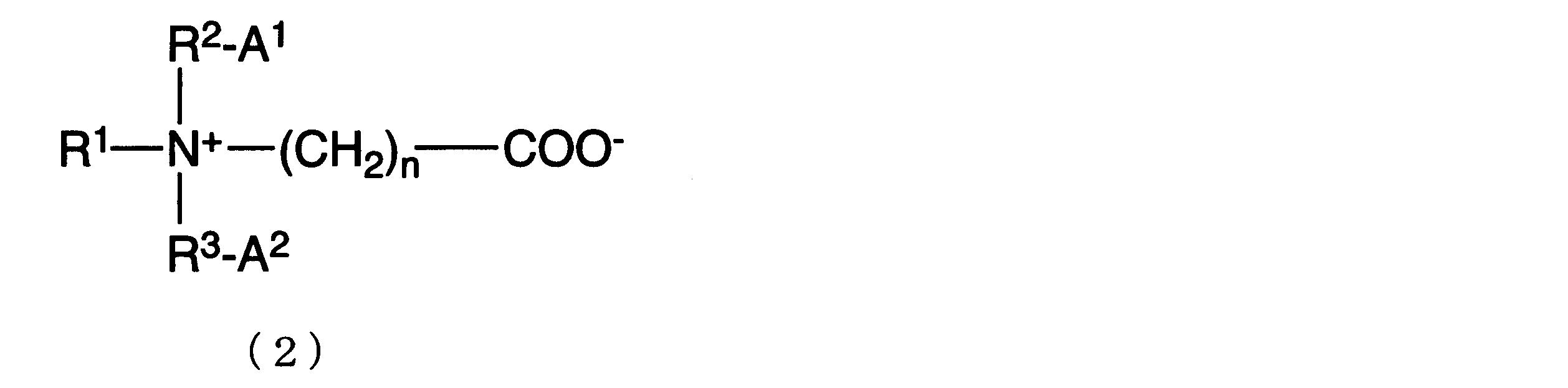
- the alkylamino fatty acid type surfactant contained in the water treatment agent composition according to this embodiment is preferably represented by the following general formula (2).
- R 1 is a hydrogen atom or an alkyl group having 1 to 20 carbon atoms, preferably 1 to 19.
- n is a number from 1 to 10, and n is preferably 1 to 3.
- R 2 and R 3 each independently represents an alkylene group having 0 to 5 carbon atoms or a hydroxyalkylene group, and from the viewpoint of storage stability, an alkylene group having 1 to 3 carbon atoms is preferred, and A 1 and A 2 are each independently —H, —COOH, —CONH 2 , —OCOH, —NHCOH, —NHCOR 4 , —OH, — [(CH 2 ) m —N ((CH 2 ) p COOH)] — (CH 2 ) q COOH
- the terminal H group is present as a salt such as sodium or potassium, etc.
- R 4 is an alkyl group having 1 to 20 carbon atoms, preferably 1 to 19 carbon atoms, m, p, q is independently a number from 1 to 20 There. Note that "R 2, R 3 is an alkylene or hydroxyalkylene group having 0 carbon atoms" in the formula (2), there is no R 2, R 3, A 1 to N, A 2 Indicates a direct bond.)
- the alkylbetaine surfactant contained in the water treatment composition according to the present embodiment is preferably represented by the following general formula (3).
- R 1 is an alkyl group having 8 to 16, preferably 10 to 16, and more preferably 10 to 14 carbon atoms.
- R 2 and R 5 are each independently 1 to 5 carbon atoms, Preferably, it is an alkylene group or a hydroxyalkylene group having 1 to 3.
- R 3 and R 4 are each independently an alkyl group or a hydroxyalkyl group having 1 to 3 carbon atoms, and from the viewpoint of storage stability, the number of carbon atoms Preferred is an alkyl group of 1 to 3.
- A is a group selected from —COO—, —CONH—, —OCO—, —NHCO—, —O—, and n is preferably a number of 0 or 1.
- X is -COO - or -SO 3 - and is).
- R 1 is an alkyl group having 10 to 14 carbon atoms
- R 3 and R 4 are methyl groups
- n 0.
- Betaine acetate is preferable
- R 1 is an alkyl group having 12 carbon atoms
- R 3 and R 4 are methyl groups
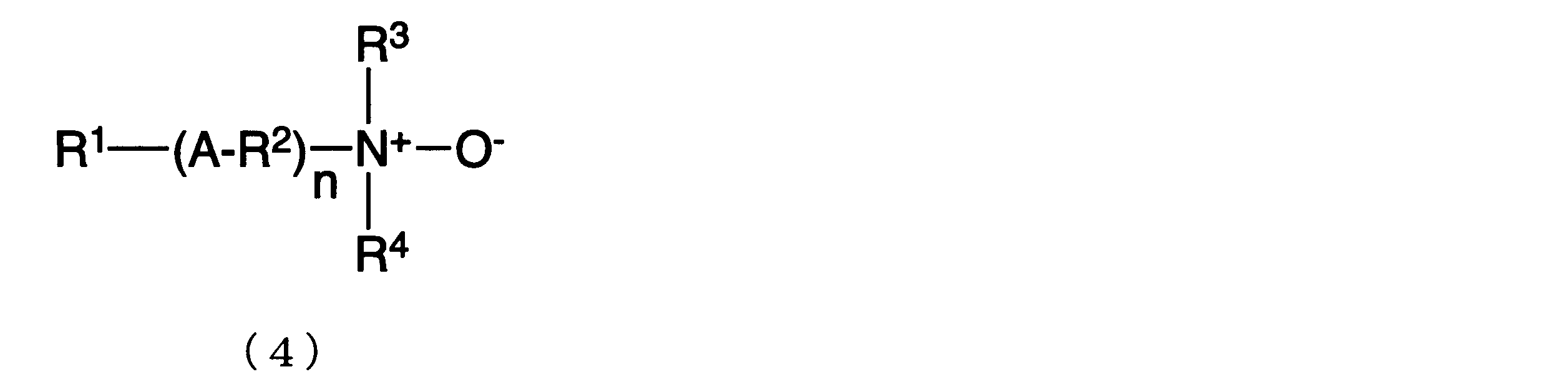
- the alkylamine oxide surfactant contained in the water treatment composition according to this embodiment is preferably represented by the following general formula (4).
- R 1 is an alkyl group having 8 to 16, preferably 10 to 16, and more preferably 10 to 14 carbon atoms.
- R 2 is 1 to 5, preferably 2 or 3 carbon atoms.
- R 3 and R 4 each independently represents an alkyl group having 1 to 3 carbon atoms or a hydroxyalkyl group, and an alkyl group having 1 to 3 carbon atoms is preferable from the viewpoint of storage stability.
- anionic surfactant contained in the water treatment composition according to this embodiment examples include fatty acid type surfactants such as lauric acid and palmitic acid, alkyl ether carboxylic acids, alkyl sulfates, alkyl sulfate esters, and acyl lactic acids.
- N-acyl amino acid salt alkane sulfonate, ⁇ -olefin sulfonate, ⁇ -sulfo fatty acid methyl ester salt, alkyl diphenyl ether disulfonate, linear alkyl naphthalene sulfonate, alkyl ether sulfate ester salt, polyoxy Examples include ethylene alkyl sulfate salts, polyoxyethylene alkyl allyl sulfate salts, polyoxyethylene alkyl phenyl ether sulfonate salts, alkyl phosphate ester salts, and alkyl sulfosuccinate salts.
- anionic surfactants having an alkyl ether structure are preferred compared to alkyl sulfates, alkylbenzene sulfonates, etc., especially containing polyoxyethylene chains such as polyoxyethylene alkyl ether sulfates An anionic surfactant is preferred.
- Nonionic surfactants include polyoxyethylene alkylphenyl ether type surfactants such as polyoxyethylene alkyl ether and polyoxyethylene nonylphenyl ether, polyoxyethylene alkyl allyl ether, polyoxyethylene fatty acid ester, polyoxyethylene polyoxyethylene Oxypropylene alkyl ether, polyoxyethylene sorbitan fatty acid ester, alkyl glucoside, polyoxyethylene fatty acid ester, polyoxyethylene castor oil, polyhydric alcohol fatty acid ester type surfactants such as sucrose fatty acid ester and sorbitan fatty acid ester, and polyhydric alcohol Alkyl ether type surfactant, fatty acid alkanolamide, ethylene oxide / propylene oxide adduct of lower / higher alcohol, sucrose fat Salts esters, alkanolamides and the like.
- polyoxyethylene alkylphenyl ether type surfactants such as polyoxyethylene alkyl ether and polyoxyethylene nonylphenyl ether
- a nonionic surfactant having an alkyl ether structure is preferable, and a nonionic surfactant containing a polyoxyethylene chain such as polyoxyethylene alkylphenyl ether is particularly preferable.
- the N-vinylpyrrolidone monomer-containing polymer contained in the water treatment agent composition according to the present embodiment may be a polymer containing N-vinyl-2-pyrrolidone as a monomer constituting the polymer.
- the N-vinylpyrrolidone monomer-containing polymer include copolymer polymers containing N-vinylpyrrolidone monomer in addition to polyvinylpyrrolidone.
- Polymerizable monomers copolymerizable with N-vinylpyrrolidone include methyl (meth) acrylate, ethyl (meth) acrylate, butyl (meth) acrylate, cyclohexyl (meth) acrylate, and hydroxy (meth) acrylate.
- (Meth) acrylic acid esters such as ethyl, (meth) acrylamide derivatives such as (meth) acrylamide, N-monomethyl (meth) acrylamide, N-monoethyl (meth) acrylamide, N, N-dimethyl (meth) acrylamide, Basic unsaturated monomers such as dimethylaminoethyl (meth) acrylate, dimethylaminoethyl (meth) acrylamide, vinylpyridine, and vinylimidazole, and salts or quaternized compounds thereof, imino ethers such as vinyloxazoline and isopropenyloxazoline , (Meth) acrylic acid, Carboxyl group-containing unsaturated monomers such as taconic acid, maleic acid and fumaric acid and their salts, 2-hydroxyethyl (meth) acrylate, 2-hydroxypropyl (meth) acrylate, 3-hydroxypropyl (meth) acrylate, 2 -Hydroxybut
- the water treatment agent composition according to the present embodiment it is preferable to add a scale dispersant in addition to the above-described components as necessary.
- the scale dispersant is used to suppress the generation of scale by chelating calcium ions, magnesium ions, etc. involved in scale generation to increase the solubility of the ions in water. Thereby, accumulation of sludge in the cooling tower or the like is suppressed, and corrosion due to accumulated sludge or the like can be suppressed.
- the scale dispersant examples include polyacrylic acid and salts thereof, polymaleic acid and salts thereof, acrylamide polymers and acrylic polymers, monomer units of (meth) acrylic acid and / or salts thereof, ( A water-soluble copolymer comprising a monomer unit of (meth) acrylamide-alkyl- and / or aryl-sulfonic acid and / or a salt thereof, and a monomer unit of substituted (meth) acrylamide; and polyacrylic acid, acrylic acid and the like Copolymers of acrylamide, phosphinic acid compounds such as phosphinic acid and bis (poly-2-carboxyethyl) phosphinic acid, phosphinocarboxylic acid, aminotrimethylenephosphonic acid, diethylenetriaminepentamethylenephosphonic acid, 2-phosphonobutane-1,2 , 4-1.2-tricarboxylic acid, 1-hydroxyethylide 1,1-diphosphonic acid, phosphonate and polymer
- the content of bromate ions in the water treatment agent composition according to this embodiment is preferably 10 mg / kg or less, and more preferably 5 mg / kg or less. If the bromate ion content exceeds 10 mg / kg, decomposition of the azole compound may be accelerated.
- the proportion of free halogen in the water treatment agent composition according to this embodiment is preferably 10% or more, more preferably 70% or more, and further preferably 90% or more. If the proportion of free halogen is less than 10%, the bactericidal effect may be lowered.
- a surfactant at least one selected from amphoteric surfactants, anionic surfactants, and nonionic surfactants
- an N-vinylpyrrolidone monomer are contained.
- at least one of the polymers is contained in an amount of 0.01% by weight or more and 30% by weight or less, more preferably more than 0.01% by weight and 30% by weight or less based on the total weight of the composition. More preferably, it is contained in an amount of not less than 10% by weight and not more than 10% by weight, particularly preferably not less than 0.05% by weight and not more than 5% by weight.
- the azole compound decomposes to produce a precipitate. If it exceeds 30% by weight, the production cost may increase.
- the water treatment agent composition according to this embodiment is, for example, selected from surfactants (amphoteric surfactants, anionic surfactants, and nonionic surfactants) after mixing alkali with water as necessary. At least one) and an N-vinylpyrrolidone monomer-containing polymer, and then an azole compound, and a bromine-based oxidant and a sulfamic acid compound, or a bromine compound It can be obtained by mixing a reaction product with a chlorine-based oxidant and a sulfamic acid compound.
- surfactants amphoteric surfactants, anionic surfactants, and nonionic surfactants
- a water treatment composition containing at least one of polymers, water, alkali as required, surfactant (from amphoteric surfactant, anionic surfactant, and nonionic surfactant) At least one selected from N-vinylpyrrolidone monomer-containing polymer, a mixture containing azole compound and sulfamic acid compound, and adding bromine under an inert gas atmosphere to react, or , Water, alkali as necessary, surfactant (amphoteric surfactant, anionic surfactant, and noni surfactant) At least one selected from the group of surfactants containing N-vinylpyrrolidone monomer, and bromine is added to the mixture containing the azole compound and the sul
- the inert gas to be used is not limited, at least one of nitrogen and argon is preferable from the viewpoint of manufacturing and the like, and nitrogen is particularly preferable from the viewpoint of manufacturing cost and the like.
- the oxygen concentration in the reactor during the addition of bromine is preferably 6% or less, more preferably 4% or less, further preferably 2% or less, and particularly preferably 1% or less. If the oxygen concentration in the reactor during the bromine reaction exceeds 6%, the amount of bromic acid produced in the reaction system may increase.
- the addition ratio of bromine is preferably 25% by weight or less, more preferably 1% by weight or more and 20% by weight or less based on the total amount of the composition. If the bromine addition rate exceeds 25% by weight relative to the total amount of the composition, the amount of bromic acid produced in the reaction system may increase. If it is less than 1% by weight, the sterilizing power may be inferior.
- the reaction temperature at the time of bromine addition is preferably controlled in the range of 0 ° C. to 25 ° C., but more preferably in the range of 0 ° C. to 15 ° C. from the viewpoint of production cost.
- the reaction temperature at the time of bromine addition exceeds 25 degreeC, the production amount of the bromic acid in a reaction system may increase, and when it is less than 0 degreeC, it may freeze.
- the sulfamic acid-hypobromite composition mainly contains no bromate ions and can be handled safely.
- a one-component water treatment agent composition that is substantially free of bromate ions, is excellent in bactericidal performance, and is excellent in storage stability is obtained.
- the water treatment agent composition according to the present embodiment can be used in water treatment methods such as water treatment in industrial water systems such as cooling water, and pipe cleaning with advanced biofouling.
- the effective bromine concentration in an aqueous system to which the water treating agent composition according to this embodiment is added is preferably 0.01 to 100 mg / L (as Cl 2 ). If the amount is less than 0.01 mg / L (as Cl 2 ), a sufficient slime suppression effect may not be obtained. If the amount is more than 100 mg / L (as Cl 2 ), corrosion of pipes or the like may occur. There is.
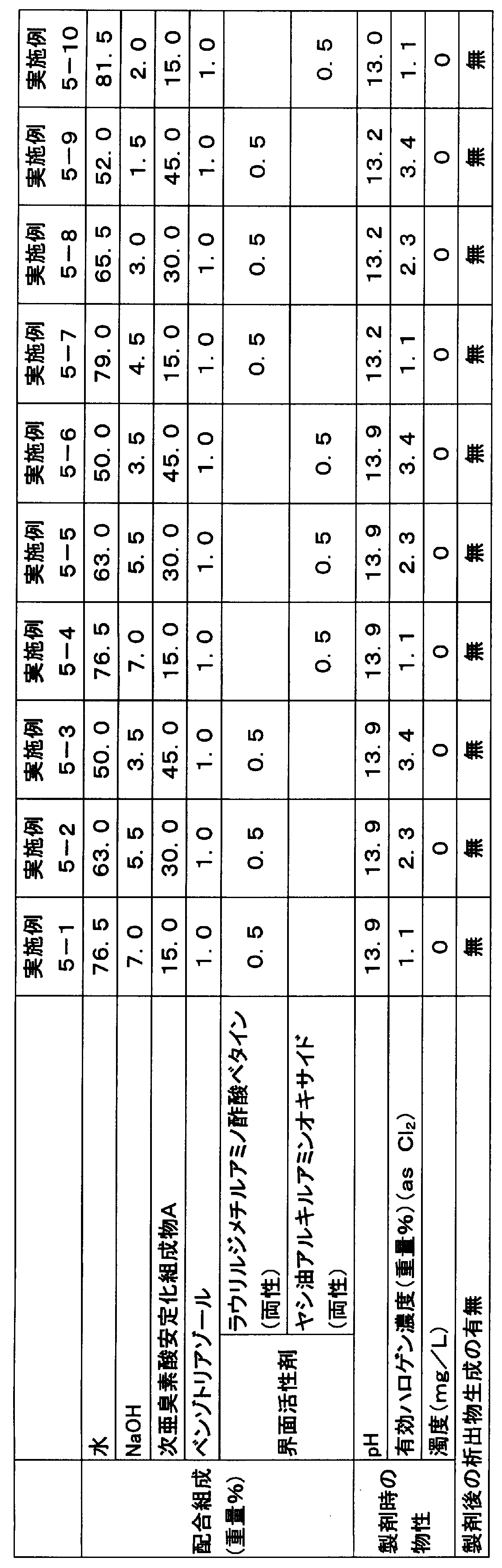
- Examples and Comparative Examples were formulated by adding them with the blending compositions (% by weight) shown in Tables 1 to 5.
- water and alkali were mixed, then the surfactant or N-vinylpyrrolidone monomer-containing polymer was mixed, then the azole compound was mixed, and further the hypobromite stabilizing composition was added.
- Formulation was performed in a PTFE (polytetrafluoroethylene) container by cooling to room temperature or lower and adding each drug while stirring with a stirrer.
- PTFE polytetrafluoroethylene
- hypobromite stabilizing compositions A, a, B, C, and D are as follows.
- hypobromite Stabilizing Composition A Under nitrogen atmosphere, liquid bromine: 16.9% by weight (wt%), sulfamic acid: 10.7% by weight, sodium hydroxide: 12.9% by weight, potassium hydroxide: 3.94% by weight, water: remaining The components were mixed to prepare a hypobromite stabilized composition A.
- the pH of the hypobromite stabilizing composition A was 14, and the bromine content (concentration) was 16.9 wt% (as Br 2 ).
- concentration of bromine in terms of total chlorine was 7.5% by weight (as Cl 2 ).
- the detailed preparation method of the hypobromite stabilization composition A is as follows.
- the pH of the resulting solution was 14 as measured by the glass electrode method.
- the bromine content of the resulting solution was 16.9% as measured by a redox titration method using sodium thiosulfate after bromine was converted to iodine with potassium iodide, and the theoretical bromine content (16.9). %) was 100.0%.
- the oxygen concentration in the reaction vessel during the bromine reaction was measured using “Oxygen Monitor JKO-02 LJDII” manufactured by Zico Corporation.
- the bromic acid concentration was less than 5 mg / kg.
- Electrode type Glass electrode type pH meter: IOL-30, manufactured by Toa DKK Corporation
- Electrode calibration Neutral phosphate pH (6.86) standard solution (type 2) manufactured by Kanto Chemical Co., boric acid manufactured by the same company Salt temperature (9.18) Standard solution (type 2) was measured by two-point calibration
- Measurement value Immerse the electrode in the measurement solution and use the value after stabilization as the measurement value.
- the effective halogen concentration is a value measured by an effective total chlorine measurement method (DPD (diethyl-p-phenylenediamine) method) using a multi-item water quality analyzer DR / 4000 manufactured by HACH, diluted 20,000 times. mg / L asCl 2 ).
- the effective halogen referred to here is a value measured by an effective total chlorine measuring method (DPD method).
- an effective bromine concentration (mg / L asCl 2 ) which is an effective halogen concentration in terms of chlorine, can be calculated from the effective chlorine concentration, and 2.25 (159.159) is obtained as a value measured by the effective total chlorine measurement method (DPD method).
- Turbidity was measured by a photometric method using a multi-item water quality analyzer DR / 2800 manufactured by HACH.
- the target hypobromite stabilization composition a was obtained by the same composition ratio and production method as the hypobromite stabilization composition A, except that the reaction was performed in the air without flowing nitrogen gas.
- the pH of the hypobromite stabilizing composition a was 14, and the bromine content was 16.9% by weight.
- [Hypobromite stabilization composition B] A composition prepared according to the following procedure based on the contents described in JP-T-11-506139.
- the pH of the hypobromite stabilizing composition B was 14, and the bromine content was 9.2% by weight.
- the stabilized solution of (2) was added to the solution of (1) while stirring to obtain the desired hypobromite stabilizing composition B.
- Halpobromite stabilization composition C A composition containing bromine chloride, sulfamic acid, and sodium hydroxide. The pH of the hypobromite stabilizing composition C was 14, and the bromine content was 15.5%.
- the free halogen concentration and total halogen concentration were determined by measuring the effective chlorine measurement method (DPD (diethyl-p-) using a multi-item water quality analyzer DR / 4000 manufactured by HACH after diluting the sample 20,000 times. (Phenylenediamine) method).
- the free bromine concentration and the total bromine concentration were calculated from the molecular weights of chlorine and bromine after obtaining values as the free chlorine concentration and the total chlorine concentration.
- Hypobromite stabilization composition D Hypobromite stabilized composition D was prepared based on the content of International Patent Application Publication No. 03/093171.
- Hypobromite stabilization composition D is a composition containing liquid bromine, sulfamate, and sodium hydroxide.
- the pH of the hypobromite stabilizing composition D was 14, and the bromine content (concentration) was 16.1% by weight (as Br 2 ).
- the concentration of bromine in terms of total chlorine was 7.1% by weight (as Cl 2 ).
- the equivalent ratio of sulfamic acid to the equivalent of bromine was 1.45.
- Hypobromite stabilization composition A was blended as a hypohalite, and benzotriazole was blended as an azole compound that was a corrosion inhibitor for copper-based metals such as copper and copper alloys.
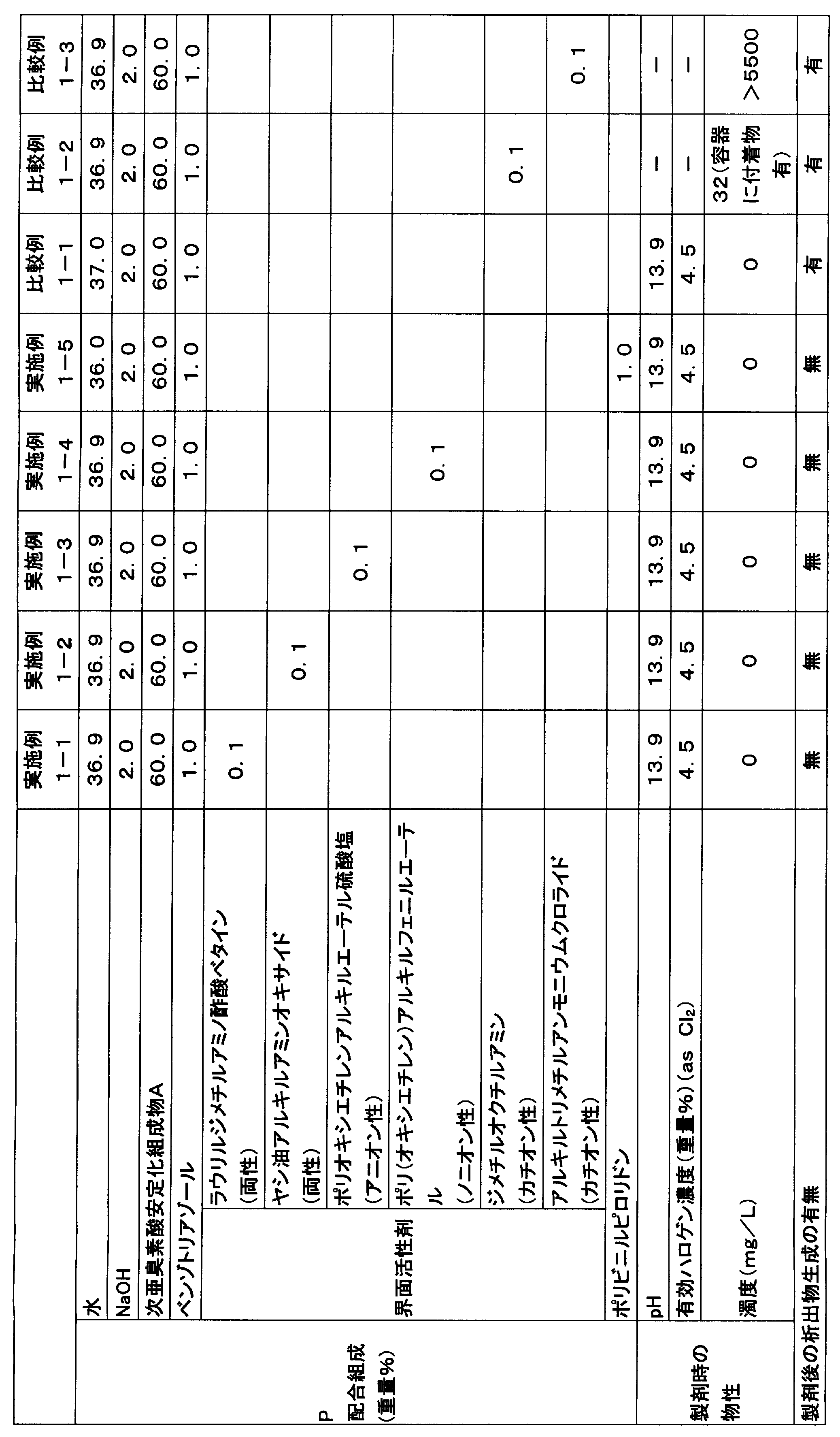
- amphoteric surfactant lauryldimethylaminoacetic acid betaine (Example 1-1), coconut oil alkylamine oxide (Example 1-2), anionic surfactant polyoxyethylene alkyl ether sulfate Salt (Example 1-3), poly (oxyethylene) alkylphenyl ether which is a nonionic surfactant (Example 1-4), polyvinylpyrrolidone (weight average molecular weight: 8) as an N-vinylpyrrolidone monomer-containing polymer , 000) (Example 1-5), dimethyloctylamine (Comparative Example 1-2), which is a cationic surfactant, and alkyltrimethylammonium chloride (Comparative Example 1-3).
- no surfactant or N-vinylpyrrolidone monomer-containing polymer was blended. After the preparation, it was stored outdoors and the presence or absence of precipitates after irradiation for 1 week in sunlight
- a hypobromite stabilizing composition A was blended, and amphoteric surfactant lauryldimethylaminoacetic acid betaine, coconut oil alkyl Water treatment when amine oxide, anionic surfactant polyoxyethylene alkyl ether sulfate, nonionic surfactant poly (oxyethylene) alkylphenyl ether, and N-vinylpyrrolidone monomer-containing polymer are blended It was possible to formulate an agent composition, and it was a liquid water treatment agent composition having excellent quality with almost no precipitates even after irradiation with sunlight.
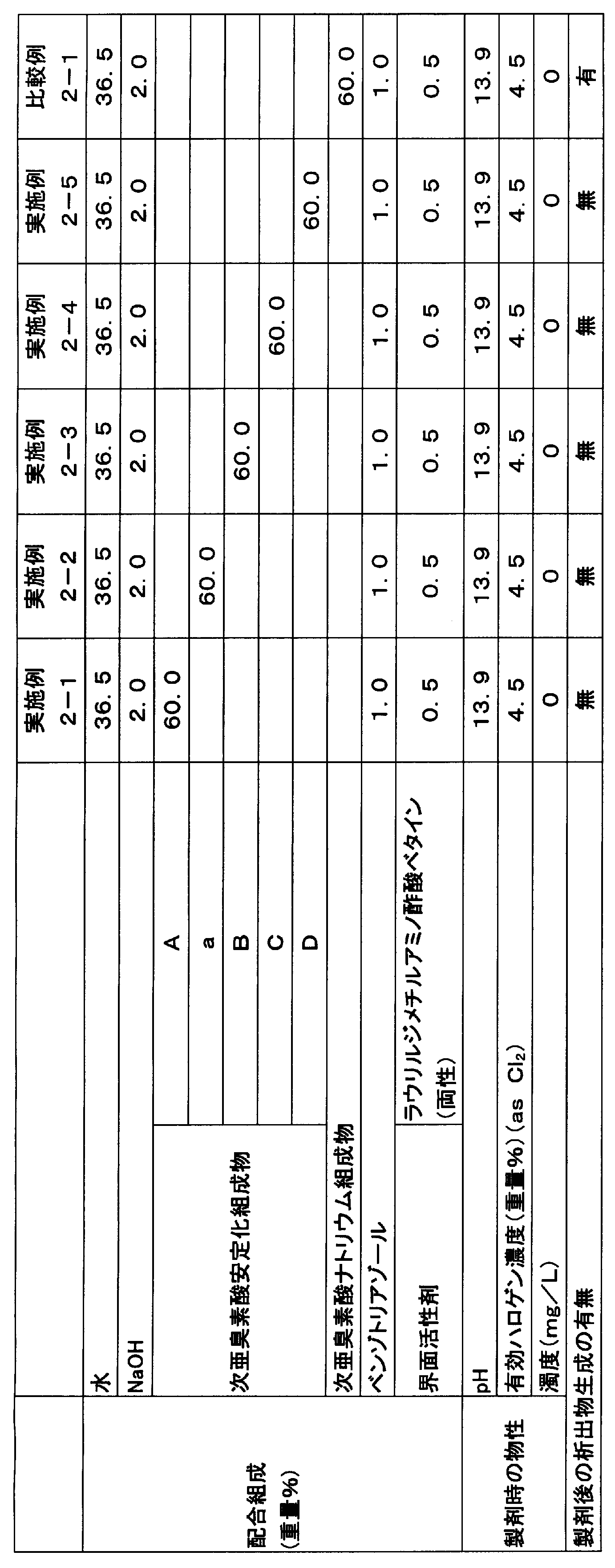
- hypobromite stabilization composition A (Example 2-1), hypobromite stabilization composition a (Example 2-2), hypobromite stabilization composition B (Example 2-3), hypobromite stabilization composition C (Example 2-4), hypobromite stabilization composition D (Example 2-5), or sodium hypobromite composition Using (Comparative Example 2-1), it was formulated as shown in Table 2. After the formulation, it was stored outdoors, and the presence or absence of precipitates after irradiation with sunlight for 1 week was visually confirmed.
- Hypobromite stabilizing composition A was blended as a hypohalite, and as shown in Table 3, it was formulated by changing the amount of amphoteric surfactant lauryldimethylaminoacetic acid betaine or coconut oil alkylamine oxide, After the preparation, it was stored outdoors and the presence or absence of precipitates after irradiation for 1 week in sunlight was confirmed visually.
- Hypobromite stabilizing composition A was blended as a hypohalite, and as shown in Table 4, in Examples 4-1 and 4-2, tolyltriazole was blended as an azole compound to prepare a formulation. The presence or absence of precipitates after storage and irradiation with sunlight for one week was confirmed visually.
- hypobromite stabilization composition A was formulated and formulated in the amounts shown in Table 5. After formulation, stored outdoors and confirmed for precipitates after 1 week exposure to sunlight. did.
Landscapes
- Life Sciences & Earth Sciences (AREA)
- General Health & Medical Sciences (AREA)
- Engineering & Computer Science (AREA)
- Health & Medical Sciences (AREA)
- Plant Pathology (AREA)
- Dentistry (AREA)
- Environmental Sciences (AREA)
- Agronomy & Crop Science (AREA)
- Zoology (AREA)
- Pest Control & Pesticides (AREA)
- Wood Science & Technology (AREA)
- Chemical & Material Sciences (AREA)
- Hydrology & Water Resources (AREA)
- Environmental & Geological Engineering (AREA)
- Water Supply & Treatment (AREA)
- Organic Chemistry (AREA)
- Toxicology (AREA)
- Inorganic Chemistry (AREA)
- Agricultural Chemicals And Associated Chemicals (AREA)
- Treatment Of Water By Oxidation Or Reduction (AREA)
- Removal Of Specific Substances (AREA)
Abstract
Description
本発明者らが鋭意検討した結果、「臭素系酸化剤」と「スルファミン酸化合物」とから形成される次亜臭素酸の安定化組成物(次亜臭素酸安定化組成物)と、「アゾール化合物」と、「両性界面活性剤、アニオン性界面活性剤、およびノニオン性界面活性剤から選択される少なくとも1つの界面活性剤」および「N-ビニルピロリドン単量体含有ポリマー」のうち少なくとも1つとを配合することで、日光等の光が照射される屋外保管等の条件下でも析出物の生成が低減される、より品質が優れた安定な液体の水処理剤組成物を提供することが可能となることを見出した。
R2NSO3H(1)
(式中、Rは独立して水素原子または炭素数1~8のアルキル基である。)

本実施形態に係る水処理剤組成物は、例えば、水に必要に応じてアルカリを混合した後、界面活性剤(両性界面活性剤、アニオン性界面活性剤、およびノニオン性界面活性剤から選択される少なくとも1つ)およびN-ビニルピロリドン単量体含有ポリマーのうち少なくとも1つを混合し、次にアゾール化合物を混合し、さらに、臭素系酸化剤とスルファミン酸化合物を混合する、または臭素化合物と塩素系酸化剤との反応物と、スルファミン酸化合物とを混合することにより得られる。
本実施形態に係る水処理剤組成物は、冷却水等の工業用水システムの水処理や、生物付着汚染の進んだ配管洗浄等の水処理方法に用いることができる。
窒素雰囲気下で、液体臭素:16.9重量%(wt%)、スルファミン酸:10.7重量%、水酸化ナトリウム:12.9重量%、水酸化カリウム:3.94重量%、水:残分を混合して、次亜臭素酸安定化組成物Aを調製した。次亜臭素酸安定化組成物AのpHは14、臭素含有率(濃度)は16.9重量%(as Br2)であった。なお、臭素の全塩素換算の濃度は7.5重量%(as Cl2)であった。次亜臭素酸安定化組成物Aの詳細な調製方法は以下の通りである。
電極タイプ:ガラス電極式
pH測定計:東亜ディーケーケー社製、IOL-30型
電極の校正:関東化学社製中性リン酸塩pH(6.86)標準液(第2種)、同社製ホウ酸塩pH(9.18)標準液(第2種)の2点校正で行った
測定温度:25℃
測定値:測定液に電極を浸漬し、安定後の値を測定値とし、3回測定の平均値
窒素ガスを流さずに大気下で反応させること以外は次亜臭素酸安定化組成物Aと同様の組成比、製造方法で、目的の次亜臭素酸安定化組成物aを得た。次亜臭素酸安定化組成物aのpHは14、臭素含有率は16.9重量%であった。
特表平11-506139号公報の記載内容に基づき、下記手順で作製した組成物である。次亜臭素酸安定化組成物BのpHは14、臭素含有率は9.2重量%であった。
(1)60.0グラムの40重量%臭化ナトリウム純水溶液に、12%次亜塩素酸ナトリウム溶液を50.0グラム加え、撹拌した。
(2)20.6グラムの純水、9.6グラムのスルファミン酸、6.6gの水酸化ナトリウムから組成された安定化溶液を作製した。
(3)(1)の溶液に、(2)の安定化溶液を撹拌させながら加え、目的の次亜臭素酸安定化組成物Bを得た。
塩化臭素、スルファミン酸、水酸化ナトリウムを含有する組成物である。次亜臭素酸安定化組成物CのpHは14、臭素含有率は15.5%であった。
国際特許出願公開第03/093171号の記載内容に基づき次亜臭素酸安定化組成物Dを調製した。次亜臭素酸安定化組成物Dは、液体臭素、スルファミン酸塩、水酸化ナトリウムを含有する組成物である。次亜臭素酸安定化組成物DのpHは14、臭素含有率(濃度)は16.1重量%(as Br2)であった。なお、臭素の全塩素換算の濃度は7.1重量%(as Cl2)であった。臭素の当量に対するスルファミン酸の当量比は1.45であった。
純水:24.6重量%(wt%)、水酸化ナトリウム:2.0重量%、次亜塩素酸ナトリウム:62.5重量%(wt%)、臭化ナトリウム:10.9重量%の順で混合し、次亜臭素酸ナトリウム組成物を調製した。臭素含有率(濃度)は17重量%(as Br2)であった。なお、臭素の全塩素換算の濃度は7.5重量%(as Cl2)であった。
次亜ハロゲン酸塩として、次亜臭素酸安定化組成物Aを配合し、銅や銅合金等の銅系金属用の防食剤等であるアゾール化合物として、ベンゾトリアゾールを配合した。界面活性剤として、両性界面活性剤であるラウリルジメチルアミノ酢酸ベタイン(実施例1-1)、ヤシ油アルキルアミンオキサイド(実施例1-2)、アニオン性界面活性剤であるポリオキシエチレンアルキルエーテル硫酸塩(実施例1-3)、ノニオン性界面活性剤であるポリ(オキシエチレン)アルキルフェニルエーテル(実施例1-4)、N-ビニルピロリドン単量体含有ポリマーとしてポリビニルピロリドン(重量平均分子量:8,000)(実施例1-5)、カチオン性界面活性剤であるジメチルオクチルアミン(比較例1-2)、アルキルトリメチルアンモニウムクロライド(比較例1-3)を配合した。比較例1-1では、界面活性剤またはN-ビニルピロリドン単量体含有ポリマーを配合しなかった。製剤後、屋外保管して日光に1週間照射後の析出物の有無を目視で確認した。
次亜ハロゲン酸塩として、次亜臭素酸安定化組成物A(実施例2-1)、次亜臭素酸安定化組成物a(実施例2-2)、次亜臭素酸安定化組成物B(実施例2-3)、次亜臭素酸安定化組成物C(実施例2-4)、次亜臭素酸安定化組成物D(実施例2-5)、または次亜臭素酸ナトリウム組成物(比較例2-1)を用いて、表2に記載の通りに製剤化し、製剤後、屋外保管して日光に1週間照射後の析出物の有無を目視で確認した。
次亜ハロゲン酸塩として、次亜臭素酸安定化組成物Aを配合し、表3の通り、両性界面活性剤であるラウリルジメチルアミノ酢酸ベタインまたはヤシ油アルキルアミンオキサイドの量を変えて製剤化し、製剤後、屋外保管して日光に1週間照射後の析出物の有無を目視で確認した。

次亜ハロゲン酸塩として、次亜臭素酸安定化組成物Aを配合し、表4の通り実施例4-1,4-2ではアゾール化合物としてトリルトリアゾールを配合して製剤化し、製剤後、屋外保管して日光に1週間照射後の析出物の有無を目視で確認した。

次亜ハロゲン酸塩として、次亜臭素酸安定化組成物Aを配合し、表5の通りの量で製剤化し、製剤後、屋外保管して日光に1週間照射後の析出物の有無を確認した。
Claims (7)
- 臭素系酸化剤と、
スルファミン酸化合物と、
アゾール化合物と、
界面活性剤およびN-ビニルピロリドン単量体含有ポリマーのうち少なくとも1つと、
を含み、
前記界面活性剤が、両性界面活性剤、アニオン性界面活性剤、およびノニオン性界面活性剤から選択される少なくとも1つであることを特徴とする水処理剤組成物。 - 請求項1に記載の水処理剤組成物であって、
前記界面活性剤が、アルキルアミノ脂肪酸型界面活性剤、アルキルベタイン型界面活性剤、およびアルキルアミンオキサイド型界面活性剤から選択される少なくとも1つの両性界面活性剤であることを特徴とする水処理剤組成物。 - 請求項1に記載の水処理剤組成物であって、
前記界面活性剤が、アルキルエーテル構造を有するアニオン性界面活性剤またはノニオン性界面活性剤であることを特徴とする水処理剤組成物。 - 請求項1~3のいずれか1項に記載の水処理剤組成物であって、
前記臭素系酸化剤が臭素であることを特徴とする水処理剤組成物。 - 請求項1~4のいずれか1項に記載の水処理剤組成物であって、
前記水処理剤組成物における前記界面活性剤およびN-ビニルピロリドン単量体含有ポリマーのうち少なくとも1つの配合量が、前記水処理剤組成物の総重量に対して0.01重量%以上30重量%以下であることを特徴とする水処理剤組成物。 - 請求項1~5のいずれか1項に記載の水処理剤組成物であって、
前記水処理剤組成物のpHが、13.0以上であることを特徴とする水処理剤組成物。 - 請求項1~6のいずれか1項に記載の水処理剤組成物を用いて水を処理することを特徴とする水処理方法。
Priority Applications (3)
| Application Number | Priority Date | Filing Date | Title |
|---|---|---|---|
| KR1020187031116A KR102197921B1 (ko) | 2016-04-26 | 2017-02-16 | 수처리제 조성물 및 수처리 방법 |
| JP2018514140A JP6666433B2 (ja) | 2016-04-26 | 2017-02-16 | 水処理剤組成物および水処理方法 |
| CN201780024095.2A CN109071283B (zh) | 2016-04-26 | 2017-02-16 | 水处理剂组合物及水处理方法 |
Applications Claiming Priority (2)
| Application Number | Priority Date | Filing Date | Title |
|---|---|---|---|
| JP2016-088072 | 2016-04-26 | ||
| JP2016088072 | 2016-04-26 |
Publications (1)
| Publication Number | Publication Date |
|---|---|
| WO2017187725A1 true WO2017187725A1 (ja) | 2017-11-02 |
Family
ID=60161400
Family Applications (1)
| Application Number | Title | Priority Date | Filing Date |
|---|---|---|---|
| PCT/JP2017/005738 Ceased WO2017187725A1 (ja) | 2016-04-26 | 2017-02-16 | 水処理剤組成物および水処理方法 |
Country Status (5)
| Country | Link |
|---|---|
| JP (1) | JP6666433B2 (ja) |
| KR (1) | KR102197921B1 (ja) |
| CN (1) | CN109071283B (ja) |
| TW (1) | TWI772292B (ja) |
| WO (1) | WO2017187725A1 (ja) |
Cited By (1)
| Publication number | Priority date | Publication date | Assignee | Title |
|---|---|---|---|---|
| JP2019100781A (ja) * | 2017-11-30 | 2019-06-24 | オルガノ株式会社 | 次亜臭素酸またはその塩および安定化次亜臭素酸組成物の濃度測定方法 |
Families Citing this family (2)
| Publication number | Priority date | Publication date | Assignee | Title |
|---|---|---|---|---|
| CN110980897A (zh) * | 2019-12-24 | 2020-04-10 | 广州市粤新工程技术有限公司 | 环保型冷却系统杀菌灭藻剂 |
| CN118139823A (zh) * | 2021-08-09 | 2024-06-04 | 量子技术研究与生产协会有限责任公司 | 废水净化剂及其生产方法 |
Citations (6)
| Publication number | Priority date | Publication date | Assignee | Title |
|---|---|---|---|---|
| JP2002363016A (ja) * | 2001-05-31 | 2002-12-18 | Hakuto Co Ltd | 微生物コントロール剤 |
| JP2005505408A (ja) * | 2001-10-09 | 2005-02-24 | アルベマール・コーポレーシヨン | 産業用水システム中のバイオフィルムの抑制 |
| JP2015044765A (ja) * | 2013-08-28 | 2015-03-12 | オルガノ株式会社 | 水処理剤組成物、水処理剤組成物の製造方法および水処理方法 |
| JP2015044764A (ja) * | 2013-08-28 | 2015-03-12 | オルガノ株式会社 | 水処理剤組成物、水処理剤組成物の製造方法および水処理方法 |
| JP2015221766A (ja) * | 2014-05-23 | 2015-12-10 | 東西化学産業株式会社 | スライム防止用組成物 |
| JP2016084375A (ja) * | 2014-10-23 | 2016-05-19 | オルガノ株式会社 | 洗浄剤組成物 |
Family Cites Families (6)
| Publication number | Priority date | Publication date | Assignee | Title |
|---|---|---|---|---|
| EP1833085A1 (en) * | 1998-12-28 | 2007-09-12 | Hitachi Chemical Company, Ltd. | Materials for polishing liquid for metal, polishing liquid for metal, method for preparation thereof and polishing method using the same |
| WO2001041571A1 (en) * | 1999-12-10 | 2001-06-14 | Kao Corporation | Microbicide compositions |
| UA108641C2 (uk) * | 2010-04-02 | 2015-05-25 | Паразитицидна композиція, яка містить чотири активних агенти, та спосіб її застосування | |
| PL3172964T3 (pl) * | 2011-09-12 | 2021-03-08 | Boehringer Ingelheim Animal Health USA Inc. | Kompozycje przeciwpasożytniczne zawierające izoksazolinową substancję czynną, sposób i ich zastosowania |
| CN104023720B (zh) * | 2011-11-17 | 2016-10-26 | 梅里亚有限公司 | 包含芳基吡唑和取代咪唑的组合物,其方法和用途 |
| JP5980700B2 (ja) * | 2012-03-19 | 2016-08-31 | 株式会社ポーラファルマ | 抗真菌医薬組成物が充填された樹脂容器 |
-
2017
- 2017-02-16 CN CN201780024095.2A patent/CN109071283B/zh active Active
- 2017-02-16 WO PCT/JP2017/005738 patent/WO2017187725A1/ja not_active Ceased
- 2017-02-16 JP JP2018514140A patent/JP6666433B2/ja active Active
- 2017-02-16 KR KR1020187031116A patent/KR102197921B1/ko active Active
- 2017-04-10 TW TW106111829A patent/TWI772292B/zh active
Patent Citations (6)
| Publication number | Priority date | Publication date | Assignee | Title |
|---|---|---|---|---|
| JP2002363016A (ja) * | 2001-05-31 | 2002-12-18 | Hakuto Co Ltd | 微生物コントロール剤 |
| JP2005505408A (ja) * | 2001-10-09 | 2005-02-24 | アルベマール・コーポレーシヨン | 産業用水システム中のバイオフィルムの抑制 |
| JP2015044765A (ja) * | 2013-08-28 | 2015-03-12 | オルガノ株式会社 | 水処理剤組成物、水処理剤組成物の製造方法および水処理方法 |
| JP2015044764A (ja) * | 2013-08-28 | 2015-03-12 | オルガノ株式会社 | 水処理剤組成物、水処理剤組成物の製造方法および水処理方法 |
| JP2015221766A (ja) * | 2014-05-23 | 2015-12-10 | 東西化学産業株式会社 | スライム防止用組成物 |
| JP2016084375A (ja) * | 2014-10-23 | 2016-05-19 | オルガノ株式会社 | 洗浄剤組成物 |
Cited By (2)
| Publication number | Priority date | Publication date | Assignee | Title |
|---|---|---|---|---|
| JP2019100781A (ja) * | 2017-11-30 | 2019-06-24 | オルガノ株式会社 | 次亜臭素酸またはその塩および安定化次亜臭素酸組成物の濃度測定方法 |
| JP6996955B2 (ja) | 2017-11-30 | 2022-01-17 | オルガノ株式会社 | 安定化次亜臭素酸組成物の濃度測定方法 |
Also Published As
| Publication number | Publication date |
|---|---|
| JP6666433B2 (ja) | 2020-03-13 |
| CN109071283A (zh) | 2018-12-21 |
| JPWO2017187725A1 (ja) | 2018-12-27 |
| CN109071283B (zh) | 2022-03-04 |
| KR102197921B1 (ko) | 2021-01-04 |
| KR20180122728A (ko) | 2018-11-13 |
| TWI772292B (zh) | 2022-08-01 |
| TW201806878A (zh) | 2018-03-01 |
Similar Documents
| Publication | Publication Date | Title |
|---|---|---|
| JP6200243B2 (ja) | 水処理剤組成物の製造方法および水処理方法 | |
| JP6649697B2 (ja) | 水の殺菌方法 | |
| KR102132462B1 (ko) | 역침투막을 이용한 수처리 시스템 및 수처리 방법 | |
| JP6412639B2 (ja) | アンモニア性窒素含有排水の処理方法およびアンモニア性窒素分解剤 | |
| JP6666433B2 (ja) | 水処理剤組成物および水処理方法 | |
| JP6145360B2 (ja) | 水処理剤組成物、水処理剤組成物の製造方法および水処理方法 | |
| JP3685800B1 (ja) | 水系における次亜臭素酸の生成方法 | |
| TWI703094B (zh) | 利用逆滲透膜之水處理方法 | |
| CN107249332B (zh) | 水处理剂组合物、水处理剂组合物的制造方法和水处理方法 | |
| JP6837301B2 (ja) | 逆浸透膜処理方法および逆浸透膜処理システム | |
| JP2016155071A (ja) | 分離膜の殺菌方法 | |
| JP6506987B2 (ja) | 逆浸透膜の改質方法、およびホウ素含有水の処理方法 | |
| JP2017214406A (ja) | 水処理剤組成物、水処理剤組成物の製造方法および水処理方法 | |
| KR102238510B1 (ko) | 수처리제 조성물, 수처리 방법 및 수처리제 조성물의 보관 또는 사용 방법 | |
| JP2020131134A (ja) | 分離膜用スライム抑制剤、分離膜用スライム抑制剤の製造方法、および分離膜のスライム抑制方法 | |
| JP6548870B2 (ja) | 製紙工程水のスライム抑制方法 | |
| JP2019108310A (ja) | 殺菌殺藻剤組成物及び殺菌殺藻方法、並びに水処理剤組成物及び水処理方法 | |
| JP2016120487A (ja) | 水の殺菌方法 | |
| JP2015108170A (ja) | 腐食低減方法及び腐食低減剤 |
Legal Events
| Date | Code | Title | Description |
|---|---|---|---|
| WWE | Wipo information: entry into national phase |
Ref document number: 2018514140 Country of ref document: JP |
|
| ENP | Entry into the national phase |
Ref document number: 20187031116 Country of ref document: KR Kind code of ref document: A |
|
| NENP | Non-entry into the national phase |
Ref country code: DE |
|
| 121 | Ep: the epo has been informed by wipo that ep was designated in this application |
Ref document number: 17789014 Country of ref document: EP Kind code of ref document: A1 |
|
| 122 | Ep: pct application non-entry in european phase |
Ref document number: 17789014 Country of ref document: EP Kind code of ref document: A1 |