WO2017146456A1 - 결정성 고분자 및 이의 제조방법 - Google Patents
결정성 고분자 및 이의 제조방법 Download PDFInfo
- Publication number
- WO2017146456A1 WO2017146456A1 PCT/KR2017/001935 KR2017001935W WO2017146456A1 WO 2017146456 A1 WO2017146456 A1 WO 2017146456A1 KR 2017001935 W KR2017001935 W KR 2017001935W WO 2017146456 A1 WO2017146456 A1 WO 2017146456A1
- Authority
- WO
- WIPO (PCT)
- Prior art keywords
- formula
- polymer
- crystalline polymer
- monomer
- monomers
- Prior art date
- Legal status (The legal status is an assumption and is not a legal conclusion. Google has not performed a legal analysis and makes no representation as to the accuracy of the status listed.)
- Ceased
Links
- 0 CC1(C)/C=C/C*C[N+]*1 Chemical compound CC1(C)/C=C/C*C[N+]*1 0.000 description 2
- YBSBVLBINUEPCL-UHFFFAOYSA-N CC(CC=C1)C=C1N Chemical compound CC(CC=C1)C=C1N YBSBVLBINUEPCL-UHFFFAOYSA-N 0.000 description 1
- AFBPFSWMIHJQDM-UHFFFAOYSA-N CNc1ccccc1 Chemical compound CNc1ccccc1 AFBPFSWMIHJQDM-UHFFFAOYSA-N 0.000 description 1
Images







Classifications
-
- C—CHEMISTRY; METALLURGY
- C08—ORGANIC MACROMOLECULAR COMPOUNDS; THEIR PREPARATION OR CHEMICAL WORKING-UP; COMPOSITIONS BASED THEREON
- C08G—MACROMOLECULAR COMPOUNDS OBTAINED OTHERWISE THAN BY REACTIONS ONLY INVOLVING UNSATURATED CARBON-TO-CARBON BONDS
- C08G61/00—Macromolecular compounds obtained by reactions forming a carbon-to-carbon link in the main chain of the macromolecule
-
- C—CHEMISTRY; METALLURGY
- C08—ORGANIC MACROMOLECULAR COMPOUNDS; THEIR PREPARATION OR CHEMICAL WORKING-UP; COMPOSITIONS BASED THEREON
- C08G—MACROMOLECULAR COMPOUNDS OBTAINED OTHERWISE THAN BY REACTIONS ONLY INVOLVING UNSATURATED CARBON-TO-CARBON BONDS
- C08G61/00—Macromolecular compounds obtained by reactions forming a carbon-to-carbon link in the main chain of the macromolecule
- C08G61/02—Macromolecular compounds containing only carbon atoms in the main chain of the macromolecule, e.g. polyxylylenes
-
- C—CHEMISTRY; METALLURGY
- C08—ORGANIC MACROMOLECULAR COMPOUNDS; THEIR PREPARATION OR CHEMICAL WORKING-UP; COMPOSITIONS BASED THEREON
- C08G—MACROMOLECULAR COMPOUNDS OBTAINED OTHERWISE THAN BY REACTIONS ONLY INVOLVING UNSATURATED CARBON-TO-CARBON BONDS
- C08G61/00—Macromolecular compounds obtained by reactions forming a carbon-to-carbon link in the main chain of the macromolecule
- C08G61/12—Macromolecular compounds containing atoms other than carbon in the main chain of the macromolecule
- C08G61/122—Macromolecular compounds containing atoms other than carbon in the main chain of the macromolecule derived from five- or six-membered heterocyclic compounds, other than imides
- C08G61/123—Macromolecular compounds containing atoms other than carbon in the main chain of the macromolecule derived from five- or six-membered heterocyclic compounds, other than imides derived from five-membered heterocyclic compounds
-
- C—CHEMISTRY; METALLURGY
- C08—ORGANIC MACROMOLECULAR COMPOUNDS; THEIR PREPARATION OR CHEMICAL WORKING-UP; COMPOSITIONS BASED THEREON
- C08L—COMPOSITIONS OF MACROMOLECULAR COMPOUNDS
- C08L65/00—Compositions of macromolecular compounds obtained by reactions forming a carbon-to-carbon link in the main chain; Compositions of derivatives of such polymers
-
- C—CHEMISTRY; METALLURGY
- C08—ORGANIC MACROMOLECULAR COMPOUNDS; THEIR PREPARATION OR CHEMICAL WORKING-UP; COMPOSITIONS BASED THEREON
- C08G—MACROMOLECULAR COMPOUNDS OBTAINED OTHERWISE THAN BY REACTIONS ONLY INVOLVING UNSATURATED CARBON-TO-CARBON BONDS
- C08G2261/00—Macromolecular compounds obtained by reactions forming a carbon-to-carbon link in the main chain of the macromolecule
- C08G2261/50—Physical properties
- C08G2261/51—Charge transport
- C08G2261/512—Hole transport
Definitions
- the present invention relates to a polymer, and more particularly to a crystalline polymer.
- polymers require more than just flexibility.
- the polymer requires to deliver or store particles such as electrons, ions, or gases.
- particles such as electrons, ions, or gases.
- these methods have an unsatisfactory result of poor particle transport as large amorphous regions are formed due to the inherent morphological limitations of the polymer, that is, random entanglement of one-dimensional chains.
- an object of the present invention is to provide an organic crystalline polymer having conductivity.
- two aspects of the present invention provide a crystalline polymer and a method of manufacturing the same.
- the method for producing a crystalline polymer comprises forming a two-monomer-linked precursor having a pair of monomers and one linker connecting these monomers to each other. Thereafter, the 2-monomer-linked precursor is polymerized to obtain a crystalline polymer.
- the crystalline polymer includes a plurality of polymer backbones formed by combining monomers provided in the different 2-monomer-linked precursors, and the linker connects a pair of monomers provided in adjacent polymer backbones. do.
- the polymer backbone may be, for example, polypyrrole, polythiophene, polyaniline, or poly (3,4-ethylenedioxythiophene) as a conductive polymer.
- the linker may be an oxidative dopant for adding holes to the polymer backbone or a reducing dopant for adding electrons to the polymer backbone.
- the crystalline polymer may have a repeating pattern of unit cells having lattice constants having lattice points in a molecular unit.
- the one linker and the pair of monomers may be bonded by ionic bonds, hydrogen bonds, coordination bonds, or covalent bonds.
- the polymerization may be performed using oxidative polymerization, C-C coupling, condensation polymerization, photopolymerization, or electrochemical polymerization.
- monomers provided in different 2-monomer-linked precursors are sequentially connected to form a polymer backbone in a state in which the monomers form 2-monomer-linked precursors fixed with a linker during polymerization.
- the backbone of the polymer can be greatly reduced and thus partially not entangled at all and can be arranged in a regular arrangement, that is, regularly.
- the spacing between the backbones can be constant due to the linkage. Accordingly, the polymer crystallinity can be greatly improved.
- FIG. 1 is a schematic view showing a method for producing a crystalline polymer according to an embodiment of the present invention.
- FIG. 2 is a schematic view showing a method of manufacturing a crystalline polymer thin film according to an embodiment of the present invention.
- 3A to 3D show intermediates obtained during the processes of Comparative Polymer Synthesis Example 1 and Polymer Synthesis Examples 1 to 3, respectively, Py: MSA, TMCP (Py: BDSA: Py), TMCP (Py: BDSA: Py), And FT-IR spectra of TMCP (Py: BPDSA: Py).
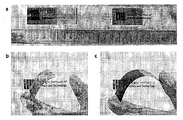
- FIG. 4 shows optical pictures of a poly (Py: EDSA: Py) film formed on various substrates obtained through Polymer Synthesis Example 1.
- FIG. 4 shows optical pictures of a poly (Py: EDSA: Py) film formed on various substrates obtained through Polymer Synthesis Example 1.
- FIG. 6 shows crystal properties of a poly (Py: EDSA: Py) film according to Polymer Synthesis Example 1
- FIG. 7 shows crystal properties of a poly (Py: BPDSA: Py) film according to Polymer Synthesis Example 3
- FIG. 8. Shows crystal properties of the poly (Py: BDSA: Py) film according to the polymer synthesis example 2
- Figure 9 shows the crystal properties of the poly (Py: MSA) film according to the polymer synthesis Comparative Example 1.
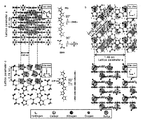
- FIG. 11 is a schematic diagram illustrating the chemical arrangement of poly (Py: EDSA: Py) and poly (Py: BPDSA: Py) according to Polymer Synthesis Examples 1 and 3.
- FIG. 11 is a schematic diagram illustrating the chemical arrangement of poly (Py: EDSA: Py) and poly (Py: BPDSA: Py) according to Polymer Synthesis Examples 1 and 3.
- FIG. 11 is a schematic diagram illustrating the chemical arrangement of poly (Py: EDSA: Py) and poly (Py: BPDSA: Py) according to Polymer Synthesis Examples 1 and 3.
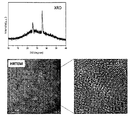
- FIG. 13 shows crystal properties of a polymer film according to Polymer Synthesis Example 4.
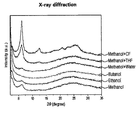
- FIG. 14 is an X-ray diffraction graph of a poly (EDOT: BPDSA: EDOT) film according to Polymer Synthesis Example 6.
- EDOT BPDSA: EDOT
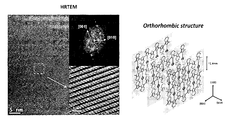
- FIG. 15 is an HRTEM image of a poly (EDOT: BPDSA: EDOT) film according to Polymer Synthesis Example 6.
- FIG. 15 is an HRTEM image of a poly (EDOT: BPDSA: EDOT) film according to Polymer Synthesis Example 6.
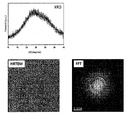
- FIG. 17 shows crystal properties of a polymer film according to Polymer Synthesis Example 8.
- FIG. 18 shows crystal properties of a polymer film according to Polymer Synthesis Example 9.
- alkyl or “alkylene” may mean an aliphatic hydrocarbon unless it is clearly stated otherwise.
- Alkyl may be a saturated alkyl group having no double bond or triple bond, or may be an unsaturated alkyl group having double bond or triple bond.
- Saturated alkyl groups can be branched, linear, or cyclic alkyl groups. Unless defined otherwise, alkyl groups can be C1 to C4 alkyl groups, and C1 to C4 alkyl groups can be methyl, ethyl, propyl, iso-propyl, n-butyl, iso-butyl, sec-butyl, or t-butyl .
- aryl or “arylene” may be a monocyclic aromatic group or a polycyclic aromatic group unless clearly stated otherwise.
- heteroaryl or “heteroarylene” includes at least one of nitrogen, phosphorus, oxygen, sulfur, and selenium as ring members in the ring and carbon as another ring member, unless expressly stated otherwise. It may be a monocyclic aromatic group or a polycyclic aromatic group containing.
- cycloalkane or “cycloalkylene” may be monocyclic saturated hydrocarbon or polycyclic saturated hydrocarbon unless it is clearly stated otherwise.
- FIG. 1 is a schematic view showing a method for producing a crystalline polymer according to an embodiment of the present invention.
- TMCP two-monomer-connected precursor obtained by reacting two monomers with a connector
- Two monomers in TMCP can be linked via a linker.
- the two monomers are shown to be the same as each other, in some cases, they may be different kinds.
- the monomer may be a monomer that may exhibit conductivity when TMCP is polymerized as described below. Specifically, the monomer may have a multiple bond or a non-covalent electron pair in the molecule, and may have a structure in which electrons are delocalized. Furthermore, the linker may also have a structure in which electrons are delocalized.
- each monomer may have one reaction site (# 1) for the connection with the linker, and may also have two polymerization sites (*) for the polymerization reaction with the monomers.
- each linker may have a pair of reaction sites (# 2) capable of binding to the reaction site (# 1) of the monomer at both ends thereof.
- the one linker and the pair of monomers may be linked by various bonding methods, for example, ionic bonds, hydrogen bonds, coordination bonds, and covalent bonds.
- the reaction site (# 1) of the monomer and the reaction site (# 2) of the linker may be modified to be suitable for ionic bonds, hydrogen bonds, coordination bonds, or covalent bonds.
- TMCP may be polymerized to obtain a crystalline polymer.
- monomers provided in TMCPs adjacent to each other may be polymerized.
- one side polymerization site (*) of the first monomer (M A1 ) provided in the first TMCP in the polymerization process is one side polymerization of one second monomer (M B1 ) provided in the adjacent second TMCP.
- the other polymerization site (*) of the first monomer (M A1 ) provided in the first TMCP connected to the site (*) is one side of the polymerization site (*) of the third monomer (M C1 ) provided in the adjacent third TMCP.
- PB1 first polymer backbone
- the crystalline polymer has a plurality of backbones in which the monomers are bonded in a row, and the first monomer M A1 provided in the first backbone PB1 is adjacent to one side of the first backbone PB1. It is connected to the fifth monomer (M A2 ) provided in the second backbone (PB3) and the first connecting member (CA), and is provided in the first backbone (PB1) and is adjacent to the first monomer (M A1 ).
- the second monomer M B1 may be connected to the sixth monomer M B2 provided in the third backbone PB2 adjacent to the other side of the first backbone PB1 through the second connector CB.
- FIG. 1 illustrates a unit layer of a crystalline polymer, and a plurality of such unit layers may be stacked in the crystalline polymer layer.
- Such crystalline polymers may exhibit crystal structures commonly found in metal or metal oxide crystals.
- the crystalline polymer may have a repeating pattern of unit cells having a lattice constant defined by a spacing d between adjacent lattice planes and angles between the faces.
- the crystal structure of the crystalline polymer may be hexagonal close packed lattice (HCP), face centered cubic (FCC), or orthorhombic (orthorhombic).
- HCP hexagonal close packed lattice
- FCC face centered cubic
- orthorhombic orthorhombic
- the backbone of the crystalline polymer may be, for example, polypyrrole, polythiophene, polyaniline, poly (3,4-ethylenedioxythiophene), or polyphenylene. However, it is not limited to this.
- the crystalline polymer may exhibit metallic conductivity or semiconducting conductivity.
- the linker may be an oxidative dopant for adding holes to the polymer backbone or a reducing dopant for adding electrons to the polymer backbone. In this case, the conductivity of the crystalline polymer may be improved.
- the TMCP may have a pair of monomers and one linker connecting these monomers to each other.
- Each of the pair of monomers included in the TMCP may be any one of monomers represented by the following Chemical Formulas 1 or 2.
- Y may be NR 1 , S, O, Se, or (CH) 2 .
- R 1 may be hydrogen or an alkyl group of C1 to C3.
- Ring G may be a pentagonal heteroaromatic ring when Y is NR 1 , S, O, or Se, and ring G may be a hexagonal aromatic ring, benzene ring, when Y is (CH) 2 .
- the site (*) to which A 1 and A 2 are bonded may be a polymerization site for polymer reaction.
- a 1 and A 2 may be functional groups for coupling or polymerization reactions.
- any one of A 1 and A 2 may be hydrogen, —B (OR A ) 2 , —Sn (R A ) 3 , or X A , and the other may be hydrogen, or X A.
- R A is H or an alkyl group of C1 to C4, X A may be Cl, Br, I, or pseudohalogen (pseudohalogen) irrespective of each other.
- the pseudohalide may be, for example, -CN, -CNO, -NCO, or -OTf (trifluoromethanesulfonate).
- a 1 and A 2 are both hydrogen, A 1 and A 2 are both X A, or one of A 1 and A 2 is -B (OR A ) 2 or -Sn (R A ) 3 and the other One may be X A.
- B 1 and B 2 are independently of each other hydrogen, a hydroxyl group, a C1 to C4 alkyl group, a C1 to C4 alkyl alcohol group, a C1 to C4 alkoxy group, a C1 to C4 (alkyl) carboxylic acid, a C1 to C4 A (alkyl) carboxylate, an amine group, or a C1 to C4 alkylamine group, or B 1 and B 2 are joined together to form a carboxylic acid anhydride, an ethylenedioxy group, or 5 to 1 with B 1 and B 2 linked carbon atoms; A 6 membered aromatic ring can be formed.
- B 1 and B 2 are combined B 1 and B 2 is an aromatic ring of five or six members formed together with the attached carbon atom may be a hetero aromatic ring.
- heteroatoms may be from 1 to 3, and may be nitrogen, phosphorus, oxygen, sulfur, or selenium irrespective of each other.
- the heteroaromatic ring may be imidazole, pyrazole, triazole, thiazole, isothiazole, or thiadiazole. .
- At least one of Y or B 2 of B 1 may be a reaction site capable of binding to the linker.
- the monomer represented by Formula 1 may be represented by the following Formula 1-1 or 1-2 depending on the type of Y.
- Y 1 may be NR 1 , S, O, or Se.
- R 1 may be hydrogen or an alkyl group of C1 to C3, and ring G 1 may be a pentagonal heteroaromatic ring.
- a 1 , A 2 , *, B 1 and B 2 may be as defined in Formula 1.
- B 1 and B 2 are independently of each other hydrogen, hydroxyl group, C1 to C4 alkyl group, C1 to C4 alkyl alcohol group, C1 to C4 alkoxy group, C1 to C4 (alkyl) carboxylic acid, C1 to It may be a (alkyl) carboxylate of C4, an amine group, or an alkylamine group of C1 to C4, or B 1 and B 2 may be combined with each other to be a carboxylic anhydride or ethylenedioxy group.
- a 1 , A 2 , *, B 1 and B 2 may be as defined in Formula 1.
- B 1 and B 2 may be a functional group that can be bonded to the linker, or B 1 and B 2 may be combined to form a functional group that may be bound to the linker.
- B 1 and B 2 is a functional group capable of bonding to the linking group, it is a hydroxyl group, a C1 to C4 alkylalcohol group, C1 to C4 (alkyl) carboxylic acid, C1 to C4 (alkyl) carboxyl It may be a rate, an amine group, or an alkylamine group of C1 to C4, and the other of B 1 and B 2 may be hydrogen or an alkyl group of C1 to C4.
- heteroatoms may be 1 to 3, and may be nitrogen, phosphorus, oxygen, sulfur, or selenium regardless of each other.
- the heteroaromatic ring may be imidazole, pyrazole, triazole, thiazole, isothiazole, or thiadiazole. .
- the monomer represented by Chemical Formula 1 may be represented by the following Chemical Formulas 1A, 1B, 1C, 1D, 1E, 1F, and 1G.
- Y 1 , A 1, and A 2 may be as defined in Formula 1-1, and B 3 and B 4 may be hydrogen or an alkyl group of C1 to C4 regardless of each other.
- Y, A 1 , A 2 , and B 1 may be as defined in Formula 1.
- R B may be a bond, an alkyl group of C1 to C4, or a (alkyl) carbonyl group of C1 to C4.
- B 1 may specifically be hydrogen or an alkyl group of C1 to C4.
- Y, A 1 , A 2 , and B 1 may be as defined in Formula 1.
- L B may be a carboxylic acid, a carboxylate, or an amine group
- R B may be a bond or an alkyl group of C1 to C4.
- B 1 may specifically be hydrogen or an alkyl group of C1 to C4.
- Y, A 1 and A 2 may be as defined in Formula 1.
- Y, A 1 and A 2 may be as defined in Formula 1.
- a 1 and A 2 may be as defined in Formula 1, and Ring B is a 5-6 membered heteroaromatic ring, and may have n hetero atoms Y a .
- n may be an integer from 1 to 3.
- Y a may be N, NH, O, S, P, PH, or Se regardless of each other.
- Formula 1G represents when Ring B of Formula 1F is a 5-membered heteroaromatic ring, Y a1 , Y a2 , and Y a3 At least one of which is a heteroatom, and the other may be carbon.
- the heteroatoms may be selected from the group consisting of N, NH, O, S, P, PH, and Se, and when two or more are heteroatoms, they may be selected independently of each other.
- at least Y a1 Or Y a2 may be heteroatom more specifically N or NH.
- the heteroaromatic ring may be imidazole, pyrazole, triazole, thiazole, isothiazole, or thiadiazole. .
- Y may be NH 2 or SH.
- the site marked * may be a polymerization site for polymer reaction.
- linker may be represented by any one of the following Formulas 5A to 5F.
- R 1 - and R 2 - may be an anionic functional group. Specifically, R 1 - and R 2 - may be COO ⁇ , SO 3 ⁇ , or PO (OH) O ⁇ , regardless of each other.
- X 1 + and X 2 + is a counter cations, it may be independently selected hydrogen ion or alkali metal ion. The alkali metal ion may be Na + or K + .
- R is C2 to C4 alkanediyl, C2 to C4 alkenediyl, C2 to C4 alkyndiyl, C6 to C20 arylenediyl, C2 to C20 heteroarylenediyl, C6 to C20 Arylene alkenediyl or cycloalkanediyl of C6 to C20.
- R is 1, 2-ethanediyl, 1, 3- propanediyl, 1,4-butanediyl, 1,4-butenediyl, para-biphenyldiyl, para-phenyldiyl , 2,6-naphthalenediyl, 2,6-anthracenediyl, 2,6-anthraquinonediyl, 2,2'-bithiophen-5,5'-diyl, or para-phenyleneethyleneyl Can be.
- X 1 and X 2 are halogen and may be Br, Cl, or I regardless of each other.
- R may be as defined in Formula 5A.
- linkers shown in Formulas 5A and 5B can act as oxidative dopants that add holes to the polymer backbone, as can be seen in Schemes 1, 2, and 10-13 and Formulas 30, 31, and 39-42, described below. .
- R 1 , R 2 , R 3 , and R 4 may be hydrogen or an alkyl group of C1 to C2, regardless of each other.
- R may be as defined in Formula 5A.
- the rings D 1 and D 2 may be a 5-membered or 6-membered unsaturated heterocyclic compound having at least one N, specifically N of 1 to 3 as a hetero member.
- R may be as defined in Formula 5A.
- n may be an integer of 1 or 0.
- M is Zn, Cu, Pd, Ru, or a metal ion such as Pt
- L is H 2 O, NH 3, or an ethylene-a-diamine
- X a is a counter ion OH -, NO 3 - , CO 3 - can be a -, CN -, or Cl.
- n may be determined so that the compound is neutral in consideration of the oxidation number of the metal ion and the oxidation number of the counter ion.
- the monomer and the linker may be linked by various chemical bonds such as 1) ion bond, 2) hydrogen bond, 3) coordination bond, and 4) covalent bond.
- at least one of Y, B1, and B2 of the monomer represented by Formula 1 may participate in a chemical bond with the linker.
- the reaction for forming the TMCP may be any one of the following Schemes 1-13. Specifically, Schemes 1, 2, 10 to 13 are by ionic bonds, Schemes 3 and 4 are by hydrogen bonding, Schemes 5 and 6 are by coordination bonds, and Schemes 7, 8, and 9 are covalently bonded to TMCP. Indicates that is formed.
- Y 1, A 1, A 2, B 1, and B 2 are as defined in the formula 1-1, R, R 1 -, R 2 -, X 1 +, 2 +, and X is And as defined in Formula 5A.
- the monomer represented by Formula 1-1 may be a monomer represented by Formula 1A.
- TMCP represented by Chemical Formula 10 may be obtained through Scheme 1.
- Specific examples of TMCP represented by Formula 10 may be represented by the following Formulas 10A and 10B. However, it is not limited to this.
- a 1 , A 2 , B 1 , and B 2 may be as defined in Formula 1-1, and R, X 3 , and X 4 may be as defined in Formula 5B.
- the monomer represented by Formula 1-1 may be a monomer represented by Formula 1A.
- Y 1 may be NH.
- N may be tetravalent.
- TMCP represented by Chemical Formula 11 may be obtained through Scheme 2.
- Specific examples of the TMCP represented by Formula 11 may be represented by the following Formula 11A. However, it is not limited to this.
- TMCP represented by Chemical Formula 12 may be obtained through Scheme 3.
- Specific examples of the TMCP represented by Formula 12 may be represented by the following Formulas 12A, 12B, and 12C. However, it is not limited to this.
- TMCP represented by Chemical Formula 13 may be obtained through Scheme 4.
- Specific examples of the TMCP represented by Formula 13 may be represented by the following Formula 13A and Formula 13B. However, it is not limited to this.
- Y 1 , A 1 , A 2 , B 1 , and B 2 may be as defined in Formula 1-1, and M, L, X a , and n may be as defined in Formula 5E.
- the monomer represented by Formula 1-1 may be a monomer represented by Formula 1A.
- TMCP represented by Chemical Formula 14 may be obtained through Scheme 5.
- Y, A 1 , A 2 , B 1 , R B and L B may be as defined in Formula 1C, and M, L, X a , and n may be as defined in Formula 5E.
- TMCP represented by Chemical Formula 15 may be obtained through Scheme 6.
- TMCP represented by Formula 14 may be represented by the following Chemical Formula 14A
- TMCP represented by Formula 15 may be represented by the following Chemical Formulas 15A and 15B. However, it is not limited to this.
- Y, A 1 , and A 2 may be as defined in Formula 1D, and R may be as defined in Formula 5C.
- TMCP represented by Chemical Formula 16 may be obtained through Reaction Scheme 7.
- Y, A 1 , and A 2 may be as defined in Formula 1E.
- TMCP represented by Chemical Formula 17 may be obtained through Scheme 8.
- TMCP represented by the formula (16) may be represented by the following formula (16A) and 16B, specific examples of the TMCP represented by the formula (17) may be represented by the formula (17A). However, it is not limited to this.
- a 1 , A 2 , Y a1 , and Y a3 Is as defined in Formula 1G, and R, X 3 , and X 4 may be as defined in Formula 5B.
- Y a1 and Y a3 May be N, O, S, P, Se, or CH irrespective of each other.
- the reaction represented by Scheme 9 may be performed using a base such as calcium carbonate.
- TMCP represented by Chemical Formula 18 may be obtained through Reaction Scheme 9.
- Y a2 and Y a3 may be N, O, S, P, Se, or CH irrespective of each other.
- the reaction may be performed in a state where no base is used.
- TMCP represented by Chemical Formula 19 may be obtained through Scheme 10.
- a 1 , A 2 , Y a1 , Y a2 , and Y a3 Are as defined in Formula 1G, R, R 1 -, R 2 -, X 1 +, 2 +, and X may be the same as defined in Formula 5A.
- Y a1 may be N, O, S, P, or Se
- Y a2 and Y a3 May be N, NH, O, S, P, PH, Se, or CH irrespective of each other.
- TMCP represented by the formula (18) may be represented by the formula (18A)
- specific examples of the TMCP represented by the formula (19) may be represented by the formula (19A)
- specific examples of the TMCP represented by the formula (20) may be represented by the formula (20A) have.
- Y are as defined in Formula 2
- R, R 1 -, R 2 -, X 1 +, 2 +, and X may be the same as defined in Formula 5A.
- TMCP represented by Chemical Formula 21 may be obtained through Scheme 12.
- the monomer aniline is when Y in Formula 2 is NH 2 , and R, X 3 , and X 4 may be as defined in Formula 5B.
- TMCP represented by Chemical Formula 22 can be obtained by performing Scheme 13.
- TMCP represented by Formula 21 may be represented by the following Chemical Formula 21A
- specific examples of the TMCP represented by Formula 22 may be represented by the following Chemical Formula 22A. However, it is not limited to this.
- the crystalline polymer may be formed by polymerizing the TMCP described above. Such polymerisation may be oxidative coupling, C-C coupling, condensation polymerization, photopolymerization, or electrochemical polymerization.
- the C-C coupling can be, for example, Suzuki coupling, Stiletto coupling, CH-arlation, or CH-CH arlation. This polymerisation reaction may occur between the polymerization sites (* of Formulas 1 and 2) of the monomers included in the TMCP.
- Examples of such crystalline polymers may be as follows.
- Polymers represented by Chemical Formulas 30 to 42 are polymerized polymerized reactions of TMCP represented by Chemical Formulas 10 to 22, respectively.
- m may be an integer of 10 to 10,000. However, it is not limited to this.
- TMCP monomers included in different TMCPs are sequentially connected to form a polymer backbone.
- a regular arrangement can be achieved without being intertwined at all.
- FIG. 2 is a schematic view showing a method of manufacturing a crystalline polymer thin film according to an embodiment of the present invention.
- a mixed solution may be obtained by dissolving an appropriate amount of monomer and a linker in a solvent in a reactor.
- the solvent may be a co-solvent capable of dissolving the monomer and the linker at the same time.
- the solvent may be water, an organic solvent, or a mixed solvent thereof.
- the organic solvent may be alcohol (ex. Methanol, ethanol, propanol, butanol, etc.), chloroform, tetrahydrofuran (THF), or a mixed solvent of two or more thereof.
- the co-solvent may be another solvent, which is not exemplified depending on the type of the monomer and the linker.
- the monomer and the linker in each of the different solvents are dissolved, and then dispersed in an emulsion form to obtain a mixed solution.
- the mixed solution can be stirred to obtain TMCP in which two monomers are bonded to both ends of one linker (A).
- the substrate can be immersed in the mixed solution (B). Before immersing the substrate in the mixed solution, the substrate surface may be washed and then exposed to ultraviolet light and / or ozone to pretreat the substrate surface.
- the substrate may be glass, a polymer substrate such as polyethylene terephthalate (PET), a metal substrate, or a graphite foil.
- PET polyethylene terephthalate
- the present invention is not limited thereto, but in some cases, a light transmissive substrate may be used.
- the initiator can be placed in the mixed solution containing the substrate (C).
- the initiator may vary depending on the type of monomer or the type of polymerization method. As an example, in the case of oxidative polymerization, the initiator may be ammonium persulfate. Polymerization of TMCP may be initiated by the initiator to produce a polymer in the reaction solution.
- the substrate can be slowly removed from the mixed solution (D).
- a polymer film may be formed on the surface of the substrate, and the polymer film may have a regular arrangement, that is, improved crystallinity, as described with reference to FIG. 1.
- the substrate on which the polymer film is formed may be washed to remove residual materials and then dried.
- the polymer film thus formed may be used as an electrode, for example, a transparent electrode, or may be used as a charge conductive layer, for example, a hole transport layer.
- the device using the polymer film may be an organic thin film transistor, an organic light emitting diode, an organic solar cell, or the like.
- crystalline polymer particles can be obtained.
- the crystalline polymer particles can be obtained as a precipitate by dissolving an appropriate amount of monomer and linker in a solvent to prepare a mixed solution, and then adding an initiator therein, followed by stirring.
- Such crystalline polymer particles can be obtained in various sizes ranging from nanometers to micrometers.
- the slurry may be prepared by mixing the polymer particle precipitate, the binder and the solvent.
- the binder is polytetrafluoroethylene (PTFE), polyvinylidene fluoride (Fluoride, PVDF), polyvinyl alcohol (PVA), polybutadiene rubber (Rubber, PBR), carboxymethyl cellulose (Carboxy Methyl Cellulose, CMC), or modified polymers of any of these, two or more co-polymers or mixtures thereof.
- the slurry may further include carbon black, graphite, carbon fiber, carbon nanotube, or graphene.
- Such a slurry can be applied onto a substrate using various methods to form an electrode layer.
- the electrode layer may be provided in a supercapacitor or pseudocapacitor, and in this case, charge and discharge operations may be implemented by adsorbing or desorbing ions. Specifically, ions may be adsorbed or desorbed due to heteroatoms of the crystalline polymer. Meanwhile, the electrode layer may be provided in a battery, in which case ions, for example, lithium ions are intercalated or decalated into the crystalline polymer, or heteroatoms of the crystalline polymer are oxidized or reduced. As a result, the charging or discharging operation may be implemented.
- Glass slides (76 ⁇ 26 mm, Marienfeld-Superior), ITO (Indium tin oxide) coated glass slides (15 to 25 ⁇ sq -1 , 75 ⁇ 25 mm, Aldrich), flexible PET (Poly (ethylene) terephthalate)) film (thickness: 100 mu m, Film Bank), and flexible graphite foil (thickness: 130 mu m, Dongbang Carbon) were prepared.
- Each substrate was sequentially ultrasonically cleaned with deionized water, acetone (Sigma-Aldrich) and isopropyl alcohol (Aldrich) for 15 minutes, then heated in an oven to 60 ° C. and dried, and the surface of the substrate was exposed to UV and ozone. It was exposed and surface treated. After immersing the surface-treated substrate vertically in the mixed solution, 5 ml of 0.10 mmol of ammonium persulfate (Aldrich) aqueous solution was added to the mixed solution, and TMCP (Py: EDSA: Py) at ⁇ 0 ° C. Chemical oxidative polymerization of was induced on the substrate.
- the substrate was removed from the mixed solution, which resulted in a uniform poly (Py: EDSA: Py) film on the substrate.
- the film was washed with deionized water and ethanol (Aldrich) to remove residual salts and unreacted monomers.
- the washed film was dried overnight at 80 ° C. in a vacuum oven.
- TMCP (Py: BDSA: Py) was obtained using the same method as in Synthesis Example 1, except that 11.8 mg of BDSA (1,4-butanedisulfonic acid, Ark Pharm) was used instead of EDSA. : BDSA: Py) film was obtained.
- TMCP (Py: BPDSA: Py) was obtained using the same method as Polymer Synthesis Example 1, except that 15.7 mg of BPDSA (4,4'-biphenyldisulfonic acid, Tokyo Chemical Industry) was used instead of EDSA. (Py: BPDSA: Py) film was obtained.
- FT-IR spectra were measured using a Perkin-Elmer FT-IR spectrometer (Spectrum System 2000) with potassium bromide pellets (Fluka). UV-visible spectra were obtained using a Perkin Elmer Lambda 750 UV-VIS-NIR spectrometer in the range from 300 to 1,000 nm.
- HRTEM images were recorded using high voltage (1250 kV) electron beams (Gatan Inc., SP-US1000HV). To this end, samples were manufactured according to the synthesis examples using a carbon coated copper grid (200 mesh, EM Science) as a substrate, but formed in a very thin thickness so that the electron beam can be transmitted. Conductivity of the synthesized polymer film was measured by van der Pauw method at room temperature using the van der Pauw measurement system of Bio-Rad. The bar graph shows the average conductivity measured for three samples of each polymer. In addition, the sheet resistance of the PPy film ( ⁇ 150 nm) formed through in-situ polymerization on a glass substrate (1 ⁇ 1 cm 2 square) was measured.
- 3A to 3D show intermediates obtained during the processes of Comparative Polymer Synthesis Example 1 and Polymer Synthesis Examples 1 to 3, respectively, Py: MSA, TMCP (Py: BDSA: Py), TMCP (Py: BDSA: Py), And FT-IR spectra of TMCP (Py: BPDSA: Py).
- the upper black lines are the FT-IR spectra of Py
- the lower purple lines are Py: MSA (a) and TMCP (Py: BDSA: Py) (b, respectively. ), TMCP (Py: BDSA: Py) (c), and TMCP (Py: BPDSA: Py) (d).
- the absence of N-H and C ⁇ C stretching in all precursors may mean that ionic bonds formed as a result of acid-base interactions were formed in the precursors.
- FIG. 4 shows optical pictures of a poly (Py: EDSA: Py) film formed on various substrates obtained through Polymer Synthesis Example 1.
- the poly (Py: EDSA: Py) film was produced in a size of 4.5 ⁇ 2.5 cm. Meanwhile, poly (Py: EDSA: Py) films were formed on both sides of the substrates, and the thickness thereof was about 150 nm. It can also be seen that the poly (Py: EDSA: Py) film polymerized in-situ in the presence of an oxidant on the substrate forms a uniform film.
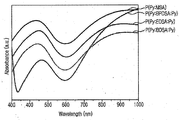
- each polymer film was successfully synthesized on a glass substrate to exhibit an absorption peak at ⁇ 430 nm, which is due to the polaron band of p-doped polypyrrol (PPy) in the polymer film.
- the poly (Py: EDSA: Py), poly (Py: BDSA: Py) and poly (Py: BPDSA: Py) films showed a red shifted absorption spectrum compared to poly (Py: MSA). Red displacement absorption indicates the presence of electronic interactions between the stacked polymer chains and can make the energy bandgap smaller than the energy bandgap of amorphous polymers having the same polymer backbone structure.
- FIG. 6 shows crystal properties of a poly (Py: EDSA: Py) film according to Polymer Synthesis Example 1
- FIG. 7 shows crystal properties of a poly (Py: BPDSA: Py) film according to Polymer Synthesis Example 3
- FIG. 8. Shows crystal properties of the poly (Py: BDSA: Py) film according to the polymer synthesis example 2
- Figure 9 shows the crystal properties of the poly (Py: MSA) film according to the polymer synthesis Comparative Example 1.
- the poly (Py: EDSA: Py) film exhibits a high crystal structure. Furthermore, direction, Direction, and From the HRTEM and FFT (fast Fourier transform) images measured in the direction, it can be seen that the poly (Py: EDSA: Py) film exhibits an HCP crystal structure with a space group of P6 3 / mmc . Specifically, all HRTEM images Having a plane in common, the interplanar spacing (d spacing) is ⁇ 0.41 nm, from which the lattice parameter a of 0.47 nm for poly (Py: EDSA: Py) can be easily calculated.
- poly (Py: EDSA: Py) grew in the [0001] direction because the lattice parameter c is twice the distance between two repeat units.
- the dark contrast region of the HRTEM image shows clusters of ionic bonds between ammonium and sulfonate having an electron density higher than the electron density inside the carbon.
- the poly (Py: BPDSA: Py) film also showed a high crystal structure. Specifically, direction, Direction, and From the HRTEM and FFT images measured in the direction, it can be seen that the poly (Py: BPDSA: Py) film exhibits the FCC crystal structure. Specifically, the (400) d interval, which is the fourth order reflection of the d interval (1.48 nm), is consistent with the calculated length (0.37 nm) between repeat units.
- the X-ray diffraction pattern shows two characteristic peaks and some crystal structures in the HRTEM.
- the crystal domain is small and the crystallinity is relatively low. This can be reasonably interpreted to indicate that the rotational degrees of freedom of the butyl group of BDSA as compared to EDSA (FIG. 5) and BPDSA (FIG. 6) interfere with crystal packing.
- poly (Py: MSA) showed amorphous in HRTEM and X-ray diffraction analysis.
- the bond length and angle between the polymer chain and the connector may vary during self-assembly by factors of the surrounding environment such as relative ions and steric hindrance May be affected.
- the polymer may be somewhat different depending on the type of the connector, a polymer aligned at the molecular level having a thermodynamically stable structure as a whole was obtained.
- These polymers in particular, for Polymer Synthesis Examples 1 and 3, formed the most stable crystal structures (HCP and FCC) possible in each case.
- poly (Py: EDSA: Py) electrical conductivity of (8.94 Scm-1) is poly (Py: MSA) electrical conductivity of-the nearly three times higher than that (3.04 Scm 1).
- the conductivity was higher than poly (Py: MSA) but lower than poly (Py: EDSA: Py). This may be due to their relative crystallinity.
- FIG. 11 is a schematic diagram illustrating the chemical arrangement of poly (Py: EDSA: Py) and poly (Py: BPDSA: Py) according to Polymer Synthesis Examples 1 and 3.
- FIG. Prediction of this chemical arrangement was inferred based on the experimental results of TEM, XRD, and XPS.
- FIG. 11 a top view and a side view of the crystal structure of poly (Py: EDSA: Py) are shown in (a), and poly (Py: EDSA: Py) is ammonium sulfate It can be seen that the ion clusters are hexagonally packed within the (0001) plane.
- TMCP (Py: AqDSA: Py) was obtained using the same method as Polymer Synthesis Example 1, and poly (Py: AqDSA: Py) was used. ) Film.
- TMCP (Py: AqDSNa: Py) was obtained using the same method as in Polymer Synthesis Example 1, and the poly (Py: AqDSNa: Py) film.
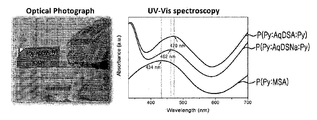
- a poly (Py: AqDSA: Py) film polymerized in-situ in the presence of an oxidant on a substrate from an optical photograph taken of a poly (Py: AqDSA: Py) film according to Polymer Synthesis Example 4 It can be seen that a uniform film is formed.
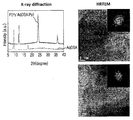
- FIG. 13 shows crystal properties of a polymer film according to Polymer Synthesis Example 4.
- EDOT 3,4-ethylenedioxythiophene
- BPDSA 4,4'-biphenyldisulfonic acid
- FeCl3 0.015 mol of FeCl3
- a poly (EDOT: BPDSA) film was obtained in the same manner as in Synthesis Example 6 except that 1 equivalent of EDOT (3, 4-ethylenedioxythiophene) was used.
- FIG. 14 is an X-ray diffraction graph of a poly (EDOT: BPDSA: EDOT) film according to Polymer Synthesis Example 6.
- EDOT BPDSA: EDOT
- the poly (EDOT: BPDSA: EDOT) film according to Polymer Synthesis Example 6 may or may not show peaks depending on the type of solvent used in the synthesis process, and is a cosolvent capable of dissolving both EDOT and BPDSA. In the case of using a mixed solvent of methanol and chloroform, crystallinity was best.
- FIG. 15 is an HRTEM image of a poly (EDOT: BPDSA: EDOT) film according to Polymer Synthesis Example 6.
- FIG. 15 is an HRTEM image of a poly (EDOT: BPDSA: EDOT) film according to Polymer Synthesis Example 6.
- the electrical conductivity of the poly (EDOT: BPDSA: EDOT) film which is a crystalline polymer, is significantly improved compared to the electrical conductivity of 0.055 Scm -1 , which is a polymer (EDOT: BPDSA) film, which does not form crystals at 0.208 Scm -1 .
- the results are shown.
- TMCP Py: Zn: Py
- TMCP formed by coordinating two Py and one Zn was obtained using the same method as in Synthesis Example 1 of the polymer. This was used to obtain a poly (Py: Zn: Py) film.
- Pentaerythritol and 3,4-dimethoxythiophene were dissolved in a toluene solvent (250 mL) at a molar ratio of 8: 2 (0.08: 0.02 mol) to obtain a mixed solution.
- pTSA p-toluenesulfonic acid
- the mixed solution was stirred for 24 hours in an argon atmosphere. After 24 hours, the black mixture was purified and dried to give a yellow solid TMCP (Spiropropylenedioxythiophene; SprioBiproDOT).
- SprioBiproDOT 0.1 mmol of SprioBiproDOT obtained was dissolved in 30 ml anhydrous dimethylformamide solvent, and 0.18 mmol of tetra-n-butylammonium bromide, 0.5 mmol of potassium acetate, and palladium acetate 0.018 mmol was added. The resulting mixture was stirred at least 12 hours at room temperature.
- a polymer film may be obtained on the substrate, and the polymerized in the liquid phase may be obtained as a precipitate.
- the polymer film and precipitate contain poly (spirobipropylenedioxythiophene; SprioBiproDOT).
- FIG. 17 shows crystal properties of a polymer film according to Polymer Synthesis Example 8.
- FIG. 18 shows crystal properties of a polymer film according to Polymer Synthesis Example 9.
Landscapes
- Chemical & Material Sciences (AREA)
- Health & Medical Sciences (AREA)
- Chemical Kinetics & Catalysis (AREA)
- Medicinal Chemistry (AREA)
- Polymers & Plastics (AREA)
- Organic Chemistry (AREA)
- Polyoxymethylene Polymers And Polymers With Carbon-To-Carbon Bonds (AREA)
- Other Resins Obtained By Reactions Not Involving Carbon-To-Carbon Unsaturated Bonds (AREA)
Abstract
결정성 고분자와 이의 제조방법을 제공한다. 결정성 고분자의 제조방법은 한 쌍의 모노머와 이들 모노머를 서로 연결하는 하나의 연결체를 구비하는 2-모노머-연결 전구체를 형성하는 단계를 구비한다. 이 후, 상기 2-모노머-연결 전구체를 고분자화하여 결정성 고분자를 얻는다. 상기 결정성 고분자는 상기 서로 다른 2-모노머-연결 전구체들 내에 구비된 모노머들이 결합되어 형성된 다수의 고분자 백본들을 구비하고, 상기 연결체는 서로 인접하는 고분자 백본들에 구비된 한 쌍의 모노머들을 연결한다.
Description
본 발명은 고분자에 관한 것으로, 보다 상세하게는 결정성 고분자에 관한 것이다.
최근 고분자에 대해 단순한 유연성 이상의 특성을 요구한다. 일 예로서, 고분자가 전자, 이온, 또는 가스과 같은 입자를 전달하거나 혹은 저장하는 것을 요구한다. 이를 만족시키기 위해, 고분자의 주쇄 또는 측쇄 상에 관능기를 도입하는 수많은 시도가 있어 왔다. 그러나, 이러한 방법은 고분자의 고유한 형태학적 한계 즉, 일차원 사슬의 무작위 얽힘으로 인해 큰 비정질 영역들이 형성됨에 따라, 입자 전달성이 떨어지는 만족스럽지 못한 결과를 가져왔다.
이에 따라, 최근 공유결합 유기골격(covalent bond organic framework)과같은 고분자 사슬이 잘 정돈된 구조를 갖는 결정성 고분자에 대한 연구가 진행되고 있다. 그러나, 이러한 공유결합 유기골격 구조의 경우 형성된 3차원 구조물 내에 세공들이 다량 분포하고, 이러한 세공을 통해 기체 등을 흡착하는 용도로 개발되고 있을 뿐, 전도성을 갖는 공유결합 유기골격 구조의 고분자는 연구되고 있지 않은 것으로 보인다.
따라서, 본 발명이 해결하고자 하는 과제는, 전도성을 갖는 유기결정성 고분자를 제공함에 있다.
본 발명의 기술적 과제들은 이상에서 언급한 기술적 과제로 제한되지 않으며, 언급되지 않은 또 다른 기술적 과제들은 아래의 기재로부터 당업자에게 명확하게 이해될 수 있을 것이다.
상기 기술적 과제를 이루기 위하여 본 발명의 두 측면들은 결정성 고분자와 이의 제조방법을 제공한다.
결정성 고분자의 제조방법은 한 쌍의 모노머와 이들 모노머를 서로 연결하는 하나의 연결체를 구비하는 2-모노머-연결 전구체를 형성하는 단계를 구비한다. 이 후, 상기 2-모노머-연결 전구체를 고분자화하여 결정성 고분자를 얻는다.
상기 결정성 고분자는 상기 서로 다른 2-모노머-연결 전구체들 내에 구비된 모노머들이 결합되어 형성된 다수의 고분자 백본들을 구비하고, 상기 연결체는 서로 인접하는 고분자 백본들에 구비된 한 쌍의 모노머들을 연결한다. 상기 고분자 백본은 전도성 고분자 일 예로서, 폴리피롤, 폴리티오펜, 폴리아닐린, 또는 폴리(3,4-에틸렌다이옥시티오펜)일 수 있다. 상기 연결체는 상기 연결체는 상기 고분자 백본에 정공을 더하는 산화성 도펀트 또는 상기 고분자 백본에 전자를 더하는 환원성 도펀트일 수 있다.
상기 결정성 고분자는 분자 단위의 격자점들을 구비하여 격자 상수를 갖는 유닛 셀의 반복 패턴을 가질 수 있다.
상기 하나의 연결체와 상기 한 쌍의 모노머는 이온결합, 수소결합, 배위결합, 또는 공유결합에 의해 결합될 수 있다. 상기 고분자화는 산화중합, C-C 커플링, 축합 중합, 광중합, 또는 전기화학중합을 사용하여 수행할 수 있다.
상술한 바와 같이 본 발명에 따르면, 고분자화 과정에서 모노머들이 연결체로 고정된 2-모노머-연결 전구체를 형성한 상태에서 서로 다른 2-모노머-연결 전구체들 내에 구비된 모노머들이 차례로 연결되어 고분자 백본을 형성함에 따라, 상기 고분자의 백본은 얽힘이 크게 감소 나아가 부분적으로는 전혀 얽히지 않고 규칙적인 배열 즉, 규칙적으로 정렬될 수 있다. 다시 말해서, 백본들 사이의 간격이 상기 연결체로 인해 일정해질 수 있다. 이에 따라, 고분자 결정성이 크게 향상될 수 있다.
그러나, 본 발명의 효과들은 이상에서 언급한 효과로 제한되지 않으며, 언급되지 않은 또 다른 효과들은 아래의 기재로부터 당업자에게 명확하게 이해될 수 있을 것이다.
도 1은 본 발명의 일 실시예에 따른 결정성 고분자 제조방법을 나타낸 개략도이다.
도 2는 본 발명의 일 실시예에 따른 결정성 고분자 박막을 제조하는 방법을 나타낸 개략도이다.
도 3a 내지 도 3d는 각각 고분자 합성 비교예 1 및 고분자 합성예들 1 내지 3의 진행과정들 중 얻어진 중간체들인 Py:MSA, TMCP(Py:BDSA:Py), TMCP(Py:BDSA:Py), 및 TMCP(Py:BPDSA:Py)의 FT-IR 스펙트럼들을 나타낸다.
도 4는 고분자 합성예 1을 통해 얻어진 다양한 기판 상에 형성된 폴리(Py:EDSA:Py) 필름을 촬영한 광학 사진들을 나타낸다.
도 5는 고분자 합성 비교예 1 및 고분자 합성예들 1 내지 3에서 얻어진 고분자막들의 자외선-가시광선 흡수 스펙트럼들을 나타낸다.
도 6은 고분자 합성예 1에 따른 폴리(Py:EDSA:Py) 필름의 결정특성을 나타내고, 도 7은 고분자 합성예 3에 따른 폴리(Py:BPDSA:Py) 필름의 결정특성을 나타내고, 도 8은 고분자 합성예 2에 따른 폴리(Py:BDSA:Py) 필름의 결정특성을 나타내고, 도 9는 고분자 합성 비교예 1에 따른 폴리(Py:MSA) 필름의 결정특성을 나타낸다.
도 10은 고분자 합성예들 1 내지 3 및 에 고분자 합성 비교예 1에 따른 폴리(Py:EDSA:Py) 필름, 폴리(Py:BPDSA:Py) 필름, 폴리(Py:BDSA:Py) 필름, 및 폴리(Py:MSA) 필름의 전도도와 면저항을 나타낸다.
도 11은 고분자 합성예들 1 및 3에 따른 폴리(Py:EDSA:Py)과 폴리(Py:BPDSA:Py)의 화학적 배열을 예측하여 나타난 개략도이다.
도 12는 고분자 합성예들 4 및 5, 그리고 고분자 합성 비교예 1에 따른 고분자 필름의 특성을 나타낸다.
도 13은 고분자 합성예 4에 따른 고분자 필름의 결정 특성을 나타낸다.
도 14은 고분자 합성예 6에 따른 폴리(EDOT:BPDSA:EDOT) 필름의 X선 회절 그래프이다.
도 15는 고분자 합성예 6에 따른 폴리(EDOT:BPDSA:EDOT) 필름의 HRTEM 이미지이다.
도 16은 고분자 합성예 7에 따른 고분자 필름의 결정 특성을 나타낸다.
도 17은 고분자 합성예 8에 따른 고분자 필름의 결정 특성을 나타낸다.
도 18은 고분자 합성예 9에 따른 고분자 필름의 결정 특성을 나타낸다.
이하, 본 발명을 보다 구체적으로 설명하기 위하여 본 발명에 따른 바람직한 실시예를 첨부된 도면을 참조하여 보다 상세하게 설명한다. 그러나, 본 발명은 여기서 설명되어지는 실시예에 한정되지 않고 다른 형태로 구체화될 수도 있다. 도면들에 있어서, 층이 다른 층 또는 기판 "상"에 있다고 언급되어지는 경우에 그것은 다른 층 또는 기판 상에 직접 형성될 수 있거나 또는 그들 사이에 제 3의 층이 개재될 수도 있다.
본 명세서에서 "탄소수 X 내지 탄소수 Y"라고 기재한 경우에는, X와 Y 사이의 모든 정수에 해당하는 탄소수도 함께 기재된 것으로 해석되어야 한다.
본 명세서에서 "알킬"또는 "알킬렌"는 다른 의미로 기재된 것이 명확하지 않은 한 지방족 탄화수소를 의미할 수 있다. "알킬"은 어떤 이중결합 혹은 삼중결합을 가지지 않는 포화 알킬기일 수 있고, 혹은 이중결합 혹은 삼중결합을 갖는 불포화알킬기일 수 있다. 포화 알킬기는 분지된, 선형, 또는 고리형 알킬기일 수 있다. 다르게 정의되지 않은 한, 알킬기는 C1 내지 C4 알킬기일 수 있고, C1 내지 C4 알킬기는 메틸, 에틸, 프로필, iso-프로필, n-부틸, iso-부틸, sec-부틸, 또는 t-부틸일 수 있다.
본 명세서에서 "아릴"또는 "아릴렌"은 다른 의미로 기재된 것이 명확하지 않은 한 단일환 방향족기 또는 다환 방향족기일 수 있다.
본 명세서에서 "헤테로아릴"또는 "헤테로아릴렌"는 다른 의미로 기재된 것이 명확하지 않은 한 질소, 인, 산소, 황, 및 셀레니움 중 적어도 어느 하나를 고리 내에 고리 멤버로서 함유하고 다른 고리 멤버로서 탄소를 함유하는 단일환 방향족기 또는 다환 방향족기일 수 있다.
본 명세서에서 "사이클로알칸"또는 "사이클로알킬렌"은 다른 의미로 기재된 것이 명확하지 않은 한 단일환 포화탄화수소 또는 다환 포화탄화수소일 수 있다.
결정성 고분자
도 1은 본 발명의 일 실시예에 따른 결정성 고분자 제조방법을 나타낸 개략도이다.
도 1을 참고하면, 먼저, 2개의 모노머와 연결체(connector)가 반응하여 얻어진 2-모노머-연결 전구체 (Two-Monomer-Connected Precursor; TMCP)를 얻을 수 있다. TMCP에서 2개의 모노머는 연결체를 통해 연결될 수 있다.
상기 2개의 모노머는 서로 같은 것으로 도시되었으나, 경우에 따라서는 서로 다른 종류일 수 있다. 상기 모노머는 후술하는 바와 같이 TMCP가 고분자화되었을 때 전도성을 나타낼 수 있는 모노머일 수 있다. 구체적으로, 상기 모노머는 분자 내에 다중결합 혹은 비공유전자쌍을 구비하여, 전자가 비편재화된 구조를 가질 수 있다. 나아가, 연결체 또한 전자가 비편재화된 구조를 가질 수 있다.
한편, 각 모노머는 상기 연결체와의 연결을 위한 하나의 반응사이트(#1)를 가지며, 또한 상기 모노머들과의 중합 반응을 위한 두 개의 중합 사이트(polymerization site, *)를 가질 수 있다. 또한, 각 연결체는 그의 양단에 상기 모노머의 반응사이트(#1)에 결합될 수 있는 한 쌍의 반응사이트들(#2)들을 가질 수 있다. 상기 하나의 연결체와 상기 한 쌍의 모노머는 다양한 결합방법 예를 들어, 이온결합, 수소결합, 배위결합, 공유결합등에 의해 연결될 수 있다. 구체적으로, 상기 모노머의 반응사이트(#1)와 상기 연결체의 반응사이트들(#2)은 이온결합, 수소결합, 배위결합, 또는 공유결합에 적절하도록 변형될 수 있다.
이 후, TMCP를 고분자화하여 결정성 고분자를 얻을 수 있다. 구체적으로, 서로 인접하는 TMCP들 내에 구비된 모노머들이 고분자화될 수 있다. 일 예로서, 상기 고분자화 과정에서 제1 TMCP 내에 구비된 제1 모노머(MA1)의 일측 중합 사이트(*)는 인접하는 제2 TMCP 내에 구비된 하나의 제2 모노머(MB1)의 일측 중합 사이트(*)와 연결되고, 제1 TMCP 내에 구비된 제1 모노머(MA1)의 타측 중합 사이트(*)는 인접하는 제3 TMCP 내에 구비된 제3 모노머(MC1)의 일측 중합 사이트(*)와 연결되면서, 상기 모노머들이 차례로 결합된 제1 고분자 백본(PB1)을 형성할 수 있다.
그 결과, 결정성 고분자는 상기 모노머들이 일렬로 결합된 다수의 백본을 가지며, 제1 백본(PB1)에 구비된 제1 모노머(MA1)는 상기 제1 백본(PB1)의 일측에 인접하는 다른 제2 백본(PB3)에 구비된 제5 모노머(MA2)와 제1 연결체(CA)를 통해 연결되며, 또한, 상기 제1 백본(PB1)에 구비되고 제1 모노머(MA1)에 인접한 제2 모노머(MB1)는 상기 제1 백본(PB1)의 타측에 인접하는 제3 백본(PB2)에 구비된 제6 모노머(MB2)와 제2 연결체(CB)를 통해 연결될 수 있다.
이와 같이, 상기 고분자화 과정에서 모노머들이 연결체로 고정된 TMCP를 형성한 상태에서 서로 다른 TMCP들 내에 구비된 모노머들이 차례로 연결되어 고분자 백본을 형성함에 따라, 상기 고분자의 백본은 얽힘이 크게 감소 나아가 부분적으로는 전혀 얽히지 않고 규칙적인 배열 즉, 규칙적으로 정렬될 수 있다. 다시 말해서, 백본들 사이의 간격이 상기 연결체로 인해 일정해질 수 있다. 이에 따라, 고분자 결정성이 크게 향상될 수 있다. 또한 도 1에는 결정성 고분자의 단위층이 도시되어 있으며, 결정성 고분자층 내에는 이러한 단위층이 다수 개 적층된 형태를 가질 수 있다.
이러한 결정성 고분자는 금속 혹은 금속 산화물 결정에서 흔히 나타나는 결정 구조 (crystal structure)를 나타낼 수 있다. 구체적으로, 상기 결정성 고분자는 인접한 격자 면간 거리(spacing d between adjacent lattice plane), 면들 사이의 각으로 정의되는 격자 상수를 갖는 유닛 셀의 반복 패턴을 가질 수 있다. 일 예로서, 결정성 고분자의 결정구조는 HCP(hexagonal close packed lattice), FCC (face centered cubic), 또는 사방정계 (orthorhombic)일 수 있다. 이 때, 각 유닛 셀의 꼭지점 즉, 격자점은 원자 단위가 아닌 분자 단위가 배치되는 것일 수 있다.
상기 결정성 고분자의 백본은 전도성 고분자 일 예로서, 폴리피롤, 폴리티오펜, 폴리아닐린, 폴리(3,4-에틸렌다이옥시티오펜), 또는 폴리페닐렌일 수 있다. 그러나, 이에 한정되는 것은 아니다. 상기 결정성 고분자는 금속성 전도도 또는 반도체성 전도도를 나타낼 수 있다. 한편, 상기 연결체는 상기 고분자 백본에 정공을 더하는 산화성 도펀트 또는 상기 고분자 백본에 전자를 더하는 환원성 도펀트일 수 있는데, 이 경우 상기 결정성 고분자의 전도도는 향상될 수 있다.
2-모노머-연결 전구체 (TMCP)
앞서 설명한 바와 같이, TMCP는 한 쌍의 모노머와 이들 모노머를 서로 연결하는 하나의 연결체를 구비할 수 있다.
상기 TMCP에 구비된 한 쌍의 모노머들 각각은 하기 화학식들 1 또는 2로 나타낸 모노머 중 어느 하나의 모노머일 수 있다.
[화학식 1]

상기 화학식 1에서, Y는 NR1, S, O, Se, 또는 (CH)2 일 수 있다. 이 때, R1은 수소 또는 C1 내지 C3의 알킬기일 수 있다. Y가 NR1, S, O, 또는 Se일 때 고리 G는 오각 헤테로방향족 고리이고, Y가 (CH)2 일 때 고리 G는 육각 방향족 고리 즉, 벤젠고리일 수 있다.
A1 및 A2가 결합된 자리(*)는 고분자 반응을 위한 중합 사이트일 수 있다. A1 및 A2는 커플링 또는 중합 반응을 위한 작용기들일 수 있다. 일 예로서 A1 및 A2 중 어느 하나는 수소, -B(ORA)2, -Sn(RA)3, 또는 XA이고, 다른 하나는 수소, 또는 XA일 수 있다. 이 때, RA는 H 또는 C1 내지 C4의 알킬기이고, XA는 서로에 관계없이 Cl, Br, I, 또는 유사할로겐(pseudohalogen)일 수 있다. 상기 유사할로겐화물은 일 예로서, -CN, -CNO, -NCO, 또는 -OTf(trifluoromethanesulfonate)일 수 있다. 구체예에서, A1 및 A2는 모두 수소이거나, A1 및 A2는 모두 XA이거나, A1 및 A2 중 하나는 -B(ORA)2 또는 -Sn(RA)3이고 다른 하나는 XA일 수 있다.
B1 및 B2는 서로에 관계없이 수소, 하이드록실기, C1 내지 C4의 알킬기, C1 내지 C4의 알킬알콜기, C1 내지 C4의 알콕시기, C1 내지 C4의 (알킬)카복실산, C1 내지 C4의 (알킬)카복실레이트, 아민기, 또는 C1 내지 C4의 알킬아민기이거나, 또는 B1 및 B2는 서로 합쳐져 카복실산 무수물, 에틸렌다이옥시기, 또는 B1 및 B2가 연결된 탄소원자들과 함께 5 내지 6 멤버의 방향족고리를 형성할 수 있다. B1 및 B2가 합쳐져 B1 및 B2가 연결된 탄소원자들과 함께 형성한 5 내지 6 멤버의 방향족고리는 헤테로방향족고리일 수 있다. 여기서 헤테로원자는 1 내지 3개일 수 있고, 서로에 관계없이 질소, 인, 산소, 황, 또는 셀레니움일 수 있다. 일 예로서, 상기 헤테로방향족고리는 이미다졸(imidazole), 피라졸(pyrazole), 트라이아졸(triazole), 티아졸(thiazole), 이소티아졸(isothiazole), 또는 티아다이아졸(thiadiazole)일 수 있다.
상기 화학식 1에서, Y 또는, B1 중 B2 중 적어도 어느 하나는 상기 연결체에 결합될 수 있는 반응사이트일 수 있다.
상기 화학식 1로 나타낸 모노머는 Y의 종류에 따라 하기 화학식 1-1 또는 1-2로 나타낼 수 있다.
[화학식 1-1]

상기 화학식 1-1에서, Y1는 NR1, S, O, 또는 Se일 수 있다. 이 때, R1은 수소 또는 C1 내지 C3의 알킬기일 수 있고, 고리 G1는 오각 헤테로방향족 고리일 수 있다. A1, A2, *, B1 및 B2는 상기 화학식 1에서 정의된 바와 같을 수 있다.
특히, B1 및 B2는 서로에 관계없이 수소, 하이드록실기, C1 내지 C4의 알킬기, C1 내지 C4의 알킬알콜기, C1 내지 C4의 알콕시기, C1 내지 C4의 (알킬)카복실산, C1 내지 C4의 (알킬)카복실레이트, 아민기, 또는 C1 내지 C4의 알킬아민기이거나, 또는 B1 및 B2는 서로 합쳐져 카복실산 무수물 또는 에틸렌다이옥시기일 수 있다.
[화학식 1-2]

상기 화학식 1-2에서, A1, A2, *, B1 및 B2는 상기 화학식 1에서 정의된 바와 같을 수 있다.
구체적으로, B1 및 B2 중 적어도 하나는 상기 연결체에 결합될 수 있는 작용기이거나 B1 및 B2가 합쳐져 상기 연결체에 결합될 수 있는 작용기를 형성할 수 있다. B1 및 B2 중 하나가 상기 연결체에 결합될 수 있는 작용기인 경우, 이는 하이드록실기, C1 내지 C4의 알킬알콜기, C1 내지 C4의 (알킬)카복실산, C1 내지 C4의 (알킬)카복실레이트, 아민기, 또는 C1 내지 C4의 알킬아민기일 수 있고, B1 및 B2 중 다른 하나는 수소 또는 C1 내지 C4의 알킬기일 수 있다. B1 및 B2가 합쳐져 상기 연결체에 결합될 수 있는 작용기를 형성한 경우, B1 및 B2는 서로 합쳐져 카복실산 무수물을 형성하거나, B1 및 B2가 연결된 탄소원자들과 함께 5 내지 6 멤버의 헤테로방향족고리를 형성할 수 있다. 상기 헤테로방향족고리에서 헤테로원자는 1 내지 3개일 수 있고, 서로에 관계없이 질소, 인, 산소, 황, 또는 셀레니움일 수 있다. 일 예로서, 상기 헤테로방향족고리는 이미다졸(imidazole), 피라졸(pyrazole), 트라이아졸(triazole), 티아졸(thiazole), 이소티아졸(isothiazole), 또는 티아다이아졸(thiadiazole)일 수 있다.
상기 화학식 1로 나타낸 모노머는 하기 화학식들 1A, 1B, 1C, 1D, 1E, 1F, 및 1G로 나타낼 수 있다.
[화학식 1A]

상기 화학식 1A에서, Y1, A1 및 A2는 상기 화학식 1-1에서 정의된 바와 같을 수 있고, B3 및 B4은 서로에 관계없이 수소 또는 C1 내지 C4의 알킬기일 수 있다.
[화학식 1B]

상기 화학식 1B에서, Y, A1, A2, 및 B1은 상기 화학식 1에서 정의된 바와 같을 수 있다. RB는 결합이거나, C1 내지 C4의 알킬기, 또는 C1 내지 C4의 (알킬)카보닐기일 수 있다. B1은 구체적으로 수소 또는 C1 내지 C4의 알킬기일 수 있다.
[화학식 1C]

상기 화학식 1C에서, Y, A1, A2, 및 B1은 상기 화학식 1에서 정의된 바와 같을 수 있다. LB는 카복실산, 카복실레이트, 또는 아민기일 수 있고, RB는 결합이거나 C1 내지 C4의 알킬기일 수 있다. B1은 구체적으로 수소 또는 C1 내지 C4의 알킬기일 수 있다.
[화학식 1D]

상기 화학식 1D에서, Y, A1 및 A2는 상기 화학식 1에서 정의된 바와 같을 수 있다.
[화학식 1E]

상기 화학식 1E에서, Y, A1 및 A2는 상기 화학식 1에서 정의된 바와 같을 수 있다.
[화학식 1F]

상기 화학식 1F에서, A1 및 A2는 상기 화학식 1에서 정의된 바와 같을 수 있고, 고리 B는 5 내지 6 멤버의 헤테로방향족고리로서, 헤테로원자인 Ya를 n개 구비할 수 있다. n은 1 내지 3의 정수일 수 있다. Ya는 서로에 관계없이 N, NH, O, S, P, PH, 또는 Se일 수 있다.
[화학식 1G]

상기 화학식 1G는 상기 화학식 1F의 고리 B가 5 멤버의 헤테로방향족고리일 때를 나타낸 것으로, Ya1, Ya2, 및 Ya3
중 적어도 하나는 헤테로원자이고, 나머지는 탄소일 수 있다. 상기 헤테로원자는 N, NH, O, S, P, PH, 및 Se로 이루어진 군에서 선택될 수 있고, 둘 이상이 헤테로원자인 경우 서로에 관계없이 선택될 수 있다. 일 예로서, 적어도 Ya1
또는 Ya2는 헤테로원자 더 구체적으로는 N 또는 NH일 수 있다. 구체예로서, 상기 헤테로방향족고리는 이미다졸(imidazole), 피라졸(pyrazole), 트라이아졸(triazole), 티아졸(thiazole), 이소티아졸(isothiazole), 또는 티아다이아졸(thiadiazole)일 수 있다.
상기 화학식 1G의 구체예는 다음과 같을 수 있다.


[화학식 2]

상기 화학식 2에서, Y는 NH2 또는 SH일 수 있다. *로 표시된 자리는 고분자 반응을 위한 중합 사이트일 수 있다.
한편, 상기 연결체는 하기 화학식 5A 내지 5F 중 어느 하나로 나타낼 수 있다.
[화학식 5A]

상기 화학식 5A에서, R1
- 및 R2
-는 음이온성 작용기일 수 있다. 구체적으로, R1
- 및 R2
-는 서로에 관계없이 COO-, SO3
-, 또는 PO(OH)O-일 수 있다. X1
+ 및 X2
+는 상대 양이온으로서, 서로에 관계없이 수소 이온 또는 알칼리금속 이온일 수 있다. 상기 알칼리금속 이온은 Na+ 또는 K+일 수 있다. 또한, R은 C2 내지 C4의 알칸다이일, C2 내지 C4의 알켄다이일, C2 내지 C4의 알킨다이일, C6 내지 C20의 아릴렌다이일, C2 내지 C20의 헤테로아릴렌다이일, C6 내지 C20의 아릴렌알켄다이일또는 C6 내지 C20의 사이클로알칸다이일일 수 있다. 일 예로서, R은 1, 2-에탄다이일, 1, 3- 프로판다이일, 1,4-부탄다이일, 1,4-부텐다이일, 파라-바이페닐다이일, 파라-페닐다이일, 2,6-나프탈렌다이일, 2,6-안트라센다이일, 2,6-안트라퀴논다이일, 2,2′-바이티오펜-5,5′-다이일, 또는 파라-페닐렌에틸렌일 수 있다.
[화학식 5B]

상기 화학식 5B에서, X1 및 X2는 할로겐으로서, 서로에 관계없이 Br, Cl, 또는 I일 수 있다. 또한, R은 상기 화학식 5A에서 정의한 바와 같을 수 있다.
상기 화학식 5A 및 5B에 도시된 연결체는 후술하는 반응식 1, 2, 및 10 내지 13 그리고 화학식 30, 31, 및 39 내지 42에서 확인할 수 있는 바와 같이 고분자 백본에 정공을 더하는 산화성 도펀트로서 작용할 수 있다.
[화학식 5C]

상기 화학식 5C에서, R1, R2, R3, 및 R4는 서로에 관계없이, 수소 또는 C1 내지 C2의 알킬기일 수 있다. 또한, R은 상기 화학식 5A에서 정의한 바와 같을 수 있다.
[화학식 5D]

상기 화학식 5D에서, 고리 D1 및 D2는 적어도 하나의 N, 구체적으로는 1 내지 3의 N을 헤테로멤버로서 구비하는 5-멤버 혹은 6-멤버 불포화 헤테로고리화합물일 수 있다. 또한, R은 상기 화학식 5A에서 정의한 바와 같을 수 있다. 한편, n은 1 또는 0의 정수일 수 있다.
[화학식 5E]

상기 화학식 5E에서, M은 Zn, Cu, Pd, Ru, 또는 Pt와 같은 금속이온이고, L은 H2O, NH3, 또는 에틸렌다이아민이고, Xa는 상대이온으로서 OH-, NO3
-, CO3
-, CN-, 또는 Cl-일 수 있다. 그러나, 이에 한정되는 것은 아니다. 한편, n은 상기 금속이온의 산화수와 상기 상대이온의 산화수를 고려하여 화합물이 중성이 되도록 결정될 수 있다.
[화학식 5F]

상기 TMCP에서 모노머와 연결체는 1)이온결합, 2)수소결합, 3) 배위결합, 4) 공유결합 등 다양한 화학결합에 의해 연결될 수 있다. 일 예로서, 화학식 1로 나타낸 모노머의 Y, B1 및 B2 중 적어도 하나가 연결체와의 화학결합에 참여할 수 있다.
TMCP를 형성하는 반응은 하기 반응식들 1 내지 13 중 어느 하나일 수 있다. 구체적으로, 반응식 1, 2, 10 내지 13은 이온결합에 의해, 반응식 3 및 4는 수소결합에 의해, 반응식 5 및 6은 배위결합에 의해, 반응식 7, 8, 및 9는 공유결합에 의해 TMCP가 형성되는 것을 나타낸다.
[반응식 1]

상기 반응식 1에서, Y1, A1, A2, B1, 및 B2는 화학식 1-1에서 정의된 바와 같고, R, R1
-, R2
-, X1
+, 및 X2
+는 화학식 5A에서 정의된 바와 같을 수 있다. 일 예로서, 상기 화학식 1-1로 나타낸 모노머는 상기 화학식 1A로 나타낸 모노머일 수 있다.
또한, 상기 반응식 1을 통해 화학식 10으로 표시된 TMCP를 얻을 수 있다. 화학식 10으로 표시된 TMCP의 구체적인 예는 하기 화학식 10A와 10B로 나타낼 수 있다. 그러나, 이에 한정되는 것은 아니다.


[반응식 2]

상기 반응식 2에서, A1, A2, B1, 및 B2는 화학식 1-1에서 정의된 바와 같고, R, X3, 및 X4는 화학식 5B에서 정의된 바와 같을 수 있다. 일 예로서, 상기 화학식 1-1로 나타낸 모노머는 상기 화학식 1A로 나타낸 모노머일 수 있다. 다만, Y1는 NH일 수 있다. 이 때, N은 사가화될 수 있다.
또한, 상기 반응식 2를 통해 화학식 11으로 표시된 TMCP를 얻을 수 있다. 화학식 11으로 표시된 TMCP의 구체적인 예는 하기 화학식 11A로 나타낼 수 있다. 그러나, 이에 한정되는 것은 아니다.

[반응식 3]

상기 반응식 3에서, Y, A1, A2, B1, 및 RB 화학식 1B에서 정의된 바와 같고, R, R1, R2, R3, 및 R4는 화학식 5C에서 정의된 바와 같을 수 있다.
또한, 상기 반응식 3를 통해 화학식 12으로 표시된 TMCP를 얻을 수 있다. 화학식 12으로 표시된 TMCP의 구체적인 예는 하기 화학식 12A, 12B, 및 12C로 나타낼 수 있다. 그러나, 이에 한정되는 것은 아니다.


[반응식 4]

상기 반응식 4에서, Y, A1, A2, B1, 및 RB 화학식 1B에서 정의된 바와 같고, R, D1, D2 및 n은 화학식 5D에서 정의된 바와 같을 수 있다.
또한, 상기 반응식 4를 통해 화학식 13으로 표시된 TMCP를 얻을 수 있다. 화학식 13으로 표시된 TMCP의 구체적인 예는 하기 화학식 13A 및 화학식 13B로 나타낼 수 있다. 그러나, 이에 한정되는 것은 아니다.


[반응식 5]

상기 반응식 5에서, Y1, A1, A2, B1, 및 B2는 화학식 1-1에서 정의된 바와 같고, M, L, Xa, 및 n은 화학식 5E에서 정의된 바와 같을 수 있다. 일 예로서, 상기 화학식 1-1로 나타낸 모노머는 상기 화학식 1A로 나타낸 모노머일 수 있다. 또한, 상기 반응식 5를 통해 화학식 14로 표시된 TMCP를 얻을 수 있다.
[반응식 6]

상기 반응식 6에서, Y, A1, A2, B1, RB및 LB는 화학식 1C에서 정의된 바와 같고, M, L, Xa, 및 n은 화학식 5E에서 정의된 바와 같을 수 있다. 또한, 상기 반응식 6을 통해 화학식 15로 표시된 TMCP를 얻을 수 있다.
화학식 14로 표시된 TMCP의 구체적인 예는 하기 화학식 14A로 나타낼 수 있고, 화학식 15로 표시된 TMCP의 구체적인 예는 하기 화학식 15A 및 15B로 나타낼 수 있다. 그러나, 이에 한정되는 것은 아니다.


[반응식 7]

상기 반응식 7에서, Y, A1, 및 A2는 화학식 1D에서 정의된 바와 같고, R은 화학식 5C에서 정의된 바와 같을 수 있다. 또한, 상기 반응식 7을 통해 화학식 16으로 표시된 TMCP를 얻을 수 있다.
[반응식 8]

상기 반응식 8에서, Y, A1, 및 A2는 화학식 1E에서 정의된 바와 같을 수 있다. 또한, 상기 반응식 8을 통해 화학식 17으로 표시된 TMCP를 얻을 수 있다.
화학식 16으로 표시된 TMCP의 구체적인 예는 하기 화학식 16A 및 16B로 나타낼 수 있고, 화학식 17로 표시된 TMCP의 구체적인 예는 하기 화학식 17A로 나타낼 수 있다. 그러나, 이에 한정되는 것은 아니다.


[반응식 9]

상기 반응식 9에서, A1, A2, Ya1, 및 Ya3
는 화학식 1G에서 정의된 바와 같고, R, X3, 및 X4는 화학식 5B에서 정의된 바와 같을 수 있다. 구체적으로, Ya1 및 Ya3
는 서로에 관계없이 N, O, S, P, Se, 또는 CH일 수 있다. 상기 반응식 9로 나타낸 반응은, 탄산 칼슘과 같은 염기를 사용하여 진행될 수 있다. 또한, 상기 반응식 9을 통해 화학식 18로 표시된 TMCP를 얻을 수 있다.
[반응식 10]

상기 반응식 10에서, A1, A2, Ya2, 및 Ya3
는 화학식 1G에서 정의된 바와 같고, R, X3, 및 X4는 화학식 5B에서 정의된 바와 같을 수 있다. 구체적으로, Ya2 및 Ya3 는 서로에 관계없이 N, O, S, P, Se, 또는 CH일 수 있다. 이 때는 상기 반응식 9와는 달리 염기를 사용하지 않은 상태에서 반응을 진행시킬 수 있다. 또한, 상기 반응식 10을 통해 화학식 19로 표시된 TMCP를 얻을 수 있다.
[반응식 11]

상기 반응식 11에서, A1, A2, Ya1, Ya2, 및 Ya3
는 화학식 1G에서 정의된 바와 같고, R, R1
-, R2
-, X1
+, 및 X2
+는 화학식 5A에서 정의된 바와 같을 수 있다. 구체적으로, Ya1은 N, O, S, P, 또는 Se일 수 있고, Ya2 및 Ya3
는 서로에 관계없이 N, NH, O, S, P, PH, Se, 또는 CH일 수 있다. 상기 반응식 11을 통해 화학식 20으로 표시된 TMCP를 얻을 수 있다.
화학식 18로 표시된 TMCP의 구체적인 예는 하기 화학식 18A로 나타낼 수 있고, 화학식 19로 표시된 TMCP의 구체적인 예는 하기 화학식 19A로 나타낼 수 있고, 또한 화학식 20으로 표시된 TMCP의 구체적인 예는 하기 화학식 20A로 나타낼 수 있다. 그러나, 이에 한정되는 것은 아니다.


[반응식 12]

상기 반응식 12에서, Y는 화학식 2에서 정의된 바와 같고, R, R1
-, R2
-, X1
+, 및 X2
+는 화학식 5A에서 정의된 바와 같을 수 있다. 또한, 상기 반응식 12를 통해 화학식 21으로 표시된 TMCP를 얻을 수 있다.
[반응식 13]

상기 반응식 13에서, 모노머인 아닐린은 화학식 2의 Y가 NH2일 때이고, R, X3, 및 X4는 화학식 5B에서 정의된 바와 같을 수 있다. 또한, 상기 반응식 13을 해 화학식 22으로 표시된 TMCP를 얻을 수 있다.
화학식 21으로 표시된 TMCP의 구체적인 예는 하기 화학식 21A로 나타낼 수 있고, 화학식 22로 표시된 TMCP의 구체적인 예는 하기 화학식 22A로 나타낼 수 있다. 그러나, 이에 한정되는 것은 아니다.


결정성 고분자 예시들
앞서 설명한 TMCP를 고분자화시켜 결정성 고분자를 형성할 수 있다. 이러한 고분자화는 산화중합(oxidative coupling), C-C 커플링, 축합 중합, 광중합, 또는 전기화학중합일 수 있다. C-C 커플링은 일 예로서, 스즈키 커플링, 스틸레 커플링, CH-아릴레이션, 또는 CH-CH 아릴레이션일 수 있다. 이러한 고분자화 반응은 TMCP에 포함된 모노머들의 중합 사이트들(화학식 1 및 2의 *) 사이에서 일어날 수 있다.
이러한 결정성 고분자의 예시는 다음과 같을 수 있다.


화학식 30 내지 42로 나타낸 고분자들은 각각 화학식 10 내지 22로 나타낸 TMCP들을 고분자화 반응시킨 고분자들이다. 상기 화학식들 30 내지 42에서 m은 10 내지 10,000의 정수일 수 있다. 그러나, 이에 한정되는 것은 아니다.
이러한 고분자들은 도 1을 참조하여 설명한 바와 같이, 모노머들이 연결체로 고정된 TMCP를 형성한 상태에서 서로 다른 TMCP들 내에 구비된 모노머들이 차례로 연결되어 고분자 백본을 형성함에 따라, 상기 고분자의 백본은 얽힘이 크게 감소 나아가 부분적으로는 전혀 얽히지 않고 규칙적인 배열을 이룰 수 있다.
결정성 고분자 박막 제조방법
도 2는 본 발명의 일 실시예에 따른 결정성 고분자 박막을 제조하는 방법을 나타낸 개략도이다.
도 2를 참조하면, 반응기 내에서 적정량의 모노머와 연결체를 용매 내에 용해시켜 혼합용액을 얻을 수 있다. 이 때, 용매는 상기 모노머와 상기 연결체를 동시에 용해시킬 수 있는 공용매일 수 있다. 상기 용매는 물, 유기용매, 또는 이의 혼합용매일 수 있다. 상기 유기용매는 알코올(ex. 메탄올, 에탄올, 프로판올, 부탄올 등), 클로로포름, 테트라하이드로퓨란(THF), 또는 이들 중 둘 이상의 혼합용매일 수 있다. 그러나 이에 한정되지 않고, 모노머와 연결체의 종류에 따라 공용매는 예시되지 않은 다른 용매가 될 수도 있다. 한편, 공용매가 없는 경우 서로 다른 용매들에 모노머와 연결체를 각각 녹인 후, 에멀젼 형태로 분산시켜 혼합액을 얻을 수도 있다. 이 혼합용액을 교반하여 두 개의 모노머가 하나의 연결체의 양측 단부에 결합된 TMCP를 얻을 수 있다(A).
이 후, 기판을 상기 혼합용액 내에 담글 수 있다(B). 상기 기판을 혼합용액 내에 담그기 전에 상기 기판 표면을 세척 후, 자외선 및/또는 오존에 노출시켜 상기 기판 표면을 전처리할 수 있다. 상기 기판은 유리, PET(Poly(ethylene terephthalate))와 같은 고분자 기판, 금속 기판, 혹은 흑연 포일일 수 있다. 그러나, 이에 한정되는 것은 아니나, 경우에 따라서는 광투과 가능한 기판을 사용할 수도 있다.
이 후, 상기 기판이 담겨진 혼합용액 내에 개시제를 넣을 수 있다(C). 상기 개시제는 모노머의 종류에 따라 혹은 고분자화 방법의 종류에 따라 달라질 수 있다. 일 예로서, 산화 중합인 경우 개시제는 과황산 암모늄 (ammonium persulfate)일 수 있다. 상기 개시제에 의해 TMCP의 고분자화가 개시되어 반응용액 내에 고분자가 생성될 수 있다.
이 후, 상기 기판을 상기 혼합용액으로부터 천천히 빼낼 수 있다(D). 이 때, 상기 기판 표면에 고분자막이 형성될 수 있으며, 상기 고분자막은 도 1을 참조하여 설명한 바와 같이 규칙적인 배열 즉, 향상된 결정성을 가질 수 있다. 이 후, 고분자막이 형성된 기판을 세정하여 잔류물질등을 제거한 후, 건조시킬 수 있다.
이와 같이 형성된 고분자막은 전극, 일 예로서 투명전극으로 사용하거나, 혹은 전하전도층, 일 예로서 정공수송층으로 사용할 수 있다. 이러한 고분자막을 이용하는 소자는 유기박막트랜지스터, 유기발광다이오드, 유기태양전지 등일 수 있다.
결정성 고분자 입자 슬러리 제조방법
본 발명의 다른 실시예에 따르면, 결정성 고분자 입자를 얻을 수 있다. 결정성 고분자 입자는, 적정량의 모노머와 연결체를 용매 내에 용해시켜 혼합용액을 준비한 후, 여기에 개시제를 넣은 후, 교반하면 침전물로서 얻을 수 있다. 이러한 결정성 고분자 입자는 나노미터 내지 마이크로미터 사이즈로 다양하게 얻어질 수 있다.
고분자 입자 침전물, 바인더 및 용매를 혼합하여 슬러리를 제조할 수 있다. 이 때, 바인더는 폴리테트라플루오르에틸렌 (Polytetrafluoroethylene, PTFE), 폴리비닐리덴플로라이드 ( Fluoride, PVDF), 폴리비닐알코올 (PVA),폴리부타디엔 고무 (Rubber,PBR),카르복시메틸셀루로오즈 (Carboxy Methyl Cellulose, CMC), 또는 이들 중 어느 하나의 변형(modified) 고분자, 이들 중 둘 이상의 공줍합체 또는 혼합물일 수 있다. 상기 슬러리는 탄소입자 일 예로서, 카본 블랙(carbon black), 흑연(graphite), 탄소섬유(carbon fiber), 탄소나노튜브(carbon nanotube), 또는 그라핀(graphene)를 추가적으로 더 포함할 수 있다.
이러한 슬러리를 기판 상에 다양한 방법을 사용하여 도포하여, 전극층을 형성할 수 있다. 이러한 전극층은 슈퍼캐패시터 혹은 유사커패시터 내에 구비될 수 있으며, 이 경우 이온을 흡착 또는 탈착시킴에 따라 충전과 방전 동작을 구현할 수 있다. 구체적으로, 결정성 고분자의 헤테로원자로 인해 이온이 흡탈착될 수 있다. 한편, 상기 전극층은 배터리 내에 구비될 수 있으며, 이 경우 상기 결정성 고분자 내로 이온 예를 들어, 리튬이온이 삽입(intercalation) 또는 탈삽입(decalation)되거나, 혹은 상기 결정성 고분자의 헤테로원자가 산화 또는 환원됨에 따라 충전 또는 방전 동작을 구현할 수 있다.
이하, 본 발명의 이해를 돕기 위하여 바람직한 실험예(example)를 제시한다. 다만, 하기의 실험예는 본 발명의 이해를 돕기 위한 것일 뿐, 본 발명이 하기의 실험예에 의해 한정되는 것은 아니다.
<고분자
합성예들
1 ~ 3>
[반응식 21]

고분자
합성예
1 :
폴리(Py:EDSA:Py)의
합성
먼저, 20 ㎖의 뚜껑 달린 바이알 내에서 EDSA (1,2-ethanedisulfonic acid, Tokyo Chemical Industry) 9.50 ㎎을 5 ㎖의 탈이온수에 용해시켰다. 그 후, 상기 바이알에 Py (pyrrole, Tokyo Chemical Industry) 7.00 ㎖를 첨가하여 Py와 EDSA의 혼합용액을 얻었다. 상기 혼합용액을 2 시간 동안 ~0 ℃에서 교반하여 Py 두 단위체들이 하나의 EDSA를 사용한 이온결합에 의해 연결된 TMCP(two-monomer-connected precursor)인 (Py:EDSA:Py)를 제조하였다.
기판으로 유리 슬라이드(glass slides, 76 × 26 mm, Marienfeld-Superior), ITO (Indium tin oxide) 코팅된 유리 슬라이드 (15 내지 25 Ωsq-1, 75 × 25 mm, Aldrich), 유연한 PET (Poly(ethylene terephthalate)) 필름 (두께 : 100 ㎛, Film Bank), 및 유연한 흑연 포일 (두께: 130 ㎛, Dongbang Carbon)을 준비하였다.
각 기판을 탈이온수, 아세톤(Sigma-Aldrich) 및 이소프로필 알콜 (Aldrich)로 각각 15 분간 순차적으로 초음파 세척한 후, 오븐에서 60 ℃로 가열하여 건조하고, 상기 기판의 표면을 자외선 및 오존에 함께 노출시켜 표면 처리하였다. 상기 표면처리된 기판을 상기 혼합용액 내에 수직으로 담근 후, 상기 혼합용액 내에 0.10 mmol의 과황산 암모늄 (ammonium persulfate, Aldrich) 수용액 5 ㎖를 부가하여, ~0 ℃에서 TMCP(Py:EDSA:Py)의 화학 산화 중합(chemical oxidative polymerization)을 상기 기판 상에서 유도하였다. 약 12 시간 후, 상기 기판을 상기 혼합용액으로부터 빼내었고, 그 결과 상기 기판 상에 균일한 폴리(Py:EDSA:Py) 필름을 얻었다. 상기 필름을 탈이온수 및 에탄올 (Aldrich)로 세정하여 잔류염 및 미반응 모노머를 제거하였다. 세정된 필름을 진공 오븐에서 80 ℃에서 밤새 건조시켰다.
고분자
합성예
2 :
폴리(Py:BDSA:Py)의
합성
EDSA 대신에 11.8 ㎎의 BDSA (1,4-butanedisulfonic acid, Ark Pharm)를 사용한 것을 제외하고는 고분자 합성예 1과 동일한 방법을 사용하여 TMCP(Py:BDSA:Py)를 얻고 이를 사용하여 폴리(Py:BDSA:Py) 필름을 얻었다.
고분자
합성예
3 :
폴리(Py:BPDSA:Py)의
합성
EDSA 대신에 15.7 ㎎의 BPDSA (4,4'-biphenyldisulfonic acid, Tokyo Chemical Industry)를 사용한 것을 제외하고는 고분자 합성예 1과 동일한 방법을 사용하여 TMCP(Py:BPDSA:Py)를 얻고 이를 사용하여 폴리(Py:BPDSA:Py) 필름을 얻었다.
고분자 합성
비교예
1 :
폴리(Py:MSA)의
합성
[반응식 22]

EDSA 대신에 9.80 ㎎의 MSA (methanesulfonic acid, Sigma-Aldrich)를 사용한 것을 제외하고는 고분자 합성예 1과 동일한 방법을 사용하여 전구체인 Py:MSA를 얻고 이를 사용하여 폴리(Py:MSA) 필름을 얻었다.
평가예
<평가방법>
FT-IR 스펙트럼은 칼륨 브로마이드 펠릿 (Fluka)을 갖는 Perkin-Elmer FT-IR 분광기 (Spectrum System 2000)를 사용하여 측정되었다. 자외선 - 가시광선 스펙트럼은 300 ~ 1,000 nm의 범위에서 Perkin Elmer Lambda 750 UV-VIS-NIR 분광기를 사용하여 얻었다. X-선 회절 측정을 위해, 유리 슬라이드 상에 다중 중합을 통해 두꺼운 고분자 필름 (> 1 ㎛)을 제조하였고, 40kV 및 100mA에서 Cu-Kα 방사선(λ=1.54Å)을 갖는 Rigaku D / max-2500 회절계를 사용하여 수행되었다. HRTEM 이미지를 고전압(1,250 kV) 전자빔을 사용하여 기록하였다(Gatan Inc., SP-US1000HV). 이를 위해, 샘플들은 탄소 코팅된 구리 그리드(200 mesh, EM Science)를 기판으로 사용하여 상기 합성예들에 따라 제조되되, 전자빔이 투과될 수 있도록 매우 얇은 두께로 형성하였다. 합성된 고분자 필름의 전도도는 Bio-Rad 사의 van der Pauw 측정 시스템을 사용하여 실온에서 van der Pauw 법으로 측정하였다. 막대 그래프는 각각의 중합체의 3 개 샘플에 대해 측정된 평균전도도를 나타낸다. 또한, 유리 기판 (1 × 1 cm2 정사각형)상의 인-시츄 중합을 통해 형성된 PPy 필름 (~ 150 nm)의 면저항을 측정하였다.
도 3a 내지 도 3d는 각각 고분자 합성 비교예 1 및 고분자 합성예들 1 내지 3의 진행과정들 중 얻어진 중간체들인 Py:MSA, TMCP(Py:BDSA:Py), TMCP(Py:BDSA:Py), 및 TMCP(Py:BPDSA:Py)의 FT-IR 스펙트럼들을 나타낸다. 구체적으로, FT-IR 스펙트럼 a, b, c, d 모두에서 상부 검은선들은 Py의 FT-IR 스펙트럼이고, 하부 보라색선들은 각각 Py:MSA(a), TMCP(Py:BDSA:Py)(b), TMCP(Py:BDSA:Py)(c), 및 TMCP(Py:BPDSA:Py)(d)의 FT-IR 스펙트럼이다.
도 3a 내지 도 3d를 참조하면, Py 링의 FT-IR 스펙트럼에서 N-H 신축 진동과 관련된 3375 cm-1에서 강력하고 넓은 피크와 C=C 신축에 해당하는 1673 cm-1에서의 피크가 관찰된다. 그러나, Py:MSA, TMCP(Py:BDSA:Py), TMCP(Py:BDSA:Py), 및 TMCP(Py:BPDSA:Py)인 Py 염들의 경우, N-H 밴드는 감소되고 이동되며, Py 링에서 C=C 신축이 관찰되지 않는다. 대조적으로, NH2+ 변형 밴드과 관련있다고 여겨지는 1675-1650 cm-1 영역의 진동 밴드가 모든 Py 염 샘플의 스펙트럼에서 관찰된다. TMCP(Py:BPDSA:Py) (d)의 스펙트럼에서 관찰되는 1644 cm-1의 강한 피크는 BPDSA의 바이 페닐 고리에 기인하는 C=C 신축에 해당한다. 1500 cm-1 이하인 1200 cm-1과 1050 cm-1 부근에서 관찰된 피크는 각각 -SO3 그룹과 S=O의 신축 진동에 의한 것이다.
이와 같이, 모든 전구체들에서 N-H와 C=C 신축이 관찰되지 않는 것은 전구체들 내에 산-염기 상호 작용의 결과로 형성된 이온 결합이 형성되었음을 의미할 수 있다.
도 4는 고분자 합성예 1을 통해 얻어진 다양한 기판 상에 형성된 폴리(Py:EDSA:Py) 필름을 촬영한 광학 사진들을 나타낸다. 구체적으로, (a)는 유리 슬라이드와 ITO-코팅된 유리 슬라이드 상에 인-시츄로 고분자화된 폴리(Py:EDSA:Py) 필름들을 촬영한 사진이고, (b)는 유연 PET 필름 상에 인-시츄로 고분자화된 폴리(Py:EDSA:Py) 필름들을 촬영한 사진이며, (c)는 유연 흑연 포일 상에 인-시츄로 고분자화된 폴리(Py:EDSA:Py) 필름들을 촬영한 사진이다.
도 4를 참조하면, 폴리(Py:EDSA:Py) 필름은 4.5 × 2.5 ㎝의 크기로 제조되었음을 확인할 수 있다. 한편, 기판들의 양측면 상에 폴리(Py:EDSA:Py) 필름들이 형성되었고, 그 두께는 약 150 nm였다. 또한, 기판 상에서 산화제의 존재하에 인-시츄로 고분자회된 폴리(Py:EDSA:Py) 필름은 균일한 막을 형성함을 알 수 있다.
도 5는 고분자 합성 비교예 1 및 고분자 합성예들 1 내지 3에서 얻어진 고분자막들의 자외선-가시광선 흡수 스펙트럼들을 나타낸다.
도 5를 참조하면, 유리 기판 상에 각 고분자막들이 성공적으로 합성되어 ~ 430 nm에서의 흡수 피크를 나타내는데, 이 흡수 피크는 고분자막 내 p 도핑된 PPy(polypyrrol)의 폴라론 밴드에 기인한다. 흥미롭게도 폴리(Py : EDSA : Py)막, 폴리(Py : BDSA : Py)막과 폴리(Py : BPDSA : Py)막은 폴리(Py : MSA)와 비교하여 적색 시프트된 흡수 스펙트럼을 보였는데, 이러한 적색 변위 흡수는 적층된 고분자 사슬 사이의 전자 상호 작용의 존재를 나타내며, 동일한 고분자 골격 구조를 갖는 비정질 고분자의 에너지 밴드갭보다 에너지 밴드갭을 작게 할 수 있다.
도 6은 고분자 합성예 1에 따른 폴리(Py:EDSA:Py) 필름의 결정특성을 나타내고, 도 7은 고분자 합성예 3에 따른 폴리(Py:BPDSA:Py) 필름의 결정특성을 나타내고, 도 8은 고분자 합성예 2에 따른 폴리(Py:BDSA:Py) 필름의 결정특성을 나타내고, 도 9는 고분자 합성 비교예 1에 따른 폴리(Py:MSA) 필름의 결정특성을 나타낸다.
도 6을 참조하면, 폴리(Py:EDSA:Py) 필름은 고도의 결정 구조를 나타냄을 알 수 있다. 나아가,  방향,
방향,  방향, 및
방향, 및  방향으로 측정된 HRTEM과 FFT (fast Fourier transform) 이미지들로부터, 폴리(Py:EDSA:Py) 필름은 P63/mmc의 공간군을 가진 HCP 결정 구조를 나타냄을 알 수 있다. 구체적으로, 모든 HRTEM 이미지는
  면을 공통적으로 가지며, 면간 간격 (d 간격)은 ~ 0.41 nm이며, 이로부터 폴리(Py:EDSA:Py)에 대한 0.47 nm의 격자 파라미터 a가 쉽게 계산될 수 있다. 격자 파라미터 a로부터 격자 파라미터 c의 2 차 반사인 (0002) d 간격을 계산하였고, 이는 2θ = 23.8°에서 X 선 회절 피크에 해당하고, 반복 단위들 사이의 계산된 길이(0.37 nm)와 일치한다. HCP 결정의 패킹 순서를 고려할 때, 격자 파라미터 c가 두 반복 단위 사이의 거리의 두 배이기 때문에, 폴리(Py:EDSA:Py)는 [0001] 방향으로 성장한 것으로 추정되었다. HRTEM 이미지의 어두운 대비 영역은 탄소 내부의 전자 밀도보다 높은 전자 밀도를 갖는 암모늄과 설포네이트 사이의 이온 결합의 클러스터들을 나타낸다. 그러므로, 암모늄 - 설포네이트 클러스터들은 (0001)면에 육각형으로 패킹되어 있고, 전형적인 HCP 결정들에서 원시 단위셀의 c/a 비율에 대응하는 격자 파라미터가 a=0.47nm이고 c=0.74nm인 단위 셀로 존재하는 것으로 합리적으로 추정할 수 있다.
도 7을 참조하면, 폴리(Py:BPDSA:Py) 필름 또한 고도의 결정 구조를 나타내었다. 구체적으로,  방향,
방향,  방향, 및
방향, 및  방향으로 측정된 HRTEM과 FFT 이미지들로부터, 폴리(Py:BPDSA:Py) 필름은 FCC 결정 구조를 나타냄을 알 수 있다. 구체적으로, d 간격 (1.48 nm)의 4 차 반사인 (400) d 간격은 반복 단위 사이의 계산된 길이 (0.37 nm)와 일치한다. X- 선 회절 스펙트럼은 [100] 방향의 d 간격을 조사하기 위해 사용되었고, 피크는 2θ = 6.1°(1.48 nm), 12.2°(0.74 ㎚), 18.2 ° (0.49 nm), 24.4° (0.37 ㎚) 및 30.4 ° (0.29 nm)에서 관찰되었다. [111] 방향에 따른 FCC 구조의 결정 적층 순서를 고려하면, 설포네이트 그룹들 사이의 길이가 1.05 nm인 BPDSA 커넥터는 PPy 체인들 사이에 비스듬히 패킹된 것으로 추정되었다. 폴리(Py:BPDSA:Py)의 d 간격은, PPy 체인들 사이에 비스듬히 패킹된 BPDSA 커넥터로 인해 서로 다른 이온 결합 각과 길이 (따라서, 전자 밀도가 약간씩 다른)를 갖는 암모늄 - 설포네이트 이온성 클러스터들의 두가지 다른 형태가 존재하기 때문에, 비교적 길다. 그러므로, 폴리(Py:BPDSA:Py)의 분자 결정 구조는 다른 암모늄-설포네이트 클러스터들의 순서 측면에서, 층간 암염 구조(공간군
  )와 유사하다. 또한, 격자 파라미터가 a = 1.48 nm와 2r = 1.05 nm 인 폴리(Py:BPDSA:Py)의 단위셀은 전형적인 FCC 결정과 일치하는 a/2r 비율을 갖는다.
도 8을 참조하면, 폴리(Py:BDSA:Py) 필름은 X 선 회절 패턴이 두 개의 특징적인 피크를 나타내내고 HRTEM에서 일부 결정구조를 나타냄을 알 수 있다. 그러나, 결정 도메인이 작고 결정성이 비교적 낮은 것을 알 수 있다. 이는 EDSA (도 5) 및 BPDSA (도 6) 대비, BDSA의 부틸 그룹의 회전 자유도가 결정 패킹을 방해한다는 것을 나타내는 것으로 합리적으로 해석될 수 있다.
도 9를 참조하면 폴리(Py:MSA)는 HRTEM 및 X 선 회절 분석에서 비결정성을 보였다.
도 6 내지 도 9를 동시에 참조하면, 공유 결합에서와 달리, 용액 내 이온 결합의 경우, 중합체 체인과 커넥터 사이의 결합 길이 및 각도는 상대 이온 및 입체 장애와 같은 주변 환경의 인자에 의한 자기 조립 동안 영향을 받을 수 있다. 그러나, 본 실험예들에서는 커넥터의 종류에 따라 다소 다를 수는 있지만 전체적으로 열역학적으로 안정한 구조를 가진 분자 수준으로 정렬된 고분자를 얻었다. 이들 고분자는 특히, 고분자 합성예 1 및 3의 경우는 각각의 경우에 가능한 가장 안정한 결정 구조 (HCP 및 FCC)를 형성했다.
도 10은 고분자 합성예들 1 내지 3 및 에 고분자 합성 비교예 1에 따른 폴리(Py:EDSA:Py) 필름, 폴리(Py:BPDSA:Py) 필름, 폴리(Py:BDSA:Py) 필름, 및 폴리(Py:MSA) 필름의 전도도와 면저항을 나타낸다.
도 10을 참조하면, 폴리(Py:EDSA:Py)의 전기전도도(8.94 Scm-
1)는 폴리(Py:MSA)의 전기전도도(3.04 Scm-
1)보다 거의 3배 더 높다. 폴리(Py:BDSA:Py)의 경우 전도도는 폴리(Py:MSA)보다 높았지만 폴리(Py:EDSA:Py)보다 낮았다. 이는 그들의 상대적인 결정성에 기인할 수 있다. 특히, 방향족 커넥터를 사용하여 형성된 폴리(Py:BPDSA:Py) 의 전도도(103.7 Scm-
1)는 폴리(Py:MSA)의 전도도와 비교하여 현저히 증가했는데, 이러한 결과는 결정 구조가 전기 전도 경로에 강하게 영향을 미칠뿐만 아니라, 커넥터 내의 바이 페닐기의 방향족 구조가 자체 p- 공액 시스템에 의해 커넥터를 따라 전하 이동을 향상시킨다는 것을 암시하는 것으로 이해되었다.
도 11은 고분자 합성예들 1 및 3에 따른 폴리(Py:EDSA:Py)과 폴리(Py:BPDSA:Py)의 화학적 배열을 예측하여 나타난 개략도이다. 이러한 화학적 배열의 예측은 TEM, XRD, 및 XPS의 실험적 결과를 바탕으로 유추되었다.
도 11을 참조하면, 폴리(Py:EDSA:Py)의 결정구조의 전면도(top view) 및 측면도(side view)가 (a)에 도시되었고, 폴리(Py:EDSA:Py)는 암모늄-설페이트 이온 클러스터들이 (0001) 면 내에서 육각형으로 패킹된 것을 알 수 있다.
또한, 폴리(Py:BPDSA:Py)의 결정구조의 전면도 및 측면도가 (b)에 도시되었고, 폴리(Py:BPDSA:Py)는 암모늄-설페이트 이온 클러스터들이 층상 암염 구조로 정육면체로 패킹된 것을 알 수 있다.
<고분자
합성예들
4 ~ 9>
고분자
합성예
4 :
폴리(Py:AqDSA:Py)의
합성
[반응식 23]

EDSA 대신에 AqDSA (2,6-anthraquinonedisulfonic acid) 0.005M를 사용한 것을 제외하고는 고분자 합성예 1과 동일한 방법을 사용하여 TMCP(Py:AqDSA:Py)를 얻고 이를 사용하여 폴리(Py:AqDSA:Py) 필름을 얻었다.
고분자
합성예
5 :
폴리(Py:AqDSNa:Py)의
합성
[반응식 24]

EDSA 대신에 AqDSNa (2,6-anthraquinonedisulfonate sodium salt) 0.005M를 사용한 것을 제외하고는 고분자 합성예 1과 동일한 방법을 사용하여 TMCP(Py:AqDSNa:Py)를 얻고 이를 사용하여 폴리(Py:AqDSNa:Py) 필름을 얻었다.
도 12는 고분자 합성예들 4 및 5, 그리고 고분자 합성 비교예 1에 따른 고분자 필름의 특성을 나타낸다.
도 12를 참조하면, 고분자 합성예 4에 따른 폴리(Py:AqDSA:Py) 필름을 촬영한 광학사진으로부터 기판 상에서 산화제의 존재하에 인-시츄로 고분자회된 폴리(Py:AqDSA:Py) 필름은 균일한 막을 형성함을 알 수 있다.
또한, 고분자 합성예 4에 따른 폴리(Py:AqDSA:Py) 필름, 고분자 합성예 5에 따른 폴리(Py:AqDSNa:Py) 필름, 및 고분자 합성 비교예 1에 따른 폴리(Py:MSA) 필름의 자외선-가시광선 흡수 스펙트럼에 따르면, 유리 기판 상에 각 고분자막들이 성공적으로 합성되어 각각 470 nm, 462 nm, 및 434 nm에서의 흡수 피크를 나타냄을 알 수 있다.
도 13은 고분자 합성예 4에 따른 고분자 필름의 결정 특성을 나타낸다.
도 13을 참조하면, 고분자 합성예 4에 따른 폴리(Py:AqDSA:Py) 필름의 XRD 그래프에서 날카로운 피크들이 나타나고 또한 HRTEM에서 선형구조가 나타남과 더불어서 FFT 변환 회절패턴이 나타남을 볼 때, 폴리(Py:AqDSA:Py) 필름은 양호한 결정 구조를 구비함을 알 수 있다.
고분자
합성예
6 :
폴리(EDOT:BPDSA:EDOT)의
합성
[반응식 25]

Py와 EDSA 대신에 모노머로 EDOT (3, 4-ethylenedioxythiophene) 2 당량을 사용하고 연결체로서 BPDSA (4,4'-biphenyldisulfonic acid) 1당량 사용하고, 과황산 암모늄 대신에 개시제로서 FeCl3 0.015몰을 사용한 것을 제외하고는 고분자 합성예 1과 동일한 방법을 사용하여 TMCP(EDOT:BPDSA:EDOT)를 얻고 이를 사용하여 폴리(EDOT:BPDSA:EDOT) 필름을 얻었다.
고분자 합성
비교예
2 :
폴리(EDOT:BPDSA)의
합성
EDOT (3, 4-ethylenedioxythiophene)를 1 당량 사용한 것을 제외하고는 고분자 합성예 6과 동일한 방법을 사용하여 폴리(EDOT:BPDSA) 필름을 얻었다.
도 14은 고분자 합성예 6에 따른 폴리(EDOT:BPDSA:EDOT) 필름의 X선 회절 그래프이다.
도 14를 참조하면, 고분자 합성예 6에 따른 폴리(EDOT:BPDSA:EDOT) 필름은 합성 과정에서 사용한 용매의 종류에 따라 피크가 나타나기도 하고 나타나지 않기도 하였는데, EDOT와 BPDSA 모두를 녹일 수 있는 공용매인 메탄올과 클로로포름의 혼합용매를 사용한 경우, 결정성이 가장 양호하게 나타났다.
도 15는 고분자 합성예 6에 따른 폴리(EDOT:BPDSA:EDOT) 필름의 HRTEM 이미지이다.
도 15를 참조하면, 폴리(EDOT:BPDSA:EDOT) 필름의 HRTEM 이미지를 분석한 결과 폴리(EDOT:BPDSA:EDOT) 필름이 사방정계(orthorhombic) 구조를 갖는 것으로 나타났다.
이와 같이 결정성 고분자인 폴리(EDOT:BPDSA:EDOT) 필름의 전기전도도는 0.208 Scm-1로 결정을 형성하지 못한 고분자인 폴리(EDOT:BPDSA) 필름의 전기전도도인 0.055 Scm-1에 비해 크게 향상된 결과를 나타내었다.
고분자
합성예
7 :
폴리(Py:Zn:Py)의
합성
[반응식 26]

EDSA 대신에 Zn(NO3)2 0.005M를 사용한 것을 제외하고는 고분자 합성예 1과 동일한 방법을 사용하여 2 개의 Py와 하나의 Zn이 배위결합하여 형성한 TMCP(Py:Zn:Py)를 얻고 이를 사용하여 폴리(Py:Zn:Py) 필름을 얻었다.
도 16은 고분자 합성예 7에 따른 고분자 필름의 결정 특성을 나타낸다.
도 16을 참조하면, 고분자 합성예 7에 따른 폴리(Py:Zn:Py) 필름의 XRD 그래프에서 날카로운 피크들이 나타나고 또한 HRTEM 이미지에서 선형구조가 나타남을 볼 때, 폴리(Py:Zn:Py) 필름은 양호한 결정 구조를 구비함을 알 수 있다.
고분자
합성예
8 :
폴리(spiroBiProDOT)의
합성
[반응식 27]

펜타에리트리톨 (pentaerythritol)과 3,4-다이메톡시티오펜 (3,4-dimethoxythiophene)을 8:2의 몰비율(0.08 : 0.02 mol)로 톨루엔 용매(250 ㎖)에 녹여 혼합용액을 얻었다. pTSA(p-toluenesulfonic acid) 0.015 mmol을 위 혼합용액 내에 첨가한 후, 상기 혼합용액을 아르곤 분위기에서 24시간 동안 교반하였다. 24시간 후 검은 혼합물을 정제하고 건조하여 최종적으로 노란색 고체 TMCP(spirobipropylenedioxythiophene; SprioBiproDOT)를 얻었다. 얻어진 SprioBiproDOT 0.1 mmol을 30 ㎖ 무수 디메틸포름아미드 용매에 녹이고, 여기에 테트라-n-부틸암모늄 브로마이드(tetra-n-butylammonium bromide) 0.18mmol, 아세트산 칼륨 (potassium acetate) 0.5mmol, 아세트산 팔라듐 (palladium acetate) 0.018mmol을 첨가하였다. 결과로서 얻어진 혼합물을 상온 이상의 온도에서 12시간 이상 교반시켰다. 고분자 합성예 1과 같이 기판을 사용한 경우 기판 상에 고분자 필름을 얻을 수 있고, 액상에서 중합된 것은 침전물로 얻을 수 있다. 상기 고분자 필름 및 침전물은 폴리(spirobipropylenedioxythiophene; SprioBiproDOT)을 함유한다.
도 17은 고분자 합성예 8에 따른 고분자 필름의 결정 특성을 나타낸다.
도 17을 참조하면, 고분자 합성예 8에 따른 폴리(SprioBiproDOT) 필름의 HRTEM 이미지에서 선형구조가 나타남을 볼 때, 폴리(SprioBiproDOT) 필름은 양호한 결정 구조를 구비함을 알 수 있다.
고분자
합성예
9
[반응식 28]

100 ㎖의 2구 플라스크에 벤조트라이아졸(benzotriazole, Sigma-Aldrich) 1g, 트랜스-1,4-다이브로모-2-부텐 (Sigma-Aldrich) 0.9g, K2CO3 (Sigma-Aldrich) 1.74 g을 넣었다. 플라스크의 한쪽 입구를 리플럭스 콘덴서에 설치시킨 후 n-MP (N -Methyl-2-pyrrolidone, Sigma-Aldrich) 30ml을 넣어 용해시켰다. 아르곤 가스 주입아래 상온에서 30분 동안 교반시킨 후, 온도를 800 ℃로 올렸다. 상기 용액을 48시간 동안 교반한 후 디스틸레이션을 하여 용매 n-MP를 제거시켰다. 고체상태로 남아있는 물질은 MC (Methylene Chloride)에 녹인 후 정제하여 추출했다. 여기에서 얻어진 고체물질은 다시 MC에 용해시킨 후 헥산 (Sigma-Aldrich) 을 넣어 재결정을 했다. 재결정으로 얻어진 물질은 그 후 헥산과 EA (ethyl acetate)의 2:1 비율을 용리제(eluent)로 하여 크로마토크래피를 통해 분리했다. 상기 과정을 통해 벤조트라이아졸 두 단위체들이 하나의 트랜스-1,4-다이브로모-2-부텐을 사용한 공유결합에 의해 연결된 TMCP를 제조하였다.
100 ㎖의 2구 플라스크 내에 공유결합에 의해 연결된 TMCP 30mg, 개시제 FeCl3 60mg를 넣었다. 플라스크를 리플럭스 콘덴서에 설치시킨 후 DMF (Sigma-Aldrich) 10ml룰 넣어 용해시켰다. 아르곤 가스 주입아래 상온에서 30분 동안 교반시킨 후 온도를 120°C 까지 올렸다. 약 72 시간 후, 침전된 생성물을 분리하고, 탈이온수 및 에탄올 (Aldrich)로 세정하여 잔류염 및 미반응 모노머를 제거하였다.
도 18은 고분자 합성예 9에 따른 고분자 필름의 결정 특성을 나타낸다.
도 18을 참조하면, 고분자 합성예 9에 따른 고분자 필름의 HRTEM 이미지에서 선형구조가 나타남을 볼 때, 고분자 필름은 적어도 일부에서 양호한 결정 구조를 구비함을 알 수 있다.
이상, 본 발명을 바람직한 실시예를 들어 상세하게 설명하였으나, 본 발명은 상기 실시예에 한정되지 않고, 본 발명의 기술적 사상 및 범위 내에서 당 분야에서 통상의 지식을 가진 자에 의하여 여러가지 변형 및 변경이 가능하다.
Claims (27)
- 한 쌍의 모노머와 이들 모노머를 서로 연결하는 하나의 연결체를 구비하는 2-모노머-연결 전구체를 형성하는 단계; 및상기 2-모노머-연결 전구체를 고분자화하는 단계를 포함하는 결정성 고분자 제조방법.
- 제1항에 있어서,상기 고분자화 단계에서 제조된 결정성 고분자는상기 서로 다른 2-모노머-연결 전구체들 내에 구비된 모노머들이 결합되어 형성된 다수의 고분자 백본들을 구비하고, 상기 연결체는 서로 인접하는 고분자 백본들에 구비된 한 쌍의 모노머들을 연결하는 결정성 고분자 제조방법.
- 제2항에 있어서,상기 고분자 백본은 전도성 고분자인 결정성 고분자 제조방법.
- 제3항에 있어서,상기 고분자 백본은 폴리피롤, 폴리티오펜, 폴리아닐린, 폴리(3,4-에틸렌다이옥시티오펜), 또는 폴리페닐렌인 결정성 고분자 제조방법.
- 제2항에 있어서,상기 연결체는 상기 연결체는 상기 고분자 백본에 정공을 더하는 산화성 도펀트 또는 상기 고분자 백본에 전자를 더하는 환원성 도펀트인 결정성 고분자 제조방법.
- 제1항에 있어서,상기 결정성 고분자는 분자 단위의 격자점들을 구비하여 격자 상수를 갖는 유닛 셀의 반복 패턴을 갖는 결정성 고분자 제조방법.
- 제1항에 있어서,상기 하나의 연결체와 상기 한 쌍의 모노머는 이온결합, 수소결합, 배위결합, 또는 공유결합에 의해 결합되는 결정성 고분자 제조방법.
- 제1항에 있어서,상기 고분자화는 산화중합, C-C 커플링, 축합 중합, 광중합, 또는 전기화학중합을 사용하여 수행하는 결정성 고분자 제조방법.
- 제1항에 있어서,상기 모노머는 하기 화학식 1로 나타낸 모노머인 결정성 고분자 제조방법:[화학식 1]
 상기 화학식 1에서,Y는 NR1, S, O, Se, 또는 (CH)2이고, R1은 수소 또는 C1 내지 C3의 알킬기이고,A1 및 A2 중 어느 하나는 수소, -B(ORA)2,-Sn(RA)3, 또는 XA이고, 다른 하나는 수소, 또는 XA이고, RA는 H 또는 C1 내지 C4의 알킬기이고, XA는 서로에 관계없이 Cl, Br, I, 또는 유사할로겐(pseudohalogen)이고,B1 및 B2는 서로에 관계없이 수소, 하이드록실기, C1 내지 C4의 알킬기, C1 내지 C4의 알킬알콜기, C1 내지 C4의 알콕시기, C1 내지 C4의 (알킬)카복실산, C1 내지 C4의 (알킬)카복실레이트, 아민기, 또는 C1 내지 C4의 알킬아민기이거나, B1 및 B2는 서로 합쳐져 카복실산 무수물, 에틸렌다이옥시기를 형성하거나, 또는 B1 및 B2는 서로 합쳐져 B1 및 B2가 연결된 탄소원자들과 함께 5 내지 6 멤버의 헤테로방향족고리를 형성하고,*는 상기 고분자화 단계에서의 중합 사이트이다.
 - 제9항에 있어서,상기 화학식 1로 나타낸 모노머는 하기 화학식 1-1로 나타낸 모노머인 결정성 고분자 제조방법:[화학식 1-1]
 상기 화학식 1-1에서, Y1는 NR1, S, O, 또는 Se이고, R1은 수소 또는 C1 내지 C3의 알킬기이고, 고리 G1는 오각 헤테로방향족 고리이고, A1, A2, *, B1 및 B2는 상기 화학식 1에서 정의된 바와 같다.
 - 제10항에 있어서,상기 화학식 1-1로 나타낸 모노머는 하기 화학식 1A로 나타낸 모노머인 결정성 고분자 제조방법:[화학식 1A]
 상기 화학식 1A에서, Y1, A1 및 A2는 상기 화학식 1-1에서 정의된 바와 같고, B3 및 B4은 서로에 관계없이 수소 또는 C1 내지 C4의 알킬기이다.
 - 제9항에 있어서,상기 화학식 1로 나타낸 모노머는 하기 화학식 1-2로 나타낸 모노머인 결정성 고분자 제조방법:[화학식 1-2]
 상기 화학식 1-2에서, A1, A2, *, B1 및 B2는 상기 화학식 1에서 정의된 바와 같다.
 - 제12항에 있어서,상기 화학식 1-2로 나타낸 모노머는 하기 화학식 1F로 나타낸 모노머인 결정성 고분자 제조방법:[화학식 1F]
 상기 화학식 1F에서, A1 및 A2는 상기 화학식 1에서 정의된 바와 같고, 고리 B는 5 내지 6 멤버의 헤테로방향족고리로서, Ya는 서로에 관계없이 N, NH, O, S, P, PH, 또는 Se이고, n은 1 내지 3의 정수이다.
 - 제13항에 있어서,상기 화학식 1F로 나타낸 모노머는 하기 화학식 1G로 나타낸 모노머인 결정성 고분자 제조방법:[화학식 1G]
 상기 화학식 1G는 Ya1, Ya2, 및 Ya3 중 적어도 하나는 헤테로원자이고, 나머지는 탄소히고, 상기 각 헤테로원자는 N, NH, O, S, P, PH, 및 Se로 이루어진 군에서 선택될 수 있다.
 - 제14항에 있어서,상기 Ya1 또는 Ya2는 N 또는 NH인 결정성 고분자 제조방법.
- 제9항에 있어서,상기 화학식 1로 나타낸 모노머는 하기 화학식들 1B, 1C, 1D, 및 1E로 나타낸 모노머들 중 어느 하나인 결정성 고분자 제조방법:[화학식 1B]
 상기 화학식 1B에서, Y, A1, A2, 및 B1은 상기 화학식 1에서 정의된 바와 같고, RB는 결합이거나, C1 내지 C4의 알킬기, 또는 C1 내지 C4의 (알킬)카보닐기이고,[화학식 1C]
 상기 화학식 1C에서, Y, A1, A2, 및 B1은 상기 화학식 1에서 정의된 바와 같고, LB는 카복실산, 카복실레이트, 또는 아민기이고, RB는 결합이거나 C1 내지 C4의 알킬기이고,[화학식 1D]
 상기 화학식 1D에서, Y, A1 및 A2는 상기 화학식 1에서 정의된 바와 같고,[화학식 1E]
 상기 화학식 1E에서, Y, A1 및 A2는 상기 화학식 1에서 정의된 바와 같다.
 - 제1항에 있어서,상기 모노머는 하기 화학식 2로 나타낸 모노머인 결정성 고분자 제조방법:[화학식 2]
 상기 화학식 2에서, Y는 NH2 또는 SH이고, *는 상기 고분자화 단계에서의 중합 사이트이다.
 - 제1항에 있어서,상기 연결체는 하기 화학식 5A 내지 5F 중 어느 하나로 나타낸 연결체인 결정성 고분자 제조방법:[화학식 5A]
 상기 화학식 5A에서, R1 - 및 R2 -는 서로에 관계없이 COO-, SO3 -, 또는 PO(OH)O-이고, X1 + 및 X2 +는 서로에 관계없이 수소 이온 또는 알칼리금속 이온이고, R은 C2 내지 C4의 알칸다이일, C2 내지 C4의 알켄다이일, C2 내지 C4의 알킨다이일, C6 내지 C20의 아릴렌, C2 내지 C20의 헤테로아릴렌, C6 내지 C20의 아릴렌알켄다이일또는 C6 내지 C20의 사이클로알킬렌이고,[화학식 5B]
 상기 화학식 5B에서, X1 및 X2는 서로에 관계없이 Br, Cl, 또는 I이고, R은 상기 화학식 5A에서 정의한 바와 같고,[화학식 5C]
 상기 화학식 5C에서, R1, R2, R3, 및 R4는 서로에 관계없이, 수소 또는 C1 내지 C2의 알킬기일 수 있고, R은 상기 화학식 5A에서 정의한 바와 같고,[화학식 5D]
 상기 화학식 5D에서, 고리 D1 및 D2는 1 내지 3의 N을 헤테로멤버로서 구비하는 5-멤버 혹은 6-멤버 불포화 헤테로고리화합물이고, R은 상기 화학식 5A에서 정의한 바와 같고, n은 1 또는 0의 정수이고,[화학식 5E]
 상기 화학식 5E에서, M은 Zn, Cu, Pd, Ru, 또는 Pt와 같은 금속이온이고, L은 H2O, NH3, 또는 에틸렌다이아민이고, Xa는 상대이온으로 OH-, NO3 -, CO3 -, CN-, 또는 Cl-이고, n은 상기 금속이온의 산화수와 상기 상대이온의 산화수를 고려하여 화합물이 중성이 되도록 결정된 수이다.[화학식 5F]
- 제1항에 있어서,상기 결정성 고분자는 하기 화학식들 30 내지 42 중 어느 하나로 표시된 것인 결정성 고분자 제조방법:


 상기 화학식들 30 내지 42에서 m은 10 내지 10,000의 정수이다.
 - 한 쌍의 모노머와 이들 모노머를 서로 연결하는 하나의 연결체를 구비하는 2-모노머-연결 전구체가 고분자화된 결정성 고분자.
- 제20항에 있어서,상기 결정성 고분자는 상기 서로 다른 2-모노머-연결 전구체들 내에 구비된 모노머들이 결합되어 형성된 다수의 고분자 백본들을 구비하고, 상기 연결체는 서로 인접하는 고분자 백본들에 구비된 한 쌍의 모노머들을 연결하는 결정성 고분자.
- 제20항에 있어서,상기 고분자 백본은 전도성 고분자인 결정성 고분자.
- 제22항에 있어서,상기 고분자 백본은 폴리피롤, 폴리티오펜, 폴리아닐린, 폴리(3,4-에틸렌다이옥시티오펜), 또는 폴리페닐렌인 결정성 고분자.
- 제20항에 있어서,상기 연결체는 상기 연결체는 상기 고분자 백본에 정공을 더하는 산화성 도펀트 또는 상기 고분자 백본에 전자를 더하는 환원성 도펀트인 결정성 고분자.
- 제20항에 있어서,상기 결정성 고분자는 분자 단위의 격자점들을 구비하여 격자 상수를 갖는 유닛 셀의 반복 패턴을 갖는 결정성 고분자.
- 제20항에 있어서,상기 하나의 연결체와 상기 한 쌍의 모노머는 이온결합, 수소결합, 배위결합, 또는 공유결합에 의해 결합되는 결정성 고분자.
- 제20항에 있어서,상기 결정성 고분자는 하기 화학식들 30 내지 42 중 어느 하나로 표시된 것인 결정성 고분자:


 상기 화학식들 30 내지 42에서 m은 10 내지 10,000의 정수이다.
Applications Claiming Priority (2)
| Application Number | Priority Date | Filing Date | Title |
|---|---|---|---|
| US201662297956P | 2016-02-22 | 2016-02-22 | |
| US62/297,956 | 2016-02-22 |
Publications (1)
| Publication Number | Publication Date |
|---|---|
| WO2017146456A1 true WO2017146456A1 (ko) | 2017-08-31 |
Family
ID=59686420
Family Applications (1)
| Application Number | Title | Priority Date | Filing Date |
|---|---|---|---|
| PCT/KR2017/001935 Ceased WO2017146456A1 (ko) | 2016-02-22 | 2017-02-22 | 결정성 고분자 및 이의 제조방법 |
Country Status (2)
| Country | Link |
|---|---|
| KR (1) | KR101854644B1 (ko) |
| WO (1) | WO2017146456A1 (ko) |
Cited By (1)
| Publication number | Priority date | Publication date | Assignee | Title |
|---|---|---|---|---|
| CN111072932A (zh) * | 2019-12-19 | 2020-04-28 | 南京宜凯瑞新材料有限公司 | 黑色至透明交联型电致变色聚合物及其制备方法 |
Citations (5)
| Publication number | Priority date | Publication date | Assignee | Title |
|---|---|---|---|---|
| US5643998A (en) * | 1994-03-10 | 1997-07-01 | Kabushiki Kaisha Toyota Chuo Kenkyusho | Recyclable polymer, process for producing the same, method for recovering the same, and method for regenerating the same |
| KR100217533B1 (ko) * | 1996-03-22 | 1999-09-01 | 포만 제프리 엘 | 형태 및 특성이 조절 가능한 다결정질 전도성 중합체 및 그의 전구체 |
| US20050239994A1 (en) * | 2004-03-31 | 2005-10-27 | Litt Morton H | Liquid crystal poly(phenylene sulfonic acids) |
| KR20080096585A (ko) * | 2006-02-16 | 2008-10-30 | 유니버시티 오브 코넥티컷 | 전구체 중합체로부터 유도된 전도성 중합체, 그것의 제조 방법 및 용도 |
| KR20150032203A (ko) * | 2013-09-17 | 2015-03-25 | 전남대학교산학협력단 | 일체형 전도성고분자 바인더조성물, 상기 바인더조성물 제조방법, 상기 바인더조성물을 포함하는 에너지 저장장치, 상기 바인더조성물로 형성된 감지부를 포함하는 센서, 및 상기 바인더조성물을 유효성분으로 포함하는 부식방지용 코팅조성물 |
Family Cites Families (1)
| Publication number | Priority date | Publication date | Assignee | Title |
|---|---|---|---|---|
| KR100868442B1 (ko) * | 2007-03-09 | 2008-11-11 | 광주과학기술원 | 유기 결정성 고분자 |
-
2017
- 2017-02-22 WO PCT/KR2017/001935 patent/WO2017146456A1/ko not_active Ceased
- 2017-02-22 KR KR1020170023497A patent/KR101854644B1/ko not_active Expired - Fee Related
Patent Citations (5)
| Publication number | Priority date | Publication date | Assignee | Title |
|---|---|---|---|---|
| US5643998A (en) * | 1994-03-10 | 1997-07-01 | Kabushiki Kaisha Toyota Chuo Kenkyusho | Recyclable polymer, process for producing the same, method for recovering the same, and method for regenerating the same |
| KR100217533B1 (ko) * | 1996-03-22 | 1999-09-01 | 포만 제프리 엘 | 형태 및 특성이 조절 가능한 다결정질 전도성 중합체 및 그의 전구체 |
| US20050239994A1 (en) * | 2004-03-31 | 2005-10-27 | Litt Morton H | Liquid crystal poly(phenylene sulfonic acids) |
| KR20080096585A (ko) * | 2006-02-16 | 2008-10-30 | 유니버시티 오브 코넥티컷 | 전구체 중합체로부터 유도된 전도성 중합체, 그것의 제조 방법 및 용도 |
| KR20150032203A (ko) * | 2013-09-17 | 2015-03-25 | 전남대학교산학협력단 | 일체형 전도성고분자 바인더조성물, 상기 바인더조성물 제조방법, 상기 바인더조성물을 포함하는 에너지 저장장치, 상기 바인더조성물로 형성된 감지부를 포함하는 센서, 및 상기 바인더조성물을 유효성분으로 포함하는 부식방지용 코팅조성물 |
Non-Patent Citations (1)
| Title |
|---|
| LEE, H. -J. ET AL.: "Close-packed Polymer Crystals from Two-monomer-connected Precursors", NATURE COMMUNICATIONS, vol. 7, 19 September 2016 (2016-09-19), pages 1 - 6, XP055412115 * |
Cited By (1)
| Publication number | Priority date | Publication date | Assignee | Title |
|---|---|---|---|---|
| CN111072932A (zh) * | 2019-12-19 | 2020-04-28 | 南京宜凯瑞新材料有限公司 | 黑色至透明交联型电致变色聚合物及其制备方法 |
Also Published As
| Publication number | Publication date |
|---|---|
| KR20170098720A (ko) | 2017-08-30 |
| KR101854644B1 (ko) | 2018-05-03 |
Similar Documents
| Publication | Publication Date | Title |
|---|---|---|
| WO2010074432A1 (en) | Conductive polymer, polymer composition, film and organic photoelectric device including same | |
| WO2014171755A1 (ko) | 플러렌 유도체, 이를 이용한 유기 태양 전지 및 이의 제조 방법 | |
| WO2016099218A2 (ko) | 중합체 및 이를 포함하는 유기 태양 전지 | |
| WO2021112420A1 (ko) | 신규 폴리플루오렌계 중합체 이오노머, 음이온교환막 및 이의 제조방법 | |
| WO2016133368A9 (ko) | 헤테로환 화합물 및 이를 포함하는 유기 태양 전지 | |
| WO2018236100A1 (ko) | 유기 태양 전지 | |
| WO2016171465A2 (ko) | 헤테로환 화합물 및 이를 포함하는 유기 태양 전지 | |
| WO2013066065A1 (ko) | 유기 반도체 화합물, 이의 제조방법 및 이를 채용한 유기 태양전지 | |
| WO2019004781A1 (ko) | 페로브스카이트 태양전지 | |
| WO2011081302A2 (ko) | 전도성 고분자 중합체, 전도성 고분자 조성물, 전도성 고분자 조성물막 및 이를 이용한 유기광전소자 | |
| WO2019066305A1 (ko) | 중합체 및 이를 포함하는 유기 태양 전지 | |
| WO2019066553A2 (ko) | 전기 변색 복합체, 이를 포함하는 전기 변색 소자 및 전기 변색 소자의 제조방법 | |
| WO2015122722A1 (ko) | 공중합체 및 이를 포함하는 유기 태양 전지 | |
| WO2015190762A2 (ko) | 축합고리 유도체 및 이를 포함하는 유기 태양 전지 | |
| WO2022231394A1 (ko) | 가교 고분자 전해질 첨가용 단량체 및 이를 포함하는 리튬이온전지용 가교 고분자 전해질막 | |
| WO2014061867A1 (ko) | 신규한 유기 반도체 화합물 및 이의 제조방법 | |
| WO2020022777A1 (ko) | 고분자 전해질 및 이의 제조방법 | |
| WO2017146456A1 (ko) | 결정성 고분자 및 이의 제조방법 | |
| WO2021075871A1 (ko) | 고체 전해질의 중간 생성물, 이를 이용한 고체 전해질, 이를 포함하는 이차 전지, 및 그들의 제조 방법 | |
| WO2015199328A1 (ko) | 전기화학소자용 첨가제와, 이를 포함하는 전해액, 전극 및 전기화학소자 | |
| WO2015037966A1 (ko) | 공중합체 및 이를 포함하는 유기 태양 전지 | |
| WO2018225999A1 (ko) | 화합물 및 이를 포함하는 유기 태양 전지 | |
| WO2012008753A2 (ko) | 가교구조를 포함하는 술폰화된 폴리(아릴렌 에테르) 공중합체 및 이를 포함하는 고분자 전해질막 | |
| WO2023191535A1 (ko) | 클릭반응을 이용한 패턴화된 cnt 필름 코팅 기판 및 이의 제조방법 | |
| WO2014204082A1 (ko) | 유기 반도체 화합물, 이의 제조방법 및 이를 채용한 유기 태양전지 |
Legal Events
| Date | Code | Title | Description |
|---|---|---|---|
| NENP | Non-entry into the national phase |
Ref country code: DE |
|
| 121 | Ep: the epo has been informed by wipo that ep was designated in this application |
Ref document number: 17756794 Country of ref document: EP Kind code of ref document: A1 |
|
| 122 | Ep: pct application non-entry in european phase |
Ref document number: 17756794 Country of ref document: EP Kind code of ref document: A1 |