WO2017138605A1 - 着色スペーサー形成用感光性着色組成物、硬化物、着色スペーサー、画像表示装置 - Google Patents
着色スペーサー形成用感光性着色組成物、硬化物、着色スペーサー、画像表示装置 Download PDFInfo
- Publication number
- WO2017138605A1 WO2017138605A1 PCT/JP2017/004720 JP2017004720W WO2017138605A1 WO 2017138605 A1 WO2017138605 A1 WO 2017138605A1 JP 2017004720 W JP2017004720 W JP 2017004720W WO 2017138605 A1 WO2017138605 A1 WO 2017138605A1
- Authority
- WO
- WIPO (PCT)
- Prior art keywords
- group
- pigment
- coloring composition
- photosensitive coloring
- mass
- Prior art date
- Legal status (The legal status is an assumption and is not a legal conclusion. Google has not performed a legal analysis and makes no representation as to the accuracy of the status listed.)
- Ceased
Links
- 0 *C([C@@]1C2=C(c(c(*)c(*)c(*)c3*)c3N3)C3=O)C(OC(C3=C(c4c(*)c(*)c(*)c(*)c4N4)C4=O)=O)=C3C(*)=C1OC2=O Chemical compound *C([C@@]1C2=C(c(c(*)c(*)c(*)c3*)c3N3)C3=O)C(OC(C3=C(c4c(*)c(*)c(*)c(*)c4N4)C4=O)=O)=C3C(*)=C1OC2=O 0.000 description 1
Classifications
-
- C—CHEMISTRY; METALLURGY
- C08—ORGANIC MACROMOLECULAR COMPOUNDS; THEIR PREPARATION OR CHEMICAL WORKING-UP; COMPOSITIONS BASED THEREON
- C08F—MACROMOLECULAR COMPOUNDS OBTAINED BY REACTIONS ONLY INVOLVING CARBON-TO-CARBON UNSATURATED BONDS
- C08F2/00—Processes of polymerisation
- C08F2/46—Polymerisation initiated by wave energy or particle radiation
- C08F2/48—Polymerisation initiated by wave energy or particle radiation by ultraviolet or visible light
- C08F2/50—Polymerisation initiated by wave energy or particle radiation by ultraviolet or visible light with sensitising agents
-
- G—PHYSICS
- G03—PHOTOGRAPHY; CINEMATOGRAPHY; ANALOGOUS TECHNIQUES USING WAVES OTHER THAN OPTICAL WAVES; ELECTROGRAPHY; HOLOGRAPHY
- G03F—PHOTOMECHANICAL PRODUCTION OF TEXTURED OR PATTERNED SURFACES, e.g. FOR PRINTING, FOR PROCESSING OF SEMICONDUCTOR DEVICES; MATERIALS THEREFOR; ORIGINALS THEREFOR; APPARATUS SPECIALLY ADAPTED THEREFOR
- G03F7/00—Photomechanical, e.g. photolithographic, production of textured or patterned surfaces, e.g. printing surfaces; Materials therefor, e.g. comprising photoresists; Apparatus specially adapted therefor
- G03F7/004—Photosensitive materials
- G03F7/09—Photosensitive materials characterised by structural details, e.g. supports, auxiliary layers
- G03F7/105—Photosensitive materials characterised by structural details, e.g. supports, auxiliary layers having substances, e.g. indicators, for forming visible images
-
- G—PHYSICS
- G03—PHOTOGRAPHY; CINEMATOGRAPHY; ANALOGOUS TECHNIQUES USING WAVES OTHER THAN OPTICAL WAVES; ELECTROGRAPHY; HOLOGRAPHY
- G03F—PHOTOMECHANICAL PRODUCTION OF TEXTURED OR PATTERNED SURFACES, e.g. FOR PRINTING, FOR PROCESSING OF SEMICONDUCTOR DEVICES; MATERIALS THEREFOR; ORIGINALS THEREFOR; APPARATUS SPECIALLY ADAPTED THEREFOR
- G03F7/00—Photomechanical, e.g. photolithographic, production of textured or patterned surfaces, e.g. printing surfaces; Materials therefor, e.g. comprising photoresists; Apparatus specially adapted therefor
- G03F7/004—Photosensitive materials
- G03F7/027—Non-macromolecular photopolymerisable compounds having carbon-to-carbon double bonds, e.g. ethylenic compounds
-
- G—PHYSICS
- G02—OPTICS
- G02B—OPTICAL ELEMENTS, SYSTEMS OR APPARATUS
- G02B5/00—Optical elements other than lenses
- G02B5/20—Filters
-
- G—PHYSICS
- G02—OPTICS
- G02F—OPTICAL DEVICES OR ARRANGEMENTS FOR THE CONTROL OF LIGHT BY MODIFICATION OF THE OPTICAL PROPERTIES OF THE MEDIA OF THE ELEMENTS INVOLVED THEREIN; NON-LINEAR OPTICS; FREQUENCY-CHANGING OF LIGHT; OPTICAL LOGIC ELEMENTS; OPTICAL ANALOGUE/DIGITAL CONVERTERS
- G02F1/00—Devices or arrangements for the control of the intensity, colour, phase, polarisation or direction of light arriving from an independent light source, e.g. switching, gating or modulating; Non-linear optics
- G02F1/01—Devices or arrangements for the control of the intensity, colour, phase, polarisation or direction of light arriving from an independent light source, e.g. switching, gating or modulating; Non-linear optics for the control of the intensity, phase, polarisation or colour
- G02F1/13—Devices or arrangements for the control of the intensity, colour, phase, polarisation or direction of light arriving from an independent light source, e.g. switching, gating or modulating; Non-linear optics for the control of the intensity, phase, polarisation or colour based on liquid crystals, e.g. single liquid crystal display cells
- G02F1/133—Constructional arrangements; Operation of liquid crystal cells; Circuit arrangements
- G02F1/1333—Constructional arrangements; Manufacturing methods
- G02F1/1335—Structural association of cells with optical devices, e.g. polarisers or reflectors
-
- G—PHYSICS
- G02—OPTICS
- G02F—OPTICAL DEVICES OR ARRANGEMENTS FOR THE CONTROL OF LIGHT BY MODIFICATION OF THE OPTICAL PROPERTIES OF THE MEDIA OF THE ELEMENTS INVOLVED THEREIN; NON-LINEAR OPTICS; FREQUENCY-CHANGING OF LIGHT; OPTICAL LOGIC ELEMENTS; OPTICAL ANALOGUE/DIGITAL CONVERTERS
- G02F1/00—Devices or arrangements for the control of the intensity, colour, phase, polarisation or direction of light arriving from an independent light source, e.g. switching, gating or modulating; Non-linear optics
- G02F1/01—Devices or arrangements for the control of the intensity, colour, phase, polarisation or direction of light arriving from an independent light source, e.g. switching, gating or modulating; Non-linear optics for the control of the intensity, phase, polarisation or colour
- G02F1/13—Devices or arrangements for the control of the intensity, colour, phase, polarisation or direction of light arriving from an independent light source, e.g. switching, gating or modulating; Non-linear optics for the control of the intensity, phase, polarisation or colour based on liquid crystals, e.g. single liquid crystal display cells
- G02F1/133—Constructional arrangements; Operation of liquid crystal cells; Circuit arrangements
- G02F1/1333—Constructional arrangements; Manufacturing methods
- G02F1/1335—Structural association of cells with optical devices, e.g. polarisers or reflectors
- G02F1/133509—Filters, e.g. light shielding masks
- G02F1/133514—Colour filters
-
- G—PHYSICS
- G02—OPTICS
- G02F—OPTICAL DEVICES OR ARRANGEMENTS FOR THE CONTROL OF LIGHT BY MODIFICATION OF THE OPTICAL PROPERTIES OF THE MEDIA OF THE ELEMENTS INVOLVED THEREIN; NON-LINEAR OPTICS; FREQUENCY-CHANGING OF LIGHT; OPTICAL LOGIC ELEMENTS; OPTICAL ANALOGUE/DIGITAL CONVERTERS
- G02F1/00—Devices or arrangements for the control of the intensity, colour, phase, polarisation or direction of light arriving from an independent light source, e.g. switching, gating or modulating; Non-linear optics
- G02F1/01—Devices or arrangements for the control of the intensity, colour, phase, polarisation or direction of light arriving from an independent light source, e.g. switching, gating or modulating; Non-linear optics for the control of the intensity, phase, polarisation or colour
- G02F1/13—Devices or arrangements for the control of the intensity, colour, phase, polarisation or direction of light arriving from an independent light source, e.g. switching, gating or modulating; Non-linear optics for the control of the intensity, phase, polarisation or colour based on liquid crystals, e.g. single liquid crystal display cells
- G02F1/133—Constructional arrangements; Operation of liquid crystal cells; Circuit arrangements
- G02F1/1333—Constructional arrangements; Manufacturing methods
- G02F1/1339—Gaskets; Spacers; Sealing of cells
-
- G—PHYSICS
- G02—OPTICS
- G02F—OPTICAL DEVICES OR ARRANGEMENTS FOR THE CONTROL OF LIGHT BY MODIFICATION OF THE OPTICAL PROPERTIES OF THE MEDIA OF THE ELEMENTS INVOLVED THEREIN; NON-LINEAR OPTICS; FREQUENCY-CHANGING OF LIGHT; OPTICAL LOGIC ELEMENTS; OPTICAL ANALOGUE/DIGITAL CONVERTERS
- G02F1/00—Devices or arrangements for the control of the intensity, colour, phase, polarisation or direction of light arriving from an independent light source, e.g. switching, gating or modulating; Non-linear optics
- G02F1/01—Devices or arrangements for the control of the intensity, colour, phase, polarisation or direction of light arriving from an independent light source, e.g. switching, gating or modulating; Non-linear optics for the control of the intensity, phase, polarisation or colour
- G02F1/13—Devices or arrangements for the control of the intensity, colour, phase, polarisation or direction of light arriving from an independent light source, e.g. switching, gating or modulating; Non-linear optics for the control of the intensity, phase, polarisation or colour based on liquid crystals, e.g. single liquid crystal display cells
- G02F1/133—Constructional arrangements; Operation of liquid crystal cells; Circuit arrangements
- G02F1/1333—Constructional arrangements; Manufacturing methods
- G02F1/1339—Gaskets; Spacers; Sealing of cells
- G02F1/13398—Spacer materials; Spacer properties
-
- G—PHYSICS
- G03—PHOTOGRAPHY; CINEMATOGRAPHY; ANALOGOUS TECHNIQUES USING WAVES OTHER THAN OPTICAL WAVES; ELECTROGRAPHY; HOLOGRAPHY
- G03F—PHOTOMECHANICAL PRODUCTION OF TEXTURED OR PATTERNED SURFACES, e.g. FOR PRINTING, FOR PROCESSING OF SEMICONDUCTOR DEVICES; MATERIALS THEREFOR; ORIGINALS THEREFOR; APPARATUS SPECIALLY ADAPTED THEREFOR
- G03F7/00—Photomechanical, e.g. photolithographic, production of textured or patterned surfaces, e.g. printing surfaces; Materials therefor, e.g. comprising photoresists; Apparatus specially adapted therefor
- G03F7/0005—Production of optical devices or components in so far as characterised by the lithographic processes or materials used therefor
- G03F7/0007—Filters, e.g. additive colour filters; Components for display devices
-
- G—PHYSICS
- G03—PHOTOGRAPHY; CINEMATOGRAPHY; ANALOGOUS TECHNIQUES USING WAVES OTHER THAN OPTICAL WAVES; ELECTROGRAPHY; HOLOGRAPHY
- G03F—PHOTOMECHANICAL PRODUCTION OF TEXTURED OR PATTERNED SURFACES, e.g. FOR PRINTING, FOR PROCESSING OF SEMICONDUCTOR DEVICES; MATERIALS THEREFOR; ORIGINALS THEREFOR; APPARATUS SPECIALLY ADAPTED THEREFOR
- G03F7/00—Photomechanical, e.g. photolithographic, production of textured or patterned surfaces, e.g. printing surfaces; Materials therefor, e.g. comprising photoresists; Apparatus specially adapted therefor
- G03F7/004—Photosensitive materials
Definitions
- the present invention relates to a photosensitive coloring composition for forming a colored spacer.
- the present invention relates to a photosensitive coloring composition that is preferably used for forming a colored spacer or the like in a color filter such as a liquid crystal display, a coloring spacer obtained by curing the photosensitive coloring composition, and an image display device including the coloring spacer. .
- the liquid crystal display utilizes the property that the arrangement of liquid crystal molecules is switched by turning on and off the voltage to the liquid crystal.
- many of the members constituting the LCD cell are formed by a method using a photosensitive composition typified by photolithography. This photosensitive composition is expected to be widely applied in the future because it is easy to form a fine structure and is easy to process a large area substrate.
- Patent Document 3 discloses that when a specific black pigment and a specific dispersant are used in combination, the light blocking property is excellent, the dispersibility and the plate making property are excellent, and the dielectric constant is sufficiently low.
- Patent Document 4 discloses that an inorganic black colorant, an organic black colorant, and a blue colorant are used at a specific blending ratio, thereby simultaneously satisfying the characteristics of the spacer and the black matrix.
- the colored spacer has been required to exhibit the same function as that of the black matrix, and in particular, it can exhibit a light-shielding property without spots in the entire visible wavelength range of 450 nm to 700 nm. is needed.
- the coloring spacer was produced by combining several specific pigment types with different light absorption characteristics like the photosensitive coloring composition described in patent document 2, light shielding property was produced. Although the height difference between the main spacer and the sub-spacer can be controlled, the light shielding property is not sufficient in a part of the visible wavelength range, and the light leakage is not sufficiently suppressed in the entire wavelength range of 450 nm to 700 nm. Was found.
- the photosensitive coloring composition described in Patent Document 3 cannot achieve both the suppression of light leakage in the visible region and the control of the steps between the main spacer and the sub-spacer. Furthermore, it was found that the photosensitive coloring composition described in Patent Document 4 cannot form a step between the main spacer and the sub-spacer.
- the present invention has been made in view of the above circumstances, and the present invention has a high light-shielding property, controls the level difference between the main spacer and the sub-spacer, and leaks light over the entire visible wavelength range of 450 nm to 700 nm. Another object of the present invention is to provide a photosensitive coloring composition for forming a colored spacer, which can also be suppressed.
- the present inventors have found that the above-mentioned problems can be solved by setting the maximum transmittance at a wavelength of 300 to 370 nm to a specific range. That is, the present invention has the following configurations [1] to [11].
- a colored spacer containing (a) a colorant, (b) an alkali-soluble resin, (c) a photopolymerization initiator, (d) an ethylenically unsaturated compound, (e) a solvent, and (f) a dispersant.
- a photosensitive coloring composition for forming, (A) the colorant comprises (a-1) an organic pigment and (a-2) carbon black, The content ratio of the (a-2) carbon black to the (a) colorant is 20% by mass or less, and A photosensitive coloring composition for forming a colored spacer, wherein the photosensitive coloring composition has a maximum transmittance of 0.010% or more at a wavelength of 300 to 370 nm.
- Composition. [3] The organic pigment (a-1) contains at least one selected from the group consisting of a red pigment and an orange pigment and at least one selected from the group consisting of a blue pigment and a purple pigment.
- the photosensitive coloring composition for forming a colored spacer according to any one of [1] to [4], wherein the organic pigment (a-1) contains an organic black pigment.
- the organic black pigment is a compound represented by the following formula (1), a geometric isomer of the compound, a salt of the compound, or a salt of the geometric isomer of the compound. Photosensitive coloring composition for forming colored spacers.
- R 1 and R 6 are each independently a hydrogen atom, CH 3 , CF 3 , a fluorine atom or a chlorine atom;
- An image display device comprising the colored spacer according to [10].
- a photosensitive material for forming a colored spacer that has high light shielding properties, controls the step between the main spacer and the sub-spacer, and can suppress light leakage in the entire visible wavelength range of 450 nm to 700 nm.
- a colored composition can be provided.
- an image display apparatus provided with such a colored spacer can be provided.
- (meth) acryl means “acryl and / or methacryl”, and the same applies to “(meth) acrylate” and “(meth) acryloyl”.
- (co) polymer means to include both a single polymer (homopolymer) and a copolymer (copolymer).
- acid (anhydride) means to include both acids and anhydrides.
- acrylic resin means a (co) polymer containing (meth) acrylic acid and a (co) polymer containing a (meth) acrylic ester having a carboxyl group.
- the term “monomer” is a term corresponding to a so-called high molecular substance (polymer), and includes a dimer, a trimer, an oligomer, etc. in addition to a monomer (monomer) in a narrow sense. It is.
- the “total solid content” means all components other than the solvent contained in the photosensitive coloring composition or the ink described later.
- “weight average molecular weight” refers to polystyrene-reduced weight average molecular weight (Mw) by GPC (gel permeation chromatography).
- the “amine value” means an amine value in terms of effective solid content unless otherwise specified, and is a value represented by the mass of KOH equivalent to the base amount per 1 g of the solid content of the dispersant. It is. The measuring method will be described later.
- the “acid value” represents an acid value in terms of effective solid content unless otherwise specified, and is calculated by neutralization titration.
- the photosensitive coloring composition for forming a colored spacer of the present invention is: (A) a colorant (b) an alkali-soluble resin (c) a photopolymerization initiator (d) an ethylenically unsaturated compound (e) a solvent (f) a dispersant as an essential component, and if necessary, a silane cup It includes adhesion improvers such as ring agents, coatability improvers, development improvers, ultraviolet absorbers, antioxidants, surfactants, pigment derivatives, and other compounding components. Used in a state dissolved or dispersed in a solvent.
- the (a) colorant used in the photosensitive coloring composition for forming a colored spacer of the present invention contains (a-1) an organic pigment and (a-2) carbon black. As described above, it is easy to control the shape and the level difference by using an organic pigment that absorbs less ultraviolet light, and it is possible to achieve a high light shielding property by using carbon black in addition to the organic pigment.
- organic pigments are not particularly limited, but organic compounds such as azo, phthalocyanine, quinacridone, benzimidazolone, isoindolinone, dioxazine, indanthrene, and perylene.
- organic compounds such as azo, phthalocyanine, quinacridone, benzimidazolone, isoindolinone, dioxazine, indanthrene, and perylene.
- various inorganic pigments can also be used.
- specific examples of usable pigments are indicated by pigment numbers. Terms such as “CI Pigment Red 2” mentioned below mean the color index (CI).
- C.I. I. Pigment Red 48 1, 122, 149, 168, 177, 179, 194, 202, 206, 207, 209, 224, 242, 254, 272, more preferably C.I. I. Pigment red 149, 177, 179, 194, 209, 224, 254.
- C.I. I. Pigment Red 177, 254, and 272 are preferably used.
- a red pigment having a low ultraviolet absorption rate I. More preferably, CI pigment red 254 and 272 are used.
- C.I. I. Pigment Orange 1 As orange (orange) pigments, C.I. I. Pigment Orange 1, 2, 5, 13, 16, 17, 19, 20, 21, 22, 23, 24, 34, 36, 38, 39, 43, 46, 48, 49, 61, 62, 64, 65, 67, 68, 69, 70, 71, 72, 73, 74, 75, 77, 78, 79. Of these, C.I. I. Pigment orange 38, 43, 64, 71, 72. In terms of dispersibility and light shielding properties, C.I. I. Pigment Orange 43, 64, and 72 are preferably used. When the photosensitive coloring composition is cured with ultraviolet rays, it is preferable to use an orange pigment having a low ultraviolet absorption rate. I. More preferably, CI pigment oranges 64 and 72 are used.
- blue pigments examples include C.I. I. Pigment Blue 1, 1: 2, 9, 14, 15, 15: 1, 15: 2, 15: 3, 15: 4, 15: 6, 16, 17, 19, 25, 27, 28, 29, 33, 35, 36, 56, 56: 1, 60, 61, 61: 1, 62, 63, 66, 67, 68, 71, 72, 73, 74, 75, 76, 78, 79. Of these, C.I. I. Pigment Blue 15, 15: 1, 15: 2, 15: 3, 15: 4, 15: 6, 16, 60, more preferably C.I. I. Pigment blue 15: 6. In terms of dispersibility and light shielding properties, C.I. I. Pigment Blue 15: 6, 16, and 60 are preferably used. When the photosensitive coloring composition is cured with ultraviolet rays, it is preferable to use a blue pigment having a low ultraviolet absorption rate. C. I. More preferably, CI Pigment Blue 60 is used.
- Examples of purple pigments include C.I. I. Pigment Violet 1, 1: 1, 2, 2: 2, 3, 3: 1, 3: 3, 5, 5: 1, 14, 15, 16, 19, 23, 25, 27, 29, 31, 32, 37, 39, 42, 44, 47, 49, 50. Of these, C.I. I. Pigment violet 19, 23, 29, more preferably C.I. I. And CI Pigment Violet 23. In terms of dispersibility and light shielding properties, C.I. I. Pigment Violet 23 and 29 are preferably used. When the photosensitive coloring composition is cured with ultraviolet rays, it is preferable to use a violet pigment having a low ultraviolet absorption rate. I. More preferably, pigment violet 29 is used.
- organic coloring pigments that can be used in addition to red pigments, orange pigments, blue pigments, and purple pigments include green pigments and yellow pigments.
- green pigments include C.I. I. Pigment green 1, 2, 4, 7, 8, 10, 13, 14, 15, 17, 18, 19, 26, 36, 45, 48, 50, 51, 54, 55. Of these, C.I. I. And CI Pigment Green 7 and 36.
- yellow pigments include C.I. I.
- C.I. I. Pigment yellow 83, 117, 129, 138, 139, 150, 154, 155, 180, 185 more preferably C.I. I. Pigment yellow 83, 138, 139, 150, 180.
- Red pigment C.I. I. Pigment Red 177, 254, 272
- Orange pigment C.I. I. Pigment Orange 43, 64, 72
- Blue pigment C.I. I. Pigment Blue 15: 6, 60 Purple pigment: C.I. I. Pigment Violet 23, 29
- At least 1 sort (s) chosen from the group which consists of a red pigment and an orange pigment and at least 1 sort (s) chosen from the group which consists of a blue pigment and a purple pigment. It is preferable to contain, for example, a combination of a red pigment and a blue pigment, a combination of a blue pigment and an orange pigment, a combination of a blue pigment, an orange pigment and a purple pigment. Among these, it is preferable to use a blue pigment and / or a violet pigment from the viewpoint of light shielding properties in the visible region, particularly in the long wavelength region.
- the absorption spectrum of carbon black has a decreasing absorbance from short wavelength to long wavelength, and the absorbance in the ultraviolet region is higher than that of organic pigments. From this point of view, it is preferable to use a blue pigment and / or purple pigment and carbon black in combination, and it is more preferable to use a blue pigment and purple pigment and carbon black in combination.
- the organic pigment preferably contains an organic black pigment.
- an organic black pigment which is a compound represented by the following formula (1), a geometric isomer of the compound, a salt of the compound, or a salt of the geometric isomer of the compound.
- R 1 and R 6 are each independently a hydrogen atom, CH 3 , CF 3 , a fluorine atom or a chlorine atom;
- the geometric isomer of the compound represented by the general formula (1) has the following core structure (however, the substituents in the structural formula are omitted), and the trans-trans isomer is probably the most stable. is there.
- the compound represented by general formula (1) When the compound represented by general formula (1) is anionic, its charge can be any known suitable cation, such as a metal, organic, inorganic or metal organic cation, specifically an alkali metal, alkaline earth metal.
- the geometric isomer of the compound represented by the general formula (1) is anionic, it is preferably a similar salt.
- R 2 , R 4 , R 5 , R 7 , R 9 and R 10 are independently of each other preferably a hydrogen atom, a fluorine atom or a chlorine atom, more preferably a hydrogen atom.
- R 3 and R 8 are preferably independently of each other a hydrogen atom, NO 2 , OCH 3 , OC 2 H 5 , bromine atom, chlorine atom, CH 3 , C 2 H 5 , N (CH 3 ) 2 , N (CH 3 ) (C 2 H 5 ), N (C 2 H 5 ) 2 , ⁇ -naphthyl, ⁇ -naphthyl, SO 3 H or SO 3 — , more preferably a hydrogen atom or SO 3 H.
- R 1 and R 6 are preferably each independently a hydrogen atom, CH 3 or CF 3 , more preferably a hydrogen atom.
- at least one combination selected from the group consisting of R 1 and R 6 , R 2 and R 7 , R 3 and R 8 , R 4 and R 9 , and R 5 and R 10 is the same, and more preferably R 1 is the same as R 6 , R 2 is the same as R 7 , R 3 is the same as R 8 , R 4 is the same as R 9 , and R 5 is the same as R 10 Are the same.
- alkyl group having 1 to 12 carbon atoms examples include methyl group, ethyl group, n-propyl group, isopropyl group, n-butyl group, sec-butyl group, isobutyl group, tert-butyl group, 2-methylbutyl group, n- Pentyl group, 2-pentyl group, 3-pentyl group, 2,2-dimethylpropyl group, n-hexyl group, heptyl group, n-octyl group, 1,1,3,3-tetramethylbutyl group, 2-ethylhexyl Group, nonyl group, decyl group, undecyl group or dodecyl group.
- Examples of the cycloalkyl group having 3 to 12 carbon atoms include cyclopropyl group, cyclopropylmethyl group, cyclobutyl group, cyclopentyl group, cyclohexyl group, cyclohexylmethyl group, trimethylcyclohexyl group, tuzyl group, norbornyl group, bornyl group, norcaryl group. , Caryl group, menthyl group, norpinyl group, pinyl group, 1-adamantyl group or 2-adamantyl group.
- alkenyl group having 2 to 12 carbon atoms examples include vinyl group, allyl group, 2-propen-2-yl group, 2-buten-1-yl group, 3-buten-1-yl group, and 1,3-butadiene.
- Examples of the cycloalkenyl group having 3 to 12 carbon atoms include a 2-cyclobuten-1-yl group, a 2-cyclopenten-1-yl group, a 2-cyclohexen-1-yl group, a 3-cyclohexen-1-yl group, , 4-Cyclohexadien-1-yl group, 1-p-menten-8-yl group, 4 (10) -tgen-10-yl group, 2-norbornen-1-yl group, 2,5-norbornadiene-1 -Yl group, 7,7-dimethyl-2,4-norcaradien-3-yl group or camphenyl group.
- alkynyl group having 2 to 12 carbon atoms examples include 1-propyn-3-yl group, 1-butyn-4-yl group, 1-pentyn-5-yl group, and 2-methyl-3-butyn-2-yl.
- the halogen atom is, for example, a fluorine atom, a chlorine atom, a bromine atom or an iodine atom.
- the organic black pigment represented by the general formula (1) is preferably a compound represented by the following general formula (2).
- organic black pigments include Irgaphor (registered trademark) Black S 0100 CF (manufactured by BASF) under the trade name.
- This organic black pigment is preferably used after being dispersed by a dispersant, a solvent and a method described later.
- dispersibility and storage stability may be improved.
- organic black pigments include aniline black, cyanine black, and perylene black.
- the present invention further includes (a-2) carbon black in addition to the above (a-1) organic pigment as a colorant.
- (A-2) Since carbon black has an entire absorption spectrum at all wavelengths in the visible region, it can be considered that light leakage in the entire range of wavelengths from 450 nm to 700 nm in the visible region can be suppressed by using this carbon black.
- Examples of carbon black include the following carbon black.
- Carbon black coated with resin may be used.
- Use of carbon black coated with a resin has the effect of improving adhesion to a glass substrate and volume resistance.
- carbon black coated with the resin for example, carbon black described in Japanese Patent Application Laid-Open No. 09-71733 can be preferably used.
- Resin-coated carbon black is preferably used in terms of volume resistance and dielectric constant.
- the total content of Na and Ca is preferably 100 ppm or less.
- Carbon black is usually raw material oil or combustion oil (or gas) at the time of production, reaction stop water or granulated water, Na mixed from furnace materials of the reactor, Ca, K, Mg, Al, Fe.
- the ash content of etc. is contained on the order of percent.
- Na and Ca are generally contained in a few hundred ppm or more, but by reducing these, penetration into the transparent electrode (ITO) and other electrodes is suppressed, and electricity Tend to prevent mechanical short circuit.
- the resin-coated carbon black is preferably so-called acidic carbon black having a pH of 6 or less. Since the dispersion diameter (agglomerate diameter) in water is small, it is possible to cover fine units. Furthermore, it is preferable that the average particle diameter is 40 nm or less and the dibutyl phthalate (DBP) absorption is 140 ml / 100 g or less. By setting it within the above range, a coating film having good light shielding properties tends to be obtained.
- Average particle size means number average particle size. Photographs taken with tens of thousands of magnifications by electron microscope observation are taken in several fields of view, and particle image analysis in which about 2000 to 3000 particles of these photographs are measured by an image processing apparatus. This means the equivalent circle diameter obtained by.
- the method for preparing the carbon black coated with the resin is not particularly limited. For example, after appropriately adjusting the blending amount of the carbon black and the resin, After mixing and stirring a resin solution obtained by mixing a resin and a solvent such as cyclohexanone, toluene, xylene and the like, and a suspension obtained by mixing carbon black and water, carbon black and water are separated, 1. A method in which the composition obtained by removing water and heating and kneading is formed into a sheet, pulverized and then dried; A method in which the resin solution and suspension prepared in the same manner as above are mixed and stirred to granulate carbon black and the resin, and then the resulting granular material is separated and heated to remove the remaining solvent and water; 3.
- a carboxylic acid such as maleic acid or fumaric acid is dissolved in the above exemplified solvent, carbon black is added, mixed and dried, the solvent is removed to obtain a carboxylic acid-impregnated carbon black, and then a resin is added thereto.
- dry blending method A reactive group-containing monomer component constituting the resin to be coated and water are stirred at a high speed to prepare a suspension. After polymerization, the suspension is cooled to obtain a reactive group-containing resin from the polymer suspension.
- a method of adding carbon black and kneading, reacting carbon black with a reactive group (grafting carbon black), cooling and pulverizing, and the like can be employed.
- the type of resin to be coated is not particularly limited, but a synthetic resin is common, and a resin having a benzene ring in its structure has a stronger function as an amphoteric surfactant. From the viewpoints of stability and dispersion stability.
- Specific synthetic resins include phenolic resin, melamine resin, xylene resin, diallyl phthalate resin, glyphtal resin, epoxy resin, alkylbenzene resin and other thermosetting resins, polystyrene, polycarbonate, polyethylene terephthalate, polybutylene terephthalate, and modified polyphenylene.
- Thermoplastic resins such as oxide, polysulfone, polyparaphenylene terephthalamide, polyamide imide, polyimide, polyamino bismaleimide, polyether sulfopolyphenylene sulfone, polyarylate, polyether ether ketone, can be used.
- the coating amount of the resin on the carbon black is preferably 1 to 30% by mass with respect to the total amount of the carbon black and the resin, and there is a tendency that the coating can be made sufficiently by setting the amount to the lower limit value or more. On the other hand, by setting it to the upper limit value or less, there is a tendency that adhesion between resins can be prevented and dispersibility can be improved.
- the carbon black thus coated with a resin can be used as a light shielding material for a colored spacer according to a conventional method, and a color filter having this colored spacer as a constituent element can be prepared by a conventional method.
- a colored spacer having a high light shielding rate and a low surface reflectance can be achieved at a low cost. It is also presumed that by coating the carbon black surface with a resin, Ca and Na can be contained in the carbon black.
- a dye may be used.
- the dye that can be used as the colorant include azo dyes, anthraquinone dyes, phthalocyanine dyes, quinoneimine dyes, quinoline dyes, nitro dyes, carbonyl dyes, and methine dyes.
- the azo dye include C.I. I. Acid Yellow 11, C.I. I. Acid Orange 7, C.I. I. Acid Red 37, C.I. I. Acid Red 180, C.I. I. Acid Blue 29, C.I. I. Direct Red 28, C.I. I. Direct Red 83, C.I. I. Direct Yellow 12, C.I. I.
- Direct Orange 26 C.I. I. Direct Green 28, C.I. I. Direct Green 59, C.I. I. Reactive Yellow 2, C.I. I. Reactive Red 17, C.I. I. Reactive Red 120, C.I. I. Reactive Black 5, C.I. I. Disperse Orange 5, C.I. I. Disperse thread 58, C.I. I. Disperse blue 165, C.I. I. Basic Blue 41, C.I. I. Basic Red 18, C.I. I. Molded Red 7, C.I. I. Moldant Yellow 5, C.I. I. Examples thereof include Moldant Black 7.
- anthraquinone dyes examples include C.I. I. Bat Blue 4, C.I. I. Acid Blue 40, C.I. I. Acid Green 25, C.I. I. Reactive Blue 19, C.I. I. Reactive Blue 49, C.I. I. Disperse thread 60, C.I. I. Disperse Blue 56, C.I. I. Disperse Blue 60 etc. are mentioned.
- Other examples of the phthalocyanine dye include C.I. I. Pad Blue 5 and the like are quinone imine dyes such as C.I. I. Basic Blue 3, C.I. I. Basic Blue 9 and the like are quinoline dyes such as C.I. I. Solvent Yellow 33, C.I. I. Acid Yellow 3, C.I. I. Disperse Yellow 64 and the like are nitro dyes such as C.I. I. Acid Yellow 1, C.I. I. Acid Orange 3, C.I. I. Disperse Yellow 42 and the like.
- the average particle size of the pigment is usually 1 ⁇ m or less, preferably 0.5 ⁇ m or less, more preferably 0.25 ⁇ m or less.
- the standard of the average particle diameter is the number of pigment particles.
- the average particle diameter of the pigment is a value obtained from the pigment particle diameter measured by dynamic light scattering (DLS). The particle size is measured by fully diluting the photosensitive coloring composition (usually diluted to a pigment concentration of about 0.005 to 0.2% by mass. However, if there is a concentration recommended by the measuring instrument, According to concentration) and measured at 25 ° C.
- the (b) alkali-soluble resin used in the present invention is not particularly limited as long as it contains a carboxyl group or a hydroxyl group.
- an epoxy (meth) acrylate resin, an acrylic resin, a carboxyl group-containing epoxy resin, or a carboxyl group-containing resin is used.
- a urethane resin, a novolac resin, a polyvinylphenol resin, and the like can be given.
- an epoxy (meth) acrylate resin and an acrylic resin are preferable. These can be used individually by 1 type or in mixture of multiple types.
- the alkali-soluble resin (b) used in the present invention is particularly the following alkali-soluble resin (b1) and / or alkali-soluble resin (b2) (hereinafter sometimes referred to as “carboxyl group-containing epoxy (meth) acrylate resin”). Is preferably used from the viewpoint of excellent plate-making properties.
- the epoxy resin includes the raw material compound before the resin is formed by thermosetting, and the epoxy resin can be appropriately selected from known epoxy resins. Moreover, the epoxy resin can use the compound obtained by making a phenolic compound and epihalohydrin react.
- the phenolic compound is preferably a compound having a dihydric or higher phenolic hydroxyl group, and may be a monomer or a polymer.
- the types of epoxy resins used as raw materials are cresol novolac type epoxy resins, phenol novolac type epoxy resins, bisphenol A type epoxy resins, bisphenol F type epoxy resins, trisphenol methane type epoxy resins, biphenyl novolac type epoxy resins, naphthalene novolak type
- An epoxy resin, an epoxy resin that is a reaction product of a polyaddition reaction product of dicyclopentadiene and phenol or cresol and an epihalohydrin, an adamantyl group-containing epoxy resin, a fluorene type epoxy resin, and the like can be suitably used. Those having an aromatic ring in the main chain can be suitably used.
- epoxy resin examples include, for example, bisphenol A type epoxy resin (for example, “Epicoat (registered trademark, the same applies hereinafter) 828”, “Epicoat 1001”, “Epicoat 1002”, “Epicoat” manufactured by Mitsubishi Chemical Corporation.
- bisphenol A type epoxy resin for example, “Epicoat (registered trademark, the same applies hereinafter) 828”, “Epicoat 1001”, “Epicoat 1002”, “Epicoat” manufactured by Mitsubishi Chemical Corporation.
- epoxy obtained by reaction of alcoholic hydroxyl group of bisphenol A type epoxy resin and epichlorohydrin (for example,” NER-1302 “(epoxy equivalent 323, softening point 76 ° C) manufactured by Nippon Kayaku Co., Ltd.), bisphenol F Type resin (for example, “Epicoat 807”, “EP-4001”, “EP-4002”, “EP-4004”, etc., manufactured by Mitsubishi Chemical Corporation), obtained by reaction of alcoholic hydroxyl group of bisphenol F type epoxy resin with epichlorohydrin Epoxy resin (for example, “N manufactured by Nippon Kayaku Co., Ltd.
- R-7406 (epoxy equivalent 350, softening point 66 ° C.)), bisphenol S type epoxy resin, biphenyl glycidyl ether (eg“ YX-4000 ”manufactured by Mitsubishi Chemical Corporation), phenol novolac type epoxy resin (eg Nippon Kayaku) "EPPN-201" manufactured by Yakuhin Co., "EP-152", “EP-154" manufactured by Mitsubishi Chemical Corporation, "DEN-438” manufactured by Dow Chemical Co., Ltd.), (o, m, p-) cresol novolak type Epoxy resins (for example, “EOCN (registered trademark, the same shall apply hereinafter) -102S”, “EOCN-1020”, “EOCN-104S” manufactured by Nippon Kayaku Co., Ltd.), triglycidyl isocyanurate (for example, manufactured by Nissan Chemical Co., Ltd.) “TEPIC (registered trademark)”), trisphenol methane type epoxy resin (for example, “EPPN (registered
- NC-3000 and epoxy resin represented by the following general formula (B4) include“ ESF-300 ”manufactured by Nippon Steel & Sumikin Chemical Co., Ltd.
- a represents an average value and represents a number from 0 to 10.
- R 111 represents any of a hydrogen atom, a halogen atom, an alkyl group having 1 to 8 carbon atoms, a cycloalkyl group having 3 to 10 carbon atoms, a phenyl group, a naphthyl group, and a biphenyl group.
- a plurality of R 111 present in one molecule may be the same or different.
- R 121 represents any one of a hydrogen atom, a halogen atom, an alkyl group having 1 to 8 carbon atoms, a cycloalkyl group having 3 to 10 carbon atoms, a phenyl group, a naphthyl group, and a biphenyl group.
- a plurality of R 121 present in one molecule may be the same or different.
- X represents a linking group represented by the following general formula (B3-1) or (B3-2). However, one or more adamantane structures are included in the molecular structure.
- c represents an integer of 2 or 3.
- R 131 to R 134 and R 135 to R 137 are each independently an adamantyl group, a hydrogen atom, or a substituent, which may have a substituent. And an alkyl group having 1 to 12 carbon atoms which may have a phenyl group which may have a substituent. * Indicates a bond.
- p and q each independently represent an integer of 0 to 4, it represents an alkyl group or a halogen atom
- R 141 and R 142 carbon atoms are each independently 1-4.
- R 143 and R 144 each independently represents an alkylene group having 1 to 4 carbon atoms.
- x and y each independently represents an integer of 0 or more.
- an epoxy resin represented by any one of the general formulas (B1) to (B4) it is preferable to use an epoxy resin represented by any one of the general formulas (B1) to (B4).
- Examples of ⁇ , ⁇ -unsaturated monocarboxylic acid or ⁇ , ⁇ -unsaturated monocarboxylic acid ester having a carboxyl group include (meth) acrylic acid, crotonic acid, o-, m- or p-vinylbenzoic acid, (meta ) Monocarboxylic acid such as ⁇ -position haloalkyl, alkoxyl, halogen, nitro, cyano substituent of acrylic acid, 2- (meth) acryloyloxyethyl succinic acid, 2- (meth) acryloyloxyethyl adipic acid, 2- ( (Meth) acryloyloxyethyl phthalic acid, 2- (meth) acryloyloxyethyl hexahydrophthalic acid, 2- (meth) acryloyloxyethyl maleic acid, 2- (meth) acryloyloxypropyl succinic acid, 2- (Meth) acryl
- an ⁇ , ⁇ -unsaturated monocarboxylic acid or an ⁇ , ⁇ -unsaturated monocarboxylic acid ester having a carboxyl group can be used as a method for adding an ⁇ , ⁇ -unsaturated monocarboxylic acid or an ⁇ , ⁇ -unsaturated monocarboxylic acid ester having a carboxyl group.
- a known method can be used as a method for adding an ⁇ , ⁇ -unsaturated monocarboxylic acid or an ⁇ , ⁇ -unsaturated monocarboxylic acid ester having a carboxyl group.
- an epoxy resin at a temperature of 50 to 150 ° C. in the presence of an esterification catalyst. it can.
- esterification catalyst used here tertiary amines such as triethylamine, trimethylamine, benzyldimethylamine, and benzyldiethylamine, quaternary ammonium salts such as tetramethylammonium chloride, tetraethylammonium chloride, dodecyltrimethylammonium chloride, and the like can be used. .
- the epoxy resin, ⁇ , ⁇ -unsaturated monocarboxylic acid or ⁇ , ⁇ -unsaturated monocarboxylic acid ester having a carboxyl group, and esterification catalyst may be used alone or in combination of two types. You may use the above together.
- the amount of ⁇ , ⁇ -unsaturated monocarboxylic acid or ⁇ , ⁇ -unsaturated monocarboxylic acid ester having a carboxyl group is preferably in the range of 0.5 to 1.2 equivalents relative to 1 equivalent of epoxy group of the epoxy resin. More preferably, it is in the range of 0.7 to 1.1 equivalents.
- Polybasic acids and / or anhydrides thereof include maleic acid, succinic acid, itaconic acid, phthalic acid, tetrahydrophthalic acid, hexahydrophthalic acid, pyromellitic acid, trimellitic acid, benzophenone tetracarboxylic acid, methyl hexahydrophthal
- examples thereof include one or more selected from acids, endomethylenetetrahydrophthalic acid, chlorendic acid, methyltetrahydrophthalic acid, biphenyltetracarboxylic acid, and anhydrides thereof.
- maleic acid succinic acid, itaconic acid, phthalic acid, tetrahydrophthalic acid, hexahydrophthalic acid, pyromellitic acid, trimellitic acid, biphenyltetracarboxylic acid, or anhydrides thereof.
- Particularly preferred is tetrahydrophthalic acid, biphenyltetracarboxylic acid, tetrahydrophthalic anhydride, or biphenyltetracarboxylic dianhydride.
- a known method can be used for addition reaction of polybasic acid and / or anhydride thereof, and ⁇ , ⁇ -unsaturated monocarboxylic acid or ⁇ , ⁇ -unsaturated monocarboxylic acid having a carboxyl group to epoxy resin.
- the target product can be obtained by continuing the reaction under the same conditions as in the ester addition reaction.
- the addition amount of the polybasic acid and / or its anhydride component is preferably such that the acid value of the resulting carboxyl group-containing epoxy (meth) acrylate resin is in the range of 10 to 150 mgKOH / g, and further 20
- the degree is preferably in the range of ⁇ 140 mgKOH / g.
- the carboxyl group-containing epoxy (meth) acrylate resin is usually a polybasic acid and a reaction product of an epoxy resin and an ⁇ , ⁇ -unsaturated monocarboxylic acid or an ⁇ , ⁇ -unsaturated monocarboxylic acid ester having a carboxyl group.
- the mixing order of the polybasic acid and / or its anhydride and the polyfunctional alcohol is not particularly limited. Any hydroxyl group present in the mixture of the reaction product of the epoxy resin with the ⁇ , ⁇ -unsaturated monocarboxylic acid or the ⁇ , ⁇ -unsaturated monocarboxylic acid ester having a carboxyl group and the polyfunctional alcohol by heating.
- the polybasic acid and / or its anhydride Any hydroxyl group present in the mixture of the reaction product of the epoxy resin with the ⁇ , ⁇ -unsaturated monocarboxylic acid or the ⁇ , ⁇ -unsaturated monocarboxylic acid ester having a carboxyl group and the polyfunctional alcohol by heating.
- Examples of the carboxyl group-containing epoxy (meth) acrylate resin include those described in Korean Patent Publication No. 10-2013-0022955 in addition to the above-mentioned ones.
- the weight average molecular weight (Mw) in terms of polystyrene measured by gel permeation chromatography (GPC) of the carboxyl group-containing epoxy (meth) acrylate resin is usually 1,000 or more, preferably 1,500 or more, more preferably 2, 000 or more, more preferably 3,000 or more, still more preferably 4,000 or more, particularly preferably 5,000 or more, and usually 10,000 or less, preferably 8,000 or less, more preferably 6,000 or less. It is. If the weight average molecular weight is small, the solubility in the developer tends to be high, and if it is large, the solubility in the developer tends to be low.
- the acid value of the carboxyl group-containing epoxy (meth) acrylate resin is not particularly limited, but is preferably 10 mgKOH / g or more, more preferably 20 mgKOH / g or more, further preferably 40 mgKOH / g or more, more preferably 60 mgKOH / g or more, 80 mgKOH / g or more is particularly preferred, 200 mgKOH / g or less is preferred, 150 mgKOH / g or less is more preferred, 120 mgKOH / g or less is more preferred, and 100 mgKOH / g or less is particularly preferred.
- the amount is not less than the lower limit value, moderate development solubility tends to be obtained, and when the value is not more than the upper limit value, the development tends to be excessive and the film dissolution tends to be suppressed.
- the carboxyl group-containing epoxy (meth) acrylate resin may be used alone or as a mixture of two or more resins. Moreover, you may replace and use a part of above-mentioned carboxyl group-containing epoxy (meth) acrylate resin for another binder resin. That is, a carboxyl group-containing epoxy (meth) acrylate resin and another binder resin may be used in combination.
- the proportion of the carboxyl group-containing epoxy (meth) acrylate resin in the alkali-soluble resin (b) is preferably 50% by mass or more, more preferably 60% by mass or more, and 70% by mass or more. More preferably, it is particularly preferably 80% by mass or more.
- binder resin which can be used together with a carboxyl group-containing epoxy (meth) acrylate resin, What is necessary is just to select from the resin normally used for the photosensitive coloring composition.
- all other binder resins may be used alone or in combination of two or more.
- an acrylic resin is preferably used as the (b) alkali-soluble resin from the viewpoint of compatibility with pigments, dispersants, and the like, and those described in Japanese Patent Application Laid-Open No. 2014-137466 are preferably used. it can.
- acrylic resin examples include an ethylenically unsaturated monomer having one or more carboxyl groups (hereinafter referred to as “unsaturated monomer (b1)”) and other copolymerizable ethylenically unsaturated monomers. Examples thereof include a copolymer with a monomer (hereinafter referred to as “unsaturated monomer (b2)”).
- the unsaturated monomer (b1) examples include unsaturated monocarboxylic acids such as (meth) acrylic acid, crotonic acid, ⁇ -chloroacrylic acid and cinnamic acid; maleic acid, maleic anhydride, fumaric acid, itacone Acid, itaconic anhydride, citraconic acid, citraconic anhydride, mesaconic acid and other unsaturated dicarboxylic acids or their anhydrides; succinic acid mono [2- (meth) acryloyloxyethyl], phthalic acid mono [2- (meth) Mono [(meth) acryloyloxyalkyl] esters of polyvalent carboxylic acids such as acryloyloxyethyl]; having carboxy groups and hydroxyl groups at both ends such as ⁇ -carboxypolycaprolactone mono (meth) acrylate Examples thereof include mono (meth) acrylates of polymers; p-vinylbenzoic acid and the like. These uns
- Examples of the unsaturated monomer (b2) include N-substituted maleimides such as N-phenylmaleimide and N-cyclohexylmaleimide; styrene, ⁇ -methylstyrene, p-hydroxystyrene, p-hydroxy- ⁇ - Aromatic vinyl compounds such as methylstyrene, p-vinylbenzylglycidyl ether, acenaphthylene;
- N-substituted maleimides such as N-phenylmaleimide and N-cyclohexylmaleimide
- styrene ⁇ -methylstyrene
- p-hydroxystyrene p-hydroxy- ⁇ -
- Aromatic vinyl compounds such as methylstyrene, p-vinylbenzylglycidyl ether, acenaphthylene;
- Vinyl ethers such as cyclohexyl vinyl ether, isobornyl vinyl ether, tricyclo [5.2.1.0 2,6 ] decan-8-yl vinyl ether, pentacyclopentadecanyl vinyl ether, 3- (vinyloxymethyl) -3-ethyloxetane
- a macromonomer having a mono (meth) acryloyl group at the end of the polymer molecular chain such as polystyrene, polymethyl (meth) acrylate, poly-n-butyl (meth) acrylate, and polysiloxane.
- These unsaturated monomers (b2) can be used alone or in admixture of two or more.
- the copolymerization ratio of the unsaturated monomer (b1) in the copolymer is preferably 5 to 50% by mass. More preferably, it is 10 to 40% by mass.
- copolymer of the unsaturated monomer (b1) and the unsaturated monomer (b2) include, for example, Japanese Patent Laid-Open No. 7-140654, Japanese Patent Laid-Open No. 8-259876, Japan Japanese Unexamined Patent Publication No. 10-31308, Japanese Unexamined Patent Publication No. 10-300922, Japanese Unexamined Patent Publication No. 11-174224, Japanese Unexamined Patent Publication No. 11-258415, Japanese Unexamined Patent Publication No. 2000-56118, Japan Examples thereof include copolymers disclosed in Japanese Patent Application Laid-Open No. 2004-101728.
- the copolymer of the unsaturated monomer (b1) and the unsaturated monomer (b2) can be produced by a known method.
- Japanese Unexamined Patent Publication No. 2003-222717 Japanese Unexamined Patent Publication No.
- the structure, Mw, and Mw / Mn can be controlled by methods disclosed in Japanese Patent Application Publication No. 2006-259680, International Publication No. 2007/029871, and the like.
- the photopolymerization initiator is a component having a function of directly absorbing light, causing a decomposition reaction or a hydrogen abstraction reaction, and generating a polymerization active radical. If necessary, an additive such as a polymerization accelerator (chain transfer agent) or a sensitizing dye may be added and used.
- an additive such as a polymerization accelerator (chain transfer agent) or a sensitizing dye may be added and used.
- the photopolymerization initiator include metallocene compounds including titanocene compounds described in Japanese Patent Application Laid-Open No. 59-152396 and Japanese Patent Application Laid-Open No. 61-151197; Japanese Patent Application Laid-Open No.
- titanocene derivatives include dicyclopentadienyl titanium dichloride, dicyclopentadienyl titanium bisphenyl, dicyclopentadienyl titanium bis (2,3,4,5,6-pentafluoro Phen-1-yl), dicyclopentadienyl titanium bis (2,3,5,6-tetrafluorophen-1-yl), dicyclopentadienyl titanium bis (2,4,6-trifluoropheny) 1-yl), dicyclopentadienyltitanium di (2,6-difluorophen-1-yl), dicyclopentadienyltitanium di (2,4-difluorophen-1-yl), di (methylcyclopenta Dienyl) titanium bis (2,3,4,5,6-pentafluorophen-1-yl), di (methylcyclone) Pentadienyl) titanium bis (2,6-difluorophen-1-yl), dicyclopentadieny
- Biimidazole derivatives include 2- (2′-chlorophenyl) -4,5-diphenylimidazole dimer, 2- (2′-chlorophenyl) -4,5-bis (3′-methoxyphenyl) imidazole. Dimer, 2- (2′-fluorophenyl) -4,5-diphenylimidazole dimer, 2- (2′-methoxyphenyl) -4,5-diphenylimidazole dimer, (4′-methoxyphenyl) ) -4,5-diphenylimidazole dimer and the like.
- halomethylated oxadiazole derivatives examples include 2-trichloromethyl-5- (2′-benzofuryl) -1,3,4-oxadiazole, 2-trichloromethyl-5- [ ⁇ - (2′- Benzofuryl) vinyl] -1,3,4-oxadiazole, 2-trichloromethyl-5- [ ⁇ - ⁇ 2 ′-(6 ′′ -benzofuryl) vinyl ⁇ ]-1,3,4-oxadiazole, 2 -Trichloromethyl-5-furyl-1,3,4-oxadiazole and the like.
- halomethyl-s-triazine derivatives examples include 2- (4-methoxyphenyl) -4,6-bis (trichloromethyl) -s-triazine, 2- (4-methoxynaphthyl) -4,6-bis ( Trichloromethyl) -s-triazine, 2- (4-ethoxynaphthyl) -4,6-bis (trichloromethyl) -s-triazine, 2- (4-ethoxycarbonylnaphthyl) -4,6-bis (trichloromethyl) -S-triazine and the like.
- ⁇ -aminoalkylphenone derivatives include 2-methyl-1 [4- (methylthio) phenyl] -2-morpholinopropan-1-one, 2-benzyl-2-dimethylamino-1- (4- Morpholinophenyl) -butanone-1,2-benzyl-2-dimethylamino-1- (4-morpholinophenyl) butan-1-one, 4-dimethylaminoethylbenzoate, 4-dimethylaminoisoamylbenzoe -To, 4-diethylaminoacetophenone, 4-dimethylaminopropiophenone, 2-ethylhexyl-1,4-dimethylaminobenzoate, 2,5-bis (4-diethylaminobenzal) cyclohexanone, 7-diethylamino-3- (4 -Diethylaminobenzoyl) coumarin, 4- (diethylamino) chalcone, etc. It is
- an oxime ester compound is particularly effective in terms of sensitivity and plate-making property, and when using an alkali-soluble resin containing a phenolic hydroxyl group, it is disadvantageous in terms of sensitivity.
- Such an oxime ester compound having excellent sensitivity is useful.
- Examples of the oxime ester compound include those described in International Publication No. 2008/077554, those described in International Publication No. 2009/131189, those described in Japanese Patent Application Laid-Open No. 2011-132215, and International Publication No. And those described in Japanese Patent Application Publication No. 2008/078678, and Japanese Patent Publication No. 2014-500852.
- a photoinitiator may be used individually by 1 type, or may be used in combination of 2 or more type.
- a sensitizing dye and a polymerization accelerator corresponding to the wavelength of the image exposure light source can be blended with the photopolymerization initiator as necessary for the purpose of increasing the sensitivity.
- sensitizing dyes xanthene dyes described in JP-A-4-221958, JP-A-4-219756, JP-A-3-239703, JP-A-5-289335
- amino group-containing sensitizing dyes preferred are amino group-containing sensitizing dyes, and more preferred are compounds having an amino group and a phenyl group in the same molecule. Particularly preferred are, for example, 4,4′-dimethylaminobenzophenone, 4,4′-diethylaminobenzophenone, 2-aminobenzophenone, 4-aminobenzophenone, 4,4′-diaminobenzophenone, 3,3′-diaminobenzophenone.
- Benzophenone compounds such as 3,4-diaminobenzophenone; 2- (p-dimethylaminophenyl) benzoxazole, 2- (p-diethylaminophenyl) benzoxazole, 2- (p-dimethylaminophenyl) benzo [4,5 ] Benzoxazole, 2- (p-dimethylaminophenyl) benzo [6,7] benzoxazole, 2,5-bis (p-diethylaminophenyl) -1,3,4-oxazole, 2- (p-dimethylaminophenyl) ) Benzothiazole, 2- (p-diethi) Ruaminophenyl) benzothiazole, 2- (p-dimethylaminophenyl) benzimidazole, 2- (p-diethylaminophenyl) benzimidazole, 2,5-bis (p-diethylaminophenyl) -1,3,4-thiadiazol
- polymerization accelerator examples include aromatic amines such as ethyl p-dimethylaminobenzoate and 2-dimethylaminoethyl benzoate, aliphatic amines such as n-butylamine and N-methyldiethanolamine, and mercapto compounds described later. It is done.
- a polymerization accelerator may be used individually by 1 type, or may be used in combination of 2 or more type.
- the photosensitive coloring composition of the present invention contains (d) an ethylenically unsaturated compound.
- the ethylenically unsaturated compound used in the present invention is a compound having at least one ethylenically unsaturated group in the molecule. Specifically, for example, (meth) acrylic acid, (meth) acrylic acid alkyl ester, acrylonitrile, styrene, a carboxylic acid having one ethylenically unsaturated bond, a monoester of polyhydric or monohydric alcohol, etc. Can be mentioned.
- a polyfunctional ethylenic monomer having two or more ethylenically unsaturated groups in one molecule is particularly desirable.
- the number of ethylenically unsaturated groups possessed by the polyfunctional ethylenic monomer is not particularly limited, but is usually 2 or more, preferably 4 or more, more preferably 5 or more, and preferably 8 or less. Yes, more preferably 7 or less. There exists a tendency for it to become high sensitivity by setting it as the said lower limit or more, and there exists a tendency for the solubility to a solvent to improve by setting it as the said upper limit or less.
- polyfunctional ethylenic monomer examples include, for example, an ester of an aliphatic polyhydroxy compound and an unsaturated carboxylic acid; an ester of an aromatic polyhydroxy compound and an unsaturated carboxylic acid; an aliphatic polyhydroxy compound, and an aromatic polyhydroxy compound.
- esters obtained by an esterification reaction of a polyvalent hydroxy compound such as a hydroxy compound with an unsaturated carboxylic acid and a polybasic carboxylic acid.
- ester of the aliphatic polyhydroxy compound and the unsaturated carboxylic acid examples include ethylene glycol diacrylate, triethylene glycol diacrylate, trimethylolpropane triacrylate, trimethylolethane triacrylate, pentaerythritol diacrylate, pentaerythritol triacrylate, Acrylic acid esters of aliphatic polyhydroxy compounds such as pentaerythritol tetraacrylate, dipentaerythritol tetraacrylate, dipentaerythritol pentaacrylate, dipentaerythritol hexaacrylate, glycerol acrylate, etc.
- itaconic acid ester replaced by itaconate
- ester of an aromatic polyhydroxy compound and an unsaturated carboxylic acid examples include acrylic acid esters and methacrylic acid esters of aromatic polyhydroxy compounds such as hydroquinone diacrylate, hydroquinone dimethacrylate, resorcin diacrylate, resorcin dimethacrylate, pyrogallol triacrylate and the like. Etc.
- the ester obtained by the esterification reaction of a polybasic carboxylic acid and an unsaturated carboxylic acid and a polyvalent hydroxy compound is not necessarily a single substance, but representative examples include acrylic acid, phthalic acid, and Examples include condensates of ethylene glycol, condensates of acrylic acid, maleic acid and diethylene glycol, condensates of methacrylic acid, terephthalic acid and pentaerythritol, condensates of acrylic acid, adipic acid, butanediol and glycerin.
- a polyisocyanate compound and a hydroxyl group-containing (meth) acrylate ester or a polyisocyanate compound and a polyol and a hydroxyl group-containing (meth) acrylate ester are reacted.
- urethane (meth) acrylates examples include DPHA-40H, UX-5000, UX-5002D-P20, UX-5003, UX-5005 (manufactured by Nippon Kayaku Co., Ltd.), U-2PPA, U-6LPA, U -10PA, U-33H, UA-53H, UA-32P, UA-1100H (made by Shin-Nakamura Chemical Co., Ltd.), UA-306H, UA-510H, UF-8001G (made by Kyoeisha Chemical Co., Ltd.), UV-1700B , UV-7600B, UV-7605B, UV-7630B, UV7640B (manufactured by Nippon Synthetic Chemical).
- (meth) acrylic acid alkyl ester as (d) ethylenically unsaturated compound, and it is more preferable to use dipentaerythritol hexaacrylate. These may be used alone or in combination of two or more.
- the photosensitive coloring composition of the present invention contains (e) a solvent.
- a pigment can be disperse
- the photosensitive coloring composition of the present invention usually contains (a) a colorant, (b) an alkali-soluble resin, (c) a photopolymerization initiator, (d) an ethylenically unsaturated compound, (f) a dispersant, and necessary.
- Various other materials used according to the above are used in a state dissolved or dispersed in a solvent.
- organic solvents are preferable from the viewpoints of dispersibility and coatability.
- organic solvents those having a boiling point in the range of 100 to 300 ° C. are preferably selected from the viewpoint of applicability, and those having a boiling point in the range of 120 to 280 ° C. are more preferable.
- the boiling point here means the boiling point at a pressure of 1013.25 hPa.
- organic solvents include the following. Ethylene glycol monomethyl ether, ethylene glycol monoethyl ether, ethylene glycol monopropyl ether, ethylene glycol monobutyl ether, propylene glycol monomethyl ether, propylene glycol monoethyl ether, propylene glycol mono-n-butyl ether, propylene glycol t-butyl ether, diethylene glycol monomethyl Ether, diethylene glycol monoethyl ether, diethylene glycol mono-n-butyl ether, methoxymethylpentanol, dipropylene glycol monoethyl ether, dipropylene glycol monomethyl ether, 3-methyl-3-methoxybutanol, triethylene glycol monomethyl ether, triethylene glycol Monoe Ether, glycol monoalkyl ethers such as tripropylene glycol methyl ether; Glycol dialkyl ethers such as ethylene glycol dimethyl ether, ethylene glycol diethyl
- acetone Like acetone, methyl ethyl ketone, methyl amyl ketone, methyl isopropyl ketone, methyl isoamyl ketone, diisopropyl ketone, diisobutyl ketone, methyl isobutyl ketone, cyclohexanone, ethyl amyl ketone, methyl butyl ketone, methyl hexyl ketone, methyl nonyl ketone, methoxymethyl pentanone Ketones; Mono- or polyhydric alcohols such as ethanol, propanol, butanol, hexanol, cyclohexanol, ethylene glycol, propylene glycol, butanediol, diethylene glycol, dipropylene glycol, triethylene glycol, methoxymethylpentanol, glycerin, benzyl alcohol; aliphatic hydrocarbons such as n-pentan
- Aromatic hydrocarbons such as benzene, toluene, xylene, cumene; Amyl formate, ethyl formate, ethyl acetate, butyl acetate, propyl acetate, amyl acetate, methyl isobutyrate, ethylene glycol acetate, ethyl propionate, propyl propionate, butyl butyrate, isobutyl butyrate, methyl isobutyrate, ethyl Caprylate, butyl stearate, ethyl benzoate, methyl 3-ethoxypropionate, ethyl 3-ethoxypropionate, methyl 3-methoxypropionate, ethyl 3-methoxypropionate, propyl 3-methoxypropionate, 3-methoxypropionic acid Linear or cyclic esters such as butyl, ⁇ -butyrolactone; Alkoxycarboxylic acids such as 3-methoxy
- organic solvents corresponding to the above include mineral spirits, Valsol # 2, Apco # 18 solvent, Apco thinner, Soal Solvent No. 1 and no. 2, Solvesso # 150, Shell TS28 Solvent, carbitol, ethyl carbitol, butyl carbitol, methyl cellosolve (“Cerosolve” is a registered trademark, the same applies hereinafter), ethyl cellosolve, ethyl cellosolve acetate, methyl cellosolve acetate, diglyme (any Product name). These organic solvents may be used alone or in combination of two or more.
- an organic solvent having a boiling point in the range of 100 to 200 ° C. (under a pressure of 1013.25 hPa. The same applies to the boiling points hereinafter). More preferably, it has a boiling point of 120 to 170 ° C.
- glycol alkyl ether acetates are preferred from the viewpoints of good balance of coatability, surface tension and the like, and relatively high solubility of the constituent components in the composition.
- glycol alkyl ether acetates may be used alone or in combination with other organic solvents.
- glycol monoalkyl ethers are particularly preferable.
- propylene glycol monomethyl ether is particularly preferred because of the solubility of the constituent components in the composition.
- Glycol monoalkyl ethers are highly polar, and if the amount added is too large, the pigment tends to aggregate, and the storage stability such as the viscosity of the colored resin composition obtained later tends to decrease.
- the proportion of glycol monoalkyl ethers in the solvent is preferably 5% by mass to 30% by mass, and more preferably 5% by mass to 20% by mass.
- an organic solvent having a boiling point of 150 ° C. or higher (hereinafter sometimes referred to as “high boiling point solvent”).
- high boiling point solvent an organic solvent having a boiling point of 150 ° C. or higher
- the photosensitive coloring composition is difficult to dry, but has an effect of preventing the uniform dispersion state of the pigment in the composition from being destroyed by rapid drying. That is, for example, there is an effect of preventing the occurrence of a foreign matter defect due to precipitation or solidification of a color material or the like at the tip of the slit nozzle.
- diethylene glycol mono-n-butyl ether, diethylene glycol mono-n-butyl ether acetate, and diethylene glycol monoethyl ether acetate are particularly preferred because of their high effects.
- the content of the high boiling point solvent in the organic solvent is preferably 3% by mass to 50% by mass, more preferably 5% by mass to 40% by mass, and particularly preferably 5% by mass to 30% by mass.
- the drying temperature of the composition Is suppressed, and there is a tendency that problems such as a tact defect in the reduced-pressure drying process and a pin mark of prebaking can be suppressed.
- the high boiling point solvent having a boiling point of 150 ° C. or higher may be glycol alkyl ether acetates or glycol alkyl ethers. In this case, a high boiling point solvent having a boiling point of 150 ° C. or higher is separately contained. It doesn't have to be.
- Preferred high boiling solvents include, for example, diethylene glycol mono-n-butyl ether acetate, diethylene glycol monoethyl ether acetate, dipropylene glycol methyl ether acetate, 1,3-butylene glycol diacetate, and 1,6-hexanol diester. Examples include acetate and triacetin.
- a polymer dispersant having a functional group is preferable, and further, from the viewpoint of dispersion stability, a carboxyl group; a phosphoric acid group; a sulfonic acid group; or a base thereof; primary, secondary or tertiary A polymeric dispersant having a functional group such as an amino group; a quaternary ammonium base; a group derived from a nitrogen-containing heterocycle such as pyridine, pyrimidine, or pyrazine is preferable.
- a polymer dispersant having a basic functional group such as a primary, secondary or tertiary amino group; a quaternary ammonium base; a group derived from a nitrogen-containing heterocycle such as pyridine, pyrimidine or pyrazine, disperses the pigment.
- a basic functional group such as a primary, secondary or tertiary amino group
- a quaternary ammonium base such as pyridine, pyrimidine or pyrazine
- polymer dispersants include urethane dispersants, acrylic dispersants, polyethyleneimine dispersants, polyallylamine dispersants, dispersants composed of amino group-containing monomers and macromonomers, and polyoxyethylene alkyl ethers.
- examples thereof include a system dispersant, a polyoxyethylene diester dispersant, a polyether phosphate dispersant, a polyester phosphate dispersant, a sorbitan aliphatic ester dispersant, and an aliphatic modified polyester dispersant.
- a dispersant examples include trade names of EFKA (registered trademark, manufactured by BASF), DISPERBYK (registered trademark, manufactured by BYK Chemie), Disparon (registered trademark, manufactured by Enomoto Kasei), and SOLPERSE. (Registered trademark, manufactured by Lubrizol Corporation), KP (manufactured by Shin-Etsu Chemical Co., Ltd.), Polyflow (manufactured by Kyoeisha Chemical Co., Ltd.), Ajisper (registered trademark, manufactured by Ajinomoto Co., Inc.), and the like. These polymer dispersants may be used alone or in combination of two or more.
- the weight average molecular weight (Mw) of the polymer dispersant is usually 700 or more, preferably 1,000 or more, and usually 100,000 or less, preferably 50,000 or less.
- the dispersant preferably contains a urethane polymer dispersant and / or an acrylic polymer dispersant having a functional group. It is particularly preferable to include it.
- a polymer dispersant having a basic functional group and having a polyester bond and / or a polyether bond is preferable.
- urethane and acrylic polymer dispersants examples include DISPERBYK 160 to 166, 182 series (both are urethane), DISPERBYK2000, 2001, LPN21116, etc. (both are acrylic) (all manufactured by Big Chemie).
- Specific examples of a preferable chemical structure as a urethane-based polymer dispersant include, for example, the same as a polyisocyanate compound and a compound having one or two hydroxyl groups in the molecule and a number average molecular weight of 300 to 10,000.
- examples thereof include a dispersion resin having a weight average molecular weight of 1,000 to 200,000 obtained by reacting a compound having an active hydrogen and a tertiary amino group in the molecule. By treating these with a quaternizing agent such as benzyl chloride, all or part of the tertiary amino group can be converted to a quaternary ammonium base.
- polyisocyanate compounds examples include paraphenylene diisocyanate, 2,4-tolylene diisocyanate, 2,6-tolylene diisocyanate, 4,4'-diphenylmethane diisocyanate, naphthalene-1,5-diisocyanate, and tolidine diisocyanate.
- polyisocyanate are trimers of organic diisocyanate, and most preferred are trimerene of tolylene diisocyanate and trimer of isophorone diisocyanate. These may be used alone or in combination of two or more.
- the polyisocyanate may be converted into an isocyanate group using an appropriate trimerization catalyst such as tertiary amines, phosphines, alkoxides, metal oxides, carboxylates and the like. And the trimerization is stopped by adding a catalyst poison, and then the unreacted polyisocyanate is removed by solvent extraction and thin-film distillation to obtain the desired isocyanurate group-containing polyisocyanate.
- an appropriate trimerization catalyst such as tertiary amines, phosphines, alkoxides, metal oxides, carboxylates and the like.
- Examples of the compound having one or two hydroxyl groups in the same molecule and having a number average molecular weight of 300 to 10,000 include polyether glycol, polyester glycol, polycarbonate glycol, polyolefin glycol and the like, and one terminal hydroxyl group of these compounds has a carbon number. Examples thereof include those alkoxylated with 1 to 25 alkyl groups and mixtures of two or more thereof.
- Polyether glycols include polyether diols, polyether ester diols, and mixtures of two or more of these.
- polyether diols are those obtained by homopolymerizing or copolymerizing alkylene oxides such as polyethylene glycol, polypropylene glycol, polyethylene-propylene glycol, polyoxytetramethylene glycol, polyoxyhexamethylene glycol, polyoxyoctamethylene glycol, and the like. The mixture of 2 or more types of these is mentioned.
- Polyether ester diols include those obtained by reacting a mixture of ether group-containing diols or other glycols with dicarboxylic acids or their anhydrides or reacting polyester glycols with alkylene oxides, such as poly (poly And oxytetramethylene) adipate.
- alkylene oxides such as poly (poly And oxytetramethylene) adipate.
- the polyether glycol is polyethylene glycol, polypropylene glycol, polyoxytetramethylene glycol or a compound in which one terminal hydroxyl group of these compounds is alkoxylated with an alkyl group having 1 to 25 carbon atoms.
- Polyester glycol includes dicarboxylic acid (succinic acid, glutaric acid, adipic acid, sebacic acid, fumaric acid, maleic acid, phthalic acid, etc.) or anhydrides thereof and glycol (ethylene glycol, diethylene glycol, triethylene glycol, propylene glycol, Dipropylene glycol, tripropylene glycol, 1,2-butanediol, 1,3-butanediol, 1,4-butanediol, 2,3-butanediol, 3-methyl-1,5-pentanediol, neopentyl glycol 2-methyl-1,3-propanediol, 2-methyl-2-propyl-1,3-propanediol, 2-butyl-2-ethyl-1,3-propanediol, 1,5-pentanediol, , 6-hexanediol, 2-methyl-2,4 Pentanediol, 2,2,
- Polycarbonate glycols include poly (1,6-hexylene) carbonate, poly (3-methyl-1,5-pentylene) carbonate, and polyolefin glycols include polybutadiene glycol, hydrogenated polybutadiene glycol, hydrogenated polyisoprene glycol, etc. Is mentioned. These may be used alone or in combination of two or more.
- the number average molecular weight of the compound having one or two hydroxyl groups in the same molecule is usually 300 to 10,000, preferably 500 to 6,000, and more preferably 1,000 to 4,000.
- Active hydrogen that is, a hydrogen atom directly bonded to an oxygen atom, a nitrogen atom or a sulfur atom includes a hydrogen atom in a functional group such as a hydroxyl group, an amino group, and a thiol group. Of these, the hydrogen atom of the amino group is preferred.
- the tertiary amino group is not particularly limited, and examples thereof include an amino group having an alkyl group having 1 to 4 carbon atoms, or a heterocyclic structure, more specifically, an imidazole ring or a triazole ring.
- Examples of such compounds having an active hydrogen and a tertiary amino group in the same molecule include N, N-dimethyl-1,3-propanediamine, N, N-diethyl-1,3-propanediamine, N , N-dipropyl-1,3-propanediamine, N, N-dibutyl-1,3-propanediamine, N, N-dimethylethylenediamine, N, N-diethylethylenediamine, N, N-dipropylethylenediamine, N, N -Dibutylethylenediamine, N, N-dimethyl-1,4-butanediamine, N, N-diethyl-1,4-butanediamine, N, N-dipropyl
- examples of the nitrogen-containing heterocyclic ring include pyrazole ring, imidazole ring, triazole ring, tetrazole ring, indole ring, carbazole ring, indazole ring, benzimidazole ring, benzo Nitrogen-containing hetero 6-membered rings such as triazole ring, benzoxazole ring, benzothiazole ring, benzothiadiazole ring, etc., pyridine ring, pyridazine ring, pyrimidine ring, triazine ring, quinoline ring, acridine ring, isoquinoline ring A ring is mentioned.
- nitrogen-containing heterocycles preferred are an imidazole ring or a triazole ring.
- these compounds having an imidazole ring and an amino group include 1- (3-aminopropyl) imidazole, histidine, 2-aminoimidazole, 1- (2-aminoethyl) imidazole and the like.
- specific examples of the compound having a triazole ring and an amino group include 3-amino-1,2,4-triazole, 5- (2-amino-5-chlorophenyl) -3-phenyl-1H-1 2,4-triazole, 4-amino-4H-1,2,4-triazole-3,5-diol, 3-amino-5-phenyl-1H-1,3,4-triazole, 5-amino-1 , 4-diphenyl-1,2,3-triazole, 3-amino-1-benzyl-1H-2,4-triazole and the like.
- N, N-dimethyl-1,3-propanediamine, N, N-diethyl-1,3-propanediamine, 1- (3-aminopropyl) imidazole, and 3-amino-1,2,4-triazole preferable. These may be used alone or in combination of two or more.
- the preferred blending ratio of the raw materials for producing the urethane polymer dispersant is 10 compounds having a number average molecular weight of 300 to 10,000 having one or two hydroxyl groups in the same molecule with respect to 100 parts by mass of the polyisocyanate compound.
- the production of the urethane-based polymer dispersant is performed according to a known method for producing a polyurethane resin.
- a solvent for production usually, ketones such as acetone, methyl ethyl ketone, methyl isobutyl ketone, cyclopentanone, cyclohexanone, isophorone, esters such as ethyl acetate, butyl acetate, cellosolve acetate, benzene, toluene, xylene, hexane Hydrocarbons such as diacetone alcohol, isopropanol, sec-butanol, tert-butanol, etc., chlorides such as methylene chloride and chloroform, ethers such as tetrahydrofuran and diethyl ether, dimethylformamide, N-methyl Aprotic polar solvents such as pyrrolidone and dimethyl sulfoxide are used. These may be used alone or in combination of
- a urethanization reaction catalyst is usually used.
- the catalyst include tin-based compounds such as dibutyltin dilaurate, dioctyltin dilaurate, dibutyltin dioctate, and stannous octoate, iron-based compounds such as iron acetylacetonate and ferric chloride, triethylamine, and triethylenediamine. Secondary amine type and the like can be mentioned. These may be used alone or in combination of two or more.
- the introduction amount of the compound having active hydrogen and tertiary amino group in the same molecule is preferably controlled in the range of 1 to 100 mgKOH / g in terms of the amine value after the reaction. More preferably, it is in the range of 5 to 95 mgKOH / g.
- the amine value is a value obtained by neutralizing and titrating a basic amino group with an acid, and representing the acid value in mg of KOH. When the amine value is lower than the above range, the dispersing ability tends to be lowered, and when it exceeds the above range, the developability tends to be lowered.
- the weight average molecular weight (Mw) of the urethane-based polymer dispersant is usually in the range of 1,000 to 200,000, preferably 2,000 to 100,000, more preferably 3,000 to 50,000. If the molecular weight is less than 1,000, the dispersibility and dispersion stability are poor.
- an unsaturated group-containing monomer having a functional group (the functional group here is the functional group described above as the functional group contained in the polymer dispersant); It is preferable to use a random copolymer, a graft copolymer, or a block copolymer with an unsaturated group-containing monomer having no functional group. These copolymers can be produced by a known method.
- Examples of the unsaturated group-containing monomer having a functional group include (meth) acrylic acid, 2- (meth) acryloyloxyethyl succinic acid, 2- (meth) acryloyloxyethylphthalic acid, 2- (meth) acrylic acid.
- Tertiary amino groups such as unsaturated monomers having a carboxyl group such as leuoxyethyl hexahydrophthalic acid and acrylic acid dimer, dimethylaminoethyl (meth) acrylate, diethylaminoethyl (meth) acrylate and quaternized products thereof; Specific examples include unsaturated monomers having a quaternary ammonium base. These may be used alone or in combination of two or more.
- Examples of the unsaturated group-containing monomer having no functional group include methyl (meth) acrylate, ethyl (meth) acrylate, propyl (meth) acrylate, isopropyl (meth) acrylate, n-butyl (meth) acrylate, isobutyl ( (Meth) acrylate, t-butyl (meth) acrylate, benzyl (meth) acrylate, phenyl (meth) acrylate, cyclohexyl (meth) acrylate, phenoxyethyl (meth) acrylate, phenoxymethyl (meth) acrylate, 2-ethylhexyl (meth) Acrylate, isobornyl (meth) acrylate, tricyclodecane (meth) acrylate, tetrahydrofurfuryl (meth) acrylate, N-vinylpyrrolidone, styrene and its derivatives
- the acrylic polymer dispersant is particularly preferably an AB or BAB block copolymer composed of an A block having a functional group and a B block having no functional group.
- the block may contain a partial structure derived from the unsaturated group-containing monomer not containing the functional group. May be contained in the A block in any form of random copolymerization or block copolymerization.
- content in the A block of the partial structure which does not contain a functional group is 80 mass% or less normally, Preferably it is 50 mass% or less, More preferably, it is 30 mass% or less.
- the B block is composed of a partial structure derived from an unsaturated group-containing monomer that does not contain the above functional group, but a partial structure derived from two or more types of monomers is contained in one B block. These may be contained in the B block in any form of random copolymerization or block copolymerization.
- the AB or BAB block copolymer is prepared, for example, by the living polymerization method shown below.
- the living polymerization method includes an anion living polymerization method, a cation living polymerization method, and a radical living polymerization method. Among these, the anion living polymerization method has a polymerization active species as an anion, and is represented by the following scheme, for example.
- Ar 1 is a monovalent organic group
- Ar 2 is a monovalent organic group different from Ar 1
- M is a metal atom
- s and t are each an integer of 1 or more.
- the polymerization active species is a radical, and is represented by the following scheme, for example.
- Ar 1 is a monovalent organic group
- Ar 2 is a monovalent organic group different from Ar 1
- j and k are each an integer of 1 or more
- R a is a hydrogen atom or 1
- R b is a hydrogen atom different from R a or a monovalent organic group.
- the acrylic polymer dispersant that can be used in the present invention may be an AB block copolymer or a BAB block copolymer, and the A block constituting the copolymer.
- the / B block ratio is preferably 1/99 to 80/20, and particularly preferably 5/95 to 60/40 (mass ratio), and within this range, a balance between dispersibility and storage stability can be ensured.
- the amount of the quaternary ammonium base in 1 g of the AB block copolymer and BAB block copolymer that can be used in the present invention is preferably 0.1 to 10 mmol. There exists a tendency which can ensure favorable dispersibility by making it in the range.
- Such a block copolymer usually contains an amino group generated in the production process, but its amine value is about 1 to 100 mgKOH / g, and from the viewpoint of dispersibility, Preferably it is 10 mgKOH / g or more, More preferably, it is 30 mgKOH / g or more, More preferably, it is 50 mgKOH / g or more, Preferably it is 90 mgKOH / g or less, More preferably, it is 80 mgKOH / g or less, More preferably, it is 75 mgKOH / g or less.
- the amine value of the dispersant such as these block copolymers is expressed by the mass of KOH equivalent to the amount of base per gram of solid content excluding the solvent in the dispersant sample, and is measured by the following method. Disperse 0.5-1.5 g of the dispersant sample in a 100 mL beaker and dissolve with 50 mL of acetic acid. This solution is neutralized with a 0.1 mol / L HClO 4 acetic acid solution using an automatic titrator equipped with a pH electrode. Using the inflection point of the titration pH curve as the end point of titration, the amine value is determined by the following formula.
- Amine value [mgKOH / g] (561 ⁇ V) / (W ⁇ S) [However, W: Weighing amount of dispersant sample [g], V: Titration amount at the end of titration [mL], S: Solid content concentration [mass%] of the dispersant sample. ]
- the amine value of this block copolymer depends on the presence and type of the acid group that is the basis of the acid value, but generally it is preferably lower, usually 10 mg KOH / g or less, and its weight average molecular weight (Mw) ) Is preferably in the range of 1000 to 100,000. There exists a tendency which can ensure favorable dispersibility by setting it as the said range.
- the specific structure of the polymer dispersant is not particularly limited, but from the viewpoint of dispersibility, a repeating unit represented by the following formula (i) (hereinafter referred to as “repeating” It is preferable to have a unit (i) ”.
- R 31 to R 33 each independently have a hydrogen atom, an alkyl group which may have a substituent, an aryl group which may have a substituent, or a substituent.
- R 34 is hydrogen atom or a methyl group.
- X is a divalent linking group, and Y ⁇ is a counter anion.
- the carbon number of the alkyl group in the alkyl group which may have a substituent is not particularly limited, but is usually 1 or more and 10 or less. Preferably, it is 6 or less.
- Specific examples of the alkyl group include a methyl group, an ethyl group, a propyl group, a butyl group, a pentyl group, a hexyl group, a heptyl group, and an octyl group.
- a methyl group, an ethyl group, a propyl group, and a butyl group are exemplified.
- It is preferably a group, a pentyl group, or a hexyl group, and more preferably a methyl group, an ethyl group, a propyl group, or a butyl group. Further, it may be linear or branched. Further, it may contain a cyclic structure such as a cyclohexyl group or a cyclohexylmethyl group.
- the carbon number of the aryl group in the aryl group which may have a substituent is not particularly limited, but is usually 6 or more and 16 or less. Preferably, it is 12 or less.
- Specific examples of the aryl group include a phenyl group, a methylphenyl group, an ethylphenyl group, a dimethylphenyl group, a diethylphenyl group, a naphthyl group, and an anthracenyl group.
- a phenyl group, a methylphenyl group, and an ethylphenyl group A dimethylphenyl group, or a diethylphenyl group, and more preferably a phenyl group, a methylphenyl group, or an ethylphenyl group.
- the carbon number of the aralkyl group in the aralkyl group which may have a substituent is not particularly limited, but is usually 7 or more and 16 or less. Preferably, it is 12 or less.
- Specific examples of the aralkyl group include a phenylmethylene group, a phenylethylene group, a phenylpropylene group, a phenylbutylene group, and a phenylisopropylene group.
- a phenylmethylene group, a phenylethylene group, a phenylpropylene group, or A phenylbutylene group is preferable, and a phenylmethylene group or a phenylethylene group is more preferable.
- R 31 to R 33 are preferably each independently an alkyl group or an aralkyl group. Specifically, R 31 and R 33 are each independently a methyl group or an ethyl group. It is preferable that R 32 is a phenylmethylene group or a phenylethylene group, R 31 and R 33 are methyl groups, and R 32 is a phenylmethylene group.
- the polymer dispersant when it has a tertiary amine as a functional group, from the viewpoint of dispersibility, it may be a repeating unit represented by the following formula (ii) (hereinafter, referred to as “repeating unit (ii)”). .).
- R 35 and R 36 each independently have a hydrogen atom, an alkyl group which may have a substituent, an aryl group which may have a substituent, or a substituent. is also aralkyl group optionally may form a ring structure by combining R 35 and R 36 are each other.
- R 37 is a hydrogen atom or a methyl group.
- Z is a divalent linking group.
- R 35 and R 36 in the formula (ii) as the alkyl group which may have a substituent, may be preferably used those exemplified as R 31 ⁇ R 33 in the formula (i) it can.
- the aryl group which may have a substituent in R 35 and R 36 in the above formula (ii) those exemplified as R 31 to R 33 in the above formula (i) should be preferably employed.
- the aralkyl group optionally having a substituent in R 35 and R 36 in the above formula (ii) those exemplified as R 31 to R 33 in the above formula (i) may be preferably employed. it can.
- R 35 and R 36 are preferably each independently an alkyl group which may have a substituent, and more preferably a methyl group or an ethyl group.
- alkyl group, aralkyl group or aryl group in R 31 to R 33 of the above formula (i) and R 35 and R 36 of the above formula (ii) may have include a halogen atom, an alkoxy group, A benzoyl group, a hydroxyl group, etc. are mentioned.
- the linking group X and Z for example, an alkylene group, an arylene group having 6 to 12 carbon atoms having 1 to 10 carbon atoms, -CONH-R 43 - group, —COOR 44 — group (wherein R 43 and R 44 are a single bond, an alkylene group having 1 to 10 carbon atoms, or an ether group (alkyloxyalkyl group) having 2 to 10 carbon atoms), etc. Is a —COO—R 44 — group.
- examples of Y ⁇ of the counter anion include Cl ⁇ , Br ⁇ , I ⁇ , ClO 4 ⁇ , BF 4 ⁇ , CH 3 COO ⁇ , PF 6 ⁇ and the like.
- the content rate of the repeating unit represented by the said formula (i) is not specifically limited, From a dispersible viewpoint, it is represented by the content rate of the repeating unit represented by the said formula (i), and the said formula (ii). Preferably it is 60 mol% or less, more preferably 50 mol% or less, still more preferably 40 mol% or less, particularly preferably 35 mol% or less, based on the total content of repeating units.
- the amount is preferably 5 mol% or more, more preferably 10 mol% or more, still more preferably 20 mol% or more, and particularly preferably 30 mol% or more.
- the content ratio of the repeating unit represented by the formula (i) in the total repeating units of the polymer dispersant is not particularly limited, but is preferably 1 mol% or more from the viewpoint of dispersibility, and 5 mol. % Or more, more preferably 10 mol% or more, more preferably 50 mol% or less, more preferably 30 mol% or less, and 20 mol% or less. Is more preferable, and it is especially preferable that it is 15 mol% or less.
- the content ratio of the repeating unit represented by the formula (ii) in all the repeating units of the polymer dispersant is not particularly limited, but is preferably 5 mol% or more from the viewpoint of dispersibility. % Or more, more preferably 15 mol% or more, particularly preferably 20 mol% or more, more preferably 60 mol% or less, and 40 mol% or less. Is more preferably 30 mol% or less, and particularly preferably 25 mol% or less.
- the polymer dispersant is a repeating unit represented by the following formula (iii) (hereinafter referred to as “repeating unit (iii)” from the viewpoint of improving compatibility with binder components such as a solvent and improving dispersion stability. It is preferable that it has.
- R 40 is an ethylene group or a propylene group
- R 41 is an alkyl group which may have a substituent
- R 42 is a hydrogen atom or a methyl group.
- n is an integer of 1 to 20.
- the carbon number of the alkyl group in the alkyl group which may have a substituent is not particularly limited, but is usually 1 or more, preferably 2 or more, and 10 Or less, more preferably 6 or less.
- Specific examples of the alkyl group include a methyl group, an ethyl group, a propyl group, a butyl group, a pentyl group, a hexyl group, a heptyl group, and an octyl group.
- a methyl group, an ethyl group, a propyl group, and a butyl group are exemplified.
- It is preferably a group, a pentyl group, or a hexyl group, and more preferably a methyl group, an ethyl group, a propyl group, or a butyl group. Further, it may be linear or branched. Further, it may contain a cyclic structure such as a cyclohexyl group or a cyclohexylmethyl group. Examples of the substituent which may be included include a halogen atom, an alkoxy group, a benzoyl group, and a hydroxyl group.
- n in the above formula (iii) is preferably 1 or more, more preferably 2 or more, and preferably 10 or less from the viewpoints of compatibility with a binder component such as a solvent and dispersibility. More preferably, it is 5 or less.
- the content ratio of the repeating unit represented by the formula (iii) in all the repeating units of the polymer dispersant is not particularly limited, but is preferably 1 mol% or more, and preferably 2 mol% or more. More preferably, it is 4 mol% or more, more preferably 30 mol% or less, more preferably 20 mol% or less, and even more preferably 10 mol% or less.
- the amount is within the above range, compatibility with a binder component such as a solvent tends to be compatible with dispersion stability.
- the polymer dispersant is a repeating unit represented by the following formula (iv) (hereinafter referred to as “repeating unit (iv)” from the viewpoint of improving the compatibility of the dispersing agent with a binder component such as a solvent and improving dispersion stability. ) ").).
- R 38 represents an alkyl group which may have a substituent, an aryl group which may have a substituent, or an aralkyl group which may have a substituent.
- R 39 is a hydrogen atom or a methyl group.
- the carbon number of the alkyl group in the alkyl group which may have a substituent is not particularly limited, but is usually 1 or more, preferably 2 or more, and preferably 4 or more. More preferably, it is preferably 10 or less, more preferably 8 or less.
- Specific examples of the alkyl group include a methyl group, an ethyl group, a propyl group, a butyl group, a pentyl group, a hexyl group, a heptyl group, and an octyl group. Among these, a methyl group, an ethyl group, a propyl group, and a butyl group are exemplified.
- It is preferably a group, a pentyl group, or a hexyl group, and more preferably a methyl group, an ethyl group, a propyl group, or a butyl group. Further, it may be linear or branched. Further, it may contain a cyclic structure such as a cyclohexyl group or a cyclohexylmethyl group.
- the carbon number of the aryl group in the aryl group which may have a substituent is not particularly limited, but is usually 6 or more and preferably 16 or less. Or less, more preferably 8 or less.
- Specific examples of the aryl group include a phenyl group, a methylphenyl group, an ethylphenyl group, a dimethylphenyl group, a diethylphenyl group, a naphthyl group, and an anthracenyl group.
- a phenyl group, a methylphenyl group, and an ethylphenyl group A dimethylphenyl group, or a diethylphenyl group, and more preferably a phenyl group, a methylphenyl group, or an ethylphenyl group.
- the carbon number of the aralkyl group in the aralkyl group which may have a substituent is not particularly limited, but is usually 7 or more and preferably 16 or less. More preferably, it is more preferably 10 or less.
- Specific examples of the aralkyl group include a phenylmethylene group, a phenylethylene group, a phenylpropylene group, a phenylbutylene group, and a phenylisopropylene group.
- a phenylmethylene group, a phenylethylene group, a phenylpropylene group, or A phenylbutylene group is preferable, and a phenylmethylene group or a phenylethylene group is more preferable.
- R 38 is preferably an alkyl group or an aralkyl group, and more preferably a methyl group, an ethyl group, or a phenylmethylene group.
- R 38 a substituent which may have an alkyl group, a halogen atom, an alkoxy group, and the like.
- substituent that the aryl group or aralkyl group may have include a chain alkyl group, a halogen atom, and an alkoxy group.
- the linear alkyl group represented by R 38 includes both linear and branched chains.
- the content of the repeating unit represented by the formula (iv) in all the repeating units of the polymer dispersant is preferably 30 mol% or more and 40 mol% or more from the viewpoint of dispersibility. More preferably, it is more preferably 50 mol% or more, more preferably 80 mol% or less, and even more preferably 70 mol% or less.
- the polymer dispersant may have a repeating unit other than the repeating unit (i), the repeating unit (ii), the repeating unit (iii), and the repeating unit (iv).
- repeating units include styrene monomers such as styrene and ⁇ -methylstyrene; (meth) acrylate monomers such as (meth) acrylic acid chloride; (meth) acrylamide, N- (Meth) acrylamide monomers such as methylolacrylamide; vinyl acetate; acrylonitrile; allyl glycidyl ether, crotonic acid glycidyl ether; and repeating units derived from monomers such as N-methacryloylmorpholine.
- the polymer dispersant is composed of an A block having the repeating unit (i) and the repeating unit (ii), and a B block not having the repeating unit (i) and the repeating unit (ii). It is preferable that it is a block copolymer which has these.
- the block copolymer is preferably an AB block copolymer or a BAB block copolymer. By introducing not only a quaternary ammonium base but also a tertiary amino group into the A block, the dispersing ability of the dispersant tends to be remarkably improved.
- the B block preferably has a repeating unit (iii), and more preferably has a repeating unit (iv).
- the repeating unit (i) and the repeating unit (ii) may be contained in any form of random copolymerization and block copolymerization.
- the repeating unit (i) and the repeating unit (ii) may be contained in two or more kinds in one A block. In that case, each repeating unit is randomly copolymerized in the A block. It may be contained in any form of block copolymerization.
- a repeating unit other than the repeating unit (i) and the repeating unit (ii) may be contained in the A block.
- Examples of such a repeating unit include the aforementioned (meth) acrylic acid ester-based unit.
- Examples include a repeating unit derived from a monomer.
- the content of the repeating unit other than the repeating unit (i) and the repeating unit (ii) in the A block is preferably 0 to 50 mol%, more preferably 0 to 20 mol%. Most preferably it is not contained in the block.
- Repeating units other than the repeating units (iii) and (iv) may be contained in the B block, and examples of such repeating units include styrene monomers such as styrene and ⁇ -methylstyrene; (Meth) acrylate monomers such as (meth) acrylic acid chloride; (meth) acrylamide monomers such as (meth) acrylamide and N-methylolacrylamide; vinyl acetate; acrylonitrile; allyl glycidyl ether, glycidyl crotonic acid Ether; repeating units derived from monomers such as N-methacryloylmorpholine.
- styrene monomers such as styrene and ⁇ -methylstyrene
- (Meth) acrylate monomers such as (meth) acrylic acid chloride
- (meth) acrylamide monomers such as (meth) acrylamide and N-methylolacrylamide
- vinyl acetate acrylon
- the content of the repeating unit other than the repeating unit (iii) and the repeating unit (iv) in the B block is preferably 0 to 50 mol%, more preferably 0 to 20 mol%. Most preferably it is not contained in the block.
- the dispersant is preferably used in combination with a pigment derivative described later.
- the photosensitive coloring composition of the present invention includes an adhesion improver such as a silane coupling agent, a coatability improver, a development improver, an ultraviolet absorber, an antioxidant, a surfactant, and a pigment derivative.
- an adhesion improver such as a silane coupling agent, a coatability improver, a development improver, an ultraviolet absorber, an antioxidant, a surfactant, and a pigment derivative.
- a photoacid generator, a crosslinking agent, and the like can be appropriately blended.
- the photosensitive coloring composition of the present invention may contain an adhesion improver in order to improve the adhesion to the substrate.
- an adhesion improver a silane coupling agent, a phosphoric acid group-containing compound and the like are preferable.
- the kind of the silane coupling agent various kinds such as epoxy, (meth) acrylic and amino can be used alone or in combination of two or more.
- Preferred silane coupling agents include, for example, (meth) acryloxysilanes such as 3-methacryloxypropylmethyldimethoxysilane and 3-methacryloxypropyltrimethoxysilane, and 2- (3,4-epoxycyclohexyl) ethyltrimethoxysilane.
- Epoxy silanes such as 3-glycidoxypropyltrimethoxysilane, 3-glycidoxypropylmethyldiethoxysilane, 3-glycidoxypropyltriethoxysilane, and ureidosilanes such as 3-ureidopropyltriethoxysilane, Isocyanate silanes such as 3-isocyanatopropyltriethoxysilane are mentioned, and epoxy silane silane coupling agents are particularly preferable.
- the phosphoric acid group-containing compound (meth) acryloyl group-containing phosphates are preferable, and those represented by the following general formula (g1), (g2) or (g3) are preferable.
- R 51 represents a hydrogen atom or a methyl group
- l and l ′ are integers of 1 to 10
- m is 1, 2 or 3.
- These phosphoric acid group-containing compounds may be used alone or in combination of two or more.
- the photosensitive coloring composition of the present invention may contain a surfactant in order to improve coatability.
- surfactant for example, various types such as anionic, cationic, nonionic, and amphoteric surfactants can be used.
- nonionic surfactants are preferably used because they are less likely to adversely affect various properties, and among them, fluorine-based and silicon-based surfactants are effective in terms of coatability.
- fluorine-based and silicon-based surfactants include TSF4460 (manufactured by GE Toshiba Silicone), DFX-18 (manufactured by Neos), BYK-300, BYK-325, BYK-330 (manufactured by BYK Chemie), and KP340 (Shin-Etsu Silicone).
- F-470, F-475, F-478, F-559 DIC
- SH7PA Toray Silicone
- DS-401 Diagonal Component
- L-77 Long Term Evolution
- FC4430 manufactured by 3M
- 1 type may be used for surfactant and it may use 2 or more types together by arbitrary combinations and a ratio.
- Pigment derivative The photosensitive coloring composition of the present invention may contain a pigment derivative as a dispersion aid in order to improve dispersibility and storage stability.
- a pigment derivative as a dispersion aid
- As pigment derivatives azo, phthalocyanine, quinacridone, benzimidazolone, quinophthalone, isoindolinone, dioxazine, anthraquinone, indanthrene, perylene, perinone, diketopyrrolopyrrole, dioxazine
- derivatives such as phthalocyanines and quinophthalones are preferable.
- Substituents of pigment derivatives include sulfonic acid groups, sulfonamide groups and quaternary salts thereof, phthalimidomethyl groups, dialkylaminoalkyl groups, hydroxyl groups, carboxyl groups, amide groups, etc. directly on the pigment skeleton or alkyl groups, aryl groups, and complex groups. Examples thereof include those bonded via a ring group and the like, and a sulfonic acid group is preferable. Further, a plurality of these substituents may be substituted on one pigment skeleton.
- pigment derivatives include phthalocyanine sulfonic acid derivatives, quinophthalone sulfonic acid derivatives, anthraquinone sulfonic acid derivatives, quinacridone sulfonic acid derivatives, diketopyrrolopyrrole sulfonic acid derivatives, and dioxazine sulfonic acid derivatives. These may be used alone or in combination of two or more.
- a photoacid generator is a compound capable of generating an acid by ultraviolet rays, and has a crosslinking agent such as a melamine compound due to the action of an acid generated upon exposure. The crosslinking reaction will proceed.
- a photoacid generator those having a high solubility in a solvent, particularly in a solvent used in a photosensitive coloring composition, are preferable, for example, diphenyliodonium, ditolyliodonium, phenyl (p-anisyl).
- Iodonium bis (m-nitrophenyl) iodonium, bis (p-tert-butylphenyl) iodonium, bis (p-chlorophenyl) iodonium, bis (n-dodecyl) iodonium, p-isobutylphenyl (p-tolyl) iodonium, p Diaryl iodonium such as isopropylphenyl (p-tolyl) iodonium, or triarylsulfonium chloride such as triphenylsulfonium, bromide, borofluoride, hexafluorophosphate salt, hexafluoroa Senate salts, aromatic sulfonates, tetrakis (pentafluorophenyl) borate salts and the like, sulfonium organoboron complexes such as diphenylphenacylsulfonium (n-butyl) triphen
- Crosslinking agent can be further added to the photosensitive coloring composition of the present invention.
- a melamine or guanamine compound can be used.
- these cross-linking agents include melamine or guanamine compounds represented by the following general formula (6).
- R 61 represents a —NR 66 R 67 group or an aryl group having 6 to 12 carbon atoms
- R 61 represents R 62, R 63 , R 64 , R 65 , one of R 66 and R 67
- R 61 represents R 62, R 63, one of R 64 and R 65 are -CH 2 oR 68 group in the case of an aryl group having 6 to 12 carbon atoms
- R 62 , R 63 , R 64 , R 65 , R 66 and R 67 independently of one another, represent hydrogen or a —CH 2 OR 68 group, wherein R 68 represents a hydrogen atom or an alkyl group having 1 to 4 carbon atoms.
- the aryl group having 6 to 12 carbon atoms is typically a phenyl group, 1-naphthyl group or 2-naphthyl group, and these phenyl group and naphthyl group include an alkyl group, an alkoxy group, a halogen atom, etc. May be bonded to each other.
- Each of the alkyl group and the alkoxy group may have about 1 to 6 carbon atoms.
- Alkyl group represented by R 68 is, among the above, methyl group or an ethyl group, especially a methyl group.
- Melamine compounds corresponding to the general formula (6) that is, compounds of the following general formula (6-1) include hexamethylol melamine, pentamethylol melamine, tetramethylol melamine, hexamethoxymethyl melamine, pentamethoxymethyl melamine, tetramethoxy Methyl melamine, hexaethoxymethyl melamine and the like are included.
- R 62 , R 63 , R 64 , R 65 , R 66 and R 67 when one of R 62 , R 63 , R 64 , R 65 , R 66 and R 67 is an aryl group, one of R 62 , R 63 , R 64 and R 65 is —CH 2.
- guanamine compounds corresponding to the general formula (6) that is, compounds in which R 61 in the general formula (6) is aryl include tetramethylol benzoguanamine, tetramethoxymethyl benzoguanamine, trimethoxymethyl benzoguanamine, tetraethoxymethyl benzoguanamine. Etc. are included.
- a crosslinking agent having a methylol group or a methylol alkyl ether group can also be used. Examples are given below. 2,6-bis (hydroxymethyl) -4-methylphenol, 4-tert-butyl-2,6-bis (hydroxymethyl) phenol, 5-ethyl-1,3-bis (hydroxymethyl) perhydro-1,3 , 5-triazin-2-one (commonly known as N-ethyldimethyloltriazone) or its dimethyl ether, dimethylol trimethylene urea or its dimethyl ether, 3,5-bis (hydroxymethyl) perhydro-1,3,5- Oxadiazin-4-one (commonly called dimethyloluron) or a dimethyl ether thereof, tetramethylol glyoxal diurein or a tetramethyl ether thereof.
- crosslinking agents may be used individually by 1 type, or may be used in combination of 2 or more type.
- the amount of the crosslinking agent used is preferably 0.1 to 15% by mass, particularly preferably 0.5 to 10% by mass, based on the total solid content of the photosensitive coloring composition.
- Mercapto compounds include 2-mercaptobenzothiazole, 2-mercaptobenzoxazole, 2-mercaptobenzimidazole, hexanedithiol, decandithiol, 1,4-dimethylmercaptobenzene, butanediol bisthiopropionate, butanediol bis Thioglycolate, ethylene glycol bisthioglycolate, trimethylolpropane tristhioglycolate, butanediol bisthiopropionate, trimethylolpropane tristhiopropionate, trimethylolpropane tristhioglycolate, pentaerythritol tetrakisthiopropioate , Pentaerythritol tetrakisthioglycolate, trishydroxyethyltristhiopropionate, ethylene glycol (3-mercaptobutyrate), butanediol bis (3-mercapto
- the content ratio of (a) the colorant is usually 10% by mass or more and preferably 20% by mass or more with respect to the total solid content in the photosensitive coloring composition. 30% by mass or more, more preferably 35% by mass or more, usually 70% by mass or less, more preferably 60% by mass or less, and 50% by mass. More preferably, it is more preferably 45% by mass or less.
- the content ratio of (a-1) organic pigment to (a) colorant is preferably 70% by mass or more, more preferably 80% by mass or more, and further preferably 85% by mass or more. 90% by mass or more, particularly preferably 99% by mass or less, more preferably 97% by mass or less, still more preferably 95% by mass or less, and 93% by mass or less. It is particularly preferred that There exists a tendency which can control level
- the content ratio of (a) at least one pigment selected from the group consisting of a red pigment and an orange pigment with respect to the colorant is preferably 1% by mass or more, more preferably 2% by mass or more, It is further preferably 3% by mass or more, more preferably 30% by mass or less, more preferably 20% by mass or less, further preferably 15% by mass or less, and 10% by mass or less. It is particularly preferred.
- a sufficient optical density (OD) tends to be obtained, and by setting the upper limit value or less, the step forming property tends to be easily controlled.
- the content ratio of (a) at least one pigment selected from the group consisting of a blue pigment and a violet pigment with respect to the colorant is preferably 20% by mass or more, more preferably 40% by mass or more, It is more preferably 60% by mass or more, still more preferably 80% by mass or more, particularly preferably 85% by mass or more, and preferably 99% by mass or less, and 97% by mass or less. Is more preferably 95% by mass or less, particularly preferably 93% by mass or less, and most preferably 90% by mass or less. There exists a tendency which can ensure light-shielding property by setting it as the said lower limit or more, and there exists a tendency which level
- the content ratio of (a-2) carbon black to (a) the colorant is preferably 1% by mass or more, more preferably 2% by mass or more, and further preferably 5% by mass or more. Preferably, it is more preferably 7% by mass or more, particularly preferably 8% by mass or more, and usually 20% by mass or less, preferably 18% by mass or less, and preferably 15% by mass or less. More preferably, it is more preferably 13% by mass or less.
- the content ratio of the organic black pigment to the (a) colorant is preferably 5% by mass or more, more preferably 10% by mass or more, and 20% by mass. % Or more, more preferably 50% by mass or less, more preferably 40% by mass or less, further preferably 30% by mass or less, and 20% by mass or less. Is particularly preferred.
- a sufficient optical density (OD) tends to be obtained, and by setting the upper limit value or less, the step forming property tends to be easily controlled.
- the content rate of alkali-soluble resin is 5 mass% or more normally with respect to the total solid of the photosensitive coloring composition of this invention, Preferably it is 10 mass% or more, More preferably, it is 20 mass% or more, More preferably, it is 30. It is 80 mass% or less normally, Preferably it is 60 mass% or less, More preferably, it is 50 mass% or less, More preferably, it is 40 mass% or less.
- (B) By making the content rate of alkali-soluble resin more than the said lower limit, there exists a tendency which can suppress the fall of the solubility with respect to the developing solution of an unexposed part, and can suppress image development defect. Moreover, by setting it as the said upper limit or less, there exists a tendency which can suppress that the permeability
- the content rate of a photoinitiator is 0.1 mass% or more normally with respect to the total solid of the photosensitive coloring composition of this invention, Preferably it is 0.5 mass% or more, More preferably, it is 1 mass% or more. Further, it is preferably 2% by mass or more, particularly preferably 3% by mass or more, and usually 15% by mass or less, preferably 10% by mass or less, more preferably 8% by mass or less.
- C There exists a tendency which can suppress a sensitivity fall by making the content rate of a photoinitiator more than the said lower limit, and the fall of the solubility with respect to the developing solution of an unexposed part is suppressed by making it the said upper limit or less. There is a tendency that development defects can be suppressed.
- the content ratio of the polymerization accelerator is preferably 0.05% by mass or more with respect to the total solid content of the photosensitive coloring composition of the present invention. 10% by mass or less, preferably 5% by mass or less.
- the polymerization accelerator is usually 0.1 to 50 parts by mass, particularly 0.1 to 20 parts by mass with respect to 100 parts by mass of the photopolymerization initiator (c). It is preferable to use in proportion.
- the blending ratio of the sensitizing dye in the photosensitive coloring composition of the present invention is usually 20% by mass or less, preferably 15% by mass or less, based on the total solid content in the photosensitive coloring composition from the viewpoint of sensitivity. Preferably it is 10 mass% or less.
- the content ratio of the ethylenically unsaturated compound is usually 30% by mass or less, preferably 20% by mass or less, based on the total solid content of the photosensitive coloring composition of the present invention.
- (D) By making the content rate of an ethylenically unsaturated compound below the said upper limit, it becomes the tendency which suppresses that the permeability of the developing solution to an exposure part becomes high, and obtains a favorable image easily. is there.
- the lower limit of the content rate of (d) ethylenically unsaturated compound is 1 mass% or more normally, Preferably it is 5 mass% or more, More preferably, it is 10 mass% or more.
- the photosensitive coloring composition of the present invention is prepared by using (e) a solvent so that the solid content concentration is usually 5 to 50% by mass, preferably 10 to 30% by mass.
- the content of the dispersant is usually 1% by mass or more, preferably 3% by mass or more, more preferably 5% by mass or more, and usually 30% by mass or less in the solid content of the photosensitive coloring composition. 20 mass% or less is preferable, 15 mass% or less is especially preferable, and 10 mass% or less is the most preferable. Further, the content ratio of the (f) dispersant with respect to 100 parts by mass of the (a) colorant is usually preferably 5 parts by mass or more and 10 parts by mass or more, and usually 50 parts by mass or less, particularly 30 parts by mass or less. preferable.
- the content is usually 0.1% by mass or more, preferably 0.2% by mass or more, more preferably 0.4% by mass, based on the total solid content in the photosensitive coloring composition. In addition, it is usually 5% by mass or less, preferably 3% by mass or less, and more preferably 2% by mass or less.
- the effect of improving the adhesion can be sufficiently obtained by setting it to the above lower limit value or more, and the sensitivity is lowered by setting it to the upper limit value or less, or a residue remains after development and becomes a defect. There is a tendency to be able to suppress.
- the content rate is 0.001 mass% or more normally with respect to the total solid in a photosensitive coloring composition, Preferably it is 0.005 mass% or more, More preferably, it is 0.01. % By mass or more, more preferably 0.03% by mass or more, and usually 10% by mass or less, preferably 1% by mass or less, more preferably 0.5% by mass or less, and further preferably 0.3% by mass or less. .
- the amount is not less than the lower limit, the smoothness and uniformity of the coating film tend to be easily developed, and when the amount is not more than the upper limit value, the smoothness and uniformity of the coating film are likely to be manifested, and other characteristics deteriorate. Tend to be suppressed.
- the photosensitive coloring composition for forming a colored spacer of the present invention has a maximum transmittance of 0.010% or more at a wavelength of 300 to 370 nm.
- a step of exposing using an ultraviolet lamp there is usually a step of exposing using an ultraviolet lamp.
- the emission spectrum of the ultraviolet lamp is an emission line spectrum and has a plurality of emission peaks in the wavelength range of 300 to 370 nm. Therefore, in order to form a spacer with a desired level difference using the photosensitive coloring composition, it is desirable that the photosensitive coloring composition has a sufficiently high transmittance at a wavelength of 300 to 370 nm.
- the maximum transmittance at a wavelength of 300 to 370 nm is usually 0.010% or more, preferably 0.020% or more, preferably 0.030% or more. More preferably, it is more preferably 0.040% or more, still more preferably 0.045% or more, particularly preferably 0.050% or more, and 0.055% or more. Most preferably, it is usually 5% or less.
- the photosensitive coloring composition for forming a colored spacer of the present invention has a maximum transmittance of 0.010% or more at a wavelength of 300 to 370 nm, but is replaced with a maximum transmittance of 300 to 370 nm.
- the maximum transmittance at ⁇ 450 nm may be used as an index.
- the photosensitive coloring composition for forming a colored spacer of the present invention preferably has a maximum transmittance of 0.1% or more at a wavelength of 300 to 450 nm, more preferably 0.15% or more, and 0.2%. More preferably, it is more preferably 0.25% or more, particularly preferably 0.3% or more, particularly preferably 0.4% or more, and 0.5% or more. Most preferably, it is usually 10% or less. By setting the lower limit value or more, there is a tendency that a step between the main spacer and the sub-spacer is easily formed.
- the maximum transmittance at a wavelength of 300 to 370 nm or 300 to 450 nm of the photosensitive coloring composition is such that a cured film having a film thickness of 3 ⁇ m is formed using the photosensitive coloring composition, and a wavelength of 300 to 370 nm is measured with a spectrophotometer. It can be specified by measuring the transmittance in the range of 300 to 450 nm. Although detailed measurement conditions etc. are not specifically limited, For example, it can measure with the following method. First, a photosensitive coloring composition is applied onto a glass substrate (“AN100” manufactured by AGC) using a spinner. Next, a coating film is formed by heating and drying on a hot plate at 90 ° C. for 90 seconds.
- AN100 manufactured by AGC
- the obtained coating film is irradiated with ultraviolet rays under air. Intensity at a wavelength of 365nm is used ultraviolet is 32 mW / cm 2, amount of exposure to 70 mJ / cm 2. Subsequently, a developer comprising an aqueous solution containing 0.05% by mass of potassium hydroxide and 0.08% by mass of a nonionic surfactant (“A-60” manufactured by Kao Corporation) was used, and the water pressure was 0 at 25 ° C. After 15 MPa shower development, development is stopped with pure water and washed with water spray. The shower development time is adjusted between 10 and 120 seconds, and is 1.5 times the time during which the unexposed film is dissolved and removed.
- A-60 nonionic surfactant
- the solid film substrate obtained by these operations is heated in an oven at 230 ° C. for 20 minutes to cure the pattern, thereby obtaining a solid film pattern substrate having a thickness of 3 ⁇ m.
- the light transmittance of the substrate was measured using a spectrophotometer UV-3150 manufactured by Shimadzu Corporation with a glass substrate not coated with the photosensitive coloring composition as a control, in a wavelength range of 300 to 370 nm or 300 nm to 450 nm. Measure with The measurement pitch is 2 nm. Then, the maximum light transmittance in a wavelength range of 300 to 370 nm or 300 to 450 nm is calculated.
- the specific method of setting the maximum transmittance at a wavelength of 300 to 370 nm or 300 to 450 nm of the photosensitive coloring composition to be not less than the above lower limit is not particularly limited, but a pigment which is a main light-absorbing component contained in the composition,
- a pigment which is a main light-absorbing component contained in the composition it is preferable to use (a-1) an organic pigment having a sufficiently high maximum transmittance at a wavelength of 300 to 370 nm or 300 to 450 nm, and particularly a sufficient transmittance at 365 nm, which is a normal maximum emission wavelength in the exposure process. It is preferable to use a high one.
- the transmittance at a wavelength of 365 nm when a cured film having a film thickness of 1.0 ⁇ m after firing was formed by coating a photosensitive coloring composition having a pigment content ratio of 30% by mass in the total solid content. Is preferably 2% or more, more preferably 5% or more, more preferably 10% or more, and most preferably 15% or more, and most preferably 60% or less. .
- a photosensitive coloring composition having a maximum transmittance at a wavelength of 300 to 370 nm or a wavelength of 300 to 450 nm tends to be easily obtained.
- Table 1 shows the transmittance (%) at a wavelength of 365 nm when a cured film having a film thickness after firing of 1.0 ⁇ m (a pigment content in the total solid content is 30% by mass) of a representative organic pigment is formed. .
- the average value of the transmittance at a wavelength of 365 nm when a cured film having a film thickness of 1.0 ⁇ m after firing is preferably 1% or more, It is more preferably 3% or more, further preferably 5% or more, still more preferably 10% or more, particularly preferably 15% or more, and usually 60% or less.
- the average value of the transmittance can be calculated by averaging the transmittance values of the organic pigments contained in the total organic pigment based on the blending ratio (mass ratio).
- the photosensitive coloring composition for forming a colored spacer of the present invention can be suitably used for forming a colored spacer, and is preferably black from the viewpoint of being used as a colored spacer.
- the optical density (OD) per 1 ⁇ m of the coating film is preferably 1.0 or more, more preferably 1.2 or more, further preferably 1.5 or more. It is particularly preferably 0.8 or more, usually 4.0 or less, and more preferably 3.0 or less.
- the photosensitive coloring composition for forming a colored spacer of the present invention (hereinafter sometimes referred to as “resist”) is produced according to a conventional method.
- the colorant is preferably dispersed in advance using a paint conditioner, a sand grinder, a ball mill, a roll mill, a stone mill, a jet mill, a homogenizer or the like. Since the colorant (a) is finely divided by the dispersion treatment, the resist coating characteristics are improved.
- the dispersion treatment is usually preferably carried out in a system in which a part or all of (a) a colorant, (e) a solvent, (f) a dispersant, and (b) an alkali-soluble resin are used together (hereinafter referred to as dispersion).
- the mixture subjected to the treatment and the composition obtained by the treatment may be referred to as “ink” or “pigment dispersion”.
- a polymer dispersant as the dispersant (f) because the resulting ink and resist are prevented from thickening with time (excellent in dispersion stability).
- a pigment dispersion containing at least (a) a colorant, (e) a solvent, and (f) a dispersant.
- a colorant e) organic solvent, and (f) dispersant that can be used in the pigment dispersion
- those described as those that can be used in the photosensitive coloring composition are preferably employed. Can do.
- a dispersion treatment when a dispersion treatment is performed on a liquid containing all components to be blended in the photosensitive coloring composition, a highly reactive component may be modified due to heat generated during the dispersion treatment. Therefore, it is preferable to perform the dispersion treatment in a system containing a polymer dispersant.
- the colorant is dispersed with a sand grinder, glass beads or zirconia beads having a particle diameter of about 0.1 to 8 mm are preferably used.
- the temperature is usually from 0 ° C. to 100 ° C., and preferably from room temperature to 80 ° C.
- the dispersion time is appropriately adjusted because the appropriate time varies depending on the composition of the liquid and the size of the dispersion treatment apparatus.
- the standard of dispersion is to control the gloss of the ink so that the 20-degree specular gloss (JIS Z8741) of the resist is in the range of 50 to 300.
- the dispersion treatment is not sufficient, and rough pigment (coloring material) particles often remain, which may result in insufficient developability, adhesion, resolution, and the like.
- the dispersion treatment is performed until the gloss value exceeds the above range, the pigment is crushed and a large number of ultrafine particles are generated, so that the dispersion stability tends to be impaired.
- the dispersed particle diameter of the pigment dispersed in the ink is usually 0.03 to 0.3 ⁇ m, and is measured by a dynamic light scattering method or the like.
- the ink obtained by the dispersion treatment and the other components contained in the resist are mixed to obtain a uniform solution.
- fine dust is often mixed in the liquid, and thus the obtained resist is preferably filtered by a filter or the like.
- a cured product can be obtained by curing the photosensitive coloring composition of the present invention.
- a cured product obtained by curing the photosensitive coloring composition can be suitably used as a colored spacer.
- the material thereof is not particularly limited.
- Transparent substrates are mainly used.
- materials include polyester resins such as polyethylene terephthalate, polyolefin resins such as polypropylene and polyethylene, sheets made of thermoplastic resins such as polycarbonate, polymethyl methacrylate, and polysulfone, and epoxy.
- thermosetting resin sheets such as resins, unsaturated polyester resins, poly (meth) acrylic resins, and various glasses.
- glass and heat resistant resin are preferable from the viewpoint of heat resistance.
- a transparent electrode such as ITO or IZO is formed on the surface of the substrate. Other than the transparent substrate, it can be formed on the TFT array.
- the support may be subjected to corona discharge treatment, ozone treatment, silane coupling agent, thin film formation treatment of various resins such as urethane resin, etc., if necessary, in order to improve surface properties such as adhesiveness.
- the thickness of the transparent substrate is usually 0.05 to 10 mm, preferably 0.1 to 7 mm. When a thin film forming process of various resins is performed, the film thickness is usually 0.01 to 10 ⁇ m, preferably 0.05 to 5 ⁇ m.
- the photosensitive colored composition of the present invention is used for the same applications as known photosensitive colored compositions for color filters. Hereinafter, it is used as a colored spacer (black photospacer). The method for forming a black photospacer using the photosensitive coloring composition of the present invention will be described below.
- a photosensitive coloring composition is supplied in a film shape or a pattern shape by a method such as coating on a substrate on which a black photospacer is to be provided, and the solvent is dried. Subsequently, pattern formation is performed by a method such as exposure-development photolithography. Thereafter, a black photo spacer is formed on the substrate by performing additional exposure or thermosetting treatment as necessary.
- the photosensitive coloring composition of the present invention is usually supplied onto a substrate in a state of being dissolved or dispersed in a solvent.
- a conventionally known method such as a spinner method, a wire bar method, a flow coating method, a die coating method, a roll coating method, a spray coating method, or the like can be used. Further, it may be supplied in a pattern by an inkjet method or a printing method. Above all, the die coating method reduces the amount of coating solution used, and has no influence from mist adhering to the spin coating method. It is preferable from the viewpoint.
- the coating amount varies depending on the application, but in the case of a black photospacer, for example, the dry film thickness is usually in the range of 0.5 ⁇ m to 10 ⁇ m, preferably 1 ⁇ m to 9 ⁇ m, particularly preferably 1 ⁇ m to 7 ⁇ m.
- the dry film thickness or the height of the finally formed spacer is uniform over the entire area of the substrate. When the variation is large, a nonuniformity defect occurs in the liquid crystal panel.
- the finally formed black photo spacers have different heights.
- the difference in height between the spacer and the sub-spacer is a step.
- a known substrate such as a glass substrate can be used as the substrate.
- the substrate surface is preferably a flat surface.
- Drying method Drying after supplying the photosensitive coloring composition solution onto the substrate is preferably performed by a drying method using a hot plate, an IR oven, or a convection oven. Moreover, you may combine the reduced pressure drying method of drying in a reduced pressure chamber, without raising temperature.
- Drying conditions can be appropriately selected according to the type of solvent component and the performance of the dryer used.
- the drying time is usually selected within a range of 15 seconds to 5 minutes at a temperature of 40 ° C. to 130 ° C., preferably 50 ° C. to 110 ° C., depending on the type of solvent component and the performance of the dryer used.
- the temperature is selected in the range of 30 seconds to 3 minutes.
- Exposure is performed by superposing a negative mask pattern on the coating film of the photosensitive coloring composition, and irradiating with an ultraviolet light source or a visible light source through this mask pattern.
- the exposure mask is placed close to the coating film of the photosensitive coloring composition, or the exposure mask is arranged at a position away from the coating film of the photosensitive coloring composition. You may carry out by the method of projecting the exposure light through a mask. Alternatively, a scanning exposure method using a laser beam without using a mask pattern may be used.
- the exposure is performed in a deoxygenated atmosphere or after forming an oxygen blocking layer such as a polyvinyl alcohol layer on the photopolymerizable layer. Or you may.
- a light shielding portion (light transmittance 0%) and a plurality of openings have the highest average light transmittance.
- An exposure mask having an opening (intermediate transmission opening) having a small average light transmittance with respect to a high opening (complete transmission opening) is used.
- a difference in the residual film ratio is caused by a difference in average light transmittance between the intermediate transmission opening and the complete transmission opening, that is, a difference in exposure amount.
- a method of producing the intermediate transmission opening by a matrix-shaped light shielding pattern having a minute polygonal light shielding unit is known.
- the exposure amount of the sub-spacer is set lower than the exposure amount of the main spacer, as described in Japanese Patent Application Laid-Open No. 2015-127748.
- the transmittance of the intermediate transmission opening with respect to the transmittance of the complete transmission opening is preferably 20% or less, more preferably 15% or less, and further preferably 10% or less. preferable.
- the light source used for the above exposure is not particularly limited.
- the light source include a xenon lamp, a halogen lamp, a tungsten lamp, a high-pressure mercury lamp, an ultra-high pressure mercury lamp, a metal halide lamp, a medium-pressure mercury lamp, a low-pressure mercury lamp, a carbon arc, and a fluorescent lamp, an argon ion laser, a YAG laser,
- laser light sources such as excimer laser, nitrogen laser, helium cadmium laser, blue-violet semiconductor laser, and near infrared semiconductor laser.
- An optical filter can also be used when used by irradiating light of a specific wavelength.
- the optical filter may be of a type that can control the light transmittance at the exposure wavelength with a thin film, for example, and the material in that case is, for example, a Cr compound (Cr oxide, nitride, oxynitride, fluoride, etc.), Examples include MoSi, Si, W, and Al.
- a Cr compound Cr oxide, nitride, oxynitride, fluoride, etc.
- Energy of exposure generally, 1 mJ / cm 2 or more, preferably 5 mJ / cm 2 or more, more preferably 10 mJ / cm 2 or more, usually 300 mJ / cm 2 or less, preferably 200 mJ / cm 2 or less, more preferably 150 mJ / cm 2 or less.
- the distance between the exposure target and the mask pattern is usually 10 ⁇ m or more, preferably 50 ⁇ m or more, more preferably 75 ⁇ m or more, and usually 500 ⁇ m or less, preferably 400 ⁇ m or less, more preferably 300 ⁇ m or less.
- an image pattern can be formed on the substrate by development using an aqueous solution of an alkaline compound or an organic solvent.
- This aqueous solution may further contain a surfactant, an organic solvent, a buffering agent, a complexing agent, a dye or a pigment.
- Alkaline compounds include sodium hydroxide, potassium hydroxide, lithium hydroxide, sodium carbonate, potassium carbonate, sodium bicarbonate, potassium bicarbonate, sodium silicate, potassium silicate, sodium metasilicate, sodium phosphate, potassium phosphate
- Inorganic alkaline compounds such as sodium hydrogen phosphate, potassium hydrogen phosphate, sodium dihydrogen phosphate, potassium dihydrogen phosphate, ammonium hydroxide, mono-di- or triethanolamine, mono-di- or trimethylamine , Mono-di- or triethylamine, mono- or diisopropylamine, n-butylamine, mono-di- or triisopropanolamine, ethyleneimine, ethylenediimine, tetramethylammonium hydroxide (TMAH), choline, etc.
- Organic alkaline compounds. These alkaline compounds may be a mixture of two or more.
- surfactant examples include nonionic surfactants such as polyoxyethylene alkyl ethers, polyoxyethylene alkyl aryl ethers, polyoxyethylene alkyl esters, sorbitan alkyl esters, monoglyceride alkyl esters; Anionic surfactants such as acid salts, alkylnaphthalene sulfonates, alkyl sulfates, alkyl sulfonates, sulfosuccinic acid ester salts; amphoteric surfactants such as alkyl betaines and amino acids.
- nonionic surfactants such as polyoxyethylene alkyl ethers, polyoxyethylene alkyl aryl ethers, polyoxyethylene alkyl esters, sorbitan alkyl esters, monoglyceride alkyl esters
- Anionic surfactants such as acid salts, alkylnaphthalene sulfonates, alkyl sulfates, alkyl sulfon
- organic solvent examples include isopropyl alcohol, benzyl alcohol, ethyl cellosolve, butyl cellosolve, phenyl cellosolve, propylene glycol, diacetone alcohol and the like.
- the organic solvent can be used alone or in combination with an aqueous solution.
- the development processing conditions are not particularly limited, and the development temperature is usually in the range of 10 to 50 ° C., particularly 15 to 45 ° C., particularly preferably 20 to 40 ° C.
- the development methods are immersion development, spray development, brush Any of a developing method, an ultrasonic developing method and the like can be used.
- thermosetting treatment The substrate after development may be subjected to additional exposure by a method similar to the above exposure method, if necessary, or may be subjected to thermosetting treatment.
- the thermosetting treatment conditions are such that the temperature is selected in the range of 100 ° C. to 280 ° C., preferably in the range of 150 ° C. to 250 ° C., and the time is selected in the range of 5 minutes to 60 minutes.
- the size and shape of the colored spacer of the present invention are appropriately adjusted depending on the specifications of the color filter to which the colored spacer is applied, but the photosensitive colored composition of the present invention is particularly suitable for the main spacer and the sub-spacer by photolithography. It is useful for forming black photo spacers with different heights at the same time. In this case, the height of the main spacer is usually about 2 to 7 ⁇ m, and the sub spacer is usually 0.2 to 1.5 ⁇ m than the main spacer. It has a low height.
- the shape of the colored spacer to be formed is not particularly limited, but there is usually an embodiment in which the main spacer and the sub-spacer are formed as isolated columns, and in this case, the difference in height between the main spacer and the sub-spacer is a step. It can be. On the other hand, there is also an embodiment in which a shape in which a black matrix and a column spacer are integrated as described in Japanese Patent Application Laid-Open No. 2014-146029 is formed. In this case, the height of the black matrix and the column spacer are also included. The difference in height can be a step.
- the optical density (OD) per 1 ⁇ m of the colored spacer of the present invention is preferably 1.0 or more, more preferably 1.2 or more, still more preferably 1.5 or more, from the viewpoint of light shielding properties.
- the above is particularly preferable, usually 4.0 or less, and preferably 3.0 or less.
- the optical density (OD) is a value measured by a method described later.
- the color filter of the present invention is provided with the colored spacer of the present invention as described above.
- a black matrix, a red, green, and blue pixel coloring layer, and an overcoat layer are stacked to form a colored spacer, and then an alignment film is formed.
- the liquid crystal provided with the colored spacer of the present invention is formed by bonding the color filter having the colored spacer of the present invention and the liquid crystal driving side substrate to form a liquid crystal cell, and injecting the liquid crystal into the formed liquid crystal cell.
- An image display device such as a display device can be manufactured.
- the inside of the reaction vessel was changed to air substitution, 0.7 parts by mass of trisdimethylaminomethylphenol and 0.12 parts by mass of hydroquinone were added to 43.2 parts by mass of acrylic acid, and the reaction was continued at 100 ° C. for 12 hours. Thereafter, 56.2 parts by mass of tetrahydrophthalic anhydride (THPA) and 0.7 parts by mass of triethylamine were added and reacted at 100 ° C. for 3.5 hours.
- THPA tetrahydrophthalic anhydride
- the weight average molecular weight Mw measured by GPC of the alkali-soluble resin-I thus obtained was about 8400, and the acid value was 80 mgKOH / g.
- TMP trimethylolpropane
- BPDA biphenyltetracarboxylic dianhydride
- THPA tetrahydrophthalic anhydride
- Polymer.Amine value is 70 mgKOH / g.
- Acid value is 1 mgKOH / g or less.
- the A block of Dispersant-I contains repeating units of the following formulas (1a) and (2a), and the B block contains repeating units of the following formula (3a).
- the content of the repeating units of the following formulas (1a), (2a), and (3a) in all the repeating units of Dispersant-I is 11.1 mol%, 22.2 mol%, and 6.7 mol%, respectively. is there.
- DPHA Dipentaerythritol hexaacrylate manufactured by Nippon Kayaku Co., Ltd.
- KAYAMER PM-21 phosphate containing methacryloyl group
- SH6040 3-glycidoxypropyltrimethoxysilane manufactured by Toray Dow Corning
- optical density (OD) ⁇ Evaluation of optical density (OD)>
- the optical density (OD) of a glass substrate having a pattern 2 described later was measured with a transmission densitometer (“D200-II” manufactured by Gretag Macbeth). Furthermore, the film thickness at the measurement location was also measured, and the optical density (unit OD) per unit film thickness (1 ⁇ m) was calculated.
- ⁇ Light transmittance at a wavelength of 450 nm to 700 nm> Using a spectrophotometer UV-3150 manufactured by Shimadzu Corporation as a control, the light transmittance of a glass substrate having a pattern 2 described later is compared with a glass substrate not coated with the photosensitive coloring composition in the wavelength range of 450 nm to 700 nm. It was measured. The measurement pitch was 2 nm. The maximum light transmittance in the wavelength range of 450 nm to 700 nm was calculated.
- ⁇ Preparation of pigment dispersions 1, 3 to 5> The pigment, dispersant, dispersion aid, alkali-soluble resin, and solvent described in Table 2 were mixed so that the mass ratio described in Table 2 was obtained. This solution was subjected to a dispersion treatment in the range of 25 to 45 ° C. for 3 hours using a paint shaker. As the beads, 0.5 mm ⁇ zirconia beads were used, and 2.5 times the mass of the dispersion was added. After the dispersion was completed, the beads and the dispersion were separated by a filter to prepare pigment dispersions 1, 3 to 5.
- Carbon black was produced by a normal oil furnace method. However, as the raw material oil, an ethylene bottom oil having a small amount of Na, Ca, and S was used, and a coke oven gas was used for combustion. Furthermore, pure water treated with an ion exchange resin was used as the reaction stop water. 540 g of the obtained carbon black was stirred at 5,000 to 6,000 rpm for 30 minutes together with 14500 g of pure water using a homomixer to obtain a slurry.
- the slurry was transferred to a container with a screw type stirrer, and 600 g of toluene in which 60 g of epoxy resin “Epicoat 828” (manufactured by Mitsubishi Chemical Corporation) was dissolved was added little by little while mixing at about 1,000 rpm. In about 15 minutes, the entire amount of carbon black dispersed in water was transferred to the toluene side, and became particles of about 1 mm.
- Examples 1 to 3 and Comparative Examples 1 to 4 Using the pigment dispersions 1 to 5 prepared above, each component was added so that the ratio in the solid content was the ratio shown in Table 3, and PGMEA was further added so that the solid content was 22% by mass. It was dissolved to prepare a photosensitive coloring composition. Using the obtained photosensitive coloring composition, it evaluated by the method mentioned later.
- a completely transmissive opening of a circular pattern of various diameters of 5 to 50 ⁇ m (5 to 20 ⁇ m: every 1 ⁇ m, 25 ⁇ m to 50 ⁇ m: every 5 ⁇ m) and a diameter of 5 to 50 ⁇ m (every 5 to 20 ⁇ m: every 1 ⁇ m) , 25 ⁇ m to 50 ⁇ m: every 5 ⁇ m)
- exposure processing was performed using an exposure mask having intermediate transmission openings of circular patterns of various diameters.
- the intermediate transmission opening is a thin film of Cr oxide and has a light transmittance of 14 ⁇ 2% at a wavelength of 365 nm.
- the exposure gap (distance between the mask and the coated surface) was 200 ⁇ m.
- the irradiation light intensity at a wavelength 365nm is used ultraviolet is 32 mW / cm 2, the exposure amount was 70 mJ / cm 2.
- ultraviolet irradiation was performed under air.
- a developer comprising an aqueous solution containing 0.05% by mass of potassium hydroxide and 0.08% by mass of a nonionic surfactant (“A-60” manufactured by Kao Corporation) was used, and the water pressure was 0 at 25 ° C.
- A-60 a nonionic surfactant manufactured by Kao Corporation
- the shower development time was adjusted between 10 and 120 seconds, and was 1.5 times as long as the unexposed coating film was dissolved and removed.
- substrate with which the said pattern was formed was heated at 230 degreeC for 20 minute (s) in oven, the pattern was hardened, and the substantially cylindrical colored spacer pattern (pattern 1) was obtained.
- the optical density (OD) per unit film thickness (1 ⁇ m) of the pattern 2 was measured by the method described above. Further, the maximum light transmittance of the pattern 2 in the wavelength range of 300 to 450 nm, the wavelength range of 300 to 370 nm, and the wavelength range of 450 nm to 700 nm was measured by the method described above. Furthermore, the level difference of pattern 1 was evaluated by the method described above. These results are shown in Table 3, respectively.
- the photosensitive coloring composition for forming a colored spacer of the present invention the light shielding property is high, the step between the main spacer and the sub-spacer is controlled, and light leakage in the visible wavelength range from 450 nm to 700 nm is also achieved.
- An inhibited cured product and a colored spacer can be provided, and an image display device including such a colored spacer can be provided. Therefore, the present invention has very high industrial applicability in the fields of the photosensitive coloring composition for forming a colored spacer, a cured product, a colored spacer, and an image display device.
Landscapes
- Physics & Mathematics (AREA)
- General Physics & Mathematics (AREA)
- Nonlinear Science (AREA)
- Optics & Photonics (AREA)
- Chemical & Material Sciences (AREA)
- Mathematical Physics (AREA)
- Crystallography & Structural Chemistry (AREA)
- Spectroscopy & Molecular Physics (AREA)
- Structural Engineering (AREA)
- Architecture (AREA)
- Engineering & Computer Science (AREA)
- Organic Chemistry (AREA)
- Chemical Kinetics & Catalysis (AREA)
- Medicinal Chemistry (AREA)
- Polymers & Plastics (AREA)
- Health & Medical Sciences (AREA)
- Liquid Crystal (AREA)
- Materials For Photolithography (AREA)
- Optical Filters (AREA)
- Macromonomer-Based Addition Polymer (AREA)
- Devices For Indicating Variable Information By Combining Individual Elements (AREA)
- Polymerisation Methods In General (AREA)
Abstract
Description
本発明者らが検討したところ、特許文献2に記載されている感光性着色組成物のように、光吸収特性の異なる特定の顔料種を複数組み合わせるなどして着色スペーサーを作製したところ、遮光性が高く、また、メインスペーサーとサブスペーサーの段差は制御できるものの、可視領域の一部の波長域において遮光性が十分ではなく、波長450nm~700nmの全範囲における光漏れの抑制は十分ではないことが見出された。
また、特許文献3に記載されている感光性着色組成物は、可視領域における光漏れの抑制と、メインスペーサーとサブスペーサーの段差のコントロールとを両立できないことが見出された。
さらに、特許文献4に記載されている感光性着色組成物は、メインスペーサーとサブスペーサーの段差を形成することができないことが見出された。
本発明は、上記事情に鑑みてなされたものであり、本発明は、遮光性が高く、メインスペーサーとサブスペーサーの段差をコントロールすると共に、可視領域である波長450nmから700nmの全範囲における光漏れも抑制することが可能な着色スペーサー形成用感光性着色組成物を提供することを目的とする。
すなわち、本発明は以下の[1]~[11]の構成を有する。
前記(a)着色剤が、(a-1)有機顔料、及び(a-2)カーボンブラックを含み、
前記(a)着色剤に対する前記(a-2)カーボンブラックの含有割合が20質量%以下であり、かつ、
前記感光性着色組成物の波長300~370nmにおける最高透過率が0.010%以上であることを特徴とする着色スペーサー形成用感光性着色組成物。
[2] 前記(a-1)有機顔料が、赤色顔料、橙色顔料、青色顔料及び紫色顔料からなる群から選ばれる少なくとも1種を含有する、[1]に記載の着色スペーサー形成用感光性着色組成物。
[3] 前記(a-1)有機顔料が、赤色顔料及び橙色顔料からなる群から選ばれる少なくとも1種と、青色顔料及び紫色顔料からなる群から選ばれる少なくとも1種とを含有する、[1]又は[2]に記載の着色スペーサー形成用感光性着色組成物。
[4] 前記(a-1)有機顔料が、青色顔料及び紫色顔料を含有する、[1]又は[2]に記載の着色スペーサー形成用感光性着色組成物。
[6] 前記有機黒色顔料が、下記式(1)で表される化合物、該化合物の幾何異性体、該化合物の塩、または該化合物の幾何異性体の塩である、[5]に記載の着色スペーサー形成用感光性着色組成物。
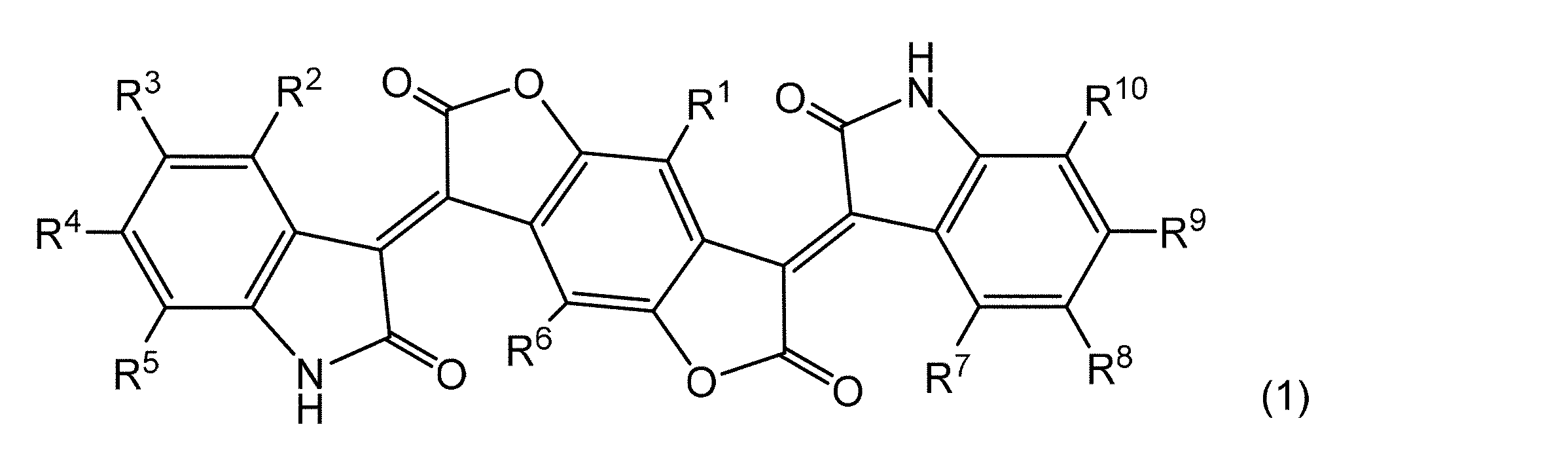
R2、R3、R4、R5、R7、R8、R9およびR10は他の全てから互いに独立して水素原子、ハロゲン原子、R11、COOH、COOR11、COO-、CONH2、CONHR11、CONR11R12、CN、OH、OR11、COCR11、OOCNH2、OOCNHR11、OOCNR11R12、NO2、NH2、NHR11、NR11R12、NHCOR12、NR11COR12、N=CH2、N=CHR11、N=CR11R12、SH、SR11、SOR11、SO2R11、SO3R11、SO3H、SO3 -、SO2NH2、SO2NHR11またはSO2NR11R12である;
且つ、R2とR3、R3とR4、R4とR5、R7とR8、R8とR9、及びR9とR10からなる群から選ばれる少なくとも1つの組み合わせは、互いに直接結合し、または酸素原子、硫黄原子、NH若しくはNR11ブリッジによって互いに結合することもできる;
R11およびR12は互いに独立して、炭素数1~12のアルキル基、炭素数3~12のシクロアルキル基、炭素数2~12のアルケニル基、炭素数3~12のシクロアルケニル基または炭素数2~12のアルキニル基である。)
[8] フォトリソグラフィー法により高さの異なる着色スペーサーを一括形成するために用いる、[1]~[7]のいずれか1つに記載の着色スペーサー形成用感光性着色組成物。
[9] [1]~[8]のいずれか1つに記載の着色スペーサー形成用感光性着色組成物を硬化して得られる硬化物。
[10] [9]に記載の硬化物から形成される着色スペーサー。
[11] [10]に記載の着色スペーサーを備える画像表示装置。
なお、本発明において、「(メタ)アクリル」とは「アクリル及び/又はメタクリル」を意味し、「(メタ)アクリレート」、「(メタ)アクリロイル」についても同様である。
本発明において「全固形分」とは、感光性着色組成物中又は後述するインク中に含まれる、溶剤以外の全成分を意味するものとする。
本発明において、「重量平均分子量」とは、GPC(ゲルパーミエーションクロマトグラフィー)によるポリスチレン換算の重量平均分子量(Mw)をさす。
また、本発明において、「アミン価」とは、特に断りのない限り、有効固形分換算のアミン価を表し、分散剤の固形分1gあたりの塩基量と当量のKOHの質量で表される値である。なお、測定方法については後述する。一方、「酸価」とは、特に断りのない限り有効固形分換算の酸価を表し、中和滴定により算出される。
本発明の着色スペーサー形成用感光性着色組成物は、
(a)着色剤
(b)アルカリ可溶性樹脂
(c)光重合開始剤
(d)エチレン性不飽和化合物
(e)溶剤
(f)分散剤
を必須成分として含有し、必要に応じて、更にシランカップリング剤等の密着向上剤、塗布性向上剤、現像改良剤、紫外線吸収剤、酸化防止剤、界面活性剤、顔料誘導体等、その他の配合成分を含むものであり、通常、各配合成分が、溶剤に溶解又は分散した状態で使用される。
本発明の着色スペーサー形成用感光性着色組成物で用いる(a)着色剤は、(a-1)有機顔料、及び(a-2)カーボンブラックを含有する。このように、紫外線の吸収が少ない有機顔料を用いることで形状や段差のコントロールがしやすく、また、有機顔料に加えてカーボンブラックを用いることで高遮光性を達成することができる。
なお、分散性や遮光性の点で、C.I.ピグメントブルー15:6、16、60を用いることが好ましく、感光性着色組成物を紫外線で硬化させる場合には、青色顔料としては紫外線吸収率の低いものを使用することが好ましく、かかる観点からはC.I.ピグメントブルー60を用いることがより好ましい。
なお、分散性や遮光性の点で、C.I.ピグメントバイオレット23、29を用いることが好ましく、感光性着色組成物を紫外線で硬化させる場合には、紫色顔料としては紫外線吸収率の低いものを使用することが好ましく、係る観点からはC.I.ピグメントバイオレット29を用いることがより好ましい。
緑色顔料としては、C.I.ピグメントグリーン1、2、4、7、8、10、13、14、15、17、18、19、26、36、45、48、50、51、54、55を挙げることができる。この中でも、好ましくはC.I.ピグメントグリーン7、36を挙げることができる。
黄色顔料としては、C.I.ピグメントイエロー1、1:1、2、3、4、5、6、9、10、12、13、14、16、17、24、31、32、34、35、35:1、36、36:1、37、37:1、40、41、42、43、48、53、55、61、62、62:1、63、65、73、74、75、81、83、87、93、94、95、97、100、101、104、105、108、109、110、111、116、117、119、120、126、127、127:1、128、129、133、134、136、138、139、142、147、148、150、151、153、154、155、157、158、159、160、161、162、163、164、165、166、167、168、169、170、172、173、174、175、176、180、181、182、183、184、185、188、189、190、191、191:1、192、193、194、195、196、197、198、199、200、202、203、204、205、206、207、208を挙げることができる。この中でも、好ましくはC.I.ピグメントイエロー83、117、129、138、139、150、154、155、180、185、更に好ましくはC.I.ピグメントイエロー83、138、139、150、180を挙げることができる。
赤色顔料:C.I.ピグメントレッド177、254、272
橙色顔料:C.I.ピグメントオレンジ43、64、72
青色顔料:C.I.ピグメントブルー15:6、60
紫色顔料:C.I.ピグメントバイオレット23、29
これらの中でも、可視領域の特に長波長領域における遮光性の観点から、青色顔料及び/又は紫色顔料を用いることが好ましい。特に、カーボンブラックの吸収スペクトルは、短波長から長波長にかけて吸光度が右肩下がりとなっており、また、有機顔料よりも紫外領域の吸光度が高くなっているため、遮光性と製版性を両立するとの観点から、青色顔料及び/又は紫色顔料とカーボンブラックとを併用することが好ましく、青色顔料及び紫色顔料とカーボンブラックとを併用することがより好ましい。
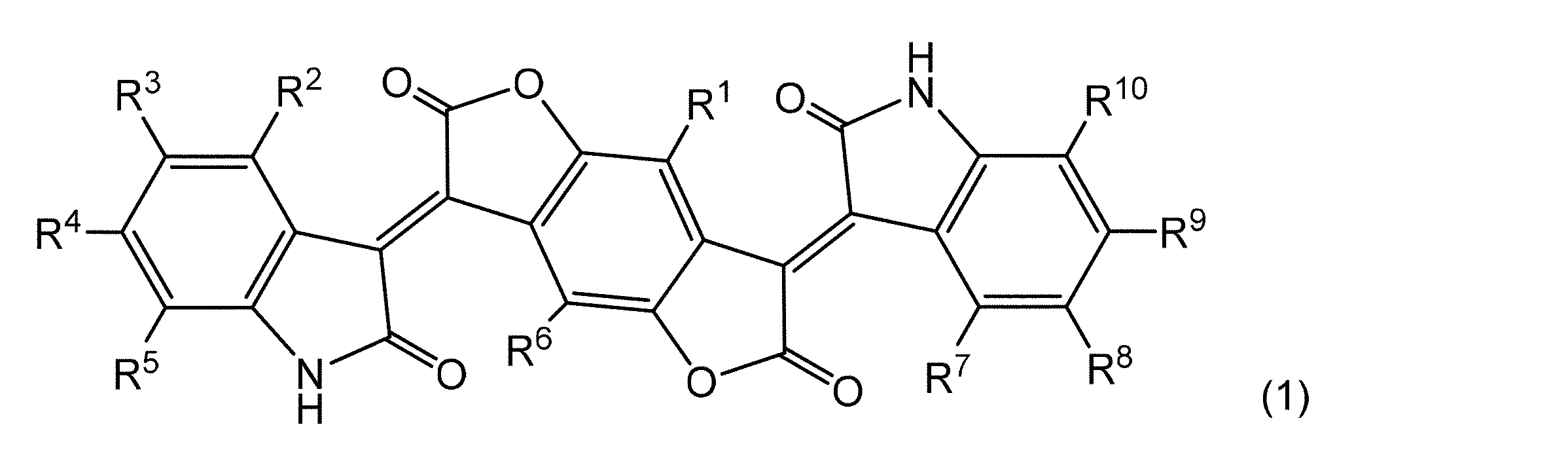
R2、R3、R4、R5、R7、R8、R9およびR10は他の全てから互いに独立して水素原子、ハロゲン原子、R11、COOH、COOR11、COO-、CONH2、CONHR11、CONR11R12、CN、OH、OR11、COCR11、OOCNH2、OOCNHR11、OOCNR11R12、NO2、NH2、NHR11、NR11R12、NHCOR12、NR11COR12、N=CH2、N=CHR11、N=CR11R12、SH、SR11、SOR11、SO2R11、SO3R11、SO3H、SO3 -、SO2NH2、SO2NHR11またはSO2NR11R12である;
且つ、R2とR3、R3とR4、R4とR5、R7とR8、R8とR9、及びR9とR10からなる群から選ばれる少なくとも1つの組み合わせは、互いに直接結合し、または酸素原子、硫黄原子、NH若しくはNR11ブリッジによって互いに結合することもできる;
R11およびR12は互いに独立して、炭素数1~12のアルキル基、炭素数3~12のシクロアルキル基、炭素数2~12のアルケニル基、炭素数3~12のシクロアルケニル基または炭素数2~12のアルキニル基である。

R2、R4、R5、R7、R9およびR10は互いに独立して好ましくは水素原子、フッ素原子、または塩素原子であり、さらに好ましくは水素原子である。
R3およびR8は互いに独立して好ましくは水素原子、NO2、OCH3、OC2H5、臭素原子、塩素原子、CH3、C2H5、N(CH3)2、N(CH3)(C2H5)、N(C2H5)2、α-ナフチル、β-ナフチル、SO3HまたはSO3 -であり、さらに好ましくは水素原子またはSO3Hである。
好ましくは、R1とR6、R2とR7、R3とR8、R4とR9、およびR5とR10からなる群から選ばれる少なくとも1つの組み合わせが同一であり、より好ましくは、R1はR6と同一であり、R2はR7と同一であり、R3はR8と同一であり、R4はR9と同一であり、かつ、R5はR10と同一である。

この有機黒色顔料は、好ましくは後述される分散剤、溶剤、方法によって分散して使用される。また、分散の際に前記一般式(2)のスルホン酸誘導体が存在すると、分散性や保存性が向上する場合がある。
デグサ社製:Printex(登録商標、以下同じ。)3、Printex3OP、Printex30、Printex30OP、Printex40、Printex45、Printex55、Printex60、Printex75、Printex80、Printex85、Printex90、Printex A、Printex L、Printex G、Printex P、Printex U、Printex V、PrintexG、SpecialBlack550、SpecialBlack350、SpecialBlack250、SpecialBlack100、SpecialBlack6、SpecialBlack5、SpecialBlack4、Color Black FW1、Color Black FW2、Color Black FW2V、Color Black FW18、Color Black FW18、Color Black FW200、Color Black S160、Color Black S170
キャボット社製:Monarch(登録商標、以下同じ。)120、Monarch280、Monarch460、Monarch800、Monarch880、Monarch900、Monarch1000、Monarch1100、Monarch1300、Monarch1400、Monarch4630、REGAL(登録商標、以下同じ。)99、REGAL99R、REGAL415、REGAL415R、REGAL250、REGAL250R、REGAL330、REGAL400R、REGAL55R0、REGAL660R、BLACK PEARLS480、PEARLS130、VULCAN(登録商標) XC72R、ELFTEX(登録商標)-8
コロンビヤン カーボン社製:RAVEN(登録商標、以下同じ。)11、RAVEN14、RAVEN15、RAVEN16、RAVEN22RAVEN30、RAVEN35、RAVEN40、RAVEN410、RAVEN420、RAVEN450、RAVEN500、RAVEN780、RAVEN850、RAVEN890H、RAVEN1000、RAVEN1020、RAVEN1040、RAVEN1060U、RAVEN1080U、RAVEN1170、RAVEN1190U、RAVEN1250、RAVEN1500、RAVEN2000、RAVEN2500U、RAVEN3500、RAVEN5000、RAVEN5250、RAVEN5750、RAVEN7000
具体的な合成樹脂としては、フェノール樹脂、メラミン樹脂、キシレン樹脂、ジアリルフタレート樹脂、グリプタル樹脂、エポキシ樹脂、アルキルベンゼン樹脂等の熱硬化性樹脂や、ポリスチレン、ポリカーボネート、ポリエチレンテレフタレート、ポリブチレンテレフタレート、変性ポリフェニレンオキサイド、ポリスルフォン、ポリパラフェニレンテレフタルアミド、ポリアミドイミド、ポリイミド、ポリアミノビスマレイミド、ポリエーテルスルフォポリフェニレンスルフォン、ポリアリレート、ポリエーテルエーテルケトン、等の熱可塑性樹脂が使用できる。カーボンブラックに対する樹脂の被覆量は、カーボンブラックと樹脂の合計量に対し1~30質量%が好ましく、前記下限値以上とすることで被覆を十分なものとすることができる傾向がある。一方、前記上限値以下とすることで、樹脂同士の粘着を防ぎ、分散性が良好なものとすることができる傾向がある。
アゾ系染料としては、例えば、C.I.アシッドイエロー11、C.I.アシッドオレンジ7、C.I.アシッドレッド37、C.I.アシッドレッド180、C.I.アシッドブルー29、C.I.ダイレクトレッド28、C.I.ダイレクトレッド83、C.I.ダイレクトイエロー12、C.I.ダイレクトオレンジ26、C.I.ダイレクトグリーン28、C.I.ダイレクトグリーン59、C.I.リアクティブイエロー2、C.I.リアクティブレッド17、C.I.リアクティブレッド120、C.I.リアクティブブラック5、C.I.ディスパースオレンジ5、C.I.ディスパースレッド58、C.I.ディスパースブルー165、C.I.ベーシックブルー41、C.I.ベーシックレッド18、C.I.モルダントレッド7、C.I.モルダントイエロー5、C.I.モルダントブラック7等が挙げられる。
この他、フタロシアニン系染料として、例えば、C.I.パッドブルー5等が、キノンイミン系染料として、例えば、C.I.ベーシックブルー3、C.I.ベーシックブルー9等が、キノリン系染料として、例えば、C.I.ソルベントイエロー33、C.I.アシッドイエロー3、C.I.ディスパースイエロー64等が、ニトロ系染料として、例えば、C.I.アシッドイエロー1、C.I.アシッドオレンジ3、C.I.ディスパースイエロー42等が挙げられる。
なお、感光性着色組成物において、顔料の平均粒子径は、動的光散乱(DLS)により測定された顔料粒子径から求めた値である。粒子径測定は、十分に希釈された感光性着色組成物(通常は希釈して、顔料濃度0.005~0.2質量%程度に調製。但し測定機器により推奨された濃度があれば、その濃度に従う。)に対して行い、25℃にて測定する。
本発明で用いる(b)アルカリ可溶性樹脂としては、カルボキシル基又は水酸基を含む樹脂であれば特に限定はなく、例えばエポキシ(メタ)アクリレート系樹脂、アクリル系樹脂、カルボキシル基含有エポキシ樹脂、カルボキシル基含有ウレタン樹脂、ノボラック系樹脂、ポリビニルフェノール系樹脂等が挙げられるが、中でもエポキシ(メタ)アクリレート系樹脂、アクリル系樹脂が好ましい。これらは1種を単独で、或いは複数種を混合して使用することができる。
エポキシ樹脂にα,β-不飽和モノカルボン酸又はカルボキシル基を有するα,β-不飽和モノカルボン酸エステルを付加させ、さらに、多塩基酸及び/又はその無水物を反応させることによって得られたアルカリ可溶性樹脂。
<アルカリ可溶性樹脂(b2)>
エポキシ樹脂にα,β-不飽和モノカルボン酸又はカルボキシル基を有するα,β-不飽和モノカルボン酸エステルを付加させ、さらに、多価アルコール、及び多塩基酸及び/又はその無水物と反応させることによって得られたアルカリ可溶性樹脂。
原料となるエポキシ樹脂の種類としては、クレゾールノボラック型エポキシ樹脂、フェノールノボラック型エポキシ樹脂、ビスフェノールA型エポキシ樹脂、ビスフェノールF型エポキシ樹脂、トリスフェノールメタン型エポキシ樹脂、ビフェニルノボラック型エポキシ樹脂、ナフタレンノボラック型エポキシ樹脂、ジシクロペンタジエンとフェノールまたはクレゾールとの重付加反応物とエピハロヒドリンとの反応生成物であるエポキシ樹脂、アダマンチル基含有エポキシ樹脂、フルオレン型エポキシ樹脂等を好適に用いることができ、このように主鎖に芳香族環を有するものを好適に用いることができる。


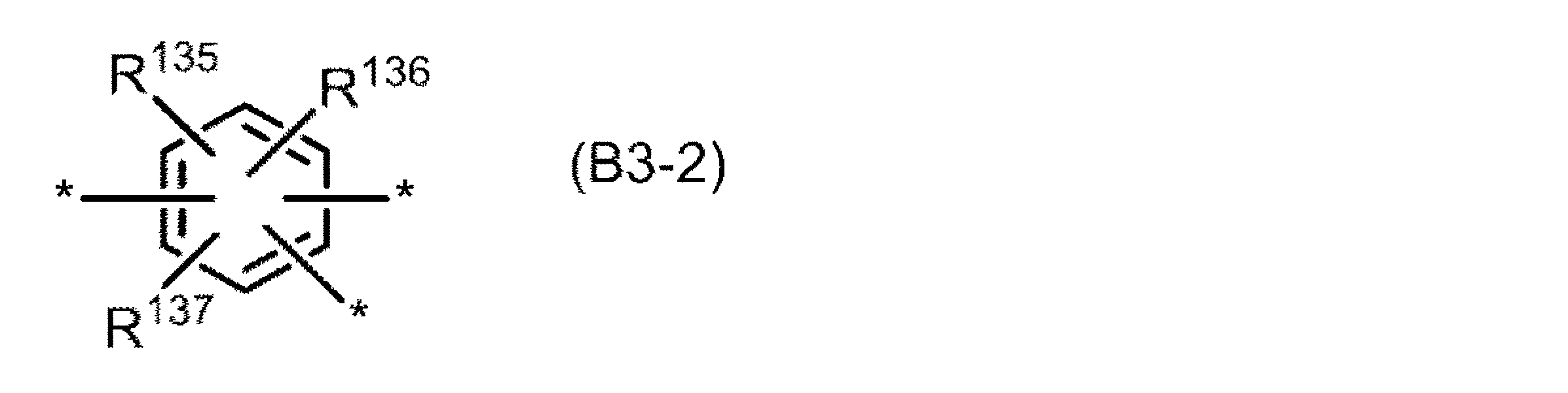
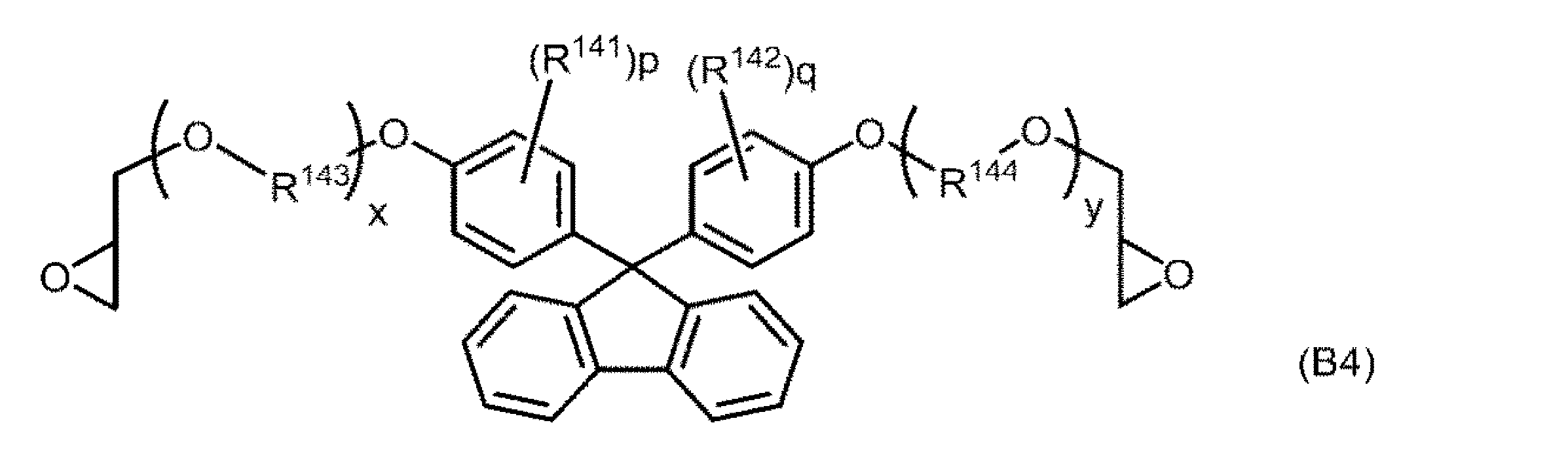
これらの内、感度の点から、特に好ましいものは(メタ)アクリル酸である。
α,β-不飽和モノカルボン酸又はカルボキシル基を有するα,β-不飽和モノカルボン酸エステルの使用量は、エポキシ樹脂のエポキシ基1当量に対し0.5~1.2当量の範囲が好ましく、さらに好ましくは0.7~1.1当量の範囲である。α,β-不飽和モノカルボン酸又はカルボキシル基を有するα,β-不飽和モノカルボン酸エステルの使用量が少ないと不飽和基の導入量が不足し、引き続く多塩基酸及び/又はその無水物との反応も不十分となる。また、多量のエポキシ基が残存することも有利ではない。一方、該使用量が多いとα,β-不飽和モノカルボン酸又はカルボキシル基を有するα,β-不飽和モノカルボン酸エステルが未反応物として残存する。いずれの場合も硬化特性が悪化する傾向が認められる。
カルボキシル基含有エポキシ(メタ)アクリレート樹脂は、通常、エポキシ樹脂とα,β-不飽和モノカルボン酸又はカルボキシル基を有するα,β-不飽和モノカルボン酸エステルとの反応物に、多塩基酸及び/又はその無水物を混合した後、もしくは、エポキシ樹脂とα,β-不飽和モノカルボン酸又はカルボキシル基を有するα,β-不飽和モノカルボン酸エステルとの反応物に、多塩基酸及び/又はその無水物及び多官能アルコールを混合した後に、加温することにより得られる。この場合、多塩基酸及び/又はその無水物と多官能アルコールの混合順序に、特に制限はない。加温により、エポキシ樹脂とα,β-不飽和モノカルボン酸又はカルボキシル基を有するα,β-不飽和モノカルボン酸エステルとの反応物と多官能アルコールとの混合物中に存在するいずれかの水酸基に対して多塩基酸及び/又はその無水物が付加反応する。
また、前述のカルボキシル基含有エポキシ(メタ)アクリレート樹脂の一部を、他のバインダー樹脂に置き換えて用いてもよい。即ち、カルボキシル基含有エポキシ(メタ)アクリレート樹脂と他のバインダー樹脂を併用してもよい。この場合において、(b)アルカリ可溶性樹脂におけるカルボキシル基含有エポキシ(メタ)アクリレート樹脂の割合を、50質量%以上とすることが好ましく、60質量%以上とすることがより好ましく、70質量%以上とすることがさらに好ましく、80質量%以上とすることが特に好ましい。
不飽和単量体(b1)としては、例えば、(メタ)アクリル酸、クロトン酸、α-クロルアクリル酸、けい皮酸の如き不飽和モノカルボン酸;マレイン酸、無水マレイン酸、フマル酸、イタコン酸、無水イタコン酸、シトラコン酸、無水シトラコン酸、メサコン酸の如き不飽和ジカルボン酸又はその無水物;こはく酸モノ〔2-(メタ)アクリロイロキシエチル〕、フタル酸モノ〔2-(メタ)アクリロイロキシエチル〕の如き2価以上の多価カルボン酸のモノ〔(メタ)アクリロイロキシアルキル〕エステル;ω-カルボキシポリカプロラクトンモノ(メタ)アクリレートの如き両末端にカルボキシ基と水酸基とを有するポリマーのモノ(メタ)アクリレート;p-ビニル安息香酸等を挙げることができる。
これらの不飽和単量体(b1)は、単独で又は2種以上を混合して使用することができる。
これらの不飽和単量体(b2)は、単独で又は2種以上を混合して使用することができる。
不飽和単量体(b1)と不飽和単量体(b2)の共重合体は、公知の方法により製造することができるが、例えば、日本国特開2003-222717号公報、日本国特開2006-259680号公報、国際公開第2007/029871号等に開示されている方法により、その構造やMw、Mw/Mnを制御することもできる。
(c)光重合開始剤は、光を直接吸収し、分解反応又は水素引き抜き反応を起こし、重合活性ラジカルを発生する機能を有する成分である。必要に応じて重合促進剤(連鎖移動剤)、増感色素等の付加剤を添加して使用してもよい。
光重合開始剤としては、例えば、日本国特開昭59-152396号公報、日本国特開昭61-151197号公報に記載のチタノセン化合物を含むメタロセン化合物;日本国特開2000-56118号公報に記載のヘキサアリールビイミダゾール誘導体;日本国特開平10-39503号公報記載のハロメチル化オキサジアゾール誘導体、ハロメチル-s-トリアジン誘導体、N-フェニルグリシン等のN-アリール-α-アミノ酸類、N-アリール-α-アミノ酸塩類、N-アリール-α-アミノ酸エステル類等のラジカル活性剤、α-アミノアルキルフェノン誘導体;日本国特開2000-80068号公報、日本国特開2006-36750号公報等に記載されているオキシムエステル誘導体等が挙げられる。
オキシムエステル系化合物としては、例えば、国際公開第2008/075564号に記載のもの、国際公開第2009/131189号に記載のもの、日本国特開2011-132215号公報に記載のもの、国際公開第2008/078678号に記載のもの、日本国特表2014-500852号公報に記載のものなどが挙げられる。
光重合開始剤には、必要に応じて、感応感度を高める目的で、画像露光光源の波長に応じた増感色素、重合促進剤を配合させることができる。増感色素としては、日本国特開平4-221958号公報、日本国特開平4-219756号公報に記載のキサンテン色素、日本国特開平3-239703号公報、日本国特開平5-289335号公報に記載の複素環を有するクマリン色素、日本国特開平3-239703号公報、日本国特開平5-289335号公報に記載の3-ケトクマリン化合物、日本国特開平6-19240号公報に記載のピロメテン色素、その他、日本国特開昭47-2528号公報、日本国特開昭54-155292号公報、日本国特公昭45-37377号公報、日本国特開昭48-84183号公報、日本国特開昭52-112681号公報、日本国特開昭58-15503号公報、日本国特開昭60-88005号公報、日本国特開昭59-56403号公報、日本国特開平2-69号公報、日本国特開昭57-168088号公報、日本国特開平5-107761号公報、日本国特開平5-210240号公報、日本国特開平4-288818号公報に記載のジアルキルアミノベンゼン骨格を有する色素等を挙げることができる。
増感色素もまた1種を単独で用いてもよく、2種以上を併用してもよい。
本発明の感光性着色組成物は、(d)エチレン性不飽和化合物を含む。(d)エチレン性不飽和化合物を含むことで、感度が向上する。
本発明に用いられるエチレン性不飽和化合物は、分子内にエチレン性不飽和基を少なくとも1個有する化合物である。具体的には、例えば(メタ)アクリル酸、(メタ)アクリル酸アルキルエステル、アクリロニトリル、スチレン、及びエチレン性不飽和結合を1個有するカルボン酸と、多価又は1価アルコールのモノエステル、等が挙げられる。
多官能エチレン性単量体の例としては、例えば脂肪族ポリヒドロキシ化合物と不飽和カルボン酸とのエステル;芳香族ポリヒドロキシ化合物と不飽和カルボン酸とのエステル;脂肪族ポリヒドロキシ化合物、芳香族ポリヒドロキシ化合物等の多価ヒドロキシ化合物と、不飽和カルボン酸及び多塩基性カルボン酸とのエステル化反応により得られるエステルなどが挙げられる。
これらは1種を単独で用いてもよく、2種以上を併用してもよい。
本発明の感光性着色組成物は、(e)溶剤を含む。(e)溶剤を含むことで、顔料を溶剤中に分散でき、また、塗布が容易となる。
本発明の感光性着色組成物は、通常、(a)着色剤、(b)アルカリ可溶性樹脂、(c)光重合開始剤、(d)エチレン性不飽和化合物、(f)分散剤、及び必要に応じて使用されるその他の各種材料が、溶剤に溶解又は分散した状態で使用される。溶剤の中でも、分散性や塗布性の観点から有機溶剤が好ましい。
エチレングリコールモノメチルエーテル、エチレングリコールモノエチルエーテル、エチレングリコールモノプロピルエーテル、エチレングリコールモノブチルエーテル、プロピレングリコールモノメチルエーテル、プロピレングリコールモノエチルエーテル、プロピレングリコールモノ-n-ブチルエーテル、プロピレングリコール-t-ブチルエーテル、ジエチレングリコールモノメチルエーテル、ジエチレングリコールモノエチルエーテル、ジエチレングリコールモノ-n-ブチルエーテル、メトキシメチルペンタノール、ジプロピレングリコールモノエチルエーテル、ジプロピレングリコールモノメチルエーテル、3-メチル-3-メトキシブタノール、トリエチレングリコールモノメチルエーテル、トリエチレングリコールモノエチルエーテル、トリプロピレングリコールメチルエーテルのようなグリコールモノアルキルエーテル類;
エチレングリコールジメチルエーテル、エチレングリコールジエチルエーテル、ジエチレングリコールジメチルエーテル、ジエチレングリコールジエチルエーテル、ジエチレングリコールジプロピルエーテル、ジエチレングリコールジブチルエーテル、ジプロピレングリコールジメチルエーテルのようなグリコールジアルキルエーテル類;
エチレングリコールジアセテート、1,3-ブチレングリコールジアセテート、1,6-ヘキサノールジアセテートなどのグリコールジアセテート類;
シクロヘキサノールアセテートなどのアルキルアセテート類;
アミルエーテル、ジエチルエーテル、ジプロピルエーテル、ジイソプロピルエーテル、ジブチルエーテル、ジアミルエーテル、エチルイソブチルエーテル、ジヘキシルエーテルのようなエーテル類;
エタノール、プロパノール、ブタノール、ヘキサノール、シクロヘキサノール、エチレングリコール、プロピレングリコール、ブタンジオール、ジエチレングリコール、ジプロピレングリコール、トリエチレングリコール、メトキシメチルペンタノール、グリセリン、ベンジルアルコールのような1価又は多価アルコール類;
n-ペンタン、n-オクタン、ジイソブチレン、n-ヘキサン、ヘキセン、イソプレン、ジペンテン、ドデカンのような脂肪族炭化水素類;
シクロヘキサン、メチルシクロヘキサン、メチルシクロヘキセン、ビシクロヘキシルのような脂環式炭化水素類;
アミルホルメート、エチルホルメート、酢酸エチル、酢酸ブチル、酢酸プロピル、酢酸アミル、メチルイソブチレート、エチレングリコールアセテート、エチルプロピオネート、プロピルプロピオネート、酪酸ブチル、酪酸イソブチル、イソ酪酸メチル、エチルカプリレート、ブチルステアレート、エチルベンゾエート、3-エトキシプロピオン酸メチル、3-エトキシプロピオン酸エチル、3-メトキシプロピオン酸メチル、3-メトキシプロピオン酸エチル、3-メトキシプロピオン酸プロピル、3-メトキシプロピオン酸ブチル、γ-ブチロラクトンのような鎖状又は環状エステル類;
3-メトキシプロピオン酸、3-エトキシプロピオン酸のようなアルコキシカルボン酸類;
ブチルクロリド、アミルクロリドのようなハロゲン化炭化水素類;
メトキシメチルペンタノンのようなエーテルケトン類;
アセトニトリル、ベンゾニトリルのようなニトリル類等。
これらの有機溶剤は、単独で用いてもよく、2種以上を併用してもよい。
また、グリコールアルキルエーテルアセテート類は、単独で使用してもよいが、他の有機溶剤を併用してもよい。併用する有機溶剤として、特に好ましいのはグリコールモノアルキルエーテル類である。中でも、特に組成物中の構成成分の溶解性からプロピレングリコールモノメチルエーテルが好ましい。なお、グリコールモノアルキルエーテル類は極性が高く、添加量が多すぎると顔料が凝集しやすく、後に得られる着色樹脂組成物の粘度が上がっていくなどの保存安定性が低下する傾向があるので、溶剤中のグリコールモノアルキルエーテル類の割合は5質量%~30質量%が好ましく、5質量%~20質量%がより好ましい。
好ましい高沸点溶剤として、例えば前述の各種溶剤の中ではジエチレングリコールモノ-n-ブチルエーテルアセテート、ジエチレングリコールモノエチルエーテルアセテート、ジプロピレングリコールメチルエーテルアセテート、1,3-ブチレングリコールジアセテート、1,6-ヘキサノールジアセテート、トリアセチンなどが挙げられる。
本発明の感光性着色組成物においては、(a)着色剤を微細に分散させ、且つその分散状態を安定化させることが品質の安定性確保には重要なため、(f)分散剤を含む。
(f)分散剤としては、官能基を有する高分子分散剤が好ましく、更に、分散安定性の面からカルボキシル基;リン酸基;スルホン酸基;又はこれらの塩基;一級、二級又は三級アミノ基;四級アンモニウム塩基;ピリジン、ピリミジン、ピラジン等の含窒素ヘテロ環由来の基、等の官能基を有する高分子分散剤が好ましい。中でも特に、一級、二級又は三級アミノ基;四級アンモニウム塩基;ピリジン、ピリミジン、ピラジン等の含窒素ヘテロ環由来の基、等の塩基性官能基を有する高分子分散剤が顔料を分散する際に少量の分散剤で分散することができるとの観点から特に好ましい。
これらの高分子分散剤は1種を単独で使用してもよく、又は2種以上を併用してもよい。
これらの内、顔料の分散性の観点から、(f)分散剤は官能基を有するウレタン系高分子分散剤及び/又はアクリル系高分子分散剤を含むことが好ましく、アクリル系高分子分散剤を含むことが特に好ましい。
また分散性、保存性の面から、塩基性官能基を有し、ポリエステル結合及び/又はポリエーテル結合を有する高分子分散剤が好ましい。
ウレタン系高分子分散剤として好ましい化学構造を具体的に例示するならば、例えば、ポリイソシアネート化合物と、分子内に水酸基を1個又は2個有する数平均分子量300~10,000の化合物と、同一分子内に活性水素と3級アミノ基を有する化合物とを反応させることによって得られる、重量平均分子量1,000~200,000の分散樹脂等が挙げられる。これらをベンジルクロリド等の四級化剤で処理することで、3級アミノ基の全部又は一部を4級アンモニウム塩基にすることができる。
ポリエーテルグリコールとしては、ポリエーテルジオール、ポリエーテルエステルジオール、及びこれら2種類以上の混合物が挙げられる。ポリエーテルジオールとしては、アルキレンオキシドを単独又は共重合させて得られるもの、例えばポリエチレングリコール、ポリプロピレングリコール、ポリエチレン-プロピレングリコール、ポリオキシテトラメチレングリコール、ポリオキシヘキサメチレングリコール、ポリオキシオクタメチレングリコール及びそれらの2種以上の混合物が挙げられる。
これらは1種を単独で用いてもよく、2種以上を併用してもよい。
活性水素、即ち、酸素原子、窒素原子又は硫黄原子に直接結合している水素原子としては、水酸基、アミノ基、チオール基等の官能基中の水素原子が挙げられ、中でもアミノ基、特に1級のアミノ基の水素原子が好ましい。
このような同一分子内に活性水素と3級アミノ基を有する化合物を例示するならば、N,N-ジメチル-1,3-プロパンジアミン、N,N-ジエチル-1,3-プロパンジアミン、N,N-ジプロピル-1,3-プロパンジアミン、N,N-ジブチル-1,3-プロパンジアミン、N,N-ジメチルエチレンジアミン、N,N-ジエチルエチレンジアミン、N,N-ジプロピルエチレンジアミン、N,N-ジブチルエチレンジアミン、N,N-ジメチル-1,4-ブタンジアミン、N,N-ジエチル-1,4-ブタンジアミン、N,N-ジプロピル-1,4-ブタンジアミン、N,N-ジブチル-1,4-ブタンジアミン等が挙げられる。
これらは1種を単独で用いてもよく、2種以上を併用してもよい。
ウレタン系高分子分散剤の重量平均分子量(Mw)は通常1,000~200,000、好ましくは2,000~100,000、より好ましくは3,000~50,000の範囲である。この分子量が1,000未満では分散性及び分散安定性が劣り、200,000を超えると溶解性が低下し分散性が劣ると同時に反応の制御が困難となる。
該A-B又はB-A-Bブロック共重合体は、例えば、以下に示すリビング重合法にて調製される。
リビング重合法には、アニオンリビング重合法、カチオンリビング重合法、ラジカルリビング重合法があり、このうち、アニオンリビング重合法は、重合活性種がアニオンであり、例えば下記スキームで表される。
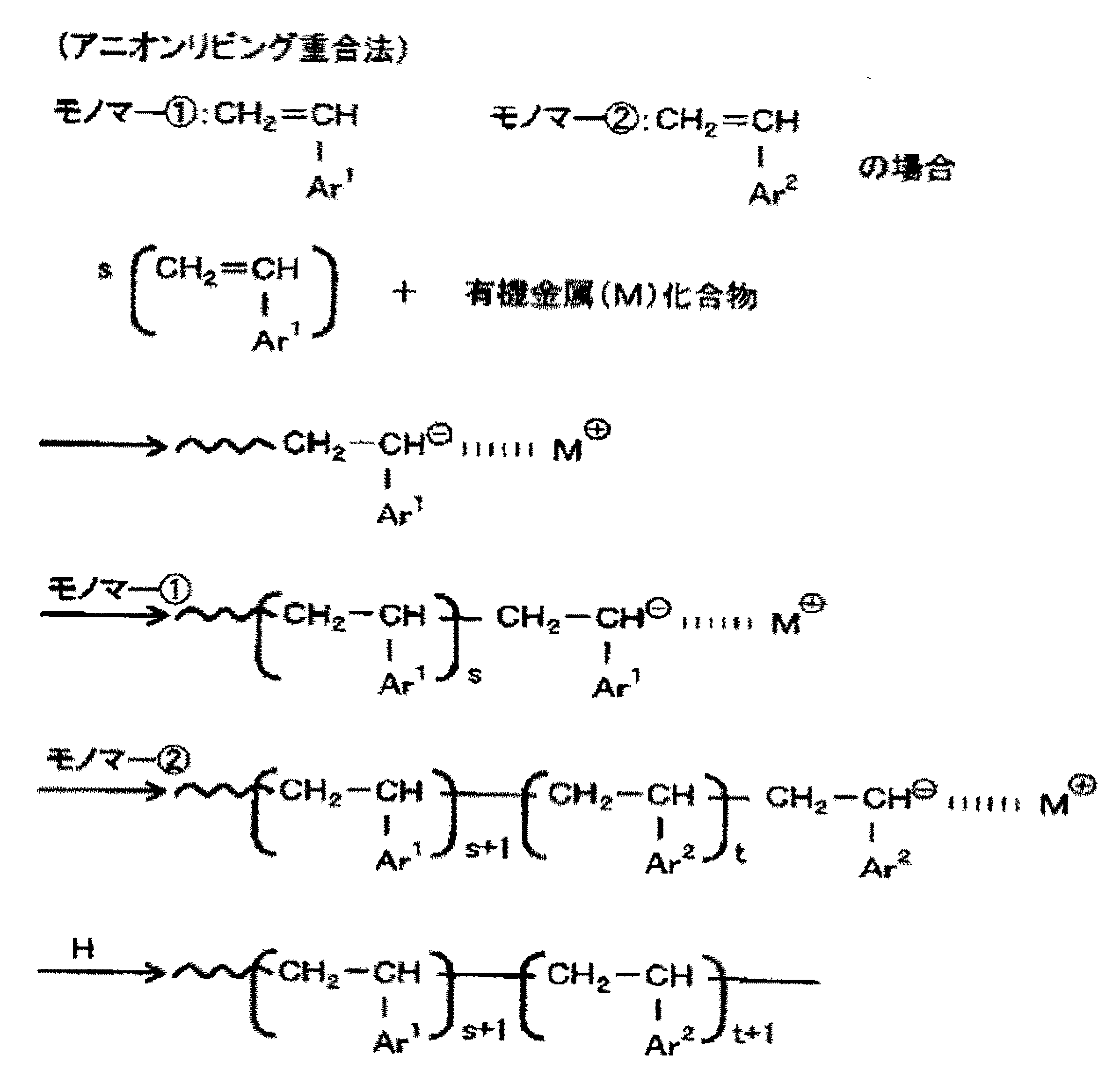
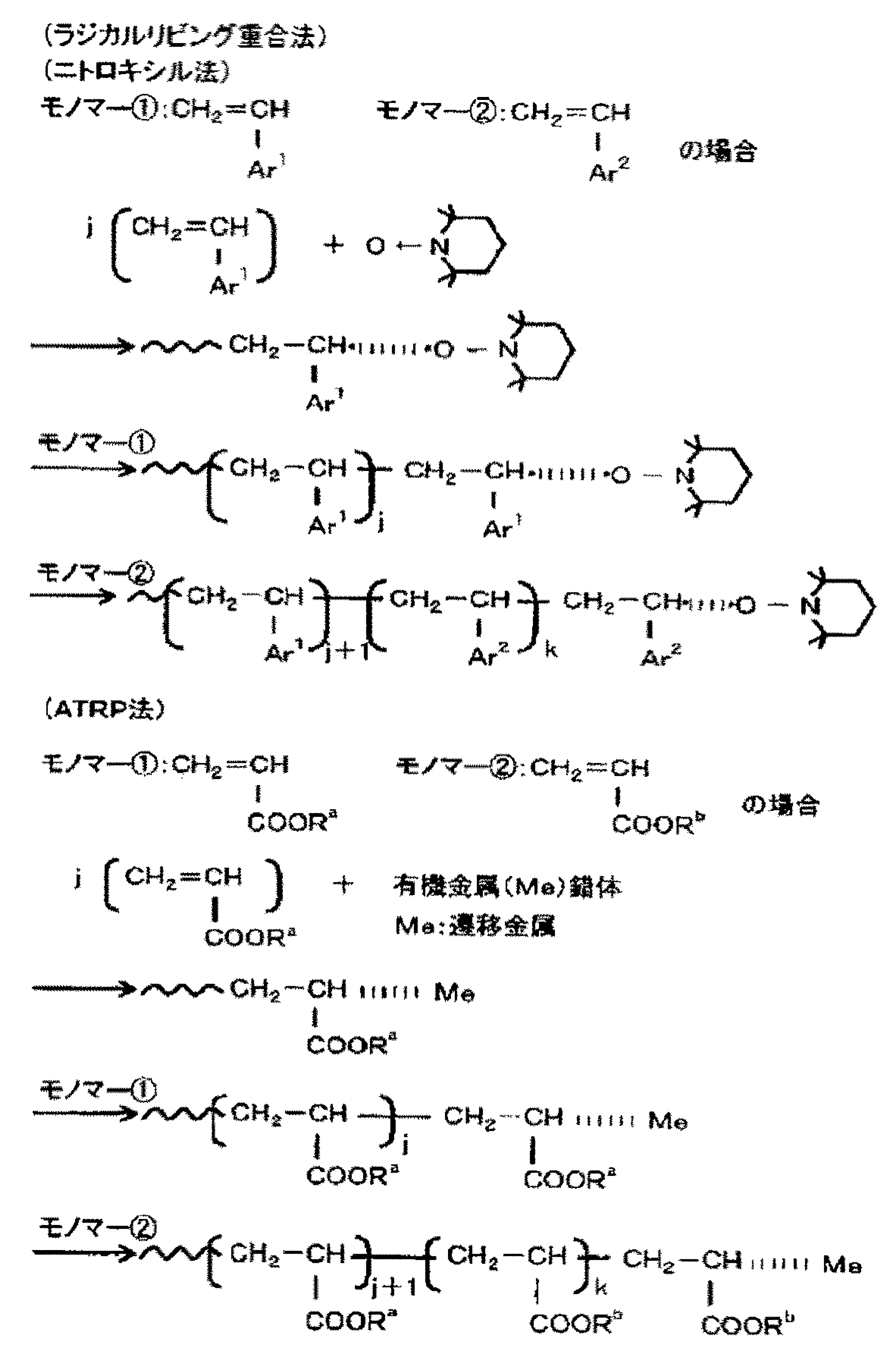
また、本発明で用いることができるA-Bブロック共重合体、B-A-Bブロック共重合体1g中の4級アンモニウム塩基の量は、通常0.1~10mmolであることが好ましく、この範囲内にすることで良好な分散性を確保できる傾向がある。
ここで、これらのブロック共重合体等の分散剤のアミン価は、分散剤試料中の溶剤を除いた固形分1gあたりの塩基量と当量のKOHの質量で表し、次の方法により測定する。
100mLのビーカーに分散剤試料の0.5~1.5gを精秤し、50mLの酢酸で溶解する。pH電極を備えた自動滴定装置を使って、この溶液を0.1mol/LのHClO4酢酸溶液にて中和滴定する。滴定pH曲線の変曲点を滴定終点とし次式によりアミン価を求める。
〔但し、W:分散剤試料秤取量[g]、V:滴定終点での滴定量[mL]、S:分散剤試料の固形分濃度[質量%]を表す。〕
また、このブロック共重合体のアミン価は、該酸価の元となる酸性基の有無及び種類にもよるが、一般に低い方が好ましく、通常10mgKOH/g以下であり、その重量平均分子量(Mw)は、1000~100,000の範囲が好ましい。前記範囲内とすることで良好な分散性を確保できる傾向がある。


同様に、上記式(ii)のR35及びR36における、置換基を有していてもよいアリール基としては、上記式(i)のR31~R33として例示したものを好ましく採用することができる。また、上記式(ii)のR35及びR36における、置換基を有していてもよいアラルキル基としては、上記式(i)のR31~R33として例示したものを好ましく採用することができる。
また、上記式(i)において、対アニオンのY-としては、Cl-、Br-、I-、ClO4 -、BF4 -、CH3COO-、PF6 -等が挙げられる。
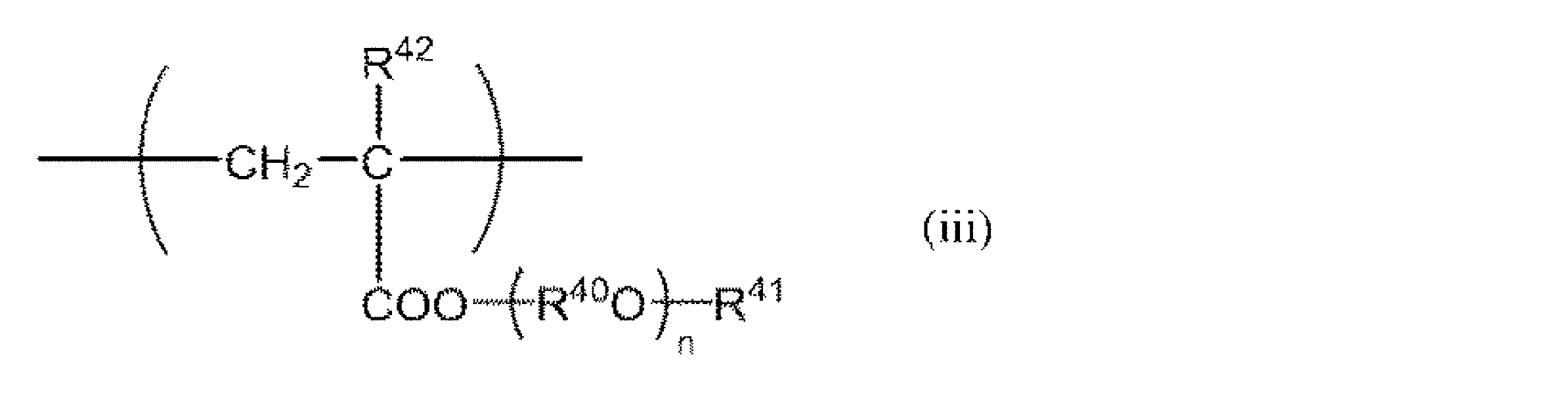

R38における、アルキル基が有していてもよい置換基としては、ハロゲン原子、アルコキシ基等が挙げられる。また、アリール基又はアラルキル基が有していてもよい置換基としては、鎖状のアルキル基、ハロゲン原子、アルコキシ基等が挙げられる。また、R38で示される鎖状のアルキル基には、直鎖状及び分岐鎖状のいずれも含まれる。
本発明の感光性着色組成物には、上述の成分の他、シランカップリング剤等の密着向上剤、塗布性向上剤、現像改良剤、紫外線吸収剤、酸化防止剤、界面活性剤、顔料誘導体、光酸発生剤、架橋剤等を適宜配合することができる。
本発明の感光性着色組成物には、基板との密着性を改善するため、密着向上剤を含有させてもよい。密着向上剤としては、シランカップリング剤、燐酸基含有化合物等が好ましい。
シランカップリング剤の種類としては、エポキシ系、(メタ)アクリル系、アミノ系等種々のものを1種を単独で、或いは2種以上を混合して使用できる。
燐酸基含有化合物としては、(メタ)アクリロイル基含有ホスフェート類が好ましく、下記一般式(g1)、(g2)又は(g3)で表されるものが好ましい。
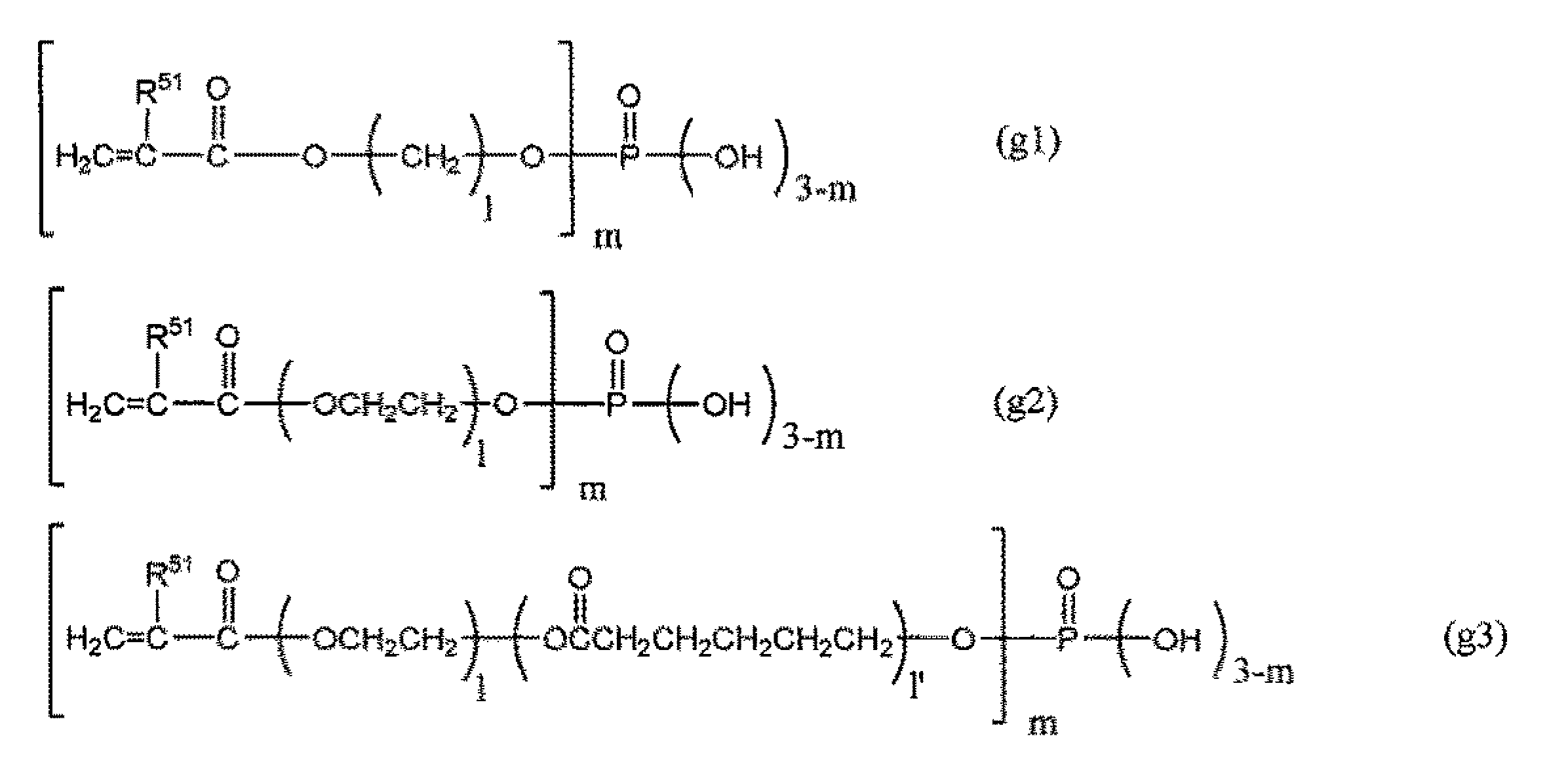
これらの燐酸基含有化合物も1種類を単独で用いても、2種以上を組み合わせて使用してもよい。
本発明の感光性着色組成物には、塗布性向上ため、界面活性剤を含有させてもよい。
このような界面活性剤としては、例えば、TSF4460(ジーイー東芝シリコーン社製)、DFX-18(ネオス社製)、BYK-300、BYK-325、BYK-330(ビックケミー社製)、KP340(信越シリコーン社製)、F-470、F-475、F-478、F-559(DIC社製)、SH7PA(トーレシリコーン社製)、DS-401(ダイキン社製)、L-77(日本ユニカー社製)、FC4430(3M社製)等が挙げられる。
なお、界面活性剤は、1種を用いてもよく、2種以上を任意の組み合わせ及び比率で併用してもよい。
本発明の感光性着色組成物には、分散性、保存性向上のため、分散助剤として顔料誘導体を含有させてもよい。
顔料誘導体としてはアゾ系、フタロシアニン系、キナクリドン系、ベンズイミダゾロン系、キノフタロン系、イソインドリノン系、ジオキサジン系、アントラキノン系、インダンスレン系、ペリレン系、ペリノン系、ジケトピロロピロール系、ジオキサジン系等の誘導体が挙げられるが、中でもフタロシアニン系、キノフタロン系が好ましい。
顔料誘導体の置換基としてはスルホン酸基、スルホンアミド基及びその4級塩、フタルイミドメチル基、ジアルキルアミノアルキル基、水酸基、カルボキシル基、アミド基等が顔料骨格に直接又はアルキル基、アリール基、複素環基等を介して結合したものが挙げられ、好ましくはスルホン酸基である。またこれら置換基は一つの顔料骨格に複数置換していてもよい。
光酸発生剤とは、紫外線により酸を発生することができる化合物であり、露光を行った際に発生する酸の作用により、例えばメラミン化合物等架橋剤があることで架橋反応を進行させることとなる。係る光酸発生剤の中でも、溶剤に対する溶解性、特に感光性着色組成物に使われる溶剤に対する溶解性が大きいものが好ましいものであり、例えば、ジフェニルヨードニウム、ジトリルヨードニウム、フェニル(p-アニシル)ヨードニウム、ビス(m-ニトロフェニル)ヨードニウム、ビス(p-tert-ブチルフェニル)ヨードニウム、ビス(p-クロロフェニル)ヨードニウム、ビス(n-ドデシル)ヨードニウム、p-イソブチルフェニル(p-トリル)ヨードニウム、p-イソプロピルフェニル(p-トリル)ヨードニウムなどのジアリールヨードニウム、あるいはトリフェニルスルホニウムなどのトリアリールスルホニウムのクロリド、ブロミド、あるいはホウフッ化塩、ヘキサフルオロフォスフェート塩、ヘキサフルオロアルセネート塩、芳香族スルホン酸塩、テトラキス(ペンタフルオロフェニル)ボレート塩等や、ジフェニルフェナシルスルホニウム(n-ブチル)トリフェニルボレート等のスルホニウム有機ホウ素錯体類、あるいは、2-メチル-4,6-ビストリクロロメチルトリアジン、2-(4-メトキシフェニル)-4,6-ビストリクロロメチルトリアジンなどのトリアジン化合物等を挙げることができるがこの限りではない。
本発明の感光性着色組成物には、さらに架橋剤を加えることができ、例えばメラミン又はグアナミン系の化合物を用いることができる。これら架橋剤としては、例えば、下記一般式(6)で示されるメラミン又はグアナミン系の化合物を挙げることができる。

ここで、炭素数6~12のアリール基は典型的にはフェニル基、1-ナフチル基又は2-ナフチル基であり、これらのフェニル基やナフチル基には、アルキル基、アルコキシ基、ハロゲン原子などの置換基が結合していてもよい。アルキル基及びアルコキシ基は、それぞれ炭素数1~6程度であることができる。R68で表されるアルキル基は、上記のなかでも、メチル基又はエチル基、とりわけメチル基であるのが好ましい。

2,6-ビス(ヒドロキシメチル)-4-メチルフェノール、4-tert-ブチル-2,6-ビス(ヒドロキシメチル)フェノール、5-エチル-1,3-ビス(ヒドロキシメチル)ペルヒドロ-1,3,5-トリアジン-2-オン(通称N-エチルジメチロールトリアゾン)又はそのジメチルエーテル体、ジメチロールトリメチレン尿素又はそのジメチルエーテル体、3,5-ビス(ヒドロキシメチル)ペルヒドロ-1,3,5-オキサジアジン-4-オン(通称ジメチロールウロン)又はそのジメチルエーテル体、テトラメチロールグリオキザールジウレイン又はそのテトラメチルエーテル体。
重合促進剤として、また、基板への密着性の向上のため、メルカプト化合物を添加することも可能である。
本発明の感光性着色組成物において、(a)着色剤の含有割合は、感光性着色組成物中の全固形分量に対して通常10質量%以上であり、20質量%以上であることが好ましく、30質量%以上であることがより好ましく、35質量%以上であることがさらに好ましく、また、通常70質量%以下であることが好ましく、60質量%以下であることがより好ましく、50質量%以下であることがさらに好ましく、45質量%以下であることが特に好ましい。(a)着色剤の含有割合を前記下限値以上とすることで、十分な光学濃度(OD)が得られる傾向があり、また、前記上限値以下とすることで段差形成性をコントロールしやすい傾向がある。
また、本発明の感光性着色組成物中に占める増感色素の配合割合は感度の観点から感光性着色組成物中の全固形分中、通常20質量%以下、好ましくは15質量%以下、更に好ましくは10質量%以下である。
本発明の着色スペーサー形成用感光性着色組成物は、波長300~370nmにおける最高透過率が0.010%以上である。感光性着色組成物を用いてスペーサー等の硬化物を形成する際には、通常、紫外線ランプを用いて露光する工程がある。紫外線ランプの発光スペクトルは輝線スペクトルであり、波長300~370nmの範囲に複数の発光ピークを有する。そのため感光性着色組成物を用いて所望の段差のスペーサーを形成するためには、該感光性着色組成物を、波長300~370nmにおける透過率を十分高いものとすることが望ましい。
まず、ガラス基板(AGC社製「AN100」)上にスピナーを用いて感光性着色組成物を塗布する。次いで、90℃にて90秒間、ホットプレート上で加熱乾燥して塗布膜を形成する。得られた塗布膜に対し、空気下で紫外線照射を行う。波長365nmでの強度が32mW/cm2である紫外線を用い、露光量は70mJ/cm2とする。続いて、0.05質量%の水酸化カリウムと0.08質量%のノニオン性界面活性剤(花王社製「A-60」)を含有する水溶液よりなる現像液を用い、25℃において水圧0.15MPaのシャワー現像を施した後、純水にて現像を停止し、水洗スプレーにて洗浄する。シャワー現像時間は、10~120秒の間で調整し、未露光の塗膜が溶解除去される時間の1.5倍とする。これらの操作により得られたべタ膜基板をオーブン中、230℃で20分間加熱してパターンを硬化させ、膜厚が3μmのべた膜のパターン基板を得る。次に、当該基板の光透過率を、感光性着色組成物を未塗布のガラス基板を対照として、島津製作所社製分光光度計UV-3150を用いて、波長300~370nmや300nm~450nmの範囲で測定する。測定ピッチは2nmとする。そして、波長300~370nmや300nm~450nmの範囲における最高光透過率を算出する。

本発明の着色スペーサー形成用感光性着色組成物(以下、「レジスト」と称することがある。)は、常法に従って製造される。
通常、(a)着色剤は、予めペイントコンディショナー、サンドグラインダー、ボールミル、ロールミル、ストーンミル、ジェットミル、ホモジナイザー等を用いて分散処理するのが好ましい。分散処理により(a)着色剤が微粒子化されるため、レジストの塗布特性が向上する。
このように、レジストを製造する工程において、(a)着色剤、(e)溶剤、及び(f)分散剤を少なくとも含有する顔料分散液を製造することが好ましい。顔料分散液に用いることができる(a)着色剤、(e)有機溶剤、及び(f)分散剤としては、それぞれ感光性着色組成物に用いることができるものとして記載したものを好ましく採用することができる。
サンドグラインダーで(a)着色剤を分散させる場合には、0.1~8mm程度の粒子径のガラスビーズ又はジルコニアビーズが好ましく用いられる。分散処理条件は、温度は通常0℃から100℃であり、好ましくは室温から80℃の範囲である。分散時間は液の組成及び分散処理装置のサイズ等により適正時間が異なるため適宜調節する。レジストの20度鏡面光沢度(JIS Z8741)が50~300の範囲となるように、インキの光沢を制御するのが分散の目安である。レジストの光沢度が低い場合には、分散処理が十分でなく荒い顔料(色材)粒子が残っていることが多く、現像性、密着性、解像性等が不十分となる可能性がある。また、光沢値が上記範囲を超えるまで分散処理を行うと、顔料が破砕して超微粒子が多数生じるため、却って分散安定性が損なわれる傾向がある。
次に、上記分散処理により得られたインキと、レジスト中に含まれる、上記の他の成分を混合し、均一な溶液とする。レジストの製造工程においては、微細なゴミが液中に混じることが多いため、得られたレジストはフィルター等により濾過処理するのが望ましい。
本発明の感光性着色組成物を硬化させることで、硬化物を得ることができる。感光性着色組成物を硬化してなる硬化物は、着色スペーサーとして好適に用いることができる。
次に、本発明の感光性着色組成物を用いた着色スペーサーについて、その製造方法に従って説明する。
着色スペーサーを形成するための支持体としては、適度の強度があれば、その材質は特に限定されるものではない。主に透明基板が使用されるが、材質としては、例えば、ポリエチレンテレフタレートなどのポリエステル系樹脂、ポリプロピレン、ポリエチレンなどのポリオレフィン系樹脂、ポリカーボネート、ポリメチルメタクリレート、ポリスルフォンなどの熱可塑性樹脂製シート、エポキシ樹脂、不飽和ポリエステル樹脂、ポリ(メタ)アクリル系樹脂などの熱硬化性樹脂シート、又は各種ガラスなどが挙げられる。この中でも、耐熱性の観点からガラス、耐熱性樹脂が好ましい。また、基板の表面にITO、IZO等の透明電極が成膜されている場合もある。透明基板以外では、TFTアレイ上に形成することも可能である。
透明基板の厚さは、通常0.05~10mm、好ましくは0.1~7mmの範囲とされる。また各種樹脂の薄膜形成処理を行う場合、その膜厚は、通常0.01~10μm、好ましくは0.05~5μmの範囲である。
本発明の感光性着色組成物は、公知のカラーフィルター用感光性着色組成物と同様の用途に使用されるが、以下、着色スペーサー(ブラックフォトスペーサー)として使用される場合について、本発明の感光性着色組成物を用いたブラックフォトスペーサーの形成方法の具体例に従って説明する。
[1]基板への供給方法
本発明の感光性着色組成物は、通常、溶剤に溶解或いは分散された状態で、基板上へ供給される。その供給方法としては、従来公知の方法、例えば、スピナー法、ワイヤーバー法、フローコート法、ダイコート法、ロールコート法、スプレーコート法などによって行うことができる。また、インクジェット法や印刷法などにより、パターン状に供給されてもよい。中でも、ダイコート法によれば、塗布液の使用量が大幅に削減され、かつ、スピンコート法によった際に付着するミストなどの影響が全くない、異物発生が抑制されるなど、総合的な観点から好ましい。
基板上に感光性着色組成物溶液を供給した後の乾燥は、ホットプレート、IRオーブン、コンベクションオーブンを使用した乾燥方法によるのが好ましい。また、温度を高めず、減圧チャンバー内で乾燥を行う、減圧乾燥法を組み合わせてもよい。
露光は、感光性着色組成物の塗布膜上に、ネガのマスクパターンを重ね、このマスクパターンを介し、紫外線又は可視光線の光源を照射して行う。露光マスクを用いて露光を行う場合には、露光マスクを感光性着色組成物の塗布膜に近接させる方法や、露光マスクを感光性着色組成物の塗布膜から離れた位置に配置し、該露光マスクを介した露光光を投影する方法によって行ってもよい。また、マスクパターンを用いないレーザー光による走査露光方式によって行ってもよい。この際、必要に応じ、酸素による光重合性層の感度の低下を防ぐため、脱酸素雰囲気下で行ったり、光重合性層上にポリビニルアルコール層などの酸素遮断層を形成した後に露光を行ったりしてもよい。
中間透過開口部は、例えば、微小な多角形の遮光ユニットを有するマトリックス状遮光パターンによって作製する方法等が知られている。また吸収体として、クロム系、モリブデン系、タングステン系、シリコン系などの材料の膜によって、光透過率を制御し作製する方法等が知られている。
メインスペーサー及びサブスペーサーからなる、高さの異なる着色スペーサーを得るには、日本国特開2015-127748号公報に記載されているように、メインスペーサーの露光量に対するサブスペーサーの露光量を低めに設定することが望ましく、完全透過開口部の透過率に対する中間透過開口部の透過率が、20%以下であることが好ましく、15%以下であることがより好ましく、10%以下であることがさらに好ましい。
また、近接露光方式の場合には、露光対象とマスクパターンとの距離としては、通常10μm以上、好ましくは50μm以上、より好ましくは75μm以上であり、通常500μm以下、好ましくは400μm以下、より好ましくは300μm以下である。
上記の露光を行った後、アルカリ性化合物の水溶液、又は有機溶剤を用いる現像によって、基板上に画像パターンを形成することができる。この水溶液には、さらに界面活性剤、有機溶剤、緩衝剤、錯化剤、染料又は顔料を含ませることができる。
現像の後の基板には、必要により上記の露光方法と同様な方法により追露光を行ってもよく、また熱硬化処理を行ってもよい。この際の熱硬化処理条件は、温度は100℃~280℃の範囲、好ましくは150℃~250℃の範囲で選ばれ、時間は5分間~60分間の範囲で選ばれる。
本発明のカラーフィルターは、上述のような本発明の着色スペーサーを備えるものであり、例えば透明基板としてのガラス基板上に、ブラックマトリクスと、赤色、緑色、青色の画素着色層と、オーバーコート層とが積層されて、着色スペーサーを形成した後配向膜を形成して製造される。
以下の実施例及び比較例で用いた感光性着色組成物の構成成分は次の通りである。
BASF社製、Irgaphor(登録商標) Black S 0100 CF(下記式(2)で表される化学構造を有する)

プロピレングリコールモノメチルエーテルアセテート145質量部を窒素置換しながら撹拌し、120℃に昇温した。ここにスチレン10質量部、グリシジルメタクリレート85.2質量部およびトリシクロデカン骨格を有するモノメタクリレート(日立化成社製FA-513M)66質量部を滴下し、および2,2’-アゾビス-2-メチルブチロニトリル8.47質量部を3時間かけて滴下し、更に90℃で2時間撹拌し続けた。次に反応容器内を空気置換に変え、アクリル酸43.2質量部にトリスジメチルアミノメチルフェノール0.7質量部およびハイドロキノン0.12質量部を投入し、100℃で12時間反応を続けた。その後、テトラヒドロ無水フタル酸(THPA)56.2質量部、トリエチルアミン0.7質量部を加え、100℃で3.5時間反応させた。こうして得られたアルカリ可溶性樹脂-IのGPCにより測定した重量平均分子量Mwは約8400、酸価は80mgKOH/gであった。
日本化薬(株)製「ZCR-1642H」(MW=6500、酸価=98mgKOH/g)
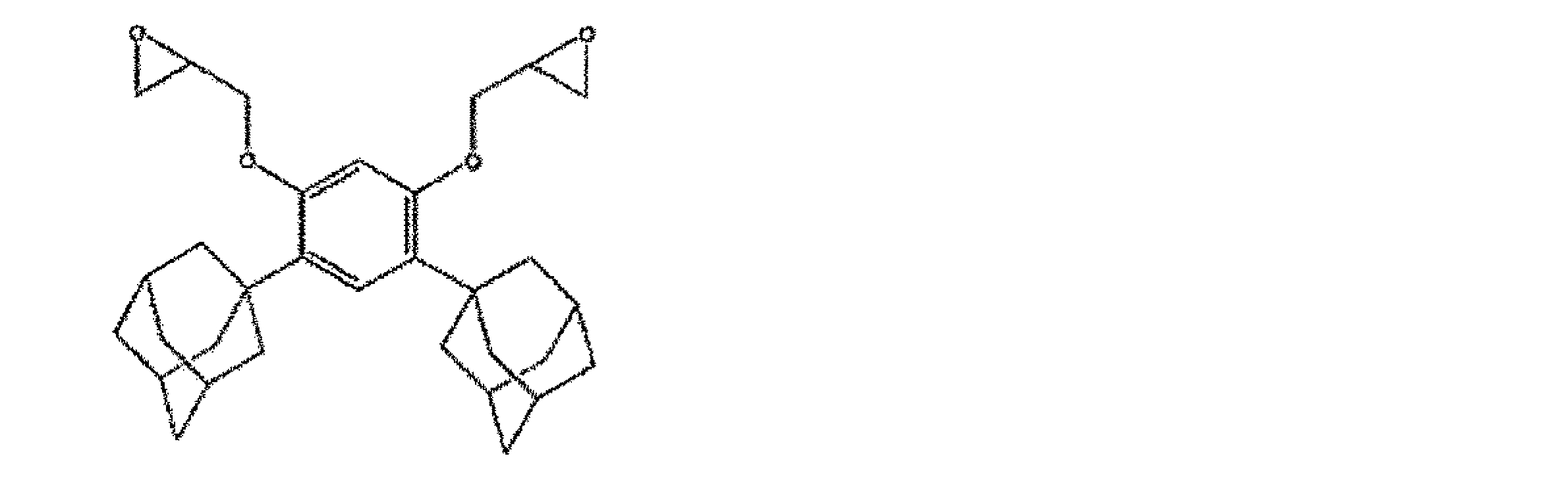
樹脂溶液が透明になったところでメトキシブチルアセテートで希釈し、固形分50質量%となるよう調製し、酸価105mgKOH/g、GPCで測定したポリスチレン換算の重量平均分子量(Mw)2480のアルカリ可溶性樹脂-IIIを得た。
ビックケミー社製「DISPERBYK-LPN21116」(側鎖に4級アンモニウム塩基及び3級アミノ基を有するAブロックと、4級アンモニウム塩基及びアミノ基を有さないBブロックからなる、アクリル系A-Bブロック共重合体。アミン価は70mgKOH/g。酸価は1mgKOH/g以下。)
分散剤-IのAブロック中には、下記式(1a)及び(2a)の繰り返し単位が含まれ、Bブロック中には下記式(3a)の繰り返し単位が含まれる。分散剤-Iの全繰り返し単位に占める下記式(1a)、(2a)、及び(3a)の繰り返し単位の含有割合はそれぞれ11.1モル%、22.2モル%、6.7モル%である。
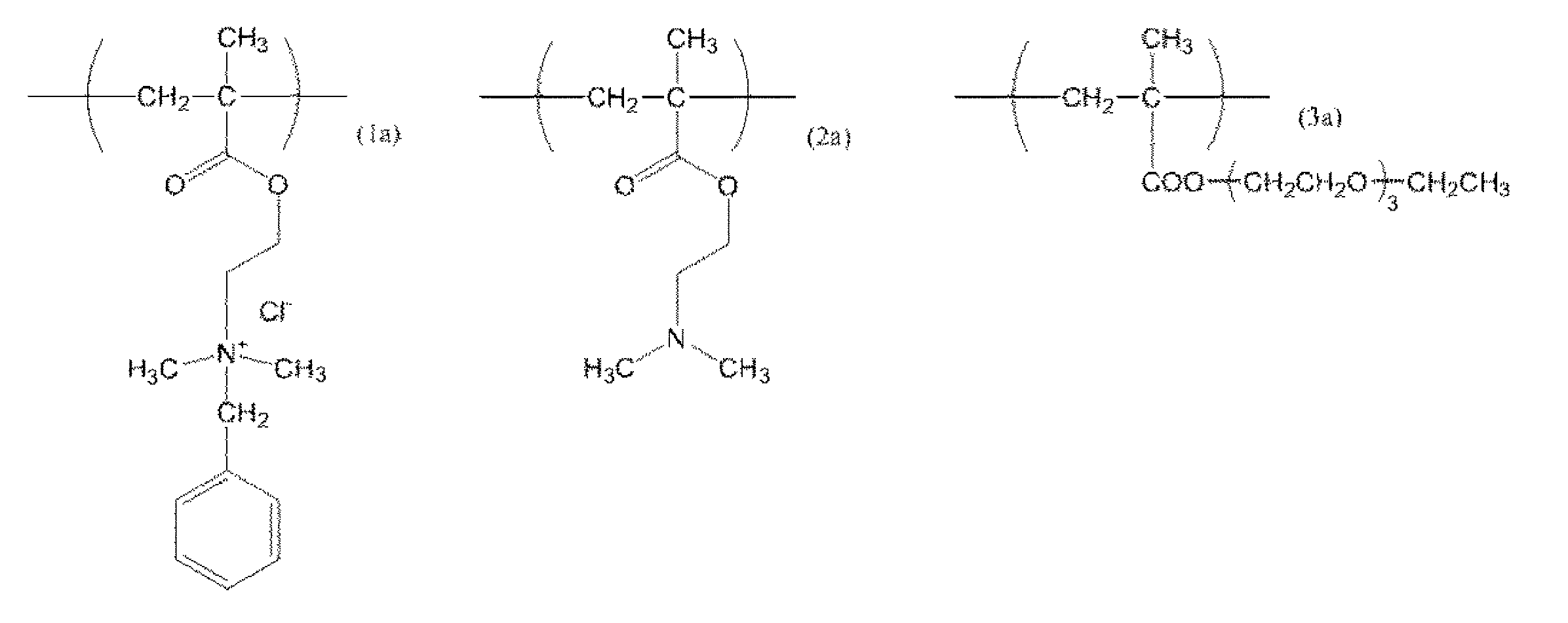
ビックケミー社製「DISPERBYK-167」(ウレタン系高分子分散剤)
ルーブリゾール社製「Solsperse12000」
<溶剤-I>
PGMEA:プロピレングリコールモノメチルエーテルアセテート
<溶剤-II>
MB:3-メトキシブタノール
<光重合開始剤-I>


DPHA:日本化薬(株)製 ジペンタエリスリトールヘキサアクリレート
<添加剤-I>
日本化薬(株)製、KAYAMER PM-21(メタクリロイル基含有ホスフェート)
<添加剤-II>
東レ・ダウコーニング社製 SH6040(3-グリシドキシプロピルトリメトキシシラン)
<界面活性剤>
DIC(株)製 メガファック F-559
後述のパターン2を有するガラス基板の光学濃度(OD)を透過濃度計(グレタグマクベス社製「D200-II」)にて測定した。さらに測定箇所の膜厚も測定し、単位膜厚(1μm)あたりの光学濃度(単位OD)を算出した。
完全透過開口部に対応するメインスペーサーパターンの高さと中間透過開口部に対応するサブスペーサーパターンの高さを測定し、その高さの差(ΔH)を算出した。ΔHが0.4μm以上のものを○、0.4μm未満のものを×とした。
後述のパターン2を有するガラス基板の光透過率を、感光性着色組成物を未塗布のガラス基板を対照として、島津製作所社製分光光度計UV-3150を用いて、波長300nm~450nmの範囲で測定した。測定ピッチは2nmとした。
波長300nm~450nmの範囲における最高光透過率を算出した。同様に、波長300nm~370nmにおける最高光透過率を算出した。
後述のパターン2を有するガラス基板の光透過率を、感光性着色組成物を未塗布のガラス基板を対照として、島津製作所社製分光光度計UV-3150を用いて、波長450nm~700nmの範囲で測定した。測定ピッチは2nmとした。
波長450nm~700nmの範囲における最高光透過率を算出した。
表2に記載の顔料、分散剤、分散助剤、アルカリ可溶性樹脂、及び溶剤を、表2に記載の質量比となるように混合した。この溶液をペイントシェーカーにより25~45℃の範囲で3時間分散処理を行った。ビーズとしては、0.5mmφのジルコニアビーズを用い、分散液の2.5倍の質量を加えた。分散終了後、フィルターによりビーズと分散液を分離して、顔料分散液1、3~5を調製した。
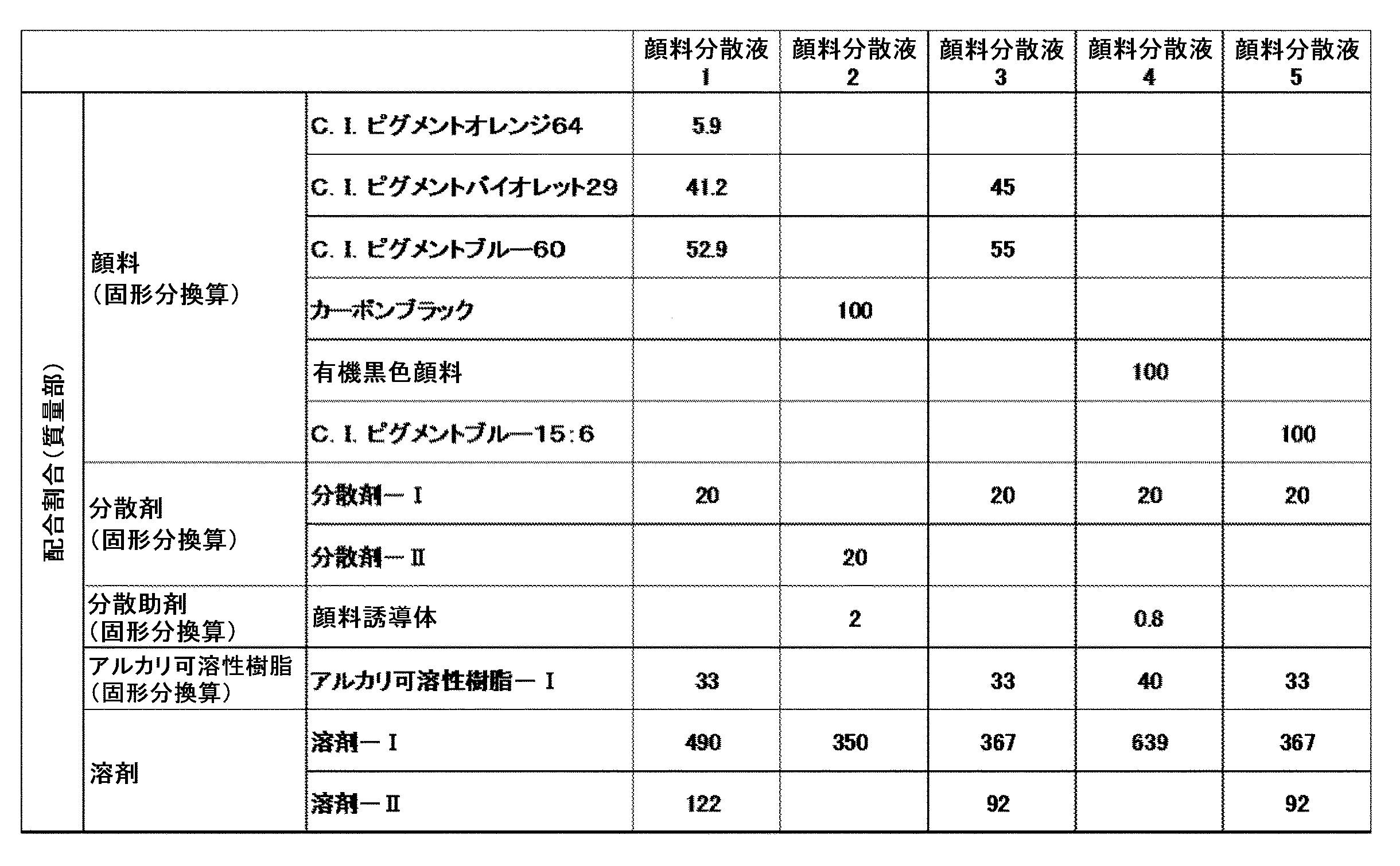
カーボンブラックは、通常のオイルファーネス法で製造した。但し、原料油としては、Na、Ca、S分量の少ないエチレンボトム油を用い、燃焼用にはコークス炉ガスを用いた。更に、反応停止水としては、イオン交換樹脂で処理した純水を用いた。得られたカーボンブラック540gを純水14500gと共にホモミキサーを用い5,000~6,000rpmで30分撹拌しスラリーを得た。このスラリーをスクリュー型撹拌機付容器に移し約1,000rpmで混合しながらエポキシ樹脂「エピコート828」(三菱化学(株)製)60gを溶解したトルエン600gを少量ずつ添加していった。約15分で、水に分散していたカーボンブラックは全量トルエン側に移行し、約1mmの粒となった。
得られた被覆カーボンブラック、分散剤、顔料誘導体及び溶剤を、表2に記載の質量比となるように混合した。
上記調製した顔料分散液1~5を用いて、固形分中の比率が表3の配合割合となるように各成分を加え、さらに固形分が22質量%となるようにPGMEAを加え、撹拌、溶解させて、感光性着色組成物を調製した。得られた感光性着色組成物を用いて、後述する方法で評価を行った。

ガラス基板(AGC社製「AN100」)上にスピナーを用いて各感光性着色組成物を塗布した。次いで、90℃にて90秒間、ホットプレート上で加熱乾燥して塗布膜を形成した。
得られた塗布膜に対し、直径5~50μm(5~20μm:1μmおき、25μm~50μm:5μmおき)の各種直径の円形パターンの完全透過開口部及び直径5~50μm(5~20μm:1μmおき、25μm~50μm:5μmおき)の各種直径の円形パターンの中間透過開口部を有する露光マスクを用いて露光処理を施した。中間透過開口部は、Cr酸化物の薄膜で波長365nmにおける光透過率を14±2%としたものである。露光ギャップ(マスクと塗布面間の距離)は、200μmであった。照射光としては、波長365nmでの強度が32mW/cm2である紫外線を用い、露光量は70mJ/cm2とした。また、紫外線照射は空気下で行った。
これらの操作により、不要部分を除去したパターンを得た。当該パターンの形成された基板をオーブン中、230℃で20分間加熱してパターンを硬化させ、略円柱状の着色スペーサーパターン(パターン1)を得た。また、露光マスクを使わなかった以外は同様の手順で膜厚が3μmのべた膜のパターン(パターン2)も作製した。
Claims (11)
- (a)着色剤、(b)アルカリ可溶性樹脂、(c)光重合開始剤、(d)エチレン性不飽和化合物、(e)溶剤、及び(f)分散剤を含有する、着色スペーサー形成用感光性着色組成物であって、
前記(a)着色剤が、(a-1)有機顔料、及び(a-2)カーボンブラックを含み、
前記(a)着色剤に対する前記(a-2)カーボンブラックの含有割合が20質量%以下であり、かつ、
前記感光性着色組成物の波長300~370nmにおける最高透過率が0.010%以上であることを特徴とする着色スペーサー形成用感光性着色組成物。 - 前記(a-1)有機顔料が、赤色顔料、橙色顔料、青色顔料及び紫色顔料からなる群から選ばれる少なくとも1種を含有する、請求項1に記載の着色スペーサー形成用感光性着色組成物。
- 前記(a-1)有機顔料が、赤色顔料及び橙色顔料からなる群から選ばれる少なくとも1種と、青色顔料及び紫色顔料からなる群から選ばれる少なくとも1種とを含有する、請求項1又は2に記載の着色スペーサー形成用感光性着色組成物。
- 前記(a-1)有機顔料が、青色顔料及び紫色顔料を含有する、請求項1又は2に記載の着色スペーサー形成用感光性着色組成物。
- 前記(a-1)有機顔料が、有機黒色顔料を含有する、請求項1~4のいずれか1項に記載の着色スペーサー形成用感光性着色組成物。
- 前記有機黒色顔料が、下記式(1)で表される化合物、該化合物の幾何異性体、該化合物の塩、または該化合物の幾何異性体の塩である、請求項5に記載の着色スペーサー形成用感光性着色組成物。

R2、R3、R4、R5、R7、R8、R9およびR10は他の全てから互いに独立して水素原子、ハロゲン原子、R11、COOH、COOR11、COO-、CONH2、CONHR11、CONR11R12、CN、OH、OR11、COCR11、OOCNH2、OOCNHR11、OOCNR11R12、NO2、NH2、NHR11、NR11R12、NHCOR12、NR11COR12、N=CH2、N=CHR11、N=CR11R12、SH、SR11、SOR11、SO2R11、SO3R11、SO3H、SO3 -、SO2NH2、SO2NHR11またはSO2NR11R12である;
且つ、R2とR3、R3とR4、R4とR5、R7とR8、R8とR9、及びR9とR10からなる群から選ばれる少なくとも1つの組み合わせは、互いに直接結合し、または酸素原子、硫黄原子、NH若しくはNR11ブリッジによって互いに結合することもできる;
R11およびR12は互いに独立して、炭素数1~12のアルキル基、炭素数3~12のシクロアルキル基、炭素数2~12のアルケニル基、炭素数3~12のシクロアルケニル基または炭素数2~12のアルキニル基である。) - 硬化した塗膜の膜厚1μm当たりの光学濃度が1.0以上である、請求項1~6のいずれか1項に記載の着色スペーサー形成用感光性着色組成物。
- フォトリソグラフィー法により高さの異なる着色スペーサーを一括形成するために用いる、請求項1~7のいずれか1項に記載の着色スペーサー形成用感光性着色組成物。
- 請求項1~8のいずれか1項に記載の着色スペーサー形成用感光性着色組成物を硬化して得られる硬化物。
- 請求項9に記載の硬化物から形成される着色スペーサー。
- 請求項10に記載の着色スペーサーを備える画像表示装置。
Priority Applications (4)
| Application Number | Priority Date | Filing Date | Title |
|---|---|---|---|
| CN201780010607.XA CN108700685A (zh) | 2016-02-12 | 2017-02-09 | 着色间隔物用感光性着色组合物、固化物、着色间隔物、图像显示装置 |
| KR1020187023049A KR102780117B1 (ko) | 2016-02-12 | 2017-02-09 | 착색 스페이서 형성용 감광성 착색 조성물, 경화물, 착색 스페이서, 화상 표시 장치 |
| CN202210140197.3A CN114545737A (zh) | 2016-02-12 | 2017-02-09 | 着色间隔物用感光性着色组合物、固化物、着色间隔物、图像显示装置 |
| JP2017566995A JP7184518B2 (ja) | 2016-02-12 | 2017-02-09 | 着色スペーサー形成用感光性着色組成物、硬化物、着色スペーサー、画像表示装置 |
Applications Claiming Priority (4)
| Application Number | Priority Date | Filing Date | Title |
|---|---|---|---|
| JP2016024975 | 2016-02-12 | ||
| JP2016-024975 | 2016-02-12 | ||
| JP2016172027 | 2016-09-02 | ||
| JP2016-172027 | 2016-09-02 |
Publications (1)
| Publication Number | Publication Date |
|---|---|
| WO2017138605A1 true WO2017138605A1 (ja) | 2017-08-17 |
Family
ID=59563154
Family Applications (1)
| Application Number | Title | Priority Date | Filing Date |
|---|---|---|---|
| PCT/JP2017/004720 Ceased WO2017138605A1 (ja) | 2016-02-12 | 2017-02-09 | 着色スペーサー形成用感光性着色組成物、硬化物、着色スペーサー、画像表示装置 |
Country Status (5)
| Country | Link |
|---|---|
| JP (2) | JP7184518B2 (ja) |
| KR (1) | KR102780117B1 (ja) |
| CN (2) | CN114545737A (ja) |
| TW (1) | TWI794156B (ja) |
| WO (1) | WO2017138605A1 (ja) |
Cited By (6)
| Publication number | Priority date | Publication date | Assignee | Title |
|---|---|---|---|---|
| JP2019061216A (ja) * | 2017-09-26 | 2019-04-18 | 東京応化工業株式会社 | 感光性樹脂組成物、硬化膜、表示装置、及びパターン形成方法 |
| JP2019079048A (ja) * | 2017-10-20 | 2019-05-23 | 東友ファインケム株式会社Dongwoo Fine−Chem Co., Ltd. | 着色分散液、これを含む着色感光性樹脂組成物、前記樹脂組成物を用いて製造されたパターン層、前記パターン層を含むカラーフィルタ、および前記カラーフィルタを含む表示装置 |
| JP2019133144A (ja) * | 2018-01-31 | 2019-08-08 | 東友ファインケム株式会社Dongwoo Fine−Chem Co., Ltd. | 着色感光性樹脂組成物、これを利用して製造されたブラックマトリクスおよび/またはカラムスペーサーを含むカラーフィルター、およびカラーフィルターを含む画像表示装置 |
| WO2020017576A1 (ja) * | 2018-07-20 | 2020-01-23 | 三菱ケミカル株式会社 | 感光性着色樹脂組成物、硬化物、画像表示装置及び照明 |
| JP2020132776A (ja) * | 2019-02-21 | 2020-08-31 | サカタインクス株式会社 | 着色組成物、及び、それを含有する着色レジスト組成物 |
| JPWO2024204265A1 (ja) * | 2023-03-31 | 2024-10-03 |
Families Citing this family (4)
| Publication number | Priority date | Publication date | Assignee | Title |
|---|---|---|---|---|
| US20200201180A1 (en) * | 2018-12-21 | 2020-06-25 | Rohm And Haas Electronic Materials Korea Ltd. | Colored photosensitive resin composition and black matrix prepared therefrom |
| JP6843949B2 (ja) * | 2018-12-27 | 2021-03-17 | 株式会社タムラ製作所 | 黒色感光性樹脂組成物 |
| TWI857067B (zh) * | 2020-05-29 | 2024-10-01 | 奇美實業股份有限公司 | 黑色感光性樹脂組成物、黑色圖案、彩色濾光片以及液晶顯示裝置 |
| KR102598243B1 (ko) | 2021-02-25 | 2023-11-03 | 동우 화인켐 주식회사 | 화상표시장치용 격벽, 이를 제조하는 방법 및 상기 격벽을 포함하는 화상표시장치 |
Citations (5)
| Publication number | Priority date | Publication date | Assignee | Title |
|---|---|---|---|---|
| JPH0728236A (ja) * | 1993-05-12 | 1995-01-31 | Fuji Photo Film Co Ltd | 遮光性感光性樹脂組成物および遮光性画像の形成方法 |
| JP2000314804A (ja) * | 1999-04-28 | 2000-11-14 | Fuji Photo Film Co Ltd | カラーフィルター及びその製造方法 |
| JP2010091876A (ja) * | 2008-10-09 | 2010-04-22 | Taiyo Ink Mfg Ltd | 黒色ソルダーレジスト組成物及びその硬化物 |
| WO2015046178A1 (ja) * | 2013-09-25 | 2015-04-02 | 三菱化学株式会社 | 感光性着色組成物、ブラックマトリクス、着色スペーサー、画像表示装置及び顔料分散液 |
| JP2015525260A (ja) * | 2012-06-01 | 2015-09-03 | ビーエーエスエフ ソシエタス・ヨーロピアBasf Se | 黒色着色剤混合物 |
Family Cites Families (9)
| Publication number | Priority date | Publication date | Assignee | Title |
|---|---|---|---|---|
| US5489621A (en) * | 1993-05-12 | 1996-02-06 | Fuji Photo Film Co., Ltd. | Process for forming colored partial picture element and light-shielding light-sensitive resin composition used therefor |
| US20100243970A1 (en) | 2007-08-22 | 2010-09-30 | Mitsubishi Chemical Corporation | Resin black matrix, light blocking photosensitive resin composition, tft element substrate and liquid crystal display device |
| TWI512397B (zh) * | 2009-06-24 | 2015-12-11 | Sumitomo Chemical Co | Coloring the photosensitive composition |
| KR102007133B1 (ko) * | 2011-10-25 | 2019-08-02 | 미쯔비시 케미컬 주식회사 | 착색 감광성 조성물, 착색 스페이서, 컬러 필터, 및 액정 표시 장치 |
| JP6036708B2 (ja) | 2012-01-31 | 2016-11-30 | 三菱化学株式会社 | 着色感光性組成物、ブラックフォトスペーサー、及びカラーフィルター |
| KR101658374B1 (ko) * | 2013-01-25 | 2016-09-22 | 롬엔드하스전자재료코리아유한회사 | 컬럼 스페이서 및 블랙 매트릭스를 동시에 구현할 수 있는 착색 감광성 수지 조성물 |
| JP6365118B2 (ja) * | 2013-09-20 | 2018-08-01 | 三菱ケミカル株式会社 | 感光性樹脂組成物、それを硬化させてなる硬化物、ブラックマトリックス及び画像表示装置 |
| JP6620743B2 (ja) * | 2014-07-04 | 2019-12-18 | 三菱ケミカル株式会社 | 樹脂、感光性樹脂組成物、硬化物、カラーフィルタ及び画像表示装置 |
| JP2022099579A (ja) * | 2020-12-23 | 2022-07-05 | 三菱瓦斯化学株式会社 | 多層プリント配線板の絶縁層用樹脂組成物、樹脂シート、多層プリント配線板、半導体装置、及び硬化物 |
-
2017
- 2017-02-09 WO PCT/JP2017/004720 patent/WO2017138605A1/ja not_active Ceased
- 2017-02-09 JP JP2017566995A patent/JP7184518B2/ja active Active
- 2017-02-09 CN CN202210140197.3A patent/CN114545737A/zh active Pending
- 2017-02-09 KR KR1020187023049A patent/KR102780117B1/ko active Active
- 2017-02-09 CN CN201780010607.XA patent/CN108700685A/zh active Pending
- 2017-02-10 TW TW106104459A patent/TWI794156B/zh active
-
2021
- 2021-09-03 JP JP2021144186A patent/JP2021192120A/ja active Pending
Patent Citations (5)
| Publication number | Priority date | Publication date | Assignee | Title |
|---|---|---|---|---|
| JPH0728236A (ja) * | 1993-05-12 | 1995-01-31 | Fuji Photo Film Co Ltd | 遮光性感光性樹脂組成物および遮光性画像の形成方法 |
| JP2000314804A (ja) * | 1999-04-28 | 2000-11-14 | Fuji Photo Film Co Ltd | カラーフィルター及びその製造方法 |
| JP2010091876A (ja) * | 2008-10-09 | 2010-04-22 | Taiyo Ink Mfg Ltd | 黒色ソルダーレジスト組成物及びその硬化物 |
| JP2015525260A (ja) * | 2012-06-01 | 2015-09-03 | ビーエーエスエフ ソシエタス・ヨーロピアBasf Se | 黒色着色剤混合物 |
| WO2015046178A1 (ja) * | 2013-09-25 | 2015-04-02 | 三菱化学株式会社 | 感光性着色組成物、ブラックマトリクス、着色スペーサー、画像表示装置及び顔料分散液 |
Cited By (14)
| Publication number | Priority date | Publication date | Assignee | Title |
|---|---|---|---|---|
| JP2019061216A (ja) * | 2017-09-26 | 2019-04-18 | 東京応化工業株式会社 | 感光性樹脂組成物、硬化膜、表示装置、及びパターン形成方法 |
| JP2019079048A (ja) * | 2017-10-20 | 2019-05-23 | 東友ファインケム株式会社Dongwoo Fine−Chem Co., Ltd. | 着色分散液、これを含む着色感光性樹脂組成物、前記樹脂組成物を用いて製造されたパターン層、前記パターン層を含むカラーフィルタ、および前記カラーフィルタを含む表示装置 |
| JP2019133144A (ja) * | 2018-01-31 | 2019-08-08 | 東友ファインケム株式会社Dongwoo Fine−Chem Co., Ltd. | 着色感光性樹脂組成物、これを利用して製造されたブラックマトリクスおよび/またはカラムスペーサーを含むカラーフィルター、およびカラーフィルターを含む画像表示装置 |
| KR20210032320A (ko) * | 2018-07-20 | 2021-03-24 | 미쯔비시 케미컬 주식회사 | 감광성 착색 수지 조성물, 경화물, 화상 표시 장치 및 조명 |
| CN112313579A (zh) * | 2018-07-20 | 2021-02-02 | 三菱化学株式会社 | 感光性着色树脂组合物、固化物、图像显示装置及照明 |
| WO2020017576A1 (ja) * | 2018-07-20 | 2020-01-23 | 三菱ケミカル株式会社 | 感光性着色樹脂組成物、硬化物、画像表示装置及び照明 |
| JPWO2020017576A1 (ja) * | 2018-07-20 | 2021-08-12 | 三菱ケミカル株式会社 | 感光性着色樹脂組成物、硬化物、画像表示装置及び照明 |
| JP7435445B2 (ja) | 2018-07-20 | 2024-02-21 | 三菱ケミカル株式会社 | 感光性着色樹脂組成物、硬化物、画像表示装置及び照明 |
| KR102706032B1 (ko) * | 2018-07-20 | 2024-09-11 | 미쯔비시 케미컬 주식회사 | 감광성 착색 수지 조성물, 경화물, 화상 표시 장치 및 조명 |
| CN112313579B (zh) * | 2018-07-20 | 2025-05-13 | 三菱化学株式会社 | 感光性着色树脂组合物、固化物、图像显示装置及照明 |
| JP2020132776A (ja) * | 2019-02-21 | 2020-08-31 | サカタインクス株式会社 | 着色組成物、及び、それを含有する着色レジスト組成物 |
| JP7360798B2 (ja) | 2019-02-21 | 2023-10-13 | サカタインクス株式会社 | 着色組成物、及び、それを含有する着色レジスト組成物 |
| JPWO2024204265A1 (ja) * | 2023-03-31 | 2024-10-03 | ||
| WO2024204265A1 (ja) * | 2023-03-31 | 2024-10-03 | 太陽ホールディングス株式会社 | 感光性樹脂組成物、ドライフィルム、硬化物、および、プリント配線板 |
Also Published As
| Publication number | Publication date |
|---|---|
| JP7184518B2 (ja) | 2022-12-06 |
| KR102780117B1 (ko) | 2025-03-11 |
| CN114545737A (zh) | 2022-05-27 |
| CN108700685A (zh) | 2018-10-23 |
| JP2021192120A (ja) | 2021-12-16 |
| TW201800844A (zh) | 2018-01-01 |
| TWI794156B (zh) | 2023-03-01 |
| JPWO2017138605A1 (ja) | 2018-12-06 |
| KR20180107146A (ko) | 2018-10-01 |
Similar Documents
| Publication | Publication Date | Title |
|---|---|---|
| JP7485147B2 (ja) | 感光性着色組成物、硬化物、着色スペーサー、画像表示装置 | |
| JP6268508B2 (ja) | 感光性着色組成物、硬化物、着色スペーサー、画像表示装置 | |
| JP6380723B1 (ja) | 感光性着色組成物、硬化物、着色スペーサー、画像表示装置 | |
| JP2019133167A (ja) | 感光性着色組成物、着色スペーサー及び画像表示装置 | |
| JP7184518B2 (ja) | 着色スペーサー形成用感光性着色組成物、硬化物、着色スペーサー、画像表示装置 | |
| JP7031598B2 (ja) | 感光性着色組成物、硬化物、着色スペーサー、画像表示装置 | |
| JP6543968B2 (ja) | 感光性着色組成物、硬化物、着色スペーサー、及び画像表示装置 | |
| JP2016177190A (ja) | 着色スペーサー形成用感光性着色組成物、硬化物、着色スペーサー、画像表示装置 | |
| JP6528475B2 (ja) | 感光性着色組成物、硬化物、着色スペーサー、及び画像表示装置 | |
| JP6561533B2 (ja) | 感光性着色組成物、硬化物、着色スペーサー、画像表示装置 | |
| JP7230559B2 (ja) | 感光性着色組成物、硬化物、着色スペーサー、及び画像表示装置 | |
| JP7006358B2 (ja) | 感光性着色組成物、硬化物、着色スペーサー、及び画像表示装置 | |
| JP2019015966A (ja) | 感光性着色組成物、硬化物、着色スペーサー、及び画像表示装置 | |
| JP7375773B2 (ja) | 感光性着色組成物、硬化物、着色スペーサー、及び画像表示装置 | |
| JPWO2019004427A1 (ja) | 感光性着色組成物、硬化物、着色スペーサー、及び画像表示装置 |
Legal Events
| Date | Code | Title | Description |
|---|---|---|---|
| 121 | Ep: the epo has been informed by wipo that ep was designated in this application |
Ref document number: 17750326 Country of ref document: EP Kind code of ref document: A1 |
|
| ENP | Entry into the national phase |
Ref document number: 2017566995 Country of ref document: JP Kind code of ref document: A |
|
| ENP | Entry into the national phase |
Ref document number: 20187023049 Country of ref document: KR Kind code of ref document: A |
|
| NENP | Non-entry into the national phase |
Ref country code: DE |
|
| 122 | Ep: pct application non-entry in european phase |
Ref document number: 17750326 Country of ref document: EP Kind code of ref document: A1 |