WO2017110964A1 - 砒素の不溶化材及び不溶化方法 - Google Patents
砒素の不溶化材及び不溶化方法 Download PDFInfo
- Publication number
- WO2017110964A1 WO2017110964A1 PCT/JP2016/088278 JP2016088278W WO2017110964A1 WO 2017110964 A1 WO2017110964 A1 WO 2017110964A1 JP 2016088278 W JP2016088278 W JP 2016088278W WO 2017110964 A1 WO2017110964 A1 WO 2017110964A1
- Authority
- WO
- WIPO (PCT)
- Prior art keywords
- arsenic
- gypsum
- iron powder
- mass
- soil
- Prior art date
- Legal status (The legal status is an assumption and is not a legal conclusion. Google has not performed a legal analysis and makes no representation as to the accuracy of the status listed.)
- Ceased
Links
Classifications
-
- B—PERFORMING OPERATIONS; TRANSPORTING
- B09—DISPOSAL OF SOLID WASTE; RECLAMATION OF CONTAMINATED SOIL
- B09B—DISPOSAL OF SOLID WASTE NOT OTHERWISE PROVIDED FOR
- B09B3/00—Destroying solid waste or transforming solid waste into something useful or harmless
- B09B3/70—Chemical treatment, e.g. pH adjustment or oxidation
-
- B—PERFORMING OPERATIONS; TRANSPORTING
- B09—DISPOSAL OF SOLID WASTE; RECLAMATION OF CONTAMINATED SOIL
- B09C—RECLAMATION OF CONTAMINATED SOIL
- B09C1/00—Reclamation of contaminated soil
- B09C1/02—Extraction using liquids, e.g. washing, leaching, flotation
-
- B—PERFORMING OPERATIONS; TRANSPORTING
- B09—DISPOSAL OF SOLID WASTE; RECLAMATION OF CONTAMINATED SOIL
- B09C—RECLAMATION OF CONTAMINATED SOIL
- B09C1/00—Reclamation of contaminated soil
- B09C1/08—Reclamation of contaminated soil chemically
-
- C—CHEMISTRY; METALLURGY
- C09—DYES; PAINTS; POLISHES; NATURAL RESINS; ADHESIVES; COMPOSITIONS NOT OTHERWISE PROVIDED FOR; APPLICATIONS OF MATERIALS NOT OTHERWISE PROVIDED FOR
- C09K—MATERIALS FOR MISCELLANEOUS APPLICATIONS, NOT PROVIDED FOR ELSEWHERE
- C09K17/00—Soil-conditioning materials or soil-stabilising materials
- C09K17/02—Soil-conditioning materials or soil-stabilising materials containing inorganic compounds only
- C09K17/06—Calcium compounds, e.g. lime
-
- C—CHEMISTRY; METALLURGY
- C09—DYES; PAINTS; POLISHES; NATURAL RESINS; ADHESIVES; COMPOSITIONS NOT OTHERWISE PROVIDED FOR; APPLICATIONS OF MATERIALS NOT OTHERWISE PROVIDED FOR
- C09K—MATERIALS FOR MISCELLANEOUS APPLICATIONS, NOT PROVIDED FOR ELSEWHERE
- C09K17/00—Soil-conditioning materials or soil-stabilising materials
- C09K17/02—Soil-conditioning materials or soil-stabilising materials containing inorganic compounds only
- C09K17/08—Aluminium compounds, e.g. aluminium hydroxide
Definitions
- the present invention relates to an arsenic insolubilizing material and an arsenic insolubilizing method.
- Soil contamination countermeasures include excavation and removal methods that dispose of contaminated soil at designated disposal sites, containment methods that seal contaminated soil, purification methods that separate and remove heavy metals from the soil, and elution of heavy metals, etc.
- Excavation and removal methods and containment methods are generally high-cost, and there is a restriction that the soil itself is lost or the land use after treatment is greatly restricted by the treatment.
- the insolubilization method using the insolubilizing material is a cost-effective and effective measure.
- Insolubilizing materials such as various heavy metals are used for the purpose of suppressing elution of heavy metals, etc. in soil such as factory sites, soil landfilled with residual soil, and various types of soil such as sludge generated by wastewater treatment.
- soil such as factory sites, soil landfilled with residual soil, and various types of soil such as sludge generated by wastewater treatment.
- Patent Document 1 by adding and mixing sludge produced in wastewater treatment or mud such as construction residual soil, the treated material after treatment can be neutralized, such as heavy metals contained in the mud
- An insolubilized solidifying material such as gypsum-based heavy metal has been proposed which can be insolubilized simultaneously and solidified to give strength to the mud and have excellent handling properties.
- Patent Document 1 proposes an insolubilized solidified material such as heavy metal, in which calcined gypsum contains a predetermined aluminum compound and a neutralizing agent containing a calcium or magnesium component.
- arsenic is insolubilized as heavy metals etc. by adding gypsum to the soil Consideration has also been made.
- the effect of insolubilizing arsenic is insufficient only by adding gypsum to the soil, and it has been required to stably insolubilize arsenic in the soil with other additives other than gypsum.
- arsenic is one of the pollutants with a high detection frequency, so a technique that can more effectively insolubilize arsenic in soil is desired.
- an object of the present invention is to provide an insolubilization technique capable of effectively reducing the amount of arsenic eluted in soil containing at least arsenic as a specific harmful substance.
- the present invention is an arsenic insolubilizing material used for soil containing at least arsenic as a specific harmful substance, containing gypsum and iron powder, and 6 parts of iron powder with respect to 100 parts by mass of gypsum.
- an arsenic insolubilizing material which is contained in the range of ⁇ 100 parts by mass.
- the present invention also provides arsenic insolubilization, wherein gypsum and iron powder are added to a soil containing at least arsenic as a specific harmful substance at a ratio of 6 to 100 parts by mass of the iron powder with respect to 100 parts by mass of the gypsum.
- gypsum and iron powder are added to a soil containing at least arsenic as a specific harmful substance at a ratio of 6 to 100 parts by mass of the iron powder with respect to 100 parts by mass of the gypsum.
- an insolubilization technique capable of effectively reducing the amount of arsenic eluted in soil containing at least arsenic as a specific harmful substance.
- the arsenic insolubilizing material (hereinafter simply referred to as “insolubilizing material”) according to an embodiment of the present invention is used for soil containing at least arsenic as a specific harmful substance.
- the insolubilizing material contains gypsum and iron powder, and contains iron powder in the range of 6 to 100 parts by mass with respect to 100 parts by mass of gypsum.
- arsenic In soil containing arsenic, arsenic (As) often exists in the form of arsenate ions (AsO 4 3 ⁇ ).
- arsenate ions Arsenate ions
- the gypsum When gypsum is added to the soil, the gypsum is dissolved by moisture in the soil, and the arsenate ions contained in the soil react with calcium ions eluted from the gypsum, resulting in the precipitation of sparingly soluble calcium arsenate. It is conceivable (see the following formula (1)). Therefore, it is presumed that the effect of insolubilizing arsenic is exhibited when the insolubilizing material contains gypsum. 3Ca 2+ + 2AsO 4 3- ⁇ Ca 3 (AsO 4 ) 2 (1)
- iron powder when added to the soil together with gypsum, it is considered that iron is easily ionized by the action of calcium ions and sulfate ions derived from gypsum and trace elements such as phosphorus, sulfur, and manganese in gypsum.
- calcium ions and sulfate ions derived from gypsum and trace elements such as phosphorus, sulfur, and manganese in gypsum.
- trace elements such as phosphorus, sulfur, and manganese
- iron powder when iron powder is used in combination with gypsum, iron is easily ionized by the action of calcium and sulfate ions derived from gypsum, and trace elements such as sulfur contained in gypsum, and iron ions in the soil. It is thought that many can be generated.
- iron powder iron powder
- the insolubilizing material contains gypsum and iron powder at a ratio of 6 parts by mass or more of iron powder to 100 parts by mass of gypsum, the amount of arsenic eluted is effectively reduced in soil containing arsenic. Arsenic can be insolubilized.
- the gypsum used for the insolubilizing material of this embodiment is a mineral mainly composed of calcium sulfate (CaSO 4 ).
- the gypsum includes calcium sulfate dihydrate [CaSO 4 ⁇ 2H 2 O] (also referred to as dihydrate gypsum), calcium sulfate 1/2 hydrate [CaSO 4 ⁇ 1 / 2H 2 O] (half And anhydrous calcium sulfate [CaSO 4 ] (also referred to as anhydrite).
- These 1 type, or 2 or more types of gypsum can be used, and the mixture of 2 or more types of gypsum can also be used.
- Gypsum is a neutral substance, and even if it is used in large quantities on the soil, the pH of the soil hardly fluctuates, and the treated soil does not become basic after the insolubilization treatment until it becomes consistently basic, That is, it is useful as an insolubilizing material because the pH of the soil can be maintained within a range not exceeding 8.6. Furthermore, when calcined gypsum is used as gypsum, in addition to achieving insolubilization of heavy metals and the like, solidification performance can be imparted by the hydration reaction.
- calcined gypsum is used as the gypsum, it is possible to improve the handling of the obtained processed material even when the soil containing arsenic is soil with a high water content such as mud.
- the pH of the treated soil is maintained within the range that does not consistently become a basic region after the insolubilization treatment and does not vary greatly. Even for the mud contained, the handleability of the treated product can be easily increased by the solidification performance of calcined gypsum.
- calcined gypsum that is excellent in soil solidification performance as gypsum.
- the calcined gypsum is calcium sulfate hemihydrate [CaSO 4 ⁇ 1 / 2H 2 O] and anhydrous [CaSO 4 ].
- calcined gypsum chemically reacts with moisture in the soil and easily changes to dihydrate gypsum by hydration reaction, so that the soil treated with this solidifies and has strength, improving the handleability of the soil Can be made.
- calcined gypsum examples include hemihydrate gypsum ( ⁇ -type hemihydrate gypsum or ⁇ -type hemihydrate gypsum), type III anhydrous gypsum, and mixtures thereof, and any of them can be used.
- Type II anhydrous gypsum can be used although its hydration rate is slower than other calcined gypsum.
- hemihydrate gypsum and / or type III anhydrous gypsum are preferable, and hemihydrate gypsum is more preferable.
- the raw gypsum for calcined gypsum may be a natural product, by-product gypsum, or waste gypsum.
- natural products and by-product gypsum are preferable because they are inexpensive materials, but it is more preferable to use waste gypsum as a raw material in consideration of higher economy and effective utilization of resources.
- the insolubilized material containing calcined gypsum as gypsum stabilizes heavy metals in the treated material. Since it is fixed, its use is expected.
- the amount used may be appropriately determined according to the moisture content of the soil to be treated.
- the insolubilizing material of the present embodiment contains 6 to 100 parts by mass, preferably 10 to 80 parts by mass, more preferably 20 to 60 parts by mass of iron powder with respect to 100 parts by mass of gypsum.
- the content of the iron powder in the insolubilized material is preferably 10 parts by mass or more, more preferably 20 parts by mass or more with respect to 100 parts by mass of gypsum, from the viewpoint of enhancing the effect of insolubilizing arsenic in the soil. .
- the content of iron powder in the insolubilizing material may be large, but from an economical viewpoint, it is preferably 80 parts by mass or less, and further, the soil treated with the insolubilizing material is inevitable to iron powder. From the viewpoint of avoiding acidification with an element that is actively added from the viewpoint of imparting desired characteristics to the element and / or iron powder remaining as a general impurity, the amount is more preferably 60 parts by mass or less.
- Iron powder has a high iron content compared to iron compound powders such as iron oxide, iron hydroxide, ferrous sulfate, and iron chloride, and therefore has high insolubilizing ability against arsenic. Even when ferrous sulfate or iron chloride is used in combination with gypsum, an insolubilizing effect on arsenic can be expected, but ferrous sulfate is not practical because it has poor long-term stability and iron chloride has deliquescence. In addition, as illustrated in the examples and comparative examples described later, iron powder has a higher effect of reducing the amount of arsenic in the soil when used in combination with gypsum at a specific ratio compared to iron oxide and iron hydroxide. The insolubilizing effect on arsenic is very high.
- Atomized iron powder is iron powder manufactured by the atomizing method. Atomized iron powder is produced, for example, by spraying a jet fluid such as an inert gas, air, or water into a molten metal flow to make a fine powder.
- Reduced iron powder is iron powder produced by a reduction method. The reduced iron powder is produced, for example, by heating and reducing iron oxide or ore.
- Electrolytic iron powder is iron powder produced by mechanically pulverizing electrolytic iron. Electrolytic iron is produced, for example, by electrolyzing an iron salt aqueous solution. Carbonyl iron powder is produced by reacting iron and carbon monoxide to produce liquid iron / carbonyl and decomposing it at a temperature around 250 ° C. Dalai iron powder is a swarf obtained by cutting during the manufacture of steel products.
- atomized iron powder is preferable from the viewpoint of industrial properties.
- the atomized iron powder at least one of gas atomized iron powder and water atomized iron powder can be used.
- the gas atomized iron powder is an atomized iron powder produced using an inert gas in the jet fluid described above.
- Water atomized iron powder is atomized iron powder manufactured using water for the above-described jet fluid. From the viewpoint of increasing the specific surface area of the iron powder surface, it is more preferable to use water atomized iron powder as the iron powder.
- the iron powder may contain elements other than iron (Fe).
- elements include carbon (C), oxygen (O), nitrogen (N), silicon (Si), phosphorus (P), sulfur (S), copper (Cu), aluminum (Al), manganese ( Mn), nickel (Ni), chromium (Cr), molybdenum (Mo), tungsten (W), lead (Pb), and the like.
- One or more of these other elements may be contained in the iron powder.
- Other elements may remain as inevitable impurities in the production process of iron powder or iron material, or may be positively added from the viewpoint of imparting desired characteristics to the iron powder. .
- the iron powder contains one or both of S and Mn among the other elements.
- S and Mn the use of moisture in the soil and the action of S and / or Mn promotes local battery formation on the surface of the iron powder, and arsenic in the soil Is likely to be adsorbed on the iron powder surface.
- iron in the iron powder is easily ionized in combination with gypsum in the soil, so that the effect of insolubilizing arsenic in the soil is further enhanced. From the viewpoint of the effect of insolubilizing arsenic by a combination of iron ionization and oxidation in the soil, it is preferable to use iron powder as it is in the insolubilizing material of this embodiment.
- the S content in the iron powder is preferably 0.05% by mass or more, more preferably 0.3% by mass or more, and further preferably 1% by mass or more. is there.
- the Mn content is preferably 0.1% by mass or more, more preferably 2% by mass or more.
- the S content in the iron powder is preferably 5% by mass or less, more preferably 3% by mass or less, and the Mn content is 10% by mass or less. Preferably, it is 6% by mass or less.
- the iron powder contains 0.05 to 5% by mass of S and 0.1 to 10% by mass of Mn, and the balance consists of Fe and inevitable impurities other than S and Mn. .
- content of inevitable impurities other than S and Mn is suppressed to about 1 mass% or less in total in iron powder.
- the particle size of the iron powder is not particularly limited, but from the viewpoint of dispersibility with gypsum and handleability, the average particle size is preferably 10 ⁇ m or more and 1000 ⁇ m or less, more preferably 10 ⁇ m or more and 300 ⁇ m or less. Iron powder having an average particle size of less than 10 ⁇ m is likely to aggregate and localize, and the arsenic adsorption effect is poorly sustained. When iron powder with an average particle diameter exceeding 1000 ⁇ m is mixed with gypsum, it tends to separate from gypsum due to its weight, and it becomes difficult to ensure a satisfactory arsenic adsorption capacity due to insufficient specific surface area.
- the average particle size of the iron powder is a particle size distribution expressed as a percentage of the mass that is vibrated and sieved under a predetermined condition using a standard sieve having a mesh size of JIS Z 8801. It can be determined from the particle size calculated to be 50% or less on the cumulative sieve.
- the average particle diameter of the iron powder used in the postscript Example is the value measured using the said standard sieve.
- the insolubilizing material of this embodiment preferably further contains at least one selected from the group consisting of aluminum sulfate and amorphous aluminum hydroxide.
- Aluminum sulfate includes hydrates and hydrates, and hydrates are preferable from the viewpoint of reactivity, and 16 to 18 hydrates are more preferable among them.
- the insolubilizing material contains aluminum sulfate and / or amorphous aluminum hydroxide, which not only insolubilizes heavy metals other than arsenic contained in the soil where the insolubilizing material is used, but also insolubilizes arsenic. Can be further enhanced. Of aluminum sulfate and amorphous aluminum hydroxide, aluminum sulfate is more preferable. Aluminum sulfate is an acidic substance, and it is thought that ionization of iron is further promoted.
- the insolubilizing material preferably contains 10 to 30 parts by mass of aluminum sulfate and / or amorphous aluminum hydroxide with respect to 100 parts by mass of gypsum, in addition to the gypsum and iron powder. More preferably, it is contained in the range of parts. From the viewpoint of further enhancing the effect of insolubilizing arsenic in the soil, the content of aluminum sulfate and / or amorphous aluminum hydroxide is preferably 10 parts by mass or more with respect to 100 parts by mass of gypsum, and 15 parts by mass. More preferably, it is more than 20 parts by mass.
- the content of aluminum sulfate and / or amorphous aluminum hydroxide is 30 masses with respect to 100 parts by mass of gypsum from the viewpoint of avoiding acidification of the soil due to the addition of the insolubilizing material. Part or less is preferred.
- the said content in case an insolubilizing material contains both aluminum sulfate and amorphous aluminum hydroxide is the sum total of content of aluminum sulfate and content of amorphous aluminum hydroxide.
- the insolubilizing material of this embodiment preferably contains calcium carbonate as a component other than the above from the economical viewpoint.
- Calcium carbonate can be used as a filler (a filler) or a dispersing agent.
- the content of calcium carbonate in the insolubilized material is preferably 50 to 100 parts by mass, more preferably 60 to 90 parts by mass with respect to 100 parts by mass of gypsum.
- Silica and aggregates such as gravel and sand can also be used as a filler (a filler) or a dispersing agent.
- the insolubilizing material of this embodiment may contain a substance having a soil solidifying effect (soil solidifying material). Any conventionally known solidifying material can be used. Among the soil solidifying materials, non-basic substances, for example, neutral or weakly acidic substances are preferable. A suitable soil solidifying material is preferably at least one selected from the group consisting of polyacrylamide and water glass. The insolubilizing material can maintain the strength of the soil by containing the soil solidifying material. The soil solidifying material is preferably contained within a range that exhibits a soil solidifying effect and does not impair the arsenic insolubilizing effect of the insolubilizing material.
- the insolubilizing material of the present embodiment described in detail above may be, for example, a method in which the insolubilizing material is used in a method of being added to and mixed with arsenic-containing soil or a method of being sprayed on the surface of the arsenic-containing soil. it can. Since the insolubilizing material contains gypsum and iron powder in a specific ratio, the synergistic effect of gypsum and iron powder is generated, so that the amount of arsenic dissolved in the soil is reduced to the environmental standard value (0.01 mg / L). ) Arsenic can be insolubilized.
- the insolubilizing material of this embodiment can also be expected to have an insolubilizing effect on heavy metals other than arsenic, such as lead, fluorine, cadmium, hexavalent chromium, and selenium, as specific harmful substances.
- the insolubilizing material of this embodiment can further enhance the insolubilizing effect on arsenic by containing aluminum sulfate and / or amorphous aluminum hydroxide in a specific ratio in addition to gypsum and iron powder. is there. Furthermore, an insolubilizing effect on other heavy metals (for example, fluorine, lead, hexavalent chromium, cadmium, selenium, etc.) can be expected.
- heavy metals for example, fluorine, lead, hexavalent chromium, cadmium, selenium, etc.
- the insolubilizing material of the present embodiment it is possible to make the treated soil a range that does not become consistently basic after insolubilizing treatment by the insolubilizing material, for example, for environmental conservation. Considerable landfill processing becomes possible.
- that the soil is neutral means that the pH of the soil is 5.8 to 8.6.
- that the soil is acidic means that the pH of the soil is less than 5.8, and that the soil is basic means that the pH of the soil is more than 8.6.
- the insolubilization material of this embodiment can take the following structure.
- an arsenic insolubilization method includes gypsum and iron powder in a soil containing at least arsenic as a specific harmful substance. This is a method of adding 6 to 100 parts by mass of iron powder with respect to 100 parts by mass.
- the amount of iron powder added to the soil is preferably 10 parts by mass or more with respect to 100 parts by mass of gypsum, and 20 masses. More preferably, it is more than part. From an economical viewpoint, the amount of iron powder added to the soil is preferably 80 parts by mass or less with respect to 100 parts by mass of gypsum, and further, the elements remaining as unavoidable impurities in iron powder and / or Or it is more preferable to set it as 60 mass parts or less from a viewpoint which avoids acidifying a soil by the element added positively from a viewpoint of giving a desired characteristic to iron powder.
- the gypsum and iron powder used in the insolubilization method of this embodiment can be the same as the gypsum and iron powder contained in the insolubilizing material according to the above-described embodiment, respectively.
- gypsum and iron powder can also be used separately, and the insolubilization material which concerns on above-mentioned embodiment can also be used.
- gypsum and iron powder may be added to the arsenic-containing soil at the same time, or may be added separately at different timings.
- the insolubilizing material according to the above-described embodiment can be used, aluminum sulfate, amorphous aluminum hydroxide, or both of them can be added to the soil. .
- the insolubilization material which concerns on the above-mentioned embodiment may contain the filler (extension material), the dispersion material, the soil solidification material, etc. which are contained in soil.
- the method for adding gypsum and iron powder to the soil is not particularly limited.
- gypsum and iron powder can be added and mixed in the soil, and gypsum and iron powder can be sprayed on the surface of the soil. After gypsum and iron powder are sprayed on the soil, they may be mixed. When gypsum and iron powder are mixed with soil, an appropriate amount of water may be added to the soil as necessary to facilitate the mixing operation.
- the addition amount (use amount) of gypsum and iron powder to the soil can be appropriately determined according to the elution amount of specific harmful substances such as arsenic contained in the soil.
- 10 to 200 kg of gypsum is preferably added per 1 m 3 of soil, and 0.6 to 120 kg of iron powder is preferably added.
- the insolubilization method of the present embodiment is configured so that the pH of the treated soil does not consistently become a basic region after the insolubilization treatment, and specifically, the pH of the soil does not exceed 8.6. It is preferable.
- gypsum and iron powder are added to the arsenic-containing soil at a ratio of 6 to 100 parts by mass of iron powder with respect to 100 parts by mass of gypsum.
- the amount can be effectively reduced and arsenic can be insolubilized.
- an effect of insolubilization to heavy metals other than arsenic, such as lead, fluorine, cadmium, hexavalent chromium and selenium can be expected as a specific harmful substance.
- the insolubilization method of the present embodiment is such that, in addition to gypsum and iron powder, aluminum sulfate and / or amorphous aluminum hydroxide is added to the soil at a specific ratio with respect to gypsum, thereby insolubilizing effect on arsenic. Can be further increased. Furthermore, an insolubilizing effect on other heavy metals (for example, fluorine, lead, hexavalent chromium, cadmium, selenium, etc.) can be expected.
- heavy metals for example, fluorine, lead, hexavalent chromium, cadmium, selenium, etc.
- the arsenic insolubilization method of the present embodiment can have the following configuration.
- [11] A method for insolubilizing arsenic, wherein gypsum and iron powder are added to a soil containing at least arsenic as a specific harmful substance at a ratio of 6 to 100 parts by mass of the iron powder with respect to 100 parts by mass of the gypsum.
- [12] The arsenic insolubilization method according to [11], wherein the iron powder is added in an amount of 10 to 80 parts by mass with respect to 100 parts by mass of the gypsum.
- Each test method used (1) 2003 Ministry of the Environment Notification No. 18 Dissolution Test Method Drying the target soil, passing it through a 2 mm sieve after drying, and further using water as a solvent, 10 times the amount of water that passed through the dried soil was added to prepare a test sample. This was shaken continuously for 6 hours at 200 times / minute with a swinging width of 4 to 5 cm. Then, after centrifugation and filtration, the obtained filtrate was used as a measurement sample. Arsenic was analyzed in the sample by a method based on each arsenic analysis method standardized by JIS.
- pH test Based on “pH test method of soil suspension JGS0211”, the pH of the treatment system in each example described below was measured by the following procedure.
- the sample to be measured was placed in a beaker, and water was added so that the mass ratio of water (including water in the sample) to the dry mass of the sample was 5.
- the sample was suspended with a stir bar and allowed to stand for 30 minutes or more and 3 hours or less as a sample solution for measurement.
- the sample solution in the beaker was stirred and then measured with a glass electrode pH meter.
- the amount of arsenic eluted from the mud and the pH were measured according to the methods described above. Evaluation of the insolubilization effect on arsenic was performed according to the following criteria, taking into account that the environmental standard value of the arsenic elution amount is 0.01 mg / L.
- C The arsenic elution amount was 0.01 mg / L or more and less than 0.02 mg / L.
- D The arsenic elution amount was 0.02 mg / L or more and less than 0.1 mg / L.
- Comparative Example A1 In Comparative Examples A1-2, Reference Example A8, the test was performed without adding anything to the simulated contaminated mud. In Comparative Example A2, a test was performed using a commercially available hemihydrate gypsum as an insolubilizing material and adding 15 kg of hemihydrate gypsum per 1 m 3 of the simulated contaminated mud. In Reference Example A8, a commercially available water atomized iron powder (average particle diameter: 70 ⁇ m) was used as an insolubilizing material, and 1.5 kg of water atomized iron powder was added per 1 m 3 of the above simulated contaminated mud and tested.
- Example A1 the insolubilized material which mix
- the insolubilized material was added to the simulated contaminated mud so that the amount of hemihydrate gypsum added was 15 kg and the amount of water atomized iron powder added was 0.9 kg per 1 m 3 of the simulated contaminated mud.
- tests were performed in the same manner as in Example A1 except that the content and addition amount of the water atomized iron powder in the insolubilized material were changed as shown in Table 1.
- Comparative Examples A3 to A4 and Reference Example A9 In Comparative Examples A3 to A4 and Reference Example A9, the water-atomized iron powder used in Example A3, as shown in Table 1, was commercially available iron oxide (III), commercially available iron oxide (II), and commercially available, respectively. The test was conducted in the same manner as in Example A3 except that the iron hydroxide was changed to iron (III).
- Example B In Experimental Example B, in order to confirm the effect of using aluminum sulfate or amorphous aluminum hydroxide and the effect of its use amount (content in the insolubilized material), the tests of Examples B1 to 4 described later are performed. Went.
- Examples B1 to B3 In Examples B1 to 3, the insolubilized material used in Example A2 was further mixed with 10 parts by mass, 20 parts by mass, and 30 parts by mass of aluminum sulfate, respectively.
- aluminum sulfate commercially available aluminum sulfate 18 hydrate was used. Accordingly, the amount of aluminum sulfate added was 1.5 kg, 3 kg, and 4.5 kg, respectively, per 1 m 3 of the simulated contaminated mud.
- tests were performed in the same manner as in Example A2 except that the content of aluminum sulfate in the insolubilized material and the amount added to the simulated contaminated mud were changed.
- Example B4 In Example B4, the insolubilized material further mixed with 20 parts by mass of amorphous aluminum hydroxide was used in the insolubilized material used in Example A2. Commercially available amorphous aluminum hydroxide was used as the amorphous aluminum hydroxide. Accordingly, the amount of amorphous aluminum hydroxide added was 3 kg per 1 m 3 of the simulated contaminated mud. Thus, in Example B4, the test was performed in the same manner as in Example A2, except that the content of amorphous aluminum hydroxide in the insolubilized material and the amount added to the simulated contaminated mud were changed.
- the insolubilized material containing 6 parts by mass or more of iron powder with respect to 100 parts by mass of gypsum can suppress the arsenic elution amount to less than 0.02 mg / L, which is twice the environmental standard value.
- the insolubilized material containing 10 parts by mass or more of iron powder was able to suppress the arsenic elution amount to less than 0.01 mg / L below the environmental standard value (Examples A2 to 7 and B1 to 4).
- the insolubilized material containing 20 parts by mass or more of iron powder with respect to 100 parts by mass of gypsum can suppress the arsenic elution amount to less than 0.005 mg / L, and exhibits a high insolubilizing effect (Example A3). ⁇ 7).
- insolubilized material containing iron oxide (II), iron oxide (III) and iron hydroxide (III) instead of iron powder the amount of arsenic eluted is 0 even when used in combination with hemihydrate gypsum. It could not be suppressed to less than 0.01 mg / L (Comparative Examples A3 to A4, Reference Example A9).
- iron hydroxide (III) can be suppressed to less than 0.02 mg / L by adding 20 parts by mass or more with respect to 100 parts by mass of hemihydrate gypsum. Since a larger amount is required, the efficiency is lower than iron powder and the practicality is poor (Reference Example A9).
- Example A2 and Examples B1 to B4 it is possible to further reduce the arsenic elution amount by using gypsum, iron powder, and aluminum sulfate and / or amorphous aluminum hydroxide in combination. confirmed.
- an insolubilized material in which 20 parts by mass or more of aluminum sulfate is blended with respect to 100 parts by mass of gypsum can suppress the arsenic elution amount to less than 0.005 mg / L, and exhibits a high insolubilizing effect (Example B2). ⁇ 3).
- the treated product at each stage of 1st, 7th, and 28th is collected as a sample, and an elution test is performed using these samples.
- the amount of arsenic elution was measured. By this measurement, a test was performed to confirm whether arsenic did not re-elut with time. The results are shown in Table 3.
- arsenic can be stably insolubilized for a long period of time by using an insolubilizing material containing hemihydrate gypsum and iron powder in a specific ratio.
Landscapes
- Chemical & Material Sciences (AREA)
- Engineering & Computer Science (AREA)
- Life Sciences & Earth Sciences (AREA)
- Environmental & Geological Engineering (AREA)
- Soil Sciences (AREA)
- General Chemical & Material Sciences (AREA)
- General Health & Medical Sciences (AREA)
- Toxicology (AREA)
- Chemical Kinetics & Catalysis (AREA)
- Inorganic Chemistry (AREA)
- Health & Medical Sciences (AREA)
- General Life Sciences & Earth Sciences (AREA)
- Materials Engineering (AREA)
- Organic Chemistry (AREA)
- Processing Of Solid Wastes (AREA)
Abstract
特定有害物質として少なくとも砒素を含有する土壌に対して、砒素の溶出量を効果的に低減可能な不溶化技術を提供する。 特定有害物質として少なくとも砒素を含有する土壌に用いられる、砒素の不溶化材であって、石膏と鉄粉とを含有し、石膏100質量部に対し、鉄粉を6~100質量部の範囲で含有する、砒素の不溶化材である。また、特定有害物質として少なくとも砒素を含有する土壌に、石膏と鉄粉とを、石膏100質量部に対して鉄粉6~100質量部の割合で添加する、砒素の不溶化方法である。
Description
本発明は、砒素の不溶化材、及び砒素の不溶化方法に関する。
例えば、重金属等による健康被害について認識されていなかった時代から操業していた工場跡地等にあっては、重金属等で汚染された汚染土壌が存在している場合がある。土壌中に含有されていた重金属等が溶出し、地下水中等に侵入して、人の健康を脅かす事態が生じることが知られており、近年、工場跡地の再開発等に伴う土壌汚染の顕在化が重要な問題となっている。特定有害物質である重金属等のなかでも、砒素は検出頻度の高い汚染物質の一つとして知られている。
土壌汚染の対策技術の工法としては、所定の処分場へ汚染土壌を廃棄する掘削除去工法、汚染土壌を密封する封じ込め工法、土壌中から重金属等そのものを分離除去する浄化工法、及び重金属等の溶出を低減する不溶化工法等がある。掘削除去工法や封じ込め工法は一般的に高コストであるうえに、処理によって土壌自体を失うか、処理後の土地利用が大きく制限されてしまうという制約がある。一方、不溶化材を用いた不溶化工法は、コスト的に優位でかつ有効な措置である。
工場跡地等の土壌、残土で埋め立てた土壌、及び排水処理で生じる汚泥等の各種土壌における重金属等の溶出を抑制する目的で、種々の重金属等の不溶化材が使用されており、その効果が確認されている。例えば、特許文献1では、排水処理で生じる汚泥或いは建設残土等の泥土に添加混合して使用することで、処理した後の処理物を中性にすることができ、泥土中に含まれる重金属等を不溶化すると同時に固化して泥土に強度を与えてハンドリング性に優れるものとすることができる、石膏系の重金属等の不溶化固化材が提案されている。具体的には、特許文献1では、焼石膏に、所定のアルミニウム化合物と、カルシウム又はマグネシウム成分を含む中和剤とを含有させてなる、重金属等の不溶化固化材が提案されている。
なお、本明細書において、「特定有害物質」とも称している「重金属等」とは、平成15年施行の土壌汚染対策法の第2条で規定される「特定有害物質」である重金属等(第2種特定有害物質)を言い、具体的には次のものを指す。
・カドミウム及びその化合物
・六価クロム化合物
・シアン化合物
・水銀及びその化合物(アルキル水銀を含む)
・セレン及びその化合物
・鉛及びその化合物
・砒素及びその化合物
・フッ素及びその化合物
・ほう素及びその化合物
・カドミウム及びその化合物
・六価クロム化合物
・シアン化合物
・水銀及びその化合物(アルキル水銀を含む)
・セレン及びその化合物
・鉛及びその化合物
・砒素及びその化合物
・フッ素及びその化合物
・ほう素及びその化合物
これまでに、重金属等を含む土壌に対して、土壌を中性に近い状態で、土壌中に含まれる重金属等を不溶化するために、石膏を土壌に添加することにより、重金属等として砒素を不溶化する検討も行われてきた。しかし、石膏を土壌に添加するだけでは砒素の不溶化効果が不十分な場合もあり、石膏以外の他の添加剤等により土壌中の砒素を安定的に不溶化することが求められていた。先述したように、重金属等のなかでも、砒素は検出頻度の高い汚染物質の一つであることから、土壌中の砒素をさらに効果的に不溶化できる技術が望まれている。
そこで、本発明の目的は、特定有害物質として少なくとも砒素を含有する土壌に対して、砒素の溶出量を効果的に低減可能な不溶化技術を提供することにある。
上記目的は、以下の本発明によって達成される。すなわち、本発明は、特定有害物質として少なくとも砒素を含有する土壌に用いられる、砒素の不溶化材であって、石膏と鉄粉とを含有し、前記石膏100質量部に対し、前記鉄粉を6~100質量部の範囲で含有する、砒素の不溶化材を提供する。
また、本発明は、特定有害物質として少なくとも砒素を含有する土壌に、石膏と鉄粉とを、前記石膏100質量部に対して前記鉄粉6~100質量部の割合で添加する、砒素の不溶化方法を提供する。
本発明によれば、特定有害物質として少なくとも砒素を含有する土壌に対して、砒素の溶出量を効果的に低減可能な不溶化技術を提供することができる。
以下、本発明の実施の形態について説明するが、本発明は以下の実施の形態に限定されるものではない。
<砒素の不溶化材>
本発明の一実施形態に係る、砒素の不溶化材(以下、単に「不溶化材」と記す。)は、特定有害物質として少なくとも砒素を含有する土壌に用いられる。そして、不溶化材は、石膏と鉄粉とを含有し、石膏100質量部に対し、鉄粉を6~100質量部の範囲で含有する。
本発明の一実施形態に係る、砒素の不溶化材(以下、単に「不溶化材」と記す。)は、特定有害物質として少なくとも砒素を含有する土壌に用いられる。そして、不溶化材は、石膏と鉄粉とを含有し、石膏100質量部に対し、鉄粉を6~100質量部の範囲で含有する。
砒素を含有する土壌中では、砒素(As)は、多くの場合、ヒ酸イオン(AsO4
3-)の形で存在する。その土壌に石膏が添加されると、石膏が土壌中の水分により溶け出し、土壌中に含まれるヒ酸イオンが石膏から溶出するカルシウムイオンと反応し、難溶性のヒ酸カルシウムが析出されると考えられる(下記式(1)参照)。そのため、不溶化材が石膏を含有することで、砒素を不溶化させる効果が発揮されるものと推察される。
3Ca2+ + 2AsO4 3- → Ca3(AsO4)2 ・・・(1)
3Ca2+ + 2AsO4 3- → Ca3(AsO4)2 ・・・(1)
さらに石膏とともに鉄粉が土壌に添加されると、石膏に由来するカルシウムイオン及び硫酸イオン、並びに石膏中のリン、硫黄、及びマンガン等の微量元素の作用によって、鉄がイオン化しやすくなると考えられる。従来、鉄粉では、鉄粉表面で起こるイオン化は極わずかであり、鉄粉のイオン化だけでは、砒素に対し、満足な不溶化効果を得ることはできないと考えられていた。しかし、鉄粉を石膏と組み合わせて用いることにより、石膏に由来するカルシウムイオン及び硫酸イオン、並びに石膏中に含まれる硫黄等の微量元素の作用によって、鉄がイオン化しやすくなり、土壌中に鉄イオンを多く生成できるものと考えられる。そして、多くの鉄(鉄粉)がイオン化する結果、鉄イオンとヒ酸イオンとが結合することで難溶性のヒ酸鉄が多く析出されると考えられる(下記式(2)参照)。そのため、不溶化材が石膏とともに鉄粉を含有することで、砒素を不溶化させる効果がより発揮されるものと推察される。
3Fe2+ + 2AsO4 3- → Fe3(AsO4)2 ・・・(2)
3Fe2+ + 2AsO4 3- → Fe3(AsO4)2 ・・・(2)
石膏及び鉄粉を併用し、さらにそれらを特定の割合で用いる場合に、相乗効果が生じ、石膏及び鉄粉のそれぞれが有する効果よりも際立って優れた、砒素の不溶化効果を発揮することが可能になる。具体的には、不溶化材は、石膏100質量部に対して鉄粉6質量部以上という割合で石膏及び鉄粉を含有するため、砒素を含有する土壌に対して砒素の溶出量を効果的に低減することができ、砒素を不溶化させることができる。
本実施形態の不溶化材に用いられる石膏は、硫酸カルシウム(CaSO4)を主成分とする鉱物である。石膏としては、硫酸カルシウムの2水和物[CaSO4・2H2O](二水石膏とも称される)、硫酸カルシウムの1/2水和物[CaSO4・1/2H2O](半水石膏とも称される)、硫酸カルシウムの無水物[CaSO4](硬石膏とも称される)を挙げることができる。これらの1種又は2種以上の石膏を用いることができ、2種以上の石膏の混合物を用いることもできる。
石膏は、中性の物質であり、土壌に対して大量に使用しても土壌のpHがほとんど変動することなく、処理土壌を不溶化処理中から不溶化処理後で一貫して塩基性にならない範囲、すなわち土壌のpHが8.6より大きくならない範囲内に維持できることから、不溶化材として有用である。さらに、石膏として焼石膏を用いた場合は、重金属等の不溶化を達成できることに加えて、その水和反応によって固化性能を付与することができる。そのため、石膏として焼石膏を用いれば、砒素を含有する土壌が泥土等の含水率の高い土壌である場合においても、得られる処理物のハンドリングを向上させることが可能である。この際、上述の通り、焼石膏を大量に使用しても処理土壌のpHが不溶化処理中から不溶化処理後で一貫して塩基性域にならない範囲内に維持され大きく変動しないことから、砒素を含有する泥土に対しても、焼石膏の固化性能によって、処理物の取り扱い性を容易に高めることができる。
上述の通り、石膏としては、土壌の固化性能に優れる焼石膏を用いることが好ましい。焼石膏とは、硫酸カルシウムの1/2水和物[CaSO4・1/2H2O]及び無水和物[CaSO4]である。焼石膏を用いることで、土壌中の砒素の不溶化とともに、固化性能の有効利用が可能になる。すなわち、焼石膏は、土壌中の水分と化学反応し、水和反応により容易に二水石膏に変化するため、これで処理した土壌は固化して強度を有するものとなり、土壌の取扱い性を向上させることができる。
焼石膏としては、半水石膏(β型半水石膏若しくはα型半水石膏)、III型無水石膏、又はそれらの混合物等が挙げられ、いずれも用いることができる。また、II型無水石膏は、他の焼石膏と比べ水和速度が緩慢ではあるが、用いることができる。これらの焼石膏のうち、半水石膏及び/又はIII型無水石膏が好ましく、その中でも半水石膏がより好ましい。焼石膏の原料石膏としては、天然物、副生石膏、又は廃石膏のいずれでもよい。これらの中の天然物や副生石膏も安価な材料であり好ましいが、より高い経済性と資源の有効活用とを考慮すると、原料に廃石膏を用いることがより好ましい。なお、材料自体に起因する重金属等の存在が懸念されるような廃石膏を用いた場合であっても、石膏として焼石膏を含有する不溶化材によれば、重金属等も処理物内に安定に固定されるので、その利用が期待される。本実施形態の不溶化材において、石膏を固化材の役割ももたせて使用する場合、その使用量は、処理対象の土壌の含水率に応じて適宜に決定すればよい。
本実施形態の不溶化材は、石膏100質量部に対して、鉄粉を6~100質量部、好ましくは10~80質量部、より好ましくは20~60質量部の範囲で含有する。不溶化材中の鉄粉の含有量は、土壌中の砒素の不溶化効果を高める観点から、石膏100質量部に対して、10質量部以上であることが好ましく、より好ましくは20質量部以上である。また、不溶化材中の鉄粉の含有量は、多くてもよいが、経済的な観点から、80質量部以下であることが好ましく、さらに、不溶化材を用いて処理する土壌が鉄粉に不可避的不純物として残存する元素及び/又は鉄粉に所望の特性をもたせる観点で積極的に添加される元素により、酸性化することを避ける観点から、60質量部以下であることがより好ましい。
鉄粉は、酸化鉄、水酸化鉄、硫酸第一鉄、及び塩化鉄等の鉄化合物の粉末と比較して、鉄含有量が高いため、砒素に対する不溶化能力が高い。硫酸第一鉄や塩化鉄を石膏と併用した場合でも、砒素に対する不溶化効果が期待できるが、硫酸第一鉄は長期安定性に乏しく、塩化鉄は潮解性があるため実用的でない。また、後記実施例及び比較例において例証されている通り、鉄粉は、酸化鉄や水酸化鉄に比べて、石膏と特定の割合で併用した際の土壌における砒素の溶出量を抑える効果が高く、砒素に対する不溶化効果が非常に高い。
鉄粉としては、アトマイズ鉄粉、還元鉄粉、電解鉄粉、カーボニル鉄粉、ダライ鉄粉、又はそれらの混合物を用いることができる。これらの鉄粉の種類は、製造方法によって分類されるものであるが、各種によって鉄粉粒子の形状、断面形状、及び組成等の特性が変わり得る。アトマイズ鉄粉とは、アトマイズ法により製造された鉄粉である。アトマイズ鉄粉は、例えば溶湯の流れに不活性ガス、空気、又は水等のジェット流体を吹き付けて微粉末化することで製造される。還元鉄粉とは、還元法により製造された鉄粉である。還元鉄粉は、例えば酸化鉄や鉱石を加熱還元して製造される。電解鉄粉は、電解鉄を機械粉砕して製造された鉄粉である。電解鉄は、例えば鉄塩水溶液を電気分解して製造される。カーボニル鉄粉は、鉄と一酸化炭素とを反応させ、液状の鉄・カーボニルを造り、250℃付近の温度で分解することで製造される。ダライ鉄粉は、鉄鋼製品の製造の際に、切削加工で得られる切粉である。
鉄粉としては、工業性の観点から、アトマイズ鉄粉が好ましい。アトマイズ鉄粉として、ガスアトマイズ鉄粉及び水アトマイズ鉄粉のうちの少なくとも一方を用いることができる。ガスアトマイズ鉄粉は、前述のジェット流体に不活性ガスを用いて製造されたアトマイズ鉄粉である。水アトマイズ鉄粉は、前述のジェット流体に水を用いて製造されたアトマイズ鉄粉である。鉄粉表面の比表面積を高めることができる観点から、鉄粉として、水アトマイズ鉄粉を用いることがより好ましい。
鉄粉には、鉄(Fe)以外の他の元素が含有されていてもよい。他の元素としては、例えば、炭素(C)、酸素(O)、窒素(N)、ケイ素(Si)、リン(P)、硫黄(S)、銅(Cu)、アルミニウム(Al)、マンガン(Mn)、ニッケル(Ni)、クロム(Cr)、モリブデン(Mo)、タングステン(W)、及び鉛(Pb)等を挙げることができる。それらの他の元素のうちの1種又は2種以上が鉄粉に含有されていてもよい。他の元素は、鉄粉又は鉄素材の製造工程において、不可避的不純物として残存するものであってもよく、鉄粉に所望の特性をもたせる観点で積極的に添加されるものであってもよい。
鉄粉は、前記他の元素のうち、S及びMnのいずれか一方又は双方を含有するものであることが好ましい。所定量のS及び/又はMnを含有する鉄粉が土壌に添加されると、土壌中の水分、並びにS及び/又はMnの作用によって、鉄粉表面の局部電池化が進み、土壌中の砒素が鉄粉表面に吸着しやすくなると考えられる。このことに加え、前述したように、土壌において、鉄粉の鉄が石膏との組み合わせによってイオン化しやすくなるため、土壌中の砒素を不溶化させる効果がさらに高まると考えられる。土壌における鉄のイオン化及び酸化の組み合わせによる砒素の不溶化効果の観点から、本実施形態の不溶化材では、鉄粉をそのまま使用するのがよい。
上述のような砒素吸着能の観点から、鉄粉中のS含有量は、0.05質量%以上であることが好ましく、より好ましくは0.3質量%以上、さらに好ましくは1質量%以上である。また同様に、Mn含有量は0.1質量%以上であることが好ましく、より好ましくは2質量%以上である。また、製造上の制約から、鉄粉中のS含有量は、5質量%以下であることが好ましく、より好ましくは3質量%以下であり、Mn含有量は、10質量%以下であることが好ましく、より好ましくは6質量%以下である。このように、鉄粉は、Sを0.05~5質量%、及びMnを0.1~10質量%含有し、残部がFe、並びにS及びMn以外の不可避的不純物からなることがさらに好ましい。なお、鉄粉中、S及びMn以外の不可避的不純物の含有量は合計で1質量%以下程度に抑えてあることが好ましい。
鉄粉の粒子径は特に制限されないが、石膏との分散性や取扱い性の観点から、好ましくは、平均粒子径で10μm以上1000μm以下、より好ましくは10μm以上300μm以下である。平均粒子径が10μm未満の鉄粉は凝集して局在化しやすく、かつ、砒素吸着効果の持続性に乏しい。平均粒子径が1000μmを超える鉄粉は石膏と混合された際にその重みで石膏と分離してしまいやすくなるとともに、比表面積不足となって満足のいく砒素吸着容量を確保し難くなる。鉄粉の平均粒子径は、JIS Z 8801などで定められた大きさの網目を持つ標準篩を用いて、所定の条件で振動、篩分けられた質量の百分率で表された粒度分布を用い、累積篩下又は篩上50%に算出された粒子径から求めることができる。なお、後記実施例において用いた鉄粉の平均粒子径は、上記標準篩を用いて測定された値である。
本実施形態の不溶化材は、さらに硫酸アルミニウム、及び非晶質水酸化アルミニウムからなる群から選択される少なくとも1種を含有することが好ましい。硫酸アルミニウムは無水和物と水和物があるが、反応性の観点から水和物が好ましく、その中でも16~18水和物がより好ましい。不溶化材が、硫酸アルミニウム及び/又は非晶質水酸化アルミニウムを含有することで、不溶化材が用いられる土壌に含有されている砒素以外の他の重金属等を不溶化できるだけでなく、砒素を不溶化する効果をより高めることができる。硫酸アルミニウム及び非晶質水酸化アルミニウムのうち、硫酸アルミニウムがより好ましい。硫酸アルミニウムは酸性物質であり、鉄のイオン化がより促進されると考えられる。
不溶化材は、前記石膏及び鉄粉に加え、さらに石膏100質量部に対し、硫酸アルミニウム及び/又は非晶質水酸化アルミニウムを10~30質量部の範囲で含有することが好ましく、20~30質量部の範囲で含有することがより好ましい。硫酸アルミニウム及び/又は非晶質水酸化アルミニウムの含有量は、土壌中の砒素を不溶化する効果をさらに高める観点から、石膏100質量部に対して、10質量部以上であることが好ましく、15質量部以上であることがより好ましく、20質量部以上であることがさらに好ましい。硫酸アルミニウム及び/又は非晶質水酸化アルミニウムの含有量は、不溶化材の添加により土壌が酸性化することを避ける観点から、また、経済的な観点から、石膏100質量部に対して、30質量部以下が好ましい。なお、不溶化材が硫酸アルミニウム及び非晶質水酸化アルミニウムの両方を含有する場合の上記含有量は、硫酸アルミニウムの含有量と非晶質水酸化アルミニウムの含有量との合計である。
本実施形態の不溶化材は、上記以外の成分として、経済的な観点から、炭酸カルシウムを含有することが好ましい。炭酸カルシウムを充填材(増量材)や分散材の役割で使用することができる。不溶化材中の炭酸カルシウムの含有量は、石膏100質量部に対して、50~100質量部が好ましく、より好ましくは60~90質量部である。また、充填材(増量材)や分散材として、シリカ、並びに砂利及び砂等の骨材等を用いることもできる。
本実施形態の不溶化材は、土壌固化効果を有する物質(土壌固化材)を含有してもよい。土壌固化材としては、従来公知のものをいずれも用いることができる。土壌固化材のなかでも、塩基性でない物質、例えば、中性又は弱酸性の物質が好ましい。好適な土壌固化材としては、ポリアクリルアミド及び水ガラスからなる群より選択された少なくとも1種が好ましい。不溶化材は、土壌固化材を含有することにより、土壌の強度を維持することができる。土壌固化材は、土壌固化効果を発揮し、かつ、不溶化材による砒素の不溶化効果を阻害しない範囲で含有させるのがよい。
以上詳述した本実施形態の不溶化材は、例えば、砒素を含有する土壌に添加されて混合される手法、又は砒素を含有する土壌の表面に散布される手法にて、不溶化材を用いることができる。不溶化材は、石膏と鉄粉とを特定の割合にて含有するため、石膏と鉄粉との相乗効果が生じることによって、土壌に対して砒素の溶出量を環境基準値(0.01mg/L)以下にすることが可能であり、砒素を不溶化させることができる。さらに、本実施形態の不溶化材によって、特定有害物質として、砒素以外の他の重金属等、例えば、鉛、フッ素、カドミウム、六価クロム及びセレン等に対する不溶化効果も期待できる。
また、本実施形態の不溶化材は、石膏及び鉄粉に加えて、硫酸アルミニウム及び/又は非晶質水酸化アルミニウムを特定の割合で含有することにより、砒素に対する不溶化効果をより高めることが可能である。さらに、他の重金属等(例えば、フッ素、鉛、六価クロム、カドミウム及びセレン等)に対する不溶化効果も期待できる。
さらに、本実施形態の不溶化材によれば、その不溶化材によって処理土壌を不溶化処理中から不溶化処理後で一貫して塩基性とならない範囲とすることが可能であり、それによって、例えば環境保全に配慮した埋め立て処理が可能になる。本明細書において、土壌が中性であるとは、土壌のpHが5.8~8.6であることを意味する。なお、土壌が酸性であるとは、土壌のpHが5.8未満であることを意味し、土壌が塩基性であるとは、土壌のpHが8.6超であることを意味する。これらの定義は、排水基準を定める省令別表第2において水素イオン濃度の許容限度が5.8~8.6と定められていることに基づくものである。
なお、本実施形態の不溶化材は、次の構成をとることが可能である。
[1]特定有害物質として少なくとも砒素を含有する土壌に用いられる、砒素の不溶化材であって、石膏と鉄粉とを含有し、前記石膏100質量部に対し、前記鉄粉を6~100質量部の範囲で含有する、砒素の不溶化材。
[2]前記石膏100質量部に対し、前記鉄粉を10~80質量部の範囲で含有する前記[1]に記載の砒素の不溶化材。
[3]前記石膏100質量部に対し、前記鉄粉を20~60質量部の範囲で含有する前記[1]又は[2]に記載の砒素の不溶化材。
[4]前記石膏100質量部に対し、さらに硫酸アルミニウム、及び非晶質水酸化アルミニウムからなる群から選択される少なくとも1種を10~30質量部の範囲で含有する前記[1]~[3]のいずれかに記載の砒素の不溶化材。
[5]前記石膏100質量部に対し、さらに硫酸アルミニウム、及び非晶質水酸化アルミニウムからなる群から選択される少なくとも1種を20~30質量部の範囲で含有する前記[1]~[4]のいずれかに記載の砒素の不溶化材。
[6]前記石膏が、半水石膏である前記[1]~[5]のいずれかに記載の砒素の不溶化材。
[7]前記鉄粉の平均粒子径が10μm以上1000μm以下である前記[1]~[6]のいずれかに記載の砒素の不溶化材。
[8]前記鉄粉のS含有量が0.05~5質量%である前記[1]~[7]のいずれかに記載の砒素の不溶化材。
[9]前記鉄粉のS含有量が0.05~5質量%で且つMn含有量が0.1~10質量%である前記[1]~[8]のいずれかに記載の砒素の不溶化材。
[10]前記鉄粉が、アトマイズ鉄粉である前記[1]~[9]のいずれかに記載の砒素の不溶化材。
[1]特定有害物質として少なくとも砒素を含有する土壌に用いられる、砒素の不溶化材であって、石膏と鉄粉とを含有し、前記石膏100質量部に対し、前記鉄粉を6~100質量部の範囲で含有する、砒素の不溶化材。
[2]前記石膏100質量部に対し、前記鉄粉を10~80質量部の範囲で含有する前記[1]に記載の砒素の不溶化材。
[3]前記石膏100質量部に対し、前記鉄粉を20~60質量部の範囲で含有する前記[1]又は[2]に記載の砒素の不溶化材。
[4]前記石膏100質量部に対し、さらに硫酸アルミニウム、及び非晶質水酸化アルミニウムからなる群から選択される少なくとも1種を10~30質量部の範囲で含有する前記[1]~[3]のいずれかに記載の砒素の不溶化材。
[5]前記石膏100質量部に対し、さらに硫酸アルミニウム、及び非晶質水酸化アルミニウムからなる群から選択される少なくとも1種を20~30質量部の範囲で含有する前記[1]~[4]のいずれかに記載の砒素の不溶化材。
[6]前記石膏が、半水石膏である前記[1]~[5]のいずれかに記載の砒素の不溶化材。
[7]前記鉄粉の平均粒子径が10μm以上1000μm以下である前記[1]~[6]のいずれかに記載の砒素の不溶化材。
[8]前記鉄粉のS含有量が0.05~5質量%である前記[1]~[7]のいずれかに記載の砒素の不溶化材。
[9]前記鉄粉のS含有量が0.05~5質量%で且つMn含有量が0.1~10質量%である前記[1]~[8]のいずれかに記載の砒素の不溶化材。
[10]前記鉄粉が、アトマイズ鉄粉である前記[1]~[9]のいずれかに記載の砒素の不溶化材。
<砒素の不溶化方法>
本発明の一実施形態に係る、砒素の不溶化方法(以下、単に「不溶化方法」と記すことがある。)は、特定有害物質として少なくとも砒素を含有する土壌に、石膏と鉄粉とを、石膏100質量部に対して鉄粉6~100質量部の割合で添加する方法である。
本発明の一実施形態に係る、砒素の不溶化方法(以下、単に「不溶化方法」と記すことがある。)は、特定有害物質として少なくとも砒素を含有する土壌に、石膏と鉄粉とを、石膏100質量部に対して鉄粉6~100質量部の割合で添加する方法である。
本実施形態の不溶化方法では、土壌中の砒素の不溶化効果を高める観点から、土壌への鉄粉の添加量を、石膏100質量部に対して、10質量部以上とすることが好ましく、20質量部以上とすることがより好ましい。また、経済的な観点から、土壌への鉄粉の添加量を、石膏100質量部に対して、80質量部以下とすることが好ましく、さらに、鉄粉に不可避的不純物として残存する元素及び/又は鉄粉に所望の特性をもたせる観点で積極的に添加される元素により、土壌が酸性化することを避ける観点から、60質量部以下とすることがより好ましい。
本実施形態の不溶化方法で用いる石膏及び鉄粉は、それぞれ、前述の実施形態に係る不溶化材が含有する石膏及び鉄粉と同様のものを用いることができる。本実施形態の不溶化方法では、石膏及び鉄粉を別々に用いることもでき、前述の実施形態に係る不溶化材を用いることもできる。石膏及び鉄粉を別々に用いる場合、砒素を含有する土壌に対して、石膏と鉄粉とを同時期に添加してもよく、添加タイミングをずらして別々に添加してもよい。
上述の通り、本実施形態の不溶化方法では、前述の実施形態に係る不溶化材を用いることができることから、硫酸アルミニウム、非晶質水酸化アルミニウム、又はそれらの両方を、土壌に添加することもできる。この場合、土壌に、硫酸アルミニウム及び/又は非晶質水酸化アルミニウムを、石膏100質量部に対して、10~30質量部の割合で添加することが好ましく、20~30質量部の割合で添加することがより好ましい。
なお、本実施形態の不溶化方法では、前述の実施形態に係る不溶化材が含有してもよい、充填材(増量材)、分散材、及び土壌固化材等を土壌に添加してもよい。
石膏及び鉄粉を土壌に添加する方法は特に制限されない。例えば、土壌に石膏及び鉄粉を添加して混合することができ、また、土壌の表面に石膏及び鉄粉を散布することもできる。石膏及び鉄粉を土壌に散布した後に、それらを混合してもよい。石膏及び鉄粉を土壌に混合する際には、混合作業を容易にするため、必要に応じて土壌に水を適量添加してもよい。
本実施形態の不溶化方法において、土壌に対する石膏及び鉄粉の各添加量(使用量)は、土壌に含有されている砒素等の特定有害物質の溶出量に応じて、適宜決定することができる。例えば、土壌1m3当たり、石膏を10~200kg添加することが好ましく、鉄粉を0.6~120kg添加することが好ましい。また、本実施形態の不溶化方法では、処理土壌のpHが不溶化処理中から不溶化処理後で一貫して塩基性域にならない、具体的には土壌のpHが8.6より大きくならないように構成することが好ましい。
本実施形態の砒素の不溶化方法では、砒素を含有する土壌に、石膏と鉄粉とを、石膏100質量部に対して鉄粉6~100質量部の割合で添加するため、土壌における砒素の溶出量を効果的に低減することができ、砒素を不溶化させることができる。さらに、本実施形態の不溶化方法によって、特定有害物質として、砒素以外の他の重金属等、例えば、鉛、フッ素、カドミウム、六価クロム及びセレン等に対する不溶化効果も期待できる。
また、本実施形態の不溶化方法は、石膏及び鉄粉に加えて、硫酸アルミニウム及び/又は非晶質水酸化アルミニウムを石膏に対して特定の割合で前記土壌に添加することにより、砒素に対する不溶化効果をより高めることが可能である。さらに、他の重金属等(例えば、フッ素、鉛、六価クロム、カドミウム及びセレン等)に対する不溶化効果も期待できる。
以上述べたように、本実施形態の砒素の不溶化方法は、次の構成をとることが可能である。
[11]特定有害物質として少なくとも砒素を含有する土壌に、石膏と鉄粉とを、前記石膏100質量部に対して前記鉄粉6~100質量部の割合で添加する、砒素の不溶化方法。
[12]前記石膏100質量部に対し、前記鉄粉を10~80質量部の範囲で添加する前記[11]に記載の砒素の不溶化方法。
[13]前記石膏100質量部に対し、前記鉄粉を20~60質量部の範囲で添加する前記[11]又は[12]に記載の砒素の不溶化方法。
[14]前記石膏100質量部に対し、さらに硫酸アルミニウム、及び非晶質水酸化アルミニウムからなる群から選択される少なくとも1種を10~30質量部、より好ましくは20~30質量部の割合で添加する前記[11]~[13]のいずれかに記載の砒素の不溶化方法。
[15]前記石膏が、半水石膏である前記[11]~[14]のいずれかに記載の砒素の不溶化方法。
[16]前記鉄粉の平均粒子径が10μm以上1000μm以下、より好ましくは10μm以上300μm以下である前記[11]~[15]のいずれかに記載の砒素の不溶化方法。
[17]前記鉄粉のS含有量が0.05~5質量%である前記[11]~[16]のいずれかに記載の砒素の不溶化方法。
[18]前記鉄粉のS含有量が0.05~5質量%で且つMn含有量が0.1~10質量%である前記[11]~[17]のいずれかに記載の砒素の不溶化方法。
[19]前記鉄粉が、アトマイズ鉄粉である前記[11]~[18]のいずれかに記載の砒素の不溶化方法。
[20]特定有害物質として少なくとも砒素を含有する土壌に、前述の不溶化材(好ましくは前記[1]~[10]のいずれかに記載の不溶化材)を添加する、砒素の不溶化方法。
[11]特定有害物質として少なくとも砒素を含有する土壌に、石膏と鉄粉とを、前記石膏100質量部に対して前記鉄粉6~100質量部の割合で添加する、砒素の不溶化方法。
[12]前記石膏100質量部に対し、前記鉄粉を10~80質量部の範囲で添加する前記[11]に記載の砒素の不溶化方法。
[13]前記石膏100質量部に対し、前記鉄粉を20~60質量部の範囲で添加する前記[11]又は[12]に記載の砒素の不溶化方法。
[14]前記石膏100質量部に対し、さらに硫酸アルミニウム、及び非晶質水酸化アルミニウムからなる群から選択される少なくとも1種を10~30質量部、より好ましくは20~30質量部の割合で添加する前記[11]~[13]のいずれかに記載の砒素の不溶化方法。
[15]前記石膏が、半水石膏である前記[11]~[14]のいずれかに記載の砒素の不溶化方法。
[16]前記鉄粉の平均粒子径が10μm以上1000μm以下、より好ましくは10μm以上300μm以下である前記[11]~[15]のいずれかに記載の砒素の不溶化方法。
[17]前記鉄粉のS含有量が0.05~5質量%である前記[11]~[16]のいずれかに記載の砒素の不溶化方法。
[18]前記鉄粉のS含有量が0.05~5質量%で且つMn含有量が0.1~10質量%である前記[11]~[17]のいずれかに記載の砒素の不溶化方法。
[19]前記鉄粉が、アトマイズ鉄粉である前記[11]~[18]のいずれかに記載の砒素の不溶化方法。
[20]特定有害物質として少なくとも砒素を含有する土壌に、前述の不溶化材(好ましくは前記[1]~[10]のいずれかに記載の不溶化材)を添加する、砒素の不溶化方法。
次に、実施例及び比較例を挙げて、本発明を更に具体的に説明する。まず、使用した試験方法及び評価手法について述べる。その効果等を検証する際に用いた各試験は、以下の方法で行った。
[使用した各試験方法]
(1)平成15年環境省告示第18号溶出試験法
対象となる土壌を乾燥し、乾燥後に2mmの篩を通過させ、さらに、溶媒として水を用い、通過した乾燥土壌の10倍量の水を加えて試験用試料を調製した。これを6時間、200回/分、振り幅4~5cmで連続して振り混ぜた。その後、遠心分離、ろ過後、得られたろ液を測定用サンプルとした。JISで標準化されているそれぞれの砒素の分析方法に準拠した方法で、該サンプル中の砒素分析を行った。
(1)平成15年環境省告示第18号溶出試験法
対象となる土壌を乾燥し、乾燥後に2mmの篩を通過させ、さらに、溶媒として水を用い、通過した乾燥土壌の10倍量の水を加えて試験用試料を調製した。これを6時間、200回/分、振り幅4~5cmで連続して振り混ぜた。その後、遠心分離、ろ過後、得られたろ液を測定用サンプルとした。JISで標準化されているそれぞれの砒素の分析方法に準拠した方法で、該サンプル中の砒素分析を行った。
(2)pH試験
「土懸濁液のpH試験方法 JGS0211」に準拠して、後記各例における処理系のpHを下記の手順で測定した。
測定対象試料をビーカーに入れ、試料の乾燥質量に対する水(試料中の水を含む)の質量比が5になるように水を加えた。試料を撹拌棒で懸濁させ、30分以上、3時間以内静置したものを測定用の試料液とした。ビーカー内の試料液を撹拌した後、ガラス電極pH計で測定した。
「土懸濁液のpH試験方法 JGS0211」に準拠して、後記各例における処理系のpHを下記の手順で測定した。
測定対象試料をビーカーに入れ、試料の乾燥質量に対する水(試料中の水を含む)の質量比が5になるように水を加えた。試料を撹拌棒で懸濁させ、30分以上、3時間以内静置したものを測定用の試料液とした。ビーカー内の試料液を撹拌した後、ガラス電極pH計で測定した。
(3)含水比試験
JIS A1203に規定される「土の含水比試験方法」に準拠して、処理対象となる模擬汚染泥土の含水比w(%)を、次の式によって算出した。
w=(ma-mb)×100/(mb-mc)
ma:試料と容器の質量(g)
mb:炉乾燥試料と容器の質量(g)
mc:容器の質量(g)
JIS A1203に規定される「土の含水比試験方法」に準拠して、処理対象となる模擬汚染泥土の含水比w(%)を、次の式によって算出した。
w=(ma-mb)×100/(mb-mc)
ma:試料と容器の質量(g)
mb:炉乾燥試料と容器の質量(g)
mc:容器の質量(g)
[評価用の模擬汚染土壌の調製]
110℃±5℃の乾燥機で恒量となるまで乾燥させた土壌を用意した。その土壌に、砒素を添加して、砒素の溶出量が0.1mg/Lになるように、模擬汚染土壌を調製した。
110℃±5℃の乾燥機で恒量となるまで乾燥させた土壌を用意した。その土壌に、砒素を添加して、砒素の溶出量が0.1mg/Lになるように、模擬汚染土壌を調製した。
[砒素に対する不溶化の評価]
上記模擬汚染土壌に水を加えて含水比40%の模擬汚染泥土を調製した。この模擬汚染泥土に対して、後記表1及び表2に示す配合の各例の不溶化材(ただし、比較例A1は模擬汚染泥土のみの対照である)を用いて、模擬汚染泥土中に含まれる砒素を不溶化処理する作業を行った。具体的には、各例の不溶化材のそれぞれに対して、処理対象の泥土1m3を用い、その泥土1m3に不溶化材を添加して十分に混練し、不溶化処理を行った。処理後、1日養生した後、泥土からの砒素の溶出量と、pHをそれぞれ前述の方法にしたがって測定した。
砒素に対する不溶化効果の評価は、砒素の溶出量の環境基準値が0.01mg/Lであることも踏まえて、以下の基準にしたがって行った。
A:砒素の溶出量が0.005mg/L未満であった。
B:砒素の溶出量が0.005mg/L以上0.01mg/L未満であった。
C:砒素の溶出量が0.01mg/L以上0.02mg/L未満であった。
D:砒素の溶出量が0.02mg/L以上0.1mg/L未満であった。
E:砒素の溶出量が0.1mg/L以上であった。
上記模擬汚染土壌に水を加えて含水比40%の模擬汚染泥土を調製した。この模擬汚染泥土に対して、後記表1及び表2に示す配合の各例の不溶化材(ただし、比較例A1は模擬汚染泥土のみの対照である)を用いて、模擬汚染泥土中に含まれる砒素を不溶化処理する作業を行った。具体的には、各例の不溶化材のそれぞれに対して、処理対象の泥土1m3を用い、その泥土1m3に不溶化材を添加して十分に混練し、不溶化処理を行った。処理後、1日養生した後、泥土からの砒素の溶出量と、pHをそれぞれ前述の方法にしたがって測定した。
砒素に対する不溶化効果の評価は、砒素の溶出量の環境基準値が0.01mg/Lであることも踏まえて、以下の基準にしたがって行った。
A:砒素の溶出量が0.005mg/L未満であった。
B:砒素の溶出量が0.005mg/L以上0.01mg/L未満であった。
C:砒素の溶出量が0.01mg/L以上0.02mg/L未満であった。
D:砒素の溶出量が0.02mg/L以上0.1mg/L未満であった。
E:砒素の溶出量が0.1mg/L以上であった。
<実験例A>
実験例Aでは、石膏と鉄粉との組み合わせによる効果、及びその鉄粉の使用量(不溶化材中の含有量)による効果を確認するために、後述する比較例A1~4及び実施例A1~7並びに参考例A8~9の試験を行った。
実験例Aでは、石膏と鉄粉との組み合わせによる効果、及びその鉄粉の使用量(不溶化材中の含有量)による効果を確認するために、後述する比較例A1~4及び実施例A1~7並びに参考例A8~9の試験を行った。
(比較例A1~2、参考例A8)
比較例A1では、上記模擬汚染泥土に対して、何も添加せずに試験を行った。比較例A2では、市販の半水石膏を不溶化材として用い、上記模擬汚染泥土1m3当たり、半水石膏を15kg添加し、試験を行った。参考例A8では、市販の水アトマイズ鉄粉(平均粒子径:70μm)を不溶化材として用い、上記模擬汚染泥土1m3当たり、水アトマイズ鉄粉を1.5kg添加し、試験を行った。
比較例A1では、上記模擬汚染泥土に対して、何も添加せずに試験を行った。比較例A2では、市販の半水石膏を不溶化材として用い、上記模擬汚染泥土1m3当たり、半水石膏を15kg添加し、試験を行った。参考例A8では、市販の水アトマイズ鉄粉(平均粒子径:70μm)を不溶化材として用い、上記模擬汚染泥土1m3当たり、水アトマイズ鉄粉を1.5kg添加し、試験を行った。
(実施例A1~7)
実施例A1では、石膏として比較例A2で用いた半水石膏100質量部と、鉄粉として市販の水アトマイズ鉄粉(平均粒子径:70μm)6質量部とを配合した不溶化材を用いた。この不溶化材を、上記模擬汚染泥土1m3当たり、半水石膏の添加量が15kg、水アトマイズ鉄粉の添加量が0.9kgとなるように上記模擬汚染泥土に添加し、試験を行った。
実施例A2~7では、不溶化材中の水アトマイズ鉄粉の含有量及び添加量を表1に示す通りに変更した以外は実施例A1と同様にして試験を行った。
実施例A1では、石膏として比較例A2で用いた半水石膏100質量部と、鉄粉として市販の水アトマイズ鉄粉(平均粒子径:70μm)6質量部とを配合した不溶化材を用いた。この不溶化材を、上記模擬汚染泥土1m3当たり、半水石膏の添加量が15kg、水アトマイズ鉄粉の添加量が0.9kgとなるように上記模擬汚染泥土に添加し、試験を行った。
実施例A2~7では、不溶化材中の水アトマイズ鉄粉の含有量及び添加量を表1に示す通りに変更した以外は実施例A1と同様にして試験を行った。
(比較例A3~4及び参考例A9)
比較例A3~4及び参考例A9では、実施例A3で用いた水アトマイズ鉄粉を、表1に示すように、それぞれ、市販の酸化鉄(III)、市販の酸化鉄(II)、及び市販の水酸化鉄(III)に変更した以外は、実施例A3と同様にして試験を行った。
比較例A3~4及び参考例A9では、実施例A3で用いた水アトマイズ鉄粉を、表1に示すように、それぞれ、市販の酸化鉄(III)、市販の酸化鉄(II)、及び市販の水酸化鉄(III)に変更した以外は、実施例A3と同様にして試験を行った。
<実験例B>
実験例Bでは、さらに硫酸アルミニウム又は非晶質水酸化アルミニウムを用いたことによる効果及びその使用量(不溶化材中の含有量)による効果を確認するために、後述する実施例B1~4の試験を行った。
実験例Bでは、さらに硫酸アルミニウム又は非晶質水酸化アルミニウムを用いたことによる効果及びその使用量(不溶化材中の含有量)による効果を確認するために、後述する実施例B1~4の試験を行った。
(実施例B1~3)
実施例B1~3では、実施例A2で用いた不溶化材において、さらに硫酸アルミニウムをそれぞれ、10質量部、20質量部、及び30質量部配合した不溶化材を用いた。硫酸アルミニウムとしては市販の硫酸アルミニウム18水和物を用いた。また、それに伴い、硫酸アルミニウムの添加量を、上記模擬汚染泥土1m3当たり、それぞれ、1.5kg、3kg、及び4.5kgとした。このように、実施例B1~3では、硫酸アルミニウムの不溶化材中の含有量及び上記模擬汚染泥土に対する添加量を変更した以外は、実施例A2と同様に試験を行った。
実施例B1~3では、実施例A2で用いた不溶化材において、さらに硫酸アルミニウムをそれぞれ、10質量部、20質量部、及び30質量部配合した不溶化材を用いた。硫酸アルミニウムとしては市販の硫酸アルミニウム18水和物を用いた。また、それに伴い、硫酸アルミニウムの添加量を、上記模擬汚染泥土1m3当たり、それぞれ、1.5kg、3kg、及び4.5kgとした。このように、実施例B1~3では、硫酸アルミニウムの不溶化材中の含有量及び上記模擬汚染泥土に対する添加量を変更した以外は、実施例A2と同様に試験を行った。
(実施例B4)
実施例B4では、実施例A2で用いた不溶化材において、さらに非晶質水酸化アルミニウムを20質量部配合した不溶化材を用いた。非晶質水酸化アルミニウムとしては市販の非晶質水酸化アルミニウムを用いた。また、それに伴い、非晶質水酸化アルミニウムの添加量を、上記模擬汚染泥土1m3当たり、3kgとした。このように、実施例B4では、非晶質水酸化アルミニウムの不溶化材中の含有量及び上記模擬汚染泥土に対する添加量を変更した以外は、実施例A2と同様に試験を行った。
実施例B4では、実施例A2で用いた不溶化材において、さらに非晶質水酸化アルミニウムを20質量部配合した不溶化材を用いた。非晶質水酸化アルミニウムとしては市販の非晶質水酸化アルミニウムを用いた。また、それに伴い、非晶質水酸化アルミニウムの添加量を、上記模擬汚染泥土1m3当たり、3kgとした。このように、実施例B4では、非晶質水酸化アルミニウムの不溶化材中の含有量及び上記模擬汚染泥土に対する添加量を変更した以外は、実施例A2と同様に試験を行った。
以上の実験例Aの結果を表1に、実験例Bの結果を表2に示す。
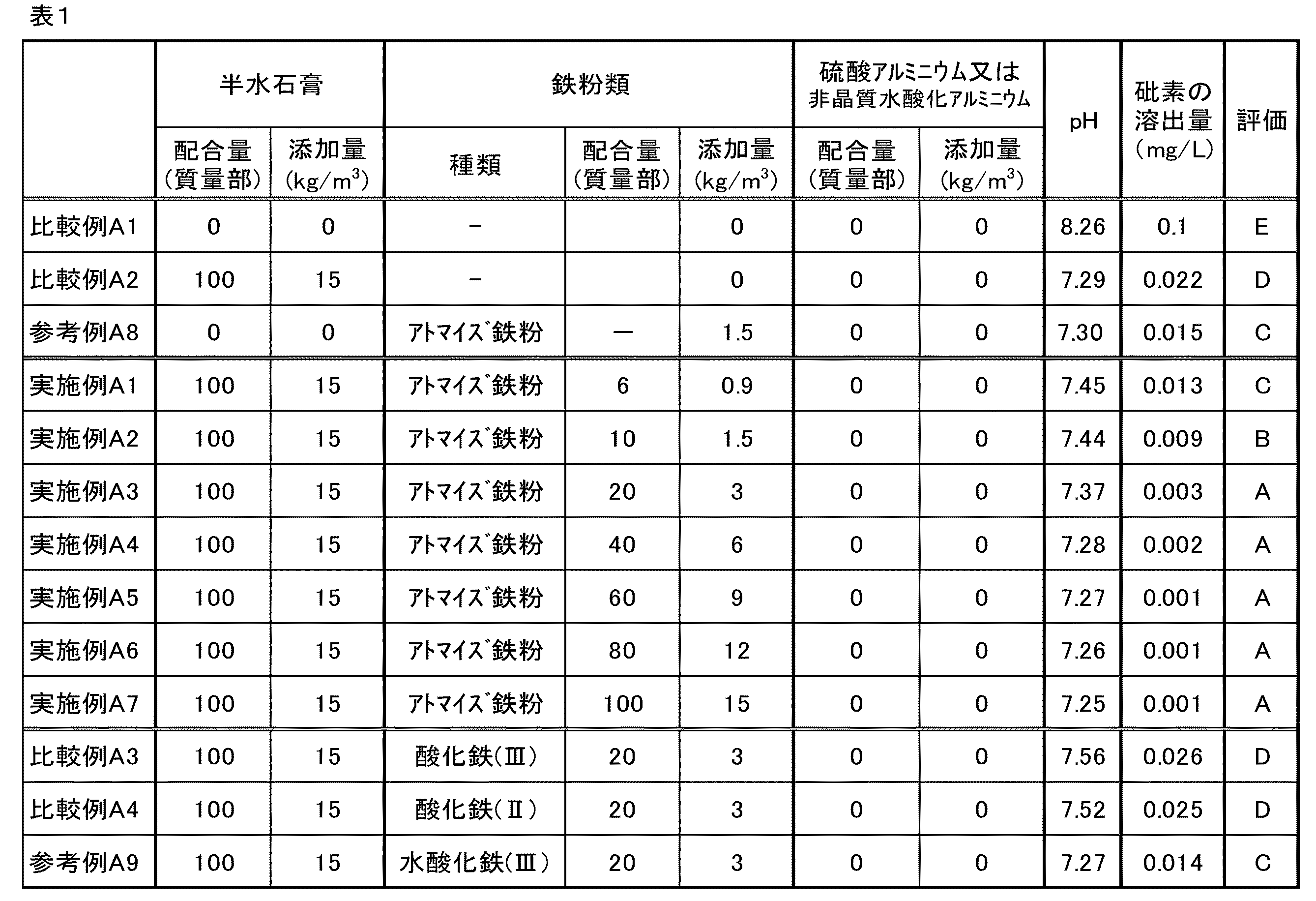

以上の結果より、石膏100質量部に対して、鉄粉を6質量部以上配合した不溶化材は、砒素の溶出量を環境基準値の2倍である0.02mg/L未満に抑えることができた(実施例A1~7及びB1~4)。特に、鉄粉を10質量部以上配合した不溶化材は、砒素の溶出量を環境基準値以下の0.01mg/L未満に抑えることができた(実施例A2~7及びB1~4)。さらに、石膏100質量部に対して、鉄粉を20質量部以上配合した不溶化材は、砒素の溶出量を0.005mg/L未満に抑えることができ、高い不溶化効果を発揮した(実施例A3~7)。これに対し、鉄粉の代わりに、酸化鉄(II)、酸化鉄(III)及び水酸化鉄(III)を配合した不溶化材では、半水石膏と併用しても、砒素の溶出量を0.01mg/L未満に抑えることができなかった(比較例A3~4、参考例A9)。また、水酸化鉄(III)は半水石膏100質量部に対して20質量部以上添加することで、砒素の溶出量を0.02mg/L未満に抑えることができているが、鉄粉と比べ多くの量を必要とするため鉄粉よりも効率が低く、実用性に乏しい(参考例A9)。
さらに、実施例A2と実施例B1~4の結果から、石膏、鉄粉、並びに硫酸アルミニウム及び/又は非晶質水酸化アルミニウムを併用することで、砒素の溶出量をさらに低減可能であることが確認された。特に、石膏100質量部に対して、硫酸アルミニウムを20質量部以上配合した不溶化材は、砒素の溶出量を0.005mg/L未満に抑えることができ、高い不溶化効果を発揮した(実施例B2~3)。
[砒素の再溶出確認試験]
砒素の溶出量が0.1mg/Lとなるように調製した模擬汚染土壌を用い、この模擬汚染土壌に対して、上記実施例A3の不溶化材を実施例A3と同量の添加量にて添加し、混合撹拌して処理を行い、28日間養生する試験を行った。そして、得られた処理物について、各段階でサンプルを採取して、各採取物について、先に述べた溶出試験を行い、得られた測定用サンプル中の砒素の溶出量をそれぞれ測定した。具体的には、上記した処理を行っている過程で、1日、7日、及び28日の各段階における処理物をサンプルとしてそれぞれ採取し、これらを用いて溶出試験を行い、測定用サンプル中の砒素の溶出量を測定した。この測定によって、時間の経過とともに砒素が再溶出しないかを確認する試験を行った。その結果を表3に示す。
砒素の溶出量が0.1mg/Lとなるように調製した模擬汚染土壌を用い、この模擬汚染土壌に対して、上記実施例A3の不溶化材を実施例A3と同量の添加量にて添加し、混合撹拌して処理を行い、28日間養生する試験を行った。そして、得られた処理物について、各段階でサンプルを採取して、各採取物について、先に述べた溶出試験を行い、得られた測定用サンプル中の砒素の溶出量をそれぞれ測定した。具体的には、上記した処理を行っている過程で、1日、7日、及び28日の各段階における処理物をサンプルとしてそれぞれ採取し、これらを用いて溶出試験を行い、測定用サンプル中の砒素の溶出量を測定した。この測定によって、時間の経過とともに砒素が再溶出しないかを確認する試験を行った。その結果を表3に示す。
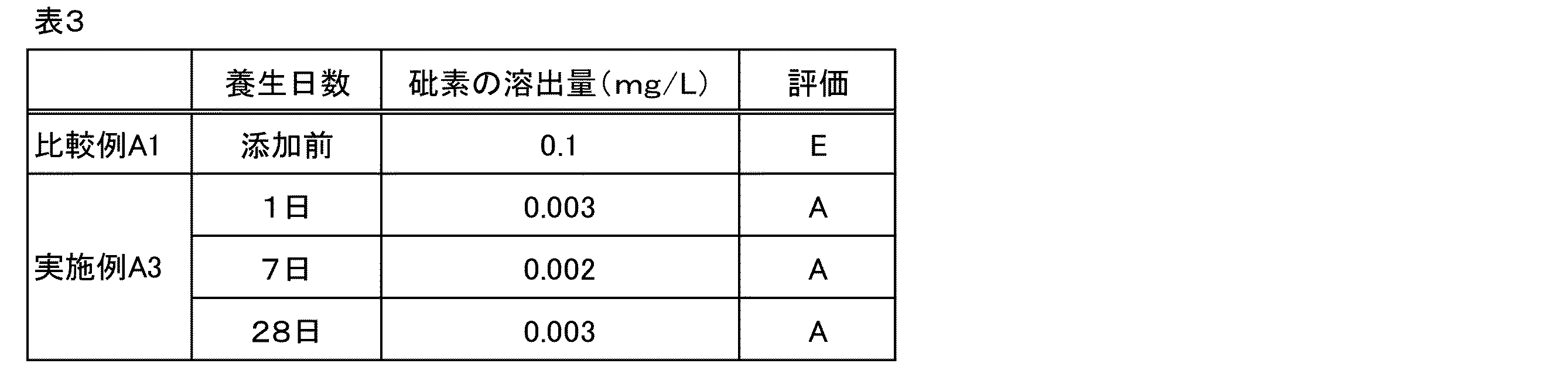
砒素の再溶出確認試験の結果より、半水石膏及び鉄粉を特定の割合で含有する不溶化材によって、長期間でも安定して、砒素を不溶化できることが確認された。
Claims (11)
- 特定有害物質として少なくとも砒素を含有する土壌に用いられる、砒素の不溶化材であって、
石膏と鉄粉とを含有し、
前記石膏100質量部に対し、前記鉄粉を6~100質量部の範囲で含有する、砒素の不溶化材。 - 前記石膏100質量部に対し、前記鉄粉を10~80質量部の範囲で含有する請求項1に記載の砒素の不溶化材。
- 前記石膏100質量部に対し、前記鉄粉を20~60質量部の範囲で含有する請求項1又は2に記載の砒素の不溶化材。
- 前記石膏100質量部に対し、さらに硫酸アルミニウム、及び非晶質水酸化アルミニウムからなる群から選択される少なくとも1種を10~30質量部の範囲で含有する請求項1~3のいずれか1項に記載の砒素の不溶化材。
- 前記石膏100質量部に対し、さらに硫酸アルミニウム、及び非晶質水酸化アルミニウムからなる群から選択される少なくとも1種を20~30質量部の範囲で含有する請求項1~4のいずれか1項に記載の砒素の不溶化材。
- 前記石膏が、半水石膏である請求項1~5のいずれか1項に記載の砒素の不溶化材。
- 前記鉄粉の平均粒子径が10μm以上1000μm以下である請求項1~6のいずれか1項に記載の砒素の不溶化材。
- 前記鉄粉のS含有量が0.05~5質量%である請求項1~7のいずれか1項に記載の砒素の不溶化材。
- 前記鉄粉のS含有量が0.05~5質量%で且つMn含有量が0.1~10質量%である請求項1~8のいずれか1項に記載の砒素の不溶化材。
- 前記鉄粉が、アトマイズ鉄粉である請求項1~9のいずれか1項に記載の砒素の不溶化材。
- 特定有害物質として少なくとも砒素を含有する土壌に、
石膏と鉄粉とを、前記石膏100質量部に対して前記鉄粉6~100質量部の割合で添加する、砒素の不溶化方法。
Priority Applications (2)
| Application Number | Priority Date | Filing Date | Title |
|---|---|---|---|
| CN201680076277.XA CN108430658A (zh) | 2015-12-25 | 2016-12-22 | 砷的不溶化材料及不溶化方法 |
| JP2017558241A JP6720214B2 (ja) | 2015-12-25 | 2016-12-22 | 砒素の不溶化材及び不溶化方法 |
Applications Claiming Priority (2)
| Application Number | Priority Date | Filing Date | Title |
|---|---|---|---|
| JP2015-252944 | 2015-12-25 | ||
| JP2015252944 | 2015-12-25 |
Publications (1)
| Publication Number | Publication Date |
|---|---|
| WO2017110964A1 true WO2017110964A1 (ja) | 2017-06-29 |
Family
ID=59089510
Family Applications (1)
| Application Number | Title | Priority Date | Filing Date |
|---|---|---|---|
| PCT/JP2016/088278 Ceased WO2017110964A1 (ja) | 2015-12-25 | 2016-12-22 | 砒素の不溶化材及び不溶化方法 |
Country Status (4)
| Country | Link |
|---|---|
| JP (1) | JP6720214B2 (ja) |
| CN (1) | CN108430658A (ja) |
| TW (1) | TWI713664B (ja) |
| WO (1) | WO2017110964A1 (ja) |
Cited By (2)
| Publication number | Priority date | Publication date | Assignee | Title |
|---|---|---|---|---|
| US11414334B2 (en) | 2020-10-09 | 2022-08-16 | United States Government, as represented by the Administrator of the U.S. EPA | Method for sequestering ions in an environmental matrix |
| US12097546B2 (en) | 2020-10-09 | 2024-09-24 | United States Government, as represented by the Administrator of the U.S. EPA | Method for sequestering ions in an environmental matrix |
Families Citing this family (3)
| Publication number | Priority date | Publication date | Assignee | Title |
|---|---|---|---|---|
| CN111533155B (zh) * | 2020-04-23 | 2021-12-14 | 大唐环境产业集团股份有限公司 | 一种脱硫石膏中重金属的固定化方法 |
| JP7794396B2 (ja) * | 2022-02-07 | 2026-01-06 | 株式会社神戸製鋼所 | 重金属類吸収抑制剤、土壌及び農作物の栽培方法 |
| CN117259398A (zh) * | 2023-10-16 | 2023-12-22 | 矿冶科技集团有限公司 | 一种铁锰钙三元复合材料及金属废渣的稳定化处理方法 |
Citations (8)
| Publication number | Priority date | Publication date | Assignee | Title |
|---|---|---|---|---|
| JP2006055796A (ja) * | 2004-08-23 | 2006-03-02 | Nishimatsu Constr Co Ltd | 土壌改良方法 |
| JP2006159023A (ja) * | 2004-12-03 | 2006-06-22 | Nishimatsu Constr Co Ltd | 土壌浄化方法 |
| JP2007045983A (ja) * | 2005-08-12 | 2007-02-22 | Titan Kogyo Kk | 土壌改良材 |
| JP2010082539A (ja) * | 2008-09-30 | 2010-04-15 | Kurita Water Ind Ltd | 土壌またはスラグの処理方法 |
| JP2010207659A (ja) * | 2009-03-06 | 2010-09-24 | Yoshino Gypsum Co Ltd | 焼石膏を含有した重金属等不溶化固化材 |
| JP2013188688A (ja) * | 2012-03-14 | 2013-09-26 | Hazama Ando Corp | 重金属で汚染された土壌又は地盤を浄化するための土壌浄化剤、それに用いられる添加剤、及び土壌浄化方法 |
| JP2013227554A (ja) * | 2012-03-30 | 2013-11-07 | Yoshino Gypsum Co Ltd | 特定有害物質の不溶化材及びこれを用いた特定有害物質の不溶化方法 |
| JP2015229124A (ja) * | 2014-06-03 | 2015-12-21 | Dowaエコシステム株式会社 | 汚染土壌の無害化処理方法 |
Family Cites Families (5)
| Publication number | Priority date | Publication date | Assignee | Title |
|---|---|---|---|---|
| JP2008043921A (ja) * | 2006-08-21 | 2008-02-28 | Kobe Steel Ltd | 汚染水中のヒ素除去法およびヒ素除去処理剤 |
| CN102249609B (zh) * | 2011-04-29 | 2013-06-12 | 昆明理工大学 | 一种含砷废渣固化体及其制备方法 |
| CN104801527A (zh) * | 2014-01-23 | 2015-07-29 | 江苏佳源铝业有限公司 | 一种用含钙铝材料处理砷污染物的方法 |
| CN104004520B (zh) * | 2014-05-07 | 2017-03-08 | 上海纺织建筑设计研究院 | 一种用于砷污染场地土壤修复的稳定剂 |
| CN104668266B (zh) * | 2014-12-03 | 2017-03-15 | 厦门紫金矿冶技术有限公司 | 一种含砷危废渣的无害化处理方法 |
-
2016
- 2016-12-22 JP JP2017558241A patent/JP6720214B2/ja active Active
- 2016-12-22 CN CN201680076277.XA patent/CN108430658A/zh active Pending
- 2016-12-22 WO PCT/JP2016/088278 patent/WO2017110964A1/ja not_active Ceased
- 2016-12-23 TW TW105142976A patent/TWI713664B/zh active
Patent Citations (8)
| Publication number | Priority date | Publication date | Assignee | Title |
|---|---|---|---|---|
| JP2006055796A (ja) * | 2004-08-23 | 2006-03-02 | Nishimatsu Constr Co Ltd | 土壌改良方法 |
| JP2006159023A (ja) * | 2004-12-03 | 2006-06-22 | Nishimatsu Constr Co Ltd | 土壌浄化方法 |
| JP2007045983A (ja) * | 2005-08-12 | 2007-02-22 | Titan Kogyo Kk | 土壌改良材 |
| JP2010082539A (ja) * | 2008-09-30 | 2010-04-15 | Kurita Water Ind Ltd | 土壌またはスラグの処理方法 |
| JP2010207659A (ja) * | 2009-03-06 | 2010-09-24 | Yoshino Gypsum Co Ltd | 焼石膏を含有した重金属等不溶化固化材 |
| JP2013188688A (ja) * | 2012-03-14 | 2013-09-26 | Hazama Ando Corp | 重金属で汚染された土壌又は地盤を浄化するための土壌浄化剤、それに用いられる添加剤、及び土壌浄化方法 |
| JP2013227554A (ja) * | 2012-03-30 | 2013-11-07 | Yoshino Gypsum Co Ltd | 特定有害物質の不溶化材及びこれを用いた特定有害物質の不溶化方法 |
| JP2015229124A (ja) * | 2014-06-03 | 2015-12-21 | Dowaエコシステム株式会社 | 汚染土壌の無害化処理方法 |
Cited By (2)
| Publication number | Priority date | Publication date | Assignee | Title |
|---|---|---|---|---|
| US11414334B2 (en) | 2020-10-09 | 2022-08-16 | United States Government, as represented by the Administrator of the U.S. EPA | Method for sequestering ions in an environmental matrix |
| US12097546B2 (en) | 2020-10-09 | 2024-09-24 | United States Government, as represented by the Administrator of the U.S. EPA | Method for sequestering ions in an environmental matrix |
Also Published As
| Publication number | Publication date |
|---|---|
| CN108430658A (zh) | 2018-08-21 |
| JP6720214B2 (ja) | 2020-07-08 |
| JPWO2017110964A1 (ja) | 2018-10-18 |
| TWI713664B (zh) | 2020-12-21 |
| TW201729869A (zh) | 2017-09-01 |
Similar Documents
| Publication | Publication Date | Title |
|---|---|---|
| Phenrat et al. | A SEM and X-ray study for investigation of solidified/stabilized arsenic–iron hydroxide sludge | |
| JP6720214B2 (ja) | 砒素の不溶化材及び不溶化方法 | |
| EP3064286B1 (en) | Use of an insolubilizing material for specific hazardous substance and method for insolubilizing specific hazardous substance with same | |
| JP5599061B2 (ja) | 中性固化材用の添加材、中性固化材および重金属類の溶出抑制方法 | |
| JP5963177B2 (ja) | 固形状重金属被汚染物の処理方法及びセメント固化物の製造方法 | |
| CN106467745A (zh) | 适用砷污染土壤的钢渣脱硫石膏基土壤固化剂 | |
| CN104804747A (zh) | 一种钙基重金属土壤修复剂及制备方法 | |
| JP2005146275A (ja) | 土壌、土質改良及び固化安定剤 | |
| CN108085006B (zh) | 一种用于修复砷污染土壤的固化剂及其制备方法和应用 | |
| JP2010207659A (ja) | 焼石膏を含有した重金属等不溶化固化材 | |
| JP2016022406A (ja) | 重金属汚染水の処理方法 | |
| JP6046476B2 (ja) | 有害物質の溶出防止剤およびそれを用いた溶出防止方法 | |
| JPH10137716A (ja) | 廃棄物処理材および廃棄物処理方法 | |
| EP2835359B1 (en) | Uses of a material for insolubilizing specific toxic substances, method for insolubilizing specific toxic substances, and soil improvement method | |
| JP6793544B2 (ja) | 土壌処理材及び重金属汚染土壌の浄化方法 | |
| CN110665958B (zh) | 一种利用城市固废修复砷污染土壤的稳定化药剂及方法 | |
| JP2002248444A (ja) | クロム酸化物含有物質の処理方法 | |
| JP2018145077A (ja) | セメント添加剤、セメント組成物及びコンクリート | |
| JP7076337B2 (ja) | 不溶化材 | |
| JP2019026536A (ja) | セメント添加剤及びセメント組成物 | |
| JP6227879B2 (ja) | 特定有害物質の不溶化材及びこれを用いた特定有害物質の不溶化方法 | |
| JP6686630B2 (ja) | 重金属等不溶化材及びその製造方法 | |
| JP6385818B2 (ja) | セメント添加剤及びセメント組成物 | |
| JP7089971B2 (ja) | 重金属類の不溶化方法、及び、不溶化材 | |
| JP4374602B2 (ja) | 重金属固定化剤およびその廃棄物処理方法 |
Legal Events
| Date | Code | Title | Description |
|---|---|---|---|
| 121 | Ep: the epo has been informed by wipo that ep was designated in this application |
Ref document number: 16878851 Country of ref document: EP Kind code of ref document: A1 |
|
| ENP | Entry into the national phase |
Ref document number: 2017558241 Country of ref document: JP Kind code of ref document: A |
|
| NENP | Non-entry into the national phase |
Ref country code: DE |
|
| 122 | Ep: pct application non-entry in european phase |
Ref document number: 16878851 Country of ref document: EP Kind code of ref document: A1 |