WO2017104946A1 - 유기 화합물, 조성물, 유기 광전자 소자 및 표시 장치 - Google Patents
유기 화합물, 조성물, 유기 광전자 소자 및 표시 장치 Download PDFInfo
- Publication number
- WO2017104946A1 WO2017104946A1 PCT/KR2016/010521 KR2016010521W WO2017104946A1 WO 2017104946 A1 WO2017104946 A1 WO 2017104946A1 KR 2016010521 W KR2016010521 W KR 2016010521W WO 2017104946 A1 WO2017104946 A1 WO 2017104946A1
- Authority
- WO
- WIPO (PCT)
- Prior art keywords
- substituted
- unsubstituted
- group
- formula
- organic
- Prior art date
- Legal status (The legal status is an assumption and is not a legal conclusion. Google has not performed a legal analysis and makes no representation as to the accuracy of the status listed.)
- Ceased
Links
- 0 Cc1c(*)nc(c2c(*)c(*)c(*)c(*)c2c2c3c(*)c(*)c(*)c2*)c3n1 Chemical compound Cc1c(*)nc(c2c(*)c(*)c(*)c(*)c2c2c3c(*)c(*)c(*)c2*)c3n1 0.000 description 15
- HLYKLNQDGOWCLX-UHFFFAOYSA-N Brc1ccccc1-c(cc1)cc2c1c1nccnc1c1c2cccc1 Chemical compound Brc1ccccc1-c(cc1)cc2c1c1nccnc1c1c2cccc1 HLYKLNQDGOWCLX-UHFFFAOYSA-N 0.000 description 1
- OSOUNOBYRMOXQQ-UHFFFAOYSA-N Cc1cc(Cl)ccc1 Chemical compound Cc1cc(Cl)ccc1 OSOUNOBYRMOXQQ-UHFFFAOYSA-N 0.000 description 1
- FBGNGKPKNAUYCI-UHFFFAOYSA-N Clc1cc(-c2ccccc2-c(cc2)cc3c2c2nccnc2c2c3cccc2)ccc1 Chemical compound Clc1cc(-c2ccccc2-c(cc2)cc3c2c2nccnc2c2c3cccc2)ccc1 FBGNGKPKNAUYCI-UHFFFAOYSA-N 0.000 description 1
Classifications
-
- H—ELECTRICITY
- H10—SEMICONDUCTOR DEVICES; ELECTRIC SOLID-STATE DEVICES NOT OTHERWISE PROVIDED FOR
- H10K—ORGANIC ELECTRIC SOLID-STATE DEVICES
- H10K85/00—Organic materials used in the body or electrodes of devices covered by this subclass
- H10K85/60—Organic compounds having low molecular weight
- H10K85/615—Polycyclic condensed aromatic hydrocarbons, e.g. anthracene
-
- C—CHEMISTRY; METALLURGY
- C07—ORGANIC CHEMISTRY
- C07D—HETEROCYCLIC COMPOUNDS
- C07D209/00—Heterocyclic compounds containing five-membered rings, condensed with other rings, with one nitrogen atom as the only ring hetero atom
- C07D209/56—Ring systems containing three or more rings
- C07D209/80—[b, c]- or [b, d]-condensed
- C07D209/82—Carbazoles; Hydrogenated carbazoles
-
- C—CHEMISTRY; METALLURGY
- C07—ORGANIC CHEMISTRY
- C07D—HETEROCYCLIC COMPOUNDS
- C07D241/00—Heterocyclic compounds containing 1,4-diazine or hydrogenated 1,4-diazine rings
- C07D241/36—Heterocyclic compounds containing 1,4-diazine or hydrogenated 1,4-diazine rings condensed with carbocyclic rings or ring systems
-
- C—CHEMISTRY; METALLURGY
- C07—ORGANIC CHEMISTRY
- C07D—HETEROCYCLIC COMPOUNDS
- C07D401/00—Heterocyclic compounds containing two or more hetero rings, having nitrogen atoms as the only ring hetero atoms, at least one ring being a six-membered ring with only one nitrogen atom
- C07D401/02—Heterocyclic compounds containing two or more hetero rings, having nitrogen atoms as the only ring hetero atoms, at least one ring being a six-membered ring with only one nitrogen atom containing two hetero rings
- C07D401/10—Heterocyclic compounds containing two or more hetero rings, having nitrogen atoms as the only ring hetero atoms, at least one ring being a six-membered ring with only one nitrogen atom containing two hetero rings linked by a carbon chain containing aromatic rings
-
- C—CHEMISTRY; METALLURGY
- C07—ORGANIC CHEMISTRY
- C07D—HETEROCYCLIC COMPOUNDS
- C07D401/00—Heterocyclic compounds containing two or more hetero rings, having nitrogen atoms as the only ring hetero atoms, at least one ring being a six-membered ring with only one nitrogen atom
- C07D401/14—Heterocyclic compounds containing two or more hetero rings, having nitrogen atoms as the only ring hetero atoms, at least one ring being a six-membered ring with only one nitrogen atom containing three or more hetero rings
-
- C—CHEMISTRY; METALLURGY
- C07—ORGANIC CHEMISTRY
- C07D—HETEROCYCLIC COMPOUNDS
- C07D403/00—Heterocyclic compounds containing two or more hetero rings, having nitrogen atoms as the only ring hetero atoms, not provided for by group C07D401/00
- C07D403/02—Heterocyclic compounds containing two or more hetero rings, having nitrogen atoms as the only ring hetero atoms, not provided for by group C07D401/00 containing two hetero rings
- C07D403/10—Heterocyclic compounds containing two or more hetero rings, having nitrogen atoms as the only ring hetero atoms, not provided for by group C07D401/00 containing two hetero rings linked by a carbon chain containing aromatic rings
-
- C—CHEMISTRY; METALLURGY
- C07—ORGANIC CHEMISTRY
- C07D—HETEROCYCLIC COMPOUNDS
- C07D403/00—Heterocyclic compounds containing two or more hetero rings, having nitrogen atoms as the only ring hetero atoms, not provided for by group C07D401/00
- C07D403/14—Heterocyclic compounds containing two or more hetero rings, having nitrogen atoms as the only ring hetero atoms, not provided for by group C07D401/00 containing three or more hetero rings
-
- C—CHEMISTRY; METALLURGY
- C09—DYES; PAINTS; POLISHES; NATURAL RESINS; ADHESIVES; COMPOSITIONS NOT OTHERWISE PROVIDED FOR; APPLICATIONS OF MATERIALS NOT OTHERWISE PROVIDED FOR
- C09K—MATERIALS FOR MISCELLANEOUS APPLICATIONS, NOT PROVIDED FOR ELSEWHERE
- C09K11/00—Luminescent materials, e.g. electroluminescent or chemiluminescent
- C09K11/06—Luminescent materials, e.g. electroluminescent or chemiluminescent containing organic luminescent materials
-
- H—ELECTRICITY
- H10—SEMICONDUCTOR DEVICES; ELECTRIC SOLID-STATE DEVICES NOT OTHERWISE PROVIDED FOR
- H10K—ORGANIC ELECTRIC SOLID-STATE DEVICES
- H10K59/00—Integrated devices, or assemblies of multiple devices, comprising at least one organic light-emitting element covered by group H10K50/00
- H10K59/10—OLED displays
-
- Y—GENERAL TAGGING OF NEW TECHNOLOGICAL DEVELOPMENTS; GENERAL TAGGING OF CROSS-SECTIONAL TECHNOLOGIES SPANNING OVER SEVERAL SECTIONS OF THE IPC; TECHNICAL SUBJECTS COVERED BY FORMER USPC CROSS-REFERENCE ART COLLECTIONS [XRACs] AND DIGESTS
- Y02—TECHNOLOGIES OR APPLICATIONS FOR MITIGATION OR ADAPTATION AGAINST CLIMATE CHANGE
- Y02E—REDUCTION OF GREENHOUSE GAS [GHG] EMISSIONS, RELATED TO ENERGY GENERATION, TRANSMISSION OR DISTRIBUTION
- Y02E10/00—Energy generation through renewable energy sources
- Y02E10/50—Photovoltaic [PV] energy
- Y02E10/549—Organic PV cells
Definitions
- An organic compound a composition, an organic optoelectronic device, and a display device.
- Organic optoelectronic diodes are devices that can switch electrical energy and light energy.
- Organic optoelectronic devices can be divided into two types according to the principle of operation.
- One is an optoelectronic device in which excitons formed by light energy are separated into electrons and holes, and the electrons and holes are transferred to other electrodes, respectively, to generate electric energy.
- Examples of the organic optoelectronic device may be an organic photoelectric device, an organic light emitting device, an organic solar cell and an organic photo conductor drum.
- organic light emitting diodes have attracted much attention recently as demand for flat panel displays increases.
- An organic light emitting device converts electrical energy into light by applying a current to an organic light emitting material, and has an organic layer interposed between an anode and a cathode.
- the performance of the organic light emitting device is greatly influenced by the characteristics of the organic layer, and in particular, by the organic material included in the organic layer.
- One embodiment provides an organic compound capable of implementing high efficiency and long life organic optoelectronic devices.
- One embodiment provides an organic optoelectronic device composition comprising the organic compound. Another embodiment provides an organic optoelectronic device including the organic compound. Another embodiment provides a display device including the organic optoelectronic device.
- an organic compound represented by Chemical Formula 1 is provided.
- Z 1 to Z 13 are each independently N or CR a
- At least one of Z 1 to Z 13 is N,
- L 1 is a single bond or a substituted or unsubstituted C6 to C30 arylene group
- R 1 to R 10 are each independently hydrogen, deuterium, a substituted or unsubstituted C 1 to C 10 alkyl group, a substituted or unsubstituted C 6 to C 12 aryl group, or a combination thereof,
- R 1 1 to R 14 and R a are each independently hydrogen, deuterium, a substituted or unsubstituted C 1 to C 10 alkyl group, a substituted or unsubstituted C 6 to C 12 aryl group, a substituted or unsubstituted C 3 to C 12 hate Logo or a combination thereof,
- R 1 to R 14 and R a are each independently present or two adjacent groups combine to form a ring
- nl and n2 are each independently an integer of 0 to 2.
- the organic compound includes a first organic compound, and at least one crab 2 organic compound having a carbazole moiety.
- an organic optoelectronic device It provides a composition for an organic optoelectronic device.
- a display device including the organic optoelectronic device is provided.
- FIG. 1 is a cross-sectional view illustrating an organic light emitting diode according to an embodiment.
- substituted means that at least one hydrogen in a substituent or compound is deuterium, a halogen group, a hydroxy group, an amino group, a substituted or unsubstituted C1 to C30 amine group, a nitro group, a substituted or unsubstituted C1 to C10 trifluoro such as C1 to C40 silyl group, C1 to C30 alkyl group, C1 to C10 alkylsilyl group, C6 to C30 aryl group, C2 to C30 heterocyclic group, C1 to C20 alkoxy group, trifluoromethyl group, etc.
- substituted herein refers to a deuterium, a substituted or unsubstituted C1 to C30 amine group, a nitro group, a substituted or unsubstituted C 1 to C40 silyl group, C1 to It may be substituted with a C30 alkyl group, C1 to C10 alkylsilyl group, C6 to C30 aryl group or C2 to C30 heterocyclic group.
- substituted means a deuterium, a substituted or unsubstituted C1 to C40 silyl group, C1 to C30 alkyl group, C1 to C10 alkylsilyl group or C6 to C30 aryl group Can be substituted have.
- substituted halogen group, hydroxy group, amino group, substituted or unsubstituted C1 to C20 amine group, nitro group, substituted or unsubstituted C3 to C40 silyl group, C1 to C30 alkyl group, C1 to C10 alkylsilyl group, C6 to Two adjacent substituents of C 1 to C 10 trifluoroalkyl group or cyano group such as C 30 aryl group, C 3 to C 30 heterocyclic group, C 1 to C 20 alkoxy group, trifluoromethyl group, etc. may be fused to form a ring.
- the substituted C6 to C30 aryl group may be fused to another adjacent substituted C6 to C30 aryl group to form a substituted or unsubstituted fluorene ring.
- hetero 'includes at least one heteroatom in one functional group and the remainder is carbon, said heteroatom selected from N, 0, S, P and Si. Can be.
- aryl group refers to a group having one or more carbocyclic aromatic moieties, and broadly the form in which the carbocyclic aromatic moieties are connected in a single bond and the carbocyclic aromatic moieties are directly or
- Aryl groups include monocyclic, polycyclic or fused polycyclic (ie, rings that divide adjacent pairs of carbon atoms) functional groups.
- heterocyclic group refers to at least one hetero atom selected from N, 0, S, P and Si in a ring compound such as an aryl group, a cycloalkyl group, a fused ring thereof or a combination thereof. Containing, and the rest is carbon.
- the heterocyclic group may include one or more heteroatoms for all or each ring.
- a substituted or unsubstituted aryl group and / or a substituted or unsubstituted heterocyclic group includes a substituted or unsubstituted phenyl group, a substituted or unsubstituted naphthyl group, a substituted or unsubstituted anthracenyl group, a substituted or unsubstituted group Substituted phenanthryl groups, substitutions or
- Naphthyridinyl groups substituted or unsubstituted benzoxazinyl groups, substituted or unsubstituted benzthiazinyl groups, substituted or unsubstituted acridinyl groups, substituted or unsubstituted
- Phenazineyl group substituted or unsubstituted phenothiazineyl group, substituted or unsubstituted
- a dibenzofuranyl group, a substituted or unsubstituted dibenzothiophenyl group, a substituted or unsubstituted carbazole group, a combination thereof, or a combination thereof may be in a fused form, but is not limited thereto.
- the substituted or unsubstituted aryl group is substituted or unsubstituted phenyl group, substituted or unsubstituted naphthyl group, substituted or unsubstituted biphenyl group, substituted or unsubstituted terphenyl group, substituted or unsubstituted It may be a quarterphenyl group or a substituted or unsubstituted fluorenyl group.
- a substituted or unsubstituted indenyl group a substituted or unsubstituted pyridinyl group, a substituted or unsubstituted pyrimidinyl group, a substituted or unsubstituted pyrazinyl group, a substituted or unsubstituted triazinyl group , Substituted or unsubstituted indolyl group, substituted or unsubstituted quinolinyl group, substituted or unsubstituted isoquinolinyl group, substituted or unsubstituted quinazolinyl group, substituted or unsubstituted quinoxalinyl group, substituted or unsubstituted Done
- Dibenzofuran group may be a substituted or unsubstituted di banjo a thiophenyl group, a substituted or unsubstituted carbazole, a combination thereof or a combination thereof fused form, but is not The "May eu
- the hole characteristic refers to electrons when an electric field is applied. It refers to a property that can form holes by donating, and has conductivity characteristics along the HOMO level to facilitate injection of holes formed in the anode into the light emitting layer, movement of holes formed in the light emitting layer into the anode, and movement in the light emitting layer. Means to come.
- the electron characteristic refers to a characteristic that can receive electrons when an electric field is applied, and has a conductivity characteristic along the LUMO level, and injects electrons formed in the cathode into the light emitting layer, moves electrons formed in the light emitting layer to the cathode, and It means a property that facilitates movement.
- An organic compound according to one embodiment may be represented by Formula 1 below.
- Z 1 to Z 13 are each independently N or CR a ,
- At least one of Z 1 to Z 13 is N,
- L 1 is a single bond or a substituted or unsubstituted C6 to C30 arylene group
- R 1 to R 10 are each independently hydrogen, deuterium, a substituted or unsubstituted C1 to C10 alkyl group, a substituted or unsubstituted C6 to C12 aryl group, or a combination thereof,
- R 1 1 to R 14 and R a are each independently hydrogen, deuterium, a substituted or unsubstituted C1 to C10 alkyl group, a substituted or unsubstituted C6 to C12 aryl group, a substituted or unsubstituted C3 to C12 'heterocyclic group Or a combination thereof,
- R 1 to R 14 and R a are each independently present or two adjacent groups combine to form a ring
- nl and n2 are each independently an integer of 0 to 2.
- the organic compound may include a dibenzoquinoxaline moiety and a ring having at least one nitrogen, and thus may have a structure in which electrons are easily received when an electric field is applied, and thus driving voltage of the organic optoelectronic device to which the organic compound is applied. This can lower the efficiency and increase efficiency.
- the LUMO energy of the organic compound calculated by the B3LYP / 6-31G ** method using Gaussian 09 can be, for example, -1.5 eV to -2.0 eV. Within this range, for example, about 1.7 eV to -1.8 eV.
- the organic compound may implement an asymmetric structure by including a nitrogen-containing ring substituent that extends to one side about the dibenzoquinoxaline, thereby lowering the crystallinity by inhibiting the interaction of molecules.
- the organic compound has an asymmetric structure so that
- Effectively preventing stacking can increase process stability while lowering the deposition temperature.
- At least two of Z 1 to Z 13 may be N.
- at least three of Z 1 to Z 13 may be N.
- at least one of Z 1 to Z 3 may be N.
- at least one of ⁇ to Z 3 may be N, and each of Z 4 to Z 13 may independently be CR a , wherein R a is hydrogen, deuterium, a substituted or unsubstituted C1 to C10 alkyl group. , A substituted or unsubstituted C6 internal C12 aryl group, a substituted or unsubstituted C3 to C12 heterocyclic group, or a combination thereof.
- at least two of Z 1 to Z 3 may be N.
- At least two of Z 1 to Z 3 may be N, and each of ⁇ 4 to ⁇ 13 may independently be N or CR a , wherein R a is hydrogen, hydrogen, substituted or unsubstituted. Or a C1 to C10 alkyl group, a substituted or unsubstituted C6 to C12 aryl group, a substituted or unsubstituted C3 to C12 heterocyclic group, or a combination thereof.
- Z 1 to Z 3 may be all N, ⁇ 4 to ⁇ 13 may be each independently ⁇ or CR a , wherein R a is hydrogen, deuterium, substituted or unsubstituted C1 to C10 alkyl group, substituted or unsubstituted C6 to C12 aryl group, substituted Or an unsubstituted C3 to C12 heterocyclic group or a combination thereof.
- R 1 to R 4 may be each independently hydrogen, deuterium or a substituted or unsubstituted C1 to C10 alkyl group, and R 1 to R 4 may be each independently hydrogen.
- L 1 may be, for example, a single bond or have at least one kink structure.
- the fold structure refers to a structure in which two connecting portions do not form a straight structure.
- o-phenylene and meta-phenylene in which the connecting portions do not form a straight structure, are represented.
- P-phenylene having a folding structure and the connecting portions forming a straight structure does not have a bending structure.
- L 1 is, for example, a single bond, a substituted or unsubstituted phenylene group having a folding structure, a substituted or unsubstituted biphenylene group having a folding structure, a substituted or unsubstituted terphenylene group having a folding structure, a folding structure It may be a substituted or unsubstituted quarterphenylene group, a substituted or unsubstituted pentaphenylene group having a folding structure.
- L 1 may include, for example, at least one of a single bond or a substituted or unsubstituted 0-phenylene group and a substituted or unsubstituted m-phenylene group.
- L 1 may be, for example, a single bond or one selected from substituted or unsubstituted groups listed in Group 1 below.
- R 30 to R 57 are each independently hydrogen, deuterium, substituted or unsubstituted C1 to C10 alkyl group, substituted or unsubstituted C3 to C30 cycloalkyl group, substituted or unsubstituted C6 to C30 aryl group, substituted or unsubstituted C2 to C30 heterocyclic group, substituted or unsubstituted amine group, substituted or unsubstituted C6 to C30 arylamine group, substituted or unsubstituted C6 to C30 heteroarylamine group, substituted or unsubstituted C1 to C30 alkoxy Group, halogen, cyano group, hydroxyl group, amino group, nitro group, carboxyl group, ferrocenyl group, or a combination thereof.
- the molecular weight of the organic compound may be, for example, about 750 or less. Within this range may be greater than or equal to about 538 and less than 750. By having a molecular weight in the above range it is possible to reduce the thermal decomposition of the organic compound by the high temperature during the deposition process and to improve the heat resistance. It may be about 538 to 749 within the range, may be about 550 to 730 within the range, may be about 600 to 700 within the range.
- the organic compound may be represented by, for example, the following Chemical Formula 2.
- ⁇ 1 to Z ⁇ R 1 to R 14 , nl and n 2 are as described above,
- R 15 to R 17 are each independently hydrogen, deuterium, a substituted or unsubstituted C1 to C10 alkyl group, a substituted or unsubstituted C6 to C12 aryl group, a substituted or unsubstituted C3 to C12 heterocyclic group, or a combination thereof Can,
- n3 and n4 may be each independently an integer of 0 to 2.
- At least two of Z 1 to Z 13 may be N.
- at least three of Z 1 to Z 13 may be N.
- at least one of Z 1 to Z 3 may be N.
- at least one of Z 1 to Z 3 may be N, and Z 4 to Z 13 may each independently be CR a , wherein R a is hydrogen, deuterium, a substituted or unsubstituted C1 to C10 alkyl group , A substituted or unsubstituted C6 to C12 aryl group, a substituted or unsubstituted C3 to C12 heterocyclic group or a combination thereof.
- at least two of Z 1 to Z 3 may be N.
- At least two of Z 1 to Z 3 may be N, and each of ⁇ 4 to ⁇ 13 may independently be ⁇ or CR a , wherein R a is hydrogen, deuterium, substituted or unsubstituted C1.
- R a is hydrogen, deuterium, substituted or unsubstituted C1.
- C10 alkyl group a substituted or unsubstituted C6 to C12 aryl group, a substituted or unsubstituted C3 to C12 heterocyclic group or a combination thereof.
- Z 1 to Z 3 may be all N
- Z 4 to Z 13 may be each independently N or CR a
- R a is hydrogen, deuterium, substituted or unsubstituted C1 to It may be a C10 alkyl group, a substituted or unsubstituted C6 to C12 aryl group, a substituted or unsubstituted C3 to C12 heterocyclic group or a combination thereof.
- R 1 to R 4 may be each independently hydrogen, deuterium or a substituted or unsubstituted C1 to C10 alkyl group, and R 1 to R 4 may be each independently hydrogen.
- the organic compound may be represented by, for example, the following Chemical Formula 3 or 4.
- X 1 to Z ⁇ R 1 to R 17 , nl to n4 are as described above.
- at least two of Z 1 to Z 13 may be N.
- At least three of, for example Z 1 to Z 13 may be a N.
- At least one of Z 1 to Z 3 may be N.
- Z 1 to Z 3, at least one of which may be N and, ⁇ 4 to ⁇ 13 each independently represent CR a may be, in which R a is an unsubstituted C1 hydrogen, heavy hydrogen, substituted or unsubstituted To C10 alkyl group, a substituted or unsubstituted C6 to C12 aryl group, a substituted or unsubstituted C3 to C12 heterocyclic group or a combination thereof.
- At least two of Z 1 to Z 3 may be N.
- at least two of Z 1 to Z 3 may be N, and each of ⁇ 4 to ⁇ 13 may independently be N or CR a , wherein R a is hydrogen, deuterium, substituted or unsubstituted. It may be a C1 to C10 alkyl group, a substituted or unsubstituted C6 to C12 aryl group, a substituted or unsubstituted C3 to C12 heterocyclic group or a combination thereof.
- Z 1 to Z 3 may be all N, ⁇ 4 to ⁇ 13 may be each independently ⁇ or CR a , wherein R a is hydrogen, deuterium, substituted or unsubstituted Or a C1 to C10 alkyl group, a substituted or unsubstituted C6 to C12 aryl group, a substituted or unsubstituted C3 to C12 heterocyclic group, or a combination thereof.
- R 1 to R 4 may be each independently hydrogen, deuterium or a substituted or unsubstituted C1 to C10 alkyl group, and R 1 to R 4 may be each independently hydrogen.
- the organic compound may be one of the compounds listed in the following Group 2, but is not limited thereto. . .
- the aforementioned organic compound can be applied to organic optoelectronic devices.
- the aforementioned organic compounds may be applied to the organic optoelectronic device alone or in combination with other organic compounds.
- the above-mentioned organic compound is used together with other organic compounds, it can be applied in the form of a composition.
- the composition may include at least one organic compound having the above-described organic compound and a carbazole moiety.
- the above-described organic compound is referred to as a 'first organic compound' and at least one organic compound having a carbazole moiety is referred to as a 'second organic compound'.
- the second organic compound may be, for example, a compound represented by Formula 5 below.
- ⁇ ⁇ is a single bond, a substituted or unsubstituted C1 to C20 alkylene group, a substituted or unsubstituted C2 to C20 alkenylene group, a substituted or unsubstituted C6 to C30 arylene group, a substituted or unsubstituted C2 to C30 divalent Heterocyclic group or a combination thereof,
- Ar 1 is a substituted or unsubstituted C6 to C30 aryl group, a substituted or unsubstituted C2 to C30 heterocyclic group or a combination thereof,
- R 60 to R 63 are each independently hydrogen, deuterium, a substituted or unsubstituted C1 to C20 alkyl group, a substituted or unsubstituted C6 to C50 aryl group, a substituted or unsubstituted C2 to C50 heterocyclic group, or a combination thereof ,
- At least one of R 60 to R 63 and Ar 1 includes a substituted or unsubstituted triphenylene group or a substituted or unsubstituted carbazolyl group.
- the second organic compound represented by Chemical Formula 5 may be, for example represented by at least one of 5-III in Chemical Formula 5-1.
- X ', X 4 and X 5 are each independently a single bond, a substituted or unsubstituted C1 to C20 alkylene group, a substituted or unsubstituted C2 to C20 alkenylene group, a substituted or unsubstituted C6 to C30 arylene group, substituted Or an unsubstituted C2 to C30 divalent heterocyclic group or a combination thereof,
- Ar 1 and Ar 4 are each independently a substituted or unsubstituted C6 to C30 aryl group, a substituted or unsubstituted : C2 to C30 heterocyclic group or a combination thereof,
- R 60 to R 63 and R 6S to R 79 are each independently hydrogen, deuterium, a substituted or unsubstituted C1 to C20 alkyl group, a substituted or unsubstituted C6 to C50 aryl group, a substituted or unsubstituted C2 to C50 heterocycle Groups or a combination thereof.
- the second organic compound represented by Chemical Formula 5 may be, for example, a compound listed in Group 3, but is not limited thereto.
- the second organic compound may be, for example, a compound made of a combination of a moiety represented by Formula 6 and a moiety represented by Formula 7. [Formula 6] [Formula 7]
- Y 2 and Y 3 are each independently a single bond, a substituted or unsubstituted C1 to C20 alkylene group, a substituted or unsubstituted C2 to C20 alkenylene group, a substituted or unsubstituted C6 to C30 arylene group, a substituted or unsubstituted C2 to C30 divalent heterocyclic group or a combination thereof,
- Ar 2 and Ar 3 are each independently a substituted or unsubstituted C6 to C30 aryl group, a substituted or unsubstituted C2 to C30 heterocyclic group or a combination thereof,
- R 64 to R 67 are each independently hydrogen, hydrogen, substituted or unsubstituted C1 to C20 alkyl group, substituted or unsubstituted C6 to C50 aryl group, substituted or unsubstituted C2 to C50 heterocyclic group, or a combination thereof ego,
- Adjacent two * of Formula 6 combines with two * of Formula 7 to form a fused ring, and * which does not form a fused ring in Formula 6 is each independently CR b , wherein R b is hydrogen, deuterium Or a substituted or unsubstituted C1 to C10 alkyl group, a substituted or unsubstituted C6 to C12 aryl group, a substituted or unsubstituted C3 to C12 heterocyclic group, or a combination thereof.
- the second organic compound consisting of a combination of the moiety represented by Formula 6 and the moiety represented by Formula 7 may be selected from, for example, a compound listed in Group 4 below, but is not limited thereto.
- the second organic compound may include at least one compound compound consisting of a compound represented by Chemical Formula 5 and a combination of a moiety represented by Chemical Formula 6 and a moiety represented by Chemical Formula 7.
- the composition may include the first organic compound and the second organic compound in an increase ratio of about 1: 10 to 10: 1.
- the composition may be applied to an organic layer of an organic optoelectronic device, and the first organic compound and the second organic compound may serve as a host.
- the first organic compound may be a compound having a bipolar characteristic having a relatively strong electronic property
- the second organic compound is a compound having a bipolar characteristic having a relatively strong hole characteristic, and used together with the first organic compound to transfer charges. And it is possible to further improve the luminous efficiency and lifetime characteristics by increasing the stability.
- composition may further include one or more organic compounds in addition to the first organic compound and the second organic compound described above.
- the composition may further comprise a dopant.
- the dopant may be a red, green or blue dopant, for example, a phosphorescent dopant.
- the dopant is a substance that is mixed with the first host compound and the second host compound in a small amount to emit light, and is generally a metal complex that emits light by multiple excitation which excites above a triplet state. Materials such as may be used.
- the dopant may be, for example, an inorganic, organic, or inorganic compound, and may be included in one kind or two or more kinds.
- Examples of the phosphorescent dopant include Ir, Pt, Os, Ti, Zr, Hf, Eu, Tb, Tm, Fe, Co, Ni, Ru, Rh,
- the phosphorescent dopant may be, for example, a compound represented by Chemical Formula Z, but is not limited thereto.
- ⁇ is a metal
- L and X are the same or different from each other and a ligand forming a complex with ⁇ .
- the ⁇ can be, for example, Ir, Pt, Os, Ti, Zr, Hf, Eu, Tb, Tm, Fe, Co, Ni, Ru, Rh, Pd or combinations thereof, wherein L and X are, for example, bidentate It may be a ligand.
- the composition may be formed into a thin film by a dry film forming method or a solution process.
- the dry film forming method may be, for example, chemical vapor deposition, sputtering, plasma plating, and ion plating, and two or more compounds may be simultaneously formed or a compound having the same deposition temperature may be mixed and formed together.
- the solution process may be, for example, inkjet printing, spin coating, slit coating, bar coating. And / or dip coating.
- the organic optoelectronic device is not particularly limited as long as it is a device capable of converting electrical energy and light energy, and examples thereof include organic photoelectric devices, organic light emitting devices, organic solar cells, and organic photosensitive drums.
- the organic optoelectronic device may include an anode and a cathode facing each other, and at least one organic layer positioned between the anode and the cathode, and the organic layer may include the organic compound or the composition described above.
- the organic layer may include a light emitting layer including the organic compound or the composition.
- the organic layer may include an auxiliary layer positioned between the emission layer, the anode and the emission layer, and / or between the cathode and the emission layer, and the auxiliary layer may include the organic compound or the composition.
- an organic light emitting diode 100 includes an anode 1 10 and a cathode 120 facing each other, and an organic layer 105 positioned between the anode 1 10 and the cathode 120. ).
- the anode 1 10 may be made of a high work function conductor, for example, to facilitate hole injection, and may be made of metal, metal oxide and / or conductive polymer, for example.
- the anode 1 10 is, for example, a metal such as nickel, platinum, vanadium, crumb, copper, zinc, gold or an alloy thereof; Zinc oxide, indium oxide, indium tin oxide ( ⁇ ),
- Metal oxides such as rhodium zinc oxide (IZO); Combinations of oxides with metals such as ZnO and A1 or Sn0 2 and Sb; Conductive polymers such as poly (3-methylthiophene), poly (3,4- (ethylene-1,2-dioxy) thiophene Xpolyehtylenedioxythiophene: PEDOT), polypyrrole and polyaniline, and the like, but are not limited thereto. .
- IZO rhodium zinc oxide
- Conductive polymers such as poly (3-methylthiophene), poly (3,4- (ethylene-1,2-dioxy) thiophene Xpolyehtylenedioxythiophene: PEDOT), polypyrrole and polyaniline, and the like, but are not limited thereto. .
- the cathode 120 may be made of a low work function conductor, for example, to facilitate electron injection, and may be made of metal, metal oxide and / or conductive polymer, for example.
- the cathode 120 is, for example, a metal such as magnesium, calcium, sodium, potassium, titanium, indium, yttrium, lithium, gadolinium, aluminum, silver, tin, lead, cesium, barium, or an alloy thereof; Multilayer structure materials such as LiF / Al, Li0 2 / Al, LiF / Ca, LiF / Al, and BaF 2 / Ca, but are not limited thereto.
- the organic layer 105 includes an emission layer 130 comprising the above-mentioned organic compound or the above-described composition.
- the light emitting layer 130 may include the organic compound or the composition as a host, may include the above-described organic compound alone, or may include at least two kinds of the above-described organic compounds in combination or as described above.
- the composition may be contained, or may contain a mixture of the above-mentioned organic compound or another organic compound with the above-described composition.
- the light emitting layer 130 may further include a dopant.
- the dopant may be a red, green or blue dopant, for example a phosphorescent dopant.
- the dopant is as described above.
- the organic layer 105 may further include an auxiliary layer (not shown) positioned between the anode 1 10 and the light emitting layer 130 and / or between the cathode 120 and the light emitting layer 130.
- the auxiliary layer is a hole injection layer, a hole transport layer, an electron blocking layer, an electron injection layer, an electron transport layer, a hole Barrier layers or combinations thereof.
- the auxiliary layer may comprise the aforementioned organic compound or composition.
- the organic light emitting diode described above may be applied to an organic light emitting diode display. [Form for implementation of invention]
- intermediate 1-10 (45 g, 9 mmol 5 mmol) was dissolved in 0.4 L of dimethylforamide (DMF), followed by bis (pinacolato) diboron (29.7 g, 117 mmol) and ( ⁇ , ⁇ '- bis (diphenylphosphine). ) ferrocene) dichloropalladium (II) (0.80 g, 0.98 mmol) and potassium acetate (28.7 g, 293 mmol) were added and refluxed at 150 ° C for 18 hours. After the reaction was completed, water was added to the reaction solution, and the mixture was filtered and dried in a vacuum oven. The obtained residue was separated and purified through flash column chromatography to obtain Intermediate I-11 (32.2 g, 65%).
- intermediate 1-9 (10 g, 19.7 mmol) was dissolved in 0.1 L of tetrahydrofuran (THF), followed by 2-chloro- purchased from Tokyo Chemical Industry (http://www.tcichemicals.com/). 4,6-diphenyl-l, 3,5-triazine (5.27 g, 19.7 mmol)
- An organic light emitting device was manufactured using Compound 1 obtained in Synthesis Example 16 as a host and Ir (PPy) 3 as a dopant.
- ⁇ was used as a positive electrode with a thickness of 1000 A.
- Aluminum (Al) was used at a thickness of 1000 A.
- the method of manufacturing the organic light emitting device the anode is cut into a glass substrate having a sheet resistance value of 15 ⁇ / ⁇ 2 to a size of 50mm x 50 mm x 0.7 mm in acetone, isopropyl alcohol and pure water After ultrasonic cleaning for 15 minutes each, UV ozone cleaning was used for 30 minutes.
- the amount of the phosphorescent dopyeon agent was deposited such that the weight 7 0 /.
- the total amount of the light-emitting layer 100 parts by weight 0/0.
- Bis (2-methyl-8- qumolinolate) -4- (phenylphenolato) aluminum (BAlq) was deposited on the emission layer to form a hole blocking layer having a thickness of 50 A. Subsequently, the same vacuum deposition was performed. Alq3 was deposited under the conditions to form an electron transport layer having a thickness of 200 A. As a cathode on the electron transport layer
- LiF and A1 were sequentially deposited to manufacture an organic photoelectric device.
- the structure of the organic photoelectric device is nO / NPB (80 nm) / EML (Compound 1 (93 weight 0 /.) + Ir (PPy) 3 (7 weight 0 /.), 30 nm) / Balq (5 nm) / It was produced in the structure of Alq3 (20 nm) / LiF (1 nm) / Al (100 nm).
- the organic light emitting diodes of Comparative Examples 1 to 3 were prepared in the same manner as in Example 1, except that CBP, Compound Host 1 obtained in Synthesis Example 23, and Compound Host 2 obtained in Synthesis Example 24 were used instead of Compound 1 obtained in Synthesis Example 16.
- the structure of NPB, BAlq, CBP and Ir (PPy) 3 used in the organic light emitting device is as follows.
- the current value flowing through the unit device was measured using a current-voltmeter (Keithley 2400) while increasing the voltage from 0V to 10V, and the measured current value was divided by the area to obtain a result.
- the luminance was measured by using a luminance meter (Minolta Cs-IOOOA) while increasing the voltage from 0V to 10V to obtain a result.
- a luminance meter Minolta Cs-IOOOA
- the current efficiency (cd / A) of the same current density (10 mA / cm 2) was calculated using the brightness, current density and voltage measured from (1) and (2) above.
- Comparative Example 3 HOST2 4.3 Green 18.5
- Table 1 it can be seen that the organic light emitting diode according to Example 1 to 7 exhibits low driving voltage and high luminous efficiency compared to the organic light emitting diode according to Comparative Examples 1 to 3.
- the temperature was measured when the HOST of the light emitting layer was deposited during the manufacturing process of the organic light emitting device according to Example 1, which means a temperature at which a thickness of 1 A may be stacked per second (A / sec).
- the energy input difference was measured as a function of temperature while changing the temperature of the sample and reference using a DSC1 instrument from Metier Teledo.
- Samples of the compounds were collected lg and filled with nitrogen in a glass container and sealed. After the glass container was stored in an oven at 200 ° C. for 200 hours, the purity was measured in the same manner as the method for measuring the room temperature purity.
- HOST 2 obtained in Synthesis Example 24 is lower than the compound 3 and Synthesis 12 obtained in Synthesis Example 18 and the compound 12 obtained in Synthesis Example 19 it can be seen that the lower the glass transition temperature, the higher the deposition process temperature and lower the high temperature purity .
- Compound A was vacuum deposited on the ITO substrate using the prepared ⁇ transparent electrode as an anode to form a hole injection layer having a thickness of 700 A, and then compound C was deposited to a thickness of 50 A on the injection layer. Depositing a thickness of 1020 A to form a hole transport layer.
- the oil-emitting light emitting device has a structure having five organic thin film layers, specifically as follows.
- the organic light emitting diodes of Examples 9 to 13 were obtained by the same method as Example 8, except for using the known compounds B-10, B-31, B-34, B-43, and E-1 instead of the compound C-10. Produced.
- Comparative Examples 4 to 9 Compound C-10 is used as the sole host, Compound B-10 is used as the sole host, Compound B-10 is used as the sole host, Compound B-31 is used as the sole host, Compound B-34 is the sole host.
- the organic light emitting diodes of Comparative Examples 4 to 9 were prepared in the same manner as in Example 8, except that Compound B-43 was used as the sole host and Compound E-1 was the sole host. Evaluation II
- the current value flowing through the unit device was measured by using a current-voltmeter (Keithley 2400) while increasing the voltage from 0V to 10V, and the measured current value was divided by the area to obtain a result.
- the luminance was measured by using a luminance meter (Minolta Cs-IOOOA) while increasing the voltage from 0V to 10V to obtain a result.
- a luminance meter Minolta Cs-IOOOA
- the current efficiency (cd / A) of the same current density (10 mA / cm 2) was calculated using the brightness, current density and voltage measured from (1) and (2) above.
- Example 1 Compound 12 B-34 48.5 150 Example 12 Compound 12 B-43 51.0 140
- Comparative Example 9 E-1 1.4 30 Referring to Table 3, the organic light emitting diode according to Examples 8 to 13 is significantly improved in the luminous efficiency and reception characteristics compared to the organic light emitting diode according to Comparative Example 4 Nag ' 9 You can see that. In addition, it can be seen that the organic light emitting device according to Examples 8 to 13 further improved luminous efficiency and lifespan than the organic light emitting device according to the reference example.
- the present invention is not limited to the above embodiments, but may be manufactured in various forms, and a person skilled in the art to which the present invention pertains has another specific form without changing the technical spirit or essential features of the present invention. It will be appreciated that the present invention may be practiced as. Therefore, it should be understood that the embodiments described above are exemplary in all respects and not restrictive.
Landscapes
- Chemical & Material Sciences (AREA)
- Organic Chemistry (AREA)
- Engineering & Computer Science (AREA)
- Materials Engineering (AREA)
- Physics & Mathematics (AREA)
- Spectroscopy & Molecular Physics (AREA)
- Electroluminescent Light Sources (AREA)
Abstract
화학식 1로 표현되는 유기 화합물, 상기 유기 화합물을 포함하는 조성물, 상기 유기 화합물 및/또는 상기 조성물을 포함하는 유기 광전자 소자 및 표시 장치에 관한 것이다.
Description
【명세서】
【발명의 명칭】
유기 화합물, 조성물, 유기 광전자 소자 및 표시 장치
【기술분야】
유기 화합물, 조성물, 유기 광전자 소자 및 표시 장치에 관한 것이다.
【배경기술】
유기 광전자 소자 (organic optoelectronic diode)는 전기 에너지와 광 에너지를 상호 전환할 수 있는 소자이다.
유기 광전자 소자는 동작 원리에 따라 크게 두 가지로 나눌 수 있다. 하나는 광 에너지에 의해 형성된 엑시톤 (exciton)이 전자와 정공으로 분리되고 상기 전자와 정공이 각각 다른 전극으로 전달되면서 전기 에너지를 발생하는 광전 소자이고, 다른 하나는 전극에 전압 또는 전류를 공급하여 전기
에너지로부터 광 에너지를 발생하는 발광 소자이다.
유기 광전자 소자의 예로는 유기 광전 소자, 유기 발광 소자, 유기 태양 전지 및 유기 감광체 드럼 (organic photo conductor drum) 등을 들 수 있다.
이 중, 유기 발광 소자 (organic light emitting diode, OLED)는 근래 평판 표시 장치 (flat panel display device)의 수요 증가에 따라 크게 주목받고 있다. 유기 발광 소자는 유기 발광 재료에 전류를 가하여 전기 에너지를 빛으로 전환시키는 소자로서, 통상 애노드와 캐소드 사이에 유기층이 삽입된 구조로 이루어져 있다. 유기 발광 소자의 성능은 유기층의 특성에 의해 영향을 많이 받으며, 그 중에서도 유기층에 포함된 유기 재료에 의해 영향을 많이 받는다.
특히 유기 발광 소자가 대형 평판 표시 장치에 적용되기 위해서는 정공 및 전자의 이동성을 높이는 동시에 전기화학적 안정성을 높일 수 있는 유기 재료의 개발이 필요하다.
【발명의 상세한 설명】
【기술적 과제】
일 구현예는 고효율 및 장수명 유기 광전자 소자를 구현할 수 있는 유기 화합물을 제공한다.
일 구현예는 상기 유기 화합물을 포함하는 유기광전자소자용 조성물을 제공한다.
다른 구현예는 상기 유기 화합물을 포함하는 유기 광전자 소자를 제공한다. 또 다른 구현예는 상기 유기 광전자 소자를 포함하는 표시 장치를
제공한다.
【기술적 해결방법】
일 구현예에 따르면, 하기 화학식 1로 표현되는 유기 화합물을 제공한다. 화학식 1 ]

상기 화학식 1에서,
Z1 내지 Z13은 각각 독립적으로 N 또는 CRa 이고
Z1 내지 Z13중 적어도 하나는 N이고,
L1은 단일 결합 또는 치환 또는 비치환된 C6 내지 C30 아릴렌기이고,
R1 내지 R10은 각각 독립적으로 수소, 중수소, 치환 또는 비치환된 C 1 내지 C 10 알킬기, 치환 또는 비치환된 C6 내지 C 12 아릴기 또는 이들의 조합이고,
R1 1내지 R14 및 Ra는 각각 독립적으로 수소, 중수소, 치환 또는 비치환된 C 1 내지 C 10 알킬기, 치환 또는 비치환된 C6 내지 C 12 아릴기 , 치환 또는 비치환된 C3 내지 C12 해테로고리기 또는 이들의 조합이고,
R1 내지 R14 및 Ra는 각각 독립적으로 존재하거나 인접한 두 개가 결합하여 고리를 형성하고,
nl 및 n2는 각각 독립적으로 0 내지 2의 정수이다.
다른 구현예에 따르면, 상기 유기 화합물인 제 1 유기 화합물, 그리고 카바졸 모이어티를 가지는 적어도 하나의 게 2 유기 화합물을 포함하는
유기광전자소자용 조성물올 제공한다.
또 다른 구현예에 따르면, 서로 마주하는 애노드와 캐소드, 그리고 상기 애노드와 상기 캐소드 사이에 위치하는 적어도 1층의 유기층을 포함하고, 상기 유기층은 발광층, 그리고 상기 애노드와 상기 발광층 사이 또는 상기 캐소드와 상기 발광층 사이에 위치하는 보조층을 포함하며 , 상기 발광층 또는 보조층은 상기 유기 화합물 또는 상기 유기광전자소자용 조성물을 포함하는 유기 광전자 소자를 제공한다.
또 다른 구현예에 따르면, 상기 유기 광전자 소자를 포함하는 표시 장치를 제공한다.
【유리한 효과】
고효율 장수명 유기 광전자 소자를 구현할 수 있다.
【도면의 간단한 설명】
도 1은 일 구현예에 따른 유기 발광 소자를 도시한 단면도이다.
【발명의 실시를 위한 최선의 형태】
이하, 본 발명의 구현예를 상세히 설명하기로 한다. 다만, 이는 예시로서 제시되는 것으로, 이에 의해 본 발명이 제한되지는 않으며 본 발명은 후술할 청구범위의 범주에 의해 정의될 뿐이다.
본 명세서에서 "치환 "이란 별도의 정의가 없는 한, 치환기 또는 화합물 중의 적어도 하나의 수소가 중수소, 할로겐기, 히드록시기, 아미노기, 치환 또는 비치환된 C1 내지 C30 아민기, 니트로기, 치환 또는 비치환된 C1 내지 C40 실릴기, C1 내지 C30 알킬기, C1 내지 C10 알킬실릴기, C6 내지 C30 아릴기, C2 내지 C30 헤테로고리기, C1 내지 C20 알콕시기, 트리플루오로메틸기 등의 C1 내지 C 10 트리플루오로알킬기 또는 시아노기로 치환된 것을 의미한다.
일 예에서, 본 명세서의 "치환 "이란 치환기 또는 화합물 중의 적어도 하나의 수소가 중수소, 치환 또는 비치환된 C1 내지 C30 아민기, 니트로기 , 치환 또는 비치환된 C 1 내지 C40 실릴기, C1 내지 C30 알킬기, C1 내지 C10 알킬실릴기, C6 내지 C30 아릴기 또는 C2 내지 C30 헤테로고리기로 치환된 것일 수 있다.
일 예에서, 본 명세서의 "치환 "이란 치환기 또는 화합물 중의 적어도 하나의 수소가 중수소, 치환 또는 비치환된 C1 내지 C40 실릴기, C1 내지 C30 알킬기, C1 내지 C10 알킬실릴기 또는 C6 내지 C30 아릴기로 치환된 것일 수
있다.
또한 상기 치환된 할로겐기, 히드록시기, 아미노기, 치환 또는 비치환된 C1 내지 C20 아민기, 니트로기, 치환 또는 비치환된 C3 내지 C40 실릴기, C1 내지 C30 알킬기, C1 내지 C10 알킬실릴기, C6 내지 C30 아릴기, C3 내지 C30 헤테로고리기, C 1 내지 C20 알콕시기, 트리플루오로메틸기 등의 C 1 내지 C10 트리플루오로알킬기 또는 시아노기 중 인접한 두 개의 치환기가 융합되어 고리를 형성할 수도 있다. 예를 들어, 상기 치환된 C6 내지 C30 아릴기는 인접한 또 다른 치환된 C6 내지 C30 아릴기와 융합되어 치환 또는 비치환된 플루오렌 고리를 형성할 수 있다.
본 명세서에서 "헤테로' '란 별도의 정의가 없는 한, 하나의 작용기 내에 적어도 하나의 헤테로 원자를 포함하고 나머지는 탄소인 것을 의미한다. 상기 헤테로 원자는 N, 0, S, P 및 Si 에서 선택될 수 있다.
본 명세서에서 "아릴기 (aryl group)"는 카보사이클릭 방향족 모이어티를 하나 이상 갖는 그룹을 의미하며 넓게는 카보사이클릭 방향족 모이어티들이 단일 결합으로 연결된 형태 및 카보사이클릭 방향족 모이어티들이 직접 또는
간접적으로 융합된 비방향족 융합 고리 또한 포함한다. 아릴기는 모노시클릭, 폴리시클릭 또는 융합된 폴리시클릭 (즉, 탄소원자들의 인접한 쌍들을 나눠 가지는 고리) 작용기를 포함한다.
본 명세서에서 "헤테로고리기 (heterocyclic group)"는 아릴기, 사이클로알킬기, 이들의 융합고리 또는 이들의 조합과 같은 고리 화합물 내에 N, 0, S, P 및 Si에서 선택되는 헤테로 원자를 적어도 한 개를 함유하고, 나머지는 탄소인 것을 의미한다. 상기 해테로고리기가 융합고리인 경우, 상기 헤테로고리기 전체 또는 각각의 고리마다 헤테로 원자를 한 개 이상 포함할 수 있다.
보다 구체적으로, 치환 또는 비치환된 아릴기 및 /또는 치환 또는 비치환된 헤테로 고리기는, 치환 또는 비치환된 페닐기, 치환 또는 비치환된 나프틸기, 치환 또는 비치환된 안트라세닐기, 치환 또는 비치환된 페난트릴기, 치환 또는
비치환된 나프타세닐기 , 치환 또는 비치환된 피레닐기 , 치환 또는 비치환된 바이페닐기, 치환 또는 비치환된 터페닐기, 치환 또는 비치환된 쿼터페닐기, 치환 또는 비치환된 크리세닐기, 치환 또는 비치환된 트리페닐레닐기, 치환 또는 비치환된 페릴레닐기, 치환 또는 비치환된 인데닐기, 치환 또는 비치환된
퓨라닐기, 치환 또는 비치환된 티오페닐기, 치환 또는 비치환된 피를릴기, 치환 또는 비치환된 피라졸릴기, 치환 또는 비치환된 이미다졸일기, 치환 또는
비치환된 트리아졸일기, 치환 또는 비치환된 옥사졸일기, 치환또는 비치환된 티아졸일기, 치환 또는 비치환된 옥사디아졸일기, 치환 또는 비치환된
티아디아졸일기, 치환 또는 비치환된 피리디닐기, 치환 또는 비치환된
피리미디닐기, 치환 또는 비치환된 피라지닐기, 치환 또는 비치환된 트리아지닐기, 치환 또는 비치환된 벤조퓨라닐기, 치환 또는 비치환된 벤조티오페닐기, 치환 또는 비치환된 벤즈이미다졸일기, 치환 또는 비치환된 인돌일기, 치환 또는 비치환된 퀴놀리닐기, 치환 또는 비치환된 이소퀴놀리닐기, 치환 또는 비치환된 퀴나졸리닐기, 치환 또는 비치환된 퀴녹살리닐기, 치환 또는 비치환된
나프티리디닐기, 치환 또는 비치환된 벤즈옥사진일기, 치환 또는 비치환된 벤즈티아진일기, 치환 또는 비치환된 아크리디닐기, 치환 또는 비치환된
페나진일기, 치환 또는 비치환된 페노티아진일기, 치환 또는 비치환된
페녹사진일기, 치환 또는 비치환된 플루오레닐기, 치환 또는 비치환된
디벤조퓨란일기, 치환 또는 비치환된 디벤조티오페닐기, 치환 또는 비치환된 카바졸기, 이들의 조합 또는 이들의 조합이 융합된 형태일 수 있으나, 이에 제한되지는 않는다.
본 발명의 일 예에서, 치환 또는 비치환된 아릴기는 치환 또는 비치환된 페닐기, 치환 또는 비치환된 나프틸기, 치환 또는 비치환된 바이페닐기, 치환 또는 비치환된 터페닐기, 치환 또는 비치환된 쿼터페닐기 또는 치환 또는 비치환된 플루오레닐기일 수 있다.
본 발명의 일 예에서, 치환 또는 비치환된 인데닐기, 치환 또는 비치환된 피리디닐기, 치환 또는 비치환된 피리미디닐기, 치환 또는 비치환된 피라지닐기, 치환 또는 비치환된 트리아지닐기, 치환 또는 비치환된 인돌일기, 치환 또는 비치환된 퀴놀리닐기, 치환 또는 비치환된 이소퀴놀리닐기, 치환 또는 비치환된 퀴나졸리닐기, 치환 또는 비치환된 퀴녹살리닐기, 치환 또는 비치환된
디벤조퓨란일기, 치환 또는 비치환된 디밴조티오페닐기, 치환 또는 비치환된 카바졸기, 이들의 조합 또는 이들의 조합이 융합된 형태일 수 있으나, 이에' 제한되지는 않는다ᅳ
본 명세서에서, 정공 특성이란, 전기장 (electric field)을 가했을 때 전자를
공여하여 정공을 형성할 수 있는 특성을 말하는 것으로 , HOMO 준위를 따라 전도 특성을 가져 양극에서 형성된 정공의 발광층으로의 주입, 발광층에서 형성된 정공의 양극으로의 이동 및 발광층에서의 이동을 용이하게 하는 특성올 의미한다. 또한 전자 특성이란, 전기장을 가했을 때 전자를 받을 수 있는 특성을 말하는 것으로, LUMO 준위를 따라 전도 특성을 가져 음극에서 형성된 전자의 발광층으로의 주입, 발광층에서 형성된 전자의 음극으로의 이동 및 발광층에서의 이동을 용이하게 하는 특성을 의미한다.
이하 일 구현예에 따른 유기 화합물을 설명한다.
일 구현예에 따른 유기 화합물은 하기 화학식 1로 표현될 수 있다.
화학식 1]

상기 화학식 1에서,
Z1 내지 Z13은 각각 독립적으로 N 또는 CRa 이고,
Z1 내지 Z13중 적어도 하나는 N이고,
L1은 단일 결합 또는 치환 또는 비치환된 C6 내지 C30 아릴렌기이고,
R1 내지 R10은 각각 독립적으로 수소, 중수소, 치환 또는 비치환된 C1 내지 C10 알킬기, 치환 또는 비치환된 C6 내지 C12 아릴기 또는 이들의 조합이고,
R1 1 내지 R14 및 Ra는 각각 독립적으로 수소, 중수소, 치환 또는 비치환된 C1 내지 C10 알킬기, 치환 또는 비치환된 C6 내지 C12 아릴기, 치환 또는 비치환된 C3 내지 C12 '해테로고리기 또는 이들의 조합이고,
R1 내지 R14 및 Ra는 각각 독립적으로 존재하거나 인접한 두 개가 결합하여 고리를 형성하고,
nl 및 n2는 각각 독립적으로 0 내지 2의 정수이다.
상기 유기 화합물은 다이벤조퀴녹살린 (dibenzoquinoxaline) 모이어티와 적어도 하나의 질소를 가진 고리를 포함함으로써 전기장 인가시 전자를 받기 쉬운 구조가 될 수 있고, 이에 따라 상기 유기 화합물을 적용한 유기 광전자 소자의 구동 전압올 낮추고 효율을 높일 수 있다.
Gaussian 09를 사용하여 B3LYP/6-31G** 방법으로 계산된 상기 유기 화합물의 LUMO 에너지는 예컨대 -1.5eV 내지 -2.0eV일 수 있다. 상기 범위 내에서 예컨대 약 1.7eV 내지 -1.8eV일 수 있다.
또한 상기 유기 화합물은 다이벤조퀴녹살린을 중심으로 한쪽으로 뻗은 질소 함유 고리 치환기를 포함함으로써 비대칭 구조를 구현할 수 있고 이에 따라 분자의 상호 작용을 억제하여 결정성을 낮출 수 있다.
또한 상기 유기 화합물은 비대칭 구조를 가짐으로써 분자들의
스태킹 (stacking)을 효과적으로 방지하여 공정 안정성을 높이는 동시에 증착 온도를 낮출 수 있다.
상기 화학식 1에서, 예컨대 Z1 내지 Z13중 적어도 두 개는 N일 수 있다. 상기 화학식 1에서, 예컨대 Z1 내지 Z13중 적어도 세 개는 N일 수 있다. 상기 화학식 1에서, 예컨대 Z1 내지 Z3중 적어도 하나는 N일 수 있다. 상기 화학식 1에서, 예컨대 } 내지 Z3 중 적어도 하나는 N일 수 있으며, Z4 내지 Z13 각각 독립적으로 CRa일 수 있고, 여기서 Ra는 수소, 중수소, 치환 또는 비치환된 C1 내지 C10 알킬기, 치환 또는 비치환된 C6 내자 C12 아릴기, 치환 또는 비치환된 C3 내지 C12 헤테로고리기 또는 이들의 조합일 수 있다. 상기 화학식 1에서, 예컨대 Z1 내지 Z3중 적어도 둘은 N일 수 있다.
상기 화학식 1에서, 예컨대 Z1 내지 Z3 중 적어도 둘은 N일 수 있으며 , Ζ4 내지 ζ13 각각 독립적으로 Ν 또는 CRa일 수 있고, 여기서 Ra는 수소, 증수소, 치환 또는 비치환된 C1 내지 C10 알킬기, 치환 또는 비치환된 C6 내지 C12 아릴기, 치환 또는 비치환된 C3 내지 C12 헤테로고리기 또는 이들의 조합일 수 있다.
상기 화학식 1에서, 예컨대 Z1 내지 Z3는 모두 N일 수 있고 , Ζ4 내지 Ζ13은 각각 독립적으로 Ν 또는 CRa일 수 있고, 여기서 Ra는 수소, 중수소, 치환 또는 비치환된 C1 내지 C10 알킬기, 치환 또는 비치환된 C6 내지 C12 아릴기, 치환
또는 비치환된 C3 내지 C12 헤테로고리기 또는 이들의 조합일 수 있다.
상기 화학식 1에서, R1 내지 R4는 예컨대 각각 독립적으로 수소, 중수소 또는 치환 또는 비치환된 C1 내지 C10 알킬기일 수 있고, R1 내지 R4는 예컨대 각각 독립적으로 수소일 수 있다.
상기 화학식 1에서, L1은 예컨대 단일 결합이거나 적어도 하나의 꺾임 (kink) 구조를 가질 수 있다. 여기서 꺾임 구조는 두 개의 연결 부분들이 직선 구조를 이루지 않는 구조를 말하는 것으로, 예컨대 페닐렌기의 경우 연결 부분들이 직선 구조를 이루지 않는 올쏘 페닐렌 (o-phenylene)과 메타 페닐렌 (m-phenylene)이 꺾임 구조를 가지며, 연결 부분들이 직선 구조를 이루는 파라 페닐렌 (p-phenylene)은 꺾임 구조를 가지지 않는다.
상기 화학식 1에서, L1은 예컨대 단일 결합, 꺾임 구조의 치환 또는 비치환된 페닐렌기, 꺾임 구조의 치환 또는 비치환된 바이페닐렌기, 꺾임 구조의 치환 또는 비치환된 터페닐렌기, 꺾임구조의 치환 또는 비치환된 쿼터페닐렌기, 꺾임구조의 치환 또는 비치환된 펜타페닐렌기일 수 있다.
상기 화학식 1에서, L1은 예컨대 단일 결합이거나 치환 또는 비치환된 0- 페닐렌기 및 치환 또는 비치환된 m-페닐렌기 중 적어도 하나를 포함할 수 있다. 상기 화학식 1에서, L1은 예컨대 단일 결합이거나 하기 그룹 1에 나열된 치환 또는 비치환된 기에서 선택된 하나일 수 있다.

상기 그룹 1에서,
R30 내지 R57은 각각 독립적으로 수소, 중수소, 치환 또는 비치환된 C1 내지 C10 알킬기, 치환 또는 비치환된 C3 내지 C30 사이클로알킬기, 치환 또는 비치환된 C6 내지 C30 아릴기, 치환 또는 비치환된 C2 내지 C30 헤테로고리기, 치환 또는 비치환된 아민기 , 치환 또는 비치환된 C6 내지 C30 아릴아민기 , 치환 또는 비치환된 C6 내지 C30 해테로아릴아민기, 치환 또는 비치환된 C1 내지 C30 알콕시기, 할로겐, 시아노기, 히드록실기, 아미노기,니트로기, 카르복실기, 페로세닐기 또는 이들의 조합이다.
상기 유기 화합물의 분자량은 예컨대 약 750 이하일 수 있다. 상기 범위 내에서 약 538 이상 750 미만일 수 있다. 상기 범위의 분자량을 가짐으로써 증착 공정시 높은 온도에 의해 유기 화합물이 열분해되는 것을 감소시키고 내열성을 개선할 수 있다. 상기 범위 내에서 약 538 내지 749 일 수 있고, 상기 범위 내에서 약 550 내지 730 일 수 있고, 상기 범위 내에서 약 600 내지 700일 수 있다.
상기 유기 화합물은 예컨대 하기 화학식 2로 표현될 수 있다.

상기 화학식 2에서,
Ζ1 내지 Z^ R1 내지 R14, nl 및 n2는 전술한 바와 같고,
R15 내지 R17은 각각 독립적으로 수소, 중수소, 치환 또는 비치환된 C1 내지 C10 알킬기, 치환 또는 비치환된 C6 내지 C12 아릴기, 치환 또는 비치환된 C3 내지 C12 헤테로고리기 또는 이들의 조합일 수 있고,
n3 및 n4는 각각 독립적으로 0 내자 2의 정수일 수 있다.
상기 화학식 2에서, 예컨대 nl+n2+n3+n4≥2 일 수 있다.
상기 화학식 2에서 예컨대 Z1 내지 Z13중 적어도 두 개는 N일 수 있다. 상기 화학식 2에서 예컨대 Z1 내지 Z13중 적어도 세 개는 N일 수 있다. 상기 화학식 2에서 예컨대 Z1 내지 Z3중 적어도 하나는 N일 수 있다. 상기 화학식 2에서 예컨대 Z1 내지 Z3 중 적어도 하나는 N일 수 있으며, Z4 내지 Z13 각각 독립적으로 CRa일 수 있고, 여기서 Ra는 수소, 중수소, 치환 또는 비치환된 C1 내지 C10 알킬기, 치환 또는 비치환된 C6 내지 C12 아릴기, 치환 또는 비치환된 C3 내지 C12 헤테로고리기 또는 이들의 조합일 수 있다. 상기 화학식 2에서, 예컨대 Z1 내지 Z3중 적어도 둘은 N일 수 있다. 상기 화학식 2에서, 예컨대 Z1 내지 Z3 중 적어도 둘은 N일 수 있으며 , Ζ4 내지 ζ13 각각 독립적으로 Ν 또는 CRa일 수 있고, 여기서 Ra는 수소, 중수소, 치환 또는 비치환된 C1 내지 C10 알킬기, 치환 또는 비치환된 C6 내지 C12 아릴기, 치환 또는 비치환된 C3 내지 C12 헤테로고리기 또는 이들의 조합일 수 있다.
상기 화학식 2에서, 예컨대 Z1 내지 Z3는 모두 N일 수 있고, Z4 내지 Z13은 각각 독립적으로 N 또는 CRa일 수 있고, 여기서 Ra는 수소, 중수소, 치환 또는 비치환된 C1 내지 C10 알킬기, 치환 또는 비치환된 C6 내지 C12 아릴기, 치환 또는 비치환된 C3 내지 C12 헤테로고리기 또는 이들의 조합일 수 있다.
상기 화학식 2에서, R1 내지 R4는 예컨대 각각 독립적으로 수소, 중수소 또는 치환 또는 비치환된 C1 내지 C10 알킬기일 수 있고, R1 내지 R4는 예컨대 각각 독립적으로 수소일 수 있다.
상기 유기 화합물은 예컨대 하기 화학식 3 또는 4로 표현될 수 있다.


상기 화학식 3 또는 4에서 , Ζ1 내지 Z^ R1 내지 R17, nl 내지 n4는 전술한 바와 같다.
상기 화학식 3 또는 4에서 예컨대 nl+n2+n3+n4≥2 일 수 있다. 상기 화학식 3 또는 4에서 예컨대 Z1 내지 Z13중 적어도 두 개는 N일 수 있다.
상기 화학식 3 또는 4에서 : 예컨대 Z1 내지 Z13중 적어도 세 개는 N일 수 있다.
상기 화학식 3 또는 4에서 : 예컨대 Z1 내지 Z3중 적어도 하나는 N일 수 있다.
상기 화학식 3 또는 4에서: 예컨대 Z1 내지 Z3 중 적어도 하나는 N일 수 있으며 , Ζ4 내지 Ζ13 각각 독립적으로 CRa일 수 있고, 여기서 Ra는 수소, 중수소, 치환 또는 비치환된 C1 내지 C10 알킬기, 치환 또는 비치환된 C6 내지 C12 아릴기, 치환 또는 비치환된 C3 내지 C12 헤테로고리기 또는 이들의 조합일 수 있다.
상기 화학식 3 또는 4에서, 예컨대 Z1 내지 Z3중 적어도 둘은 N일 수 있다. 상기 화학식 3 또는 4에서, 예컨대 Z1 내지 Z3 중 적어도 둘은 N일 수 있으며 , Ζ4 내지 Ζ13 각각 독립적으로 Ν 또는 CRa일 수 있고, 여기서 Ra는 수소, 중수소, 치환 또는 비치환된 C1 내지 C10 알킬기, 치환 또는 비치환된 C6 내지 C12 아릴기, 치환 또는 비치환된 C3 내지 C12 헤테로고리기 또는 이들의 조합일 수 있다.
상기 화학식 3 또는 4에서, 예컨대 Z1 내지 Z3는 모두 N일 수 있고 , Ζ4 내지 Ζ13은 각각 독립적으로 Ν 또는 CRa일 수 있고, 여기서 Ra는 수소, 중수소, 치환 또는 비치환된 C1 내자 C10 알킬기, 치환 또는 비치환된 C6 내지 C12 아릴기, 치환 또는 비치환된 C3 내지 C12 헤테로고리기 또는 이들의 조합일 수 있다.
상기 화학식 3 또는 4에서, R1 내지 R4는 예컨대 각각 독립적으로 수소, 중수소 또는 치환 또는 비치환된 C1 내지 C10 알킬기일 수 있고, R1 내지 R4는 예컨대 각각 독립적으로 수소일 수 있다.
상기 유기 화합물은 하기 그룹 2에 나열된 화합물 중 하나일 수 있으나, 이에 한정되는 것은 아니다. . .

TZSOlO/9lOZaM/X3d

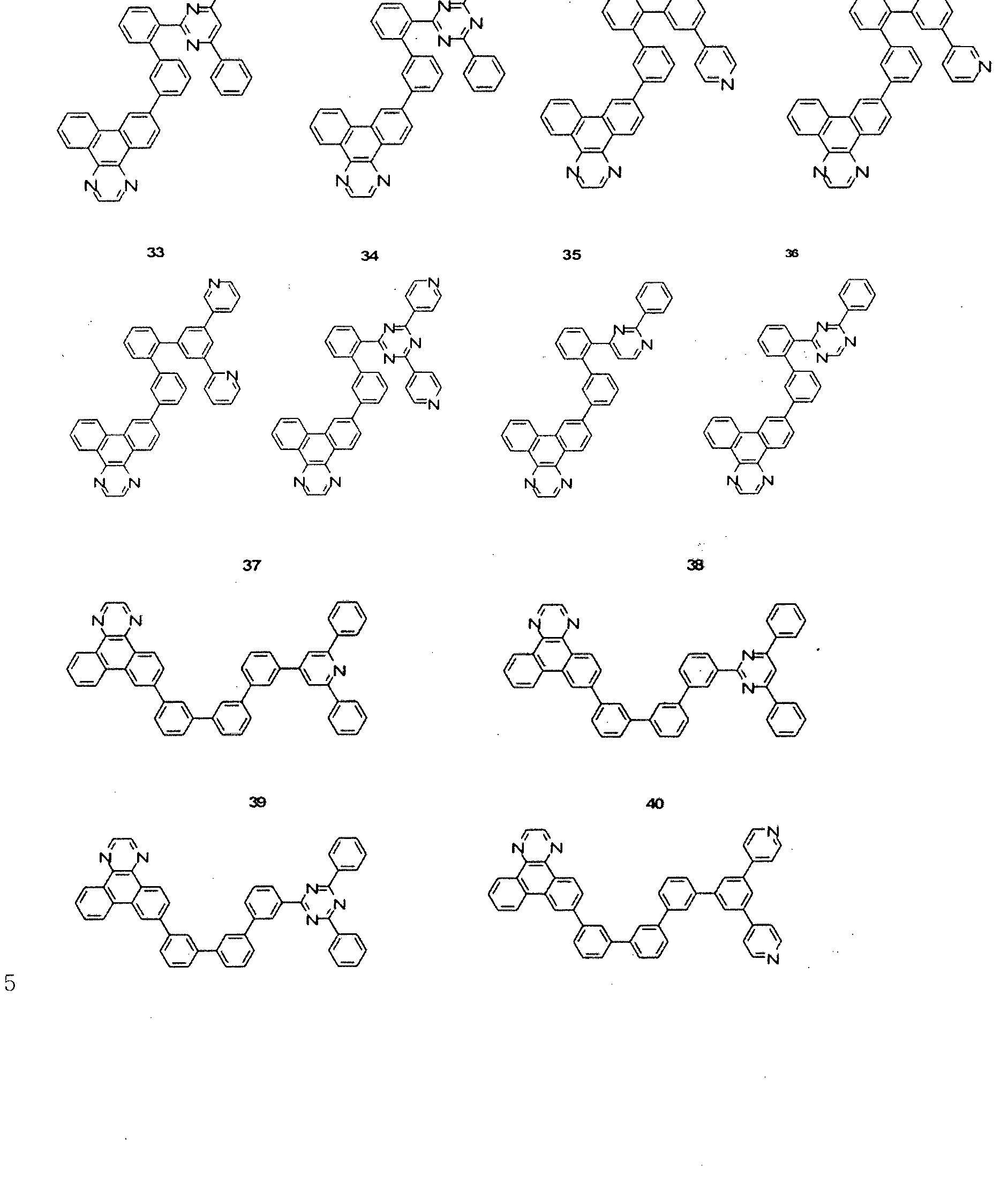
TIS0T0/9T0^HX/I3d 9^0Ϊ/-Ϊ0∑: OAV


상술한 유기 화합물은 단독으로 또는 다른 유기 화합물과 함께 유기 광전자 소자에 적용될 수 있다. 상술한 유기 화합물이 다른 유기 화합물과 함께 사용되는 경우, 조성물의 형태로 적용될 수 있다ᅳ
이하, 상술한 유기 화합물을 포함하는 유기 광전자 소자용 조성물의 일
예를 설명한다.
상기 유기 광전자 소자용 조성물의 일 예로, 상술한 유기 화합물과 카바졸 모이어티를 가지는 적어도 하나의 유기 화합물을 포함하는 조성물일 수 있다. 이하에서 상술한 유기 화합물은 '제 1 유기 화합물 '하고 카바졸 모이어티를 가지는 적어도 하나의 유기 화합물은 '제 2 유기 화합물' 이라 한다.
상기 제 2 유기 화합물은 예컨대 하기 화학식 5로 표현되는 화합물일 수 있다.
[화학식 5]

Ar'
상기 화학식 5에서,
γΐ은 단일 결합, 치환 또는 비치환된 C1 내지 C20 알킬렌기, 치환 또는 비치환된 C2 내지 C20 알케닐렌기, 치환 또는 비치환된 C6 내지 C30 아릴렌기, 치환 또는 비치환된 C2 내지 C30 2가의 헤테로고리기 또는 이들의 조합이고, Ar1은 치환 또는 비치환된 C6 내지 C30 아릴기, 치환 또는 비치환된 C2 내지 C30 헤테로고리기 또는 이들의 조합이고,
R60 내지 R63은 각각 독립적으로 수소, 중수소, 치환 또는 비치환된 C1 내지 C20 알킬기 , 치환 또는 비치환된 C6 내지 C50 아릴기 , 치환 또는 비치환된 C2 내지 C50 헤테로고리기 또는 이들의 조합이고,
R60 내지 R63 및 Ar1 중 적어도 하나는 치환 또는 비치환된 트리페닐렌기 또는 치환 또는 비치환된 카바졸릴기를 포함한다.
상기 화학식 5로 표현되는 계 2 유기 화합물은 예컨대 하기 화학식 5-1 내 5-III 중 적어도 하나로 표현될 수 있다.
[
상기 화학식 5-1 내지 5-ΙΠ에서,
Υ', Υ4 및 Υ5는 각각 독립적으로 단일 결합, 치환 또는 비치환된 C1 내지 C20 알킬렌기, 치환 또는 비치환된 C2 내지 C20 알케닐렌기, 치환 또는 비치환된 C6 내지 C30 아릴렌기, 치환 또는 비치환된 C2 내지 C30 2가의 헤테로고리기 또는 이들의 조합이고,
Ar1 및 Ar4는 각각 독립적으로 치환 또는 비치환된 C6 내지 C30 아릴기, 치환 또는 비치환된 : C2 내지 C30 헤테로고리기 또는 이들의 조합이고,
R60 내지 R63및 R6S 내지 R79는각각 독립적으로 수소, 중수소, 치환 또는 비치환된 C1 내지 C20 알킬기, 치환 또는 비치환된 C6 내지 C50 아릴기, 치환 또는 비치환된 C2 내지 C50 헤테로고리기 또는 이들의 조합이다.
상기 화학식 5로 표현되는 게 2 유기 화합물은 예컨대 그룹 3에 나열된 화합물일 수 있으나, 이에 한정되는 것은 아니다.

[e 불 ΤΓ]
81
TZS0l0/9l0ZaM/X3d

TZSOlO/9lOZaM/X3d
-a SS-9

oz
TIS0T0/9T0^HX/I3d 9^0Ϊ/-Ϊ0∑: OAV

TZSOlO/9lOZaM/X3d

TZSOlO/9lOZaM/X3d

B-103 8-104 B-105

TIS0T0/9T0^HX/I3d 9^0Ϊ/-Ϊ0∑: OAV

52
TIS0T0/9T0^HX/I3d 9^0Ϊ/-Ϊ0∑: OAV


상기 제 2 유기 화합물은 예컨대 하기 화학식 6으로 표현되는 모이어티와 학식 7로 표현되는 모이어티의 조합으로 이루어진 화합물일 수 있다. [화학식 6] [화학식 7]

Y2 및 Y3는 각각 독립적으로 단일 결합, 치환 또는 비치환된 C1 내지 C20 알킬렌기, 치환 또는 비치환된 C2 내지 C20 알케닐렌기, 치환 또는 비치환된 C6 내지 C30 아릴렌기, 치환 또는 비치환된 C2 내지 C30 2가의 헤테로고리기 또는 이들의 조합이고,
Ar2 및 Ar3은 각각 독립적으로 치환 또는 비치환된 C6 내지 C30 아릴기, 치환 또는 비치환된 C2 내지 C30 헤테로고리기 또는 이들의 조합이고,
R64 내지 R67은 각각 독립적으로 수소, 증수소, 치환 또는 비치환된 C1 내지 C20 알킬기, 치환 또는 비치환된 C6 내지 C50 아릴기, 치환 또는 비치환된 C2 내지 C50 해테로고리기 또는 이들의 조합이고,
상기 화학식 6의 인접한 두 개의 *는 상기 화학식 7의 두 개의 *와 결합하여 융합고리를 형성하고 상기 화학식 6에서 융합고리를 형성하지 않은 *는 각각 독립적으로 CRb이고, 여기서 Rb는 수소, 중수소, 치환 또는 비치환된 C1 내지 C10 알킬기, 치환 또는 비치환된 C6 내지 C12 아릴기, 치환 또는 비치환된 C3 내지 C12 헤테로고리기 또는 이들의 조합이다.
상기 화학식 6으로 표현되는 모이어티와상기 화학식 7로 표현되는 모이어티의 조합으로 이루어진 제 2 유기 화합물은 예컨대 하기 그룹 4에 나열된 화합물에서 선택될 수 있으나, 이에 한정되는 것은 아니다.
그룹 4]
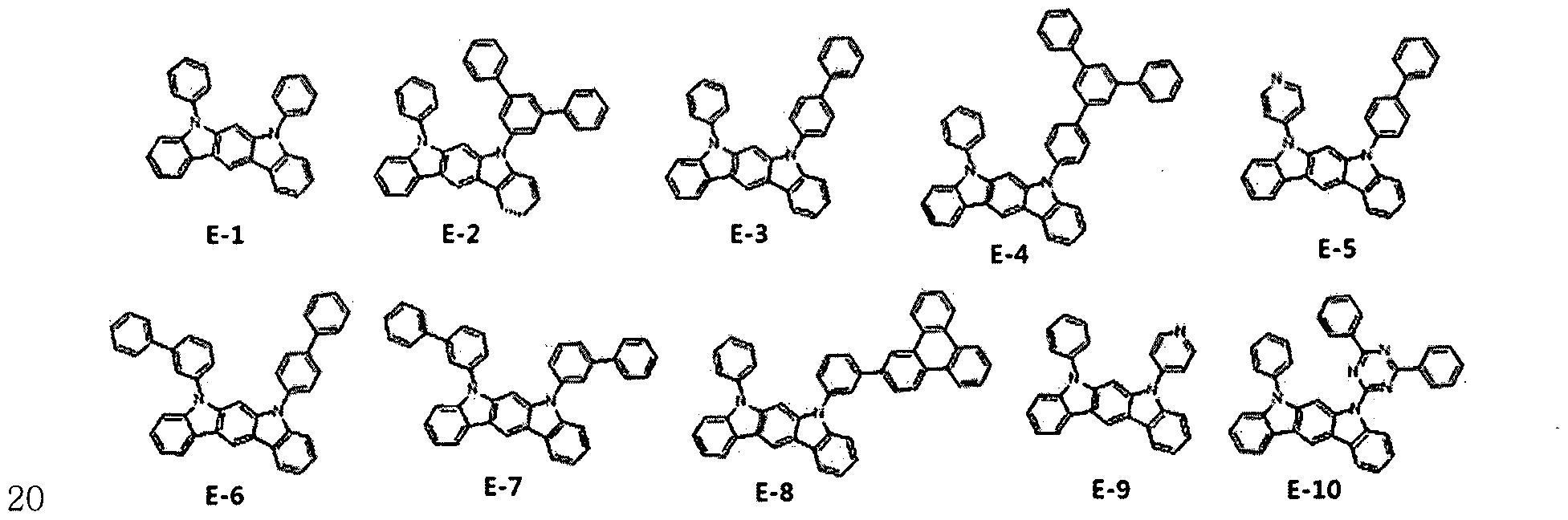
RECTIFIED SHEET (RULE 91 ) ISA/KR

RECTIFIED SHEET (RULE 91) ISA/'KR

상기 제 2 유기 화합물은 상기 화학식 5로 표현되는 화합물 및 하기 화학식 6으로 표현되는 모이어티와 하기 화학식 7로 표현되는 모이어티의 조합으로 이루어진 화합물 증 적어도 하나를 포함할 수 있다.
상기 조성물은 제 1 유기 화합물과 제 2 유기 화합물을 약 1 : 10 내지 10: 1의 증량비로 포함할 수 있다.
상기 조성물은 유기 광전자 소자의 유기층에 적용될 수 있으며, 제 1 유기 화합물과 제 2 유기 화합물은 호스트 (host)로서 역할을 할 수 있다. 이 때 제 1 유기 화합물은 전자 특성이 상대적으로 강한 바이폴라 특성을 가지는 화합물일 수 있고 제 2 유기 화합물은 정공 특성이 상대적으로 강한 바이폴라 특성을 가지는 화합물로, 제 1 유기 화합물과 함께 사용되어 전하의 이동성 및 안정성을 높임으로써 발광 효율 및 수명 특성을 더욱 개선시킬 수 있다.
상기 조성물은 전술한 제 1 유기 화합물과 제 2 유기 화합물 외에 1종 이상의 유기 화합물을 더 포함할 수 있다.
상기 조성물은 도펀트를 더 포함할 수 있다. 상기 도펀트는 적색, 녹색 또는 청색의 도펀트일 수 있으며, 예컨대 인광 도펀트일 수 있다.
상기 도편트는 상기 제 1 호스트 화합물과 상기 제 2 호스트 화합물에 미량 혼합되어 발광을 일으키는 물질로, 일반적으로 삼중항 상태 이상으로 여기시키는 다중항 여기 (multiple excitation)에 의해 발광하는 금속 착체 (metal complex)와 같은 물질이 사용될 수 있다. 상기 도펀트는 예컨대 무기, 유기, 유무기 화합물일 수 있으며, 1종 또는 2종 이상 포함될 수 있다.
상기 인광 도편트의 예로는 Ir, Pt, Os, Ti, Zr, Hf, Eu, Tb, Tm, Fe, Co, Ni, Ru, Rh,
RECTIFIED SHEET (RULE 91 ) iSA/KR
Pd 또는 이들의 조합을 포함하는 유기 금속화합물을 들 수 있다. 상기 인광 도편트는 예컨대 하기 화학식 Z로 표현되는 화합물을 사용할 수 있으나, 이에 한정되는 것은 아니다.
[화학식 Z]
L2MX
상기 화학식 Z에서 , Μ은 금속이고, L 및 X는 서로 같거나 다르며 Μ과 착화합물을 형성하는 리간드이다.
상기 Μ은 예컨대 Ir, Pt, Os, Ti, Zr, Hf, Eu, Tb, Tm, Fe, Co, Ni, Ru, Rh, Pd또는 이들의 조합일 수 있고, 상기 L 및 X는 예컨대 바이덴테이트 리간드일 수 있다. 상기 조성물은 건식 성막법 또는 용액 공정으로 박막으로 형성될 수 있다. 상기 건식 성막법은 예컨대 화학기상증착법, 스퍼터링, 플라즈마 도금 및 이온도금 일 수 있고, 둘 이상의 화합물을 동시에 성막하거나 증착 온도가 같은 화합물을 흔합하여 같이 성막할 수 있다. 상기 용액 공정은 예컨대 잉크젯 인쇄, 스핀 코팅, 슬릿 코팅, 바 코팅 .및/또는 딥 코팅일 수 있다.
이하 상술한 유기 화합물 또는 상술한 조성물을 적용한 유기 광전자 소자를 설명한다.
상기 유기 광전자 소자는 전기 에너지와 광 에너지를 상호 전환할 수 있는 소자이면 특별히 한정되지 않으며, 예컨대 유기 광전 소자, 유기 발광 소자, 유기 태양 전지 및 유기 감광체 드럼 등을 들 수 있다.
상기 유기 광전자 소자는 서로 마주하는 애노드와 캐소드, 그리고 상기 애노드와 상기 캐소드 사이에 위치하는 적어도 1층의 유기층을 포함할 수 있고, 상기 유기층은 전술한 유기 화합물 또는 전술한 조성물올 포함할 수 있다.
일 예로, 상기 유기층은 상기 유기 화합물 또는 상기 조성물을 포함하는 발광층을 포함할 수 있다.
일 예로, 상기 유기층은 발광층, 애노드와 발광층 사이 및 /또는 캐소드와 발광층 사이에 위치하는 보조층을 포함할 수 있고, 상기 보조층은 상기 유기 화합물 또는 상기 조성물을 포함할 수 있다.
여기서는 유기 광전자 소자의 일 예인 유기 발광 소자를 도면을 참고하여 설명한다.
도 1은 일 구현예에 따른 유기 발광 소자를 보여주는 단면도이다.
도 1을 참고하면, 일 구현예에 따른 유기 발광 소자 (100)는 서로 마주하는 애노드 (1 10)와 캐소드 (120), 그리고 애노드 (1 10)와 캐소드 (120) 사이에 위치하는 유기층 (105)을 포함한다.
애노드 (1 10)는 예컨대 정공 주입이 원활하도록 일 함수가 높은 도전체로 만들어질 수 있으며, 예컨대 금속, 금속 산화물 및 /또는 도전성 고분자로 만들어질 수 있다. 애노드 (1 10)는 예컨대 니켈, 백금, 바나듐, 크름, 구리, 아연, 금과 같은 금속 또는 이들의 합금; 아연산화물, 인듐산화물, 인듐주석산화물 (ΠΌ),
인듬아연산화물 (IZO)과 같은 금속 산화물; ZnO와 A1 또는 Sn02와 Sb와 같은 금속과 산화물의 조합; 폴리 (3-메틸티오펜), 폴리 (3,4- (에틸렌 -1 ,2- 디옥시)티오펜 Xpolyehtylenedioxythiophene: PEDOT), 폴리피롤 및 폴리아닐린과 같은 도전성 고분자 등을 들 수 있으나, 이에 한정되는 것은 아니다.
캐소드 (120)는 예컨대 전자 주입이 원활하도록 일 함수가 낮은 도전체로 만들어질 수 있으며, 예컨대 금속, 금속 산화물 및 /또는 도전성 고분자로 만들어질 수 있다. 캐소드 (120)은 예컨대 마그네슘, 칼슘, 나트륨, 칼륨, 타이타늄, 인듐, 이트륨, 리튬, 가돌리늄, 알루미늄, 은, 주석, 납, 세슘, 바륨 등과 같은 금속 또는 이들의 합금; LiF/Al, Li02/Al, LiF/Ca, LiF/Al 및 BaF2/Ca과 같은 다층 구조 물질을 들 수 있으나, 이에 한정되는 것은 아니다.
유기층 (105)은 전술한 유기 화합물 또는 전술한 조성물을 포함하는 발광층 (130)을 포함한다.
발광층 (130)은 호스트 (host)로서 상기 유기 화합물 또는 상기 조성물을 포함할 수 있으며, 전술한 유기 화합물을 단독으로 포함할 수도 있고 전술한 유기 화합물 중 적어도 두 종류를 흔합하여 포함할 수도 있고 전술한 조성물올 포함할 수도 있고 전술한 유기 화합물 또는 전술한 조성물과 다른 유기 화합물올 흔합하여 포함할 수도 있다.
발광층 (130)은 도편트 (dopant)를 더 포함할 수 있다. 상기 도편트는 적색, 녹색 또는 청색의 도편트일 수 있으며, 예컨대 인광 도편트일 수 있다. 도편트는 전술한 바와 같다.
유기층 (105)은 애노드 (1 10)와 발광층 (130) 사이 및 /또는 캐소드 (120)와 발광층 (130) 사이에 위치하는 보조층 (도시하지 않음)을 더 포함할 수 있다.
보조층은 정공 주입층, 정공 수송층, 전자 차단층, 전자 주입층, 전자 수송층, 정공
차단층 또는 이들의 조합일 수 있다. 보조층은 전술한 유기 화합물 또는 조성물을 포함할 수 있다.
상술한 유기 발광 소자는 유기 발광 표시 장치에 적용될 수 있다. 【발명의 실시를 위한 형태】
이하에서는 본 발명의 구체적인 실시예들을 제시한다. 다만, 하기에 기재된 실시예들은 본 발명을 구체적으로 예시하거나 설명하기 위한 것에 블과하며, 이로서 본 발명이 제한되어서는 아니된다.
중간체의 합성
합성예 1: 중간체 1-1의 합성
[반웅식 1]

질소 환경에서 zhengzhou chemical international Co.,
Ltd(http://www.chemicalintl.com/)사의 . 3-bromophenanthrene-9, 10-dione(l 00 g, 348 mmol)을 ethanol 1 L에 녹인 후, 여기에 ethylenediamine(25.1 g, 418 mmol)을 넣고 8시간 가열하여 환류 시킨 후, acetic acid를 추가로 1.5 L 넣어 9시간 가열하여 환류 시켰다ᅳ 반웅 완료 후 반웅 액을 상온으로 넁각 시켰다. 생성된 고체를 여과하여 과량의 ethan이으로 씻어 중간체 1-1(78.5 g, 73 %)을 얻었다.
HRMS (70 eV, EI+): m/z calcd for C16H9BrN2: 307.9949, found: 308.
Elemental Analysis: C, 62 %; H, 3 %
합성예 2: 중간체 1-2의 합성
[반웅식 2]

1^&^5( ∞ 1 03 1^) &11& ^ (2.61 2.26 1 101)을 넣고 교반시켰다. 물에 포화된 potassuim carbonate(78.1 g, 565 mmol)을 넣고 80 °C에서 8시간 동안 가열하여 환류 시켰다. 반웅 완료 후 반웅액에 물을 넣고 dichloromethane(DCM)로 추출한 다음 무수 MgS04로 수분을 제거한 후, 필터하고 감압 농축하였다. 이렇게 얻어진 잔사를 flash column chromatography로 분리 정제하여 중간체 1-2(65.5 g, 85 %)를 얻었다.
HRMS (70 eV, EI+): m/z calcd for C22H13C1N2: 340.0767, found: 340.
Elemental Analysis: C, 78 %; H, 4 %
합성예 3: 중간체 1-3의 합성
[반웅식 3]

1 - 2 1 - 3 질소 환경에서 중간체 1-2(60 g, 176 mmol)를 dimethylforamide(DMF) 0.6 L에 녹인 후, 여기에 bis(pinacolato)diboron(53.6 g, 211 mmol)와 (1 ,1 '- bis(diphenylphosphine)ferrocene)dichloropalladium(II)( 1.44 g, 1.76 mmol) 그리고 potassium acetate(51.8 g, 528 mmol)을 넣고 150 °C에서 20시간 동안 가열하여 환류시켰다. 반웅 완료 후 반웅액에 물을 넣고 흔합물을 필터한 후, 진공오본에서 건조하였다. 이렇게 얻어진 잔사를 flash column chromatography로 분리 정제하여 중간체 1-3(51.7 g, 68 %)을 얻었다.
HRMS (70 eV, EI+): m/z calcd for C28H25BN202: 432.2009, found: 432.
Elemental Analysis: C, 78 %; H, 6 %
합성예 4: 중간체 1-4의 합성
[반웅식 4]

1 - 4
질소 환경에서 중간체 1-3(50 g, 1 16 mmol)을 tetrahydrofuran(THF) 0.45 L에 녹인 후, 여기에 l-bromo-3-iodobenzene(39.3 g, 139 mmol)와
tetrakis(triphenylphosphine)palladium(1.34 g, 1.16 mmol)-§- 넣고 교반시켰다. 물에 포화된 potassuim carbonate(40.1 g, 290 mmol)을 넣고 80 °C에서 5시간 동안 가열하여 환류 시켰다. 반웅 완료 후 반웅액에 물을 넣고 dichloromethane(DCM)로 추출한 다음 무수 MgS04로 수분을 제거한 후, 필터하고 감압 농축하였다. 이렇게 얻어진 잔사를 flash column chromatography로 분리 정제하여 중간체 1-4(47.1 g, 88 %)를 얻었다.
HRMS (70 eV, EI+): m/z calcd for C28H17BrN2: 460.0575, found: 460.
Elemental Analysis: C, 73 %; H, 4 %
합성예 5: 중간체 1-5의 합성
[반웅식 5]

HRMS (70 eV, EI+): m/z calcd for C34H29BN202: 508.2322, found: 508.
Elemental Analysis: C, 80 %; H, 6 %
합성예 6: 중간체 1-6의 합성
[반웅식 6]

HRMS (70 eV, EI+): m/z calcd for C22H21BN202: 356.1696, found: 356.
Elemental Analysis: C, 74 %; H, 6 %
합성예 7: 중간체 1-7의 합성
[반응식 기

질소 환경에서 중간체 1-6(100 g, 281 mmol)을 tetrahydrofuran(THF) 1L에 녹인 후, 여기에 l-bromo-2-iock benzene(95.3 g, 337 mmol)와
tetrakis(triphenylphosphine)palladium(3.25 g, 2.81 mmol)을 넣고 교반시켰다. 물에 포화된 potassuim carbonate(97.1 g, 703 mmol)을 넣고 80 °C에서 8시간 동안 가열하여 환류 시켰다. 반웅 완료 후 반응액에 물을 넣고 dichloromethane(DCM)로 추출한
다음 무수 MgS04로 수분을 제거한 후, 필터하고 감압 농축하였다. 아렇게 얻어진 잔사를 flash column chromatography로 분리 정제하여 중간체 1-7(92.0 g, 85 %)을 얻었다.
HRMS (70 eV, EI+): m/z calcd for C22H13BrN2: 384.0262, found: 384.
Elemental Analysis: C, 69 %; H, 3 %
합성예 8: 중간체 1-8의 합성
[반웅식 8]

1 · ' 1 - 8
질소 환경에서 중간체 1-7(90 g, 234 mmol)을 tetrahydrofuran(THF) 0.7L에 녹인 후, 여기에 3-chlorophenylboronic acid(43.8 g, 280 mmol)≤f
tetrakis(triphenylphosphine)palladium(2.70 g, 2.34 mmol)을 넣고 교반시켰다. 물에 포화된 potassuim carbonate(80.9 g, 585 mmol)을 넣고 80 °C에서 12시간 동안 가열하여 환류 시켰다. 반웅 완료 후 반웅액에 물을 넣고 dichloromethane(DCM)로 추출한 다음 무수 MgS04로 수분을 제거한 후, 필터하고 감압 농축하였다. 이렇게 얻어진 잔사를 flash column chromatography로 분리 정제하여 중간체 1-8(81.0 g, 83 %)을 얻었다.
HRMS (70 eV, EI+): m/z calcd for C28H17C1N2: 416.1080, found: 416.
Elemental Analysis: C, 81 %; H, 4 %
합성예 9: 중간체 1-9의 합성
[반응식 9]

1 - 8 1 - 9
질소 환경에서 중간체 1-8(75 g, 180 mmol)을 dimethylfommide(DMF) 1L에 녹인 후, 여기에 1^(1 0 0)^1)01ᅳ0^54.8 216 11 01)와 (1 ,1 '-
bis(diphenylphosphine)ferrocene)dichloropalladium(II)(1.47 g, 1.80 mmol) 그리고 potassium acetate(53.0 g, 540 mmol)을 넣고 150°C에서 23시간 동안 가열하여 환류 시켰다. 반웅 완료 후 반웅액에 물을 넣고 흔합물을 필터한 후, 진공오븐에서 건조하였다. 이렇게 얻어진 잔사를 flash column chromatography로 분리 정제하여 중간체 1-9(55.8 g, 61 %)을 얻었다.
HRMS (70 eV, EI+): m/z calcd for C34H29BN202: 508.2322, found: 508.
Elemental Analysis: C, 80 %; H, 6 %
합성예 10: 중간체 1-10의 합성
[반웅식 10]

질소 환경에서 중간체 1-3(50 g, 116 mmol)을 tetrahydrofuran(THF) 0.45 L에 녹인 후, 여기데 l-bromo-2-iodobenzene(39.3 g, 139 mmol)와
tetrakis(triphenylphosphine)palladium(1.34 g, 1.16 mmol)-i: 넣고 교반시켰다. 물에 포화된 1« 35^^ 0&1 0^( 40.1 290 1111:101)을 넣고 80°C에서 8시간 동안 가열하여 환류 시켰다. 반옹 완료 후 반웅액에 물을 넣고 dichloromethane(DCM)로 추출한 다음 무수 MgS04로 수분을 제거한 후, 필터하고 감압 농축하였다. 이렇게 얻어진 잔사를 flash column chromatography로 분리 정제하여 중간체 I-10(48.2 g, 90 %)을 얻었다.
HRMS (70 eV, EI+): m/z calcd for C28H17BrN2: 460.0575, found: 460.
Elemental Analysis: C, 73 %; H, 4 %
합성예 11: 중간체 1-11의 합성
[반웅식

질소 환경에서 중간체 1-10(45 g, 9그 5 mmol)를 dimethylforamide(DMF) 0.4 L에 녹인 후, 여기에 bis(pinacolato)diboron(29.7 g, 117mmol)와 (Ι,Ι'- bis(diphenylphosphine)ferrocene)dichloropalladium(II)(0.80 g, 0.98 mmol) 그리고 potassium acetate(28.7 g, 293 mmol) 넣고 150 °C에서 18시간 동안 가열하여 환류 시켰다. 반응 완료 후 반웅액에 물을 넣고 흔합물을 필터한 후, 진공오븐에서 건조하였다. 이렇게 얻어진 잔사를 flash column chromatography로 분리 정제하여 중간체 1-11(32.2 g, 65 %)를 얻었다.
HRMS (70 eV, EI+): m/z calcd for C34H29BN202: 508.2322, found: 508.
Elemental Analysis: C, 80 %; H, 6 %
합성예 12: 중간체 1-12의 합성
[반응식 12]

1 -5 1 -12
질소 환경에서 중간체 1-5(40 g, 78.7 mmol)를 tetrahydrofuran(THF) 0.3 L에 녹인 후, 여기에 1-1>1:01110-3-10(101 ^6^(26.7 94.41111101)와
tetrakis(tΓiphenylphosphine)palladium(0.91 g, 0.79mrrlol)을 넣고 교반시켰다. 물에 포화된 1^&5^^ 0&1¾00 ^27.2 197111«01)을 넣고 80 °C에서 8시간 동안 가열하여 환류 시켰다. 반웅 완료 후 반웅액에 물을 넣고 dichloromethane(DCM)로 추출한 다음 무수 MgS04로 수분을 제거한 후, 필터하고 감압 농축하였다. 이렇게 얻어진 잔사를 flash column chromatography로 분리 정제하여 중간체 1-12(37.6 g, 89%)를 얻었다.
HRMS (70 eV, EI+): m/z calcd for C34H21BrN2: 536.0888, found: 536.
Elemental Analysis: C, 76 %; H, 4 %
합성예 13: 중간체 1-13의 합성
[반웅식 13]

질소 환경에서 중간체 1-12(30 g, 55.8 mmol)를 dimethylforamide(DMF) 0.2 L에 녹인 후, 여기에 bis(pinacolato)diboron(17.0 g, 67.0 mmol)와 (1,1 '- bis(diphenylphosphine)ferrocene)dichloropalladium(II)(0.46 g, 0.56 mmol) 그리고 potassium acetate(l 6.4 g, 167 mmol)을 넣고 150 °C에서 6시간 동안 가열하여 환류 시켰다. 반웅 완료 후 반웅액에 물을 넣고 흔합물을 필터한 후, 진공오븐에서 건조하였다. 이렇게 얻어진 잔사를 flash column chromatography로 분리 정제하여 중간체 1-13(26.7 g, 82 %)을 얻었다.
HRMS (70 eV, EI+): m/z calcd for C40H33BN2O2: 584.2635, found: 584.
Elemental Analysis: C, 82 %; H, 6 %
합성예 14: 중간체 1-14의 합성
[반웅식 14]

질소 환경에서 zhengzhou chemical international Co.,
Ltd(http://www.chemicalintl.com/)人!"의 3,6-dibromophenanthrene-9, 10-dione( 100 g, 273 mmol)을 ethanol l L에 녹인 후, 여기에 ethylenediamine(25.1 g, 418 mmol)을 넣고 8시간 가열하여 환류 시킨 후, acetic acid를 추가로 1.5 L 넣어 9시간 가열하여 환류 시켰다. 반웅 완료 후 반응 액을 상온으로 넁각 시켰다. 생성된 고체를
여과하여 과량의 ethan이으로 씻어 중간체 1-14(78.5 g, 73 %)를 얻었다.
HRMS (70 eV, EI+): m/z calcd for C16H8Br2N2: 385.9054, found: 385.
Elemental Analysis: C, 50 %; H, 2 %
합성예 15: 중간체 1-15의 합성
[반웅식 15]

질소 환경에서 sigma aldrich(http://www.sigmaaldrich.com/)사의 2-bromo-5- iodopyridine(100 g, 352 mmol)를 tetrahydrofuran(THF) ().8 L에 녹인 후, 여기에 pyridin- 4-ylboronic acid(52.0 g, 423 mmol)와 tetrakis(triphenylphosphine)palladium(4.07 g, 3.52 mmol)을 넣고 교반시켰다. 물에 포화된 1^&3^^ 0^1?0 16(122 880 010101)을 넣고 80 °C에서 12시간 동안 가열하여 환류 시켰다. 반웅 완료 후 반웅액에 물을 넣고 dichloromethane(DCM)로 추출한 다음 무수 MgS04로 수분을 제거한 후, 필터하고 감압 농축하였다. 이렇게 얻어진 잔사를 flash column chromatography로 분리 정제하여 중간체 1-15(29.8 g, 36 %)를 얻었다.
HRMS (70 eV, EI+): m/z calcd for C10H7BrN2: 233.9793, found: 234.
Elemental Analysis: C, 51 %; H, 3 % 최종 화합물의 합성
합성예 16: 화합물 1와합성
[반응식 16]

질소 환경에서 중간체 1-3(10 g, 23.1 mmol)을 tetrahydrofuran(THF) 0.1 L에 녹인 후, 여기에 Nanjing Kindchem Co., Ltd.(http://www.kindchem.net/)사에서 구입한 4-chloro-2,6-diphenylpyridine(6.15 g, 23.1 mmol)와
tetrakis(triphenylphosphine)palladium(0.27 g, 0.23 mmol)을 넣고 교반시켰다. 물에
포화된 potassuim carbonate(7.98 g, 57.8 mmol)을 넣고 80 °C에서 10시간 동안 가열하여 환류 시켰다ᅳ 반웅 완료 후 반웅액에 물을 넣고 dichloromethane(DCM)로 추출한 다음 무수 MgS04로 수분을 제거한 후, 필터하고 감압 농축하였다. 이렇게 얻어진 잔사를 flash column chromatography로 분리 정제하여 화합물 1(1 1.1 g, 90 %)을 얻었다.
HRMS (70 eV, EI+): m/z calcd for C39H25N3: 535.2048, found: 535.
Elemental Analysis: C, 87 %; H, 5 %
합성예 17: 화합물 2의 합성
[반웅식 17]

질소 환경에서 중간체 1-3(10 g, 23.1 mmol)을 tetrahydrofuran(THF) 0.1 L에 녹인 '후, 여기'에 Tokyo Chemical Industry(http://www.tcichemicals.com/)사에서 구입한 2-chloro-4,6-diphenylpyrimidine(6.16 g, 23.1 mmol)와
tetrakis(triphenylphosphine)palladium(0.27 g, 0.23 mmol)을 넣고 교반시켰다. 물에 포화된 potassuim carbonate(7.98 g, 5그 8 mmol)을 넣고 80 °C에서 10시간 동안 가열하여 환류 시켰다. 반웅 완료 후 반웅액에 물을 넣고 dichloroniethane(DCM)로 추출한 다음 무수 MgS04로 수분을 제거한 후, 필터하고 감압 농축하였다. 이렇게 얻어진 잔사를 flash column chromatography로 분리 정제하여 화합물 2(10.5 g, 85 %)를 얻었다.
HRMS (70 eV, EI+): m/z calcd for C38H24N4: 536.2001, found: 536.
Elemental Analysis: C, 85 %; H, 5 %
합성예 18: 화합물 3의 합성
[반응식 18]

질소 환경에서 중간체 1-3(10 g, 23.1 mmol)을 tetrahydrofuran(THF) 0.1 L에 녹인 후, '여기에 Tokyo Chemical Industry(http://www.tcichemicals.com/)사에서 구입한 2-chloro-4,6-diphenyl- 1 ,3,5-triazine(6.18 g, 23.1 mmol)와
tetrakis(triphenylphosphme)palladium(0.27 g, 0.23 mmol)을 넣고 교반시켰다. 물에 포화된 potassuim carbonate (그 98 g, 57.8 mmol)을 넣고 80 °C에서 10시간 동안 가열하여 환류 시켰다. 반웅 완료 후 반웅액에 물을 넣고 dichloromethane(DCM)로 추출한 다음 무수 MgS04로 수분을 제거한 후, 필터하고 감압 농축하였다. 이렇게 얻어진 잔사를 flash column chromatography로 분리 정제하여 화합물 3(1 1.5 g, 93 %)을 얻었다
HRMS (70 eV, EI+): m/z calcd for C37H23N5: 537.1953, found: 537.
Elemental Analysis: C, 83 %; H, 4 %
합성예 19: 화합물 12의 합성
[

질소 환경에서 중간체 1-5(10 g, 19.7 mmol)을 tetrahydrofuran(THF) 0.1 L에 녹인 후, 여기에 Tokyo Chemical Industry(http://www.tcichemicals.com/)사에서 구입한 2-chloro-4,6-diphenyl-l ,3,5-triazine(5.27 g, 19.7 mmol)와
tetrakis(triphenylphosphine)palladium(0.23 g, 0.20 mmol)을 넣고 교반시켰다. 물에 포화된 potassuim carbonate(6.81 g, 49.3 mmol)을 넣고 80 °C에서 9시간 동안 가열하여 환류 시켰다. 반웅 완료 후 반웅액에 물을 넣고 dichloromethane(DCM)로 추출한 다음 무수 MgS04로 수분을 제거한 후, 필터하고 감압 농축하였다. 이렇게
얻어진 잔사를 flash column chromatography로 분리 정제하여 화합물 12(9.67 g: 80 %)를 얻었다.
HRMS (70 eV, EI+): m/z calcd for C43H27N5: 613.2266, found: 613.
Elemental Analysis: C, 84 %; H, 4 %
합성예 20: 화합물 21의 합성
[반웅식 20]

질소 환경에서 중간체 1-9(10 g, 19.7 mmol)를 tetrahydrofuran(THF) 0.1 L에 녹인 후, 여기에 Tokyo Chemical Industry(http://www.tcichemicals.com/)사에서 구입한 2-chloro-4,6-diphenyl-l ,3,5-triazine(5.27 g, 19.7 mmol)와
tetrakis(triphenylphosphine)palladium(0.23 g, 0·20 mmol)을 넣고 교반시켰다. 물에 포화된 potassuim carbonate(6.81 g, 49.3 mmol)을 넣고 80 °C에서 12시간 동안 가열하연 환류 시켰다. 반웅 완료 후 반응액에 물을 넣고 dichloromethane(DCM)로 추출한 다음 무수 MgS04로 수분을 제거한 후, 필터하고 감압 농축하였다. 이렇게 얻어진 잔사를 flash column chromatography로 분리 정제하여 화합물 21(9.31 g, 77 %)을 얻었다.
HRMS (70 eV, EI+): m/z calcd for C43H27N5: 613.2266, found: 613.
Elemental Analysis: C, 84 %; H, 4 %
합성예 21: 화합물 30의 합성
[

질소 환경에서 중간체 1-1 1(10 g, 19.7 mmol)을 tetrahydrofuran(THF) 0.1 L에
녹인 후, 여기에 Tokyo Chemical Industry(http://www.tcichemicals.com/)사에서 구입한 2-chloro-4,6-diphenyl- l ,3,5-triazine(5.27 g, 19.7 mmol)와
tetrakis(triphenylphosphine)palladium(0.23 g, 0.20 mmol)을 넣고 교반시켰다. 물에 포화된 potassuim carbonate(6.81 g, 49.3 mmol)을 넣고 80 °C에서 10시간 동안 가열하여 환류 시켰다. 반웅 완료 후 반웅액에 물을 넣고 dichloromethane(DCM)로 추출한 다음 무수 MgS04로 수분을 제거한 후, 필터하고 감압 농축하였다. 이렇게 얻어진 잔사를 flash column chromatography로 분리 정제하여 화합물 30(6.29 g, 52 %)을 얻었다.
HRMS (70 eV, EI+): m/z calcd for C43H27N5 : 613.2266, found: 613.
Elemental Analysis: C, 84 %; H, 4 %
합성예 22: 화합물 39의 합성
[반웅식 22]

tetrakis(triphenylphosphine)palladium(0.20 g, 0.17 mnlol)을 넣고 교반시켰다. 물에 포화된 potassuim carbonate(5.92 g, 42.8 mmol)을 넣고 80 °C에서 1 5시간 동안 가열하여 환류 시켰다. 반웅 완료 후 반웅액에 물을 넣고 dichloromethane(DCM)로 추출한 다음 무수 MgS04로 수분을 제거한 후, 필터하고 감압 농축하였다. 이렇게 얻어진 잔사를 flash column chromatography로 분리 정제하여 화합물 39(10.6 g, 90 %)를 얻었다.
HRMS (70 eV, EI+): m/z calcd for C49H31N5: 689.2579, found: 689.
Elemental Analysis: C, 85 %; H, 5 %
합성예 23: 화합물 Host 1의 합성

공개된 특허 KR2014-0135524A의 합성예 17과 동일한 방법으로 합성하였다. HRMS (70 eV, EI+): m/z calcd for C45H29N3 : 61 1.2361, found: 61 1.
Elemental Analysis: C, 88 %; H, 5 %
합성예 24: 화합물 Host2의 합성
[반웅식 23]

질소 환경에서 중간체 1-14(10 g, 25.8 mmol)를 tetrahydrofuran(THF) 0.1 L에 녹인 후, 여기에 중간체 1-15(12.1 g, 51.5 mmol)와
tetrakis(triphenylphosphine)palladium(0.60 g, 0.52 mmol)을 넣고 교반시켰다. 물에 포화된 potassuim carbonate(17.8 g, 129 Inmol)을 넣고 80 °C에서 18시간 동안 가열하여 환류 시켰다. 반웅 완료 후 반웅액에 물을 넣고 dichloromethane(DCM)로 추출한 다음 무수 MgS04로 수분을 제거한 후, 필터하고 감압 농축하였다. 이렇게 얻어진 잔사를 flash column chromatography로 분리 정제하여 화합물 Host 2(10.4 g, 75 %)를 얻었다.
HRMS (70 eV, EI+): m/z calcd for C36H22N6: 538.1906, found: 538.
Elemental Analysis: C, 80 %; H, 4 % 유기 발광 소자의 제작 I
실시예 1
합성예 16에서 얻은 화합물 1을 호스트로 사용하고, Ir(PPy)3를 도편트로 사용하여 유기발광소자를 제작하였다.
양극으로는 ΠΌ를 1000 A의 두께로 사용하였고, 음극으로는
알루미늄 (Al)을 1000 A의 두께로 사용하였다. 구체적으로, 유기발광소자의 제조방법을 설명하면, 양극은 15 Ω/αη2의 면저항값을 가진 ΠΌ 유리 기판을 50mm X 50 mm X 0.7 mm의 크기로 잘라서 아세톤과 이소프로필알코올과 순수물 속에서 각 15 분 동안 초음파세정한 후, 30 분 동안 UV 오존 세정하여 사용하였다.
상기 기판 상부에 진공도 650> 10-7Pa, 증착속도 0.1 내지 0.3 nm/s의 조건으로 N4,N4'-di(naphthalen- l -yl)-N4,N4'-diphenylbiphenyl-4,4'-diami^ (NPB) (80 nm)를 증착하여 800 A의 정공수송층을 형성하였다. 이어서, 동일한 진공 증착조건에서 합성예 16에서 얻은 화합물 1을 이용하여 막 두께 300 A의 발광층올 형성하였고, 이 때, 인광 도펀트인 Ir(PPy)3을 동시에 증착하였다. 이 때, 인광 도편트의 증착속도를 조절하여, 발광층의 전체량을 100 중량0 /0로 하였을 때, 인광 도편트의 배합량이 7 중량0 /。가 되도록 증착하였다.
상기 발광층 상부에 동일한 진공 증착조건을 이용하여 Bis(2-methyl-8- qumolinolate)-4-(phenylphenolato)aluminium (BAlq)를 증착하여 막 두께 50 A의 정공저지층올 형성하였다ᅳ 이어서, 동일한 진공 증착조건에서 Alq3를 증착하여, 막 두께 200 A의 전자수송층을 형성하였다. 상기 전자수송층 상부에 음극으로서
LiF와 A1을 순차적으로 증착하여 유기광전소자를 제작하였다.
상기 유기광전소자의 구조는 nO/ NPB (80 nm)/ EML (화합물 1 (93 중량0 /。) + Ir(PPy)3(7 중량0 /。), 30 nm)/ Balq (5 nm)/ Alq3 (20 nm)/ LiF (1 nm) / Al (100 nm) 의 구조로 제작하였다.
실시예 2 내지 7
합성예 16에서 얻은 화합물 1 대신 합성예 17에서 얻은 화합물 2, 합성예 18에서 얻은 화합물 3, 합성예 19에서 얻은 화합물 12, 합성예 20에서 얻은 화합물 21 , 합성예 21에서 얻은 화합물 30 및 합성예 22에서 얻은 화합물 39를 각각 사용한 것을 제외하고 실시예 1과 동일한 방법으로 실시예 2 내지 7의 유기발광소자를 제조하였다.
비교예 1 내지 3
합성예 16에서 얻은 화합물 1 대신 CBP, 합성예 23에서 얻은 화합물 Host l 및 합성예 24에서 얻은 화합물 Host 2를 각각 사용한 것을 제외하고 실시예 1과 동일한 방법으로 비교예 1 내지 3의 유기발광소자를 제조하였다.
상기 유기발광소자 제작에 사용된 NPB, BAlq, CBP 및 Ir(PPy)3의 구조는 하기와 같다.
(NPB]

[CBP] tlr(PPy)

실시예 1 내지 7과 비교예 1 내지 3에 따른 유기발광소자의 전압에 따른 전류밀도 변화, 휘도 변화 및 발광효율을 측정하였다ᅳ
구체적인 측정방법은 하기와 같고, 그 결과는 표 1과 같다.
(1) 전압변화에 따른 전류밀도의 변화 측정
제조된 유기발광소자에 대해, 전압을 0V 부터 10V까지 상승시키면서 전류- 전압계 (Keithley 2400)를 이용하여 단위소자에 흐르는 전류값을 측정하고, 측정된 전류값을 면적으로 나누어 결과를 얻었다.
(2) 전압변화에 따른 휘도변화 측정
제조된 유기발광소자에 대해, 전압을 0V 부터 10V까지 상승시키면서 휘도계 (Minolta Cs-IOOOA)를 이용하여 그 때의 휘도를 측정하여 결과를 얻었다.
(3) 발광효율 측정
상기 (1) 및 (2)로부터 측정된 휘도와 전류밀도 및 전압을 이용하여 동일 전류밀도 (10 mA/cm2)의 전류 효율 (cd/A) 을 계산하였다.
[표 1]
o. 화합물 구동전압 (V) 색 (EL color) 효율 (cd/A)
실시예 1 1 3.5 Green 88.9
실시예 2 2 3.3 Green 90.4
실시예 3 3 3.2 Green 98.8
실시예 4 12 3.8 Green 85.2
실시예 5 21 3.6 Green 83.5
실시예 6 30 3.6 Green 88.0
실시예 7 39 4.0 Green 85.0
비교예 1 CBP 4.8 Green 31.4
비교예 2 HOST1 4.2 Green 74.3
비교예 3 HOST2 4.3 Green 18.5 표 1을 참고하면, 실시예 1 내자 7에 따른 유기발광소자는 비교예 1 내지 3에 따른 유기발광소자와 비교하여 낮은 구동 전압 및 높은 발광 효율을 나타내는 것을 확인할 수 있다 · ——
합성예 18에서 얻은 화합물 3, 합성예 19에서 얻은 화합물 12 및 합성예 24에서 얻은 Host 2의 증착공정온도, 유리전이온도 (Tg) 및 고온순도를 각각 측정하였다.
구체적인 측정방법은 하기와 같고, 그 결과는 표 2와 같다.
(1) 증착공정 온도
실시예 1에 따른 유기발광소자의 제작 공정 중 발광층의 HOST를 증착할 때 온도를 측정한 것으로 1초 (sec)당 1 A의 두께가 적층될 수 있는 온도를 의미한다 (A/sec)
(2) 유리전이온도 (Tg)
Metier teledo 사의 DSC1 장비를 이용하여 sample과 reference의 온도를 변화시키면서 energy 입력차를 온도의 함수로서 측정하였다.
(3) 상온순도
Waters사의 HPLC (모델명: Alliance e2695 - 4gradient pump) 및 waters사의 PDA (모델명: 2994)를 이용하여 측정하였다. 컬럼관은 Symmetry C18 (3.9 x 150 mm:
5 )을 이용하였다.
(4) 고온순도
화합물의 샘플올 l g 채취하여 유리용기에 질소로 충진 후 밀폐하였다. 상기 유리용기를 200 시간 200 °C 오븐에 보관 후 상기 상온순도를 측정하는 방법과 동일한 방법으로 순도를 측정하였다.
[표 2]

따라서, 합성예 24에서 얻은 HOST 2를 유기발광소자에 적용한 비교예 3의 경우, 낮은 유리전이온도로 인해 소자를 제작하는 봉지공정 (약 60~90 °C에서 이루어짐)에서 박막에 문제가 소자결과에 악 영향을 준 것으로 예상되며, 유리발광소자의 제작 공정에서 열에 의해 깨져 소자효율에 영향을 미쳤을 것으로 예상된다.
이에 반해, 합성예 18에서 얻은 화합물 3 및 합성예 19에서 얻은 화합물 12는 합성예 24에서 얻은 HOST 2와 비교하여 높은 분자량을 가짐에도 불구하고 낮은 유리전이은도를 가지면서 적절한 증착온도로 조절되어 고온에서도 높은 순도를 유지할 수 있음을 확인할 수 있다. 유기 발광 소자의 제작 II
실시예 8
ΠΌ (Indium tin oxide)가 1500A의 두께로 박막 코팅된 유리 기판을 증류수
초음파로 세척하였다. 증류수 세척이 끝나면 이소프로필 알코올, 아세톤, 메탄올 등의 용제로 초음파 세척을 하고 건조시킨 후 플라즈마 세정기로 이송 시킨 다음 산소 플라즈마를 이용하여 상기 기판을 10분간 세정 한 후 진공 증착기로 기판을 이송하였다. 이렇게 준비된 ΠΌ 투명 전극을 양극으로 사용하여 ITO 기판 상부에 화합물 A를 진공 증착하여 700 A두께의 정공 주입층을 형성하고 상기 주입층 상부에 화합물 B를 50 A의 두께로 증착한 후, 화합물 C를 1020 A의 두께로 증착하여 정공수송층을 형성하였다. 정공수송층 상부에 상기에서 합성예 19에서 얻은 화합물 12와 공지의 화합물 C-10을 동시쎄 호스트로 사용하고 도판트로 트리스 (2-페닐피리딘)이리듐 (III) [Ir(ppy)3]를 lOwt0/。로 도핑하여 진공 증착으로 400 A 두께의 발광층을 형성하였다. 여기서 화합물 12와 화합물 B-1은 1 : 1 비율로 사용되었다. 이어서 상기 발광층 상부에 화합물 D와 Liq를 동시에 1 : 1 비율로 진공 증착하여 300 A 두께의 전자수송층을 형성하고 상기 전자수송층 상부에 Liq l 5 A과 A1 1200A을 순차적으로 진공 증착 하여 음극을 형성함으로써 유기발광소자를 제작하였다.
상기 유가발광소자는 5층의 유기 박막층을 가지는 구조로 되어 있으며, 구체적으로 다음과 같다.
ΠΌ/화합물 A(700A)/화합물 B(50A)/화합물 C(1020A)/EML [화합물 12:화합물 C-10:Ir(ppy)3 = X:X: 10%](400A)/화합물 D:Liq(300A)/Liq(15 A)/A1(1200 A)의 구조로 제작하였다. (X= 중량비)
화합물 A: N4,N4'-diphenyl-N4,N4'-bis(9-phenyl-9H-carbazol-3-yl)biphenyl-4,4'- diamine
화합물 B: 1 ,4,5,8,9, 1 1 -hexaazatriphenylene-hexacarbonitrile (HAT-CN), 화합물 C:N-(biphenyl-4-yl)-9,9-dimethyl-N-(4-(9-phenyl-9H-carbazol-3-yl)phen^ 9H-fluoren-2-amine
화합물 D: 8-(4-(4,6-di(naphthalen-2-yl)-l ,3,5-triazin-2-yl)phenyl)quinoline 실시예 9 내지 13
화합물 C-10 대신 공지 화합물 B-10, 화합물 B-31 , B-34, B-43 및 E-1을 각각 사용한 것을 제외하고 실시예 8과 동일한 방법으로 실시예 9 내지 13의 유기발광소자를 제작하였다.
비교예 4 내지 9
화합물 12와 화합물 C-10의 2종 호스트 대신 화합물 C-10을 단독 호스트를 사용, 화합물 B-10을 단독 호스트를 사용, 화합물 B-31을 단독 호스트를 사용, 화합물 B-34를 단독 호스트를 사용, 화합물 B-43을 단독 호스트를 사용 및 화합물 E-1을 단독 호스트로 사용한 것을 제외하고 실시예 8과 동일한 방법으로 비교예 4 내지 9의 유기발광소자를 제작하였다. 평가 II
실시예 8 내지 13과 비교예 4 내지 9에 따른 유기발광소자의 발광효율 및 수명특성을 평가하였다.
구체적인 측정방법은 하기와 같고, 그 결과는 표 3과 같다.
(1) 전압변화에 따른 전류밀도의 변화 측정
제조된 유기발광소자에 대해, 전압올 0V 부터 10V까지 상승시키면서 전류- 전압계 (Keithley 2400)를 이용하여 단위소자에 흐르는 전류값을 측정하고, 측정된 전류값을 면적으로 나누어 결과를 얻었다.
(2) 전압변화에 따른 휘도변화 측정
제조된 유기발광소자에 대해, 전압을 0V 부터 10V까지 상승시키면서 휘도계 (Minolta Cs-IOOOA)를 이용하여 그 때의 휘도를 측정하여 결과를 얻었다.
(3) 발광효율 측정
상기 (1) 및 (2)로부터 측정된 휘도와 전류밀도 및 전압을 이용하여 동일 전류밀도 (10 mA/cm2)의 전류 효율 (cd/A) 을 계산하였다.
(4) 수명 측정
휘도 (cd/m2)를 6000 cd/m2로 유지하고 전류 효율 (cd/A)이 97%로 감소하는 시간을 측정하여 결과를 얻었다.
[표 3]
거 U호스트 제 2호스트 발광효율 (cd/A) 수명 T97(h) 실시예 8 화합물 12 C-10 49.5 150
실시예 9 화합물 12 B-10 50.0 125
실시예 10 화합물 12 B-31 48.1 126
실시예 1 1 화합물 12 B-34 48.5 150
실시예 12 화합물 12 B-43 51.0 140
실시예 13 화합물 12 E-1 51.0 1 10
기준예 화합물 12 48.5 100
비교예 4 C-10 16.5 10
비교예 5 B-10 37.5 10
비교예 6 B-31 2.5 0
비교예 7 B-34 18.3 0
비교예 8 B-43 2.8 10
비교예 9 E-1 1.4 30 표 3을 참고하면, 실시예 8 내지 13에 따른 유기발광소자는 비교예 4 내只' 9에 따른 유기발광소자와 비교하여 발광효율 및 수^특성이 현저하게 개선된 것을 확인할 수 있다. 또한 실시예 8 내지 13에 따른 유기발광소자는 기준예에 따른 유기발광소자보다 발광효율 및 수명이 더욱 개선되었음을 알 수 있다. 본 발명은 상기 실시예들에 한정되는 것이 아니라 서로 다른 다양한 형태로 제조될 수 있으며, 본 발명이 속하는 기술분야에서 통상의 지식을 가진 자는 본 발명의 기술적 사상이나 필수적인 특징을 변경하지 않고서 다른 구체적인 형태로 실시될 수 있다는 것을 이해할 수 있을 것이다. 그러므로 이상에서 기술한 실시예들은 모든 면에서 예시적인 것이며 한정적이 아닌 것으로 이해해야만 한다.
【부호의 설명]
100: 유기 발광 소자
105: 유기층
1 10: 애노드
120: 캐소드
130: 발광층
Claims
【청구항 1】
하기 화학식 1로 표현되는 유기 화합물: 화학식 1]

상기 화학식 1에서,
Z1 내지 Z13은 각각 독립적으로 N 또는 CR3 이고,
Z1 내지 Z13중 적어도 하나는 N이고, :
L1은 단일 결합 또는 치환 또는 비치환된 C6 내지 C30 아릴렌기이고,
R1 내지 R10은 각각 독립적으로 수소, 중수소, 치환 또는 비치환된 C1 내지 C10 알킬기, 치환 또는 비치환된 C6 내지 C12 아릴기 또는 이들의 조합이고,
R" 내지 R14 및 Ra는 각각 독립적으로 수소, 중수소, 치환 또는 비치환된 C1 내지 C10 알킬기, 치환 또는 비치환된 C6 내지 C12 아릴기, 치환 또는 비치환된 C3 내지 C12 해테로고리기 또는 이들의 조합이고,
R1 내지 R14 및 Ra는 각각 독립적으로 존재하거나 인접한 두 개가 결합하여 고리를 형성하고,
nl 및 n2는 각각 독립적으로 0 내지 2의 정수이다.
【청구항 2】
거 U항에서,
L1은 치환 또는 비치환된 0-페닐렌기 및 치환 또는 비치환된 m-페닐렌기 중 적어도 하나를 포함하는 것인 유기 화합물.
【청구항 3 ]
게 1항에서,
L1은 단일 결합이거나 하기 그룹 1에 나열된 치환 또는 비치환된 기에서 선택된 하나인 유기 화합물:

상기 그룹 1에서,
R30 내지 R57은 각각 독립.적으로 수소, 중수소, 치환 또는 비치환된 C1 내지 C10 알킬기, 치환 또는 비치환된 C3 내지 C30 사이클로알킬기, 치환 또는 비치환된 C6 내지 C30 아릴기, 치환 또는 비치환된 C2 내지 C30 헤테로고리기, 치환 또는 비치환된 아민기, 치환 또는 비치환된 C6 내지 C30 아릴아민기, 치환 또는 비치환된 C6 내지 C30 헤테로아릴아민기, 치환 또는 비치환된 C1 내지 C30 알콕시기, 할로겐, 시아노기, 히드록실기, 아미노기, 니트로기, 카르복실기, 페로세닐기 또는 이들의 조합이다.
【청구항 4】
제 1항에서,
R1 내지 R4는 각각 독립적으로 수소, 중수소 또는 치환 또는 비치환된 C 1 내지 C 10 알킬기인 유기 화합물.
【청구항 5】
제 1항에서,
Z1 내지 Z13중 적어도 세 개는 N인 유기 화합물.
【청구항 6】
게 1항에서,
Z1 내지 Z3는 모두 N이고,
Z4 내지 Z13은 각각 독립적으로 N 또는 CRa이고, 여기서 Ra는 수소, 중수소 치환 또는 비치환된 C1 내지 C10 알킬기, 치환 또는 비치환된 C6 내지 C12 아릴기, 치환 또는 비치환된 C3 내지 C12 헤테로고리기 또는 이들의 조합인 유기 화합물.
【청구항 7】
제 1항에서,
하기 화학식 3 또는 4로 표현되는 유기 화합물:
[화학식 3]


상기 화학식 3 또는 4에서,
Z1 내지 Z13은 각각 독립적으로 N 또는 CRa 이고,
Z1 내지 Z13중 적어도 하나는 N이고,
R1 내지 R10은 각각 독립적으로 수소., 중수소, 치환 또는 비치환된 C1 내지 C10 알킬기, 치환 또는 비치환된 C6 내지 C12 아릴기 또는 이들의 조합이고,
R1 1 내지 R14 및 Ra는 각각 독립적으로 수소, 중수소, 치환 또는 비치환된 C1 내지 C10 알킬기, 치환 또는 비치환된 C6 내지 C12 아릴기 또는 치환 또는 비치환된 C3 내지 C12 헤테로고리기 또는 이들의 조합이고,
R1 내지 R" 및 Ra는 각각 독립적으로 존재하거나 인접한 두 개가 결합하여 고리를 형성하고,
nl 및 n4는 각각 독립적으로 0 내지 2의 정수이고,
nl+n2+n3+n4>2 이다.
【청구항 8】
제 1항에서,
하기 그룹 2에 나열된 유기 화합물.


TZSOlO/9lOZaM/X3d 8S


[청구항 9】
게 1항에 따른 제 1 유기 화합물, 그리고
카바졸 모이어티를 가지는 적어도 하나의 제 2 유기 화합물
을 포함하는 유기광전자소자용 조성물.
【청구항 10】
제 9항에서,
상기 제 2 유기 화합물은
하기 화학식 5로 표현되는 화합물, 및 하기 화학식 6으로 표현되는 모이어티와 하기 화학식 7로 표현되는 모이어티의 조합으로 이루어진 화합물 중 적어도 하나를 포함하는 유기광전자소자용 조성물:
[화학식 5]

Y1은 단일 결합, 치환 또는 비치환된 C1 내지 C20 알킬렌기, 치환 또는 비치환된 C2 내지 C20 알케닐렌기, 치환 또는 비치환된 C6 내지 C30 아릴렌기, 치환 또는 비치환된 C2 내지 C30 2가의 헤테로고리기 또는 이들의 조합이고,
Ar1은 치환 또는 비치환된 C6 내지 C30 아릴기, 치환 또는 비치환된 C2 내지 C30 헤테로고리기 또는 이들의 조합이고,
R60 내지 R63은 각각 독립적으로 수소, 중수소, 치환 또는 비치환된 C1 내지 C20 알킬기, 치환 또는 비치환된 C6 내지 C50 아릴기, 치환 또는 비치환된 C2 내지 C50 헤테로고리기 또는 이들의 조합이고,
R60 내지 R63 및 Ar1 중 적어도 하나는 치환 또는 비치환된 트리페닐렌기 또는 치환 또는 비치환된 카바졸릴기를 포함하고,
[화학식 6] [화학식 7]

상기 화학식 6 또는 7에서,
Y2 및 Y3는 각각 독립적으로 단일 결합, 치환 또는 비치환된 C1 내지 C20 알킬렌기, 치환 또는 비치환된 C2 내지 C20 알케닐렌기, 치환 또는 비치환된 C6 내지 C30 아릴렌기, 치환 또는 비치환된 C2 내지 C30 2가의 헤테로고리기 또는 이들의 조합이고,
Ar2 및 Ar3은 각각 독립적으로 치환 또는 비치환된 C6 내지 C30 아릴기, 치환 또는 비치환된 C2 내지 C30 헤테로고리기 또는 이들의 조합이고,
R64 내지 R67은 각각 독립적으로 수소, 중수소, 치환 또는 비치환된 C1 내지 C20 알킬기, 치환 또는 비치환된 C6 내지 C50 아릴기, 치환 또는 비치환된 C2 내지 C50 헤테로고리기 또는 이들의 조합이고,
상기 화학식 6의 인접한 두 개의 *는 상기 화학식 7의 두 개의 *와 결합하여 융합고리를 형성하고 상기 화학식 6에서 융합고리를 형성하지 않은 *는 각각 독립적으로 CRb이고, 여기서 Rb는 수소, 중수소, 치환 또는 비치환된 C1 내지 C10 알킬기, 치환 또는 비치환된 C6 내지 C12 아릴기, 치환 또는 비치환된 C3 내지 C12 헤테로고리기 또는 이들의 조합이다.
【청구항 1 1】
제 10항에서,
상기 화학식 5로 표현되는 제 2 유기 화합물은하기 화학식 5-1 내지 5-ΙΠ 중 적어도 하나로 표현되는 유기광전자소자용 조성물:
5_1] [화학식 5-Π]

상기 화학식 5-1 내지 5-ΙΠ에서,
Y1, Y4 및 Y5는 각각 독립적으로 단일 결합, 치환 또는 비치환된 C1 내지
C20 알킬렌기, 치환 또는 비치환된 C2 내지 C20 알케닐렌기, 치환 또는 비치환된
C6 내지 C30 아릴렌기 , 치환 또는 비치환된 C2 내지 C30 2가의 헤테로고리기
또는 이들의 조합이고,
Ατ'및 Ar4는 각각 독립적으로 치환 또는 비치환된 C6 내지 C30 아릴기, 치환 또는 비치환된 C2 내지 C30 해테로고리기 또는 이들의 조합이고,
R60 내지 Rw및 R6S 내지 R79는각각 독립적으로 수소, 증수소, 치환 또는 비치환된 C1 내지 C20 알킬기, 치환 또는 비치환된 C6 내지 C50 아릴기, 치환 또는 비치환된 C2 내지 C50 헤테로고리기 또는 이들의 조합이다.
【청구항 12】
제 10항에서,
상기 화학식 6으로 표현되는 모이어티와 상기 화학식 7로 표현되는 모이어티의 조합으로 이루어진 제 2 유기 화합물은 하기 그룹 4에 나열된 화합물에서 선택되는 유기광전자소자용 조성물:
그룹 4]

RECTIFIED SHEET (RULE 91 ) !SA/KR

RECTIFIED SHEET (RULE 91) ISA/KR
【청구항 13 ]
서로 마주하는 애노드와 캐소드, 그리고
상기 애노드와 상기 캐소드 사이에 위치하는 적어도 1층의 유기층 을 포함하고,
상기 유기층은
발광층, 그리고
상기 애노드와 상기 발광층 사이 또는 상기 캐소드와 상기 발광층 사이에 위치하는 보조층을 포함하며 ,
상기 발광층 또는 보조층은 제 1항에 따른 유기 화합물 또는 제 9항에 따른 유기광전자소자용 조성물을 포함하는 유기 광전자 소자ᅳ
【청구항 14】
제 13항에 따른 유기 광전자 소자를 포함하는 표시 장치.
Applications Claiming Priority (2)
| Application Number | Priority Date | Filing Date | Title |
|---|---|---|---|
| KR1020150181934A KR20170073245A (ko) | 2015-12-18 | 2015-12-18 | 유기 화합물, 조성물, 유기 광전자 소자 및 표시 장치 |
| KR10-2015-0181934 | 2015-12-18 |
Publications (1)
| Publication Number | Publication Date |
|---|---|
| WO2017104946A1 true WO2017104946A1 (ko) | 2017-06-22 |
Family
ID=59056798
Family Applications (1)
| Application Number | Title | Priority Date | Filing Date |
|---|---|---|---|
| PCT/KR2016/010521 Ceased WO2017104946A1 (ko) | 2015-12-18 | 2016-09-21 | 유기 화합물, 조성물, 유기 광전자 소자 및 표시 장치 |
Country Status (2)
| Country | Link |
|---|---|
| KR (1) | KR20170073245A (ko) |
| WO (1) | WO2017104946A1 (ko) |
Cited By (3)
| Publication number | Priority date | Publication date | Assignee | Title |
|---|---|---|---|---|
| KR20190001116A (ko) * | 2017-06-26 | 2019-01-04 | 삼성에스디아이 주식회사 | 유기 광전자 소자용 화합물, 유기 광전자 소자용 조성물, 유기 광전자 소자 및 표시 장치 |
| WO2022124367A1 (ja) * | 2020-12-11 | 2022-06-16 | 日鉄ケミカル&マテリアル株式会社 | 有機電界発光素子用材料及び有機電界発光素子 |
| US11588116B2 (en) | 2020-03-11 | 2023-02-21 | Lg Chem, Ltd. | Organic light emitting device |
Families Citing this family (5)
| Publication number | Priority date | Publication date | Assignee | Title |
|---|---|---|---|---|
| KR102162404B1 (ko) * | 2017-12-27 | 2020-10-06 | 삼성에스디아이 주식회사 | 유기 광전자 소자용 화합물, 유기 광전자 소자용 조성물, 유기 광전자 소자 및 표시 장치 |
| KR102804096B1 (ko) * | 2019-04-26 | 2025-05-09 | 듀폰스페셜티머터리얼스코리아 유한회사 | 복수 종의 호스트 재료 및 이를 포함하는 유기 전계 발광 소자 |
| KR102516810B1 (ko) | 2019-09-30 | 2023-03-30 | 삼성에스디아이 주식회사 | 유기 광전자 소자용 화합물, 유기 광전자 소자용 조성물, 유기 광전자 소자 및 표시 장치 |
| WO2022231389A1 (ko) * | 2021-04-30 | 2022-11-03 | 주식회사 엘지화학 | 유기 발광 소자 |
| KR20250006563A (ko) * | 2023-07-04 | 2025-01-13 | 엘티소재주식회사 | 화합물, 유기 발광 소자 및 유기 발광 소자의 유기물층용 조성물 |
Citations (5)
| Publication number | Priority date | Publication date | Assignee | Title |
|---|---|---|---|---|
| WO2008056746A1 (en) * | 2006-11-09 | 2008-05-15 | Nippon Steel Chemical Co., Ltd. | Compound for organic electroluminescent device and organic electroluminescent device |
| WO2008119666A1 (en) * | 2007-03-29 | 2008-10-09 | Basf Se | Heterocyclic bridged biphenyls |
| KR20110042004A (ko) * | 2009-10-16 | 2011-04-22 | 에스에프씨 주식회사 | 축합방향족 화합물 및 이를 포함하는 유기전계발광소자 |
| WO2011081431A2 (ko) * | 2009-12-30 | 2011-07-07 | 주식회사 두산 | 유기발광 화합물 및 이를 포함한 유기 전계 발광 소자 |
| KR20150090836A (ko) * | 2014-01-29 | 2015-08-06 | 제일모직주식회사 | 전자수송보조층용 조성물, 전자수송보조층을 포함하는 유기 광전자 소자 및 표시 장치 |
-
2015
- 2015-12-18 KR KR1020150181934A patent/KR20170073245A/ko not_active Ceased
-
2016
- 2016-09-21 WO PCT/KR2016/010521 patent/WO2017104946A1/ko not_active Ceased
Patent Citations (5)
| Publication number | Priority date | Publication date | Assignee | Title |
|---|---|---|---|---|
| WO2008056746A1 (en) * | 2006-11-09 | 2008-05-15 | Nippon Steel Chemical Co., Ltd. | Compound for organic electroluminescent device and organic electroluminescent device |
| WO2008119666A1 (en) * | 2007-03-29 | 2008-10-09 | Basf Se | Heterocyclic bridged biphenyls |
| KR20110042004A (ko) * | 2009-10-16 | 2011-04-22 | 에스에프씨 주식회사 | 축합방향족 화합물 및 이를 포함하는 유기전계발광소자 |
| WO2011081431A2 (ko) * | 2009-12-30 | 2011-07-07 | 주식회사 두산 | 유기발광 화합물 및 이를 포함한 유기 전계 발광 소자 |
| KR20150090836A (ko) * | 2014-01-29 | 2015-08-06 | 제일모직주식회사 | 전자수송보조층용 조성물, 전자수송보조층을 포함하는 유기 광전자 소자 및 표시 장치 |
Cited By (6)
| Publication number | Priority date | Publication date | Assignee | Title |
|---|---|---|---|---|
| KR20190001116A (ko) * | 2017-06-26 | 2019-01-04 | 삼성에스디아이 주식회사 | 유기 광전자 소자용 화합물, 유기 광전자 소자용 조성물, 유기 광전자 소자 및 표시 장치 |
| KR102146790B1 (ko) * | 2017-06-26 | 2020-08-21 | 삼성에스디아이 주식회사 | 유기 광전자 소자용 화합물, 유기 광전자 소자용 조성물, 유기 광전자 소자 및 표시 장치 |
| US11588116B2 (en) | 2020-03-11 | 2023-02-21 | Lg Chem, Ltd. | Organic light emitting device |
| WO2022124367A1 (ja) * | 2020-12-11 | 2022-06-16 | 日鉄ケミカル&マテリアル株式会社 | 有機電界発光素子用材料及び有機電界発光素子 |
| JPWO2022124367A1 (ko) * | 2020-12-11 | 2022-06-16 | ||
| JP7819116B2 (ja) | 2020-12-11 | 2026-02-24 | 日鉄ケミカル&マテリアル株式会社 | 有機電界発光素子用材料及び有機電界発光素子 |
Also Published As
| Publication number | Publication date |
|---|---|
| KR20170073245A (ko) | 2017-06-28 |
Similar Documents
| Publication | Publication Date | Title |
|---|---|---|
| KR101773363B1 (ko) | 유기 화합물, 조성물, 유기 광전자 소자 및 표시 장치 | |
| CN105378028B (zh) | 有机光电组件用组成物、有机光电组件及显示组件 | |
| JP6257113B2 (ja) | 有機化合物、有機光電子素子および表示装置 | |
| JP6431530B2 (ja) | 有機光電子素子用発光材料、有機光電子素子および表示装置 | |
| KR101829745B1 (ko) | 유기 화합물, 조성물, 유기 광전자 소자 및 표시 장치 | |
| WO2016013732A1 (ko) | 유기광전자소자용 조성물, 유기광전자소자 및 표시 장치 | |
| KR101972802B1 (ko) | 유기 화합물, 조성물 및 유기 광전자 소자 | |
| CN107849000A (zh) | 有机化合物及有机光电装置和显示装置 | |
| WO2015111848A1 (ko) | 유기 화합물, 조성물, 유기 광전자 소자 및 표시 장치 | |
| WO2016024675A1 (ko) | 유기 광전자 소자 및 표시 장치 | |
| KR101897039B1 (ko) | 유기 화합물, 조성물, 유기 광전자 소자 및 표시 장치 | |
| KR20170073245A (ko) | 유기 화합물, 조성물, 유기 광전자 소자 및 표시 장치 | |
| CN110872511A (zh) | 用于有机光电器件的组合物、有机光电器件及显示器件 | |
| JP6478672B2 (ja) | 有機化合物、組成物、有機光電子素子および表示装置 | |
| WO2015186882A1 (ko) | 유기 화합물, 유기 광전자 소자 및 표시 장치 | |
| CN112592333B (zh) | 用于有机光电装置的化合物、有机光电装置及显示装置 | |
| CN107868035B (zh) | 用于有机光电装置的化合物、用于有机光电装置的组合物及有机光电装置及显示装置 | |
| KR102162401B1 (ko) | 유기 광전자 소자용 조성물, 유기 광전자 소자 및 표시 장치 | |
| US10270042B2 (en) | Compound for organic optoelectric device and organic optoelectric device and display device | |
| KR102008896B1 (ko) | 유기 화합물, 유기 광전자 소자 및 표시 장치 | |
| KR102146791B1 (ko) | 유기 광전자 소자용 화합물, 유기 광전자 소자 및 표시 장치 | |
| CN113437228B (zh) | 用于有机光电装置的组合物、有机光电装置和显示装置 | |
| CN112368853B (zh) | 用于有机光电元件的化合物、用于有机光电元件的组合物、有机光电元件及显示装置 | |
| KR102005866B1 (ko) | 조성물, 유기 광전자 소자 및 표시 장치 | |
| WO2015178589A1 (ko) | 유기 화합물, 조성물, 유기 광전자 소자 및 표시 장치 |
Legal Events
| Date | Code | Title | Description |
|---|---|---|---|
| 121 | Ep: the epo has been informed by wipo that ep was designated in this application |
Ref document number: 16875888 Country of ref document: EP Kind code of ref document: A1 |
|
| NENP | Non-entry into the national phase |
Ref country code: DE |
|
| 122 | Ep: pct application non-entry in european phase |
Ref document number: 16875888 Country of ref document: EP Kind code of ref document: A1 |