WO2017073077A1 - 射出成形複合体および加飾シート、並びにこれらの製造方法 - Google Patents
射出成形複合体および加飾シート、並びにこれらの製造方法 Download PDFInfo
- Publication number
- WO2017073077A1 WO2017073077A1 PCT/JP2016/004755 JP2016004755W WO2017073077A1 WO 2017073077 A1 WO2017073077 A1 WO 2017073077A1 JP 2016004755 W JP2016004755 W JP 2016004755W WO 2017073077 A1 WO2017073077 A1 WO 2017073077A1
- Authority
- WO
- WIPO (PCT)
- Prior art keywords
- injection
- resin
- layer
- decorative sheet
- decorative
- Prior art date
- Legal status (The legal status is an assumption and is not a legal conclusion. Google has not performed a legal analysis and makes no representation as to the accuracy of the status listed.)
- Ceased
Links
Images

Classifications
-
- B—PERFORMING OPERATIONS; TRANSPORTING
- B29—WORKING OF PLASTICS; WORKING OF SUBSTANCES IN A PLASTIC STATE IN GENERAL
- B29C—SHAPING OR JOINING OF PLASTICS; SHAPING OF MATERIAL IN A PLASTIC STATE, NOT OTHERWISE PROVIDED FOR; AFTER-TREATMENT OF THE SHAPED PRODUCTS, e.g. REPAIRING
- B29C45/00—Injection moulding, i.e. forcing the required volume of moulding material through a nozzle into a closed mould; Apparatus therefor
- B29C45/14—Injection moulding, i.e. forcing the required volume of moulding material through a nozzle into a closed mould; Apparatus therefor incorporating preformed parts or layers, e.g. injection moulding around inserts or for coating articles
-
- B—PERFORMING OPERATIONS; TRANSPORTING
- B29—WORKING OF PLASTICS; WORKING OF SUBSTANCES IN A PLASTIC STATE IN GENERAL
- B29C—SHAPING OR JOINING OF PLASTICS; SHAPING OF MATERIAL IN A PLASTIC STATE, NOT OTHERWISE PROVIDED FOR; AFTER-TREATMENT OF THE SHAPED PRODUCTS, e.g. REPAIRING
- B29C48/00—Extrusion moulding, i.e. expressing the moulding material through a die or nozzle which imparts the desired form; Apparatus therefor
- B29C48/25—Component parts, details or accessories; Auxiliary operations
- B29C48/30—Extrusion nozzles or dies
-
- B—PERFORMING OPERATIONS; TRANSPORTING
- B29—WORKING OF PLASTICS; WORKING OF SUBSTANCES IN A PLASTIC STATE IN GENERAL
- B29C—SHAPING OR JOINING OF PLASTICS; SHAPING OF MATERIAL IN A PLASTIC STATE, NOT OTHERWISE PROVIDED FOR; AFTER-TREATMENT OF THE SHAPED PRODUCTS, e.g. REPAIRING
- B29C48/00—Extrusion moulding, i.e. expressing the moulding material through a die or nozzle which imparts the desired form; Apparatus therefor
- B29C48/25—Component parts, details or accessories; Auxiliary operations
- B29C48/30—Extrusion nozzles or dies
- B29C48/304—Extrusion nozzles or dies specially adapted for bringing together components, e.g. melts within the die
-
- B—PERFORMING OPERATIONS; TRANSPORTING
- B32—LAYERED PRODUCTS
- B32B—LAYERED PRODUCTS, i.e. PRODUCTS BUILT-UP OF STRATA OF FLAT OR NON-FLAT, e.g. CELLULAR OR HONEYCOMB, FORM
- B32B27/00—Layered products comprising a layer of synthetic resin
-
- B—PERFORMING OPERATIONS; TRANSPORTING
- B32—LAYERED PRODUCTS
- B32B—LAYERED PRODUCTS, i.e. PRODUCTS BUILT-UP OF STRATA OF FLAT OR NON-FLAT, e.g. CELLULAR OR HONEYCOMB, FORM
- B32B27/00—Layered products comprising a layer of synthetic resin
- B32B27/36—Layered products comprising a layer of synthetic resin comprising polyesters
-
- C—CHEMISTRY; METALLURGY
- C08—ORGANIC MACROMOLECULAR COMPOUNDS; THEIR PREPARATION OR CHEMICAL WORKING-UP; COMPOSITIONS BASED THEREON
- C08L—COMPOSITIONS OF MACROMOLECULAR COMPOUNDS
- C08L33/00—Compositions of homopolymers or copolymers of compounds having one or more unsaturated aliphatic radicals, each having only one carbon-to-carbon double bond, and only one being terminated by only one carboxyl radical, or of salts, anhydrides, esters, amides, imides or nitriles thereof; Compositions of derivatives of such polymers
- C08L33/02—Homopolymers or copolymers of acids; Metal or ammonium salts thereof
-
- C—CHEMISTRY; METALLURGY
- C08—ORGANIC MACROMOLECULAR COMPOUNDS; THEIR PREPARATION OR CHEMICAL WORKING-UP; COMPOSITIONS BASED THEREON
- C08L—COMPOSITIONS OF MACROMOLECULAR COMPOUNDS
- C08L55/00—Compositions of homopolymers or copolymers, obtained by polymerisation reactions only involving carbon-to-carbon unsaturated bonds, not provided for in groups C08L23/00 - C08L53/00
- C08L55/02—ABS [Acrylonitrile-Butadiene-Styrene] polymers
-
- C—CHEMISTRY; METALLURGY
- C08—ORGANIC MACROMOLECULAR COMPOUNDS; THEIR PREPARATION OR CHEMICAL WORKING-UP; COMPOSITIONS BASED THEREON
- C08L—COMPOSITIONS OF MACROMOLECULAR COMPOUNDS
- C08L69/00—Compositions of polycarbonates; Compositions of derivatives of polycarbonates
-
- B—PERFORMING OPERATIONS; TRANSPORTING
- B29—WORKING OF PLASTICS; WORKING OF SUBSTANCES IN A PLASTIC STATE IN GENERAL
- B29K—INDEXING SCHEME ASSOCIATED WITH SUBCLASSES B29B, B29C OR B29D, RELATING TO MOULDING MATERIALS OR TO MATERIALS FOR MOULDS, REINFORCEMENTS, FILLERS OR PREFORMED PARTS, e.g. INSERTS
- B29K2033/00—Use of polymers of unsaturated acids or derivatives thereof as moulding material
- B29K2033/04—Polymers of esters
- B29K2033/08—Polymers of acrylic acid esters, e.g. PMA, i.e. polymethylacrylate
-
- B—PERFORMING OPERATIONS; TRANSPORTING
- B29—WORKING OF PLASTICS; WORKING OF SUBSTANCES IN A PLASTIC STATE IN GENERAL
- B29K—INDEXING SCHEME ASSOCIATED WITH SUBCLASSES B29B, B29C OR B29D, RELATING TO MOULDING MATERIALS OR TO MATERIALS FOR MOULDS, REINFORCEMENTS, FILLERS OR PREFORMED PARTS, e.g. INSERTS
- B29K2055/00—Use of specific polymers obtained by polymerisation reactions only involving carbon-to-carbon unsaturated bonds, not provided for in a single one of main groups B29K2023/00 - B29K2049/00, e.g. having a vinyl group, as moulding material
- B29K2055/02—ABS polymers, i.e. acrylonitrile-butadiene-styrene polymers
-
- B—PERFORMING OPERATIONS; TRANSPORTING
- B29—WORKING OF PLASTICS; WORKING OF SUBSTANCES IN A PLASTIC STATE IN GENERAL
- B29K—INDEXING SCHEME ASSOCIATED WITH SUBCLASSES B29B, B29C OR B29D, RELATING TO MOULDING MATERIALS OR TO MATERIALS FOR MOULDS, REINFORCEMENTS, FILLERS OR PREFORMED PARTS, e.g. INSERTS
- B29K2069/00—Use of PC, i.e. polycarbonates or derivatives thereof, as moulding material
Definitions
- the present invention relates to an injection molded composite and a decorative sheet suitable for three-dimensional thermoforming. Moreover, it is related with these manufacturing methods.
- the main resin has a design such as a pattern in advance.
- An integral molding method is used in which the applied resin decorative sheets are stacked and molded at once with a press molding machine or the like.
- insert molding in which a thermoplastic resin is injection-molded on one surface of the injection-molding simultaneous decorating sheet is used (Patent Document 1).
- the decorative sheet is required to have performances such as easy moldability, good surface properties, and high designability.
- performances such as easy moldability, good surface properties, and high designability.
- decorative sheets for thermoforming that have excellent surface gloss, such as a piano black design, and have a design with a deep color.
- a method of laminating a transparent resin layer serving as a protective layer on the outermost surface layer by any method is used.
- a design such as coating is imparted to the resin sheet as a base material, and a primer layer and a methacrylic transparent resin layer are laminated thereon, or a colored base resin and a methacrylic transparent resin are coextruded.
- a method of forming a two-layer sheet is disclosed (Patent Documents 2 to 5).
- the adhesion between the resin used for molding and the decorative sheet may be insufficient.
- the adhesiveness tends to improve if the temperature of the resin is increased during molding, but there is a problem that the resin deteriorates if the temperature of the resin is increased.
- Patent Document 1 discloses a technique in which a base material sheet for improving adhesion is laminated on a laminate of a surface sheet and a pattern ink layer via an adhesive layer.
- the lamination process of an adhesive bond layer and a base material sheet was complicated, and productivity was bad.
- delamination may occur between the adhesive layer and the substrate layer due to exposure to various environments such as high temperature and high humidity.
- the present invention has been made in view of the above background, and the object of the present invention is an injection-molded composite and a decorative sheet thereof that are excellent in productivity and excellent in adhesion between the decorative sheet and the injection-molded product. As well as providing these manufacturing methods.
- An injection-molded composite comprising an injection-molded body and a decorative sheet covering at least a part of the surface of the injection-molded body, wherein the decorative sheet contains a transparent resin and is visible
- a bonding layer mainly composed of a binder resin in the order of lamination of the surface protective layer / decorative layer / bonding layer
- at least a part of the surface of the injection molded body is bonded to the bonding layer of the decorative sheet, and at least a bonded portion of the injection molded body to the decorative sheet is a single piece of the binder resin.
- An injection-molded composite whose main component is an injection-molded resin containing 60% by mass or more of a monomer-derived structural unit in common with a monomer-derived structural unit.
- the transparent resin is a (meth) acrylic resin.
- the surface protective layer has a thickness of 0.01 to 0.25 mm
- the decorative layer has a thickness of 0.05 to 0.5 mm
- the bonding layer has a thickness of 0.01 to 0.4 mm.
- [7] The injection-molded composite according to any one of [1] to [6], wherein the colorant is an organic dye.
- [8] The injection-molded composite according to any one of [1] to [7], which does not have an adhesive layer between the injection-molded product and the decorative sheet.
- a method for producing an injection-molded composite comprising a transparent resin, a surface protective layer having visible light permeability, a decorative layer containing a coloring material, and a bonding layer mainly composed of a binder resin.
- a method for producing a decorative sheet used for an injection-molded composite, a surface protective layer containing a transparent resin as a main component, a decorative layer containing a coloring material, and a bonding layer containing a binder resin as a main component A step of obtaining a decorative sheet by coextrusion so as to be a laminate of a surface protective layer / decorative layer / joining layer, wherein the binder resin is at least in an injection molded body constituting the injection molded composite
- the manufacturing method of the decorating sheet made into resin which contains 60 mass% or more of structural units derived from the monomer in common with the structural unit derived from the monomer of the main component resin which comprises a junction part with the said decorating sheet.
- the present invention has an excellent effect of being able to provide an injection molded composite that is excellent in productivity and also excellent in adhesion between a decorative sheet and an injection molded body, and a decorative sheet thereof, and a production method thereof. .
- the injection molded composite of the present invention has a three-dimensional molded body in which at least a part of the surface of the injection molded body is covered with a decorative sheet.
- a decorative sheet contains a transparent resin and has a surface protective layer having visible light permeability, a decorative layer containing a coloring material, and a bonding layer mainly composed of a binder resin. It is a sheet formed by coextrusion molding in the layer stacking order.
- a bonding layer of a decorative sheet is coated on at least a part of the surface of the injection molded body. That is, at least a part of the surface of the injection molded body is bonded to the bonding layer in the decorative sheet.
- the “main component” refers to a component that occupies 60% by mass or more with respect to each total amount of layers or injection-molded parts composed of the same composition.
- visible light transmission means a layer having transparency when visually observed. That is, it means a layer in which luminous transmittance is recognized in the visible light wavelength region.
- Transparent resin refers to a transparent resin having a high light transmittance in a band of 400 to 800 nm.
- the joint with the decorative sheet is made of a composition mainly composed of the same type of injection-molded resin as the binder resin that is the main component of the decorative sheet bonding layer (layer directly in contact with the injection-molded body).
- the same type refers to an injection molding resin containing 60% by mass or more of a monomer-derived structural unit in common with the binder resin monomer-derived structural unit. Adhesiveness between the decorative sheet and the injection-molded product can be kept good by making the monomer-derived structural unit common to 60 mass% or more of all the structural units. More preferably, the above conditions are satisfied and the types of resins are the same.
- the same type of resin means a resin having the same type of resin, such as a methacrylic resin, an acrylic resin, an ABS resin, or a polycarbonate resin.
- the binder resin and the injection molding resin constituting the main component may be independently one kind of resin or two or more kinds of mixed resins.
- the structural unit derived from a common monomer may be 60% by mass or more in the total structural unit of each of the binder resin and the injection molding resin, and it is more preferable that the types of the resins are the same. .
- the binder resin and the injection molding resin may satisfy the above conditions, and the number average molecular weight, weight average molecular weight, dispersity, MVR, and the like may be different. Moreover, what changed the kind and quantity of an additive is also contained. Moreover, as long as the said conditions are satisfy
- the injection-molded body may be a molded body made of a plurality of injection-molded resins, in addition to the molded body mainly composed of the injection-molded resin. For example, after forming a molded body from a composition mainly composed of the same type of injection molding resin as the binder resin of the decorative sheet, further molding the injection molding composite using another injection molding resin. The body can be formed.
- the binder resin that is the main component of the bonding layer of the decorative sheet and the injection molding resin that is the main component of the bonded portion of at least the decorative sheet in the injection molded body are as described above. Since the same kind of resin is used, an injection-molded composite excellent in design and adhesion can be provided without impairing the advantages of the co-extrusion method that can be produced with high productivity and low cost. Moreover, when it does not have an adhesive bond layer, it is not necessary to laminate
- the decorative sheet is composed of a surface protective layer having visible light permeability, a decorative layer containing a coloring material, and a bonding layer mainly composed of a binder resin in the order of lamination of the surface protective layer / decorative layer / bonding layer. This is an extruded sheet.
- the decorative sheet is preferably formed of these three layers, but may be provided with other layers such as an adhesive layer and a base material layer as necessary. Manufacturing cost can be reduced by setting it as a three-layer structure of a surface protective layer / decorative layer / joining layer. If the number of layers is 2 or less, the function of each layer described later cannot be satisfied.
- the equipment for coextrusion molding becomes large, which tends to increase the cost of products.
- the increase in the number of interfaces of each layer may increase the resin retention in the T-die and cause gel defects, resulting in a defect, or the appearance quality of the product may be reduced due to the sharkskin flow.
- the aspect which interposed an adhesive bond layer in a part of an injection molded body and a decoration sheet is not excluded, the aspect joined by the joining layer of a decoration sheet contacting an injection molded body directly is preferable.
- the aspect which does not have an adhesive bond layer between an injection molded object and a decorating sheet especially is preferable.
- the bonding layer constituting the decorative sheet is a layer in contact with the injection molded body, and plays a role as a binder layer that maintains good adhesion to the injection molded body.
- the bonding layer contains a binder resin as a main component.
- the binder resin is composed of a structural unit derived from a monomer common to the injection molding resin whose main component is 60% by mass or more.
- the structural unit derived from a common monomer of the binder resin and the injection molding resin is more preferably 70% by mass or more, further preferably 80% by mass or more, and more preferably 90% by mass or more in each resin. It is particularly preferred.
- the binder resin and the injection molded resin are not particularly limited as long as they satisfy the above conditions and do not depart from the spirit of the present invention.
- Suitable resins include polycarbonate resin; polystyrene, acrylonitrile-butadiene-styrene copolymer (ABS resin), styrene-maleimide copolymer, styrene-N-phenylmaleimide copolymer, styrene-N-phenylmaleimide-acrylonitrile.
- Copolymer styrene-N-phenylmaleimide-methyl methacrylate copolymer, styrene-N-phenylmaleimide-butyl acrylate copolymer, rubber-reinforced impact-resistant polystyrene, styrene-acrylonitrile copolymer (AS resin), Ethylene-propylene rubber reinforced styrene-acrylonitrile copolymer (AES resin), polyacrylate rubber reinforced styrene-acrylonitrile copolymer (AAS resin), styrene-methyl methacrylate copolymer (MS resin), styrene - methyl methacrylate - butadiene copolymer (MBS resin) Styrene-based resin, etc., or a mixture thereof can be exemplified.
- AS resin styrene-acrylonitrile copolymer
- AES resin Ethylene-propylene rubber reinforced
- Polycarbonate resin is a polymer obtained by reaction of a polyfunctional hydroxy compound and a carbonate ester-forming compound.
- the polyfunctional hydroxy compound include 4,4′-dihydroxybiphenyls which may have a substituent; bis (hydroxyphenyl) alkanes which may have a substituent; and the like. Of these polyfunctional hydroxy compounds, 2,2-bis (4-hydroxyphenyl) propane is preferred.
- the carbonate ester-forming compound include various dihalogenated carbonyls such as phosgene, haloformates such as chloroformate, and carbonate ester compounds such as bisaryl carbonate. The amount of the carbonate ester-forming compound may be appropriately adjusted in consideration of the stoichiometric ratio (equivalent) of the reaction.
- the polycarbonate-based resin may contain a unit having a polyester, polyurethane, polyether, or polysiloxane structure in addition to the polycarbonate unit.
- the polycarbonate-based resin suitably used in the present invention is not particularly limited by its molecular weight, but from the viewpoint of ease of production by extrusion, one having a viscosity average molecular weight of about 13,000 to 30,000, or at 250 ° C. and 100 sec ⁇ 1 . A melt viscosity of about 13,000 to 60,000 poise is preferred.
- the molecular weight can be adjusted by adjusting the amount of the terminal terminator or branching agent.
- the ratio of the diene rubber component in 100% by mass of the acrylonitrile-butadiene-styrene copolymer component is preferably 8 to 50% by mass, more preferably 10 to 35% by mass.
- the rubber particle diameter of the ABS resin is preferably 0.1 to 5.0 ⁇ m, more preferably 0.3 to 1.5 ⁇ m.
- the structure of the rubber particles may form a single phase or may have a salami structure.
- each pellet When using a composition containing a polycarbonate-based resin and an ABS resin, each pellet is introduced into a single-screw or twin-screw extruder with separate feeders and melt-kneaded, or the pellets are blended in advance and then melted. It can be manufactured by kneading.
- the mixing ratio of the polycarbonate-based resin and the ABS resin is not particularly limited in a strict sense, but is usually preferably in the range of 20/80 to 90/10 by mass ratio.
- polycarbonate resin and ABS resin fluidity and impact strength can be increased.
- “Multilon TN7500” manufactured by Teijin Chemicals Ltd., “Cycoloy C6600” manufactured by Sabic Innovative Plastics, Inc. can be used.
- the bonding layer may contain a resin other than the binder resin that satisfies the above conditions.
- the bonding layer includes various additives as necessary, for example, antioxidants, stabilizers, ultraviolet absorbers, lubricants, processing aids, antistatic agents, colorants, impact resistance aids, foaming agents, Fillers, matting agents and the like may be blended.
- the thickness of the bonding layer is preferably 10 to 400 ⁇ m. If it is smaller than 10 ⁇ m, the layer thickness may be non-uniform in extrusion. Even if the thickness is larger than 400 ⁇ m, the adhesion is not remarkably improved, but rather the thickness of the entire sheet increases, which may cause problems in handling properties and cutting properties. Moreover, when the insert molding is performed by increasing the thickness of the entire sheet, the followability of the film at the end of the molded body may be reduced. Therefore, the lower limit of the thickness of the bonding layer is more preferably 30 ⁇ m, still more preferably 50 ⁇ m, and the upper limit of the thickness of the bonding layer is more preferably 350 ⁇ m, further preferably 300 ⁇ m or less.
- the decoration layer which comprises a decoration sheet
- a sheet having excellent design properties can be provided by the surface protective layer and the decorative layer. For example, a sheet having excellent surface gloss such as piano black tone and deep color can be provided.
- the decorative layer can be formed using a composition containing a known resin, a dye (including an organic dye), and a colorant such as a pigment without departing from the spirit of the present invention.
- Suitable examples of the resin include (meth) acrylic resins, styrene resins, and polycarbonate resins. From the viewpoint of excellent weather resistance, transparency and surface hardness, a (meth) acrylic resin is preferred. From the viewpoint of excellent impact resistance, a polycarbonate resin and a (meth) acrylic resin containing rubber particles, or a mixture thereof are preferable.
- the rubber particle is a multilayer structure rubber particle having a crosslinked polymer layer containing an alkyl acrylate unit having an alkyl group having 3 to 8 carbon atoms, and having a particle size of 0.05 to 0.3 ⁇ m. preferable.
- Such rubber particles may be, for example, the particles disclosed in JP-A-10-182755.
- polycarbonate-based resin examples include the resins exemplified in the bonding layer.
- resins exemplified in the bonding layer include the resins exemplified in the bonding layer.
- (meth) acrylic resin resin illustrated as transparent resin mentioned later can be illustrated.
- a known resin can be used as the styrene resin.
- the proportion of rubber particles in the total amount of the decorative layer is preferably 10 to 50% by mass. By setting it within this range, it is possible to effectively pull out the cracking resistance at the time of cutting and increase the bending flexibility.
- the particle size of the rubber particles is preferably 0.07 to 0.2 ⁇ m. By making it in this range, it is possible to maintain good crack resistance and bending flexibility during cutting.
- a dye is selected according to the purpose and needs. Suitable dyes include anthraquinones, anthrapyridones, perylenes, anthracenes, perinones, indanthrones, quinacridones, xanthenes, thioxanthenes, oxazines, oxazolines, indigoids, thioindigoides, quinophthalones.
- Naphthalimides Naphthalimides, cyanines, methines, pyrazolones, lactones, coumarins, bis-benzoxazolylthiophenes, naphthalenetetracarboxylic acids, phthalocyanines, triarylmethanes, aminoketones, bis (styryl) Biphenyls, azines, rhodamines, derivatives of the aforementioned compounds, and mixtures thereof.
- Anthraquinones are preferred from the viewpoint of availability.
- additives to the decorative layer without departing from the spirit of the present invention.
- antioxidants stabilizers, ultraviolet absorbers, lubricants, processing aids, antistatic agents, colorants, impact resistance aids, foaming agents, fillers, matting agents, and the like may be blended.
- the thickness of the decoration layer may vary depending on the application and needs, but is preferably 50 to 500 ⁇ m. If it is smaller than 50 ⁇ m, the color density of the colored layer may be insufficient. Even if the thickness is larger than 500 ⁇ m, the above-mentioned effect is not remarkably improved, but rather the thickness of the entire sheet increases, which may cause problems in handling property, cutting property, punching property, and the like. Moreover, when the insert molding is performed by increasing the thickness of the entire sheet, the followability of the film at the end of the molded body may be reduced. Therefore, the lower limit of the thickness of the decorative layer is more preferably 100 ⁇ m, further preferably 150 ⁇ m, and the upper limit of the thickness of the decorative layer is more preferably 350 ⁇ m, and further preferably 250 ⁇ m.
- the thickness of the entire decorative sheet is preferably 500 ⁇ m or less.
- the thickness is 500 ⁇ m or less, secondary workability such as handling property, cutting property and punching property is improved, and handling as a sheet becomes easy.
- the insert molding is performed by increasing the thickness of the entire sheet, the followability of the film at the end of the molded body may be reduced.
- the usage-amount of the raw material per unit area can be reduced by setting it as 500 micrometers or less.
- the upper limit of the thickness of the decorative sheet is more preferably 400 ⁇ m, further preferably 300 ⁇ m, and the lower limit is preferably 50 ⁇ m, more preferably 100 ⁇ m.
- the thickness of the whole decorative sheet is less than 50 ⁇ m, there is a concern that the sheet is heated and stretched at the time of insert molding, so that the second layer becomes thin and affected by the color of the injection resin.
- the surface protective layer constituting the decorative sheet is a layer containing a transparent resin and functions as a surface protective layer.
- the surface protective layer By providing the surface protective layer, the effect of giving depth to the decorative layer containing the adjacent colorant can be obtained. Moreover, the generation of surface haze accompanying the three-dimensional molding can be suppressed, and the color depth can be maintained after the three-dimensional molding.
- the transparent resin a known resin can be used without departing from the gist of the present invention.
- Preferred examples include (meth) acrylic resin, styrene resin, polycarbonate resin, polyolefin resin, norbornene resin, cyclohexane. Examples thereof include olefin resins and polyester resins.
- a (meth) acrylic resin is preferred from the viewpoint of excellent weather resistance, transparency, and surface hardness.
- the “(meth) acrylic resin” is a concept including both a methacrylic resin and an acrylic resin.
- (Meth) acrylic resins also include acrylate / methacrylate derivatives, particularly acrylate / methacrylate (co) polymers.
- the repeating structural unit of the (meth) acrylic resin is not particularly limited.
- the type of (meth) acrylic resin is not particularly limited, but includes a structural unit derived from (meth) acrylic acid ester from the viewpoint of excellent impact resistance and whitening resistance of a portion where the sheet is bent during injection molding.
- the block copolymer is preferably contained in an amount of 1 to 95% by mass, more preferably 60 to 90% by mass, based on the total amount of the (meth) acrylic resin. By making a block copolymer into the said range, surface smoothness after insert molding can be more effectively drawn out, maintaining surface height.
- the multilayer structure rubber particles are preferably 1 to 90% by mass, more preferably 5 to 40% by mass with respect to the total amount of the (meth) acrylic resin. % Content can also be used.
- the multilayer rubber particles are the same as those described above for the decorative layer.
- Preferred examples of the block copolymer include a methacrylic acid ester polymer block (b1) containing a structural unit derived from a methacrylic acid ester and an acrylate polymer block (b2) containing a structural unit derived from an acrylate ester.
- a methacrylic acid ester polymer block (b1) containing a structural unit derived from a methacrylic acid ester
- an acrylate polymer block (b2) containing a structural unit derived from an acrylate ester.
- Each independently contains one or more in a molecule, and contains 10 to 80% by weight of the methacrylic ester polymer block (b1) and 90 to 20% by weight of the acrylate polymer block (b2).
- a block copolymer (B) can be illustrated. By using such a block copolymer (B), the whitening resistance at the time of bending can be more effectively brought out.
- an acrylic resin composition (C) in which the block copolymer (B) further contains a methacrylic resin (A) having 80% by mass or more of a structural unit derived from methyl methacrylate is preferable.
- the methacrylic resin (A) is 10 to 99 parts by weight, preferably 60 to 60 parts by weight with respect to a total of 100 parts by weight of the methacrylic resin (A) and the block copolymer (B). 95 parts by mass, and the block copolymer (B) is 90 to 1 part by mass, preferably 40 to 5 parts by mass.
- the (meth) acrylic resin can contain other (meth) acrylic resins other than the methacrylic resin (A) and the block copolymer (B). In that case, it is preferable to contain 1% by mass or more of the methacrylic resin (A) and the block copolymer (B) with respect to the total amount of the (meth) acrylic resin. In order to effectively bring out other properties of the (meth) acrylic resin, 90% by mass or less is preferable. Moreover, as a preferable aspect, the aspect which consists only of methacrylic resin (A) and a block copolymer (B) with respect to (meth) acrylic-type resin whole quantity, and methacrylic resin (A) and a block copolymer (B) are included. There is an aspect of over 90% and less than 100%. By setting it as such a range, the characteristics of the methacrylic resin (A) and the block copolymer (B) can be effectively extracted.
- the structural unit derived from methyl methacrylate of the methacrylic resin (A) is preferably 90% by mass or more, and more preferably 95% by mass or more. That is, the proportion of structural units derived from monomers other than methyl methacrylate is 20% by mass or less, preferably 10% by mass or less, more preferably 5% by mass or less.
- Such monomers other than methyl methacrylate include acrylic acid esters such as methyl acrylate and ethyl acrylate; methacrylic acid esters other than methyl methacrylate; unsaturated carboxylic acids; olefins; conjugated dienes; Is mentioned.
- the stereoregularity of the methacrylic resin (A) is not particularly limited, and for example, those having stereoregularity such as isotactic, heterotactic and syndiotactic may be used.
- the melt viscosity of the methacrylic resin (A) at 220 ° C. and a shear rate of 122 / sec is in the range of 1500 to 3500 Pa ⁇ s.
- the melt viscosity is more preferably 1800 Pa ⁇ s or more, and particularly preferably 2000 Pa ⁇ s or more. Further, it is more preferably 3300 Pa ⁇ s or less, and particularly preferably 3100 Pa ⁇ s or less.
- methacrylic resin (A) examples include “Parapet H1000B” (MFR: 22 g / 10 min (230 ° C., 37.3 N)) and “Parapet GF” (MFR: 15 g / 10 min (230 ° C., 37.3 N).
- the block copolymer (B) is a diblock copolymer or a triblock copolymer in which the methacrylate polymer block (b1) is bonded to one or both ends of the acrylate polymer block (b2). Particularly preferred.
- the block copolymer (B) has 30 to 80% by mass of an acrylate polymer block (b2) and 20 to 70% by mass of a methacrylic acid ester polymer block (b1), and the block copolymer It is preferable that (B) has a melt viscosity of 75 to 1500 Pa ⁇ s at 220 ° C. and a shear rate of 122 / sec.
- the acrylic ester polymer block (b2) is mainly composed of a structural unit derived from an acrylic ester.
- the proportion of structural units derived from the acrylate ester in the acrylate polymer block (b2) is preferably 50% by mass or more, more preferably 70% by mass or more, further preferably 80% by mass or more, and particularly preferably 90% by mass. %, And a composition of 100% by mass is also included.
- acrylate ester examples include methyl acrylate, ethyl acrylate, n-propyl acrylate, isopropyl acrylate, n-butyl acrylate, isobutyl acrylate, sec-butyl acrylate, tert-butyl acrylate, acrylic Amyl acid, Isoamyl acrylate, n-hexyl acrylate, cyclohexyl acrylate, 2-ethylhexyl acrylate, pentadecyl acrylate, dodecyl acrylate, isobornyl acrylate, phenyl acrylate, benzyl acrylate, phenoxyethyl acrylate, acrylic acid Examples include 2-hydroxyethyl, 2-methoxyethyl acrylate, glycidyl acrylate, and allyl acrylate.
- An acrylic acid ester polymer block (b2) can be formed by polymerizing these acrylic acid esters alone or in combination of two or more.
- those obtained by (co) polymerizing n-butyl acrylate and / or benzyl acrylate are preferable from the viewpoints of cost, low temperature characteristics, transparency and the like.
- the methacrylic acid ester polymer block (b1) is mainly composed of structural units derived from methacrylic acid esters.
- the proportion of structural units derived from the methacrylic acid ester in the methacrylic acid ester polymer block (b1) is preferably 80% by mass or more, more preferably 90% by mass or more, further preferably 95% by mass or more, and particularly preferably 98% by mass. %, And all structural units are monomers derived from methacrylic acid esters.
- methyl methacrylate is preferable from the viewpoint of improving transparency and heat resistance.
- the syndiotacticity (rr) of triplet display is 60% or more from the viewpoint of improving heat resistance.
- the glass transition temperature is increased and excellent heat resistance is exhibited in the resin composition of the present invention. More preferably, it is 65% or more, more preferably 70% or more, and most preferably 75% or more.
- the block copolymer (B) may have a functional group such as a hydroxyl group, a carboxyl group, an acid anhydride, or an amino group in the molecular chain or at the molecular chain end as necessary.
- the method for producing the block copolymer (B) is not particularly limited, and a method according to a known method can be employed.
- a method of living polymerizing monomers constituting each polymer block is generally used.
- living polymerization methods include a method of anionic polymerization using an organic alkali metal compound as a polymerization initiator in the presence of a mineral acid salt such as an alkali metal or an alkaline earth metal salt, and an organic alkali metal compound.
- the block copolymer (B) can be obtained with high purity, the molecular weight and the composition ratio can be easily controlled, and it is economical.
- a method in which anionic polymerization is used in the presence of an organoaluminum compound is preferred.
- the transparent resin is preferably 90% by mass or more, more preferably 98% by mass or more, and still more preferably 99% by mass or more with respect to the total amount of the surface protective layer, from the viewpoint of enhancing visible light transmittance.
- Transparent resin is used individually by 1 type or in combination of 2 or more types.
- additives for example, an antioxidant, a stabilizer, an ultraviolet absorber, a lubricant, a processing aid, an antistatic agent, a colorant, an impact resistance aid, and foaming are used without departing from the spirit of the present invention.
- Agents, fillers, matting agents can be added.
- an ultraviolet absorber may be added.
- the ultraviolet absorber is a compound having an ability to absorb ultraviolet rays, and is a compound mainly having a function of converting light energy into heat energy.
- UV absorber examples include benzophenones, benzotriazoles, triazines, benzoates, salicylates, cyanoacrylates, succinic anilides, malonic esters, formamidines, and the like. Among these, benzotriazoles and triazines are preferable.
- An ultraviolet absorber can be used individually by 1 type or in combination of 2 or more types.
- benzotriazoles examples include 2,2′-methylenebis [4- (1,1,3,3-tetramethylbutyl) 6- (2H-benzotriazol-yl) phenol] (manufactured by Asahi Denka Kogyo Co., Ltd .; trade name ADK STAB LA-31), 2- (2H-benzotriazol-2-yl) -4- (1,1,3,3-tetramethylbutyl) phenol (manufactured by Ciba Specialty Chemicals; trade name TINUVIN329), 2 -(2H-benzotriazol-2-yl) -4,6-bis (1-methyl-1-phenylethyl) phenol (manufactured by Ciba Specialty Chemicals; trade name TINUVIN234).
- triazines examples include Toyotsu Chemiplus; trade name TINUVIN479. Of these ultraviolet absorbers, triazines are preferably used from the viewpoint that resin deterioration due to ultraviolet irradiation can be suppressed.
- the thickness of the surface protective layer may vary depending on applications and needs, but is preferably 10 to 250 ⁇ m. If it is smaller than 10 ⁇ m, the weather resistance, transparency and surface hardness may be insufficient. Moreover, from the point which improves a weather resistance, the addition effect of a ultraviolet absorber falls because the thickness of a surface protective layer becomes thin. Although a method of increasing the concentration of the ultraviolet absorber can be considered for this problem, since the ultraviolet absorber is generally a low molecule, the compatibility with the resin is low and the sheet surface tends to bleed during long-term use. . Since bleed appears more conspicuously as the concentration of the ultraviolet absorber is higher, the concentration of the ultraviolet absorber is limited.
- the thickness of the surface protective layer is larger than 250 ⁇ m, the above function is not remarkably improved. Rather, the increase in the thickness of the entire sheet causes problems in handling properties, cutting properties, punching properties, crack resistance, and the like. There is a case.
- the lower limit of the thickness of the surface protective layer is more preferably 30 ⁇ m, still more preferably 40 ⁇ m, and the upper limit of the thickness of the surface protective layer is more preferably 150 ⁇ m, still more preferably 100 ⁇ m.
- a decorative sheet can be manufactured by coextrusion molding, and the injection-molded body can be insert-molded, that is, injection-molded into the decorative sheet.
- the decorative sheet can prepare a composition of each of the surface protective layer, the decorative layer, and the bonding layer, and can produce a multilayer laminate by a coextrusion method using these compositions. By performing coextrusion molding, excellent interlayer adhesion can be obtained while increasing productivity.
- the composition of the surface protective layer, the decorative layer, and the bonding layer is heated and melted, supplied to the extrusion die through different flow paths from different extruders and pumps, etc., and laminated after being extruded into multiple layers from the extrusion die. By bonding, a multilayer laminate is formed.
- the extrusion die include a coextrusion molding method using a film forming apparatus such as a T-die extrusion molding machine such as a multi-manifold die and a field block.
- the resin layered in the feed block is guided to a sheet forming die such as a T-die and formed into a sheet shape, and then flows into the gap between a pair of pressure rolls to form a bank. To do. And it passes through the gap
- the resin layered in the multi-manifold die is similarly formed into a sheet inside the die. Then, it may flow into a pair of pressure rolls to form a bank. And it passes through the gap
- a multi-manifold die is preferable from the viewpoint of keeping the thickness uniformity of each layer good.
- the present invention will be described more specifically with reference to examples and comparative examples.
- this invention is not restrict
- the present invention includes all aspects that are obtained by arbitrarily combining the above-described items representing technical characteristics such as characteristic values, forms, manufacturing methods, and uses.
- composition ratio of each polymer block The composition ratio of each polymer block was determined by 1 H-NMR ( 1 H-nuclear magnetic resonance) measurement.
- Equipment JEOL Nuclear Magnetic Resonance Device “JNM-LA400”
- Deuterated solvent Deuterated chloroform
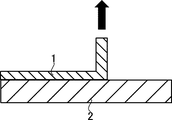
- FIG. 1 shows an explanatory diagram of a sample used in the peel strength test.
- Test pieces of the decorative sheet 1 and the injection molded body 2 were produced.
- the peelable polyimide film 3 was interposed in the decorative sheet 1 and a part of the injection molded body 2, and the non-joining part 4 with the injection molded body 2 was provided in the edge part of the decorative sheet 1.
- FIG. 1 the peel strength was measured according to JIS K 6854-1. Specifically, as shown in FIG. 2, the non-bonded portion 4 of the decorative sheet 1 is pulled vertically with respect to the surface of the injection molded body 2 (see FIG. 2), and the decorative sheet peeled from the injection molded body. The peel strength of was measured.
- the sheet part which hits the four corners of the mold follows the mold cleanly, but in the case where the moldability is bad, wrinkles and cracks occur in the four corners.
- the quality of the moldability was judged visually and evaluated according to the following criteria. A: Good without wrinkles or cracks. B: Wrinkles and cracks were observed in a very small part, but there was no practical problem. C: Wrinkles or cracks that have practical problems.
- the polymer contained in the reaction solution was sampled and the weight average molecular weight (hereinafter referred to as Mw (a1-1)) was measured, and it was 40,000.
- Mw (a1-1) weight average molecular weight
- the methyl methacrylate polymer is further block copolymerized with an acrylate ester, whereby the methyl methacrylate polymer is converted into a methacrylate ester polymer block (b1) (hereinafter referred to as “methyl methacrylate polymer block (b1-1)”). ").
- the reaction solution was brought to ⁇ 25 ° C., and a mixed solution of 24.5 kg of n-butyl acrylate and 10.5 kg of benzyl acrylate was added dropwise over 0.5 hours.
- the polymer contained in the reaction solution was sampled and the weight average molecular weight was measured, and it was 80,000. Since the weight average molecular weight of the methyl methacrylate polymer block (b1-1) was 40,000, the weight of the acrylate polymer block (b2) composed of a copolymer of n-butyl acrylate and benzyl acrylate.
- the average molecular weight (Mw (b2)) was determined to be 40,000.
- the weight average molecular weight Mw (A) of the obtained block copolymer (A-1) was 120,000. Since the weight average molecular weight of the diblock copolymer was 80,000, the weight average molecular weight (referred to as Mw (a1-2)) of the methyl methacrylate polymer block (b1-2) was 40,000. Were determined. Since the weight average molecular weight Mw (b1-1) of the methyl methacrylate polymer block (b1-1) and the weight average molecular weight Mw (b1-2) of the methyl methacrylate polymer block (b1-2) are both 40,000. , Mw (b1) is 40,000, and Mw (b1-total) is 80,000.
- each is laminated using a multi-manifold die with a width of 300 mm, extruded at a temperature of 240 ° C., nipped with a metal mirror roll at 100 ° C. and 105 ° C., and taken at a speed of 5.6 m / min, A decorative sheet having a surface protective layer thickness of 50 ⁇ m, a decorative layer thickness of 150 ⁇ m, a bonding layer thickness of 50 ⁇ m, and a total thickness of 250 ⁇ m was formed.
- the resin temperature at the time of injection molding was 220 ° C.
- Example 2 A decorative sheet was formed in the same manner as in Example 1 except that the discharge amount of the extruder was changed to set the bonding layer thickness to 100 ⁇ m and the total thickness to 300 ⁇ m. Next, an injection molded composite was produced in the same manner as in Example 1.
- Example 3 A decorative sheet was formed in the same manner as in Example 1 except that the discharge amount of the extruder was changed to make the surface protective layer thickness 25 ⁇ m and the total thickness 225 ⁇ m. Next, an injection molded composite was produced in the same manner as in Example 1.
- Example 4 A decorative sheet was formed in the same manner as in Example 1 except that the discharge amount of the extruder was changed so that the thickness of the surface protective layer was 100 ⁇ m and the total thickness was 300 ⁇ m. Next, an injection molded composite was produced in the same manner as in Example 1.
- Example 5 A decorative sheet was formed in the same manner as in Example 1 except that the resin of the decorative layer was changed to the black polycarbonate of Production Example 3. Next, an injection molded composite was produced in the same manner as in Example 1.
- Example 6 A decorative sheet was formed in the same manner as in Example 1 except that the resin of the bonding layer was polycarbonate (“301-4” manufactured by Sumika Stylon Polycarbonate). Next, an injection-molded composite was produced in the same manner as in Example 1 except that the resin for injection molding was polycarbonate (“301-22” manufactured by Sumika Stylon Polycarbonate) and the resin temperature was 280 ° C.
- Example 7 A decorative sheet was formed in the same manner as in Example 1 except that the resin for the surface protective layer was an acrylic resin (Parapet “HR-S” manufactured by Kuraray Co., Ltd.). Next, an injection molded composite was produced in the same manner as in Example 1.
- the resin for the surface protective layer was an acrylic resin (Parapet “HR-S” manufactured by Kuraray Co., Ltd.).
- an injection molded composite was produced in the same manner as in Example 1.
- Production Example 4 In Production Example 1, up to an acrylate polymer block was synthesized in the same manner, and a diblock copolymer consisting of a methyl methacrylate polymer block (Mw: 45,000) and an acrylate polymer block (Mw: 45,000) was prepared. A polymer (A-3) was obtained. Using the diblock copolymer (A-3) instead of the block copolymer (A-1), similarly to Production Example 1, pellets of the acrylic resin composition (A-4) were produced.
- Example 8 Using the acrylic resin composition (A-4) of Production Example 4 as a transparent resin to be a surface protective layer and using “Multilon TN7500” manufactured by Teijin Chemicals Ltd. as a bonding layer, a decorative sheet is produced under the conditions shown in Table 1. Filmed. Next, using “Multilon TN7500” manufactured by Teijin Chemicals Ltd. as the injection resin, a decorative sheet was formed in the same manner as in Example 1 under the conditions shown in Table 1. Next, an injection molded composite was produced in the same manner as in Example 1.
- Comparative Example 2 A decorative sheet was formed in the same manner as in Comparative Example 1. Subsequently, an injection-molded composite was produced in the same manner as in Comparative Example 1 except that the resin temperature was changed to 240 ° C.
- Example 3 A decorative sheet was formed in the same manner as in Example 1 except that the resin used as the bonding layer was not formed and only the surface protective layer and the decorative layer were molded, and the total thickness was 200 ⁇ m. Next, an injection molded composite was produced in the same manner as in Example 1.
- Comparative Example 4 A decorative sheet was formed in the same manner as in Comparative Example 3. Next, an injection-molded composite was produced in the same manner as in Comparative Example 3 except that the resin temperature was changed to 240 ° C.
- Example 5 A decorative sheet was formed in the same manner as in Example 1 except that the resin for forming the surface protective layer was not used and only the decorative layer and the bonding layer were formed, and the total thickness was 200 ⁇ m. Next, an injection molded composite was produced in the same manner as in Example 1.
- Examples 1 to 8 in which the same resin as the resin for injection molding was used as the bonding layer, when the peel strength was measured, the material was destroyed and the adhesiveness was excellent. Furthermore, in these examples, surface haze after insert molding did not occur, and excellent results were obtained.
- Examples 1 to 6 and 8 using an acrylic resin composition containing the block copolymer (A-2) or (A-4) as the surface protective layer have excellent peel strength, moldability, and surface hardness. The balance of performance was good without surface haze.
- Example 7 which does not contain a block copolymer in a surface protective layer was inferior in crack resistance, other evaluations are favorable and can be used if it is an application which does not involve the shaping
- Comparative Example 1 using a resin different from the resin for injection molding as the bonding layer was inferior in peel strength to the examples. And also in Comparative Example 2 in which the resin temperature was higher in injection molding, no improvement in peel strength was observed. Comparative Example 3 having no bonding layer was inferior in peeling strength to the examples. And also in the comparative example 4 which made the resin temperature higher in injection molding, the improvement of peeling strength was not seen. In Comparative Example 5 having no surface protective layer, surface haze after insert molding occurred, which was inferior to the examples.
- the injection-molded composite and the decorative sheet of the present invention can be applied to all injection-molded composites that require design properties.
- billboard parts such as advertising towers, stand signboards, sleeve signboards, billboard signs, rooftop signboards
- display parts such as showcases, partition plates, store displays
- fluorescent lamp covers, mood lighting covers, lamp shades, light ceilings, light walls Lighting parts such as chandeliers
- Interior parts such as furniture, pendants, mirrors, etc .
- Building parts such as doors, domes, safety window glass, partitions, staircases, balconies, roofs of leisure buildings; aircraft windshields, pilots Transport equipment related parts such as visor, motorcycle, motorboat windshield, bus shading plate, automotive side visor, rear visor, head wing, headlight cover, automotive interior parts, bumper and other automotive exterior parts; name plate for audio images, stereo cover , TV protection masks, vending machines, mobile phones, personal computers, etc.
- Child equipment parts Medical equipment parts such as incubators and X-ray parts
- Machine-related parts such as machine covers, instrument covers, experimental devices, rulers, dials, observation windows; road signs, guide plates, curved mirrors, sound barriers, etc.
- Transportation related parts Others: Greenhouses, large aquariums, box aquariums, bathroom components, clock panels, bathtubs, sanitary, desk mats, game parts, toys, face decoration masks and protective films for welding, etc. Wallpaper: used for marking film and the like.
Landscapes
- Chemical & Material Sciences (AREA)
- Engineering & Computer Science (AREA)
- Manufacturing & Machinery (AREA)
- Mechanical Engineering (AREA)
- Health & Medical Sciences (AREA)
- Chemical Kinetics & Catalysis (AREA)
- Medicinal Chemistry (AREA)
- Polymers & Plastics (AREA)
- Organic Chemistry (AREA)
- Laminated Bodies (AREA)
- Injection Moulding Of Plastics Or The Like (AREA)
Abstract
Description
[1]:射出成形体と、前記射出成形体の表面の少なくとも一部を被覆する加飾シートとを具備する射出成形複合体であって、前記加飾シートは、透明樹脂を含有し、可視光透過性を有する表面保護層、着色材を含有する加飾層およびバインダー樹脂を主成分とする接合層が、表面保護層/加飾層/接合層の積層順で共押出成形されてなるシートであり、前記射出成形体の表面の少なくとも一部は、前記加飾シートにおける前記接合層と接合しており、前記射出成形体における少なくとも前記加飾シートとの接合部分は、前記バインダー樹脂の単量体由来の構造単位と共通する単量体由来の構造単位を60質量%以上含む射出成形樹脂が主成分である射出成形複合体。
[2]: 前記バインダー樹脂は、アクリロニトリル-ブタジエン-スチレン共重合体およびポリカーボネート系樹脂の少なくとも一方を用いる[1]に記載の射出成形複合体。
[3]: 前記透明樹脂が(メタ)アクリル系樹脂である[1]または[2]に記載の射出成形複合体。
[4]: 前記(メタ)アクリル系樹脂全量に対し、メタクリル酸メチルに由来する構造単位を80質量%以上有するメタクリル系樹脂(A)と、メタクリル酸エステル重合体ブロック(b1)10~80質量%およびアクリル酸エステル重合体ブロック(b2)90~20質量%を有するブロック共重合体(B)を樹脂全量に対して1質量%以上含有する[3]に記載の射出成形複合体。
[5]: 前記加飾層は、ポリカーボネート系樹脂、およびゴム粒子を含有する(メタ)アクリル系樹脂の少なくとも一方を含有する[1]~[4]のいずれかに記載の射出成形複合体。
[6]: 前記表面保護層の厚みが0.01~0.25mm、前記加飾層の厚みが0.05~0.5mm、前記接合層の厚みが0.01~0.4mmである[1]~[5]のいずれかに記載の射出成形複合体。
[7]: 前記着色材が、有機染料である[1]~[6]のいずれかに記載の射出成形複合体。
[8] 前記射出成形体と前記加飾シートとの間に接着剤層を有さない、[1]~[7]のいずれかに記載の射出成形複合体。
[9]: 射出成形体の表面に接合され、射出成形複合体を形成するために用いられる加飾シートであって、[1]~[8]のいずれかに用いられる射出成形複合体に用いられる加飾シート。
[10]: 射出成形複合体の製造方法であって、透明樹脂を含有し、可視光透過性を有する表面保護層、着色材を含有する加飾層およびバインダー樹脂を主成分とする接合層を、表面保護層/加飾層/接合層の順に形成された加飾シートを共押出により得る工程と、前記接合層に接するように、射出成形により射出成形体を形成する工程とを備え、前記射出成形体における少なくとも前記加飾シートとの接合部は、前記バインダー樹脂の単量体由来の構造単位と共通する単量体由来の構造単位を60質量%以上含む射出成形樹脂を主成分とする射出成形複合体の製造方法。
[11]: 射出成形複合体に用いられる加飾シートの製造方法であって、透明樹脂を主成分とする表面保護層、着色材を含有する加飾層およびバインダー樹脂を主成分とする接合層を、表面保護層/加飾層/接合層の積層体となるように共押出により加飾シートを得る工程を具備し、前記バインダー樹脂は、前記射出成形複合体を構成する射出成形体における少なくとも前記加飾シートとの接合部を構成する主成分樹脂の単量体由来の構造単位と共通する単量体由来の構造単位を60質量%以上含む樹脂とする加飾シートの製造方法。
本発明の射出成形複合体は、射出成形体の表面の少なくとも一部が加飾シートにより被覆された立体成形体を有する。射出成形複合体は、射出成形体に更に別の立体成形体やシート等が積層されていてもよい。加飾シートは、透明樹脂を含有し、可視光透過性を有する表面保護層、着色材を含有する加飾層およびバインダー樹脂を主成分とする接合層が、表面保護層/加飾層/接合層の積層順で共押出成形されてなるシートである。射出成形体の表面の少なくとも一部に加飾シートの接合層が被覆せしめられている。即ち、前記射出成形体の表面の少なくとも一部は、加飾シートにおける接合層と接合している。
加飾シートは、可視光透過性を有する表面保護層、着色材を含有する加飾層およびバインダー樹脂を主成分とする接合層が、表面保護層/加飾層/接合層の積層順で共押出成形されてなるシートである。加飾シートは、これらの3層から構成される態様が好ましいが、必要に応じて接着剤層や基材層等の他の層を設けてもよい。表面保護層/加飾層/接合層の3層構造とすることで、製造コストを低減できる。2層以下であると後述する各層の機能を満たすことができなくなる。4層以上であると共押出成形する際の設備が大きくなり、製品のコスト増加につながりやすい。また、各層の界面の数が増えることで、Tダイ内に樹脂の滞留部が増加しゲルブツが発生し欠点となったり、シャークスキン流動により製品の外観品位を低下させたりすることがある。射出成形体と加飾シートの一部において接着剤層を介する態様を排除するものではないが、加飾シートの接合層が射出成形体と直接接触することによって接合される態様が好ましい。特に、射出成形体と加飾シートとの間に接着剤層を有さない態様が好ましい。
また、前記ブロック共重合体に代えて若しくは前記ブロック共重合体に加えて、多層構造ゴム粒子を(メタ)アクリル系樹脂全量に対し、好ましくは1~90質量%、より好ましくは5~40質量%含有するものも使用できる。当該多層構造ゴム粒子は加飾層について上述したものと同様である。
射出成形複合体の製造方法としては、加飾シートを共押出成形により製造し、且つ加飾シートに射出成形体をインサート成形、即ち、射出成形することにより製造できる。加飾シートは、表面保護層、加飾層および接合層それぞれの組成物を準備し、これら組成物を用いた共押出法により多層積層体を製造できる。共押出成形を行うことにより、生産性を高めつつ、優れた層間接着性が得られる。
〔重量平均分子量(Mw)および分子量分布〕
各樹脂の重合中および重合終了後の重量平均分子量(Mw)および分子量分布はGPC(ゲル・パーミエイション・クロマトグラフィー)によりポリスチレン換算分子量で求めた。
・装置:東ソー社製GPC装置「HLC-8320」
・分離カラム:東ソー社製の「TSKguardcolum SuperHZ-H」、「TSKgel HZM-M」および「TSKgel SuperHZ4000」を直列に連結
・溶離剤:テトラヒドロフラン
・溶離剤流量:0.35mL/min
・カラム温度:40℃
・検出方法:示差屈折率(RI)
各重合体ブロックの構成割合は1H-NMR(1H-核磁気共鳴)測定によって求めた。
・装置:日本電子社製核磁気共鳴装置「JNM-LA400」
・重溶媒:重水素化クロロホルム
図1に、剥離強度試験に用いたサンプルの説明図を示す。加飾シート1と射出成形体2の試験片を作製した。この際、加飾シート1と射出成形体2の一部に剥離性のポリイミドフィルム3を介在させ、加飾シート1の端部に、射出成形体2との非接合部4を設けた。そして、JIS K 6854-1に準拠して剥離強度を測定した。具体的には、図2に示すように、射出成形体2面に対して、加飾シート1の非接合部4を垂直方向に引張り(図2参照)、射出成形体から剥離した加飾シートの剥離強度を測定した。具体的な測定条件は以下の通り。なお、剥離強度が強く材料破壊したものもあった。
・幅:25mm
・最小長さ:50mm
・つかみ移動速度:50mm/min
・測定装置:島津製作所社製 EZ-XS
加飾シートを300mm(MD)×210mm(TD)の試験片に切り出し、布施真空社製真空圧空成形機NGFを用い、表面保護層を上側として取り付け固定し、追従性を評価した。
遠赤外線ヒーターを用い、加飾シートの表面温度が130℃になったところで、金型(底面の大きさは縦10cm横10cm、上面の大きさは縦9cm横9cm、高さ3.5cm)の上面に接合層側を密着させ、真空成形によるプレフォーミングを実施した。成形性が良好なものは型四隅に当るシート部が型に綺麗に追従するが、悪いものは四隅にシワや割れが生じる。成形性の良否は目視で判定し、以下の基準で評価した。
A:シワや割れが生じずに良好なもの。
B:シワや割れが極一部に観測されたが、実用上問題ないもの。
C:実用上問題があるシワや割れが生じたもの。
前記追従性評価の際にプレフォーミングしたシートを使用した。前記シートをインサート成形用金型(底面の大きさは縦9cm横9cm、奥行き3.5cm)に、予め金型にあわせて不要部をカッターでトリミングしたシートの表面保護層側を金型に密着させて固定した。名機製作所社製の射出成形機M-100Cを用い、射出成形用樹脂を用いてインサート成形を行うことで、射出成形複合体を得た。その後、必要に応じシートの不要部分をカッターでトリミングした。耐割れ性が良好なものはシートの割れなくトリミングできるが、悪いものはトリミング時にシートの割れが生じる。以下の基準で評価した。
A:割れおよびヒビが観測されないもの(目視)。
B:若干のヒビが観測されたもの(目視)。
C:割れが生じたもの(目視)。
D:全面にわれが生じて白濁したもの(目視)。
前述の製膜条件により作製した加飾シートとその延伸成形体を、それぞれ30mm×30mmに切り出して試験片とした。鉛筆硬度試験機(東洋精機製作所社製:鉛筆引っかき塗膜硬さ試験機)に試験片をセットし、JIS-K5600-5-4に準拠して、表面保護層側の鉛筆硬度を測定し、延伸前後の鉛筆硬度を比較した。
前記耐割れ性の評価に使用した成形品をその表面保護層側から目視評価した。評価法は室内蛍光灯の光を入射角45°、反射角45°で覗き込み、フィルムに写っている蛍光灯と天井の境目の表面ヘイズを見ることで評価した。以下の基準で評価した。
A:表面にヘイズが発生していない試験片。
C:表面にヘイズが発生している試験片。
内部を脱気し、窒素で置換したブライン冷却できるジャケットおよび撹拌機つきのグラスライニング製3m3反応容器に、室温にて乾燥トルエン735kg、ヘキサメチルトリエチレンテトラミン0.4kg、およびイソブチルビス(2,6-ジ-t-ブチル-4-メチルフェノキシ)アルミニウム20molを含有するトルエン溶液39.4kgを加え、さらに、sec-ブチルリチウム1.17molを加えた。これにメタクリル酸メチル35.0kgを加え、室温で1時間反応させた。反応液に含まれる重合体をサンプリングして重量平均分子量(以下、Mw(a1-1)と称する)を測定したところ、40,000であった。かかるメタクリル酸メチル重合体はさらにアクリル酸エステルをブロック共重合することで、該メタクリル酸メチル重合体はメタクリル酸エステル重合体ブロック(b1)(以下、「メタクリル酸メチル重合体ブロック(b1-1)」と称する)となる。
ゴム微粒子入り耐衝撃性アクリル樹脂(クラレ社製 「GR-00100」)70質量部と、アクリル樹脂(クラレ社製 「EH」)30質量部と、アントラキノン系染料(ランクセス社製)1.7質量部を溶融混練し、黒色アクリル樹脂を得た。
ポリカーボネート系樹脂(住化スタイロンポリカーボネート社製「300シリーズ」MFR=10)100質量部に対し、アントラキノン系染料(ランクセス社製)1.7質量部を溶融混練し、黒色ポリカーボネート樹脂を得た。
表面保護層となる透明樹脂として製造例1のアクリル系樹脂組成物(A-2)を用い、30mmΦベント式の1軸押出機を用いて吐出量5kg/hrにて押出し、同時に加飾層として製造例2の黒色アクリル樹脂を用い、50mmΦベント式の1軸押出機を用いて15kg/hrにて押出し、同時に接合層となるバインダー樹脂としてABS樹脂(MFR=11、無着色)、を用い、30mmΦベント式の1軸押出機を用いて5kg/hrにて押出した。
そして、それぞれを幅300mmのマルチマニホールドダイを用いて積層させて温度240℃にて押出し、100℃と105℃の金属鏡面ロールでニップして5.6m/minの速度にて引取ることにより、表面保護層厚さ50μm、加飾層厚さ150μm、接合層厚さ50μm、総厚さ250μmの加飾シートを製膜した。
次いで前記加飾シートの接合層側にABS樹脂(MFR=11、無着色)を[耐割れ性評価]の項目に記した方法により射出成形して総厚さ3.0mmの射出成形複合体を製造した。射出成形時の樹脂温度は220℃とした。
押出機の吐出量を変更し、接合層厚さ100μm、総厚さ300μmとした以外は実施例1と同様にして加飾シートを製膜した。次いで実施例1と同様にして射出成形複合体を製造した。
押出し機の吐出量を変更し、表面保護層厚さ25μm、総厚さ225μmとした以外は実施例1と同様にして加飾シートを製膜した。次いで実施例1と同様にして射出成形複合体を製造した。
押出し機の吐出量を変更し、表面保護層厚さ100μm、総厚さ300μmとした以外は実施例1と同様にして加飾シートを製膜した。次いで実施例1と同様にして射出成形複合体を製造した。
加飾層の樹脂を製造例3の黒色ポリカーボネートとした以外は実施例1と同様にして加飾シートを製膜した。次いで実施例1と同様にして射出成形複合体を製造した。
接合層の樹脂をポリカーボネート(住化スタイロンポリカーボネート社製「301-4」)とした以外は実施例1と同様にして加飾シートを製膜した。
次いで射出成形用樹脂をポリカーボネート(住化スタイロンポリカーボネート社製「301-22」)とし、樹脂温度を280℃とした以外は実施例1と同様にして射出成形複合体を製造した。
表面保護層の樹脂をアクリル樹脂(クラレ社製パラペット「HR-S」)とした以外は実施例1と同様にして加飾シートを製膜した。次いで実施例1と同様にして射出成形複合体を製造した。
製造例1において、アクリル酸エステル重合体ブロックまでを同様に合成し、メタクリル酸メチル重合体ブロック(Mw:45,000)-アクリル酸エステル重合体ブロック(Mw:45,000)からなるジブロック共重合体(A-3)を得た。ブロック共重合体(A-1)の代わりにジブロック共重合体(A-3)を用いて、引続き製造例1と同様に、アクリル系樹脂組成物(A-4)のペレットを製造した。
表面保護層となる透明樹脂として製造例4のアクリル系樹脂組成物(A-4)を用い、接合層として帝人化成社製「マルチロンTN7500」を用い、表1の条件にて加飾シートを製膜した。次いで射出樹脂として帝人化成社製「マルチロンTN7500」を用い、表1の条件にて実施例1と同様にして加飾シートを製膜した。次いで実施例1と同様にして射出成形複合体を製造した。
接合層の樹脂をポリカーボネート(住化スタイロンポリカーボネート社製「300シリーズ」MFR=10)とした以外は実施例1と同様にして加飾シートを製膜した。次いで実施例1と同様にして射出成形複合体を製造した。
比較例1と同様にして加飾シートを製膜した。次いで樹脂温度を240℃に変更した以外は比較例1と同様にして射出成形複合体を製造した。
接合層となる樹脂を使用せず表面保護層、加飾層のみで成形し、総厚さ200μmである以外は実施例1と同様にして加飾シートを製膜した。次いで実施例1と同様にして射出成形複合体を製造した。
比較例3と同様にして加飾シートを製膜した。次いで樹脂温度を240℃に変更した以外は比較例3と同様にして射出成形複合体を製造した。
表面保護層となる樹脂を使用せず加飾層、接合層のみで成形し、総厚さ200μmである以外は実施例1と同様にして加飾シートを製膜した。次いで実施例1と同様にして射出成形複合体を製造した。

Claims (11)
- 射出成形体と、前記射出成形体の表面の少なくとも一部を被覆する加飾シートとを具備する射出成形複合体であって、
前記加飾シートは、透明樹脂を含有し、可視光透過性を有する表面保護層、着色材を含有する加飾層およびバインダー樹脂を主成分とする接合層が、表面保護層/加飾層/接合層の積層順で共押出成形されてなるシートであり、
前記射出成形体の表面の少なくとも一部は、前記加飾シートにおける前記接合層と接合しており、
前記射出成形体における少なくとも前記加飾シートとの接合部分は、前記バインダー樹脂の単量体由来の構造単位と共通する単量体由来の構造単位を60質量%以上含む射出成形樹脂が主成分である射出成形複合体。 - 前記バインダー樹脂は、アクリロニトリル-ブタジエン-スチレン共重合体およびポリカーボネート系樹脂の少なくとも一方を用いる請求項1に記載の射出成形複合体。
- 前記透明樹脂が(メタ)アクリル系樹脂である請求項1または2に記載の射出成形複合体。
- 前記(メタ)アクリル系樹脂全量に対し、メタクリル酸メチルに由来する構造単位を80質量%以上有するメタクリル系樹脂(A)と、メタクリル酸エステル重合体ブロック(b1)10~80質量%およびアクリル酸エステル重合体ブロック(b2)90~20質量%を有するブロック共重合体(B)を樹脂全量に対して1質量%以上含有する請求項3に記載の射出成形複合体。
- 前記加飾層は、ポリカーボネート系樹脂、およびゴム粒子を含有する(メタ)アクリル系樹脂の少なくとも一方を含有する請求項1~4のいずれか1項に記載の射出成形複合体。
- 前記表面保護層の厚みが0.01~0.25mm、前記加飾層の厚みが0.05~0.5mm、前記接合層の厚みが0.01~0.4mmである請求項1~5のいずれか1項に記載の射出成形複合体。
- 前記着色材が、有機染料である請求項1~6のいずれか1項に記載の射出成形複合体。
- 前記射出成形体と前記加飾シートとの間に接着剤層を有さない、請求項1~7のいずれか1項に記載の射出成形複合体。
- 射出成形体の表面に接合され、射出成形複合体を形成するために用いられる加飾シートであって、
請求項1~8のいずれか1項に用いられる射出成形複合体に用いられる加飾シート。 - 射出成形複合体の製造方法であって、
透明樹脂を含有し、可視光透過性を有する表面保護層、着色材を含有する加飾層およびバインダー樹脂を主成分とする接合層を、表面保護層/加飾層/接合層の順に形成された加飾シートを共押出により得る工程と、
前記接合層に接するように、射出成形により射出成形体を形成する工程とを備え、
前記射出成形体における少なくとも前記加飾シートとの接合部は、前記バインダー樹脂の単量体由来の構造単位と共通する単量体由来の構造単位を60質量%以上含む射出成形樹脂を主成分とする射出成形複合体の製造方法。 - 射出成形複合体に用いられる加飾シートの製造方法であって、
透明樹脂を主成分とする表面保護層、着色材を含有する加飾層およびバインダー樹脂を主成分とする接合層を、表面保護層/加飾層/接合層の積層体となるように共押出により加飾シートを得る工程を具備し、
前記バインダー樹脂は、前記射出成形複合体を構成する射出成形体における少なくとも前記加飾シートとの接合部を構成する主成分樹脂の単量体由来の構造単位と共通する単量体由来の構造単位を60質量%以上含む樹脂とする加飾シートの製造方法。
Priority Applications (3)
| Application Number | Priority Date | Filing Date | Title |
|---|---|---|---|
| CN201680063217.4A CN108349130B (zh) | 2015-10-30 | 2016-10-28 | 注射成型复合体和装饰片、以及它们的制造方法 |
| KR1020187013758A KR20180077186A (ko) | 2015-10-30 | 2016-10-28 | 사출 성형 복합체 및 가식 시트, 그리고 이것들의 제조 방법 |
| JP2017547632A JP6836511B2 (ja) | 2015-10-30 | 2016-10-28 | 射出成形複合体および加飾シート、並びにこれらの製造方法 |
Applications Claiming Priority (2)
| Application Number | Priority Date | Filing Date | Title |
|---|---|---|---|
| JP2015-214726 | 2015-10-30 | ||
| JP2015214726 | 2015-10-30 |
Publications (1)
| Publication Number | Publication Date |
|---|---|
| WO2017073077A1 true WO2017073077A1 (ja) | 2017-05-04 |
Family
ID=58630033
Family Applications (1)
| Application Number | Title | Priority Date | Filing Date |
|---|---|---|---|
| PCT/JP2016/004755 Ceased WO2017073077A1 (ja) | 2015-10-30 | 2016-10-28 | 射出成形複合体および加飾シート、並びにこれらの製造方法 |
Country Status (5)
| Country | Link |
|---|---|
| JP (1) | JP6836511B2 (ja) |
| KR (1) | KR20180077186A (ja) |
| CN (1) | CN108349130B (ja) |
| TW (1) | TW201728452A (ja) |
| WO (1) | WO2017073077A1 (ja) |
Cited By (1)
| Publication number | Priority date | Publication date | Assignee | Title |
|---|---|---|---|---|
| WO2018221580A1 (ja) * | 2017-05-31 | 2018-12-06 | 株式会社クラレ | 積層フィルム、積層成形体、およびこれらの製造方法 |
Citations (2)
| Publication number | Priority date | Publication date | Assignee | Title |
|---|---|---|---|---|
| JP2006062290A (ja) * | 2004-08-30 | 2006-03-09 | Shin Etsu Polymer Co Ltd | 加飾シート |
| JP2010131822A (ja) * | 2008-12-03 | 2010-06-17 | Tokyo Tokushu Insatsu Kogyo Kk | インサート成形方法 |
Family Cites Families (2)
| Publication number | Priority date | Publication date | Assignee | Title |
|---|---|---|---|---|
| CN102471657B (zh) * | 2009-07-16 | 2014-09-17 | 积水化学工业株式会社 | 粘合胶带、层叠体及图像显示装置 |
| CN104781339B (zh) * | 2012-11-09 | 2016-10-12 | 株式会社可乐丽 | 甲基丙烯酸类树脂组合物 |
-
2016
- 2016-10-28 JP JP2017547632A patent/JP6836511B2/ja active Active
- 2016-10-28 TW TW105135331A patent/TW201728452A/zh unknown
- 2016-10-28 CN CN201680063217.4A patent/CN108349130B/zh active Active
- 2016-10-28 KR KR1020187013758A patent/KR20180077186A/ko not_active Withdrawn
- 2016-10-28 WO PCT/JP2016/004755 patent/WO2017073077A1/ja not_active Ceased
Patent Citations (2)
| Publication number | Priority date | Publication date | Assignee | Title |
|---|---|---|---|---|
| JP2006062290A (ja) * | 2004-08-30 | 2006-03-09 | Shin Etsu Polymer Co Ltd | 加飾シート |
| JP2010131822A (ja) * | 2008-12-03 | 2010-06-17 | Tokyo Tokushu Insatsu Kogyo Kk | インサート成形方法 |
Cited By (3)
| Publication number | Priority date | Publication date | Assignee | Title |
|---|---|---|---|---|
| WO2018221580A1 (ja) * | 2017-05-31 | 2018-12-06 | 株式会社クラレ | 積層フィルム、積層成形体、およびこれらの製造方法 |
| JPWO2018221580A1 (ja) * | 2017-05-31 | 2020-04-02 | 株式会社クラレ | 積層フィルム、積層成形体、およびこれらの製造方法 |
| JP6998948B2 (ja) | 2017-05-31 | 2022-01-18 | 株式会社クラレ | 積層フィルム、積層成形体、およびこれらの製造方法 |
Also Published As
| Publication number | Publication date |
|---|---|
| JP6836511B2 (ja) | 2021-03-03 |
| JPWO2017073077A1 (ja) | 2018-08-16 |
| CN108349130A (zh) | 2018-07-31 |
| CN108349130B (zh) | 2021-01-01 |
| KR20180077186A (ko) | 2018-07-06 |
| TW201728452A (zh) | 2017-08-16 |
Similar Documents
| Publication | Publication Date | Title |
|---|---|---|
| JP6324406B2 (ja) | アクリル系樹脂フィルム | |
| KR102366891B1 (ko) | 유색 가식 필름 | |
| JP6846337B2 (ja) | 樹脂組成物およびその製造方法、成形体、フィルム並びに物品 | |
| KR102391053B1 (ko) | 흑색 필름 | |
| JP6571111B2 (ja) | 加飾用複層シートおよび立体成型体 | |
| CN110546003B (zh) | 层叠膜、层叠成形体和它们的制造方法 | |
| JP6594404B2 (ja) | 樹脂組成物、フィルムおよびそれらの製造方法、成形体、並びに物品 | |
| JP6967520B2 (ja) | 積層加飾フィルムとその製造方法、並びに、加飾成形体とその製造方法 | |
| JP2017078168A (ja) | アクリル系樹脂フィルムおよびその製造方法 | |
| JPWO2019194210A1 (ja) | (メタ)アクリル樹脂組成物、フィルムおよびその製造方法 | |
| JP6742158B2 (ja) | アクリル系樹脂フィルムおよびそれを用いた積層フィルム並びに積層体 | |
| JP6836511B2 (ja) | 射出成形複合体および加飾シート、並びにこれらの製造方法 |
Legal Events
| Date | Code | Title | Description |
|---|---|---|---|
| 121 | Ep: the epo has been informed by wipo that ep was designated in this application |
Ref document number: 16859315 Country of ref document: EP Kind code of ref document: A1 |
|
| ENP | Entry into the national phase |
Ref document number: 2017547632 Country of ref document: JP Kind code of ref document: A |
|
| NENP | Non-entry into the national phase |
Ref country code: DE |
|
| ENP | Entry into the national phase |
Ref document number: 20187013758 Country of ref document: KR Kind code of ref document: A |
|
| 122 | Ep: pct application non-entry in european phase |
Ref document number: 16859315 Country of ref document: EP Kind code of ref document: A1 |