WO2017026396A1 - エポキシ樹脂、変性エポキシ樹脂、エポキシ樹脂組成物およびその硬化物 - Google Patents
エポキシ樹脂、変性エポキシ樹脂、エポキシ樹脂組成物およびその硬化物 Download PDFInfo
- Publication number
- WO2017026396A1 WO2017026396A1 PCT/JP2016/073104 JP2016073104W WO2017026396A1 WO 2017026396 A1 WO2017026396 A1 WO 2017026396A1 JP 2016073104 W JP2016073104 W JP 2016073104W WO 2017026396 A1 WO2017026396 A1 WO 2017026396A1
- Authority
- WO
- WIPO (PCT)
- Prior art keywords
- epoxy resin
- resin composition
- formula
- group
- weight
- Prior art date
- Legal status (The legal status is an assumption and is not a legal conclusion. Google has not performed a legal analysis and makes no representation as to the accuracy of the status listed.)
- Ceased
Links
Classifications
-
- C—CHEMISTRY; METALLURGY
- C08—ORGANIC MACROMOLECULAR COMPOUNDS; THEIR PREPARATION OR CHEMICAL WORKING-UP; COMPOSITIONS BASED THEREON
- C08G—MACROMOLECULAR COMPOUNDS OBTAINED OTHERWISE THAN BY REACTIONS ONLY INVOLVING UNSATURATED CARBON-TO-CARBON BONDS
- C08G59/00—Polycondensates containing more than one epoxy group per molecule; Macromolecules obtained by polymerising compounds containing more than one epoxy group per molecule using curing agents or catalysts which react with the epoxy groups
- C08G59/14—Polycondensates modified by chemical after-treatment
- C08G59/1405—Polycondensates modified by chemical after-treatment with inorganic compounds
- C08G59/1411—Polycondensates modified by chemical after-treatment with inorganic compounds containing sulfur
-
- C—CHEMISTRY; METALLURGY
- C08—ORGANIC MACROMOLECULAR COMPOUNDS; THEIR PREPARATION OR CHEMICAL WORKING-UP; COMPOSITIONS BASED THEREON
- C08G—MACROMOLECULAR COMPOUNDS OBTAINED OTHERWISE THAN BY REACTIONS ONLY INVOLVING UNSATURATED CARBON-TO-CARBON BONDS
- C08G59/00—Polycondensates containing more than one epoxy group per molecule; Macromolecules obtained by polymerising compounds containing more than one epoxy group per molecule using curing agents or catalysts which react with the epoxy groups
- C08G59/02—Polycondensates containing more than one epoxy group per molecule
- C08G59/04—Polycondensates containing more than one epoxy group per molecule of polyhydroxy compounds with epihalohydrins or precursors thereof
-
- C—CHEMISTRY; METALLURGY
- C08—ORGANIC MACROMOLECULAR COMPOUNDS; THEIR PREPARATION OR CHEMICAL WORKING-UP; COMPOSITIONS BASED THEREON
- C08G—MACROMOLECULAR COMPOUNDS OBTAINED OTHERWISE THAN BY REACTIONS ONLY INVOLVING UNSATURATED CARBON-TO-CARBON BONDS
- C08G59/00—Polycondensates containing more than one epoxy group per molecule; Macromolecules obtained by polymerising compounds containing more than one epoxy group per molecule using curing agents or catalysts which react with the epoxy groups
- C08G59/14—Polycondensates modified by chemical after-treatment
Definitions
- the present invention relates to an epoxy resin, a modified epoxy resin, an epoxy resin composition, and a cured product thereof, and includes electrical materials such as semiconductor sealing materials, liquid crystal sealing materials, EL sealing materials, printed wiring boards, and build-up laminates.
- electrical materials such as semiconductor sealing materials, liquid crystal sealing materials, EL sealing materials, printed wiring boards, and build-up laminates.
- -It is suitably used for lightweight high-strength materials such as electronic parts, carbon fiber reinforced plastics, and glass fiber reinforced plastics.
- Patent Documents 1 and 2 discloses an allyl group-containing bisphenol A structure epoxy resin (Patent Document 3).
- Japanese Unexamined Patent Publication No. 11-140163 Japanese Patent Laid-Open No. 11-255866 Japanese Unexamined Patent Publication No. 2004-107501
- an object of the present invention is to provide an epoxy resin, a modified epoxy resin, an epoxy resin composition, and a cured product thereof exhibiting excellent hygroscopicity (low water absorption) heat resistance and strength in the cured product.
- each of a plurality of R's independently represents an allyl group or a propenyl group, and 10% or more of the total R is a propenyl group.
- G represents a glycidyl group.
- Each of a plurality of X's independently represents hydrogen.
- a modified epoxy resin obtained by polymerizing the epoxy resin described in [1] above and a bisphenol [3] An epoxy resin composition containing the epoxy resin according to [1] or the modified epoxy resin according to [2], [4] The epoxy resin composition according to [3], which contains a curing agent, [5] The epoxy resin composition according to [3] or [4] above, which contains a curing accelerator, [6] The epoxy resin composition according to any one of [3] to [5] above, which contains a radical polymerization initiator, [7] A cured product obtained by curing the epoxy resin composition according to any one of [3] to [6] is provided.
- the present invention provides an insulating material (such as a highly reliable semiconductor encapsulating material) and a laminated board (printed) that exhibit excellent low moisture absorption (low water absorption) and heat resistance (solder reflow resistance) in the cured product.
- CFRP CFRP
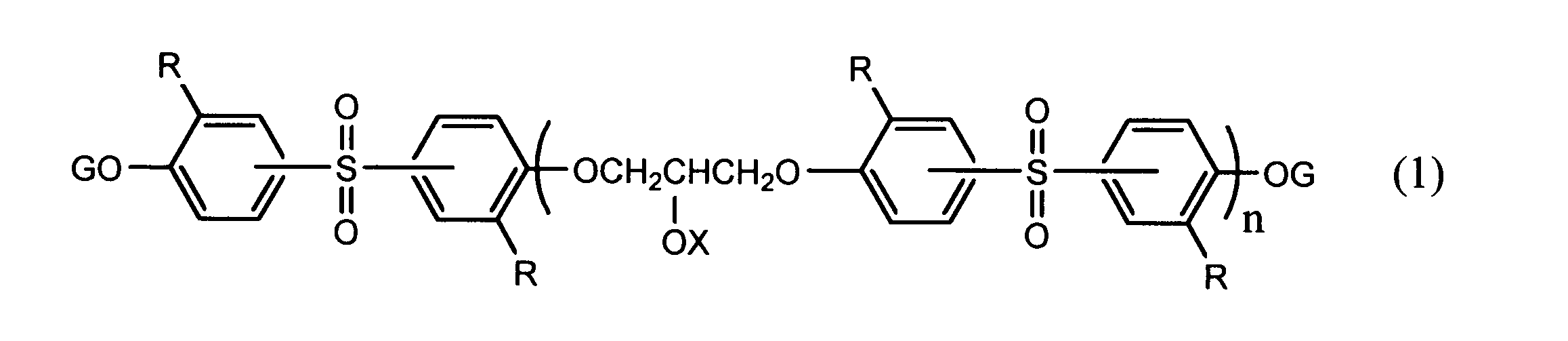
- the epoxy resin of the present invention is represented by following formula (1).
- R's independently represent an allyl group or a propenyl group (propenyl group represents a 1-propenyl group, hereinafter referred to as a propenyl group), and 10% or more of the total R is propenyl.
- G represents a glycidyl group
- a plurality of Xs each independently represent a hydrogen atom or a glycidyl group
- n is 0 to 10
- the average value represents a real number of 0 to 10.
- Epoxy resins generate polar groups (hydroxyl groups and ester groups) at the cross-linking points in the curing reaction, and it is known that their hydrophilicity greatly affects hygroscopicity.
- a low epoxy group concentration (high epoxy equivalent) for effectively reducing the polar group concentration functions effectively.
- the epoxy resin of the present invention converts part or all of allyl groups into more reactive propenyl groups, and as a result, reaction between propenyl groups (while allyl groups are not crosslinked) during the curing process. Therefore, the crosslink density is increased and the heat resistance (glass transition temperature) is improved.
- polar groups are not generated, so that there is little deterioration in water absorption (wetness) due to improved heat resistance.
- R represents an allyl group or a propenyl group, and 10% or more of the total R is a propenyl group, more preferably 20% or more, and particularly preferably 30% or more. It is. If it is less than 10%, the heat resistance may not be sufficiently improved.
- n is preferably 0 to 10, particularly preferably 0 to 5.
- the average value of n is 0 to 10, preferably 0 to 5.
- the epoxy equivalent of the epoxy resin of the present invention is 221 to 8100 g / eq. More preferably, 221 to 4300 g / eq. It is. Epoxy equivalent is 8100 g / eq. Exceeding this indicates that the amount of epoxy groups per unit structure decreases, which means that the number of epoxy groups decreases. Therefore, it may not be preferable in terms of heat resistance.
- the total amount of chlorine remaining in the epoxy resin of the present invention obtained by the reaction is preferably 1500 ppm or less, more preferably 1000 ppm or less, and particularly preferably 500 ppm or less.
- the epoxy resin of the present invention has a resinous form having a softening point.
- the softening point is preferably 50 to 100 ° C. If the softening point is too low, there is no problem when used by dissolving in a solvent. However, when handled as a solid resin, since blocking occurs and there is a tack, handling becomes worse. Conversely, when the softening point is too high, problems such as poor handling may occur during kneading with other resins.
- the melt viscosity is preferably 0.01 to 5 Pa ⁇ s (ICI melt viscosity 150 ° C. corn plate method), more preferably 0.02 to 4 Pa ⁇ s, and particularly 0.02 to 3 Pa ⁇ s. preferable. If the viscosity is too small, there is an advantage of good fluidity even if a large amount of filler such as a filler is blended, while blocking and tackiness occur.
- the epoxy resin of the present invention described in the above (1) has the following formula (2):
- each R independently represents an allyl group or a propenyl group.
- a compound represented by the formula (2) include 2,2′-diallyl-4,4′-sulfonyldiphenol, 2-allyl-2′-propenyl-4,4′-sulfonyldiphenol, 2,2 '-Dipropenyl-4,4'-sulfonyldiphenol, 2,2'-diallyl-6,6'-sulfonyldiphenol, 2-allyl-2'-propenyl-6,6'-sulfonyldiphenol, 2,2 Examples include '-dipropenyl-6,6'-sulfonyldiphenol, which are used at a blending ratio such that propenyl group / (propenyl group + allyl group) ⁇ 0.1.
- the epihalohydrins used in the reaction of the compound of the formula (2) with epihalohydrins include epichlorohydrin, epibromohydrin, epiiodohydrin, ⁇ -methylepichlorohydrin, ⁇ -methylepibromohydrin, ⁇ -ethyl.
- Epichlorohydrin and the like are available, but industrially available and inexpensive epichlorohydrin is preferable. This reaction can be performed according to a conventionally known method.
- the mixture is reacted at 20 to 120 ° C. for 1 to 20 hours while adding a solid of alkali metal hydroxide such as sodium hydroxide or potassium hydroxide all at once or gradually to a mixture of the compound of formula (2) and epihalohydrins.
- the alkali metal hydroxide may be used in the form of an aqueous solution.
- the alkali metal hydroxide is continuously added and water and epihalohydrins are continuously added under reduced pressure or normal pressure from within the reaction system. The water may be removed and the epihalohydrins may be continuously returned to the reaction system.
- the amount of epihalohydrin used is usually 0.5 to 20 mol, preferably 0.7 to 10 mol, relative to 1 equivalent of the hydroxyl group of the compound of formula (2).
- the amount of the alkali metal hydroxide used is usually in the range of 0.5 to 1.5 mol, preferably 0.7 to 1.2 mol, relative to 1 equivalent of the hydroxyl group of the compound of the formula (2).
- an epoxy resin having a low hydrolyzable halogen concentration can be obtained by adding an aprotic polar solvent such as dimethyl sulfone, dimethyl sulfoxide (DMSO), dimethylformamide, 1,3-dimethyl-2-imidazolidinone. It is obtained and suitable for use as an electronic material sealing material.
- the total chlorine concentration is preferably 1500 ppm or less, more preferably 1000 ppm or less.
- the amount of the aprotic polar solvent used is in the range of 5 to 200% by weight, preferably 10 to 100% by weight, based on the weight of the epihalohydrin.
- the reaction can easily proceed by adding alcohols such as methanol and ethanol.
- toluene, xylene, dioxane and the like can also be used.
- a quaternary ammonium salt such as tetramethylammonium chloride, tetramethylammonium bromide or trimethylbenzylammonium chloride is used as a catalyst in a mixture of the compound represented by the formula (2) and an excess of epihalohydrins
- a solid or aqueous solution of an alkali metal hydroxide such as sodium hydroxide or potassium hydroxide is added to the halohydrin ether of the compound of the formula (2) obtained by reacting at 150 ° C. for 1 to 20 hours, and 20 to 120
- the epoxy resin of the present invention can also be obtained by reacting at 20 ° C. for 1 to 20 hours to cyclize the halohydrin ether.
- the amount of the quaternary ammonium salt used is usually 0.001 to 0.2 mol, preferably 0.05 to 0.1 mol, relative to 1 equivalent of the hydroxyl group of the compound of the formula (2).
- these reactants are washed with water, or after removing excess epihalohydrin under heating and decompression without washing with water, and then dissolved in a solvent such as toluene, xylene, methyl isobutyl ketone, and the like, and then an alkali such as sodium hydroxide or potassium hydroxide.
- the reaction is carried out again by adding an aqueous solution of metal hydroxide.
- the amount of the alkali metal hydroxide used is usually 0.01 to 0.2 mol, preferably 0.05 to 0.15 mol, relative to 1 equivalent of the hydroxyl group of the compound of the formula (2).
- the reaction temperature is usually 50 to 120 ° C., and the reaction time is usually 0.5 to 2 hours.
- an epoxy resin with less hydrolyzable halogen can be obtained by distilling off a solvent such as toluene, xylene, and methyl isobutyl ketone under heating and reduced pressure.
- the epoxy resin of the formula (1) having a large value of n can be obtained by polymerizing the epoxy resin of the formula (1) obtained once with the compound of the formula (2).
- the epoxy resin of the formula (1) and the compound of the formula (2) are dissolved in a solvent such as toluene, xylene, methyl isobutyl ketone, if necessary, and sodium hydroxide, triphenylphosphine, tertiary ammonium salt, etc. This is done by adding a catalyst and heating.
- the use ratio of the epoxy resin of the formula (1) and the compound of the formula (2) is usually charged so that the epoxy group has an equivalent ratio greater than the hydroxyl group.
- the epoxy resin obtained as described above is an epoxy resin in which all Xs are hydrogen atoms in the above formula (1), but by further reacting an epihalohydrin with a secondary alcoholic hydroxyl group, A polyfunctional epoxy resin in which all or part of the glycidyl group is glycidyl group can be obtained.
- the secondary alcoholic hydroxyl group of this epoxy resin and epihalohydrin are mixed with DMSO, quaternary ammonium salt, 1,3-dimethyl-2-imidazolidinone or cyclic ether and alkali metal hydroxide.
- Epoxidation can be carried out by reacting in the presence of substances, and the proportion of X being a glycidyl group can be arbitrarily controlled by adjusting the amount of alkali metal hydroxide.
- DMSO or 1,3-dimethyl-2-imidazolidinone and cyclic ethers are preferably used in an amount of 5 to 300% by weight based on the epoxy resin in which all Xs are hydrogen atoms in the formula (1).
- the quaternary ammonium salt include tetramethylammonium chloride and tetramethylammonium bromide.
- the amount used is 0 with respect to 1 equivalent of the secondary alcoholic hydroxyl group of the epoxy resin in which X is a hydrogen atom in the formula (1). .3 to 50 g is preferable, and 0.5 to 20 g is particularly preferable.
- the epihalohydrin used in this reaction there are epichlorohydrin, epibromhydrin, epiiodohydrin and the like, as described above, but industrially easily available and inexpensive epichlorohydrin is preferable.
- the amount used is preferably 1 equivalent or more with respect to 1 equivalent of the secondary alcoholic hydroxyl group of the epoxy resin in which all Xs in the formula (1) are hydrogen atoms.
- the alkali metal hydroxide sodium hydroxide, potassium hydroxide and the like can be used, but sodium hydroxide is preferable.
- the amount of the alkali metal hydroxide used is preferably 1 to 10 times, particularly preferably 1 equivalent to 1 equivalent of the secondary alcoholic hydroxyl group to be epoxidized in the epoxy resin in which all X in the formula (1) are hydrogen atoms. May be used in an amount of 1 to 2 times.
- the alkali metal hydroxide may be solid or an aqueous solution. In the case of using an aqueous solution, the reaction can also be carried out during the reaction while water in the reaction system is distilled out of the reaction system under normal pressure and reduced pressure.
- the reaction temperature is preferably 30 to 100 ° C.
- excess epihalohydrin and solvents can be recovered by distillation under reduced pressure, the resin can be dissolved in an organic solvent, and dehydrohalogenation reaction can be performed with an alkali metal hydroxide.
- water separation is performed to separate by-product salts and solvents, and excess epihalohydrin and solvents are recovered from the oil layer by distillation under reduced pressure.
- the resin is dissolved in an organic solvent, and alkali metal hydroxide is used.
- a dehydrohalogenation reaction may be performed.
- methyl isobutyl ketone benzene, toluene, xylene and the like can be used, and methyl isobutyl ketone is preferable. They can be used alone or in a mixed system. Thus, an epoxy resin in which part or all of X in the formula (1) is a glycidyl group is obtained.
- epoxidation and rearrangement of an allyl group to a propenyl group can be performed simultaneously.
- an aprotic polar solvent such as dimethyl sulfone, dimethyl sulfoxide (DMSO), dimethylformamide, 1,3-dimethyl-2-imidazolidinone
- a solid of alkali metal hydroxide such as sodium hydroxide or potassium hydroxide is added to a mixture of the compound of formula (2), epihalohydrins and aprotic polar solvent all at once or 20 to 70 ° C., preferably Is reacted at 20-40 ° C. for 1-20 hours.
- the amount of alkali metal hydroxide used in this case is usually in the range of 1.0 to 2.0 mol, preferably 1.0 to 1.8 mol, relative to 1 equivalent of the hydroxyl group of the compound of the formula (2).
- these reactants are washed with water or without excess water, after removing excess epihalohydrins and aprotic polar solvents under reduced pressure, and then dissolved in a solvent such as toluene, xylene, methyl isobutyl ketone, sodium hydroxide, The reaction is carried out again by adding an aqueous solution of an alkali metal hydroxide such as potassium hydroxide.
- the amount of the alkali metal hydroxide used is usually 0.01 to 0.2 mol, preferably 0.05 to 0.15 mol, relative to 1 equivalent of the hydroxyl group of the compound of the formula (2).
- the reaction temperature is usually 50 to 120 ° C., and the reaction time is usually 0.5 to 2 hours.
- the by-produced salt was removed by filtration, washing with water, etc., and a solvent such as toluene, xylene, methyl isobutyl ketone was distilled off under heating and reduced pressure to convert part or all of the allyl group to a propenyl group.
- An epoxy resin can be obtained.
- the modified epoxy resin [2] (hereinafter referred to as a modified epoxy resin) can be obtained by polymerizing the epoxy resin of the formula (1) once obtained with bisphenols. For polymerization, if necessary, dissolve the epoxy resin of formula (1) and bisphenols in a solvent such as toluene, xylene, and methyl isobutyl ketone, and add a catalyst such as sodium hydroxide, triphenylphosphine, and tertiary ammonium salt. This is done by heating. The use ratio of the epoxy resin of the above formula (1) and the bisphenol is usually charged so that the epoxy group has an equivalent ratio greater than the hydroxyl group.
- a solvent such as toluene, xylene, and methyl isobutyl ketone
- a catalyst such as sodium hydroxide, triphenylphosphine, and tertiary ammonium salt. This is done by heating.
- the use ratio of the epoxy resin of the above formula (1) and the bisphenol is usually charged so
- bisphenols used in this case include bisphenol A, bisphenol F, bisphenol AD, bisphenol Z, bisphenol S, tetrabromobisphenol A, tetrabromobisphenol F, biphenol, dihydroxybenzene, dihydroxyphenyl sulfide, and dihydroxyphenyl ether. However, it is not limited to these. These may be used alone or in combination of two or more. In this reaction, a secondary alcoholic hydroxyl group is also produced, and this hydroxyl group can be glycidylated in whole or in part by the method described above.
- the epoxy resin or modified epoxy resin of the present invention can also be used as a raw material for the epoxy acrylate resin.
- the epoxy resin or modified epoxy resin of the formula (1) of the present invention can be used alone or in combination with other epoxy resins.
- the proportion of the epoxy resin of the formula (1) or modified epoxy resin of the present invention in the total epoxy resin is preferably 20% by weight or more, particularly preferably 30% by weight or more.
- epoxy resin Any conventionally known epoxy resin can be used as the epoxy resin that can be used in combination with the epoxy resin or the modified epoxy resin of the formula (1).
- Specific examples of epoxy resins include polycondensates of phenols and various aldehydes, polymers of phenols and various diene compounds, polycondensates of phenols and ketones, polycondensates of bisphenols and various aldehydes.
- glycidyl ether epoxy resins obtained by glycidylating alcohols, alicyclic epoxies such as 4-vinyl-1-cyclohexene diepoxide and 3,4-epoxycyclohexylmethyl-3,4'-epoxycyclohexanecarboxylate
- the resin include, but are not limited to, glycidylamine epoxy resins and glycidyl ester epoxy resins such as tetraglycidyldiaminodiphenylmethane (TGDDM) and triglycidyl-p-aminophenol. These may be used alone or in combination of two or more.
- a phenol aralkyl resin obtained by condensation reaction of phenols and the above-mentioned bishalogenomethyl aralkyl derivative or aralkyl alcohol derivative, and an epoxy resin obtained by dehydrochlorination reaction with epichlorohydrin are low hygroscopic, Since it is excellent in flame retardancy and dielectric properties, it is particularly preferable as an epoxy resin.
- the epoxy resin composition of the present invention may contain a cyanate ester resin.
- a conventionally well-known cyanate ester compound can be used as a cyanate ester compound which can be mix
- Specific examples of cyanate ester compounds include polycondensates of phenols and various aldehydes, polymers of phenols and various diene compounds, polycondensates of phenols and ketones, and polycondensations of bisphenols and various aldehydes. Examples include, but are not limited to, cyanate ester compounds obtained by reacting a product with cyanogen halide. These may be used alone or in combination of two or more.
- phenols examples include phenol, alkyl-substituted phenol, aromatic-substituted phenol, naphthol, alkyl-substituted naphthol, dihydroxybenzene, alkyl-substituted dihydroxybenzene, and dihydroxynaphthalene.
- aldehydes examples include formaldehyde, acetaldehyde, alkyl aldehyde, benzaldehyde, alkyl-substituted benzaldehyde, hydroxybenzaldehyde, naphthaldehyde, glutaraldehyde, phthalaldehyde, crotonaldehyde, and cinnamaldehyde.
- Examples of the various diene compounds include dicyclopentadiene, terpenes, vinylcyclohexene, norbornadiene, vinylnorbornene, tetrahydroindene, divinylbenzene, divinylbiphenyl, diisopropenylbiphenyl, butadiene, and isoprene.
- Examples of the ketones include acetone, methyl ethyl ketone, methyl isobutyl ketone, acetophenone, and benzophenone.
- cyanate ester resin examples include dicyanate benzene, tricyanate benzene, dicyanate naphthalene, dicyanate biphenyl, 2,2′-bis (4-cyanatophenyl) propane, bis (4-cyanatophenyl).
- Methane bis (3,5-dimethyl-4-cyanatophenyl) methane, 2,2'-bis (3,5-dimethyl-4-cyanatophenyl) propane, 2,2'-bis (4-sia Natophenyl) ethane, 2,2′-bis (4-cyanatophenyl) hexafluoropropane, bis (4-cyanatophenyl) sulfone, bis (4-cyanatophenyl) thioether, phenol novolac cyanate, phenol di Examples include those in which the hydroxyl group of the cyclopentadiene cocondensate is converted to a cyanate group. It is not limited.
- cyanate ester compounds described in Japanese Patent Application Laid-Open No. 2004-041055 are particularly preferable as cyanate ester compounds because of their low hygroscopicity, flame retardancy, and dielectric properties.
- the epoxy resin composition of the present invention when a cyanate resin is included, zinc naphthenate, cobalt naphthenate, copper naphthenate, naphthene are used to form a sym-triazine ring by trimerizing cyanate groups as necessary.
- a catalyst such as lead acid, zinc octylate, tin octylate, lead acetylacetonate, and dibutyltin maleate can also be contained.
- the catalyst is usually used in an amount of 0.0001 to 0.10 parts by weight, preferably 0.00015 to 0.0015 parts by weight, based on 100 parts by weight of the total weight of the epoxy resin composition.
- the epoxy resin composition of the present invention may contain a maleimide compound.
- a conventionally well-known maleimide compound can be used as a maleimide compound which can be mix
- Specific examples of the maleimide compound include 4,4′-diphenylmethane bismaleimide, polyphenylmethane maleimide, m-phenylene bismaleimide, 2,2′-bis [4- (4-maleimidophenoxy) phenyl] propane, 3,3 '-Dimethyl-5,5'-diethyl-4,4'-diphenylmethane bismaleimide, 4-methyl-1,3-phenylene bismaleimide, 4,4'-diphenyl ether bismaleimide, 4,4'-diphenylsulfone bismaleimide 1,3-bis (3-maleimidophenoxy) benzene, 1,3-bis (4-maleimidophenoxy) benzene and the like, but are not limited thereto.
- the blending amount of the maleimide compound is preferably 5 times or less, more preferably 2 times or less of the epoxy resin of the present invention by weight ratio. Further, the maleimide compound described in Japanese Patent Application Laid-Open No. 2004-107501 (Patent Document 3) is particularly preferable as the maleimide compound because of its low hygroscopicity, flame retardancy, and dielectric properties.
- a radical polymerization initiator for reacting the propenyl groups of the epoxy resin of the formula (1), or the propenyl group and the maleimide group.
- the radical polymerization initiator include methyl ethyl ketone peroxide, benzoyl peroxide, dicumyl peroxide, t-butyl hydroperoxide, cumene hydroperoxide, t-butyl peroxyoctate, and t-butyl peroxy.
- Organic peroxides such as benzoate and lauroyl peroxide, azobisisobutyronitrile, 4,4'-azobis (4-cyanovaleric acid), 2,2'-azobis (2,4-dimethylvaleronitrile), etc.
- the well-known hardening accelerator of an azo type compound is mentioned, It does not specifically limit to these.
- the amount is preferably 0.01 to 5 parts by weight, particularly preferably 0.01 to 3 parts by weight based on 100 parts by weight of the total amount of the epoxy resin and the curing agent.
- the epoxy resin composition of the present invention contains a curing agent in its preferred embodiment.
- amine compounds, acid anhydride compounds, amide compounds, phenol compounds, and the like can be used.
- Specific examples of the curing agent that can be used include diaminodiphenylmethane, diethylenetriamine, triethylenetetramine, diaminodiphenylsulfone, isophoronediamine, dicyandiamide, polyamide resin synthesized from linolenic acid and ethylenediamine, phthalic anhydride, triethylene anhydride.
- the amount of the curing agent used is preferably 0.5 to 1.5 equivalents, particularly preferably 0.6 to 1.2 equivalents, based on 1 equivalent of the epoxy group of the epoxy resin. When less than 0.5 equivalent or more than 1.5 equivalent with respect to 1 equivalent of epoxy group, curing may be incomplete and good cured properties may not be obtained.
- an epoxy resin curing catalyst (curing accelerator) can be blended as necessary.
- imidazoles such as 2-methylimidazole, 2-ethylimidazole, 2-phenylimidazole, 2-ethyl-4-methylimidazole, 2-undecylimidazole, 1-cyanoethyl-2-ethyl-4-methylimidazole, triethylamine
- Amines such as triethylenediamine, 2- (dimethylaminomethyl) phenol, 1,8-diaza-bicyclo (5,4,0) undecene-7, tris (dimethylaminomethyl) phenol, benzyldimethylamine, triphenylphosphine, Examples thereof include phosphines such as tributylphosphine and trioctylphosphine.
- the amount of the curing catalyst is preferably 10 parts by weight or less, more preferably 5 parts by weight or less, based on 100 parts by weight
- the epoxy resin composition of the present invention includes, as necessary, fused silica, crystalline silica, porous silica, alumina, zircon, calcium silicate, calcium carbonate, silicon carbide, silicon nitride, boron nitride, zirconia, aluminum nitride, Powders such as forsterite, steatite, spinel, mullite, titania, talc, etc., or various fillers such as inorganic fillers, silane coupling agents, mold release agents, pigments, etc., which have been made spherical or crushed.
- a curable resin or the like can be added.
- the amount of the inorganic filler used is usually in the range of 80 to 92% by weight, preferably 83 to 90% by weight in the epoxy resin composition.
- the epoxy resin composition of the present invention is obtained by uniformly mixing the above components at a predetermined ratio, and is usually precured at 130 to 180 ° C. for 30 to 500 seconds, and further at 150 to 200 ° C. After curing for 2 to 15 hours, a sufficient curing reaction proceeds and the cured product of the present invention is obtained.
- the components of the epoxy resin composition can be uniformly dispersed or dissolved in a solvent or the like, and the solvent can be removed and then cured.
- the cured product of the present invention thus obtained has moisture resistance, heat resistance, and high adhesiveness. Therefore, the epoxy resin composition of the present invention can be used in a wide range of fields requiring moisture resistance, heat resistance and high adhesion. Specifically, it is useful as a material for all electrical and electronic components such as an insulating material, a laminated board (printed wiring board, BGA substrate, build-up substrate, etc.), a sealing material, and a resist. In addition to molding materials and composite materials, they can also be used in fields such as paint materials and adhesives. Particularly in semiconductor encapsulation, solder reflow resistance is beneficial.
- the epoxy resin composition of the present invention can be used for sealing semiconductor devices.
- the semiconductor device using the epoxy resin composition of the present invention for sealing has a cured product of the epoxy resin composition of the present invention.
- a semiconductor device using the epoxy resin composition of the present invention for sealing for example, DIP (Dual Inline Package), QFP (Quad Flat Package), BGA (Ball Grid Array), CSP (Chip Size Package), SOP (Small) Outline package), TSOP (thin small outline package), TQFP (think quad flat package) and the like.
- varnish-like composition An organic solvent can be added to the epoxy resin composition of the present invention to obtain a varnish-like composition (hereinafter simply referred to as varnish).
- the solvent used include amide solvents such as ⁇ -butyrolactone, N-methylpyrrolidone, N, N-dimethylformamide, N, N-dimethylacetamide, N, N-dimethylimidazolidinone, and tetramethylene sulfone.
- ether solvents such as diethylene glycol dimethyl ether, diethylene glycol diethyl ether, propylene glycol, propylene glycol monomethyl ether, propylene glycol monomethyl ether monoacetate, propylene glycol monobutyl ether, ketones such as methyl ethyl ketone, methyl isobutyl ketone, cyclopentanone and cyclohexanone
- Aromatic solvents such as solvent, toluene, xylene and the like can be mentioned.
- the solvent is used in the range where the solid content concentration excluding the solvent in the obtained varnish is usually 10 to 80% by weight, preferably 20 to 70% by weight.
- a known additive can be blended in the epoxy resin composition of the present invention as necessary.
- additives that can be used include polybutadiene and modified products thereof, modified products of acrylonitrile copolymer, polyphenylene ether, polystyrene, polyethylene, polyimide, fluororesin, silicone gel, silicone oil, and silica, alumina, calcium carbonate, Quartz powder, aluminum powder, graphite, talc, clay, iron oxide, titanium oxide, aluminum nitride, asbestos, mica, glass powder and other inorganic fillers, filler surface treatment agents such as silane coupling agents, mold release agents And colorants such as carbon black, phthalocyanine blue, and phthalocyanine green.
- the amount of these additives is preferably 1,000 parts by weight or less, more preferably 700 parts by weight or less, based on 100 parts by weight of the epoxy resin composition.
- the method for preparing the epoxy resin composition of the present invention is not particularly limited, but each component may be mixed evenly or prepolymerized.
- a maleimide resin and a cyanate ester compound are prepolymerized by heating in the presence or absence of a catalyst and in the presence or absence of a solvent.
- an aromatic amine resin and / or a maleimide resin and, if necessary, an epoxy resin, an amine compound, a maleimide compound, a cyanate ester compound, a phenol resin, an acid anhydride compound, and other additives may be prepolymerized.
- Good for mixing or prepolymerization of each component, for example, an extruder, a kneader, or a roll is used in the absence of a solvent, and a reaction kettle with a stirring device is used in the presence of a solvent.
- a prepreg can be obtained by heating and melting the epoxy resin composition of the present invention to lower the viscosity and impregnating the fiber with a reinforcing fiber such as glass fiber, carbon fiber, polyester fiber, polyamide fiber or alumina fiber. Moreover, a prepreg can also be obtained by impregnating the varnish into a reinforcing fiber and drying by heating. The above prepreg is cut into a desired shape, laminated with copper foil as necessary, and then the curable resin composition is heated and cured while applying pressure to the laminate by a press molding method, autoclave molding method, sheet winding molding method, etc. Thus, an electric / electronic laminate (printed wiring board) and a carbon fiber reinforcing material can be obtained.
- a reinforcing fiber such as glass fiber, carbon fiber, polyester fiber, polyamide fiber or alumina fiber.
- epoxy equivalent Measured by a method according to JIS K-7236.
- Melt viscosity Melt viscosity in the cone plate method at 150 ° C.
- Softening point Measured by a method according to JIS K-7234.
- Propenyl group ratio in total R Measured by NMR.
- Reference example 1 165 parts by weight of 2,2′-diallyl-4,4′-sulfonyldiphenol (TG-SH manufactured by Nippon Kayaku Co., Ltd.) and 200 parts by weight of methanol are charged into a reaction vessel, stirred and dissolved, and then granulated in a hydroxylated state. 105 parts by weight of potassium (purity 85%) was added. After the addition, methanol was distilled off while heating, and the reaction was carried out for 4 hours while maintaining the internal temperature at 100 ° C. After neutralizing with hydrochloric acid, 330 parts by weight of methyl isobutyl ketone was added and washing with water was repeated.
- Example 1 165 parts by weight of 2,2′-dipropenyl-4,4′-sulfonyldiphenol obtained in Reference Example 1, 510 parts by weight of epichlorohydrin and 130 parts by weight of dimethyl sulfoxide were charged into a reaction vessel, heated, stirred and dissolved, and then the temperature was increased. Was maintained at 45 ° C., and 41 parts by weight of flaky sodium hydroxide was continuously added over 1.5 hours. After completion of the addition of sodium hydroxide, the reaction was carried out at 45 ° C. for 2 hours and at 70 ° C. for 1 hour.
- the epoxy equivalent of the obtained epoxy resin (E1) was 236 g / eq, the softening point was 64 ° C., the melt viscosity was 0.09 Pa ⁇ s, and the proportion of propenyl groups in all R in the formula (1) was 100%.
- Example 2 In Example 1, 165 parts by weight of 2,2′-dipropenyl-4,4′-sulfonyldiphenol was changed to 17 parts by weight, and 148 parts by weight of 2,2′-diallyl-4,4′-sulfonyldiphenol was further added. When the same operation was performed except having added, 204 weight part of epoxy resins (E2) of this invention were obtained. The epoxy equivalent of the obtained epoxy resin (E2) was 237 g / eq, a highly viscous liquid at room temperature, and the proportion of propenyl groups in all R in the formula (1) was 11%.
- Example 3 In Example 1, 165 parts by weight of 2,2′-dipropenyl-4,4′-sulfonyldiphenol was changed to 107 parts by weight, and 58 parts by weight of 2,2′-diallyl-4,4′-sulfonyldiphenol was further added. When the same operation was performed except adding, 200 weight part of epoxy resins (E3) of this invention were obtained. The epoxy equivalent of the obtained epoxy resin (E3) was 243 g / eq, the softening point was 56 ° C., and the proportion of propenyl groups in all R in the formula (1) was 67%.
- Example 4 In Example 1, 165 parts by weight of 2,2′-dipropenyl-4,4′-sulfonyldiphenol was changed to 135 parts by weight, and 30 parts by weight of 2,2′-diallyl-4,4′-sulfonyldiphenol was further added. When the same operation was performed except having added, 203 weight part of epoxy resins (E4) were obtained. The epoxy equivalent of the obtained epoxy resin (E4) was 239 g / eq, the softening point was 64 ° C., and the proportion of propenyl groups in all Rs in the formula (1) was 85%.
- Comparative Synthesis Example 1 The same operation as in Example 1 except that 165 parts by weight of 2,2′-dipropenyl-4,4′-sulfonyldiphenol was changed to 165 parts by weight of 2,2′-diallyl-4,4′-sulfonyldiphenol. As a result, 200 parts by weight of an epoxy resin (ER2) was obtained.
- the epoxy resin (ER2) obtained had an epoxy equivalent of 224 g / eq and was semisolid at room temperature.
- the proportion of propenyl groups in all R in formula (1) was less than 10%.
- Examples 5-6, Comparative Example 1 The various components are blended in the proportions shown in Table 1 below, kneaded with a mixing roll, converted into a tablet, a resin molded body is prepared by transfer molding, and cured at 160 ° C. for 2 hours and further at 180 ° C. for 8 hours, and the physical properties of the cured product was measured.
- Temperature increase rate 2 °C / min -Water absorption Weight increase rate (%) before and after boiling a disk-shaped test piece having a diameter of 5 cm and a thickness of 4 mm in water at 100 ° C. for 24 hours
- Examples 8-9, Comparative Examples 2-3 Various components are blended in the proportions shown in Table 2 below, kneaded with a mixing roll, converted into a tablet, a resin molded product is prepared by transfer molding, and cured at 160 ° C. for 2 hours and further at 180 ° C. for 6 hours, and physical properties of the cured product Was measured.
- cured material using the epoxy resin of this invention shows the low hygroscopic property (low water absorption) and heat resistance (solder reflow resistance) excellent compared with the comparative example.
- the cured product using the epoxy resin containing the propenyl group of the present invention has superior heat resistance (glass transition temperature) compared to the cured product using the epoxy resin of the comparative example having no propenyl group. It can be confirmed that the strength (elastic modulus) is exhibited.
- the epoxy resin of the present invention includes an insulating material for electric and electronic parts (high reliability semiconductor encapsulating material, etc.) and a laminated board (printed wiring board, BGA substrate, build-up board, etc.), adhesive (conductive adhesive, etc.) It is useful for various composite materials including CFRP and paints.
Landscapes
- Chemical & Material Sciences (AREA)
- Health & Medical Sciences (AREA)
- Chemical Kinetics & Catalysis (AREA)
- Medicinal Chemistry (AREA)
- Polymers & Plastics (AREA)
- Organic Chemistry (AREA)
- General Chemical & Material Sciences (AREA)
- Inorganic Chemistry (AREA)
- Epoxy Resins (AREA)
- Epoxy Compounds (AREA)
- Structures Or Materials For Encapsulating Or Coating Semiconductor Devices Or Solid State Devices (AREA)
Abstract
Description
また、近年携帯電話などのモバイル電子機器が普及してきており、精密電子機器が屋外環境や人体の極近傍で使用・携帯されるようになってきているため、外的環境(特に耐湿熱)に対する耐性が必要とされる。
更に自動車分野においては電子化が進み、エンジンの近くに精密電子機器が配置されることもあるため耐熱・耐湿性がより高いレベルで要求されるようになっている。
また、近年省エネの必要から飛行機、自動車、列車、船舶等の軽量化が進んでいる。従来は金属材料を用いていたものを、軽量で高強度な炭素繊維複合材料に置き換える検討が乗物分野で特に行われている。例を挙げれば、ボーイング787においては複合材料の比率を上げることで軽量化を行い、燃費効率を大幅に改善している。自動車分野では一部ではあるが複合材料製のシャフトを搭載しており、また高級車向けに車体を複合材料で作る動きもある。これらの要求に対して、エポキシ樹脂及びこれを含有する樹脂組成物について多くの提案がなされている(特許文献1、特許文献2)。特許文献3には、アリル基含有するビスフェノールA構造のエポキシ樹脂が開示されている(特許文献3)
[1]下記式(1)
[2]前項[1]記載のエポキシ樹脂とビスフェノール類とを重合した変性エポキシ樹脂、
[3]前項[1]記載のエポキシ樹脂または前項[2]記載の変性エポキシ樹脂を含有するエポキシ樹脂組成物、
[4]硬化剤を含有する前項[3]に記載のエポキシ樹脂組成物、
[5]硬化促進剤を含有する前項[3]又は[4]に記載のエポキシ樹脂組成物、
[6]ラジカル重合開始剤を含有する前項[3]~[5]のいずれか一項に記載のエポキシ樹脂組成物、
[7]前項[3]~[6]のいずれか一項に記載のエポキシ樹脂組成物を硬化した硬化物
を、提供するものである。
本発明のエポキシ樹脂は、下記式(1)で表される。
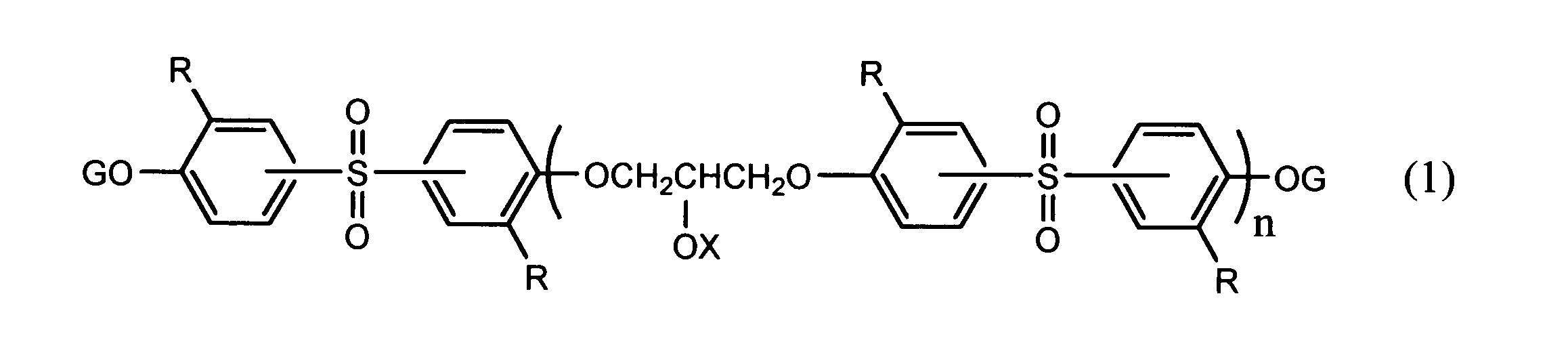
本発明のエポキシ樹脂は、アリル基の一部または全てをより反応性の高いプロペニル基に変換しており、その結果、硬化過程において、(アリル基は架橋しないのに対し)プロペニル基同士の反応がおこるため、架橋密度が上がり耐熱性(ガラス転移温度)が向上する。一方、エポキシ基の反応と異なり極性基が発生しないため、耐熱性向上に伴う吸水(湿)性の悪化が少なくて済む。
また前式(1)中、nは0~10が好ましく、特に0~5が好ましい。nの平均値は0~10であり、好ましくは0~5である。
また、溶融粘度は0.01~5Pa・s(ICI 溶融粘度 150℃ コーンプレート法)が好ましく、より好ましくは0.02~4Pa・sであり、特に0.02~3Pa・sであることが好ましい。粘度が小さすぎる場合、フィラー等の充填剤を多量に配合しても流動性が良い利点があり、一方でブロッキングの発生やタックがある。
まず上記(1)記載の本発明のエポキシ樹脂は下記式(2)

例えば前記式(2)の化合物とエピハロヒドリン類及び非プロトン性極性溶媒の混合物に水酸化ナトリウム、水酸化カリウムなどのアルカリ金属水酸化物の固体を一括または徐々に添加しながら20~70℃、好ましくは20~40℃で1~20時間反応させる。この場合のアルカリ金属水酸化物の使用量は前記式(2)の化合物の水酸基1当量に対し通常1.0~2.0モル、好ましくは1.0~1.8モルの範囲である。
通常、これらの反応物は水洗後、または水洗無しに加熱減圧下過剰のエピハロヒドリン類及び非プロトン性極性溶媒を除去した後、トルエン、キシレン、メチルイソブチルケトン等の溶媒に溶解し、水酸化ナトリウム、水酸化カリウムなどのアルカリ金属水酸化物の水溶液を加えて再び反応を行う。この場合アルカリ金属水酸化物の使用量は前記式(2)の化合物の水酸基1当量に対して通常0.01~0.2モル、好ましくは0.05~0.15モルである。反応温度は通常50~120℃、反応時間は通常0.5~2時間である。
反応終了後副生した塩をろ過、水洗などにより除去し、さらに加熱減圧下トルエン、キシレン、メチルイソブチルケトン等の溶媒を留去することにより、アリル基の一部または全部がプロペニル基に転換したエポキシ樹脂を得ることができる。
上記[2]の変性エポキシ樹脂(以下、変性エポキシ樹脂)は、一旦得られた上記式(1)のエポキシ樹脂を、ビスフェノール類と重合させることにより得ることができる。重合は、必要によりトルエン、キシレン、メチルイソブチルケトン等の溶媒に上記式(1)のエポキシ樹脂及びビスフェノール類を溶解し、水酸化ナトリウム、トリフェニルホスフィン、三級アンモニウム塩等の触媒を添加して加熱する事により行う。上記式(1)のエポキシ樹脂とビスフェノール類の使用比率は、通常エポキシ基が当量比で水酸基よりも多くなるように仕込む。
この場合に使用されるビスフェノール類としては、例えば、ビスフェノールA、ビスフェノールF、ビスフェノールAD、ビスフェノールZ、ビスフェノールS、テトラブロモビスフェノールA、テトラブロモビスフェノールF、ビフェノール、ジヒドロキシベンゼン、ジヒドロキシフェニルスルフィド、ジヒドロキシフェニルエーテル等が挙げられるがこれらに限定されることはない。また、これらは単独でも2種以上併用しても良い。
この反応に際しても、2級アルコール性水酸基が生成するが、この水酸基も前述のような方法によりその全てまたは一部をグリシジル化することができる。
また、フェノール類と前記のビスハロゲノメチルアラルキル誘導体またはアラルキルアルコール誘導体とを縮合反応させることにより得られるフェノールアラルキル樹脂を原料とし、エピクロルヒドリンと脱塩酸反応させることにより得られるエポキシ樹脂は、低吸湿性、難燃性、誘電特性に優れているためエポキシ樹脂として特に好ましい。
本発明のエポキシ樹脂組成物に配合し得るシアネートエステル化合物としては従来公知のシアネートエステル化合物を使用することができる。シアネートエステル化合物の具体例としては、フェノール類と各種アルデヒドとの重縮合物、フェノール類と各種ジエン化合物との重合物、フェノール類とケトン類との重縮合物及びビスフェノール類と各種アルデヒドの重縮合物などをハロゲン化シアンと反応させることにより得られるシアネートエステル化合物が挙げられるがこれらに限定されるものではない。これらは単独で用いてもよく2種以上を用いてもよい。
上記フェノール類としては、フェノール、アルキル置換フェノール、芳香族置換フェノール、ナフトール、アルキル置換ナフトール、ジヒドロキシベンゼン、アルキル置換ジヒドロキシベンゼン、ジヒドロキシナフタレン等が挙げられる。
上記各種アルデヒドとしては、ホルムアルデヒド、アセトアルデヒド、アルキルアルデヒド、ベンズアルデヒド、アルキル置換ベンズアルデヒド、ヒドロキシベンズアルデヒド、ナフトアルデヒド、グルタルアルデヒド、フタルアルデヒド、クロトンアルデヒド、シンナムアルデヒド等が挙げられる。
上記各種ジエン化合物としては、ジシクロペンタジエン、テルペン類、ビニルシクロヘキセン、ノルボルナジエン、ビニルノルボルネン、テトラヒドロインデン、ジビニルベンゼン、ジビニルビフェニル、ジイソプロペニルビフェニル、ブタジエン、イソプレン等が挙げられる。
上記ケトン類としてはアセトン、メチルエチルケトン、メチルイソブチルケトン、アセトフェノン、ベンゾフェノン等が挙げられる。
シアネートエステル樹脂の具体例としては、ジシアナートベンゼン、トリシアナートベンゼン、ジシアナートナフタレン、ジシアナートビフェニル、2、2’-ビス(4-シアナートフェニル)プロパン、ビス(4-シアナートフェニル)メタン、ビス(3,5-ジメチル-4-シアナートフェニル)メタン、2,2’-ビス(3,5-ジメチル-4-シアナートフェニル)プロパン、2,2’-ビス(4-シアナートフェニル)エタン、2,2’-ビス(4-シアナートフェニル)ヘキサフロロプロパン、ビス(4-シアナートフェニル)スルホン、ビス(4-シアナートフェニル)チオエーテル、フェノールノボラックシアナート、フェノール・ジシクロペンタジエン共縮合物の水酸基をシアネート基に変換したもの等が挙げられるがこれらに限定されるものではない。
また、日本国特開2004-041055号公報に合成方法が記載されているシアネートエステル化合物は、低吸湿性、難燃性、誘電特性に優れているためシアネートエステル化合物として特に好ましい。
本発明のエポキシ樹脂組成物に配合し得るマレイミド化合物としては従来公知のマレイミド化合物を使用することができる。マレイミド化合物の具体例としては、4,4´-ジフェニルメタンビスマレイミド、ポリフェニルメタンマレイミド、m-フェニレンビスマレイミド、2,2´-ビス〔4-(4-マレイミドフェノキシ)フェニル〕プロパン、3,3´-ジメチル-5,5´-ジエチル-4,4´-ジフェニルメタンビスマレイミド、4-メチル-1,3-フェニレンビスマレイミド、4,4´-ジフェニルエーテルビスマレイミド、4,4´-ジフェニルスルフォンビスマレイミド、1,3-ビス(3-マレイミドフェノキシ)ベンゼン、1,3-ビス(4-マレイミドフェノキシ)ベンゼンなどが挙げられるがこれらに限定されるものではない。これらは単独で用いてもよく、2種以上併用してもよい。マレイミド化合物の配合量は、重量比で本発明のエポキシ樹脂の好ましくは5倍以下、より好ましくは2倍以下の範囲である。
また、日本国特開2004-107501号公報(特許文献3)に記載されているマレイミド化合物は、低吸湿性、難燃性、誘電特性に優れているためマレイミド化合物として特に好ましい。
また、前記ワニスを、強化繊維に含浸させて加熱乾燥させることによりプリプレグを得ることもできる。
上記のプリプレグを所望の形に裁断、必要により銅箔などと積層後、積層物にプレス成形法やオートクレーブ成形法、シートワインディング成形法などで圧力をかけながら硬化性樹脂組成物を加熱硬化させることにより電気電子用積層板(プリント配線板)や、炭素繊維強化材を得ることができる。
エポキシ当量:JIS K-7236に準じた方法で測定。
溶融粘度:150℃におけるコーンプレート法における溶融粘度。
軟化点:JIS K-7234に準じた方法で測定。
全R中のプロペニル基の割合:NMRにより測定。
2,2’-ジアリル-4,4’-スルホニルジフェノール(日本化薬(株)製 TG-SH)165重量部、メタノール200重量部を反応容器に仕込み、撹拌、溶解後、粒状の水酸化カリウム(純度85%)105重量部添加した。添加後、加熱しながらメタノールを留去し、内温を100℃に保持しながら4時間反応を行った。塩酸で中和を行った後、メチルイソブチルケトンを330重量部加え、水洗を繰り返した。ついで油層から加熱減圧下においてメチルイソブチルケトンを留去することにより、2,2’-ジプロペニル-4,4’-スルホニルジフェノールを161重量部得た。得られた2,2’-ジプロペニル-4,4’-スルホニルジフェノールの軟化点は81℃であった。
参考例1で得られた2,2’-ジプロペニル-4,4’-スルホニルジフェノール165重量部、エピクロルヒドリン510重量部、ジメチルスルホキシド130重量部を反応容器に仕込み、加熱、撹拌、溶解後、温度を45℃に保持しながら、フレーク状水酸化ナトリウム41重量部を1.5時間かけて連続的に添加した。水酸化ナトリウム添加完了後、45℃で2時間、70℃で1時間反応を行った。ついで加熱減圧下において過剰のエピクロルヒドリンとジメチルスルホキシドを留去し、残留物に330重量部のメチルイソブチルケトンを添加し残留物を溶解させた。このメチルイソブチルケトン溶液から水洗によって副生塩を除去した後、30%水酸化ナトリウム水溶液10重量部を添加し、70℃で1時間反応させた後、反応液の水洗を洗浄液が中性となるまで繰り返した。ついで油層から加熱減圧下においてメチルイソブチルケトンを留去することにより本発明のエポキシ樹脂(E1)207重量部を得た。得られたエポキシ樹脂(E1)のエポキシ当量は236g/eq、軟化点64℃、溶融粘度0.09Pa・s、式(1)における全R中のプロペニル基の割合は100%であった。
実施例1において、2,2’-ジプロペニル-4,4’-スルホニルジフェノール165重量部を17重量部に変え、更に2,2’-ジアリル-4,4’-スルホニルジフェノール148重量部を加えた以外は同様の操作を行ったところ、本発明のエポキシ樹脂(E2)204重量部を得た。得られたエポキシ樹脂(E2)のエポキシ当量は237g/eq、室温で高粘調な液状、式(1)における全R中のプロペニル基の割合は11%であった。
実施例1において、2,2’-ジプロペニル-4,4’-スルホニルジフェノール165重量部を107重量部に変え、更に2,2’-ジアリル-4,4’-スルホニルジフェノール58重量部を加えた以外は同様の操作を行ったところ、本発明のエポキシ樹脂(E3)200重量部を得た。得られたエポキシ樹脂(E3)のエポキシ当量は243g/eq、軟化点56℃、式(1)における全R中のプロペニル基の割合は67%であった。
実施例1において、2,2’-ジプロペニル-4,4’-スルホニルジフェノール165重量部を135重量部に変え、更に2,2’-ジアリル-4,4’-スルホニルジフェノール30重量部を加えた以外は同様の操作を行ったところ、エポキシ樹脂(E4)203重量部を得た。得られたエポキシ樹脂(E4)のエポキシ当量は239g/eq、軟化点64℃、式(1)における全R中のプロペニル基の割合は85%であった。
実施例1において、2,2’-ジプロペニル-4,4’-スルホニルジフェノール165重量部を2,2’-ジアリル-4,4’-スルホニルジフェノール165重量部に変えた以外は同様の操作を行ったところ、エポキシ樹脂(ER2)200重量部を得た。得られたエポキシ樹脂(ER2)のエポキシ当量は224g/eq、室温で半固形であった。式(1)における全R中のプロペニル基の割合は10%未満であった。
各種成分を下記表1の割合で配合し、ミキシングロールで混練、タブレット化後、トランスファー成形で樹脂成形体を調製し、160℃で2時間、更に180℃で8時間硬化させ、硬化物の物性を測定した。
・ガラス転位温度(TMA):真空理工(株)製 TM-7000
昇温速度 2℃/min
・吸水率:直径5cm×厚み4mmの円盤状の試験片を100℃の水中で24時間煮沸した前後の重量増加率(%)

C1:2-エチル-4-メチルイミダゾール(東京化成工業株式会社製)
R1:ジクミルパーオキサイド(化薬アクゾ株式会社製)
ER1:ジグリシジルビスフェノールA(三菱化学株式会社製 jER-1001)
各種成分を下記表2の割合で配合し、ミキシングロールで混練、タブレット化後、トランスファー成形で樹脂成形体を調製し、160℃で2時間、更に180℃で6時間硬化させ、硬化物の物性を測定した。
・動的粘弾性測定
測定項目:30℃での貯蔵弾性率
:ガラス転移温度(tanδ最大時の温度)
・曲げ弾性試験
測定項目:弾性率
JIS K 6911に準拠 室温でテストを行った。
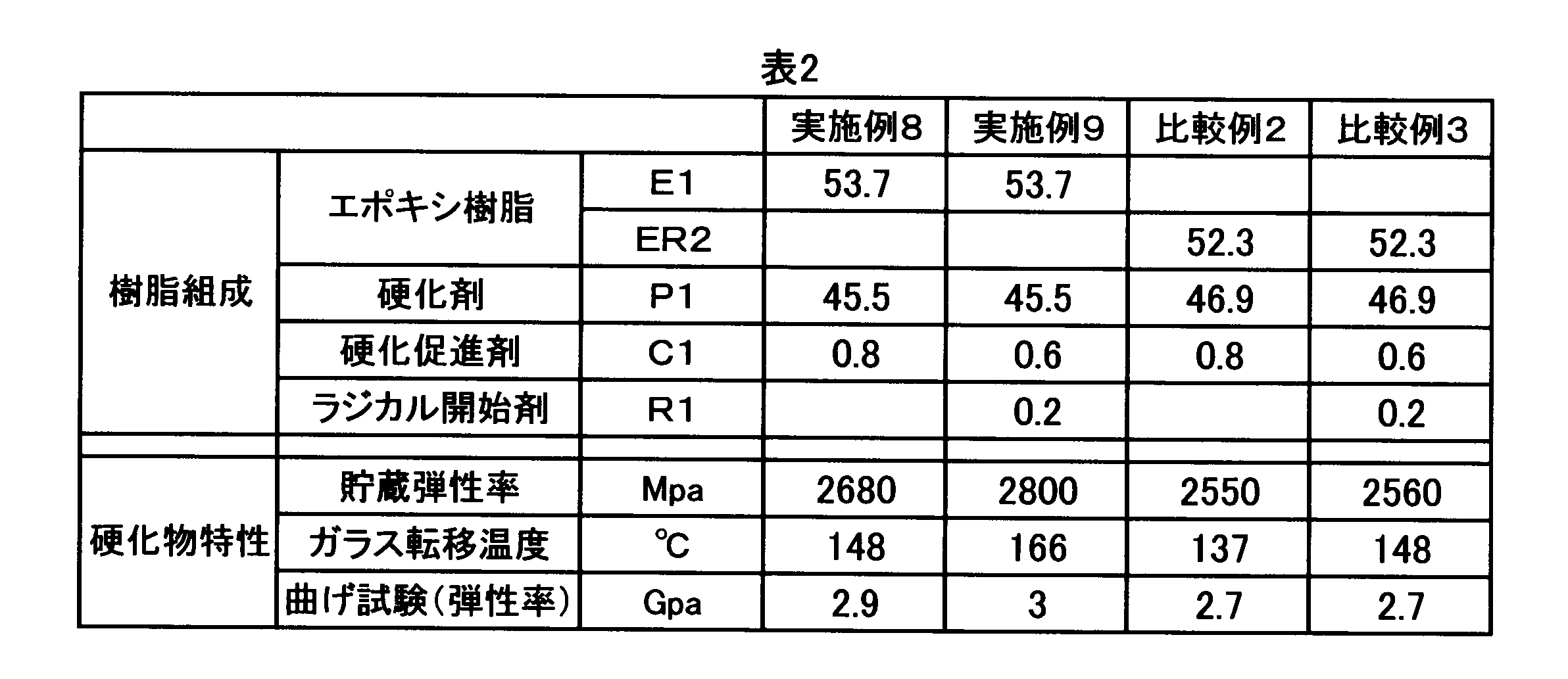
また表2から、本発明のプロペニル基を含有するエポキシ樹脂を用いた硬化物は、プロペニル基のない比較例のエポキシ樹脂を用いた硬化物と比較して、優れた耐熱性(ガラス転移温度)、強度(弾性率)を示すことが確認できる。また、ラジカル開始剤を用いて硬化させると、更に高い耐熱性、強度の硬化物が得られることが確認できる。
なお、本出願は、2015年8月7日付で出願された日本国特許出願(特願2015-156589)に基づいており、その全体が引用により援用される。また、ここに引用されるすべての参照は全体として取り込まれる。
Claims (7)
- 下記式(1)

- 請求項1記載のエポキシ樹脂とビスフェノール類とを重合した変性エポキシ樹脂。
- 請求項1記載のエポキシ樹脂または請求項2記載の変性エポキシ樹脂を含有するエポキシ樹脂組成物。
- 硬化剤を含有する請求項3に記載のエポキシ樹脂組成物。
- 硬化促進剤を含有する請求項3又は請求項4に記載のエポキシ樹脂組成物。
- ラジカル重合開始剤を含有する請求項3~請求項5のいずれか一項に記載のエポキシ樹脂組成物。
- 請求項3~請求項6のいずれか一項に記載のエポキシ樹脂組成物を硬化した硬化物。
Priority Applications (3)
| Application Number | Priority Date | Filing Date | Title |
|---|---|---|---|
| KR1020177034940A KR20180038415A (ko) | 2015-08-07 | 2016-08-05 | 에폭시 수지, 변성 에폭시 수지, 에폭시 수지 조성물 및 그 경화물 |
| CN201680040742.4A CN107849221A (zh) | 2015-08-07 | 2016-08-05 | 环氧树脂、改性环氧树脂、环氧树脂组成物及其硬化物 |
| JP2017534411A JP6715249B2 (ja) | 2015-08-07 | 2016-08-05 | エポキシ樹脂、変性エポキシ樹脂、エポキシ樹脂組成物およびその硬化物 |
Applications Claiming Priority (2)
| Application Number | Priority Date | Filing Date | Title |
|---|---|---|---|
| JP2015156589 | 2015-08-07 | ||
| JP2015-156589 | 2015-08-07 |
Publications (1)
| Publication Number | Publication Date |
|---|---|
| WO2017026396A1 true WO2017026396A1 (ja) | 2017-02-16 |
Family
ID=57983535
Family Applications (1)
| Application Number | Title | Priority Date | Filing Date |
|---|---|---|---|
| PCT/JP2016/073104 Ceased WO2017026396A1 (ja) | 2015-08-07 | 2016-08-05 | エポキシ樹脂、変性エポキシ樹脂、エポキシ樹脂組成物およびその硬化物 |
Country Status (5)
| Country | Link |
|---|---|
| JP (1) | JP6715249B2 (ja) |
| KR (1) | KR20180038415A (ja) |
| CN (1) | CN107849221A (ja) |
| TW (1) | TW201712068A (ja) |
| WO (1) | WO2017026396A1 (ja) |
Cited By (2)
| Publication number | Priority date | Publication date | Assignee | Title |
|---|---|---|---|---|
| JP2022008158A (ja) * | 2020-06-24 | 2022-01-13 | Jnc株式会社 | エポキシ樹脂組成物、電子部品用組成物、電子部品用材料 |
| CN118772374A (zh) * | 2024-07-24 | 2024-10-15 | 威海永轩新材料有限公司 | 一种中温固化耐高温低介电环氧树脂的制备方法和应用 |
Families Citing this family (2)
| Publication number | Priority date | Publication date | Assignee | Title |
|---|---|---|---|---|
| CN116239835B (zh) * | 2023-05-11 | 2023-07-25 | 江苏佳润管业有限公司 | 一种高强度聚乙烯给水管及其制备方法 |
| CN117680928A (zh) * | 2023-11-30 | 2024-03-12 | 常熟市淼泉铸造有限公司 | 一种防水密封性光伏真空泵壳体制作方法 |
Citations (4)
| Publication number | Priority date | Publication date | Assignee | Title |
|---|---|---|---|---|
| JPS54116096A (en) * | 1978-01-20 | 1979-09-10 | Ciba Geigy Ag | Polymerizable composition |
| JPS63142019A (ja) * | 1986-12-02 | 1988-06-14 | チバーガイギー アクチエンゲゼルシヤフト | 多官能価エポキシド樹脂 |
| JPH02621A (ja) * | 1987-11-06 | 1990-01-05 | Shell Internatl Res Maatschappij Bv | 2,2−ビス−〔3−(アリルもしくはプロペニル)−4−ヒドロキシフエニル〕化合物のグリシジルエーテルおよびそれから得られる樹脂 |
| JP2004107501A (ja) * | 2002-09-19 | 2004-04-08 | Nippon Kayaku Co Ltd | エポキシ樹脂、エポキシ樹脂組成物及びその硬化物 |
-
2016
- 2016-08-05 TW TW105124870A patent/TW201712068A/zh unknown
- 2016-08-05 KR KR1020177034940A patent/KR20180038415A/ko not_active Withdrawn
- 2016-08-05 CN CN201680040742.4A patent/CN107849221A/zh active Pending
- 2016-08-05 JP JP2017534411A patent/JP6715249B2/ja active Active
- 2016-08-05 WO PCT/JP2016/073104 patent/WO2017026396A1/ja not_active Ceased
Patent Citations (4)
| Publication number | Priority date | Publication date | Assignee | Title |
|---|---|---|---|---|
| JPS54116096A (en) * | 1978-01-20 | 1979-09-10 | Ciba Geigy Ag | Polymerizable composition |
| JPS63142019A (ja) * | 1986-12-02 | 1988-06-14 | チバーガイギー アクチエンゲゼルシヤフト | 多官能価エポキシド樹脂 |
| JPH02621A (ja) * | 1987-11-06 | 1990-01-05 | Shell Internatl Res Maatschappij Bv | 2,2−ビス−〔3−(アリルもしくはプロペニル)−4−ヒドロキシフエニル〕化合物のグリシジルエーテルおよびそれから得られる樹脂 |
| JP2004107501A (ja) * | 2002-09-19 | 2004-04-08 | Nippon Kayaku Co Ltd | エポキシ樹脂、エポキシ樹脂組成物及びその硬化物 |
Cited By (3)
| Publication number | Priority date | Publication date | Assignee | Title |
|---|---|---|---|---|
| JP2022008158A (ja) * | 2020-06-24 | 2022-01-13 | Jnc株式会社 | エポキシ樹脂組成物、電子部品用組成物、電子部品用材料 |
| JP7725880B2 (ja) | 2020-06-24 | 2025-08-20 | Jnc株式会社 | エポキシ樹脂組成物、電子部品用組成物、電子部品用材料 |
| CN118772374A (zh) * | 2024-07-24 | 2024-10-15 | 威海永轩新材料有限公司 | 一种中温固化耐高温低介电环氧树脂的制备方法和应用 |
Also Published As
| Publication number | Publication date |
|---|---|
| JP6715249B2 (ja) | 2020-07-01 |
| JPWO2017026396A1 (ja) | 2018-06-07 |
| CN107849221A (zh) | 2018-03-27 |
| TW201712068A (zh) | 2017-04-01 |
| KR20180038415A (ko) | 2018-04-16 |
Similar Documents
| Publication | Publication Date | Title |
|---|---|---|
| KR102760030B1 (ko) | 말레이미드 수지, 경화성 수지 조성물 및 그 경화물 | |
| JP5030297B2 (ja) | 積層板用樹脂組成物、プリプレグ及び積層板 | |
| KR102761584B1 (ko) | 말레이미드 수지, 경화성 수지 조성물 및 그 경화물 | |
| JP6429862B2 (ja) | 芳香族アミン樹脂、マレイミド樹脂、硬化性樹脂組成物およびその硬化物 | |
| TWI425019B (zh) | Liquid epoxy resin, epoxy resin composition and hardened product | |
| CN101522747B (zh) | 变性液性环氧树脂、以及使用该树脂的环氧树脂组成物及其硬化物 | |
| JP6715249B2 (ja) | エポキシ樹脂、変性エポキシ樹脂、エポキシ樹脂組成物およびその硬化物 | |
| KR102728399B1 (ko) | 알케닐기 함유 화합물, 경화성 수지 조성물 및 그 경화물 | |
| JP6963565B2 (ja) | アルケニル基含有樹脂、硬化性樹脂組成物およびその硬化物 | |
| WO2023013092A1 (ja) | エポキシ樹脂混合物、エポキシ樹脂組成物およびその硬化物 | |
| JP7185383B2 (ja) | 硬化性樹脂組成物およびその硬化物 | |
| JP4259834B2 (ja) | エポキシ樹脂、エポキシ樹脂組成物及びその硬化物 | |
| WO2019198607A1 (ja) | アルケニル基含有化合物、硬化性樹脂組成物及びその硬化物 | |
| KR102890723B1 (ko) | 에폭시 수지, 경화성 수지 조성물 및 그 경화물 | |
| JP5170724B2 (ja) | エポキシ樹脂、エポキシ樹脂組成物及びその硬化物 | |
| JP7464474B2 (ja) | マレイミド樹脂、硬化性樹脂組成物およびその硬化物 | |
| TWI754743B (zh) | 含甲基烯丙基之樹脂、硬化性樹脂組成物及其硬化物 | |
| KR102787186B1 (ko) | 에폭시 수지, 경화성 수지 조성물, 및 그 경화물 | |
| KR102827934B1 (ko) | 에폭시 수지 및 그 제조 방법, 경화성 수지 조성물, 및 그 경화물 | |
| JP5131961B2 (ja) | エポキシ樹脂、エポキシ樹脂組成物、およびその硬化物 | |
| JP4033449B2 (ja) | エポキシ樹脂及びその製造方法 | |
| JP2025118710A (ja) | エポキシ樹脂、硬化性樹脂組成物、およびその硬化物 | |
| JP2024054289A (ja) | フェノール樹脂、エポキシ樹脂、エポキシ樹脂組成物およびその硬化物 | |
| JP2007045978A (ja) | エポキシ樹脂、エポキシ樹脂組成物、およびその硬化物 |
Legal Events
| Date | Code | Title | Description |
|---|---|---|---|
| 121 | Ep: the epo has been informed by wipo that ep was designated in this application |
Ref document number: 16835093 Country of ref document: EP Kind code of ref document: A1 |
|
| ENP | Entry into the national phase |
Ref document number: 2017534411 Country of ref document: JP Kind code of ref document: A |
|
| ENP | Entry into the national phase |
Ref document number: 20177034940 Country of ref document: KR Kind code of ref document: A |
|
| NENP | Non-entry into the national phase |
Ref country code: DE |
|
| 122 | Ep: pct application non-entry in european phase |
Ref document number: 16835093 Country of ref document: EP Kind code of ref document: A1 |