WO2017010357A1 - 熱可塑性樹脂組成物からなるフィルムの製造方法 - Google Patents
熱可塑性樹脂組成物からなるフィルムの製造方法 Download PDFInfo
- Publication number
- WO2017010357A1 WO2017010357A1 PCT/JP2016/069941 JP2016069941W WO2017010357A1 WO 2017010357 A1 WO2017010357 A1 WO 2017010357A1 JP 2016069941 W JP2016069941 W JP 2016069941W WO 2017010357 A1 WO2017010357 A1 WO 2017010357A1
- Authority
- WO
- WIPO (PCT)
- Prior art keywords
- ethylene
- screw
- vinyl alcohol
- die
- polyamide
- Prior art date
- Legal status (The legal status is an assumption and is not a legal conclusion. Google has not performed a legal analysis and makes no representation as to the accuracy of the status listed.)
- Ceased
Links
Classifications
-
- C—CHEMISTRY; METALLURGY
- C08—ORGANIC MACROMOLECULAR COMPOUNDS; THEIR PREPARATION OR CHEMICAL WORKING-UP; COMPOSITIONS BASED THEREON
- C08L—COMPOSITIONS OF MACROMOLECULAR COMPOUNDS
- C08L77/00—Compositions of polyamides obtained by reactions forming a carboxylic amide link in the main chain; Compositions of derivatives of such polymers
-
- B—PERFORMING OPERATIONS; TRANSPORTING
- B29—WORKING OF PLASTICS; WORKING OF SUBSTANCES IN A PLASTIC STATE IN GENERAL
- B29C—SHAPING OR JOINING OF PLASTICS; SHAPING OF MATERIAL IN A PLASTIC STATE, NOT OTHERWISE PROVIDED FOR; AFTER-TREATMENT OF THE SHAPED PRODUCTS, e.g. REPAIRING
- B29C48/00—Extrusion moulding, i.e. expressing the moulding material through a die or nozzle which imparts the desired form; Apparatus therefor
- B29C48/25—Component parts, details or accessories; Auxiliary operations
- B29C48/92—Measuring, controlling or regulating
-
- C—CHEMISTRY; METALLURGY
- C08—ORGANIC MACROMOLECULAR COMPOUNDS; THEIR PREPARATION OR CHEMICAL WORKING-UP; COMPOSITIONS BASED THEREON
- C08J—WORKING-UP; GENERAL PROCESSES OF COMPOUNDING; AFTER-TREATMENT NOT COVERED BY SUBCLASSES C08B, C08C, C08F, C08G or C08H
- C08J5/00—Manufacture of articles or shaped materials containing macromolecular substances
- C08J5/20—Manufacture of shaped structures of ion-exchange resins
- C08J5/22—Films, membranes or diaphragms
-
- C—CHEMISTRY; METALLURGY
- C08—ORGANIC MACROMOLECULAR COMPOUNDS; THEIR PREPARATION OR CHEMICAL WORKING-UP; COMPOSITIONS BASED THEREON
- C08L—COMPOSITIONS OF MACROMOLECULAR COMPOUNDS
- C08L29/00—Compositions of homopolymers or copolymers of compounds having one or more unsaturated aliphatic radicals, each having only one carbon-to-carbon double bond, and at least one being terminated by an alcohol, ether, aldehydo, ketonic, acetal or ketal radical; Compositions of hydrolysed polymers of esters of unsaturated alcohols with saturated carboxylic acids; Compositions of derivatives of such polymers
- C08L29/02—Homopolymers or copolymers of unsaturated alcohols
- C08L29/04—Polyvinyl alcohol; Partially hydrolysed homopolymers or copolymers of esters of unsaturated alcohols with saturated carboxylic acids
Definitions
- the present invention relates to a method for producing a film comprising a thermoplastic resin composition. More specifically, the present invention relates to a method for producing a film comprising a thermoplastic resin composition containing an ethylene-vinyl alcohol copolymer and polyamide.
- 2012-72306 discloses a method in which a polyamide and an elastomer are first melt-kneaded and then an ethylene-vinyl alcohol copolymer is added and further melt-kneaded. This method suppresses the generation of gel particles due to the reaction between the ethylene-vinyl alcohol copolymer and the polyamide by shortening the time during which the ethylene-vinyl alcohol copolymer and the polyamide are simultaneously melt-kneaded.
- JP 2012-72306 A as a more specific embodiment, a biaxial kneader having two supply ports is used, and polyamide pellets and rubber compound pellets are provided at the upstream supply port of the biaxial kneader. Then, ethylene-vinyl alcohol copolymer pellets are supplied to the supply port on the downstream side of the twin-screw kneader, melt-kneaded to prepare thermoplastic resin composition pellets, which are put into an inflation molding apparatus. An example of supplying and producing a film is described. The inflation molding apparatus was one in which an inflation die was attached to the discharge port of a single screw extruder.
- the present invention provides a method for producing a film comprising a thermoplastic resin composition containing an ethylene-vinyl alcohol copolymer and a polyamide, further suppressing the generation of gel particles due to the reaction between the ethylene-vinyl alcohol copolymer and the polyamide. Let it be an issue.
- the present inventor reduces the heat history applied to the ethylene-vinyl alcohol copolymer and the polyamide to suppress the reaction, It has been found that the generation of gel particles can be further suppressed by removing the process that tends to stay, and the present invention has been completed.
- the present invention relates to a method for producing a film comprising a thermoplastic resin composition containing an ethylene-vinyl alcohol copolymer and a polyamide, the method comprising a biaxial kneading extrusion in which an inflation die or a T die is connected to a discharge port
- the ethylene-vinyl alcohol copolymer and polyamide are put into a cylinder of a twin-screw kneading extruder using a machine, the ethylene-vinyl alcohol copolymer and polyamide are melt-kneaded, and the kneaded product is taken from an inflation die or a T die.
- the time from when the ethylene-vinyl alcohol copolymer and polyamide are charged into the cylinder of the twin-screw kneading extruder until the kneaded material is discharged from the inflation die or T die is 1.5 to 6 .5 minutes.
- a method for producing a film comprising a thermoplastic resin composition containing an ethylene-vinyl alcohol copolymer and polyamide, the method comprising a twin-screw kneading extruder in which an inflation die or a T die is connected to a discharge port
- the ethylene-vinyl alcohol copolymer and polyamide into the cylinder of the twin-screw kneading extruder, melt-kneading the ethylene-vinyl alcohol copolymer and polyamide, and discharging the kneaded material from the inflation die or T-die.
- thermoplastic resin composition The time from when the ethylene-vinyl alcohol copolymer and the polyamide are charged into the cylinder of the twin-screw kneading extruder to when the kneaded material is discharged from the inflation die or T die is 1.5 to 6.
- a method for producing a film comprising a thermoplastic resin composition wherein the film is 5 minutes.
- the thermoplastic resin composition further comprises 20 parts by mass or more of an elastomer with respect to 100 parts by mass of the total amount of the ethylene-vinyl alcohol copolymer and the polyamide.
- a method for producing a film comprising a thermoplastic resin composition A method for producing a film comprising a thermoplastic resin composition.
- thermoplastic resin composition according to [2], wherein the elastomer is an acid-modified polyolefin elastomer.
- the effective screw length L is 400 mm or more and less than 5000 mm, and the screw rotation speed during melt-kneading is 50 rpm or more and less than 300 rpm.
- a method for producing a film comprising the composition [6]
- the screw of the twin-screw kneading extruder has at least two kneading zones, and the total length in the extrusion direction of the kneading zone is 15 to 40% of the effective screw length [1] ]
- thermoplastic resin composition of the present invention According to the method for producing a film comprising the thermoplastic resin composition of the present invention, the generation of gel particles due to the reaction between the ethylene-vinyl alcohol copolymer and the polyamide can be suppressed, and a film with few defects can be obtained. .
- the present invention relates to a method for producing a film comprising a thermoplastic resin composition containing an ethylene-vinyl alcohol copolymer and a polyamide, the method comprising a biaxial kneading extrusion in which an inflation die or a T die is connected to a discharge port
- the ethylene-vinyl alcohol copolymer and polyamide are put into a cylinder of a twin-screw kneading extruder using a machine, the ethylene-vinyl alcohol copolymer and polyamide are melt-kneaded, and the kneaded product is taken from an inflation die or a T die.
- the time from when the ethylene-vinyl alcohol copolymer and polyamide are charged into the cylinder of the twin-screw kneading extruder until the kneaded material is discharged from the inflation die or T die is 1.5 minutes or more It is 6.5 minutes or less.
- the twin-screw kneading extruder used in the present invention comprises a cylinder, two screws installed in the cylinder, a raw material inlet, and a kneaded product outlet, and is a flow-type thermoplastic resin composition.
- a cylinder two screws installed in the cylinder
- a raw material inlet a raw material inlet
- a flow-type thermoplastic resin composition e.g., a flow-type thermoplastic resin composition
- melt-knead for example, the type
- the ratio L / D between the screw effective length L and the screw diameter D is preferably 15 or more and less than 70, more preferably 20 or more and less than 60, and further preferably 30 or more and less than 50. . If L / D is too low, the degree of freedom in screw design is reduced, so that a sufficient kneading zone cannot be obtained, and it becomes difficult to uniformly disperse the ethylene-vinyl alcohol copolymer and polyamide. Moreover, when L / D is too high, it is expected that there is no technical problem, but the twin-screw kneader becomes expensive, which is not preferable in terms of versatility and cost.
- the screw effective length L is preferably 400 mm or more and less than 5000 mm, more preferably 800 mm or more and less than 4000 mm, and still more preferably 1000 mm or more and less than 3500 mm.
- the screw rotation speed during melt kneading is preferably 50 rpm or more and less than 300 rpm, more preferably 60 rpm or more and less than 250 rpm, and further preferably 70 rpm or more and less than 200 rpm. If the screw effective length L is too short or the screw rotation speed is too high, a sufficient residence time cannot be obtained, and the ethylene-vinyl alcohol copolymer and the polyamide will not be mixed uniformly. If the effective screw length is too long or the screw rotation speed is too low, the residence time becomes long, and gel particles are likely to be generated due to an excessive reaction between the ethylene-vinyl alcohol copolymer and the polyamide.
- the screw of the twin-screw kneading extruder has at least two kneading zones.
- the total length in the extrusion direction of the kneading zone is preferably 15 to 40% of the effective screw length, more preferably 18 to 35% of the effective screw length, and further preferably 20 to 30% of the effective screw length. %.
- the ethylene-vinyl alcohol copolymer and the polyamide will not be mixed uniformly, resulting in poorly dispersed particles, and if it is too long, heat generation due to shearing will increase, and ethylene-vinyl alcohol will increase.
- the copolymer and polyamide are likely to react excessively, and gel particles are likely to be generated.
- an inflation die or a T die is connected to the discharge port.
- the inflation die is not particularly limited as long as it is an extrusion die used for so-called inflation molding, and general ones can be used.
- the diameter of the die, the lip gap, etc. are appropriately selected according to the film to be produced. can do.
- inflation molding refers to extruding molten resin in a cylindrical shape from an annular extrusion die, and expanding the cylindrical molten resin by applying a light internal pressure while the molten resin is still in a molten state, It is a molding method for producing a resin film by cooling, flattening with a guide roll, and winding up as it is.
- the diameter of the inflation die, the lip gap, and the like can be appropriately selected according to the film to be manufactured.
- the T die is not particularly limited as long as it is a die having parallel slits (slots) for extruding the film, and general ones can be used.
- the length and width of the slit of the T die are manufactured. It can select suitably according to the film to perform.
- the inflation die or the T die is directly connected to the discharge port of the twin-screw kneading extruder. Since it is preferable to minimize the time during which the ethylene-vinyl alcohol copolymer and polyamide are subjected to the heat history, the distance from the discharge port of the twin-screw kneading extruder to the discharge port of the inflation die or T die should be as short as possible. It is preferable to connect a twin-screw kneading extruder and an inflation die or a T die.
- an ethylene-vinyl alcohol copolymer and polyamide are charged into a cylinder of a twin screw kneading extruder using a twin screw kneading extruder having an inflation die or a T die connected to a discharge port.
- the time (hereinafter also referred to as “residence time”) from when the ethylene-vinyl alcohol copolymer and polyamide are charged into the cylinder of the twin-screw kneading extruder to when the kneaded material is discharged from the inflation die or T-die.
- the time is 1.5 to 6.5 minutes, preferably 2.0 to 6.0 minutes, and more preferably 2.5 to 5.0 minutes. If the residence time is too short, the ethylene-vinyl alcohol copolymer and the polyamide are not mixed uniformly, and poorly dispersed particles are likely to be produced. If the residence time is too long, gel particles are likely to be generated.
- the residence time here means the time after both the ethylene-vinyl alcohol copolymer and the polyamide are put into the cylinder of the twin-screw kneading extruder. That is, when ethylene-vinyl alcohol copolymer and polyamide are simultaneously fed into the cylinder of a twin-screw kneading extruder, this is the time from when the kneaded product is discharged from the inflation die or T die.
- the twin-screw kneading extruder has two or more raw material inlets and the ethylene-vinyl alcohol copolymer and the polyamide are charged into separate inlets
- the ethylene-vinyl alcohol copolymer is first When the polyamide is introduced (to the upstream inlet) and the polyamide is introduced later (to the downstream inlet), the polyamide is introduced into the cylinder and then the kneaded material is discharged from the inflation die or the T die.
- the polyamide is charged first (upstream inlet) and the ethylene-vinyl alcohol copolymer is later (downstream downstream). Inlet) when it is turned on, an ethylene - the time from vinyl alcohol copolymer is put into the cylinder until the kneaded material is discharged from an inflation die or T-die.
- the temperature in the cylinder of the twin-screw kneading extruder (hereinafter also referred to as “kneading temperature”) is not particularly limited as long as it is a temperature at which the ethylene-vinyl alcohol copolymer and polyamide can be melt-kneaded, but preferably 160 to 260. ° C, more preferably 170 to 250 ° C, still more preferably 180 to 240 ° C. If the kneading temperature is too low, poor dispersion due to the unmelted resin occurs. If the kneading temperature is too high, the ethylene-vinyl alcohol copolymer and the polyamide easily react excessively, and gel particles are likely to be generated.
- the ethylene-vinyl alcohol copolymer (hereinafter also referred to as “EVOH”) used in the present invention is composed of an ethylene unit (—CH 2 CH 2 —) and a vinyl alcohol unit (—CH 2 —CH (OH) —).
- EVOH ethylene-vinyl alcohol copolymer
- the copolymer may contain other structural units as long as the effects of the present invention are not impaired.
- the ethylene-vinyl alcohol copolymer used in the present invention has an ethylene unit content, that is, an ethylene composition ratio of preferably 32 to 48 mol%, more preferably 38 to 48 mol%.
- the ethylene-vinyl alcohol copolymer is a saponified product of an ethylene-vinyl acetate copolymer, and the saponification degree is preferably 90% or more, more preferably 98% or more. If the saponification degree of the ethylene-vinyl alcohol copolymer is too small, the gas barrier property is lowered and the thermal stability is also lowered.
- the ethylene-vinyl alcohol copolymer is commercially available, for example, under the product name “EVAL” (registered trademark) from Kuraray Co., Ltd. and under the product name “SOANOL” (registered trademark) from Nippon Synthetic Chemical Industry Co., Ltd. It can be obtained.
- EVAL registered trademark
- SOANOL registered trademark
- ethylene-vinyl alcohol copolymer having an ethylene composition ratio of 32 to 48 mol% and a saponification degree of 90% or more “EVAL” (registered trademark) H171B manufactured by Kuraray Co., Ltd.
- the polyamide used in the present invention is not limited, but is preferably nylon 11, nylon 12, nylon 6, nylon 66, nylon 6/66 copolymer, nylon 6/12 copolymer, nylon MXD6 and It is at least one selected from the group consisting of nylon 6/66/12, nylon 4/6, nylon 9T, nylon 6T and nylon 6/10.
- nylon 6, nylon 6/66 copolymer, and nylon 6/12 copolymer are preferable in terms of both durability and gas barrier properties.
- the blending ratio of the ethylene-vinyl alcohol copolymer and the polyamide is not particularly limited, but the ratio of the ethylene-vinyl alcohol copolymer to the total mass of the ethylene-vinyl alcohol copolymer and the polyamide is preferably 95 to 30% by mass. More preferably, it is 90 to 40% by mass, and further preferably 80 to 50% by mass. If the proportion of the ethylene-vinyl alcohol copolymer is too low, sufficient gas barrier properties cannot be obtained, and if the proportion of the ethylene-vinyl alcohol copolymer is too high, flexibility and durability are poor.
- the thermoplastic resin composition can further contain an elastomer.
- Including an elastomer has the advantage of increased flexibility and durability.
- elastomers include diene rubbers and hydrogenated products thereof (for example, natural rubber (NR), isoprene rubber (IR), styrene butadiene rubber (SBR), butadiene rubber (BR), acrylonitrile / butadiene rubber (NBR)), Olefin rubber (for example, ethylene propylene rubber (EPDM, EPM), butyl rubber (IIR), etc.), acrylic rubber (ACM), halogen-containing rubber (for example, Br-IIR, Cl-IIR, halogenated isoolefin-paraalkylstyrene) Copolymer), silicone rubber (for example, methyl vinyl silicone rubber, dimethyl silicone rubber, etc.), sulfur-containing rubber (for example, polysulfide rubber), fluorine rubber (for example, vinylidene fluoride rubber, fluorine-containing vinyl
- preferred elastomers are acid-modified polyolefin elastomers, modified rubbers having acid anhydride groups or epoxy groups, and halogenated isoolefin-paraalkylstyrene copolymers (for example, brominated isobutylene-p-methylstyrene copolymers).
- acid-modified polyolefin elastomer include maleic anhydride-modified ethylene- ⁇ -olefin copolymer elastomer, and more specifically, maleic anhydride-modified ethylene-propylene copolymer elastomer, maleic anhydride-modified ethylene-butene copolymer elastomer.
- the amount of the elastomer is preferably 20 parts by mass or more, more preferably 50 parts by mass with respect to 100 parts by mass of the total amount of the ethylene-vinyl alcohol copolymer and the polyamide. Is 220 parts by mass, more preferably 80-200 parts by mass. If the blending amount of the elastomer is too small, the effect of improving flexibility and durability is not sufficient, and if the blending amount of the elastomer is too large, the fluidity at the time of melting is lowered and film formation becomes difficult.
- the thermoplastic resin composition contains an elastomer
- the ethylene-vinyl alcohol copolymer and polyamide may constitute a matrix phase and the elastomer may constitute a dispersed phase to form a sea-island structure. It is preferable to form a sea-island structure.
- thermoplastic resin composition used in the present invention may contain a resin other than an ethylene-vinyl alcohol copolymer and polyamide, an elastomer, and various additives as long as the effects of the present invention are not impaired.
- Additives include plasticizers, processing aids (metal soaps, etc.), cross-linking agents, cross-linking accelerators, cross-linking accelerators, reinforcing agents (fillers), scorch inhibitors, anti-aging agents, peptizers, organic modifiers.
- a quality agent, a softening agent, a tackifier, etc. can be mentioned.
- the film made of the thermoplastic resin composition produced by the method of the present invention is excellent in gas barrier properties and durability, it can be suitably used as an inner liner of a pneumatic tire.
- Nylon 6/12 “UBE nylon” 7024B manufactured by Ube Industries, Ltd.
- Nylon 6 “UBE nylon” 1013B manufactured by Ube Industries, Ltd.
- Nylon 6/66 “UBE nylon” 5033B manufactured by Ube Industries, Ltd.
- TAFMER registered trademark
- MH7020 maleic anhydride modified ethylene-butene copolymer elastomer manufactured by Mitsui Chemicals, Inc.
- TAFMER registered trademark
- MH7010 maleic anhydride-modified ethylene-butene copolymer elastomer manufactured by Mitsui Chemicals, Inc.
- TAFMER registered trademark
- MP0620 maleic anhydride-modified ethylene-propylene copolymer elastomer manufactured by Mitsui Chemicals, Inc.
- Bond First (registered trademark) 2E (ethylene-glycidyl methacrylate copolymer manufactured by Sumitomo Chemical Co., Ltd.) was used as a modified rubber having an epoxy group.
- Exxpro registered trademark
- MDX89-4 brominated isobutylene-p-methylstyrene copolymer manufactured by ExxonMobil Chemical
- tris (2-hydroxyethyl) isocyanurate (“Sake” A manufactured by Shikoku Kasei Kogyo Co., Ltd.) was used.
- Metal soap (magnesium stearate SM-PG manufactured by Sakai Chemical Industry Co., Ltd.) was used as a processing aid.
- the obtained strand-shaped extrudate was pelletized with a resin pelletizer to obtain a pellet-shaped thermoplastic resin composition.
- the pellet-shaped thermoplastic resin composition was put into a 40 mm ⁇ single-screw extruder equipped with an inflation die (manufactured by Pla Giken Co., Ltd., die temperature: 230 ° C.) to form a film having an average thickness of 0.1 mm.
- the time from when the ethylene-vinyl alcohol copolymer and nylon 6 are charged into the twin-screw kneading extruder to when the melt-kneaded material is discharged from the twin-screw kneading extruder, and the pellet-shaped thermoplastic resin composition are The total time (hereinafter referred to as “residence time”) from when it was put into the single screw extruder until it was discharged from the inflation die was 7.5 minutes.
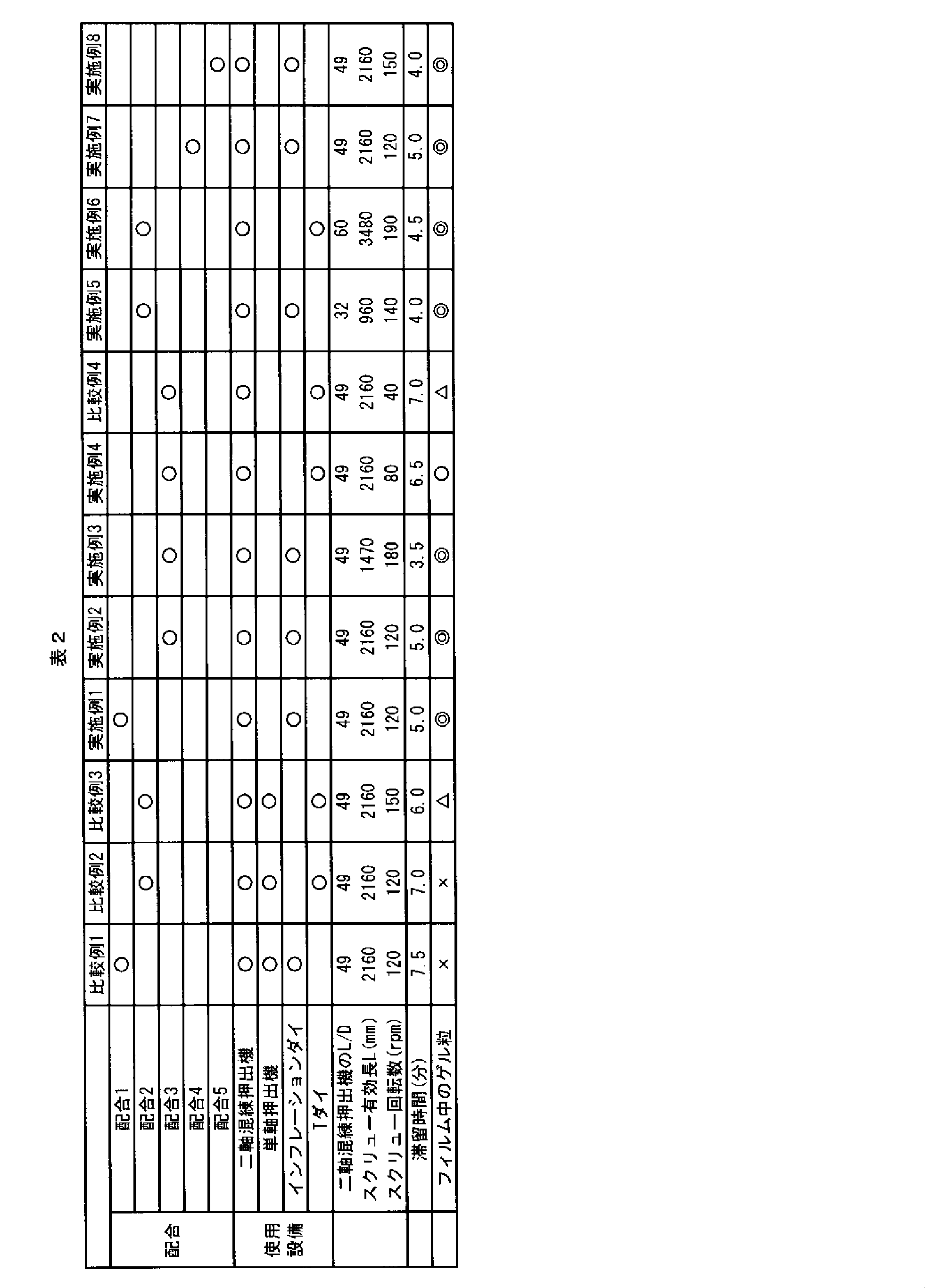
- the gel particle was observed about the produced film. The method for observing the gel particles will be described later. The observation results are shown in Table 2.
- the pellet-shaped thermoplastic resin composition was introduced into a 40 mm ⁇ single-screw extruder with a 550 mm width T die (manufactured by Pla Giken Co., Ltd., die temperature 230 ° C.), and formed into a film having an average thickness of 0.1 mm. However, the residence time was 7.0 minutes. The gel particle was observed about the produced film. The observation results are shown in Table 2.
- Comparative Example 3 The same procedure as in Comparative Example 2 was performed except that the residence time was changed to 6.0 minutes by changing the screw rotation speed of the twin-screw kneading extruder to 150 rpm.
- the time (hereinafter referred to as “residence time”) from when the ethylene-vinyl alcohol copolymer and nylon 6 were put into the twin-screw kneading extruder to when they were discharged from the inflation die was 5 minutes.
- the gel particle was observed about the produced film. The observation results are shown in Table 2. The method for observing the gel particles will be described later.
- Example 2 The same operation as in Example 1 was performed except that the raw material was changed to that of Formulation 3 in Table 1.
- Comparative Example 4 The same procedure as in Example 4 was performed except that the residence time was changed to 7.0 minutes by setting the screw rotation speed of the twin-screw kneading extruder to 40 rpm.
- Example 7 The same operation as in Example 1 was performed except that the raw material was changed to that of Formulation 4 in Table 1.
- Example 8 The same operation as in Example 1 was performed except that the raw material was changed to that of Formulation 5 in Table 1 and the screw rotation speed was changed to 150 rpm. At this time, the residence time was 4.0 minutes.
- the film made of the thermoplastic resin composition produced by the method of the present invention can be suitably used as an inner liner of a pneumatic tire, for example.
Landscapes
- Chemical & Material Sciences (AREA)
- Engineering & Computer Science (AREA)
- Chemical Kinetics & Catalysis (AREA)
- Medicinal Chemistry (AREA)
- Polymers & Plastics (AREA)
- Organic Chemistry (AREA)
- Health & Medical Sciences (AREA)
- Mechanical Engineering (AREA)
- Manufacturing & Machinery (AREA)
- Materials Engineering (AREA)
- Compositions Of Macromolecular Compounds (AREA)
- Processes Of Treating Macromolecular Substances (AREA)
- Extrusion Moulding Of Plastics Or The Like (AREA)
- Manufacture Of Macromolecular Shaped Articles (AREA)
Abstract
エチレン-ビニルアルコール共重合体およびポリアミドを含む熱可塑性樹脂組成物からなるフィルムを製造するに際し、ゲル粒の発生を抑制する。吐出口にインフレーションダイまたはTダイが接続された二軸混練押出機を用い、エチレン-ビニルアルコール共重合体およびポリアミドが二軸混練押出機のシリンダ内に導入されてから混練物がインフレーションダイまたはTダイから吐出されるまでの時間を1.5~6.5分にする。
Description
本発明は、熱可塑性樹脂組成物からなるフィルムの製造方法に関する。より詳しくは、エチレン-ビニルアルコール共重合体とポリアミドを含む熱可塑性樹脂組成物からなるフィルムの製造方法に関する。
エチレン-ビニルアルコール共重合体およびポリアミドを含む熱可塑性樹脂組成物からなるフィルムまたはエチレン-ビニルアルコール共重合体、ポリアミドおよびエラストマーを含む熱可塑性樹脂組成物からなるフィルムを製造しようとすると、エチレン-ビニルアルコール共重合体とポリアミドは反応するため、高温で長時間混練するとゲル化してゲル粒が発生し、それがフィルム欠点になるという問題がある。
この問題を解決するために、特開2012-72306号公報は、まずポリアミドとエラストマーを溶融混練し、後からエチレン-ビニルアルコール共重合体を添加してさらに溶融混練する方法を開示している。この方法は、エチレン-ビニルアルコール共重合体とポリアミドとが同時に溶融混練される時間を短くすることにより、エチレン-ビニルアルコール共重合体とポリアミドの反応によるゲル粒の発生を抑制するものである。
この問題を解決するために、特開2012-72306号公報は、まずポリアミドとエラストマーを溶融混練し、後からエチレン-ビニルアルコール共重合体を添加してさらに溶融混練する方法を開示している。この方法は、エチレン-ビニルアルコール共重合体とポリアミドとが同時に溶融混練される時間を短くすることにより、エチレン-ビニルアルコール共重合体とポリアミドの反応によるゲル粒の発生を抑制するものである。
特開2012-72306号公報には、より具体的な実施形態として、2つの供給口を有する二軸混練機を用い、二軸混練機の上流側の供給口にポリアミドのペレットとゴムコンパウンドのペレットを供給し、二軸混練機の下流側の供給口にエチレン-ビニルアルコール共重合体のペレットを供給し、溶融混練して、熱可塑性樹脂組成物のペレットを調製し、それをインフレーション成形装置に供給して、フィルムを作製した例が記載されている。そのインフレーション成形装置は、単軸押出機の吐出口にインフレーションダイを取り付けたものであった。
この方法によると、二軸混練により組成物を調製した後に、フィルム製膜の際に単軸押出機で再び熱履歴がかかるため、ゲル粒の発生機会が増大する。また、単軸押出機は二軸混練機に比べ、セルフクリーニング性が乏しく、滞留によるゲル粒が発生しやすい。
本発明は、エチレン-ビニルアルコール共重合体およびポリアミドを含む熱可塑性樹脂組成物からなるフィルムの製造方法において、エチレン-ビニルアルコール共重合体とポリアミドの反応によるゲル粒の発生をさらに抑制することを課題とする。
この方法によると、二軸混練により組成物を調製した後に、フィルム製膜の際に単軸押出機で再び熱履歴がかかるため、ゲル粒の発生機会が増大する。また、単軸押出機は二軸混練機に比べ、セルフクリーニング性が乏しく、滞留によるゲル粒が発生しやすい。
本発明は、エチレン-ビニルアルコール共重合体およびポリアミドを含む熱可塑性樹脂組成物からなるフィルムの製造方法において、エチレン-ビニルアルコール共重合体とポリアミドの反応によるゲル粒の発生をさらに抑制することを課題とする。
本発明者は、エチレン-ビニルアルコール共重合体およびポリアミドを含む熱可塑性樹脂組成物からなるフィルムの製造方法において、エチレン-ビニルアルコール共重合体とポリアミドにかかる熱履歴を減らして反応を抑えるとともに、滞留しやすい工程を取り除くことにより、ゲル粒の発生をさらに抑制することができることを見いだし、本発明を完成した。
本発明は、エチレン-ビニルアルコール共重合体およびポリアミドを含む熱可塑性樹脂組成物からなるフィルムの製造方法であって、該方法は、吐出口にインフレーションダイまたはTダイが接続された二軸混練押出機を用いて、エチレン-ビニルアルコール共重合体およびポリアミドを二軸混練押出機のシリンダー内に投入し、エチレン-ビニルアルコール共重合体およびポリアミドを溶融混練し、混練物をインフレーションダイまたはTダイから吐出する工程を含み、エチレン-ビニルアルコール共重合体およびポリアミドが二軸混練押出機のシリンダー内に投入されてから混練物がインフレーションダイまたはTダイから吐出されるまでの時間が1.5~6.5分であることを特徴とする。
本発明は、次の態様を含む。
[1]エチレン-ビニルアルコール共重合体およびポリアミドを含む熱可塑性樹脂組成物からなるフィルムの製造方法であって、該方法は、吐出口にインフレーションダイまたはTダイが接続された二軸混練押出機を用いて、エチレン-ビニルアルコール共重合体およびポリアミドを二軸混練押出機のシリンダー内に投入し、エチレン-ビニルアルコール共重合体およびポリアミドを溶融混練し、混練物をインフレーションダイまたはTダイから吐出する工程を含み、エチレン-ビニルアルコール共重合体およびポリアミドが二軸混練押出機のシリンダー内に投入されてから混練物がインフレーションダイまたはTダイから吐出されるまでの時間が1.5~6.5分であることを特徴とする熱可塑性樹脂組成物からなるフィルムの製造方法。
[2]熱可塑性樹脂組成物が、さらに、エラストマーを、エチレン-ビニルアルコール共重合体とポリアミドの合計量100質量部に対して、20質量部以上含むことを特徴とする[1]に記載の熱可塑性樹脂組成物からなるフィルムの製造方法。
[3]エラストマーが酸変性ポリオレフィンエラストマーであることを特徴とする[2]に記載の熱可塑性樹脂組成物からなるフィルムの製造方法。
[4]二軸混練押出機のスクリュー有効長Lとスクリュー径Dの比L/Dが15以上70未満であることを特徴とする[1]~[3]のいずれかに記載の熱可塑性樹脂組成物からなるフィルムの製造方法。
[5]スクリュー有効長Lが400mm以上5000mm未満であり、溶融混練時のスクリュー回転数が50rpm以上300rpm未満であることを特徴とする[1]~[4]のいずれかに記載の熱可塑性樹脂組成物からなるフィルムの製造方法。
[6]二軸混練押出機のスクリューが少なくとも2箇所以上の混練ゾーンを有し、混練ゾーンの押出方向長さの総和が、スクリュー有効長の15~40%であることを特徴とする[1]~[5]のいずれかに記載の熱可塑性樹脂組成物からなるフィルムの製造方法。
[1]エチレン-ビニルアルコール共重合体およびポリアミドを含む熱可塑性樹脂組成物からなるフィルムの製造方法であって、該方法は、吐出口にインフレーションダイまたはTダイが接続された二軸混練押出機を用いて、エチレン-ビニルアルコール共重合体およびポリアミドを二軸混練押出機のシリンダー内に投入し、エチレン-ビニルアルコール共重合体およびポリアミドを溶融混練し、混練物をインフレーションダイまたはTダイから吐出する工程を含み、エチレン-ビニルアルコール共重合体およびポリアミドが二軸混練押出機のシリンダー内に投入されてから混練物がインフレーションダイまたはTダイから吐出されるまでの時間が1.5~6.5分であることを特徴とする熱可塑性樹脂組成物からなるフィルムの製造方法。
[2]熱可塑性樹脂組成物が、さらに、エラストマーを、エチレン-ビニルアルコール共重合体とポリアミドの合計量100質量部に対して、20質量部以上含むことを特徴とする[1]に記載の熱可塑性樹脂組成物からなるフィルムの製造方法。
[3]エラストマーが酸変性ポリオレフィンエラストマーであることを特徴とする[2]に記載の熱可塑性樹脂組成物からなるフィルムの製造方法。
[4]二軸混練押出機のスクリュー有効長Lとスクリュー径Dの比L/Dが15以上70未満であることを特徴とする[1]~[3]のいずれかに記載の熱可塑性樹脂組成物からなるフィルムの製造方法。
[5]スクリュー有効長Lが400mm以上5000mm未満であり、溶融混練時のスクリュー回転数が50rpm以上300rpm未満であることを特徴とする[1]~[4]のいずれかに記載の熱可塑性樹脂組成物からなるフィルムの製造方法。
[6]二軸混練押出機のスクリューが少なくとも2箇所以上の混練ゾーンを有し、混練ゾーンの押出方向長さの総和が、スクリュー有効長の15~40%であることを特徴とする[1]~[5]のいずれかに記載の熱可塑性樹脂組成物からなるフィルムの製造方法。
本発明の熱可塑性樹脂組成物からなるフィルムの製造方法によれば、エチレン-ビニルアルコール共重合体とポリアミドの反応によるゲル粒の発生を抑制することができ、欠点の少ないフィルムを得ることができる。
本発明は、エチレン-ビニルアルコール共重合体およびポリアミドを含む熱可塑性樹脂組成物からなるフィルムの製造方法であって、該方法は、吐出口にインフレーションダイまたはTダイが接続された二軸混練押出機を用いて、エチレン-ビニルアルコール共重合体およびポリアミドを二軸混練押出機のシリンダー内に投入し、エチレン-ビニルアルコール共重合体およびポリアミドを溶融混練し、混練物をインフレーションダイまたはTダイから吐出する工程を含み、エチレン-ビニルアルコール共重合体およびポリアミドが二軸混練押出機のシリンダー内に投入されてから混練物がインフレーションダイまたはTダイから吐出されるまでの時間が1.5分以上6.5分以下であることを特徴とする。
本発明において用いる二軸混練押出機は、シリンダーと、シリンダーの中に設置された2つのスクリューと、原料の投入口と、混練物の吐出口とを備え、流通式で熱可塑性樹脂組成物を溶融混練することができるものであれば、特に限定されないが、たとえば、株式会社日本製鋼所製の型式TEXシリーズ、東芝機械株式会社製の型式TEMシリーズなどを用いることができる。
二軸混練押出機は、スクリュー有効長Lとスクリュー径Dの比L/Dが、好ましくは15以上70未満であり、より好ましくは20以上60未満であり、さらに好ましくは30以上50未満である。L/Dが低すぎるとスクリューデザインの自由度が低下するため、十分な混練ゾーンを取ることができず、エチレン-ビニルアルコール共重合体とポリアミドを均一に分散させるのが困難になる。また、L/Dが高すぎる場合には、技術的な問題はないと予想されるが、二軸混練機が高価になり、汎用性およびコスト面で好ましくない。
スクリュー有効長Lは、好ましくは、400mm以上5000mm未満であり、より好ましくは800mm以上4000mm未満であり、さらに好ましくは1000mm以上3500mm未満である。
溶融混練時のスクリュー回転数は、好ましくは50rpm以上300rpm未満であり、より好ましくは60rpm以上250rpm未満であり、さらに好ましくは70rpm以上200rpm未満である。
スクリュー有効長Lが短すぎたり、スクリュー回転数が高すぎると、十分な滞留時間を得ることができず、エチレン-ビニルアルコール共重合体とポリアミドが均一に混ざり合わない。スクリュー有効長が長すぎたり、スクリュー回転数が低すぎると、滞留時間が長くなり、エチレン-ビニルアルコール共重合体とポリアミドの過剰反応によるゲル粒が発生しやすくなる。
溶融混練時のスクリュー回転数は、好ましくは50rpm以上300rpm未満であり、より好ましくは60rpm以上250rpm未満であり、さらに好ましくは70rpm以上200rpm未満である。
スクリュー有効長Lが短すぎたり、スクリュー回転数が高すぎると、十分な滞留時間を得ることができず、エチレン-ビニルアルコール共重合体とポリアミドが均一に混ざり合わない。スクリュー有効長が長すぎたり、スクリュー回転数が低すぎると、滞留時間が長くなり、エチレン-ビニルアルコール共重合体とポリアミドの過剰反応によるゲル粒が発生しやすくなる。
二軸混練押出機のスクリューが少なくとも2箇所以上の混練ゾーンを有することが好ましい。2箇所以上の混練ゾーンを有することにより、局所的な混練による過剰な発熱を抑制できるという利点がある。さらに、混練ゾーンの押出方向長さの総和は、好ましくはスクリュー有効長の15~40%であり、より好ましくはスクリュー有効長の18~35%であり、さらに好ましくはスクリュー有効長の20~30%である。混練ゾーンの押出方向長さの総和が短すぎるとエチレン-ビニルアルコール共重合体とポリアミドが均一に混ざり合わず不良分散粒が出やすくなり、長すぎるとせん断による発熱が大きくなり、エチレン-ビニルアルコール共重合体とポリアミドが過剰に反応しやすくなり、ゲル粒が発生しやすくなる。
本発明において用いる二軸混練押出機は、その吐出口にインフレーションダイまたはTダイが接続される。
インフレーションダイは、いわゆるインフレーション成形に用いられる押出ダイであれば、特に限定されず、一般的なものを使用することができ、ダイの口径、リップギャップ等は、製造するフィルムに応じて、適宜選択することができる。ここで、インフレーション成形とは、環状の押出ダイから筒状に溶融樹脂を押し出し、筒状の溶融樹脂がまだ溶融状態にある間に、筒状の溶融樹脂に軽い内圧を加えて膨張させ、次いで冷却し、案内ロールによって平らにつぶして、そのまま巻き取ることにより、樹脂フィルムを製造する成形方法である。インフレーションダイの口径、リップギャップ等は、製造するフィルムに応じて、適宜選択することができる。
Tダイは、フィルムを押し出すための平行スリット(スロット)をもったダイであれば、特に限定されず、一般的なものを使用することができ、Tダイのスリットの長さおよび幅は、製造するフィルムに応じて、適宜選択することができる。
インフレーションダイまたはTダイは、二軸混練押出機の吐出口に直接接続されることが好ましい。エチレン-ビニルアルコール共重合体とポリアミドが熱履歴を受ける時間をできるだけ短くすることが好ましいので、二軸混練押出機の吐出口からインフレーションダイまたはTダイの吐出口までの距離はできるだけ短くなるように二軸混練押出機とインフレーションダイまたはTダイとを接続することが好ましい。
本発明の方法は、吐出口にインフレーションダイまたはTダイが接続された二軸混練押出機を用いて、エチレン-ビニルアルコール共重合体およびポリアミドを二軸混練押出機のシリンダー内に投入し、エチレン-ビニルアルコール共重合体およびポリアミドを溶融混練し、混練物をインフレーションダイまたはTダイから吐出する工程を含む。
この工程は、吐出口にインフレーションダイまたはTダイが接続された二軸混練押出機を用いて、流通式で行われる。
この工程は、吐出口にインフレーションダイまたはTダイが接続された二軸混練押出機を用いて、流通式で行われる。
エチレン-ビニルアルコール共重合体およびポリアミドが二軸混練押出機のシリンダー内に投入されてから混練物がインフレーションダイまたはTダイから吐出されるまでの時間(以下「滞留時間」ともいう。)は、1.5~6.5分であり、好ましくは2.0~6.0分であり、より好ましくは2.5~5.0分である。滞留時間が短すぎるとエチレン-ビニルアルコール共重合体とポリアミドが均一に混ざり合わず不良分散粒が出やすくなり、滞留時間が長すぎるとゲル粒が発生しやすくなる。
ここでいう滞留時間は、エチレン-ビニルアルコール共重合体とポリアミドの両方が二軸混練押出機のシリンダー内に投入されてからの時間をいう。すなわち、エチレン-ビニルアルコール共重合体とポリアミドが同時に二軸混練押出機のシリンダー内に投入される場合は、その投入のときから混練物がインフレーションダイまたはTダイから吐出されるまでの時間であるが、二軸混練押出機が原料の投入口を2つ以上有し、エチレン-ビニルアルコール共重合体とポリアミドを別々の投入口に投入される場合において、エチレン-ビニルアルコール共重合体が先に(上流側の投入口に)投入され、ポリアミドが後で(下流側の投入口に)投入されるときは、ポリアミドがシリンダー内に投入されてから混練物がインフレーションダイまたはTダイから吐出されるまでの時間であり、ポリアミドが先に(上流側の投入口に)投入され、エチレン-ビニルアルコール共重合体が後で(下流側の投入口に)投入されるときは、エチレン-ビニルアルコール共重合体がシリンダー内に投入されてから混練物がインフレーションダイまたはTダイから吐出されるまでの時間である。
ここでいう滞留時間は、エチレン-ビニルアルコール共重合体とポリアミドの両方が二軸混練押出機のシリンダー内に投入されてからの時間をいう。すなわち、エチレン-ビニルアルコール共重合体とポリアミドが同時に二軸混練押出機のシリンダー内に投入される場合は、その投入のときから混練物がインフレーションダイまたはTダイから吐出されるまでの時間であるが、二軸混練押出機が原料の投入口を2つ以上有し、エチレン-ビニルアルコール共重合体とポリアミドを別々の投入口に投入される場合において、エチレン-ビニルアルコール共重合体が先に(上流側の投入口に)投入され、ポリアミドが後で(下流側の投入口に)投入されるときは、ポリアミドがシリンダー内に投入されてから混練物がインフレーションダイまたはTダイから吐出されるまでの時間であり、ポリアミドが先に(上流側の投入口に)投入され、エチレン-ビニルアルコール共重合体が後で(下流側の投入口に)投入されるときは、エチレン-ビニルアルコール共重合体がシリンダー内に投入されてから混練物がインフレーションダイまたはTダイから吐出されるまでの時間である。
二軸混練押出機のシリンダー内の温度(以下「混練温度」ともいう。)は、エチレン-ビニルアルコール共重合体およびポリアミドを溶融混練できる温度であれば、特に限定されないが、好ましくは160~260℃であり、より好ましくは170~250℃であり、さらに好ましくは180~240℃である。混練温度が低すぎると未溶融樹脂による不良分散が発生し、混練温度が高すぎるとエチレン-ビニルアルコール共重合体とポリアミドが過剰に反応しやすくなり、ゲル粒が発生しやすくなる。
本発明において使用するエチレン-ビニルアルコール共重合体(以下「EVOH」ともいう。)は、エチレン単位(-CH2CH2-)とビニルアルコール単位(-CH2-CH(OH)-)とからなる共重合体であるが、エチレン単位およびビニルアルコール単位に加えて、本発明の効果を阻害しない範囲で、他の構成単位を含有していてもよい。本発明において使用するエチレン-ビニルアルコール共重合体は、エチレン単位の含量すなわちエチレン組成比が好ましくは32~48モル%、より好ましくは38~48モル%のものを使用する。エチレン-ビニルアルコール共重合体のエチレン組成比が少なすぎるとエチレン-ビニルアルコール共重合体の柔軟性が減り、耐久性が落ちる。逆にエチレン組成比が多すぎるとガスバリア性が低下する。エチレン-ビニルアルコール共重合体はエチレン-酢酸ビニル共重合体のケン化物であるが、そのケン化度は、好ましくは90%以上、より好ましくは98%以上である。エチレン-ビニルアルコール共重合体のケン化度が小さすぎるとガスバリア性が低下し、また熱安定性も低下する。エチレン-ビニルアルコール共重合体は、市販されており、たとえば、株式会社クラレから「エバール」(登録商標)の商品名で、日本合成化学工業株式会社から「ソアノール」(登録商標)の商品名で入手することができる。エチレン組成比32~48モル%でケン化度90%以上であるエチレン-ビニルアルコール共重合体としては、株式会社クラレ製「エバール」(登録商標)H171B(エチレン組成比38モル%、ケン化度99%以上)、E171B(エチレン組成比44モル%、ケン化度99%以上)、日本合成化学工業株式会社製「ソアノール」(登録商標)H4815B(エチレン組成比48モル%、ケン化度99%以上)、A4412B(エチレン組成比42モル%、ケン化度99%以上)、DC3212B(エチレン組成比32モル%、ケン化度99%以上)などがある。
本発明において使用するポリアミドとしては、限定するものではないが、好ましくは、ナイロン11、ナイロン12、ナイロン6、ナイロン66、ナイロン6/66共重合体、ナイロン6/12共重合体、ナイロンMXD6およびナイロン6/66/12、ナイロン4/6、ナイロン9T、ナイロン6T、ナイロン6/10からなる群から選ばれた少なくとも一種である。なかでも、ナイロン6、ナイロン6/66共重合体およびナイロン6/12共重合体が耐久性とガスバリア性の両立という点で好ましい。
エチレン-ビニルアルコール共重合体とポリアミドの配合比率は、特に限定されないが、エチレン-ビニルアルコール共重合体とポリアミドの合計質量に対するエチレン-ビニルアルコール共重合体の割合は、好ましくは95~30質量%であり、より好ましくは90~40質量%であり、さらに好ましくは80~50質量%である。エチレン-ビニルアルコール共重合体の割合が低すぎると十分なガスバリア性が得られず、エチレン-ビニルアルコール共重合体の割合が高すぎると柔軟性および耐久性が乏しくなる。
熱可塑性樹脂組成物は、さらに、エラストマーを含むことができる。エラストマーを含めると、柔軟性および耐久性が向上するという利点がある。
エラストマーとしては、ジエン系ゴムおよびその水添物(たとえば、天然ゴム(NR)、イソプレンゴム(IR)、スチレンブタジエンゴム(SBR)、ブタジエンゴム(BR)、アクリロニトリル・ブタジエンゴム(NBR)など)、オレフィン系ゴム(たとえば、エチレンプロピレンゴム(EPDM、EPM)、ブチルゴム(IIR)など)、アクリルゴム(ACM)、含ハロゲンゴム(たとえば、Br-IIR、Cl-IIR、ハロゲン化イソオレフィン-パラアルキルスチレン共重合体など)、シリコーンゴム(たとえば、メチルビニルシリコーンゴム、ジメチルシリコーンゴムなど)、含イオウゴム(たとえば、ポリスルフィドゴム)、フッ素ゴム(たとえば、ビニリデンフルオライド系ゴム、含フッ素ビニルエーテル系ゴム)、熱可塑性エラストマー(たとえば、スチレン系エラストマー、オレフィン系エラストマー、酸変性オレフィン系エラストマー、エステル系エラストマー、ウレタン系エラストマー、ポリアミド系エラストマー)などを挙げることができる。
なかでも、好ましいエラストマーは、酸変性ポリオレフィンエラストマー、酸無水物基もしくはエポキシ基を有する変性ゴム、ハロゲン化イソオレフィン-パラアルキルスチレン共重合体(たとえば臭素化イソブチレン-p-メチルスチレン共重合体)である。
酸変性ポリオレフィンエラストマーとしては、無水マレイン酸変性エチレン-α-オレフィン共重合エラストマーが挙げられ、より具体的には、無水マレイン酸変性エチレン-プロピレン共重合エラストマー、無水マレイン酸変性エチレン-ブテン共重合エラストマーなどが挙げられる。
エラストマーとしては、ジエン系ゴムおよびその水添物(たとえば、天然ゴム(NR)、イソプレンゴム(IR)、スチレンブタジエンゴム(SBR)、ブタジエンゴム(BR)、アクリロニトリル・ブタジエンゴム(NBR)など)、オレフィン系ゴム(たとえば、エチレンプロピレンゴム(EPDM、EPM)、ブチルゴム(IIR)など)、アクリルゴム(ACM)、含ハロゲンゴム(たとえば、Br-IIR、Cl-IIR、ハロゲン化イソオレフィン-パラアルキルスチレン共重合体など)、シリコーンゴム(たとえば、メチルビニルシリコーンゴム、ジメチルシリコーンゴムなど)、含イオウゴム(たとえば、ポリスルフィドゴム)、フッ素ゴム(たとえば、ビニリデンフルオライド系ゴム、含フッ素ビニルエーテル系ゴム)、熱可塑性エラストマー(たとえば、スチレン系エラストマー、オレフィン系エラストマー、酸変性オレフィン系エラストマー、エステル系エラストマー、ウレタン系エラストマー、ポリアミド系エラストマー)などを挙げることができる。
なかでも、好ましいエラストマーは、酸変性ポリオレフィンエラストマー、酸無水物基もしくはエポキシ基を有する変性ゴム、ハロゲン化イソオレフィン-パラアルキルスチレン共重合体(たとえば臭素化イソブチレン-p-メチルスチレン共重合体)である。
酸変性ポリオレフィンエラストマーとしては、無水マレイン酸変性エチレン-α-オレフィン共重合エラストマーが挙げられ、より具体的には、無水マレイン酸変性エチレン-プロピレン共重合エラストマー、無水マレイン酸変性エチレン-ブテン共重合エラストマーなどが挙げられる。
熱可塑性樹脂組成物がエラストマーを含む場合は、エラストマーの配合量は、エチレン-ビニルアルコール共重合体とポリアミドの合計量100質量部に対して、好ましくは20質量部以上であり、より好ましくは50~220質量部であり、さらに好ましくは80~200質量部である。エラストマーの配合量が少なすぎると柔軟性および耐久性を向上させる効果が十分でなく、エラストマーの配合量が多なすぎると溶融時の流動性が低下し、フィルム製膜が困難になる。
熱可塑性樹脂組成物がエラストマーを含む場合は、エチレン-ビニルアルコール共重合体およびポリアミドがマトリックス相を構成し、エラストマーが分散相を構成して、海島構造を形成してもよいが、そのような海島構造を形成していることが好ましい。
本発明において使用する熱可塑性樹脂組成物は、エチレン-ビニルアルコール共重合体およびポリアミド以外の樹脂、エラストマー、各種添加剤を、本発明の効果を阻害しない範囲で含んでもよい。添加剤としては、可塑剤、加工助剤(金属石鹸など)、架橋剤、架橋促進助剤、架橋促進剤、補強剤(フィラー)、スコーチ防止剤、老化防止剤、素練促進剤、有機改質剤、軟化剤、粘着付与剤などを挙げることができる。
本発明の方法によって製造される熱可塑性樹脂組成物からなるフィルムは、ガスバリア性および耐久性に優れるため、空気入りタイヤのインナーライナーとして好適に使用することができる。
以下、実施例に基づいて本発明をさらに詳しく説明するが、本発明は以下の実施例に限定されるものではない。
以下の実施例および比較例において使用した原料は次のとおりである。
エチレン-ビニルアルコール共重合体として、次の3種類を用いた。
ソアノール(登録商標)D2908(日本合成化学工業株式会社製)
ソアノール(登録商標)E3808(日本合成化学工業株式会社製)
ソアノール(登録商標)H4815B(日本合成化学工業株式会社製)
ソアノール(登録商標)D2908(日本合成化学工業株式会社製)
ソアノール(登録商標)E3808(日本合成化学工業株式会社製)
ソアノール(登録商標)H4815B(日本合成化学工業株式会社製)
ポリアミドとして、次の3種類を用いた。
ナイロン6/12:宇部興産株式会社製「UBEナイロン」7024B
ナイロン6:宇部興産株式会社製「UBEナイロン」1013B
ナイロン6/66:宇部興産株式会社製「UBEナイロン」5033B
ナイロン6/12:宇部興産株式会社製「UBEナイロン」7024B
ナイロン6:宇部興産株式会社製「UBEナイロン」1013B
ナイロン6/66:宇部興産株式会社製「UBEナイロン」5033B
酸変性ポリオレフィンエラストマーとして、次の3種類を用いた。
タフマー(登録商標)MH7020(三井化学株式会社製無水マレイン酸変性エチレン-ブテン共重合エラストマー)
タフマー(登録商標)MH7010(三井化学株式会社製無水マレイン酸変性エチレン-ブテン共重合エラストマー)
タフマー(登録商標)MP0620(三井化学株式会社製無水マレイン酸変性エチレン-プロピレン共重合エラストマー)
タフマー(登録商標)MH7020(三井化学株式会社製無水マレイン酸変性エチレン-ブテン共重合エラストマー)
タフマー(登録商標)MH7010(三井化学株式会社製無水マレイン酸変性エチレン-ブテン共重合エラストマー)
タフマー(登録商標)MP0620(三井化学株式会社製無水マレイン酸変性エチレン-プロピレン共重合エラストマー)
エポキシ基を有する変性ゴムとして、ボンドファースト(登録商標)2E(住友化学株式会社製エチレン-グリシジルメタクリレート共重合体)を用いた。
ハロゲン化イソオレフィン-パラアルキルスチレン共重合体として、Exxpro(登録商標)MDX89-4(エクソンモービル・ケミカル社製臭素化イソブチレン-p-メチルスチレン共重合体)を用いた。
架橋剤として、トリス(2-ヒドロキシエチル)イソシアヌレート(四国化成工業株式会社製「セイク」A)を用いた。
加工助剤として、金属石鹸(堺化学工業株式会社製ステアリン酸マグネシウムSM-PG)を用いた。
比較例1
エチレン-ビニルアルコール共重合体(日本合成化学工業株式会社製ソアノール(登録商標)D2908)およびナイロン6(宇部興産株式会社製「UBEナイロン」1013B)を、表1の配合1の配合比で、二軸混練押出機(株式会社日本製鋼所製,型式TEX44,L/D=49,スクリュー有効長L=2160mm,スクリュー回転数120rpm)のシリンダ内に投入し、温度230℃で溶融混練し、溶融混練物を吐出口に取り付けられたダイからストランド状に押し出した。得られたストランド状押出物を樹脂用ペレタイザーでペレット化し、ペレット状の熱可塑性樹脂組成物を得た。次いで、ペレット状の熱可塑性樹脂組成物をインフレーションダイ付の40mmφ単軸押出機(株式会社プラ技研製,ダイ温度230℃)に投入し、平均厚み0.1mmのフィルムに成形した。ただし、エチレン-ビニルアルコール共重合体およびナイロン6が二軸混練押出機に投入されてから溶融混練物が二軸混練押出機から吐出されるまでの時間と、ペレット状の熱可塑性樹脂組成物が単軸押出機に投入されてからインフレーションダイから吐出されるまでの時間との合計(以下「滞留時間」という。)は7.5分であった。作製したフィルムについてゲル粒を観察した。ゲル粒の観察方法は後述する。観察した結果を表2に示す。
エチレン-ビニルアルコール共重合体(日本合成化学工業株式会社製ソアノール(登録商標)D2908)およびナイロン6(宇部興産株式会社製「UBEナイロン」1013B)を、表1の配合1の配合比で、二軸混練押出機(株式会社日本製鋼所製,型式TEX44,L/D=49,スクリュー有効長L=2160mm,スクリュー回転数120rpm)のシリンダ内に投入し、温度230℃で溶融混練し、溶融混練物を吐出口に取り付けられたダイからストランド状に押し出した。得られたストランド状押出物を樹脂用ペレタイザーでペレット化し、ペレット状の熱可塑性樹脂組成物を得た。次いで、ペレット状の熱可塑性樹脂組成物をインフレーションダイ付の40mmφ単軸押出機(株式会社プラ技研製,ダイ温度230℃)に投入し、平均厚み0.1mmのフィルムに成形した。ただし、エチレン-ビニルアルコール共重合体およびナイロン6が二軸混練押出機に投入されてから溶融混練物が二軸混練押出機から吐出されるまでの時間と、ペレット状の熱可塑性樹脂組成物が単軸押出機に投入されてからインフレーションダイから吐出されるまでの時間との合計(以下「滞留時間」という。)は7.5分であった。作製したフィルムについてゲル粒を観察した。ゲル粒の観察方法は後述する。観察した結果を表2に示す。
比較例2
原料を、表1の配合2の配合比で、二軸混練押出機(株式会社日本製鋼所製,型式TEX44,L/D=49,スクリュー有効長L=2160mm,スクリュー回転数120rpm)のシリンダ内に投入し、温度230℃で溶融混練し、溶融混練物を吐出口に取り付けられたダイからストランド状に押出した。得られたストランド状押出物を樹脂用ペレタイザーでペレット化し、ペレット状の熱可塑性樹脂組成物を得た。次いで、ペレット状の熱可塑性樹脂組成物を550mm幅Tダイ付の40mmφ単軸押出機(株式会社プラ技研製,ダイ温度230℃)に導入し、平均厚み0.1mmのフィルムに成形した。ただし、滞留時間は7.0分であった。作製したフィルムについてゲル粒を観察した。観察した結果を表2に示す。
原料を、表1の配合2の配合比で、二軸混練押出機(株式会社日本製鋼所製,型式TEX44,L/D=49,スクリュー有効長L=2160mm,スクリュー回転数120rpm)のシリンダ内に投入し、温度230℃で溶融混練し、溶融混練物を吐出口に取り付けられたダイからストランド状に押出した。得られたストランド状押出物を樹脂用ペレタイザーでペレット化し、ペレット状の熱可塑性樹脂組成物を得た。次いで、ペレット状の熱可塑性樹脂組成物を550mm幅Tダイ付の40mmφ単軸押出機(株式会社プラ技研製,ダイ温度230℃)に導入し、平均厚み0.1mmのフィルムに成形した。ただし、滞留時間は7.0分であった。作製したフィルムについてゲル粒を観察した。観察した結果を表2に示す。
比較例3
二軸混練押出機のスクリュー回転数を150rpmにすることで、滞留時間を6.0分に変更した以外は、比較例2と同様に実施した。
二軸混練押出機のスクリュー回転数を150rpmにすることで、滞留時間を6.0分に変更した以外は、比較例2と同様に実施した。
実施例1
エチレン-ビニルアルコール共重合体(日本合成化学工業株式会社製ソアノール(登録商標)D2908)45質量部およびナイロン6(宇部興産株式会社製「UBEナイロン」1013B)55質量部を、100mm口径インフレーションダイ(株式会社プラコー製)を接続した二軸混練押出機(株式会社日本製鋼所製,型式TEX44,L/D=49,スクリュー有効長L=2160mm,スクリュー回転数120rpm,温度230℃)のシリンダ内に投入し、二軸混練押出機にて混練した組成物をそのままインフレーションダイに導入して平均厚み0.1mmの円筒状フィルムを作製した。ただし、エチレン-ビニルアルコール共重合体およびナイロン6が二軸混練押出機に投入されてからインフレーションダイから吐出されるまでの時間(以下「滞留時間」という。)は5分であった。作製したフィルムについてゲル粒を観察した。観察結果を表2に示す。ゲル粒の観察方法は後述する。
エチレン-ビニルアルコール共重合体(日本合成化学工業株式会社製ソアノール(登録商標)D2908)45質量部およびナイロン6(宇部興産株式会社製「UBEナイロン」1013B)55質量部を、100mm口径インフレーションダイ(株式会社プラコー製)を接続した二軸混練押出機(株式会社日本製鋼所製,型式TEX44,L/D=49,スクリュー有効長L=2160mm,スクリュー回転数120rpm,温度230℃)のシリンダ内に投入し、二軸混練押出機にて混練した組成物をそのままインフレーションダイに導入して平均厚み0.1mmの円筒状フィルムを作製した。ただし、エチレン-ビニルアルコール共重合体およびナイロン6が二軸混練押出機に投入されてからインフレーションダイから吐出されるまでの時間(以下「滞留時間」という。)は5分であった。作製したフィルムについてゲル粒を観察した。観察結果を表2に示す。ゲル粒の観察方法は後述する。
実施例2
原料を表1の配合3のものに変更した以外は実施例1と同様に実施した。
原料を表1の配合3のものに変更した以外は実施例1と同様に実施した。
実施例3
二軸混練押出機を株式会社日本製鋼所製,型式TEX30(L/D=49,スクリュー有効長L=1470mm,スクリュー回転数180rpm,温度230℃)に変更し、実施例2と同様に実施した。このときの滞留時間は、3.5分であった。
二軸混練押出機を株式会社日本製鋼所製,型式TEX30(L/D=49,スクリュー有効長L=1470mm,スクリュー回転数180rpm,温度230℃)に変更し、実施例2と同様に実施した。このときの滞留時間は、3.5分であった。
実施例4
原料を、表1の配合3の配合比で、550mm幅Tダイ(株式会社プラ技研製)を接続した二軸混練押出機(株式会社日本製鋼所製,型式TEX44,L/D=49,スクリュー有効長L=2160mm,スクリュー回転数80rpm,温度230℃)のシリンダ内に投入し、二軸混練押出機にて混練した組成物をそのままTダイに導入して平均厚み0.1mmのシート状フィルムを作製した。ただし、原料が二軸混練押出機に投入されてからTダイから吐出されるまでの時間(以下「滞留時間」という。)は6.5分であった。作製したフィルムについてゲル粒を観察した。観察結果を表2に示す。
原料を、表1の配合3の配合比で、550mm幅Tダイ(株式会社プラ技研製)を接続した二軸混練押出機(株式会社日本製鋼所製,型式TEX44,L/D=49,スクリュー有効長L=2160mm,スクリュー回転数80rpm,温度230℃)のシリンダ内に投入し、二軸混練押出機にて混練した組成物をそのままTダイに導入して平均厚み0.1mmのシート状フィルムを作製した。ただし、原料が二軸混練押出機に投入されてからTダイから吐出されるまでの時間(以下「滞留時間」という。)は6.5分であった。作製したフィルムについてゲル粒を観察した。観察結果を表2に示す。
比較例4
二軸混練押出機のスクリュー回転数を40rpmにすることで、滞留時間を7.0分に変更した以外は、実施例4と同様に実施した。
二軸混練押出機のスクリュー回転数を40rpmにすることで、滞留時間を7.0分に変更した以外は、実施例4と同様に実施した。
実施例5
原料を表1に示す配合2のものに変更し、二軸混練押出機(株式会社日本製鋼所製,L/D=32,スクリュー有効長L=960mm,スクリュー回転数140rpm,温度230℃)を用いて、滞留時間を4.0分に変更した以外は、実施例1と同様に実施した。
原料を表1に示す配合2のものに変更し、二軸混練押出機(株式会社日本製鋼所製,L/D=32,スクリュー有効長L=960mm,スクリュー回転数140rpm,温度230℃)を用いて、滞留時間を4.0分に変更した以外は、実施例1と同様に実施した。
実施例6
原料を、表1に示す配合2の配合比で、550mm幅Tダイ(株式会社プラ技研製)を接続した二軸混練押出機(株式会社日本製鋼所製,L/D=60,スクリュー有効長L=3480mm,スクリュー回転数190rpm,温度230℃)のシリンダ内に投入し、二軸混練押出機にて混練した組成物をそのままTダイに導入して平均厚み0.1mmのシート状フィルムを作製した。ただし、滞留時間は4.5分であった。作製したフィルムについてゲル粒を観察した。観察結果を表2に示す。
原料を、表1に示す配合2の配合比で、550mm幅Tダイ(株式会社プラ技研製)を接続した二軸混練押出機(株式会社日本製鋼所製,L/D=60,スクリュー有効長L=3480mm,スクリュー回転数190rpm,温度230℃)のシリンダ内に投入し、二軸混練押出機にて混練した組成物をそのままTダイに導入して平均厚み0.1mmのシート状フィルムを作製した。ただし、滞留時間は4.5分であった。作製したフィルムについてゲル粒を観察した。観察結果を表2に示す。
実施例7
原料を表1の配合4のものに変更した以外は実施例1と同様に実施した。
原料を表1の配合4のものに変更した以外は実施例1と同様に実施した。
実施例8
原料を表1の配合5のものに変更し、スクリュー回転数を150rpmに変更した以外は実施例1と同様に実施した。このとき、滞留時間は4.0分であった。
原料を表1の配合5のものに変更し、スクリュー回転数を150rpmに変更した以外は実施例1と同様に実施した。このとき、滞留時間は4.0分であった。
[ゲル粒の観察方法]
フィルムを目視にて観察し、50cm×50cmの正方形のフィルム片の中に、大きさ(最も長くとれる長さ)が0.5mm以上のゲル粒が、
2個以内のものを◎、
3~5個のものを○、
6個以上のものを△、
10個以上のものを×、
と判定し、◎、○のものについてはフィルム成形性(加工性)は良好と扱い、△、×のものについてはフィルム成形性(加工性)は不良とした。なお、大きさが0.5mm未満の粒については、粒として扱わずカウントしない。
フィルムを目視にて観察し、50cm×50cmの正方形のフィルム片の中に、大きさ(最も長くとれる長さ)が0.5mm以上のゲル粒が、
2個以内のものを◎、
3~5個のものを○、
6個以上のものを△、
10個以上のものを×、
と判定し、◎、○のものについてはフィルム成形性(加工性)は良好と扱い、△、×のものについてはフィルム成形性(加工性)は不良とした。なお、大きさが0.5mm未満の粒については、粒として扱わずカウントしない。

本発明の方法によって製造される熱可塑性樹脂組成物からなるフィルムは、たとえば、空気入りタイヤのインナーライナーとして好適に使用することができる。
Claims (6)
- エチレン-ビニルアルコール共重合体およびポリアミドを含む熱可塑性樹脂組成物からなるフィルムの製造方法であって、該方法は、吐出口にインフレーションダイまたはTダイが接続された二軸混練押出機を用いて、エチレン-ビニルアルコール共重合体およびポリアミドを二軸混練押出機のシリンダー内に投入し、エチレン-ビニルアルコール共重合体およびポリアミドを溶融混練し、混練物をインフレーションダイまたはTダイから吐出する工程を含み、エチレン-ビニルアルコール共重合体およびポリアミドが二軸混練押出機のシリンダー内に投入されてから混練物がインフレーションダイまたはTダイから吐出されるまでの時間が1.5~6.5分であることを特徴とする熱可塑性樹脂組成物からなるフィルムの製造方法。
- 熱可塑性樹脂組成物が、さらに、エラストマーを、エチレン-ビニルアルコール共重合体とポリアミドの合計量100質量部に対して、20質量部以上含むことを特徴とする請求項1に記載の熱可塑性樹脂組成物からなるフィルムの製造方法。
- エラストマーが酸変性ポリオレフィンエラストマーであることを特徴とする請求項2に記載の熱可塑性樹脂組成物からなるフィルムの製造方法。
- 二軸混練押出機のスクリュー有効長Lとスクリュー径Dの比L/Dが15以上70未満であることを特徴とする請求項1~3のいずれか1項に記載の熱可塑性樹脂組成物からなるフィルムの製造方法。
- スクリュー有効長Lが400mm以上5000mm未満であり、溶融混練時のスクリュー回転数が50rpm以上300rpm未満であることを特徴とする請求項1~4のいずれか1項に記載の熱可塑性樹脂組成物からなるフィルムの製造方法。
- 二軸混練押出機のスクリューが少なくとも2箇所以上の混練ゾーンを有し、混練ゾーンの押出方向長さの総和がスクリュー有効長の15~40%であることを特徴とする請求項1~5のいずれか1項に記載の熱可塑性樹脂組成物からなるフィルムの製造方法。
Applications Claiming Priority (2)
| Application Number | Priority Date | Filing Date | Title |
|---|---|---|---|
| JP2015-142060 | 2015-07-16 | ||
| JP2015142060A JP2017025132A (ja) | 2015-07-16 | 2015-07-16 | 熱可塑性樹脂組成物からなるフィルムの製造方法 |
Publications (1)
| Publication Number | Publication Date |
|---|---|
| WO2017010357A1 true WO2017010357A1 (ja) | 2017-01-19 |
Family
ID=57757725
Family Applications (1)
| Application Number | Title | Priority Date | Filing Date |
|---|---|---|---|
| PCT/JP2016/069941 Ceased WO2017010357A1 (ja) | 2015-07-16 | 2016-07-05 | 熱可塑性樹脂組成物からなるフィルムの製造方法 |
Country Status (2)
| Country | Link |
|---|---|
| JP (1) | JP2017025132A (ja) |
| WO (1) | WO2017010357A1 (ja) |
Citations (4)
| Publication number | Priority date | Publication date | Assignee | Title |
|---|---|---|---|---|
| JP2012072306A (ja) * | 2010-09-29 | 2012-04-12 | Yokohama Rubber Co Ltd:The | 熱可塑性エラストマー組成物の製造方法 |
| JP2012224844A (ja) * | 2011-04-04 | 2012-11-15 | Nippon Synthetic Chem Ind Co Ltd:The | 樹脂組成物およびそれを用いた多層構造体 |
| JP2013199537A (ja) * | 2012-03-23 | 2013-10-03 | Yokohama Rubber Co Ltd:The | 熱可塑性エラストマー組成物の製造方法 |
| WO2015012394A1 (ja) * | 2013-07-25 | 2015-01-29 | 横浜ゴム株式会社 | 熱可塑性樹脂組成物の製造方法 |
-
2015
- 2015-07-16 JP JP2015142060A patent/JP2017025132A/ja active Pending
-
2016
- 2016-07-05 WO PCT/JP2016/069941 patent/WO2017010357A1/ja not_active Ceased
Patent Citations (4)
| Publication number | Priority date | Publication date | Assignee | Title |
|---|---|---|---|---|
| JP2012072306A (ja) * | 2010-09-29 | 2012-04-12 | Yokohama Rubber Co Ltd:The | 熱可塑性エラストマー組成物の製造方法 |
| JP2012224844A (ja) * | 2011-04-04 | 2012-11-15 | Nippon Synthetic Chem Ind Co Ltd:The | 樹脂組成物およびそれを用いた多層構造体 |
| JP2013199537A (ja) * | 2012-03-23 | 2013-10-03 | Yokohama Rubber Co Ltd:The | 熱可塑性エラストマー組成物の製造方法 |
| WO2015012394A1 (ja) * | 2013-07-25 | 2015-01-29 | 横浜ゴム株式会社 | 熱可塑性樹脂組成物の製造方法 |
Also Published As
| Publication number | Publication date |
|---|---|
| JP2017025132A (ja) | 2017-02-02 |
Similar Documents
| Publication | Publication Date | Title |
|---|---|---|
| CN102575020B (zh) | 热塑性弹性体组合物的制造方法 | |
| CN103442907B (zh) | 动态硫化的热塑性弹性体薄膜 | |
| JP4862954B1 (ja) | 熱可塑性樹脂組成物の製造方法 | |
| CN104583282B (zh) | 热塑性弹性体组合物的制造方法 | |
| JP5663956B2 (ja) | 熱可塑性エラストマー組成物およびその製造方法 | |
| JP2016088093A (ja) | 動的に加硫された熱可塑性エラストマーフィルムの形成方法及びそれから形成されたフィルム | |
| WO2013136596A1 (ja) | 熱可塑性エラストマー組成物 | |
| JP6926495B2 (ja) | 熱可塑性樹脂組成物、インナーライナーおよび空気入りタイヤ | |
| JP6565398B2 (ja) | 熱可塑性樹脂組成物、インナーライナーおよび空気入りタイヤ | |
| JP5990967B2 (ja) | 熱可塑性エラストマー組成物の製造方法 | |
| CN105408413B (zh) | 热塑性树脂组合物的制造方法 | |
| JP6195013B2 (ja) | 熱可塑性エラストマー組成物 | |
| WO2019116673A1 (ja) | タイヤ用熱可塑性エラストマー組成物およびタイヤ | |
| CN102725353B (zh) | 热塑性弹性体组合物和其制造方法 | |
| WO2017010357A1 (ja) | 熱可塑性樹脂組成物からなるフィルムの製造方法 | |
| JP6044245B2 (ja) | 空気入りタイヤ用フィルム状部材の製造方法 | |
| JP2012046560A (ja) | 熱可塑性樹脂組成物およびそれを用いた空気入りタイヤ | |
| WO2018123192A1 (ja) | 熱可塑性樹脂組成物、インナーライナーおよび空気入りタイヤ |
Legal Events
| Date | Code | Title | Description |
|---|---|---|---|
| 121 | Ep: the epo has been informed by wipo that ep was designated in this application |
Ref document number: 16824337 Country of ref document: EP Kind code of ref document: A1 |
|
| NENP | Non-entry into the national phase |
Ref country code: DE |
|
| 122 | Ep: pct application non-entry in european phase |
Ref document number: 16824337 Country of ref document: EP Kind code of ref document: A1 |