WO2017010100A1 - 細胞投与用、保存用、又は培養用容器 - Google Patents
細胞投与用、保存用、又は培養用容器 Download PDFInfo
- Publication number
- WO2017010100A1 WO2017010100A1 PCT/JP2016/003319 JP2016003319W WO2017010100A1 WO 2017010100 A1 WO2017010100 A1 WO 2017010100A1 JP 2016003319 W JP2016003319 W JP 2016003319W WO 2017010100 A1 WO2017010100 A1 WO 2017010100A1
- Authority
- WO
- WIPO (PCT)
- Prior art keywords
- cell
- cells
- container
- fluororesin
- storage
- Prior art date
- Legal status (The legal status is an assumption and is not a legal conclusion. Google has not performed a legal analysis and makes no representation as to the accuracy of the status listed.)
- Ceased
Links
Classifications
-
- C—CHEMISTRY; METALLURGY
- C12—BIOCHEMISTRY; BEER; SPIRITS; WINE; VINEGAR; MICROBIOLOGY; ENZYMOLOGY; MUTATION OR GENETIC ENGINEERING
- C12M—APPARATUS FOR ENZYMOLOGY OR MICROBIOLOGY; APPARATUS FOR CULTURING MICROORGANISMS FOR PRODUCING BIOMASS, FOR GROWING CELLS OR FOR OBTAINING FERMENTATION OR METABOLIC PRODUCTS, i.e. BIOREACTORS OR FERMENTERS
- C12M23/00—Constructional details, e.g. recesses, hinges
- C12M23/20—Material Coatings
-
- A—HUMAN NECESSITIES
- A61—MEDICAL OR VETERINARY SCIENCE; HYGIENE
- A61K—PREPARATIONS FOR MEDICAL, DENTAL OR TOILETRY PURPOSES
- A61K35/00—Medicinal preparations containing materials or reaction products thereof with undetermined constitution
- A61K35/12—Materials from mammals; Compositions comprising non-specified tissues or cells; Compositions comprising non-embryonic stem cells; Genetically modified cells
- A61K35/28—Bone marrow; Haematopoietic stem cells; Mesenchymal stem cells of any origin, e.g. adipose-derived stem cells
-
- C—CHEMISTRY; METALLURGY
- C09—DYES; PAINTS; POLISHES; NATURAL RESINS; ADHESIVES; COMPOSITIONS NOT OTHERWISE PROVIDED FOR; APPLICATIONS OF MATERIALS NOT OTHERWISE PROVIDED FOR
- C09D—COATING COMPOSITIONS, e.g. PAINTS, VARNISHES OR LACQUERS; FILLING PASTES; CHEMICAL PAINT OR INK REMOVERS; INKS; CORRECTING FLUIDS; WOODSTAINS; PASTES OR SOLIDS FOR COLOURING OR PRINTING; USE OF MATERIALS THEREFOR
- C09D127/00—Coating compositions based on homopolymers or copolymers of compounds having one or more unsaturated aliphatic radicals, each having only one carbon-to-carbon double bond, and at least one being terminated by a halogen; Coating compositions based on derivatives of such polymers
- C09D127/02—Coating compositions based on homopolymers or copolymers of compounds having one or more unsaturated aliphatic radicals, each having only one carbon-to-carbon double bond, and at least one being terminated by a halogen; Coating compositions based on derivatives of such polymers not modified by chemical after-treatment
- C09D127/12—Coating compositions based on homopolymers or copolymers of compounds having one or more unsaturated aliphatic radicals, each having only one carbon-to-carbon double bond, and at least one being terminated by a halogen; Coating compositions based on derivatives of such polymers not modified by chemical after-treatment containing fluorine atoms
- C09D127/18—Homopolymers or copolymers of tetrafluoroethene
-
- C—CHEMISTRY; METALLURGY
- C09—DYES; PAINTS; POLISHES; NATURAL RESINS; ADHESIVES; COMPOSITIONS NOT OTHERWISE PROVIDED FOR; APPLICATIONS OF MATERIALS NOT OTHERWISE PROVIDED FOR
- C09D—COATING COMPOSITIONS, e.g. PAINTS, VARNISHES OR LACQUERS; FILLING PASTES; CHEMICAL PAINT OR INK REMOVERS; INKS; CORRECTING FLUIDS; WOODSTAINS; PASTES OR SOLIDS FOR COLOURING OR PRINTING; USE OF MATERIALS THEREFOR
- C09D127/00—Coating compositions based on homopolymers or copolymers of compounds having one or more unsaturated aliphatic radicals, each having only one carbon-to-carbon double bond, and at least one being terminated by a halogen; Coating compositions based on derivatives of such polymers
- C09D127/02—Coating compositions based on homopolymers or copolymers of compounds having one or more unsaturated aliphatic radicals, each having only one carbon-to-carbon double bond, and at least one being terminated by a halogen; Coating compositions based on derivatives of such polymers not modified by chemical after-treatment
- C09D127/12—Coating compositions based on homopolymers or copolymers of compounds having one or more unsaturated aliphatic radicals, each having only one carbon-to-carbon double bond, and at least one being terminated by a halogen; Coating compositions based on derivatives of such polymers not modified by chemical after-treatment containing fluorine atoms
- C09D127/20—Homopolymers or copolymers of hexafluoropropene
-
- C—CHEMISTRY; METALLURGY
- C09—DYES; PAINTS; POLISHES; NATURAL RESINS; ADHESIVES; COMPOSITIONS NOT OTHERWISE PROVIDED FOR; APPLICATIONS OF MATERIALS NOT OTHERWISE PROVIDED FOR
- C09D—COATING COMPOSITIONS, e.g. PAINTS, VARNISHES OR LACQUERS; FILLING PASTES; CHEMICAL PAINT OR INK REMOVERS; INKS; CORRECTING FLUIDS; WOODSTAINS; PASTES OR SOLIDS FOR COLOURING OR PRINTING; USE OF MATERIALS THEREFOR
- C09D129/00—Coating compositions based on homopolymers or copolymers of compounds having one or more unsaturated aliphatic radicals, each having only one carbon-to-carbon double bond, and at least one being terminated by an alcohol, ether, aldehydo, ketonic, acetal, or ketal radical; Coating compositions based on hydrolysed polymers of esters of unsaturated alcohols with saturated carboxylic acids; Coating compositions based on derivatives of such polymers
- C09D129/10—Homopolymers or copolymers of unsaturated ethers
-
- C—CHEMISTRY; METALLURGY
- C12—BIOCHEMISTRY; BEER; SPIRITS; WINE; VINEGAR; MICROBIOLOGY; ENZYMOLOGY; MUTATION OR GENETIC ENGINEERING
- C12M—APPARATUS FOR ENZYMOLOGY OR MICROBIOLOGY; APPARATUS FOR CULTURING MICROORGANISMS FOR PRODUCING BIOMASS, FOR GROWING CELLS OR FOR OBTAINING FERMENTATION OR METABOLIC PRODUCTS, i.e. BIOREACTORS OR FERMENTERS
- C12M23/00—Constructional details, e.g. recesses, hinges
- C12M23/02—Form or structure of the vessel
- C12M23/14—Bags
-
- C—CHEMISTRY; METALLURGY
- C12—BIOCHEMISTRY; BEER; SPIRITS; WINE; VINEGAR; MICROBIOLOGY; ENZYMOLOGY; MUTATION OR GENETIC ENGINEERING
- C12N—MICROORGANISMS OR ENZYMES; COMPOSITIONS THEREOF; PROPAGATING, PRESERVING, OR MAINTAINING MICROORGANISMS; MUTATION OR GENETIC ENGINEERING; CULTURE MEDIA
- C12N5/00—Undifferentiated human, animal or plant cells, e.g. cell lines; Tissues; Cultivation or maintenance thereof; Culture media therefor
- C12N5/06—Animal cells or tissues; Human cells or tissues
- C12N5/0602—Vertebrate cells
- C12N5/0652—Cells of skeletal and connective tissues; Mesenchyme
- C12N5/0662—Stem cells
-
- C—CHEMISTRY; METALLURGY
- C12—BIOCHEMISTRY; BEER; SPIRITS; WINE; VINEGAR; MICROBIOLOGY; ENZYMOLOGY; MUTATION OR GENETIC ENGINEERING
- C12N—MICROORGANISMS OR ENZYMES; COMPOSITIONS THEREOF; PROPAGATING, PRESERVING, OR MAINTAINING MICROORGANISMS; MUTATION OR GENETIC ENGINEERING; CULTURE MEDIA
- C12N5/00—Undifferentiated human, animal or plant cells, e.g. cell lines; Tissues; Cultivation or maintenance thereof; Culture media therefor
- C12N5/06—Animal cells or tissues; Human cells or tissues
- C12N5/0602—Vertebrate cells
- C12N5/0652—Cells of skeletal and connective tissues; Mesenchyme
- C12N5/0662—Stem cells
- C12N5/0663—Bone marrow mesenchymal stem cells (BM-MSC)
-
- C—CHEMISTRY; METALLURGY
- C12—BIOCHEMISTRY; BEER; SPIRITS; WINE; VINEGAR; MICROBIOLOGY; ENZYMOLOGY; MUTATION OR GENETIC ENGINEERING
- C12N—MICROORGANISMS OR ENZYMES; COMPOSITIONS THEREOF; PROPAGATING, PRESERVING, OR MAINTAINING MICROORGANISMS; MUTATION OR GENETIC ENGINEERING; CULTURE MEDIA
- C12N2533/00—Supports or coatings for cell culture, characterised by material
- C12N2533/30—Synthetic polymers
Definitions
- the present invention relates to a fluororesin containing one or more —CF 3 end groups, or the total number of non-fluorinated group ends and —CF 2 H group ends in the fluororesin is 70 or less per 1 ⁇ 10 6 carbon atoms.
- the present invention relates to a container for use in administration, storage, or culture of mammalian cells, wherein a surface in contact with mammalian cells is formed by a certain fluororesin.
- Pluripotent stem cells such as embryonic stem cells (Embryonic Stem cells; ES cells) and induced pluripotent stem cells (iPS cells) have unlimited proliferation ability and pluripotency into various tissue cells It is a cell.
- Human pluripotent stem cells are further differentiated into cells having various functions by induction of differentiation in vitro, and then administered to patients who are expected to have administration effects, and are expected to be applied to regenerative medicine.
- somatic stem cells such as mesenchymal stem cells are also expected to have therapeutic effects obtained by the release of trophic factors and cytokines, as well as the effect of differentiation and complementation of their constituent cells after homing to tissue damage sites. Research is being attempted. In order to realize these, it is necessary to stably culture or store high-quality cells in large quantities and to administer them while maintaining the quality.
- a bag-shaped culture container As a container for culturing suspension cells, a bag-shaped culture container (bag) has been devised (Patent Document 1).
- a bag is composed of a poly (ethylene butylene) polystyrene block copolymer and a polymer alloy in which an ethylene acrylate copolymer is mixed with a polymer mixture of polypropylene, and has excellent transparency and gas permeability.
- bags suitable for culturing adherent cells have also been devised (Patent Documents 2 and 3).
- the bag disclosed in Patent Document 2 has been improved so that the inner surface of the bag is subjected to corona discharge treatment to increase hydrophilicity and cells can be easily adhered.
- the bag disclosed in Patent Document 3 is made of a synthetic resin sheet having a predetermined bending rigidity so that the bag is not easily deformed during culture, and the container is deformed when the bag is moved. It is characterized in that it can prevent cell detachment and death caused by doing so.
- commercially available bags are also known, for example, a CultiLife [registered trademark] Spin bag (manufactured by TAKARA) made of ethylene (Et) -vinyl acetate (VA) copolymer (EVA), or a fluororesin.
- VueLife FEP Bag 32-C manufactured by American Fluoroseal Corporation
- culture bag A-1000NL manufactured by Nipro
- FEP tetrafluoroethylene
- HFP hexafluoropropylene copolymer
- An object of the present invention is to provide a container that can administer, store, or prepare a mammalian cell-containing solution having a high concentration and a high proportion of living cells.
- Mammalian cells are administered using a container in which a surface in contact with mammalian cells is formed with a fluororesin having a total number of 70 or less per 1 ⁇ 10 6 carbons, and mammals are used in such containers.
- a surface in contact with a mammalian cell is formed by a fluororesin in which the total number of non-fluorinated group ends and —CF 2 H group ends in the fluororesin is 70 or less per 1 ⁇ 10 6 carbons.
- a container for administration, storage, or culture of a mammalian cell characterized by comprising: (2) a fluororesin containing end groups of -CF 3 1 or more, for administration of mammalian cells, wherein a surface in contact with the mammalian cells are formed, for storage, or the culture vessel.
- the fluororesin is at least one fluororesin selected from a tetrafluoroethylene-hexafluoropropylene copolymer and a tetrafluoroethylene-perfluoroalkyl vinyl ether copolymer (1)
- a mammalian cell-containing solution is administered or stored using the administration, storage, or culture container of the present invention, or when mammalian cells are cultured, cell adhesion to the inner surface of the container and cell viability decrease are reduced. Because it can be effectively suppressed, it is possible to administer, store, or prepare a liquid containing a high concentration of mammalian cells containing a high proportion of living cells. Regeneration using a liquid containing mammalian cells (suspension) It contributes to medical care.
- a CF 3 for use in administration, storage, or culture of mammalian cells is used.
- the resin is generically referred to as “the present fluororesin”, and is not particularly limited as long as the surface is in contact with mammalian cells (mammalian cell-containing solution).
- the entire container is the present fluororesin. May be formed.
- the container of the present invention is characterized in that the surface of the container that comes into contact with mammalian cells is formed of the present fluororesin.
- a mammalian cell-containing solution is administered or stored using a container having such characteristics, or when mammalian cells are cultured, cell adhesion and cell viability decrease are effectively suppressed.
- culture of suspension cells administration and / or storage of adhesive cell-containing solution and suspension culture of adhesive cells can be suitably used.
- the above containers are matrigel, entactin, fibronectin, temperature-responsive polymer (such as PIPAAm), polycation (such as polylysine), gelatin, lectin, many
- the inner surface of the container is not coated (or arranged) with cell adhesive substances such as sugars (hyaluronic acid, etc.), polylactic acid, polyglycolic acid, ⁇ -aminocaprolactone, type I collagen, type IV collagen, chitosan, laminin. Those are preferred.
- “storage” includes storage during transfer.
- suspension cells examples include suspension cells such as red blood cells and white blood cells (derived from peripheral blood) (neutrophils, monocytes [monocytes, lymphocytes], macrophages, etc.).
- the adhesive cells include embryonic stem cells (embryonic stem cells: ES cells), embryonic germ cells (embryonic germ cells: EG cells), germ line stem cells (germline stem cells: GS cells), and induced pluripotent stem cells.
- Pluripotent stem cells such as (iPS cells; induced pluripotent stem cell), multipotent stem cells such as mesenchymal stem cells, hematopoietic stem cells, neural stem cells, myocardial progenitor cells, vascular endothelial progenitor cells, neural progenitor cells, fat precursors Stem cells such as cells, dermal fibroblasts, skeletal muscle myoblasts, osteoblasts, odontoblasts, etc., cardiomyocytes, vascular endothelial cells, nerve cells, fat cells, skin fibers Mature cells such as cells, skeletal muscle cells, bone cells, hepatocyte (hepatocyte) cells, umbilical vein endothelial cells, cutaneous microlymphatic endothelial
- the fluororesin of the present invention preferably does not contain a —CF 2 H group end, but the end of a non-fluorinated group in the fluororesin (for example, —COF, —COOH, and —COOH, —CH 2 OH, —CONH associated with water) 2, the total of the functional groups) such as -COOCH 3 and -CF 2 H group terminal is preferably less than 70 amino 1 ⁇ 10 6 per carbon, more preferably less than 35 1 ⁇ 10 6 per carbon. Furthermore, 20 or less per 1 ⁇ 10 6 carbon is more preferable, and 10 or less per 1 ⁇ 10 6 carbon is particularly preferable.
- the surface in contact with the mammalian cell is obtained by the fluororesin in which the total number of non-fluorinated group ends and —CF 2 H group ends in the fluororesin is 70 or less per 1 ⁇ 10 6 carbons.
- fluororesin in which the total number of non-fluorinated group ends and —CF 2 H group ends in the fluororesin is 70 or less per 1 ⁇ 10 6 carbons.
- the fluororesin may be a fluororesin that includes one or more —CF 3 end groups and has a more stabilized end structure. Fluorinated resins in which is fluorinated and has —CF 3 are also included.
- the above-mentioned —CF 3 terminal group can be analyzed by high-temperature 19 F NMR measurement.
- non-fluorinated group terminal means a terminal having reactivity and generally called an unstable terminal.
- Specific examples of the non-fluorinated group terminal include —COF, —COOH, water and Mention may be made of functional groups such as —COOH, —CH 2 OH, —CONH 2 , —COOCH 3 .
- the total of non-fluorinated group terminals (for example, —COF, —COOH, and functional groups such as —COOH, —CH 2 OH, —CONH 2 , —COOCH 3 associated with water) in the present fluororesin is 1 ⁇ carbon. 70 or less per 10 6 is preferable, and 50 or less per 1 ⁇ 10 6 carbon is more preferable. Further, more preferably less 35 1 ⁇ 10 6 per carbon, carbon 1 ⁇ 10 15 per 6 or less is more preferable, more preferably still not more than 10 pieces 1 ⁇ 10 6 per carbon, 1 ⁇ 10 5 cells per 6 carbons The following is particularly preferable, and 2 or less per 1 ⁇ 10 6 carbon is particularly preferable.
- fluororesin examples include polytetrafluoroethylene (PTFE), tetrafluoroethylene (TFE) -hexafluoropropylene (HFP) copolymer (FEP), and TFE-perfluoroalkyl vinyl ether (PAVE).
- PTFE polytetrafluoroethylene
- TFE tetrafluoroethylene
- HFP tetrafluoropropylene
- PAVE TFE-perfluoroalkyl vinyl ether
- a copolymer (PFA) can be mentioned, Among these, FEP and PFA are preferable and FEP can be illustrated suitably.
- the “TFE-HFP copolymer” means a copolymer containing at least TFE and HFP. That is, the “TFE-HFP copolymer” includes a binary copolymer of TFE and HFP (TFE / HFP copolymer; FEP), and a copolymer of TFE, HFP and vinyl fluoride (VF).
- TFE / HFP / VF copolymer Polymer (TFE / HFP / VF copolymer), TFE / HFP / vinylidene fluoride (VDF) copolymer (TFE / HFP / VDF copolymer), TFE / HFP / perfluoro (alkyl vinyl ether) ( Terpolymers such as copolymers with PAVE) (TFE / HFP / PAVE copolymer), and copolymers of TFE, HFP, VF and VDF (TFE / HFP / VF / VDF copolymer).
- TFE / HFP / VF / PAVE copolymer TFE / HFP / VF / PAVE copolymer
- TFE / HFP / VDF / PAVE copolymer TFE / HFP / VD
- Quaternary copolymers such as TFE / HFP / VF / VDF / PAVE copolymer
- quaternary copolymers such as TFE / HFP / VF / VDF / PAVE copolymer.
- the TFE-HFP copolymer is preferably a TFE / HFP copolymer or a TFE / HFP / PAVE copolymer.
- the mass ratio of TFE to HFP in such a TFE / HFP copolymer is preferably 80 to 97/3 to 20, and more preferably 84 to 92/8 to 16.
- the mass ratio of TFE, HFP and PAVE in the TFE / HFP / PAVE copolymer is preferably 70 to 97/3 to 20 / 0.1 to 10, more preferably 81 to 92/5 to 16 / 0.3. ⁇ 5 is more preferred.
- TFE-PAVE copolymer means a copolymer containing at least TFE and PAVE. That is, the “TFE-PAVE copolymer” includes a binary copolymer of TFE and PAVE (TFE / PAVE copolymer; PFA), and a copolymer of TFE, PAVE and hexafluoropropylene (HFP).
- TFE-PAVE copolymer includes a binary copolymer of TFE and PAVE (TFE / PAVE copolymer; PFA), and a copolymer of TFE, PAVE and hexafluoropropylene (HFP).
- TFE / PAVE / HFP copolymer TFE / PAVE / vinylidene fluoride (VDF) copolymer (TFE / PAVE / VDF copolymer), TFE / PAVE / chlorotrifluoroethylene (CTFE) Terpolymers such as TFE / PAVE / CTFE copolymer, TFE / PAVE / HFP / VDF copolymer (TFE / PAVE / HFP / VDF copolymer), TFE Copolymer of TFE / PAVE / HFP / CTFE (TFE / PAVE / HFP / CTFE copolymer), TFE / PAVE / VDF / CTFE Quaternary copolymers such as TFE / PAVE / VDF / CTFE copolymer, and TFE / PAVE / HFP / VDF / CTFE copolymer (TFE / PAVE / HFP / HFP
- the PAVE constituting the PAVE unit is not particularly limited.
- perfluoro (methyl vinyl ether) [PMVE] perfluoro (ethyl vinyl ether) [PEVE], perfluoro (propyl vinyl ether) [PPVE], perfluoro ( Butyl vinyl ether), perfluoro (pentyl vinyl ether), perfluoro (hexyl vinyl ether), perfluoro (heptyl vinyl ether) and the like.
- the mass ratio of TFE to PAVE in the TFE-PAVE copolymer is preferably 90 to 98/2 to 10, more preferably 92 to 97/3 to 8.
- the end group of the fluororesin synthesized according to a conventional method such as suspension polymerization or emulsion polymerization is brought into contact with the fluororesin and a fluorine-containing compound (for example, a fluorine radical source) before the fluororesin is melt-extruded.
- a fluorine-containing compound for example, a fluorine radical source
- fluorination treatment by a known method such as a method of stabilizing treatment and a method of fluorination treatment by contacting a fluorine-containing compound and a fluorine-containing compound obtained after melt extrusion of the fluororesin Can be produced.
- the fluorine-containing compound is brought into contact with the molded product molded from the fluororesin, such as a film molded by melting the fluororesin, a container molded from the film, or a container molded from the fluororesin. Can also be performed. Moreover, these processing methods can also be combined.
- the total of the non-fluorinated group ends and the total of the non-fluorinated group ends and the —CF 2 H group ends are 70 per 1 ⁇ 10 6 carbon at each stage of the fluororesin, pellet, and film as raw materials. It is not necessary that the number be 70 or less per 1 ⁇ 10 6 carbons on the surface of the final container that contacts the cells. Further, if the fluorine resin containing end groups of -CF 3 one or more, fluorine resin as a raw material, pellets need not end groups -CF 3 is 1 or more at each stage of the film, final It is sufficient that the fluororesin contains one or more terminal groups of —CF 3 on the surface of the container that contacts the cells.
- fluorine radical source examples include, but are not limited to, halogen fluoride such as IF 5 and ClF 3 , F 2 gas, CoF 3 , AgF 2 , UF 6 , OF 2 , N 2 F 2 , and CF 3 OF. Can do.
- F 2 gas may have a concentration of 100%, but from the viewpoint of safety, it is mixed with an inert gas and diluted to 5 to 50% by mass, preferably 15 to 30% by mass.
- the inert gas include nitrogen gas, helium gas, argon gas and the like, and nitrogen gas is preferable from the viewpoint of cost effectiveness.
- the fluorination treatment is preferably performed at a temperature of 20 to 220 ° C., more preferably 100 to 200 ° C.
- the fluorination treatment is preferably performed for 5 to 30 hours, more preferably for 10 to 20 hours.
- the container obtained by the present invention may have a surface roughness adjusted for arithmetic average roughness (Ra), surface roughness root mean square roughness (RMS), and surface free energy.
- Ra arithmetic average roughness
- RMS surface roughness root mean square roughness
- surface free energy is 16.5 to 18.5 (mJ / m 2 ) and the like provided with the inner surface of the container.
- Examples of the form of the container of the present invention include dishes, well plates, bags, bottles, centrifuge tubes, vials, syringes, tubes and the like.
- the container of the present invention is a cell administration container
- Infusion bags, (infusion) bottles and tubes
- the container of the present invention is a cell storage container
- dishes, well plates, bags, bottles, centrifuge tubes and vials are preferred
- the container of the present invention is a cell culture.
- the bag-shaped container of the present invention can be suitably exemplified because it can be applied to all uses for cell administration, storage, and culture.
- the above dishes, well plates, bags, bottles, centrifuge tubes, vials, syringes, tubes, etc. are compression molding, extrusion molding, transfer molding, inflation molding, blow molding, injection molding, rotational molding, lining molding, foam extrusion molding, It can be produced by combining a film forming method or the like with a sealing means such as heat sealing, high frequency fusion, or ultrasonic fusion as necessary.
- the bag can be manufactured by stacking the fluororesin material film (sheet) and then heat-sealing the edge using an impulse sealer.
- the film used for forming the bag may be a single-layer film or a multilayer film composed of two or more layers.
- at least the inner surface in contact with mammalian cells is the fluororesin of the present invention.
- the other layer film may be a layer film of the material (for example, polyolefin resin material) different from this fluororesin.
- the film is laminated using a method such as a heat laminating method, a heat compression method, a high-frequency heating method, a solvent casting method, and an extrusion lamination method.
- the base material such as dishes, well plates, bags, bottles, centrifuge tubes, vials, syringes, tubes, etc. manufactured from glass, metal, resin, etc.
- the coating agent made of the fluororesin is coated with the coating agent made of the fluororesin.
- An inventive container can also be obtained. Any method can be adopted depending on the form of the substrate. Examples of such coating treatment include spin coating, spray coating, bar coating, roll coating, dipping, brush coating, rotrining, electrostatic coating, and the like.
- a coating layer is formed by a drying process and a high temperature heat treatment. Moreover, you may make it thick to arbitrary film thickness by further applying the coating agent containing this this fluororesin.
- the mammalian cell-containing solution when a mammalian cell-containing solution is stored frozen, the mammalian cell-containing solution is stored at a temperature that does not freeze (usually within a range of 0 to 37 ° C., preferably 0 to 25 ° C. [room temperature]).
- a temperature that does not freeze usually within a range of 0 to 37 ° C., preferably 0 to 25 ° C. [room temperature]
- the mammalian cell-containing solution after storage at the non-freezing temperature is not transferred to another container. It can be used for administration (transplantation).
- hMSC Human Mesenchymal Stem Cells
- the survival rate of hMSC after storage as shown in Table 5, when cell bags D, F, G, J, and K (Example samples 1, 3, 4, 6, and 7) were used, respectively. They were 93%, 96%, 93%, 95%, and 96%, and all were as high as 90% or more.
- the recovery rate of viable hMSC after storage was as follows: Cell Bags A, B, C, H, L, and M (Comparative Samples 1 and 2) 3, 4, 5, and 6) compared to (34%, 37%, 31%, 37%, 31%, and 32%, respectively) cell bags D, F, G, J, and It was higher when stored in K (Example Samples 1, 3, 4, 6, and 7) (46%, 66%, 92%, 66%, and 77%, respectively).
- the survival rate of hMSC after storage was as high as 95% when the cell bag G (Example Sample 4) was used.
- the recovery rate of viable hMSC after storage was as shown in Table 9 when stored in cell bags B and L (Comparative Samples 2 and 5) (27 each). % And 22%) were higher when stored in the cell bag G (Example sample 4) (76%).
- the survival rates of hMSC after storage were 93% and 93 when cell bags E, F, I, and K (Example samples 2, 3, 5, and 7) were used, respectively. %, 91%, and 92%, all being as high as 90% or more.
- the recovery rate (cell survival rate x cell recovery rate) of viable hMSC after storage as shown in Table 12, compared with the case where it was stored in the cell bag B (Comparative Example Sample 2) (45%), It was higher when stored in cell bags E, F, I, and K (Example Samples 2, 3, 5, and 7) (77%, 69%, 76%, and 61%, respectively).
- Example samples 1 to 7 show that cell adhesion and cell survival on the inner surface of the container can be obtained by administering, storing, or culturing cells using cell bags D to G and I to K (Example samples 1 to 7). Since the rate reduction can be effectively suppressed, it is shown that a cell-containing solution having a high concentration and a high proportion of living cells can be administered, stored, or prepared.
- a cell-containing solution having a high concentration and a high proportion of living cells can be administered, stored, or prepared, which contributes to regenerative medicine using a mammalian cell-containing solution (suspension). It is.
Landscapes
- Health & Medical Sciences (AREA)
- Life Sciences & Earth Sciences (AREA)
- Engineering & Computer Science (AREA)
- Chemical & Material Sciences (AREA)
- Wood Science & Technology (AREA)
- Organic Chemistry (AREA)
- Zoology (AREA)
- Bioinformatics & Cheminformatics (AREA)
- Biomedical Technology (AREA)
- Biotechnology (AREA)
- Genetics & Genomics (AREA)
- General Health & Medical Sciences (AREA)
- Biochemistry (AREA)
- Microbiology (AREA)
- Immunology (AREA)
- General Engineering & Computer Science (AREA)
- Developmental Biology & Embryology (AREA)
- Cell Biology (AREA)
- Clinical Laboratory Science (AREA)
- Sustainable Development (AREA)
- Materials Engineering (AREA)
- Rheumatology (AREA)
- Hematology (AREA)
- Virology (AREA)
- Medicinal Chemistry (AREA)
- Pharmacology & Pharmacy (AREA)
- Epidemiology (AREA)
- Animal Behavior & Ethology (AREA)
- Public Health (AREA)
- Veterinary Medicine (AREA)
- Apparatus Associated With Microorganisms And Enzymes (AREA)
- Micro-Organisms Or Cultivation Processes Thereof (AREA)
- Medical Preparation Storing Or Oral Administration Devices (AREA)
Abstract
Description
さらに、バッグの市販品も知られており、例えば、エチレン(Et)-酢酸ビニル(VA)共重合体(EVA)素材のCultiLife[登録商標]Spinバッグ(TAKARA社製)や、フッ素樹脂であるテトラフルオロエチレン(TFE)-ヘキサフルオロプロピレン(HFP)共重合体(FEP)を材料としたVueLife FEP Bag 32-C(American Fluoroseal Corporation社製)、カルチャーバッグA-1000NL(ニプロ社製)等が市販されている。
しかしながら、これらのバッグはいずれも、接着性細胞のバッグ内表面への接着を抑制し、浮遊状態で細胞を維持又は培養するためのものではない。
(1)フッ素樹脂における非フッ素化基末端と-CF2H基末端とを合計した数が炭素1×10⁶当たり70個以下であるフッ素樹脂により、哺乳動物細胞と接触する表面が形成されていることを特徴とする哺乳動物細胞の投与用、保存用、又は培養用容器。
(2)-CF3の末端基を1つ以上含むフッ素樹脂により、哺乳動物細胞と接触する表面が形成されていることを特徴とする哺乳動物細胞の投与用、保存用、又は培養用容器。
(3)非フッ素化基末端が炭素1×10⁶当たり70個以下であるフッ素樹脂により哺乳動物細胞と接触する表面が形成されていることを特徴とする、上記(2)記載の哺乳動物細胞の投与用、保存用、又は培養用容器。
(4)フッ素樹脂が、テトラフルオロエチレン-ヘキサフルオロプロピレン系共重合体、及びテトラフルオロエチレン-パーフルオロアルキルビニルエーテル系共重合体から選ばれる少なくとも1つのフッ素樹脂であることを特徴とする上記(1)~(3)のいずれかに記載の投与用、保存用、又は培養用容器。
(5)バッグであることを特徴とする上記(1)~(4)のいずれかに記載の投与用、保存用、又は培養用容器。
(6)哺乳動物細胞が接着性細胞であることを特徴とする上記(1)~(5)のいずれかに記載の投与用、保存用、又は培養用容器。
(7)哺乳動物細胞が間葉系幹細胞であることを特徴とする上記(1)~(6)のいずれかに記載の投与用、保存用、又は培養用容器。
すなわち、本発明として、フッ素樹脂における非フッ素化基末端と-CF2H基末端とを合計した数が炭素1×10⁶当たり70個以下であるフッ素樹脂により、哺乳動物細胞と接触する表面が形成されていることを特徴とする哺乳動物細胞の投与用、保存用、又は培養用容器を挙げることができる。
すなわち、本発明の一態様として、-CF3の末端基を1つ以上含むフッ素樹脂における非フッ素化基末端が炭素1×10⁶当たり70個以下であるフッ素樹脂により哺乳動物細胞と接触する表面が形成されていることを特徴とする哺乳動物細胞の投与用、保存用、又は培養用容器を挙げることができる。
すなわち、前記非フッ素化基末端の合計や、非フッ素化基末端と-CF2H基末端との合計は、原料となるフッ素樹脂、ペレット、フィルムの各段階において炭素1×10⁶当たり70個以下である必要はなく、最終的な容器の細胞と接触する表面において炭素1×10⁶当たり70個以下であればよい。また、-CF3の末端基を1つ以上含むフッ素樹脂の場合、原料となるフッ素樹脂、ペレット、フィルムの各段階において-CF3の末端基が1つ以上である必要はなく、最終的な容器の細胞と接触する表面においてフッ素樹脂が-CF3の末端基を1つ以上含んでいればよい。
16cm×15cmサイズで厚さ100μmの3種類のフィルムを、インパルスシーラーを用いてシール時間50秒、シール圧力0.2MPa、シール幅5mmの条件でヒートシールすることにより、12種類の細胞バッグ(細胞バッグA~C[比較例サンプル1~3]、細胞バッグD~G[実施例サンプル1~4]、細胞バッグH[比較例サンプル4]、細胞バッグI~K[実施例サンプル5~7]、及び細胞バッグL[比較例サンプル5])を製造した(表2参照)。なお、細胞バッグM(比較例サンプル6)として、ポリ塩化ビニル製の細胞バッグ(川澄化学工業株式会社製のカワスミ クォドラップ バッグACP-AMPを加工)を用いた(表2参照)。
厚み250~300μm程度の当該樹脂のサンプルを作製し、FT-IR Spectrometer 1760X(Perkin-Elmer社製)を用いて分析を行った。
厚み250~300μm程度の当該樹脂のサンプルを作製するにあたっては、ペレットを油圧プレスにて圧延して作製した。また、細胞バックを構成するフィルム(ペレットから溶融成形により作製)はそのまま、厚みが足りない場合は、フィルムを重ね合わせて測定した。
l:吸光度
k:補正係数(表1参照)
t:サンプル厚み(mm)


当該樹脂フィルムを370℃で溶融させてストランドを作製し、核磁気共鳴分光計AVANCE300WB(Bruker社製)を用いて、高温19F NMRによるスペクトルの測定を行った。
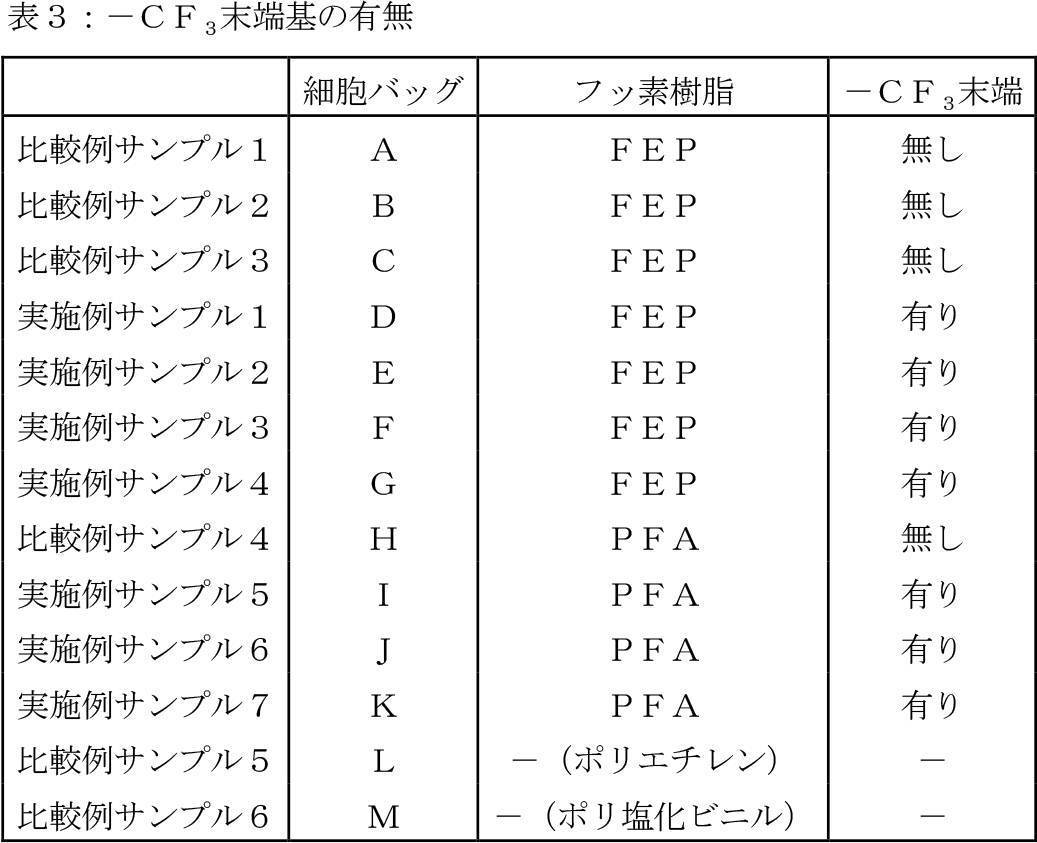
上記実施例1の細胞バッグを用いて細胞を保存した場合に、細胞接着が抑制され、浮遊状態で保存できるかどうかについて解析した。
2-1-1 細胞保存液の調製
6.0(w/v)%トレハロース含有ラクテック(登録商標)注(大塚製薬工場社製)と、低分子デキストランL注(10[w/v]%デキストラン含有ラクテック注)(大塚製薬工場社製)とを1:1で混合し、細胞保存液を調製した。
〔1〕4×10⁵個のhMSC(Lonza社製、PT-2501)を、75cm2フラスコを用いてMSC培養液(Lonza社製、PT-3001)存在下で37℃、5%CO2インキュベーターにて培養し、約90%コンフルエントで定法にしたがって継代した。
〔2〕継代したhMSC(継代回数3回の細胞、ほぼ100%コンフルエント)の培養液をアスピレーターで除き、フラスコ当たり8mLのPBS(Invitrogen社製)でhMSCをリンスした。
〔3〕PBSをアスピレーターで除き、フラスコ当たり3.75mLのトリプシン-EDTA(Lonza社製、CC-3232)を加え、室温で5分間静置した。
〔4〕hMSCが90%程度剥離するまで顕微鏡下で観察しながら、ゆっくりと揺らした。
〔5〕フラスコ当たり3.75mLのMSC培養液を加え、トリプシン反応を停止させ、ピペッティングによりhMSCを回収し、50mL遠心チューブに移した。
〔6〕600×g、5分間、25℃で遠心分離を行った。
〔7〕上清をアスピレーターで除き、1フラスコ当たり3mLの上記細胞保存液を加え、hMSCペレット(沈殿物)を懸濁した。
〔8〕10μLのhMSC-BM懸濁液を採取し、細胞計数盤で細胞数を計測し、5×10⁵個/mLとなるように上記細胞保存液を添加し、氷冷した。
〔1〕5×10⁵個/mLのhMSC含有細胞保存液を、13種類の細胞バッグA~M内に3mLずつ播種した。
〔2〕インキュベーター(25℃、5%CO2)(アズワン社製、PIC100)内に6時間静置・保存した後、細胞懸濁液の一部(20μL)を回収し、20μLの0.4%トリパンブルー(Gibco社製)と混合し、細胞計数盤を用いて顕微鏡(ECLIPSE TS100、ニコン社製)下で細胞懸濁液の細胞濃度及び生細胞数を計測し、それぞれ細胞回収率(表4、7及び10参照)及び細胞生存率(表5、8及び11参照)を算出した。また、バッグの一部をハサミでカットし、6ウェルプレート上において、バッグに接着した細胞を顕微鏡(IX-70、オリンパス社製)下で観察した。なお、表4~表6、表7~表9、及び表10~表12の結果は、それぞれ独立した(hMSCの調製時期が異なる)実験により得られたものである。
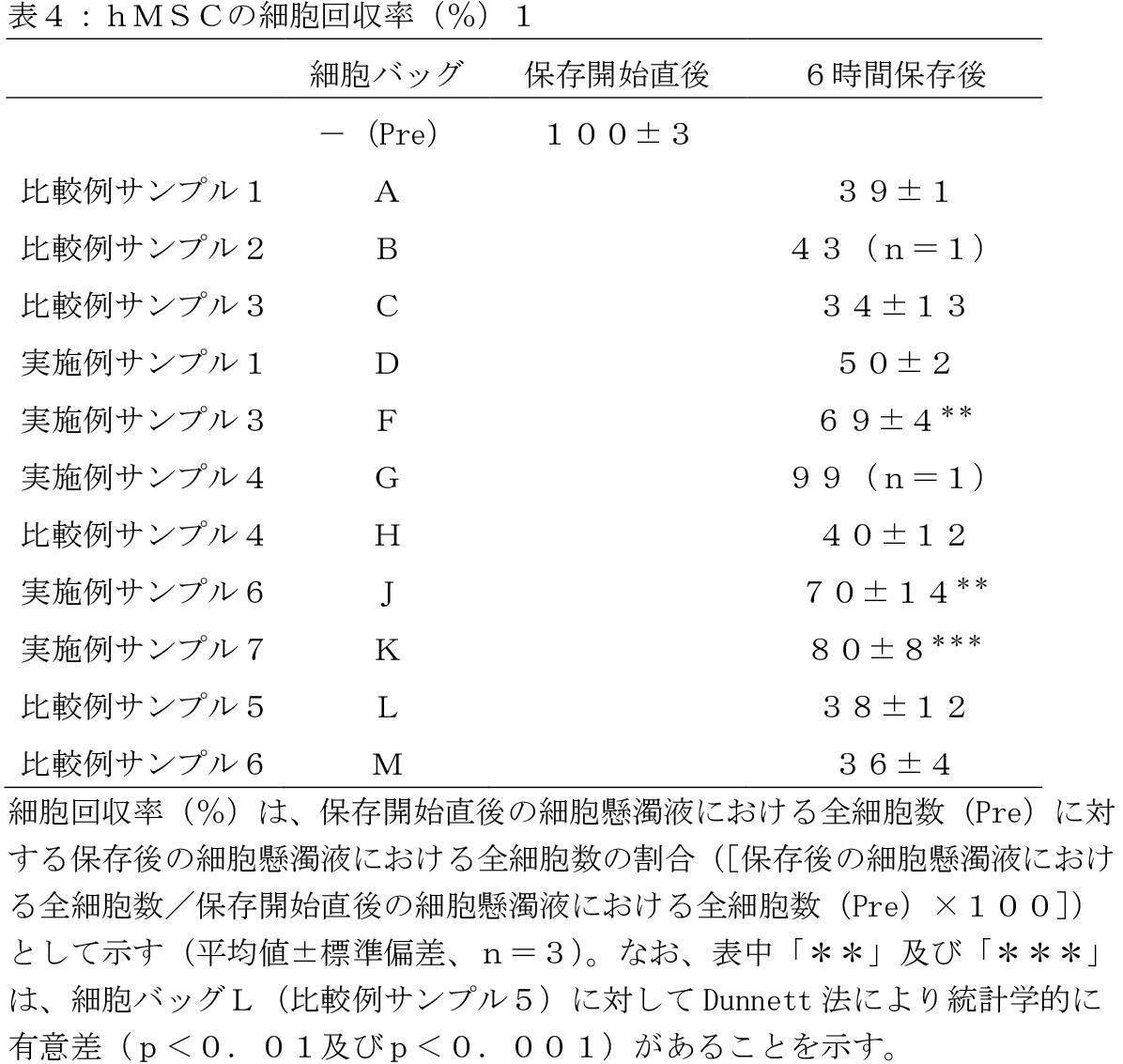

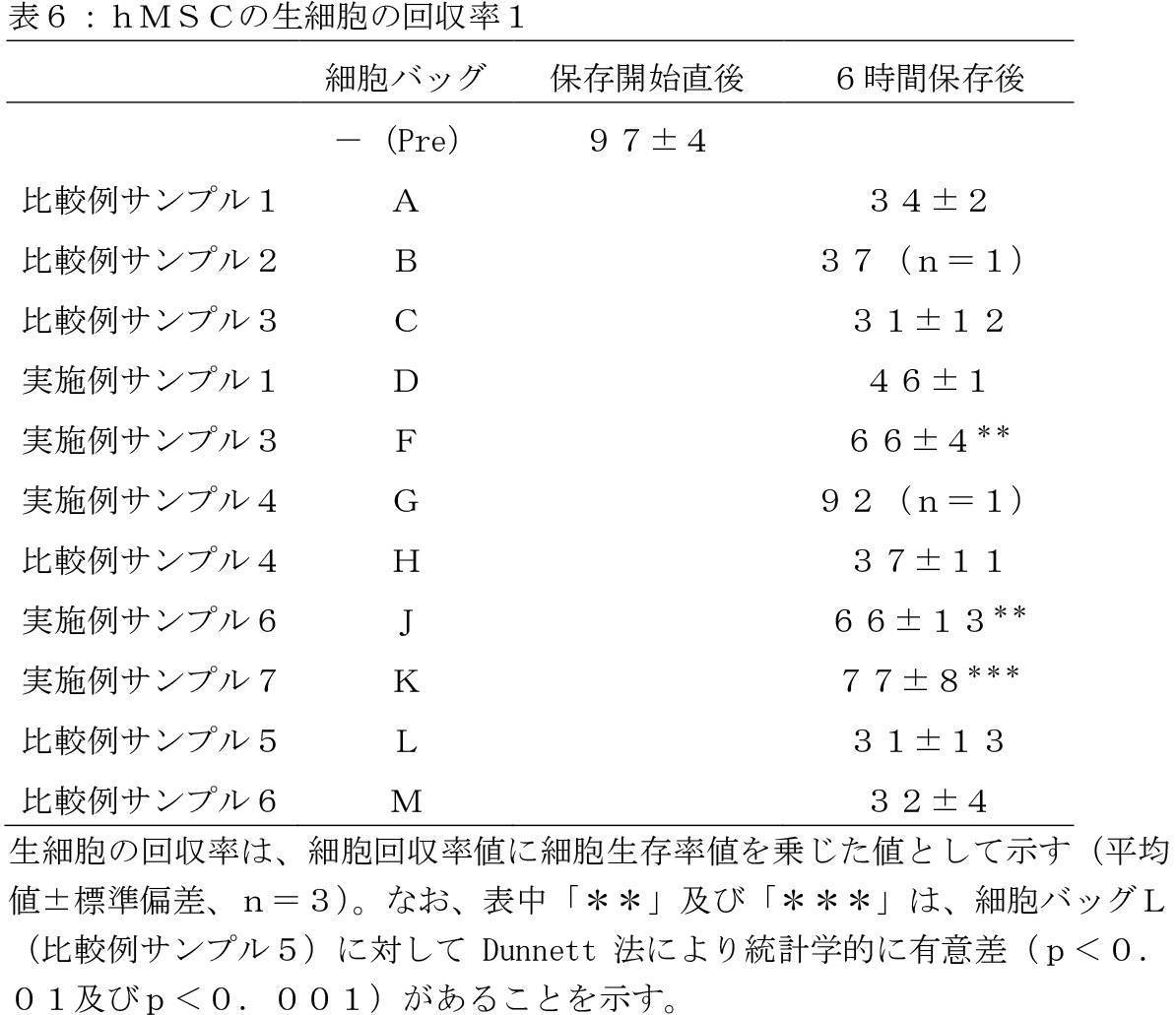
保存後のhMSCの回収率は、表4に示すとおり、細胞バッグA、B、C、H、L、及びM(比較例サンプル1、2、3、4、5、及び6)を用いた場合は、それぞれ39%、43%、34%、40%、38%、及び36%であったのに対して、細胞バッグD、F、G、J、及びK(実施例サンプル1、3、4、6、及び7)を用いた場合は、それぞれ50%、69%、99%、70%、及び80%と高かった。

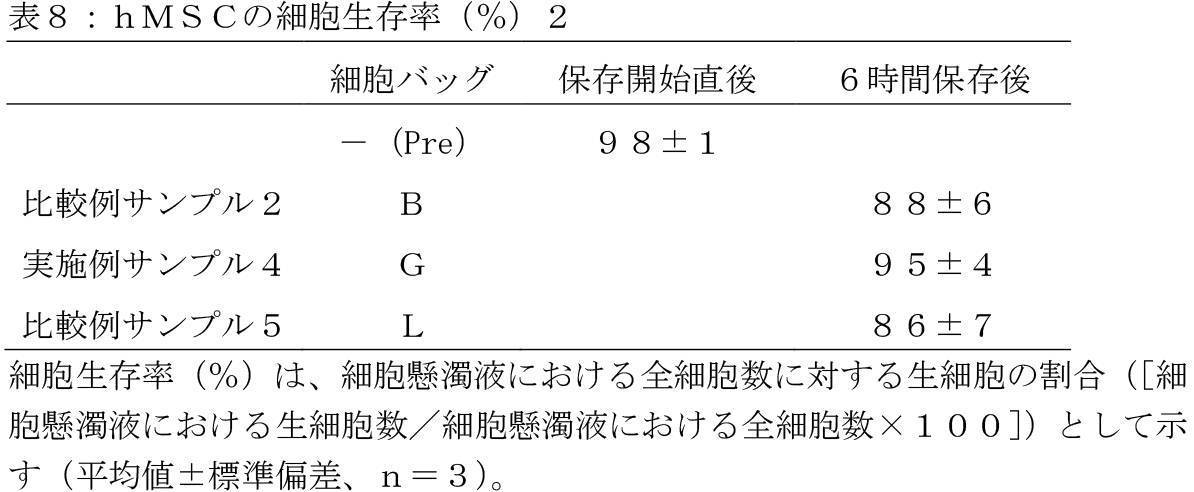
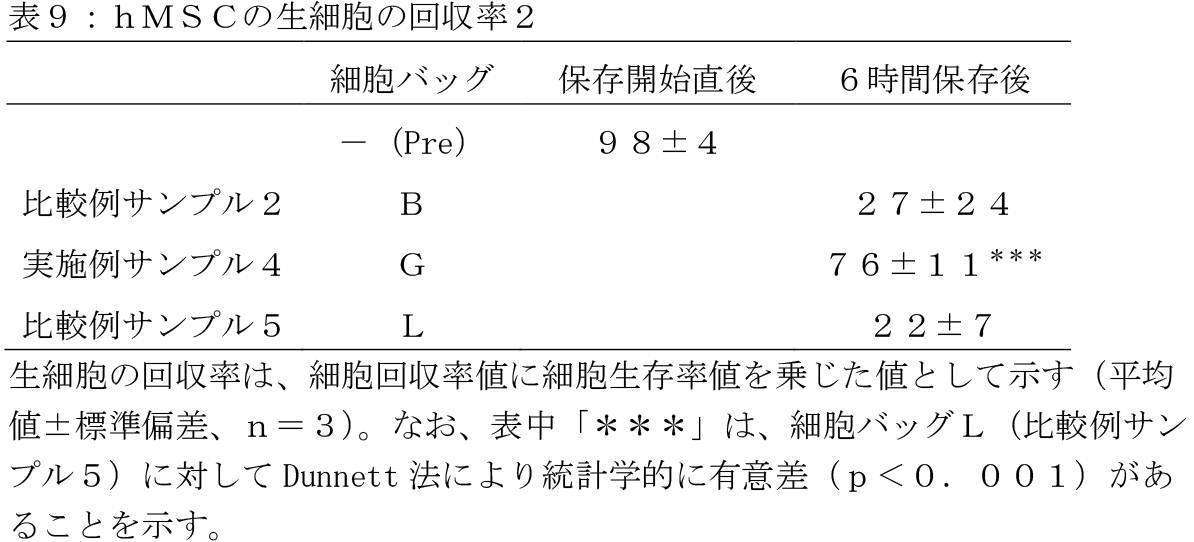
保存後のhMSCの回収率は、表7に示すとおり、細胞バッグB及びL(比較例サンプル2及び5)を用いた場合は、それぞれ30%及び25%であったのに対して、細胞バッグG(実施例サンプル4)を用いた場合は、80%と高かった。
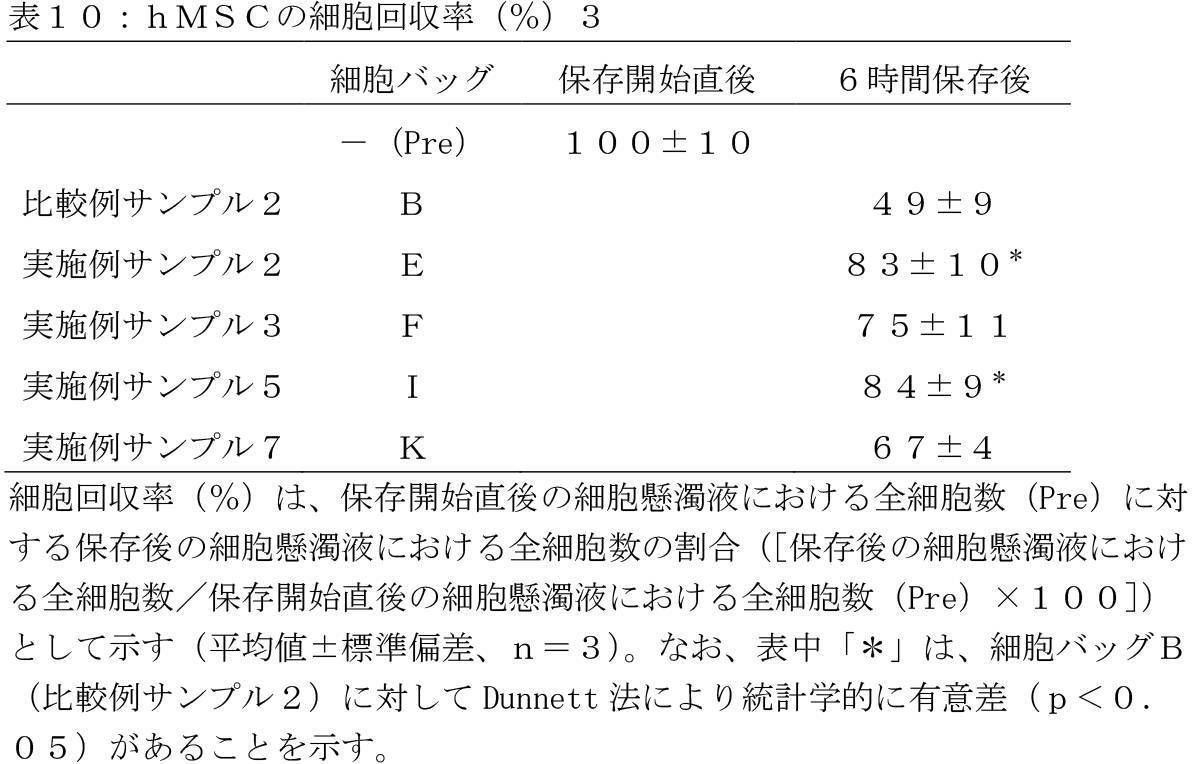


保存後のhMSCの回収率は、表10に示すとおり、細胞バッグB(比較例サンプル2)を用いた場合は49%であったのに対して、細胞バッグE、F、I、及びK(実施例サンプル2、3、5、及び7)を用いた場合は、それぞれ83%、75%、84%、及び67%と高かった。
これらの結果は、細胞バッグD~G、及びI~K(実施例サンプル1~4、及び5~7)内で細胞を保存すると、細胞バッグA~C、H、L、及びM(比較例サンプル1~3、4、5、及び6)内で細胞を保存するよりも、生細胞の接着性を有意に抑制できることを示している。
上記実施例1で製造した細胞バッグを用いて細胞を培養した場合に、細胞接着が抑制され、浮遊状態で培養できるかどうかについて解析した。
〔1〕マウス間葉系幹細胞由来10T1/2細胞を、10%FBS(life technologies社製、gibco standard)を含むDMEM(nacalai tesque社製、08458-45)培養液中に、1.0×10⁵個/mLとなるように懸濁させ、2種類の細胞バッグB(比較例サンプル2)及びG(実施例サンプル4)内に3mLずつ播種した。
〔2〕インキュベーター(37℃、5%CO2)内で培養し、4時間、1、2、3、及び6日後、細胞懸濁液の一部(10μL)を回収し、10μLの0.4%トリパンブルー(Gibco社製)と混合し、細胞計数盤で生細胞数を計測し、細胞生存率を算出した。また、細胞バッグに接着した細胞を光学顕微鏡(Nikon社製)下で観察した。
培養後の10T1/2細胞の生存率は、細胞バッグG(実施例サンプル4)及び細胞バッグB(比較例サンプル2)を用いた場合はともに、70%以上と高かった。一方、培養後にバッグ内面に接着した10T1/2細胞の割合は、細胞バッグBを用いた場合よりも細胞バッグGを用いた方が少なかった。
この結果は、細胞バッグG(実施例サンプル4)内で細胞を培養すると、細胞バッグB(比較例サンプル2)内で細胞を培養するよりも、生細胞の接着性を有意に抑制できることを示している。
Claims (7)
- フッ素樹脂における非フッ素化基末端と-CF2H基末端とを合計した数が炭素1×10⁶当たり70個以下であるフッ素樹脂により、哺乳動物細胞と接触する表面が形成されていることを特徴とする哺乳動物細胞の投与用、保存用、又は培養用容器。
- -CF3の末端基を1つ以上含むフッ素樹脂により、哺乳動物細胞と接触する表面が形成されていることを特徴とする哺乳動物細胞の投与用、保存用、又は培養用容器。
- 非フッ素化基末端が炭素1×10⁶当たり70個以下であるフッ素樹脂により哺乳動物細胞と接触する表面が形成されていることを特徴とする、請求項2記載の哺乳動物細胞の投与用、保存用、又は培養用容器。
- フッ素樹脂が、テトラフルオロエチレン-ヘキサフルオロプロピレン系共重合体、及びテトラフルオロエチレン-パーフルオロアルキルビニルエーテル系共重合体から選ばれる少なくとも1つのフッ素樹脂であることを特徴とする請求項1~3のいずれかに記載の投与用、保存用、又は培養用容器。
- バッグであることを特徴とする請求項1~4のいずれかに記載の投与用、保存用、又は培養用容器。
- 哺乳動物細胞が接着性細胞であることを特徴とする請求項1~5のいずれかに記載の投与用、保存用、又は培養用容器。
- 哺乳動物細胞が間葉系幹細胞であることを特徴とする請求項1~6のいずれかに記載の投与用、保存用、又は培養用容器。
Priority Applications (16)
| Application Number | Priority Date | Filing Date | Title |
|---|---|---|---|
| SG11201800273PA SG11201800273PA (en) | 2015-07-16 | 2016-07-14 | Container for cell administration, storage or culturing |
| US15/743,913 US10961493B2 (en) | 2015-07-16 | 2016-07-14 | Container for cell administration, storage or culturing |
| NZ738915A NZ738915A (en) | 2015-07-16 | 2016-07-14 | Container for cell administration, storage or culturing |
| EP16824084.4A EP3323878A4 (en) | 2015-07-16 | 2016-07-14 | CONTAINER FOR ADMINISTRATION, STORAGE OR CULTIVATION OF CELLS |
| CA2991291A CA2991291C (en) | 2015-07-16 | 2016-07-14 | Container for cell administration, storage or culturing comprising fluororesin whose terminal groups are subjected to fluorination treatment |
| BR112018000658-0A BR112018000658B1 (pt) | 2015-07-16 | 2016-07-14 | Recipiente para administração, armazenagem ou cultivo de células |
| MYPI2018700168A MY182101A (en) | 2015-07-16 | 2016-07-14 | Container for cell administration, storage or culturing |
| JP2017528293A JP6872481B2 (ja) | 2015-07-16 | 2016-07-14 | 細胞投与用、保存用、又は培養用容器 |
| CN201680041189.6A CN107849511B (zh) | 2015-07-16 | 2016-07-14 | 用于细胞施予、保存、或培养的容器 |
| HK18106932.8A HK1247235B (en) | 2015-07-16 | 2016-07-14 | Container for cell administration, storage or culturing |
| AU2016293661A AU2016293661B2 (en) | 2015-07-16 | 2016-07-14 | Container for cell administration, storage or culturing |
| RU2018105093A RU2671472C1 (ru) | 2015-07-16 | 2016-07-14 | Контейнер для введения, хранения или культивирования клеток |
| KR1020187003059A KR102040736B1 (ko) | 2015-07-16 | 2016-07-14 | 세포 투여용, 보존용, 또는 배양용 용기 |
| MX2018000589A MX389453B (es) | 2015-07-16 | 2016-07-14 | Recipiente para administración, almacenamiento o cultivo celular. |
| HK18108812.9A HK1249129A1 (en) | 2015-07-16 | 2016-07-14 | Container for cell administration, storage or culturing |
| PH12018550003A PH12018550003A1 (en) | 2015-07-16 | 2018-01-15 | Container for cell administration, storage or culturing |
Applications Claiming Priority (4)
| Application Number | Priority Date | Filing Date | Title |
|---|---|---|---|
| JP2015142201 | 2015-07-16 | ||
| JP2015-142201 | 2015-07-16 | ||
| JP2016004339 | 2016-01-13 | ||
| JP2016-004339 | 2016-01-13 |
Publications (1)
| Publication Number | Publication Date |
|---|---|
| WO2017010100A1 true WO2017010100A1 (ja) | 2017-01-19 |
Family
ID=57757256
Family Applications (1)
| Application Number | Title | Priority Date | Filing Date |
|---|---|---|---|
| PCT/JP2016/003319 Ceased WO2017010100A1 (ja) | 2015-07-16 | 2016-07-14 | 細胞投与用、保存用、又は培養用容器 |
Country Status (17)
| Country | Link |
|---|---|
| US (1) | US10961493B2 (ja) |
| EP (1) | EP3323878A4 (ja) |
| JP (2) | JP6872481B2 (ja) |
| KR (1) | KR102040736B1 (ja) |
| CN (1) | CN107849511B (ja) |
| AU (1) | AU2016293661B2 (ja) |
| BR (1) | BR112018000658B1 (ja) |
| CA (1) | CA2991291C (ja) |
| HK (1) | HK1249129A1 (ja) |
| MX (1) | MX389453B (ja) |
| MY (1) | MY182101A (ja) |
| NZ (1) | NZ738915A (ja) |
| PH (1) | PH12018550003A1 (ja) |
| RU (1) | RU2671472C1 (ja) |
| SG (1) | SG11201800273PA (ja) |
| TW (2) | TWI725977B (ja) |
| WO (1) | WO2017010100A1 (ja) |
Cited By (4)
| Publication number | Priority date | Publication date | Assignee | Title |
|---|---|---|---|---|
| WO2020122225A1 (ja) | 2018-12-13 | 2020-06-18 | 国立研究開発法人産業技術総合研究所 | 細胞培養器具および細胞の処理方法 |
| WO2023162943A1 (ja) | 2022-02-25 | 2023-08-31 | ダイキン工業株式会社 | 細胞、核酸、又はタンパク質の凍結保存用のシリンジ |
| WO2023162945A1 (ja) | 2022-02-25 | 2023-08-31 | 株式会社大塚製薬工場 | 凍結保存用のシリンジ |
| WO2024150805A1 (ja) * | 2023-01-12 | 2024-07-18 | 東京応化工業株式会社 | チューブ及び細胞培養用デバイス |
Families Citing this family (2)
| Publication number | Priority date | Publication date | Assignee | Title |
|---|---|---|---|---|
| EP3572061A4 (en) * | 2017-01-18 | 2020-10-14 | Daikin Industries, Ltd. | CONTAINER FOR THE ADMINISTRATION, STORAGE, DISTRIBUTION OR TRANSPORT OF A LOW ADSORBABLE PROTEIN OR OF A COMPOSITION CONTAINING PROTEIN, AND APPARATUS FOR THE PRODUCTION OF A PROTEIN OR OF A PROTEIN COMPOSITION |
| CN113321835B (zh) * | 2021-05-21 | 2024-04-05 | 江苏康进医疗器材有限公司 | 一种用于细胞培养袋的薄膜、制备工艺及细胞培养袋 |
Citations (2)
| Publication number | Priority date | Publication date | Assignee | Title |
|---|---|---|---|---|
| WO2005037984A1 (ja) * | 2003-10-20 | 2005-04-28 | Jms Co., Ltd. | 細胞取扱装置、組織再生用組成物及び組織再生方法 |
| JP2014513918A (ja) * | 2011-02-18 | 2014-06-19 | ステムサイト インコーポレーテッド | 幹細胞の包装および輸送 |
Family Cites Families (12)
| Publication number | Priority date | Publication date | Assignee | Title |
|---|---|---|---|---|
| JP2726708B2 (ja) | 1989-08-01 | 1998-03-11 | 株式会社ニッショー | 細胞培養用バッグ |
| WO1991005007A1 (en) * | 1989-10-06 | 1991-04-18 | E.I. Du Pont De Nemours And Company | Extrusion process for difficultly-melt-processible polymers |
| JPH0698756A (ja) | 1992-09-18 | 1994-04-12 | Nissho Corp | 付着性細胞培養用バツグ |
| JP3962153B2 (ja) | 1998-03-25 | 2007-08-22 | イー・アイ・デュポン・ドウ・ヌムール・アンド・カンパニー | 改良された防汚性を有する食品加熱加工器具 |
| CN100497580C (zh) * | 2003-10-20 | 2009-06-10 | 株式会社Jms | 细胞处理装置、组织再生用组合物及组织再生方法 |
| CN1882614B (zh) * | 2003-11-20 | 2011-01-19 | 大金工业株式会社 | 含氟聚合物制造方法及含氟聚合物的物质 |
| US20070292945A1 (en) * | 2004-03-25 | 2007-12-20 | Lin Wenglong R | Cell Culture Apparatus and Methods |
| JP4887222B2 (ja) | 2006-06-16 | 2012-02-29 | ニプロ株式会社 | 細胞培養容器、その製造方法、及び細胞培養方法 |
| US10655097B2 (en) | 2014-12-22 | 2020-05-19 | Saint-Gobain Performance Plastics Corporation | T-cell culture double bag assembly |
| US10280390B2 (en) | 2014-12-22 | 2019-05-07 | Saint-Gobain Performance Plastics Corporation | System for culture of cells in a controlled environment |
| JP6165280B2 (ja) | 2015-01-29 | 2017-07-19 | ダイキン工業株式会社 | 細胞培養器材 |
| JP2016146777A (ja) | 2015-02-12 | 2016-08-18 | ダイキン工業株式会社 | 細胞培養用バッグ及びそれを用いた細胞培養方法 |
-
2016
- 2016-07-14 EP EP16824084.4A patent/EP3323878A4/en active Pending
- 2016-07-14 CN CN201680041189.6A patent/CN107849511B/zh active Active
- 2016-07-14 TW TW105122219A patent/TWI725977B/zh active
- 2016-07-14 BR BR112018000658-0A patent/BR112018000658B1/pt active IP Right Grant
- 2016-07-14 NZ NZ738915A patent/NZ738915A/en unknown
- 2016-07-14 CA CA2991291A patent/CA2991291C/en active Active
- 2016-07-14 HK HK18108812.9A patent/HK1249129A1/en unknown
- 2016-07-14 SG SG11201800273PA patent/SG11201800273PA/en unknown
- 2016-07-14 US US15/743,913 patent/US10961493B2/en active Active
- 2016-07-14 KR KR1020187003059A patent/KR102040736B1/ko active Active
- 2016-07-14 JP JP2017528293A patent/JP6872481B2/ja active Active
- 2016-07-14 WO PCT/JP2016/003319 patent/WO2017010100A1/ja not_active Ceased
- 2016-07-14 AU AU2016293661A patent/AU2016293661B2/en active Active
- 2016-07-14 RU RU2018105093A patent/RU2671472C1/ru active
- 2016-07-14 MX MX2018000589A patent/MX389453B/es unknown
- 2016-07-14 TW TW110104805A patent/TW202126803A/zh unknown
- 2016-07-14 MY MYPI2018700168A patent/MY182101A/en unknown
-
2018
- 2018-01-15 PH PH12018550003A patent/PH12018550003A1/en unknown
-
2021
- 2021-03-03 JP JP2021033697A patent/JP2021078525A/ja active Pending
Patent Citations (2)
| Publication number | Priority date | Publication date | Assignee | Title |
|---|---|---|---|---|
| WO2005037984A1 (ja) * | 2003-10-20 | 2005-04-28 | Jms Co., Ltd. | 細胞取扱装置、組織再生用組成物及び組織再生方法 |
| JP2014513918A (ja) * | 2011-02-18 | 2014-06-19 | ステムサイト インコーポレーテッド | 幹細胞の包装および輸送 |
Non-Patent Citations (2)
| Title |
|---|
| EIJI FUJITA: "Fusso Jushi no Hyomen·Kaimen no Seigyo Gijutsu to sono Oyo", 13 May 2015 (2015-05-13), XP055510054, Retrieved from the Internet <URL:https://web.archive.org/web/20150513072252> [retrieved on 20161002] * |
| See also references of EP3323878A4 * |
Cited By (5)
| Publication number | Priority date | Publication date | Assignee | Title |
|---|---|---|---|---|
| WO2020122225A1 (ja) | 2018-12-13 | 2020-06-18 | 国立研究開発法人産業技術総合研究所 | 細胞培養器具および細胞の処理方法 |
| US12270020B2 (en) | 2018-12-13 | 2025-04-08 | National Institute Of Advanced Industrial Science And Technology | Cell culture instrument and cell processing method |
| WO2023162943A1 (ja) | 2022-02-25 | 2023-08-31 | ダイキン工業株式会社 | 細胞、核酸、又はタンパク質の凍結保存用のシリンジ |
| WO2023162945A1 (ja) | 2022-02-25 | 2023-08-31 | 株式会社大塚製薬工場 | 凍結保存用のシリンジ |
| WO2024150805A1 (ja) * | 2023-01-12 | 2024-07-18 | 東京応化工業株式会社 | チューブ及び細胞培養用デバイス |
Also Published As
| Publication number | Publication date |
|---|---|
| TW202126803A (zh) | 2021-07-16 |
| KR102040736B1 (ko) | 2019-11-05 |
| TW201706405A (zh) | 2017-02-16 |
| MY182101A (en) | 2021-01-18 |
| HK1249129A1 (en) | 2018-10-26 |
| US20180201890A1 (en) | 2018-07-19 |
| CA2991291A1 (en) | 2017-01-19 |
| CN107849511B (zh) | 2021-06-18 |
| SG11201800273PA (en) | 2018-02-27 |
| NZ738915A (en) | 2018-12-21 |
| CN107849511A (zh) | 2018-03-27 |
| EP3323878A4 (en) | 2019-03-27 |
| AU2016293661B2 (en) | 2018-11-08 |
| JP6872481B2 (ja) | 2021-05-19 |
| BR112018000658B1 (pt) | 2022-05-24 |
| TWI725977B (zh) | 2021-05-01 |
| MX2018000589A (es) | 2018-09-06 |
| CA2991291C (en) | 2022-06-21 |
| EP3323878A1 (en) | 2018-05-23 |
| PH12018550003A1 (en) | 2018-07-09 |
| MX389453B (es) | 2025-03-11 |
| US10961493B2 (en) | 2021-03-30 |
| AU2016293661A1 (en) | 2018-02-01 |
| JP2021078525A (ja) | 2021-05-27 |
| HK1247235A1 (zh) | 2018-09-21 |
| JPWO2017010100A1 (ja) | 2018-04-26 |
| BR112018000658A2 (ja) | 2018-09-18 |
| KR20180022965A (ko) | 2018-03-06 |
| RU2671472C1 (ru) | 2018-10-31 |
Similar Documents
| Publication | Publication Date | Title |
|---|---|---|
| JP2021078525A (ja) | 細胞投与用、保存用、又は培養用容器 | |
| Nagase et al. | Poly (N-isopropylacrylamide)-based thermoresponsive surfaces provide new types of biomedical applications | |
| JP7123346B2 (ja) | 生体適合性材料、コーティング組成物、コーティング膜及び物品 | |
| JP2014513918A5 (ja) | 幹細胞の包装製品並びに同包装製品を作製する方法および輸送する方法 | |
| JP6810386B2 (ja) | 低タンパク質吸着性材料、低タンパク質吸着性物品、低細胞付着性材料および低細胞付着性物品 | |
| JP2020127439A (ja) | 分化細胞の製造方法、及びその製造方法のために使用する培養バッグ | |
| WO2018135228A1 (ja) | タンパク質低吸着性を有するタンパク質若しくはタンパク質を含む組成物の投与用、保存用、運搬用、または輸送用の容器及びタンパク質若しくはタンパク質組成物の製造用器材 | |
| JP6214583B2 (ja) | 高分子基材、その用途及びその製造方法 | |
| JP6165280B2 (ja) | 細胞培養器材 | |
| JP2016026520A (ja) | タンパク質付着防止用化合物、塗布液および医療用デバイス | |
| Yamahara et al. | Fabrication of thermo-responsive PNIPAAm-g-ETFE for cell culture dishes by pre-irradiation grafting | |
| HK1247235B (en) | Container for cell administration, storage or culturing | |
| WO2016129220A1 (ja) | 細胞培養用バッグ及びそれを用いた細胞培養方法 | |
| JP2017077241A (ja) | 接着性細胞培養用基材、ならびにこれを利用した細胞培養容器および細胞培養方法 | |
| JP6810376B2 (ja) | 抗血栓性材料、抗血栓性物品、抗菌性材料、抗菌性物品、及び、物品表面の大腸菌の増殖を阻害する方法 | |
| US20250263672A1 (en) | Syringe for cryopreservation of cells, nucleic acids, or proteins | |
| JP2017077240A (ja) | 接着性細胞培養用基材、ならびにこれを利用した細胞培養容器および細胞培養方法 | |
| AU2023225399A1 (en) | Syringe for cryopreservation |
Legal Events
| Date | Code | Title | Description |
|---|---|---|---|
| 121 | Ep: the epo has been informed by wipo that ep was designated in this application |
Ref document number: 16824084 Country of ref document: EP Kind code of ref document: A1 |
|
| ENP | Entry into the national phase |
Ref document number: 2991291 Country of ref document: CA |
|
| ENP | Entry into the national phase |
Ref document number: 2017528293 Country of ref document: JP Kind code of ref document: A |
|
| WWE | Wipo information: entry into national phase |
Ref document number: 15743913 Country of ref document: US |
|
| WWE | Wipo information: entry into national phase |
Ref document number: 11201800273P Country of ref document: SG |
|
| WWE | Wipo information: entry into national phase |
Ref document number: 12018550003 Country of ref document: PH Ref document number: MX/A/2018/000589 Country of ref document: MX |
|
| NENP | Non-entry into the national phase |
Ref country code: DE |
|
| ENP | Entry into the national phase |
Ref document number: 20187003059 Country of ref document: KR Kind code of ref document: A |
|
| ENP | Entry into the national phase |
Ref document number: 2016293661 Country of ref document: AU Date of ref document: 20160714 Kind code of ref document: A |
|
| WWE | Wipo information: entry into national phase |
Ref document number: 2018105093 Country of ref document: RU Ref document number: 2016824084 Country of ref document: EP |
|
| REG | Reference to national code |
Ref country code: BR Ref legal event code: B01A Ref document number: 112018000658 Country of ref document: BR |
|
| ENP | Entry into the national phase |
Ref document number: 112018000658 Country of ref document: BR Kind code of ref document: A2 Effective date: 20180112 |