WO2016208667A1 - エポキシ樹脂組成物およびその硬化物 - Google Patents
エポキシ樹脂組成物およびその硬化物 Download PDFInfo
- Publication number
- WO2016208667A1 WO2016208667A1 PCT/JP2016/068645 JP2016068645W WO2016208667A1 WO 2016208667 A1 WO2016208667 A1 WO 2016208667A1 JP 2016068645 W JP2016068645 W JP 2016068645W WO 2016208667 A1 WO2016208667 A1 WO 2016208667A1
- Authority
- WO
- WIPO (PCT)
- Prior art keywords
- epoxy resin
- group
- resin composition
- parts
- weight
- Prior art date
- Legal status (The legal status is an assumption and is not a legal conclusion. Google has not performed a legal analysis and makes no representation as to the accuracy of the status listed.)
- Ceased
Links
- 0 C*(C)Cc(cc1)ccc1-c1ccc(C)cc1 Chemical compound C*(C)Cc(cc1)ccc1-c1ccc(C)cc1 0.000 description 1
- HIDBROSJWZYGSZ-UHFFFAOYSA-N O=C(C=CC1=O)N1c1ccccc1 Chemical compound O=C(C=CC1=O)N1c1ccccc1 HIDBROSJWZYGSZ-UHFFFAOYSA-N 0.000 description 1
Images


Classifications
-
- C—CHEMISTRY; METALLURGY
- C08—ORGANIC MACROMOLECULAR COMPOUNDS; THEIR PREPARATION OR CHEMICAL WORKING-UP; COMPOSITIONS BASED THEREON
- C08G—MACROMOLECULAR COMPOUNDS OBTAINED OTHERWISE THAN BY REACTIONS ONLY INVOLVING UNSATURATED CARBON-TO-CARBON BONDS
- C08G59/00—Polycondensates containing more than one epoxy group per molecule; Macromolecules obtained by polymerising compounds containing more than one epoxy group per molecule using curing agents or catalysts which react with the epoxy groups
- C08G59/18—Macromolecules obtained by polymerising compounds containing more than one epoxy group per molecule using curing agents or catalysts which react with the epoxy groups ; e.g. general methods of curing
- C08G59/40—Macromolecules obtained by polymerising compounds containing more than one epoxy group per molecule using curing agents or catalysts which react with the epoxy groups ; e.g. general methods of curing characterised by the curing agents used
- C08G59/4007—Curing agents not provided for by the groups C08G59/42 - C08G59/66
- C08G59/4014—Nitrogen containing compounds
- C08G59/4042—Imines; Imides
-
- C—CHEMISTRY; METALLURGY
- C08—ORGANIC MACROMOLECULAR COMPOUNDS; THEIR PREPARATION OR CHEMICAL WORKING-UP; COMPOSITIONS BASED THEREON
- C08G—MACROMOLECULAR COMPOUNDS OBTAINED OTHERWISE THAN BY REACTIONS ONLY INVOLVING UNSATURATED CARBON-TO-CARBON BONDS
- C08G59/00—Polycondensates containing more than one epoxy group per molecule; Macromolecules obtained by polymerising compounds containing more than one epoxy group per molecule using curing agents or catalysts which react with the epoxy groups
- C08G59/18—Macromolecules obtained by polymerising compounds containing more than one epoxy group per molecule using curing agents or catalysts which react with the epoxy groups ; e.g. general methods of curing
- C08G59/40—Macromolecules obtained by polymerising compounds containing more than one epoxy group per molecule using curing agents or catalysts which react with the epoxy groups ; e.g. general methods of curing characterised by the curing agents used
-
- C—CHEMISTRY; METALLURGY
- C08—ORGANIC MACROMOLECULAR COMPOUNDS; THEIR PREPARATION OR CHEMICAL WORKING-UP; COMPOSITIONS BASED THEREON
- C08L—COMPOSITIONS OF MACROMOLECULAR COMPOUNDS
- C08L63/00—Compositions of epoxy resins; Compositions of derivatives of epoxy resins
-
- C—CHEMISTRY; METALLURGY
- C08—ORGANIC MACROMOLECULAR COMPOUNDS; THEIR PREPARATION OR CHEMICAL WORKING-UP; COMPOSITIONS BASED THEREON
- C08L—COMPOSITIONS OF MACROMOLECULAR COMPOUNDS
- C08L79/00—Compositions of macromolecular compounds obtained by reactions forming in the main chain of the macromolecule a linkage containing nitrogen with or without oxygen or carbon only, not provided for in groups C08L61/00 - C08L77/00
- C08L79/04—Polycondensates having nitrogen-containing heterocyclic rings in the main chain; Polyhydrazides; Polyamide acids or similar polyimide precursors
- C08L79/08—Polyimides; Polyester-imides; Polyamide-imides; Polyamide acids or similar polyimide precursors
- C08L79/085—Unsaturated polyimide precursors
Definitions
- the present invention relates to an epoxy resin composition and a cured product thereof. Specifically, for high-reliability semiconductor encapsulant use, electrical / electronic component insulation material use, and various composite materials use such as laminate (printed wiring glass fiber reinforced composite material) and CFRP (carbon fiber reinforced composite material), The present invention relates to an epoxy resin composition useful for various adhesive applications, various coating applications, structural members, and the like, and a cured product thereof.
- thermosetting mainly paper-based paper-phenolic resin, glass cloth-based glass cloth-epoxy resin, etc. Resin is used.
- thermosetting resins exhibit high heat resistance and dimensional stability due to their unique cross-linking structure, so they are widely used in fields that require high reliability such as electronic parts, especially copper-clad laminates.
- high copper foil adhesion for forming fine wiring and mechanical strength and toughness when drilling or punching is required. It is said that.
- epoxy resin has relatively good mechanical strength and heat resistance, it is required to improve the heat resistance due to the recent high-density mounting of printed wiring boards and high-layer structures, and to improve the mechanical strength of the resin by making the board thinner. It is like that.
- a semiconductor chip having a high processing capability such as a CPU is mounted on a laminated plate made of a polymer material.
- a low dielectric constant and a low dielectric loss tangent are required for the wiring board.
- a bismaleimide resin has been studied as an impregnation resin instead of an epoxy resin for the purpose of improving the dielectric constant of the resin.
- BT resin which is a resin in which a bisphenol A-type cyanate ester compound and a bismaleimide compound are used together, is excellent in heat resistance, chemical resistance, electrical characteristics, etc., and is widely used as a high-performance wiring board. in use.
- a bismaleimide resin which is a thermosetting resin, is a resin that has excellent low dielectric properties, flame retardancy, and heat resistance, but generally has a problem of lower interlayer adhesion and mechanical strength than epoxy resins.
- the present inventors further improved the maleimide resin (Patent Documents 2 and 3) that have been developed so far, and an epoxy resin balanced in copper foil adhesion, heat resistance, and dielectric properties (relative dielectric constant, dielectric loss tangent). The compounding quantity of the maleimide resin in the composition was found.
- An object of the present invention is to provide a maleimide resin-containing epoxy resin composition and a cured product thereof balanced in copper foil adhesion, heat resistance, and dielectric properties (relative dielectric constant, dielectric loss tangent). .
- Epoxy resin composition containing a maleimide resin and an epoxy resin represented by the following formula (1), wherein the maleimide resin is contained in an amount of 5 to 50% by weight based on the total amount of the resin in the composition.
- a plurality of R's are present independently and each represents a hydrogen atom, an alkyl group having 1 to 5 carbon atoms or an aromatic group.
- (2) The epoxy resin composition according to item (1), which contains a curing accelerator, (3)
- the epoxy resin composition according to (1) or (2) above which contains an epoxy resin curing agent having a phenol group, amino group, acid anhydride or cyanate group in the molecule;
- the epoxy resin composition of the present invention has excellent properties in terms of adhesion to metal foil, heat resistance, low dielectric properties, and low dielectric loss tangent properties while containing a maleimide resin. Further, the cured product can provide a prepreg or a laminate having excellent performance.
- the epoxy resin composition of the present invention will be described below.
- the epoxy resin composition of the present invention contains a maleimide resin represented by the following formula (1) and an epoxy resin as at least essential components, and the maleimide resin is added in an amount of 5 to 50% by weight based on the total amount of the resin in the composition. %contains.
- R's are present independently and each represents a hydrogen atom, an alkyl group having 1 to 5 carbon atoms or an aromatic group.
- the method for producing the maleimide resin represented by the formula (1) that can be used is not particularly limited, and it may be produced by any known method known as a method for synthesizing a maleimide compound.
- a compound of the following formula (2) is required as a precursor thereof.
- Japanese Patent Laid-Open No. 3-100016 and Japanese Patent Publication No. 8-16151 Describes the reaction of anilines with dihalogenomethyl compounds and dialkoxymethyl compounds. The same method is used to react anilines with bishalogenomethylbiphenyls or bisalkoxymethylbiphenyls. This gives the compound of formula (2).
- R's are present independently and each represents a hydrogen atom, an alkyl group having 1 to 5 carbon atoms or an aromatic group.
- anilines used in the production of the compound of formula (2) include aniline, 2-methylaniline, 3-methylaniline, 4-methylaniline, 2-ethylaniline, 3-ethylaniline, 4-ethylaniline, 2 , 3-dimethylaniline, 2,4-dimethylaniline, 2,5-dimethylaniline, 2,6-dimethylaniline, 3,4-dimethylaniline, 3,5-dimethylaniline, 2-propylaniline, 3-propylaniline 4-propylaniline, 2-isopropylaniline, 3-isopropylaniline, 4-isopropylaniline, 2-ethyl-6-methylaniline, 2-sec-butylaniline, 2-tert-butylaniline, 4-butylaniline, 4 -Sec-butylaniline, 4-tert-butylaniline, 2,6-die Alkyl-substituted anilines having one or more alkyl groups having 1 to 5 carbon atoms such as ruani
- bishalogenomethyl biphenyls or bisalkoxymethyl biphenyls used examples include 4,4′-bis (chloromethyl) biphenyl, 4,4′-bis (bromomethyl) biphenyl, and 4,4′-bis (fluoromethyl).
- Examples include methylbiphenyl, 4,4′-diisobutoxymethylbiphenyl, 4,4′-dibutoxymethylbiphenyl, 4,4′-di-tert-butoxymethylbiphenyl, and the like. These may be used alone or in combination of two or more.
- the amount of bishalogenomethylbiphenyls or bisalkoxymethylbiphenyls used is preferably 0.05 to 0.8 mol, more preferably 0.1 to 0.6 mol, relative to 1 mol of the aniline used. .
- an acidic catalyst such as hydrochloric acid, phosphoric acid, sulfuric acid, formic acid, zinc chloride, ferric chloride, aluminum chloride, p-toluenesulfonic acid, methanesulfonic acid and the like may be used. These may be used alone or in combination of two or more.
- the amount of the catalyst used is preferably 0.1 to 0.8 mol, more preferably 0.5 to 0.7 mol with respect to 1 mol of the aniline used. If the amount is too large, the viscosity of the reaction solution is high. If the amount is too small, the reaction proceeds slowly.
- the reaction may be carried out using an organic solvent such as toluene or xylene, if necessary, or without solvent.
- the water is removed from the system by azeotropic distillation.
- bishalogenomethylbiphenyls or bisalkoxymethylbiphenyls are preferably added at 40 to 100 ° C., more preferably 50 to 80 ° C., preferably over 1 to 5 hours, more preferably 2 to 4 hours, and then the solvent is added.
- the temperature is raised while removing from the system, and the reaction is preferably carried out at 180 to 240 ° C., more preferably 190 to 220 ° C., preferably 5 to 30 hours, more preferably 10 to 20 hours.
- diphenylamine which is a by-product at this stage, varies depending on the amount of catalyst, the ratio of raw materials used, temperature, time, etc. Usually 2 to 10% by weight is contained in the resin. Diphenylamine cannot be removed under conditions where aniline is distilled off. Diphenylamine can be removed by blowing steam or an inert gas such as a large amount of nitrogen gas under reduced pressure by heating at a temperature equal to or higher than the boiling point of aniline.
- diphenylamine When diphenylamine is contained in the epoxy resin composition of the present invention, for example, when used for a curing reaction with an epoxy resin, it becomes a terminal end of a molecular chain, and if the content is large, a curing network is not sufficiently formed. There is a possibility that the mechanical strength will be significantly reduced.
- diphenylamine when diphenylamine is contained in the aromatic amine resin represented by the formula (2), diphenylamine remains as it is after maleimidation and remains in the cured product as it is without contributing to the reaction. Bleed out and thermal decomposition resistance may decrease. Accordingly, the diphenylamine content is preferably 1% by weight or less, more preferably 0.5% by weight or less, and further preferably 0.2% by weight or less.
- the softening point of the aromatic amine resin represented by the formula (2) is preferably 65 ° C. or less, and more preferably 60 ° C. or less.
- the softening point is higher than 65 ° C., the viscosity of the maleimidized resin becomes high, and it becomes difficult to impregnate carbon fibers or glass fibers. If the dilution solvent is increased to lower the viscosity, the resin may not adhere sufficiently.
- the maleimide resin of the formula (1) used in the epoxy resin composition of the present invention can be obtained by reacting the compound of the formula (2) with maleic anhydride in the presence of a solvent and a catalyst.
- a method described in Japanese Patent Application Laid-Open No. 100016 or Japanese Patent Application Laid-Open No. 61-229863 may be employed.
- As the solvent used in the reaction it is necessary to remove water generated during the reaction from the system, and therefore a water-insoluble solvent is used.
- aromatic solvents such as toluene and xylene
- aliphatic solvents such as cyclohexane and n-hexane
- ethers such as diethyl ether and diisopropyl ether
- ester solvents such as ethyl acetate and butyl acetate, methyl isobutyl ketone and cyclopentanone
- water-insoluble solvent an aprotic polar solvent may be used in combination.
- the catalyst is an acidic catalyst and is not particularly limited, and examples thereof include p-toluenesulfonic acid, hydroxy-p-toluenesulfonic acid, methanesulfonic acid, sulfuric acid, and phosphoric acid.
- maleic acid is dissolved in toluene, an N-methylpyrrolidone solution of the compound of formula (2) is added with stirring, and then p-toluenesulfonic acid is added to remove water generated under reflux conditions from the system. While doing the reaction.
- Examples of the alkyl group having 1 to 5 carbon atoms in the formula (1) include methyl group, ethyl group, n-propyl group, iso-propyl group, n-butyl group, iso-butyl group, tert-butyl group, sec- Examples thereof include a butyl group and an n-pentyl group.
- the average value of n in the formula (1) can be calculated from the value of the weight average molecular weight obtained by the measurement of gel permeation chromatography (GPC) of the maleimide resin, but is approximately a raw material. It can be considered to be almost equivalent to the average value of n calculated from the GPC measurement result of the amine compound represented by the formula (2).
- the epoxy resin composition of the present invention contains a maleimide resin and an epoxy resin represented by the formula (1).
- the blending amount of the maleimide resin represented by the formula (1) is 5 to 50% by weight with respect to the total amount of the resin in the epoxy resin composition.
- the amount is preferably 10 to 50% by weight, more preferably 20 to 50% by weight. In the case of the above range, in the physical properties of the cured product, mechanical strength and peel strength are high, dielectric loss tangent is low, and heat resistance tends to be high.
- the epoxy resin that can be used in the epoxy resin composition of the present invention includes a monomer containing at least one epoxy group from the viewpoint that the epoxy group has a curing promoting action.
- Examples of the epoxy resin that can be blended with the maleimide resin represented by the formula (1) include novolak type epoxy resin, bisphenol A type epoxy resin, biphenyl type epoxy resin, triphenylmethane type epoxy resin, phenol aralkyl type epoxy resin, epoxy Examples include alkoxysilane compounds containing functional groups.
- bisphenol A bisphenol S, thiodiphenol, fluorene bisphenol, terpene diphenol, 4,4′-biphenol, 2,2′-biphenol, 3,3 ′, 5,5′-tetramethyl- [ 1,1′-biphenyl] -4,4′-diol, hydroquinone, resorcin, naphthalenediol, tris- (4-hydroxyphenyl) methane, 1,1,2,2-tetrakis (4-hydroxyphenyl) ethane, phenol (Phenol, alkyl-substituted phenol, naphthol, alkyl-substituted naphthol, dihydroxybenzene, dihydroxynaphthalene, etc.) and formaldehyde, acetaldehyde, benzaldehyde, p-hydroxybenzaldehyde, o-hydroxybenzaldehyde, p-hydroxyacetate Enone, o-hydroxyace
- halogenated bisphenols such as tetrabromobisphenol A
- glycidyl etherified products derived from alcohols alicyclic epoxy resins
- glycidylamine epoxy resins glycidyl ester epoxy resins
- examples include, but are not limited to, solid or liquid epoxy resins. These may be used alone or in combination of two or more.
- a phenol aralkyl resin obtained by a condensation reaction of phenol and the above bishalogenomethylbiphenyls or bisalkoxymethylbiphenyls is used as a raw material, and is represented by the following formula (3) obtained by a dehydrochlorination reaction with epichlorohydrin.
- the epoxy resin used is particularly preferable as an epoxy resin that can be blended because it is excellent in low moisture absorption, flame retardancy, and dielectric properties.
- R's are present independently and each represents a hydrogen atom, an alkyl group having 1 to 5 carbon atoms or an aromatic group.
- n is an integer and represents the average value of 1 ⁇ n ⁇ 5.
- Examples of the alkyl group having 1 to 5 carbon atoms in the formula (3) include the same as those described in the description of the alkyl group having 1 to 5 carbon atoms in the formula (1), and the formula (3)
- the value of n in it can be calculated from the value of the weight average molecular weight determined by the measurement of gel permeation chromatography (GPC) of the epoxy resin.
- the blending amount of the epoxy resin is not particularly limited, but is preferably in the range of 0.1 to 10 times, more preferably 0.3 to 2 times that of the maleimide resin by weight ratio.
- the compounding amount of the epoxy resin is 0.1 times or more of the maleimide resin, the cured product is difficult to become brittle, and when it is 10 times or less, the heat resistance and dielectric properties tend to be further improved.
- the epoxy resin composition of the present invention can be used in combination with a conventionally known epoxy resin curing agent.
- the epoxy resin curing agent that can be used in combination include compounds having a phenol group, benzoxazine, amino group, thiol group, acid anhydride, or cyanate group in the molecule.
- Specific examples include amine compounds represented by the above formula (2), phenylenediamine, diaminodiphenylmethane, diaminodiphenyl ether, diaminodiphenylsulfone, diaminodiphenyl sulfide, bis (4-amino-3,5-dimethyl-phenyl).
- 1,4-diisopropylbenzene bis (4-aminophenyl) -1,4-diisopropylbenzene, aromatic diamines such as xylenediamine, aliphatic amines such as methylenedianiline, halogenated derivatives thereof, aliphatic Thiols such as methanedithiol, propanedithiol, cyclohexanedithiol, 2-mercaptoethyl-2,3-dimercapto-succinate, 2,3-dimercapto-1-propanol (2-mercaptoacetate), diethyleneglycol Bis (2-mercaptoacetate), 1,2-dimercaptopropyl methyl ether, bis (2-mercaptoethyl) ether, trimethylolpropane tris (thioglycolate), pentaerythritol tetra (mercaptopropionate), pentaerythritol tetra (Th
- the compound which has the phenol group mentioned above, a benzoxazine, an amino group, a thiol group, or a cyanate group can be used also as a hardening
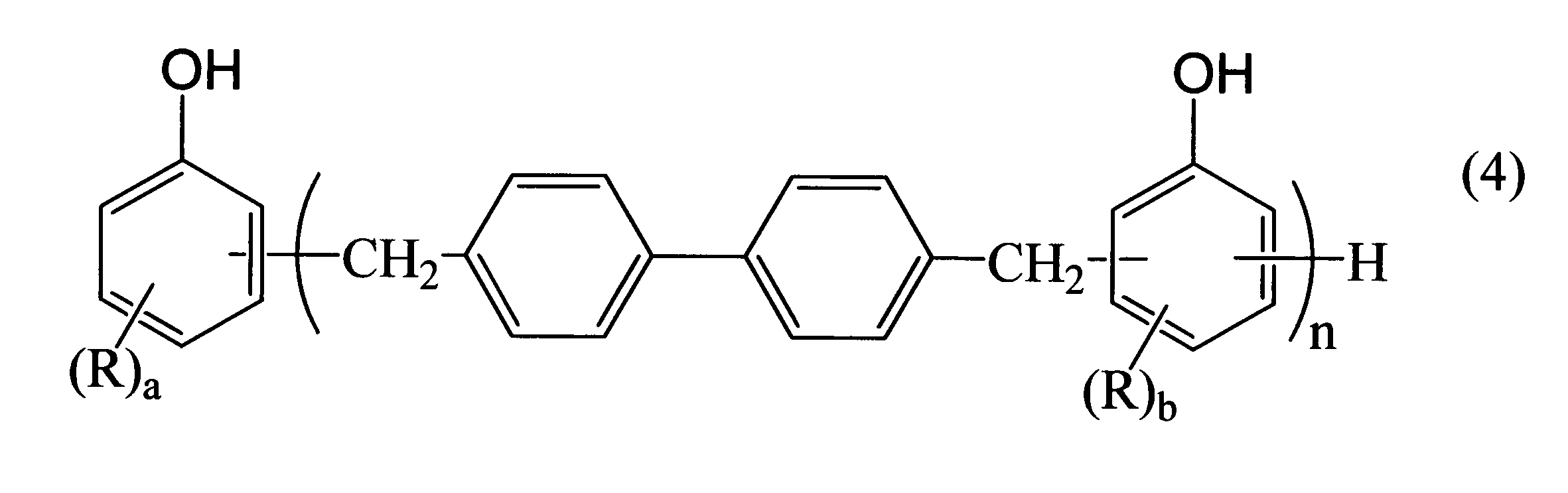
- the compound represented by the following formula (4), which is a raw material for the epoxy resin of the formula (3), is particularly preferable as an epoxy resin curing agent because of its excellent low moisture absorption, flame retardancy, and dielectric properties.
- R's are present independently and each represents a hydrogen atom, an alkyl group having 1 to 5 carbon atoms or an aromatic group.
- n is an integer and represents an average value of 1 ⁇ n ⁇ 20.
- Examples of the alkyl group having 1 to 5 carbon atoms in the formula (4) include the same as those described in the description of the alkyl group having 1 to 5 carbon atoms in the formula (1), and the formula (4)
- the average value of n can be calculated from the value of the weight average molecular weight determined by the measurement of gel permeation chromatography (GPC) of the epoxy resin.
- the compounding amount of the epoxy resin curing agent is preferably not more than twice that of the epoxy resin by weight, and more preferably not more than 1 time.
- the epoxy resin composition of the present invention containing an epoxy resin curing agent is adjusted so that the maleimide resin represented by the formula (1) is contained in an amount of 5 to 50% by weight based on the total amount of the resin in the composition. To do. More preferably, it is 10 to 50% by weight, and particularly preferably 20 to 50% by weight. It is. In the case of the above range, in the physical properties of the cured product, mechanical strength is high, peel strength is high, and heat resistance tends to be high.
- maleimide compounds that can be used include 4,4′-diphenylmethane bismaleimide, polyphenylmethane maleimide, m-phenylene bismaleimide, 2,2′-bis [4- (4-maleimidophenoxy) phenyl] propane, 3 , 3'-dimethyl-5,5'-diethyl-4,4'-diphenylmethane bismaleimide, 4-methyl-1,3-phenylene bismaleimide, 4,4'-diphenyl ether bismaleimide, 4,4'-diphenylsulfone
- Examples thereof include, but are not limited to, bismaleimide, 1,3-bis (3-maleimidophenoxy) benzene, and 1,3-bis (4-maleimidophenoxy) benzene. These may be used alone or in combination of two or more.
- the blending amount 4,4′-diphenylmethane bismaleimide, polyphenylmethane maleimide, m-phenylene bis
- the epoxy resin composition of the present invention may contain a cyanate ester compound.
- a conventionally well-known cyanate ester compound can be used as a cyanate ester compound which can be mix
- Specific examples of cyanate ester compounds include polycondensates of phenols and various aldehydes, polymers of phenols and various diene compounds, polycondensates of phenols and ketones, and polycondensations of bisphenols and various aldehydes. Examples include, but are not limited to, cyanate ester compounds obtained by reacting a product with cyanogen halide. These may be used alone or in combination of two or more.
- cyanate ester compounds described in Japanese Patent Application Laid-Open No. 2005-264154 are particularly preferable as cyanate ester compounds because they are excellent in low moisture absorption, flame retardancy, and dielectric properties.
- the epoxy resin composition of this invention can contain a hardening accelerator as needed.
- curing accelerators that can be used include 2-methylimidazole, 2-ethylimidazole, 2-phenylimidazole, 2-ethyl-4-methylimidazole, 2-undecylimidazole, 1-cyanoethyl-2-ethyl-4-methylimidazole.
- imidazoles triethylamine, triethylenediamine, 2- (dimethylaminomethyl) phenol, 1,8-diaza-bicyclo (5,4,0) undecene-7, tris (dimethylaminomethyl) phenol, benzyldimethylamine, etc.
- Phosphines such as amines, triphenylphosphine, tributylphosphine, trioctylphosphine and organometallic salts such as tin octylate, zinc octylate, dibutyltin dimaleate, zinc naphthenate, cobalt naphthenate, tin oleate, Zinc, aluminum chloride, include organometallic compounds such as metal chlorides such as tin chloride, benzoyl peroxide, dicumyl peroxide, there is a methyl ethyl ketone peroxide, etc. t- butyl perbenzoate organic peroxide.
- the amount of the curing accelerator is preferably added in an amount of 0.01 to 20% by weight, more preferably 0.01 to 10% by weight, based on the maleimide resin.
- the epoxy resin composition of this invention can contain the compound which has an allyl group or a methallyl group as needed.
- the compound having an allyl group or methallyl group that can be used include 4,4′-bisphenol A diallyl ether, 4,4′-bisphenol F diallyl ether, 4,4′-bisphenol F dimethallyl ether, tri ( (Meth) allyl isocyanurate, 2,2-di (4-acetyloxy-3- (meth) allylphenyl) propane, di (4-acetyloxy-3- (meth) allylphenyl) methane, di (4-acetyloxy) -3- (meth) allylphenyl) sulfone, 2,2-di (4-benzoyloxy-3- (meth) allylphenyl) propane, di (4-benzoyloxy-3- (meth) allylphenyl) methane, di (4-Benzoyloxy-3- (meth) allyl
- R 1 and R 2 each independently exist, and each represents a hydrogen atom, an alkyl group having 1 to 10 carbon atoms or an aromatic group.
- A represents 1 to 4
- b represents 1 to 3.
- n is an integer and represents an average value of 1 ⁇ n ⁇ 5.
- Examples of the alkyl group having 1 to 10 carbon atoms in R 1 and R 2 in the formula (5) include a methyl group, an ethyl group, an n-propyl group, an iso-propyl group, an n-butyl group, an iso-butyl group, tert-butyl, sec-butyl, n-pentyl, i-pentyl, amyl, n-hexyl, cyclopentyl, cyclohexyl, octyl, 2-ethylhexyl, nonyl, decyl A methyl group is preferable.
- an aromatic hydrocarbon group such as phenyl group, biphenyl group, indenyl group, naphthyl group, anthryl group, fluorenyl group, pyrenyl group, furanyl group
- aromatic hydrocarbon group such as phenyl group, biphenyl group, indenyl group, naphthyl group, anthryl group, fluorenyl group, pyrenyl group, furanyl group
- Examples include thienyl group, thienothienyl group, pyrrolyl group, imidazolyl group, pyridyl group, pyrazyl group, pyrimidyl group, quinolyl group, indolyl group, and carbazolyl group.
- n in the formula (5) is an integer, and represents an average value of 1 ⁇ n ⁇ 5.
- n is preferably from 1 to 10, more preferably from 2 to 8, and particularly preferably from 2 to 4.
- the weight average molecular weight (Mw) of the compound having an allyl group or a methallyl group is preferably 350 to 1200. More preferably, it is 400 to 1000, and particularly preferably 440 to 800. If the molecular weight is 350 or less, it may be difficult to form a cured product due to volatility, and if the molecular weight is 1200 or more, compatibility with a high viscosity or a solvent may be very difficult. Can be difficult.
- the weight average molecular weight of allyl ether resin can be measured by the gel permeation chromatography method (GPC).
- the production method of the compound having an allyl group or methallyl group represented by the formula (5) is not particularly limited, and may be produced by any known method known as a synthesis method of an allyl ether compound.
- Japanese Patent Application Laid-Open No. 2003-104923 discloses an allyl ether obtained by reacting a polyphenol compound with an allyl halide such as allyl chloride, allyl bromide or methylallyl chloride using a base such as an alkali metal hydroxide. Is disclosed.
- the compounding amount of the compound having an allyl group or a methallyl group can be appropriately set according to the type of the compound to be used, and is not particularly limited.
- the content of the compound having an allyl group or a methallyl group is 5 to 30% by mass with respect to the total amount of the composition. Preferably, it is 7 to 25% by mass.
- additives can be blended in the epoxy resin composition of the present invention as necessary.
- additives that can be used include curing agents for epoxy resins, polybutadiene and modified products thereof, modified products of acrylonitrile copolymers, polyphenylene ether, polystyrene, polyethylene, polyimide, fluororesin, maleimide compounds, cyanate ester compounds , Silicone gel, silicone oil, inorganic fillers such as silica, alumina, calcium carbonate, quartz powder, aluminum powder, graphite, talc, clay, iron oxide, titanium oxide, aluminum nitride, asbestos, mica, glass powder, silane cup Coloring agents such as a surface treatment agent for a filler such as a ring agent, a release agent, carbon black, phthalocyanine blue, and phthalocyanine green can be used.
- the amount of these additives is preferably 1,000 parts by weight or less, more preferably 700 parts by weight or less, based on 100 parts by weight of the total resin of the resin composition
- the method for preparing the epoxy resin composition of the present invention is not particularly limited, but each component may be mixed evenly or prepolymerized.
- the maleimide resin and epoxy resin used in the present invention are prepolymerized by heating in the presence or absence of a catalyst and in the presence or absence of a solvent.
- a prepolymer is obtained by adding a maleimide resin used in the present invention and an epoxy resin, and if necessary, a curing agent such as an amine compound, a maleimide compound, a cyanate ester compound, a phenol resin, an acid anhydride compound, and other additives. May be used.
- a curing agent such as an amine compound, a maleimide compound, a cyanate ester compound, a phenol resin, an acid anhydride compound, and other additives. May be used.
- an extruder, a kneader, or a roll is used in the absence of a solvent, and a reaction kettle with a stirring device is used in the
- An organic solvent can be added to the epoxy resin composition of the present invention to obtain a varnish-like composition (hereinafter simply referred to as varnish).
- varnish a varnish-like composition
- the epoxy resin composition of the present invention is dissolved in a solvent such as toluene, xylene, acetone, methyl ethyl ketone, methyl isobutyl ketone, dimethylformamide, dimethylacetamide, N-methylpyrrolidone to obtain an epoxy resin composition varnish, and glass fiber.
- a prepreg obtained by impregnating a base material such as carbon fiber, polyester fiber, polyamide fiber, alumina fiber, paper, etc. and drying by heating is subjected to hot press molding to obtain a cured product of the epoxy resin composition of the present invention. can do.
- the solvent is used in an amount of 10 to 70% by weight, preferably 15 to 70% by weight in the mixture of the epoxy resin composition of the present invention and the solvent.
- cured material containing a carbon fiber can also be obtained as it is, for example with a RTM system.
- the epoxy resin composition of the present invention can be used as a modifier for a film-type composition. Specifically, it can be used to improve the flexibility of the B-stage.
- a film-type resin composition is formed by applying the epoxy resin composition of the present invention on the release film as the epoxy resin composition varnish, removing the solvent under heating, and then performing B-staging. Obtained as an adhesive.
- This sheet-like adhesive can be used as an interlayer insulating layer in a multilayer substrate or the like.
- a prepreg can be obtained by heating and melting the epoxy resin composition of the present invention to lower the viscosity and impregnating the fiber with a reinforcing fiber such as glass fiber, carbon fiber, polyester fiber, polyamide fiber or alumina fiber. Moreover, a prepreg can also be obtained by impregnating the varnish into a reinforcing fiber and drying by heating.
- the above prepreg is cut into the desired shape, laminated with copper foil, etc. if necessary, and the epoxy resin composition for laminates is heat-cured while applying pressure to the laminate by the press molding method, autoclave molding method, sheet winding molding method, etc. By doing so, a laminated board can be obtained.
- a circuit can be formed on a laminated board made by superimposing copper foil on the surface, and a multilayer circuit board can be obtained by superimposing a prepreg or copper foil thereon and repeating the above operation.
- aromatic amine resin (a1) was obtained by distilling off excess aniline and toluene from the oil layer with a rotary evaporator under heating and reduced pressure (200 ° C., 0.6 KPa). Diphenylamine in the aromatic amine resin (a1) was 2.0%. The obtained resin was again dripped little by little on the rotary evaporator under heating and reduced pressure (200 ° C., 4 KPa) instead of steam blowing. As a result, 166 parts of aromatic amine resin (A1) was obtained.
- the aromatic amine resin (A1) obtained had a softening point of 56 ° C., a melt viscosity of 0.035 Pa ⁇ s, and diphenylamine of 0.1% or less.
- the average value of n in the formula (2) calculated from the measurement result of gel permeation chromatography was 1.6.
- the reaction is carried out at the same temperature for 2 hours, 3 parts of p-toluenesulfonic acid is added, condensed water and toluene azeotroped under reflux conditions are cooled and separated, and only toluene which is an organic layer Was returned to the system and reacted for 20 hours while dehydrating.
- 120 parts of toluene was added, and washing with water was repeated to remove p-toluenesulfonic acid and excess maleic anhydride, followed by heating to remove water from the system by azeotropy.
- the reaction solution was concentrated to obtain a resin solution containing 70% of maleimide resin (M1).
- Example 1 30 parts by weight of maleimide resin (M1) obtained in Synthesis Example 2, 40 parts of epoxy resin 1 (Nippon Kayaku NC-3000-L epoxy equivalent 269 g / eq. Softening point 52 ° C.), epoxy resin curing agent 1 (Nippon Kayaku KAYAHARD GPH-65 hydroxyl group equivalent 199 g / eq. Softening point 65 ° C.) 29 parts by weight, 2-ethyl 4-methylimidazole (Shikoku Kasei Co., Ltd.) 1 part by weight, kneaded with a mixing roll, and tableted Thereafter, a resin molded body was prepared by transfer molding and cured at 200 ° C. for 2 hours to obtain a cured product of the present invention.
- epoxy resin 1 Nippon Kayaku NC-3000-L epoxy equivalent 269 g / eq. Softening point 52 ° C.
- epoxy resin curing agent 1 Nippon Kayaku KAYAHARD GPH-65 hydroxyl group equivalent 199
- Example 2 48 parts by weight of maleimide resin (M1) obtained in Synthesis Example 2, 30 parts of epoxy resin 1 (Nippon Kayaku NC-3000-L epoxy equivalent 269 g / eq. Softening point 52 ° C.), epoxy resin curing agent 1 (Nippon Kayaku KAYAHARD GPH-65 hydroxyl group equivalent 199 g / eq. Softening point 65 ° C.) 21 parts by weight, 2-ethyl 4-methylimidazole (Shikoku Kasei Co., Ltd.) 1 part by weight, kneaded with a mixing roll, and tableted Thereafter, a resin molded body was prepared by transfer molding and cured at 200 ° C. for 2 hours to obtain a cured product of the present invention.
- epoxy resin 1 Nippon Kayaku NC-3000-L epoxy equivalent 269 g / eq. Softening point 52 ° C.
- epoxy resin curing agent 1 Nippon Kayaku KAYAHARD GPH-65 hydroxyl group equivalent 199
- Comparative Example 2 70 parts by weight of maleimide resin (M1) obtained in Synthesis Example 2, 16 parts of epoxy resin 1 (Nippon Kayaku NC-3000-L epoxy equivalent 269 g / eq. Softening point 52 ° C.), epoxy resin curing agent 1 (Nippon Kayaku KAYAHARD GPH-65 hydroxyl group equivalent 199 g / eq. Softening point 65 ° C.) 12 parts by weight, 2-ethyl 4-methylimidazole (Shikoku Kasei Co., Ltd.) 2 parts by weight, kneaded with a mixing roll, and tableted Thereafter, a resin molded body was prepared by transfer molding and cured at 200 ° C. for 2 hours.
- epoxy resin 1 Nippon Kayaku NC-3000-L epoxy equivalent 269 g / eq. Softening point 52 ° C.
- epoxy resin curing agent 1 Nippon Kayaku KAYAHARD GPH-65 hydroxyl group equivalent 199 g / eq.
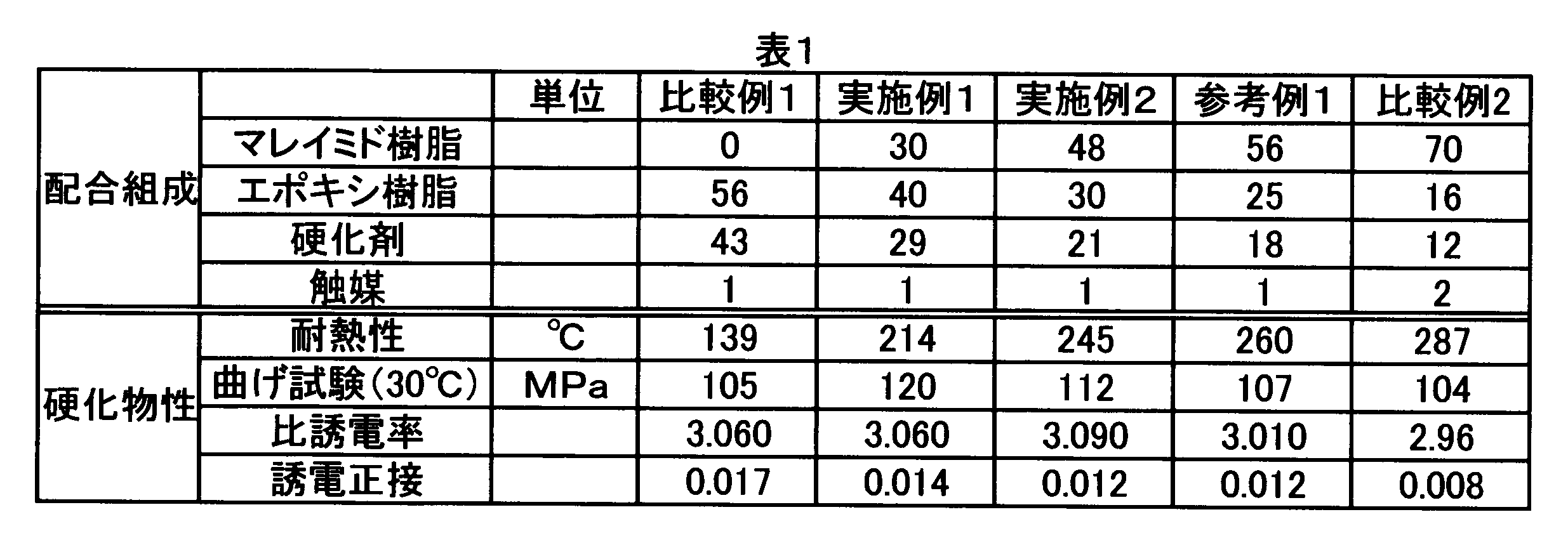
- the epoxy resin composition of the present invention in which the blending amount of the maleimide resin (M1) represented by the formula (1) is blended in the range of 5 to 50% by weight is It can be seen that the material is superior in mechanical strength adhesion and dielectric loss tangent as compared to the case of the blending amount outside the range.
- Example 3 30 parts by weight of maleimide resin (M1) obtained in Synthesis Example 2, 40 parts of epoxy resin 1 (Nippon Kayaku NC-3000-L epoxy equivalent 269 g / eq. Softening point 52 ° C.), epoxy resin curing agent 1 (Nippon Kayaku KAYAHARD GPH-65 hydroxyl group equivalent 199 g / eq. Softening point 65 ° C.) 29 parts by weight, 2-ethyl 4-methylimidazole (Shikoku Kasei Co., Ltd.) 1 part by weight, kneaded with a mixing roll, and tableted Thereafter, a resin molded body was prepared on copper foil by transfer molding and cured at 200 ° C. for 2 hours to obtain a cured product of the present invention.
- epoxy resin 1 Nippon Kayaku NC-3000-L epoxy equivalent 269 g / eq. Softening point 52 ° C.
- epoxy resin curing agent 1 Nippon Kayaku KAYAHARD GPH-65 hydroxyl group
- Example 4 48 parts by weight of maleimide resin (M1) obtained in Synthesis Example 2, 30 parts of epoxy resin 1 (Nippon Kayaku NC-3000-L epoxy equivalent 269 g / eq. Softening point 52 ° C.), epoxy resin curing agent 1 (Nippon Kayaku KAYAHARD GPH-65 hydroxyl group equivalent 199 g / eq. Softening point 65 ° C.) 21 parts by weight, 2-ethyl 4-methylimidazole (Shikoku Kasei Co., Ltd.) 1 part by weight, kneaded with a mixing roll, and tableted Thereafter, a resin molded body was prepared by transfer molding and cured at 200 ° C. for 2 hours to obtain a cured product of the present invention.
- epoxy resin 1 Nippon Kayaku NC-3000-L epoxy equivalent 269 g / eq. Softening point 52 ° C.
- epoxy resin curing agent 1 Nippon Kayaku KAYAHARD GPH-65 hydroxyl group equivalent 199
- the epoxy resin composition of the present invention in which the blending amount of the maleimide resin (M1) represented by the formula (1) is blended in the range of 5 to 50% by weight is as follows. It can be seen that the material is superior in mechanical strength adhesion as compared with the case of the amount out of the range.
- allyl-modified biphenylaralkyl novolak resin (AEP1) was obtained by distilling off the solvents from the oil layer using a rotary evaporator under nitrogen bubbling under reduced pressure.
- the total chlorine of the obtained resin was 15 ppm.
- the obtained resin was semi-solid.
- the number average molecular weight (Mn) obtained by GPC measurement was 579, and the weight average molecular weight (Mw) was 805.
- the average value of n in the formula (5) calculated from the measurement result of gel permeation chromatography was 2.0.
- the mixture was cooled to 38 to 40 ° C., and 130.0 parts by mass of flaky caustic soda (purity: 99%, manufactured by Tosoh Corp.) (1.3 molar equivalents relative to 1 molar equivalent of the hydroxyl group of the phenol resin) was added over 60 minutes. Thereafter, 294.3 parts by mass of methallyl chloride (purity 99%, manufactured by Tokyo Chemical Industry Co., Ltd.) (1.3 molar equivalents relative to 1 molar equivalent of the hydroxyl group of the phenol resin) was added dropwise over 60 minutes, and the temperature was 38 to 40 ° C. For 5 hours and at 60 to 65 ° C. for 1 hour.
- flaky caustic soda purity: 99%, manufactured by Tosoh Corp.
- methallyl chloride purity 99%, manufactured by Tokyo Chemical Industry Co., Ltd.
- Example 5 48 parts by weight of maleimide resin (M1) obtained in Synthesis Example 2 and 6 parts of epoxy resin (KBM-403 epoxy equivalent 280 g / eq. Softening point 52 ° C., manufactured by Shin-Etsu Chemical Co., Ltd.), obtained in Synthesis Example 3 44 parts by weight of allyl-modified biphenyl aralkyl novolak resin (AEP1) and 2 parts by weight of 2-ethyl 4-methylimidazole (Shikoku Kasei Co., Ltd.) were kneaded with a mixing roll, and the gel time at 175 ° C. was measured and cured. Was 64 seconds.
- AEP1 allyl-modified biphenyl aralkyl novolak resin
- 2-ethyl 4-methylimidazole Shikoku Kasei Co., Ltd.
- Example 6 48 parts by weight of maleimide resin (M1) obtained in Synthesis Example 2 and 6 parts of epoxy resin (KBM-303 epoxy equivalent 280 g / eq. Softening point 52 ° C. manufactured by Shin-Etsu Chemical Co., Ltd.), obtained in Synthesis Example 3 44 parts by weight of allyl-modified biphenylaralkyl novolak resin and 2 parts by weight of 2-ethyl 4-methylimidazole (Shikoku Kasei Co., Ltd.) were mixed, kneaded with a mixing roll, and measured for gel time at 175 ° C. to evaluate curability. However, it was 59 seconds.
- Example 7 48 parts by weight of maleimide resin (M1) obtained in Synthesis Example 2 and 6 parts of epoxy resin (KBM-403 epoxy equivalent 280 g / eq. Softening point 52 ° C., manufactured by Shin-Etsu Chemical Co., Ltd.), obtained in Synthesis Example 4 44 parts by weight of the methallyl-modified biphenylaralkyl novolak resin and 2 parts by weight of 2-ethyl 4-methylimidazole (Shikoku Kasei Co., Ltd.) were mixed, kneaded with a mixing roll, and measured for gel time at 175 ° C. to evaluate curability. However, it was 68 seconds.
- Example 8 48 parts by weight of maleimide resin (M1) obtained in Synthesis Example 2 and 6 parts of epoxy resin (KBM-303, epoxy equivalent 280 g / eq. Softening point 52 ° C., manufactured by Shin-Etsu Chemical Co., Ltd.), obtained in Synthesis Example 4 44 parts by weight of the methallyl-modified biphenylaralkyl novolak resin and 2 parts by weight of 2-ethyl 4-methylimidazole (Shikoku Kasei Co., Ltd.) were mixed, kneaded with a mixing roll, and measured for gel time at 175 ° C. to evaluate curability. However, it was 57 seconds.
- Comparative Example 4 98 parts by weight of the maleimide resin (M1) obtained in Synthesis Example 2 and 2 parts by weight of 2-ethyl 4-methylimidazole (Shikoku Kasei Co., Ltd.) were mixed and kneaded with a mixing roll, and the gel time at 175 ° C. was measured. When the curability was evaluated, it was 900 seconds or longer.
- the epoxy resin composition and the cured product thereof according to the present invention are used for a highly reliable semiconductor encapsulant, an electrical / electronic component insulating material, and a laminate (printed wiring glass fiber reinforced composite material) or CFRP (carbon fiber reinforced composite material). ) And other various composite materials, various adhesives, various paints, structural members, and the like.
Landscapes
- Chemical & Material Sciences (AREA)
- Health & Medical Sciences (AREA)
- Chemical Kinetics & Catalysis (AREA)
- Medicinal Chemistry (AREA)
- Polymers & Plastics (AREA)
- Organic Chemistry (AREA)
- Epoxy Resins (AREA)
- Reinforced Plastic Materials (AREA)
Abstract
Description
本発明者らはこれまで開発してきたマレイミド樹脂(特許文献2及び3)をさらに改良し、銅箔接着性、耐熱性、及び誘電特性(比誘電率、誘電正接)においてバランスがとれたエポキシ樹脂組成物中のマレイミド樹脂の配合量を見出した。
本発明の目的は、銅箔接着性、耐熱性、及び誘電特性(比誘電率、誘電正接)の特性においてバランスのとれたマレイミド樹脂含有のエポキシ樹脂組成物及びその硬化物を提供することにある。

(2)硬化促進剤を含有する前項(1)に記載のエポキシ樹脂組成物、
(3)分子内にフェノール基、アミノ基、酸無水物またはシアネート基を有するエポキシ樹脂硬化剤を含有する前項(1)又は(2)に記載のエポキシ樹脂組成物、
(4)アリル基またはメタリル基を有する化合物を含有する前項(1)~(3)に記載のエポキシ樹脂組成物、
(5)前項(1)~(4)に記載のエポキシ樹脂組成物を硬化してなる硬化物、
に関する。
本発明のエポキシ樹脂組成物は、下記式(1)で表されるマレイミド樹脂及びエポキシ樹脂を少なくとも必須成分として含有し、前記組成物中の樹脂総量に対して、前記マレイミド樹脂を5~50重量%含有する。

式(1)のマレイミド樹脂を製造する場合、その前駆体として下記式(2)の化合物が必要になるが、例えば日本国特開平3-100016号公報及び日本国特公平8-16151号公報にはアニリン類とジハロゲノメチル化合物やジアルコキシメチル化合物との反応が記載されているが、これらと同様の方法を採用してアニリン類とビスハロゲノメチルビフェニル類又はビスアルコキシメチルビフェニル類とを反応させることにより式(2)の化合物が得られる。

反応は必要によりトルエン、キシレンなどの有機溶剤を使用して行っても、無溶剤で行っても良い。例えば、アニリン類と溶剤の混合溶液に酸性触媒を添加した後、触媒が水を含む場合は共沸により水を系内から除く。しかる後に好ましくは40~100℃、より好ましくは50~80℃でビスハロゲノメチルビフェニル類またはビスアルコキシメチルビフェニル類を好ましくは1~5時間、より好ましくは2~4時間かけて添加し、その後溶剤を系内から除きながら昇温して好ましくは180~240℃、より好ましくは190~220℃で、好ましくは5~30時間、より好ましくは10~20時間反応を行う。反応終了後、アルカリ水溶液で酸性触媒を中和後、油層に非水溶性有機溶剤を加えて廃水が中性になるまで洗浄を繰り返し、加熱減圧下で過剰のアニリン類や有機溶剤を留去することにより式(2)の化合物が得られる。日本国特公平8-16151号公報や日本国特許第5030297号公報においては言及されていないが、この段階で副生成物であるジフェニルアミンは、触媒量・原料使用比率・温度・時間等により異なるが、通常樹脂中に2~10重量%含まれる。ジフェニルアミンは、アニリンを留去する条件では除去できない。少なくともアニリンの沸点以上の温度での加熱減圧下での水蒸気や、大量の窒素ガス等の不活性ガスの吹き込みを行うことでジフェニルアミンを除去することができる。
例えばマレイン酸をトルエンに溶解し、撹拌下で式(2)の化合物のN-メチルピロリドン溶液を添加し、その後p-トルエンスルホン酸を加えて、還流条件下で生成する水を系内から除去しながら反応を行う。
また、式(1)のnの平均値は、マレイミド樹脂のゲルパーミエーションクロマトグラフィー(GPC)の測定により求められた重量平均分子量の値から算出することが出来るが、近似的には原料である式(2)で表されるアミン化合物のGPCの測定結果から算出したnの平均値とほぼ同等と考えることが出来る。

また、前記式(3)のエポキシ樹脂の原料である下記式(4)で表される化合物は低吸湿、難燃性、誘電特性に優れるためエポキシ樹脂硬化剤として特に好ましい。
また、エポキシ樹脂硬化剤を含有する本発明のエポキシ樹脂組成物は、組成物中の樹脂総量に対して、前記式(1)で表されるマレイミド樹脂が5~50重量%含有するように調整する。より好ましくは10~50重量%であり、特に好ましくは20~50重量%。である。上記範囲の場合、硬化物の物性において機械強度が高く、ピール強度も高く、さらに耐熱性も高くなる傾向がある。
また、日本国特開2005-264154号公報に合成方法が記載されているシアネートエステル化合物は、低吸湿性、難燃性、誘電特性に優れているためシアネートエステル化合物として特に好ましい。
用い得る硬化促進剤としては、2-メチルイミダゾール、2-エチルイミダゾール、2-フェニルイミダゾール、2-エチル-4-メチルイミダゾール、2-ウンデシルイミダゾール、1-シアノエチル-2-エチル-4-メチルイミダゾールなどのイミダゾール類、トリエチルアミン、トリエチレンジアミン、2-(ジメチルアミノメチル)フェノール、1,8-ジアザ-ビシクロ(5,4,0)ウンデセン-7、トリス(ジメチルアミノメチル)フェノール、ベンジルジメチルアミン等のアミン類、トリフェニルホスフィン、トリブチルホスフィン、トリオクチルホスフィンなどのホスフィン類及びオクチル酸スズ、オクチル酸亜鉛、ジブチルスズジマレエート、ナフテン酸亜鉛、ナフテン酸コバルト、オレイン酸スズ等の有機金属塩、塩化亜鉛、塩化アルミニウム、塩化スズなどの金属塩化物などの有機金属化合物などがあり、ベンゾイルパーオキサイド、ジクミルパーオキサイド、メチルエチルケトンパーオキサイド、t-ブチルパーベンゾエートなど有機過酸化物がある。硬化促進剤は少なすぎると硬化不良の原因になり、多すぎると樹脂組成物の硬化物性に悪影響を及ぼす恐れがある。そのためマレイミド樹脂に対し好ましくは0.01~20重量%、より好ましくは0.01~10重量%添加する。
用いることができるアリル基またはメタリル基を有する化合物としては、例えば、4,4’-ビスフェノールAジアリルエーテル、4,4’-ビスフェノールFジアリルエーテル、4,4’-ビスフェノールFジメタリルエーテル、トリ(メタ)アリルイソシアヌレート、2,2-ジ(4-アセチルオキシ-3-(メタ)アリルフェニル)プロパン、ジ(4-アセチルオキシ-3-(メタ)アリルフェニル)メタン、ジ(4-アセチルオキシ-3-(メタ)アリルフェニル)スルホン、2,2-ジ(4-ベンゾイルオキシ-3-(メタ)アリルフェニル)プロパン、ジ(4-ベンゾイルオキシ-3-(メタ)アリルフェニル)メタン、ジ(4-ベンゾイルオキシ-3-(メタ)アリルフェニル)スルホン、2,2-ジ(4-トルオイルオキシ-3-(メタ)アリルフェニル)プロパン、ジ(4-トルオイルオキシ-3-(メタ)アリルフェニル)メタン、ジ(4-トルオイルオキシ-3-(メタ)アリルフェニル)スルホン、2,2-ジ(4-プロピオニルオキシ-3-(メタ)アリルフェニル)プロパン、ジ(4-プロピオニルオキシ-3-(メタ)アリルフェニル)メタン、ジ(4-プロピオニルオキシ-3-(メタ)アリルフェニル)スルホン、2,2-ジ(4-ブチリルオキシ-3-(メタ)アリルフェニル)プロパン、2,2-ジ(4-イソブチリルオキシ-3-(メタ)アリルフェニル)プロパン・アリルクロリド、アリルアルコール、アリルエチルエーテル、アリル-2-ヒドロキシエチルエーテル、アリルグリシジルエーテル、メタリルグリシジルエーテル、ジアリルフタレート、トリメチロールプロパンジアリルエーテル、ペンタエリスリトールトリアリルエーテル、トリアリルイソシアヌレートが挙げられる。好ましく以下の一般式(5)で表されるものが挙げられる。
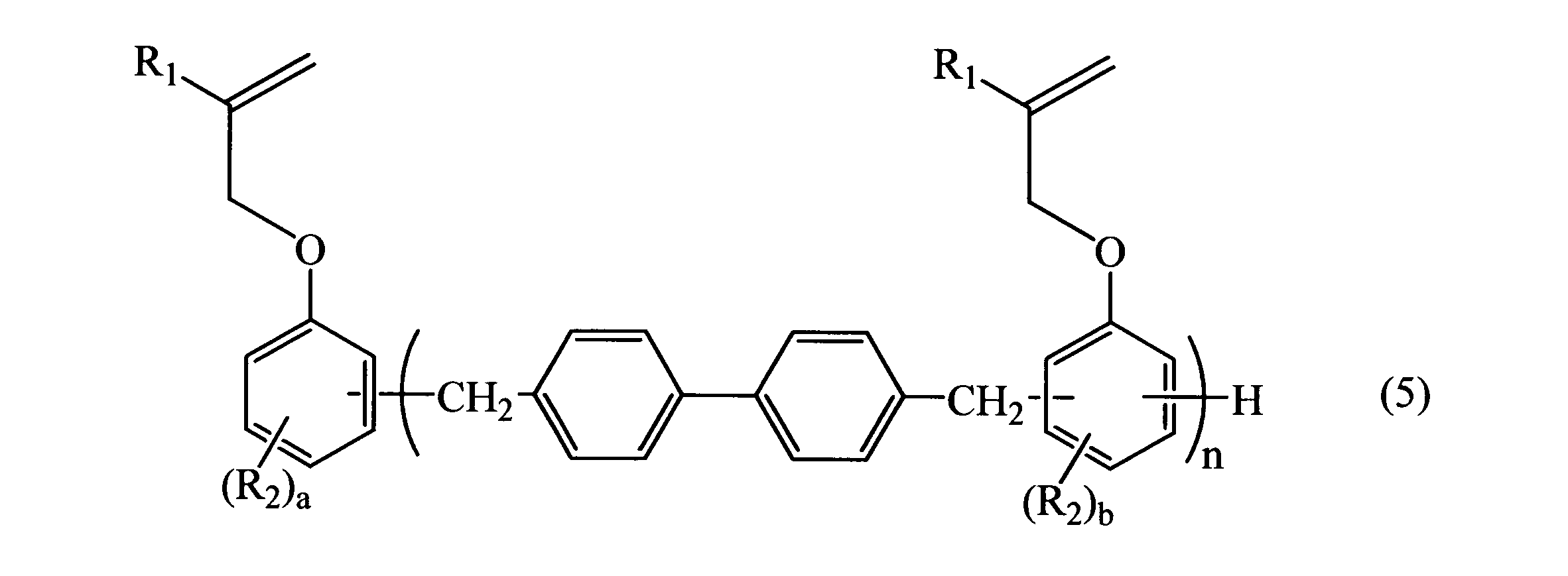
前記式(5)中のR1、R2における芳香族基としては、フェニル基、ビフェニル基、インデニル基、ナフチル基、アントリル基、フルオレニル基、ピレニル基等の芳香族炭化水素基、フラニル基、チエニル基、チエノチエニル基、ピロリル基、イミダゾリル基、ピリジル基、ピラジル基、ピリミジル基、キノリル基、インドリル基及びカルバゾリル基等が挙げられる。
なお、アリルエーテル樹脂の重量平均分子量はゲルパーミエーションクロマトグラフィー法(GPC)により測定することができる。
また、前記ワニスを、強化繊維に含浸させて加熱乾燥させることによりプリプレグを得ることもできる。
上記のプリプレグを所望の形に裁断、必要により銅箔などと積層後、積層物にプレス成形法やオートクレーブ成形法、シートワインディング成形法などで圧力をかけながら積層板用エポキシ樹脂組成物を加熱硬化させることにより積層板を得ることができる。
更に、表面に銅箔を重ねてできた積層板に回路を形成し、その上にプリプレグや銅箔等を重ねて上記の操作を繰り返して多層の回路基板を得ることができる。
・ 軟化点 :JIS K-7234に準じた方法で測定
・ 溶融粘度:コーンプレート法での150℃における粘度
・ジフェニルアミン含量:ガスクロマトグラフィーで測定
温度計、冷却管、ディーンスターク共沸蒸留トラップ、撹拌機を取り付けたフラスコにアニリン372部とトルエン200部を仕込み、室温で35%塩酸146部を1時間で滴下した。滴下終了後加熱して共沸してくる水とトルエンを冷却・分液した後、有機層であるトルエンだけを系内に戻して脱水を行った。次いで4,4’-ビス(クロロメチル)ビフェニル125部を60~70℃に保ちながら1時間かけて添加し、更に同温度で2時間反応を行った。反応終了後、昇温をしながらトルエンを留去して系内を195~200℃とし、この温度で15時間反応をした。その後冷却しながら30%水酸化ナトリウム水溶液330部を系内が激しく還流しないようにゆっくりと滴下し、80℃以下で昇温時に留去したトルエンを系内に戻し、70℃~80℃で静置した。分離した下層の水層を除去し、反応液の水洗を洗浄液が中性になるまで繰り返した。次いでロータリーエバポレーターで油層から加熱減圧下(200℃、0.6KPa)において過剰のアニリンとトルエンを留去することにより芳香族アミン樹脂(a1)173部を得た。芳香族アミン樹脂(a1)中のジフェニルアミンは2.0%であった。
得られた樹脂を、再びロータリーエバポレーターで加熱減圧下(200℃、4KPa)において水蒸気吹き込みの代わりに水を少量づつ滴下した。その結果、芳香族アミン樹脂(A1)166部を得た。得られた芳香族アミン樹脂(A1)の軟化点は56℃、溶融粘度は0.035Pa・s、ジフェニルアミンは0.1%以下であった。ゲルパーミエーションクロマトグラフィ-の測定結果から算出した式(2)におけるnの平均値は1.6であった。
温度計、冷却管、ディーンスターク共沸蒸留トラップ、撹拌機を取り付けたフラスコに無水マレイン酸147部とトルエン300部を仕込み、加熱して共沸してくる水とトルエンを冷却・分液した後、有機層であるトルエンだけを系内に戻して脱水を行った。次に、実施例1で得られた芳香族アミン樹脂(A1)195部をN-メチル-2-ピロリドン195部に溶解した樹脂溶液を、系内を80~85℃に保ちながら1時間かけて滴下した。滴下終了後、同温度で2時間反応を行い、p-トルエンスルホン酸3部を加えて、還流条件で共沸してくる縮合水とトルエンを冷却・分液した後、有機層であるトルエンだけを系内に戻して脱水を行いながら20時間反応を行った。反応終了後、トルエンを120部追加し、水洗を繰り返してp-トルエンスルホン酸及び過剰の無水マレイン酸を除去し、加熱して共沸により水を系内から除いた。次いで反応溶液を濃縮して、マレイミド樹脂(M1)を70%含有する樹脂溶液を得た。
合成例2で得られたマレイミド樹脂(M1)を30重量部、エポキシ樹脂1(日本化薬製 NC-3000-L エポキシ当量269g/eq. 軟化点52℃)を40部、エポキシ樹脂硬化剤1(日本化薬製 KAYAHARD GPH-65 水酸基当量199g/eq. 軟化点65℃)29重量部、2-エチル4-メチルイミダゾール(四国化成株式会社)1重量部を配合しミキシングロールで混練、タブレット化後、トランスファー成形で樹脂成形体を調製し、200℃で2時間で硬化させ、本発明の硬化物を得た。
合成例2で得られたマレイミド樹脂(M1)を48重量部、エポキシ樹脂1(日本化薬製 NC-3000-L エポキシ当量269g/eq. 軟化点52℃)を30部、エポキシ樹脂硬化剤1(日本化薬製 KAYAHARD GPH-65 水酸基当量199g/eq. 軟化点65℃)21重量部、2-エチル4-メチルイミダゾール(四国化成株式会社)1重量部を配合しミキシングロールで混練、タブレット化後、トランスファー成形で樹脂成形体を調製し、200℃で2時間で硬化させ、本発明の硬化物を得た。
合成例2で得られたマレイミド樹脂(M1)を56重量部、エポキシ樹脂1(日本化薬製 NC-3000-L エポキシ当量269g/eq. 軟化点52℃)を25部、エポキシ樹脂硬化剤1(日本化薬製 KAYAHARD GPH-65 水酸基当量199g/eq. 軟化点65℃)18重量部、2-エチル4-メチルイミダゾール(四国化成株式会社)1重量部を配合しミキシングロールで混練、タブレット化後、トランスファー成形で樹脂成形体を調製し、200℃で2時間で硬化させ、硬化物を得た。
エポキシ樹脂1(日本化薬製 NC-3000-L エポキシ当量269g/eq. 軟化点52℃)を56部、エポキシ樹脂硬化剤1(日本化薬製 KAYAHARD GPH-65 水酸基当量199g/eq. 軟化点65℃)43重量部、2-エチル4-メチルイミダゾール(四国化成株式会社)1重量部を配合しミキシングロールで混練、タブレット化後、トランスファー成形で樹脂成形体を調製し、200℃で2時間で硬化させた。
合成例2で得られたマレイミド樹脂(M1)を70重量部、エポキシ樹脂1(日本化薬製 NC-3000-L エポキシ当量269g/eq. 軟化点52℃)を16部、エポキシ樹脂硬化剤1(日本化薬製 KAYAHARD GPH-65 水酸基当量199g/eq. 軟化点65℃)12重量部、2-エチル4-メチルイミダゾール(四国化成株式会社)2重量部を配合しミキシングロールで混練、タブレット化後、トランスファー成形で樹脂成形体を調製し、200℃で2時間で硬化させた。
・ ガラス転移温度:動的粘弾性試験機により測定し、tanδが最大値のときの温度。
・ 誘電率:(空洞共振機 Agilent Technologies社製)K6991に準拠して1GHzにおいて測定
・曲げ強度:JIS-6481(曲げ強さ)に準拠し30℃で測定。
合成例2で得られたマレイミド樹脂(M1)を30重量部、エポキシ樹脂1(日本化薬製 NC-3000-L エポキシ当量269g/eq. 軟化点52℃)を40部、エポキシ樹脂硬化剤1(日本化薬製 KAYAHARD GPH-65 水酸基当量199g/eq. 軟化点65℃)29重量部、2-エチル4-メチルイミダゾール(四国化成株式会社)1重量部を配合しミキシングロールで混練、タブレット化後、銅箔にトランスファー成形で樹脂成形体を調製し、200℃で2時間で硬化させ、本発明の硬化物を得た。
合成例2で得られたマレイミド樹脂(M1)を48重量部、エポキシ樹脂1(日本化薬製 NC-3000-L エポキシ当量269g/eq. 軟化点52℃)を30部、エポキシ樹脂硬化剤1(日本化薬製 KAYAHARD GPH-65 水酸基当量199g/eq. 軟化点65℃)21重量部、2-エチル4-メチルイミダゾール(四国化成株式会社)1重量部を配合しミキシングロールで混練、タブレット化後、トランスファー成形で樹脂成形体を調製し、200℃で2時間で硬化させ、本発明の硬化物を得た。
エポキシ樹脂1(日本化薬製 NC-3000-L エポキシ当量269g/eq. 軟化点52℃)を56部、エポキシ樹脂硬化剤1(日本化薬製 KAYAHARD GPH-65 水酸基当量199g/eq. 軟化点65℃)43重量部、2-エチル4-メチルイミダゾール(四国化成株式会社)1重量部を配合しミキシングロールで混練、タブレット化後、トランスファー成形で樹脂成形体を調製し、200℃で2時間で硬化させた。
合成例2で得られたマレイミド樹脂(M1)を56重量部、エポキシ樹脂1(日本化薬製 NC-3000-L エポキシ当量269g/eq. 軟化点52℃)を25部、エポキシ樹脂硬化剤1(日本化薬製 KAYAHARD GPH-65 水酸基当量199g/eq. 軟化点65℃)18重量部、2-エチル4-メチルイミダゾール(四国化成株式会社)1重量部を配合しミキシングロールで混練、タブレット化後、銅箔にトランスファー成形で樹脂成形体を調製し、200℃で2時間で硬化させ、硬化物を得た。
・ピール強度:JISK-6911に準拠

撹拌機、還流冷却管、撹拌装置を備えたフラスコに、窒素パージを施しながら水40部、ジメチルスルホキシド400部、フェノールビフェニレン樹脂(水酸基当量210g/eq.軟化点74℃)210部を加え、45℃に昇温し溶解後、38-40℃に冷却、そのままフレーク状の水酸化ナトリウム(純度 99% 東ソー製)44.4部(フェノールビフェニレン樹脂の水酸基1モル当量に対して1.1モル当量)を60分かけて添加し、その後、さらにアリルクロライド(純度 98.7面積% 市販のアリルクロライドを蒸留生成により分離。アリルクロライドポリマー量 <0.2面積% ガスクロマトグラフィー(GC)により確認)101.5部(フェノールビフェニレン樹脂の水酸基1モル当量に対して1.3モル当量、水酸化ナトリウム1モルに対して1.18倍モル)を60分かけて滴下、そのまま38-40℃で5時間、60~65℃で1時間反応を行った。反応終了後、ロータリーエバポレータにて135℃以下で加熱減圧下、水やジメチルスルホキシド等を留去した後、メチルイソブチルケトン740部を加え、水洗を繰り返し、水層が中性になったことを確認した後、油層からロータリーエバポレータを用いて減圧下、窒素バブリングしながら溶剤類を留去することでアリル変性ビフェニルアラルキルノボラック樹脂(AEP1)240部を得た。得られた樹脂の全塩素は15ppmであった。また得られた樹脂は半固形状であった。そして、GPC測定で得られた数平均分子量(Mn)は579、重量平均分子量(Mw)は805であった。ゲルパーミエーションクロマトグラフィ-の測定結果から算出した式(5)におけるnの平均値は2.0であった。
撹拌機、還流冷却管、撹拌装置を備えたフラスコに、窒素パージを施しながら水25質量部、ジメチルスルホキシド500質量部、フェノール樹脂(フェノール-ビフェニレン型 水酸基当量200g/eq.軟化点65℃)500質量部を加え、45℃に昇温し溶解させた。次いで38~40℃に冷却、そのままフレーク状の苛性ソーダ(純度 99% 東ソー製)130.0質量部(フェノール樹脂の水酸基1モル当量に対し、1.3モル当量)を60分かけて添加した。その後、さらにメタリルクロライド(純度99% 東京化成工業製)294.3質量部(フェノール樹脂の水酸基1モル当量に対し、1.3モル当量)を60分かけて滴下し、そのまま38~40℃で5時間、60~65℃で1時間反応を行った。
反応終了後、ロータリーエバポレータにて125℃以下で加熱減圧下、水やジメチルスルホキシド等を留去した。そして、メチルイソブチルケトン740質量部を加え、水洗を繰り返し、水層が中性になったことを確認した。その後油層からロータリーエバポレータを用いて、減圧下、窒素バブリングしながら溶剤類を留去することで、メタリル変性ビフェニルアラルキルノボラック樹脂(MEP1)600質量部を得た。そして、GPC測定で得られた数平均分子量(Mn)は591、重量平均分子量(Mw)は826であった。ゲルパーミエーションクロマトグラフィ-の測定結果から算出した式(5)におけるnの平均値は2.0であった。
合成例2で得られたマレイミド樹脂(M1)を48重量部、エポキシ樹脂(信越化学工業株式会社製 KBM-403 エポキシ当量280g/eq. 軟化点52℃)を6部、合成例3で得られたアリル変性ビフェニルアラルキルノボラック樹脂(AEP1)を44重量部、2-エチル4-メチルイミダゾール(四国化成株式会社)2重量部を配合しミキシングロールにて混練、175℃でのゲルタイムを測定し硬化性を評価したところ、64秒であった。
合成例2で得られたマレイミド樹脂(M1)を48重量部、エポキシ樹脂(信越化学工業株式会社製 KBM-303 エポキシ当量280g/eq. 軟化点52℃)を6部、合成例3で得られたアリル変性ビフェニルアラルキルノボラック樹脂を44重量部、2-エチル4-メチルイミダゾール(四国化成株式会社)2重量部を配合しミキシングロールにて混練、175℃でのゲルタイムを測定し硬化性を評価したところ、59秒であった。
合成例2で得られたマレイミド樹脂(M1)を48重量部、エポキシ樹脂(信越化学工業株式会社製 KBM-403 エポキシ当量280g/eq. 軟化点52℃)を6部、合成例4で得られたメタリル変性ビフェニルアラルキルノボラック樹脂を44重量部、2-エチル4-メチルイミダゾール(四国化成株式会社)2重量部を配合しミキシングロールにて混練、175℃でのゲルタイムを測定し硬化性を評価したところ、68秒であった。
合成例2で得られたマレイミド樹脂(M1)を48重量部、エポキシ樹脂(信越化学工業株式会社製 KBM-303 エポキシ当量280g/eq. 軟化点52℃)を6部、合成例4で得られたメタリル変性ビフェニルアラルキルノボラック樹脂を44重量部、2-エチル4-メチルイミダゾール(四国化成株式会社)2重量部を配合しミキシングロールにて混練、175℃でのゲルタイムを測定し硬化性を評価したところ、57秒であった。
合成例2で得られたマレイミド樹脂(M1)を98重量部、2-エチル4-メチルイミダゾール(四国化成株式会社)2重量部を配合しミキシングロールにて混練、175℃でのゲルタイムを測定し硬化性を評価したところ、900秒以上であった。
なお、本出願は、2015年6月25日付で出願された日本国特許出願(特願2015-127282)に基づいており、その全体が引用により援用される。また、ここに引用されるすべての参照は全体として取り込まれる。
Claims (5)
- 下記式(1)で表されるマレイミド樹脂及びエポキシ樹脂を含有するエポキシ樹脂組成物であって、前記組成物中の樹脂総量に対して、前記マレイミド樹脂を5~50重量%含有するエポキシ樹脂組成物。

- 硬化促進剤を含有する請求項1に記載のエポキシ樹脂組成物。
- 分子内にフェノール基、アミノ基、酸無水物またはシアネート基を有するエポキシ樹脂硬化剤を含有する請求項1又は請求項2に記載のエポキシ樹脂組成物。
- アリル基またはメタリル基を有する化合物を含有する請求項1~請求項3のいずれか1項に記載のエポキシ樹脂組成物。
- 請求項1~請求項4のいずれか1項に記載のエポキシ樹脂組成物を硬化してなる硬化物。
Priority Applications (3)
| Application Number | Priority Date | Filing Date | Title |
|---|---|---|---|
| CN201680033626.XA CN107614567A (zh) | 2015-06-25 | 2016-06-23 | 环氧树脂组成物及其硬化物 |
| KR1020177028690A KR102476086B1 (ko) | 2015-06-25 | 2016-06-23 | 에폭시 수지 조성물 및 그 경화물 |
| JP2017524965A JP6789936B2 (ja) | 2015-06-25 | 2016-06-23 | エポキシ樹脂組成物およびその硬化物 |
Applications Claiming Priority (2)
| Application Number | Priority Date | Filing Date | Title |
|---|---|---|---|
| JP2015-127282 | 2015-06-25 | ||
| JP2015127282 | 2015-06-25 |
Publications (1)
| Publication Number | Publication Date |
|---|---|
| WO2016208667A1 true WO2016208667A1 (ja) | 2016-12-29 |
Family
ID=57584952
Family Applications (1)
| Application Number | Title | Priority Date | Filing Date |
|---|---|---|---|
| PCT/JP2016/068645 Ceased WO2016208667A1 (ja) | 2015-06-25 | 2016-06-23 | エポキシ樹脂組成物およびその硬化物 |
Country Status (5)
| Country | Link |
|---|---|
| JP (1) | JP6789936B2 (ja) |
| KR (1) | KR102476086B1 (ja) |
| CN (1) | CN107614567A (ja) |
| TW (1) | TW201706357A (ja) |
| WO (1) | WO2016208667A1 (ja) |
Cited By (9)
| Publication number | Priority date | Publication date | Assignee | Title |
|---|---|---|---|---|
| JP2018135447A (ja) * | 2017-02-22 | 2018-08-30 | 住友ベークライト株式会社 | 樹脂組成物及び構造体 |
| WO2018199157A1 (ja) * | 2017-04-28 | 2018-11-01 | 日本化薬株式会社 | マレイミド樹脂組成物、プリプレグ及びその硬化物 |
| JP2020122158A (ja) * | 2020-04-30 | 2020-08-13 | 味の素株式会社 | 樹脂組成物 |
| CN113727970A (zh) * | 2019-04-26 | 2021-11-30 | Dic株式会社 | 马来酰亚胺、固化性树脂组合物及固化物 |
| KR20220158795A (ko) | 2020-05-11 | 2022-12-01 | 닛테츠 케미컬 앤드 머티리얼 가부시키가이샤 | 열경화성 수지 조성물 및 그 경화물 |
| WO2023162785A1 (ja) * | 2022-02-22 | 2023-08-31 | パナソニックIpマネジメント株式会社 | 樹脂組成物、プリプレグ、樹脂付きフィルム、樹脂付き金属箔、金属張積層板、及びプリント配線板 |
| KR20230153292A (ko) * | 2022-04-28 | 2023-11-06 | 롬 앤드 하스 일렉트로닉 머트어리얼즈 엘엘씨 | 유전체 응용 분야용 중합체 수지 |
| KR20240051917A (ko) | 2021-08-30 | 2024-04-22 | 닛테츠 케미컬 앤드 머티리얼 가부시키가이샤 | 알릴에테르 화합물, 수지 조성물 및 그 경화물 |
| CN118184836A (zh) * | 2024-03-14 | 2024-06-14 | 珠海宏昌电子材料有限公司 | 一种碳氢树脂及其制备方法和应用 |
Families Citing this family (2)
| Publication number | Priority date | Publication date | Assignee | Title |
|---|---|---|---|---|
| WO2022202335A1 (ja) * | 2021-03-23 | 2022-09-29 | 日本化薬株式会社 | フェノール樹脂混合物、硬化性樹脂組成物及びその硬化物 |
| JP2023152754A (ja) * | 2022-03-31 | 2023-10-17 | Dic株式会社 | 硬化性組成物、硬化物、プリプレグ、回路基板、ビルドアップフィルム、半導体封止材及び半導体装置 |
Citations (6)
| Publication number | Priority date | Publication date | Assignee | Title |
|---|---|---|---|---|
| JPH07330831A (ja) * | 1994-06-14 | 1995-12-19 | Toagosei Co Ltd | 樹脂組成物 |
| JP2005163014A (ja) * | 2003-11-12 | 2005-06-23 | Mitsui Chemicals Inc | 樹脂組成物ならびにそれを用いたプリプレグおよび積層板 |
| JP2009001783A (ja) * | 2007-05-18 | 2009-01-08 | Nippon Kayaku Co Ltd | 積層板用樹脂組成物、プリプレグ及び積層板 |
| JP2014037485A (ja) * | 2012-08-16 | 2014-02-27 | Mitsubishi Gas Chemical Co Inc | 熱硬化性樹脂組成物、プリプレグ、積層板及びプリント配線板 |
| WO2015152007A1 (ja) * | 2014-04-02 | 2015-10-08 | 日本化薬株式会社 | 芳香族アミン樹脂、マレイミド樹脂、硬化性樹脂組成物およびその硬化物 |
| WO2016072404A1 (ja) * | 2014-11-06 | 2016-05-12 | 三菱瓦斯化学株式会社 | 樹脂組成物、プリプレグ、金属箔張積層板、樹脂複合シート、及びプリント配線板 |
Family Cites Families (5)
| Publication number | Priority date | Publication date | Assignee | Title |
|---|---|---|---|---|
| JPS5430440A (en) | 1977-08-10 | 1979-03-06 | Japan Storage Battery Co Ltd | Inverter |
| JP5019585B2 (ja) | 2007-02-26 | 2012-09-05 | 日本化薬株式会社 | エポキシ樹脂組成物及びその硬化物、繊維強化複合材料 |
| JP6937701B2 (ja) * | 2016-01-13 | 2021-09-22 | 太陽インキ製造株式会社 | ドライフィルムおよびプリント配線板 |
| WO2017170844A1 (ja) * | 2016-04-01 | 2017-10-05 | 日本化薬株式会社 | 熱硬化性樹脂組成物、プリプレグ及びその硬化物 |
| JP6956388B2 (ja) * | 2016-04-19 | 2021-11-02 | パナソニックIpマネジメント株式会社 | プリプレグ、金属張積層板及びプリント配線板 |
-
2016
- 2016-06-23 JP JP2017524965A patent/JP6789936B2/ja active Active
- 2016-06-23 WO PCT/JP2016/068645 patent/WO2016208667A1/ja not_active Ceased
- 2016-06-23 CN CN201680033626.XA patent/CN107614567A/zh active Pending
- 2016-06-23 KR KR1020177028690A patent/KR102476086B1/ko active Active
- 2016-06-24 TW TW105120127A patent/TW201706357A/zh unknown
Patent Citations (6)
| Publication number | Priority date | Publication date | Assignee | Title |
|---|---|---|---|---|
| JPH07330831A (ja) * | 1994-06-14 | 1995-12-19 | Toagosei Co Ltd | 樹脂組成物 |
| JP2005163014A (ja) * | 2003-11-12 | 2005-06-23 | Mitsui Chemicals Inc | 樹脂組成物ならびにそれを用いたプリプレグおよび積層板 |
| JP2009001783A (ja) * | 2007-05-18 | 2009-01-08 | Nippon Kayaku Co Ltd | 積層板用樹脂組成物、プリプレグ及び積層板 |
| JP2014037485A (ja) * | 2012-08-16 | 2014-02-27 | Mitsubishi Gas Chemical Co Inc | 熱硬化性樹脂組成物、プリプレグ、積層板及びプリント配線板 |
| WO2015152007A1 (ja) * | 2014-04-02 | 2015-10-08 | 日本化薬株式会社 | 芳香族アミン樹脂、マレイミド樹脂、硬化性樹脂組成物およびその硬化物 |
| WO2016072404A1 (ja) * | 2014-11-06 | 2016-05-12 | 三菱瓦斯化学株式会社 | 樹脂組成物、プリプレグ、金属箔張積層板、樹脂複合シート、及びプリント配線板 |
Cited By (14)
| Publication number | Priority date | Publication date | Assignee | Title |
|---|---|---|---|---|
| JP2018135447A (ja) * | 2017-02-22 | 2018-08-30 | 住友ベークライト株式会社 | 樹脂組成物及び構造体 |
| WO2018199157A1 (ja) * | 2017-04-28 | 2018-11-01 | 日本化薬株式会社 | マレイミド樹脂組成物、プリプレグ及びその硬化物 |
| CN110546177A (zh) * | 2017-04-28 | 2019-12-06 | 日本化药株式会社 | 顺丁烯二酰亚胺树脂组成物、预浸体及其硬化物 |
| JPWO2018199157A1 (ja) * | 2017-04-28 | 2020-03-12 | 日本化薬株式会社 | マレイミド樹脂組成物、プリプレグ及びその硬化物 |
| CN113727970A (zh) * | 2019-04-26 | 2021-11-30 | Dic株式会社 | 马来酰亚胺、固化性树脂组合物及固化物 |
| JP7070604B2 (ja) | 2020-04-30 | 2022-05-18 | 味の素株式会社 | 樹脂組成物、樹脂シート、回路基板及び半導体チップパッケージ |
| JP2020122158A (ja) * | 2020-04-30 | 2020-08-13 | 味の素株式会社 | 樹脂組成物 |
| KR20220158795A (ko) | 2020-05-11 | 2022-12-01 | 닛테츠 케미컬 앤드 머티리얼 가부시키가이샤 | 열경화성 수지 조성물 및 그 경화물 |
| KR20240051917A (ko) | 2021-08-30 | 2024-04-22 | 닛테츠 케미컬 앤드 머티리얼 가부시키가이샤 | 알릴에테르 화합물, 수지 조성물 및 그 경화물 |
| WO2023162785A1 (ja) * | 2022-02-22 | 2023-08-31 | パナソニックIpマネジメント株式会社 | 樹脂組成物、プリプレグ、樹脂付きフィルム、樹脂付き金属箔、金属張積層板、及びプリント配線板 |
| KR20230153292A (ko) * | 2022-04-28 | 2023-11-06 | 롬 앤드 하스 일렉트로닉 머트어리얼즈 엘엘씨 | 유전체 응용 분야용 중합체 수지 |
| JP2023164406A (ja) * | 2022-04-28 | 2023-11-10 | ローム アンド ハース エレクトロニック マテリアルズ エルエルシー | 誘電体用途向けポリマー樹脂 |
| KR102901588B1 (ko) * | 2022-04-28 | 2025-12-17 | 듀폰 일렉트로닉 머티어리얼즈 인터내셔널, 엘엘씨 | 유전체 응용 분야용 중합체 수지 |
| CN118184836A (zh) * | 2024-03-14 | 2024-06-14 | 珠海宏昌电子材料有限公司 | 一种碳氢树脂及其制备方法和应用 |
Also Published As
| Publication number | Publication date |
|---|---|
| CN107614567A (zh) | 2018-01-19 |
| JP6789936B2 (ja) | 2020-11-25 |
| KR20180022630A (ko) | 2018-03-06 |
| JPWO2016208667A1 (ja) | 2018-04-05 |
| KR102476086B1 (ko) | 2022-12-09 |
| TW201706357A (zh) | 2017-02-16 |
Similar Documents
| Publication | Publication Date | Title |
|---|---|---|
| JP6789936B2 (ja) | エポキシ樹脂組成物およびその硬化物 | |
| JP5030297B2 (ja) | 積層板用樹脂組成物、プリプレグ及び積層板 | |
| KR102761584B1 (ko) | 말레이미드 수지, 경화성 수지 조성물 및 그 경화물 | |
| KR20210056996A (ko) | 말레이미드 수지, 경화성 수지 조성물 및 그 경화물 | |
| JP6429862B2 (ja) | 芳香族アミン樹脂、マレイミド樹脂、硬化性樹脂組成物およびその硬化物 | |
| JP5019585B2 (ja) | エポキシ樹脂組成物及びその硬化物、繊維強化複合材料 | |
| JPWO2017170551A1 (ja) | マレイミド樹脂、硬化性樹脂組成物およびその硬化物 | |
| WO2017170844A1 (ja) | 熱硬化性樹脂組成物、プリプレグ及びその硬化物 | |
| CN102010343B (zh) | 多元羟基化合物及其制造方法和环氧树脂组合物及其固化物 | |
| WO2016117584A1 (ja) | 芳香族アミン樹脂、エポキシ樹脂組成物及びその硬化物 | |
| WO2008020594A1 (fr) | Résine époxy liquide modifiée, composition de résine époxy contenant celle-ci et produit cuit dérivé | |
| JP6715249B2 (ja) | エポキシ樹脂、変性エポキシ樹脂、エポキシ樹脂組成物およびその硬化物 | |
| WO2018123806A1 (ja) | アルケニル基含有樹脂、硬化性樹脂組成物およびその硬化物 | |
| TW201516070A (zh) | 環氧樹脂組成物及其硬化物 | |
| WO2018025921A9 (ja) | マレイミド樹脂組成物、プリプレグ、その硬化物及び半導体装置 | |
| JP5448137B2 (ja) | 多価フェノール樹脂、エポキシ樹脂組成物、およびその硬化物 | |
| WO2018199157A1 (ja) | マレイミド樹脂組成物、プリプレグ及びその硬化物 | |
| WO2015060307A1 (ja) | フェノール樹脂、エポキシ樹脂、エポキシ樹脂組成物、プリプレグ、およびその硬化物 | |
| TWI754743B (zh) | 含甲基烯丙基之樹脂、硬化性樹脂組成物及其硬化物 | |
| TWI864369B (zh) | 環氧樹脂及其製造方法、硬化性樹脂組成物、及其硬化物 |
Legal Events
| Date | Code | Title | Description |
|---|---|---|---|
| 121 | Ep: the epo has been informed by wipo that ep was designated in this application |
Ref document number: 16814436 Country of ref document: EP Kind code of ref document: A1 |
|
| ENP | Entry into the national phase |
Ref document number: 2017524965 Country of ref document: JP Kind code of ref document: A |
|
| ENP | Entry into the national phase |
Ref document number: 20177028690 Country of ref document: KR Kind code of ref document: A |
|
| NENP | Non-entry into the national phase |
Ref country code: DE |
|
| 122 | Ep: pct application non-entry in european phase |
Ref document number: 16814436 Country of ref document: EP Kind code of ref document: A1 |