WO2016204280A1 - 美容フェイスマスク用シート - Google Patents
美容フェイスマスク用シート Download PDFInfo
- Publication number
- WO2016204280A1 WO2016204280A1 PCT/JP2016/068131 JP2016068131W WO2016204280A1 WO 2016204280 A1 WO2016204280 A1 WO 2016204280A1 JP 2016068131 W JP2016068131 W JP 2016068131W WO 2016204280 A1 WO2016204280 A1 WO 2016204280A1
- Authority
- WO
- WIPO (PCT)
- Prior art keywords
- nonwoven fabric
- fibers
- skin
- weight
- cosmetic
- Prior art date
- Legal status (The legal status is an assumption and is not a legal conclusion. Google has not performed a legal analysis and makes no representation as to the accuracy of the status listed.)
- Ceased
Links
Images

Classifications
-
- A—HUMAN NECESSITIES
- A45—HAND OR TRAVELLING ARTICLES
- A45D—HAIRDRESSING OR SHAVING EQUIPMENT; EQUIPMENT FOR COSMETICS OR COSMETIC TREATMENTS, e.g. FOR MANICURING OR PEDICURING
- A45D44/00—Other cosmetic or toiletry articles, e.g. for hairdressers' rooms
- A45D44/22—Face shaping devices, e.g. chin straps; Wrinkle removers, e.g. stretching the skin
-
- A—HUMAN NECESSITIES
- A61—MEDICAL OR VETERINARY SCIENCE; HYGIENE
- A61K—PREPARATIONS FOR MEDICAL, DENTAL OR TOILETRY PURPOSES
- A61K8/00—Cosmetics or similar toiletry preparations
- A61K8/02—Cosmetics or similar toiletry preparations characterised by special physical form
-
- A—HUMAN NECESSITIES
- A61—MEDICAL OR VETERINARY SCIENCE; HYGIENE
- A61K—PREPARATIONS FOR MEDICAL, DENTAL OR TOILETRY PURPOSES
- A61K8/00—Cosmetics or similar toiletry preparations
- A61K8/18—Cosmetics or similar toiletry preparations characterised by the composition
- A61K8/30—Cosmetics or similar toiletry preparations characterised by the composition containing organic compounds
- A61K8/64—Proteins; Peptides; Derivatives or degradation products thereof
- A61K8/65—Collagen; Gelatin; Keratin; Derivatives or degradation products thereof
-
- A—HUMAN NECESSITIES
- A61—MEDICAL OR VETERINARY SCIENCE; HYGIENE
- A61K—PREPARATIONS FOR MEDICAL, DENTAL OR TOILETRY PURPOSES
- A61K8/00—Cosmetics or similar toiletry preparations
- A61K8/18—Cosmetics or similar toiletry preparations characterised by the composition
- A61K8/72—Cosmetics or similar toiletry preparations characterised by the composition containing organic macromolecular compounds
- A61K8/73—Polysaccharides
-
- A—HUMAN NECESSITIES
- A61—MEDICAL OR VETERINARY SCIENCE; HYGIENE
- A61Q—SPECIFIC USE OF COSMETICS OR SIMILAR TOILETRY PREPARATIONS
- A61Q19/00—Preparations for care of the skin
-
- D—TEXTILES; PAPER
- D04—BRAIDING; LACE-MAKING; KNITTING; TRIMMINGS; NON-WOVEN FABRICS
- D04H—MAKING TEXTILE FABRICS, e.g. FROM FIBRES OR FILAMENTARY MATERIAL; FABRICS MADE BY SUCH PROCESSES OR APPARATUS, e.g. FELTS, NON-WOVEN FABRICS; COTTON-WOOL; WADDING ; NON-WOVEN FABRICS FROM STAPLE FIBRES, FILAMENTS OR YARNS, BONDED WITH AT LEAST ONE WEB-LIKE MATERIAL DURING THEIR CONSOLIDATION
- D04H1/00—Non-woven fabrics formed wholly or mainly of staple fibres or like relatively short fibres
- D04H1/40—Non-woven fabrics formed wholly or mainly of staple fibres or like relatively short fibres from fleeces or layers composed of fibres without existing or potential cohesive properties
- D04H1/44—Non-woven fabrics formed wholly or mainly of staple fibres or like relatively short fibres from fleeces or layers composed of fibres without existing or potential cohesive properties the fleeces or layers being consolidated by mechanical means, e.g. by rolling
- D04H1/46—Non-woven fabrics formed wholly or mainly of staple fibres or like relatively short fibres from fleeces or layers composed of fibres without existing or potential cohesive properties the fleeces or layers being consolidated by mechanical means, e.g. by rolling by needling or like operations to cause entanglement of fibres
- D04H1/492—Non-woven fabrics formed wholly or mainly of staple fibres or like relatively short fibres from fleeces or layers composed of fibres without existing or potential cohesive properties the fleeces or layers being consolidated by mechanical means, e.g. by rolling by needling or like operations to cause entanglement of fibres by fluid jet
Definitions
- the present invention relates to a beauty face mask sheet used for a beauty face mask that packs cosmetics on the face.
- Patent Document 1 describes a pack cosmetic having a fiber sheet using hydrophilic fibers selected from the group consisting of plant fibers, animal fibers, regenerated fibers, and semi-synthetic fibers as base fibers.
- Patent Document 2 describes a face pack sheet having a structure such as knitted fabric, woven fabric, non-woven fabric, or paper using natural fibers or chemical fibers as a material for the face pack sheet.
- cellulose fibers having high water absorption.
- Patent Document 3 proposes the use of a moisturizing nonwoven fabric sheet made of rayon fibers in order to enhance the moisture retention.
- Patent Document 4 proposes a cotton sheet used for a face mask.
- the present invention provides a cosmetic face mask sheet that can improve the transfer of cosmetics to the skin.
- the present invention is a cosmetic face mask sheet, wherein the cosmetic face mask sheet is composed of a spunlace nonwoven fabric, and the spunlace nonwoven fabric is insoluble collagen fiber 1 with respect to the total weight of the spunlace nonwoven fabric.
- the present invention relates to a sheet for a cosmetic face mask, characterized in that it comprises ⁇ 100 wt% and 0 to 99 wt% of one or more fibers selected from the group consisting of cotton and rayon fibers.
- the use of a spunlace nonwoven fabric containing insoluble collagen fibers as a beauty face mask sheet can improve the transfer of cosmetics to the skin.
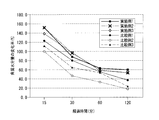
- FIG. 1 is a graph showing the rate of change in the amount of keratin moisture after applying a model cosmetic to the skin using the spunlace nonwoven fabrics of Examples 1 to 3 and Comparative Examples 1 to 3.
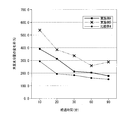
- FIG. 2 is a graph showing the rate of change in the amount of keratin moisture after applying a model cosmetic to the skin using the spunlace nonwoven fabrics of Examples 4 and 5 and Comparative Example 4.
- FIG. 3 is a graph showing the rate of change in the amount of keratin moisture after applying a model cosmetic to the skin using the spunlace nonwoven fabrics of Examples 6 to 8 and Comparative Example 5.
- a beauty face mask sheet comprising a spunlace nonwoven fabric (also called hydroentangled nonwoven fabric) containing 1 to 100% by weight of insoluble collagen fibers and 0 to 99% by weight of one or more fibers selected from the group consisting of cotton and rayon fibers.
- a beauty face mask sheet comprising a spunlace nonwoven fabric (also called hydroentangled nonwoven fabric) containing 1 to 100% by weight of insoluble collagen fibers and 0 to 99% by weight of one or more fibers selected from the group consisting of cotton and rayon fibers.
- the transfer of cosmetics to the skin was improved, and the present invention was achieved.
- the amount of horny moisture has been increased by using rayon fibers and cotton fibers having high water absorption in the cosmetic face mask sheet, but in the present application, insoluble collagen fibers are included in the cosmetic face mask sheet.
- insoluble collagen fibers have high liquid absorbability, collagen fibers that have absorbed liquid have high draping properties, and stick well to the skin, and the liquid is well released into the skin. Guessed.
- insoluble collagen fiber means a collagen fiber that does not dissolve in water.
- the beauty face mask sheet is made of spunlace nonwoven fabric.
- spunlace nonwoven fabric By being a spunlace nonwoven fabric, it is flexible and has less fuzz, feels good and has good adhesion to the skin.
- cosmetics such as lotion and attached to the skin, there is little liquid dripping in horizontal and vertical holding, and the cosmetics retainability is good.
- the spunlace nonwoven fabric contains 1 to 100% by weight of insoluble collagen fibers and 0 to 99% by weight of one or more fibers selected from the group consisting of cotton and rayon fibers with respect to the total weight of the spunlace nonwoven fabric.
- the cosmetic face mask sheet retains the cosmetics and improves the transfer of the cosmetics to the skin. For example, when moisture is applied to the skin with the cosmetic face mask sheet, the transfer of moisture (cosmetics) to the skin is improved, and the amount of keratin moisture is increased.
- the cosmetic face mask sheet is easily adhered to the skin by comprising only insoluble collagen fibers, or by blending cotton and rayon fibers with insoluble collagen fibers.
- the spunlace nonwoven fabric preferably contains 3% by weight or more of insoluble collagen fibers with respect to the total weight of the spunlace nonwoven fabric. More preferably, it is more preferably 20% by weight or more.
- the spunlace nonwoven fabric preferably contains 50% by weight or more of cotton and / or rayon fiber with respect to the total weight of the spunlace nonwoven fabric. 70% by weight or more is more preferable.
- the insoluble collagen fibers are not particularly limited, and known insoluble collagen fibers can be used.
- the insoluble collagen fibers can be obtained by insolubilizing solubilized collagen fibers obtained by dissolving a collagen raw material and spinning a solubilized collagen solution obtained by solubilization.
- collagen raw material skins of animals such as cows, pigs, horses, deer, and rabbits can be used.
- a fresh floor skin obtained from an animal such as a cow or a salted raw skin is used. Since the collagen contained in such a collagen raw material is insoluble collagen that is partially cross-linked, a solubilization treatment for cutting the cross-link is performed.
- a solubilization method a known alkali solubilization method, enzyme solubilization method, or the like can be used.
- Collagen that has become soluble in water by solubilization treatment is an aqueous solution of acid such as aqueous hydrochloric acid, aqueous acetic acid, aqueous lactic acid, etc., and has a collagen (solid content) concentration of 1 to 15% by weight, preferably 2 to 10%. %, And a collagen spinning solution having a pH in the range of 2 to 4.5 is prepared.
- the obtained collagen spinning solution may be defoamed under reduced pressure stirring as necessary, and filtered to remove fine dust that is water-insoluble.
- a collagen spinning solution can be formed by discharging a collagen spinning solution, for example, to an inorganic salt aqueous solution or an organic solvent through a spinning nozzle or a slit and coagulating it.
- the insolubilized collagen fibers can be obtained by cross-linking and insolubilizing the obtained solubilized collagen fibers with, for example, an organic crosslinking agent and / or a metal compound.
- organic crosslinking agent organic crosslinking agents, such as aldehyde compounds, such as formaldehyde, and epoxy compounds, such as epichlorohydrin, can be used, for example.
- epoxy compounds such as epichlorohydrin
- the metal compound for example, a zirconium salt or an aluminum salt can be used.
- insoluble collagen fiber for example, a commercially available product such as a regenerated collagen fiber “ULTIMA (registered trademark)” manufactured by Kaneka Corporation may be used.
- ULTIMA registered trademark
- the rayon fiber is not particularly limited, and solvent-spun rayon such as viscose rayon, copper ammonia rayon, and lyocell can be used.
- the single fiber fineness of the fiber is not particularly limited, for example, it is preferably 10 dtex or less, more preferably 5 dtex or less from the viewpoint of good touch.
- the fiber length of the fiber is not particularly limited, but for example, from the viewpoint of handleability during production of a spunlace nonwoven fabric, it is preferably 26 to 75 mm, and more preferably 38 to 51 mm.
- the spunlace nonwoven fabric preferably has a basis weight of 20 to 100 g / m 2 , more preferably 20 to 90 g / m 2 , still more preferably 30 to 85 g / m 2 , and 40 to 80 g / m 2. it is even more preferred that m 2.
- the basis weight is within the above range, the handleability at the time of application to the face is good and the fit to the face is also good. Moreover, the liquid retention property which hold
- the spunlace nonwoven fabric preferably has a thickness of 0.1 to 1 mm, more preferably 0.2 to 0.6 mm.
- the thickness is within the above range, the handleability at the time of application to the face is good and the fit to the face is also good. Moreover, the retention of cosmetics and the transfer of cosmetics to the skin are also improved.
- the thickness of the nonwoven fabric is measured according to JIS L 1913: 2010.
- the spunlace nonwoven fabric may be a single layer nonwoven fabric or a laminated nonwoven fabric.
- fiber fibers are made by mixing insoluble collagen fibers and cotton and / or rayon fibers, and then the fibers are entangled by a general spunlace method (also called hydroentanglement method). Can do.
- a general spunlace method also called hydroentanglement method
- a laminated nonwoven fabric for example, a fiber web made of insoluble collagen fibers and a fiber web made of one or more fibers selected from the group consisting of cotton and rayon fibers were produced, and these fiber webs (fiber layers) were laminated. Thereafter, the fibers can be entangled by a general spunlace method.
- the spunlace nonwoven fabric is made of insoluble collagen fibers, a fiber web made of 100% by weight of insoluble collagen fibers can be prepared, and then the fibers can be entangled by a general spunlace method.
- the cosmetic is not particularly limited, and known cosmetics can be used.
- lotions and lotions containing various active ingredients can be used.
- the active ingredient include a moisturizing agent, an ultraviolet ray preventing agent, and a whitening agent.
- the moisturizer is not particularly limited as long as it has a moisturizing effect.
- examples include glycerin, ceramide, ceramide derivatives, hyaluronic acid, collagen, and the like.
- the ultraviolet ray preventing agent is not particularly limited as long as it has an ultraviolet ray preventing effect.
- examples thereof include cinnamic acid-based UV absorbers, triazine-based UV absorbers, benzophenone-based UV absorbers, benzoic acid-based UV absorbers, salicylic acid-based UV absorbers, and dibenzoylmethane-based UV absorbers.
- the whitening agent is not particularly limited as long as it has a whitening effect.
- examples include ellagic acid, ascorbic acid, ascorbic acid derivatives, vitamin E derivatives, kojic acid, arbutin, and placenta extract.
- the content of the active ingredient is not particularly limited, but is preferably 0.01 to 20% by weight, and more preferably 0.1 to 15% by weight.
- the said active ingredient may be used by 1 type, and may use 2 or more types together.
- the cosmetic face mask sheet impregnated or applied to the cosmetic face mask sheet is transferred to the skin as a model cosmetic material by impregnating the cosmetic face mask sheet impregnated with an aqueous glycerin solution containing 10% by weight of glycerin.
- the hydration property is based on the rate of change over time in the amount of keratin water after the removal of the cosmetic face mask sheet with respect to the amount of keratin moisture before the cosmetic face mask sheet is applied (initial horny moisture amount). Judgment. It means that there is much transfer to a skin of a moisturizing component, so that the value of the rate of change of amount of keratin moisture is high.
- a cosmetic face mask sheet impregnated or coated with cosmetics can be produced by cutting the cosmetic face mask sheet into a predetermined shape and impregnating or applying the cosmetic.
- the cosmetic face mask sheet impregnated or coated with cosmetics can be used as a cosmetic face mask that is applied to a part of or the entire face to apply the cosmetics to the skin.
- Insoluble collagen fibers those prepared in the following Production Example 1 were used.
- ⁇ Production Example 1 of Insoluble Collagen Fiber> A cow's floor skin was used as raw material, and an aqueous hydrogen peroxide solution diluted to 30% by weight was added to the skin solubilized with alkali, and then dissolved in a lactic acid aqueous solution to adjust the pH to 3.5 and a solid content of 7.5% by weight. Stock solutions were made.
- the stock solution was subjected to stirring and defoaming treatment with a stirring deaerator (manufactured by Dalton Co., 8DMV type) under reduced pressure, transferred to a piston-type spinning stock solution tank, and further allowed to stand under reduced pressure for defoaming.
- the gear pump was fed in a fixed amount, filtered through a sintered filter with a pore size of 10 ⁇ m, passed through a spinning nozzle with a pore size of 0.07 mm, a pore length of 0.5 mm, and a pore number of 1000, and 20 wt% sodium sulfate.
- Example 1 Using the above-described insoluble collagen fibers, a fiber web composed of 100% by weight of insoluble collagen fibers is prepared, entangled between the fibers by a general hydroentanglement method, and dried to form a spunlace nonwoven fabric (weight per unit: 40 g / m 2 , A thickness of 0.51 mm) was produced.
- Example 2 A spunlace nonwoven fabric was produced in the same manner as in Example 1 except that the basis weight of the spunlace nonwoven fabric was 60 g / m 2 and the thickness was 0.66 mm.
- Example 3 A spunlace nonwoven fabric was produced in the same manner as in Example 1 except that the basis weight of the spunlace nonwoven fabric was 80 g / m 2 and the thickness was 0.71 mm.
- Comparative Example 2 A spunlace nonwoven fabric was produced in the same manner as in Comparative Example 1 except that the basis weight of the spunlace nonwoven fabric was 60 g / m 2 and the thickness was 0.60 mm.
- Comparative Example 3 A spunlace nonwoven fabric was produced in the same manner as in Comparative Example 1 except that the basis weight of the spunlace nonwoven fabric was 80 g / m 2 and the thickness was 0.55 mm.
- test piece (Evaluation of hydration 1) A 2.5 cm ⁇ 2.5 cm square test piece was cut out from each non-woven fabric, and the obtained test piece was immersed in an aqueous glycerin solution having a concentration of 10% by weight used as a model cosmetic. The water on the surface of the test piece after immersion was cut off and brought into contact with the inner part of the subject's forearm for 10 minutes, and then the test piece was removed. The subjects were eight Japanese women who were healthy from 39 to 49 years old and had no abnormal skin. Prior to contacting the test piece, the skin keratin water content (initial keratin water content) was measured. Also, the amount of horny moisture in the skin after 15 minutes, 30 minutes, 60 minutes, and 120 minutes was measured immediately after removing the test piece.
- the ratio of the amount of change in the amount of horny water in each elapsed time with respect to the initial amount of horny water (the amount of horny water in each elapsed time ⁇ initial amount of horny water), that is, the rate of change in the amount of horny water did.
- Example 4 The above-described insoluble collagen fibers and cotton are mixed at the blending ratio shown in Table 2 to prepare a fiber web, entangled between the fibers by a general hydroentanglement method, and dried to form a spunlace nonwoven fabric (weight per unit: 40 g / m 2 , thickness 0.34 mm).
- Example 5 A spunlace nonwoven fabric (weight per unit: 40 g / m 2 , thickness 0. 0) was prepared in the same manner as in Example 4 except that the above-described insoluble collagen fibers and cotton were mixed at the blending ratio shown in Table 2 to prepare a fiber web. 36 mm).
- the water replenishment property when the spunlace nonwoven fabrics of Examples 4 and 5 and Comparative Example 4 were used was evaluated by measuring and calculating the rate of change in the amount of stratum corneum as follows. The results are shown in Table 2 below. The results of the rate of change in the amount of keratin moisture are shown in FIG.
- test piece (Evaluation of hydration ability 2) A 2 cm ⁇ 2 cm square test piece was cut from each non-woven fabric, and the obtained test piece was immersed in an aqueous glycerin solution having a concentration of 10% by weight used as a model cosmetic. After the surface moisture of the test piece after immersion was cut, the test piece was removed after being brought into contact with the inner part of the subject's forearm for 10 minutes. The subjects were five Japanese women who were healthy from 20 to 59 years old and had no abnormal skin. Prior to contacting the test piece, the skin keratin water content (initial keratin water content) was measured.
- the keratin moisture content of the skin was measured. Then, based on the following formula, the ratio of the amount of change in the amount of horny water in each elapsed time with respect to the initial amount of horny water (the amount of horny water in each elapsed time ⁇ initial amount of horny water), that is, the rate of change in the amount of horny water did.
- the stratum corneum moisture content was measured using a skin stratum corneum moisture content measuring device “SKICON-200EX” (Yayoi Co., Ltd.).
- the cotton of Comparative Example 4 is obtained when the above-mentioned model cosmetic is impregnated into the spunlace nonwoven fabric in which the collagen fibers are mixed with the cotton of Examples 4 and 5 and packed into the skin.
- the rate of change in the amount of keratin moisture is high, the hydration is excellent, and the cosmetic is transferred to the skin. It turns out that it is improving.
- Example 6 A fiber web composed of 100% by weight of the insoluble collagen fibers described above is prepared, entangled between fibers by a general hydroentanglement method, and dried to produce a spunlace nonwoven fabric (weight per unit: 60 g / m 2 , thickness 0.65 mm). did.
- Example 7 A spunlace nonwoven fabric having the basis weight and thickness shown in Table 3 is the same as in Example 6 except that the above-described insoluble collagen fiber and rayon fiber are mixed in the blending ratio shown in Table 3 to produce a fiber web.
- Example 6 A spunlace nonwoven fabric having the basis weight and thickness shown in Table 3 is the same as in Example 6 except that the above-described insoluble collagen fiber and rayon fiber are mixed in the blending ratio shown in Table 3 to produce a fiber web.
- Example 5 A spunlace nonwoven fabric (weight per unit: 60 g / m 2 , thickness 0.52 mm) was produced in the same manner as in Example 6 except that a fiber web composed of 100% by weight of rayon fiber was produced.
- Example 6 A spunlace nonwoven fabric (weight per unit: 60 g / m 2 , thickness 0. 0) was prepared in the same manner as in Example 6 except that the above-described insoluble collagen fibers and wool were blended in the blending ratio shown in Table 3 to prepare a fiber web. 97 mm).
- test piece (Evaluation of hydration 3) A 2 cm ⁇ 2 cm square test piece was cut from each non-woven fabric, and the obtained test piece was immersed in an aqueous glycerin solution having a concentration of 10% by weight used as a model cosmetic. After the surface moisture of the test piece after immersion was cut, the test piece was removed after being brought into contact with the inner part of the subject's forearm for 10 minutes. The subjects were 10 Japanese women who were healthy from 20 to 59 years old and had no abnormal skin. Prior to contacting the test piece, the skin keratin water content (initial keratin water content) was measured.
- the keratin moisture content of the skin was measured. Then, based on the following formula, the ratio of the amount of change in the amount of horny water in each elapsed time with respect to the initial amount of horny water (the amount of horny water in each elapsed time ⁇ initial amount of horny water), that is, the rate of change in the amount of horny water is calculated. did.
- the stratum corneum moisture content was measured using a skin stratum corneum moisture content measuring device “SKICON-200EX” (Yayoi Co., Ltd.).
- the above-described model cosmetic is impregnated into a spunlace nonwoven fabric comprising 100% by weight of the collagen fibers of Example 6, and a spunlace nonwoven fabric obtained by blending the collagen fibers and the ration fibers of Examples 7 and 8.
- the rate of change in the amount of horny water is higher at each measurement time after applying the model cosmetic than in the case of using the spunlace nonwoven fabric made of 100% by weight of rayon fiber of Comparative Example 5. It was found that the hydration property was excellent and the transfer of cosmetics to the skin was improved.
- the number of liquid dripping from the sheet was recorded until the test piece was lifted from the skin, and the liquid retention during horizontal holding was evaluated. The smaller the number of dripping, the better the liquid retention.
- the number of subjects for each nonwoven fabric was five, and the average value was taken.
- a spunlace nonwoven fabric comprising the collagen fibers of Examples 1 to 3 and 6, and a spunlace nonwoven fabric obtained by blending the cotton of Examples 4 and 5 with collagen fibers Both had higher vertical and horizontal adhesion to the skin than non-woven fabric made of cotton. Further, the spunlace nonwoven fabric composed of the collagen fibers of Examples 1 to 3 and 6 and the spunlace nonwoven fabric obtained by blending the collagen fibers with the rayon fibers of Examples 7 and 8 are more perpendicular to the skin than the nonwoven fabric composed of the rayon fibers. Both adhesion and horizontal adhesion were high.
- the spunlace nonwoven fabric in which wool is mixed with the collagen fibers of Comparative Example 6 and the needle punched nonwoven fabric made of collagen fibers of Comparative Example 7 have many drippings in vertical and horizontal holding, It was difficult to use as a cosmetic face mask sheet.
Landscapes
- Health & Medical Sciences (AREA)
- Life Sciences & Earth Sciences (AREA)
- Public Health (AREA)
- Veterinary Medicine (AREA)
- Animal Behavior & Ethology (AREA)
- General Health & Medical Sciences (AREA)
- Epidemiology (AREA)
- Birds (AREA)
- Engineering & Computer Science (AREA)
- Dermatology (AREA)
- Mechanical Engineering (AREA)
- Textile Engineering (AREA)
- Cosmetics (AREA)
Abstract
本発明は、美容フェイスマスク用シートであって、前記美容フェイスマスク用シートは、スパンレース不織布で構成されており、前記スパンレース不織布は、スパンレース不織布の全体重量に対して、不溶性コラーゲン繊維1~100重量%と、コットン及びレーヨン繊維からなる群から選ばれる一種以上の繊維0~99重量%を含む美容フェイスマスク用シートに関する。これにより、肌への化粧料の移行を向上させることができる美容フェイスマスク用シートを提供する。
Description
本発明は、顔面に化粧料をパックする美容フェイスマスクに用いる美容フェイスマスク用シートに関する。
従来から、化粧水、乳液等の化粧料をパック剤として顔面に付与するのに、シートに化粧料を含浸又は塗布した美容フェイスマスクが用いられており、化粧料を含浸又は塗布する美容フェイスマスク用シートとしては、様々な繊維シートが提案されていた。例えば、特許文献1には、基材繊維として、植物繊維、動物繊維、再生繊維及び半合成繊維からなる群より選ばれる親水性繊維を用いた繊維シートを有するパック化粧料が記載されている。特許文献2には、顔面パック用シートの素材として、天然繊維や化学繊維を用い、編物、織物、不織布、紙等の構造にした顔面パック用シートが記載されている。そして、各種繊維素材の中でも、吸水性の高いセルロース繊維を用いることが好まれていた。例えば、特許文献3には、保湿性を高めるためにレーヨン繊維からなる保湿性不織布シートを用いることが提案されている。特許文献4には、フェイスマスクに用いる木綿シートが提案されている。
しかしながら、従来の美容フェイスマスクシートにおいて、シートに含浸又は塗布された化粧料の肌への移行をさらに改善することが求められていた。
本発明は、上記を鑑み、肌への化粧料の移行を向上させることができる美容フェイスマスク用シートを提供する。
本発明は、美容フェイスマスク用シートであって、前記美容フェイスマスク用シートは、スパンレース不織布で構成されており、前記スパンレース不織布は、スパンレース不織布の全体重量に対して、不溶性コラーゲン繊維1~100重量%と、コットン及びレーヨン繊維からなる群から選ばれる一種以上の繊維0~99重量%を含むことを特徴とする美容フェイスマスク用シートに関する。
本発明によれば、不溶性コラーゲン繊維を含むスパンレース不織布を美容フェイスマスク用シートとして用いることで、肌への化粧料の移行を向上させることができる。
本発明の発明者らは、美容フェイスマスクにおいて、肌への化粧料の移行を向上させることについて鋭意検討した。その結果、不溶性コラーゲン繊維1~100重量%と、コットン及びレーヨン繊維からなる群から選ばれる一種以上の繊維0~99重量%を含むスパンレース不織布(水流交絡不織布ともいう。)を美容フェイスマスクシートとして用いることで、化粧料の肌への移行が向上することを見出し、本発明に至った。具体的には、従来は、美容フェイスマスクシートに吸水性が高いレーヨン繊維や木綿繊維を用いることで角質水分量を高めていたが、本願では、美容フェイスマスクシートに不溶性コラーゲン繊維を含ませることにより、該美容フェイスマスクシートにて肌に水分を付与した場合、水分の肌への移行が向上し、従来よりも角質水分量の変化率が大幅に向上することを見出した。これは、不溶性コラーゲン繊維の液吸収性が高いこと、液を吸収したコラーゲン繊維はドレープ性が高く肌に良く張り付くこと、及び液の肌への放出が良好であること等に起因していると推測される。本発明の実施形態において、「不溶性コラーゲン繊維」とは、水に溶解しないコラーゲン繊維を意味する。
本発明の実施形態において、美容フェイスマスク用シートは、スパンレース不織布で構成されている。スパンレース不織布であることにより、柔軟で毛羽立ちが少なく、肌触りが良好になるうえ、肌への密着性が良好である。また、美容フェイスマスク用シートに化粧水等の化粧料を含浸せて肌へ貼り付けた場合、水平保持及び垂直保持での液垂れが少なく、化粧料の保持性が良好である。
前記スパンレース不織布は、スパンレース不織布の全体重量に対して、不溶性コラーゲン繊維1~100重量%と、コットン及びレーヨン繊維からなる群から選ばれる一種以上の繊維0~99重量%を含む。不溶性コラーゲン繊維のみで構成する、或いはコットン及びレーヨン繊維に不溶性コラーゲン繊維を混綿することにより、美容フェイスマスク用シートの化粧料の保持性が高くなり、肌への化粧料の移行も向上する。例えば、該美容フェイスマスクシートにて肌に水分を付与した場合、肌への水分(化粧料)の移行が向上し、角質水分量が高くなる。また、不溶性コラーゲン繊維のみで構成する、或いはコットン及びレーヨン繊維に不溶性コラーゲン繊維を混綿することにより、美容フェイスマスク用シートが肌に密着しやすい。
肌への化粧料の移行及び肌への密着性を高める観点から、前記スパンレース不織布は、スパンレース不織布の全体重量に対して、不溶性コラーゲン繊維を3重量%以上含むことが好ましく、10重量%以上含むことがより好ましく、20重量%以上含むことがさらに好ましい。
美容フェイスマスク製造時における美容フェイスマスク用シートの初期吸水を高める観点から、前記スパンレース不織布は、スパンレース不織布の全体重量に対して、コットン及び/又はレーヨン繊維を50重量%以上含むことが好ましく、70重量%以上含むことがより好ましい。
前記不溶性コラーゲン繊維としては、特に限定されず、公知の不溶性コラーゲン繊維を用いることができる。例えば、前記不溶性コラーゲン繊維は、コラーゲン原料を溶解処理し、可溶化して得られた可溶化コラーゲン溶液を紡糸して得られた可溶化コラーゲン繊維を不溶化することで得ることができる。
コラーゲン原料としては、牛、豚、馬、鹿、兎等の動物の皮を用いることができる。好ましくは、牛等の動物から得られるフレッシュな床皮や塩漬けした生皮を用いる。このようなコラーゲン原料に含有されるコラーゲンは、部分的に架橋している不溶性のコラーゲンであるために、架橋を切断する可溶化処理が施される。可溶化処理の方法としては、公知のアルカリ可溶化法や酵素可溶化法等を用いることができる。
可溶化処理することで水に溶解可能になったコラーゲンは、例えば塩酸水溶液、酢酸水溶液、乳酸水溶液等の酸の水溶液でコラーゲン(固形分)濃度が1~15重量%、好ましくは2~10重量%程度であり、pH2~4.5の範囲のコラーゲンの紡糸液に調製される。なお、得られたコラーゲンの紡糸液は、必要に応じて減圧攪拌下で脱泡を施し、水不溶分である細かいゴミを除去するために濾過を行ってもよい。コラーゲンの紡糸液を、例えば、紡糸ノズルやスリットを通して無機塩水溶液や有機溶媒に吐出し、凝固することにより可溶化コラーゲン繊維を形成することができる。得られた可溶化コラーゲン繊維を、例えば、有機架橋剤及び/又は金属化合物で架橋して不溶化することで不溶性コラーゲン繊維を得ることができる。有機架橋剤としては、例えば、ホルムアルデヒド等のアルデヒド化合物、エピクロロヒドリン等のエポキシ化合物等の有機架橋剤を用いることができる。金属化合物としては、例えば、ジルコニウム塩、アルミニウム塩等を用いることができる。
前記不溶性コラーゲン繊維としては、例えば、株式会社カネカ製の再生コラーゲン繊維「ULTIMA(登録商標)」等の市販のものを用いてもよい。
前記レーヨン繊維としては、特に限定されず、ビスコースレーヨン、銅アンモニアレーヨン、及びリヨセル等の溶剤紡糸されたレーヨン等を用いることができる。
前記繊維の単繊維繊度は、特に限定されないが、例えば、肌触りが良好であるという観点から、10dtex以下であることが好ましく、5dtex以下であることがより好ましい。また、前記繊維の繊維長は、特に限定されないが、例えば、スパンレース不織布の製造時の取扱い性の観点から、26~75mmであることが好ましく、38~51mmであることがより好ましい。
前記スパンレース不織布は、目付が20~100g/m2であることが好ましく、20~90g/m2であることがより好ましく、30~85g/m2であることがさらに好ましく、40~80g/m2であることがさらにより好ましい。目付が上記の範囲内であると、顔面への貼付時の取扱い性が良好であるとともに、顔面へのフィット性も良好になる。また、化粧料を保持する保液性及び化粧料の肌への移行も向上する。
前記スパンレース不織布は、厚みが0.1~1mmであることが好ましく、より好ましくは0.2~0.6mmである。厚みが上記の範囲内であると、顔面への貼付時の取扱い性が良好であるとともに、顔面へのフィット性も良好になる。また、化粧料の保持性及び化粧料の肌への移行も向上する。本発明の実施形態において、不織布の厚みは、JIS L 1913:2010に準じて測定したものである。
前記スパンレース不織布は、単層不織布であってもよく、積層不織布であってもよい。単層不織布の場合は、不溶性コラーゲン繊維と、コットン及び/又はレーヨン繊維を混綿して繊維ウェブを作製した後、一般的なスパンレース法(水流交絡法ともいう。)により繊維間を交絡することができる。積層不織布の場合は、例えば、不溶性コラーゲン繊維からなる繊維ウェブと、コットン及びレーヨン繊維からなる群から選ばれる一種以上の繊維からなる繊維ウェブを作製し、これらの繊維ウェブ(繊維層)が積層した後、一般的なスパンレース法により繊維間を交絡することができる。前記スパンレース不織布が不溶性コラーゲン繊維からなる場合は、不溶性コラーゲン繊維100重量%からなる繊維ウェブを作製した後、一般的なスパンレース法により繊維間を交絡することができる。
前記美容フェイスマスク用シートに化粧料を含浸又は塗布することが好ましい。化粧料としては、特に限定されず、公知のものを用いることができる。例えば、各種有効成分を含む化粧水や化粧液を用いることができる。有効成分としては、例えば、保湿剤、紫外線防止剤、美白剤等が挙げられる。
前記保湿剤としては、保湿効果があるものであればよく、特に限定されない。例えば、グリセリン、セラミド、セラミド誘導体、ヒアルロン酸、コラーゲン等が挙げられる。
前記紫外線防止剤としては、紫外線防止効果があるものであればよく、特に限定されない。例えば、ケイ皮酸系紫外線吸収剤、トリアジン系紫外線吸収剤、ベンゾフェノン系紫外線吸収剤、安息香酸系紫外線吸収剤、サリチル酸系紫外線剤、ジベンゾイルメタン系紫外線吸収剤等が挙げられる。
前記美白剤としては、美白効果があるものであればよく、特に限定されない。例えば、エラグ酸、アスコルビン酸、アスコルビン酸誘導体、ビタミンE誘導体、コウジ酸、アルブチン、プラセンタエキス等が挙げられる。
前記化粧料において、有効成分の含有量は特に限定されないが、例えば、0.01~20重量%であることが好ましく、0.1~15重量%であることがより好ましい。前記有効成分は、一種で用いてもよく、二種以上を併用してもよい。
本発明の実施形態において、美容フェイスマスク用シートに含浸又は塗布された化粧料の肌への移行は、モデル化粧料としてグリセリンを10重量%含むグリセリン水溶液を含浸させた美容フェイスマスク用シートを肌(前腕内側部)に貼付けた後の水分補給性を評価することで確認することができる。水分補給性は、具体的には、美容フェイスマスク用シートを貼付ける前の角質水分量(初期角質水分量)に対する美容フェイスマスク用シートを除去した後の角質水分量の経時的変化率に基づいて判断する。角質水分量の変化率の値が高いほど、保湿成分の肌への移行が多いことを意味する。
美容フェイスマスク用シートを所定の形状に切断して前記化粧料を含浸又は塗布することで、化粧料が含浸又は塗布された美容フェイスマスク用シートを作製することができる。化粧料が含浸又は塗布された美容フェイスマスク用シートは、顔面の一部又は全体に貼り付けて化粧料を肌に付与する美容フェイスマスクとして用いることができる。
以下実施例により本発明を更に具体的に説明する。なお、本発明は下記の実施例に限定されるものではない。
実施例及び比較例において、下記繊維を用いた。
(1)不溶性コラーゲン繊維:下記の製造例1で作製したものを用いた。
<不溶性コラーゲン繊維の製造例1>
牛の床皮を原料とし、アルカリで可溶化した皮片に30重量%に希釈した過酸化水素水溶液を投入後、乳酸水溶液で溶解し、pH3.5、固形分7.5重量%に調整した原液を作製した。原液を減圧下で撹拌脱泡機((株)ダルトン製、8DMV型)により撹拌脱泡処理し、ピストン式紡糸原液タンクに移送し、さらに減圧下で静置して、脱泡を行った。かかる原液をピストンで押し出した後、ギアポンプ定量送液し、孔径10μmの焼結フィルターで濾過後、孔径0.07mm、孔長0.5mm、孔数1000の紡糸ノズルを通し、硫酸ナトリウム20重量%を含有してなる25℃の凝固浴(ホウ酸及び水酸化ナトリウムでpH11に調整)へ紡出速度5m/分で吐出した。次に、得られた再生コラーゲン繊維を、エピクロロヒドリン1.7重量%、水酸化ナトリウム0.0246重量%、及び硫酸ナトリウム(東ソー(株)製の中性無水芒硝を使用)17重量%を含有した水溶液に25℃で4時間浸漬した後、さらに反応液温度を43℃に昇温して2時間浸漬した。反応終了後に反応液を除去後、25℃の水を用いて3回バッチ水洗を行った。この後、硫酸アルミニウム(日本軽金属(株)製の硫酸バンドを使用)5.0重量%、クエン酸三ナトリウム塩(扶桑化学工業(株)製精製クエン酸ナトリウムMを使用)0.9重量%、水酸化ナトリウム1.2重量%を含有した水溶液に30℃で浸漬し、反応開始から2時間後、3時間後および4時間後にそれぞれ5重量%水酸化ナトリウム水溶液を反応液に添加した。その後、25℃の水を用いて3回バッチ水洗を行った。水洗した繊維をプルロニック型ポリエーテル系静電防止剤からなる油剤を満たした浴槽に浸漬して油剤を付着させた。50℃に調整した熱風対流式乾燥機を用いて緊張下で乾燥させ、単繊維繊度2dtexの不溶性コラーゲン繊維(トウ)を得た。ギアクリンパーでクリンプを付与したトウをロータリーカッターで繊維長51mmにカットすることで単繊維繊度2dtex、繊維長51mmの不溶性コラーゲン繊維を得た。
(1)不溶性コラーゲン繊維:下記の製造例1で作製したものを用いた。
<不溶性コラーゲン繊維の製造例1>
牛の床皮を原料とし、アルカリで可溶化した皮片に30重量%に希釈した過酸化水素水溶液を投入後、乳酸水溶液で溶解し、pH3.5、固形分7.5重量%に調整した原液を作製した。原液を減圧下で撹拌脱泡機((株)ダルトン製、8DMV型)により撹拌脱泡処理し、ピストン式紡糸原液タンクに移送し、さらに減圧下で静置して、脱泡を行った。かかる原液をピストンで押し出した後、ギアポンプ定量送液し、孔径10μmの焼結フィルターで濾過後、孔径0.07mm、孔長0.5mm、孔数1000の紡糸ノズルを通し、硫酸ナトリウム20重量%を含有してなる25℃の凝固浴(ホウ酸及び水酸化ナトリウムでpH11に調整)へ紡出速度5m/分で吐出した。次に、得られた再生コラーゲン繊維を、エピクロロヒドリン1.7重量%、水酸化ナトリウム0.0246重量%、及び硫酸ナトリウム(東ソー(株)製の中性無水芒硝を使用)17重量%を含有した水溶液に25℃で4時間浸漬した後、さらに反応液温度を43℃に昇温して2時間浸漬した。反応終了後に反応液を除去後、25℃の水を用いて3回バッチ水洗を行った。この後、硫酸アルミニウム(日本軽金属(株)製の硫酸バンドを使用)5.0重量%、クエン酸三ナトリウム塩(扶桑化学工業(株)製精製クエン酸ナトリウムMを使用)0.9重量%、水酸化ナトリウム1.2重量%を含有した水溶液に30℃で浸漬し、反応開始から2時間後、3時間後および4時間後にそれぞれ5重量%水酸化ナトリウム水溶液を反応液に添加した。その後、25℃の水を用いて3回バッチ水洗を行った。水洗した繊維をプルロニック型ポリエーテル系静電防止剤からなる油剤を満たした浴槽に浸漬して油剤を付着させた。50℃に調整した熱風対流式乾燥機を用いて緊張下で乾燥させ、単繊維繊度2dtexの不溶性コラーゲン繊維(トウ)を得た。ギアクリンパーでクリンプを付与したトウをロータリーカッターで繊維長51mmにカットすることで単繊維繊度2dtex、繊維長51mmの不溶性コラーゲン繊維を得た。
(2)レーヨン繊維:ダイワボウレーヨン株式会社社製、製品名「CORONA」、繊度1.7dtex、繊維長51mm
(3)コットン:丸三産業社製、晒し綿
(4)ウール:明和製、品名「60Sウール毛」
(3)コットン:丸三産業社製、晒し綿
(4)ウール:明和製、品名「60Sウール毛」
(実施例1)
上述した不溶性コラーゲン繊維を用い、不溶性コラーゲン繊維100重量%からなる繊維ウェブを作製し、一般的な水流交絡法により繊維間を交絡し、乾燥させることでスパンレース不織布(目付:40g/m2、厚み0.51mm)を作製した。
上述した不溶性コラーゲン繊維を用い、不溶性コラーゲン繊維100重量%からなる繊維ウェブを作製し、一般的な水流交絡法により繊維間を交絡し、乾燥させることでスパンレース不織布(目付:40g/m2、厚み0.51mm)を作製した。
(実施例2)
スパンレース不織布の目付が60g/m2、厚みが0.66mmになるようにした以外は、実施例1と同様にしてスパンレース不織布を作製した。
スパンレース不織布の目付が60g/m2、厚みが0.66mmになるようにした以外は、実施例1と同様にしてスパンレース不織布を作製した。
(実施例3)
スパンレース不織布の目付が80g/m2、厚みが0.71mmになるようにした以外は、実施例1と同様にしてスパンレース不織布を作製した。
スパンレース不織布の目付が80g/m2、厚みが0.71mmになるようにした以外は、実施例1と同様にしてスパンレース不織布を作製した。
(比較例1)
上述したレーヨン繊維を用い、レーヨン繊維100重量%からなる繊維ウェブを作製し、一般的な水流交絡法により繊維間を交絡し、乾燥させることでスパンレース不織布(目付:40g/m2、厚み0.53mm)を作製した。
上述したレーヨン繊維を用い、レーヨン繊維100重量%からなる繊維ウェブを作製し、一般的な水流交絡法により繊維間を交絡し、乾燥させることでスパンレース不織布(目付:40g/m2、厚み0.53mm)を作製した。
(比較例2)
スパンレース不織布の目付が60g/m2、厚みが0.60mmになるようにした以外は、比較例1と同様にしてスパンレース不織布を作製した。
スパンレース不織布の目付が60g/m2、厚みが0.60mmになるようにした以外は、比較例1と同様にしてスパンレース不織布を作製した。
(比較例3)
スパンレース不織布の目付が80g/m2、厚みが0.55mmになるようにした以外は、比較例1と同様にしてスパンレース不織布を作製した。
スパンレース不織布の目付が80g/m2、厚みが0.55mmになるようにした以外は、比較例1と同様にしてスパンレース不織布を作製した。
実施例1~3及び比較例1~3のスパンレース不織布を用いた場合の水分補給性を下記のように角質水分量の変化率を測定算出することで評価した。この結果を下記表1に示した。また、角質水分量の変化率の結果を図1に示した。
(水分補給性の評価1)
各不織布から2.5cm×2.5cmの正方形の試験片を切り取り、得られた試験片をモデル化粧料として用いた濃度が10重量%のグリセリン水溶液に30分間浸漬した。浸漬後の試験片の表面の水分を切り、被験者の前腕の内側部に10分間接触させた後、試験片を取り除いた。被験者は、39~49歳までの健康で肌に異常のない日本人女性8名とした。試験片を接触する前に、肌の角質水分量(初期角質水分量)を測定した。また、試験片を除去した直後を0分とし、15分経過後、30分経過後、60分経過後及び120分経過後の肌の角質水分量を測定した。その後、下記式に基づいて、初期角質水分量に対する各経過時間における角質水分量の変化量(各経過時間の角質水分量-初期角質水分量)の割合、すなわち、角質水分量の変化率を算出した。角質水分量は、肌角層水分量測定装置「SKICON-200EX」(株式会社ヤヨイ)を用いて測定した。測定は各測定部位で5回ずつ行い、最大値と最小値を除いて平均した値を測定値とした。水分補給性試験は、温度20±2℃、相対湿度50±10%の条件下で行った。
角質水分量の変化率=(各経過時間後の角質水分量-初期角質水分量)/初期角質水分量×100%
各不織布から2.5cm×2.5cmの正方形の試験片を切り取り、得られた試験片をモデル化粧料として用いた濃度が10重量%のグリセリン水溶液に30分間浸漬した。浸漬後の試験片の表面の水分を切り、被験者の前腕の内側部に10分間接触させた後、試験片を取り除いた。被験者は、39~49歳までの健康で肌に異常のない日本人女性8名とした。試験片を接触する前に、肌の角質水分量(初期角質水分量)を測定した。また、試験片を除去した直後を0分とし、15分経過後、30分経過後、60分経過後及び120分経過後の肌の角質水分量を測定した。その後、下記式に基づいて、初期角質水分量に対する各経過時間における角質水分量の変化量(各経過時間の角質水分量-初期角質水分量)の割合、すなわち、角質水分量の変化率を算出した。角質水分量は、肌角層水分量測定装置「SKICON-200EX」(株式会社ヤヨイ)を用いて測定した。測定は各測定部位で5回ずつ行い、最大値と最小値を除いて平均した値を測定値とした。水分補給性試験は、温度20±2℃、相対湿度50±10%の条件下で行った。
角質水分量の変化率=(各経過時間後の角質水分量-初期角質水分量)/初期角質水分量×100%

上記表1の結果及び図1から、実施例1~3のコラーゲン繊維からなるスパンレース不織布に上述したモデル化粧料を含浸させて肌にパックした場合の方が、比較例のレーヨン繊維からなるスパンレース不織布を用いた場合より、モデル化粧料を付与した後、各測定時間において、角質水分量の変化率が高く、水分補給性に優れることが分かった。実施例1~3のコラーゲン繊維からなるスパンレース不織布を用いると、モデル化粧料を含浸した該不織布(美容フェイスマスク用シート)の肌へのパック実施後、肌への化粧料の移行が高くなっていることが分かった。
(実施例4)
上述した不溶性コラーゲン繊維及びコットンを、下記表2に示す配合割合で混綿して繊維ウェブを作製し、一般的な水流交絡法により繊維間を交絡し、乾燥させてスパンレース不織布(目付:40g/m2、厚み0.34mm)を作製した。
上述した不溶性コラーゲン繊維及びコットンを、下記表2に示す配合割合で混綿して繊維ウェブを作製し、一般的な水流交絡法により繊維間を交絡し、乾燥させてスパンレース不織布(目付:40g/m2、厚み0.34mm)を作製した。
(実施例5)
上述した不溶性コラーゲン繊維及びコットンを、下記表2に示す配合割合で混綿して繊維ウェブを作製した以外は、実施例4と同様にして、スパンレース不織布(目付:40g/m2、厚み0.36mm)を作製した。
上述した不溶性コラーゲン繊維及びコットンを、下記表2に示す配合割合で混綿して繊維ウェブを作製した以外は、実施例4と同様にして、スパンレース不織布(目付:40g/m2、厚み0.36mm)を作製した。
(比較例4)
上述したコットンを用い、コットン100重量%からなる繊維ウェブを作製し、一般的な水流交絡法により繊維間を交絡し、乾燥させてスパンレース不織布(目付:40g/m2、厚み0.33mm)を作製した。
上述したコットンを用い、コットン100重量%からなる繊維ウェブを作製し、一般的な水流交絡法により繊維間を交絡し、乾燥させてスパンレース不織布(目付:40g/m2、厚み0.33mm)を作製した。
実施例4、5及び比較例4のスパンレース不織布を用いた場合の水分補給性を下記のように角質水分量の変化率を測定算出することで評価した。この結果を下記表2に示した。また、角質水分量の変化率の結果を図2に示した。
(水分補給性の評価2)
各不織布から2cm×2cmの正方形の試験片を切り取り、得られた試験片をモデル化粧料として用いた濃度が10重量%のグリセリン水溶液に30分間浸漬した。浸漬後の試験片の表面の水分を切った後、被験者の前腕の内側部に10分間接触させた後、試験片を取り除いた。被験者は、20~59歳までの健康で肌に異常のない日本人女性5名とした。試験片を接触する前に、肌の角質水分量(初期角質水分量)を測定した。また、試験片を除去した直後を0分とし、10分経過後、20分経過後、30分経過後、60分経過後及び90分経過後の肌の角質水分量を測定した。その後、下記式に基づいて、初期角質水分量に対する各経過時間における角質水分量の変化量(各経過時間の角質水分量-初期角質水分量)の割合、すなわち、角質水分量の変化率を算出した。角質水分量は、肌角層水分量測定装置「SKICON-200EX」(株式会社ヤヨイ)を用いて行った。測定は各測定部位で5回ずつ行い、最大値と最小値を除いて平均した値を測定値とした。水分補給性試験は、温度20±1℃、相対湿度50±5%の条件下で行った。
角質水分量の変化率=(各経過時間後の角質水分量-初期角質水分量)/初期角質水分量×100%
各不織布から2cm×2cmの正方形の試験片を切り取り、得られた試験片をモデル化粧料として用いた濃度が10重量%のグリセリン水溶液に30分間浸漬した。浸漬後の試験片の表面の水分を切った後、被験者の前腕の内側部に10分間接触させた後、試験片を取り除いた。被験者は、20~59歳までの健康で肌に異常のない日本人女性5名とした。試験片を接触する前に、肌の角質水分量(初期角質水分量)を測定した。また、試験片を除去した直後を0分とし、10分経過後、20分経過後、30分経過後、60分経過後及び90分経過後の肌の角質水分量を測定した。その後、下記式に基づいて、初期角質水分量に対する各経過時間における角質水分量の変化量(各経過時間の角質水分量-初期角質水分量)の割合、すなわち、角質水分量の変化率を算出した。角質水分量は、肌角層水分量測定装置「SKICON-200EX」(株式会社ヤヨイ)を用いて行った。測定は各測定部位で5回ずつ行い、最大値と最小値を除いて平均した値を測定値とした。水分補給性試験は、温度20±1℃、相対湿度50±5%の条件下で行った。
角質水分量の変化率=(各経過時間後の角質水分量-初期角質水分量)/初期角質水分量×100%

上記表2の結果及び図2から、実施例4及び5のコットンにコラーゲン繊維を混綿したスパンレース不織布に上述したモデル化粧料を含浸させて肌にパックした場合の方が、比較例4のコットン100重量%からなるスパンレース不織布を用いた場合より、モデル化粧料を付与した後、各測定時間において、角質水分量の変化率が高く、水分補給性に優れ、肌への化粧料の移行が向上していることが分かった。
(実施例6)
上述した不溶性コラーゲン繊維100重量%からなる繊維ウェブを作製し、一般的な水流交絡法により繊維間を交絡し、乾燥させてスパンレース不織布(目付:60g/m2、厚み0.65mm)を作製した。
上述した不溶性コラーゲン繊維100重量%からなる繊維ウェブを作製し、一般的な水流交絡法により繊維間を交絡し、乾燥させてスパンレース不織布(目付:60g/m2、厚み0.65mm)を作製した。
(実施例7及び8)
上述した不溶性コラーゲン繊維及びレーヨン繊維を、下記表3に示す配合割合で混綿して繊維ウェブを作製した以外は、実施例6と同様にして、下記表3に示す目付及び厚みを有するスパンレース不織布を作製した。
上述した不溶性コラーゲン繊維及びレーヨン繊維を、下記表3に示す配合割合で混綿して繊維ウェブを作製した以外は、実施例6と同様にして、下記表3に示す目付及び厚みを有するスパンレース不織布を作製した。
(比較例5)
上述したレーヨン繊維100重量%からなる繊維ウェブを作製した以外は、実施例6と同様にして、スパンレース不織布(目付:60g/m2、厚み0.52mm)を作製した。
上述したレーヨン繊維100重量%からなる繊維ウェブを作製した以外は、実施例6と同様にして、スパンレース不織布(目付:60g/m2、厚み0.52mm)を作製した。
(比較例6)
上述した不溶性コラーゲン繊維及びウールを、下記表3に示す配合割合で混綿して繊維ウェブを作製した以外は、実施例6と同様にして、スパンレース不織布(目付:60g/m2、厚み0.97mm)を作製した。
上述した不溶性コラーゲン繊維及びウールを、下記表3に示す配合割合で混綿して繊維ウェブを作製した以外は、実施例6と同様にして、スパンレース不織布(目付:60g/m2、厚み0.97mm)を作製した。
(比較例7)
上述したレーヨン繊維100重量%からなる繊維ウェブを作製し、一般的なニードルパンチ法により繊維間を交絡させてニードルパンチ不織布(目付:60g/m2、厚み1.02mm)を作製した。
上述したレーヨン繊維100重量%からなる繊維ウェブを作製し、一般的なニードルパンチ法により繊維間を交絡させてニードルパンチ不織布(目付:60g/m2、厚み1.02mm)を作製した。
実施例6~8及び比較例5の不織布を用いた場合の水分補給性を下記のように角質水分量の変化率を測定算出することで評価した。この結果を下記表3に示した。また、角質水分量の変化率の結果を図3に示した。
(水分補給性の評価3)
各不織布から2cm×2cmの正方形の試験片を切り取り、得られた試験片をモデル化粧料として用いた濃度が10重量%のグリセリン水溶液に30分間浸漬した。浸漬後の試験片の表面の水分を切った後、被験者の前腕の内側部に10分間接触させた後、試験片を取り除いた。被験者は、20~59歳までの健康で肌に異常のない日本人女性10名とした。試験片を接触する前に、肌の角質水分量(初期角質水分量)を測定した。また、試験片を除去した直後を0分とし、10分経過後、20分経過後、30分経過後、60分経過後及び90分経過後の肌の角質水分量を測定した。その後、下記式に基づいて、初期角質水分量に対する各経過時間における角質水分量の変化量(各経過時間の角質水分量-初期角質水分量)の割合、すなわち、角質水分量の変化率を算出した。角質水分量は、肌角層水分量測定装置「SKICON-200EX」(株式会社ヤヨイ)を用いて行った。測定は各測定部位で5回ずつ行い、最大値と最小値を除いて平均した値を測定値とした。水分補給性試験は、温度20±1℃、相対湿度50±5%の条件下で行った。
角質水分量の変化率=(各経過時間後の角質水分量-初期角質水分量)/初期角質水分量×100%
各不織布から2cm×2cmの正方形の試験片を切り取り、得られた試験片をモデル化粧料として用いた濃度が10重量%のグリセリン水溶液に30分間浸漬した。浸漬後の試験片の表面の水分を切った後、被験者の前腕の内側部に10分間接触させた後、試験片を取り除いた。被験者は、20~59歳までの健康で肌に異常のない日本人女性10名とした。試験片を接触する前に、肌の角質水分量(初期角質水分量)を測定した。また、試験片を除去した直後を0分とし、10分経過後、20分経過後、30分経過後、60分経過後及び90分経過後の肌の角質水分量を測定した。その後、下記式に基づいて、初期角質水分量に対する各経過時間における角質水分量の変化量(各経過時間の角質水分量-初期角質水分量)の割合、すなわち、角質水分量の変化率を算出した。角質水分量は、肌角層水分量測定装置「SKICON-200EX」(株式会社ヤヨイ)を用いて行った。測定は各測定部位で5回ずつ行い、最大値と最小値を除いて平均した値を測定値とした。水分補給性試験は、温度20±1℃、相対湿度50±5%の条件下で行った。
角質水分量の変化率=(各経過時間後の角質水分量-初期角質水分量)/初期角質水分量×100%
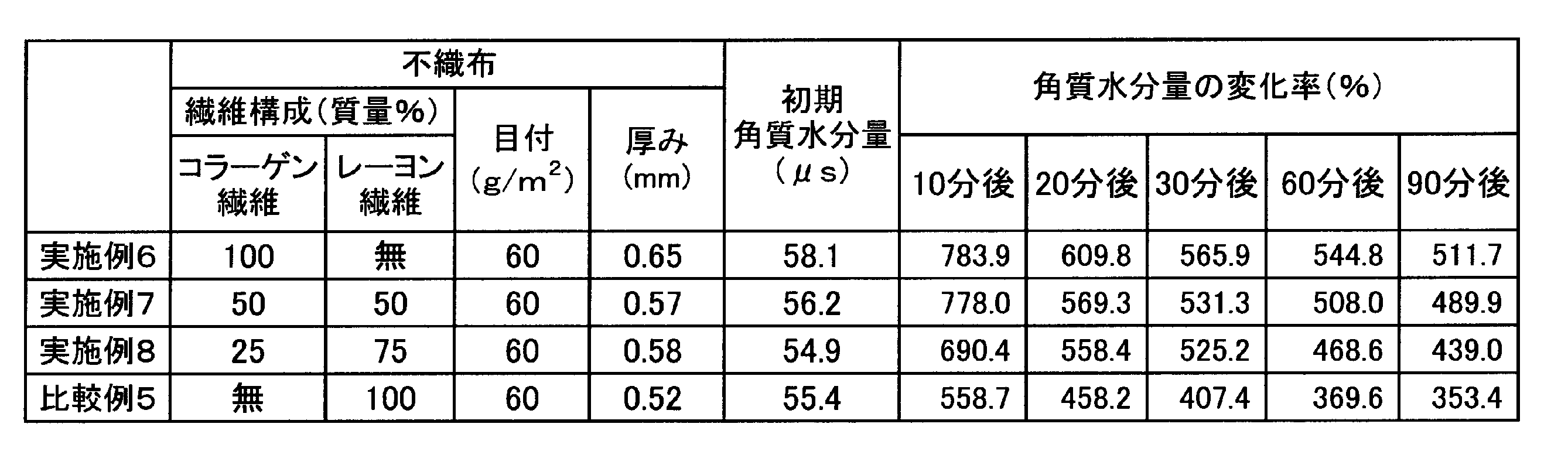
上記表3及び図3から、実施例6のコラーゲン繊維100重量%からなるスパンレース不織布、実施例7及び8のコラーゲン繊維とレーション繊維を混綿したスパンレース不織布に上述したモデル化粧料を含浸させて肌にパックした場合の方が、比較例5のレーヨン繊維100重量%からなるスパンレース不織布を用いた場合より、モデル化粧料を付与した後、各測定時間において、角質水分量の変化率が高く、水分補給性に優れ、肌への化粧料の移行が向上していることが分かった。
実施例1~8及び比較例1~7の不織布の肌への垂直密着性及び垂直保持時の液保持性、並びに水平密着性及び水平保持時の液保持性を下記の評価し、その結果に上記表4に示した。
(肌への垂直密着性及び垂直保持時の液保持性)
各不織布から5cm×5cmの正方形の試験片(シート)を切り取り、試験片にモデル化粧料として用いた濃度が10重量%のグリセリン水溶液を飽和量になるまで含浸させた後、余剰液が垂れなくなるまで液切りをしたシートを被験者の前腕の内側部に貼り付け、前腕を垂直に保ちつつ10分間放置し、肌からのシート浮き上がりを観察し、垂直密着性を下記の3段階の基準で評価した。また、10分間放置する間に、シートからの液垂れの回数を記録して、垂直保持時の液保持性を評価した。液垂れの回数の少ないほど、液保持性に優れることになる。各不織布の被験者は5名とした。
非常に良い:全く浮き上がりが観察されない。
良い:端の一箇所が浮き上がってくることがある。
普通:端の数カ所が浮き上がってくることがある。
各不織布から5cm×5cmの正方形の試験片(シート)を切り取り、試験片にモデル化粧料として用いた濃度が10重量%のグリセリン水溶液を飽和量になるまで含浸させた後、余剰液が垂れなくなるまで液切りをしたシートを被験者の前腕の内側部に貼り付け、前腕を垂直に保ちつつ10分間放置し、肌からのシート浮き上がりを観察し、垂直密着性を下記の3段階の基準で評価した。また、10分間放置する間に、シートからの液垂れの回数を記録して、垂直保持時の液保持性を評価した。液垂れの回数の少ないほど、液保持性に優れることになる。各不織布の被験者は5名とした。
非常に良い:全く浮き上がりが観察されない。
良い:端の一箇所が浮き上がってくることがある。
普通:端の数カ所が浮き上がってくることがある。
(肌への水平密着性及び水平保持時の液保持性)
各不織布から5cm×5cmの正方形の試験片(シート)を切り取り、試験片にモデル化粧料として用いた濃度が10重量%のグリセリン水溶液を飽和量になるまで含浸させた後約1時間放置した。その後、余剰液が垂れなくなるまで液切りをしたシートを被験者の前腕の内側部に貼り付け、前腕を水平に保ち、シートが肌から浮き上がってくるまでの時間を測定した。シート浮きまでの時間が長いほど、密着性に優れることになる。また、試験片が肌から浮き上がってくるまでの間に、シートからの液垂れの回数を記録して、水平保持時の液保持性を評価した。液垂れの回数の少ないほど、液保持性に優れることになる。各不織布の被験者は5名とし、平均値を取った。
各不織布から5cm×5cmの正方形の試験片(シート)を切り取り、試験片にモデル化粧料として用いた濃度が10重量%のグリセリン水溶液を飽和量になるまで含浸させた後約1時間放置した。その後、余剰液が垂れなくなるまで液切りをしたシートを被験者の前腕の内側部に貼り付け、前腕を水平に保ち、シートが肌から浮き上がってくるまでの時間を測定した。シート浮きまでの時間が長いほど、密着性に優れることになる。また、試験片が肌から浮き上がってくるまでの間に、シートからの液垂れの回数を記録して、水平保持時の液保持性を評価した。液垂れの回数の少ないほど、液保持性に優れることになる。各不織布の被験者は5名とし、平均値を取った。
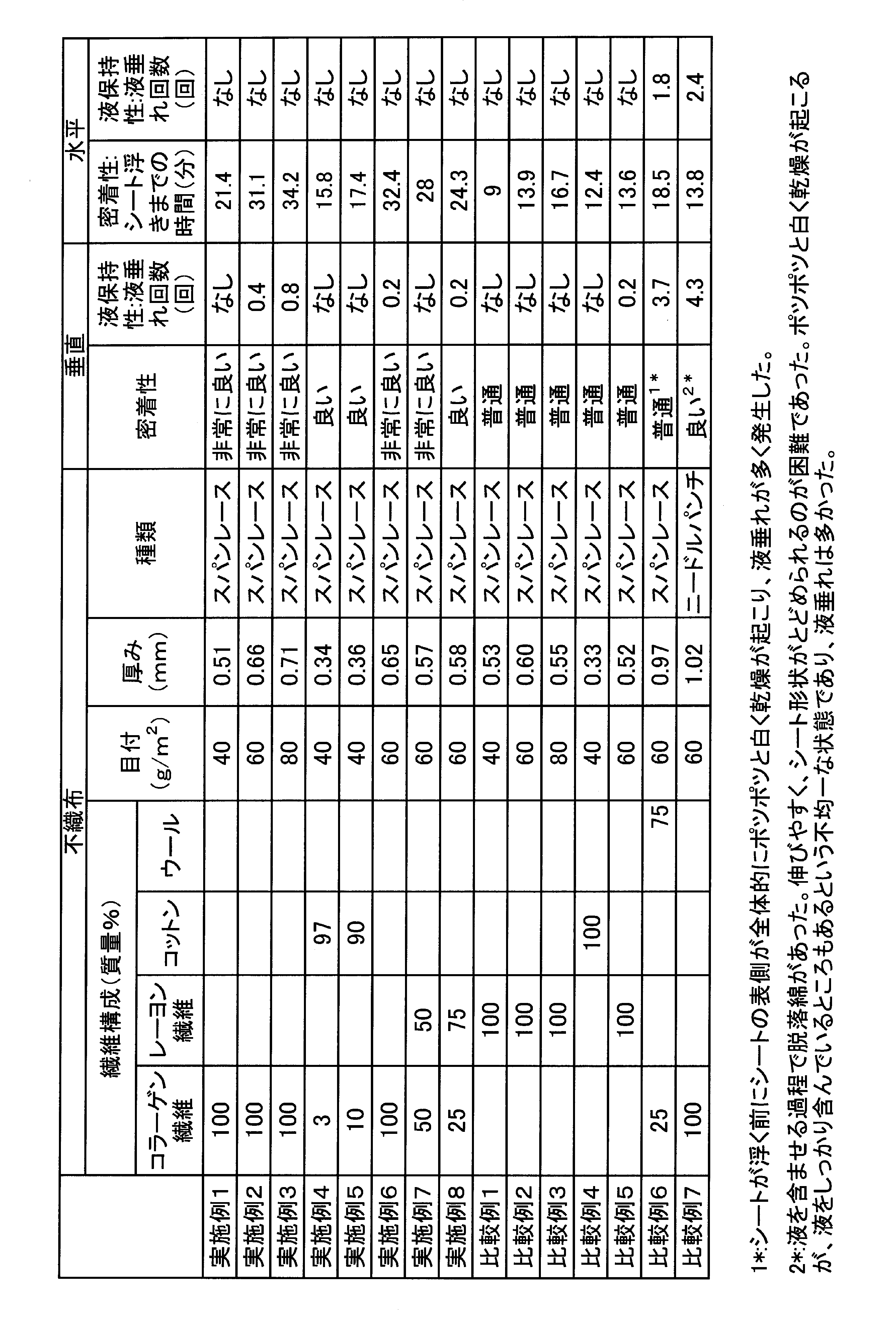
上記表4の結果から分かるように、モデル化粧料を含浸した場合、実施例1~3及び6のコラーゲン繊維からなるスパンレース不織布、実施例4及び5のコットンにコラーゲン繊維を混綿したスパンレース不織布の方が、コットンからなる不織布より、肌への垂直密着性及び水平密着性のいずれも高かった。また、実施例1~3及び6のコラーゲン繊維からなるスパンレース不織布、実施例7及び8のレーヨン繊維にコラーゲン繊維を混綿したスパンレース不織布の方が、レーヨン繊維からなる不織布より、肌への垂直密着性及び水平密着性のいずれも高かった。
一方、モデル化粧料を含浸した場合、比較例6のコラーゲン繊維にウールを混綿したスパンレース不織布及び比較例7のコラーゲン繊維からなるニードルパンチ不織布は、垂直保持及び水平保持での液垂れが多く、美容フェイスマスク用シートとして用いることは困難であった。
Claims (4)
- 美容フェイスマスク用シートであって、
前記美容フェイスマスク用シートは、スパンレース不織布で構成されており、
前記スパンレース不織布は、不溶性コラーゲン繊維1~100重量%と、コットン及びレーヨン繊維からなる群から選ばれる一種以上の繊維0~99重量%を含むことを特徴とする美容フェイスマスク用シート。 - 前記スパンレース不織布の目付が20~100g/m2である請求項1に記載の美容フェイスマスク用シート。
- 前記スパンレース不織布は、単層不織布である請求項1又は2に記載の美容フェイスマスク用シート。
- 前記美容フェイスマスク用シートに化粧料が含浸又は塗布されている請求項1~3のいずれか1項に記載の美容フェイスマスク用シート。
Priority Applications (1)
| Application Number | Priority Date | Filing Date | Title |
|---|---|---|---|
| JP2017524866A JP6839079B2 (ja) | 2015-06-19 | 2016-06-17 | 美容フェイスマスク用シート |
Applications Claiming Priority (2)
| Application Number | Priority Date | Filing Date | Title |
|---|---|---|---|
| JP2015123958 | 2015-06-19 | ||
| JP2015-123958 | 2015-06-19 |
Publications (1)
| Publication Number | Publication Date |
|---|---|
| WO2016204280A1 true WO2016204280A1 (ja) | 2016-12-22 |
Family
ID=57546392
Family Applications (1)
| Application Number | Title | Priority Date | Filing Date |
|---|---|---|---|
| PCT/JP2016/068131 Ceased WO2016204280A1 (ja) | 2015-06-19 | 2016-06-17 | 美容フェイスマスク用シート |
Country Status (2)
| Country | Link |
|---|---|
| JP (1) | JP6839079B2 (ja) |
| WO (1) | WO2016204280A1 (ja) |
Cited By (2)
| Publication number | Priority date | Publication date | Assignee | Title |
|---|---|---|---|---|
| WO2022138206A1 (ja) * | 2020-12-22 | 2022-06-30 | 日本毛織株式会社 | 創傷被覆材 |
| WO2022230609A1 (ja) * | 2021-04-30 | 2022-11-03 | 株式会社カネカ | 保湿性布地及びそれを含む肌着 |
Citations (4)
| Publication number | Priority date | Publication date | Assignee | Title |
|---|---|---|---|---|
| JPS62145006A (ja) * | 1985-12-18 | 1987-06-29 | Koken:Kk | 化学的に修飾されたコラ−ゲンによりなる化粧用フイルム |
| JP2002142861A (ja) * | 2000-08-31 | 2002-05-21 | Lion Corp | 顔面パック用シート及び顔面パック用化粧料シート |
| JP2007153900A (ja) * | 2005-12-07 | 2007-06-21 | L'oreal Sa | 熱効果を有する溶解性の化粧用物品 |
| JP2014129280A (ja) * | 2012-12-28 | 2014-07-10 | Kao Corp | 不織布含浸化粧料 |
-
2016
- 2016-06-17 JP JP2017524866A patent/JP6839079B2/ja not_active Expired - Fee Related
- 2016-06-17 WO PCT/JP2016/068131 patent/WO2016204280A1/ja not_active Ceased
Patent Citations (4)
| Publication number | Priority date | Publication date | Assignee | Title |
|---|---|---|---|---|
| JPS62145006A (ja) * | 1985-12-18 | 1987-06-29 | Koken:Kk | 化学的に修飾されたコラ−ゲンによりなる化粧用フイルム |
| JP2002142861A (ja) * | 2000-08-31 | 2002-05-21 | Lion Corp | 顔面パック用シート及び顔面パック用化粧料シート |
| JP2007153900A (ja) * | 2005-12-07 | 2007-06-21 | L'oreal Sa | 熱効果を有する溶解性の化粧用物品 |
| JP2014129280A (ja) * | 2012-12-28 | 2014-07-10 | Kao Corp | 不織布含浸化粧料 |
Cited By (5)
| Publication number | Priority date | Publication date | Assignee | Title |
|---|---|---|---|---|
| WO2022138206A1 (ja) * | 2020-12-22 | 2022-06-30 | 日本毛織株式会社 | 創傷被覆材 |
| WO2022230609A1 (ja) * | 2021-04-30 | 2022-11-03 | 株式会社カネカ | 保湿性布地及びそれを含む肌着 |
| JPWO2022230609A1 (ja) * | 2021-04-30 | 2022-11-03 | ||
| CN116710607A (zh) * | 2021-04-30 | 2023-09-05 | 株式会社钟化 | 保湿性布料及包含该布料的内衣 |
| CN116710607B (zh) * | 2021-04-30 | 2026-03-13 | 株式会社钟化 | 保湿性布料及包含该布料的内衣 |
Also Published As
| Publication number | Publication date |
|---|---|
| JPWO2016204280A1 (ja) | 2018-04-05 |
| JP6839079B2 (ja) | 2021-03-03 |
Similar Documents
| Publication | Publication Date | Title |
|---|---|---|
| TWI642451B (zh) | 保液片料及面膜 | |
| JP6494518B2 (ja) | 保液シート及びフェイスマスク | |
| JP2014128523A (ja) | フェイスマスク及びフェイスマスクの製造方法 | |
| JP6480335B2 (ja) | 抗菌性不織布シート、含液シート、およびフェイスマスク | |
| CN108403446B (zh) | 一种竹炭粘胶纤维面膜基布及高锁水保湿面膜 | |
| JP6385191B2 (ja) | 薬液含浸用シート及びこれを用いたフェイスマスク | |
| JP4775991B2 (ja) | 美容シート用不織布及び美容シート | |
| TWI862580B (zh) | 纖維積層體及其製造方法 | |
| JP4514865B2 (ja) | 湿潤用基材およびその使用方法 | |
| AU2021238941A1 (en) | Debridement composition | |
| JP2025092758A (ja) | 不織布およびその製造方法、ならびに液体含浸シートおよび拭き取りシート | |
| WO2018235859A1 (ja) | スキンケア製品用不織布 | |
| KR20210130535A (ko) | 냉감 효과의 스펀레이스 혼섬 부직포 | |
| JP6839079B2 (ja) | 美容フェイスマスク用シート | |
| CN210163618U (zh) | 一种ab面水刺无纺面料 | |
| CN105055290A (zh) | 一种天然环保湿巾 | |
| CN107997882A (zh) | 一种具有抗菌消炎、止痛功效的卫生巾及其制作方法 | |
| JP2013124435A (ja) | 化粧用シート | |
| US3052237A (en) | Surgical dressings | |
| WO2020071228A1 (ja) | スキンケア製品用不織布、フェイスマスクおよびクレンジングシート | |
| CN109674374A (zh) | 一种可撕多功能毛巾及其制备方法 | |
| KR20140064139A (ko) | 셀룰로오즈를 이용한 모세관 겔망 구조를 가진 하이드로겔 시트 및 그 제조방법 | |
| JP5283320B2 (ja) | パック化粧料 | |
| JP4937603B2 (ja) | 繊維シート及びパック化粧料 | |
| KR20260050842A (ko) | 항균 기능성 시트 제조 방법 및 이를 통해 제조된 항균 기능성 시트 |
Legal Events
| Date | Code | Title | Description |
|---|---|---|---|
| 121 | Ep: the epo has been informed by wipo that ep was designated in this application |
Ref document number: 16811754 Country of ref document: EP Kind code of ref document: A1 |
|
| ENP | Entry into the national phase |
Ref document number: 2017524866 Country of ref document: JP Kind code of ref document: A |
|
| NENP | Non-entry into the national phase |
Ref country code: DE |
|
| 122 | Ep: pct application non-entry in european phase |
Ref document number: 16811754 Country of ref document: EP Kind code of ref document: A1 |