WO2016199755A1 - ゲル、ゲルの製造方法、レンズ、コンタクトレンズ表面改質剤、重合性組成物及び重合体 - Google Patents
ゲル、ゲルの製造方法、レンズ、コンタクトレンズ表面改質剤、重合性組成物及び重合体 Download PDFInfo
- Publication number
- WO2016199755A1 WO2016199755A1 PCT/JP2016/066888 JP2016066888W WO2016199755A1 WO 2016199755 A1 WO2016199755 A1 WO 2016199755A1 JP 2016066888 W JP2016066888 W JP 2016066888W WO 2016199755 A1 WO2016199755 A1 WO 2016199755A1
- Authority
- WO
- WIPO (PCT)
- Prior art keywords
- group
- carbon atoms
- repeating unit
- mass
- meth
- Prior art date
- Legal status (The legal status is an assumption and is not a legal conclusion. Google has not performed a legal analysis and makes no representation as to the accuracy of the status listed.)
- Ceased
Links
- 0 C*O[N+](*=*[N+]([O-])O**)[O-] Chemical compound C*O[N+](*=*[N+]([O-])O**)[O-] 0.000 description 1
Classifications
-
- G—PHYSICS
- G02—OPTICS
- G02B—OPTICAL ELEMENTS, SYSTEMS OR APPARATUS
- G02B1/00—Optical elements characterised by the material of which they are made; Optical coatings for optical elements
- G02B1/04—Optical elements characterised by the material of which they are made; Optical coatings for optical elements made of organic materials, e.g. plastics
- G02B1/041—Lenses
- G02B1/043—Contact lenses
-
- C—CHEMISTRY; METALLURGY
- C08—ORGANIC MACROMOLECULAR COMPOUNDS; THEIR PREPARATION OR CHEMICAL WORKING-UP; COMPOSITIONS BASED THEREON
- C08F—MACROMOLECULAR COMPOUNDS OBTAINED BY REACTIONS ONLY INVOLVING CARBON-TO-CARBON UNSATURATED BONDS
- C08F2/00—Processes of polymerisation
- C08F2/44—Polymerisation in the presence of compounding ingredients, e.g. plasticisers, dyestuffs, fillers
-
- C—CHEMISTRY; METALLURGY
- C08—ORGANIC MACROMOLECULAR COMPOUNDS; THEIR PREPARATION OR CHEMICAL WORKING-UP; COMPOSITIONS BASED THEREON
- C08F—MACROMOLECULAR COMPOUNDS OBTAINED BY REACTIONS ONLY INVOLVING CARBON-TO-CARBON UNSATURATED BONDS
- C08F220/00—Copolymers of compounds having one or more unsaturated aliphatic radicals, each having only one carbon-to-carbon double bond, and only one being terminated by only one carboxyl radical or a salt, anhydride ester, amide, imide or nitrile thereof
- C08F220/02—Monocarboxylic acids having less than ten carbon atoms; Derivatives thereof
- C08F220/10—Esters
- C08F220/12—Esters of monohydric alcohols or phenols
- C08F220/16—Esters of monohydric alcohols or phenols of phenols or of alcohols containing two or more carbon atoms
- C08F220/18—Esters of monohydric alcohols or phenols of phenols or of alcohols containing two or more carbon atoms with acrylic or methacrylic acids
- C08F220/1808—C8-(meth)acrylate, e.g. isooctyl (meth)acrylate or 2-ethylhexyl (meth)acrylate
-
- C—CHEMISTRY; METALLURGY
- C08—ORGANIC MACROMOLECULAR COMPOUNDS; THEIR PREPARATION OR CHEMICAL WORKING-UP; COMPOSITIONS BASED THEREON
- C08F—MACROMOLECULAR COMPOUNDS OBTAINED BY REACTIONS ONLY INVOLVING CARBON-TO-CARBON UNSATURATED BONDS
- C08F220/00—Copolymers of compounds having one or more unsaturated aliphatic radicals, each having only one carbon-to-carbon double bond, and only one being terminated by only one carboxyl radical or a salt, anhydride ester, amide, imide or nitrile thereof
- C08F220/02—Monocarboxylic acids having less than ten carbon atoms; Derivatives thereof
- C08F220/10—Esters
- C08F220/26—Esters containing oxygen in addition to the carboxy oxygen
- C08F220/28—Esters containing oxygen in addition to the carboxy oxygen containing no aromatic rings in the alcohol moiety
- C08F220/285—Esters containing oxygen in addition to the carboxy oxygen containing no aromatic rings in the alcohol moiety and containing a polyether chain in the alcohol moiety
- C08F220/286—Esters containing oxygen in addition to the carboxy oxygen containing no aromatic rings in the alcohol moiety and containing a polyether chain in the alcohol moiety and containing polyethylene oxide in the alcohol moiety, e.g. methoxy polyethylene glycol (meth)acrylate
-
- C—CHEMISTRY; METALLURGY
- C08—ORGANIC MACROMOLECULAR COMPOUNDS; THEIR PREPARATION OR CHEMICAL WORKING-UP; COMPOSITIONS BASED THEREON
- C08F—MACROMOLECULAR COMPOUNDS OBTAINED BY REACTIONS ONLY INVOLVING CARBON-TO-CARBON UNSATURATED BONDS
- C08F220/00—Copolymers of compounds having one or more unsaturated aliphatic radicals, each having only one carbon-to-carbon double bond, and only one being terminated by only one carboxyl radical or a salt, anhydride ester, amide, imide or nitrile thereof
- C08F220/02—Monocarboxylic acids having less than ten carbon atoms; Derivatives thereof
- C08F220/52—Amides or imides
- C08F220/54—Amides, e.g. N,N-dimethylacrylamide or N-isopropylacrylamide
-
- C—CHEMISTRY; METALLURGY
- C08—ORGANIC MACROMOLECULAR COMPOUNDS; THEIR PREPARATION OR CHEMICAL WORKING-UP; COMPOSITIONS BASED THEREON
- C08L—COMPOSITIONS OF MACROMOLECULAR COMPOUNDS
- C08L101/00—Compositions of unspecified macromolecular compounds
-
- C—CHEMISTRY; METALLURGY
- C08—ORGANIC MACROMOLECULAR COMPOUNDS; THEIR PREPARATION OR CHEMICAL WORKING-UP; COMPOSITIONS BASED THEREON
- C08L—COMPOSITIONS OF MACROMOLECULAR COMPOUNDS
- C08L33/00—Compositions of homopolymers or copolymers of compounds having one or more unsaturated aliphatic radicals, each having only one carbon-to-carbon double bond, and only one being terminated by only one carboxyl radical, or of salts, anhydrides, esters, amides, imides or nitriles thereof; Compositions of derivatives of such polymers
- C08L33/04—Homopolymers or copolymers of esters
-
- G—PHYSICS
- G02—OPTICS
- G02C—SPECTACLES; SUNGLASSES OR GOGGLES INSOFAR AS THEY HAVE THE SAME FEATURES AS SPECTACLES; CONTACT LENSES
- G02C7/00—Optical parts
- G02C7/02—Lenses; Lens systems ; Methods of designing lenses
- G02C7/04—Contact lenses for the eyes
- G02C7/049—Contact lenses having special fitting or structural features achieved by special materials or material structures
-
- B—PERFORMING OPERATIONS; TRANSPORTING
- B29—WORKING OF PLASTICS; WORKING OF SUBSTANCES IN A PLASTIC STATE IN GENERAL
- B29D—PRODUCING PARTICULAR ARTICLES FROM PLASTICS OR FROM SUBSTANCES IN A PLASTIC STATE
- B29D11/00—Producing optical elements, e.g. lenses or prisms
- B29D11/00009—Production of simple or compound lenses
- B29D11/00038—Production of contact lenses
- B29D11/00067—Hydrating contact lenses
-
- G—PHYSICS
- G02—OPTICS
- G02C—SPECTACLES; SUNGLASSES OR GOGGLES INSOFAR AS THEY HAVE THE SAME FEATURES AS SPECTACLES; CONTACT LENSES
- G02C7/00—Optical parts
- G02C7/02—Lenses; Lens systems ; Methods of designing lenses
- G02C7/022—Ophthalmic lenses having special refractive features achieved by special materials or material structures
Definitions
- the present invention relates to a gel, a method for producing the gel, a lens, a contact lens surface modifier, a polymerizable composition, and a polymer. More specifically, the present invention relates to a gel useful as a contact lens material, a method for producing the gel, a lens, a contact lens surface modifier, a polymerizable composition, and a polymer.
- Contact lenses are broadly classified into hydrous contact lenses (including soft contact lenses) and non-hydrous contact lenses (including hard contact lenses and soft contact lenses). Hydrous contact lenses are generally non-hydrous contacts. There is an advantage that the wearing feeling is better than the lens. However, since conventional water-containing contact lenses have high water content, there are problems such as quick drying of the lenses and a decrease in oxygen permeability.
- the silicone hydrogel has a problem that the silicone chain contained therein is hydrophobic, so that the wearing feeling is not good and the lipid is easily attached. If these are left to be used as they are, eye fatigue, cloudiness, a reduction in visual acuity correction power, and adverse effects on the cornea may occur.
- Patent Document 1 discloses that an ophthalmic lens surface is irradiated with high-frequency plasma or excimer light, brought into contact with a hydrophilic monomer solution, and then irradiated with ultraviolet rays to fix the hydrophilic monomer to the ophthalmic lens surface ( Techniques for graft polymerization) are disclosed.
- Patent Document 2 the lens surface is modified by coating the surface of the ophthalmic lens with carbon by a plasma polymerization reaction and further graft polymerizing a hydrophilic monomer.
- the hydrophilicity of the surface of the silicone hydrogel lens is improved by bulk polymerizing a specific zwitterionic monomer together with the silicone monomer.
- Patent Documents 1 and 2 require maintenance of a plasma irradiation apparatus, an ultraviolet irradiation apparatus, and the like, and increase the number of manufacturing processes, so an increase in cost is indispensable. Further, after such a surface modification step, a cleaning step for removing unreacted monomers is also required. This cleaning requires defenses against microbial growth and requires great care. Therefore, the techniques described in Patent Documents 1 and 2 can be a significant cost problem. Further, the lens modified by the technique described in Patent Document 3 is not satisfactory in terms of surface hydrophilicity, lubricity, and wearing feeling. Furthermore, the nonionic surfactant described in Patent Document 4 is not sufficient in terms of the ability to make the lens surface hydrophilic and the ability to impart lubricity. Moreover, although it has the performance which wash
- the problem to be solved by the present invention is to provide a gel that is excellent in surface hydrophilicity, lubricity and antifouling properties and is useful as a contact lens material.
- a gel containing a specific polymer in addition to a polymer obtained by polymerizing a hydrophilic monomer together with a crosslinking agent is excellent in surface hydrophilicity, lubricity and antifouling properties, and contact lenses.
- the present invention was completed by finding it useful as a material.
- the present invention provides the following ⁇ 1> to ⁇ 14>.
- a gel (hereinafter also referred to as a gel of the present invention).
- the repeating unit (A-1) in which the repeating unit (A) has a polyoxyalkylene group in the side chain and the terminal of the side chain is composed of a hydrogen atom or an alkyl group having 1 to 4 carbon atoms.
- R 6 represents a hydrogen atom or a methyl group
- R 7 represents an alkanediyl group having 2 to 4 carbon atoms
- R 8 represents an alkanediyl group having 1 to 10 carbon atoms
- R 9 , R 10 and R 11 each independently represents a hydrogen atom or a hydrocarbon group having 1 to 8 carbon atoms
- q represents an average value of 1 to 10.
- R 12 represents a hydrogen atom or a methyl group
- R 13 and R 14 each independently represents a hydrogen atom, an alkyl group having 1 to 6 carbon atoms or a hydroxyalkyl group.
- R 15 represents a hydrogen atom or a methyl group
- R 16 and R 17 each independently represents an alkanediyl group having 1 to 3 carbon atoms.
- R 18 represents an alkanediyl group having 1 to 5 carbon atoms.
- Y represents — (C ⁇ O) O ⁇ , — (O ⁇ S ⁇ O) O ⁇ , —O (O ⁇ S ⁇ O) O ⁇ , — (S ⁇ O) O ⁇ , —O (S ⁇ O).
- R 24 represents an alkyl group having 1 to 3 carbon atoms
- R 19 represents a hydrogen atom or a methyl group
- R 20 and R 21 each independently represents a divalent organic group having 1 to 10 carbon atoms
- R 22 and R 23 each independently represents a hydrocarbon group having 1 to 10 carbon atoms.
- R 25 represents a hydrogen atom or a methyl group
- R 26 represents —O—, * — (C ⁇ O) —O—, * — (C ⁇ O) —NR 31 —, * —NR 31 — (C ⁇ O) —
- R 31 represents a hydrogen atom or An organic group having 1 to 10 carbon atoms, * represents a position bonded to the carbon atom to which R 25 in formula (8) is bonded) or a phenylene group
- R 27 represents a divalent organic group having 1 to 10 carbon atoms
- R 28 , R 29 and R 30 each independently represents a hydrocarbon group having 1 to 10 carbon atoms.
- R 1 represents an alkanediyl group having 2 to 4 carbon atoms
- R 2 represents a hydrogen atom or an alkyl group having 1 to 4 carbon atoms
- R 3 represents a hydrogen atom or a methyl group
- R 4 represents —O—, * — (C ⁇ O) —O—, * — (C ⁇ O) —NR 5 —, * —NR 5 — (C ⁇ O) —
- R 5 represents a hydrogen atom or An organic group having 1 to 10 carbon atoms, * represents a position bonded to the carbon atom to which R 3 in formula (2) is bonded) or a phenylene group
- n represents an average value of 2 to 100.
- R 32 represents an alkanediyl group having 2 to 4 carbon atoms
- R 33 represents an alkyl group having 5 to 30 carbon atoms, an alkanoyl group having 5 to 30 carbon atoms, or an aryl group
- R 34 represents a hydrogen atom or a methyl group
- R 36 is A hydrogen atom or an organic group having 1 to 10 carbon atoms, ** represents a position bonded to the carbon atom to which R 34 in formula (10) is bonded) or a phenylene group
- m represents an average value of 2 to 100.
- R 37 represents a hydrogen atom or a methyl group
- R 38 represents —O—, ***-(C ⁇ O) —O—, ***-(C ⁇ O) —NR 40 —, ***-NR 40 — (C ⁇ O) —
- R 40 represents a hydrogen atom or an organic group having 1 to 10 carbon atoms, *** represents a position bonded to the carbon atom to which R 37 in formula (11) is bonded) or a phenylene group
- R 39 represents a hydrocarbon group having 4 to 30 carbon atoms.
- R 41 represents a divalent organic group having 1 to 10 carbon atoms
- R 42 and R 43 each independently represents an organic group having 1 to 10 carbon atoms
- R 44 , R 45 and R 46 each independently represent —OSi (R 49 ) 3 (R 49 independently represents a hydrogen atom or an organic group having 1 to 8 carbon atoms) or 1 carbon atom
- r represents an average value of 0 to 200.
- ⁇ 11> The gel according to any one of ⁇ 1> to ⁇ 9>, wherein the polymer b is obtained by polymerizing a silicone compound having a polymerizable functional group together with the hydrophilic monomer and the crosslinking agent.
- a method for producing a gel containing a polymer comprising: a polymer a having the following repeating unit (A): 2.5 to 95% by mass and the following repeating unit (B): 2.5 to 95% by mass.
- a method for producing a gel, wherein a hydrophilic monomer is polymerized together with a crosslinking agent in the presence to form a polymer (hereinafter also referred to as a method for producing a gel of the present invention).
- Hydrophilic repeating unit (B) Containing a polyoxyalkylene group in the side chain, and the terminal of the side chain is composed of an alkyl group having 5 to 30 carbon atoms, an alkanoyl group having 5 to 30 carbon atoms, or an aryl group Repeating unit
- a lens (hereinafter, also referred to as a lens of the present invention), comprising the gel according to any one of ⁇ 1> to ⁇ 11>.
- ⁇ 14> The lens according to ⁇ 13>, which is a contact lens.
- a contact lens surface comprising a polymer a having the following repeating unit (A): 2.5 to 95% by mass and the following repeating unit (B): 2.5 to 95% by mass
- a modifier hereinafter also referred to as a contact lens surface modifier of the present invention.
- Polymer a having the following repeating unit (A): 2.5 to 95% by mass and the following repeating unit (B): 2.5 to 95% by mass, a hydrophilic monomer, and a crosslinking agent.
- a polymerizable composition hereinafter also referred to as a polymerizable composition of the present invention.
- a polymer having the following repeating unit (A): 2.5 to 95% by mass and the following repeating unit (B): 2.5 to 95% by mass (hereinafter referred to as the weight of the present invention). Although it is also called a coalescence, it is synonymous with the polymer a).
- the gel of the present invention is excellent in surface hydrophilicity, lubricity and antifouling property, and also has high sustainability of these properties. Therefore, the gel of the present invention is useful as a contact lens material. Further, according to the method for producing a gel of the present invention, a gel excellent in surface hydrophilicity, lubricity and antifouling property can be produced easily and at low cost. In addition, the lens of the present invention is excellent in surface hydrophilicity, lubricity and antifouling properties, and also has high sustainability of these characteristics. Further, by using the polymer and contact lens surface modifier of the present invention, a lens having excellent surface hydrophilicity, lubricity and antifouling properties and high sustainability of these properties can be obtained. Further, by using the polymerizable composition of the present invention, a gel having excellent surface hydrophilicity, lubricity and antifouling properties and high sustainability of these properties can be obtained.
- the gel of the present invention comprises a polymer a having the following repeating unit (A): 2.5 to 95% by mass and a repeating unit (B): 2.5 to 95% by mass (hereinafter also simply referred to as polymer a). ) And a polymer b obtained by polymerizing a hydrophilic monomer together with a crosslinking agent (hereinafter also simply referred to as polymer b).
- Hydrophilic repeating unit (B) Containing a polyoxyalkylene group in the side chain, and the terminal of the side chain is composed of an alkyl group having 5 to 30 carbon atoms, an alkanoyl group having 5 to 30 carbon atoms, or an aryl group Repeating unit to be used
- the description which specifies the thing in this specification by a manufacturing method is based on the existence of an impractical situation which is impossible.
- the polymer a used in the gel of the present invention has the above repeating unit (A): 2.5 to 95% by mass and the above repeating unit (B): 2.5 to 95% by mass.
- Such a polymer a acts as a modifying agent for modifying the contact lens surface and the like, and is useful as a contact lens surface modifying polymer, a contact lens surface modifying agent, and the like.
- the repeating unit (A) may be any hydrophilic repeating unit, but has a polyoxyalkylene group in the side chain, and the side chain terminal is a hydrogen atom or an alkyl group having 1 to 4 carbon atoms.
- Repeating unit (A-4), repeating unit (A-5) represented by the following formula (6), betaine repeating unit (A-6) represented by the following formula (7), anionic repeating unit (A -7) and at least one selected from cationic repeating units (A-8) represented by the following formula (8) are preferred.
- hydrophilic means having a strong affinity for water. Specifically, when it is a homopolymer consisting of only one type of repeating unit (having a number average molecular weight of about 10,000 by the measurement method of the example), it is 1 g or more per 100 g of pure water at room temperature (25 ° C.). When dissolved, the repeating unit is hydrophilic.
- R 6 represents a hydrogen atom or a methyl group
- R 7 represents an alkanediyl group having 2 to 4 carbon atoms
- R 8 represents an alkanediyl group having 1 to 10 carbon atoms
- R 9 , R 10 and R 11 each independently represents a hydrogen atom or a hydrocarbon group having 1 to 8 carbon atoms
- q represents an average value of 1 to 10.
- R 12 represents a hydrogen atom or a methyl group
- R 13 and R 14 each independently represents a hydrogen atom, an alkyl group having 1 to 6 carbon atoms or a hydroxyalkyl group.
- R 15 represents a hydrogen atom or a methyl group
- R 16 and R 17 each independently represents an alkanediyl group having 1 to 3 carbon atoms.
- R 18 represents an alkanediyl group having 1 to 5 carbon atoms.
- Y represents — (C ⁇ O) O ⁇ , — (O ⁇ S ⁇ O) O ⁇ , —O (O ⁇ S ⁇ O) O ⁇ , — (S ⁇ O) O ⁇ , —O (S ⁇ O).
- R 24 represents an alkyl group having 1 to 3 carbon atoms
- R 19 represents a hydrogen atom or a methyl group
- R 20 and R 21 each independently represents a divalent organic group having 1 to 10 carbon atoms
- R 22 and R 23 each independently represents a hydrocarbon group having 1 to 10 carbon atoms.
- R 25 represents a hydrogen atom or a methyl group
- R 26 represents —O—, * — (C ⁇ O) —O—, * — (C ⁇ O) —NR 31 —, * —NR 31 — (C ⁇ O) —
- R 31 represents a hydrogen atom or An organic group having 1 to 10 carbon atoms, * represents a position bonded to the carbon atom to which R 25 in formula (8) is bonded) or a phenylene group
- R 27 represents a divalent organic group having 1 to 10 carbon atoms
- R 28 , R 29 and R 30 each independently represents a hydrocarbon group having 1 to 10 carbon atoms.
- the repeating unit (A-1) has a polyoxyalkylene group in the side chain, and the terminal of the side chain is composed of a hydrogen atom or an alkyl group having 1 to 4 carbon atoms.
- Examples of the repeating unit (A-1) include a repeating unit containing a structure represented by the following formula (1) in the side chain.
- known polymers can be used, among which (meth) acrylate polymer species and (meth) acrylamide polymers Species, styrenic polymer species and the like are preferred.
- the repeating unit represented by the following formula (2) is preferable.
- R 1 represents an alkanediyl group having 2 to 4 carbon atoms
- R 2 represents a hydrogen atom or an alkyl group having 1 to 4 carbon atoms
- n represents an average value of 2 to 100.
- R 3 represents a hydrogen atom or a methyl group
- R 4 represents —O—, * — (C ⁇ O) —O—, * — (C ⁇ O) —NR 5 —, * —NR 5 — (C ⁇ O) —
- R 5 represents a hydrogen atom or An organic group having 1 to 10 carbon atoms, * represents a position bonded to the carbon atom to which R 3 in formula (2) is bonded) or a phenylene group;
- Other symbols are synonymous with the symbols in formula (1).
- R 1 represents an alkanediyl group having 2 to 4 carbon atoms, and n R 1 s may be the same or different.
- the number of carbon atoms of the alkanediyl group represented by R 1 is preferably 2 or 3, more preferably 2.
- the alkanediyl group represented by R 1 may be linear or branched, and specifically includes ethane-1,2-diyl group, propane-1,2-diyl group, propane-1,3- Examples thereof include a diyl group, a propane-2,2-diyl group, a butane-1,2-diyl group, a butane-1,3-diyl group, and a butane-1,4-diyl group.
- an ethane-1,2-diyl group is preferable from the viewpoint of availability, hydrophilicity, and the like.
- R 2 represents a hydrogen atom or an alkyl group having 1 to 4 carbon atoms.
- the number of carbon atoms of the alkyl group represented by R 2 is preferably 1 to 3, more preferably 1 or 2, and still more preferably 1, from the viewpoints of availability, hydrophilicity and the like.
- the alkyl group represented by R 2 may be linear or branched, and specifically includes methyl, ethyl, n-propyl, isopropyl, n-butyl, isobutyl, sec-butyl. Group and tert-butyl group.
- a hydrogen atom or an alkyl group having 1 to 3 carbon atoms is preferable, and a hydrogen atom or an alkyl group having 1 or 2 carbon atoms is more preferable, from the viewpoint of availability, hydrophilicity, etc.
- a hydrogen atom or a methyl group is more preferable, and a methyl group is particularly preferable.
- R 4 represents —O—, * — (C ⁇ O) —O—, * — (C ⁇ O) —NR 5 —, * —NR 5 — (C ⁇ O) —, or a phenylene group.
- a phenylene group include a 1,2-phenylene group, a 1,3-phenylene group, and a 1,4-phenylene group.
- the organic group represented by R 5 has 1 to 10 carbon atoms, preferably 1 to 6 carbon atoms.
- Examples of the organic group include hydrocarbon groups.
- Such a hydrocarbon group is a concept including an aliphatic hydrocarbon group, an alicyclic hydrocarbon group, and an aromatic hydrocarbon group.
- the aliphatic hydrocarbon group in R 5 may be linear or branched, and specifically includes methyl, ethyl, n-propyl, isopropyl, n-butyl, isobutyl, sec-butyl. Group, tert-butyl group, pentyl group, hexyl group, heptyl group, octyl group, nonyl group, decyl group and other alkyl groups.
- the alicyclic hydrocarbon group is roughly classified into a monocyclic alicyclic hydrocarbon group and a bridged ring hydrocarbon group.
- Examples of the monocyclic alicyclic hydrocarbon group include cycloalkyl groups such as a cyclopropyl group and a cyclohexyl group.
- Examples of the bridged ring hydrocarbon group include an isobornyl group.
- Examples of the aromatic hydrocarbon group include aryl groups such as a phenyl group.
- * — (C ⁇ O) —O— and a phenylene group are preferable, and * — (C ⁇ O) —O— is particularly preferable from the viewpoint of hydrophilization performance and the like.
- n represents an average value of 2 to 100, preferably an average value of 4 to 90, more preferably an average value of 8 to 90, still more preferably an average value of 8 to 60, and still more preferably. Is an average value of 8 to 40, particularly preferably an average value of 9 to 25.
- Each “average value” in this specification can be measured by NMR.
- 1 H-NMR is measured, and an alkanediyl group having 2 to 4 carbon atoms in R 1 and a methyl group at the end of an alkyl group having 1 to 4 carbon atoms in R 2 are The average value of n can be calculated by comparing the integral values of the respective proton peaks.
- Examples of the monomer for deriving such a repeating unit (A-1) include polyethylene glycol (meth) acrylate, polypropylenelene glycol (meth) acrylate, polyethylene glycol polypropylene glycol (meth) acrylate, polyethylene glycol polytetramethylene glycol (meth). Acrylate, polypropylene glycol polytetramethylene glycol (meth) acrylate, methoxypolyethylene glycol (meth) acrylate, ethoxypolyethylene glycol (meth) acrylate, and the like.
- the repeating unit (A-1) may be used alone or in combination of two or more. It may be used in combination. Among these, polyethylene glycol (meth) acrylate and methoxypolyethylene glycol (meth) acrylate are preferable.
- the repeating unit (A-2) is represented by the above formula (3).
- R 7 represents an alkanediyl group having 2 to 4 carbon atoms. In the case where R 7 is more, R 7 may be the same or different.
- the carbon number of the alkanediyl group represented by R 7 is preferably 2 or 3, and more preferably 2.
- the alkanediyl group represented by R 7 may be linear or branched, and specifically, ethane-1,2-diyl group, propane-1,2-diyl group, propane-1,3- Examples thereof include a diyl group, a propane-2,2-diyl group, a butane-1,2-diyl group, a butane-1,3-diyl group, and a butane-1,4-diyl group.
- an ethane-1,2-diyl group is preferable from the viewpoint of availability, hydrophilicity, and the like.
- R 8 represents an alkanediyl group having 1 to 10 carbon atoms.
- the number of carbon atoms of the alkanediyl group represented by R 8 is preferably 1 to 6, more preferably 1 to 4, still more preferably 2 or 3, and particularly preferably 2.
- the alkanediyl group represented by R 8 may be linear or branched, and preferred specific examples include those similar to the alkanediyl group represented by R 7 .
- R 9 , R 10 and R 11 each independently represents a hydrogen atom or a hydrocarbon group having 1 to 8 carbon atoms, preferably a hydrocarbon group having 1 to 8 carbon atoms.
- the carbon number of such a hydrocarbon group is preferably 1 to 4, more preferably 1 or 2, and particularly preferably 1.
- the hydrocarbon group include an alkyl group; an aryl group such as a phenyl group; and an aralkyl group such as a benzyl group, with an alkyl group being preferred.
- the alkyl group may be linear or branched, and preferred specific examples include methyl, ethyl, n-propyl, isopropyl, n-butyl, isobutyl, sec-butyl, tert- A butyl group is mentioned.
- q represents an average value of 1 to 10, preferably 1 to 7 on average, more preferably 1 to 4 on average, and further preferably 1.
- the repeating unit (A-2) includes alkali metal ions such as sodium ions and potassium ions, alkaline earth metal ions such as calcium ions and magnesium ions, counter ions such as ammonium ions, hydrogen ions and hydroxide ions. You may have.
- Examples of the monomer for deriving such a repeating unit (A-2) include 2- (meth) acryloyloxyethyl-2 ′-(trimethylammonio) ethyl phosphate (2- (meth) acryloyloxyethyl phosphorylcholine), 3- (Meth) acryloyloxypropyl-2 '-(trimethylammonio) ethyl phosphate, 4- (meth) acryloyloxybutyl-2'-(trimethylammonio) ethyl phosphate, 2- (meth) acryloyloxyethoxyethyl-2 ' -(Trimethylammonio) ethyl phosphate, 2- (meth) acryloyloxydiethoxyethyl-2 '-(trimethylammonio) ethyl phosphate, 2- (meth) acryloyloxyethyl-2'-(triethylammonio) ethyl
- the repeating unit (A-3) is represented by the above formula (4).
- R 13 and R 14 each independently represent a hydrogen atom, an alkyl group having 1 to 6 carbon atoms, or a hydroxyalkyl group.
- the number of carbon atoms of the alkyl group represented by R 13 or R 14 is preferably 1 to 3.
- the alkyl group represented by R 13 or R 14 may be linear or branched, and preferred specific examples include a methyl group, an ethyl group, an n-propyl group, and an isopropyl group.
- the number of carbon atoms of the hydroxyalkyl group represented by R 13 and R 14 is preferably 1 to 6, and more preferably 1 to 3.
- the alkyl group contained in the hydroxyalkyl group may be linear or branched, and preferred specific examples of the hydroxyalkyl group include a hydroxymethyl group, a hydroxyethyl group, a hydroxypropyl group, and a hydroxyisopropyl group.
- the substitution position of the hydroxy group in the hydroxyalkyl group is arbitrary.
- Examples of the monomer for deriving such a repeating unit (A-3) include dimethyl (meth) acrylamide, diethyl (meth) acrylamide, N-isopropyl (meth) acrylamide, N- (hydroxymethyl) (meth) acrylamide, N- (2-Hydroxyethyl) (meth) acrylamide and the like, and the repeating unit (A-3) may be used alone or in combination of two or more.
- the repeating unit (A-4) is represented by the above formula (5).
- R 16 and R 17 each independently represents an alkanediyl group having 1 to 3 carbon atoms. Such an alkanediyl group preferably has 1 to 2 carbon atoms.
- the alkanediyl group may be linear or branched, but is preferably linear. Preferable specific examples include methane-1,1-diyl group and ethane-1,2-diyl group.
- Examples of such a monomer for inducing the repeating unit (A-4) include 4- (meth) acryloylmorpholine.
- the repeating unit (A-5) is represented by the above formula (6).
- R 18 represents an alkanediyl group having 1 to 5 carbon atoms. Such an alkanediyl group preferably has 3 to 5 carbon atoms.
- the alkanediyl group may be linear or branched, but is preferably linear. Preferable specific examples include a propane-1,3-diyl group, a butane-1,4-diyl group, and a pentane-1,5-diyl group.
- Examples of the monomer for deriving such a repeating unit (A-5) include 1-vinyl-2-pyrrolidone, N-vinyl- ⁇ -caprolactam and the like, and the repeating unit (A-5) can be used alone. Or what was used combining 2 or more types may be used.
- the repeating unit (A-6) is a betaine repeating unit represented by the above formula (7).
- Y is preferably — (C ⁇ O) O 2 — .
- the alkyl group represented by R 24 include a methyl group, an ethyl group, an n-propyl group, and an isopropyl group.
- R 20 and R 21 each independently represents a divalent organic group having 1 to 10 carbon atoms. Such a divalent organic group preferably has 1 to 8 carbon atoms, more preferably 1 to 6 carbon atoms.
- the divalent organic group is preferably a divalent hydrocarbon group, and more preferably a divalent aliphatic hydrocarbon group.
- the divalent aliphatic hydrocarbon group may be linear or branched.
- an alkanediyl group is preferable.
- R 22 and R 23 each independently represents a hydrocarbon group having 1 to 10 carbon atoms.
- the hydrocarbon group preferably has 1 to 6 carbon atoms, more preferably 1 to 4 carbon atoms.
- Examples of the hydrocarbon group represented by R 22 and R 23 include an alkyl group; an aryl group such as a phenyl group; and an aralkyl group such as a benzyl group, with an alkyl group being preferred.
- the alkyl group may be linear or branched, and examples thereof include a methyl group, an ethyl group, an n-propyl group, an isopropyl group, an n-butyl group, an isobutyl group, a sec-butyl group, and a tert-butyl group. It is done.
- the repeating unit (A-6) includes an alkali metal ion such as sodium ion and potassium ion, an alkaline earth metal ion such as calcium ion and magnesium ion, a counter ion such as ammonium ion, hydrogen ion and hydroxide ion. You may have.
- alkali metal ion such as sodium ion and potassium ion
- alkaline earth metal ion such as calcium ion and magnesium ion
- a counter ion such as ammonium ion
- hydrogen ion and hydroxide ion You may have.
- N- (meth) acryloyloxyethyl-N N-dimethylammonium- ⁇ -N-methylcarboxybetaine
- N- (meth) acryloyloxyethyl- Examples include (meth) acrylate monomers such as N, N-dimethylammonium- ⁇ -N-propylsulfobetaine, and the repeating unit (A-6) is a single unit or a combination of two or more types. But you can.
- the repeating unit (A-7) is an anionic repeating unit.
- the repeating unit (A-7) a repeating unit having an acidic group can be mentioned.
- the repeating unit (A-7) is preferably a unit derived from a monomer containing an ethylenically unsaturated bond from the viewpoint of ease of introduction and safety.
- examples of the acidic group include a carboxy group, a sulfo group, a phosphoric acid group, or a salt thereof, and the acid group may have one or two or more.
- the salt include alkali metal salts such as sodium salt and potassium salt; alkaline earth metal salts such as magnesium salt and calcium salt; ammonium salt; organic ammonium salt and the like.
- Monomers for deriving the repeating unit (A-7) include unsaturated dicarboxylic acids such as fumaric acid, maleic acid and itaconic acid or salts thereof; unsaturated carboxylic acids such as (meth) acrylic acid or salts thereof; ethylenesulfonic acid , Sulfo group-containing polymerizable unsaturated monomers such as allyl sulfonic acid, methallyl sulfonic acid, 2-sulfoethyl (meth) acrylate, 2-acrylamido-2-methylpropane sulfonic acid or the like; 2- (meth) acryloyloxyethyl Examples thereof include phosphate group-containing polymerizable unsaturated monomers such as acid phosphate and 2- (meth) acryloyloxypropyl acid phosphate, or salts thereof.
- the monomer for deriving the repeating unit (A-7) is a hydrolyzate of an acrylate ester; a hydrolyzate of an acid anhydride of an unsaturated dicarboxylic acid such as maleic anhydride or itaconic anhydride; glycidyl methacrylate or (4 It can also be obtained by using an adduct of an acidic group-containing thiol to an epoxy group such as -vinylbenzyl) glycidyl ether.
- the repeating unit (A-7) may be used alone or in combination of two or more. Among these, acrylic acid and methacrylic acid are preferable from the viewpoint of ease of introduction and reactivity.
- the repeating unit (A-8) is a cationic repeating unit represented by the above formula (8).
- R 26 represents —O—, * — (C ⁇ O) —O—, * — (C ⁇ O) —NR 31 —, * —NR 31 — (C ⁇ O) — or phenylene. Indicates a group. Examples of such a phenylene group include a 1,2-phenylene group, a 1,3-phenylene group, and a 1,4-phenylene group.
- the organic group represented by R 31 has 1 to 10 carbon atoms, preferably 1 to 6 carbon atoms.
- Examples of the organic group include hydrocarbon groups.
- Such a hydrocarbon group is a concept including an aliphatic hydrocarbon group, an alicyclic hydrocarbon group, and an aromatic hydrocarbon group.
- the aliphatic hydrocarbon group for R 31 may be linear or branched, and specifically includes methyl, ethyl, n-propyl, isopropyl, n-butyl, isobutyl, sec-butyl. Group, tert-butyl group, pentyl group, hexyl group, heptyl group, octyl group, nonyl group, decyl group and other alkyl groups.
- the alicyclic hydrocarbon group is roughly classified into a monocyclic alicyclic hydrocarbon group and a bridged ring hydrocarbon group.
- Examples of the monocyclic alicyclic hydrocarbon group include cycloalkyl groups such as a cyclopropyl group and a cyclohexyl group.
- Examples of the bridged ring hydrocarbon group include an isobornyl group.
- Examples of the aromatic hydrocarbon group include aryl groups such as a phenyl group.
- R 27 represents a divalent organic group having 1 to 10 carbon atoms. Such a divalent organic group preferably has 1 to 8 carbon atoms, more preferably 1 to 6 carbon atoms.
- the divalent organic group is preferably a divalent hydrocarbon group, and more preferably a divalent aliphatic hydrocarbon group.
- the divalent aliphatic hydrocarbon group may be linear or branched.
- an alkanediyl group is preferable.
- methane-1,1-diyl group methane-1,1-diyl group, ethane-1,2-diyl group, propane-1,1-diyl group, propane-1,2-diyl group, propane-1,3-diyl group, propane-2 , 2-diyl group, butane-1,4-diyl group, pentane-1,5-diyl group, hexane-1,6-diyl group and the like.
- R 28 , R 29 and R 30 each independently represent a hydrocarbon group having 1 to 10 carbon atoms.
- the hydrocarbon group preferably has 1 to 6 carbon atoms, more preferably 1 to 4 carbon atoms.
- Examples of the hydrocarbon group represented by R 28 , R 29 and R 30 include an alkyl group; an aryl group such as a phenyl group; and an aralkyl group such as a benzyl group, with an alkyl group being preferred.
- the alkyl group may be linear or branched, and examples thereof include a methyl group, an ethyl group, an n-propyl group, an isopropyl group, an n-butyl group, an isobutyl group, a sec-butyl group, and a tert-butyl group. It is done.
- the repeating unit (A-8) may have a counter ion.
- Counter ions include halogen ions such as chlorine ion, bromine ion and iodine ion; hydrogen sulfate ion; alkyl sulfate ion such as methyl sulfate ion and ethyl sulfate ion; alkyl sulfonate ion; dodecylbenzene sulfonate ion and paratoluene sulfonate Examples thereof include aryl sulfonate ions such as ions; alkenyl sulfonate ions such as sodium 2-methyl-2-propene-1-sulfonate; carboxylate ions such as acetate ions.
- halogen ions such as chlorine ion, bromine ion and iodine ion
- hydrogen sulfate ion alkyl sulfate ion such as methyl sulfate ion and ethyl s
- the monomer type of the monomer for deriving the repeating unit (A-8) include (meth) acrylates and (meth) acrylamides.
- monomer species of (meth) acrylates include ((meth) acryloyloxyethyl) trimethylammonium chloride ((meth) acryloyloxy C 1-10 alkyl) tri-C 1-10 alkylammonium chloride, ((meth) acryloyl) ((Meth) acryloyloxy C 1-10 alkyl) diC 1-10 alkyl C 6-10 aralkylammonium chloride such as oxyethyl) dimethylbenzylammonium chloride.
- Examples of monomer species of (meth) acrylamides include (3- (meth) acrylamide C 1-10 alkyl) tri-C 1-10 alkyl ammonium chloride such as (3- (meth) acrylamidopropyl) trimethylammonium chloride, (3- And (3- (meth) acrylamide C 1-10 alkyl) diC 1-10 alkyl C 6-10 aralkyl ammonium chloride such as (meth) acrylamidopropyl) dimethylbenzylammonium chloride.
- the repeating unit (A-8) may be a single unit or a combination of two or more types. Among these, (3- (meth) acrylamidopropyl) trimethylammonium chloride is preferable from the viewpoint of ease of introduction and reactivity.
- repeating units (A-1) to (A-8) are preferred from the viewpoint of hydrophilicity, antifouling property and lubricity.
- the repeating unit (A-4), the repeating unit (A-6), and the repeating unit (A-7) are preferable.
- the repeating unit (A-1), the repeating unit (A-3), and the repeating unit (A-6) are preferred.
- the repeating unit (A-7) are more preferred.
- the repeating unit (A) the following (i) to (ii) are preferable, and (ii) is particularly preferable from the viewpoint of hydrophilicity performance and lubricity imparting effect.
- the total content of the repeating unit (A) is 2.5 to 95% by mass with respect to all the repeating units of the polymer a, but the hydrophilicity-improving performance, the antifouling property-improving effect and the lubricity-improving effect. From this viewpoint, it is preferably 5 to 95% by mass, more preferably 20 to 95% by mass, further preferably 30 to 95% by mass, and further preferably 40 to 90% by mass.
- the content ratio is preferably 60:40 to 99.9: 0.1, more preferably 75:25 to 99: 1, The ratio is preferably 80:20 to 99: 1, and particularly preferably 85:15 to 99: 1.
- the content of the repeating unit (A) can be measured by 1 H-NMR, 13 C-NMR or the like.
- the repeating unit (B) has a polyoxyalkylene group in the side chain, and the end of the side chain is a repeating unit composed of an alkyl group having 5 to 30 carbon atoms, an alkanoyl group having 5 to 30 carbon atoms, or an aryl group. It is a unit, and the polymer a may have one or more repeating units corresponding to the repeating unit (B).
- the repeating unit (B) is preferably not a hydrophilic repeating unit.
- alkyl groups having 5 to 30 carbon atoms alkanoyl groups having 5 to 30 carbon atoms, and aryl groups
- alkyl groups having 5 to 30 carbon atoms and alkanoyl groups having 5 to 30 carbon atoms are preferable.
- the number of carbon atoms of the alkyl group or alkanoyl group is preferably 6 to 25, more preferably 7 to 20, still more preferably 8 to 18, and further preferably 9 to 9 from the viewpoint of availability. 16, particularly preferably 10-14.
- the alkyl group may be linear or branched, and specific examples include 2-ethylhexyl group, octyl group, decyl group, lauryl group, palmityl group, stearyl group and the like.
- 2-ethylhexyl group, lauryl group and stearyl group are preferable, and lauryl group and stearyl group are more preferable.
- the alkanoyl group include a 2-ethylhexanoyl group, a lauroyl group, and a stearoyl group.
- the aryl group preferably has 6 to 12 carbon atoms. Specific examples include a phenyl group.
- the aryl group may have an alkyl group having 1 to 30 carbon atoms as a substituent. Such an alkyl group preferably has 3 to 24 carbon atoms, more preferably 5 to 16 carbon atoms.
- substituted position and the number of substitution of such a substituted alkyl group are arbitrary, the suitable number of substitution is 1 or 2.
- An example of such an aryl group having an alkyl group having 1 to 30 carbon atoms as a substituent is a nonylphenyl group.
- examples of the repeating unit (B) include a repeating unit containing a structure represented by the following formula (9) in a side chain.
- the polymer species to be a repeating unit having a structure represented by the formula (9) in the side chain known polymers can be used, among which (meth) acrylate polymer species and (meth) acrylamide polymers Species, styrenic polymer species and the like are preferred.
- the repeating unit represented by the following formula (10) is preferable.
- R 32 represents an alkanediyl group having 2 to 4 carbon atoms
- R 33 represents an alkyl group having 5 to 30 carbon atoms, an alkanoyl group having 5 to 30 carbon atoms, or an aryl group
- m represents an average value of 2 to 100.
- R 34 represents a hydrogen atom or a methyl group
- R 36 is A hydrogen atom or an organic group having 1 to 10 carbon atoms, ** represents a position bonded to the carbon atom to which R 34 in formula (10) is bonded) or a phenylene group;
- Other symbols are synonymous with the symbols in formula (9).
- R 32 represents an alkanediyl group having 2 to 4 carbon atoms.
- the carbon number of the alkanediyl group represented by R 32 is preferably 2 or 3, and more preferably 2.
- the alkanediyl group represented by R 32 may be linear or branched, and specifically includes ethane-1,2-diyl group, propane-1,2-diyl group, propane-1,3- Examples thereof include a diyl group, a propane-2,2-diyl group, a butane-1,2-diyl group, a butane-1,3-diyl group, and a butane-1,4-diyl group. Among these, an ethane-1,2-diyl group is preferable from the viewpoint of availability.
- the m R 32 may be the same or different.
- R 33 represents an alkyl group having 5 to 30 carbon atoms, an alkanoyl group having 5 to 30 carbon atoms, or an aryl group.
- the number of carbon atoms of the alkyl group or alkanoyl group represented by R 33 is preferably 6 to 25, more preferably 7 to 20, still more preferably 8 to 18, from the viewpoint of availability.
- the number is preferably 9 to 16, particularly preferably 10 to 14.
- the alkyl group represented by R 33 may be linear or branched, and specific examples include 2-ethylhexyl group, octyl group, decyl group, lauryl group, palmityl group, stearyl group and the like.
- 2-ethylhexyl group, lauryl group and stearyl group are preferable, and lauryl group and stearyl group are more preferable.
- alkanoyl group represented by R 33 include a 2-ethylhexanoyl group, a lauroyl group, and a stearoyl group.
- the number of carbon atoms of the aryl group represented by R 33 is preferably 6-12. Specific examples include a phenyl group.
- the aryl group may have an alkyl group having 1 to 30 carbon atoms as a substituent. Such an alkyl group preferably has 3 to 24 carbon atoms, more preferably 5 to 16 carbon atoms.
- the substituted position and the number of substitution of such a substituted alkyl group are arbitrary, the suitable number of substitution is 1 or 2.
- An example of such an aryl group having an alkyl group having 1 to 30 carbon atoms as a substituent is a nonylphenyl group.
- R 33 As described above, from the viewpoint of availability and the like, an alkyl group having 5 to 30 carbon atoms and an aryl group are preferable, and an alkyl group having 5 to 30 carbon atoms is more preferable.
- R 35 represents —O—, ** — (C ⁇ O) —O—, ** — (C ⁇ O) —NR 36 —, ** — NR 36 — (C ⁇ O) — or a phenylene group. Indicates. Examples of such a phenylene group include a 1,2-phenylene group, a 1,3-phenylene group, and a 1,4-phenylene group.
- the organic group represented by R 36 has 1 to 10 carbon atoms, preferably 1 to 6 carbon atoms.
- Examples of the organic group include hydrocarbon groups.
- Such a hydrocarbon group is a concept including an aliphatic hydrocarbon group, an alicyclic hydrocarbon group, and an aromatic hydrocarbon group.
- the aliphatic hydrocarbon group for R 36 may be linear or branched, and specifically includes methyl, ethyl, n-propyl, isopropyl, n-butyl, isobutyl, sec-butyl. Group, tert-butyl group, pentyl group, hexyl group, heptyl group, octyl group, nonyl group, decyl group and other alkyl groups.
- the alicyclic hydrocarbon group is roughly classified into a monocyclic alicyclic hydrocarbon group and a bridged ring hydrocarbon group.
- Examples of the monocyclic alicyclic hydrocarbon group include cycloalkyl groups such as a cyclopropyl group and a cyclohexyl group.
- Examples of the bridged ring hydrocarbon group include an isobornyl group.
- Examples of the aromatic hydrocarbon group include aryl groups such as a phenyl group.
- **-(C ⁇ O) —O— and a phenylene group are preferable, and **-(C ⁇ O) —O— is particularly preferable.
- m represents an average value of 2 to 100, preferably an average value of 2 to 90, more preferably an average value of 4 to 90, still more preferably an average value of 9 to 60, and particularly preferably. Is an average value of 10-40.
- Examples of the monomer for deriving such a repeating unit (B) include 2-ethylhexyl polyethylene glycol (meth) acrylate, lauroxy polyethylene glycol (meth) acrylate, stearoxy polyethylene glycol (meth) acrylate, and phenoxy polyethylene glycol (meth) acrylate.
- Phenoxypolypropylene glycol (meth) acrylate, nonylphenoxypolypropylene glycol (meth) acrylate, 2-ethylhexyl polyethylene glycol polypropylenelene glycol (meth) acrylate, nonylphenoxypolyethylene glycol polypropylenelene glycol (meth) acrylate, etc., and repeating units ( B) may be used alone or in combination of two or more. .
- lauroxy polyethylene glycol (meth) acrylate and stearoxy polyethylene glycol (meth) acrylate are preferable.
- the total content of the repeating unit (B) is 2.5 to 95% by mass with respect to all the repeating units of the polymer “a”. From the viewpoint of transparency and the like, it is preferably 5 to 95% by mass, more preferably 5 to 80% by mass, still more preferably 10 to 70% by mass, and further preferably 10 to 60% by mass. In addition, what is necessary is just to measure content of a repeating unit (B) similarly to content of a repeating unit (A).
- the polymer a used in the present invention includes a repeating unit (C-1) represented by the following formula (11) and a repeating unit (C-2) having a group represented by the following formula (12) at the end of the side chain. And those having one or more repeating units (C) selected from: When the polymer a includes such a repeating unit (C), the surface hydrophilicity, lubricity and antifouling property of the gel are improved.
- R 37 represents a hydrogen atom or a methyl group
- R 38 represents —O—, ***-(C ⁇ O) —O—, ***-(C ⁇ O) —NR 40 —, ***-NR 40 — (C ⁇ O) —
- R 40 represents a hydrogen atom or an organic group having 1 to 10 carbon atoms, *** represents a position bonded to the carbon atom to which R 37 in formula (11) is bonded) or a phenylene group
- R 39 represents a hydrocarbon group having 4 to 30 carbon atoms.
- R 41 represents a divalent organic group having 1 to 10 carbon atoms
- R 42 and R 43 each independently represents an organic group having 1 to 10 carbon atoms
- R 44 , R 45 and R 46 each independently represent —OSi (R 49 ) 3 (R 49 independently represents a hydrogen atom or an organic group having 1 to 8 carbon atoms) or 1 carbon atom
- r represents an average value of 0 to 200.
- the repeating unit (C-1) is represented by the above formula (11).
- R 38 represents —O—, ***-(C ⁇ O) —O—, ***-(C ⁇ O) —NR 40 —, ***-NR 40 — (C ⁇ O) — or phenylene. Indicates a group. Examples of such a phenylene group include a 1,2-phenylene group, a 1,3-phenylene group, and a 1,4-phenylene group.
- the organic group represented by R 40 has 1 to 10 carbon atoms, preferably 1 to 6 carbon atoms.
- Examples of the organic group include hydrocarbon groups.
- Such a hydrocarbon group is a concept including an aliphatic hydrocarbon group, an alicyclic hydrocarbon group, and an aromatic hydrocarbon group.
- the aliphatic hydrocarbon group for R 40 may be linear or branched, and specifically includes methyl, ethyl, n-propyl, isopropyl, n-butyl, isobutyl, sec-butyl. Group, tert-butyl group, pentyl group, hexyl group, heptyl group, octyl group, nonyl group, decyl group and other alkyl groups.
- the alicyclic hydrocarbon group is roughly classified into a monocyclic alicyclic hydrocarbon group and a bridged ring hydrocarbon group.
- Examples of the monocyclic alicyclic hydrocarbon group include cycloalkyl groups such as a cyclopropyl group and a cyclohexyl group.
- Examples of the bridged ring hydrocarbon group include an isobornyl group.
- Examples of the aromatic hydrocarbon group include aryl groups such as a phenyl group.
- R 39 represents a hydrocarbon group having 4 to 30 carbon atoms, which may be linear or branched and may contain a ring structure, but is preferably an alkyl group. Further, the number of carbon atoms of the hydrocarbon group is preferably 6 to 24, more preferably 8 to 18, and still more preferably from the viewpoints of hydrophilization performance, antifouling property imparting effect, lubricity imparting effect and the like. Is 8 to 14, particularly preferably 10 to 14. Examples of the alkyl group include 2-ethylhexyl group, octyl group, decyl group, lauryl group, palmityl group, stearyl group and the like.
- 2-ethylhexyl group, lauryl group, and stearyl group are preferable, and 2-ethylhexyl group and lauryl group are more preferable from the viewpoints of availability, antifouling property, and the like.
- Examples of the monomer for deriving such a repeating unit (C-1) include 2-ethylhexyl (meth) acrylate, lauryl (meth) acrylate, stearyl (meth) acrylate, N-dodecyl (meth) acrylamide and the like.
- Unit (C-1) may be used alone or in combination of two or more.
- the polymer species to be a repeating unit having a group represented by the above formula (12) at the end of the side chain known polymers can be used, among which (meth) acrylate polymer species, (meth) acrylamide type These polymer species and styrenic polymer species are preferred.
- the repeating unit represented by the following formula (13) is preferable.
- R 47 represents a hydrogen atom or a methyl group
- R 48 represents —O—, * — (C ⁇ O) —O—, * — (C ⁇ O) —NR 50 —, * —NR 50 — (C ⁇ O) —
- R 50 represents a hydrogen atom or An organic group having 1 to 10 carbon atoms, * represents a position bonded to the carbon atom to which R 47 in formula (13) is bonded) or a phenylene group; Other symbols are synonymous with the symbols in formula (12).
- R 41 represents a divalent organic group having 1 to 10 carbon atoms.
- the carbon number of such a divalent organic group is preferably 2 to 8, more preferably 2 to 6, and still more preferably 2 to 4.
- Examples of the divalent organic group include a divalent hydrocarbon group.
- the divalent hydrocarbon group is preferably a divalent aliphatic hydrocarbon group, which may be linear or branched, and more preferably an alkanediyl group. Specific examples of such alkanediyl groups include ethane-1,2-diyl group, propane-1,2-diyl group, propane-1,3-diyl group, propane-2,2-diyl group, butane. -1,2-diyl group, butane-1,3-diyl group, butane-1,4-diyl group and the like.
- R 42 and R 43 each independently represents an organic group having 1 to 10 carbon atoms. When there are a plurality of R 42 and R 43 , R 42 may be the same or different, and R 43 may be the same or different.
- the organic group preferably has 1 to 6 carbon atoms, more preferably 1 to 4 carbon atoms, and still more preferably 1 or 2.
- Examples of the organic group include hydrocarbon groups.
- the hydrocarbon group may be linear or branched, but is preferably an alkyl group. Specific examples of such an alkyl group include methyl group, ethyl group, n-propyl group, isopropyl group, n-butyl group, isobutyl group, sec-butyl group, and tert-butyl group.
- R 44 , R 45 and R 46 each independently represent —OSi (R 49 ) 3 or an organic group having 1 to 10 carbon atoms, and R 49 each independently represents a hydrogen atom or 1 to carbon atoms. 8 organic groups are shown.
- the organic group represented by R 44 , R 45 and R 46 and the organic group represented by R 49 preferably have 1 to 6 carbon atoms, more preferably 1 to 4 carbon atoms, and still more preferably 1 or 2 carbon atoms. It is.
- examples of the organic group represented by R 44 , R 45 and R 46 and the organic group represented by R 49 include the same organic groups represented by R 42 .
- R 44 Of R 44 , R 45 and R 46 , —OSi (R 49 ) 3 is preferable from the viewpoint of hydrophilicity.
- R 49 an organic group having 1 to 8 carbon atoms is preferable from the viewpoint of hydrophilicity.
- r represents an average value of 0 to 200, but from the viewpoint of hydrophilization performance, the average value is preferably 0 to 100, the average value is more preferably 0 to 50, and the average value is more preferably 0 to 25. An average value of 0 to 10 is particularly preferable.
- R 48 is the same as R 38 and R 50 is the same as R 40 .
- repeating unit represented by formula (11) (C-1 R 38 is preferably a repeating unit of ***-(C ⁇ O) —NH— and a repeating unit represented by the formula (13).
- Examples of the monomer for deriving such a repeating unit (C-2) include 3- [tris (trimethylsiloxy) silyl] propyl (meth) acrylate, 3- [bis (trimethylsiloxy) (methyl) (meth) acrylate. Silyl] propyl, silicone (meth) acrylate (X-22-2475 (manufactured by Shin-Etsu Silicone), FM-0711 (manufactured by JNC), etc.) and the like, and the repeating unit (C-2) is used alone. Or what was used combining 2 or more types may be used.
- the total content of the repeating unit (C) is 60% by mass with respect to all the repeating units of the polymer a from the viewpoints of hydrophilicity performance, antifouling property imparting effect, lubricity imparting effect, transparency and the like.
- the following is preferable, 0.1 to 50% by mass is more preferable, 0.5 to 45% by mass is further preferable, 0.5 to 40% by mass is further preferable, 0.5 to 35% by mass is further preferable, and It is more preferably 5 to 30% by mass, further preferably 1 to 20% by mass, further preferably 1 to 15% by mass, further preferably 1.5 to 15% by mass, and particularly preferably 1.5 to 10% by mass.
- what is necessary is just to measure content of a repeating unit (C) similarly to content of a repeating unit (A).
- mass ratio [(A) :( B)] of the repeating unit (A) and the repeating unit (B) contained in the polymer a used in the present invention hydrophilicity-improving performance, antifouling property-imparting effect.
- 20:80 to 95: 5 is preferable, 30:70 to 95: 5 is more preferable, 40:60 to 90:10 is further preferable, and 50:50 to 90: 10 is more preferable, and 55:45 to 90:10 is particularly preferable.
- the mass ratio [((A) + (B)) :( C)] is, for example, hydrophilicity-improving performance, antifouling property imparting effect. From the viewpoint of lubricity imparting effect and transparency, 60:40 to 99: 1 is preferable, 70:30 to 99: 1 is more preferable, 75:25 to 99: 1 is still more preferable, and 80:20 to 98. 5: 1.5 is more preferable, and 85:15 to 98.5: 1.5 is particularly preferable.
- the mass ratio [(A) :( B)] is in the range of the mass ratio [(A) :( B)] and the mass ratio [((A) + (B)) :( C)] is The mass ratio [((A) + (B)) :( C)] is particularly preferable.
- the polymer a used in the present invention may be a copolymer, and may be any of a block copolymer, a random copolymer, and an alternating copolymer.
- the polymer a is preferably a non-mesh polymer, more preferably a linear or comb polymer, from the viewpoints of hydrophilicity performance, antifouling property imparting effect and lubricity imparting effect.
- the polymer a modifier
- surface hydrophilicity, lubricity, antifouling properties, etc. are further improved.
- the linear polymer means a polymer having a linear molecular structure and includes a polymer having a structure composed of a long linear main chain and a relatively short side chain bonded thereto. is there.
- the comb polymer refers to a polymer having a comb-shaped molecular structure, and refers to a polymer having a structure composed of a long linear main chain and a relatively long side chain bonded thereto.
- the weight average molecular weight (M w ) of the polymer a used in the present invention is preferably 10,000 to 10,000,000, more preferably 10,000 to 5,000,000, still more preferably 10,000 to 3,000,000, and 10,000 to 200,000. Ten thousand is particularly preferred. By making the weight average molecular weight within such a range, handling properties are improved.
- the number average molecular weight (M n ) of the polymer a used in the present invention is preferably 10,000 to 10,000,000, more preferably 10,000 to 5,000,000, still more preferably 10,000 to 3,000,000, and 10,000 to 200,000. Is more preferable, and 10,000 to 500,000 is particularly preferable.
- the molecular weight distribution (M w / M n ) is preferably 1 to 10, more preferably 1 to 7, and particularly preferably 1 to 5. In addition, what is necessary is just to measure the said weight average molecular weight, number average molecular weight, and molecular weight distribution according to the method as described in the Example mentioned later.
- the polymer a used in the present invention may be water-soluble or water-insoluble.
- water-soluble means that the polymer becomes visually transparent when added to water (25 ° C.) and mixed so that the polymer solid content is 0.5 mass%.
- HLB Hydrophile Balance
- HLB Hydrophile Balance
- the polymer a is preferably 5 to 25, more preferably 8 to 23, and particularly preferably 10 to 22.
- HLB means what is calculated from the ratio between the organic value and the inorganic value of a compound (Oda equation), and “Formation Design with Organic Conception Diagram” [1998, NIHON EMULSION CO. , LTD].
- a monomer for inducing each repeating unit is mixed, and this mixture is mixed with water, acetonitrile, Ecamide B-100 (manufactured by Idemitsu Kosan Co., Ltd.) t-butyl as necessary. It can be obtained by dissolving in a solvent such as alcohol and radical polymerization by adding a polymerization initiator.
- the polymerization initiator used in carrying out the radical polymerization is not particularly limited as long as it is a normal radical polymerization initiator.
- the amount of the polymerization initiator charged is preferably 0.001 to 10 parts by mass, more preferably 0.01 to 5 parts by mass with respect to 100 parts by mass of the monomer component.
- the polymerization temperature is preferably 20 to 100 ° C., and the polymerization time is preferably 0.5 to 48 hours.
- the content of the polymer a (modifier) is preferably 0. 0 with respect to the total amount of the gel from the viewpoints of hydrophilization performance, antifouling imparting effect, lubricity imparting effect, transparency, oxygen permeability, and the like. 01% by mass or more, more preferably 0.1% by mass or more, further preferably 0.5% by mass or more, particularly preferably 1% by mass or more, and from the viewpoint of transparency and appropriate hardness, the total amount of gel Is preferably 40% by mass or less, more preferably 30% by mass or less, still more preferably 20% by mass or less, and particularly preferably 10% by mass or less.
- the gel of the present invention contains polymer b.
- the polymer b used in the gel of the present invention is obtained by polymerizing a hydrophilic monomer (hereinafter also referred to as hydrophilic monomer c) together with a crosslinking agent (hereinafter also referred to as crosslinking agent d).
- the content of the polymer b is preferably 60% by mass or more, more preferably 70% by mass or more, and still more preferably 80% by mass or more with respect to the total amount of the gel from the viewpoints of mechanical strength, transparency, oxygen permeability, and the like.
- it is preferably 90% by mass or more, and is preferably 99.99% by mass or less, more preferably less than or equal to 99.99% by mass with respect to the total amount of the gel from the viewpoints of hydrophilicity performance, antifouling property imparting effect, lubricity imparting effect and the like. Is 99.9% by mass or less, more preferably 99.5% by mass or less, and particularly preferably 99% by mass or less.
- the hydrophilic monomer c is not particularly limited as long as it is a hydrophilic compound having a polymerizable functional group, but is preferably a hydrophilic compound having one polymerizable functional group.
- a polymerizable unsaturated bond is preferable.
- hydrophilic monomer c examples include carboxylic acids having a polymerizable functional group such as (meth) acrylic acid, itaconic acid, crotonic acid, vinylbenzoic acid; hydroxymethyl (meth) acrylate, 2-hydroxyethyl (meth) (Meth) acrylates having a hydroxyl group such as acrylate, 2-hydroxypropyl (meth) acrylate, 2,3-dihydroxypropyl (meth) acrylate, polyethylene glycol mono (meth) acrylate, polypropylene glycol mono (meth) acrylate; ) Acrylamide, N-methyl (meth) acrylamide, N-ethyl (meth) acrylamide, N-hydroxyethyl (meth) acrylamide, N, N-dimethyl (meth) acrylamide, N, N-diethyl (meth) acrylamide, N- (Meth) acrylamides such as til-N-aminoethyl (me)
- hydrophilic monomers (meth) acrylates having a hydroxyl group, (meth) from the viewpoint of hydrophilization performance, antifouling property imparting effect, lubricity imparting effect, gel and lens mechanical properties and storage stability Acrylamides are preferred.
- the pyrrolidone derivative whose polymerizable group is a methylene group and nitrogen-substituted (meth) acrylamides can impart the desired effect of the present invention to gels and lenses, and have high compatibility with the silicone compound g described later.
- vinyl acetate is hydrolyzed by acids and bases, when such a hydrophilic monomer is used, the gel or lens is treated with an acid or base after the gel or lens is manufactured. Surface hydrophilicity can be imparted.
- the cross-linking agent d only needs to have two or more polymerizable functional groups.
- the polymerizable functional group is preferably a polymerizable unsaturated bond.
- Specific examples of the crosslinking agent d include allyl (meth) acrylate, vinyl (meth) acrylate, 4-vinylbenzyl (meth) acrylate, 3-vinylbenzyl (meth) acrylate, (meth) acryloyloxyethyl (meth) acrylate, Ethylene glycol di (meth) acrylate, diethylene glycol di (meth) acrylate, diethylene glycol diallyl ether, triethylene glycol di (meth) acrylate, tetraethylene glycol di (meth) acrylate, propylene glycol di (meth) acrylate, dipropylene glycol di ( (Meth) acrylate, butanediol di (meth) acrylate, 2,2-bis (p-
- the amount of the crosslinking agent d used in obtaining the polymer b is preferably 0.1 to 20 parts by mass, more preferably 5 to 15 parts by mass with respect to 100 parts by mass of the hydrophilic monomer c.
- Polymer b can be synthesized by polymerizing hydrophilic monomer c together with crosslinking agent d. Such polymerization may be performed by appropriately combining conventional methods, but is preferably performed in the presence of the polymer a. By synthesizing the polymer b in this manner, the polymer a (modifier) is held between the mutual network structures of the polymer b in the gel, and the surface hydrophilicity, lubricity and antifouling properties are obtained. An improved gel is prepared.
- the polymer b is preferably a polymer obtained by polymerizing a silicone compound having a polymerizable functional group (hereinafter also referred to as a silicone compound e having a polymerizable functional group) together with a hydrophilic monomer c and a crosslinking agent d. Thereby, high oxygen permeability and a softness
- the polymerizable functional group in the silicone compound e having a polymerizable functional group is preferably a polymerizable unsaturated bond.
- silicone compound e having a polymerizable functional group examples include a silicone-containing alkyl (meth) acrylate compound, a silicone-containing styrene compound, a silicone-containing fumaric acid diester compound, a compound having an ethylenically unsaturated group and a silicone structure via a urethane bond. Can be mentioned. In addition, these can be used individually by 1 type or in combination of 2 or more types.
- silicone-containing alkyl (meth) acrylate compounds include trimethylsiloxydimethylsilylmethyl (meth) acrylate, trimethylsiloxydimethylsilylpropyl (meth) acrylate, methylbis (trimethylsiloxy) silylpropyl (meth) acrylate, and tris (trimethylsiloxy).
- Silylpropyl (meth) acrylate mono [methylbis (trimethylsiloxy) siloxy] bis (trimethylsiloxy) silylpropyl (meth) acrylate, tris [methylbis (trimethylsiloxy) siloxy] silylpropyl (meth) acrylate, methylbis (trimethylsiloxy) silyl Propyl glyceryl (meth) acrylate, tris (trimethylsiloxy) silylpropyl glyceryl (meth) acrylate Mono [methylbis (trimethylsiloxy) siloxy] bis (trimethylsiloxy) silylpropyl glyceryl (meth) acrylate, trimethylsilylethyltetramethyldisiloxypropyl glyceryl (meth) acrylate, trimethylsilylmethyl (meth) acrylate, trimethylsilylpropyl (meth) acrylate, Trimethylsilylpropylglyceryl (me
- silicone-containing styrene compound examples include a compound represented by the following formula (14).
- silicone-containing styrene compounds include tris (trimethylsiloxy) silylstyrene, bis (trimethylsiloxy) methylsilylstyrene, (trimethylsiloxy) dimethylsilylstyrene, tris (trimethylsiloxy) siloxydimethylsilylstyrene, [bis (trimethylsiloxy ) Methylsiloxy] dimethylsilylstyrene, (trimethylsiloxy) dimethylsilylstyrene, heptamethyltrisiloxanylstyrene, nonamethyltetrasiloxanylstyrene, pentadecamethylheptacyloxanylstyrene, heneicosamethyldecacyloxanylstyrene , Heptacosamethyl tridecacyloxanyl styrene, Hentria Contamethyl pentadecacyloxanyl styrene,
- silicone-containing fumaric acid diester compound examples include a compound represented by the following formula (15).
- R 51 to R 56 each independently represents a methyl group or a trimethylsiloxy group; a and b each independently represent an integer of 1 to 10. ]
- silicone-containing fumaric acid diester compounds include bis (3- (trimethylsilyl) propyl) fumarate, bis (3- (pentamethyldisiloxanyl) propyl) fumarate, and bis (tris (trimethylsiloxy) silylpropyl) fumarate. Etc.
- Examples of the compound having an ethylenically unsaturated group and a silicone structure via a urethane bond include a polysiloxane macromonomer represented by the following formula (16).
- a compound having an ethylenically unsaturated group and a silicone structure via a urethane bond imparts flexibility, elastic resilience, and oxygen permeability to the gel or lens obtained by providing a urethane bond and a siloxane moiety. At the same time, it also has the effect of improving the mechanical strength.
- such a silicone compound has an ethylenically unsaturated group which is a polymerizable functional group at both ends of the molecule, and is copolymerized with other copolymerization components via this polymerizable functional group.
- the reinforcing effect by chemical bonding can be imparted to gels and lenses.
- a 1 represents a group represented by the following formula (17)
- a 2 represents a group represented by the following formula (18)
- U 1 represents a group represented by the following formula (19)
- S 1 and S 2 each independently represent a group represented by the following formula (20)
- U 2 represents a group represented by the following formula (21)
- U 3 represents a group represented by the following formula (22)
- j represents an integer of 0 to 10.
- Y 21 represents a (meth) acryloyl group, a vinyl group or an allyl group
- Z 21 represents a single bond or an oxygen atom
- R 57 represents a single bond or a divalent hydrocarbon group having 1 to 12 carbon atoms.
- Y 22 represents a (meth) acryloyl group, a vinyl group or an allyl group
- Z 22 represents a single bond or an oxygen atom
- R 58 represents a single bond or a divalent hydrocarbon group having 1 to 12 carbon atoms.
- X 21 and X 25 each independently represent a single bond, an oxygen atom, an alkylene glycol group or a polyalkylene glycol group
- E 21 is — (NH) — (C ⁇ O) —
- X 21 is a single bond
- X 25 is an oxygen atom, an alkylene glycol group or a polyalkylene glycol group.
- E 21 forms a urethane bond with X 25.
- — (C ⁇ O) — (NH) —
- X 21 is an oxygen atom, an alkylene glycol group or a polyalkylene glycol group.
- X 25 is a single bond, that is, in this case E 21 forms a urethane bond with X 21 ), or a divalent group derived from a diisocyanate (provided that X 21 and X 21 in this case) 25 is each independently an oxygen atom, an alkylene glycol group or a polyalkylene glycol group, that is, in this case, E 21 forms two urethane bonds between X 21 and X 25 .
- Show R 59 represents a linear or branched alkanediyl group having 1 to 6 carbon atoms.
- R 60 to R 65 each independently represent a hydrogen atom, an alkyl group having 1 to 6 carbon atoms, a fluorinated alkyl group, or a phenyl group, K represents an integer of 10 to 100, L represents an integer of 0 to 90. However, K + L is an integer of 10 to 100. ]
- R 66 and R 67 each independently represents a linear or branched alkanediyl group having 1 to 6 carbon atoms
- X 27 and X 28 each independently represent an oxygen atom, an alkylene glycol group or a polyalkylene glycol group
- E 24 represents a divalent group derived from diisocyanate. E 24 forms two urethane bonds between X 27 and X 28 .
- R 68 represents a linear or branched alkanediyl group having 1 to 6 carbon atoms
- X 22 and X 26 each independently represent a single bond, an oxygen atom, an alkylene glycol group or a polyalkylene glycol group
- E 22 is — (NH) — (C ⁇ O) — (where X 22 is an oxygen atom, an alkylene glycol group or a polyalkylene glycol group, and X 26 is a single bond.
- E 22 forms a urethane bond with X 22 ), — (C ⁇ O) — (NH) —
- X 22 is a single bond
- X 26 is an oxygen atom
- An alkylene glycol group or a polyalkylene glycol group, that is, in this case, E 22 forms a urethane bond with X 26 ), or a divalent group derived from a diisocyanate in this case, X 22 and X 26 each independently represents an oxygen atom, an alkylene glycol group or a polyalkylene glycol group, that is, in this case, E 22 forms two urethane bonds between X 22 and X 26 .
- j represents an integer of 0 to 10, and is preferably an integer of 0 to 5 from the viewpoint of good compatibility with the hydrophilic monomer c and excellent transparency.
- Y 21 in the formula (17) and Y 22 in the formula (18) each independently represent a (meth) acryloyl group, a vinyl group or an allyl group, but can be easily copolymerized with the hydrophilic monomer c.
- a (meth) acryloyl group is preferable.
- Z 21 in formula (17) and Z 22 in formula (18) each independently represent a single bond or an oxygen atom, preferably an oxygen atom.
- R 57 in formula (17) and R 58 in formula (18) each independently represent a single bond or a divalent hydrocarbon group having 1 to 12 carbon atoms
- a divalent hydrocarbon group is preferred.
- Such a divalent hydrocarbon group may be linear or branched, and may have an aromatic ring, but is preferably a divalent aliphatic hydrocarbon group, more preferably an alkane. Diyl group.
- the carbon number of the divalent hydrocarbon group is preferably 2-4. Specifically, ethane-1,2-diyl group, propane-1,1-diyl group, propane-1,2-diyl group, propane-1,3-diyl group, propane-2,2-diyl group, And a butane-1,4-diyl group.
- a divalent group derived from diisocyanate is shown, but a divalent group derived from diisocyanate is preferred.
- E 24 in the formula (21) represents a divalent group derived from diisocyanate. E 24 forms two urethane bonds between X 27 and X 28 .
- the diisocyanate for deriving the “diisocyanate-derived divalent group” in E 21 , E 22 and E 24 may be a saturated or unsaturated aliphatic diisocyanate, or an alicyclic or aromatic diisocyanate.
- divalent group derived from the diisocyanate examples include a divalent group derived from a saturated aliphatic diisocyanate such as ethylene diisocyanate, 1,3-diisocyanate propane, and hexamethylene diisocyanate; 1,2-diisocyanate cyclohexane, Divalent groups derived from alicyclic diisocyanates such as bis (4-isocyanatocyclohexyl) methane and isophorone diisocyanate; divalent groups derived from aromatic diisocyanates such as tolylene diisocyanate and 1,5-diisocyanate naphthalene; And divalent groups derived from unsaturated aliphatic diisocyanates such as 2′-diisocyanate diethyl fumarate.
- a saturated aliphatic diisocyanate such as ethylene diisocyanate, 1,3-diisocyanate propane, and hexamethylene diisocyanate
- a divalent group derived from hexamethylene diisocyanate, a divalent group derived from tolylene diisocyanate, and a divalent group derived from isophorone diisocyanate are preferable from the viewpoint of easy availability and imparting strength to a gel or a lens. .
- X 21 and X 25 in formula (19) and X 22 and X 26 in formula (22) each independently represent a single bond, an oxygen atom, an alkylene glycol group or a polyalkylene glycol group.
- E 21 is — (NH) — (C ⁇ O) —
- X 21 is a single bond
- X 25 is an oxygen atom, an alkylene glycol group or a polyalkylene glycol group. That is, in this case, E 21 forms a urethane bond with X 25 .
- E 21 is — (C ⁇ O) — (NH) —
- X 21 is an oxygen atom, an alkylene glycol group or a polyalkylene glycol group
- X 25 is a single bond.
- E 21 forms a urethane bond with X 21 .
- E 21 is a divalent group derived from diisocyanate
- X 21 and X 25 are each independently an oxygen atom, an alkylene glycol group or a polyalkylene glycol group. That is, in this case, E 21 forms two urethane bonds between X 21 and X 25 .
- E 22 is — (NH) — (C ⁇ O) —
- X 22 is an oxygen atom, an alkylene glycol group or a polyalkylene glycol group
- X 26 is a single bond. That is, in this case, E 22 forms a urethane bond with X 22 .
- E 22 When E 22 is — (C ⁇ O) — (NH) —, X 22 is a single bond, and X 26 is an oxygen atom, an alkylene glycol group or a polyalkylene glycol group. That is, in this case, E 22 forms a urethane bond with X 26 . Further, when E 22 is a diisocyanate-derived divalent group, X 22 and X 26 are each independently an oxygen atom, an alkylene glycol group or a polyalkylene glycol group. That is, in this case, E 22 forms two urethane bonds between X 22 and X 26 .
- X 21 and X 25 in the above formula (19) and X 22 and X 26 in the formula (22) are preferably an oxygen atom, an alkylene glycol group, or a polyalkylene glycol group.
- X ⁇ 27> and X ⁇ 28 > in Formula (21) show an oxygen atom, an alkylene glycol group, or a polyalkylene glycol group each independently.
- the number of carbon atoms of the alkylene glycol group and polyalkylene glycol group represented by X 21 , X 22 , X 25 , X 26 , X 27 and X 28 is preferably 1-20, more preferably 1-6. is there.
- equation (23) is preferable.
- x represents an integer of 1 to 4
- y represents an integer of 1 to 5.
- R 59 in the formula (19), R 66 and R 67 in the formula (21), and R 68 in the formula (22), a linear or branched alkanediyl group having 1 to 6 carbon atoms Show.
- methane-1,1-diyl group, ethane-1,2-diyl group, propane-1,1-diyl group, propane-1,2-diyl group, propane-1,3-diyl group Examples thereof include a propane-2,2-diyl group, a butane-1,4-diyl group, a pentane-1,5-diyl group, and a hexane-1,6-diyl group.
- R 60 to R 65 in the formula (20) each independently represent a hydrogen atom, an alkyl group having 1 to 6 carbon atoms, a fluorinated alkyl group, or a phenyl group, and an alkyl group having 1 to 6 carbon atoms.
- a fluorinated alkyl group is preferred.
- the number of carbon atoms of the alkyl group represented by R 60 to R 65 is preferably 1 to 3, more preferably 1 or 2, and still more preferably 1.
- the alkyl group represented by R 60 to R 65 may be linear or branched, and specifically includes a methyl group, an ethyl group, an n-propyl group, an isopropyl group, an n-butyl group, an isobutyl group, and sec-butyl group and tert-butyl group.
- Examples of the fluorinated alkyl group represented by R 60 to R 65 include a group represented by — (CH 2 ) ⁇ -C ⁇ F 2 ⁇ +1 ( ⁇ and ⁇ each independently represents an integer of 1 to 10). Is preferred.
- fluorinated alkyl group examples include linear fluorinated alkyl such as 3,3,3-trifluoro-n-propyl group, 2- (perfluorobutyl) ethyl group, and 2- (perfluorooctyl) ethyl group. And branched fluorinated alkyl groups such as 2- (perfluoro-5-methylhexyl) ethyl group.
- R 60 to R 65 is a fluorinated alkyl group, the lipid antifouling property of the gel or lens is improved.
- K represents an integer of 10 to 100
- L represents an integer of 0 to 90
- K + L is an integer of 10 to 100.
- K + L is an integer of 10 to 100
- the compatibility with the hydrophilic monomer c is good and the transparency is excellent.
- oxygen permeability and flexibility of the gel or lens are improved.
- K + L is preferably an integer of 10 to 80.
- a typical example of the polysiloxane macromonomer represented by the above formula (16) is a compound represented by the following formula (24) or (25).
- the amount used is preferably 50 to 150 parts by mass, more preferably 100 parts per 100 parts by mass of the hydrophilic monomer c. ⁇ 130 parts by mass.
- the polymer b further includes a property adjusting compound having a polymerizable functional group (hereinafter referred to as a property adjusting having a polymerizable functional group).
- a property adjusting having a polymerizable functional group hereinafter referred to as a property adjusting having a polymerizable functional group.
- a compound obtained by copolymerizing a compound f) may also be used.
- Examples of the property adjusting compound having a polymerizable functional group include alkyl (meth) acrylate, fluorine-containing alkyl (meth) acrylate, a hardness adjusting monomer, a polymerizable ultraviolet absorber, a polymerizable dye, and a polymerizable ultraviolet absorbing dye.
- alkyl (meth) acrylate When alkyl (meth) acrylate is used, hardness and softness can be imparted by adjusting the hardness of the ophthalmic lens.
- alkyl (meth) acrylate examples include methyl (meth) acrylate, ethyl (meth) acrylate, n-propyl (meth) acrylate, isopropyl (meth) acrylate, n-butyl (meth) acrylate, isobutyl (meth) acrylate, t-butyl (meth) acrylate, pentyl (meth) acrylate, t-pentyl (meth) acrylate, hexyl (meth) acrylate, heptyl (meth) acrylate, n-octyl (meth) acrylate, 2-ethylhexyl (meth) acrylate, Nonyl (meth) acrylate, n-de
- fluorine-containing alkyl (meth) acrylate When fluorine-containing alkyl (meth) acrylate is used, the antilipid contamination of the ophthalmic lens can be improved.
- fluorine-containing alkyl (meth) acrylate include a compound represented by the following formula (29).
- R 81 represents a hydrogen atom or a methyl group
- v represents an integer of 1 to 15
- w represents an integer of 1 to (2v + 1).
- fluorine-containing alkyl (meth) acrylate examples include 2,2,2-trifluoroethyl (meth) acrylate, 2,2,3,3-tetrafluoropropyl (meth) acrylate, 2,2,3,3 -Tetrafluoro-t-pentyl (meth) acrylate, 2,2,3,4,4,4-hexafluorobutyl (meth) acrylate, 2,2,3,4,4,4-hexafluoro-t-hexyl (Meth) acrylate, 2,3,4,5,5,5-hexafluoro-2,4-bis (trifluoromethyl) pentyl (meth) acrylate, 2,2,3,3,4,4-hexafluoro Butyl (meth) acrylate, 2,2,2,2 ′, 2 ′, 2′-hexafluoroisopropyl (meth) acrylate, 2,2,3,3,4,4,4-heptafluorobutyl (Meth)
- the hardness of the ophthalmic lens can be adjusted to impart hardness or softness.
- the hardness adjusting monomer include alkoxyalkyl (meth) such as 2-ethoxyethyl (meth) acrylate, 3-ethoxypropyl (meth) acrylate, 2-methoxyethyl (meth) acrylate, and 3-methoxypropyl (meth) acrylate.
- alkylthioalkyl (meth) acrylate such as ethylthioethyl (meth) acrylate and methylthioethyl (meth) acrylate
- alkylthioalkyl (meth) acrylate such as ethylthioethyl (meth) acrylate and methylthioethyl (meth) acrylate
- the ophthalmic lens can be given ultraviolet absorptivity, and the ophthalmic lens can be colored.
- Examples of the polymerizable ultraviolet absorber include 2-hydroxy-4- (meth) acryloyloxybenzophenone, 2-hydroxy-4- (meth) acryloyloxy-5-t-butylbenzophenone, 2-hydroxy-4- (meth).
- Benzophenone-based polymerizable UV absorbers such as acryloyloxy-2 ′, 4′-dichlorobenzophenone, 2-hydroxy-4- (2′-hydroxy-3 ′-(meth) acryloyloxypropoxy) benzophenone; 2- (2 '-Hydroxy-5'-(meth) acryloyloxyethylphenyl) -2H-benzotriazole, 2- (2'-hydroxy-5 '-(meth) acryloyloxyethylphenyl) -5-chloro-2H-benzotriazole, 2- [3- (2H-benzotriazol-2-yl) -4-hydroxy Enyl] ethyl (meth) acrylate, 2- (2′-hydroxy-5 ′-(meth) acryloyloxypropylphenyl) -2H-benzotriazole, 2- (2′-hydroxy-5 ′-(meth) acryloyloxypropylphenyl) -2H
- polymerizable dye examples include 1-phenylazo-4- (meth) acryloyloxynaphthalene, 1-phenylazo-2-hydroxy-3- (meth) acryloyloxynaphthalene, 1-naphthylazo-2-hydroxy-3- (meta ) Acryloyloxynaphthalene, 1- ( ⁇ -anthrylazo) -2-hydroxy-3- (meth) acryloyloxynaphthalene, 1-((4 ′-(phenylazo) -phenyl) azo) -2-hydroxy-3- (meth) ) Acryloyloxynaphthalene, 1- (2 ′, 4′-xylylazo) -2- (meth) acryloyloxynaphthalene, 1- (o-tolylazo) -2- (meth) acryloyloxynaphthalene, 2- (m- (meta ) Acryloylamide-anilino) -4,6-bis (1
- Examples of the polymerizable ultraviolet absorbing dye include 2,4-dihydroxy-3 (p-styrenoazo) benzophenone, 2,4-dihydroxy-5- (p-styrenoazo) benzophenone, and 2,4-dihydroxy-3- (p- (Meth) acryloyloxymethylphenylazo) benzophenone, 2,4-dihydroxy-5- (p- (meth) acryloyloxymethylphenylazo) benzophenone, 2,4-dihydroxy-3- (p- (meth) acryloyloxyethyl Phenylazo) benzophenone, 2,4-dihydroxy-5- (p- (meth) acryloyloxyethylphenylazo) benzophenone, 2,4-dihydroxy-3- (p- (meth) acryloyloxypropylphenylazo) benzophenone, 2 , 4-Dihydroxy-5- (p- ( Ta) acryloyloxypropylphenyl
- the gel of the present invention may further contain a silicone compound (hereinafter also referred to as silicone compound g).
- silicone compound g a silicone compound
- the silicone compound g include a non-polymerizable silicone compound (hereinafter also referred to as a non-polymerizable silicone compound h) in addition to the silicone compound e having the polymerizable functional group.
- Specific examples of the silicone compound g include those represented by the following formula (26) or (27) in addition to the examples given as the silicone compound e having a polymerizable functional group.
- R 69 to R 76 are each independently a hydrogen atom, an alkyl group having 1 to 6 carbon atoms, a fluorinated alkyl group, an alkyl group having at least one amino group, an alkyl group having at least one hydroxyl group, at least An alkyl group having one epoxy group, an alkyl group having at least one carboxy group, or a phenyl group; e represents an integer of 10 to 100, f represents an integer of 0 to 90. However, e + f is an integer of 10 to 100. ]
- R 77 to R 79 each independently represent a hydrogen atom, an alkyl group having 1 to 6 carbon atoms, or a group represented by the following formula (28); g represents an integer of 5 to 100, h represents an integer of 0 to 100. However, at least one of R 77 to R 79 is a group represented by the following formula (28). ]
- R 80 represents a hydrogen atom or an alkyl group having 1 to 22 carbon atoms, d represents an integer of 1 to 100.
- the “alkyl group” in the alkyl group and the alkyl group having at least one carboxy group is the same as the alkyl group represented by R 60 to R 65 .
- the alkyl group having 1 to 6 carbon atoms represented by R 77 to R 79 in the formula (27) is the same as the alkyl group represented by R 60 to R 65 .
- the fluorinated alkyl group represented by R 69 to R 76 in the formula (26) is the same as the fluorinated alkyl group represented by R 60 to R 65 .
- the alkyl group having 1 to 22 carbon atoms represented by R 80 in the formula (28) may be linear or branched, and specifically includes a methyl group, an ethyl group, an n-propyl group, an isopropyl group, n -Butyl group, isobutyl group, sec-butyl group, tert-butyl group and the like.
- the silicone compound e having a polymerizable functional group and the non-polymerizable silicone compound h may have a hydrophilic partial structure in the molecule.
- a silicone compound has a hydrophilic partial structure, the compatibility of a silicone compound and the polymer b improves, and the surface hydrophilicity of the gel or lens obtained can be improved.
- hydrophilic partial structure examples include polyethylene glycol, polypropylene glycol, polyvinyl alcohol, polyvinyl pyrrolidone, poly (meth) acrylic acid, poly (meth) acrylate, poly (2-hydroxyethyl (meth) acrylate), poly Examples include tetrahydrofuran, polyoxetane, polyoxazoline, polyacrylamide, polydimethylacrylamide, polydiethylacrylamide, poly (2-methacryloyloxyethylphosphorylcholine), and partial structures derived from these block polymers.
- This hydrophilic partial structure may be bonded to the silicone compound in a comb shape, or may be bonded to one end or both ends.
- the molecular weight of this hydrophilic partial structure is preferably 100 to 1,000,000, more preferably 1,000 to 500,000, from the viewpoint of surface hydrophilicity and transparency.
- the content of the silicone compound g is preferably 0% by mass or more, more preferably 0.01% by mass or more, and still more preferably 0% with respect to the total amount of the gel from the viewpoints of mechanical strength, transparency, oxygen permeability, and the like. .1% by mass or more, particularly preferably 1% by mass or more, and preferably 70% by mass or less based on the total amount of the gel from the viewpoints of hydrophilicity, antifouling property, lubricity and the like. More preferably, it is 60 mass% or less, More preferably, it is 30 mass% or less, Most preferably, it is 10 mass% or less.
- the gel of the present invention may contain a property adjusting compound.
- a property adjusting compound in addition to the property adjusting compound f having a polymerizable functional group, 2- (4,6-diphenyl-1,3,5-triazin-2-yl) -5- (hexyloxy) phenol, Non-polymerizable property adjusting compounds such as 2- (5-chloro-2H-benzotriazol-2-yl) -6- (1,1-dimethylethyl) -4-methylphenol (hereinafter referred to as non-polymerizable property adjusting compound i) Also referred to).
- the gel of this invention is excellent in surface hydrophilicity, lubricity, and antifouling property (especially lipid antifouling property), and also the sustainability of each of these characteristics is also high. Moreover, it is excellent also in gel strength, transparency, and oxygen permeability. Therefore, the gel of the present invention is useful as an ophthalmic lens material, a culture substrate for cells and organs, a material for storage containers, and the like. In particular, it is useful as a contact lens material.
- the ophthalmic lens is a concept including eyeglasses, an intraocular lens, an artificial cornea, a corneal onlay, a corneal inlay, and the like in addition to a contact lens such as a soft contact lens and a hard contact lens.
- the contact lens may be non-hydrous, low hydrous, or high hydrous, but a silicone hydrogel contact lens is preferred.
- a silicone hydrogel contact lens having excellent surface hydrophilicity, lubricity and antifouling property (particularly lipid antifouling property) can also be provided.
- the lens of the present invention comprises the gel of the present invention.
- an ophthalmic lens is preferable, and a contact lens is more preferable.
- the linear swelling coefficient of the lens in water (hereinafter also referred to as coefficient (I)) is that of the lens when the fluorine-containing anion is replaced with a fluorine-free anion. It is preferably smaller than the linear swelling coefficient in water (hereinafter also referred to as coefficient (II)).
- coefficient (I) the linear swelling coefficient in water
- the difference between the coefficient (I) and the coefficient (II) is preferably 0.005 to 0.1.
- the polymerizable composition of the present invention is characterized by containing a polymer a, a hydrophilic monomer c, and a crosslinking agent d.
- the content of the polymer a (modifier) is preferably based on the total amount of the polymerizable composition from the viewpoints of hydrophilization performance, antifouling imparting effect, lubricity imparting effect, transparency, oxygen permeability, and the like.
- the amount is preferably 40% by mass or less, more preferably 30% by mass or less, still more preferably 20% by mass or less, and particularly preferably 10% by mass or less, based on the total amount of the polymerizable composition.
- the content of the hydrophilic monomer c is preferably 30% by mass or more, more preferably 40% by mass or more, based on the total amount of the polymerizable composition, from the viewpoints of hydrophilization performance, stability, transparency, and the like. Further, from the viewpoint of oxygen permeability, it is preferably 95% by mass or less, more preferably 90% by mass or less, and still more preferably 80% by mass or less, with respect to the total amount of the polymerizable composition.
- the content of the crosslinking agent d is preferably 0.05% by mass or more, more preferably 0.1% by mass or more, based on the total amount of the polymerizable composition, from the viewpoint of flexibility. From the viewpoint of mechanical strength and durability, the content is preferably 10% by mass or less, more preferably 7% by mass or less, based on the total amount of the polymerizable composition.
- the polymerizable composition of the present invention may contain a silicone compound g and a property adjusting compound.
- the silicone compound g include the above-described silicone compound e having a polymerizable functional group and a non-polymerizable silicone compound h.
- the property adjusting compound include a property adjusting compound f having a polymerizable functional group, and a non-polymerizable property adjusting compound.
- the content of the silicone compound g is preferably 0% by mass or more, more preferably 0.01% by mass or more with respect to the total amount of the polymerizable composition from the viewpoint of oxygen permeability and flexibility, and hydrophilicity.
- the content thereof is 0.01% with respect to the total amount of the polymerizable composition. -20% by mass is preferable, and 0.1-10% by mass is more preferable.
- the content thereof is preferably 1 to 30% by mass, and preferably 3 to 20% by mass with respect to the total amount of the polymerizable composition. More preferred.
- the content thereof is 0 with respect to the total amount of the polymerizable composition. 0.01 to 3% by mass is preferable, and 0.01 to 2% by mass is more preferable.
- the method for producing a gel containing a polymer of the present invention is characterized in that a hydrophilic monomer c is polymerized with a crosslinking agent d in the presence of the polymer a to form a polymer b.
- a hydrophilic monomer c is polymerized with a crosslinking agent d in the presence of the polymer a to form a polymer b.
- the polymer a (modifier) in the gel is held between the mutual network structures of the polymer b, and surface hydrophilicity, lubricity and antifouling properties are obtained.
- An improved gel is prepared.
- the gel and lens of the present invention are prepared by adding, for example, the polymer a, the hydrophilic monomer c and the crosslinking agent d, and the other components (silicone compound g and property adjusting compound) as necessary.
- (Polymerizable composition of the present invention) can be obtained by heating and / or ultraviolet irradiation by a casting method, copolymerization, and then swelling in water. Moreover, it can replace with ultraviolet irradiation and can perform the copolymerization by electron beam irradiation.
- the polymerization component in the polymerizable composition is heated and polymerized, for example, a polymerizable composition and a radical polymerization initiator are added into a mold corresponding to a desired lens shape, and this mold is gradually heated. Polymerization is performed, and a lens can be produced by subjecting the obtained gel molded body to mechanical processing such as cutting and polishing as necessary. The mechanical processing may be performed over the entire surface of one or both surfaces of the molded body, or may be performed on a part of one or both surfaces of the molded body. Examples of the polymerization method include a bulk polymerization method and a solution polymerization method.
- Solvents used for solution polymerization include, for example, alcohols having 1 to 4 carbon atoms such as methanol, ethanol, 1-propanol, 2-propanol, acetone, methyl ethyl ketone, dimethylformamide, dimethyl sulfoxide, acetonitrile, N-methyl- Examples include water-soluble organic solvents such as 2-pyrrolidone.
- the amount of these solvents used is preferably 0.1 to 50 parts by mass with respect to 100 parts by mass of the total polymerization components in the polymerizable composition, from the viewpoint of promoting the copolymerization reaction and maintaining uniformity in the reaction solution. 0.5 to 15 parts by mass is more preferable.
- radical polymerization initiator examples include 2,2′-azobisisobutyronitrile, 2,2′-azobis (2,4-dimethylvaleronitrile), benzoyl peroxide, t-butyl hydroperoxide, Examples thereof include cumene hydroperoxide, lauroyl peroxide, t-butylperoxyhexanoate, and 3,5,5-trimethylhexanoyl peroxide.
- These radical polymerization initiators can be used alone or in combination of two or more.
- the amount of the radical polymerization initiator used is preferably 0.001 to 2 parts by mass, and more preferably 0.01 to 1 part by mass with respect to 100 parts by mass of all the polymerization components in the polymerizable composition.
- the heating temperature in the heat polymerization is preferably 50 to 150 ° C., more preferably 60 to 140 ° C.
- the heating time is preferably 10 to 120 minutes, more preferably 20 to 60 minutes.
- a polymerizable composition and a photopolymerization initiator are added into a mold corresponding to a desired lens shape, and ultraviolet rays are applied to the mold.
- a lens can be produced by performing polymerization by irradiation and subjecting the resulting gel molded body to mechanical processing such as cutting and polishing as necessary. The mechanical processing may be performed over the entire surface of one or both surfaces of the molded body, or may be performed on a part of one or both surfaces of the molded body.
- Examples of the polymerization method include a bulk polymerization method and a solution polymerization method.
- Examples of the solvent used in the solution polymerization include the same solvents as those used in the heat polymerization.
- the material of the template used for polymerization by ultraviolet irradiation is not particularly limited as long as it is a material that can transmit ultraviolet rays necessary for polymerization and curing, and general-purpose resins such as polypropylene, polystyrene, nylon, and polyester are preferable. . Moreover, glass may be sufficient. By molding and processing these materials, a mold having a desired shape can be obtained.
- photopolymerization initiator examples include phosphine oxide photopolymerization initiation such as 2,4,6-trimethylbenzoyl-diphenylphosphine oxide (TPO) and bis (2,4,6-trimethylbenzoyl) -phenylphosphine oxide.
- phosphine oxide photopolymerization initiation such as 2,4,6-trimethylbenzoyl-diphenylphosphine oxide (TPO) and bis (2,4,6-trimethylbenzoyl) -phenylphosphine oxide.
- Benzoin photopolymerization initiators such as methyl orthobenzoyl benzoate, methyl benzoyl formate, benzoin methyl ether, benzoin ethyl ether, benzoin isopropyl ether, benzoin isobutyl ether, benzoin-n-butyl ether; 2-hydroxy-2-methyl- 1-phenylpropan-1-one, p-isopropyl- ⁇ -hydroxyisobutylphenone, pt-butyltrichloroacetophenone, 2,2-dimethoxy-2-phenylacetophenone, ⁇ , ⁇ -dichloro-4-phenoxyacetophenone, N, N-tetraethyl-4,4-diaminobenzophenone, benzophenone acrylate, benzophenone and other phenone photopolymerization initiators; 2-chlorothioxanthone, 2-methylthioxanthone, etc.
- photopolymerizations such as 1-hydroxycyclohexyl phenyl ketone, 1-phenyl-1,2-propanedione-2- (o-ethoxycarbonyl) oxime, dibenzosvalon, 2-ethylanthraquinone Initiators are mentioned. These photoinitiators can be used individually by 1 type or in combination of 2 or more types. Moreover, you may use a photosensitizer with a photoinitiator. The amount of these photopolymerization initiator and photosensitizer used is preferably 0.001 to 2 parts by mass, more preferably 0.01 to 2 parts by mass with respect to 100 parts by mass of the total polymerization components in the polymerizable composition. 1 part by mass.
- the wavelength range of the ultraviolet rays to be irradiated may be appropriately selected according to the function of the lens material and the type of photopolymerization initiator.
- the ultraviolet illuminance is preferably 1.0 to 50 mW / cm 2
- the ultraviolet irradiation amount is preferably 0.1 to 10 J / cm 2 .
- the irradiation time of ultraviolet rays is preferably 1 minute or longer. Note that ultraviolet rays with different illuminances may be irradiated stepwise, and heating may be performed simultaneously with the irradiation of ultraviolet rays.
- hindered phenolic or phosphite antioxidants such as silicon, fatty acid ester, fatty acid, fatty acid glyceride, or beeswax are used as necessary.
- Polymeric composition of the present invention includes natural oil-based lubricants and mold release agents; benzotriazole-based, benzophenone-based, dibenzoylmethane-based or salicylate-based light stabilizers; antistatic agents such as polyalkylene glycols and fatty acid glycerides. The polymerization reaction may be carried out after appropriately adding to the above.
- the lens obtained as described above may be washed using water, physiological saline, buffer, organic solvent, mixed solvent thereof or the like. Specifically, the lens may be immersed in these solvents, and this may be repeated. Further, the lens may be subjected to low temperature plasma treatment, atmospheric pressure plasma treatment, corona discharge treatment, and the like. By performing the low temperature plasma treatment, the hydrophilicity of the surface and the antifouling property can be further improved.
- the low-temperature plasma treatment can be performed in a rare gas atmosphere such as an alkane having 1 to 6 carbon atoms, a fluorine-substituted alkane, nitrogen, oxygen, argon, hydrogen, air, water, silane, or a mixture thereof.
- the low temperature plasma treatment in a rare gas atmosphere with a mixture with nitrogen or the like.
- the low temperature plasma treatment may be performed under reduced pressure or under atmospheric pressure.
- output, processing time, and gas concentration are adjusted as appropriate using high-frequency RF (for example, 13.56 MHz), low-frequency AF (for example, 15.0 to 40.0 KHz), and microwave (for example, 2.45 GHz). By doing so, the surface modification effect can be controlled.
- the polymer of the present invention has the following repeating unit (A): 2.5 to 95% by mass and the following repeating unit (B): 2.5 to 95% by mass.
- the polymer is the polymer a and is useful as a contact lens surface modifying polymer and a contact lens surface modifying agent.
- the contact lens surface modifier of the present invention is characterized by containing the polymer a.
- Synthesis Example 1 Synthesis of Copolymer (N-1) 0.9 g of methoxypolyethylene glycol (9) monomethacrylate (M-90G (manufactured by Shin-Nakamura Chemical Co., Ltd.), hereinafter referred to as MPEGM) and lauroxypolyethylene glycol (30 ) Monomethacrylate (PLE-1300 (manufactured by NOF Corporation), hereinafter referred to as LPEGM) 1.85 g, 0.02 g of 2,2′-azobis (isobutyronitrile) as a polymerization initiator, and ecamide B as a solvent -12 (made by Idemitsu Kosan Co., Ltd.) 12g was mixed and put into a flask.
- MPEGM methoxypolyethylene glycol (9) monomethacrylate
- LPEGM lauroxypolyethylene glycol
- PLE-1300 manufactured by NOF Corporation
- the obtained copolymer (N-1) had a weight average molecular weight of 111,000, a number average molecular weight of 23300, and a molecular weight distribution of 4.8.
- Synthesis Example 2 Synthesis of Copolymer (N-2) MPEGM 1.20 g, LPEGM 1.50 g, 2-ethylhexyl acrylate (manufactured by Tokyo Chemical Industry Co., Ltd.) 0.30 g, and 2,2′-azobis ( 0.03 g of isobutyronitrile) and 12 g of ecamide B-100 (manufactured by Idemitsu Kosan Co., Ltd.) as a solvent were mixed and placed in a flask. Nitrogen was blown into this, the temperature was raised to 70 ° C., polymerized for 8 hours, and then cooled to room temperature.
- the obtained solution was dialyzed against pure water to obtain a dispersion of copolymer (N-2).
- the content of repeating units derived from MPEGM was 40% by mass
- the content of repeating units derived from LPEGM was 50% by mass
- the content of the repeating unit was 10% by mass.
- Synthesis Example 3 Synthesis of Copolymer (N-3) 2.03 g of MPEGM, 0.83 g of LPEGM, 0.14 g of silicone methacrylate represented by the following formula (X) (manufactured by Tokyo Chemical Industry Co., Ltd.), 2, 0.03 g of 2′-azobis (isobutyronitrile) and 12 g of ecamide B-100 (manufactured by Idemitsu Kosan Co., Ltd.) as a solvent were mixed and placed in a flask. Nitrogen was blown into this, the temperature was raised to 70 ° C., polymerized for 8 hours, and then cooled to room temperature.
- X manufactured by Tokyo Chemical Industry Co., Ltd.
- 2′-azobis isobutyronitrile
- ecamide B-100 manufactured by Idemitsu Kosan Co., Ltd.
- the obtained solution was dialyzed against pure water to obtain a dispersion of copolymer (N-3).
- the content of repeating units derived from MPEGM was 67.5% by mass
- the content of repeating units derived from LPEGM was 27.5% by mass
- silicone methacrylate The content of the repeating unit derived from X was 5% by mass.
- these contents were measured by 1 H-NMR.
- the obtained copolymer (N-3) had a weight average molecular weight of 133000, a number average molecular weight of 39400, and a molecular weight distribution of 3.4.
- Synthesis Example 4 Synthesis of Copolymer (N-4) 4.25 g of dimethylacrylamide (manufactured by Kojin Co., Ltd., hereinafter referred to as DMAA) and N-methacryloyloxyethyl-N, N-dimethylammonium- ⁇ -N- 0.125 g of methylcarboxybetaine (GLBT (produced by Osaka Organic Chemical Co., Ltd.), hereinafter referred to as GLBT), 0.50 g of LPEGM, 0.125 g of N-dodecylacrylamide (produced by Tokyo Chemical Industry Co., Ltd., hereinafter referred to as DDAA), Then, 0.05 g of 2,2′-azobis (isobutyronitrile) as a polymerization initiator, 31.05 g of acetonitrile (manufactured by Mitsubishi Rayon Co., Ltd.) and 13.50 g of pure water were mixed and put into a flask.
- DMAA dimethyl
- the obtained copolymer (N-4) had a weight average molecular weight of 515,000, a number average molecular weight of 128,000, and a molecular weight distribution of 4.2.
- Synthesis Example 5 Synthesis of Copolymer (N-5) 4.00 g of N- (2-hydroxyethyl) acrylamide (hereinafter referred to as HEAA) (manufactured by Kojinsha), 5.00 g of LPEGM, 1.00 g of DDAA, 0.10 g of 2,2′-azobis (isobutyronitrile) as a polymerization initiator and 39.10 g of isopropanol (manufactured by Tokuyama) as a solvent were mixed and placed in a flask. Nitrogen was blown into this, the temperature was raised to 60 ° C., polymerized for 6 hours, and then cooled to room temperature.
- HEAA N- (2-hydroxyethyl) acrylamide
- the resulting solution was dialyzed against pure water to obtain an aqueous solution of copolymer (N-5).
- the content of the repeating unit derived from HEAA is 40% by mass
- the content of the repeating unit derived from LPEGM is 50% by mass
- the content of the repeating unit derived from DDAA The amount was 10% by mass.
- these contents were measured by 1 H-NMR.
- the obtained copolymer (N-5) had a weight average molecular weight of 32,000, a number average molecular weight of 16000, and a molecular weight distribution of 2.0.
- Synthesis Example 6 Synthesis of copolymer (N-6) DMAA 1.38 g, acrylic acid (Toagosei Co., Ltd., hereinafter referred to as AA) 0.125 g, LPEGM 2.75 g, DDAA 0.75 g, polymerization started 0.052 g of 2,2′-azobis (isobutyronitrile) as an agent, 31.05 g of acetonitrile (manufactured by Mitsubishi Rayon Co., Ltd.) and 13.50 g of pure water as a solvent were mixed and placed in a flask. Nitrogen was blown into this, the temperature was raised to 60 ° C., polymerized for 6 hours, and then cooled to room temperature.
- AA acrylic acid
- DDAA 0.75 g polymerization started 0.052 g of 2,2′-azobis (isobutyronitrile) as an agent, 31.05 g of acetonitrile (manufactured by
- copolymer (N-6) a dispersion of copolymer (N-6).
- the content of the repeating unit derived from DMAA is 27.5% by mass
- the content of the repeating unit derived from AA is 2.5% by mass
- the content of the repeating unit was 55% by mass
- the content of the repeating unit derived from DDAA was 15% by mass. These contents were measured by 1 H-NMR.
- the obtained copolymer (N-6) had a weight average molecular weight of 430000, a number average molecular weight of 108,000, and a molecular weight distribution of 4.0.
- Synthesis Example 7 Synthesis of copolymer (N-7) 10.0 g of MPEGM, 25.0 g of LPEGM, 15.0 g of silicone methacrylate represented by the above formula (X) (manufactured by Tokyo Chemical Industry Co., Ltd.), 2, 0.25 g of 2′-azobis (isobutyronitrile) and 200 g of acetonitrile as a solvent were mixed and placed in a flask. Nitrogen was blown into this, the temperature was raised to 70 ° C., polymerized for 8 hours, and then cooled to room temperature. The obtained solution was dialyzed against pure water to obtain a dispersion of copolymer (N-7).
- the content of repeating units derived from MPEGM is 20% by mass
- the content of repeating units derived from LPEGM is 50% by mass
- the content of the repeating unit was 30% by mass. These contents were measured by 1 H-NMR.
- the obtained copolymer (N-7) had a weight average molecular weight of 91,000, a number average molecular weight of 50500, and a molecular weight distribution of 1.8.
- Synthesis Example 8 Synthesis of Copolymer (N-8) 2.0 g HEAA, 5.0 g LPEGM, 3.0 g silicone methacrylate represented by the above formula (X), 2 as a polymerization initiator, 0.07 g of 2′-azobis (isobutyronitrile) and 39.93 g of ethanol as a solvent were mixed and placed in a flask. Nitrogen was blown into this, the temperature was raised to 70 ° C., polymerized for 8 hours, and then cooled to room temperature. The obtained solution was dialyzed against pure water to obtain a dispersion of copolymer (N-8).
- the content of repeating units derived from HEAA is 20% by mass
- the content of repeating units derived from LPEGM is 50% by mass
- the content of the repeating unit was 30% by mass. These contents were measured by 1 H-NMR.
- the obtained copolymer (N-8) had a weight average molecular weight of 48,000, a number average molecular weight of 15,000, and a molecular weight distribution of 3.2.
- Synthesis Example 9 Synthesis of Copolymer (N-9) DMAA 2.25 g, GLBT 0.125 g, LPEGM 2.50 g, DDAA 0.125 g, and 2,2′-azobis (isobutyronitrile) 0 as a polymerization initiator 0.5 g, 31.05 g of acetonitrile (manufactured by Mitsubishi Rayon Co., Ltd.) and 13.50 g of pure water as a solvent were mixed and placed in a flask. Nitrogen was blown into this, the temperature was raised to 60 ° C., polymerized for 6 hours, and then cooled to room temperature.
- the obtained solution was dialyzed with pure water to obtain an aqueous solution of a copolymer (N-9).
- the content of the repeating unit derived from DMAA is 45% by mass
- the content of the repeating unit derived from GLBT is 2.5% by mass
- the repeating unit derived from LPEGM The content of the repeating unit derived from DDAA was 2.5% by mass.
- Synthesis Example 10 Synthesis of Copolymer (N-10) DMAA 0.25 g, GLBT 0.125 g, LPEGM 4.50 g, DDAA 0.125 g, and 2,2′-azobis (isobutyronitrile) 0 as a polymerization initiator 0.5 g, 31.05 g of acetonitrile (manufactured by Mitsubishi Rayon Co., Ltd.) and 13.50 g of pure water as a solvent were mixed and placed in a flask. Nitrogen was blown into this, the temperature was raised to 60 ° C., polymerized for 6 hours, and then cooled to room temperature. The obtained solution was dialyzed against pure water to obtain a dispersion of copolymer (N-10).
- the content of the repeating unit derived from DMAA is 5% by mass
- the content of the repeating unit derived from GLBT is 2.5% by mass
- the repeating unit derived from LPEGM was 90% by mass
- the content of the repeating unit derived from DDAA was 2.5% by mass.
- Synthesis Example 11 Synthesis of copolymer (N-11) 15.0 g of MPEGM, 30.0 g of LPEGM, 5.0 g of silicone methacrylate represented by the above formula (X) (manufactured by Tokyo Chemical Industry Co., Ltd.), and 2, 0.5 g of 2′-azobis (isobutyronitrile) and 200 g of acetonitrile as a solvent were mixed and placed in a flask. Nitrogen was blown into this, the temperature was raised to 70 ° C., polymerized for 8 hours, and then cooled to room temperature. The resulting solution was dialyzed against pure water to obtain an aqueous solution of copolymer (N-11).
- the content of repeating units derived from MPEGM is 30% by mass
- the content of repeating units derived from LPEGM is 60% by mass
- the content of the repeating unit was 10% by mass.
- Synthesis Example 12 Synthesis of Copolymer (N-12) MPEGM 5.0 g, LPEGM 20.0 g, silicone methacrylate represented by the above formula (X) (manufactured by Tokyo Chemical Industry Co., Ltd.) 25.0 g, 0.5 g of 2′-azobis (isobutyronitrile) and 200 g of acetonitrile as a solvent were mixed and placed in a flask. Nitrogen was blown into this, the temperature was raised to 70 ° C., polymerized for 8 hours, and then cooled to room temperature. The obtained solution was dialyzed with pure water to obtain a dispersion of copolymer (N-12).
- X manufactured by Tokyo Chemical Industry Co., Ltd.
- the content of repeating units derived from MPEGM was 10% by mass
- the content of repeating units derived from LPEGM was 40% by mass
- derived from silicone methacrylate (X) The content of the repeating unit was 50% by mass.
- Synthesis Example 13 Synthesis of copolymer (N-13) 3.0 g HEAA, 6.0 g LPEGM, 1.0 g silicone methacrylate represented by the above formula (X) (manufactured by Tokyo Chemical Industry Co., Ltd.), and 2, 0.07 g of 2′-azobis (isobutyronitrile) and 39.93 g of ethanol as a solvent were mixed and placed in a flask. Nitrogen was blown into this, the temperature was raised to 70 ° C., polymerized for 8 hours, and then cooled to room temperature. The resulting solution was dialyzed against pure water to obtain an aqueous solution of copolymer (N-13).
- the content of the repeating unit derived from HEAA is 30% by mass
- the content of the repeating unit derived from LPEGM is 60% by mass
- the content of the repeating unit was 10% by mass. These contents were measured by 1 H-NMR.
- the obtained copolymer (N-13) had a weight average molecular weight of 45,000, a number average molecular weight of 15,000, and a molecular weight distribution of 3.0.
- Synthesis Example 14 Synthesis of copolymer (N-14) 1.0 g of HEAA, 4.0 g of LPEGM, 5.0 g of silicone methacrylate represented by the above formula (X) (manufactured by Tokyo Chemical Industry Co., Ltd.), and 2, 0.07 g of 2′-azobis (isobutyronitrile) and 39.93 g of ethanol as a solvent were mixed and placed in a flask. Nitrogen was blown into this, the temperature was raised to 70 ° C., polymerized for 8 hours, and then cooled to room temperature. The obtained solution was dialyzed against pure water to obtain a dispersion of copolymer (N-14).
- the content of the repeating unit derived from HEAA is 10% by mass
- the content of the repeating unit derived from LPEGM is 40% by mass
- the content of the repeating unit was 50% by mass.
- the obtained solution was dialyzed with pure water to obtain an aqueous solution of a copolymer (N-15).
- the content of repeating units derived from MPEGM was 95% by mass
- the content of repeating units derived from 2-ethylhexyl acrylate was 5% by mass. These contents were measured by 1 H-NMR.
- the obtained copolymer (N-15) had a weight average molecular weight of 115,000, a number average molecular weight of 26800, and a molecular weight distribution of 4.3.
- the content of repeating units derived from DMAA was 80% by mass, and the content of repeating units derived from 2-ethylhexyl acrylate was 20% by mass. These contents were measured by 1 H-NMR. Further, the obtained copolymer (N-16) had a weight average molecular weight of 49000, a number average molecular weight of 14300, and a molecular weight distribution of 3.4. Properties and the like of the copolymers (N-1) to (N-16) are shown in Tables 1 and 2 below.
- Example 1 Preparation of Gel A 0.5 mass% aqueous dispersion of copolymer (N-1) was lyophilized to obtain a solid content of copolymer (N-1). Subsequently, 50 parts by mass of silicone methacrylate (manufactured by Tokyo Chemical Industry Co., Ltd.) represented by the following formula (X), 40 parts by mass of DMAA (manufactured by Kojin Co., Ltd.), polyethylene glycol dimethacrylate n ⁇ 4 (manufactured by Tokyo Chemical Industry Co., Ltd.) 5 Part by mass, 5 parts by mass of copolymer (N-1), and 1 part by mass of 2,2-dimethoxy-2-phenylacetophenone were mixed, poured into a glass petri dish, and the UV irradiation amount in air was 1.5 J / UV irradiation was performed so as to obtain cm 2 to obtain a polymer. The polymer was swollen with ion exchange water and then washed with PBS three times.
- Test Example 1 Surface hydrophilicity test of polymer-added silicone hydrogel The polymer-added silicone hydrogel obtained in each Example and Comparative Example was taken out from PBS and evaluated according to the following criteria. It can be said that the higher the evaluation criteria, the better the surface hydrophilicity. The test results are shown in Table 3.
- Test Example 2 Lubricity Test of Polymer-Added Silicone Hydrogel
- a gel (control gel) used as a control in the lubricity test was prepared. That is, 50 parts by mass of silicone methacrylate represented by the above formula (X) (manufactured by Tokyo Chemical Industry Co., Ltd.), 45 parts by mass of DMAA (manufactured by Kojin Co., Ltd.), polyethylene glycol dimethacrylate n ⁇ 4 (manufactured by Tokyo Chemical Industry Co., Ltd.) 5 Part by mass and 1 part by mass of 2,2-dimethoxy-2-phenylacetophenone are mixed and poured into a glass petri dish, and UV irradiation is performed in the atmosphere so that the UV irradiation amount is 1.5 J / cm 2, and polymerization is performed.
- silicone methacrylate represented by the above formula (X) manufactured by Tokyo Chemical Industry Co., Ltd.
- DMAA manufactured by Kojin Co., Ltd.
- the gels of Examples 1 to 14 were excellent in surface hydrophilicity and lubricity. From this result, it is understood that excellent surface hydrophilicity and lubricity are imparted by adding the polymers of Synthesis Examples 1 to 14 at the time of preparing the silicone hydrogel. The gels of Examples 3 to 14 were particularly excellent in surface hydrophilicity.
- Test Example 3 Lipid Antifouling Test First, prior to the test, oleic acid: 1.20% by mass, linoleic acid: 1.20% by mass, tripalmitin: 16.23% by mass, cetyl alcohol: 4.01% by mass, Palmitic acid: 1.20% by mass, cetyl palmitate: 16.23% by mass, cholesterol: 1.60% by mass, cholesterol palmitate: 1.60% by mass, and lecithin: 56.71% by homogenization by heating and stirring Thus, an artificial lipid solution was prepared by mixing and emulsifying 0.5 parts by mass of this lipid liquid and 99.5 parts by mass of water.
- the polymer-added silicone hydrogel obtained in each Example and Comparative Example was immersed in 1 mL of an artificial lipid solution, shaken for 1 hour, taken out, washed with PBS three times, and dried under reduced pressure. Thereafter, the silicone hydrogel was immersed in 1 mL of an ethanol / diethyl ether (75/25% by volume) solution, and left for 30 minutes to extract the lipid remaining in the silicone hydrogel. 0.5 mL of this extract was collected in a test tube and the solvent was evaporated at 90 ° C. Next, 0.5 mL of concentrated sulfuric acid was added to the test tube and heated at 90 ° C. for 30 minutes.
- the gels of Examples 1 to 14 were excellent in lipid antifouling properties. From these results, it can be seen that excellent lipid antifouling properties can be imparted by adding the polymers of Synthesis Examples 1 to 14 when preparing the silicone hydrogel. In addition, the gels of Examples 2 to 14 were particularly excellent in lipid antifouling properties.
Landscapes
- Chemical & Material Sciences (AREA)
- Health & Medical Sciences (AREA)
- Organic Chemistry (AREA)
- Chemical Kinetics & Catalysis (AREA)
- Medicinal Chemistry (AREA)
- Polymers & Plastics (AREA)
- Physics & Mathematics (AREA)
- General Physics & Mathematics (AREA)
- Optics & Photonics (AREA)
- Ophthalmology & Optometry (AREA)
- General Health & Medical Sciences (AREA)
- Addition Polymer Or Copolymer, Post-Treatments, Or Chemical Modifications (AREA)
- Eyeglasses (AREA)
- Engineering & Computer Science (AREA)
- Polymerisation Methods In General (AREA)
- Compositions Of Macromolecular Compounds (AREA)
- Macromonomer-Based Addition Polymer (AREA)
- Mechanical Engineering (AREA)
- Manufacturing & Machinery (AREA)
Abstract
表面親水性、潤滑性及び防汚性に優れ、コンタクトレンズ材料などとして有用なゲルを提供すること。 下記繰り返し単位(A):2.5~95質量%と下記繰り返し単位(B):2.5~95質量%とを有する重合体aと、親水性モノマーを架橋剤と共に重合したポリマーbと、を含むことを特徴とする、ゲル。 (A)親水性繰り返し単位 (B)側鎖にポリオキシアルキレン基を有し、その側鎖の末端が炭素数5~30のアルキル基、炭素数5~30のアルカノイル基、又はアリール基で構成される繰り返し単位
Description
本発明は、ゲル、ゲルの製造方法、レンズ、コンタクトレンズ表面改質剤、重合性組成物及び重合体に関する。より詳細には、コンタクトレンズ材料などとして有用なゲル、ゲルの製造方法、レンズ、コンタクトレンズ表面改質剤、重合性組成物及び重合体に関する。
コンタクトレンズは含水性コンタクトレンズ(ソフトコンタクトレンズが含まれる)と非含水性コンタクトレンズ(ハードコンタクトレンズとソフトコンタクトレンズが含まれる)に大別され、含水性コンタクトレンズは、一般に、非含水性コンタクトレンズよりも装着感が良好であるという利点がある。
しかしながら、従来の含水性コンタクトレンズは含水性が高いため、レンズの乾燥が早い、酸素透過性が低下する場合がある等の問題があった。
しかしながら、従来の含水性コンタクトレンズは含水性が高いため、レンズの乾燥が早い、酸素透過性が低下する場合がある等の問題があった。
そこで、低含水性でありながら高い酸素透過性をもつシリコーンハイドロゲルコンタクトレンズが開発され、近年ではこれがコンタクトレンズの主流となっている。しかしながら、シリコーンハイドロゲルは、これに含まれるシリコーン鎖が疎水性を示すため、装着感が良好でない、脂質がつきやすいという問題があった。これらを放置してそのまま継続使用した場合、眼精疲労、くもり、視力矯正力の低下、角膜に対する悪影響等が生じる恐れがある。
斯様な背景の下、レンズ表面の親水性を向上させること、脂質等の汚れの付着を防止すること、或いは潤滑性を付与することなどを目的として、レンズ材料の改質技術が開発されている。例えば、特許文献1には、眼用レンズ表面に高周波プラズマ又はエキシマ光を照射し、親水性モノマー溶液を接触させた後、紫外線を照射して、親水性モノマーを眼用レンズ表面へ固定化(グラフト重合)させる技術が開示されている。また、特許文献2では、プラズマ重合反応により眼用レンズ表面を炭素被覆し、更に親水性モノマーをグラフト重合させることにより、レンズ表面を改質している。
また、特許文献3では、特定の双性イオンモノマーを、シリコーンモノマーとともに塊状重合させることで、シリコーンハイドロゲルレンズ表面の親水性改善を図っている。
その他、コンタクトレンズ表面の親水性改善のため、コンタクトレンズ用の洗浄液や保存液、コーティング剤が種々提案されている。例えば、コンタクトレンズ用洗浄液として、ノニオン性界面活性剤であるポリ(オキシエチレン)-ポリ(オキシプロピレン)ブロックコポリマー(ポロキサマーやポロキサミン)が、これまで広く使用されてきた(特許文献4)。
しかしながら、特許文献1及び2に記載の技術では、プラズマ照射装置や紫外線照射装置などの整備が必要であり、製造工程数も増加するため、コスト増は不可欠である。また、このような表面改質工程ののちには未反応モノマーを除去するための洗浄工程も必要となる。この洗浄は、微生物繁殖に対する防御手段が不可欠で、細心の注意が必要である。よって、特許文献1及び2に記載の技術では、コスト上大きな問題となりうる。
また、特許文献3に記載の手法で改質されたレンズは、表面親水性や潤滑性、装用感の点で満足できるものではなかった。
さらに、特許文献4に記載のノニオン性界面活性剤は、レンズ表面を親水性化する性能、潤滑性を付与する性能については十分なものでなかった。また、脂質がレンズ表面に付着した後にこれを洗浄する性能を備えるものの、防汚性については不十分であった。
また、特許文献3に記載の手法で改質されたレンズは、表面親水性や潤滑性、装用感の点で満足できるものではなかった。
さらに、特許文献4に記載のノニオン性界面活性剤は、レンズ表面を親水性化する性能、潤滑性を付与する性能については十分なものでなかった。また、脂質がレンズ表面に付着した後にこれを洗浄する性能を備えるものの、防汚性については不十分であった。
本発明が解決しようとする課題は、表面親水性、潤滑性及び防汚性に優れ、コンタクトレンズ材料などとして有用なゲルを提供することにある。
そこで、本発明者らは鋭意検討した結果、親水性モノマーを架橋剤と共に重合したポリマーに加えて、特定の重合体を含むゲルが、表面親水性、潤滑性及び防汚性に優れ、コンタクトレンズ材料などとして有用であることを見出し、本発明を完成した。
すなわち、本発明は、以下の<1>~<14>を提供するものである。
<1> 下記繰り返し単位(A):2.5~95質量%と下記繰り返し単位(B):2.5~95質量%とを有する重合体aと、親水性モノマーを架橋剤と共に重合したポリマーbと、を含むことを特徴とする、ゲル(以下、本発明のゲルとも称する)。
(A)親水性繰り返し単位
(B)側鎖にポリオキシアルキレン基を有し、その側鎖の末端が炭素数5~30のアルキル基、炭素数5~30のアルカノイル基、又はアリール基で構成される繰り返し単位
(A)親水性繰り返し単位
(B)側鎖にポリオキシアルキレン基を有し、その側鎖の末端が炭素数5~30のアルキル基、炭素数5~30のアルカノイル基、又はアリール基で構成される繰り返し単位
<2> 前記重合体aの存在下で前記親水性モノマーを前記架橋剤と共に重合した、<1>に記載のゲル。
<3> 前記繰り返し単位(A)が、側鎖にポリオキシアルキレン基を有し、その側鎖の末端が水素原子又は炭素数1~4のアルキル基で構成される繰り返し単位(A-1)、下記式(3)で表される繰り返し単位(A-2)、下記式(4)で表される繰り返し単位(A-3)、下記式(5)で表される繰り返し単位(A-4)、下記式(6)で表される繰り返し単位(A-5)、下記式(7)で表されるベタイン性繰り返し単位(A-6)、アニオン性繰り返し単位(A-7)、及び下記式(8)で表されるカチオン性繰り返し単位(A-8)から選ばれる1種以上である、<1>又は<2>に記載のゲル。

〔式(3)中、
R6は、水素原子又はメチル基を示し、
R7は、炭素数2~4のアルカンジイル基を示し、
R8は、炭素数1~10のアルカンジイル基を示し、
R9、R10及びR11は、それぞれ独立して、水素原子又は炭素数1~8の炭化水素基を示し、
qは、平均値で1~10を示す。〕
R6は、水素原子又はメチル基を示し、
R7は、炭素数2~4のアルカンジイル基を示し、
R8は、炭素数1~10のアルカンジイル基を示し、
R9、R10及びR11は、それぞれ独立して、水素原子又は炭素数1~8の炭化水素基を示し、
qは、平均値で1~10を示す。〕
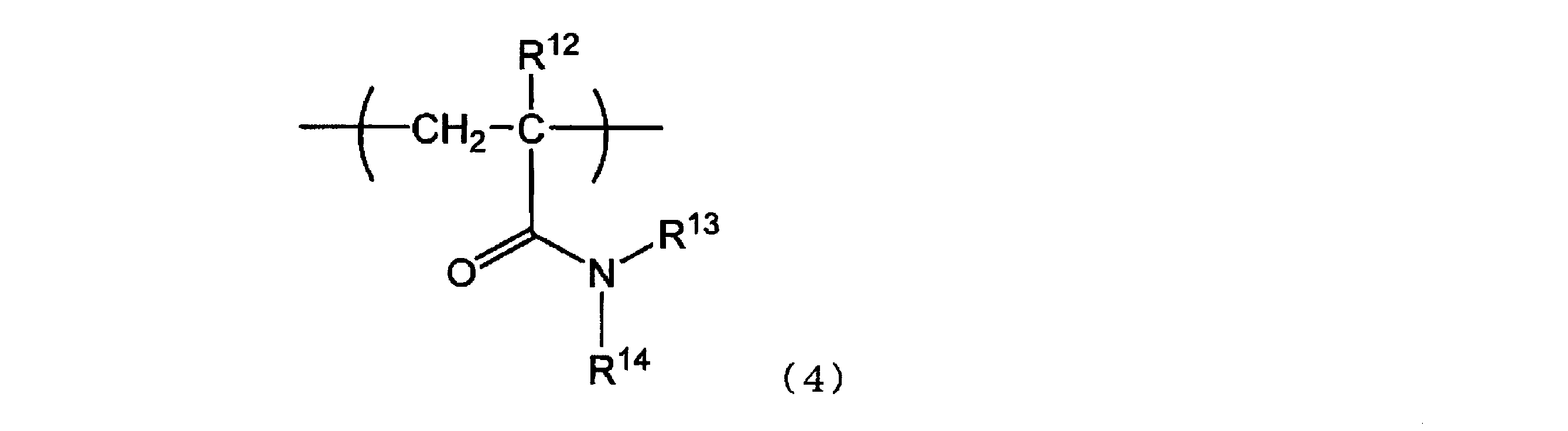
〔式(4)中、
R12は、水素原子又はメチル基を示し、
R13及びR14は、それぞれ独立して、水素原子、炭素数1~6のアルキル基又はヒドロキシアルキル基を示す。〕
R12は、水素原子又はメチル基を示し、
R13及びR14は、それぞれ独立して、水素原子、炭素数1~6のアルキル基又はヒドロキシアルキル基を示す。〕
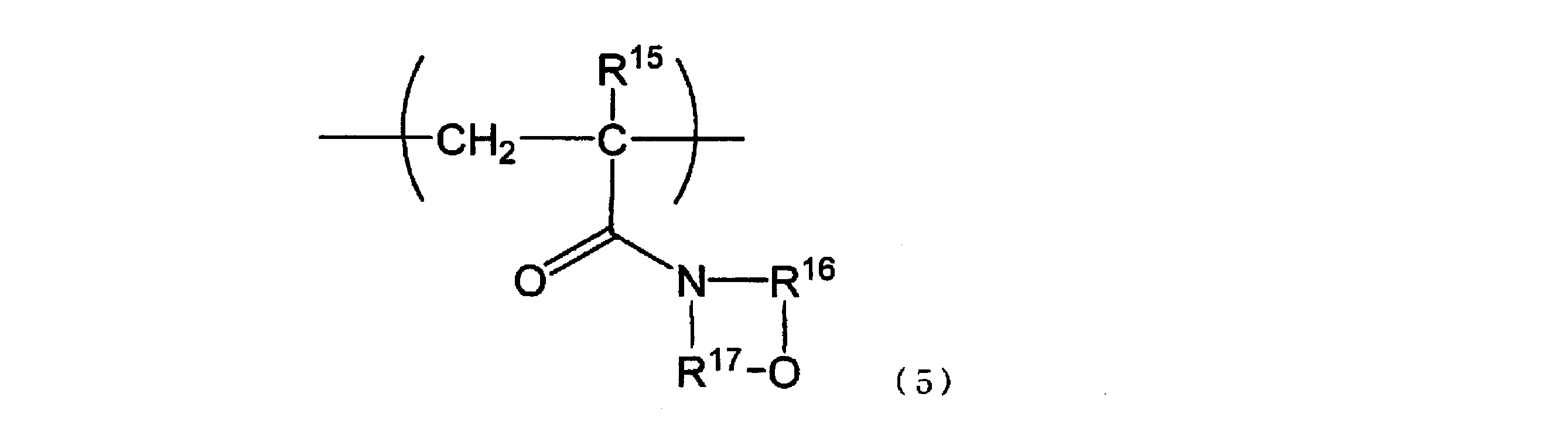
〔式(5)中、
R15は、水素原子又はメチル基を示し、
R16及びR17は、それぞれ独立して、炭素数1~3のアルカンジイル基を示す。〕
R15は、水素原子又はメチル基を示し、
R16及びR17は、それぞれ独立して、炭素数1~3のアルカンジイル基を示す。〕

〔式(6)中、
R18は、炭素数1~5のアルカンジイル基を示す。〕
R18は、炭素数1~5のアルカンジイル基を示す。〕

〔式(7)中、
Yは、-(C=O)O-、-(O=S=O)O-、-O(O=S=O)O-、-(S=O)O-、-O(S=O)O-、-OP(=O)(OR24)O-、-OP(=O)(R24)O-、-P(=O)(OR24)O-、又は-P(=O)(R24)O-を示し(R24は炭素数1~3のアルキル基を示す)、
R19は、水素原子又はメチル基を示し、
R20及びR21は、それぞれ独立して、炭素数1~10の2価の有機基を示し、
R22及びR23は、それぞれ独立して、炭素数1~10の炭化水素基を示す。〕
Yは、-(C=O)O-、-(O=S=O)O-、-O(O=S=O)O-、-(S=O)O-、-O(S=O)O-、-OP(=O)(OR24)O-、-OP(=O)(R24)O-、-P(=O)(OR24)O-、又は-P(=O)(R24)O-を示し(R24は炭素数1~3のアルキル基を示す)、
R19は、水素原子又はメチル基を示し、
R20及びR21は、それぞれ独立して、炭素数1~10の2価の有機基を示し、
R22及びR23は、それぞれ独立して、炭素数1~10の炭化水素基を示す。〕
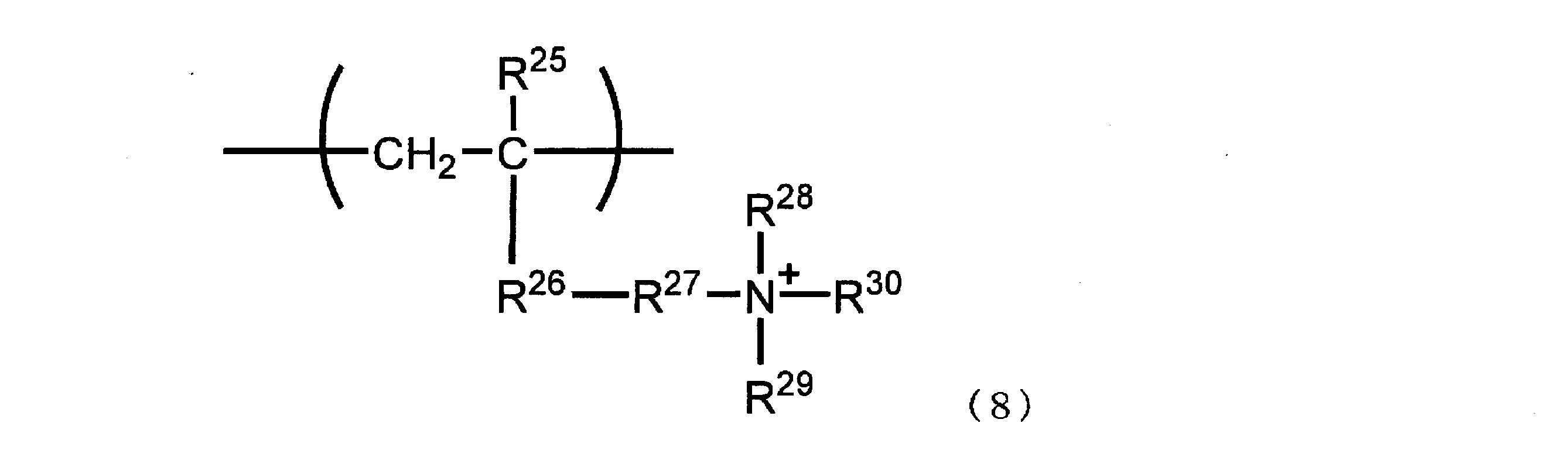
〔式(8)中、
R25は、水素原子又はメチル基を示し、
R26は、-O-、*-(C=O)-O-、*-(C=O)-NR31-、*-NR31-(C=O)-(R31は、水素原子又は炭素数1~10の有機基を示し、*は、式(8)中のR25が結合している炭素原子と結合する位置を示す)又はフェニレン基を示し、
R27は、炭素数1~10の2価の有機基を示し、
R28、R29及びR30は、それぞれ独立して、炭素数1~10の炭化水素基を示す。〕
R25は、水素原子又はメチル基を示し、
R26は、-O-、*-(C=O)-O-、*-(C=O)-NR31-、*-NR31-(C=O)-(R31は、水素原子又は炭素数1~10の有機基を示し、*は、式(8)中のR25が結合している炭素原子と結合する位置を示す)又はフェニレン基を示し、
R27は、炭素数1~10の2価の有機基を示し、
R28、R29及びR30は、それぞれ独立して、炭素数1~10の炭化水素基を示す。〕
<4> 前記繰り返し単位(A-1)が、下記式(2)で表されるものである、<3>に記載のゲル。

〔式(2)中、
R1は、炭素数2~4のアルカンジイル基を示し、
R2は、水素原子又は炭素数1~4のアルキル基を示し、
R3は、水素原子又はメチル基を示し、
R4は、-O-、*-(C=O)-O-、*-(C=O)-NR5-、*-NR5-(C=O)-(R5は、水素原子又は炭素数1~10の有機基を示し、*は、式(2)中のR3が結合している炭素原子と結合する位置を示す)又はフェニレン基を示し、
nは、平均値で2~100を示す。〕
R1は、炭素数2~4のアルカンジイル基を示し、
R2は、水素原子又は炭素数1~4のアルキル基を示し、
R3は、水素原子又はメチル基を示し、
R4は、-O-、*-(C=O)-O-、*-(C=O)-NR5-、*-NR5-(C=O)-(R5は、水素原子又は炭素数1~10の有機基を示し、*は、式(2)中のR3が結合している炭素原子と結合する位置を示す)又はフェニレン基を示し、
nは、平均値で2~100を示す。〕
<5> 前記繰り返し単位(B)が、側鎖にポリオキシアルキレン基を有し、その側鎖の末端が炭素数5~30のアルキル基又は炭素数5~30のアルカノイル基で構成される繰り返し単位である、<1>~<4>のいずれかに記載のゲル。
<6> 前記繰り返し単位(B)が、下記式(10)で表されるものである、<1>~<4>のいずれかに記載のゲル。
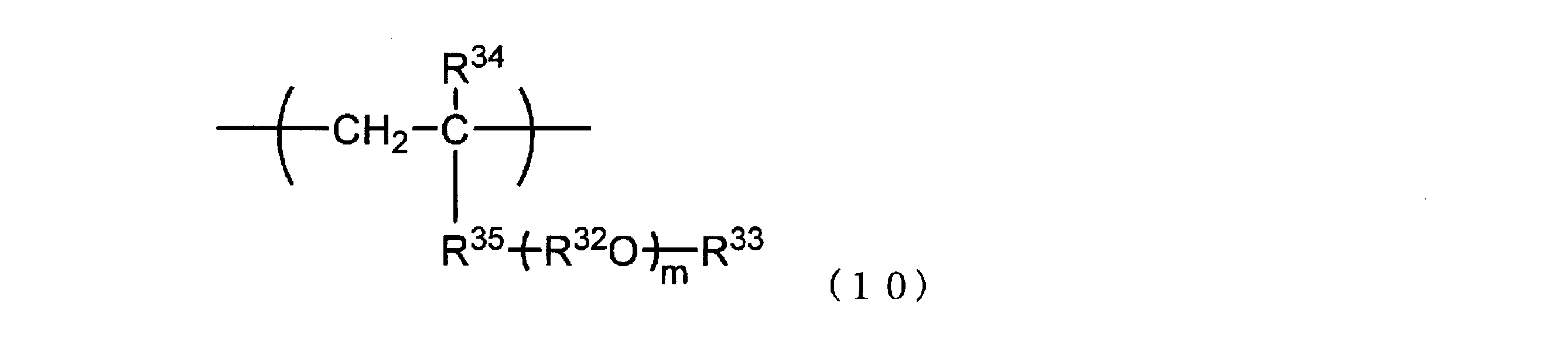
〔式(10)中、
R32は、炭素数2~4のアルカンジイル基を示し、
R33は、炭素数5~30のアルキル基、炭素数5~30のアルカノイル基、又はアリール基を示し、
R34は、水素原子又はメチル基を示し、
R35は、-O-、**-(C=O)-O-、**-(C=O)-NR36-、**-NR36-(C=O)-(R36は、水素原子又は炭素数1~10の有機基を示し、**は、式(10)中のR34が結合している炭素原子と結合する位置を示す)又はフェニレン基を示し、
mは、平均値で2~100を示す。〕
R32は、炭素数2~4のアルカンジイル基を示し、
R33は、炭素数5~30のアルキル基、炭素数5~30のアルカノイル基、又はアリール基を示し、
R34は、水素原子又はメチル基を示し、
R35は、-O-、**-(C=O)-O-、**-(C=O)-NR36-、**-NR36-(C=O)-(R36は、水素原子又は炭素数1~10の有機基を示し、**は、式(10)中のR34が結合している炭素原子と結合する位置を示す)又はフェニレン基を示し、
mは、平均値で2~100を示す。〕
<7> 前記重合体aが、下記式(11)で表される繰り返し単位(C-1)及び下記式(12)で表される基を側鎖の末端に有する繰り返し単位(C-2)から選ばれる1種以上の繰り返し単位(C):60質量%以下を更に有する、<1>~<6>のいずれかに記載のゲル。

〔式(11)中、
R37は、水素原子又はメチル基を示し、
R38は、-O-、***-(C=O)-O-、***-(C=O)-NR40-、***-NR40-(C=O)-(R40は、水素原子又は炭素数1~10の有機基を示し、***は、式(11)中のR37が結合している炭素原子と結合する位置を示す)又はフェニレン基を示し、
R39は、炭素数4~30の炭化水素基を示す。〕
R37は、水素原子又はメチル基を示し、
R38は、-O-、***-(C=O)-O-、***-(C=O)-NR40-、***-NR40-(C=O)-(R40は、水素原子又は炭素数1~10の有機基を示し、***は、式(11)中のR37が結合している炭素原子と結合する位置を示す)又はフェニレン基を示し、
R39は、炭素数4~30の炭化水素基を示す。〕

〔式(12)中、
R41は、炭素数1~10の2価の有機基を示し、
R42及びR43は、それぞれ独立して、炭素数1~10の有機基を示し、
R44、R45及びR46は、それぞれ独立して、-OSi(R49)3(R49は、それぞれ独立して、水素原子又は炭素数1~8の有機基を示す)又は炭素数1~10の有機基を示し、
rは、平均値で0~200を示す。〕
R41は、炭素数1~10の2価の有機基を示し、
R42及びR43は、それぞれ独立して、炭素数1~10の有機基を示し、
R44、R45及びR46は、それぞれ独立して、-OSi(R49)3(R49は、それぞれ独立して、水素原子又は炭素数1~8の有機基を示す)又は炭素数1~10の有機基を示し、
rは、平均値で0~200を示す。〕
<8> 前記重合体aが、非網目状の重合体である、<1>~<7>のいずれかに記載のゲル。
<9> 前記重合体aを0.01~40質量%含有する、<1>~<8>のいずれかに記載のゲル。
<10> 更に、シリコーン化合物を含有する、<1>~<9>のいずれかに記載のゲル。
<11> 前記ポリマーbが、重合性官能基を有するシリコーン化合物を、前記親水性モノマー及び前記架橋剤と共に重合したものである、<1>~<9>のいずれかに記載のゲル。
<12> ポリマーを含むゲルの製造方法であって、下記繰り返し単位(A):2.5~95質量%と下記繰り返し単位(B):2.5~95質量%とを有する重合体aの存在下で、親水性モノマーを架橋剤と共に重合してポリマーとすることを特徴とする、ゲルの製造方法(以下、本発明のゲルの製造方法とも称する)。
(A)親水性繰り返し単位
(B)側鎖にポリオキシアルキレン基を有し、その側鎖の末端が炭素数5~30のアルキル基、炭素数5~30のアルカノイル基、又はアリール基で構成される繰り返し単位
(A)親水性繰り返し単位
(B)側鎖にポリオキシアルキレン基を有し、その側鎖の末端が炭素数5~30のアルキル基、炭素数5~30のアルカノイル基、又はアリール基で構成される繰り返し単位
<13> <1>~<11>のいずれかに記載のゲルを含むことを特徴とする、レンズ(以下、本発明のレンズとも称する)。
<14> コンタクトレンズである、<13>に記載のレンズ。
<15> 下記繰り返し単位(A):2.5~95質量%と下記繰り返し単位(B):2.5~95質量%とを有する重合体aを含有することを特徴とする、コンタクトレンズ表面改質剤(以下、本発明のコンタクトレンズ表面改質剤とも称する)。
(A)親水性繰り返し単位
(B)側鎖にポリオキシアルキレン基を有し、その側鎖の末端が炭素数5~30のアルキル基、炭素数5~30のアルカノイル基、又はアリール基で構成される繰り返し単位
(A)親水性繰り返し単位
(B)側鎖にポリオキシアルキレン基を有し、その側鎖の末端が炭素数5~30のアルキル基、炭素数5~30のアルカノイル基、又はアリール基で構成される繰り返し単位
<16> 下記繰り返し単位(A):2.5~95質量%と下記繰り返し単位(B):2.5~95質量%とを有する重合体aと、親水性モノマーと、架橋剤と、を含むことを特徴とする、重合性組成物(以下、本発明の重合性組成物とも称する)。
(A)親水性繰り返し単位
(B)側鎖にポリオキシアルキレン基を有し、その側鎖の末端が炭素数5~30のアルキル基、炭素数5~30のアルカノイル基、又はアリール基で構成される繰り返し単位
(A)親水性繰り返し単位
(B)側鎖にポリオキシアルキレン基を有し、その側鎖の末端が炭素数5~30のアルキル基、炭素数5~30のアルカノイル基、又はアリール基で構成される繰り返し単位
<17> 下記繰り返し単位(A):2.5~95質量%と下記繰り返し単位(B):2.5~95質量%とを有することを特徴とする、重合体(以下、本発明の重合体とも称するが、重合体aと同義である)。
(A)親水性繰り返し単位
(B)側鎖にポリオキシアルキレン基を有し、その側鎖の末端が炭素数5~30のアルキル基、炭素数5~30のアルカノイル基、又はアリール基で構成される繰り返し単位
(A)親水性繰り返し単位
(B)側鎖にポリオキシアルキレン基を有し、その側鎖の末端が炭素数5~30のアルキル基、炭素数5~30のアルカノイル基、又はアリール基で構成される繰り返し単位
本発明のゲルは、表面親水性、潤滑性及び防汚性に優れ、しかもこれら各特性の持続性も高い。したがって、本発明のゲルは、コンタクトレンズ材料などとして有用である。
また、本発明のゲルの製造方法によれば、表面親水性、潤滑性及び防汚性に優れるゲルを簡便に且つ低コストで製造できる。
また、本発明のレンズは、表面親水性、潤滑性及び防汚性に優れ、しかもこれら各特性の持続性も高い。
また、本発明の重合体、コンタクトレンズ表面改質剤を用いることにより、表面親水性、潤滑性及び防汚性に優れ、しかもこれら各特性の持続性も高いレンズが得られる。
また、本発明の重合性組成物を用いることにより、表面親水性、潤滑性及び防汚性に優れ、しかもこれら各特性の持続性も高いゲルを得ることができる。
また、本発明のゲルの製造方法によれば、表面親水性、潤滑性及び防汚性に優れるゲルを簡便に且つ低コストで製造できる。
また、本発明のレンズは、表面親水性、潤滑性及び防汚性に優れ、しかもこれら各特性の持続性も高い。
また、本発明の重合体、コンタクトレンズ表面改質剤を用いることにより、表面親水性、潤滑性及び防汚性に優れ、しかもこれら各特性の持続性も高いレンズが得られる。
また、本発明の重合性組成物を用いることにより、表面親水性、潤滑性及び防汚性に優れ、しかもこれら各特性の持続性も高いゲルを得ることができる。
〔ゲル〕
本発明のゲルは、下記繰り返し単位(A):2.5~95質量%と下記繰り返し単位(B):2.5~95質量%とを有する重合体a(以下、単に重合体aとも称する)と、親水性モノマーを架橋剤と共に重合したポリマーb(以下、単にポリマーbとも称する)と、を含むことを特徴とするものである。
(A)親水性繰り返し単位
(B)側鎖にポリオキシアルキレン基を有し、その側鎖の末端が炭素数5~30のアルキル基、炭素数5~30のアルカノイル基、又はアリール基で構成される繰り返し単位
なお、本明細書における物を製法で特定する記載は、不可能・非実際的事情が存在することによるものである。
本発明のゲルは、下記繰り返し単位(A):2.5~95質量%と下記繰り返し単位(B):2.5~95質量%とを有する重合体a(以下、単に重合体aとも称する)と、親水性モノマーを架橋剤と共に重合したポリマーb(以下、単にポリマーbとも称する)と、を含むことを特徴とするものである。
(A)親水性繰り返し単位
(B)側鎖にポリオキシアルキレン基を有し、その側鎖の末端が炭素数5~30のアルキル基、炭素数5~30のアルカノイル基、又はアリール基で構成される繰り返し単位
なお、本明細書における物を製法で特定する記載は、不可能・非実際的事情が存在することによるものである。
<重合体a>
本発明のゲルに使用される重合体aは、上記繰り返し単位(A):2.5~95質量%と上記繰り返し単位(B):2.5~95質量%とを有するものである。斯かる重合体aは、コンタクトレンズ表面等を改質する改質剤として作用し、コンタクトレンズ表面改質用重合体、コンタクトレンズ表面改質剤等として有用である。
本発明のゲルに使用される重合体aは、上記繰り返し単位(A):2.5~95質量%と上記繰り返し単位(B):2.5~95質量%とを有するものである。斯かる重合体aは、コンタクトレンズ表面等を改質する改質剤として作用し、コンタクトレンズ表面改質用重合体、コンタクトレンズ表面改質剤等として有用である。
(繰り返し単位(A))
繰り返し単位(A)は、親水性繰り返し単位であればよいが、側鎖にポリオキシアルキレン基を有し、その側鎖の末端が水素原子又は炭素数1~4のアルキル基で構成される繰り返し単位(A-1)、下記式(3)で表される繰り返し単位(A-2)、下記式(4)で表される繰り返し単位(A-3)、下記式(5)で表される繰り返し単位(A-4)、下記式(6)で表される繰り返し単位(A-5)、下記式(7)で表されるベタイン性繰り返し単位(A-6)、アニオン性繰り返し単位(A-7)、及び下記式(8)で表されるカチオン性繰り返し単位(A-8)から選ばれる1種以上であるのが好ましい。
なお、本明細書において、親水性とは、水との親和力が強い性質を持つことを意味する。具体的には1種の繰り返し単位のみからなるホモポリマー(実施例の測定法による数平均分子量が1万程度のもの)とした場合に、常温(25℃)において純水100gに対して1g以上溶解する場合にはその繰り返し単位は親水性である。
繰り返し単位(A)は、親水性繰り返し単位であればよいが、側鎖にポリオキシアルキレン基を有し、その側鎖の末端が水素原子又は炭素数1~4のアルキル基で構成される繰り返し単位(A-1)、下記式(3)で表される繰り返し単位(A-2)、下記式(4)で表される繰り返し単位(A-3)、下記式(5)で表される繰り返し単位(A-4)、下記式(6)で表される繰り返し単位(A-5)、下記式(7)で表されるベタイン性繰り返し単位(A-6)、アニオン性繰り返し単位(A-7)、及び下記式(8)で表されるカチオン性繰り返し単位(A-8)から選ばれる1種以上であるのが好ましい。
なお、本明細書において、親水性とは、水との親和力が強い性質を持つことを意味する。具体的には1種の繰り返し単位のみからなるホモポリマー(実施例の測定法による数平均分子量が1万程度のもの)とした場合に、常温(25℃)において純水100gに対して1g以上溶解する場合にはその繰り返し単位は親水性である。
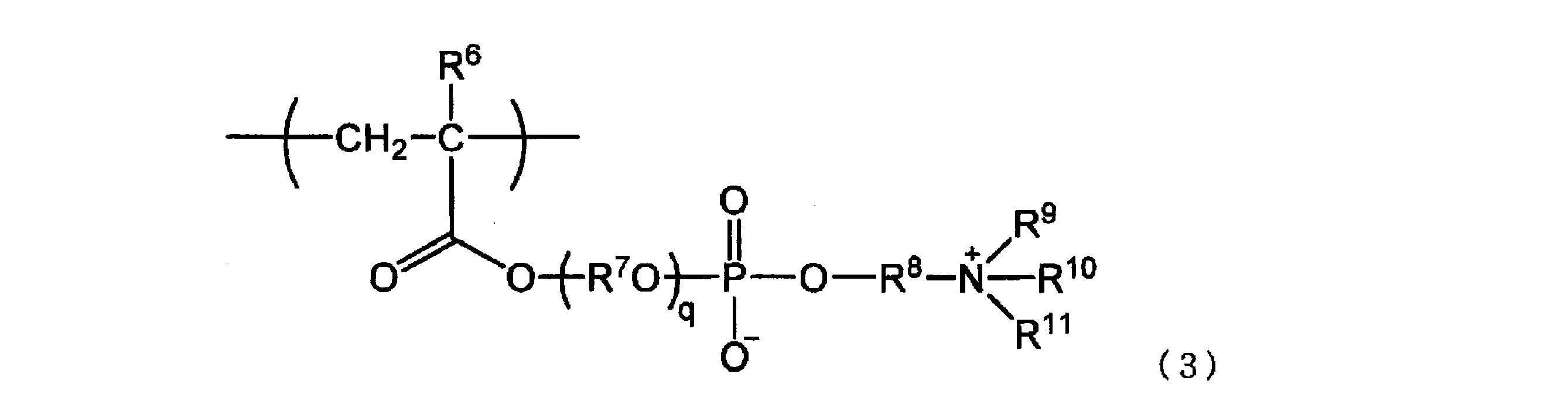
〔式(3)中、
R6は、水素原子又はメチル基を示し、
R7は、炭素数2~4のアルカンジイル基を示し、
R8は、炭素数1~10のアルカンジイル基を示し、
R9、R10及びR11は、それぞれ独立して、水素原子又は炭素数1~8の炭化水素基を示し、
qは、平均値で1~10を示す。〕
R6は、水素原子又はメチル基を示し、
R7は、炭素数2~4のアルカンジイル基を示し、
R8は、炭素数1~10のアルカンジイル基を示し、
R9、R10及びR11は、それぞれ独立して、水素原子又は炭素数1~8の炭化水素基を示し、
qは、平均値で1~10を示す。〕

〔式(4)中、
R12は、水素原子又はメチル基を示し、
R13及びR14は、それぞれ独立して、水素原子、炭素数1~6のアルキル基又はヒドロキシアルキル基を示す。〕
R12は、水素原子又はメチル基を示し、
R13及びR14は、それぞれ独立して、水素原子、炭素数1~6のアルキル基又はヒドロキシアルキル基を示す。〕

〔式(5)中、
R15は、水素原子又はメチル基を示し、
R16及びR17は、それぞれ独立して、炭素数1~3のアルカンジイル基を示す。〕
R15は、水素原子又はメチル基を示し、
R16及びR17は、それぞれ独立して、炭素数1~3のアルカンジイル基を示す。〕
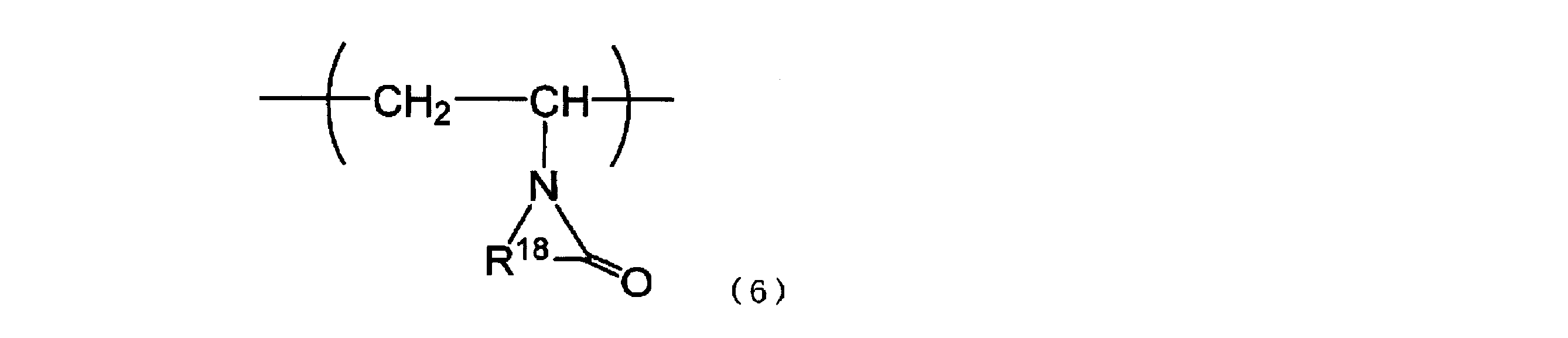
〔式(6)中、
R18は、炭素数1~5のアルカンジイル基を示す。〕
R18は、炭素数1~5のアルカンジイル基を示す。〕

〔式(7)中、
Yは、-(C=O)O-、-(O=S=O)O-、-O(O=S=O)O-、-(S=O)O-、-O(S=O)O-、-OP(=O)(OR24)O-、-OP(=O)(R24)O-、-P(=O)(OR24)O-、又は-P(=O)(R24)O-を示し(R24は炭素数1~3のアルキル基を示す)、
R19は、水素原子又はメチル基を示し、
R20及びR21は、それぞれ独立して、炭素数1~10の2価の有機基を示し、
R22及びR23は、それぞれ独立して、炭素数1~10の炭化水素基を示す。〕
Yは、-(C=O)O-、-(O=S=O)O-、-O(O=S=O)O-、-(S=O)O-、-O(S=O)O-、-OP(=O)(OR24)O-、-OP(=O)(R24)O-、-P(=O)(OR24)O-、又は-P(=O)(R24)O-を示し(R24は炭素数1~3のアルキル基を示す)、
R19は、水素原子又はメチル基を示し、
R20及びR21は、それぞれ独立して、炭素数1~10の2価の有機基を示し、
R22及びR23は、それぞれ独立して、炭素数1~10の炭化水素基を示す。〕

〔式(8)中、
R25は、水素原子又はメチル基を示し、
R26は、-O-、*-(C=O)-O-、*-(C=O)-NR31-、*-NR31-(C=O)-(R31は、水素原子又は炭素数1~10の有機基を示し、*は、式(8)中のR25が結合している炭素原子と結合する位置を示す)又はフェニレン基を示し、
R27は、炭素数1~10の2価の有機基を示し、
R28、R29及びR30は、それぞれ独立して、炭素数1~10の炭化水素基を示す。〕
R25は、水素原子又はメチル基を示し、
R26は、-O-、*-(C=O)-O-、*-(C=O)-NR31-、*-NR31-(C=O)-(R31は、水素原子又は炭素数1~10の有機基を示し、*は、式(8)中のR25が結合している炭素原子と結合する位置を示す)又はフェニレン基を示し、
R27は、炭素数1~10の2価の有機基を示し、
R28、R29及びR30は、それぞれ独立して、炭素数1~10の炭化水素基を示す。〕
(繰り返し単位(A-1))
繰り返し単位(A-1)は、側鎖にポリオキシアルキレン基を有し、その側鎖の末端が水素原子又は炭素数1~4のアルキル基で構成されるものである。
繰り返し単位(A-1)としては、下記式(1)で表される構造を側鎖に含む繰り返し単位が挙げられる。式(1)で表される構造を側鎖中に有する繰り返し単位となるポリマー種としては公知のものを用いることができ、中でも、(メタ)アクリレート系のポリマー種、(メタ)アクリルアミド系のポリマー種、スチレン系のポリマー種等が好ましい。これらの中でも、下記式(2)で表される繰り返し単位が好ましい。
繰り返し単位(A-1)は、側鎖にポリオキシアルキレン基を有し、その側鎖の末端が水素原子又は炭素数1~4のアルキル基で構成されるものである。
繰り返し単位(A-1)としては、下記式(1)で表される構造を側鎖に含む繰り返し単位が挙げられる。式(1)で表される構造を側鎖中に有する繰り返し単位となるポリマー種としては公知のものを用いることができ、中でも、(メタ)アクリレート系のポリマー種、(メタ)アクリルアミド系のポリマー種、スチレン系のポリマー種等が好ましい。これらの中でも、下記式(2)で表される繰り返し単位が好ましい。

〔式(1)中、
R1は、炭素数2~4のアルカンジイル基を示し、
R2は、水素原子又は炭素数1~4のアルキル基を示し、
nは、平均値で2~100を示す。〕
R1は、炭素数2~4のアルカンジイル基を示し、
R2は、水素原子又は炭素数1~4のアルキル基を示し、
nは、平均値で2~100を示す。〕
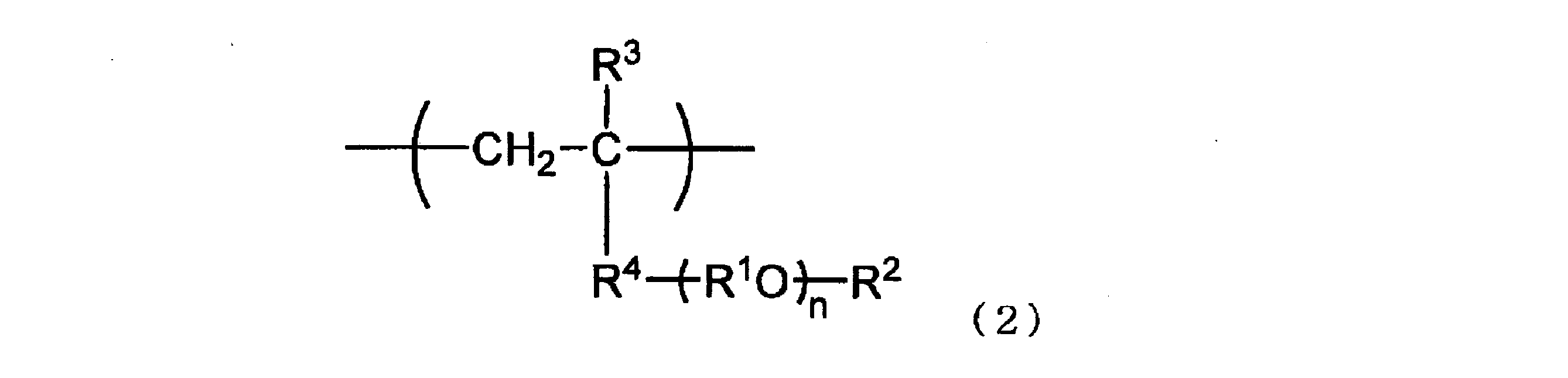
〔式(2)中、
R3は、水素原子又はメチル基を示し、
R4は、-O-、*-(C=O)-O-、*-(C=O)-NR5-、*-NR5-(C=O)-(R5は、水素原子又は炭素数1~10の有機基を示し、*は、式(2)中のR3が結合している炭素原子と結合する位置を示す)又はフェニレン基を示し、
その他の記号は式(1)中の記号と同義である。〕
R3は、水素原子又はメチル基を示し、
R4は、-O-、*-(C=O)-O-、*-(C=O)-NR5-、*-NR5-(C=O)-(R5は、水素原子又は炭素数1~10の有機基を示し、*は、式(2)中のR3が結合している炭素原子と結合する位置を示す)又はフェニレン基を示し、
その他の記号は式(1)中の記号と同義である。〕
ここで、式(1)及び(2)中の各記号について説明する。
R1は、炭素数2~4のアルカンジイル基を示し、n個のR1は同一でも異なっていてもよい。
R1で示されるアルカンジイル基の炭素数は、好ましくは2又は3であり、より好ましくは2である。
また、R1で示されるアルカンジイル基は直鎖状でも分岐鎖状でもよく、具体的には、エタン-1,2-ジイル基、プロパン-1,2-ジイル基、プロパン-1,3-ジイル基、プロパン-2,2-ジイル基、ブタン-1,2-ジイル基、ブタン-1,3-ジイル基、ブタン-1,4-ジイル基等が挙げられる。これらの中でも、入手容易性、親水性化性能等の観点から、エタン-1,2-ジイル基が好ましい。
R1は、炭素数2~4のアルカンジイル基を示し、n個のR1は同一でも異なっていてもよい。
R1で示されるアルカンジイル基の炭素数は、好ましくは2又は3であり、より好ましくは2である。
また、R1で示されるアルカンジイル基は直鎖状でも分岐鎖状でもよく、具体的には、エタン-1,2-ジイル基、プロパン-1,2-ジイル基、プロパン-1,3-ジイル基、プロパン-2,2-ジイル基、ブタン-1,2-ジイル基、ブタン-1,3-ジイル基、ブタン-1,4-ジイル基等が挙げられる。これらの中でも、入手容易性、親水性化性能等の観点から、エタン-1,2-ジイル基が好ましい。
また、R2は、水素原子又は炭素数1~4のアルキル基を示す。R2で示されるアルキル基の炭素数は、入手容易性、親水性化性能等の観点から、好ましくは1~3であり、より好ましくは1又は2であり、更に好ましくは1である。また、R2で示されるアルキル基は直鎖状でも分岐鎖状でもよく、具体的には、メチル基、エチル基、n-プロピル基、イソプロピル基、n-ブチル基、イソブチル基、sec-ブチル基、tert-ブチル基が挙げられる。
斯様なR2の中でも、入手容易性、親水性化性能等の観点から、水素原子又は炭素数1~3のアルキル基が好ましく、水素原子又は炭素数1若しくは2のアルキル基がより好ましく、水素原子又はメチル基が更に好ましく、メチル基が特に好ましい。
斯様なR2の中でも、入手容易性、親水性化性能等の観点から、水素原子又は炭素数1~3のアルキル基が好ましく、水素原子又は炭素数1若しくは2のアルキル基がより好ましく、水素原子又はメチル基が更に好ましく、メチル基が特に好ましい。
また、R4は、-O-、*-(C=O)-O-、*-(C=O)-NR5-、*-NR5-(C=O)-又はフェニレン基を示す。斯かるフェニレン基としては、1,2-フェニレン基、1,3-フェニレン基、1,4-フェニレン基が挙げられる。
また、上記R5で示される有機基の炭素数は1~10であるが、好ましくは1~6である。上記有機基としては、炭化水素基が挙げられる。斯かる炭化水素基は、脂肪族炭化水素基、脂環式炭化水素基及び芳香族炭化水素基を包含する概念である。
上記R5における脂肪族炭化水素基は直鎖状でも分岐鎖状でもよく、具体的には、メチル基、エチル基、n-プロピル基、イソプロピル基、n-ブチル基、イソブチル基、sec-ブチル基、tert-ブチル基、ペンチル基、ヘキシル基、ヘプチル基、オクチル基、ノニル基、デシル基等のアルキル基が挙げられる。
また、上記脂環式炭化水素基は、単環の脂環式炭化水素基と橋かけ環炭化水素基に大別される。上記単環の脂環式炭化水素基としては、シクロプロピル基、シクロヘキシル基等のシクロアルキル基が挙げられる。また、橋かけ環炭化水素基としては、イソボルニル基等が挙げられる。
また、上記芳香族炭化水素基としては、フェニル基等のアリール基が挙げられる。
また、上記脂環式炭化水素基は、単環の脂環式炭化水素基と橋かけ環炭化水素基に大別される。上記単環の脂環式炭化水素基としては、シクロプロピル基、シクロヘキシル基等のシクロアルキル基が挙げられる。また、橋かけ環炭化水素基としては、イソボルニル基等が挙げられる。
また、上記芳香族炭化水素基としては、フェニル基等のアリール基が挙げられる。
上述のようなR4の中でも、親水性化性能等の観点から、*-(C=O)-O-、フェニレン基が好ましく、*-(C=O)-O-が特に好ましい。
nは、平均値で2~100を示すが、好ましくは平均値で4~90であり、より好ましくは平均値で8~90であり、更に好ましくは平均値で8~60であり、更に好ましくは平均値で8~40であり、特に好ましくは平均値で9~25である。
なお、本明細書における各「平均値」はNMRで測定できる。例えば、上記式(2)の構造について、1H-NMRを測定し、R1の炭素数2~4のアルカンジイル基と、R2の炭素数1~4のアルキル基の末端のメチル基との、それぞれのプロトンピークの積分値を比較することで、nの平均値を算出可能である。
なお、本明細書における各「平均値」はNMRで測定できる。例えば、上記式(2)の構造について、1H-NMRを測定し、R1の炭素数2~4のアルカンジイル基と、R2の炭素数1~4のアルキル基の末端のメチル基との、それぞれのプロトンピークの積分値を比較することで、nの平均値を算出可能である。
斯様な繰り返し単位(A-1)を誘導するモノマーとしては、ポリエチレングリコール(メタ)アクリレート、ポリプロピレンレングリコール(メタ)アクリレート、ポリエチレングリコールポリプロピレングリコール(メタ)アクリレート、ポリエチレングリコールポリテトラメチレングリコール(メタ)アクリレート、ポリプロピレングリコールポリテトラメチレングリコール(メタ)アクリレート、メトキシポリエチレングリコール(メタ)アクリレート、エトキシポリエチレングリコール(メタ)アクリレート等が挙げられ、繰り返し単位(A-1)は、これらを単独で又は2種以上を組み合わせて用いたものでもよい。これらの中でも、ポリエチレングリコール(メタ)アクリレート、メトキシポリエチレングリコール(メタ)アクリレートが好ましい。
(繰り返し単位(A-2))
繰り返し単位(A-2)は、上記式(3)で表されるものである。
式(3)中、R7は、炭素数2~4のアルカンジイル基を示す。なお、R7が複数ある場合、R7は同一でも異なっていてもよい。
また、R7で示されるアルカンジイル基の炭素数は、好ましくは2又は3であり、より好ましくは2である。
また、R7で示されるアルカンジイル基は直鎖状でも分岐鎖状でもよく、具体的には、エタン-1,2-ジイル基、プロパン-1,2-ジイル基、プロパン-1,3-ジイル基、プロパン-2,2-ジイル基、ブタン-1,2-ジイル基、ブタン-1,3-ジイル基、ブタン-1,4-ジイル基等が挙げられる。これらの中でも、入手容易性、親水性化性能等の観点から、エタン-1,2-ジイル基が好ましい。
繰り返し単位(A-2)は、上記式(3)で表されるものである。
式(3)中、R7は、炭素数2~4のアルカンジイル基を示す。なお、R7が複数ある場合、R7は同一でも異なっていてもよい。
また、R7で示されるアルカンジイル基の炭素数は、好ましくは2又は3であり、より好ましくは2である。
また、R7で示されるアルカンジイル基は直鎖状でも分岐鎖状でもよく、具体的には、エタン-1,2-ジイル基、プロパン-1,2-ジイル基、プロパン-1,3-ジイル基、プロパン-2,2-ジイル基、ブタン-1,2-ジイル基、ブタン-1,3-ジイル基、ブタン-1,4-ジイル基等が挙げられる。これらの中でも、入手容易性、親水性化性能等の観点から、エタン-1,2-ジイル基が好ましい。
また、R8は、炭素数1~10のアルカンジイル基を示す。
R8で示されるアルカンジイル基の炭素数は、好ましくは1~6であり、より好ましくは1~4であり、更に好ましくは2又は3であり、特に好ましくは2である。
また、R8で示されるアルカンジイル基は直鎖状でも分岐鎖状でもよく、好適な具体例としては、上記R7で示されるアルカンジイル基と同様のものが挙げられる。
R8で示されるアルカンジイル基の炭素数は、好ましくは1~6であり、より好ましくは1~4であり、更に好ましくは2又は3であり、特に好ましくは2である。
また、R8で示されるアルカンジイル基は直鎖状でも分岐鎖状でもよく、好適な具体例としては、上記R7で示されるアルカンジイル基と同様のものが挙げられる。
また、R9、R10及びR11は、それぞれ独立して、水素原子又は炭素数1~8の炭化水素基を示すが、炭素数1~8の炭化水素基が好ましい。斯かる炭化水素基の炭素数は、好ましくは1~4であり、より好ましくは1又は2であり、特に好ましくは1である。
また、上記炭化水素基としては、アルキル基;フェニル基等のアリール基;ベンジル基等のアラルキル基が挙げられるが、アルキル基が好ましい。
上記アルキル基は直鎖状でも分岐鎖状でもよく、好適な具体例としては、メチル基、エチル基、n-プロピル基、イソプロピル基、n-ブチル基、イソブチル基、sec-ブチル基、tert-ブチル基が挙げられる。
また、上記炭化水素基としては、アルキル基;フェニル基等のアリール基;ベンジル基等のアラルキル基が挙げられるが、アルキル基が好ましい。
上記アルキル基は直鎖状でも分岐鎖状でもよく、好適な具体例としては、メチル基、エチル基、n-プロピル基、イソプロピル基、n-ブチル基、イソブチル基、sec-ブチル基、tert-ブチル基が挙げられる。
また、qは、平均値で1~10を示すが、好ましくは平均値で1~7であり、より好ましくは平均値で1~4であり、更に好ましくは1である。
なお、繰り返し単位(A-2)は、ナトリウムイオン、カリウムイオン等のアルカリ金属イオン、カルシウムイオン、マグネシウムイオン等のアルカリ土類金属イオン、アンモニウムイオン、水素イオン、水酸化物イオン等の対イオンを有していてもよい。
斯様な繰り返し単位(A-2)を誘導するモノマーとしては、2-(メタ)アクリロイルオキシエチル-2'-(トリメチルアンモニオ)エチルホスフェート(2-(メタ)アクリロイルオキシエチルホスホリルコリン)、3-(メタ)アクリロイルオキシプロピル-2'-(トリメチルアンモニオ)エチルホスフェート、4-(メタ)アクリロイルオキシブチル-2'-(トリメチルアンモニオ)エチルホスフェート、2-(メタ)アクリロイルオキシエトキシエチル-2'-(トリメチルアンモニオ)エチルホスフェート、2-(メタ)アクリロイルオキシジエトキシエチル-2'-(トリメチルアンモニオ)エチルホスフェート、2-(メタ)アクリロイルオキシエチル-2'-(トリエチルアンモニオ)エチルホスフェート、2-(メタ)アクリロイルオキシエチル-2'-(トリブチルアンモニオ)エチルホスフェート等が挙げられ、繰り返し単位(A-2)は、これらを単独で又は2種以上を組み合わせて用いたものでもよい。
(繰り返し単位(A-3))
繰り返し単位(A-3)は、上記式(4)で表されるものである。
式(4)中、R13及びR14は、それぞれ独立して、水素原子、炭素数1~6のアルキル基、又はヒドロキシアルキル基を示す。
繰り返し単位(A-3)は、上記式(4)で表されるものである。
式(4)中、R13及びR14は、それぞれ独立して、水素原子、炭素数1~6のアルキル基、又はヒドロキシアルキル基を示す。
R13、R14で示されるアルキル基の炭素数は、好ましくは1~3である。
また、上記R13、R14で示されるアルキル基は直鎖状でも分岐鎖状でもよく、好適な具体例としては、メチル基、エチル基、n-プロピル基、イソプロピル基が挙げられる。
また、上記R13、R14で示されるアルキル基は直鎖状でも分岐鎖状でもよく、好適な具体例としては、メチル基、エチル基、n-プロピル基、イソプロピル基が挙げられる。
また、R13、R14で示されるヒドロキシアルキル基の炭素数は、好ましくは1~6であり、より好ましくは1~3である。ヒドロキシアルキル基に含まれるアルキル基は直鎖状でも分岐鎖状でもよく、ヒドロキシアルキル基の好適な具体例としては、ヒドロキシメチル基、ヒドロキシエチル基、ヒドロキシプロピル基、ヒドロキシイソプロピル基が挙げられる。なお、ヒドロキシアルキル基におけるヒドロキシ基の置換位置は任意である。
斯様な繰り返し単位(A-3)を誘導するモノマーとしては、ジメチル(メタ)アクリルアミド、ジエチル(メタ)アクリルアミド、N-イソプロピル(メタ)アクリルアミド、N-(ヒドロキシメチル)(メタ)アクリルアミド、N-(2-ヒドロキシエチル)(メタ)アクリルアミド等が挙げられ、繰り返し単位(A-3)は、これらを単独で又は2種以上を組み合わせて用いたものでもよい。
(繰り返し単位(A-4))
繰り返し単位(A-4)は、上記式(5)で表されるものである。
式(5)中、R16及びR17は、それぞれ独立して、炭素数1~3のアルカンジイル基を示す。斯かるアルカンジイル基の炭素数は、好ましくは1~2である。
また、上記アルカンジイル基は直鎖状でも分岐鎖状でもよいが、直鎖状が好ましい。好適な具体例としては、メタン-1,1-ジイル基、エタン-1,2-ジイル基が挙げられる。
繰り返し単位(A-4)は、上記式(5)で表されるものである。
式(5)中、R16及びR17は、それぞれ独立して、炭素数1~3のアルカンジイル基を示す。斯かるアルカンジイル基の炭素数は、好ましくは1~2である。
また、上記アルカンジイル基は直鎖状でも分岐鎖状でもよいが、直鎖状が好ましい。好適な具体例としては、メタン-1,1-ジイル基、エタン-1,2-ジイル基が挙げられる。
斯様な繰り返し単位(A-4)を誘導するモノマーとしては、4-(メタ)アクリロイルモルホリン等が挙げられる。
(繰り返し単位(A-5))
繰り返し単位(A-5)は、上記式(6)で表されるものである。
式(6)中、R18は、炭素数1~5のアルカンジイル基を示す。斯かるアルカンジイル基の炭素数は、好ましくは3~5である。
また、上記アルカンジイル基は直鎖状でも分岐鎖状でもよいが、直鎖状が好ましい。好適な具体例としては、プロパン-1,3-ジイル基、ブタン-1,4-ジイル基、ペンタン-1,5-ジイル基が挙げられる。
繰り返し単位(A-5)は、上記式(6)で表されるものである。
式(6)中、R18は、炭素数1~5のアルカンジイル基を示す。斯かるアルカンジイル基の炭素数は、好ましくは3~5である。
また、上記アルカンジイル基は直鎖状でも分岐鎖状でもよいが、直鎖状が好ましい。好適な具体例としては、プロパン-1,3-ジイル基、ブタン-1,4-ジイル基、ペンタン-1,5-ジイル基が挙げられる。
斯様な繰り返し単位(A-5)を誘導するモノマーとしては、1-ビニル-2-ピロリドン、N-ビニル-ε-カプロラクタム等が挙げられ、繰り返し単位(A-5)は、これらを単独で又は2種以上を組み合わせて用いたものでもよい。
(繰り返し単位(A-6))
繰り返し単位(A-6)は、上記式(7)で表されるベタイン性繰り返し単位である。
式(7)中、Yとしては、-(C=O)O-が好ましい。なお、R24で示されるアルキル基としては、メチル基、エチル基、n-プロピル基、イソプロピル基が挙げられる。
また、式(7)中、R20及びR21は、それぞれ独立して、炭素数1~10の2価の有機基を示す。斯かる2価の有機基の炭素数は、好ましくは1~8、より好ましくは1~6である。
また、上記2価の有機基としては、2価の炭化水素基が好ましく、2価の脂肪族炭化水素基がより好ましい。当該2価の脂肪族炭化水素基は、直鎖状でも分岐鎖状でもよい。また、2価の脂肪族炭化水素基としては、アルカンジイル基が好ましい。例えば、メタン-1,1-ジイル基、エタン-1,2-ジイル基、プロパン-1,1-ジイル基、プロパン-1,2-ジイル基、プロパン-1,3-ジイル基、プロパン-2,2-ジイル基、ブタン-1,4-ジイル基、ペンタン-1,5-ジイル基、ヘキサン-1,6-ジイル基等が挙げられる。
繰り返し単位(A-6)は、上記式(7)で表されるベタイン性繰り返し単位である。
式(7)中、Yとしては、-(C=O)O-が好ましい。なお、R24で示されるアルキル基としては、メチル基、エチル基、n-プロピル基、イソプロピル基が挙げられる。
また、式(7)中、R20及びR21は、それぞれ独立して、炭素数1~10の2価の有機基を示す。斯かる2価の有機基の炭素数は、好ましくは1~8、より好ましくは1~6である。
また、上記2価の有機基としては、2価の炭化水素基が好ましく、2価の脂肪族炭化水素基がより好ましい。当該2価の脂肪族炭化水素基は、直鎖状でも分岐鎖状でもよい。また、2価の脂肪族炭化水素基としては、アルカンジイル基が好ましい。例えば、メタン-1,1-ジイル基、エタン-1,2-ジイル基、プロパン-1,1-ジイル基、プロパン-1,2-ジイル基、プロパン-1,3-ジイル基、プロパン-2,2-ジイル基、ブタン-1,4-ジイル基、ペンタン-1,5-ジイル基、ヘキサン-1,6-ジイル基等が挙げられる。
また、式(7)中、R22及びR23は、それぞれ独立して、炭素数1~10の炭化水素基を示す。当該炭化水素基の炭素数は、好ましくは1~6、より好ましくは1~4である。
R22及びR23で示される炭化水素基としては、アルキル基;フェニル基等のアリール基;ベンジル基等のアラルキル基が挙げられるが、アルキル基が好ましい。当該アルキル基は、直鎖状でも分岐鎖状でもよく、例えば、メチル基、エチル基、n-プロピル基、イソプロピル基、n-ブチル基、イソブチル基、sec-ブチル基、tert-ブチル基が挙げられる。
R22及びR23で示される炭化水素基としては、アルキル基;フェニル基等のアリール基;ベンジル基等のアラルキル基が挙げられるが、アルキル基が好ましい。当該アルキル基は、直鎖状でも分岐鎖状でもよく、例えば、メチル基、エチル基、n-プロピル基、イソプロピル基、n-ブチル基、イソブチル基、sec-ブチル基、tert-ブチル基が挙げられる。
なお、繰り返し単位(A-6)は、ナトリウムイオン、カリウムイオン等のアルカリ金属イオン、カルシウムイオン、マグネシウムイオン等のアルカリ土類金属イオン、アンモニウムイオン、水素イオン、水酸化物イオン等の対イオンを有していてもよい。
斯様な繰り返し単位(A-6)を誘導するモノマーとしては、N-(メタ)アクリロイルオキシエチル-N,N-ジメチルアンモニウム-α-N-メチルカルボキシベタイン、N-(メタ)アクリロイルオキシエチル-N,N-ジメチルアンモニウム-α-N-プロピルスルホベタイン等の(メタ)アクリレート系モノマー等が挙げられ、繰り返し単位(A-6)は、これらを単独で又は2種以上を組み合わせて用いたものでもよい。
(繰り返し単位(A-7))
繰り返し単位(A-7)は、アニオン性繰り返し単位である。
繰り返し単位(A-7)としては、酸性基を有する繰り返し単位が挙げられる。
また、繰り返し単位(A-7)としては、導入の容易さ、安全性の観点から、エチレン性不飽和結合を含有するモノマーに由来する単位が好ましい。
また、酸性基としては、カルボキシ基、スルホ基、リン酸基又はこれらの塩などが挙げられ、これらを1個有していてもよく、2個以上有していてもよい。なお、塩としては、ナトリウム塩、カリウム塩等のアルカリ金属塩;マグネシウム塩、カルシウム塩等のアルカリ土類金属塩;アンモニウム塩;有機アンモニウム塩等が挙げられる。
繰り返し単位(A-7)は、アニオン性繰り返し単位である。
繰り返し単位(A-7)としては、酸性基を有する繰り返し単位が挙げられる。
また、繰り返し単位(A-7)としては、導入の容易さ、安全性の観点から、エチレン性不飽和結合を含有するモノマーに由来する単位が好ましい。
また、酸性基としては、カルボキシ基、スルホ基、リン酸基又はこれらの塩などが挙げられ、これらを1個有していてもよく、2個以上有していてもよい。なお、塩としては、ナトリウム塩、カリウム塩等のアルカリ金属塩;マグネシウム塩、カルシウム塩等のアルカリ土類金属塩;アンモニウム塩;有機アンモニウム塩等が挙げられる。
繰り返し単位(A-7)を誘導するモノマーとしては、フマル酸、マレイン酸、イタコン酸等の不飽和ジカルボン酸又はその塩;(メタ)アクリル酸等の不飽和カルボン酸又はその塩;エチレンスルホン酸、アリルスルホン酸、メタアリルスルホン酸、2-スルホエチル(メタ)アクリレート、2-アクリルアミド-2-メチルプロパンスルホン酸等のスルホ基含有重合性不飽和モノマー又はその塩;2-(メタ)アクリロイルオキシエチルアシッドホスフェート、2-(メタ)アクリロイルオキシプロピルアシッドホスフェート等のリン酸基含有重合性不飽和モノマー又はその塩が挙げられる。また、繰り返し単位(A-7)を誘導するモノマーは、アクリル酸エステルの加水分解物;無水マレイン酸、無水イタコン酸等の不飽和ジカルボン酸の酸無水物の加水分解物;グリシジルメタクリレートや(4-ビニルベンジル)グリシジルエーテル等のエポキシ基への酸性基含有チオールの付加物などを用いて得ることもできる。繰り返し単位(A-7)は、これらを単独で又は2種以上を組み合わせて用いたものでもよい。
これらの中でも、導入の容易さ、反応性の観点から、アクリル酸、メタアクリル酸が好ましい。
これらの中でも、導入の容易さ、反応性の観点から、アクリル酸、メタアクリル酸が好ましい。
(繰り返し単位(A-8))
繰り返し単位(A-8)は、上記式(8)で表されるカチオン性繰り返し単位である。
式(8)中、R26は、-O-、*-(C=O)-O-、*-(C=O)-NR31-、*-NR31-(C=O)-又はフェニレン基を示す。斯かるフェニレン基としては、1,2-フェニレン基、1,3-フェニレン基、1,4-フェニレン基が挙げられる。
繰り返し単位(A-8)は、上記式(8)で表されるカチオン性繰り返し単位である。
式(8)中、R26は、-O-、*-(C=O)-O-、*-(C=O)-NR31-、*-NR31-(C=O)-又はフェニレン基を示す。斯かるフェニレン基としては、1,2-フェニレン基、1,3-フェニレン基、1,4-フェニレン基が挙げられる。
また、上記R31で示される有機基の炭素数は1~10であるが、好ましくは1~6である。上記有機基としては、炭化水素基が挙げられる。斯かる炭化水素基は、脂肪族炭化水素基、脂環式炭化水素基及び芳香族炭化水素基を包含する概念である。
上記R31における脂肪族炭化水素基は直鎖状でも分岐鎖状でもよく、具体的には、メチル基、エチル基、n-プロピル基、イソプロピル基、n-ブチル基、イソブチル基、sec-ブチル基、tert-ブチル基、ペンチル基、ヘキシル基、ヘプチル基、オクチル基、ノニル基、デシル基等のアルキル基が挙げられる。
また、上記脂環式炭化水素基は、単環の脂環式炭化水素基と橋かけ環炭化水素基に大別される。上記単環の脂環式炭化水素基としては、シクロプロピル基、シクロヘキシル基等のシクロアルキル基が挙げられる。また、橋かけ環炭化水素基としては、イソボルニル基等が挙げられる。
また、上記芳香族炭化水素基としては、フェニル基等のアリール基が挙げられる。
また、上記脂環式炭化水素基は、単環の脂環式炭化水素基と橋かけ環炭化水素基に大別される。上記単環の脂環式炭化水素基としては、シクロプロピル基、シクロヘキシル基等のシクロアルキル基が挙げられる。また、橋かけ環炭化水素基としては、イソボルニル基等が挙げられる。
また、上記芳香族炭化水素基としては、フェニル基等のアリール基が挙げられる。
式(8)中、R27は、炭素数1~10の2価の有機基を示す。斯かる2価の有機基の炭素数は、好ましくは1~8、より好ましくは1~6である。
また、上記2価の有機基としては、2価の炭化水素基が好ましく、2価の脂肪族炭化水素基がより好ましい。当該2価の脂肪族炭化水素基は、直鎖状でも分岐鎖状でもよい。また、2価の脂肪族炭化水素基としては、アルカンジイル基が好ましい。例えば、メタン-1,1-ジイル基、エタン-1,2-ジイル基、プロパン-1,1-ジイル基、プロパン-1,2-ジイル基、プロパン-1,3-ジイル基、プロパン-2,2-ジイル基、ブタン-1,4-ジイル基、ペンタン-1,5-ジイル基、ヘキサン-1,6-ジイル基等が挙げられる。
また、上記2価の有機基としては、2価の炭化水素基が好ましく、2価の脂肪族炭化水素基がより好ましい。当該2価の脂肪族炭化水素基は、直鎖状でも分岐鎖状でもよい。また、2価の脂肪族炭化水素基としては、アルカンジイル基が好ましい。例えば、メタン-1,1-ジイル基、エタン-1,2-ジイル基、プロパン-1,1-ジイル基、プロパン-1,2-ジイル基、プロパン-1,3-ジイル基、プロパン-2,2-ジイル基、ブタン-1,4-ジイル基、ペンタン-1,5-ジイル基、ヘキサン-1,6-ジイル基等が挙げられる。
式(8)中、R28、R29及びR30は、それぞれ独立して、炭素数1~10の炭化水素基を示す。当該炭化水素基の炭素数は、好ましくは1~6、より好ましくは1~4である。
R28、R29及びR30で示される炭化水素基としては、アルキル基;フェニル基等のアリール基;ベンジル基等のアラルキル基が挙げられるが、アルキル基が好ましい。当該アルキル基は、直鎖状でも分岐鎖状でもよく、例えば、メチル基、エチル基、n-プロピル基、イソプロピル基、n-ブチル基、イソブチル基、sec-ブチル基、tert-ブチル基が挙げられる。
なお、繰り返し単位(A-8)は対イオンを有していてもよい。対イオンとしては、塩素イオン、臭素イオン、ヨウ素イオン等のハロゲノイオン;硫酸水素イオン;メチル硫酸イオン、エチル硫酸イオン等のアルキル硫酸イオン;アルキルスルホン酸イオン;ドデシルベンゼンスルホン酸イオン、パラトルエンスルホン酸イオン等のアリールスルホン酸イオン;2-メチル-2-プロペン-1-スルホン酸ナトリウム等のアルケニルスルホン酸イオン;酢酸イオン等のカルボン酸イオン等が挙げられる。
R28、R29及びR30で示される炭化水素基としては、アルキル基;フェニル基等のアリール基;ベンジル基等のアラルキル基が挙げられるが、アルキル基が好ましい。当該アルキル基は、直鎖状でも分岐鎖状でもよく、例えば、メチル基、エチル基、n-プロピル基、イソプロピル基、n-ブチル基、イソブチル基、sec-ブチル基、tert-ブチル基が挙げられる。
なお、繰り返し単位(A-8)は対イオンを有していてもよい。対イオンとしては、塩素イオン、臭素イオン、ヨウ素イオン等のハロゲノイオン;硫酸水素イオン;メチル硫酸イオン、エチル硫酸イオン等のアルキル硫酸イオン;アルキルスルホン酸イオン;ドデシルベンゼンスルホン酸イオン、パラトルエンスルホン酸イオン等のアリールスルホン酸イオン;2-メチル-2-プロペン-1-スルホン酸ナトリウム等のアルケニルスルホン酸イオン;酢酸イオン等のカルボン酸イオン等が挙げられる。
繰り返し単位(A-8)を誘導するモノマーのモノマー種の好適な具体例としては、(メタ)アクリレート類、(メタ)アクリルアミド類が挙げられる。
(メタ)アクリレート類のモノマー種としては、((メタ)アクリロイルオキシエチル)トリメチルアンモニウムクロライド等の((メタ)アクリロイルオキシC1-10アルキル)トリC1-10アルキルアンモニウムクロライド、((メタ)アクリロイルオキシエチル)ジメチルベンジルアンモニウムクロライド等の((メタ)アクリロイルオキシC1-10アルキル)ジC1-10アルキルC6-10アラルキルアンモニウムクロライドが挙げられる。(メタ)アクリルアミド類のモノマー種としては、(3-(メタ)アクリルアミドプロピル)トリメチルアンモニウムクロリド等の(3-(メタ)アクリルアミドC1-10アルキル)トリC1-10アルキルアンモニウムクロリド、(3-(メタ)アクリルアミドプロピル)ジメチルベンジルアンモニウムクロリド等の(3-(メタ)アクリルアミドC1-10アルキル)ジC1-10アルキルC6-10アラルキルアンモニウムクロリド等が挙げられる。繰り返し単位(A-8)は、これらを単独で又は2種以上を組み合わせて用いたものでもよい。
これらの中でも、導入の容易さ、反応性の観点から、(3-(メタ)アクリルアミドプロピル)トリメチルアンモニウムクロリドが好ましい。
(メタ)アクリレート類のモノマー種としては、((メタ)アクリロイルオキシエチル)トリメチルアンモニウムクロライド等の((メタ)アクリロイルオキシC1-10アルキル)トリC1-10アルキルアンモニウムクロライド、((メタ)アクリロイルオキシエチル)ジメチルベンジルアンモニウムクロライド等の((メタ)アクリロイルオキシC1-10アルキル)ジC1-10アルキルC6-10アラルキルアンモニウムクロライドが挙げられる。(メタ)アクリルアミド類のモノマー種としては、(3-(メタ)アクリルアミドプロピル)トリメチルアンモニウムクロリド等の(3-(メタ)アクリルアミドC1-10アルキル)トリC1-10アルキルアンモニウムクロリド、(3-(メタ)アクリルアミドプロピル)ジメチルベンジルアンモニウムクロリド等の(3-(メタ)アクリルアミドC1-10アルキル)ジC1-10アルキルC6-10アラルキルアンモニウムクロリド等が挙げられる。繰り返し単位(A-8)は、これらを単独で又は2種以上を組み合わせて用いたものでもよい。
これらの中でも、導入の容易さ、反応性の観点から、(3-(メタ)アクリルアミドプロピル)トリメチルアンモニウムクロリドが好ましい。
これら繰り返し単位(A-1)~(A-8)の中でも、親水性化性能、防汚性付与効果及び潤滑性付与効果の観点から、繰り返し単位(A-1)、繰り返し単位(A-3)、繰り返し単位(A-4)、繰り返し単位(A-6)、繰り返し単位(A-7)が好ましく、繰り返し単位(A-1)、繰り返し単位(A-3)、繰り返し単位(A-6)、繰り返し単位(A-7)がより好ましい。中でも、繰り返し単位(A)としては、親水性化性能及び潤滑性付与効果の観点からは、以下の(i)~(ii)が好ましく、(ii)が特に好ましい。
(i) 繰り返し単位(A-1)及び(A-3)から選ばれる1種以上、好ましくは繰り返し単位(A-3)
(ii) 繰り返し単位(A-1)及び(A-3)から選ばれる1種以上と、繰り返し単位(A-6)及び(A-7)から選ばれる1種以上との組み合わせ、好ましくは繰り返し単位(A-3)と、繰り返し単位(A-6)及び(A-7)から選ばれる1種以上との組み合わせ
(i) 繰り返し単位(A-1)及び(A-3)から選ばれる1種以上、好ましくは繰り返し単位(A-3)
(ii) 繰り返し単位(A-1)及び(A-3)から選ばれる1種以上と、繰り返し単位(A-6)及び(A-7)から選ばれる1種以上との組み合わせ、好ましくは繰り返し単位(A-3)と、繰り返し単位(A-6)及び(A-7)から選ばれる1種以上との組み合わせ
また、繰り返し単位(A)の合計含有量は、重合体aの全繰り返し単位に対して、2.5~95質量%であるが、親水性化性能、防汚性付与効果及び潤滑性付与効果の観点から、5~95質量%が好ましく、20~95質量%がより好ましく、30~95質量%が更に好ましく、40~90質量%が更に好ましい。
また、繰り返し単位(A-1)及び(A-3)から選ばれる1種以上と、繰り返し単位(A-6)及び(A-7)から選ばれる1種以上とを組み合わせて用いる場合、これらの含有量の比率は、ゲルの透明性等の観点から、質量比で、好ましくは60:40~99.9:0.1であり、より好ましくは75:25~99:1であり、更に好ましくは80:20~99:1であり、特に好ましくは85:15~99:1である。
なお、繰り返し単位(A)の含有量は1H-NMR、13C-NMR等により測定可能である。
また、繰り返し単位(A-1)及び(A-3)から選ばれる1種以上と、繰り返し単位(A-6)及び(A-7)から選ばれる1種以上とを組み合わせて用いる場合、これらの含有量の比率は、ゲルの透明性等の観点から、質量比で、好ましくは60:40~99.9:0.1であり、より好ましくは75:25~99:1であり、更に好ましくは80:20~99:1であり、特に好ましくは85:15~99:1である。
なお、繰り返し単位(A)の含有量は1H-NMR、13C-NMR等により測定可能である。
(繰り返し単位(B))
繰り返し単位(B)は、側鎖にポリオキシアルキレン基を有し、その側鎖の末端が炭素数5~30のアルキル基、炭素数5~30のアルカノイル基、又はアリール基で構成される繰り返し単位であり、重合体aは、繰り返し単位(B)に該当する繰り返し単位を1種又は2種以上有していてよい。なお、繰り返し単位(B)は親水性繰り返し単位でないものが好ましい。また、上記炭素数5~30のアルキル基、炭素数5~30のアルカノイル基、アリール基の中では、炭素数5~30のアルキル基、炭素数5~30のアルカノイル基が好ましい。
上記アルキル基、アルカノイル基の炭素数は、入手容易性等の観点から、好ましくは6~25であり、より好ましくは7~20であり、更に好ましくは8~18であり、更に好ましくは9~16であり、特に好ましくは10~14である。また、アルキル基は直鎖状でも分岐鎖状でもよく、具体的には、2-エチルヘキシル基、オクチル基、デシル基、ラウリル基、パルミチル基、ステアリル基等が挙げられる。これらの中でも、2-エチルヘキシル基、ラウリル基、ステアリル基が好ましく、ラウリル基、ステアリル基がより好ましい。また、アルカノイル基としては、2-エチルヘキサノイル基、ラウロイル基、ステアロイル基が挙げられる。
また、上記アリール基の炭素数は、好ましくは6~12である。具体的には、フェニル基が挙げられる。また、上記アリール基は、炭素数1~30のアルキル基を置換基として有していてもよい。斯かるアルキル基の炭素数としては、3~24が好ましく、5~16がより好ましい。なお、斯かる置換アルキル基の置換位置及び置換個数は任意であるが、好適な置換個数は1又は2個である。また、斯様な炭素数1~30のアルキル基を置換基として有するアリール基としては、ノニルフェニル基が挙げられる。
繰り返し単位(B)は、側鎖にポリオキシアルキレン基を有し、その側鎖の末端が炭素数5~30のアルキル基、炭素数5~30のアルカノイル基、又はアリール基で構成される繰り返し単位であり、重合体aは、繰り返し単位(B)に該当する繰り返し単位を1種又は2種以上有していてよい。なお、繰り返し単位(B)は親水性繰り返し単位でないものが好ましい。また、上記炭素数5~30のアルキル基、炭素数5~30のアルカノイル基、アリール基の中では、炭素数5~30のアルキル基、炭素数5~30のアルカノイル基が好ましい。
上記アルキル基、アルカノイル基の炭素数は、入手容易性等の観点から、好ましくは6~25であり、より好ましくは7~20であり、更に好ましくは8~18であり、更に好ましくは9~16であり、特に好ましくは10~14である。また、アルキル基は直鎖状でも分岐鎖状でもよく、具体的には、2-エチルヘキシル基、オクチル基、デシル基、ラウリル基、パルミチル基、ステアリル基等が挙げられる。これらの中でも、2-エチルヘキシル基、ラウリル基、ステアリル基が好ましく、ラウリル基、ステアリル基がより好ましい。また、アルカノイル基としては、2-エチルヘキサノイル基、ラウロイル基、ステアロイル基が挙げられる。
また、上記アリール基の炭素数は、好ましくは6~12である。具体的には、フェニル基が挙げられる。また、上記アリール基は、炭素数1~30のアルキル基を置換基として有していてもよい。斯かるアルキル基の炭素数としては、3~24が好ましく、5~16がより好ましい。なお、斯かる置換アルキル基の置換位置及び置換個数は任意であるが、好適な置換個数は1又は2個である。また、斯様な炭素数1~30のアルキル基を置換基として有するアリール基としては、ノニルフェニル基が挙げられる。
また、繰り返し単位(B)としては、下記式(9)で表される構造を側鎖に含む繰り返し単位が挙げられる。式(9)で表される構造を側鎖中に有する繰り返し単位となるポリマー種としては公知のものを用いることができ、中でも、(メタ)アクリレート系のポリマー種、(メタ)アクリルアミド系のポリマー種、スチレン系のポリマー種等が好ましい。これらの中でも、下記式(10)で表される繰り返し単位が好ましい。

〔式(9)中、
R32は、炭素数2~4のアルカンジイル基を示し、
R33は、炭素数5~30のアルキル基、炭素数5~30のアルカノイル基、又はアリール基を示し、
mは、平均値で2~100を示す。〕
R32は、炭素数2~4のアルカンジイル基を示し、
R33は、炭素数5~30のアルキル基、炭素数5~30のアルカノイル基、又はアリール基を示し、
mは、平均値で2~100を示す。〕

〔式(10)中、
R34は、水素原子又はメチル基を示し、
R35は、-O-、**-(C=O)-O-、**-(C=O)-NR36-、**-NR36-(C=O)-(R36は、水素原子又は炭素数1~10の有機基を示し、**は、式(10)中のR34が結合している炭素原子と結合する位置を示す)又はフェニレン基を示し、
その他の記号は式(9)中の記号と同義である。〕
R34は、水素原子又はメチル基を示し、
R35は、-O-、**-(C=O)-O-、**-(C=O)-NR36-、**-NR36-(C=O)-(R36は、水素原子又は炭素数1~10の有機基を示し、**は、式(10)中のR34が結合している炭素原子と結合する位置を示す)又はフェニレン基を示し、
その他の記号は式(9)中の記号と同義である。〕
ここで、式(9)及び(10)中の各記号について説明する。
R32は、炭素数2~4のアルカンジイル基を示す。R32で示されるアルカンジイル基の炭素数は、好ましくは2又は3であり、より好ましくは2である。
また、R32で示されるアルカンジイル基は直鎖状でも分岐鎖状でもよく、具体的には、エタン-1,2-ジイル基、プロパン-1,2-ジイル基、プロパン-1,3-ジイル基、プロパン-2,2-ジイル基、ブタン-1,2-ジイル基、ブタン-1,3-ジイル基、ブタン-1,4-ジイル基等が挙げられる。これらの中でも、入手容易性等の観点から、エタン-1,2-ジイル基が好ましい。
なお、m個のR32は同一でも異なっていてもよい。
R32は、炭素数2~4のアルカンジイル基を示す。R32で示されるアルカンジイル基の炭素数は、好ましくは2又は3であり、より好ましくは2である。
また、R32で示されるアルカンジイル基は直鎖状でも分岐鎖状でもよく、具体的には、エタン-1,2-ジイル基、プロパン-1,2-ジイル基、プロパン-1,3-ジイル基、プロパン-2,2-ジイル基、ブタン-1,2-ジイル基、ブタン-1,3-ジイル基、ブタン-1,4-ジイル基等が挙げられる。これらの中でも、入手容易性等の観点から、エタン-1,2-ジイル基が好ましい。
なお、m個のR32は同一でも異なっていてもよい。
また、R33は、炭素数5~30のアルキル基、炭素数5~30のアルカノイル基、又はアリール基を示す。
R33で示されるアルキル基、アルカノイル基の炭素数は、入手容易性等の観点から、好ましくは6~25であり、より好ましくは7~20であり、更に好ましくは8~18であり、更に好ましくは9~16であり、特に好ましくは10~14である。
また、R33で示されるアルキル基は直鎖状でも分岐鎖状でもよく、具体的には、2-エチルヘキシル基、オクチル基、デシル基、ラウリル基、パルミチル基、ステアリル基等が挙げられる。これらの中でも、2-エチルヘキシル基、ラウリル基、ステアリル基が好ましく、ラウリル基、ステアリル基がより好ましい。
また、R33で示されるアルカノイル基としては、2-エチルヘキサノイル基、ラウロイル基、ステアロイル基が挙げられる。
R33で示されるアルキル基、アルカノイル基の炭素数は、入手容易性等の観点から、好ましくは6~25であり、より好ましくは7~20であり、更に好ましくは8~18であり、更に好ましくは9~16であり、特に好ましくは10~14である。
また、R33で示されるアルキル基は直鎖状でも分岐鎖状でもよく、具体的には、2-エチルヘキシル基、オクチル基、デシル基、ラウリル基、パルミチル基、ステアリル基等が挙げられる。これらの中でも、2-エチルヘキシル基、ラウリル基、ステアリル基が好ましく、ラウリル基、ステアリル基がより好ましい。
また、R33で示されるアルカノイル基としては、2-エチルヘキサノイル基、ラウロイル基、ステアロイル基が挙げられる。
また、R33で示されるアリール基の炭素数は、好ましくは6~12である。具体的には、フェニル基が挙げられる。
また、上記アリール基は、炭素数1~30のアルキル基を置換基として有していてもよい。斯かるアルキル基の炭素数としては、3~24が好ましく、5~16がより好ましい。なお、斯かる置換アルキル基の置換位置及び置換個数は任意であるが、好適な置換個数は1又は2個である。
また、斯様な炭素数1~30のアルキル基を置換基として有するアリール基としては、ノニルフェニル基が挙げられる。
また、上記アリール基は、炭素数1~30のアルキル基を置換基として有していてもよい。斯かるアルキル基の炭素数としては、3~24が好ましく、5~16がより好ましい。なお、斯かる置換アルキル基の置換位置及び置換個数は任意であるが、好適な置換個数は1又は2個である。
また、斯様な炭素数1~30のアルキル基を置換基として有するアリール基としては、ノニルフェニル基が挙げられる。
上述のようなR33の中でも、入手容易性等の観点から、炭素数5~30のアルキル基、アリール基が好ましく、炭素数5~30のアルキル基がより好ましい。
また、R35は、-O-、**-(C=O)-O-、**-(C=O)-NR36-、**-NR36-(C=O)-又はフェニレン基を示す。斯かるフェニレン基としては、1,2-フェニレン基、1,3-フェニレン基、1,4-フェニレン基が挙げられる。
また、R36で示される有機基の炭素数は1~10であるが、好ましくは1~6である。上記有機基としては、炭化水素基が挙げられる。斯かる炭化水素基は、脂肪族炭化水素基、脂環式炭化水素基及び芳香族炭化水素基を包含する概念である。
上記R36における脂肪族炭化水素基は直鎖状でも分岐鎖状でもよく、具体的には、メチル基、エチル基、n-プロピル基、イソプロピル基、n-ブチル基、イソブチル基、sec-ブチル基、tert-ブチル基、ペンチル基、ヘキシル基、ヘプチル基、オクチル基、ノニル基、デシル基等のアルキル基が挙げられる。
また、上記脂環式炭化水素基は、単環の脂環式炭化水素基と橋かけ環炭化水素基に大別される。上記単環の脂環式炭化水素基としては、シクロプロピル基、シクロヘキシル基等のシクロアルキル基が挙げられる。また、橋かけ環炭化水素基としては、イソボルニル基等が挙げられる。
また、上記芳香族炭化水素基としては、フェニル基等のアリール基が挙げられる。
また、上記脂環式炭化水素基は、単環の脂環式炭化水素基と橋かけ環炭化水素基に大別される。上記単環の脂環式炭化水素基としては、シクロプロピル基、シクロヘキシル基等のシクロアルキル基が挙げられる。また、橋かけ環炭化水素基としては、イソボルニル基等が挙げられる。
また、上記芳香族炭化水素基としては、フェニル基等のアリール基が挙げられる。
上述のようなR35の中でも、**-(C=O)-O-、フェニレン基が好ましく、**-(C=O)-O-が特に好ましい。
mは、平均値で2~100を示すが、好ましくは平均値で2~90であり、より好ましくは平均値で4~90であり、更に好ましくは平均値で9~60であり、特に好ましくは平均値で10~40である。
斯様な繰り返し単位(B)を誘導するモノマーとしては、2-エチルヘキシルポリエチレングリコール(メタ)アクリレート、ラウロキシポリエチレングリコール(メタ)アクリレート、ステアロキシポリエチレングリコール(メタ)アクリレート、フェノキシポリエチレングリコール(メタ)アクリレート、フェノキシポリプロピレングリコール(メタ)アクリレート、ノニルフェノキシポリプロピレングリコール(メタ)アクリレート、2-エチルヘキシルポリエチレングリコールポリプロピレンレングリコール(メタ)アクリレート、ノニルフェノキシポリエチレングリコールポリプロピレンレングリコール(メタ)アクリレート等が挙げられ、繰り返し単位(B)は、これらを単独で又は2種以上を組み合わせて用いたものでもよい。これらの中でも、ラウロキシポリエチレングリコール(メタ)アクリレート、ステアロキシポリエチレングリコール(メタ)アクリレートが好ましい。
また、繰り返し単位(B)の合計含有量は、重合体aの全繰り返し単位に対して、2.5~95質量%であるが、親水性化性能、防汚性付与効果、潤滑性付与効果及び透明性等の観点から、5~95質量%が好ましく、5~80質量%がより好ましく、10~70質量%が更に好ましく、10~60質量%が更に好ましい。
なお、繰り返し単位(B)の含有量は、繰り返し単位(A)の含有量と同様にして測定すればよい。
なお、繰り返し単位(B)の含有量は、繰り返し単位(A)の含有量と同様にして測定すればよい。
(繰り返し単位(C))
本発明で用いる重合体aとしては、下記式(11)で表される繰り返し単位(C-1)及び下記式(12)で表される基を側鎖の末端に有する繰り返し単位(C-2)から選ばれる1種以上の繰り返し単位(C)を有するものが好ましい。重合体aが、斯様な繰り返し単位(C)を備えることにより、ゲルの表面親水性、潤滑性及び防汚性が改善する。
本発明で用いる重合体aとしては、下記式(11)で表される繰り返し単位(C-1)及び下記式(12)で表される基を側鎖の末端に有する繰り返し単位(C-2)から選ばれる1種以上の繰り返し単位(C)を有するものが好ましい。重合体aが、斯様な繰り返し単位(C)を備えることにより、ゲルの表面親水性、潤滑性及び防汚性が改善する。
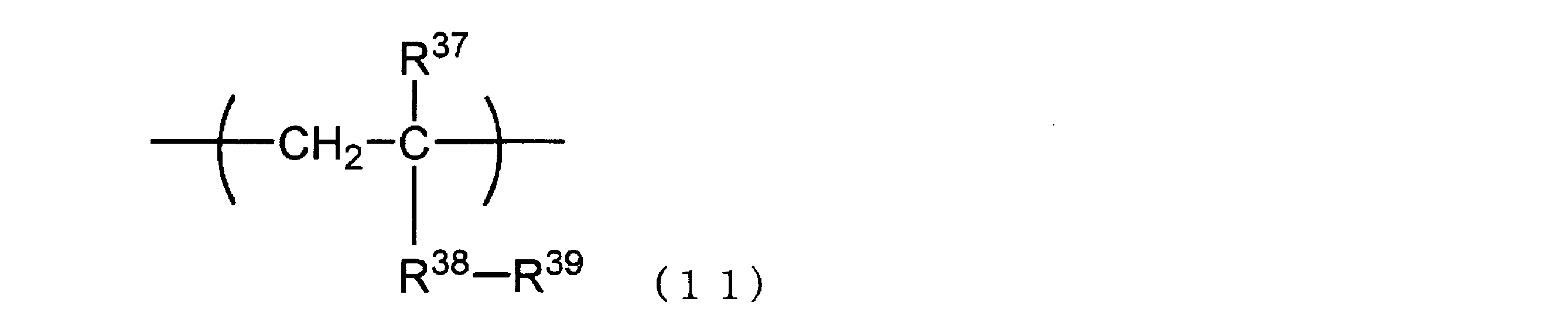
〔式(11)中、
R37は、水素原子又はメチル基を示し、
R38は、-O-、***-(C=O)-O-、***-(C=O)-NR40-、***-NR40-(C=O)-(R40は、水素原子又は炭素数1~10の有機基を示し、***は、式(11)中のR37が結合している炭素原子と結合する位置を示す)又はフェニレン基を示し、
R39は、炭素数4~30の炭化水素基を示す。〕
R37は、水素原子又はメチル基を示し、
R38は、-O-、***-(C=O)-O-、***-(C=O)-NR40-、***-NR40-(C=O)-(R40は、水素原子又は炭素数1~10の有機基を示し、***は、式(11)中のR37が結合している炭素原子と結合する位置を示す)又はフェニレン基を示し、
R39は、炭素数4~30の炭化水素基を示す。〕

〔式(12)中、
R41は、炭素数1~10の2価の有機基を示し、
R42及びR43は、それぞれ独立して、炭素数1~10の有機基を示し、
R44、R45及びR46は、それぞれ独立して、-OSi(R49)3(R49は、それぞれ独立して、水素原子又は炭素数1~8の有機基を示す)又は炭素数1~10の有機基を示し、
rは、平均値で0~200を示す。〕
R41は、炭素数1~10の2価の有機基を示し、
R42及びR43は、それぞれ独立して、炭素数1~10の有機基を示し、
R44、R45及びR46は、それぞれ独立して、-OSi(R49)3(R49は、それぞれ独立して、水素原子又は炭素数1~8の有機基を示す)又は炭素数1~10の有機基を示し、
rは、平均値で0~200を示す。〕
(繰り返し単位(C-1))
繰り返し単位(C-1)は、上記式(11)で表されるものである。
繰り返し単位(C-1)は、上記式(11)で表されるものである。
R38は、-O-、***-(C=O)-O-、***-(C=O)-NR40-、***-NR40-(C=O)-又はフェニレン基を示す。斯かるフェニレン基としては、1,2-フェニレン基、1,3-フェニレン基、1,4-フェニレン基が挙げられる。
また、R40で示される有機基の炭素数は1~10であるが、好ましくは1~6である。上記有機基としては、炭化水素基が挙げられる。斯かる炭化水素基は、脂肪族炭化水素基、脂環式炭化水素基及び芳香族炭化水素基を包含する概念である。
上記R40における脂肪族炭化水素基は直鎖状でも分岐鎖状でもよく、具体的には、メチル基、エチル基、n-プロピル基、イソプロピル基、n-ブチル基、イソブチル基、sec-ブチル基、tert-ブチル基、ペンチル基、ヘキシル基、ヘプチル基、オクチル基、ノニル基、デシル基等のアルキル基が挙げられる。
また、上記脂環式炭化水素基は、単環の脂環式炭化水素基と橋かけ環炭化水素基に大別される。上記単環の脂環式炭化水素基としては、シクロプロピル基、シクロヘキシル基等のシクロアルキル基が挙げられる。また、橋かけ環炭化水素基としては、イソボルニル基等が挙げられる。
また、上記芳香族炭化水素基としては、フェニル基等のアリール基が挙げられる。
また、上記脂環式炭化水素基は、単環の脂環式炭化水素基と橋かけ環炭化水素基に大別される。上記単環の脂環式炭化水素基としては、シクロプロピル基、シクロヘキシル基等のシクロアルキル基が挙げられる。また、橋かけ環炭化水素基としては、イソボルニル基等が挙げられる。
また、上記芳香族炭化水素基としては、フェニル基等のアリール基が挙げられる。
上述のようなR38の中でも、親水性化性能、防汚性付与効果及び潤滑性付与効果等の観点から、***-(C=O)-O-、***-(C=O)-NR40-、フェニレン基が好ましく、***-(C=O)-O-、***-(C=O)-NR40-がより好ましく、***-(C=O)-O-、***-(C=O)-NH-が更に好ましく、***-(C=O)-NH-が特に好ましい。
また、R39は、炭素数4~30の炭化水素基を示し、直鎖状、分岐鎖状のいずれでもよく、環構造を含んでいてもよいが、好ましくはアルキル基である。
また、上記炭化水素基の炭素数は、親水性化性能、防汚性付与効果及び潤滑性付与効果等の観点から、好ましくは6~24であり、より好ましくは8~18であり、更に好ましくは8~14であり、特に好ましくは10~14である。
上記アルキル基としては、例えば、2-エチルヘキシル基、オクチル基、デシル基、ラウリル基、パルミチル基、ステアリル基等が挙げられる。これらの中でも、入手容易性、防汚性付与効果等の観点から、2-エチルヘキシル基、ラウリル基、ステアリル基が好ましく、2-エチルヘキシル基、ラウリル基がより好ましい。
また、上記炭化水素基の炭素数は、親水性化性能、防汚性付与効果及び潤滑性付与効果等の観点から、好ましくは6~24であり、より好ましくは8~18であり、更に好ましくは8~14であり、特に好ましくは10~14である。
上記アルキル基としては、例えば、2-エチルヘキシル基、オクチル基、デシル基、ラウリル基、パルミチル基、ステアリル基等が挙げられる。これらの中でも、入手容易性、防汚性付与効果等の観点から、2-エチルヘキシル基、ラウリル基、ステアリル基が好ましく、2-エチルヘキシル基、ラウリル基がより好ましい。
斯様な繰り返し単位(C-1)を誘導するモノマーとしては、2-エチルヘキシル(メタ)アクリレート、ラウリル(メタ)アクリレート、ステアリル(メタ)アクリレート、N-ドデシル(メタ)アクリルアミド等が挙げられ、繰り返し単位(C-1)は、これらを単独で又は2種以上を組み合わせて用いたものでもよい。
(繰り返し単位(C-2))
上記式(12)で表される基を側鎖の末端に有する繰り返し単位となるポリマー種としては公知のものを用いることができ、中でも、(メタ)アクリレート系のポリマー種、(メタ)アクリルアミド系のポリマー種、スチレン系のポリマー種等が好ましい。これらの中でも、下記式(13)で表される繰り返し単位が好ましい。
上記式(12)で表される基を側鎖の末端に有する繰り返し単位となるポリマー種としては公知のものを用いることができ、中でも、(メタ)アクリレート系のポリマー種、(メタ)アクリルアミド系のポリマー種、スチレン系のポリマー種等が好ましい。これらの中でも、下記式(13)で表される繰り返し単位が好ましい。
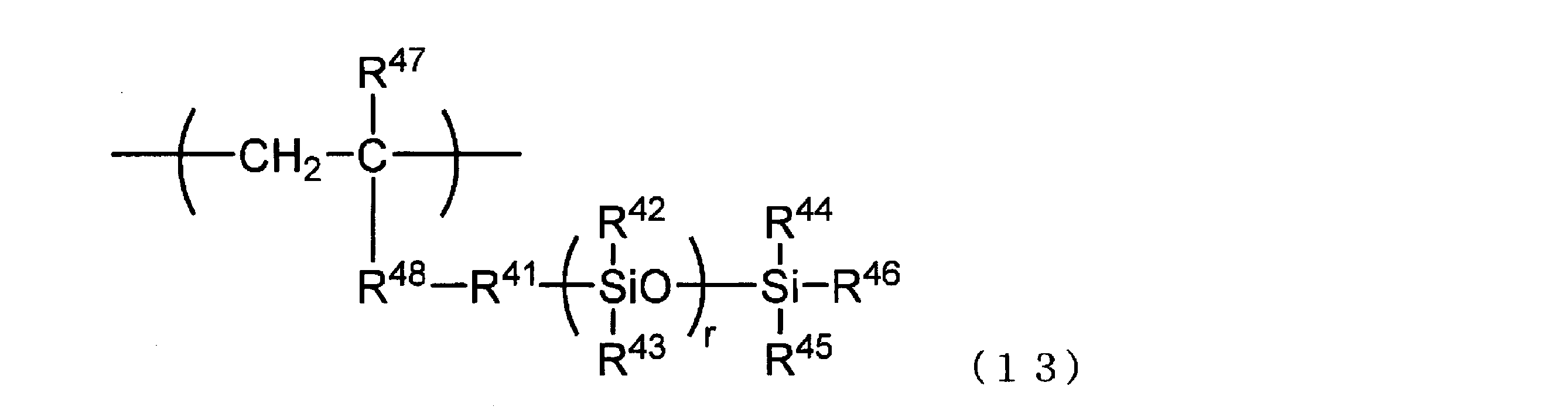
〔式(13)中、
R47は、水素原子又はメチル基を示し、
R48は、-O-、*-(C=O)-O-、*-(C=O)-NR50-、*-NR50-(C=O)-(R50は、水素原子又は炭素数1~10の有機基を示し、*は、式(13)中のR47が結合している炭素原子と結合する位置を示す)又はフェニレン基を示し、
その他の記号は式(12)中の記号と同義である。〕
R47は、水素原子又はメチル基を示し、
R48は、-O-、*-(C=O)-O-、*-(C=O)-NR50-、*-NR50-(C=O)-(R50は、水素原子又は炭素数1~10の有機基を示し、*は、式(13)中のR47が結合している炭素原子と結合する位置を示す)又はフェニレン基を示し、
その他の記号は式(12)中の記号と同義である。〕
ここで、式(12)及び(13)中の各記号について説明する。
R41は、炭素数1~10の2価の有機基を示す。斯かる2価の有機基の炭素数は、好ましくは2~8であり、より好ましくは2~6であり、更に好ましくは2~4である。
上記2価の有機基としては、2価の炭化水素基が挙げられる。2価の炭化水素基は、好ましくは2価の脂肪族炭化水素基であり、直鎖状でも分岐鎖状でもよいが、より好ましくはアルカンジイル基である。斯かるアルカンジイル基の好適な具体例としては、エタン-1,2-ジイル基、プロパン-1,2-ジイル基、プロパン-1,3-ジイル基、プロパン-2,2-ジイル基、ブタン-1,2-ジイル基、ブタン-1,3-ジイル基、ブタン-1,4-ジイル基等が挙げられる。
R41は、炭素数1~10の2価の有機基を示す。斯かる2価の有機基の炭素数は、好ましくは2~8であり、より好ましくは2~6であり、更に好ましくは2~4である。
上記2価の有機基としては、2価の炭化水素基が挙げられる。2価の炭化水素基は、好ましくは2価の脂肪族炭化水素基であり、直鎖状でも分岐鎖状でもよいが、より好ましくはアルカンジイル基である。斯かるアルカンジイル基の好適な具体例としては、エタン-1,2-ジイル基、プロパン-1,2-ジイル基、プロパン-1,3-ジイル基、プロパン-2,2-ジイル基、ブタン-1,2-ジイル基、ブタン-1,3-ジイル基、ブタン-1,4-ジイル基等が挙げられる。
また、R42及びR43は、それぞれ独立して、炭素数1~10の有機基を示す。なお、R42、R43が複数ある場合、R42は同一でも異なっていてもよく、R43も同一でも異なっていてもよい。
また、上記有機基の炭素数は、好ましくは1~6であり、より好ましくは1~4であり、更に好ましくは1又は2である。
上記有機基としては、炭化水素基が挙げられる。炭化水素基は直鎖状でも分岐鎖状でもよいが、好ましくはアルキル基である。斯かるアルキル基の具体例としては、メチル基、エチル基、n-プロピル基、イソプロピル基、n-ブチル基、イソブチル基、sec-ブチル基、tert-ブチル基が挙げられる。
また、上記有機基の炭素数は、好ましくは1~6であり、より好ましくは1~4であり、更に好ましくは1又は2である。
上記有機基としては、炭化水素基が挙げられる。炭化水素基は直鎖状でも分岐鎖状でもよいが、好ましくはアルキル基である。斯かるアルキル基の具体例としては、メチル基、エチル基、n-プロピル基、イソプロピル基、n-ブチル基、イソブチル基、sec-ブチル基、tert-ブチル基が挙げられる。
R44、R45及びR46は、それぞれ独立して、-OSi(R49)3又は炭素数1~10の有機基を示し、R49は、それぞれ独立して、水素原子又は炭素数1~8の有機基を示す。
上記R44、R45及びR46で示される有機基、R49で示される有機基の炭素数は、好ましくは1~6であり、より好ましくは1~4であり、更に好ましくは1又は2である。また、R44、R45及びR46で示される有機基、R49で示される有機基としては、R42で示される有機基と同様のものが挙げられる。
上記R44、R45及びR46で示される有機基、R49で示される有機基の炭素数は、好ましくは1~6であり、より好ましくは1~4であり、更に好ましくは1又は2である。また、R44、R45及びR46で示される有機基、R49で示される有機基としては、R42で示される有機基と同様のものが挙げられる。
また、R44、R45及びR46の中では、親水性化性能の観点から、-OSi(R49)3が好ましい。また、R49の中では、親水性化性能の観点から、炭素数1~8の有機基が好ましい。
rは、平均値で0~200を示すが、親水性化性能の観点から、平均値で0~100が好ましく、平均値で0~50がより好ましく、平均値で0~25が更に好ましく、平均値で0~10が特に好ましい。
なお、R48は上記R38と、R50は上記R40と、それぞれ同様である。
なお、R48は上記R38と、R50は上記R40と、それぞれ同様である。
これら繰り返し単位(C-1)~(C-2)の中でも、親水性化性能、防汚性付与効果及び潤滑性付与効果の観点から、式(11)で表される繰り返し単位(C-1)のうちR38が***-(C=O)-NH-の繰り返し単位、式(13)で表される繰り返し単位が好ましい。
斯様な繰り返し単位(C-2)を誘導するモノマーとしては、(メタ)アクリル酸3-[トリス(トリメチルシロキシ)シリル]プロピル、(メタ)アクリル酸3-[ビス(トリメチルシロキシ)(メチル)シリル]プロピル、シリコーン(メタ)アクリレート(X-22-2475(信越シリコーン社製)、FM-0711(JNC社製)等)等が挙げられ、繰り返し単位(C-2)は、これらを単独で又は2種以上を組み合わせて用いたものでもよい。
また、繰り返し単位(C)の合計含有量は、親水性化性能、防汚性付与効果、潤滑性付与効果及び透明性等の観点から、重合体aの全繰り返し単位に対して、60質量%以下が好ましく、0.1~50質量%がより好ましく、0.5~45質量%が更に好ましく、0.5~40質量%が更に好ましく、0.5~35質量%が更に好ましく、0.5~30質量%が更に好ましく、1~20質量%が更に好ましく、1~15質量%が更に好ましく、1.5~15質量%が更に好ましく、1.5~10質量%が特に好ましい。
なお、繰り返し単位(C)の含有量は、繰り返し単位(A)の含有量と同様にして測定すればよい。
なお、繰り返し単位(C)の含有量は、繰り返し単位(A)の含有量と同様にして測定すればよい。
また、本発明で用いる重合体aに含まれる繰り返し単位(A)と繰り返し単位(B)との質量比〔(A):(B)〕としては、親水性化性能、防汚性付与効果、潤滑性付与効果及び透明性等の観点から、20:80~95:5が好ましく、30:70~95:5がより好ましく、40:60~90:10が更に好ましく、50:50~90:10が更に好ましく、55:45~90:10が特に好ましい。
また、本発明で用いる重合体aが繰り返し単位(C)を有する場合、質量比〔((A)+(B)):(C)〕としては、親水性化性能、防汚性付与効果、潤滑性付与効果及び透明性等の観点から、60:40~99:1が好ましく、70:30~99:1がより好ましく、75:25~99:1が更に好ましく、80:20~98.5:1.5が更に好ましく、85:15~98.5:1.5が特に好ましい。
また、質量比〔(A):(B)〕が上記質量比〔(A):(B)〕の範囲であり、且つ質量比〔((A)+(B)):(C)〕が上記質量比〔((A)+(B)):(C)〕の範囲であることが特に好ましい。
また、質量比〔(A):(B)〕が上記質量比〔(A):(B)〕の範囲であり、且つ質量比〔((A)+(B)):(C)〕が上記質量比〔((A)+(B)):(C)〕の範囲であることが特に好ましい。
また、本発明で用いる重合体aは共重合体であればよく、ブロック共重合体、ランダム共重合体、交互共重合体のいずれであってもよい。
また、重合体aとしては、親水性化性能、防汚性付与効果及び潤滑性付与等の効果の観点から、非網目状の重合体が好ましく、線状又は櫛型の重合体がより好ましい。重合体aがこのような分子構造をもつ場合、ポリマーbの相互網目構造間に重合体a(改質剤)が抱え込まれやすくなり、表面親水性、潤滑性及び防汚性等が更に改善される。なお、線状の重合体とは、線状の分子構造をもつポリマーをいい、長い直鎖状の主鎖とそれに結合した比較的短い側鎖とから構成される構造をもつポリマーを含む概念である。また、櫛型の重合体とは、櫛型の分子構造をもつポリマーをいい、長い直鎖状の主鎖とそれに結合した比較的長い側鎖とから構成される構造をもつポリマーをいう。
また、重合体aとしては、親水性化性能、防汚性付与効果及び潤滑性付与等の効果の観点から、非網目状の重合体が好ましく、線状又は櫛型の重合体がより好ましい。重合体aがこのような分子構造をもつ場合、ポリマーbの相互網目構造間に重合体a(改質剤)が抱え込まれやすくなり、表面親水性、潤滑性及び防汚性等が更に改善される。なお、線状の重合体とは、線状の分子構造をもつポリマーをいい、長い直鎖状の主鎖とそれに結合した比較的短い側鎖とから構成される構造をもつポリマーを含む概念である。また、櫛型の重合体とは、櫛型の分子構造をもつポリマーをいい、長い直鎖状の主鎖とそれに結合した比較的長い側鎖とから構成される構造をもつポリマーをいう。
また、本発明で用いる重合体aの重量平均分子量(Mw)としては、1万~1000万が好ましく、1万~500万がより好ましく、1万~300万が更に好ましく、1万~200万が特に好ましい。重量平均分子量を斯様な範囲にすることにより、ハンドリング性が向上する。
また、本発明で用いる重合体aの数平均分子量(Mn)としては、1万~1000万が好ましく、1万~500万がより好ましく、1万~300万が更に好ましく、1万~200万が更に好ましく、1万~50万が特に好ましい。
また、分子量分布(Mw/Mn)としては、1~10が好ましく、1~7がより好ましく、1~5が特に好ましい。
なお、上記重量平均分子量、数平均分子量及び分子量分布は、後述する実施例に記載の方法に従い測定すればよい。
また、本発明で用いる重合体aの数平均分子量(Mn)としては、1万~1000万が好ましく、1万~500万がより好ましく、1万~300万が更に好ましく、1万~200万が更に好ましく、1万~50万が特に好ましい。
また、分子量分布(Mw/Mn)としては、1~10が好ましく、1~7がより好ましく、1~5が特に好ましい。
なお、上記重量平均分子量、数平均分子量及び分子量分布は、後述する実施例に記載の方法に従い測定すればよい。
本発明で用いる重合体aは、水溶性でも非水溶性でもよい。なお、本明細書において、水溶性とは、0.5質量%のポリマー固形分となるように重合体を水(25℃)に添加、混合したときに、目視で透明になることをいう。
また、重合体aのHLB(Hydrophile-Lipophile Balance)としては、5~25が好ましく、8~23がより好ましく、10~22が特に好ましい。
本明細書において、HLBは、化合物の有機性の値と無機性の値の比率から算出されるもの(小田式)を意味し、「Formulation Design with Organic Conception Diagram」[1998年、NIHON EMULSION CO.,LTD]に記載の計算方法により算出できる。
本明細書において、HLBは、化合物の有機性の値と無機性の値の比率から算出されるもの(小田式)を意味し、「Formulation Design with Organic Conception Diagram」[1998年、NIHON EMULSION CO.,LTD]に記載の計算方法により算出できる。
また、本発明で用いる重合体aは、例えば、各繰り返し単位を誘導するモノマーを混合し、この混合物を、必要に応じて、水、アセトニトリル、エクアミドB-100(出光興産社製)t-ブチルアルコール等の溶媒に溶解させ、重合開始剤を加えてラジカル重合することにより得ることができる。
上記ラジカル重合を行う際に用いられる重合開始剤としては、通常のラジカル重合開始剤であれば特に限定されるものではないが、例えば、過酸化ベンゾイル、過酸化ラウロイル、ジイソプロピルペルオキシジカーボネート、t-ブチルペルオキシ-2-エチルヘキサノエート、t-ブチペルオキシピバレート、t-ブチルペルオキシジイソブチレート、アゾビスイソブチロニトリル、アゾビスイソジメチルバレロニトリル、過硫酸塩、過硫酸塩一亜硫酸水素塩系等が挙げられる。
また、重合開始剤の仕込み量は、モノマー成分100質量部に対して0.001~10質量部が好ましく、0.01~5質量部がより好ましい。また、重合温度は20~100℃が好ましく、重合時間は0.5~48時間が好ましい。
上記ラジカル重合を行う際に用いられる重合開始剤としては、通常のラジカル重合開始剤であれば特に限定されるものではないが、例えば、過酸化ベンゾイル、過酸化ラウロイル、ジイソプロピルペルオキシジカーボネート、t-ブチルペルオキシ-2-エチルヘキサノエート、t-ブチペルオキシピバレート、t-ブチルペルオキシジイソブチレート、アゾビスイソブチロニトリル、アゾビスイソジメチルバレロニトリル、過硫酸塩、過硫酸塩一亜硫酸水素塩系等が挙げられる。
また、重合開始剤の仕込み量は、モノマー成分100質量部に対して0.001~10質量部が好ましく、0.01~5質量部がより好ましい。また、重合温度は20~100℃が好ましく、重合時間は0.5~48時間が好ましい。
重合体a(改質剤)の含有量は、親水性化性能、防汚性付与効果、潤滑性付与効果、透明性及び酸素透過性等の観点から、ゲル全量に対して、好ましくは0.01質量%以上、より好ましくは0.1質量%以上、更に好ましくは0.5質量%以上、特に好ましくは1質量%以上であり、また、透明性や適度な硬さとする観点から、ゲル全量に対して、好ましくは40質量%以下、より好ましくは30質量%以下、更に好ましくは20質量%以下、特に好ましくは10質量%以下である。
<ポリマーb>
本発明のゲルは、ポリマーbを含むものである。本発明のゲルに使用されるポリマーbは、親水性モノマー(以下、親水性モノマーcとも称する)を架橋剤(以下、架橋剤dとも称する)と共に重合したものである。
ポリマーbの含有量は、力学的強度、透明性、酸素透過性等の観点から、ゲル全量に対して、好ましくは60質量%以上、より好ましくは70質量%以上、更に好ましくは80質量%以上、特に好ましくは90質量%以上であり、また、親水性化性能、防汚性付与効果、潤滑性付与効果等の観点から、ゲル全量に対して、好ましくは99.99質量%以下、より好ましくは99.9質量%以下、更に好ましくは99.5質量%以下、特に好ましくは99質量%以下である。
本発明のゲルは、ポリマーbを含むものである。本発明のゲルに使用されるポリマーbは、親水性モノマー(以下、親水性モノマーcとも称する)を架橋剤(以下、架橋剤dとも称する)と共に重合したものである。
ポリマーbの含有量は、力学的強度、透明性、酸素透過性等の観点から、ゲル全量に対して、好ましくは60質量%以上、より好ましくは70質量%以上、更に好ましくは80質量%以上、特に好ましくは90質量%以上であり、また、親水性化性能、防汚性付与効果、潤滑性付与効果等の観点から、ゲル全量に対して、好ましくは99.99質量%以下、より好ましくは99.9質量%以下、更に好ましくは99.5質量%以下、特に好ましくは99質量%以下である。
(親水性モノマーc)
親水性モノマーcは、重合性官能基を有する親水性の化合物であれば特に限定されるものではないが、重合性官能基を1個有する親水性の化合物が好ましい。重合性官能基としては、重合性不飽和結合が好ましい。
親水性モノマーcは、重合性官能基を有する親水性の化合物であれば特に限定されるものではないが、重合性官能基を1個有する親水性の化合物が好ましい。重合性官能基としては、重合性不飽和結合が好ましい。
親水性モノマーcの具体例としては、(メタ)アクリル酸、イタコン酸、クロトン酸、ビニル安息香酸などの重合性官能基を有するカルボン酸類;ヒドロキシメチル(メタ)アクリレート、2-ヒドロキシエチル(メタ)アクリレート、2-ヒドロキシプロピル(メタ)アクリレート、2,3-ジヒドロキシプロピル(メタ)アクリレート、ポリエチレングリコールモノ(メタ)アクリレート、ポリプロピレングリコールモノ(メタ)アクリレートなどの水酸基を有する(メタ)アクリレート類;(メタ)アクリルアミド、N-メチル(メタ)アクリルアミド、N-エチル(メタ)アクリルアミド、N-ヒドロキシエチル(メタ)アクリルアミド、N,N-ジメチル(メタ)アクリルアミド、N,N-ジエチル(メタ)アクリルアミド、N-エチル-N-アミノエチル(メタ)アクリルアミドなどの(メタ)アクリルアミド類;2-ジメチルアミノエチル(メタ)アクリレート、2-ブチルアミノエチル(メタ)アクリレートなどの(アルキル)アミノアルキル(メタ)アクリレート類;N-ビニル-3-メチル-2-ピロリドン、N-ビニル-4-メチル-2-ピロリドン、N-ビニル-5-メチル-2-ピロリドン、N-ビニル-3-エチル-2-ピロリドン、N-ビニル-4,5-ジメチル-2-ピロリドン、N-ビニル-5,5-ジメチル-2-ピロリドン、N-ビニル-3,3,5-トリメチル-2-ピロリドン、N-(メタ)アクリロリルピロリドン、N-(メタ)アクリロリルオキシエチルピロリドン、1-メチル-3-メチレン-2-ピロリドン、1-エチル-3-メチレン-2-ピロリドン、1-メチル-5-メチレン-2-ピロリドン、1-エチル-5-メチレン-2-ピロリドン、5-メチル-3-メチレン-2-ピロリドン、5-エチル-3-メチレン-2-ピロリドン、1-n-プロピル-3-メチレン-2-ピロリドン、1-n-プロピル-5-メチレン-2-ピロリドン、1-i-プロピル-3-メチレン-2-ピロリドン、1-i-プロピル-5-メチレン-2-ピロリドン、1-n-ブチル-3-メチレン-2-ピロリドン、1-t-ブチル-3-メチレン-2-ピロリドンなどの重合性官能基を有するピロリドン類;N-ビニル-2-ピペリドン、N-ビニル-3-メチル-2-ピペリドン、N-ビニル-4-メチル-2-ピペリドン、N-ビニル-5-メチル-2-ピペリドン、N-ビニル-6-メチル-2-ピペリドン、N-ビニル-6-エチル-2-ピペリドン、N-ビニル-3,5-ジメチル-2-ピペリドン、N-ビニル-4,4-ジメチル-2-ピペリドンなどのN-ビニルピペリドン類;N-ビニル-2-カプロラクタム、N-ビニル-3-メチル-2-カプロラクタム、N-ビニル-4-メチル-2-カプロラクタム、N-ビニル-7-メチル-2-カプロラクタム、N-ビニル-7-エチル-2-カプロラクタム、N-ビニル-3,5-ジメチル-2-カプロラクタム、N-ビニル-4,6-ジメチル-2-カプロラクタム、N-ビニル-3,5,7-トリメチル-2-カプロラクタムなどのN-ビニルラクタム類;N-ビニルホルムアミド、N-ビニル-N-メチルホルムアミド、N-ビニル-N-エチルホルムアミド、N-ビニルアセトアミド、N-ビニル-N-メチルアセトアミド、N-ビニル-N-エチルアセトアミドなどのN-ビニルアミド類;アミノスチレン、ヒドロキシスチレン、酢酸ビニル、グリシジル(メタ)アクリレート、アリルグリシジルエーテル、プロピオン酸ビニル、N-ビニルイミダゾール、N-ビニルピペリジン、N-ビニルスクシンイミド、N-ビニルフタルイミド、N-(メタ)アクリロイルピペリジン、N-(メタ)アクリロイルモルホリンなどのその他の親水性モノマー等が挙げられる。
これら親水性モノマーは、1種を単独で又は2種以上を組み合わせて使用できる。
これら親水性モノマーは、1種を単独で又は2種以上を組み合わせて使用できる。
これら親水性モノマーの中でも、親水性化性能、防汚性付与効果、潤滑性付与効果、ゲルやレンズの機械的特性及び保存安定性の観点から、水酸基を有する(メタ)アクリレート類、(メタ)アクリルアミド類が好ましい。
なお、重合性基がメチレン基であるピロリドン誘導体や、窒素置換された(メタ)アクリルアミド類は、ゲルやレンズに本発明の所望の効果を付与でき、後述するシリコーン化合物gとの相溶性も高い。また、酢酸ビニルは酸や塩基によって加水分解を受けるため、このような親水性モノマーを使用した場合、ゲルやレンズを製造した後に酸や塩基で処理することで、ゲルやレンズにさらなる柔軟性及び表面親水性を付与できる。
なお、重合性基がメチレン基であるピロリドン誘導体や、窒素置換された(メタ)アクリルアミド類は、ゲルやレンズに本発明の所望の効果を付与でき、後述するシリコーン化合物gとの相溶性も高い。また、酢酸ビニルは酸や塩基によって加水分解を受けるため、このような親水性モノマーを使用した場合、ゲルやレンズを製造した後に酸や塩基で処理することで、ゲルやレンズにさらなる柔軟性及び表面親水性を付与できる。
(架橋剤d)
架橋剤dは、重合性官能基を2個以上有するものであればよい。また、重合性官能基としては、重合性不飽和結合が好ましい。
架橋剤dの具体例としては、アリル(メタ)アクリレート、ビニル(メタ)アクリレート、4-ビニルベンジル(メタ)アクリレート、3-ビニルベンジル(メタ)アクリレート、(メタ)アクリロイルオキシエチル(メタ)アクリレート、エチレングリコールジ(メタ)アクリレート、ジエチレングリコールジ(メタ)アクリレート、ジエチレングリコールジアリルエーテル、トリエチレングリコールジ(メタ)アクリレート、テトラエチレングリコールジ(メタ)アクリレート、プロピレングリコールジ(メタ)アクリレート、ジプロピレングリコールジ(メタ)アクリレート、ブタンジオールジ(メタ)アクリレート、2,2-ビス(p-(メタ)アクリロイルオキシフェニル)ヘキサフルオロプロパン、2,2-ビス(m-(メタ)アクリロイルオキシフェニル)ヘキサフルオロプロパン、2,2-ビス(o-(メタ)アクリロイルオキシフェニル)ヘキサフルオロプロパン、2,2-ビス(p-(メタ)アクリロイルオキシフェニル)プロパン、2,2-ビス(m-(メタ)アクリロイルオキシフェニル)プロパン、2,2-ビス(o-(メタ)アクリロイルオキシフェニル)プロパン、1,4-ビス(2-(メタ)アクリロイルオキシヘキサフルオロイソプロピル)ベンゼン、1,3-ビス(2-(メタ)アクリロイルオキシヘキサフルオロイソプロピル)ベンゼン、1,2-ビス(2-(メタ)アクリロイルオキシヘキサフルオロイソプロピル)ベンゼン、1,4-ビス(2-(メタ)アクリロイルオキシイソプロピル)ベンゼン、1,3-ビス(2-(メタ)アクリロイルオキシイソプロピル)ベンゼン、1,2-ビス(2-(メタ)アクリロイルオキシイソプロピル)ベンゼン等の重合性官能基を2個有する架橋剤;トリメチロールプロパントリ(メタ)アクリレート等の重合性官能基を3個有する架橋剤などが挙げられる。
これら架橋剤は、1種を単独で又は2種以上を組み合わせて使用できる。
架橋剤dは、重合性官能基を2個以上有するものであればよい。また、重合性官能基としては、重合性不飽和結合が好ましい。
架橋剤dの具体例としては、アリル(メタ)アクリレート、ビニル(メタ)アクリレート、4-ビニルベンジル(メタ)アクリレート、3-ビニルベンジル(メタ)アクリレート、(メタ)アクリロイルオキシエチル(メタ)アクリレート、エチレングリコールジ(メタ)アクリレート、ジエチレングリコールジ(メタ)アクリレート、ジエチレングリコールジアリルエーテル、トリエチレングリコールジ(メタ)アクリレート、テトラエチレングリコールジ(メタ)アクリレート、プロピレングリコールジ(メタ)アクリレート、ジプロピレングリコールジ(メタ)アクリレート、ブタンジオールジ(メタ)アクリレート、2,2-ビス(p-(メタ)アクリロイルオキシフェニル)ヘキサフルオロプロパン、2,2-ビス(m-(メタ)アクリロイルオキシフェニル)ヘキサフルオロプロパン、2,2-ビス(o-(メタ)アクリロイルオキシフェニル)ヘキサフルオロプロパン、2,2-ビス(p-(メタ)アクリロイルオキシフェニル)プロパン、2,2-ビス(m-(メタ)アクリロイルオキシフェニル)プロパン、2,2-ビス(o-(メタ)アクリロイルオキシフェニル)プロパン、1,4-ビス(2-(メタ)アクリロイルオキシヘキサフルオロイソプロピル)ベンゼン、1,3-ビス(2-(メタ)アクリロイルオキシヘキサフルオロイソプロピル)ベンゼン、1,2-ビス(2-(メタ)アクリロイルオキシヘキサフルオロイソプロピル)ベンゼン、1,4-ビス(2-(メタ)アクリロイルオキシイソプロピル)ベンゼン、1,3-ビス(2-(メタ)アクリロイルオキシイソプロピル)ベンゼン、1,2-ビス(2-(メタ)アクリロイルオキシイソプロピル)ベンゼン等の重合性官能基を2個有する架橋剤;トリメチロールプロパントリ(メタ)アクリレート等の重合性官能基を3個有する架橋剤などが挙げられる。
これら架橋剤は、1種を単独で又は2種以上を組み合わせて使用できる。
ポリマーbを得る際の架橋剤dの使用量は、親水性モノマーc 100質量部に対して、好ましくは0.1~20質量部であり、より好ましくは5~15質量部である。
ポリマーbは、親水性モノマーcを架橋剤dと共に重合することで合成できる。斯かる重合は常法を適宜組み合わせて行えばよいが、重合体aの存在下で行うのが好ましい。このようにしてポリマーbを合成することにより、ゲル中で、ポリマーbの相互網目構造間に重合体a(改質剤)が抱え込まれるような状態となり、表面親水性、潤滑性及び防汚性が改善されたゲルが調製される。
(重合性官能基を有するシリコーン化合物e)
また、ポリマーbは、重合性官能基を有するシリコーン化合物(以下、重合性官能基を有するシリコーン化合物eとも称する)を、親水性モノマーc及び架橋剤dと共に重合したものが好ましい。これにより、得られるゲルやレンズに高い酸素透過性及び柔軟性が付与される。なお、重合性官能基を有するシリコーン化合物eにおける重合性官能基としては、重合性不飽和結合が好ましい。
また、ポリマーbは、重合性官能基を有するシリコーン化合物(以下、重合性官能基を有するシリコーン化合物eとも称する)を、親水性モノマーc及び架橋剤dと共に重合したものが好ましい。これにより、得られるゲルやレンズに高い酸素透過性及び柔軟性が付与される。なお、重合性官能基を有するシリコーン化合物eにおける重合性官能基としては、重合性不飽和結合が好ましい。
重合性官能基を有するシリコーン化合物eとしては、シリコーン含有アルキル(メタ)アクリレート化合物、シリコーン含有スチレン化合物、シリコーン含有フマル酸ジエステル化合物、ウレタン結合を介してエチレン性不飽和基及びシリコーン構造を有する化合物が挙げられる。なお、これらは、1種を単独で又は2種以上を組み合わせて使用できる。
シリコーン含有アルキル(メタ)アクリレート化合物としては、例えば、トリメチルシロキシジメチルシリルメチル(メタ)アクリレート、トリメチルシロキシジメチルシリルプロピル(メタ)アクリレート、メチルビス(トリメチルシロキシ)シリルプロピル(メタ)アクリレート、トリス(トリメチルシロキシ)シリルプロピル(メタ)アクリレート、モノ[メチルビス(トリメチルシロキシ)シロキシ]ビス(トリメチルシロキシ)シリルプロピル(メタ)アクリレート、トリス[メチルビス(トリメチルシロキシ)シロキシ]シリルプロピル(メタ)アクリレート、メチルビス(トリメチルシロキシ)シリルプロピルグリセリル(メタ)アクリレート、トリス(トリメチルシロキシ)シリルプロピルグリセリル(メタ)アクリレート、モノ[メチルビス(トリメチルシロキシ)シロキシ]ビス(トリメチルシロキシ)シリルプロピルグリセリル(メタ)アクリレート、トリメチルシリルエチルテトラメチルジシロキシプロピルグリセリル(メタ)アクリレート、トリメチルシリルメチル(メタ)アクリレート、トリメチルシリルプロピル(メタ)アクリレート、トリメチルシリルプロピルグリセリル(メタ)アクリレート、トリメチルシロキシジメチルシリルプロピルグリセリル(メタ)アクリレート、メチルビス(トリメチルシロキシ)シリルエチルテトラメチルジシロキシメチル(メタ)アクリレート、テトラメチルトリイソプロピルシクロテトラシロキサニルプロピル(メタ)アクリレート、テトラメチルトリイソプロピルシクロテトラシロキシビス(トリメチルシロキシ)シリルプロピル(メタ)アクリレートなどが挙げられる。
シリコーン含有スチレン化合物としては、例えば、下記式(14)で表される化合物などが挙げられる。
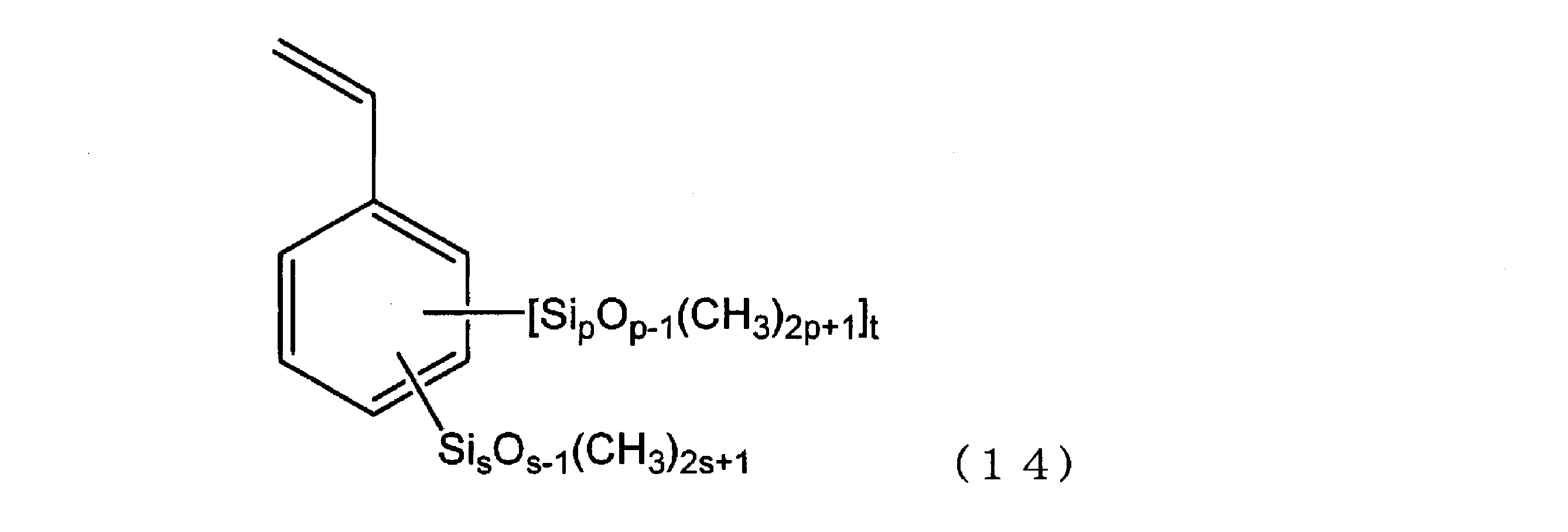
〔式(14)中、
p及びsは、それぞれ独立して、1~15の整数を示し、
tは、0又は1を示す。〕
p及びsは、それぞれ独立して、1~15の整数を示し、
tは、0又は1を示す。〕
シリコーン含有スチレン化合物の具体例としては、トリス(トリメチルシロキシ)シリルスチレン、ビス(トリメチルシロキシ)メチルシリルスチレン、(トリメチルシロキシ)ジメチルシリルスチレン、トリス(トリメチルシロキシ)シロキシジメチルシリルスチレン、[ビス(トリメチルシロキシ)メチルシロキシ]ジメチルシリルスチレン、(トリメチルシロキシ)ジメチルシリルスチレン、ヘプタメチルトリシロキサニルスチレン、ノナメチルテトラシロキサニルスチレン、ペンタデカメチルヘプタシロキサニルスチレン、ヘンエイコサメチルデカシロキサニルスチレン、ヘプタコサメチルトリデカシロキサニルスチレン、ヘントリアコンタメチルペンタデカシロキサニルスチレン、トリメチルシロキシペンタメチルジシロキシメチルシリルスチレン、トリス(ペンタメチルジシロキシ)シリルスチレン、トリス(トリメチルシロキシ)シロキシビス(トリメチルシロキシ)シリルスチレン、ビス(ヘプタメチルトリシロキシ)メチルシリルスチレン、トリス[メチルビス(トリメチルシロキシ)シロキシ]シリルスチレン、トリメチルシロキシビス[トリス(トリメチルシロキシ)シロキシ]シリルスチレン、ヘプタキス(トリメチルシロキシ)トリシリルスチレン、ノナメチルテトラシロキシウンデシルメチルペンタシロキシメチルシリルスチレン、トリス[トリス(トリメチルシロキシ)シロキシ]シリルスチレン、(トリストリメチルシロキシヘキサメチル)テトラシロキシ[トリス(トリメチルシロキシ)シロキシ]トリメチルシロキシシリルスチレン、ノナキス(トリメチルシロキシ)テトラシリルスチレン、ビス(トリデカメチルヘキサシロキシ)メチルシリルスチレン、ヘプタメチルシクロテトラシロキサニルスチレン、ヘプタメチルシクロテトラシロキシビス(トリメチルシロキシ)シリルスチレン、トリプロピルテトラメチルシクロテトラシロキサニルスチレン、トリメチルシリルスチレンなどが挙げられる。
シリコーン含有フマル酸ジエステル化合物としては、例えば、下記式(15)で表される化合物などが挙げられる。
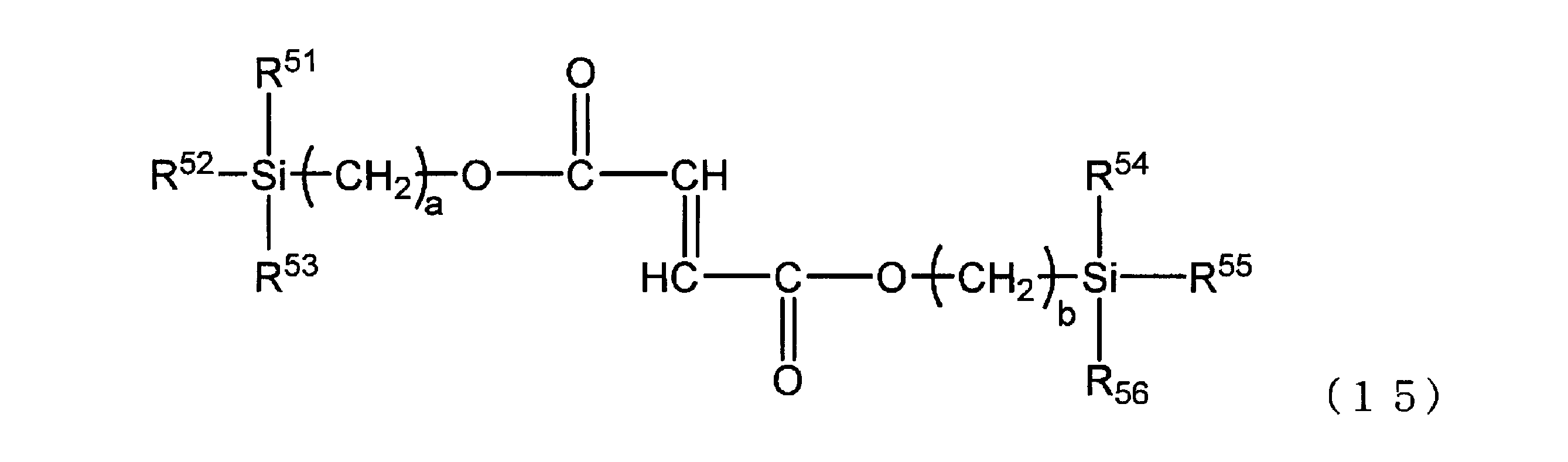
〔式(15)中、
R51~R56は、それぞれ独立して、メチル基又はトリメチルシロキシ基を示し、
a及びbは、それぞれ独立して、1~10の整数を示す。〕
R51~R56は、それぞれ独立して、メチル基又はトリメチルシロキシ基を示し、
a及びbは、それぞれ独立して、1~10の整数を示す。〕
シリコーン含有フマル酸ジエステル化合物の具体例としては、ビス(3-(トリメチルシリル)プロピル)フマレート、ビス(3-(ペンタメチルジシロキサニル)プロピル)フマレート、ビス(トリス(トリメチルシロキシ)シリルプロピル)フマレートなどが挙げられる。
ウレタン結合を介してエチレン性不飽和基及びシリコーン構造を有する化合物としては、下記式(16)で表されるポリシロキサンマクロモノマーが挙げられる。
なお、ウレタン結合を介してエチレン性不飽和基及びシリコーン構造を有する化合物は、ウレタン結合及びシロキサン部分を備えることにより、得られるゲルやレンズに、柔軟性、弾力的反発性、酸素透過性を付与するものであり、それと同時に、機械的強度を向上させる作用も有する。すなわち、かかるシリコーン化合物は、分子の両末端に重合性官能基であるエチレン性不飽和基を有し、この重合性官能基を介して他の共重合成分と共重合されるので、得られる分子の架橋による物理的な強化だけでなく、化学的結合による補強効果をゲルやレンズに付与できる。
なお、ウレタン結合を介してエチレン性不飽和基及びシリコーン構造を有する化合物は、ウレタン結合及びシロキサン部分を備えることにより、得られるゲルやレンズに、柔軟性、弾力的反発性、酸素透過性を付与するものであり、それと同時に、機械的強度を向上させる作用も有する。すなわち、かかるシリコーン化合物は、分子の両末端に重合性官能基であるエチレン性不飽和基を有し、この重合性官能基を介して他の共重合成分と共重合されるので、得られる分子の架橋による物理的な強化だけでなく、化学的結合による補強効果をゲルやレンズに付与できる。
A1-U1-(S1-U2)j-S2-U3-A2 (16)
〔式(16)中、
A1は、下記式(17)で表される基を示し、
A2は、下記式(18)で表される基を示し、
U1は、下記式(19)で表される基を示し、
S1及びS2は、それぞれ独立して、下記式(20)で表される基を示し、
U2は、下記式(21)で表される基を示し、
U3は、下記式(22)で表される基を示し、
jは、0~10の整数を示す。〕
A1は、下記式(17)で表される基を示し、
A2は、下記式(18)で表される基を示し、
U1は、下記式(19)で表される基を示し、
S1及びS2は、それぞれ独立して、下記式(20)で表される基を示し、
U2は、下記式(21)で表される基を示し、
U3は、下記式(22)で表される基を示し、
jは、0~10の整数を示す。〕
Y21-Z21-R57- (17)
〔式(17)中、
Y21は、(メタ)アクリロイル基、ビニル基又はアリル基を示し、
Z21は、単結合又は酸素原子を示し、
R57は、単結合、又は炭素数1~12の2価の炭化水素基を示す。〕
Y21は、(メタ)アクリロイル基、ビニル基又はアリル基を示し、
Z21は、単結合又は酸素原子を示し、
R57は、単結合、又は炭素数1~12の2価の炭化水素基を示す。〕
-R58-Z22-Y22 (18)
〔式(18)中、
Y22は、(メタ)アクリロイル基、ビニル基又はアリル基を示し、
Z22は、単結合又は酸素原子を示し、
R58は、単結合、又は炭素数1~12の2価の炭化水素基を示す。〕
Y22は、(メタ)アクリロイル基、ビニル基又はアリル基を示し、
Z22は、単結合又は酸素原子を示し、
R58は、単結合、又は炭素数1~12の2価の炭化水素基を示す。〕
-X21-E21-X25-R59- (19)
〔式(19)中、
X21及びX25は、それぞれ独立して、単結合、酸素原子、アルキレングリコール基又はポリアルキレングリコール基を示し、
E21は、-(NH)-(C=O)-(但し、この場合、X21は単結合であり、且つX25は酸素原子、アルキレングリコール基又はポリアルキレングリコール基である。すなわち、この場合はE21はX25とウレタン結合を形成している。)、-(C=O)-(NH)-(但し、この場合、X21は酸素原子、アルキレングリコール基又はポリアルキレングリコール基であり、且つX25は単結合である。すなわち、この場合はE21はX21とウレタン結合を形成している。)、又はジイソシアネート由来の2価の基(但し、この場合、X21及びX25は、それぞれ独立して、酸素原子、アルキレングリコール基又はポリアルキレングリコール基である。すなわち、この場合はE21はX21及びX25の間で2つのウレタン結合を形成している。)を示し、
R59は、炭素数1~6の直鎖状又は分岐鎖状のアルカンジイル基を示す。〕
X21及びX25は、それぞれ独立して、単結合、酸素原子、アルキレングリコール基又はポリアルキレングリコール基を示し、
E21は、-(NH)-(C=O)-(但し、この場合、X21は単結合であり、且つX25は酸素原子、アルキレングリコール基又はポリアルキレングリコール基である。すなわち、この場合はE21はX25とウレタン結合を形成している。)、-(C=O)-(NH)-(但し、この場合、X21は酸素原子、アルキレングリコール基又はポリアルキレングリコール基であり、且つX25は単結合である。すなわち、この場合はE21はX21とウレタン結合を形成している。)、又はジイソシアネート由来の2価の基(但し、この場合、X21及びX25は、それぞれ独立して、酸素原子、アルキレングリコール基又はポリアルキレングリコール基である。すなわち、この場合はE21はX21及びX25の間で2つのウレタン結合を形成している。)を示し、
R59は、炭素数1~6の直鎖状又は分岐鎖状のアルカンジイル基を示す。〕
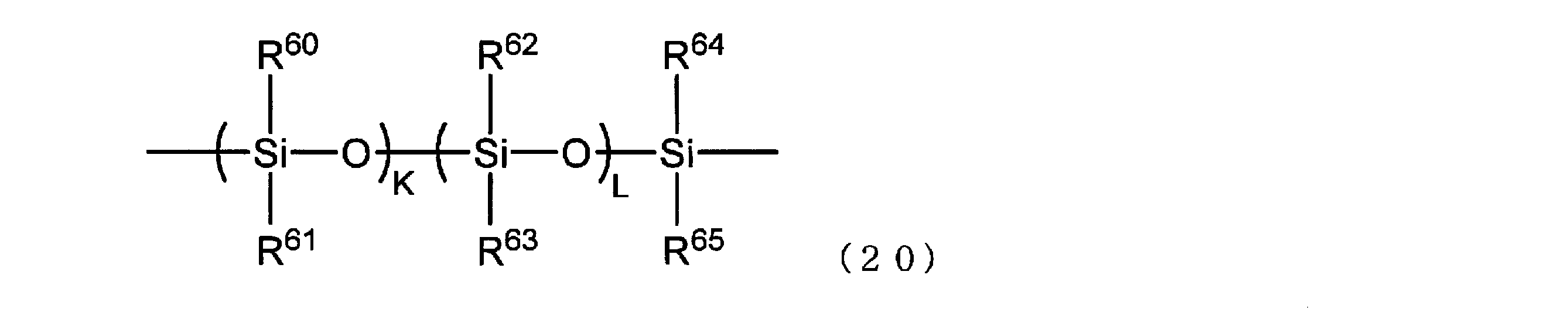
〔式(20)中、
R60~R65は、それぞれ独立して、水素原子、炭素数1~6のアルキル基、フッ化アルキル基、又はフェニル基を示し、
Kは、10~100の整数を示し、
Lは、0~90の整数を示す。
但し、K+Lは、10~100の整数である。〕
R60~R65は、それぞれ独立して、水素原子、炭素数1~6のアルキル基、フッ化アルキル基、又はフェニル基を示し、
Kは、10~100の整数を示し、
Lは、0~90の整数を示す。
但し、K+Lは、10~100の整数である。〕
-R66-X27-E24-X28-R67- (21)
〔式(21)中、
R66及びR67は、それぞれ独立して、炭素数1~6の直鎖状又は分岐鎖状のアルカンジイル基を示し、
X27及びX28は、それぞれ独立して、酸素原子、アルキレングリコール基又はポリアルキレングリコール基を示し、
E24は、ジイソシアネート由来の2価の基を示す。なお、E24はX27及びX28の間で2つのウレタン結合を形成している。〕
R66及びR67は、それぞれ独立して、炭素数1~6の直鎖状又は分岐鎖状のアルカンジイル基を示し、
X27及びX28は、それぞれ独立して、酸素原子、アルキレングリコール基又はポリアルキレングリコール基を示し、
E24は、ジイソシアネート由来の2価の基を示す。なお、E24はX27及びX28の間で2つのウレタン結合を形成している。〕
-R68-X26-E22-X22- (22)
〔式(22)中、
R68は、炭素数1~6の直鎖状又は分岐鎖状のアルカンジイル基を示し、
X22及びX26は、それぞれ独立して、単結合、酸素原子、アルキレングリコール基又はポリアルキレングリコール基を示し、
E22は、-(NH)-(C=O)-(但し、この場合、X22は酸素原子、アルキレングリコール基又はポリアルキレングリコール基であり、且つX26は単結合である。すなわち、この場合はE22はX22とウレタン結合を形成している。)、-(C=O)-(NH)-(但し、この場合、X22は単結合であり、且つX26は酸素原子、アルキレングリコール基又はポリアルキレングリコール基である。すなわち、この場合はE22はX26とウレタン結合を形成している。)、又はジイソシアネート由来の2価の基(但し、この場合、X22及びX26は、それぞれ独立して、酸素原子、アルキレングリコール基又はポリアルキレングリコール基である。すなわち、この場合はE22はX22及びX26の間で2つのウレタン結合を形成している。)を示す。〕
R68は、炭素数1~6の直鎖状又は分岐鎖状のアルカンジイル基を示し、
X22及びX26は、それぞれ独立して、単結合、酸素原子、アルキレングリコール基又はポリアルキレングリコール基を示し、
E22は、-(NH)-(C=O)-(但し、この場合、X22は酸素原子、アルキレングリコール基又はポリアルキレングリコール基であり、且つX26は単結合である。すなわち、この場合はE22はX22とウレタン結合を形成している。)、-(C=O)-(NH)-(但し、この場合、X22は単結合であり、且つX26は酸素原子、アルキレングリコール基又はポリアルキレングリコール基である。すなわち、この場合はE22はX26とウレタン結合を形成している。)、又はジイソシアネート由来の2価の基(但し、この場合、X22及びX26は、それぞれ独立して、酸素原子、アルキレングリコール基又はポリアルキレングリコール基である。すなわち、この場合はE22はX22及びX26の間で2つのウレタン結合を形成している。)を示す。〕
ここで、式(16)~(22)中の各記号について説明する。
式(16)中、jは0~10の整数を示すが、親水性モノマーcとの相溶性を良好にし透明性に優れたものとする観点からは、好ましくは0~5の整数である。
式(17)中のY21及び式(18)中のY22は、それぞれ独立して、(メタ)アクリロイル基、ビニル基又はアリル基を示すが、親水性モノマーcと容易に共重合しうるという点で、(メタ)アクリロイル基が好ましい。
式(17)中のZ21及び式(18)中のZ22は、それぞれ独立して、単結合又は酸素原子を示すが、好ましくは酸素原子である。
式(17)中のR57及び式(18)中のR58は、それぞれ独立して、単結合、又は炭素数1~12の2価の炭化水素基を示すが、炭素数1~12の2価の炭化水素基が好ましい。斯かる2価の炭化水素基は、直鎖状でも分岐鎖状でもよく、また、芳香環を有していてもよいが、好ましくは2価の脂肪族炭化水素基であり、より好ましくはアルカンジイル基である。また、2価の炭化水素基の炭素数は、好ましくは2~4である。具体的には、エタン-1,2-ジイル基、プロパン-1,1-ジイル基、プロパン-1,2-ジイル基、プロパン-1,3-ジイル基、プロパン-2,2-ジイル基、ブタン-1,4-ジイル基等が挙げられる。
式(19)中のE21及び式(22)中のE22は、それぞれ独立して、-(NH)-(C=O)-、-(C=O)-(NH)-、又はジイソシアネート由来の2価の基を示すが、ジイソシアネート由来の2価の基が好ましい。
式(21)中のE24は、ジイソシアネート由来の2価の基を示す。なお、E24はX27及びX28の間で2つのウレタン結合を形成している。
式(21)中のE24は、ジイソシアネート由来の2価の基を示す。なお、E24はX27及びX28の間で2つのウレタン結合を形成している。
上記E21、E22及びE24における「ジイソシアネート由来の2価の基」を誘導するジイソシアネートは、飽和又は不飽和脂肪族系ジイソシアネートでもよく、脂環式系又は芳香族系ジイソシアネートでもよい。
上記ジイソシアネート由来の2価の基としては、具体的には、エチレンジイソシアネート、1,3-ジイソシアネートプロパン、ヘキサメチレンジイソシアネートなどの飽和脂肪族系ジイソシアネート由来の2価の基;1,2-ジイソシアネートシクロヘキサン、ビス(4-イソシアネートシクロヘキシル)メタン、イソホロンジイソシアネートなどの脂環式系ジイソシアネート由来の2価の基;トリレンジイソシアネート、1,5-ジイソシアネートナフタレンなどの芳香族系ジイソシアネート由来の2価の基;2,2'-ジイソシアネートジエチルフマレートなどの不飽和脂肪族系ジイソシアネート由来の2価の基が挙げられる。
これらの中では、入手容易性及びゲルやレンズへの強度付与の観点から、ヘキサメチレンジイソシアネート由来の2価の基、トリレンジイソシアネート由来の2価の基、イソホロンジイソシアネート由来の2価の基が好ましい。
上記ジイソシアネート由来の2価の基としては、具体的には、エチレンジイソシアネート、1,3-ジイソシアネートプロパン、ヘキサメチレンジイソシアネートなどの飽和脂肪族系ジイソシアネート由来の2価の基;1,2-ジイソシアネートシクロヘキサン、ビス(4-イソシアネートシクロヘキシル)メタン、イソホロンジイソシアネートなどの脂環式系ジイソシアネート由来の2価の基;トリレンジイソシアネート、1,5-ジイソシアネートナフタレンなどの芳香族系ジイソシアネート由来の2価の基;2,2'-ジイソシアネートジエチルフマレートなどの不飽和脂肪族系ジイソシアネート由来の2価の基が挙げられる。
これらの中では、入手容易性及びゲルやレンズへの強度付与の観点から、ヘキサメチレンジイソシアネート由来の2価の基、トリレンジイソシアネート由来の2価の基、イソホロンジイソシアネート由来の2価の基が好ましい。
式(19)中のX21及びX25、並びに式(22)中のX22及びX26は、それぞれ独立して、単結合、酸素原子、アルキレングリコール基又はポリアルキレングリコール基を示す。
但し、E21が、-(NH)-(C=O)-の場合は、X21は単結合であり、且つX25は酸素原子、アルキレングリコール基又はポリアルキレングリコール基である。すなわち、この場合はE21はX25とウレタン結合を形成している。また、E21が、-(C=O)-(NH)-の場合は、X21は酸素原子、アルキレングリコール基又はポリアルキレングリコール基であり、且つX25は単結合である。すなわち、この場合はE21はX21とウレタン結合を形成している。また、E21が、ジイソシアネート由来の2価の基の場合は、X21及びX25は、それぞれ独立して、酸素原子、アルキレングリコール基又はポリアルキレングリコール基である。すなわち、この場合はE21はX21及びX25の間で2つのウレタン結合を形成している。
また、E22が、-(NH)-(C=O)-の場合は、X22は酸素原子、アルキレングリコール基又はポリアルキレングリコール基であり、且つX26は単結合である。すなわち、この場合はE22はX22とウレタン結合を形成している。また、E22が、-(C=O)-(NH)-の場合は、X22は単結合であり、且つX26は酸素原子、アルキレングリコール基又はポリアルキレングリコール基である。すなわち、この場合はE22はX26とウレタン結合を形成している。また、E22が、ジイソシアネート由来の2価の基の場合は、X22及びX26は、それぞれ独立して、酸素原子、アルキレングリコール基又はポリアルキレングリコール基である。すなわち、この場合はE22はX22及びX26の間で2つのウレタン結合を形成している。
但し、E21が、-(NH)-(C=O)-の場合は、X21は単結合であり、且つX25は酸素原子、アルキレングリコール基又はポリアルキレングリコール基である。すなわち、この場合はE21はX25とウレタン結合を形成している。また、E21が、-(C=O)-(NH)-の場合は、X21は酸素原子、アルキレングリコール基又はポリアルキレングリコール基であり、且つX25は単結合である。すなわち、この場合はE21はX21とウレタン結合を形成している。また、E21が、ジイソシアネート由来の2価の基の場合は、X21及びX25は、それぞれ独立して、酸素原子、アルキレングリコール基又はポリアルキレングリコール基である。すなわち、この場合はE21はX21及びX25の間で2つのウレタン結合を形成している。
また、E22が、-(NH)-(C=O)-の場合は、X22は酸素原子、アルキレングリコール基又はポリアルキレングリコール基であり、且つX26は単結合である。すなわち、この場合はE22はX22とウレタン結合を形成している。また、E22が、-(C=O)-(NH)-の場合は、X22は単結合であり、且つX26は酸素原子、アルキレングリコール基又はポリアルキレングリコール基である。すなわち、この場合はE22はX26とウレタン結合を形成している。また、E22が、ジイソシアネート由来の2価の基の場合は、X22及びX26は、それぞれ独立して、酸素原子、アルキレングリコール基又はポリアルキレングリコール基である。すなわち、この場合はE22はX22及びX26の間で2つのウレタン結合を形成している。
上記式(19)中のX21及びX25、並びに式(22)中のX22及びX26としては、酸素原子、アルキレングリコール基、ポリアルキレングリコール基が好ましい。
また、式(21)中のX27及びX28は、それぞれ独立して、酸素原子、アルキレングリコール基又はポリアルキレングリコール基を示す。
上記X21、X22、X25、X26、X27、及びX28で示されるアルキレングリコール基、ポリアルキレングリコール基の炭素数は、好ましくは1~20であり、より好ましくは1~6である。また、アルキレングリコール基、ポリアルキレングリコール基としては、以下の式(23)で表されるものが好ましい。
また、式(21)中のX27及びX28は、それぞれ独立して、酸素原子、アルキレングリコール基又はポリアルキレングリコール基を示す。
上記X21、X22、X25、X26、X27、及びX28で示されるアルキレングリコール基、ポリアルキレングリコール基の炭素数は、好ましくは1~20であり、より好ましくは1~6である。また、アルキレングリコール基、ポリアルキレングリコール基としては、以下の式(23)で表されるものが好ましい。
-O-(CxH2x-O)y- (23)
〔式(23)中、xは、1~4の整数を示し、yは、1~5の整数を示す。〕
式(19)中のR59、式(21)中のR66及びR67、並びに式(22)中のR68は、炭素数1~6の直鎖状又は分岐鎖状のアルカンジイル基を示す。具体的には、メタン-1,1-ジイル基、エタン-1,2-ジイル基、プロパン-1,1-ジイル基、プロパン-1,2-ジイル基、プロパン-1,3-ジイル基、プロパン-2,2-ジイル基、ブタン-1,4-ジイル基、ペンタン-1,5-ジイル基、ヘキサン-1,6-ジイル基等が挙げられる。
式(20)中のR60~R65は、それぞれ独立して、水素原子、炭素数1~6のアルキル基、フッ化アルキル基、又はフェニル基を示すが、炭素数1~6のアルキル基、フッ化アルキル基が好ましい。
R60~R65で示されるアルキル基の炭素数は、好ましくは1~3であり、より好ましくは1又は2であり、更に好ましくは1である。また、R60~R65で示されるアルキル基は直鎖状でも分岐鎖状でもよく、具体的には、メチル基、エチル基、n-プロピル基、イソプロピル基、n-ブチル基、イソブチル基、sec-ブチル基、tert-ブチル基が挙げられる。
R60~R65で示されるフッ化アルキル基としては、-(CH2)α-CβF2β+1(α及びβ、それぞれ独立して、1~10の整数を示す)で表される基が好ましい。
フッ化アルキル基の具体例としては、3,3,3-トリフルオロ-n-プロピル基、2-(ペルフルオロブチル)エチル基、2-(ペルフルオロオクチル)エチル基などの直鎖状のフッ化アルキル基、2-(ペルフルオロ-5-メチルヘキシル)エチル基などの分岐鎖状のフッ化アルキル基などが挙げられる。
なお、R60~R65のうち少なくとも1つ以上がフッ化アルキル基の場合には、ゲルやレンズの脂質防汚性が向上する。
R60~R65で示されるアルキル基の炭素数は、好ましくは1~3であり、より好ましくは1又は2であり、更に好ましくは1である。また、R60~R65で示されるアルキル基は直鎖状でも分岐鎖状でもよく、具体的には、メチル基、エチル基、n-プロピル基、イソプロピル基、n-ブチル基、イソブチル基、sec-ブチル基、tert-ブチル基が挙げられる。
R60~R65で示されるフッ化アルキル基としては、-(CH2)α-CβF2β+1(α及びβ、それぞれ独立して、1~10の整数を示す)で表される基が好ましい。
フッ化アルキル基の具体例としては、3,3,3-トリフルオロ-n-プロピル基、2-(ペルフルオロブチル)エチル基、2-(ペルフルオロオクチル)エチル基などの直鎖状のフッ化アルキル基、2-(ペルフルオロ-5-メチルヘキシル)エチル基などの分岐鎖状のフッ化アルキル基などが挙げられる。
なお、R60~R65のうち少なくとも1つ以上がフッ化アルキル基の場合には、ゲルやレンズの脂質防汚性が向上する。
式(20)中、Kは、10~100の整数を示し、Lは、0~90の整数を示すが、K+Lは、10~100の整数である。K+Lが10~100の整数であることにより、親水性モノマーcとの相溶性が良好になり透明性に優れたものとなる。また、ゲルやレンズの酸素透過性及び柔軟性も向上する。K+Lとしては、10~80の整数が好ましい。
上記式(16)で表されるポリシロキサンマクロモノマーの代表例としては、下記式(24)又は(25)で表される化合物を挙げられる。


ポリマーbを得る際に重合性官能基を有するシリコーン化合物eを使用する場合、その使用量は、親水性モノマーc 100質量部に対して、好ましくは50~150質量部であり、より好ましくは100~130質量部である。
(重合性官能基を有する特性調節化合物f)
また、ポリマーbは、親水性モノマーc、架橋剤d、重合性官能基を有するシリコーン化合物eに加えて、さらに、重合性官能基を有する特性調節化合物(以下、重合性官能基を有する特性調節化合物fとも称する)を共重合させたものでもよい。
重合性官能基を有する特性調節化合物としては、アルキル(メタ)アクリレート、フッ素含有アルキル(メタ)アクリレート、硬度調節モノマー、重合性紫外線吸収剤、重合性色素、重合性紫外線吸収色素などが挙げられる。
また、ポリマーbは、親水性モノマーc、架橋剤d、重合性官能基を有するシリコーン化合物eに加えて、さらに、重合性官能基を有する特性調節化合物(以下、重合性官能基を有する特性調節化合物fとも称する)を共重合させたものでもよい。
重合性官能基を有する特性調節化合物としては、アルキル(メタ)アクリレート、フッ素含有アルキル(メタ)アクリレート、硬度調節モノマー、重合性紫外線吸収剤、重合性色素、重合性紫外線吸収色素などが挙げられる。
アルキル(メタ)アクリレートを使用した場合、眼用レンズの硬度を調節して硬質性や軟質性を付与できる。
アルキル(メタ)アクリレートとしては、例えば、メチル(メタ)アクリレート、エチル(メタ)アクリレート、n-プロピル(メタ)アクリレート、イソプロピル(メタ)アクリレート、n-ブチル(メタ)アクリレート、イソブチル(メタ)アクリレート、t-ブチル(メタ)アクリレート、ペンチル(メタ)アクリレート、t-ペンチル(メタ)アクリレート、ヘキシル(メタ)アクリレート、ヘプチル(メタ)アクリレート、n-オクチル(メタ)アクリレート、2-エチルヘキシル(メタ)アクリレート、ノニル(メタ)アクリレート、n-デシル(メタ)アクリレート、n-ドデシル(メタ)アクリレート、ステアリル(メタ)アクリレート、シクロペンチル(メタ)アクリレート、シクロヘキシル(メタ)アクリレートなどの直鎖状、分岐鎖状又は環状のアルキル(メタ)アクリレートなどが挙げられる。
これらアルキル(メタ)アクリレートは、1種を単独で又は2種以上を組み合わせて使用できる。
アルキル(メタ)アクリレートとしては、例えば、メチル(メタ)アクリレート、エチル(メタ)アクリレート、n-プロピル(メタ)アクリレート、イソプロピル(メタ)アクリレート、n-ブチル(メタ)アクリレート、イソブチル(メタ)アクリレート、t-ブチル(メタ)アクリレート、ペンチル(メタ)アクリレート、t-ペンチル(メタ)アクリレート、ヘキシル(メタ)アクリレート、ヘプチル(メタ)アクリレート、n-オクチル(メタ)アクリレート、2-エチルヘキシル(メタ)アクリレート、ノニル(メタ)アクリレート、n-デシル(メタ)アクリレート、n-ドデシル(メタ)アクリレート、ステアリル(メタ)アクリレート、シクロペンチル(メタ)アクリレート、シクロヘキシル(メタ)アクリレートなどの直鎖状、分岐鎖状又は環状のアルキル(メタ)アクリレートなどが挙げられる。
これらアルキル(メタ)アクリレートは、1種を単独で又は2種以上を組み合わせて使用できる。
フッ素含有アルキル(メタ)アクリレートを使用した場合、眼用レンズの抗脂質汚染性を向上させることができる。
フッ素含有アルキル(メタ)アクリレートとしては、例えば、下記式(29)で表される化合物等が挙げられる。
フッ素含有アルキル(メタ)アクリレートとしては、例えば、下記式(29)で表される化合物等が挙げられる。
CH2=CR81COOCvH(2v-w+1)Fw (29)
〔式(29)中、
R81は、水素原子又はメチル基を示し、
vは、1~15の整数を示し、
wは、1~(2v+1)の整数を示す。〕
R81は、水素原子又はメチル基を示し、
vは、1~15の整数を示し、
wは、1~(2v+1)の整数を示す。〕
フッ素含有アルキル(メタ)アクリレートの具体例としては、2,2,2-トリフルオロエチル(メタ)アクリレート、2,2,3,3-テトラフルオロプロピル(メタ)アクリレート、2,2,3,3-テトラフルオロ-t-ペンチル(メタ)アクリレート、2,2,3,4,4,4-ヘキサフルオロブチル(メタ)アクリレート、2,2,3,4,4,4-ヘキサフルオロ-t-ヘキシル(メタ)アクリレート、2,3,4,5,5,5-ヘキサフルオロ-2,4-ビス(トリフルオロメチル)ペンチル(メタ)アクリレート、2,2,3,3,4,4-ヘキサフルオロブチル(メタ)アクリレート、2,2,2,2',2',2'-ヘキサフルオロイソプロピル(メタ)アクリレート、2,2,3,3,4,4,4-ヘプタフルオロブチル(メタ)アクリレート、2,2,3,3,4,4,5,5-オクタフルオロペンチル(メタ)アクリレート、2,2,3,3,4,4,5,5,5-ノナフルオロペンチル(メタ)アクリレート、2,2,3,3,4,4,5,5,6,6,7,7-ドデカフルオロヘプチル(メタ)アクリレート、3,3,4,4,5,5,6,6,7,7,8,8-ドデカフルオロオクチル(メタ)アクリレート、3,3,4,4,5,5,6,6,7,7,8,8,8-トリデカフルオロオクチル(メタ)アクリレート、2,2,3,3,4,4,5,5,6,6,7,7,7-トリデカフルオロヘプチル(メタ)アクリレート、3,3,4,4,5,5,6,6,7,7,8,8,9,9,10,10-ヘキサデカフルオロデシル(メタ)アクリレート、3,3,4,4,5,5,6,6,7,7,8,8,9,9,10,10,10-ヘプタデカフルオロデシル(メタ)アクリレート、3,3,4,4,5,5,6,6,7,7,8,8,9,9,10,10,11,11-オクタデカフルオロウンデシル(メタ)アクリレート、3,3,4,4,5,5,6,6,7,7,8,8,9,9,10,10,11,11,11-ノナデカフルオロウンデシル(メタ)アクリレート、3,3,4,4,5,5,6,6,7,7,8,8,9,9,10,10,11,11,12,12-エイコサフルオロドデシル(メタ)アクリレートなどが挙げられる。
これらフッ素含有アルキル(メタ)アクリレートは、1種を単独で又は2種以上を組み合わせて使用できる。
これらフッ素含有アルキル(メタ)アクリレートは、1種を単独で又は2種以上を組み合わせて使用できる。
硬度調節モノマーを使用した場合、眼用レンズの硬度を調節して硬質性や軟質性を付与できる。
硬度調節モノマーとしては、例えば、2-エトキシエチル(メタ)アクリレート、3-エトキシプロピル(メタ)アクリレート、2-メトキシエチル(メタ)アクリレート、3-メトキシプロピル(メタ)アクリレートなどのアルコキシアルキル(メタ)アクリレート;エチルチオエチル(メタ)アクリレート、メチルチオエチル(メタ)アクリレートなどのアルキルチオアルキル(メタ)アクリレート;スチレン、α-メチルスチレン、メチルスチレン、エチルスチレン、プロピルスチレン、ブチルスチレン、t-ブチルスチレン、イソブチルスチレン、ペンチルスチレン、メチル-α-メチルスチレン、エチル-α-メチルスチレン、プロピル-α-メチルスチレン、ブチル-α-メチルスチレン、t-ブチル-α-メチルスチレン、イソブチル-α-メチルスチレン、ペンチル-α-メチルスチレンなどのスチレン類などが挙げられる。
これら硬度調節モノマーは、1種を単独で又は2種以上を組み合わせて使用できる。
硬度調節モノマーとしては、例えば、2-エトキシエチル(メタ)アクリレート、3-エトキシプロピル(メタ)アクリレート、2-メトキシエチル(メタ)アクリレート、3-メトキシプロピル(メタ)アクリレートなどのアルコキシアルキル(メタ)アクリレート;エチルチオエチル(メタ)アクリレート、メチルチオエチル(メタ)アクリレートなどのアルキルチオアルキル(メタ)アクリレート;スチレン、α-メチルスチレン、メチルスチレン、エチルスチレン、プロピルスチレン、ブチルスチレン、t-ブチルスチレン、イソブチルスチレン、ペンチルスチレン、メチル-α-メチルスチレン、エチル-α-メチルスチレン、プロピル-α-メチルスチレン、ブチル-α-メチルスチレン、t-ブチル-α-メチルスチレン、イソブチル-α-メチルスチレン、ペンチル-α-メチルスチレンなどのスチレン類などが挙げられる。
これら硬度調節モノマーは、1種を単独で又は2種以上を組み合わせて使用できる。
重合性紫外線吸収剤、重合性色素及び重合性紫外線吸収色素を使用した場合、眼用レンズに紫外線吸収性を付与でき、また、眼用レンズを着色できる。
重合性紫外線吸収剤としては、例えば、2-ヒドロキシ-4-(メタ)アクリロイルオキシベンゾフェノン、2-ヒドロキシ-4-(メタ)アクリロイルオキシ-5-t-ブチルベンゾフェノン、2-ヒドロキシ-4-(メタ)アクリロイルオキシ-2',4'-ジクロロベンゾフェノン、2-ヒドロキシ-4-(2'-ヒドロキシ-3'-(メタ)アクリロイルオキシプロポキシ)ベンゾフェノンなどのベンゾフェノン系重合性紫外線吸収剤;2-(2'-ヒドロキシ-5'-(メタ)アクリロイルオキシエチルフェニル)-2H-ベンゾトリアゾール、2-(2'-ヒドロキシ-5'-(メタ)アクリロイルオキシエチルフェニル)-5-クロロ-2H-ベンゾトリアゾール、2-[3-(2H-ベンゾトリアゾール-2-イル)-4-ヒドロキシフェニル]エチル(メタ)アクリレート、2-(2'-ヒドロキシ-5'-(メタ)アクリロイルオキシプロピルフェニル)-2H-ベンゾトリアゾール、2-(2'-ヒドロキシ-5'-(メタ)アクリロイルオキシプロピル-3'-t-ブチルフェニル)-5-クロロ-2H-ベンゾトリアゾール、2-(2'-ヒドロキシ-5'-(2"-(メタ)アクリロイルオキシエトキシ)-3'-t-ブチルフェニル)-5-メチル-2H-ベンゾトリアゾール、2-[2'-ヒドロキシ-5'-(2-(メタ)アクリロイルオキシエチル)フェニル]-2H-ベンゾトリアゾールなどのベンゾトリアゾール系重合性紫外線吸収剤;2-ヒドロキシ-4-(メタ)アクリロイルオキシメチル安息香酸フェニルなどのサリチル酸誘導体系重合性紫外線吸収剤;2-シアノ-3-フェニル-3-(3'-(メタ)アクリロイルオキシフェニル)プロペニル酸メチルエステルなどのその他の重合性紫外線吸収剤が挙げられる。
これら重合性紫外線吸収剤は、1種を単独で又は2種以上を組み合わせて使用できる。
これら重合性紫外線吸収剤は、1種を単独で又は2種以上を組み合わせて使用できる。
重合性色素としては、例えば、1-フェニルアゾ-4-(メタ)アクリロイルオキシナフタレン、1-フェニルアゾ-2-ヒドロキシ-3-(メタ)アクリロイルオキシナフタレン、1-ナフチルアゾ-2-ヒドロキシ-3-(メタ)アクリロイルオキシナフタレン、1-(α-アントリルアゾ)-2-ヒドロキシ-3-(メタ)アクリロイルオキシナフタレン、1-((4'-(フェニルアゾ)-フェニル)アゾ)-2-ヒドロキシ-3-(メタ)アクリロイルオキシナフタレン、1-(2',4'-キシリルアゾ)-2-(メタ)アクリロイルオキシナフタレン、1-(o-トリルアゾ)-2-(メタ)アクリロイルオキシナフタレン、2-(m-(メタ)アクリロイルアミド-アニリノ)-4,6-ビス(1'-(o-トリルアゾ)-2'-ナフチルアミノ)-1,3,5-トリアジン、2-(m-ビニルアニリノ)-4-(4'-ニトロフェニルアゾアニリノ)-6-クロロ-1,3,5-トリアジン、2-(1'-(o-トリルアゾ)-2'-ナフチルオキシ)-4-(m-ビニルアニリノ)-6-クロロ-1,3,5-トリアジン、2-(p-ビニルアニリノ)-4-(1'-(o-トリルアゾ)-2'ナフチルアミノ)-6-クロロ-1,3,5-トリアジン、N-(1'-(o-トリルアゾ)-2'-ナフチル)-3-ビニルフタル酸モノアミド、N-(1'-(o-トリルアゾ)-2'-ナフチル)-6-ビニルフタル酸モノアミド、3-ビニルフタル酸-(4'-(p-スルホフェニルアゾ)-1'-ナフチル)モノエステル、6-ビニルフタル酸-(4'-(p-スルホフェニルアゾ)-1'-ナフチル)モノエステル、3-(メタ)アクリロイルアミド-4-フェニルアゾフェノール、3-(メタ)アクリロイルアミド-4-(8'-ヒドロキシ-3',6'-ジスルホ-1'-ナフチルアゾ)-フェノール、3-(メタ)アクリロイルアミド-4-(1'-フェニルアゾ-2'-ナフチルアゾ)-フェノール、3-(メタ)アクリロイルアミド-4-(p-トリルアゾ)フェノール、2-アミノ-4-(m-(2'-ヒドロキシ-1'-ナフチルアゾ)アニリノ)-6-イソプロペニル-1,3,5-トリアジン、2-アミノ-4-(N-メチル-p-(2'-ヒドロキシ-1'-ナフチルアゾ)アニリノ)-6-イソプロペニル-1,3,5-トリアジン、2-アミノ-4-(m-(4'-ヒドロキシ-1'-フェニルアゾ)アニリノ)-6-イソプロペニル-1,3,5-トリアジン、2-アミノ-4-(N-メチル-p-(4'-ヒドロキシフェニルアゾ)アニリノ)-6-イソプロペニル-1,3,5-トリアジン、2-アミノ-4-(m-(3'-メチル-1'-フェニル-5'-ヒドロキシ-4'-ピラゾリルアゾ)アニリノ)-6-イソプロペニル-1,3,5-トリアジン、2-アミノ-4-(N-メチル-p-(3'-メチル-1'-フェニル-5'-ヒドロキシ-4'-ピラゾリルアゾ)アニリノ)-6-イソプロペニル-1,3,5-トリアジン、2-アミノ-4-(p-フェニルアゾアニリノ)-6-イソプロペニル-1,3,5-トリアジン、4-フェニルアゾ-7-(メタ)アクリロイルアミド-1-ナフトールなどのアゾ系重合性色素;
1,5-ビス((メタ)アクリロイルアミノ)-9,10-アントラキノン、1-(4'-ビニルベンゾイルアミド)-9,10-アントラキノン、4-アミノ-1-(4'-ビニルベンゾイルアミド)-9,10-アントラキノン、5-アミノ-1-(4'-ビニルベンゾイルアミド)-9,10-アントラキノン、8-アミノ-1-(4'-ビニルベンゾイルアミド)-9,10-アントラキノン、4-ニトロ-1-(4'-ビニルベンゾイルアミド)-9,10-アントラキノン、4-ヒドロキシ-1-(4'-ビニルベンゾイルアミド)-9,10-アントラキノン、1-(3'-ビニルベンゾイルアミド)-9,10-アントラキノン、1-(2'-ビニルベンゾイルアミド)-9,10-アントラキノン、1-(4'-イソプロペニルベンゾイルアミド)-9,10-アントラキノン、1-(3'-イソプロペニルベンゾイルアミド)-9,10-アントラキノン、1-(2'-イソプロペニルベンゾイルアミド)-9,10-アントラキノン、1,4-ビス(4'-ビニルベンゾイルアミド)-9,10-アントラキノン、1,4-ビス(4'-イソプロペニルベンゾイルアミド)-9,10-アントラキノン、1,5'-ビス(4'-ビニルベンゾイルアミド)-9,10-アントラキノン、1,5-ビス(4'-イソプロペニルベンゾイルアミド)-9,10-アントラキノン、1-メチルアミノ-4-(3'-ビニルベンゾイルアミド)-9,10-アントラキノン、1-メチルアミノ-4-(4'-ビニルベンゾイルオキシエチルアミノ)-9,10-アントラキノン、1-アミノ-4-(3'-ビニルフェニルアミノ)-9,10-アントラキノン-2-スルホン酸、1-アミノ-4-(4'-ビニルフェニルアミノ)-9,10-アントラキノン-2-スルホン酸、1-アミノ-4-(2'-ビニルベンジルアミノ)-9,10-アントラキノン-2-スルホン酸、1-アミノ-4-(3'-(メタ)アクリロイルアミノフェニルアミノ)-9,10-アントラキノン-2-スルホン酸、1-アミノ-4-(3'-(メタ)アクリロイルアミノベンジルアミノ)-9,10-アントラキノン-2-スルホン酸、1-(β-エトキシカルボニルアリルアミノ)-9,10-アントラキノン、1-(β-カルボキシアリルアミノ)-9,10-アントラキノン、1,5-ジ-(β-カルボキシアリルアミノ)-9,10-アントラキノン、1-(β-イソプロポキシカルボニルアリルアミノ)-5-ベンゾイルアミド-9,10-アントラキノン、2-(3'-(メタ)アクリロイルアミド-アニリノ)-4-(3'-(3"-スルホ-4"-アミノアントラキノン-1"-イル)-アミノ-アニリノ)-6-クロロ-1,3,5-トリアジン、2-(3'-(メタ)アクリロイルアミド-アニリノ)-4-(3'-(3"-スルホ-4"-アミノアントラキノン-1"-イル)-アミノ-アニリノ)-6-ヒドラジノ-1,3,5-トリアジン、2,4-ビス-((4"-メトキシアントラキノン-1"-イル)-アミノ)-6-(3'-ビニルアニリノ)-1,3,5-トリアジン、2-(2'-ビニルフェノキシ)-4-(4'-(3"-スルホ-4"-アミノアントラキノン-1"-イル-アミノ)-アニリノ)-6-クロロ-1,3,5-トリアジンなどのアントラキノン系重合性色素;o-ニトロアニリノメチル(メタ)アクリレートなどのニトロ系重合性色素;(メタ)アクリロイル化テトラアミノ銅フタロシアニン、(メタ)アクリロイル化(ドデカノイル化テトラアミノ銅フタロシアニン)などのフタロシアニン系重合性色素などが挙げられる。
これら重合性色素は、1種を単独で又は2種以上を組み合わせて使用できる。
これら重合性色素は、1種を単独で又は2種以上を組み合わせて使用できる。
重合性紫外線吸収色素としては、例えば、2,4-ジヒドロキシ-3(p-スチレノアゾ)ベンゾフェノン、2,4-ジヒドロキシ-5-(p-スチレノアゾ)ベンゾフェノン、2,4-ジヒドロキシ-3-(p-(メタ)アクリロイルオキシメチルフェニルアゾ)ベンゾフェノン、2,4-ジヒドロキシ-5-(p-(メタ)アクリロイルオキシメチルフェニルアゾ)ベンゾフェノン、2,4-ジヒドロキシ-3-(p-(メタ)アクリロイルオキシエチルフェニルアゾ)ベンゾフェノン、2,4-ジヒドロキシ-5-(p-(メタ)アクリロイルオキシエチルフェニルアゾ)ベンゾフェノン、2,4-ジヒドロキシ-3-(p-(メタ)アクリロイルオキシプロピルフェニルアゾ)ベンゾフェノン、2,4-ジヒドロキシ-5-(p-(メタ)アクリロイルオキシプロピルフェニルアゾ)ベンゾフェノン、2,4-ジヒドロキシ-3-(o-(メタ)アクリロイルオキシメチルフェニルアゾ)ベンゾフェノン、2,4-ジヒドロキシ-5-(o-(メタ)アクリロイルオキシメチルフェニルアゾ)ベンゾフェノン、2,4-ジヒドロキシ-3-(o-(メタ)アクリロイルオキシエチルフェニルアゾ)ベンゾフェノン、2,4-ジヒドロキシ-5-(o-(メタ)アクリロイルオキシエチルフェニルアゾ)ベンゾフェノン、2,4-ジヒドロキシ-3-(o-(メタ)アクリロイルオキシプロピルフェニルアゾ)ベンゾフェノン、2,4-ジヒドロキシ-5-(o-(メタ)アクリロイルオキシプロピルフェニルアゾ)ベンゾフェノン、2,4-ジヒドロキシ-3-(p-(N,N-ジ(メタ)アクリロイルオキシエチルアミノ)フェニルアゾ)ベンゾフェノン、2,4-ジヒドロキシ-5-(p-(N,N-ジ(メタ)アクリロイルオキシエチルアミノ)フェニルアゾ)ベンゾフェノン、2,4-ジヒドロキシ-3-(o-(N,N-ジ(メタ)アクリロイルオキシエチルアミノ)フェニルアゾ)ベンゾフェノン、2,4-ジヒドロキシ-5-(o-(N,N-ジ(メタ)アクリロイルエチルアミノ)フェニルアゾ)ベンゾフェノン、2,4-ジヒドロキシ-3-(p-(N-エチル-N-(メタ)アクリロイルオキシエチルアミノ)フェニルアゾ)ベンゾフェノン、2,4-ジヒドロキシ-5-(p-(N-エチル-N-(メタ)アクリロイルオキシエチルアミノ)フェニルアゾ)ベンゾフェノン、2,4-ジヒドロキシ-3-(o-(N-エチル-N-(メタ)アクリロイルオキシエチルアミノ)フェニルアゾ)ベンゾフェノン、2,4-ジヒドロキシ-5-(o-(N-エチル-N-(メタ)アクリロイルオキシエチルアミノ)フェニルアゾ)ベンゾフェノン、2,4-ジヒドロキシ-3-(p-(N-エチル-N-(メタ)アクリロイルアミノ)フェニルアゾ)ベンゾフェノン、2,4-ジヒドロキシ-5-(p-(N-エチル-N-(メタ)アクリロイルアミノ)フェニルアゾ)ベンゾフェノン、2,4-ジヒドロキシ-3-(o-(N-エチル-N-(メタ)アクリロイルアミノ)フェニルアゾ)ベンゾフェノン、2,4-ジヒドロキシ-5-(o-(N-エチル-N-(メタ)アクリロイルアミノ)フェニルアゾ)ベンゾフェノン、2,4-ジヒドロキシ‐5-(4-(2-(N-(2-(メタ)アクリロイルオキシエチル)カルバモイルオキシ)エチル)フェニルアゾ)ベンゾフェノンなどのベンゾフェノン系の重合性紫外線吸収色素や、2-ヒドロキシ-4-(p-スチレノアゾ)安息香酸フェニルなどの安息香酸系の重合性紫外線吸収色素などが挙げられる。
これら重合性紫外線吸収色素は、1種を単独で又は2種以上を組み合わせて使用できる。
これら重合性紫外線吸収色素は、1種を単独で又は2種以上を組み合わせて使用できる。
<シリコーン化合物g>
本発明のゲルは、上記各成分に加えて、更に、シリコーン化合物(以下、シリコーン化合物gとも称する)を含んでいてもよい。これにより、得られるゲルやレンズに高い酸素透過性及び柔軟性が付与される。
シリコーン化合物gとしては、上記重合性官能基を有するシリコーン化合物eの他に、非重合性シリコーン化合物(以下、非重合性シリコーン化合物hとも称する)が挙げられる。
シリコーン化合物gの具体例としては、重合性官能基を有するシリコーン化合物eとして挙げた例の他に、下記式(26)又は(27)で表されるものが挙げられる。
本発明のゲルは、上記各成分に加えて、更に、シリコーン化合物(以下、シリコーン化合物gとも称する)を含んでいてもよい。これにより、得られるゲルやレンズに高い酸素透過性及び柔軟性が付与される。
シリコーン化合物gとしては、上記重合性官能基を有するシリコーン化合物eの他に、非重合性シリコーン化合物(以下、非重合性シリコーン化合物hとも称する)が挙げられる。
シリコーン化合物gの具体例としては、重合性官能基を有するシリコーン化合物eとして挙げた例の他に、下記式(26)又は(27)で表されるものが挙げられる。

〔式(26)中、
R69~R76は、それぞれ独立して、水素原子、炭素数1~6のアルキル基、フッ化アルキル基、少なくとも1つのアミノ基を有するアルキル基、少なくとも1つのヒドロキシル基を有するアルキル基、少なくとも1つのエポキシ基を有するアルキル基、少なくとも1つのカルボキシ基を有するアルキル基、又はフェニル基を示し、
eは、10~100の整数を示し、
fは、0~90の整数を示す。
但し、e+fは、10~100の整数である。〕
R69~R76は、それぞれ独立して、水素原子、炭素数1~6のアルキル基、フッ化アルキル基、少なくとも1つのアミノ基を有するアルキル基、少なくとも1つのヒドロキシル基を有するアルキル基、少なくとも1つのエポキシ基を有するアルキル基、少なくとも1つのカルボキシ基を有するアルキル基、又はフェニル基を示し、
eは、10~100の整数を示し、
fは、0~90の整数を示す。
但し、e+fは、10~100の整数である。〕
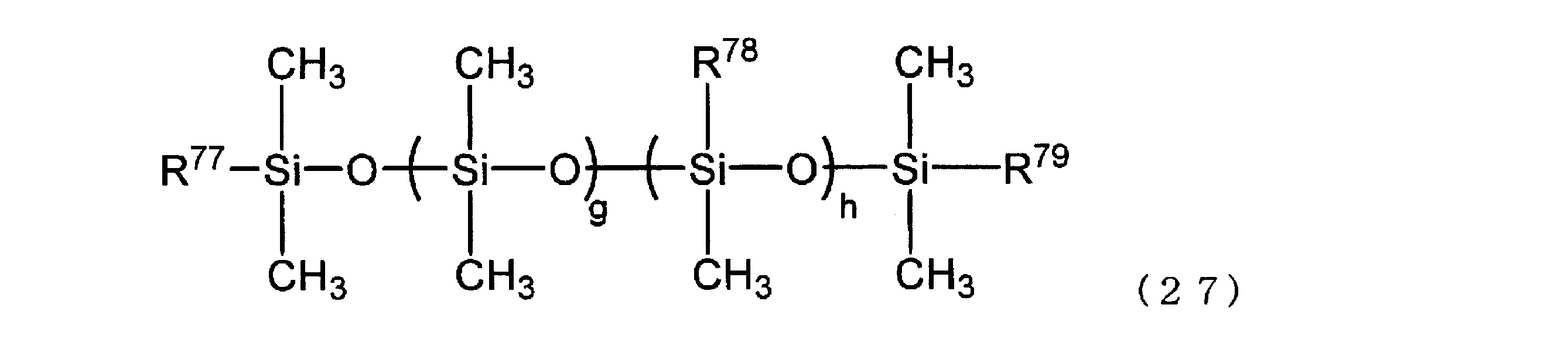
〔式(27)中、
R77~R79は、それぞれ独立して、水素原子、炭素数1~6のアルキル基、又は下記式(28)で表される基を示し、
gは、5~100の整数を示し、
hは、0~100の整数を示す。
但し、R77~R79のうち少なくとも1つは、下記式(28)で表される基である。〕
R77~R79は、それぞれ独立して、水素原子、炭素数1~6のアルキル基、又は下記式(28)で表される基を示し、
gは、5~100の整数を示し、
hは、0~100の整数を示す。
但し、R77~R79のうち少なくとも1つは、下記式(28)で表される基である。〕

〔式(28)中、
R80は、水素原子又は炭素数1~22のアルキル基を示し、
dは、1~100の整数を示す。〕
R80は、水素原子又は炭素数1~22のアルキル基を示し、
dは、1~100の整数を示す。〕
式(26)中のR69~R76で示される炭素数1~6のアルキル基、少なくとも1つのアミノ基を有するアルキル基、少なくとも1つのヒドロキシル基を有するアルキル基、少なくとも1つのエポキシ基を有するアルキル基、少なくとも1つのカルボキシ基を有するアルキル基における「アルキル基」は、R60~R65で示されるアルキル基と同様である。また、式(27)中のR77~R79で示される炭素数1~6のアルキル基も、R60~R65で示されるアルキル基と同様である。
式(26)中のR69~R76で示されるフッ化アルキル基は、R60~R65で示されるフッ化アルキル基と同様である。
式(26)中のR69~R76で示されるフッ化アルキル基は、R60~R65で示されるフッ化アルキル基と同様である。
式(28)中のR80で示される炭素数1~22のアルキル基は直鎖状でも分岐鎖状でもよく、具体的には、メチル基、エチル基、n-プロピル基、イソプロピル基、n-ブチル基、イソブチル基、sec-ブチル基、tert-ブチル基等が挙げられる。
なお、重合性官能基を有するシリコーン化合物e、非重合性シリコーン化合物hは、分子中に親水性部分構造を有していてもよい。このようにシリコーン化合物が親水性部分構造を有することにより、シリコーン化合物とポリマーbとの相溶性が向上し、得られるゲルやレンズの表面親水性を改善させることができる。上記親水性部分構造としては、例えば、ポリエチレングリコール、ポリプロピレングリコール、ポリビニルアルコール、ポリビニルピロリドン、ポリ(メタ)アクリル酸、ポリ(メタ)アクリル酸塩、ポリ(2-ヒドロキシエチル(メタ)アクリレート)、ポリテトラヒドロフラン、ポリオキセタン、ポリオキサゾリン、ポリアクリルアミド、ポリジメチルアクリルアミド、ポリジエチルアクリルアミド、ポリ(2-メタクリロイルオキシエチルホスホリルコリン)、これらのブロックポリマーに由来する部分構造などが挙げられる。この親水性部分構造はシリコーン化合物に対して、くし型状に結合していてもよいし、片末端又は両末端に結合していてもよい。この親水性部分構造の分子量は、表面親水性及び透明性の観点から、好ましくは100~1,000,000であり、より好ましくは1,000~500,000である。
シリコーン化合物gの含有量は、力学的強度、透明性、酸素透過性等の観点から、ゲル全量に対して、好ましくは0質量%以上、より好ましくは0.01質量%以上、更に好ましくは0.1質量%以上、特に好ましくは1質量%以上であり、また、親水性化性能、防汚性付与効果、潤滑性付与効果等の観点から、ゲル全量に対して、好ましくは70質量%以下、より好ましくは60質量%以下、更に好ましくは30質量%以下、特に好ましくは10質量%以下である。
<特性調節化合物>
なお、本発明のゲルは、特性調節化合物を含んでいてもよい。特性調節化合物としては、重合性官能基を有する特性調節化合物fの他に、2-(4,6-ジフェニル-1,3,5-トリアジン-2-イル)-5-(ヘキシルオキシ)フェノール、2-(5-クロロ-2H-ベンゾトリアゾール-2-イル)-6-(1,1-ジメチルエチル)-4-メチルフェノールなどの非重合性特性調節化合物(以下、非重合性特性調節化合物iとも称する)が挙げられる。
なお、本発明のゲルは、特性調節化合物を含んでいてもよい。特性調節化合物としては、重合性官能基を有する特性調節化合物fの他に、2-(4,6-ジフェニル-1,3,5-トリアジン-2-イル)-5-(ヘキシルオキシ)フェノール、2-(5-クロロ-2H-ベンゾトリアゾール-2-イル)-6-(1,1-ジメチルエチル)-4-メチルフェノールなどの非重合性特性調節化合物(以下、非重合性特性調節化合物iとも称する)が挙げられる。
そして、本発明のゲルは、表面親水性、潤滑性及び防汚性(特に脂質防汚性)に優れ、しかもこれら各特性の持続性も高い。また、ゲル強度、透明性、酸素透過性にも優れる。
したがって、本発明のゲルは、眼用レンズ材料をはじめとして、細胞や臓器などの培養基材、保存用容器の材料などとして有用である。特に、コンタクトレンズ材料として有用である。
ここで、本明細書において、眼用レンズは、ソフトコンタクトレンズ、ハードコンタクトレンズ等のコンタクトレンズの他、メガネ、眼内レンズ、人工角膜、角膜オンレイ、角膜インレイ等を含む概念であり、また、上記コンタクトレンズは、非含水性、低含水性、高含水性のいずれでもよいが、シリコーンハイドロゲルコンタクトレンズが好ましい。本発明のゲルを用いることにより、表面親水性、潤滑性及び防汚性(特に脂質防汚性)に優れるシリコーンハイドロゲルコンタクトレンズを提供することもできる。
したがって、本発明のゲルは、眼用レンズ材料をはじめとして、細胞や臓器などの培養基材、保存用容器の材料などとして有用である。特に、コンタクトレンズ材料として有用である。
ここで、本明細書において、眼用レンズは、ソフトコンタクトレンズ、ハードコンタクトレンズ等のコンタクトレンズの他、メガネ、眼内レンズ、人工角膜、角膜オンレイ、角膜インレイ等を含む概念であり、また、上記コンタクトレンズは、非含水性、低含水性、高含水性のいずれでもよいが、シリコーンハイドロゲルコンタクトレンズが好ましい。本発明のゲルを用いることにより、表面親水性、潤滑性及び防汚性(特に脂質防汚性)に優れるシリコーンハイドロゲルコンタクトレンズを提供することもできる。
〔レンズ〕
本発明のレンズは、本発明のゲルを含むことを特徴とするものである。レンズとしては、眼用レンズが好ましく、コンタクトレンズがより好ましい。
なお、レンズがフッ素含有陰イオンを含む場合において、レンズの水中での線膨潤係数(以下、係数(I)とも称する)は、フッ素含有陰イオンをフッ素非含有陰イオンに置換した場合のレンズの水中での線膨潤係数(以下、係数(II)とも称する)よりも小さいことが好ましい。また、係数(I)と係数(II)の差は、好ましくは0.005~0.1である。
これら係数をこのような範囲とすることによって、眼用レンズとした場合の装用感や柔軟性が改善され、また、眼疾患の発生を未然に予防しやすくなる。
本発明のレンズは、本発明のゲルを含むことを特徴とするものである。レンズとしては、眼用レンズが好ましく、コンタクトレンズがより好ましい。
なお、レンズがフッ素含有陰イオンを含む場合において、レンズの水中での線膨潤係数(以下、係数(I)とも称する)は、フッ素含有陰イオンをフッ素非含有陰イオンに置換した場合のレンズの水中での線膨潤係数(以下、係数(II)とも称する)よりも小さいことが好ましい。また、係数(I)と係数(II)の差は、好ましくは0.005~0.1である。
これら係数をこのような範囲とすることによって、眼用レンズとした場合の装用感や柔軟性が改善され、また、眼疾患の発生を未然に予防しやすくなる。
〔重合性組成物〕
本発明の重合性組成物は、重合体aと、親水性モノマーcと、架橋剤dとを含むことを特徴とするものである。本発明の重合性組成物を使用することにより、表面親水性、潤滑性及び防汚性に優れ、しかもこれら各特性の持続性も高いゲルを得ることができる。
本発明の重合性組成物は、重合体aと、親水性モノマーcと、架橋剤dとを含むことを特徴とするものである。本発明の重合性組成物を使用することにより、表面親水性、潤滑性及び防汚性に優れ、しかもこれら各特性の持続性も高いゲルを得ることができる。
重合体a(改質剤)の含有量は、親水性化性能、防汚性付与効果、潤滑性付与効果、透明性及び酸素透過性等の観点から、重合性組成物全量に対して、好ましくは0.01質量%以上、より好ましくは0.1質量%以上、更に好ましくは0.5質量%以上、特に好ましくは1質量%以上であり、また、透明性や適度な硬さとする観点から、重合性組成物全量に対して、好ましくは40質量%以下、より好ましくは30質量%以下、更に好ましくは20質量%以下、特に好ましくは10質量%以下である。
親水性モノマーcの含有量は、親水性化性能、安定性及び透明性等の観点から、重合性組成物全量に対して、好ましくは30質量%以上、より好ましくは40質量%以上であり、また、酸素透過性の観点から、重合性組成物全量に対して、好ましくは95質量%以下、より好ましくは90質量%以下、更に好ましくは80質量%以下である。
架橋剤dの含有量は、柔軟性の観点から、重合性組成物全量に対して、好ましくは0.05質量%以上、より好ましくは0.1質量%以上であり、また、ゲルやレンズの機械的強度及び耐久性の観点から、重合性組成物全量に対して、好ましくは10質量%以下、より好ましくは7質量%以下である。
親水性モノマーcの含有量は、親水性化性能、安定性及び透明性等の観点から、重合性組成物全量に対して、好ましくは30質量%以上、より好ましくは40質量%以上であり、また、酸素透過性の観点から、重合性組成物全量に対して、好ましくは95質量%以下、より好ましくは90質量%以下、更に好ましくは80質量%以下である。
架橋剤dの含有量は、柔軟性の観点から、重合性組成物全量に対して、好ましくは0.05質量%以上、より好ましくは0.1質量%以上であり、また、ゲルやレンズの機械的強度及び耐久性の観点から、重合性組成物全量に対して、好ましくは10質量%以下、より好ましくは7質量%以下である。
また、本発明の重合性組成物は、上記各成分に加えて、シリコーン化合物g、特性調節化合物を含んでいてもよい。シリコーン化合物gとしては、上記重合性官能基を有するシリコーン化合物e、非重合性シリコーン化合物hが挙げられ、特性調節化合物としては、重合性官能基を有する特性調節化合物f、非重合性特性調節化合物iが挙げられる。
シリコーン化合物gの含有量は、酸素透過性及び柔軟性の観点から、重合性組成物全量に対して、好ましくは0質量%以上、より好ましくは0.01質量%以上であり、また、親水性化性能及び透明性等の観点から、重合性組成物全量に対して、好ましくは70質量%以下、より好ましくは60質量%以下である。
また、重合性官能基を有する特性調節化合物fとして、アルキル(メタ)アクリレートやフッ素含有アルキル(メタ)アクリレートを使用する場合、これらの含有量は、重合性組成物全量に対して、0.01~20質量%が好ましく、0.1~10質量%がより好ましい。また、重合性官能基を有する特性調節化合物fとして、硬度調節モノマーを使用する場合、その含有量は、重合性組成物全量に対して、1~30質量%が好ましく、3~20質量%がより好ましい。また、重合性官能基を有する特性調節化合物fとして、重合性紫外線吸収剤、重合性色素及び重合性紫外線吸収色素を使用する場合、これらの含有量は、重合性組成物全量に対して、0.01~3質量%が好ましく、0.01~2質量%がより好ましい。
シリコーン化合物gの含有量は、酸素透過性及び柔軟性の観点から、重合性組成物全量に対して、好ましくは0質量%以上、より好ましくは0.01質量%以上であり、また、親水性化性能及び透明性等の観点から、重合性組成物全量に対して、好ましくは70質量%以下、より好ましくは60質量%以下である。
また、重合性官能基を有する特性調節化合物fとして、アルキル(メタ)アクリレートやフッ素含有アルキル(メタ)アクリレートを使用する場合、これらの含有量は、重合性組成物全量に対して、0.01~20質量%が好ましく、0.1~10質量%がより好ましい。また、重合性官能基を有する特性調節化合物fとして、硬度調節モノマーを使用する場合、その含有量は、重合性組成物全量に対して、1~30質量%が好ましく、3~20質量%がより好ましい。また、重合性官能基を有する特性調節化合物fとして、重合性紫外線吸収剤、重合性色素及び重合性紫外線吸収色素を使用する場合、これらの含有量は、重合性組成物全量に対して、0.01~3質量%が好ましく、0.01~2質量%がより好ましい。
〔ゲルの製造方法〕
本発明のポリマーを含むゲルの製造方法は、重合体aの存在下で親水性モノマーcを架橋剤dと共に重合してポリマーbとすることを特徴とするものである。このようにしてポリマーbを合成することにより、ポリマーbの相互網目構造間にゲル中の重合体a(改質剤)が抱え込まれるような状態となり、表面親水性、潤滑性及び防汚性が改善されたゲルが調製される。
本発明のポリマーを含むゲルの製造方法は、重合体aの存在下で親水性モノマーcを架橋剤dと共に重合してポリマーbとすることを特徴とするものである。このようにしてポリマーbを合成することにより、ポリマーbの相互網目構造間にゲル中の重合体a(改質剤)が抱え込まれるような状態となり、表面親水性、潤滑性及び防汚性が改善されたゲルが調製される。
以下、本発明のゲル及びレンズを製造する方法について具体的に説明する。
本発明のゲル及びレンズは、例えば、重合体a、親水性モノマーc及び架橋剤d、必要に応じてその他の上記各成分(シリコーン化合物gや特性調節化合物)を加えて調製した重合性組成物(本発明の重合性組成物)を、鋳型法にて加熱及び/又は紫外線照射し、共重合させ、次いで水に膨潤させることによって得ることができる。また、紫外線照射に代えて電子線照射による共重合を行うこともできる。
本発明のゲル及びレンズは、例えば、重合体a、親水性モノマーc及び架橋剤d、必要に応じてその他の上記各成分(シリコーン化合物gや特性調節化合物)を加えて調製した重合性組成物(本発明の重合性組成物)を、鋳型法にて加熱及び/又は紫外線照射し、共重合させ、次いで水に膨潤させることによって得ることができる。また、紫外線照射に代えて電子線照射による共重合を行うこともできる。
重合性組成物中の重合成分を加熱重合させる場合には、例えば、所望のレンズの形状に対応した鋳型内に、重合性組成物及びラジカル重合開始剤を加え、この鋳型を徐々に加熱して重合を行ない、得られたゲルの成形体に、必要に応じて切削加工、研磨加工などの機械的加工を施すことによって、レンズを製造することができる。機械的加工は、成形体の一方又は両方の面の全面にわたって行なってもよいし、成形体の一方又は両方の面の一部に対して行なってもよい。
また、重合方法としては、塊状重合法、溶液重合法が挙げられる。溶液重合する場合に用いられる溶媒としては、例えば、メタノール、エタノール、1-プロパノール、2-プロパノールなどの炭素数1~4のアルコール、アセトン、メチルエチルケトン、ジメチルホルムアミド、ジメチルスルホキシド、アセトニトリル、N-メチル-2-ピロリドン等の水溶性有機溶媒が挙げられる。これら溶媒の使用量としては、共重合反応の促進及び反応液における均一性維持の観点から、重合性組成物中の全重合成分100質量部に対して、0.1~50質量部が好ましく、0.5~15質量部がより好ましい。
また、ラジカル重合開始剤としては、例えば、2,2'-アゾビスイソブチロニトリル、2,2'-アゾビス(2,4-ジメチルバレロニトリル)、ベンゾイルパーオキサイド、t-ブチルハイドロパーオキサイド、クメンハイドロパーオキサイド、ラウロイルパーオキサイド、t-ブチルパーオキシヘキサノエート、3,5,5-トリメチルヘキサノイルパーオキサイドなどが挙げられる。これらラジカル重合開始剤は、1種を単独で又は2種以上を組み合わせて使用できる。
ラジカル重合開始剤の使用量としては、重合性組成物中の全重合成分100質量部に対して、0.001~2質量部が好ましく、0.01~1質量部がより好ましい。
また、加熱重合における加熱温度は、好ましくは50~150℃、より好ましくは60~140℃である。また、加熱時間は、好ましくは10~120分間、より好ましくは20~60分間である。鋳型内での加熱温度を50℃以上又は加熱時間を10分以上とすることによって、残留モノマー成分の低減を図ることが可能となる。一方、鋳型内での加熱温度を150℃以下又は加熱時間を120分間以下とすることによって、各重合成分の揮発を抑制すると共に、型の変形を防止することができる。
また、重合方法としては、塊状重合法、溶液重合法が挙げられる。溶液重合する場合に用いられる溶媒としては、例えば、メタノール、エタノール、1-プロパノール、2-プロパノールなどの炭素数1~4のアルコール、アセトン、メチルエチルケトン、ジメチルホルムアミド、ジメチルスルホキシド、アセトニトリル、N-メチル-2-ピロリドン等の水溶性有機溶媒が挙げられる。これら溶媒の使用量としては、共重合反応の促進及び反応液における均一性維持の観点から、重合性組成物中の全重合成分100質量部に対して、0.1~50質量部が好ましく、0.5~15質量部がより好ましい。
また、ラジカル重合開始剤としては、例えば、2,2'-アゾビスイソブチロニトリル、2,2'-アゾビス(2,4-ジメチルバレロニトリル)、ベンゾイルパーオキサイド、t-ブチルハイドロパーオキサイド、クメンハイドロパーオキサイド、ラウロイルパーオキサイド、t-ブチルパーオキシヘキサノエート、3,5,5-トリメチルヘキサノイルパーオキサイドなどが挙げられる。これらラジカル重合開始剤は、1種を単独で又は2種以上を組み合わせて使用できる。
ラジカル重合開始剤の使用量としては、重合性組成物中の全重合成分100質量部に対して、0.001~2質量部が好ましく、0.01~1質量部がより好ましい。
また、加熱重合における加熱温度は、好ましくは50~150℃、より好ましくは60~140℃である。また、加熱時間は、好ましくは10~120分間、より好ましくは20~60分間である。鋳型内での加熱温度を50℃以上又は加熱時間を10分以上とすることによって、残留モノマー成分の低減を図ることが可能となる。一方、鋳型内での加熱温度を150℃以下又は加熱時間を120分間以下とすることによって、各重合成分の揮発を抑制すると共に、型の変形を防止することができる。
重合性組成物中の重合成分を紫外線照射して重合させる場合には、例えば、所望のレンズの形状に対応した鋳型内に、重合性組成物及び光重合開始剤を加え、この鋳型に紫外線を照射して重合を行ない、得られたゲルの成形体に、必要に応じて切削加工、研磨加工などの機械的加工を施すことによって、レンズを製造することができる。機械的加工は、成形体の一方又は両方の面の全面にわたって行なってもよいし、成形体の一方又は両方の面の一部に対して行なってもよい。
また、重合方法としては、塊状重合法、溶液重合法が挙げられる。溶液重合する場合に用いられる溶媒としては、加熱重合で用いる溶媒と同様のものが挙げられる。
なお、紫外線照射による重合に用いられる鋳型の材質は、重合・硬化に必要な紫外線を透過しうる材質である限り特に限定されるものではなく、ポリプロピレン、ポリスチレン、ナイロン、ポリエステルなどの汎用樹脂が好ましい。また、ガラスであってもよい。これらの材料を成形、加工することによって、所望の形状を有する鋳型とすることができる。
また、光重合開始剤としては、例えば、2,4,6-トリメチルベンゾイル-ジフェニルホスフィンオキサイド(TPO)、ビス(2,4,6-トリメチルベンゾイル)-フェニルホスフィンオキサイドなどのホスフィンオキサイド系光重合開始剤;メチルオルソベンゾイルベンゾエート、メチルベンゾイルフォルメート、ベンゾインメチルエーテル、ベンゾインエチルエーテル、ベンゾインイソプロピルエーテル、ベンゾインイソブチルエーテル、ベンゾイン-n-ブチルエーテルなどのベンゾイン系光重合開始剤;2-ヒドロキシ-2-メチル-1-フェニルプロパン-1-オン、p-イソプロピル-α-ヒドロキシイソブチルフェノン、p-t-ブチルトリクロロアセトフェノン、2,2-ジメトキシ-2-フェニルアセトフェノン、α,α-ジクロロ-4-フェノキシアセトフェノン、N,N-テトラエチル-4,4-ジアミノベンゾフェノン、ベンゾフェノンアクリレート、ベンゾフェノンなどのフェノン系光重合開始剤;2-クロロチオキサンソン、2-メチルチオキサンソンなどのチオキサンソン系光重合開始剤;1-ヒドロキシシクロヘキシルフェニルケトン、1-フェニル-1,2-プロパンジオン-2-(o-エトキシカルボニル)オキシム、ジベンゾスバロン、2-エチルアンスラキノンなどのその他の光重合開始剤が挙げられる。これら光重合開始剤は、1種を単独で又は2種以上を組み合わせて使用できる。また、光重合開始剤と共に、光増感剤を用いてもよい。
これら光重合開始剤及び光増感剤の使用量は、重合性組成物中の全重合成分100質量部に対して、それぞれ、好ましくは0.001~2質量部、より好ましくは0.01~1質量部である。
また、重合方法としては、塊状重合法、溶液重合法が挙げられる。溶液重合する場合に用いられる溶媒としては、加熱重合で用いる溶媒と同様のものが挙げられる。
なお、紫外線照射による重合に用いられる鋳型の材質は、重合・硬化に必要な紫外線を透過しうる材質である限り特に限定されるものではなく、ポリプロピレン、ポリスチレン、ナイロン、ポリエステルなどの汎用樹脂が好ましい。また、ガラスであってもよい。これらの材料を成形、加工することによって、所望の形状を有する鋳型とすることができる。
また、光重合開始剤としては、例えば、2,4,6-トリメチルベンゾイル-ジフェニルホスフィンオキサイド(TPO)、ビス(2,4,6-トリメチルベンゾイル)-フェニルホスフィンオキサイドなどのホスフィンオキサイド系光重合開始剤;メチルオルソベンゾイルベンゾエート、メチルベンゾイルフォルメート、ベンゾインメチルエーテル、ベンゾインエチルエーテル、ベンゾインイソプロピルエーテル、ベンゾインイソブチルエーテル、ベンゾイン-n-ブチルエーテルなどのベンゾイン系光重合開始剤;2-ヒドロキシ-2-メチル-1-フェニルプロパン-1-オン、p-イソプロピル-α-ヒドロキシイソブチルフェノン、p-t-ブチルトリクロロアセトフェノン、2,2-ジメトキシ-2-フェニルアセトフェノン、α,α-ジクロロ-4-フェノキシアセトフェノン、N,N-テトラエチル-4,4-ジアミノベンゾフェノン、ベンゾフェノンアクリレート、ベンゾフェノンなどのフェノン系光重合開始剤;2-クロロチオキサンソン、2-メチルチオキサンソンなどのチオキサンソン系光重合開始剤;1-ヒドロキシシクロヘキシルフェニルケトン、1-フェニル-1,2-プロパンジオン-2-(o-エトキシカルボニル)オキシム、ジベンゾスバロン、2-エチルアンスラキノンなどのその他の光重合開始剤が挙げられる。これら光重合開始剤は、1種を単独で又は2種以上を組み合わせて使用できる。また、光重合開始剤と共に、光増感剤を用いてもよい。
これら光重合開始剤及び光増感剤の使用量は、重合性組成物中の全重合成分100質量部に対して、それぞれ、好ましくは0.001~2質量部、より好ましくは0.01~1質量部である。
また、照射する紫外線の波長域は、レンズ材料の機能や光重合開始剤の種類に応じて適宜選択すればよい。紫外線照度は、好ましくは1.0~50mW/cm2であり、紫外線照射量は、好ましくは0.1~10J/cm2である。また、紫外線の照射時間は1分間以上が好ましい。なお、異なる照度の紫外線を段階的に照射してもよく、また、紫外線の照射と同時に加熱を行ってもよい。
また、安定性や離型性を確保するために、必要に応じて、ヒンダードフェノール系又はホスファイト系酸化防止剤;シリコン系、脂肪酸エステル系、脂肪酸系、脂肪酸グリセリド系、又は蜜ろうなどの天然油脂系の滑剤や離型剤;ベンゾトリアゾール系、ベンゾフェノン系、ジベンゾイルメタン系又はサリチレート系の光安定剤;ポリアルキレングリコール、脂肪酸グリセリドなどの帯電防止剤などを、本発明の重合性組成物にあらかじめ適宜添加しておいてから、重合反応を行ってもよい。
上記にようにして得られたレンズは、水、生理食塩水、バッファー、有機溶剤、これらの混合溶剤などを使用して洗浄してもよい。具体的には、これら溶剤にレンズを浸漬し、これを繰り返すなどすればよい。
また、レンズには、低温プラズマ処理、大気圧プラズマ処理、コロナ放電処理などを施してもよい。低温プラズマ処理を施すことにより、表面親水性や防汚性を更に向上させることができる。
低温プラズマ処理は、炭素数1~6のアルカン、フッ素置換されたアルカン、窒素、酸素、アルゴン、水素、空気、水、シラン又はこれらの混合物などの希薄気体雰囲気下において行うことができる。特に、イオンエッチングによる物理的な表面改質効果とラジカルのインプランテーションによる化学的な表面改質効果が期待されるという理由から、酸素単独、又は酸素と、水、テトラフルオロメタン、有機シラン、メタン、窒素などとの混合物による希薄気体雰囲気下で低温プラズマ処理を行うことが好ましい。低温プラズマ処理は、減圧下で行ってもよいし、大気圧下で行ってもよい。低温プラズマ処理においては、高周波RF(例えば13.56MHz)、低周波AF(例えば15.0~40.0KHz)、マイクロ波(例えば2.45GHz)にて、出力、処理時間、ガス濃度を適宜調整することにより、表面改質効果を制御することができる。
また、レンズには、低温プラズマ処理、大気圧プラズマ処理、コロナ放電処理などを施してもよい。低温プラズマ処理を施すことにより、表面親水性や防汚性を更に向上させることができる。
低温プラズマ処理は、炭素数1~6のアルカン、フッ素置換されたアルカン、窒素、酸素、アルゴン、水素、空気、水、シラン又はこれらの混合物などの希薄気体雰囲気下において行うことができる。特に、イオンエッチングによる物理的な表面改質効果とラジカルのインプランテーションによる化学的な表面改質効果が期待されるという理由から、酸素単独、又は酸素と、水、テトラフルオロメタン、有機シラン、メタン、窒素などとの混合物による希薄気体雰囲気下で低温プラズマ処理を行うことが好ましい。低温プラズマ処理は、減圧下で行ってもよいし、大気圧下で行ってもよい。低温プラズマ処理においては、高周波RF(例えば13.56MHz)、低周波AF(例えば15.0~40.0KHz)、マイクロ波(例えば2.45GHz)にて、出力、処理時間、ガス濃度を適宜調整することにより、表面改質効果を制御することができる。
〔重合体及びコンタクトレンズ表面改質剤〕
本発明の重合体は、下記繰り返し単位(A):2.5~95質量%と下記繰り返し単位(B):2.5~95質量%とを有することを特徴とするものである。当該重合体は、上記重合体aであり、コンタクトレンズ表面改質用重合体、コンタクトレンズ表面改質剤として有用である。
(A)親水性繰り返し単位
(B)側鎖にポリオキシアルキレン基を有し、その側鎖の末端が炭素数5~30のアルキル基、炭素数5~30のアルカノイル基、又はアリール基で構成される繰り返し単位
また、本発明のコンタクトレンズ表面改質剤は、上記重合体aを含有することを特徴とするものである。
本発明の重合体は、下記繰り返し単位(A):2.5~95質量%と下記繰り返し単位(B):2.5~95質量%とを有することを特徴とするものである。当該重合体は、上記重合体aであり、コンタクトレンズ表面改質用重合体、コンタクトレンズ表面改質剤として有用である。
(A)親水性繰り返し単位
(B)側鎖にポリオキシアルキレン基を有し、その側鎖の末端が炭素数5~30のアルキル基、炭素数5~30のアルカノイル基、又はアリール基で構成される繰り返し単位
また、本発明のコンタクトレンズ表面改質剤は、上記重合体aを含有することを特徴とするものである。
以下、実施例を挙げて本発明を詳細に説明するが、本発明はこれら実施例に限定されるものではない。
実施例における各分析条件は以下に示すとおりである。
<分子量測定>
重量平均分子量(Mw)及び数平均分子量(Mn)は、東ソー社製 TSKgel α-Mカラムを用い、流量:0.5ミリリットル/分、溶出溶媒:NMP溶媒(H3PO4:0.016M、LiBr:0.030M)、カラム温度:40℃の分析条件で、ポリスチレンを標準とするゲルパーミエーションクロマトグラフィー(GPC)により測定した。
<NMRスペクトル>
1H-NMRスペクトルは、溶媒及び内部標準物質としてd6-DMSOを用いて、BRUKER製モデルAVANCE500(500MHz)により測定した。
<分子量測定>
重量平均分子量(Mw)及び数平均分子量(Mn)は、東ソー社製 TSKgel α-Mカラムを用い、流量:0.5ミリリットル/分、溶出溶媒:NMP溶媒(H3PO4:0.016M、LiBr:0.030M)、カラム温度:40℃の分析条件で、ポリスチレンを標準とするゲルパーミエーションクロマトグラフィー(GPC)により測定した。
<NMRスペクトル>
1H-NMRスペクトルは、溶媒及び内部標準物質としてd6-DMSOを用いて、BRUKER製モデルAVANCE500(500MHz)により測定した。
合成例1 共重合体(N-1)の合成
メトキシポリエチレングリコール(9)モノメタクリレート(M-90G(新中村化学社製)、以下、MPEGMと称する)0.9gと、ラウロキシポリエチレングリコール(30)モノメタクリレート(PLE-1300(日油社製)、以下、LPEGMと称する)1.85gと、重合開始剤として2,2'-アゾビス(イソブチロニトリル)0.03gと、溶媒としてエクアミドB-100(出光興産社製)12gとを混合しフラスコに入れた。これに窒素を吹き込み、70℃まで昇温し、8時間重合させ、その後室温に冷却した。得られた溶液を純水で透析することで、共重合体(N-1)の分散液を得た。
得られた共重合体(N-1)において、MPEGM由来の繰り返し単位の含有量は35質量%であり、LPEGM由来の繰り返し単位の含有量は65質量%であった。なお、これら含有量は1H-NMRにより測定した。
また、得られた共重合体(N-1)の重量平均分子量は111000であり、数平均分子量は23300であり、分子量分布は4.8であった。
メトキシポリエチレングリコール(9)モノメタクリレート(M-90G(新中村化学社製)、以下、MPEGMと称する)0.9gと、ラウロキシポリエチレングリコール(30)モノメタクリレート(PLE-1300(日油社製)、以下、LPEGMと称する)1.85gと、重合開始剤として2,2'-アゾビス(イソブチロニトリル)0.03gと、溶媒としてエクアミドB-100(出光興産社製)12gとを混合しフラスコに入れた。これに窒素を吹き込み、70℃まで昇温し、8時間重合させ、その後室温に冷却した。得られた溶液を純水で透析することで、共重合体(N-1)の分散液を得た。
得られた共重合体(N-1)において、MPEGM由来の繰り返し単位の含有量は35質量%であり、LPEGM由来の繰り返し単位の含有量は65質量%であった。なお、これら含有量は1H-NMRにより測定した。
また、得られた共重合体(N-1)の重量平均分子量は111000であり、数平均分子量は23300であり、分子量分布は4.8であった。
合成例2 共重合体(N-2)の合成
MPEGM1.20gと、LPEGM1.50gと、アクリル酸2-エチルヘキシル(東京化成社製)0.30gと、重合開始剤として2,2'-アゾビス(イソブチロニトリル)0.03gと、溶媒としてエクアミドB-100(出光興産社製)12gとを混合しフラスコに入れた。これに窒素を吹き込み、70℃まで昇温し、8時間重合させ、その後室温に冷却した。得られた溶液を純水で透析することで、共重合体(N-2)の分散液を得た。
得られた共重合体(N-2)において、MPEGM由来の繰り返し単位の含有量は40質量%であり、LPEGM由来の繰り返し単位の含有量は50質量%であり、アクリル酸2-エチルヘキシル由来の繰り返し単位の含有量は10質量%であった。なお、これら含有量は1H-NMRにより測定した。
また、得られた共重合体(N-2)の重量平均分子量は118000であり、数平均分子量は33800であり、分子量分布は3.5であった。
MPEGM1.20gと、LPEGM1.50gと、アクリル酸2-エチルヘキシル(東京化成社製)0.30gと、重合開始剤として2,2'-アゾビス(イソブチロニトリル)0.03gと、溶媒としてエクアミドB-100(出光興産社製)12gとを混合しフラスコに入れた。これに窒素を吹き込み、70℃まで昇温し、8時間重合させ、その後室温に冷却した。得られた溶液を純水で透析することで、共重合体(N-2)の分散液を得た。
得られた共重合体(N-2)において、MPEGM由来の繰り返し単位の含有量は40質量%であり、LPEGM由来の繰り返し単位の含有量は50質量%であり、アクリル酸2-エチルヘキシル由来の繰り返し単位の含有量は10質量%であった。なお、これら含有量は1H-NMRにより測定した。
また、得られた共重合体(N-2)の重量平均分子量は118000であり、数平均分子量は33800であり、分子量分布は3.5であった。
合成例3 共重合体(N-3)の合成
MPEGM2.03gと、LPEGM0.83gと、下記式(X)で示されるシリコーンメタクリレート(東京化成社製)0.14gと、重合開始剤として2,2'-アゾビス(イソブチロニトリル)0.03gと、溶媒としてエクアミドB-100(出光興産社製)12gとを混合しフラスコに入れた。これに窒素を吹き込み、70℃まで昇温し、8時間重合させ、その後室温に冷却した。得られた溶液を純水で透析することで、共重合体(N-3)の分散液を得た。
得られた共重合体(N-3)において、MPEGM由来の繰り返し単位の含有量は67.5質量%であり、LPEGM由来の繰り返し単位の含有量は27.5質量%であり、シリコーンメタクリレート(X)由来の繰り返し単位の含有量は5質量%であった。なお、これら含有量は1H-NMRにより測定した。
また、得られた共重合体(N-3)の重量平均分子量は133000であり、数平均分子量は39400であり、分子量分布は3.4であった。
MPEGM2.03gと、LPEGM0.83gと、下記式(X)で示されるシリコーンメタクリレート(東京化成社製)0.14gと、重合開始剤として2,2'-アゾビス(イソブチロニトリル)0.03gと、溶媒としてエクアミドB-100(出光興産社製)12gとを混合しフラスコに入れた。これに窒素を吹き込み、70℃まで昇温し、8時間重合させ、その後室温に冷却した。得られた溶液を純水で透析することで、共重合体(N-3)の分散液を得た。
得られた共重合体(N-3)において、MPEGM由来の繰り返し単位の含有量は67.5質量%であり、LPEGM由来の繰り返し単位の含有量は27.5質量%であり、シリコーンメタクリレート(X)由来の繰り返し単位の含有量は5質量%であった。なお、これら含有量は1H-NMRにより測定した。
また、得られた共重合体(N-3)の重量平均分子量は133000であり、数平均分子量は39400であり、分子量分布は3.4であった。
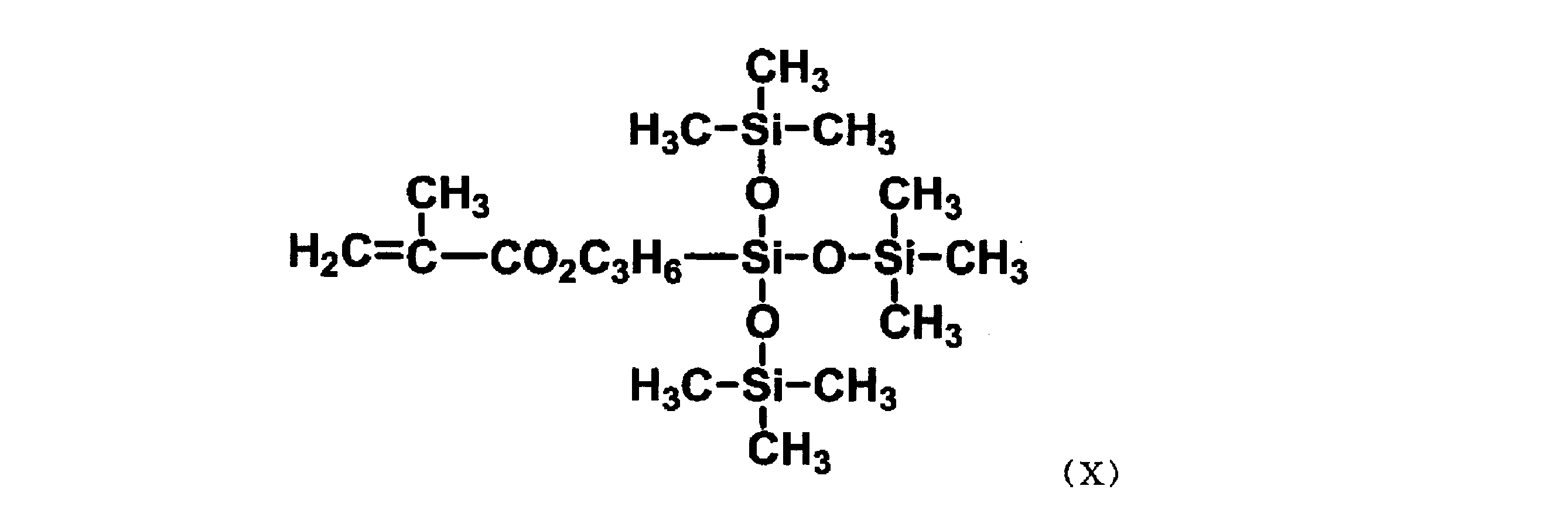
合成例4 共重合体(N-4)の合成
ジメチルアクリルアミド((興人社製)以下、DMAAと称する)4.25gと、N-メタクリロイルオキシエチル-N,N-ジメチルアンモニウム-α-N-メチルカルボキシベタイン(GLBT(大阪有機化学工業社製)以下、GLBTと称する)0.125gと、LPEGM0.50gと、N-ドデシルアクリルアミド((東京化成社製)以下、DDAAと称する)0.125gと、重合開始剤として2,2'-アゾビス(イソブチロニトリル)0.05gと、溶媒としてアセトニトリル(三菱レーヨン社製)31.05gと純水13.50gを混合しフラスコに入れた。これに窒素を吹き込み、60℃まで昇温し、6時間重合させ、その後室温に冷却した。得られた溶液を純水で透析することで、共重合体(N-4)の水溶液を得た。
得られた共重合体(N-4)において、DMAA由来の繰り返し単位の含有量は85質量%であり、GLBT由来の繰り返し単位の含有量は2.5質量%であり、LPEGM由来の繰り返し単位の含有量は10質量%であり、DDAA由来の繰り返し単位の含有量は2.5質量%であった。なお、これら含有量は1H-NMRにより測定した。
また、得られた共重合体(N-4)の重量平均分子量は515000であり、数平均分子量は128000であり、分子量分布は4.2であった。
ジメチルアクリルアミド((興人社製)以下、DMAAと称する)4.25gと、N-メタクリロイルオキシエチル-N,N-ジメチルアンモニウム-α-N-メチルカルボキシベタイン(GLBT(大阪有機化学工業社製)以下、GLBTと称する)0.125gと、LPEGM0.50gと、N-ドデシルアクリルアミド((東京化成社製)以下、DDAAと称する)0.125gと、重合開始剤として2,2'-アゾビス(イソブチロニトリル)0.05gと、溶媒としてアセトニトリル(三菱レーヨン社製)31.05gと純水13.50gを混合しフラスコに入れた。これに窒素を吹き込み、60℃まで昇温し、6時間重合させ、その後室温に冷却した。得られた溶液を純水で透析することで、共重合体(N-4)の水溶液を得た。
得られた共重合体(N-4)において、DMAA由来の繰り返し単位の含有量は85質量%であり、GLBT由来の繰り返し単位の含有量は2.5質量%であり、LPEGM由来の繰り返し単位の含有量は10質量%であり、DDAA由来の繰り返し単位の含有量は2.5質量%であった。なお、これら含有量は1H-NMRにより測定した。
また、得られた共重合体(N-4)の重量平均分子量は515000であり、数平均分子量は128000であり、分子量分布は4.2であった。
合成例5 共重合体(N-5)の合成
N-(2-ヒドロキシエチル)アクリルアミド((興人社製)以下、HEAAと称する)4.00gと、LPEGM5.00gと、DDAA1.00gと、重合開始剤として2,2'-アゾビス(イソブチロニトリル)0.10gと、溶媒としてイソプロパノール(トクヤマ社製)39.10gを混合しフラスコに入れた。これに窒素を吹き込み、60℃まで昇温し、6時間重合させ、その後室温に冷却した。得られた溶液を純水で透析することで、共重合体(N-5)の水溶液を得た。
得られた共重合体(N-5)において、HEAA由来の繰り返し単位の含有量は40質量%であり、LPEGM由来の繰り返し単位の含有量は50質量%であり、DDAA由来の繰り返し単位の含有量は10質量%であった。なお、これら含有量は1H-NMRにより測定した。
また、得られた共重合体(N-5)の重量平均分子量は32000であり、数平均分子量は16000であり、分子量分布は2.0であった。
N-(2-ヒドロキシエチル)アクリルアミド((興人社製)以下、HEAAと称する)4.00gと、LPEGM5.00gと、DDAA1.00gと、重合開始剤として2,2'-アゾビス(イソブチロニトリル)0.10gと、溶媒としてイソプロパノール(トクヤマ社製)39.10gを混合しフラスコに入れた。これに窒素を吹き込み、60℃まで昇温し、6時間重合させ、その後室温に冷却した。得られた溶液を純水で透析することで、共重合体(N-5)の水溶液を得た。
得られた共重合体(N-5)において、HEAA由来の繰り返し単位の含有量は40質量%であり、LPEGM由来の繰り返し単位の含有量は50質量%であり、DDAA由来の繰り返し単位の含有量は10質量%であった。なお、これら含有量は1H-NMRにより測定した。
また、得られた共重合体(N-5)の重量平均分子量は32000であり、数平均分子量は16000であり、分子量分布は2.0であった。
合成例6 共重合体(N-6)の合成
DMAA1.38gと、アクリル酸((東亞合成社製)以下、AAと称する)0.125gと、LPEGM2.75gと、DDAA0.75gと、重合開始剤として2,2'-アゾビス(イソブチロニトリル)0.05gと、溶媒としてアセトニトリル(三菱レーヨン社製)31.05gと純水13.50gを混合しフラスコに入れた。これに窒素を吹き込み、60℃まで昇温し、6時間重合させ、その後室温に冷却した。得られた溶液に炭酸水素ナトリウム0.153gを加えた後、純水で透析することで、共重合体(N-6)の分散液を得た。
得られた共重合体(N-6)において、DMAA由来の繰り返し単位の含有量は27.5質量%であり、AA由来の繰り返し単位の含有量は2.5質量%であり、LPEGM由来の繰り返し単位の含有量は55質量%であり、DDAA由来の繰り返し単位の含有量は15質量%であった。なお、これら含有量は1H-NMRにより測定した。
また、得られた共重合体(N-6)の重量平均分子量は430000であり、数平均分子量は108000であり、分子量分布は4.0であった。
DMAA1.38gと、アクリル酸((東亞合成社製)以下、AAと称する)0.125gと、LPEGM2.75gと、DDAA0.75gと、重合開始剤として2,2'-アゾビス(イソブチロニトリル)0.05gと、溶媒としてアセトニトリル(三菱レーヨン社製)31.05gと純水13.50gを混合しフラスコに入れた。これに窒素を吹き込み、60℃まで昇温し、6時間重合させ、その後室温に冷却した。得られた溶液に炭酸水素ナトリウム0.153gを加えた後、純水で透析することで、共重合体(N-6)の分散液を得た。
得られた共重合体(N-6)において、DMAA由来の繰り返し単位の含有量は27.5質量%であり、AA由来の繰り返し単位の含有量は2.5質量%であり、LPEGM由来の繰り返し単位の含有量は55質量%であり、DDAA由来の繰り返し単位の含有量は15質量%であった。なお、これら含有量は1H-NMRにより測定した。
また、得られた共重合体(N-6)の重量平均分子量は430000であり、数平均分子量は108000であり、分子量分布は4.0であった。
合成例7 共重合体(N-7)の合成
MPEGM10.0gと、LPEGM25.0gと、上記式(X)で示されるシリコーンメタクリレート(東京化成社製)15.0gと、重合開始剤として2,2'-アゾビス(イソブチロニトリル)0.25gと、溶媒としてアセトニトリル200gとを混合しフラスコに入れた。これに窒素を吹き込み、70℃まで昇温し、8時間重合させ、その後室温に冷却した。得られた溶液を純水で透析することで、共重合体(N-7)の分散液を得た。
得られた共重合体(N-7)において、MPEGM由来の繰り返し単位の含有量は20質量%であり、LPEGM由来の繰り返し単位の含有量は50質量%であり、シリコーンメタクリレート(X)由来の繰り返し単位の含有量は30質量%であった。なお、これら含有量は1H-NMRにより測定した。
また、得られた共重合体(N-7)の重量平均分子量は91000であり、数平均分子量は50500であり、分子量分布は1.8であった。
MPEGM10.0gと、LPEGM25.0gと、上記式(X)で示されるシリコーンメタクリレート(東京化成社製)15.0gと、重合開始剤として2,2'-アゾビス(イソブチロニトリル)0.25gと、溶媒としてアセトニトリル200gとを混合しフラスコに入れた。これに窒素を吹き込み、70℃まで昇温し、8時間重合させ、その後室温に冷却した。得られた溶液を純水で透析することで、共重合体(N-7)の分散液を得た。
得られた共重合体(N-7)において、MPEGM由来の繰り返し単位の含有量は20質量%であり、LPEGM由来の繰り返し単位の含有量は50質量%であり、シリコーンメタクリレート(X)由来の繰り返し単位の含有量は30質量%であった。なお、これら含有量は1H-NMRにより測定した。
また、得られた共重合体(N-7)の重量平均分子量は91000であり、数平均分子量は50500であり、分子量分布は1.8であった。
合成例8 共重合体(N-8)の合成
HEAA2.0gと、LPEGM5.0gと、上記式(X)で示されるシリコーンメタクリレート(東京化成社製)3.0gと、重合開始剤として2,2'-アゾビス(イソブチロニトリル)0.07gと、溶媒としてエタノール39.93gとを混合しフラスコに入れた。これに窒素を吹き込み、70℃まで昇温し、8時間重合させ、その後室温に冷却した。得られた溶液を純水で透析することで、共重合体(N-8)の分散液を得た。
得られた共重合体(N-8)において、HEAA由来の繰り返し単位の含有量は20質量%であり、LPEGM由来の繰り返し単位の含有量は50質量%であり、シリコーンメタクリレート(X)由来の繰り返し単位の含有量は30質量%であった。なお、これら含有量は1H-NMRにより測定した。
また、得られた共重合体(N-8)の重量平均分子量は48000であり、数平均分子量は15000であり、分子量分布は3.2であった。
HEAA2.0gと、LPEGM5.0gと、上記式(X)で示されるシリコーンメタクリレート(東京化成社製)3.0gと、重合開始剤として2,2'-アゾビス(イソブチロニトリル)0.07gと、溶媒としてエタノール39.93gとを混合しフラスコに入れた。これに窒素を吹き込み、70℃まで昇温し、8時間重合させ、その後室温に冷却した。得られた溶液を純水で透析することで、共重合体(N-8)の分散液を得た。
得られた共重合体(N-8)において、HEAA由来の繰り返し単位の含有量は20質量%であり、LPEGM由来の繰り返し単位の含有量は50質量%であり、シリコーンメタクリレート(X)由来の繰り返し単位の含有量は30質量%であった。なお、これら含有量は1H-NMRにより測定した。
また、得られた共重合体(N-8)の重量平均分子量は48000であり、数平均分子量は15000であり、分子量分布は3.2であった。
合成例9 共重合体(N-9)の合成
DMAA2.25gと、GLBT0.125gと、LPEGM2.50gと、DDAA0.125gと、重合開始剤として2,2'-アゾビス(イソブチロニトリル)0.5gと、溶媒としてアセトニトリル(三菱レーヨン社製)31.05gと純水13.50gを混合しフラスコに入れた。これに窒素を吹き込み、60℃まで昇温し、6時間重合させ、その後室温に冷却した。得られた溶液を純水で透析することで、共重合体(N-9)の水溶液を得た。
得られた共重合体(N-9)において、DMAA由来の繰り返し単位の含有量は45質量%であり、GLBT由来の繰り返し単位の含有量は2.5質量%であり、LPEGM由来の繰り返し単位の含有量は50質量%であり、DDAA由来の繰り返し単位の含有量は2.5質量%であった。なお、これら含有量は1H-NMRにより測定した。
また、得られた共重合体(N-9)の重量平均分子量は47000であり、数平均分子量は11500であり、分子量分布は4.1であった。
DMAA2.25gと、GLBT0.125gと、LPEGM2.50gと、DDAA0.125gと、重合開始剤として2,2'-アゾビス(イソブチロニトリル)0.5gと、溶媒としてアセトニトリル(三菱レーヨン社製)31.05gと純水13.50gを混合しフラスコに入れた。これに窒素を吹き込み、60℃まで昇温し、6時間重合させ、その後室温に冷却した。得られた溶液を純水で透析することで、共重合体(N-9)の水溶液を得た。
得られた共重合体(N-9)において、DMAA由来の繰り返し単位の含有量は45質量%であり、GLBT由来の繰り返し単位の含有量は2.5質量%であり、LPEGM由来の繰り返し単位の含有量は50質量%であり、DDAA由来の繰り返し単位の含有量は2.5質量%であった。なお、これら含有量は1H-NMRにより測定した。
また、得られた共重合体(N-9)の重量平均分子量は47000であり、数平均分子量は11500であり、分子量分布は4.1であった。
合成例10 共重合体(N-10)の合成
DMAA0.25gと、GLBT0.125gと、LPEGM4.50gと、DDAA0.125gと、重合開始剤として2,2'-アゾビス(イソブチロニトリル)0.5gと、溶媒としてアセトニトリル(三菱レーヨン社製)31.05gと純水13.50gを混合しフラスコに入れた。これに窒素を吹き込み、60℃まで昇温し、6時間重合させ、その後室温に冷却した。得られた溶液を純水で透析することで、共重合体(N-10)の分散液を得た。
得られた共重合体(N-10)において、DMAA由来の繰り返し単位の含有量は5質量%であり、GLBT由来の繰り返し単位の含有量は2.5質量%であり、LPEGM由来の繰り返し単位の含有量は90質量%であり、DDAA由来の繰り返し単位の含有量は2.5質量%であった。なお、これら含有量は1H-NMRにより測定した。
また、得られた共重合体(N-10)の重量平均分子量は35000であり、数平均分子量は10400であり、分子量分布は3.4であった。
DMAA0.25gと、GLBT0.125gと、LPEGM4.50gと、DDAA0.125gと、重合開始剤として2,2'-アゾビス(イソブチロニトリル)0.5gと、溶媒としてアセトニトリル(三菱レーヨン社製)31.05gと純水13.50gを混合しフラスコに入れた。これに窒素を吹き込み、60℃まで昇温し、6時間重合させ、その後室温に冷却した。得られた溶液を純水で透析することで、共重合体(N-10)の分散液を得た。
得られた共重合体(N-10)において、DMAA由来の繰り返し単位の含有量は5質量%であり、GLBT由来の繰り返し単位の含有量は2.5質量%であり、LPEGM由来の繰り返し単位の含有量は90質量%であり、DDAA由来の繰り返し単位の含有量は2.5質量%であった。なお、これら含有量は1H-NMRにより測定した。
また、得られた共重合体(N-10)の重量平均分子量は35000であり、数平均分子量は10400であり、分子量分布は3.4であった。
合成例11 共重合体(N-11)の合成
MPEGM15.0gと、LPEGM30.0gと、上記式(X)で示されるシリコーンメタクリレート(東京化成社製)5.0gと、重合開始剤として2,2'-アゾビス(イソブチロニトリル)0.5gと、溶媒としてアセトニトリル200gとを混合しフラスコに入れた。これに窒素を吹き込み、70℃まで昇温し、8時間重合させ、その後室温に冷却した。得られた溶液を純水で透析することで、共重合体(N-11)の水溶液を得た。
得られた共重合体(N-11)において、MPEGM由来の繰り返し単位の含有量は30質量%であり、LPEGM由来の繰り返し単位の含有量は60質量%であり、シリコーンメタクリレート(X)由来の繰り返し単位の含有量は10質量%であった。なお、これら含有量は1H-NMRにより測定した。
また、得られた共重合体(N-11)の重量平均分子量は50000であり、数平均分子量は26000であり、分子量分布は1.9であった。
MPEGM15.0gと、LPEGM30.0gと、上記式(X)で示されるシリコーンメタクリレート(東京化成社製)5.0gと、重合開始剤として2,2'-アゾビス(イソブチロニトリル)0.5gと、溶媒としてアセトニトリル200gとを混合しフラスコに入れた。これに窒素を吹き込み、70℃まで昇温し、8時間重合させ、その後室温に冷却した。得られた溶液を純水で透析することで、共重合体(N-11)の水溶液を得た。
得られた共重合体(N-11)において、MPEGM由来の繰り返し単位の含有量は30質量%であり、LPEGM由来の繰り返し単位の含有量は60質量%であり、シリコーンメタクリレート(X)由来の繰り返し単位の含有量は10質量%であった。なお、これら含有量は1H-NMRにより測定した。
また、得られた共重合体(N-11)の重量平均分子量は50000であり、数平均分子量は26000であり、分子量分布は1.9であった。
合成例12 共重合体(N-12)の合成
MPEGM5.0gと、LPEGM20.0gと、上記式(X)で示されるシリコーンメタクリレート(東京化成社製)25.0gと、重合開始剤として2,2'-アゾビス(イソブチロニトリル)0.5gと、溶媒としてアセトニトリル200gとを混合しフラスコに入れた。これに窒素を吹き込み、70℃まで昇温し、8時間重合させ、その後室温に冷却した。得られた溶液を純水で透析することで、共重合体(N-12)の分散液を得た。
得られた共重合体(N-12)において、MPEGM由来の繰り返し単位の含有量は10質量%であり、LPEGM由来の繰り返し単位の含有量は40質量%であり、シリコーンメタクリレート(X)由来の繰り返し単位の含有量は50質量%であった。なお、これら含有量は1H-NMRにより測定した。
また、得られた共重合体(N-12)の重量平均分子量は43000であり、数平均分子量は20000であり、分子量分布は2.2であった。
MPEGM5.0gと、LPEGM20.0gと、上記式(X)で示されるシリコーンメタクリレート(東京化成社製)25.0gと、重合開始剤として2,2'-アゾビス(イソブチロニトリル)0.5gと、溶媒としてアセトニトリル200gとを混合しフラスコに入れた。これに窒素を吹き込み、70℃まで昇温し、8時間重合させ、その後室温に冷却した。得られた溶液を純水で透析することで、共重合体(N-12)の分散液を得た。
得られた共重合体(N-12)において、MPEGM由来の繰り返し単位の含有量は10質量%であり、LPEGM由来の繰り返し単位の含有量は40質量%であり、シリコーンメタクリレート(X)由来の繰り返し単位の含有量は50質量%であった。なお、これら含有量は1H-NMRにより測定した。
また、得られた共重合体(N-12)の重量平均分子量は43000であり、数平均分子量は20000であり、分子量分布は2.2であった。
合成例13 共重合体(N-13)の合成
HEAA3.0gと、LPEGM6.0gと、上記式(X)で示されるシリコーンメタクリレート(東京化成社製)1.0gと、重合開始剤として2,2'-アゾビス(イソブチロニトリル)0.07gと、溶媒としてエタノール39.93gとを混合しフラスコに入れた。これに窒素を吹き込み、70℃まで昇温し、8時間重合させ、その後室温に冷却した。得られた溶液を純水で透析することで、共重合体(N-13)の水溶液を得た。
得られた共重合体(N-13)において、HEAA由来の繰り返し単位の含有量は30質量%であり、LPEGM由来の繰り返し単位の含有量は60質量%であり、シリコーンメタクリレート(X)由来の繰り返し単位の含有量は10質量%であった。なお、これら含有量は1H-NMRにより測定した。
また、得られた共重合体(N-13)の重量平均分子量は45000であり、数平均分子量は15000であり、分子量分布は3.0であった。
HEAA3.0gと、LPEGM6.0gと、上記式(X)で示されるシリコーンメタクリレート(東京化成社製)1.0gと、重合開始剤として2,2'-アゾビス(イソブチロニトリル)0.07gと、溶媒としてエタノール39.93gとを混合しフラスコに入れた。これに窒素を吹き込み、70℃まで昇温し、8時間重合させ、その後室温に冷却した。得られた溶液を純水で透析することで、共重合体(N-13)の水溶液を得た。
得られた共重合体(N-13)において、HEAA由来の繰り返し単位の含有量は30質量%であり、LPEGM由来の繰り返し単位の含有量は60質量%であり、シリコーンメタクリレート(X)由来の繰り返し単位の含有量は10質量%であった。なお、これら含有量は1H-NMRにより測定した。
また、得られた共重合体(N-13)の重量平均分子量は45000であり、数平均分子量は15000であり、分子量分布は3.0であった。
合成例14 共重合体(N-14)の合成
HEAA1.0gと、LPEGM4.0gと、上記式(X)で示されるシリコーンメタクリレート(東京化成社製)5.0gと、重合開始剤として2,2'-アゾビス(イソブチロニトリル)0.07gと、溶媒としてエタノール39.93gとを混合しフラスコに入れた。これに窒素を吹き込み、70℃まで昇温し、8時間重合させ、その後室温に冷却した。得られた溶液を純水で透析することで、共重合体(N-14)の分散液を得た。
得られた共重合体(N-14)において、HEAA由来の繰り返し単位の含有量は10質量%であり、LPEGM由来の繰り返し単位の含有量は40質量%であり、シリコーンメタクリレート(X)由来の繰り返し単位の含有量は50質量%であった。なお、これら含有量は1H-NMRにより測定した。
また、得られた共重合体(N-14)の重量平均分子量は48300であり、数平均分子量は13200であり、分子量分布は3.7であった。
HEAA1.0gと、LPEGM4.0gと、上記式(X)で示されるシリコーンメタクリレート(東京化成社製)5.0gと、重合開始剤として2,2'-アゾビス(イソブチロニトリル)0.07gと、溶媒としてエタノール39.93gとを混合しフラスコに入れた。これに窒素を吹き込み、70℃まで昇温し、8時間重合させ、その後室温に冷却した。得られた溶液を純水で透析することで、共重合体(N-14)の分散液を得た。
得られた共重合体(N-14)において、HEAA由来の繰り返し単位の含有量は10質量%であり、LPEGM由来の繰り返し単位の含有量は40質量%であり、シリコーンメタクリレート(X)由来の繰り返し単位の含有量は50質量%であった。なお、これら含有量は1H-NMRにより測定した。
また、得られた共重合体(N-14)の重量平均分子量は48300であり、数平均分子量は13200であり、分子量分布は3.7であった。
参考例1 共重合体(N-15)の合成
MPEGM2.85gと、アクリル酸2-エチルヘキシル(東京化成社製)0.15gと、重合開始剤として2,2'-アゾビス(イソブチロニトリル)0.03gと、溶媒としてエクアミドB-100(出光興産社製)12gとを混合しフラスコに入れた。これに窒素を吹き込み、70℃まで昇温し、8時間重合させ、その後室温に冷却した。得られた溶液を純水で透析することで、共重合体(N-15)の水溶液を得た。
得られた共重合体(N-15)において、MPEGM由来の繰り返し単位の含有量は95質量%であり、アクリル酸2-エチルヘキシル由来の繰り返し単位の含有量は5質量%であった。なお、これら含有量は1H-NMRにより測定した。
また、得られた共重合体(N-15)の重量平均分子量は115000であり、数平均分子量は26800であり、分子量分布は4.3であった。
MPEGM2.85gと、アクリル酸2-エチルヘキシル(東京化成社製)0.15gと、重合開始剤として2,2'-アゾビス(イソブチロニトリル)0.03gと、溶媒としてエクアミドB-100(出光興産社製)12gとを混合しフラスコに入れた。これに窒素を吹き込み、70℃まで昇温し、8時間重合させ、その後室温に冷却した。得られた溶液を純水で透析することで、共重合体(N-15)の水溶液を得た。
得られた共重合体(N-15)において、MPEGM由来の繰り返し単位の含有量は95質量%であり、アクリル酸2-エチルヘキシル由来の繰り返し単位の含有量は5質量%であった。なお、これら含有量は1H-NMRにより測定した。
また、得られた共重合体(N-15)の重量平均分子量は115000であり、数平均分子量は26800であり、分子量分布は4.3であった。
参考例2 共重合体(N-16)の合成
DMAA2.40gと、アクリル酸2-エチルヘキシル(東京化成社製)0.60gと、重合開始剤として2,2'-アゾビス(イソブチロニトリル)0.03gと、溶媒としてエクアミドB-100(出光興産社製)12gとを混合しフラスコに入れた。これに窒素を吹き込み、70℃まで昇温し、8時間重合させ、その後室温に冷却した。得られた溶液を純水で透析することで、共重合体(N-16)の水溶液を得た。
得られた共重合体(N-16)において、DMAA由来の繰り返し単位の含有量は80質量%であり、アクリル酸2-エチルヘキシル由来の繰り返し単位の含有量は20質量%であった。なお、これら含有量は1H-NMRにより測定した。
また、得られた共重合体(N-16)の重量平均分子量は49000であり、数平均分子量は14300であり、分子量分布は3.4であった。
共重合体(N-1)~(N-16)の性状等を以下の表1及び2に示す。
DMAA2.40gと、アクリル酸2-エチルヘキシル(東京化成社製)0.60gと、重合開始剤として2,2'-アゾビス(イソブチロニトリル)0.03gと、溶媒としてエクアミドB-100(出光興産社製)12gとを混合しフラスコに入れた。これに窒素を吹き込み、70℃まで昇温し、8時間重合させ、その後室温に冷却した。得られた溶液を純水で透析することで、共重合体(N-16)の水溶液を得た。
得られた共重合体(N-16)において、DMAA由来の繰り返し単位の含有量は80質量%であり、アクリル酸2-エチルヘキシル由来の繰り返し単位の含有量は20質量%であった。なお、これら含有量は1H-NMRにより測定した。
また、得られた共重合体(N-16)の重量平均分子量は49000であり、数平均分子量は14300であり、分子量分布は3.4であった。
共重合体(N-1)~(N-16)の性状等を以下の表1及び2に示す。
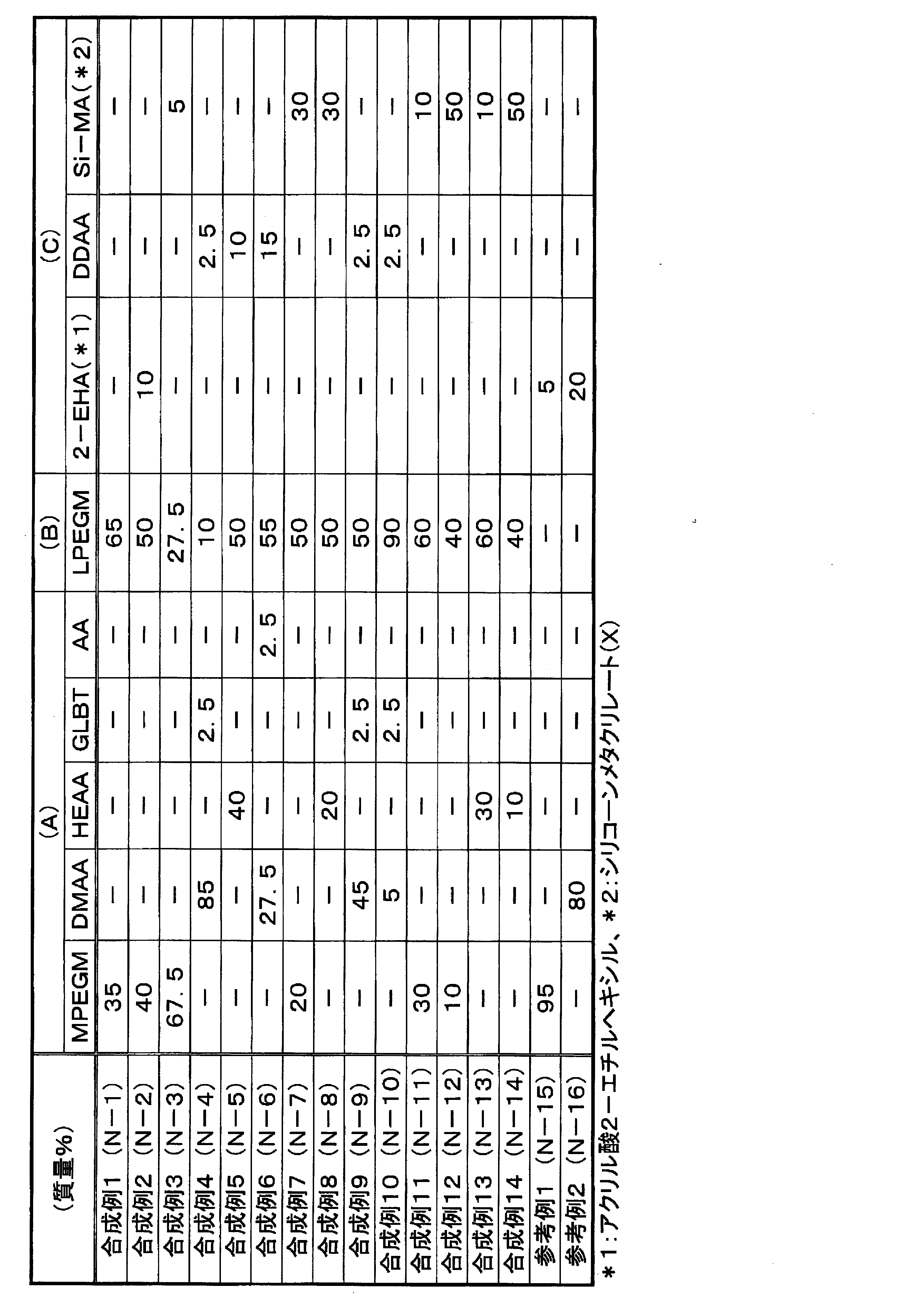
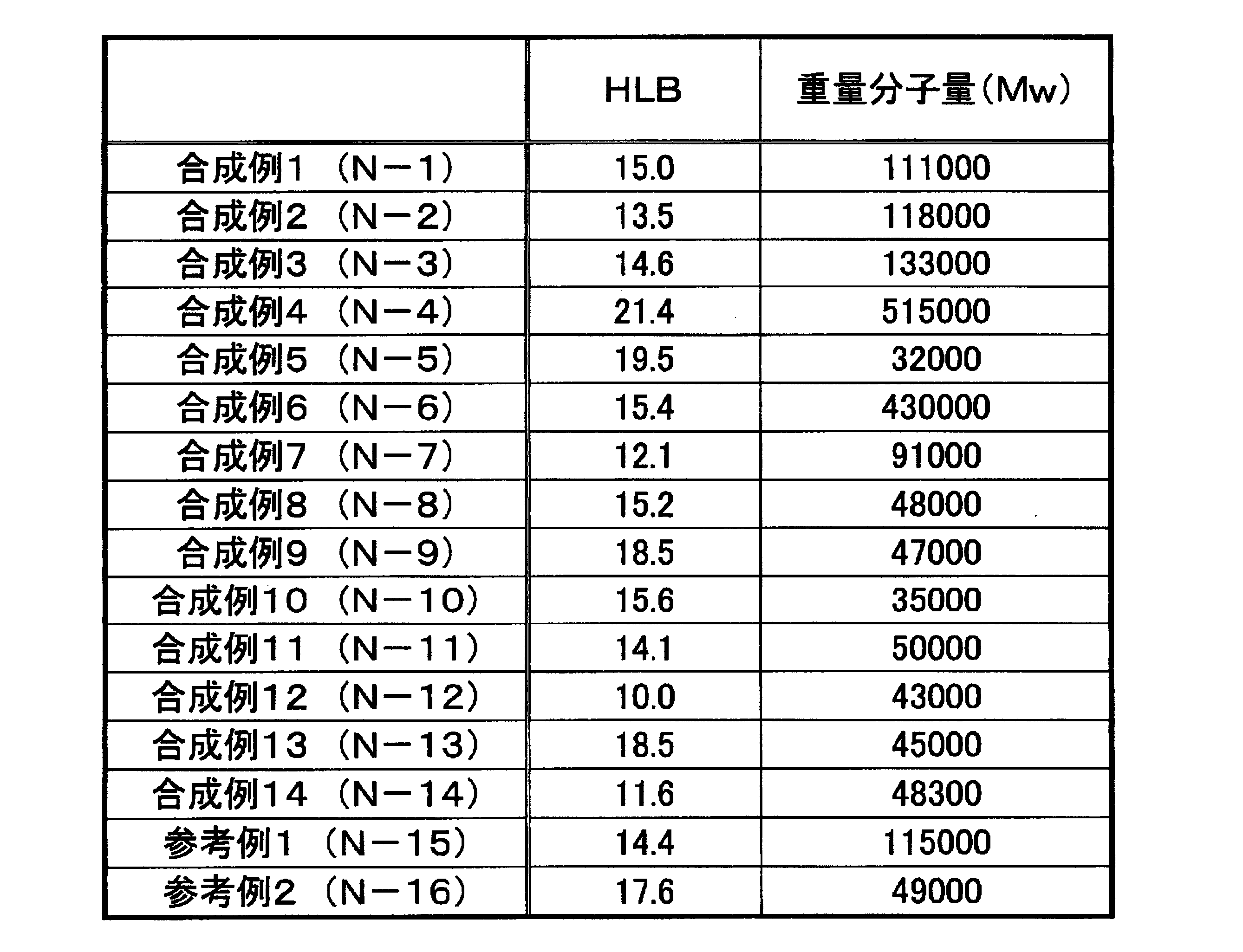
実施例1 ゲルの作製
共重合体(N-1)の0.5質量%水分散液を凍結乾燥し、共重合体(N-1)の固形分を得た。次いで、下記式(X)で表されるシリコーンメタクリレート(東京化成社製)50質量部、DMAA(興人社製)40質量部、ポリエチレングリコールジメタクリラート n≒4(東京化成工業社製)5質量部、共重合体(N-1)5質量部、及び2,2-ジメトキシ-2-フェニルアセトフェノン1質量部を混合し、ガラスシャーレに流し込み、大気中にてUV照射量:1.5J/cm2となるようにUV照射を行い、重合物を得た。この重合物をイオン交換水で膨潤させた後、PBSで3回洗浄した。その後、PBS中でオートクレーブ滅菌して、ポリマー添加シリコーンハイドロゲルを得た。
共重合体(N-1)の0.5質量%水分散液を凍結乾燥し、共重合体(N-1)の固形分を得た。次いで、下記式(X)で表されるシリコーンメタクリレート(東京化成社製)50質量部、DMAA(興人社製)40質量部、ポリエチレングリコールジメタクリラート n≒4(東京化成工業社製)5質量部、共重合体(N-1)5質量部、及び2,2-ジメトキシ-2-フェニルアセトフェノン1質量部を混合し、ガラスシャーレに流し込み、大気中にてUV照射量:1.5J/cm2となるようにUV照射を行い、重合物を得た。この重合物をイオン交換水で膨潤させた後、PBSで3回洗浄した。その後、PBS中でオートクレーブ滅菌して、ポリマー添加シリコーンハイドロゲルを得た。
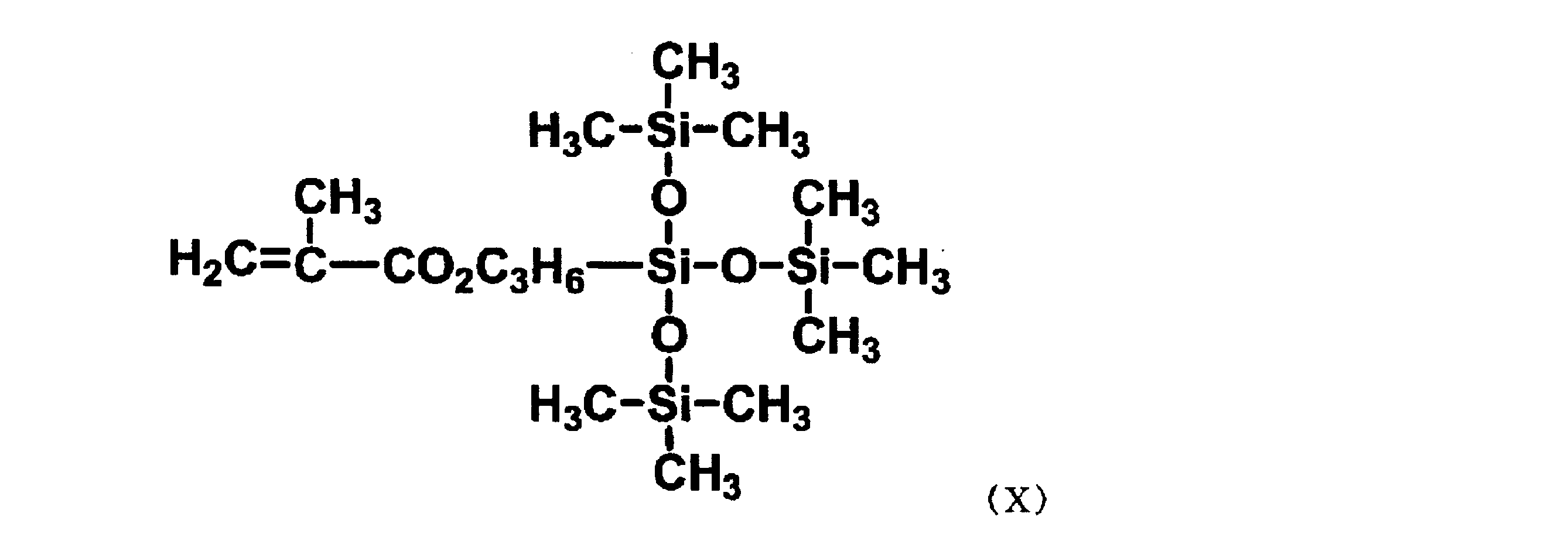
実施例2~14 ゲルの作製
共重合体(N-1)の0.5質量%水分散液を、共重合体(N-2)~(N-14)の0.5質量%水分散液又は水溶液に変更する以外は、実施例1と同様にしてポリマー添加シリコーンハイドロゲルを得た。
共重合体(N-1)の0.5質量%水分散液を、共重合体(N-2)~(N-14)の0.5質量%水分散液又は水溶液に変更する以外は、実施例1と同様にしてポリマー添加シリコーンハイドロゲルを得た。
比較例1~2 ゲルの作製
共重合体(N-1)の0.5質量%水分散液を、共重合体(N-15)~(N-16)の0.5質量%水溶液に変更する以外は、実施例1と同様にしてポリマー添加シリコーンハイドロゲルを得た。
共重合体(N-1)の0.5質量%水分散液を、共重合体(N-15)~(N-16)の0.5質量%水溶液に変更する以外は、実施例1と同様にしてポリマー添加シリコーンハイドロゲルを得た。
比較例3 ゲルの作製
上記式(X)で表されるシリコーンメタクリレート(東京化成社製)50質量部、DMAA(興人社製)40質量部、ポリエチレングリコールジメタクリラート n≒4(東京化成工業社製)5質量部、ポロキサマー407を5質量部、及び2,2-ジメトキシ-2-フェニルアセトフェノン1質量部を混合し、ガラスシャーレに流し込み、大気中にてUV照射量:1.5J/cm2となるようにUV照射を行い、重合物を得た。この重合物をイオン交換水で膨潤させた後、PBSで3回洗浄した。その後、PBS中でオートクレーブ滅菌して、ポリマー添加シリコーンハイドロゲルを得た。
上記式(X)で表されるシリコーンメタクリレート(東京化成社製)50質量部、DMAA(興人社製)40質量部、ポリエチレングリコールジメタクリラート n≒4(東京化成工業社製)5質量部、ポロキサマー407を5質量部、及び2,2-ジメトキシ-2-フェニルアセトフェノン1質量部を混合し、ガラスシャーレに流し込み、大気中にてUV照射量:1.5J/cm2となるようにUV照射を行い、重合物を得た。この重合物をイオン交換水で膨潤させた後、PBSで3回洗浄した。その後、PBS中でオートクレーブ滅菌して、ポリマー添加シリコーンハイドロゲルを得た。
試験例1 ポリマー添加シリコーンハイドロゲルの表面親水性試験
各実施例及び比較例で得たポリマー添加シリコーンハイドロゲルをPBSから取り出して、下記の基準にて評価を行なった。評価基準のランクが高いほど表面親水性に優れるといえる。試験結果を表3に示す。
各実施例及び比較例で得たポリマー添加シリコーンハイドロゲルをPBSから取り出して、下記の基準にて評価を行なった。評価基準のランクが高いほど表面親水性に優れるといえる。試験結果を表3に示す。
(表面親水性評価基準)
ランク
1・・・シリコーンハイドロゲル表面が殆ど濡れず、水を弾いている
2・・・シリコーンハイドロゲル表面の面積の半分以上の濡れが不均一であり、若干水を弾いている
3・・・シリコーンハイドロゲル表面の面積の半分以上が均一に濡れている
4・・・シリコーンハイドロゲル表面が均一に濡れている
ランク
1・・・シリコーンハイドロゲル表面が殆ど濡れず、水を弾いている
2・・・シリコーンハイドロゲル表面の面積の半分以上の濡れが不均一であり、若干水を弾いている
3・・・シリコーンハイドロゲル表面の面積の半分以上が均一に濡れている
4・・・シリコーンハイドロゲル表面が均一に濡れている
試験例2 ポリマー添加シリコーンハイドロゲルの潤滑性試験
試験に先立ち、潤滑性試験においてコントロールとして使用するゲル(コントロールゲル)を作製した。すなわち、上記式(X)で表されるシリコーンメタクリレート(東京化成社製)50質量部、DMAA(興人社製)45質量部、ポリエチレングリコールジメタクリラート n≒4(東京化成工業社製)5質量部、及び2,2-ジメトキシ-2-フェニルアセトフェノン1質量部を混合し、ガラスシャーレに流し込み、大気中にてUV照射量:1.5J/cm2となるようにUV照射を行い、重合物を得た。この重合物をイオン交換水で膨潤させた後、PBSで3回洗浄した。その後、PBS中でオートクレーブ滅菌して、コントロールゲルを得た。
各実施例及び比較例で得たポリマー添加シリコーンハイドロゲルについて、乾燥した指で触った際の潤滑性を下記のランク1~4の基準で10名の被験者に評価してもらい、潤滑性ランクの平均値を算出した。評価基準のランクが高いほど潤滑性に優れるといえる。試験結果を表3に示す。
試験に先立ち、潤滑性試験においてコントロールとして使用するゲル(コントロールゲル)を作製した。すなわち、上記式(X)で表されるシリコーンメタクリレート(東京化成社製)50質量部、DMAA(興人社製)45質量部、ポリエチレングリコールジメタクリラート n≒4(東京化成工業社製)5質量部、及び2,2-ジメトキシ-2-フェニルアセトフェノン1質量部を混合し、ガラスシャーレに流し込み、大気中にてUV照射量:1.5J/cm2となるようにUV照射を行い、重合物を得た。この重合物をイオン交換水で膨潤させた後、PBSで3回洗浄した。その後、PBS中でオートクレーブ滅菌して、コントロールゲルを得た。
各実施例及び比較例で得たポリマー添加シリコーンハイドロゲルについて、乾燥した指で触った際の潤滑性を下記のランク1~4の基準で10名の被験者に評価してもらい、潤滑性ランクの平均値を算出した。評価基準のランクが高いほど潤滑性に優れるといえる。試験結果を表3に示す。
(潤滑性評価基準)
ランク
1・・・コントロールゲルと同等
2・・・コントロールゲルと比較して僅かに潤滑性がある
3・・・全体に軋みなく、コントロールゲルと比較して潤滑性がある
4・・・全体に軋みなく、コントロールゲルと比較して非常に潤滑性がある
ランク
1・・・コントロールゲルと同等
2・・・コントロールゲルと比較して僅かに潤滑性がある
3・・・全体に軋みなく、コントロールゲルと比較して潤滑性がある
4・・・全体に軋みなく、コントロールゲルと比較して非常に潤滑性がある

表3に示すとおり、実施例1~14のゲルは、表面親水性及び潤滑性に優れていた。この結果から、合成例1~14のポリマーを、シリコーンハイドロゲル作製時に添加することにより、優れた表面親水性及び潤滑性が付与されることがわかる。
また、実施例3~14のゲルは表面親水性に特に優れていた。
また、実施例3~14のゲルは表面親水性に特に優れていた。
試験例3 脂質防汚性試験
まず、試験に先立ち、オレイン酸:1.20質量%、リノール酸:1.20質量%、トリパルミチン:16.23質量%、セチルアルコール:4.01質量%、パルミチン酸:1.20質量%、パルミチン酸セチル:16.23質量%、コレステロール:1.60質量%、パルミチン酸コレステロール:1.60質量%及びレシチン:56.71質量%を加熱撹拌によって均一化して脂質液を得て、この脂質液0.5質量部と水99.5質量部とを混合して乳化させた人工脂質溶液を調製した。
次いで、各実施例及び比較例で得たポリマー添加シリコーンハイドロゲルを人工脂質溶液1mLに浸漬し、1時間振とうした後取り出し、PBSで3回洗浄し、減圧乾燥した。その後、シリコーンハイドロゲルをエタノール/ジエチルエーテル(75/25体積%)溶液1mLに浸漬し、30分静置することでシリコーンハイドロゲルに残存する脂質を抽出した。この抽出液0.5mLを試験管に採取し、90℃で溶媒を蒸発させた。
次いで、試験管中に濃硫酸0.5mLを添加し、90℃30分間加熱した。この溶液を室温まで冷却した後、0.6質量%バニリン水溶液/リン酸(20/80体積%)溶液を2.5mL添加し、37℃で15分間保持した。この溶液を室温まで冷却後、540nmにおける吸光度を測定した。脂質濃度既知の溶液を予め前記同様の方法により測定して検量線を作成しておき、前記測定結果の吸光度からシリコーンハイドロゲルに吸着した脂質量を決定した。
試験結果を表4に示す。なお、表中のコントロールは、上記シリコーンハイドロゲルの代わりに試験例2で得たコントロールゲルを用いて上記と同様に試験した結果を示す。また、脂質防汚量はコントロールと比較して低下した脂質付着量を示し、その値が大きい程、脂質防汚性が高いといえる。
まず、試験に先立ち、オレイン酸:1.20質量%、リノール酸:1.20質量%、トリパルミチン:16.23質量%、セチルアルコール:4.01質量%、パルミチン酸:1.20質量%、パルミチン酸セチル:16.23質量%、コレステロール:1.60質量%、パルミチン酸コレステロール:1.60質量%及びレシチン:56.71質量%を加熱撹拌によって均一化して脂質液を得て、この脂質液0.5質量部と水99.5質量部とを混合して乳化させた人工脂質溶液を調製した。
次いで、各実施例及び比較例で得たポリマー添加シリコーンハイドロゲルを人工脂質溶液1mLに浸漬し、1時間振とうした後取り出し、PBSで3回洗浄し、減圧乾燥した。その後、シリコーンハイドロゲルをエタノール/ジエチルエーテル(75/25体積%)溶液1mLに浸漬し、30分静置することでシリコーンハイドロゲルに残存する脂質を抽出した。この抽出液0.5mLを試験管に採取し、90℃で溶媒を蒸発させた。
次いで、試験管中に濃硫酸0.5mLを添加し、90℃30分間加熱した。この溶液を室温まで冷却した後、0.6質量%バニリン水溶液/リン酸(20/80体積%)溶液を2.5mL添加し、37℃で15分間保持した。この溶液を室温まで冷却後、540nmにおける吸光度を測定した。脂質濃度既知の溶液を予め前記同様の方法により測定して検量線を作成しておき、前記測定結果の吸光度からシリコーンハイドロゲルに吸着した脂質量を決定した。
試験結果を表4に示す。なお、表中のコントロールは、上記シリコーンハイドロゲルの代わりに試験例2で得たコントロールゲルを用いて上記と同様に試験した結果を示す。また、脂質防汚量はコントロールと比較して低下した脂質付着量を示し、その値が大きい程、脂質防汚性が高いといえる。

表4に示すとおり、実施例1~14のゲルは、脂質防汚性に優れていた。この結果から、合成例1~14のポリマーを、シリコーンハイドロゲル作製時に添加することにより、優れた脂質防汚性が付与されることがわかる。
また、実施例2~14のゲルは脂質防汚性に特に優れていた。
また、実施例2~14のゲルは脂質防汚性に特に優れていた。
Claims (17)
- 下記繰り返し単位(A):2.5~95質量%と下記繰り返し単位(B):2.5~95質量%とを有する重合体aと、
親水性モノマーを架橋剤と共に重合したポリマーbと、を含むことを特徴とする、
ゲル。
(A)親水性繰り返し単位
(B)側鎖にポリオキシアルキレン基を有し、その側鎖の末端が炭素数5~30のアルキル基、炭素数5~30のアルカノイル基、又はアリール基で構成される繰り返し単位 - 前記重合体aの存在下で前記親水性モノマーを前記架橋剤と共に重合した、請求項1に記載のゲル。
- 前記繰り返し単位(A)が、側鎖にポリオキシアルキレン基を有し、その側鎖の末端が水素原子又は炭素数1~4のアルキル基で構成される繰り返し単位(A-1)、下記式(3)で表される繰り返し単位(A-2)、下記式(4)で表される繰り返し単位(A-3)、下記式(5)で表される繰り返し単位(A-4)、下記式(6)で表される繰り返し単位(A-5)、下記式(7)で表されるベタイン性繰り返し単位(A-6)、アニオン性繰り返し単位(A-7)、及び下記式(8)で表されるカチオン性繰り返し単位(A-8)から選ばれる1種以上である、請求項1又は2に記載のゲル。

R6は、水素原子又はメチル基を示し、
R7は、炭素数2~4のアルカンジイル基を示し、
R8は、炭素数1~10のアルカンジイル基を示し、
R9、R10及びR11は、それぞれ独立して、水素原子又は炭素数1~8の炭化水素基を示し、
qは、平均値で1~10を示す。〕
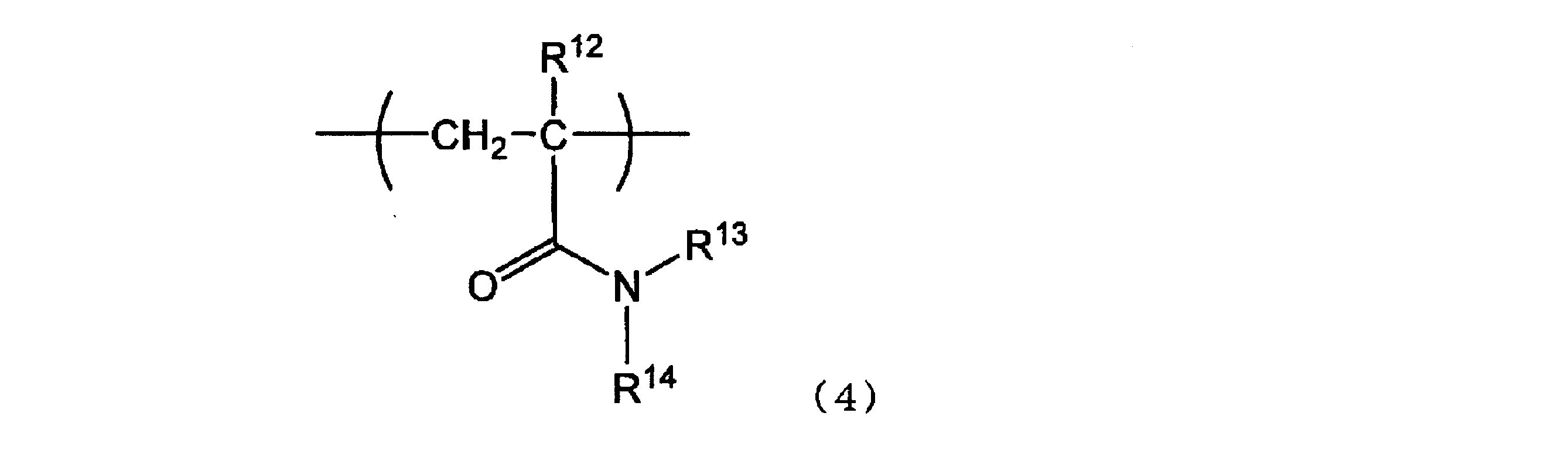
R12は、水素原子又はメチル基を示し、
R13及びR14は、それぞれ独立して、水素原子、炭素数1~6のアルキル基又はヒドロキシアルキル基を示す。〕
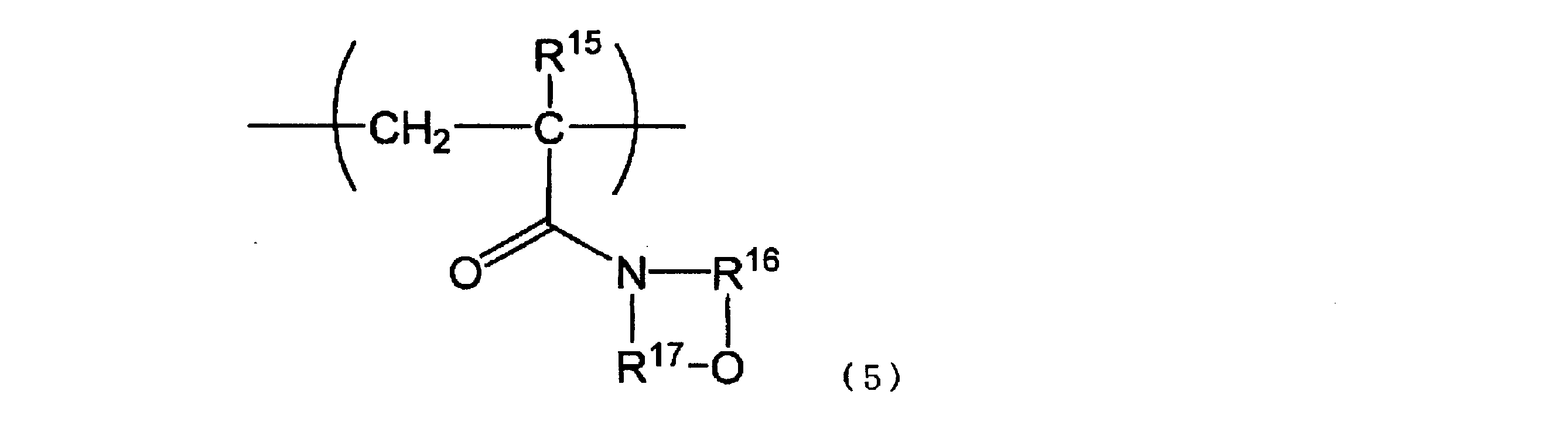
R15は、水素原子又はメチル基を示し、
R16及びR17は、それぞれ独立して、炭素数1~3のアルカンジイル基を示す。〕
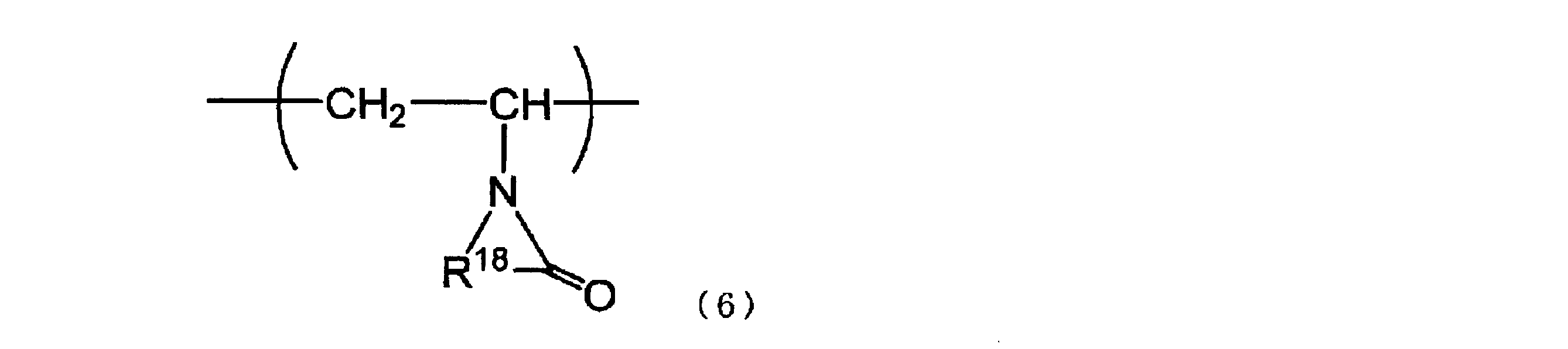
R18は、炭素数1~5のアルカンジイル基を示す。〕

Yは、-(C=O)O-、-(O=S=O)O-、-O(O=S=O)O-、-(S=O)O-、-O(S=O)O-、-OP(=O)(OR24)O-、-OP(=O)(R24)O-、-P(=O)(OR24)O-、又は-P(=O)(R24)O-を示し(R24は炭素数1~3のアルキル基を示す)、
R19は、水素原子又はメチル基を示し、
R20及びR21は、それぞれ独立して、炭素数1~10の2価の有機基を示し、
R22及びR23は、それぞれ独立して、炭素数1~10の炭化水素基を示す。〕
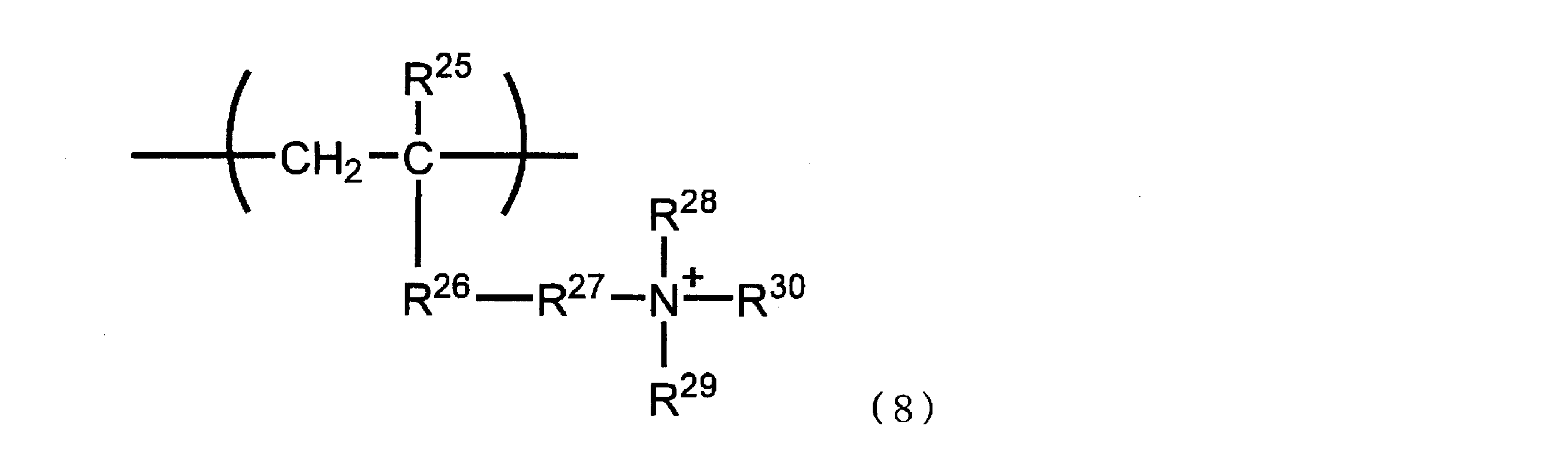
R25は、水素原子又はメチル基を示し、
R26は、-O-、*-(C=O)-O-、*-(C=O)-NR31-、*-NR31-(C=O)-(R31は、水素原子又は炭素数1~10の有機基を示し、*は、式(8)中のR25が結合している炭素原子と結合する位置を示す)又はフェニレン基を示し、
R27は、炭素数1~10の2価の有機基を示し、
R28、R29及びR30は、それぞれ独立して、炭素数1~10の炭化水素基を示す。〕 - 前記繰り返し単位(A-1)が、下記式(2)で表されるものである、請求項3に記載のゲル。

R1は、炭素数2~4のアルカンジイル基を示し、
R2は、水素原子又は炭素数1~4のアルキル基を示し、
R3は、水素原子又はメチル基を示し、
R4は、-O-、*-(C=O)-O-、*-(C=O)-NR5-、*-NR5-(C=O)-(R5は、水素原子又は炭素数1~10の有機基を示し、*は、式(2)中のR3が結合している炭素原子と結合する位置を示す)又はフェニレン基を示し、
nは、平均値で2~100を示す。〕 - 前記繰り返し単位(B)が、側鎖にポリオキシアルキレン基を有し、その側鎖の末端が炭素数5~30のアルキル基又は炭素数5~30のアルカノイル基で構成される繰り返し単位である、請求項1~4のいずれか1項に記載のゲル。
- 前記繰り返し単位(B)が、下記式(10)で表されるものである、請求項1~4のいずれか1項に記載のゲル。

R32は、炭素数2~4のアルカンジイル基を示し、
R33は、炭素数5~30のアルキル基、炭素数5~30のアルカノイル基、又はアリール基を示し、
R34は、水素原子又はメチル基を示し、
R35は、-O-、**-(C=O)-O-、**-(C=O)-NR36-、**-NR36-(C=O)-(R36は、水素原子又は炭素数1~10の有機基を示し、**は、式(10)中のR34が結合している炭素原子と結合する位置を示す)又はフェニレン基を示し、
mは、平均値で2~100を示す。〕 - 前記重合体aが、下記式(11)で表される繰り返し単位(C-1)及び下記式(12)で表される基を側鎖の末端に有する繰り返し単位(C-2)から選ばれる1種以上の繰り返し単位(C):60質量%以下を更に有する、請求項1~6のいずれか1項に記載のゲル。
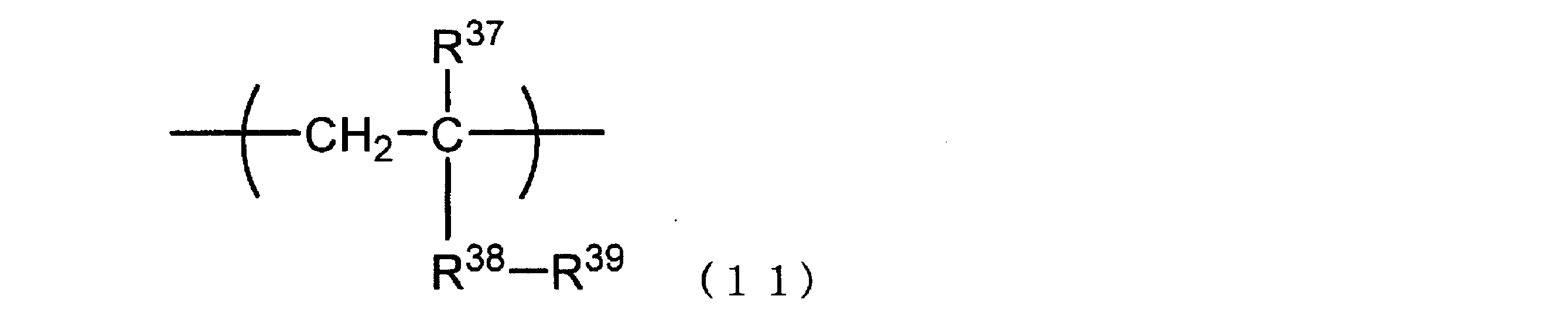
R37は、水素原子又はメチル基を示し、
R38は、-O-、***-(C=O)-O-、***-(C=O)-NR40-、***-NR40-(C=O)-(R40は、水素原子又は炭素数1~10の有機基を示し、***は、式(11)中のR37が結合している炭素原子と結合する位置を示す)又はフェニレン基を示し、
R39は、炭素数4~30の炭化水素基を示す。〕

R41は、炭素数1~10の2価の有機基を示し、
R42及びR43は、それぞれ独立して、炭素数1~10の有機基を示し、
R44、R45及びR46は、それぞれ独立して、-OSi(R49)3(R49は、それぞれ独立して、水素原子又は炭素数1~8の有機基を示す)又は炭素数1~10の有機基を示し、
rは、平均値で0~200を示す。〕 - 前記重合体aが、非網目状の重合体である、請求項1~7のいずれか1項に記載のゲル。
- 前記重合体aを0.01~40質量%含有する、請求項1~8のいずれか1項に記載のゲル。
- 更に、シリコーン化合物を含有する、請求項1~9のいずれか1項に記載のゲル。
- 前記ポリマーbが、重合性官能基を有するシリコーン化合物を、前記親水性モノマー及び前記架橋剤と共に重合したものである、請求項1~9のいずれか1項に記載のゲル。
- ポリマーを含むゲルの製造方法であって、
下記繰り返し単位(A):2.5~95質量%と下記繰り返し単位(B):2.5~95質量%とを有する重合体aの存在下で、
親水性モノマーを架橋剤と共に重合してポリマーとすることを特徴とする、
ゲルの製造方法。
(A)親水性繰り返し単位
(B)側鎖にポリオキシアルキレン基を有し、その側鎖の末端が炭素数5~30のアルキル基、炭素数5~30のアルカノイル基、又はアリール基で構成される繰り返し単位 - 請求項1~11のいずれか1項に記載のゲルを含むことを特徴とする、
レンズ。 - コンタクトレンズである、請求項13に記載のレンズ。
- 下記繰り返し単位(A):2.5~95質量%と下記繰り返し単位(B):2.5~95質量%とを有する重合体aを含有することを特徴とする、
コンタクトレンズ表面改質剤。
(A)親水性繰り返し単位
(B)側鎖にポリオキシアルキレン基を有し、その側鎖の末端が炭素数5~30のアルキル基、炭素数5~30のアルカノイル基、又はアリール基で構成される繰り返し単位 - 下記繰り返し単位(A):2.5~95質量%と下記繰り返し単位(B):2.5~95質量%とを有する重合体aと、
親水性モノマーと、
架橋剤と、を含むことを特徴とする、
重合性組成物。
(A)親水性繰り返し単位
(B)側鎖にポリオキシアルキレン基を有し、その側鎖の末端が炭素数5~30のアルキル基、炭素数5~30のアルカノイル基、又はアリール基で構成される繰り返し単位 - 下記繰り返し単位(A):2.5~95質量%と下記繰り返し単位(B):2.5~95質量%とを有することを特徴とする、
重合体。
(A)親水性繰り返し単位
(B)側鎖にポリオキシアルキレン基を有し、その側鎖の末端が炭素数5~30のアルキル基、炭素数5~30のアルカノイル基、又はアリール基で構成される繰り返し単位
Priority Applications (2)
| Application Number | Priority Date | Filing Date | Title |
|---|---|---|---|
| JP2017523643A JP6836503B2 (ja) | 2015-06-08 | 2016-06-07 | ゲル、ゲルの製造方法、レンズ、コンタクトレンズ表面改質剤、重合性組成物及び重合体 |
| US15/580,502 US20180356561A1 (en) | 2015-06-08 | 2016-06-07 | Gel, gel manufacturing method, lens, contact lens surface modifier, polymerizable composition, and polymer |
Applications Claiming Priority (2)
| Application Number | Priority Date | Filing Date | Title |
|---|---|---|---|
| JP2015-115458 | 2015-06-08 | ||
| JP2015115458 | 2015-06-08 |
Publications (1)
| Publication Number | Publication Date |
|---|---|
| WO2016199755A1 true WO2016199755A1 (ja) | 2016-12-15 |
Family
ID=57504742
Family Applications (1)
| Application Number | Title | Priority Date | Filing Date |
|---|---|---|---|
| PCT/JP2016/066888 Ceased WO2016199755A1 (ja) | 2015-06-08 | 2016-06-07 | ゲル、ゲルの製造方法、レンズ、コンタクトレンズ表面改質剤、重合性組成物及び重合体 |
Country Status (3)
| Country | Link |
|---|---|
| US (1) | US20180356561A1 (ja) |
| JP (1) | JP6836503B2 (ja) |
| WO (1) | WO2016199755A1 (ja) |
Cited By (1)
| Publication number | Priority date | Publication date | Assignee | Title |
|---|---|---|---|---|
| JP2019077842A (ja) * | 2017-10-27 | 2019-05-23 | 日油株式会社 | ポリオキシエチレン共重合体および眼用デバイス |
Families Citing this family (7)
| Publication number | Priority date | Publication date | Assignee | Title |
|---|---|---|---|---|
| CN107771191B (zh) | 2015-06-17 | 2020-08-28 | 科莱恩国际有限公司 | 作为水泥浆中的降失水剂的水溶性或水溶胀性聚合物 |
| JP6754362B2 (ja) * | 2015-08-04 | 2020-09-09 | Jsr株式会社 | 重合体組成物、物品、メディカルデバイス、物品の製造方法および細胞塊の製造方法 |
| WO2018108609A1 (en) | 2016-12-12 | 2018-06-21 | Clariant International Ltd | Polymer comprising certain level of bio-based carbon |
| CN110300573B (zh) | 2016-12-12 | 2023-07-25 | 科莱恩国际有限公司 | 生物基聚合物在化妆、皮肤病学或药物学组合物中的用途 |
| EP3554643B1 (en) | 2016-12-15 | 2025-03-19 | Clariant International Ltd | Water-soluble and/or water-swellable hybrid polymer |
| EP3554644B1 (en) | 2016-12-15 | 2025-03-19 | Clariant International Ltd | Water-soluble and/or water-swellable hybrid polymer |
| US11339241B2 (en) | 2016-12-15 | 2022-05-24 | Clariant International Ltd. | Water-soluble and/or water-swellable hybrid polymer |
Citations (5)
| Publication number | Priority date | Publication date | Assignee | Title |
|---|---|---|---|---|
| JP2004137403A (ja) * | 2002-10-18 | 2004-05-13 | Asahi Glass Co Ltd | 硬化性組成物 |
| JP2006312664A (ja) * | 2005-05-06 | 2006-11-16 | Hitachi Chem Co Ltd | 樹脂組成物及びこれを用いた粘着剤 |
| JP2012111939A (ja) * | 2010-11-02 | 2012-06-14 | Nippon Synthetic Chem Ind Co Ltd:The | アクリル系樹脂組成物、アクリル系粘着剤、粘着シート、両面粘着シート、透明電極用粘着剤、タッチパネル及び画像表示装置、並びに粘着剤層含有積層体の製造方法 |
| WO2012117898A1 (ja) * | 2011-02-28 | 2012-09-07 | 積水化成品工業株式会社 | 粘着性高分子ゲル用組成物及び粘着性高分子ゲル |
| WO2015119256A1 (ja) * | 2014-02-06 | 2015-08-13 | Jsr株式会社 | レンズ用液剤、コンタクトレンズおよびその製造方法 |
Family Cites Families (2)
| Publication number | Priority date | Publication date | Assignee | Title |
|---|---|---|---|---|
| JP3989054B2 (ja) * | 1996-07-29 | 2007-10-10 | 株式会社メニコン | コンタクトレンズ用洗浄材 |
| DE102009015868A1 (de) * | 2009-04-01 | 2009-11-26 | Clariant International Limited | Kammförmige, kationische Copolymere, deren Herstellung und Verwendung in kosmetischen, pharmazeutischen und dermatologischen Formulierungen |
-
2016
- 2016-06-07 US US15/580,502 patent/US20180356561A1/en not_active Abandoned
- 2016-06-07 WO PCT/JP2016/066888 patent/WO2016199755A1/ja not_active Ceased
- 2016-06-07 JP JP2017523643A patent/JP6836503B2/ja active Active
Patent Citations (5)
| Publication number | Priority date | Publication date | Assignee | Title |
|---|---|---|---|---|
| JP2004137403A (ja) * | 2002-10-18 | 2004-05-13 | Asahi Glass Co Ltd | 硬化性組成物 |
| JP2006312664A (ja) * | 2005-05-06 | 2006-11-16 | Hitachi Chem Co Ltd | 樹脂組成物及びこれを用いた粘着剤 |
| JP2012111939A (ja) * | 2010-11-02 | 2012-06-14 | Nippon Synthetic Chem Ind Co Ltd:The | アクリル系樹脂組成物、アクリル系粘着剤、粘着シート、両面粘着シート、透明電極用粘着剤、タッチパネル及び画像表示装置、並びに粘着剤層含有積層体の製造方法 |
| WO2012117898A1 (ja) * | 2011-02-28 | 2012-09-07 | 積水化成品工業株式会社 | 粘着性高分子ゲル用組成物及び粘着性高分子ゲル |
| WO2015119256A1 (ja) * | 2014-02-06 | 2015-08-13 | Jsr株式会社 | レンズ用液剤、コンタクトレンズおよびその製造方法 |
Cited By (1)
| Publication number | Priority date | Publication date | Assignee | Title |
|---|---|---|---|---|
| JP2019077842A (ja) * | 2017-10-27 | 2019-05-23 | 日油株式会社 | ポリオキシエチレン共重合体および眼用デバイス |
Also Published As
| Publication number | Publication date |
|---|---|
| JP6836503B2 (ja) | 2021-03-03 |
| US20180356561A1 (en) | 2018-12-13 |
| JPWO2016199755A1 (ja) | 2018-03-22 |
Similar Documents
| Publication | Publication Date | Title |
|---|---|---|
| JP2774233B2 (ja) | 眼用レンズ材料 | |
| US8124668B2 (en) | Silicone-containing ocular lens material with high safety and preparing method thereof | |
| JP3850729B2 (ja) | 眼用レンズ材料 | |
| JP5766603B2 (ja) | 眼用レンズ | |
| JP6836503B2 (ja) | ゲル、ゲルの製造方法、レンズ、コンタクトレンズ表面改質剤、重合性組成物及び重合体 | |
| JP3195662B2 (ja) | 眼用レンズ材料 | |
| JPWO2001071415A1 (ja) | 眼用レンズ材料 | |
| JP3771940B2 (ja) | 眼用レンズの製法およびそれからえられた眼用レンズ | |
| JPS63305113A (ja) | コンタクトレンズ材料 | |
| JP5668062B2 (ja) | イオン性化合物、組成物、硬化物、ハイドロゲル及び眼用レンズ | |
| JPH11286521A (ja) | 眼用レンズ材料 | |
| JP3569373B2 (ja) | 含水性ソフトコンタクトレンズ | |
| JPH11133201A (ja) | 光学材料 | |
| JPH08227001A (ja) | 含水性コンタクトレンズの表面処理方法及びそれによって得られた含水性コンタクトレンズ | |
| JP3063877B2 (ja) | 含水性ソフトコンタクトレンズ | |
| JP6974633B2 (ja) | ポリマー材料 | |
| JPH1180274A (ja) | 光学材料 | |
| JPH10148797A (ja) | 眼用レンズ材料 | |
| JPH02198415A (ja) | 眼用レンズ材料 | |
| JPH0764029A (ja) | コンタクトレンズ | |
| JPH09189887A (ja) | 眼用レンズ材料 | |
| JP4004350B2 (ja) | 耐脂質汚染性に優れた含水性材料 | |
| JP3040259B2 (ja) | 眼用レンズ材料 | |
| JPH10206804A (ja) | 眼用レンズ材料 |
Legal Events
| Date | Code | Title | Description |
|---|---|---|---|
| 121 | Ep: the epo has been informed by wipo that ep was designated in this application |
Ref document number: 16807462 Country of ref document: EP Kind code of ref document: A1 |
|
| ENP | Entry into the national phase |
Ref document number: 2017523643 Country of ref document: JP Kind code of ref document: A |
|
| NENP | Non-entry into the national phase |
Ref country code: DE |
|
| 122 | Ep: pct application non-entry in european phase |
Ref document number: 16807462 Country of ref document: EP Kind code of ref document: A1 |