WO2016194595A1 - 毛髪洗浄剤組成物 - Google Patents
毛髪洗浄剤組成物 Download PDFInfo
- Publication number
- WO2016194595A1 WO2016194595A1 PCT/JP2016/064476 JP2016064476W WO2016194595A1 WO 2016194595 A1 WO2016194595 A1 WO 2016194595A1 JP 2016064476 W JP2016064476 W JP 2016064476W WO 2016194595 A1 WO2016194595 A1 WO 2016194595A1
- Authority
- WO
- WIPO (PCT)
- Prior art keywords
- mass
- scalp
- content
- hair
- component
- Prior art date
- Legal status (The legal status is an assumption and is not a legal conclusion. Google has not performed a legal analysis and makes no representation as to the accuracy of the status listed.)
- Ceased
Links
Classifications
-
- A—HUMAN NECESSITIES
- A61—MEDICAL OR VETERINARY SCIENCE; HYGIENE
- A61K—PREPARATIONS FOR MEDICAL, DENTAL OR TOILETRY PURPOSES
- A61K8/00—Cosmetics or similar toiletry preparations
- A61K8/18—Cosmetics or similar toiletry preparations characterised by the composition
- A61K8/30—Cosmetics or similar toiletry preparations characterised by the composition containing organic compounds
- A61K8/46—Cosmetics or similar toiletry preparations characterised by the composition containing organic compounds containing sulfur
-
- A—HUMAN NECESSITIES
- A61—MEDICAL OR VETERINARY SCIENCE; HYGIENE
- A61K—PREPARATIONS FOR MEDICAL, DENTAL OR TOILETRY PURPOSES
- A61K8/00—Cosmetics or similar toiletry preparations
- A61K8/18—Cosmetics or similar toiletry preparations characterised by the composition
- A61K8/30—Cosmetics or similar toiletry preparations characterised by the composition containing organic compounds
- A61K8/40—Cosmetics or similar toiletry preparations characterised by the composition containing organic compounds containing nitrogen
- A61K8/44—Aminocarboxylic acids or derivatives thereof, e.g. aminocarboxylic acids containing sulfur; Salts; Esters or N-acylated derivatives thereof
-
- A—HUMAN NECESSITIES
- A61—MEDICAL OR VETERINARY SCIENCE; HYGIENE
- A61K—PREPARATIONS FOR MEDICAL, DENTAL OR TOILETRY PURPOSES
- A61K8/00—Cosmetics or similar toiletry preparations
- A61K8/18—Cosmetics or similar toiletry preparations characterised by the composition
- A61K8/30—Cosmetics or similar toiletry preparations characterised by the composition containing organic compounds
- A61K8/49—Cosmetics or similar toiletry preparations characterised by the composition containing organic compounds containing heterocyclic compounds
-
- A—HUMAN NECESSITIES
- A61—MEDICAL OR VETERINARY SCIENCE; HYGIENE
- A61K—PREPARATIONS FOR MEDICAL, DENTAL OR TOILETRY PURPOSES
- A61K8/00—Cosmetics or similar toiletry preparations
- A61K8/18—Cosmetics or similar toiletry preparations characterised by the composition
- A61K8/30—Cosmetics or similar toiletry preparations characterised by the composition containing organic compounds
- A61K8/49—Cosmetics or similar toiletry preparations characterised by the composition containing organic compounds containing heterocyclic compounds
- A61K8/4973—Cosmetics or similar toiletry preparations characterised by the composition containing organic compounds containing heterocyclic compounds with oxygen as the only hetero atom
-
- A—HUMAN NECESSITIES
- A61—MEDICAL OR VETERINARY SCIENCE; HYGIENE
- A61K—PREPARATIONS FOR MEDICAL, DENTAL OR TOILETRY PURPOSES
- A61K8/00—Cosmetics or similar toiletry preparations
- A61K8/18—Cosmetics or similar toiletry preparations characterised by the composition
- A61K8/72—Cosmetics or similar toiletry preparations characterised by the composition containing organic macromolecular compounds
- A61K8/73—Polysaccharides
-
- A—HUMAN NECESSITIES
- A61—MEDICAL OR VETERINARY SCIENCE; HYGIENE
- A61K—PREPARATIONS FOR MEDICAL, DENTAL OR TOILETRY PURPOSES
- A61K8/00—Cosmetics or similar toiletry preparations
- A61K8/18—Cosmetics or similar toiletry preparations characterised by the composition
- A61K8/72—Cosmetics or similar toiletry preparations characterised by the composition containing organic macromolecular compounds
- A61K8/84—Cosmetics or similar toiletry preparations characterised by the composition containing organic macromolecular compounds obtained by reactions otherwise than those involving only carbon-carbon unsaturated bonds
- A61K8/86—Polyethers
-
- A—HUMAN NECESSITIES
- A61—MEDICAL OR VETERINARY SCIENCE; HYGIENE
- A61Q—SPECIFIC USE OF COSMETICS OR SIMILAR TOILETRY PREPARATIONS
- A61Q5/00—Preparations for care of the hair
- A61Q5/02—Preparations for cleaning the hair
Definitions
- the present invention relates to a hair cleaning composition.
- a hair cleansing composition that is excellent in foaming, fine foam, and smooth hair during rinsing, can improve the flexibility of the scalp, and can increase the moisture content of the scalp. ing.
- the present invention provides a hair cleansing composition that is excellent in foaming, fineness of foam, and smoothness of hair during rinsing, can improve the flexibility of the scalp, and can increase the moisture content of the scalp.
- the purpose is to provide.
- This invention is based on the said knowledge by this inventor, and as a means for solving the said subject, it is as follows. ⁇ 1> (A) polyoxyethylene alkyl ether sulfate, (B) an amphoteric surfactant, (C) N-acyl amino acid ester, (D) polyoxyethylene hydrogenated castor oil having an average addition mole number of ethylene oxide of 5 to 30, and (E) a cationic polymer, The content (mass%) of the (C) N-acyl amino acid ester and the content (mass%) of the polyoxyethylene hydrogenated castor oil in which the average added mole number of the ethylene oxide (D) is 5 to 30 A hair cleansing composition having a mass ratio (D / C) of 1 to 12.5.
- the content of the (C) N-acyl amino acid ester is 0.08% by mass to 1% by mass
- the content of the polyoxyethylene alkyl ether sulfate (A) is 12% by mass to 20% by mass
- the content of the cationic polymer (E) is 0.1% by mass to 1% by mass
- the hair cleansing composition according to any one of ⁇ 1> to ⁇ 2>, wherein the mass ratio (D / C) is 3 to 9.
- the (B) amphoteric surfactant is at least one selected from alkylbetaine amphoteric surfactants, amidobetaine amphoteric surfactants, and imidazolinium betaine amphoteric surfactants,
- the hair cleansing composition according to any one of ⁇ 1> to ⁇ 3>, wherein the content of the (B) amphoteric surfactant is 1% by mass to 20% by mass.
- the present invention it is possible to solve the above-mentioned problems and achieve the above-mentioned object, and it is excellent in foaming, fineness of foam, and smoothness of hair during rinsing, and improves the flexibility of the scalp. It is possible to provide a hair cleansing composition that can increase the amount of water in the scalp.
- the hair cleansing composition of the present invention has an average addition mole number of (A) polyoxyethylene alkyl ether sulfate, (B) amphoteric surfactant, (C) N-acyl amino acid ester, and (D) ethylene oxide. 30 to 30 polyoxyethylene hydrogenated castor oil and (E) a cationic polymer, and further contains other components as necessary.
- polyoxyethylene alkyl ether sulfate Polyoxyethylene alkyl ether sulfate> The polyoxyethylene alkyl ether sulfate of component (A) is contained to improve foaming, fineness of foam, smoothness of hair at the time of rinsing, flexibility of scalp, and moisture content of scalp. Yes.
- the number of carbon atoms in the alkyl group portion of the polyoxyethylene alkyl ether sulfate of component (A) is preferably 10 to 24, more preferably 12 to 14 from the viewpoint of good foaming.
- the average added mole number of ethylene oxide of the polyoxyethylene alkyl ether sulfate of the component (A) (hereinafter sometimes referred to as “EO”) is preferably 1 to 3 from the viewpoint of good foaming. ⁇ 3 are more preferred.
- EO average added mole number of ethylene oxide of the polyoxyethylene alkyl ether sulfate of the component (A)
- EO average added mole number of ethylene oxide of the polyoxyethylene alkyl ether sulfate of the component (A)
- EO average added mole number of ethylene oxide of the polyoxyethylene alkyl ether sulfate of the component (A)
- EO average added mole number of ethylene oxide of the polyoxyethylene alkyl ether sulfate of the component (
- the polyoxyethylene alkyl ether sulfate as the component (A) is not particularly limited and may be appropriately selected depending on the intended purpose. Examples thereof include compounds represented by the following general formula (a).
- R 1 O (CH 2 CH 2 O) m SO 3 M 1 ⁇ formula (a) (In the general formula (a), R 1 represents an alkyl group, M 1 represents an alkali metal, ammonium, or alkanolamine, and m represents an integer of 1 to 3)
- Examples of the (A) component polyoxyethylene alkyl ether sulfate include polyoxyethylene capryl ether sulfate (EO: 1 to 3), polyoxyethylene lauryl ether sulfate (EO: 1 to 3), polyoxyethylene Examples include ethylene myristyl ether sulfate (EO: 1 to 3), polyoxyethylene palmityl ether sulfate (EO: 1 to 3), and polyoxyethylene stearyl ether sulfate (EO: 1 to 3). These may be used alone or in combination of two or more.
- polyoxyethylene lauryl ether sulfate (EO: 1 to 3) is preferable and polyoxyethylene lauryl ether ammonium sulfate (EO: 2) is more preferable from the viewpoint of good foaming and fineness of the foam.
- polyoxyethylene alkyl ether sulfate of the component (A) a commercially available product may be used, or an appropriately synthesized product may be used.
- the commercially available product include trade name: EMAL 170J (polyoxyethylene lauryl ether sodium sulfate (EO: 1), manufactured by Kao Corporation), trade name: Sinoline SPE-1250 (polyoxyethylene lauryl ether sodium sulfate (EO) : 2), manufactured by Shin Nippon Rika Co., Ltd.), trade name: Teikapol NE1270 (polyoxyethylene lauryl ether ammonium sulfate (EO: 3), manufactured by Teika Co., Ltd.), and the like. These may be used alone or in combination of two or more.
- Sinoline SPE-1250 sodium polyoxyethylene lauryl ether sulfate (EO: 2), manufactured by Shin Nippon Rika Co., Ltd.
- EO sodium polyoxyethylene lauryl ether sulfate
- the content of the polyoxyethylene alkyl ether sulfate of the component (A) from the viewpoint of good foaming, fine foam, smooth hair during rinsing, scalp flexibility, and scalp moisture content, 5% by mass to 25% by mass is preferable and 12% by mass to 20% by mass is more preferable based on the total amount of the hair cleaning composition.
- the content is less than 5% by mass, the foaming and fineness of the foam may be insufficient.
- the content exceeds 25% by mass, the smoothness of the hair during rinsing and the flexibility of the scalp. And the amount of water in the scalp may be insufficient.
- the coacervate with (E) component since the coacervate with (E) component is not formed, the smoothness of the hair at the time of a rinse becomes inadequate.
- the (B) component amphoteric surfactant is contained in order to improve the fineness of foam, the flexibility of the scalp, and the moisture content of the scalp.
- amphoteric surfactant of the component (B) is not particularly limited and may be appropriately selected depending on the intended purpose. Examples thereof include betaine amphoteric surfactants, aminopropionic acid amphoteric surfactants, and amino acid amphoteric surfactants. Surfactant etc. are mentioned. These may be used individually by 1 type and may use 2 or more types together. Among these, betaine amphoteric surfactants are preferable.
- betaine amphoteric surfactants examples include alkylbetaine amphoteric surfactants, amide betaine amphoteric surfactants, sulfobetaine amphoteric surfactants, phosphobetaine surfactants, and imidazolinium betaine amphoteric interfaces. An active agent etc. are mentioned. These may be used individually by 1 type and may use 2 or more types together. Among these, alkylbetaine amphoteric surfactants, amidobetaine amphoteric surfactants, and imidazolinium betaine amphoteric surfactants are preferred, and amide betaine amphoteric surfactants are more preferred from the viewpoint of fineness of foam. .
- alkylbetaine amphoteric surfactant examples include alkyldimethylaminoacetic acid betaine.
- alkyldimethylaminoacetic acid betaine examples include lauryldimethylaminoacetic acid betaine, myristyldimethylaminoacetic acid betaine, and stearyldimethylaminoacetic acid betaine. These may be used individually by 1 type and may use 2 or more types together. Among these, lauryldimethylaminoacetic acid betaine is preferable.
- amidobetaine amphoteric surfactant examples include alkylamidopropylbetaine.
- alkylamidopropyl betaine examples include coconut oil fatty acid amidopropyl betaine (cocamidopropyl betaine), lauric acid amidopropyl betaine, and isostearamidopropyl betaine. These may be used individually by 1 type and may use 2 or more types together. Among these, lauric acid amidopropyl betaine and coconut oil fatty acid amidopropyl betaine are preferable.
- sulfobetaine amphoteric surfactants examples include hydroxysulfobetaine amphoteric surfactants and amide sulfobetaine amphoteric surfactants.
- hydroxysulfobetaine amphoteric surfactants examples include coconut oil fatty acid dimethylaminohydroxysulfobetaine, lauryldimethylaminohydroxysulfobetaine, and laurylhydroxysulfobetaine. These may be used individually by 1 type and may use 2 or more types together.
- amidosulfobetaine-based amphoteric surfactant examples include dodecylaminomethyldimethylsulfopropylbetaine and octadecylaminomethyldimethylsulfopropylbetaine. These may be used individually by 1 type and may use 2 or more types together.
- Examples of the phosphobetaine surfactant include alkylhydroxyphosphobetaine.
- Examples of the alkyl hydroxyphosphobetaine include lauryl hydroxyphosphobetaine, myristyl hydroxyphosphobetaine, stearyl hydroxyphosphobetaine, and the like. These may be used individually by 1 type and may use 2 or more types together.
- imidazolinium betaine amphoteric surfactant examples include coconut oil alkyl-N-hydroxyethyl imidazolinium betaine, coconut oil alkyl-N-carboxyethyl-N-hydroxyethyl imidazolinium betaine, 2-alkyl- And N-carboxymethyl-N-hydroxyethylimidazolinium betaine. These may be used individually by 1 type and may use 2 or more types together. Among these, 2-alkyl-N-carboxymethyl-N-hydroxyethylimidazolinium betaine is preferable.
- aminopropionic acid-based amphoteric surfactant examples include sodium laurylaminodipropionate and triethanolamine laurylaminodipropionate. These may be used individually by 1 type and may use 2 or more types together.
- Examples of the amino acid-based amphoteric surfactant include alkylamino fatty acids or salts thereof.
- alkylamino fatty acid include laurylamino fatty acid, stearylamino fatty acid, myristylamino fatty acid and the like. These may be used individually by 1 type and may use 2 or more types together.
- Examples of the counter ion of the salt include alkali metal salts, ammonium salts, alkanolamine salts, and the like. Among these, alkali metal salts are preferable, sodium and potassium are more preferable, and sodium is particularly preferable.
- amphoteric surfactant for the component (B) a commercially available product can be used.
- the commercially available product include trade name: Enadicol L-30B (amidopropyl betaine laurate, manufactured by Otsuka Kogyo Co., Ltd.) ), Product name: Amhitoal 55AB (coconut oil fatty acid amidopropyl betaine solution), product name: Amhitoal 20Y-B (2-alkyl-N-carboxymethyl-N-hydroxyethylimidazolinium betaine) (above, manufactured by Kao Corporation) ), Amogen SH (Lauryldimethylaminoacetic acid betaine, manufactured by Daiichi Kogyo Seiyaku Co., Ltd.), and the like. These may be used individually by 1 type and may use 2 or more types together.
- the content of the amphoteric surfactant of the component (B) is 1% by mass to 20% with respect to the total amount of the hair cleaning composition in terms of fineness of foam, flexibility of the scalp, and moisture content of the scalp. % By mass is preferable, and 3% by mass to 10% by mass is more preferable. When the content is less than 1% by mass, the fineness of the foam and the moisture content of the scalp may be insufficient. When the content exceeds 20% by mass, the flexibility of the scalp and the moisture content of the scalp are increased. It may be insufficient.
- N-acyl amino acid ester > The N-acyl amino acid ester of component (C) is contained in order to improve foaming, fineness of foam, smoothness of hair upon rinsing, flexibility of scalp, and moisture content of scalp.
- the N-acyl amino acid ester of the component (C) is an ester of an N-acyl amino acid and a higher alcohol.
- the N-acyl amino acid is not particularly limited as long as it has an acyl group, and can be appropriately selected according to the purpose. Examples thereof include N-acyl acidic amino acids. Examples of the N-acyl acidic amino acid include N-acyl aspartic acid and N-acyl glutamic acid. These may be used individually by 1 type and may use 2 or more types together. Among these, N-acyl glutamic acid is preferable.
- the structures of these amino acids may be optically active or racemic.
- the acyl group is preferably an acyl group derived from a saturated or unsaturated fatty acid having 8 to 22 carbon atoms.
- the acyl group is a fatty acid having a single composition such as lauric acid, palmitic acid, stearic acid, or oleic acid.
- it may be a mixed fatty acid obtained from nature such as coconut oil fatty acid, beef tallow fatty acid, hardened beef tallow fatty acid, or an acyl group of fatty acids (including branched fatty acids) obtained by synthesis.
- the higher alcohols are not particularly limited, and examples thereof include sterols, alkyl alcohols having 8 to 38 carbon atoms, and alkenyl alcohols having 8 to 38 carbon atoms. Among these, sterols, liquid higher alkyl alcohols having 8 to 30 carbon atoms, liquid higher alkenyl alcohols having 8 to 30 carbon atoms, and solid higher alkyl alcohols having 12 to 38 carbon atoms are preferable.
- the N-acyl acidic amino acid ester of component (C) may be a monoester form or a diester form, and a diester form in which at least one of two ester forming residues is a sterol residue is preferable.
- the sterol may be animal-derived or plant-derived, and examples thereof include cholesterol, phytosterol, and hydrogenated products thereof.
- the liquid higher alkyl alcohol having 8 to 30 carbon atoms and the liquid higher alkenyl alcohol having 8 to 38 carbon atoms are natural or synthetic aliphatic alcohols having 8 to 30 carbon atoms and are liquid at room temperature. Examples thereof include branched alcohols such as 2-octyldodecyl alcohol and unsaturated alcohols such as oleyl alcohol.
- the solid higher alkyl alcohol having 12 to 38 carbon atoms is a saturated monohydric alcohol having 12 to 38 carbon atoms and is solid at room temperature, and examples thereof include cetyl alcohol and behenyl alcohol. It is done.
- the N-acyl amino acid ester of the component (C) can be used singly or in combination of two or more, and preferably includes those having a sterol residue as at least one ester residue.
- N-acyl amino acid ester of the component (C) examples include N-lauroyl-L-glutamate di (phytosteryl / 2-octyldodecyl), N-lauroyl-L-glutamate di (cholesteryl / behenyl / octyldodecyl), N-lauroyl-L-glutamate di (cholesteryl / octyldodecyl), N-lauroyl-L-glutamate di (phytosteryl / behenyl / 2-octyldodecyl) and the like. These may be used individually by 1 type and may use 2 or more types together.
- N-lauroyl-L-glutamate di cholesteryl / octyldodecyl
- N-lauroyl-L-glutamate di phytosteryl / 2-octyldodecyl
- N-lauroyl- More preferred is L-glutamate (phytosteryl / 2-octyldodecyl).
- N-acyl amino acid ester of the component (C) a commercially available product can be used, and examples of the commercially available product include trade name: Erdeu PS-203 (N-lauroyl-L-glutamate di (phytosteryl / 2).
- the content of the N-acyl amino acid ester of the component (C) is based on the total amount of the hair cleaning composition in terms of foaming, fineness of foam, softness of the scalp, and moisture content of the scalp. 0.05 mass% to 3 mass% is preferable, and 0.08 mass% to 1 mass% is more preferable. When the content is less than 0.05% by mass, the scalp flexibility and the moisture content of the scalp may be insufficient. When the content exceeds 3% by mass, the foaming is good and the foam is fine. May be insufficient.
- the (D) component polyoxyethylene hydrogenated castor oil is contained to improve foaming, fineness of foam, flexibility of scalp, and moisture content of scalp.
- the (D) component polyoxyethylene hydrogenated castor oil is an esterified product obtained by addition polymerization of ethylene oxide to hydrogenated castor oil.
- the average added mole number of ethylene oxide in the polyoxyethylene hydrogenated castor oil is 5 to 30, preferably 7 to 20.
- Polyoxyethylene hydrogenated castor oil having an average added mole number of ethylene oxide of less than 5 is generally not commercially available. On the other hand, if it exceeds 30, the foaming quality, the fineness of the foam, the flexibility of the scalp, and the moisture content of the scalp will be insufficient.
- the HLB value of the polyoxyethylene hydrogenated castor oil is preferably 5 to 11, and more preferably 6 to 9.
- (D) component polyoxyethylene hydrogenated castor oil a commercially available product can be used.
- the commercially available product include trade name: EMALEX HC-5 (EO: 5, HLB value: 5), product Name: EMALEX HC-7 (EO: 7, HLB value: 6), Product name: EMALEX HC-10 (EO: 10, HLB value: 7), Product name: EMALEX HC-20 (EO: 20, HLB value: 9), trade name: EMALEX HC-30 (EO: 30, HLB: 11) (above, manufactured by Nippon Emulsion Co., Ltd.), trade name: Braunon CW-20-90 (EO: 20, manufactured by Aoki Oil & Fat Co., Ltd.) Etc. These may be used alone or in combination of two or more. Among these, trade name: EMALEX HC-20 (EO: 20, HLB value: 9) is preferable.
- the said HLB value is shown by IOB value x10 in an organic conceptual diagram.
- the IOB in the organic conceptual diagram refers to the ratio of the inorganic value (IV) to the organic value (OV) in the organic conceptual diagram, that is, “inorganic value (IV) / organic value (OV)”.
- the organic conceptual diagram was proposed by Satoshi Fujita, and details thereof are described in “Pharmaceutical Bulletin”, 1954, vol. 2, 2, pp. 163-173, “Area of Chemistry”, 1957, vol. 11, 10, pp. 719-725, “Fragrance Journal”, 1981, vol. 50, pp. 79-82, “Organic Conceptual Diagram-Fundamentals and Applications” (by Yoshio Koda, Sankyo Publishing, 1984).
- the content of the (D) component polyoxyethylene hydrogenated castor oil is based on the total amount of the hair cleaning composition from the viewpoint of good foaming, fineness of foam, softness of scalp, and moisture content of scalp. 0.05 mass% to 3 mass% is preferable, and 0.1 mass% to 1 mass% is more preferable. When the content is less than 0.05% by mass, good foaming, fineness of the foam, softness of the scalp, and moisture content of the scalp may be insufficient, and when it exceeds 3% by mass, The foaming quality and the fineness of the foam may be insufficient.
- the mass ratio (D / C) is 1 to 12.5 in terms of foaming, fineness of foam, smoothness of hair during rinsing, flexibility of scalp, and moisture content of scalp. 3 to 9 are preferred.
- the mass ratio (D / C) is less than 1, the foaming quality, the scalp flexibility, and the moisture content of the scalp are insufficient, and when it exceeds 12.5, the fineness of the foam and when rinsing The smoothness of the hair becomes insufficient.
- ⁇ (E) Cationic polymer The cationic polymer of the component (E) is contained to improve the smoothness of hair during rinsing, the flexibility of the scalp, and the moisture content of the scalp.
- Examples of the cationic polymer of the component (E) include cationized cellulose (for example, O- [2-hydroxy-3- (trimethylammonio) propyl] hydroxyethyl cellulose chloride, trade name: kachinal HC-100, trade name).
- cationized cellulose for example, O- [2-hydroxy-3- (trimethylammonio) propyl] hydroxyethyl cellulose chloride, trade name: kachinal HC-100, trade name).
- Katchinal HC-200 trade name: Katchinal LC-100, trade name: Katchinal LC-200 (Toho Chemical Co., Ltd.), etc.
- cationized guar gum for example, O- [2-hydroxy-3- (trimethylammonium chloride) E) Propyl] Guar gum, trade name: JAGUAR EXCEL, manufactured by Sansho Corporation
- cationized locust bean gum trade name: JAGUAR EXCEL, manufactured by Sansho Corporation
- cationized locust bean gum trade name: JAGUAR EXCEL, manufactured by Sansho Corporation
- cationized locust bean gum cationized tara gum
- homopolymer of diallyl quaternary ammonium salt diallyl quaternary ammonium salt / acrylamide copolymer
- dimethyldiallylammo Um chloride / acrylamide copolymer trade name: Marquat 2200, manufactured by Nalco Co., Ltd.
- cationized cellulose chlorinated O- [2-hydroxy-3- (trimethylammonio) propyl] hydroxyethylcellulose
- cationized guar gum O- [2-chloride
- Hydroxy-3- (trimethylammonio) propyl] guam gum is preferred
- cationized cellulose chlorinated O- [2-hydroxy-3- (trimethylammonio) propyl] hydroxyethylcellulose
- weight average molecular weight of the cationic polymer of the said (E) component there is no restriction
- the weight average molecular weight is a value measured using GPC-MALLS, and a sample solution diluted with a mobile phase having a pure polymer concentration of about 1,000 ppm is used as a TSK-GELA column (manufactured by Tosoh Corporation).
- a wavelength of about 633 nm can be measured with a multi-angle light scattering detector.
- polyethylene glycol having a known molecular weight can be used as a standard product.
- the content of the cationic polymer of the component (E) is 0.05% with respect to the total amount of the hair cleaning composition in terms of the smoothness of the hair during rinsing, the flexibility of the scalp, and the moisture content of the scalp. % By mass to 2% by mass is preferable, and 0.1% by mass to 1% by mass is more preferable. When the content is less than 0.05% by mass, the smoothness of the hair at the time of rinsing, the flexibility of the scalp, and the moisture content of the scalp may be insufficient, and when the content exceeds 2% by mass, Not only may the flexibility of hair be insufficient, but there may be problems such as stiff hair.
- the other components are not particularly limited, and can contain other components in addition to the components (A) to (E) as long as the effects of the present invention are not impaired.
- the pH of the hair cleansing composition at 25 ° C. is preferably 3-7. If the pH is less than 3, there is a concern about irritation to the background, and if it exceeds 7, the antiseptic power may be reduced and microorganisms may propagate.
- the pH can be measured according to the quasi-drug raw material standard general test method pH measurement method.
- the pH of the hair cleaning composition can be adjusted by adding a pH adjusting agent such as citric acid while confirming the pH after mixing all the components. More specifically, purified water is balanced and mixed and stirred so that the total of components other than the pH adjuster such as citric acid is about 98% by mass. If necessary, it may be heated. While mixing and stirring, an aqueous solution of a pH adjusting agent such as citric acid is gradually added, and each is added to the target pH while measuring the pH. When the target pH is reached, the remaining purified water is finally added, and water is added so that the total amount becomes 100% by mass.
- the pH can be measured according to the quasi-drug raw material standard general test method pH measurement method.
- the viscosity of the hair cleaning composition is not particularly limited and may be appropriately selected depending on the intended purpose, but is preferably 1 Pa ⁇ s to 25 Pa ⁇ s, preferably 8 Pa ⁇ s to 16 Pa ⁇ s at 25 ° C. More preferred.
- the viscosity is less than 1 Pa ⁇ s, it may be difficult to use because it spills from the hand during use, and when it exceeds 25 Pa ⁇ s, the dischargeability from the container may be deteriorated.
- said viscosity it can measure at 25 degreeC based on a quasi-drug raw material standard general test method viscosity measuring method 2nd method.
- -Dosage form There is no restriction
- the properties include liquid, cream, foam, gel, and wax.
- the dosage form include a pump type, a spray type, and a tube type.
- the method for producing the hair cleaning composition is not particularly limited and may be appropriately selected depending on the intended purpose. It is prepared by mixing the component (A) to the component (E) and the other components. can do. Specifically, the component (E) and purified water are uniformly mixed at 50 ° C. to 60 ° C. and swollen, and then heated to 70 ° C. to 75 ° C. to obtain the component (A) and the component (B ) Add ingredients and mix uniformly. Then, it cools to 40 degrees C or less, the mixture of the said (C) component and the said (D) component is added, and it mixes uniformly. After cooling to 30 ° C.
- the other components are added, and the remaining amount of purified water is blended and mixed uniformly so that the total amount of the hair cleaning composition is 100% by mass to obtain a hair cleaning composition.
- an apparatus which prepares the said hair-cleaning-agent composition According to the objective, it can select suitably, For example, it equips with several stirring blades (propeller, turbine, a disper, etc.) which can carry out shearing and the whole mixing. And a stirrer.
- tube containers such as an aluminum laminate tube, an EVAL tube, an aluminum tube, a glass vapor deposition plastic tube, a pump container by mechanical or a differential pressure And squeeze containers, laminate film containers, dropper containers, bottle containers, and the like.
- the material of the aluminum laminated tube container include a laminated film.
- the laminate film usually has two or more layers, and more preferably two to five layers, from the viewpoint of strength, flexibility, weather resistance and the like.
- Examples of the material of the laminate film include polyethylene, polyethylene terephthalate, polyester, biaxially stretched polypropylene, unstretched polypropylene, polyacrylonitrile, synthetic resin such as ethylene-vinyl acetate copolymer, paper, aluminum vapor-deposited plastic, and the like.
- Examples of the material of the bottle container include polyethylene, polypropylene, polyethylene terephthalate, polystyrene, polyvinyl chloride, ethylene-vinyl alcohol resin, acrylonitrile-styrene resin, ABS resin, polyamide, glass, and the like. Single layer to two layers It is preferable to use in combination.
- the hair cleanser composition of the present invention is excellent in foaming, fineness of foam, and smoothness of hair at the time of rinsing, can improve the flexibility of the scalp, and can increase the moisture content of the scalp, For example, it is suitable for in bath hair care agents such as shampoo and rinse-in shampoo.
- compositions and contents of the hair cleaning compositions shown in Tables 1 to 13 below were prepared by the following method. That is, (E) component or (E ′) component and purified water are uniformly mixed at 50 ° C. to 60 ° C., swollen, and then heated to 70 ° C. to 75 ° C. to obtain (A) component or (A ′ ) Component and (B) component or (B ′) component were added and mixed uniformly. Then, it cooled to 40 degrees C or less, the mixture of (C) component or (C ') component, and (D) component or (D') component was added, and it mixed uniformly.
- Average value of judgment points is 4.5 points or more ⁇ : Average value of judgment points is 3.5 points or more and less than 4.5 points ⁇ : Average value of judgment points is 2.5 points or more and less than 3.5 points ⁇ : Average value of judgment points is less than 2.5
- ⁇ Flexibility of scalp> Four male panelists in their 30s to 40s who feel the scalp hardening and dryness with aging wash their hair with 4 g of each hair cleaning composition, and measure the hardness of the scalp at the top and bottom of the hair before and after washing.
- the hardness of the scalp was measured using a viscoelasticity measuring device (trade name: Vesmeter E-100HS, manufactured by Wave Cyber Co., Ltd.). Specifically, after acclimating for 30 minutes in a constant temperature and humidity chamber adjusted to 25 ° C. and 40% RH before washing the hair, the probe of the portable wireless viscoelasticity measuring instrument is placed on the top of the head before washing. It was pressed against the scalp and the maximum load was measured.
- the measurement was performed 10 times, and the average value of the maximum load was defined as the hardness (initial value) of the scalp before washing.
- shampooing was performed, and after the shampooing, the average value of the maximum load after shampooing was determined under the same habituation and measurement conditions as before the shampooing, and was used as the hardness of the scalp after shampooing.
- For 4 male panelists calculate the cure rate of the scalp hardness after washing the hair relative to the scalp hardness (initial value) before washing the hair, calculate the average cure rate of 4 male panelists, and based on the following evaluation criteria
- the “scalp flexibility” was evaluated. It is known that the average curing rate when washing with a commercially available hair cleansing composition is about 100% to 130%.
- the lower the average curing rate the softer the scalp is than before washing the hair.
- the top of the head means a place that is at the uppermost position on the head when anatomically normal.
- -Evaluation criteria for scalp flexibility A: Average curing rate is less than 90% (the scalp is softer than before washing) ⁇ : The average curing rate is 90% or more and less than 100% (the scalp becomes slightly softer than before washing the hair) (Triangle
- X The average curing rate is 110% or more (the scalp is harder than before washing the hair)
- ⁇ Moisture content of scalp> Four male panelists in their 30s to 40s who feel the scalp hardening and dryness with aging performed shampooing under the same conditions as in the above-mentioned evaluation of “flexibility of the scalp”.
- the moisture content of the scalp was measured using a highly sensitive stratum corneum moisture meter (trade name: ASA-MX, manufactured by Asahi Biomed Co., Ltd.).
- the moisture content of the scalp before and after shampooing is measured, the average value of the moisture content before and after shampooing, the moisture content of the scalp before shampooing (initial value), and The moisture content of the scalp after shampooing was used.
- the hair cleanser composition of the present invention is excellent in foaming, fineness of foam, and smoothness of hair at the time of rinsing, can improve the flexibility of the scalp, and can increase the moisture content of the scalp, For example, it is suitable for in bath hair care agents such as shampoo and rinse-in shampoo.
Landscapes
- Life Sciences & Earth Sciences (AREA)
- Health & Medical Sciences (AREA)
- Animal Behavior & Ethology (AREA)
- General Health & Medical Sciences (AREA)
- Public Health (AREA)
- Veterinary Medicine (AREA)
- Birds (AREA)
- Epidemiology (AREA)
- Cosmetics (AREA)
- Detergent Compositions (AREA)
Abstract
(A)ポリオキシエチレンアルキルエーテル硫酸塩、(B)両性界面活性剤、(C)N-アシルアミノ酸エステル、(D)エチレンオキサイドの平均付加モル数が5~30であるポリオキシエチレン硬化ヒマシ油、及び(E)カチオン性ポリマー、を含有し、前記(C)N-アシルアミノ酸エステルの含有量(質量%)と、前記(D)エチレンオキサイドの平均付加モル数が5~30であるポリオキシエチレン硬化ヒマシ油の含有量(質量%)との質量比(D/C)が、1~12.5である毛髪洗浄剤組成物を提供する。
Description
本発明は、毛髪洗浄剤組成物に関する。
加齢に伴う頭皮や毛髪の悩みとして、抜け毛、細毛、毛髪のうねり、毛髪のパサつき、頭皮の硬化、頭皮の乾燥などが挙げられる。これらの悩みに対して、損傷改善、及び補修効果に優れ、仕上がりのなめらかさを向上できる毛髪化粧料が提案されている(例えば、特許文献1~3参照)。しかし、頭皮の硬化、及び頭皮の乾燥の悩みに対する技術についてはこれまでに開発されていない。
したがって、泡立ちのよさ、泡のきめ細かさ、及びすすぎ時の毛髪のなめらかさに優れ、頭皮の柔軟性を向上でき、頭皮の水分量を増加させることができる毛髪洗浄剤組成物の提供が望まれている。
本発明は、従来における前記諸問題を解決し、以下の目的を達成することを課題とする。即ち、本発明は、泡立ちのよさ、泡のきめ細かさ、及びすすぎ時の毛髪のなめらかさに優れ、頭皮の柔軟性を向上でき、頭皮の水分量を増加させることができる毛髪洗浄剤組成物を提供することを目的とする。
前記課題を解決するため本発明者が鋭意検討を重ねた結果、(A)ポリオキシエチレンアルキルエーテル硫酸塩、(B)両性界面活性剤、(C)N-アシルアミノ酸エステル、(D)エチレンオキサイドの平均付加モル数が5~30であるポリオキシエチレン硬化ヒマシ油、及び(E)カチオン性ポリマー、を含有し、前記(C)N-アシルアミノ酸エステルの含有量(質量%)と、前記(D)エチレンオキサイドの平均付加モル数が5~30であるポリオキシエチレン硬化ヒマシ油の含有量(質量%)との質量比(D/C)が、1~12.5である毛髪洗浄剤組成物が、各成分の相乗効果によって、泡立ちのよさ、泡のきめ細かさ、及びすすぎ時の毛髪のなめらかさに優れ、頭皮の柔軟性を向上でき、頭皮の水分量を増加させることができることを知見した。
本発明は、本発明者による前記知見に基づくものであり、前記課題を解決するための手段としては、以下の通りである。
<1> (A)ポリオキシエチレンアルキルエーテル硫酸塩、
(B)両性界面活性剤、
(C)N-アシルアミノ酸エステル、
(D)エチレンオキサイドの平均付加モル数が5~30であるポリオキシエチレン硬化ヒマシ油、及び
(E)カチオン性ポリマー、を含有し、
前記(C)N-アシルアミノ酸エステルの含有量(質量%)と、前記(D)エチレンオキサイドの平均付加モル数が5~30であるポリオキシエチレン硬化ヒマシ油の含有量(質量%)との質量比(D/C)が、1~12.5であることを特徴とする毛髪洗浄剤組成物である。
<2> 前記(C)N-アシルアミノ酸エステルの含有量が、0.08質量%~1質量%であり、
前記(D)エチレンオキサイドの平均付加モル数が5~30であるポリオキシエチレン硬化ヒマシ油の含有量が、0.1質量%~1質量%である前記<1>に記載の毛髪洗浄剤組成物である。
<3> 前記(A)ポリオキシエチレンアルキルエーテル硫酸塩の含有量が、12質量%~20質量%であり、
前記(E)カチオン性ポリマーの含有量が、0.1質量%~1質量%であり、
前記(C)N-アシルアミノ酸エステルの含有量(質量%)と、前記(D)エチレンオキサイドの平均付加モル数が5~30であるポリオキシエチレン硬化ヒマシ油の含有量(質量%)との質量比(D/C)が、3~9である前記<1>から<2>のいずれかに記載の毛髪洗浄剤組成物である。
<4> 前記(B)両性界面活性剤が、アルキルベタイン系両性界面活性剤、アミドベタイン系両性界面活性剤、及びイミダゾリニウムベタイン系両性界面活性剤から選択される少なくとも1種であり、
前記(B)両性界面活性剤の含有量が、1質量%~20質量%である前記<1>から<3>のいずれかに記載の毛髪洗浄剤組成物である。
<1> (A)ポリオキシエチレンアルキルエーテル硫酸塩、
(B)両性界面活性剤、
(C)N-アシルアミノ酸エステル、
(D)エチレンオキサイドの平均付加モル数が5~30であるポリオキシエチレン硬化ヒマシ油、及び
(E)カチオン性ポリマー、を含有し、
前記(C)N-アシルアミノ酸エステルの含有量(質量%)と、前記(D)エチレンオキサイドの平均付加モル数が5~30であるポリオキシエチレン硬化ヒマシ油の含有量(質量%)との質量比(D/C)が、1~12.5であることを特徴とする毛髪洗浄剤組成物である。
<2> 前記(C)N-アシルアミノ酸エステルの含有量が、0.08質量%~1質量%であり、
前記(D)エチレンオキサイドの平均付加モル数が5~30であるポリオキシエチレン硬化ヒマシ油の含有量が、0.1質量%~1質量%である前記<1>に記載の毛髪洗浄剤組成物である。
<3> 前記(A)ポリオキシエチレンアルキルエーテル硫酸塩の含有量が、12質量%~20質量%であり、
前記(E)カチオン性ポリマーの含有量が、0.1質量%~1質量%であり、
前記(C)N-アシルアミノ酸エステルの含有量(質量%)と、前記(D)エチレンオキサイドの平均付加モル数が5~30であるポリオキシエチレン硬化ヒマシ油の含有量(質量%)との質量比(D/C)が、3~9である前記<1>から<2>のいずれかに記載の毛髪洗浄剤組成物である。
<4> 前記(B)両性界面活性剤が、アルキルベタイン系両性界面活性剤、アミドベタイン系両性界面活性剤、及びイミダゾリニウムベタイン系両性界面活性剤から選択される少なくとも1種であり、
前記(B)両性界面活性剤の含有量が、1質量%~20質量%である前記<1>から<3>のいずれかに記載の毛髪洗浄剤組成物である。
本発明によれば、従来における前記諸問題を解決し、前記目的を達成することができ、泡立ちのよさ、泡のきめ細かさ、及びすすぎ時の毛髪のなめらかさに優れ、頭皮の柔軟性を向上でき、頭皮の水分量を増加させることができる毛髪洗浄剤組成物を提供することができる。
(毛髪洗浄剤組成物)
本発明の毛髪洗浄剤組成物は、(A)ポリオキシエチレンアルキルエーテル硫酸塩、(B)両性界面活性剤、(C)N-アシルアミノ酸エステル、(D)エチレンオキサイドの平均付加モル数が5~30であるポリオキシエチレン硬化ヒマシ油、及び(E)カチオン性ポリマーを含有してなり、更に必要に応じてその他の成分を含有してなる。
本発明の毛髪洗浄剤組成物は、(A)ポリオキシエチレンアルキルエーテル硫酸塩、(B)両性界面活性剤、(C)N-アシルアミノ酸エステル、(D)エチレンオキサイドの平均付加モル数が5~30であるポリオキシエチレン硬化ヒマシ油、及び(E)カチオン性ポリマーを含有してなり、更に必要に応じてその他の成分を含有してなる。
<(A)ポリオキシエチレンアルキルエーテル硫酸塩>
前記(A)成分のポリオキシエチレンアルキルエーテル硫酸塩は、泡立ちのよさ、泡のきめ細かさ、すすぎ時の毛髪のなめらかさ、頭皮の柔軟性、及び頭皮の水分量を向上させるために含有されている。
前記(A)成分のポリオキシエチレンアルキルエーテル硫酸塩は、泡立ちのよさ、泡のきめ細かさ、すすぎ時の毛髪のなめらかさ、頭皮の柔軟性、及び頭皮の水分量を向上させるために含有されている。
前記(A)成分のポリオキシエチレンアルキルエーテル硫酸塩のアルキル基部分の炭素数としては、泡立ちのよさの点から、10~24が好ましく、12~14がより好ましい。
前記(A)成分のポリオキシエチレンアルキルエーテル硫酸塩のエチレンオキサイドの平均付加モル数(以下、「EO」とも称することがある)としては、泡立ちのよさの点から、1~3が好ましく、2~3がより好ましい。
前記(A)成分のポリオキシエチレンアルキルエーテル硫酸塩の塩としては、特に制限はなく、目的に応じて適宜選択することができ、例えば、アルカリ金属、アンモニウム、アルカノールアミンなどが挙げられる。これらの中でも、アルカリ金属、アンモニウムが好ましく、ナトリウム、アンモニウムがより好ましく、ナトリウムが特に好ましい。
前記(A)成分のポリオキシエチレンアルキルエーテル硫酸塩のエチレンオキサイドの平均付加モル数(以下、「EO」とも称することがある)としては、泡立ちのよさの点から、1~3が好ましく、2~3がより好ましい。
前記(A)成分のポリオキシエチレンアルキルエーテル硫酸塩の塩としては、特に制限はなく、目的に応じて適宜選択することができ、例えば、アルカリ金属、アンモニウム、アルカノールアミンなどが挙げられる。これらの中でも、アルカリ金属、アンモニウムが好ましく、ナトリウム、アンモニウムがより好ましく、ナトリウムが特に好ましい。
前記(A)成分のポリオキシエチレンアルキルエーテル硫酸塩としては、特に制限はなく、目的に応じて適宜選択することができ、例えば、下記一般式(a)で表される化合物などが挙げられる。
R1O(CH2CH2O)mSO3M1 ・・・ 一般式(a)
(ただし、前記一般式(a)中、R1はアルキル基を示し、M1はアルカリ金属、アンモニウム、又はアルカノールアミンを示し、mは1~3の整数を示す)
(ただし、前記一般式(a)中、R1はアルキル基を示し、M1はアルカリ金属、アンモニウム、又はアルカノールアミンを示し、mは1~3の整数を示す)
前記(A)成分のポリオキシエチレンアルキルエーテル硫酸塩としては、例えば、ポリオキシエチレンカプリルエーテル硫酸塩(EO:1~3)、ポリオキシエチレンラウリルエーテル硫酸塩(EO:1~3)、ポリオキシエチレンミリスチルエーテル硫酸塩(EO:1~3)、ポリオキシエチレンパルミチルエーテル硫酸塩(EO:1~3)、ポリオキシエチレンステアリルエーテル硫酸塩(EO:1~3)などが挙げられる。これらは、1種単独で使用してもよく、2種以上を併用してもよい。これらの中でも、泡立ちのよさ、及び泡のきめ細かさの点から、ポリオキシエチレンラウリルエーテル硫酸塩(EO:1~3)が好ましく、ポリオキシエチレンラウリルエーテル硫酸アンモニウム(EO:2)がより好ましい。
前記(A)成分のポリオキシエチレンアルキルエーテル硫酸塩としては、市販品を用いてもよく、適宜合成したものを用いてもよい。前記市販品としては、例えば、商品名:エマール170J(ポリオキシエチレンラウリルエーテル硫酸ナトリウム(EO:1)、花王株式会社製)、商品名:シノリンSPE-1250(ポリオキシエチレンラウリルエーテル硫酸ナトリウム(EO:2)、新日本理化株式会社製)、商品名:テイカポールNE1270(ポリオキシエチレンラウリルエーテル硫酸アンモニウム(EO:3)、テイカ株式会社製)などが挙げられる。これらは、1種単独で使用してもよく、2種以上を併用してもよい。これらの中でも、泡立ちのよさ、及び泡のきめ細かさの点から、商品名:シノリンSPE-1250(ポリオキシエチレンラウリルエーテル硫酸ナトリウム(EO:2)、新日本理化株式会社製)が好ましい。
前記(A)成分のポリオキシエチレンアルキルエーテル硫酸塩の含有量としては、泡立ちのよさ、泡のきめ細かさ、すすぎ時の毛髪のなめらかさ、頭皮の柔軟性、及び頭皮の水分量の点から、毛髪洗浄剤組成物全量に対して、5質量%~25質量%が好ましく、12質量%~20質量%がより好ましい。前記含有量が、5質量%未満であると、泡立ちのよさ、及び泡のきめ細かさが不十分となることがあり、25質量%を超えると、すすぎ時の毛髪のなめらかさ、頭皮の柔軟性、及び頭皮の水分量が不十分となることがある。また、(A)成分を含有しない場合、(E)成分とのコアセルベートを形成しないため、すすぎ時の毛髪のなめらかさが不十分となる。
<(B)両性界面活性剤>
前記(B)成分の両性界面活性剤は、泡のきめ細かさ、頭皮の柔軟性、及び頭皮の水分量を向上させるために含有されている。
前記(B)成分の両性界面活性剤は、泡のきめ細かさ、頭皮の柔軟性、及び頭皮の水分量を向上させるために含有されている。
前記(B)成分の両性界面活性剤としては、特に制限はなく、目的に応じて適宜選択することができ、例えば、ベタイン系両性界面活性剤、アミノプロピオン酸系両性界面活性剤、アミノ酸系両性界面活性剤などが挙げられる。これらは、1種単独で使用してもよいし、2種以上を併用してもよい。これらの中でも、ベタイン系両性界面活性剤が好ましい。
前記ベタイン系両性界面活性剤としては、例えば、アルキルベタイン系両性界面活性剤、アミドベタイン系両性界面活性剤、スルホベタイン系両性界面活性剤、ホスホベタイン系界面活性剤、イミダゾリニウムベタイン系両性界面活性剤などが挙げられる。これらは、1種単独で使用してもよいし、2種以上を併用してもよい。これらの中でも、泡のきめ細かさの点から、アルキルベタイン系両性界面活性剤、アミドベタイン系両性界面活性剤、イミダゾリニウムベタイン系両性界面活性剤が好ましく、アミドベタイン系両性界面活性剤がより好ましい。
前記アルキルベタイン系両性界面活性剤としては、例えば、アルキルジメチルアミノ酢酸ベタインなどが挙げられる。前記アルキルジメチルアミノ酢酸ベタインとしては、例えば、ラウリルジメチルアミノ酢酸ベタイン、ミリスチルジメチルアミノ酢酸ベタイン、ステアリルジメチルアミノ酢酸ベタインなどが挙げられる。これらは、1種単独で使用してもよいし、2種以上を併用してもよい。これらの中でも、ラウリルジメチルアミノ酢酸ベタインが好ましい。
前記アミドベタイン系両性界面活性剤としては、例えば、アルキルアミドプロピルベタインなどが挙げられる。前記アルキルアミドプロピルベタインとしては、例えば、ヤシ油脂肪酸アミドプロピルベタイン(コカミドプロピルベタイン)、ラウリン酸アミドプロピルベタイン、イソステアラミドプロピルベタインなどが挙げられる。これらは、1種単独で使用してもよいし、2種以上を併用してもよい。これらの中でも、ラウリン酸アミドプロピルベタイン、ヤシ油脂肪酸アミドプロピルベタインが好ましい。
前記スルホベタイン系両性界面活性剤としては、例えば、ヒドロキシスルホベタイン系両性界面活性剤、アミドスルホベタイン系両性界面活性剤などが挙げられる。
前記ヒドロキシスルホベタイン系両性界面活性剤としては、例えば、ヤシ油脂肪酸ジメチルアミノヒドロキシスルホベタイン、ラウリルジメチルアミノヒドロキシスルホベタイン、ラウリルヒドロキシスルホベタインなどが挙げられる。これらは、1種単独で使用してもよいし、2種以上を併用してもよい。
前記アミドスルホベタイン系両性界面活性剤としては、例えば、ドデシルアミノメチルジメチルスルホプロピルベタイン、オクタデシルアミノメチルジメチルスルホプロピルベタインなどが挙げられる。これらは、1種単独で使用してもよいし、2種以上を併用してもよい。
前記ヒドロキシスルホベタイン系両性界面活性剤としては、例えば、ヤシ油脂肪酸ジメチルアミノヒドロキシスルホベタイン、ラウリルジメチルアミノヒドロキシスルホベタイン、ラウリルヒドロキシスルホベタインなどが挙げられる。これらは、1種単独で使用してもよいし、2種以上を併用してもよい。
前記アミドスルホベタイン系両性界面活性剤としては、例えば、ドデシルアミノメチルジメチルスルホプロピルベタイン、オクタデシルアミノメチルジメチルスルホプロピルベタインなどが挙げられる。これらは、1種単独で使用してもよいし、2種以上を併用してもよい。
前記ホスホベタイン系界面活性剤としては、例えば、アルキルヒドロキシホスホベタインなどが挙げられる。前記アルキルヒドロキシホスホベタインとしては、例えば、ラウリルヒドロキシホスホベタイン、ミリスチルヒドロキシホスホベタイン、ステアリルヒドロキシホスホベタインなどが挙げられる。これらは、1種単独で使用してもよいし、2種以上を併用してもよい。
前記イミダゾリニウムベタイン系両性界面活性剤としては、例えば、ヤシ油アルキル-N-ヒドロキシエチルイミダゾリニウムベタイン、ヤシ油アルキル-N-カルボキシエチル-N-ヒドロキシエチルイミダゾリニウムベタイン、2-アルキル-N-カルボキシメチル-N-ヒドロキシエチルイミダゾリニウムベタインなどが挙げられる。これらは、1種単独で使用してもよいし、2種以上を併用してもよい。これらの中でも、2-アルキル-N-カルボキシメチル-N-ヒドロキシエチルイミダゾリニウムベタインが好ましい。
前記アミノプロピオン酸系両性界面活性剤としては、例えば、ラウリルアミノジプロピオン酸ナトリウム、ラウリルアミノジプロピオン酸トリエタノールアミンなどが挙げられる。これらは、1種単独で使用してもよいし、2種以上を併用してもよい。
前記アミノ酸系両性界面活性剤としては、例えば、アルキルアミノ脂肪酸、又はこれらの塩などが挙げられる。前記アルキルアミノ脂肪酸としては、例えば、ラウリルアミノ脂肪酸、ステアリルアミノ脂肪酸、ミリスチルアミノ脂肪酸などが挙げられる。これらは、1種単独で使用してもよいし、2種以上を併用してもよい。
前記塩の対イオンとしては、例えば、アルカリ金属塩、アンモニウム塩、アルカノールアミン塩などが挙げられる。これらの中でも、アルカリ金属塩が好ましく、ナトリウム、カリウムがより好ましく、ナトリウムが特に好ましい。
前記塩の対イオンとしては、例えば、アルカリ金属塩、アンモニウム塩、アルカノールアミン塩などが挙げられる。これらの中でも、アルカリ金属塩が好ましく、ナトリウム、カリウムがより好ましく、ナトリウムが特に好ましい。
前記(B)成分の両性界面活性剤としては、市販品を用いることができ、前記市販品としては、例えば、商品名:エナジコールL-30B(ラウリン酸アミドプロピルベタイン、一方社油脂工業株式会社製)、商品名:アンヒトール55AB(ヤシ油脂肪酸アミドプロピルベタイン液)、商品名:アンヒトール20Y-B(2-アルキル-N-カルボキシメチル-N-ヒドロキシエチルイミダゾリニウムベタイン)(以上、花王株式会社製)、アモーゲンS-H(ラウリルジメチルアミノ酢酸ベタイン、第一工業製薬株式会社製)などが挙げられる。これらは、1種単独で使用してもよいし、2種以上を併用してもよい。
前記(B)成分の両性界面活性剤の含有量としては、泡のきめ細かさ、頭皮の柔軟性、及び頭皮の水分量の点から、毛髪洗浄剤組成物全量に対して、1質量%~20質量%が好ましく、3質量%~10質量%がより好ましい。前記含有量が、1質量%未満であると、泡のきめ細かさ、及び頭皮の水分量が不十分となることがあり、20質量%を超えると、頭皮の柔軟性、及び頭皮の水分量が不十分となることがある。
<(C)N-アシルアミノ酸エステル>
前記(C)成分のN-アシルアミノ酸エステルは、泡立ちのよさ、泡のきめ細かさ、すすぎ時の毛髪のなめらかさ、頭皮の柔軟性、及び頭皮の水分量を向上させるために含有されている。
前記(C)成分のN-アシルアミノ酸エステルは、泡立ちのよさ、泡のきめ細かさ、すすぎ時の毛髪のなめらかさ、頭皮の柔軟性、及び頭皮の水分量を向上させるために含有されている。
前記(C)成分のN-アシルアミノ酸エステルは、N-アシルアミノ酸と高級アルコール類とのエステルである。
前記N-アシルアミノ酸としては、アシル基を有していれば特に制限はなく、目的に応じて適宜選択することができ、例えば、N-アシル酸性アミノ酸などが挙げられる。前記N-アシル酸性アミノ酸としては、例えば、N-アシルアスパラギン酸、N-アシルグルタミン酸などが挙げられる。これらは、1種単独で使用してもよいし、2種以上を併用してもよい。これらの中でも、N-アシルグルタミン酸が好ましい。
これらのアミノ酸の構造としては、光学活性体であっても、ラセミ体であってもよい。
前記アシル基としては、炭素数が8~22の飽和又は不飽和脂肪酸より誘導されるアシル基が好ましく、例えば、ラウリン酸、パルミチン酸,ステアリン酸、オレイン酸等の単一組成の脂肪酸によるアシル基の他に、ヤシ油脂肪酸,牛脂脂肪酸,硬化牛脂脂肪酸等の天然より得られる混合脂肪酸、合成により得られる脂肪酸(分枝脂肪酸を含む)のアシル基であってもよい。
前記高級アルコール類としては、特に制限はなく、例えば、ステロール、炭素数が8~38のアルキルアルコール、炭素数が8~38のアルケニルアルコールなどが挙げられる。これらの中でも、ステロール、炭素数が8~30の液状高級アルキルアルコール、炭素数が8~30の液状高級アルケニルアルコール、炭素数が12~38の固形状高級アルキルアルコールが好ましい。
前記N-アシルアミノ酸としては、アシル基を有していれば特に制限はなく、目的に応じて適宜選択することができ、例えば、N-アシル酸性アミノ酸などが挙げられる。前記N-アシル酸性アミノ酸としては、例えば、N-アシルアスパラギン酸、N-アシルグルタミン酸などが挙げられる。これらは、1種単独で使用してもよいし、2種以上を併用してもよい。これらの中でも、N-アシルグルタミン酸が好ましい。
これらのアミノ酸の構造としては、光学活性体であっても、ラセミ体であってもよい。
前記アシル基としては、炭素数が8~22の飽和又は不飽和脂肪酸より誘導されるアシル基が好ましく、例えば、ラウリン酸、パルミチン酸,ステアリン酸、オレイン酸等の単一組成の脂肪酸によるアシル基の他に、ヤシ油脂肪酸,牛脂脂肪酸,硬化牛脂脂肪酸等の天然より得られる混合脂肪酸、合成により得られる脂肪酸(分枝脂肪酸を含む)のアシル基であってもよい。
前記高級アルコール類としては、特に制限はなく、例えば、ステロール、炭素数が8~38のアルキルアルコール、炭素数が8~38のアルケニルアルコールなどが挙げられる。これらの中でも、ステロール、炭素数が8~30の液状高級アルキルアルコール、炭素数が8~30の液状高級アルケニルアルコール、炭素数が12~38の固形状高級アルキルアルコールが好ましい。
前記(C)成分のN-アシル酸性アミノ酸エステルとしては、モノエステル体であってもジエステル体であってもよく、2つのエステル生成残基のうち少なくとも一方がステロール残基であるジエステル体が好ましい。
前記ステロールとしては、動物由来のものであっても植物由来のものであってもよく、例えば、コレステロール、フィトステロール又はこれらの水添物などが挙げられる。
前記炭素数が8~30の液状高級アルキルアルコール、及び前記炭素数が8~38の液状高級アルケニルアルコールとしては、炭素数が8~30の天然又は合成脂肪族アルコールであり、かつ常温で液状を呈するものであり、例えば、2-オクチルドデシルアルコール等の分枝アルコール、オレイルアルコール等の不飽和アルコールなどが挙げられる。
前記炭素数が12~38の固形状高級アルキルアルコールとしては、炭素数が12~38の飽和一価アルコールであり、かつ常温で固形状を呈するものであり、例えば、セチルアルコール、ベヘニルアルコールなどが挙げられる。
前記ステロールとしては、動物由来のものであっても植物由来のものであってもよく、例えば、コレステロール、フィトステロール又はこれらの水添物などが挙げられる。
前記炭素数が8~30の液状高級アルキルアルコール、及び前記炭素数が8~38の液状高級アルケニルアルコールとしては、炭素数が8~30の天然又は合成脂肪族アルコールであり、かつ常温で液状を呈するものであり、例えば、2-オクチルドデシルアルコール等の分枝アルコール、オレイルアルコール等の不飽和アルコールなどが挙げられる。
前記炭素数が12~38の固形状高級アルキルアルコールとしては、炭素数が12~38の飽和一価アルコールであり、かつ常温で固形状を呈するものであり、例えば、セチルアルコール、ベヘニルアルコールなどが挙げられる。
前記(C)成分のN-アシルアミノ酸エステルは、1種又は2種以上を組み合わせて用いることができ、少なくとも一つのエステル残基としてステロール残基を有するものを含むことが好ましい。
前記(C)成分のN-アシルアミノ酸エステルとしては、例えば、N-ラウロイル-L-グルタミン酸ジ(フィトステリル/2-オクチルドデシル)、N-ラウロイル-L-グルタミン酸ジ(コレステリル/ベヘニル/オクチルドデシル)、N-ラウロイル-L-グルタミン酸ジ(コレステリル/オクチルドデシル)、N-ラウロイル-L-グルタミン酸ジ(フィトステリル/ベヘニル/2-オクチルドデシル)などが挙げられる。これらは、1種単独で使用してもよいし、2種以上を併用してもよい。これらの中でも、頭皮の柔軟性の点から、N-ラウロイル-L-グルタミン酸ジ(コレステリル/オクチルドデシル)、N-ラウロイル-L-グルタミン酸ジ(フィトステリル/2-オクチルドデシル)が好ましく、N-ラウロイル-L-グルタミン酸ジ(フィトステリル/2-オクチルドデシル)がより好ましい。
前記(C)成分のN-アシルアミノ酸エステルとしては、市販品を用いることができ、前記市販品としては、例えば、商品名:エルデュウPS-203(N-ラウロイル-L-グルタミン酸ジ(フィトステリル/2-オクチルデシル))、商品名:エルデュウCL-301(N-ラウロイル-L-グルタミン酸ジ(コレステリル/ベヘニル/オクチルドデシル))、商品名:エルデュウCL-202(N-ラウロイル-L-グルタミン酸ジ(コレステリル/オクチルドデシル))、商品名:エルデュウPS-304(N-ラウロイル-L-グルタミン酸ジ(フィトステリル/ベヘニル/オクチルドデシル))、商品名:エルデュウPS-306(N-ラウロイル-L-グルタミン酸ジ(オクチルドデシル/フィトステリル/ベヘニル))(以上、味の素株式会社製)などが挙げられる。これらは、1種単独で使用してもよいし、2種以上を併用してもよい。
前記(C)成分のN-アシルアミノ酸エステルの含有量としては、泡立ちのよさ、泡のきめ細かさ、頭皮の柔軟性、及び頭皮の水分量の点から、毛髪洗浄剤組成物全量に対して、0.05質量%~3質量%が好ましく、0.08質量%~1質量%がより好ましい。前記含有量が、0.05質量%未満であると、頭皮の柔軟性、及び頭皮の水分量が不十分となることがあり、3質量%を超えると、泡立ちのよさ、及び泡のきめ細かさが不十分となることがある。
<(D)ポリオキシエチレン硬化ヒマシ油>
前記(D)成分のポリオキシエチレン硬化ヒマシ油は、泡立ちのよさ、泡のきめ細かさ、頭皮の柔軟性、及び頭皮の水分量を向上させるために含有されている。
前記(D)成分のポリオキシエチレン硬化ヒマシ油は、泡立ちのよさ、泡のきめ細かさ、頭皮の柔軟性、及び頭皮の水分量を向上させるために含有されている。
前記(D)成分のポリオキシエチレン硬化ヒマシ油は、硬化ヒマシ油に酸化エチレンを付加重合して得られたエステル化物である。
前記ポリオキシエチレン硬化ヒマシ油のエチレンオキサイドの平均付加モル数としては、5~30であり、7~20が好ましい。前記エチレンオキサイドの平均付加モル数が5未満のポリオキシエチレン硬化ヒマシ油は一般には市販されていない。また、30を超えると、泡立ちのよさ、泡のきめ細かさ、頭皮の柔軟性、及び頭皮の水分量が不十分となる。
前記ポリオキシエチレン硬化ヒマシ油のHLB値としては、5~11が好ましく、6~9がより好ましい。
前記ポリオキシエチレン硬化ヒマシ油のエチレンオキサイドの平均付加モル数としては、5~30であり、7~20が好ましい。前記エチレンオキサイドの平均付加モル数が5未満のポリオキシエチレン硬化ヒマシ油は一般には市販されていない。また、30を超えると、泡立ちのよさ、泡のきめ細かさ、頭皮の柔軟性、及び頭皮の水分量が不十分となる。
前記ポリオキシエチレン硬化ヒマシ油のHLB値としては、5~11が好ましく、6~9がより好ましい。
前記(D)成分のポリオキシエチレン硬化ヒマシ油としては、市販品を用いることができ、前記市販品としては、例えば、商品名:EMALEX HC-5(EO:5、HLB値:5)、商品名:EMALEX HC-7(EO:7、HLB値:6)、商品名:EMALEX HC-10(EO:10、HLB値:7)、商品名:EMALEX HC-20(EO:20、HLB値:9)、商品名:EMALEX HC-30(EO:30、HLB:11)(以上、日本エマルジョン株式会社製)、商品名:ブラウノンCW-20-90(EO:20、青木油脂工業株式会社製)などが挙げられる。これらは、1種単独で使用してもよく、2種以上を併用してもよい。これらの中でも、商品名:EMALEX HC-20(EO:20、HLB値:9)が好ましい。
なお、前記HLB値は、有機概念図におけるIOB値×10で示されるものである。前記有機概念図におけるIOBとは、有機概念図における有機性値(OV)に対する無機性値(IV)の比、即ち、「無機性値(IV)/有機性値(OV)」をいう。前記有機概念図とは、藤田穆により提案されたものであり、その詳細は、“Pharmaceutical Bulletin”, 1954, vol.2, 2, pp.163-173、「化学の領域」, 1957, vol.11, 10, pp.719-725、「フレグランスジャーナル」, 1981, vol.50, pp.79-82、「有機概念図-基礎と応用-」(甲田善生著、三共出版、1984)などで詳述されている。
前記(D)成分のポリオキシエチレン硬化ヒマシ油の含有量としては、泡立ちのよさ、泡のきめ細かさ、頭皮の柔軟性、及び頭皮の水分量の点から、毛髪洗浄剤組成物全量に対して、0.05質量%~3質量%が好ましく、0.1質量%~1質量%がより好ましい。前記含有量が、0.05質量%未満であると、泡立ちのよさ、泡のきめ細かさ、頭皮の柔軟性、及び頭皮の水分量が不十分となることがあり、3質量%を超えると、泡立ちのよさ、及び泡のきめ細かさが不十分となることがある。
<質量比(D/C)>
前記(C)成分のN-アシルアミノ酸エステルの含有量(質量%)と、前記(D)成分のエチレンオキサイドの平均付加モル数が5~30であるポリオキシエチレン硬化ヒマシ油の含有量(質量%)との質量比(D/C)としては、泡立ちのよさ、泡のきめ細かさ、すすぎ時の毛髪のなめらかさ、頭皮の柔軟性、及び頭皮の水分量の点から、1~12.5であり、3~9が好ましい。前記質量比(D/C)が、1未満であると、泡立ちのよさ、頭皮の柔軟性、及び頭皮の水分量が不十分となり、12.5を超えると、泡のきめ細かさ、及びすすぎ時の毛髪のなめらかさが不十分となる。
前記(C)成分のN-アシルアミノ酸エステルの含有量(質量%)と、前記(D)成分のエチレンオキサイドの平均付加モル数が5~30であるポリオキシエチレン硬化ヒマシ油の含有量(質量%)との質量比(D/C)としては、泡立ちのよさ、泡のきめ細かさ、すすぎ時の毛髪のなめらかさ、頭皮の柔軟性、及び頭皮の水分量の点から、1~12.5であり、3~9が好ましい。前記質量比(D/C)が、1未満であると、泡立ちのよさ、頭皮の柔軟性、及び頭皮の水分量が不十分となり、12.5を超えると、泡のきめ細かさ、及びすすぎ時の毛髪のなめらかさが不十分となる。
<(E)カチオン性ポリマー>
前記(E)成分のカチオン性ポリマーは、すすぎ時の毛髪のなめらかさ、頭皮の柔軟性、及び頭皮の水分量を向上させるために含有されている。
前記(E)成分のカチオン性ポリマーは、すすぎ時の毛髪のなめらかさ、頭皮の柔軟性、及び頭皮の水分量を向上させるために含有されている。
前記(E)成分のカチオン性ポリマーとしては、例えば、カチオン化セルロース(例えば、塩化O-[2-ヒドロキシ-3-(トリメチルアンモニオ)プロピル]ヒドロキシエチルセルロース、商品名:カチナールHC-100、商品名:カチナールHC-200、商品名:カチナールLC-100、商品名:カチナールLC-200(東邦化学工業株式会社)等)、カチオン化グァーガム(例えば、塩化O-〔2-ヒドロキシ-3-(トリメチルアンモニオ)プロピル〕グァーガム、商品名:JAGUAR EXCEL、三昌株式会社製)、カチオン化ローカストビーンガム、カチオン化タラガム、ジアリル四級アンモニウム塩のホモポリマー、ジアリル四級アンモニウム塩・アクリルアミド共重合体(例えば、ジメチルジアリルアンモニウムクロライド・アクリルアミド共重合体、商品名:マーコート2200、ナルコ株式会社製等)、四級化ポリビニルピロリドン誘導体、ポリグリコールポリアミン縮合物、ビニルイミダゾリウムトリクロライド・ビニルピロリドン共重合体、ヒドロキシエチルセルロース・ジメチルジアリルアンモニウムクロライド共重合体、ビニルピロリドン・四級化ジメチルアミノエチルメタクリレート共重合体、ポリビニルピロリドン・アルキルアミノアクリレート共重合体、ポリビニルピロリドン・アルキルアミノアクリレート・ビニルカプロラクタム共重合体、ビニルピロリドン・メタクリルアミドプロピル塩化トリメチルアンモニウム共重合体、アルキルアクリルアミド・アクリレート・アルキルアミノアルキルアクリルアミド・ポリエチレングリコールメタクリレート共重合体、アジピン酸・ジメチルアミノヒドロキシプロピルエチレントリアミン共重合体などが挙げられる。これらは、1種単独で使用してもよいし、2種以上を併用してもよい。これらの中でも、すすぎ時の毛髪のなめらかさの点から、カチオン化セルロース(塩化O-[2-ヒドロキシ-3-(トリメチルアンモニオ)プロピル]ヒドロキシエチルセルロース)、カチオン化グァーガム(塩化O-〔2-ヒドロキシ-3-(トリメチルアンモニオ)プロピル〕グァーガム)が好ましく、カチオン化セルロース(塩化O-[2-ヒドロキシ-3-(トリメチルアンモニオ)プロピル]ヒドロキシエチルセルロース)がより好ましい。
前記(E)成分のカチオン性ポリマーの重量平均分子量としては、特に制限はなく、目的に応じて適宜選択することができるが、2,000,000以下が好ましく、100,000以上2,000,000以下がより好ましく、100,000以上1,600,000以下が特に好ましい。なお、前記重量平均分子量は、GPC-MALLSを用いて測定した値であり、ポリマーの純分濃度が約1,000ppmの移動相で希釈した試料溶液を、TSK-GELαカラム(東ソー株式会社製)を用い、0.5mol/Lの過塩素酸ナトリウム溶液を移動相として、約633nmの波長を多角度光散乱検出器により測定することができる。標準品としては、分子量既知のポリエチレングリコールを用いることができる。
前記(E)成分のカチオン性ポリマーの含有量としては、すすぎ時の毛髪のなめらかさ、頭皮の柔軟性、及び頭皮の水分量の点から、毛髪洗浄剤組成物全量に対して、0.05質量%~2質量%が好ましく、0.1質量%~1質量%がより好ましい。前記含有量が、0.05質量%未満であると、すすぎ時の毛髪のなめらかさ、頭皮の柔軟性、及び頭皮の水分量が不十分となることがあり、2質量%を超えると、頭皮の柔軟性が不十分となることがあるだけでなく、髪にごわつき等の不具合が生じる場合がある。
<その他の成分>
前記その他の成分としては、特に制限はなく、前記(A)成分~前記(E)成分の各成分以外にも、本発明の効果を損なわない範囲で、その他の成分を含有することができる。
前記その他の成分としては、特に制限はなく、目的に応じて適宜選択することができ、例えば、前記(A)成分以外のアニオン性界面活性剤、前記(C)成分以外の液状油分、固体脂、前記(D)成分以外のノニオン性界面活性剤、アニオン性ポリマー、ノニオン性ポリマー、ポリオール類、食塩、芒硝等の無機塩類、有機塩類、モノラウリン酸ポリグリセリル、プロピレングリコール等の保湿剤、トニック剤、可溶化剤、BHT、α-トコフェロール等の酸化防止剤、トリクロサン、トリクロロカルバン等の殺菌剤、脂肪酸モノエタノールアミド、脂肪酸ジエタノールアミド等の粘度調整剤、紫外線吸収剤、タンパク質誘導体、動植物抽出液、ピロクトンオラミン、ジンクピリチオン等のフケ防止剤、グリチルリチン酸ジカリウム等の抗炎症剤、安息香酸又はその塩、パラベン類、ケーソンCG等の防腐剤、クエン酸、トリエタノールアミン等のpH調整剤、乳濁剤、ハイドロトロープ、低級アルコール、ビタミン類、揮発性油分、疎水性溶媒、精製水等の希釈性溶媒、色素、香料などが挙げられる。これらは、1種単独で使用してもよいし、2種以上を併用してもよい。
前記その他の成分としては、特に制限はなく、前記(A)成分~前記(E)成分の各成分以外にも、本発明の効果を損なわない範囲で、その他の成分を含有することができる。
前記その他の成分としては、特に制限はなく、目的に応じて適宜選択することができ、例えば、前記(A)成分以外のアニオン性界面活性剤、前記(C)成分以外の液状油分、固体脂、前記(D)成分以外のノニオン性界面活性剤、アニオン性ポリマー、ノニオン性ポリマー、ポリオール類、食塩、芒硝等の無機塩類、有機塩類、モノラウリン酸ポリグリセリル、プロピレングリコール等の保湿剤、トニック剤、可溶化剤、BHT、α-トコフェロール等の酸化防止剤、トリクロサン、トリクロロカルバン等の殺菌剤、脂肪酸モノエタノールアミド、脂肪酸ジエタノールアミド等の粘度調整剤、紫外線吸収剤、タンパク質誘導体、動植物抽出液、ピロクトンオラミン、ジンクピリチオン等のフケ防止剤、グリチルリチン酸ジカリウム等の抗炎症剤、安息香酸又はその塩、パラベン類、ケーソンCG等の防腐剤、クエン酸、トリエタノールアミン等のpH調整剤、乳濁剤、ハイドロトロープ、低級アルコール、ビタミン類、揮発性油分、疎水性溶媒、精製水等の希釈性溶媒、色素、香料などが挙げられる。これらは、1種単独で使用してもよいし、2種以上を併用してもよい。
-pH-
前記毛髪洗浄剤組成物の25℃におけるpHとしては、3~7が好ましい。前記pHが、3未満であると、地肌への刺激が懸念され、7を超えると、防腐力が低下し、微生物が繁殖する場合がある。なお、前記pHとしては、医薬部外品原料規格一般試験法pH測定法に準拠して測定することができる。
前記毛髪洗浄剤組成物の25℃におけるpHとしては、3~7が好ましい。前記pHが、3未満であると、地肌への刺激が懸念され、7を超えると、防腐力が低下し、微生物が繁殖する場合がある。なお、前記pHとしては、医薬部外品原料規格一般試験法pH測定法に準拠して測定することができる。
前記毛髪洗浄剤組成物のpHとしては、すべての成分を混合した後に最後にpHを確認しながらクエン酸などのpH調整剤を加えることで調整できる。より詳しくは、クエン酸などのpH調整剤以外の成分の合計が約98質量%となるように精製水をバランスして混合攪拌する。必要なら加温してもよい。混合攪拌中にクエン酸などのpH調整剤の水溶液を徐々に添加し、それぞれpHを測定しながら目標とするpHまで添加する。目標pHとなったところで、最後に残りの精製水を加えて、全体で100質量%となるように水を加える。なお、前記pHとしては、医薬部外品原料規格一般試験法pH測定法に準拠して測定することができる。
-粘度-
前記毛髪洗浄剤組成物の粘度としては、特に制限はなく、目的に応じて適宜選択することができるが、25℃で、1Pa・s~25Pa・sが好ましく、8Pa・s~16Pa・sがより好ましい。前記粘度が、1Pa・s未満であると、使用時に手からこぼれるため使用しにくくなる場合があり、25Pa・sを超えると、容器からの排出性が悪くなる場合がある。なお、前記粘度としては、25℃で、医薬部外品原料規格一般試験法粘度測定法第2法に準拠して測定することができる。
前記毛髪洗浄剤組成物の粘度としては、特に制限はなく、目的に応じて適宜選択することができるが、25℃で、1Pa・s~25Pa・sが好ましく、8Pa・s~16Pa・sがより好ましい。前記粘度が、1Pa・s未満であると、使用時に手からこぼれるため使用しにくくなる場合があり、25Pa・sを超えると、容器からの排出性が悪くなる場合がある。なお、前記粘度としては、25℃で、医薬部外品原料規格一般試験法粘度測定法第2法に準拠して測定することができる。
-剤型-
前記毛髪洗浄剤組成物の性状、及び剤型としては、特に制限はなく、目的に応じて適宜選択することができる。前記性状としては、例えば、液状、クリーム状、フォーム状、ジェル状、ワックス状などが挙げられる。前記剤型としては、例えば、ポンプタイプ、スプレータイプ、チューブタイプなどが挙げられる。
前記毛髪洗浄剤組成物の性状、及び剤型としては、特に制限はなく、目的に応じて適宜選択することができる。前記性状としては、例えば、液状、クリーム状、フォーム状、ジェル状、ワックス状などが挙げられる。前記剤型としては、例えば、ポンプタイプ、スプレータイプ、チューブタイプなどが挙げられる。
-製造方法-
前記毛髪洗浄剤組成物の製造方法としては、特に制限はなく、目的に応じて適宜選択することができ、前記(A)成分~前記(E)成分、及び前記その他の成分を混合して調製することができる。具体的には、前記(E)成分、及び精製水を50℃~60℃で均一混合し、膨潤させた後、70℃~75℃に加熱して、前記(A)成分、及び前記(B)成分を添加し、均一に混合する。その後、40℃以下まで冷却し、前記(C)成分、及び前記(D)成分の混合物を添加し、均一に混合する。30℃以下に冷却後、前記その他の成分を添加し、毛髪洗浄剤組成物の全体が100質量%となるように精製水を残量配合して均一に混合し、毛髪洗浄剤組成物を得ることができる。
前記毛髪洗浄剤組成物を調製する装置としては、特に制限はなく、目的に応じて適宜選択することができ、例えば、剪断と全体混合できる複数の攪拌羽根(プロペラ、タービン、ディスパー等)を備えた攪拌装置などが挙げられる。
前記毛髪洗浄剤組成物の製造方法としては、特に制限はなく、目的に応じて適宜選択することができ、前記(A)成分~前記(E)成分、及び前記その他の成分を混合して調製することができる。具体的には、前記(E)成分、及び精製水を50℃~60℃で均一混合し、膨潤させた後、70℃~75℃に加熱して、前記(A)成分、及び前記(B)成分を添加し、均一に混合する。その後、40℃以下まで冷却し、前記(C)成分、及び前記(D)成分の混合物を添加し、均一に混合する。30℃以下に冷却後、前記その他の成分を添加し、毛髪洗浄剤組成物の全体が100質量%となるように精製水を残量配合して均一に混合し、毛髪洗浄剤組成物を得ることができる。
前記毛髪洗浄剤組成物を調製する装置としては、特に制限はなく、目的に応じて適宜選択することができ、例えば、剪断と全体混合できる複数の攪拌羽根(プロペラ、タービン、ディスパー等)を備えた攪拌装置などが挙げられる。
-容器-
前記容器としては、特に制限はなく、目的に応じて適宜選択することができ、例えば、アルミニウムラミネートチューブ、EVALチューブ、アルミニウムチューブ、ガラス蒸着プラスチックチューブ等のチューブ容器、機械的又は差圧によるポンプ容器及びスクイーズ容器、ラミネートフィルム容器、スポイト容器、ボトル容器などが挙げられる。
前記アルミニウムラミネートチューブ容器の材質としては、例えば、ラミネートフィルムなどが挙げられる。前記ラミネートフィルムとしては、強度、柔軟性、耐候性等の点から、通常2層以上の多層を有することが好ましく、2層~5層がより好ましい。前記ラミネートフィルムの材質としては、例えば、ポリエチレン、ポリエチレンテレフタレート、ポリエステル、二軸延伸ポリプロピレン、無延伸ポリプロピレン、ポリアクリロニトリル、エチレン-酢酸ビニル共重合体等の合成樹脂、紙、アルミニウム蒸着プラスチックなどが挙げられる。
前記ボトル容器の材質としては、例えば、ポリエチレン、ポリプロピレン、ポリエチレンテレフタレート、ポリスチレン、ポリ塩化ビニル、エチレン-ビニルアルコール樹脂、アクリロニトリル-スチレン樹脂、ABS樹脂、ポリアミド、ガラスなどが挙げられ、単層乃至2層以上組み合わせて用いることが好ましい。
前記容器としては、特に制限はなく、目的に応じて適宜選択することができ、例えば、アルミニウムラミネートチューブ、EVALチューブ、アルミニウムチューブ、ガラス蒸着プラスチックチューブ等のチューブ容器、機械的又は差圧によるポンプ容器及びスクイーズ容器、ラミネートフィルム容器、スポイト容器、ボトル容器などが挙げられる。
前記アルミニウムラミネートチューブ容器の材質としては、例えば、ラミネートフィルムなどが挙げられる。前記ラミネートフィルムとしては、強度、柔軟性、耐候性等の点から、通常2層以上の多層を有することが好ましく、2層~5層がより好ましい。前記ラミネートフィルムの材質としては、例えば、ポリエチレン、ポリエチレンテレフタレート、ポリエステル、二軸延伸ポリプロピレン、無延伸ポリプロピレン、ポリアクリロニトリル、エチレン-酢酸ビニル共重合体等の合成樹脂、紙、アルミニウム蒸着プラスチックなどが挙げられる。
前記ボトル容器の材質としては、例えば、ポリエチレン、ポリプロピレン、ポリエチレンテレフタレート、ポリスチレン、ポリ塩化ビニル、エチレン-ビニルアルコール樹脂、アクリロニトリル-スチレン樹脂、ABS樹脂、ポリアミド、ガラスなどが挙げられ、単層乃至2層以上組み合わせて用いることが好ましい。
-用途-
本発明の毛髪洗浄剤組成物は、泡立ちのよさ、泡のきめ細かさ、及びすすぎ時の毛髪のなめらかさに優れ、頭皮の柔軟性を向上でき、頭皮の水分量を増加させることができるため、例えば、シャンプー、リンスインシャンプー等のインバスヘアケア剤に好適である。
本発明の毛髪洗浄剤組成物は、泡立ちのよさ、泡のきめ細かさ、及びすすぎ時の毛髪のなめらかさに優れ、頭皮の柔軟性を向上でき、頭皮の水分量を増加させることができるため、例えば、シャンプー、リンスインシャンプー等のインバスヘアケア剤に好適である。
以下に、本発明を実施例、及び比較例に基づいて更に具体的に説明するが、本発明は、下記実施例に制限されるものではない。なお、実施例、及び比較例の記載の各成分の含有量は、全て純分換算した値である。
(実施例1~34、及び比較例1~15)
下記表1~表13に示す組成、及び含有量の毛髪洗浄剤組成物を以下の方法で調製した。即ち、(E)成分又は(E’)成分、及び精製水を50℃~60℃で均一混合し、膨潤させた後、70℃~75℃に加熱して、(A)成分又(A’)成分、及び(B)成分又は(B’)成分を添加し、均一に混合した。その後、40℃以下まで冷却し、(C)成分又は(C’)成分、及び(D)成分又は(D’)成分の混合物を添加し、均一に混合した。30℃以下に冷却後、共通成分(ピロクトンオラミン、モノラウリン酸ポリグリセリル、プロピレングリコール、及び安息香酸ナトリウム)を添加し、均一に混合した後、クエン酸を用いて、pHを5.2に調整し、毛髪洗浄剤組成物を得た。なお、前記pHは、25℃にて、pHメーター(HM-30G、東亜ディーケーケー株式会社製)を用いて測定した。
下記表1~表13に示す組成、及び含有量の毛髪洗浄剤組成物を以下の方法で調製した。即ち、(E)成分又は(E’)成分、及び精製水を50℃~60℃で均一混合し、膨潤させた後、70℃~75℃に加熱して、(A)成分又(A’)成分、及び(B)成分又は(B’)成分を添加し、均一に混合した。その後、40℃以下まで冷却し、(C)成分又は(C’)成分、及び(D)成分又は(D’)成分の混合物を添加し、均一に混合した。30℃以下に冷却後、共通成分(ピロクトンオラミン、モノラウリン酸ポリグリセリル、プロピレングリコール、及び安息香酸ナトリウム)を添加し、均一に混合した後、クエン酸を用いて、pHを5.2に調整し、毛髪洗浄剤組成物を得た。なお、前記pHは、25℃にて、pHメーター(HM-30G、東亜ディーケーケー株式会社製)を用いて測定した。
得られた実施例1~34、並びに比較例1~15の毛髪洗浄剤組成物について、以下のようにして、「泡立ちのよさ」、「泡のきめ細かさ」、「すすぎ時の毛髪のなめらかさ」、「頭皮の柔軟性」、及び「頭皮の水分量」を評価した。結果を下記表1~表13に示す。
<泡立ちのよさ、泡のきめ細かさ、及びすすぎ時の毛髪のなめらかさ>
20代~40代の専門パネラー10名が、各毛髪洗浄剤組成物4gで洗髪を行い、洗髪時の「泡立ちのよさ」、及び「泡のきめ細かさ」について、下記の判定基準を用いて判定点を求め、前記判定点の平均値を算出し、下記の評価基準を用いて評価した。その後、毛髪をお湯ですすぎ、「すすぎ時の毛髪のなめらかさ」について、下記の判定基準を用いて判定点を求め、前記判定点の平均値を算出し、下記の評価基準を用いて評価した。
20代~40代の専門パネラー10名が、各毛髪洗浄剤組成物4gで洗髪を行い、洗髪時の「泡立ちのよさ」、及び「泡のきめ細かさ」について、下記の判定基準を用いて判定点を求め、前記判定点の平均値を算出し、下記の評価基準を用いて評価した。その後、毛髪をお湯ですすぎ、「すすぎ時の毛髪のなめらかさ」について、下記の判定基準を用いて判定点を求め、前記判定点の平均値を算出し、下記の評価基準を用いて評価した。
-泡立ちのよさの判定基準-
5点:非常に泡立つ
4点:泡立つ
3点:やや泡立つ
2点:ほとんど泡立たない
1点:泡立たない
5点:非常に泡立つ
4点:泡立つ
3点:やや泡立つ
2点:ほとんど泡立たない
1点:泡立たない
-泡のきめ細かさの判定基準-
5点:きめが非常に細かい
4点:きめが細かい
3点:きめがやや細かい
2点:きめがやや粗い
1点:きめが粗い
5点:きめが非常に細かい
4点:きめが細かい
3点:きめがやや細かい
2点:きめがやや粗い
1点:きめが粗い
-すすぎ時の毛髪のなめらかさの判定基準-
5点:非常になめらかである
4点:ややなめらかである
3点:どちらともいえない
2点:ややなめらかでない
1点:なめらかでない
5点:非常になめらかである
4点:ややなめらかである
3点:どちらともいえない
2点:ややなめらかでない
1点:なめらかでない
-泡立ちのよさ、泡のきめ細かさ、及びすすぎ時の毛髪のなめらかさの評価基準-
◎:判定点の平均値が4.5点以上
○:判定点の平均値が3.5点以上4.5点未満
△:判定点の平均値が2.5点以上3.5点未満
×:判定点の平均値が2.5点未満
◎:判定点の平均値が4.5点以上
○:判定点の平均値が3.5点以上4.5点未満
△:判定点の平均値が2.5点以上3.5点未満
×:判定点の平均値が2.5点未満
<頭皮の柔軟性>
加齢により頭皮の硬化及び乾燥を感じている30代~40代の男性専門パネラー4名が、各毛髪洗浄剤組成物4gで洗髪を行い、洗髪前後での頭頂の頭皮の硬度を携帯無線式粘弾性測定機(商品名:Vesmeter E-100HS、株式会社ウェイブサイバー製)を用いて頭皮の硬度を測定した。
具体的には、洗髪前に、25℃、40%RHに調整された恒温恒湿室にて30分間馴化を行った後、前記携帯無線式粘弾性測定機のプローブを洗髪前の前記頭頂の頭皮に押し当て、最大荷重を測定した。前記測定を10回行い、前記最大荷重の平均値を洗髪前の頭皮の硬度(初期値)とした。次に洗髪を行い、前記洗髪後に、前記洗髪前と同様の馴化及び測定条件により、洗髪後の最大荷重の平均値を求め、洗髪後の頭皮の硬度とした。男性専門パネラー4名について、それぞれ洗髪前の頭皮の硬度(初期値)に対する洗髪後の頭皮の硬度の硬化率を求め、男性専門パネラー4名の平均硬化率を算出し、下記評価基準に基づいて、「頭皮の柔軟性」を評価した。なお、通常市販されている毛髪洗浄剤組成物で洗髪した場合の前記平均硬化率は100%以上130%以下程度であることが分かっている。また、前記平均硬化率が低いほど、洗髪前よりも頭皮が柔らかいことになる。ここで、前記頭頂とは、解剖学的正位の時に頭部で一番上方になる場所を意味する。
-頭皮の柔軟性の評価基準-
◎:平均硬化率が90%未満(洗髪前よりも頭皮が柔らかくなる)
○:平均硬化率が90%以上100%未満(洗髪前よりも頭皮がやや柔らかくなる)
△:平均硬化率が100%以上110%未満(洗髪前と変わらない又はやや硬くなる)
×:平均硬化率が110%以上(洗髪前よりも頭皮が硬くなる)
加齢により頭皮の硬化及び乾燥を感じている30代~40代の男性専門パネラー4名が、各毛髪洗浄剤組成物4gで洗髪を行い、洗髪前後での頭頂の頭皮の硬度を携帯無線式粘弾性測定機(商品名:Vesmeter E-100HS、株式会社ウェイブサイバー製)を用いて頭皮の硬度を測定した。
具体的には、洗髪前に、25℃、40%RHに調整された恒温恒湿室にて30分間馴化を行った後、前記携帯無線式粘弾性測定機のプローブを洗髪前の前記頭頂の頭皮に押し当て、最大荷重を測定した。前記測定を10回行い、前記最大荷重の平均値を洗髪前の頭皮の硬度(初期値)とした。次に洗髪を行い、前記洗髪後に、前記洗髪前と同様の馴化及び測定条件により、洗髪後の最大荷重の平均値を求め、洗髪後の頭皮の硬度とした。男性専門パネラー4名について、それぞれ洗髪前の頭皮の硬度(初期値)に対する洗髪後の頭皮の硬度の硬化率を求め、男性専門パネラー4名の平均硬化率を算出し、下記評価基準に基づいて、「頭皮の柔軟性」を評価した。なお、通常市販されている毛髪洗浄剤組成物で洗髪した場合の前記平均硬化率は100%以上130%以下程度であることが分かっている。また、前記平均硬化率が低いほど、洗髪前よりも頭皮が柔らかいことになる。ここで、前記頭頂とは、解剖学的正位の時に頭部で一番上方になる場所を意味する。
-頭皮の柔軟性の評価基準-
◎:平均硬化率が90%未満(洗髪前よりも頭皮が柔らかくなる)
○:平均硬化率が90%以上100%未満(洗髪前よりも頭皮がやや柔らかくなる)
△:平均硬化率が100%以上110%未満(洗髪前と変わらない又はやや硬くなる)
×:平均硬化率が110%以上(洗髪前よりも頭皮が硬くなる)
<頭皮の水分量>
加齢により頭皮の硬化及び乾燥を感じている30代~40代の男性専門パネラー4名が、前記「頭皮の柔軟性」の評価と同様の条件にて洗髪を行い、洗髪前後での頭頂の頭皮の水分量を高感度角層膜厚水分計(商品名:ASA-MX、有限会社アサヒバイオメッド製)を用いて測定した。
具体的には、前記「頭皮の柔軟性」の評価における洗髪前後の頭皮の硬度の測定において、携帯無線式粘弾性測定機を前記高感度角層膜厚水分計に変更した以外は洗髪前後の頭皮の硬度の測定と同様にして、洗髪前後の頭皮の水分量を測定し、洗髪前及び洗髪後の前記水分量のそれぞれの平均値を、洗髪前の頭皮の水分量(初期値)、及び洗髪後の頭皮の水分量とした。男性専門パネラー4名について、それぞれ洗髪前の頭皮の水分量(初期値)に対する洗髪後の頭皮の水分量の増加率を求め、男性専門パネラー4名の平均増加率を算出し、下記評価基準に基づいて、「頭皮の水分量」を評価した。
なお、通常市販されている毛髪洗浄剤組成物で洗髪した場合の前記平均増加率は100%未満程度であることが分かっている。また、前記平均増加率が高いほど、洗髪前よりも頭皮の水分量が増加したことになる。
-頭皮の水分量の評価基準-
◎:平均増加率が110%以上
○:平均増加率が100%以上110%未満
△:平均増加率が90%以上100%未満
×:平均増加率が90%未満
加齢により頭皮の硬化及び乾燥を感じている30代~40代の男性専門パネラー4名が、前記「頭皮の柔軟性」の評価と同様の条件にて洗髪を行い、洗髪前後での頭頂の頭皮の水分量を高感度角層膜厚水分計(商品名:ASA-MX、有限会社アサヒバイオメッド製)を用いて測定した。
具体的には、前記「頭皮の柔軟性」の評価における洗髪前後の頭皮の硬度の測定において、携帯無線式粘弾性測定機を前記高感度角層膜厚水分計に変更した以外は洗髪前後の頭皮の硬度の測定と同様にして、洗髪前後の頭皮の水分量を測定し、洗髪前及び洗髪後の前記水分量のそれぞれの平均値を、洗髪前の頭皮の水分量(初期値)、及び洗髪後の頭皮の水分量とした。男性専門パネラー4名について、それぞれ洗髪前の頭皮の水分量(初期値)に対する洗髪後の頭皮の水分量の増加率を求め、男性専門パネラー4名の平均増加率を算出し、下記評価基準に基づいて、「頭皮の水分量」を評価した。
なお、通常市販されている毛髪洗浄剤組成物で洗髪した場合の前記平均増加率は100%未満程度であることが分かっている。また、前記平均増加率が高いほど、洗髪前よりも頭皮の水分量が増加したことになる。
-頭皮の水分量の評価基準-
◎:平均増加率が110%以上
○:平均増加率が100%以上110%未満
△:平均増加率が90%以上100%未満
×:平均増加率が90%未満

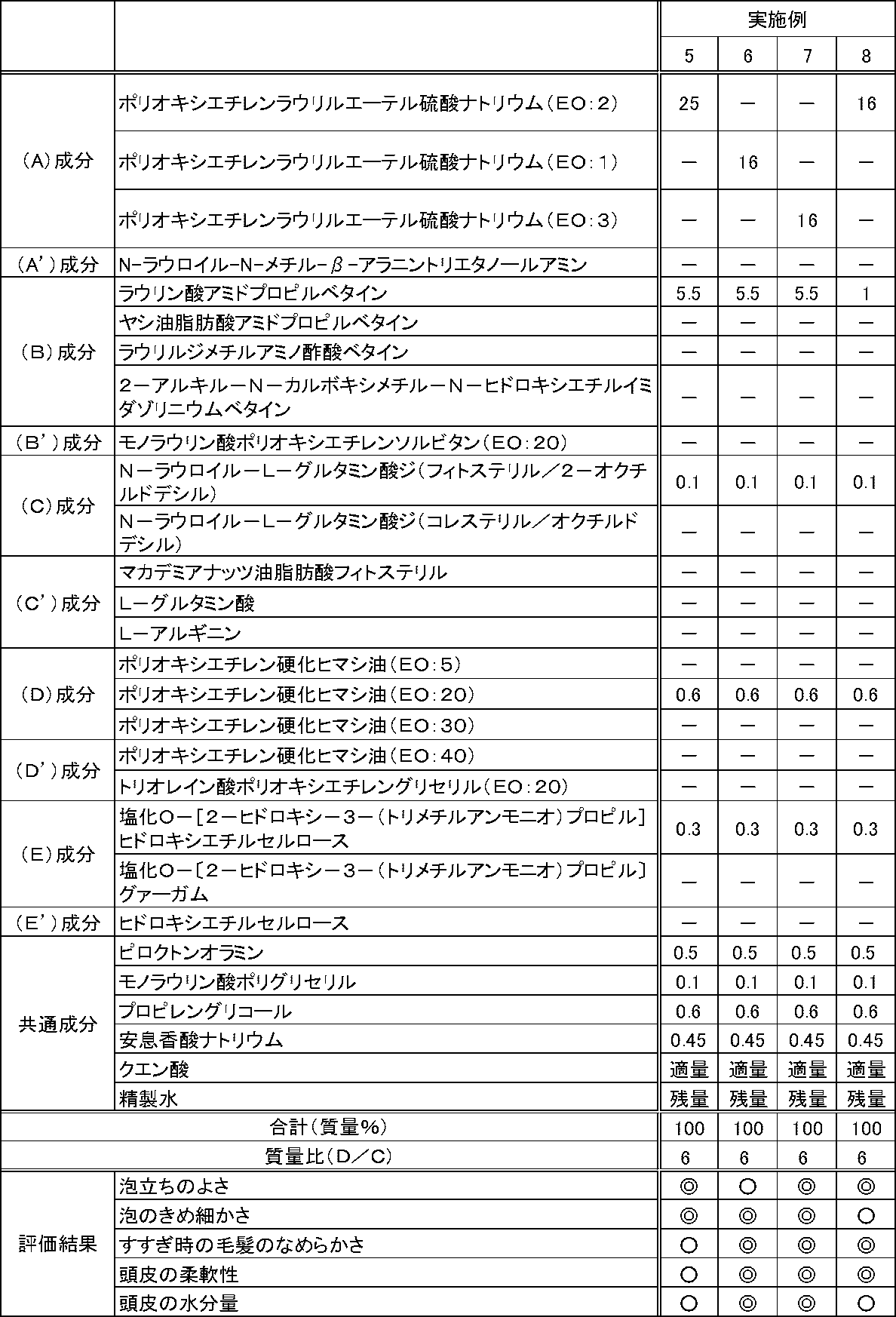
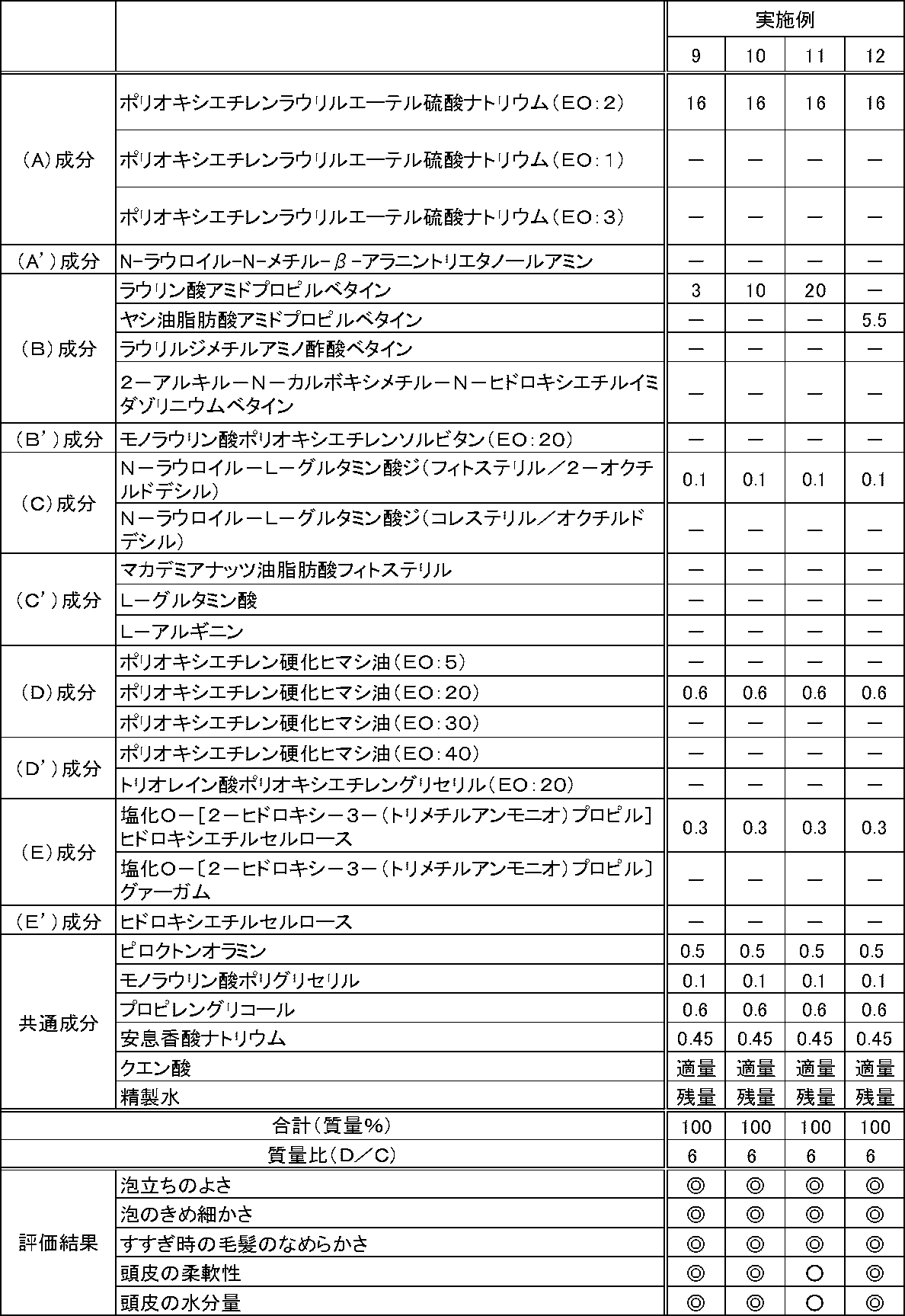
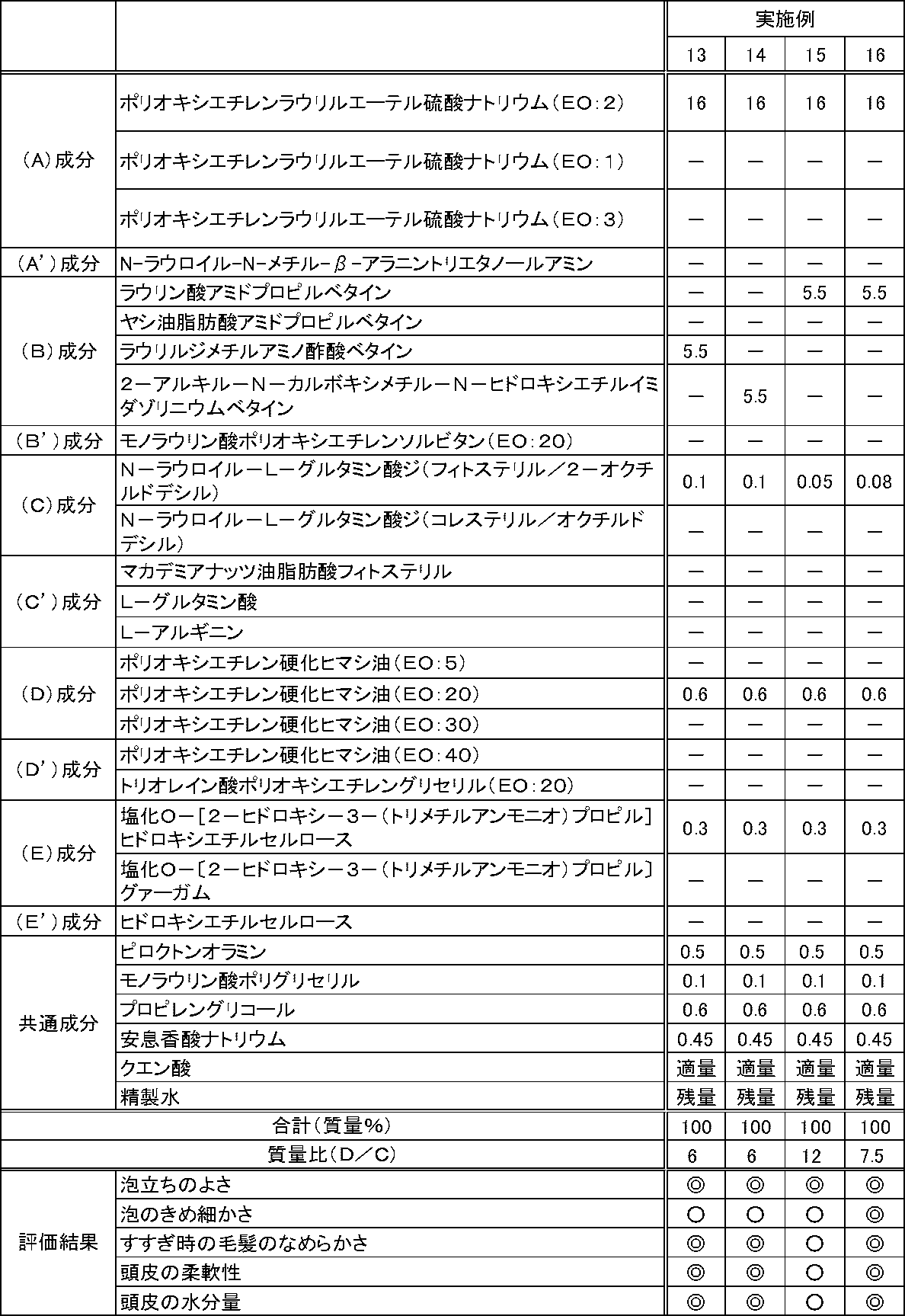
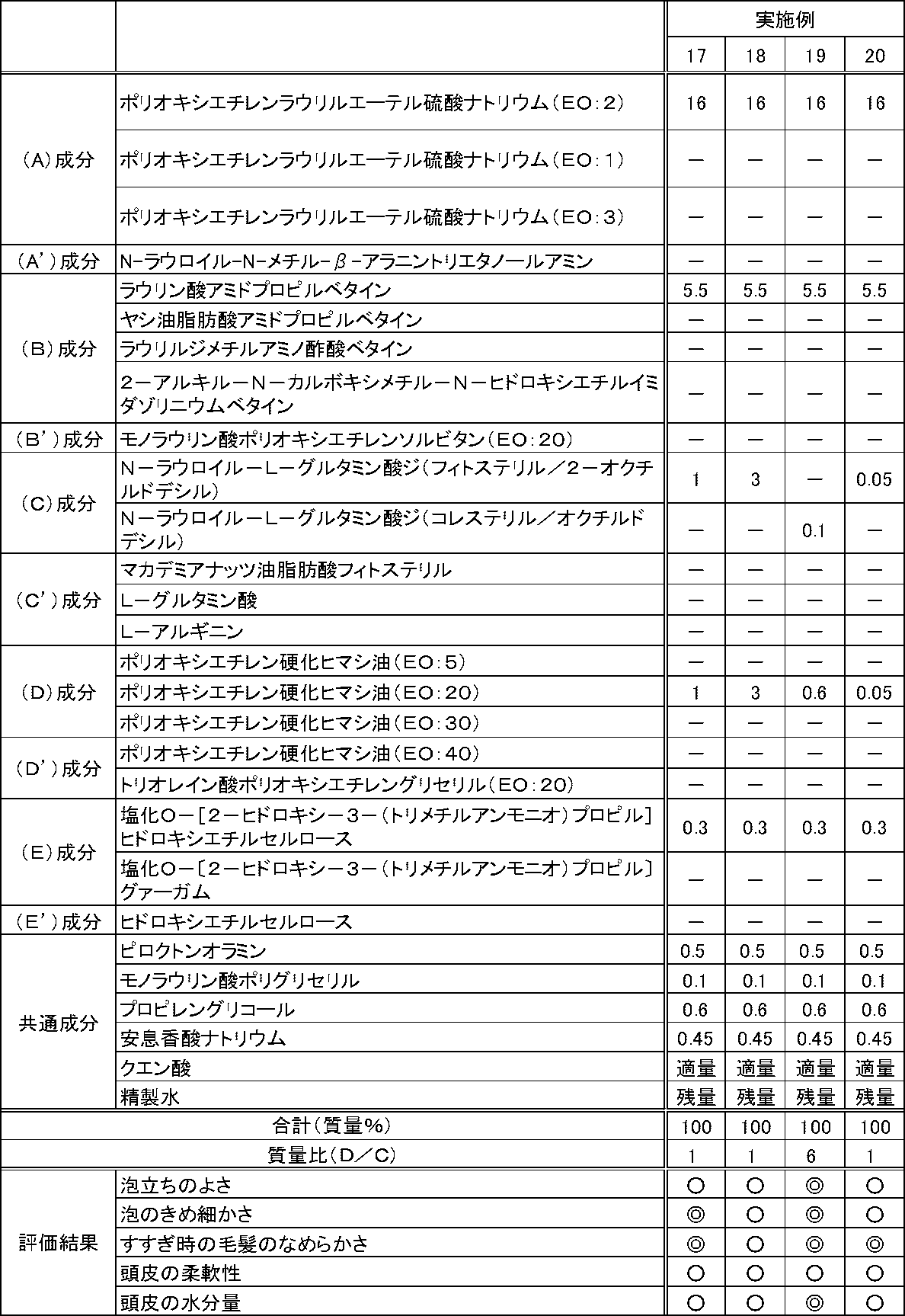

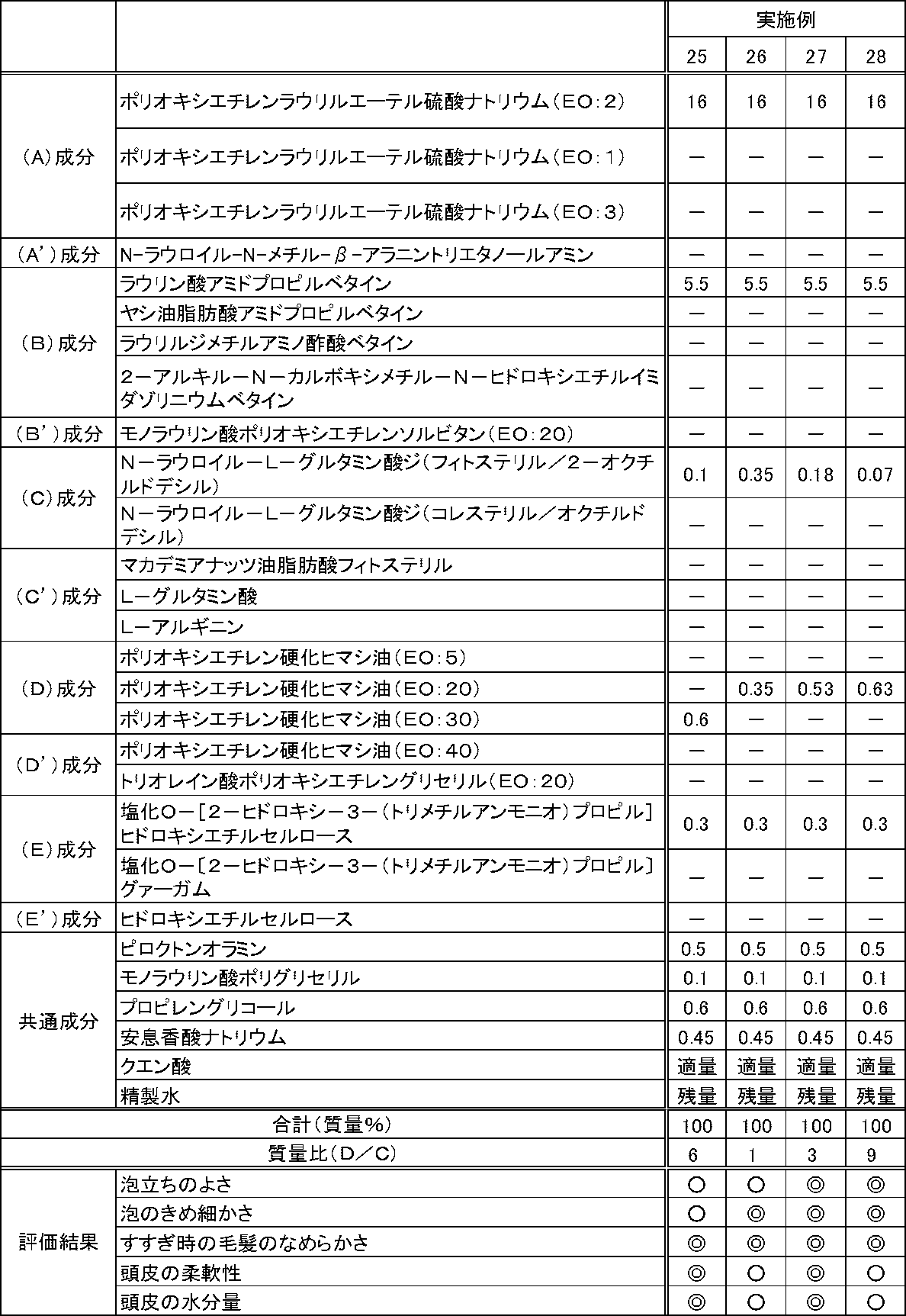
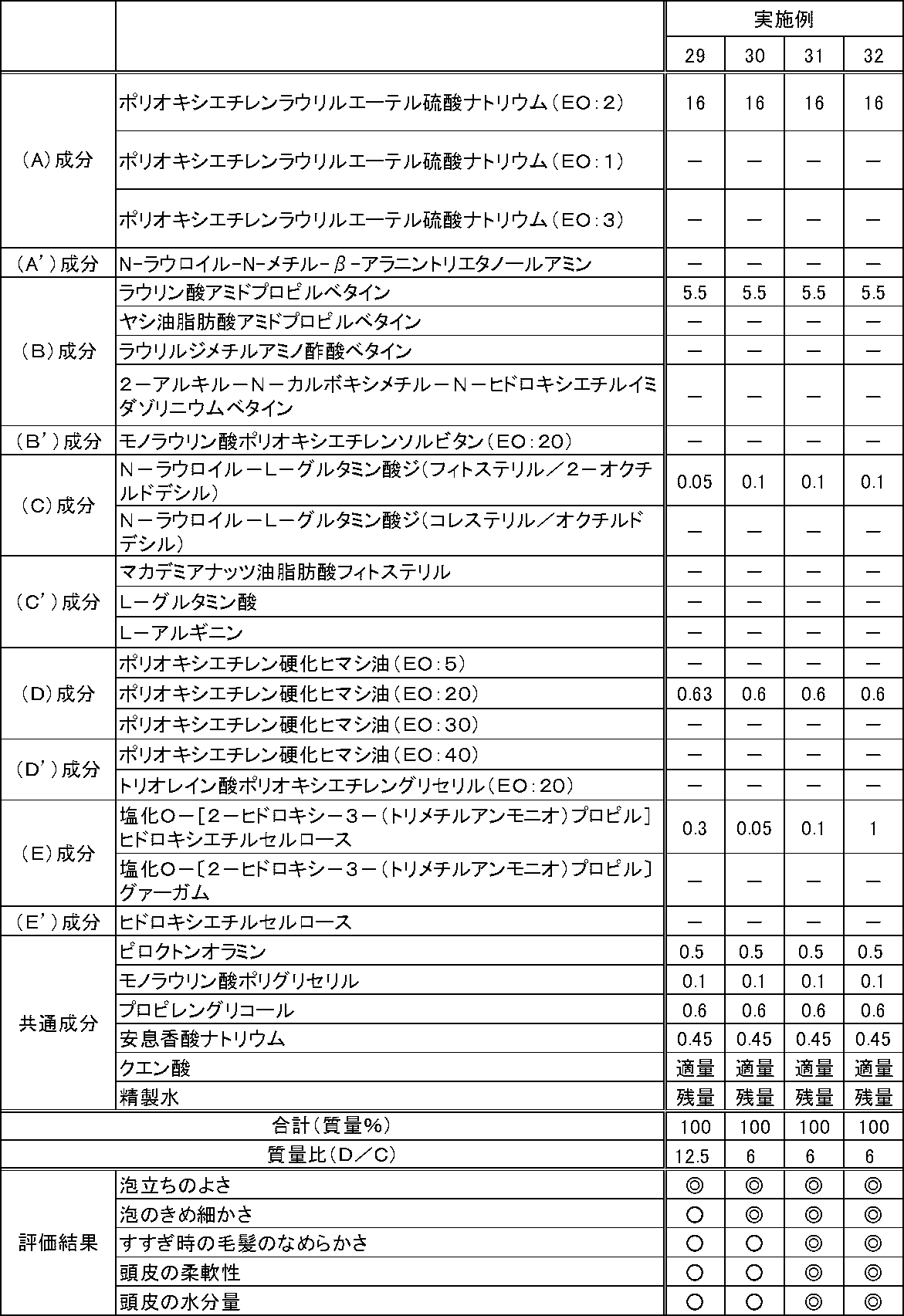
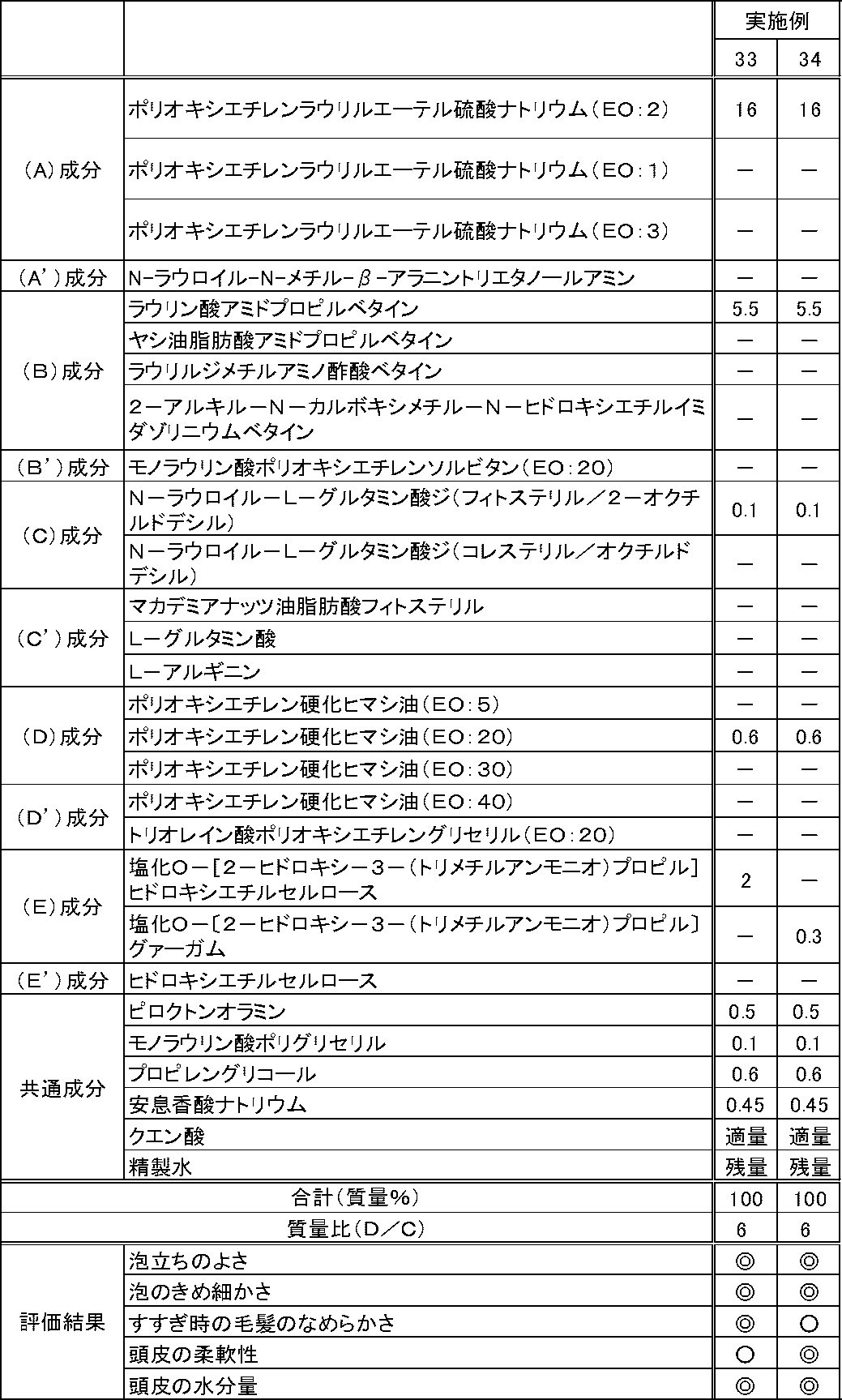
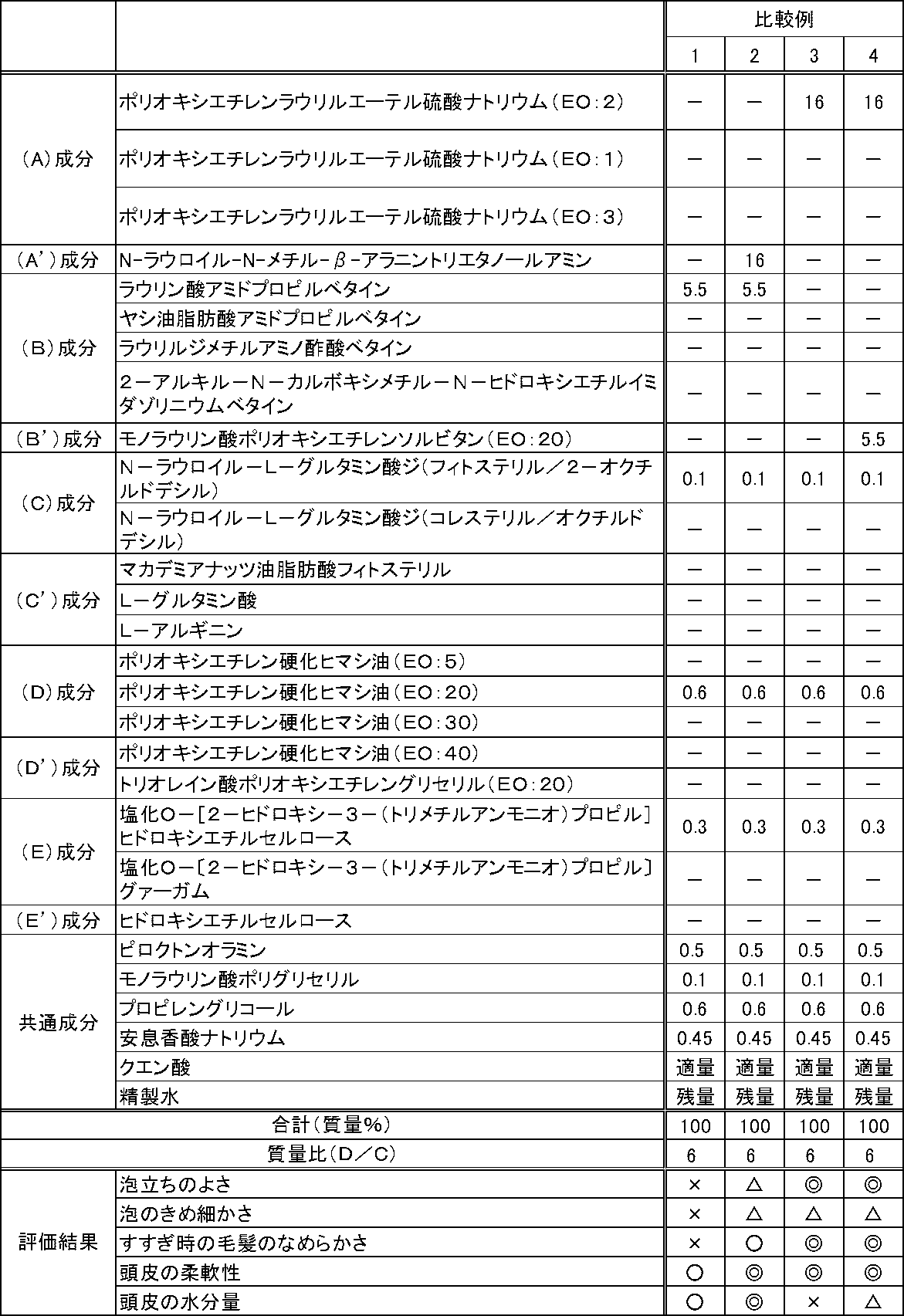


なお、前記実施例、及び前記比較例で使用した各種成分の詳細について、下記表14に示す。

本発明の毛髪洗浄剤組成物は、泡立ちのよさ、泡のきめ細かさ、及びすすぎ時の毛髪のなめらかさに優れ、頭皮の柔軟性を向上でき、頭皮の水分量を増加させることができるため、例えば、シャンプー、リンスインシャンプー等のインバスヘアケア剤に好適である。
Claims (4)
- (A)ポリオキシエチレンアルキルエーテル硫酸塩、
(B)両性界面活性剤、
(C)N-アシルアミノ酸エステル、
(D)エチレンオキサイドの平均付加モル数が5~30であるポリオキシエチレン硬化ヒマシ油、及び
(E)カチオン性ポリマー、を含有し、
前記(C)N-アシルアミノ酸エステルの含有量(質量%)と、前記(D)エチレンオキサイドの平均付加モル数が5~30であるポリオキシエチレン硬化ヒマシ油の含有量(質量%)との質量比(D/C)が、1~12.5であることを特徴とする毛髪洗浄剤組成物。 - 前記(C)N-アシルアミノ酸エステルの含有量が、0.08質量%~1質量%であり、
前記(D)エチレンオキサイドの平均付加モル数が5~30であるポリオキシエチレン硬化ヒマシ油の含有量が、0.1質量%~1質量%である請求項1に記載の毛髪洗浄剤組成物。 - 前記(A)ポリオキシエチレンアルキルエーテル硫酸塩の含有量が、12質量%~20質量%であり、
前記(E)カチオン性ポリマーの含有量が、0.1質量%~1質量%であり、
前記(C)N-アシルアミノ酸エステルの含有量(質量%)と、前記(D)エチレンオキサイドの平均付加モル数が5~30であるポリオキシエチレン硬化ヒマシ油の含有量(質量%)との質量比(D/C)が、3~9である請求項1から2のいずれかに記載の毛髪洗浄剤組成物。 - 前記(B)両性界面活性剤が、アルキルベタイン系両性界面活性剤、アミドベタイン系両性界面活性剤、及びイミダゾリニウムベタイン系両性界面活性剤から選択される少なくとも1種であり、
前記(B)両性界面活性剤の含有量が、1質量%~20質量%である請求項1から3のいずれかに記載の毛髪洗浄剤組成物。
Priority Applications (2)
| Application Number | Priority Date | Filing Date | Title |
|---|---|---|---|
| KR1020177030288A KR102539780B1 (ko) | 2015-05-29 | 2016-05-16 | 모발 세정제 조성물 |
| MYPI2017704220A MY185250A (en) | 2015-05-29 | 2016-05-16 | Hair cleanser composition |
Applications Claiming Priority (2)
| Application Number | Priority Date | Filing Date | Title |
|---|---|---|---|
| JP2015-110548 | 2015-05-29 | ||
| JP2015110548A JP6476070B2 (ja) | 2015-05-29 | 2015-05-29 | 毛髪洗浄剤組成物 |
Publications (1)
| Publication Number | Publication Date |
|---|---|
| WO2016194595A1 true WO2016194595A1 (ja) | 2016-12-08 |
Family
ID=57440973
Family Applications (1)
| Application Number | Title | Priority Date | Filing Date |
|---|---|---|---|
| PCT/JP2016/064476 Ceased WO2016194595A1 (ja) | 2015-05-29 | 2016-05-16 | 毛髪洗浄剤組成物 |
Country Status (4)
| Country | Link |
|---|---|
| JP (1) | JP6476070B2 (ja) |
| KR (1) | KR102539780B1 (ja) |
| MY (1) | MY185250A (ja) |
| WO (1) | WO2016194595A1 (ja) |
Cited By (1)
| Publication number | Priority date | Publication date | Assignee | Title |
|---|---|---|---|---|
| CN109745246A (zh) * | 2017-11-01 | 2019-05-14 | 日油株式会社 | 毛发清洗剂组合物 |
Families Citing this family (1)
| Publication number | Priority date | Publication date | Assignee | Title |
|---|---|---|---|---|
| JP7333686B2 (ja) * | 2018-10-05 | 2023-08-25 | ライオン株式会社 | フォーマー容器入り皮膚洗浄剤組成物 |
Citations (5)
| Publication number | Priority date | Publication date | Assignee | Title |
|---|---|---|---|---|
| JPH10175826A (ja) * | 1996-12-16 | 1998-06-30 | Lion Corp | シャンプー組成物 |
| JPH11240828A (ja) * | 1997-12-25 | 1999-09-07 | Ajinomoto Co Inc | 化粧料用油性原料 |
| JP2000154112A (ja) * | 1998-06-01 | 2000-06-06 | Ajinomoto Co Inc | 新規化粧料組成物 |
| JP2004210658A (ja) * | 2002-12-27 | 2004-07-29 | Kose Corp | 毛髪化粧料 |
| JP2005239625A (ja) * | 2004-02-26 | 2005-09-08 | Kanebo Cosmetics Inc | 毛髪化粧料 |
Family Cites Families (3)
| Publication number | Priority date | Publication date | Assignee | Title |
|---|---|---|---|---|
| JP5078130B2 (ja) | 2007-03-23 | 2012-11-21 | 株式会社 資生堂 | 洗浄料 |
| JP5280873B2 (ja) | 2009-01-22 | 2013-09-04 | 株式会社 資生堂 | 毛髪化粧料 |
| JP5630801B2 (ja) | 2009-03-31 | 2014-11-26 | 株式会社コーセー | 洗浄剤組成物 |
-
2015
- 2015-05-29 JP JP2015110548A patent/JP6476070B2/ja active Active
-
2016
- 2016-05-16 MY MYPI2017704220A patent/MY185250A/en unknown
- 2016-05-16 KR KR1020177030288A patent/KR102539780B1/ko active Active
- 2016-05-16 WO PCT/JP2016/064476 patent/WO2016194595A1/ja not_active Ceased
Patent Citations (5)
| Publication number | Priority date | Publication date | Assignee | Title |
|---|---|---|---|---|
| JPH10175826A (ja) * | 1996-12-16 | 1998-06-30 | Lion Corp | シャンプー組成物 |
| JPH11240828A (ja) * | 1997-12-25 | 1999-09-07 | Ajinomoto Co Inc | 化粧料用油性原料 |
| JP2000154112A (ja) * | 1998-06-01 | 2000-06-06 | Ajinomoto Co Inc | 新規化粧料組成物 |
| JP2004210658A (ja) * | 2002-12-27 | 2004-07-29 | Kose Corp | 毛髪化粧料 |
| JP2005239625A (ja) * | 2004-02-26 | 2005-09-08 | Kanebo Cosmetics Inc | 毛髪化粧料 |
Cited By (1)
| Publication number | Priority date | Publication date | Assignee | Title |
|---|---|---|---|---|
| CN109745246A (zh) * | 2017-11-01 | 2019-05-14 | 日油株式会社 | 毛发清洗剂组合物 |
Also Published As
| Publication number | Publication date |
|---|---|
| JP2016222592A (ja) | 2016-12-28 |
| KR20180011067A (ko) | 2018-01-31 |
| KR102539780B1 (ko) | 2023-06-07 |
| JP6476070B2 (ja) | 2019-02-27 |
| MY185250A (en) | 2021-04-30 |
Similar Documents
| Publication | Publication Date | Title |
|---|---|---|
| US9949901B2 (en) | Low viscosity hair care composition | |
| JP5921528B2 (ja) | 増粘化アミノ酸界面活性剤組成物およびその方法 | |
| JP6120870B2 (ja) | シャンプー組成物 | |
| JP4627333B2 (ja) | 毛髪化粧料 | |
| US20180221266A1 (en) | Low viscosity hair care composition | |
| KR101858291B1 (ko) | 세정제 조성물 | |
| JP2016532651A (ja) | ジヒドロキシアルキル置換ポリガラクトマンナンおよびその製造方法 | |
| US12059485B2 (en) | Personal cleansing compositions comprising a surfactant system consisting of an alkyl ether sulfate and betaine | |
| JP6484269B2 (ja) | コンディショナー組成物 | |
| JP6476070B2 (ja) | 毛髪洗浄剤組成物 | |
| CN108601717A (zh) | 含有季戊四醇酯和ppg烷基醚的头发调理组合物 | |
| JP4509462B2 (ja) | 毛髪化粧料 | |
| JPWO2016002522A1 (ja) | フォーマー容器入り皮膚洗浄剤組成物 | |
| JP2010209004A (ja) | 洗浄料組成物 | |
| JP2006124352A (ja) | 毛髪化粧料 | |
| WO2012066917A1 (ja) | 洗浄剤組成物 | |
| JP6178001B2 (ja) | シャンプー組成物 | |
| JP2003292995A (ja) | 洗浄剤組成物 | |
| JP2022164749A (ja) | 毛髪洗浄剤組成物 | |
| JP6810924B2 (ja) | 身体洗浄組成物 | |
| JP7001369B2 (ja) | 毛髪洗浄剤組成物 | |
| JP7316805B2 (ja) | 皮膚洗浄剤組成物 | |
| JP2010159234A (ja) | 毛髪洗浄料 | |
| JP2021102586A (ja) | 毛髪洗浄剤組成物 | |
| JP2010241775A (ja) | 毛髪化粧料 |
Legal Events
| Date | Code | Title | Description |
|---|---|---|---|
| 121 | Ep: the epo has been informed by wipo that ep was designated in this application |
Ref document number: 16803030 Country of ref document: EP Kind code of ref document: A1 |
|
| ENP | Entry into the national phase |
Ref document number: 20177030288 Country of ref document: KR Kind code of ref document: A |
|
| NENP | Non-entry into the national phase |
Ref country code: DE |
|
| 122 | Ep: pct application non-entry in european phase |
Ref document number: 16803030 Country of ref document: EP Kind code of ref document: A1 |