WO2016186006A1 - タイヤ用ゴム組成物 - Google Patents
タイヤ用ゴム組成物 Download PDFInfo
- Publication number
- WO2016186006A1 WO2016186006A1 PCT/JP2016/064188 JP2016064188W WO2016186006A1 WO 2016186006 A1 WO2016186006 A1 WO 2016186006A1 JP 2016064188 W JP2016064188 W JP 2016064188W WO 2016186006 A1 WO2016186006 A1 WO 2016186006A1
- Authority
- WO
- WIPO (PCT)
- Prior art keywords
- carbon black
- rubber composition
- mass
- dst
- rubber
- Prior art date
- Legal status (The legal status is an assumption and is not a legal conclusion. Google has not performed a legal analysis and makes no representation as to the accuracy of the status listed.)
- Ceased
Links
Images



Classifications
-
- B—PERFORMING OPERATIONS; TRANSPORTING
- B60—VEHICLES IN GENERAL
- B60C—VEHICLE TYRES; TYRE INFLATION; TYRE CHANGING; CONNECTING VALVES TO INFLATABLE ELASTIC BODIES IN GENERAL; DEVICES OR ARRANGEMENTS RELATED TO TYRES
- B60C1/00—Tyres characterised by the chemical composition or the physical arrangement or mixture of the composition
- B60C1/0016—Compositions of the tread
-
- B—PERFORMING OPERATIONS; TRANSPORTING
- B60—VEHICLES IN GENERAL
- B60C—VEHICLE TYRES; TYRE INFLATION; TYRE CHANGING; CONNECTING VALVES TO INFLATABLE ELASTIC BODIES IN GENERAL; DEVICES OR ARRANGEMENTS RELATED TO TYRES
- B60C1/00—Tyres characterised by the chemical composition or the physical arrangement or mixture of the composition
-
- B—PERFORMING OPERATIONS; TRANSPORTING
- B60—VEHICLES IN GENERAL
- B60C—VEHICLE TYRES; TYRE INFLATION; TYRE CHANGING; CONNECTING VALVES TO INFLATABLE ELASTIC BODIES IN GENERAL; DEVICES OR ARRANGEMENTS RELATED TO TYRES
- B60C11/00—Tyre tread bands; Tread patterns; Anti-skid inserts
- B60C11/0041—Tyre tread bands; Tread patterns; Anti-skid inserts comprising different tread rubber layers
- B60C11/005—Tyre tread bands; Tread patterns; Anti-skid inserts comprising different tread rubber layers with cap and base layers
-
- C—CHEMISTRY; METALLURGY
- C08—ORGANIC MACROMOLECULAR COMPOUNDS; THEIR PREPARATION OR CHEMICAL WORKING-UP; COMPOSITIONS BASED THEREON
- C08K—Use of inorganic or non-macromolecular organic substances as compounding ingredients
- C08K3/00—Use of inorganic substances as compounding ingredients
- C08K3/02—Elements
- C08K3/04—Carbon
-
- C—CHEMISTRY; METALLURGY
- C08—ORGANIC MACROMOLECULAR COMPOUNDS; THEIR PREPARATION OR CHEMICAL WORKING-UP; COMPOSITIONS BASED THEREON
- C08K—Use of inorganic or non-macromolecular organic substances as compounding ingredients
- C08K3/00—Use of inorganic substances as compounding ingredients
- C08K3/34—Silicon-containing compounds
- C08K3/36—Silica
-
- C—CHEMISTRY; METALLURGY
- C08—ORGANIC MACROMOLECULAR COMPOUNDS; THEIR PREPARATION OR CHEMICAL WORKING-UP; COMPOSITIONS BASED THEREON
- C08L—COMPOSITIONS OF MACROMOLECULAR COMPOUNDS
- C08L7/00—Compositions of natural rubber
-
- C—CHEMISTRY; METALLURGY
- C08—ORGANIC MACROMOLECULAR COMPOUNDS; THEIR PREPARATION OR CHEMICAL WORKING-UP; COMPOSITIONS BASED THEREON
- C08L—COMPOSITIONS OF MACROMOLECULAR COMPOUNDS
- C08L9/00—Compositions of homopolymers or copolymers of conjugated diene hydrocarbons
-
- C—CHEMISTRY; METALLURGY
- C08—ORGANIC MACROMOLECULAR COMPOUNDS; THEIR PREPARATION OR CHEMICAL WORKING-UP; COMPOSITIONS BASED THEREON
- C08L—COMPOSITIONS OF MACROMOLECULAR COMPOUNDS
- C08L9/00—Compositions of homopolymers or copolymers of conjugated diene hydrocarbons
- C08L9/06—Copolymers with styrene
-
- B—PERFORMING OPERATIONS; TRANSPORTING
- B60—VEHICLES IN GENERAL
- B60C—VEHICLE TYRES; TYRE INFLATION; TYRE CHANGING; CONNECTING VALVES TO INFLATABLE ELASTIC BODIES IN GENERAL; DEVICES OR ARRANGEMENTS RELATED TO TYRES
- B60C11/00—Tyre tread bands; Tread patterns; Anti-skid inserts
- B60C11/0008—Tyre tread bands; Tread patterns; Anti-skid inserts characterised by the tread rubber
- B60C2011/0016—Physical properties or dimensions
-
- B—PERFORMING OPERATIONS; TRANSPORTING
- B60—VEHICLES IN GENERAL
- B60C—VEHICLE TYRES; TYRE INFLATION; TYRE CHANGING; CONNECTING VALVES TO INFLATABLE ELASTIC BODIES IN GENERAL; DEVICES OR ARRANGEMENTS RELATED TO TYRES
- B60C2200/00—Tyres specially adapted for particular applications
- B60C2200/04—Tyres specially adapted for particular applications for road vehicles, e.g. passenger cars
-
- B—PERFORMING OPERATIONS; TRANSPORTING
- B60—VEHICLES IN GENERAL
- B60C—VEHICLE TYRES; TYRE INFLATION; TYRE CHANGING; CONNECTING VALVES TO INFLATABLE ELASTIC BODIES IN GENERAL; DEVICES OR ARRANGEMENTS RELATED TO TYRES
- B60C2200/00—Tyres specially adapted for particular applications
- B60C2200/06—Tyres specially adapted for particular applications for heavy duty vehicles
- B60C2200/065—Tyres specially adapted for particular applications for heavy duty vehicles for construction vehicles
-
- C—CHEMISTRY; METALLURGY
- C08—ORGANIC MACROMOLECULAR COMPOUNDS; THEIR PREPARATION OR CHEMICAL WORKING-UP; COMPOSITIONS BASED THEREON
- C08K—Use of inorganic or non-macromolecular organic substances as compounding ingredients
- C08K2201/00—Specific properties of additives
- C08K2201/002—Physical properties
- C08K2201/006—Additives being defined by their surface area
Definitions
- the present invention relates to a rubber composition for tires that maintains and improves mechanical properties while reducing heat build-up by blending carbon black having specific colloidal properties.
- the rolling resistance is smaller and the wear resistance is higher.
- suppression of heat generation of the rubber composition constituting the pneumatic tire has been performed.
- 60 ° C. tan ⁇ by dynamic viscoelasticity measurement is used as an index of exothermic property of the rubber composition. The smaller the tan ⁇ (60 ° C.) of the rubber composition, the smaller the exothermic property.
- the amount of carbon black is reduced, the particle size of carbon black is increased, or silica is added instead of carbon black.
- a method for reducing the tan ⁇ (60 ° C.) of the rubber composition for example, the amount of carbon black is reduced, the particle size of carbon black is increased, or silica is added instead of carbon black.
- Such a method has a problem that mechanical properties such as tensile strength at break, tensile elongation at break, and rubber hardness are lowered, and steering stability, wear resistance, and durability are lowered when the tire is formed.
- Patent Document 1 discloses that a rubber composition has a low heat generation mainly by blending carbon black with adjusted specific surface area (BET specific surface area, CTAB specific surface area, iodine adsorption index IA), DBP structure value, Stokes diameter dst, and the like. It is proposed to make it. However, this rubber composition does not necessarily have sufficient action to ensure mechanical strength and wear resistance, and further improvement has been demanded.
- cut resistance is a characteristic that makes it difficult for the tire to be damaged when it touches or collides with an obstacle or an external object.
- Heat generation is the ability to heat the energy applied to the tire by such physical impact. Instead, it is a characteristic that reduces the impact by heating the rubber. For this reason, in order to make the cut resistance of a tire excellent, it is requested
- the rubber has a low heat generation property, so that the cut resistance and the low heat generation property are in a trade-off relationship.
- Examples of methods for reducing the heat build-up of the rubber composition include reducing the amount of carbon black added, increasing the particle size of carbon black, and adding silica in place of carbon black.
- reducing the amount of carbon black added increasing the particle size of carbon black, and adding silica in place of carbon black.
- such a method has a problem that mechanical properties such as tensile strength at break and rubber hardness are lowered, and cut resistance and wear resistance are lowered when the tire is formed.
- Patent Document 2 proposes that silica, carbon black, a silane coupling agent, sulfur and a sulfenamide accelerator are blended in a specific ratio with natural rubber in order to reduce the heat build-up of a large vehicle tire. .
- this rubber composition is not always sufficient in improving the cut resistance. Therefore, further improvement has been demanded so as to achieve both heat resistance and cut resistance.
- An object of the present invention is to provide a rubber composition for tires that maintains and improves mechanical properties and cut resistance while reducing heat build-up by blending carbon black having specific colloidal properties. is there.
- the rubber composition for a tire of the first aspect of the present invention that achieves the above object has a nitrogen adsorption specific surface area N 2 SA of 90 m 2 / g or less and a compressed DBP absorption amount (24M4) of 95 with respect to 100 parts by mass of the diene rubber.
- N 2 SA nitrogen adsorption specific surface area
- 24M4 compressed DBP absorption amount
- the rubber composition for tires for construction vehicles according to the second aspect of the present invention has a nitrogen adsorption specific surface area N 2 SA of 90 m 2 / g or less and a compressed DBP absorption with respect to 100 parts by mass of diene rubber containing 60% by mass or more of natural rubber.
- N 2 SA nitrogen adsorption specific surface area
- an inorganic filler containing carbon black having an amount (24M4) of 95 to 120 ml / 100 g, and a mode diameter Dst (nm) in a Stokes diameter mass distribution curve of the carbon black aggregate and its
- the ratio ⁇ Dst / Dst of the half-value width ⁇ Dst (nm) is 0.65 or more, and the N 2 SA, (24M4) and Dst satisfy the following formula (1).
- the tire rubber composition according to the first aspect of the present invention has a nitrogen adsorption specific surface area N 2 SA of 90 m 2 / g or less, a compressed DBP absorption (24M4) of 95 to 120 ml / 100 g with respect to 100 parts by mass of the diene rubber. Since the carbon black aggregate has a ratio ⁇ Dst / Dst in the mass distribution curve of Stokes diameter of 0.65 or more and 5 to 120 parts by mass of carbon black satisfying the relationship of the above formula (1) is blended, the rubber composition It is possible to maintain and improve mechanical properties such as tensile strength at break, tensile elongation at break, and rubber hardness, while reducing tan ⁇ (60 ° C.).
- the Dst of the carbon black is preferably 160 nm or more.
- the N 2 SA of carbon black is preferably not 50 m 2 / g or more.
- the pneumatic tire using the rubber composition for a tire of the first aspect of the present invention maintains and improves handling stability, wear resistance, and durability over conventional levels while reducing rolling resistance and improving fuel efficiency. be able to.
- the rubber composition for tires for construction vehicles according to the second aspect of the present invention has a nitrogen adsorption specific surface area N 2 SA of 90 m 2 / g or less and a compressed DBP absorption with respect to 100 parts by mass of diene rubber containing 60% by mass or more of natural rubber.
- the Dst of the carbon black is preferably 160 nm or more.
- the N 2 SA of carbon black is preferably not 50 m 2 / g or more.
- silica is preferably added as the inorganic filler, and more than 30 parts by mass of carbon black is preferably added.
- the pneumatic tire for construction vehicles using the rubber composition for tires for construction vehicles according to the second aspect of the present invention in the tread portion is less than the conventional level while reducing heat generation and suppressing overheating during continuous running. Cut resistance can be improved.
- FIG. 1 is a graph showing the relationship of (24M4) / Dst against N 2 SA for ASTM grade carbon black.
- FIG. 2 is an example of a graph showing the relationship of (24M4) / Dst with respect to N 2 SA for carbon black used in the tire rubber composition of the present invention.
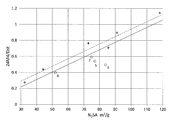
- FIG. 3 is a graph showing the relationship of (24M4) / Dst to N 2 SA of carbon black used in the examples and comparative examples of the present specification.
- FIG. 4 is a cross-sectional view in the tire meridian direction illustrating an example of an embodiment of a pneumatic tire.
- FIG. 5 is a cross-sectional view in the meridian direction showing an example of an embodiment of a pneumatic tire for construction vehicles.
- the rubber composition for tires of the first invention and the rubber composition for tires for construction vehicles of the second invention have a specific nitrogen adsorption specific surface area N 2 SA and a compressed DBP absorption amount (24M4), and By blending a novel carbon black in which the relationship between the mode diameter Dst and its half-value width ⁇ Dst ratio ⁇ Dst / Dst and Dst / (24M4) and N 2 SA in the mass distribution curve of the Stokes diameter of the aggregate is limited, Deteriorating mechanical properties such as tensile rupture strength, tensile rupture elongation, rubber hardness, wear resistance, and cut resistance while reducing tan ⁇ (60 ° C.) of the rubber composition using carbon black having a large diameter. Absent.
- the carbon black used in the present invention has a nitrogen adsorption specific surface area N 2 SA of 90 m 2 / g or less.
- N 2 SA is preferably 87 m 2 / g or less, more preferably 86 m 2 / g or less, and still more preferably 85 m 2 / g or less.
- N 2 SA is preferably 50 m 2 / g or more, may more preferably 53m 2 / g or more, even more preferably at 55m 2 / g or more.
- N 2 SA is preferably 50 to 90 m 2 / g, more preferably 55 to 85 m 2 / g. In this specification, N 2 SA of carbon black is measured according to JIS K6217-7.
- the compressed DBP absorption amount (24M4) of carbon black is 95 to 120 ml / 100 g, preferably 100 to 115 ml / 100 g.
- tan ⁇ 60 ° C.
- the compressed DBP absorption exceeds 120 ml / 100 g, the tensile strength at break, tensile elongation at break, and cut resistance deteriorate.
- workability deteriorates due to an increase in viscosity.
- the amount of compressed DBP absorption shall be measured using a compressed sample described in Appendix A in accordance with JIS K6217-4.
- the carbon black used in the present invention has the above-described nitrogen adsorption specific surface area N 2 SA and compressed DBP absorption (24M4), and also relates to the mode diameter Dst and its half-value width ⁇ Dst in the mass distribution curve of the Stokes diameter of the aggregate. Have the relationship.
- the ratio ⁇ Dst / Dst of the half-value width ⁇ Dst (nm) of the mass distribution curve to the mode diameter Dst (nm) in the mass distribution curve of Stokes diameter of the carbon black aggregate is 0.65 or more, preferably 0.8. 70 or more. Heat generation can be reduced by setting the ratio ⁇ Dst / Dst to 0.65 or more.
- the mode diameter Dst in the mass distribution curve of the Stokes diameter of the aggregate refers to the mode diameter of the maximum frequency in the mass distribution curve of the Stokes diameter of the aggregate obtained by centrifugal sedimentation of carbon black.
- the half-value width ⁇ Dst refers to the distribution width when the frequency is half the maximum point in the aggregate mass distribution curve. In the present invention, Dst and ⁇ Dst are measured in accordance with the method for obtaining the aggregate distribution by JIS K6217-6 disc centrifugal light sedimentation method.
- the nitrogen adsorption specific surface area N 2 SA, the compressed DBP absorption amount (24M4), and Dst satisfy the following formula (1).
- Dst is the mode diameter (nm) in the mass distribution curve of the Stokes diameter of the aggregate
- N 2 SA is the nitrogen adsorption specific surface area (m 2 / g)
- (24M4) is the compressed DBP absorption (ml / 100 g). is there.)
- Carbon black has N 2 SA, compression DBP absorption and ratio ⁇ Dst / Dst within the specified range as described above, and (24M4) / Dst and N 2 SA satisfy the above formula (1), thereby providing rubber.
- Mechanical properties such as tensile strength at break, tensile elongation at break, rubber hardness, wear resistance and cut resistance can be maintained and improved while reducing tan ⁇ (60 ° C.) of the composition.
- the intercept on the right side of the formula (1) is preferably ⁇ 0.10, more preferably ⁇ 0.12.
- FIG. 1 is a graph showing the relationship between (24M4) / Dst and N 2 SA for an ASTM grade which is a representative carbon black having an ASTM standard number.
- the horizontal axis represents N 2 SA (m 2 / g)
- the vertical axis represents (24M4) / Dst (ml / 100 g / nm).
- (24M4) / Dst of conventional standardized carbon black black is approximately represented by a linear line (dashed line in FIG. 1) with respect to N 2 SA, and its slope is about 0.0093, intercept Is 0.0133.
- the upper limit of the aggregate characteristic ratio (24M4) / Dst with respect to N 2 SA is limited by the formula (1).
- This boundary line (primary straight line in which the inequality sign of the formula (1) is equal) is shown by a solid line in FIG.
- carbon black used in the examples of the present specification is plotted with ⁇ marks.
- the broken line in FIG. 2 is a linear straight line obtained from ASTM grade carbon black.
- the carbon black specified by the formula (1) has N 2 SA, compressed DBP absorption (24M4), and ratio ⁇ Dst / Dst in the above-mentioned range, tan ⁇ (60 ° C.) of the rubber composition. It is possible to maintain and improve mechanical properties such as tensile strength at break, tensile elongation at break, rubber hardness, and wear resistance. Moreover, when it is used as a tire, the cut resistance can be made excellent.
- the Dst of the carbon black used in the present invention is not particularly limited, but is preferably 160 nm or more, more preferably 165 nm or more, and further preferably 170 nm or more. If Dst is less than 160 nm, the heat generation may be deteriorated.
- the carbon black having the above-described characteristics is, for example, feedstock introduction conditions in a carbon black production furnace, supply amount of all air, introduction amount of fuel oil and feedstock, reaction time (combustion from the last feedstock introduction position to reaction stoppage)
- the production conditions such as gas residence time) can be adjusted.
- both carbon black having the above-described characteristics and other carbon blacks can be used.
- the ratio for which carbon black which has a specific colloidal characteristic accounts exceeds 50 mass%.
- FIG. 4 illustrates an embodiment of a pneumatic tire using the rubber composition for a tire of the first invention.
- the pneumatic tire has a tread portion 1, a sidewall portion 2, and a bead portion 3, a carcass layer 4 is mounted between the left and right bead portions 3 and 3, and both end portions of the pneumatic tire around the bead core 5 from the inside of the tire. It is folded outside.
- a belt layer 6 is disposed outside the carcass layer 4 in the tire tread portion 1 in the tire radial direction, and a tread rubber 7 is disposed outside the belt layer 6.
- the pneumatic tire shown in FIG. 4 is an example of a pneumatic tire used for passenger cars, small trucks (light trucks) and the like, but the tire rubber composition of the present invention is not limited to this embodiment. For example, it can be suitably used for heavy duty pneumatic tires such as trucks and buses.
- the tire rubber composition according to the first aspect of the present invention is used for cords such as rubber, carcass layer, belt layer, belt cover layer and the like constituting cap tread portion, under tread portion, sidewall portion, and bead filler portion of a pneumatic tire. It can be suitably used for covering rubber, a crescent-shaped side reinforcing rubber layer in a run-flat tire, rubber constituting a rim cushion portion, and the like.
- the tire rubber composition of the first aspect of the present invention can be suitably used for the tread rubber 7 and the sidewall portion 2. Especially, it is good to use for the tread rubber 7. Since the pneumatic tire using the rubber composition of the present invention for these members has low heat generation during running, it can reduce rolling resistance and improve fuel efficiency. At the same time, by improving the mechanical properties of the rubber composition, it is possible to maintain and improve the handling stability, wear resistance, and durability to the conventional level or higher.
- examples of the diene rubber include natural rubber, isoprene rubber, butadiene rubber, styrene-butadiene rubber, acrylonitrile-butadiene rubber and the like that are usually used in tire rubber compositions.
- natural rubber, isoprene rubber, butadiene rubber, and styrene-butadiene rubber are preferable.
- These diene rubbers can be used alone or as any blend.
- the amount of carbon black is 5 to 120 parts by weight, preferably 20 to 100 parts by weight, based on 100 parts by weight of the diene rubber.
- the blending amount of carbon black is less than 5 parts by mass, the tensile breaking strength, rubber hardness, and wear resistance of the rubber composition are deteriorated.
- the compounding amount of carbon black exceeds 120 parts by mass, tan ⁇ (60 ° C.) increases and tensile elongation at break decreases.
- the wear resistance deteriorates.
- the total amount of carbon black is 5 to 120 parts by mass with respect to 100 parts by mass of the diene rubber.
- the balance between tan ⁇ and mechanical properties of the rubber composition can be adjusted by blending together other carbon blacks.
- Various additives commonly used in tire rubber compositions such as vulcanization or crosslinking agents, vulcanization accelerators, various inorganic fillers, various oils, anti-aging agents, and plasticizers, for tire rubber compositions
- vulcanization or crosslinking agents such as vulcanization or crosslinking agents, vulcanization accelerators, various inorganic fillers, various oils, anti-aging agents, and plasticizers
- a general method to form a rubber composition which can be used for vulcanization or crosslinking.
- a conventional general amount can be used.
- the rubber composition for tires of the present invention can be produced by mixing the above components using a normal rubber kneading machine such as a Banbury mixer, a kneader, or a roll.
- FIG. 5 is an explanatory view illustrating an embodiment of a pneumatic tire for construction vehicles using the rubber composition for tires for construction vehicles of the second aspect of the present invention.
- the pneumatic tire for a construction vehicle is a large heavy-duty pneumatic tire used for a construction vehicle such as a large dump truck operating in a quarry or a large-scale construction workshop.
- a pneumatic tire for construction vehicles refers to a large tire that is mounted on a large vehicle on which a load of 2 to 100 tons is applied.
- the pneumatic tire for construction vehicles includes a tread portion 11, a sidewall portion 12, and a bead portion 13.
- a carcass layer 14 including a plurality of reinforcing cords extending in the tire radial direction is mounted between the pair of left and right bead portions 13, 13, and an end portion of the carcass layer 14 is folded around the bead core 15 from the inside of the tire to the outside. It is.
- a plurality of belt layers 16 are embedded on the outer peripheral side of the carcass layer 14 in the tread portion 11. These belt layers 16 include a plurality of reinforcing cords inclined with respect to the tire circumferential direction, and are arranged so that the reinforcing cords cross each other between the layers. Further, a plurality of belt protective layers 17 are embedded on the outer peripheral side of the belt layer 16. While the belt layer 16 reinforces the tread portion 11, the belt protective layer 17 is provided for the purpose of protecting the belt layer 16. These belt protective layers 17 include a plurality of reinforcing cords inclined with respect to the tire circumferential direction, and are arranged so that the reinforcing cords cross each other between the layers.
- a layer of an under tread 19 is disposed on the outer peripheral side of the belt protective layer 17 in the tread portion 11. Furthermore, the layer of the cap tread 18 is laminated outside the layer of the undertread 19 to form a tread portion.
- the rubber composition for tires for construction vehicles according to the second aspect of the present invention can be suitably used for rubber constituting a cap tread portion, an under tread portion and a belt cushion portion of a tire for construction vehicles. Particularly preferably, it can be suitably used for a tread portion 11 such as a cap tread 18 or an under tread 19 of a pneumatic tire for construction vehicles. Since the pneumatic tire for construction vehicles using the tire rubber composition for construction vehicles of the present invention for these tire tread portions 11 has less heat generation during traveling, it is suppressed from being overheated and tire durability is increased. Can be improved. At the same time, by improving the cut resistance and rubber hardness of the rubber composition, the wear resistance and durability of the pneumatic tire can be maintained and improved to a level higher than the conventional level.
- the diene rubber necessarily contains natural rubber.
- the content of the natural rubber is 60% by mass or more, preferably 65 to 100% by mass in 100% by mass of the diene rubber. If the content of the natural rubber is less than 60% by mass, cut resistance cannot be ensured. Further, the effect of reducing the exothermic property cannot be sufficiently obtained.
- the rubber composition for tires for construction vehicles according to the second aspect of the present invention can contain a diene rubber other than natural rubber as a diene rubber.
- diene rubbers include isoprene rubber, butadiene rubber, styrene-butadiene rubber, acrylonitrile-butadiene rubber, butyl rubber, and halogenated butyl rubber. Of these, isoprene rubber, butadiene rubber, styrene-butadiene rubber, and halogenated butyl rubber are preferable.
- These diene rubbers can be used alone or as any blend.
- the content of the other diene rubber is 40% by mass or less, preferably 0 to 35% by mass in 100% by mass of the diene rubber.
- an inorganic filler containing carbon black is blended in an amount of 30 to 80 parts by mass, preferably 38 to 78 parts by mass with respect to 100 parts by mass of the diene rubber.
- the compounding amount of the inorganic filler is less than 30 parts by mass, the cut resistance is insufficient.
- the compounding quantity of an inorganic filler exceeds 80 mass parts, there exists a possibility that heat_generation
- the compounding amount of carbon black is preferably more than 30 parts by mass, more preferably more than 30 parts by mass and 75 parts by mass or less with respect to 100 parts by mass of the diene rubber. If the blending amount of carbon black is less than 30 parts by mass, the tensile rupture strength, rubber hardness, and cut resistance of the rubber composition may be deteriorated. On the other hand, if the amount of carbon black exceeds 75 parts by mass, the exothermic property may increase.
- carbon black having the above-described characteristics and other carbon blacks can be used together.
- the proportion of carbon black having a specific colloidal characteristic exceeds 50% by mass, and the total amount of carbon black is preferably more than 30 parts by mass and 75 parts by mass or less with respect to 100 parts by mass of the diene rubber. .
- the balance with the exothermic property of a rubber composition, cut resistance, and rubber hardness can be adjusted by mix
- silica, clay, talc, mica, calcium carbonate or the like can be blended as an inorganic filler other than carbon black.
- exothermicity can be reduced by blending silica.
- the compounding amount of silica is 5 to 25 parts by mass, preferably 8 to 23 parts by mass with respect to 100 parts by mass of the diene rubber. By making the compounding quantity of silica into such a range, the low exothermic property and the cut resistance of the rubber composition can be compatible. If the amount of silica is less than 5 parts by mass, the exothermic property cannot be sufficiently reduced. When the amount of silica exceeds 25 parts by mass, the wear resistance decreases.
- silica is an optional component. By constituting the inorganic filler with only carbon black or an inorganic filler other than silica, the rubber hardness of the tire rubber composition for construction vehicles can be increased. Such a rubber composition is suitable for constituting the undertread portion.
- Silica preferably has a nitrogen adsorption specific surface area of 150 to 250 m 2 / g.
- the nitrogen adsorption specific surface area of silica is less than 150 m 2 / g, the reinforcing property for the rubber composition is insufficient and the cut resistance is insufficient.
- the nitrogen adsorption specific surface area of silica exceeds 250 m 2 / g, the exothermic property increases. Note that the nitrogen adsorption specific surface area of silica is determined in accordance with ISO 9277.
- the silica used in the present invention is not limited as long as it has the above-described characteristics, and may be appropriately selected from those manufactured, or may be manufactured to have the above-described characteristics by a normal method. .
- As the type of silica for example, wet method silica, dry method silica, or surface-treated silica can be used.
- a silane coupling agent in the rubber composition of the present invention, it is preferable to mix a silane coupling agent with silica, so that the dispersibility of silica can be improved and the reinforcement with the rubber component can be further increased.
- the silane coupling agent is preferably added in an amount of 3 to 20% by mass, more preferably 5 to 15% by mass, based on the amount of silica.
- the compounding quantity of a silane coupling agent is less than 3 mass% of silica mass, the effect which improves the dispersibility of a silica is not fully acquired.
- silane coupling agents when the compounding quantity of a silane coupling agent exceeds 20 mass%, silane coupling agents will condense and it will become impossible to acquire a desired effect.
- the silane coupling agent is not particularly limited, but a sulfur-containing silane coupling agent is preferable.
- a sulfur-containing silane coupling agent is preferable.
- vulcanization or crosslinking agents such as vulcanization or crosslinking agents, vulcanization accelerators, various inorganic fillers, various oils, anti-aging agents, plasticizers, and the like.
- Various additives can be blended, and such additives can be kneaded by a general method to obtain a rubber composition, which can be used for vulcanization or crosslinking. As long as the amount of these additives is not contrary to the object of the present invention, a conventional general amount can be used.
- the rubber composition for tires for construction vehicles of the present invention can be produced by mixing the above components using a normal rubber kneading machine such as a Banbury mixer, a kneader, or a roll.
- Examples 1 to 4 Eleven types of rubber compositions (Examples 1 to 4, Standard Example 1 and Comparative Examples 1 to 6) were prepared using 11 types of carbon black (CB-1 to CB-11). Of these, three types of carbon black (CB-1 to CB-3) are commercially available grades, and eight types of carbon black (CB-4 to CB-11) are prototypes, and their colloidal characteristics are shown in Table 1. . Further, in FIG. 3, the relationship between (24M4) / Dst and N 2 SA of each of the carbon blacks CB-1 to CB-11 is plotted, and numbers for referring to the respective carbon blacks are attached. In FIG. 3, the solid line is a straight line when the equation (1) is made equal, and the broken line is a primary straight line corresponding to the ASTM grade of carbon black.
- N 2 SA Nitrogen adsorption specific surface area measured based on JIS K6217-7 24M4: Compressed DBP absorption measured based on JIS K6217-4 (compressed sample)
- Dst Based on JIS K6217-6 Mode diameter which is the maximum value of the mass distribution curve of the Stokes diameter of the aggregate by the disc centrifugal light sedimentation method.
- ⁇ Dst Stokes diameter of the aggregate by the disc centrifugal photoprecipitation method measured based on JIS K6217-6
- ⁇ Dst / Dst value of ratio ⁇ Dst / Dst • left side of equation (1) (24M4) / calculated value of Dst • right side of equation (1) calculated value of 0.0093 ⁇ N 2 SA ⁇ 0.06
- carbon blacks CB1 to CB3 represent the following commercial grades, respectively.
- CB1 Niteron Carbon Corporation Niteron # 200IS, N339 ⁇
- CB2 Tokai Carbon Co., Ltd. Seest 300
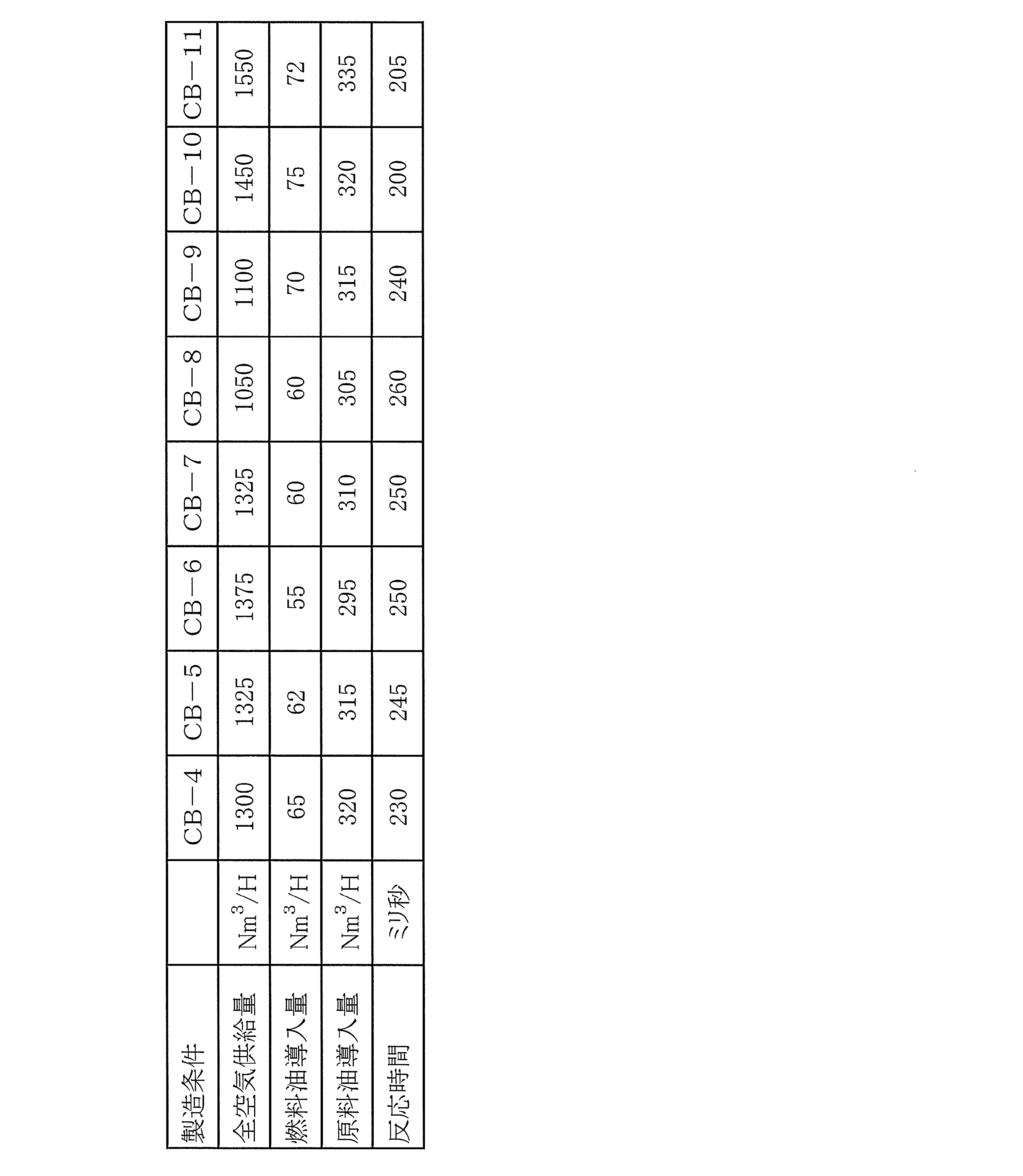
- carbon blacks CB4 to CB11 were produced by changing the total air supply amount, fuel oil introduction amount, feedstock oil introduction amount, and reaction time as shown in Table 2. .
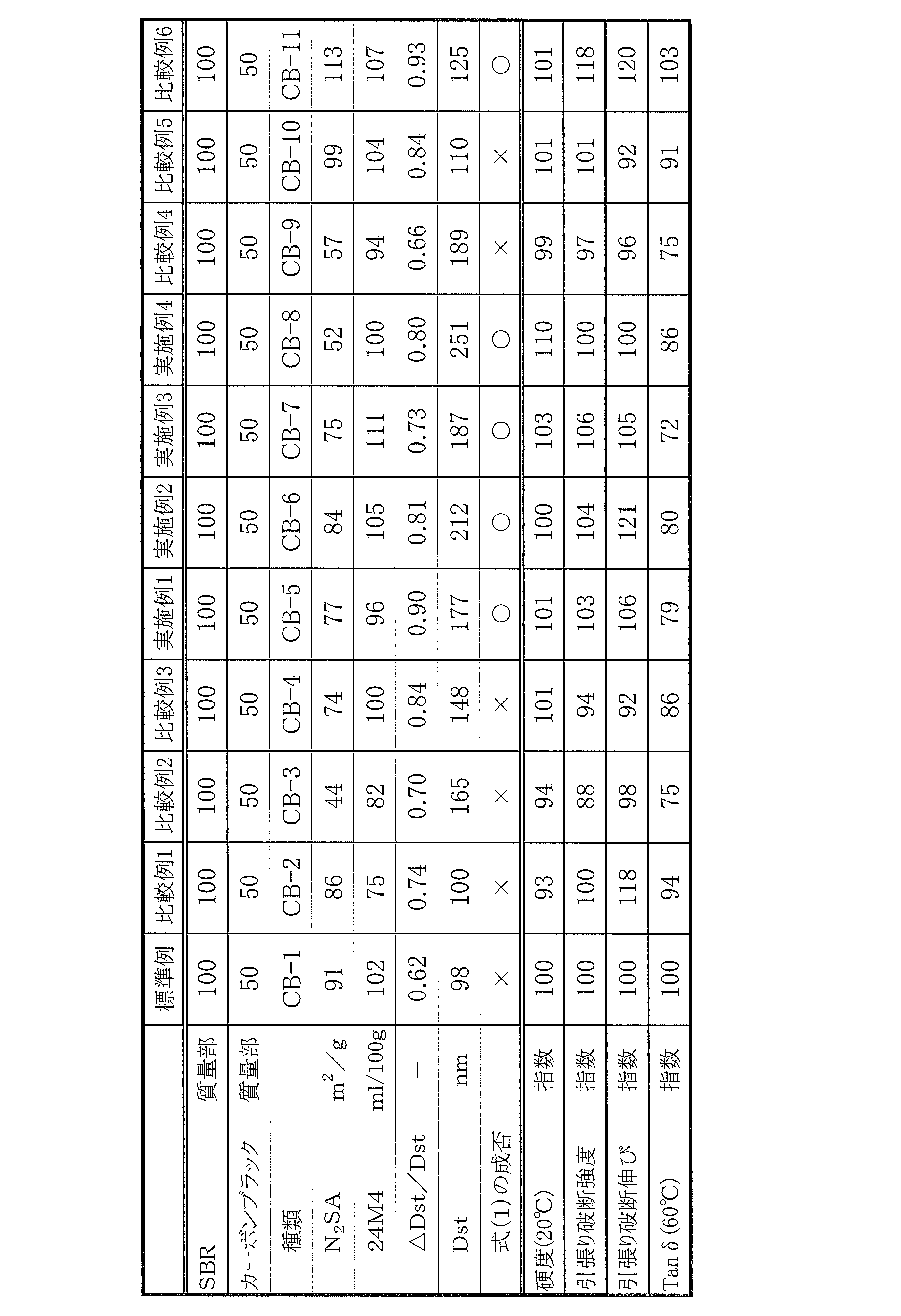
- the 11 types of rubber compositions thus obtained were each vulcanized at 160 ° C. for 20 minutes in a mold having a predetermined shape to prepare test pieces.
- the rubber hardness, tensile properties, and 60 ° C. Evaluation of tan ⁇ was performed.
- Rubber Hardness Rubber hardness was measured at a temperature of 20 ° C. with a durometer type A in accordance with JIS K6253 using the obtained test piece. The obtained results are shown in the “Rubber Hardness” column of Table 3 as an index with the value of Standard Example 1 as 100. The larger the index, the smaller the rubber hardness, and the better the steering stability when made into a tire.
- Tan ⁇ at 60 ° C Based on JIS K6394, the obtained test piece was subjected to a loss tangent tan ⁇ at a temperature of 60 ° C. under the conditions of an initial strain of 10%, an amplitude of ⁇ 2% and a frequency of 20 Hz using a viscoelastic spectrometer manufactured by Toyo Seiki Seisakusho. It was measured.
- the obtained tan ⁇ results are shown in the column of “tan ⁇ (60 ° C.)” in Table 3 as an index with the value of standard example 1 being 100. The smaller the index of tan ⁇ (60 ° C.), the smaller the heat generation, and the smaller the rolling resistance when the tire is made, the better the fuel efficiency.
- SBR styrene butadiene rubber
- Nipol 1502 manufactured by Nippon Zeon CB1 to CB11 carbon black shown in Table 1 above
- the rubber composition of Comparative Example 1 has poor rubber hardness because the compressed DBP absorption amount (24M4) of carbon black CB-2 is less than 95 ml / 100 g and does not satisfy the formula (1). .
- the rubber composition of Comparative Example 3 is inferior in tensile rupture strength and tensile rupture elongation because carbon black CB-4 does not satisfy the formula (1).
- the rubber composition of Comparative Example 4 is inferior in tensile strength at break and tensile elongation at break because the compressed DBP absorption amount (24M4) of carbon black CB-9 is less than 95 ml / 100 g and does not satisfy the formula (1).
- the rubber composition of Comparative Example 5 is inferior in tensile elongation at break because the nitrogen adsorption specific surface area N 2 SA of carbon black CB-10 exceeds 90 m 2 / g and does not satisfy the formula (1).
- the rubber composition of Comparative Example 6 has a large tan ⁇ (60 ° C.) because the nitrogen adsorption specific surface area N 2 SA of carbon black CB-11 exceeds 90 m 2 / g.
- Examples 5-12 23 types of rubber compositions were prepared using 11 types of carbon black (CB-1 to CB-11). Of these, three types of carbon black (CB-1 to CB-3) are commercially available grades, and eight types of carbon black (CB-4 to CB-11) are prototypes, and their colloidal characteristics are shown in Table 1. .
- the colloidal characteristics, commercial grade names, and production methods in Table 1 are as described above, and a description thereof is omitted.
- the pneumatic tire for construction vehicles was mounted on a large dump truck, and the internal temperature of the tread after running for a certain time (5 mm on the overhead cover) was measured and indexed. The obtained results are shown in the column of “Heat resistance” in Tables 5 and 6 as an index with the value of standard example 2 being 100. It means that the temperature rise of the pneumatic tire for construction vehicles can be suppressed as the index of heat resistance is smaller.
- the exothermic resistance index has an allowable range of 101 or less, preferably 98 or less.
- Cut resistance The obtained pneumatic tire for construction vehicles was attached to a large dump truck, and the size and number of cut scratches when the vehicle was run on an off-road for 1500 hours were visually determined. The obtained results are shown in the “Cut resistance” column of Tables 5 and 6 as an index with the value of Standard Example 2 being 100. The larger the index of cut resistance, the better the cut resistance and the better the tire durability.
- the cut resistance index has an allowable range of 99 or more, preferably 102 or more.
- ⁇ NR Natural rubber
- STR20 -BR Polybutadiene
- Nipol BR1220 manufactured by Nippon Zeon Silica: SOLOSY ZEOSIL 1165MP nitrogen adsorption specific surface area of 165 m 2 / g
- Coupling agent sulfur-containing silane coupling agent, bis (3-triethoxysilylpropyl) tetrasulfide
- Dexa Si69 CB1 to CB11 carbon black shown in Table 1 above
- the rubber composition of Comparative Example 7 has a nitrogen adsorption specific surface area N 2 SA of carbon black CB-1 of more than 90 m 2 / g and a compressed DBP absorption (24M4) of less than 95 ml / 100 g. And since it does not satisfy
- the rubber composition of Comparative Example 8 is inferior in cut resistance because the compressed DBP absorption amount (24M4) of carbon black CB-3 is less than 95 ml / 100 g and does not satisfy the formula (1).
- the rubber composition of Comparative Example 9 is inferior in heat resistance and cut resistance because the carbon black CB-4 does not satisfy the formula (1).
- the rubber composition of Comparative Example 10 has a cut DBP absorption amount (24M4) of carbon black CB-9 of less than 95 ml / 100 g and does not satisfy the formula (1). Inferior.
- the rubber composition of Comparative Example 11 has poor heat generation resistance because the nitrogen adsorption specific surface area N 2 SA of carbon black CB-10 exceeds 90 m 2 / g and does not satisfy the formula (1).
- the rubber composition of Comparative Example 12 is inferior in heat resistance because the nitrogen adsorption specific surface area N 2 SA of carbon black CB-11 exceeds 90 m 2 / g.
- the rubber composition of Comparative Example 13 is inferior in cut resistance because the content of natural rubber is less than 60% by mass.
- the rubber composition of Comparative Example 14 is inferior in heat resistance because the amount of carbon black exceeds 80 parts by mass.
- the rubber composition of Comparative Example 15 is inferior in cut resistance because the blending amount of the inorganic filler containing carbon black is less than 30 parts by mass.
- Examples 10 to 12 Eight types of tires for construction vehicles (Examples 10 to 12, Standard Example 3, and Comparative Examples 16 to 19) were each set at 160 ° C. in a mold having a predetermined shape. Test pieces were prepared by vulcanization for 20 minutes, and rubber hardness, tan ⁇ at 60 ° C., and tensile strength at break were evaluated by the following methods.
- Rubber Hardness Rubber hardness was measured at a temperature of 20 ° C. with a durometer type A in accordance with JIS K6253 using the obtained test piece. The obtained results are shown in the “Rubber Hardness” column of Table 7 as an index with the value of Standard Example 3 as 100. The larger the index, the greater the rubber hardness, and the better the steering stability when made into a tire.
- Tan ⁇ at 60 ° C Based on JIS K6394, the obtained test piece was subjected to a loss tangent tan ⁇ at a temperature of 60 ° C. under the conditions of an initial strain of 10%, an amplitude of ⁇ 2% and a frequency of 20 Hz using a viscoelastic spectrometer manufactured by Toyo Seiki Seisakusho. It was measured.
- the obtained tan ⁇ results are shown in the column of “heat resistance” in Table 7 as an index with the value of standard example 3 as 100. The smaller the index of heat resistance, the smaller the heat generation, which means that the overheating state is suppressed when the tire is used for a construction vehicle.
- the rubber composition of Comparative Example 16 has a nitrogen adsorption specific surface area N 2 SA of carbon black CB-1 of more than 90 m 2 / g and a compressed DBP absorption amount (24M4) of less than 95 ml / 100 g. And since it does not satisfy
- the rubber composition of Comparative Example 17 has inferior cut resistance because the compressed DBP absorption amount (24M4) of carbon black CB-3 is less than 95 ml / 100 g and does not satisfy the formula (1).
- the rubber composition of Comparative Example 18 is inferior in heat resistance and cut resistance because carbon black CB-4 does not satisfy the formula (1).
- the rubber composition of Comparative Example 19 is inferior in heat resistance because the nitrogen adsorption specific surface area N 2 SA of carbon black CB-11 exceeds 90 m 2 / g.
- Tread part 2 Side wall part 3: Bead part 4: Carcass layer 5: Bead core 6: Belt layer 7: Tread rubber 11: Tread part 12: Side wall part 13: Bead part 14: Carcass layer 15: Bead core 16: Belt layer 17: Belt protective layer 18: Cap tread 19: Under tread
Landscapes
- Chemical & Material Sciences (AREA)
- Health & Medical Sciences (AREA)
- Chemical Kinetics & Catalysis (AREA)
- Medicinal Chemistry (AREA)
- Polymers & Plastics (AREA)
- Organic Chemistry (AREA)
- Engineering & Computer Science (AREA)
- Mechanical Engineering (AREA)
- Compositions Of Macromolecular Compounds (AREA)
- Tires In General (AREA)
Abstract
Description
(24M4)/Dst<0.0093×N2SA-0.06 (1)
(ただし、Dstは凝集体のストークス径の質量分布曲線におけるモード径(nm)、N2SAは窒素吸着比表面積(m2/g)、(24M4)は圧縮DBP吸収量(ml/100g)である。)
(24M4)/Dst<0.0093×N2SA-0.06 (1)
(ただし、Dstは凝集体のストークス径の質量分布曲線におけるモード径(nm)、N2SAは窒素吸着比表面積(m2/g)、(24M4)は圧縮DBP吸収量(ml/100g)である。)
(24M4)/Dst<0.0093×N2SA-0.06 (1)
(ただし、Dstは凝集体のストークス径の質量分布曲線におけるモード径(nm)、N2SAは窒素吸着比表面積(m2/g)、(24M4)は圧縮DBP吸収量(ml/100g)である。)
11種類のカーボンブラック(CB-1~CB-11)を使用して11種類のゴム組成物(実施例1~4、標準例1、比較例1~6)を調製した。このうち3種類のカーボンブラック(CB-1~CB-3)は市販グレード、8種類のカーボンブラック(CB-4~CB-11)は試作品であり、それぞれのコロイダル特性を表1に示した。また図3において、各カーボンブラックCB-1~CB-11の(24M4)/DstとN2SAの関係をプロットすると共に、それぞれのカーボンブラックを参照する番号を付した。なお図3において実線は式(1)を等号にしたときの直線、破線はカーボンブラックのASTMグレードに相当する1次直線である。
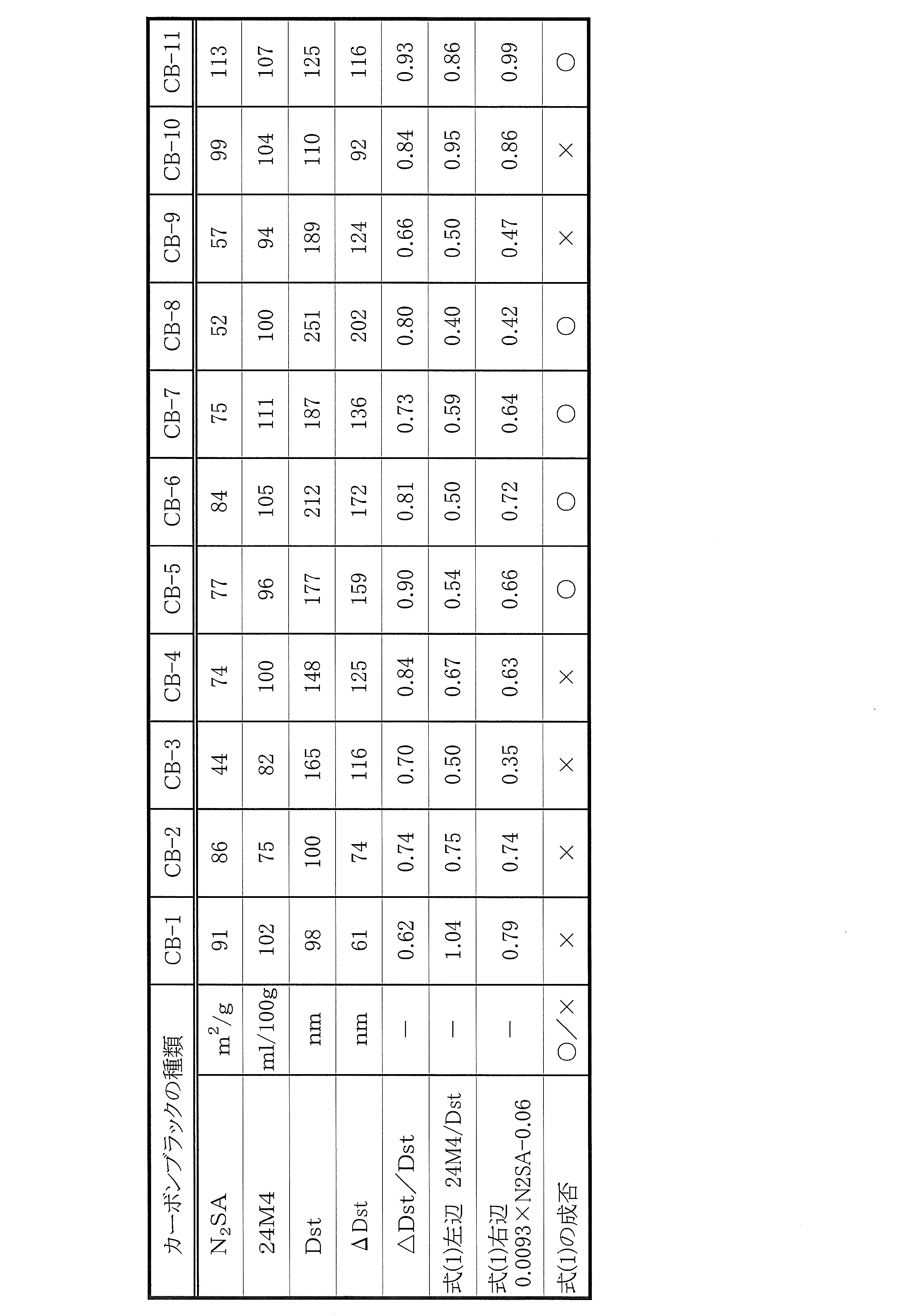
・N2SA:JIS K6217-7に基づいて測定された窒素吸着比表面積
・24M4:JIS K6217-4(圧縮試料)に基づいて測定された圧縮DBP吸収量
・Dst:JIS K6217-6に基づいて測定されたディスク遠心光沈降法による凝集体のストークス径の質量分布曲線の最大値であるモード径
・△Dst:JIS K6217-6に基づいて測定されたディスク遠心光沈降法による凝集体のストークス径の質量分布曲線において、その質量頻度が最大点の半分の高さのときの分布の幅(半値幅)
・△Dst/Dst:比△Dst/Dstの値
・式(1)の左辺 (24M4)/Dstの計算値
・式(1)の右辺 0.0093×N2SA-0.06の計算値
・式(1)の成否:左辺<右辺が成立するときが○、成立しないときを×で表す。
・CB1:新日化カーボン社製ニテロン#200IS、N339
・CB2:東海カーボン社製シースト300、N326
・CB3:新日化カーボン社製ニテロン#10N、N550
円筒反応炉を使用して、表2に示すように全空気供給量、燃料油導入量、原料油導入量、反応時間を変えて、カーボンブラックCB4~CB11を製造した。
上述した11種類のカーボンブラック(CB1~CB11)を用いて、表4の配合剤を共通に添加した、表3に示す配合からなる11種類のゴム組成物(実施例1~4、標準例1、比較例1~6)を調製するに当たり、それぞれ硫黄及び加硫促進剤を除く成分を秤量し、55Lのニーダーで15分間混練した後、そのマスターバッチを放出し室温冷却した。このマスターバッチを55Lのニーダーに供し、硫黄及び加硫促進剤を加え、混合しタイヤ用ゴム組成物を得た。なお、表4に記載の配合剤の量は、表3に記載のSBR100質量部に対する質量部で記載した。
ゴム硬度は、得られた試験片を用いてJIS K6253に準拠しデュロメータのタイプAにより温度20℃で測定した。得られた結果は、標準例1の値を100とする指数として表3の「ゴム硬度」の欄に示した。この指数が大きいほどゴム硬度が小さく、タイヤにしたとき操縦安定性が優れることを意味する。
得られた試験片から、JIS K6251に準拠してJIS3号ダンベル型試験片(厚さ2mm)を打ち抜き、温度20℃、500mm/分の引張り速度で試験を行い、引張り破断強度および引張り破断伸びを測定した。得られた結果は、標準例1のそれぞれの値を100とする指数として表3の「引張り破断強度」および「引張り破断伸び」の欄に示した。これら指数が大きいほど引張り破断強度及び引張り破断伸びが大きく機械的特性が優れることを意味する。
得られた試験片をJIS K6394に準拠して、東洋精機製作所社製粘弾性スペクトロメーターを用いて、初期歪み10%、振幅±2%、周波数20Hzの条件で、温度60℃における損失正接tanδを測定した。得られたtanδの結果は、標準例1の値を100とする指数として表3の「tanδ(60℃)」の欄に示した。tanδ(60℃)の指数が小さいほど発熱性が小さく、タイヤにしたとき転がり抵抗が小さく燃費性能が優れることを意味する。
・SBR:スチレンブタジエンゴム、日本ゼオン社製Nipol 1502
・CB1~CB11:上述した表1に示したカーボンブラック
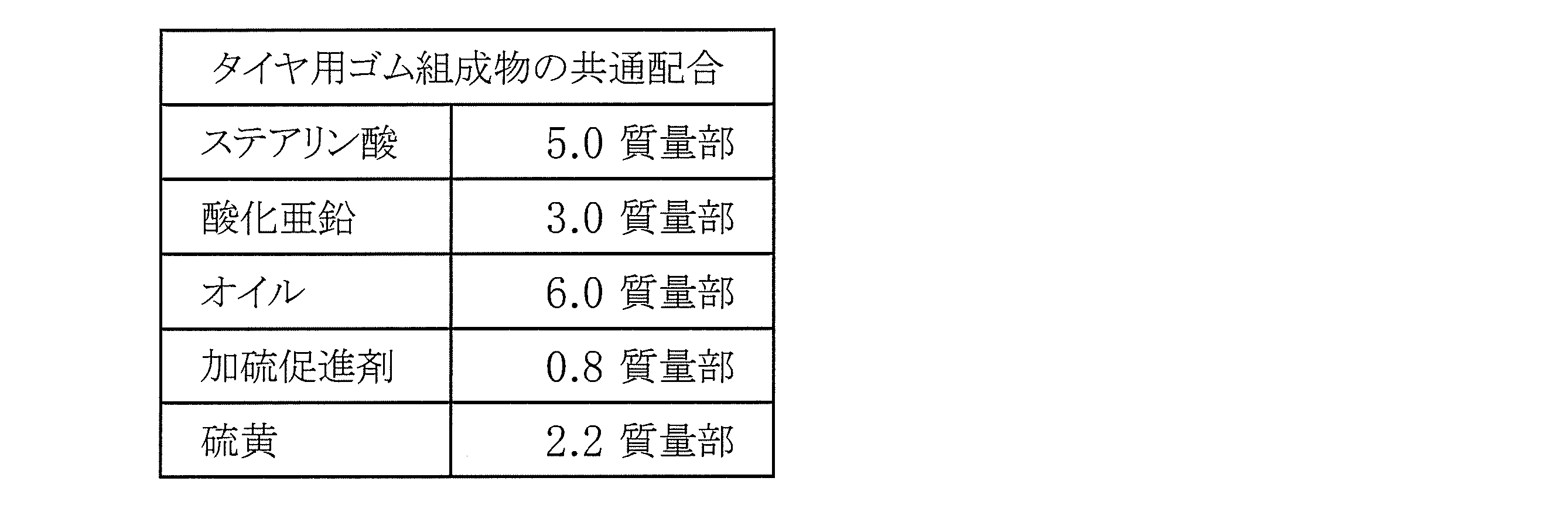
・ステアリン酸:日油社製ビーズステアリン酸
・酸化亜鉛:正同化学工業社製酸化亜鉛3種
・オイル:昭和シェル石油株式会社製エキストラクト4号S
・加硫促進剤:大内新興化学工業社製ノクセラーNS-P
・硫黄:鶴見化学工業社製油処理硫黄
11種類のカーボンブラック(CB-1~CB-11)を使用して23種類のゴム組成物(実施例5~12、標準例2,3、比較例7~19)を調製した。このうち3種類のカーボンブラック(CB-1~CB-3)は市販グレード、8種類のカーボンブラック(CB-4~CB-11)は試作品であり、それぞれのコロイダル特性を表1に示した。表1におけるコロイダル特性、市販グレード名および製造方法は前述の通りであり、説明を省略する。
上述した11種類のカーボンブラック(CB1~CB11)を用いて、表8の配合剤を共通に添加した、表5,6,7に示す配合からなる23種類のゴム組成物(実施例5~12、標準例2,3、比較例7~19)を調製するに当たり、それぞれ硫黄及び加硫促進剤を除く成分を秤量し、55Lのニーダーで15分間混練した後、そのマスターバッチを放出し室温冷却した。このマスターバッチを55Lのニーダーに供し、硫黄及び加硫促進剤を加え、混合し建設車両向けタイヤ用ゴム組成物を得た。なお、表8に記載の配合剤の量は、表5~7に記載のジエン系ゴム100質量部に対する質量部で記載した。
得られた建設車両用空気入りタイヤを大型ダンプに装着して、一定時間走行後のトレッド内部温度(オーバーヘッドカバー上5mm)を測定、指数化した。得られた結果は、標準例2の値を100とする指数として表5,6の「耐発熱性」の欄に示した。耐発熱性の指数が小さいほど建設車両用空気入りタイヤの温度上昇を抑制することができることを意味する。なお耐発熱性の指数は、許容範囲が101以下、好ましくは98以下であるとよい。
得られた建設車両用空気入りタイヤを大型ダンプに装着して、オフロードを1500時間走行した時のカットキズの大小・数を目視で判定した。得られた結果は、標準例2の値を100とする指数として表5,6の「耐カット性」の欄に示した。耐カット性の指数が大きいほど耐カット性が優れ、タイヤ耐久性が優れることを意味する。なお耐カット性の指数は、許容範囲が99以上、好ましくは102以上であるとよい。


・NR:天然ゴム、STR20
・BR:ポリブタジエン、日本ゼオン社製Nipol BR1220
・シリカ:SOLVAY社製ZEOSIL 1165MP、窒素吸着比表面積が165m2/g
・カップリング剤:硫黄含有シランカップリング剤、ビス(3-トリエトキシシリルプロピル)テトラスルフィド、デクサ社製Si69
・CB1~CB11:上述した表1に示したカーボンブラック
ゴム硬度は、得られた試験片を用いてJIS K6253に準拠しデュロメータのタイプAにより温度20℃で測定した。得られた結果は、標準例3の値を100とする指数として表7の「ゴム硬度」の欄に示した。この指数が大きいほどゴム硬度が大きく、タイヤにしたとき操縦安定性が優れることを意味する。
得られた試験片をJIS K6394に準拠して、東洋精機製作所社製粘弾性スペクトロメーターを用いて、初期歪み10%、振幅±2%、周波数20Hzの条件で、温度60℃における損失正接tanδを測定した。得られたtanδの結果は、標準例3の値を100とする指数として表7の「耐発熱性」の欄に示した。耐発熱性の指数が小さいほど発熱性が小さく、建設車両用タイヤにしたとき過熱状態になるのを抑制することを意味する。
得られた試験片を使用し、JIS K6251に準拠して、ダンベルJIS3号形試験片を作製し、室温(20℃)で500mm/分の引張り速度で引張り試験を行い、破断したときの引張り破断強度を測定した。得られた結果は、標準例3の値を100にする指数として表7の「耐カット性」の欄に記載した。この指数が大きいほど引張破断強度が強く耐カット性が優れることを意味する。

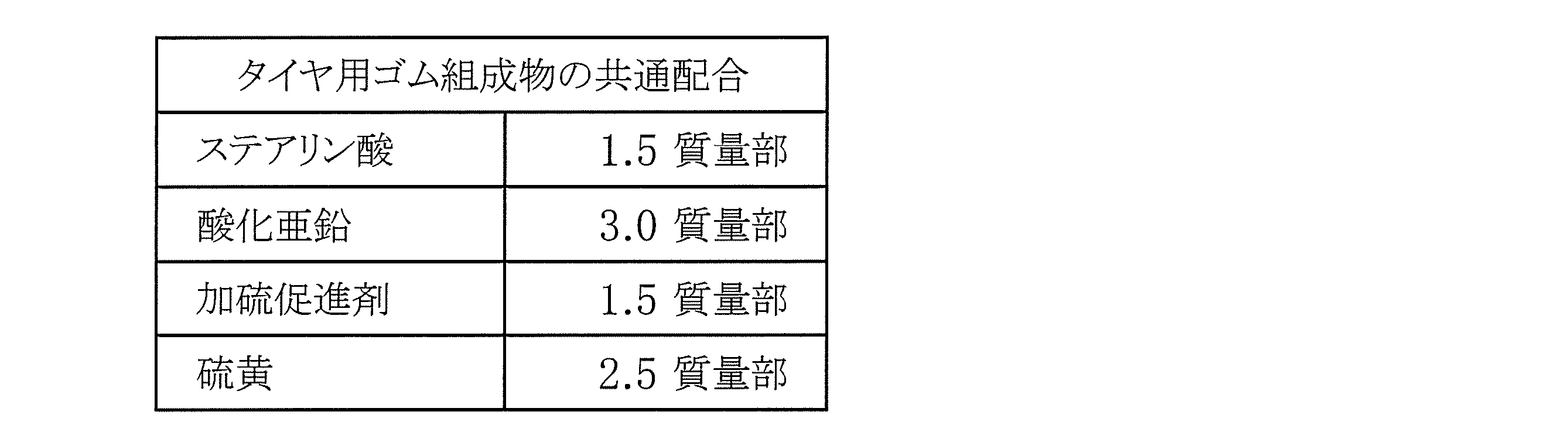
・ステアリン酸:日油社製ビーズステアリン酸
・酸化亜鉛:正同化学工業社製酸化亜鉛3種
・加硫促進剤:FLEXSYS社製SANTOCURE CBS
・硫黄:鶴見化学工業社製金華印油入微粉硫黄(硫黄の含有量95.24重量%)
2:サイドウォール部
3:ビード部
4:カーカス層
5:ビードコア
6:ベルト層
7:トレッドゴム
11:トレッド部
12:サイドウォール部
13:ビード部
14:カーカス層
15:ビードコア
16:ベルト層
17:ベルト保護層
18:キャップトレッド
19:アンダートレッド
Claims (10)
- ジエン系ゴム100質量部に対し、窒素吸着比表面積N2SAが90m2/g以下、圧縮DBP吸収量(24M4)が95~120ml/100gのカーボンブラックを5~120質量部を配合すると共に、前記カーボンブラックの凝集体のストークス径の質量分布曲線におけるモード径Dst(nm)およびその半値幅ΔDst(nm)の比ΔDst/Dstが0.65以上であり、前記N2SA、(24M4)およびDstが下記の式(1)を満たすことを特徴とするタイヤ用ゴム組成物。
(24M4)/Dst<0.0093×N2SA-0.06 (1)
(ただし、Dstは凝集体のストークス径の質量分布曲線におけるモード径(nm)、N2SAは窒素吸着比表面積(m2/g)、(24M4)は圧縮DBP吸収量(ml/100g)である。) - 前記Dstが、160nm以上であることを特徴とする請求項1に記載のタイヤ用ゴム組成物。
- 前記N2SAが、50m2/g以上であることを特徴とする請求項1または2に記載のタイヤ用ゴム組成物。
- 請求項1,2または3に記載のタイヤ用ゴム組成物を使用した空気入りタイヤ。
- 天然ゴムを60質量%以上含むジエン系ゴム100質量部に対し、窒素吸着比表面積N2SAが90m2/g以下、圧縮DBP吸収量(24M4)が95~120ml/100gのカーボンブラックを含む無機充填剤を30~80質量部配合すると共に、前記カーボンブラックの凝集体のストークス径の質量分布曲線におけるモード径Dst(nm)およびその半値幅ΔDst(nm)の比ΔDst/Dstが0.65以上であり、前記N2SA、(24M4)およびDstが下記の式(1)を満たすことを特徴とする建設車両向けタイヤ用ゴム組成物。
(24M4)/Dst<0.0093×N2SA-0.06 (1)
(ただし、Dstは凝集体のストークス径の質量分布曲線におけるモード径(nm)、N2SAは窒素吸着比表面積(m2/g)、(24M4)は圧縮DBP吸収量(ml/100g)である。) - 前記Dstが、160nm以上であることを特徴とする請求項5に記載の建設車両向けタイヤ用ゴム組成物。
- 前記N2SAが、50m2/g以上であることを特徴とする請求項5または6に記載の建設車両向けタイヤ用ゴム組成物。
- 前記無機充填剤として、シリカを5~25質量部配合したことを特徴とする請求項5,6または7に記載の建設車両向けタイヤ用ゴム組成物。
- 前記カーボンブラックを30質量部超配合したことを特徴とする請求項5~8のいずれかに記載の建設車両向けタイヤ用ゴム組成物。
- 請求項5~9のいずれかに記載のタイヤ用ゴム組成物をトレッド部に使用した建設車両向け空気入りタイヤ。
Priority Applications (4)
| Application Number | Priority Date | Filing Date | Title |
|---|---|---|---|
| US15/575,311 US10752055B2 (en) | 2015-05-18 | 2016-05-12 | Rubber composition for tire |
| RU2017139720A RU2681903C1 (ru) | 2015-05-18 | 2016-05-12 | Каучуковая композиция для шины |
| JP2016544685A JP6424895B2 (ja) | 2015-05-18 | 2016-05-12 | タイヤ用ゴム組成物 |
| CN201680028159.1A CN107531944B (zh) | 2015-05-18 | 2016-05-12 | 轮胎用橡胶组合物 |
Applications Claiming Priority (4)
| Application Number | Priority Date | Filing Date | Title |
|---|---|---|---|
| JP2015100753 | 2015-05-18 | ||
| JP2015-100753 | 2015-05-18 | ||
| JP2015-149447 | 2015-07-29 | ||
| JP2015149447 | 2015-07-29 |
Publications (1)
| Publication Number | Publication Date |
|---|---|
| WO2016186006A1 true WO2016186006A1 (ja) | 2016-11-24 |
Family
ID=57319986
Family Applications (1)
| Application Number | Title | Priority Date | Filing Date |
|---|---|---|---|
| PCT/JP2016/064188 Ceased WO2016186006A1 (ja) | 2015-05-18 | 2016-05-12 | タイヤ用ゴム組成物 |
Country Status (5)
| Country | Link |
|---|---|
| US (1) | US10752055B2 (ja) |
| JP (1) | JP6424895B2 (ja) |
| CN (1) | CN107531944B (ja) |
| RU (1) | RU2681903C1 (ja) |
| WO (1) | WO2016186006A1 (ja) |
Families Citing this family (1)
| Publication number | Priority date | Publication date | Assignee | Title |
|---|---|---|---|---|
| TWI875160B (zh) * | 2023-08-29 | 2025-03-01 | 林園先進材料科技股份有限公司 | 碳黑及其應用 |
Citations (2)
| Publication number | Priority date | Publication date | Assignee | Title |
|---|---|---|---|---|
| JPH0224335A (ja) * | 1988-07-12 | 1990-01-26 | Toyo Tire & Rubber Co Ltd | ゴム組成物 |
| WO2014103876A1 (ja) * | 2012-12-28 | 2014-07-03 | 横浜ゴム株式会社 | 建設車両用空気入りタイヤ用ゴム組成物 |
Family Cites Families (8)
| Publication number | Priority date | Publication date | Assignee | Title |
|---|---|---|---|---|
| RU2082621C1 (ru) * | 1992-10-27 | 1997-06-27 | Санкт-Петербургский государственный горный институт им.Г.В.Плеханова (технический университет) | Шина большегрузного автомобиля |
| DE69723668T2 (de) * | 1996-08-26 | 2004-06-03 | Bridgestone Corp. | Kautschukzusammensetzung und unter deren verwendung hergestellter luftreifen |
| US6441070B1 (en) * | 2000-07-14 | 2002-08-27 | The Goodyear Tire & Rubber Company | Rubber compositions containing a trivalent phosphorous compound-silica complex |
| WO2002092680A2 (fr) | 2001-05-16 | 2002-11-21 | Societe De Technologie Michelin | Composition de caoutchouc pour armature de sommet de pneumatique |
| JP4810567B2 (ja) * | 2008-12-10 | 2011-11-09 | 住友ゴム工業株式会社 | スタッドレスタイヤ用トレッドゴム組成物及びスタッドレスタイヤ |
| JP5579744B2 (ja) | 2008-12-29 | 2014-08-27 | コンパニー ゼネラール デ エタブリッスマン ミシュラン | 大型車両トレッド/アンダートレッド |
| JP4987095B2 (ja) * | 2009-09-24 | 2012-07-25 | 住友ゴム工業株式会社 | タイヤ用ゴム組成物及び空気入りタイヤ |
| JP5500229B2 (ja) * | 2012-10-30 | 2014-05-21 | 横浜ゴム株式会社 | ランフラットタイヤのサイドゴム補強層用ゴム組成物 |
-
2016
- 2016-05-12 RU RU2017139720A patent/RU2681903C1/ru active
- 2016-05-12 US US15/575,311 patent/US10752055B2/en active Active
- 2016-05-12 WO PCT/JP2016/064188 patent/WO2016186006A1/ja not_active Ceased
- 2016-05-12 JP JP2016544685A patent/JP6424895B2/ja active Active
- 2016-05-12 CN CN201680028159.1A patent/CN107531944B/zh active Active
Patent Citations (2)
| Publication number | Priority date | Publication date | Assignee | Title |
|---|---|---|---|---|
| JPH0224335A (ja) * | 1988-07-12 | 1990-01-26 | Toyo Tire & Rubber Co Ltd | ゴム組成物 |
| WO2014103876A1 (ja) * | 2012-12-28 | 2014-07-03 | 横浜ゴム株式会社 | 建設車両用空気入りタイヤ用ゴム組成物 |
Also Published As
| Publication number | Publication date |
|---|---|
| RU2681903C1 (ru) | 2019-03-13 |
| JP6424895B2 (ja) | 2018-11-21 |
| CN107531944A (zh) | 2018-01-02 |
| US20180154692A1 (en) | 2018-06-07 |
| JPWO2016186006A1 (ja) | 2017-09-14 |
| US10752055B2 (en) | 2020-08-25 |
| CN107531944B (zh) | 2020-08-04 |
Similar Documents
| Publication | Publication Date | Title |
|---|---|---|
| KR101599463B1 (ko) | 런플랫 타이어의 사이드 고무 보강층용 고무 조성물 | |
| JP5850201B2 (ja) | 重荷重空気入りタイヤ | |
| JP5768901B2 (ja) | 空気入りタイヤ | |
| JP5935243B2 (ja) | ランフラットタイヤ用ゴム組成物 | |
| JP6897206B2 (ja) | 重荷重用空気入りタイヤ | |
| JP5652296B2 (ja) | タイヤ用ゴム組成物 | |
| JP5451125B2 (ja) | サイドウォール補強層用ゴム組成物及びタイヤ | |
| JP6644248B2 (ja) | 重荷重空気入りタイヤ用ゴム組成物 | |
| JP6149349B2 (ja) | タイヤ用ゴム組成物 | |
| JP6149347B2 (ja) | タイヤ用ゴム組成物 | |
| JP5991064B2 (ja) | タイヤ用ゴム組成物 | |
| JP6149348B2 (ja) | タイヤ用ゴム組成物 | |
| CN116829377B (zh) | 充气轮胎 | |
| JP6424895B2 (ja) | タイヤ用ゴム組成物 | |
| JP2020078962A (ja) | 空気入りタイヤ | |
| JP6481524B2 (ja) | タイヤ用ゴム組成物 | |
| JP6024390B2 (ja) | タイヤ用ゴム組成物 | |
| JP6657754B2 (ja) | タイヤベルトクッション用ゴム組成物 |
Legal Events
| Date | Code | Title | Description |
|---|---|---|---|
| ENP | Entry into the national phase |
Ref document number: 2016544685 Country of ref document: JP Kind code of ref document: A |
|
| 121 | Ep: the epo has been informed by wipo that ep was designated in this application |
Ref document number: 16796399 Country of ref document: EP Kind code of ref document: A1 |
|
| WWE | Wipo information: entry into national phase |
Ref document number: 15575311 Country of ref document: US |
|
| NENP | Non-entry into the national phase |
Ref country code: DE |
|
| WWE | Wipo information: entry into national phase |
Ref document number: 2017139720 Country of ref document: RU |
|
| 122 | Ep: pct application non-entry in european phase |
Ref document number: 16796399 Country of ref document: EP Kind code of ref document: A1 |