WO2016159287A1 - 微生物製剤の製造方法及び微生物製剤 - Google Patents
微生物製剤の製造方法及び微生物製剤 Download PDFInfo
- Publication number
- WO2016159287A1 WO2016159287A1 PCT/JP2016/060772 JP2016060772W WO2016159287A1 WO 2016159287 A1 WO2016159287 A1 WO 2016159287A1 JP 2016060772 W JP2016060772 W JP 2016060772W WO 2016159287 A1 WO2016159287 A1 WO 2016159287A1
- Authority
- WO
- WIPO (PCT)
- Prior art keywords
- target compound
- microorganism
- base sequence
- sequence data
- microorganisms
- Prior art date
- Legal status (The legal status is an assumption and is not a legal conclusion. Google has not performed a legal analysis and makes no representation as to the accuracy of the status listed.)
- Ceased
Links
Images

Classifications
-
- C—CHEMISTRY; METALLURGY
- C02—TREATMENT OF WATER, WASTE WATER, SEWAGE, OR SLUDGE
- C02F—TREATMENT OF WATER, WASTE WATER, SEWAGE, OR SLUDGE
- C02F3/00—Biological treatment of water, waste water, or sewage
- C02F3/34—Biological treatment of water, waste water, or sewage characterised by the microorganisms used
- C02F3/341—Consortia of bacteria
-
- C—CHEMISTRY; METALLURGY
- C02—TREATMENT OF WATER, WASTE WATER, SEWAGE, OR SLUDGE
- C02F—TREATMENT OF WATER, WASTE WATER, SEWAGE, OR SLUDGE
- C02F3/00—Biological treatment of water, waste water, or sewage
- C02F3/34—Biological treatment of water, waste water, or sewage characterised by the microorganisms used
-
- C—CHEMISTRY; METALLURGY
- C12—BIOCHEMISTRY; BEER; SPIRITS; WINE; VINEGAR; MICROBIOLOGY; ENZYMOLOGY; MUTATION OR GENETIC ENGINEERING
- C12N—MICROORGANISMS OR ENZYMES; COMPOSITIONS THEREOF; PROPAGATING, PRESERVING, OR MAINTAINING MICROORGANISMS; MUTATION OR GENETIC ENGINEERING; CULTURE MEDIA
- C12N1/00—Microorganisms; Compositions thereof; Processes of propagating, maintaining or preserving microorganisms or compositions thereof; Processes of preparing or isolating a composition containing a microorganism; Culture media therefor
- C12N1/20—Bacteria; Culture media therefor
-
- C—CHEMISTRY; METALLURGY
- C12—BIOCHEMISTRY; BEER; SPIRITS; WINE; VINEGAR; MICROBIOLOGY; ENZYMOLOGY; MUTATION OR GENETIC ENGINEERING
- C12N—MICROORGANISMS OR ENZYMES; COMPOSITIONS THEREOF; PROPAGATING, PRESERVING, OR MAINTAINING MICROORGANISMS; MUTATION OR GENETIC ENGINEERING; CULTURE MEDIA
- C12N11/00—Carrier-bound or immobilised enzymes; Carrier-bound or immobilised microbial cells; Preparation thereof
- C12N11/14—Enzymes or microbial cells immobilised on or in an inorganic carrier
-
- C—CHEMISTRY; METALLURGY
- C12—BIOCHEMISTRY; BEER; SPIRITS; WINE; VINEGAR; MICROBIOLOGY; ENZYMOLOGY; MUTATION OR GENETIC ENGINEERING
- C12N—MICROORGANISMS OR ENZYMES; COMPOSITIONS THEREOF; PROPAGATING, PRESERVING, OR MAINTAINING MICROORGANISMS; MUTATION OR GENETIC ENGINEERING; CULTURE MEDIA
- C12N15/00—Mutation or genetic engineering; DNA or RNA concerning genetic engineering, vectors, e.g. plasmids, or their isolation, preparation or purification; Use of hosts therefor
- C12N15/09—Recombinant DNA-technology
- C12N15/10—Processes for the isolation, preparation or purification of DNA or RNA
-
- C—CHEMISTRY; METALLURGY
- C12—BIOCHEMISTRY; BEER; SPIRITS; WINE; VINEGAR; MICROBIOLOGY; ENZYMOLOGY; MUTATION OR GENETIC ENGINEERING
- C12Q—MEASURING OR TESTING PROCESSES INVOLVING ENZYMES, NUCLEIC ACIDS OR MICROORGANISMS; COMPOSITIONS OR TEST PAPERS THEREFOR; PROCESSES OF PREPARING SUCH COMPOSITIONS; CONDITION-RESPONSIVE CONTROL IN MICROBIOLOGICAL OR ENZYMOLOGICAL PROCESSES
- C12Q1/00—Measuring or testing processes involving enzymes, nucleic acids or microorganisms; Compositions therefor; Processes of preparing such compositions
- C12Q1/68—Measuring or testing processes involving enzymes, nucleic acids or microorganisms; Compositions therefor; Processes of preparing such compositions involving nucleic acids
- C12Q1/6809—Methods for determination or identification of nucleic acids involving differential detection
-
- C—CHEMISTRY; METALLURGY
- C02—TREATMENT OF WATER, WASTE WATER, SEWAGE, OR SLUDGE
- C02F—TREATMENT OF WATER, WASTE WATER, SEWAGE, OR SLUDGE
- C02F2101/00—Nature of the contaminant
- C02F2101/10—Inorganic compounds
- C02F2101/16—Nitrogen compounds, e.g. ammonia
-
- C—CHEMISTRY; METALLURGY
- C02—TREATMENT OF WATER, WASTE WATER, SEWAGE, OR SLUDGE
- C02F—TREATMENT OF WATER, WASTE WATER, SEWAGE, OR SLUDGE
- C02F2101/00—Nature of the contaminant
- C02F2101/30—Organic compounds
- C02F2101/36—Organic compounds containing halogen
-
- C—CHEMISTRY; METALLURGY
- C02—TREATMENT OF WATER, WASTE WATER, SEWAGE, OR SLUDGE
- C02F—TREATMENT OF WATER, WASTE WATER, SEWAGE, OR SLUDGE
- C02F2209/00—Controlling or monitoring parameters in water treatment
- C02F2209/36—Biological material, e.g. enzymes or ATP
-
- C—CHEMISTRY; METALLURGY
- C02—TREATMENT OF WATER, WASTE WATER, SEWAGE, OR SLUDGE
- C02F—TREATMENT OF WATER, WASTE WATER, SEWAGE, OR SLUDGE
- C02F3/00—Biological treatment of water, waste water, or sewage
- C02F3/30—Aerobic and anaerobic processes
- C02F3/302—Nitrification and denitrification treatment
-
- C—CHEMISTRY; METALLURGY
- C12—BIOCHEMISTRY; BEER; SPIRITS; WINE; VINEGAR; MICROBIOLOGY; ENZYMOLOGY; MUTATION OR GENETIC ENGINEERING
- C12Q—MEASURING OR TESTING PROCESSES INVOLVING ENZYMES, NUCLEIC ACIDS OR MICROORGANISMS; COMPOSITIONS OR TEST PAPERS THEREFOR; PROCESSES OF PREPARING SUCH COMPOSITIONS; CONDITION-RESPONSIVE CONTROL IN MICROBIOLOGICAL OR ENZYMOLOGICAL PROCESSES
- C12Q1/00—Measuring or testing processes involving enzymes, nucleic acids or microorganisms; Compositions therefor; Processes of preparing such compositions
- C12Q1/68—Measuring or testing processes involving enzymes, nucleic acids or microorganisms; Compositions therefor; Processes of preparing such compositions involving nucleic acids
- C12Q1/6876—Nucleic acid products used in the analysis of nucleic acids, e.g. primers or probes
- C12Q1/6888—Nucleic acid products used in the analysis of nucleic acids, e.g. primers or probes for detection or identification of organisms
- C12Q1/689—Nucleic acid products used in the analysis of nucleic acids, e.g. primers or probes for detection or identification of organisms for bacteria
Definitions
- the present invention relates to a method for producing a microorganism preparation and a microorganism preparation.
- a combustion treatment method or a biological treatment method using a target compound-decomposing microorganism is used as a method for removing the target compound from the wastewater.
- a method for obtaining a target compound-degrading microorganism a method (isolation culture method) is known in which microorganisms that degrade the target compound are accumulated and cultured, and the decomposing microorganisms are identified, isolated, and purely cultured.
- acclimatization that gives the target compound as a nutrient source at a low concentration and gradually adjusts the concentration to make the activated sludge acclimatize with the target compound and increases the resolution ( Habituation method) is known.
- the isolation and culturing method has a problem that it takes a long time to isolate the decomposing microorganism, the microorganism can be artificially cultivated and the manufacturing cost for pure culture is high.
- the acclimatization method is inexpensive and can cultivate degrading microorganisms in large quantities, but has a problem that it takes a long time to acclimate.
- nitrifying bacteria are densified, and fine particles and microorganisms having excellent physical properties are aggregated and granulated.
- a method for producing a microbial preparation is disclosed. This microorganism preparation can be efficiently produced by continuous culture and can be stored, so that it is useful for the efficient treatment of waste water.
- Patent Document 1 can increase the density of nitrifying bacteria using nitrogen treatment capacity as an index, the type and abundance of nitrifying bacteria during and after granulation Can not grasp.
- the concentration and ratio of the target compound-degrading microorganisms cannot be grasped, so the concentration of the target compound added in the granulation step is too high. Therefore, it is difficult to predict growth inhibition of the target compound-decomposing microorganism group, and inhibition of growth of the target compound-decomposing microorganism due to accumulation of decomposition intermediates of the target compound.
- the present invention provides a method for stably and efficiently producing a microbial preparation that carries a target compound-degrading microorganism at a desired density by monitoring the abundance ratio of the target compound-degrading microorganism.
- Another object of the present invention is to provide a microbial preparation produced by the above production method, a compound decomposition method using the microbial preparation, and a method for evaluating the microbial preparation.
- the present inventors effectively monitor microbial preparations by monitoring target compound-degrading microorganisms carried on microbial preparations based on gene analysis information that comprehensively analyzes microorganisms carried on microbial preparations during manufacture. A new manufacturing method was established and the present invention was completed.
- the present invention relates to the following [1] to [6], for example.
- a method for producing a microorganism preparation carrying a target compound-degrading microorganism comprising adding a biomass containing the target compound-degrading microorganism and an inorganic particulate carrier in a medium containing the target compound, and being contained in the biomass
- the microorganisms are supported on the inorganic fine particles, and the culturing process and the target compound-decomposable microorganisms existing ratio reached a predetermined value while monitoring the ratio of the target compound-degradable microorganisms in the microorganisms supported on the inorganic particle carrier.
- Amplifying a predetermined region to obtain an amplified product analyzing the base sequence data of the amplified product, and obtaining the obtained base sequence data for each base sequence data Divided into multiple groups based on the homology between the groups, and the microorganisms having the base sequence data of each group are of a single type, and based on the representative base sequence data of each group, the types of target compound-degrading microorganisms And a step of calculating the abundance ratio of the target compound-degrading microorganisms in all the microorganisms based on the number of base sequence data determined and obtained.
- the method for evaluating a microbial preparation according to [4], comprising a step of evaluating the microbial preparation using as an index the presence ratio of the target compound-degrading microorganism in the microorganism contained in the microorganism preparation, Amplifying a predetermined region of the 16S rRNA gene of the microorganism contained in the microorganism preparation to obtain an amplified product, analyzing the base sequence data of the amplified product, and obtaining the obtained base sequence data for each base sequence Divide into multiple groups based on the homology between the data, make the microorganisms with the base sequence data of each group a single type, and based on the representative base sequence data of each group, select the type of target compound-degrading microbe A step of calculating the existence ratio of the target compound-degrading microorganisms in all microorganisms based on the number of base sequence data determined and The evaluation method obtained by the method of including.
- the target compound-degrading microorganisms are brought to a desired density by detecting the types of microorganisms carried on the microorganism preparation and monitoring the target compound-degrading microorganisms based on the result of calculating the existence ratio. It is possible to provide a method for stably and efficiently producing a supported microbial preparation.
- the present invention can also provide a microbial preparation produced by the above production method, a compound decomposition method using the microbial preparation, and a method for evaluating the microbial preparation.
- the present embodiment a mode for carrying out the present invention (hereinafter referred to as “the present embodiment”) will be described in detail.
- this invention is not limited to the following embodiment.
- the method for producing a microorganism preparation supporting a target compound-degrading microorganism comprises adding a biomass containing the target compound-degrading microorganism and an inorganic fine particle carrier in a medium containing the target compound, and And the step of culturing while monitoring the abundance ratio of the target compound-degrading microorganisms in the microorganisms carried on the inorganic particulate carrier, and after the abundance ratio of the target compound-degrading microorganisms reaches a predetermined value Recovering the inorganic fine particle carrier carrying the target compound-degrading microorganism and obtaining a microbial preparation.
- the target compound according to this embodiment is not particularly limited as long as it is a compound that is decomposed by microorganisms, but is preferably contained in waste water.
- examples of such compounds include ammonia, nitrous acid, benzene, toluene, styrene, xylene, catechol, protocatechuic acid, protocatechualdehyde, 2-phenylbutyric acid, 2-isopropylphenylbutyric acid, (S) -2- ( 4-chlorophenyl) -3-methylbutanoic acid, benzoic acid, benzaldehyde and the like.
- ammonia or (S) -2- (4-chlorophenyl) -3-methylbutanoic acid which is desired to be removed from waste water, is preferable.
- the medium containing the target compound is not particularly limited as long as it contains the target compound and can culture the target compound-degrading microorganism.
- a medium may be a medium in which each salt, pH and the like are artificially prepared, or sewage or waste water.
- the concentration of the target compound contained in the medium is preferably set to a low initial level and gradually increased during the culture process. The initial concentration can be appropriately set for each target compound.
- the target compound-degrading microorganism is a microorganism that can be decomposed and used as a nutrient source.
- the target compound degrading microorganism according to the present embodiment is appropriately selected depending on the selection of the target compound.
- ammonia is selected as the target compound
- nitrifying bacteria ammonia oxidizing bacteria such as Nitrosomonas genus, nitrite oxidizing bacteria such as Nitrobacter genus, Nitrospira genus, etc.
- (S) -2- (4-chlorophenyl) -3-methylbutanoic acid is selected as the target compound, for example, bacteria belonging to the family Sphingomomonaceae and the like can be mentioned.
- biomass containing the target compound-degrading microorganism examples include activated sludge, microflora such as soil and biofilm, and the like, and activated sludge is preferred from the viewpoint of being widely used in the industry for purification of sewage.
- activated sludge examples include sewage sludge, industrial wastewater treatment plant activated sludge, human waste treatment plant sludge, and the like.
- the material may be a metal and an inorganic salt or oxide thereof, may contain carbon, or may be chemically classified as an inorganic substance, or organic carbon It may be a pure substance or a mixture having a content of less than about 1%.
- inorganic fine particle carriers include incineration of organic waste such as industrial products such as alumina (aluminum oxide) and hydroxyapatite (calcium phosphate hydroxide) (including non-standard products, by-products and waste products), and activated sludge.
- industrial products such as alumina (aluminum oxide) and hydroxyapatite (calcium phosphate hydroxide) (including non-standard products, by-products and waste products)
- activated sludge examples include ash and coal incineration ash, which is a burner of thermal power generation or coke ovens.
- coal incineration ash is preferable from the viewpoints that it is inexpensive, can be obtained by a simple operation, and that the activity of microorganisms is generated in a short period of time.
- clinker ash or fly ash is preferable, and fly ash is more preferable because the center particle diameter is 100 ⁇ m or less without performing sieving or the like.
- clinker ash is also pulverized to adjust the center particle diameter, and can be used in the same manner as fly ash.
- the composition of clinker ash or fly ash is not particularly limited.
- the center particle diameter of the inorganic fine particle carrier is preferably 1 ⁇ m to 100 ⁇ m, more preferably 4 ⁇ m to 75 ⁇ m, and still more preferably 13 ⁇ m to 25 ⁇ m.
- the central particle size is in such a range, when the biomass containing the target compound-decomposing microorganism and the inorganic fine particle carrier are mixed, both of them tend to aggregate, and the biomass containing a suitable amount of the target compound-decomposing microorganism is inorganic. It tends to be carried on the fine particle carrier.
- the specific gravity of the inorganic fine particle carrier is not particularly limited, but is preferably 1.2 to 3.5.
- the inorganic fine particle carrier may be agglomerated using various aggregating agents as necessary for the purpose of improving the yield in the initial stage of culture.
- the flocculant include nonionic, cationic, and anionic polymer flocculants.
- any of batch, semi-batch, fed-batch, and continuous methods may be used.
- a culture method for example, from the viewpoint of efficiently preparing a microorganism having a slow growth and a low cell yield, as described in JP-A-9-187272, a container for culturing a microorganism (hereinafter referred to as a reaction)
- a continuous culture method may be used in which the concentration of the target compound supplied to the tank is increased logarithmically as the culture time elapses.
- the specifications of the reaction tank are not particularly limited, and conventionally used culture tanks and activated sludge treatment tanks can be used.
- the target compound-degrading microorganism is an aerobic microorganism, for example, from the viewpoint that the target compound-degrading microorganism can be efficiently accumulated by concentrating the target compound-degrading microorganisms at a high concentration with a simple operation management.
- a reaction vessel as shown in FIG. 1 A reaction vessel as shown in FIG.
- the 1 is composed of a split-type bubble column reactor.
- This reactor has a structure in which a partition wall 3 and a current plate 4 are incorporated in a culture tank 1, and is divided into an aeration part 2 and a sedimentation part 5 by the partition wall 3.
- the bottom part of the sedimentation part 5 has a tapered slope 6, and the aeration part 2 is caused by the upward flow of air or high oxygen partial pressure gas 8 in which the solids descending along the slope flow in from the diffuser 7 at the bottom part.
- the one side part divided by the inner flow straightening plate 4 is raised, and in contact with the inflowing water 9 above the aeration part 2 and mixed, and the other outer side divided by the current regulating plate 4 is lowered to the bottom slope 6. A circulation flow is reached.
- inflow water 9 flowing from above the water surface of the aeration part 2 a synthetic medium or waste water containing the target compound is supplied and cultured.
- the supply of inflow water 9 may be either continuous or intermittent.
- an inorganic fine particle carrier is caused to flow in the reaction tank, and microorganisms contained in the biomass are accumulated and supported on this to be cultured.
- the medium is supplied to the reaction tank, air or a high oxygen partial pressure gas 8 is supplied from the aeration device 7, and the medium containing the inorganic fine particle carrier is circulated in the aeration part 2 while flowing the inorganic fine particle carrier. And accumulate microorganisms on the inorganic fine particle carrier.
- the type of target compound-degrading microorganisms supported on the inorganic fine particle carrier and the abundance ratio with respect to the microorganisms supported on the inorganic fine particle carrier can be confirmed by the method described later. Therefore, in the process of culturing the inorganic fine particle carrier carrying the target compound degrading microorganism, the change can be examined by periodically checking the existence ratio of the target compound degrading microorganism.
- the presence ratio of the target compound-degrading microorganisms in the inorganic fine particle carrier carrying the target compound-degrading microorganisms reaches a predetermined value, it can be determined that it has a predetermined function as a microbial preparation that decomposes the target compound.
- the inorganic microparticle carrier carrying the target compound-degrading microorganism can be recovered to obtain the microbial preparation of the present embodiment.
- the existence ratio of the target compound-degrading microorganisms for determining that the microorganism preparation has a predetermined function can be appropriately set depending on the target compound.
- the proportion of nitrifying bacteria present is preferably 5% or more, more preferably 10% or more, and even more preferably 15% or more.
- the presence ratio of (S) -2- (4-chlorophenyl) -3-methylbutanoic acid degrading microorganisms is It is preferably 5% or more, more preferably 6% or more, and even more preferably 7% or more.
- the inorganic fine particle carrier carrying the target compound-degrading microorganisms cultured until the abundance ratio of the target compound-degrading microorganisms reaches a predetermined value is collected, and this is used as the microorganism preparation of this embodiment.
- only the inorganic fine particle carrier carrying the target compound degrading microorganism may be collected and used as a microbial preparation, or a medium containing the inorganic fine particle carrier carrying the target compound degrading microorganism may be used as the microbial preparation.
- a microorganism preparation obtained by removing water by concentration or drying from a medium containing an inorganic fine particle carrier supporting a target compound-degrading microorganism may be used.
- the supported microorganism if the supported microorganism is an aerobic microorganism, it may be treated in advance with a high oxygen partial pressure gas.
- the presence ratio of the target compound-degrading microorganisms contained in the microorganism preparation (inorganic fine particle carrier carrying the target compound-degrading microorganisms) being manufactured by monitoring the target compound-degrading microorganisms during the culturing process.
- the microorganism preparation inorganic fine particle carrier carrying the target compound-degrading microorganisms
- the growth of the target compound-degrading microorganism can be appropriately controlled by taking measures such as adjusting the amount of the target compound to be added. .
- the existence ratio of the target compound-degrading microorganism was obtained by amplifying a predetermined region of the 16S rRNA gene of the microorganism supported on the inorganic fine particle carrier to obtain an amplification product, and analyzing the base sequence data of the amplification product.
- DNA directly prepared from an inorganic fine particle carrier supporting the target compound-degrading microorganism can be used.
- a method for preparing DNA a method well known to those skilled in the art can be used.
- a commercially available DNA extraction kit or the like can be used.
- a predetermined region of the 16S rRNA gene contained in the prepared DNA is amplified, and the obtained amplification product is used for subsequent analysis.
- the 16S rRNA gene has a conserved region containing a sequence common between species on the gene and a variable region (V1-V9) containing a sequence that differs depending on the species / genus.
- the region to be amplified is preferably a variable region sandwiched between conserved regions because 16S rRNA genes derived from a plurality of types of microorganisms can be obtained in a single amplification step and a plurality of types of microorganisms can be identified.
- Examples of the region to be amplified include a range including the V3-V4 region.
- the number of base sequences in the region to be amplified is preferably 100 to 1500 bases, more preferably 300 to 800 bases, still more preferably 400 to 600 bases. If the region to be amplified has such a length, there is a tendency that sufficient reliability can be obtained to classify a plurality of types of microorganisms during analysis.
- the method for amplifying a predetermined region of the 16S rRNA gene is not particularly limited, and methods well known to those skilled in the art can be used. Examples of such a method include a polymerase chain reaction method (PCR method).
- PCR method polymerase chain reaction method
- both the forward primer and the reverse primer are used as the variable region of the 16S rRNA gene. It is preferably a universal primer designed to hybridize under stringent conditions to a conserved region sandwiching.
- the forward primer and the reverse primer have a universal primer sequence that is a base sequence that hybridizes under stringent conditions to the conserved region of the 16S rRNA gene.
- the length of the universal primer sequence is preferably 15 to 40 bases, more preferably 15 to 30 bases, and even more preferably 15 to 25 bases.
- stringent conditions means that a complementary strand of a nucleotide strand having homology to a target sequence preferentially hybridizes to the target sequence, and complementation of a nucleotide strand having no homology. It means conditions under which the strands do not substantially hybridize. Stringent conditions are sequence-dependent and will be different in different circumstances. Longer sequences hybridize specifically at higher temperatures. Generally, stringent conditions are selected to be about 5 ° C. lower than the thermal melting temperature (Tm) for the specific sequence at a defined ionic strength and pH. Tm is the temperature at which 50% of the nucleotides complementary to the target sequence hybridize to the target sequence in equilibrium under a defined ionic strength, pH, and DNA concentration.
- Tm thermal melting temperature
- the next-generation sequencer is a next-generation sequencer from the viewpoint that a plurality of types of microorganisms can be analyzed simultaneously and comprehensively without separating an amplification product (amplicon) obtained by amplifying a predetermined region of the 16S rRNA gene.
- amplification product amplicon
- GS FLX + System manufactured by Roche
- MiSeq manufactured by Illumina
- the universal primer may have a specific sequence in addition to the universal primer sequence.
- the forward primer is designed from the 5 ′ end to be an adapter sequence necessary for sequencing by sequence analysis, a barcode sequence unique to each specimen, a universal primer sequence, and the reverse primer from the 5 ′ end. It is designed to be an adapter sequence and a universal primer sequence necessary for sequencing in sequence analysis.
- the barcode sequence is used for identification between samples, and is an arbitrarily designed base sequence corresponding to the number of samples to be used for the sequencer at the same time. By using a primer having such a barcode sequence, a large number of specimens can be analyzed by one sequence analysis.
- the adapter sequence and the barcode sequence those specified by the manufacturer can be used.
- the length of the barcode sequence can be designed according to the number of samples used for the base sequence analysis, and can be, for example, 8 to 15 bases.
- the base sequence data obtained by the sequence analysis can be divided into individual samples based on the barcode sequence specific to the sample included in the base sequence data.
- the divided base sequence data is further sorted by the sequence length of the base sequence data, the number of bases mismatched with the universal primer sequence, the average quality value of the base sequence data determined by the quality program attached to the sequencer, etc.
- the base sequence data is highly accurate.
- the obtained high-accuracy base sequence data is divided into a plurality of groups based on the homology between base sequence data by OTU (Operational Taxonomic Unit) analysis.
- the homology between the base sequence data for dividing into the same group can be set according to the required reliability, and may be 95% or more, 97% or more, 99% or more It may be.
- Examples of software for performing OTU analysis include Uclust (http://drive5.com/usearch/manual/uclust_algo.html), UPARSE (http://drive5.com/usearch/manual/uparse_pipeline.html), USEARCH (http://www.drive5.com/usearch) and the like.
- microorganisms having the same group of base sequence data are a single type of microorganism.
- the “kind” here includes taxonomic departments, genera, and species.
- the representative base sequence data of each group is subjected to a homology search using a database such as DDBJ, GenBank, RDP, Greengenes, etc., and a microorganism having the base sequence data with the highest homology is identified as a microorganism having the representative base sequence data.
- a database such as DDBJ, GenBank, RDP, Greengenes, etc.
- the representative base sequence data refers to base sequence data that exhibits homology equal to or higher than a threshold with any base sequence data belonging to each group.
- the number of groups can be considered to be the same as the number of types of microorganisms constituting the microflora in a detectable range. From the number of base sequence data divided into each group, the ratio in the total number of base sequence data obtained, that is, the existence ratio of the microbial species of that group in the entire microbiota can be obtained. By determining the group of target compound-degrading microorganisms from the representative base sequence data by the above method, the abundance ratio can be calculated.
- the microorganism preparation of the present embodiment can be used for decomposing target compounds.
- Examples of the method for decomposing the target compound include a method in which the microbial preparation of the present embodiment is added to a waste liquid containing the target compound and stirred. At this time, the amount of the microbial preparation to be added can be appropriately set according to the type of the target compound, the capacity of the reaction tank, the abundance ratio of the target compound-degrading microorganisms supported on the microbial preparation, and the like.
- the method for evaluating a microbial preparation of the present embodiment includes a step of evaluating a microbial preparation using an abundance ratio of a target compound-degrading microorganism as an index.
- the method described above can be used for the presence ratio of the target compound-degrading microorganism.
- Examples of the microbial preparation used in the evaluation method of the present embodiment include a microbial preparation stored after production.
- Evaluation of the microbial preparation is performed by calculating the presence ratio of the target compound-degrading microorganism in the microorganism contained in the microbial preparation.
- an evaluation method for example, the existence ratio of the target compound degrading microorganisms contained in the microbial preparation immediately after production and the microbial preparation during storage is compared, and the existence ratio of the target compound degrading microorganism contained in the microbial preparation during storage is compared. When it is decreasing, it can be determined that the degradation activity of the microbial preparation during storage is decreased.
- Example 1 (material) A concentrated solution of components used for the production of the medium was prepared by the following method. 35.4 g of (NH 4 ) 2 SO 4 and 7.7 g of Na 2 HPO 4 were dissolved in 500 mL of pure water to obtain a nitrogen phosphorus solution of 15,000 mg / L of ammonia nitrogen. Inorganic salt solution 1 was prepared by dissolving 110 g of KCl, 50 g of CaCl 2 .2H 2 O, and 1 mg of CoCl 2 in 1000 mL of pure water. An inorganic salt solution 2 was prepared by dissolving 5 mg of NaMoO 4 .2H 2 O in 1000 mL of pure water.
- the medium to be supplied during the culture is 0.2 g of (NH 4 ) 2 SO 4 and 1.54 g of Na 2 HPO 4 dissolved in 1000 mL of pure water, 1 ml of inorganic salt solution 1, 1 ml of inorganic salt solution 2, and inorganic salt solution 3 Prepared by adding 1 mL. Since the medium was continuously supplied during the culture period, the necessary amount was appropriately produced.
- the activated sludge suspension was prepared using pure water so that the activated sludge was collected from the aeration tank of the chemical factory and the activated sludge concentration was 5000 mg-MLSS / L.
- MLSS is a floating solid suspended solid (Mixed liquid Volatile Suspended Solid). MLSS was measured according to the method described in the Japan Sewerage Association by the Sewerage Society of Japan.
- the inorganic fine particle carrier dispersion was prepared by mixing a suspension obtained by adding 500 g of fly ash to 800 ml of pure water and mixing a solution obtained by dissolving 60 g of Sumifloc FA-40H (manufactured by MT Aqua Polymer) in 600 ml of pure water. .
- a microbial preparation was produced using an airlift type continuous reaction tank equipped with an aeration section and a sedimentation section for performing solid-liquid separation. Add 10 L of activated sludge suspension, 10 mL of nitrogen phosphorus solution, 10 mL of inorganic salt solution 1, 10 mL of inorganic salt solution 2, 10 mL of inorganic salt solution 3 and 1.4 L of inorganic fine particle carrier dispersion to the reaction tank, and stir by air lift to culture Went. The medium in which these were mixed was controlled around pH 7.5 using a 10% by mass H 3 PO 4 solution and a 10% by mass Na 2 CO 3 solution. The water temperature was controlled at 25 ° C.
- the medium in the reaction vessel is referred to as a culture solution.
- the concentration of ammonia nitrogen in the culture broth was measured. When the ammonia nitrogen disappeared, supply of the supply medium was started.
- the concentration of ammonia nitrogen in the culture solution and the flow rate of the culture medium should not inhibit the growth of nitrifying bacteria according to the measurement results of the ammonia concentration, nitrite concentration, nitric acid concentration, and nitrifying bacteria existing ratio in the culture solution.
- the ammonia nitrogen concentration in the culture solution was gradually increased.
- the culture solution on the 36th day after the culture was collected from the aeration part of the reaction tank, and this was used as a microbial preparation in which nitrifying bacteria were densified.
- the ammonia nitrogen removal rate is calculated from the ammonia nitrogen concentration contained in the culture solution and the ammonia nitrogen concentration contained in the supply medium at the time of collecting the culture solution from which the activated sludge was settled and separated from the settling part of the reaction tank. Calculated.
- the nitrogen treatment capacity was calculated from the culture volume of the aerated part.
- the medium 1.5 mL containing the inorganic fine particle carrier carrying the target compound degrading microorganisms was collected and centrifuged at room temperature (13,000 rpm, 5 minutes). After removing the supernatant, 1 mL of sterilized physiological saline was added, mixed by inverting for about 5 seconds, and centrifuged at room temperature (13000 rpm, 5 minutes). After removing the supernatant, 300 ⁇ L of Lysis buffer (manufactured by AMR) was added and mixed well. This suspension was added to a tube containing beads (Easy Extract for DNA (manufactured by AMR)), and then crushed by stirring with a vortex mixer for 2 minutes.
- Lysis buffer manufactured by AMR
- TE solution 10 mM Tris, 1 mM EDTA, pH 8.0
- TE solution 300 ⁇ L of TE solution (10 mM Tris, 1 mM EDTA, pH 8.0)
- TE solution 300 ⁇ L of TE solution (10 mM Tris, 1 mM EDTA, pH 8.0)
- TE solution 300 ⁇ L of TE solution (10 mM Tris, 1 mM EDTA, pH 8.0)
- 450 ⁇ L of the supernatant was put into a new tube, and 600 ⁇ L of a phenol mixed solution (attached to Easy Extract for DNA (manufactured by AMR)) was added thereto, and the mixture was stirred with a vortex mixer for 4 minutes. And centrifuged (13,000 rpm, 5 minutes).
- 16S rRNA gene Measure the double-stranded DNA concentration in the prepared DNA solution, and use a universal primer set (forward primer and reverse primer) with 50 ng of DNA calculated based on the measured value as a template, The V3-V4 region of the 16S rRNA gene was PCR amplified.
- 50 ⁇ L of a reaction solution containing 50 pmol of each primer was prepared using “Premix Ex Taq Hot Start Version” (registered trademark) manufactured by Takara Bio Inc., followed by preheating at 94 ° C. for 2 minutes, followed by denaturation. , Annealing, and extension were performed at 98 ° C. ⁇ 10 seconds, 50 ° C. ⁇ 30 seconds, and 72 ° C.
- DNA fragments (about 570 bp) of various microorganisms contained in the inorganic fine particle carrier carrying the target compound-degrading microorganisms were amplified by PCR using the universal primer set.
- the forward primer has an adapter A sequence consisting of the base sequence shown in SEQ ID NO: 1 from the 5 ′ end side, a barcode sequence consisting of 10 bases, and a universal primer sequence consisting of the base sequence shown in SEQ ID NO: 2.
- a reverse primer having an adapter B sequence consisting of the base sequence shown in SEQ ID NO: 3 and a universal primer sequence consisting of the base sequence shown in SEQ ID NO: 4 from the 5 'end side was used.
- the amplified PCR product was treated with a DNA cleaner (Wako Pure Chemical Industries, Ltd.) to purify the DNA.
- the purified DNA was eluted and collected with 200 ⁇ L of TE solution.
- the recovered purified DNA solution was subjected to agarose gel electrophoresis, and a band detected at a position of about 570 bp was cut out together with the gel.
- DNA was extracted from the cut out gel using MinElute Gel Extraction Kit (manufactured by Qiagen), and this was used as a sequence sample for use in a sequencer.
- each base sequence data was classified into each unique sample based on the barcode sequence unique to the sample included in each base sequence data. Thereafter, the sequence length of the base sequence data is less than 200 bases, 1000 bases or more, 1 base or more mismatches with the universal primer sequence (forward primer), and the determined base sequence data determined using the quality program attached to the sequencer High-precision base sequence data was extracted by removing sequence data having an average quality value of 25 or less.
- the high-accuracy base sequence data was subjected to OTU analysis.
- OTU analysis sequence data having a homology of 95% or more are classified into the same group to form a plurality of groups.
- OTU analysis was performed using Uclust. From the information obtained by the OTU analysis, the types of microorganisms contained in the inorganic fine particle carrier carrying the target compound-degrading microorganisms were determined and the existence ratio of each microorganism was calculated.
- Ammonia-nitrogen removal rate, nitrogen treatment capacity and nitrifying bacteria (ammonia-oxidizing bacteria (Nitrosomonas) contained in the inorganic particulate carrier carrying the target compound-degrading microorganisms)
- Table 1 shows a summary of the abundance ratios of genus) and nitrite oxidizing bacteria (Nitrobacter genus, Nitrospira genus). Changes in the proportion of nitrifying bacteria contained in the inorganic particulate carrier carrying the target compound-degrading microorganisms over time based on the genetic analysis information of the microorganisms contained in the inorganic particulate carrier carrying the target compound-degrading microorganisms in culture It was possible to measure. It was also shown that with the increase of various nitrifying bacteria, the nitrogen treatment capacity of the inorganic fine particle carrier carrying the target compound-degrading microorganism was increased.
- Example 2 (material) A concentrated solution of components used for the production of the medium was prepared by the following method. 100 g of MgSO 4 ⁇ 7H 2 O was dissolved in 1000 mL of pure water to obtain an inorganic salt solution A. An inorganic salt solution B was prepared by dissolving 4.152 g of Na 2 HPO 4, 2.244 g of NaH 2 PO 4 and 1.2 g of (NH 4 ) 2 SO 4 in 300 mL of pure water.
- (S) -2- (4-chlorophenyl) -3-methylbutanoic acid solution in which 1.18 g of (S) -2- (4-chlorophenyl) -3-methylbutanoic acid (purity about 85% by mass) was dissolved in 100 mL of pure water (10 g / L) was used.
- the inorganic fine particle carrier dispersion was prepared by adding 50 g of activated sludge incineration ash to 250 ml of pure water, mixing and suspending.
- the activated sludge suspension was obtained by collecting activated sludge from an aeration tank of a chemical factory.
- a microbial preparation was produced using an airlift type continuous reaction tank equipped with an aeration part (capacity 1 L) and a sedimentation part (capacity 0.4 L).
- a solution was prepared by adding 9.876 mL of the solution, inorganic fine particle carrier dispersion and 250 mL, and 70 mL of pure water. This medium was agitated by airlift and cultured. The medium was controlled around pH 6.9 using a 10% by mass Na 2 CO 3 solution. The water temperature was controlled at 25 ° C.
- the medium in the reaction vessel is referred to as a culture solution.
- DNA extraction of microorganisms contained in the inorganic particulate carrier carrying the subject compound-degrading microorganisms in culture is performed as needed. It was.
- Example 3 The same inorganic salt solution 1, inorganic salt solution 2, and inorganic salt solution 3 as those used in Example 1 were used as the inorganic salt solution used for the production of the medium.
- the influent water was 1 mL of (S) -2- (4-chlorophenyl) -3-methylbutanoic acid solution, 1 g of (NH4) 2 SO 4 , 1.298 g of Na 2 HPO 4 and 0.912 g of NaH 2 PO 4.
- the activated sludge suspension was obtained by collecting activated sludge from an aeration tank of a chemical factory.
- S) -2- (4-Chlorophenyl) -3-methylbutanoic acid removal reaction was performed using an airlift type continuous reaction tank equipped with an aeration part (capacity 3 L) and a sedimentation part (capacity 1 L).
- (S) -2- (4-Chlorophenyl) -3-methylbutanoic acid removal reaction is performed under conditions where there is no (S) -2- (4-chlorophenyl) -3-methylbutanoic acid-degrading microbial preparation (series A). The test was performed under two conditions (B series).
- Influent water was added to the reaction tank, and activated sludge suspension was added to adjust the activated sludge concentration to 2408 mg-MLSS / L to obtain a culture solution.
- MLSS is a floating solid suspended solid (Mixed liquid Volatile Suspended Solid).
- 459 mL of the (S) -2- (4-chlorophenyl) -3-methylbutanoic acid-degrading microbial preparation 54 days after culture produced in Example 2 in which the supernatant was further removed by centrifugation.
- a culture solution was obtained.
- the A-series and B-series culture solutions were agitated to initiate the reaction. Influent was added at a rate of 1 mL / min.
- the influent water was controlled around pH 7 using a 10% by mass Na 2 CO 3 solution.
- the water temperature was controlled at 25 ° C.
- Information on gene analysis of microorganisms in the microorganism preparation was obtained in the same manner as in Example 1.
- the (S) -2- (4-chlorophenyl) -3-methylbutanoic acid removal rate and the (S) -2- (4-chlorophenyl) -3-methylbutanoic acid degrading microorganism were measured by the method described in Example 2. The same was done.
Landscapes
- Chemical & Material Sciences (AREA)
- Life Sciences & Earth Sciences (AREA)
- Engineering & Computer Science (AREA)
- Organic Chemistry (AREA)
- Health & Medical Sciences (AREA)
- Zoology (AREA)
- Wood Science & Technology (AREA)
- Genetics & Genomics (AREA)
- Microbiology (AREA)
- Bioinformatics & Cheminformatics (AREA)
- Biotechnology (AREA)
- General Engineering & Computer Science (AREA)
- General Health & Medical Sciences (AREA)
- Biochemistry (AREA)
- Biomedical Technology (AREA)
- Analytical Chemistry (AREA)
- Proteomics, Peptides & Aminoacids (AREA)
- Physics & Mathematics (AREA)
- Biophysics (AREA)
- Molecular Biology (AREA)
- Water Supply & Treatment (AREA)
- Environmental & Geological Engineering (AREA)
- Hydrology & Water Resources (AREA)
- Biodiversity & Conservation Biology (AREA)
- Immunology (AREA)
- Inorganic Chemistry (AREA)
- Crystallography & Structural Chemistry (AREA)
- Plant Pathology (AREA)
- Medicinal Chemistry (AREA)
- Tropical Medicine & Parasitology (AREA)
- Virology (AREA)
- Micro-Organisms Or Cultivation Processes Thereof (AREA)
- Measuring Or Testing Involving Enzymes Or Micro-Organisms (AREA)
- Purification Treatments By Anaerobic Or Anaerobic And Aerobic Bacteria Or Animals (AREA)
- Immobilizing And Processing Of Enzymes And Microorganisms (AREA)
- Bioinformatics & Computational Biology (AREA)
- Evolutionary Biology (AREA)
- Medical Informatics (AREA)
- Spectroscopy & Molecular Physics (AREA)
- Theoretical Computer Science (AREA)
Abstract
Description
[1]対象化合物分解性微生物を担持する微生物製剤の製造方法であって、対象化合物を含む培地中で、対象化合物分解性微生物を含むバイオマスと、無機微粒子担体とを添加し、バイオマスに含まれる微生物を無機微粒子に担持させ、無機微粒子担体に担持された微生物における対象化合物分解性微生物の存在割合を監視しながら、培養する工程と、対象化合物分解性微生物の存在割合が所定の値に到達した後、対象化合物分解性微生物を担持した無機微粒子担体を回収し、微生物製剤を得る工程と、を備え、対象化合物分解性微生物の存在割合が、無機微粒子担体に担持された微生物の16S rRNA遺伝子の所定の領域を増幅して増幅産物を得る工程と、増幅産物の塩基配列データを解析し、得られた塩基配列データを各塩基配列データ間の相同性に基づいて複数のグループに分け、それぞれのグループの塩基配列データを有する微生物を単一の種類とし、それぞれのグループの代表塩基配列データに基づき、対象化合物分解性微生物の種類を決定し、得られた塩基配列データの数に基づき、すべての微生物における対象化合物分解性微生物の存在割合を算出する工程と、を含む方法によって得られる、製造方法。
[2]対象化合物が(S)-2-(4-クロロフェニル)-3-メチルブタン酸である、[1]に記載の製造方法。
[3]対象化合物がアンモニアである、[1]に記載の製造方法。
[4][1]~[3]のいずれかに記載の製造方法により製造された、微生物製剤。
[5][4]に記載の微生物製剤を用いた、化合物分解方法。
[6][4]に記載の微生物製剤の評価方法であって、微生物製剤に含まれる微生物における対象化合物分解性微生物の存在割合を指標として微生物製剤を評価する工程を備え、対象化合物分解性微生物の存在割合が、微生物製剤に含まれる微生物の16S rRNA遺伝子の所定の領域を増幅して増幅産物を得る工程と、増幅産物の塩基配列データを解析し、得られた塩基配列データを各塩基配列データ間の相同性に基づいて複数のグループに分け、それぞれのグループの塩基配列データを有する微生物を単一の種類とし、それぞれのグループの代表塩基配列データに基づき、対象化合物分解性微生物の種類を決定し、得られた塩基配列データの数に基づき、すべての微生物における対象化合物分解性微生物の存在割合を算出する工程と、を含む方法によって得られる、評価方法。
本実施形態の対象化合物分解性微生物を担持する微生物製剤の製造方法は、対象化合物を含む培地中で、対象化合物分解性微生物を含むバイオマスと、無機微粒子担体とを添加し、バイオマスに含まれる微生物を無機微粒子に担持させ、無機微粒子担体に担持された微生物における対象化合物分解性微生物の存在割合を監視しながら、培養する工程と、対象化合物分解性微生物の存在割合が所定の値に到達した後、対象化合物分解性微生物を担持した無機微粒子担体を回収し、微生物製剤を得る工程と、を備える。
対象化合物分解性微生物の存在割合は、無機微粒子担体に担持された微生物の16S rRNA遺伝子の所定の領域を増幅して増幅産物を得る工程と、増幅産物の塩基配列データを解析し、得られた塩基配列データを各塩基配列データ間の相同性に基づいて複数のグループに分け、それぞれのグループの塩基配列データを有する微生物を単一の種類とし、それぞれのグループの代表塩基配列データに基づき、対象化合物分解性微生物の種類を決定し、得られた塩基配列データの数に基づき、すべての微生物における対象化合物分解性微生物の存在割合を算出する工程と、を含む方法によって得られる。
本実施形態の微生物製剤は、対象化合物の分解に利用することができる。対象化合物の分解方法としては、例えば、対象化合物を含む廃液等に対し、本実施形態の微生物製剤を添加し、攪拌する方法が挙げられる。このとき、添加する微生物製剤の量は、対象化合物の種類、反応槽の容量、微生物製剤に担持されている対象化合物分解性微生物の存在割合等により、適宜設定することができる。
本実施形態の微生物製剤の評価方法は、対象化合物分解性微生物の存在割合を指標として微生物製剤を評価する工程を備える。対象化合物分解性微生物の存在割合は、上述した方法を用いることができる。
(材料)
培地の製造に用いる成分の濃縮液を以下に示す方法で調製した。(NH4)2SO4 35.4gとNa2HPO4 7.7gを純水 500mLに溶解して、アンモニア態窒素15000mg/Lの窒素リン溶液とした。KCl 110gとCaCl2・2H2O 50gとCoCl2 1mgを純水 1000mLに溶解して、無機塩溶液1とした。NaMoO4・2H2O 5mgを純水 1000mLに溶解して無機塩溶液2とした。MgSO4・7H2O 85gとFeSO4・7H2O 8.5gとMnSO4・5H2O 2gとZnSO4 100mgとCuSO4・5H2O 100mgを純水 1000mLに溶解して無機塩溶液3とした。培養中に供給する培地は、(NH4)2SO4 0.2gとNa2HPO4 1.54gを純水 1000mLに溶解し、無機塩溶液1 1ml、無機塩溶液2 1ml、無機塩溶液3 1mLを加えることにより製造した。培地は、培養期間中に継続して供給するため、適宜、必要量を製造した。活性汚泥懸濁液は、化学工場の曝気槽から活性汚泥を採取して、活性汚泥濃度が5000mg-MLSS/Lとなるように純水を用いて調整した。MLSSとは、浮遊固形物(Mixed liquorVolatile Suspended Solid)のことである。MLSSは、下水試験方法 上巻 ―2012年度版― 公益社団法人日本下水道協会著に記載の方法に従って測定した。無機微粒子担体分散液は、純水800mlにフライアッシュ500gを加えて混合した懸濁液と、スミフロックFA-40H(MTアクアポリマー社製)60gを純水600mlに溶解した液を混合して製造した。
曝気部と固液分離を行うための沈降部とを備えるエアリフト型連続反応槽を用いて、微生物製剤の製造を行った。反応槽に活性汚泥懸濁液10L、窒素リン溶液10mL、無機塩溶液1 10ml、無機塩溶液2 10ml、無機塩溶液3 10mL、無機微粒子担体分散液1.4Lを加え、エアリフトにより攪拌し、培養を行った。これらを混合した培地は、10質量%H3PO4溶液及び10質量%Na2CO3溶液を用いて、pH7.5付近に制御した。水温は25℃に制御した。以下、反応槽中の培地を培養液という。
反応槽の沈降部から活性汚泥が沈降分離された培養液を回収し、これを孔径0.45μm、直径25mmのシリンジフィルター(アドバンテック社製)でろ過し、アンモニア態窒素検出キット及び分光光度計スペクトロクワントNOVA60(メルクミリポア社製)を用いて測定した。
反応槽の沈降部から活性汚泥が沈降分離された培養液を回収した時点における、培養液中に含まれるアンモニア態窒素濃度及び供給用培地に含まれるアンモニア態窒素濃度から、アンモニア態窒素除去率を算出した。

反応槽の沈降部から活性汚泥が沈降分離された培養液を回収した時点における、培地中に含まれるアンモニア態窒素濃度、供給用培地に含まれるアンモニア態窒素濃度、供給用培地の流量及び反応槽曝気部の培養液容量から、窒素処理能力を算出した。

・DNAの調製
硝化細菌の検出及びその存在割合の算出は、培養中の無機微粒子担体に活性汚泥が固着した対象化合物分解性微生物を担持した無機微粒子担体を回収し、そこに含まれる微生物の16S rRNA遺伝子を用いた塩基配列データに基づいて求めた。対象化合物分解性微生物を担持した無機微粒子担体中の微生物のDNAは以下の方法で調製した。
調製したDNA溶液中の二本鎖DNA濃度を測定し、その測定値に基づいて計算した50ngのDNAを鋳型として、ユニバーサルプライマーセット(フォワードプライマー及びリバースプライマー)を用いて、16S rRNA遺伝子のV3-V4領域をPCR増幅した。PCRはタカラバイオ社製の「Premix Ex Taq Hot Start Version」(登録商標)を用いて、各プライマーを50pmol含む反応液50μLを調製し、94℃で2分間のプレヒーティングを行った後、変性、アニーリング、伸長をそれぞれ98℃×10秒間、50℃×30秒間、72℃×80秒間で行い、これを25サイクル繰り返した。ユニバーサルプライマーセットを用いたPCRにより、対象化合物分解性微生物を担持した無機微粒子担体に含まれる各種微生物のDNA断片(約570bp)を増幅した。
増幅したPCR産物を、DNAクリーナー(和光純薬社製)で処理し、DNAを精製した。精製DNAは200μLのTE溶液で溶出・回収した。回収した精製DNA溶液をアガロースゲル電気泳動に供し、約570bpの位置に検出されるバンドをゲルごと切り出した。切り出したゲルからMinElute Gel Extraction Kit(キアゲン社製)を用いてDNAを抽出し、これをシークエンサーに供するシークエンス用サンプルとした。
上記高精度塩基配列データを、OTU解析に供した。OTU解析では、95%以上の相同性を有する各配列データ同士を同じグループに分類し、複数のグループを形成した。OTU解析は、Uclustを用いて行った。OTU解析により得られた情報から、対象化合物分解性微生物を担持した無機微粒子担体に含まれる微生物の種類の決定及びそれぞれの微生物の存在割合の算出を行った。
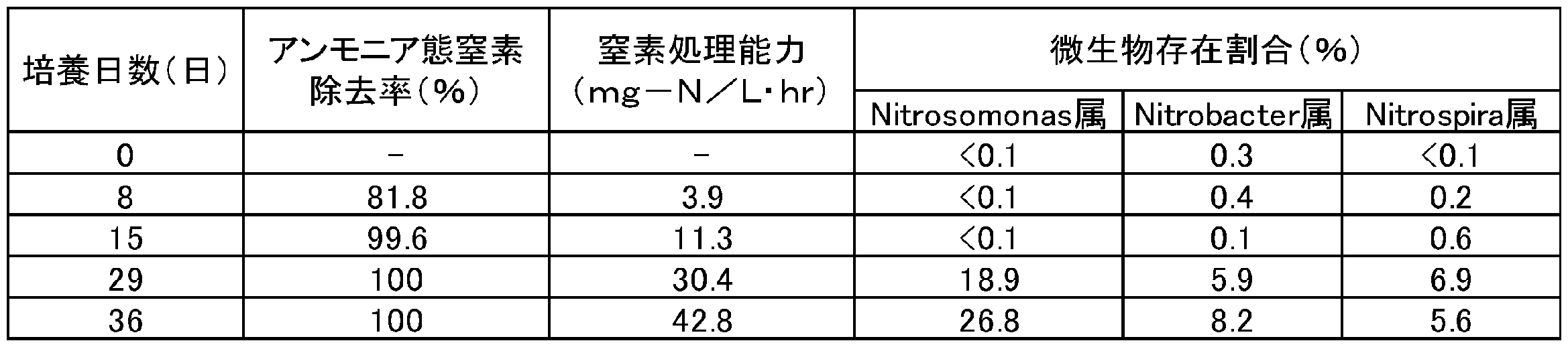
対象化合物分解性微生物を担持した無機微粒子担体を各日数培養した後のアンモニア態窒素除去率、窒素処理能力及び対象化合物分解性微生物を担持した無機微粒子担体に含まれる硝化細菌(アンモニア酸化細菌(Nitrosomonas属)、亜硝酸酸化細菌(Nitrobacter属、Nitrospira属))の存在割合をまとめたものを表1に示す。培養中の対象化合物分解性微生物を担持した無機微粒子担体に含まれる微生物の遺伝子解析情報によって、対象化合物分解性微生物を担持した無機微粒子担体中に含まれる硝化細菌の存在割合の変化を経時的に測定することができた。また、各種硝化細菌の増加に伴い、対象化合物分解性微生物を担持した無機微粒子担体の窒素処理能力が増加していることも示された。
(材料)
培地の製造に用いる成分の濃縮液を以下に示す方法で調製した。MgSO4・7H2O 100gを純水 1000mLに溶解して、無機塩溶液Aとした。Na2HPO4 4.152gとNaH2PO4 2.244gと(NH4)2SO4 1.2gを純水 300mLに溶解して、無機塩溶液Bとした。(S)-2-(4-クロロフェニル)-3-メチルブタン酸(純度約85質量%)1.18gを純水 100mLに溶解した(S)-2-(4-クロロフェニル)-3-メチルブタン酸溶液(10g/L)を用いた。無機微粒子担体分散液は、純水250mlに活性汚泥焼却灰50gを加えて混合、懸濁させて製造した。活性汚泥懸濁液は、化学工場の曝気槽から活性汚泥を採取したものをそのまま用いた。培養中に供給する培地は、(NH4)2SO4 1.0gとNa2HPO4 1.3gとNaH2PO4 0.9gを純水 1000mLに溶解し、(S)-2-(4-クロロフェニル)-3-メチルブタン酸溶液 4.0mL、及び無機塩溶液1 1ml、無機塩溶液2 1ml、無機塩溶液3 1mLを加えることにより製造した。培地は、培養期間中に継続して供給するため、適宜、必要量を製造した。その他、培養開始時に用いる炭素源として、メタノールと水を7:3(v/v)程度の割合で含む工場由来副生油を用いた。
曝気部(容量1L)及び沈降部(容量0.4L)を備えるエアリフト型連続反応槽を用いて、微生物製剤の製造を行った。反応槽に、活性汚泥懸濁液570mLと無機塩溶液A 4.9mLと無機塩溶液B 300mLと工場由来副生油 13.2μLと(S)-2-(4-クロロフェニル)-3-メチルブタン酸溶液 9.876mLと無機微粒子担体分散液と250mL、純水 70mLを加え、培地を調製した。この培地をエアリフトにより攪拌し、培養を行った。培地は、10質量%Na2CO3溶液を用いて、pH6.9付近に制御した。水温は25℃に制御した。以下、反応槽中の培地を培養液という。
培地中の(S)-2-(4-クロロフェニル)-3-メチルブタン酸濃度は、培地を下記の条件でHPLCに供することで算出した。
・装置:LC-10A(島津製作所社製)
・カラム:SUMIPAX ODS A-211 4.6mm×250mm、5μ(住化分析センター社製)
溶媒:A液 0.01% TFA水溶液、B液 アセトニトリル、A液:B液=4:6
流速:1.0mL/分
オーブン温度:40℃
検出器:UV 220nm
サンプル注入量:10μL
反応槽の沈降部から活性汚泥が沈降分離された培養液を回収した時点での、培養液中に含まれる(S)-2-(4-クロロフェニル)-3-メチルブタン酸濃度、供給用培地に含まれる(S)-2-(4-クロロフェニル)-3-メチルブタン酸濃度から、(S)-2-(4-クロロフェニル)-3-メチルブタン酸除去率を算出した。

反応槽の沈降部から活性汚泥が沈降分離された培養液を回収した時点での、培地中に含まれる(S)-2-(4-クロロフェニル)-3-メチルブタン酸濃度、供給用培地に含まれる(S)-2-(4-クロロフェニル)-3-メチルブタン酸濃度、供給用培地の流量、反応槽曝気部の培養液容量から、(S)-2-(4-クロロフェニル)-3-メチルブタン酸処理能力を算出した。

(S)-2-(4-クロロフェニル)-3-メチルブタン酸分解菌の検出及びその存在割合の算出は、培養中の無機微粒子担体に活性汚泥が固着した対象化合物分解性微生物を担持した無機微粒子担体を回収し、そのDNAを用いた遺伝子解析情報に基づいて求めた。対象化合物分解性微生物を担持した無機微粒子担体中の微生物の遺伝子解析情報は実施例1と同様の方法で得た。
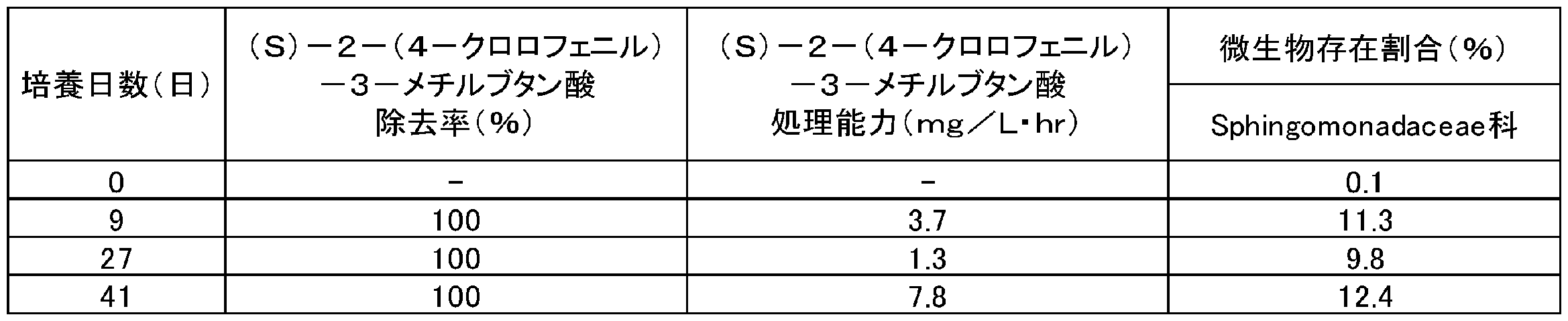
対象化合物分解性微生物を担持した無機微粒子担体を各日数培養した後の(S)-2-(4-クロロフェニル)-3-メチルブタン酸除去率、(S)-2-(4-クロロフェニル)-3-メチルブタン酸処理能力及び対象化合物分解性微生物を担持した無機微粒子担体に含まれる(S)-2-(4-クロロフェニル)-3-メチルブタン酸分解性菌(Sphingomonadaceae科)の存在割合をまとめたものを表2に示す。培養中の対象化合物分解性微生物を担持した無機微粒子担体に含まれる微生物の遺伝子解析情報によって、(S)-2-(4-クロロフェニル)-3-メチルブタン酸分解性菌の存在割合の変化を経時的に測定することができた。また、Sphingomonadaceae科細菌の増加に伴い、対象化合物分解性微生物を担持した無機微粒子担体の(S)-2-(4-クロロフェニル)-3-メチルブタン酸処理能力が増加していることも示された。
培地の製造に用いる無機塩溶液は、実施例1と同じ、無機塩溶液1、無機塩溶液2、無機塩溶液3とした。(S)-2-(4-クロロフェニル)-3-メチルブタン酸溶液は、実施例2と同じものを用いた。流入水は、(S)-2-(4-クロロフェニル)-3-メチルブタン酸溶液1mL、(NH4)2SO4 1g、Na2HPO4 1.298g、NaH2PO4 0.912gを純水 1000mLに溶解し、無機塩溶液1 1ml、無機塩溶液2 1ml、無機塩溶液3 1mLを加えることにより製造した。流入水は、(S)-2-(4-クロロフェニル)-3-メチルブタン酸除去反応期間中に継続して供給するため、適宜、必要量を製造した。活性汚泥懸濁液は、化学工場の曝気槽から活性汚泥を採取したものをそのまま用いた。
曝気部(容量3L)及び沈降部(容量1L)を備えるエアリフト型連続反応槽を用いて、(S)-2-(4-クロロフェニル)-3-メチルブタン酸除去反応を行った。(S)-2-(4-クロロフェニル)-3-メチルブタン酸除去反応は、(S)-2-(4-クロロフェニル)-3-メチルブタン酸分解性微生物製剤が無い条件(A系列)と有る条件(B系列)の2種類の条件で行った。反応槽に流入水を加え、活性汚泥懸濁液を加え、活性汚泥濃度が2408mg-MLSS/Lとなるように調整し、培養液とした。MLSSとは、浮遊固形物(Mixed liquorVolatile Suspended Solid)のことである。B系列にのみ、更に上清を遠心分離により取り除いた実施例2で製造した、培養後54日目の(S)-2-(4-クロロフェニル)-3-メチルブタン酸分解性微生物製剤を459mL分加え、培養液とした。A系列及びB系列の培養液を攪拌し、反応を開始した。流入水は1mL/分の速度で加えた。流入水は、10質量%Na2CO3溶液を用いて、pH7付近に制御した。水温は25℃に制御した。微生物製剤中の微生物の遺伝子解析情報は実施例1と同様の方法で得た。
(S)-2-(4-クロロフェニル)-3-メチルブタン酸除去率及び(S)-2-(4-クロロフェニル)-3-メチルブタン酸分解性微生物の測定は、実施例2に記載の方法と同様にして行った。
A系列及びB系列における、流入水の(S)-2-(4-クロロフェニル)-3-メチルブタン酸除去率及び(S)-2-(4-クロロフェニル)-3-メチルブタン酸分解性微生物の割合をまとめたものを、表3に示す。B系列では、反応開始時から(S)-2-(4-クロロフェニル)-3-メチルブタン酸分解性微生物製剤を加えているため、4.6日目の時点から(S)-2-(4-クロロフェニル)-3-メチルブタン酸分解性微生物の割合が高く、(S)-2-(4-クロロフェニル)-3-メチルブタン酸除去率も高かった。一方、A系列ではB系列に比べ、(S)-2-(4-クロロフェニル)-3-メチルブタン酸分解性微生物の割合の上昇が遅く、(S)-2-(4-クロロフェニル)-3-メチルブタン酸除去率も低かった。

Claims (6)
- 対象化合物分解性微生物を担持する微生物製剤の製造方法であって、
対象化合物を含む培地中で、前記対象化合物分解性微生物を含むバイオマスと、無機微粒子担体とを添加し、前記バイオマスに含まれる微生物を前記無機微粒子に担持させ、前記無機微粒子担体に担持された微生物における対象化合物分解性微生物の存在割合を監視しながら、培養する工程と、
対象化合物分解性微生物の存在割合が所定の値に到達した後、対象化合物分解性微生物を担持した無機微粒子担体を回収し、微生物製剤を得る工程と、
を備え、
前記対象化合物分解性微生物の存在割合が、
前記無機微粒子担体に担持された微生物の16S rRNA遺伝子の所定の領域を増幅して増幅産物を得る工程と、
前記増幅産物の塩基配列データを解析し、得られた塩基配列データを各塩基配列データ間の相同性に基づいて複数のグループに分け、それぞれのグループの塩基配列データを有する微生物を単一の種類とし、それぞれのグループの代表塩基配列データに基づき、対象化合物分解性微生物の種類を決定し、得られた塩基配列データの数に基づき、すべての微生物における対象化合物分解性微生物の存在割合を算出する工程と、
を含む方法によって得られる、製造方法。 - 前記対象化合物が(S)-2-(4-クロロフェニル)-3-メチルブタン酸である、請求項1に記載の製造方法。
- 前記対象化合物がアンモニアである、請求項1に記載の製造方法。
- 請求項1~3のいずれか一項に記載の製造方法により製造された、微生物製剤。
- 請求項4に記載の微生物製剤を用いた、化合物分解方法。
- 請求項4に記載の微生物製剤の評価方法であって、
前記微生物製剤に含まれる微生物における対象化合物分解性微生物の存在割合を指標として前記微生物製剤を評価する工程を備え、
前記対象化合物分解性微生物の存在割合が、
前記微生物製剤に含まれる微生物の16S rRNA遺伝子の所定の領域を増幅して増幅産物を得る工程と、
前記増幅産物の塩基配列データを解析し、得られた塩基配列データを各塩基配列データ間の相同性に基づいて複数のグループに分け、それぞれのグループの塩基配列データを有する微生物を単一の種類とし、それぞれのグループの代表塩基配列データに基づき、対象化合物分解性微生物の種類を決定し、得られた塩基配列データの数に基づき、すべての微生物における対象化合物分解性微生物の存在割合を算出する工程と、
を含む方法によって得られる、評価方法。
Priority Applications (3)
| Application Number | Priority Date | Filing Date | Title |
|---|---|---|---|
| US15/563,696 US10526223B2 (en) | 2015-04-03 | 2016-03-31 | Method for producing microbiologic agent, and microbiologic agent |
| CN201680019319.6A CN107532160A (zh) | 2015-04-03 | 2016-03-31 | 微生物制剂的制造方法及微生物制剂 |
| KR1020177031880A KR102590751B1 (ko) | 2015-04-03 | 2016-03-31 | 미생물 제제의 제조 방법 및 미생물 제제 |
Applications Claiming Priority (2)
| Application Number | Priority Date | Filing Date | Title |
|---|---|---|---|
| JP2015076955A JP6599630B2 (ja) | 2015-04-03 | 2015-04-03 | 微生物製剤の製造方法及び微生物製剤 |
| JP2015-076955 | 2015-04-03 |
Publications (1)
| Publication Number | Publication Date |
|---|---|
| WO2016159287A1 true WO2016159287A1 (ja) | 2016-10-06 |
Family
ID=57004407
Family Applications (1)
| Application Number | Title | Priority Date | Filing Date |
|---|---|---|---|
| PCT/JP2016/060772 Ceased WO2016159287A1 (ja) | 2015-04-03 | 2016-03-31 | 微生物製剤の製造方法及び微生物製剤 |
Country Status (6)
| Country | Link |
|---|---|
| US (1) | US10526223B2 (ja) |
| JP (1) | JP6599630B2 (ja) |
| KR (1) | KR102590751B1 (ja) |
| CN (1) | CN107532160A (ja) |
| TW (1) | TWI706034B (ja) |
| WO (1) | WO2016159287A1 (ja) |
Families Citing this family (2)
| Publication number | Priority date | Publication date | Assignee | Title |
|---|---|---|---|---|
| JP7287009B2 (ja) * | 2019-03-06 | 2023-06-06 | 栗田工業株式会社 | 解析装置、解析システム及び解析方法 |
| WO2020227548A1 (en) * | 2019-05-07 | 2020-11-12 | Aobiome Llc | Preparations of ammonia oxidizing microorganisms and related products |
Citations (8)
| Publication number | Priority date | Publication date | Assignee | Title |
|---|---|---|---|---|
| JPS5988098A (ja) * | 1982-11-09 | 1984-05-21 | Suntory Ltd | 固定化微生物の活性評価法 |
| JPH06153989A (ja) * | 1992-11-25 | 1994-06-03 | Meidensha Corp | 生物固定化担体からの微生物剥離法及び生物分解機能評価法 |
| JP2002282826A (ja) * | 2001-03-29 | 2002-10-02 | Mitsubishi Heavy Ind Ltd | メタン発酵方法およびその装置 |
| JP2003274937A (ja) * | 2002-03-25 | 2003-09-30 | Sumitomo Chem Co Ltd | 微生物製剤の製造方法および微生物製剤 |
| JP2007268471A (ja) * | 2006-03-31 | 2007-10-18 | Ebara Corp | メタン発酵系における嫌気性微生物活性とメタン生成能の評価および制御方法 |
| JP2008142704A (ja) * | 2006-11-15 | 2008-06-26 | Kobelco Eco-Solutions Co Ltd | 生物学的水処理のシミュレーション方法およびシミュレーション装置 |
| JP2008212083A (ja) * | 2007-03-06 | 2008-09-18 | Kyoto Univ | テレフタル酸含有廃水処理において微生物を検出または定量するためのプライマーセット、それを用いた微生物量のモニタリング方法およびメタン発酵効率を評価する方法 |
| JP2010531640A (ja) * | 2007-06-29 | 2010-09-30 | コモンウェルス サイエンティフィック アンド インダストリアル リサーチ オーガニゼイション | 毒性化合物の分解方法 |
Family Cites Families (14)
| Publication number | Priority date | Publication date | Assignee | Title |
|---|---|---|---|---|
| US5580770A (en) * | 1989-11-02 | 1996-12-03 | Alliedsignal Inc. | Support containing particulate adsorbent and microorganisms for removal of pollutants |
| JPH09131178A (ja) | 1995-11-13 | 1997-05-20 | Sumitomo Chem Co Ltd | 微生物の凝集造粒方法 |
| JPH09187272A (ja) | 1996-01-08 | 1997-07-22 | Sumitomo Chem Co Ltd | 硝化菌の連続培養法 |
| JP2000354484A (ja) | 1999-04-16 | 2000-12-26 | Sumitomo Chem Co Ltd | 好気性微生物の保存方法 |
| JP2002027976A (ja) | 2000-07-12 | 2002-01-29 | Sumitomo Chem Co Ltd | 硝化細菌及び硝化細菌資材の保存方法 |
| JP2003334587A (ja) | 2001-05-16 | 2003-11-25 | Sumitomo Chem Co Ltd | 微生物製剤の施用方法 |
| JP2003088355A (ja) | 2001-09-13 | 2003-03-25 | Sumitomo Chem Co Ltd | 好気性微生物の培養装置およびこれを使用した培養方法 |
| JP3928492B2 (ja) | 2002-06-11 | 2007-06-13 | 栗田工業株式会社 | 混合微生物系の監視方法および管理方法 |
| JP2005007262A (ja) | 2003-06-18 | 2005-01-13 | Sumitomo Chem Co Ltd | 排水中のアンモニア性窒素の硝化方法 |
| KR20050112023A (ko) * | 2004-05-24 | 2005-11-29 | 주식회사 프로바이오닉 | 다이옥신 분해.제거용 미생물제제 및 이를 이용한다이옥신의 분해.제거방법 |
| JP2010048566A (ja) * | 2008-08-19 | 2010-03-04 | Sumitomo Chemical Co Ltd | Dnaを定量又は検出する方法 |
| JP5170446B2 (ja) * | 2009-01-30 | 2013-03-27 | 株式会社日立プラントテクノロジー | 亜硝酸型硝化反応汚泥の製造方法及び製造装置、並びに廃水処理方法及び廃水処理装置 |
| KR101095476B1 (ko) * | 2009-07-15 | 2011-12-16 | 이화여자대학교 산학협력단 | 신규한 메탄산화세균 큐프리아비더스 속 및 이를 이용한 메탄 및 휘발성유기화합물의 동시 저감방법 |
| KR20170068259A (ko) * | 2015-12-09 | 2017-06-19 | 대한민국(관리부서:국립수산과학원) | 아질산 분해 능력이 있는 미생물 균주 및 이를 이용한 아질산 분해 방법 |
-
2015
- 2015-04-03 JP JP2015076955A patent/JP6599630B2/ja active Active
-
2016
- 2016-03-31 WO PCT/JP2016/060772 patent/WO2016159287A1/ja not_active Ceased
- 2016-03-31 CN CN201680019319.6A patent/CN107532160A/zh active Pending
- 2016-03-31 KR KR1020177031880A patent/KR102590751B1/ko active Active
- 2016-03-31 US US15/563,696 patent/US10526223B2/en active Active
- 2016-04-01 TW TW105110523A patent/TWI706034B/zh active
Patent Citations (8)
| Publication number | Priority date | Publication date | Assignee | Title |
|---|---|---|---|---|
| JPS5988098A (ja) * | 1982-11-09 | 1984-05-21 | Suntory Ltd | 固定化微生物の活性評価法 |
| JPH06153989A (ja) * | 1992-11-25 | 1994-06-03 | Meidensha Corp | 生物固定化担体からの微生物剥離法及び生物分解機能評価法 |
| JP2002282826A (ja) * | 2001-03-29 | 2002-10-02 | Mitsubishi Heavy Ind Ltd | メタン発酵方法およびその装置 |
| JP2003274937A (ja) * | 2002-03-25 | 2003-09-30 | Sumitomo Chem Co Ltd | 微生物製剤の製造方法および微生物製剤 |
| JP2007268471A (ja) * | 2006-03-31 | 2007-10-18 | Ebara Corp | メタン発酵系における嫌気性微生物活性とメタン生成能の評価および制御方法 |
| JP2008142704A (ja) * | 2006-11-15 | 2008-06-26 | Kobelco Eco-Solutions Co Ltd | 生物学的水処理のシミュレーション方法およびシミュレーション装置 |
| JP2008212083A (ja) * | 2007-03-06 | 2008-09-18 | Kyoto Univ | テレフタル酸含有廃水処理において微生物を検出または定量するためのプライマーセット、それを用いた微生物量のモニタリング方法およびメタン発酵効率を評価する方法 |
| JP2010531640A (ja) * | 2007-06-29 | 2010-09-30 | コモンウェルス サイエンティフィック アンド インダストリアル リサーチ オーガニゼイション | 毒性化合物の分解方法 |
Non-Patent Citations (3)
| Title |
|---|
| BELLUCCI, M. ET AL.: "Ammonia- oxidizing bacteria in wastewater", METHODS IN ENZYMOLOGY, vol. 496, 2011, pages 269 - 286, ISSN: 0076-6879 * |
| KRAIGHER, B. ET AL.: "Nitrification activity and community structure of nitrite-oxidizing bacteria in the bioreactors operated with addition of pharmaceuticals", JOURNAL OF HAZARDOUS MATERIALS, vol. 188, 2011, pages 78 - 84, XP028162508, ISSN: 0304-3894 * |
| YOSUKE NAKAMURA ET AL.: "Development of Microorganism Formulation for Bioaugmentation", SUMITOMO KAGAKU GIJUTSUSHI 2003-II, 28 November 2003 (2003-11-28), pages 19 - 25, ISSN: 0387-1312 * |
Also Published As
| Publication number | Publication date |
|---|---|
| TW201643244A (zh) | 2016-12-16 |
| JP2016195566A (ja) | 2016-11-24 |
| KR102590751B1 (ko) | 2023-10-17 |
| TWI706034B (zh) | 2020-10-01 |
| KR20170131697A (ko) | 2017-11-29 |
| US20180072598A1 (en) | 2018-03-15 |
| US10526223B2 (en) | 2020-01-07 |
| JP6599630B2 (ja) | 2019-10-30 |
| CN107532160A (zh) | 2018-01-02 |
Similar Documents
| Publication | Publication Date | Title |
|---|---|---|
| Zou et al. | Cultivating aerobic granular sludge in a developed continuous-flow reactor with two-zone sedimentation tank treating real and low-strength wastewater | |
| Tay et al. | Presence of anaerobic Bacteroides in aerobically grown microbial granules | |
| Narita et al. | Enrichment and physiological characterization of an anaerobic ammonium-oxidizing bacterium ‘Candidatus Brocadia sapporoensis’ | |
| AU2002257205B2 (en) | PCR-based monitoring in wastewater biotreatment systems | |
| Ramos et al. | Biodegradation of a high-strength wastewater containing a mixture of ammonium, aromatic compounds and salts with simultaneous nitritation in an aerobic granular reactor | |
| AU2002257205A1 (en) | PCR-based monitoring in wastewater biotreatment systems | |
| Mielcarek et al. | Citric acid application for denitrification process support in biofilm reactor | |
| Vanysacker et al. | Development and evaluation of a TaqMan duplex real-time PCR quantification method for reliable enumeration of Candidatus Microthrix | |
| Islam et al. | Functional relationship between ammonia-oxidizing bacteria and ammonia-oxidizing archaea populations in the secondary treatment system of a full-scale municipal wastewater treatment plant | |
| Yu et al. | Understanding bacterial communities of partial nitritation and nitratation reactors at ambient and low temperature | |
| Xu et al. | Analysis of key microbial community during the start-up of anaerobic ammonium oxidation process with paddy soil as inoculated sludge | |
| Cydzik-Kwiatkowska et al. | Nitrifying granules cultivation in a sequencing batch reactor at a low organics-to-total nitrogen ratio in wastewater | |
| JP6599630B2 (ja) | 微生物製剤の製造方法及び微生物製剤 | |
| Duque et al. | Characterization of the bacterial communities of aerobic granules in a 2-fluorophenol degrading process | |
| Feng et al. | Characterization of microbial community structure in a hybrid biofilm-activated sludge reactor for simultaneous nitrogen and phosphorus removal | |
| Fan et al. | Monitoring, isolation and characterization of Microthrix parvicella strains from a Chinese wastewater treatment plant | |
| Wojnowska-Baryła et al. | The application of molecular techniques to the study of wastewater treatment systems | |
| JP5337631B2 (ja) | プライマーセット、Eikelboomtype021N検出方法、ならびに、生物処理方法 | |
| JP5557990B2 (ja) | 汚泥中の特定微生物の将来のある時点における存在量を予測する方法 | |
| Ziembinska et al. | Molecular analysis of temporal changes of a bacterial community structure in activated sludge using denaturing gradient gel electrophoresis (DGGE) and fluorescent in situ hybridization (FISH) | |
| Yan et al. | Cloning of environmental genomic fragments as physical markers for monitoring microbial populations in coking wastewater treatment system | |
| JP4815581B2 (ja) | 微生物群集解析による水処理施設の稼動状況の判断方法 | |
| Liu et al. | Characterization of microbial communities in a fluidized-pellet-bed bioreactor for wastewater treatment | |
| de Leon Gallegos | Microbial ecology of industrial activated sludge process: linking functional diversity to system performance | |
| Quoc | Effect of Granular Sizes on Nutrient Removal and Recovery in Wastewater Treatment Processes |
Legal Events
| Date | Code | Title | Description |
|---|---|---|---|
| 121 | Ep: the epo has been informed by wipo that ep was designated in this application |
Ref document number: 16773167 Country of ref document: EP Kind code of ref document: A1 |
|
| WWE | Wipo information: entry into national phase |
Ref document number: 15563696 Country of ref document: US |
|
| NENP | Non-entry into the national phase |
Ref country code: DE |
|
| ENP | Entry into the national phase |
Ref document number: 20177031880 Country of ref document: KR Kind code of ref document: A |
|
| 122 | Ep: pct application non-entry in european phase |
Ref document number: 16773167 Country of ref document: EP Kind code of ref document: A1 |