WO2016159014A1 - 農業用シートおよびその製造方法 - Google Patents
農業用シートおよびその製造方法 Download PDFInfo
- Publication number
- WO2016159014A1 WO2016159014A1 PCT/JP2016/060256 JP2016060256W WO2016159014A1 WO 2016159014 A1 WO2016159014 A1 WO 2016159014A1 JP 2016060256 W JP2016060256 W JP 2016060256W WO 2016159014 A1 WO2016159014 A1 WO 2016159014A1
- Authority
- WO
- WIPO (PCT)
- Prior art keywords
- sheet
- agricultural
- agricultural sheet
- resin
- holes
- Prior art date
- Legal status (The legal status is an assumption and is not a legal conclusion. Google has not performed a legal analysis and makes no representation as to the accuracy of the status listed.)
- Ceased
Links
Images



Classifications
-
- A—HUMAN NECESSITIES
- A01—AGRICULTURE; FORESTRY; ANIMAL HUSBANDRY; HUNTING; TRAPPING; FISHING
- A01G—HORTICULTURE; CULTIVATION OF VEGETABLES, FLOWERS, RICE, FRUIT, VINES, HOPS OR SEAWEED; FORESTRY; WATERING
- A01G13/00—Protection of plants
-
- A—HUMAN NECESSITIES
- A01—AGRICULTURE; FORESTRY; ANIMAL HUSBANDRY; HUNTING; TRAPPING; FISHING
- A01G—HORTICULTURE; CULTIVATION OF VEGETABLES, FLOWERS, RICE, FRUIT, VINES, HOPS OR SEAWEED; FORESTRY; WATERING
- A01G13/00—Protection of plants
- A01G13/20—Protective coverings for plants
-
- B—PERFORMING OPERATIONS; TRANSPORTING
- B32—LAYERED PRODUCTS
- B32B—LAYERED PRODUCTS, i.e. PRODUCTS BUILT-UP OF STRATA OF FLAT OR NON-FLAT, e.g. CELLULAR OR HONEYCOMB, FORM
- B32B27/00—Layered products comprising a layer of synthetic resin
- B32B27/32—Layered products comprising a layer of synthetic resin comprising polyolefins
-
- B—PERFORMING OPERATIONS; TRANSPORTING
- B32—LAYERED PRODUCTS
- B32B—LAYERED PRODUCTS, i.e. PRODUCTS BUILT-UP OF STRATA OF FLAT OR NON-FLAT, e.g. CELLULAR OR HONEYCOMB, FORM
- B32B5/00—Layered products characterised by the non- homogeneity or physical structure, i.e. comprising a fibrous, filamentary, particulate or foam layer; Layered products characterised by having a layer differing constitutionally or physically in different parts
- B32B5/18—Layered products characterised by the non- homogeneity or physical structure, i.e. comprising a fibrous, filamentary, particulate or foam layer; Layered products characterised by having a layer differing constitutionally or physically in different parts characterised by features of a layer of foamed material
Definitions
- This disclosure relates to an agricultural sheet and a method for manufacturing the same.
- Multi-cultivation refers to a cultivation method that controls the state of cultivated soil in order to obtain good quality crops without being affected by the weather during cultivation.
- the state of the cultivated soil is controlled by covering the ground on which the roots of the trees extend with an agricultural sheet material.
- a base sheet containing a thermoplastic resin is known as an agricultural sheet (also referred to as a multi film or a multi sheet) that is a film material for multi cultivation.
- Patent Document 1 discloses a biennial result prevention method using a microporous film. Further, it is disclosed that a microporous film is produced using a raw material in which a filler such as calcium carbonate is blended with a thermoplastic resin such as an olefin resin.
- Patent Document 2 discloses an agricultural film for covering the ground around agricultural crops, in which a split cloth is laminated on one side of a white microporous film. Further, it is disclosed that white microporous film has high reflectance, so that the growth of crops is improved.
- Patent Document 2 in order to improve the growth of crops, it is effective to reflect sunlight on the ground and irradiate fruit trees with the reflected light.
- a means for improving the amount of reflected light for example, there is a method of increasing the installation area of an agricultural sheet.
- an agricultural sheet agricultural film
- a general agricultural sheet has water shielding properties, so that water such as rainwater stays on the agricultural sheet.
- the present disclosure has been made in view of the above circumstances, and has as its main purpose to provide an agricultural sheet having good water permeability.
- a base sheet containing a resin and having light reflectivity is provided, and the base sheet is a porous base sheet.
- An agricultural sheet having a plurality of through holes penetrating from the surface to the other surface, and a method for producing the same are provided.
- an agricultural sheet that includes a thermoplastic resin and has a base material sheet that is reflective, and penetrates from one surface of the agricultural sheet to the other surface.
- An agricultural sheet having a plurality of through holes is provided.
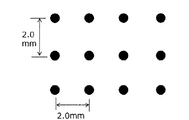
- FIG. 6 is a schematic plan view showing a three-way arrangement in Example 2.
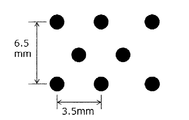
- FIG. 6 is a schematic plan view showing a three-way arrangement in Example 3.
- FIG. 6 is a schematic plan view showing a four-sided arrangement in Example 1.
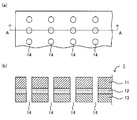
- FIG. 1A is a schematic plan view illustrating an example of an agricultural sheet according to the present disclosure
- FIG. 1B is a cross-sectional view taken along line AA in FIG.
- the agricultural sheet 1 contains the thermoplastic resin and has the base material sheet 11 which has light reflectivity, the reinforcement sheet 13 which reinforces the base material sheet 11, and the base material sheet 11 And a thermal adhesive resin layer 12 that is disposed between the reinforcing sheet 13 and joins the base sheet 11 and the reinforcing sheet 13.
- the through-hole 14 which penetrates the other surface from one surface of the agricultural sheet
- seat 1 should just contain resin, a thermosetting resin may be used instead of a thermoplastic resin, and a thermoplastic resin and a thermosetting resin may be mixed and used for it. .
- the through-hole since the through-hole is formed, it can be set as the agricultural sheet
- the agricultural sheet of the present disclosure will be described for each configuration.
- Base Material Sheet contains at least a resin, and may contain an additive such as a filler as necessary. Moreover, it is preferable that a base material sheet has water permeability in a through-hole, and has moisture permeability, air permeability, and water impermeability in parts other than a through-hole.
- moisture permeability refers to the property of allowing water, i.e., water vapor, to pass through as a gas
- air permeability refers to the property of allowing gas such as carbon dioxide to pass through. The property of not allowing water to pass through.
- the base sheet in the present disclosure has light reflectivity. “Having light reflectivity” means that the minimum reflectance in the visible region is 70% or more in a portion other than the through hole.
- the minimum reflectance in the visible region is preferably 75% or more, and more preferably 80% or more.
- the minimum reflectance in the visible region is, for example, by using an ultraviolet / visible / near infrared spectrophotometer (Shimadzu UV-3600) and an integrating sphere attachment (ISR-3100) at an incident angle of 8 ° and a visible region of 450 It can be obtained by measuring the reflectance (total reflectance) at ⁇ 750 nm.
- Spectralon manufactured by Teflon (registered trademark) manufactured by Labsphere, USA can be used.
- Resin The type of resin in the present disclosure is not particularly limited.
- a thermoplastic resin polyolefin resin, acrylic resin, styrene resin, vinyl fluoride resin, amide resin, saturated ester resin Among them, polyolefin resin is preferable. This is because heat resistance, water resistance, chemical resistance and cost are excellent.
- polyolefin resins include olefin homopolymers, copolymers of two or more olefins, copolymers of one or more olefins and one or more polymerizable monomers that can be polymerized with olefins, and the like. Can be mentioned.
- examples of the olefin (monomer unit) include ethylene, propylene, butene, hexene and the like.
- the copolymer may be a binary system, a ternary system, or a quaternary system.
- the copolymer may be a random copolymer or a block copolymer.
- polystyrene-based resin examples include, for example, a polyethylene-based resin and a polypropylene-based resin, and among them, a polypropylene-based resin is preferable.
- An example of the polypropylene resin is a propylene homopolymer.
- the propylene homopolymer preferably has isotactic or syndiotactic stereoregularity.
- Other examples of polypropylene resins include copolymers of propylene and other ⁇ -olefins. Examples of other ⁇ olefins include at least one of ethylene, butene-1, hexene-1, heptene-1,4-methylpentene-1.
- the polypropylene resin preferably contains propylene as a main component of monomer units.
- examples of the polyethylene resin include low density polyethylene, linear polyethylene, and high density polyethylene.
- the polyethylene resin preferably contains ethylene as a main component of monomer units.
- poly (4-methylpentene-1), poly (butene-1), ethylene-vinyl acetate copolymer, or the like may be used as the polyolefin resin.
- the type of resin in the present disclosure is not particularly limited.
- a thermosetting resin phenol resin, epoxy resin, urea resin, melamine resin, unsaturated polyester resin, urethane resin, imide A series resin or the like may be used.
- one type of resin may be used, or two or more types of resins may be used.
- a polyolefin resin is preferably the main component, and a polypropylene resin is more preferable.
- content of resin in a base material sheet is 45 mass% or more, for example, and 55 mass% or more may be sufficient as it.
- the content of the resin in the base sheet is, for example, 99% by mass or less and may be 98% by mass or less.
- the base sheet in the present disclosure may contain a filler.
- a filler By adding a filler and preparing a base sheet by stretching, for example, voids are generated inside the base sheet, and a porous base sheet is obtained.
- the filler include inorganic fillers and organic fillers.
- the inorganic filler examples include calcium carbonate such as heavy calcium carbonate and light calcium carbonate, calcined clay, talc, silicon oxide, diatomaceous earth, titanium oxide, magnesium oxide, zinc oxide, and barium sulfate.
- the inorganic filler may be surface-treated with a fatty acid.
- the inorganic filler is preferably heavy calcium carbonate, light calcium carbonate, calcined clay, or talc. This is because it is inexpensive and has good moldability.
- the average particle diameter of the inorganic filler is, for example, in the range of 0.01 ⁇ m to 15 ⁇ m, and may be in the range of 0.01 ⁇ m to 8 ⁇ m.
- the average particle size is defined as a statistical average value of the particle size distribution measured on a volume basis, for example, a value measured by LA-920 manufactured by Horiba, Ltd.
- organic fillers examples include polyethylene terephthalate, polybutylene terephthalate, polycarbonate, polyamide, polyethylene naphthalate, polystyrene, melamine, polyethylene sulfite, polyimide, polyethyl ether ketone, polyether ether ketone, polyphenylene sulfite, and poly-4. -Methyl-1-pentene, polymethyl methacrylate and the like.
- the organic filler is a cyclic olefin homopolymer, a copolymer of cyclic olefin and ethylene, having a melting point in the range of 120 ° C. to 300 ° C. or a glass transition temperature of 120 ° C. to 280 ° C. Materials that are within the range can also be used.
- the organic filler and the above-described resin are preferably different materials.
- the content of the filler in the base material sheet is, for example, in the range of 1% by mass to 65% by mass, and preferably in the range of 2% by mass to 55% by mass.
- the base sheet in the present disclosure may contain various additives such as a surfactant, a lubricant, and an antistatic material as necessary.
- a surfactant for example, condensation can be prevented.
- the surfactant include nonionic surfactants, anionic surfactants, and zwitterionic surfactants.
- the nonionic surfactant include glycerin fatty acid ester, pentaerythritol fatty acid ester, polyoxypropylene / polyoxyethylene block polymer, and the like.
- the anionic surfactant include salts such as sulfonate and alkylbenzene sulfonate. In addition, as said salt, a sodium salt, potassium salt, ammonium salt etc. are mentioned, for example.
- examples of the lubricant include aliphatic hydrocarbons such as liquid paraffin, synthetic paraffin, and microcrystalline wax, stearic acid esters of linear alcohols, higher fatty acid amides, and the like.
- examples of the antistatic material include alkyl diethanolamine, hydroxyalkyl monoethanolamine, glycerin fatty acid ester, polyglycerin fatty acid ester, alkylsulfonic acid soda, alkylbenzenesulfonic acid soda, and tetraalkylammonium perchlorate.
- content of an additive is not specifically limited, According to the kind of additive, it selects suitably.
- the base material sheet in this indication is a porous base material sheet which has a space inside.
- the porous substrate sheet usually has water permeability in the through holes, and has moisture permeability, air permeability and water impermeability in portions other than the through holes.
- the porosity of the porous substrate sheet is not particularly limited, but is, for example, in the range of 35% to 60%, and preferably in the range of 40% to 58%.
- the porosity refers to the ratio of voids in the porous substrate sheet and can be calculated by the following formula 1. Note that the void ratio calculation does not include the voids of the through holes.
- Porosity (%) ⁇ ( ⁇ o ⁇ ) / ⁇ o ⁇ ⁇ 100 (Formula 1)
- ⁇ is the density of the porous substrate sheet, and conforms to JIS P 8118.
- ⁇ o is the true density of the porous substrate sheet.
- the true density can be determined by analyzing the types of main material components constituting the porous substrate sheet and their constituent ratios and using general values of the types of material components. For example, the density of polypropylene is 0.9 g / cm 3 and the density of calcium carbonate is 2.7 g / cm 3 .
- the true density is substantially equal to the density of the material before stretching unless the material before stretching contains a large amount of air. Therefore, the true density may be obtained from the material before stretching, or may be obtained by a dry density measuring method by a constant volume expansion method. In the latter case, examples of the measuring apparatus include a dry automatic densimeter Accupick 1330 manufactured by Shimadzu Corporation.
- the average diameter of the voids is, for example, in the range of 1 ⁇ m to 50 ⁇ m, preferably in the range of 2 ⁇ m to 40 ⁇ m, and more preferably in the range of 5 ⁇ m to 30 ⁇ m.
- an average [(L + M) / 2] obtained by measuring and averaging the maximum diameter (L) of the void and the maximum diameter (M) in the direction perpendicular thereto is defined as the void diameter.
- the diameter of at least n (n is an integer of 1 or more, and preferably an integer of 100 or more) is measured, and the average value is defined as the average diameter of the voids.
- a scanning electron microscope S-2400 manufactured by Hitachi, Ltd. can be used for cross-sectional observation of the sample.
- the thickness of the porous substrate sheet is not particularly limited, but is, for example, in the range of 30 ⁇ m to 90 ⁇ m, and preferably in the range of 40 ⁇ m to 80 ⁇ m.
- the porous substrate sheet may have a single layer structure or a multilayer structure. When the porous substrate sheet has a multilayer structure, the resin component contained in each layer may be the same.
- the moisture permeability of the porous base sheet is, for example, 600 g / (m 2 ⁇ day) or more, preferably 700 g / (m 2 ⁇ day) or more, and more preferably 800 g / (m 2 ⁇ day) or more. It is more preferable.
- the moisture permeability conforms to the condition B (temperature 40 ° C. ⁇ 0.5 ° C., relative humidity 90% ⁇ 2%) of the moisture permeability test method (cup method) of moisture-proof packaging material defined in JIS Z 0208: 1973. It can be measured.
- a test specimen prepared by installing a sheet to be tested and a hygroscopic agent on a moisture permeable cup (PA-201 manufactured by Tester Sangyo Co., Ltd.) is placed in a constant temperature and humidity apparatus set at a temperature of 40 ° C. and a humidity of 90%. After 24 hours, the increase in the mass of the cup is measured.
- the water pressure resistance of the porous substrate sheet is, for example, 10 kPa or more, and preferably 20 kPa or more.
- the water pressure resistance can be measured in accordance with the method A (low water pressure method) of the water resistance test (hydrostatic pressure method) of the waterproof test method for textiles specified in JIS L 1092: 2009.
- the level device filled with water is 600 mm / min (10 mm / min)
- the water level is measured in mm when water droplets come out from three places on the back side of the sheet to be tested.
- the opacity of the porous substrate sheet is preferably in the range of 70% to 100%, for example.
- the opacity can be measured according to the paper and paperboard specified in JIS P 8149: 2000-Opacity test method (backing of paper) -diffuse illumination method.
- the density of the porous substrate sheet is, for example, in the range of 0.50 g / cm 3 to 0.90 g / cm 3 and in the range of 0.50 g / cm 3 to 0.70 g / cm 3. preferable.
- the density can be calculated, for example, by measuring the thickness and mass of a sheet to be tested having a size of 100 mm ⁇ 1000 mm.
- Each of these physical property values is a value obtained by measuring a portion other than the through hole of the porous substrate sheet.
- the production method of the porous substrate sheet is not particularly limited as long as a desired porous substrate sheet can be obtained, and a known production method can be adopted. Moreover, it is preferable that the porous base material sheet in this indication is what was extended
- the agricultural sheet of the present disclosure may have a reinforcing sheet that reinforces the base sheet.
- a reinforcing sheet that reinforces the base sheet.
- the reinforcing sheet By providing the reinforcing sheet, a highly durable agricultural sheet can be obtained.
- the physical strength tends to be lower than when no through-holes are provided, but physical strength is improved by providing a reinforcing sheet.
- the material of the reinforcing sheet is not particularly limited, and examples thereof include a thermoplastic resin.
- the thermoplastic resin is the same as that described in the above “(1) Resin”.
- the reinforcing sheet examples include nonwoven fabric and woven fabric. These materials usually have moisture permeability and air permeability in portions other than the through holes. On the other hand, these materials may or may not have water shielding properties in portions other than the through holes. If the diameter of the voids in the reinforcing sheet is large, it is usually impossible to obtain water shielding properties, but water shielding properties can also be imparted by performing a water shielding treatment, for example. In addition, when these materials are used, a gap derived from irregularities such as a nonwoven fabric is generated between the base sheet and the ground, so that water easily penetrates.
- the material of the nonwoven fabric or woven fabric is preferably a polyolefin resin, an ester resin or an amide resin among thermoplastic resins.
- the nonwoven fabric for example, fiber orthogonal nonwoven fabric, long fiber nonwoven fabric, short fiber nonwoven fabric, wet nonwoven fabric, dry nonwoven fabric, airlaid nonwoven fabric, card nonwoven fabric, parallel nonwoven fabric, cloth nonwoven fabric, random nonwoven fabric, spunbond nonwoven fabric, meltblown nonwoven fabric , Flash spinning nonwoven fabric, chemical bond nonwoven fabric, hydroentangled nonwoven fabric, needle punch nonwoven fabric, stitch bond nonwoven fabric, thermal bond nonwoven fabric, burst fiber nonwoven fabric, tow spread nonwoven fabric, split fiber nonwoven fabric, composite nonwoven fabric, laminated nonwoven fabric, coated nonwoven fabric, laminated nonwoven fabric, etc. Is mentioned.
- the fiber-orthogonal nonwoven fabric is a nonwoven fabric obtained by laminating two or more stretched films so that the stretching directions are perpendicular to each other. Examples thereof include Warif (registered trademark) manufactured by JX Nippon Oil & Energy.
- the fiber diameter of the long fiber nonwoven fabric is preferably in the range of 3 ⁇ m to 20 ⁇ m, for example.
- the fiber diameter of the short fiber nonwoven fabric is preferably less than 3 ⁇ m, for example.
- the porous reinforcing sheet usually has moisture permeability, air permeability, and water impermeability in portions other than the through holes.
- the porous reinforcing sheet preferably contains a thermoplastic resin. For example, cutting is easy and workability is high.
- thermoplastic resin and additive in the porous reinforcing sheet, and preferable physical properties of the porous reinforcing sheet are the same as those of the porous base sheet described above, for example.
- thermoplastic resin contained in the porous reinforcing sheet and the thermoplastic resin contained in the porous substrate sheet may be the same or different.
- the thickness of the reinforcing sheet is not particularly limited, but is, for example, 5 ⁇ m to 150 ⁇ m, and preferably 50 ⁇ m to 100 ⁇ m.
- the base sheet and the reinforcing sheet are preferably bonded, and may be bonded via a heat-adhesive resin layer or may be directly bonded without using a heat-adhesive resin layer or the like.
- the former case is effective when the reinforcing sheet is a nonwoven fabric or a woven fabric. Since the non-woven fabric or the woven fabric has a relatively large gap, the non-woven fabric or the woven fabric is arranged so that the thermal adhesive resin layer fills the gap, and thus the base sheet and the reinforcing sheet are firmly bonded. In the latter case, for example, the base sheet and the reinforcing sheet can be bonded directly by heat-sealing.
- the thermal adhesive resin layer is composed of a thermal adhesive resin.
- An example of the thermoadhesive resin is a thermoplastic resin.
- the thermoplastic resin is the same as that described in the above “(1) Resin”.
- the thermal adhesive resin is preferably a polyolefin resin, and more preferably an ethylene-vinyl acetate copolymer.
- the ethylene-vinyl acetate copolymer is excellent in, for example, extrusion lamination suitability.
- the vinyl acetate content of the ethylene-vinyl acetate copolymer is preferably in the range of 10% by mass to 30% by mass, for example.
- the melt index (MI) of the ethylene-vinyl acetate copolymer is preferably in the range of 15 to 45, for example.
- the heat-adhesive resin When an ethylene-vinyl acetate copolymer is used as the heat-adhesive resin, it is preferable to provide an anchor coat layer between the heat-adhesive resin layer and the base sheet, or between the heat-adhesive resin layer and the reinforcing sheet. It is because it can join more firmly.
- the material for the anchor coat layer include a modified ethylene-vinyl acetate copolymer resin, and specific examples include ADCOAT AD-37P295 (Toyo Morton).
- thermoplastic resin contained in the thermoadhesive resin layer, the thermoplastic resin contained in the base sheet, and the thermoplastic resin contained in the reinforcing sheet may be the same or different, respectively. Good.
- thermoplastic resin contained in a thermoadhesive resin layer, a base material sheet, and a reinforcement sheet is polyolefin resin.
- the thickness of the heat-adhesive resin layer is not particularly limited, but is, for example, in the range of 3 ⁇ m to 30 ⁇ m, and preferably in the range of 5 ⁇ m to 20 ⁇ m.
- the agricultural sheet of the present disclosure has a plurality of through holes penetrating from one surface to the other surface.
- the planar view shape of a through-hole is not specifically limited, For example, circular shape, elliptical shape, polygonal shape etc. are mentioned.
- the width of the through hole is, for example, in the range of 5 ⁇ m to 1 mm, preferably in the range of 10 ⁇ m to 800 ⁇ m, and more preferably in the range of 20 ⁇ m to 100 ⁇ m.
- the maximum width of the through hole is defined as the width of the through hole.
- the width of the through hole is the diameter of the through hole.
- the ratio of through holes in the agricultural sheet is, for example, in the range of 10,000 / m 2 to 1 million / m 2 , and in the range of 100,000 / m 2 to 700,000 / m 2.
- the plurality of through holes may be arranged in a pattern or may be arranged randomly, but the former is preferable. This is because it is easy to produce agricultural sheets.
- the plurality of through holes are preferably arranged in a lattice.
- the plurality of through holes being arranged in a lattice means that the plurality of through holes are present at lattice points of the lattice.
- the distance between the lattice points is preferably in the range of 1 mm to 10 mm, for example.
- Examples of the type of lattice arrangement include a tetragonal arrangement such as a cubic arrangement, a rectangular arrangement, and an oblique arrangement.
- the four-way arrangement is suitable when it is desired to improve the tensile strength of the agricultural sheet.
- examples of the lattice arrangement include a three-way arrangement and a hexagonal arrangement. The three-way arrangement and the hexagonal arrangement are suitable when it is desired to improve the aperture ratio of the agricultural sheet.
- the aperture ratio of the agricultural sheet is preferably in the range of 4% to 9%, for example. This is because if the open area ratio is too small, water permeability may decrease, and if the open area ratio is too high, physical strength and light reflectivity may decrease.
- the agricultural sheet of the present disclosure may have a light reflecting layer.
- the light reflecting layer contains, for example, a white powder and a resin component.
- the white powder include anatase type or rutile type titanium oxide, titanium oxide whose surface is treated with a metal oxide such as Al, Si, calcium carbonate, barium sulfate, and the like.
- the resin component include polyurethane resins and polyester resins.
- the polyurethane resin include polyester polyurethane, polyether polyurethane, polyether polyester polyurethane, polycarbonate polyurethane, and polycaprolactam polyurethane.
- the arrangement location of the light reflecting layer is not particularly limited, and may be the outermost surface of the agricultural sheet or may be inside. Moreover, it is preferable that the light reflection layer is provided on the side opposite to the reinforcing sheet with respect to the porous substrate sheet.
- the thickness of the light reflecting layer is, for example, in the range of 0.5 ⁇ m to 4 ⁇ m.
- FIG. 2 is a schematic cross-sectional view illustrating an example of a method for manufacturing an agricultural sheet according to the present disclosure.
- a thermoadhesive resin layer 12 is formed on the surface of a base sheet 11 containing a thermoplastic resin and having light reflectivity (FIG. 2 (a)).
- the reinforcing sheet 13 is disposed on the heat-adhesive resin layer 12, and a precursor sheet 15 of an agricultural sheet is obtained by applying pressure while heating (FIG. 2B).
- a plurality of through holes 14 penetrating from one surface of the precursor sheet 15 to the other surface are formed using the needle-like member 16 (FIG. 2C).
- the base sheet 11, the heat-adhesive resin layer 12, and the reinforcement sheet 13 are arrange
- the base material sheet 11 should just contain resin, a thermosetting resin may be used instead of a thermoplastic resin, and a thermoplastic resin and a thermosetting resin may be mixed and used for it. .
- the through hole is formed, an agricultural sheet having good water permeability can be obtained.
- seat of this indication is demonstrated for every process.
- the preparatory process in this indication is a process of preparing the precursor sheet of the sheet for agriculture which has resin and contains the substrate sheet which has light reflectivity.
- composition of the precursor sheet is basically the same as that of the agricultural sheet except that there are no through holes.
- the configuration of the agricultural sheet is the same as the content described in “A. Agricultural sheet”, and therefore description thereof is omitted here.
- examples of the method for producing the precursor sheet include a base sheet (typically, a base sheet in which no through-hole is formed) and reinforcement. There is a method in which a heat-adhesive resin layer is formed on at least one surface of the sheet, and the base sheet and the reinforcing sheet are laminated via the heat-adhesive resin layer.
- the method for forming the heat-adhesive resin layer on the surface of the base sheet or the reinforcing sheet is not particularly limited.
- the method for disposing the heat-adhesive resin layer on the surface of the base sheet or the reinforcing sheet, and after the disposition A method of applying heat and pressurizing is mentioned.
- the method of laminating the base sheet and the reinforcing sheet via the heat-adhesive resin layer is not particularly limited, and examples thereof include a method of applying pressure by applying heat.
- the through-hole forming step in the present disclosure is a step of forming a plurality of through-holes penetrating from one surface of the precursor sheet to the other surface.
- the method for forming the through hole is not particularly limited, and examples thereof include mechanical treatment.
- the mechanical method include press treatment using a needle-like member having a plurality of needles.
- the diameters of the side surfaces of the plurality of needles included in the needle-like member are preferably in the range of 5 ⁇ m to 1 mm when the portion that contacts the agricultural sheet is measured when forming the plurality of through holes.
- the needle-like member may be heated (hot needle treatment).
- the method for forming the through hole may be batch processing or continuous processing, but the latter is preferred. It is because it is excellent in productivity. Specific examples of the latter include treatment using a roll whose surface is processed into a needle shape. In particular, in the present disclosure, it is preferable to form a through hole with a hot needle roll. It is because it is excellent in productivity.
- FIG. 3 is a process diagram illustrating an example of a through hole forming process in the present disclosure.
- the precursor sheet 15 is unwound from the unwinding roll 21, passed between the heated hot needle roll 22 and the rubber roll (receiving roll) 23, and the agricultural sheet 1 is wound on the winding roll 24.
- the through holes are uniformly formed in the width direction.
- an exhaust gas treatment device 25 may be provided.
- Agricultural sheet The agricultural sheet obtained according to the present disclosure is the same as the contents described in the above-mentioned “A. Agricultural sheet”, and thus description thereof is omitted here.
- Example 1 Manufacture of base sheet
- a propylene homopolymer manufactured by Nippon Polychem Co., Ltd., trade name “Novatech PP: MA-8”, melting point 164 ° C.
- high density polyethylene Calcium carbonate powder made by Nippon Polychem Co., Ltd., trade name “NOVATEC HD: HJ580”, melting point 134 ° C., density 0.960 g / cm 3 ) of 6.5% by mass and an average particle size of 1.5 ⁇ m
- An unstretched sheet was obtained from the resin composition comprising 28% by mass using an extruder. Next, this unstretched sheet was stretched 4 times in the longitudinal direction to obtain a uniaxially stretched sheet.
- a resin composition constituting the outer layer of the base sheet a propylene homopolymer of 51.5% by mass, high density polyethylene of 3.5% by mass, and an average particle size of 1.
- a resin composition comprising 42% by mass of 5 ⁇ m calcium carbonate powder and 3% by mass of titanium oxide powder having an average particle diameter of 0.8 ⁇ m is melt-kneaded using another extruder, and the surface of the above uniaxially stretched sheet A laminated sheet having an outer layer, an inner layer, and an outer layer was obtained by extrusion from both sides of the die.
- this laminated sheet is stretched 7 times in the transverse direction and slits at the ears, so that the thickness is 70 ⁇ m, the outer layer (15 ⁇ m), the inner layer (40 ⁇ m), the outer layer (15 ⁇ m) have a layer structure, A base sheet (porous base sheet) containing voids was obtained.
- the obtained base material sheet had a porosity of 55%, an opacity of 93%, and a moisture permeability of 800 g / m 2 ⁇ day.
- Through holes were formed in the obtained precursor sheet using a hot needle roll having a heating temperature of 175 ° C.
- the penetration depth of the needle was 1.5 mm.
- the diameter of the needle used was 0.5 mm (500 ⁇ m), and the number of needles was 250,000 / m 2 .
- the needle array used was a four-way array shown in FIG. In this way, an agricultural sheet was obtained.
- the aperture ratio of the obtained agricultural sheet was 4.9%.
- Example 2 A through hole is formed using a hot needle roll having a needle diameter of 0.9 mm, the number of needles of 90,000 / m 2 , and a needle arrangement of the triangular arrangement shown in FIG.
- An agricultural sheet of Example 2 was obtained in the same manner as Example 1 except that the hole area ratio was 5.7%.
- Example 3 A through hole is formed using a hot needle roll having a needle diameter of 0.7 mm, the number of needles of 240,000 / m 2 , and a needle arrangement of the triangular arrangement shown in FIG.
- An agricultural sheet of Example 3 was obtained in the same manner as Example 1 except that the hole area ratio was 9.2%.
- Table 1 shows the results of measuring the water passage time and light reflectance of the agricultural sheets obtained in Examples 1 to 3.
- the water passage time is a vertical standing funnel (used by removing the mesh of a disposable filter (sample hole diameter 128 mm x pilot hole diameter 50 mm x height 83 mm) manufactured by Sampratec) from the outside. After fixing the agricultural sheet so as to close it, the time it took for half of the poured water (50 ml) to pass through the agricultural sheet, starting when 100 ml of water was poured from the top hole of the funnel was measured.
Landscapes
- Health & Medical Sciences (AREA)
- General Health & Medical Sciences (AREA)
- Toxicology (AREA)
- Life Sciences & Earth Sciences (AREA)
- Environmental Sciences (AREA)
- Protection Of Plants (AREA)
- Laminated Bodies (AREA)
Abstract
農業用シートであって、上記農業用シートが、樹脂を含有し、光反射性を有する基材シートを有し、上記基材シートが、多孔質基材シートであり、上記農業用シートの一方の表面から他方の表面を貫通する複数の貫通孔を有する、農業用シート。
Description
本開示は、農業用シートおよびその製造方法に関する。
最近、果実、野菜および花等の農作物の自由化要求が国外から高まり、農作物の高品質化および差別化等が図られている。そのなかでマルチ栽培の技術が注目されている。マルチ栽培とは、栽培時の天候に影響されることなく良質の農作物を得るために栽培土壌の状態をコントロールする栽培方法をいう。マルチ栽培においては、樹木の根が伸びている地面を農業用シート材で被覆することによって栽培土壌の状態のコントロールを行う。
マルチ栽培用のフィルム材である農業用シート(マルチフィルムまたはマルチシートとも称する)として、熱可塑性樹脂を含有する基材シートが知られている。特許文献1には、微孔性フィルムを用いた隔年結果防止方法が開示されている。さらに、オレフィン系樹脂等の熱可塑性樹脂に炭酸カルシウム等の充填材を配合した原料を用いて微孔性フィルムを作製することが開示されている。
特許文献2には、農作物周辺の地面を覆うための農業用フィルムであって、白色の微多孔性フィルムの片面に割布を積層した農業用フィルムが開示されている。さらに、白色の微多孔性フィルムは高い反射率を有するため、農作物の生育がよくなることが開示されている。
特許文献2に記載されているように、農作物の生育をよくするためには、太陽光線を地上で反射させて、その反射光を果樹に照射することが有効である。反射光量を向上させる手段として、例えば、農業用シートの設置面積を増やす方法がある。しかしながら、例えば通路等にも農業用シート(農業用フィルム)を設置した場合、一般的な農業用シートは遮水性を有するため、雨水等の水が農業用シート上に滞留してしまう。
本開示は、上記実情に鑑みてなされたものであり、良好な通水性を有する農業用シートを提供することを主目的とする。
上記課題を解決するために、本開示の一つの実施形態においては、樹脂を含有し、光反射性を有する基材シートを備え、上記基材シートが、多孔質基材シートであり、一方の表面から他方の表面を貫通する複数の貫通孔を有する、農業用シート、およびその製造方法を提供する。
また、本開示の別の実施形態においては、熱可塑性樹脂を含有し、反射性を有する基材シートを有する農業用シートであって、上記農業用シートの一方の表面から他方の表面を貫通する複数の貫通孔を有する、農業用シートを提供する。
本開示においては、良好な通水性を有する農業用シートを提供することができるという効果を奏する。
以下、本開示の農業用シート、および、農業用シートの製造方法について、詳細に説明する。
A.農業用シート
図1(a)は本開示の農業用シートの一例を示す概略平面図であり、図1(b)は図1(a)のA-A断面図である。図1(b)に示すように、農業用シート1は、熱可塑性樹脂を含有し、光反射性を有する基材シート11と、基材シート11を補強する補強シート13と、基材シート11および補強シート13の間に配置され、基材シート11および補強シート13を接合する熱接着性樹脂層12と、を有する。さらに、図1(a)、(b)に示すように、農業用シート1の一方の表面から他方の表面を貫通する貫通孔14が複数形成されている。なお、農業用シート1は、樹脂を含有していればよく、熱可塑性樹脂の代わりに、熱硬化性樹脂を用いてもよく、熱可塑性樹脂および熱硬化性樹脂を混合して用いてもよい。
図1(a)は本開示の農業用シートの一例を示す概略平面図であり、図1(b)は図1(a)のA-A断面図である。図1(b)に示すように、農業用シート1は、熱可塑性樹脂を含有し、光反射性を有する基材シート11と、基材シート11を補強する補強シート13と、基材シート11および補強シート13の間に配置され、基材シート11および補強シート13を接合する熱接着性樹脂層12と、を有する。さらに、図1(a)、(b)に示すように、農業用シート1の一方の表面から他方の表面を貫通する貫通孔14が複数形成されている。なお、農業用シート1は、樹脂を含有していればよく、熱可塑性樹脂の代わりに、熱硬化性樹脂を用いてもよく、熱可塑性樹脂および熱硬化性樹脂を混合して用いてもよい。
本開示によれば、貫通孔が形成されていることから、良好な通水性を有する農業用シートとすることができる。そのため、例えば通路等にも農業用シートを設置した場合にも、雨水等の水が農業用シート上に滞留することを防止できる。その結果、水の滞留による作業性の低下を抑制しつつ、農業用シートの設置面積を増やすことができ、反射光量を向上させることができる。また、農業用シートが通水性を有するため、例えば栽培土壌が過度に乾燥した場合に、栽培土壌に容易に水を供給することができる。
以下、本開示の農業用シートについて、構成ごとに説明する。
以下、本開示の農業用シートについて、構成ごとに説明する。
1.基材シート
本開示における基材シートは、少なくとも樹脂を含有し、必要に応じて、充填材等の添加材を含有していてもよい。また、基材シートは、貫通孔において通水性を有し、貫通孔以外の部分において、透湿性、通気性および遮水性を有することが好ましい。なお、本開示において、透湿性とは、気体としての水すなわち水蒸気を通過させる性質をいい、通気性とは、二酸化炭素をはじめとする気体を通過させる性質をいい、遮水性とは、液体としての水を通過させない性質をいう。
本開示における基材シートは、少なくとも樹脂を含有し、必要に応じて、充填材等の添加材を含有していてもよい。また、基材シートは、貫通孔において通水性を有し、貫通孔以外の部分において、透湿性、通気性および遮水性を有することが好ましい。なお、本開示において、透湿性とは、気体としての水すなわち水蒸気を通過させる性質をいい、通気性とは、二酸化炭素をはじめとする気体を通過させる性質をいい、遮水性とは、液体としての水を通過させない性質をいう。
また、本開示における基材シートは、光反射性を有する。「光反射性を有する」とは、貫通孔以外の部分において、可視領域での最低反射率が70%以上であることをいう。可視領域での最低反射率は、75%以上であることが好ましく、80%以上であることがより好ましい。可視領域での最低反射率は、例えば、紫外・可視・近赤外分光光度計(島津製作所UV-3600)および積分球付属装置(ISR-3100)を用いて、入射角8°で可視領域450~750nmでの反射率(全反射率)を測定することで求めることができる。標準板としては、例えば、米国ラブスフェア社製スペクトラロン(テフロン(登録商標)製)を用いることができる。
(1)樹脂
本開示における樹脂の種類は、特に限定されないが、例えば、熱可塑性樹脂として、ポリオレフィン系樹脂、アクリル系樹脂、スチレン系樹脂、フッ化ビニル系樹脂、アミド系樹脂、飽和エステル系樹脂等が挙げられ、中でも、ポリオレフィン系樹脂が好ましい。耐熱性、耐水性、耐薬品性、コスト面が優れるからである。
本開示における樹脂の種類は、特に限定されないが、例えば、熱可塑性樹脂として、ポリオレフィン系樹脂、アクリル系樹脂、スチレン系樹脂、フッ化ビニル系樹脂、アミド系樹脂、飽和エステル系樹脂等が挙げられ、中でも、ポリオレフィン系樹脂が好ましい。耐熱性、耐水性、耐薬品性、コスト面が優れるからである。
ポリオレフィン系樹脂としては、例えば、オレフィンの単独重合体、2種類以上のオレフィンの共重合体、1種類以上のオレフィンと、オレフィンと重合可能な1種類以上の重合性モノマーとの共重合体等が挙げられる。上記オレフィン(モノマー単位)としては、例えば、エチレン、プロピレン、ブテン、ヘキセン等が挙げられる。また、共重合体は、2元系でも3元系でも4元系でもよい。また、共重合体は、ランダム共重合体でもブロック共重合体であってもよい。
ポリオレフィン系樹脂の具体例としては、例えば、ポリエチレン系樹脂、ポリプロピレン系樹脂等が挙げられ、中でも、ポリプロピレン系樹脂等が好ましい。ポリプロピレン系樹脂の一例としては、プロピレン単独重合体が挙げられる。プロピレン単独重合体は、アイソタクティックまたはシンジオタクティックな立体規則性を有することが好ましい。ポリプロピレン系樹脂の他の例としては、プロピレンと、他のαオレフィンとの共重合体が挙げられる。他のαオレフィンとしては、例えば、エチレン、ブテン-1、ヘキセン-1、ヘプテン-1,4-メチルペンテン-1の少なくとも一種等が挙げられる。ポリプロピレン系樹脂は、プロピレンをモノマー単位の主成分とすることが好ましい。
一方、ポリエチレン系樹脂としては、例えば、低密度ポリエチレン、直鎖状ポリエチレン、高密度ポリエチレン等が挙げられる。ポリエチレン系樹脂は、エチレンをモノマー単位の主成分とすることが好ましい。また、ポリオレフィン系樹脂として、ポリ(4-メチルペンテン-1)、ポリ(ブテン-1)、エチレン-酢酸ビニル共重合体等を用いてもよい。
また、本開示における樹脂の種類は、特に限定されないが、例えば、熱硬化性樹脂として、フェノール系樹脂、エポキシ系樹脂、ユリア系樹脂、メラミン系樹脂、不飽和ポリエステル系樹脂、ウレタン系樹脂、イミド系樹脂等を用いてもよい。
本開示においては、1種類の樹脂を用いてもよく、2種類以上の樹脂を用いてもよい。2種類以上の樹脂を用いる場合、ポリオレフィン系樹脂を主成分とすることが好ましく、ポリプロピレン系樹脂を主成分とすることがより好ましい。また、基材シートにおける樹脂の含有量は、例えば、45質量%以上であり、55質量%以上であってもよい。一方、基材シートにおける樹脂の含有量は、例えば、99質量%以下であり、98質量%以下であってもよい。
(2)充填材
本開示における基材シートは、充填材を含有していてもよい。充填材を添加し、例えば延伸により基材シートを作製することで、基材シートの内部に空隙が生じ、多孔質基材シートが得られる。充填材としては、例えば、無機系充填材および有機系充填材が挙げられる。
本開示における基材シートは、充填材を含有していてもよい。充填材を添加し、例えば延伸により基材シートを作製することで、基材シートの内部に空隙が生じ、多孔質基材シートが得られる。充填材としては、例えば、無機系充填材および有機系充填材が挙げられる。
無機系充填材としては、例えば、重質炭酸カルシウム、軽質炭酸カルシウム等の炭酸カルシウム、焼成クレイ、タルク、酸化珪素、珪藻土、酸化チタン、酸化マグネシウム、酸化亜鉛、硫酸バリウム等が挙げられる。また、無機系充填材は脂肪酸で表面処理されていてもよい。中でも、無機系充填材は、重質炭酸カルシウム、軽質炭酸カルシウム、焼成クレイまたはタルクであることが好ましい。安価で成形性がよいからである。
無機系充填材の平均粒子径は、例えば、0.01μm~15μmの範囲内であり、0.01μm~8μmの範囲内であってもよい。なお、平均粒子径とは、体積基準で測定した粒径分布の統計的平均値として定義され、例えば、株式会社堀場製作所製LA-920によって測定された値をいう。
有機系充填材としては、例えば、ポリエチレンテレフタレート、ポリブチレンテレフタレート、ポリカーボネート、ポリアミド、ポリエチレンナフタレート、ポリスチレン、メラミン、ポリエチレンサルファイト、ポリイミド、ポリエチルエーテルケトン、ポリエーテルエーテルケトン、ポリフェニレンサルファイト、ポリ-4-メチル-1-ペンテン、ポリメチルメタクリレート等が挙げられる。また、有機系充填材として、環状オレフィンの単独重合体、環状オレフィンとエチレンとの共重合体であり、融点が120℃~300℃の範囲内であるかガラス転移温度が120℃~280℃の範囲内である材料を用いることもできる。有機系充填材と、上述した樹脂とは、異なる材料であることが好ましい。
基材シートにおける充填材の含有量は、例えば、1質量%~65質量%の範囲内であり、2質量%~55質量%の範囲内であることが好ましい。
(3)他の添加材
本開示における基材シートは、必要に応じて、界面活性材、滑材、帯電防止材等の各種添加材を含有していてもよい。界面活性材の添加により、例えば結露を防ぐことができる。界面活性材としては、例えば、非イオン性界面活性材、陰イオン性界面活性材、両イオン性界面活性材等が挙げられる。非イオン性界面活性材としては、例えば、グリセリン脂肪酸エステル、ペンタエリスリトール脂肪酸エステル、ポリオキシプロピレン・ポリオキシエチレンブロックポリマー等が挙げられる。陰イオン性界面活性材としては、例えば、スルホン酸塩、アルキルベンゼンスルホン酸塩等の塩が挙げられる。なお、上記塩としては、例えば、ナトリウム塩、カリウム塩、アンモニウム塩等が挙げられる。
本開示における基材シートは、必要に応じて、界面活性材、滑材、帯電防止材等の各種添加材を含有していてもよい。界面活性材の添加により、例えば結露を防ぐことができる。界面活性材としては、例えば、非イオン性界面活性材、陰イオン性界面活性材、両イオン性界面活性材等が挙げられる。非イオン性界面活性材としては、例えば、グリセリン脂肪酸エステル、ペンタエリスリトール脂肪酸エステル、ポリオキシプロピレン・ポリオキシエチレンブロックポリマー等が挙げられる。陰イオン性界面活性材としては、例えば、スルホン酸塩、アルキルベンゼンスルホン酸塩等の塩が挙げられる。なお、上記塩としては、例えば、ナトリウム塩、カリウム塩、アンモニウム塩等が挙げられる。
また、滑材としては、例えば、流動パラフィン、合成パラフィン、マイクロクリスタリンワックス等の脂肪族炭化水素、直鎖アルコールのステアリン酸エステル、高級脂肪酸アマイド等が挙げられる。また、帯電防止材としては、例えば、アルキルジエタノールアミン、ヒドロキシアルキルモノエタノールアミン、グリセリン脂肪酸エステル、ポリグリセリン脂肪酸エステル、アルキルスルホン酸ソーダ、アルキルベンゼンスルホン酸ソーダ、過塩素酸テトラアルキルアンモニウム塩等が挙げられる。なお、添加材の含有量は、特に限定されず、添加材の種類に応じて適宜選択する。
(4)基材シート
本開示における基材シートは、内部に空隙を有する多孔質基材シートであることが好ましい。多孔質基材シートは、通常、貫通孔において通水性を有し、貫通孔以外の部分において、透湿性、通気性および遮水性を有する。多孔質基材シートの空隙率は、特に限定されないが、例えば35%~60%の範囲内であり、40%~58%の範囲内であることが好ましい。
本開示における基材シートは、内部に空隙を有する多孔質基材シートであることが好ましい。多孔質基材シートは、通常、貫通孔において通水性を有し、貫通孔以外の部分において、透湿性、通気性および遮水性を有する。多孔質基材シートの空隙率は、特に限定されないが、例えば35%~60%の範囲内であり、40%~58%の範囲内であることが好ましい。
空隙率とは、多孔質基材シートに占める空隙の割合をいい、下記式1により算出できる。なお、空隙率の算出には、貫通孔の空隙を含めない。
空隙率(%)={(ρo-ρ)/ρo}×100 …(式1)
式1において、ρは多孔質基材シートの密度であり、JIS P 8118に準拠する。ρoは多孔質基材シートの真密度である。真密度は、多孔質基材シートを構成する主要な材料成分の種類と、それらの構成比率とを分析して、材料成分の種類の一般的な値を用いることで決定することができる。例えば、ポリプロピレンの密度は0.9g/cm3であり、炭酸カルシウムの密度は2.7g/cm3である。なお、多孔質基材シートが延伸処理されたものであるときは、延伸前の材料が多量の空気を含有するものでない限り、真密度は延伸前の材料の密度にほぼ等しい。そのため、真密度は、延伸前の材料から求めてもよく、定容積膨張法による乾式密度測定方法で求めてもよい。後者の場合、測定装置としては、例えば、(株)島津製作所製の乾式自動密度計アキュピック1330が挙げられる。
空隙率(%)={(ρo-ρ)/ρo}×100 …(式1)
式1において、ρは多孔質基材シートの密度であり、JIS P 8118に準拠する。ρoは多孔質基材シートの真密度である。真密度は、多孔質基材シートを構成する主要な材料成分の種類と、それらの構成比率とを分析して、材料成分の種類の一般的な値を用いることで決定することができる。例えば、ポリプロピレンの密度は0.9g/cm3であり、炭酸カルシウムの密度は2.7g/cm3である。なお、多孔質基材シートが延伸処理されたものであるときは、延伸前の材料が多量の空気を含有するものでない限り、真密度は延伸前の材料の密度にほぼ等しい。そのため、真密度は、延伸前の材料から求めてもよく、定容積膨張法による乾式密度測定方法で求めてもよい。後者の場合、測定装置としては、例えば、(株)島津製作所製の乾式自動密度計アキュピック1330が挙げられる。
空隙の平均径は、例えば、1μm~50μmの範囲内であり、2μm~40μmの範囲であることが好ましく、5μm~30μmの範囲内であることがより好ましい。本開示において、空隙の最大径(L)とそれに直角な方向の最大の径(M)を測定して平均したもの[(L+M)/2]を、空隙の径とする。少なくともn個(nは1以上の整数であり、100以上の整数であることが好ましい)の空隙の径を測定し、その平均値を、空隙の平均径とする。試料の断面観察には、例えば、(株)日立製作所製の走査型電子顕微鏡S-2400を用いることができる。
多孔質基材シートの厚みは、特に限定されないが、例えば30μm~90μmの範囲内であり、40μm~80μmの範囲内であることが好ましい。また、多孔質基材シートは、単層構造であってもよく、複層構造であってもよい。多孔質基材シートが複層構造である場合、各層に含まれる樹脂成分は、同一であってもよい。
多孔質基材シートの透湿度は、例えば、600g/(m2・day)以上であり、700g/(m2・day)以上であることが好ましく、800g/(m2・day)以上であることがより好ましい。透湿度は、JIS Z 0208:1973に規定される防湿包装材料の透湿度試験方法(カップ法)の条件B(温度40℃±0.5℃、相対湿度90%±2%)に準拠して測定できる。例えば、透湿カップ(テスター産業社製のPA-201)に試験するシートおよび吸湿剤などを設置して作成された試験体を、温度40℃湿度90%に設定された恒温恒湿装置中に24時間入れた後、そのカップの質量の増加量を測定する。
多孔質基材シートの耐水圧は、例えば、10kPa以上であり、20kPa以上であることが好ましい。耐水圧は、JIS L 1092:2009に規定される繊維製品の防水性試験方法の耐水度試験(静水圧法)のA法(低水圧法)に準拠して測定できる。例えば、耐水圧試験装置(安田精機製作所の織布耐水度試験機No.409)に試験するシートを表側に水が当たるように取り付けた後、水を入れた水準装置を600mm/分(10mm/秒)の速さで上昇させて、試験するシートの裏側3ヶ所から水滴が出たときの水位をmm単位で測定する。
多孔質基材シートの不透明度は、例えば、70%~100%の範囲内であることが好ましい。不透明度は、JIS P 8149:2000に規定される紙及び板紙-不透明度試験方法(紙の裏当て)-拡散照明法に準拠して測定できる。例えば、分光測色計(コニカミノルタ社製のCM-5)で測定する。
多孔質基材シートの密度は、例えば、0.50g/cm3~0.90g/cm3の範囲内であり、0.50g/cm3~0.70g/cm3の範囲内であることが好ましい。密度は、例えば100mm×1000mmの大きさの試験するシートの厚みおよび質量を測定することで算出できる。
なお、これらのそれぞれの物性値は、多孔質基材シートの貫通孔以外の部分を測定した値である。
多孔質基材シートの耐水圧は、例えば、10kPa以上であり、20kPa以上であることが好ましい。耐水圧は、JIS L 1092:2009に規定される繊維製品の防水性試験方法の耐水度試験(静水圧法)のA法(低水圧法)に準拠して測定できる。例えば、耐水圧試験装置(安田精機製作所の織布耐水度試験機No.409)に試験するシートを表側に水が当たるように取り付けた後、水を入れた水準装置を600mm/分(10mm/秒)の速さで上昇させて、試験するシートの裏側3ヶ所から水滴が出たときの水位をmm単位で測定する。
多孔質基材シートの不透明度は、例えば、70%~100%の範囲内であることが好ましい。不透明度は、JIS P 8149:2000に規定される紙及び板紙-不透明度試験方法(紙の裏当て)-拡散照明法に準拠して測定できる。例えば、分光測色計(コニカミノルタ社製のCM-5)で測定する。
多孔質基材シートの密度は、例えば、0.50g/cm3~0.90g/cm3の範囲内であり、0.50g/cm3~0.70g/cm3の範囲内であることが好ましい。密度は、例えば100mm×1000mmの大きさの試験するシートの厚みおよび質量を測定することで算出できる。
なお、これらのそれぞれの物性値は、多孔質基材シートの貫通孔以外の部分を測定した値である。
多孔質基材シートの製造方法は、所望の多孔質基材シートが得られる方法であれば特に限定されず、公知の製造方法を採用することができる。また、本開示における多孔質基材シートは、延伸処理されたものであることが好ましい。
2.補強シート
本開示の農業用シートは、基材シートを補強する補強シートを有していてもよい。補強シートを設けることで、耐久性の高い農業用シートとすることができる。特に、本開示の農業用シートは貫通孔を有するため、貫通孔を有しない場合に比べて物理的強度が低い傾向にあるが、補強シートを設けることで、物理的強度が向上する。
本開示の農業用シートは、基材シートを補強する補強シートを有していてもよい。補強シートを設けることで、耐久性の高い農業用シートとすることができる。特に、本開示の農業用シートは貫通孔を有するため、貫通孔を有しない場合に比べて物理的強度が低い傾向にあるが、補強シートを設けることで、物理的強度が向上する。
補強シートの材料は、特に限定されないが、例えば、熱可塑性樹脂が挙げられる。熱可塑性樹脂については、上記「(1)樹脂」に記載した内容と同様である。
補強シートとしては、例えば、不織布および織布等が挙げられる。これらの材料は、貫通孔以外の部分において、通常、透湿性および通気性を有する。一方、これらの材料は、貫通孔以外の部分において、遮水性を有していてもよく、有していなくてもよい。補強シートの空隙の径が大きければ、通常、遮水性は得られないが、例えば遮水処理を行うことで、遮水性を付与することもできる。また、これらの材料を用いた場合、基材シートおよび地面の間に、不織布等の凹凸に由来する隙間が生じるため、水が浸透しやすい。
不織布または織布の材料は、熱可塑性樹脂の中でも、ポリオレフィン系樹脂、エステル系樹脂またはアミド系樹脂であることが好ましい。また、不織布としては、例えば、繊維直交不織布、長繊維不織布、短繊維不織布、湿式不織布、乾式不織布、エアレイド不織布、カード式不織布、パラレル式不織布、クロス式不織布、ランダム不織布、スパンボンド不織布、メルトブローン不織布、フラッシュ紡糸不織布、ケミカルボンド不織布、水流交絡不織布、ニードルパンチ不織布、ステッチボンド不織布、サーマルボンド不織布、バーストファイバー不織布、トウ開繊不織布、スプリットファイバー不織布、複合不織布、積層不織布、コーテッド不織布、ラミネート不織布等が挙げられる。
繊維直交不織布は、2枚以上の延伸フィルムを、延伸方向が直交するように積層した不織布であり、例えば、JX日鉱日石エネルギー社製ワリフ(登録商標)等が挙げられる。また、長繊維不織布の繊維径は、例えば3μm~20μmの範囲内であることが好ましい。一方、短繊維不織布の繊維径は、例えば3μm未満であることが好ましい。
一方、補強シートの他の例としては、多孔質補強シートが挙げられる。多孔質補強シートは、貫通孔以外の部分において、通常、透湿性、通気性および遮水性を有する。多孔質補強シートは熱可塑性樹脂を含有することが好ましい。例えば切断が容易であり、加工性が高いからである。
また、多孔質補強シートにおける熱可塑性樹脂および添加材の種類、ならびに、多孔質補強シートの好ましい物性等については、例えば、上述した多孔質基材シートと同様である。また、多孔質補強シートに含まれる熱可塑性樹脂と、多孔質基材シートに含まれる熱可塑性樹脂とは、同じであってもよく、異なっていてもよい。
補強シートの厚みは、特に限定されないが、例えば5μm~150μmであり、50μm~100μmであることが好ましい。
基材シートおよび補強シートは、接合されていることが好ましく、熱接着性樹脂層を介して接合されていてもよく、熱接着性樹脂層等を介さずに直接接合されていてもよい。前者の場合は、補強シートが不織布または織布である場合に有効である。不織布または織布は比較的大きな空隙を有しているため、その隙間を熱接着性樹脂層が埋めるように配置されるため、基材シートおよび補強シートが強固に接合される。後者の場合は、例えば、基材シートおよび補強シートを熱融着させることで、両者を直接接合できる。
熱接着性樹脂層は、熱接着性樹脂から構成される。熱接着性樹脂としては、例えば熱可塑性樹脂が挙げられる。熱可塑性樹脂については、上記「(1)樹脂」に記載した内容と同様である。中でも、熱接着性樹脂は、ポリオレフィン系樹脂であることが好ましく、エチレン-酢酸ビニル共重合体であることがより好ましい。エチレン-酢酸ビニル共重合体は、例えば押出ラミネーション適性に優れている。エチレン-酢酸ビニル共重合体の酢酸ビニル含有率は、例えば、10質量%~30質量%の範囲内であることが好ましい。エチレン-酢酸ビニル共重合体のメルトインデックス(MI)は、例えば、15~45の範囲内であることが好ましい。
熱接着性樹脂としてエチレン-酢酸ビニル共重合体を用いる場合、熱接着性樹脂層および基材シートの間、または、熱接着性樹脂層および補強シートの間にアンカーコート層を設けることが好ましい。より強固に接合できるからである。アンカーコート層の材料としては、例えば、変成エチレン-酢酸ビニル共重合体樹脂が挙げられ、具体的には、アドコートAD-37P295(東洋モートン)等が挙げられる。
また、熱接着性樹脂層に含まれる熱可塑性樹脂と、基材シートに含まれる熱可塑性樹脂と、補強シートに含まれる熱可塑性樹脂とは、それぞれ、同じであってもよく、異なっていてもよい。また、熱接着性樹脂層、基材シートおよび補強シートに含まれる熱可塑性樹脂が、ポリオレフィン系樹脂であることが好ましい。
熱接着性樹脂層の厚みは、特に限定されないが、例えば3μm~30μmの範囲内であり、5μm~20μmの範囲内であることが好ましい。
3.農業用シート
本開示の農業用シートは、一方の表面から他方の表面を貫通する貫通孔を複数有する。貫通孔の平面視形状は、特に限定されないが、例えば、円状、楕円状、多角形状等が挙げられる。貫通孔の幅は、例えば、5μm~1mmの範囲内であり、10μm~800μmの範囲内であることが好ましく、20μm~100μmの範囲内であることがより好ましい。なお、本開示においては、農業用シートの表面を農業用シートの法線方向から平面視したときに、貫通孔の最大幅を貫通孔の幅とする。貫通孔の形状が円状の場合、貫通孔の幅は貫通孔の孔の直径である。
本開示の農業用シートは、一方の表面から他方の表面を貫通する貫通孔を複数有する。貫通孔の平面視形状は、特に限定されないが、例えば、円状、楕円状、多角形状等が挙げられる。貫通孔の幅は、例えば、5μm~1mmの範囲内であり、10μm~800μmの範囲内であることが好ましく、20μm~100μmの範囲内であることがより好ましい。なお、本開示においては、農業用シートの表面を農業用シートの法線方向から平面視したときに、貫通孔の最大幅を貫通孔の幅とする。貫通孔の形状が円状の場合、貫通孔の幅は貫通孔の孔の直径である。
また、農業用シートにおける貫通孔の割合は、例えば、1万個/m2~100万個/m2の範囲内であり、10万個/m2~70万個/m2の範囲内であることが好ましい。また、複数の貫通孔は、パターン状に配置されていてもよく、ランダムに配置されていてもよいが、前者が好ましい。農業用シートの製造が容易だからである。さらに、複数の貫通孔は、格子配列していることが好ましい。なお、複数の貫通孔が格子配列しているとは、複数の貫通孔が格子の格子点に存在していることを意味する。格子点の距離は、例えば、1mm~10mmの範囲内であることが好ましい。格子配列の種類として、例えば、立方配列、長方配列、斜方配列等の四方配列が挙げられる。四方配列は、農業用シートの引張強度を向上させたいときに適している。また、格子配列の種類として、三方配列および六方配列も挙げられる。三方配列および六方配列は、農業用シートの開口率を向上させたいときに適している。
また、農業用シートの開孔率は、例えば、4%~9%の範囲内であることが好ましい。開孔率が小さすぎると、通水性が低下する可能性がり、開孔率が高すぎると、物理的強度および光反射性が低下する可能性があるからである。開孔率は、下記式より算出できる。
開孔率(%)=(1個当たりの開孔面積×貫通孔の個数)/1平方メートル×100
開孔率(%)=(1個当たりの開孔面積×貫通孔の個数)/1平方メートル×100
本開示の農業用シートは、光反射層を有していてもよい。光反射層を設けることで、より反射率を高くでき、果実の着色を促進したり、地温の上昇を抑制したりすることができる。光反射層は、例えば、白色粉末および樹脂成分を含有する。白色粉末としては、例えば、アナターゼ型またはルチル型の酸化チタン、これらの表面をAl、Si等の金属酸化物で処理した酸化チタン、炭酸カルシウム、硫酸バリウム等が挙げられる。樹脂成分としては、例えば、ポリウレタン系樹脂、ポリエステル系樹脂等が挙げられる。また、ポリウレタン系樹脂としては、例えば、ポリエステルポリウレタン、ポリエーテルポリウレタン、ポリエーテルポリエステルポリウレタン、ポリカーボネートポリウレタン、ポリカプロラクタムポリウレタン等が挙げられる。光反射層の配置場所は、特に限定されず、農業用シートの最表面であってもよく、内部であってもよい。また、光反射層は、多孔質基板シートを基準として、補強シートとは反対側に設けられていることが好ましい。光反射層の厚みは、例えば、0.5μm~4μmの範囲内である。
B.農業用シートの製造方法
次に、本開示の農業用シートの製造方法について説明する。図2は、本開示の農業用シートの製造方法の一例を示す概略断面図である。図2においては、熱可塑性樹脂を含有し、光反射性を有する基材シート11の表面に、熱接着性樹脂層12を形成する(図2(a))。次に、熱接着性樹脂層12上に補強シート13を配置し、加熱しながら圧力を付与することで、農業用シートの前駆シート15を得る(図2(b))。次に、針状部材16を用いて、前駆シート15の一方の表面から他方の表面を貫通する貫通孔14を複数形成する(図2(c))。これにより、基材シート11、熱接着性樹脂層12および補強シート13がこの順に配置され、貫通孔14を有する農業用シート1が得られる(図2(d))。なお、基材シート11は、樹脂を含有していればよく、熱可塑性樹脂の代わりに、熱硬化性樹脂を用いてもよく、熱可塑性樹脂と熱硬化性樹脂を混合して用いてもよい。
次に、本開示の農業用シートの製造方法について説明する。図2は、本開示の農業用シートの製造方法の一例を示す概略断面図である。図2においては、熱可塑性樹脂を含有し、光反射性を有する基材シート11の表面に、熱接着性樹脂層12を形成する(図2(a))。次に、熱接着性樹脂層12上に補強シート13を配置し、加熱しながら圧力を付与することで、農業用シートの前駆シート15を得る(図2(b))。次に、針状部材16を用いて、前駆シート15の一方の表面から他方の表面を貫通する貫通孔14を複数形成する(図2(c))。これにより、基材シート11、熱接着性樹脂層12および補強シート13がこの順に配置され、貫通孔14を有する農業用シート1が得られる(図2(d))。なお、基材シート11は、樹脂を含有していればよく、熱可塑性樹脂の代わりに、熱硬化性樹脂を用いてもよく、熱可塑性樹脂と熱硬化性樹脂を混合して用いてもよい。
本開示によれば、貫通孔を形成することから、良好な通水性を有する農業用シートを得ることができる。
以下、本開示の農業用シートの製造方法について、工程ごとに説明する。
以下、本開示の農業用シートの製造方法について、工程ごとに説明する。
1.準備工程
本開示における準備工程は、樹脂を含有し、光反射性を有する基材シートを有する農業用シートの前駆シートを準備する工程である。
本開示における準備工程は、樹脂を含有し、光反射性を有する基材シートを有する農業用シートの前駆シートを準備する工程である。
前駆シートの構成は、貫通孔がないこと以外、基本的に農業用シートの構成と同じである。農業用シートの構成については、「A.農業用シート」に記載した内容と同様であるので、ここでの記載は省略する。
また、前駆シートが補強シートおよび熱接着性樹脂層を有する場合、その前駆シートの製造方法としては、例えば、基材シート(典型的には、貫通孔が形成されていない基材シート)および補強シートの少なくとも一方の表面に熱接着性樹脂層を形成し、基材シートおよび補強シートを、熱接着性樹脂層を介して積層する方法が挙げられる。基材シートまたは補強シートの表面に熱接着性樹脂層を形成する方法は、特に限定されないが、例えば、基材シートまたは補強シートの表面に熱接着性樹脂層を配置する方法、および、配置後に熱を加えて加圧する方法が挙げられる。基材シートおよび補強シートを、熱接着性樹脂層を介して積層する方法も、特に限定されないが、例えば、熱を加えて加圧する方法が挙げられる。
2.貫通孔形成工程
本開示における貫通孔形成工程は、上記前駆シートの一方の表面から他方の表面を貫通する貫通孔を複数形成する工程である。
本開示における貫通孔形成工程は、上記前駆シートの一方の表面から他方の表面を貫通する貫通孔を複数形成する工程である。
貫通孔を形成する方法は、特に限定されないが、例えば、機械的処理が挙げられる。機械的方法としては、例えば、複数の針を有する針状部材を用いたプレス処理が挙げられる。針状部材が有する複数の針の側面部の径は、複数の貫通孔を形成するときに農業用シートに接触する部分を測定したときに、5μm~1mmの範囲内であることが好ましい。さらに、針状部材を加熱してもよい(熱針処理)。貫通孔を形成する方法は、バッチ処理であってもよく、連続処理であってもよいが、後者が好ましい。生産性に優れているからである。後者の具体例としては、表面が針状に加工されたロールを用いる処理等が挙げられる。特に、本開示においては、熱針ロールにより貫通孔を形成することが好ましい。生産性に優れているからである。
図3は、本開示における貫通孔形成工程の一例を示す工程図である。図3においては、巻出ロール21から前駆シート15を巻出し、加熱した熱針ロール22およびゴムロール(受けロール)23の間を通過させ、農業用シート1を巻取ロール24に巻取る。前駆シート15が熱針ロール22およびゴムロール23の間を通過する際に、幅方向に均一に貫通孔が形成される。また、熱針ロール22で貫通孔を形成する際に、ガスが生じる場合があるため、排ガス処理装置25を設けてもよい。
3.農業用シート
本開示により得られる農業用シートについては、上記「A.農業用シート」に記載した内容と同様であるので、ここでの記載は省略する。
本開示により得られる農業用シートについては、上記「A.農業用シート」に記載した内容と同様であるので、ここでの記載は省略する。
なお、本開示は、上記実施形態に限定されるものではない。上記実施形態は例示であり、本開示の特許請求の範囲に記載された技術的思想と、実質的に同一の構成を有し、同様な作用効果を奏するものは、いかなる場合であっても本開示の技術的範囲に包含される。
以下、実施例を用いて、本開示をさらに具体的に説明する。
[実施例1]
(基材シートの製造)
基材シートの内層を構成する樹脂組成物として、プロピレン単独重合体(日本ポリケム(株)製、商品名「ノバテックPP:MA-8」、融点164℃)を65.5質量%、高密度ポリエチレン(日本ポリケム(株)製、商品名「ノバテックHD:HJ580」、融点134℃、密度0.960g/cm3)を6.5質量%、および、平均粒子径が1.5μmの炭酸カルシウム粉末を28質量%よりなる樹脂組成物を、押出機を用いて無延伸シートを得た。次いで、この無延伸シートを縦方向に4倍延伸して、一軸延伸シートを得た。
(基材シートの製造)
基材シートの内層を構成する樹脂組成物として、プロピレン単独重合体(日本ポリケム(株)製、商品名「ノバテックPP:MA-8」、融点164℃)を65.5質量%、高密度ポリエチレン(日本ポリケム(株)製、商品名「ノバテックHD:HJ580」、融点134℃、密度0.960g/cm3)を6.5質量%、および、平均粒子径が1.5μmの炭酸カルシウム粉末を28質量%よりなる樹脂組成物を、押出機を用いて無延伸シートを得た。次いで、この無延伸シートを縦方向に4倍延伸して、一軸延伸シートを得た。
一方、基材シートの外層を構成する樹脂組成物として、上記と同様の材料にて、プロピレン単独重合体を51.5質量%、高密度ポリエチレンを3.5質量%、平均粒子径が1.5μmの炭酸カルシウム粉末を42質量%、平均粒子径が0.8μmの酸化チタン粉末を3質量%よりなる樹脂組成物を、別の押出機を用いて溶融混練し、上記の一軸延伸シートの表面の両側にダイより押し出し、外層、内層、外層の層構成を有する積層シートを得た。
次いで、この積層シートを横方向に7倍延伸し耳部をスリットすることにより、厚みが70μmであり、外層(15μm)、内層(40μ)、外層(15μm)の層構成を有し、微細な空隙を含有する基材シート(多孔質基材シート)を得た。得られた基材シートの空隙率は55%であり、不透明度は93%であり、透湿度は800g/m2・dayであった。
(農業用シートの作製)
得られた基材シートに、アンカーコート材(変成エチレン-酢酸ビニル共重合体)を塗布した状態で、酢酸ビニル含有率18質量%のエチレン-酢酸ビニル共重合体を厚み15μmで押出しコーティングした。これにより、基材シート上に熱接着性樹脂層を形成した。同時に、第2給紙から補強シートとしてポリエチレン繊維直交積層不織布(ワリフ(登録商標 SS(T) JX日鉱日石エネルギー社製)をエチレン-酢酸ビニル共重合体で圧着して貼り合わせた。エチレン-酢酸ビニル共重合体の溶融樹脂温度は250℃であった。このようにして積層体(前駆シート)を得た。
得られた基材シートに、アンカーコート材(変成エチレン-酢酸ビニル共重合体)を塗布した状態で、酢酸ビニル含有率18質量%のエチレン-酢酸ビニル共重合体を厚み15μmで押出しコーティングした。これにより、基材シート上に熱接着性樹脂層を形成した。同時に、第2給紙から補強シートとしてポリエチレン繊維直交積層不織布(ワリフ(登録商標 SS(T) JX日鉱日石エネルギー社製)をエチレン-酢酸ビニル共重合体で圧着して貼り合わせた。エチレン-酢酸ビニル共重合体の溶融樹脂温度は250℃であった。このようにして積層体(前駆シート)を得た。
得られた前駆シートを、加熱温度175℃の熱針ロールを用いて貫通孔を形成した。針の侵入深さは1.5mmであった。また、使用した針の径は0.5mm(500μm)であり、針の数は25万個/m2であった。また、使用した針の配列は図4に示す四方配列であった。このようにして、農業用シートを得た。得られた農業用シートの開孔率は4.9%であった。得られた農業用シートを土壌に敷き、農業用シート上に水を100ml滴下したところ、水が滞留することなく、5分で土壌中に通水した。
[実施例2]
針の径が0.9mm、針の数が9万個/m2、針の配列が図5に示す三角配列である熱針ロールを用いて貫通孔を形成し、得られた農業用シートの開孔率が5.7%であったこと以外は、実施例1と同様にして、実施例2の農業用シートを得た。
針の径が0.9mm、針の数が9万個/m2、針の配列が図5に示す三角配列である熱針ロールを用いて貫通孔を形成し、得られた農業用シートの開孔率が5.7%であったこと以外は、実施例1と同様にして、実施例2の農業用シートを得た。
[実施例3]
針の径が0.7mm、針の数が24万個/m2、針の配列が図6に示す三角配列である熱針ロールを用いて貫通孔を形成し、得られた農業用シートの開孔率が9.2%であったこと以外は、実施例1と同様にして、実施例3の農業用シートを得た。
針の径が0.7mm、針の数が24万個/m2、針の配列が図6に示す三角配列である熱針ロールを用いて貫通孔を形成し、得られた農業用シートの開孔率が9.2%であったこと以外は、実施例1と同様にして、実施例3の農業用シートを得た。
実施例1~実施例3で得られた農業用シートの通水時間と光反射率を測定した結果を表1に示す。なお、通水時間は、垂直に立てたロート(サンプラテック社製のディスポフィルター(上穴直径128mm×下穴径50mm×高さ83mm)のメッシュを除去して使用した。)の下穴を外側からふさぐように農業用シートを固定した後、ロートの上穴から100mlの水を注いだときを開始時として、注いだ水の半分(50ml)の水が農業用シートを通過するのにかかった時間を測定した。

表1より、実施例1~実施例3で得られた農業用シートが良好な通水性を有することがわかった。
1…農業用シート
11…基材シート
12…熱接着性樹脂層
13…補強シート
14…貫通孔
15…前駆シート
16…針状部材
11…基材シート
12…熱接着性樹脂層
13…補強シート
14…貫通孔
15…前駆シート
16…針状部材
Claims (20)
- 農業用シートであって、
前記農業用シートが、樹脂を含有し、光反射性を有する基材シートを有し、
前記基材シートが、多孔質基材シートであり、
前記農業用シートの一方の表面から他方の表面を貫通する複数の貫通孔を有する、農業用シート。 - 前記農業用シートにおける前記複数の貫通孔の割合が、1万個/m2~100万個/m2の範囲内であることを特徴とする請求項1に記載の農業用シート。
- 前記農業用シートにおける開口率が、4%~9%の範囲内であることを特徴とする請求項2に記載の農業用シート。
- 前記農業用シートにおける開口率が、4%~9%の範囲内であることを特徴とする請求項1に記載の農業用シート。
- 前記農業用シートにおける前記複数の貫通孔の幅が、前記農業用シートの表面を前記農業用シートの法線方向から平面視したときに、5μm~1mmの範囲内であることを特徴とする請求項1に記載の農業用シート。
- 前記農業用シートにおける前記複数の貫通孔が、格子配列していることを特徴とする請求項1に記載の農業用シート。
- 前記格子配列が、四方配列であることを特徴とする請求項6に記載の農業用シート。
- 前記格子配列が、三方配列または六方配列であることを特徴とする請求項6に記載の農業用シート。
- 前記基材シートに含有される前記樹脂が、熱可塑性樹脂であることを特徴とする請求項1に記載の農業用シート。
- 前記基材シートに含有される前記樹脂が、ポリオレフィン系樹脂であることを特徴とする請求項1に記載の農業用シート。
- 前記基材シートに含有される前記樹脂が、ポリプロピレン系樹脂であることを特徴とする請求項1に記載の農業用シート。
- 前記多孔質基材シートの透湿度が、前記複数の貫通孔以外の部分において、600g/(m2・day)以上であることを特徴とする請求項1に記載の農業用シート。
- 前記多孔質基材シートの耐水圧が、前記複数の貫通孔以外の部分において、10kPa以上であることを特徴とする請求項1に記載の農業用シート。
- 前記多孔質基材シートと、前記多孔質基材シートを補強する補強シートとが、接合していることを特徴とする請求項1に記載の農業用シート。
- 前記補強シートが、織布または不織布であることを特徴とする請求項14に記載の農業用シート。
- 前記多孔質樹脂シートと、前記補強シートとが、熱接着性樹脂層を介して接合していることを特徴とする請求項14に記載の農業用シート。
- 前記熱接着性樹脂層が、エチレン-酢酸ビニル共重合体を有することを特徴とする請求項16に記載の農業用シート。
- 請求項1に記載の農業用シートの製造方法であって、
複数の針を有する針状部材で、前記複数の貫通孔を形成することを特徴とする農業用シートの製造方法。 - 前記複数の針の側面部の径が、前記複数の貫通孔を形成するときに前記農業用シートに接触する部分を測定したときに、5μm~1mmの範囲内であることを特徴とする請求項18に記載の農業用シートの製造方法。
- 農業用シートであって、
前記農業用シートが、樹脂を含有し、光反射性を有する基材シートを有し、
前記農業用シートの一方の表面から他方の表面を貫通する複数の貫通孔を有する、農業用シート。
Applications Claiming Priority (4)
| Application Number | Priority Date | Filing Date | Title |
|---|---|---|---|
| JP2015069724A JP5907295B1 (ja) | 2015-03-30 | 2015-03-30 | 農業用シートおよびその製造方法 |
| JP2015-069724 | 2015-03-30 | ||
| JP2016066090A JP6720636B2 (ja) | 2016-03-29 | 2016-03-29 | 農業用シートおよびその製造方法 |
| JP2016-066090 | 2016-03-29 |
Publications (1)
| Publication Number | Publication Date |
|---|---|
| WO2016159014A1 true WO2016159014A1 (ja) | 2016-10-06 |
Family
ID=57005993
Family Applications (1)
| Application Number | Title | Priority Date | Filing Date |
|---|---|---|---|
| PCT/JP2016/060256 Ceased WO2016159014A1 (ja) | 2015-03-30 | 2016-03-29 | 農業用シートおよびその製造方法 |
Country Status (1)
| Country | Link |
|---|---|
| WO (1) | WO2016159014A1 (ja) |
Cited By (1)
| Publication number | Priority date | Publication date | Assignee | Title |
|---|---|---|---|---|
| WO2018084156A1 (ja) * | 2016-11-01 | 2018-05-11 | 大日本印刷株式会社 | 農業シート |
Citations (7)
| Publication number | Priority date | Publication date | Assignee | Title |
|---|---|---|---|---|
| JPS6381038A (ja) * | 1986-09-25 | 1988-04-11 | 住友化学工業株式会社 | 積層有孔フイルム |
| JPH0623421U (ja) * | 1992-08-27 | 1994-03-29 | ダイニック株式会社 | 園芸用可撓性シート |
| JPH09277454A (ja) * | 1996-04-09 | 1997-10-28 | Toray Ind Inc | 複合フィルム |
| JP2000202932A (ja) * | 1999-01-18 | 2000-07-25 | Nitto Denko Corp | 光透過透湿防水シ―ト |
| JP2001352842A (ja) * | 2000-06-14 | 2001-12-25 | Sekisui Chem Co Ltd | 農業用フィルム |
| JP2009153398A (ja) * | 2007-12-25 | 2009-07-16 | Nidaiki Kk | 農業用シート、そのシートを使用した農作物の栽培・管理方法及び栽培した農作物 |
| JP2014233206A (ja) * | 2013-05-30 | 2014-12-15 | 大日本印刷株式会社 | 農業用シート |
-
2016
- 2016-03-29 WO PCT/JP2016/060256 patent/WO2016159014A1/ja not_active Ceased
Patent Citations (7)
| Publication number | Priority date | Publication date | Assignee | Title |
|---|---|---|---|---|
| JPS6381038A (ja) * | 1986-09-25 | 1988-04-11 | 住友化学工業株式会社 | 積層有孔フイルム |
| JPH0623421U (ja) * | 1992-08-27 | 1994-03-29 | ダイニック株式会社 | 園芸用可撓性シート |
| JPH09277454A (ja) * | 1996-04-09 | 1997-10-28 | Toray Ind Inc | 複合フィルム |
| JP2000202932A (ja) * | 1999-01-18 | 2000-07-25 | Nitto Denko Corp | 光透過透湿防水シ―ト |
| JP2001352842A (ja) * | 2000-06-14 | 2001-12-25 | Sekisui Chem Co Ltd | 農業用フィルム |
| JP2009153398A (ja) * | 2007-12-25 | 2009-07-16 | Nidaiki Kk | 農業用シート、そのシートを使用した農作物の栽培・管理方法及び栽培した農作物 |
| JP2014233206A (ja) * | 2013-05-30 | 2014-12-15 | 大日本印刷株式会社 | 農業用シート |
Cited By (2)
| Publication number | Priority date | Publication date | Assignee | Title |
|---|---|---|---|---|
| WO2018084156A1 (ja) * | 2016-11-01 | 2018-05-11 | 大日本印刷株式会社 | 農業シート |
| JP2019031650A (ja) * | 2016-11-01 | 2019-02-28 | 大日本印刷株式会社 | 農業シート |
Similar Documents
| Publication | Publication Date | Title |
|---|---|---|
| JP7120359B2 (ja) | 植物栽培装置および反射シート | |
| TWI485068B (zh) | Waterproof sheets for building materials | |
| JP6992252B2 (ja) | 農業用照明器具 | |
| JP5733641B2 (ja) | 農業用シート | |
| CN103732054B (zh) | 农业用被覆材 | |
| JPH07358B2 (ja) | 耐候性網状割膜・その不織布及びその製造方法 | |
| JP6720636B2 (ja) | 農業用シートおよびその製造方法 | |
| JP5907295B1 (ja) | 農業用シートおよびその製造方法 | |
| JP4750749B2 (ja) | 農業用光反射シート | |
| JP6414311B1 (ja) | 農業シート | |
| JP6090493B2 (ja) | 農業用シートおよびその製造方法 | |
| JP7070607B2 (ja) | 農業用シートおよびその製造方法 | |
| TW200422603A (en) | Methods of analyzing microporous polyolefin film pore structure and three-dimensional images thereof | |
| JP5843181B1 (ja) | 農業用シート | |
| JP7271916B2 (ja) | 植物栽培装置および反射シート | |
| JP2017086042A (ja) | 農業用シート | |
| WO2014046070A1 (ja) | 農業用被覆材及びその製造方法 | |
| JP2004042330A (ja) | 建材用透湿防水シート | |
| DE102014003418B4 (de) | Element zur Lichtmanipulation | |
| JP6119816B2 (ja) | 農業用シート | |
| JP2018166478A (ja) | 農業用フィルム | |
| JP2018183972A (ja) | 遮熱透湿防水シートおよびそれを用いた建材用積層体 | |
| WO2006073177A1 (ja) | 遮熱性および光透過性を有するネット状資材 | |
| JP2012167412A (ja) | 揚水性繊維構造体 | |
| JP2016218277A (ja) | 表面突起を有する反射シート及びその製造方法 |
Legal Events
| Date | Code | Title | Description |
|---|---|---|---|
| 121 | Ep: the epo has been informed by wipo that ep was designated in this application |
Ref document number: 16772895 Country of ref document: EP Kind code of ref document: A1 |
|
| DPE2 | Request for preliminary examination filed before expiration of 19th month from priority date (pct application filed from 20040101) | ||
| NENP | Non-entry into the national phase |
Ref country code: DE |
|
| 122 | Ep: pct application non-entry in european phase |
Ref document number: 16772895 Country of ref document: EP Kind code of ref document: A1 |