WO2016140300A1 - ゴム組成物およびタイヤ - Google Patents
ゴム組成物およびタイヤ Download PDFInfo
- Publication number
- WO2016140300A1 WO2016140300A1 PCT/JP2016/056557 JP2016056557W WO2016140300A1 WO 2016140300 A1 WO2016140300 A1 WO 2016140300A1 JP 2016056557 W JP2016056557 W JP 2016056557W WO 2016140300 A1 WO2016140300 A1 WO 2016140300A1
- Authority
- WO
- WIPO (PCT)
- Prior art keywords
- group
- nitrone
- rubber
- modified polymer
- rubber composition
- Prior art date
- Legal status (The legal status is an assumption and is not a legal conclusion. Google has not performed a legal analysis and makes no representation as to the accuracy of the status listed.)
- Ceased
Links
Images

Classifications
-
- B—PERFORMING OPERATIONS; TRANSPORTING
- B60—VEHICLES IN GENERAL
- B60C—VEHICLE TYRES; TYRE INFLATION; TYRE CHANGING; CONNECTING VALVES TO INFLATABLE ELASTIC BODIES IN GENERAL; DEVICES OR ARRANGEMENTS RELATED TO TYRES
- B60C1/00—Tyres characterised by the chemical composition or the physical arrangement or mixture of the composition
-
- C—CHEMISTRY; METALLURGY
- C08—ORGANIC MACROMOLECULAR COMPOUNDS; THEIR PREPARATION OR CHEMICAL WORKING-UP; COMPOSITIONS BASED THEREON
- C08C—TREATMENT OR CHEMICAL MODIFICATION OF RUBBERS
- C08C19/00—Chemical modification of rubber
- C08C19/22—Incorporating nitrogen atoms into the molecule
-
- C—CHEMISTRY; METALLURGY
- C08—ORGANIC MACROMOLECULAR COMPOUNDS; THEIR PREPARATION OR CHEMICAL WORKING-UP; COMPOSITIONS BASED THEREON
- C08K—Use of inorganic or non-macromolecular organic substances as compounding ingredients
- C08K3/00—Use of inorganic substances as compounding ingredients
- C08K3/34—Silicon-containing compounds
- C08K3/36—Silica
-
- C—CHEMISTRY; METALLURGY
- C08—ORGANIC MACROMOLECULAR COMPOUNDS; THEIR PREPARATION OR CHEMICAL WORKING-UP; COMPOSITIONS BASED THEREON
- C08L—COMPOSITIONS OF MACROMOLECULAR COMPOUNDS
- C08L15/00—Compositions of rubber derivatives
-
- C—CHEMISTRY; METALLURGY
- C08—ORGANIC MACROMOLECULAR COMPOUNDS; THEIR PREPARATION OR CHEMICAL WORKING-UP; COMPOSITIONS BASED THEREON
- C08L—COMPOSITIONS OF MACROMOLECULAR COMPOUNDS
- C08L9/00—Compositions of homopolymers or copolymers of conjugated diene hydrocarbons
Definitions
- the present invention relates to a rubber composition and a tire.
- Patent Document 1 a rubber composition containing a modified polymer using a compound having a nitrone group (nitrone compound) as a modifier is known as a rubber composition used for tires and the like.
- a rubber composition used for tires and the like includes a rubber composition in which 10 to 120 parts by weight of silica is blended with 100 parts by weight of a diene rubber containing 5 to 100% by weight of a modified butadiene rubber, Is a rubber composition obtained by modifying a butadiene rubber having a cis content of 90% or more with a nitrone compound having a nitrogen-containing heterocyclic ring in the molecule.
- Patent Document 1 shows that heat generation is reduced by using the rubber composition described in Patent Document 1.
- an object of the present invention is to provide a rubber composition excellent in rigidity, toughness and low heat build-up after vulcanization, and a tire using the rubber composition.
- the present inventors can solve the above problems by using a nitrone compound having at least one group selected from the group consisting of a fluoro group and a trifluoromethyl group as a modifier. And found the present invention. That is, the present inventors have found that the above problem can be solved by the following configuration.
- the diene rubber includes a modified polymer obtained by reacting a nitrone compound with a double bond of a conjugated diene polymer,
- the nitrone compound has at least one group selected from the group consisting of a fluoro group and a trifluoromethyl group,
- nitrone compound is N-phenyl- ⁇ - (4-fluorophenyl) nitrone, N-phenyl- ⁇ - (3-fluorophenyl) nitrone, N-phenyl- ⁇ - (2-fluorophenyl) nitrone, N- (4-fluorophenyl) - ⁇ -phenylnitrone, N- (3-fluorophenyl) - ⁇ -phenylnitrone, N- (2-fluorophenyl) - ⁇ -phenylnitrone, N-phenyl- ⁇ - (4 -Trifluoromethylphenyl) nitrone, N-phenyl- ⁇ - (3-trifluoromethylphenyl) nitrone, N-phenyl- ⁇ - (2-trifluoromethylphenyl) nitrone, N- (4-trifluoromethylphenyl) - ⁇ -phenylnitrone, N- (3-trifluoromethylphenyl) - ⁇ - ⁇ -
- the modification rate represents the ratio (mol%) modified by the nitrone compound among all the double bonds derived from the conjugated diene of the conjugated diene polymer.
- the amount of the nitrone compound reacted with respect to the double bond of the conjugated diene polymer is 0.1 to 10 parts by mass with respect to 100 parts by mass of the diene rubber.
- the rubber composition according to any one of (1) to (4), wherein the silica content is 25 to 130 parts by mass with respect to 100 parts by mass of the diene rubber.
- a numerical range represented by using “to” means a range including numerical values described before and after “to” as a lower limit value and an upper limit value.
- the rubber composition of the present invention contains a diene rubber and silica.
- the diene rubber includes a modified polymer obtained by reacting a nitrone compound with a double bond of a conjugated diene polymer.
- the nitrone compound has at least one group selected from the group consisting of a fluoro group and a trifluoromethyl group.
- the content of the modified polymer in the diene rubber is 10 to 100% by mass. Since the composition of this invention takes such a structure, it is thought that it is excellent in the rigidity after a vulcanization, toughness, and low exothermic property. The reason is not clear, but it is presumed that it is as follows.
- the composition of the present invention contains a modified polymer obtained by reacting a nitrone compound with a double bond of a conjugated diene polymer. Therefore, the nitrone residue (modified nitrone group) in the modified polymer interacts with the silica in the composition to form a dense and homogeneous network between the silica and the polymer, resulting in improved rigidity and toughness. It is considered a thing. Moreover, since a homogeneous structure is formed as described above, it is considered that energy loss is reduced and low heat build-up is improved. Here, if the interaction between the nitrone compound and the silica is too strong, the balance between rigidity and toughness is reduced.
- the nitrone compound is at least selected from the group consisting of a fluoro group and a trifluoromethyl group. Since a nitrone compound having one kind of group is used, the interaction is adjusted to an appropriate size by the above group in the nitrone compound, and as a result, it is considered that the balance between rigidity and toughness is ensured.
- the diene rubber contained in the composition of the present invention includes a modified polymer obtained by reacting a nitrone compound with a double bond of a conjugated diene polymer.
- the nitrone compound has at least one group selected from the group consisting of a fluoro group and a trifluoromethyl group.
- the content of the modified polymer in the diene rubber is 10 to 100% by mass.
- the diene rubber may contain a rubber component other than the modified polymer.
- the rubber component is not particularly limited, but natural rubber, isoprene rubber (IR), butadiene rubber (BR), aromatic vinyl-conjugated diene copolymer rubber (for example, styrene butadiene rubber (SBR)), acrylonitrile-butadiene.
- examples thereof include copolymer rubber (NBR), butyl rubber (IIR), halogenated butyl rubber (Br-IIR, Cl-IIR), and chloroprene rubber (CR). Of these, butadiene rubber (BR) and styrene butadiene rubber (SBR) are preferable.
- the modified polymer is a nitrone compound having at least one group selected from the group consisting of a fluoro group and a trifluoromethyl group with respect to the double bond of the conjugated diene polymer (hereinafter also referred to as “fluoronitrone”). It is a modified polymer obtained by reacting.
- the conjugated diene polymer used in the production of the modified polymer is not particularly limited, and natural rubber (NR), isoprene rubber (IR), butadiene rubber (BR), aromatic vinyl-conjugated diene copolymer rubber (for example, styrene)
- NR natural rubber
- IR isoprene rubber
- BR butadiene rubber
- aromatic vinyl-conjugated diene copolymer rubber for example, styrene
- SBR butadiene rubber
- NBR acrylonitrile-butadiene copolymer rubber
- IIR butyl rubber
- Br-IIR, Cl-IIR halogenated butyl rubber
- chloroprene rubber CR
- SBR styrene butadiene rubber
- the modified polymer is preferably a modified polymer obtained by reacting a nitrone compound with a double bond of styrene butadiene rubber (SBR).
- the nitrone compound used in the production of the modified polymer may be a nitrone compound (fluoronitrone) having at least one group selected from the group consisting of a fluoro group (—F) and a trifluoromethyl group (—CF 3 ).
- a nitrone compound fluoronitrone having at least one group selected from the group consisting of a fluoro group (—F) and a trifluoromethyl group (—CF 3 ).
- the nitrone compound refers to a compound having a nitrone group represented by the following formula (1).
- Fluoronitrone is preferably a compound represented by the following formula (2).
- X and Y each independently represent an aliphatic hydrocarbon group, an aromatic hydrocarbon group, or an aromatic heterocyclic group which may have a substituent. However, at least one of X and Y has at least one group selected from the group consisting of a fluoro group and a trifluoromethyl group as the substituent.
- the aliphatic hydrocarbon group include an alkyl group, a cycloalkyl group, and an alkenyl group.
- alkyl group examples include methyl group, ethyl group, n-propyl group, isopropyl group, n-butyl group, isobutyl group, sec-butyl group, tert-butyl group, n-pentyl group, isopentyl group, neopentyl group, Examples thereof include a tert-pentyl group, 1-methylbutyl group, 2-methylbutyl group, 1,2-dimethylpropyl group, n-hexyl group, n-heptyl group, and n-octyl group.
- alkyl groups having 1 to 6 carbon atoms are more preferred.
- Examples of the cycloalkyl group include a cyclopropyl group, a cyclobutyl group, a cyclopentyl group, a cyclohexyl group, etc. Among them, a cycloalkyl group having 3 to 10 carbon atoms is preferable, and a cycloalkyl group having 3 to 6 carbon atoms is preferable. More preferred.
- Examples of the alkenyl group include a vinyl group, a 1-propenyl group, an allyl group, an isopropenyl group, a 1-butenyl group, and a 2-butenyl group. Among them, an alkenyl group having 2 to 18 carbon atoms is preferable.
- An alkenyl group having 2 to 6 carbon atoms is more preferable.
- the aromatic hydrocarbon group include an aryl group and an aralkyl group.
- the aryl group include a phenyl group, a naphthyl group, an anthryl group, a phenanthryl group, and a biphenyl group. Among them, an aryl group having 6 to 14 carbon atoms is preferable, and an aryl group having 6 to 10 carbon atoms is more preferable.
- a phenyl group and a naphthyl group are more preferable.
- the aralkyl group include a benzyl group, a phenethyl group, and a phenylpropyl group.
- an aralkyl group having 7 to 13 carbon atoms is preferable, an aralkyl group having 7 to 11 carbon atoms is more preferable, and a benzyl group is preferable.
- the aromatic heterocyclic group include pyrrolyl group, furyl group, thienyl group, pyrazolyl group, imidazolyl group (imidazole group), oxazolyl group, isoxazolyl group, thiazolyl group, isothiazolyl group, pyridyl group (pyridine group), furan Group, thiophene group, pyridazinyl group, pyrimidinyl group, pyrazinyl group and the like.
- Fluoronitrone is preferably a compound represented by the following formula (F).
- X represents a fluoro group or a trifluoromethyl group.
- m and n each independently represent an integer of 0 to 5, and the sum of m and n is 1 or more.
- the integer represented by m is preferably an integer of 0 to 2, more preferably an integer of 0 to 1, because the solubility in a solvent at the time of synthesizing fluorocynitron is improved and the synthesis is facilitated.
- the integer represented by n is preferably an integer of 0 to 2, more preferably an integer of 0 to 1, because the solubility in a solvent at the time of synthesizing fluoronitrones is improved and the synthesis is facilitated.
- the total of m and n (m + n) is preferably 1 to 4, and more preferably 1 to 2.
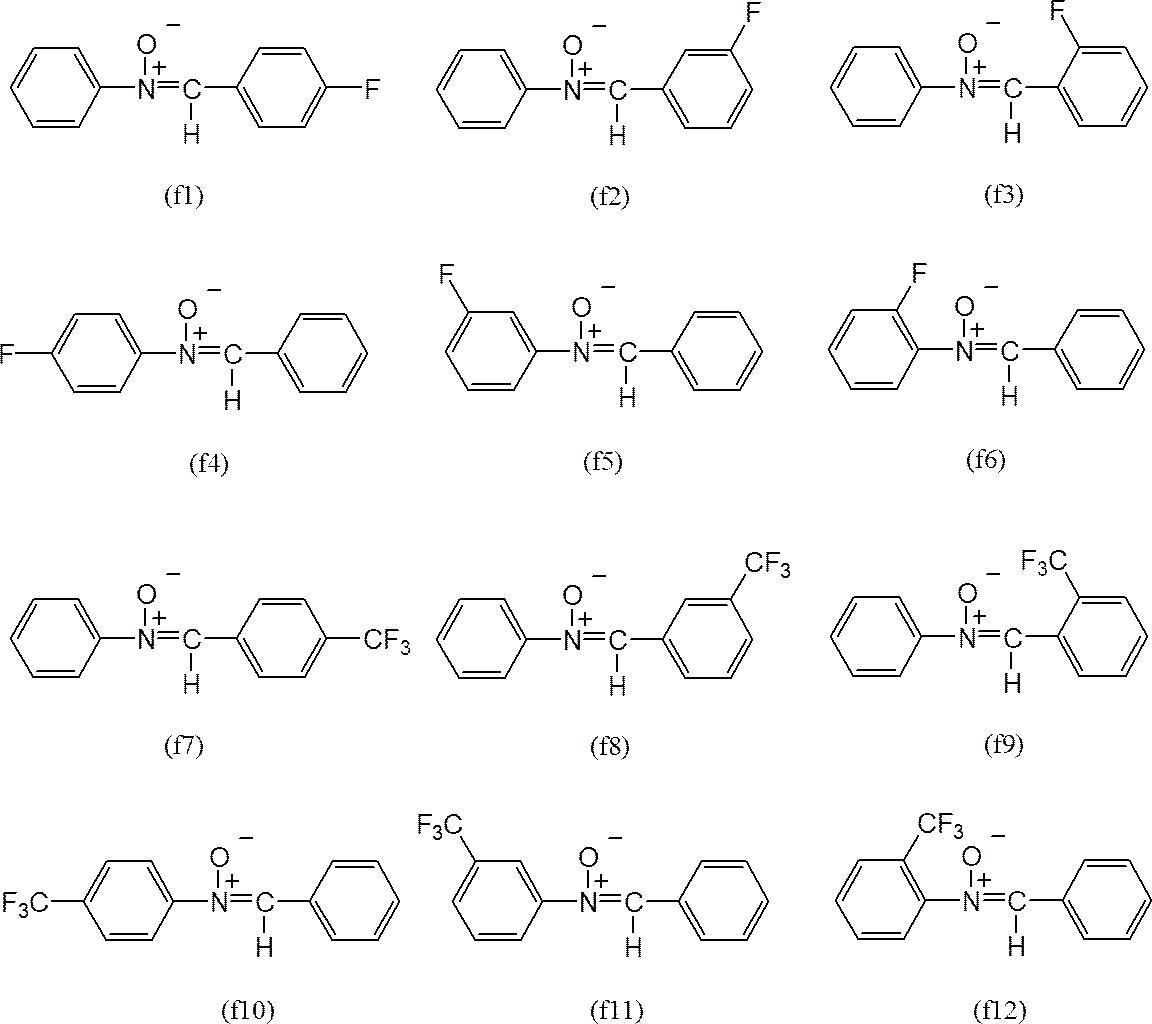
- the fluoronitrones include N-phenyl- ⁇ - (4-fluorophenyl) nitrones represented by the following formula (f1), N-phenyl- ⁇ - (3-fluorophenyl) nitrones represented by the following formula (f2), N-phenyl- ⁇ - (2-fluorophenyl) nitrone represented by the following formula (f3), N- (4-fluorophenyl) - ⁇ -phenylnitrone represented by the following formula (f4), N- (3-fluorophenyl) - ⁇ -phenylnitrone represented by the following formula (f6), N- (2-fluorophenyl) - ⁇ -phenylnitrone represented by the following formula (f6), N-phenyl- ⁇ - (4-trifluoromethylphenyl) nitrone, N-phenyl- ⁇ - (3-trifluoromethylphenyl) nitrone represented by the following formula (f8), represented by the following formula (f9) N-phenyl
- the synthesis method of fluoronitrone is not particularly limited, and a conventionally known method can be used.
- a compound having a hydroxyamino group (—NHOH) a compound having at least one group selected from the group consisting of an aldehyde group (—CHO) and a fluoro group and a trifluoromethyl group, and a hydroxyamino group Stir for 1 to 24 hours at room temperature in an organic solvent (eg, methanol, ethanol, tetrahydrofuran, etc.) in such an amount that the molar ratio to the aldehyde group (—NHOH / —CHO) is 1.0 to 1.5.
- an organic solvent eg, methanol, ethanol, tetrahydrofuran, etc.
- a compound (fluoronitrone) having at least one group selected from the group consisting of a fluoro group and a trifluoromethyl group and a nitrone group.
- the method for producing the modified polymer by reacting the fluoronitrone with the double bond of the conjugated diene polymer is not particularly limited.
- the above-described conjugated diene polymer and the above-described nitrone compound are mixed at 100 to 200 ° C. And mixing for 1 to 30 minutes.
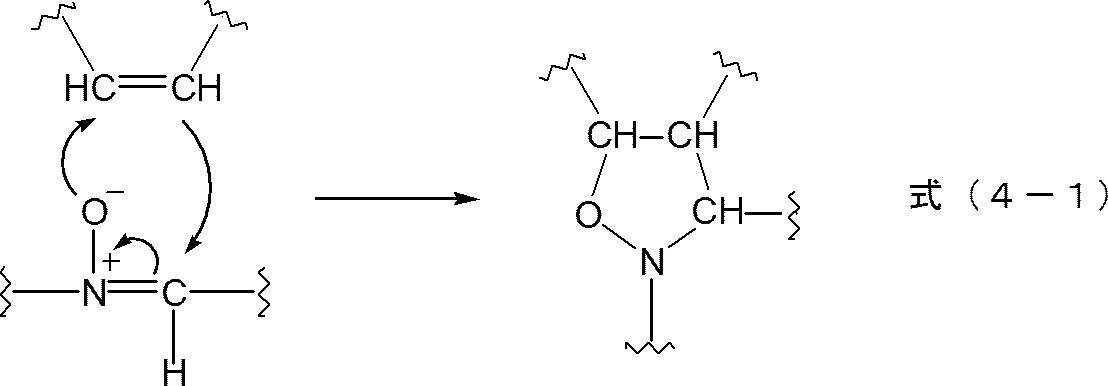
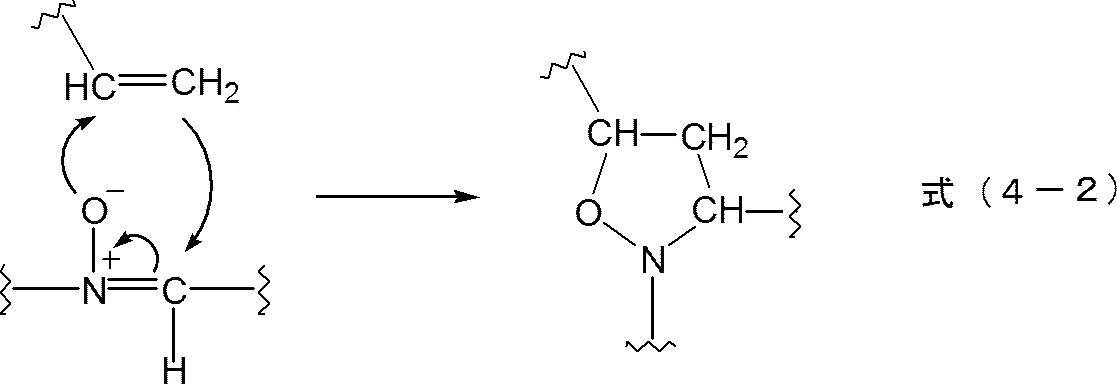
- a cycloaddition reaction takes place, giving a five-membered ring.
- the following formula (4-1) represents a reaction between a 1,4-bond and a nitrone group
- the following formula (4-2) represents a reaction between a 1,2-vinyl bond and a nitrone group.
- Formulas (4-1) and (4-2) represent reactions when butadiene is 1,3-butadiene, but when butadiene is other than 1,3-butadiene, Give a ring.
- the amount of fluoronitrone reacted with the double bond of the conjugated diene polymer is preferably 0.1 to 10 parts by mass, and 0.3 to 5 parts by mass with respect to 100 parts by mass of the diene rubber. More preferably, the amount is 1 to 3 parts by mass.
- the modification rate of the modified polymer is not particularly limited, but is preferably 0.02 to 4.0 mol%, and more preferably 0.10 to 2.0 mol%.
- the modification rate is preferably 0.20 mol% or more.
- the modification rate represents the ratio (mol%) modified by the nitrone compound among all the double bonds derived from the conjugated diene (conjugated diene diene unit) of the conjugated diene polymer. Is butadiene (1,3-butadiene), it represents the ratio (mol%) in which the structure of the above formula (4-1) or the above formula (4-2) is formed by modification with a nitrone compound.
- the modification rate can be determined, for example, by performing NMR measurement of the conjugated diene polymer and modified polymer (that is, the polymer before and after modification).
- modified polymer that is, the polymer before and after modification.
- a modified polymer having a modification rate of 100 mol% also corresponds to a diene rubber.
- the content of the modified polymer in the diene rubber is 10 to 100% by mass.
- the content is more preferably 20 to 60% by mass, and more preferably 40% by mass or more.
- the composition of the present invention contains silica.
- the said silica in particular is not restrict
- Specific examples of silica include wet silica, dry silica, fumed silica, diatomaceous earth, and the like. Of these, wet silica is preferable.
- the silica one type of silica may be used alone, or two or more types of silica may be used in combination.
- the content of silica is not particularly limited, but is preferably 25 to 130 parts by mass, more preferably 40 to 80 parts by mass with respect to 100 parts by mass of the diene rubber. .
- the composition of this invention can contain an additive further in the range which does not impair the effect and objective as needed.
- the additive include fillers other than silica (for example, carbon black), silane coupling agents, zinc oxide (zinc white), stearic acid, adhesive resins, peptizers, anti-aging agents, waxes, Various additives generally used in rubber compositions such as processing aids, aroma oils, liquid polymers, terpene resins, thermosetting resins, vulcanizing agents (for example, sulfur), and vulcanization accelerators can be mentioned. .
- the production method of the composition of the present invention is not particularly limited, and specific examples thereof include, for example, kneading the above-described components using a known method and apparatus (for example, a Banbury mixer, a kneader, a roll, etc.). The method etc. are mentioned.
- a known method and apparatus for example, a Banbury mixer, a kneader, a roll, etc.
- the method etc. are mentioned.
- the composition of the present invention contains sulfur or a vulcanization accelerator, components other than sulfur and the vulcanization accelerator are first mixed at a high temperature (preferably 80 to 140 ° C.) and cooled, and then sulfur or It is preferable to mix a vulcanization accelerator.
- the composition of the present invention can be vulcanized or crosslinked under conventionally known vulcanization or crosslinking conditions.
- composition of the present invention is suitably used for tires (preferably cap tread portions).
- the tire of the present invention is a tire using the above-described composition of the present invention. Especially, it is preferable that it is a pneumatic tire which used the composition of this invention for the tire tread part (cap tread part).
- FIG. 1 shows a schematic partial sectional view of a tire representing an example of an embodiment of the tire of the present invention, but the tire of the present invention is not limited to the embodiment shown in FIG.
- reference numeral 1 represents a bead portion
- reference numeral 2 represents a sidewall portion
- reference numeral 3 represents a tire tread portion
- a carcass layer 4 in which fiber cords are embedded is mounted between the pair of left and right bead portions 1, and the end of the carcass layer 4 extends from the inside of the tire to the outside around the bead core 5 and the bead filler 6. Wrapped and rolled up.
- a belt layer 7 is disposed over the circumference of the tire on the outside of the carcass layer 4.
- the rim cushion 8 is arrange
- the tire tread portion 3 is formed of the above-described composition of the present invention.
- the tire of the present invention can be manufactured, for example, according to a conventionally known method. Moreover, as gas with which a tire is filled, inert gas, such as nitrogen, argon, helium other than the air which adjusted normal or oxygen partial pressure, can be used.
- inert gas such as nitrogen, argon, helium other than the air which adjusted normal or oxygen partial pressure
- Modified Polymer 1 ⁇ Synthesis of Modified Polymer (Modified Polymer 1)> SBR (NIPOL 1502 manufactured by Nippon Zeon Co., Ltd.) was added to a 120 ° C. Banbury mixer and masticated for 2 minutes. Thereafter, 2 parts by mass of fluoronitrone 1 synthesized as described above was added to 100 parts by mass of SBR, and mixed at 160 ° C. for 5 minutes to modify SBR with fluoronitrone (fluoronitrone 1). The resulting modified polymer is referred to as modified polymer 1. The obtained modified polymer 1 was subjected to NMR measurement to obtain a modification rate. The modification rate of the modified polymer 1 was 0.72 mol%. NIPOL 1502 (styrene unit content: 23.5% by mass, Mw: 450,000, manufactured by Zeon Corporation)
- Modified Polymer 2 SBR was modified with fluoronitrone (fluoronitrone 2) according to the same procedure as modified polymer 1 except that 2 parts by mass of fluoronitrone 2 synthesized as described above was added instead of fluoronitrone 1.
- the resulting modified polymer is referred to as modified polymer 2.
- the obtained modified polymer 2 was subjected to NMR measurement to determine the modification rate.
- the modification rate of the modified polymer 2 was 0.58 mol%.
- the nitrone amount converted value represents the part by mass of the nitrone compound used for the synthesis of the modified polymer or the comparatively modified polymer with respect to 100 parts by mass of the diene rubber.
- the modification rate represents the modification rate [mol%] of the modified polymer described above.
- Zinc flower Zinc flower No. 3 (manufactured by Shodo Chemical Co., Ltd.)
- Sulfur Oil-treated sulfur (manufactured by Karuizawa Refinery)
- Vulcanization accelerator CZ Noxeller CZ-G (Ouchi Shinko Chemical Co., Ltd.)
- Vulcanization accelerator DPG Soxinol DG: (Sumitomo Chemical Co., Ltd.)
- Examples 1 and 2 containing a modified polymer obtained by reacting a fluoronitrone with a double bond of a conjugated diene polymer exhibit excellent rigidity, toughness and low heat build-up. It was. Among them, Example 2 in which the fluoronitrone is a nitrone compound having a trifluoromethyl group showed more excellent toughness and low heat build-up.
- Comparative Examples 1 to 3 which do not contain a modified polymer obtained by reacting a fluoronitrone with a double bond of a conjugated diene polymer, are insufficient in at least one of rigidity, toughness and low exothermic property. there were.
Landscapes
- Chemical & Material Sciences (AREA)
- Health & Medical Sciences (AREA)
- Chemical Kinetics & Catalysis (AREA)
- Medicinal Chemistry (AREA)
- Polymers & Plastics (AREA)
- Organic Chemistry (AREA)
- Engineering & Computer Science (AREA)
- Mechanical Engineering (AREA)
- General Chemical & Material Sciences (AREA)
- Compositions Of Macromolecular Compounds (AREA)
- Addition Polymer Or Copolymer, Post-Treatments, Or Chemical Modifications (AREA)
Abstract
本発明は、加硫後の剛性、靭性および低発熱性に優れたゴム組成物、ならびに、そのゴム組成物を使用したタイヤを提供することを目的とする。本発明のゴム組成物は、ジエン系ゴムと、シリカとを含有し、上記ジエン系ゴムが共役ジエン重合体の二重結合に対してニトロン化合物を反応させることで得られる変性ポリマーを含み、上記ニトロン化合物がフルオロ基およびトリフルオロメチル基からなる群より選択される少なくとも1種の基を有し、上記ジエン系ゴム中の上記変性ポリマーの含有量が10~100質量%である。
Description
本発明は、ゴム組成物およびタイヤに関する。
従来、タイヤ等に用いられるゴム組成物として、ニトロン基を有する化合物(ニトロン化合物)を変性剤として用いた変性ポリマーを含有するゴム組成物が知られている。
例えば、特許文献1の請求項1には、「変性ブタジエンゴムを5~100重量%含むジエン系ゴム100重量部にシリカを10~120重量部配合したゴム組成物であって、前記変性ブタジエンゴムが、シス含量が90%以上のブタジエンゴムを、窒素含有複素環を分子中に有するニトロン化合物で変性したものであることを特徴とするゴム組成物。」が開示されている。特許文献1には、特許文献1に記載のゴム組成物を用いることで発熱性が低減することが示されている。
例えば、特許文献1の請求項1には、「変性ブタジエンゴムを5~100重量%含むジエン系ゴム100重量部にシリカを10~120重量部配合したゴム組成物であって、前記変性ブタジエンゴムが、シス含量が90%以上のブタジエンゴムを、窒素含有複素環を分子中に有するニトロン化合物で変性したものであることを特徴とするゴム組成物。」が開示されている。特許文献1には、特許文献1に記載のゴム組成物を用いることで発熱性が低減することが示されている。
昨今、環境問題などの観点から、燃費の向上が求められ、それに伴い、さらなる発熱性の低減が求められている。また、タイヤに対する耐久性の要求水準が高まるなか、ゴム組成物に対して、加硫後の剛性や靭性のさらなる向上が求められている。
このようななか、本発明者らが特許文献1に記載のゴム組成物について検討したところ、その低発熱性は昨今要求されるレベルを必ずしも満たすものではないこと明らかになった。
このようななか、本発明者らが特許文献1に記載のゴム組成物について検討したところ、その低発熱性は昨今要求されるレベルを必ずしも満たすものではないこと明らかになった。
そこで、本発明は、上記実情を鑑みて、加硫後の剛性、靭性および低発熱性に優れたゴム組成物、ならびに、そのゴム組成物を使用したタイヤを提供することを目的とする。
本発明者らは、上記課題について鋭意検討した結果、フルオロ基およびトリフルオロメチル基からなる群より選択される少なくとも1種の基を有するニトロン化合物を変性剤として使用することで上記課題が解決できることを見出し、本発明に至った。
すなわち、本発明者らは、以下の構成により上記課題が解決できることを見出した。
すなわち、本発明者らは、以下の構成により上記課題が解決できることを見出した。
(1) ジエン系ゴムと、シリカとを含有し、
上記ジエン系ゴムが、共役ジエン重合体の二重結合に対してニトロン化合物を反応させることで得られる変性ポリマーを含み、
上記ニトロン化合物が、フルオロ基およびトリフルオロメチル基からなる群より選択される少なくとも1種の基を有し、
上記ジエン系ゴム中の上記変性ポリマーの含有量が、10~100質量%である、ゴム組成物。
(2) 上記ニトロン化合物が、N-フェニル-α-(4-フルオロフェニル)ニトロン、N-フェニル-α-(3-フルオロフェニル)ニトロン、N-フェニル-α-(2-フルオロフェニル)ニトロン、N-(4-フルオロフェニル)-α-フェニルニトロン、N-(3-フルオロフェニル)-α-フェニルニトロン、N-(2-フルオロフェニル)-α-フェニルニトロン、N-フェニル-α-(4-トリフルオロメチルフェニル)ニトロン、N-フェニル-α-(3-トリフルオロメチルフェニル)ニトロン、N-フェニル-α-(2-トリフルオロメチルフェニル)ニトロン、N-(4-トリフルオロメチルフェニル)-α-フェニルニトロン、N-(3-トリフルオロメチルフェニル)-α-フェニルニトロンおよびN-(2-トリフルオロメチルフェニル)-α-フェニルニトロンからなる群より選択される化合物である、上記(1)に記載のゴム組成物。
(3) 上記変性ポリマーの変性率が、0.02~4.0mol%である、上記(1)または(2)に記載のゴム組成物。ここで、変性率は、上記共役ジエン重合体が有する共役ジエンに由来する全ての二重結合のうち、上記ニトロン化合物によって変性された割合(mol%)を表す。
(4) 上記共役ジエン重合体の二重結合に対して反応させる上記ニトロン化合物の量が、上記ジエン系ゴム100質量部に対して、0.1~10質量部である、上記(1)~(3)のいずれかに記載のゴム組成物。
(5) 上記シリカの含有量が、上記ジエン系ゴム100質量部に対して、25~130質量部である、上記(1)~(4)のいずれかに記載のゴム組成物。
(6) 上記(1)~(5)のいずれかに記載のゴム組成物をタイヤトレッド部に使用したタイヤ。
上記ジエン系ゴムが、共役ジエン重合体の二重結合に対してニトロン化合物を反応させることで得られる変性ポリマーを含み、
上記ニトロン化合物が、フルオロ基およびトリフルオロメチル基からなる群より選択される少なくとも1種の基を有し、
上記ジエン系ゴム中の上記変性ポリマーの含有量が、10~100質量%である、ゴム組成物。
(2) 上記ニトロン化合物が、N-フェニル-α-(4-フルオロフェニル)ニトロン、N-フェニル-α-(3-フルオロフェニル)ニトロン、N-フェニル-α-(2-フルオロフェニル)ニトロン、N-(4-フルオロフェニル)-α-フェニルニトロン、N-(3-フルオロフェニル)-α-フェニルニトロン、N-(2-フルオロフェニル)-α-フェニルニトロン、N-フェニル-α-(4-トリフルオロメチルフェニル)ニトロン、N-フェニル-α-(3-トリフルオロメチルフェニル)ニトロン、N-フェニル-α-(2-トリフルオロメチルフェニル)ニトロン、N-(4-トリフルオロメチルフェニル)-α-フェニルニトロン、N-(3-トリフルオロメチルフェニル)-α-フェニルニトロンおよびN-(2-トリフルオロメチルフェニル)-α-フェニルニトロンからなる群より選択される化合物である、上記(1)に記載のゴム組成物。
(3) 上記変性ポリマーの変性率が、0.02~4.0mol%である、上記(1)または(2)に記載のゴム組成物。ここで、変性率は、上記共役ジエン重合体が有する共役ジエンに由来する全ての二重結合のうち、上記ニトロン化合物によって変性された割合(mol%)を表す。
(4) 上記共役ジエン重合体の二重結合に対して反応させる上記ニトロン化合物の量が、上記ジエン系ゴム100質量部に対して、0.1~10質量部である、上記(1)~(3)のいずれかに記載のゴム組成物。
(5) 上記シリカの含有量が、上記ジエン系ゴム100質量部に対して、25~130質量部である、上記(1)~(4)のいずれかに記載のゴム組成物。
(6) 上記(1)~(5)のいずれかに記載のゴム組成物をタイヤトレッド部に使用したタイヤ。
以下に示すように、本発明によれば、加硫後の剛性、靭性および低発熱性に優れたゴム組成物、ならびに、そのゴム組成物を使用したタイヤを提供することができる。
以下に、本発明のゴム組成物、および、本発明のゴム組成物を使用したタイヤについて説明する。
なお、本明細書において「~」を用いて表される数値範囲は、「~」の前後に記載される数値を下限値および上限値として含む範囲を意味する。
なお、本明細書において「~」を用いて表される数値範囲は、「~」の前後に記載される数値を下限値および上限値として含む範囲を意味する。
[ゴム組成物]
本発明のゴム組成物(以下、本発明の組成物とも言う)は、ジエン系ゴムと、シリカとを含有する。
ここで、上記ジエン系ゴムは、共役ジエン重合体の二重結合に対してニトロン化合物を反応させることで得られる変性ポリマーを含む。また、上記ニトロン化合物は、フルオロ基およびトリフルオロメチル基からなる群より選択される少なくとも1種の基を有する。また、上記ジエン系ゴム中の上記変性ポリマーの含有量は10~100質量%である。
本発明の組成物はこのような構成をとるため、加硫後の剛性、靭性および低発熱性に優れるものと考えられる。その理由は明らかではないが、およそ以下のとおりと推測される。
本発明のゴム組成物(以下、本発明の組成物とも言う)は、ジエン系ゴムと、シリカとを含有する。
ここで、上記ジエン系ゴムは、共役ジエン重合体の二重結合に対してニトロン化合物を反応させることで得られる変性ポリマーを含む。また、上記ニトロン化合物は、フルオロ基およびトリフルオロメチル基からなる群より選択される少なくとも1種の基を有する。また、上記ジエン系ゴム中の上記変性ポリマーの含有量は10~100質量%である。
本発明の組成物はこのような構成をとるため、加硫後の剛性、靭性および低発熱性に優れるものと考えられる。その理由は明らかではないが、およそ以下のとおりと推測される。
本発明の組成物は、上述のとおり、共役ジエン重合体の二重結合に対してニトロン化合物を反応させることで得られる変性ポリマーを含有する。そのため、変性ポリマー中のニトロン残基(変性後のニトロン基)が組成物中のシリカと相互作用し、シリカとポリマーとの緻密かつ均質なネットワークが形成され、結果として、剛性および靭性が向上するものと考えられる。また、上述のとおり、均質な構造が形成されるため、エネルギーロスが低下し、低発熱性が向上するものと考えられる。
ここで、ニトロン化合物とシリカとの相互作用が強すぎると、剛性と靭性のバランスが低下してしまうところ、本発明では上記ニトロン化合物としてフルオロ基およびトリフルオロメチル基からなる群より選択される少なくとも1種の基を有するニトロン化合物を使用するため、ニトロン化合物中の上記基によって相互作用が適度な大きさに調整され、結果として、剛性と靭性のバランスが担保されているものと考えられる。
ここで、ニトロン化合物とシリカとの相互作用が強すぎると、剛性と靭性のバランスが低下してしまうところ、本発明では上記ニトロン化合物としてフルオロ基およびトリフルオロメチル基からなる群より選択される少なくとも1種の基を有するニトロン化合物を使用するため、ニトロン化合物中の上記基によって相互作用が適度な大きさに調整され、結果として、剛性と靭性のバランスが担保されているものと考えられる。
〔ジエン系ゴム〕
本発明の組成物に含有されるジエン系ゴムは、共役ジエン重合体の二重結合に対してニトロン化合物を反応させることで得られる変性ポリマーを含む。ここで、上記ニトロン化合物はフルオロ基およびトリフルオロメチル基からなる群より選択される少なくとも1種の基を有する。また、上記ジエン系ゴム中の上記変性ポリマーの含有量は10~100質量%である。
なお、上記ジエン系ゴムは上記変性ポリマー以外のゴム成分を含んでいてもよい。そのようなゴム成分としては特に制限されないが、天然ゴム、イソプレンゴム(IR)、ブタジエンゴム(BR)、芳香族ビニル-共役ジエン共重合ゴム(例えば、スチレンブタジエンゴム(SBR))、アクリロニトリル-ブタジエン共重合ゴム(NBR)、ブチルゴム(IIR)、ハロゲン化ブチルゴム(Br-IIR、Cl-IIR)、クロロプレンゴム(CR)などが挙げられる。なかでも、ブタジエンゴム(BR)、スチレンブタジエンゴム(SBR)が好ましい。
本発明の組成物に含有されるジエン系ゴムは、共役ジエン重合体の二重結合に対してニトロン化合物を反応させることで得られる変性ポリマーを含む。ここで、上記ニトロン化合物はフルオロ基およびトリフルオロメチル基からなる群より選択される少なくとも1種の基を有する。また、上記ジエン系ゴム中の上記変性ポリマーの含有量は10~100質量%である。
なお、上記ジエン系ゴムは上記変性ポリマー以外のゴム成分を含んでいてもよい。そのようなゴム成分としては特に制限されないが、天然ゴム、イソプレンゴム(IR)、ブタジエンゴム(BR)、芳香族ビニル-共役ジエン共重合ゴム(例えば、スチレンブタジエンゴム(SBR))、アクリロニトリル-ブタジエン共重合ゴム(NBR)、ブチルゴム(IIR)、ハロゲン化ブチルゴム(Br-IIR、Cl-IIR)、クロロプレンゴム(CR)などが挙げられる。なかでも、ブタジエンゴム(BR)、スチレンブタジエンゴム(SBR)が好ましい。
<変性ポリマー>
変性ポリマーは、共役ジエン重合体の二重結合に対して、フルオロ基およびトリフルオロメチル基からなる群より選択される少なくとも1種の基を有するニトロン化合物(以下、「フルオロニトロン」とも言う)を反応させることで得られる変性ポリマーである。
変性ポリマーは、共役ジエン重合体の二重結合に対して、フルオロ基およびトリフルオロメチル基からなる群より選択される少なくとも1種の基を有するニトロン化合物(以下、「フルオロニトロン」とも言う)を反応させることで得られる変性ポリマーである。
(共役ジエン重合体)
変性ポリマーの製造に使用される共役ジエン重合体としては特に制限されず、天然ゴム(NR)、イソプレンゴム(IR)、ブタジエンゴム(BR)、芳香族ビニル-共役ジエン共重合ゴム(例えば、スチレンブタジエンゴム(SBR))、アクリロニトリル-ブタジエン共重合ゴム(NBR)、ブチルゴム(IIR)、ハロゲン化ブチルゴム(Br-IIR、Cl-IIR)、クロロプレンゴム(CR)などが挙げられる。なかでも、スチレンブタジエンゴム(SBR)が好ましい。すなわち、変性ポリマーは、スチレンブタジエンゴム(SBR)の二重結合に対してニトロン化合物を反応させることで得られる変性ポリマーであるのが好ましい。
変性ポリマーの製造に使用される共役ジエン重合体としては特に制限されず、天然ゴム(NR)、イソプレンゴム(IR)、ブタジエンゴム(BR)、芳香族ビニル-共役ジエン共重合ゴム(例えば、スチレンブタジエンゴム(SBR))、アクリロニトリル-ブタジエン共重合ゴム(NBR)、ブチルゴム(IIR)、ハロゲン化ブチルゴム(Br-IIR、Cl-IIR)、クロロプレンゴム(CR)などが挙げられる。なかでも、スチレンブタジエンゴム(SBR)が好ましい。すなわち、変性ポリマーは、スチレンブタジエンゴム(SBR)の二重結合に対してニトロン化合物を反応させることで得られる変性ポリマーであるのが好ましい。
(ニトロン化合物)
変性ポリマーの製造に使用されるニトロン化合物は、フルオロ基(-F)およびトリフルオロメチル基(-CF3)からなる群より選択される少なくとも1種の基を有するニトロン化合物(フルオロニトロン)であれば特に制限されない。ここで、ニトロン化合物とは、下記式(1)で表されるニトロン基を有する化合物を指す。
変性ポリマーの製造に使用されるニトロン化合物は、フルオロ基(-F)およびトリフルオロメチル基(-CF3)からなる群より選択される少なくとも1種の基を有するニトロン化合物(フルオロニトロン)であれば特に制限されない。ここで、ニトロン化合物とは、下記式(1)で表されるニトロン基を有する化合物を指す。

上記式(1)中、*は結合位置を表す。
フルオロニトロンは、下記式(2)で表される化合物であることが好ましい。

上記式(2)中、XおよびYは、それぞれ独立に、置換基を有していてもよい、脂肪族炭化水素基、芳香族炭化水素基、または、芳香族複素環基を表す。ただし、XおよびYのうち少なくとも一方は、上記置換基として、フルオロ基およびトリフルオロメチル基からなる群より選択される少なくとも1種の基を有する。
上記脂肪族炭化水素基としては、例えば、アルキル基、シクロアルキル基、アルケニル基などが挙げられる。アルキル基としては、例えば、メチル基、エチル基、n-プロピル基、イソプロピル基、n-ブチル基、イソブチル基、sec-ブチル基、tert-ブチル基、n-ペンチル基、イソペンチル基、ネオペンチル基、tert-ペンチル基、1-メチルブチル基、2-メチルブチル基、1,2-ジメチルプロピル基、n-ヘキシル基、n-ヘプチル基、n-オクチル基などが挙げられ、なかでも、炭素数1~18のアルキル基が好ましく、炭素数1~6のアルキル基がより好ましい。シクロアルキル基としては、例えば、シクロプロピル基、シクロブチル基、シクロペンチル基、シクロヘキシル基などが挙げられ、なかでも、炭素数3~10のシクロアルキル基が好ましく、炭素数3~6のシクロアルキル基がより好ましい。アルケニル基としては、例えば、ビニル基、1-プロペニル基、アリル基、イソプロペニル基、1-ブテニル基、2-ブテニル基などが挙げられ、なかでも、炭素数2~18のアルケニル基が好ましく、炭素数2~6のアルケニル基がより好ましい。
上記芳香族炭化水素基としては、例えば、アリール基、アラルキル基などが挙げられる。アリール基としては、例えば、フェニル基、ナフチル基、アントリル基、フェナントリル基、ビフェニル基などが挙げられ、なかでも、炭素数6~14のアリール基が好ましく、炭素数6~10のアリール基がより好ましく、フェニル基、ナフチル基がさらに好ましい。アラルキル基としては、例えば、ベンジル基、フェネチル基、フェニルプロピル基などが挙げられ、なかでも、炭素数7~13のアラルキル基が好ましく、炭素数7~11のアラルキル基がより好ましく、ベンジル基がさらに好ましい。
上記芳香族複素環基としては、例えば、ピロリル基、フリル基、チエニル基、ピラゾリル基、イミダゾリル基(イミダゾール基)、オキサゾリル基、イソオキサゾリル基、チアゾリル基、イソチアゾリル基、ピリジル基(ピリジン基)、フラン基、チオフェン基、ピリダジニル基、ピリミジニル基、ピラジニル基等が挙げられる。
上記脂肪族炭化水素基としては、例えば、アルキル基、シクロアルキル基、アルケニル基などが挙げられる。アルキル基としては、例えば、メチル基、エチル基、n-プロピル基、イソプロピル基、n-ブチル基、イソブチル基、sec-ブチル基、tert-ブチル基、n-ペンチル基、イソペンチル基、ネオペンチル基、tert-ペンチル基、1-メチルブチル基、2-メチルブチル基、1,2-ジメチルプロピル基、n-ヘキシル基、n-ヘプチル基、n-オクチル基などが挙げられ、なかでも、炭素数1~18のアルキル基が好ましく、炭素数1~6のアルキル基がより好ましい。シクロアルキル基としては、例えば、シクロプロピル基、シクロブチル基、シクロペンチル基、シクロヘキシル基などが挙げられ、なかでも、炭素数3~10のシクロアルキル基が好ましく、炭素数3~6のシクロアルキル基がより好ましい。アルケニル基としては、例えば、ビニル基、1-プロペニル基、アリル基、イソプロペニル基、1-ブテニル基、2-ブテニル基などが挙げられ、なかでも、炭素数2~18のアルケニル基が好ましく、炭素数2~6のアルケニル基がより好ましい。
上記芳香族炭化水素基としては、例えば、アリール基、アラルキル基などが挙げられる。アリール基としては、例えば、フェニル基、ナフチル基、アントリル基、フェナントリル基、ビフェニル基などが挙げられ、なかでも、炭素数6~14のアリール基が好ましく、炭素数6~10のアリール基がより好ましく、フェニル基、ナフチル基がさらに好ましい。アラルキル基としては、例えば、ベンジル基、フェネチル基、フェニルプロピル基などが挙げられ、なかでも、炭素数7~13のアラルキル基が好ましく、炭素数7~11のアラルキル基がより好ましく、ベンジル基がさらに好ましい。
上記芳香族複素環基としては、例えば、ピロリル基、フリル基、チエニル基、ピラゾリル基、イミダゾリル基(イミダゾール基)、オキサゾリル基、イソオキサゾリル基、チアゾリル基、イソチアゾリル基、ピリジル基(ピリジン基)、フラン基、チオフェン基、ピリダジニル基、ピリミジニル基、ピラジニル基等が挙げられる。
フルオロニトロンは、下記式(F)で表される化合物であることが好ましい。
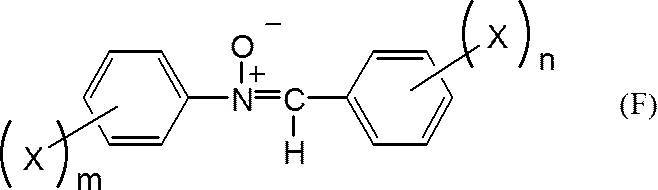
上記式(F)中、Xは、フルオロ基またはトリフルオロメチル基を表す。
上記式(F)中、mおよびnは、それぞれ独立に、0~5の整数を示し、mとnとの合計は1以上である。
mが示す整数としては、フルオロシニトロンを合成する際の溶媒への溶解度が良好になり合成が容易になるという理由から、0~2の整数が好ましく、0~1の整数がより好ましい。
nが示す整数としては、フルオロニトロンを合成する際の溶媒への溶解度が良好になり合成が容易になるという理由から、0~2の整数が好ましく、0~1の整数がより好ましい。
また、mとnとの合計(m+n)は、1~4が好ましく、1~2がより好ましい。
上記式(F)中、mおよびnは、それぞれ独立に、0~5の整数を示し、mとnとの合計は1以上である。
mが示す整数としては、フルオロシニトロンを合成する際の溶媒への溶解度が良好になり合成が容易になるという理由から、0~2の整数が好ましく、0~1の整数がより好ましい。
nが示す整数としては、フルオロニトロンを合成する際の溶媒への溶解度が良好になり合成が容易になるという理由から、0~2の整数が好ましく、0~1の整数がより好ましい。
また、mとnとの合計(m+n)は、1~4が好ましく、1~2がより好ましい。
フルオロニトロンは、下記式(f1)で表されるN-フェニル-α-(4-フルオロフェニル)ニトロン、下記式(f2)で表されるN-フェニル-α-(3-フルオロフェニル)ニトロン、下記式(f3)で表されるN-フェニル-α-(2-フルオロフェニル)ニトロン、下記式(f4)で表されるN-(4-フルオロフェニル)-α-フェニルニトロン、下記式(f5)で表されるN-(3-フルオロフェニル)-α-フェニルニトロン、下記式(f6)で表されるN-(2-フルオロフェニル)-α-フェニルニトロン、下記式(f7)で表されるN-フェニル-α-(4-トリフルオロメチルフェニル)ニトロン、下記式(f8)で表されるN-フェニル-α-(3-トリフルオロメチルフェニル)ニトロン、下記式(f9)で表されるN-フェニル-α-(2-トリフルオロメチルフェニル)ニトロン、下記式(f10)で表されるN-(4-トリフルオロメチルフェニル)-α-フェニルニトロン、下記式(f11)で表されるN-(3-トリフルオロメチルフェニル)-α-フェニルニトロンおよび下記式(f12)で表されるN-(2-トリフルオロメチルフェニル)-α-フェニルニトロンからなる群より選択される化合物であることが好ましい。
フルオロニトロンの合成方法は特に限定されず、従来公知の方法を用いることができる。例えば、ヒドロキシアミノ基(-NHOH)を有する化合物と、アルデヒド基(-CHO)ならびにフルオロ基およびトリフルオロメチル基からなる群より選択される少なくとも1種の基を有する化合物とを、ヒドロキシアミノ基とアルデヒド基とのモル比(-NHOH/-CHO)が1.0~1.5となる量で、有機溶媒(例えば、メタノール、エタノール、テトラヒドロフラン等)下で、室温で1~24時間撹拌することにより、両基が反応し、フルオロ基およびトリフルオロメチル基からなる群より選択される少なくとも1種の基とニトロン基とを有する化合物(フルオロニトロン)を与える。
(変性ポリマーの製造方法)
共役ジエン重合体の二重結合に対してフルオロニトロンを反応させることで変性ポリマーを製造する方法は特に制限されないが、例えば、上述した共役ジエン重合体と上述したニトロン化合物とを、100~200℃で1~30分間混合する方法が挙げられる。
このとき、下記式(4-1)または下記式(4-2)に示すように、上記共役ジエン重合体が有する共役ジエンに由来する二重結合とフルオロニトロンが有するニトロン基との間で、環化付加反応が起こり、五員環を与える。なお、下記式(4-1)は1,4-結合とニトロン基との反応を表し、下記式(4-2)は1,2-ビニル結合とニトロン基との反応を表す。また、式(4-1)および(4-2)はブタジエンが1,3-ブタジエンの場合の反応を表すものであるが、ブタジエンが1,3-ブタジエン以外の場合も同様の反応により五員環を与える。
共役ジエン重合体の二重結合に対してフルオロニトロンを反応させることで変性ポリマーを製造する方法は特に制限されないが、例えば、上述した共役ジエン重合体と上述したニトロン化合物とを、100~200℃で1~30分間混合する方法が挙げられる。
このとき、下記式(4-1)または下記式(4-2)に示すように、上記共役ジエン重合体が有する共役ジエンに由来する二重結合とフルオロニトロンが有するニトロン基との間で、環化付加反応が起こり、五員環を与える。なお、下記式(4-1)は1,4-結合とニトロン基との反応を表し、下記式(4-2)は1,2-ビニル結合とニトロン基との反応を表す。また、式(4-1)および(4-2)はブタジエンが1,3-ブタジエンの場合の反応を表すものであるが、ブタジエンが1,3-ブタジエン以外の場合も同様の反応により五員環を与える。
上記共役ジエン重合体の二重結合に対して反応させるフルオロニトロンの量は、上記ジエン系ゴム100質量部に対して、0.1~10質量部であるのが好ましく、0.3~5質量部であるのがより好ましく、1~3質量部であるのがさらに好ましい。
(変性率)
変性ポリマーの変性率は特に制限されないが、0.02~4.0mol%であることが好ましく、0.10~2.0mol%であることがより好ましい。上記変性率は0.20mol%以上であることが好ましい。
ここで、変性率とは、上記共役ジエン重合体が有する共役ジエン(共役ジエンジエン単位)に由来する全ての二重結合のうち、ニトロン化合物によって変性された割合(mol%)を表し、例えば共役ジエンがブタジエン(1,3-ブタジエン)であれば、ニトロン化合物による変性によって上記式(4-1)または上記式(4-2)の構造が形成された割合(mol%)を表す。変性率は、例えば、上記共役ジエン重合体および変性ポリマー(すなわち、変性前後のポリマー)のNMR測定を行うことで求めることができる。
なお、本明細書において、変性率が100mol%の変性ポリマーもジエン系ゴムに該当するものとする。
変性ポリマーの変性率は特に制限されないが、0.02~4.0mol%であることが好ましく、0.10~2.0mol%であることがより好ましい。上記変性率は0.20mol%以上であることが好ましい。
ここで、変性率とは、上記共役ジエン重合体が有する共役ジエン(共役ジエンジエン単位)に由来する全ての二重結合のうち、ニトロン化合物によって変性された割合(mol%)を表し、例えば共役ジエンがブタジエン(1,3-ブタジエン)であれば、ニトロン化合物による変性によって上記式(4-1)または上記式(4-2)の構造が形成された割合(mol%)を表す。変性率は、例えば、上記共役ジエン重合体および変性ポリマー(すなわち、変性前後のポリマー)のNMR測定を行うことで求めることができる。
なお、本明細書において、変性率が100mol%の変性ポリマーもジエン系ゴムに該当するものとする。
ジエン系ゴム中の変性ポリマーの含有量は、10~100質量%である。なかでも、20~60質量%であることがより好ましく、そのなかでも、40質量%以上であることがより好ましい。
〔シリカ〕
本発明の組成物はシリカを含有する。
上記シリカは特に制限されないが、タイヤ等の用途でゴム組成物に配合されている従来公知の任意のシリカを用いることができる。
シリカの具体例としては、湿式シリカ、乾式シリカ、ヒュームドシリカ、珪藻土などが挙げられる。なかでも、湿式シリカが好ましい。上記シリカは、1種のシリカを単独で用いても、2種以上のシリカを併用してもよい。
本発明の組成物はシリカを含有する。
上記シリカは特に制限されないが、タイヤ等の用途でゴム組成物に配合されている従来公知の任意のシリカを用いることができる。
シリカの具体例としては、湿式シリカ、乾式シリカ、ヒュームドシリカ、珪藻土などが挙げられる。なかでも、湿式シリカが好ましい。上記シリカは、1種のシリカを単独で用いても、2種以上のシリカを併用してもよい。
本発明の組成物において、シリカの含有量は特に制限されないが、上記ジエン系ゴム100質量部に対して、25~130質量部であることが好ましく、40~80質量部であることがより好ましい。
〔任意成分〕
本発明の組成物は、必要に応じて、その効果や目的を損なわない範囲でさらに添加剤を含有することができる。
上記添加剤としては、例えば、シリカ以外の充填剤(例えば、カーボンブラック)、シランカップリング剤、酸化亜鉛(亜鉛華)、ステアリン酸、接着用樹脂、素練り促進剤、老化防止剤、ワックス、加工助剤、アロマオイル、液状ポリマー、テルペン系樹脂、熱硬化性樹脂、加硫剤(例えば、硫黄)、加硫促進剤などのゴム組成物に一般的に使用される各種添加剤が挙げられる。
本発明の組成物は、必要に応じて、その効果や目的を損なわない範囲でさらに添加剤を含有することができる。
上記添加剤としては、例えば、シリカ以外の充填剤(例えば、カーボンブラック)、シランカップリング剤、酸化亜鉛(亜鉛華)、ステアリン酸、接着用樹脂、素練り促進剤、老化防止剤、ワックス、加工助剤、アロマオイル、液状ポリマー、テルペン系樹脂、熱硬化性樹脂、加硫剤(例えば、硫黄)、加硫促進剤などのゴム組成物に一般的に使用される各種添加剤が挙げられる。
〔ゴム組成物の製造方法〕
本発明の組成物の製造方法は特に限定されず、その具体例としては、例えば、上述した各成分を、公知の方法、装置(例えば、バンバリーミキサー、ニーダー、ロールなど)を用いて、混練する方法などが挙げられる。本発明の組成物が硫黄または加硫促進剤を含有する場合は、硫黄および加硫促進剤以外の成分を先に高温(好ましくは80~140℃)で混合し、冷却してから、硫黄または加硫促進剤を混合するのが好ましい。
また、本発明の組成物は、従来公知の加硫または架橋条件で加硫または架橋することができる。
本発明の組成物の製造方法は特に限定されず、その具体例としては、例えば、上述した各成分を、公知の方法、装置(例えば、バンバリーミキサー、ニーダー、ロールなど)を用いて、混練する方法などが挙げられる。本発明の組成物が硫黄または加硫促進剤を含有する場合は、硫黄および加硫促進剤以外の成分を先に高温(好ましくは80~140℃)で混合し、冷却してから、硫黄または加硫促進剤を混合するのが好ましい。
また、本発明の組成物は、従来公知の加硫または架橋条件で加硫または架橋することができる。
〔用途〕
本発明の組成物はタイヤ(好ましくは、キャップトレッド部)に好適に用いられる。
本発明の組成物はタイヤ(好ましくは、キャップトレッド部)に好適に用いられる。
[タイヤ]
本発明のタイヤは、上述した本発明の組成物を使用したタイヤである。なかでも、本発明の組成物をタイヤトレッド部(キャップトレッド部)に使用した空気入りタイヤであることが好ましい。
図1に、本発明のタイヤの実施態様の一例を表すタイヤの部分断面概略図を示すが、本発明のタイヤは図1に示す態様に限定されるものではない。
本発明のタイヤは、上述した本発明の組成物を使用したタイヤである。なかでも、本発明の組成物をタイヤトレッド部(キャップトレッド部)に使用した空気入りタイヤであることが好ましい。
図1に、本発明のタイヤの実施態様の一例を表すタイヤの部分断面概略図を示すが、本発明のタイヤは図1に示す態様に限定されるものではない。
図1において、符号1はビード部を表し、符号2はサイドウォール部を表し、符号3はタイヤトレッド部を表す。
また、左右一対のビード部1間においては、繊維コードが埋設されたカーカス層4が装架されており、このカーカス層4の端部はビードコア5およびビードフィラー6の廻りにタイヤ内側から外側に折り返されて巻き上げられている。
また、タイヤトレッド部3においては、カーカス層4の外側に、ベルト層7がタイヤ1周に亘って配置されている。
また、ビード部1においては、リムに接する部分にリムクッション8が配置されている。
なお、タイヤトレッド部3は上述した本発明の組成物により形成されている。
また、左右一対のビード部1間においては、繊維コードが埋設されたカーカス層4が装架されており、このカーカス層4の端部はビードコア5およびビードフィラー6の廻りにタイヤ内側から外側に折り返されて巻き上げられている。
また、タイヤトレッド部3においては、カーカス層4の外側に、ベルト層7がタイヤ1周に亘って配置されている。
また、ビード部1においては、リムに接する部分にリムクッション8が配置されている。
なお、タイヤトレッド部3は上述した本発明の組成物により形成されている。
本発明のタイヤは、例えば、従来公知の方法に従って製造することができる。また、タイヤに充填する気体としては、通常のまたは酸素分圧を調整した空気の他、窒素、アルゴン、ヘリウムなどの不活性ガスを用いることができる。
以下、実施例により、本発明についてさらに詳細に説明するが、本発明はこれらに限定されるものではない。
<フルオロニトロン(フルオロニトロン1)の合成>
300mLナスフラスコに、下記式(f3b)で表されるフルオロベンズアルデヒド(21.7g)およびエタノール(20mL)を入れ、ここに、下記式(f3a)で表されるフェニルヒドロキシアミン(15.8g)をエタノール(30mL)に溶かしたものを加え、室温で22時間撹拌した。撹拌終了後、エタノールからの再結晶により、下記式(f3)で表されるニトロン化合物(フルオロニトロン)を白色の結晶として得た(30.1g)。得られたフルオロニトロンをフルオロニトロン1とする。収率は96%であった。
300mLナスフラスコに、下記式(f3b)で表されるフルオロベンズアルデヒド(21.7g)およびエタノール(20mL)を入れ、ここに、下記式(f3a)で表されるフェニルヒドロキシアミン(15.8g)をエタノール(30mL)に溶かしたものを加え、室温で22時間撹拌した。撹拌終了後、エタノールからの再結晶により、下記式(f3)で表されるニトロン化合物(フルオロニトロン)を白色の結晶として得た(30.1g)。得られたフルオロニトロンをフルオロニトロン1とする。収率は96%であった。
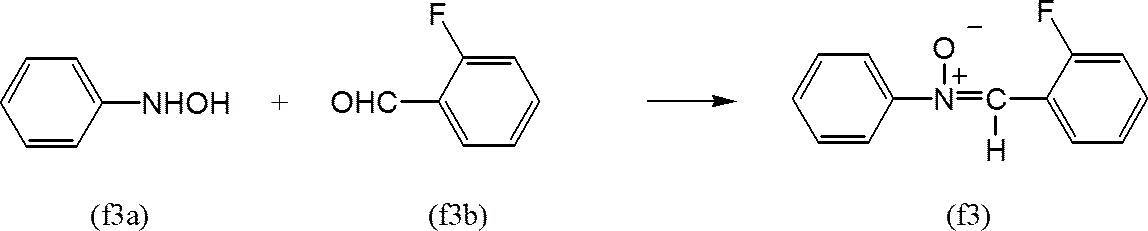
<フルオロニトロン(フルオロニトロン2)の合成>
300mLナスフラスコに、下記式(f9b)で表されるトリフルオロメチルベンズアルデヒド(23.5g)およびエタノール(20mL)を入れ、ここに、下記式(f9a)で表されるフェニルヒドロキシアミン(14.8g)をエタノール(30mL)に溶かしたものを加え、室温で22時間撹拌した。撹拌終了後、エタノールからの再結晶により、下記式(f9)で表されるニトロン化合物(フルオロニトロン)を白色の結晶として得た(34.7g)。得られたフルオロニトロンをフルオロニトロン2とする。収率は97%であった。
300mLナスフラスコに、下記式(f9b)で表されるトリフルオロメチルベンズアルデヒド(23.5g)およびエタノール(20mL)を入れ、ここに、下記式(f9a)で表されるフェニルヒドロキシアミン(14.8g)をエタノール(30mL)に溶かしたものを加え、室温で22時間撹拌した。撹拌終了後、エタノールからの再結晶により、下記式(f9)で表されるニトロン化合物(フルオロニトロン)を白色の結晶として得た(34.7g)。得られたフルオロニトロンをフルオロニトロン2とする。収率は97%であった。

<ジフェニルニトロンの合成>
300mLナスフラスコに、下記式(6)で表されるベンズアルデヒド(42.45g)およびエタノール(10mL)を入れ、ここに、下記式(5)で表されるフェニルヒドロキシアミン(43.65g)をエタノール(70mL)に溶かしたものを加え、室温で22時間撹拌した。撹拌終了後、エタノールからの再結晶により、下記式(7)で表されるカルボキシ基を有さないニトロン化合物(ジフェニルニトロン)を白色の結晶として得た(65.40g)。収率は83%であった。
300mLナスフラスコに、下記式(6)で表されるベンズアルデヒド(42.45g)およびエタノール(10mL)を入れ、ここに、下記式(5)で表されるフェニルヒドロキシアミン(43.65g)をエタノール(70mL)に溶かしたものを加え、室温で22時間撹拌した。撹拌終了後、エタノールからの再結晶により、下記式(7)で表されるカルボキシ基を有さないニトロン化合物(ジフェニルニトロン)を白色の結晶として得た(65.40g)。収率は83%であった。

<ピリジルニトロンの合成>
2Lナスフラスコに、40℃に温めたメタノール(900mL)を入れ、ここに、下記式(b-2)で表される2-ピリジンカルボキシアルデヒド(21.4g)を加えて溶かした。この溶液に、下記式(a-2)で表されるフェニルヒドロキシアミン(21.8g)をメタノール(100mL)に溶かしたものを加え、室温で19時間撹拌した。撹拌終了後、メタノールからの再結晶により、下記式(c-2)で表されるニトロン化合物(ピリジルニトロン)を得た(39.0g)。収率は90%であった。
2Lナスフラスコに、40℃に温めたメタノール(900mL)を入れ、ここに、下記式(b-2)で表される2-ピリジンカルボキシアルデヒド(21.4g)を加えて溶かした。この溶液に、下記式(a-2)で表されるフェニルヒドロキシアミン(21.8g)をメタノール(100mL)に溶かしたものを加え、室温で19時間撹拌した。撹拌終了後、メタノールからの再結晶により、下記式(c-2)で表されるニトロン化合物(ピリジルニトロン)を得た(39.0g)。収率は90%であった。

<変性ポリマー(変性ポリマー1)の合成>
120℃のバンバリーミキサーにSBR(日本ゼオン社製NIPOL 1502)を投入して2分間素練りを行った。その後、上述のとおり合成したフルオロニトロン1をSBR100質量部に対して2質量部投入し、160℃で5分間混合することで、SBRをフルオロニトロン(フルオロニトロン1)によって変性した。得られた変性ポリマーを変性ポリマー1とする。
得られた変性ポリマー1についてNMR測定を行い、変性率を求めたところ、変性ポリマー1の変性率は0.72mol%であった。
NIPOL 1502(スチレン単位含有量:23.5質量%、Mw:45万、日本ゼオン社製)
120℃のバンバリーミキサーにSBR(日本ゼオン社製NIPOL 1502)を投入して2分間素練りを行った。その後、上述のとおり合成したフルオロニトロン1をSBR100質量部に対して2質量部投入し、160℃で5分間混合することで、SBRをフルオロニトロン(フルオロニトロン1)によって変性した。得られた変性ポリマーを変性ポリマー1とする。
得られた変性ポリマー1についてNMR測定を行い、変性率を求めたところ、変性ポリマー1の変性率は0.72mol%であった。
NIPOL 1502(スチレン単位含有量:23.5質量%、Mw:45万、日本ゼオン社製)
<変性ポリマー(変性ポリマー2)の合成>
フルオロニトロン1の代わりに上述のとおり合成したフルオロニトロン2を2質量部投入する以外は変性ポリマー1と同様の手順に従って、SBRをフルオロニトロン(フルオロニトロン2)によって変性した。得られた変性ポリマーを変性ポリマー2とする。
得られた変性ポリマー2についてNMR測定を行い、変性率を求めたところ、変性ポリマー2の変性率は0.58mol%であった。
フルオロニトロン1の代わりに上述のとおり合成したフルオロニトロン2を2質量部投入する以外は変性ポリマー1と同様の手順に従って、SBRをフルオロニトロン(フルオロニトロン2)によって変性した。得られた変性ポリマーを変性ポリマー2とする。
得られた変性ポリマー2についてNMR測定を行い、変性率を求めたところ、変性ポリマー2の変性率は0.58mol%であった。
<比較変性ポリマー1の合成>
フルオロニトロン1の代わりに上述のとおり合成したジフェニルニトロンを2質量部投入する以外は変性ポリマー1と同様の手順に従って、SBRをジフェニルニトロンによって変性した。得られた、ジフェニルニトロンによって変性されたSBRを比較変性ポリマー1とする。
得られた比較変性ポリマー1についてNMR測定を行い、変性率を求めたところ、比較変性ポリマー1の変性率は0.78mol%であった。
フルオロニトロン1の代わりに上述のとおり合成したジフェニルニトロンを2質量部投入する以外は変性ポリマー1と同様の手順に従って、SBRをジフェニルニトロンによって変性した。得られた、ジフェニルニトロンによって変性されたSBRを比較変性ポリマー1とする。
得られた比較変性ポリマー1についてNMR測定を行い、変性率を求めたところ、比較変性ポリマー1の変性率は0.78mol%であった。
<比較変性ポリマー2の合成>
フルオロニトロン1の代わりに上述のとおり合成したピリジルニトロンを2質量部投入する以外は変性ポリマー1と同様の手順に従って、SBRをピリジルニトロンによって変性した。得られた、ピリジルニトロンによって変性されたSBRを比較変性ポリマー2とする。
得られた比較変性ポリマー2についてNMR測定を行い、変性率を求めたところ、比較変性ポリマー2の変性率は0.68mol%であった。
フルオロニトロン1の代わりに上述のとおり合成したピリジルニトロンを2質量部投入する以外は変性ポリマー1と同様の手順に従って、SBRをピリジルニトロンによって変性した。得られた、ピリジルニトロンによって変性されたSBRを比較変性ポリマー2とする。
得られた比較変性ポリマー2についてNMR測定を行い、変性率を求めたところ、比較変性ポリマー2の変性率は0.68mol%であった。
<ゴム組成物の調製>
下記表1に示される成分を、下記表1に示される割合(質量部)で配合した。
具体的には、まず、下記表1に示される成分のうち硫黄および加硫促進剤を除く成分を、80℃のバンバリーミキサーで5分間混合した。次に、ロールを用いて、硫黄および加硫促進剤を混合し、ゴム組成物を得た。
下記表1に示される成分を、下記表1に示される割合(質量部)で配合した。
具体的には、まず、下記表1に示される成分のうち硫黄および加硫促進剤を除く成分を、80℃のバンバリーミキサーで5分間混合した。次に、ロールを用いて、硫黄および加硫促進剤を混合し、ゴム組成物を得た。
<加硫ゴムシートの作製>
得られた各ゴム組成物(未加硫)を、金型(15cm×15cm×0.2cm)中、160℃で15分間プレス加硫して、加硫ゴムシートを作製した。
得られた各ゴム組成物(未加硫)を、金型(15cm×15cm×0.2cm)中、160℃で15分間プレス加硫して、加硫ゴムシートを作製した。
<評価>
(モジュラス)
作製した加硫ゴムシートを厚さ2mmのダンベル状(ダンベル状3号形)に切り出して試験片とした。
得られた試験片について、JIS K6251:2010に準じ、100%モジュラス(100%伸長時の応力)[MPa]を測定した。結果を表1に示す(M100)。結果は、比較例1を100とする指数で表した。M100が大きい方が剛性に優れる。
(モジュラス)
作製した加硫ゴムシートを厚さ2mmのダンベル状(ダンベル状3号形)に切り出して試験片とした。
得られた試験片について、JIS K6251:2010に準じ、100%モジュラス(100%伸長時の応力)[MPa]を測定した。結果を表1に示す(M100)。結果は、比較例1を100とする指数で表した。M100が大きい方が剛性に優れる。
(破断伸び)
作製した加硫ゴムシートを厚さ2mmのダンベル状(ダンベル状3号形)に切り出して試験片とした。
得られた試験片について、JIS K6251:2010に準じ、温度20℃、引張り速度500mm/分の条件で破断伸び(=破断時の伸び率)を測定した。結果を表1に示す(破断伸び)。結果は、比較例1を100とする指数で表した。破断伸びが大きい方が靭性に優れる。
作製した加硫ゴムシートを厚さ2mmのダンベル状(ダンベル状3号形)に切り出して試験片とした。
得られた試験片について、JIS K6251:2010に準じ、温度20℃、引張り速度500mm/分の条件で破断伸び(=破断時の伸び率)を測定した。結果を表1に示す(破断伸び)。結果は、比較例1を100とする指数で表した。破断伸びが大きい方が靭性に優れる。
(低発熱性)
作製した加硫ゴムシートについて、粘弾性スペクトロメーター(東洋精機製作所社製)を用いて、初期歪み10%、振幅±2%、周波数20Hzの条件下で、温度60℃の損失正接tanδ(60℃)を測定した。tanδ(60℃)の逆数を表1に示す(低発熱性)。なお、比較例1のtanδ(60℃)の逆数を100とする指数で表した。値が大きいほど、低発熱性に優れる。
作製した加硫ゴムシートについて、粘弾性スペクトロメーター(東洋精機製作所社製)を用いて、初期歪み10%、振幅±2%、周波数20Hzの条件下で、温度60℃の損失正接tanδ(60℃)を測定した。tanδ(60℃)の逆数を表1に示す(低発熱性)。なお、比較例1のtanδ(60℃)の逆数を100とする指数で表した。値が大きいほど、低発熱性に優れる。
表1中、ニトロン量換算値は、ジエン系ゴム100質量部に対する、変性ポリマーまたは比較変性ポリマーの合成に使用したニトロン化合物の質量部を表す。
また、表1中、変性率は、上述した変性ポリマーの変性率[mol%]を表す。
また、表1中、変性率は、上述した変性ポリマーの変性率[mol%]を表す。

上記表1に示されている各成分の詳細は以下のとおりである。
・SBR:NIPOL 1502(スチレン単位含有量:23.5質量%、Mw:45万、日本ゼオン社製)
・BR:NIPOL BR1220(日本ゼオン社製)
・変性ポリマー1:上述のとおり合成した変性ポリマー1
・変性ポリマー2:上述のとおり合成した変性ポリマー2
・比較変性ポリマー1:上述のとおり合成した比較変性ポリマー1
・比較変性ポリマー2:上述のとおり合成した比較変性ポリマー2
・カーボンブラック:ショウブラックN339(キャボットジャパン社製)
・シリカ:ZEOSIL 165GR(ロディアシリカコリア社製)
・ステアリン酸:ステアリン酸YR(日油社製)
・加工助剤:アクチプラストST(Rhein Chemie社製)
・老化防止剤:SANTOFLEX 6PPD(Soltia Europe社製)
・ワックス:サンノック(大内新興化学工業社製)
・カップリング剤:Si69(エボニック・デグサ社製)
・オイル:エキストラクト4号S(昭和シェル石油社製)
・亜鉛華:亜鉛華3号(正同化学社製)
・硫黄:油処理硫黄(軽井沢精錬所社製)
・加硫促進剤CZ:ノクセラー CZ-G(大内振興化学工業社製)
・加硫促進剤DPG:ソクシノール D-G:(住友化学社製)
・SBR:NIPOL 1502(スチレン単位含有量:23.5質量%、Mw:45万、日本ゼオン社製)
・BR:NIPOL BR1220(日本ゼオン社製)
・変性ポリマー1:上述のとおり合成した変性ポリマー1
・変性ポリマー2:上述のとおり合成した変性ポリマー2
・比較変性ポリマー1:上述のとおり合成した比較変性ポリマー1
・比較変性ポリマー2:上述のとおり合成した比較変性ポリマー2
・カーボンブラック:ショウブラックN339(キャボットジャパン社製)
・シリカ:ZEOSIL 165GR(ロディアシリカコリア社製)
・ステアリン酸:ステアリン酸YR(日油社製)
・加工助剤:アクチプラストST(Rhein Chemie社製)
・老化防止剤:SANTOFLEX 6PPD(Soltia Europe社製)
・ワックス:サンノック(大内新興化学工業社製)
・カップリング剤:Si69(エボニック・デグサ社製)
・オイル:エキストラクト4号S(昭和シェル石油社製)
・亜鉛華:亜鉛華3号(正同化学社製)
・硫黄:油処理硫黄(軽井沢精錬所社製)
・加硫促進剤CZ:ノクセラー CZ-G(大内振興化学工業社製)
・加硫促進剤DPG:ソクシノール D-G:(住友化学社製)
表1から分かるように、共役ジエン重合体の二重結合に対してフルオロニトロンを反応させることで得られる変性ポリマーを含有する実施例1~2は、優れた剛性、靭性および低発熱性を示した。なかでも、上記フルオロニトロンがトリフルオロメチル基を有するニトロン化合物である実施例2は、より優れた靭性および低発熱性を示した。
一方、共役ジエン重合体の二重結合に対してフルオロニトロンを反応させることで得られる変性ポリマーを含有しない比較例1~3は、剛性、靭性および低発熱性のうち少なくともいずれかが不十分であった。
1 ビード部
2 サイドウォール部
3 タイヤトレッド部
4 カーカス層
5 ビードコア
6 ビードフィラー
7 ベルト層
8 リムクッション
2 サイドウォール部
3 タイヤトレッド部
4 カーカス層
5 ビードコア
6 ビードフィラー
7 ベルト層
8 リムクッション
Claims (6)
- ジエン系ゴムと、シリカとを含有し、
前記ジエン系ゴムが、共役ジエン重合体の二重結合に対してニトロン化合物を反応させることで得られる変性ポリマーを含み、
前記ニトロン化合物が、フルオロ基およびトリフルオロメチル基からなる群より選択される少なくとも1種の基を有し、
前記ジエン系ゴム中の前記変性ポリマーの含有量が、10~100質量%である、ゴム組成物。 - 前記ニトロン化合物が、N-フェニル-α-(4-フルオロフェニル)ニトロン、N-フェニル-α-(3-フルオロフェニル)ニトロン、N-フェニル-α-(2-フルオロフェニル)ニトロン、N-(4-フルオロフェニル)-α-フェニルニトロン、N-(3-フルオロフェニル)-α-フェニルニトロン、N-(2-フルオロフェニル)-α-フェニルニトロン、N-フェニル-α-(4-トリフルオロメチルフェニル)ニトロン、N-フェニル-α-(3-トリフルオロメチルフェニル)ニトロン、N-フェニル-α-(2-トリフルオロメチルフェニル)ニトロン、N-(4-トリフルオロメチルフェニル)-α-フェニルニトロン、N-(3-トリフルオロメチルフェニル)-α-フェニルニトロンおよびN-(2-トリフルオロメチルフェニル)-α-フェニルニトロンからなる群より選択される化合物である、請求項1に記載のゴム組成物。
- 前記変性ポリマーの変性率が、0.02~4.0mol%である、請求項1または2に記載のゴム組成物。ここで、変性率は、前記共役ジエン重合体が有する共役ジエンに由来する全ての二重結合のうち、前記ニトロン化合物によって変性された割合(mol%)を表す。
- 前記共役ジエン重合体の二重結合に対して反応させる前記ニトロン化合物の量が、前記ジエン系ゴム100質量部に対して、0.1~10質量部である、請求項1~3のいずれか1項に記載のゴム組成物。
- 前記シリカの含有量が、前記ジエン系ゴム100質量部に対して、25~130質量部である、請求項1~4のいずれか1項に記載のゴム組成物。
- 請求項1~5のいずれか1項に記載のゴム組成物をタイヤトレッド部に使用したタイヤ。
Priority Applications (1)
| Application Number | Priority Date | Filing Date | Title |
|---|---|---|---|
| JP2016549592A JPWO2016140300A1 (ja) | 2015-03-03 | 2016-03-03 | ゴム組成物およびタイヤ |
Applications Claiming Priority (2)
| Application Number | Priority Date | Filing Date | Title |
|---|---|---|---|
| JP2015041245 | 2015-03-03 | ||
| JP2015-041245 | 2015-03-03 |
Publications (1)
| Publication Number | Publication Date |
|---|---|
| WO2016140300A1 true WO2016140300A1 (ja) | 2016-09-09 |
Family
ID=56848236
Family Applications (1)
| Application Number | Title | Priority Date | Filing Date |
|---|---|---|---|
| PCT/JP2016/056557 Ceased WO2016140300A1 (ja) | 2015-03-03 | 2016-03-03 | ゴム組成物およびタイヤ |
Country Status (2)
| Country | Link |
|---|---|
| JP (1) | JPWO2016140300A1 (ja) |
| WO (1) | WO2016140300A1 (ja) |
Citations (6)
| Publication number | Priority date | Publication date | Assignee | Title |
|---|---|---|---|---|
| JP2008163232A (ja) * | 2006-12-28 | 2008-07-17 | Bridgestone Corp | 混合処理ゴム、それを用いたゴム組成物及びタイヤ |
| JP2008208163A (ja) * | 2007-02-23 | 2008-09-11 | Bridgestone Corp | 変性重合体、それを用いたゴム組成物及びタイヤ |
| JP2013032471A (ja) * | 2011-08-03 | 2013-02-14 | Yokohama Rubber Co Ltd:The | ゴム組成物 |
| JP2013159717A (ja) * | 2012-02-06 | 2013-08-19 | Bridgestone Corp | ゴム組成物及びそれを用いた空気入りタイヤ |
| JP2014101400A (ja) * | 2012-11-16 | 2014-06-05 | Yokohama Rubber Co Ltd:The | 変性ポリマー |
| JP2015218184A (ja) * | 2014-05-14 | 2015-12-07 | 横浜ゴム株式会社 | ゴム支承用ゴム組成物およびゴム支承 |
-
2016
- 2016-03-03 JP JP2016549592A patent/JPWO2016140300A1/ja active Pending
- 2016-03-03 WO PCT/JP2016/056557 patent/WO2016140300A1/ja not_active Ceased
Patent Citations (6)
| Publication number | Priority date | Publication date | Assignee | Title |
|---|---|---|---|---|
| JP2008163232A (ja) * | 2006-12-28 | 2008-07-17 | Bridgestone Corp | 混合処理ゴム、それを用いたゴム組成物及びタイヤ |
| JP2008208163A (ja) * | 2007-02-23 | 2008-09-11 | Bridgestone Corp | 変性重合体、それを用いたゴム組成物及びタイヤ |
| JP2013032471A (ja) * | 2011-08-03 | 2013-02-14 | Yokohama Rubber Co Ltd:The | ゴム組成物 |
| JP2013159717A (ja) * | 2012-02-06 | 2013-08-19 | Bridgestone Corp | ゴム組成物及びそれを用いた空気入りタイヤ |
| JP2014101400A (ja) * | 2012-11-16 | 2014-06-05 | Yokohama Rubber Co Ltd:The | 変性ポリマー |
| JP2015218184A (ja) * | 2014-05-14 | 2015-12-07 | 横浜ゴム株式会社 | ゴム支承用ゴム組成物およびゴム支承 |
Also Published As
| Publication number | Publication date |
|---|---|
| JPWO2016140300A1 (ja) | 2017-12-07 |
Similar Documents
| Publication | Publication Date | Title |
|---|---|---|
| JP5761442B1 (ja) | 変性ポリマーおよびゴム組成物並びに空気入りタイヤ | |
| US9803031B2 (en) | Modified polymer, rubber composition and pneumatic tire | |
| JP5812154B1 (ja) | アンダートレッド用ゴム組成物および空気入りタイヤ | |
| JP5716850B1 (ja) | 変性ポリマー、これを用いるゴム組成物及びタイヤ | |
| JP5812152B1 (ja) | 重荷重タイヤ用ゴム組成物および空気入りタイヤ | |
| WO2016098760A1 (ja) | ゴム組成物、これを使用する空気入りタイヤ及びコンベアベルト | |
| WO2015173991A1 (ja) | タイヤビードインシュレーション用ゴム組成物および空気入りタイヤ | |
| JP5761443B1 (ja) | ゴム組成物及び空気入りタイヤ | |
| JP5949986B1 (ja) | 化合物、変性ポリマー、ゴム組成物、タイヤおよびコンベアベルト | |
| JP5812155B1 (ja) | タイヤリムクッションまたはガムフィニッシング用ゴム組成物および空気入りタイヤ | |
| JP5812156B1 (ja) | サイドウォール用ゴム組成物および空気入りタイヤ | |
| WO2016140300A1 (ja) | ゴム組成物およびタイヤ | |
| JP5761427B1 (ja) | ビードフィラー用ゴム組成物および空気入りタイヤ | |
| US9932462B2 (en) | Rubber composition for tire rim cushion or rubber finishing, and pneumatic tire | |
| WO2016148144A1 (ja) | ゴム組成物およびタイヤ | |
| JP5812153B1 (ja) | サイドウォール用ゴム組成物および空気入りタイヤ | |
| JP5812157B1 (ja) | タイヤリムクッションまたはガムフィニッシング用ゴム組成物および空気入りタイヤ | |
| JP6112161B2 (ja) | 変性ポリマーの製造方法、変性ポリマー、ゴム組成物および空気入りタイヤ | |
| JP6582816B2 (ja) | ポリマー変性剤組成物、変性ポリマー、ゴム組成物及びタイヤ | |
| WO2016140304A1 (ja) | ゴム組成物、タイヤおよび工業用コンベアベルト | |
| JP6582818B2 (ja) | ポリマー変性剤組成物、変性ポリマー、ゴム組成物及びタイヤ | |
| WO2015173988A1 (ja) | サイドウォール用ゴム組成物および空気入りタイヤ | |
| WO2017057368A1 (ja) | ポリマー変性剤組成物、変性ポリマー、ゴム組成物及びタイヤ |
Legal Events
| Date | Code | Title | Description |
|---|---|---|---|
| ENP | Entry into the national phase |
Ref document number: 2016549592 Country of ref document: JP Kind code of ref document: A |
|
| 121 | Ep: the epo has been informed by wipo that ep was designated in this application |
Ref document number: 16758992 Country of ref document: EP Kind code of ref document: A1 |
|
| NENP | Non-entry into the national phase |
Ref country code: DE |
|
| 122 | Ep: pct application non-entry in european phase |
Ref document number: 16758992 Country of ref document: EP Kind code of ref document: A1 |