WO2016140020A1 - 熱伝導性シリコーン組成物 - Google Patents
熱伝導性シリコーン組成物 Download PDFInfo
- Publication number
- WO2016140020A1 WO2016140020A1 PCT/JP2016/053689 JP2016053689W WO2016140020A1 WO 2016140020 A1 WO2016140020 A1 WO 2016140020A1 JP 2016053689 W JP2016053689 W JP 2016053689W WO 2016140020 A1 WO2016140020 A1 WO 2016140020A1
- Authority
- WO
- WIPO (PCT)
- Prior art keywords
- component
- heat
- mass
- silicone composition
- group
- Prior art date
- Legal status (The legal status is an assumption and is not a legal conclusion. Google has not performed a legal analysis and makes no representation as to the accuracy of the status listed.)
- Ceased
Links
Classifications
-
- C—CHEMISTRY; METALLURGY
- C09—DYES; PAINTS; POLISHES; NATURAL RESINS; ADHESIVES; COMPOSITIONS NOT OTHERWISE PROVIDED FOR; APPLICATIONS OF MATERIALS NOT OTHERWISE PROVIDED FOR
- C09K—MATERIALS FOR MISCELLANEOUS APPLICATIONS, NOT PROVIDED FOR ELSEWHERE
- C09K5/00—Heat-transfer, heat-exchange or heat-storage materials, e.g. refrigerants; Materials for the production of heat or cold by chemical reactions other than by combustion
- C09K5/08—Materials not undergoing a change of physical state when used
- C09K5/14—Solid materials, e.g. powdery or granular
-
- C—CHEMISTRY; METALLURGY
- C08—ORGANIC MACROMOLECULAR COMPOUNDS; THEIR PREPARATION OR CHEMICAL WORKING-UP; COMPOSITIONS BASED THEREON
- C08G—MACROMOLECULAR COMPOUNDS OBTAINED OTHERWISE THAN BY REACTIONS ONLY INVOLVING UNSATURATED CARBON-TO-CARBON BONDS
- C08G77/00—Macromolecular compounds obtained by reactions forming a linkage containing silicon with or without sulfur, nitrogen, oxygen or carbon in the main chain of the macromolecule
- C08G77/04—Polysiloxanes
- C08G77/06—Preparatory processes
- C08G77/08—Preparatory processes characterised by the catalysts used
-
- C—CHEMISTRY; METALLURGY
- C08—ORGANIC MACROMOLECULAR COMPOUNDS; THEIR PREPARATION OR CHEMICAL WORKING-UP; COMPOSITIONS BASED THEREON
- C08K—Use of inorganic or non-macromolecular organic substances as compounding ingredients
- C08K3/00—Use of inorganic substances as compounding ingredients
- C08K3/02—Elements
- C08K3/08—Metals
-
- C—CHEMISTRY; METALLURGY
- C08—ORGANIC MACROMOLECULAR COMPOUNDS; THEIR PREPARATION OR CHEMICAL WORKING-UP; COMPOSITIONS BASED THEREON
- C08K—Use of inorganic or non-macromolecular organic substances as compounding ingredients
- C08K3/00—Use of inorganic substances as compounding ingredients
- C08K3/18—Oxygen-containing compounds, e.g. metal carbonyls
- C08K3/20—Oxides; Hydroxides
- C08K3/22—Oxides; Hydroxides of metals
-
- C—CHEMISTRY; METALLURGY
- C08—ORGANIC MACROMOLECULAR COMPOUNDS; THEIR PREPARATION OR CHEMICAL WORKING-UP; COMPOSITIONS BASED THEREON
- C08L—COMPOSITIONS OF MACROMOLECULAR COMPOUNDS
- C08L83/00—Compositions of macromolecular compounds obtained by reactions forming in the main chain of the macromolecule a linkage containing silicon with or without sulfur, nitrogen, oxygen or carbon only; Compositions of derivatives of such polymers
- C08L83/04—Polysiloxanes
-
- C—CHEMISTRY; METALLURGY
- C09—DYES; PAINTS; POLISHES; NATURAL RESINS; ADHESIVES; COMPOSITIONS NOT OTHERWISE PROVIDED FOR; APPLICATIONS OF MATERIALS NOT OTHERWISE PROVIDED FOR
- C09K—MATERIALS FOR MISCELLANEOUS APPLICATIONS, NOT PROVIDED FOR ELSEWHERE
- C09K5/00—Heat-transfer, heat-exchange or heat-storage materials, e.g. refrigerants; Materials for the production of heat or cold by chemical reactions other than by combustion
- C09K5/08—Materials not undergoing a change of physical state when used
- C09K5/10—Liquid materials
-
- C—CHEMISTRY; METALLURGY
- C08—ORGANIC MACROMOLECULAR COMPOUNDS; THEIR PREPARATION OR CHEMICAL WORKING-UP; COMPOSITIONS BASED THEREON
- C08G—MACROMOLECULAR COMPOUNDS OBTAINED OTHERWISE THAN BY REACTIONS ONLY INVOLVING UNSATURATED CARBON-TO-CARBON BONDS
- C08G77/00—Macromolecular compounds obtained by reactions forming a linkage containing silicon with or without sulfur, nitrogen, oxygen or carbon in the main chain of the macromolecule
- C08G77/04—Polysiloxanes
- C08G77/12—Polysiloxanes containing silicon bound to hydrogen
-
- C—CHEMISTRY; METALLURGY
- C08—ORGANIC MACROMOLECULAR COMPOUNDS; THEIR PREPARATION OR CHEMICAL WORKING-UP; COMPOSITIONS BASED THEREON
- C08G—MACROMOLECULAR COMPOUNDS OBTAINED OTHERWISE THAN BY REACTIONS ONLY INVOLVING UNSATURATED CARBON-TO-CARBON BONDS
- C08G77/00—Macromolecular compounds obtained by reactions forming a linkage containing silicon with or without sulfur, nitrogen, oxygen or carbon in the main chain of the macromolecule
- C08G77/04—Polysiloxanes
- C08G77/14—Polysiloxanes containing silicon bound to oxygen-containing groups
- C08G77/18—Polysiloxanes containing silicon bound to oxygen-containing groups to alkoxy or aryloxy groups
-
- C—CHEMISTRY; METALLURGY
- C08—ORGANIC MACROMOLECULAR COMPOUNDS; THEIR PREPARATION OR CHEMICAL WORKING-UP; COMPOSITIONS BASED THEREON
- C08G—MACROMOLECULAR COMPOUNDS OBTAINED OTHERWISE THAN BY REACTIONS ONLY INVOLVING UNSATURATED CARBON-TO-CARBON BONDS
- C08G77/00—Macromolecular compounds obtained by reactions forming a linkage containing silicon with or without sulfur, nitrogen, oxygen or carbon in the main chain of the macromolecule
- C08G77/04—Polysiloxanes
- C08G77/20—Polysiloxanes containing silicon bound to unsaturated aliphatic groups
-
- C—CHEMISTRY; METALLURGY
- C08—ORGANIC MACROMOLECULAR COMPOUNDS; THEIR PREPARATION OR CHEMICAL WORKING-UP; COMPOSITIONS BASED THEREON
- C08K—Use of inorganic or non-macromolecular organic substances as compounding ingredients
- C08K3/00—Use of inorganic substances as compounding ingredients
- C08K3/02—Elements
- C08K3/08—Metals
- C08K2003/0812—Aluminium
-
- C—CHEMISTRY; METALLURGY
- C08—ORGANIC MACROMOLECULAR COMPOUNDS; THEIR PREPARATION OR CHEMICAL WORKING-UP; COMPOSITIONS BASED THEREON
- C08K—Use of inorganic or non-macromolecular organic substances as compounding ingredients
- C08K3/00—Use of inorganic substances as compounding ingredients
- C08K3/18—Oxygen-containing compounds, e.g. metal carbonyls
- C08K3/20—Oxides; Hydroxides
- C08K3/22—Oxides; Hydroxides of metals
- C08K2003/2296—Oxides; Hydroxides of metals of zinc
-
- C—CHEMISTRY; METALLURGY
- C08—ORGANIC MACROMOLECULAR COMPOUNDS; THEIR PREPARATION OR CHEMICAL WORKING-UP; COMPOSITIONS BASED THEREON
- C08K—Use of inorganic or non-macromolecular organic substances as compounding ingredients
- C08K2201/00—Specific properties of additives
- C08K2201/001—Conductive additives
-
- C—CHEMISTRY; METALLURGY
- C08—ORGANIC MACROMOLECULAR COMPOUNDS; THEIR PREPARATION OR CHEMICAL WORKING-UP; COMPOSITIONS BASED THEREON
- C08K—Use of inorganic or non-macromolecular organic substances as compounding ingredients
- C08K2201/00—Specific properties of additives
- C08K2201/002—Physical properties
- C08K2201/003—Additives being defined by their diameter
-
- C—CHEMISTRY; METALLURGY
- C08—ORGANIC MACROMOLECULAR COMPOUNDS; THEIR PREPARATION OR CHEMICAL WORKING-UP; COMPOSITIONS BASED THEREON
- C08K—Use of inorganic or non-macromolecular organic substances as compounding ingredients
- C08K2201/00—Specific properties of additives
- C08K2201/002—Physical properties
- C08K2201/005—Additives being defined by their particle size in general
-
- C—CHEMISTRY; METALLURGY
- C08—ORGANIC MACROMOLECULAR COMPOUNDS; THEIR PREPARATION OR CHEMICAL WORKING-UP; COMPOSITIONS BASED THEREON
- C08L—COMPOSITIONS OF MACROMOLECULAR COMPOUNDS
- C08L2205/00—Polymer mixtures characterised by other features
- C08L2205/02—Polymer mixtures characterised by other features containing two or more polymers of the same C08L -group
- C08L2205/025—Polymer mixtures characterised by other features containing two or more polymers of the same C08L -group containing two or more polymers of the same hierarchy C08L, and differing only in parameters such as density, comonomer content, molecular weight, structure
-
- C—CHEMISTRY; METALLURGY
- C08—ORGANIC MACROMOLECULAR COMPOUNDS; THEIR PREPARATION OR CHEMICAL WORKING-UP; COMPOSITIONS BASED THEREON
- C08L—COMPOSITIONS OF MACROMOLECULAR COMPOUNDS
- C08L2205/00—Polymer mixtures characterised by other features
- C08L2205/03—Polymer mixtures characterised by other features containing three or more polymers in a blend
Definitions
- the present invention relates to a thermally conductive silicone composition capable of maintaining suitable heat dissipation performance without peeling from a substrate even under severe heat cycle test environments when mounted on a heating element that generates a large warp.
- a cooling member such as a heat sink is disposed in the vicinity of the heat generating portion, and by efficiently bringing them into close contact with each other, efficient heat transfer from the heat generating portion to the cooling member can be performed. .
- heat transfer becomes inefficient due to the presence of air having low heat conductivity, and the temperature of the heat generating portion cannot be sufficiently lowered.
- heat dissipation material with good thermal conductivity and followability on the surface of the member, that is, heat dissipation sheet or heat dissipation grease is used to prevent air from interposing between the heat generating part and the cooling member.
- Patent Documents 1 to 3 the heat dissipating grease can be used with a reduced thickness when mounted, and therefore exhibits high performance from the viewpoint of thermal resistance.
- Patent Document 4 In order to further improve the heat dissipation performance, it has been studied to reduce the thermal resistance by reducing the thickness when mounting the heat dissipation grease and increasing the thermal conductivity of the heat dissipation grease.
- an object of the present invention is to provide a thermally conductive silicone composition that does not cause exfoliation of heat dissipating grease and can maintain a low thermal resistance even under severe reliability test conditions such as a heat cycle test at ⁇ 55 ° C. to 170 ° C. Is to provide.
- the present inventors have conducted intensive research. As a result, in the thermally conductive silicone composition containing the following components (A) to (G), a filler having an appropriate particle size distribution is used, and a sieve residue of the composition is used. As a result, it was found that the above-mentioned problems can be solved by managing the above, and the present invention has been completed.
- the present invention provides the following thermally conductive silicone composition and a heat dissipation material using the same.
- ⁇ 1> (A) an organopolysiloxane having at least two alkenyl groups in one molecule and a kinematic viscosity at 25 ° C. of 10 to 100,000 mm 2 / s, (B) General formula (1)
- R 1 is an alkyl group having 1 to 6 carbon atoms, and a is an integer of 5 to 100
- the blending amount of the component (C) and the component (D) is such that the mass ratio ⁇ component (C) + component (D) ⁇ / ⁇ component (A) + component (B) ⁇ is 8.0 to 14.0.
- the mass ratio of component (C) to component (D) ⁇ amount (component (C) / component (D) ⁇ is 3.0 to 6.0]
- E General formula (2)
- R 2 is an alkyl group having 1 to 6 carbon atoms, and b is an integer of 5 to 100
- reaction control agent selected from acetylene compounds, nitrogen compounds, organic phosphorus compounds, oxime compounds and organic chloro compounds: an amount of 0.1 to 5% on a mass basis with respect to component (A),
- a heat dissipating material comprising the thermally conductive silicone composition according to ⁇ 2>.
- the thickness of the cured product obtained by pressing the heat conductive silicone composition according to ⁇ 1> or ⁇ 2> at 0.15 MPa for 15 minutes at room temperature and heat curing at 150 ° C. for 90 minutes is 35 to 60 ⁇ m at room temperature.
- the thermally conductive silicone composition of the present invention has excellent reliability and low thermal resistance without peeling of the heat-dissipating grease even under severe reliability test conditions such as a heat cycle test at -55 ° C to 170 ° C. Can be maintained.
- the organopolysiloxane of component (A) has at least two alkenyl groups bonded to silicon atoms in one molecule, and may be linear or branched, or a mixture of two or more different viscosities. .
- alkenyl group bonded to the silicon atom examples include alkenyl groups having 2 to 6 carbon atoms such as vinyl group, allyl group, 1-butenyl group, and 1-hexenyl group. To vinyl group.
- the alkenyl group bonded to the silicon atom may be present at any end or in the middle of the molecular chain of the organopolysiloxane, but at least one is preferably present at the end.
- Examples of the remaining organic group bonded to the silicon atom include an alkyl group such as a methyl group, an ethyl group, a propyl group, a butyl group, a hexyl group, and a dodecyl group; an aryl group such as a phenyl group; a 2-phenylethyl group, a 2-phenylpropoxy group; An aralkyl group such as a ru group, and a halogen atom-substituted hydrocarbon group such as a chloromethyl group and a 3,3,3-trifluoropropyl group are also exemplified. Of these, a methyl group is preferred from the viewpoint of ease of synthesis and cost.
- the kinematic viscosity at 25 ° C. of component (A) is in the range of 10 to 100,000 mm 2 / s, preferably 100 to 50,000 mm 2 / s.
- the kinematic viscosity is a value measured with an Ubbelohde Ostwald viscometer.
- Component (A) is preferably contained in an amount of 2 to 10% by mass, more preferably 3 to 8% by mass, in the thermally conductive silicone composition of the present invention.
- Component (B) is a one-terminal trifunctional hydrolyzable methylpolysiloxane represented by the following general formula (1).
- R 1 is an alkyl group having 1 to 6 carbon atoms, and is a methyl group, an ethyl group, a propyl group, an isopropyl group, a butyl group, a sec-butyl group, a tert-butyl group, or a pentyl group. And a hexyl group.
- a is less than 5, the oil bleed of the composition is serious and the reliability may be deteriorated.
- the filler component (component (C) and component (D)
- the blending amount of the one-terminal trifunctional hydrolyzable methylpolysiloxane of the component (B) is less than 50 parts by mass with respect to 100 parts by mass of the component (A), sufficient wettability cannot be exhibited, while 130 parts by mass If it is more, the oil bleed of the composition becomes violent and the reliability is deteriorated, so the amount is 50 to 130 parts by mass, preferably 60 to 120 parts by mass.
- the shape of the component (C) aluminum powder is not particularly limited, and examples thereof include a spherical shape, an indefinite shape, and the like, and may have been surface-treated in advance. If the average particle size of the aluminum powder is smaller than 7 ⁇ m, the thickness of the composition becomes too thin and inferior in reliability. On the other hand, if the average particle size is larger than 16 ⁇ m, the thickness of the composition becomes too thick, resulting in high thermal resistance and reduced performance. Therefore, it is in the range of 7 ⁇ m to 16 ⁇ m, and preferably in the range of 7 ⁇ m to 14 ⁇ m. In the present invention, the average particle diameter is a volume-based volume average diameter measured by Nikkiso Co., Ltd. Microtrac MT3300EX.
- the shape of the component (D) zinc oxide powder is not particularly limited, and examples thereof include a spherical shape and an indefinite shape. If the average particle size of the zinc oxide powder is larger than 2 ⁇ m, the filling property into the composition is deteriorated, the viscosity of the composition is increased, and there is a possibility that the extensibility becomes poor. If the average particle size is less than 0.1 ⁇ m, the filling property of the resulting composition may be deteriorated and the viscosity of the composition may be increased, so the range of 0.1 to 2 ⁇ m is preferable.
- the blending amount of component (C) and component (D) is the mass ratio ⁇ total blending amount of component (C) and component (D) ⁇ / ⁇ total blending amount of component (A) and component (B) ⁇ . If the value is smaller than 8, the thermal conductivity of the composition is lowered and the performance is deteriorated. On the other hand, if the value is larger than 14, the viscosity of the composition is increased and the extensibility is poor, so that the range of 8.0 to 14.0 is preferable. Is preferably in the range of 8.0 to 13.5.
- the thickness of the composition becomes too thin and the reliability is inferior. If it is greater than 0, the thickness of the composition becomes too thick and the thermal resistance increases, so the range of 3.0 to 6.0 is preferable, and the range of 3.5 to 5.5 is preferable.
- Component (E) is an organohydrogenpolysiloxane represented by the following general formula (2).
- examples of R 2 include an alkyl group selected from a methyl group, an ethyl group, a propyl group, a butyl group, a hexyl group, and the like. Among these, from the viewpoint of ease of synthesis and cost. A methyl group is preferred.
- the component (E) when b is less than 5, the component (E) becomes a volatile component, which is not preferable for use in electronic parts, and when it is more than 100, the viscosity becomes high and handling becomes difficult.
- a range of 5 to 80 is preferable, and a range of 5 to 80 is preferable.
- Component (F) is an organohydrogenpolysiloxane other than component (E), and at least one hydrogen atom bonded to a silicon atom (ie, Si—H group) is present in one molecule in order to reticulate the composition by crosslinking. Have two.
- the organohydrogenpolysiloxane of component (F) may be linear, branched or cyclic, or a mixture thereof.
- Examples of the remaining organic group bonded to the silicon atom of component (F) include monovalent hydrocarbon groups other than aliphatic unsaturated hydrocarbon groups. In particular, it is an unsubstituted or substituted monovalent hydrocarbon group having 1 to 12 carbon atoms, preferably 1 to 10 carbon atoms.
- an alkyl group such as a methyl group, an ethyl group, a propyl group, a butyl group, a hexyl group and a dodecyl group; an aryl group such as a phenyl group; an aralkyl group such as a 2-phenylethyl group and a 2-phenylpropyl group; a chloromethyl group And halogen atom-substituted hydrocarbon groups such as 3,3,3-trifluoropropyl group, and epoxies such as 2-glycidoxyethyl group, 3-glycidoxypropyl group and 4-glycidoxybutyl group Ring-containing organic groups are also mentioned as examples.
- R 3 represents an unsubstituted or substituted monovalent hydrocarbon group that is not a hydrogen atom or an aliphatic unsaturated hydrocarbon group, and a plurality of R 3 may be the same or different, and at least 2 Each is a hydrogen atom.
- R 3 represents an unsubstituted or substituted monovalent hydrocarbon group that is not an aliphatic unsaturated hydrocarbon group, and a plurality of R 3 may be the same or different, and at least 2 Each is a hydrogen atom.
- Examples of the unsubstituted or substituted monovalent hydrocarbon group that is not an aliphatic unsaturated hydrocarbon group include the organic groups described above.
- c is preferably an integer of 0 to 1,000, more preferably an integer of 2 to 100.
- organo hydrogen polysiloxane represented by following General formula (4) is mentioned, for example.
- R 3 represents an unsubstituted or substituted monovalent hydrocarbon group that is not an aliphatic unsaturated hydrocarbon group, and the plurality of R 3 may be the same or different, and specifically, Organic groups.
- d is 0.005 to 0.3
- e is 0.5 to 0.98
- f is 0.01 to 0.12
- d + e + f 1.
- the kinematic viscosity at 25 ° C. having at least three hydrogen atoms bonded to silicon atoms in one molecule and at least two (R 3 SiO 3/2 ) units in one molecule is 10 mm 2 / s or more.
- Organohydrogenpolysiloxanes having a size of 500 mm 2 / s or less are preferred.
- R 3 represents an unsubstituted or substituted monovalent hydrocarbon group that is not an aliphatic unsaturated hydrocarbon group, and a plurality of R 3 may be the same or different, specifically, Organic groups.
- x represents an integer of 10 to 100, and y represents an integer of 2 to 20.
- R 3 represents an unsubstituted or substituted monovalent hydrocarbon group that is not an aliphatic unsaturated hydrocarbon group, and a plurality of R 3 may be the same or different, specifically, Organic groups.
- g is 0 to 5
- h is an integer of 2 to 5
- g + h is 3 to 7 is preferable.
- the amount of component (E) and component (F) is the value of ⁇ total number of hydrogen atoms bonded to silicon atoms in component (E) and component (F) ⁇ / ⁇ number of alkenyl groups in component (A) ⁇ . If the ratio is less than 0.5, the composition may not be reticulated sufficiently and the grease may be pumped out. On the other hand, if the ratio is greater than 1.5, the crosslinking density of the composition becomes too high and peels off during the reliability test. Therefore, the amount is preferably in the range of 0.5 to 1.5, and more preferably in the range of 0.7 to 1.3.
- Component (G) The platinum-based hydrosilylation catalyst of component (G) is a component that promotes the addition reaction between the alkenyl group of component (A) and the Si—H groups of component (E) and component (F).
- Component (G) is a catalyst selected from platinum and platinum compounds. Examples thereof include platinum alone, chloroplatinic acid, platinum-olefin complexes, platinum-alcohol complexes, and platinum coordination compounds.
- the blending amount of component (G) is preferably in the range of 0.1 to 500 ppm as platinum atoms on a mass basis with respect to component (A).
- reaction control agent of component (H) may be added to the present invention as necessary.
- the component (H) reaction control agent suppresses the progress of the hydrosilylation reaction at room temperature and prolongs shelf life and pot life.
- the reaction control agent those conventionally known for use in addition reaction curable silicone compositions can be used.
- acetylene compounds such as 1-ethynyl-1-cyclohexanol and 3,5-dimethyl-1-hexyn-3-ol; various nitrogen compounds such as tributylamine, tetramethylethylenediamine and benzotriazole; organic compounds such as triphenylphosphine Examples thereof include phosphorus compounds; oxime compounds; organic chloro compounds and the like.
- the amount of component (H) is preferably 0.1 to 5% on a mass basis with respect to component (A).
- the reaction control agent may be diluted with toluene or the like to improve the dispersibility in the composition.
- an antioxidant may be added to the present invention as necessary to prevent deterioration.
- the method for producing the thermally conductive silicone composition of the present invention is not particularly limited as long as it follows the conventional method for producing a thermally conductive silicone composition.
- components (A) to (G) and other components as necessary are mixed with Trimix, Twin Mix, Planetary Mixer (all are registered trademarks of the mixer manufactured by Inoue Seisakusho Co., Ltd.), Ultra Mixer (Mizuho Industry Co., Ltd.) ) And a Hibis Disper Mix (registered trademark of a mixer manufactured by Tokushu Kika Kogyo Co., Ltd.).
- the residue at 250 mesh (63 ⁇ m aperture) is 5 ppm or less
- Residue at 440 mesh (32 ⁇ m openings) is 200 ppm or more.
- the sieve residue test of the present invention can be performed, for example, by the following method.
- a solution obtained by mixing and dispersing the thermally conductive silicone composition of the present invention with twice the amount of toluene is passed through a 250 mesh (63 ⁇ m opening) or a 440 mesh (32 ⁇ m opening) and thoroughly washed with cleaning toluene. . Thereafter, the coarse particles remaining on the mesh are put into a dryer and dried, the residue after drying is placed on a medicine wrapping paper, the mass is measured, and the ratio of the residue in the composition is calculated.
- the residue when using a 250 mesh (63 ⁇ m aperture) sieve exceeds 5 ppm, the thickness in actual use becomes too thick and the thermal resistance becomes high, so 5 ppm or less is preferable, and 2 ppm or less is preferable. Further, if the residue when using a 440 mesh (32 ⁇ m aperture) sieve is less than 200 ppm, the thickness at the time of actual use becomes too thin, and the composition may be peeled off from the substrate during the reliability test. Therefore, 200 ppm or more is preferable.
- the upper limit of the residue when a 440 mesh (32 ⁇ m aperture) sieve is used is preferably 20% by mass or less, and more preferably 15% by mass or less.
- the thickness of curing under the following conditions may exceed 60 ⁇ m.
- the residue at 250 mesh (63 ⁇ m openings) 5 ppm or less and the residue at 440 mesh (32 ⁇ m openings) may be 200 ppm or more, when mixing component (A) and component (B) What is necessary is just to make it a predetermined compounding quantity using the filler managed so that it may become said residue ratio.
- the heat dissipating material of the present invention sandwiches the composition of the present invention between plates, presses at 0.15 MPa for 15 minutes at room temperature, heat cures at 150 ° C. for 90 minutes in that state, cools to room temperature, measures the thickness, Those having a thickness of 35 to 60 ⁇ m are preferred. If the thickness is less than 35 ⁇ m, the composition may be peeled off during the reliability test. On the other hand, if the thickness is more than 60 ⁇ m, the thermal resistance may increase and the heat dissipation characteristics may be deteriorated. In order to obtain such a heat dissipation material, the amount of residue may be adjusted so as to satisfy the above amount, and the amount of residue can be adjusted using a method known to those skilled in the art.
- the thermal conductivity of the thermally conductive silicone composition was measured by Model QTM-500 manufactured by Kyoto Electronics Industry Co., Ltd. with each composition poured into a 3 cm thick mold and covered with a kitchen wrap.
- the heat conductive silicone composition was applied in a thickness of 2 mm between two parallel plates having a diameter of 2.5 cm.
- the temperature of the coated plate was increased from 25 ° C. at 5 ° C./min, and then a program was prepared to maintain the temperature at 150 ° C. for 120 minutes, and the storage elastic modulus G ′ and loss elastic modulus G ′′ were measured.
- the measurement was performed using a viscoelasticity measuring apparatus (Rheometric Scientific, type RDAIII), and a value 7200 seconds after the start of temperature increase was adopted.
- the thermally conductive silicone composition was sandwiched between a 15 mm ⁇ 15 mm ⁇ 1 mmt Si chip and a 15 mm ⁇ 15 mm ⁇ 1 mmt Ni plate, pressed at 0.15 MPa for 15 minutes at room temperature, and then in an oven at 150 ° C. for 90 minutes.
- a test piece was prepared by heat-curing for a minute. After curing, the sample was cooled to room temperature, the thickness of the entire test piece was measured, and the thickness of the thermally conductive silicone composition was measured by subtracting the thickness of the Si chip and Ni plate. Moreover, the thermal resistance was measured using the test piece used for the thickness measurement (initial value).
- the thermal resistance of the test piece after the heat cycle test ( ⁇ 55 ° C. to 170 ° C., 2,000 cycles) was measured in the same manner as the initial value.
- this thermal resistance measurement was performed by nano flash (the Niche company make, LFA447).
- the kinematic viscosity is a value measured at 25 ° C. using an Ubbelohde Ostwald viscometer (manufactured by Shibata Kagaku Co., Ltd.).
- the average particle diameter is a volume-based volume average diameter measured by Microtrac MT3300EX (manufactured by Nikkiso Co., Ltd.).
- A-1 Dimethylpolysiloxane having both ends blocked with dimethylvinylsilyl groups and a kinematic viscosity at 25 ° C. of 1000 mm 2 / s
- C-1 Aluminum powder with an average particle size of 12 ⁇ m
- C-2 Aluminum powder with an average particle size of 8 ⁇ m
- C-3 (for comparative example): Aluminum powder with an average particle size of 17 ⁇ m
- C-4 (for comparative example): Average particle size 6 ⁇ m aluminum powder
- Examples 1 to 6, Comparative Examples 1 to 8 Components (A) to (H) were mixed as follows to obtain compositions of Examples 1 to 6 and Comparative Examples 1 to 8. That is, 100 parts by mass of the component (A) is taken in a 5 liter planetary mixer (manufactured by Inoue Seisakusho Co., Ltd.), and the components (B), (C) and ( D) was added and mixed at 170 ° C. for 1 hour. It cooled until it became normal temperature, and added component (E), (F), (G), and (H) by the compounding quantity (mass part) shown to Table 1, 2, and mixed so that it might become uniform. Said test was done about each obtained composition.
Landscapes
- Chemical & Material Sciences (AREA)
- Chemical Kinetics & Catalysis (AREA)
- Organic Chemistry (AREA)
- Engineering & Computer Science (AREA)
- Medicinal Chemistry (AREA)
- Polymers & Plastics (AREA)
- Health & Medical Sciences (AREA)
- Physics & Mathematics (AREA)
- Combustion & Propulsion (AREA)
- Thermal Sciences (AREA)
- Materials Engineering (AREA)
- Compositions Of Macromolecular Compounds (AREA)
- Cooling Or The Like Of Semiconductors Or Solid State Devices (AREA)
Abstract
Description
従って、本発明の目的は、-55℃~170℃のヒートサイクル試験のような厳しい信頼性試験条件下においても放熱グリースの剥離が発生せず、低い熱抵抗を維持できる熱伝導性シリコーン組成物を提供することにある。
<1>
(A)1分子中に少なくとも2個のアルケニル基を有する、25℃における動粘度が10~100,000mm2/sであるオルガノポリシロキサン、
(B)一般式(1)

で表される片末端3官能の加水分解性メチルポリシロキサン:成分(A)100質量部に対して50~130質量部、
(C)平均粒径が7μm以上16μm以下であるアルミニウム粉末、
(D)平均粒径が2μm以下である酸化亜鉛粉末、
〔成分(C)と成分(D)の配合量は、質量比{成分(C)+成分(D)}/{成分(A)+成分(B)}が8.0~14.0となる量であって、成分(C)と成分(D)の質量比{成分(C)/成分(D)}が3.0~6.0となる量〕
(E)一般式(2)

で表されるオルガノハイドロジェンポリシロキサン、
(F)成分(E)以外の、1分子中に少なくとも2個のケイ素原子に結合した水素原子を含有するオルガノハイドロジェンポリシロキサン
〔成分(E)と成分(F)の配合量は、{成分(E)と成分(F)のケイ素原子に結合した水素原子の合計個数}/{成分(A)のアルケニル基の個数}の値が0.5~1.5になる量であって、{成分(E)中のケイ素原子に結合した水素原子の個数}/{成分(F)中のケイ素原子に結合した水素原子の個数}の比が0.6~5.0になる量〕、及び
(G)白金系ヒドロシリル化反応触媒:成分(A)に対し質量基準で白金原子として0.1~500ppm
を含む熱伝導性シリコーン組成物であって、該組成物を2倍量のトルエンと混合し分散させた液を篩がけした際に、250メッシュ(63μm目開き)での残渣が5ppm以下であり、440メッシュ(32μm目開き)での残渣が200ppm以上である熱伝導性シリコーン組成物。
更に、(H)アセチレン化合物、窒素化合物、有機りん化合物、オキシム化合物及び有機クロロ化合物より選択される反応制御剤:成分(A)に対して質量基準で0.1~5%となる量、
を含む<1>記載の熱伝導性シリコーン組成物。
<1>又は<2>に記載の熱伝導性シリコーン組成物からなる放熱材料。
<4>
<1>又は<2>に記載の熱伝導性シリコーン組成物を、室温で0.15MPaで15分間押圧し、150℃で90分間加熱硬化して得られる硬化物の厚みが室温で35~60μmである請求項3記載の放熱材料。
[成分(A)]
成分(A)のオルガノポリシロキサンは、ケイ素原子に結合したアルケニル基を1分子中に少なくとも2個有するもので、直鎖状でも分岐状でもよく、またこれら2種以上の異なる粘度の混合物でもよい。
成分(A)は、本発明の熱伝導性シリコーン組成物中、2~10質量%含有することが好ましく、3~8質量%含有することがより好ましい。
成分(B)は下記一般式(1)で表される片末端3官能の加水分解性メチルポリシロキサンである。

成分(C)のアルミニウム粉末の形状は特に制限されるものではなく、例えば球状、不定形状等が挙げられ、事前に表面処理したものであってもよい。アルミニウム粉末の平均粒径は、7μmより小さいと組成物の厚みが薄くなりすぎてしまい信頼性に劣る一方、16μmよりも大きいと組成物の厚みが厚くなりすぎて熱抵抗が高くなり性能が低下してしまうおそれがあるため、7μm~16μmの範囲であり、好ましくは7μm~14μmの範囲である。
なお、本発明において、平均粒径は日機装(株)製マイクロトラックMT3300EXにより測定した体積基準の体積平均径である。
成分(D)の酸化亜鉛粉末の形状は特に制限されるものでなく、例えば球状、不定形状等が挙げられる。酸化亜鉛粉末の平均粒径は、2μmより大きいと組成物への充填性が悪くなり組成物の粘度が上昇し伸展性の乏しいものとなってしまうおそれがあるため、2μmである。また、この平均粒径が0.1μmより小さいと、得られる組成物への充填性が悪くなり組成物の粘度が上昇してしまうことがあるので、0.1~2μmの範囲がよい。
また、成分(C)と成分(D)の質量比{成分(C)/成分(D)}が3.0より小さいと組成物の厚みが薄くなりすぎてしまい信頼性に劣る一方、6.0よりも大きいと組成物の厚みが厚くなりすぎて熱抵抗が上昇するため、3.0~6.0の範囲がよく、好ましくは3.5~5.5の範囲がよい。
成分(E)は下記一般式(2)で表されるオルガノハイドロジェンポリシロキサンである。

成分(F)は上記成分(E)以外のオルガノハイドロジェンポリシロキサンであり、架橋により組成物を網状化するためケイ素原子に結合した水素原子(即ち、Si-H基)を1分子中に少なくとも2個有する。成分(F)のオルガノハイドロジェンポリシロキサンは、直鎖状、分岐状および環状のいずれであってもよく、またこれらの混合物であってもよい。

式(3)中、R3は、水素原子又は脂肪族不飽和炭化水素基でない非置換若しくは置換の1価炭化水素基を示し、複数のR3はそれぞれ同一でも異なっていてもよく、少なくとも2個は水素原子である。脂肪族不飽和炭化水素基でない非置換若しくは置換の1価炭化水素基としては、上述した有機基が挙げられる。cは0~1,000の整数であることが好ましく、2~100の整数であることがより好ましい。
(HR3 2SiO1/2)d(R3 2SiO)e(R3SiO3/2)f (4)
式(4)中、R3は、脂肪族不飽和炭化水素基でない非置換若しくは置換の1価炭化水素基を示し、複数のR3はそれぞれ同一でも異なっていてもよく、具体的には上述した有機基が挙げられる。dは0.005~0.3、eは0.5~0.98、fは0.01~0.12、かつd+e+f=1を満たす数である。
中でも、1分子中にケイ素原子に結合した水素原子を少なくとも3個有し、かつ1分子中に(R3SiO3/2)単位を少なくとも2個有する25℃における動粘度が10mm2/s以上500mm2/s以下であるオルガノハイドロジェンポリシロキサンが好ましい。

式(5)中、R3は、脂肪族不飽和炭化水素基でない非置換若しくは置換の1価炭化水素基を示し、複数のR3はそれぞれ同一でも異なっていてもよく、具体的には上述した有機基が挙げられる。xは10~100の整数を示し、yは2~20の整数を示す。
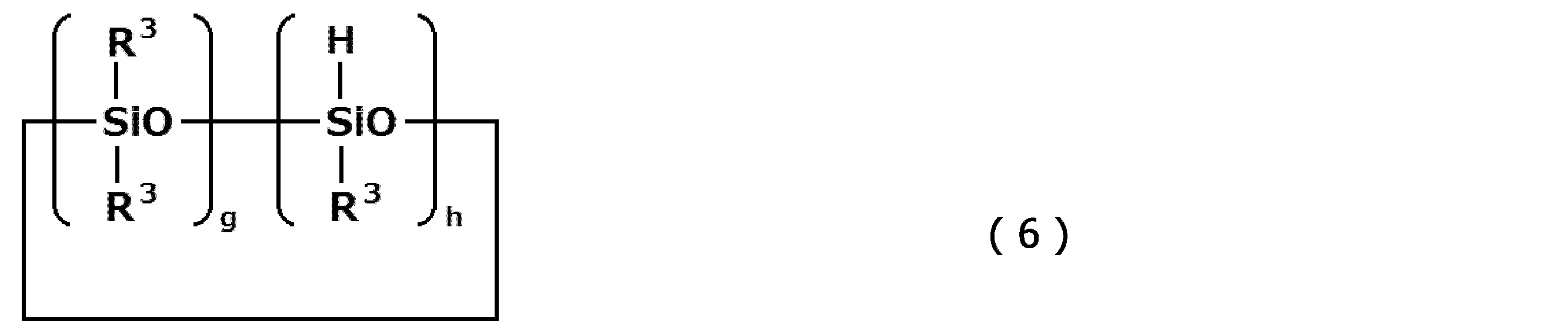
式(6)中、R3は、脂肪族不飽和炭化水素基でない非置換若しくは置換の1価炭化水素基を示し、複数のR3はそれぞれ同一でも異なっていてもよく、具体的には上述した有機基が挙げられる。gは0~5、hは2~5の整数であり、g+hは3~7となるような組み合わせが好ましい。
また、{成分(E)中のケイ素原子に結合した水素原子の個数}/{成分(F)中のケイ素原子に結合した水素原子の個数}が0.6より小さいと組成物の架橋密度が高くなりすぎてしまい信頼性試験中に剥離してしまうおそれがある一方、5.0より大きいとグリースがポンプアウトするおそれがあるため、0.6~5.0の範囲がよい。
成分(G)の白金系ヒドロシリル化触媒は、成分(A)のアルケニル基と成分(E)及び成分(F)のSi-H基との間の付加反応の促進成分である。成分(G)は白金および白金化合物から選択される触媒であり、例えば白金の単体、塩化白金酸、白金-オレフィン錯体、白金-アルコール錯体、白金配位化合物等が挙げられる。成分(G)の配合量は、成分(A)に対し質量基準で白金原子として0.1~500ppmの範囲が好ましい。
また本発明には上記の必須成分(A)~(G)以外に必要に応じて、成分(H)の反応制御剤を添加してもよい。
成分(H)の反応制御剤は、室温でのヒドロシリル化反応の進行を抑え、シェルフライフ、ポットライフを延長させるものである。反応制御剤としては、付加反応硬化型シリコーン組成物に使用される従来公知のものを使用することができる。例えば、1-エチニル-1-シクロヘキサノール、3,5-ジメチル-1-ヘキシン-3-オール等のアセチレン化合物;トリブチルアミン、テトラメチルエチレンジアミン、ベンゾトリアゾール等の各種窒素化合物;トリフェニルホスフィン等の有機りん化合物;オキシム化合物;有機クロロ化合物等が挙げられる。
成分(H)の配合量は、成分(A)に対して質量基準で0.1~5%となる量がよい。また、反応制御剤は組成物への分散性を良くするためにトルエン等で希釈して使用してもよい。
本発明の篩残渣試験は例えば以下の方法で行うことができる。
本発明の熱伝導性シリコーン組成物を2倍量のトルエンと混合し分散させた液を250メッシュ(63μm目開き)または440メッシュ(32μm目開き)に通し、洗浄用トルエンを用いてよく洗浄する。その後、メッシュ上に残った粗粒を乾燥機に入れて乾燥し、乾燥後の残渣を薬包紙にとり質量を測定し、組成物中の残渣の割合を算出する。
評価方法、測定方法を以下に示す。
熱伝導性シリコーン組成物の絶対粘度は、マルコム粘度計(タイプPC-1TL)を用いて25℃で測定した。
熱伝導性シリコーン組成物の熱伝導率は、各組成物を3cm厚の型に流し込み、キッチン用ラップをかぶせて京都電子工業(株)社製のModel QTM-500で測定した。
直径2.5cmの2枚のパラレルプレートの間に、熱伝導性シリコーン組成物を厚み2mmで塗布した。塗布したプレートを25℃から5℃/分にて昇温後、150℃において120分間温度を維持するようにプログラムを作成し、貯蔵弾性率G’及び損失弾性率G”の測定を行った。測定は、粘弾性測定装置(レオメトリック・サイエンティフィック社製、タイプRDAIII)を用いて行い、昇温開始後7200秒後の数値を採用した。
15mm×15mm×1mmtのSiチップと15mm×15mm×1mmtのNiプレートの間に、熱伝導性シリコーン組成物を挟み込み、室温で0.15MPaで15分間押圧し、その状態で150℃のオーブンで90分間加熱硬化させ、試験片を作製した。硬化後、室温に冷却し、試験片全体の厚みを測定し、SiチップとNiプレートの厚みを差し引くことで熱伝導性シリコーン組成物の厚みを測定した。
また、厚み測定に用いた試験片を用いて熱抵抗の測定を行った(初期値)。さらにその後、ヒートサイクル試験(-55℃~170℃、2,000サイクル)後の試験片の熱抵抗を初期値と同様に測定した。尚、この熱抵抗測定はナノフラッシュ(ニッチェ社製、LFA447)により行った。
50gの熱伝導性シリコーン組成物を250mLのポリ瓶にとりトルエン100gと混合した後に2時間振とうを行い分散させた。分散液を250メッシュ(63μm目開き)または440メッシュ(32μm目開き)に通し、洗浄用トルエンを用いて洗い流し、そのメッシュを乾燥機に入れて乾燥させた。乾燥後にメッシュオンの残渣を薬包紙にとり篩残渣の質量を計量し、組成物中の篩残渣の割合を計算した。
A-1:両末端がジメチルビニルシリル基で封鎖され、25℃における動粘度が1000mm2/sのジメチルポリシロキサン
B-1:下記式で表される片末端3官能の加水分解性メチルポリシロキサン

C-1:平均粒径12μmのアルミニウム粉末
C-2:平均粒径8μmのアルミニウム粉末
C-3(比較例用):平均粒径17μmのアルミニウム粉末
C-4(比較例用):平均粒径6μmのアルミニウム粉末
D-1:平均粒径0.6μmの酸化亜鉛粉末
E-1:下記式で表されるオルガノハイドロジェンポリシロキサン

F-1:下記式で表されるオルガノハイドロジェンポリシロキサン

F-2:下記式で表されるオルガノハイドロジェンポリシロキサン

G-1:白金-ジビニルテトラメチルジシロキサン錯体を上記A-1と同じジメチルポリシロキサンに溶解した溶液(白金原子含有量:1質量%)
H-1:1-エチニル‐1-シクロヘキサノール
成分(A)~(H)を以下のように混合して、実施例1~6及び比較例1~8の組成物を得た。即ち、5リットルのプラネタリミキサー(井上製作所(株)製)に100質量部の成分(A)をとり、表1、2に示す配合量(質量部)で成分(B)、(C)及び(D)を加え170℃で1時間混合した。常温になるまで冷却し、次に表1、2に示す配合量(質量部)で成分(E)、(F)、(G)及び(H)を加えて均一になるように混合した。
得られた各組成物について、上記の試験を行った。


Claims (4)
- (A)1分子中に少なくとも2個のアルケニル基を有する、25℃における動粘度が10~100,000mm2/sであるオルガノポリシロキサン
(B)一般式(1)

(式中、R1は炭素原子数1~6のアルキル基であり、aは5~100の整数である)
で表される片末端3官能の加水分解性メチルポリシロキサン:成分(A)100質量部に対して50~130質量部、
(C)平均粒径が7μm以上16μm以下であるアルミニウム粉末、
(D)平均粒径が2μm以下である酸化亜鉛粉末、
〔成分(C)と成分(D)の配合量は、質量比{成分(C)+成分(D)}/{成分(A)+成分(B)}が8.0~14.0となる量であって、成分(C)と成分(D)の質量比{成分(C)/成分(D)}が3.0~6.0となる量〕
(E)一般式(2)

(式中、R2は炭素原子数1~6のアルキル基であり、bは5~100の整数である)
で表されるオルガノハイドロジェンポリシロキサン、
(F)成分(E)以外の、1分子中に少なくとも2個のケイ素原子に結合した水素原子を含有するオルガノハイドロジェンポリシロキサン
〔成分(E)と成分(F)の配合量は、{成分(E)と成分(F)のケイ素原子に結合した水素原子の合計個数}/{成分(A)のアルケニル基の個数}の値が0.5~1.5になる量であって、{成分(E)中のケイ素原子に結合した水素原子の個数}/{成分(F)中のケイ素原子に結合した水素原子の個数}の比が0.6~5.0になる量〕、及び
(G)白金系ヒドロシリル化反応触媒:成分(A)に対し質量基準で白金原子として0.1~500ppm
を含む熱伝導性シリコーン組成物であって、該組成物を2倍量のトルエンと混合し分散させた液を篩がけした際に、250メッシュ(63μm目開き)での残渣が5ppm以下であり、440メッシュ(32μm目開き)での残渣が200ppm以上である熱伝導性シリコーン組成物。 - 更に、(H)アセチレン化合物、窒素化合物、有機りん化合物、オキシム化合物及び有機クロロ化合物より選択される反応制御剤:成分(A)に対して質量基準で0.1~5%となる量、
を含む請求項1記載の熱伝導性シリコーン組成物。 - 請求項1又は2に記載の熱伝導性シリコーン組成物からなる放熱材料。
- 請求項1又は2に記載の熱伝導性シリコーン組成物を、室温で0.15MPaで15分間押圧し、150℃で90分間加熱硬化して得られる硬化物の厚みが室温で35~60μmである請求項3記載の放熱材料。
Priority Applications (5)
| Application Number | Priority Date | Filing Date | Title |
|---|---|---|---|
| MYPI2017703083A MY182479A (en) | 2015-03-02 | 2016-02-08 | Thermal conductive silicone composition |
| US15/550,863 US10174237B2 (en) | 2015-03-02 | 2016-02-08 | Thermal conductive silicone composition |
| KR1020177027369A KR20170127482A (ko) | 2015-03-02 | 2016-02-08 | 열 전도성 실리콘 조성물 |
| CN201680012739.1A CN107406678B (zh) | 2015-03-02 | 2016-02-08 | 热传导性硅酮组合物 |
| JP2017503388A JP6388072B2 (ja) | 2015-03-02 | 2016-02-08 | 熱伝導性シリコーン組成物 |
Applications Claiming Priority (2)
| Application Number | Priority Date | Filing Date | Title |
|---|---|---|---|
| JP2015-039908 | 2015-03-02 | ||
| JP2015039908 | 2015-03-02 |
Publications (1)
| Publication Number | Publication Date |
|---|---|
| WO2016140020A1 true WO2016140020A1 (ja) | 2016-09-09 |
Family
ID=56849337
Family Applications (1)
| Application Number | Title | Priority Date | Filing Date |
|---|---|---|---|
| PCT/JP2016/053689 Ceased WO2016140020A1 (ja) | 2015-03-02 | 2016-02-08 | 熱伝導性シリコーン組成物 |
Country Status (7)
| Country | Link |
|---|---|
| US (1) | US10174237B2 (ja) |
| JP (1) | JP6388072B2 (ja) |
| KR (1) | KR20170127482A (ja) |
| CN (1) | CN107406678B (ja) |
| MY (1) | MY182479A (ja) |
| TW (1) | TWI667291B (ja) |
| WO (1) | WO2016140020A1 (ja) |
Cited By (12)
| Publication number | Priority date | Publication date | Assignee | Title |
|---|---|---|---|---|
| JP2018104615A (ja) * | 2016-12-28 | 2018-07-05 | 信越化学工業株式会社 | シリコーン組成物およびその硬化物 |
| WO2019021824A1 (ja) * | 2017-07-24 | 2019-01-31 | 東レ・ダウコーニング株式会社 | 熱伝導性シリコーンゲル組成物、熱伝導性部材および放熱構造体 |
| WO2019229962A1 (ja) * | 2018-05-31 | 2019-12-05 | 日立化成株式会社 | 樹脂組成物、樹脂部材、樹脂シート、bステージシート、cステージシート、樹脂付金属箔、金属基板及びパワー半導体装置 |
| WO2020039560A1 (ja) * | 2018-08-23 | 2020-02-27 | 日立化成株式会社 | 半導体デバイスの製造方法、熱伝導シート、及び熱伝導シートの製造方法 |
| WO2020039561A1 (ja) * | 2018-08-23 | 2020-02-27 | 日立化成株式会社 | 半導体デバイスの製造方法及び熱伝導シート |
| KR20220108786A (ko) * | 2019-11-25 | 2022-08-03 | 다우 실리콘즈 코포레이션 | 난연성 폴리실록산 조성물 |
| US11549043B2 (en) | 2017-07-24 | 2023-01-10 | Dow Toray Co., Ltd. | Multicomponent-curable thermally-conductive silicone gel composition, thermally-conductive member and heat dissipation structure |
| US11578245B2 (en) | 2017-07-24 | 2023-02-14 | Dow Toray Co., Ltd. | Thermally-conductive silicone gel composition, thermally-conductive member, and heat dissipation structure |
| JP2023061304A (ja) * | 2021-10-19 | 2023-05-01 | 信越化学工業株式会社 | 熱伝導性シリコーン組成物 |
| WO2023182459A1 (ja) * | 2022-03-24 | 2023-09-28 | 積水ポリマテック株式会社 | 熱伝導性組成物、2液硬化型熱伝導性材料、熱伝導性組成物の供給形態、熱伝導性部材、バッテリモジュール、及び熱伝導性組成物の供給形態の製造方法 |
| JP2023550866A (ja) * | 2020-09-23 | 2023-12-06 | ダウ グローバル テクノロジーズ エルエルシー | 分配粘度が低く、分配後の鉛直流が少なく、硬化後の熱インピーダンスが低い熱界面材料 |
| KR102958112B1 (ko) | 2018-11-16 | 2026-04-28 | 헨켈 아게 운트 코. 카게아아 | 액체 광학 투명 접착제 응용분야를 위한 이중 경화성 실리콘-유기 하이브리드 중합체 조성물 |
Families Citing this family (6)
| Publication number | Priority date | Publication date | Assignee | Title |
|---|---|---|---|---|
| KR102394963B1 (ko) | 2017-02-08 | 2022-05-04 | 엘켐 실리콘즈 유에스에이 코포레이션 | 열 관리가 개선된 이차 배터리 팩 |
| WO2021079714A1 (ja) * | 2019-10-24 | 2021-04-29 | 信越化学工業株式会社 | 熱伝導性シリコーン組成物及びその製造方法 |
| JP7371249B2 (ja) * | 2020-05-22 | 2023-10-30 | 信越化学工業株式会社 | 高熱伝導性シリコーン組成物 |
| CN111777996B (zh) * | 2020-07-16 | 2021-07-27 | 杭州师范大学 | 一种含相变组分的有机硅冷却液及其制备方法和应用 |
| CN116997613A (zh) | 2022-01-28 | 2023-11-03 | 瓦克化学股份公司 | 含铝导热膏 |
| CN115651410A (zh) * | 2022-09-08 | 2023-01-31 | 东莞市佳迪新材料有限公司 | 一种含氟塑料的导热垫片及其制备方法 |
Citations (4)
| Publication number | Priority date | Publication date | Assignee | Title |
|---|---|---|---|---|
| JPH08295737A (ja) * | 1995-04-24 | 1996-11-12 | Internatl Business Mach Corp <Ibm> | 熱伝導性コンプライアント・シート |
| JP2005325211A (ja) * | 2004-05-13 | 2005-11-24 | Shin Etsu Chem Co Ltd | 熱伝導性シリコーンゴム組成物及び成型品 |
| JP2009221310A (ja) * | 2008-03-14 | 2009-10-01 | Momentive Performance Materials Inc | 熱伝導性シリコーングリース組成物 |
| JP2013222836A (ja) * | 2012-04-17 | 2013-10-28 | Shin Etsu Chem Co Ltd | 放熱性及びリワーク性に優れる電子装置及びその製造方法 |
Family Cites Families (9)
| Publication number | Priority date | Publication date | Assignee | Title |
|---|---|---|---|---|
| JP2938429B1 (ja) | 1998-02-27 | 1999-08-23 | 信越化学工業株式会社 | 熱伝導性シリコーン組成物 |
| JP2938428B1 (ja) | 1998-02-27 | 1999-08-23 | 信越化学工業株式会社 | 熱伝導性グリース組成物 |
| JP3952184B2 (ja) | 2002-10-10 | 2007-08-01 | 信越化学工業株式会社 | 熱伝導性シート |
| TWI385246B (zh) | 2004-05-21 | 2013-02-11 | 信越化學工業股份有限公司 | 聚矽氧烷潤滑油組成物 |
| JP2005330426A (ja) | 2004-05-21 | 2005-12-02 | Shin Etsu Chem Co Ltd | 放熱用シリコーングリース組成物 |
| EP1878767A1 (en) * | 2006-07-12 | 2008-01-16 | Shin-Etsu Chemical Co., Ltd. | Heat conductive silicone grease composition and cured product thereof |
| JP5434795B2 (ja) * | 2010-05-25 | 2014-03-05 | 信越化学工業株式会社 | 熱伝導性シリコーングリース組成物 |
| JP5640945B2 (ja) * | 2011-10-11 | 2014-12-17 | 信越化学工業株式会社 | 硬化性オルガノポリシロキサン組成物及び半導体装置 |
| TWI534255B (zh) * | 2012-05-14 | 2016-05-21 | Shinetsu Chemical Co | Heat-conductive silicone grease composition |
-
2016
- 2016-02-08 WO PCT/JP2016/053689 patent/WO2016140020A1/ja not_active Ceased
- 2016-02-08 CN CN201680012739.1A patent/CN107406678B/zh active Active
- 2016-02-08 MY MYPI2017703083A patent/MY182479A/en unknown
- 2016-02-08 KR KR1020177027369A patent/KR20170127482A/ko not_active Withdrawn
- 2016-02-08 US US15/550,863 patent/US10174237B2/en active Active
- 2016-02-08 JP JP2017503388A patent/JP6388072B2/ja active Active
- 2016-02-18 TW TW105104682A patent/TWI667291B/zh active
Patent Citations (4)
| Publication number | Priority date | Publication date | Assignee | Title |
|---|---|---|---|---|
| JPH08295737A (ja) * | 1995-04-24 | 1996-11-12 | Internatl Business Mach Corp <Ibm> | 熱伝導性コンプライアント・シート |
| JP2005325211A (ja) * | 2004-05-13 | 2005-11-24 | Shin Etsu Chem Co Ltd | 熱伝導性シリコーンゴム組成物及び成型品 |
| JP2009221310A (ja) * | 2008-03-14 | 2009-10-01 | Momentive Performance Materials Inc | 熱伝導性シリコーングリース組成物 |
| JP2013222836A (ja) * | 2012-04-17 | 2013-10-28 | Shin Etsu Chem Co Ltd | 放熱性及びリワーク性に優れる電子装置及びその製造方法 |
Cited By (29)
| Publication number | Priority date | Publication date | Assignee | Title |
|---|---|---|---|---|
| KR102499583B1 (ko) | 2016-12-28 | 2023-02-14 | 신에쓰 가가꾸 고교 가부시끼가이샤 | 실리콘 조성물 및 그 경화물 |
| KR20180077050A (ko) * | 2016-12-28 | 2018-07-06 | 신에쓰 가가꾸 고교 가부시끼가이샤 | 실리콘 조성물 및 그 경화물 |
| JP2018104615A (ja) * | 2016-12-28 | 2018-07-05 | 信越化学工業株式会社 | シリコーン組成物およびその硬化物 |
| US11674040B2 (en) | 2017-07-24 | 2023-06-13 | Dow Toray Co., Ltd. | Thermally-conductive silicone gel composition, thermally-conductive member, and heat dissipation structure |
| US11549043B2 (en) | 2017-07-24 | 2023-01-10 | Dow Toray Co., Ltd. | Multicomponent-curable thermally-conductive silicone gel composition, thermally-conductive member and heat dissipation structure |
| WO2019021824A1 (ja) * | 2017-07-24 | 2019-01-31 | 東レ・ダウコーニング株式会社 | 熱伝導性シリコーンゲル組成物、熱伝導性部材および放熱構造体 |
| CN111051433A (zh) * | 2017-07-24 | 2020-04-21 | 陶氏东丽株式会社 | 导热性硅酮凝胶组合物、导热性部件及散热构造体 |
| JPWO2019021824A1 (ja) * | 2017-07-24 | 2020-07-30 | ダウ・東レ株式会社 | 熱伝導性シリコーンゲル組成物、熱伝導性部材および放熱構造体 |
| US11578245B2 (en) | 2017-07-24 | 2023-02-14 | Dow Toray Co., Ltd. | Thermally-conductive silicone gel composition, thermally-conductive member, and heat dissipation structure |
| JP7160508B2 (ja) | 2017-07-24 | 2022-10-25 | ダウ・東レ株式会社 | 熱伝導性シリコーンゲル組成物、熱伝導性部材および放熱構造体 |
| JPWO2019229962A1 (ja) * | 2018-05-31 | 2021-07-26 | 昭和電工マテリアルズ株式会社 | 樹脂組成物、樹脂部材、樹脂シート、bステージシート、cステージシート、樹脂付金属箔、金属基板及びパワー半導体装置 |
| JP7255593B2 (ja) | 2018-05-31 | 2023-04-11 | 株式会社レゾナック | 樹脂組成物、樹脂部材、樹脂シート、bステージシート、cステージシート、樹脂付金属箔、金属基板及びパワー半導体装置 |
| WO2019229962A1 (ja) * | 2018-05-31 | 2019-12-05 | 日立化成株式会社 | 樹脂組成物、樹脂部材、樹脂シート、bステージシート、cステージシート、樹脂付金属箔、金属基板及びパワー半導体装置 |
| JPWO2020039561A1 (ja) * | 2018-08-23 | 2021-08-10 | 昭和電工マテリアルズ株式会社 | 半導体デバイスの製造方法及び熱伝導シート |
| JP7160101B2 (ja) | 2018-08-23 | 2022-10-25 | 昭和電工マテリアルズ株式会社 | 半導体デバイスの製造方法、熱伝導シート、及び熱伝導シートの製造方法 |
| WO2020039560A1 (ja) * | 2018-08-23 | 2020-02-27 | 日立化成株式会社 | 半導体デバイスの製造方法、熱伝導シート、及び熱伝導シートの製造方法 |
| JPWO2020039560A1 (ja) * | 2018-08-23 | 2021-08-10 | 昭和電工マテリアルズ株式会社 | 半導体デバイスの製造方法、熱伝導シート、及び熱伝導シートの製造方法 |
| WO2020039561A1 (ja) * | 2018-08-23 | 2020-02-27 | 日立化成株式会社 | 半導体デバイスの製造方法及び熱伝導シート |
| JP7160102B2 (ja) | 2018-08-23 | 2022-10-25 | 昭和電工マテリアルズ株式会社 | 半導体デバイスの製造方法及び熱伝導シート |
| KR102958112B1 (ko) | 2018-11-16 | 2026-04-28 | 헨켈 아게 운트 코. 카게아아 | 액체 광학 투명 접착제 응용분야를 위한 이중 경화성 실리콘-유기 하이브리드 중합체 조성물 |
| JP7573028B2 (ja) | 2019-11-25 | 2024-10-24 | ダウ シリコーンズ コーポレーション | 難燃性ポリシロキサン組成物 |
| KR20220108786A (ko) * | 2019-11-25 | 2022-08-03 | 다우 실리콘즈 코포레이션 | 난연성 폴리실록산 조성물 |
| JP2023509568A (ja) * | 2019-11-25 | 2023-03-09 | ダウ シリコーンズ コーポレーション | 難燃性ポリシロキサン組成物 |
| KR102790462B1 (ko) | 2019-11-25 | 2025-04-08 | 다우 실리콘즈 코포레이션 | 난연성 폴리실록산 조성물 |
| JP2023550866A (ja) * | 2020-09-23 | 2023-12-06 | ダウ グローバル テクノロジーズ エルエルシー | 分配粘度が低く、分配後の鉛直流が少なく、硬化後の熱インピーダンスが低い熱界面材料 |
| JP7731420B2 (ja) | 2020-09-23 | 2025-08-29 | ダウ グローバル テクノロジーズ エルエルシー | 分配粘度が低く、分配後の鉛直流が少なく、硬化後の熱インピーダンスが低い熱界面材料 |
| JP7606439B2 (ja) | 2021-10-19 | 2024-12-25 | 信越化学工業株式会社 | 熱伝導性シリコーン組成物 |
| JP2023061304A (ja) * | 2021-10-19 | 2023-05-01 | 信越化学工業株式会社 | 熱伝導性シリコーン組成物 |
| WO2023182459A1 (ja) * | 2022-03-24 | 2023-09-28 | 積水ポリマテック株式会社 | 熱伝導性組成物、2液硬化型熱伝導性材料、熱伝導性組成物の供給形態、熱伝導性部材、バッテリモジュール、及び熱伝導性組成物の供給形態の製造方法 |
Also Published As
| Publication number | Publication date |
|---|---|
| JP6388072B2 (ja) | 2018-09-12 |
| MY182479A (en) | 2021-01-25 |
| JPWO2016140020A1 (ja) | 2017-11-24 |
| TW201632588A (zh) | 2016-09-16 |
| CN107406678A (zh) | 2017-11-28 |
| US10174237B2 (en) | 2019-01-08 |
| TWI667291B (zh) | 2019-08-01 |
| CN107406678B (zh) | 2020-08-04 |
| US20180022977A1 (en) | 2018-01-25 |
| KR20170127482A (ko) | 2017-11-21 |
Similar Documents
| Publication | Publication Date | Title |
|---|---|---|
| JP6388072B2 (ja) | 熱伝導性シリコーン組成物 | |
| CN104968728B (zh) | 导热性有机硅组合物、导热性层和半导体装置 | |
| JP5898139B2 (ja) | 熱伝導性シリコーン組成物 | |
| JP5640945B2 (ja) | 硬化性オルガノポリシロキサン組成物及び半導体装置 | |
| JP5947267B2 (ja) | シリコーン組成物及び熱伝導性シリコーン組成物の製造方法 | |
| TWI743247B (zh) | 導熱性聚矽氧組成物及其之硬化物,以及製造方法 | |
| JP6614362B2 (ja) | 熱伝導性シリコーン組成物 | |
| JP2008038137A (ja) | 熱伝導性シリコーングリース組成物およびその硬化物 | |
| JP7070320B2 (ja) | 熱伝導性シリコーン組成物 | |
| WO2019198424A1 (ja) | 熱伝導性シリコーン組成物及びその硬化物 | |
| CN115667407B (zh) | 高导热性有机硅组合物 | |
| JP2015212318A (ja) | 熱伝導性シリコーン組成物 | |
| JP2009235279A (ja) | 熱伝導性成形体およびその製造方法 | |
| JP6493092B2 (ja) | 熱伝導性シリコーン組成物 | |
| JP6943028B2 (ja) | 熱伝導性シリコーン組成物 | |
| JP2021185215A (ja) | 熱伝導性付加硬化型シリコーン組成物 | |
| KR20160150290A (ko) | 방열 성능이 우수한 실리콘 중합체 조성물 | |
| JP6314710B2 (ja) | 熱伝導性シリコーン組成物 | |
| CN122055415A (zh) | 导热有机硅组合物 | |
| JP2024178019A (ja) | 熱伝導性2液付加硬化型シリコーン組成物、硬化物及びシート |
Legal Events
| Date | Code | Title | Description |
|---|---|---|---|
| 121 | Ep: the epo has been informed by wipo that ep was designated in this application |
Ref document number: 16758715 Country of ref document: EP Kind code of ref document: A1 |
|
| ENP | Entry into the national phase |
Ref document number: 2017503388 Country of ref document: JP Kind code of ref document: A |
|
| WWE | Wipo information: entry into national phase |
Ref document number: 15550863 Country of ref document: US |
|
| NENP | Non-entry into the national phase |
Ref country code: DE |
|
| ENP | Entry into the national phase |
Ref document number: 20177027369 Country of ref document: KR Kind code of ref document: A |
|
| 122 | Ep: pct application non-entry in european phase |
Ref document number: 16758715 Country of ref document: EP Kind code of ref document: A1 |