WO2016136162A1 - 研磨用組成物及び研磨方法 - Google Patents
研磨用組成物及び研磨方法 Download PDFInfo
- Publication number
- WO2016136162A1 WO2016136162A1 PCT/JP2016/000647 JP2016000647W WO2016136162A1 WO 2016136162 A1 WO2016136162 A1 WO 2016136162A1 JP 2016000647 W JP2016000647 W JP 2016000647W WO 2016136162 A1 WO2016136162 A1 WO 2016136162A1
- Authority
- WO
- WIPO (PCT)
- Prior art keywords
- polishing
- acid
- polishing composition
- polished
- functional group
- Prior art date
- Legal status (The legal status is an assumption and is not a legal conclusion. Google has not performed a legal analysis and makes no representation as to the accuracy of the status listed.)
- Ceased
Links
Classifications
-
- C—CHEMISTRY; METALLURGY
- C09—DYES; PAINTS; POLISHES; NATURAL RESINS; ADHESIVES; COMPOSITIONS NOT OTHERWISE PROVIDED FOR; APPLICATIONS OF MATERIALS NOT OTHERWISE PROVIDED FOR
- C09G—POLISHING COMPOSITIONS; SKI WAXES
- C09G1/00—Polishing compositions
- C09G1/02—Polishing compositions containing abrasives or grinding agents
-
- B—PERFORMING OPERATIONS; TRANSPORTING
- B24—GRINDING; POLISHING
- B24B—MACHINES, DEVICES, OR PROCESSES FOR GRINDING OR POLISHING; DRESSING OR CONDITIONING OF ABRADING SURFACES; FEEDING OF GRINDING, POLISHING, OR LAPPING AGENTS
- B24B37/00—Lapping machines or devices; Accessories
-
- C—CHEMISTRY; METALLURGY
- C09—DYES; PAINTS; POLISHES; NATURAL RESINS; ADHESIVES; COMPOSITIONS NOT OTHERWISE PROVIDED FOR; APPLICATIONS OF MATERIALS NOT OTHERWISE PROVIDED FOR
- C09K—MATERIALS FOR MISCELLANEOUS APPLICATIONS, NOT PROVIDED FOR ELSEWHERE
- C09K3/00—Materials not provided for elsewhere
- C09K3/14—Anti-slip materials; Abrasives
-
- H—ELECTRICITY
- H10—SEMICONDUCTOR DEVICES; ELECTRIC SOLID-STATE DEVICES NOT OTHERWISE PROVIDED FOR
- H10P—GENERIC PROCESSES OR APPARATUS FOR THE MANUFACTURE OR TREATMENT OF DEVICES COVERED BY CLASS H10
- H10P52/00—Grinding, lapping or polishing of wafers, substrates or parts of devices
-
- H—ELECTRICITY
- H10—SEMICONDUCTOR DEVICES; ELECTRIC SOLID-STATE DEVICES NOT OTHERWISE PROVIDED FOR
- H10P—GENERIC PROCESSES OR APPARATUS FOR THE MANUFACTURE OR TREATMENT OF DEVICES COVERED BY CLASS H10
- H10P52/00—Grinding, lapping or polishing of wafers, substrates or parts of devices
- H10P52/40—Chemomechanical polishing [CMP]
- H10P52/403—Chemomechanical polishing [CMP] of conductive or resistive materials
Definitions
- the present invention relates to a polishing composition and a polishing method.
- An anti-corrosion agent and a surfactant are added to a polishing composition used for metal polishing in order to suppress metal etching and corrosion by the polishing composition (see, for example, Patent Document 1).
- anticorrosives and surfactants may accelerate etching and corrosion.
- transition metals having a standard electrode potential of ⁇ 0.45 V or more and 0.33 V or less have a property of low resistance to chemicals such as water, acids, complexing agents, and oxidizing agents, so that etching and corrosion are not caused. There was a tendency to be promoted.
- the present invention solves the above-described problems of the prior art, and even if it is used for polishing a polishing object containing a transition metal having a standard electrode potential of ⁇ 0.45 V or more and 0.33 V or less, the object to be polished. It is an object of the present invention to provide a polishing composition and a polishing method in which an object is not easily etched or corroded.
- a polishing composition according to one embodiment of the present invention is a polishing composition for polishing an object to be polished containing a transition metal having a standard electrode potential of ⁇ 0.45 V or more and 0.33 V or less. And containing an abrasive and an organic compound for protecting metal, and the organic compound for protecting metal is an interaction functional group that is a functional group that interacts with the object to be polished, and that the abrasive grains approach the object to be polished.
- the gist of the present invention is to have a suppressive functional group that is a suppressive functional group.
- Another aspect of the polishing method according to the present invention is to polish an object to be polished using the polishing composition according to the above aspect.
- polishing or corrosion hardly occurs in a polishing object containing a transition metal having a standard electrode potential of ⁇ 0.45 V or more and 0.33 V or less.
- the polishing composition of the present embodiment is a polishing composition for polishing a polishing object containing a transition metal having a standard electrode potential of ⁇ 0.45 V or more and 0.33 V or less.
- a transition metal having a standard electrode potential of ⁇ 0.45 V or more and 0.33 V or less.
- This organic compound for metal protection has an interactive functional group that is a functional group that interacts with the object to be polished, and an inhibitory functional group that is a functional group that prevents the abrasive grains from approaching the object to be polished.
- etching or corrosion hardly occurs on the polishing object.
- an anticorrosive agent and a surfactant are added to the polishing composition used for polishing the metal.
- benzotriazole that forms a salt with copper may be added as an anticorrosive agent. Since a copper salt film of benzotriazole is formed on the surface of copper, etching and corrosion of copper are suppressed.
- the nitrogen atom in the nitrogen-containing anticorrosive such as benzotriazole functions as a ligand of the complex, so that the nitrogen-containing anticorrosion The agent and the transition metal react with each other to easily generate a fragile compound or a water-soluble complex.
- general nitrogen-containing anticorrosive agents tend to promote the etching and corrosion of transition metals, they are used for polishing transition metals having a standard electrode potential of ⁇ 0.45 V or more and 0.33 V or less. In some cases, a general nitrogen-containing anticorrosive could not be added to the composition.
- a surfactant forms a protective film by utilizing electrostatic adsorption, hydrophilic-hydrophilic interaction, or hydrophobic-hydrophobic interaction with an object to be polished due to its charge and chemical structure.
- an anionic surfactant if the acid dissociation constant pKa of the functional group of the surfactant is low, the function of the functional group as an acid is too strong, so that the standard electrode potential is ⁇ 0.45 V or more and 0.00. It reacts with transition metals of 33V or less to promote the formation of fragile compounds and water-soluble compounds.
- the acid dissociation constant pKa of the functional group of the surfactant is high, the functional group reacts with hydrogen ions in the polishing composition and the activity of the functional group is lost. The action (chemical adsorption) becomes difficult. In the case of a cationic surfactant, interaction (chemisorption) with a transition metal having a standard electrode potential of ⁇ 0.45 V or more and 0.33 V or less hardly occurs due to electrical repulsion.
- the polishing composition of the present embodiment includes an interaction functional group that is a functional group that interacts with a polishing object, and a suppression functional group that is a functional group that suppresses the abrasive grains from approaching the polishing object. Since the metal protective organic compound is contained, a film of the metal protective organic compound is formed as a protective film on the surface of the object to be polished by the action of the interactive functional group and the inhibitory functional group. Specifically, due to the interaction between the interacting functional group and the object to be polished, the interacting functional group chemisorbs to the surface of the object to be polished without corroding the surface of the object to be polished, and the hydrophobicity of the inhibitory functional group.
- the metal protecting organic compound is arranged on the surface of the object to be polished to form a film (molecular alignment film).
- a film molecular alignment film
- polishing composition of the present embodiment will be described in more detail.
- the various operations and physical property measurements described below were performed under conditions of room temperature (20 ° C. to 25 ° C.) and relative humidity of 40% to 50% unless otherwise specified.
- the polishing object applicable to polishing with the polishing composition of the present embodiment contains a transition metal having a standard electrode potential of ⁇ 0.45 V or more and 0.33 V or less.
- the transition metal having a standard electrode potential of ⁇ 0.45 V or more and 0.33 V or less include iron (Fe), nickel (Ni), cobalt (Co), and tungsten (W).
- the object to be polished may be composed of at least one of these transition metals, or may contain at least one of these transition metals.
- abrasive grain contained in the polishing composition of this embodiment is not specifically limited,
- the abrasive grain containing a silica can be used.
- the type of silica is not particularly limited, and examples thereof include colloidal silica, fumed silica, and sol-gel silica. These silicas may be used alone or in combination of two or more. Of these, colloidal silica and fumed silica are preferred.
- Colloidal silica can be produced by the following known methods. For example, a method by hydrolysis of alkoxysilane described in pages 154 to 156 of “Science of Sol-Gel Method” by Sakuo Sakuo (published by Agne Jofu Co., Ltd.); described in JP-A-11-60232 A method in which methyl silicate or a mixture of methyl silicate and methanol is dropped into water, methanol, and a mixed solvent composed of ammonia or ammonia and an ammonium salt to react methyl silicate with water; As described in JP-A-2007-52032, a method of hydrolyzing an alkyl silicate koji with an acid catalyst and then adding an alkali catalyst and heating to advance polymerization of silicic acid to grow particles; And a method of using a specific type of hydrolysis catalyst in a specific amount at the time of hydrolysis of alkoxysilane. In addition, a method for producing sodium silicate by ion exchange is also mentioned.
- fumed silica As a method for producing fumed silica, a method using a gas phase reaction in which silicon tetrachloride is vaporized and burned in an oxyhydrogen flame can be mentioned. Further, fumed silica can be made into an aqueous dispersion by a known method. Examples of methods for making an aqueous dispersion include, for example, JP-A-2004-43298, JP-A-2003-176123, and JP-A-2002. And the method described in Japanese Patent No. 309239. Furthermore, colloidal silica having an organic acid immobilized on the surface can be used as colloidal silica. Examples of organic acids include sulfonic acid, carboxylic acid, sulfinic acid, and phosphonic acid.
- silane coupling agent having a thiol group such as 3-mercaptopropyltrimethoxysilane is reacted with a hydroxyl group on the surface of colloidal silica to be coupled, and then the thiol group is oxidized with hydrogen peroxide.
- colloidal silica having sulfonic acid immobilized on the surface can be obtained.
- the average primary particle diameter of the abrasive grains contained in the polishing composition of the present embodiment may be 5 nm or more, preferably 10 nm or more, and more preferably 15 nm or more. When the average primary particle diameter of the abrasive grains is within the above range, the polishing rate of the object to be polished is improved. On the other hand, the average primary particle diameter of the abrasive grains contained in the polishing composition of the present embodiment may be 400 nm or less, preferably 300 nm or less, more preferably 200 nm or less, and even more preferably 100 nm or less. . If the average primary particle diameter of the abrasive grains is within the above range, it is easy to obtain a surface with low defects and low surface roughness by polishing.
- the average primary particle diameter of an abrasive grain can be calculated from the specific surface area measured, for example by the nitrogen adsorption method (BET method).
- the content of abrasive grains in the polishing composition may be 0.005% by mass or more, preferably 0.01% by mass or more, more preferably 0.05% by mass or more, and still more preferably 0.8% by mass. 1% by mass or more. If content of an abrasive grain exists in said range, the grinding
- the organic compound for metal protection contained in the polishing composition of the present embodiment is included in the polishing composition and an interactive functional group that is a functional group that interacts with the object to be polished. And an inhibitory functional group that is a functional group that suppresses water, an oxidizing agent, a metal oxide solubilizer, abrasive grains, and the like as polishing components from approaching the object to be polished.
- the acid dissociation constant pKa of the interacting functional group is preferably 1 or more and 6 or less.
- the metal for protecting the metal is obtained by the interaction between the interacting functional group and the object to be polished without causing etching or corrosion on the surface of the object to be polished.
- the compound can be chemically adsorbed on the surface of the object to be polished.
- the type of the interactive functional group is not particularly limited.
- the interacting functional group is preferably at least one of a phosphate group (H 2 PO 4 —) and a carboxy group (—COOH).
- the phosphate group, carboxy group, sulfonic acid group, and benzenesulfonic acid group may be a salt such as an amine salt or a metal salt.
- a carboxy group may be a sodium salt (—COONa), a potassium salt (—COOK) or the like.
- polishing target object at least 1 chemical bond of an ionic bond, a covalent bond, and a hydrogen bond is preferable.
- the type of the inhibitory functional group is not particularly limited, but an aryl group such as a phenyl group (including a condensed ring), an alkyl group such as a lauryl group, a hexylheptyl group, a dodecyl group, and a stearyl group, an oleyl group, Examples thereof include an alkenyl group such as an allyl group and a polyoxyethylene group represented by a chemical formula of — (OCH 2 CH 2 ) n —.
- the alkyl group also includes a long chain alkyl group of a polymer backbone. Among these, an alkyl group having 1 to 20 carbon atoms and a polyoxyethylene group in which n in the chemical formula is an integer of 1 to 10 are preferable.
- the metal protecting organic compound having an alkyl group and a polyoxyethylene group having a chain length in the above range is easily self-aligned on the surface of the object to be polished by hydrophobic interaction, a strong protective film is formed on the surface of the object to be polished. Can be formed.
- the chain length of the polyoxyethylene group which is a hydrophilic group
- n in the above chemical formula indicating the chain length of the polyoxyethylene group is An integer of 10 or less is preferable.
- the metal protecting organic compound having such interactive functional group and inhibitory functional group include lauric acid, lauryl phosphoric acid, laureth-2 phosphoric acid, palace-3 phosphoric acid, palace-6 phosphoric acid, palace. -9 phosphoric acid and the like.
- These lauric acid, lauryl phosphoric acid, laureth-2 phosphoric acid, palace-3 phosphoric acid, palace-6 phosphoric acid, and palace-9 phosphoric acid may be not only acids but also salts such as metal salts (for example, sodium salts).
- laureth-2 phosphate is a monoester of phosphoric acid and laureth-2
- laureth-2 is a polyethylene glycol ether of lauryl alcohol.
- Palace-3 phosphate is an ester of phosphoric acid and Palace-3.
- Palace-3 is an aliphatic alcohol polyethylene glycol obtained by adding ethylene oxide to an aliphatic alcohol having 12 to 15 carbon atoms. It is an ether, and its average added mole number is 3.
- Palace-6 phosphoric acid is an ester of phosphoric acid and Palace-6, which is an aliphatic alcohol polyethylene glycol obtained by adding ethylene oxide to an aliphatic alcohol having 12 to 15 carbon atoms. It is an ether, and its average added mole number is 6.
- Palace-9 phosphoric acid is an ester of phosphoric acid and Palace-9, which is an aliphatic alcohol polyethylene glycol obtained by adding ethylene oxide to an aliphatic alcohol having 12 to 16 carbon atoms. It is an ether, and its average added mole number is 9.
- a pH adjuster In order to improve the performance of the polishing composition of the present embodiment, a pH adjuster, a metal oxide solubilizer, an oxidizing agent, a water-soluble polymer (a copolymer may be used as necessary). These salts and derivatives may also be added), and various additives such as anticorrosives, dispersion aids, preservatives, and antifungal agents may be added.
- the pH value of the polishing composition of the present embodiment can be adjusted by adding a pH adjusting agent.
- a pH adjusting agent By adjusting the pH of the polishing composition, the polishing rate of the polishing object, the dispersibility of the abrasive grains, and the like can be controlled.
- the pH adjuster used as necessary to adjust the pH value of the polishing composition to a desired value may be either acid or alkali, and may be a salt thereof. .
- the addition amount of the pH adjuster is not particularly limited, and may be appropriately adjusted so that the polishing composition has a desired pH.
- the acid as the pH adjuster include inorganic acids, organic acids such as monocarboxylic acids and organic sulfuric acids.
- inorganic acid include hydrochloric acid, sulfuric acid, nitric acid, hydrofluoric acid, boric acid, carbonic acid, hypophosphorous acid, phosphorous acid, phosphoric acid and the like.
- monocarboxylic acids include formic acid, acetic acid, propionic acid, butyric acid, valeric acid, 2-methylbutyric acid, n-hexanoic acid, 3,3-dimethylbutyric acid, 2-ethylbutyric acid, and 4-methylpentanoic acid.
- N-heptanoic acid 2-methylhexanoic acid, n-octanoic acid, 2-ethylhexanoic acid, benzoic acid, glycolic acid, salicylic acid, glyceric acid, gluconic acid, lactic acid, diglycolic acid, 2-furancarboxylic acid, 2 , 5-furandicarboxylic acid, 3-furancarboxylic acid, 2-tetrahydrofurancarboxylic acid, methoxyacetic acid, methoxyphenylacetic acid, phenoxyacetic acid and the like.
- organic sulfuric acid include methanesulfonic acid, ethanesulfonic acid, isethionic acid and the like. These acids may be used individually by 1 type, and may be used in combination of 2 or more type.
- the base as the pH adjusting agent include organic bases such as quaternary ammonium hydroxide compounds, alkali metal hydroxides such as potassium hydroxide, and alkaline earth metal hydroxides. It is done. Among these, potassium hydroxide and a quaternary ammonium hydroxide compound are preferable from the viewpoint of availability. These bases may be used individually by 1 type, and may be used in combination of 2 or more type.
- alkali metal examples include potassium and sodium.
- alkaline earth metal include calcium and strontium.
- specific examples of the salt include carbonate, hydrogen carbonate, sulfate, acetate, and the like.
- specific examples of quaternary ammonium include tetramethylammonium, tetraethylammonium, tetrabutylammonium and the like.
- the quaternary ammonium hydroxide compound includes quaternary ammonium hydroxide or a salt thereof, and specific examples thereof include tetramethylammonium hydroxide, tetraethylammonium hydroxide, tetrabutylammonium hydroxide and the like.
- a salt such as an ammonium salt of an acid or an alkali metal salt may be used as a pH adjuster.
- a salt of a weak acid and a strong base a salt of a strong acid and a weak base, or a salt of a weak acid and a weak base is used, a buffering action of pH can be expected.
- a salt it is possible to adjust not only the pH but also the conductivity by adding a small amount.
- a metal oxide solubilizer may be added to the polishing composition of this embodiment in order to promote dissolution of the object to be polished.
- the metal oxide solubilizer include oxalic acid, malonic acid, succinic acid, glutaric acid, adipic acid, pimelic acid, maleic acid, phthalic acid, malic acid, itaconic acid, citric acid, tartaric acid, ethylenediaminetetraacetic acid, nitrilotrimethyl.
- polyvalent carboxylic acids such as acetic acid, hydroxyethylethylenediaminetriacetic acid, triethylenetetraminehexaacetic acid, and diethylenetriaminepentaacetic acid.
- examples of the metal oxide solubilizer include 2-aminoethylphosphonic acid, 1-hydroxyethylidene-1,1-diphosphonic acid, aminotri (methylenephosphonic acid), ethylenediaminetetrakis (methylenephosphonic acid), diethylenetriaminepenta (methylenephosphonic). Acid), ethane-1,1-diphosphonic acid, ethane-1,1,2-triphosphonic acid, methanehydroxyphosphonic acid, and 1-phosphonobutane-2,3,4-tricarboxylic acid. Furthermore, examples of the metal oxide solubilizer include ketones such as 1,3-diketone, phenol derivatives, and ammonia.
- examples of the metal oxide solubilizer include methylamine, dimethylamine, trimethylamine, ethylamine, diethylamine, triethylamine, ethylenediamine, monoethanolamine, N- ( ⁇ -aminoethyl) ethanolamine, hexamethylenediamine, diethylenetriamine, and triethylene.
- examples include amines such as tetramine, anhydrous piperazine, piperazine hexahydrate, 1- (2-aminoethyl) piperazine, N-methylpiperazine, and guanidine.
- examples of the metal oxide solubilizer include glycine, ⁇ -alanine, ⁇ -alanine, N-methylglycine, N, N-dimethylglycine, 2-aminobutyric acid, norvaline, valine, leucine, norleucine, isoleucine, phenylalanine, Proline, sarcosine, ornithine, lysine, taurine, serine, threonine, homoserine, tyrosine, bicine, tricine, 3,5-diiodotyrosine, ⁇ - (3,4-dihydroxyphenyl) alanine, thyroxine, 4-hydroxyproline, cysteine , Methionine, ethionine, lanthionine, cystathionine, cystine, cysteic acid, aspartic acid, glutamic acid, S- (carboxymethyl) cysteine, 4-aminobutyric acid, asparagine, glutamine
- Oxidizing Agent may be added to the polishing composition of this embodiment in order to oxidize the surface of the object to be polished.
- the oxidizing agent include hydrogen peroxide, peracetic acid, percarbonate, urea peroxide, perchlorate, persulfate, nitric acid and the like.
- Specific examples of the persulfate include sodium persulfate, potassium persulfate, and ammonium persulfate. These oxidizing agents may be used individually by 1 type, and may be used in combination of 2 or more type.
- the polishing composition of the present embodiment includes a water-soluble polymer (copolymer which acts on the surface of the object to be polished and the surface of the abrasive grains. These salts and derivatives may also be used. May be added). Specific examples of water-soluble polymers, water-soluble copolymers, and salts or derivatives thereof include polycarboxylic acids such as polyacrylates, polysulfonic acids such as polyphosphonic acid and polystyrene sulfonic acid, chitansan gum, and sodium alginate.
- Examples thereof include saccharides, cellulose derivatives such as hydroxyethyl cellulose and carboxymethyl cellulose, polyethylene glycol, polyvinyl alcohol, polyvinyl pyrrolidone, sorbitan monooleate, and oxyalkylene polymers having a single kind or plural kinds of oxyalkylene units. These may be used individually by 1 type and may be used in combination of 2 or more type.
- An anticorrosive agent may be added to the polishing composition of this embodiment in order to suppress corrosion of the surface of the object to be polished.
- Specific examples of the anticorrosive include amines, pyridines, tetraphenylphosphonium salts, benzotriazoles, triazoles, tetrazoles, benzoic acid and the like.
- One of these anticorrosive agents may be used alone, or two or more thereof may be used in combination.
- a dispersion aid may be added in order to facilitate redispersion of the aggregate of abrasive grains.
- the dispersion aid include condensed phosphates such as pyrophosphate and hexametaphosphate. These dispersing aids may be used alone or in combination of two or more.
- Preservative An antiseptic may be added to the polishing composition of the present embodiment.
- Specific examples of the preservative include sodium hypochlorite and the like.
- a preservative may be used individually by 1 type, and may be used in combination of 2 or more type.
- antifungal agent may be added to the polishing composition of this embodiment.
- antifungal agents include isothiazoline preservatives such as 2-methyl-4-isothiazolin-3-one and 5-chloro-2-methyl-4-isothiazolin-3-one, and oxazolidine-2,5- And oxazolines such as dione.
- paraoxybenzoic acid esters, phenoxyethanol and the like can be mentioned.
- the polishing composition of this embodiment may contain liquid media, such as water and an organic solvent.
- the liquid medium functions as a dispersion medium or a solvent for dispersing or dissolving each component (abrasive grains, metal protecting organic compound, additive, etc.) of the polishing composition.
- the liquid medium include water and organic solvents.
- One kind can be used alone, or two or more kinds can be mixed and used, but it is preferable to contain water.
- pure water, ultrapure water, or distilled water from which foreign substances are removed through a filter after removing impurity ions with an ion exchange resin is preferable.
- the manufacturing method of the polishing composition of this embodiment is not specifically limited, For example, an abrasive grain, the organic compound for metal protection, and various additives as needed, water It can manufacture by stirring and mixing in liquid media, such as. For example, it can be produced by stirring and mixing, in water, abrasive grains made of silica, sodium laurate as an organic compound for metal protection, and various additives such as a pH adjuster.
- abrasive grains made of silica, sodium laurate as an organic compound for metal protection and various additives such as a pH adjuster.
- the temperature at the time of mixing is not specifically limited, 10 to 40 degreeC is preferable and you may heat in order to improve a dissolution rate. Further, the mixing time is not particularly limited.
- polishing target object using the polishing composition of this embodiment can be performed with the grinding
- a single-side polishing apparatus or a double-side polishing apparatus can be used.
- polishing object is a substrate made of a transition metal and is polished using a single-side polishing apparatus
- the substrate is held using a holder called a carrier, and a surface plate to which a polishing cloth is attached is used on one side of the substrate.
- One surface of the substrate is polished by rotating the surface plate while pressing the substrate and supplying the polishing composition.
- polishing a transition metal substrate using a double-side polishing machine When polishing a transition metal substrate using a double-side polishing machine, hold the substrate using a holder called a carrier, and place a surface plate with a polishing cloth on both sides of the substrate from both sides of the substrate. Each surface is pressed and both surfaces of the substrate are polished by rotating the surface plates on both sides while supplying the polishing composition. Regardless of which polishing apparatus is used, the substrate is polished by the physical action caused by friction (friction between the polishing cloth and the polishing composition and the transition metal) and the chemical action that the polishing composition provides to the transition metal.
- the polishing apparatus Regardless of which polishing apparatus is used, the substrate is polished by the physical action caused by friction (friction between the polishing cloth and the polishing composition and the transition metal) and the chemical action that the polishing composition provides to the transition metal.
- the polishing cloth various materials such as polyurethane, non-woven fabric, and suede can be used. In addition to the difference in materials, materials having various physical properties such as hardness and thickness can be used. Furthermore, any of those containing abrasive grains and those not containing abrasive grains can be used, but those containing no abrasive grains are preferably used.
- the polishing load (pressure applied to the object to be polished) among the polishing conditions is not particularly limited, but may be 0.7 kPa or more and 69 kPa or less. When the polishing load is within this range, a sufficient polishing rate is exhibited, and it is possible to suppress the polishing object from being damaged by the load or the occurrence of defects such as scratches on the surface of the polishing object. .
- the polishing rate (linear velocity) among the polishing conditions is not particularly limited, but may be 10 m / min or more and 300 m / min or less, and preferably 30 m / min or more and 200 m / min or less. If the polishing rate (linear velocity) is within this range, a sufficient polishing rate can be obtained. Further, the polishing cloth can be prevented from being damaged by the friction of the object to be polished, and the friction is sufficiently transmitted to the object to be polished, so that the so-called state of slipping of the object to be polished can be suppressed and sufficient polishing can be performed.
- the supply amount of the polishing composition among the polishing conditions varies depending on the type of the polishing object, the type of the polishing apparatus, and the polishing conditions, but the polishing composition is uneven between the polishing object and the polishing cloth. It is sufficient that the amount is sufficient to be supplied to the entire surface.
- the polishing composition may not be supplied to the entire polishing object, or the polishing composition may dry and solidify to cause defects on the surface of the polishing object.
- the supply amount of the polishing composition is large, it is not economical, and there is a possibility that friction is hindered by an excessive polishing composition (particularly a liquid medium such as water) and the polishing is hindered.
- the pre-polishing composition used in the pre-polishing step it is preferable to use a pre-polishing composition having a higher polishing power than the polishing composition of the present embodiment. Specifically, it is preferable to use abrasive grains having higher hardness and a larger average primary particle diameter than the abrasive grains used in the polishing composition of the present embodiment.
- the type of abrasive grains contained in the preliminary polishing composition is not particularly limited, and examples thereof include boron carbide, silicon carbide, aluminum oxide (alumina), zirconia, zircon, ceria, titania and the like. These may be used individually by 1 type and may be used in combination of 2 or more type. Among these abrasive grains, boron carbide and silicon carbide are particularly preferable as the abrasive grains contained in the preliminary polishing composition. Boron carbide and silicon carbide may contain an impurity element such as iron or carbon.
- the average primary particle diameter of the abrasive grains contained in the preliminary polishing composition may be 0.1 ⁇ m or more, and preferably 0.3 ⁇ m or more.
- the average primary particle diameter of the abrasive grains contained in the preliminary polishing composition may be 20 ⁇ m or less, preferably 5 ⁇ m or less. As the average primary particle diameter of the abrasive grains contained in the preliminary polishing composition decreases, it is easy to obtain a surface with low defects and low surface roughness.
- the average primary particle diameter of the abrasive grains contained in the preliminary polishing composition can be measured, for example, with a laser diffraction / scattering particle diameter distribution measuring apparatus. An example of this apparatus is “LA-950” manufactured by HORIBA, Ltd.
- the content of the abrasive grains in the preliminary polishing composition may be 0.5% by mass or more, and preferably 1% by mass or more. As the content of abrasive grains increases, the polishing rate of the object to be polished by the preliminary polishing composition increases. On the other hand, the content of abrasive grains in the preliminary polishing composition may be 40% by mass or less, and preferably 30% by mass or less. As the abrasive content decreases, the production cost of the preliminary polishing composition decreases.
- the preferred pH of the preliminary polishing composition is the same as the polishing composition of the present embodiment, the type of polishing object, the type of abrasive grains, the average primary particle diameter of abrasive grains, and the production of abrasive grains. It depends on the history. The pH of the preliminary polishing composition is adjusted with an acid, a base, or a salt thereof, similarly to the pH of the polishing composition of the present embodiment.
- the pre-polishing composition may contain various additives as desired, for example, a re-dispersing agent, like the polishing composition of the present embodiment.
- a re-dispersing agent like the polishing composition of the present embodiment.
- the redispersant include fine particles having an average primary particle diameter of 0.2 ⁇ m or less, a water-soluble polymer, a water-soluble copolymer, or a salt thereof that is optionally added to the polishing composition of the present embodiment. can give.
- the kind of fine particles having an average primary particle size of 0.2 ⁇ m or less is not particularly limited.
- examples thereof include titanium halide, tungsten boride, and manganese oxide.
- metal oxides are preferable because they are easily available and low in cost.
- alumina for example, ⁇ -alumina, intermediate alumina, fumed alumina, alumina sol or a mixture thereof
- hydrated alumina for example, boehmite
- Aluminum hydroxide and silica for example, colloidal silica, fumed silica, sol-gel silica
- the average primary particle diameter of the fine particles is preferably 0.005 ⁇ m or more, more preferably 0.01 ⁇ m or more, from the viewpoint of availability.
- the average primary particle diameter of the fine particles is preferably 0.5 ⁇ m or less, more preferably 0.2 ⁇ m or less, and further preferably 0.1 ⁇ m or less.
- the average primary particle diameter of the fine particles is within the above range, not only the cost is reduced, but also the settling of the abrasive grains hardly occurs, and the redispersibility of the abrasive grains of the preliminary polishing composition is further increased.
- the polishing composition of the present embodiment can be recovered after being used for polishing the polishing object and reused for polishing the polishing object.
- the method of reusing the polishing composition there is a method in which the polishing composition discharged from the polishing apparatus is collected in a tank and is circulated again into the polishing apparatus to be used for polishing. If the polishing composition is circulated, the amount of the polishing composition discharged as a waste liquid can be reduced, so that the environmental load can be reduced. Moreover, since the quantity of the polishing composition to be used can be reduced, the manufacturing cost required for grinding
- the abrasive particles, organic compounds for metal protection, additives, etc. consumed and lost due to use in polishing are used as a composition regulator. It is good to reuse after adding.
- a composition regulator what mixed abrasive grain, the organic compound for metal protection, an additive, etc. by arbitrary mixing ratios can be used.
- the polishing composition is adjusted to a composition suitable for reuse and suitable polishing can be performed.
- concentrations of the abrasive grains, the metal protecting organic compound, and the additives contained in the composition modifier are arbitrary and are not particularly limited, and may be appropriately adjusted according to the size of the tank and the polishing conditions.
- the polishing composition of the present embodiment may be a one-component type or a multi-component type such as a two-component type in which some or all of the components of the polishing composition are mixed at an arbitrary ratio. May be. Further, in polishing the polishing object, polishing may be performed using the stock solution of the polishing composition of the present embodiment as it is, but the polishing composition is diluted 10 times or more with a diluent such as water. Polishing may be performed using a diluted product.
- Abrasive grains (average primary particle size 35 nm) composed of colloidal silica whose surface is modified with sulfonic acid groups, various metal protecting organic compounds, water as a liquid medium, additives such as citric acid, polyacrylic acid, peroxide Hydrogen was mixed and the abrasive grains were dispersed in water to produce polishing compositions of Examples 1 to 21 and Comparative Examples 1 to 70.
- the content of abrasive grains in these polishing compositions is 0.2% by mass, the content of organic compounds for metal protection is 0.25% by mass, the content of citric acid is 0.1% by mass, and the content of polyacrylic acid The content is 0.01% by mass, the content of hydrogen peroxide is 0.7% by mass, and the balance is water.
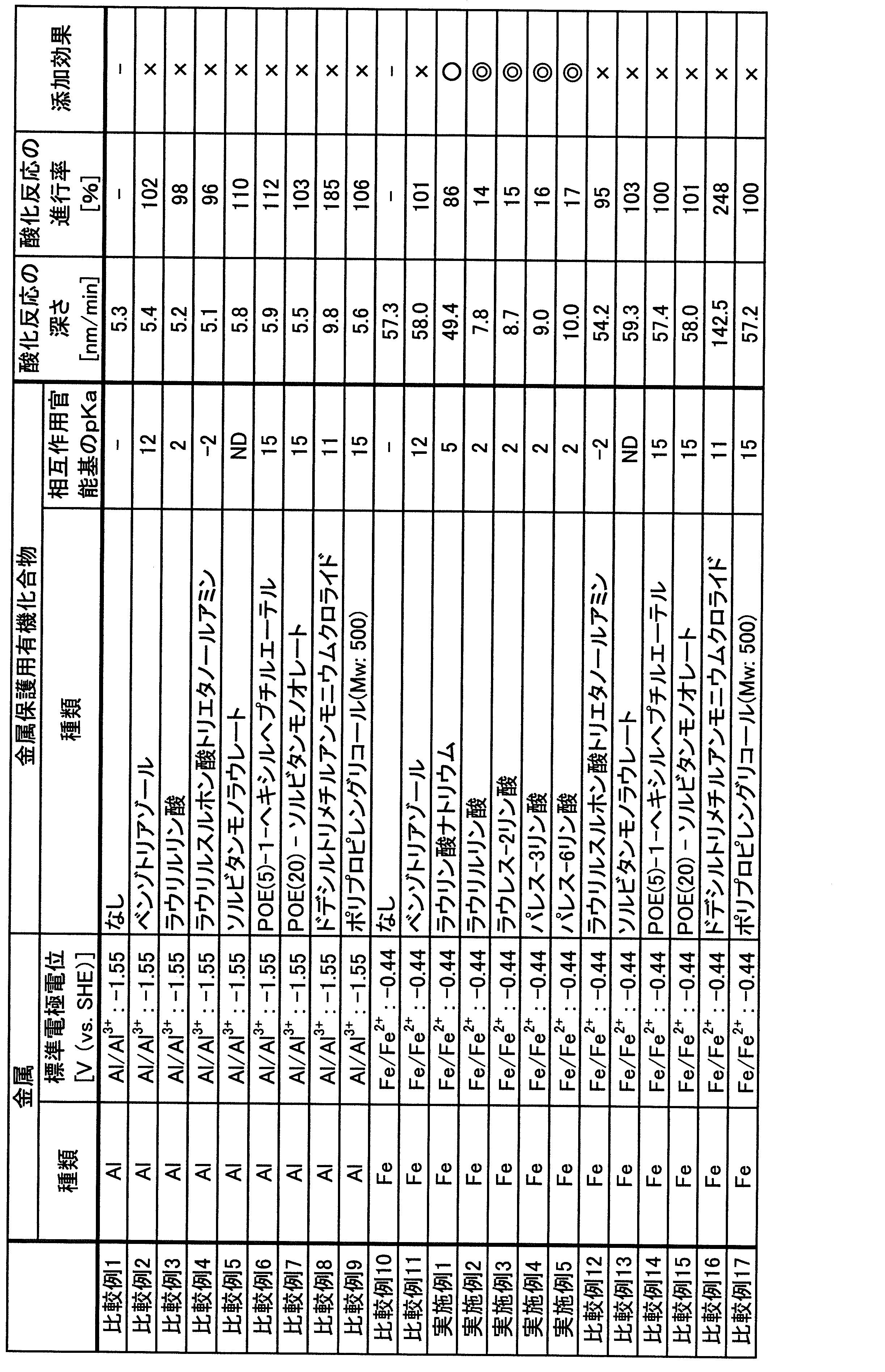
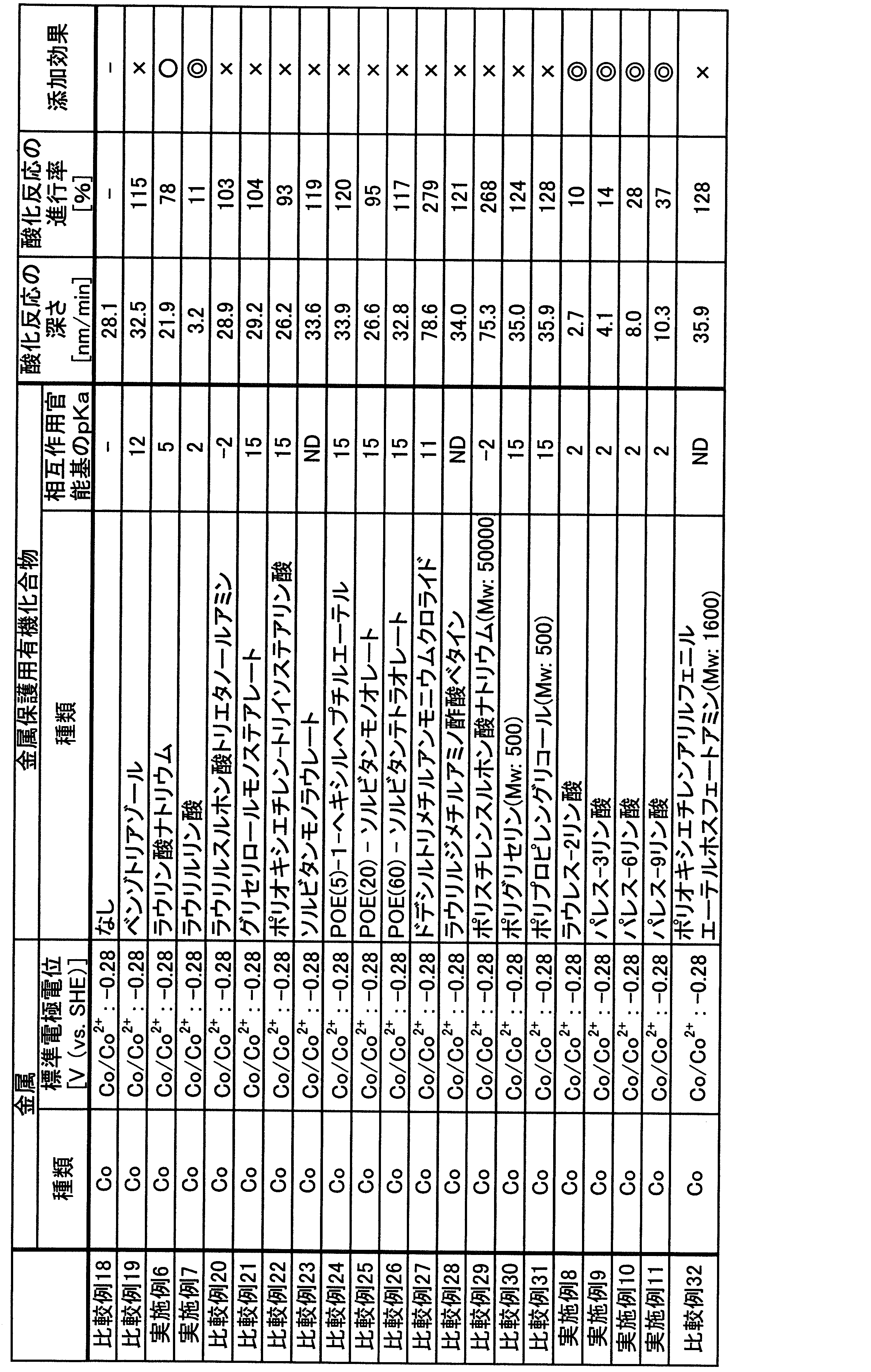
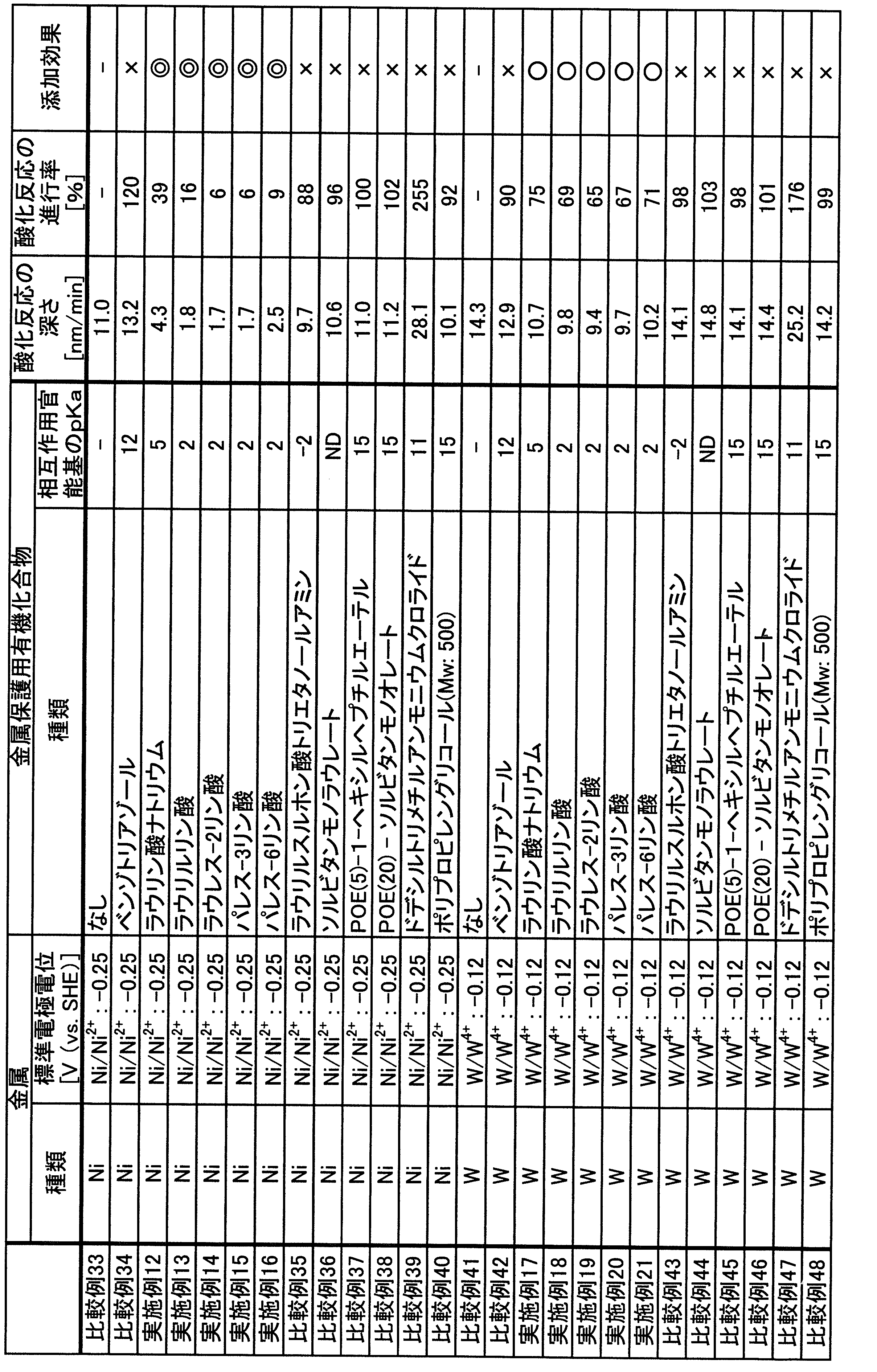
- POE in “POE (5) -1-hexylheptyl ether” shown in Tables 1 to 4 means “polyoxyethylene”, and “(5)” is an oxyethylene unit of a polyoxyethylene group. This means that the average number of repetitions of is 5. The same applies to “POE (20) -sorbitan monooleate” and “POE (60) -sorbitan tetraoleate”.
- the depth of the oxidation reaction that occurred when the polishing compositions of Examples 1 to 21 and Comparative Examples 1 to 70 were brought into contact with a substrate having a metal coating was measured.
- the depth of the oxidation reaction is a value obtained by combining the etching amount (depth) of the metal film and the thickness of the oxide film formed on the surface of the metal film.
- the thickness of the oxide film is measured by performing a depth direction analysis (depth profile) of X-ray photoelectron spectroscopy (XPS) on the substrate. By adding up the thicknesses of the oxide films, the depth of the oxidation reaction can be measured.
- the oxidation reaction depth is not measured by the above method, but the substrate is subjected to constant voltage electrolysis by electrochemical measurement in one minute. It was calculated based on Faraday's law from the flowing current value. Specifically, a current time curve when a voltage of + 1.12-0.059 ⁇ pH is applied to the working electrode using a potentiostat (Model 1280Z) manufactured by Solarton as a standard with respect to the potential of the reference electrode is shown. The electric quantity was measured from the integrated value of the current time curve. At this time, a blanket wafer on which each metal film was formed was used for the working electrode, a platinum plate was used for the counter electrode, and a silver-silver chloride electrode was used for the reference electrode.
- a potentiostat Model 1280Z
- the progress rate of the oxidation reaction is 50% or less, it is indicated by ⁇ that the effect of adding the organic compound for metal protection is very good, and when it exceeds 50% and less than 90%, the metal protection
- the addition effect of the organic compound for use is good, it is indicated by a circle, and when it is 90% or more, the addition effect of the organic compound for metal protection is indicated by an x mark.
- the corrosion potential was measured. If the corrosion potential is higher than that of the comparative example in which the metal protecting organic compound is not added, it can be determined that the corrosion is improved by the addition of the metal protecting organic compound.
- the corrosion potential can be measured using a potentiostat (Model 1280Z) manufactured by Solarton. The corrosion potential was determined by a Tafel curve obtained by scanning the voltage at a scanning speed of 5 mV / sec in the range of the immersion potential ⁇ 1.0 V. The results are shown in Table 5.
Landscapes
- Chemical & Material Sciences (AREA)
- Organic Chemistry (AREA)
- Engineering & Computer Science (AREA)
- Mechanical Engineering (AREA)
- Materials Engineering (AREA)
- Finish Polishing, Edge Sharpening, And Grinding By Specific Grinding Devices (AREA)
- Mechanical Treatment Of Semiconductor (AREA)
Abstract
Description
また、本発明の他の態様に係る研磨方法は、上記一態様に係る研磨用組成物を用いて研磨対象物を研磨することを要旨とする。
金属の研磨に使用される研磨用組成物には、研磨用組成物による金属のエッチングや腐食を抑制するために、防食剤や界面活性剤が添加されている。例えば、銅の研磨に使用される従来の研磨用組成物には、銅と塩を形成するベンゾトリアゾールが防食剤として添加されている場合がある。銅の表面にベンゾトリアゾールの銅塩の被膜が形成されるため、銅のエッチングや腐食が抑制される。
本実施形態の研磨用組成物による研磨に適用可能な研磨対象物は、標準電極電位が-0.45V以上0.33V以下の遷移金属を含有するものである。標準電極電位が-0.45V以上0.33V以下の遷移金属としては、例えば鉄(Fe)、ニッケル(Ni)、コバルト(Co)、タングステン(W)があげられる。研磨対象物は、これらの遷移金属のうち少なくとも1種からなるものであってもよいし、これらの遷移金属のうち少なくとも1種を含有するものであってもよい。
本実施形態の研磨用組成物に含有される砥粒の種類は特に限定されるものではないが、例えば、シリカを含有する砥粒を使用することができる。シリカの種類は特に限定されるものではないが、例えば、コロイダルシリカ、フュームドシリカ、ゾルゲル法シリカ等があげられる。これらのシリカは、1種を単独で用いてもよいし、2種以上を併用してもよい。また、これらの中でも、コロイダルシリカ、フュームドシリカが好ましい。
さらに、コロイダルシリカとして、表面に有機酸を固定化したコロイダルシリカを使用することができる。有機酸の例としては、スルホン酸、カルボン酸、スルフィン酸、及びホスホン酸があげられる。
なお、砥粒の平均一次粒子径は、例えば窒素吸着法(BET法)により測定した比表面積から算出することができる。
一方、研磨用組成物中の砥粒の含有量は50質量%以下としてもよく、好ましくは30質量%以下であり、より好ましくは20質量%以下である。砥粒の含有量が上記の範囲内であれば、研磨用組成物の製造コストが低減する。また、研磨後の研磨対象物の表面上に残存する砥粒の量が低減され、研磨対象物の表面の清浄性が向上する。
本実施形態の研磨用組成物に含有される金属保護用有機化合物は、研磨対象物と相互作用する官能基である相互作用官能基と、研磨用組成物中に含まれる研磨成分である水、酸化剤、酸化金属溶解剤、砥粒等が研磨対象物に接近することを抑制する官能基である抑制官能基と、を有している。
相互作用官能基の酸解離定数pKaは、1以上6以下が好ましい。相互作用官能基の酸解離定数pKaが上記範囲内であれば、研磨対象物の表面にエッチングや腐食を生じさせることなく、相互作用官能基と研磨対象物との相互作用により、金属保護用有機化合物を研磨対象物の表面に化学吸着させることができる。
リン酸基、カルボキシ基、スルホン酸基、ベンゼンスルホン酸基については、アミン塩、金属塩等の塩であってもよい。例えばカルボキシ基であれば、ナトリウム塩(-COONa)、カリウム塩(-COOK)等であってもよい。
また、相互作用官能基と研磨対象物との間に生じる相互作用の種類としては、イオン結合、共有結合、及び水素結合の少なくとも一つの化学結合が好ましい。
本実施形態の研磨用組成物には、その性能を向上させるために、必要に応じてpH調整剤、酸化金属溶解剤、酸化剤、水溶性重合体(共重合体でもよい。また、これらの塩、誘導体でもよい)、防食剤、分散助剤、防腐剤、防黴剤等の各種添加剤を添加してもよい。
本実施形態の研磨用組成物のpHの値は、pH調整剤の添加により調整することができる。研磨用組成物のpHの調整により、研磨対象物の研磨速度や砥粒の分散性等を制御することができる。研磨用組成物のpHの値を所望の値に調整するために必要に応じて使用されるpH調整剤は、酸及びアルカリのいずれであってもよく、また、それらの塩であってもよい。pH調整剤の添加量は、特に限定されるものではなく、研磨用組成物が所望のpHとなるように適宜調整すればよい。
また、pH調整剤としての塩基の具体例としては、水酸化第四級アンモニウム化合物等の有機塩基、水酸化カリウム等のアルカリ金属の水酸化物、及びアルカリ土類金属の水酸化物等があげられる。これらの中では、入手容易性から水酸化カリウム、水酸化第四級アンモニウム化合物が好ましい。これらの塩基は、1種を単独で用いてもよいし、2種以上を組み合わせて用いてもよい。
水酸化第四級アンモニウム化合物としては、水酸化第四級アンモニウム又はその塩を含み、具体例としては、水酸化テトラメチルアンモニウム、水酸化テトラエチルアンモニウム、水酸化テトラブチルアンモニウム等があげられる。
本実施形態の研磨用組成物には、研磨対象物の溶解を促進するために酸化金属溶解剤を添加してもよい。酸化金属溶解剤としては、例えば、シュウ酸、マロン酸、コハク酸、グルタル酸、アジピン酸、ピメリン酸、マレイン酸、フタル酸、リンゴ酸、イタコン酸、クエン酸、酒石酸、エチレンジアミン四酢酸、ニトリロ三酢酸、ヒドロキシエチルエチレンジアミン三酢酸、トリエチレンテトラミン六酢酸、ジエチレントリアミン五酢酸等の多価カルボン酸があげられる。
さらに、酸化金属溶解剤としては、例えば、1,3-ジケトン等のケトン類、フェノール誘導体、アンモニアがあげられる。
さらに、酸化金属溶解剤としては、例えば、メチルアミン、ジメチルアミン、トリメチルアミン、エチルアミン、ジエチルアミン、トリエチルアミン、エチレンジアミン、モノエタノールアミン、N-(β-アミノエチル)エタノールアミン、ヘキサメチレンジアミン、ジエチレントリアミン、トリエチレンテトラミン、無水ピペラジン、ピペラジン六水和物、1-(2-アミノエチル)ピペラジン、N-メチルピペラジン、グアニジン等のアミンがあげられる。
これらの酸化金属溶解剤は、1種を単独で用いてもよいし、2種以上を組み合わせて用いてもよい。
本実施形態の研磨用組成物には、研磨対象物の表面を酸化させるために酸化剤を添加してもよい。酸化剤の具体例としては、過酸化水素、過酢酸、過炭酸塩、過酸化尿素、過塩素酸塩、過硫酸塩、硝酸等があげられる。過硫酸塩の具体例としては、過硫酸ナトリウム、過硫酸カリウム、過硫酸アンモニウム等があげられる。これら酸化剤は、1種を単独で用いてもよいし、2種以上を組み合わせて用いてもよい。
本実施形態の研磨用組成物には、研磨対象物の表面や砥粒の表面に作用する水溶性重合体(共重合体でもよい。また、これらの塩、誘導体でもよい。)を添加してもよい。水溶性重合体、水溶性共重合体、これらの塩又は誘導体の具体例としては、ポリアクリル酸塩等のポリカルボン酸、ポリホスホン酸、ポリスチレンスルホン酸等のポリスルホン酸、キタンサンガム、アルギン酸ナトリウム等の多糖類、ヒドロキシエチルセルロース、カルボキシメチルセルロース等のセルロース誘導体、ポリエチレングリコール、ポリビニルアルコール、ポリビニルピロリドン、ソルビタンモノオレエート、単一種又は複数種のオキシアルキレン単位を有するオキシアルキレン系重合体等があげられる。これらは、1種を単独で用いてもよいし、2種以上を組み合わせて用いてもよい。
本実施形態の研磨用組成物には、研磨対象物の表面の腐食を抑制するために防食剤を添加してもよい。防食剤の具体例としては、アミン類、ピリジン類、テトラフェニルホスホニウム塩、ベンゾトリアゾール類、トリアゾール類、テトラゾール類、安息香酸等があげられる。これらの防食剤は、1種を単独で用いてもよいし、2種以上を組み合わせて用いてもよい。
本実施形態の研磨用組成物には、砥粒の凝集体の再分散を容易にするために分散助剤を添加してもよい。分散助剤の具体例としては、ピロリン酸塩やヘキサメタリン酸塩等の縮合リン酸塩等があげられる。これらの分散助剤は、1種を単独で用いてもよいし、2種以上を組み合わせて用いてもよい。
本実施形態の研磨用組成物には、防腐剤を添加してもよい。防腐剤の具体例としては、次亜塩素酸ナトリウム等があげられる。防腐剤は、1種を単独で用いてもよいし、2種以上を組み合わせて用いてもよい。
本実施形態の研磨用組成物には、防黴剤を添加してもよい。防黴剤の具体例としては、2-メチル-4-イソチアゾリン-3-オン、5-クロロ-2-メチル-4-イソチアゾリン-3-オン等のイソチアゾリン系防腐剤や、オキサゾリジン-2,5-ジオン等のオキサゾリン等があげられる。また、パラオキシ安息香酸エステル類、フェノキシエタノール等があげられる。
本実施形態の研磨用組成物は、水、有機溶剤等の液状媒体を含有してもよい。液状媒体は、研磨用組成物の各成分(砥粒、金属保護用有機化合物、添加剤等)を分散又は溶解するための分散媒又は溶媒として機能する。液状媒体としては水、有機溶剤があげられ、1種を単独で用いることができるし、2種以上を混合して用いることができるが、水を含有することが好ましい。ただし、各成分の作用を阻害することを抑制するという観点から、不純物をできる限り含有しない水を用いることが好ましい。具体的には、イオン交換樹脂にて不純物イオンを除去した後にフィルタを通して異物を除去した純水や超純水、あるいは蒸留水が好ましい。
本実施形態の研磨用組成物の製造方法は特に限定されるものではなく、例えば、砥粒と、金属保護用有機化合物と、所望により各種添加剤とを、水等の液状媒体中で攪拌、混合することによって製造することができる。例えば、シリカからなる砥粒と、金属保護用有機化合物としてラウリン酸ナトリウムと、pH調整剤等の各種添加剤とを、水中で攪拌、混合することによって製造することができる。混合時の温度は特に限定されるものではないが、10℃以上40℃以下が好ましく、溶解速度を向上させるために加熱してもよい。また、混合時間も特に限定されない。
本実施形態の研磨用組成物を用いた研磨対象物の研磨は、通常の研磨に用いられる研磨装置や研磨条件により行うことができる。例えば片面研磨装置や両面研磨装置を使用することができる。
例えば、研磨対象物を遷移金属製の基板とし、片面研磨装置を用いて研磨する場合には、キャリアと呼ばれる保持具を用いて基板を保持し、研磨布が貼付された定盤を基板の片面に押しつけて研磨用組成物を供給しながら定盤を回転させることにより、基板の片面を研磨する。
いずれの研磨装置を用いた場合でも、摩擦(研磨布及び研磨用組成物と、遷移金属との摩擦)による物理的作用と研磨用組成物が遷移金属にもたらす化学的作用とによって基板が研磨される。
さらに、研磨条件のうち研磨荷重(研磨対象物に負荷する圧力)については特に限定されないが、0.7kPa以上69kPa以下としてもよい。研磨荷重がこの範囲内であれば、十分な研磨速度が発揮され、荷重により研磨対象物が破損したり、研磨対象物の表面に傷等の欠陥が発生したりすることを抑制することができる。
さらに、研磨条件のうち研磨用組成物の供給量については、研磨対象物の種類、研磨装置の種類、研磨条件によっても異なるが、研磨対象物と研磨布との間に研磨用組成物がムラ無く全面に供給されるのに十分な量であればよい。研磨用組成物の供給量が少ない場合は、研磨用組成物が研磨対象物全体に供給されないことや、研磨用組成物が乾燥凝固し研磨対象物の表面に欠陥を生じさせることがある。逆に研磨用組成物の供給量が多い場合は、経済的でないことの他、過剰な研磨用組成物(特に水等の液状媒体)により摩擦が妨げられて研磨が阻害されるおそれがある。
そこで、予備研磨工程により研磨対象物の表面の傷を除去しておくことにより、本実施形態の研磨用組成物を用いた本研磨工程で要する研磨時間を短縮することができ、優れた鏡面を効率的に得ることができる。予備研磨工程において用いる予備研磨用組成物としては、本実施形態の研磨用組成物に比べて研磨力がより強いものを用いることが好ましい。具体的には、本実施形態の研磨用組成物に用いる砥粒よりも、硬度が高く、平均一次粒子径が大きい砥粒を使用することが好ましい。
予備研磨用組成物に含有される砥粒の平均一次粒子径は、0.1μm以上としてもよく、好ましくは0.3μm以上である。また、予備研磨用組成物に含有される砥粒の平均一次粒子径は、20μm以下としてもよく、好ましくは5μm以下である。予備研磨用組成物に含有される砥粒の平均一次粒子径が小さくなるにしたがって、低欠陥且つ面粗度の小さい表面を得ることが容易である。なお、予備研磨用組成物に含有される砥粒の平均一次粒子径は、例えば、レーザー回折/散乱式粒子径分布測定装置で測定することができる。この装置の例としては、株式会社堀場製作所製の“LA-950”があげられる。
さらに、予備研磨用組成物の好適なpHは、本実施形態の研磨用組成物のpHと同様に、研磨対象物の種類、砥粒の種類、砥粒の平均一次粒子径、砥粒の製造履歴等により異なる。予備研磨用組成物のpHは、本実施形態の研磨用組成物のpHと同様に、酸、塩基、又はそれらの塩により調整される。
平均一次粒子径が0.2μm以下である微粒子の種類は特に限定されるものではないが、例えばアルミナ、ジルコニア、ジルコン、セリア、チタニア、シリカ、酸化クロム、酸化鉄、窒化ケイ素、窒化チタン、ホウ化チタン、ホウ化タングステン、酸化マンガン等があげられる。これらの微粒子は、1種を単独で用いてもよいし、2種以上を併用してもよい。また、上記のうち2種以上の物質の混合物からなる微粒子を用いてもよい。
この微粒子の平均一次粒子径は、入手容易性の観点から、0.005μm以上であることが好ましく、0.01μm以上であることがより好ましい。また、微粒子の平均一次粒子径は、0.5μm以下であることが好ましく、0.2μm以下であることがより好ましく、0.1μm以下であることがさらに好ましい。微粒子の平均一次粒子径が上記の範囲内であれば、コストが低減するだけでなく、砥粒自身の沈降が起こりにくく、予備研磨用組成物の砥粒の再分散性がより高まる。
以下に実施例及び比較例を示し、本発明をさらに具体的に説明する。
スルホン酸基を表面修飾したコロイダルシリカからなる砥粒(平均一次粒子径35nm)と、各種金属保護用有機化合物と、液状媒体である水と、添加剤であるクエン酸、ポリアクリル酸、過酸化水素と、を混合して、砥粒を水に分散させ、実施例1~21及び比較例1~70の研磨用組成物を製造した。これら研磨用組成物中の砥粒の含有量は0.2質量%、金属保護用有機化合物の含有量は0.25質量%、クエン酸の含有量は0.1質量%、ポリアクリル酸の含有量は0.01質量%、過酸化水素の含有量は0.7質量%であり、残部は水である。


Claims (6)
- 標準電極電位が-0.45V以上0.33V以下の遷移金属を含有する研磨対象物を研磨する研磨用組成物であって、
砥粒及び金属保護用有機化合物を含有し、前記金属保護用有機化合物は、前記研磨対象物と相互作用する官能基である相互作用官能基と、前記砥粒が前記研磨対象物に接近することを抑制する官能基である抑制官能基と、を有する研磨用組成物。 - 前記相互作用官能基の酸解離定数pKaが1以上6以下である請求項1に記載の研磨用組成物。
- 前記相互作用官能基がリン酸基(H2PO4-)及びカルボキシ基(-COOH)の少なくとも一方である請求項1又は請求項2に記載の研磨用組成物。
- 前記抑制官能基が、炭素数1以上20以下のアルキル基、又は、-(OCH2CH2)n-なる化学式で表されるポリオキシエチレン基であり、前記化学式中のnは1以上10以下の整数である請求項1~3のいずれか一項に記載の研磨用組成物。
- 前記相互作用がイオン結合、共有結合、及び水素結合の少なくとも一つの化学結合である請求項1~4のいずれか一項に記載の研磨用組成物。
- 請求項1~5のいずれか一項に記載の研磨用組成物を用いて研磨対象物を研磨する研磨方法。
Priority Applications (3)
| Application Number | Priority Date | Filing Date | Title |
|---|---|---|---|
| US15/551,867 US20180057710A1 (en) | 2015-02-24 | 2016-02-08 | Polishing composition and polishing method |
| CN201680008949.3A CN107207947B (zh) | 2015-02-24 | 2016-02-08 | 研磨用组合物以及研磨方法 |
| KR1020177018844A KR102589681B1 (ko) | 2015-02-24 | 2016-02-08 | 연마용 조성물 및 연마 방법 |
Applications Claiming Priority (2)
| Application Number | Priority Date | Filing Date | Title |
|---|---|---|---|
| JP2015033938A JP6538368B2 (ja) | 2015-02-24 | 2015-02-24 | 研磨用組成物及び研磨方法 |
| JP2015-033938 | 2015-02-24 |
Publications (1)
| Publication Number | Publication Date |
|---|---|
| WO2016136162A1 true WO2016136162A1 (ja) | 2016-09-01 |
Family
ID=56788269
Family Applications (1)
| Application Number | Title | Priority Date | Filing Date |
|---|---|---|---|
| PCT/JP2016/000647 Ceased WO2016136162A1 (ja) | 2015-02-24 | 2016-02-08 | 研磨用組成物及び研磨方法 |
Country Status (6)
| Country | Link |
|---|---|
| US (1) | US20180057710A1 (ja) |
| JP (1) | JP6538368B2 (ja) |
| KR (1) | KR102589681B1 (ja) |
| CN (1) | CN107207947B (ja) |
| TW (1) | TW201704439A (ja) |
| WO (1) | WO2016136162A1 (ja) |
Families Citing this family (14)
| Publication number | Priority date | Publication date | Assignee | Title |
|---|---|---|---|---|
| JP6936314B2 (ja) * | 2016-09-29 | 2021-09-15 | ローム アンド ハース エレクトロニック マテリアルズ シーエムピー ホウルディングス インコーポレイテッド | タングステンのためのケミカルメカニカルポリッシング法 |
| CN108084887A (zh) * | 2017-12-21 | 2018-05-29 | 惠州市米特仑科技有限公司 | 一种氧化硅抛光液的制备方法 |
| JPWO2019181399A1 (ja) * | 2018-03-23 | 2021-02-04 | 富士フイルム株式会社 | 研磨液および化学的機械的研磨方法 |
| US11643599B2 (en) * | 2018-07-20 | 2023-05-09 | Versum Materials Us, Llc | Tungsten chemical mechanical polishing for reduced oxide erosion |
| US11043396B2 (en) * | 2018-07-31 | 2021-06-22 | Taiwan Semiconductor Manufacturing Company, Ltd. | Chemical mechanical polish slurry and method of manufacture |
| JP7316797B2 (ja) * | 2018-09-04 | 2023-07-28 | 株式会社フジミインコーポレーテッド | 研磨用組成物および研磨システム |
| US10763119B2 (en) * | 2018-12-19 | 2020-09-01 | Fujifilm Electronic Materials U.S.A., Inc. | Polishing compositions and methods of using same |
| US10759970B2 (en) | 2018-12-19 | 2020-09-01 | Fujifilm Electronic Materials U.S.A., Inc. | Polishing compositions and methods of using same |
| WO2020162144A1 (ja) * | 2019-02-05 | 2020-08-13 | 株式会社フジミインコーポレーテッド | 研磨用組成物 |
| JP7608718B2 (ja) * | 2020-03-13 | 2025-01-07 | 株式会社レゾナック | 研磨液及び研磨方法 |
| US11680186B2 (en) | 2020-11-06 | 2023-06-20 | Fujifilm Electronic Materials U.S.A., Inc. | Polishing compositions and methods of using same |
| EP4295975A1 (en) * | 2021-02-22 | 2023-12-27 | Mitsubishi Materials Corporation | Bonding paste, bonded layer, bonded body, and method for producing bonded body |
| US20220332977A1 (en) * | 2021-04-16 | 2022-10-20 | Entegris, Inc. | Cmp compositions for polishing dielectric materials |
| JP2022188798A (ja) * | 2021-06-10 | 2022-12-22 | 三菱ケミカル株式会社 | 研磨組成物 |
Citations (5)
| Publication number | Priority date | Publication date | Assignee | Title |
|---|---|---|---|---|
| JP2008118112A (ja) * | 2006-10-11 | 2008-05-22 | Hitachi Chem Co Ltd | Cmp用研磨液及び基板の研磨方法 |
| JP2008264945A (ja) * | 2007-04-20 | 2008-11-06 | Nihon Micro Coating Co Ltd | テクスチャ加工スラリー及び方法 |
| JP2011091248A (ja) * | 2009-10-23 | 2011-05-06 | Hitachi Chem Co Ltd | コバルト用研磨液、及びこの研磨液を用いた基板の研磨方法 |
| JP2013042131A (ja) * | 2011-08-15 | 2013-02-28 | Rohm & Haas Electronic Materials Cmp Holdings Inc | タングステンをケミカルメカニカルポリッシングするための方法 |
| JP2013042123A (ja) * | 2011-07-20 | 2013-02-28 | Hitachi Chemical Co Ltd | 研磨剤及び基板の研磨方法 |
Family Cites Families (6)
| Publication number | Priority date | Publication date | Assignee | Title |
|---|---|---|---|---|
| WO2005047410A1 (en) * | 2003-11-14 | 2005-05-26 | Showa Denko K.K. | Polishing composition and polishing method |
| TWI288046B (en) * | 2003-11-14 | 2007-10-11 | Showa Denko Kk | Polishing composition and polishing method |
| JPWO2008013226A1 (ja) * | 2006-07-28 | 2009-12-17 | 昭和電工株式会社 | 研磨組成物 |
| JP2009081300A (ja) | 2007-09-26 | 2009-04-16 | Fujifilm Corp | 金属研磨用組成物及びそれを用いた研磨方法 |
| US20140011362A1 (en) * | 2012-07-06 | 2014-01-09 | Basf Se | Chemical mechanical polishing (cmp) composition comprising a non-ionic surfactant and an aromatic compound comprising at least one acid group |
| CN104592896A (zh) * | 2014-12-31 | 2015-05-06 | 上海新安纳电子科技有限公司 | 一种化学机械抛光液 |
-
2015
- 2015-02-24 JP JP2015033938A patent/JP6538368B2/ja active Active
-
2016
- 2016-02-08 US US15/551,867 patent/US20180057710A1/en not_active Abandoned
- 2016-02-08 KR KR1020177018844A patent/KR102589681B1/ko active Active
- 2016-02-08 CN CN201680008949.3A patent/CN107207947B/zh active Active
- 2016-02-08 WO PCT/JP2016/000647 patent/WO2016136162A1/ja not_active Ceased
- 2016-02-23 TW TW105105306A patent/TW201704439A/zh unknown
Patent Citations (5)
| Publication number | Priority date | Publication date | Assignee | Title |
|---|---|---|---|---|
| JP2008118112A (ja) * | 2006-10-11 | 2008-05-22 | Hitachi Chem Co Ltd | Cmp用研磨液及び基板の研磨方法 |
| JP2008264945A (ja) * | 2007-04-20 | 2008-11-06 | Nihon Micro Coating Co Ltd | テクスチャ加工スラリー及び方法 |
| JP2011091248A (ja) * | 2009-10-23 | 2011-05-06 | Hitachi Chem Co Ltd | コバルト用研磨液、及びこの研磨液を用いた基板の研磨方法 |
| JP2013042123A (ja) * | 2011-07-20 | 2013-02-28 | Hitachi Chemical Co Ltd | 研磨剤及び基板の研磨方法 |
| JP2013042131A (ja) * | 2011-08-15 | 2013-02-28 | Rohm & Haas Electronic Materials Cmp Holdings Inc | タングステンをケミカルメカニカルポリッシングするための方法 |
Also Published As
| Publication number | Publication date |
|---|---|
| CN107207947B (zh) | 2019-06-18 |
| JP6538368B2 (ja) | 2019-07-03 |
| JP2016155922A (ja) | 2016-09-01 |
| US20180057710A1 (en) | 2018-03-01 |
| TW201704439A (zh) | 2017-02-01 |
| KR20170121155A (ko) | 2017-11-01 |
| CN107207947A (zh) | 2017-09-26 |
| KR102589681B1 (ko) | 2023-10-17 |
Similar Documents
| Publication | Publication Date | Title |
|---|---|---|
| JP6538368B2 (ja) | 研磨用組成物及び研磨方法 | |
| TWI628042B (zh) | 含鈷之基材的化學機械硏磨 | |
| CN101622326B (zh) | 包含表面活性剂的能稀释的化学机械抛光组合物 | |
| JP6396740B2 (ja) | 研磨用組成物及び研磨方法 | |
| KR20170074869A (ko) | 연마용 조성물 | |
| TWI730970B (zh) | 研磨方法及雜質去除用組成物以及基板及其製造方法 | |
| US6805812B2 (en) | Phosphono compound-containing polishing composition and method of using same | |
| JP2019039004A (ja) | 金属化学機械平坦化(cmp)組成物およびその方法 | |
| JP6396741B2 (ja) | 研磨用組成物及びその製造方法並びに研磨方法 | |
| JP6908480B2 (ja) | 研磨用組成物及びその製造方法並びに研磨方法並びに基板の製造方法 | |
| TW201627437A (zh) | 鈷凹陷控制劑 | |
| TW201634652A (zh) | 鈷拋光加速劑 | |
| WO2016103575A1 (ja) | 研磨用組成物、研磨方法、及びセラミック製部品の製造方法 | |
| TW202241810A (zh) | 化學機械拋光組成物及方法 | |
| TW201940648A (zh) | 用於化學機械拋光含鈷基材的漿料 | |
| JP2026069585A (ja) | 研磨組成物及びその使用方法 | |
| JP2016069522A (ja) | 組成物 | |
| CN116904119B (zh) | 半导体工艺用组合物和基板的抛光方法 | |
| JP6512732B2 (ja) | 研磨用組成物の試験方法 | |
| CN116904118B (zh) | 半导体工艺用组合物和使用其的半导体器件的制造方法 | |
| JPWO2016047714A1 (ja) | 研磨用組成物 | |
| JP2008135453A (ja) | 研磨用組成物及び研磨方法 | |
| CN116333686A (zh) | 化学机械研磨用组合物及研磨方法 | |
| JP2019057615A (ja) | 研磨用組成物及びその製造方法並びに研磨方法 | |
| TW202039718A (zh) | 研磨用組合物 |
Legal Events
| Date | Code | Title | Description |
|---|---|---|---|
| 121 | Ep: the epo has been informed by wipo that ep was designated in this application |
Ref document number: 16754918 Country of ref document: EP Kind code of ref document: A1 |
|
| ENP | Entry into the national phase |
Ref document number: 20177018844 Country of ref document: KR Kind code of ref document: A |
|
| WWE | Wipo information: entry into national phase |
Ref document number: 15551867 Country of ref document: US |
|
| NENP | Non-entry into the national phase |
Ref country code: DE |
|
| 122 | Ep: pct application non-entry in european phase |
Ref document number: 16754918 Country of ref document: EP Kind code of ref document: A1 |