WO2016125350A1 - エポキシ樹脂組成物、フィルム状エポキシ樹脂組成物、硬化物及び電子装置 - Google Patents
エポキシ樹脂組成物、フィルム状エポキシ樹脂組成物、硬化物及び電子装置 Download PDFInfo
- Publication number
- WO2016125350A1 WO2016125350A1 PCT/JP2015/080601 JP2015080601W WO2016125350A1 WO 2016125350 A1 WO2016125350 A1 WO 2016125350A1 JP 2015080601 W JP2015080601 W JP 2015080601W WO 2016125350 A1 WO2016125350 A1 WO 2016125350A1
- Authority
- WO
- WIPO (PCT)
- Prior art keywords
- epoxy resin
- resin composition
- film
- hydroxyl group
- sealing
- Prior art date
- Legal status (The legal status is an assumption and is not a legal conclusion. Google has not performed a legal analysis and makes no representation as to the accuracy of the status listed.)
- Ceased
Links
- MMBNCIOXQMVEQR-UHFFFAOYSA-N CC(C)([NH+](C)[IH-]=[IH])N=[IH] Chemical compound CC(C)([NH+](C)[IH-]=[IH])N=[IH] MMBNCIOXQMVEQR-UHFFFAOYSA-N 0.000 description 1
Images


Classifications
-
- H—ELECTRICITY
- H10—SEMICONDUCTOR DEVICES; ELECTRIC SOLID-STATE DEVICES NOT OTHERWISE PROVIDED FOR
- H10W—GENERIC PACKAGES, INTERCONNECTIONS, CONNECTORS OR OTHER CONSTRUCTIONAL DETAILS OF DEVICES COVERED BY CLASS H10
- H10W74/00—Encapsulations, e.g. protective coatings
- H10W74/40—Encapsulations, e.g. protective coatings characterised by their materials
- H10W74/47—Encapsulations, e.g. protective coatings characterised by their materials comprising organic materials, e.g. plastics or resins
- H10W74/473—Encapsulations, e.g. protective coatings characterised by their materials comprising organic materials, e.g. plastics or resins containing a filler
-
- C—CHEMISTRY; METALLURGY
- C08—ORGANIC MACROMOLECULAR COMPOUNDS; THEIR PREPARATION OR CHEMICAL WORKING-UP; COMPOSITIONS BASED THEREON
- C08G—MACROMOLECULAR COMPOUNDS OBTAINED OTHERWISE THAN BY REACTIONS ONLY INVOLVING UNSATURATED CARBON-TO-CARBON BONDS
- C08G59/00—Polycondensates containing more than one epoxy group per molecule; Macromolecules obtained by polymerising compounds containing more than one epoxy group per molecule using curing agents or catalysts which react with the epoxy groups
- C08G59/18—Macromolecules obtained by polymerising compounds containing more than one epoxy group per molecule using curing agents or catalysts which react with the epoxy groups ; e.g. general methods of curing
- C08G59/40—Macromolecules obtained by polymerising compounds containing more than one epoxy group per molecule using curing agents or catalysts which react with the epoxy groups ; e.g. general methods of curing characterised by the curing agents used
- C08G59/62—Alcohols or phenols
-
- C—CHEMISTRY; METALLURGY
- C08—ORGANIC MACROMOLECULAR COMPOUNDS; THEIR PREPARATION OR CHEMICAL WORKING-UP; COMPOSITIONS BASED THEREON
- C08J—WORKING-UP; GENERAL PROCESSES OF COMPOUNDING; AFTER-TREATMENT NOT COVERED BY SUBCLASSES C08B, C08C, C08F, C08G or C08H
- C08J5/00—Manufacture of articles or shaped materials containing macromolecular substances
- C08J5/18—Manufacture of films or sheets
-
- C—CHEMISTRY; METALLURGY
- C08—ORGANIC MACROMOLECULAR COMPOUNDS; THEIR PREPARATION OR CHEMICAL WORKING-UP; COMPOSITIONS BASED THEREON
- C08L—COMPOSITIONS OF MACROMOLECULAR COMPOUNDS
- C08L63/00—Compositions of epoxy resins; Compositions of derivatives of epoxy resins
-
- H—ELECTRICITY
- H10—SEMICONDUCTOR DEVICES; ELECTRIC SOLID-STATE DEVICES NOT OTHERWISE PROVIDED FOR
- H10W—GENERIC PACKAGES, INTERCONNECTIONS, CONNECTORS OR OTHER CONSTRUCTIONAL DETAILS OF DEVICES COVERED BY CLASS H10
- H10W70/00—Package substrates; Interposers; Redistribution layers [RDL]
- H10W70/01—Manufacture or treatment
- H10W70/05—Manufacture or treatment of insulating or insulated package substrates, or of interposers, or of redistribution layers
- H10W70/08—Manufacture or treatment of insulating or insulated package substrates, or of interposers, or of redistribution layers by depositing layers on the chip or wafer, e.g. "chip-first" RDLs
- H10W70/09—Manufacture or treatment of insulating or insulated package substrates, or of interposers, or of redistribution layers by depositing layers on the chip or wafer, e.g. "chip-first" RDLs extending onto an encapsulation that laterally surrounds the chip or wafer, e.g. fan-out wafer level package [FOWLP] RDLs
-
- H—ELECTRICITY
- H10—SEMICONDUCTOR DEVICES; ELECTRIC SOLID-STATE DEVICES NOT OTHERWISE PROVIDED FOR
- H10W—GENERIC PACKAGES, INTERCONNECTIONS, CONNECTORS OR OTHER CONSTRUCTIONAL DETAILS OF DEVICES COVERED BY CLASS H10
- H10W70/00—Package substrates; Interposers; Redistribution layers [RDL]
- H10W70/60—Insulating or insulated package substrates; Interposers; Redistribution layers
-
- H—ELECTRICITY
- H10—SEMICONDUCTOR DEVICES; ELECTRIC SOLID-STATE DEVICES NOT OTHERWISE PROVIDED FOR
- H10W—GENERIC PACKAGES, INTERCONNECTIONS, CONNECTORS OR OTHER CONSTRUCTIONAL DETAILS OF DEVICES COVERED BY CLASS H10
- H10W72/00—Interconnections or connectors in packages
- H10W72/01—Manufacture or treatment
- H10W72/0198—Manufacture or treatment batch processes
-
- C—CHEMISTRY; METALLURGY
- C08—ORGANIC MACROMOLECULAR COMPOUNDS; THEIR PREPARATION OR CHEMICAL WORKING-UP; COMPOSITIONS BASED THEREON
- C08L—COMPOSITIONS OF MACROMOLECULAR COMPOUNDS
- C08L2203/00—Applications
- C08L2203/16—Applications used for films
- C08L2203/162—Applications used for films sealable films
-
- H—ELECTRICITY
- H10—SEMICONDUCTOR DEVICES; ELECTRIC SOLID-STATE DEVICES NOT OTHERWISE PROVIDED FOR
- H10W—GENERIC PACKAGES, INTERCONNECTIONS, CONNECTORS OR OTHER CONSTRUCTIONAL DETAILS OF DEVICES COVERED BY CLASS H10
- H10W72/00—Interconnections or connectors in packages
- H10W72/20—Bump connectors, e.g. solder bumps or copper pillars; Dummy bumps; Thermal bumps
- H10W72/241—Dispositions, e.g. layouts
-
- H—ELECTRICITY
- H10—SEMICONDUCTOR DEVICES; ELECTRIC SOLID-STATE DEVICES NOT OTHERWISE PROVIDED FOR
- H10W—GENERIC PACKAGES, INTERCONNECTIONS, CONNECTORS OR OTHER CONSTRUCTIONAL DETAILS OF DEVICES COVERED BY CLASS H10
- H10W74/00—Encapsulations, e.g. protective coatings
- H10W74/01—Manufacture or treatment
- H10W74/019—Manufacture or treatment using temporary auxiliary substrates
Definitions
- the present invention relates to an epoxy resin composition, a film-like epoxy resin composition, and a cured product capable of embedding or sealing an electronic component or an electronic device (for example, an electronic component or an electronic device disposed on a printed wiring board), In addition, the present invention relates to an electronic device using these.
- the semiconductor element is sealed with a liquid or solid resin sealing material, and the semiconductor element is sealed.
- a mounting method in which an external connection terminal is further provided in the stopped portion and a semiconductor device manufactured using the mounting method have been proposed (for example, see Patent Documents 1 to 4 below).
- the sealing of the rearranged semiconductor elements is performed by, for example, molding by molding a liquid or solid resin sealing material with a mold.
- transfer molding may be used in which sealing is performed by pouring a resin obtained by melting a pellet-shaped resin sealing material into a mold.
- a resin obtained by melting is poured and molded, when a large area is sealed, an unfilled portion may occur. Therefore, in recent years, compression molding has started to be performed in which molding is performed after supplying a resin sealing material to a mold or an object to be sealed in advance.
- compression molding since the resin sealing material is directly supplied to the mold or the object to be sealed, there is an advantage that an unfilled portion is hardly generated even when sealing a large area.
- a liquid or solid resin sealing material is used as in transfer molding.
- the sealed molded product may be warped.
- the warpage of the sealed molded product becomes a factor that induces defects in subsequent processes. For example, if warpage occurs in the sealed molded product of FIG. 2A described later, there is a problem that dicing accuracy is impaired in the dicing process (see FIG. 2D). Therefore, it is required to reduce the warpage of the sealed molded product.
- the present invention has been made in view of the above problems, and a film-like epoxy resin composition (film-like resin sealing material, sealing film) having excellent handling properties (flexibility, etc.) is obtained, It aims at providing the epoxy resin composition which can suppress the curvature after sealing. Another object of the present invention is to provide a film-like epoxy resin composition that has excellent handleability and can suppress warping after sealing. An object of this invention is to provide the hardened
- Embodiment of this invention contains (A) epoxy resin, (B) resin which has an aromatic ring and a hydroxyl group, and (C) inorganic filler,
- the said (A) epoxy resin is liquid at 25 degreeC.
- the resin (B) having an aromatic ring and a hydroxyl group contains a resin having a naphthalene ring and a hydroxyl group, and the content of the epoxy resin that is liquid at 25 ° C. is the above (A) epoxy resin.
- an epoxy resin composition that is 30% by mass or more based on the total amount of the resin having an aromatic ring and a hydroxyl group.
- the epoxy resin composition according to the first embodiment when the epoxy resin composition is formed into a film, a film-like epoxy resin composition having excellent handling properties (flexibility, etc.) can be obtained. Moreover, according to the epoxy resin composition which concerns on 1st Embodiment, it is possible to suppress the curvature after sealing, and especially suppress the curvature after sealing even when sealing a large area. can do. Furthermore, the epoxy resin composition according to the first embodiment has excellent heat resistance.
- Embodiment of this invention provides the film-form epoxy resin composition containing the said epoxy resin composition.
- the film-like epoxy resin composition according to the first embodiment has excellent handleability and can suppress warping after sealing.
- 2nd Embodiment of this invention is a film-form epoxy resin composition for sealing at least 1 sort of to-be-sealed body chosen from the group which consists of an electronic component and an electronic device, Comprising: (A) Epoxy resin, (B) a resin having an aromatic ring and a hydroxyl group, and (C) an inorganic filler, wherein the (A) epoxy resin contains an epoxy resin that is liquid at 25 ° C., and the (B) aromatic ring and hydroxyl group A resin having a naphthalene ring and a hydroxyl group, and the content of the epoxy resin that is liquid at 25 ° C. is that of (A) the epoxy resin, and (B) the resin having an aromatic ring and a hydroxyl group.
- a film-like epoxy resin composition that is 30% by mass or more based on the total amount.
- the film-like epoxy resin composition according to the second embodiment has excellent handleability (flexibility, etc.). Moreover, according to the film-form epoxy resin composition which concerns on 2nd Embodiment, it is possible to suppress the curvature after sealing, and especially the curvature after sealing even when sealing a large area. Can be suppressed. Furthermore, the film-like epoxy resin composition according to the second embodiment has excellent heat resistance.
- the epoxy resin composition and the film-like epoxy resin composition according to the present invention may further contain a curing accelerator.
- the resin having a naphthalene ring and a hydroxyl group may include a compound represented by the following general formula (I) or a compound represented by the following general formula (II).
- R 11 , R 12 , R 13 , R 14 and R 15 each independently represents a hydrogen atom, an alkyl group having 1 to 6 carbon atoms or an alkoxy group having 1 to 2 carbon atoms;
- M2, m3, m4, m5, m6, m7 and m8 each independently represent an integer of 0 to 2 (provided that m1, m2, m3, m4, m5, m6, m7 and m8 are all 0) Except for the case), n1 represents an integer of 0 to 10.
- R 21 , R 22 and R 23 each independently represent a hydrogen atom, an alkyl group having 1 to 6 carbon atoms or an alkoxy group having 1 to 2 carbon atoms, and n2 represents 0 to 10 carbon atoms. Indicates an integer.
- the epoxy resin composition and the film-like epoxy resin composition according to the present invention may further contain an elastomer.
- the present invention provides a cured product of the epoxy resin composition and a cured product of the film-like epoxy resin composition. According to the hardened
- the present invention includes at least one type of sealed body selected from the group consisting of an electronic component and an electronic device, and a sealing portion that seals the sealed body, and the sealing portion includes the epoxy.
- an electronic device comprising a resin composition, the film-like epoxy resin composition or the cured product.
- the epoxy resin composition which can suppress the curvature after sealing can be provided.
- the film-form epoxy resin composition which can suppress the curvature after sealing can be provided.
- cured material of the said epoxy resin composition can be provided.
- cured material can be provided.
- the film-like epoxy resin composition according to the present invention can be suitably used for embedding or sealing an electronic component or an electronic device (for example, an electronic component or an electronic device disposed on a printed wiring board).
- the film-like epoxy resin composition according to the present invention can be suitably used for molding methods (laminate, press, etc.) that do not require a mold in addition to being suitably used for molding.
- an application of a film-like epoxy resin composition as a sealing material can be provided.
- ADVANTAGE OF THE INVENTION the application of the film-form epoxy resin composition to embedding or sealing of an electronic component can be provided.
- ADVANTAGE OF THE INVENTION the application of the film-form epoxy resin composition to embedding or sealing of an electronic device can be provided.
- ADVANTAGE OF THE INVENTION the application of the film-form epoxy resin composition to the embedding or sealing of the electronic component or electronic device arrange
- ADVANTAGE OF THE INVENTION the application of the film-form epoxy resin composition to molding can be provided.
- ADVANTAGE OF THE INVENTION the application of the film-form epoxy resin composition to the shaping
- the amount of each component in the composition means the total amount of the plurality of substances present in the composition unless there is a specific notice when there are a plurality of substances corresponding to each component in the composition.
- the epoxy resin composition according to this embodiment contains (A) an epoxy resin, (B) a resin having an aromatic ring and a hydroxyl group, and (C) an inorganic filler as essential components.
- the epoxy resin includes at least one epoxy resin that is liquid at 25 ° C.
- the resin having an aromatic ring and a hydroxyl group includes at least one resin having a naphthalene ring and a hydroxyl group.
- the content of the epoxy resin that is liquid at 25 ° C. is 30% by mass or more based on the total amount of (A) the epoxy resin and (B) the resin having an aromatic ring and a hydroxyl group.
- Examples of the shape of the epoxy resin composition according to this embodiment include film, liquid, solid (granule, powder, etc.), and the like.
- the epoxy resin composition according to the present embodiment can be used for sealing by molding, sealing by a molding method that does not require a mold (laminate, press, etc.), and the like.
- the epoxy resin composition according to the present embodiment can be used for embedding or sealing an electronic component or an electronic device.
- Examples of electronic components include filters such as SAW filters; passive components such as sensors.
- Examples of the electronic device include a semiconductor element, an integrated circuit, and a semiconductor device.
- the epoxy resin composition according to this embodiment can also be used for embedding or sealing other objects to be sealed. “Embedding” means supplying a sealing material to a gap, a step or the like.
- “Sealing” means that the object to be sealed is covered with a sealing material so that the object to be sealed does not come into contact with the outside air.
- Epoxy resin contains at least one epoxy resin that is liquid at 25 ° C. (hereinafter referred to as “epoxy resin (a1)”) in order to impart flexibility to the film-like epoxy resin composition.
- epoxy resin (a1) there is no restriction
- the epoxy resin which has a 2 or more glycidyl group in 1 molecule can be used.
- the epoxy resin (a1) include bisphenol A type epoxy resin, bisphenol F type epoxy resin, and naphthalene type epoxy resin.
- a commercially available product may be used as the epoxy resin (a1).
- the epoxy resin (a1) trade name “jER825” (bisphenol A type epoxy resin, epoxy equivalent: 175) manufactured by Mitsubishi Chemical Corporation, trade name “jER806” (bisphenol F type, manufactured by Mitsubishi Chemical Corporation) Epoxy resin, epoxy equivalent: 160), DIC Corporation trade name “HP-4032D” (naphthalene type epoxy resin, epoxy equivalent: 141), DIC Corporation trade name “EXA-4850”, etc.
- An epoxy resin etc. are mentioned.
- An epoxy resin (a1) may be used individually by 1 type, and may use 2 or more types together.
- epoxy resin that is liquid at 25 ° C.” means that a value obtained by measuring the viscosity of the epoxy resin held at 25 ° C. using an E-type viscometer or a B-type viscometer is 400 Pa ⁇ s or less. Epoxy resin is shown.
- the content of the epoxy resin (a1) is 30 masses based on the total amount of (A) the epoxy resin and (B) the resin having an aromatic ring and a hydroxyl group from the viewpoint of obtaining excellent handling properties (flexibility, etc.). % Or more.
- the content of the epoxy resin (a1) may be 35% by mass or more, 37% by mass or more, or 40% by mass or more from the viewpoint of obtaining further excellent handleability (flexibility, etc.). There may be.
- the content of the epoxy resin (a1) When used as a sealing sheet provided with a protective layer, may be 70% by mass or less and 65% by mass or less from the viewpoint of good peelability of the protective layer. May be.
- the content of the epoxy resin (a1) is 30 to 30% from the viewpoint of good releasability of the protective layer when used as a sealing sheet provided with a protective layer while maintaining excellent handleability (flexibility, etc.). It may be 70% by mass or 30 to 65% by mass.
- the content of the epoxy resin (a1) may be 60% by mass or more, and 65% by mass or more based on the total amount of the (A) epoxy resin from the viewpoint of obtaining further excellent handling properties (flexibility, etc.). It may be 70 mass% or more.
- the content of the epoxy resin (a1) may be 100% by mass or less, and 95% by mass or less, based on the total amount of the (A) epoxy resin, from the viewpoint of obtaining further excellent handling properties (flexibility, etc.). It may be 90 mass% or less.
- the epoxy resin further contains an epoxy resin other than the epoxy resin (a1) that is liquid at 25 ° C. (hereinafter referred to as “epoxy resin (a2)”, for example, an epoxy resin that is not liquid at 25 ° C.). Also good.
- naphthalene type epoxy resin tetrafunctional naphthalene type epoxy resin, trifunctional naphthalene type epoxy resin, etc.
- anthracene type epoxy resin trisphenylmethane type epoxy resin, dicyclopentadiene type epoxy resin, biphenyl aralkyl Type epoxy resin, phenol novolak type epoxy resin, cresol novolak type epoxy resin (o-cresol novolak type epoxy resin, etc.), dihydroxybenzene novolak type epoxy resin, glycidyl ester type epoxy resin, glycidyl amine type epoxy resin, hydantoin type epoxy resin, Examples include isocyanurate type epoxy resins.
- the epoxy resin (a2) may be a naphthalene type epoxy resin from the viewpoint of obtaining further excellent heat resistance.
- An epoxy resin (a2) may be used individually by 1 type, and may use 2 or more types together.
- a commercially available product may be used as the epoxy resin (a2).
- Commercially available products of epoxy resin (a2) include DIC Corporation trade name “HP-4700” (tetrafunctional naphthalene type epoxy resin), trade name “HP-4750” (trifunctional naphthalene type epoxy resin), trade name.
- Type epoxy resin trade name “YX-8800” (anthracene type epoxy resin) manufactured by Mitsubishi Chemical Corporation, trade name “ESCN-190-2” (o-cresol novolac type epoxy resin) manufactured by Sumitomo Chemical Co., Ltd. Etc.
- the epoxy resin is the following general one among the epoxy resins (a2) from the viewpoint of further improving the heat resistance and the handleability (flexibility, etc.) of the B-stage (semi-cured) film-like epoxy resin composition.
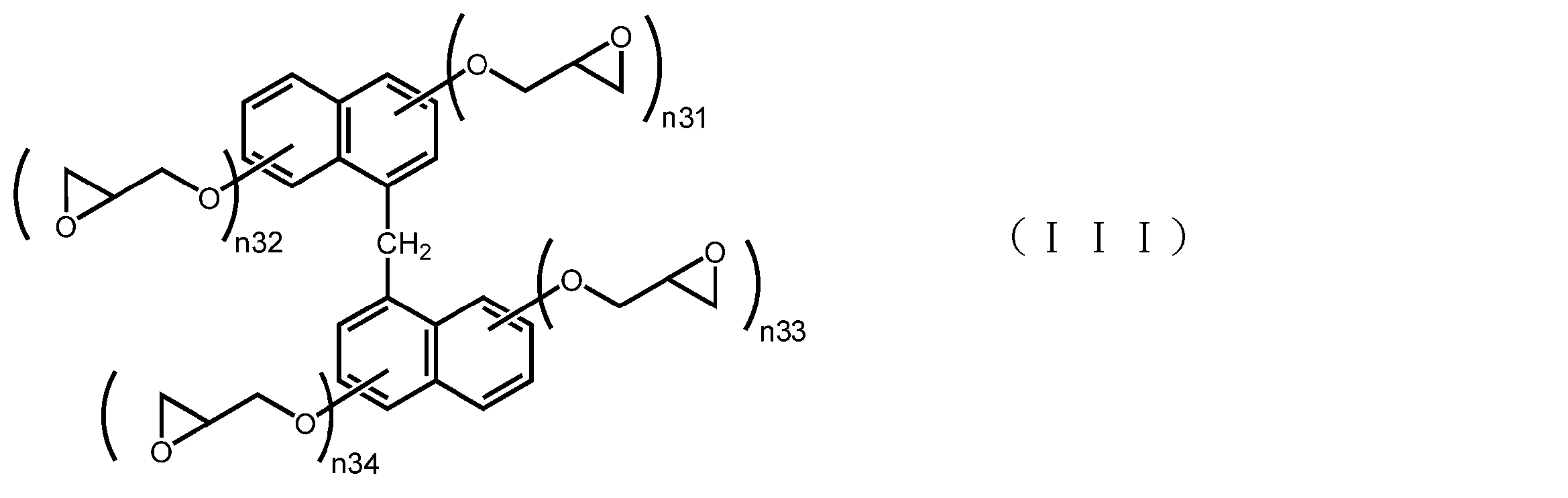
- An epoxy resin represented by the formula (III) may be included.
- n31 + n32 + n33 + n34 may be 2 or more, or 3 or more from the viewpoint of obtaining further excellent heat resistance.
- n31 + n32 + n33 + n34 may be 4 or less, or 3 or less from the viewpoint of obtaining even better handling properties (flexibility, etc.).
- n31 to n34 each independently represents 0 or 1, and n31 + n32 + n33 + n34 represents 2 or more (n31 + n32 + n33 + n34 ⁇ 2).
- Examples of the epoxy resin represented by the formula (III) include an epoxy resin represented by the following formula (IV) and an epoxy resin represented by the following formula (V).
- a commercially available product may be used as the epoxy resin represented by the formula (III).
- trade name “HP-4750” epoxy equivalent: 182 manufactured by DIC Corporation may be mentioned.
- trade name “HP-4700” epoxy equivalent: 166) manufactured by DIC Corporation may be mentioned.
- the content of the epoxy resin (a2) may be 10% by mass or more or 15% by mass or more based on the total amount of the (A) epoxy resin from the viewpoint of obtaining further excellent heat resistance. 20 mass% or more.
- the content of the epoxy resin (a2) may be 45% by mass or less, and 42% by mass or less, based on the total amount of the (A) epoxy resin, from the viewpoint of obtaining further excellent handling properties (flexibility, etc.). It may be 40 mass% or less.
- the content of the epoxy resin (a2) may be 10 parts by mass or more, or 15 parts by mass or more with respect to 100 parts by mass of the epoxy resin (a1) from the viewpoint of obtaining further excellent heat resistance. It may be 20 parts by mass or more.
- the content of the epoxy resin (a2) may be less than 30 parts by mass with respect to 100 parts by mass of the epoxy resin (a1) from the viewpoint of obtaining further excellent handling properties (flexibility, etc.), and 28 parts by mass. Or 25 parts by mass or less.
- the resin having an aromatic ring and a hydroxyl group contains at least one resin having a naphthalene ring (naphthalene skeleton) and a hydroxyl group (hereinafter referred to as “resin (b1)”).
- resin (b1) By using the resin (b1), it is possible to reduce the shrinkage (reaction shrinkage) caused by the reaction between the (A) epoxy resin and the (B) resin having an aromatic ring and a hydroxyl group. It is estimated that warpage can be suppressed.
- a hydroxyl group in resin which has an aromatic ring and a hydroxyl group a phenolic hydroxyl group (hydroxyl group couple
- the phenolic hydroxyl group include a hydroxyl group directly bonded to a naphthalene ring and a hydroxyl group directly bonded to a benzene ring.
- the resin having an aromatic ring and a hydroxyl group may be a phenol resin.
- the resin (b1) may be a compound represented by the following general formula (I) from the viewpoint of further suppressing warpage after sealing.
- R 11 , R 12 , R 13 , R 14 and R 15 each independently represents a hydrogen atom, an alkyl group having 1 to 6 carbon atoms or an alkoxy group having 1 to 2 carbon atoms; , M2, m3, m4, m5, m6, m7 and m8 each independently represent an integer of 0 to 2 (provided that m1, m2, m3, m4, m5, m6, m7 and m8 are all 0) Except for the case), n1 represents an integer of 0 to 10. ]
- At least one of R 11 , R 12 , R 13 , R 14 and R 15 may be a hydrogen atom, and R 11 , R 12 , R 13 , R 14 and R 15 All of these may be hydrogen atoms.
- at least one of m1, m2, m3, m4, m5, m6, m7 and m8 may be 1, m1, m2, m3, m4, m5, m6, All of m7 and m8 may be 1.
- At least one of m1, m2, m3, m4, m5, m6, m7 and m8 may be 2, and m1, m2, m3, m4, m5, m6, m7 and m8. All may be two.
- n1 may be an integer of 0 to 10 or an integer of 0 to 6 from the viewpoint of excellent moldability, fluidity and flame retardancy.
- the compound represented by the formula (I) has a naphthalene ring in which a hydroxyl group is bonded to the 1-position and the 6-position from the viewpoint of further suppressing warpage after sealing and obtaining further excellent heat resistance. May be. Since the hydroxyl group is bonded to the 1-position and 6-position of the naphthalene ring, it can efficiently react with the (A) epoxy resin.
- the compound represented by the formula (I) may be a compound represented by the following general formula (II) from the viewpoint of further suppressing warpage after sealing and further obtaining excellent heat resistance. Good.
- R 21 , R 22 and R 23 each independently represent a hydrogen atom, an alkyl group having 1 to 6 carbon atoms or an alkoxy group having 1 to 2 carbon atoms, and may be the same or different from each other. May be. n2 represents an integer of 0 to 10. ]
- R 21, R 22 and R 23 may be hydrogen atoms, all of R 21, R 22 and R 23 may be hydrogen atoms .
- n2 may be an integer of 0 to 10 or an integer of 0 to 6 from the viewpoint of excellent moldability, fluidity and flame retardancy.
- a compound having a structure represented by the following general formula (VI) (n6 represents an integer of 1 or more) from the viewpoint of further suppressing water absorption and warping after sealing.
- the product name “SN-475N” manufactured by the company may be used.
- the resin having an aromatic ring and a hydroxyl group may further contain a resin having no naphthalene ring (hereinafter referred to as “resin (b2)”) as a resin other than the resin (b1).
- resin (b2) include resins generally used in sealing epoxy resin compositions, and are not particularly limited.
- Examples of the resin (b2) include novolak-type phenol resins (resins obtained by condensation or co-condensation of phenols and aldehydes in the presence of an acidic catalyst); trisphenylmethane-type phenol resins; polyparavinyl phenol resins; Examples include aralkyl resins (phenols and aralkyl resins having a xylylene group synthesized from phenols and dimethoxyparaxylene); phenol resins having a biphenyl skeleton (biphenyl aralkyl type phenol resins and the like).
- the phenols include phenol, cresol, xylenol, resorcin, catechol, bisphenol A, bisphenol F, and the like.
- aldehydes include formaldehyde, acetaldehyde, propionaldehyde, benzaldehyde, salicylaldehyde and the like.
- the resin (b2) may be a biphenyl aralkyl type phenol resin from the viewpoint of obtaining excellent flame retardancy, or may be a novolac type phenol resin from the viewpoint of obtaining excellent heat resistance. Resin (b2) may be used individually by 1 type, and may use 2 or more types together.
- (A) Equivalent of glycidyl group of epoxy resin / (B) Equivalent of functional group that reacts with glycidyl group in resin having aromatic ring and hydroxyl group) is an unreacted (B) resin having aromatic ring and hydroxyl group. From the viewpoint of suppressing the number, it may be 0.7 or more, 0.8 or more, or 0.9 or more.
- the ratio may be 2.0 or less, 1.8 or less, or 1.7 or less from the viewpoint of reducing the amount of unreacted (A) epoxy resin.
- the ratio may be 0.7 to 2.0 from the viewpoint of suppressing the amount of unreacted (A) epoxy resin and (B) resin having an aromatic ring and a hydroxyl group, and 0.8 to 1. It may be 8 or 0.9 to 1.7.
- the equivalent of the glycidyl group / equivalent of the functional group that reacts with the glycidyl group in the resin (b2)) may be 0.7 or more from the viewpoint of reducing the amount of the unreacted resin (b2). It may be above or 0.9 or more.
- the ratio may be 2.0 or less, 1.8 or less, or 1.7 or less from the viewpoint of reducing the amount of unreacted (A) epoxy resin.
- the ratio may be 0.7 to 2.0, or 0.8 to 1.8 from the viewpoint of suppressing the unreacted (A) epoxy resin and resin (b2) to be small, .9 to 1.7 may also be used.
- (C) inorganic filler As an inorganic filler, a conventionally well-known inorganic filler can be used and is not specifically limited.
- C) As an inorganic filler barium sulfate; barium titanate; silicas such as amorphous silica, crystalline silica, fused silica, spherical silica; talc; clay; magnesium carbonate; calcium carbonate; aluminum oxide; aluminum hydroxide Silicon nitride; aluminum nitride and the like.
- the inorganic filler has a viewpoint that an effect of improving dispersibility in the resin and an effect of suppressing sedimentation in the varnish can be easily obtained by surface modification or the like, and a desired value because it has a relatively small coefficient of thermal expansion. Silicas may be used from the viewpoint of easily obtaining cured film characteristics.
- An inorganic filler may be used individually by 1 type, and may use 2 or more types together.
- the inorganic filler may be surface-modified.
- the method of surface modification is not particularly limited, but it is simple, has many types of functional groups, and easily imparts desired characteristics, so even surface modification using a silane coupling agent.
- Silane coupling agents include alkyl silanes, alkoxy silanes, vinyl silanes, epoxy silanes, amino silanes, acrylic silanes, methacryl silanes, mercapto silanes, sulfide silanes, isocyanate silanes, isocyanurate silanes, ureido silanes, sulfur silanes, styryl silanes, alkyls. Examples include chlorosilane and silane having an acid anhydride group.
- At least one selected from the group consisting of phenylaminosilane and silane having an acid anhydride group may be used.
- a silane coupling agent may be used individually by 1 type, and may use 2 or more types together.
- the average particle size of the inorganic filler is such that aggregation of the inorganic filler is easily suppressed and sufficient dispersion is possible, and in the preparation of the film-like epoxy resin composition, particles are easily settled in the varnish. From the viewpoint of being suppressed, the following range may be used.
- the average particle diameter of the inorganic filler may be 0.01 ⁇ m or more, 0.1 ⁇ m or more, or 0.3 ⁇ m or more.
- the average particle diameter of the inorganic filler may exceed 5 ⁇ m, may be 5.2 ⁇ m or more, and may be 5.5 ⁇ m or more.
- the average particle diameter of the inorganic filler may be 50 ⁇ m or less, 25 ⁇ m or less, or 10 ⁇ m or less. From these viewpoints, the average particle diameter of the (C) inorganic filler may be 0.01 to 50 ⁇ m, 0.1 to 25 ⁇ m, 0.3 to 10 ⁇ m, It may be more than 5 ⁇ m and not more than 10 ⁇ m, may be 5.2 to 10 ⁇ m, and may be 5.5 to 10 ⁇ m.
- the content of the inorganic filler is such that the warpage of the electronic device (semiconductor device, etc.) increases due to the difference in thermal expansion coefficient between the sealed body (electronic device such as a semiconductor element) and the sealing portion. It can be easily prevented, and cracks occur in the drying process during the production of the film-like epoxy resin composition, and the encapsulated material cannot be sufficiently sealed due to an increase in the melt viscosity of the film-like epoxy resin composition.
- the following range may be sufficient from a viewpoint which can suppress a malfunction easily.
- the content of the inorganic filler may be 50% by mass or more based on the total amount of the epoxy resin composition (excluding solvents such as organic solvents), or may be 60% by mass or more, 70 mass% or more may be sufficient.
- the content of the inorganic filler may be 95% by mass or less or 90% by mass or less based on the total amount of the epoxy resin composition (excluding solvents such as organic solvents). From these viewpoints, the content of the inorganic filler (C) may be 50% by mass or more based on the total amount of the epoxy resin composition (excluding solvents such as organic solvents), and 60 to 95% by mass. It may be 70 to 90% by mass.
- the epoxy resin composition according to the present embodiment may further contain (D) a curing accelerator.
- D) a curing accelerator When the curing reaction proceeds without using a curing accelerator, (D) the curing accelerator may not be used.
- the group which consists of an amine type hardening accelerator, an imidazole type hardening accelerator, a urea type hardening accelerator, and a phosphorus type hardening accelerator It may be at least one selected from more.
- amine-based curing accelerators include 1,8-diazabicyclo [5.4.0] -7-undecene, 1,5-diazabicyclo [4.3.0] -5-nonene.
- Examples of the imidazole curing accelerator include 2-phenyl-4-methylimidazole, 2-ethyl-4-methylimidazole, 1-cyanoethyl-2-ethyl-4-methylimidazole, and the like.
- Examples of urea-based curing accelerators include 3-phenyl-1,1-dimethylurea.
- Examples of phosphorus curing accelerators include triphenylphosphine and its addition reaction product, (4-hydroxyphenyl) diphenylphosphine, bis (4-hydroxyphenyl) phenylphosphine, tris (4-hydroxyphenyl) phosphine, and the like.
- an imidazole-based curing accelerator may be used from the viewpoint of easily obtaining a desired activation temperature.
- a commercially available product may be used as the imidazole curing accelerator.
- Examples of commercially available imidazole-based curing accelerators include trade names “CURESOL 2PHZ-PW” and “CURESOL 2P4MZ” manufactured by Shikoku Kasei Kogyo Co., Ltd.
- a hardening accelerator may be used individually by 1 type, and may use 2 or more types together.
- the content of the curing accelerator is a viewpoint that a sufficient curing accelerating effect can be easily obtained, and in the process (coating and drying, etc.) in producing the film-like epoxy resin composition, or From the viewpoint of being able to suppress the progress of curing during storage of the film-like epoxy resin composition and from easily preventing cracking of the film-like epoxy resin composition and molding defects associated with an increase in melt viscosity, It may be a range.
- the content of the (D) curing accelerator may be 0.01% by mass or more based on the total amount of the (A) epoxy resin and the (B) resin having an aromatic ring and a hydroxyl group. 1 mass% or more may be sufficient and 0.3 mass% or more may be sufficient.
- the content of the curing accelerator may be 5% by mass or less, and 3% by mass or less based on the total amount of (A) the epoxy resin and (B) the resin having an aromatic ring and a hydroxyl group. It may be 1.5 mass% or less. From these viewpoints, the content of the (D) curing accelerator is 0.01 to 5% by mass based on the total amount of (A) the epoxy resin and (B) the resin having an aromatic ring and a hydroxyl group. It may be 0.1 to 3% by mass or 0.3 to 1.5% by mass.
- the epoxy resin composition according to this embodiment is a component corresponding to (E) an elastomer ((A) an epoxy resin, (B) a resin having an aromatic ring and a hydroxyl group, (C) an inorganic filler, or (D) a curing accelerator. May be further contained. (E) By using an elastomer, it is possible to effectively reduce warping after sealing (for example, the amount of warping of the package) and package cracks.
- the elastomer As the elastomer, a conventionally known elastomer (flexible agent) can be used and is not particularly limited.
- the elastomer (E) include thermoplastic elastomers such as silicone, styrene, olefin, urethane, polyester, polyether, polyamide, and polybutadiene; NR (natural rubber), NBR (acrylonitrile-butadiene) Rubber), acrylic rubber, urethane rubber, silicone powder, etc .; methyl methacrylate-styrene-butadiene copolymer (MBS), methyl methacrylate-silicone copolymer, methyl methacrylate-butyl acrylate copolymer, etc. And rubber particles having a core-shell structure.
- thermoplastic elastomers such as silicone, styrene, olefin, urethane, polyester, polyether, polyamide, and polybutadiene
- NR natural rubber
- (E) a commercially available product may be used as the elastomer.
- Examples of commercially available elastomers include KANE ACE B series, M series and FM series (all are trade names) manufactured by Kaneka Corporation, and the trade name “KMP” series manufactured by Shin-Etsu Chemical Co., Ltd. Can be mentioned.
- An elastomer may be used individually by 1 type and may use 2 or more types together.
- the average particle size of the elastomer may be 0.05 to 50 ⁇ m, 0.1 to 30 ⁇ m, 1 to 30 ⁇ m, or 1.5 to 30 ⁇ m. Good.
- When the average particle diameter of the elastomer is within these ranges, it is possible to suppress a decrease in fluidity due to an increase in viscosity at the time of melting.
- the elastomer content may be 3 to 8% by mass based on the total amount of the epoxy resin composition (excluding solvents such as organic solvents). (E) When the content of the elastomer is within such a range, warpage after sealing can be effectively reduced.
- the epoxy resin composition according to the present embodiment may further contain other additives.
- additives include pigments, dyes, mold release agents, antioxidants, stress relaxation agents, coupling agents, surface tension modifiers, ion exchangers, colorants, flame retardants, and the like.
- an additive is not limited to these,
- the epoxy resin composition which concerns on this embodiment may contain the various well-known additives in this technical field as needed.
- the film-like epoxy resin composition according to the present embodiment includes the epoxy resin composition according to the present embodiment. Moreover, the film-form epoxy resin composition which concerns on this embodiment may also contain the B-staged epoxy resin composition.
- the film-like epoxy resin composition according to this embodiment can be used for sealing by molding, sealing by a molding method that does not require a mold (laminate, press, etc.), and the like.
- the film-form epoxy resin composition which concerns on this embodiment can be used in order to seal at least 1 type of to-be-sealed body chosen from the group which consists of an electronic component and an electronic device.
- the cured product according to the present embodiment is a cured product of the epoxy resin composition according to the present embodiment.
- the cured product according to the present embodiment may be a cured product of the film-like epoxy resin composition according to the present embodiment.
- the encapsulated body is larger than the liquid or solid (granule, powder, etc.) resin encapsulant.
- the sealing resin can be uniformly supplied onto the sealing body, and the sealed body can be easily and satisfactorily sealed.
- the resin sealing material becomes a dust generation source, and the device or the clean room may be contaminated.
- the size of the sealed molded product can be increased while reducing the problem of dust generation.
- the sealing resin is molded in the mold, it is necessary to increase the size of the mold in order to increase the size of the sealed molded product. Increasing the size of the mold requires high mold accuracy, which increases the technical difficulty and may significantly increase the mold manufacturing cost.
- the film-like epoxy resin composition according to the present embodiment is suitably used not only for mold molding which is a conventional sealing molding method but also for molding methods (laminate, press, etc.) that do not require a mold. be able to.
- the thickness of the film-like epoxy resin composition according to the present embodiment may be 25 ⁇ m or more or 50 ⁇ m or more from the viewpoint of easily preventing the film-like epoxy resin composition from cracking.
- the thickness of the film-like epoxy resin composition according to the present embodiment may be 100 ⁇ m or more, 105 ⁇ m or more, or 110 ⁇ m or more from the viewpoint of easily sealing an object to be sealed. Also good.
- the thickness of the film-like epoxy resin composition according to the present embodiment may be 500 ⁇ m or less or 300 ⁇ m or less from the viewpoint of suppressing variation in the thickness of the film-like epoxy resin composition.
- the said range regarding the thickness of the film-form epoxy resin composition which concerns on this embodiment may be sufficient as the thickness of the hardened
- a thick film-like epoxy resin composition may be produced by laminating two or more thin film-like epoxy resin compositions.
- a film-like epoxy resin composition having a thickness of 300 ⁇ m is obtained by laminating two film-like epoxy resin compositions having a thickness of 150 ⁇ m. Can be produced.
- the film-like epoxy resin composition according to this embodiment can be obtained, for example, by molding the epoxy resin composition according to this embodiment into a film shape.
- the 1st aspect of the manufacturing method of the film-form epoxy resin composition which concerns on this embodiment is a varnish coating method, for example, (A) epoxy resin, (B) resin which has an aromatic ring and a hydroxyl group, and (C ) A step of forming a coating film on a support using a varnish containing an inorganic filler, and a step of heating and drying the coating film to obtain a film-like epoxy resin composition.
- the 2nd aspect of the manufacturing method of the film-form epoxy resin composition which concerns on this embodiment is a solid containing at least (A) epoxy resin, (B) resin which has an aromatic ring and a hydroxyl group, and (C) inorganic filler.
- the method includes forming the resin composition into a sheet to obtain a film-like epoxy resin composition. From the viewpoint of easily controlling the thickness, the varnish coating method may be used.
- the film-like epoxy resin composition according to this embodiment includes, for example, (A) an epoxy resin, (B) a resin having an aromatic ring and a hydroxyl group, (C) an inorganic filler, and various optional components used as necessary.
- the mixing method is not particularly limited as long as each compounding component can be dispersed and mixed, but a mill, a mixer, a stirring blade, or the like can be used. As needed, it can form into a film by the varnish coating method using the varnish obtained by melt
- the film-like epoxy resin composition according to the present embodiment is formed by extruding a solid resin composition prepared by kneading each compounding component with a kneader, a two-roll, a continuous kneader, etc. into a sheet shape to form a film. Can also be obtained.
- the solvent a conventionally known organic solvent can be used.
- the organic solvent may be a solvent capable of dissolving components other than the inorganic filler (C), aliphatic hydrocarbons, aromatic hydrocarbons, terpenes, halogens, esters, ketones, alcohols. And aldehydes.
- An organic solvent may be used individually by 1 type, and may use 2 or more types together.
- esters, ketones, and alcohols may be used from the viewpoint of low environmental burden and (A) an epoxy resin and (B) a resin that has an aromatic ring and a hydroxyl group.
- the organic solvent may be a ketone from the viewpoint that (A) the epoxy resin and (B) the resin having an aromatic ring and a hydroxyl group are particularly easily dissolved.
- acetone, methyl ethyl ketone and methyl isobutyl ketone may be used from the viewpoint of low volatilization at room temperature (25 ° C.) and easy removal during drying.
- the content of the organic solvent in the varnish used for the production of the film-like epoxy resin composition may be 2 to 30% by mass or 5 to 25% by mass based on the total amount of the varnish.
- problems such as film cracking can be easily prevented, and a sufficient minimum melt viscosity can be easily obtained.
- problems such as the adhesiveness becoming too strong and the handling property being lowered, and problems such as foaming due to the volatilization of the organic solvent during heat curing.
- a film-like epoxy resin composition can be produced by heating and drying a coating film obtained by applying varnish to a support by hot air spraying or the like.
- coating A die coat, a comma coat, etc. are mentioned.
- the support is not particularly limited, and examples thereof include a polymer film and a metal foil.
- the polymer film include polyolefin films such as polyethylene film and polypropylene film; polyester films such as polyethylene terephthalate film; polyvinyl chloride film; polycarbonate film; acetylcellulose film; polyimide film; polyamide film; .
- the metal foil include copper foil and aluminum foil.
- the thickness of the support is not particularly limited, but may be 2 to 200 ⁇ m from the viewpoint of excellent workability and drying property. With such a thickness, it is possible to prevent a problem that the support is cut during coating, and a problem that the support is bent during coating due to the weight of the varnish. Moreover, generation
- the coating film can be heated at a temperature of ⁇ 10 ° C. of the boiling point of the organic solvent for a time of 25% or more of the total drying time.
- Heat drying can be performed in two or more steps with different heating temperatures. In this case, heat drying may be performed from a low temperature, and the heating temperature of the next stage can be set within + 30 ° C. of the heating temperature of the previous stage.
- a protective layer for example, a protective film for the purpose of protection may be disposed on the film-like epoxy resin composition provided on the support.
- a protective layer for example, a protective film
- the handleability is further improved, and it is possible to avoid the problem that the film-like epoxy resin composition sticks to the back surface of the support when it is wound.
- the protective layer is not particularly limited, and examples thereof include a polymer film and a metal foil.
- the polymer film include polyolefin films such as polyethylene films and polypropylene films; polyester films such as polyethylene terephthalate films; polyvinyl chloride films; polycarbonate films; acetylcellulose films;
- the metal foil include copper foil and aluminum foil.
- the thickness of the protective layer is not particularly limited, but is 12 to 100 ⁇ m from the viewpoint of obtaining a sufficient protective effect and reducing the thickness when the film-like epoxy resin composition is wound into a roll. It may be.
- a sealing sheet including a support and a film-like epoxy resin composition disposed on the support.
- the sealing sheet may further include a protective layer (such as a protective film) on the side opposite to the support side of the film-like epoxy resin composition.
- An electronic apparatus includes at least one type of sealed body selected from the group consisting of an electronic component and an electronic device, and a sealing portion that seals the sealed body.
- the portion includes the epoxy resin composition according to this embodiment, the film-like epoxy resin composition according to this embodiment, or the cured product according to this embodiment.
- the electronic device according to the present embodiment is formed by sealing an object to be sealed using an epoxy resin composition (such as a film-like epoxy resin composition) or a cured product thereof.
- an electronic device provided with an electronic device a semiconductor device provided with a semiconductor element is mentioned, for example.
- the manufacturing method of the electronic device according to the present embodiment includes at least one type of encapsulation selected from the group consisting of electronic components and electronic devices by the epoxy resin composition (film-like epoxy resin composition or the like) according to the present embodiment.
- a sealing process seals a to-be-sealed body (for example, to-be-sealed body provided on the board
- the manufacturing method of the electronic device includes, for example, a step of sealing the object to be sealed with the film-like epoxy resin composition by pressing the film-like epoxy resin composition against the object to be sealed under heating. And a step of curing the film-like epoxy resin composition in which the object to be sealed is sealed to obtain a sealing portion.
- 1 and 2 are schematic cross-sectional views for explaining a method for manufacturing a semiconductor device according to the present embodiment.
- the semiconductor device manufacturing method according to the present embodiment first, the substrate 30, the temporary fixing material 40 disposed on the surface of the substrate 30, and the plurality of semiconductor elements 20 (encapsulated) arranged side by side on the temporary fixing material 40. A laminated body provided with an object to be stopped) (FIG. 1A).
- the sealing film 2 with the support including the support 1 and the sealing film 2 provided on the support 1 is opposed to the laminate, and then the sealing film 2 with respect to the semiconductor element 20.
- a sealing molding may be obtained by compression molding.
- the laminator used in the laminating method is not particularly limited, and examples thereof include roll type and balloon type laminators. Among these, a balloon type capable of vacuum pressurization can be used from the viewpoint of excellent embeddability.
- the lamination temperature is usually below the softening point of the support (film-like support etc.).
- the laminating temperature is, for example, around the minimum melt viscosity of the sealing film.
- the pressure at the time of laminating varies depending on the size or density of an object to be sealed (for example, an electronic device such as a semiconductor element), but may be 0.1 to 1.5 MPa, or 0.3 to 1.0 MPa. There may be.
- the lamination time is not particularly limited, but may be 20 to 600 seconds, 30 to 300 seconds, or 40 to 120 seconds.
- Curing can be performed, for example, in the air or under an inert gas.
- the curing temperature is not particularly limited, but may be 80 to 280 ° C., 100 to 240 ° C., or 120 to 200 ° C. If the curing temperature is 80 ° C. or higher, the curing of the sealing film proceeds sufficiently and the occurrence of defects can be easily suppressed. If the curing temperature is 280 ° C. or lower, the occurrence of heat damage to other materials can be suppressed.
- the curing time is not particularly limited, but may be 30 to 600 minutes, 45 to 300 minutes, or 60 to 240 minutes. When the curing time is within these ranges, the curing of the sealing film proceeds sufficiently and good production efficiency is obtained. A plurality of curing conditions may be combined.
- a semiconductor device can be obtained through the following steps of insulating layer formation, wiring pattern formation, ball mounting, and dicing.
- the sealing molded product 100 is peeled from the substrate 30 and the temporary fixing material 40 of FIG. 1C (FIG. 2A).
- an insulating layer 50 for a rewiring material is provided on the side where the semiconductor element 20 of the sealing molded product 100 is exposed (FIG. 2B).
- ball mounting is performed to form the insulating layer 52, the wiring 54, and the ball 56 (FIG. 2C).
- the sealing molding is separated into pieces with the dicing cutter 60 (FIG.2 (d)).
- cured material (sealing part) 2b is obtained (FIG.2 (e)).
- Epoxy resin component that is liquid at 25 ° C.
- A1 Bisphenol F type epoxy resin (epoxy equivalent: 160, manufactured by Mitsubishi Chemical Corporation, trade name “jER806”) (Ingredients that are not liquid at 25 ° C)
- A2 Trifunctional naphthalene type epoxy resin (epoxy equivalent: 182; manufactured by DIC Corporation, trade name “HP-4750”, compound represented by formula (IV))
- A3 Anthracene type epoxy resin (epoxy equivalent: 179, manufactured by Mitsubishi Chemical Corporation, trade name “YX-8800”)
- B Resin having aromatic ring and hydroxyl group (resin having naphthalene ring and hydroxyl group)
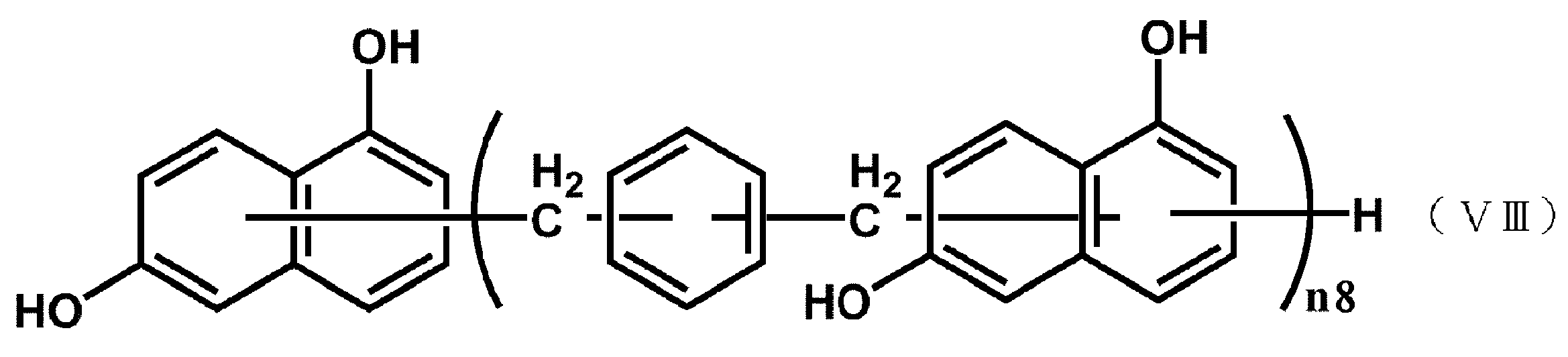
- B1 Compound represented by the following formula (VIII) (hydroxyl equivalent: 110, manufactured by Nippon Steel & Sumikin Chemical Co., Ltd., trade name “SN-395”)
- B2 Compound having the structure represented by the formula (VI) (hydroxyl equivalent: 187, manufactured by Nippon Steel & Sumikin Chemical Co., Ltd., trade name “SN-180”)
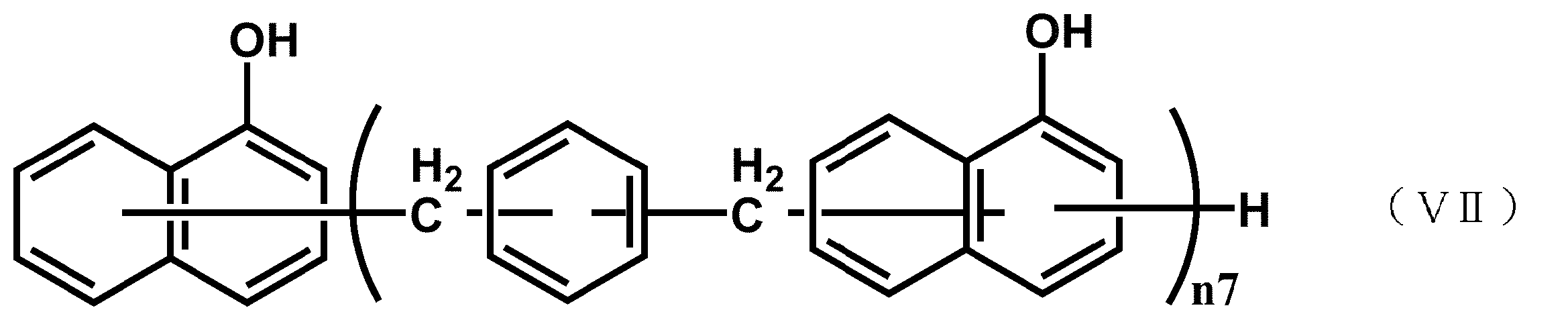
- B3 Compound having the structure represented by the formula (VII) (hydroxyl equivalent: 205, manufactured by Nippon Steel & Sumikin Chemical Co., Ltd., trade name “SN-475N”)
- B4 Compound represented by the following formula (IX) (hydroxyl equivalent: 143, product name “MEH-7000” manufactured by Meiwa Kasei Co., Ltd.) (Phenolic resin without naphthalene ring)
- B5 Novolac type phenolic resin (hydroxy
- Each component of the compounding amount (unit: part by mass) shown in Table 1 and Table 2 was charged into a 1 L polyethylene container, and then stirred and dispersed and mixed for 3 hours to obtain a mixed solution.
- the mixture was filtered through nylon # 200 mesh (opening diameter: 75 ⁇ m), and the filtrate was collected as a varnish-like epoxy resin composition.
- a varnish-like epoxy resin composition By applying this varnish-like epoxy resin composition on a support (38 ⁇ m thick polyethylene terephthalate, manufactured by Oji F-Tex Co., Ltd.) using a coating machine and drying it, the support and a film-like epoxy resin composition A laminate (total thickness: 188 ⁇ m, resin composition layer thickness: 150 ⁇ m) was prepared.
- the application and drying conditions are as follows.
- the laminate of the support and the film-like epoxy resin composition was cut into a length of 30 mm, a width of 5 mm, and a thickness of 0.25 mm.
- a vacuum pressure laminator MVLP-500 manufactured by Meiki Seisakusho Co., Ltd.
- a film-like epoxy resin composition under the conditions of a temperature of 90 ° C., a vacuuming time of 30 seconds, a pressure of 0.5 MPa, and a pressure time of 40 seconds.
- the object surface was laminated in accordance with the surface of Naflon sheet (trade name: TOMBO 9000-S) manufactured by NICHIAS Corporation having a length of 100 mm, a width of 100 mm, and a thickness of 2 mm.
- the laminate comprising the naflon sheet and the film-like epoxy resin composition is placed in an oven at 140 ° C. for 2 hours to be cured and laminated on the naflon sheet. A cured film was obtained. Next, the cured film was peeled off from the naflon sheet to obtain a measurement sample.
- a dynamic viscoelastic device E-4000 manufactured by UBM Co., Ltd.
- the peak value of tan ⁇ when measured in the tension mode, the distance between chucks of 20 mm, the frequency of 10 Hz, and the heating rate of 5 / min is the glass transition temperature ( Tg).
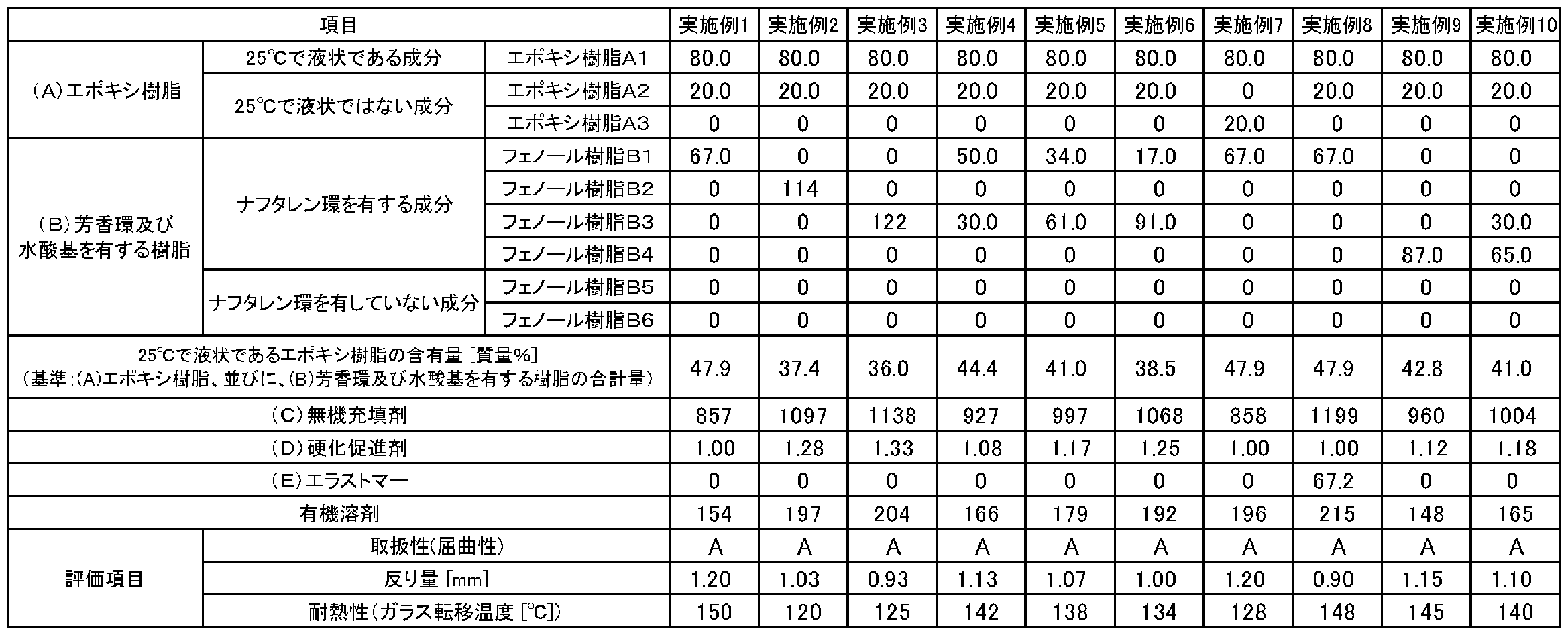
- Tables 1 and 2 show the evaluation results of heat resistance (glass transition temperature [° C.]).
- a Naflon sheet (trade name: TOMBO 9000-S) manufactured by NICHIAS Corporation having a length of 200 mm, a width of 200 mm, and a thickness of 1.0 mm was prepared. The center part of the naflon sheet was cut into a length of 120 mm, a width of 10 mm, and a thickness of 1.0 mm to obtain a test piece A having an opening B as shown in FIG. Nichiban Co., Ltd.
- the placed film-like epoxy resin composition was pressed under a vacuum (0.1 kPa) at a temperature of 110 ° C. and a pressure of 0.1 MPa for 5 minutes. Next, the pressure of the press was returned to normal pressure, and a film-like epoxy resin composition adhered on the silicon substrate was obtained.
- the film-like epoxy resin composition was polished so that the total thickness of the laminate of the silicon substrate and the film-like epoxy resin composition was 1.00 mm.
- a laminate having a total thickness of 1.00 mm was cured in an oven at 140 ° C. for 2 hours, and then naturally cooled to 25 ° C. to obtain a sample for warpage evaluation.
- the epoxy resin compositions of the examples were all good in handling property, warpage amount and heat resistance. Since the film-like epoxy resin composition obtained using the epoxy resin composition of the examples is hard to break before curing and has good handleability, it can be sealed well. On the other hand, in Comparative Examples 1 and 2, the handleability was excellent, but the warpage of the substrate after resin sealing was large and the warpage amount was inferior. In Comparative Example 3, the amount of warpage and heat resistance were excellent, but the flexibility was low and the handleability was poor. In Comparative Example 4, the heat resistance was excellent, but the flexibility was low and the handleability was inferior, and the amount of warpage was also inferior.
Landscapes
- Chemical & Material Sciences (AREA)
- Health & Medical Sciences (AREA)
- Chemical Kinetics & Catalysis (AREA)
- Medicinal Chemistry (AREA)
- Polymers & Plastics (AREA)
- Organic Chemistry (AREA)
- Engineering & Computer Science (AREA)
- Manufacturing & Machinery (AREA)
- Materials Engineering (AREA)
- Epoxy Resins (AREA)
- Structures Or Materials For Encapsulating Or Coating Semiconductor Devices Or Solid State Devices (AREA)
Abstract
Description


本実施形態に係るエポキシ樹脂組成物は、(A)エポキシ樹脂、(B)芳香環及び水酸基を有する樹脂、並びに、(C)無機充填剤を必須成分として含有している。本実施形態において、(A)エポキシ樹脂は、25℃で液状であるエポキシ樹脂を少なくとも1種含み、(B)芳香環及び水酸基を有する樹脂は、ナフタレン環及び水酸基を有する樹脂を少なくとも1種含み、25℃で液状であるエポキシ樹脂の含有量は、(A)エポキシ樹脂、並びに、(B)芳香環及び水酸基を有する樹脂の合計量を基準として30質量%以上である。
(A)エポキシ樹脂は、フィルム状エポキシ樹脂組成物に柔軟性を付与するために、25℃で液状であるエポキシ樹脂(以下、「エポキシ樹脂(a1)」という)を少なくとも1種含む。エポキシ樹脂(a1)としては、特に制限はなく、例えば、1分子中に2個以上のグリシジル基を有するエポキシ樹脂を用いることができる。エポキシ樹脂(a1)としては、ビスフェノールA型エポキシ樹脂、ビスフェノールF型エポキシ樹脂、ナフタレン型エポキシ樹脂等が挙げられる。
ここで、「25℃で液状であるエポキシ樹脂」とは、25℃に保持された当該エポキシ樹脂の粘度をE型粘度計又はB型粘度計を用いて測定した値が400Pa・s以下であるエポキシ樹脂を示す。


(B)芳香環及び水酸基を有する樹脂は、ナフタレン環(ナフタレン骨格)及び水酸基を有する樹脂(以下、「樹脂(b1)」という)を少なくとも1種含む。樹脂(b1)を用いることにより、(A)エポキシ樹脂と(B)芳香環及び水酸基を有する樹脂との反応によって生じる収縮(反応収縮)を小さくすることが可能であることから、封止後の反りを抑制できると推測される。(B)芳香環及び水酸基を有する樹脂における水酸基としては、例えば、フェノール性水酸基(芳香環に直接結合している水酸基)等が挙げられる。フェノール性水酸基としては、例えば、ナフタレン環に直接結合している水酸基、ベンゼン環に直接結合している水酸基等が挙げられる。(B)芳香環及び水酸基を有する樹脂は、フェノール樹脂であってもよい。



(C)無機充填剤としては、従来公知の無機充填剤が使用でき、特定に限定されない。(C)無機充填剤としては、硫酸バリウム;チタン酸バリウム;無定形シリカ、結晶性シリカ、溶融シリカ、球状シリカ等のシリカ類;タルク;クレー;炭酸マグネシウム;炭酸カルシウム;酸化アルミニウム;水酸化アルミニウム;窒化ケイ素;窒化アルミニウムなどが挙げられる。(C)無機充填剤は、表面改質等により、樹脂中の分散性の向上効果及びワニス中での沈降抑制効果が得られやすい観点、並びに、比較的小さい熱膨張率を有するために所望の硬化膜特性が得られやすい観点から、シリカ類であってもよい。(C)無機充填剤は、1種を単独で用いてもよく、2種以上を併用してもよい。
本実施形態に係るエポキシ樹脂組成物は、(D)硬化促進剤を更に含有してもよい。(D)硬化促進剤を用いることなく硬化反応が進行する場合には、(D)硬化促進剤を用いなくてもよい。
本実施形態に係るエポキシ樹脂組成物は、(E)エラストマー((A)エポキシ樹脂、(B)芳香環及び水酸基を有する樹脂、(C)無機充填剤又は(D)硬化促進剤に該当する成分を除く)を更に含有してもよい。(E)エラストマーを用いることにより、封止後の反り(例えばパッケージの反り量)及びパッケージクラックを効果的に低減することができる。
本実施形態に係るエポキシ樹脂組成物は、他の添加剤を更に含有していてもよい。このような添加剤としては、顔料、染料、離型剤、酸化防止剤、応力緩和剤、カップリング剤、表面張力調整剤、イオン交換体、着色剤、難燃剤等を挙げることができる。但し、添加剤はこれらに限定されるものではなく、本実施形態に係るエポキシ樹脂組成物は、必要に応じて当技術分野で周知の各種添加剤を含有していてもよい。
本実施形態に係るフィルム状エポキシ樹脂組成物は、本実施形態に係るエポキシ樹脂組成物を含んでいる。また、本実施形態に係るフィルム状エポキシ樹脂組成物は、Bステージ化されたエポキシ樹脂組成物を含んでもよい。本実施形態に係るフィルム状エポキシ樹脂組成物は、モールド成形による封止、金型を必要としない成形方法(ラミネート、プレス等)による封止などに用いることができる。本実施形態に係るフィルム状エポキシ樹脂組成物は、電子部品及び電子デバイスからなる群より選ばれる少なくとも1種の被封止体を封止するために用いることができる。本実施形態に係る硬化物は、本実施形態に係るエポキシ樹脂組成物の硬化物である。本実施形態に係る硬化物は、本実施形態に係るフィルム状エポキシ樹脂組成物の硬化物であってもよい。
本実施形態に係る電子装置は、電子部品及び電子デバイスからなる群より選ばれる少なくとも1種の被封止体と、前記被封止体を封止する封止部と、を備え、前記封止部が、本実施形態に係るエポキシ樹脂組成物、本実施形態に係るフィルム状エポキシ樹脂組成物、又は、本実施形態に係る硬化物を含む。本実施形態に係る電子装置は、エポキシ樹脂組成物(フィルム状エポキシ樹脂組成物等)又はその硬化物を用いて被封止体が封止されてなる。電子デバイスを備える電子装置としては、例えば、半導体素子を備える半導体装置が挙げられる。
フィルム状エポキシ樹脂組成物を構成する成分として、表1及び表2に示す化合物を準備した。各成分の詳細を下記に示す。
(25℃で液状である成分)
A1:ビスフェノールF型エポキシ樹脂(エポキシ当量:160、三菱化学株式会社製、商品名「jER806」)
(25℃で液状ではない成分)
A2:3官能ナフタレン型エポキシ樹脂(エポキシ当量:182、DIC株式会社製、商品名「HP-4750」、式(IV)で表される化合物)
A3:アントラセン型エポキシ樹脂(エポキシ当量:179、三菱化学株式会社製、商品名「YX-8800」)
(ナフタレン環及び水酸基を有する樹脂)
B1:下記式(VIII)で表される化合物(水酸基当量:110、新日鉄住金化学株式会社製、商品名「SN-395」)
B3:式(VII)で表される構造を有する化合物(水酸基当量:205、新日鉄住金化学株式会社製、商品名「SN-475N」)
B4:下記式(IX)で表される化合物(水酸基当量:143、明和化成株式会社製、商品名「MEH-7000」)

B5:ノボラック型フェノール樹脂(水酸基当量:104、旭有機材工業株式会社製、商品名「PAPS-PN2」)
B6:トリスフェニルメタン型フェノール樹脂(水酸基当量:103、エア・ウォーター株式会社製、商品名「HE910-10」)
シリカ(株式会社アドマテックス製、商品名「SX-E2」、フェニルアミノシラン処理、平均粒子径:5.8μm)
四国化成工業株式会社製、商品名「キュアゾール 2P4MZ」
シリコーンエラストマー(信越化学工業株式会社製、商品名「KMP605」、平均粒子径:2μm)
メチルエチルケトン(株式会社ゴードー製)
・塗布方法:コンマコート
・乾燥速度:1m/分
・乾燥条件(温度/炉長):110℃/3.3m、130℃/3.3m、140℃/3.3m
(取扱性(屈曲性)の評価)
フィルム状エポキシ樹脂組成物の屈曲性は、屈曲試験機を用いて次の手順で評価した。試験機として、ヨシミツ精機株式会社製の屈曲試験機(JIS型タイプ1、円筒型マンドレル法)を準備した。支持体及びフィルム状エポキシ樹脂組成物の積層体を5cm角にカットして試験片を準備した。直径2mmの円筒形マンドレルに試験片の支持体側を接触させ、試験片を180°曲げたときのフィルム状エポキシ樹脂組成物の割れの有無を評価した。割れが発生しない場合を屈曲性良好として、表中「A」と表記した。割れが発生した場合を屈曲性不良として、表中「B」と表記した。取扱性(屈曲性)の評価結果を表1及び表2に示す。
支持体及びフィルム状エポキシ樹脂組成物の積層体を長さ30mm×幅5mm×厚み0.25mmにカットした。次に、株式会社名機製作所製の真空加圧ラミネータMVLP-500を用いて、温度90℃、真空引き時間30秒、圧力0.5MPa、加圧時間40秒の条件で、フィルム状エポキシ樹脂組成物面を長さ100mm×幅100mm×厚み2mmのニチアス株式会社製ナフロンシート(商品名:TOMBO 9000-S)面に合わせてラミネートした。その後、フィルム状エポキシ樹脂組成物を支持する支持体を剥がした後、ナフロンシート及びフィルム状エポキシ樹脂組成物からなる積層体を140℃のオーブンに2時間入れて硬化させて、ナフロンシートに積層された硬化フィルムを得た。次に、ナフロンシートから硬化フィルムを剥がし、測定用サンプルを得た。動的粘弾性装置E-4000(株式会社UBM製)を用い、引張りモード、チャック間距離20mm、周波数10Hz、昇温速度5/minの条件で測定したときのtanδのピーク値をガラス転移温度(Tg)として得た。耐熱性(ガラス転移温度[℃])の評価結果を表1及び表2に示す。
[評価サンプルの作製]
長さ200mm×幅200mm×厚み1.0mmのニチアス株式会社製ナフロンシート(商品名:TOMBO 9000-S)を準備した。ナフロンシートの中心部を長さ120mm×幅10mm×厚み1.0mmにカットして、図3に示すように、開口Bを有する試験片Aを得た。開口Bの中に長さ120mm×幅10mm×厚み0.725mmのシリコン(Si)基板を入れ、シリコン基板が動かないように、長さ140mm×幅25mm×厚み0.025mmにカットしたニチバン株式会社製のポリイミドテープでシリコン基板の全面及びナフロンシートをナフロンシートの下面から固定した。ポリイミドテープで固定していない上面に、厚み150μmのフィルム状エポキシ樹脂組成物(長さ120mm×幅10mmにカットしたフィルムを使用)を、シリコン基板上の全面が覆われるように2枚配置した。配置したフィルム状エポキシ樹脂組成物を真空下(0.1kPa)、温度110℃、圧力0.1MPaで5分間プレスした。次に、プレスの圧力を常圧に戻し、シリコン基板上に接着したフィルム状エポキシ樹脂組成物を得た。シリコン基板とフィルム状エポキシ樹脂組成物との積層体の全厚が1.00mmとなるようにフィルム状エポキシ樹脂組成物を研磨した。全厚1.00mmの積層体を140℃のオーブンで2時間硬化させた後、25℃まで自然冷却させることで、反り評価用サンプルを得た。
三次元レーザー形状測定装置(株式会社キーエンス製、商品名:LK-030)を用いて、上記で得られた反り評価用サンプルの室温(25℃)における最大反り量を測定した。スキャン範囲を140mm×20mm、スキャンピッチを1.0mm、スキャン速度を20mm/sに設定して測定を行った。測定結果を表1及び表2に示す。

Claims (14)
- (A)エポキシ樹脂、(B)芳香環及び水酸基を有する樹脂、並びに、(C)無機充填剤を含有し、
前記(A)エポキシ樹脂が、25℃で液状であるエポキシ樹脂を含み、
前記(B)芳香環及び水酸基を有する樹脂が、ナフタレン環及び水酸基を有する樹脂を含み、
前記25℃で液状であるエポキシ樹脂の含有量が、前記(A)エポキシ樹脂、並びに、前記(B)芳香環及び水酸基を有する樹脂の合計量を基準として30質量%以上である、エポキシ樹脂組成物。 - 硬化促進剤を更に含有する、請求項1に記載のエポキシ樹脂組成物。
- 前記ナフタレン環及び水酸基を有する樹脂が、下記一般式(I)で表される化合物を含む、請求項1又は2に記載のエポキシ樹脂組成物。

- 前記ナフタレン環及び水酸基を有する樹脂が、下記一般式(II)で表される化合物を含む、請求項1又は2に記載のエポキシ樹脂組成物。

- エラストマーを更に含有する、請求項1~4のいずれか一項に記載のエポキシ樹脂組成物。
- 請求項1~5のいずれか一項に記載のエポキシ樹脂組成物を含む、フィルム状エポキシ樹脂組成物。
- 請求項1~5のいずれか一項に記載のエポキシ樹脂組成物の硬化物。
- 電子部品及び電子デバイスからなる群より選ばれる少なくとも1種の被封止体と、前記被封止体を封止する封止部と、を備え、
前記封止部が、請求項1~5のいずれか一項に記載のエポキシ樹脂組成物、請求項6に記載のフィルム状エポキシ樹脂組成物、又は、請求項7に記載の硬化物を含む、電子装置。 - 電子部品及び電子デバイスからなる群より選ばれる少なくとも1種の被封止体を封止するためのフィルム状エポキシ樹脂組成物であって、
(A)エポキシ樹脂、(B)芳香環及び水酸基を有する樹脂、並びに、(C)無機充填剤を含有し、
前記(A)エポキシ樹脂が、25℃で液状であるエポキシ樹脂を含み、
前記(B)芳香環及び水酸基を有する樹脂が、ナフタレン環及び水酸基を有する樹脂を含み、
前記25℃で液状であるエポキシ樹脂の含有量が、前記(A)エポキシ樹脂、並びに、前記(B)芳香環及び水酸基を有する樹脂の合計量を基準として30質量%以上である、フィルム状エポキシ樹脂組成物。 - 硬化促進剤を更に含有する、請求項9に記載のフィルム状エポキシ樹脂組成物。
- 前記ナフタレン環及び水酸基を有する樹脂が、下記一般式(I)で表される化合物を含む、請求項9又は10に記載のフィルム状エポキシ樹脂組成物。

- 前記ナフタレン環及び水酸基を有する樹脂が、下記一般式(II)で表される化合物を含む、請求項9又は10に記載のフィルム状エポキシ樹脂組成物。

- エラストマーを更に含有する、請求項9~12のいずれか一項に記載のフィルム状エポキシ樹脂組成物。
- 請求項9~13のいずれか一項に記載のフィルム状エポキシ樹脂組成物の硬化物。
Priority Applications (3)
| Application Number | Priority Date | Filing Date | Title |
|---|---|---|---|
| KR1020177022197A KR102378992B1 (ko) | 2015-02-03 | 2015-10-29 | 에폭시 수지 조성물, 필름형 에폭시 수지 조성물, 경화물 및 전자 장치 |
| JP2016573179A JP6508226B2 (ja) | 2015-02-03 | 2015-10-29 | エポキシ樹脂組成物、フィルム状エポキシ樹脂組成物、硬化物及び電子装置 |
| CN201580075307.0A CN107207705B (zh) | 2015-02-03 | 2015-10-29 | 环氧树脂组合物、膜状环氧树脂组合物、固化物及电子装置 |
Applications Claiming Priority (2)
| Application Number | Priority Date | Filing Date | Title |
|---|---|---|---|
| JP2015019593 | 2015-02-03 | ||
| JP2015-019593 | 2015-02-03 |
Publications (1)
| Publication Number | Publication Date |
|---|---|
| WO2016125350A1 true WO2016125350A1 (ja) | 2016-08-11 |
Family
ID=56563709
Family Applications (1)
| Application Number | Title | Priority Date | Filing Date |
|---|---|---|---|
| PCT/JP2015/080601 Ceased WO2016125350A1 (ja) | 2015-02-03 | 2015-10-29 | エポキシ樹脂組成物、フィルム状エポキシ樹脂組成物、硬化物及び電子装置 |
Country Status (5)
| Country | Link |
|---|---|
| JP (1) | JP6508226B2 (ja) |
| KR (1) | KR102378992B1 (ja) |
| CN (1) | CN107207705B (ja) |
| TW (1) | TWI677529B (ja) |
| WO (1) | WO2016125350A1 (ja) |
Cited By (5)
| Publication number | Priority date | Publication date | Assignee | Title |
|---|---|---|---|---|
| JP2016175972A (ja) * | 2015-03-19 | 2016-10-06 | 日東電工株式会社 | 封止用シートおよびパッケージの製造方法 |
| KR20190019012A (ko) * | 2017-08-16 | 2019-02-26 | 신에쓰 가가꾸 고교 가부시끼가이샤 | 반도체 봉지용 열경화성 에폭시 수지 시트, 반도체 장치, 및 그 제조방법 |
| KR20190024694A (ko) * | 2017-08-28 | 2019-03-08 | 신에쓰 가가꾸 고교 가부시끼가이샤 | 섬유함유 수지기판, 봉지후 반도체소자 탑재기판, 봉지후 반도체소자 형성 웨이퍼, 봉지후 반도체소자 탑재시트, 반도체장치, 및 반도체장치의 제조방법 |
| WO2020100345A1 (ja) * | 2018-11-14 | 2020-05-22 | ナガセケムテックス株式会社 | 硬化性樹脂組成物および硬化性シート |
| US20220260910A1 (en) * | 2019-05-27 | 2022-08-18 | Mitsubishi Gas Chemical Company, Inc. | Underlayer film forming composition for lithography, underlayer film for lithography, and pattern formation method and purification method |
Families Citing this family (5)
| Publication number | Priority date | Publication date | Assignee | Title |
|---|---|---|---|---|
| KR102135599B1 (ko) * | 2017-08-28 | 2020-07-20 | 스미또모 베이크라이트 가부시키가이샤 | 네거티브형 감광성 수지 조성물, 반도체 장치 및 전자기기 |
| JP7268970B2 (ja) * | 2018-07-03 | 2023-05-08 | 日東電工株式会社 | 封止用シートおよび電子素子装置の製造方法 |
| KR102840281B1 (ko) * | 2018-08-03 | 2025-07-30 | 미쯔비시 케미컬 주식회사 | 적층체 및 에폭시 수지 시트의 제조 방법 |
| KR102516292B1 (ko) * | 2020-06-30 | 2023-03-31 | (주)이녹스첨단소재 | 전자장치 제조용 절연필름 |
| CN116444941A (zh) * | 2023-03-08 | 2023-07-18 | 上海道宜半导体材料有限公司 | 一种环氧树脂组合物、制备方法及应用 |
Citations (11)
| Publication number | Priority date | Publication date | Assignee | Title |
|---|---|---|---|---|
| JP2000026707A (ja) * | 1998-07-15 | 2000-01-25 | Hitachi Chem Co Ltd | エポキシ樹脂組成物及び電子部品装置 |
| JP2001214037A (ja) * | 2000-01-31 | 2001-08-07 | Dainippon Ink & Chem Inc | エポキシ樹脂組成物 |
| JP2009256626A (ja) * | 2008-03-28 | 2009-11-05 | Sekisui Chem Co Ltd | エポキシ系樹脂組成物、プリプレグ、硬化体、シート状成形体、積層板および多層積層板 |
| JP2010053334A (ja) * | 2008-07-31 | 2010-03-11 | Sekisui Chem Co Ltd | エポキシ系樹脂組成物、プリプレグ、硬化体、シート状成形体、積層板及び多層積層板 |
| WO2010035452A1 (ja) * | 2008-09-24 | 2010-04-01 | 積水化学工業株式会社 | 樹脂組成物、硬化体及び積層体 |
| JP2011021101A (ja) * | 2009-07-15 | 2011-02-03 | Ajinomoto Co Inc | 樹脂組成物 |
| JP2011089038A (ja) * | 2009-10-22 | 2011-05-06 | Ajinomoto Co Inc | 樹脂組成物 |
| JP2013153223A (ja) * | 2008-02-27 | 2013-08-08 | Ajinomoto Co Inc | 多層プリント配線板の製造方法 |
| JP2013151684A (ja) * | 2013-02-25 | 2013-08-08 | Nippon Steel & Sumikin Chemical Co Ltd | 多価ヒドロキシ樹脂、その製造方法、エポキシ樹脂組成物及びその硬化物 |
| JP2014029958A (ja) * | 2012-07-31 | 2014-02-13 | Ajinomoto Co Inc | 半導体装置の製造方法 |
| JP2015003982A (ja) * | 2013-06-20 | 2015-01-08 | 住友ベークライト株式会社 | プライマー層形成用樹脂組成物 |
Family Cites Families (6)
| Publication number | Priority date | Publication date | Assignee | Title |
|---|---|---|---|---|
| JPS616615A (ja) | 1984-06-20 | 1986-01-13 | Nippon Sheet Glass Co Ltd | 屈折率分布型レンズ |
| JP2001127095A (ja) | 1999-10-29 | 2001-05-11 | Shinko Electric Ind Co Ltd | 半導体装置及びその製造方法 |
| JP2001244372A (ja) | 2000-03-01 | 2001-09-07 | Seiko Epson Corp | 半導体装置およびその製造方法 |
| DE102006009789B3 (de) | 2006-03-01 | 2007-10-04 | Infineon Technologies Ag | Verfahren zur Herstellung eines Halbleiterbauteils aus einer Verbundplatte mit Halbleiterchips und Kunststoffgehäusemasse |
| JP5364078B2 (ja) * | 2010-11-18 | 2013-12-11 | 日東電工株式会社 | 熱硬化性樹脂組成物硬化体の製法およびそれにより得られた硬化物 |
| JP6123152B2 (ja) * | 2010-12-08 | 2017-05-10 | 味の素株式会社 | 樹脂組成物 |
-
2015
- 2015-10-29 KR KR1020177022197A patent/KR102378992B1/ko active Active
- 2015-10-29 CN CN201580075307.0A patent/CN107207705B/zh active Active
- 2015-10-29 JP JP2016573179A patent/JP6508226B2/ja active Active
- 2015-10-29 WO PCT/JP2015/080601 patent/WO2016125350A1/ja not_active Ceased
- 2015-10-30 TW TW104135807A patent/TWI677529B/zh active
Patent Citations (11)
| Publication number | Priority date | Publication date | Assignee | Title |
|---|---|---|---|---|
| JP2000026707A (ja) * | 1998-07-15 | 2000-01-25 | Hitachi Chem Co Ltd | エポキシ樹脂組成物及び電子部品装置 |
| JP2001214037A (ja) * | 2000-01-31 | 2001-08-07 | Dainippon Ink & Chem Inc | エポキシ樹脂組成物 |
| JP2013153223A (ja) * | 2008-02-27 | 2013-08-08 | Ajinomoto Co Inc | 多層プリント配線板の製造方法 |
| JP2009256626A (ja) * | 2008-03-28 | 2009-11-05 | Sekisui Chem Co Ltd | エポキシ系樹脂組成物、プリプレグ、硬化体、シート状成形体、積層板および多層積層板 |
| JP2010053334A (ja) * | 2008-07-31 | 2010-03-11 | Sekisui Chem Co Ltd | エポキシ系樹脂組成物、プリプレグ、硬化体、シート状成形体、積層板及び多層積層板 |
| WO2010035452A1 (ja) * | 2008-09-24 | 2010-04-01 | 積水化学工業株式会社 | 樹脂組成物、硬化体及び積層体 |
| JP2011021101A (ja) * | 2009-07-15 | 2011-02-03 | Ajinomoto Co Inc | 樹脂組成物 |
| JP2011089038A (ja) * | 2009-10-22 | 2011-05-06 | Ajinomoto Co Inc | 樹脂組成物 |
| JP2014029958A (ja) * | 2012-07-31 | 2014-02-13 | Ajinomoto Co Inc | 半導体装置の製造方法 |
| JP2013151684A (ja) * | 2013-02-25 | 2013-08-08 | Nippon Steel & Sumikin Chemical Co Ltd | 多価ヒドロキシ樹脂、その製造方法、エポキシ樹脂組成物及びその硬化物 |
| JP2015003982A (ja) * | 2013-06-20 | 2015-01-08 | 住友ベークライト株式会社 | プライマー層形成用樹脂組成物 |
Cited By (12)
| Publication number | Priority date | Publication date | Assignee | Title |
|---|---|---|---|---|
| JP2016175972A (ja) * | 2015-03-19 | 2016-10-06 | 日東電工株式会社 | 封止用シートおよびパッケージの製造方法 |
| KR20190019012A (ko) * | 2017-08-16 | 2019-02-26 | 신에쓰 가가꾸 고교 가부시끼가이샤 | 반도체 봉지용 열경화성 에폭시 수지 시트, 반도체 장치, 및 그 제조방법 |
| JP2019036642A (ja) * | 2017-08-16 | 2019-03-07 | 信越化学工業株式会社 | 半導体封止用熱硬化性エポキシ樹脂シート、半導体装置、及びその製造方法 |
| US10808102B2 (en) | 2017-08-16 | 2020-10-20 | Shin-Etsu Chemical Co., Ltd. | Thermosetting epoxy resin sheet for encapsulating semiconductor, semiconductor equipment, and method for manufacturing the same |
| KR102570038B1 (ko) * | 2017-08-16 | 2023-08-23 | 신에쓰 가가꾸 고교 가부시끼가이샤 | 반도체 봉지용 열경화성 에폭시 수지 시트, 반도체 장치, 및 그 제조방법 |
| KR20190024694A (ko) * | 2017-08-28 | 2019-03-08 | 신에쓰 가가꾸 고교 가부시끼가이샤 | 섬유함유 수지기판, 봉지후 반도체소자 탑재기판, 봉지후 반도체소자 형성 웨이퍼, 봉지후 반도체소자 탑재시트, 반도체장치, 및 반도체장치의 제조방법 |
| JP2019041064A (ja) * | 2017-08-28 | 2019-03-14 | 信越化学工業株式会社 | 繊維含有樹脂基板、封止後半導体素子搭載基板、封止後半導体素子形成ウエハ、封止後半導体素子搭載シート、半導体装置、及び半導体装置の製造方法 |
| KR102518301B1 (ko) * | 2017-08-28 | 2023-04-05 | 신에쓰 가가꾸 고교 가부시끼가이샤 | 섬유함유 수지기판, 봉지후 반도체소자 탑재기판, 봉지후 반도체소자 형성 웨이퍼, 봉지후 반도체소자 탑재시트, 반도체장치, 및 반도체장치의 제조방법 |
| WO2020100345A1 (ja) * | 2018-11-14 | 2020-05-22 | ナガセケムテックス株式会社 | 硬化性樹脂組成物および硬化性シート |
| JP6764149B1 (ja) * | 2018-11-14 | 2020-09-30 | ナガセケムテックス株式会社 | 硬化性樹脂組成物および硬化性シート |
| US11718770B2 (en) | 2018-11-14 | 2023-08-08 | Nagase Chemtex Corporation | Curable resin composition and curable sheet |
| US20220260910A1 (en) * | 2019-05-27 | 2022-08-18 | Mitsubishi Gas Chemical Company, Inc. | Underlayer film forming composition for lithography, underlayer film for lithography, and pattern formation method and purification method |
Also Published As
| Publication number | Publication date |
|---|---|
| JPWO2016125350A1 (ja) | 2017-09-28 |
| JP6508226B2 (ja) | 2019-05-08 |
| CN107207705A (zh) | 2017-09-26 |
| TW201629147A (zh) | 2016-08-16 |
| KR20170113571A (ko) | 2017-10-12 |
| KR102378992B1 (ko) | 2022-03-24 |
| TWI677529B (zh) | 2019-11-21 |
| CN107207705B (zh) | 2019-11-01 |
Similar Documents
| Publication | Publication Date | Title |
|---|---|---|
| JP7115520B2 (ja) | 封止用フィルム及び封止構造体 | |
| JP6508226B2 (ja) | エポキシ樹脂組成物、フィルム状エポキシ樹脂組成物、硬化物及び電子装置 | |
| JP6801659B2 (ja) | エポキシ樹脂組成物、フィルム状エポキシ樹脂組成物及び電子装置 | |
| JP6717005B2 (ja) | 樹脂組成物、硬化物、樹脂フィルム、封止材及び封止構造体 | |
| JP6511840B2 (ja) | エポキシ樹脂組成物、フィルム状エポキシ樹脂組成物及び電子部品装置 | |
| JP6749887B2 (ja) | 封止用フィルム及びそれを用いた電子部品装置 | |
| JPWO2017203622A1 (ja) | 封止構造体及びその製造方法、並びに、封止材 | |
| JP7070559B2 (ja) | 封止用フィルム及び封止構造体、並びにこれらの製造方法 | |
| JP6544427B2 (ja) | 熱硬化性樹脂組成物、硬化物、樹脂シート、封止構造体及びその製造方法、並びに、電子部品装置及びその製造方法 | |
| JP7354666B2 (ja) | 封止用フィルム、封止構造体、及び封止構造体の製造方法 | |
| JP2018064054A (ja) | 封止材、及び、封止構造体の製造方法 | |
| JP2018032783A (ja) | 封止シート及びその製造方法、並びに、封止構造体及びその製造方法 | |
| JP2018041768A (ja) | 封止構造体の製造方法、封止材及び硬化物 |
Legal Events
| Date | Code | Title | Description |
|---|---|---|---|
| 121 | Ep: the epo has been informed by wipo that ep was designated in this application |
Ref document number: 15881167 Country of ref document: EP Kind code of ref document: A1 |
|
| ENP | Entry into the national phase |
Ref document number: 2016573179 Country of ref document: JP Kind code of ref document: A |
|
| NENP | Non-entry into the national phase |
Ref country code: DE |
|
| ENP | Entry into the national phase |
Ref document number: 20177022197 Country of ref document: KR Kind code of ref document: A |
|
| 122 | Ep: pct application non-entry in european phase |
Ref document number: 15881167 Country of ref document: EP Kind code of ref document: A1 |