WO2016121322A1 - 非水電解質二次電池用負極板及びその負極板を用いた非水電解質二次電池 - Google Patents
非水電解質二次電池用負極板及びその負極板を用いた非水電解質二次電池 Download PDFInfo
- Publication number
- WO2016121322A1 WO2016121322A1 PCT/JP2016/000218 JP2016000218W WO2016121322A1 WO 2016121322 A1 WO2016121322 A1 WO 2016121322A1 JP 2016000218 W JP2016000218 W JP 2016000218W WO 2016121322 A1 WO2016121322 A1 WO 2016121322A1
- Authority
- WO
- WIPO (PCT)
- Prior art keywords
- negative electrode
- electrolyte secondary
- electrode plate
- secondary battery
- nonaqueous electrolyte
- Prior art date
- Legal status (The legal status is an assumption and is not a legal conclusion. Google has not performed a legal analysis and makes no representation as to the accuracy of the status listed.)
- Ceased
Links
Images

Classifications
-
- H—ELECTRICITY
- H01—ELECTRIC ELEMENTS
- H01M—PROCESSES OR MEANS, e.g. BATTERIES, FOR THE DIRECT CONVERSION OF CHEMICAL ENERGY INTO ELECTRICAL ENERGY
- H01M4/00—Electrodes
- H01M4/02—Electrodes composed of, or comprising, active material
- H01M4/13—Electrodes for accumulators with non-aqueous electrolyte, e.g. for lithium-accumulators; Processes of manufacture thereof
- H01M4/133—Electrodes based on carbonaceous material, e.g. graphite-intercalation compounds or CFx
-
- C—CHEMISTRY; METALLURGY
- C08—ORGANIC MACROMOLECULAR COMPOUNDS; THEIR PREPARATION OR CHEMICAL WORKING-UP; COMPOSITIONS BASED THEREON
- C08L—COMPOSITIONS OF MACROMOLECULAR COMPOUNDS
- C08L1/00—Compositions of cellulose, modified cellulose or cellulose derivatives
- C08L1/08—Cellulose derivatives
- C08L1/26—Cellulose ethers
- C08L1/28—Alkyl ethers
-
- C—CHEMISTRY; METALLURGY
- C08—ORGANIC MACROMOLECULAR COMPOUNDS; THEIR PREPARATION OR CHEMICAL WORKING-UP; COMPOSITIONS BASED THEREON
- C08L—COMPOSITIONS OF MACROMOLECULAR COMPOUNDS
- C08L33/00—Compositions of homopolymers or copolymers of compounds having one or more unsaturated aliphatic radicals, each having only one carbon-to-carbon double bond, and only one being terminated by only one carboxyl radical, or of salts, anhydrides, esters, amides, imides or nitriles thereof; Compositions of derivatives of such polymers
- C08L33/02—Homopolymers or copolymers of acids; Metal or ammonium salts thereof
-
- H—ELECTRICITY
- H01—ELECTRIC ELEMENTS
- H01M—PROCESSES OR MEANS, e.g. BATTERIES, FOR THE DIRECT CONVERSION OF CHEMICAL ENERGY INTO ELECTRICAL ENERGY
- H01M4/00—Electrodes
- H01M4/02—Electrodes composed of, or comprising, active material
- H01M4/36—Selection of substances as active materials, active masses, active liquids
- H01M4/48—Selection of substances as active materials, active masses, active liquids of inorganic oxides or hydroxides
- H01M4/485—Selection of substances as active materials, active masses, active liquids of inorganic oxides or hydroxides of mixed oxides or hydroxides for inserting or intercalating light metals, e.g. LiTi2O4 or LiTi2OxFy
-
- H—ELECTRICITY
- H01—ELECTRIC ELEMENTS
- H01M—PROCESSES OR MEANS, e.g. BATTERIES, FOR THE DIRECT CONVERSION OF CHEMICAL ENERGY INTO ELECTRICAL ENERGY
- H01M4/00—Electrodes
- H01M4/02—Electrodes composed of, or comprising, active material
- H01M4/62—Selection of inactive substances as ingredients for active masses, e.g. binders, fillers
- H01M4/621—Binders
- H01M4/622—Binders being polymers
-
- H—ELECTRICITY
- H01—ELECTRIC ELEMENTS
- H01M—PROCESSES OR MEANS, e.g. BATTERIES, FOR THE DIRECT CONVERSION OF CHEMICAL ENERGY INTO ELECTRICAL ENERGY
- H01M10/00—Secondary cells; Manufacture thereof
- H01M10/05—Accumulators with non-aqueous electrolyte
- H01M10/052—Li-accumulators
-
- H—ELECTRICITY
- H01—ELECTRIC ELEMENTS
- H01M—PROCESSES OR MEANS, e.g. BATTERIES, FOR THE DIRECT CONVERSION OF CHEMICAL ENERGY INTO ELECTRICAL ENERGY
- H01M4/00—Electrodes
- H01M4/02—Electrodes composed of, or comprising, active material
- H01M2004/026—Electrodes composed of, or comprising, active material characterised by the polarity
- H01M2004/027—Negative electrodes
-
- H—ELECTRICITY
- H01—ELECTRIC ELEMENTS
- H01M—PROCESSES OR MEANS, e.g. BATTERIES, FOR THE DIRECT CONVERSION OF CHEMICAL ENERGY INTO ELECTRICAL ENERGY
- H01M4/00—Electrodes
- H01M4/02—Electrodes composed of, or comprising, active material
- H01M4/36—Selection of substances as active materials, active masses, active liquids
- H01M4/58—Selection of substances as active materials, active masses, active liquids of inorganic compounds other than oxides or hydroxides, e.g. sulfides, selenides, tellurides, halogenides or LiCoFy; of polyanionic structures, e.g. phosphates, silicates or borates
- H01M4/583—Carbonaceous material, e.g. graphite-intercalation compounds or CFx
- H01M4/587—Carbonaceous material, e.g. graphite-intercalation compounds or CFx for inserting or intercalating light metals
-
- Y—GENERAL TAGGING OF NEW TECHNOLOGICAL DEVELOPMENTS; GENERAL TAGGING OF CROSS-SECTIONAL TECHNOLOGIES SPANNING OVER SEVERAL SECTIONS OF THE IPC; TECHNICAL SUBJECTS COVERED BY FORMER USPC CROSS-REFERENCE ART COLLECTIONS [XRACs] AND DIGESTS
- Y02—TECHNOLOGIES OR APPLICATIONS FOR MITIGATION OR ADAPTATION AGAINST CLIMATE CHANGE
- Y02E—REDUCTION OF GREENHOUSE GAS [GHG] EMISSIONS, RELATED TO ENERGY GENERATION, TRANSMISSION OR DISTRIBUTION
- Y02E60/00—Enabling technologies; Technologies with a potential or indirect contribution to GHG emissions mitigation
- Y02E60/10—Energy storage using batteries
Definitions
- the present invention relates to a negative electrode plate for a non-aqueous electrolyte secondary battery containing a carbon material and silicon oxide, and a non-aqueous electrolyte secondary battery using the negative electrode plate.
- nonaqueous electrolyte secondary batteries have been widely used as drive power sources for portable electronic devices such as smartphones, tablet computers, notebook computers, and portable music players. With the progress of miniaturization and higher functionality of these portable electronic devices, non-aqueous electrolyte secondary batteries are required to have higher capacities.
- Carbon materials such as graphite are often used as negative electrode active materials for non-aqueous electrolyte secondary batteries. While the carbon material has a discharge potential comparable to that of lithium metal, it can suppress lithium dendrite growth during charging. Therefore, the nonaqueous electrolyte secondary battery excellent in safety can be provided by using the carbon material as the negative electrode active material. For example, graphite can occlude lithium ions until the composition of LiC 6 is reached, and its theoretical capacity is 372 mAh / g.
- silicon materials such as silicon and oxides thereof having a higher capacity than carbon materials have attracted attention as negative electrode active materials for non-aqueous electrolyte secondary batteries.
- silicon can occlude lithium ions until it has a composition of Li 4.4 Si, and its theoretical capacity is 4200 mAh / g. Therefore, the capacity of the nonaqueous electrolyte secondary battery can be increased by using the silicon material as the negative electrode active material.
- the silicon material can suppress the dendrite growth of lithium during charging in the same manner as the carbon material.
- silicon materials have a larger expansion and contraction due to charging and discharging than carbon materials, there is a problem that the electrode plate resistance increases due to pulverization of the negative electrode active material and dropping from the conductive network, and the cycle characteristics are likely to deteriorate. .
- Patent Document 1 discloses a non-aqueous electrolyte secondary battery using a negative electrode mixture containing SiO as a negative electrode active material and polyacrylic acid as a binder.
- the purpose of this technology is to use polyacrylic acid as a binder to improve the adhesion between the negative electrode mixture and the adhesion between the negative electrode mixture and the negative electrode current collector, and to suppress deterioration of the battery. It is what.
- Patent Document 2 non-catalyst using a negative electrode mixture containing SiO as a negative electrode active material on which carbon nanofibers are grown by supporting a catalytic element on the surface and polyacrylic acid or polyacrylate as a binder is used.
- a water electrolyte secondary battery is disclosed. This technology not only secures a conductive network between SiO particles, but also solves the problem that the flexibility of the electrode plate is lost when an acrylic acid polymer such as polyacrylic acid is used as a binder. It is intended.
- Patent Document 3 discloses a negative electrode plate having silicon oxide and graphite represented by the general formula SiO x (0.5 ⁇ x ⁇ 1.5), and a positive electrode plate having a lithium transition metal composite oxide containing at least Ni and Mn.
- a non-aqueous electrolyte secondary battery is disclosed.
- Patent Document 3 a decrease in battery characteristics due to SiO x volume expansion associated with charge / discharge is suppressed by setting the content of SiO x to 20 mass% or less with respect to the total mass of SiO x and graphite. It is described.
- Silicon oxide has a smaller amount of expansion / contraction during charging / discharging than silicon. However, with only the techniques described in Patent Document 1 and Patent Document 2, it is difficult to obtain sufficient cycle characteristics when silicon oxide is used instead of the carbon material.
- the present invention has been made in view of the above, and an object thereof is to improve the cycle characteristics of a nonaqueous electrolyte secondary battery containing a carbon material and silicon oxide as a negative electrode active material.
- a negative electrode plate for a non-aqueous electrolyte secondary battery includes a negative electrode active material containing a carbon material and silicon oxide, carboxymethyl cellulose, and a partially neutralized poly (sodium hydroxide) or sodium hydroxide. It is characterized by comprising acrylic acid and a copolymer containing as constituent units at least two selected from the group consisting of styrene, butadiene, methyl acrylate, methyl methacrylate, and acrylonitrile.
- polyacrylic acid is partially neutralized with sodium hydroxide or ammonia.
- the degree of neutralization of polyacrylic acid is not particularly limited, but is preferably 0.2 or more and 0.8 or less.
- the nonaqueous electrolyte secondary battery which concerns on this invention is comprised using the negative electrode plate which has said structure, a positive electrode plate, a separator, a nonaqueous electrolyte, and an exterior body. Can do.
- a negative electrode plate for a non-aqueous electrolyte secondary battery having a high capacity and excellent cycle characteristics it is possible to provide a negative electrode plate for a non-aqueous electrolyte secondary battery having a high capacity and excellent cycle characteristics, and a non-aqueous electrolyte secondary battery.
- FIG. 1 is a perspective view of a pouch-type nonaqueous electrolyte secondary battery used in Examples and Comparative Examples.
- the negative electrode plate for a non-aqueous electrolyte secondary battery can be manufactured by the following procedure. First, an active material, a thickener, and a binder are mixed, and the mixture is kneaded in a dispersion medium to prepare a negative electrode mixture slurry. The negative electrode mixture slurry is applied on a negative electrode current collector and dried to form a negative electrode mixture layer. Subsequently, it compresses using a roller and cut
- a carbon material and silicon oxide are used as the negative electrode active material.
- Each content of the carbon material and silicon oxide in the negative electrode active material can be appropriately determined according to the design capacity of the negative electrode plate, but the content of silicon oxide is 0.5% by mass with respect to the mass of the negative electrode active material. It is preferable that it is 20 mass% or less.
- Examples of the carbon material include graphite, graphitizable carbon, and non-graphitizable carbon, and it is particularly preferable to use graphite.
- graphite both artificial graphite and natural graphite can be used, and the carbon material can be used alone or in combination of two or more.
- the silicon oxide can be used without limitation as long as it is a compound comprising silicon and oxygen, but it is preferable to use silicon oxide represented by the general formula SiO x (0.5 ⁇ x ⁇ 1.6).
- SiO x preferably has a structure in which fine two phases of Si phase and SiO 2 phase are dispersed inside the particle.
- silicon oxide has a higher surface resistance than carbon materials, it is preferable to coat the surface of silicon oxide with amorphous carbon.
- the method for coating the amorphous carbon include a chemical vapor deposition (CVD) method.
- CVD chemical vapor deposition
- a hydrocarbon-based gas can be thermally decomposed in a non-oxidizing atmosphere to attach amorphous carbon to the silicon oxide surface.
- Amorphous carbon need not cover the entire surface of the silicon oxide.
- the coating amount of amorphous carbon is preferably 0.1% by mass or more and 10% by mass or less with respect to silicon oxide.
- Carboxymethylcellulose is used as a thickener.
- the content of carboxymethyl cellulose (CMC) can be appropriately determined in order to adjust the viscosity of the negative electrode mixture slurry.
- the content of carboxymethyl cellulose (CMC) is preferably 0.5% by mass or more and 3% by mass or less with respect to the negative electrode active material.
- Polyacrylic acid functions as a thickener and a binder.
- polyacrylic acid is neutralized with sodium hydroxide (NaOH) or ammonia (NH 3 )
- the proton of the carboxyl group of polyacrylic acid is replaced with sodium ion (Na + ) or ammonium ion (NH 4 + ).
- the degree of neutralization of polyacrylic acid is not particularly limited, but the degree of neutralization is preferably 0.2 or more and 0.8 or less.
- the degree of neutralization is calculated as the ratio of neutralized carboxyl groups to the number of all carboxyl groups bonded to polyacrylic acid (PAA).
- polyacrylic acid may have any structure of a crosslinked structure and a non-crosslinked structure.
- the content of the partially neutralized polyacrylic acid is preferably 0.05% by mass or more and 5% by mass or less based on the mass of the negative electrode active material.
- the weight average molecular weight of the partially neutralized polyacrylic acid is preferably 500,000 to 10,000,000. If the weight average molecular weight is within this range, gelation of the negative electrode mixture slurry containing partially neutralized polyacrylic acid is suppressed, and the production of the negative electrode plate becomes easy.
- a copolymer containing at least two or more selected from the group consisting of styrene, butadiene, methyl acrylate, methyl methacrylate, and acrylonitrile is used.
- This copolymer exhibits a function as a binder.
- the copolymer preferably contains styrene and butadiene as structural units, and more preferably comprises styrene and butadiene.
- the negative electrode plate for a non-aqueous electrolyte secondary battery according to an embodiment of the present invention has been described above.
- the non-aqueous electrolyte secondary battery according to an embodiment of the present invention will be described below.
- the positive electrode plate can be produced in the same manner as the negative electrode plate using a positive electrode active material.
- a lithium transition metal composite oxide capable of inserting and extracting lithium ions can be used.
- the lithium transition metal composite oxide include a general formula LiMO 2 (M is at least one of Co, Ni, and Mn), LiMn 2 O 4 , and LiFePO 4 . These can be used singly or in combination of two or more, and at least one selected from the group consisting of Al, Ti, Mg, and Zr is added or substituted with a transition metal element Can do.
- the separator is used to insulate the negative electrode plate from the positive electrode plate, and is interposed between the negative electrode plate and the positive electrode plate.
- a microporous film mainly composed of polyolefin such as polyethylene (PE) or polypropylene (PP) can be used as the separator.
- the microporous membrane can be used singly or as a laminate of two or more layers.
- a layer mainly composed of polyethylene (PE) having a low melting point is used as an intermediate layer and polypropylene (PP) having excellent oxidation resistance is used as a surface layer.
- inorganic particles such as aluminum oxide (Al 2 O 3 ), titanium oxide (TiO 2 ), and silicon oxide (SiO 2 ) can be added to the separator.
- inorganic particles can be carried in the separator and can be applied together with a binder on the separator surface.
- non-aqueous electrolyte a solution obtained by dissolving a lithium salt as an electrolyte salt in a non-aqueous solvent can be used.
- a non-aqueous solvent or a non-aqueous electrolyte using a gel polymer together with the non-aqueous solvent can be used.
- a cyclic carbonate ester As the non-aqueous solvent, a cyclic carbonate ester, a chain carbonate ester, a cyclic carboxylic acid ester and a chain carboxylic acid ester can be used, and these are preferably used in combination of two or more.
- the cyclic carbonate include ethylene carbonate (EC), propylene carbonate (PC), and butylene carbonate (BC).
- a cyclic carbonate in which part of hydrogen is substituted with fluorine such as fluoroethylene carbonate (FEC)
- the chain carbonate include dimethyl carbonate (DMC), ethyl methyl carbonate (EMC), diethyl carbonate (DEC), and methyl propyl carbonate (MPC).
- Examples of cyclic carboxylic acid esters include ⁇ -butyrolactone ( ⁇ -BL) and ⁇ -valerolactone ( ⁇ -VL).
- Examples of chain carboxylic acid esters include methyl pivalate, ethyl pivalate, methyl isobutyrate and methyl Pionate is exemplified.
- Lithium salts include LiPF 6 , LiBF 4 , LiCF 3 SO 3 , LiN (CF 3 SO 2 ) 2 , LiN (C 2 F 5 SO 2 ) 2 , LiN (CF 3 SO 2 ) (C 4 F 9 SO 2 ), LiC (CF 3 SO 2 ) 3 , LiC (C 2 F 5 SO 2 ) 3 , LiAsF 6 , LiClO 4 , Li 2 B 10 Cl 10 and Li 2 B 12 Cl 12 are exemplified.
- LiPF 6 is particularly preferable, and the concentration in the nonaqueous electrolyte is preferably 0.5 to 2.0 mol / L.
- Another lithium salt such as LiBF 4 can be mixed with LiPF 6 .
- Example 1 Preparation of negative electrode plate
- the molded coke was fired and graphitized, and then pulverized and classified to a predetermined size to produce graphite having an average particle size of 20 ⁇ m.
- This oxidized silicon After pulverizing and classifying the raw material to adjust the particle size, amorphous carbon was coated on the silicon oxide surface by a chemical vapor deposition (CVD) method in an argon atmosphere. The coating amount of amorphous carbon was 5% by mass with respect to silicon oxide. This was crushed and classified to produce silicon oxide having an average particle size of 10 ⁇ m.
- CVD chemical vapor deposition
- a negative electrode active material was prepared by mixing 95 parts by mass of graphite prepared as described above and 5 parts by mass of silicon oxide prepared as described above.
- This negative electrode active material is 100 parts by mass
- carboxymethylcellulose (CMC) is 1 part by mass
- polyacrylic acid (PAA) partially neutralized with sodium hydroxide (NaOH) is 0.3 parts by mass
- styrene and butadiene are used as structural units. It mixed so that the copolymer to have might be 1 mass part.
- the neutralization degree of polyacrylic acid was 0.5.
- the mixture was put into water as a dispersion medium and kneaded to prepare a negative electrode mixture slurry.
- This negative electrode mixture slurry was applied to both surfaces of a copper negative electrode current collector having a thickness of 10 ⁇ m by a doctor blade method and dried to form a negative electrode mixture layer. Finally, the negative electrode mixture layer was compressed using a compression roller and cut into a predetermined size to produce a negative electrode plate.
- Cobalt carbonate (CoCO 3 ) was thermally decomposed at 550 ° C. to produce tricobalt tetroxide (Co 3 O 4 ).
- the tricobalt tetroxide was weighed so that the molar ratio of lithium carbonate as a lithium source, cobalt and lithium was 1: 1, and mixed in a mortar. This mixture was baked at 850 ° C. for 20 hours in an air atmosphere to produce lithium cobaltate (LiCoO 2 ).
- the obtained lithium cobaltate was pulverized with a mortar until the average particle size became 15 ⁇ m to prepare a positive electrode active material.
- the lithium cobaltate thus obtained was 96.5 parts by mass, the carbon powder as the conductive agent was 1.5 parts by mass, and the polyvinylidene fluoride (PVdF) as the binder was 2 parts by mass.
- the mixture was put into an N-methylpyrrolidone (NMP) solution as a dispersion medium and kneaded to prepare a positive electrode mixture slurry.
- NMP N-methylpyrrolidone
- This positive electrode mixture slurry was applied to both surfaces of an aluminum positive electrode current collector having a thickness of 15 ⁇ m by a doctor blade method and dried to form a positive electrode mixture layer. Finally, the positive electrode mixture layer was compressed using a compression roller and cut into a predetermined size to produce a positive electrode plate.
- the coating amount of each of the negative electrode active material and the positive electrode active material was adjusted so that the charge capacity ratio between the positive electrode and the negative electrode (negative electrode charge capacity / positive electrode charge capacity) was 1.1 at the potential of the positive electrode active material as a design standard. .
- a non-aqueous solvent was prepared by mixing ethylene carbonate (EC) and methyl ethyl carbonate (MEC) in a volume ratio of 30:70.
- EC ethylene carbonate
- MEC methyl ethyl carbonate
- LiPF 6 lithium hexafluorophosphate
- VC vinylene carbonate
- FEC fluoroethylene carbonate
- a negative electrode lead 11 made of nickel and a positive electrode lead 12 made of aluminum were connected to the negative electrode plate and the positive electrode plate produced as described above. And it wound in the flat shape through the separator which consists of a polyethylene microporous film, and produced the spiral electrode body.
- a laminate exterior body 13 made of a laminate sheet was used as the exterior body for housing the electrode body.
- the laminate sheet had a five-layer structure of resin layer (polypropylene) / adhesive layer / aluminum alloy layer / adhesive layer / resin layer (polypropylene).
- a part of this laminate sheet was molded into a cup shape to provide a storage space for the electrode body, and a laminate outer package 13 was produced.
- An electrode body and a non-aqueous electrolyte were housed in the laminate outer package 13 to produce a pouch-type non-aqueous electrolyte secondary battery 10 having a design capacity of 800 mAh.
- Example 2 A nonaqueous electrolyte secondary battery according to Example 2 was produced in the same manner as in Example 1 except that the degree of neutralization of polyacrylic acid was 0.8.
- Example 3 A nonaqueous electrolyte secondary battery according to Example 2 was fabricated in the same manner as in Example 1 except that the degree of neutralization of polyacrylic acid was 0.2.
- Example 4 A nonaqueous electrolyte secondary battery according to Example 4 was produced in the same manner as in Example 1 except that styrene and methyl acrylate were used as the constituent units of the copolymer.
- Example 5 A nonaqueous electrolyte secondary battery according to Example 5 was produced in the same manner as in Example 1 except that styrene and methyl methacrylate were used as the constituent units of the copolymer.
- Example 6 A nonaqueous electrolyte secondary battery according to Example 6 was produced in the same manner as in Example 1 except that methyl methacrylate and acrylonitrile were used as the structural units of the copolymer.
- Example 7 A nonaqueous electrolyte secondary battery according to Example 7 was produced in the same manner as in Example 1 except that the content of polyacrylic acid was 0.05% by mass with respect to the negative electrode active material.
- Example 8 A nonaqueous electrolyte secondary battery according to Example 8 was produced in the same manner as in Example 1 except that the content of polyacrylic acid was 1% by mass with respect to the negative electrode active material.
- Example 9 A nonaqueous electrolyte secondary battery according to Example 9 was produced in the same manner as in Example 1 except that the content of polyacrylic acid was 5 mass% with respect to the negative electrode active material.
- Example 10 A nonaqueous electrolyte secondary battery according to Example 10 was produced in the same manner as in Example 1 except that polyacrylic acid was neutralized with ammonia (NH 3 ).
- Comparative Example 1 A nonaqueous electrolyte secondary battery according to Comparative Example 1 was produced in the same manner as Example 1 except that polyacrylic acid was not used.
- Comparative Example 2 A nonaqueous electrolyte secondary battery according to Comparative Example 2 was produced in the same manner as Example 1 except that carboxymethylcellulose was not used.
- Comparative Example 3 A nonaqueous electrolyte secondary battery according to Comparative Example 3 was produced in the same manner as in Example 1 except that the copolymer was not used.
- Comparative Example 4 A nonaqueous electrolyte secondary battery according to Comparative Example 4 was produced in the same manner as in Example 1 except that carboxymethylcellulose and a copolymer were not used.
- Comparative Example 5 A nonaqueous electrolyte secondary battery according to Comparative Example 5 was produced in the same manner as in Example 1 except that the degree of neutralization of polyacrylic acid was 1.
- Comparative Example 6 A nonaqueous electrolyte secondary battery according to Comparative Example 6 was produced in the same manner as in Example 1 except that the degree of neutralization of polyacrylic acid was 0.
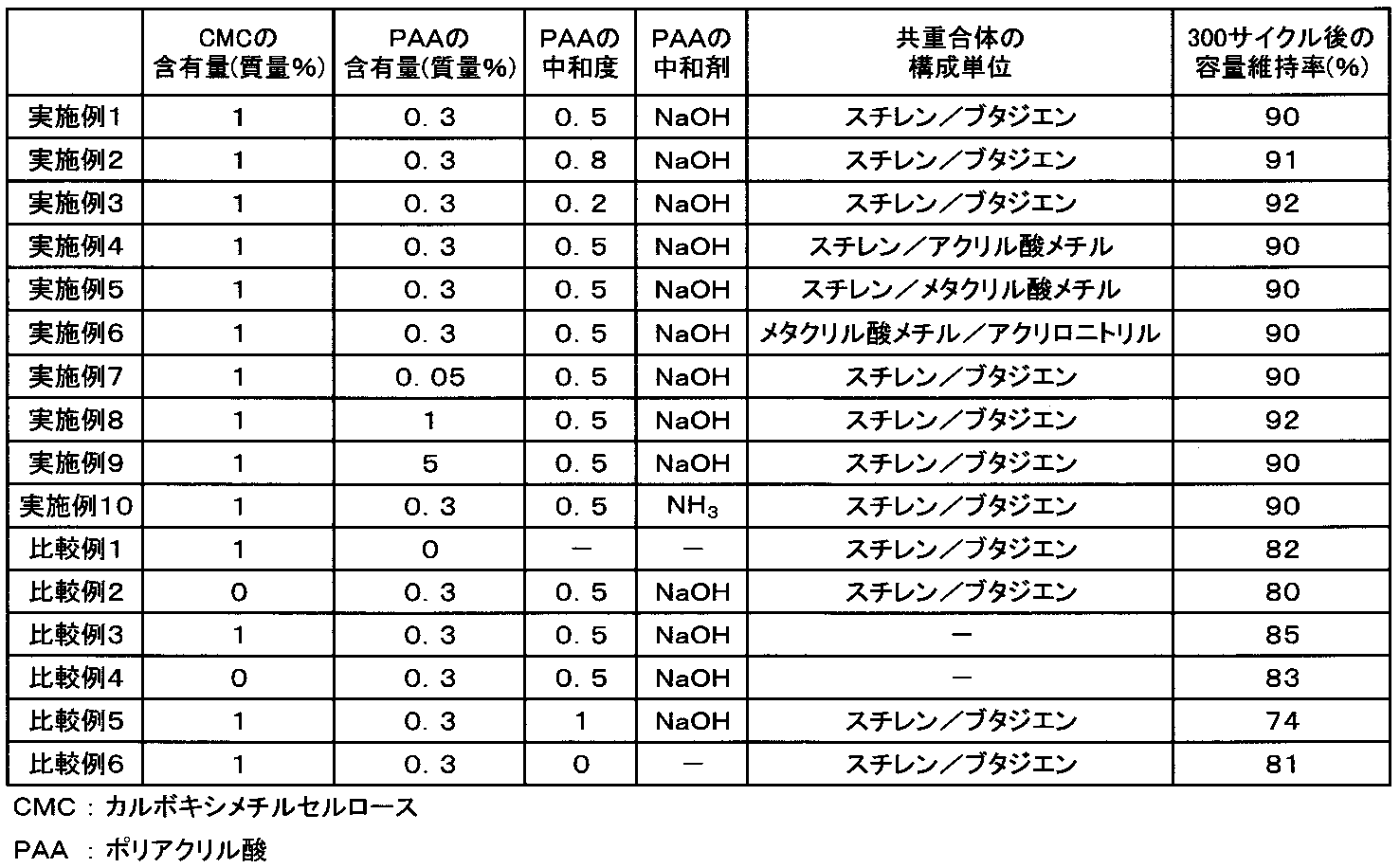
- Examples 1 to 10 all show a capacity retention rate of 90% or more.
- Comparative Examples 1 to 3 which do not contain any one of carboxymethyl cellulose, partially neutralized polyacrylic acid, and a copolymer, have a capacity retention rate of 85% or less. That is, even if any of these three elements is missing, the cycle characteristics are greatly deteriorated.
- Comparative Example 3 and Comparative Example 4 are compared, it can be seen that when the negative electrode plate does not contain a copolymer, the capacity retention rate hardly decreases even if carboxymethyl cellulose is missing. This result suggests that the cycle characteristics are improved by organic connection of the three elements of carboxymethylcellulose, partially neutralized polyacrylic acid, and copolymer.
- Comparative Example 5 having a polyacrylic acid neutralization degree of 1 and Comparative Example 6 having a polyacrylic acid neutralization degree of 0 are examples 1 to Compared to 3, the capacity maintenance rate is greatly reduced. This shows that it is important to partially neutralize the polyacrylic acid. However, in Examples 1 to 3, since there is almost no difference in capacity retention rate, polyacrylic acid partially neutralized so that the degree of neutralization is outside the range of 0.2 to 0.8 is used. However, the cycle characteristics are considered to be improved.
- the content of polyacrylic acid since there is almost no difference in capacity retention in Examples 1 and 7 to 8, the content of polyacrylic acid is 0.05 to 5 mass with respect to the negative electrode active material. Even if out of the range of%, the cycle characteristics are considered to be improved.
- Example 1 shows that the effect of the present invention is similarly exhibited even when ammonia is used instead of sodium hydroxide.
- a pouch-type exterior body made of a laminate sheet is used, but a metal exterior can can also be used.
- the outer can include a cylindrical outer can and a rectangular outer can.
- the present invention it is possible to provide a negative electrode plate for a non-aqueous electrolyte secondary battery having high capacity and excellent cycle characteristics, and a non-aqueous electrolyte secondary battery using the negative electrode plate. Therefore, the industrial applicability of the present invention is great.
Landscapes
- Chemical & Material Sciences (AREA)
- Chemical Kinetics & Catalysis (AREA)
- Electrochemistry (AREA)
- General Chemical & Material Sciences (AREA)
- Polymers & Plastics (AREA)
- Health & Medical Sciences (AREA)
- Medicinal Chemistry (AREA)
- Organic Chemistry (AREA)
- Materials Engineering (AREA)
- Inorganic Chemistry (AREA)
- Engineering & Computer Science (AREA)
- Battery Electrode And Active Subsutance (AREA)
- Secondary Cells (AREA)
Abstract
Description
(負極板の作製)
成型したコークスを焼成して黒鉛化した後、所定サイズに粉砕、分級して平均粒径が20μmの黒鉛を作製した。
素を粉砕、分級して粒度を調整した後、アルゴン雰囲気下で化学蒸着(CVD)法により酸化ケイ素表面に非晶質炭素を被覆した。非晶質炭素の被覆量は酸化ケイ素に対して5質量%とした。これを解砕、分級して平均粒径が10μmの酸化ケイ素を作製した。
炭酸コバルト(CoCO3)を550℃で熱分解させて四酸化三コバルト(Co3O4)を作製した。この四酸化三コバルトをリチウム源としての炭酸リチウムとコバルトとリチウムのモル比が1:1となるように秤量して、乳鉢で混合した。この混合物を空気雰囲気下において850℃で20時間焼成して、コバルト酸リチウム(LiCoO2)を作製した。得られたコバルト酸リチウムを乳鉢で平均粒径が15μmとなるまで粉砕して、正極活物質を作製した。
エチレンカーボネート(EC)とメチルエチルカーボネート(MEC)を体積比で30:70の割合で混合して非水溶媒を調製した。この非水溶媒にヘキサフルオロリン酸リチウム(LiPF6)を濃度が1mol/Lとなるように溶解し、さらにビニレンカーボネート(VC)とフルオロエチレンカーボネート(FEC)を添加して非水電解液を調製した。なお、ビニレンカーボネートとフルオロエチレンカーボネートの添加量はいずれも非水電解液質量に対して1質量%とした。
上記のようにして作製した負極板と正極板にそれぞれニッケル製の負極リード11とアルミニウム製の正極リード12を接続した。そして、ポリエチレン製微多孔膜からなるセパレータを介して扁平状に巻回して渦巻状の電極体を作製した。
ポリアクリル酸の中和度を0.8としたこと以外は実施例1と同様にして実施例2に係る非水電解質二次電池を作製した。
ポリアクリル酸の中和度を0.2としたこと以外は実施例1と同様にして実施例2に係る非水電解質二次電池を作製した。
共重合体の構成単位としてスチレンとアクリル酸メチルを用いたこと以外は実施例1と同様にして実施例4に係る非水電解質二次電池を作製した。
共重合体の構成単位としてスチレンとメタクリル酸メチルを用いたこと以外は実施例1と同様にして実施例5に係る非水電解質二次電池を作製した。
共重合体の構成単位としてメタクリル酸メチルとアクリロニトリルを用いたこと以外は実施例1と同様にして実施例6に係る非水電解質二次電池を作製した。
ポリアクリル酸の含有量を負極活物質に対して0.05質量%としたこと以外は実施例1と同様にして実施例7に係る非水電解質二次電池を作製した。
ポリアクリル酸の含有量を負極活物質に対して1質量%としたこと以外は実施例1と同様にして実施例8に係る非水電解質二次電池を作製した。
ポリアクリル酸の含有量を負極活物質に対して5質量%としたこと以外は実施例1と同様にして実施例9に係る非水電解質二次電池を作製した。
ポリアクリル酸をアンモニア(NH3)で中和したこと以外は実施例1と同様にして実施例10に係る非水電解質二次電池を作製した。
ポリアクリル酸を用いなかったこと以外は実施例1と同様にして比較例1に係る非水電解質二次電池を作製した。
カルボキシメチルセルロースを用いなかったこと以外は実施例1と同様にして比較例2に係る非水電解質二次電池を作製した。
共重合体を用いなかったこと以外は実施例1と同様にして比較例3に係る非水電解質二次電池を作製した。
カルボキシメチルセルロースと共重合体を用いなかったこと以外は実施例1と同様にして比較例4に係る非水電解質二次電池を作製した。
ポリアクリル酸の中和度を1としたこと以外は実施例1と同様にして比較例5に係る非水電解質二次電池を作製した。
ポリアクリル酸の中和度を0としたこと以外は実施例1と同様にして比較例6に係る非水電解質二次電池を作製した。
実施例1~10及び比較例1~6のそれぞれの電池について、次の条件でサイクル試験を行った。まず、電池を1It=800mAの定電流で電池電圧が4.4Vになるまで充電し、その後4.4Vの定電圧で電流が1/20It=40mAになるまで充電した。次いで、電池を1It=800mAの定電流で電池電圧が3.0Vになるまで放電した。このような充放電を25℃の環境下で300サイクル繰り返し、1サイクル目の放電容量と300サイクル目の放電容量を求めた。そして、以下の式から300サイクル後の容量維持率を算出した。その結果を表1にまとめて示す。
300サイクル後の容量維持率(%)
= (300サイクル目の放電容量/1サイクル目の放電容量)×100
11 負極リード
12 正極リード
13 ラミネート外装体
Claims (8)
- 炭素材料及び酸化ケイ素を含む負極活物質と、
カルボキシメチルセルロースと、
水酸化ナトリウム及びアンモニアの少なくとも一方で部分中和されたポリアクリル酸と、
スチレン、ブタジエン、アクリル酸メチル、メタクリル酸メチル、及びアクリロニトリルからなる群から選ばれる少なくとも2種以上を構成単位として含む共重合体と、
を備える非水電解質二次電池用負極板。 - 前記ポリアクリル酸の中和度が0.2以上0.8以下である請求項1に記載の非水電解質二次電池用負極板。
- 部分中和された前記ポリアクリル酸の含有量が、前記負極活物質に対して0.05質量%以上5質量%以下である請求項1に記載の非水電解質二次電池用負極板。
- 前記共重合体がスチレンとブタジエンを含む請求項1に記載の非水電解質二次電池用負極板。
- 前記部分中和されたポリアクリル酸の重量平均分子量が500000以上10000000以下である請求項1に記載の非水電解質二次電池用負極板。
- 前記酸化ケイ素は一般式SiOx(0.5≦x<1.6)で表される請求項1に記載の非水電解質二次電池用負極板。
- 前記酸化ケイ素の前記負極活物質中の含有量は0.5質量%以上20質量%以下である請求項1に記載の非水電解質二次電池用負極板。
- 請求項1から7のいずれかに記載の前記負極板と、正極板と、セパレータと、非水電解質と、外装体とを備える非水電解質二次電池。
Priority Applications (3)
| Application Number | Priority Date | Filing Date | Title |
|---|---|---|---|
| CN201680004893.4A CN107112502A (zh) | 2015-01-27 | 2016-01-18 | 非水电解质二次电池用负极板及使用该负极板的非水电解质二次电池 |
| JP2016571837A JPWO2016121322A1 (ja) | 2015-01-27 | 2016-01-18 | 非水電解質二次電池用負極板及びその負極板を用いた非水電解質二次電池 |
| US15/538,398 US20180013131A1 (en) | 2015-01-27 | 2016-01-18 | Negative electrode plate for nonaqueous electrolyte secondary battery and nonaqueous electrolyte secondary battery including negative electrode plate |
Applications Claiming Priority (2)
| Application Number | Priority Date | Filing Date | Title |
|---|---|---|---|
| JP2015013072 | 2015-01-27 | ||
| JP2015-013072 | 2015-01-27 |
Publications (1)
| Publication Number | Publication Date |
|---|---|
| WO2016121322A1 true WO2016121322A1 (ja) | 2016-08-04 |
Family
ID=56542947
Family Applications (1)
| Application Number | Title | Priority Date | Filing Date |
|---|---|---|---|
| PCT/JP2016/000218 Ceased WO2016121322A1 (ja) | 2015-01-27 | 2016-01-18 | 非水電解質二次電池用負極板及びその負極板を用いた非水電解質二次電池 |
Country Status (4)
| Country | Link |
|---|---|
| US (1) | US20180013131A1 (ja) |
| JP (1) | JPWO2016121322A1 (ja) |
| CN (1) | CN107112502A (ja) |
| WO (1) | WO2016121322A1 (ja) |
Cited By (9)
| Publication number | Priority date | Publication date | Assignee | Title |
|---|---|---|---|---|
| JP2018072544A (ja) * | 2016-10-28 | 2018-05-10 | 京セラドキュメントソリューションズ株式会社 | 静電潜像現像用トナー |
| WO2018096981A1 (ja) * | 2016-11-25 | 2018-05-31 | 出光興産株式会社 | 電気化学素子用バインダー |
| WO2018123751A1 (ja) * | 2016-12-28 | 2018-07-05 | パナソニックIpマネジメント株式会社 | 非水電解質二次電池 |
| WO2019131860A1 (ja) * | 2017-12-28 | 2019-07-04 | 昭和電工株式会社 | リチウムイオン二次電池用負極材 |
| JP2019145468A (ja) * | 2018-02-23 | 2019-08-29 | 東ソー株式会社 | リチウムイオン二次電池負極用バインダー及び負極材 |
| WO2019167611A1 (ja) | 2018-02-27 | 2019-09-06 | パナソニックIpマネジメント株式会社 | 非水電解質二次電池 |
| WO2019167610A1 (ja) | 2018-02-27 | 2019-09-06 | パナソニックIpマネジメント株式会社 | 非水電解質二次電池 |
| JP2020119855A (ja) * | 2019-01-28 | 2020-08-06 | 三菱ケミカル株式会社 | 非水系電解液電池 |
| JP7783325B2 (ja) | 2023-04-06 | 2025-12-09 | 寧徳新能源科技有限公司 | 二次電池及び電子装置 |
Families Citing this family (7)
| Publication number | Priority date | Publication date | Assignee | Title |
|---|---|---|---|---|
| CN108520958A (zh) * | 2018-03-12 | 2018-09-11 | 深圳市优特利电源有限公司 | 改性聚合物粘结剂、电极浆料和电极以及锂离子电池 |
| CN109698349A (zh) * | 2018-12-05 | 2019-04-30 | 上海空间电源研究所 | 适用于高容量硅基负极的粘结剂、负极及高比能锂离子电池的制备方法 |
| CN110137497B (zh) * | 2019-05-11 | 2021-05-25 | 珠海冠宇电池股份有限公司 | 一种负极粘结剂及其制备方法及锂离子电池 |
| CN110492103A (zh) * | 2019-08-19 | 2019-11-22 | 上海纳米技术及应用国家工程研究中心有限公司 | 一种锂离子电池硅碳负极粘结剂的制备方法及其产品和应用 |
| CN110828779B (zh) * | 2019-12-11 | 2022-08-23 | 东莞维科电池有限公司 | 一种锂离子电池负极片及其制备方法、锂离子电池 |
| WO2021131279A1 (ja) * | 2019-12-24 | 2021-07-01 | 昭和電工株式会社 | 非水系二次電池電極バインダー、及び非水系二次電池電極 |
| CN115050922B (zh) * | 2022-07-19 | 2023-06-30 | 深圳市研一新材料有限责任公司 | 一种水性粘结剂及其制备方法和应用 |
Citations (5)
| Publication number | Priority date | Publication date | Assignee | Title |
|---|---|---|---|---|
| JP2003282147A (ja) * | 2002-03-26 | 2003-10-03 | Toshiba Battery Co Ltd | リチウムイオン二次電池 |
| WO2014065407A1 (ja) * | 2012-10-26 | 2014-05-01 | 和光純薬工業株式会社 | リチウム電池用結着剤、電極作製用組成物および電極 |
| WO2014188734A1 (ja) * | 2013-05-23 | 2014-11-27 | 日本ゼオン株式会社 | 二次電池負極用スラリー組成物、二次電池用負極、および、二次電池 |
| WO2015098050A1 (ja) * | 2013-12-26 | 2015-07-02 | 日本ゼオン株式会社 | リチウムイオン二次電池負極用スラリー組成物、リチウムイオン二次電池用負極およびリチウムイオン二次電池 |
| JP2015198038A (ja) * | 2014-04-02 | 2015-11-09 | 信越化学工業株式会社 | 非水電解質二次電池用負極及び非水電解質二次電池 |
Family Cites Families (4)
| Publication number | Priority date | Publication date | Assignee | Title |
|---|---|---|---|---|
| JP2001250536A (ja) * | 2000-03-02 | 2001-09-14 | Matsushita Electric Ind Co Ltd | 非水電解液二次電池用負極板の製造法 |
| JP2008251523A (ja) * | 2007-03-06 | 2008-10-16 | Hitachi Chem Co Ltd | 非水電解液二次電池用負極材、非水電解液二次電池用負極及び非水電解液二次電池 |
| JP2009117309A (ja) * | 2007-11-09 | 2009-05-28 | Furukawa Battery Co Ltd:The | 非水電解液二次電池用負極材料、その製造方法及び非水電解液二次電池 |
| CN105027338B (zh) * | 2013-03-15 | 2017-03-15 | 日本瑞翁株式会社 | 二次电池用粘合剂组合物、二次电池用浆料组合物、二次电池用负极、以及二次电池 |
-
2016
- 2016-01-18 JP JP2016571837A patent/JPWO2016121322A1/ja active Pending
- 2016-01-18 WO PCT/JP2016/000218 patent/WO2016121322A1/ja not_active Ceased
- 2016-01-18 CN CN201680004893.4A patent/CN107112502A/zh active Pending
- 2016-01-18 US US15/538,398 patent/US20180013131A1/en not_active Abandoned
Patent Citations (5)
| Publication number | Priority date | Publication date | Assignee | Title |
|---|---|---|---|---|
| JP2003282147A (ja) * | 2002-03-26 | 2003-10-03 | Toshiba Battery Co Ltd | リチウムイオン二次電池 |
| WO2014065407A1 (ja) * | 2012-10-26 | 2014-05-01 | 和光純薬工業株式会社 | リチウム電池用結着剤、電極作製用組成物および電極 |
| WO2014188734A1 (ja) * | 2013-05-23 | 2014-11-27 | 日本ゼオン株式会社 | 二次電池負極用スラリー組成物、二次電池用負極、および、二次電池 |
| WO2015098050A1 (ja) * | 2013-12-26 | 2015-07-02 | 日本ゼオン株式会社 | リチウムイオン二次電池負極用スラリー組成物、リチウムイオン二次電池用負極およびリチウムイオン二次電池 |
| JP2015198038A (ja) * | 2014-04-02 | 2015-11-09 | 信越化学工業株式会社 | 非水電解質二次電池用負極及び非水電解質二次電池 |
Non-Patent Citations (2)
| Title |
|---|
| ZHEN-JI HAN ET AL.: "Kakushu Alkali-gen de Chuwa shita Polyacrylic Acid Binder o Mochiita Si Denkyoku no Denki Kagaku Tokusei", ABSTRACTS, BATTERY SYMPOSIUM IN JAPAN, vol. 52, 17 October 2011 (2011-10-17), pages 209 * |
| ZHEN-JI HAN ET AL.: "Koyoryo Si/Kokuen Fukugo Fukyoku-yo Binder no Sekkei", ABSTRACTS OF ANNUAL MEETING OF THE ELECTROCHEMICAL SOCIETY OF JAPAN, vol. 80, 29 March 2013 (2013-03-29), pages 221 * |
Cited By (14)
| Publication number | Priority date | Publication date | Assignee | Title |
|---|---|---|---|---|
| JP2018072544A (ja) * | 2016-10-28 | 2018-05-10 | 京セラドキュメントソリューションズ株式会社 | 静電潜像現像用トナー |
| WO2018096981A1 (ja) * | 2016-11-25 | 2018-05-31 | 出光興産株式会社 | 電気化学素子用バインダー |
| CN109997262A (zh) * | 2016-11-25 | 2019-07-09 | 出光兴产株式会社 | 电化学元件用粘结剂 |
| WO2018123751A1 (ja) * | 2016-12-28 | 2018-07-05 | パナソニックIpマネジメント株式会社 | 非水電解質二次電池 |
| US11923528B2 (en) | 2016-12-28 | 2024-03-05 | Panasonic Intellectual Property Management Co., Ltd. | Non-aqueous electrolyte secondary battery |
| JPWO2018123751A1 (ja) * | 2016-12-28 | 2019-10-31 | パナソニックIpマネジメント株式会社 | 非水電解質二次電池 |
| WO2019131860A1 (ja) * | 2017-12-28 | 2019-07-04 | 昭和電工株式会社 | リチウムイオン二次電池用負極材 |
| JP7009255B2 (ja) | 2018-02-23 | 2022-01-25 | 東ソー株式会社 | リチウムイオン二次電池負極用バインダー及び負極材 |
| JP2019145468A (ja) * | 2018-02-23 | 2019-08-29 | 東ソー株式会社 | リチウムイオン二次電池負極用バインダー及び負極材 |
| WO2019167611A1 (ja) | 2018-02-27 | 2019-09-06 | パナソニックIpマネジメント株式会社 | 非水電解質二次電池 |
| US11916237B2 (en) | 2018-02-27 | 2024-02-27 | Panasonic Intellectual Property Management Co., Ltd. | Non-aqueous electrolyte secondary battery |
| WO2019167610A1 (ja) | 2018-02-27 | 2019-09-06 | パナソニックIpマネジメント株式会社 | 非水電解質二次電池 |
| JP2020119855A (ja) * | 2019-01-28 | 2020-08-06 | 三菱ケミカル株式会社 | 非水系電解液電池 |
| JP7783325B2 (ja) | 2023-04-06 | 2025-12-09 | 寧徳新能源科技有限公司 | 二次電池及び電子装置 |
Also Published As
| Publication number | Publication date |
|---|---|
| US20180013131A1 (en) | 2018-01-11 |
| CN107112502A (zh) | 2017-08-29 |
| JPWO2016121322A1 (ja) | 2017-11-02 |
Similar Documents
| Publication | Publication Date | Title |
|---|---|---|
| JPWO2016121322A1 (ja) | 非水電解質二次電池用負極板及びその負極板を用いた非水電解質二次電池 | |
| JP5574404B2 (ja) | リチウムイオン二次電池 | |
| KR101463114B1 (ko) | 음극 활물질, 그 제조 방법 및 이를 채용한 음극과 리튬전지 | |
| US20140065489A1 (en) | Electrolyte-negative electrode structure, and lithium ion secondary battery comprising the same | |
| CN103337617A (zh) | 正极活性材料以及包括其的正极和锂离子二次电池 | |
| JP6052179B2 (ja) | リチウムイオン二次電池 | |
| WO2014010476A1 (ja) | リチウム二次電池用電極およびその製造方法並びにリチウム二次電池およびその製造方法 | |
| CN105280880A (zh) | 非水电解质二次电池用正极、非水电解质二次电池以及其系统 | |
| CN102315441A (zh) | 正极活性物质、制造该正极活性物质的方法和锂二次电池 | |
| WO2013099279A1 (ja) | 非水電解質二次電池用負極および非水電解質二次電池用負極を有する非水電解質二次電池 | |
| JPWO2014147983A1 (ja) | 非水電解質二次電池 | |
| CN102780027B (zh) | 二次电池、电子装置、电动工具和电动车辆 | |
| KR20180014956A (ko) | 리튬이차전지용 리튬 코발트 복합 산화물 및 이를 포함한 양극을 함유한 리튬이차전지 | |
| JP5836601B2 (ja) | 非水電解質二次電池 | |
| KR20140093877A (ko) | 리튬 이차 전지용 음극 및 이의 제조 방법, 및 이를 포함하는 리튬 이차 전지 | |
| US10170760B2 (en) | Lithium ion secondary battery | |
| CN109075383B (zh) | 锂离子二次电池及电池组 | |
| JP3579280B2 (ja) | 非水電解液二次電池用負極およびこの負極を備えた非水電解液二次電池 | |
| WO2014136794A1 (ja) | リチウム二次電池 | |
| JP5586116B2 (ja) | リチウム二次電池用の正極合材およびその使用 | |
| WO2020065833A1 (ja) | 二次電池 | |
| CN111864196A (zh) | 锂二次电池 | |
| CN105009349B (zh) | 锂二次电池 | |
| JP2014049292A (ja) | リチウムイオン二次電池用非水電解液及びリチウムイオン二次電池 | |
| JP5189466B2 (ja) | リチウム二次電池 |
Legal Events
| Date | Code | Title | Description |
|---|---|---|---|
| 121 | Ep: the epo has been informed by wipo that ep was designated in this application |
Ref document number: 16742927 Country of ref document: EP Kind code of ref document: A1 |
|
| ENP | Entry into the national phase |
Ref document number: 2016571837 Country of ref document: JP Kind code of ref document: A |
|
| WWE | Wipo information: entry into national phase |
Ref document number: 15538398 Country of ref document: US |
|
| NENP | Non-entry into the national phase |
Ref country code: DE |
|
| 122 | Ep: pct application non-entry in european phase |
Ref document number: 16742927 Country of ref document: EP Kind code of ref document: A1 |