WO2016111091A1 - 両面金属積層フィルム - Google Patents
両面金属積層フィルム Download PDFInfo
- Publication number
- WO2016111091A1 WO2016111091A1 PCT/JP2015/082527 JP2015082527W WO2016111091A1 WO 2016111091 A1 WO2016111091 A1 WO 2016111091A1 JP 2015082527 W JP2015082527 W JP 2015082527W WO 2016111091 A1 WO2016111091 A1 WO 2016111091A1
- Authority
- WO
- WIPO (PCT)
- Prior art keywords
- film
- layer
- double
- coating
- polyester
- Prior art date
- Legal status (The legal status is an assumption and is not a legal conclusion. Google has not performed a legal analysis and makes no representation as to the accuracy of the status listed.)
- Ceased
Links
Classifications
-
- B—PERFORMING OPERATIONS; TRANSPORTING
- B32—LAYERED PRODUCTS
- B32B—LAYERED PRODUCTS, i.e. PRODUCTS BUILT-UP OF STRATA OF FLAT OR NON-FLAT, e.g. CELLULAR OR HONEYCOMB, FORM
- B32B15/00—Layered products comprising a layer of metal
- B32B15/04—Layered products comprising a layer of metal comprising metal as the main or only constituent of a layer, which is next to another layer of the same or of a different material
- B32B15/08—Layered products comprising a layer of metal comprising metal as the main or only constituent of a layer, which is next to another layer of the same or of a different material of synthetic resin
-
- B—PERFORMING OPERATIONS; TRANSPORTING
- B32—LAYERED PRODUCTS
- B32B—LAYERED PRODUCTS, i.e. PRODUCTS BUILT-UP OF STRATA OF FLAT OR NON-FLAT, e.g. CELLULAR OR HONEYCOMB, FORM
- B32B15/00—Layered products comprising a layer of metal
- B32B15/04—Layered products comprising a layer of metal comprising metal as the main or only constituent of a layer, which is next to another layer of the same or of a different material
- B32B15/08—Layered products comprising a layer of metal comprising metal as the main or only constituent of a layer, which is next to another layer of the same or of a different material of synthetic resin
- B32B15/09—Layered products comprising a layer of metal comprising metal as the main or only constituent of a layer, which is next to another layer of the same or of a different material of synthetic resin comprising polyesters
-
- C—CHEMISTRY; METALLURGY
- C08—ORGANIC MACROMOLECULAR COMPOUNDS; THEIR PREPARATION OR CHEMICAL WORKING-UP; COMPOSITIONS BASED THEREON
- C08J—WORKING-UP; GENERAL PROCESSES OF COMPOUNDING; AFTER-TREATMENT NOT COVERED BY SUBCLASSES C08B, C08C, C08F, C08G or C08H
- C08J7/00—Chemical treatment or coating of shaped articles made of macromolecular substances
- C08J7/04—Coating
- C08J7/043—Improving the adhesiveness of the coatings per se, e.g. forming primers
-
- B—PERFORMING OPERATIONS; TRANSPORTING
- B32—LAYERED PRODUCTS
- B32B—LAYERED PRODUCTS, i.e. PRODUCTS BUILT-UP OF STRATA OF FLAT OR NON-FLAT, e.g. CELLULAR OR HONEYCOMB, FORM
- B32B15/00—Layered products comprising a layer of metal
- B32B15/20—Layered products comprising a layer of metal comprising aluminium or copper
-
- B—PERFORMING OPERATIONS; TRANSPORTING
- B32—LAYERED PRODUCTS
- B32B—LAYERED PRODUCTS, i.e. PRODUCTS BUILT-UP OF STRATA OF FLAT OR NON-FLAT, e.g. CELLULAR OR HONEYCOMB, FORM
- B32B27/00—Layered products comprising a layer of synthetic resin
- B32B27/16—Layered products comprising a layer of synthetic resin specially treated, e.g. irradiated
-
- B—PERFORMING OPERATIONS; TRANSPORTING
- B32—LAYERED PRODUCTS
- B32B—LAYERED PRODUCTS, i.e. PRODUCTS BUILT-UP OF STRATA OF FLAT OR NON-FLAT, e.g. CELLULAR OR HONEYCOMB, FORM
- B32B27/00—Layered products comprising a layer of synthetic resin
- B32B27/36—Layered products comprising a layer of synthetic resin comprising polyesters
-
- C—CHEMISTRY; METALLURGY
- C08—ORGANIC MACROMOLECULAR COMPOUNDS; THEIR PREPARATION OR CHEMICAL WORKING-UP; COMPOSITIONS BASED THEREON
- C08J—WORKING-UP; GENERAL PROCESSES OF COMPOUNDING; AFTER-TREATMENT NOT COVERED BY SUBCLASSES C08B, C08C, C08F, C08G or C08H
- C08J7/00—Chemical treatment or coating of shaped articles made of macromolecular substances
- C08J7/04—Coating
- C08J7/044—Forming conductive coatings; Forming coatings having anti-static properties
-
- C—CHEMISTRY; METALLURGY
- C08—ORGANIC MACROMOLECULAR COMPOUNDS; THEIR PREPARATION OR CHEMICAL WORKING-UP; COMPOSITIONS BASED THEREON
- C08J—WORKING-UP; GENERAL PROCESSES OF COMPOUNDING; AFTER-TREATMENT NOT COVERED BY SUBCLASSES C08B, C08C, C08F, C08G or C08H
- C08J7/00—Chemical treatment or coating of shaped articles made of macromolecular substances
- C08J7/04—Coating
- C08J7/046—Forming abrasion-resistant coatings; Forming surface-hardening coatings
-
- H—ELECTRICITY
- H05—ELECTRIC TECHNIQUES NOT OTHERWISE PROVIDED FOR
- H05K—PRINTED CIRCUITS; CASINGS OR CONSTRUCTIONAL DETAILS OF ELECTRIC APPARATUS; MANUFACTURE OF ASSEMBLAGES OF ELECTRICAL COMPONENTS
- H05K1/00—Printed circuits
- H05K1/02—Details
- H05K1/03—Use of materials for the substrate
-
- H—ELECTRICITY
- H05—ELECTRIC TECHNIQUES NOT OTHERWISE PROVIDED FOR
- H05K—PRINTED CIRCUITS; CASINGS OR CONSTRUCTIONAL DETAILS OF ELECTRIC APPARATUS; MANUFACTURE OF ASSEMBLAGES OF ELECTRICAL COMPONENTS
- H05K3/00—Apparatus or processes for manufacturing printed circuits
- H05K3/38—Improvement of the adhesion between the insulating substrate and the metal
-
- B—PERFORMING OPERATIONS; TRANSPORTING
- B32—LAYERED PRODUCTS
- B32B—LAYERED PRODUCTS, i.e. PRODUCTS BUILT-UP OF STRATA OF FLAT OR NON-FLAT, e.g. CELLULAR OR HONEYCOMB, FORM
- B32B2255/00—Coating on the layer surface
- B32B2255/10—Coating on the layer surface on synthetic resin layer or on natural or synthetic rubber layer
-
- B—PERFORMING OPERATIONS; TRANSPORTING
- B32—LAYERED PRODUCTS
- B32B—LAYERED PRODUCTS, i.e. PRODUCTS BUILT-UP OF STRATA OF FLAT OR NON-FLAT, e.g. CELLULAR OR HONEYCOMB, FORM
- B32B2255/00—Coating on the layer surface
- B32B2255/26—Polymeric coating
-
- B—PERFORMING OPERATIONS; TRANSPORTING
- B32—LAYERED PRODUCTS
- B32B—LAYERED PRODUCTS, i.e. PRODUCTS BUILT-UP OF STRATA OF FLAT OR NON-FLAT, e.g. CELLULAR OR HONEYCOMB, FORM
- B32B2311/00—Metals, their alloys or their compounds
- B32B2311/12—Copper
Definitions
- the present invention relates to a double-sided metal laminated film in which a patterned metal layer is laminated, and has good adhesion to the metal layer, patterning of the metal layer, and the shape of the pattern, especially for flexible double-sided circuit boards,
- the present invention relates to a film suitable for a structural member for a touch panel (for example, a conductive film).
- polyester films have been used in various fields by taking advantage of their mechanical properties, optical properties, dimensional stability and the like.
- a flexible substrate application is exemplified.
- the thickness of the flexible double-sided printed wiring board itself is studied to be 20 ⁇ m or less. Yes.
- Patent Document 1 describes a double-sided metal laminate film having a three-layer metal laminate film structure in which a copper foil is bonded to an insulating film via an adhesive.
- Patent Document 2 has a description of forming a copper coating layer having a uniform thickness on an insulating film by electroplating.
- a metal other than copper such as chromium, chromium oxide, or nickel
- the base metal layer is made of, for example, about 50 to 200 mm so as to have a predetermined thickness, and then a thin copper layer by dry plating and an electroless copper plating film by electroless plating are sequentially formed. Consists of methods.
- Patent Document 3 as a material for a flexible double-sided printed wiring board, even in a two-layer metal laminated film, the adhesion between the insulating film and the base metal layer was insufficient. Therefore, the base layer interposed between the insulating film and the metal layer is required to have good adhesion to the insulating film and good adhesion to the metal layer laminated on the base layer. ing.
- the polyester film base material is usually blended with particles for the main purpose of imparting slipperiness and preventing scratches in each process. If more particles are added and the surface roughness of the polyester film substrate is designed to be high, the handling properties during processing of the substrate will increase, but there will be particle aggregates in the pattern part of the metal laminate film In addition, defects in patterning failure of the metal laminated film frequently occur.
- the polyester film substrate has a shrinkage characteristic that shrinks after heating.
- Highly sensitive wiring board that has a tendency that the shape of the patterned metal layer is distorted due to shrinkage difference ( ⁇ S) between the film running direction (MD) and the direction (TD) perpendicular thereto, and the response of the wiring board tends to decrease. It is extremely difficult to process a good patterned metal laminate film.
- JP-A-6-132628 Japanese Patent Laid-Open No. 8-139448 JP-A-6-120630 JP 2014-53410 A
- the present invention has been made in view of the above-described circumstances, and the problem to be solved is that the adhesion to the metal layer is good, the step of laminating the metal film, and the heating after the patterning of the laminated metal layer Inhibition of oligomer precipitation that occurs during heat treatment at a temperature of about 150 ° C. or 180 ° C. in the process, and heat shrinkage at 150 ° C.
- the object is to provide a patterned metal laminated film that does not cause defects due to poor patterning and distortion of the shape of the patterned metal layer.
- the gist of the present invention is that the polyester film has a coating layer formed from a coating solution containing a quaternary ammonium base-containing compound, a polyethylene glycol-containing acrylate polymer, and a crosslinking agent on both sides of the polyester film.
- the present invention resides in a double-sided metal laminate film in which metal layers are laminated.
- the film is exposed to a high temperature atmosphere for a long time, such as 150 ° C., 90 minutes, or 180 ° C., 60 minutes.
- a high temperature atmosphere such as 150 ° C., 90 minutes, or 180 ° C., 60 minutes.
- the increase in film haze is as small as possible, the adhesion between the polyester film and the coating layer, the adhesion between the metal layer and the coating layer is good, and the patterning of the metal laminate film is delicate, and the pattern width is designed to be narrower Even when it is used for a type that has been designed, there will be no defects such as patterning defects, the response of the wiring board will be highly accurate, and even when a highly sensitive wiring board is used for a type that has been designed, it will be patterned.
- a double-sided metal laminate film that does not suffer from defects due to the shape distortion of the formed metal layer can be provided, for example, a flexible double-sided circuit board or a touch Channel Configuration member (e.g., a conductive film) is suitable as, its industrial value is very high.
- a touch Channel Configuration member e.g., a conductive film
- the polyester film in the present invention may have a single layer structure or a multilayer structure, and may have a multilayer structure of four layers or more as long as the gist of the present invention is not exceeded other than the two-layer or three-layer structure.
- Well not particularly limited.
- Polyester can be obtained by polycondensation of aromatic dicarboxylic acid and aliphatic glycol.
- aromatic dicarboxylic acid include terephthalic acid and 2,6-naphthalenedicarboxylic acid
- aliphatic glycol include ethylene glycol, diethylene glycol, and 1,4-cyclohexanedimethanol.
- Typical polyesters include polyethylene terephthalate (PET), polyethylene-2,6-naphthalene dicarboxylate (PEN) and the like.
- the polyester may be a homopolyester or a copolyester.
- a copolyester it is a copolymer containing 30 mol% or less of the third component.
- the dicarboxylic acid component of the copolyester include isophthalic acid, phthalic acid, terephthalic acid, 2,6-naphthalenedicarboxylic acid, adipic acid, sebacic acid, and one kind of oxycarboxylic acid (for example, P-oxybenzoic acid).
- glycol component examples include one or more types such as ethylene glycol, diethylene glycol, propylene glycol, butanediol, 1,4-cyclohexanedimethanone neopentyl glycol.
- Ti titanium compound
- P phosphorus compound
- Ti it is more preferably in the range of 2 to 10 ppm.
- Ti exceeds the upper limit of the above formula (1), an oligomer is by-produced in the step of melt-extruding polyester, and a film having low oligomer and high transparency may not be obtained.
- it may be difficult to cope with applications such as optical applications, in particular, where the color tone of the coated film is important.
- P is more preferably in the range of 5 to 200 ppm, particularly preferably 0 to 100 ppm.
- P exceeds the upper limit of the formula (2), gelation occurs at the time of polyester production, and it becomes a foreign substance to deteriorate the quality of the film. For example, it is difficult to cope with an inspection process involving optical evaluation such as a touch panel application. May be.
- the layer containing the titanium compound and the phosphorus compound preferably contains substantially no antimony element, usually 10 ppm or less, preferably 5 ppm or less, most preferably substantially free, ie 1 ppm or less. It is. If the amount of the antimony element is too large, it may be reduced by the phosphorus compound during melt extrusion and aggregate to cause foreign matters, or the film may become dark and the transparency may be insufficient.
- the polyester constituting the layer containing the titanium compound and the phosphorus compound within the above-mentioned range may be obtained by a melt polymerization reaction, but is obtained by solid-phase polymerization of the chipped polyester after the melt polymerization. If the raw material used is used, the amount of oligomer contained in the raw material can be reduced, so that it is preferably used.
- the amount of the oligomer contained in the layer containing the titanium compound and the phosphorus compound within the above range is usually 0.7% by weight or less, preferably 0.5% by weight or less.
- the present invention may be a film having a structure obtained by coextrusion laminating a polyester having a low oligomer content on the surface of at least one side of a layer composed of a polyester having a normal oligomer content.
- the effect of suppressing oligomer precipitation obtained in the present invention can be exhibited to a high degree.
- the maximum roughness (St) of the film surface is preferably in the range of 10 to 100 nm on each surface, more preferably 10 to 50 nm.
- the maximum roughness (St) is less than 10 nm, the film surface becomes too smooth, and there is a tendency that scratches frequently occur in the multilayer polyester film forming process.
- the thickness exceeds 100 nm, the frequency of occurrence of disconnection of the wiring in the crystallizing process of the transparent conductive layer, particularly in a very thinly patterned portion having a wiring width of 4 ⁇ m or less on the patterned transparent conductive film.
- the coated film is bonded to a laminated body through an adhesive, the haze of the laminated body is greatly increased, which may be inappropriate for optical members in terms of optical characteristics or visibility.
- particles having an average particle size of 0.1 to 0.6 ⁇ m may be blended in both outer layers having a multilayer structure for the main purpose of imparting slipperiness and preventing scratches in each step. preferable.
- the particles to be blended are preferably only one type, and are not particularly limited as long as they can impart slipperiness. Specific examples include silica, calcium carbonate, magnesium carbonate, barium carbonate, calcium sulfate, calcium phosphate. And particles of magnesium phosphate, kaolin, aluminum oxide, titanium oxide and the like. Further, the heat-resistant organic particles described in JP-B-59-5216, JP-A-59-217755 and the like may be used. Examples of other heat-resistant organic particles include thermosetting urea resins, thermosetting phenol resins, thermosetting epoxy resins, benzoguanamine resins, and the like. Furthermore, precipitated particles obtained by precipitating and finely dispersing a part of a metal compound such as a catalyst during the polyester production process can also be used.
- the shape of the particles to be used is not particularly limited, and any of a spherical shape, a block shape, a rod shape, a flat shape, and the like may be used. Moreover, there is no restriction
- the particle content in both outer layers is usually 0.05 to 1.0% by weight, preferably 0.05 to 0.5% by weight.
- the slipperiness of the film may be insufficient, and as a result, appearance defects such as scratches may occur during film processing.
- film transparency may be inadequate.
- the outermost polyester layer constituting the multilayer polyester film it is preferable to use aluminum oxide particles in the outermost polyester layer constituting the multilayer polyester film for the purpose of preventing scratches or imparting slipperiness.
- the average particle diameter of the aluminum oxide particles is out of the above range, the damage preventing effect or the slipperiness may be poor.
- the aluminum oxide particles include ⁇ -type and ⁇ -type aluminum oxide produced by flame hydrolysis using anhydrous aluminum chloride as a raw material.
- the method for adding particles to the polyester is not particularly limited, and a conventionally known method can be adopted.
- it can be added at any stage for producing the polyester constituting each layer, but it is preferably added after completion of esterification or transesterification.
- a method of blending a slurry of particles dispersed in ethylene glycol or water with a vented kneading extruder and a polyester raw material, or a blending of dried particles and a polyester raw material using a kneading extruder is done by methods.
- the thickness of the polyester film is not particularly limited as long as it can be formed as a film, but is usually in the range of 9 to 80 ⁇ m.
- polyester film Next, a production example of the polyester film will be specifically described, but is not limited to the following production example.
- a method in which the polyester raw material described above is used and the molten sheet extruded from the die is cooled and solidified with a cooling roll to obtain an unstretched sheet is preferable.
- the obtained unstretched sheet is stretched in the biaxial direction.
- the unstretched sheet is stretched in one direction by a roll or a tenter type stretching machine.
- the stretching temperature is usually 70 to 120 ° C., preferably 80 to 110 ° C., and the stretching ratio is usually 2.5 to 7 times, preferably 3.0 to 6 times.
- the stretching temperature orthogonal to the first-stage stretching direction is usually 70 to 170 ° C., and the draw ratio is usually 3.0 to 7 times, preferably 3.5 to 6 times.
- heat treatment is performed at a temperature of 180 to 270 ° C. under tension or relaxation within 30% to obtain a biaxially oriented film.
- the simultaneous biaxial stretching method can also be adopted for polyester film production.
- the simultaneous biaxial stretching method is a method in which the unstretched sheet is usually stretched and oriented simultaneously in the machine direction and the width direction in a state where the temperature is controlled at 70 to 120 ° C, preferably 80 to 110 ° C.
- the area magnification is 4 to 50 times, preferably 7 to 35 times, and more preferably 10 to 25 times.
- heat treatment is performed at a temperature of 170 to 250 ° C. under tension or under relaxation within 30% to obtain a stretched oriented film.
- a conventionally known stretching method such as a screw method, a pantograph method, or a linear driving method can be employed.
- the polyester film having a multilayer structure imparts functions such as adhesiveness, antistatic property, slipperiness and releasability to the film during the stretching process and / or to the subsequent film as long as the gist of the present invention is not impaired.
- surface treatment such as corona treatment may be applied to the film surface.
- the coating layer in the present invention may be provided by in-line coating, which treats the film surface during the process of forming a polyester film, or may employ off-line coating which is applied outside the system on a once produced film. . Since the coating can be performed simultaneously with the film formation, the production can be handled at a low cost, and therefore in-line coating is preferably used.
- Coating layer is additive such as surfactant, antifoaming agent, coatability improver, thickener, organic lubricant, organic particles, inorganic particles, antioxidant, UV absorber, foaming agent, dye, pigment, etc. May contain
- the coating layer must contain a quaternary ammonium base-containing compound in order to reduce an increase in the amount of oligomer precipitation due to thermal damage to the coating layer from the outside.
- compounds having a quaternary ammonium base those having a component containing a quaternary ammonium base in the main chain or side chain in the molecule are targeted.
- Specific examples include pyrrolidinium ring, quaternized alkylamine, further copolymerized with acrylic acid or methacrylic acid, quaternized N-alkylaminoacrylamide, vinylbenzyltrimethylammonium salt, 2-hydroxy-3- And methacryloxypropyltrimethylammonium salt.
- these may be combined or copolymerized with other binder polymers.
- examples of anions that serve as counter ions of these quaternary ammonium salts include ions such as halogen, alkyl sulfate, alkyl sulfonate, and nitric acid.
- counterions other than halogen are preferable in that heat resistance is particularly good.
- the compound having a quaternary ammonium base is preferably a polymer compound. If the molecular weight is too low, it may be easily removed from the coating layer and the performance may deteriorate over time, or problems such as blocking of the coating layer may occur. Moreover, when the molecular weight is low, the heat resistance stability may be inferior.
- the number average molecular weight of the compound having a quaternary ammonium base is usually 1000 or more, preferably 2000 or more, and more preferably 5000 or more.
- the upper limit of the number average molecular weight is 500,000 or less.
- these compounds may be used independently and may be used in combination of 2 or more types.
- the content of the quaternary ammonium base-containing compound is usually in the range of 20 to 70% by weight, preferably 40 to 70% by weight, based on the total solid content in the coating solution forming the coating layer. When it is out of the range, it may be difficult to obtain a desired oligomer sealing effect.
- the coating layer must contain a polyethylene glycol-containing acrylate polymer for the purpose of improving the stretch followability at the time of forming the coating layer by ensuring higher coating properties than before.
- polyethylene glycol monoacrylate, polypropylene glycol monoacrylate, polyethylene glycol diacrylate (the polymerization degree of polyethylene glycol units is preferably in the range of 4 to 14), polypropylene glycol diacrylate, polytetramethylene glycol diacrylate, poly (Ethylene glycol-tetramethylene glycol) diacrylate, poly (propylene glycol-tetramethylene glycol) diacrylate, polyethylene glycol-polypropylene glycol-polyethylene glycol diacrylate, polypropylene glycol-polybutylene glycol monomethacrylate, methoxypolyethylene glycol monomethacrylate, methoxy Polyethylene glycol monoacrylate Octoxypolyethylene glycol-polypropylene glycol monomethacrylate, octoxypolyethyleneglycol-polypropyleneglycol monoacrylate, lauroxypolyethyleneglycol monomethacrylate, lauroxypolyethyleneglycolmonoacrylate,
- the number average molecular weight of the polyethylene glycol-containing acrylate polymer is usually 1000 or more, preferably 2000 or more, and more preferably 5000 or more.
- the upper limit of the number average molecular weight is 500,000 or less.
- chain length of the alkyl chain of the polyethylene glycol-containing alkyl acrylate polymer is not particularly limited as long as it can be polymerized as a polymer.
- the content of the polyethylene glycol-containing polymer is usually in the range of 5 to 40% by weight, preferably 20 to 30% by weight, as a percentage of the total solid content in the coating solution forming the coating layer. When it is out of the range, problems such as insufficient stretch followability when forming the coating layer may occur.
- the quaternary ammonium base-containing compound and the polyethylene glycol-containing acrylate polymer may be a mixture, may be copolymerized in advance, and are not particularly limited as long as they do not impair the gist of the present invention. is not. Moreover, when making it copolymerize, a conventionally well-known manufacturing method can be used.
- the coating layer needs to be used in combination with a crosslinking agent for the purpose of further improving the durability of the coating layer.
- Specific examples include methylolated or alkylolized urea, melamine, guanamine, acrylamide, polyamide compound, epoxy compound, aziridine compound, block polyisocyanate, titanium coupling agent, zirco-aluminate coupling agent, polycarbodiimide and the like. It is done.
- melamine cross-linking agents are preferred in terms of good coating properties and durable adhesion, particularly for the purposes of the present invention.
- the melamine crosslinking agent is not particularly limited, but melamine, a methylolated melamine derivative obtained by condensing melamine and formaldehyde, a compound partially or completely etherified by reacting methylolated melamine with a lower alcohol, And a mixture thereof can be used.
- the melamine crosslinking agent may be either a monomer or a condensate composed of a dimer or higher polymer, or a mixture thereof.
- the lower alcohol used for the etherification methyl alcohol, ethyl alcohol, isopropyl alcohol, n-butanol, isobutanol and the like can be preferably used.
- the functional group has an imino group, a methylol group, or an alkoxymethyl group such as a methoxymethyl group or a butoxymethyl group in one molecule, and an imino group type methylated melamine, a methylol group type melamine, or a methylol group type methylated group.
- Melamine fully alkyl methylated melamine and the like can be used. Of these, methylolated melamine is most preferred. Furthermore, an acidic catalyst such as p-toluenesulfonic acid can be used in combination for the purpose of promoting the thermal curing of the melamine crosslinking agent.
- the content of the crosslinking agent is usually in the range of 10 to 60% by weight, preferably 20 to 50% by weight, based on the total solid content in the coating solution forming the coating layer. When it is out of the range, the durability adhesion of the coating layer to the metal layer may be insufficient.
- the coating layer contains particles for the purpose of improving adhesion and slipperiness.
- particles include silica, alumina, kaolin, calcium carbonate, titanium oxide, barium salt and the like.
- the content of the particles is usually in the range of 0.5 to 10% by weight, preferably 1 to 5% by weight, based on the total solid content in the coating solution forming the coating layer. If the blending amount is less than 0.5% by weight, the blocking resistance may be insufficient. On the other hand, if it exceeds 10% by weight, the transparency of the film may be lowered.
- an antifoaming agent a coating property improver, a thickener, an organic lubricant, an organic polymer particle, an antioxidant, an ultraviolet ray is included in the coating layer as necessary.
- Absorbent blowing agents, dyes and the like may be contained.
- the above-mentioned series of compounds is applied as an aqueous solution or aqueous dispersion, and the coating solution adjusted to a solid content concentration of about 0.1 to 50% by weight as a guide is applied onto the polyester film. It is preferable to produce a laminated polyester film.
- the coating solution may contain a small amount of an organic solvent for the purpose of improving the dispersibility in water, improving the film forming property, and the like.
- organic solvent include aliphatic or alicyclic alcohols such as n-butyl alcohol, n-propyl alcohol, isopropyl alcohol, ethyl alcohol and methyl alcohol, glycols such as propylene glycol, ethylene glycol and diethylene glycol, n-butyl cellosolve, Glycol derivatives such as ethyl cellosolve, methyl cellosolve, propylene glycol monomethyl ether, ethers such as dioxane and tetrahydrofuran, esters such as ethyl acetate and amyl acetate, ketones such as methyl ethyl ketone and acetone, and amides such as N-methylpyrrolidone Can be mentioned. Only one type of organic solvent may
- the coating amount of the coating layer (after drying) is usually in the range of 0.005 to 1 g / m 2 , preferably 0.005 to 0.5 g / m 2 , more preferably 0.005 to 0.1 g / m 2 . is there.
- the coating amount is less than 0.005 g / m 2 , the uniformity of coating thickness may be insufficient, and the amount of oligomer deposited from the coating layer surface after heat treatment may increase.
- problems such as a decrease in slipperiness may occur.
- the coating layer is used in combination with a binder polymer such as a polyester resin, an acrylic resin, a polyurethane resin, or polyvinyl alcohol within the range not impairing the gist of the present invention for the purpose of improving the coating appearance and improving the oligomer precipitation prevention property. It is also possible to do.
- a binder polymer such as a polyester resin, an acrylic resin, a polyurethane resin, or polyvinyl alcohol within the range not impairing the gist of the present invention for the purpose of improving the coating appearance and improving the oligomer precipitation prevention property. It is also possible to do.
- coating method of the coating liquid conventionally known coating methods such as reverse gravure coating, direct gravure coating, roll coating, die coating, bar coating, curtain coating, spray coating, and the like can be used.
- coating method there is a description example in “Coating method” published by Yoji Harasaki, published in 1979.
- the double-sided metal laminated film of the present invention may require a high degree of transparency even after being exposed to a high temperature atmosphere for a long time, for example, for touch panels.
- the film haze change rate (heating haze, ⁇ H) before and after the heat treatment (150 ° C., 90 minutes) is usually 0.5% or less, preferably 0.3% or less in order to correspond as a touch panel member. More preferably, it is 0.1% or less.
- ⁇ H exceeds 0.5%, the visibility decreases as the film haze increases, and may be inappropriate for applications that require high visibility, such as for touch panels.
- (DELTA) H is low.
- a double-sided metal laminated film satisfying the above characteristic values can be obtained by using a double-sided coated film satisfying the above characteristic values.
- the amount (OL) of oligomer (cyclic trimer) extracted with dimethylformamide from the coating layer surface (one side) before and after heat treatment is usually 0.5 mg / m 2 or less, preferably 0.4 mg / m 2 or less.
- the amount of oligomer precipitation is increased in a post-processing, for example, a heat treatment step such as a sputtering step, for example, in a high-temperature atmosphere such as 180 ° C. for 60 minutes. In some cases, the transparency of the film decreases.
- a double-sided metal laminated film satisfying the above characteristic values can be obtained by using a double-sided coated film satisfying the above characteristic values.
- the patterning of the metal layer film has become delicate due to the oligomer precipitation that occurs when heat treatment is performed at a temperature of about 150 ° C. or 180 ° C. in the process of laminating the metal film, and the pattern width is designed to be narrower Has a problem that a defect such as a patterning failure occurs.
- the present inventor considered that the maximum roughness (St) of the outermost surface in the multilayer polyester film substrate constituting the coated film is one of the causes of patterning failure.
- the maximum roughness (St) of the coating layer surface before and after heat treatment of the double-sided coating film is preferably in the range of 10 to 100 nm, more preferably 10 to 50 nm.
- the absolute value of the shrinkage rate difference ( ⁇ S) heated under the condition of 150 ° C. for 90 minutes in the film running direction (MD) and the direction (TD) perpendicular thereto satisfies the following formula. preferable.
- ⁇ S
- 0.5 or less (in the above formula, SMD means the shrinkage rate (%) in the film running direction, and STD means the shrinkage rate (%) in the direction perpendicular to the film running direction, respectively. .)
- ⁇ S is preferably 0.3 or less. More preferably, it is 0.1 or less. When ⁇ S exceeds 0.5, the shape of the patterned metal layer tends to be distorted, and the response of the wiring board tends to be reduced, which may make it difficult to handle as a highly sensitive wiring board.
- the absolute value of the difference in shrinkage rate ( ⁇ S) heated under the condition of 150 ° C. for 90 minutes in the film running direction (MD) and the direction (TD) perpendicular thereto Preferably satisfies the following formula.
- ⁇ S is preferably 0.3 or less. More preferably, it is 0.1 or less.
- ⁇ S exceeds 0.5, the shape of the patterned metal layer tends to be distorted, and the response of the wiring board tends to be reduced, which may make it difficult to handle as a highly sensitive wiring board.
- the double-sided metal laminated film satisfying the shrinkage characteristic value can be obtained by using a double-sided coating film satisfying the shrinkage characteristic value.
- the metal layer forming the double-sided metal laminated film will be described.
- the metal used for the metal layer two or more kinds of metals such as gold, platinum, silver, copper, aluminum, cobalt, chromium, zinc, nickel, titanium, tungsten, iron, tin, indium and nickel / chromium alloy are used.
- a metal solid solution (alloy) can also be used. Among them, considering the versatility of metal film formation, cost, ease of removal by etching, etc., chromium, nickel, titanium, nickel / chromium alloy, aluminum, zinc, copper / nickel alloy, copper / titanium alloy, gold, silver And copper is preferred.
- the metal film layer may be a single layer or a multilayer structure in which two or more different metals are stacked.
- the layer thickness of the metal layer is not particularly limited, but is preferably 5 nm to 500 nm, more preferably 10 nm to 300 nm. When the thickness of the metal layer is less than 5 nm, the metal layer may easily crack. On the other hand, when the thickness of the metal layer exceeds 500 nm, it takes a long time to form the metal layer and tends to be costly.
- the metal layer on the coating layer is preferably formed by one or more methods selected from a vapor deposition method, a sputtering method and an ion plating method, and particularly preferably formed by a sputtering method. Two or more of the above methods can be used in combination, or any of the methods can be used alone.
- a metal layer on the coating layer by placing a support (corresponding to a double-sided coating film in the present invention) in a vacuum container and heating and evaporating the metal.
- a support (corresponding to a double-sided coating film in the present invention) is placed in a vacuum vessel, an inert gas such as argon is introduced, a DC voltage is applied, and the ionized inert gas is used as a target metal. It is preferable to form a metal layer on the coating layer with the metal that has been struck and struck.
- a support (corresponding to a double-sided coating film in the present invention) is placed in a vacuum vessel, the metal is heated and evaporated in a glow discharge atmosphere, and a metal layer is formed on the coating layer by ionized evaporated metal. It is preferable to carry out.
- the patterning can be performed using a conventionally known technique. For example, there is description in JP-A-2014-150118.
- Preparation of a standard sample was performed by accurately weighing an oligomer (ester cyclic trimer) collected in advance and dissolving in an accurately weighed DMF.
- concentration of the standard sample is preferably in the range of 0.001 to 0.01 mg / ml.
- Thickness of the laminated polyester layer The film piece was fixed with an epoxy resin and then cut with a microtome, and the cross section of the film was observed with a transmission electron micrograph. Two of the cross-sections are observed in parallel with the film surface, and the interface is observed by light and dark. The distance between the two interfaces and the film surface was measured from 10 photographs, and the average value was defined as the laminated thickness.
- oligomer amount (OL) extracted from the coating layer surface of the double-sided coating film In advance, the double-sided coated film is heated in air at 150 ° C. for 90 minutes. Thereafter, the heat-treated film is brought into close contact with the inner surface of a box having a top and width of 10 cm and a height of 3 cm with the top open to obtain a box shape. Next, 4 ml of DMF (dimethylformamide) is placed in the box prepared by the above method and left for 3 minutes, and then DMF is recovered.
- DMF dimethylformamide
- the recovered DMF was supplied to liquid chromatography (manufactured by Shimadzu Corporation: LC-7A) to determine the amount of oligomer in DMF, and this value was divided by the area of the film in contact with DMF to determine the amount of oligomer on the film surface (mg / M 2 ).
- the amount of oligomer in DMF was determined from the peak area ratio between the standard sample peak area and the measured sample peak area (absolute calibration curve method) (A surface).
- the opposite surface side (B surface) was also measured in the same manner as described above to determine the amount of oligomer (OL) extracted from the coating layer surface.
- Preparation of the standard sample was performed by accurately weighing the preliminarily collected oligomer (cyclic trimer) and dissolving it in the accurately weighed DMF.
- concentration of the standard sample is preferably in the range of 0.001 to 0.01 mg / ml.
- Adhesion evaluation to metal layer (practical property substitution evaluation): In the double-side coated film, a 20 nm thick copper oxide layer was formed on the film surface by reactive sputtering. After applying a patterned photoresist on the copper oxide layer and drying and curing, the obtained copper oxide layer is immersed in a 4% aqueous ferric chloride solution to leave a copper oxide layer with a width of 3 mm. Etching was performed as described above. The obtained patterned copper oxide layer was crystallized by heat treatment at 150 ° C. for 90 minutes.
- Adhesive strength is 0.5 N / mm or more, good adhesiveness (practically no problem level)
- B Adhesion strength is 0.3 to 0.4 N / mm, and adhesion is normal (a level that may cause a problem in practical use).
- C Adhesive strength is 0.2 N / mm or less, poor adhesion (practically problematic level)
- the most detailed copper oxide layer after patterning was inspected at 100 locations with an optical microscope (Keyence Digital Microscope Model number: VHX-200) at a magnification of 40 times, and the copper oxide layer was checked for breakage.
- the wiring disconnection after patterning was evaluated according to the following criteria (A surface).
- the opposite surface side (B surface) was also inspected in the same manner as described above, and was determined according to the following criteria.
- ⁇ Criteria> A: Disconnection of copper wiring is not confirmed on both sides A and B.
- B Disconnection of copper wiring is not confirmed on both A and B surfaces, but cracking of the wiring is confirmed.
- C Both A and B surfaces are confirmed. , Disconnection of copper wiring is confirmed at one or more places
- Adhesion to the metal layer, wiring break evaluation after patterning of the copper oxide layer are all A (a level that causes no problem in practical use)
- B: At least one of the adhesion to the metal layer and the evaluation of the disconnection of the wiring after patterning the copper oxide layer is B (a level that may cause a problem in practical use)
- polyester film used in Examples and Comparative Examples was prepared as follows.
- Polyester (I) was pre-crystallized at 160 ° C. in advance, and then solid-phase polymerized in a nitrogen atmosphere at a temperature of 220 ° C., limiting viscosity 0.72, oligomer (ester cyclic trimer) content 0.46 wt. % Polyester (II) was obtained.
- the pressure was gradually reduced from normal pressure, and finally 0.3 mmHg.
- the reaction was stopped at a time corresponding to an intrinsic viscosity of 0.63 due to a change in stirring power of the reaction vessel, and the polymer was discharged under nitrogen pressure to obtain polyester (III) having an intrinsic viscosity of 0.63. .
- polyester (IV) Produced in the same manner as in the production method of polyester (I), except that aluminum oxide particles dispersed in ethylene glycol having an average particle size of 0.3 ⁇ m are added so that the content of the particles with respect to polyester is 1.5% by weight. As a result, polyester (IV) was obtained. The obtained polyester (IV) had an intrinsic viscosity of 0.59 and an oligomer (ester cyclic trimer) content of 0.87% by weight.
- polyester (V) [Production Method of Polyester (V)]
- the aluminum oxide particles were produced in the same manner as the polyester (IV) except that the average particle size was different from 0.04 ⁇ m to obtain a polyester (V).
- the obtained polyester (V) had an intrinsic viscosity of 0.59 and an oligomer (ester cyclic trimer) content of 0.87% by weight.
- polyester (VI) [Production method of polyester (VI)]
- the aluminum oxide particles were produced in the same manner as the polyester (IV) except that the average particle size was different from 0.8 ⁇ m to obtain a polyester (VI).
- the obtained polyester (VI) had an intrinsic viscosity of 0.59 and an oligomer (ester cyclic trimer) content of 0.87% by weight.
- the pressure was gradually reduced from normal pressure, and finally 0.3 mmHg.
- the reaction was stopped at a time corresponding to an intrinsic viscosity of 0.63 due to a change in stirring power of the reaction tank, and the polymer was discharged under nitrogen pressure.
- the intrinsic viscosity of the obtained polyester (VII) was 0.63.
- Example 1 A mixed raw material in which the polyesters (II), (III), and (IV) are mixed at a ratio of 89.5%, 10%, and 0.5%, respectively, is used as the raw material for the a layer, and the raw material of 100% polyester (I) is used.
- raw materials for the b layer each was supplied to two extruders, melted at 285 ° C., and then on the casting drum cooled to 40 ° C. with the a layer as the outermost layer (surface layer) and the b layer as the intermediate layer.
- a non-oriented sheet was obtained by coextrusion and cooling and solidification so that the layered polyester film thickness constitutional ratio was 2: 19: 2 with two types and three layers (aba).
- the film was stretched 3.4 times in the machine direction at a film temperature of 85 ° C. using the roll peripheral speed difference, and then the coating amount after drying the coating solution composed of the coating agent composition shown in Table 2 below was 0.1% on one side.
- the film is guided to a tenter and stretched 4.5 times at 120 ° C in the lateral direction so as to be 012 g / m 2.
- the film was relaxed in the transverse direction, and the film was wound on a roll to obtain a double-side coated film provided with a coating layer having a thickness of 23 ⁇ m.
- the example of a compound which comprises the coating liquid shown in Table 2 is as follows, and the unit of the numerical value in Table 2 is weight%. Further, the fine adjustment of STD can be finely adjusted by the film width after relaxation in the lateral direction.
- a copper oxide layer is laminated on both surfaces so as to have a thickness of 20 nm on the coating layer surface of the obtained double-sided coating film, and a patterned photoresist is applied on the copper oxide layer.
- the obtained copper oxide layer was immersed in a 4% aqueous ferric chloride solution and etched to obtain a patterned double-sided metal laminate film.
- Table 7 The properties of the obtained film are shown in Table 7 below.
- Example 2 In Example 1, the coating solution comprising the coating composition shown in Table 2 below, the raw material composition, the longitudinal stretch ratio, the lateral stretch ratio, the main crystal temperature, the thickness composition ratio, the film thickness, and the film width after relaxation in the lateral direction are A film was obtained in the same manner as in Example 1 except for the difference.
- Example 18 In Example 1, a film was obtained in the same manner as in Example 1 except that the coating amount of the coating layer was changed.
- Example 19 In Example 1, a film was obtained in the same manner as in Example 1 except that the transverse stretch ratio and the film width after relaxation differed in the transverse direction.
- Example 20 In Example 8, a film was obtained in the same manner as in Example 8 except that the transverse draw ratio and the film width after relaxation differed in the transverse direction.
- Comparative Example 1 In Example 1, polyester (I), (III), and (IV) were mixed in the proportions of 89.5%, 10%, and 0.5%, respectively, as the raw material for the layer a. To obtain a film.
- Example 1 In Example 1, a film was obtained in the same manner as in Example 1 except that the coating solution composed of the coating composition shown in Table 2 below was changed.
- Comparative Examples 5-7 A film was obtained in the same manner as in Example 1 except that the raw material for the a layer was different in Example 1.
- Comparative Example 8 In Example 1, the surface layer polyester (IV) was changed to polyester (VI), and the production was carried out in the same manner as in Example 1. As a result, a double-sided coated film was obtained. 18) Wiring disconnection evaluation after patterning of copper layer ", it was difficult to cope with patterning with the finest 4 ⁇ m. The properties of the obtained film are shown in Tables 3 to 11 below.
- Example 9 In Example 1, it manufactured similarly to Example 1 except not providing a coating layer, and obtained the film.
- Comparative Example 10 In Example 1, polyester (III), (IV), and (VII) were mixed in the proportions of 10%, 0.5%, and 89.5%, respectively, as the raw material for layer a. To obtain a film.
- Table 2 below shows the coating composition of the coating layer used in the above Examples and Comparative Examples.
- the double-sided metal laminated film of the present invention can be suitably used for, for example, a flexible double-sided circuit board application, a touch panel constituent member (for example, a conductive film).
Landscapes
- Chemical & Material Sciences (AREA)
- Health & Medical Sciences (AREA)
- Chemical Kinetics & Catalysis (AREA)
- Medicinal Chemistry (AREA)
- Polymers & Plastics (AREA)
- Organic Chemistry (AREA)
- Engineering & Computer Science (AREA)
- Microelectronics & Electronic Packaging (AREA)
- Manufacturing & Machinery (AREA)
- Laminated Bodies (AREA)
Abstract
金属層に対する密着性、金属層のパターン化がともに良好である、両面金属積層フィルムを提供する。 ポリエステルフィルムの両面に、四級アンモニウム塩基含有化合物、ポリエチレングリコール含有アクリレートポリマー、および架橋剤を含有する塗布液から形成された塗布層を有し、当該塗布層上にはそれぞれ金属層が積層されている両面金属積層フィルム。
Description
本発明は、パターン化された金属層が積層された両面金属積層フィルムに関するものであり、金属層に対する密着性、金属層のパターン化、パターンの形状が良好であり、特にフレキシブル両面回路基板用途、タッチパネル用構成部材(例えば、導電性フィルムなど)などに好適なフィルムに関するものである。
従来、ポリエステルフィルムが、その機械特性、光学特性、寸法安定性などの長所を生かして、各種分野に使用されている。その一例として、フレキシブル基板用途が例示される。
近年、テレビ、携帯電話、ノート型パソコン、デジタルカメラ、ゲーム機などに代表される電子機器は、小型化、薄型化、軽量化が急速に進み、これらに使用される材料に対しても、小さなスペースにも部品を収納可能とする高密度で高性能な材料が要求されている。
このような要求に応える材料として、薄く、狭いスペースに折り込むことが可能で、耐屈曲性に優れたフレキシブル両面プリント配線基板が広汎に使用されるようになってきている。
しかしながら、高密度化の要求の高い、折畳み型携帯電話や摺動型携帯電話などの可動部に用いられるフレキシブル両面プリント配線基板(フレキシブル回路基板)に対しては、さらなる狭ピッチ化および、より優れた柔軟性が要求される。従来のフレキシブル両面プリント配線基板の構造では、多層化した場合に、長期間の使用後に断線を起こすという課題があり、高度な耐屈曲性が要求される用途に対しては不十分である。
そのため、高耐屈曲性を実現するための対応策として、例えば、フレキシブル両面プリント配線基板自体の薄膜化が必要とされており、例えば、絶縁フィルムの厚さを20μm以下とする検討が行われている。
一方、ポリエステルフィルムの特性である収縮率特性により、パターン化された金属層の形状(例えば、格子状)が歪み、配線基板として応答(反応)ができない課題があり、配線基板の高度な応答が要求される用途に対して不十分である。
そのため、配線基板の高度化を実現するための対応策として、例えば、フレキシブル両面プリント配線基板のパターンの歪み防止検討が行われている。
フレキシブル両面プリント配線基板の構成事例として、例えば特許文献1には、絶縁フィルム上に接着剤介して銅箔を貼り合わせた3層金属積層フィルム構造とする両面金属積層フィルムが記載されている。
しかしながら、3層金属積層フィルム構造では、所望の配線パターンを得るため、エッチング時に、基板面に垂直な方向だけでなく、平面方向(側壁面)にもエッチングが進行するサイドエッチングが生じ、配線部の断面形状が裾広がりの台形になりやすい傾向にあり、その結果、配線パターンの狭ピッチ化が困難になるという問題がある。また、当該構造では、絶縁フィルム表面に、接着層を介して銅箔を貼り合わせるため、この銅箔による導体層の薄膜化にはおのずと限界がある。
これに対して、フレキシブル両面プリント配線基板材料として、絶縁フィルム上に接着剤を用いずに、乾式めっき法または湿式めっき法により導体層となる銅被膜層を直接形成する、2層金属積層フィルム構造の両面金属積層フィルムが提案され、現在の主流になりつつある。
上記2層金属積層フィルム形成方法として、たとえば、特許文献2には、電気めっき法により、絶縁フィルム上に均一な膜厚の銅被膜層を形成する記載がある。当該方法では、電気めっきによる銅被膜層の形成前に、真空蒸着法、スパッタリング法、イオンプレーティング法などの乾式めっき法により、絶縁フィルム上に、クロム、酸化クロム、ニッケルなどの銅以外の金属からなる下地金属層を所定の厚みになるように、例えば、50Å~200Å程度、成膜した後、乾式めっき法による薄い銅層と無電解めっきによる無電化銅めっき被膜とを順次成膜する製造方法から構成される。
また、特許文献3には、フレキシブル両面プリント配線基板の材料として、2層金属積層フィルムにおいても、絶縁フィルムと下地金属層との密着性が不十分であった。そのため、絶縁フィルムと金属層の間に介在する下地層においては、絶縁フィルムに対する密着性が良好であると共に、下地層の上に積層される金属層に対する密着性も良好であることが必要とされている。
例えば、スパッタリング処理により、金属層を積層する過程および、積層した金属層のパターン化後の加熱工程においては、ポリエステルフィルムのフィルム面への熱ダメージが大きく、当該フィルムよりオリゴマー(主として、環状三量体)が析出する傾向にあり、製造装置の汚染や、フィルム表面へのオリゴマー析出によるフィルム表面の突起等が懸念されている。
また、近年、最終部材の高性能化に伴い、金属積層膜のパターン化が繊細となり、パターン幅がより狭く設計されている。
ポリエステルフィルム基材には、通常、易滑性の付与および各工程での傷発生防止を主たる目的として粒子を配合している。粒子をより多く添加し、ポリエステルフィルム基材の表面粗さを高く設計すれば、該基材の加工時のハンドリング性は上昇するが、金属積層フィルムのパターン部分に粒子の凝集体が存在する場合、金属積層膜のパターン化不良の不具合が頻発する。
一方、ポリエステル基材に粒子を配合しないと、各工程でのロールパスをフィルムが通過する際に発生する傷がフィルム全面に発生し、これも、金属積層膜のパターン化不良の不具合が頻発する傾向にあり、良好な金属積層フィルムを加工することは極めて困難である。
さらに、近年の最終部材の高性能化に伴い、配線基板の応答性が良好となり、高感度な配線基板が設計されている。
ポリエステルフィルム基材には、加熱した後に収縮する収縮率特性が存在する。フィルム走行方向(MD)とそれに直交する方向(TD)の収縮率差(ΔS)により、パターン化された金属層の形状が歪み、配線基板の応答が低下する傾向があり、高感度な配線基板を作成することできず、良好なパターン化された金属積層フィルムを加工することは極めて困難である。
本発明は、上記実情に鑑みなされたものであって、その解決課題は、金属層に対する密着性が良好であり、また、金属膜を積層する工程および、積層した金属層のパターン化後の加熱工程における150℃、あるいは180℃程度の温度で熱処理する際に析出するオリゴマー析出を抑制し、フィルム走行方向(MD)とそれに直交する方向(TD)における150℃90分間の条件で加熱した収縮率差を抑制することにより、金属積層膜のパターン化が繊細となり、パターン幅がより狭く設計され、配線基板の応答が高精度化となり、高感度な配線基板が設計されたタイプに使用されたときでも、パターン化不良、パターン化された金属層の形状の歪みによる不具合が発生しないパターン化した金属積層フィルムを提供することにある。
本発明者は、上記実情に鑑み、鋭意検討した結果、特定の塗布層を有するポリエステルフィルムを構成部材として用いれば、上述の課題を容易に解決できることを知見し、本発明を完成させるに至った。
すなわち、本発明の要旨は、ポリエステルフィルムの両面に、四級アンモニウム塩基含有化合物、ポリエチレングリコール含有アクリレートポリマー、および架橋剤を含有する塗布液から形成された塗布層を有し、当該塗布層上にはそれぞれ金属層が積層されていることを特徴とする両面金属積層フィルムに存する。
本発明の両面金属積層フィルムによれば、例えば、150℃、90分間、あるいは180℃、60分間等、高温雰囲気下にフィルムが長時間晒され、過酷な熱処理工程を経た後でも、オリゴマー析出によるフィルムヘーズの上昇が極力小さく、ポリエステルフィルムと塗布層との密着性、金属層と塗布層との密着性が良好であり、また、金属積層膜のパターン化が繊細となり、パターン幅がより狭く設計されたタイプに使用されたときでも、パターン化不良等の不具合が発生せず、配線基板の応答が高精度化となり、高感度な配線基板が設計されたタイプに使用された時でも、パターン化された金属層の形状歪みによる不具合が発生しない両面金属積層フィルムを提供することができ、例えば、フレキシブル両面回路基板、あるいはタッチパネル用構成部材(例えば、導電性フィルムなど)として好適であり、その工業的価値は非常に高い。
先ず、ポリエステルフィルムについて説明する。本発明におけるポリエステルフィルムは単層構成であっても多層構成であってもよく、2層、3層構成以外にも本発明の要旨を越えない限り、4層またはそれ以上の多層であってもよく、特に限定されるものではない。
ポリエステルは、芳香族ジカルボン酸と脂肪族グリコールとを重縮合させて得られる。芳香族ジカルボン酸としては、テレフタル酸、2,6-ナフタレンジカルボン酸などが挙げられ、脂肪族グリコールとしては、エチレングリコール、ジエチレングリコール、1,4-シクロヘキサンジメタノール等が挙げられる。代表的なポリエステルとしては、ポリエチレンテレフタレ-ト(PET)、ポリエチレン-2,6-ナフタレンジカルボキシレ-ト(PEN)等が例示される。
また、ポリエステルは、ホモポリエステルであっても共重合ポリエステルであってもよい。共重合ポリエステルの場合は、30モル%以下の第三成分を含有した共重合体である。共重合ポリエステルのジカルボン酸成分としては、イソフタル酸、フタル酸、テレフタル酸、2,6-ナフタレンジカルボン酸、アジピン酸、セバシン酸、および、オキシカルボン酸(例えば、P-オキシ安息香酸など)の一種または、二種以上が挙げられ、グリコール成分として、エチレングリコール、ジエチレングリコール、プロピレングリコール、ブタンジオール、1,4-シクロヘキサンジメタノーネオペンチルグリコール等の一種または二種以上が挙げられる。
多層ポリエステルフィルム中には、オリゴマーの析出を抑制するために、チタン化合物(Ti)およびリン化合物(P)を使用することが好ましく、当該化合物の含有量に関して、下記式(1)および(2)を同時に満足することが好ましい。
0<Ti≦20 …(1)
0≦P ≦300 …(2)
(上記式中、Tiは多層ポリエステルフィルム中のチタン元素量(ppm)、Pはリン元素量(ppm)をそれぞれ意味する。)
0<Ti≦20 …(1)
0≦P ≦300 …(2)
(上記式中、Tiは多層ポリエステルフィルム中のチタン元素量(ppm)、Pはリン元素量(ppm)をそれぞれ意味する。)
Tiに関しては、さらに好ましくは2~10ppmの範囲である。Tiが上記(1)式の上限を超える場合、ポリエステルを溶融押出する工程でオリゴマーが副生し、低オリゴマーで且つ高透明性を有するフィルムが得られないことがある。また、光学用途等、特に塗布フィルムの色調を重視する用途に対応困難になることがある。
一方、Pに関しては、さらに好ましくは5~200ppm、特に好ましくは0~100ppmの範囲である。Pが上記(2)式の上限を超える場合、ポリエステル製造時にゲル化が発生し、異物となってフィルムの品質を低下させ、例えば、タッチパネル用途等、光学的評価を伴う検査工程に対応困難になることがある。
上記式(1)および(2)を同時に満足することにより、多層ポリエステルフィルム中の含有オリゴマー量低減に対して、さらに顕著な効果を奏することができる。
また、上記チタン化合物およびリン化合物を含有する層中には、実質的にアンチモン元素を含まないことが好ましく、通常は10ppm以下、好ましくは5ppm以下、最も好ましくは実質的に含まない、すなわち1ppm以下である。アンチモン元素の量が多すぎると、溶融押出する際に上記リン化合物によって還元され、凝集して異物の原因となる、あるいはフィルムが黒ずみ、透明性が不十分となる場合がある。
チタン化合物およびリン化合物を前述の範囲内で含む層を構成するポリエステルは、溶融重合反応で得られたものであってもよいが、溶融重合後、チップ化したポリエステルを固相重合して得られた原料を用いれば、原料中に含まれるオリゴマー量が低減できるので好ましく使用される。
チタン化合物およびリン化合物を前述の範囲内で含む層中に含まれるオリゴマー量は、通常0.7重量%以下、好ましくは0.5重量%以下である。
本発明においては、通常のオリゴマー含有量のポリエステルからなる層の少なくとも片側の表面に、かかるオリゴマー含有量の少ないポリエステルを共押出積層した構造を有するフィルムであってもよく、かかる構造を有する場合、本発明で得られるオリゴマー析出の抑制効果を高度に発揮できる。
フィルム表面の最大粗さ(St)は、それぞれの面が10~100nmの範囲であることが好ましく、さらに好ましくは10~50nmである。当該最大粗さ(St)が10nm未満の場合には、フィルム表面が平滑になりすぎて、多層ポリエステルフィルム製膜工程においてキズが多発する傾向がある。一方、100nmを超える場合は、パターン化した透明導電膜上において、特に配線幅が4μm以下の、非常に細くパターン化された箇所で、透明導電層の結晶化工程で配線の断線が発生する頻度が高くなる傾向がある。また、塗布フィルムを、粘着剤を介して貼り合せ積層体にした際に、積層体のヘーズが大きく上昇し、光学特性、あるいは視認性の点で光学部材用として不適当となる場合がある。
本発明においては、多層構成の両外層中には、易滑性の付与および各工程での傷発生防止を主たる目的として、平均粒径が0.1~0.6μmの粒子を配合することが好ましい。
配合する粒子は1種類のみが好ましく、易滑性付与可能な粒子であれば特に限定されるものではなく、具体例としては、例えば、シリカ、炭酸カルシウム、炭酸マグネシウム、炭酸バリウム、硫酸カルシウム、リン酸カルシウム、リン酸マグネシウム、カオリン、酸化アルミニウム、酸化チタン等の粒子が挙げられる。また、特公昭59-5216号公報、特開昭59-217755号公報等に記載されている耐熱性有機粒子を用いてもよい。
この他の耐熱性有機粒子の例として、熱硬化性尿素樹脂、熱硬化性フェノール樹脂、熱硬化性エポキシ樹脂、ベンゾグアナミン樹脂等が挙げられる。さらに、ポリエステル製造工程中、触媒等の金属化合物の一部を沈殿、微分散させた析出粒子を用いることもできる。
この他の耐熱性有機粒子の例として、熱硬化性尿素樹脂、熱硬化性フェノール樹脂、熱硬化性エポキシ樹脂、ベンゾグアナミン樹脂等が挙げられる。さらに、ポリエステル製造工程中、触媒等の金属化合物の一部を沈殿、微分散させた析出粒子を用いることもできる。
一方、使用する粒子の形状に関しても特に限定されるわけではなく、球状、塊状、棒状、扁平状等のいずれを用いてもよい。また、その硬度、比重、色等についても特に制限はない。
さらに両外層中の粒子含有量は、通常0.05~1.0重量%、好ましくは0.05~0.5重量%の範囲である。粒子含有量が0.05重量%未満の場合には、フィルムの易滑性が不十分な場合があり、その結果、フィルム加工時に傷等の外観不良が生じることがある。一方、1.0重量%を超えて添加する場合、フィルム透明性が不十分な場合がある。
さらに、多層ポリエステルフィルムを構成する最外層のポリエステル層中には、傷つき防止あるいは易滑性付与を目的として、酸化アルミニウム粒子を使用することが好ましい。酸化アルミニウム粒子の平均粒径が前記範囲を外れる場合には、傷つき防止効果あるいは易滑性が乏しくなる場合がある。
酸化アルミニウム粒子の具体例として、例えば、無水塩化アルミニウムを原料に火炎加水分解により製造されるγ型、δ型酸化アルミニウム等が挙げられる。
ポリエステル中に粒子を添加する方法としては、特に限定されるものではなく、従来公知の方法を採用しうる。例えば、各層を構成するポリエステルを製造する任意の段階において添加することができるが、好ましくはエステル化もしくはエステル交換反応終了後、添加するのが良い。
また、ベント付き混練押出機を用い、エチレングリコールまたは水などに分散させた粒子のスラリーとポリエステル原料とをブレンドする方法、または、混練押出機を用い、乾燥させた粒子とポリエステル原料とをブレンドする方法などによって行われる。
なお、ポリエステルフィルム中には、上述の粒子以外に必要に応じて従来公知の紫外線吸収剤、酸化防止剤、帯電防止剤、熱安定剤、潤滑剤、染料、顔料等を添加することができる。
ポリエステルフィルムの厚みは、フィルムとして製膜可能な範囲であれば特に限定されるものではないが、通常9~80μmの範囲である。
次にポリエステルフィルムの製造例について具体的に説明するが、以下の製造例に何ら限定されるものではない。
まず、先に述べたポリエステル原料を使用し、ダイから押し出された溶融シートを冷却ロールで冷却固化して未延伸シートを得る方法が好ましい。この場合、シートの平面性を向上させるためシートと回転冷却ドラムとの密着性を高めることが好ましく、静電印加密着法および/または液体塗布密着法が好ましく採用される。
次に得られた未延伸シートは二軸方向に延伸される。その場合、まず、前記の未延伸シートを一方向にロールまたはテンター方式の延伸機により延伸する。延伸温度は、通常70~120℃、好ましくは80~110℃であり、延伸倍率は通常2.5~7倍、好ましくは3.0~6倍である。次いで、一段目の延伸方向と直交する延伸温度は通常70~170℃であり、延伸倍率は通常3.0~7倍、好ましくは3.5~6倍である。そして、引き続き180~270℃の温度で緊張下または30%以内の弛緩下で熱処理を行い、二軸配向フィルムを得る。
上記の延伸においては、一方向の延伸を2段階以上で行う方法を採用することもできる。その場合、最終的に二方向の延伸倍率がそれぞれ上記範囲となるように行うのが好ましい。
ポリエステルフィルム製造に関しては同時二軸延伸法を採用することもできる。同時二軸延伸法は前記の未延伸シートを通常70~120℃、好ましくは80~110℃で温度コントロールされた状態で機械方向および幅方向に同時に延伸し配向させる方法で、延伸倍率としては、面積倍率で4~50倍、好ましくは7~35倍、さらに好ましくは10~25倍である。そして、引き続き、170~250℃の温度で緊張下または30%以内の弛緩下で熱処理を行い、延伸配向フィルムを得る。上述の延伸方式を採用する同時二軸延伸装置に関しては、スクリュー方式、パンタグラフ方式、リニアー駆動方式等、従来公知の延伸方式を採用することができる。
本発明において、多層構成のポリエステルフィルムは延伸工程中、および/またはその後のフィルムに、本発明の主旨を損なわない範囲において、接着性、帯電防止性、滑り性、離形性等の機能を付与するために、フィルム表面にコロナ処理等の表面処理を施したりしてもよい。
次に、両面塗布フィルムを形成する塗布層について説明する。本発明における塗布層は、ポリエステルフィルムの製膜工程中にフィルム表面を処理する、インラインコーティングにより設けられてもよく、一旦製造したフィルム上に系外で塗布する、オフラインコーティングを採用してもよい。製膜と同時に塗布が可能であるため、製造が安価に対応可能であることから、インラインコーティングが好ましく用いられる。
塗布層は、界面活性剤、消泡剤、塗布性改良剤、増粘剤、有機系潤滑剤、有機粒子、無機粒子、酸化防止剤、紫外線吸収剤、発泡剤、染料、顔料等の添加剤を含有していてもよい
塗布層は、外部から塗布層への熱的ダメージにより、オリゴマー析出量が増加することを低減するため、四級アンモニウム塩基含有化合物を含有することが必須である。
4級アンモニウム塩基を有する化合物に関しては、分子中の主鎖や側鎖に、4級アンモニウム塩基を含む構成要素を有するものが対象となる。具体例としては、ピロリジウム環、アルキルアミンの4級化物、さらにこれらをアクリル酸やメタクリル酸と共重合したもの、N-アルキルアミノアクリルアミドの4級化物、ビニルベンジルトリメチルアンモニウム塩、2-ヒドロキシ3-メタクリルオキシプロピルトリメチルアンモニウム塩等が挙げられる。さらに、これらを組み合わせたり、あるいは他のバインダーポリマーと共重合させたりしても構わない。また、これら4級アンモニウム塩の対イオンとなるアニオンとしては例えば、ハロゲン、アルキルサルフェート、アルキルスルホネート、硝酸等のイオンが挙げられる。中でも、ハロゲン以外の対イオンが、特に耐熱性が良好となる点でこのましい。
4級アンモニウム塩基を有する化合物は、高分子化合物であることが望ましい。分子量が低すぎる場合は、塗布層中から容易に除去されて経時的に性能が低下、あるいは塗布層のブロッキング等の不具合を生じる場合がある。また、分子量が低いと耐熱安定性に劣る場合がある。
かかる観点より、4級アンモニウム塩基を有する化合物の数平均分子量は、通常1000以上、好ましくは2000以上、さらに好ましくは5000以上である。一方、数平均分子量が高すぎる場合は、塗布液の粘度が高くなりすぎる等の不具合を生じる場合がある。かかる観点より、数平均分子量の上限は500000以下を目安にするのが好ましい。
また、これらの化合物は単独で用いても良いし、2種類以上組み合わせて用いても良い。
また、これらの化合物は単独で用いても良いし、2種類以上組み合わせて用いても良い。
四級アンモニウム塩基含有化合物の含有量は、塗布層を形成する塗布液中の全固形分に対する割合として、通常20~70重量%、好ましくは40~70重量%の範囲である。当該範囲を外れる場合、所望するオリゴマー封止効果を得るのが困難になる場合がある。
また、塗布層は、従来よりもさらに高度な塗布性を確保することにより、塗布層形成時における延伸追従性を良好とすることを目的としてポリエチレングリコール含有アクリレートポリマーを含有することが必須である。
具体的には、ポリエチレングリコールモノアクリレート、ポリプロピレングリコールモノアクリレート、ポリエチレングリコールジアクリレート(ポリエチレグリコール単位の重合度は4~14の範囲が好ましい。)、ポリプロピレングリコールジアクリレート、ポリテトラメチレングリコールジアクリレート、ポリ(エチレングリコール-テトラメチレングリコール)ジアクリレート、ポリ(プロピレングリコール-テトラメチレングリコール)ジアクリレート、ポリエチレングリコール-ポリプロピレングリコール-ポリエチレングリコールジアクリレート、ポリプロピレングリコール-ポリブチレングリコールモノメタクリレート、メトキシポリエチレングリコールモノメタクリレート、メトキシポリエチレングリコールモノアクリレート、オクトキシポリエチレングリコール-ポリプロピレングリコールモノメタクリレート、オクトキシポリエチレングリコール-ポリプロピレングリコールモノアクリレート、ラウロキシポリエチレングリコールモノメタクリレート、ラウロキシポリエチレングリコールモノアクリレート、ステアロキシポリエチレングリコールモノメタクリレート、ステアロキシポリエチレングリコールモノアクリレート、アリロキシポリエチレングリコールモノメタクリレート、アリロキシポリエチレングリコールモノアクリレート等を出発原料とする重合体が例示される。
ポリエチレングリコール含有アクリレートポリマーの数平均分子量は、通常1000以上、好ましくは2000以上、さらに好ましくは5000以上であることがよい。一方、数平均分子量が高すぎる場合は、塗布液の粘度が高くなりすぎる等の不具合を生じる場合がある。かかる観点より、数平均分子量の上限は500000以下を目安にするのが好ましい。
また、これらの化合物は単独で用いても良いし、2種類以上組み合わせて用いても良い。更に、ポリエチレングリコール含有アルキルアクリレートポリマーのアルキル鎖の鎖長については、ポリマーとして重合可能な範囲であれば、特に限定されるわけではない。
ポリエチレングリコール含有ポリマーの含有量は、塗布層を形成する塗布液中の全固形分に対する割合として、通常5~40重量%、好ましくは20~30重量%の範囲である。当該範囲を外れる場合、塗布層形成時における延伸追従性が不十分になる等の不具合を生じる場合がある。
前記の四級アンモニウム塩基含有化合物およびポリエチレングリコール含有アクリレートポリマーは混合物であってもよいし、あらかじめ、共重合されていてもよく、本発明の主旨を損なわない範囲であれば、特に限定されるわけではない。また、共重合化させる場合には従来公知の製造方法を用いることができる。
更に、塗布層は、塗布層のさらなる耐久性向上を目的として、架橋剤を併用する必要がある。
具体例として、メチロール化またはアルキロール化した尿素、メラミン、グアナミン、アクリルアミド、ポリアミド化合物、エポキシ化合物、アジリジン化合物、ブロックポリイソシアネート、チタンカップリング剤、ジルコ-アルミネートカップリング剤、ポリカルボジイミド等が挙げられる。
架橋剤の中でも、特に本発明の用途上、塗布性、耐久密着性が良好となる点で、メラミン架橋剤が好ましい。メラミン架橋剤としては、特に限定されるものではないが、メラミン、メラミンとホルムアルデヒドを縮合して得られるメチロール化メラミン誘導体、メチロール化メラミンに低級アルコールを反応させて部分的あるいは完全エーテル化した化合物、およびこれらの混合物などを用いることができる。
また、メラミン架橋剤は、単量体、あるいは2量体以上の多量体からなる縮合物のいずれであってもよく、あるいはこれらの混合物を用いてもよい。上記エーテル化に用いる低級アルコールとしては、メチルアルコール、エチルアルコール、イソプロピルアルコール、n-ブタノール、イソブタノールなどを好ましく使用することができる。官能基としては、イミノ基、メチロール基、あるいはメトキシメチル基やブトキシメチル基等のアルコキシメチル基を1分子中に有するもので、イミノ基型メチル化メラミン、メチロール基型メラミン、メチロール基型メチル化メラミン、完全アルキル型メチル化メラミンなどを用いることができる。その中でもメチロール化メラミンが最も好ましい。さらに、メラミン架橋剤の熱硬化促進を目的として、例えば、p-トルエンスルホン酸などの酸性触媒を併用することもできる。
架橋剤の含有量は、塗布層を形成する塗布液中の全固形分に対する割合として、通常10~60重量%、好ましくは20~50重量%の範囲である。当該範囲を外れる場合、金属層に対する塗布層の耐久密着性が不十分な場合がある。
更に、塗布層は、固着性、滑り性改良を目的として、粒子を含有するのが好ましい。具体例としてはシリカ、アルミナ、カオリン、炭酸カルシウム、酸化チタン、バリウム塩等が挙げられる。
粒子の含有量は、塗布層を形成する塗布液中の全固形分に対する割合として、通常0.5~10重量%、好ましくは1~5重量%の範囲である。配合量が0.5重量%未満では、耐ブロッキング性が不十分となる場合があり、一方、10重量%を超えると、フィルムの透明性が低下する場合がある。
また、本発明の要旨を損なわない範囲において、塗布層中には必要に応じて消泡剤、塗布性改良剤、増粘剤、有機系潤滑剤、有機系高分子粒子、酸化防止剤、紫外線吸収剤発泡剤、染料等が含有されてもよい。
塗布延伸法(インラインコーティング)の場合、上述の一連の化合物を水溶液または水分散体として、固形分濃度を0.1~50重量%程度を目安に調整した塗布液をポリエステルフィルム上に塗布する要領にて積層ポリエステルフィルムを製造するのが好ましい。
また、本発明の要旨を越えない範囲において、水への分散性改良、造膜性改良等を目的として、塗布液中には少量の有機溶剤を含有していてもよい。有機溶剤としては、n-ブチルアルコール、n-プロピルアルコール、イソプロピルアルコール、エチルアルコール、メチルアルコール等の脂肪族または脂環族アルコール類、プロピレングリコール、エチレングリコール、ジエチレングリコール等のグリコール類、n-ブチルセロソルブ、エチルセロソルブ、メチルセロソルブ、プロピレングリコールモノメチルエーテル等のグリコール誘導体、ジオキサン、テトラヒドロフラン等のエーテル類、酢酸エチル、酢酸アミル等のエステル類、メチルエチルケトン、アセトン等のケトン類、N-メチルピロリドン等のアミド類が挙げられる。有機溶剤は一種類のみでもよく、適宜、二種類以上を使用してもよい。
塗布層の塗布量(乾燥後)は、通常0.005~1g/m2、好ましくは0.005~0.5g/m2、さらに好ましくは0.005~0.1g/m2の範囲である。塗布量が0.005g/m2未満の場合には、塗布厚みの均一性が不十分な場合があり、熱処理後、塗布層表面から析出するオリゴマー量が多くなる場合がある。一方、1g/m2を超えて塗布する場合には、滑り性低下等の不具合を生じる場合がある。
なお、塗布層には、塗布外観の向上、オリゴマー析出防止性の向上等を目的として、本発明の主旨を損なわない範囲において、ポリエステル樹脂、アクリル樹脂、ポリウレタン樹脂、ポリビニルアルコール等のバインダーポリマーを併用することも可能である。
塗布液の塗布方法としては、リバースグラビアコート、ダイレクトグラビアコート、ロールコート、ダイコート、バーコート、カーテンコート、スプレーコート等、従来公知の塗工方式を用いることができる。塗工方式に関しては「コーティング方式」槇書店原崎勇次著 1979年発行に記載例がある。
本発明の両面金属積層フィルムは、例えば、タッチパネル用等において、長時間、高温雰囲気下に晒された後であっても、高度な透明性が要求される場合がある。かかる観点より、タッチパネル用部材として対応するためには、熱処理(150℃、90分間)前後におけるフィルムヘーズ変化率(加熱ヘーズ、ΔH)は、通常0.5%以下、好ましくは0.3%以下、更に好ましくは0.1%以下である。ΔHが0.5%を越える場合にはフィルムヘーズ上昇に伴い視認性が低下し、例えば、タッチパネル用等、高度な視認性が必要とされる用途に不適当となる場合がある。なお、ΔHが低いほど、オリゴマーの析出が少ないことを示す。
因に、上記の特性値を満足する両面金属積層フィルムは、上記の特性値を満足する両面塗布フィルムを使用することにより得ることが出来る。
因に、上記の特性値を満足する両面金属積層フィルムは、上記の特性値を満足する両面塗布フィルムを使用することにより得ることが出来る。
本発明の両面金属積層フィルムにおいて、熱処理(150℃、90分間)前後における塗布層表面(片面)からジメチルホルムアミドにより抽出されるオリゴマー(環状三量体)量(OL)は、通常0.5mg/m2以下であり、好ましくは0.4mg/m2以下である。OLが1.0mg/m2を超える場合、後加工、例えば、スパッタリング工程などの熱処理工程において、例えば、180℃、60分間等、高温雰囲気下で長時間の加熱処理に伴い、オリゴマー析出量が多くなり、フィルムの透明性が低下する場合がある。
因に、上記の特性値を満足する両面金属積層フィルムは、上記の特性値を満足する両面塗布フィルムを使用することにより得ることが出来る。
因に、上記の特性値を満足する両面金属積層フィルムは、上記の特性値を満足する両面塗布フィルムを使用することにより得ることが出来る。
従来、金属膜を積層する工程における150℃、あるいは180℃程度の温度で熱処理する際に析出するオリゴマー析出により、金属層膜のパターン化が繊細となった、パターン幅がより狭く設計されたタイプには、パターン化不良等の不具合が発生する問題を抱えている。本発明者は、塗布フィルムを構成する多層ポリエステルフィルム基材における最表面の最大粗さ(St)がパターン化不良の原因の一つであると考えた。
両面塗布フィルムの熱処理前後の塗布層の表面の最大粗さ(St)は10~100nmの範囲が好ましく、さらに好ましくは10~50nmである。
本発明の両面金属積層フィルムにおいて、フィルム走行方向(MD)とそれに直交する方向(TD)における150℃90分間の条件で加熱した収縮率差(ΔS)の絶対値が以下の式を満たすことが好ましい。
ΔS=|SMD-STD|=0.5以下
(上記式中、SMDは、フィルム走行方向の収縮率(%)、STDは、フィルム走行方向と直交する方向の収縮率(%)をそれぞれ意味する。)
ΔS=|SMD-STD|=0.5以下
(上記式中、SMDは、フィルム走行方向の収縮率(%)、STDは、フィルム走行方向と直交する方向の収縮率(%)をそれぞれ意味する。)
SMDに関しては、通常0.2~1.5%の範囲である。STDに関しては、通常0.0~1.0%の範囲である。
ΔSに関しては、好ましくは0.3以下である。さらに好ましくは0.1以下である。
ΔSが0.5を超える場合、パターン化された金属層の形状が歪み、配線基板の応答が低下する傾向があり、高感度な配線基板として対応困難になる場合がある。
ΔSが0.5を超える場合、パターン化された金属層の形状が歪み、配線基板の応答が低下する傾向があり、高感度な配線基板として対応困難になる場合がある。
本発明における両面金属積層フィルムを構成する、両面塗布フィルムにおいても、フィルム走行方向(MD)とそれに直交する方向(TD)における150℃90分間の条件で加熱した収縮率差(ΔS)の絶対値が以下の式を満たすことが好ましい。

SMDに関しては、通常0.2~1.5%の範囲である。STDに関しては、通常0.0~1.0%の範囲である。
ΔSに関しては、好ましくは0.3以下である。さらに好ましくは0.1以下である。
ΔSが0.5を超える場合、パターン化された金属層の形状が歪み、配線基板の応答が低下する傾向があり、高感度な配線基板として対応困難になる場合がある。
因に、上記の収縮特性値を満足する両面金属積層フィルムは、上記の収縮特性値を満足する両面塗布フィルムを使用することにより得ることが出来る。
ΔSが0.5を超える場合、パターン化された金属層の形状が歪み、配線基板の応答が低下する傾向があり、高感度な配線基板として対応困難になる場合がある。
因に、上記の収縮特性値を満足する両面金属積層フィルムは、上記の収縮特性値を満足する両面塗布フィルムを使用することにより得ることが出来る。
次に、両面金属積層フィルムを形成する金属層について説明する。金属層に使用する金属としては、金、白金、銀、銅、アルミニウム、コバルト、クロム、亜鉛、ニッケル、チタン、タングステン、鉄、スズ、インジウム等の金属単体やニッケル・クロムアロイ等の2種類以上の金属の固溶体(アロイ)を使用することもできる。中でも、金属膜形成の汎用性、コスト、エッチングによる除去の容易性等を考慮して、クロム、ニッケル、チタン、ニッケル・クロムアロイ、アルミニウム、亜鉛、銅・ニッケルアロイ、銅・チタンアロイ、金、銀および銅が好まし。さらに好ましくは、クロム、ニッケル、チタン、ニッケル・クロムアロイ、アルミニウム、亜鉛、金、銀および銅がよい。最も好ましくは銅(酸化銅も含む)がよい。また、金属膜層は単層であっても、異なる金属が2層以上積層した複層構造であってもよい。
金属層の層厚みは特に限定されないが、5nm~500nmが好ましく、より好ましくは10nm~300nmである。金属層の層厚みが5nm未満の場合、金属層にクラックが入り易い場合がある。一方、金属層の層厚みが500nmを越える場合、金属層形成に長時間を要し、コストがかかる傾向にある。
塗布層上への金属層形成方法については、従来から公知の手法を採用することができる。具体的には、蒸着法、スパッタリング法およびイオンプレーティング法から選ばれる1種以上の方法により形成されるのが好ましく、特にスパッタリング法により形成されるのが好ましい。前記方法は2種類以上を組合せて用いることもできるし、いずれかの方法を単独で用いることもできる。
蒸着法(真空蒸着法)は、支持体(本発明では両面塗布フィルムに相当する)を真空容器内に入れ、金属を加熱蒸発させることにより塗布層上に金属層形成を行うことが好ましい。
スパッタリング法は、支持体(本発明では両面塗布フィルムに相当する)を真空容器内に入れ、アルゴン等の不活性ガスを導入し、直流電圧を印加して、イオン化した不活性ガスをターゲット金属に衝突させ、叩き出された金属により、塗布層上に金属層形成を行うことが好ましい。
イオンプレーティング法は、支持体(本発明では両面塗布フィルムに相当する)を真空容器内に入れ、グロー放電雰囲気下で、金属を加熱蒸発させ、イオン化した蒸発金属により塗布層上に金属層形成を行うことが好ましい。
パターン化においては、従来公知の技術を用いて実施することができる。例えば、特開2014-150118号公報に記載がある。
以下、本発明を実施例によりさらに詳細に説明するが、本発明はその要旨を超えない限り以下の実施例に限定されるものではない。なお、実施例および比較例中「部」とあるのは「重量部」を示す。また、本発明で用いた測定法および評価方法は次のとおりである。
(1)ポリエステルの固有粘度の測定方法:
ポリエステルに非相溶な他のポリマー成分および顔料を除去したポリエステル1gを精秤し、フェノール/テトラクロロエタン=50/50(重量比)の混合溶媒100mlを加えて溶解させ、30℃で測定した。
ポリエステルに非相溶な他のポリマー成分および顔料を除去したポリエステル1gを精秤し、フェノール/テトラクロロエタン=50/50(重量比)の混合溶媒100mlを加えて溶解させ、30℃で測定した。
(2)平均粒径(d50)および粒度分布:
(株)島津製作所社製遠心沈降式粒度分布測定装置SA-CP3型を用いてストークスの抵抗則にもとづく沈降法によって粒子の大きさを測定し、平均粒径を求めた。平均粒径の測定法と同様にして粒度分布を求めた。すなわち、等価球分布における大粒子側から積算を行い、下記式から粒度分布比(R)を算出した。
(r)=粒子積算重量が25%のときの粒径/粒子積算重量が75%のときの粒径
(株)島津製作所社製遠心沈降式粒度分布測定装置SA-CP3型を用いてストークスの抵抗則にもとづく沈降法によって粒子の大きさを測定し、平均粒径を求めた。平均粒径の測定法と同様にして粒度分布を求めた。すなわち、等価球分布における大粒子側から積算を行い、下記式から粒度分布比(R)を算出した。
(r)=粒子積算重量が25%のときの粒径/粒子積算重量が75%のときの粒径
(3)ポリエステル原料に含有される含有オリゴマー量の測定方法:
ポリエステル原料を約200mg秤量し、クロロホルム/HFIP(ヘキサフルオロ-2-イソプロパノル)の比率3:2の混合溶媒2mlに溶解させる。溶解後、クロロホルム20mlを追加した後、メタノール10mlを少しずつ加える。沈殿物を濾過により除去し、さらに沈殿物をクロロホルム/メタノールの比率2:1の混合溶媒で洗浄し、濾液・洗浄液を回収し、エバポレーターにより濃縮、その後、乾固させる。乾固物をDMF(ジメチルホルムアミド)25mlに溶解後、この溶液を液体クロマトグラフィー(島津製作所製:LC-7A)に供給して、DMF中のオリゴマー量を求め、この値をクロロホルム/HFIP混合溶媒に溶解させたポリエステル原料量で割って、含有オリゴマー量(重量%)とする。DMF中のオリゴマー量は、標準試料ピーク面積と測定試料ピーク面積のピーク面積比より求めた(絶対検量線法)。
ポリエステル原料を約200mg秤量し、クロロホルム/HFIP(ヘキサフルオロ-2-イソプロパノル)の比率3:2の混合溶媒2mlに溶解させる。溶解後、クロロホルム20mlを追加した後、メタノール10mlを少しずつ加える。沈殿物を濾過により除去し、さらに沈殿物をクロロホルム/メタノールの比率2:1の混合溶媒で洗浄し、濾液・洗浄液を回収し、エバポレーターにより濃縮、その後、乾固させる。乾固物をDMF(ジメチルホルムアミド)25mlに溶解後、この溶液を液体クロマトグラフィー(島津製作所製:LC-7A)に供給して、DMF中のオリゴマー量を求め、この値をクロロホルム/HFIP混合溶媒に溶解させたポリエステル原料量で割って、含有オリゴマー量(重量%)とする。DMF中のオリゴマー量は、標準試料ピーク面積と測定試料ピーク面積のピーク面積比より求めた(絶対検量線法)。
標準試料の作成は、予め分取したオリゴマー(エステル環状三量体)を正確に秤量し、正確に秤量したDMFに溶解し作成した。標準試料の濃度は、0.001~0.01mg/mlの範囲が好ましい。
なお、液体クロマトグラフの条件は下記のとおりとした。
移動相A:アセトニトリル
移動相B:2%酢酸水溶液
カラム:三菱化学(株)製『MCI GEL ODS 1HU』
カラム温度:40℃
流速:1ml/分
検出波長:254nm
移動相A:アセトニトリル
移動相B:2%酢酸水溶液
カラム:三菱化学(株)製『MCI GEL ODS 1HU』
カラム温度:40℃
流速:1ml/分
検出波長:254nm
(4)積層ポリエステル層の厚み:
フィルム小片をエポキシ樹脂にて固定成形した後、ミクロトームで切断し、フィルムの断面を透過型電子顕微鏡写真にて観察した。その断面のうちフィルム表面とほぼ平行に2本、明暗によって界面が観察される。その2本の界面とフィルム表面までの距離を10枚の写真から測定し、平均値を積層厚さとした。
フィルム小片をエポキシ樹脂にて固定成形した後、ミクロトームで切断し、フィルムの断面を透過型電子顕微鏡写真にて観察した。その断面のうちフィルム表面とほぼ平行に2本、明暗によって界面が観察される。その2本の界面とフィルム表面までの距離を10枚の写真から測定し、平均値を積層厚さとした。
(5)ポリエステルフィルム中の金属元素およびリン元素量の定量:
蛍光X線分析装置((株)島津製作所社製型式「XRF-1500」を用いて、下記表1に示す条件下で、フィルムFP法により単枚測定でフィルム中の元素量を求めた。なお、本方法での検出限界は、通常1ppm程度である。
蛍光X線分析装置((株)島津製作所社製型式「XRF-1500」を用いて、下記表1に示す条件下で、フィルムFP法により単枚測定でフィルム中の元素量を求めた。なお、本方法での検出限界は、通常1ppm程度である。

(6)両面塗布フィルムの塗布層表面から抽出されるオリゴマー量(OL)の測定方法:
あらかじめ、両面塗布フィルムを空気中、150℃で90分間加熱する。その後、熱処理をした当該フィルムを上部が開いている縦横10cm、高さ3cmの箱の内面にできるだけ密着させて箱形の形状とする。次いで、上記の方法で作成した箱の中にDMF(ジメチルホルムアミド)4mlを入れて3分間放置した後、DMFを回収する。回収したDMFを液体クロマトグラフィー(島津製作所製:LC-7A)に供給して、DMF中のオリゴマー量を求め、この値を、DMFを接触させたフィルム面積で割って、フィルム表面オリゴマー量(mg/m2)とする。DMF中のオリゴマー量は、標準試料ピーク面積と測定試料ピーク面積のピーク面積比より求めた(絶対検量線法)(A面)。
反対面側(B面)も上記と同様の要領にて測定を行い、塗布層表面から抽出されるオリゴマー量(OL)を求めた。
あらかじめ、両面塗布フィルムを空気中、150℃で90分間加熱する。その後、熱処理をした当該フィルムを上部が開いている縦横10cm、高さ3cmの箱の内面にできるだけ密着させて箱形の形状とする。次いで、上記の方法で作成した箱の中にDMF(ジメチルホルムアミド)4mlを入れて3分間放置した後、DMFを回収する。回収したDMFを液体クロマトグラフィー(島津製作所製:LC-7A)に供給して、DMF中のオリゴマー量を求め、この値を、DMFを接触させたフィルム面積で割って、フィルム表面オリゴマー量(mg/m2)とする。DMF中のオリゴマー量は、標準試料ピーク面積と測定試料ピーク面積のピーク面積比より求めた(絶対検量線法)(A面)。
反対面側(B面)も上記と同様の要領にて測定を行い、塗布層表面から抽出されるオリゴマー量(OL)を求めた。
標準試料の作成は、予め分取したオリゴマー(環状三量体)を正確に秤量し、正確に秤量したDMFに溶解し作成した。標準試料の濃度は、0.001~0.01mg/mlの範囲が好ましい。
なお、液体クロマトグラフの条件は下記のとおりとした。
移動相A:アセトニトリル
移動相B:2%酢酸水溶液
カラム:三菱化学(株)製『MCI GEL ODS 1HU』
カラム温度:40℃
流速:1ml/分
検出波長:254nm
移動相A:アセトニトリル
移動相B:2%酢酸水溶液
カラム:三菱化学(株)製『MCI GEL ODS 1HU』
カラム温度:40℃
流速:1ml/分
検出波長:254nm
(7)両面塗布フィルムのヘーズ(H0)の測定:
試料フィルムをJIS-K-7136に準じ、村上色彩研究所製「HM-150」により、フィルムヘーズを測定した。
試料フィルムをJIS-K-7136に準じ、村上色彩研究所製「HM-150」により、フィルムヘーズを測定した。
(8)加熱処理後の両面塗布フィルムヘーズ(H1)の測定:
試料フィルムを所定の熱処理条件(150℃、90分間)で処理した後、(5)項と同様にして、フィルムヘーズを測定した。
試料フィルムを所定の熱処理条件(150℃、90分間)で処理した後、(5)項と同様にして、フィルムヘーズを測定した。
(9)両面塗布フィルムのヘーズ変化率(加熱ヘーズ、ΔH)の測定:
(7)項と(8)項の測定値より、両面塗布フィルムヘーズ変化率(加熱ヘーズ、ΔH)を算出した。
ΔH=(H1)-(H0)
(7)項と(8)項の測定値より、両面塗布フィルムヘーズ変化率(加熱ヘーズ、ΔH)を算出した。
ΔH=(H1)-(H0)
(9)両面塗布フィルムの表面の最大粗さ(St)測定(熱処理前):
試料フィルムの測定面を、直接位相検出干渉法、いわゆるマイケルソンの干渉を利用した2光束干渉法を用いた、非接触表面計測システム「マイクロマップ社製Micromap512)」により表面粗さ(St)を計測した。なお、測定波長は530nmとし、対物レンズは20倍を用いて、20°視野計測し、計12点計測した計測値の内、その最大値と最小値を除く計10点の平均値を採用しその表面粗さ(St)とした。上記測定方法により、塗布フィルムにおいて、熱処理前のフィルム表面の表面粗さ(St1)を測定した(A面)。反対面側(B面)も上記と同様の要領にて表面粗さ(St2)の測定を行った。
試料フィルムの測定面を、直接位相検出干渉法、いわゆるマイケルソンの干渉を利用した2光束干渉法を用いた、非接触表面計測システム「マイクロマップ社製Micromap512)」により表面粗さ(St)を計測した。なお、測定波長は530nmとし、対物レンズは20倍を用いて、20°視野計測し、計12点計測した計測値の内、その最大値と最小値を除く計10点の平均値を採用しその表面粗さ(St)とした。上記測定方法により、塗布フィルムにおいて、熱処理前のフィルム表面の表面粗さ(St1)を測定した(A面)。反対面側(B面)も上記と同様の要領にて表面粗さ(St2)の測定を行った。
(11)両面塗布フィルムの表面の最大粗さ(St)測定(熱処理後):
上記(10)と同様の要領で、塗布フィルムにおいて、150℃、90分間熱処理した後における、フィルム表面の表面粗さ(St3)を測定した(A面)。
反対面側(B面)も上記と同様の要領にて表面粗さ(St4)の測定を行った。
上記(10)と同様の要領で、塗布フィルムにおいて、150℃、90分間熱処理した後における、フィルム表面の表面粗さ(St3)を測定した(A面)。
反対面側(B面)も上記と同様の要領にて表面粗さ(St4)の測定を行った。
(12)パターン化された金属層領域表面の最大粗さ(St)測定:
両面塗布フィルムにおいて、フィルム表面上に焼結体材料を用いた反応性スパッタリング法により、厚さ20nmの酸化銅層を形成した。当該酸化銅層上にパターン化(最細部:20μm)されているフォトレジストを塗布して乾燥硬化した後、得られた酸化銅層を4%の塩化第2鉄水溶液に浸漬してエッチング処理した。得られたパターン化された酸化銅層は150℃×90分間の加熱処理により結晶化させた。得られたパターン化後の酸化銅層の金属層領域の表面粗さ(St5)を上記(10)と同様の要領で、測定した(A面)。
両面塗布フィルムにおいて、フィルム表面上に焼結体材料を用いた反応性スパッタリング法により、厚さ20nmの酸化銅層を形成した。当該酸化銅層上にパターン化(最細部:20μm)されているフォトレジストを塗布して乾燥硬化した後、得られた酸化銅層を4%の塩化第2鉄水溶液に浸漬してエッチング処理した。得られたパターン化された酸化銅層は150℃×90分間の加熱処理により結晶化させた。得られたパターン化後の酸化銅層の金属層領域の表面粗さ(St5)を上記(10)と同様の要領で、測定した(A面)。
(13)パターン化された金属層領域表面の最大粗さ(St)測定:
(12)の反対面(B面)を上記(10)と同様の要領でパターン化し、得られたパターン化後の酸化銅層の金属層領域の表面粗さ(St6)を上記(10)と同様の要領で、測定した。
(12)の反対面(B面)を上記(10)と同様の要領でパターン化し、得られたパターン化後の酸化銅層の金属層領域の表面粗さ(St6)を上記(10)と同様の要領で、測定した。
(14)パターン化された金属層が設けられていない領域の表面の最大粗さ(St)測定:
(12)の非金属層領域における表面粗さ(St)を、上記(10)と同様の要領で、表面粗さ(St7)を測定した(A面)。
(12)の非金属層領域における表面粗さ(St)を、上記(10)と同様の要領で、表面粗さ(St7)を測定した(A面)。
(15)パターン化した金属層が設けられていない領域の表面の最大粗さ(St)測定:
(13)の非金属層領域における表面粗さ(St)を、上記(10)と同様の要領で、表面粗さ(St8)を測定した(B面)。
(13)の非金属層領域における表面粗さ(St)を、上記(10)と同様の要領で、表面粗さ(St8)を測定した(B面)。
(16)両面金属積層フィルムおよび両面塗布フィルムの収縮率(SMD、STD)の測定:
試料フィルムを無張力状態で所定の温度(150℃)に保ったオーブン中、90分間熱処理し、その前後の試料の長さを測定して次式にて算出した。なお、塗布フィルムのMDとTDのそれぞれについて測定した。
収縮率={(熱処理前のサンプル長)-(熱処理後のサンプル長)}/(熱処理前のサンプル長)×100
試料フィルムを無張力状態で所定の温度(150℃)に保ったオーブン中、90分間熱処理し、その前後の試料の長さを測定して次式にて算出した。なお、塗布フィルムのMDとTDのそれぞれについて測定した。
収縮率={(熱処理前のサンプル長)-(熱処理後のサンプル長)}/(熱処理前のサンプル長)×100
(17)金属層に対する密着性評価(実用特性代用評価):
両面塗布フィルムにおいて、フィルム表面上に反応性スパッタリング法により、厚さ20nmの酸化銅層を形成した。当該酸化銅層上にパターン化されているフォトレジストを塗布して乾燥硬化した後、得られた酸化銅層を4%の塩化第2鉄水溶液に浸漬して、3mm幅に酸化銅層が残るようにエッチング処理した。得られたパターン化された酸化銅層は150℃×90分間の加熱処理により結晶化させた。次に、株式会社島津製作所製「Ezgraph」を使用し、JISC 5016に定めるように、90度方向での引っ張り試験を行い、金属層に対する密着力を測定し、下記判定基準により、判定を行った(A面)。反対面側(B面)も上記と同様の要領にて測定を行い、下記判定基準により、判定を行った。
《判定基準》
A:密着力が0.5N/mm以上であり、密着性良好(実用上、問題ないレベル)
B:密着力が0.3~0.4N/mmであり、密着性は普通(実用上、問題になる場合があるレベル)
C:密着力が0.2N/mm以下であり、密着性不良(実用上、問題あるレベル)
両面塗布フィルムにおいて、フィルム表面上に反応性スパッタリング法により、厚さ20nmの酸化銅層を形成した。当該酸化銅層上にパターン化されているフォトレジストを塗布して乾燥硬化した後、得られた酸化銅層を4%の塩化第2鉄水溶液に浸漬して、3mm幅に酸化銅層が残るようにエッチング処理した。得られたパターン化された酸化銅層は150℃×90分間の加熱処理により結晶化させた。次に、株式会社島津製作所製「Ezgraph」を使用し、JISC 5016に定めるように、90度方向での引っ張り試験を行い、金属層に対する密着力を測定し、下記判定基準により、判定を行った(A面)。反対面側(B面)も上記と同様の要領にて測定を行い、下記判定基準により、判定を行った。
《判定基準》
A:密着力が0.5N/mm以上であり、密着性良好(実用上、問題ないレベル)
B:密着力が0.3~0.4N/mmであり、密着性は普通(実用上、問題になる場合があるレベル)
C:密着力が0.2N/mm以下であり、密着性不良(実用上、問題あるレベル)
(18)銅層パターン化後の配線断線評価(耐熱性の実用特性代用評価):
両面塗布フィルムにおいて、フィルム表面上に焼結体材料を用いた反応性スパッタリング法により、厚さ20nmの酸化銅層を形成した。当該酸化銅層上にライン状にパターン化(最細部:4μm、8μm、12μm、20μm)されているフォトレジストを塗布して乾燥硬化した後、得られた酸化銅層を4%の塩化第2鉄水溶液に浸漬してエッチング処理した。得られたパターン化された酸化銅層は150℃×90分間の加熱処理により結晶化させた。
得られたパターン化後の酸化銅層の最細部となる箇所を光学顕微鏡(キーエンス社製 デジタルマイクロスコープ 型番:VHX-200)にて倍率40倍で100箇所検査し、酸化銅層の断線の有無を検査し、以下の基準にてパターン化後の配線断線性を評価した(A面)。反対面側(B面)も上記と同様の要領にて検査を行い、下記判定基準により、判定を行った。
《判定基準》
A:A面、B面ともに、銅配線の断線が確認されない
B:A面、B面ともに、銅配線の断線は確認されないが、配線のひび割れ現象が確認される
C:A面、B面ともに、銅配線の断線が1箇所以上で確認される
両面塗布フィルムにおいて、フィルム表面上に焼結体材料を用いた反応性スパッタリング法により、厚さ20nmの酸化銅層を形成した。当該酸化銅層上にライン状にパターン化(最細部:4μm、8μm、12μm、20μm)されているフォトレジストを塗布して乾燥硬化した後、得られた酸化銅層を4%の塩化第2鉄水溶液に浸漬してエッチング処理した。得られたパターン化された酸化銅層は150℃×90分間の加熱処理により結晶化させた。
得られたパターン化後の酸化銅層の最細部となる箇所を光学顕微鏡(キーエンス社製 デジタルマイクロスコープ 型番:VHX-200)にて倍率40倍で100箇所検査し、酸化銅層の断線の有無を検査し、以下の基準にてパターン化後の配線断線性を評価した(A面)。反対面側(B面)も上記と同様の要領にて検査を行い、下記判定基準により、判定を行った。
《判定基準》
A:A面、B面ともに、銅配線の断線が確認されない
B:A面、B面ともに、銅配線の断線は確認されないが、配線のひび割れ現象が確認される
C:A面、B面ともに、銅配線の断線が1箇所以上で確認される
(19)銅層パターン化後のパターン形状(歪み)評価:
両面塗布フィルムにおいて、フィルム表面上に焼結体材料を用いた反応性スパッタリング法により、厚さ20nmの酸化銅層を形成した。当該酸化銅層上に格子状にパターン化(最細部:4μm)されているフォトレジストを塗布して乾燥硬化した後、得られた酸化銅層を4%の塩化第2鉄水溶液に浸漬してエッチング処理した。得られたパターン化された酸化銅層を、150℃×90分間の加熱処理する前後における格子状のパターン(加熱前のXの長さ=3.00mm、加熱前のYの長さ=3.00mm)の寸法変化(X,Y)に関して、測定顕微鏡を用いて観察し、下記判定基準により、判定を行った。なお、パターン化された金属層の形状の歪みは、塗布フィルムのMDとTDの収縮差が起因する。故に、本評価では簡略化のためA面において評価を行った。
(判定基準)
A:加熱後のXとYの長さの差が0.01mm以下。(加熱処理前後での寸法変化がほとんどなく実用上、問題ないレベル)
B:加熱後のXとYの長さの差が0.01mmを超える。(加熱処理前後での寸法変化により、実用上、問題あるレベル)
両面塗布フィルムにおいて、フィルム表面上に焼結体材料を用いた反応性スパッタリング法により、厚さ20nmの酸化銅層を形成した。当該酸化銅層上に格子状にパターン化(最細部:4μm)されているフォトレジストを塗布して乾燥硬化した後、得られた酸化銅層を4%の塩化第2鉄水溶液に浸漬してエッチング処理した。得られたパターン化された酸化銅層を、150℃×90分間の加熱処理する前後における格子状のパターン(加熱前のXの長さ=3.00mm、加熱前のYの長さ=3.00mm)の寸法変化(X,Y)に関して、測定顕微鏡を用いて観察し、下記判定基準により、判定を行った。なお、パターン化された金属層の形状の歪みは、塗布フィルムのMDとTDの収縮差が起因する。故に、本評価では簡略化のためA面において評価を行った。
(判定基準)
A:加熱後のXとYの長さの差が0.01mm以下。(加熱処理前後での寸法変化がほとんどなく実用上、問題ないレベル)
B:加熱後のXとYの長さの差が0.01mmを超える。(加熱処理前後での寸法変化により、実用上、問題あるレベル)
(20)総合評価:
実施例および比較例で得られた、各両面パターン化した金属積層フィルムにおいて、金属層に対する密着性、酸化銅層パターン化後の配線断線評価、銅層パターン化後のパターン形状(歪み)評価につき、下記判定基準により、総合評価を行った。
《判定基準》
A:金属層に対する密着性、酸化銅層パターン化後の配線断線評価がすべてA(実用上、問題ないレベル)
B:金属層に対する密着性、酸化銅層パターン化後の配線断線評価の内、少なくとも一つがB(実用上、問題になる場合があるレベル)
C:金属層に対する密着性、酸化銅層パターン化後の配線断線評価の内、少なくとも一つがC(実用上、問題あるレベル)
実施例および比較例で得られた、各両面パターン化した金属積層フィルムにおいて、金属層に対する密着性、酸化銅層パターン化後の配線断線評価、銅層パターン化後のパターン形状(歪み)評価につき、下記判定基準により、総合評価を行った。
《判定基準》
A:金属層に対する密着性、酸化銅層パターン化後の配線断線評価がすべてA(実用上、問題ないレベル)
B:金属層に対する密着性、酸化銅層パターン化後の配線断線評価の内、少なくとも一つがB(実用上、問題になる場合があるレベル)
C:金属層に対する密着性、酸化銅層パターン化後の配線断線評価の内、少なくとも一つがC(実用上、問題あるレベル)
実施例および比較例において使用したポリエステルフィルムは、以下のようにして準備したものである。
〈ポリエステルの製造〉
[ポリエステル(I)の製造方法]
テレフタル酸ジメチル100重量部とエチレングリコール60重量部とを出発原料とし、触媒としてテトラブトキシチタネートを加えて反応器にとり、反応開始温度を150℃とし、メタノールの留去とともに徐々に反応温度を上昇させ、3時間後に230℃とした。4時間後、実質的にエステル交換反応を終了させた。この反応混合物を重縮合槽に移し、し、4時間重縮合反応を行った。すなわち、温度を230℃から徐々に昇温し280℃とした。一方、圧力は常圧より徐々に減じ、最終的には0.3mmHgとした。反応開始後、反応槽の攪拌動力の変化により、極限粘度0.55に相当する時点で反応を停止し、窒素加圧下ポリマーを吐出させ、極限粘度0.59、オリゴマー(エステル環状三量体)含有量0.89重量%のポリエステル(I)を得た。
[ポリエステル(I)の製造方法]
テレフタル酸ジメチル100重量部とエチレングリコール60重量部とを出発原料とし、触媒としてテトラブトキシチタネートを加えて反応器にとり、反応開始温度を150℃とし、メタノールの留去とともに徐々に反応温度を上昇させ、3時間後に230℃とした。4時間後、実質的にエステル交換反応を終了させた。この反応混合物を重縮合槽に移し、し、4時間重縮合反応を行った。すなわち、温度を230℃から徐々に昇温し280℃とした。一方、圧力は常圧より徐々に減じ、最終的には0.3mmHgとした。反応開始後、反応槽の攪拌動力の変化により、極限粘度0.55に相当する時点で反応を停止し、窒素加圧下ポリマーを吐出させ、極限粘度0.59、オリゴマー(エステル環状三量体)含有量0.89重量%のポリエステル(I)を得た。
[ポリエステル(II)の製造方法]
ポリエステル(I)を、予め160℃で予備結晶化させた後、温度220℃の窒素雰囲気下で固相重合し、極限粘度0.72、オリゴマー(エステル環状三量体)含有量0.46重量%のポリエステル(II)を得た。
ポリエステル(I)を、予め160℃で予備結晶化させた後、温度220℃の窒素雰囲気下で固相重合し、極限粘度0.72、オリゴマー(エステル環状三量体)含有量0.46重量%のポリエステル(II)を得た。
[ポリエステル(III)の製造方法]
テレフタル酸ジメチル100重量部とエチレングリコール60重量部とを出発原料とし、触媒として酢酸マグネシウム・四水塩を加えて反応器にとり、反応開始温度を150℃とし、メタノールの留去とともに徐々に反応温度を上昇させ、3時間後に230℃とした。4時間後、実質的にエステル交換反応を終了させた。この反応混合物を重縮合槽に移し、正リン酸を添加した後、二酸化ゲルマニウムを加えて、4時間重縮合反応を行った。すなわち、温度を230℃から徐々に昇温し280℃とした。一方、圧力は常圧より徐々に減じ、最終的には0.3mmHgとした。反応開始後、反応槽の攪拌動力の変化により、極限粘度0.63に相当する時点で反応を停止し、窒素加圧下ポリマーを吐出させ、極限粘度は0.63のポリエステル(III)を得た。
テレフタル酸ジメチル100重量部とエチレングリコール60重量部とを出発原料とし、触媒として酢酸マグネシウム・四水塩を加えて反応器にとり、反応開始温度を150℃とし、メタノールの留去とともに徐々に反応温度を上昇させ、3時間後に230℃とした。4時間後、実質的にエステル交換反応を終了させた。この反応混合物を重縮合槽に移し、正リン酸を添加した後、二酸化ゲルマニウムを加えて、4時間重縮合反応を行った。すなわち、温度を230℃から徐々に昇温し280℃とした。一方、圧力は常圧より徐々に減じ、最終的には0.3mmHgとした。反応開始後、反応槽の攪拌動力の変化により、極限粘度0.63に相当する時点で反応を停止し、窒素加圧下ポリマーを吐出させ、極限粘度は0.63のポリエステル(III)を得た。
[ポリエステル(IV)の製造方法]
ポリエステル(I)の製造方法において、平均粒子径0.3μmのエチレングリコールに分散させた酸化アルミニウム粒子を粒子のポリエステルに対する含有量が1.5重量%となるように添加する以外は同様にして製造し、ポリエステル(IV)を得た。得られたポリエステル(IV)は、極限粘度0.59、オリゴマー(エステル環状三量体)含有量0.87重量%であった。
ポリエステル(I)の製造方法において、平均粒子径0.3μmのエチレングリコールに分散させた酸化アルミニウム粒子を粒子のポリエステルに対する含有量が1.5重量%となるように添加する以外は同様にして製造し、ポリエステル(IV)を得た。得られたポリエステル(IV)は、極限粘度0.59、オリゴマー(エステル環状三量体)含有量0.87重量%であった。
[ポリエステル(V)の製造方法]
酸化アルミニウム粒子に関して、平均粒径が0.04μmと異なる以外はポリエステル(IV)と同様にして製造し、ポリエステル(V)を得た。得られたポリエステル(V)は、極限粘度0.59、オリゴマー(エステル環状三量体)含有量0.87重量%であった。
酸化アルミニウム粒子に関して、平均粒径が0.04μmと異なる以外はポリエステル(IV)と同様にして製造し、ポリエステル(V)を得た。得られたポリエステル(V)は、極限粘度0.59、オリゴマー(エステル環状三量体)含有量0.87重量%であった。
[ポリエステル(VI)の製造方法]
酸化アルミニウム粒子に関して、平均粒径が0.8μmと異なる以外はポリエステル(IV)と同様にして製造し、ポリエステル(VI)を得た。得られたポリエステル(VI)は、極限粘度0.59、オリゴマー(エステル環状三量体)含有量0.87重量%であった。
酸化アルミニウム粒子に関して、平均粒径が0.8μmと異なる以外はポリエステル(IV)と同様にして製造し、ポリエステル(VI)を得た。得られたポリエステル(VI)は、極限粘度0.59、オリゴマー(エステル環状三量体)含有量0.87重量%であった。
[ポリエステル(VII)の製造方法]
テレフタル酸ジメチル100重量部とエチレングリコール60重量部とを出発原料とし、触媒として酢酸マグネシウム・四水塩0.09重量部を反応器にとり、反応開始温度を150℃とし、メタノールの留去とともに徐々に反応温度を上昇させ、3時間後に230℃とした。4時間後、実質的にエステル交換反応を終了させた。この反応混合物にエチルアシッドフォスフェート0.04部を添加した後、三酸化アンチモン0.04部を加えて、4時間重縮合反応を行った。すなわち、温度を230℃から徐々に昇温し280℃とした。一方、圧力は常圧より徐々に減じ、最終的には0.3mmHgとした。反応開始後、反応槽の攪拌動力の変化により、極限粘度0.63に相当する時点で反応を停止し、窒素加圧下ポリマーを吐出させた。得られたポリエステル(VII)の極限粘度は0.63であった。
テレフタル酸ジメチル100重量部とエチレングリコール60重量部とを出発原料とし、触媒として酢酸マグネシウム・四水塩0.09重量部を反応器にとり、反応開始温度を150℃とし、メタノールの留去とともに徐々に反応温度を上昇させ、3時間後に230℃とした。4時間後、実質的にエステル交換反応を終了させた。この反応混合物にエチルアシッドフォスフェート0.04部を添加した後、三酸化アンチモン0.04部を加えて、4時間重縮合反応を行った。すなわち、温度を230℃から徐々に昇温し280℃とした。一方、圧力は常圧より徐々に減じ、最終的には0.3mmHgとした。反応開始後、反応槽の攪拌動力の変化により、極限粘度0.63に相当する時点で反応を停止し、窒素加圧下ポリマーを吐出させた。得られたポリエステル(VII)の極限粘度は0.63であった。
実施例1:
上記ポリエステル(II)、(III)、(IV)をそれぞれ89.5%、10%、0.5%の割合で混合した混合原料をa層の原料とし、ポリエステル(I)100%の原料をb層の原料として、2台の押出機に各々を供給し、各々285℃で溶融した後、a層を最外層(表層)、b層を中間層として、40℃に冷却したキャスティングドラム上に、2種3層(aba)で、積層ポリエステルフィルム厚み構成比がa:b:a=2:19:2になるように共押出し冷却固化させて無配向シートを得た。次いで、ロール周速差を利用してフィルム温度85℃で縦方向に3.4倍延伸した後、下記表2に示す塗布剤組成からなる塗布液を乾燥後の塗工量が片面で0.012g/m2となるように、フィルム両面(フィルム走行方向に対して、上面がA面、下面がB面)に塗布した後に、テンターに導き、横方向に120℃で4.5倍延伸し、230℃で熱処理を行った後、横方向に弛緩し、フィルムをロール上に巻き上げ、厚さ23μm塗布層が設けられた両面塗布フィルムを得た。なお、表2に示す塗布液を構成する化合物例は以下のとおりであり、表2中の数値の単位は重量%である。また、STDの微調整は、横方向に弛緩後のフィルム幅で微調整可能である。
上記ポリエステル(II)、(III)、(IV)をそれぞれ89.5%、10%、0.5%の割合で混合した混合原料をa層の原料とし、ポリエステル(I)100%の原料をb層の原料として、2台の押出機に各々を供給し、各々285℃で溶融した後、a層を最外層(表層)、b層を中間層として、40℃に冷却したキャスティングドラム上に、2種3層(aba)で、積層ポリエステルフィルム厚み構成比がa:b:a=2:19:2になるように共押出し冷却固化させて無配向シートを得た。次いで、ロール周速差を利用してフィルム温度85℃で縦方向に3.4倍延伸した後、下記表2に示す塗布剤組成からなる塗布液を乾燥後の塗工量が片面で0.012g/m2となるように、フィルム両面(フィルム走行方向に対して、上面がA面、下面がB面)に塗布した後に、テンターに導き、横方向に120℃で4.5倍延伸し、230℃で熱処理を行った後、横方向に弛緩し、フィルムをロール上に巻き上げ、厚さ23μm塗布層が設けられた両面塗布フィルムを得た。なお、表2に示す塗布液を構成する化合物例は以下のとおりであり、表2中の数値の単位は重量%である。また、STDの微調整は、横方向に弛緩後のフィルム幅で微調整可能である。
(化合物例)
・4級アンモニウム塩基含有ポリマー(A1):
2-ヒドロキシ3-メタクリルオキシプロピルトリメチルアンモニウム塩ポリマー
対イオン:メチルスルホネート 数平均分子量:30000
・ポリエチレングリコール含有アクリレートポリマー(B1):
ポリエチレングリコール含有モノアクリレートポリマー 数平均分子量:20000
・ポリエチレングリコール含有アクリレートポリマー(B2):
オクトキシポリエチレングリコール-ポリプロピレングリコールモノアクリレートポリマー 数平均分子量:32000
・架橋剤(C):メラミン架橋剤(DIC社製:ベッカミン「MAS」)
・粒子(D):アルミナ表面変性コロイダルシリカ(平均粒径:50nm)
・バインダー(E):ポリビニルアルコール(けん化度88モル%、重合度500)
・4級アンモニウム塩基含有ポリマー(A1):
2-ヒドロキシ3-メタクリルオキシプロピルトリメチルアンモニウム塩ポリマー
対イオン:メチルスルホネート 数平均分子量:30000
・ポリエチレングリコール含有アクリレートポリマー(B1):
ポリエチレングリコール含有モノアクリレートポリマー 数平均分子量:20000
・ポリエチレングリコール含有アクリレートポリマー(B2):
オクトキシポリエチレングリコール-ポリプロピレングリコールモノアクリレートポリマー 数平均分子量:32000
・架橋剤(C):メラミン架橋剤(DIC社製:ベッカミン「MAS」)
・粒子(D):アルミナ表面変性コロイダルシリカ(平均粒径:50nm)
・バインダー(E):ポリビニルアルコール(けん化度88モル%、重合度500)
次に得られた両面塗布フィルムの塗布層表面にスパッタリング法により、酸化銅層を厚みが20nmになるように両面に積層し、当該酸化銅層上にパターン化されているフォトレジストを塗布して乾燥硬化した後、得られた酸化銅層を4%の塩化第2鉄水溶液に浸漬してエッチング処理し、パターン化した両面金属積層フィルムを得た。得られたフィルムの特性を下記表7に示す。
実施例2~17:
実施例1において、下記表2に示す塗布剤組成からなる塗布液、原料配合、縦延伸倍率、横延伸倍率、主結晶温度、厚み構成比、フィルム厚さ、横方向に弛緩後のフィルム幅が異なる以外は実施例1と同様にして製造しフィルムを得た。
実施例1において、下記表2に示す塗布剤組成からなる塗布液、原料配合、縦延伸倍率、横延伸倍率、主結晶温度、厚み構成比、フィルム厚さ、横方向に弛緩後のフィルム幅が異なる以外は実施例1と同様にして製造しフィルムを得た。
実施例18:
実施例1において、塗布層の塗布量を変更すること以外は実施例1と同様にして製造し、フィルムを得た。
実施例1において、塗布層の塗布量を変更すること以外は実施例1と同様にして製造し、フィルムを得た。
実施例19:
実施例1において、横延伸倍率、横方向に弛緩後のフィルム幅が異なる以外は実施例1と同様にして製造し、フィルムを得た。
実施例1において、横延伸倍率、横方向に弛緩後のフィルム幅が異なる以外は実施例1と同様にして製造し、フィルムを得た。
実施例20:
実施例8において、横延伸倍率、横方向に弛緩後のフィルム幅が異なる以外は実施例8と同様にして製造し、フィルムを得た。
実施例8において、横延伸倍率、横方向に弛緩後のフィルム幅が異なる以外は実施例8と同様にして製造し、フィルムを得た。
比較例1:
実施例1において、a層の原料としてポリエステル(I)、(III)、(IV)をそれぞれ89.5%、10%、0.5%の割合で混合した以外は、実施例1と同様にして製造し、フィルムを得た。
実施例1において、a層の原料としてポリエステル(I)、(III)、(IV)をそれぞれ89.5%、10%、0.5%の割合で混合した以外は、実施例1と同様にして製造し、フィルムを得た。
比較例2~4:
実施例1において、下記表2に示す塗布剤組成からなる塗布液を変更する以外は、実施例1と同様にして製造し、フィルムを得た。
実施例1において、下記表2に示す塗布剤組成からなる塗布液を変更する以外は、実施例1と同様にして製造し、フィルムを得た。
比較例5~7:
実施例1において、a層の原料が異なる以外は、実施例1と同様にして製造し、フィルムを得た。
実施例1において、a層の原料が異なる以外は、実施例1と同様にして製造し、フィルムを得た。
比較例8:
実施例1において、表層のポリエステル(IV)をポリエステル(VI)に変更し、実施例1と同様にして製造し、両面塗布フィルムを得た結果、両面塗布フィルムの表面が粗面化し、「(18)銅層パターン化後の配線断線評価」において、最細部4μmのパターン化加工には対応困難であった。得られたフィルムの特性を下記表3~11に示す。
実施例1において、表層のポリエステル(IV)をポリエステル(VI)に変更し、実施例1と同様にして製造し、両面塗布フィルムを得た結果、両面塗布フィルムの表面が粗面化し、「(18)銅層パターン化後の配線断線評価」において、最細部4μmのパターン化加工には対応困難であった。得られたフィルムの特性を下記表3~11に示す。
比較例9:
実施例1において、塗布層を設けない以外は実施例1と同様にして製造し、フィルムを得た。
実施例1において、塗布層を設けない以外は実施例1と同様にして製造し、フィルムを得た。
比較例10:
実施例1において、a層の原料としてポリエステル(III)、(IV)、(VII)をそれぞれ10%、0.5%、89.5%の割合で混合した以外は、実施例1と同様にして製造し、フィルムを得た。
実施例1において、a層の原料としてポリエステル(III)、(IV)、(VII)をそれぞれ10%、0.5%、89.5%の割合で混合した以外は、実施例1と同様にして製造し、フィルムを得た。
上記実施例および比較例で使用した塗布層の塗布剤組成を下記表2に示す。
上記実施例および比較例で使用したポリエステルにおいて、表層、中間層の原料配合は、下記表3~5に示す。
上記実施例および比較例で得られたフィルムの特性を下記表6~8に示す。
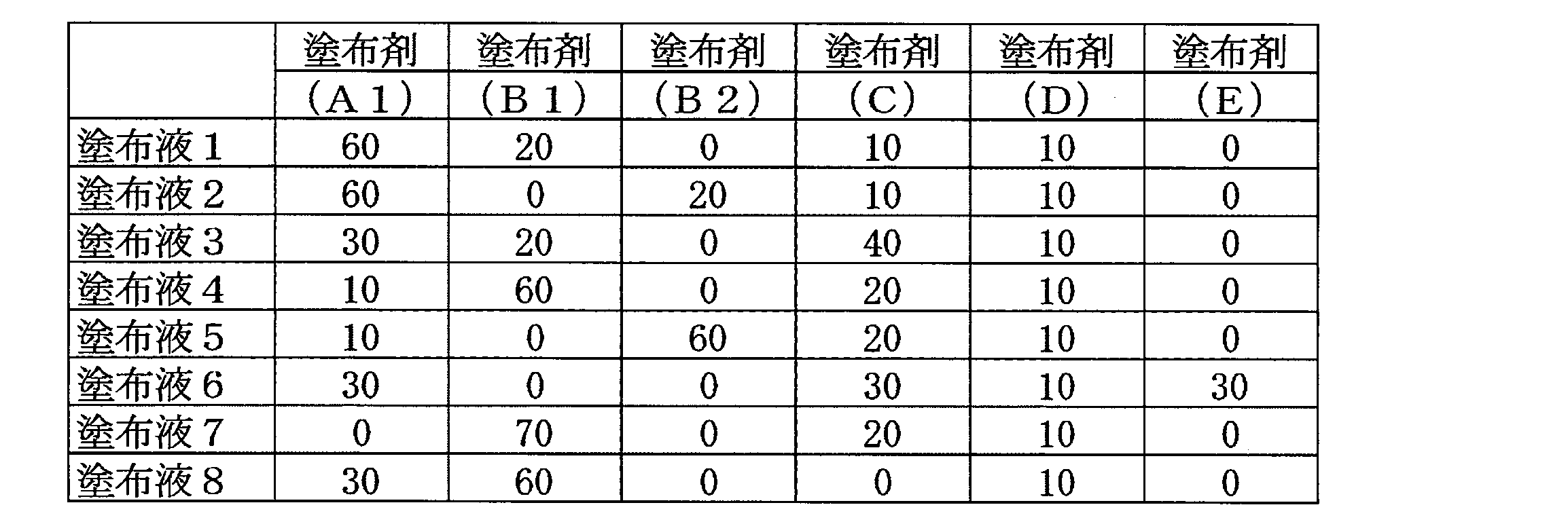
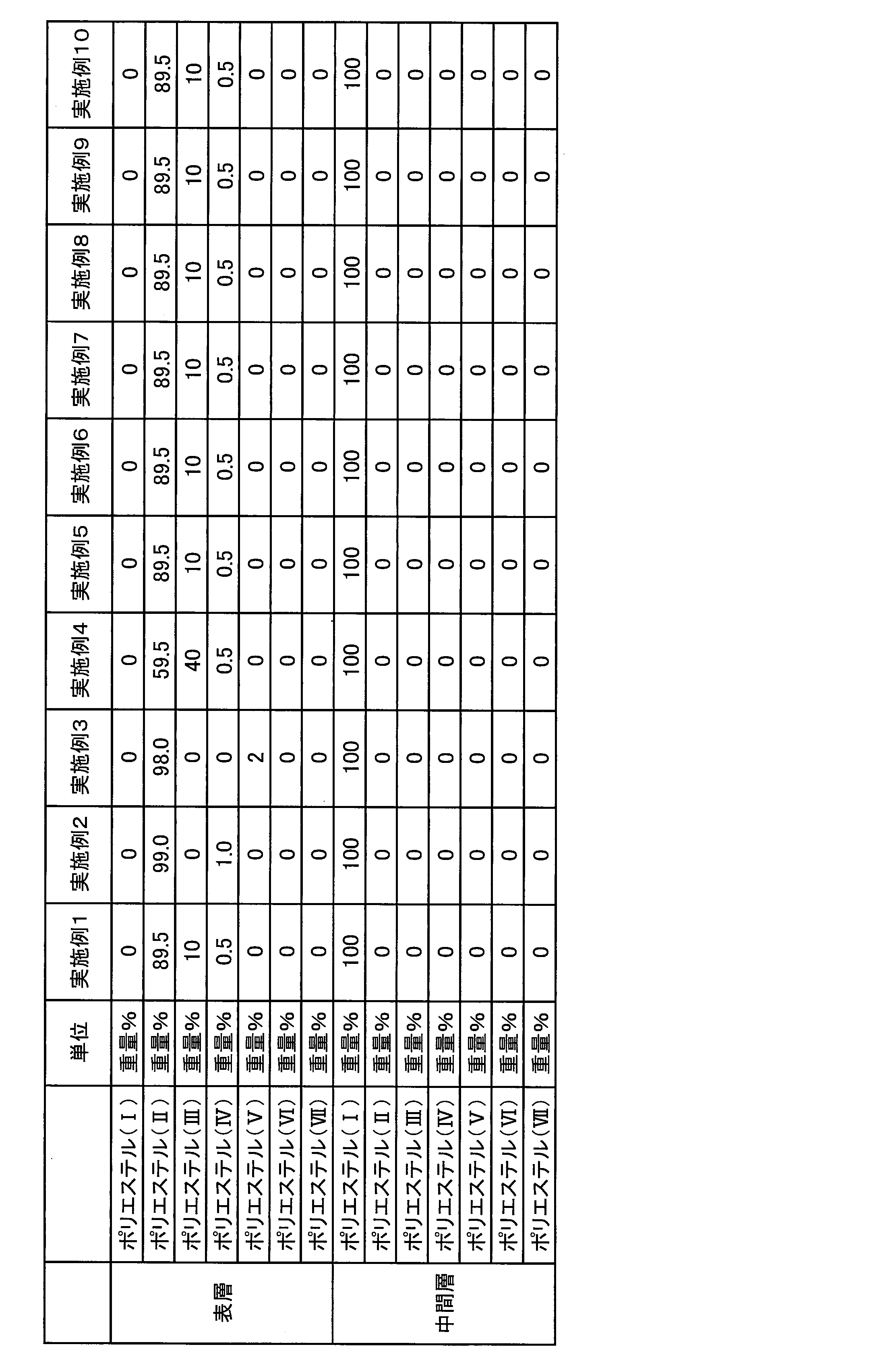


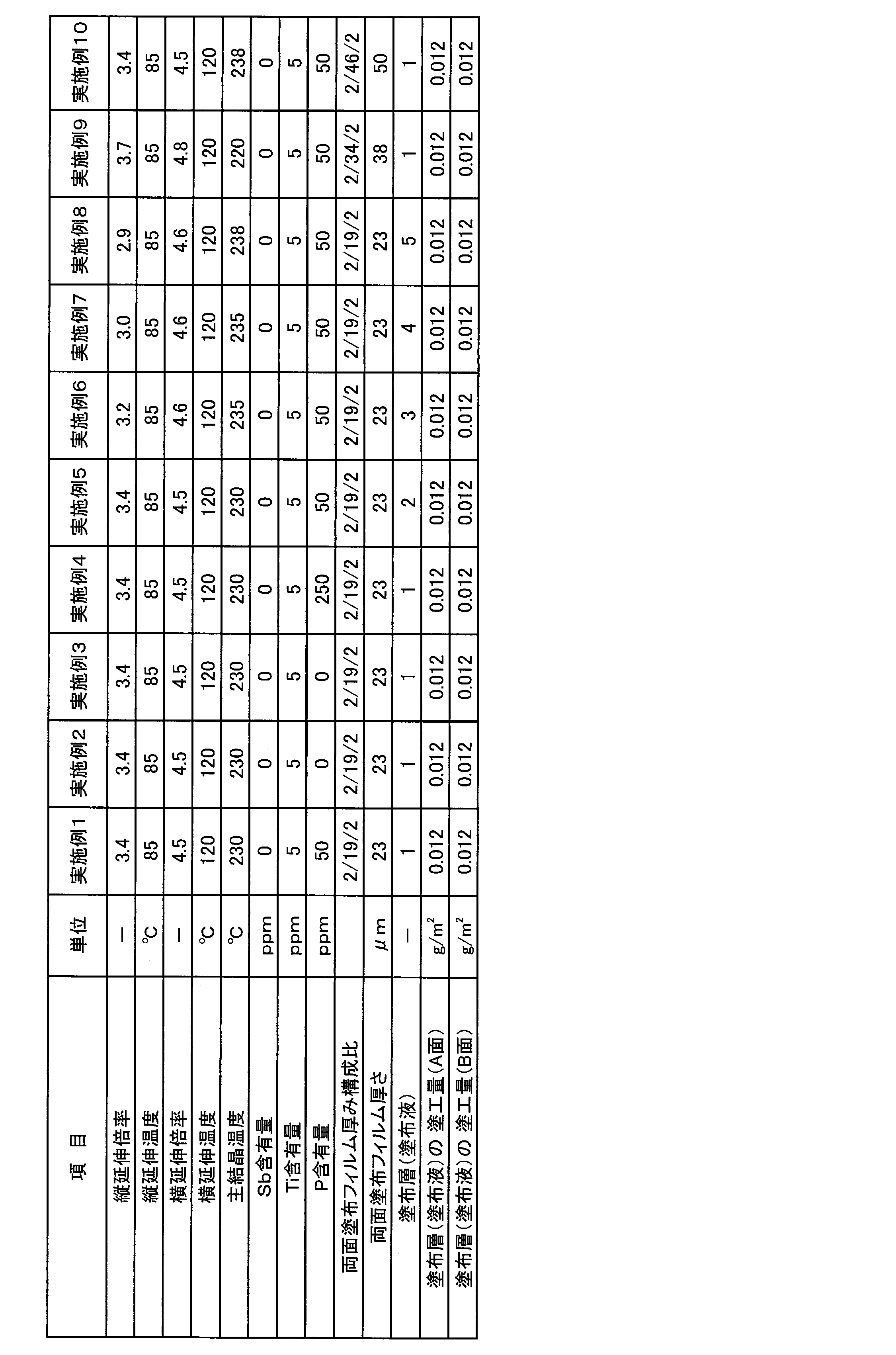
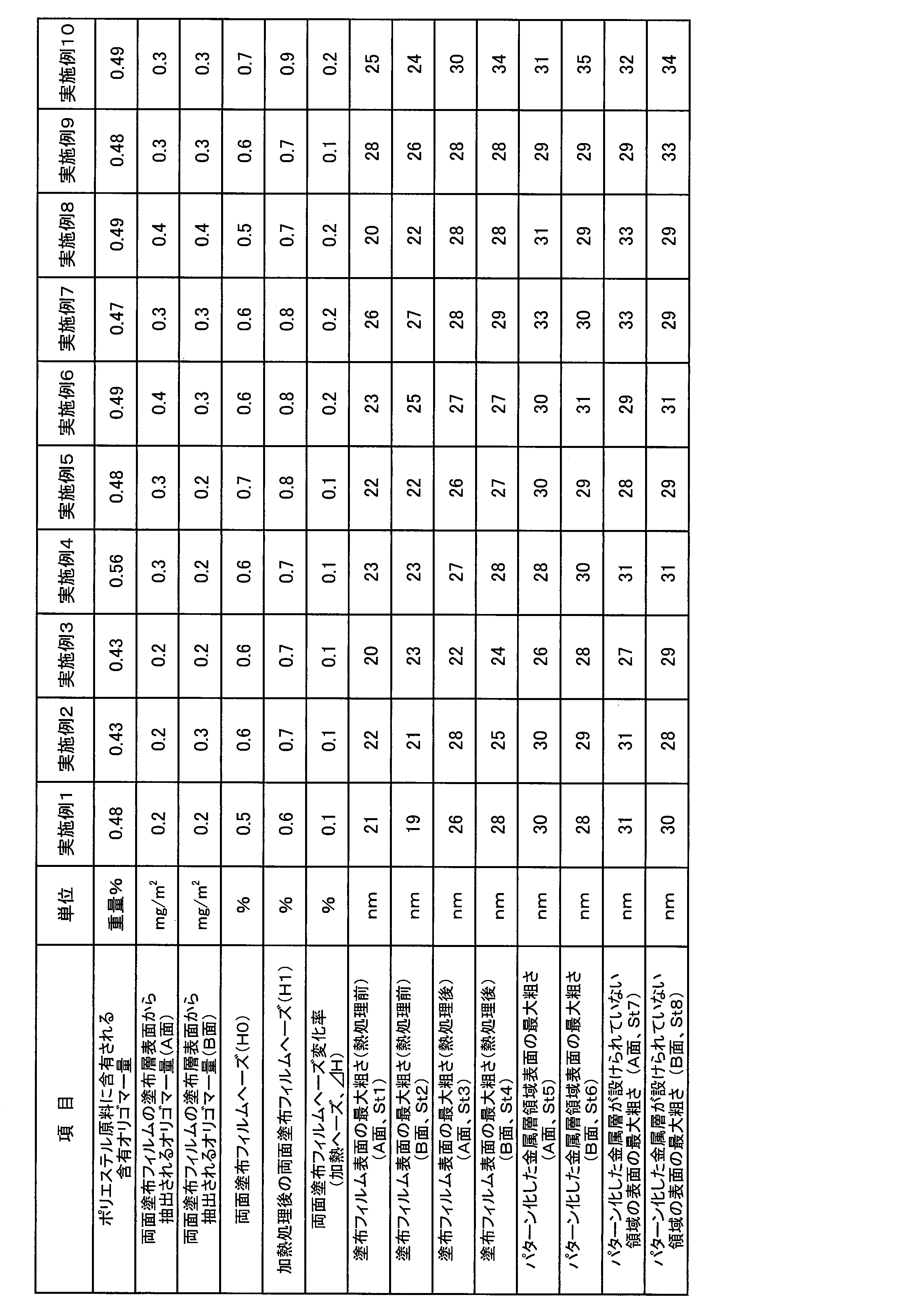

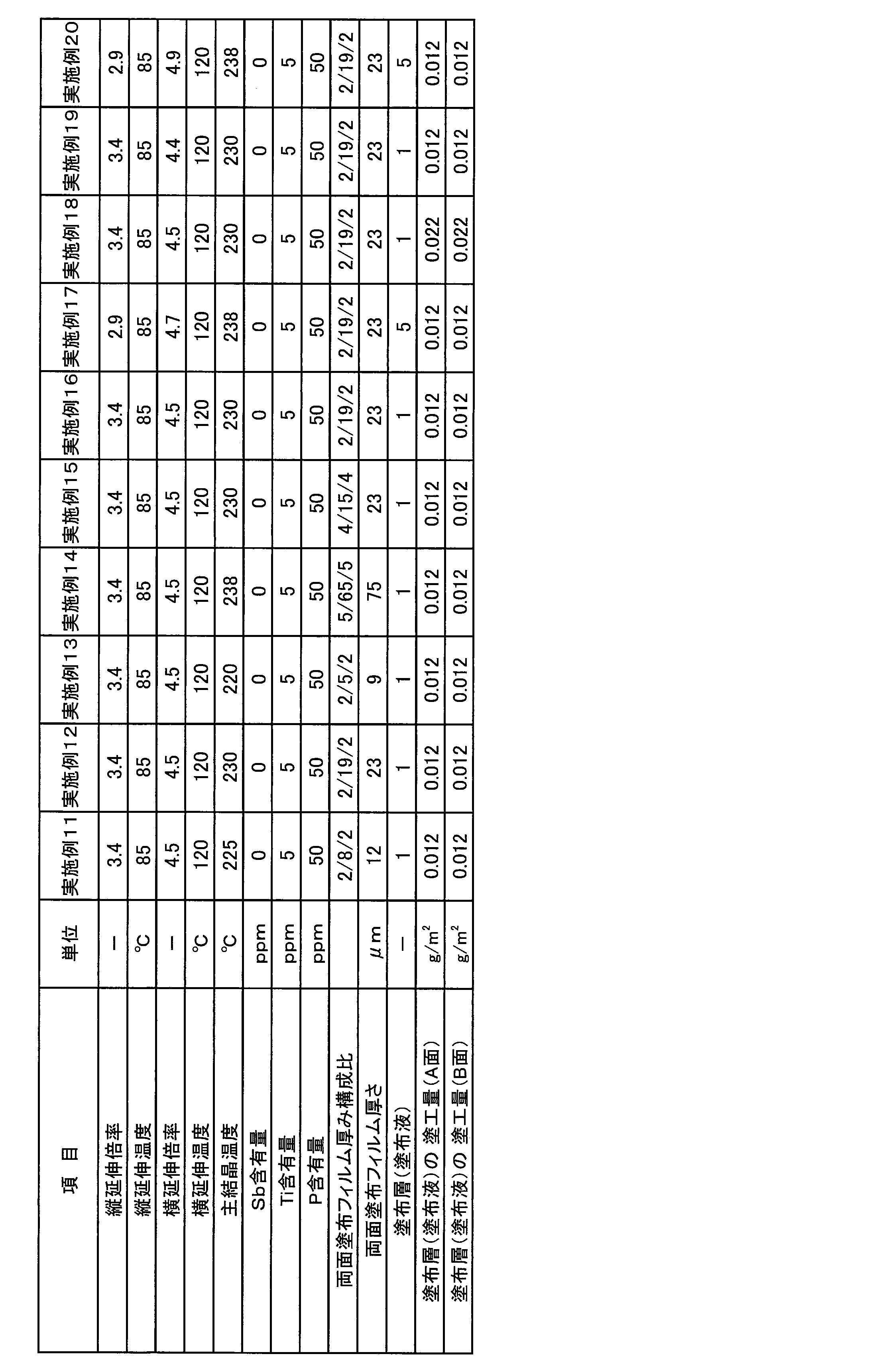
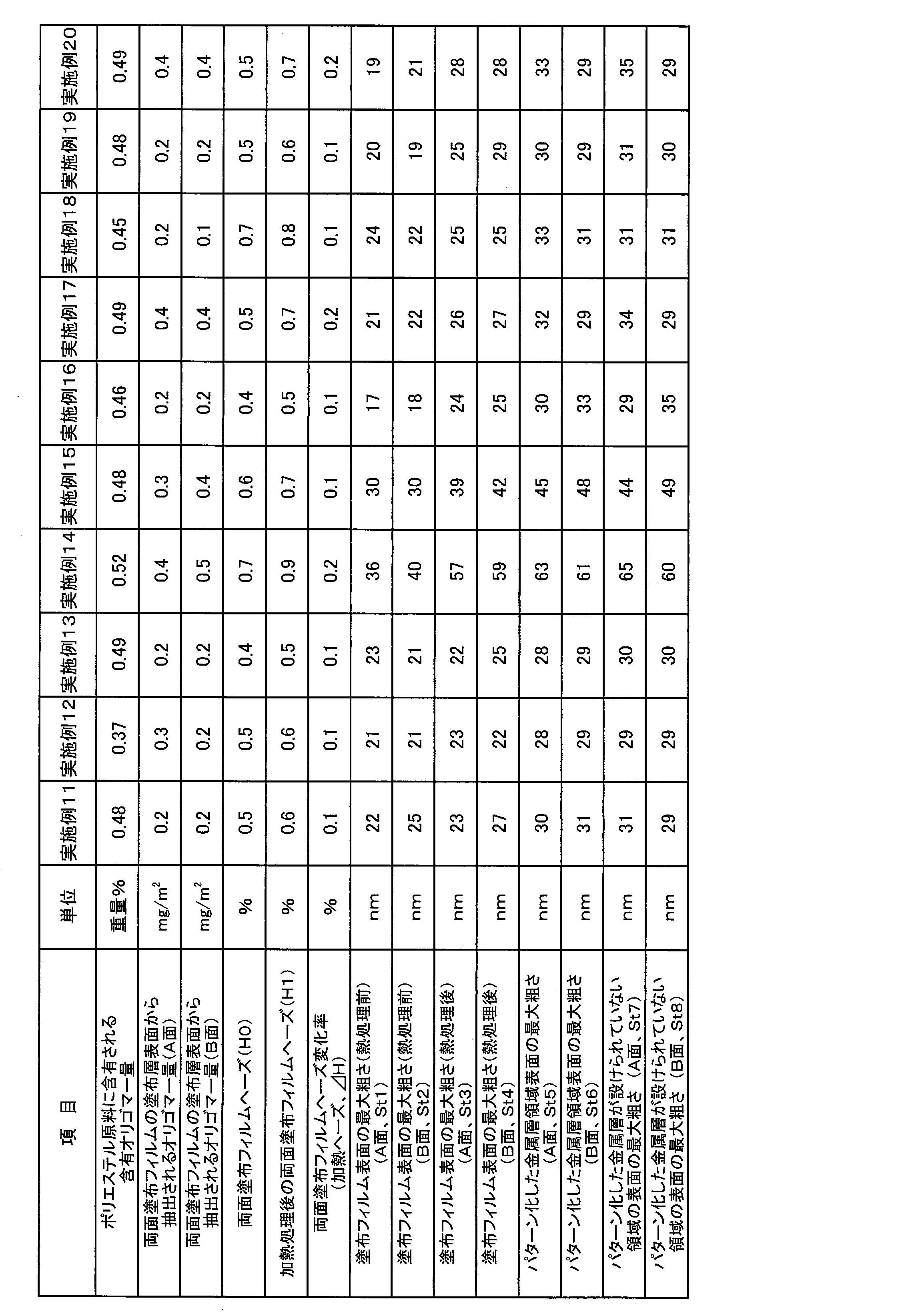
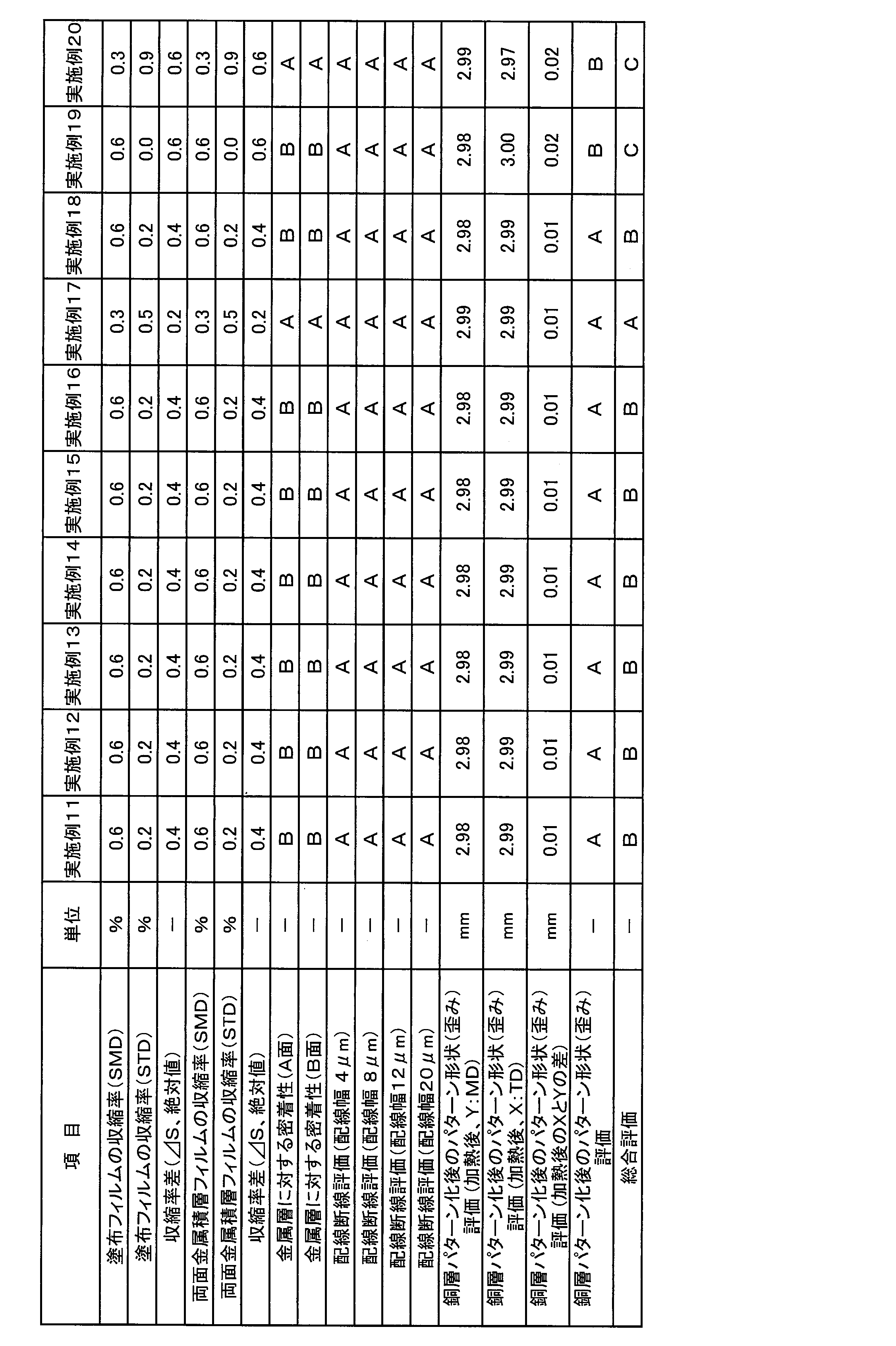


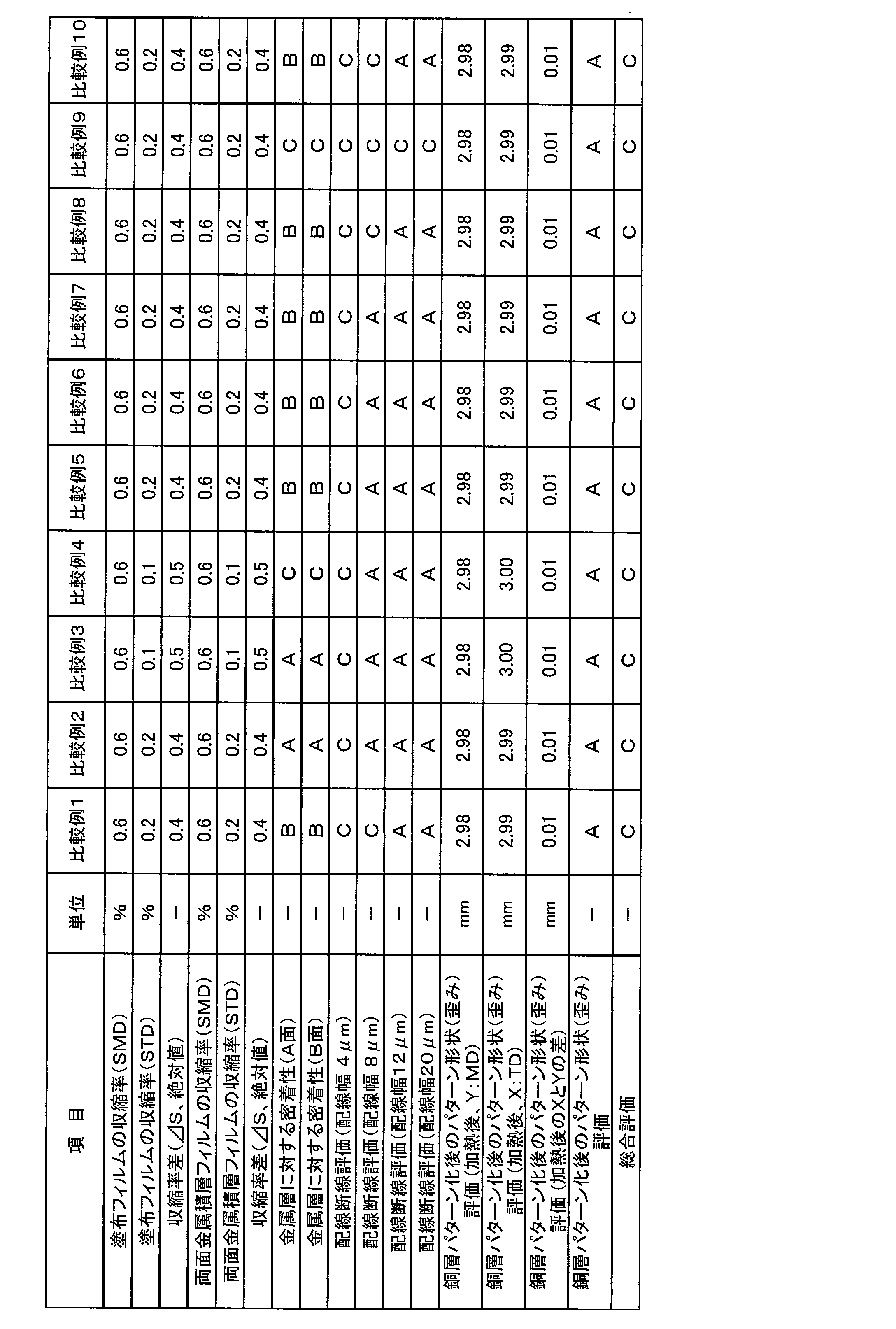
本発明の両面金属積層フィルムは、例えば、フレキシブル両面回路基板用途、タッチパネル用構成部材(例えば、導電性フィルムなど)などに好適に利用することができる。
Claims (5)
- ポリエステルフィルムの両面に、四級アンモニウム塩基含有化合物、ポリエチレングリコール含有アクリレートポリマー、および架橋剤を含有する塗布液から形成された塗布層を有し、当該塗布層上にはそれぞれ金属層が積層されていることを特徴とする両面金属積層フィルム。
- 塗布層を形成する塗布液中の全固形分に対する割合として、四級アンモニウム塩基含有化合物の含有量は20~70重量%、ポリエチレングリコール含有ポリマーの含有量5~40重量%、架橋剤の含有量は10~60重量%である請求項1に記載の両面金属積層フィルム。
- 金属層がパターン化された金属層である請求項1又は2に記載の両面金属積層フィルム。
- 金属層が銅層である請求項1~3の何れかに記載の両面金属積層フィルム。
- 下記式を満足する請求項1~4の何れかに記載の両面金属積層フィルム。
|SMD-STD|≦0.5
(上記式中、SMDは、フィルム走行方向(MD)の収縮率(%)、STDは、フィルム走行方向と直交する方向(TD)の収縮率(%)をそれぞれ意味する。)
Priority Applications (3)
| Application Number | Priority Date | Filing Date | Title |
|---|---|---|---|
| KR1020197004497A KR20190018564A (ko) | 2015-01-10 | 2015-11-19 | 양면 금속적층 필름 |
| CN201580072219.5A CN107107554B (zh) | 2015-01-10 | 2015-11-19 | 双面金属叠层膜 |
| KR1020177016426A KR102001374B1 (ko) | 2015-01-10 | 2015-11-19 | 양면 금속적층 필름 |
Applications Claiming Priority (6)
| Application Number | Priority Date | Filing Date | Title |
|---|---|---|---|
| JP2015-003726 | 2015-01-10 | ||
| JP2015-003725 | 2015-01-10 | ||
| JP2015003726A JP6467928B2 (ja) | 2015-01-10 | 2015-01-10 | 両面金属積層フィルム |
| JP2015003725A JP6467927B2 (ja) | 2015-01-10 | 2015-01-10 | 両面金属積層フィルム |
| JP2015011863A JP6467942B2 (ja) | 2015-01-24 | 2015-01-24 | 両面金属積層フィルム |
| JP2015-011863 | 2015-01-24 |
Publications (1)
| Publication Number | Publication Date |
|---|---|
| WO2016111091A1 true WO2016111091A1 (ja) | 2016-07-14 |
Family
ID=56355794
Family Applications (1)
| Application Number | Title | Priority Date | Filing Date |
|---|---|---|---|
| PCT/JP2015/082527 Ceased WO2016111091A1 (ja) | 2015-01-10 | 2015-11-19 | 両面金属積層フィルム |
Country Status (4)
| Country | Link |
|---|---|
| KR (2) | KR102001374B1 (ja) |
| CN (1) | CN107107554B (ja) |
| TW (1) | TWI680053B (ja) |
| WO (1) | WO2016111091A1 (ja) |
Cited By (1)
| Publication number | Priority date | Publication date | Assignee | Title |
|---|---|---|---|---|
| JP2018098009A (ja) * | 2016-12-12 | 2018-06-21 | 住友化学株式会社 | 有機電子デバイスの製造方法、電極付き基板及び有機電子デバイス |
Families Citing this family (1)
| Publication number | Priority date | Publication date | Assignee | Title |
|---|---|---|---|---|
| CN113400534B (zh) * | 2021-06-18 | 2022-09-23 | 泉州嘉德利电子材料有限公司 | 聚丙烯薄膜及聚丙烯薄膜制备方法与应用 |
Citations (5)
| Publication number | Priority date | Publication date | Assignee | Title |
|---|---|---|---|---|
| JP2004107627A (ja) * | 2002-07-25 | 2004-04-08 | Toray Ind Inc | 光学用積層フィルム、反射防止用積層フィルム、タッチパネル用積層フィルムおよびディスプレイ部材用積層フィルム |
| JP2011020266A (ja) * | 2009-07-13 | 2011-02-03 | Mitsubishi Plastics Inc | 積層ポリエステルフィルム |
| JP2011037936A (ja) * | 2009-08-07 | 2011-02-24 | Mitsubishi Plastics Inc | 両面積層ポリエステルフィルム |
| JP2013202987A (ja) * | 2012-03-29 | 2013-10-07 | Mitsubishi Plastics Inc | 塗布フィルム |
| JP2014094467A (ja) * | 2012-11-08 | 2014-05-22 | Mitsubishi Plastics Inc | 透明導電膜基材用ポリエステルフィルムおよび透明導電フィルム |
Family Cites Families (9)
| Publication number | Priority date | Publication date | Assignee | Title |
|---|---|---|---|---|
| JPS5874351A (ja) * | 1981-10-30 | 1983-05-04 | 東レ株式会社 | 銅蒸着ポリエステルフイルム |
| JPH06120630A (ja) | 1992-10-07 | 1994-04-28 | Ulvac Japan Ltd | プリント配線基板用の銅箔 |
| JPH06132628A (ja) | 1992-10-19 | 1994-05-13 | Fujikura Ltd | 片面フレキシブル印刷配線板の製法 |
| JP3152331B2 (ja) | 1994-11-11 | 2001-04-03 | 住友金属鉱山株式会社 | フレキシブル基板の製造方法 |
| JP5517019B2 (ja) * | 2008-05-26 | 2014-06-11 | 住友金属鉱山株式会社 | プリント配線基板およびプリント配線基板の製造方法 |
| JP5441583B2 (ja) * | 2009-09-18 | 2014-03-12 | 三菱樹脂株式会社 | 両面積層ポリエステルフィルム |
| WO2012029499A1 (ja) * | 2010-08-30 | 2012-03-08 | 長瀬産業株式会社 | 1,4-シクロヘキシレンジメチレンテレフタレートと1,4-シクロヘキシレンジメチレンイソフタレートとの共重合体フィルム、太陽電池モジュール用保護シート、及び、太陽電池モジュール |
| JP2014053410A (ja) | 2012-09-06 | 2014-03-20 | Sumitomo Metal Mining Co Ltd | 両面金属積層フィルムの製造方法とその製造装置、および、フレキシブル両面プリント配線基板の製造方法 |
| WO2014208644A1 (ja) * | 2013-06-28 | 2014-12-31 | 新日鉄住金化学株式会社 | ポリイミド、樹脂フィルム及び金属張積層体 |
-
2015
- 2015-11-19 CN CN201580072219.5A patent/CN107107554B/zh active Active
- 2015-11-19 WO PCT/JP2015/082527 patent/WO2016111091A1/ja not_active Ceased
- 2015-11-19 KR KR1020177016426A patent/KR102001374B1/ko active Active
- 2015-11-19 KR KR1020197004497A patent/KR20190018564A/ko not_active Ceased
- 2015-11-24 TW TW104138963A patent/TWI680053B/zh active
Patent Citations (5)
| Publication number | Priority date | Publication date | Assignee | Title |
|---|---|---|---|---|
| JP2004107627A (ja) * | 2002-07-25 | 2004-04-08 | Toray Ind Inc | 光学用積層フィルム、反射防止用積層フィルム、タッチパネル用積層フィルムおよびディスプレイ部材用積層フィルム |
| JP2011020266A (ja) * | 2009-07-13 | 2011-02-03 | Mitsubishi Plastics Inc | 積層ポリエステルフィルム |
| JP2011037936A (ja) * | 2009-08-07 | 2011-02-24 | Mitsubishi Plastics Inc | 両面積層ポリエステルフィルム |
| JP2013202987A (ja) * | 2012-03-29 | 2013-10-07 | Mitsubishi Plastics Inc | 塗布フィルム |
| JP2014094467A (ja) * | 2012-11-08 | 2014-05-22 | Mitsubishi Plastics Inc | 透明導電膜基材用ポリエステルフィルムおよび透明導電フィルム |
Cited By (1)
| Publication number | Priority date | Publication date | Assignee | Title |
|---|---|---|---|---|
| JP2018098009A (ja) * | 2016-12-12 | 2018-06-21 | 住友化学株式会社 | 有機電子デバイスの製造方法、電極付き基板及び有機電子デバイス |
Also Published As
| Publication number | Publication date |
|---|---|
| KR20170084286A (ko) | 2017-07-19 |
| TWI680053B (zh) | 2019-12-21 |
| CN107107554A (zh) | 2017-08-29 |
| KR20190018564A (ko) | 2019-02-22 |
| KR102001374B1 (ko) | 2019-07-18 |
| CN107107554B (zh) | 2020-04-03 |
| TW201637852A (zh) | 2016-11-01 |
Similar Documents
| Publication | Publication Date | Title |
|---|---|---|
| JP5281554B2 (ja) | 離型フィルム | |
| JP5236586B2 (ja) | 積層ポリエステルフィルム | |
| JP5385846B2 (ja) | 積層ポリエステルフィルム | |
| JP2011037936A (ja) | 両面積層ポリエステルフィルム | |
| WO2011034151A1 (ja) | 両面積層ポリエステルフィルム | |
| JP2013202987A (ja) | 塗布フィルム | |
| JP5770066B2 (ja) | 積層ポリエステルフィルム | |
| JP6022903B2 (ja) | 透明導電フィルム | |
| CN107107554B (zh) | 双面金属叠层膜 | |
| JP6467942B2 (ja) | 両面金属積層フィルム | |
| JP6467928B2 (ja) | 両面金属積層フィルム | |
| WO2019123979A1 (ja) | 二軸配向積層フィルム | |
| JP6379674B2 (ja) | 積層体 | |
| JP6763126B2 (ja) | 金属積層フィルム | |
| JP6467927B2 (ja) | 両面金属積層フィルム | |
| TWI734682B (zh) | 金屬膜層合用薄膜 | |
| JP6763125B2 (ja) | 金属積層フィルム | |
| JP2014231143A (ja) | 塗布フィルム | |
| JP5993712B2 (ja) | 透明導電膜基材用ポリエステルフィルムおよび透明導電フィルム | |
| JP2011177894A (ja) | 熱硬化型拡散シート用二軸延伸ポリエステルフィルム | |
| JP2007161937A (ja) | 光学用ポリエステルフィルム | |
| JP6805520B2 (ja) | 金属層付きポリエステルフィルムの製造方法 | |
| JP2000085067A (ja) | 蒸着用積層ポリエステルフィルム | |
| JP2017061036A (ja) | 光学用二軸配向ポリエステルフィルム | |
| JP2000085079A (ja) | 蒸着用積層ポリエステルフィルム |
Legal Events
| Date | Code | Title | Description |
|---|---|---|---|
| 121 | Ep: the epo has been informed by wipo that ep was designated in this application |
Ref document number: 15876964 Country of ref document: EP Kind code of ref document: A1 |
|
| ENP | Entry into the national phase |
Ref document number: 20177016426 Country of ref document: KR Kind code of ref document: A |
|
| NENP | Non-entry into the national phase |
Ref country code: DE |
|
| 122 | Ep: pct application non-entry in european phase |
Ref document number: 15876964 Country of ref document: EP Kind code of ref document: A1 |