WO2016080133A1 - 含フッ素オレフィンを構成成分とする共沸様組成物 - Google Patents
含フッ素オレフィンを構成成分とする共沸様組成物 Download PDFInfo
- Publication number
- WO2016080133A1 WO2016080133A1 PCT/JP2015/079494 JP2015079494W WO2016080133A1 WO 2016080133 A1 WO2016080133 A1 WO 2016080133A1 JP 2015079494 W JP2015079494 W JP 2015079494W WO 2016080133 A1 WO2016080133 A1 WO 2016080133A1
- Authority
- WO
- WIPO (PCT)
- Prior art keywords
- composition
- azeotropic
- mol
- liquid
- dce
- Prior art date
- Legal status (The legal status is an assumption and is not a legal conclusion. Google has not performed a legal analysis and makes no representation as to the accuracy of the status listed.)
- Ceased
Links
Images

Classifications
-
- C—CHEMISTRY; METALLURGY
- C11—ANIMAL OR VEGETABLE OILS, FATS, FATTY SUBSTANCES OR WAXES; FATTY ACIDS THEREFROM; DETERGENTS; CANDLES
- C11D—DETERGENT COMPOSITIONS; USE OF SINGLE SUBSTANCES AS DETERGENTS; SOAP OR SOAP-MAKING; RESIN SOAPS; RECOVERY OF GLYCEROL
- C11D7/00—Compositions of detergents based essentially on non-surface-active compounds
- C11D7/50—Solvents
- C11D7/5036—Azeotropic mixtures containing halogenated solvents
- C11D7/504—Azeotropic mixtures containing halogenated solvents all solvents being halogenated hydrocarbons
-
- C—CHEMISTRY; METALLURGY
- C07—ORGANIC CHEMISTRY
- C07C—ACYCLIC OR CARBOCYCLIC COMPOUNDS
- C07C21/00—Acyclic unsaturated compounds containing halogen atoms
- C07C21/02—Acyclic unsaturated compounds containing halogen atoms containing carbon-to-carbon double bonds
- C07C21/04—Chloro-alkenes
- C07C21/073—Dichloro-alkenes
-
- C—CHEMISTRY; METALLURGY
- C07—ORGANIC CHEMISTRY
- C07C—ACYCLIC OR CARBOCYCLIC COMPOUNDS
- C07C21/00—Acyclic unsaturated compounds containing halogen atoms
- C07C21/02—Acyclic unsaturated compounds containing halogen atoms containing carbon-to-carbon double bonds
- C07C21/18—Acyclic unsaturated compounds containing halogen atoms containing carbon-to-carbon double bonds containing fluorine
-
- C—CHEMISTRY; METALLURGY
- C11—ANIMAL OR VEGETABLE OILS, FATS, FATTY SUBSTANCES OR WAXES; FATTY ACIDS THEREFROM; DETERGENTS; CANDLES
- C11D—DETERGENT COMPOSITIONS; USE OF SINGLE SUBSTANCES AS DETERGENTS; SOAP OR SOAP-MAKING; RESIN SOAPS; RECOVERY OF GLYCEROL
- C11D7/00—Compositions of detergents based essentially on non-surface-active compounds
- C11D7/22—Organic compounds
- C11D7/28—Organic compounds containing halogen
- C11D7/30—Halogenated hydrocarbons
-
- C—CHEMISTRY; METALLURGY
- C11—ANIMAL OR VEGETABLE OILS, FATS, FATTY SUBSTANCES OR WAXES; FATTY ACIDS THEREFROM; DETERGENTS; CANDLES
- C11D—DETERGENT COMPOSITIONS; USE OF SINGLE SUBSTANCES AS DETERGENTS; SOAP OR SOAP-MAKING; RESIN SOAPS; RECOVERY OF GLYCEROL
- C11D7/00—Compositions of detergents based essentially on non-surface-active compounds
- C11D7/50—Solvents
-
- C—CHEMISTRY; METALLURGY
- C11—ANIMAL OR VEGETABLE OILS, FATS, FATTY SUBSTANCES OR WAXES; FATTY ACIDS THEREFROM; DETERGENTS; CANDLES
- C11D—DETERGENT COMPOSITIONS; USE OF SINGLE SUBSTANCES AS DETERGENTS; SOAP OR SOAP-MAKING; RESIN SOAPS; RECOVERY OF GLYCEROL
- C11D7/00—Compositions of detergents based essentially on non-surface-active compounds
- C11D7/50—Solvents
- C11D7/5004—Organic solvents
- C11D7/5018—Halogenated solvents
-
- C—CHEMISTRY; METALLURGY
- C11—ANIMAL OR VEGETABLE OILS, FATS, FATTY SUBSTANCES OR WAXES; FATTY ACIDS THEREFROM; DETERGENTS; CANDLES
- C11D—DETERGENT COMPOSITIONS; USE OF SINGLE SUBSTANCES AS DETERGENTS; SOAP OR SOAP-MAKING; RESIN SOAPS; RECOVERY OF GLYCEROL
- C11D7/00—Compositions of detergents based essentially on non-surface-active compounds
- C11D7/50—Solvents
- C11D7/5036—Azeotropic mixtures containing halogenated solvents
- C11D7/504—Azeotropic mixtures containing halogenated solvents all solvents being halogenated hydrocarbons
- C11D7/5059—Mixtures containing (hydro)chlorocarbons
Definitions
- the present invention relates to a novel composition containing a fluorine-containing olefin.
- Chlorofluorocarbons (hereinafter sometimes referred to as CFCs), hydrochlorofluorocarbons (sometimes referred to as HCFCs), hydrofluorocarbons (hereinafter sometimes referred to as HFCs) and the like having 1 to 5 carbon atoms
- Fluorine-containing alkanes have volatility, stability, and non-flammability characteristics, and have contributed to industrial development in applications such as refrigerants, working fluids, foaming agents, sprays, cleaning agents, solvents, and solvents.
- chlorofluorocarbons Sometimes called chlorofluorocarbons.
- blending a plurality of fluorine-containing alkanes has been widely performed.
- refrigerant numbers R502, R507A, R404A, R407C, and R410A from the American Society of Heating, Refrigerating and Air Conditioning Engineers (ASHRAE) are widely used as mixed refrigerants. These mixed refrigerants are improved in coefficient of performance, refrigeration cycle, incombustibility, global warming coefficient and the like by mixing two or more kinds of chlorofluorocarbons at a specific ratio.
- the fluorine-containing alkane has volatility, when one of the chlorofluorocarbons is unilaterally evaporated when used as a mixture, the composition changes during use and the physical properties change. Therefore, an azeotropic or azeotropic-like composition that volatilizes at substantially the same composition as the liquid phase is preferable.
- R502 mixed refrigerant of R22 and R115
- R507A mixed refrigerant of R143a and R125
- R410A its constituent components R32 and R125 are non-azeotropic, but since the composition of the gas phase part and the liquid phase part is substantially the same, practically like the azeotropic composition. Since it can be handled, it is used as an azeotropic refrigerant.
- blending fluorine-containing alkanes and alcohol for use as a draining agent for use as a draining agent, adding non-flammable fluorine-containing alkanes to flammable hydrocarbon solvents to make them nonflammable, or cleaning with controlled detergency
- an agent for use of a cleaning agent or a draining agent, an azeotropic or azeotrope-like composition in which the composition of the gas phase part and the liquid phase part when volatilized is substantially the same as the refrigerant is preferable.
- Fluorine-containing alkanes as described above are very stable in the atmosphere, have a long atmospheric lifetime, and are considered to cause global warming.
- fluorine-containing olefins having 2 to 5 carbon atoms referring to hydrofluoroolefins, hydrochlorofluoroolefins, chlorofluoroolefins, and fluoroolefins
- fluorine-containing olefins having a double bond in the molecule are significantly more reactive with OH radicals in the atmosphere than fluorine-containing alkanes having no double bond.
- the atmospheric lifetime of HFC-365mfc, HFC-245fa, HFC-43-10, etc., which are widely used at present, is in units of years, while in general, the atmospheric lifetime of fluorine-containing olefins is in units of days. Even when released into the atmosphere, it decomposes quickly, so its impact on global warming and ozone depletion is low. It has been reported that since it has physical properties similar to the above-mentioned fluorinated alkanes, it can be used in various applications such as refrigerants, working fluids, foaming agents, sprays, cleaning agents, solvents and solvents.
- Patent Document 2 proposes a composition of a fluorine-containing olefin having 3 carbon atoms and a general-purpose solvent.
- Example 4 a degreasing test example of 1,2-dichloro-3,3,3-trifluoropropene alone is disclosed, but this compound and flammability (flash point 2-4 ° C.) are (E)- There is no specific description of detergency, evaporation behavior, flammability, etc. for the 1,2-dichloro-ethylene combination.
- 1,2-dichloro-3,3,3-trifluoropropene has E and Z geometric isomers, each having its own boiling point and polarity, so that it can be dried and washed.
- JP 2008-133438 A JP-A-2-222388 JP-A-2-2211962 JP-A-2-221389 JP-A-2-222469 Japanese Patent Laid-Open No. 2-222496 JP-A-2-222702
- the low-boiling component in the cleaning liquid may decrease over time, resulting in poor cleaning.
- the used cleaning solution is usually regenerated and reused by distillation. If the composition of the liquid phase is different from the composition of the gas phase, the liquid composition of the recovered composition must be adjusted. Not efficient.
- the present invention proposes a novel azeotrope or azeotrope-like composition that contains environmentally friendly (Z) -1,2-dichloro-3,3,3-trifluoropropene and does not change composition upon volatilization. This is the issue.
- HCFO-1223xd (Z) or 1223Z) and (E) -1,2-dichloro-ethylene (Hereinafter sometimes referred to as t-DCE) forms an azeotropic (like) composition, with 1223Z being 0.0001 mol% to 40 mol% and t-DCE being 99.9999 mol% to 60 mol%.
- the composition is an azeotrope-like composition having substantially the same composition in the gas phase portion and the liquid phase portion, and has no flash point under the Fire Service Act in the region where t-DCE is 90 mol% or less. It turned out to be. In particular, 1223Z: 20 mol% and t-DCE: 80 mol% were found to be azeotropic. Furthermore, it was confirmed in the Examples that the azeotrope-like composition of the present invention was useful as an oil and fat removing agent, and the present invention was completed.
- the present invention includes the following inventions.
- invention 2 The azeotropic (like) composition according to invention 1, comprising 0.0001 mol% to 40 mol% 1223Z and 99.9999 mol% to 60 mol% t-DCE.
- a liquid composition comprising the azeotropic (like) composition according to any one of Inventions 1 to 4 and at least one additional component.
- a liquid composition comprising the azeotropic (like) composition according to any one of the inventions 1 to 4 and at least one additional component of 10 ppm to 30% by mass based on the azeotropic (like) composition.
- a cleaning solvent comprising the azeotropic (like) composition or liquid composition according to any one of Inventions 1 to 6.
- invention 8 A method for cleaning an object to be cleaned, comprising a step of bringing the azeotropic (like) composition or liquid composition according to any one of Inventions 1 to 6 into contact with the object to be cleaned.
- a novel azeotropic (like) liquid composition is provided.
- the liquid composition has an effect that the performance as a liquid whose composition hardly changes even when used under an open condition is easily maintained.
- the azeotropic (like) liquid composition has a low environmental impact, and a composition comprising 10 mol% to 40 mol% of 1223Z and 90 mol% to 60 mol% of t-DCE is The above non-dangerous goods.
- the azeotropic (like) liquid composition is useful as a solvent (cleaning solvent) for cleaning contaminants such as foreign matters and fats and oils.
- FIG. 2 is a vapor-liquid equilibrium diagram of (Z) -1,2-dichloro-3,3,3-trifluoropropene (1223Z) and (E) -1,2-dichloro-ethylene (t-DCE).
- Fluorine-containing olefin is highly compatible with various solvents, so it is possible to easily prepare a uniform composition.
- the problem that “the liquid composition tends to fluctuate” is inherent. That is, even if a plurality of types of liquids are mixed to ensure compatibility, the problem that the liquid composition tends to fluctuate due to the difference in volatility of each component is unavoidable.
- a binary liquid composition is put into an ultrasonic cleaner and used as a cleaning agent, generally low boiling point components with high volatility (components with high vapor pressure) are preferentially volatilized, and the inside of the cleaning tank High-boiling components with low volatility are concentrated.
- the concentration of the low-boiling component in the cleaning liquid may decrease over time, resulting in poor cleaning.
- the cleaning liquid may become a combustible composition when the noncombustible component volatilizes preferentially.
- thermodynamic cycle There is a similar problem when used as a working fluid in a thermodynamic cycle. That is, even when used as a working fluid in a thermodynamic cycle, the liquid composition may fluctuate over a long period of time. If the liquid composition fluctuates, the heat capacity, viscosity, or affinity with the lubricant of the liquid may change, and the operating performance of the thermodynamic cycle may deteriorate.
- liquid composition management can be a heavy work load.
- azeotropic refers to azeotropic in a thermodynamically strict sense.
- ethanol 96% by mass
- water 4% by mass
- azeotrope the composition of ethanol (96% by mass) and water (4% by mass)
- ethanol 96% by mass
- water 4% by mass
- “Azeotropic” is also called “pseudo-azeotropic” and is not thermodynamically strict azeotrope, but for a range of liquid compositions, the liquid composition and the composition of the gas in equilibrium , Refers to such a phenomenon that may be substantially equal. Even if the compositions of the gas phase part and the liquid phase part do not completely match, those skilled in the art can handle the composition in the same manner as the azeotropic composition as long as the composition of the gas phase part and the liquid phase substance substantially match. At this time, the smaller the vapor-liquid equilibrium composition difference between the gas phase portion and the liquid phase portion, the better. Thus, the phenomenon in which the vapor-liquid phase portion substantially matches the vapor-liquid equilibrium composition is called azeotropic or pseudo-azeotropic, and the composition is called azeotropic-like or pseudo-azeotropic composition. .
- azeotropic and pseudo-azeotropic should be distinguished, but in practice such as cleaning, azeotropic and azeotropic (or pseudo-azeotropic) are distinguished.
- azeotropic phenomenon and the azeotrope-like phenomenon are collectively referred to as “azeotrope (like)”.
- the composition at that time is referred to as an “azeotropic (like) composition”.
- azeotropic (like) composition In azeotropic (like), the presence or absence of an azeotropic point is not questioned. It is only necessary that the vapor-liquid equilibrium composition of the gas phase portion and the liquid phase portion substantially match.
- 1,2-dichloro-3,3,3-trifluoropropene has E-form and Z-form, and methods for selectively producing Z-form are described in patent documents (WO2014 / 046250, WO2014 / 046251).
- the high purity Z form (1223Z) is available by precision distillation.
- (E) -1,2-dichloro-ethylene is commercially available as a flammable (flash point: 2-4 ° C.) solvent.
- the first component 1223Z is 0.0001 mol% to 40 mol% and the second component t-DCE is 99.9999 mol% to 60 mol.
- % Composition is an azeotropic (like) composition in which the composition of the gas phase part and the liquid phase part are substantially the same.
- the value of mol% is the% of the number of moles of each component when the total value of the number of moles of 1223Z and the number of moles of t-DCE is 100 (that is, the relative mole% between the two components). Represents. If the composition is within this range, in practice, even if the liquid composition is handled in an open system, or even if a recovery operation is carried out by distillation, composition fluctuations are unlikely to occur.
- the composition of the gas phase part and the liquid phase part are closer to each other. It is a composition that hardly occurs.
- the range of 10/90 to 25/75 not only composition fluctuations are hardly caused, but also there is a property as an incombustible material under the Fire Service Law. It can be said to be a preferred composition.
- the range where the first component 1223Z is 19 to 21 mol% and the second component t-DCE is 81 to 78 mol% is not only incombustible, but also the liquid composition is less likely to fluctuate. It is a particularly preferred azeotropic (like) composition in the present invention. Further, the composition in which the first component 1223Z is 20 mol% and the second component t-DCE is 80 mol% is an azeotropic composition in which no theoretical compositional change occurs.
- the azeotropic (like) composition of the present invention can be produced through a step of mixing a predetermined amount of the first component and the second component. It goes without saying that the azeotropic (like) composition of the present invention is one of preferred embodiments in which a high-purity composition is substantially free of impurities. However, depending on the application, a liquid composition with such a high purity may not be required. In such a case, a small amount of raw materials and by-products for synthesizing the first component, 1223Z, and the second component, t-DCE (usually, each component is azeotropic (like ) Usually less than 1% by weight of the composition), the remaining one can also be used.
- azeotropic (like) composition when a high-purity azeotropic (like) composition is required, before mixing the first component 1223Z and the second component t-DCE, each is subjected to precision distillation. It is preferable to remove the impurities derived from the raw materials and increase the purity, and then to mix the two components to prepare the azeotropic (like) composition of the present invention.
- additional component examples include a detergency enhancer (surfactant) and a stabilizer (acid acceptor, antioxidant).
- a detergency enhancer surfactant
- a stabilizer acid acceptor, antioxidant
- sorbitan aliphatic esters such as sorbitan monooleate and sorbitan trioleate
- polyoxyethylene sorbite fatty acid esters such as sorbit tetraoleate of polyoxyethylene
- polyethylene glycol fatty acid such as polyoxyethylene monolaurate Esters
- Polyoxyethylene alkyl ethers such as polyoxyethylene lauryl ether
- Polyoxyethylene alkyl phenyl ethers such as polyoxyethylene nonylphenyl ether
- Polyoxyethylene alkylamine fatty acid amides such as polyoxyethylene oleic acid amide
- Nonionic surfactants are available.
- surfactants may be used alone or in combination of two or more.
- cationic surfactants and anionic surfactants are added to the detergent containing the azeotrope-like composition of the present invention in order to synergistically improve the detergency and interfacial action. May be.
- the amount of the surfactant used varies depending on the type of the surfactant, but it is sufficient that it does not interfere with the azeotrope-like properties of the azeotrope-like composition. It is about mass% or less, and it is preferable to set it as about 0.3 mass% or more and 5 mass% or less.
- various stabilizers may be added.
- the kind of the stabilizer is not particularly limited, but it is more preferable that the stabilizer is entrained by distillation or forms an azeotrope-like mixture.
- Specific examples of such stabilizers include nitro compounds, epoxy compounds, phenols, imidazoles, amines, hydrocarbons and the like.
- nitro compound a known compound may be used, and examples thereof include aliphatic and / or aromatic derivatives.
- examples of the aliphatic nitro compound include nitromethane, nitroethane, 1-nitropropane, 2-nitropropane and the like.
- aromatic nitro compounds for example, nitrobenzene, o-, m- or p-dinitrobenzene, trinitrobenzene, o-, m- or p-nitrotoluene, o-, m- or p-ethylnitrobenzene, 2,3-, 2,4-, 2,5-, 2,6-, 3,4- or 3,5-dimethylnitrobenzene, o-, m- or p-nitroacetophenone, o-, m- or p-nitrophenol, o -, M- or p-nitroanisole and the like can be mentioned.
- Examples of the epoxy compound include ethylene oxide, 1,2-butylene oxide, propylene oxide, styrene oxide, cyclohexene oxide, glycidol, epichlorohydrin, glycidyl methacrylate, phenyl glycidyl ether, allyl glycidyl ether, methyl glycidyl ether, butyl glycidyl ether, Mono-epoxy compounds such as 2-ethylhexyl glycidyl ether, polyepoxy compounds such as diepoxybutane, vinylcyclohexene dioxide, neopentyl glycol diglycidyl ether, ethylene glycol diglycidyl ether, glycerin polyglycidyl ether, trimethylolpropane tolglycidyl ether Compounds and the like.
- the phenols include phenols containing various substituents such as an alkyl group, an alkenyl group, an alkoxy group, a carboxyl group, a carbonyl group, and a halogen in addition to the hydroxyl group.
- Monovalent phenol such as eugenol, isoeugenol, butylhydroxyanisole, phenol, xylenol or divalent such as t-butylcatechol, 2,5-di-t-aminohydroquinone, 2,5-di-t-butylhydroquinone Phenol and the like.
- imidazoles examples include 1-methylimidazole, 1-n-butylimidazole, 1 to 18 carbon atoms having a straight chain or branched alkyl group, cycloalkyl group, or aryl group as a substituent at the N-position.
- amines include pentylamine, hexylamine, diisopropylamine, diisobutylamine, di-n-propylamine, diallylamine, triethylamine, N-methylaniline, pyridine, morpholine, N-methylmorpholine, triallylamine, allylamine, ⁇ -methyl Benzylamine, methylamine, dimethylamine, trimethylamine, ethylamine, diethylamine, propylamine, isopropylamine, dipropylamine, butylamine, isobutylamine, dibutylamine, tributylamine, diventylamine, triventylamine, 2-ethylhexylamine, aniline N, N-dimethylaniline, N, N-diethylaniline, ethylenediamine, propylenediamine, diethylenetriamine, tetrae Renpentamin, benzylamine, dibenzylamine, dipheny
- hydrocarbons examples include ⁇ -methylstyrene, p-isopropenyltoluene, isoprenes, propadiene, terpenes and the like. These may be used alone, or two or more compounds may be used in combination.
- the azeotropic (like) composition of the present invention is a precision mechanical component, an electronic material (printed circuit board, liquid crystal display, magnetic recording component, semiconductor material, etc.) It is suitable for removing foreign substances, oils, greases, greases, waxes, fluxes, inks and the like from resin processed parts, optical lenses, clothing and the like.
- the azeotropic (like) composition of the present invention is nonflammable and has appropriate fluidity and solubility, foreign substances (such as particles) can be washed away or dissolved to be removed.
- the cleaning method is not particularly limited, but the azeotropic (like) composition of the present invention (or a liquid composition containing the azeotropic (like) composition) is immersed in precision mechanical parts, electronic materials, etc. to remove dirt. Examples of the method include washing away, wiping with a waste cloth, and spray washing. These may be used in combination. It is one of the particularly preferred embodiments that the azeotropic (like) composition is placed in an ultrasonic cleaner, the article to be cleaned is immersed in the liquid, and ultrasonic cleaning is performed.
- the azeotropic (like) composition of the present invention exhibits a stable detergency even if it is used in an open system, since the composition does not fluctuate even if it is not frequently managed. This is a great practical advantage.
- the cleaning liquid used for cleaning is recovered and then subjected to a distillation operation, oils and fats and foreign matters (particles) can be separated and removed, and the azeotropic (like) composition of the present invention can be recovered.
- a general distillation regenerator for a cleaning agent is a single distillation system, the first component 1223Z is 0.0001 mol% to 40 mol% and the second component t-DCE is 99.9999 mol% or more.
- an azeotrope-like composition comprising 60 mol%, it can be regenerated with a commercially available distillation regenerator without substantial change in composition.
- the two liquid components, 1223Z and t-DCE maintain their properties as an azeotropic (like) composition, so that the recovered liquid is then re-entered without undergoing extensive composition adjustment. Can be used as a cleaning solvent.
- these “additional components” may be removed by distillation, and in this case, it is desirable to supplement them separately.
- Example 1 A 50 mL three-necked flask equipped with a septum, a stir bar, and a Dimroth capable of flowing a ⁇ 10 ° C. refrigerant was charged with 25 mL of 1223Z and t-DCE so as to have the molar concentrations shown in Table 1.
- a synthetic zeolite tube was attached to the top of the Dimroth. The flask was immersed in an oil bath and heated to reflux with stirring. After 1 hour or more had passed after the refluxing started, the composition was stabilized, and then the gas phase portion was sampled from the septum with a gas tight syringe and analyzed by gas chromatography.
- the liquid phase portion was similarly sampled using a polypropylene syringe equipped with an injection needle, and about 1 mL was sampled and transferred to a 2 mL vial previously cooled with ice water, followed by gas chromatography analysis.
- Table 1 it was set as the mol% notation using the calibration curve prepared beforehand.
- FIG. 1 plots the results in Table 1 with the liquid phase part composition of 1223Z on the horizontal axis and the gas phase part composition of 1223Z on the vertical axis.
- the composition of the gas phase portion and the liquid phase portion does not substantially change in the range where the first component 1223Z is 40 mol% to 99.9999 mol% and the second component t-DCE is 0.0001 to 60 mol%. It was found to be an azeotropic or azeotrope-like composition.
- Example 2 The flash point of the liquid mixture of 1223Z and t-DCE was measured in accordance with Japanese Industrial Standard JIS K2265-1 “How to Obtain Flash Point—Part 1: Tag Sealing Method”.
- JIS K2265-1 How to Obtain Flash Point—Part 1: Tag Sealing Method”.
- an automatic flash point measuring device atg-8l (Tanaka Scientific Instruments Manufacturing Co., Ltd.) was used. Table 2 shows the measurement results for each composition. In the range of azeotropic or azeotrope-like compositions of 1223Z and t-DCE, no flash point was observed under atmospheric pressure conditions.
- ⁇ Example 3> ⁇ Cleaning test> A commercially available 25 mL graduated cylinder was cut with an 11 mL scale line. After measuring the mass of a clean glass rod having a diameter of about 7.2 mm and a length of about 40 mm, it was immersed in the oil listed in the table for 2 minutes and then drained for 10 minutes (excess oil was removed). The mass (glass rod + initially attached oil) was measured and placed in the graduated cylinder.
- a small ultrasonic cleaner (Citizen) charged with an azeotrope-like composition having a composition described in Table 2 below having a composition of 1233Z: 20 mol% and t-DCE: 80 mol% to a liquid surface of 10 mL and filled with water at 20 ° C. Standing at the center of SW5800).
- the azeotrope-like composition volatilized with time, and when it reached the 8 mL scale line, the liquid in the graduated cylinder was analyzed with a gas chromatograph.
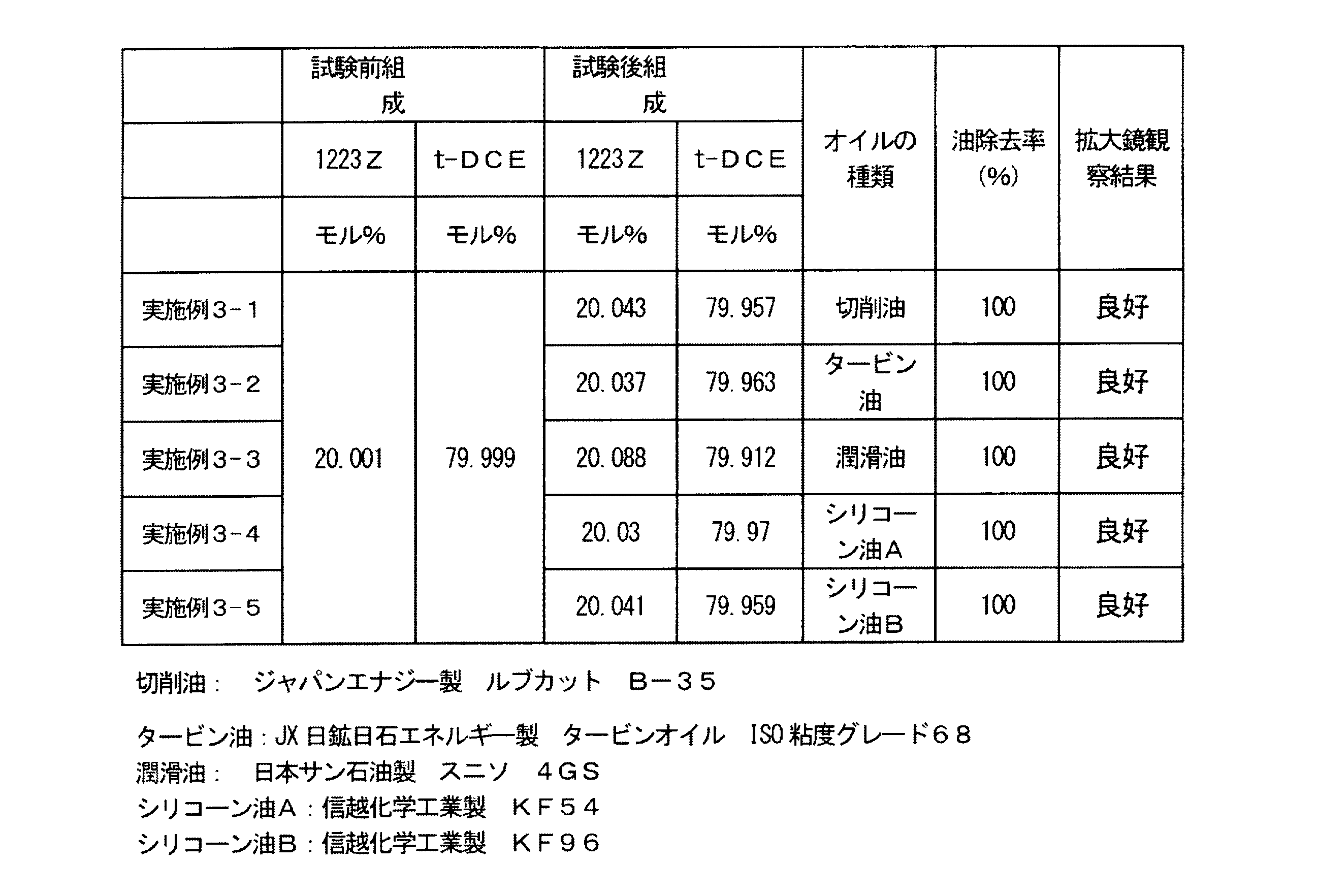
- the liquid composition before and after the cleaning was substantially the same even though 2 mL was volatilized.
- the azeotrope-like composition used in Example 1 was an azeotrope-like composition in which the composition of the remaining liquid did not change substantially even when partially volatilized.
- the glass rod is dried, and the mass (total mass of the glass rod and the residual oil) is measured to obtain the oil removal rate (the mass of the residual oil ⁇ the mass of the initial adhered oil ⁇ 100 [%]) and enlarged.
- the surface of the glass was observed with a mirror.
- the oil removal rate was 100% in all the examples, and the results of magnifying glass observation were judged to be good because no residual oil was observed.
- Table 3 The results of each example are shown in Table 3 below.
Landscapes
- Chemical & Material Sciences (AREA)
- Organic Chemistry (AREA)
- Life Sciences & Earth Sciences (AREA)
- Engineering & Computer Science (AREA)
- Chemical Kinetics & Catalysis (AREA)
- Oil, Petroleum & Natural Gas (AREA)
- Wood Science & Technology (AREA)
- Detergent Compositions (AREA)
- Organic Low-Molecular-Weight Compounds And Preparation Thereof (AREA)
Abstract
本発明の液体組成物は、0.0001モル%~40モル%の(Z)-1,2-ジクロロ-3,3,3-トリフルオロプロペン(1223Z)と、99.9999モル%~60モル%の(E)-1,2-ジクロロ-エチレン(t-DCE)とからなることを特徴とする。当該液体組成物は、地球環境への影響が小さく、共沸(様)の性質を示す。このため、開放系で使用したり、あるいは長時間使用したりしても、組成変動が実用上起こらない。蒸留による回収においても組成変動が生じにくい。このため、当該液体混合物は、洗浄剤(溶剤)として好適に使用することができる。さらにこの組成物のうちt-DCEの量が90モル%以下のものは、消防法上の非危険物である。
Description
本発明は含フッ素オレフィンを含む新規組成物に関する。
クロロフルオロカーボン類(以下CFC類と呼ぶ事がある)、ハイドロクロロフルオロカーボン類(HCFC類と呼ぶ事がある)、ハイドロフルオロカーボン類(以下HFC類と呼ぶ事がある)等の炭素数が1~5の含フッ素アルカンは、揮発性、安定性、不燃性の特徴があるので、冷媒、作動流体、発泡剤、スプレー剤、洗浄剤、溶剤、溶媒等の用途で産業の発展に貢献してきた(これらはフロン類と呼ぶことがある)。また、複数の含フッ素アルカンをブレンドして用いることも広く行われてきた。例えば、アメリカ暖房冷凍空調学会(ASHRAE)の冷媒番号R502、R507A、R404A、R407C、R410Aなどが混合冷媒として広く使われている。これらの混合冷媒は、2種類以上のフロン類を特定の比率で混合することにより成績係数、冷凍サイクル、不燃性、地球温暖化係数等が改善されている。しかし、含フッ素アルカンは揮発性を有するため、混合物として使う場合、フロン類のいずれかが一方的に蒸発すると、使用時にその組成が変化して、物性が変わってしまう。そのため、液相と実質的に同じ組成で揮発する共沸、もしくは共沸様の組成が好ましい。例えば、前述のR502(R22とR115との混合冷媒)、R507A(R143aとR125との混合冷媒)は共沸組成であるので、気相部と液相部との組成が全く同じであり共沸冷媒として用いられている。R410Aについては、その構成成分であるR32とR125とは非共沸であるが、気相部と液相部との組成が実質的に同じであるため、実用上、共沸組成物と同様に取り扱うことができるので、共沸様冷媒として用いられている。冷媒用途以外でも、例えば含フッ素アルカンとアルコールをブレンドして水切り剤として使用したり、可燃性の炭化水素系溶剤に不燃性の含フッ素アルカンを添加して不燃化したり、洗浄力を制御した洗浄剤がある。洗浄剤や水切り剤の用途においても冷媒と同様に揮発した時の気相部と液相部の組成が実質的に同じである共沸または共沸様の組成物が好ましい。
上記のような含フッ素アルカンは大気中においても非常に安定であり、大気寿命が長く、地球温暖化の原因物質とされている。近年、炭素数が2~5の含フッ素オレフィン(ハイドロフルオロオレフィンやハイドロクロロフルオロオレフィン、クロロフルオロオレフィン、フルオロオレフィンを指す)が、上記含フッ素アルカンの代替品として提案されている。分子内に二重結合を有するこれらの含フッ素オレフィンは、二重結合の無い含フッ素アルカンと比較して、大気中のOHラジカルとの反応性が著しく大きくなる。現在、広く使用されているHFC-365mfc、HFC-245fa、HFC-43-10等の大気寿命は年単位であるのに対して、一般に含フッ素オレフィンの大気寿命は日単位であり、万一、大気に放出された場合でも速やかに分解するので、地球温暖化やオゾン層破壊への影響は低い。上記の含フッ素アルカンと類似の物性を有しているので冷媒、作動流体、発泡剤、噴霧剤、洗浄剤、溶剤、溶媒等の各種用途に使用可能であることが報告されている。含フッ素オレフィンも含フッ素アルカンと同様に、ブレンドすることによって性能が改善することが可能である。例えば、特許文献1には、(Z)-1-クロロ-3,3,3-トリフルオロプロペンと1,1,2,2-テトラフルオロ-1-メトキシエタンを混合すると、共沸様の二元系溶媒が形成され、該二元系溶媒の持つ各種油の洗浄効果が優れた水準にあることが報告されているが、このように具体的に含フッ素オレフィンを含む共沸もしくは共沸様の報告例は、含フッ素アルカンと比較して少ない。
特許文献2において、炭素数3の含フッ素オレフィンと汎用溶剤の組成物が提案されている。実施例4において1,2-ジクロロ-3,3,3-トリフルオロプロペン単独の脱脂試験例が開示されているが、この化合物と可燃性(引火点2~4℃)である(E)-1,2-ジクロロ-エチレンの組み合わせに関する洗浄性、蒸発の挙動、引火性等の具体的な記述は無い。さらに、1,2-ジクロロ-3,3,3-トリフルオロプロペンにはE体、Z体の幾何異性体を有し、それぞれ固有の沸点や極性を有しているので、乾燥性、洗浄性、ポリマー適合性が異なるが、幾何異性体に関する開示が無い。特許文献3から7において、レジスト剥離剤、バフ研磨剤、付着水除去用溶剤、ドライクリーニング用洗浄剤に関する記載があるが、特許文献2と同様に、幾何異性体に関する記載や(E)-1,2-ジクロロ-エチレンとブレンドした時の詳しい挙動に関する記載は見当たらない。
しかしながら、このような揮発性の溶剤組成物においては、単純に複数の溶剤を調合して性能が改善されたとしても、各成分の揮発性によって、液組成が変動しやすいと言う問題は避けられない。例えば、二元系の液体組成物を超音波洗浄機に入れて洗浄工程に供したとき、一般に低沸点成分(蒸気圧が大きい成分)が優先的に揮発し、洗浄槽内には高沸点成分(蒸気圧が小さい成分)が濃縮される。例えば、洗浄力の高い低沸点成分と洗浄力の低い高沸点成分からなる組成物の場合、洗浄液における低沸点成分が経時的に減少して、洗浄不良を引き起こすことがある。また、使用済みの洗浄溶液は通常蒸留によって再生、再利用されるが、液相の組成と気相の組成が異なる組成物の場合は、回収した組成物の液組成を調整しなければならず効率的ではない。
特に(E)-1,2-ジクロロ-エチレンの引火点は2~4℃であるので、不燃性の組成物が望まれている。使用中に組成物が揮発して液の組成が変化すると、洗浄性能が変化するだけでなく、不燃性の組成物が可燃性の組成に変化することがありうるので、揮発時に気相部と液相部の組成が実質的に同じである共沸または共沸様の組成物が強く望まれている。
本発明は、環境に優しい(Z)-1,2-ジクロロ-3,3,3-トリフルオロプロペンを含み、揮発しても組成が変らない新規な共沸または共沸様組成物を提案することを課題とする。
本発明者らは上記課題を解決するために鋭意、検討を行った。その結果、1,2-ジクロロ-3,3,3-トリフルオロプロペンのZ体(以下、HCFO-1223xd(Z)または1223Zと呼ぶことがある)と(E)-1,2-ジクロロ-エチレン(以下、t-DCEと呼ぶことがある)は共沸(様)組成物を形成し、1223Zが0.0001モル%~40モル%とt-DCEが99.9999モル%~60モル%の組成物は、実質的に気相部と液相部の組成が同一である共沸様組成物であり、t-DCEが90モル%以下の領域では消防法上の引火点を有しない不燃物であることが判明した。特に、1223Z:20モル%、t-DCE:80モル%は共沸点であることが判明した。さらに、本発明の共沸様組成物は油脂の除去剤として有用であることが実施例で確認され、本発明を完成するに至った。
すなわち、本発明は次の各発明を含む。
[発明1]
(Z)-1,2-ジクロロ-3,3,3-トリフルオロプロペン(1223Z)と(E)-1,2-ジクロロ-エチレン(t-DCE)からなる、共沸(様)組成物。
(Z)-1,2-ジクロロ-3,3,3-トリフルオロプロペン(1223Z)と(E)-1,2-ジクロロ-エチレン(t-DCE)からなる、共沸(様)組成物。
[発明2]
0.0001モル%~40モル%の1223Zと99.9999モル%~60モル%のt-DCEとからなる、発明1に記載の共沸(様)組成物。
0.0001モル%~40モル%の1223Zと99.9999モル%~60モル%のt-DCEとからなる、発明1に記載の共沸(様)組成物。
[発明3]
10モル%~40モル%の1223Zと90モル%~60モル%のt-DCEとからなる、発明1又は発明2に記載の不燃性の共沸(様)組成物。
10モル%~40モル%の1223Zと90モル%~60モル%のt-DCEとからなる、発明1又は発明2に記載の不燃性の共沸(様)組成物。
[発明4]
(Z)-1,2-ジクロロ-3,3,3-トリフルオロプロペン(1223Z):20モル%、(E)-1,2-ジクロロ-エチレン(t-DCE):80モル%からなる共沸組成物。
(Z)-1,2-ジクロロ-3,3,3-トリフルオロプロペン(1223Z):20モル%、(E)-1,2-ジクロロ-エチレン(t-DCE):80モル%からなる共沸組成物。
[発明5]
発明1から発明4のいずれかに記載の共沸(様)組成物と、少なくとも一つの追加成分を含む液体組成物。
発明1から発明4のいずれかに記載の共沸(様)組成物と、少なくとも一つの追加成分を含む液体組成物。
[発明6]
発明1から発明4のいずれかに記載の共沸(様)組成物と、該共沸(様)組成物に対して、10ppm~30質量%の追加成分を少なくとも一つ含む、液体組成物。
発明1から発明4のいずれかに記載の共沸(様)組成物と、該共沸(様)組成物に対して、10ppm~30質量%の追加成分を少なくとも一つ含む、液体組成物。
[発明7]
発明1から発明6のいずれかに記載の共沸(様)組成物ないし液体組成物を含む、洗浄用溶剤。
発明1から発明6のいずれかに記載の共沸(様)組成物ないし液体組成物を含む、洗浄用溶剤。
[発明8]
発明1から発明6のいずれかに記載の共沸(様)組成物ないし液体組成物を、被洗浄物体に接触させる工程を含む、該被洗浄物体を洗浄する方法。
発明1から発明6のいずれかに記載の共沸(様)組成物ないし液体組成物を、被洗浄物体に接触させる工程を含む、該被洗浄物体を洗浄する方法。
本発明により、新規の共沸(様)液体組成物が提供される。当該液体組成物は、開放条件にて使用しても組成が変化しにくい液体としての性能が維持されやすいという効果を奏する。当該、共沸(様)液体組成物は、環境への負荷が少なく、しかも、10モル%~40モル%の1223Zと90モル%~60モル%のt-DCEからなる組成物は、消防法上の非危険物である。当該、共沸(様)液体組成物は、異物、油脂などの汚染物質を洗浄する溶媒(洗浄溶剤)として有用である。
以下、本発明を詳細に説明する。
含フッ素オレフィンは種々の溶剤との相溶性が高いので、容易に均一な組成物を調合することは可能である。しかし、このような単純な組成物の場合、「液組成が変動しやすい」という問題が内在している。すなわち、仮に複数種類の液体を混合し、相溶性を確保できたとしても、各成分の揮発度の違いにより、液組成が変動しやすいという問題は避けられない。例えば、二元系の液体組成物を超音波洗浄機に入れて、洗浄剤として用いた場合、一般に揮発度の高い低沸点成分(蒸気圧の大きい成分)が優先的に揮発し、洗浄槽内に揮発度の低い高沸点成分が濃縮される。例えば、洗浄力の高い低沸点成分に洗浄力の低い高沸点成分の組成物の場合、洗浄液における低沸点成分濃度が経時的に減少して、洗浄不良を引き起こす恐れがある。特に、可燃性の溶剤に不燃性の溶剤をブレンドして不燃性組成物を調合した場合、不燃性成分が優先的に揮発すると洗浄液が可燃性組成物になることがある。
また、洗浄溶媒は、使用後に蒸留等の操作によって回収、再利用するのが、環境保護の面からも経済面からも望ましいが、二成分系の液体の場合、一般に沸点の異なる二成分の液体を別々に回収せざるを得ず、回収・再利用を行うには、操作上の負荷がかかりやすい。
熱力学サイクルの作動流体に用いる場合も、同様の問題がある。すなわち、熱力学サイクルの作動流体として用いる場合も、長時間で見れば液組成が変動する可能性がある。液組成が変動すれば、液体の持つ熱容量、粘度、或いは潤滑剤との親和性に変化が生じ、熱力学サイクルの作動性能が低下することがある。
このため、二元系(多元系)の液体組成物を洗浄剤や作動流体として使用する場合、頻繁に液組成を分析し、適正な組成範囲になるように、絶えず、適切な比率に調合して、揮発した成分を補充しなければならない。しかし、こうした液組成管理は作業上の大きな負荷となり得る。
これに対して、共沸組成物の場合、液組成と同じ組成で揮発するので、使用中に液組成が変化しない非常に好ましい組成である。本明細書において「共沸」とは熱力学的に厳密な意味での共沸を指す。例えば水/エタノールの混合物の場合、エタノール(96質量%)と水(4質量%)の組成物は共沸混合物(azeotrope)であって、これと気液平衡して存在する蒸気も「エタノール(96質量%):水(4質量%)」となり、液組成と完全に一致する。この現象を「共沸」と呼ぶ。特定の温度、圧力では共沸混合物の組成は、ただ1点となる。
「共沸様」は、「擬共沸」とも呼ばれ、熱力学的に厳密な共沸ではないが、ある範囲の組成の液体については、その液組成と、平衡状態にある気体の組成が、実質的に等しいことがあり、そのような現象を指す。完全に気相部と液相部の組成が一致せずとも、実質的に気相部と液相物の組成が一致すれば、当業者は、共沸組成と同様に取り扱うことができる。このとき、気相部と液相部の気液平衡組成差は小さければ小さいほど良い。このように、実質的に気相部と液相部の気液平衡組成が一致する現象を共沸様、または擬共沸と呼び、その組成を共沸様組成、または擬共沸組成と呼ぶ。
学術的には共沸現象と擬共沸現象(または共沸様)は区別すべきであるが、洗浄等の実務においては、共沸現象と共沸様現象(または擬共沸)を区別する必要は無く、全く同じように取り扱うことができるので、本明細書においては、共沸現象と共沸様現象(または擬共沸)を併せて“共沸(様)”と呼ぶ。また、そのときの組成を“共沸(様)組成”と呼ぶ。共沸(様)においては、共沸点の有無は問われない。実質的に気相部と液相部の気液平衡組成が一致すればよい。
「共沸様」は理論的に導かれるものではなく、様々な液体の種類、組成比について気液平衡を実験によって調査し、偶然、気相の組成と液相の組成が実質的に一致した時に、初めて見出せるものであり、本発明においては、1,2-ジクロロ-3,3,3-トリフルオロプロペンのZ体と(E)-1,2-ジクロロ-エチレンの気液平衡実験を行ったところ、気液の組成が完全に一致する共沸点と、実質的に気液の組成が同一である共沸様組成を見出すことが出来た。
1,2-ジクロロ-3,3,3-トリフルオロプロペンにはE体、Z体が存在し、Z体を選択的に製造する方法は特許文献(WO2014/046250号、WO2014/046251号)に記載されており、精密蒸留により、高純度のZ体(1223Z)が入手可能である。(E)-1,2-ジクロロ-エチレンは、可燃性(引火点:2~4℃)の溶剤として市販されている。
実施例で示す気液平衡組成図から明らかな通り、第一の成分である1223Zが0.0001モル%~40モル%と第2の成分であるt-DCEが99.9999モル%~60モル%からなる組成物は気相部と液相部の組成が実質的に同じである共沸(様)組成物である。ここで、前記mol%の値は、1223Zのモル数とt-DCEのモル数の合計値を100としたときの、各成分のモル数の%(すなわち、2成分間の相対的モル%)を表す。この範囲の組成であれば、実務上、液体組成物を開放系で取り扱っても、さらには蒸留による回収操作をおこなっても、組成変動が起こりにくい。
中でも、1223Z/t-DCEのモル比が、0.0001/99.9999~25/75の組成範囲は、気相部と液相部の組成が一層近接しているために、組成変動が一層起こりにくい組成である。このうち、10/90~25/75の範囲であれば、組成変動がごく生じにくいのみならず、消防法上の不燃物としての性質もあるため、この範囲の組成物は、本発明の特に好ましい組成物と言える。
中でも、第1の成分である1223Zが19~21mol%、第2の成分であるt-DCEが81~78mol%の範囲は、不燃性であるだけでなく、液組成の変動が一層起こりにくく、本発明の中で特に好ましい共沸(様)組成物である。さらに、第1の成分である1223Zが20mol%、第2の成分であるt-DCEが80mol%の組成は、理論上の組成変動が起こらない共沸組成である。
本発明の共沸(様)組成物は、前記第1の成分と、前記第2の成分を、所定量混合する工程を経て、製造することができる。本発明の共沸(様)組成物は、不純物が実質的に混入していない、高純度のものが好ましい態様の1つであることは言うまでもない。しかし、用途によっては、それほど高い純度の液体組成物を要求されない場合もある。そのような場合には、第1の成分である1223Zや、第2の成分であるt-DCEを合成するための原料物質や、副生成物が少量(通常各成分とも、該共沸(様)組成物に対して通常1重量%未満)、残存したものを用いることもできる。
これに対し、高い純度の共沸(様)組成物が要求される場合には、第1の成分である1223Zと第2の成分であるt-DCEを混合する前に、それぞれを精密蒸留して原料由来の不純物を除去し、純度を高めた上で、2成分を混合し、本発明の共沸(様)組成物を調製することが好ましい。
所望により、共沸(様)組成物の性能を改善するために追加成分を添加することも推奨される。追加成分としては、洗浄力強化剤(界面活性剤)、安定剤(受酸剤、酸化防止剤)等が例示される。具体的には、ソルビタンモノオレエート、ソルビタントリオレエート等のソルビタン脂肪族エステル類;ポリオキシエチレンのソルビットテトラオレエート等のポリオキシエチレンソルビット脂肪酸エステル類;ポリオキシエチレンモノラウレート等のポリエチレングリコール脂肪酸エステル類;ポリオキシエチレンラウリルエーテル等のポリオキシエチレンアルキルエーテル類;ポリオキシエチレンノニルフェニルエーテル等のポリオキシエチレンアルキルフェニルエーテル類;ポリオキシエチレンオレイン酸アミド等のポリオキシエチレンアルキルアミン脂肪酸アミド類等のノニオン系界面活性剤が挙げられる。これらの界面活性剤は、単独で使用されてもよく、2種以上組み合わせて使用されてもよい。相乗的に洗浄力及び界面作用を改善する目的で、これらのノニオン系界面活性剤に加えてカチオン系界面活性剤やアニオン系界面活性剤を本発明の共沸様組成物を含む洗浄剤に添加してもよい。界面活性剤の使用量は、その種類により異なるが、共沸様組成物の共沸様の性質に支障のない程度であればよく、通常、共沸様組成物中0.1質量%以上30質量%以下程度であり、0.3質量%以上5質量%以下程度とすることが好ましい。
過酷な条件での使用に際して、更に各種の安定剤を添加してもよい。安定剤の種類は特に限定されないが、蒸留操作により同伴留出されるもの或いは共沸様混合物を形成するものがより望ましい。このような安定剤の具体例としては安定剤としては、ニトロ化合物、エポキシ化合物、フェノール類、イミダゾール類、アミン類、炭化水素類等が挙げられる。
ニトロ化合物としては、公知の化合物が用いられてもよく、脂肪族及び/または芳香族誘導体などが挙げられる。脂肪族系ニトロ化合物として、例えば、ニトロメタン、ニトロエタン、1-ニトロプロパン、2-ニトロプロパン等が挙げられる。芳香族ニトロ化合物として、例えば、ニトロベンゼン、o-、m-又はp-ジニトロベンゼン、トリニトロベンゼン、o-、m-又はp-ニトロトルエン、o-、m-又はp-エチルニトロベンゼン、2,3-、2,4-、2,5-、2,6-、3,4-又は3,5-ジメチルニトロベンゼン、o-、m-又はp-ニトロアセトフェノン、o-、m-又はp-ニトロフェノール、o-、m-又はp-ニトロアニソール等が挙げられる。
エポキシ化合物としては、例えば、エチレンオキサイド、1,2-ブチレンオキサイド、プロピレンオキサイド、スチレンオキサイド、シクロヘキセンオキサイド、グリシドール、エピクロルヒドリン、グリシジルメタアクリレート、フェニルグリシジルエーテル、アリルグリシジルエーテル、メチルグリシジルエーテル、ブチルグリシジルエーテル、2-エチルヘキシルグリシジルエーテル等のモノエポキシ系化合物、ジエポキシブタン、ビニルシクロヘキセンジオキサイド、ネオペンチルグリコールジグリシジルエーテル、エチレングリコールジグリシジルエーテル、グリセリンポリグリシジルエーテル、トリメチロールプロパントルグリシジルエーテル等のポリエポキシ系化合物等が挙げられる。
フェノール類としては、水酸基以外にアルキル基、アルケニル基、アルコキシ基、カルボキシル基、カルボニル基、ハロゲン等各種の置換基を含むフェノール類も含むものである。例えば、2,6-ジ-t-ブチル-p-クレゾール、o-クレゾール、m-クレゾール、p-クレゾール、チモール、p-t-ブチルフェノール、o-メトキシフェノール、m-メトキシフェノール、p-メトキシフェノール、オイゲノール、イソオイゲノール、ブチルヒドロキシアニソール、フェノール、キシレノール等の1価のフェノールあるいはt-ブチルカテコール、2,5-ジ-t-アミノハイドロキノン、2,5-ジ-t-ブチルハイドロキノン等の2価のフェノール等が挙げられる。
イミダゾール類としては、炭素数1以上18以下の直鎖もしくは分岐を有するアルキル基、シクロアルキル基、またはアリール基をN位の置換基とする、1-メチルイミダゾール、1-n-ブチルイミダゾール、1-フェニルイミダゾール、1-ベンジルイミダゾール、1-(β-オキシエチル)イミダゾール、1-メチル-2-プロピルイミダゾール、1-メチル-2-イソブチルイミダゾール、1-n-ブチル-2-メチルイミダゾール、1,2-ジメチルイミダゾール、1,4-ジメチルイミダゾール、1,5-ジメチルイミダゾール、1,2,5-トリメチルイミダゾール、1,4,5-トリメチルイミダゾール、1-エチル-2-メチルイミダゾール等が挙げられる。これらの化合物は単独で使用されてもよく、2種以上の化合物が併用されてもよい。
アミン類としては、ペンチルアミン、ヘキシルアミン、ジイソプロピルアミン、ジイソブチルアミン、ジ-n-プロピルアミン、ジアリルアミン、トリエチルアミン、N-メチルアニリン、ピリジン、モルホリン、N-メチルモルホリン、トリアリルアミン、アリルアミン、α-メチルベンジルアミン、メチルアミン、ジメチルアミン、トリメチルアミン、エチルアミン、ジエチルアミン、プロピルアミン、イソプロピルアミン、ジプロピルアミン、ブチルアミン、イソブチルアミン、ジブチルアミン、トリブチルアミン、ジベンチルアミン、トリベンチルアミン、2-エチルヘキシルアミン、アニリン、N,N-ジメチルアニリン、N,N-ジエチルアニリン、エチレンジアミン、プロピレンジアミン、ジエチレントリアミン、テトラエチレンペンタミン、ベンジルアミン、ジベンジルアミン、ジフェニルアミン、ジエチルヒドロキシルアミン等が挙げられる。これらは単独で用いられてもよく、2種以上の化合物が併用されてもよい。
炭化水素類としては、α-メチルスチレンやp-イソプロペニルトルエン、イソプレン類、プロパジエン類、テルペン類等が挙げられる。これらは単独で用いてもよく、2種以上の化合物が併用されてもよい。
<洗浄剤あるいは溶剤としての使用>
本発明の共沸(様)組成物(あるいは、該共沸(様)組成物を含む液体組成物)は、精密機械部品、電子材料(プリント基板、液晶表示器、磁気記録部品、半導体材料等)、樹脂加工部品、光学レンズ、衣料品などから異物、油脂、グリース、ワックス、フラックス、インキ等を除去するのに好適である。前述の通り、本発明の共沸(様)組成物は不燃性であり、適度な流動性や溶解性を有するので、異物(パーティクルなど)を洗い流したり、又は溶解したりして、除去できる。洗浄の手法は特に限定されないが、精密機械部品、電子材料などに本発明の共沸(様)組成物(あるいは、該共沸(様)組成物を含む液体組成物)を浸漬して汚れを洗い流す、ウェスでふき取る、スプレー洗浄を行う、などの方法が挙げられ、これらを組み合わせて使用しても良い。超音波洗浄機内に当該共沸(様)組成物を入れ、その液中に洗浄対象の物品を浸漬させ、超音波洗浄処理することは、特に好ましい態様の1つである。
本発明の共沸(様)組成物(あるいは、該共沸(様)組成物を含む液体組成物)は、精密機械部品、電子材料(プリント基板、液晶表示器、磁気記録部品、半導体材料等)、樹脂加工部品、光学レンズ、衣料品などから異物、油脂、グリース、ワックス、フラックス、インキ等を除去するのに好適である。前述の通り、本発明の共沸(様)組成物は不燃性であり、適度な流動性や溶解性を有するので、異物(パーティクルなど)を洗い流したり、又は溶解したりして、除去できる。洗浄の手法は特に限定されないが、精密機械部品、電子材料などに本発明の共沸(様)組成物(あるいは、該共沸(様)組成物を含む液体組成物)を浸漬して汚れを洗い流す、ウェスでふき取る、スプレー洗浄を行う、などの方法が挙げられ、これらを組み合わせて使用しても良い。超音波洗浄機内に当該共沸(様)組成物を入れ、その液中に洗浄対象の物品を浸漬させ、超音波洗浄処理することは、特に好ましい態様の1つである。
既に述べた通り、本発明の共沸(様)組成物は、開放系で使用しても、組成の変動はほとんど起こらないため、さほど頻繁に組成管理をしなくても安定した洗浄力を発揮し、これは実務上の大きなメリットである。
洗浄に用いた洗浄液は、回収した上で、蒸留操作を付せば、油脂や異物(パーティクル)を分離除去でき、本発明の共沸(様)組成物を回収できる。一般的な洗浄剤用の蒸留再生装置は単蒸留方式なので、第一の成分である1223Zが0.0001モル%~40モル%と第2の成分であるt-DCEが99.9999モル%~60モル%からなる共沸様組成物の場合は、市販の蒸留再生装置で、実質的に組成変化なく再生可能である。特に、共沸組成物の場合は高段数の蒸留塔を用いても組成変化が無いので好ましい。
蒸留操作を行う際、1223Zとt-DCEの2種類の液体成分は、共沸(様)組成物としての性質を維持するので、回収液体は、その後、大掛かりな組成調整を経ることなく、再び洗浄溶剤として使用できる。なお、上記「追加成分」が使われていた場合には、これら「追加成分」は蒸留によって除去されてしまう場合もあるので、その場合は別途補うことが望ましい。
本発明を実施例によって説明する。
<実施例1>
セプタム、攪拌子、-10℃の冷媒が流せるジムロートを備えた50mL三つ口フラスコに、表1記載のモル濃度になるように1223Zとt-DCEを合わせて25mL仕込んだ。ジムロート上部には合成ゼオライト管を取り付けた。フラスコをオイルバスに浸し、攪拌しながら還流するまで加熱した。還流が開始してから一時間以上経過して組成が安定した後、セプタムからガスタイトシリンジで気相部をサンプリングして、ガスクロマトグラフィー分析した。液相部は同様に注射針を備えたポリプロピレン製シリンジを用いて、約1mLをサンプリングし、予め氷水で冷却した2mLバイアル瓶に移した後、ガスクロマトグラフィー分析を実施した。表1においては予め作成した検量線を用いてモル%表記とした。また、図1は横軸に1223Zの液相部組成、縦軸に1223Zの気相部組成をとり、表1の結果をプロットした。第一成分の1223Zが40モル%~99.9999モル%、第二成分のt-DCEが0.0001~60モル%の範囲において、気相部と液相部の組成が実質的に変化しない共沸組成物または共沸様組成物であることが明らかとなった。

セプタム、攪拌子、-10℃の冷媒が流せるジムロートを備えた50mL三つ口フラスコに、表1記載のモル濃度になるように1223Zとt-DCEを合わせて25mL仕込んだ。ジムロート上部には合成ゼオライト管を取り付けた。フラスコをオイルバスに浸し、攪拌しながら還流するまで加熱した。還流が開始してから一時間以上経過して組成が安定した後、セプタムからガスタイトシリンジで気相部をサンプリングして、ガスクロマトグラフィー分析した。液相部は同様に注射針を備えたポリプロピレン製シリンジを用いて、約1mLをサンプリングし、予め氷水で冷却した2mLバイアル瓶に移した後、ガスクロマトグラフィー分析を実施した。表1においては予め作成した検量線を用いてモル%表記とした。また、図1は横軸に1223Zの液相部組成、縦軸に1223Zの気相部組成をとり、表1の結果をプロットした。第一成分の1223Zが40モル%~99.9999モル%、第二成分のt-DCEが0.0001~60モル%の範囲において、気相部と液相部の組成が実質的に変化しない共沸組成物または共沸様組成物であることが明らかとなった。
<実施例2>
日本工業規格JIS K2265-1「引火点の求め方-第1部:タグ密閉法」に準拠して、1223Zとt-DCEの混合液体の引火点をそれぞれ測定した。引火点測定には、自動引火点測定器atg-8l(田中科学機器製作株式会社)を使用した。各組成における測定結果を表2に示す。1223Zとt-DCEの共沸または共沸様組成物の範囲において、大気圧力条件下で引火点がないことが観測された。
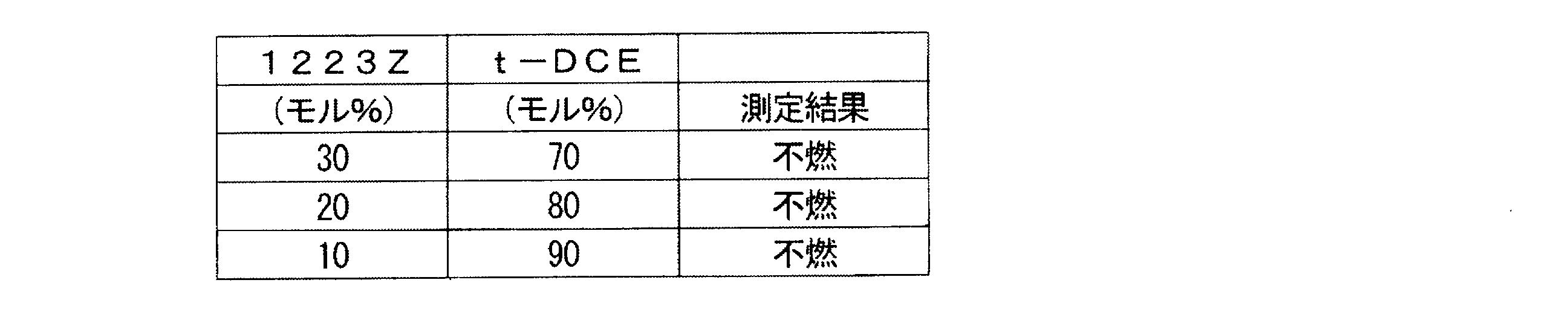
日本工業規格JIS K2265-1「引火点の求め方-第1部:タグ密閉法」に準拠して、1223Zとt-DCEの混合液体の引火点をそれぞれ測定した。引火点測定には、自動引火点測定器atg-8l(田中科学機器製作株式会社)を使用した。各組成における測定結果を表2に示す。1223Zとt-DCEの共沸または共沸様組成物の範囲において、大気圧力条件下で引火点がないことが観測された。
<実施例3>
<洗浄試験>
市販の25mLメスシリンダーを11mLの目盛り線で切断した。直径:約7.2mm×長さ:約40mmの清浄な硝子棒の質量を測定後、表記載のオイルに2分間浸漬し、10分間立てて液切した(過剰についたオイルを除去した)後、質量(ガラス棒+初期付着オイル)を測定後、前記のメスシリンダーに入れた。以下の表2に記載の組成が1233Z:20モル%、t-DCE:80モル%の共沸様組成物を10mLの液面まで仕込み、20℃の水を満たした小型超音波洗浄機(シチズン製SW5800)の中央部に立てた。超音波を照射すると時間と共に共沸様組成物が揮発し、8mLの目盛り線になった時点で、メスシリンダー内の液をガスクロマトグラフで分析した。その結果、全ての実施例1の実験例において、2mL揮発したにも関わらず、洗浄前後の液組成は実質に同一であった。すなわち、実機洗浄において、実施例1で用いた共沸様組成物は、部分的に揮発しても残液の組成が実質的に変化しない共沸様組成であることが示された。次にガラス棒を乾燥させて質量(ガラス棒と残存オイルとの総質量)を測定して、油除去率(残存オイルの質量÷初期付着オイルの質量×100[%])を求めると共に、拡大鏡で硝子の表面を観察した。その結果、全ての実施例において油除去率が100%であり、拡大鏡観察結果においては、油分の残存が認められなかったため良好と判断された。各実施例の結果を以下の表3に示す。
<洗浄試験>
市販の25mLメスシリンダーを11mLの目盛り線で切断した。直径:約7.2mm×長さ:約40mmの清浄な硝子棒の質量を測定後、表記載のオイルに2分間浸漬し、10分間立てて液切した(過剰についたオイルを除去した)後、質量(ガラス棒+初期付着オイル)を測定後、前記のメスシリンダーに入れた。以下の表2に記載の組成が1233Z:20モル%、t-DCE:80モル%の共沸様組成物を10mLの液面まで仕込み、20℃の水を満たした小型超音波洗浄機(シチズン製SW5800)の中央部に立てた。超音波を照射すると時間と共に共沸様組成物が揮発し、8mLの目盛り線になった時点で、メスシリンダー内の液をガスクロマトグラフで分析した。その結果、全ての実施例1の実験例において、2mL揮発したにも関わらず、洗浄前後の液組成は実質に同一であった。すなわち、実機洗浄において、実施例1で用いた共沸様組成物は、部分的に揮発しても残液の組成が実質的に変化しない共沸様組成であることが示された。次にガラス棒を乾燥させて質量(ガラス棒と残存オイルとの総質量)を測定して、油除去率(残存オイルの質量÷初期付着オイルの質量×100[%])を求めると共に、拡大鏡で硝子の表面を観察した。その結果、全ての実施例において油除去率が100%であり、拡大鏡観察結果においては、油分の残存が認められなかったため良好と判断された。各実施例の結果を以下の表3に示す。
Claims (8)
- (Z)-1,2-ジクロロ-3,3,3-トリフルオロプロペン(1223Z)と(E)-1,2-ジクロロ-エチレン(t-DCE)からなる、共沸(様)組成物。
- 0.0001モル%~40モル%の1223Zと99.9999モル%~60モル%のt-DCEとからなる、請求項1に記載の共沸(様)組成物。
- 10モル%~40モル%の1223Zと90モル%~60モル%のt-DCEとからなる、請求項1又は請求項2に記載の不燃性の共沸(様)組成物。
- (Z)-1,2-ジクロロ-3,3,3-トリフルオロプロペン(1223Z):20モル%、(E)-1,2-ジクロロ-エチレン(t-DCE):80モル%からなる共沸組成物。
- 請求項1から請求項4のいずれかに記載の共沸(様)組成物と、少なくとも一つの追加成分を含む液体組成物。
- 請求項1から請求項4のいずれかに記載の共沸(様)組成物と、該共沸(様)組成物に対して、10ppm~30質量%の追加成分を少なくとも一つ含む、液体組成物。
- 請求項1から請求項6のいずれかに記載の共沸(様)組成物ないし液体組成物を含む、洗浄用溶剤。
- 請求項1から請求項6のいずれかに記載の共沸(様)組成物ないし液体組成物を、被洗浄物体に接触させる工程を含む、該被洗浄物体を洗浄する方法。
Priority Applications (2)
| Application Number | Priority Date | Filing Date | Title |
|---|---|---|---|
| US15/528,318 US10344250B2 (en) | 2014-11-21 | 2015-10-20 | Azeotropic composition having fluorine-containing olefin as constituent |
| CN201580062994.2A CN107001997B (zh) | 2014-11-21 | 2015-10-20 | 以含氟烯烃为构成成分的类共沸组合物 |
Applications Claiming Priority (2)
| Application Number | Priority Date | Filing Date | Title |
|---|---|---|---|
| JP2014-237179 | 2014-11-21 | ||
| JP2014237179A JP6432306B2 (ja) | 2014-11-21 | 2014-11-21 | 含フッ素オレフィンを構成成分とする共沸様組成物 |
Publications (1)
| Publication Number | Publication Date |
|---|---|
| WO2016080133A1 true WO2016080133A1 (ja) | 2016-05-26 |
Family
ID=56013690
Family Applications (1)
| Application Number | Title | Priority Date | Filing Date |
|---|---|---|---|
| PCT/JP2015/079494 Ceased WO2016080133A1 (ja) | 2014-11-21 | 2015-10-20 | 含フッ素オレフィンを構成成分とする共沸様組成物 |
Country Status (4)
| Country | Link |
|---|---|
| US (1) | US10344250B2 (ja) |
| JP (1) | JP6432306B2 (ja) |
| CN (1) | CN107001997B (ja) |
| WO (1) | WO2016080133A1 (ja) |
Cited By (2)
| Publication number | Priority date | Publication date | Assignee | Title |
|---|---|---|---|---|
| WO2018231689A1 (en) * | 2017-06-15 | 2018-12-20 | Eastman Chemical Company | A novel minimum boiling azeotrope of n-butyl-3-hydroxybutyrate and n-undecane and application of the azeotrope to solvent cleaning |
| WO2020031962A1 (ja) * | 2018-08-10 | 2020-02-13 | ダイキン工業株式会社 | 1,2-ジクロロ-3,3,3-トリフルオロプロペンを含む組成物 |
Families Citing this family (4)
| Publication number | Priority date | Publication date | Assignee | Title |
|---|---|---|---|---|
| JP6503765B2 (ja) * | 2015-02-02 | 2019-04-24 | セントラル硝子株式会社 | 含フッ素オレフィンを構成成分とする共沸様組成物 |
| EP3447082A4 (en) * | 2016-04-22 | 2019-11-27 | Dow Toray Co., Ltd. | HIGH DIELECTRIC FILM, USE AND MANUFACTURING METHOD THEREFOR |
| JP6361721B2 (ja) | 2016-11-11 | 2018-07-25 | ダイキン工業株式会社 | 洗浄剤組成物及び洗浄方法、並びに溶剤組成物、油類のための溶剤としてのその使用、及びそれを含む油類組成物 |
| CN113993969B (zh) * | 2019-06-07 | 2024-12-20 | Agc株式会社 | 共沸组合物、类共沸组合物、组合物、清洗剂、溶剂、热传递介质 |
Citations (3)
| Publication number | Priority date | Publication date | Assignee | Title |
|---|---|---|---|---|
| JP2004529087A (ja) * | 2001-01-24 | 2004-09-24 | ハネウェル・インターナショナル・インコーポレーテッド | 1,2−ジクロロ−3,3,3−トリフルオロプロペン及びフッ化水素の共沸様組成物 |
| JP2006525374A (ja) * | 2003-05-06 | 2006-11-09 | ハネウェル・インターナショナル・インコーポレーテッド | 1−クロロ−1、3、3、3−テトラフルオロプロパン及び1、2−ジクロロ−3、3、3−トリフルオロプロペンの共沸類組成物 |
| WO2014117014A2 (en) * | 2013-01-25 | 2014-07-31 | Trane International Inc. | Refrigerant additives and compositions |
Family Cites Families (15)
| Publication number | Priority date | Publication date | Assignee | Title |
|---|---|---|---|---|
| JPH02222702A (ja) | 1989-02-23 | 1990-09-05 | Asahi Glass Co Ltd | 付着水除去用溶剤 |
| JPH02221388A (ja) | 1989-02-23 | 1990-09-04 | Asahi Glass Co Ltd | 脱脂洗浄剤 |
| JPH02221389A (ja) | 1989-02-23 | 1990-09-04 | Asahi Glass Co Ltd | バフ研磨洗浄剤 |
| JPH02221962A (ja) | 1989-02-23 | 1990-09-04 | Asahi Glass Co Ltd | レジスト現像剤 |
| JPH02222469A (ja) | 1989-02-23 | 1990-09-05 | Asahi Glass Co Ltd | レジスト剥離剤 |
| JPH02222496A (ja) | 1989-02-23 | 1990-09-05 | Asahi Glass Co Ltd | ドライクリーニング用洗浄剤 |
| US5250208A (en) * | 1992-04-02 | 1993-10-05 | E. I. Du Pont De Nemours And Company | Ternary azeotropic compositions |
| JP5109556B2 (ja) | 2006-11-01 | 2012-12-26 | セントラル硝子株式会社 | 1,1,2,2−テトラフルオロ−1−メトキシエタンを含む共沸及び共沸様組成物 |
| KR102663488B1 (ko) * | 2008-05-07 | 2024-05-10 | 더 케무어스 컴퍼니 에프씨, 엘엘씨 | 2,3-다이클로로-1,1,1-트라이플루오로프로판, 2-클로로-1,1,1-트라이플루오로프로펜, 2-클로로-1,1,1,2-테트라플루오로프로판 또는 2,3,3,3-테트라플루오로프로펜을 포함하는 조성물 |
| CA2723125C (en) * | 2008-05-12 | 2016-09-13 | Arkema Inc. | Compositions of hydrochlorofluoroolefins |
| WO2010085397A1 (en) * | 2009-01-22 | 2010-07-29 | Arkema Inc. | Trans-1,2-dichloroethylene with flash point elevated by 1 -chloro-3,3,3-trifluoropropene |
| US20120304686A1 (en) * | 2011-06-02 | 2012-12-06 | E. I. Du Pont De Nemours And Company | Absorption cycle system having dual absorption circuits |
| WO2014046250A1 (ja) | 2012-09-21 | 2014-03-27 | セントラル硝子株式会社 | 1,2-ジクロロ-3,3,3-トリフルオロプロペンの製造方法 |
| JP6119757B2 (ja) | 2012-09-21 | 2017-04-26 | セントラル硝子株式会社 | 1,2−ジクロロ−3,3,3−トリフルオロプロペンの製造方法 |
| WO2014144558A1 (en) * | 2013-03-15 | 2014-09-18 | Trane International Inc. | Lubricant defoaming additives and compositions |
-
2014
- 2014-11-21 JP JP2014237179A patent/JP6432306B2/ja active Active
-
2015
- 2015-10-20 WO PCT/JP2015/079494 patent/WO2016080133A1/ja not_active Ceased
- 2015-10-20 CN CN201580062994.2A patent/CN107001997B/zh active Active
- 2015-10-20 US US15/528,318 patent/US10344250B2/en active Active
Patent Citations (3)
| Publication number | Priority date | Publication date | Assignee | Title |
|---|---|---|---|---|
| JP2004529087A (ja) * | 2001-01-24 | 2004-09-24 | ハネウェル・インターナショナル・インコーポレーテッド | 1,2−ジクロロ−3,3,3−トリフルオロプロペン及びフッ化水素の共沸様組成物 |
| JP2006525374A (ja) * | 2003-05-06 | 2006-11-09 | ハネウェル・インターナショナル・インコーポレーテッド | 1−クロロ−1、3、3、3−テトラフルオロプロパン及び1、2−ジクロロ−3、3、3−トリフルオロプロペンの共沸類組成物 |
| WO2014117014A2 (en) * | 2013-01-25 | 2014-07-31 | Trane International Inc. | Refrigerant additives and compositions |
Cited By (7)
| Publication number | Priority date | Publication date | Assignee | Title |
|---|---|---|---|---|
| WO2018231689A1 (en) * | 2017-06-15 | 2018-12-20 | Eastman Chemical Company | A novel minimum boiling azeotrope of n-butyl-3-hydroxybutyrate and n-undecane and application of the azeotrope to solvent cleaning |
| US10233410B2 (en) | 2017-06-15 | 2019-03-19 | Eastman Chemical Company | Minimum boiling azeotrope of n-butyl-3-hydroxybutyrate and n-undecane and application of the azeotrope to solvent cleaning |
| CN110753747A (zh) * | 2017-06-15 | 2020-02-04 | 伊士曼化工公司 | 3-羟基丁酸正丁酯和正十一烷的新型最小沸点共沸物以及该共沸物在溶剂清洁中的应用 |
| CN110753747B (zh) * | 2017-06-15 | 2021-06-25 | 伊士曼化工公司 | 3-羟基丁酸正丁酯和正十一烷的新型最小沸点共沸物以及该共沸物在溶剂清洁中的应用 |
| WO2020031962A1 (ja) * | 2018-08-10 | 2020-02-13 | ダイキン工業株式会社 | 1,2-ジクロロ-3,3,3-トリフルオロプロペンを含む組成物 |
| JP2020026481A (ja) * | 2018-08-10 | 2020-02-20 | ダイキン工業株式会社 | 1,2−ジクロロ−3,3,3−トリフルオロプロペンを含む組成物 |
| US11981883B2 (en) | 2018-08-10 | 2024-05-14 | Daikin Industries, Ltd. | Composition containing 1,2-dichloro-3,3,3-trifluoropropene |
Also Published As
| Publication number | Publication date |
|---|---|
| CN107001997B (zh) | 2019-07-26 |
| JP2016098334A (ja) | 2016-05-30 |
| US20170321167A1 (en) | 2017-11-09 |
| CN107001997A (zh) | 2017-08-01 |
| US10344250B2 (en) | 2019-07-09 |
| JP6432306B2 (ja) | 2018-12-05 |
Similar Documents
| Publication | Publication Date | Title |
|---|---|---|
| JP6432306B2 (ja) | 含フッ素オレフィンを構成成分とする共沸様組成物 | |
| WO2020022474A1 (ja) | 共沸(様)組成物 | |
| US8877087B2 (en) | Nonflammable compositions comprising fluorinated compounds and use of these compositions | |
| TW201734191A (zh) | 洗淨劑組成物、清洗劑組成物及洗淨方法 | |
| JP7656166B2 (ja) | 溶剤組成物、エアゾール組成物、洗浄剤、物品の洗浄方法、塗膜形成用組成物、塗膜付き物品の製造方法、水切り剤、リンス剤及び潤滑剤溶液 | |
| JP6503765B2 (ja) | 含フッ素オレフィンを構成成分とする共沸様組成物 | |
| JP2010248443A (ja) | 1,1,1,3,3−ペンタフルオロブタンを含む共沸様組成物 | |
| WO2014096417A1 (en) | Non-flammable ternary compositions and use of these compositions | |
| JP6520178B2 (ja) | 含フッ素オレフィンを構成成分とする共沸様組成物 | |
| EP2970835A1 (en) | Non-flammable compositions and use of these compositions | |
| JPWO2017179582A1 (ja) | 抽出溶媒組成物、抽出方法、および検査方法 | |
| JP7189448B2 (ja) | Z-1,2-ジクロロ-3,3,3-トリフルオロプロペンを構成成分とする共沸様組成物 | |
| WO2016067933A1 (ja) | 含フッ素オレフィン組成物およびそれを用いた洗浄方法 | |
| JP2021059501A (ja) | ハイドロフルオロエーテル、ハイドロフルオロエーテルを含む組成物、およびハイドロフルオロエーテルを用いるコーティング膜の形成方法と物品洗浄方法 | |
| JP2018150502A (ja) | 洗浄剤組成物、リンス剤組成物及び洗浄方法 | |
| WO2020022478A1 (ja) | 溶剤組成物 | |
| US20220073804A1 (en) | Azeotropic composition, azeotrope-like composition, composition, cleaning agent, solvent, and heat transfer medium | |
| WO2015075034A1 (en) | Non-flammable compositions and use of these compositions | |
| JP6896991B2 (ja) | 組成物、液体組成物、洗浄用溶剤、およびこれらの製造方法と回収方法、ならびに洗浄用溶剤を用いる洗浄方法 | |
| JP2001509533A (ja) | 1−ブロモプロパンと高度フッ素化炭化水素の共沸混合物および共沸混合物様組成物 | |
| EP2746380A1 (en) | Non-flammable ternary compositions and use of these compositions | |
| JP2010001319A (ja) | 共沸溶剤組成物、擬共沸溶剤組成物および混合溶剤組成物 | |
| JP2023158659A (ja) | 溶液の調製方法、物品の洗浄方法、溶剤組成物、及びその用途 | |
| JP2003527446A (ja) | 1−ブロモプロパンとジクロロペンタフルオロプロパンとの共沸組成物及び共沸様組成物 | |
| JP2021116323A (ja) | 共沸様組成物及び液体組成物 |
Legal Events
| Date | Code | Title | Description |
|---|---|---|---|
| 121 | Ep: the epo has been informed by wipo that ep was designated in this application |
Ref document number: 15860824 Country of ref document: EP Kind code of ref document: A1 |
|
| WWE | Wipo information: entry into national phase |
Ref document number: 15528318 Country of ref document: US |
|
| NENP | Non-entry into the national phase |
Ref country code: DE |
|
| 122 | Ep: pct application non-entry in european phase |
Ref document number: 15860824 Country of ref document: EP Kind code of ref document: A1 |