WO2016052381A1 - 情報処理装置、制御方法、及びプログラム - Google Patents
情報処理装置、制御方法、及びプログラム Download PDFInfo
- Publication number
- WO2016052381A1 WO2016052381A1 PCT/JP2015/077266 JP2015077266W WO2016052381A1 WO 2016052381 A1 WO2016052381 A1 WO 2016052381A1 JP 2015077266 W JP2015077266 W JP 2015077266W WO 2016052381 A1 WO2016052381 A1 WO 2016052381A1
- Authority
- WO
- WIPO (PCT)
- Prior art keywords
- display
- unit
- information processing
- operator
- customer
- Prior art date
- Legal status (The legal status is an assumption and is not a legal conclusion. Google has not performed a legal analysis and makes no representation as to the accuracy of the status listed.)
- Ceased
Links
Images








Classifications
-
- G—PHYSICS
- G06—COMPUTING OR CALCULATING; COUNTING
- G06Q—INFORMATION AND COMMUNICATION TECHNOLOGY [ICT] SPECIALLY ADAPTED FOR ADMINISTRATIVE, COMMERCIAL, FINANCIAL, MANAGERIAL OR SUPERVISORY PURPOSES; SYSTEMS OR METHODS SPECIALLY ADAPTED FOR ADMINISTRATIVE, COMMERCIAL, FINANCIAL, MANAGERIAL OR SUPERVISORY PURPOSES, NOT OTHERWISE PROVIDED FOR
- G06Q10/00—Administration; Management
- G06Q10/06—Resources, workflows, human or project management; Enterprise or organisation planning; Enterprise or organisation modelling
-
- G—PHYSICS
- G06—COMPUTING OR CALCULATING; COUNTING
- G06Q—INFORMATION AND COMMUNICATION TECHNOLOGY [ICT] SPECIALLY ADAPTED FOR ADMINISTRATIVE, COMMERCIAL, FINANCIAL, MANAGERIAL OR SUPERVISORY PURPOSES; SYSTEMS OR METHODS SPECIALLY ADAPTED FOR ADMINISTRATIVE, COMMERCIAL, FINANCIAL, MANAGERIAL OR SUPERVISORY PURPOSES, NOT OTHERWISE PROVIDED FOR
- G06Q30/00—Commerce
- G06Q30/06—Buying, selling or leasing transactions
-
- G—PHYSICS
- G06—COMPUTING OR CALCULATING; COUNTING
- G06Q—INFORMATION AND COMMUNICATION TECHNOLOGY [ICT] SPECIALLY ADAPTED FOR ADMINISTRATIVE, COMMERCIAL, FINANCIAL, MANAGERIAL OR SUPERVISORY PURPOSES; SYSTEMS OR METHODS SPECIALLY ADAPTED FOR ADMINISTRATIVE, COMMERCIAL, FINANCIAL, MANAGERIAL OR SUPERVISORY PURPOSES, NOT OTHERWISE PROVIDED FOR
- G06Q50/00—Information and communication technology [ICT] specially adapted for implementation of business processes of specific business sectors, e.g. utilities or tourism
- G06Q50/10—Services
- G06Q50/12—Hotels or restaurants
-
- G—PHYSICS
- G07—CHECKING-DEVICES
- G07G—REGISTERING THE RECEIPT OF CASH, VALUABLES, OR TOKENS
- G07G1/00—Cash registers
Definitions
- the present invention relates to an information processing apparatus, a control method, and a program.
- Patent Documents 1 and 2 disclose a technique for analyzing voice data of a voice uttered by a store clerk and determining whether or not a predetermined statement is made.
- Some shop assistants are unable to grasp the customer service that should be done at the time of accounting, and cannot act as prescribed in the manual.
- the customer service level is improved by work experience, but non-regular workers such as part-time workers engaged in accounting operations at convenience stores and supermarkets are fluid, and the store side is expected to maintain the customer service level at the time of accounting. It's a difficult situation.
- the customer service level of the store clerk is evaluated based on the remarks of the store clerk, but the technology for supporting the customer service at the time of accounting is not disclosed.
- An object of the present invention is to provide a technique for supporting customer service during accounting.
- An information processing apparatus includes a first display means for displaying a first display representing a predetermined message to be performed by an operator operating an input terminal on a first display screen viewed by the operator; First detection means for detecting an utterance; and first control means for changing or deleting the first display when the predetermined utterance is detected by the first detection means.
- the control method provided by the present invention is executed by a computer.
- the control method includes a first display step for displaying a first display representing a predetermined message to be performed by an operator operating the input terminal on a first display screen viewed by the operator, and a first display for detecting the operator's message. And a first control step of changing or deleting the first display when the predetermined speech is detected by the first detection step.
- the program provided by the present invention is a program that causes a computer to operate as an information processing apparatus provided by the present invention.
- FIG. 2 is a diagram conceptually illustrating an example of a hardware configuration of an information processing apparatus according to Embodiment 1.
- FIG. It is a figure which illustrates the 1st display screen where the 1st display is displayed. It is a figure which illustrates the 1st detection information in a table format. It is a figure which illustrates the 1st display changed by the 1st control part. It is a block diagram which illustrates the information processor concerning Embodiment 2 with the use environment.
- FIG. 6 is a flowchart illustrating a flow of processing executed by the information processing apparatus according to the second embodiment. It is a block diagram which illustrates the information processor concerning Embodiment 3 with the use environment.
- 10 is a flowchart illustrating a flow of processing executed by the information processing apparatus according to the third embodiment. It is a block diagram which illustrates the information processor concerning Embodiment 4 with the use environment.
- 10 is a flowchart illustrating a flow of processing executed by the information processing apparatus according to the fourth embodiment. It is a figure which illustrates the 1st display information which shows the 1st display for every predetermined period in a table format.
- 10 is a flowchart illustrating the flow of processing executed by the information processing apparatus according to the fifth embodiment.
- 16 is a flowchart illustrating a flow of processing for controlling a second display, which is executed by the information processing apparatus according to the seventh embodiment. It is a figure which shows the structural example of a POS register apparatus. It is a figure which shows the structural example of a POS system.
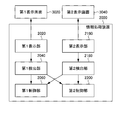
- FIG. 1 is a block diagram illustrating an information processing apparatus 2000 according to the first embodiment together with its use environment.
- arrows indicate the flow of information.
- each block represents a functional unit configuration, not a hardware unit configuration.
- the information processing apparatus 2000 includes a first display unit 2020, a first detection unit 2040, and a first control unit 2060.
- the first display unit 2020 displays on the first display screen 3020 a first display representing a predetermined message to be performed by an operator who operates the input terminal.
- the input terminal is, for example, a “POS” terminal.
- POS terminals here include not only cash register terminals but also portable terminals for taking orders.
- the 1st detection part 2040 detects an operator's statement.
- the first control unit 2060 changes or deletes the first display when a predetermined message is detected by the first detection unit 2040.
- the first display screen 3020 is a display screen viewed by an operator who operates the input terminal.
- the first display screen 3020 may be provided integrally with the information processing apparatus 2000 or may be provided as a separate body. Further, the first display screen 3020 may be provided integrally with an input terminal operated by an operator. Furthermore, the information processing apparatus 2000 may be provided integrally with an input terminal operated by an operator or may be provided as a separate body.
- FIG. 2 is a flowchart illustrating the flow of processing executed by the information processing apparatus 2000 according to the first embodiment.
- the first display unit 2020 displays the first display on the first display screen (S102).
- the information processing apparatus 2000 determines whether or not a predetermined message is detected by the first detection unit 2040 (S104). When the predetermined utterance is not detected (S104: NO), the process of FIG. 2 proceeds to step S104 again. On the other hand, when the predetermined utterance is detected (S104: YES), the process of FIG. 2 proceeds to step S106. In step S106, the first control unit 2060 changes or deletes the first display.
- a predetermined message to be performed by the operator is displayed on the first display screen, and the first display is changed or deleted by the operator performing a predetermined message.
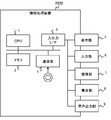
- FIG. 3 is a diagram conceptually illustrating a hardware configuration example of the information processing apparatus according to the first embodiment.
- the information processing apparatus 2000 includes a CPU (Central Processing Unit) 1, a memory 2, an input / output interface (I / F) 3, a communication unit 4, and the like.
- the CPU 1 is connected to other units via a communication line such as a bus.
- the memory 2 is a RAM (Random Access Memory), a ROM (Read Only Memory), a flash memory, or the like.
- the communication unit 4 exchanges signals with other devices and devices.
- a portable recording medium or the like can be connected to the communication unit 4.
- the input / output I / F 3 is connected to the display unit 5, the input unit 6, the imaging unit 7, the sound collection unit 8, the audio output unit 9, and the like.
- the display unit 5 is hardware that realizes the first display screen 3020 described above. Specifically, a screen corresponding to drawing data processed by a CPU 1 or a GPU (Graphics Processing Unit) (not shown) such as an LCD (Liquid Crystal Display) or a CRT (Cathode Ray Tube) display is displayed. Is a unit.
- the input unit 6 is a unit that receives an input of an operator operation, and is realized as, for example, a hardware button unit, a touch sensor, or the like.
- the display unit 5 and the input unit 6 can be integrated and realized as a touch panel.
- the imaging unit 7 is a camera formed from a lens, an imaging element, and the like, and captures still images and moving images.
- the sound collection unit 8 is a microphone unit.
- the audio output unit 9 is a speaker unit or a bell.
- the hardware configuration of the information processing apparatus 2000 is not limited to the configuration shown in FIG.
- the information processing apparatus 2000 may further have a configuration other than the configuration shown in FIG.
- the information processing apparatus 2000 may not include the display unit 5, the input unit 6, the imaging unit 7, the sound collection unit 8, and the audio output unit 9.
- the information processing apparatus 2000 communicates via the communication unit 4 to display on the display unit 5 included in another device, to acquire an image captured by the imaging unit 7, and to obtain audio obtained by the sound collection unit 8. Data acquisition and output to the audio output unit 9 can be performed.
- the first display represents the content of the statement to be made by the operator.
- the statement to be made by the operator is a statement that prompts the customer to present a predetermined item. Specifically, a statement that prompts you to present a point card, such as “Do you have a point card?”, A statement that prompts you to present a coupon, such as “Do you have a coupon?”, Or “I have a parking ticket” Such as "?”
- the message to be made by the operator may be a message indicating provision of a service.
- the statement to be made by the operator may be a statement that recommends the purchase of a product. Specifically, it is a statement that recommends the purchase of an additional product, such as "How about product A together?”
- the first display unit 2020 performs the first display at a position on the first display screen 3020 that is easily noticeable by the operator.
- the position that can be easily recognized by the operator is the center of the first display screen 3020, the window already displayed on the first display screen 3020, or the like.
- FIG. 4 is a diagram illustrating a first display screen 3020 on which the first display 20 is displayed.
- the main window 10 is a window showing the accounting status.
- the first display unit 2020 displays the first display 20 on the main window 10.
- an operator who performs accounting processing at an input terminal performs accounting processing while browsing a window or the like in which the status of accounting processing is displayed, such as the main window 10. Therefore, displaying the first display 20 on the main window 10 makes it easier for the operator to see the first display 20.
- the first display unit 2020 may erase each display already displayed on the first display screen and display only the first display on the first display screen.
- the first display is displayed at a position that is easily noticeable by the operator, or the other displays such as the main window 10 are displayed for the operator by erasing other displays that are already displayed.
- the display becomes difficult to see. Therefore, the operator is motivated to “make a predetermined statement and turn off the first display”. Therefore, the operator actively makes a predetermined statement.
- the predetermined message to be performed by the operator corresponds to the first display.
- the predetermined utterance is a utterance having contents represented by the first display.
- FIG. 5 is a diagram illustrating the first detection information in a table format.
- the table shown in FIG. 5 is referred to as a first detection information table 200.
- the first detection information table 200 has three columns: a key 202, a first display 204, and a predetermined message 206.
- the key 202 is a key for identifying each record in the first detection information table 200.
- the first display 204 represents the first display, and the predetermined utterance 206 represents the predetermined utterance corresponding to the first display 204.
- the record on the first line indicates that the predetermined message to be made by the operator when the first display of “confirmation of point card” is displayed on the first display screen is “Is there a point card?”.
- the remark requesting the presentation of the above point card may be a remark “Do you have a point card?”.
- the predetermined utterance 206 shows all the possible variations.
- the first detection unit 2040 determines that the predetermined utterance has been detected when any one of the plurality of utterances indicated in the predetermined utterance 206 is detected.
- the predetermined statement 206 may indicate a keyword that should be included in the statement, instead of showing the entire content of the statement in this way.
- the keyword “point card” is indicated in the predetermined statement 206.
- the predetermined utterance 206 may indicate a plurality of keywords.
- the first detection unit 2040 may determine that the predetermined utterance has been detected when any of the plurality of keywords is included in the utterance. If all of the plurality of keywords are included in the utterance, it may be determined that the predetermined utterance has been detected. For example, when the predetermined utterance 206 indicates “keyword A or keyword B”, the first detection unit 2040 detects the predetermined utterance when either of the keywords A and B is included in the operator's utterance. Judge that On the other hand, when the predetermined utterance 206 indicates “keyword A and keyword B”, the first detection unit 2040 detects the predetermined utterance when both the keywords A and B are included in the operator's utterance. Judge that
- the first detection unit 2040 detects the operator's remarks by analyzing voice data in which the remarks of the operator are recorded.
- a microphone or the like that acquires sound is provided inside or outside the information processing apparatus 2000.
- the 1st detection part 2040 acquires the audio
- a technique for detecting a predetermined utterance from voice data in which a person's utterance is recorded is a known technique. Therefore, details of this known technique are omitted.
- the first control unit 2060 changes or deletes the first display. By doing so, the first display is made less likely to obstruct the operator's work (accounting processing, etc.).
- “Deleting the first display” means turning off the first display from the first display screen.
- the “change of the first display” will be specifically described.
- the first control unit 2060 changes the display position of the first display.
- the first control unit 2060 changes the display position of the first display to a position that does not obstruct the operator's work, such as a position that is difficult for the operator to see.
- the first control unit 2060 changes the display position to a corner of the first display screen.
- the first control unit 2060 changes the display position to a position that does not overlap the window or the like.
- the first control unit 2060 reduces the size of the first display. For example, when the first display overlaps with a part of another window, the first control unit 2060 reduces the size of the first display so that it does not overlap with the window or the like. Further, the first control unit 2060 may change the display position of the first display whose size is reduced. For example, the first control unit 2060 reduces the size of the first display, and moves the first display to the corner of the first display screen.
- the 1st control part 2060 changes the display contents of the 1st display.
- the first control unit 2060 changes the display content of the first display to content indicating that a predetermined message has been made.
- the first control unit 2060 displays a strikethrough on a display such as “confirmation of point card”, or displays a check mark or the like next to the display.
- FIG. 6 is a diagram illustrating the first display changed by the first control unit 2060.
- FIG. 6 shows a state after the operator has made a predetermined statement under the situation “the first display 20 is displayed on the main window 10” shown in FIG. 4.
- the first control unit 2060 reduces the size of the first display 20 and changes the display position of the first display 20 to the lower right corner of the first display screen 3020 that does not overlap the main window 10. Then, the first control unit 2060 displays a check mark on the first display 20 indicating that a predetermined statement has been made.
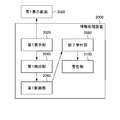
- FIG. 7 is a block diagram illustrating the information processing apparatus 2000 according to the second embodiment together with the use environment thereof.
- arrows indicate the flow of information.
- each block represents a functional unit configuration, not a hardware unit configuration.
- the information processing apparatus 2000 according to the second embodiment has the same functions as the information processing apparatus 2000 according to the first embodiment.
- the information processing apparatus 2000 includes an end reception unit 2080.
- the end reception unit 2080 receives an input indicating the end of the input process related to the customer.
- the input processing is, for example, merchandise accounting processing or order acceptance processing.
- the accounting process is a process in which information on a product purchased by a customer is read by an input terminal, a purchase price for the product is received from the customer, and the received price is input to the input terminal. More specifically, the accounting process is a series of “scan the barcode of each product at the cashier terminal, present the total amount to the customer, receive the price from the customer, and input the received price to the cashier terminal”. Processing.
- the order receiving process is a process of “listening to an item ordered by a customer and inputting the item to a portable terminal” at a restaurant, for example.
- the “input indicating the end of the accounting process” received by the end receiving unit 2080 is an input for confirming the product to be purchased and the price to be put into the cash register terminal. After this input, if there is a change, the change is output from the cashier terminal.
- the “input indicating the end of the order receiving process” received by the end receiving unit 2080 is, for example, an input for confirming the order. These inputs include, for example, pressing a button provided on the input terminal. Further, when a touch panel is provided on the first display screen, these inputs may be an operation of touching a confirmation button displayed on the display screen.
- the button for performing input indicating the end of the input process to the input terminal will be referred to as an end button. However, the name of this button is not limited to “end button”.
- the end acceptance unit 2080 1) does not accept input until the first display is changed or deleted, or 2) rejects the input accepted before the first display is changed or deleted. In the case of 1), for example, the end reception unit 2080 invalidates the above-described end button of the input terminal or the end button on the display screen until the first display is changed or deleted, thereby performing input by pressing the button. Do not accept.
- the end reception unit 2080 determines whether the first display has been changed or deleted when detecting an input by pressing the end button or the like. Then, when the first display is not changed or deleted, the process for ending the input process is not performed. At this time, for example, the end reception unit 2080 may display an error message or the like.
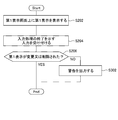
- FIG. 8 is a flowchart illustrating the flow of processing executed by the information processing apparatus 2000 according to the second embodiment.
- FIG. 8 shows the flow of processing when the end receiving unit 2080 rejects the input received before the first display is changed or deleted.
- the first display unit 2020 displays the first display on the first display screen (S202).
- the end receiving unit 2080 receives an input indicating the end of the input process (S204).
- the process of FIG. 8 branches in step S206.
- the 1st display is changed or deleted by the 1st control part 2060 (S206: YES)
- the process of FIG. 8 is complete
- the input process does not end until the first display is changed or deleted. Therefore, it is possible to prompt the operator to make a predetermined statement while preventing the operator from ending the input process without making the predetermined statement.
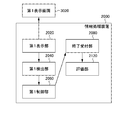
- FIG. 9 is a block diagram illustrating an information processing apparatus 2000 according to the third embodiment together with its use environment.
- arrows indicate the flow of information.
- each block represents a functional unit configuration, not a hardware unit configuration.
- the information processing apparatus 2000 according to the third embodiment has the same functions as those of the information processing apparatus 2000 according to the first or second embodiment.
- the information processing apparatus 2000 includes an end reception unit 2080 and a warning unit 2100.
- the end acceptance unit 2080 of the third embodiment has the same function as the end acceptance unit 2080 of the second embodiment.
- the warning unit 2100 issues a warning when an input is made to the end reception unit 2080 before the first display is changed or deleted.
- the content of the warning performed by the warning unit 2100 is a warning indicating that a predetermined statement has not been made.
- the content of the warning indicates the same content as the content of the first display. For example, when the content of the first display is “confirmation of the point card”, the content of the warning is “forgot to confirm the point card”.
- the warning unit 2100 issues a warning.
- the warning unit 2100 displays a display indicating a warning (hereinafter, a warning display) on the first display screen.
- a warning display a display indicating a warning (hereinafter, a warning display) on the first display screen.
- the situation in which the end acceptance unit 2080 issues a warning is a situation in which the operator does not make a predetermined speech even though the first display is displayed. Therefore, it is preferable that the warning unit 2100 displays the warning display so that it is more conspicuous than the first display.
- the warning unit 2100 displays a warning display so as to overlap the first display.
- the warning unit 2100 may issue a warning by changing the content of the first display to the content indicating the warning.
- the warning unit 2100 may output the content of the warning by voice. For example, when the content of the first display is “confirmation of point card”, the warning unit 2100 outputs a voice “forgetting confirmation of the point card”. Further, the warning unit 2100 may issue a warning by outputting a warning sound such as a beep sound.
- FIG. 10 is a flowchart illustrating the flow of processing executed by the information processing apparatus 2000 according to the third embodiment.
- the steps having the same reference numerals in FIG. 8 represent the same processing as the steps having the same reference numerals.
- step S206 when the first display is changed or deleted by the first control unit 2060 (S206: YES), the processing in FIG. In this case, the input process is terminated.
- step S206 the process of FIG. 10 proceeds to step S302.
- the warning unit 2100 performs an output indicating a warning.
- step S302 the processing by the information processing apparatus 2000 is completed when step S302 is executed. However, some processing may be performed after step S302.
- the information processing apparatus 2000 receives an input indicating the end of the input process again after giving a warning by the warning unit 2100. If the first display is not changed or deleted even when an input indicating the end of the input process is received again, the information processing apparatus 2000 ends the process.
- This flow of processing means that if the operator wants to finish the input processing even if a warning is given once, the operator's operation is accepted and the input processing is finished.
- the warning unit 2100 may accept an operator response to the warning.
- this reply is an input for selecting either one of 1) continuing the end of the input process or 2) canceling the end of the input process. If 1) is selected, the input process is terminated. On the other hand, if 2) is selected, the process of FIG. 10 returns to step S204.
- a warning is given to an operator who tries to end the input process without making a predetermined statement.
- a warning is given to an operator who tries to end the input process without making a predetermined statement.
- FIG. 11 is a block diagram illustrating the information processing apparatus 2000 according to the fourth embodiment together with its use environment.
- arrows indicate the flow of information.
- each block represents a functional unit configuration, not a hardware unit configuration.
- the information processing apparatus 2000 of the fourth embodiment has the same functions as the information processing apparatus 2000 of the first to third embodiments.
- the information processing apparatus 2000 according to the fourth embodiment includes an end reception unit 2080 and an evaluation unit 2120.
- the end acceptance unit 2080 of the fourth embodiment has the same function as the end acceptance unit 2080 of the second embodiment.
- the evaluation unit 2120 performs operator evaluation. Moreover, the evaluation part 2120 makes an operator's evaluation low, when input is performed with respect to the completion
- the evaluation of the operator is 1) when the action to be performed is not performed or the action that should not be performed is low, and 2) when the action that should be performed or the action that should not be performed is not performed High evaluation.
- the evaluation unit 2120 gives points to the operator so that the higher the evaluation is, the higher the score is. In this case, the operator's evaluation can be lowered by subtracting or not adding points to the operator's score. In this case, the operator's evaluation can be increased by adding or not subtracting the operator's score.
- the evaluation unit 2120 when an input is made to the end acceptance unit 2080 in a state where the first display is not changed or deleted, the evaluation unit 2120 performs a deduction or no addition for the operator's score. , Lower the evaluation of the operator.
- the evaluation unit 2120 when input is made to the end reception unit 2080 with the first display being changed or deleted, with respect to the score of the operator To add points.
- the operator's evaluation when the input is made to the end receiving unit 2080 in a state where the first display is not changed or deleted the end receiving unit in a state where the first display is changed or deleted. It becomes lower than the operator's evaluation when an input is made to 2080.
- FIG. 12 is a flowchart illustrating the flow of processing executed by the information processing apparatus 2000 according to the fourth embodiment.
- the steps having the same reference numerals in FIG. 8 represent the same processing as the steps having the same reference numerals.
- step S206 when the first display is changed or deleted by the first control unit 2060 (S206: YES), the process of FIG. 12 ends. In this case, the input process is terminated.
- step S206 when the first display is not changed or deleted by the first control unit 2060 (S206: NO), the process of FIG. 12 proceeds to step S402.
- step S402 the evaluation unit 2120 performs a process (such as a deduction process) that lowers the operator's evaluation.
- the flow of processing executed by the information processing apparatus 2000 of Embodiment 4 is not limited to the flow shown in FIG.
- the evaluation unit 2120 performs a process for increasing the operator's evaluation (such as a point addition process).
- the evaluation unit 2120 does not perform a process of increasing the operator's evaluation. Even in this way, the operator's evaluation when the end reception unit 2080 receives an input in a state where the first display is not changed or deleted, as in the case where the process shown in FIG. 12 is performed, The evaluation can be made lower than the operator's evaluation when the end reception unit 2080 receives an input in a state where the first display is changed or deleted.
- the information processing apparatus 2000 of the present embodiment when an input indicating the end of the input process is performed before the first display is changed or deleted, the operator's evaluation becomes low. For this reason, the operator makes a predetermined statement in order to prevent the evaluation of the operator from being lowered. Thus, according to the information processing apparatus 2000 of the present embodiment, an incentive to make a predetermined statement can be given to the operator.
- FIG. 5 the configuration of the information processing apparatus 2000 according to the fifth embodiment is illustrated in FIG. 1 as with the information processing apparatus 2000 according to the first embodiment.
- the information processing apparatus 2000 according to the fifth embodiment has the same functions as those of the information processing apparatus 2000 according to the first to fourth embodiments except for the points described below.
- movement of the 1st display part 2020 of Embodiment 5 changes according to the time of operation
- the first display unit 2020 of the fifth embodiment 1) displays a different first display according to the operation time point, or 2) displays the first display according to the operation time point, Does not display.
- the first display unit 2020 uses a first display associated with a predetermined period. Specifically, the first display unit 2020 determines a predetermined period including the time point at which the first display unit 2020 operates, and displays a first display corresponding to the predetermined period.
- the predetermined period is an arbitrary period such as “6 o'clock to 9 o'clock” or “September to October”.
- the first display unit 2020 acquires information indicating the association “first display for a predetermined period” (hereinafter, first display information).
- the first display information is stored in advance in a storage device inside or outside the information processing apparatus 2000.
- FIG. 13 is a diagram illustrating the first display information indicating the first display for each predetermined period in a table format.
- the table shown in FIG. 13 is referred to as a first display information table 300.
- the first display information table 300 has three columns: a key 302, a predetermined period 304, and a first display 306.
- a key 302 indicates a key for identifying each record.
- the predetermined period 304 represents the predetermined period described above.
- a first display 306 indicates a first display corresponding to the predetermined period 304.
- the first display 306 “confirm the point card” is associated with the predetermined period 304 “other than 6 o'clock to 9 o'clock”.
- the first display unit 2020 displays a first display of “confirm the point card” in a time zone other than 6 o'clock to 9 o'clock, but this first display in the time zone from 6 o'clock to 9 o'clock. Does not display the display.
- this record assumes a situation in which “there are many customers in the commuting time zone from 6:00 to 9:00, so the work of confirming the point card may be omitted”.
- the first display 306 “Guidance for Campaign A” is associated with the predetermined period 304 “July 2014”. If a product is being campaigned for a period of time, the operator may have to say "Recommend the product to the customer" for the duration of the campaign. Therefore, for example, as shown in the second row record of the first display information table 300, the campaign period is indicated by a predetermined period 304, and a display for prompting guidance of the campaign is created by the first display 306. deep.
- the first display unit 2020 when the first display unit 2020 operates at a time point not included in any period shown in the first display information table 300, for example, the first display unit 2020 does not display the first display.
- a default first display may be prepared. In this case, when the first display unit 2020 operates at a time that does not correspond to any period shown in the first display information table 300, the first display unit 2020 displays the default first display.
- FIG. 14 is a flowchart illustrating the flow of processing executed by the information processing apparatus 2000 according to the fifth embodiment.
- the first display unit 2020 acquires a first display associated with a predetermined period including the current time (S502).
- S504: YES the process of FIG. 14 proceeds to step S506.
- the first display is not acquired (S504: NO)
- the process of FIG. 14 ends.
- the first display unit 2020 displays the acquired first display screen 3020.
- a first display corresponding to the time when the first display unit 2020 operates is displayed on the first display screen 3020.
- the first display corresponding to the predetermined utterance according to that time is displayed. Therefore, it is possible to prompt the operator to speak appropriately according to the time when the input process is performed.
- FIG. 15 is a block diagram illustrating an information processing apparatus 2000 according to the sixth embodiment together with its use environment.
- arrows indicate the flow of information.
- each block represents a functional unit configuration, not a hardware unit configuration.
- the information processing apparatus 2000 according to the sixth embodiment has the same functions as the information processing apparatuses 2000 according to the first to fifth embodiments.
- the information processing apparatus 2000 includes a recognition unit 2140.
- the recognition unit 2140 recognizes a customer.
- the first display unit 2020 of the sixth embodiment controls the first display according to the recognition result by the recognition unit 2140.
- the “customer recognition” performed by the recognition unit 2140 is various. Hereinafter, a method for recognizing a customer will be specifically exemplified.
- the recognition unit 2140 recognizes customer characteristics such as age and gender. This recognition is performed, for example, by analyzing a customer's face and clothes taken by a camera.
- a technique for determining characteristics such as a person's age and sex from a person's face and clothes in the image is a known technique. Therefore, detailed description regarding this technique is omitted.
- the camera that images the customer may be a dedicated camera that is installed to capture the customer that is the subject of the input process, or may be a camera that is installed in the store for other purposes.
- a camera installed in a store for other purposes is, for example, a surveillance camera.
- the information processing apparatus 2000 acquires and analyzes an image stored in the camera.
- the information processing device 2000 may acquire the image from the storage device.
- the camera may be configured to store the captured image in a storage device provided inside the information processing apparatus 2000.
- the information processing apparatus 2000 acquires an image from a storage unit provided inside the information processing apparatus 2000.
- the recognition of customer characteristics may be performed by analyzing customer voices recorded using a microphone or the like.
- a technique for determining characteristics such as age and sex of a person from the recorded voice of the person is a known technique. Therefore, detailed description regarding this technique is omitted.
- the microphone for recording the customer's voice may be a dedicated microphone installed for recording the voice of the customer to be input processed, or may be a microphone installed for other purposes.
- the “microphone installed for other purposes” is, for example, a microphone used by the first detection unit 2040 to record an operator's voice.
- the information processing device 2000 acquires the sound from the storage device.
- the microphone may be configured to store the recorded voice in a storage device provided inside the information processing apparatus 2000.
- the information processing apparatus 2000 acquires sound from a storage unit provided inside the information processing apparatus 2000.
- the recognition unit 2140 may recognize the customer by recognizing an ID or the like assigned to the customer. For example, when a point card or a membership card possessed by a customer is read by an input terminal, the customer's ID (membership number or the like) is recognized using information read from the card.
- the first display unit 2020 performs a different first display according to the recognized customer. For example, it is assumed that there are a product A for women and a product B for men as target products of a certain campaign. In this case, when the customer recognized by the recognition unit 2140 is a woman, the first display unit 2020 displays a first display of “recommend product A”. On the other hand, when the customer recognized by the recognition unit 2140 is a male, the first display unit 2020 displays a first display “recommend product B”.
- the first display unit 2020 determines whether or not to display the first display according to the recognized customer. For example, it is assumed that a product A that is a campaign target product is a product for women. In this case, the first display unit 2020 displays the first display “recommend product A” only when the customer recognized by the recognition unit 2140 is a woman.
- the first display unit 2020 displays the first display “recommends member card creation” only when the recognized customer is a predetermined age or older. This predetermined age is set in advance.
- the first display unit 2020 displays the first display “recommends the purchase of the product A” only when the recognized customer is the customer who is the target of the input process for the first time during the campaign period. Whether or not a customer has been subject to input processing for a predetermined period of time is determined by associating the customer's ID with a point card or membership card read at the time of input processing, for example. It can be grasped by storing the history of input processing.
- the 1st display part 2020 uses the 1st display information which matched characteristics, such as customer's age or sex, or customer's ID, and the 1st display.
- customer characteristics and IDs are collectively referred to as “customer attributes”.
- the first display information is stored in advance in a storage device inside or outside the information processing apparatus 2000, similarly to the first display information described in the fifth embodiment.
- FIG. 16 is a diagram illustrating first display information in which a customer attribute is associated with a first display in a table format.
- the table shown in FIG. 16 is referred to as a first display information table 400.
- the first display information table 400 has five columns: a key 402, an age 406, a gender 408, a customer ID 410, and a first display 412.
- a key 402 is a key for identifying each record.
- Age 406 represents a condition relating to age
- gender 408 represents a condition relating to gender
- customer ID 410 represents a condition relating to customer ID.
- the first display 412 is a first display associated with a combination of “age 406, gender 408, customer ID 410”.
- the blank age 406, gender 408, or customer ID 410 indicates no designation.
- the record in the first row associates the first display 412 “recommend product A” with the gender 408 “female”.
- This record is a first display for prompting the operator to make a predetermined statement “recommend product A” only when the customer is a woman.
- FIG. 17 is a flowchart illustrating the flow of processing executed by the information processing apparatus 2000 according to the sixth embodiment.
- the steps having the same reference numerals in FIG. 14 represent the same processing as the steps having the same reference numerals.
- the recognition unit 2140 recognizes the customer (S602).
- the first display unit 2020 acquires a first display corresponding to the recognized customer attribute (S604). Then, as in the case of the fifth embodiment, when the first display is acquired (S504: YES), the first display unit 2020 displays the first display on the first display screen (S506).
- the first display corresponding to the recognized customer is displayed. Therefore, when the statement to be made by the operator differs depending on the customer, the operator can be prompted to make an appropriate statement according to the customer.
- FIG. 18 is a block diagram illustrating an information processing apparatus 2000 according to the seventh embodiment together with its use environment.
- arrows indicate the flow of information.
- each block represents a functional unit configuration, not a hardware unit configuration.
- the information processing apparatus 2000 according to the seventh embodiment has the same functions as the information processing apparatuses 2000 according to the first to sixth embodiments.
- the second display screen 3040 is a display screen that can be browsed by the customer.
- the second display screen 3040 is a display screen that is installed in the input terminal and installed in the direction of the customer.
- the second display screen 3040 may be provided integrally with the information processing apparatus 2000 or may be provided as a separate body.
- the information processing apparatus 2000 includes a second display unit 2160, a second detection unit 2180, and a second control unit 2200.
- Second display unit 2160 displays the second display on second display screen 3040.
- the second display is a display representing a predetermined behavior of the customer related to the predetermined utterance.
- the second detection unit 2180 detects customer behavior.
- the second control unit 2200 changes or deletes the second display.
- the change or deletion of the second display by the second control unit 2200 is performed when 1) a predetermined utterance is detected by the first detection unit 2040, or 2) when a predetermined action is detected by the second detection unit 2180. To be done.
- the first control unit 2060 performs the first display when 1) a predetermined speech is detected by the first detection unit 2040, or 2) when a predetermined action is detected by the second detection unit 2180. Is changed or deleted.
- the second display displayed on the second display unit 2160 represents a predetermined action related to a predetermined utterance.
- the predetermined action is an action related to the utterance.
- a statement to be made by the operator is a statement “Do you have a point card?”.
- the predetermined action performed by the customer is an action “present a point card”. Therefore, the second display is a content that prompts a predetermined action “present a point card”, such as “Please present if you have a point card”.
- the information processing apparatus 2000 uses information (hereinafter referred to as second detection information) indicating an association of “first display, predetermined statement, second display, predetermined action”. Specifically, the information processing apparatus 2000 acquires the second correspondence information, 1) displays the first display on the first display screen 3020 by the first display unit 2020, and 2) by the second display unit 2160. The second display is displayed on the second display screen 3040.
- the second correspondence information is stored in a storage unit provided inside or outside the information processing apparatus 2000.
- the method in which the second display unit 2160 performs the second display is the same as the method in which the first display unit 2020 performs the first display.
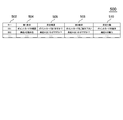
- FIG. 19 is a diagram illustrating the second detection information in a table format.
- the table shown in FIG. 19 is referred to as a second detection information table 500.
- the second detection information table 500 has five columns of a key 502, a first display 504, a predetermined message 506, a second display 508, and a predetermined action 510.
- the key 502 is a key for identifying each record in the second detection information table 500.
- the record on the second line of the second detection information table 500 is a record related to a predetermined message “recommend product A to the customer”. Therefore, the second display 508 viewed by the customer is a display recommending the product A “How about the product A?”.
- the record indicates “buy product A” as the predetermined action 510.
- the second control unit 2200 changes or deletes the second display “How about the product A?”.
- the action of “purchasing product A” can be detected by analyzing, for example, a customer's purchased product imaged by a camera and determining whether or not the product A is included in the purchased product. For example, the action can also be detected by determining whether or not the product A has been read by the input terminal.
- the 2nd detection part 2180 detects a customer's speech and a customer's operation.
- the method by which the second detection unit 2180 recognizes the customer's statement is the same as the method by which the recognition unit 2140 recognizes the customer's statement, for example.
- the information processing apparatus 2000 recognizes the customer's movement by acquiring and analyzing an image from a camera that captures the customer's movement.
- a technique for detecting a person's movement from an image (moving image) obtained by capturing a person is a known technique. Therefore, detailed description regarding this technique is omitted.
- the second detection unit 2180 may recognize the specific behavior of the customer by acquiring information from the input terminal.
- This specific action is, for example, an operation of presenting a point card or a membership card.
- the operator reads these cards using an input terminal. Therefore, by obtaining information that these cards have been read from the input terminal, it is possible to detect the behavior of the customer who has presented these cards.
- the second control unit 2200 displays the second display when 1) a predetermined speech is detected by the first detection unit 2040, or 2) when a predetermined action is detected by the second detection unit 2180. Make changes or deletions. For example, in the case of presenting the above point card, if the operator says “Is there a point card?”, It is not necessary to display “Please present the point card” on the second display screen. Therefore, the second control unit 2200 changes or deletes the second display in the case of 1). In addition, even when the customer performs a predetermined action “present a point card”, it is not necessary to display “please present a point card” on the second display screen. Therefore, the second control unit 2200 also changes or deletes the second display even in the case of 2).
- the method of changing or deleting the second display by the second control unit 2200 is the same as the “method of changing or deleting the first display by the first control unit 2060” exemplified in the first embodiment, for example.
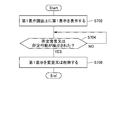
- FIG. 20 shows the flow of processing for controlling the first display.
- FIG. 21 shows a flow of processing for controlling the second display.
- the first display unit 2020 displays the first display on the first display screen (S702).
- a predetermined utterance is detected by the first detection unit 2040 or a predetermined action is detected by the second detection unit 2180 (S704: YES)
- the processing of FIG. 20 proceeds to step S706.
- the process of FIG. 20 proceeds to step S704 again.
- step S706 the first control unit 2060 changes or deletes the first display.
- the second display unit 2160 displays the second display on the second display screen (S802).
- a predetermined utterance is detected by the first detection unit 2040 or a predetermined action is detected by the second detection unit 2180 (S804: YES)
- the process of FIG. 21 proceeds to step S806.
- the process of FIG. 21 proceeds to step S804 again.
- step S806 the second control unit 2200 changes or deletes the second display.
- a display representing a predetermined action related to a predetermined message to be performed by the operator is performed on the second display screen viewed by the customer.
- the predetermined message represents “an message that prompts the customer to perform a predetermined action”
- a display corresponding to the operator's message is performed as the second display. Therefore, even if the operator does not make a predetermined statement, the probability that the customer will perform the predetermined action can be increased.
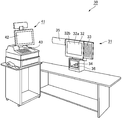
- FIG. 22 is a diagram illustrating a configuration example of the POS register device.
- the first embodiment shows an example in which the information processing apparatus 2000 described above is applied to the POS register apparatus 30.
- the POS register device 30 according to the first embodiment includes a checker device 31 and a cashier device 41.
- the checker device 31 registers the product as an accounting object and sends information on the accounting object product to the cashier device 41.
- the cashier apparatus 41 performs a settlement process for the accounting target product.
- the accounting object can be registered in both the checker device 31 and the cashier device 41.
- the checker device 31 and the cashier device 41 have a CPU 1, a memory 2, an input / output I / 10, a communication unit 4, and the like, as in FIG.
- the above-described information processing apparatus 2000 can be applied to both the checker apparatus 31 and the cashier apparatus 41, and the above-described product image presentation method can be executed in either the checker apparatus 31 or the cashier apparatus 41.
- the operator of the POS register device 30 holds the product over the reading window 36 when performing the accounting process of the product. As a result, the barcode or the like attached to the product is read, and the product is registered as an accounting object.
- the above-described display unit 5 corresponds to at least one of the display unit 32a and the display unit 42 of the touch panel unit 32.
- the input unit 6 described above corresponds to at least one of the touch panel 32 b, the keyboard 33, and the keyboard 43 of the touch panel unit 32.
- the imaging unit 7 described above corresponds to the scanner device 34.
- the scanner device 34 captures a product image that reflects the appearance of the product held over the reading window 36.
- the above-described sound collecting unit 8 is attached to, for example, the member 35 in the checker device 31, the operator of the POS register device 30, or the like.
- the sound collection unit 8 may be used for customer recognition performed by the recognition unit 2140.
- the above-described audio output unit 9 is installed in the checker device 31 and the cashier device 41, for example.
- the “POS” register apparatus 30 further includes a second display screen 3040.
- the second display screen 3040 is provided on the back side of the touch panel unit 32.
- FIG. 23 is a diagram illustrating a configuration example of a POS system.
- the second embodiment shows an example in which the information processing apparatus 2000 described above is applied to a POS system 50.
- the POS system 50 according to the second embodiment includes a server device 51 and a store side configuration 52, and the server device 51 and the store side configuration 52 are communicably connected via a communication network 53.
- the store-side configuration 52 includes a store terminal 54, a stand 55, and the like that can be connected to the communication network 53 via a communication relay device.
- the stand 55 is a device for connecting the store terminal 54 and other devices (such as a handy scanner, a cash drawer, a receipt printer, etc.) in a communicable manner.
- the store terminal 54 is a general-purpose computer such as a PC (Personal Computer), a notebook PC, a tablet-type terminal, a smartphone, and the like, and exchanges data with the server device 51, whereby the store terminal 54 A similar function is realized.
- the store terminal 54 includes a touch panel unit 56, an imaging unit 57, a microphone (not shown), and the like.
- the display unit 5 described above corresponds to the display unit of the touch panel unit 56.
- the input unit 6 described above corresponds to the touch panel of the touch panel unit 56.
- the imaging unit 7 described above corresponds to the imaging unit 57.
- the sound collecting unit 8 described above corresponds to a microphone built in the store terminal 54.
- the server device 51 is a general server computer, and is realized as a WEB server, an application server, or the like.
- the store terminal 54 and the server device 51 have a CPU 1, a memory 2, an input / output I / 10, a communication unit 4, and the like as in FIG.
- the information processing apparatus 2000 described above can be realized as only the shop terminal 54 or a combination of the server apparatus 51 and the shop apparatus.
- the server apparatus 51 for example, among the processes executed by the first display unit 2020, the process up to determining a character string to be displayed is realized by the server apparatus 51. Then, the determined character string or the like is transmitted from the server device 51 to the store terminal 54.
- the store terminal 54 performs processing for displaying the acquired character string and the like on the first display screen 3020.
- the store terminal 54 transmits the detected operator's remarks (voice, etc.) to the server device 51, and the server device 51 determines whether or not the remarks correspond to a predetermined remark.
- the server device 51 determines how to change or delete the first display, and transmits information indicating the determined content to the store terminal 54.
- the store terminal 54 changes or deletes the first display according to the received information.
- the information processing apparatus 2000 described above is not only applicable to the POS register device 30 and the POS system 50, but can be applied to various devices.
- the information processing apparatus 2000 and the control method described above may be applied to a general-purpose computer such as a PC or a smart device used by general users.
- a general-purpose computer such as a PC or a smart device used by general users.
- the user wants to grasp the price after the service is applied to the product taken by the user, after the service is applied to the product by photographing the product with the imaging unit of the computer. You can see the price.
- First display means for displaying a first display representing a predetermined message to be performed by an operator operating the input terminal on a first display screen viewed by the operator; First detection means for detecting the operator's statement; First control means for changing or deleting the first display when the predetermined speech is detected by the first detection means; An information processing apparatus. 2. Having an end acceptance unit for accepting an input indicating the end of the input process related to the customer; The termination acceptance unit does not accept an input until the first display is changed or deleted, or rejects an input accepted before the first display is changed or deleted. The information processing apparatus described in 1. 3.
- An end acceptance unit that accepts an input indicating the end of the input process related to the customer; A warning unit for performing an output indicating a warning when the input is received before the first display is changed or deleted; Having 1. Or 2.
- An end acceptance unit that accepts an input indicating the end of the input process related to the customer; Evaluation means for evaluating the operator, If the input is accepted before the first display is changed or deleted, the evaluation means lowers the evaluation of the operator.
- the information processing apparatus according to any one of the above. 5.
- the first display means displays a different first display depending on the time of operation, or determines whether to display the first display according to the time of operation.
- To 4. The information processing apparatus according to any one of the above. 6).
- the first display means displays a different first display according to the recognized customer, or determines whether to display the first display according to the recognized customer.
- Second display means for displaying a second display representing a predetermined action related to the predetermined utterance on a second display screen that can be viewed by a customer; Second detection means for detecting customer behavior; And second control means for changing or deleting the second display when the predetermined speech is detected by the first detection means or when the predetermined action is detected by the second detection means. , The first control means changes or deletes the first display when the predetermined action is detected by the second detection means.
- Second display means for displaying a second display representing a predetermined action related to the predetermined utterance on a second display screen that can be viewed by a customer; Second detection means for detecting customer behavior; And second control means for changing or deleting the second display when the predetermined speech is detected by the first detection means or when the predetermined action is detected by the second detection means.
- the first control means changes or deletes the first display when the predetermined action is
- the input terminal is a POS terminal.
- a control method executed by a computer A first display step of displaying a first display representing a predetermined message to be performed by an operator operating the input terminal on a first display screen viewed by the operator; A first detection step of detecting the operator's statement; A first control step of changing or deleting the first display when the predetermined speech is detected by the first detection step; A control method. 10. An end acceptance step for accepting an input indicating the end of the input process related to the customer; 8. The termination acceptance step does not accept an input until the first display is changed or deleted, or rejects an input accepted before the first display is changed or deleted. The control method described in 1. 11.
- the control method described in 1. 12 An end acceptance step for accepting an input indicating the end of the input process related to the customer; An evaluation step for evaluating the operator, 8. If the input is accepted before the first display is changed or deleted, the evaluation step lowers the evaluation of the operator. To 11.
- the control method as described in any one. 13 In the first display step, a different first display is displayed according to the time of operation, or the presence or absence of display of the first display is determined according to the time of operation.
- the control method as described in any one. 14 Has a recognition step to recognize the customer, 8.
- the first display step displays a different first display according to the recognized customer, or determines whether to display the first display according to the recognized customer. Thru 13.
- the first control step changes or deletes the first display when the predetermined action is detected by the second detection step.
- the input terminal is a POS terminal.
- To 15. The control method as described in any one. 17.
Landscapes
- Business, Economics & Management (AREA)
- Engineering & Computer Science (AREA)
- Tourism & Hospitality (AREA)
- General Physics & Mathematics (AREA)
- Physics & Mathematics (AREA)
- Strategic Management (AREA)
- Economics (AREA)
- General Business, Economics & Management (AREA)
- Human Resources & Organizations (AREA)
- Theoretical Computer Science (AREA)
- Marketing (AREA)
- Development Economics (AREA)
- Entrepreneurship & Innovation (AREA)
- Accounting & Taxation (AREA)
- Finance (AREA)
- Operations Research (AREA)
- Game Theory and Decision Science (AREA)
- Quality & Reliability (AREA)
- Educational Administration (AREA)
- Health & Medical Sciences (AREA)
- General Health & Medical Sciences (AREA)
- Primary Health Care (AREA)
- Cash Registers Or Receiving Machines (AREA)
- Management, Administration, Business Operations System, And Electronic Commerce (AREA)
- User Interface Of Digital Computer (AREA)
Priority Applications (1)
| Application Number | Priority Date | Filing Date | Title |
|---|---|---|---|
| JP2016552002A JP6365677B2 (ja) | 2014-09-30 | 2015-09-28 | 情報処理装置、制御方法、及びプログラム |
Applications Claiming Priority (2)
| Application Number | Priority Date | Filing Date | Title |
|---|---|---|---|
| JP2014-201362 | 2014-09-30 | ||
| JP2014201362 | 2014-09-30 |
Publications (1)
| Publication Number | Publication Date |
|---|---|
| WO2016052381A1 true WO2016052381A1 (ja) | 2016-04-07 |
Family
ID=55630417
Family Applications (1)
| Application Number | Title | Priority Date | Filing Date |
|---|---|---|---|
| PCT/JP2015/077266 Ceased WO2016052381A1 (ja) | 2014-09-30 | 2015-09-28 | 情報処理装置、制御方法、及びプログラム |
Country Status (2)
| Country | Link |
|---|---|
| JP (4) | JP6365677B2 (https=) |
| WO (1) | WO2016052381A1 (https=) |
Families Citing this family (1)
| Publication number | Priority date | Publication date | Assignee | Title |
|---|---|---|---|---|
| JP6365677B2 (ja) * | 2014-09-30 | 2018-08-01 | 日本電気株式会社 | 情報処理装置、制御方法、及びプログラム |
Citations (3)
| Publication number | Priority date | Publication date | Assignee | Title |
|---|---|---|---|---|
| JP2004192545A (ja) * | 2002-12-13 | 2004-07-08 | Toshiba Tec Corp | 接客業務管理装置 |
| JP2005010989A (ja) * | 2003-06-18 | 2005-01-13 | Nec Infrontia Corp | 販売管理方法および装置 |
| JP2007003700A (ja) * | 2005-06-22 | 2007-01-11 | Oki Electric Ind Co Ltd | 商品販売支援装置 |
Family Cites Families (9)
| Publication number | Priority date | Publication date | Assignee | Title |
|---|---|---|---|---|
| JPH1153642A (ja) * | 1997-07-30 | 1999-02-26 | Tec Corp | 商品販売登録データ処理装置 |
| JP4574888B2 (ja) | 2001-04-12 | 2010-11-04 | エスアイアイ・データサービス株式会社 | オーダ入力装置およびオーダ入力支援方法 |
| JP2004157253A (ja) * | 2002-11-05 | 2004-06-03 | Kawasaki Steel Systems R & D Corp | コンタクト・センタ・オペレータ訓練システム |
| JP2005234657A (ja) | 2004-02-17 | 2005-09-02 | Toshiba Tec Corp | 商品販売データ処理装置 |
| JP2008257429A (ja) | 2007-04-04 | 2008-10-23 | Toshiba Tec Corp | 商品販売データ処理装置 |
| JP2010230829A (ja) * | 2009-03-26 | 2010-10-14 | Toshiba Corp | 音声監視装置、その方法、及び、そのプログラム |
| JP5559252B2 (ja) * | 2012-06-21 | 2014-07-23 | 東芝テック株式会社 | 商品販売データ処理装置およびプログラム |
| JP6365677B2 (ja) | 2014-09-30 | 2018-08-01 | 日本電気株式会社 | 情報処理装置、制御方法、及びプログラム |
| JP6610992B2 (ja) * | 2015-06-09 | 2019-11-27 | パナソニックIpマネジメント株式会社 | 接客態度評価システム及び接客態度評価方法 |
-
2015
- 2015-09-28 JP JP2016552002A patent/JP6365677B2/ja active Active
- 2015-09-28 WO PCT/JP2015/077266 patent/WO2016052381A1/ja not_active Ceased
-
2018
- 2018-07-05 JP JP2018128057A patent/JP6852717B2/ja active Active
-
2020
- 2020-12-23 JP JP2020213255A patent/JP7268670B2/ja active Active
-
2023
- 2023-02-08 JP JP2023017367A patent/JP7582355B2/ja active Active
Patent Citations (3)
| Publication number | Priority date | Publication date | Assignee | Title |
|---|---|---|---|---|
| JP2004192545A (ja) * | 2002-12-13 | 2004-07-08 | Toshiba Tec Corp | 接客業務管理装置 |
| JP2005010989A (ja) * | 2003-06-18 | 2005-01-13 | Nec Infrontia Corp | 販売管理方法および装置 |
| JP2007003700A (ja) * | 2005-06-22 | 2007-01-11 | Oki Electric Ind Co Ltd | 商品販売支援装置 |
Also Published As
| Publication number | Publication date |
|---|---|
| JP7582355B2 (ja) | 2024-11-13 |
| JPWO2016052381A1 (ja) | 2017-04-27 |
| JP2021051798A (ja) | 2021-04-01 |
| JP2023053013A (ja) | 2023-04-12 |
| JP6365677B2 (ja) | 2018-08-01 |
| JP2018160273A (ja) | 2018-10-11 |
| JP7268670B2 (ja) | 2023-05-08 |
| JP6852717B2 (ja) | 2021-03-31 |
Similar Documents
| Publication | Publication Date | Title |
|---|---|---|
| US8744914B2 (en) | Mobile device consumer interface process and system | |
| JP6686290B2 (ja) | システム及び方法 | |
| JP2019510291A (ja) | 人型ロボットを用いてトランザクションを支援する方法 | |
| KR20170104153A (ko) | 멀티 레이어 인증을 이용한 오퍼 기반 거래 및 비콘 기반 디지털 거래에 대한 비콘 기반 내비게이션을 위한 시스템 및 방법 | |
| US11935111B2 (en) | Voice-based transaction terminal ordering | |
| US8738450B2 (en) | Audible transaction process and system | |
| CN110610384A (zh) | 用户画像生成方法、信息推荐方法、设备和可读介质 | |
| US20110184821A1 (en) | Payment device triggered modified transaction session at point of sale | |
| JP7435658B2 (ja) | 情報処理装置、情報処理システム、販売促進方法及びプログラム | |
| JP2021108202A (ja) | 販売促進装置、販売促進方法およびプログラム | |
| CN108510267A (zh) | 一种账户信息获取方法、移动终端 | |
| JP7582355B2 (ja) | 情報処理装置、制御方法、及びプログラム | |
| JP6354233B2 (ja) | 販売促進装置、情報処理装置、情報処理システム、販売促進方法及びプログラム | |
| JP2016192090A (ja) | 精算システム、商品登録装置、精算装置、プログラム、及び精算方法 | |
| CN113095836A (zh) | 自助购物方法及装置、电子设备和存储介质 | |
| JP2015228079A (ja) | 情報処理装置、制御方法、及びプログラム | |
| US10395292B1 (en) | Augmented reality electronic device using facial recognition functionality and displaying shopping reward at retail locations | |
| JP2016024601A (ja) | 情報処理装置、情報処理システム、情報処理方法、商品推薦方法、およびプログラム | |
| JP6196079B2 (ja) | 買い物支援システム | |
| US20250182083A1 (en) | Information processing device and information processing method | |
| US12393391B2 (en) | Customer service supporting device, self-service terminal, and method | |
| KR20150013368A (ko) | 모바일 결제 요청 장치 및 그 제어방법 | |
| KR100808441B1 (ko) | 대형 매장 사용자 편의 시스템 | |
| JP7227884B2 (ja) | 購買促進システムおよび購買促進方法 | |
| JP6696554B2 (ja) | 精算システム及び精算方法 |
Legal Events
| Date | Code | Title | Description |
|---|---|---|---|
| 121 | Ep: the epo has been informed by wipo that ep was designated in this application |
Ref document number: 15846061 Country of ref document: EP Kind code of ref document: A1 |
|
| ENP | Entry into the national phase |
Ref document number: 2016552002 Country of ref document: JP Kind code of ref document: A |
|
| NENP | Non-entry into the national phase |
Ref country code: DE |
|
| 122 | Ep: pct application non-entry in european phase |
Ref document number: 15846061 Country of ref document: EP Kind code of ref document: A1 |