WO2016042634A1 - 5-カフェイオルキナ酸含有容器詰飲料 - Google Patents
5-カフェイオルキナ酸含有容器詰飲料 Download PDFInfo
- Publication number
- WO2016042634A1 WO2016042634A1 PCT/JP2014/074681 JP2014074681W WO2016042634A1 WO 2016042634 A1 WO2016042634 A1 WO 2016042634A1 JP 2014074681 W JP2014074681 W JP 2014074681W WO 2016042634 A1 WO2016042634 A1 WO 2016042634A1
- Authority
- WO
- WIPO (PCT)
- Prior art keywords
- mass
- component
- riboflavin
- caffeoylquinic acid
- less
- Prior art date
- Legal status (The legal status is an assumption and is not a legal conclusion. Google has not performed a legal analysis and makes no representation as to the accuracy of the status listed.)
- Ceased
Links
Classifications
-
- A—HUMAN NECESSITIES
- A23—FOODS OR FOODSTUFFS; TREATMENT THEREOF, NOT COVERED BY OTHER CLASSES
- A23L—FOODS, FOODSTUFFS OR NON-ALCOHOLIC BEVERAGES, NOT OTHERWISE PROVIDED FOR; PREPARATION OR TREATMENT THEREOF
- A23L2/00—Non-alcoholic beverages; Dry compositions or concentrates therefor; Preparation or treatment thereof
Definitions
- the present invention relates to a packaged beverage containing 5-caffeoylquinic acid.
- 5-Caffeoylquinic acid is a compound in which caffeic acid is bonded to the hydroxyl group at the 5-position of quinic acid, and is known as a kind of polyphenol.
- 5-caffeioluquinic acid has been reported to have physiological effects such as an antioxidant effect and a blood pressure lowering effect.
- riboflavin also known as vitamin B 2
- carbohydrates as well as related to the metabolism of proteins and lipids, promotion and normal growth, drugs and pharmaceutical unit as a physiologically active substance having an effect of maintaining normal skin and mucous membranes It is used as a foreign product.
- Riboflavin is also used as a pigment and has a property of being easily deteriorated by light or ultraviolet irradiation.
- a technique for preventing photodegradation of riboflavin it has been proposed to coexist with coffee extract and polyphenols such as enzyme-treated isoquercitrin, myricetin, chlorogenic acid, hesperidin, epicatechin, proanthocyanin, anthocyanin ( Patent Documents 1 and 2).
- Patent Document 1 JP 2001-323263 A (Patent Document 2) JP 2006-315985 (Patent Document 3) JP 05-146253 A
- the present invention includes the following components (A) and (B): (A) 5-caffeoylquinic acid: 0.02 to 0.50% by mass, and (B) riboflavin
- the mass ratio [(B) / (A)] of the component (A) and the component (B) is 0.001 ⁇ 10 ⁇ 3 to 0.2 ⁇ 10 ⁇ 3 (that is, 0.000001 to 0.0002).
- the present invention provides a packaged beverage containing 5-caffeoylquinic acid.
- the present invention also provides the following components (A) and (B): (A) 5-caffeoylquinic acid and (B) riboflavin, the concentration of component (A) is 0.02 to 0.50 mass%, the mass ratio of component (A) to component (B) [( The present invention provides a method for producing a 5-caffeoylquinic acid-containing packaged beverage, which is formulated so that B) / (A)] is 0.001 ⁇ 10 ⁇ 3 to 0.2 ⁇ 10 ⁇ 3 .
- the present invention further provides an astringent taste inhibitor of 5-caffeoylquinic acid containing riboflavin as an active ingredient.
- the present invention further provides (A) 5-caffeoylquinic acid with (B) riboflavin having a mass ratio [(B) / (A)] of component (A) to component (B) of 0.
- the present invention provides a method for suppressing the astringency of 5-caffeoylquinic acid, which is added so as to be 001 ⁇ 10 ⁇ 3 to 0.2 ⁇ 10 ⁇ 3 .
- the present invention still further provides the use of riboflavin to suppress the astringency of 5-caffeoylquinic acid.
- the present invention relates to a packaged beverage in which the astringency of 5-caffeoylquinic acid is suppressed and a method for producing the same.
- 5-caffeioluquinic acid In order to effectively express the physiological action of 5-caffeioluquinic acid, it is necessary to continuously take its effective amount, and as a means for easily achieving it, it can be made into a beverage form. It is advantageous. However, since 5-caffeioluquinic acid has a strong astringency, increasing the amount of 5-caffeioluquinic acid in the beverage increases the astringency and tends to be an obstacle to continuous consumption.
- riboflavin and specific derivatives thereof are effective in suppressing the astringency of 5-caffeoylquinic acid.
- the present invention it is possible to provide a packaged beverage in which the astringency of 5-caffeoylquinic acid is suppressed, and it can be produced by a simple operation.
- the packaged beverage of the present invention contains 5-caffeoylquinic acid in abundance, its astringency is suppressed and can be ingested continuously. Physiological action due to can be sufficiently expected.
- the packaged beverage of the present invention contains 5-caffeoylquinic acid as component (A).
- 5-Caffeoylquinic acid may be in the form of a salt, and the salt is not particularly limited as long as it is physiologically acceptable.
- alkali metal salts, alkaline earth metal salts, ammonium salts, organic amine salts, basic amino acid salts and the like can be mentioned.
- alkali metal salt include sodium salt and potassium salt
- examples of the alkaline earth metal salt include calcium salt and magnesium salt.
- the organic amine salt include triethylamine salt, triethanolamine salt, and monoethanolamine salt.
- Examples of the basic amino acid salt include lysine salt and alginic acid salt.
- 5-caffeoylquinic acid and a salt thereof can be used in combination.
- the component (A) a commercially available reagent may be used, but a plant extract rich in the component (A) or a purified product thereof can also be used.
- the plant extract is not particularly limited as long as it contains the component (A).
- sunflower seeds, unripe apples, coffee beans, Simon leaves, pine cones, pine seed husks examples thereof include one or more selected from extracts obtained from sugar cane, southern leaves, burdock, eggplant skin, ume fruit, dandelion, grape plant and the like.
- coffee bean extract is preferable from the viewpoint of 5-caffeoylquinic acid content and the like.
- the coffee beans used for extraction are preferably one or two selected from green coffee beans and shallow roasted coffee beans from the viewpoint of 5-caffeoylquinic acid content and the like.
- the L value of the lightly roasted coffee beans is preferably 27 or more, more preferably 29 or more, still more preferably 35 or more from the viewpoint of 5-caffeoylquinic acid content, and preferably less than 62 from the viewpoint of flavor. The following is more preferable, and 55 or less is still more preferable.
- the range of the L value of the shallow roasted coffee beans is preferably 27 or more and less than 62, more preferably 29 to 60, and still more preferably 35 to 55.
- L value in this specification is a value obtained by measuring the brightness of roasted coffee beans with a color difference meter, with black as L value 0 and white as L value 100.
- the type of coffee beans may be any of Arabica, Robusta, Revelica and Arabsta. Examples of coffee bean producing areas include Brazil, Colombia, Africa, Mocha, Kilibando, Mandelin, Blue Mountain, Guatemala and the like.
- the extraction method and extraction conditions are not particularly limited, but are described in, for example, JP-A-58-138347, JP-A-59-51763, JP-A-62-111671, JP-A-5-236918, and the like. This method can be adopted. Further, the purification method is not particularly limited, and a known method can be adopted. For example, various chromatography such as ion chromatography, molecular sieve chromatography, and reverse phase chromatography can be used alone or in any desired manner. Can be combined in order.
- the content of the component (A) in the packaged beverage of the present invention is 0.02 to 0.50% by mass, preferably 0.021% by mass or more from the viewpoint of physiological activity, and 0.023% by mass or more. Is more preferably 0.025% by mass or more, and from the viewpoint of reducing astringency, 0.45% by mass or less is preferable, 0.40% by mass or less is more preferable, and 0.35% by mass or less is more preferable. 0.30% by mass or less is more preferable, 0.25% by mass or less is further preferable, and 0.18% by mass or less is particularly preferable.
- the range of the content of component (A) in the packaged beverage is preferably 0.02 to 0.45% by mass, more preferably 0.02 to 0.40% by mass, and still more preferably 0.02 to 0.4%. It is 0.35% by mass, more preferably 0.021 to 0.30% by mass, still more preferably 0.023 to 0.25% by mass, and still more preferably 0.023 to 0.18% by mass.
- “content of component (A)” is a value converted to 5-caffeoylquinic acid. That is, in the case of a salt of 5-caffeoylquinic acid, the mass is a value converted to the mass of 5-caffeoylquinic acid.
- the packaged beverage of the present invention contains riboflavin as component (B) in order to suppress the astringency of 5-caffeoylquinic acid.
- riboflavin in this specification is a general term for riboflavin, riboflavic acid ester and riboflavic acid ester salt, and the content of component (B) is defined based on the total value thereof.
- Riboflavin may be a natural product, a chemically synthesized product, or a commercially available product.
- the acid constituting the riboflavic acid ester may be an organic acid or an inorganic acid, and the type thereof is not particularly limited as long as the acid ester after esterification is physiologically acceptable.
- the salt of riboflavic acid ester is not particularly limited as long as it is physiologically acceptable.
- alkali metal salts, alkaline earth metal salts, ammonium salts, organic amine salts, basic amino acid salts and the like can be mentioned.
- alkali metal salt include sodium salt and potassium salt
- examples of the alkaline earth metal salt include calcium salt and magnesium salt.
- examples of the organic amine salt include triethylamine salt, triethanolamine salt, and monoethanolamine salt.
- Examples of the basic amino acid salt include lysine salt and alginic acid salt. Of these, alkali metal salts are preferable, and sodium salts are more preferable.
- the salt of riboflavic acid ester may be a hydrate.
- component (B) examples include, for example, riboflavin, riboflavin 5′-phosphate ester, riboflavin 5′-phosphate sodium salt, riboflavin butyrate ester, flavin adenine dinucleotide, flavin adenine dinucleotide sodium and the like. it can. These can be used alone or in combination of two or more. Among them, as the component (B), riboflavin, riboflavin 5′-phosphate ester and riboflavin 5 are used from the viewpoint of further astringent taste suppression of 5-caffeoylquinic acid, less vitamin odor derived from riboflavin, and solubility. One or two or more selected from salts of '-phosphate esters are preferable, and one or two selected from sputum riboflavin and riboflavin 5'-sodium phosphate ester are more preferable.
- the mass ratio [(B) / (A)] of the component (A) and the component (B) in the packaged beverage of the present invention is 0.001 ⁇ 10 ⁇ 3 to 0.2 ⁇ 10 ⁇ 3. From the viewpoint of suppressing the astringency of 5-caffeoylquinic acid, 0.003 ⁇ 10 ⁇ 3 or more is preferable, 0.005 ⁇ 10 ⁇ 3 or more is more preferable, and 0.007 ⁇ 10 ⁇ 3 or more is more preferable.
- 0.01 ⁇ 10 ⁇ 3 or more is particularly preferable, and from the viewpoint of low vitamin odor derived from riboflavin, 0.18 ⁇ 10 ⁇ 3 or less is preferable, 0.15 ⁇ 10 ⁇ 3 or less is more preferable, and 0 .13 ⁇ 10 ⁇ 3 or less is more preferable.
- the range of the mass ratio [(B) / (A)] in the packaged beverage is preferably 0.003 ⁇ 10 ⁇ 3 to 0.18 ⁇ 10 ⁇ 3 , more preferably 0.005 ⁇ 10 ⁇ 3.
- content of component (B) is a value converted to riboflavin. That is, when the component (B) is a riboflavic acid ester or a riboflavic acid ester salt, the mass is converted to a mass of riboflavin.
- the content of the component (B) in the packaged beverage of the present invention is preferably 0.0003 ppm by mass or more, more preferably 0.0007 ppm by mass or more, from the viewpoint of suppressing the astringency of 5-caffeoylquinic acid, 0.001 mass ppm or more is more preferable, 0.005 mass ppm or more is more preferable, 0.01 mass ppm or more is more preferable, and from the viewpoint of low vitamin odor derived from riboflavin, 0.5 mass ppm or less is preferable.
- 0.4 mass ppm or less is more preferable, 0.3 mass ppm or less is further preferable, and 0.2 mass ppm or less is particularly preferable.
- the content range of the component (B) in the packaged beverage is preferably 0.0003 to 0.5 mass ppm, more preferably 0.0007 to 0.4 mass ppm, and still more preferably 0.001 to It is 0.3 ppm by mass, more preferably 0.005 to 0.3 ppm by mass, and still more preferably 0.01 to 0.2 ppm by mass.
- the container-packed drink of this invention may contain caffeine as a component (C).
- the content of the component (C) in the packaged beverage of the present invention is preferably 0.1% by mass or less, more preferably 0.08% by mass or less, and still more preferably 0.06% by mass or less from the viewpoint of flavor.
- the lower limit value of the content of the component (C) in the packaged beverage is not particularly limited and may be 0.00% by mass, but from the viewpoint of flavor, 0.00001% by mass or more is preferable, More preferably 0.0001% by mass or more.
- the content range of component (C) in the packaged beverage is preferably 0.00001 to 0.1% by mass, more preferably 0.00001 to 0.08% by mass, and still more preferably 0.0001 to 0.1% by mass. 0.06% by mass.
- the content mass ratio [(C) / (A)] of the component (A) and the component (C) in the packaged beverage of the present invention is preferably 0.7 or less from the viewpoint of bitterness control derived from caffeine, 0.5 or less is more preferred, 0.1 or less is more preferred, and 0.05 or less is even more preferred.
- the lower limit value of the mass ratio [(C) / (A)] in the packaged beverage is not particularly limited, and may be 0. However, from the viewpoint of flavor, 0.000001 or more is preferable. More preferably, 00001 or more.
- the range of the mass ratio [(C) / (A)] in the packaged beverage is preferably 0.000001 to 0.7, more preferably 0.000001 to 0.5, still more preferably 0.00001 to 0.1, particularly preferably 0.00001 to 0.05.
- the container-packed beverage of the present invention is preferably acidic in terms of flavor from the viewpoint of flavor.
- the pH (20 ° C.) is preferably 2.5 or more, more preferably 2.7 or more, further preferably 3.0 or more, and preferably 6 or less, more preferably 5.9 or less, 5.8 or less is more preferable.
- the range of pH (20 ° C.) of the packaged beverage is preferably 2.5 to 6, more preferably 2.7 to 5.9, and further preferably 3.0 to 5.8.
- the container-packed drink of this invention is a sweetener, a milk component, fruit juice, vegetable juice, a tea extract, a fragrance
- the content of these additives can be appropriately selected within a range that does not impair the object of the present invention.
- Examples of the container-packed beverage of the present invention include soft drinks (for example, fruit juice, vegetable juice, sports drink, isotonic drink, carbonated drink), coffee drink, green tea drink, oolong tea drink, tea drink, nutrition drink, beauty drink
- soft drinks for example, fruit juice, vegetable juice, sports drink, isotonic drink, carbonated drink
- coffee drink green tea drink, oolong tea drink
- tea drink nutrition drink
- beauty drink Non-alcoholic beverages such as agents, alcoholic beverages such as beer, wine, sake, plum wine, happoshu, whiskey, brandy, shochu, rum, gin, and liqueurs can be mentioned.
- the container-packed beverage of the present invention is provided by filling a normal packaging container such as a molded container (so-called PET bottle) mainly composed of polyethylene terephthalate, a metal can, a paper container combined with a metal foil or a plastic film, or a bottle. can do.
- a normal packaging container such as a molded container (so-called PET bottle) mainly composed of polyethylene terephthalate, a metal can, a paper container combined with a metal foil or a plastic film, or a bottle. can do.
- the container-packed drink of this invention may be heat-sterilized.
- the heat sterilization method is not particularly limited as long as it conforms to the conditions stipulated in applicable laws and regulations (food hygiene law in Japan).
- retort sterilization method high temperature short time sterilization method (HTST method) and ultra-high temperature sterilization method (UHT method). It is also possible to appropriately select the heat sterilization method according to the type of container of the packaged beverage, for example, when the container can be heated and sterilized after filling the container like a metal can. Retort sterilization can be employed.
- the sterilized beverage of the present invention may be sterilized and filtered.
- the container-packed beverage of the present invention is prepared by, for example, blending the component (A) and the component (B), adjusting the concentration and mass ratio [(B) / (A)] of the component (A), and filling the container.
- the components (A) and the component (B) have different origins, or even if the origins are the same, they are isolated by purification, etc. What is independent of (B) may be used.
- the blending order is not particularly limited, and both may be blended simultaneously or sequentially.
- (C) caffeine may be further blended, and pH adjustment and heat sterilization are also possible. Note that the concentrations and mass ratios of the components (A) to (C), the container, the pH, and the specific constitution of the heat sterilization are as described above.
- the 5-caffeoylquinic acid astringency inhibitor of the present invention comprises riboflavin as an active ingredient.
- the riboflavin may be added in an effective amount capable of suppressing the astringency of 5-caffeoylquinic acid.
- (B) riboflavin is added to component (A) with respect to 5-caffeoylquinic acid.
- the component (B) are added so that the mass ratio [(B) / (A)] is 0.001 ⁇ 10 ⁇ 3 to 0.2 ⁇ 10 ⁇ 3 .
- the method for suppressing the astringency of 5-caffeoylquinic acid comprises (A) 5-Caffeoylquinic acid, (B) riboflavin, and a mass ratio of component (A) and component (B). It is added so that [(B) / (A)] is 0.001 ⁇ 10 ⁇ 3 to 0.2 ⁇ 10 ⁇ 3 .
- the specific configurations of the component (A) and the component (B) and the preferred embodiment of the mass ratio [(B) / (A)] are as described above. It should be noted that the same configuration can be adopted in the use of riboflavins for suppressing the astringency of 5-caffeoylquinic acid.
- the target to which the astringency suppressing agent and the astringency suppressing method of the present invention are applied is not particularly limited as long as it contains 5-caffeoylquinic acid, but is preferably a food or drink.
- the food and drink include seasonings such as sauce, soy sauce, miso, chili, umami seasoning; soy food such as soy milk; emulsified food such as dressing and margarine; soup including powdered soup; pickles; Noodles; bread cakes; snacks, biscuits, rice crackers, chewing gum, chocolate, candy and other confectionery.
- the present invention further discloses the following beverages, production methods, agents, methods and uses.
- a method for producing a 5-caffeoylquinic acid-containing packaged beverage is formulated so as to be 0.001 ⁇ 10 ⁇ 3 to 0.2 ⁇ 10 ⁇ 3 .
- the component (A) is preferably derived from a reagent, a plant extract or a purified product thereof, or the packaged beverage according to ⁇ 1-1> or the production method according to ⁇ 1-2> (hereinafter, The “contained beverage or manufacturing method” is referred to as “contained beverage or the like”).
- Ingredient (A) is preferably sunflower seeds, apple immature fruit, coffee beans, Simon leaves, pine cones, pine seed husks, sugar cane, southern leaves, burdock, eggplant skin, ume fruit ⁇ 1-1> to ⁇ 1-3>, which are derived from one or more plants selected from the group consisting of citrus poppy, dandelion, and grapevine, and more preferably derived from coffee beans.
- the packaged beverage according to any one of the above. ⁇ 1-5>
- the component (A) is preferably derived from one or two kinds selected from green coffee beans and shallow roast coffee beans, according to any one of the above ⁇ 1-1> to ⁇ 1-4>.
- the L value of the shallow roasted coffee beans is preferably 27 or more, more preferably 29 or more, still more preferably 35 or more, preferably less than 62, more preferably 60 or less, still more preferably 55 or less, ⁇ 1-5> Container-packed beverages and the like.
- the content of the component (A) in the packaged beverage is preferably 0.02% by mass or more, more preferably 0.021% by mass or more, still more preferably 0.023% by mass or more, and still more preferably 0.00. 025 mass% or more, preferably 0.45 mass% or less, more preferably 0.40 mass% or less, still more preferably 0.35 mass% or less, still more preferably 0.30 mass% or less, and even more preferably.
- the content of component (A) in the packaged beverage is preferably 0.02 to 0.45% by mass, more preferably 0.02 to 0.40% by mass, and still more preferably 0.02 to 0.35. % By mass, more preferably 0.021 to 0.30% by mass, still more preferably 0.023 to 0.25% by mass, and still more preferably 0.023 to 0.18% by mass. > To ⁇ 1-8> The packaged beverage according to any one of the above.
- Component (B) is preferably one or more selected from riboflavin, riboflavinic acid esters and riboflavinic acid salts, more preferably riboflavin, riboflavin 5′-phosphate, riboflavin 5′-phosphate.
- ester salts riboflavin butyrate, flavin adenine dinucleotide, and flavin adenine dinucleotide sodium, more preferably riboflavin, riboflavin 5′-phosphate and riboflavin 5′-phosphate ⁇ 1-1> to ⁇ 1 which are one or more selected from ester salts, and more preferably one or two selected from riboflavin and sodium riboflavin 5′-phosphate ester. -9>
- the packaged beverage according to any one of
- the mass ratio of component (A) to component (B) [(B) / (A)] is preferably 0.003 ⁇ 10 ⁇ 3 or more, more preferably 0.005 ⁇ 10 ⁇ 3 or more, and still more preferably Is 0.007 ⁇ 10 ⁇ 3 or more, more preferably 0.01 ⁇ 10 ⁇ 3 or more, preferably 0.18 ⁇ 10 ⁇ 3 or less, more preferably 0.15 ⁇ 10 ⁇ 3 or less, further
- the packaged beverage or the like according to any one of ⁇ 1-1> to ⁇ 1-10>, which is preferably 0.13 ⁇ 10 ⁇ 3 or less.
- the mass ratio of component (A) to component (B) [(B) / (A)] is preferably 0.003 ⁇ 10 ⁇ 3 to 0.18 ⁇ 10 ⁇ 3 , more preferably 0.005 ⁇ . 10 ⁇ 3 to 0.18 ⁇ 10 ⁇ 3 , more preferably 0.007 ⁇ 10 ⁇ 3 to 0.15 ⁇ 10 ⁇ 3 , and even more preferably 0.01 ⁇ 10 ⁇ 3 to 0.13 ⁇ 10 ⁇ 3.
- the packaged beverage or the like according to any one of ⁇ 1-1> to ⁇ 1-11>.
- the content of the component (B) in the packaged beverage is preferably 0.0003 ppm by mass or more, more preferably 0.0007 ppm by mass or more, still more preferably 0.001 ppm by mass or more, still more preferably 0.00. 005 mass ppm or more, particularly preferably 0.01 mass ppm or more, preferably 0.5 mass ppm or less, more preferably 0.4 mass ppm or less, still more preferably 0.3 mass ppm or less, and even more.
- the packaged beverage according to any one of the above ⁇ 1-1> to ⁇ 1-12>, which is preferably 0.2 mass ppm or less.
- the content of the component (B) in the packaged beverage is preferably 0.0003 to 0.5 ppm by mass, more preferably 0.0007 to 0.4 ppm by mass, and still more preferably 0.001 to 0.3 ppm.
- Containerized beverages etc. ⁇ 1-15> The packaged beverage according to any one of the above ⁇ 1-1> to ⁇ 1-14>, which preferably further contains caffeine as component (C).
- the content of the component (C) in the packaged beverage is preferably 0.1% by mass or less, more preferably 0.08% by mass or less, still more preferably 0.06% by mass or less, and preferably 0
- the packaged beverage or the like according to the above ⁇ 1-15> which is 0.0001 mass% or more, more preferably 0.0001 mass% or more.
- the content of component (C) in the packaged beverage is preferably 0.00001 to 0.1% by mass, more preferably 0.00001 to 0.08% by mass, and still more preferably 0.0001 to 0.06.
- the packaged beverage or the like according to the above ⁇ 1-15> or ⁇ 1-16> which may be 0.00% by mass.
- the mass ratio [(C) / (A)] of the component (A) and the component (C) is preferably 0.7 or less, more preferably 0.5 or less, still more preferably 0.1 or less, and particularly further.
- the mass ratio of component (A) to component (C) [(C) / (A)] is preferably 0.000001 to 0.7, more preferably 0.000001 to 0.5, and still more preferably 0. .00001 to 0.1, more preferably 0.00001 to 0.05, and may be 0.
- the pH of the packaged beverage is preferably 2.5 or more, more preferably 2.7 or more, further preferably 3.0 or more, preferably 6 or less, more preferably 5.9 or less, still more preferably.
- ⁇ 1-22> The pH of the packaged beverage is preferably 2.5 to 6, more preferably 2.7 to 5.9, still more preferably 3.0 to 5.8, and may be 5 to 6.
- ⁇ 1-23> Preferably sweetener, milk component, fruit juice, vegetable juice, tea extract, flavor, pigment, organic acid or salt thereof (excluding component (B)), inorganic acid or salt thereof, inorganic salt, carbonic acid, alcohol, emulsifier, ⁇ 1-1> to ⁇ 1-22> further comprising one or more selected from preservatives, seasonings, acidulants, amino acids, pH adjusters, antioxidants, and quality stabilizers.
- the packaged beverage according to any one of the above.
- ⁇ 1-24> Preferably it is a non-alcoholic beverage or an alcoholic beverage, more preferably a soft drink (eg fruit juice, vegetable juice, sports beverage, isotonic beverage, carbonated beverage), coffee beverage, green tea beverage, oolong tea beverage, tea beverage, nutritional drink Any one of the above ⁇ 1-1> to ⁇ 1-23>, which is a beauty drink, beer, wine, sake, plum wine, happoshu, whiskey, brandy, shochu, rum, gin, or liqueur Containerized beverages etc.
- a soft drink eg fruit juice, vegetable juice, sports beverage, isotonic beverage, carbonated beverage
- coffee beverage green tea beverage, oolong tea beverage, tea beverage, nutritional drink
- ⁇ 1-1> to ⁇ 1-23> which is a beauty drink, beer, wine, sake, plum wine, happoshu, whiskey, brandy, shochu, rum, gin, or liqueur Containerized beverages etc.
- ⁇ 1-25> ⁇ 1-1> to ⁇ 1- ⁇ 1>
- the container is preferably a molded container mainly composed of polyethylene terephthalate (so-called PET bottle), a metal container, a paper container combined with a metal foil or a plastic film, or a bottle. 24>, etc.
- ⁇ 1-26> The container-packed beverage according to any one of ⁇ 1-1> to ⁇ 1-25>, which is preferably pasteurized by heat sterilization or sterilization.
- Heat sterilization preferably conforms to the conditions stipulated by applicable laws and regulations (food hygiene law in Japan), more preferably retort sterilization, high temperature short time sterilization (HTST), or ultra high temperature
- HTST high temperature short time sterilization
- UHT ultra high temperature
- the mass ratio [(B) / (A)] of (A) 5-caffeoylquinic acid and (B) riboflavins is preferably 0.001 ⁇ 10 ⁇ 3 to 0.2 ⁇ 10 ⁇ 3 .
- 5-caffeoylquinic acid is preferably sunflower seed, apple immature fruit, coffee bean, simmon leaf, pine cone cone, pine seed husk, sugar cane, southern leaf, burdock, eggplant ⁇ 2-1> to ⁇ 1>, which are derived from one or more plants selected from skin, ume fruit, dandelion, and grape plant, and more preferably derived from coffee beans.
- 2-5> an astringency inhibitor according to any one of 2-5> and the like.
- ⁇ 2-7> (A) The above-mentioned ⁇ 2-1> to ⁇ 2-6>, wherein 5-caffeoylquinic acid is preferably derived from one or two selected from raw coffee beans and shallow roasted coffee beans The astringency inhibitor according to any one of the above.
- the L value of the shallow roasted coffee beans is preferably 27 or more, more preferably 29 or more, still more preferably 35 or more, preferably less than 62, more preferably 60 or less, still more preferably 55 or less, ⁇ 2-7> astringency suppressant and the like.
- ⁇ 2-9> The astringency control according to ⁇ 2-7> or ⁇ 2-8> above, wherein the L value of the shallow roasted coffee beans is preferably 27 or more and less than 62, more preferably 29 to 60, and still more preferably 35 to 55. Agents etc.
- the riboflavin is preferably one or more selected from riboflavin, riboflavin acid ester and riboflavin acid salt, more preferably riboflavin, riboflavin 5′-phosphate ester, riboflavin 5′-phosphorus One or more selected from acid ester salts, riboflavin butyrate, flavin adenine dinucleotide, and flavin adenine dinucleotide sodium, and more preferably riboflavin, riboflavin 5′-phosphate and riboflavin 5′-phosphorus One or two or more selected from acid ester salts, and more preferably one or two selected from riboflavin and sodium riboflavin 5′-phosphate ester ⁇ 2-1> to ⁇ 2-9> Astringency control according to any one of Agents etc.
- the mass ratio [(B) / (A)] of (A) 5-caffeoylquinic acid and (B) riboflavins is preferably 0.003 ⁇ 10 ⁇ 3 or more, more preferably 0.005 ⁇ 10. ⁇ 3 or more, more preferably 0.007 ⁇ 10 ⁇ 3 or more, still more preferably 0.01 ⁇ 10 ⁇ 3 or more, preferably 0.18 ⁇ 10 ⁇ 3 or less, more preferably 0.15 ⁇ . 10 -3 or less, still more preferably 0.13 ⁇ 10 -3 or less, the ⁇ 2-1> ⁇ astringency or inhibitors of any one of ⁇ 2-10>.
- the mass ratio [(B) / (A)] of (A) 5-caffeoylquinic acid and (B) riboflavin is preferably 0.003 ⁇ 10 ⁇ 3 to 0.18 ⁇ 10 ⁇ 3 Preferably 0.005 ⁇ 10 ⁇ 3 to 0.18 ⁇ 10 ⁇ 3 , more preferably 0.007 ⁇ 10 ⁇ 3 to 0.15 ⁇ 10 ⁇ 3 , and still more preferably 0.01 ⁇ 10 ⁇ 3 to 0.
- the astringency suppressing agent according to any one of ⁇ 2-1> to ⁇ 2-11>, which is 13 ⁇ 10 ⁇ 3 .
- ⁇ 2-13> Preferably, it is applied to a composition containing (A) 5-caffeoylquinic acid, and more preferably (A) applied to a food or drink containing 5-caffeoylquinic acid, ⁇ 2 -1> to ⁇ 2-12>
- the astringency inhibitor according to any one of the above.
- the content of (A) 5-caffeoylquinic acid in the composition or beverage is preferably 0.02% by mass or more, more preferably 0.021% by mass or more, and further preferably 0.023% by mass or more.
- the content of (A) 5-caffeoylquinic acid in the composition or beverage is preferably 0.02 to 0.50% by mass, more preferably 0.02 to 0.45% by mass, and still more preferably.
- the astringency inhibitor according to the above ⁇ 2-13> or ⁇ 2-14> which is preferably 0.023 to 0.18% by mass.
- the content of (B) riboflavin in the composition or beverage is preferably 0.0003 mass ppm or more, more preferably 0.0007 mass ppm or more, still more preferably 0.001 mass ppm or more, and still more preferably.
- the content of (B) riboflavin in the composition or beverage is preferably 0.0003 to 0.5 mass ppm, more preferably 0.0007 to 0.4 mass ppm, and still more preferably 0.001 to Any of the above ⁇ 2-13> to ⁇ 2-16>, which is 0.3 mass ppm, more preferably 0.005 to 0.3 mass ppm, and still more preferably 0.01 to 0.2 mass ppm.
- the pH is preferably 2.5 or more, more preferably 2.7 or more, still more preferably 3.0 or more, preferably 6 or less, more preferably 5.9 or less, still more preferably 5.8 or less.
- the pH is preferably 2.5 to 6, more preferably 2.7 to 5.9, still more preferably 3.0 to 5.8, and may be 5 to 6, ⁇ 2-1> ⁇ Astringency suppressant according to any one of ⁇ 2-18>.
- the analysis method for 5-caffeoylquinic acid is as follows.
- the analytical instrument can use HPLC. Specifically, it can be measured with the following apparatus and conditions.
- the model numbers of the constituent units of the apparatus are as follows. ⁇ UV-VIS detector: L-2420 (Hitachi High-Technologies Corporation) ⁇ Column oven: L-2300 (Hitachi High-Technologies Corporation) ⁇ Pump: L-2130 (Hitachi High-Technologies Corporation) ⁇ Autosampler: L-2200 (Hitachi High-Technologies Corporation) Column: Cadenza CD-C18 ⁇ 4.6 mm ⁇ 150 mm, particle size 3 ⁇ m (Intact Co.)
- caffeine Analysis of caffeine can be performed in the same manner as 5-caffeoylquinic acid except that the UV-VIS detector set wavelength is set to 270 nm and caffeine is used as a standard substance. Caffeine retention time is 18.9 minutes.
- the methods for analyzing riboflavin, thiamine, and pyridoxine are as follows.
- the analytical instrument can use UPLC. Specifically, it can be measured with the following apparatus and conditions.
- the model numbers of the constituent units of the apparatus are as follows. ⁇ Model: ACQUITY UPLC system (Waters Co., Ltd.) ⁇ Detector: PDA detector (Waters Co., Ltd.) -Column: Acquity BEHC 181.7 ⁇ m 2.1 ⁇ 100 mm (Waters)
- UPLC Ultrafiltration Chromatography
- 1 g of a sample is precisely weighed, made up to 10 mL with eluent C, filtered through a membrane filter (GL chromatography disk 25A, pore size 0.45 ⁇ m, GL Sciences), and then subjected to analysis.
- the retention time of riboflavin is 8.9 minutes
- the retention time of thiamine is 6.8 minutes
- the retention times of pyridoxine are a total of 3.7 minutes and 5.2 minutes.
- pH measurement method The pH of each container-packed beverage was measured using the following apparatus and conditions. ⁇ PH meter: F-52 (Horiba) ⁇ PH electrode: 9615-10D (Horiba) ⁇ Measurement temperature: 20 °C
- Example 11 After blending each component in the ratio shown in Table 2 to prepare a beverage, it was filled into a PET bottle to obtain a container-packed beverage. Sensory evaluation was performed about the obtained container-packed drink. The results are shown in Table 2 together with the results of Example 6.
- Examples 12 and 13 After blending each component in the ratio shown in Table 3 to prepare a beverage, it was filled into a PET bottle to obtain a container-packed beverage. The obtained packaged beverage was analyzed and sensory evaluated. The results are shown in Table 3 together with the results of Example 6.
- Example 16 Each component was blended at the ratio shown in Table 5 to prepare a beverage. After heat sterilization at 120 ° C. for 30 seconds, the beverage was filled into a PET bottle to obtain a container-packed beverage. The obtained packaged beverage was analyzed and sensory evaluated. The results are shown in Table 5 together with the results of Example 6.
Landscapes
- Health & Medical Sciences (AREA)
- Nutrition Science (AREA)
- Life Sciences & Earth Sciences (AREA)
- Chemical & Material Sciences (AREA)
- Engineering & Computer Science (AREA)
- Food Science & Technology (AREA)
- Polymers & Plastics (AREA)
- Non-Alcoholic Beverages (AREA)
- Tea And Coffee (AREA)
Abstract
次の成分(A)及び(B); (A)5-カフェオイルキナ酸:0.02~0.50質量%、及び (B)リボフラビン類 を含み、 成分(A)と成分(B)との質量比[(B)/(A)]が0.001×10-3~0.2×10-3である、5-カフェオイルキナ酸含有容器詰飲料。
Description
本発明は、5-カフェオイルキナ酸含有容器詰飲料に関する。
5-カフェオイルキナ酸は、キナ酸の5位の水酸基にカフェー酸が結合した化合物であり、ポリフェノールの一種として知られている。また、5-カフェイオルキナ酸は、抗酸化作用や血圧降下作用といった生理作用を有することが報告されている。
一方、リボフラビンは、ビタミンB2とも呼ばれ、炭水化物、タンパク質及び脂質の代謝に関係するとともに、正常な成長の促進や、皮膚及び粘膜を正常に維持する作用を有する生理活性物質として医薬品や医薬部外品等として利用されている。また、リボフラビンは、色素にも利用されており、光や紫外線照射により劣化しやすい性質を有する。そこで、リボフラビンの光劣化を防止する技術として、コーヒー抽出物や、酵素処理イソクエルシトリン、ミリセチン、クロロゲン酸、ヘスペリジン、エピカテキン、プロアントシアニン、アントシアニン等のポリフェノールと共存させることが提案されている(特許文献1、2)。
また、ビタミンB群は苦味を有することが知られており、ビタミンB群の苦味をマスキングする技術として、コーヒー抽出物を配合することが提案されているが(特許文献3)、リボフラビンを用いたマスキング技術について報告はない。
また、ビタミンB群は苦味を有することが知られており、ビタミンB群の苦味をマスキングする技術として、コーヒー抽出物を配合することが提案されているが(特許文献3)、リボフラビンを用いたマスキング技術について報告はない。
(特許文献1)特開2001-323263号公報
(特許文献2)特開2006-315985号公報
(特許文献3)特開平05-146253号公報
(特許文献2)特開2006-315985号公報
(特許文献3)特開平05-146253号公報
本発明は、次の成分(A)及び(B);
(A)5-カフェオイルキナ酸:0.02~0.50質量%、及び
(B)リボフラビン類
を含み、
成分(A)と成分(B)との質量比[(B)/(A)]が0.001×10-3~0.2×10-3(すなわち0.000001~0.0002)である、5-カフェオイルキナ酸含有容器詰飲料を提供するものである。
(A)5-カフェオイルキナ酸:0.02~0.50質量%、及び
(B)リボフラビン類
を含み、
成分(A)と成分(B)との質量比[(B)/(A)]が0.001×10-3~0.2×10-3(すなわち0.000001~0.0002)である、5-カフェオイルキナ酸含有容器詰飲料を提供するものである。
本発明はまた、次の成分(A)及び(B);
(A)5-カフェオイルキナ酸、及び
(B)リボフラビン類
を、成分(A)の濃度が0.02~0.50質量%、成分(A)と成分(B)との質量比[(B)/(A)]が0.001×10-3~0.2×10-3となるように配合する、5-カフェオイルキナ酸含有容器詰飲料の製造方法を提供するものである。
(A)5-カフェオイルキナ酸、及び
(B)リボフラビン類
を、成分(A)の濃度が0.02~0.50質量%、成分(A)と成分(B)との質量比[(B)/(A)]が0.001×10-3~0.2×10-3となるように配合する、5-カフェオイルキナ酸含有容器詰飲料の製造方法を提供するものである。
本発明は更に、リボフラビン類を有効成分とする、5-カフェオイルキナ酸の渋味抑制剤を提供するものである。
本発明は更にまた、(A)5-カフェオイルキナ酸に対して(B)リボフラビン類を、成分(A)と成分(B)との質量比[(B)/(A)]が0.001×10-3~0.2×10-3となるように添加する、5-カフェオイルキナ酸の渋味抑制方法を提供するものである。
本発明はまた更に、5-カフェオイルキナ酸の渋味を抑制するための、リボフラビン類の使用を提供するものである。
本発明は、5-カフェオイルキナ酸の渋味が抑制された容器詰飲料及びその製造方法に関する。
5-カフェイオルキナ酸の生理作用を効果的に発現させるためには、その有効量を継続して摂取することが必要であり、またそれを簡便に達成する手段として飲料の形態とすることが有利である。しかしながら、5-カフェイオルキナ酸は渋味が強いため、飲料中の5-カフェイオルキナ酸を増量すると渋味が増強され、継続して摂取する上で障害となりやすい。
本発明者らは検討した結果、リボフラビン及びその特定の誘導体が5-カフェオイルキナ酸の渋味の抑制に有効であることを見出した。
本発明によれば、5-カフェオイルキナ酸の渋味が抑制された容器詰飲料を提供することが可能であり、それを簡便な操作で製造することができる。本発明の容器詰飲料は、5-カフェオイルキナ酸を豊富に含むにも拘らず、その渋味が抑制されており、継続して摂取することが可能であるから、5-カフェオイルキナ酸による生理作用を十分に期待することができる。
(容器詰飲料及びその製造方法)
本発明の容器詰飲料は、成分(A)として5-カフェオイルキナ酸を含有する。
5-カフェオイルキナ酸は塩の形態であってもよく、塩としては生理学的に許容されるものであれば特に限定されない。例えば、アルカリ金属塩、アルカリ土類金属塩、アンモニウム塩、有機アミン塩、塩基性アミノ酸塩等を挙げることができる。アルカリ金属塩としては、例えば、ナトリウム塩、カリウム塩等が挙げられ、アルカリ土類金属塩としては、例えば、カルシウム塩、マグネシウム塩等を挙げることができる。有機アミン塩としては、例えば、トリエチルアミン塩、トリエタノールアミン塩、モノエタノールアミン塩等が挙げられ、塩基性アミノ酸塩としては、リジン塩、アルギン酸塩等を挙げることができる。また、本発明においては、5-カフェオイルキナ酸と、その塩を併用することもできる。
本発明の容器詰飲料は、成分(A)として5-カフェオイルキナ酸を含有する。
5-カフェオイルキナ酸は塩の形態であってもよく、塩としては生理学的に許容されるものであれば特に限定されない。例えば、アルカリ金属塩、アルカリ土類金属塩、アンモニウム塩、有機アミン塩、塩基性アミノ酸塩等を挙げることができる。アルカリ金属塩としては、例えば、ナトリウム塩、カリウム塩等が挙げられ、アルカリ土類金属塩としては、例えば、カルシウム塩、マグネシウム塩等を挙げることができる。有機アミン塩としては、例えば、トリエチルアミン塩、トリエタノールアミン塩、モノエタノールアミン塩等が挙げられ、塩基性アミノ酸塩としては、リジン塩、アルギン酸塩等を挙げることができる。また、本発明においては、5-カフェオイルキナ酸と、その塩を併用することもできる。
成分(A)としては、市販の試薬を用いてもよいが、成分(A)を豊富に含む植物の抽出物やその精製物を使用することもできる。
植物抽出物としては、成分(A)が含まれていれば特に限定されないが、例えば、ヒマワリ種子、リンゴ未熟果、コーヒー豆、シモン葉、マツ科植物の球果、マツ科植物の種子殻、サトウキビ、南天の葉、ゴボウ、ナスの皮、ウメの果実、フキタンポポ、ブドウ科植物等より得られる抽出物から選ばれる1種又は2種以上が挙げられる。中でも、5-カフェオイルキナ酸含量等の観点から、コーヒー豆の抽出物が好ましい。
抽出に使用するコーヒー豆は、 5-カフェオイルキナ酸含量等の観点から、生コーヒー豆及び浅焙煎コーヒー豆から選ばれる1種又は2種が好ましい。浅焙煎コーヒー豆のL値は、 5-カフェオイルキナ酸含量の観点から、27以上が好ましく、29以上がより好ましく、35以上が更に好ましく、また風味の観点から、62未満が好ましく、60以下がより好ましく、55以下が更に好ましい。浅焙煎コーヒー豆のL値の範囲としては、好ましくは27以上62未満、より好ましくは29~60、更に好ましくは35~55である。ここで、本明細書において「L値」とは、黒をL値0とし、また白をL値100として、焙煎コーヒー豆の明度を色差計で測定したものである。コーヒー豆の種類としては、アラビカ種、ロブスタ種、リベリカ種及びアラブスタ種のいずれでもよい。また、コーヒー豆の産地としては、例えば、ブラジル、コロンビア、タンザニア、モカ、キリマンジェロ、マンデリン、ブルーマウンテン、グァテマラ等が挙げられる。
抽出方法及び抽出条件は特に限定されないが、例えば、特開昭58-138347号公報、特開昭59-51763号公報、特開昭62-111671号公報、特開平5-236918号公報等に記載の方法を採用することができる。
また、精製方法は特に限定されず、公知の方法を採用することが可能であるが、例えば、イオンクロマトグラフィー、分子ふるいクロマトグラフィー、逆相クロマトグラフィー等の各種クロマトグラフィー等を単独で又は任意の順序で組み合わせて行うことができる。
植物抽出物としては、成分(A)が含まれていれば特に限定されないが、例えば、ヒマワリ種子、リンゴ未熟果、コーヒー豆、シモン葉、マツ科植物の球果、マツ科植物の種子殻、サトウキビ、南天の葉、ゴボウ、ナスの皮、ウメの果実、フキタンポポ、ブドウ科植物等より得られる抽出物から選ばれる1種又は2種以上が挙げられる。中でも、5-カフェオイルキナ酸含量等の観点から、コーヒー豆の抽出物が好ましい。
抽出に使用するコーヒー豆は、 5-カフェオイルキナ酸含量等の観点から、生コーヒー豆及び浅焙煎コーヒー豆から選ばれる1種又は2種が好ましい。浅焙煎コーヒー豆のL値は、 5-カフェオイルキナ酸含量の観点から、27以上が好ましく、29以上がより好ましく、35以上が更に好ましく、また風味の観点から、62未満が好ましく、60以下がより好ましく、55以下が更に好ましい。浅焙煎コーヒー豆のL値の範囲としては、好ましくは27以上62未満、より好ましくは29~60、更に好ましくは35~55である。ここで、本明細書において「L値」とは、黒をL値0とし、また白をL値100として、焙煎コーヒー豆の明度を色差計で測定したものである。コーヒー豆の種類としては、アラビカ種、ロブスタ種、リベリカ種及びアラブスタ種のいずれでもよい。また、コーヒー豆の産地としては、例えば、ブラジル、コロンビア、タンザニア、モカ、キリマンジェロ、マンデリン、ブルーマウンテン、グァテマラ等が挙げられる。
抽出方法及び抽出条件は特に限定されないが、例えば、特開昭58-138347号公報、特開昭59-51763号公報、特開昭62-111671号公報、特開平5-236918号公報等に記載の方法を採用することができる。
また、精製方法は特に限定されず、公知の方法を採用することが可能であるが、例えば、イオンクロマトグラフィー、分子ふるいクロマトグラフィー、逆相クロマトグラフィー等の各種クロマトグラフィー等を単独で又は任意の順序で組み合わせて行うことができる。
本発明の容器詰飲料中の成分(A)の含有量は0.02~0.50質量%であるが、生理活性の観点から、0.021質量%以上が好ましく、0.023質量%以上がより好ましく、0.025質量%以上が更に好ましく、また渋味低減の観点から、0.45質量%以下が好ましく、0.40質量%以下がより好ましく、0.35質量%以下が更に好ましく、0.30質量%以下が更に好ましく、0.25質量%以下が更に好ましく、0.18質量%以下が殊更に好ましい。当該容器詰飲料中の成分(A)の含有量の範囲としては、好ましくは0.02~0.45質量%、より好ましくは0.02~0.40質量%、更に好ましくは0.02~0.35質量%、更に好ましくは0.021~0.30質量%、更に好ましくは0.023~0.25質量%、殊更に好ましくは0.023~0.18質量%である。ここで、本明細書において「成分(A)の含有量」は、5-カフェオイルキナ酸に換算した値とする。すなわち、5-カフェオイルキナ酸の塩の場合は、その質量を5-カフェオイルキナ酸の質量に換算した値とする。
本発明の容器詰飲料は、5-カフェオイルキナ酸の渋味を抑制するために、成分(B)としてリボフラビン類を含有する。ここで、本明細書において「リボフラビン類」とは、リボフラビン、リボフラビン酸エステル及びリボフラビン酸エステルの塩の総称であり、成分(B)の含有量はこれらの合計値に基づいて定義される。リボフラビン類は、天然由来品でも、化学合成品でもよく、更に市販品であってもよい。
リボフラビン酸エステルを構成する酸は、有機酸でも無機酸でもよく、その種類はエステル化後の酸エステルが生理学的に許容されるものであれば特に限定されない。また、リボフラビン酸エステルの塩としては、塩としては生理学的に許容されるものであれば特に限定されない。例えば、アルカリ金属塩、アルカリ土類金属塩、アンモニウム塩、有機アミン塩、塩基性アミノ酸塩等を挙げることができる。アルカリ金属塩としては、例えば、ナトリウム塩、カリウム塩等が挙げられ、アルカリ土類金属塩としては、例えば、カルシウム塩、マグネシウム塩等を挙げることができる。有機アミン塩としては、例えば、トリエチルアミン塩、トリエタノールアミン塩、モノエタノールアミン塩等が挙げられ、塩基性アミノ酸塩としては、リジン塩、アルギン酸塩等を挙げることができる。中でも、アルカリ金属塩が好ましく、ナトリウム塩が更に好ましい。また、リボフラビン酸エステルの塩は、水和物であってもよい。
リボフラビン酸エステルを構成する酸は、有機酸でも無機酸でもよく、その種類はエステル化後の酸エステルが生理学的に許容されるものであれば特に限定されない。また、リボフラビン酸エステルの塩としては、塩としては生理学的に許容されるものであれば特に限定されない。例えば、アルカリ金属塩、アルカリ土類金属塩、アンモニウム塩、有機アミン塩、塩基性アミノ酸塩等を挙げることができる。アルカリ金属塩としては、例えば、ナトリウム塩、カリウム塩等が挙げられ、アルカリ土類金属塩としては、例えば、カルシウム塩、マグネシウム塩等を挙げることができる。有機アミン塩としては、例えば、トリエチルアミン塩、トリエタノールアミン塩、モノエタノールアミン塩等が挙げられ、塩基性アミノ酸塩としては、リジン塩、アルギン酸塩等を挙げることができる。中でも、アルカリ金属塩が好ましく、ナトリウム塩が更に好ましい。また、リボフラビン酸エステルの塩は、水和物であってもよい。
成分(B)の具体例としては、例えば、リボフラビン、リボフラビン5’-リン酸エステル、リボフラビン5’-リン酸エステルナトリウム、リボフラビン酪酸エステル、フラビンアデニンジヌクレオチド、フラビンアデニンジヌクレオチドナトリウム等を挙げることができる。これらは1種又は2種以上を組み合わせて使用することができる。中でも、成分(B)としては、5-カフェオイルキナ酸のより一層の渋味抑制、リボフラビン由来のビタミン臭の少なさ、溶解性の観点から、リボフラビン、リボフラビン5’-リン酸エステル及びリボフラビン5’-リン酸エステルの塩から選ばれる1種又は2種以上が好ましく、 リボフラビン、及びリボフラビン5’-リン酸エステルナトリウムから選ばれる1種又は2種がより好ましい。
本発明の容器詰飲料中の成分(A)と成分(B)との含有質量比[(B)/(A)]は0.001×10-3~0.2×10-3であるが、5-カフェオイルキナ酸の渋味抑制の観点から、0.003×10-3以上が好ましく、0.005×10-3以上がより好ましく、0.007×10-3以上が更に好ましく、0.01×10-3以上が殊更に好ましく、またリボフラビン由来のビタミン臭の少なさの観点から、0.18×10-3以下が好ましく、0.15×10-3以下がより好ましく、0.13×10-3以下が更に好ましい。当該容器詰飲料中の質量比[(B)/(A)]の範囲としては、好ましくは0.003×10-3~0.18×10-3、より好ましくは0.005×10-3~0.18×10-3、更に好ましくは0.007×10-3~0.15×10-3、殊更に好ましくは0.01×10-3~0.13×10-3である。ここで、本明細書において「成分(B)の含有量」は、リボフラビンに換算した値とする。すなわち、成分(B)がリボフラビン酸エステル及びリボフラビン酸エステルの塩の場合は、その質量をリボフラビンの質量に換算した値とする。
本発明の容器詰飲料中の成分(B)の含有量は、5-カフェオイルキナ酸の渋味抑制の観点から、0.0003質量ppm以上が好ましく、0.0007質量ppm以上がより好ましく、0.001質量ppm以上がより好ましく、0.005質量ppm以上がより好ましく、0.01質量ppm以上が更に好ましく、またリボフラビン由来のビタミン臭の少なさの観点から、0.5質量ppm以下が好ましく、0.4質量ppm以下がより好ましく、0.3質量ppm以下が更に好ましく、0.2質量ppm以下が殊更に好ましい。当該容器詰飲料中の成分(B)の含有量の範囲としては、好ましくは0.0003~0.5質量ppm、より好ましくは0.0007~0.4質量ppm、更に好ましくは0.001~0.3質量ppm、更に好ましくは0.005~0.3質量ppm、殊更に好ましくは0.01~0.2質量ppmである。
また、本発明の容器詰飲料は、成分(C)としてカフェインを含有していてもよい。本発明の容器詰飲料中の成分(C)の含有量は、風味の観点から、0.1質量%以下が好ましく、0.08質量%以下がより好ましく、0.06質量%以下が更に好ましい。なお、当該容器詰飲料中の成分(C)の含有量の下限値は特に限定されず、0.00質量%であってもよいが、風味の観点から、0.00001質量%以上が好ましく、0.0001質量%以上が更に好ましい。当該容器詰飲料中の成分(C)の含有量の範囲としては、好ましくは0.00001~0.1質量%、より好ましくは0.00001~0.08質量%、更に好ましくは0.0001~0.06質量%である。
本発明の容器詰飲料中の成分(A)と成分(C)との含有質量比[(C)/(A)]は、カフェイン由来の苦味抑制の観点から、0.7以下が好ましく、0.5以下がより好ましく、0.1以下が更に好ましく、0.05以下が殊更に好ましい。なお、当該容器詰飲料中の質量比[(C)/(A)]の下限値は特に限定されず、0であってもよいが、風味の観点から、0.000001以上が好ましく、0.00001以上が更に好ましい。当該容器詰飲料中の質量比[(C)/(A)]の範囲としては、好ましくは0.000001~0.7、より好ましくは0.000001~0.5、更に好ましくは0.00001~0.1、殊更に好ましくは0.00001~0.05である。
本発明の容器詰飲料は、風味の観点から、液性が酸性であることが好ましい。具体的には、pH(20℃)は、2.5以上が好ましく、2.7以上がより好ましく、3.0以上が更に好ましく、そして、6以下が好ましく、5.9以下がより好ましく、5.8以下が更に好ましい。当該容器詰飲料のpH(20℃)の範囲としては、好ましくは2.5~6、より好ましくは2.7~5.9、更に好ましくは3.0~5.8である。
また、本発明の容器詰飲料は、必要により、甘味料、乳成分、果汁、野菜汁、茶抽出物、香料、色素、有機酸又はその塩(成分(B)を除く)、無機酸又はその塩、無機塩、炭酸、アルコール、乳化剤、保存料、調味料、酸味料、アミノ酸、pH調整剤、酸化防止剤、品質安定剤等の添加剤の1種又は2種以上を含有してもよい。これら添加剤の含有量は、本発明の目的を損なわない範囲内で適宜選択することができる。
本発明の容器詰飲料としては、例えば、清涼飲料(例えば、果汁ジュース、野菜ジュース、スポーツ飲料、アイソトニック飲料、炭酸飲料)、コーヒー飲料、緑茶飲料、烏龍茶飲料、紅茶飲料、栄養ドリンク剤、美容ドリンク剤等の非アルコール飲料、ビール、ワイン、清酒、梅酒、発泡酒、ウィスキー、ブランデー、焼酎、ラム、ジン、リキュール類等のアルコール飲料を挙げることができる。
本発明の容器詰飲料は、ポリエチレンテレフタレートを主成分とする成形容器(いわゆるPETボトル)、金属缶、金属箔やプラスチックフィルムと複合された紙容器、瓶等の通常の包装容器に充填して提供することができる。
また、本発明の容器詰飲料は、加熱殺菌されていてもよい。加熱殺菌方法としては、適用されるべき法規(日本にあっては食品衛生法)に定められた条件に適合するものであれば特に限定されないが、例えば、レトルト殺菌法、高温短時間殺菌法(HTST法)、超高温殺菌法(UHT法)等を挙げることができる。また、容器詰飲料の容器の種類に応じて加熱殺菌法を適宜選択することも可能であり、例えば、金属缶のように、飲料を容器に充填後、容器ごと加熱殺菌できる場合にあってはレトルト殺菌を採用することができる。また、PETボトル、紙容器のようにレトルト殺菌できないものについては、飲料をあらかじめ上記と同等の殺菌条件で加熱殺菌し、無菌環境下で殺菌処理した容器に充填するアセプティック充填や、ホットパック充填等を採用することができる。また、本発明の容器詰飲料は、除菌ろ過されていてもよい。
本発明の容器詰飲料は、例えば、成分(A)と成分(B)を配合し、成分(A)の濃度及び質量比[(B)/(A)]を調整して容器に充填することで製造することができる。成分(A)及び成分(B)としては、成分(A)及び成分(B)の由来が互いに異なるもの、あるいはその由来が同一であったとしても精製等により単離し、成分(A)と成分(B)とが別個独立したものを使用すればよい。また、配合順序は特に限定されず、両者を同時に配合しても、順次配合してもよい。
また、本発明においては、必要により、更に(C)カフェインを配合してもよく、またpH調整や加熱殺菌することも可能である。
なお、成分(A)~(C)の各濃度及び質量比、容器、pH並びに加熱殺菌の具体的構成は、上記において説明したとおりである。
また、本発明においては、必要により、更に(C)カフェインを配合してもよく、またpH調整や加熱殺菌することも可能である。
なお、成分(A)~(C)の各濃度及び質量比、容器、pH並びに加熱殺菌の具体的構成は、上記において説明したとおりである。
(剤、方法及び使用)
本発明の5-カフェオイルキナ酸の渋味抑制剤は、リボフラビン類を有効成分とするものである。リボフラビン類は、5-カフェオイルキナ酸の渋味を抑制し得る有効量を添加すればよいが、通常(A)5-カフェオイルキナ酸に対して(B)リボフラビン類を、成分(A)と成分(B)との質量比[(B)/(A)]が0.001×10-3~0.2×10-3となるように添加される。
また、本発明の5-カフェオイルキナ酸の渋味抑制方法は、(A)5-カフェオイルキナ酸に対して(B)リボフラビン類を、成分(A)と成分(B)との質量比[(B)/(A)]が0.001×10-3~0.2×10-3となるように添加するものである。
成分(A)と成分(B)の具体的構成、及び質量比[(B)/(A)]の好適な態様は、上記において説明したとおりである。なお、5-カフェオイルキナ酸の渋味を抑制するためのリボフラビン類の使用においても同様の構成を採用することができる。
本発明の5-カフェオイルキナ酸の渋味抑制剤は、リボフラビン類を有効成分とするものである。リボフラビン類は、5-カフェオイルキナ酸の渋味を抑制し得る有効量を添加すればよいが、通常(A)5-カフェオイルキナ酸に対して(B)リボフラビン類を、成分(A)と成分(B)との質量比[(B)/(A)]が0.001×10-3~0.2×10-3となるように添加される。
また、本発明の5-カフェオイルキナ酸の渋味抑制方法は、(A)5-カフェオイルキナ酸に対して(B)リボフラビン類を、成分(A)と成分(B)との質量比[(B)/(A)]が0.001×10-3~0.2×10-3となるように添加するものである。
成分(A)と成分(B)の具体的構成、及び質量比[(B)/(A)]の好適な態様は、上記において説明したとおりである。なお、5-カフェオイルキナ酸の渋味を抑制するためのリボフラビン類の使用においても同様の構成を採用することができる。
本発明の渋味抑制剤及び渋味抑制方法が適用される対象は、5-カフェオイルキナ酸を含有するものであれば特に限定されないが、飲食品が好ましい。飲食品としては、前述の飲料の他、ソース、醤油、味噌、唐辛子、うま味調味料等の調味料;豆乳等の大豆食品;ドレッシング、マーガリン等の乳化食品;粉末スープを含むスープ;漬物;米飯;麺;パン・ケーキ;スナック、ビスケット、米菓、チューインガム、チョコレート、キャンディー等の菓子等を挙げることができる。
上記実施形態に関し、本発明は更に以下の飲料、製造方法、剤、方法及び使用を開示する。
<1-1>
次の成分(A)及び(B);
(A)5-カフェオイルキナ酸:0.02~0.50質量%、及び
(B)リボフラビン類
を含み、
成分(A)と成分(B)との質量比[(B)/(A)]が0.001×10-3~0.2×10-3である、5-カフェオイルキナ酸含有容器詰飲料。
次の成分(A)及び(B);
(A)5-カフェオイルキナ酸:0.02~0.50質量%、及び
(B)リボフラビン類
を含み、
成分(A)と成分(B)との質量比[(B)/(A)]が0.001×10-3~0.2×10-3である、5-カフェオイルキナ酸含有容器詰飲料。
<1-2>
次の成分(A)及び(B);
(A)5-カフェオイルキナ酸、及び
(B)リボフラビン類
を、成分(A)の濃度が0.02~0.50質量%、成分(A)と成分(B)との質量比[(B)/(A)]が0.001×10-3~0.2×10-3となるように配合する、5-カフェオイルキナ酸含有容器詰飲料の製造方法。
次の成分(A)及び(B);
(A)5-カフェオイルキナ酸、及び
(B)リボフラビン類
を、成分(A)の濃度が0.02~0.50質量%、成分(A)と成分(B)との質量比[(B)/(A)]が0.001×10-3~0.2×10-3となるように配合する、5-カフェオイルキナ酸含有容器詰飲料の製造方法。
<1-3>
成分(A)が、好ましくは試薬、又は植物抽出物若しくはその精製物に由来するものである、前記<1-1>記載の容器詰飲料又は前記<1-2>記載の製造方法(以下、「容器詰飲料又は製造方法」を「容器詰飲料等」と称する)。
<1-4>
成分(A)が、好ましくはヒマワリ種子、リンゴ未熟果、コーヒー豆、シモン葉、マツ科植物の球果、マツ科植物の種子殻、サトウキビ、南天の葉、ゴボウ、ナスの皮、ウメの果実、フキタンポポ、及びブドウ科植物から選ばれる1種又は2種以上の植物に由来するものであり、より好ましくはコーヒー豆に由来するものである、前記<1-1>~<1-3>のいずれか一に記載の容器詰飲料等。
<1-5>
成分(A)が、好ましくは生コーヒー豆及び浅焙煎コーヒー豆から選ばれる1種又は2種に由来するものである、前記<1-1>~<1-4>のいずれか一に記載の容器詰飲料等。
<1-6>
浅焙煎コーヒー豆のL値が、好ましくは27以上、より好ましくは29以上、更に好ましくは35以上であって、好ましくは62未満、より好ましくは60以下、更に好ましくは55以下である、前記<1-5>記載の容器詰飲料等。
<1-7>
浅焙煎コーヒー豆のL値が、好ましくは27以上62未満、より好ましくは29~60、更に好ましくは35~55である、前記<1-5>又は<1-6>記載の容器詰飲料等。
<1-8>
当該容器詰飲料中の成分(A)の含有量が、好ましくは0.02質量%以上、より好ましくは0.021質量%以上、更に好ましくは0.023質量%以上、より更に好ましくは0.025質量%以上であって、好ましくは0.45質量%以下、より好ましくは0.40質量%以下、更に好ましくは0.35質量%以下、更に好ましくは0.30質量%以下、より更に好ましくは0.25質量%以下、殊更に好ましくは0.18質量%以下である、前記<1-1>~<1-7>のいずれか一に記載の容器詰飲料等。
<1-9>
当該容器詰飲料中の成分(A)の含有量が、好ましくは0.02~0.45質量%、より好ましくは0.02~0.40質量%、更に好ましくは0.02~0.35質量%、更に好ましくは0.021~0.30質量%、更に好ましくは0.023~0.25質量%、殊更に好ましくは0.023~0.18質量%である、前記<1-1>~<1-8>のいずれか一に記載の容器詰飲料等。
<1-10>
成分(B)が、好ましくはリボフラビン、リボフラビン酸エステル及びリボフラビン酸エステルの塩から選ばれる1種又は2種以上であり、より好ましくはリボフラビン、リボフラビン5’-リン酸エステル、リボフラビン5’-リン酸エステルの塩、リボフラビン酪酸エステル、フラビンアデニンジヌクレオチド、及びフラビンアデニンジヌクレオチドナトリウムから選ばれる1種又は2種以上であり、更に好ましくはリボフラビン、リボフラビン5’-リン酸エステル及びリボフラビン5’-リン酸エステルの塩から選ばれる1種又は2種以上であり、より更に好ましくは リボフラビン、及びリボフラビン5’-リン酸エステルナトリウムから選ばれる1種又は2種である、前記<1-1>~<1-9>のいずれか一に記載の容器詰飲料等。
成分(A)が、好ましくは試薬、又は植物抽出物若しくはその精製物に由来するものである、前記<1-1>記載の容器詰飲料又は前記<1-2>記載の製造方法(以下、「容器詰飲料又は製造方法」を「容器詰飲料等」と称する)。
<1-4>
成分(A)が、好ましくはヒマワリ種子、リンゴ未熟果、コーヒー豆、シモン葉、マツ科植物の球果、マツ科植物の種子殻、サトウキビ、南天の葉、ゴボウ、ナスの皮、ウメの果実、フキタンポポ、及びブドウ科植物から選ばれる1種又は2種以上の植物に由来するものであり、より好ましくはコーヒー豆に由来するものである、前記<1-1>~<1-3>のいずれか一に記載の容器詰飲料等。
<1-5>
成分(A)が、好ましくは生コーヒー豆及び浅焙煎コーヒー豆から選ばれる1種又は2種に由来するものである、前記<1-1>~<1-4>のいずれか一に記載の容器詰飲料等。
<1-6>
浅焙煎コーヒー豆のL値が、好ましくは27以上、より好ましくは29以上、更に好ましくは35以上であって、好ましくは62未満、より好ましくは60以下、更に好ましくは55以下である、前記<1-5>記載の容器詰飲料等。
<1-7>
浅焙煎コーヒー豆のL値が、好ましくは27以上62未満、より好ましくは29~60、更に好ましくは35~55である、前記<1-5>又は<1-6>記載の容器詰飲料等。
<1-8>
当該容器詰飲料中の成分(A)の含有量が、好ましくは0.02質量%以上、より好ましくは0.021質量%以上、更に好ましくは0.023質量%以上、より更に好ましくは0.025質量%以上であって、好ましくは0.45質量%以下、より好ましくは0.40質量%以下、更に好ましくは0.35質量%以下、更に好ましくは0.30質量%以下、より更に好ましくは0.25質量%以下、殊更に好ましくは0.18質量%以下である、前記<1-1>~<1-7>のいずれか一に記載の容器詰飲料等。
<1-9>
当該容器詰飲料中の成分(A)の含有量が、好ましくは0.02~0.45質量%、より好ましくは0.02~0.40質量%、更に好ましくは0.02~0.35質量%、更に好ましくは0.021~0.30質量%、更に好ましくは0.023~0.25質量%、殊更に好ましくは0.023~0.18質量%である、前記<1-1>~<1-8>のいずれか一に記載の容器詰飲料等。
<1-10>
成分(B)が、好ましくはリボフラビン、リボフラビン酸エステル及びリボフラビン酸エステルの塩から選ばれる1種又は2種以上であり、より好ましくはリボフラビン、リボフラビン5’-リン酸エステル、リボフラビン5’-リン酸エステルの塩、リボフラビン酪酸エステル、フラビンアデニンジヌクレオチド、及びフラビンアデニンジヌクレオチドナトリウムから選ばれる1種又は2種以上であり、更に好ましくはリボフラビン、リボフラビン5’-リン酸エステル及びリボフラビン5’-リン酸エステルの塩から選ばれる1種又は2種以上であり、より更に好ましくは リボフラビン、及びリボフラビン5’-リン酸エステルナトリウムから選ばれる1種又は2種である、前記<1-1>~<1-9>のいずれか一に記載の容器詰飲料等。
<1-11>
成分(A)と成分(B)との含有質量比[(B)/(A)]が、好ましくは0.003×10-3以上、より好ましくは0.005×10-3以上、更に好ましくは0.007×10-3以上、より更に好ましくは0.01×10-3以上であって、好ましくは0.18×10-3以下、より好ましくは0.15×10-3以下、更に好ましくは0.13×10-3以下である、前記<1-1>~<1-10>のいずれか一に記載の容器詰飲料等。
<1-12>
成分(A)と成分(B)との含有質量比[(B)/(A)]が、好ましくは0.003×10-3~0.18×10-3、より好ましくは0.005×10-3~0.18×10-3、更に好ましくは0.007×10-3~0.15×10-3、殊更に好ましくは0.01×10-3~0.13×10-3である、前記<1-1>~<1-11>のいずれか一に記載の容器詰飲料等。
<1-13>
当該容器詰飲料中の成分(B)の含有量が、好ましくは0.0003質量ppm以上、より好ましくは0.0007質量ppm以上、更に好ましくは0.001質量ppm以上、より更に好ましくは0.005質量ppm以上、殊更に好ましくは0.01質量ppm以上であって、好ましくは0.5質量ppm以下、より好ましくは0.4質量ppm以下、更に好ましくは0.3質量ppm以下、より更に好ましくは0.2質量ppm以下である、前記<1-1>~<1-12>のいずれか一に記載の容器詰飲料等。
<1-14>
当該容器詰飲料中の成分(B)の含有量が、好ましくは0.0003~0.5質量ppm、より好ましくは0.0007~0.4質量ppm、更に好ましくは0.001~0.3質量ppm、更に好ましくは0.005~0.3質量ppm、殊更に好ましくは0.01~0.2質量ppmである、前記<1-1>~<1-13>のいずれか一に記載の容器詰飲料等。
<1-15>
好ましくは成分(C)としてカフェインを更に含有する、前記<1-1>~<1-14>のいずれか一に記載の容器詰飲料等。
<1-16>
当該容器詰飲料中の成分(C)の含有量が、好ましくは0.1質量%以下、より好ましくは0.08質量%以下、更に好ましくは0.06質量%以下であって、好ましくは0.00001質量%以上、更に好ましくは0.0001質量%以上である、前記<1-15>記載の容器詰飲料等。
<1-17>
当該容器詰飲料中の成分(C)の含有量が、好ましくは0.00001~0.1質量%、より好ましくは0.00001~0.08質量%、更に好ましくは0.0001~0.06質量%であり、また0.00質量%であってもよい、前記<1-15>又は<1-16>記載の容器詰飲料等。
<1-18>
成分(A)と成分(C)との含有質量比[(C)/(A)]が、好ましくは0.7以下、より好ましくは0.5以下、更に好ましくは0.1以下、殊更に好ましくは0.05以下であって、好ましくは0.000001以上、更に好ましくは0.00001以上である、前記<1-15>~<1-17>のいずれか一に記載の容器詰飲料等。
<1-19>
成分(A)と成分(C)との含有質量比[(C)/(A)]が、好ましくは0.000001~0.7、より好ましくは0.000001~0.5、更に好ましくは0.00001~0.1、殊更に好ましくは0.00001~0.05であり、また0であってもよい、前記<1-15>~<1-18>のいずれか一に記載の容器詰飲料等。
<1-20>
好ましくは酸性飲料である、前記<1-1>~<1-19>のいずれか一に記載の容器詰飲料等。
成分(A)と成分(B)との含有質量比[(B)/(A)]が、好ましくは0.003×10-3以上、より好ましくは0.005×10-3以上、更に好ましくは0.007×10-3以上、より更に好ましくは0.01×10-3以上であって、好ましくは0.18×10-3以下、より好ましくは0.15×10-3以下、更に好ましくは0.13×10-3以下である、前記<1-1>~<1-10>のいずれか一に記載の容器詰飲料等。
<1-12>
成分(A)と成分(B)との含有質量比[(B)/(A)]が、好ましくは0.003×10-3~0.18×10-3、より好ましくは0.005×10-3~0.18×10-3、更に好ましくは0.007×10-3~0.15×10-3、殊更に好ましくは0.01×10-3~0.13×10-3である、前記<1-1>~<1-11>のいずれか一に記載の容器詰飲料等。
<1-13>
当該容器詰飲料中の成分(B)の含有量が、好ましくは0.0003質量ppm以上、より好ましくは0.0007質量ppm以上、更に好ましくは0.001質量ppm以上、より更に好ましくは0.005質量ppm以上、殊更に好ましくは0.01質量ppm以上であって、好ましくは0.5質量ppm以下、より好ましくは0.4質量ppm以下、更に好ましくは0.3質量ppm以下、より更に好ましくは0.2質量ppm以下である、前記<1-1>~<1-12>のいずれか一に記載の容器詰飲料等。
<1-14>
当該容器詰飲料中の成分(B)の含有量が、好ましくは0.0003~0.5質量ppm、より好ましくは0.0007~0.4質量ppm、更に好ましくは0.001~0.3質量ppm、更に好ましくは0.005~0.3質量ppm、殊更に好ましくは0.01~0.2質量ppmである、前記<1-1>~<1-13>のいずれか一に記載の容器詰飲料等。
<1-15>
好ましくは成分(C)としてカフェインを更に含有する、前記<1-1>~<1-14>のいずれか一に記載の容器詰飲料等。
<1-16>
当該容器詰飲料中の成分(C)の含有量が、好ましくは0.1質量%以下、より好ましくは0.08質量%以下、更に好ましくは0.06質量%以下であって、好ましくは0.00001質量%以上、更に好ましくは0.0001質量%以上である、前記<1-15>記載の容器詰飲料等。
<1-17>
当該容器詰飲料中の成分(C)の含有量が、好ましくは0.00001~0.1質量%、より好ましくは0.00001~0.08質量%、更に好ましくは0.0001~0.06質量%であり、また0.00質量%であってもよい、前記<1-15>又は<1-16>記載の容器詰飲料等。
<1-18>
成分(A)と成分(C)との含有質量比[(C)/(A)]が、好ましくは0.7以下、より好ましくは0.5以下、更に好ましくは0.1以下、殊更に好ましくは0.05以下であって、好ましくは0.000001以上、更に好ましくは0.00001以上である、前記<1-15>~<1-17>のいずれか一に記載の容器詰飲料等。
<1-19>
成分(A)と成分(C)との含有質量比[(C)/(A)]が、好ましくは0.000001~0.7、より好ましくは0.000001~0.5、更に好ましくは0.00001~0.1、殊更に好ましくは0.00001~0.05であり、また0であってもよい、前記<1-15>~<1-18>のいずれか一に記載の容器詰飲料等。
<1-20>
好ましくは酸性飲料である、前記<1-1>~<1-19>のいずれか一に記載の容器詰飲料等。
<1-21>
当該容器詰飲料のpHが、好ましくは2.5以上、より好ましくは2.7以上、更に好ましくは3.0以上であって、好ましくは6以下、より好ましくは5.9以下、更に好ましくは5.8以下である、前記<1-1>~<1-20>のいずれか一に記載の容器詰飲料等。
<1-22>
当該容器詰飲料のpHが、好ましくは2.5~6、より好ましくは2.7~5.9、更に好ましくは3.0~5.8であり、また5~6であってもよい、前記<1-1>~<1-21>のいずれか一に記載の容器詰飲料等。
<1-23>
好ましくは甘味料、乳成分、果汁、野菜汁、茶抽出物、香料、色素、有機酸又はその塩(成分(B)を除く)、無機酸又はその塩、無機塩、炭酸、アルコール、乳化剤、保存料、調味料、酸味料、アミノ酸、pH調整剤、酸化防止剤、及び品質安定剤から選ばれる1種又は2種以上を更に含有する、前記<1-1>~<1-22>のいずれか一に記載の容器詰飲料等。
<1-24>
好ましくは非アルコール飲料又はアルコール飲料であり、より好ましくは清涼飲料(例えば、果汁ジュース、野菜ジュース、スポーツ飲料、アイソトニック飲料、炭酸飲料)、コーヒー飲料、緑茶飲料、烏龍茶飲料、紅茶飲料、栄養ドリンク剤、美容ドリンク剤、ビール、ワイン、清酒、梅酒、発泡酒、ウィスキー、ブランデー、焼酎、ラム、ジン、又はリキュール類である、前記<1-1>~<1-23>のいずれか一に記載の容器詰飲料等。
<1-25>
容器が、好ましくはポリエチレンテレフタレートを主成分とする成形容器(いわゆるPETボトル)、金属缶、金属箔若しくはプラスチックフィルムと複合された紙容器、又は瓶である、前記<1-1>~<1-24>のいずれか一に記載の容器詰飲料等。
<1-26>
好ましくは加熱殺菌又は除菌ろ過されたものである、前記<1-1>~<1-25>のいずれか一に記載の容器詰飲料等。
<1-27>
加熱殺菌が、好ましくは適用されるべき法規(日本にあっては食品衛生法)に定められた条件に適合するものであり、より好ましくはレトルト殺菌、高温短時間殺菌(HTST)、又は超高温殺菌(UHT)である、前記<1-26>記載の容器詰飲料等。
当該容器詰飲料のpHが、好ましくは2.5以上、より好ましくは2.7以上、更に好ましくは3.0以上であって、好ましくは6以下、より好ましくは5.9以下、更に好ましくは5.8以下である、前記<1-1>~<1-20>のいずれか一に記載の容器詰飲料等。
<1-22>
当該容器詰飲料のpHが、好ましくは2.5~6、より好ましくは2.7~5.9、更に好ましくは3.0~5.8であり、また5~6であってもよい、前記<1-1>~<1-21>のいずれか一に記載の容器詰飲料等。
<1-23>
好ましくは甘味料、乳成分、果汁、野菜汁、茶抽出物、香料、色素、有機酸又はその塩(成分(B)を除く)、無機酸又はその塩、無機塩、炭酸、アルコール、乳化剤、保存料、調味料、酸味料、アミノ酸、pH調整剤、酸化防止剤、及び品質安定剤から選ばれる1種又は2種以上を更に含有する、前記<1-1>~<1-22>のいずれか一に記載の容器詰飲料等。
<1-24>
好ましくは非アルコール飲料又はアルコール飲料であり、より好ましくは清涼飲料(例えば、果汁ジュース、野菜ジュース、スポーツ飲料、アイソトニック飲料、炭酸飲料)、コーヒー飲料、緑茶飲料、烏龍茶飲料、紅茶飲料、栄養ドリンク剤、美容ドリンク剤、ビール、ワイン、清酒、梅酒、発泡酒、ウィスキー、ブランデー、焼酎、ラム、ジン、又はリキュール類である、前記<1-1>~<1-23>のいずれか一に記載の容器詰飲料等。
<1-25>
容器が、好ましくはポリエチレンテレフタレートを主成分とする成形容器(いわゆるPETボトル)、金属缶、金属箔若しくはプラスチックフィルムと複合された紙容器、又は瓶である、前記<1-1>~<1-24>のいずれか一に記載の容器詰飲料等。
<1-26>
好ましくは加熱殺菌又は除菌ろ過されたものである、前記<1-1>~<1-25>のいずれか一に記載の容器詰飲料等。
<1-27>
加熱殺菌が、好ましくは適用されるべき法規(日本にあっては食品衛生法)に定められた条件に適合するものであり、より好ましくはレトルト殺菌、高温短時間殺菌(HTST)、又は超高温殺菌(UHT)である、前記<1-26>記載の容器詰飲料等。
<2-1>
リボフラビン類を有効成分とする、5-カフェオイルキナ酸の渋味抑制剤。
リボフラビン類を有効成分とする、5-カフェオイルキナ酸の渋味抑制剤。
<2-2>
(A)5-カフェオイルキナ酸に対して(B)リボフラビン類を、成分(A)と成分(B)との質量比[(B)/(A)]が0.001×10-3~0.2×10-3となるように添加する、5-カフェオイルキナ酸の渋味抑制方法。
(A)5-カフェオイルキナ酸に対して(B)リボフラビン類を、成分(A)と成分(B)との質量比[(B)/(A)]が0.001×10-3~0.2×10-3となるように添加する、5-カフェオイルキナ酸の渋味抑制方法。
<2-3>
5-カフェオイルキナ酸の渋味を抑制するための、リボフラビン類の使用。
5-カフェオイルキナ酸の渋味を抑制するための、リボフラビン類の使用。
<2-4>
(A)5-カフェオイルキナ酸と(B)リボフラビン類との質量比[(B)/(A)]が、好ましくは0.001×10-3~0.2×10-3である、前記<2-3>記載の5-カフェオイルキナ酸の渋味を抑制するための使用。
<2-5>
(A)5-カフェオイルキナ酸が、好ましくは試薬、又は植物抽出物若しくはその精製物に由来するものである、前記<2-1>記載の5-カフェオイルキナ酸の渋味抑制剤、前記<2-2>記載の5-カフェオイルキナ酸の渋味抑制方法、又は前記<2-3>若しくは<2-4>記載の5-カフェオイルキナ酸の渋味を抑制するための使用(以下、「5-カフェオイルキナ酸の渋味抑制剤、5-カフェオイルキナ酸の渋味抑制方法、又は5-カフェオイルキナ酸の渋味を抑制するための使用」を「渋味抑制剤等」と称する)。
<2-6>
(A)5-カフェオイルキナ酸が、好ましくはヒマワリ種子、リンゴ未熟果、コーヒー豆、シモン葉、マツ科植物の球果、マツ科植物の種子殻、サトウキビ、南天の葉、ゴボウ、ナスの皮、ウメの果実、フキタンポポ、及びブドウ科植物から選ばれる1種又は2種以上の植物に由来するものであり、より好ましくはコーヒー豆に由来するものである、前記<2-1>~<2-5>のいずれか一に記載の渋味抑制剤等。
<2-7>
(A)5-カフェオイルキナ酸が、好ましくは生コーヒー豆及び浅焙煎コーヒー豆から選ばれる1種又は2種に由来するものである、前記<2-1>~<2-6>のいずれか一に記載の渋味抑制剤等。
<2-8>
浅焙煎コーヒー豆のL値が、好ましくは27以上、より好ましくは29以上、更に好ましくは35以上であって、好ましくは62未満、より好ましくは60以下、更に好ましくは55以下である、前記<2-7>記載の渋味抑制剤等。
<2-9>
浅焙煎コーヒー豆のL値が、好ましくは27以上62未満、より好ましくは29~60、更に好ましくは35~55である、前記<2-7>又は<2-8>記載の渋味抑制剤等。
<2-10>
(B)リボフラビン類が、好ましくはリボフラビン、リボフラビン酸エステル及びリボフラビン酸エステルの塩から選ばれる1種又は2種以上であり、より好ましくはリボフラビン、リボフラビン5’-リン酸エステル、リボフラビン5’-リン酸エステルの塩、リボフラビン酪酸エステル、フラビンアデニンジヌクレオチド、及びフラビンアデニンジヌクレオチドナトリウムから選ばれる1種又は2種以上であり、更に好ましくはリボフラビン、リボフラビン5’-リン酸エステル及びリボフラビン5’-リン酸エステルの塩から選ばれる1種又は2種以上であり、より更に好ましくは リボフラビン、及びリボフラビン5’-リン酸エステルナトリウムから選ばれる1種又は2種である、前記<2-1>~<2-9>のいずれか一に記載の渋味抑制剤等。
(A)5-カフェオイルキナ酸と(B)リボフラビン類との質量比[(B)/(A)]が、好ましくは0.001×10-3~0.2×10-3である、前記<2-3>記載の5-カフェオイルキナ酸の渋味を抑制するための使用。
<2-5>
(A)5-カフェオイルキナ酸が、好ましくは試薬、又は植物抽出物若しくはその精製物に由来するものである、前記<2-1>記載の5-カフェオイルキナ酸の渋味抑制剤、前記<2-2>記載の5-カフェオイルキナ酸の渋味抑制方法、又は前記<2-3>若しくは<2-4>記載の5-カフェオイルキナ酸の渋味を抑制するための使用(以下、「5-カフェオイルキナ酸の渋味抑制剤、5-カフェオイルキナ酸の渋味抑制方法、又は5-カフェオイルキナ酸の渋味を抑制するための使用」を「渋味抑制剤等」と称する)。
<2-6>
(A)5-カフェオイルキナ酸が、好ましくはヒマワリ種子、リンゴ未熟果、コーヒー豆、シモン葉、マツ科植物の球果、マツ科植物の種子殻、サトウキビ、南天の葉、ゴボウ、ナスの皮、ウメの果実、フキタンポポ、及びブドウ科植物から選ばれる1種又は2種以上の植物に由来するものであり、より好ましくはコーヒー豆に由来するものである、前記<2-1>~<2-5>のいずれか一に記載の渋味抑制剤等。
<2-7>
(A)5-カフェオイルキナ酸が、好ましくは生コーヒー豆及び浅焙煎コーヒー豆から選ばれる1種又は2種に由来するものである、前記<2-1>~<2-6>のいずれか一に記載の渋味抑制剤等。
<2-8>
浅焙煎コーヒー豆のL値が、好ましくは27以上、より好ましくは29以上、更に好ましくは35以上であって、好ましくは62未満、より好ましくは60以下、更に好ましくは55以下である、前記<2-7>記載の渋味抑制剤等。
<2-9>
浅焙煎コーヒー豆のL値が、好ましくは27以上62未満、より好ましくは29~60、更に好ましくは35~55である、前記<2-7>又は<2-8>記載の渋味抑制剤等。
<2-10>
(B)リボフラビン類が、好ましくはリボフラビン、リボフラビン酸エステル及びリボフラビン酸エステルの塩から選ばれる1種又は2種以上であり、より好ましくはリボフラビン、リボフラビン5’-リン酸エステル、リボフラビン5’-リン酸エステルの塩、リボフラビン酪酸エステル、フラビンアデニンジヌクレオチド、及びフラビンアデニンジヌクレオチドナトリウムから選ばれる1種又は2種以上であり、更に好ましくはリボフラビン、リボフラビン5’-リン酸エステル及びリボフラビン5’-リン酸エステルの塩から選ばれる1種又は2種以上であり、より更に好ましくは リボフラビン、及びリボフラビン5’-リン酸エステルナトリウムから選ばれる1種又は2種である、前記<2-1>~<2-9>のいずれか一に記載の渋味抑制剤等。
<2-11>
(A)5-カフェオイルキナ酸と(B)リボフラビン類との含有質量比[(B)/(A)]が、好ましくは0.003×10-3以上、より好ましくは0.005×10-3以上、更に好ましくは0.007×10-3以上、より更に好ましくは0.01×10-3以上であって、好ましくは0.18×10-3以下、より好ましくは0.15×10-3以下、更に好ましくは0.13×10-3以下である、前記<2-1>~<2-10>のいずれか一に記載の渋味抑制剤等。
<2-12>
(A)5-カフェオイルキナ酸と(B)リボフラビン類との含有質量比[(B)/(A)]が、好ましくは0.003×10-3~0.18×10-3、より好ましくは0.005×10-3~0.18×10-3、更に好ましくは0.007×10-3~0.15×10-3、殊更に好ましくは0.01×10-3~0.13×10-3である、前記<2-1>~<2-11>のいずれか一に記載の渋味抑制剤等。
<2-13>
好ましくは(A)5-カフェオイルキナ酸を含有する組成物に適用するものであり、更に好ましくは(A)5-カフェオイルキナ酸を含有する飲食品に適用するものである、前記<2-1>~<2-12>のいずれか一に記載の渋味抑制剤等。
<2-14>
前記組成物又は飲料品中の(A)5-カフェオイルキナ酸の含有量が、好ましくは0.02質量%以上、より好ましくは0.021質量%以上、更に好ましくは0.023質量%以上、更に好ましくは0.025質量%以上であって、好ましくは0.50質量%以下、より好ましくは0.45質量%以下、更に好ましくは0.40質量%以下、更に好ましくは0.35質量%以下、更に好ましくは0.30質量%以下、より更に好ましくは0.25質量%以下、殊更に好ましくは0.18質量%以下である、前記<2-13>記載の渋味抑制剤等。
<2-15>
前記組成物又は飲料品中の(A)5-カフェオイルキナ酸の含有量が、好ましくは0.02~0.50質量%、より好ましくは0.02~0.45質量%、更に好ましくは0.02~0.40質量%、更に好ましくは0.02~0.35質量%、更に好ましくは0.021~0.30質量%、更に好ましくは0.023~0.25質量%、殊更に好ましくは0.023~0.18質量%である、前記<2-13>又は<2-14>記載の渋味抑制剤等。
<2-16>
前記組成物又は飲料品中の(B)リボフラビン類の含有量が、好ましくは0.0003質量ppm以上、より好ましくは0.0007質量ppm以上、更に好ましくは0.001質量ppm以上、より更に好ましくは0.005質量ppm以上、殊更に好ましくは0.01質量ppm以上であって、好ましくは0.5質量ppm以下、より好ましくは0.4質量ppm以下、更に好ましくは0.3質量ppm以下、より更に好ましくは0.2質量ppm以下である、前記<2-13>~<2-15>のいずれか一に記載の渋味抑制剤等。
<2-17>
前記組成物又は飲料品中の(B)リボフラビン類の含有量が、好ましくは0.0003~0.5質量ppm、より好ましくは0.0007~0.4質量ppm、更に好ましくは0.001~0.3質量ppm、更に好ましくは0.005~0.3質量ppm、殊更に好ましくは0.01~0.2質量ppmである、前記<2-13>~<2-16>のいずれか一に記載の渋味抑制剤等。
<2-18>
pHを、好ましくは2.5以上、より好ましくは2.7以上、更に好ましくは3.0以上であって、好ましくは6以下、より好ましくは5.9以下、更に好ましくは5.8以下とする、前記<2-1>~<2-17>のいずれか一に記載の渋味抑制剤等。
<2-19>
pHを、好ましくは2.5~6、より好ましくは2.7~5.9、更に好ましくは3.0~5.8としてもよく、また5~6としてもよい、前記<2-1>~<2-18>のいずれか一に記載の渋味抑制剤等。
(A)5-カフェオイルキナ酸と(B)リボフラビン類との含有質量比[(B)/(A)]が、好ましくは0.003×10-3以上、より好ましくは0.005×10-3以上、更に好ましくは0.007×10-3以上、より更に好ましくは0.01×10-3以上であって、好ましくは0.18×10-3以下、より好ましくは0.15×10-3以下、更に好ましくは0.13×10-3以下である、前記<2-1>~<2-10>のいずれか一に記載の渋味抑制剤等。
<2-12>
(A)5-カフェオイルキナ酸と(B)リボフラビン類との含有質量比[(B)/(A)]が、好ましくは0.003×10-3~0.18×10-3、より好ましくは0.005×10-3~0.18×10-3、更に好ましくは0.007×10-3~0.15×10-3、殊更に好ましくは0.01×10-3~0.13×10-3である、前記<2-1>~<2-11>のいずれか一に記載の渋味抑制剤等。
<2-13>
好ましくは(A)5-カフェオイルキナ酸を含有する組成物に適用するものであり、更に好ましくは(A)5-カフェオイルキナ酸を含有する飲食品に適用するものである、前記<2-1>~<2-12>のいずれか一に記載の渋味抑制剤等。
<2-14>
前記組成物又は飲料品中の(A)5-カフェオイルキナ酸の含有量が、好ましくは0.02質量%以上、より好ましくは0.021質量%以上、更に好ましくは0.023質量%以上、更に好ましくは0.025質量%以上であって、好ましくは0.50質量%以下、より好ましくは0.45質量%以下、更に好ましくは0.40質量%以下、更に好ましくは0.35質量%以下、更に好ましくは0.30質量%以下、より更に好ましくは0.25質量%以下、殊更に好ましくは0.18質量%以下である、前記<2-13>記載の渋味抑制剤等。
<2-15>
前記組成物又は飲料品中の(A)5-カフェオイルキナ酸の含有量が、好ましくは0.02~0.50質量%、より好ましくは0.02~0.45質量%、更に好ましくは0.02~0.40質量%、更に好ましくは0.02~0.35質量%、更に好ましくは0.021~0.30質量%、更に好ましくは0.023~0.25質量%、殊更に好ましくは0.023~0.18質量%である、前記<2-13>又は<2-14>記載の渋味抑制剤等。
<2-16>
前記組成物又は飲料品中の(B)リボフラビン類の含有量が、好ましくは0.0003質量ppm以上、より好ましくは0.0007質量ppm以上、更に好ましくは0.001質量ppm以上、より更に好ましくは0.005質量ppm以上、殊更に好ましくは0.01質量ppm以上であって、好ましくは0.5質量ppm以下、より好ましくは0.4質量ppm以下、更に好ましくは0.3質量ppm以下、より更に好ましくは0.2質量ppm以下である、前記<2-13>~<2-15>のいずれか一に記載の渋味抑制剤等。
<2-17>
前記組成物又は飲料品中の(B)リボフラビン類の含有量が、好ましくは0.0003~0.5質量ppm、より好ましくは0.0007~0.4質量ppm、更に好ましくは0.001~0.3質量ppm、更に好ましくは0.005~0.3質量ppm、殊更に好ましくは0.01~0.2質量ppmである、前記<2-13>~<2-16>のいずれか一に記載の渋味抑制剤等。
<2-18>
pHを、好ましくは2.5以上、より好ましくは2.7以上、更に好ましくは3.0以上であって、好ましくは6以下、より好ましくは5.9以下、更に好ましくは5.8以下とする、前記<2-1>~<2-17>のいずれか一に記載の渋味抑制剤等。
<2-19>
pHを、好ましくは2.5~6、より好ましくは2.7~5.9、更に好ましくは3.0~5.8としてもよく、また5~6としてもよい、前記<2-1>~<2-18>のいずれか一に記載の渋味抑制剤等。
1.5-カフェオイルキナ酸の分析
5-カフェオイルキナ酸の分析法は次の通りである。分析機器はHPLCを使用できる。具体的には、下記の装置、条件で測定することができる。装置の構成ユニットの型番は次の通りである。
・UV-VIS検出器:L-2420((株)日立ハイテクノロジーズ)
・カラムオーブン:L-2300((株)日立ハイテクノロジーズ)
・ポンプ:L-2130((株)日立ハイテクノロジーズ)
・オートサンプラー:L-2200((株)日立ハイテクノロジーズ)
・カラム:Cadenza CD-C18 φ4.6mm×150mm、粒子径3μm(インタクト(株))
5-カフェオイルキナ酸の分析法は次の通りである。分析機器はHPLCを使用できる。具体的には、下記の装置、条件で測定することができる。装置の構成ユニットの型番は次の通りである。
・UV-VIS検出器:L-2420((株)日立ハイテクノロジーズ)
・カラムオーブン:L-2300((株)日立ハイテクノロジーズ)
・ポンプ:L-2130((株)日立ハイテクノロジーズ)
・オートサンプラー:L-2200((株)日立ハイテクノロジーズ)
・カラム:Cadenza CD-C18 φ4.6mm×150mm、粒子径3μm(インタクト(株))
分析条件は次の通りである。
・サンプル注入量:10μL
・流量 :1.0mL/min
・UV-VIS検出器設定波長:325nm
・カラムオーブン設定温度:35℃
・溶離液A:0.05M 酢酸、0.1mM 1-ヒドロキシエタン-1,1-ジホスホン酸、10mM 酢酸ナトリウム、5(V/V)%アセトニトリル溶液
・溶離液B:アセトニトリル
・サンプル注入量:10μL
・流量 :1.0mL/min
・UV-VIS検出器設定波長:325nm
・カラムオーブン設定温度:35℃
・溶離液A:0.05M 酢酸、0.1mM 1-ヒドロキシエタン-1,1-ジホスホン酸、10mM 酢酸ナトリウム、5(V/V)%アセトニトリル溶液
・溶離液B:アセトニトリル
濃度勾配条件
時間 溶離液A 溶離液B
0.0分 100% 0%
10.0分 100% 0%
15.0分 95% 5%
20.0分 95% 5%
22.0分 92% 8%
50.0分 92% 8%
52.0分 10% 90%
60.0分 10% 90%
60.1分 100% 0%
70.0分 100% 0%
時間 溶離液A 溶離液B
0.0分 100% 0%
10.0分 100% 0%
15.0分 95% 5%
20.0分 95% 5%
22.0分 92% 8%
50.0分 92% 8%
52.0分 10% 90%
60.0分 10% 90%
60.1分 100% 0%
70.0分 100% 0%
HPLCでは、試料1gを精秤後、溶離液Aにて10mLにメスアップし、メンブレンフィルター(GLクロマトディスク25A,孔径0.45μm,ジーエルサイエンス(株))にて濾過後、分析に供する。5-カフェオイルキナ酸の保持時間は8.8分である。
2.カフェインの分析
カフェインの分析は、UV-VIS検出器設定波長を270nmに設定し、カフェインを標準物質とした以外は5-カフェオイルキナ酸と同様の方法で可能である。カフェインの保持時間は18.9分である。
カフェインの分析は、UV-VIS検出器設定波長を270nmに設定し、カフェインを標準物質とした以外は5-カフェオイルキナ酸と同様の方法で可能である。カフェインの保持時間は18.9分である。
3.リボフラビン、チアミン、ピリドキシンの分析
リボフラビン、チアミン、ピリドキシンの分析法は次の通りである。分析機器はUPLCを使用できる。具体的には、下記の装置、条件で測定することができる。装置の構成ユニットの型番は次の通りである。
・機種 :ACQUITY UPLCシステム(ウォーターズ(株))
・検出器:PDA検出器(ウォーターズ(株))
・カラム:Acquity BEHC181.7μm 2.1×100mm(ウォーターズ(株))
リボフラビン、チアミン、ピリドキシンの分析法は次の通りである。分析機器はUPLCを使用できる。具体的には、下記の装置、条件で測定することができる。装置の構成ユニットの型番は次の通りである。
・機種 :ACQUITY UPLCシステム(ウォーターズ(株))
・検出器:PDA検出器(ウォーターズ(株))
・カラム:Acquity BEHC181.7μm 2.1×100mm(ウォーターズ(株))
分析条件は次の通りである。
・カラムオーブン設定温度:35℃
・溶離液C:25mM KH2PO4+5mM ヘキサンスルホン酸(pH4.0)
・溶離液D:5mMヘキサンスルホン酸/メタノール
・流量 :0.4mL/min
・測定波長:205nm
・サンプル注入量 :10μL
・カラムオーブン設定温度:35℃
・溶離液C:25mM KH2PO4+5mM ヘキサンスルホン酸(pH4.0)
・溶離液D:5mMヘキサンスルホン酸/メタノール
・流量 :0.4mL/min
・測定波長:205nm
・サンプル注入量 :10μL
濃度勾配条件
時間 溶離液C 溶離液D
0.00分 98% 2%
0.50分 98% 2%
10.0分 70% 30%
10.5分 20% 80%
14.5分 20% 80%
15.0分 98% 2%
時間 溶離液C 溶離液D
0.00分 98% 2%
0.50分 98% 2%
10.0分 70% 30%
10.5分 20% 80%
14.5分 20% 80%
15.0分 98% 2%
UPLCでは、試料1gを精秤後、溶離液Cにて10mLにメスアップし、メンブレンフィルター(GLクロマトディスク25A,孔径0.45μm,ジーエルサイエンス(株))にて濾過後、分析に供する。リボフラビンの保持時間は8.9分、チアミンの保持時間は6.8分、ピリドキシンの保持時間は3.7分と5.2分の合計である。
4.pHの測定法
各容器詰飲料のpHは下記の装置、条件で測定をおこなった。
・pHメーター:F-52(堀場製作所)
・pH電極:9615-10D(堀場製作所)
・測定温度:20℃
各容器詰飲料のpHは下記の装置、条件で測定をおこなった。
・pHメーター:F-52(堀場製作所)
・pH電極:9615-10D(堀場製作所)
・測定温度:20℃
5.官能試験
各容器詰飲料の渋味、リボフラビン、チアミン又はピリドキシン由来のビタミン臭について、パネラー4名が下記の基準に基づいて評価し、その後協議により最終スコアを決定した。なお、実施例14~15及び比較例6~8においては、パネラー4名が苦味についても下記の基準に基づいて評価し、その後協議により最終スコアを決定した。
各容器詰飲料の渋味、リボフラビン、チアミン又はピリドキシン由来のビタミン臭について、パネラー4名が下記の基準に基づいて評価し、その後協議により最終スコアを決定した。なお、実施例14~15及び比較例6~8においては、パネラー4名が苦味についても下記の基準に基づいて評価し、その後協議により最終スコアを決定した。
渋味の評価基準
5:渋味をほとんど感じない。
4:渋味をあまり感じない。
3:渋味を感じる。
2:渋味をやや感じる。
1:渋味を強く感じる
5:渋味をほとんど感じない。
4:渋味をあまり感じない。
3:渋味を感じる。
2:渋味をやや感じる。
1:渋味を強く感じる
リボフラビン由来のビタミン臭の評価基準
A:ビタミン臭をほとんど感じない。
B:ビタミン臭をあまり感じない。
C:ビタミン臭を感じる。
D:ビタミン臭を強く感じる。
A:ビタミン臭をほとんど感じない。
B:ビタミン臭をあまり感じない。
C:ビタミン臭を感じる。
D:ビタミン臭を強く感じる。
苦味の評価基準
5:苦味をほとんど感じない。
4:苦味をあまり感じない。
3:苦味を感じる。
2:苦味をやや感じる。
1:苦味を強く感じる。
5:苦味をほとんど感じない。
4:苦味をあまり感じない。
3:苦味を感じる。
2:苦味をやや感じる。
1:苦味を強く感じる。
実施例1~10及び比較例1~8
表1に示す割合で各成分を配合して飲料を調製した後、PETボトルに充填し、容器詰飲料を得た。得られた容器詰飲料について官能評価を行った。その結果を表1に示す。なお、以下に示す表中の、リボフラビン、リボフラビン5’-リン酸エステルナトリウム、チアミン塩酸塩、及びピリドキシン塩酸塩はDSMニュートリション社製の商品を用いた。
表1に示す割合で各成分を配合して飲料を調製した後、PETボトルに充填し、容器詰飲料を得た。得られた容器詰飲料について官能評価を行った。その結果を表1に示す。なお、以下に示す表中の、リボフラビン、リボフラビン5’-リン酸エステルナトリウム、チアミン塩酸塩、及びピリドキシン塩酸塩はDSMニュートリション社製の商品を用いた。

表1から、飲料中の(A)5-カフェオイルキナ酸濃度、及び(A)5-カフェオイルキナ酸と(B)リボフラビン類との質量比を特定範囲内に制御することで、渋味の抑制された5-カフェオイルキナ酸含有容器詰飲料が得られることが確認された。また、チアミン及びピリドキシンは、リボフラビン類と同様にビタミンBに分類される化合物であるが、リボフラビン類が5-カフェオイルキナ酸の渋味を特異的に抑制できることが分かる。
実施例11
表2に示す割合で各成分を配合して飲料を調製した後、PETボトルに充填し、容器詰飲料を得た。得られた容器詰飲料について官能評価を行った。その結果を実施例6の結果とともに表2に示す。
表2に示す割合で各成分を配合して飲料を調製した後、PETボトルに充填し、容器詰飲料を得た。得られた容器詰飲料について官能評価を行った。その結果を実施例6の結果とともに表2に示す。

表2から、リボフラビン5’-リン酸エステルを用いても、リボフラビンと同等の効果が奏されることが確認された。
実施例12及び13
表3に示す割合で各成分を配合して飲料を調製した後、PETボトルに充填し、容器詰飲料を得た。得られた容器詰飲料について分析及び官能評価を行った。その結果を実施例6の結果とともに表3に示す。
表3に示す割合で各成分を配合して飲料を調製した後、PETボトルに充填し、容器詰飲料を得た。得られた容器詰飲料について分析及び官能評価を行った。その結果を実施例6の結果とともに表3に示す。

表3から、飲料のpHが2.5~6の酸性領域にあると、5-カフェオイルキナ酸の渋味の抑制に有効であり、pH5~6の弱酸性領域においてより効果的であることが確認された。
実施例14~15及び比較例9~11
表4に示す割合で各成分を配合して飲料を調製した後、PETボトルに充填し、容器詰飲料を得た。得られた容器詰飲料について官能評価を行った。その結果を実施例6の結果とともに表4に示す。
表4に示す割合で各成分を配合して飲料を調製した後、PETボトルに充填し、容器詰飲料を得た。得られた容器詰飲料について官能評価を行った。その結果を実施例6の結果とともに表4に示す。
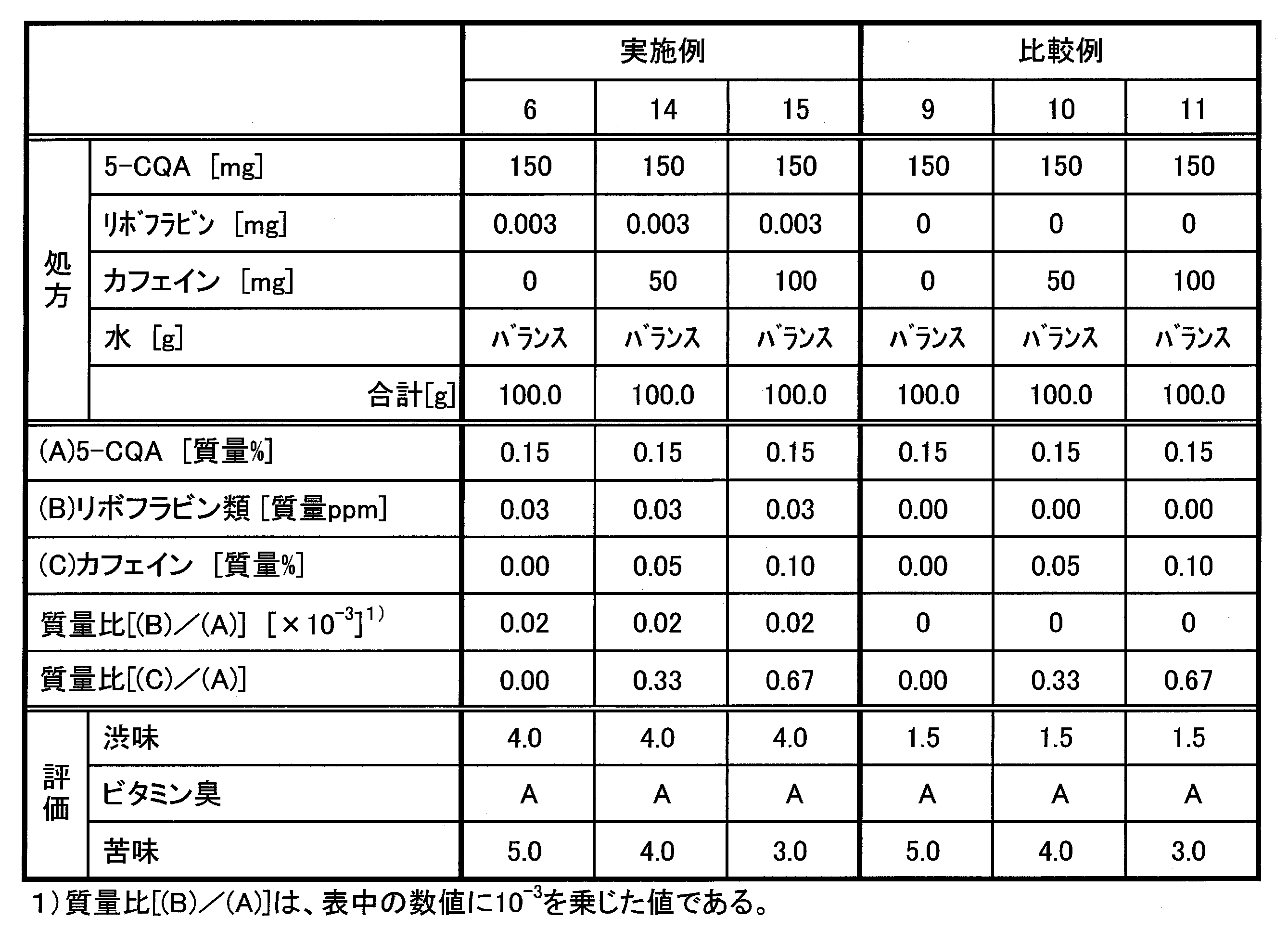
表4から、飲料中の(A)5-カフェオイルキナ酸濃度、及び(A)5-カフェオイルキナ酸と(B)リボフラビン類との質量比に加え、(A)5-カフェオイルキナ酸と(C)カフェインとの質量比を特定範囲内に制御することで、5-カフェオイルキナ酸由来の渋味だけでなく、カフェイン由来の苦味も抑制された風味の良好な飲料が得られることがわかる。
実施例16
表5に示す割合で各成分を配合して飲料を調製し、120℃で30秒間加熱殺菌した後、PETボトルに充填し、容器詰飲料を得た。得られた容器詰飲料について分析及び官能評価を行った。その結果を実施例6の結果とともに表5に示す。
表5に示す割合で各成分を配合して飲料を調製し、120℃で30秒間加熱殺菌した後、PETボトルに充填し、容器詰飲料を得た。得られた容器詰飲料について分析及び官能評価を行った。その結果を実施例6の結果とともに表5に示す。

表5から、加熱殺菌前後において5-カフェオイルキナ酸含有容器詰飲料の風味に変化がないことがわかる。
Claims (8)
- 次の成分(A)及び(B);
(A)5-カフェオイルキナ酸:0.02~0.50質量%、及び
(B)リボフラビン類
を含み、
成分(A)と成分(B)との質量比[(B)/(A)]が0.001×10-3~0.2×10-3である、5-カフェオイルキナ酸含有容器詰飲料。 - 成分(B)がリボフラビン、リボフラビン 5’-リン酸エステル及びリボフラビン 5’-リン酸エステルの塩から選択される1種又は2種以上である、請求項1記載の5-カフェオイルキナ酸含有容器詰飲料。
- 成分(A)が生コーヒー豆及び浅焙煎コーヒー豆から選択される1種又は2種に由来のものである、請求項1又は2記載の5-カフェオイルキナ酸含有容器詰飲料。
- 成分(B)の含有量が0.5質量ppm以下である、請求項1~3のいずれか1項に記載の5-カフェオイルキナ酸含有容器詰飲料。
- 成分(C)としてカフェインを0.1質量%以下含有するものである、請求項1~4のいずれか1項に記載の5-カフェオイルキナ酸含有容器詰飲料。
- pHが2.5~6である、請求項1~5のいずれか1項に記載の5-カフェオイルキナ酸含有容器詰飲料。
- 加熱殺菌されたものである、請求項1~6のいずれか1項に記載の5-カフェオイルキナ酸含有容器詰飲料。
- 次の成分(A)及び(B);
(A)5-カフェオイルキナ酸、及び
(B)リボフラビン類
を、成分(A)の濃度が0.02~0.50質量%、成分(A)と成分(B)との質量比[(B)/(A)]が0.001×10-3~0.2×10-3となるように配合する、5-カフェオイルキナ酸含有容器詰飲料の製造方法。
Priority Applications (1)
| Application Number | Priority Date | Filing Date | Title |
|---|---|---|---|
| PCT/JP2014/074681 WO2016042634A1 (ja) | 2014-09-18 | 2014-09-18 | 5-カフェイオルキナ酸含有容器詰飲料 |
Applications Claiming Priority (1)
| Application Number | Priority Date | Filing Date | Title |
|---|---|---|---|
| PCT/JP2014/074681 WO2016042634A1 (ja) | 2014-09-18 | 2014-09-18 | 5-カフェイオルキナ酸含有容器詰飲料 |
Publications (1)
| Publication Number | Publication Date |
|---|---|
| WO2016042634A1 true WO2016042634A1 (ja) | 2016-03-24 |
Family
ID=55532700
Family Applications (1)
| Application Number | Title | Priority Date | Filing Date |
|---|---|---|---|
| PCT/JP2014/074681 Ceased WO2016042634A1 (ja) | 2014-09-18 | 2014-09-18 | 5-カフェイオルキナ酸含有容器詰飲料 |
Country Status (1)
| Country | Link |
|---|---|
| WO (1) | WO2016042634A1 (ja) |
Cited By (1)
| Publication number | Priority date | Publication date | Assignee | Title |
|---|---|---|---|---|
| WO2018025504A1 (ja) * | 2016-08-04 | 2018-02-08 | 花王株式会社 | 容器詰飲料 |
Citations (8)
| Publication number | Priority date | Publication date | Assignee | Title |
|---|---|---|---|---|
| JPH05146253A (ja) * | 1991-11-26 | 1993-06-15 | Takeda Chem Ind Ltd | ビタミンb群作用物質を含有する飲料 |
| JP2006315985A (ja) * | 2005-05-11 | 2006-11-24 | Sanei Gen Ffi Inc | ビタミンの劣化抑制方法 |
| WO2006132353A1 (ja) * | 2005-06-10 | 2006-12-14 | Calpis Co., Ltd | 飲料用組成物の異臭防止方法 |
| JP2009065891A (ja) * | 2007-09-12 | 2009-04-02 | Kao Corp | 容器詰コーヒー飲料 |
| JP2010241800A (ja) * | 2009-03-18 | 2010-10-28 | Kao Corp | エネルギー消費促進剤 |
| JP2011057561A (ja) * | 2009-09-05 | 2011-03-24 | Ucc Ueshima Coffee Co Ltd | メタボリックシンドローム予防剤 |
| JP2011225455A (ja) * | 2010-04-15 | 2011-11-10 | Kao Corp | Srebp抑制剤 |
| JP2014124102A (ja) * | 2012-12-25 | 2014-07-07 | Kao Corp | クロロゲン酸類の安定化方法 |
-
2014
- 2014-09-18 WO PCT/JP2014/074681 patent/WO2016042634A1/ja not_active Ceased
Patent Citations (8)
| Publication number | Priority date | Publication date | Assignee | Title |
|---|---|---|---|---|
| JPH05146253A (ja) * | 1991-11-26 | 1993-06-15 | Takeda Chem Ind Ltd | ビタミンb群作用物質を含有する飲料 |
| JP2006315985A (ja) * | 2005-05-11 | 2006-11-24 | Sanei Gen Ffi Inc | ビタミンの劣化抑制方法 |
| WO2006132353A1 (ja) * | 2005-06-10 | 2006-12-14 | Calpis Co., Ltd | 飲料用組成物の異臭防止方法 |
| JP2009065891A (ja) * | 2007-09-12 | 2009-04-02 | Kao Corp | 容器詰コーヒー飲料 |
| JP2010241800A (ja) * | 2009-03-18 | 2010-10-28 | Kao Corp | エネルギー消費促進剤 |
| JP2011057561A (ja) * | 2009-09-05 | 2011-03-24 | Ucc Ueshima Coffee Co Ltd | メタボリックシンドローム予防剤 |
| JP2011225455A (ja) * | 2010-04-15 | 2011-11-10 | Kao Corp | Srebp抑制剤 |
| JP2014124102A (ja) * | 2012-12-25 | 2014-07-07 | Kao Corp | クロロゲン酸類の安定化方法 |
Non-Patent Citations (3)
| Title |
|---|
| ALMEIDA, A. A. P. ET AL.: "Antibacterial Activity of Coffee Extracts and Selected Coffee Chemical Compounds against Enterobacteria", J. AGRIC. FOOD CHEM., vol. 54, 2006, pages 8738 - 8743 * |
| AYA KAGAWA: "Yontei Shokuhin Seibunhyo", KAGAWA NUTRITION UNIVERSITY SHUPPANBU, 1994, pages 294 - 295 * |
| TAKASHI UEKI ET AL.: "Kosoku Ekitai Chromatography ni yoru Coffee Iri Inryo-chu no Chlorogenic Acid Rui Oyobi Caffeine no Teiryo", NORIN SUISAN SHOHI GIJUTSU CENTER CHOSA KENKYU HOKOKU, vol. 10, 1986, pages 22 - 32 * |
Cited By (1)
| Publication number | Priority date | Publication date | Assignee | Title |
|---|---|---|---|---|
| WO2018025504A1 (ja) * | 2016-08-04 | 2018-02-08 | 花王株式会社 | 容器詰飲料 |
Similar Documents
| Publication | Publication Date | Title |
|---|---|---|
| JP6257862B1 (ja) | ステビア含有飲料 | |
| EP3262954A1 (en) | Transparent beverage containing fruit flavor | |
| JP6362329B2 (ja) | ジカフェオイルキナ酸類含有飲料 | |
| JP6795539B2 (ja) | 食品組成物 | |
| JP2014060956A (ja) | 容器詰炭酸飲料及びその製造方法、並びに容器詰炭酸飲料の果実感向上方法 | |
| JP6777563B2 (ja) | 低カフェインコーヒー飲料 | |
| JP2013005787A (ja) | レモン風味を呈する飲料 | |
| JP7392766B2 (ja) | インスタント紅茶飲料用組成物の製造方法 | |
| JP6240366B1 (ja) | 茶重合ポリフェノールとRebD及び/又はRebMとを含有する飲料 | |
| JP6310625B1 (ja) | ティリロサイド及びクロロゲン酸類を含有する飲料 | |
| JP6757568B2 (ja) | 炭酸飲料 | |
| TWI577290B (zh) | Coffee drinks | |
| JP5820681B2 (ja) | 苦味抑制剤 | |
| CN105848497A (zh) | 通过长链脂肪酸的协同混合物调节苦味和口感 | |
| JP7810515B2 (ja) | 飲料組成物 | |
| JP2011072242A (ja) | 苦渋味抑制剤 | |
| TW201440661A (zh) | 咖啡飲料 | |
| WO2021186816A1 (ja) | カフェイン及び甘味成分を含有する飲料 | |
| JP6217055B1 (ja) | カテキン類とRebD及び/又はRebMとを含有する飲料 | |
| JP2023154001A (ja) | アロマフリーブドウ果汁 | |
| JP4383332B2 (ja) | 容器詰飲料 | |
| JP7838938B2 (ja) | 経口用組成物 | |
| JP7821590B2 (ja) | 飲料 | |
| EP3949751B1 (en) | Containerized beverage containing 1-deoxynojirimycin | |
| JP2017070282A (ja) | コーヒー抽出液及びその製造方法 |
Legal Events
| Date | Code | Title | Description |
|---|---|---|---|
| 121 | Ep: the epo has been informed by wipo that ep was designated in this application |
Ref document number: 14902071 Country of ref document: EP Kind code of ref document: A1 |
|
| NENP | Non-entry into the national phase |
Ref country code: DE |
|
| 122 | Ep: pct application non-entry in european phase |
Ref document number: 14902071 Country of ref document: EP Kind code of ref document: A1 |
|
| NENP | Non-entry into the national phase |
Ref country code: JP |