WO2016035831A1 - 回転電機用ステータコア - Google Patents
回転電機用ステータコア Download PDFInfo
- Publication number
- WO2016035831A1 WO2016035831A1 PCT/JP2015/074995 JP2015074995W WO2016035831A1 WO 2016035831 A1 WO2016035831 A1 WO 2016035831A1 JP 2015074995 W JP2015074995 W JP 2015074995W WO 2016035831 A1 WO2016035831 A1 WO 2016035831A1
- Authority
- WO
- WIPO (PCT)
- Prior art keywords
- stator core
- magnetic circuit
- rotating electrical
- electrical machine
- mounting
- Prior art date
- Legal status (The legal status is an assumption and is not a legal conclusion. Google has not performed a legal analysis and makes no representation as to the accuracy of the status listed.)
- Ceased
Links
Images





Classifications
-
- H—ELECTRICITY
- H02—GENERATION; CONVERSION OR DISTRIBUTION OF ELECTRIC POWER
- H02K—DYNAMO-ELECTRIC MACHINES
- H02K1/00—Details of the magnetic circuit
- H02K1/06—Details of the magnetic circuit characterised by the shape, form or construction
- H02K1/12—Stationary parts of the magnetic circuit
- H02K1/18—Means for mounting or fastening magnetic stationary parts on to, or to, the stator structures
Definitions
- the present invention relates to a stator core that constitutes a part of a stator for a rotating electrical machine.
- a stator is one of the main components used in rotating electrical machines such as generators and motors.
- this stator includes a stator core and a coil wound around a plurality of teeth portions of the stator core.
- the stator core is configured using, for example, an electromagnetic steel plate having high conversion efficiency between electric energy and magnetic energy.
- the stator having such a configuration is fixed to a stator mounting seat provided on an engine cover or the like. For this fixing, it is necessary to provide a portion to be mounted that is fixed to the stator mounting seat in a part of the stator core.
- the stator core described in Patent Document 1 has a plurality of teeth protruding from an annular base, and a mounting portion is provided on the annular base.
- a material that can efficiently convert between electric energy and magnetic energy such as a magnetic steel sheet constituting a stator core, is expensive. Therefore, from the viewpoint of cost reduction, there is a desire to reduce the amount of such high-cost materials used as much as possible.
- it is necessary to take measures such as securing the mounting strength by securing the size of the annular base portion to some extent. . Therefore, in the case of the configuration of the stator core that is integrally provided with the mounted portion disclosed in Patent Document 1, since the cost of the material is high and the size is increased, it is difficult to reduce the cost more than the current state. is there.
- the present invention has been made in view of such a background, and an object of the present invention is to provide a stator core for a rotating electrical machine having a structure capable of reducing the cost while maintaining the function of the stator core.
- One aspect of the present invention is located on the opposite side of the yoke portion from the protruding direction of the teeth portion, and a magnetic circuit member including an annular yoke portion and a plurality of teeth portions protruding radially from the yoke portion. And a stator core for a rotating electrical machine having a mounting member that constitutes a portion for fixing a mounting seat attached to an object.
- the magnetic circuit member and the mounting member are made of different members and are fixed to each other.
- the stator core includes the magnetic circuit member and the mounting member, which are separate members. Since the magnetic flux generated by the coil passes through the magnetic circuit member, the function of the stator core for the rotating electrical machine is ensured.
- the magnetic circuit member and the mounting member can be made of different materials. Therefore, it is not necessary to use a relatively expensive electromagnetic steel sheet or the like as the mounting member, and the degree of freedom in selecting the material for the mounting member is increased. As a result, a relatively inexpensive material can be used as the attachment member. Further, the cost of the stator core for the rotating electrical machine can be reduced. Further, for example, it is easy to reduce the weight of the material of the mounting member. As a result, it is easy to realize weight reduction of the stator core for the rotating electrical machine.
- stator core for a rotating electrical machine that enables cost reduction while maintaining the function of the stator core for the rotating electrical machine.
- FIG. 1 is a perspective view of a stator core for a rotating electrical machine in the first embodiment.
- FIG. 2 is a plan view of a stator core for a rotating electrical machine in the first embodiment.
- FIG. 3 is a cross-sectional view of a stator core for a rotating electrical machine in the first embodiment.
- FIG. 4 is a plan view of the magnetic circuit member and the attachment member in the first embodiment.
- FIG. 5 is a perspective view of the bent core material in the first embodiment.
- FIG. 6 is a perspective view of the attachment member in the first embodiment.
- FIG. 7 is a partial cross-sectional view showing a part of a fixed portion of a stator core for a rotating electrical machine with respect to a mounting seat in the first embodiment, broken away.
- FIG. 1 is a perspective view of a stator core for a rotating electrical machine in the first embodiment.
- FIG. 2 is a plan view of a stator core for a rotating electrical machine in the first embodiment.
- FIG. 3
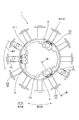
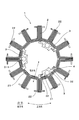
- FIG. 8 is a plan view of a stator core for a rotating electrical machine in the second embodiment.
- FIG. 9 is an exploded perspective view of a stator core for a rotating electrical machine according to the second embodiment.
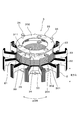
- FIG. 10 is a plan view of a stator core for a rotating electrical machine according to the third embodiment.
- FIG. 11 is a perspective view of a stator core for a rotating electrical machine according to the third embodiment.
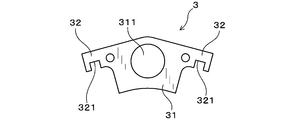
- FIG. 12 is a plan view of an attachment member in the third embodiment.
- the stator core is used as a component part of a stator of a rotating electrical machine such as a generator or a motor, for example. Further, the stator core may be configured such that the tooth portion protrudes radially outward from the yoke portion. Conversely, the tooth portion may protrude from the yoke portion toward the inside in the radial direction.
- the radial direction means the radial direction of the annular yoke portion unless otherwise specified.
- the circumferential direction means a direction along the annular shape of the yoke part unless otherwise specified.
- the axial direction is a direction orthogonal to the radial direction and the circumferential direction, and means a direction along the rotational axis of the rotor of the rotating electrical machine that rotates with respect to the stator core for the rotating electrical machine.
- a stator core 1 for a rotating electrical machine includes a magnetic circuit member 2 and a mounting member 3 (in Patent Document 1 described above, this is called a mounted portion).
- the magnetic circuit member 2 includes an annular yoke portion 21 and a plurality of tooth portions 22 protruding from the yoke portion 21 in the radial direction.
- the attachment member 3 is disposed on the side of the yoke portion 21 opposite to the protruding direction of the tooth portion 22 and constitutes a portion fixed to the attachment seat 51 (see FIG. 7).
- the magnetic circuit member 2 and the attachment member 3 are made of different members and are fixed to each other.
- a stator core 1 for a rotating electrical machine in the present embodiment is used for a stator of a magnet generator mounted on, for example, a two-wheeled vehicle. Further, the coil CL is wound around the teeth portion 22 via the bobbin 4 to constitute a stator.
- a tooth portion 22 protrudes radially outward from the yoke portion 21. Twelve teeth portions 22 are radially formed at equal intervals in the circumferential direction. However, the number of teeth portions 22 is not particularly limited.
- a plurality of mounting members 3 are arranged, and the plurality of mounting members 3 are spaced apart from each other along the circumferential direction of the yoke portion 21.
- the three attachment members 3 are arranged along the inner peripheral surface of the yoke portion 21 at equal intervals in the circumferential direction.
- the attachment member 3 includes a member main body 31 having a bolt insertion hole 311, and flanges 32 protruding from the outer peripheral side end of the member main body 31 to both sides in the circumferential direction.
- the attachment member 3 is thicker in the axial direction than the yoke portion 21.
- the magnetic circuit member 2 and the mounting member 3 are made of a resin bobbin for insulation between the coil CL wound around the teeth portion 22 and the magnetic circuit member 2.
- the bobbin 4 is integrally formed so as to cover substantially the entire magnetic circuit member 2 and to cover a part of the attachment member 3.
- the tip end portion of the tooth portion 22 is exposed from the bobbin 4.
- a part of the yoke portion 21 of the magnetic circuit member 2 adjacent to the mounting member 3 is also exposed from the bobbin 4.
- the attachment member 3 has the flange portion 32 embedded in the bobbin 4 and the substantially entire member main body portion 31 exposed from the bobbin 4.
- the magnetic circuit member 2 is made of an electromagnetic steel plate. That is, as shown in FIGS. 4 and 5, the magnetic circuit member 2 is formed by combining a plurality of bent core members 23 formed by laminating a plurality of electromagnetic steel plates and bending in a substantially U shape. Each bent core member 23 has a bottom surface portion 231 that constitutes the yoke portion 21 of the magnetic circuit member 2 and a pair of side surface portions 232 that constitute the tooth portion 22 of the magnetic circuit member 2. That is, the plurality of bent core members 23 are arranged in an annular shape with the side surface portions 232 being in surface contact with the bottom surface portion 231 facing inward.
- the attachment member 3 is made of, for example, a steel material. In order to reduce the weight, it is one desirable aspect that the mounting member 3 is formed of an aluminum material. The attachment member 3 does not necessarily need to use the same material as the magnetic circuit member 2 such as an electromagnetic steel plate. Therefore, in this embodiment, a steel material with a low material cost is used. On the other hand, when the magnetic circuit member 2 and the mounting member 3 are compared from the viewpoint of the magnetic properties of the materials used, the magnetic circuit member 2 is preferably formed of a material having magnetic permeability. On the other hand, the attachment member 3 is not necessarily limited to a material having magnetic permeability, and is formed of a material having non-magnetic properties.
- stator core 1 for a rotating electrical machine in the present embodiment a plurality of bent core members 23 and a plurality of mounting members 3 are arranged in a predetermined state in the mold as shown in FIG. Thereafter, resin is poured into the mold and solidified. Thereby, as shown in FIGS. 1 to 3, the bobbin 4 is formed in a state in which the magnetic circuit member 2 composed of the plurality of bent core members 23 and the plurality of mounting members 3 are inserted. And the stator core 1 for rotary electric machines with which the magnetic circuit member 2 and the attachment member 3 were mutually fixed is obtained.
- the stator core 1 for a rotating electrical machine is wound with a coil CL around a tooth portion 22 via a bobbin 4.
- the stator for generators is constituted.
- This stator is attached to a mounting seat 51 provided on an engine cover or the like by a bolt 52 in the mounting member 3.
- a rotor RT is rotatably disposed on the outer peripheral side of the stator. That is, the rotor RT is arranged so that a plurality of magnets in the rotor RT are opposed to the teeth portion 22 of the stator core 1 for a rotating electrical machine from the outer peripheral side.
- a magnet type generator is constituted.
- a stator core 1 for a rotating electrical machine has a magnetic circuit member 2 and a mounting member 3 which are separate members. That is, the magnetic circuit member 2 and the attachment member 3 can be made of different materials. Therefore, there is no need to use an electromagnetic steel plate or the like as the attachment member 3, and the degree of freedom in selecting the material for the attachment member 3 is increased. As a result, a relatively inexpensive material can be used as the attachment member 3. Moreover, cost reduction of the stator core 1 for rotary electric machines can be achieved. Furthermore, since the mounting member 3 can be configured with a minimum size that can secure the mounting strength, the cost of the stator core 1 for a rotating electrical machine can be further reduced. Further, for example, it is easy to reduce the weight of the material of the attachment member 3. As a result, it is easy to reduce the weight of the stator core 1 for a rotating electrical machine.
- a plurality of mounting members 3 are arranged.
- the plurality of attachment members 3 are arranged apart from each other along the circumferential direction of the yoke portion 21. Thereby, the total volume of the attachment member 3 can be made small. As a result, it is possible to reduce the weight and cost of the stator core 1 for a rotating electrical machine.
- the magnetic circuit member 2 and the mounting member 3 are fixed to each other by being integrally formed with the resin bobbin 4.
- the stator core 1 for rotary electric machines can be easily comprised, further suppressing material cost.
- the resin bobbin 4 is required to achieve electrical insulation between the coil CL wound around the teeth portion 22 and the stator core 1 for the rotating electrical machine.
- the bobbin 4 can play a role of fixing the magnetic circuit member 2 and the mounting member 3 together with the original role of the bobbin. .
- the magnetic circuit member 2 and the attachment member 3 which are separate members can be integrated without increasing the number of components.
- the mounting member 3 is thicker in the axial direction than the yoke portion 21. Thereby, when the attachment member 3 is fixed to the attachment seat 51, it is possible to prevent the yoke portion 21 from interfering with the attachment seat 51 and the bolt 52. As a result, the attachment member 3 is stably fixed to the attachment seat 51, and the stator can be stably fixed to the attachment seat 51.
- the present embodiment is an embodiment of a stator core 1 for a rotating electrical machine in which the attachment member 3 is formed in an annular shape.
- the same or equivalent components as those of the stator core for the rotating electrical machine according to the first embodiment described above are denoted by the same reference numerals, and the description thereof is simplified. Or omit. This description method is the same in the embodiments described later.
- the attachment member 3 has a plurality of engaging claw portions 33 that engage with the yoke portion 21. The attachment member 3 is fixed to the magnetic circuit member 2 by the engaging claw portion 33.
- the attachment member 3 is formed in an annular shape, and a plurality of engaging claws 33 protrude radially from each of both end portions in the axial direction. Further, the annular mounting member 3 has a plurality of bolt insertion holes 311 in a portion between the inner peripheral surface and the outer peripheral surface, in addition to the opening opened in the center thereof. These bolt insertion holes 311 are holes through which bolts 52 for fixing the stator core 1 for a rotating electrical machine to the mounting seat 51 are inserted (see FIG. 7).
- the annular mounting member 3 is disposed along the inner peripheral surface of the yoke portion 21 of the magnetic circuit member 2.
- the plurality of engaging claws 33 are bent so as to engage with the yoke portion 21. More specifically, as shown in FIG. 9, the engaging claw portion 33 provided on one end side in the axial direction of the mounting member 3 and the engaging claw portion 33 provided on the other end side face each other. It is bent in the direction and engaged with the outer peripheral surface of the yoke portion 21.
- the magnetic circuit member 2 is formed by combining a plurality of bent core materials 23.
- a pair of engaging claws 33 arranged opposite to each other in the axial direction is engaged with the bottom surface 231 of one bent core member 23.
- the attachment member 3 has the number of engagement claw portions 33 that is twice the number (24) of the number of bent core members 23 (12 in this embodiment).
- the number of the engaging claw portions 33 is not particularly limited.
- the mounting member 3 is formed by laminating a plurality of annular metal plates 301 and 302 in the axial direction as shown in FIG.
- the annular metal plate 302 disposed at both ends in the stacking direction (axial direction) has a plurality of engaging claws 33 protruding from the outer peripheral end.
- the other annular metal plate 301 does not include the engaging claw portion 33.
- Each of the annular metal plates 301 and 302 has a rivet hole 35 through which the rivet 34 is inserted.
- a plurality of bent core members 23 are arranged in an annular shape to constitute the magnetic circuit member 2, and an annular metal that does not include the engaging claw portion 33 on the inner side thereof.
- a plurality of plates 301 are arranged in a stacked state.
- a pair of annular metal plates 302 provided with the engaging claw portions 33 are overlapped with each other in the stacking direction (axial direction) on the stacked body of the plurality of annular metal plates 301.
- the plurality of annular metal plates 301 and 302 overlapped with each other are fixed to each other by the plurality of rivets 34.
- the engaging claw portions 33 in the pair of annular metal plates 302 are bent and crimped so as to be engaged with the bottom surface portion 231 of the bent core member 23, that is, the outer peripheral surface of the yoke portion 21 of the magnetic circuit member 2.
- the stator core 1 for a rotating electrical machine is obtained in which the mounting member 3 composed of a plurality of annular metal plates 301 and 302 and the magnetic circuit member 2 composed of a plurality of bent core members 23 are fixed to each other.
- the stator core 1 for a rotating electrical machine in the present embodiment is configured by, for example, assembling a bobbin formed as a separate member and disposing the coil CL around the teeth portion 22 via the bobbin. Can be configured.
- the magnetic circuit member 2 and the attachment member 3 can be directly fixed. Therefore, the stator core 1 for rotating electrical machines can be obtained easily and inexpensively. And the fixation strength of the magnetic circuit member 2 and the attachment member 3 can be made high by fixing between metals. In addition, it has the same function and effect as the first embodiment.
- the example in which the plurality of annular metal plates 301 and 302 are fixed by the rivets 34 is shown.
- the method for fixing the annular metal plates 301 and 302 is not limited to this, for example, in the stacking direction.
- the adjacent annular metal plates 301 and 302 may be fixed by caulking each other. That is, the plurality of annular metal plates 301 and 302 may be fixed to each other by caulking the convex portions and the concave portions in the thickness direction formed on the respective annular metal plates 301 and 302.
- the engaging claw 33 in the annular metal plate 302 is lengthened and caulked so as to hold the surface of the opposite annular metal plate 302, thereby fixing the attachment member 3 and the yoke portion 21, and
- the annular metal plates 301 and 302 may be fixed.
- the engaging claws 33 provided on the pair of annular metal plates 302 may be lengthened, and the positions of the engaging claws 33 may be shifted from each other in the circumferential direction.
- the engagement claw portion 33 can be in a state where the bending core material 22 is engaged at a plurality of locations on the bottom surface portion 231 of one bending core material 22.
- the present embodiment is an embodiment of a stator core 1 for a rotating electrical machine in which a magnetic circuit member 2 and an attachment member 3 are connected and fixed to each other by a metal connecting member 6.
- the connecting member 6 includes a cylindrical body 61 interposed between the magnetic circuit member 2 and the mounting member 3, and a plurality of first engaging claws each protruding from the cylindrical body 61. Part 631 and second engaging claw part 632. The plurality of first engaging claws 631 are engaged with the mounting member 3, and the plurality of second engaging claws 632 are engaged with the magnetic circuit member 2, whereby the mounting member 3 and the magnetic circuit member 2 are engaged. They are fixed to each other.
- the stator core 1 for a rotating electrical machine includes a plurality of mounting members 3, and the plurality of mounting members 3 are spaced apart from each other along the circumferential direction of the yoke portion 21.
- the shape of each attachment member 3 has the member main-body part 31 and a pair of collar part 32 similarly to the thing in 1st Embodiment.
- a groove portion 321 for engaging the first engagement claw portion 631 is formed in each of the pair of flange portions 32 along the axial direction.
- each attachment member 3 is fixed to the connecting member 6 by the pair of flange portions 32 being engaged and caulked by the first engagement claw portions 631.
- a pair of first engaging claws 631 that are opposed to each other in the axial direction are engaged with each flange 32.
- the second engaging claw portion 632 is engaged with the yoke portion 21 of the magnetic circuit member 2 and is caulked.
- the state of engagement of the second engagement claw portion 632 with the magnetic circuit member 2 is substantially the same as the state of engagement with the magnetic circuit member 2 by the engagement claw portion 33 in the second embodiment (FIGS. 8 and 9). It is the same.
- a plurality of mounting members 3 are arranged at predetermined positions at equal intervals in the circumferential direction along the inner peripheral surface of the cylindrical body 61 of the connecting member 6. To do. Then, the first engaging claw portion 631 of the connecting member 6 is bent and caulked so as to engage with the flange portion 32 of the attachment member 3. At this time, the first engaging claw portion 631 is disposed in the groove portion 321 provided in the flange portion 32.
- the magnetic circuit member 2 is configured by arranging a plurality of bent core members 23 in an annular shape along the outer peripheral surface of the cylindrical body 61 of the connecting member 6. Then, the plurality of second engaging claws 632 in the connecting member 6 are bent and caulked so as to be engaged with the bottom surface portion 231 of the bent core member 23, that is, the outer peripheral surface of the yoke portion 21 of the magnetic circuit member 2. . Thereby, the magnetic circuit member 2 is fixed to the connecting member 6.
- the stator core 1 for a rotating electrical machine in which the mounting member 3 and the magnetic circuit member 2 are fixed to each other via the connecting member 6 is obtained.
- said assembly method is an example,
- the order of fixation with the connection member 6 and the attachment member 3, and fixation with the connection member 6 and the magnetic circuit member 2 is not specifically limited. .
- stator core 1 for a rotating electrical machine in the present embodiment includes, for example, a stator by disposing a coil CL around the tooth portion 22 via a bobbin after assembling a bobbin formed as a separate member. Can be configured.
- the mounting member can be made of resin. That is, for example, the resin integrally molded with the magnetic circuit member can be used as the mounting member.
- the attachment member can be formed together with the bobbin.
Landscapes
- Engineering & Computer Science (AREA)
- Power Engineering (AREA)
- Iron Core Of Rotating Electric Machines (AREA)
Applications Claiming Priority (2)
| Application Number | Priority Date | Filing Date | Title |
|---|---|---|---|
| JP2014178062A JP2016052235A (ja) | 2014-09-02 | 2014-09-02 | ステータコア |
| JP2014-178062 | 2014-09-02 |
Publications (1)
| Publication Number | Publication Date |
|---|---|
| WO2016035831A1 true WO2016035831A1 (ja) | 2016-03-10 |
Family
ID=55439890
Family Applications (1)
| Application Number | Title | Priority Date | Filing Date |
|---|---|---|---|
| PCT/JP2015/074995 Ceased WO2016035831A1 (ja) | 2014-09-02 | 2015-09-02 | 回転電機用ステータコア |
Country Status (2)
| Country | Link |
|---|---|
| JP (1) | JP2016052235A (https=) |
| WO (1) | WO2016035831A1 (https=) |
Citations (4)
| Publication number | Priority date | Publication date | Assignee | Title |
|---|---|---|---|---|
| JPS62182069U (https=) * | 1986-05-09 | 1987-11-18 | ||
| JPH11341714A (ja) * | 1998-05-28 | 1999-12-10 | Toshiba Corp | モータのステータ |
| JP2004135483A (ja) * | 2002-10-10 | 2004-04-30 | Lg Electronics Inc | 洗濯機用モータのコア製造方法 |
| JP2005176597A (ja) * | 2003-12-10 | 2005-06-30 | Lg Electron Inc | ドラム洗濯機のアウターローター型モーター及びその製造方法 |
Family Cites Families (2)
| Publication number | Priority date | Publication date | Assignee | Title |
|---|---|---|---|---|
| KR101103989B1 (ko) * | 2010-05-04 | 2012-01-06 | 뉴모텍(주) | 모터의 스테이터 어셈블리 |
| JP5499899B2 (ja) * | 2010-05-20 | 2014-05-21 | アイシン精機株式会社 | 回転電機の保持リングの製造方法 |
-
2014
- 2014-09-02 JP JP2014178062A patent/JP2016052235A/ja active Pending
-
2015
- 2015-09-02 WO PCT/JP2015/074995 patent/WO2016035831A1/ja not_active Ceased
Patent Citations (4)
| Publication number | Priority date | Publication date | Assignee | Title |
|---|---|---|---|---|
| JPS62182069U (https=) * | 1986-05-09 | 1987-11-18 | ||
| JPH11341714A (ja) * | 1998-05-28 | 1999-12-10 | Toshiba Corp | モータのステータ |
| JP2004135483A (ja) * | 2002-10-10 | 2004-04-30 | Lg Electronics Inc | 洗濯機用モータのコア製造方法 |
| JP2005176597A (ja) * | 2003-12-10 | 2005-06-30 | Lg Electron Inc | ドラム洗濯機のアウターローター型モーター及びその製造方法 |
Also Published As
| Publication number | Publication date |
|---|---|
| JP2016052235A (ja) | 2016-04-11 |
Similar Documents
| Publication | Publication Date | Title |
|---|---|---|
| JP5519808B2 (ja) | ステータおよびこのステータを備える回転電機 | |
| JP6022077B2 (ja) | 回転電機用ロータ | |
| JP5970355B2 (ja) | ステータ | |
| WO2007049411A1 (ja) | コンデンサ電動機とその製造方法 | |
| WO2016136384A1 (ja) | 電機子および回転電機 | |
| JP2015082860A (ja) | 回転電機及び回転子鉄心の製造方法 | |
| JP2008035616A (ja) | モータ | |
| JP2013062901A (ja) | ステータおよびこのステータを備える回転電機 | |
| JP2008199845A (ja) | ステータの取り付け構造 | |
| JP5954198B2 (ja) | 回転電機 | |
| JP2019088033A (ja) | 電機子 | |
| CN108028558A (zh) | 旋转电机以及旋转电机的制造方法 | |
| JP2010178590A (ja) | 回転電機 | |
| JP2015061374A (ja) | ステータ | |
| JP2014036506A (ja) | 電機子、および、これを用いた回転電機 | |
| JP2008187864A (ja) | ステータの支持構造 | |
| JP2017225208A (ja) | 電機子、回転電機および電機子の製造方法 | |
| JP2013169044A (ja) | モータの分割ステータ・コア | |
| WO2015053071A1 (ja) | ステータ | |
| WO2016035831A1 (ja) | 回転電機用ステータコア | |
| CN104718688A (zh) | 两相旋转电机 | |
| JP2015089233A (ja) | 回転電機のステータ | |
| JP2012105543A (ja) | 電動機の固定子 | |
| JP5286121B2 (ja) | トロイダル巻線モータ | |
| JP2007252076A (ja) | 3相磁石式発電機 |
Legal Events
| Date | Code | Title | Description |
|---|---|---|---|
| 121 | Ep: the epo has been informed by wipo that ep was designated in this application |
Ref document number: 15838353 Country of ref document: EP Kind code of ref document: A1 |
|
| NENP | Non-entry into the national phase |
Ref country code: DE |
|
| 122 | Ep: pct application non-entry in european phase |
Ref document number: 15838353 Country of ref document: EP Kind code of ref document: A1 |