WO2016017017A1 - 使い捨ての化粧パッド - Google Patents
使い捨ての化粧パッド Download PDFInfo
- Publication number
- WO2016017017A1 WO2016017017A1 PCT/JP2014/070275 JP2014070275W WO2016017017A1 WO 2016017017 A1 WO2016017017 A1 WO 2016017017A1 JP 2014070275 W JP2014070275 W JP 2014070275W WO 2016017017 A1 WO2016017017 A1 WO 2016017017A1
- Authority
- WO
- WIPO (PCT)
- Prior art keywords
- fiber
- folding line
- contact surface
- fibers
- layer
- Prior art date
- Legal status (The legal status is an assumption and is not a legal conclusion. Google has not performed a legal analysis and makes no representation as to the accuracy of the status listed.)
- Ceased
Links
Images



Classifications
-
- A—HUMAN NECESSITIES
- A45—HAND OR TRAVELLING ARTICLES
- A45D—HAIRDRESSING OR SHAVING EQUIPMENT; EQUIPMENT FOR COSMETICS OR COSMETIC TREATMENTS, e.g. FOR MANICURING OR PEDICURING
- A45D34/00—Containers or accessories specially adapted for handling liquid toiletry or cosmetic substances, e.g. perfumes
- A45D34/04—Appliances specially adapted for applying liquid, e.g. using roller or ball
-
- A—HUMAN NECESSITIES
- A45—HAND OR TRAVELLING ARTICLES
- A45D—HAIRDRESSING OR SHAVING EQUIPMENT; EQUIPMENT FOR COSMETICS OR COSMETIC TREATMENTS, e.g. FOR MANICURING OR PEDICURING
- A45D34/00—Containers or accessories specially adapted for handling liquid toiletry or cosmetic substances, e.g. perfumes
- A45D2034/002—Accessories
-
- A—HUMAN NECESSITIES
- A45—HAND OR TRAVELLING ARTICLES
- A45D—HAIRDRESSING OR SHAVING EQUIPMENT; EQUIPMENT FOR COSMETICS OR COSMETIC TREATMENTS, e.g. FOR MANICURING OR PEDICURING
- A45D40/00—Casings or accessories specially adapted for storing or handling solid or pasty toiletry or cosmetic substances, e.g. shaving soaps or lipsticks
- A45D2040/0006—Accessories
-
- A—HUMAN NECESSITIES
- A45—HAND OR TRAVELLING ARTICLES
- A45D—HAIRDRESSING OR SHAVING EQUIPMENT; EQUIPMENT FOR COSMETICS OR COSMETIC TREATMENTS, e.g. FOR MANICURING OR PEDICURING
- A45D2200/00—Details not otherwise provided for in A45D
- A45D2200/10—Details of applicators
- A45D2200/1063—Removing cosmetic substances, e.g. make-up
Definitions
- the present invention relates to a disposable makeup pad used for makeup removal and the like.
- Patent Document 1 discloses a disposable makeup pad having a cushion layer and a covering sheet.
- the covering sheet includes 50% or more of rayon fibers on the skin contact surface, and has a thickness of 0.1 to 3 denier. It is formed with the fiber nonwoven fabric which has the fiber diameter.
- Such a makeup pad can be used for putting lotion and removing creams. In such a makeup pad, since it contacts the skin, a soft touch that does not give the user a sense of irritation is required.
- the cosmetic pad of Patent Document 1 has a problem that if the fiber diameter of the covering sheet is reduced in order to reduce irritation, the strength of the covering sheet is reduced and it is easily broken.
- the covering sheet is formed of a fiber nonwoven fabric having a relatively large fiber diameter exceeding 1 denier, the user can easily feel irritation when wiping off the makeup.
- a skin lotion so-called wiping skin lotion
- an object of the present invention is to provide a disposable makeup pad that is an improvement of the conventional technique and can ensure the strength of the covering sheet and improve the soft touch.
- the present invention resides in an improvement of a disposable makeup pad having a cushion layer containing hydrophilic fibers and a covering sheet covering the cushion layer.
- the present invention provides the cosmetic pad, wherein the covering sheet includes a skin contact surface and a non-skin contact surface positioned on the opposite side thereof, an outer layer positioned on the skin contact surface side, and the non-skin contact surface.
- An inner layer located on the side, and the outer layer is formed from a fiber nonwoven fabric mainly composed of hygroscopic fibers having a fiber diameter of 10 ⁇ m or less, and the inner layer is cellulose having a fiber diameter larger than that of the hygroscopic fibers. It is formed from the fiber nonwoven fabric containing 50 mass% or more of system fiber.
- the outer layer mainly composed of hygroscopic fibers, which are ultrafine fibers having a fiber diameter of 10 ⁇ m or less, comes into contact with the skin. Can improve the soft touch.
- the inner layer is formed of a fiber nonwoven fabric containing 50% by mass or more of cellulosic fibers having a fiber diameter larger than that of the water-absorbing fibers in the outer layer, the strength of the covering sheet can be increased.
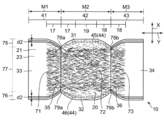
- FIG. 2 is a schematic cross-sectional view taken along line II-II in FIG. 1.
- decoration pad shown in FIG. A) The figure similar to FIG. 2 which shows the modification 1 of a makeup pad.
- the following embodiment relates to the disposable makeup pad shown in FIGS. 1 to 4 as an example of the present invention, and includes not only an indispensable structure of the invention but also a selective and preferable structure.
- a makeup pad 10 which is an example of a disposable makeup pad according to the present invention, is positioned in a first direction S and a second direction R that are orthogonal to each other, a first surface 11, and the opposite side.
- the second surface 12 both side edges 13 and 14 extending in the first direction S, both end edges 15 and 16 extending in the second direction R, and the first end 17 and the second end that are separated from each other in the first direction S 18 and an intermediate portion 19 located between the first and second end portions 17, 18.
- the width in the second direction R is constant, and in the first and second end portions 17 and 18, the dimension in the second direction R decreases toward the edges 15 and 16, respectively.
- the edges 13 and 14 are inclined.
- the decorative pad 10 includes a cushion layer 20 containing hydrophilic fibers and a covering sheet 21 that covers the cushion layer 20.
- the dimension in the first direction S of the intermediate portion 19 is larger than the dimension in the first direction S of the first and second end portions 17 and 18.
- the cushion layer 20 is a fiber assembly mainly composed of hydrophilic fibers, and hydrophobic fibers may be mixed in the fiber assembly as long as the required water absorption of the cushion layer 20 is not inhibited. Specifically, it contains about 80% by mass or more of hydrophilic fibers.
- hydrophilic fiber for example, rayon fiber, cotton fiber, acrylic fiber or the like can be used.
- hydrophobic fiber synthetic fibers, such as polyethylene, polyester, a polypropylene, or these composite fibers etc. can be used, for example.
- the cushion layer 20 is formed of a fiber assembly mainly composed of cellulosic fibers such as rayon fibers.
- the mass of the cushion layer 20 in one makeup pad 10 is preferably about 0.2 to 0.4 g.
- the cushion layer 20 preferably has a mass per unit area in the intermediate portion 19 smaller than that in the first and second end portions 17 and 18. Further, the mass per unit area at the first and second end portions 17 and 18 of the cushion layer 20 can be substantially the same or different from each other. In this embodiment, the first and second end portions 17 and 17 The mass per unit area of 18 is almost equal.
- the makeup pad 10 when used by putting a finger into the pocket 50 described later by making the mass per unit area at the first end 17 of the cushion layer 20 larger than that of the second end 18. Further, the flexibility of the end portion (first end portion 17) on the side where the finger is inserted is improved, and a soft touch can be achieved.
- the covering sheet 21 includes an inner layer 23 positioned on the non-skin contact surface side and an outer layer 24 positioned on the skin contact surface side.
- the inner layer 23 is made of, for example, about 50 to 100% by mass of cellulosic fibers such as hygroscopic rayon fibers and water-absorbing pulp fibers, about 0 to 50% by mass of hydrophobic fibers, and about 0 to about 0% of heat-fusible fibers. It is formed from a fiber nonwoven fabric containing 50% by mass.
- the inner layer 23 preferably contains about 1 to 50% by mass of hydrophobic fibers, more preferably about 1 to 30% by mass, and preferably about 1 to 50% by mass of heat-fusible fibers, more preferably about 1 to 30%. Including mass%.
- hydrophobic fiber synthetic fibers, such as polyethylene, polyester, a polypropylene, can be used, for example.
- synthetic fibers such as polyethylene, polypropylene, and polyethylene terephthalate, or composite fibers using two or more of these can be used.
- the content of the hydrophobic fiber (that is, the content of the heat-fusible fiber) ) Is preferably about 1 to 50% by mass, more preferably about 1 to 30% by mass.
- the fiber diameter of the hydrophobic fiber and the heat-fusible fiber is preferably about 10 to 20 ⁇ m, and the fiber diameter of the cellulosic fiber is preferably about 10 to 20 ⁇ m.
- the outer layer 24 is formed of a fiber nonwoven fabric mainly composed of hygroscopic fibers having a fiber diameter of 10 ⁇ m or less formed by a melt blown method. Specifically, hygroscopic fibers formed by the melt blown method are contained in an amount of about 80% by mass or more, preferably about 95% by mass or more, and in this embodiment, 100% by mass.
- the hygroscopic fibers used in the outer layer 24 preferably have lower hygroscopicity than the cellulosic fibers used in the inner layer 23.
- the hygroscopic fibers include polyamide fibers such as nylon 6 and nylon 66, acrylic fibers, Alternatively, hydrophobic fibers that have been subjected to a hydrophilic treatment can be used.
- a cosmetic liquid such as a cleansing agent
- the fiber diameter of the hygroscopic fiber is smaller than the fiber diameter of the cellulosic fiber forming the inner layer 23.
- the fiber diameter of the hygroscopic fiber is more preferably about 5 ⁇ m or less.
- nylon 6 or nylon 66 as the hygroscopic fiber forming the outer layer.
- the thickness t1 of the inner layer 23 is about 0.10 to 0.25 mm, and is about 0.16 mm in this embodiment.
- the mass per unit area of the inner layer 23 is about 10 to 35 g / m 2 , and more preferably about 15 to 30 g / m 2 .
- the density of the inner layer 23 is preferably about 0.08 to 0.2 g / cm 3 , and is about 0.12 g / cm 3 in this embodiment.
- the thickness t2 of the outer layer 24 is about 0.05 to 0.15 mm, and in this embodiment is about 0.09 mm.
- Mass per unit area of the outer layer 24 is in a range of about 5 ⁇ 30g / m 2, more preferably about 5 ⁇ 15g / m 2.
- the density of the outer layer 24 is preferably about 0.05 to 0.2 g / cm 3 , and is about 0.11 g / cm 3 in this embodiment.
- the mass of the inner layer 23 is preferably about 25 g / m 2 or more.
- the thickness t3 of the covering sheet 21 is preferably about 0.2 to 0.3 mm, and the mass per unit area of the covering sheet 21 is preferably in the range of about 25 to 40 g / m 2 .
- the specific volume of the covering sheet 21 is about 50 to 200 m 3 / kg, and in this embodiment is about 145 m 3 / kg.
- the thickness dimension t2 of the outer layer 24 is preferably smaller than the thickness dimension t1 of the inner layer.
- the covering sheet 21 extends in the skin contact surface and the non-skin contact surface located on the opposite side, the length direction Y and the width direction X orthogonal to each other, and the length direction Y. It has the 1st side edge part 31 and the 2nd side edge part 32, and the 1st edge part 33 and the 2nd edge part 34 extended in the width direction X, and the 1st and 2nd side edge part 31,
- the outer shape of the covering sheet 21 is defined by 32 and the first and second end edges 33 and 34.
- each of the length direction Y and the width direction X coincides with each of the first direction S and the second direction R of the makeup pad 10.
- the covering sheet 21 is positioned on the first end edge 33 side, and is positioned between the first folding line 35 extending in the width direction X, and between the first folding line 35 and the second end edge part 34, and in the width direction X.
- a first fold line 36 extending between the first end edge 33 and the first fold line 35, and between the first fold line 35 and the second fold line 36.
- the dimension M2 in the length direction Y of the second section 42 is larger than the dimensions M1 and M3 in the length direction Y of the first and third sections 41, 43.
- the dimensions M1 and M3 of the first and third areas 41 and 43 are larger than one half of the dimension M2 of the second area 42, and the dimension M3 of the third area 43 is equal to or larger than the dimension M1 of the first area 41.
- the first and second side edge portions 31 and 32 are concavely curved toward the inner side in the width direction X in the vicinity of the first folding curve 35 and in the vicinity of the second folding curve 36, respectively.
- the first folding line 35 coincides with one end edge 15 of the makeup pad 10
- the second folding line 36 coincides with the other end edge 16 of the makeup pad 10.
- the cushion layer 20 is disposed on the non-skin contact surface side of the covering sheet 21 in a state where the covering sheet 21 is unfolded.
- the cushion layer 20 includes a first side region 75 and a second side region 76 that are separated from each other in the width direction X, and a central region 77 that is located between the first side region 75 and the second side region 76.
- the first side region 75 is a second fold located on the outer side in the width direction X from the one end 78a of the first folding line 35 (end edge 15) located on the first side edge 31 side (on the first side edge 31 side). This is a region located on the outer side in the width direction X from one end 78b of the curved line 36 (edge 16).
- the second side region 76 is a width direction X outside (second side located on the second side edge 32 side) from the other end 79a of the first folding line 35 (end edge 15) located on the second side edge 32 side. It is a region located on the outer side 79b of the folding line 36 (end edge 16) in the width direction X outside.
- the central region 77 is a region located between the one end 78a and the other end 79a of the first folding line 35 (between the one end 78b and the other end 79b of the second folding line 36) in the width direction X. It is.
- the mass per unit area of the cushion layer 20 in the first side region 75 and the second side region 76 is substantially equal, and the mass per unit area of the cushion layer 20 in the central region 77 is the first and second side regions 75, Greater than that at 76.
- the first and second side regions 75 and 76 and the central region 77 are respectively disposed in the first cushion portion 71 disposed in the first area 41 of the covering sheet 21 and the second area 42 of the covering sheet 21.
- the second cushion part 72 and the third cushion part 73 disposed in the third area 43 of the covering sheet 21 are provided.
- the 1st cushion part 71 is arrange
- the 2nd cushion part 72 is arrange
- the first area 41 of the covering sheet 21 is in a state in which the cushion layer 20 is sandwiched between the second area 42 (that is, a state in which a part of the second cushion part 72 and the first cushion part 71 are sandwiched),
- the second section 42 is bent along the first folding line 35 toward the non-skin contact surface side
- the third section 43 has a state in which the cushion layer 20 is sandwiched between the second section 42 (that is, the first section 42). 2 in a state in which a part of the second cushion portion 72 and the third cushion portion 73 are sandwiched) along the second folding line 36 and bent toward the skin contact surface side of the first section 41 stacked on the second section 42. It has been.
- the mass per unit area of the cushion layer 20 at the first and second end portions 17 and 18 is larger than that of the intermediate portion 19.
- the first and second end portions 17 and 18 and the intermediate portion 19 each have a unit area of the cushion layer 20 in the central region in the second direction R (that is, the region where the central region 77 of the cushion layer 20 is disposed).
- the hit mass per unit area of the cushion layer 20 in both side regions that is, regions where the first and second side regions 75 and 76 of the cushion layer 20 are arranged located outside the second direction R of the central region. Greater than mass.
- the mass per unit area of the cushion layer 20 in both side regions of the first and second end portions 17 and 18 is preferably smaller than that in the central region of the intermediate portion 19.
- the laminated first and second side edge portions 31 and 32 are respectively fused by embossing / debossing by heat or ultrasonic waves, and thereby, both-side joining in which the folded covering sheet 21 is joined.
- a portion 44 is formed.
- the first and third areas 41 and 43 form the first surface 11 of the makeup pad 10, and the second area 42 forms the second surface 12.
- a pocket 50 is formed in the first surface 11 by a third area 43 stacked on the first and second areas 41 and 42.
- the cushion layer 20 is fused to the covering sheet 21 while being sandwiched between the second section 42 and the first and third sections 41 and 43.
- joining of the 1st and 2nd side edge parts 31 and 32 may be made
- the both side joints 44 extend from the first fold line 35 to the second fold line 36, and the first joint part 45 located on the first side edge 31 and the second side edge.
- 2nd joint part 46 located in the part 32 is included.
- the first and second joint portions 45 and 46 each have a straight portion 47 extending in the first direction S (length direction Y) and a pair of inclined portions 48 positioned outside the straight portion 47 in the first direction S. And have.
- the straight portion 47 is located at the intermediate portion 19 of the makeup pad 10
- the inclined portion 48 is located at the first and second end portions 17, 18 of the makeup pad 10. Is larger in the length direction Y than the inclined portion 48.
- each of the joint portions 45 and 46 is formed by a large number of substantially circular welding spots, but in other shapes, for example, a substantially rectangular welding spot or a continuous or discontinuous line shape. It may be formed.
- the bonding strength between the laminated covering sheets 21 is higher than that of the straight portion 47.
- the outer end portion 48 a of the inclined portion 48 positioned at both end edges 15 and 16 of the decorative pad 10 is formed with a higher bonding strength than other portions of the inclined portion 48.
- the dimension (d1) in the second direction R of the non-joint portion of the covering sheet 21 located between the joint portions 45 and 46 is preferably in the range of about 0.5 to 5 mm.
- the width dimension (dimension in the second direction R) d2 of the joint portions 45 and 46 is preferably in the range of about 0.5 to 5 mm.
- the pocket 50 is demarcated by both side joint portions 44, a second folding line 36 extending between the both side joint portions 44, and a second end edge portion 34, and the second end edge portion 34 causes the second direction R (width direction X) to be defined.
- An opening edge 51 of the pocket 50 extending along is formed.
- the dimension L2 in the first direction S of the laminated portion in which the first and third areas 41 and 43 are laminated is approximately 20 to 50% of the dimension L1 in the first direction S of the decorative pad 10.
- the opening edge 51 is located at the intermediate portion 19 of the decorative pad 10, and the end edge 33 a on the first end edge portion 33 side of the covering sheet 21 is located at the intermediate portion 19.
- the opening edge 51 may be configured to be positioned at the first end portion 17 of the makeup pad 10.
- a cleansing agent is applied to the first surface 11 or the second surface 12 to be used as a makeup removal pad, or pores are removed from the first surface 11 or the second surface 12.
- a lotion so-called wiping lotion
- the first surface 11 or the second surface 12 of the makeup pad 10 is pressed against the skin and rubbed.
- Necessary flexibility to the extent that no irritation is felt is required.
- it is required to have a relatively high flexibility so as not to feel irritation while removing dirt and old keratin of pores.
- the outer layer 24 forming the first and second surfaces 11 and 12 is formed of a meltblown fiber nonwoven fabric mainly composed of hygroscopic fibers that are ultrafine fibers having a fiber diameter of 10 ⁇ m or less. Therefore, compared with what formed the outer layer with the fiber nonwoven fabric of a comparatively big fiber diameter, a feeling of irritation can be reduced and a soft touch can be obtained. Furthermore, since this ultrafine fiber is a meltblown fiber, the fiber diameter can be made uniform and the peripheral surface of the fiber can be made smoother, compared to those using a split fiber as the ultrafine fiber. This can be further improved. Moreover, since the inner layer 23 is mainly made of cellulosic fibers having a fiber diameter larger than that of the hygroscopic fibers, it is possible to prevent the strength of the covering sheet 21 from being reduced by using ultrafine fibers.
- polyamide fibers such as nylon 6 and nylon 66 which have lower hygroscopicity than the cellulose fibers forming the inner layer 23, are used to cleanse the skin contact surface of the cosmetic pad 10.
- a cosmetic liquid such as an agent
- the cosmetic liquid is suppressed from being rapidly absorbed by the inner layer 23 or the cushion layer 20 having a high hygroscopic property, and the makeup is removed with the cosmetic liquid held on the skin contact surface. be able to. Thereby, when cleansing, excessive consumption of the cosmetic liquid can be suppressed.
- the inner layer 23 includes hydrophobic fibers, the hygroscopicity of the inner layer 23 is lowered, and this effect can be further improved.
- the gap between the fibers is reduced and the fibers are arranged relatively densely. be able to. Since the hygroscopic fibers arranged relatively densely as described above are so-called ultrafine fibers having a fiber diameter of about 10 ⁇ m or less, sebum and dirt that have entered the pores can be scraped off, and the cleansing function is improved. Further, the cosmetic liquid enters the fine gaps between the fibers, so that a uniform liquid film without a gap is easily formed on the skin contact surface, and the retention of the cosmetic liquid on the skin contact surface can be further enhanced.
- the adhesion to the skin is improved, and it is possible to give a feeling that the surface (skin contact surface) sticks to the skin in a state where the cosmetic liquid is impregnated.
- the thickness t3 of the covering sheet 21 is set to about 0.2 to 0.3 mm and the specific volume is set to about 50 to 200 m 3 / kg, so that the covering sheet 21 is maintained to be flexible and hardly broken. Can do.
- the hygroscopic fibers forming the outer layer 24 are formed by continuous fibers extending in the first direction S and the second direction R so that the end portions of the fibers do not exist on the first and second surfaces 11 and 12. It is preferable. That is, when the hygroscopic fiber is a short fiber in which the end portion of the fiber is present on the first and second surfaces 11 and 12, when used, the end portion may hit the skin and cause irritation. However, when short fibers are used by making the fibers continuous on the first and second surfaces 11 and 12 so that the end portions do not exist except for the first and second side edges 31 and 32, In comparison, the touch can be improved and the sheet strength in a certain direction can be improved. Referring to FIGS.
- both side joint portions 44 are formed inside the side edges 13 and 14 of the decorative pad 10, which is a cutting side of the covering sheet 21, In the cosmetic liquid application region defined by the both side joint portions 44 and the both end edges 15 and 16 on the surface 12, there are no end portions of hygroscopic fibers that are continuous fibers, and a good touch can be obtained.
- the outer layer 24 and the inner layer 23 constituting the covering sheet 21 can be integrated by a mechanical entanglement method, specifically, a fluid entanglement method (a hydroentanglement method, an air entanglement method), a needle punch entanglement method, Integrated by hydroentanglement method.
- a mechanical entanglement method specifically, a fluid entanglement method (a hydroentanglement method, an air entanglement method), a needle punch entanglement method, Integrated by hydroentanglement method.
- the high-pressure water flow is preferably jetted from the skin contact surface side (outer layer 24 side), and by this method, the surface strength of the outer layer 24 is higher than that from which the high-pressure water flow is jetted from the inner layer 23 side.
- the skin contact surface of the covering sheet 21 can have a smooth texture.
- a high-pressure water flow may be jetted from the skin contact surface side (outer layer 24 side) and the non-skin contact surface side (inner layer 23 side).
- the outer layer 24 has fiber orientation along the second direction R (the width direction X of the covering sheet 21).
- the fiber orientation refers to the orientation direction of about 50% or more of the fibers forming the outer layer 24.
- the inner layer 23 has fiber orientation along the first direction S or the second direction R (the width direction X or the length direction Y of the covering sheet 21).
- the finger When the user puts a finger in the pocket 50 and uses the makeup pad 10, the finger is inserted in a direction substantially orthogonal to the opening edge 51 of the pocket 50, and after the makeup pad 10 abuts against the skin, the opening edge 51 It is often used by moving the makeup pad 10 along the extending direction.
- the fiber orientation of the outer layer 24 By setting the fiber orientation of the outer layer 24 to the second direction R, that is, the direction that coincides with the direction in which the opening edge 51 extends, the direction in which the decorative pad 10 is moved and the fiber orientation direction of the outer layer 24 can be matched. And a smooth feel when used.
- the tear of the coating sheet 21 at the time of use can be suppressed by making the direction (1st direction S) which inserts a finger, and a fiber orientation direction cross.
- the bonding strength of the covering sheet 21 can be increased. Further, when the opening edge 51 of the pocket 50 is located at the first end portion 17, both end portions of the opening edge 51 are joined by the inclined portion 48 having a joining strength higher than that of the straight portion 47. It is possible to prevent the opening edge 51 from opening when the finger is inserted into the first and third areas 41 and 43 from being peeled off. Although the rigidity of the decorative pad 10 is increased at the bonded portion, it is possible to suppress the rigidity of the entire bonded portion from being increased by reducing the bonding strength of the straight portion 47 as compared with the inclined portion 48.
- the decorative pad 10 prevents the decorative pad 10 from being out of shape during use. can do.
- the mass per unit area of the cushion layer 20 in the both sides area of the 2nd direction R is smaller than that in the center area of the 2nd direction R, the makeup pad 10 is the cushioning property of the makeup pad 10 in a center area. In the both side areas, the laminated covering sheets 21 can be firmly joined at the side joining portions 44.
- ⁇ Modification> 4A is a schematic cross-sectional view similar to FIG. 2 in the first modification of the makeup pad 10, and FIG. 4B is a schematic cross-section similar to FIG. 2 in the second modification of the makeup pad 10.
- FIG. 4A The makeup pad 10 according to Modifications 1 and 2 has the same basic configuration as that according to the above-described embodiment, and therefore only the differences will be described below.
- the second end edge portion 34 of the covering sheet 21 is bent with the inner layer 23 inside along the third folding line 60 extending in the width direction X (second direction R).
- a first bent end 53 is provided.
- the first bent end portion 53 has a dimension L3 in the length direction Y of about 1 to 5 mm and is located at the first end portion 17.
- the opening edge 51 of the pocket 50 is formed by the third folding line 60.
- the outer layer 24 in the first section 41 and the outer layer 24 in the third section 43 are joined to each other at the both side joint portions 44, so that the moisture absorption forming the outer layer 24 is performed.
- the fiber is nylon 6 or nylon 66 and the cellulosic fiber forming the inner layer 23 is rayon fiber, the bonding strength of the first and third sections 41 and 43 at the first bent end 53 is increased. Can do.
- the first bent end portion 53 may be configured to be located in the intermediate portion 19.
- the second edge 34 of the covering sheet 21 is bent along the third folding line 60 extending in the width direction X (second direction R) with the inner layer 23 inside.
- the first bent end portion 53 and the first end edge portion 33 of the covering sheet 21 were bent along the fourth folding line 61 extending in the width direction X (second direction R) with the outer layer 24 inside.
- a second bent end 54 a second bent end 54.
- the first bent end 53 is located at the first end 17, the second bent end 54 is located at the second end 18, and the length of the first and second bent ends 53, 54 is Dimensions L3 and L4 in the length direction Y are about 1 to 5 mm, respectively.
- the inner layer 23 of the 1st area 41 and the inner layer 23 of the 2nd and 3rd areas 42 and 43 are joined, and the inner layer 23 is joined.
- the bonding strength at the second bent end 54 can be increased.
- the structure located in the intermediate part 19 may be sufficient as the 1st and 2nd bending edge parts 53 and 54, respectively.
- the thickness dimension of the covering sheet 21 is measured using a thickness meter (UF-60, manufactured by Daiei Kagaku Seisakusho Co., Ltd.) with a load of 3.0 gf / cm 2 applied to the covering sheet 21.
- the thickness dimensions of the inner layer 23 and the outer layer 24 are measured using a microscope (manufactured by Keyence Corporation, Real Surface View Microscope VE-7800).
- the specific volume (m 3 / kg) of the covering sheet 21 is calculated as the reciprocal of density (g / cm 3 ) ⁇ 10 3 .
- the covering sheet 21 is a skin contact surface and a non-skin contact located on the opposite side.
- a surface, an outer layer 24 positioned on the skin contact surface side, and an inner layer 23 positioned on the non-skin contact surface side, and the outer layer 24 mainly includes hygroscopic fibers having a fiber diameter of 10 ⁇ m or less. It is formed from a fiber nonwoven fabric, and the inner layer 23 is formed from a fiber nonwoven fabric containing 50% by mass or more of cellulosic fibers having a fiber diameter larger than that of the hygroscopic fiber.
- the present invention disclosed in the above paragraph 0039 can include at least the following embodiments.
- the hygroscopic fiber is formed by a melt blown method.
- the hygroscopic fiber is nylon 6 or nylon 66.
- the specific volume of the covering sheet 21 is 50 to 200 m 3 / kg.
- the inner layer 23 has 1 to 50% by mass of hydrophobic fibers.
- the inner layer 23 has 1 to 50% by mass of heat-fusible fibers.
- the cushion layer 20 is mainly made of rayon fiber or cotton fiber.
- the covering sheet 21 includes a length direction Y and a width direction X, first and second side edges 31 and 32 extending in the length direction Y, and first and second end edges extending in the width direction X.
- a second folding curve 36 located, a first section 41 located between the first edge 33 and the first folding curve 35, a first folding curve 35 and a second folding curve 36, The second section 42 is divided into a second section 42 and a third section 43 positioned between the second folding line 36 and the second end edge 34, and the second section 42 is divided into the first and second sections.
- the dimension in the length direction Y is larger than the three areas 41 and 43, and the cushion layer 20 is disposed on the non-skin contact surface side of the covering sheet 21.
- the first section 41 is folded along the curved line 35 toward the non-skin contact surface side of the second section 42, and the third section 43 is stacked on the second section 42 along the second folding line 36.
- the first and second side edges 31 and 32 that are laminated are joined to each other in a state of being bent toward the skin contact surface side, thereby opening the both side joint 44 and the second end edge 34 to the opening edge.
- the decorative pad 10 is defined by a first end 17 located on the first folding line 35 side, a second end 18 located on the second folding line 36 side, Intermediate portion 19 located between second end portions 17 and 18, and the mass per unit area of cushion layer 20 at first and second end portions 17 and 18 is greater than that at intermediate portion 19. large.
- the cushion layer 20 has a mass per unit area in both side regions in the width direction X smaller than that in the central region located between the both side regions.
- the outer layer 24 has fiber orientation in the width direction X.
- the both-side joint portion 44 includes a straight portion 47 and a pair of inclined portions 48 positioned outside the straight portion 47 in the longitudinal direction Y, and at least one of the pair of inclined portions 48 is inclined.
- the part 48 has higher bonding strength than the straight part 47, and the opening edge 51 of the pocket 50 extends between the one inclined part 48.
- the cover sheet 21 is bent at least one of the first and second end edges 33 and 34.
- the second end edge 34 is bent so that the inner layer 23 is on the inner side.
- the mass per unit area of the outer layer 24 is smaller than the mass per unit area of the inner layer 23, and the thickness dimension t2 of the outer layer 24 is smaller than the thickness dimension t1 of the inner layer 23.
Landscapes
- Cosmetics (AREA)
- Nonwoven Fabrics (AREA)
- Laminated Bodies (AREA)
- Absorbent Articles And Supports Therefor (AREA)
Abstract
Description
図4(a)は、化粧パッド10の変形例1における図2と同様の模式的断面図であり、図4(b)は、化粧パッド10の変形例2における図2と同様の模式的断面図である。変形例1及び2に係る化粧パッド10は、上述した実施形態に係るそれと基本的構成が同一であるので、相違する点についてのみ以下に説明する。
被覆シート21の厚さ寸法は、被覆シート21に3.0gf/cm2荷重を加えた状態で、厚み計((株)大栄科学精器製作所製、UF-60)を用いて測定する。内層23及び外層24の厚さ寸法は、顕微鏡((株)キーエンス製、リアルサーフェイスビュー顕微鏡 VE-7800)を用いて測定する。被覆シート21、内層23及び外層24のそれぞれの密度は、密度(g/cm3)=単位面積当たりの質量(g/m2)/厚さ寸法(mm)×10-3に基づいて算出し、被覆シート21の比容積(m3/kg)は、密度(g/cm3)×103の逆数として算出する。
(1)前記吸湿性繊維は、メルトブローン法により形成される。
(2)前記吸湿性繊維は、ナイロン6又はナイロン66である。
(3)被覆シート21の比容積は、50~200m3/kgである。
(4)内層23は、疎水性繊維を1~50質量%有する。
(5)内層23は、熱融着性繊維を1~50質量%有する。
(6)クッション層20は、レーヨン繊維又はコットン繊維を主とする。
(7)被覆シート21は、長さ方向Y及び幅方向Xと、長さ方向Yへ延びる第1及び第2側縁部31,32と、幅方向Xへ延びる第1及び第2端縁部33,34と、幅方向Xへ延びて第1端縁部33側に位置する第1折曲線35と、幅方向Xへ延びて第1折曲線35と第2端縁部34との間に位置する第2折曲線36とを有しており、第1端縁部33と第1折曲線35との間に位置する第1区域41と、第1折曲線35と第2折曲線36との間に位置する第2区域42と、第2折曲線36と第2端縁部34との間に位置する第3区域43とに区分されており、第2区域42は、第1及び第3区域41,43よりも長さ方向Yにおける寸法が大きくなっており、被覆シート21の前記非肌当接面側にはクッション層20が配置されており、第1折曲線35に沿って第1区域41を第2区域42の前記非肌当接面側へ折り曲げて、第2折曲線36に沿って第3区域43を第2区域42に積層された第1区域41の前記肌当接面側へ折り曲げた状態で、積層された第1及び第2側縁部31,32をそれぞれ接合することによって、両側接合部44と、第2端縁部34を開口縁51とするポケット50とが画定され、化粧パッド10は、第1折曲線35側に位置する第1端部17と、第2折曲線36側に位置する第2端部18と、第1及び第2端部17,18との間に位置する中間部19とを有し、第1及び第2端部17,18におけるクッション層20の単位面積当たりの質量は、中間部19におけるそれよりも大きい。
(8)クッション層20は、幅方向Xにおける両側域における単位面積当たりの質量が、前記両側域の間に位置する中央域におけるそれよりも小さい。
(9)外層24は、幅方向Xへ繊維配向性を有する。
(10)両側接合部44は、直状部47と、直状部47の長さ方向Y外側に位置する一対の傾斜部48とを有し、前記一対の傾斜部48のうち少なくとも一方の傾斜部48は、直状部47よりも接合強度が高く、ポケット50の開口縁51は、前記一方の傾斜部48間を延在する。
(11)被覆シート21は、第1及び第2端縁部33,34のうち少なくとも一方の端縁部が折曲されている。
(12)第2端縁部34は、内層23が内側になるように折曲されている。
(13)外層24の単位面積当たりの質量は、内層23の単位面積当たりの質量よりも小さく、外層24の厚さ寸法t2は、内層23の厚さ寸法t1よりも小さい。
17 第1端部
18 第2端部
19 中間部
20 クッション層
21 被覆シート
23 内層
24 外層
50 ポケット
51 開口縁
X 幅方向
Y 長さ方向
Claims (14)
- 親水性繊維を含むクッション層と、前記クッション層を包被する被覆シートとを有する使い捨ての化粧パッドにおいて、
前記被覆シートは、肌当接面及びその反対側に位置する非肌当接面と、前記肌当接面側に位置する外層と、前記非肌当接面側に位置する内層とを有し、
前記外層は、繊維径が10μm以下の吸湿性繊維を主とする繊維不織布から形成されており、
前記内層は、前記吸湿性繊維よりも繊維径が大きいセルロース系繊維を50質量%以上含む繊維不織布から形成されていることを特徴とする前記化粧パッド。 - 前記吸湿性繊維は、メルトブローン法により形成される請求項1に記載の化粧パッド。
- 前記吸湿性繊維は、ナイロン6又はナイロン66である請求項1又は2に記載の化粧パッド。
- 前記被覆シートの比容積は、50~200m3/kgである請求項1~3のいずれかに記載の化粧パッド。
- 前記内層は、疎水性繊維を1~50質量%有する請求項1~4のいずれかに記載の化粧パッド。
- 前記内層は、熱融着性繊維を1~50質量%有する請求項1~5のいずれかに記載の化粧パッド。
- 前記クッション層は、レーヨン繊維又はコットン繊維を主とする請求項1~6のいずれかに記載の化粧パッド。
- 前記被覆シートは、長さ方向及び幅方向と、前記長さ方向へ延びる第1及び第2側縁部と、前記幅方向へ延びる第1及び第2端縁部と、前記幅方向へ延びて前記第1端縁部側に位置する第1折曲線と、前記幅方向へ延びて前記第1折曲線と前記第2端縁部との間に位置する第2折曲線とを有しており、前記第1端縁部と前記第1折曲線との間に位置する第1区域と、前記第1折曲線と前記第2折曲線との間に位置する第2区域と、前記第2折曲線と前記第2端縁部との間に位置する第3区域とに区分されており、
前記第2区域は、前記第1及び第3区域よりも前記長さ方向における寸法が大きくなっており、
前記被覆シートの前記非肌当接面側には前記クッション層が配置されており、
前記第1折曲線に沿って前記第1区域を前記第2区域の前記非肌当接面側へ折り曲げて、前記第2折曲線に沿って前記第3区域を前記第2区域に積層された前記第1区域の前記肌当接面側へ折り曲げた状態で、積層された前記第1及び第2側縁部をそれぞれ接合することによって、両側接合部と、前記第2端縁部を開口縁とするポケットとが画定され、
前記化粧パッドは、前記第1折曲線側に位置する第1端部と、前記第2折曲線側に位置する第2端部と、前記第1及び第2端部との間に位置する中間部とを有し、
前記第1及び第2端部における前記クッション層の単位面積当たりの質量は、前記中間部におけるそれよりも大きい請求項1~7のいずれかに記載の化粧パッド。 - 前記クッション層は、前記幅方向における両側域における単位面積当たりの質量が、前記両側域の間に位置する中央域におけるそれよりも小さい請求項8に記載の化粧パッド。
- 前記外層は、前記幅方向へ繊維配向性を有する請求項8又は9に記載の化粧パッド。
- 前記両側接合部は、直状部と、前記直状部の前記長さ方向外側に位置する一対の傾斜部とを有し、
前記一対の傾斜部のうち少なくとも一方の傾斜部は、前記直状部よりも接合強度が高く、
前記ポケットの前記開口縁は、前記一方の傾斜部間を延在する請求項8~10のいずれかに記載の化粧パッド。 - 前記被覆シートは、前記第1及び第2端縁部のうち少なくとも一方の端縁部が折曲されている請求項8~11のいずれかに記載の化粧パッド。
- 前記第2端縁部は、前記内層が内側になるように折曲されている請求項12に記載の化粧パッド。
- 前記外層の単位面積当たりの質量は、前記内層の単位面積当たりの質量よりも小さく、前記外層の厚さ寸法は、前記内層の厚さ寸法よりも小さい請求項1~13のいずれかに記載の化粧パッド。
Priority Applications (4)
| Application Number | Priority Date | Filing Date | Title |
|---|---|---|---|
| CN201480079613.7A CN106455788B (zh) | 2014-07-30 | 2014-07-31 | 一次性化妆垫 |
| KR1020167035454A KR102169389B1 (ko) | 2014-07-30 | 2014-07-31 | 일회용 화장 패드 |
| BR112016028659A BR112016028659A2 (pt) | 2014-07-30 | 2014-07-31 | acolchoado cosmético descartável |
| PH12016502351A PH12016502351B1 (en) | 2014-07-30 | 2016-11-25 | Disposable cosmetic pad |
Applications Claiming Priority (2)
| Application Number | Priority Date | Filing Date | Title |
|---|---|---|---|
| JP2014155474A JP5671180B1 (ja) | 2014-07-30 | 2014-07-30 | 使い捨ての化粧パッド |
| JP2014-155474 | 2014-07-30 |
Publications (1)
| Publication Number | Publication Date |
|---|---|
| WO2016017017A1 true WO2016017017A1 (ja) | 2016-02-04 |
Family
ID=52573864
Family Applications (1)
| Application Number | Title | Priority Date | Filing Date |
|---|---|---|---|
| PCT/JP2014/070275 Ceased WO2016017017A1 (ja) | 2014-07-30 | 2014-07-31 | 使い捨ての化粧パッド |
Country Status (8)
| Country | Link |
|---|---|
| JP (1) | JP5671180B1 (ja) |
| KR (1) | KR102169389B1 (ja) |
| CN (1) | CN106455788B (ja) |
| BR (1) | BR112016028659A2 (ja) |
| MY (1) | MY174450A (ja) |
| PH (1) | PH12016502351B1 (ja) |
| TW (1) | TWI661792B (ja) |
| WO (1) | WO2016017017A1 (ja) |
Families Citing this family (6)
| Publication number | Priority date | Publication date | Assignee | Title |
|---|---|---|---|---|
| KR101723816B1 (ko) * | 2016-09-05 | 2017-04-07 | (주)코떼랑 | 기능성 화장품 피부 흡수용 패드 |
| KR101946517B1 (ko) * | 2017-01-26 | 2019-02-11 | (주)한라케미칼 | 다층 구조를 갖는 화장료 담체 |
| WO2018231537A1 (en) * | 2017-06-15 | 2018-12-20 | Porex Corporation | Integral porous fiber media with distinguishable density or fiber diameters |
| AU2021206185A1 (en) * | 2020-01-07 | 2022-08-11 | Elc Management Llc | Method, and system for multi-layer cosmetic pads and use thereof |
| JP7787662B2 (ja) * | 2020-12-25 | 2025-12-17 | オオサキメディカル株式会社 | 消毒用ワイパー |
| KR102587425B1 (ko) * | 2021-05-10 | 2023-10-12 | 주식회사 이엠코퍼레이션 | 팔꿈치 또는 무릎의 피부 케어에 적합한 미용 패드 |
Citations (9)
| Publication number | Priority date | Publication date | Assignee | Title |
|---|---|---|---|---|
| US1815763A (en) * | 1928-07-23 | 1931-07-21 | Joseph J Cosin | Powder puff and method of manufacturing the same |
| JPS5698108U (ja) * | 1979-12-24 | 1981-08-03 | ||
| JPS57189515U (ja) * | 1981-05-29 | 1982-12-01 | ||
| JPH08325930A (ja) * | 1995-03-31 | 1996-12-10 | Japan Vilene Co Ltd | 不織布及びその製造方法 |
| JP3067948U (ja) * | 1999-10-05 | 2000-04-21 | 株式会社瑞光 | 使い捨て化粧用パフ |
| JP2003093152A (ja) * | 2001-09-26 | 2003-04-02 | Lion Corp | 化粧料含浸シート |
| JP2003289940A (ja) * | 2002-04-01 | 2003-10-14 | Toray Ind Inc | 化粧用具 |
| JP2004501089A (ja) * | 2000-04-17 | 2004-01-15 | ユニリーバー・ナームローゼ・ベンノートシヤープ | アルキルジオール含浸乾燥クレンジング拭き取り用品 |
| JP2006082263A (ja) * | 2004-09-14 | 2006-03-30 | Sekisui Chem Co Ltd | 液状物供給基材 |
Family Cites Families (7)
| Publication number | Priority date | Publication date | Assignee | Title |
|---|---|---|---|---|
| JPS60151424A (ja) | 1984-01-17 | 1985-08-09 | Nissan Motor Co Ltd | フル−ドカツプリング |
| JP2000354515A (ja) * | 1999-06-15 | 2000-12-26 | Kao Corp | 化粧料塗布用具 |
| BRPI0316616B8 (pt) * | 2002-11-27 | 2021-07-27 | Hisamitsu Pharmaceutical Co | emplastro térmico com efeito térmico suficiente que torna a sensação agradável mais duradoura e irritação residual mais reduzida |
| KR101400704B1 (ko) * | 2006-07-05 | 2014-05-29 | 가오 가부시키가이샤 | 흡수성 물품 |
| CN201167908Y (zh) * | 2008-01-23 | 2008-12-24 | 胡波 | 一种化妆棉 |
| JP5536645B2 (ja) * | 2008-06-02 | 2014-07-02 | ダイワボウホールディングス株式会社 | 化粧料含浸用皮膚被覆シート及びフェイスマスク |
| CN101575767A (zh) * | 2009-03-06 | 2009-11-11 | 稳健实业(深圳)有限公司 | 一种化妆棉及其生产方法 |
-
2014
- 2014-07-30 JP JP2014155474A patent/JP5671180B1/ja active Active
- 2014-07-31 WO PCT/JP2014/070275 patent/WO2016017017A1/ja not_active Ceased
- 2014-07-31 MY MYPI2016704706A patent/MY174450A/en unknown
- 2014-07-31 KR KR1020167035454A patent/KR102169389B1/ko active Active
- 2014-07-31 CN CN201480079613.7A patent/CN106455788B/zh active Active
- 2014-07-31 BR BR112016028659A patent/BR112016028659A2/pt not_active Application Discontinuation
-
2015
- 2015-06-25 TW TW104120546A patent/TWI661792B/zh active
-
2016
- 2016-11-25 PH PH12016502351A patent/PH12016502351B1/en unknown
Patent Citations (9)
| Publication number | Priority date | Publication date | Assignee | Title |
|---|---|---|---|---|
| US1815763A (en) * | 1928-07-23 | 1931-07-21 | Joseph J Cosin | Powder puff and method of manufacturing the same |
| JPS5698108U (ja) * | 1979-12-24 | 1981-08-03 | ||
| JPS57189515U (ja) * | 1981-05-29 | 1982-12-01 | ||
| JPH08325930A (ja) * | 1995-03-31 | 1996-12-10 | Japan Vilene Co Ltd | 不織布及びその製造方法 |
| JP3067948U (ja) * | 1999-10-05 | 2000-04-21 | 株式会社瑞光 | 使い捨て化粧用パフ |
| JP2004501089A (ja) * | 2000-04-17 | 2004-01-15 | ユニリーバー・ナームローゼ・ベンノートシヤープ | アルキルジオール含浸乾燥クレンジング拭き取り用品 |
| JP2003093152A (ja) * | 2001-09-26 | 2003-04-02 | Lion Corp | 化粧料含浸シート |
| JP2003289940A (ja) * | 2002-04-01 | 2003-10-14 | Toray Ind Inc | 化粧用具 |
| JP2006082263A (ja) * | 2004-09-14 | 2006-03-30 | Sekisui Chem Co Ltd | 液状物供給基材 |
Also Published As
| Publication number | Publication date |
|---|---|
| CN106455788A (zh) | 2017-02-22 |
| CN106455788B (zh) | 2020-07-31 |
| PH12016502351A1 (en) | 2017-02-13 |
| JP5671180B1 (ja) | 2015-02-18 |
| PH12016502351B1 (en) | 2017-02-13 |
| JP2016032486A (ja) | 2016-03-10 |
| BR112016028659A2 (pt) | 2017-08-22 |
| KR102169389B1 (ko) | 2020-10-23 |
| MY174450A (en) | 2020-04-19 |
| TW201611752A (en) | 2016-04-01 |
| KR20170032232A (ko) | 2017-03-22 |
| TWI661792B (zh) | 2019-06-11 |
Similar Documents
| Publication | Publication Date | Title |
|---|---|---|
| JP5671180B1 (ja) | 使い捨ての化粧パッド | |
| TWI683046B (zh) | 擦拭用薄片 | |
| US10449093B2 (en) | Fingertip cleaning apparatus | |
| JP2008264077A (ja) | 吸収性物品及び該吸収性物品の製造方法 | |
| JP5744358B1 (ja) | 使い捨ての化粧パッド | |
| JP3978423B2 (ja) | 化粧用不織布シート | |
| CN106659608B (zh) | 吸收性物品 | |
| KR200463383Y1 (ko) | 화장솜 | |
| JP4014022B2 (ja) | 化粧用パフ及びその製造方法 | |
| JP6920911B2 (ja) | 清掃具 | |
| KR200467648Y1 (ko) | 화장용 양면 패드 | |
| JP7026471B2 (ja) | 脇用汗取りパッド | |
| TWI841785B (zh) | 吸收性物品 | |
| JP5046441B2 (ja) | 化粧綿 | |
| JP4459775B2 (ja) | シート状パック材 | |
| JP2008174864A (ja) | 化粧綿 | |
| KR20180001594U (ko) | 스펀레이스 부직포의 화장포지 | |
| KR20170003256U (ko) | 스펀레이스 부직포의 화장포지 | |
| CN109310540A (zh) | 一次性尿布 |
Legal Events
| Date | Code | Title | Description |
|---|---|---|---|
| 121 | Ep: the epo has been informed by wipo that ep was designated in this application |
Ref document number: 14898714 Country of ref document: EP Kind code of ref document: A1 |
|
| WWE | Wipo information: entry into national phase |
Ref document number: 12016502351 Country of ref document: PH |
|
| ENP | Entry into the national phase |
Ref document number: 20167035454 Country of ref document: KR Kind code of ref document: A |
|
| REG | Reference to national code |
Ref country code: BR Ref legal event code: B01A Ref document number: 112016028659 Country of ref document: BR |
|
| WWE | Wipo information: entry into national phase |
Ref document number: IDP00201608885 Country of ref document: ID |
|
| NENP | Non-entry into the national phase |
Ref country code: DE |
|
| ENP | Entry into the national phase |
Ref document number: 112016028659 Country of ref document: BR Kind code of ref document: A2 Effective date: 20161206 |
|
| 122 | Ep: pct application non-entry in european phase |
Ref document number: 14898714 Country of ref document: EP Kind code of ref document: A1 |