WO2016013421A1 - 硬化性シリコーン樹脂組成物およびその硬化物、並びにこれらを用いた光半導体装置 - Google Patents
硬化性シリコーン樹脂組成物およびその硬化物、並びにこれらを用いた光半導体装置 Download PDFInfo
- Publication number
- WO2016013421A1 WO2016013421A1 PCT/JP2015/069877 JP2015069877W WO2016013421A1 WO 2016013421 A1 WO2016013421 A1 WO 2016013421A1 JP 2015069877 W JP2015069877 W JP 2015069877W WO 2016013421 A1 WO2016013421 A1 WO 2016013421A1
- Authority
- WO
- WIPO (PCT)
- Prior art keywords
- silicone resin
- component
- group
- composition
- resin composition
- Prior art date
- Legal status (The legal status is an assumption and is not a legal conclusion. Google has not performed a legal analysis and makes no representation as to the accuracy of the status listed.)
- Ceased
Links
Images

Classifications
-
- C—CHEMISTRY; METALLURGY
- C09—DYES; PAINTS; POLISHES; NATURAL RESINS; ADHESIVES; COMPOSITIONS NOT OTHERWISE PROVIDED FOR; APPLICATIONS OF MATERIALS NOT OTHERWISE PROVIDED FOR
- C09K—MATERIALS FOR MISCELLANEOUS APPLICATIONS, NOT PROVIDED FOR ELSEWHERE
- C09K3/00—Materials not provided for elsewhere
- C09K3/10—Materials in mouldable or extrudable form for sealing or packing joints or covers
-
- H—ELECTRICITY
- H10—SEMICONDUCTOR DEVICES; ELECTRIC SOLID-STATE DEVICES NOT OTHERWISE PROVIDED FOR
- H10H—INORGANIC LIGHT-EMITTING SEMICONDUCTOR DEVICES HAVING POTENTIAL BARRIERS
- H10H20/00—Individual inorganic light-emitting semiconductor devices having potential barriers, e.g. light-emitting diodes [LED]
- H10H20/80—Constructional details
- H10H20/85—Packages
- H10H20/852—Encapsulations
- H10H20/854—Encapsulations characterised by their material, e.g. epoxy or silicone resins
-
- H—ELECTRICITY
- H10—SEMICONDUCTOR DEVICES; ELECTRIC SOLID-STATE DEVICES NOT OTHERWISE PROVIDED FOR
- H10W—GENERIC PACKAGES, INTERCONNECTIONS, CONNECTORS OR OTHER CONSTRUCTIONAL DETAILS OF DEVICES COVERED BY CLASS H10
- H10W74/00—Encapsulations, e.g. protective coatings
- H10W74/10—Encapsulations, e.g. protective coatings characterised by their shape or disposition
-
- H—ELECTRICITY
- H10—SEMICONDUCTOR DEVICES; ELECTRIC SOLID-STATE DEVICES NOT OTHERWISE PROVIDED FOR
- H10W—GENERIC PACKAGES, INTERCONNECTIONS, CONNECTORS OR OTHER CONSTRUCTIONAL DETAILS OF DEVICES COVERED BY CLASS H10
- H10W74/00—Encapsulations, e.g. protective coatings
- H10W74/40—Encapsulations, e.g. protective coatings characterised by their materials
Definitions
- the present invention relates to a curable silicone resin composition that can be suitably used as a raw material for a sealing material of an optical semiconductor element such as a light emitting diode, a raw material for an adhesive, a cured product thereof, and an optical semiconductor device using these.
- a cured product such as an epoxy resin composition or a silicone resin composition is used as a sealing material of a light emitting device using an optical semiconductor element such as a light emitting diode (abbreviation: LED).
- LED light emitting diode
- the epoxy resin composition has excellent handling properties because of the high hardness of the cured product.
- the required durability can be obtained. Many are used.
- the cured products of conventional transparent epoxy resin compositions have power semiconductors and high-intensity light emitting elements (for example, the backlights of automobile headlights and LCD TVs). It is known that heat resistance is insufficient for use as a sealing material for short-wavelength semiconductor lasers such as high-intensity LEDs for light or blue lasers, and current leakage or yellowing due to high-temperature deterioration occurs. .
- Patent Document 1 reports an addition-curable silicone resin composition that uses an addition reaction (hydrosilylation reaction) between a SiH group and an alkenyl group as a material for protecting and sealing an optical device or a semiconductor device. .
- silicone resin compositions contain a platinum-based metal catalyst, particularly a platinum catalyst, as a curing catalyst.
- a silicone resin composition containing a platinum catalyst may turn yellow when exposed to a high temperature for a long time.
- a cured product of a silicone resin composition containing a platinum catalyst has a problem that transparency is impaired when exposed to a high temperature for a long time.
- a silicone resin that solves such problems and has sufficient transparency even when exposed to high temperatures for a long period of time that is, a silicone resin that provides a cured product excellent in heat-resistant transparency Development of compositions is desired.
- the present invention has been made in view of the above circumstances, and provides an addition-curable curable silicone resin composition that provides a cured product having excellent heat-resistant transparency, a cured product thereof, and an optical semiconductor device using these. With the goal.
- component a silicone resin represented by the following formula [1] and containing a hydrogen atom (SiH group) bonded to a silicon atom;
- Component (B): it is represented by the following formula [2], a silicone resin containing a vinyl group bonded to a silicon atom (Si-CH CH 2 groups), and component (C): wherein at least a platinum catalyst,
- the total content of silanol groups (Si—OH groups) in component (B) and component (B) is 0.5 to 5.0 mmol / g, and the content of platinum atoms in component (C) is (A)
- a curable silicone resin composition having a mass unit of 0.003 to 3.0 ppm with respect to the total mass of the component, the component (B) and the component (C), It came to complete the addition-curable type curable silicone resin composition excellent in heat
- R 1 is an alkyl group having 1 to 3 carbon atoms
- R 2 is an alkyl group having 1 to 3 carbon atoms
- R 2 may be the same or different from each other
- R 3 is an alkyl group having 1 to 3 carbon atoms or an aromatic hydrocarbon group having 6 to 10 carbon atoms
- the oxygen atom in the structural unit represented by each represents an oxygen atom forming a siloxane bond or an oxygen atom forming a silanol group.
- R 4 is an alkyl group having 1 to 3 carbon atoms
- two R 4 may be the same or different from each other
- R 4 is an alkyl group having 1 to 3
- the present invention includes the following invention 1 to invention 15.
- the total content of silanol groups (Si—OH groups) in component (B) and component (B) is 0.5 to 5.0 mmol / g, and the content of platinum atoms in component (C) is
- a curable silicone resin composition having a mass unit of 0.003 to 3.0 ppm based on the total mass of the component, the component (B), and the component (C).
- R 1 is an alkyl group having 1 to 3 carbon atoms
- R 2 is an alkyl group having 1 to 3 carbon atoms
- R 2 may be the same or different from each other
- R 3 is an alkyl group having 1 to 3 carbon atoms or an aromatic hydrocarbon group having 6 to 10 carbon atoms
- the oxygen atom in the structural unit represented by each represents an oxygen atom forming a siloxane bond or an oxygen atom forming a silanol group.
- R 4 is an alkyl group having 1 to 3 carbon atoms
- two R 4 may be the same or different from each other
- R 4 is an alkyl group having 1 to 3
- invention 8 The curable silicone resin composition according to any one of Inventions 1 to 7, further comprising one or more selected from the group consisting of an adhesion-imparting agent, a phosphor and inorganic particles.
- invention 9 Curing according to any one of inventions 1 to 8, further comprising at least one selected from the group consisting of a mold release agent, a resin modifier, a colorant, a diluent, an antibacterial agent, an antifungal agent, a leveling agent, and an anti-sagging agent. Silicone resin composition.
- a sealing material comprising a cured product of the curable silicone resin composition according to any one of inventions 1 to 9.
- invention 12 A method for producing a cured product of a curable silicone resin composition, wherein the curable silicone resin composition according to any one of Inventions 1 to 9 is heated and cured at 45 ° C or higher and 300 ° C or lower.
- invention 14 The adhesive for semiconductors which consists of a hardened
- alkyl group having 1 to 3 carbon atoms include a methyl group, an ethyl group, a propyl group, and an isopropyl group.
- the aromatic hydrocarbon group having 6 to 10 carbon atoms may be a substituted or unsubstituted aromatic hydrocarbon group, and some or all of the hydrogen atoms may be substituted with fluorine atoms.
- Specific examples include a phenyl group, a naphthyl group, a tolyl group, a xylyl group, a 3-trifluoromethylphenyl group, a 4-trifluoromethylphenyl group, and a 3,5-di (trifluoromethylphenyl) group.
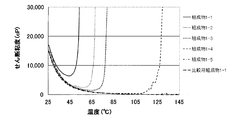
- FIG. 2 is a graph showing the relationship between the shear viscosity and the temperature of compositions prepared in Examples and Comparative Examples (Composition 1-1 to Composition 1-5, Comparative Composition 1-1).
- FIG. 4 is a graph showing the relationship between the shear viscosity and the temperature of compositions prepared in Examples and Comparative Examples (Composition 4-1 to Composition 4-3, Comparative Composition 4-1).
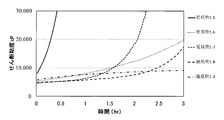
- FIG. 3 is a graph showing the relationship between shear viscosity and time of compositions prepared in Examples (Composition 1-1, Composition 1-6 to Composition 1-9).
- the curable silicone resin composition of the present invention contains at least a predetermined amount of the components (A) to (C), and the composition is heated.
- the cured product thus obtained is suitably used as a sealing material for optical semiconductor devices.
- each component contained in the composition of this invention is demonstrated.
- the component (A) is a silicone resin represented by the following formula [1] and containing a hydrogen atom (SiH group) bonded to a silicon atom.
- the above formula [1] represents an average composition formula.
- R 1 is an alkyl group having 1 to 3 carbon atoms, and two R 1 may be the same or different from each other.
- R 2 is an alkyl group having 1 to 3 carbon atoms, and the two R 2 may be the same or different from each other.
- R 3 is an alkyl group having 1 to 3 carbon atoms or an aromatic hydrocarbon group having 6 to 10 carbon atoms.
- the oxygen atom in the structural unit represented by (SiR 2 2 O 2/2 ), (R 3 SiO 3/2 ) and (SiO 4/2 ) is an oxygen atom or silanol group forming a siloxane bond, respectively. The oxygen atom which forms is shown.
- alkyl group having 1 to 3 carbon atoms in R 1 a methyl group and an ethyl group are preferable, and a methyl group is particularly preferable.
- alkyl group having 1 to 3 carbon atoms in R 2 a methyl group and an ethyl group are preferable, and a methyl group is particularly preferable.
- alkyl group having 1 to 3 carbon atoms in R 3 a methyl group and an ethyl group are preferable, and a methyl group is particularly preferable.
- the aromatic hydrocarbon group having 6 to 10 carbon atoms in R 3 is preferably a phenyl group, a 3-trifluoromethylphenyl group, a 4-trifluoromethylphenyl group, or a 3,5-di (trifluoromethylphenyl) group.
- a phenyl group is particularly preferred.
- R 1 , R 2 and R 3 are not particularly limited. Among them, R 1 is a methyl group or an ethyl group, R 2 is a methyl group or an ethyl group, R 3 is a methyl group, an ethyl group, a phenyl group, a 3-trifluoromethylphenyl group, a 4-trifluoromethylphenyl group, or 3, It is preferably any one of 5-di (trifluoromethylphenyl) groups, particularly preferably R 1 is a methyl group, R 2 is a methyl group, and R 3 is a phenyl group.
- the value of a is preferably 0.05 to 0.40, particularly preferably 0.20 to 0.40. If the value of a is 0.05 or more, the composition of the present invention has good moldability, and if it is 0.40 or less, the cured product of the present invention has good mechanical strength.
- the value of b is preferably 0.10 to 0.80, particularly preferably 0.10 to 0.40. If the value of b is 0.10 or more, the composition of the present invention has good moldability, and if it is 0.80 or less, the cured product of the present invention has good mechanical strength.
- the value of c is preferably 0.10 to 0.80, particularly preferably 0.30 to 0.60. If the value of c is 0.10 or more, the cured product of the present invention has good mechanical strength, and if it is 0.80 or less, the composition of the present invention has good moldability.
- the value of d is preferably 0 to 0.70.
- the value of d is particularly preferably 0.10 to 0.30 since the cured product of the present invention exhibits good adhesive strength and good hardness.
- the value of d is 0, there is no structural unit of (SiO 4/2 ) in the above formula [1].
- a, b, c and d should be calculated by measuring the 29 Si-NMR spectrum and 1 H-NMR spectrum of component (A) using a nuclear magnetic resonance apparatus and using these in a complementary combination. Can do.
- the structural unit represented by (SiR 2 2 O 2/2 ) is a structure represented by the following formula [1-2], that is, represented by (SiR 2 2 O 2/2 ).
- the structure unit may include a structure in which one of oxygen atoms bonded to a silicon atom forms a silanol group.
- R 2 has the same meaning as R 2 in the formula [1]
- X represents a hydroxy group.
- the structural unit represented by (SiR 2 2 O 2/2 ) includes a portion surrounded by a broken line of the structural unit represented by the following formula [1-b], and further includes the following formula [1-2-b]
- the part enclosed with the broken line of the structural unit represented by may be included. That is, a structural unit having a group represented by R 2 and having a hydroxy group remaining at the terminal to form a silanol group is also included in the structural unit represented by (SiR 2 2 O 2/2 ). It is.
- the oxygen atom in the Si—O—Si bond forms a siloxane bond with an adjacent silicon atom, It shares an oxygen atom with an adjacent structural unit.
- one oxygen atom in the Si—O—Si bond is defined as “O 1/2 ”.
- R 2 has the same meaning as R 2 in the formula [1].
- X represents a hydroxy group.
- the structural unit represented by (R 3 SiO 3/2 ) is a structure represented by the following formula [1-3] or [1-4], that is, a structure represented by (R 3 SiO 3/2 ).
- the structure which forms the silanol group may be included.
- R 3 has the same meaning as R 3 in the formula [1]
- X represents a hydroxy group.
- the structural unit represented by (R 3 SiO 3/2) includes a portion surrounded by a broken line of the structural unit represented by the following formula [1-c], and further represented by the following formula [1-3-c] or A portion surrounded by a broken line of the structural unit represented by [1-4-c] may be included. That is, a structural unit having a group represented by R 3 and having a hydroxy group remaining at the terminal to form a silanol group is also included in the structural unit represented by (R 3 SiO 3/2 ). .
- the formula [1-c], R 3 in [1-3-c] and [1-4-c] has the same meaning as R 3 in the formula [1].
- X represents a hydroxy group.
- the structural unit represented by (SiO 4/2 ) is a structure represented by the following formula [1-5], [1-6] or [1-7], that is, (SiO 4/2 ) a structure in which three or two oxygen atoms bonded to a silicon atom in the structural unit represented by each form a silanol group, or in a structural unit represented by (SiO 4/2 ) A structure in which one of oxygen atoms bonded to a silicon atom forms a silanol group may be included.
- X represents a hydroxy group.
- the structural unit represented by (SiO 4/2 ) includes a portion surrounded by a broken line of the structural unit represented by the following formula [1-d], and further includes the following formulas [1-5-d], [1 A portion surrounded by a broken line of the structural unit represented by ⁇ 6 ⁇ d] or [1-7-d] may be included. That is, a structural unit in which a hydroxy group remains at the terminal to form a silanol group is also included in the structural unit represented by (SiO 4/2 ). In the above formulas [1-5-d], [1-6-d] and [1-7-d], X represents a hydroxy group.
- the component (A) contains at least hydrogen atoms (SiH groups) bonded to silicon atoms, and the number thereof is not particularly limited. It is preferable to contain 2 or more in one molecule. In order to obtain a good cured product, the content of hydrogen atoms (SiH groups) bonded to silicon atoms in the component (A) is particularly preferably 1.0 mmol / g to 4.0 mmol / g.
- the mass average molecular weight is a value obtained by measurement by a gel permeation chromatography (abbreviation: GPC) method and conversion by a standard polystyrene calibration curve (the same applies hereinafter).
- GPC gel permeation chromatography
- the viscosity of the component (A) is not particularly limited. From the viewpoint of handling workability, the viscosity at 25 ° C. is preferably 0.001 to 10,000,000 cP (centipoise), more preferably 0.01 to 500,000 cP. If the viscosity is more than 10,000,000 cP, the moldability may be inferior, but it is also possible to treat the temperature by heating.
- the viscosity of the component (A) can be measured by a rotational viscometer or the like.
- the amount of Si—OH group contained in the component (A) is not particularly limited. 0.5 to 4.5 mmol / g is preferable, and 1.0 to 3.5 mmol / g is particularly preferable. If the Si—OH group content exceeds 4.5 mmol / g, bubbles may be observed in the cured product.
- Component (B) is a silicone resin represented by the following formula [2] and containing a vinyl group (Si—CH ⁇ CH 2 group) bonded to a silicon atom.
- component (B) only one type may be used, or two or more types may be used in combination.
- the above formula [2] represents an average composition formula.
- R 4 is an alkyl group having 1 to 3 carbon atoms, and the two R 4 may be the same or different.
- R 5 is an alkyl group having 1 to 3 carbon atoms, and the two R 5 may be the same or different.
- R 6 is an alkyl group having 1 to 3 carbon atoms or an aromatic hydrocarbon group having 6 to 10 carbon atoms.
- Each of e, f, and g is a number in the range of more than 0 and less than 1
- h is a number in the range of 0 to less than 1
- e + f + g + h 1.
- the oxygen atoms in the structural units represented by (SiR 5 2 O 2/2 ), (R 6 SiO 3/2 ) and (SiO 4/2 ) are each an oxygen atom forming a siloxane bond or a silanol group The oxygen atom which forms is shown.
- alkyl group having 1 to 3 carbon atoms in R 4 a methyl group and an ethyl group are preferable, and a methyl group is particularly preferable.
- alkyl group having 1 to 3 carbon atoms in R 5 a methyl group and an ethyl group are preferable, and a methyl group is particularly preferable.
- alkyl group having 1 to 3 carbon atoms in R 6 a methyl group and an ethyl group are preferable, and a methyl group is particularly preferable.
- the aromatic hydrocarbon group having 6 to 10 carbon atoms in R 6 is preferably a phenyl group, a 3-trifluoromethylphenyl group, a 4-trifluoromethylphenyl group, or a 3,5-di (trifluoromethylphenyl) group.
- a phenyl group is particularly preferred.
- R 4 is a methyl group or an ethyl group
- R 5 is a methyl group or an ethyl group
- R 6 is a methyl group, an ethyl group, a phenyl group, a 3-trifluoromethylphenyl group, a 4-trifluoromethylphenyl group, or 3
- It is preferably any one of 5-di (trifluoromethylphenyl) groups, particularly preferably R 4 is a methyl group, R 5 is a methyl group, and R 6 is a methyl group or a phenyl group.
- the value of e is preferably 0.05 to 0.40, particularly preferably 0.15 to 0.30. If the value of e is 0.05 or more, the composition of the present invention has good moldability, and if it is 0.40 or less, the cured product of the present invention has good mechanical strength.
- the value of f is preferably 0.10 to 0.80, particularly preferably 0.20 to 0.70. If the value of f is 0.10 or more, the composition of the present invention has good moldability, and if it is 0.80 or less, the cured product of the present invention has good mechanical strength.
- the value of g is preferably 0.10 to 0.80, particularly preferably 0.20 to 0.70. If the value of g is 0.10 or more, the cured product of the present invention has good mechanical strength, and if it is 0.80 or less, the composition of the present invention has good moldability.
- the value of h is preferably 0 to 0.70.
- the value of h is particularly preferably 0.10 to 0.30 since the cured product of the present invention exhibits good adhesive strength and good hardness.
- the value of h is 0, there is no structural unit of (SiO 4/2 ) in the above formula [2].
- e, f, g, and h are calculated by measuring the 29 Si-NMR spectrum and 1 H-NMR spectrum of component (B) using a nuclear magnetic resonance apparatus, and using these in a complementary combination. Can do.
- the structural unit represented by (SiR 5 2 O 2/2 ) is a structure represented by the following formula [2-2], that is, represented by (SiR 5 2 O 2/2 ).
- the structure unit may include a structure in which one of oxygen atoms bonded to a silicon atom forms a silanol group.
- R 5 has the same meaning as R 5 in the formula [2]
- X represents a hydroxy group.
- the structural unit represented by (SiR 5 2 O 2/2 ) includes a portion surrounded by a broken line of the structural unit represented by the following formula [2-b], and further includes the following formula [2-2-2-b]
- the part enclosed with the broken line of the structural unit represented by may be included. That is, a structural unit having a group represented by R 5 and having a hydroxy group remaining at the terminal to form a silanol group is also included in the structural unit represented by (SiR 5 2 O 2/2 ). It is.
- the oxygen atom in the Si—O—Si bond forms a siloxane bond with an adjacent silicon atom, It shares an oxygen atom with an adjacent structural unit.
- one oxygen atom in the Si—O—Si bond is defined as “O 1/2 ”.
- R 5 are the same as R 5 in the formula [2].
- X represents a hydroxy group.
- the structural unit represented by (R 6 SiO 3/2 ) is a structure represented by the following formula [2-3] or [2-4], that is, (R 6 SiO 3 / 2 ) A structure in which two of the oxygen atoms bonded to the silicon atom in the structural unit represented by each form a silanol group, or a silicon atom in the structural unit represented by (R 6 SiO 3/2 ) A structure in which one of the bonded oxygen atoms forms a silanol group may be included.
- R 6 has the same meaning as R 6 in the formula [2]
- X represents a hydroxy group.
- the structural unit represented by (R 6 SiO 3/2 ) includes a portion surrounded by a broken line of the structural unit represented by the following formula [2-c], and further includes the following formula [2-3-c] or A portion surrounded by a broken line of the structural unit represented by [2-4-c] may be included. That is, a structural unit having a group represented by R 6 and having a hydroxy group remaining at the terminal to form a silanol group is also included in the structural unit represented by (R 6 SiO 3/2 ). .
- the formula [2-c], in [2-3-c] and [2-4-c], R 6 has the same meaning as R 6 in the formula [2]. In the above formulas [2-3-c] and [2-4-c], X represents a hydroxy group.
- the structural unit represented by (SiO 4/2 ) is represented by the following formula [2-5], [2-6] or [2-7], that is, represented by (SiO 4/2 ).
- One of these may contain a structure in which a silanol group is formed.
- X represents a hydroxy group.
- the structural unit represented by (SiO 4/2 ) includes a portion surrounded by a broken line of the structural unit represented by the following formula [2-d], and further includes the following formulas [2-5-d], [2 A portion surrounded by a broken line of the structural unit represented by ⁇ 6 ⁇ d] or [2-7-d] may be included. That is, a structural unit in which a hydroxy group remains at the terminal to form a silanol group is also included in the structural unit represented by (SiO 4/2 ). In the above formulas [2-5-d], [2-6-d] and [2-7-d], X represents a hydroxy group.
- the component (B) contains at least a vinyl group (Si—CH ⁇ CH 2 group) bonded to a silicon atom, and the number thereof is not particularly limited. It is preferable to contain 2 or more in one molecule. Since a good cured product can be obtained, the content of the vinyl group (Si—CH ⁇ CH 2 group) bonded to the silicon atom in the component (B) is 0.5 mmol / g to 4.0 mmol / g. Particularly preferred.
- the viscosity of a component is not specifically limited. From the viewpoint of handling workability, the viscosity at 25 ° C. is preferably 0.001 to 10,000,000 cP, and more preferably 0.001 to 500,000 cP. If the viscosity is more than 10,000,000 cP, the moldability may be inferior, but it is also possible to treat the temperature by heating.
- the viscosity of the component (B) can be measured with a rotational viscometer or the like.
- the amount of Si—OH group contained in the component (B) is not particularly limited.
- the content of Si—OH groups is preferably 0.5 to 6.0 mmol / g, particularly preferably 1.0 to 3.5 mmol / g. If the Si—OH group content exceeds 6.0 mmol / g, bubbles may be observed in the cured product.
- ⁇ (C) component The component (C) is blended in order to promote an addition curing reaction between a SiH group in the component (A) and a Si—CH ⁇ CH 2 group in the component (B) described later.
- a component may be used individually by 1 type, or may use 2 or more types together.
- the kind of component is not specifically limited. Specifically, chloroplatinic acid, alcohol-modified chloroplatinic acid, platinum-carbonylvinylmethyl complex, platinum-divinyltetramethyldisiloxane complex (cursted catalyst), platinum-cyclovinylmethylsiloxane complex, or platinum-octylaldehyde complex Etc. can be illustrated. Of these, platinum-divinyltetramethyldisiloxane complex (cursed catalyst) and platinum-cyclovinylmethylsiloxane complex are preferable.
- the composition of the present invention aims to improve the storage stability and handling workability of the composition and to adjust the hydrosilylation reactivity during the curing process.
- a curing retarder may be blended. Since the composition of the present invention can be made into a cured product at a relatively low temperature, it can be suitably used for application / sealing to a heat-sensitive optical semiconductor member. On the other hand, depending on the coating / sealing work environment, it may be preferable to blend a curing retarder in order to adjust the curing rate from the viewpoint of storage stability over time and handling workability of the composition of the present invention. .
- the type of curing retarder is not particularly limited as long as it is a compound having a curing retarding effect on the component (C), and conventionally known compounds can also be used.
- a compound containing an aliphatic unsaturated bond, an organic phosphorus compound, a nitrogen-containing compound, an organic sulfur compound, an organic peroxide, and the like can be given. These compounds may be used alone or in combination.
- the compound containing an aliphatic unsaturated bond examples include 2-methyl-3-butyn-2-ol, 2-phenyl-3-butyn-2-ol, 3,5-dimethyl-1-hexyne- Examples include propargyl alcohols such as 3-ol and 1-ethynyl-1-cyclohexanol, ene-yne compounds, maleic esters such as maleic anhydride and dimethyl maleate, and the like.
- organic phosphorus compound examples include triorganophosphines, diorganophosphines, organophosphines, and triorganophosphites.
- nitrogen-containing compounds include N, N, N ′, N′-tetrasubstituted ethylene compounds such as N, N, N ′, N′-tetramethylethylenediamine and N, N, N ′, N′-tetraethylethylenediamine.
- Alkylene diamines N, N-dimethylethylenediamine, N, N-diethylethylenediamine, N, N-dibutylethylenediamine, N, N-dibutyl-1,3-propanediamine, N, N-dimethyl-1,3-propanediamine N, N-dibutyl-1,4-butanediamine, and the like, trisubstituted amines such as tributylamine, benzotriazole, and 2,2′-bipyridine.
- organic sulfur compound examples include organomercaptans, diorganosulfides, hydrogen sulfide, benzothiazole, thiazole, benzothiazole disulfide, and the like.
- organic peroxide examples include di-tert-butyl peroxide, dicumyl peroxide, benzoyl peroxide, and tert-butyl perbenzoate.
- oxidation retarders compounds containing aliphatic unsaturated bonds and nitrogen-containing compounds are preferred, maleic esters, propargyl alcohols, N, N, N ′, N′-tetrasubstituted alkyldiamines.
- Dimethyl maleate, 2-methyl-3-butyn-2-ol, 1-ethynyl-1-cyclohexanol, and N, N, N ′, N′-tetramethylethylenediamine are particularly preferred.
- the content of the curing retarder in the composition of the present invention is not particularly limited. Usually, a curing retarder may be added in an amount of 20 to 200 equivalents per 1 equivalent of platinum atoms in the component (C) contained in the composition, but this is not restrictive.
- the degree of the retarding effect of the retarder varies depending on the chemical structure of the retarder. Therefore, it is preferable to adjust the blending amount to an optimal amount depending on the type of the curing retarder used.
- the composition of the present invention can be stored for a long period of time at room temperature (especially an ambient temperature not heated or cooled, usually 15 to 30 ° C., the same applies hereinafter). In addition, the heat curability is excellent.
- an adhesion-imparting agent may be blended in addition to the components (A) to (C) described above for the purpose of improving the adhesiveness.
- the adhesion-imparting agent include silane coupling agents and hydrolysis condensates thereof.
- silane coupling agents include epoxy group-containing silane coupling agents such as ⁇ -glycidoxypropyltrimethoxysilane, (meth) acryl group-containing silane coupling agents, isocyanate group-containing silane coupling agents, and isocyanurate group-containing silanes. Examples include known coupling agents, amino group-containing silane coupling agents, mercapto group-containing silane coupling agents, and the like.
- the content of this adhesion-imparting agent in the composition of the present invention is not particularly limited. In the composition of the present invention, it is preferably in the range of 1 to 20% by mass, particularly preferably in the range of 5 to 15% by mass.
- antioxidants may be added to the composition of the present invention in order to suppress the occurrence of coloring and oxidative degradation of the cured product.
- antioxidants include phenol-based antioxidants, thioether-based acid additives, and phosphorus-based antioxidants. Of these, phenolic antioxidants and thioether antioxidants are preferred, and thioether antioxidants are particularly preferred. These antioxidants may be used individually by 1 type, and may use 2 or more types together.
- phenolic antioxidants include 1,3,5-tris (3,5-di-tert-butyl-4-hydroxybenzyl) -1,3,5-triazine-2,4,6- (1H, 3H , 5H) -trione, 4,4 ′, 4 ′-(1-methylpropanyl-3-ylidene) tris (6-tert-butyl-m-cresol, 6,6′-di-tert-butyl-4, 4'-butylidene-di-m-cresol, octadecyl-3- (3,5-di-tert-butyl-4-hydroxyphenyl) propionate, pentaerythritol tetrakis [3- (3,5-di-tert-butyl- 4-hydroxyphenyl) propionate], 3,9-bis ⁇ 2- [3- (3-tert-butyl-4-hydroxy-5-methylphenyl) propionyloxy] -1,1-dimethyl este
- phosphorus antioxidants examples include 3,9-bis (octadecyloxy) -2,4,8,10-tetraoxa-3,9-diphosphaspiro [5,5] undecene, 3,9-bis (2,6 -Di-tert-butyl-4-methylphenoxy) -2,4,8,10-tetraoxa-3,9-diphosphaspiro [5,5] undecene, 2,2'-methylenebis (4,6-di-tert- Butylphenyl) -2-ethylhexyl phosphite, tris (2,4-ditert-butylphenyl) phosphite, tris (nonylphenyl) phosphite, tetra-C 12-15 -alkyl (propane-2,2-diylbis ( 4,1-phenylene)) bis (phosphite), 2-ethylhexyl diphenyl phosphit
- This antioxidant may be a commercially available product or a synthesized product.
- Commercially available products are ADK STAB (manufactured by Adeka): AO-20, AO-30, AO-40, AO-50, AO-50F, AO-60, AO-60G, AO-80, AO-330, AO- Examples thereof include 412S, AO-503, PEP-8, PEP-8W, PEP-36, PEP-36A, HP-10, 2112, 2112RG, 1178, 1500, C, 135A, 3010, and TPP.
- the blending amount in the case of using this antioxidant is not particularly limited as long as it is within the range that does not impair the characteristics such as transparency of the cured product of the present invention and is an effective amount as an antioxidant. 0.001-2 mass% may be blended with respect to the total mass of the composition of the present invention, and 0.01-1 mass% is preferably blended. If the blending amount is within the above range, the antioxidant ability is sufficiently exhibited, so that a cured product having excellent engineering characteristics can be obtained while suppressing the occurrence of coloring, cloudiness, oxidative degradation, and the like.
- Conventionally known light stabilizers may be added to the composition of the present invention in order to impart resistance to light degradation caused by light energy such as sunlight and fluorescent lamps.
- a hindered amine stabilizer that captures radicals generated by photooxidation (photodegradation) is preferably used. By using it together with the above-mentioned antioxidant, the antioxidant effect can be further improved. it can.
- the light stabilizer examples include bis (2,2,6,6-tetramethyl-4-piperidyl) sebacate, 4-benzoyl-2,2,6,6-tetramethylpiperidine, tetrakis (1,2 , 2,6,6-Pentamethyl-4-piperidyl) butane-1,2,3,4-tetracarboxylate, bis (1-undecanoxy-2,2,6,6-tetramethylpiperidin-4-yl) carbonate Etc.
- bis (2,2,6,6-tetramethyl-4-piperidyl) sebacate is preferable.
- This light stabilizer may be a commercially available product or a synthesized product.
- Examples of commercially available products include ADK STAB (manufactured by ADK): LA-77Y, LA-77G, LA-82, and the like.
- the blending amount in the case of using this light stabilizer is not particularly limited as long as it is in an amount that does not impair the characteristics such as transparency of the cured product of the present invention and is an effective amount as a light stabilizer. It may be blended in an amount of 0.01 to 5% by weight, preferably 0.05 to 0.5% by weight, based on the total weight of the curable silicone resin composition of the present invention.
- a phosphor may be blended as an optional component.
- the type of the phosphor is not particularly limited. For example, yellow, which is widely used for light emitting diodes (LEDs), such as oxide phosphors, oxynitride phosphors, nitride phosphors, sulfide phosphors, oxysulfide phosphors, Examples include red, green, and blue light emitting phosphors.
- oxide phosphors include yttrium, aluminum, and garnet-based YAG green to yellow light-emitting phosphors that include cerium ions, terbium, aluminum, and garnet-based TAG-based yellow light-emitting phosphors that include cerium ions.
- oxide phosphors include yttrium, aluminum, and garnet-based YAG green to yellow light-emitting phosphors that include cerium ions, terbium, aluminum, and garnet-based TAG-based yellow light-emitting phosphors that include cerium ions.
- examples include silicate green to yellow light emitting phosphors containing europium ions.
- the oxynitride phosphor include silicon, aluminum, oxygen, and nitrogen-based sialon-based red to green light-emitting phosphors containing europium ions.
- nitride-based phosphors include calcium, strontium, aluminum, silicon, nitrogen-based casoon-based red light-emitting phosphors including europium ions.
- sulfides include ZnS-based green color phosphors including copper ions and aluminum ions.
- oxysulfide phosphor include Y 2 O 2 S red light-emitting phosphor containing europium ions. These phosphors may be used alone or in a mixture of two or more.
- the amount of the phosphor is not particularly limited. In the composition of the present invention, it is preferably in the range of 10 to 70% by mass, particularly preferably in the range of 20 to 50% by mass.
- inorganic particles may be blended for the purpose of improving optical properties, workability, mechanical properties, and physicochemical properties in the cured product.
- the kind of the inorganic particles may be selected according to the purpose, or a single kind may be blended or a plurality of kinds may be blended.
- the inorganic particles may be surface-treated with a surface treatment agent such as a silane coupling agent.
- the inorganic particles include inorganic oxide particles such as silica, barium titanate, titanium oxide, zirconium oxide, niobium oxide, aluminum oxide, cerium oxide, yttrium oxide, silicon nitride, boron nitride, silicon carbide, and aluminum nitride.
- inorganic oxide particles such as silica, barium titanate, titanium oxide, zirconium oxide, niobium oxide, aluminum oxide, cerium oxide, yttrium oxide, silicon nitride, boron nitride, silicon carbide, and aluminum nitride.
- Nitride particles such as, carbon compound particles, diamond particles, and the like are exemplified, but other materials can be selected according to the purpose, and are not limited thereto.
- the form of the inorganic particles may be any form depending on the purpose, such as powder or slurry. Depending on the required transparency, it is preferable to make the cured product of the present invention have the same refractive index or blend it into the composition of the present invention as an aqueous / solvent transparent sol.
- the average particle size of the inorganic particles to be blended is not particularly limited, and those having an average particle size according to the purpose are used. Usually, it is about 1/10 or less of the particle
- the average particle diameter of the inorganic particles means an arithmetic average value when the major axis is measured by selecting any 20 particles from 50 or more particles by observation with a scanning electron microscope (abbreviation: SEM). .
- the blending amount of the inorganic particles is arbitrary as long as the characteristics such as heat-resistant transparency of the cured product of the present invention are not impaired. If the blended amount of inorganic particles is too small, the desired effect may not be obtained, and if it is too large, it may adversely affect various properties such as heat-resistant transparency, adhesion, transparency, moldability, and hardness of the cured product. is there. About 1 to 50 mass% may be blended, and about 5 to 35 mass% is preferably blended.
- composition of the present invention has a mold release agent, a resin modifier, a colorant, a diluent, an antibacterial agent, an antifungal agent, and leveling as long as the characteristics such as transparency of the cured product are not impaired.
- An agent, an anti-sagging agent, and the like may be included.
- the compounding ratio of the component (A) and the component (B) in the composition of the present invention is not particularly limited. Basically, it is blended based on the molar ratio of the SiH group contained in the molecule of the component (A) and the Si—CH ⁇ CH 2 group contained in the molecule of the component (B). Specifically, the number of moles of SiH groups contained in the molecule of component (A): the number of moles of Si—CH ⁇ CH 2 groups contained in the molecule of component (B) is 0.8: 0. A range of 2 to 0.5: 0.5 is preferable.
- the composition of the present invention has good moldability, and if it is 0.5 or more, The cured product of the present invention has good heat transparency.
- the blending amount of the component (C) in the composition of the present invention is such that the platinum atom in the component (C) is 0.00 on a mass basis based on the total mass of the component (A), the component (B), and the component (C).
- the amount is preferably in the range of 003 to 3.0 ppm, more preferably 0.003 to 2.0 ppm. If the amount of component (C) is 0.003 ppm or more, the addition curing reaction of component (A) and component (B) proceeds smoothly, and if it is 3.0 ppm or less, the resulting cured product is excellent. Since it has heat-resistant transparency, discoloration of the cured product due to long-term heating can be suppressed. Even within the above range, the smaller the amount of the component (C), the more the cured product of the present invention tends to have excellent heat-resistant transparency. Therefore, the smaller the amount of the component (C), the better.
- the total content of silanol groups (Si—OH groups) in the component (A) and the component (B) in the composition of the present invention may be 0.5 to 5.0 mmol / g, 1.0 to 3.0 mmol / g is preferable, and 1.5 to 3.0 mmol / g is particularly preferable.
- it exceeds 5.0 mmol / g bubbles may be generated in the cured product produced from the composition. Generation
- when exceeding 5.0 mmol / g there exists a possibility that hardening of the composition may not fully progress, but a desired hardened
- the mass average molecular weight is 3,500 to 7,000
- the mass average molecular weight is 3,500 to 7,000.
- the total content of silanol groups (Si—OH groups) in the component (A) and the component (B) may be 1.5 to 5.0 mmol / g, and 1.7 to 3.0 mmol. / G is preferred, and 1.9 to 2.7 mmol / g is particularly preferred because a cured product showing excellent adhesion to packages of various sizes can be obtained.
- the content of silanol groups (Si—OH groups) in the component (A) and the component (B) was determined by measuring the 29 Si-NMR spectrum and 1 H-NMR spectrum for each component using a nuclear magnetic resonance apparatus. Can be calculated using a complementary combination.
- the viscosity of the composition of the present invention is not particularly limited. From the viewpoint of handling workability, the viscosity at 25 ° C. is preferably 0.001 to 10,000,000 cP, and more preferably 0.001 to 500,000 cP. If the viscosity is more than 10,000,000 cP, the moldability may be inferior, but it is also possible to treat the temperature by heating.
- the viscosity of the composition of the present invention can be measured with a rotational viscometer or the like.
- the composition of this invention can be prepared by mix
- the mixing method is not particularly limited. For example, a mixing method such as a universal kneader or a kneader can be employed. Moreover, you may mix (C) component with (A) component and / or (B) component previously.
- (B) component and (C) component are preserve
- the second composition containing the remainder of component A) and component (B) is stored in separate containers, mixed immediately before use to obtain the composition of the present invention, and degassed under reduced pressure for use. May be.
- the manufacturing method of (A) component is not specifically limited.
- hydrolysis polycondensation of a dialkoxysilane compound represented by the following general formula [3], a trialkoxysilane compound represented by the general formula [4] and a tetraalkoxysilane compound represented by the general formula [5] A condensate obtained by the reaction (hereinafter sometimes referred to as “hydrolyzed polycondensate [I]”) and the following general formulas [9-1], [9-2], [9-3] or It can be produced by reacting with a silane compound represented by [9-4].
- R 2 in the general formula [3] has the same meaning as R 2 in the formula [1]
- R 7 represents an alkyl group having 1 to 3 carbon atoms
- the two R 7 may be the same or different types from each other Good.
- R 3 in the general formula [4] has the same meaning as R 3 in the formula [1]
- R 8 represents an alkyl group having 1 to 3 carbon atoms
- the three R 8 are the same or different types from each other Also good.
- R 9 in the general formula [5] represents an alkyl group having 1 to 3 carbon atoms, and the four R 9 may be the same or different from each other.
- Formula [9-1], [9-2], R 1 in the [9-3] and [9-4] has the same meaning as R 1 in the formula [1].
- R 13 in the general formula [9-3] represents an alkyl group having 1 to 3 carbon atoms.
- dialkoxysilane compound represented by the general formula [3] the dialkoxysilane compound represented by the general formula [4]
- the tetraalkoxysilane compound represented by the general formula [5] are referred to as “dialkoxysilane”, respectively.
- the silane compounds represented by the general formulas [9-1], [9-2], [9-3] and [9-4] are “chlorosilane compound [9-1]”, “silanol compound [ 9-2] ”,“ monoalkoxysilane compound [9-3] ”, and“ disiloxane compound [9-4] ”. When these are collectively referred to without distinction,“ silane compound [9 ] ".
- dialkoxysilane [3] include, but are not limited to, the following compounds: Dimethyldimethoxysilane, dimethyldiethoxysilane, diethyldimethoxysilane, diethyldiethoxysilane.
- preferred compounds include dimethyldimethoxysilane and dimethyldiethoxysilane.
- trialkoxysilane [4] examples include, but are not limited to, the following compounds: Methyltrimethoxysilane, methyltriethoxysilane, ethyltrimethoxysilane, ethyltriethoxysilane, vinyltrimethoxysilane, vinyltriethoxysilane, phenyltrimethoxysilane, phenyltriethoxysilane, 3- (trifluoromethyl) phenyltrimethoxy Silane, 3- (trifluoromethyl) phenyltriethoxysilane, 4- (trifluoromethyl) phenyltrimethoxysilane, 4- (trifluoromethyl) phenyltriethoxysilane, 3,5- (ditrifluoromethyl) phenyltrimethoxy Silane, 3,5- (ditrifluoromethyl) phenyltriethoxysilane, naphthyltrimethoxysilane, naphthyl
- preferred compounds include methyltrimethoxysilane, methyltriethoxysilane, phenyltrimethoxysilane, phenyltriethoxysilane, 3- (trifluoromethyl) phenyltrimethoxysilane, and 3- (trifluoromethyl) phenyltriethoxysilane.
- 4- (trifluoromethyl) phenyltrimethoxysilane, 4- (trifluoromethyl) phenyltriethoxysilane 3,5- (ditrifluoromethyl) phenyltrimethoxysilane, 3,5- (ditrifluoromethyl) phenyltriethoxy Silanes can be mentioned, and particularly preferable compounds include methyltrimethoxysilane, methyltriethoxysilane, phenyltrimethoxysilane, and phenyltriethoxysilane.
- tetraalkoxysilane [5] include, but are not limited to, the following compounds: Tetramethoxysilane, tetraethoxysilane, tetra-n-propoxysilane, tetraisopropoxysilane.
- preferred compounds include tetramethoxysilane and tetraethoxysilane.
- dialkoxysilane [3], trialkoxysilane [4] and tetraalkoxysilane [5] used for the production of component (A) is not particularly limited.
- the dialkoxysilane [3], trialkoxysilane [4] and tetraalkoxysilane [5] may be used alone or in combination.
- dialkoxysilane [3] is selected from the group consisting of dimethyldimethoxysilane, dimethyldiethoxysilane, diethyldimethoxysilane and diethyldiethoxysilane, and trialkoxysilane [4] is methyltrimethoxysilane [4].
- dialkoxysilane [4] is one or more selected from the group consisting of dimethyldimethoxysilane and dimethyldiethoxysilane
- trialkoxysilane [5] is methyltrimethoxysilane, methyltrimethoxysilane.
- tetraalkoxysilane [6] is selected from the group consisting of tetramethoxysilane and tetraethoxysilane.
- chlorosilane compound [9-1] examples include, but are not limited to, the following compounds: Chlorodimethylsilane, chlorodiethylsilane. Among these, a preferable compound is chlorodimethylsilane.
- silanol compound [9-2] examples include, but are not limited to, the following compounds: Dimethylsilanol, diethylsilanol. Among these, a preferred compound is dimethylsilanol.
- monoalkoxysilane compound [9-3] include, but are not limited to, the following compounds: Dimethylmethoxysilane, dimethylethoxysilane, diethylmethoxysilane, diethylethoxysilane.
- preferred compounds include dimethylmethoxysilane and dimethylethoxysilane.
- disiloxane compound [9-4] include, but are not limited to, the following compounds: 1,1,3,3-tetramethyldisiloxane, 1,1,3,3-tetraethyldisiloxane. Among these, 1,1,3,3-tetramethyldisiloxane is a preferred compound.
- the hydrolysis condensate [I] can be obtained by advancing the reaction at a predetermined temperature for a predetermined time while stirring the reaction solution.
- the reaction vessel is preferably equipped with a reflux device. .
- the amount of dialkoxysilane [3], trialkoxysilane [4] and tetraalkoxysilane [5] used is not particularly limited.
- the dialkoxysilane [3]: trialkoxysilane [4] is preferably blended at a molar ratio of 85:15 to 15:85, and 85:15 to 30:70. It is particularly preferable to blend with.
- the amount is 1 to 80 mol with respect to 100 mol in total of dialkoxysilane [3], trialkoxysilane [4] and tetraalkoxysilane [5]. It is preferably 1 to 60 mol, particularly preferably.
- the amount of water used is not particularly limited.
- the total molar equivalent of alkoxy groups contained in the alkoxysilane compound of the raw material compound that is, alkoxy contained in dialkoxysilane [3], trialkoxysilane [4] and tetraalkoxysilane [5] It is preferably 1.5 times or more and 5 times or less with respect to the total molar equivalent of the group.
- the molar equivalent is 1.5 times or more, the alkoxysilane compound is efficiently hydrolyzed, and it is not necessary to add more than 5 molar equivalents.
- the reaction can be carried out even under solvent-free conditions, but a reaction solvent can also be used.
- the type of the reaction solvent is not particularly limited as long as it does not inhibit the reaction for producing the hydrolyzed polycondensate [I].
- hydrophilic organic solvents such as alcohols are preferable.
- Specific examples of the alcohols include methanol, ethanol, normal propanol, isopropanol, and butanol, but are not limited thereto.
- the amount of the reaction solvent used is preferably 0.1 to 1000% by mass, particularly preferably 1 to 300% by mass, based on the total amount of the alkoxysilane compound used.
- alcohols generated from the alkoxysilane compound as a reaction raw material in the reaction process function as a reaction solvent, it may not always be necessary to add.
- an acidic catalyst or a basic catalyst can be used as the type of catalyst used in the production of the hydrolyzed polycondensate [I].
- Use of an acidic catalyst is preferred because the molecular weight of the hydrolyzed polycondensate [I] can be easily controlled.
- the kind of acidic catalyst is not particularly limited. For example, acetic acid, hydrochloric acid, nitric acid, sulfuric acid, hydrofluoric acid, trifluoromethanesulfonic acid, tosylic acid, trifluoroacetic acid and the like can be mentioned.
- acetic acid hydrochloric acid, nitric acid, sulfuric acid, and hydrofluoric acid are preferable, and acetic acid is more preferable because the removal of the acid catalyst after the reaction is easy.
- the kind of basic catalyst is not specifically limited. Examples thereof include sodium hydroxide, potassium hydroxide, lithium hydroxide, magnesium hydroxide, sodium carbonate, potassium carbonate, cesium carbonate, triethylamine, pyridine and the like.
- the amount of the catalyst used in the production of the hydrolyzed polycondensate [I] is preferably 0.001 to 5% by mass, particularly preferably 0.005 to 1%, based on the total amount of the alkoxysilane compound, solvent and water used. % By mass.
- reaction time in the production of the hydrolyzed polycondensate [I] is not particularly limited, and may be 3 hours or more and 15 hours or less.
- Reaction temperature is not specifically limited, 60 degreeC or more and 120 degrees C or less may be sufficient, and 80 degreeC or more and 100 degrees C or less are preferable.
- This separation method is not particularly limited.
- the separation method include an extraction method. Specifically, after the temperature of the reaction solution after the above reaction is lowered to room temperature, the hydrolyzed polycondensate [I] present in the reaction system is extracted by contacting with a non-aqueous organic solvent as an extraction solvent. Next, the catalyst contained in the solution after extraction is removed.
- the method for removing the catalyst is not particularly limited. For example, if the catalyst (for example, acetic acid) used is water-soluble, this catalyst can be removed by washing the solution after extraction with water.
- a desiccant is added to the solution after removing the catalyst to remove water dissolved in the system. Furthermore, high purity hydrolysis polycondensate [I] can be separated by removing the desiccant and removing the extraction solvent under reduced pressure. At this time, water may be simultaneously removed under reduced pressure in the process of removing the extraction solvent from the solution after removing the catalyst under reduced pressure without using a desiccant.
- a non-aqueous organic solvent can be used as the extraction solvent.
- the kind of this non-aqueous organic solvent is not specifically limited. Examples thereof include aromatic hydrocarbons and ethers. Specific examples include toluene, diethyl ether, isopropyl ether, dibutyl ether, and the like, but are not limited thereto.
- the desiccant is not particularly limited as long as water can be removed from the system and separated from the hydrolyzed polycondensate [I].
- a solid desiccant is preferably used. Specifically, although magnesium sulfate etc. are mentioned, it is not limited to this.
- the separated and purified hydrolyzed polycondensate [I] may be further subjected to a condensation reaction by heating and stirring in a solvent or under heating without solvent. Thereby, the molecular weight of hydrolysis polycondensate [I] can be increased.
- a solvent used, the hydrolysis polycondensate [I] and the solvent are put into a reaction vessel capable of being heated to reflux to obtain a solution. The solution is heated to reflux and azeotroped with water generated in the system as the condensation proceeds. At this time, tosylic acid or the like may be added to the solution and heated to reflux.
- the type of the solvent to be used is not particularly limited as long as it can dissolve the hydrolysis condensate [I] and can be heated to reflux.
- the hydrolysis polycondensate [I] is charged into a reaction vessel capable of being heated and stirred, heated to 100 ° C. or higher and 150 ° C. or lower and stirred for 6 to 18 hours. At this time, in order to suppress the change in the composition ratio of the hydrolyzed polycondensate [I], it is preferable to provide the reaction vessel with a reflux device (for example, a condenser). After heating and stirring, the content liquid is cooled to room temperature.
- a reflux device for example, a condenser
- the first method is to react hydrolysis polycondensate (I) with chlorosilane compound [9-1], which is a kind of silane compound [9], in a water-insoluble organic solvent, and Refers to the method of manufacturing.
- the second method is a hydrolysis polycondensate (I) and a silanol compound [9-2], a monoalkoxysilane compound [9-3] or a disiloxane compound [9-] which is a kind of silane compound [9]. 4] in the presence of an acid in a mixed solvent of a water-insoluble organic solvent and an alcoholic solvent to produce the component (A).
- (First method) In the first method, first, a predetermined amount of the hydrolyzed polycondensate (I) and a non-aqueous organic solvent are placed in a reaction vessel to dissolve the hydrolyzed polycondensate (I). Next, a predetermined amount of the chlorosilane compound [9-1] is added to the solution while stirring at about 0 to about 10 ° C.
- the addition method is not particularly limited, but dropping is preferable. After completion of the addition, the reaction is allowed to proceed by stirring for 0.5 to 18 hours while maintaining 0 ° C. to room temperature. Then, (A) component can be obtained by terminating reaction.
- the amount of the hydrolyzed polycondensate (I) and the chlorosilane compound [9-1] used is not particularly limited. From the viewpoint of the physical properties of the component (A), it is preferable to use 0.2 to 10 mmol of the chlorosilane compound [9-1] with respect to 1 g of the hydrolyzed polycondensate (I).
- the type of the water-insoluble organic solvent to be used is not particularly limited as long as it is water-insoluble and does not inhibit the reaction for producing the component (A).
- aromatic hydrocarbons and ethers are preferable. Specific examples include toluene, diethyl ether, tetrahydrofuran, diisopropyl ether, and the like, but are not limited thereto.
- the amount of the water-insoluble organic solvent used is preferably 50 to 1000% by mass, particularly preferably 300 to 700% by mass, based on 1 g of the hydrolyzed polycondensate (I).
- the method for terminating the reaction is not particularly limited.
- the reaction is terminated by dropping water (preferably ion-exchanged water) into the reaction system.
- water preferably ion-exchanged water
- the component (A) is separated from the reaction system and purified from the viewpoint of handling the component (A).
- This separation and purification method is not particularly limited.
- a method of extracting can be mentioned. Specifically, the organic layer is separated from the reaction solution after the above reaction, and then the organic layer is washed with an acid and further washed with water. Next, a desiccant is added to the washed organic layer to remove water dissolved in the system.
- the component (A) can be separated with high purity by removing the desiccant and removing the non-aqueous organic solvent under reduced pressure. At this time, water may be simultaneously removed under reduced pressure in the process of removing the non-aqueous organic solvent under reduced pressure without using a desiccant. It is preferable that the component (A) after the separation further removes water contained in the component (A) by heating and stirring without solvent and under reduced pressure.
- the heating temperature at this time is not particularly limited, but is usually 100 to 130 ° C.
- a hydrolysis polycondensate (I), a non-aqueous organic solvent, and optionally an alcoholic solvent are put in a predetermined amount in a reaction vessel, and the hydrolysis polycondensate (I) is added. Dissolve. Next, a predetermined amount of silanol compound [9-2], monoalkoxysilane compound [9-3] or disiloxane compound [9-4] is added to the solution. Further, a catalyst for proceeding the hydrolysis and dehydration condensation reaction is added to the reaction system, and the reaction system is stirred for 1 to 48 hours at room temperature to proceed the reaction. Then, (A) component can be obtained by terminating reaction.
- the amount of the hydrolyzed polycondensate (I) and the silanol compound [9-2], monoalkoxysilane compound [9-3] or disiloxane compound [9-4] used is not particularly limited. .
- silanol compound [9-2], monoalkoxysilane compound [9-3] or disiloxane compound [9-4] per 1 g of hydrolyzed polycondensate (I) The SiH group is preferably used in the range of 0.2 mmol to 10 mmol.
- the type of the water-insoluble organic solvent to be used is not particularly limited as long as the reaction for producing the component (A) is not inhibited.
- aromatic hydrocarbons and ethers are preferable. Specific examples include toluene, diethyl ether, tetrahydrofuran, diisopropyl ether, and the like, but are not limited thereto.
- the amount of the water-insoluble organic solvent used is preferably 50 to 1000% by mass, particularly preferably 100 to 500% by mass, based on 1 g of the hydrolyzed polycondensate (I).
- the type of alcohol solvent used is not particularly limited as long as the reaction for producing the component (A) is not inhibited.
- alcohols having 1 to 4 carbon atoms are preferred. Specific examples include methanol, ethanol, 1-propanol, 2-propanol, butanol and the like, but are not limited thereto.
- the amount of the alcohol solvent used is preferably 10 to 500% by mass, particularly preferably 50 to 300% by mass, based on 1 g of the hydrolyzed polycondensate (I).
- the second method it is preferable to use a mixed solvent of a water-insoluble organic solvent and an alcohol solvent according to the type of catalyst used.
- a proton acid catalyst is used, the reactivity can be improved by using this mixed solvent.
- the type of the catalyst to be used is not particularly limited as long as it has an action of promoting the reaction for producing the component (A).
- inorganic acids are preferred. Specific examples include nitric acid, hydrochloric acid, sulfuric acid and the like, but are not limited thereto.
- the amount of the catalyst used is preferably 0.0001 to 10 mmol%, particularly preferably 0.005 to 5 mmol%, based on 1 g of the hydrolyzed polycondensate (I).
- the method for terminating the reaction is not particularly limited.
- the reaction is terminated by adding water (preferably ion-exchanged water) to the reaction system and stirring.
- water preferably ion-exchanged water
- This separation and purification method is not particularly limited.
- a method of extracting can be mentioned. Specifically, the organic layer is separated from the solution after the above reaction. Next, the organic layer is washed with water (preferably ion-exchanged water), and further a desiccant is added to remove water dissolved in the system.
- the desiccant is removed from the organic layer, and the water-insoluble organic solvent is removed under reduced pressure, whereby the component (A) can be separated with high purity.
- water may be simultaneously removed under reduced pressure in the process of removing the non-aqueous organic solvent under reduced pressure without using a desiccant.
- the component (A) after the separation further removes water contained in the component (A) by heating and stirring without solvent and under reduced pressure.
- the heating temperature at this time is not particularly limited, but is usually 100 to 130 ° C.
- the manufacturing method of (B) component is not specifically limited.
- hydrolysis polycondensation of a dialkoxysilane compound represented by the following general formula [6], a trialkoxysilane compound represented by the general formula [7] and a tetraalkoxysilane compound represented by the general formula [8] A condensate obtained by the reaction (hereinafter sometimes referred to as “hydrolyzed polycondensate [II]”), and a general formula [10-1], [10-2], [10-3] or [10 -4] can be reacted with a vinylsilane compound represented by
- the R 5 in the general formula [6] has the same meaning as R 5 in formula [2], R 10 represents an alkyl group having 1-3 carbon atoms, two R 10 may be the same or different types from each other Good.
- R 6 in the general formula [7] has the same meaning as R 6 in the formula [2]
- R 11 represents an alkyl group having 1 to 3 carbon atoms
- three R 11 may be the same or different types from each other Good
- R 12 in the general formula [8] represents an alkyl group having 1 to 3 carbon atoms
- the four R 12 may be the same or different from each other.
- Formula [10-1], [10-2], R 4 in the [10-3] and [10-4] has the same meaning as R 4 in the formula [2].
- R 14 in the general formula [10-3] represents an alkyl group having 1 to 3 carbon atoms.
- dialkoxysilane compound represented by the general formula [6] the trialkoxysilane compound represented by the general formula [7]
- the tetraalkoxysilane compound represented by the general formula [8] are referred to as “dialkoxysilane”, respectively.
- [6] “trialkoxysilane [7]”, “tetraalkoxysilane [8]”.
- the vinylsilane compounds represented by the general formulas [10-1], [10-2], [10-3] and [10-4] are “chlorovinylsilane compound [10-1]” and “vinylsilanol”, respectively.
- Compound [10-2] “monoalkoxyvinylsilane compound [10-3]”
- Compound [10] ".
- dialkoxysilane [6] include, but are not limited to, the following compounds: Dimethyldimethoxysilane, dimethyldiethoxysilane, ethyldiethoxysilane, diethyldimethoxysilane, diethyldiethoxysilane.
- preferred compounds include dimethyldimethoxysilane and dimethyldiethoxysilane.
- trialkoxysilane [7] include, but are not limited to, the following compounds: Methyltrimethoxysilane, methyltriethoxysilane, ethyltrimethoxysilane, ethyltriethoxysilane, vinyltrimethoxysilane, vinyltriethoxysilane, phenyltrimethoxysilane, phenyltriethoxysilane, 3- (trifluoromethyl) phenyltrimethoxy Silane, 3- (trifluoromethyl) phenyltriethoxysilane, 4- (trifluoromethyl) phenyltrimethoxysilane, 4- (trifluoromethyl) phenyltriethoxysilane, 3,5- (ditrifluoromethyl) phenyltrimethoxy Silane, 3,5- (ditrifluoromethyl) phenyltriethoxysilane, naphthyltrimethoxysilane, naphthyltri
- preferred compounds include methyltrimethoxysilane, methyltriethoxysilane, phenyltrimethoxysilane, phenyltriethoxysilane, 3- (trifluoromethyl) phenyltrimethoxysilane, and 3- (trifluoromethyl) phenyltriethoxysilane.
- 4- (trifluoromethyl) phenyltrimethoxysilane, 4- (trifluoromethyl) phenyltriethoxysilane 3,5- (ditrifluoromethyl) phenyltrimethoxysilane, 3,5- (ditrifluoromethyl) phenyltriethoxy Silanes can be mentioned, and particularly preferable compounds include methyltrimethoxysilane, methyltriethoxysilane, phenyltrimethoxysilane, and phenyltriethoxysilane.
- tetraalkoxysilane [8] include, but are not limited to, the following compounds: Tetramethoxysilane, tetraethoxysilane, tetra-n-propoxysilane, tetraisopropoxysilane.
- preferred compounds include tetramethoxysilane and tetraethoxysilane.
- dialkoxysilane [6], trialkoxysilane [7] and tetraalkoxysilane [8] used for the production of component (B) is not particularly limited.
- the dialkoxysilane [6], trialkoxysilane [7] and tetraalkoxysilane [8] may be used alone or in combination.
- dialkoxysilane [6] is selected from the group consisting of dimethyldimethoxysilane, dimethyldiethoxysilane, diethyldimethoxysilane and diethyldiethoxysilane, and trialkoxysilane [7] is methyltrimethoxysilane [7].
- dialkoxysilane [6] is one or more selected from the group consisting of dimethyldimethoxysilane and dimethyldiethoxysilane
- trialkoxysilane [7] is methyltrimethoxysilane, methyltrimethoxysilane.
- tetraalkoxysilane [8] is selected from the group consisting of tetramethoxysilane and tetraethoxysilane.
- chlorovinylsilane compound [10-1] include, but are not limited to, the following compounds: Chlorodimethylvinylsilane, chlorodiethylvinylsilane. Among these, a preferred compound is chlorodimethylvinylsilane.
- vinylsilanol compound [10-2] include, but are not limited to, the following compounds: Dimethyl vinyl silanol, diethyl vinyl silanol. Among these, a preferable compound is dimethylvinylsilanol.
- monoalkoxyvinylsilane compound [10-3] include, but are not limited to, the following compounds: Dimethylmethoxyvinylsilane, dimethylethoxyvinylsilane, diethylmethoxyvinylsilane, diethylethoxyvinylsilane.
- preferred compounds include dimethylmethoxyvinylsilane and dimethylethoxyvinylsilane.
- divinyldisiloxane compound [10-4] include, but are not limited to, the following compounds: 1,1,3,3-tetramethyl-1,3-divinyldisiloxane, 1,1,3,3-tetraethyl-1,3-divinyldisiloxane. Among these, 1,1,3,3-tetramethyl-1,3-divinyldisiloxane is a preferred compound.
- the hydrolyzed polycondensate [II] can be produced by applying the above-described method for producing the hydrolyzed polycondensate [I]. That is, dialkoxylane [3], trialkoxysilane [4], and tetraalkoxysilane [5] in the method for producing the hydrolysis polycondensate [I] described above are dialkoxysilane [6] and trialkoxysilane [7], respectively. ], Tetraalkoxysilane [8] is substituted, and hydrolyzed polycondensate [I] is replaced with hydrolyzed polycondensate [II], whereby the method for producing hydrolyzed polycondensate [II] can be explained. .
- the component (B) can be produced by applying the method for producing the component (A) from the hydrolysis polycondensate [I] described above.
- Compound [9-4] is vinylsilane compound [10], chlorovinylsilane compound [10-1], vinylsilanol compound [10-2], monoalkoxyvinylsilane compound [10-3], divinyldisiloxane compound [10-4], respectively.
- the SiH group, the hydrolysis polycondensate [I], and the component (A) are replaced with the Si—CH ⁇ CH 2 group, the hydrolysis polycondensate [II], and the component (B), respectively.
- a method for producing the component (B) from the polycondensate [II] can be described.
- component (C) As the component (C), a commercially available product may be used, or a synthesized product may be used.
- the component (C) can be synthesized by a conventionally known method.
- the cured product of the present invention can be obtained by heating the composition of the present invention.
- the cured product of the present invention can be used as a sealing material for semiconductor devices, and is particularly suitable as a sealing material for optical semiconductor devices and power semiconductor devices.
- a sealing material for optical semiconductor devices it can be suitably used as a sealing material for LED optical members, a sealing material for optical members for semiconductor lasers, etc., among others, as a sealing material for LED optical members. Particularly preferred.
- optical semiconductor devices have their light extraction efficiency enhanced by various technologies.
- the transparency of the sealing material of the optical semiconductor element is low, the sealing material absorbs light.
- the light extraction efficiency of the optical semiconductor device used decreases. As a result, it tends to be difficult to obtain a high-brightness optical semiconductor device product.
- the energy corresponding to the decrease in light extraction efficiency is changed to heat, which causes thermal deterioration of the optical semiconductor device, which is not preferable.
- the cured product of the present invention is excellent in transparency. Specifically, the cured product of the present invention has a good light transmittance at a wavelength in the range of usually 300 nm or more, preferably 350 nm or more, and usually 900 nm or less, preferably 500 nm or less. Therefore, it is preferable to use the cured product of the present invention as the sealing material in an optical semiconductor device having an emission wavelength in this region because a high-luminance optical semiconductor device can be obtained. In addition, this does not prevent using the hardened
- the light transmittance can be measured by measuring transmittance with an ultraviolet / visible spectrophotometer.
- the cured product of the present invention is excellent in heat-resistant transparency. That is, the cured product of the present invention has a property that the transmittance with respect to light having a predetermined wavelength does not easily fluctuate even when left for a long time under high temperature conditions. Specifically, the cured product of the present invention has a transmittance for light having a wavelength in the region of usually 300 nm or more, preferably 350 nm or more, and usually 900 nm or less, preferably 500 nm or less before and after being left at 200 ° C. for 100 hours. Has a good retention rate.
- the cured product of the present invention as an encapsulant for an optical semiconductor device having an emission wavelength in this region because a high-intensity optical semiconductor device can be obtained and heat deterioration hardly occurs.
- this does not prevent using the hardened
- the variation ratio of the transmittance can be measured by measuring the transmittance with an ultraviolet / visible spectrophotometer.
- the method for curing the composition of the present invention is not particularly limited.
- the composition of the present invention is sealed like an LED by a method such as injection, dripping, casting, casting, extrusion from a container, or by integral molding by transfer molding or injection molding.
- the composition can be cured to form a cured product, and the object to be sealed can be sealed. If the heating temperature is 45 ° C. or higher, stickiness is hardly observed in the obtained cured product, and if it is 300 ° C. or lower, foaming is hardly observed in the obtained cured product, which is practical.
- the heating time is not particularly limited, but may be about 0.5 to 12 hours, and preferably about 1 to 10 hours. If the heating time is 0.5 hours or longer, curing proceeds sufficiently, but if accuracy is required, such as for LED sealing, it is preferable to lengthen the curing time.
- the cured product of the present invention can be used as a sealing material for semiconductor devices, and is particularly suitable as a sealing material for optical semiconductor devices and power semiconductor devices.
- the sealing material made of the cured product of the present invention is excellent in heat-resistant transparency as described above. Moreover, it is excellent in heat resistance, cold resistance, and electrical insulation similarly to the cured
- the optical semiconductor device of the present invention is an optical semiconductor device including at least an optical semiconductor element, and the optical semiconductor element is sealed at least by the cured product of the present invention.
- Other configurations of the optical semiconductor device of the present invention are not particularly limited, and members other than the optical semiconductor element may be provided. Examples of such members include a base substrate, lead-out wiring, wire wiring, control element, insulating substrate, reflecting material, heat sink, conductive member, die bonding material, bonding pad, and the like. Further, in addition to the optical semiconductor element, a part or all of the members may be sealed with the cured product of the present invention.
- optical semiconductor device of the present invention include, but are not limited to, a light emitting diode (LED) device, a semiconductor laser device, and a photocoupler.
- the optical semiconductor device of the present invention includes, for example, a backlight such as a liquid crystal display, a light source such as illumination, various sensors, a printer and a copier, a measurement light source for a vehicle, a signal light, a display light, a display device, and a light source for a planar light emitter. It is suitably used for displays, decorations, various lights and switching elements.
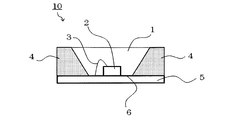
- the optical semiconductor device 10 includes at least a sealing material 1, an optical semiconductor element 2, and a bonding wire 3 on an optical semiconductor substrate 6.
- the optical semiconductor substrate 6 has a recess composed of a bottom surface made of the lead frame 5 and an inner peripheral side surface made of the reflector 4.
- the optical semiconductor element 2 is connected to the lead frame 5 using a die bond material (not shown).
- a bonding pad (not shown) provided in the optical semiconductor element 2 and the lead frame 5 are electrically connected by a bonding wire 3.
- the reflective material 4 has a function of reflecting light from the optical semiconductor element 2 in a predetermined direction.
- a sealing material 1 is filled in the region of the concave portion of the optical semiconductor substrate 6 so as to at least seal the optical semiconductor element 2. At this time, the sealing material 1 may be filled so as to also seal the bonding wire 3.
- the sealing material 1 consists of the hardened
- the phosphor (not shown) may be included in the sealing material 1.
- the sealing material 1 can protect the optical semiconductor element 2 from moisture, dust, and the like, and can maintain reliability over a long period of time. Furthermore, since the sealing material 1 also seals the bonding wire 3, it is possible to prevent electrical problems caused by the bonding wire 3 being disconnected, cut, or short-circuited at the same time.
- the cured product of the present invention can be used as an adhesive for semiconductors as described later. Therefore, it can also be employed as the above-described die bond material.
- the optical semiconductor element 2 sealed with the sealing material 1 made of the cured product of the present invention for example, an LED, a semiconductor laser, a photodiode, a phototransistor, a solar cell, a CCD (charge coupled device). Etc.
- the structure shown in FIG. 1 is only an example of the optical semiconductor device of the present invention, and the structure of the reflector, the structure of the lead frame, the mounting structure of the optical semiconductor element, and the like can be modified as appropriate.
- the method for manufacturing the optical semiconductor device 10 shown in FIG. 1 is not particularly limited.
- the optical semiconductor element 2 is die-bonded to a lead frame 5 provided with a reflective material 4, the optical semiconductor element 2 and the lead frame 5 are wire-bonded by a bonding wire 3, and then provided around the optical semiconductor element.
- An example is a method in which the composition of the present invention is filled on the inner side of the reflecting material (the recess made of the lead frame and the reflecting material), and then cured by heating at 50 to 250 ° C. to obtain the sealing material 1.
- the composition of the present invention Since the composition of the present invention has good adhesion, it can be used as an adhesive for semiconductor devices. Specifically, for example, when bonding a semiconductor element and a package, when bonding a semiconductor element and a submount, when bonding package components, when bonding a semiconductor device and an external optical member, etc.
- the composition of the invention can be used by coating, printing, potting and the like. Since the composition of the present invention is excellent in heat resistance, it provides a highly reliable optical semiconductor device that can withstand long-term use when used as an adhesive for high-power optical semiconductor devices exposed to high temperatures and ultraviolet light for a long time. can do.
- a nuclear magnetic resonance apparatus manufactured by JEOL Ltd., model number: ECA-400 having a resonance frequency of 400 MHz was used.
- the chemical shift of each functional group in the silicone resin is shown below: Me: 0.0 to 0.5 ppm
- a peak (i) area / total peak area sum
- b peak (a) area + peak (b) area) / total peak area
- c peak (c) area + peak (d) area + peak (e) area) / total peak area
- d peak (f) area + peak (g) area + peak (h) area) / total peak area.
- e sum of peak (j) area / total peak area
- f peak (a) area + peak (b) area) / total peak area
- g peak (c) area + peak (d) area + peak (e) area) / total peak area
- h peak (f) area + peak (g) area + peak (h) area) / total peak area.
- the ratio of 29 Si-NMR of peak (i) and peak (j) was calculated from the integral ratio of 1 H-NMR, and the overlap of peak (a) with peak (i) and peak (j)
- the integration value of peak (a) was calculated by subtracting the integration ratio of peak (i) and peak (j) calculated from the integrated value. In other cases, when 29 Si-NMR peaks overlapped, the calculation was performed based on the integration ratio of 1 H-NMR in the same manner as described above.
- Mass average molecular weight (Mw) measurement The mass average molecular weight (Mw) of the silicone resin was calculated by creating a calibration curve using polystyrene as a reference material by the gel permeation chromatography (abbreviation: GPC) method under the following conditions: Device: manufactured by Tosoh Corporation, product name: HLC-8320GPC, Column: manufactured by Tosoh Corporation, product name: TSK gel Super HZ 2000x4, 3000x2, Eluent: tetrahydrofuran.
- GPC gel permeation chromatography
- a calibration curve was prepared using polystyrene as a reference substance by a gel permeation chromatography (abbreviation: GPC) method under the following conditions, and values were calculated: Device: manufactured by Tosoh Corporation, product name: HLC-8320GPC, Column: manufactured by Tosoh Corporation, product name: TSK gel Super HZM-Hx2 Eluent: tetrahydrofuran.
- GPC gel permeation chromatography
- the refractive index of the silicone resin was measured using a refractometer (Kyoto Electronics Industry Co., Ltd., model: RA-600).
- Viscosity measurement Regarding the viscosity of the silicone resin, a rotational viscometer (Brookfield Engineering Laboratories, Inc., product name: DV-II + PRO) and a temperature control unit (Brookfield Engineering Laboratories, Inc., product name: THERMOSEL) are used, 25 The value at ° C was measured.
- the reaction solution was returned to room temperature, transferred to a 2 L separatory funnel, 400 mL of toluene and 400 mL of water were added, and after performing a liquid separation operation, the aqueous layer was removed.
- the organic layer was washed twice with 400 mL of water. Thereafter, the organic layer was collected, and toluene was distilled off under reduced pressure using an evaporator to obtain a silicone resin (I-1) as a colorless viscous liquid.
- the yield of the silicone resin (I-1) is 160.8 g, the mass average molecular weight (Mw) is 1,000, and the composition ratio is (Me 2 SiO 2/2 ) 0.43 (PhSiO 3/2 ) 0.57 .
- the HO—Si group content was 7.8 mmol / g (13 mass%).
- silicone resin (A1) As a colorless and transparent viscous liquid.
- the yield of the silicone resin (A1) is 42.5 g
- the mass average molecular weight (Mw) is 1,900
- the viscosity is 200 cP
- the composition ratio is (Me 2 SiO 2/2 ) 0.31 (PhSiO 3/2 ) 0.42 (H (Me) 2 SiO 1/2 ) 0.27
- the H—Si group content is 2.8 mmol / g
- the HO—Si group content is 2.0 mmol / g (3.4 mass%).
- silicone resin (B1) As a colorless and transparent viscous liquid.
- the yield of the silicone resin (B1) is 20.6 g
- the mass average molecular weight (Mw) is 1,800
- the viscosity is 350 cP
- the content of HO-Si group is 2.1 mmol / g (3 .6 mass%).
- the yield of the silicone resin (I-2) is 163.0 g, the mass average molecular weight (Mw) is 900, and the composition ratio of the product is (Me 2 SiO 2/2 ) 0.41 (PhSiO 3/2 ) 0.52 ( SiO 4/2 ) 0.06 , and the HO—Si group content was 8.5 mmol / g (14% by mass).
- silicone resin (A2) As a colorless and transparent viscous liquid.
- the yield of the silicone resin (A2) is 55.1 g
- the mass average molecular weight (Mw) is 1,000
- the viscosity is 140 cP
- the composition ratio is (Me 2 SiO 2/2 ) 0.21 (PhSiO 3/2 0.45 (SiO 4/2 ) 0.06 (H (Me) 2 SiO 1/2 ) 0.28
- the H—Si group content is 2.6 mmol / g
- the HO—Si group content is 2. It was 9 mmol / g (4.9 mass%).
- silicone resin (B2) As a colorless and transparent viscous liquid.
- the yield of the silicone resin (B2) is 29.5 g
- the weight average molecular weight (Mw) is 1,100
- the viscosity is 200 cP
- the composition ratio is (Me 2 SiO 2/2 ) 0.26 (PhSiO 3/2 ) 0.42 (SiO 4/2 ) 0.05 (CH 2 ⁇ CH (Me) 2 SiO 1/2 ) 0.27
- CH 2 ⁇ CH—Si group content is 2.7 mmol / g
- HO— The Si group content was 1.7 mmol / g (2.9% by mass).
- the yield of the silicone resin (I-3) is 154.2 g, the mass average molecular weight (Mw) is 900, and the composition ratio is (Me 2 SiO 2/2 ) 0.35 (PhSiO 3/2 ) 0.56 (SiO 4 / 2 ) It was 0.10 , and the content of HO—Si groups was 8.5 mmol / g (14% by mass).
- silicone resin (A3) As a colorless and transparent viscous liquid.
- the yield of the silicone resin (A3) is 58.4 g
- the mass average molecular weight (Mw) is 1,100
- the viscosity is 180 cP
- the composition ratio is (Me 2 SiO 2/2 ) 0.15 (PhSiO 3/2 0.46 (SiO 4/2 ) 0.07 (H (Me) 2 SiO 1/2 ) 0.33
- the H—Si group content is 3.2 mmol / g
- the HO—Si group content is 2. It was 7 mmol / g (4.6% by mass).
- Toluene was distilled off from the organic layer by an evaporator, followed by vacuum distillation (130 ° C., 2 hours) by heating to obtain a silicone resin (B3) as a colorless and transparent viscous liquid.
- the yield of the silicone resin (B3) is 32.7 g
- the weight average molecular weight (Mw) is 1,300
- the viscosity is 230 cP
- the composition ratio is (Me 2 SiO 2/2 ) 0.20 (PhSiO 3/2 0.43 (SiO 4/2 ) 0.07 (CH 2 ⁇ CH (Me) 2 SiO 1/2 ) 0.30
- CH 2 ⁇ CH—Si group content is 2.8 mmol / g
- HO—Si group The content of was 1.7 mmol / g (2.9% by mass).
- the yield of the silicone resin (I-4) is 143.4 g, the mass average molecular weight (Mw) is 1,100, and the composition ratio is (Me 2 SiO 2/2 ) 0.34 (PhSiO 3/2 ) 0.51 (SiO 4/2 ) 0.15 , and the HO—Si group content was 7.7 mmol / g (13 mass%).
- silicone resin (A4) As a colorless and transparent viscous liquid.
- the yield of the silicone resin (A4) is 165.7 g
- the mass average molecular weight (Mw) is 1,500
- the viscosity is 4,000 cP
- the composition ratio is (Me 2 SiO 2/2 ) 0.16 (PhSiO 3 / 2 ) 0.45 (SiO 4/2 ) 0.15 (H (Me) 2 SiO 1/2 ) 0.24
- the H—Si group content is 2.2 mmol / g
- the HO—Si group content is It was 3.1 mmol / g (5.3 mass%).
- silicone resin (B4) As a colorless and transparent viscous liquid.
- the yield of the silicone resin (B4) is 99.2 g
- the weight average molecular weight (Mw) is 1,400
- the viscosity is 2,500 cP
- the composition ratio is (Me 2 SiO 2/2 ) 0.23 (PhSiO 3/2 ) 0.41 (SiO 4/2 ) 0.13 (CH 2 ⁇ CH (Me) 2 SiO 1/2 ) 0.23
- CH 2 ⁇ CH—Si group content is 2.2 mmol / g
- HO—Si group content is It was 1.9 mmol / g (3.2% by mass).
- the yield of the silicone resin (I-5) is 137.7 g, the mass average molecular weight (Mw) is 1,300, and the composition ratio is (Me 2 SiO 2/2 ) 0.28 (PhSiO 3/2 ) 0.53 (SiO 4/2 ) 0.19 , and the HO—Si group content was 7.4 mmol / g (13 mass%).
- silicone resin (A5) As a colorless and transparent viscous liquid.
- the yield of the silicone resin (A5) is 27.5 g
- the weight average molecular weight (Mw) is 1,600
- the viscosity is 15,000 cP
- the composition ratio is (Me 2 SiO 2/2 ) 0.13 (PhSiO 3 / 2 ) 0.43 (SiO 4/2 ) 0.21 (H (Me) 2 SiO 1/2 ) 0.23
- the H—Si group content is 2.1 mmol / g
- the HO—Si group content is It was 2.7 mmol / g (4.6% by mass).
- silicone resin (B5) As a colorless and transparent viscous liquid.
- the yield of the silicone resin (B5) is 15.2 g
- the mass average molecular weight (Mw) is 1,500
- the viscosity is 23,000 cP
- the composition ratio is (Me 2 SiO 2/2 ) 0.18 (PhSiO 3 / 2 ) 0.40 (SiO 4/2 ) 0.19 (CH 2 ⁇ CH (Me) 2 SiO 1/2 ) 0.23
- CH 2 ⁇ CH—Si group content is 2.3 mmol / g
- Si— The OH group content was 1.7 mmol / g (2.9% by mass).
- the yield of the silicone resin (I-6) is 140.8 g, the weight average molecular weight (Mw) is 1,500, and the composition ratio is (Me 2 SiO 2/2 ) 0.29 (PhSiO 3/2 ) 0.44. (SiO 4/2 ) 0.27 , and the HO—Si group content was 6.8 mmol / g (12 mass%).
- silicone resin (A6) As a colorless and transparent viscous liquid.
- the yield of the silicone resin (A6) is 59.3 g
- the weight average molecular weight (Mw) is 1,900
- the viscosity is 280,000 cP
- the composition ratio is (Me 2 SiO 2/2 ) 0.15 (PhSiO 3 / 2 ) 0.40 (SiO 4/2 ) 0.22 (H (Me) 2 SiO 1/2 ) 0.23
- the H—Si group content is 1.6 mmol / g
- the HO—Si group content is It was 2.5 mmol / g (4.3 mass%).
- Toluene was distilled off from the organic layer by an evaporator, followed by vacuum distillation (130 ° C., 2 hours) by heating to obtain a silicone resin (B6) as a colorless and transparent viscous liquid.
- the yield of the silicone resin (B6) is 32.0 g
- the mass average molecular weight (Mw) is 1,900
- the viscosity is 280,000 cP
- the composition ratio is (Me 2 SiO 2/2 ) 0.19 (PhSiO 3 / 2 ) 0.39 (SiO 4/2 ) 0.21 (CH 2 ⁇ CH (Me) 2 SiO 1/2 ) 0.21
- the CH 2 ⁇ CH—Si group content is 1.9 mmol / g
- HO— The Si group content was 1.6 mmol / g (2.7% by mass).
- the yield of the silicone resin (DA1) is 144.2 g
- the mass average molecular weight (Mw) is 1,400
- the viscosity is 34,000 cP
- the composition ratio is (Me 2 SiO 2/2 ) 0.34 ( PhSiO 3/2 ) 0.42 (HSiO 3/2 ) 0.24
- the H—Si group content is 1.5 mmol / g
- the HO—Si group content is 7.2 mmol / g (12% by mass).
- reaction solution was returned to room temperature, transferred to a 1 L separatory funnel, 200 mL of toluene and 200 mL of water were added, and after performing a liquid separation operation, the aqueous layer was removed. Next, the organic layer was washed twice with 200 mL of water. Thereafter, the organic layer was collected, and toluene was distilled off under reduced pressure using an evaporator to obtain a silicone resin (DA2) as a colorless viscous liquid.
- DA2 silicone resin
- the yield of the silicone resin (DA2) is 81.6 g, the mass average molecular weight (Mw) is 650, the viscosity is 300 cP, and the composition ratio is (Me 2 SiO 2/2 ) 0.38 (PhSiO 3/2 ) 0.40. (H (Me) 2 SiO 1/2 ) 0.22 , the H—Si group content is 1.55 mmol / g, and the HO—Si group content is 4.7 mmol / g (8.0% by mass). )Met.
- reaction solution was returned to room temperature, transferred to a 1 L separatory funnel, 100 mL of toluene and 100 mL of water were added, and after performing a liquid separation operation, the aqueous layer was removed. Next, the organic layer was washed twice with 100 mL of water. Thereafter, the organic layer was collected, and toluene was distilled off under reduced pressure using an evaporator to obtain a silicone resin (DB2) as a colorless viscous liquid.
- DB2 silicone resin
- a silicone resin (DB3) was obtained as a colorless viscous liquid.
- the yield of the silicone resin (DB3) is 89.3 g
- the mass average molecular weight (Mw) is 630
- the viscosity is 300 cP
- HO-Si group content is 6.8 mmol / g. (12% by mass).
- composition ratios and physical property values in the synthesized silicone resins (A1) to (A6), silicone resins (B1) to (B6), and silicone resins (DA1) to (DA2), (DB1) to (DB3)
- Table 2 shows the group content, SiH group or Si—CH ⁇ CH 2 group content, mass average molecular weight, viscosity, refractive index, and transparency.
- Vi represents a vinyl group (CH 2 ⁇ CH— group).
- the starting temperature and the appearance upon curing were measured as follows.
- the composition used for the measurement was composed of (A) component silicone resin [silicone resins (A1) to (A6), (DA1) to (DA2)] and (B) component silicone resin [silicone resin (B1).
- (DB1) to (DB3)] are blended at a mass ratio of 2: 1 and mixed with the platinum catalyst of component (C) to prepare the compositions of Examples 1 to 6 and Comparative Examples 1 to 3.
- the platinum catalyst a platinum-divinyltetramethyldisiloxane complex was used so that the content of platinum atoms was 0.03 ppm in mass units with respect to the total amount of the composition.
- Viscosity of composition Regarding the viscosity of the prepared composition, a rotational viscometer (Brookfield Engineering Laboratories, Inc., product name: DV-II + PRO) and a temperature control unit (Brookfield Engineering Laboratories, Inc., product name: THERMOSEL) were used. The value at 25 ° C. was measured at a shear rate of 30 [1 / s].
- the prepared composition was poured into a mold (25 mm ⁇ ), heated in air at 90 ° C. for 1 hour, and further heated at 150 ° C. for 4 hours to produce a cured product having a thickness of 4 to 5 mm.
- the hardness of Shore A or Shore D of this cured product is determined according to JIS K 7215 “Durometer Hardness Test Method for Plastics” using a durometer (manufactured by TECLOCK, model: GS-719R, GS-720R). It was measured by. In Comparative Examples 2 and 3, the measurement was not performed because the composition did not cure.
- Linear thermal expansion coefficient of cured product 0.7 g of the prepared composition is added to a fluororesin tube (inner diameter: 5.8 mm ⁇ , height: 1.8 mm), heated in air at 90 ° C. for 1 hour, and further heated at 150 ° C. for 4 hours to obtain a cured product.
- the linear thermal expansion coefficient of the cured product was measured by heating the cured product from 25 ° C. to 200 ° C. at a temperature increase rate of 5 ° C./min in the air using ThermoPlusTMA8310 (manufactured by Rigaku Corporation). This measurement was performed twice, and the second measured value was adopted. In Comparative Examples 2 and 3, the measurement was not performed because the composition did not cure.
- the prepared composition was heated in air at 90 ° C. for 1 hour, and further heated at 150 ° C. for 4 hours to produce a cured product.
- the cured product was measured using a ThermoPlus TG8120 (manufactured by Rigaku Corporation) as a thermogravimetric / differential thermal measurement apparatus (Thermogravimetric / Differential Thermal Analysis, abbreviated as TG-DTA) at a temperature rising rate of 5 ° C./min. It heated from 25 degreeC to 500 degreeC, and measured the temperature ( Td5 ) when a 5% weight loss was carried out. In Comparative Examples 2 and 3, the measurement was not performed because the composition did not cure.
- a mixture of the prepared composition and zirconia balls having a diameter of 50 ⁇ m is mixed with a glass chip (5.0 mm ⁇ 5.0 mm ⁇ 1.1 mm) and a glass substrate (50 mm ⁇ 50 mm ⁇ 3.0 mm) or an alumina substrate ( 50 mm ⁇ 50 mm ⁇ 2.0 mm), and heated in air at 90 ° C. for 1 hour and further heated at 150 ° C. for 4 hours to be cured.
- the adhesive strength (adhesive strength) of the prepared sample was measured with a bond tester (manufactured by Daisy Japan Co., Ltd., model: Dage4000Plus). A cured product that was destroyed at the time of measurement and an adhesive strength value could not be obtained was designated as “cohesive failure”. In Comparative Examples 2 and 3, the measurement was not performed because the composition did not cure.
- Table 3 shows the evaluation results of the compositions and cured products of Examples 1 to 6 and Comparative Examples 1 to 3.
- the cured products of Examples 1 to 6 showed high transparency of 88% or more at a wavelength of 365 nm and 90% or more at a wavelength of 405 nm.
- the cured product of Comparative Example 1 had a transmittance of 45% or less. This cause is thought to be due to foaming of the cured product.
- the transparency (heat-resistant transparency) after the cured product was continuously heated at 200 ° C. for 100 hours the cured products of Examples 1 to 6 were as high as 88% or more at a wavelength of 405 nm and 79% or more at a wavelength of 365 nm. The transmittance was maintained.
- the cured products of Examples 1 to 6 exhibited T d5 of 285 ° C. or higher, and in particular, the cured products of Examples 3 to 6 exhibited high T d5 of 395 ° C. or higher.
- the cured products of Examples 1 to 6 show less than 300 ppm by volume, in particular, the cured products of Examples 1 and 3 to 6 show less than 250 ppm by volume, and the cured products of Examples 4 to 6 Shows a good linear thermal expansion coefficient of less than 215 ppm by volume.
- a low linear thermal expansion coefficient indicates that the volume expansion and shrinkage in the heat cycle is small and the mold is difficult to peel off, so that the linear thermal expansion coefficient is preferably low.
- the curing start temperature of the compositions of Examples 1 to 6 is as low as 58 to 79 ° C. and has good curability. On the other hand, in Comparative Examples 1 to 3, curing did not start even when the temperature was raised to 150 ° C.
- compositions of Examples 1 to 6 within the scope of the present invention have good curability, and the cured product has high heat-resistant transparency. Also, the adhesion was good. In particular, it was shown that the cured products of Examples 3 to 6 were excellent in heat resistance and Shore hardness. In addition, the cured products of Examples 4 to 6 were shown to have high adhesive strength.
- the silicone resin (A1) as the component (A) and the silicone resin (B1) as the component (B) are blended at a mass ratio of 2: 1 and mixed with the platinum catalyst as the component (C).
- 1-1 to Composition 1-5 were prepared.
- a comparative composition 1-1 was prepared, in which the platinum catalyst of the component (C) was not blended, and the silicone resin (A1) and the silicone resin (B1) were blended at a mass ratio of 2: 1.
- the platinum catalyst a platinum-divinyltetramethyldisiloxane complex was used so that the content of platinum atoms was a predetermined amount in mass units with respect to the total amount of the curable silicone resin composition.
- compositions 4-1 to 4-3 and A comparative composition 4-1 was prepared.
- the physical properties (transparency and heat-resistant transparency) of the cured product, the curing start temperature, and the appearance of the cured product were determined using the above-mentioned [Transparency of cured product], [Curing Evaluation was performed according to the methods described in "Heat Transparency of Products", “Curing Start Temperature”, and "Appearance upon Curing”. These results are shown in Table 4, FIG. 2 and FIG.
- the curing start temperature increased as the platinum atom content decreased.
- the curing start temperature of Composition 1-5 was higher than 150 ° C., but a cured product was obtained without any problem under the curing conditions (heating at 90 ° C. for 1 hour and further heating at 150 ° C. for 4 hours).
- the transmittance of all the cured products was in the range of 88 to 91% at a wavelength of 405 nm and in the range of 89 to 91% at a wavelength of 365 nm, indicating high transparency.
- all cured products maintained high transmittance of 85% or more at a wavelength of 405 nm, but at a wavelength of 365 nm.
- the transmittance of the cured product of Comparative Composition 4-1 was 70%, and a decrease in transparency was observed.
- the cured products of Composition 1-1 to Composition 1-5 and Composition 4-1 to Composition 4-4 maintained a transparency of 75% or more.
- Composition 1-1 to Composition 1-5 and Composition 4-1 to Composition 4-4 within the scope of the present invention have good curability and high heat transparency. It was shown that.
- compositions 1-6 to 1-9 were prepared by blending the agents.
- the platinum catalyst a platinum-divinyltetramethyldisiloxane complex was used so that the platinum atom content was 2.0 ppm in terms of mass unit with respect to the total mass of the components (A) to (C).
- the curing retarder was added in the range of 70 to 80 equivalents with a platinum atom content of 2.0 mass ppm as one equivalent.
- composition 1-6 118 ⁇ g of dimethyl maleate was added as a curing retarder to 1 g of the total composition, and in the preparation of composition 1-7, 3-butyn-2-ol was added.
- composition 1-8 67 ⁇ g of 2-methyl was added to 1 g of the total amount of the composition, and 94 ⁇ g of 1-ethynyl-1-cyclohexanol was added to 1 g of the total amount of the composition.
- 86 ⁇ g of tetramethylethylenediamine was added to 1 g of the total amount of the composition.
- compositions 1-6 to 1-9 and composition 1-1 as an example of a composition not containing a curing retarder, physical properties of these cured products (transparency and heat-resistant transparency)
- the appearance of the cured product and the curing start time are evaluated according to the methods described in [Transparency of cured product], [Heat-resistant transparency of cured product], [Appearance at curing], and [Curing start time] below. did. These results are shown in Table 5 and FIG.
- the curing start time was 26 minutes after the composition 1-1, but more than 2 hours after the composition 1-6 to the composition 1-9 to which the curing retarder was added. It was found that the curability can be controlled by adding. Further, the transmittance of the cured products of the compositions 1-6 to 1-9 is 89% or more at a wavelength of 405 nm and 87% or more at a wavelength of 365 nm, and transparency is not impaired by a curing retarder. It was. Furthermore, the transparency (heat-resistant transparency) after the cured product was continuously heated at 200 ° C.
- the silicone resin (A4) as the component (A) and the silicone resin (B4) as the component (B) are blended at a mass ratio of 2: 1, and the platinum catalyst as the component (C) is mixed.
- Compositions 4-4 to 4-6 were prepared by blending an agent or an antioxidant.
- the platinum catalyst a platinum-divinyltetramethyldisiloxane complex was used so that the content of platinum atoms was 0.2 ppm in mass units with respect to the total mass of the components (A) to (C). .
- the light stabilizer and the antioxidant were added in the range of 0.05 to 0.2% by mass with respect to the total mass of the components (A) to (C).
- composition 4-4 0.5 mg of bis (2,2,6,6-tetramethyl 4-piperidyl) sebacate as a light stabilizer was added to 1 g of the total composition. .
- 1.0 mg of bis (2,2,6,6-tetramethyl 4-piperidyl) sebacate as a light stabilizer was added to 1 g of the whole composition.
- compositions 4-4 to 4-6 and composition 4-1 as an example of a composition not containing a light stabilizer and an antioxidant, the physical properties (transparency and Heat-resistant transparency) and the appearance of the cured product were evaluated according to the methods described in [Appearance at curing] and [Heat-resistant transparency of cured product containing antioxidant] described below.
- Table 6 shows the evaluation results of the cured products of Composition 4-1 and Composition 4-4 to Composition 4-6.
- the transmittance after 100 hours and 200 hours after further heating at 200 ° C. is the transmittance after 0 hours (the transmittance in the 405 nm and 365 nm wavelength regions of the cured product before further curing).
- the composition 4-4 to 4-6 to which a light stabilizer or an antioxidant was added had a smaller transmittance fluctuation ratio than the composition 4-1.
- the transmittance fluctuation ratio was particularly small. From these results, it was shown that the addition of the light stabilizer or the antioxidant contributes to the improvement of the heat-resistant transparency of the cured product.
- the mass average molecular weight (Mw) of the silicone resin (II) is 5,200, the composition ratio is (Me 2 SiO 2/2 ) 0.50 (PhSiO 3/2 ) 0.50 , and the content of HO—Si group is 4 0.5 mmol / g (6.7% by mass), and the toluene content was 20.49% by mass.
- the yield of the silicone resin (A7) is 103.23 g, the mass average molecular weight (Mw) is 6,100, the viscosity is 5,100 cP, and the composition ratio is (Me 2 SiO 2/2 ) 0.39 (PhSiO 3 / 2 ) 0.47 (H (Me) 2 SiO 1/2 ) 0.14 , the H—Si group content is 1.26 mmol / g, and the HO—Si group content is 2.66 mmol / g (4 0.5% by mass).
- the yield of the silicone resin (A8) is 107.48 g, the mass average molecular weight (Mw) is 5,600, the viscosity is 2,800 cP, and the composition ratio is (Me 2 SiO 2/2 ) 0.40 (PhSiO 3 / 2 ) 0.48 (H (Me) 2 SiO 1/2 ) 0.12 , the H—Si group content is 1.40 mmol / g, and the HO—Si group content is 2.1 mmol / g (3 .6 mass%).
- a silicone resin (B8) was obtained.
- the yield of the silicone resin (B8) is 51.78 g
- the mass average molecular weight (Mw) is 5,300
- the viscosity is 5,000 cP
- the composition ratio is (Me 2 SiO 2/2 ) 0.39 (PhSiO 3/2 ) 0.44.
- CH 2 ⁇ CH (Me) 2 SiO 1/2 CH 2 ⁇ CH—Si group content 0.17
- CH 2 ⁇ CH—Si group content is 1.05 mmol / g
- HO—Si group content is 2.3 mmol / g. (4.0% by mass).
- the yield of the silicone resin (A9) is 106.52 g, the mass average molecular weight (Mw) is 5,800, the viscosity is 2,100 cP, and the composition ratio is (Me 2 SiO 2/2 ) 0.38 (PhSiO 3 / 2) 0.42 (H (Me ) 2 SiO 1/2) 0.20, the content of H-Si group is 1.81 mmol / g, content of HO-Si groups 1.7 mmol / g (2 0.9 mass%).
- the yield of the silicone resin (A10) is 110.66 g, the mass average molecular weight (Mw) is 5,700, the viscosity is 1,600 cP, and the composition ratio is (Me 2 SiO 2/2 ) 0.35 (PhSiO 3 / 2 ) 0.41 (H (Me) 2 SiO 1/2 ) 0.24 , the H—Si group content is 2.25 mmol / g, and the HO—Si group content is 1.18 mmol / g (2 0.0 mass%).
- the yield of the silicone resin (A11) is 113.15 g, the mass average molecular weight (Mw) is 5,700, the viscosity is 1,000 cP, and the composition ratio is (Me 2 SiO 2/2 ) 0.36 (PhSiO 3 / 2 ) 0.38 (H (Me) 2 SiO 1/2 ) 0.26 , the H—Si group content is 2.7 mmol / g, and the HO—Si group content is 0.86 mmol / g (1 0.5% by mass).
- the yield of the silicone resin (B11) is 53.64 g, the mass average molecular weight (Mw) is 5,200, the viscosity is 2,500 cP, and the composition ratio is (Me 2 SiO 2/2 ) 0.38 (PhSiO 3 / 2 ) 0.45 (CH 2 ⁇ CH (Me) 2 SiO 1/2 ) 0.17 , CH 2 ⁇ CH—Si group content is 1.6 mmol / g, and HO—Si group content is 1 It was 0.8 mmol / g (3.0 mass%).
- the yield of the silicone resin (A12) is 42.5 g, the weight average molecular weight (Mw) is 1,900, the viscosity is 200 cP, and the composition ratio is (Me 2 SiO 2/2 ) 0.31 (PhSiO 3/2 ) 0.42 (H (Me) 2 SiO 1/2 ) 0.27 , the H—Si group content is 2.8 mmol / g, and the HO—Si group content is 2.0 mmol / g (3.4). Mass%).
- a silicone resin (B12) was obtained.
- the yield of the silicone resin (B12) is 20.6 g
- the mass average molecular weight (Mw) is 1,800
- the viscosity is 350 cP
- the composition ratio is (Me 2 SiO 2/2 ) 0.32 (PhSiO 3/2 ) 0.45.
- CH 2 CH (Me) 2 SiO 1/2
- CH 2 CH-Si group content is 2.3 mmol / g
- HO-Si group content is 2.1 mmol / g. (3.6% by mass).
- composition ratios and physical properties of the synthesized silicone resins (A7) to (A12) and silicone resins (B7) to (B12) are shown in Table 7.
- Vi represents a vinyl group (CH 2 ⁇ CH— group).
- ⁇ Curable silicone resin composition and cured product thereof> The viscosity of the prepared composition, the physical properties of the cured product obtained from the composition (hardness, adhesion, transparency, linear thermal expansion coefficient, 5% weight loss temperature, adhesive strength), and appearance upon curing are as described above.
- the measurement was performed according to the measurement methods of Examples 1 to 6 and Comparative Examples 1 to 3.
- cured material it measured also about the case where a 6050 SMD type PPA resin package is used instead of a 3528 SMD type PPA resin package, and the measuring method is shown below.
- the punching moldability of the cured product is shown in the measurement method below.
- composition used for the measurement was (A) component silicone resin [silicone resins (A7) to (A12)] and (B) component silicone resins [silicone resins (B7) to (B12)].
- the compositions of Examples 7 to 12 were prepared by blending at a mass ratio of 1 and mixing with the platinum catalyst of component (C).
- the platinum catalyst a platinum-divinyltetramethyldisiloxane complex was used so that the content of platinum atoms was 0.03 ppm in mass units with respect to the total amount of the composition.
- Table 8 shows the evaluation results of the compositions and cured products of Examples 7 to 12.
- the cured products produced in Examples 7 to 12 all have excellent heat-resistant transparency.
- all cured products showed excellent adhesion to the 3528 SMD type PPA resin package substrate.
- the cured products of Examples 7 to 9 having a high mass average molecular weight and a high Si—OH group content are larger than the 3528 SMD type PPA resin package.
- Excellent adhesion to a certain 6050 SMD type PPA resin package was exhibited.
- the punchability test the cured product of Example 12 having a low mass average molecular weight could not be pulled out because of insufficient resin strength, whereas Examples 7 to 7 having a high mass average molecular weight were used. With the cured product of 11, the cured product could be punched without problems.
Landscapes
- Chemical & Material Sciences (AREA)
- Engineering & Computer Science (AREA)
- Materials Engineering (AREA)
- Organic Chemistry (AREA)
- Compositions Of Macromolecular Compounds (AREA)
- Structures Or Materials For Encapsulating Or Coating Semiconductor Devices Or Solid State Devices (AREA)
Abstract
Description
(A)成分:下記式[1]で示され、ケイ素原子に結合する水素原子(SiH基)を含有するシリコーン樹脂、
(B)成分:下記式[2]で示され、ケイ素原子に結合するビニル基(Si-CH=CH2基)を含有するシリコーン樹脂、および
(C)成分:白金触媒
を少なくとも含み、(A)成分と(B)成分中のシラノール基(Si-OH基)の総含有量が0.5~5.0mmol/gであり、(C)成分中の白金原子の含有量が、(A)成分と(B)成分と(C)成分の合計質量に対して質量単位で0.003~3.0ppmである、硬化性シリコーン樹脂組成物を使用することにより、上記課題を達成できることを見出し、耐熱透明性に優れる付加硬化型の硬化性シリコーン樹脂組成物を完成させるに至った。


(A)成分:下記式[1]で示され、ケイ素原子に結合する水素原子(SiH基)を含有するシリコーン樹脂、
(B)成分:下記式[2]で示され、ケイ素原子に結合するビニル基(Si-CH=CH2基)を含有するシリコーン樹脂、および
(C)成分:白金触媒
を少なくとも含み、(A)成分と(B)成分中のシラノール基(Si-OH基)の総含有量が0.5~5.0mmol/gであり、(C)成分中の白金原子の含有量が、(A)成分と(B)成分と(C)成分の合計質量に対して質量単位で0.003~3.0ppmである、硬化性シリコーン樹脂組成物。


(A)成分中のケイ素原子に結合する水素原子のモル数:(B)成分中のケイ素原子に結合するビニル基のモル数が0.8:0.2~0.5:0.5である、発明1の硬化性シリコーン樹脂組成物。
(A)成分において、a、b、cおよびdが、a:b:c:d=0.10~0.40:0.10~0.80:0.10~0.80:0~0.70であり、(B)成分において、e、f、gおよびhが、e:f:g:h=0.10~0.40:0.10~0.80:0.10~0.80:0~0.70である、発明1または2の硬化性シリコーン樹脂組成物。
(A)成分において、a、b、cおよびdが、a:b:c:d=0.20~0.40:0.10~0.40:0.30~0.60:0.10~0.30であり、(B)成分において、e、f、gおよびhが、e:f:g:h=0.20~0.40:0.10~0.40:0.30~0.60:0.10~0.30である、発明1乃至3のいずれか一つの硬化性シリコーン樹脂組成物。
(A)成分において、d=0であり、a、bおよびcが、a:b:c=0.05~0.40:0.10~0.80:0.10~0.80であり、(B)成分において、h=0であり、e、fおよびgが、e:f:g=0.05~0.40:0.10~0.80:0.10~0.80である、発明1または2の硬化性シリコーン樹脂組成物。
硬化遅延剤をさらに含む、発明1乃至5のいずれか一つの硬化性シリコーン樹脂組成物。
酸化防止剤または光安定剤をさらに含む、発明1乃至6のいずれか一つの硬化性シリコーン樹脂組成物。
接着付与剤、蛍光体および無機粒子からなる群から選ばれる一種以上をさらに含む、発明1乃至7のいずれか一つの硬化性シリコーン樹脂組成物。
離型剤、樹脂改質剤、着色剤、希釈剤、抗菌剤、防黴剤、レベリング剤、タレ防止剤からなる群から選ばれる一種以上をさらに含む、発明1乃至8のいずれか一つの硬化性シリコーン樹脂組成物。
発明1乃至9のいずれか一つの硬化性シリコーン樹脂組成物を硬化してなる硬化物。
発明1乃至9のいずれか一つの硬化性シリコーン樹脂組成物の硬化物からなる封止材。
発明1乃至9のいずれか一つの硬化性シリコーン樹脂組成物を45℃以上、300℃以下で加熱して硬化させる、硬化性シリコーン樹脂組成物の硬化物の製造方法。
発明1乃至9のいずれか一つの硬化性シリコーン樹脂組成物の硬化物で、光半導体素子が少なくとも封止された光半導体装置。
発明1乃至9のいずれか一つの硬化性シリコーン樹脂組成物の硬化物からなる半導体用接着剤。
発明14の半導体用接着剤を用いた光半導体装置。
本発明の硬化性シリコーン樹脂組成物(以下、単に「本発明の組成物」と称することがある。)は、所定量の(A)~(C)成分を少なくとも含み、該組成物を加熱して得られた硬化物は、光半導体装置の封止材として好適に使用される。以下、本発明の組成物に含まれる各成分について説明する。
(A)成分は、下記式[1]で示され、ケイ素原子に結合する水素原子(SiH基)を含有するシリコーン樹脂である。(A)成分は1種のみが用いられてもよく、2種以上が併用されてもよい。




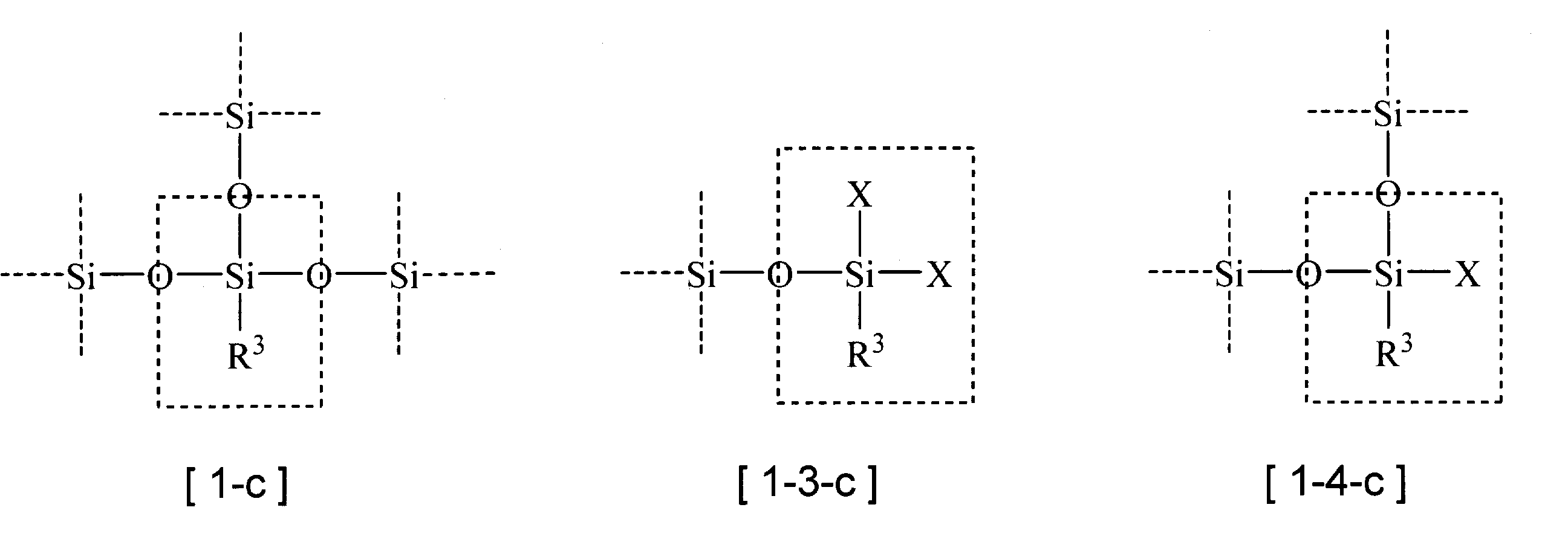

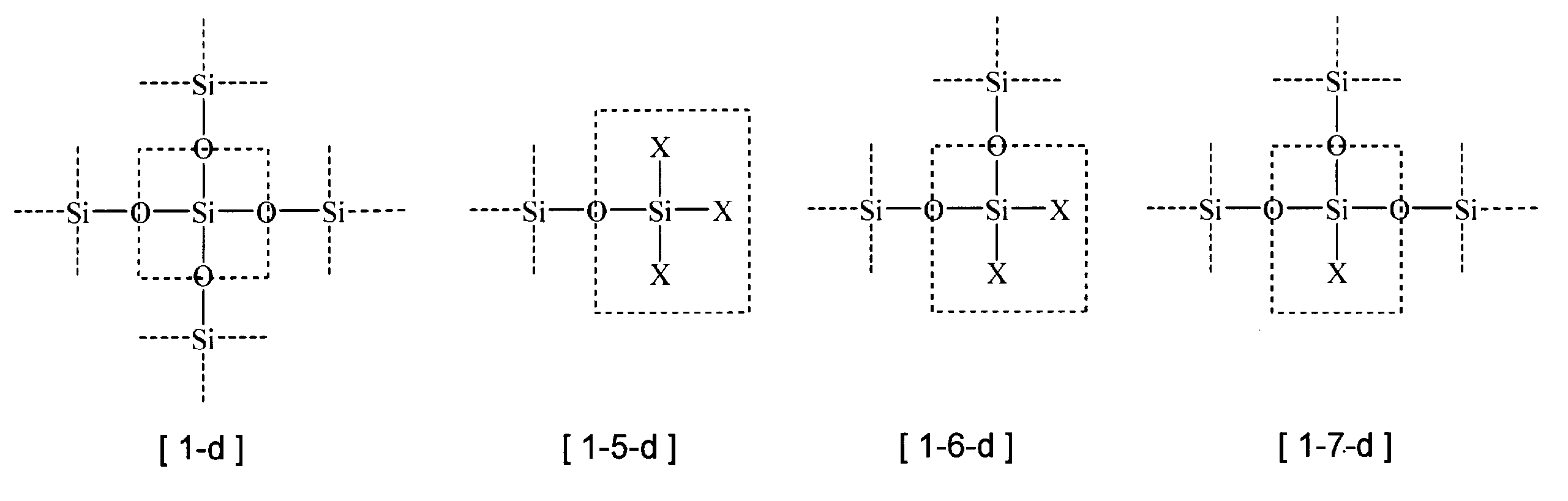
(B)成分は、下記式[2]で示され、ケイ素原子に結合するビニル基(Si-CH=CH2基)を含有するシリコーン樹脂である。(B)成分は、1種のみが用いられてもよく、2種以上が併用されてもよい。


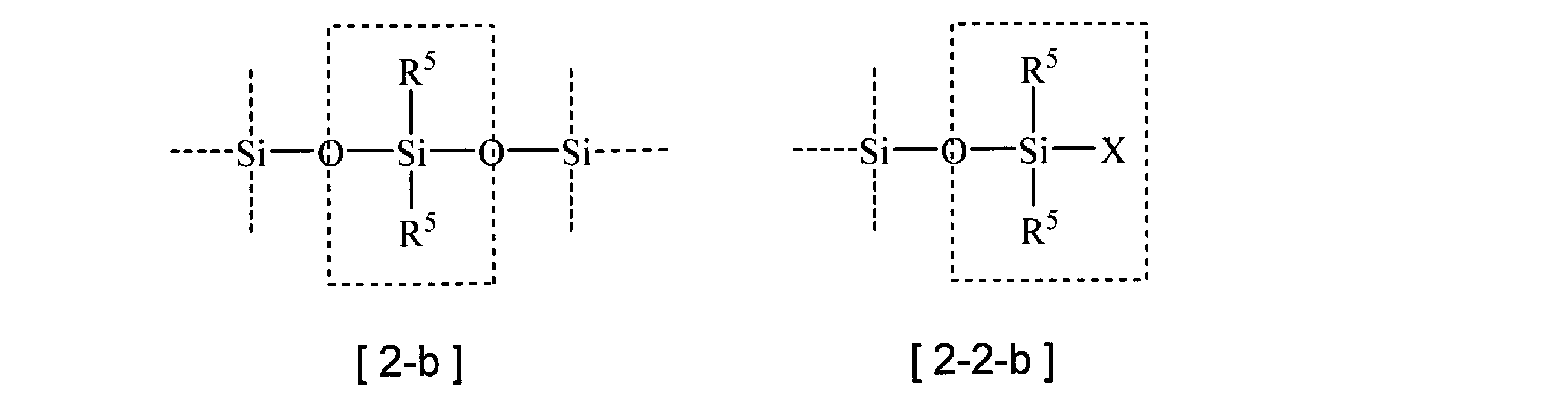



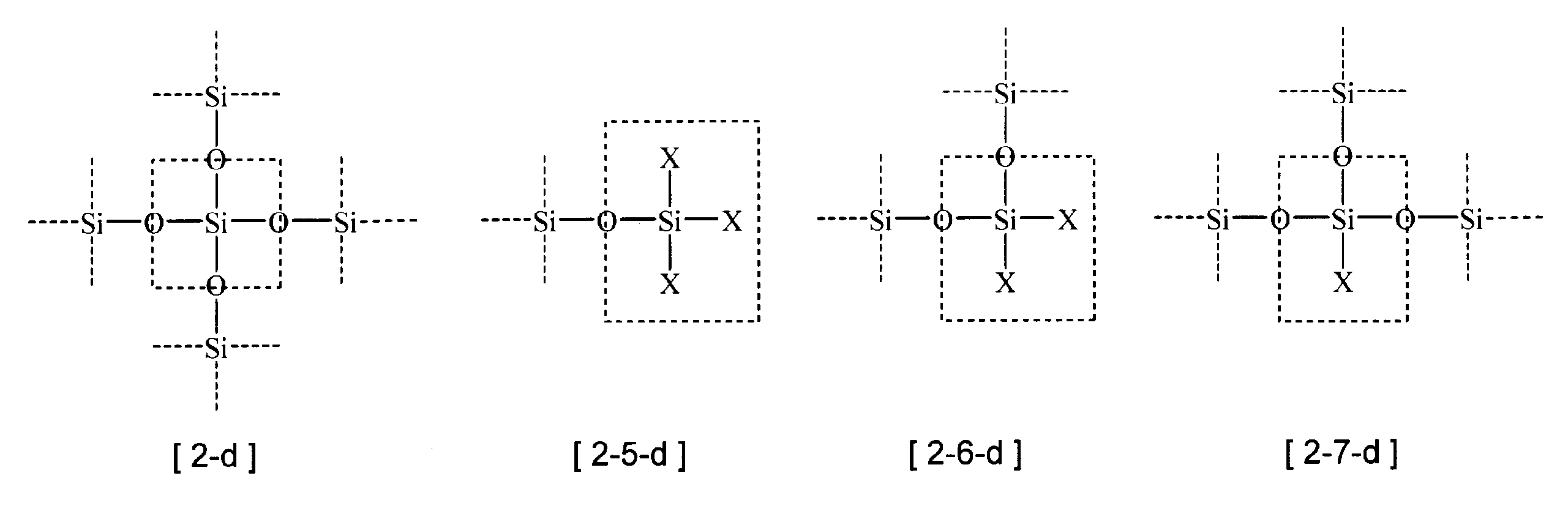
(C)成分は、後述する(A)成分中のSiH基と(B)成分中のSi-CH=CH2基との付加硬化反応を促進するために配合される。(C)成分は、一種を単独で用いても二種以上を併用してもよい。(C)成分の種類は特に限定されない。具体的には、塩化白金酸、アルコール変性塩化白金酸、白金-カルボニルビニルメチル錯体、白金-ジビニルテトラメチルジシロキサン錯体(カーステッド触媒)、白金-シクロビニルメチルシロキサン錯体、または白金-オクチルアルデヒド錯体などを例示できる。中でも、白金-ジビニルテトラメチルジシロキサン錯体(カーステッド触媒)、白金-シクロビニルメチルシロキサン錯体が好ましい。
本発明の組成物には、上述した(A)~(C)成分に加えて、該組成物の保存安定性・取扱作業性の向上、硬化過程でのヒドロシリル化反応性を調整することを目的として、硬化遅延剤を配合してもよい。本発明の組成物は、比較的低温で硬化物とすることができるため、熱に弱い光半導体部材への塗布・封止に好適に採用することができる。一方で、塗布・封止の作業環境によっては、本発明の組成物の保存経時安定性や取扱作業性の観点から、硬化速度を調整するために硬化遅延剤を配合することが好ましいこともある。硬化遅延剤の種類としては、(C)成分に対して硬化遅延効果を有する化合物であれば特に限定されず、従来から公知のものを用いることもできる。例えば、脂肪族不飽和結合を含有する化合物、有機リン化合物、窒素含有化合物、有機硫黄化合物、有機過酸化物などが挙げられる。これらの化合物は単種類を用いてもよいし、複数種類を併用してもよい。
本発明の組成物における(A)成分と(B)成分の配合比は、特に限定されない。基本的には、(A)成分の分子中に含有されるSiH基と、(B)成分の分子中に含有されるSi-CH=CH2基のモル比を基準として配合する。具体的には、(A)成分の分子中に含有されるSiH基のモル数:(B)成分の分子中に含有されるSi-CH=CH2基のモル数を0.8:0.2~0.5:0.5の範囲にすることが好ましい。Si-CH=CH2基のモル数に対してSiH基のモル数の比が0.8以下であれば、本発明の組成物は良好な成形性を有し、0.5以上であれば、本発明の硬化物は良好な耐熱透明性を有する。
本発明の組成物は、(A)成分と(B)成分と(C)成分、必要に応じてその他の添加物を配合することで調製することができる。(A)成分、(B)成分、(C)成分、必要に応じて加えた添加物は混合により、実質的に均一に分散していることが好ましい。混合方法は特に限定されない。例えば、万能混練機、ニーダーなどの混合方法を採用することができる。また、(C)成分は予め(A)成分および/または(B)成分と混合させてもよい。また、安定に長期間貯蔵するために、(B)成分と(C)成分を別途の容器に保存し、例えば(A)成分の一部および(C)成分を含む第一組成物と、(A)成分の残部および(B)成分を含む第二組成物を、それぞれ別の容器に保存しておき、使用直前に混合して本発明の組成物とし、減圧で脱泡して使用に供してもよい。
(A)成分の製造方法は特に限定されない。例えば、以下の一般式[3]で表されるジアルコキシシラン化合物、一般式[4]で表されるトリアルコキシシラン化合物および一般式[5]で表されるテトラアルコキシシラン化合物を加水分解重縮合させて得られる縮合物(以下、「加水分解重縮合物[I]」と表すことがある。)と、以下の一般式[9-1]、[9-2]、[9-3]または[9-4]で表されるシラン化合物とを反応させて製造することができる。

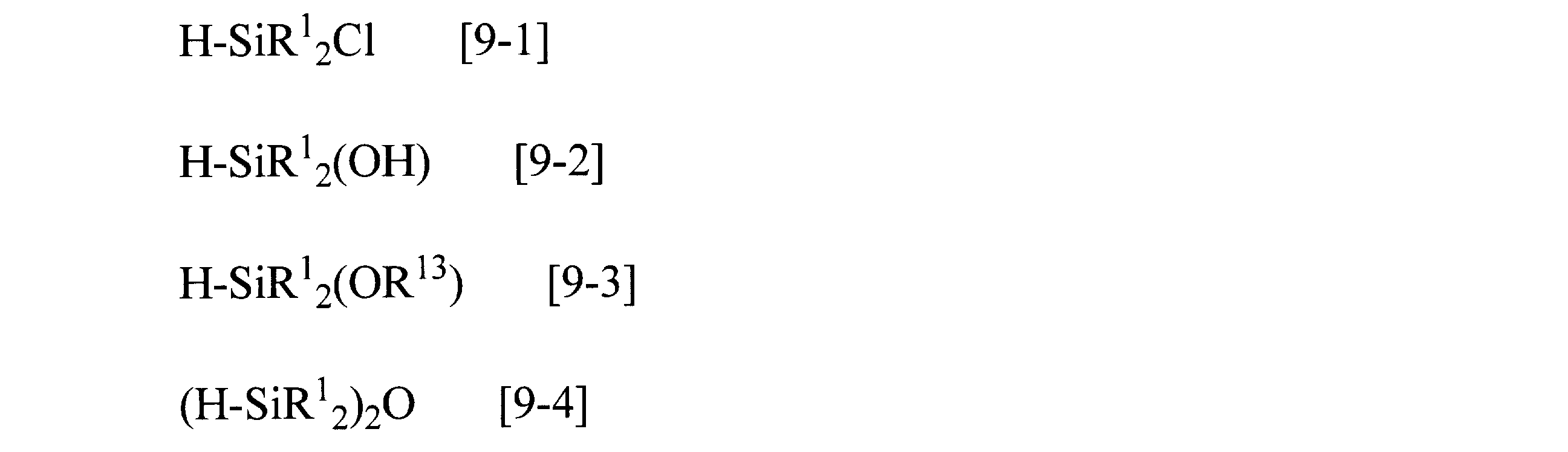
ジメチルジメトキシシラン、ジメチルジエトキシシラン、ジエチルジメトキシシラン、ジエチルジエトキシシラン。
これらの中でも好ましい化合物として、ジメチルジメトキシシラン、ジメチルジエトキシシランが挙げられる。
メチルトリメトキシシラン、メチルトリエトキシシラン、エチルトリメトキシシラン、エチルトリエトキシシラン、ビニルトリメトキシシラン、ビニルトリエトキシシラン、フェニルトリメトキシシラン、フェニルトリエトキシシラン、3-(トリフルオロメチル)フェニルトリメトキシシラン、3-(トリフルオロメチル)フェニルトリエトキシシラン、4-(トリフルオロメチル)フェニルトリメトキシシラン、4-(トリフルオロメチル)フェニルトリエトキシシラン、3,5-(ジトリフルオロメチル)フェニルトリメトキシシラン、3,5-(ジトリフルオロメチル)フェニルトリエトキシシラン、ナフチルトリメトキシシラン、ナフチルトリエトキシシラン。
これらの中でも好ましい化合物として、メチルトリメトキシシラン、メチルトリエトキシシラン、フェニルトリメトキシシラン、フェニルトリエトキシシラン、3-(トリフルオロメチル)フェニルトリメトキシシラン、3-(トリフルオロメチル)フェニルトリエトキシシラン、4-(トリフルオロメチル)フェニルトリメトキシシラン、4-(トリフルオロメチル)フェニルトリエトキシシラン3,5-(ジトリフルオロメチル)フェニルトリメトキシシラン、3,5-(ジトリフルオロメチル)フェニルトリエトキシシランが挙げられ、特に好ましい化合物として、メチルトリメトキシシラン、メチルトリエトキシシラン、フェニルトリメトキシシラン、フェニルトリエトキシシランが挙げられる。
テトラメトキシシラン、テトラエトキシシラン、テトラ-n-プロポキシシラン、テトライソプロポキシシラン。
これらの中でも好ましい化合物として、テトラメトキシシラン、テトラエトキシシランが挙げられる。
クロロジメチルシラン、クロロジエチルシラン。
これらの中でも好ましい化合物として、クロロジメチルシランが挙げられる。
ジメチルシラノール、ジエチルシラノール。
これらの中でも好ましい化合物として、ジメチルシラノールが挙げられる。
ジメチルメトキシシラン、ジメチルエトキシシラン、ジエチルメトキシシラン、ジエチルエトキシシラン。
これらの中でも好ましい化合物として、ジメチルメトキシシラン、ジメチルエトキシシランが挙げられる。
1,1,3,3-テトラメチルジシロキサン、1,1,3,3-テトラエチルジシロキサン。
これらの中でも好ましい化合物として、1,1,3,3-テトラメチルジシロキサンが挙げられる。
まず、ジアルコキシシラン[3]およびトリアルコキシシラン[4]、所望によりテトラアルコキシシラン[5]を、室温にて反応容器内に所定量入れた後、各々のアルコキシシラン化合物を加水分解重縮合するための水、必要であれば反応溶媒を加え、所望により、縮合反応を進行させるための触媒を加えて反応溶液とする。このときの投入順序はこれに限定されず、任意の順序で投入して反応溶液とすることができる。次いで、この反応溶液を撹拌しながら所定時間、所定温度で反応を進行させることで、加水分解縮合物[I]を得ることができる。この際、反応系中の未反応原料のアルコキシシラン化合物、水、反応溶媒および/または触媒が、反応系外へ留去されることを防ぐため、反応容器には還流装置を具備することが好ましい。
第一の方法においては、まず、加水分解重縮合物(I)と、非水性有機溶媒を反応容器内に所定量入れて、加水分解重縮合物(I)を溶解させる。次いでこの溶解液に対して、約0~約10℃で撹拌しながら、所定量のクロロシラン化合物[9-1]を添加する。添加方法は特に限定されないが、滴下が好ましい。添加終了後、0℃~室温を維持しながら0.5~18時間攪拌して反応を進行させる。その後、反応を終了させることで、(A)成分を得ることができる。
第二の方法においては、まず、加水分解重縮合物(I)と、非水性有機溶媒と、所望によりアルコール性溶媒とを反応容器内に所定量入れて、加水分解重縮合物(I)を溶解させる。次いで、この溶解液に、所定量のシラノール化合物[9-2]、モノアルコキシシラン化合物[9-3]またはジシロキサン化合物[9-4]を加える。さらに、加水分解および脱水縮合反応を進行させるための触媒を反応系に加え、反応系を1~48時間、室温で攪拌して反応を進行させる。その後、反応を終了させることで(A)成分を得ることができる。
(B)成分の製造方法は特に限定されない。例えば、以下の一般式[6]で表されるジアルコキシシラン化合物、一般式[7]で表されるトリアルコキシシラン化合物および一般式[8]で表されるテトラアルコキシシラン化合物を加水分解重縮合させて得られる縮合物(以下、「加水分解重縮合物[II]」と表すことがある。)と、一般式[10-1]、[10-2]、[10-3]または[10-4]で表されるビニルシラン化合物とを反応させて製造することができる。
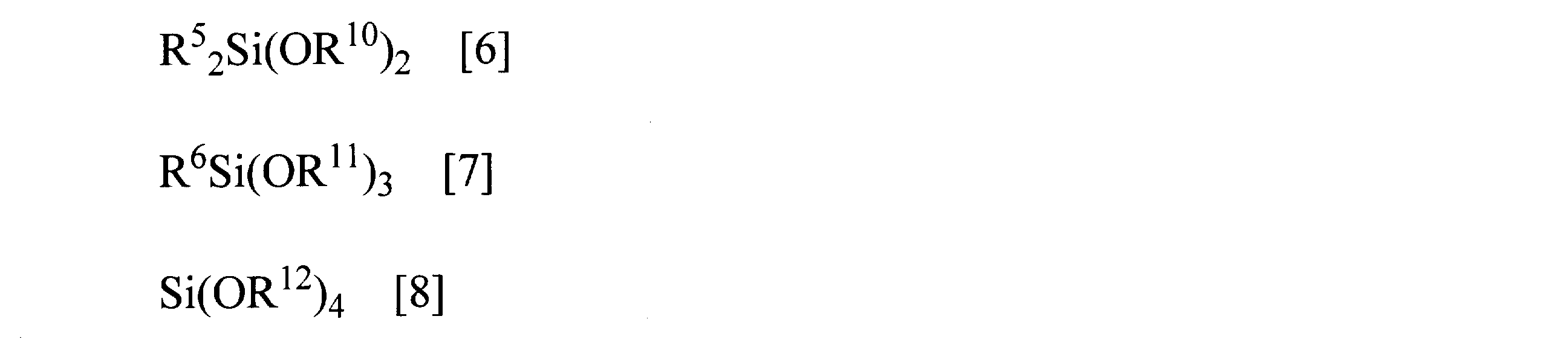

ジメチルジメトキシシラン、ジメチルジエトキシシラン、エチルジエトキシシラン、ジエチルジメトキシシラン、ジエチルジエトキシシラン。
これらの中でも好ましい化合物として、ジメチルジメトキシシラン、ジメチルジエトキシシランが挙げられる。
メチルトリメトキシシラン、メチルトリエトキシシラン、エチルトリメトキシシラン、エチルトリエトキシシラン、ビニルトリメトキシシラン、ビニルトリエトキシシラン、フェニルトリメトキシシラン、フェニルトリエトキシシラン、3-(トリフルオロメチル)フェニルトリメトキシシラン、3-(トリフルオロメチル)フェニルトリエトキシシラン、4-(トリフルオロメチル)フェニルトリメトキシシラン、4-(トリフルオロメチル)フェニルトリエトキシシラン、3,5-(ジトリフルオロメチル)フェニルトリメトキシシラン、3,5-(ジトリフルオロメチル)フェニルトリエトキシシラン、ナフチルトリメトキシシラン、ナフチルトリエトキシシラン。
これらの中でも好ましい化合物として、メチルトリメトキシシラン、メチルトリエトキシシラン、フェニルトリメトキシシラン、フェニルトリエトキシシラン、3-(トリフルオロメチル)フェニルトリメトキシシラン、3-(トリフルオロメチル)フェニルトリエトキシシラン、4-(トリフルオロメチル)フェニルトリメトキシシラン、4-(トリフルオロメチル)フェニルトリエトキシシラン3,5-(ジトリフルオロメチル)フェニルトリメトキシシラン、3,5-(ジトリフルオロメチル)フェニルトリエトキシシランが挙げられ、特に好ましい化合物として、メチルトリメトキシシラン、メチルトリエトキシシラン、フェニルトリメトキシシラン、フェニルトリエトキシシランが挙げられる。
テトラメトキシシラン、テトラエトキシシラン、テトラ-n-プロポキシシラン、テトライソプロポキシシラン。
これらの中でも好ましい化合物として、テトラメトキシシラン、テトラエトキシシランが挙げられる。
クロロジメチルビニルシラン、クロロジエチルビニルシラン。
これらの中でも好ましい化合物として、クロロジメチルビニルシランが挙げられる。
ジメチルビニルシラノール、ジエチルビニルシラノール。
これらの中でも好ましい化合物として、ジメチルビニルシラノールが挙げられる。
ジメチルメトキシビニルシラン、ジメチルエトキシビニルシラン、ジエチルメトキシビニルシラン、ジエチルエトキシビニルシラン。
これらの中でも好ましい化合物として、ジメチルメトキシビニルシラン、ジメチルエトキシビニルシランが挙げられる。
1,1,3,3-テトラメチル-1,3-ジビニルジシロキサン、1,1,3,3-テトラエチル-1,3-ジビニルジシロキサン。
これらの中でも好ましい化合物として、1,1,3,3-テトラメチル-1,3-ジビニルジシロキサンが挙げられる。
(C)成分は、市販品を使用してもよいし、合成したものを使用してもよい。(C)成分は、従来知られている方法で合成することができる。
本発明の硬化物は、本発明の組成物を加熱することにより得ることができる。
本発明の硬化物は、半導体装置用の封止材として用いることができ、特に光半導体装置用、パワー半導体装置用などの封止材として好適である。本発明の硬化物からなる封止材は、上述のように耐熱透明性に優れる。また、通常従来の付加硬化性シリコーン樹脂組成物の硬化物と同様に、耐熱性、耐寒性、電気絶縁性に優れる。
本発明の光半導体装置は、光半導体素子を少なくとも備える光半導体装置であって、本発明の硬化物によって該光半導体素子が少なくとも封止されてなる。本発明の光半導体装置におけるその他の構成は特に限定されず、光半導体素子のほかにも部材を備えていてもよい。そのような部材の一例としては、例えば、ベース基板、引き出し配線、ワイヤー配線、制御素子、絶縁基板、反射材、ヒートシンク、導電部材、ダイボンド材、ボンディングパッドなどが挙げられる。また、光半導体素子に加えて、部材の一部または全部が、本発明の硬化物で封止されていてもよい。
本発明の組成物は、良好な密着性を有するため、半導体装置用接着剤として用いることができる。具体的には、例えば、半導体素子とパッケージを接着する場合、半導体素子とサブマウントを接着する場合、パッケージ構成要素同士を接着する場合、半導体装置と外部光学部材とを接着する場合などに、本発明の組成物を塗布、印刷、ポッティングなどすることにより用いることができる。本発明の組成物は耐熱性に優れるため、長時間高温や紫外光にさらされる高出力の光半導体装置用接着剤として用いた場合、長期使用に耐え得る高い信頼性を有する光半導体装置を提供することができる。
6mLのサンプル管にシリコーン樹脂を20~30mg秤量し、0.8mLの重ジクロロメタンを加え、シリコーン樹脂を溶解させた。その溶液に2.0μLのジメチルスルホキシド(0.0282mmol)をマイクロシリンジで添加し、サンプル管を閉じ、溶液を攪拌して均一にして測定試料とした。その試料を1H-NMRで測定し、ジメチルスルホキシドのプロトン比と、H-Si基またはCH2=CH-Si基のプロトン比とを算出して、測定試料中のH-Si基またはCH2=CH-Si基のモル数を決定した。次いで、以下の式に従って、測定試料1g中の各官能基の含有量を算出した:
シリコーン樹脂中の官能基のモル数(mmol)/測定試料量(mg)×1000=測定試料1g中の官能基量(mmol/g)。
なお、シリコーン樹脂の1H-NMR測定には、共鳴周波数400MHzの核磁気共鳴装置(日本電子株式会社製、型番:ECA-400)を使用した。シリコーン樹脂中の各官能基のケミカルシフトを以下に示す:
Me-Si: 0.0~0.5ppm(3H)、
H-Si: 4.0~5.0ppm(1H)、
CH2=CH-Si: 5.5~6.5ppm(3H)、
Ph-Si: 7.0~8.0ppm(5H)。
6mLのサンプル管にシリコーン樹脂を20~30mg秤量し、0.8mLの重ジクロロメタンを加え、シリコーン樹脂を溶解させた。サンプル管を閉じ、溶液を攪拌して均一にして測定試料とした。その試料を1H-NMRで測定し、シリコーン樹脂中のMe基およびPh基のプロトン比とトルエンのMe基のプロトン比を算出して、測定資料中のトルエン量を決定した。次いで、以下の式に従って、シリコーン樹脂中のトルエンの含有量を算出した:
(トルエンの分子量(mol/g)×Me(トルエン)の面積/3)/(((PhSiO1.5の分子量(mol/g))×((Phの面積-(Me(トルエン)の面積×5/3))/5))+((Me2SiOの分子量(mol/g))×Meの面積×6)+(トルエンの分子量(mol/g)×Me(トルエン)の面積/3))=含有トルエン量(wt%)
なお、シリコーン樹脂の1H-NMR測定には、共鳴周波数400MHzの核磁気共鳴装置(日本電子株式会社製、型番:ECA-400)を使用した。シリコーン樹脂中の各官能基のケミカルシフトを以下に示す:
Me: 0.0~0.5ppm(3H)、
Me(トルエン): 2.2~2.4ppm(3H)、
Ph: 7.0~8.0ppm(5H)。
シリコーン樹脂200mgに、0.5mLの重クロロホルムを加えて溶解させ、緩和剤としてクロム(III)アセチルアセトナート錯体を10mg加えた。これにより調製した溶液を29Si-NMRで測定した。検出したシグナルを、表1に示すように、ピーク(a)~(p)に分類し、それぞれのピークを全積分値の和から百分率(積分比)として算出した。なお、シリコーン樹脂の29Si-NMR測定には、共鳴周波数400MHzの核磁気共鳴装置(日本電子株式会社製、型番:JNM-AL400)を使用した。


a=ピーク(i)面積/全ピーク面積の和、
b=(ピーク(a)面積+ピーク(b)面積)/全ピーク面積の和、
c=(ピーク(c)面積+ピーク(d)面積+ピーク(e)面積)/全ピーク面積の和、
d=(ピーク(f)面積+ピーク(g)面積+ピーク(h)面積)/全ピーク面積の和。

e=ピーク(j)面積/全ピーク面積の和、
f=(ピーク(a)面積+ピーク(b)面積)/全ピーク面積の和、
g=(ピーク(c)面積+ピーク(d)面積+ピーク(e)面積)/全ピーク面積の和、
h=(ピーク(f)面積+ピーク(g)面積+ピーク(h)面積)/全ピーク面積の和。
29Si-NMRにおいて、Me-Si基、Ph-Si基、H-Si基、CH2=CH-Si基またはその他の基のピークが重なった場合は、1H-NMRにおけるMe-Si基、Ph-Si基、H-Si基、CH2=CH-Si基またはその他の基のピークの積分面積に基づいて算出した。
比較合成例で合成したシリコーン樹脂(DA1)および(DB1)ではさらに、以下の式に基づいてそれぞれ組成比を決定した:
(H-SiO3/2)の組成比=(ピーク(k)面積+ピーク(l)面積+ピーク(m)面積)/全ピーク面積の和、
(CH2=CHSiO3/2)の組成比=(ピーク(n)面積+ピーク(o)面積+ピーク(p)面積)/全ピーク面積の和。
HO-Si基の含有量(mmol/g)は、上述の方法で算出した積分比から以下の式に従って決定した:
[A]=ピーク(a)積分比+2×ピーク(c)積分比+ピーク(d)積分比+2×ピーク(f)積分比+ピーク(g)積分比+2×ピーク(k)積分比+ピーク(l)積分比+2×ピーク(n)積分比+ピーク(o)積分比、
[B]=ピーク(a)積分比×83.16+ピーク(b)積分比×74.15+ピーク(c)積分比×147.2+ピーク(d)積分比×138.2+ピーク(e)積分比×129.2+ピーク(f)積分比×78.10+ピーク(g)積分比×69.09+ピーク(h)積分比×60.08+ピーク(i)積分比×67.16+ピーク(j)積分比×93.20+ピーク(k)積分比×71.11+ピーク(l)積分比×62.10+ピーク(m)積分比×53.09+ピーク(n)積分比×97.15+ピーク(o)積分比×88.14+ピーク(p)積分比×79.13、
HO-Si基の含有量(mmol/g)=([A]/[B])×1000。
29Si-NMRの測定において、ピーク(i)、およびピーク(j)がピーク(a)と重なるときは、1H-NMRの測定によりPh-SiとH-Siの積分比、およびPh-SiとCH=CH2-Si、その他のピークがあればその他のピークの積分比の百分率をそれぞれ求め、29Si-NMRのピーク(c)積分比+ピーク(d)積分比+ピーク(e)積分比を算出し、1H-NMRの積分比からピーク(i)およびピーク(j)の29Si-NMRの積分比を求め、ピーク(a)とピーク(i)およびピーク(j)との重なった積分値から算出したピーク(i)およびピーク(j)の積分比を差引き、ピーク(a)の積分値を算出した。その他のケースで29Si-NMRのピークが重なった場合は、上記の方法と同様に1H-NMRの積分比をもとに算出した。
シリコーン樹脂の質量平均分子量(Mw)は、下記条件のゲル透過クロマトグラフィ(略称:GPC)法により、ポリスチレンを基準物質として検量線を作成して値を算出した:
装置:東ソー株式会社製、製品名:HLC-8320GPC、
カラム:東ソー株式会社製、製品名:TSK gel Super HZ 2000x4、3000x2、
溶離液:テトラヒドロフラン。
また、質量平均分子量(Mw)が1500を超えるものに関しては、下記条件のゲル透過クロマトグラフィ(略称:GPC)法により、ポリスチレンを基準物質として検量線を作成して値を算出した:
装置:東ソー株式会社製、製品名:HLC-8320GPC、
カラム:東ソー株式会社製、製品名:TSK gel Super HZM-Hx2
溶離液:テトラヒドロフラン。
シリコーン樹脂の屈折率は、屈折率計(京都電子工業株式会社製、型式:RA-600)を使用して測定した。
シリコーン樹脂の粘度について、回転粘度計(ブルックフィールド・エンジニアリング・ラボラトリーズ・インク製、品名:DV-II+PRO)と温度制御ユニット(ブルックフィールド・エンジニアリング・ラボラトリーズ・インク製、品名:THERMOSEL)を使用し、25℃における値を測定した。
<シリコーン樹脂(I-1)の合成>
フッ素樹脂製の撹拌翼、ジムロート型還流器を具備した容積2Lの3口フラスコに、120.2g(1.0mol)のMe2Si(OMe)2、198.3g(1.0mol)のPhSi(OMe)3を採取した。次いで、239.6gの2-プロパノール、185.0gの水および0.12gの酢酸を該フラスコ内に加えて、該フラスコ内を6時間、連続的に100℃にて加温し、加水分解および縮合反応を行った。その後、反応液を室温に戻し、2Lの分液ロートに移し、400mLのトルエンおよび400mLの水を加え、分液操作を行った後、水層を除去した。次いで400mLの水により有機層の洗浄操作を2回行った。その後、有機層を回収し、エバポレーターにて、トルエンを減圧留去し、無色の粘性液体としてシリコーン樹脂(I-1)を得た。
シリコーン樹脂(I-1)の収量は160.8gであり、質量平均分子量(Mw)は1,000であり、組成比は(Me2SiO2/2)0.43(PhSiO3/2)0.57であり、HO-Si基の含有量は7.8mmol/g(13質量%)であった。
<シリコーン樹脂(A1)の合成>
39.7gのシリコーン樹脂(I-1)、119gのトルエン、39.7gのメタノール、8.3gの1,1,3,3-テトラメチルジシロキサンおよび0.20mLの70%濃硝酸をフラスコ内に加え、室温で攪拌を行った。4時間後、分液ロートに反応溶液を移し、119gの水を加え、抽出操作をした後、有機層を回収した。同様の操作を4回繰り返すことにより、有機層を洗浄した。エバポレーターにより有機層からトルエンを留去した後、加熱による減圧留去(130℃、2時間)を行い、無色透明な粘性液体としてシリコーン樹脂(A1)を得た。
シリコーン樹脂(A1)の収量は42.5g、質量平均分子量(Mw)は1,900、粘度は200cPであり、組成比は(Me2SiO2/2)0.31(PhSiO3/2)0.42(H(Me)2SiO1/2)0.27であり、H-Si基の含有量は2.8mmol/gであり、HO-Si基の含有量は2.0mmol/g(3.4質量%)であった。
<シリコーン樹脂(B1)の合成>
19.9gのシリコーン樹脂(I-1)、59.7gのトルエン、19.9gのメタノール、5.76gの1,3-ジビニル-1,1,3,3-テトラメチルジシロキサンおよび1.98mLの70%濃硝酸をフラスコ内に加え、室温で攪拌を行った。4時間後、分液ロートに反応溶液を移し、59.7gの水を加え、抽出操作をした後、有機層を回収した。同様の操作を4回繰り返すことにより、有機層を洗浄した。エバポレーターにより有機層からトルエンを留去した後、加熱による減圧留去(130℃、2時間)を行い、無色透明な粘性液体としてシリコーン樹脂(B1)を得た。
シリコーン樹脂(B1)の収量は20.6g、質量平均分子量(Mw)は1,800、粘度は350cPであり、組成比は(Me2SiO2/2)0.32(PhSiO3/2)0.45(CH2=CH(Me)2SiO1/2)0.23であり、CH2=CH-Si基の含有量は2.3mmol/gであり、HO-Si基の含有量は2.1mmol/g(3.6質量%)であった。
<シリコーン樹脂(I-2)の合成>
120.2g(1.0mol)のMe2Si(OMe)2および198.3g(1.0mol)のPhSi(OMe)3の代わりに、114.2g(0.95mol)のMe2Si(OMe)2、188.4g(0.95mol)のPhSi(OMe)3および13.0g(0.063mol)のSi(OEt)4を用いた以外は、合成例1-1と同様の操作を行った。その結果、無色の粘性液体としてシリコーン樹脂(I-2)を得た。
シリコーン樹脂(I-2)の収量は163.0gであり、質量平均分子量(Mw)は900であり、生成物の組成比は(Me2SiO2/2)0.41(PhSiO3/2)0.52(SiO4/2)0.06であり、HO-Si基の含有量は8.5mmol/g(14質量%)であった。
<シリコーン樹脂(A2)の合成>
55.8gのシリコーン樹脂(I-2)、167.4gのトルエン、55.8gのメタノール、12.7gの1,1,3,3-テトラメチルジシロキサンおよび0.30mLの70%濃硝酸をフラスコ内に加え、室温で攪拌を行った。4時間後、分液ロートに反応溶液を移し、167.4gの水を加え、抽出操作をした後、有機層を回収した。同様の操作を4回繰り返すことにより、有機層を洗浄した。エバポレーターにより有機層からトルエンを留去した後、加熱による減圧留去(130℃、2時間)を行い、無色透明な粘性液体としてシリコーン樹脂(A2)を得た。
シリコーン樹脂(A2)の収量は55.1gであり、質量平均分子量(Mw)は1,000であり、粘度は140cPであり、組成比は(Me2SiO2/2)0.21(PhSiO3/2)0.45(SiO4/2)0.06(H(Me)2SiO1/2)0.28であり、H-Si基の含有量は2.6mmol/gであり、HO-Si基の含有量は2.9mmol/g(4.9質量%)であった。
<シリコーン樹脂(B2)の合成>
27.9gのシリコーン樹脂(I-2)、83.7gのトルエン、27.9gのメタノール、8.81gの1,3-ジビニル-1,1,3,3-テトラメチルジシロキサンおよび3.03mLの70%濃硝酸をフラスコ内に加え、室温で攪拌を行った。4時間後、分液ロートに反応溶液を移し、83.7gの水を加え、抽出操作をした後、有機層を回収した。同様の操作を4回繰り返すことにより、有機層を洗浄した。エバポレーターにより有機層からトルエンを留去した後、加熱による減圧留去(130℃、2時間)を行い、無色透明な粘性液体としてシリコーン樹脂(B2)を得た。
シリコーン樹脂(B2)の収量は29.5gであり、質量平均分子量(Mw)は1,100であり、粘度は200cPであり、組成比は(Me2SiO2/2)0.26(PhSiO3/2)0.42(SiO4/2)0.05(CH2=CH(Me)2SiO1/2)0.27であり、CH2=CH-Si基の含有量は2.7mmol/gであり、HO-Si基の含有量は1.7mmol/g(2.9質量%)であった。
<シリコーン樹脂(I-3)の合成>
120.2g(1.0mol)のMe2Si(OMe)2および198.3g(1.0mol)のPhSi(OMe)3の代わりに、108.2g(0.90mol)のMe2Si(OMe)2、178.5g(0.90mol)のPhSi(OMe)3および26.0g(0.125mol)のSi(OEt)4を用いた以外は、合成例1-1と同様の操作を行った。その結果、無色透明な粘性液体としてシリコーン樹脂(I-3)を得た。
シリコーン樹脂(I-3)の収量は154.2gであり、質量平均分子量(Mw)は900であり、組成比は(Me2SiO2/2)0.35(PhSiO3/2)0.56(SiO4/2)0.10であり、HO-Si基の含有量は8.5mmol/g(14質量%)であった。
<シリコーン樹脂(A3)の合成>
57.4gのシリコーン樹脂(I-3)、172.2gのトルエン、57.4gのメタノール、16.4gの1,1,3,3-テトラメチルジシロキサンおよび0.39mLの70%濃硝酸をフラスコ内に加え、室温で攪拌を行った。4時間後、分液ロートに反応溶液を移し、172.2gの水を加え、抽出操作をした後、有機層を回収した。同様の操作を4回繰り返すことにより、有機層を洗浄した。エバポレーターにより有機層からトルエンを留去した後、加熱による減圧留去(130℃、2時間)を行い、無色透明な粘性液体としてシリコーン樹脂(A3)を得た。
シリコーン樹脂(A3)の収量は58.4gであり、質量平均分子量(Mw)は1,100であり、粘度は180cPであり、組成比は(Me2SiO2/2)0.15(PhSiO3/2)0.46(SiO4/2)0.07(H(Me)2SiO1/2)0.33であり、H-Si基の含有量は3.2mmol/gであり、HO-Si基の含有量は2.7mmol/g(4.6質量%)であった。
<シリコーン樹脂(B3)の合成>
28.7gのシリコーン樹脂(I-3)、86.1gのトルエン、28.7gのメタノール、11.4gの1,3-ジビニル-1,1,3,3-テトラメチルジシロキサンおよび3.92mLの70%濃硝酸をフラスコ内に加え、室温で攪拌を行った。4時間後、分液ロートに反応溶液を移し、86.1gの水を加え、抽出操作をした後、有機層を回収した。同様の操作を4回繰り返すことにより、有機層を洗浄した。エバポレーターにより有機層からトルエンを留去した後、加熱による減圧留去(130℃、2時間)を行い、無色透明な粘性液体としてシリコーン樹脂(B3)を得た。
シリコーン樹脂(B3)の収量は32.7gであり、質量平均分子量(Mw)は1,300であり、粘度は230cPであり、組成比は(Me2SiO2/2)0.20(PhSiO3/2)0.43(SiO4/2)0.07(CH2=CH(Me)2SiO1/2)0.30であり、CH2=CH-Si基の含有量は2.8mmol/gであり、HO-Si基の含有量は1.7mmol/g(2.9質量%)であった。
<シリコーン樹脂(I-4)の合成>
120.2g(1.0mol)のMe2Si(OMe)2および198.3g(1.0mol)のPhSi(OMe)3の代わりに、96.2g(0.80mol)のMe2Si(OMe)2、158.6g(0.80mol)のPhSi(OMe)3および52.1g(0.25mol)のSi(OEt)4を用いた以外は、合成例1-1と同様の操作を行った。その結果、無色透明な粘性液体としてシリコーン樹脂(I-4)を得た。
シリコーン樹脂(I-4)の収量は143.4gであり、質量平均分子量(Mw)は1,100であり、組成比は(Me2SiO2/2)0.34(PhSiO3/2)0.51(SiO4/2)0.15であり、HO-Si基の含有量は7.7mmol/g(13質量%)であった。
<シリコーン樹脂(A4)の合成>
173.7gのシリコーン樹脂(I-4)、521.1gのトルエン、173.7gのメタノール、31.4gの1,1,3,3-テトラメチルジシロキサンおよび0.75mLの70%濃硝酸をフラスコ内に加え、室温で攪拌を行った。4時間後、分液ロートに反応溶液を移し、521.1gの水を加え、抽出操作をした後、有機層を回収した。同様の操作を4回繰り返すことにより、有機層を洗浄した。エバポレーターにより有機層からトルエンを留去した後、加熱による減圧留去(130℃、2時間)を行い、無色透明な粘性液体としてシリコーン樹脂(A4)を得た。
シリコーン樹脂(A4)の収量は165.7gであり、質量平均分子量(Mw)は1,500であり、粘度は4,000cPであり、組成比は(Me2SiO2/2)0.16(PhSiO3/2)0.45(SiO4/2)0.15(H(Me)2SiO1/2)0.24であり、H-Si基の含有量は2.2mmol/gであり、HO-Si基の含有量は3.1mmol/g(5.3質量%)であった。
<シリコーン樹脂(B4)の合成>
91.4gのシリコーン樹脂(I-4)、274.2gのトルエン、91.4gのメタノール、23.0gの1,3-ジビニル-1,1,3,3-テトラメチルジシロキサンおよび7.90mLの70%濃硝酸をフラスコ内に加え、室温で攪拌を行った。4時間後、分液ロートに反応溶液を移し、274.2gの水を加え、抽出操作をした後、有機層を回収した。同様の操作を4回繰り返すことにより、有機層を洗浄した。エバポレーターにより有機層からトルエンを留去した後、加熱による減圧留去(130℃、2時間)を行い、無色透明な粘性液体としてシリコーン樹脂(B4)を得た。
シリコーン樹脂(B4)の収量は99.2g、質量平均分子量(Mw)は1,400、粘度は2,500cPであり、組成比は(Me2SiO2/2)0.23(PhSiO3/2)0.41(SiO4/2)0.13(CH2=CH(Me)2SiO1/2)0.23、CH2=CH-Si基の含有量は2.2mmol/gであり、HO-Si基の含有量は1.9mmol/g(3.2質量%)であった。
<シリコーン樹脂(I-5)の合成>
120.2g(1.0mol)のMe2Si(OMe)2および198.3g(1.0mol)のPhSi(OMe)3の代わりに、90.2g(0.75mol)のMe2Si(OMe)2、148.7g(0.75mol)のPhSi(OMe)3および65.1g(0.313mol)のSi(OEt)4を用いた以外は、合成例1-1と同様の操作を行った。その結果、無色透明な粘性液体としてシリコーン樹脂(I-5)を得た。
シリコーン樹脂(I-5)の収量は137.7gであり、質量平均分子量(Mw)は1,300であり、組成比は(Me2SiO2/2)0.28(PhSiO3/2)0.53(SiO4/2)0.19であり、HO-Si基の含有量は7.4mmol/g(13質量%)であった。
28.6gのシリコーン樹脂(I-5)、85.8gのトルエン、28.6gのメタノール、5.69gの1,1,3,3-テトラメチルジシロキサンおよび0.14mLの70%濃硝酸をフラスコ内に加え、室温で攪拌を行った。4時間後、分液ロートに反応溶液を移し、85.8gの水を加え、抽出操作をした後、有機層を回収した。同様の操作を4回繰り返すことにより、有機層を洗浄した。エバポレーターにより有機層からトルエンを留去した後、加熱による減圧留去(130℃、2時間)を行い、無色透明な粘性液体としてシリコーン樹脂(A5)を得た。
シリコーン樹脂(A5)の収量は27.5gであり、質量平均分子量(Mw)は1,600であり、粘度は15,000cPであり、組成比は(Me2SiO2/2)0.13(PhSiO3/2)0.43(SiO4/2)0.21(H(Me)2SiO1/2)0.23であり、H-Si基の含有量は2.1mmol/gであり、HO-Si基の含有量は2.7mmol/g(4.6質量%)であった。
14.3gのシリコーン樹脂(I-5)、42.9gのトルエン、14.3gのメタノール、3.95gの1,3-ジビニル-1,1,3,3-テトラメチルジシロキサンおよび1.36mLの70%濃硝酸をフラスコ内に加え、室温で攪拌を行った。4時間後、分液ロートに反応溶液を移し、42.9gの水を加え、抽出操作をした後、有機層を回収した。同様の操作を4回繰り返すことにより、有機層を洗浄した。エバポレーターにより有機層からトルエンを留去した後、加熱による減圧留去(130℃、2時間)を行い、無色透明な粘性液体としてシリコーン樹脂(B5)を得た。
シリコーン樹脂(B5)の収量は15.2gであり、質量平均分子量(Mw)は1,500であり、粘度は23,000cPであり、組成比は(Me2SiO2/2)0.18(PhSiO3/2)0.40(SiO4/2)0.19(CH2=CH(Me)2SiO1/2)0.23であり、CH2=CH-Si基の含有量は2.3mmol/gであり、Si-OH基の含有量は1.7mmol/g(2.9質量%)であった。
<シリコーン樹脂(I-6)の合成>
120.2g(1.0mol)のMe2Si(OMe)2および198.3g(1.0mol)のPhSi(OMe)3の代わりに、84.2g(0.70mol)のMe2Si(OMe)2、138.8g(0.70mol)のPhSi(OMe)3および78.1g(0.375mol)のSi(OEt)4を用いた以外は、合成例1-1と同様の操作を行った。その結果、無色透明な粘性液体としてシリコーン樹脂(I-6)を得た。
シリコーン樹脂(I-6)の収量は140.8gであり、質量平均分子量(Mw)は1,500であり、組成比は(Me2SiO2/2)0.29(PhSiO3/2)0.44(SiO4/2)0.27であり、HO-Si基の含有量は6.8mmol/g(12質量%)であった。
<シリコーン樹脂(A6)の合成>
47.9gのシリコーン樹脂(I-6)、143.7gのトルエン、47.9gのメタノール、10.9gの1,1,3,3-テトラメチルジシロキサンおよび0.26mLの70%濃硝酸をフラスコ内に加え、室温で攪拌を行った。4時間後、分液ロートに反応溶液を移し、143.7gの水を加え、抽出操作をした後、有機層を回収した。同様の操作を4回繰り返すことにより、有機層を洗浄した。エバポレーターにより有機層からトルエンを留去した後、加熱による減圧留去(130℃、2時間)を行い、無色透明な粘性液体としてシリコーン樹脂(A6)を得た。
シリコーン樹脂(A6)の収量は59.3gであり、質量平均分子量(Mw)は1,900であり、粘度は280,000cPであり、組成比は(Me2SiO2/2)0.15(PhSiO3/2)0.40(SiO4/2)0.22(H(Me)2SiO1/2)0.23であり、H-Si基の含有量は1.6mmol/gであり、HO-Si基の含有量は2.5mmol/g(4.3質量%)であった。
<シリコーン樹脂(B6)の合成>
23.9gのシリコーン樹脂(I-6)、71.7gのトルエン、23.9gのメタノール、7.55gの1,3-ジビニル-1,1,3,3-テトラメチルジシロキサンおよび2.60mLの70%濃硝酸をフラスコ内に加え、室温で攪拌を行った。4時間後、分液ロートに反応溶液を移し、71.7gの水を加え、抽出操作をした後、有機層を回収した。同様の操作を4回繰り返すことにより、有機層を洗浄した。エバポレーターにより有機層からトルエンを留去した後、加熱による減圧留去(130℃、2時間)を行い、無色透明な粘性液体としてシリコーン樹脂(B6)を得た。
シリコーン樹脂(B6)の収量は32.0gであり、質量平均分子量(Mw)は1,900であり、粘度は280,000cPであり、組成比は(Me2SiO2/2)0.19(PhSiO3/2)0.39(SiO4/2)0.21(CH2=CH(Me)2SiO1/2)0.21であり、CH2=CH-Si基の含有量は1.9mmol/gであり、HO-Si基の含有量は1.6mmol/g(2.7質量%)であった。
<シリコーン樹脂(DA1)の合成>
120.2g(1.0mol)のMe2Si(OMe)2および198.3g(1.0mol)のPhSi(OMe)3の代わりに、92.57g(0.77mol)のMe2Si(OMe)2、152.68g(0.77mol)のPhSi(OMe)3および47.05g(0.385mol)のHSi(OMe)3を用いた以外は、合成例1-1と同様の操作を行った。その結果、無色透明な粘性液体としてシリコーン樹脂(DA1)を得た。
シリコーン樹脂(DA1)の収量は144.2gであり、質量平均分子量(Mw)は1,400であり、粘度は34,000cPであり、組成比は(Me2SiO2/2)0.34(PhSiO3/2)0.42(HSiO3/2)0.24であり、H-Si基の含有量は1.5mmol/gであり、HO-Si基の含有量は7.2mmol/g(12質量%)であった。
フッ素樹脂製の撹拌翼、ジムロート型還流器を具備した容積2Lの3口フラスコに、48.1g(0.40mol)のMe2Si(OMe)2、79.3g(0.40mol)のPhSi(OMe)3および13.4g(0.10mol)の1,1,3,3-テトラメチルジシロキサンを採取した。次いで、106gの2-プロパノール、79.3gの水および0.06gの酢酸を該フラスコ内に加えて、該フラスコ内を6時間、連続的に100℃にて加温し、加水分解および縮合反応を行った。その後、反応液を室温に戻し、1Lの分液ロートに移し、200mLのトルエンおよび200mLの水を加え、分液操作を行った後、水層を除去した。次いで200mLの水により有機層の洗浄操作を2回行った。その後、有機層を回収し、エバポレーターにて、トルエンを減圧留去し、無色の粘性液体としてシリコーン樹脂(DA2)を得た。
シリコーン樹脂(DA2)の収量は81.6gであり、質量平均分子量(Mw)は650であり、粘度は300cPであり、組成比は(Me2SiO2/2)0.38(PhSiO3/2)0.40(H(Me)2SiO1/2)0.22であり、H-Si基の含有量は1.55mmol/gであり、HO-Si基の含有量は4.7mmol/g(8.0質量%)であった。
120.2g(1.0mol)のMe2Si(OMe)2および198.3g(1.0mol)のPhSi(OMe)3の代わりに、92.57g(0.77mol)のMe2Si(OMe)2、152.68g(0.77mol)のPhSi(OMe)3および57.07g(0.385mol)のCH2=CH-Si(OMe)3を用いた以外は、合成例1-1と同様の操作を行った。その結果、無色透明な粘性液体としてシリコーン樹脂(DB1)を得た。
シリコーン樹脂(DB1)の収量は122.3gであり、質量平均分子量(Mw)は1,200であり、粘度は3,700cPであり、組成比は(Me2SiO2/2)0.33(PhSiO3/2)0.47(CH2=CHSiO3/2)0.20であり、CH2=CH-Si基の含有量は1.7mmol/gであり、HO-Si基の含有量は10.7mmol/g(18質量%)であった。
フッ素樹脂製の撹拌翼、ジムロート型還流器を具備した容積2Lの3口フラスコに、30.1g(0.25mol)のMe2Si(OMe)2、49.6g(0.25mol)のPhSi(OMe)3および11.7g(0.063mol)の1,3-ジビニル-1,1,3,3-テトラメチルジシロキサンを採取した。次いで、59.9gの2-プロパノール、46.3gの水および0.03gの酢酸を該フラスコ内に加えて、該フラスコ内を6時間、連続的に100℃にて加温し、加水分解および縮合反応を行った。その後、反応液を室温に戻し、1Lの分液ロートに移し、100mLのトルエンおよび100mLの水を加え、分液操作を行った後、水層を除去した。次いで100mLの水により有機層の洗浄操作を2回行った。その後、有機層を回収し、エバポレーターにて、トルエンを減圧留去し、無色の粘性液体としてシリコーン樹脂(DB2)を得た。
シリコーン樹脂(DB2)の収量は39.8gであり、質量平均分子量(Mw)は1,000であり、粘度は12,000cPであり、組成比は(Me2SiO2/2)0.42(PhSiO3/2)0.54(CH2=CH(Me)2)0.03であり、CH2=CH-Si基の含有量は0.05mmol/gであり、HO-Si基の含有量は8.6mmol/g(15質量%)であった。
48.1g(0.40mol)のMe2Si(OMe)2、79.3g(0.40mol)のPhSi(OMe)3および13.4g(0.10mol)の1,1,3,3-テトラメチルジシロキサンの代わりに、48.1g(0.40mol)のMe2Si(OMe)2、79.3g(0.40mol)のPhSi(OMe)3および23.2g(0.20mol)のジメチルビニルメトキシシランを用いることと、6時間、連続的に100℃で加温する代わりに、15時間、連続的に100℃で加温すること以外は、上記<シリコーン樹脂(DA2)の合成>と同様の操作を行った。その結果、無色の粘性液体としてシリコーン樹脂(DB3)を得た。
シリコーン樹脂(DB3)の収量は89.3gであり、質量平均分子量(Mw)は630であり、粘度は300cPであり、組成比は(Me2SiO2/2)0.37(PhSiO3/2)0.47(CH2=CH(Me)2SiO1/2)0.16であり、CH2=CH-Si基の含有量は1.30mmol/gであり、HO-Si基の含有量は6.8mmol/g(12質量%)であった。

調製した組成物の粘度、該組成物から得られる硬化物の物理特性(硬度、密着性、耐熱性、透明性、耐熱透明性、線熱膨張係数、5%重量減少温度、接着強度)、硬化開始温度および硬化時の外観を次のようにして測定した。なお、測定に用いる組成物は、(A)成分のシリコーン樹脂[シリコーン樹脂(A1)~(A6)、(DA1)~(DA2)]と、(B)成分のシリコーン樹脂[シリコーン樹脂(B1)~(B6)、(DB1)~(DB3)]を2:1の質量比で配合し、(C)成分の白金触媒と混合して実施例1~6および比較例1~3の組成物を調製した。ここで、白金触媒としては、組成物全体量に対して、白金原子の含有量が質量単位で0.03ppmとなるように白金-ジビニルテトラメチルジシロキサン錯体を用いた。
調製した組成物の粘度について、回転粘度計(ブルックフィールド・エンジニアリング・ラボラトリーズ・インク製、品名:DV-II+PRO)と温度制御ユニット(ブルックフィールド・エンジニアリング・ラボラトリーズ・インク製、品名:THERMOSEL)を使用し、せん断速度30[1/s]で、25℃における値を測定した。
調製した組成物を型(25mmφ)に流し込み、空気中90℃で1時間加熱し、さらに150℃で4時間加熱して厚さが4~5mmの硬化物を作製した。この硬化物のショアAまたはショアDの硬度を、デュロメーター(株式会社テクロック製、型式:GS-719R、GS-720R)を用いて、JIS K 7215「プラスチックのデュロメータ硬さ試験方法」に規定の方法により測定した。なお、比較例2および比較例3では、組成物が硬化しなかったので測定を行わなかった。
調製した組成物を3528SMD型PPA樹脂パッケージ(3528表面実装型ポリフタルアミド樹脂パッケージ)(3.5mm×2.8mm×0.9mm)に流し込み、空気中90℃で1時間加熱し、さらに150℃で4時間加熱して硬化物とした検体を16検体作製した。これらの検体を光学顕微鏡で確認し、硬化物がパッケージから剥離していたものを「剥離」、剥離していなかったものを「密着」と評価した。16検体中、「密着」と評価した検体の数を「合格数」として計上した。なお、比較例2および比較例3では、組成物が硬化しなかったので測定を行わなかった。
調製した組成物を型(22mmφ)に流し込み、空気中90℃で1時間加熱し、さらに150℃で4時間加熱して22mmφ、2mm厚の硬化物を作製した。紫外可視分光光度計(株式会社島津製作所製、型番:UV-3150)を使用して、この硬化物の405nm、365nm波長領域における透過率を測定した。なお、比較例2および比較例3では、組成物が硬化しなかったので測定を行わなかった。
調製した組成物を型(22mmφ)に流し込み、空気中90℃で1時間加熱し、さらに150℃で4時間加熱して22mmφ、2mm厚の硬化物を作製した。この硬化物を200℃、100時間加熱した後、紫外可視分光光度計(株式会社島津製作所製、型番:UV-3150)を使用し、405nm、365nm波長領域における透過率を測定した。なお、比較例2および比較例3では、組成物が硬化しなかったので測定を行わなかった。
調製した組成物0.7gをフッ素樹脂製チューブ(内径:5.8mmφ、高さ:1.8mm)に加えて空気中90℃で1時間加熱し、さらに150℃で4時間加熱して硬化物を作製した。この硬化物の線熱膨張係数を、ThermoPlusTMA8310(リガク株式会社製)を用いて、硬化物を空気中、5℃/分の昇温速度で25℃から200℃まで加熱して測定した。この測定は2回行い、測定値は2回目のものを採用した。なお、比較例2および比較例3では、組成物が硬化しなかったので測定を行わなかった。
調製した組成物を空気中90℃で1時間加熱し、さらに150℃で4時間加熱して硬化物を作製した。この硬化物を、熱重量-示差熱同時測定装置(Thermogravimetric/Differential Thermal Analysis、略称:TG-DTA)としてThermoPlusTG8120(リガク株式会社製)を用いて、空気中、5℃/分の昇温速度で25℃から500℃まで加熱し、5%重量減少するときの温度(Td5)を測定した。なお、比較例2および比較例3では、組成物が硬化しなかったので測定を行わなかった。
調製した組成物と、直径50μmのジルコニアボールとを混合したものを、ガラスチップ(5.0mm×5.0mm×1.1mm)と、ガラス基板(50mm×50mm×3.0mm)またはアルミナ基板(50mm×50mm×2.0mm)との間に挟んだ状態で空気中90℃で1時間加熱し、さらに150℃で4時間加熱して硬化させた。作製した試料の接着力(接着強度)をボンドテスター(デイジ・ジャパン株式会社製、型式:Dage4000Plus)により測定した。測定時に硬化物が破壊され接着強度の値が得られなかったものを「凝集破壊」と表記した。なお、比較例2および比較例3では、組成物が硬化しなかったので測定を行わなかった。
調製後に10分間静置した組成物を、回転粘度計(ブルックフィールド・エンジニアリング・ラボラトリーズ・インク製、品名:DV-II+PRO)と温度制御ユニット(ブルックフィールド・エンジニアリング・ラボラトリーズ・インク製、品名:THERMOSEL)を用いて、せん断速度30[1/s]で、2.09℃/minの昇温速度で25℃から150℃まで一定昇温したときの粘度の経時変化を測定した。粘度が30,000cPを超えたときの温度を硬化開始温度として評価した。
調製した組成物1gを、ガラスモールド(22mmφ)に薄く広げた。その後、空気中90℃で1時間加熱し、さらに150℃で4時間加熱して硬化物を作製した。作製した硬化物を25℃に自然冷却した。同様にして、3個の試験体を作製した。試験体の概観を目視で確認し、全ての試験体において、透明で、発泡およびクラックの発生が観測されない状態を「良好」、いずれかの試験体において、硬化物中に泡が観測される状態を「発泡」、いずれかの試験体において、組成物が硬化せずに粘性液体のままである状態を「未硬化」と評価した。
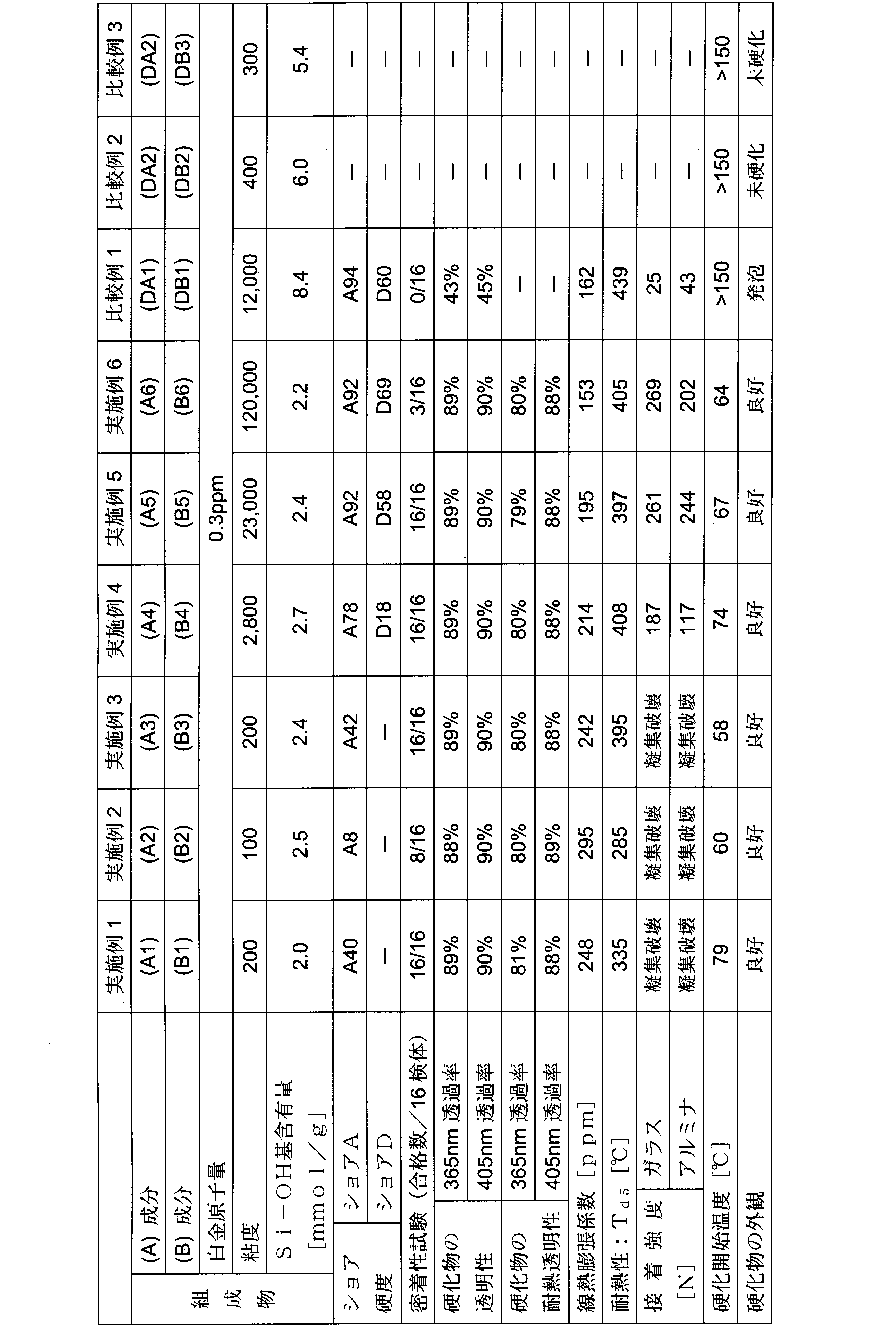
次に、(A)成分としてシリコーン樹脂(A1)と、(B)成分としてシリコーン樹脂(B1)とを2:1の質量比で配合し、(C)成分の白金触媒と混合して組成物1-1~組成物1-5を調製した。また、(C)成分の白金触媒を配合せず、シリコーン樹脂(A1)とシリコーン樹脂(B1)とを2:1の質量比で配合したのみの比較用組成物1-1を調製した。ここで、白金触媒としては、硬化性シリコーン樹脂組成物全体量に対して、白金原子の含有量が質量単位で所定量となるよう白金-ジビニルテトラメチルジシロキサン錯体を用いた。
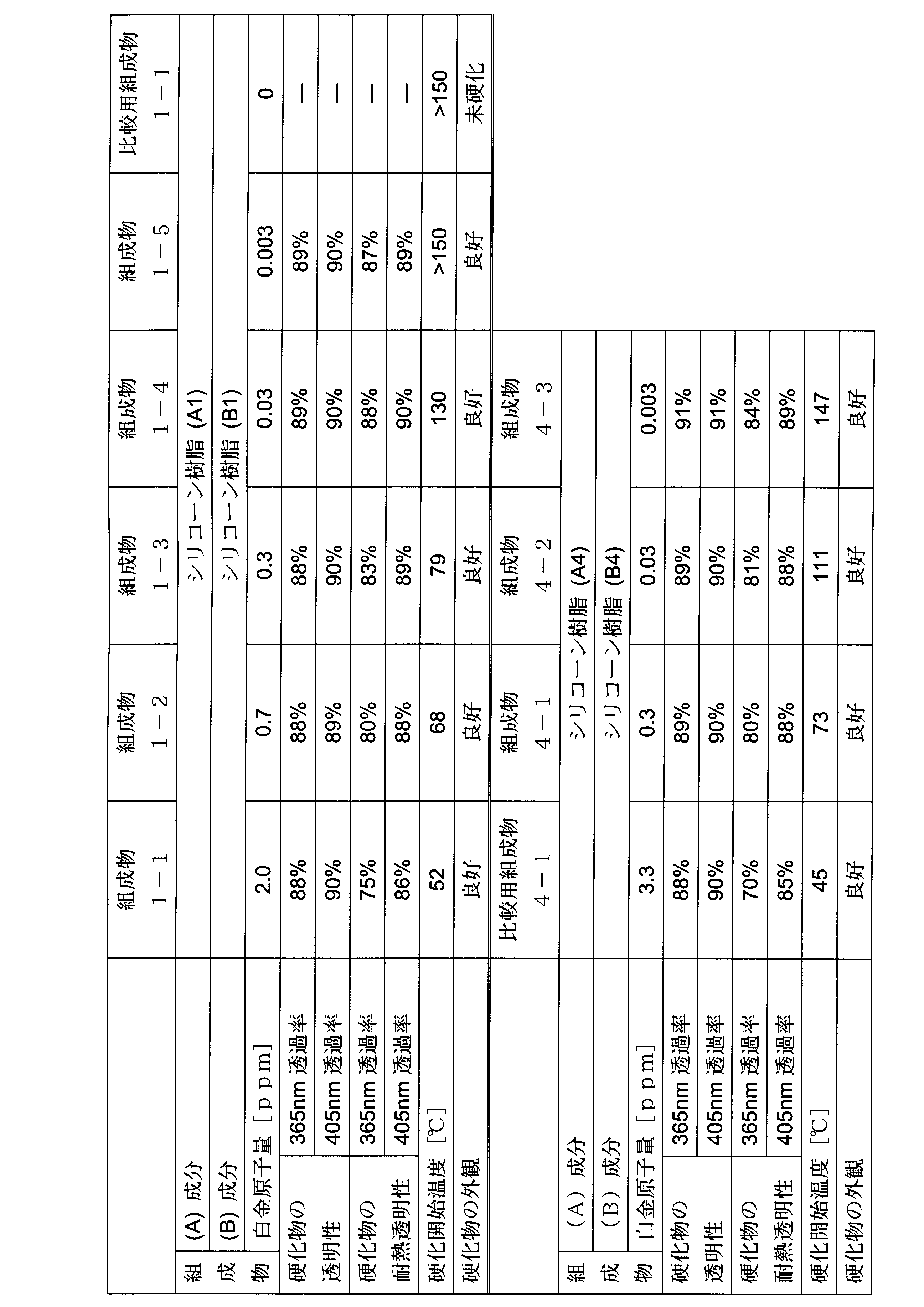
(A)成分としてシリコーン樹脂(A1)と、(B)成分としてシリコーン樹脂(B1)とを2:1の質量比で配合し、(C)成分の白金触媒を混合し、さらに種々の硬化遅延剤を配合して組成物1-6~組成物1-9を調製した。ここで、白金触媒としては、(A)~(C)成分の合計質量に対して、白金原子の含有量が質量単位で2.0ppmとなるように白金-ジビニルテトラメチルジシロキサン錯体を用いた。硬化遅延剤は白金原子の含有量2.0質量ppmを1当量として、70~80当量の範囲で添加した。具体的には、組成物1-6の調製においては硬化遅延剤としてマレイン酸ジメチルを組成物全体量1gに対して118μg添加し、組成物1-7の調製においては3-ブチン-2-オール-2-メチルを組成物全体量1gに対して67μg、組成物1-8の調製においては1-エチニル-1-シクロヘキサノールを組成物全体量1gに対して94μg添加し、組成物1-9においてはテトラメチルエチレンジアミンを組成物全体量1gに対して86μg添加した。
調製後に10分間静置した組成物の粘度を、回転粘度計(ブルックフィールド・エンジニアリング・ラボラトリーズ・インク製、品名:DV-II+PRO)と温度制御ユニット(ブルックフィールド・エンジニアリング・ラボラトリーズ・インク製、品名:THERMOSEL)を用いて、せん断速度30[1/s]で、25℃で3時間までの間1分間毎に測定した。測定開始時から粘度が30,000cPを超えたときの時間を硬化開始時間として評価した。
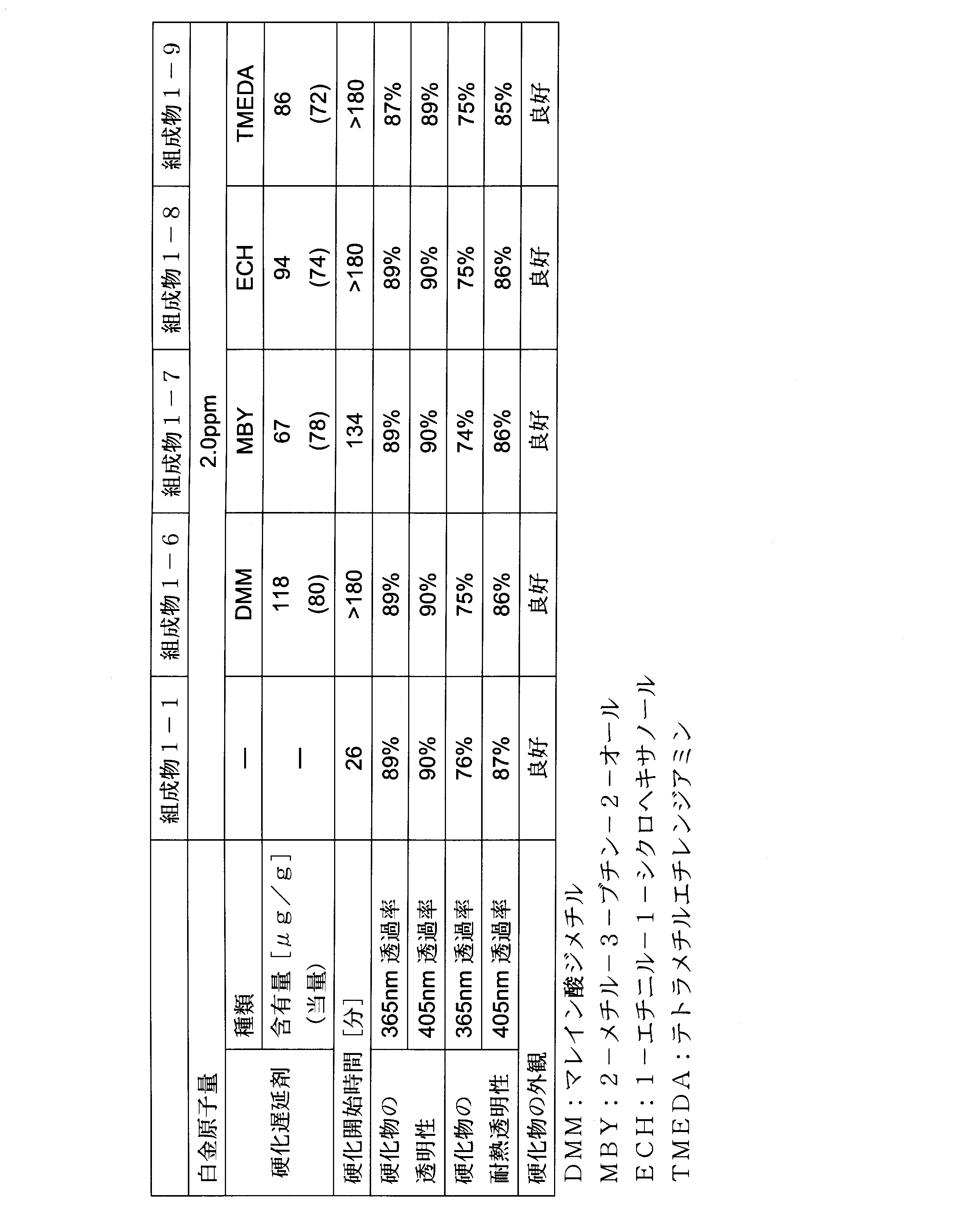
(A)成分としてシリコーン樹脂(A4)と、(B)成分としてシリコーン樹脂(B4)とを2:1の質量比で配合し、(C)成分の白金触媒を混合し、さらに種々の光安定剤または酸化防止剤を配合して組成物4-4~組成物4-6を調製した。ここで、白金触媒としては、(A)~(C)成分の合計質量に対して、白金原子の含有量が質量単位で0.2ppmとなるように白金-ジビニルテトラメチルジシロキサン錯体を用いた。光安定剤および酸化防止剤は、(A)~(C)成分の合計質量に対して、0.05~0.2質量%の範囲で添加した。具体的には、組成物4-4の調製においては、光安定剤としてビス(2,2,6,6-テトラメチル4-ピペリジル)セバケートを組成物全体量1gに対して0.5mg添加した。組成物4-5の調製においては、光安定剤としてビス(2,2,6,6-テトラメチル4-ピペリジル)セバケートを組成物全体量1gに対して1.0mg添加した。組成物4-6の調製においては、酸化防止剤として1,3,5-トリス(3,5-ジ-tert-ブチル-4-ヒドロキシベンジル)-1,3,5-トリアジン-2,4,6-(1H,3H,5H)-トリオンと、2,2-ビス({[3-(ドデシルチオ)プロピオニル]オキシ}メチル)-1,3-プロパンジイル=ビス[3-(ドデシルチオ)プロピオナート]とを組成物全体量1gに対してそれぞれ1.5mg、0.5mg添加した。
調製した組成物を空気中90℃で1時間加熱し、さらに150℃で4時間加熱して22mmφ、2mm厚の硬化物を作成した。紫外可視分光光度計(株式会社島津製作所製、型番:UV-3150)を使用し、この硬化物の405nm、365nm波長領域における透過率を測定した。この硬化物を200℃でさらに加熱し、100時間および200時間経過した時点で一旦室温まで降温した。降温後の硬化物について、同様にして透過率を測定した。これらの測定結果から、さらなる加熱前の硬化物の透過率を基準として、さらなる加熱後の硬化物の透過率の変動比を算出した。

<シリコーン樹脂(I -1)の高分子量化>
フッ素樹脂製の撹拌翼、ディーンスタークル、ジムロート型還流器を具備した容積4口2Lフラスコに、合成例1-1に記載されるシリコーン樹脂(I -1)に順ずる1,000gのシリコーン樹脂を採取した。次いで、250gのトルエンを加えて、該フラスコ内を24時間、連続的に130℃にて加温し、加水分解および縮合反応を行った。その後、反応液を室温に戻し、トルエンを含むシリコーン樹脂(II)を調製した。
シリコーン樹脂(II)の質量平均分子量(Mw)は5,200であり、組成比は(Me2SiO2/2)0.50(PhSiO3/2)0.50であり、HO-Si基の含有量は4.5mmol/g(6.7質量%)であり、トルエン含有量は20.49質量%であった。
<シリコーン樹脂(A7)の合成>
130.00gのシリコーン樹脂(II)、288.91gのトルエン、103.36gのメタノール、10.25gの1,1,3,3-テトラメチルジシロキサンおよび0.24mLの70%濃硝酸をフラスコ内に加え、室温で攪拌を行った。4時間後、分液ロートに反応溶液を移し、310gの水を加え、抽出操作をした後、有機層を回収した。同様の操作を4回繰り返すことにより、有機層を洗浄した。エバポレーターにより有機層からトルエンを留去した後、150℃、1時間の加熱による減圧留去を行った後、170℃、1時間の加熱による減圧留去を2回行い、無色透明な粘性液体としてシリコーン樹脂(A7)を得た。
シリコーン樹脂(A7)の収量は103.23gであり、質量平均分子量(Mw)は6,100であり、粘度は5,100cPであり、組成比は(Me2SiO2/2)0.39(PhSiO3/2)0.47(H(Me)2SiO1/2)0.14であり、H-Si基の含有量は1.26mmol/gであり、HO-Si基の含有量は2.66mmol/g(4.5質量%)であった。
<シリコーン樹脂(B7)の合成>
65.00gのシリコーン樹脂(II)、144.45gのトルエン、51.68gのメタノール、6.50gの1,3-ジビニル-1,1,3,3-テトラメチルジシロキサンおよび2.24mLの70%濃硝酸をフラスコ内に加え、室温で攪拌を行った。4時間後、分液ロートに反応溶液を移し、155gの水を加え、抽出操作をした後、有機層を回収した。同様の操作を4回繰り返すことにより、有機層を洗浄した。エバポレーターにより有機層からトルエンを留去した後、150℃、1時間の加熱による減圧留去を行った後、170℃、1時間の加熱による減圧留去を2回行い、無色透明な粘性液体としてシリコーン樹脂(B7)を得た。
シリコーン樹脂(B7)の収量は49.34gであり、質量平均分子量(Mw)は4,800であり、粘度は6,500cPであり、組成比は(Me2SiO2/2)0.42(PhSiO3/2)0.49(CH2=CH(Me)2SiO1/2)0.9であり、CH2=CH-Si基の含有量は0.87mmol/gであり、HO-Si基の含有量は2.6mmol/g(4.3質量%)であった。
<シリコーン樹脂(A8)の合成>
130.00gのシリコーン樹脂(II)、288.91gのトルエン、103.36gのメタノール、12.49gの1,1,3,3-テトラメチルジシロキサンおよび0.30mLの70%濃硝酸をフラスコ内に加え、室温で攪拌を行った。4時間後、分液ロートに反応溶液を移し、310gの水を加え、抽出操作をした後、有機層を回収した。同様の操作を4回繰り返すことにより、有機層を洗浄した。エバポレーターにより有機層からトルエンを留去した後、150℃、1時間の加熱による減圧留去を行った後、170℃、1時間の加熱による減圧留去を2回行い、無色透明な粘性液体としてシリコーン樹脂(A8)を得た。
シリコーン樹脂(A8)の収量は107.48gであり、質量平均分子量(Mw)は5,600であり、粘度は2,800cPであり、組成比は(Me2SiO2/2)0.40(PhSiO3/2)0.48(H(Me)2SiO1/2)0.12であり、H-Si基の含有量は1.40mmol/gであり、HO-Si基の含有量は2.1mmol/g(3.6質量%)であった。
<シリコーン樹脂(B8)の合成>
65.00gのシリコーン樹脂(II)、144.45gのトルエン、51.68gのメタノール、8.67gの1,3-ジビニル-1,1,3,3-テトラメチルジシロキサンおよび2.98mLの70%濃硝酸をフラスコ内に加え、室温で攪拌を行った。4時間後、分液ロートに反応溶液を移し、155gの水を加え、抽出操作をした後、有機層を回収した。同様の操作を4回繰り返すことにより、有機層を洗浄した。エバポレーターにより有機層からトルエンを留去した後、150℃、1時間の加熱による減圧留去を行った後、170℃、1時間の加熱による減圧留去を2回行い、無色透明な粘性液体としてシリコーン樹脂(B8)を得た。
シリコーン樹脂(B8)の収量は51.78g、質量平均分子量(Mw)は5,300、粘度は5,000cPであり、組成比は(Me2SiO2/2)0.39(PhSiO3/2)0.44(CH2=CH(Me)2SiO1/2)0.17であり、CH2=CH-Si基の含有量は1.05mmol/gであり、HO-Si基の含有量は2.3mmol/g(4.0質量%)であった。
<シリコーン樹脂(A9)の合成>
130.00gのシリコーン樹脂(II)、288.91gのトルエン、103.36gのメタノール、15.62gの1,1,3,3-テトラメチルジシロキサンおよび0.37mLの70%濃硝酸をフラスコ内に加え、室温で攪拌を行った。4時間後、分液ロートに反応溶液を移し、310gの水を加え、抽出操作をした後、有機層を回収した。同様の操作を4回繰り返すことにより、有機層を洗浄した。エバポレーターにより有機層からトルエンを留去した後、150℃、1時間の加熱による減圧留去を行った後、170℃、1時間の加熱による減圧留去を2回行い、無色透明な粘性液体としてシリコーン樹脂(A9)を得た。
シリコーン樹脂(A9)の収量は106.52gであり、質量平均分子量(Mw)は5,800であり、粘度は2,100cPであり、組成比は(Me2SiO2/2)0.38(PhSiO3/2)0.42(H(Me)2SiO1/2)0.20であり、H-Si基の含有量は1.81mmol/gであり、HO-Si基の含有量は1.7mmol/g(2.9質量%)であった。
<シリコーン樹脂(B9)の合成>
65.00gのシリコーン樹脂(II)、144.45gのトルエン、51.68gのメタノール、10.84gの1,3-ジビニル-1,1,3,3-テトラメチルジシロキサンおよび3.73mLの70%濃硝酸をフラスコ内に加え、室温で攪拌を行った。4時間後、分液ロートに反応溶液を移し、155gの水を加え、抽出操作をした後、有機層を回収した。同様の操作を4回繰り返すことにより、有機層を洗浄した。エバポレーターにより有機層からトルエンを留去した後、150℃、1時間の加熱による減圧留去を行った後、170℃、1時間の加熱による減圧留去を2回行い、無色透明な粘性液体としてシリコーン樹脂(B9)を得た。
シリコーン樹脂(B9)の収量は49.16gであり、質量平均分子量(Mw)は5,200であり、粘度は3,900cPであり、組成比は(Me2SiO2/2)0.39(PhSiO3/2)0.48(CH2=CH(Me)2SiO1/2)0.13であり、CH2=CH-Si基の含有量は1.17mmol/gであり、HO-Si基の含有量は2.2mmol/g(3.7質量%)であった。
<シリコーン樹脂(A10)の合成>
120.00gのシリコーン樹脂(II)、306.93gのトルエン、106.34gのメタノール、24.59gの1,1,3,3-テトラメチルジシロキサンおよび0.59mLの70%濃硝酸をフラスコ内に加え、室温で攪拌を行った。4時間後、分液ロートに反応溶液を移し、320gの水を加え、抽出操作をした後、有機層を回収した。同様の操作を4回繰り返すことにより、有機層を洗浄した。エバポレーターにより有機層からトルエンを留去した後、150℃、1時間の加熱による減圧留去を行った後、170℃、1時間の加熱による減圧留去を2回行い、無色透明な粘性液体としてシリコーン樹脂(A10)を得た。
シリコーン樹脂(A10)の収量は110.66gであり、質量平均分子量(Mw)は5,700であり、粘度は1,600cPであり、組成比は(Me2SiO2/2)0.35(PhSiO3/2)0.41(H(Me)2SiO1/2)0.24であり、H-Si基の含有量は2.25mmol/gであり、HO-Si基の含有量は1.18mmol/g(2.0質量%)であった。
<シリコーン樹脂(B10)の合成>
60.00gのシリコーン樹脂(II)、153.47gのトルエン、53.17gのメタノール、17.07gの1,3-ジビニル-1,1,3,3-テトラメチルジシロキサンおよび5.87mLの70%濃硝酸をフラスコ内に加え、室温で攪拌を行った。4時間後、分液ロートに反応溶液を移し、160gの水を加え、抽出操作をした後、有機層を回収した。同様の操作を4回繰り返すことにより、有機層を洗浄した。エバポレーターにより有機層からトルエンを留去した後、150℃、1時間の加熱による減圧留去を行った後、170℃、1時間の加熱による減圧留去を2回行い、無色透明な粘性液体としてシリコーン樹脂(B10)を得た。
シリコーン樹脂(B10)の収量は55.70gであり、質量平均分子量(Mw)は4,800であり、粘度は3,000cPであり、組成比は(Me2SiO2/2)0.40(PhSiO3/2)0.45(CH2=CH(Me)2SiO1/2)0.15であり、CH2=CH-Si基の含有量は1.43mmol/gであり、HO-Si基の含有量は1.9mmol/g(3.0質量%)であった。
<シリコーン樹脂(A11)の合成>
130.00gのシリコーン樹脂(II)、288.91gのトルエン、103.36gのメタノール、31.23gの1,1,3,3-テトラメチルジシロキサンおよび0.75mLの70%濃硝酸をフラスコ内に加え、室温で攪拌を行った。4時間後、分液ロートに反応溶液を移し、310gの水を加え、抽出操作をした後、有機層を回収した。同様の操作を4回繰り返すことにより、有機層を洗浄した。エバポレーターにより有機層からトルエンを留去した後、150℃、1時間の加熱による減圧留去を行った後、170℃、1時間の加熱による減圧留去を2回行い、無色透明な粘性液体としてシリコーン樹脂(A11)を得た。
シリコーン樹脂(A11)の収量は113.15gであり、質量平均分子量(Mw)は5,700であり、粘度は1,000cPであり、組成比は(Me2SiO2/2)0.36(PhSiO3/2)0.38(H(Me)2SiO1/2)0.26であり、H-Si基の含有量は2.7mmol/gであり、HO-Si基の含有量は0.86mmol/g(1.5質量%)であった。
<シリコーン樹脂(B11)の合成>
65.00gのシリコーン樹脂(II)、144.45gのトルエン、51.68gのメタノール、21.68gの1,3-ジビニル-1,1,3,3-テトラメチルジシロキサンおよび7.45mLの70%濃硝酸をフラスコ内に加え、室温で攪拌を行った。4時間後、分液ロートに反応溶液を移し、155gの水を加え、抽出操作をした後、有機層を回収した。同様の操作を4回繰り返すことにより、有機層を洗浄した。エバポレーターにより有機層からトルエンを留去した後、150℃、1時間の加熱による減圧留去を行った後、170℃、1時間の加熱による減圧留去を2回行い、無色透明な粘性液体としてシリコーン樹脂(B11)を得た。
シリコーン樹脂(B11)の収量は53.64gであり、質量平均分子量(Mw)は5,200であり、粘度は2,500cPであり、組成比は(Me2SiO2/2)0.38(PhSiO3/2)0.45(CH2=CH(Me)2SiO1/2)0.17であり、CH2=CH-Si基の含有量は1.6mmol/gであり、HO-Si基の含有量は1.8mmol/g(3.0質量%)であった。
<シリコーン樹脂(A12)の合成>
39.7gのシリコーン樹脂(I-1)、119gのトルエン、39.7gのメタノール、8.3gの1,1,3,3-テトラメチルジシロキサンおよび0.20mLの70%濃硝酸をフラスコ内に加え、室温で攪拌を行った。4時間後、分液ロートに反応溶液を移し、119gの水を加え、抽出操作をした後、有機層を回収した。同様の操作を4回繰り返すことにより、有機層を洗浄した。エバポレーターにより有機層からトルエンを留去した後、150℃、1時間の加熱による減圧留去を行った後、170℃、1時間の加熱による減圧留去を2回行い、無色透明な粘性液体としてシリコーン樹脂(A12)を得た。
シリコーン樹脂(A12)の収量は42.5gであり、質量平均分子量(Mw)は1,900であり、粘度は200cPであり、組成比は(Me2SiO2/2)0.31(PhSiO3/2)0.42(H(Me)2SiO1/2)0.27であり、H-Si基の含有量は2.8mmol/gであり、HO-Si基の含有量は2.0mmol/g(3.4質量%)であった。
<シリコーン樹脂(B12)の合成>
19.9gのシリコーン樹脂(I-1)、59.7gのトルエン、19.9gのメタノール、5.76gの1,3-ジビニル-1,1,3,3-テトラメチルジシロキサンおよび1.98mLの70%濃硝酸をフラスコ内に加え、室温で攪拌を行った。4時間後、分液ロートに反応溶液を移し、59.7gの水を加え、抽出操作をした後、有機層を回収した。同様の操作を4回繰り返すことにより、有機層を洗浄した。エバポレーターにより有機層からトルエンを留去した後、150℃、1時間の加熱による減圧留去を行った後、170℃、1時間の加熱による減圧留去を2回行い、無色透明な粘性液体としてシリコーン樹脂(B12)を得た。
シリコーン樹脂(B12)の収量は20.6g、質量平均分子量(Mw)は1,800であり、粘度は350cPであり、組成比は(Me2SiO2/2)0.32(PhSiO3/2)0.45(CH2=CH(Me)2SiO1/2)0.23であり、CH2=CH-Si基の含有量は2.3mmol/gであり、HO-Si基の含有量は2.1mmol/g(3.6質量%)であった。
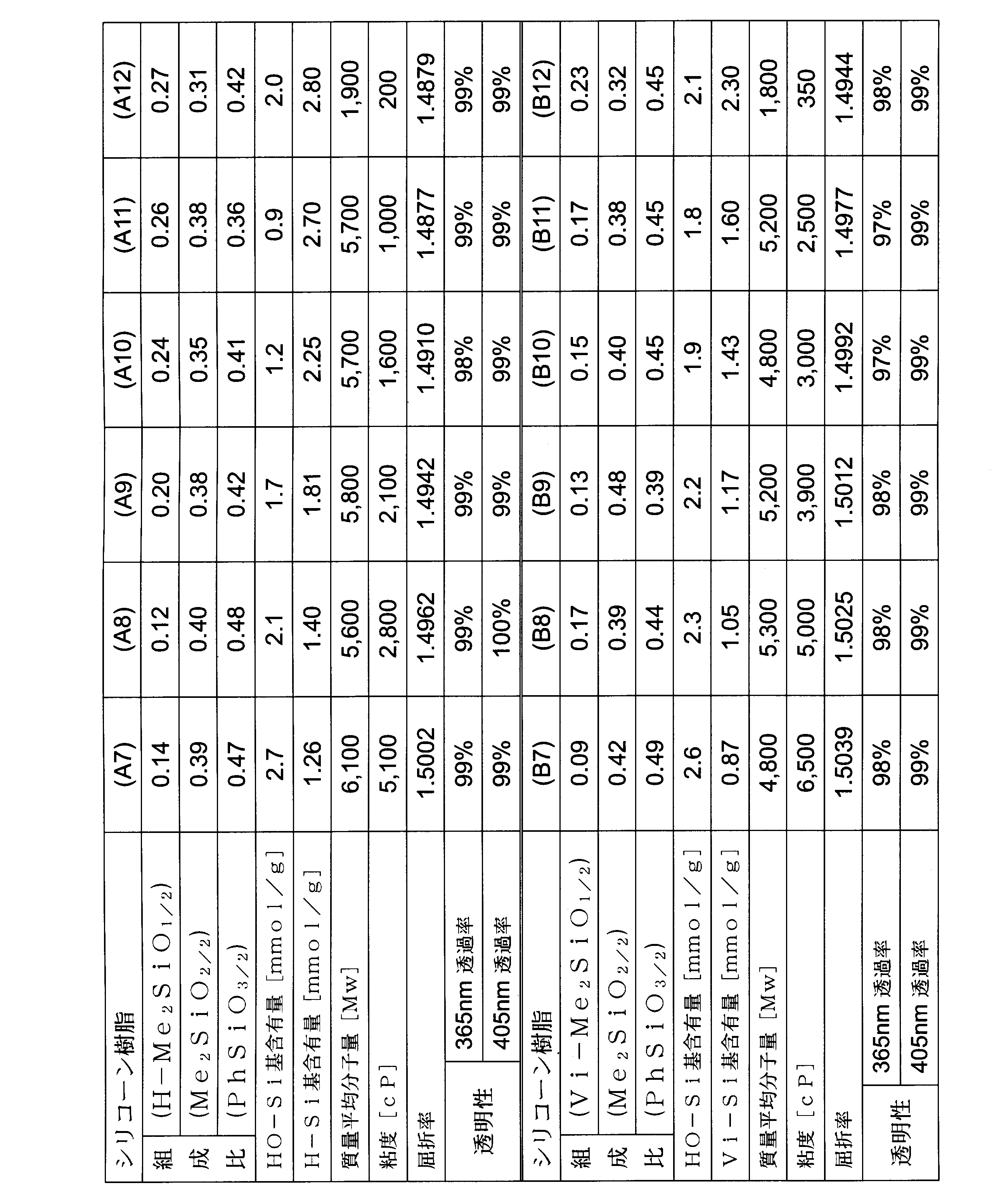
調製した組成物の粘度、該組成物から得られる硬化物の物理特性(硬度、密着性、透明性、線熱膨張係数、5%重量減少温度、接着強度)、硬化時の外観は、前述の実施例1~6および比較例1~3の測定方法に準じて測定した。また、硬化物の密着性については、3528SMD型PPA樹脂パッケージの代わりに6050SMD型PPA樹脂パッケージを用いた場合についても測定を行い、その測定方法を以下に示す。硬化物の打ち抜き成形性は、以下に測定方法に示す。なお、測定に用いる組成物は、(A)成分のシリコーン樹脂[シリコーン樹脂(A7)~(A12)]と、(B)成分のシリコーン樹脂[シリコーン樹脂(B7)~(B12)]を2:1の質量比で配合し、(C)成分の白金触媒と混合して実施例7~12の組成物を調製した。ここで、白金触媒としては、組成物全体量に対して、白金原子の含有量が質量単位で0.03ppmとなるように白金-ジビニルテトラメチルジシロキサン錯体を用いた。
調製した組成物を6050SMD型PPA(6.0mm×5.0mm×2.0mm)に流し込み、空気中90℃で1時間加熱し、さらに150℃で4時間加熱して硬化物とした検体を9検体作製した。これらの検体を光学顕微鏡で確認し、硬化物がパッケージから剥離したものを「剥離」、剥離しなかったものを「密着」と評価した。9検体中、「密着」と評価した検体の数を「合格数」として計上した。
調製した組成物を型(90mm×90mm×2mm)に流し込み、空気中90℃で1時間加熱し、さらに150℃で4時間加熱して板状硬化物を作製した。この板状硬化物を、JIS K 6251に準じてダンベル状8号形に打ち抜き成形した。硬化体の打ち抜き時に亀裂や樹脂欠けが生じずに打ち抜き成形できたものを「良好」と評価した。それ以外の場合には「不良」とした。
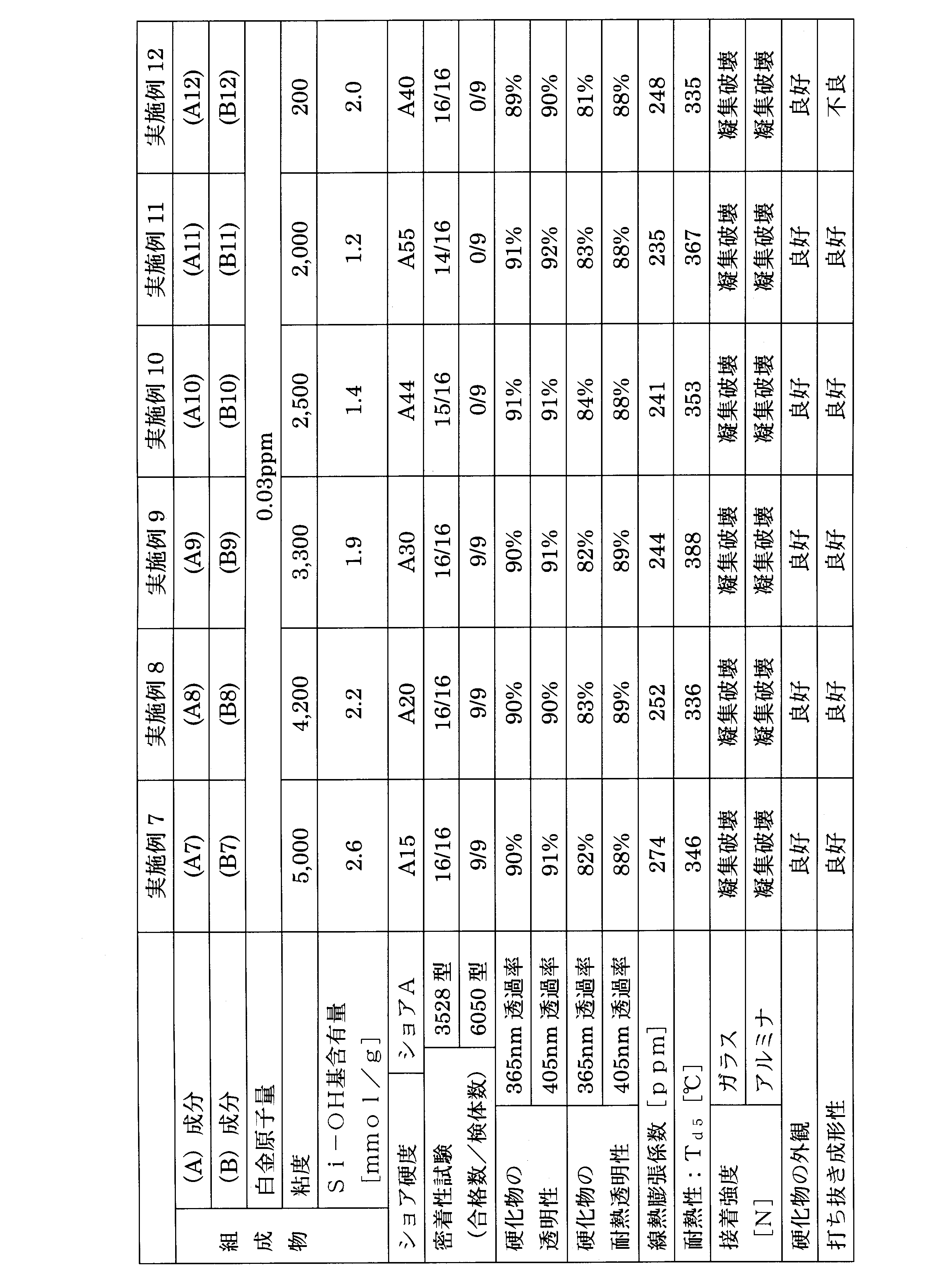
2…光半導体素子、
3…ボンディングワイヤー、
4…反射材、
5…リードフレーム、
6…光半導体基板、
10…光半導体装置。
Claims (15)
- (A)成分:下記式[1]で示され、ケイ素原子に結合する水素原子(SiH基)を含有するシリコーン樹脂、
(B)成分:下記式[2]で示され、ケイ素原子に結合するビニル基(Si-CH=CH2基)を含有するシリコーン樹脂、および
(C)成分:白金触媒
を少なくとも含み、(A)成分と(B)成分中のシラノール基(Si-OH基)の総含有量が0.5~5.0mmol/gであり、(C)成分中の白金原子の含有量が、(A)成分と(B)成分と(C)成分の合計質量に対して質量単位で0.003~3.0ppmである、硬化性シリコーン樹脂組成物。


- (A)成分中のケイ素原子に結合する水素原子のモル数:(B)成分中のケイ素原子に結合するビニル基のモル数が0.8:0.2~0.5:0.5である、請求項1に記載の硬化性シリコーン樹脂組成物。
- (A)成分において、a、b、cおよびdが、a:b:c:d=0.10~0.40:0.10~0.80:0.10~0.80:0~0.70であり、(B)成分において、e、f、gおよびhが、e:f:g:h=0.10~0.40:0.10~0.80:0.10~0.80:0~0.70である、請求項1または2に記載の硬化性シリコーン樹脂組成物。
- (A)成分において、a、b、cおよびdが、a:b:c:d=0.20~0.40:0.10~0.40:0.30~0.60:0.10~0.30であり、(B)成分において、e、f、gおよびhが、e:f:g:h=0.20~0.40:0.10~0.40:0.30~0.60:0.10~0.30である、請求項1乃至3のいずれか一項に記載の硬化性シリコーン樹脂組成物。
- (A)成分において、d=0であり、a、bおよびcが、a:b:c=0.05~0.40:0.10~0.80:0.10~0.80であり、(B)成分において、h=0であり、e、fおよびgが、e:f:g=0.05~0.40:0.10~0.80:0.10~0.80である、請求項1または2に記載の硬化性シリコーン樹脂組成物。
- 硬化遅延剤をさらに含む、請求項1乃至5のいずれか一項に記載の硬化性シリコーン樹脂組成物。
- 酸化防止剤または光安定剤をさらに含む、請求項1乃至6のいずれか一項に記載の硬化性シリコーン樹脂組成物。
- 接着付与剤、蛍光体および無機粒子からなる群から選ばれる一種以上をさらに含む、請求項1乃至7のいずれか一項に記載の硬化性シリコーン樹脂組成物。
- 離型剤、樹脂改質剤、着色剤、希釈剤、抗菌剤、防黴剤、レベリング剤およびタレ防止剤からなる群から選ばれる一種以上をさらに含む、請求項1乃至8のいずれか一項に記載の硬化性シリコーン樹脂組成物。
- 請求項1乃至9のいずれか一項に記載の硬化性シリコーン樹脂組成物を硬化してなる硬化物。
- 請求項1乃至9のいずれか一項に記載の硬化性シリコーン樹脂組成物の硬化物からなる封止材。
- 請求項1乃至9のいずれか一項に記載の硬化性シリコーン樹脂組成物を45℃以上、300℃以下で加熱して硬化させる、硬化性シリコーン樹脂組成物の硬化物の製造方法。
- 請求項1乃至9のいずれか一項に記載の硬化性シリコーン樹脂組成物の硬化物で、光半導体素子が少なくとも封止された光半導体装置。
- 請求項1乃至9のいずれか一項に記載の硬化性シリコーン樹脂組成物の硬化物からなる半導体用接着剤。
- 請求項14に記載の半導体用接着剤を用いた光半導体装置。
Priority Applications (3)
| Application Number | Priority Date | Filing Date | Title |
|---|---|---|---|
| KR1020177003741A KR20170032362A (ko) | 2014-07-24 | 2015-07-10 | 경화성 실리콘 수지 조성물 및 그 경화물, 및 이들을 이용한 광반도체 장치 |
| CN201580041251.7A CN106574118A (zh) | 2014-07-24 | 2015-07-10 | 固化性有机硅树脂组合物和其固化物,以及使用它们的光半导体装置 |
| US15/328,067 US20170218128A1 (en) | 2014-07-24 | 2015-07-10 | Curable Silicone Resin Composition, Cured Object Obtained Therefrom, and Optical Semiconductor Device Formed Using Same |
Applications Claiming Priority (6)
| Application Number | Priority Date | Filing Date | Title |
|---|---|---|---|
| JP2014-150494 | 2014-07-24 | ||
| JP2014150494 | 2014-07-24 | ||
| JP2015050137 | 2015-03-13 | ||
| JP2015-050137 | 2015-03-13 | ||
| JP2015-131140 | 2015-06-30 | ||
| JP2015131140A JP2016169358A (ja) | 2014-07-24 | 2015-06-30 | 硬化性シリコーン樹脂組成物およびその硬化物、並びにこれらを用いた光半導体装置 |
Publications (1)
| Publication Number | Publication Date |
|---|---|
| WO2016013421A1 true WO2016013421A1 (ja) | 2016-01-28 |
Family
ID=55162950
Family Applications (1)
| Application Number | Title | Priority Date | Filing Date |
|---|---|---|---|
| PCT/JP2015/069877 Ceased WO2016013421A1 (ja) | 2014-07-24 | 2015-07-10 | 硬化性シリコーン樹脂組成物およびその硬化物、並びにこれらを用いた光半導体装置 |
Country Status (2)
| Country | Link |
|---|---|
| TW (1) | TWI540182B (ja) |
| WO (1) | WO2016013421A1 (ja) |
Cited By (1)
| Publication number | Priority date | Publication date | Assignee | Title |
|---|---|---|---|---|
| WO2026034290A1 (ja) * | 2024-08-07 | 2026-02-12 | ダウ・東レ株式会社 | ポリシロキサン組成物およびその用途 |
Families Citing this family (1)
| Publication number | Priority date | Publication date | Assignee | Title |
|---|---|---|---|---|
| JP6656045B2 (ja) | 2016-03-29 | 2020-03-04 | 信越化学工業株式会社 | 担持白金触媒を含有する樹脂組成物、及びそれを用いた熱硬化性オルガノポリシロキサン組成物ならびにその硬化方法 |
Citations (7)
| Publication number | Priority date | Publication date | Assignee | Title |
|---|---|---|---|---|
| JP2005325174A (ja) * | 2004-05-12 | 2005-11-24 | Asahi Denka Kogyo Kk | ケイ素含有硬化性組成物、及びこれを熱硬化させた硬化物 |
| JP2006213789A (ja) * | 2005-02-02 | 2006-08-17 | Ge Toshiba Silicones Co Ltd | 硬化性オルガノポリシロキサン組成物及び半導体装置 |
| JP2006299099A (ja) * | 2005-04-21 | 2006-11-02 | Shin Etsu Chem Co Ltd | 光半導体素子封止用樹脂組成物及び光半導体素子 |
| JP2008127517A (ja) * | 2006-11-24 | 2008-06-05 | Momentive Performance Materials Japan Kk | 半導体封止用シリコーン組成物および半導体装置 |
| JP2009114365A (ja) * | 2007-11-08 | 2009-05-28 | Momentive Performance Materials Japan Kk | 光半導体用シリコーン接着剤組成物及びそれを用いた光半導体装置 |
| JP2012012524A (ja) * | 2010-07-01 | 2012-01-19 | Sekisui Chem Co Ltd | 光半導体装置用封止剤及びそれを用いた光半導体装置 |
| WO2014115742A1 (ja) * | 2013-01-25 | 2014-07-31 | セントラル硝子株式会社 | シリコーンを含む硬化性組成物およびその硬化物 |
-
2015
- 2015-07-10 WO PCT/JP2015/069877 patent/WO2016013421A1/ja not_active Ceased
- 2015-07-24 TW TW104124159A patent/TWI540182B/zh not_active IP Right Cessation
Patent Citations (7)
| Publication number | Priority date | Publication date | Assignee | Title |
|---|---|---|---|---|
| JP2005325174A (ja) * | 2004-05-12 | 2005-11-24 | Asahi Denka Kogyo Kk | ケイ素含有硬化性組成物、及びこれを熱硬化させた硬化物 |
| JP2006213789A (ja) * | 2005-02-02 | 2006-08-17 | Ge Toshiba Silicones Co Ltd | 硬化性オルガノポリシロキサン組成物及び半導体装置 |
| JP2006299099A (ja) * | 2005-04-21 | 2006-11-02 | Shin Etsu Chem Co Ltd | 光半導体素子封止用樹脂組成物及び光半導体素子 |
| JP2008127517A (ja) * | 2006-11-24 | 2008-06-05 | Momentive Performance Materials Japan Kk | 半導体封止用シリコーン組成物および半導体装置 |
| JP2009114365A (ja) * | 2007-11-08 | 2009-05-28 | Momentive Performance Materials Japan Kk | 光半導体用シリコーン接着剤組成物及びそれを用いた光半導体装置 |
| JP2012012524A (ja) * | 2010-07-01 | 2012-01-19 | Sekisui Chem Co Ltd | 光半導体装置用封止剤及びそれを用いた光半導体装置 |
| WO2014115742A1 (ja) * | 2013-01-25 | 2014-07-31 | セントラル硝子株式会社 | シリコーンを含む硬化性組成物およびその硬化物 |
Cited By (1)
| Publication number | Priority date | Publication date | Assignee | Title |
|---|---|---|---|---|
| WO2026034290A1 (ja) * | 2024-08-07 | 2026-02-12 | ダウ・東レ株式会社 | ポリシロキサン組成物およびその用途 |
Also Published As
| Publication number | Publication date |
|---|---|
| TW201609977A (zh) | 2016-03-16 |
| TWI540182B (zh) | 2016-07-01 |
Similar Documents
| Publication | Publication Date | Title |
|---|---|---|
| JP5526823B2 (ja) | シリコーン樹脂で封止された光半導体装置 | |
| JP2016169358A (ja) | 硬化性シリコーン樹脂組成物およびその硬化物、並びにこれらを用いた光半導体装置 | |
| WO2017010327A1 (ja) | 硬化性ポリボロシロキサン樹脂組成物およびその硬化物、並びにこれらを用いた光半導体装置 | |
| JP4911805B2 (ja) | 光半導体装置用封止剤及びそれを用いた光半導体装置 | |
| TWI696664B (zh) | 硬化性聚矽氧組合物、及光半導體裝置 | |
| WO2011125463A1 (ja) | 光半導体装置用封止剤及び光半導体装置 | |
| CN102449034A (zh) | 有机硅化合物、含有该有机硅化合物的热硬化性组成物及光半导体用密封材料 | |
| WO2017110468A1 (ja) | 熱硬化性樹脂組成物 | |
| JP2015172146A (ja) | 熱硬化性樹脂組成物及びそれを用いた物品 | |
| JP2017020005A (ja) | 硬化性ポリボロシロキサン樹脂組成物およびその硬化物、並びにこれらを用いた光半導体装置 | |
| KR20150023496A (ko) | 코팅제, 전기-전자 기기, 및 전기-전자 기기의 금속부의 보호 방법 | |
| JP2012111836A (ja) | 光半導体装置用封止剤及びそれを用いた光半導体装置 | |
| KR20140015215A (ko) | 경화성 조성물 | |
| WO2016013421A1 (ja) | 硬化性シリコーン樹脂組成物およびその硬化物、並びにこれらを用いた光半導体装置 | |
| TW201829629A (zh) | 硬化性聚矽氧組成物及使用其之光半導體裝置 | |
| JP2018111783A (ja) | 硬化性シリコーン樹脂組成物およびその硬化物、並びにこれらを用いた半導体装置 | |
| JP5323037B2 (ja) | 光半導体装置用封止剤及びそれを用いた光半導体装置 | |
| JP2013053186A (ja) | 光半導体装置用封止剤及びそれを用いた光半導体装置 | |
| KR20180108405A (ko) | 열경화성 수지 조성물 | |
| JP2017128707A (ja) | 硬化性シリコーン樹脂組成物およびその硬化物、並びにこれらを用いた光半導体装置 | |
| WO2018062513A1 (ja) | Led用封止材組成物 | |
| JP2012197328A (ja) | オルガノポリシロキサンの製造方法、光半導体装置用組成物及び光半導体装置 | |
| JP2018168216A (ja) | 硬化性シリコーン樹脂組成物およびその硬化物、並びにこれらを用いた半導体装置 | |
| WO2017056913A1 (ja) | 硬化性シリコーン樹脂組成物およびその硬化物、並びにこれらを用いた光半導体装置 | |
| JP2012197409A (ja) | 光半導体装置用封止剤及びそれを用いた光半導体装置 |
Legal Events
| Date | Code | Title | Description |
|---|---|---|---|
| 121 | Ep: the epo has been informed by wipo that ep was designated in this application |
Ref document number: 15824320 Country of ref document: EP Kind code of ref document: A1 |
|
| WWE | Wipo information: entry into national phase |
Ref document number: 15328067 Country of ref document: US |
|
| NENP | Non-entry into the national phase |
Ref country code: DE |
|
| ENP | Entry into the national phase |
Ref document number: 20177003741 Country of ref document: KR Kind code of ref document: A |
|
| 122 | Ep: pct application non-entry in european phase |
Ref document number: 15824320 Country of ref document: EP Kind code of ref document: A1 |