WO2016010107A1 - 塗装鋼板 - Google Patents
塗装鋼板 Download PDFInfo
- Publication number
- WO2016010107A1 WO2016010107A1 PCT/JP2015/070373 JP2015070373W WO2016010107A1 WO 2016010107 A1 WO2016010107 A1 WO 2016010107A1 JP 2015070373 W JP2015070373 W JP 2015070373W WO 2016010107 A1 WO2016010107 A1 WO 2016010107A1
- Authority
- WO
- WIPO (PCT)
- Prior art keywords
- coating film
- content
- outer coating
- steel sheet
- coated steel
- Prior art date
- Legal status (The legal status is an assumption and is not a legal conclusion. Google has not performed a legal analysis and makes no representation as to the accuracy of the status listed.)
- Ceased
Links
Images

Classifications
-
- B—PERFORMING OPERATIONS; TRANSPORTING
- B05—SPRAYING OR ATOMISING IN GENERAL; APPLYING FLUENT MATERIALS TO SURFACES, IN GENERAL
- B05D—PROCESSES FOR APPLYING FLUENT MATERIALS TO SURFACES, IN GENERAL
- B05D7/00—Processes, other than flocking, specially adapted for applying liquids or other fluent materials to particular surfaces or for applying particular liquids or other fluent materials
- B05D7/14—Processes, other than flocking, specially adapted for applying liquids or other fluent materials to particular surfaces or for applying particular liquids or other fluent materials to metal, e.g. car bodies
-
- B—PERFORMING OPERATIONS; TRANSPORTING
- B32—LAYERED PRODUCTS
- B32B—LAYERED PRODUCTS, i.e. PRODUCTS BUILT-UP OF STRATA OF FLAT OR NON-FLAT, e.g. CELLULAR OR HONEYCOMB, FORM
- B32B15/00—Layered products comprising a layer of metal
- B32B15/04—Layered products comprising a layer of metal comprising metal as the main or only constituent of a layer, which is next to another layer of the same or of a different material
- B32B15/08—Layered products comprising a layer of metal comprising metal as the main or only constituent of a layer, which is next to another layer of the same or of a different material of synthetic resin
Definitions
- the present invention relates to a coated steel sheet having excellent corrosion resistance and contamination resistance.
- the present invention relates to a coated steel sheet having excellent corrosion resistance and raindrop contamination when wrinkles occur in the coating film.
- the outer plate of metal equipment such as home appliances used indoors and outdoors is required to have excellent corrosion resistance. Further, the outer plate of metal equipment for outdoor use is often required to have excellent contamination resistance because contaminants often adhere to it. In particular, the outer plates of metal equipment used in rainy environments are likely to have streaks or spots due to rainwater containing dust such as dust, so it is required to have excellent resistance to raindrop contamination.
- a coated steel sheet in which a coating film for improving corrosion resistance and contamination resistance is formed on a base steel sheet is generally used as an outer plate of metal equipment.
- Patent Document 1 discloses a resin-coated metal plate that has excellent raindrop resistance and stain resistance, and also has high formability. According to Patent Document 1, cracks are not generated in the T-bending test, and high workability is obtained.
- Patent Document 2 discloses a chromium-free painted steel sheet that exhibits excellent corrosion resistance without containing a chromium-based rust preventive pigment with a large environmental load. According to Patent Document 2, it is possible to prevent rainwater and the like from remaining on the surface of the coating film by forming a hydrophilic top coating film on the undercoating film blended with the non-chromium rust preventive pigment, It is said that a coated steel sheet exhibiting sufficient corrosion resistance can be obtained without blending a chromium-based rust preventive pigment.
- An object of the present invention is to provide a coated steel sheet that is excellent in stain resistance (rain dripping resistance) and excellent in corrosion resistance when wrinkles occur in the coating film.
- the gist of the present invention is as follows.
- the coated steel sheet according to an aspect of the present invention includes a base steel sheet, an inner coating film disposed on the base steel sheet, and an outer coating film disposed on the inner coating film to be an outermost film.
- the outer coating film includes a silicate and melamine, and a region having a depth of less than 10 nm from the outer surface of the outer coating film toward the inner coating film is formed in the outer coating film.
- the outermost layer of the film, the region from the outer surface to the inner coating film having a depth of less than 0.1 ⁇ m is the surface layer of the outer coating film, and the region other than the surface layer in the outer coating film is the outer surface.
- the main body layer of the coating film, the Si content of the outermost layer is Si TS in unit mass%
- the Si content of the surface layer is Si S in unit mass%
- the Si content of the main body layer in unit mass% when the Si B, the Si TS, the Si S, and the Si B is, Si B ⁇ Si S ⁇ Si T , 7.0 ⁇ Si S ⁇ 50,7.0 ⁇ Si TS / Si B ⁇ 50, and satisfy simultaneously the and N TS the N content of the outermost layer in units mass%, a N content of the surface layer and N S in unit mass%, when the N B a N content of the body layer with unit mass%, the N TS, the N S, and wherein N B is, N S ⁇ N TS, 30 ⁇ N TS ⁇ 50 and 1.0 ⁇ N TS / N B ⁇ 3.0 are satisfied at the same time, and the depth profile curve of the N content of the outer coating film has a maximum value in a region where the depth is 0 or more
- the outer coating film may include at least one of tetraalkoxysilane or a partial hydrolysis condensate thereof as the silicate.
- the outer coating film may further contain a polyester resin.
- the base steel sheet may be a galvanized steel sheet.
- the coated steel plate according to the above aspect of the present invention can be suitably used as an outer plate of a metal device used outdoors.
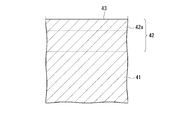
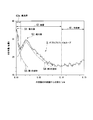
- FIG. 2 is an enlarged schematic cross-sectional view showing a main part of the coated steel sheet according to the present embodiment, and is an enlarged schematic cross-sectional view of a portion corresponding to part A in FIG. 1. It is a depth profile curve regarding N content of the outer coating film of the coated steel plate which concerns on this embodiment.
- the inventors of the present invention are coated steel sheets having excellent stain resistance, specifically, excellent raindrop resistance, in the case where wrinkles that reach the base steel sheet occur on the coating film surface.
- the following knowledge was obtained.
- FIG. 1 and FIG. 2 the cross-sectional schematic diagram of the coated steel plate which concerns on this embodiment is shown for reference.
- the coated steel plate 1 includes a base steel plate 2, an inner coating 3 disposed on the base steel 2, and an outer coating 4 disposed on the inner coating 3 and serving as an outermost film.
- the outer coating film 4 includes a silicate and melamine, and the outer coating film 4 has a depth of less than 10 nm from the outer surface 43 (coating film surface) of the outer coating film 4 to the inner coating film 3.
- the surface layer 42a, the region from the outer surface 43 to the inner coating 3 with a depth of less than 0.1 ⁇ m is the surface layer 42 of the outer coating 4, and the region other than the surface layer 42 in the outer coating 4 is the outer coating 42.
- the average Si content of the outermost layer 42 a is Si TS in unit mass%
- the average Si content of the surface layer 42 is Si S in unit mass%
- the average Si content of the main body layer 41 is a unit.
- Si TS , Si S , and Si B when Si B is expressed in mass%, the following formula 1, formula 2, and formula 3 are simultaneously Satisfied, also the N TS Average N content of the outermost layer 42a in unit mass%, and N S Average N content of the surface layer 42 at unit mass%, unit weight average N content of the body layer 41% in time to N B, N TS, the N S, and N B, equation 4 below, satisfactory formula 5, and equation 6 simultaneously, the depth profile curve 5 of the N content of the outer coating 4, the depth A region having a depth of 0 or more and less than 10 nm has a maximum value 51, a region having a depth of 10 nm or more and less than 0.1 ⁇ m has a maximum value 52, and a value obtained by dividing the maximum value 52 by
- the hydrophilicity facilitates cleaning of contaminants on the surface of the coating film
- the increased barrier properties make it difficult for contaminants to penetrate into the interior of the coating film.
- the outer coating film of the coated steel sheet contains silicate and melamine
- Si (silicon) derived from silicate has an effect of increasing the hydrophilicity of the outer coating film
- N (nitrogen) derived from melamine is an outer coating. It has the effect of increasing the barrier properties of the film.
- the present inventors have examined the relationship between the Si content of the outer coating film and the corrosion resistance, and as a result, when the Si content of the outer coating film satisfies the above conditions, it can be said qualitatively. For example, when the Si content increases toward the coating film surface, it was revealed that not only the hydrophilic property but also the corrosion resistance is improved. The detailed mechanism for improving the corrosion resistance is not yet clear, but is presumed as follows.
- cations such as Zn 2+ are eluted from the plated layer of the base steel sheet in a corrosive environment.
- This cation reacts with a silicate ion such as (SiO 3 ) 2- derived from a silicate in the outer coating film to form an insoluble salt and adheres to the heel part.
- This insoluble salt is considered to suppress the progress of corrosion of the base steel sheet. That is, it is considered that silicate ions derived from silicate serve as an inhibitor and improve the corrosion resistance of the coated steel sheet.
- the Si content of the outer coating film increases and the wettability of the coating film surface increases. That is, when the Si content of the outer coating film satisfies the above formulas 1 to 3, the contact area between the coating film surface and raindrops increases, and silicate ions are suitably eluted from the outer coating film. As a result, it is considered that the corrosion resistance of the coated steel sheet is preferably improved.
- the Si content of the outer coating film satisfies the above formulas 1 to 3
- the coated steel sheet Corrosion resistance is improved, and the hydrophilicity necessary for improving raindrop contamination is also increased.
- the barrier property of the outer coating film is affected by the N content of the outer coating film.
- the crosslinking density on the coating film surface increases, so that the barrier property of the outer coating film increases.
- the barrier property of the outer coating film is suitably increased, and contaminants are less likely to penetrate into the coating film. As a result, the raindrop contamination of the coated steel sheet is preferably improved.
- the outer coating film is baked and cured by heat transfer from the atmosphere, so that the temperature of the coating film rises excessively and Si is easily volatilized from the coating film surface. Therefore, the Si content on the coating film surface decreases, and the N content on the coating film surface becomes excessively high.
- the outer coating film is baked and cured by heat transfer from the induction-heated base steel plate, so that an excessive temperature rise on the coating film surface is suppressed, The volatilization of Si is suppressed. Therefore, the Si content increases toward the coating film surface, but the N content on the coating film surface decreases.
- the outer coating film is optimally controlled in the coated steel sheet according to the present embodiment.
- the depth profile curve of the N content of the outer coating film has a maximum value in a region having a depth of 0 or more and less than 10 nm, and a depth of 10 nm or more and less than 0.1 ⁇ m.
- the outer coating film is controlled so that the region has a maximum value and the value obtained by dividing the maximum value by the maximum value is 0.8 or more and less than 1.0.
- the Si content and the N content of the outer coating film are preferably controlled by the above formulas 1 to 6.
- FIG. 3 shows a depth profile curve of the N content of the outer coating film of the coated steel sheet according to this embodiment.
- the depth profile curve shown in FIG. 3 can be achieved only by optimally controlling the baking condition of the outer coating film. Specifically, when the outer coating film is baked, induction heating (IH) that transfers heat from the base steel plate to the coating surface, and hot air blowing that transfers heat from the coating surface to the base steel plate are optimally controlled.
- IH induction heating
- the first waveform 53 of the depth profile curve 5 is derived from a layered melamine self-condensate existing in the outermost layer.
- the second waveform 54 of the depth profile curve 5 is considered to be derived from granular melamine self-condensate and melamine crosslinked with polyester.
- the induction heating in which heat is transferred from the base steel plate to the coating surface and the hot air blowing in which heat is transferred from the coating surface to the base steel are heat transfer in directions opposite to each other. Therefore, the depth profile curve that satisfies the above-described conditions of the present embodiment is not achieved until the above-mentioned conflicting control conditions are individually and optimally controlled for the purpose of intentionally creating a depth profile curve with N content. Can be obtained.
- the depth profile curve of the N content of the outer coating film is affected by various baking conditions of the outer coating film. Therefore, a depth profile curve having an N content that satisfies the above-described conditions of the present embodiment cannot be obtained under simple baking conditions that are uniquely defined. It is necessary to individually and optimally control the induction heating that transfers heat from the base steel plate toward the coating surface and the hot air blowing that transfers heat from the coating surface toward the base steel plate. When only one of the two heating methods described above is dominant, a depth profile curve that satisfies the above conditions cannot be obtained. As a result, the Si content and the N content toward the coating film surface are not obtained. It becomes difficult to increase the amount at the same time.
- a depth profile curve with an N content satisfying the above conditions is intentionally created by optimally controlling the above-mentioned conflicting control conditions. Include. As a result, it becomes possible to control the Si content and the N content of the outer coating film so as to satisfy the above formulas 1 to 6.
- the processability of the outer coating is preferably improved.
- the outer coating film has a depth of 10 nm or more and less than 0.1 ⁇ m, and a self-condensate of melamine present in a granular form, and It is considered that melamine crosslinked with polyester is preferentially formed.
- This granular melamine self-condensate is considered to preferably improve the processability of the outer coating film due to its shape.
- this granular melamine self-condensate tends to lower the barrier property (stain resistance to raindrops) of pollutants.
- the outer coating film When the outer coating film is baked only by heating with hot air, it is difficult to obtain a depth profile curve having an N content such that the outer coating film has a maximum value in the region of the depth of 10 nm or more and less than 0.1 ⁇ m. Therefore, the N content of the outermost layer becomes excessively high and the Si content tends to decrease.
- the outer coating film when the outer coating film is baked only by induction heating, it is difficult to obtain a depth profile curve having an N content such that the outer coating film has the maximum value in the region of the depth of 0 to less than 10 nm. Therefore, the Si content of the outermost layer increases, but the N content tends to decrease.
- the baking conditions by hot air heating and induction heating are optimally controlled.
- the depth profile curve of the N content of the outer coating film satisfies the above conditions. Since the layered melamine self-condensate has a high crosslink density and is hard, when it is present in the outermost layer, the barrier property is preferably enhanced. If a large amount exists over the region, the outer coating tends to harden excessively.
- the granular melamine self-condensate and the like are preferably present in the outer coating film having a depth of 10 nm or more and less than 0.1 ⁇ m, it is considered that the workability of the outer coating film is preferably improved. .
- the corrosion resistance is improved by Si controlled within the above range, and the hydrophilicity necessary for improving the raindrop contamination is increased, and is controlled within the above range.
- the barrier property necessary for improving the raindrop resistance is improved by N, and the workability is also improved by the depth profile curve of the N content controlled to the above conditions.
- Outer coating film The outer coating film formed on the coated steel sheet according to the present embodiment contains silicate. Si derived from this silicate affects the hydrophilicity (wetting property) and corrosion resistance of the coated steel sheet.
- Si TS which is the Si content of the outermost surface layer of the outer coating film
- Si S which is the Si content of the outer layer of the outer coating film
- Si B which is the Si content of the main body layer of the outer coating film
- Si S which is Si content of the surface layer of an outer coating film needs to be 7.0 to 50 mass% as shown in said Formula 2.
- Si S is less than 7.0% by mass, the Si content in the surface layer (and the outermost layer) of the outer coating film is insufficient, and the above effect cannot be obtained.
- Si 2 S exceeds 50% by mass, the above effect is saturated.
- the upper limit of Si S is 45 mass% is preferably 40 mass%, the lower limit of Si S is 10 wt%, preferably 15% by mass.
- Si TS / Si B which is a value obtained by dividing Si TS , which is the Si content of the outermost layer of the outer coating film, by Si B , which is the Si content of the main body layer of the outer coating film, is expressed by Equation 3 above. As shown, it needs to be 7.0 or more and 50 or less. When Si TS / Si B is less than 7.0, the concentration of Si on the coating film surface is insufficient, and the supply of silicate ions over a long period of time when wrinkles occur on the coating film surface is insufficient. . Further, Si TS / Si B is of 50 greater than the effect is saturated. The upper limit of Si TS / Si B is preferably 45 and 40, and the lower limit of Si TS / Si B is preferably 10 and 15.
- Si B is Si content of the body layer of the outer coating is preferably 0.5 mass% or more and 10 mass%.
- the upper limit of Si B is more preferably 7% by mass and 5% by mass, and the lower limit of Si B is preferably 1% by mass and 2% by mass.
- the outer coating film formed on the coated steel sheet according to this embodiment contains melamine. N derived from this melamine affects the barrier properties of the coated steel sheet.
- N TS is the N content of the outermost layer of the outer coating
- N S is the N content of the surface layer of the outer coating film, as shown in Equation 4 above, must satisfy the N S ⁇ N TS There is.
- the N content is maximized in the outermost surface layer of the outer coating film. Therefore, the crosslinking density on the coating film surface is increased, and the barrier property is preferably improved.
- the above-described N TS, and the N S, and the N B is N content of the body layer of the outer coating film to satisfy the (N B + N S) ⁇ 2 ⁇ N TS preferred.
- N TS is the N content of the outermost layer of the outer coating, as shown in equation 5 above, it is necessary to be less than 30 wt% or more and 50 mass%.
- NTS is less than 30% by mass, the N content in the outermost layer of the outer coating film is insufficient, and the above effect cannot be obtained.
- NTS exceeds 50% by mass, a predetermined Si TS cannot be obtained.
- the upper limit of the N TS is 45 mass% is preferably 40 mass%, the lower limit of the N TS is preferably 35% by mass.
- the N TS is the N content of the outermost layer of the outer coating
- N TS / N B is a value obtained by dividing by N B is N content of the body layer of the outer coating, the equation 6 above As shown, it needs to be more than 1.0 and 3.0 or less. It is 1.0 or less N TS / N B, barrier properties of the coating film becomes insufficient, rain Who contamination property becomes insufficient. On the other hand, if N TS / N B is greater than 3.0, workability outermost layer is too hardened outer coating is deteriorated.
- the upper limit of the N TS / N B is preferably 2.5, the lower limit of the N TS / N B is preferably 1.2.
- N B is the N content of the body layer of the outer coating film is preferably more than 10 wt% and is 50 wt% or less.
- the upper limit of the N B is 45 mass% is preferably 40 mass%, the lower limit value of N B is 15 wt%, preferably 20% by mass.
- the outer coating film formed on the coated steel sheet according to this embodiment has an inclined structure with respect to the thickness direction.
- the depth profile curve of the N content has a maximum value in a region having a depth of 0 or more and less than 10 nm, and a depth of 10 nm or more and less than 0.1 ⁇ m.
- the region has a maximum value, and a value obtained by dividing the maximum value by the maximum value is 0.8 or more and less than 1.0.
- the maximum / maximum value is less than 0.8, the corrosion resistance, raindrop resistance, and workability in 1T bending tend to be insufficient.
- the Si content and the N content of the outer coating film are preferably controlled by the above formulas 1 to 6.
- the upper limit value of the above value obtained by dividing the maximum value by the maximum value is preferably 0.95, and the lower limit value is preferably 0.85.
- the outer coating film of the coated steel plate which concerns on this embodiment contains Ti (titanium) further.
- a Ti TS is Ti content of the outermost layer of the outer coating film
- a Ti B is a Ti content of the body layer of the outer coating film, it is preferable to satisfy the Ti TS ⁇ Ti B.
- the chemical component of the outer coating film of the coated steel sheet according to the present embodiment is not particularly limited as long as the above-described conditions are satisfied.
- an outer coating film is organic substance, an outer coating film contains C (carbon), O (oxygen), etc. as a chemical component.
- the content of C, O, etc. in the outer coating film need not be particularly limited in order to obtain the above effect.
- the content of each element in the outer coating film is measured using EPMA (Electron Probe Micro-Analyzer), XPS (X-ray Photoelectron Spectroscopy), AES (Atomic Emission Spectrometry), GDS (Glowco Spectral Measurement, etc.). do it.
- EPMA Electro Probe Micro-Analyzer
- XPS X-ray Photoelectron Spectroscopy
- AES Atomic Emission Spectrometry
- GDS Lowco Spectral Measurement, etc.
- the content of each element in the outer coating film is preferably measured using GDS.
- GDS uses GDS to continuously analyze the outer coating film from the outer surface (coating film surface) in the depth direction, and calculate the average content of each element in the outermost layer, surface layer, and main body layer. That's fine.
- the content of each element in the main body layer may be a measured value at a depth at which the influence of surface concentration is eliminated, for example, a depth of 1.0 ⁇ m.
- the film thickness of the outer coating film is not particularly limited. However, in order to ensure excellent raindrop contamination and drought corrosion resistance, the film thickness of the outer coating film is preferably 3 ⁇ m or more, and more preferably 5 ⁇ m or more. On the other hand, when the film thickness of the outer coating film is excessive, it is not only economically disadvantageous, but also crater-like defects may occur during painting baking. Therefore, it is preferable that the film thickness of an outer coating film is 50 micrometers or less, and it is more preferable that it is 40 micrometers or less.
- the hardness of the outermost layer of the outer coating film preferably has a Martens hardness HM determined by a nanoindentation method of 30 or more and 300 or less.
- the hardness of the surface layer of the outer coating film is preferably 10 or more and 100 or less, and the hardness of the main body layer of the outer coating film is preferably 10 or more and 100 or less.
- the silicate contained in the outer coating film contains at least one of tetraalkoxysilane or a partial hydrolysis condensate thereof.
- tetraalkoxysilane examples include tetramethoxysilane, tetraethoxysilane, tetrapropoxysilane and the like.
- silicate a commercially available product such as methyl silicate 51, ethyl silicate 40, or ethyl silicate 48 (above, manufactured by Colcoat Co.), or MKC silicate MS51, or MS56 (above, manufactured by Mitsubishi Chemical Corporation) is used. Also good.
- the resin used for the outer coating film is not particularly limited. What is necessary is just to select suitably by required performance, the kind of adhesive agent, etc. However, in consideration of the balance between bending workability and coating film hardness (scratch resistance), it is preferable to use a polyester-based, epoxy-based, or polyurethane-based resin.
- the crosslinking agent used with the resin and reacting in the baking and curing process uses melamine (alkyl etherified aminoformaldehyde resin, etc.) and, if necessary, commonly used ones such as isocyanate compounds and epoxy resins. Also good.
- melamine alkyl etherified aminoformaldehyde resin, etc.
- the outer coating film preferably contains a polyester resin or a melamine resin.
- the outer coating film may contain coloring pigments, extender pigments, rust preventive pigments, waxes and the like as necessary.
- Inner coating The inner coating of the coated steel sheet according to the present embodiment is not particularly limited. As the inner coating film, it is sufficient that at least one coating film is formed between the outer coating film and the base steel sheet (hereinafter referred to as “inner coating film” by combining coating films other than the outer coating film). Call).
- one film is usually considered to be sufficient, but two or more films may be provided depending on the application and required performance.
- the components of the inner coating film there are no particular restrictions on the components of the inner coating film, and it is preferable to include, for example, a polyester resin, a polyurethane resin, an epoxy resin, or a composite of these. Moreover, it is desirable to contain a crosslinking agent. In addition to the above-described components, extender pigments, rust preventive pigments, and the like may be included as necessary.
- the treatment liquid used for the coating base is not particularly limited.
- a silica-based treatment liquid in which an organic resin containing a silicon compound as a main film component is strongly increased can be used.
- the base steel plate of the coated steel plate according to the present embodiment is not particularly limited.
- ordinary steel carbon steel
- extremely low carbon steel high carbon steel
- killed steel high tensile steel
- Ni-containing steel Cr-containing steel
- the base steel plate may not have a plating layer, or may have a plating layer in order to improve corrosion resistance.
- This plating layer may be an electroplating layer, a hot dipping layer, or the like.
- Examples of the electroplating layer include electrogalvanizing, electro Zn—Ni alloy plating, and electro Zn—Fe alloy plating.
- the hot dip galvanizing layer includes hot dip galvanizing, alloying hot dip galvanizing, hot dip aluminum plating, hot dip Zn-Al alloy plating, hot dip Zn-Al-Mg alloy plating, hot dip Zn-Al-Mg-Si alloy plating, etc. Illustrated.
- the amount of plating adhesion is not particularly limited, and may be adjusted within a general range.
- the base steel plate is preferably a galvanized steel plate that easily elutes cations in a corrosive environment.
- This galvanized steel sheet may be either an electroplated steel sheet or a hot dip galvanized steel sheet as long as the plating layer contains zinc.
- elements other than zinc are also eluted from the base steel sheet as cations, so the base steel sheet may not be a galvanized steel sheet.
- the method for manufacturing the coated steel plate according to the present embodiment is not particularly limited.
- a coated steel sheet may be manufactured by the following manufacturing method shown as an example.
- the method for producing a coated steel sheet according to the present embodiment includes an inner coating film forming step for forming an inner coating film on a base steel sheet, and an outer coating film formation for forming an outer coating film that becomes an outermost film on the inner coating film. It is preferable to have a process.
- the base steel sheet is cleaned by degreasing as necessary, the surface of the base steel sheet is subjected to a coating base treatment as necessary, and then the inner coating film is formed.
- the component of the inner coating film is not particularly limited. What is necessary is just to select suitably according to a use.
- This paint needs to contain silicate and melamine, and in addition, preferably contains a base resin.
- the average Si content in the region (surface layer of the outer coating film) from the outer surface (coating film surface) of the outer coating film to a depth of less than 0.1 ⁇ m toward the inner coating film is It is necessary to be 7.0% by mass or more and 50% by mass or less. Therefore, the silicate content in the paint is desirably 0.1 to 30% by mass with respect to the whole paint.
- the lower limit value of the silicate content is desirably 1% by mass or more and 3% by mass or more, and the upper limit value of the silicate content is desirably 10% by mass or less and 7% by mass or less.
- the crosslinking agent in the paint is desirably 3 to 40 parts by mass with respect to 100 parts by mass of the base resin.
- a coloring pigment, an extender pigment, a rust preventive pigment, a wax and the like can be contained as necessary.
- the coating material comprises 0.1 to 10 parts by mass of silicate, 3 to 40 parts by mass of melamine resin, and other components such as a color pigment, extender pigment, rust preventive pigment, and 100 parts by mass of polyester resin.
- a total of 0 to 50 parts by mass of wax may be contained.
- This baking process is desirably performed using an induction heating furnace (IH furnace).
- IH furnace induction heating furnace
- the temperature of the coating film surface becomes higher than that of the base steel plate. Therefore, the temperature of the coating film surface rises excessively, and Si in the coating film may be volatilized.
- the IH furnace when the IH furnace is used, the temperature of the base steel plate becomes the highest because the base steel plate is directly heated (self-heating). Therefore, volatilization of Si contained in the coating film can be suppressed, and the average Si content in the surface layer of the outer coating film can be controlled to 7.0 mass% or more and 50 mass% or less.
- the average temperature of the base steel sheet is heated at a rate of temperature rise of 2 ° C./second to 10 ° C./second until the average temperature reaches from 210 to 250 ° C. from room temperature. preferable.
- the heated steel plate is held at a target processing temperature (holding temperature) for a predetermined processing time (holding temperature time).
- the baking temperature is preferably such that the average temperature of the base steel sheet is 210 to 250 ° C.
- the average temperature of the base steel sheet is less than 210 ° C, the coating film is insufficiently cured.
- the average temperature of the base steel sheet exceeds 250 ° C, the temperature of the coating film surface becomes excessively high and Si volatilization occurs. There is a fear.
- what is necessary is just to obtain
- the baking time may be appropriately adjusted within a range that sufficiently accelerates the curing of the coating film and does not cause Si volatilization.
- the depth profile curve of the N content can be preferably controlled.
- the average temperature of the hot air is 140 to 200 ° C. and the average wind speed of the hot air is 0.1 to 1.0 m / sec.
- This hot air blowing is an auxiliary process of the baking process using an IH furnace, and the hot air temperature is lower and the hot air volume is lower than the conventional hot air conditions. Moreover, it is preferable to blow said hot air from the direction which opposes with respect to the sheet passing direction of a steel plate.
- the depth profile curve of N content of the outer coating film of the coated steel sheet according to the present embodiment can be controlled for the first time by optimally combining the various baking conditions described above. Since the depth profile curve of the N content of the outer coating film is influenced by the various baking conditions described above, the baking conditions for controlling the depth profile curve are not uniquely determined.
- the heating rate is changed among the baking conditions in the IH furnace described above, the temperature distribution in the plate thickness direction changes in the paint (outer coating) during the baking process, and the coating from the base steel plate The heat transfer rate toward the surface changes. In this case, it is necessary to also change the hot air blowing conditions so that only the crosslinking reaction due to the IH furnace does not prevail.
- the heat transfer rate from the base steel sheet toward the coating film surface similarly changes. Also in this case, it is necessary to change the conditions for blowing hot air so that only the cross-linking reaction caused by the IH furnace is not dominant.
- the Si content in the outermost layer increases and the N content decreases.
- the Si content in the outermost layer becomes low and the N content becomes high.
- the first waveform 53 in the depth profile curve 5 shown in FIG. 3 tends to be strengthened by changing the hot air blowing condition in the direction of high temperature or high air volume.
- induction heating heat transfer from the base steel plate to the coating surface
- hot air blowing from the coating surface to the base steel plate
- the conflicting control conditions may be controlled individually and optimally. Specifically, regarding the baking conditions in the IH furnace and the blowing conditions of the hot air, it is only necessary to appropriately select a preferable value within the above numerical range and intentionally create a depth profile curve of the target N content. .
- the Si content and N content of the outer coating film are preferably controlled by the above formulas 1 to 6.
- the baking conditions in the IH furnace and the hot air blowing conditions are shown.
- the manufacturing method of the coated steel plate which concerns on this embodiment is not limited to the said method.
- the coated steel sheet according to the present embodiment can be manufactured even when electric heating is used instead of induction heating and light heating is used instead of blowing hot air.
- the outer coating film satisfies the above-mentioned technical characteristics, and therefore has excellent raindrop resistance and drought corrosion resistance.
- the conditions in the examples are one example of conditions adopted to confirm the feasibility and effects of the present invention.
- the present invention is not limited to this one condition example.
- the present invention can adopt various conditions as long as the object of the present invention is achieved without departing from the gist of the present invention.
- a hot-dip galvanized steel plate (plate thickness: 0.5 mm, plating adhesion amount per side: 60 g / m 2 ) was used as the base steel plate.
- Alkaline degreasing and water washing were performed on both surfaces (both plate surfaces) of the base steel plate.
- the both surfaces of the cleaned plate were subjected to a coating surface treatment using a silica-based chromium-free chemical conversion treatment solution (product name: Surfcoat EC2330) manufactured by Nippon Paint Co., Ltd. as a coating surface treatment solution.
- the coating for the inner coating film was applied with a bar coater to the both plate surfaces after the coating surface treatment.
- This inner coating film contains (20 parts by mass of melamine resin and 100 parts by mass of polyester resin, and 30 parts by mass in total of other pigments such as color pigments, extender pigments, rust preventive pigments and waxes) Paint.
- the inner coating film applied to both the plate surfaces was baked to form an inner coating film having a thickness of 5 ⁇ m.
- the coating for the outer coating was applied with a bar coater to both plate surfaces after the inner coating was formed.
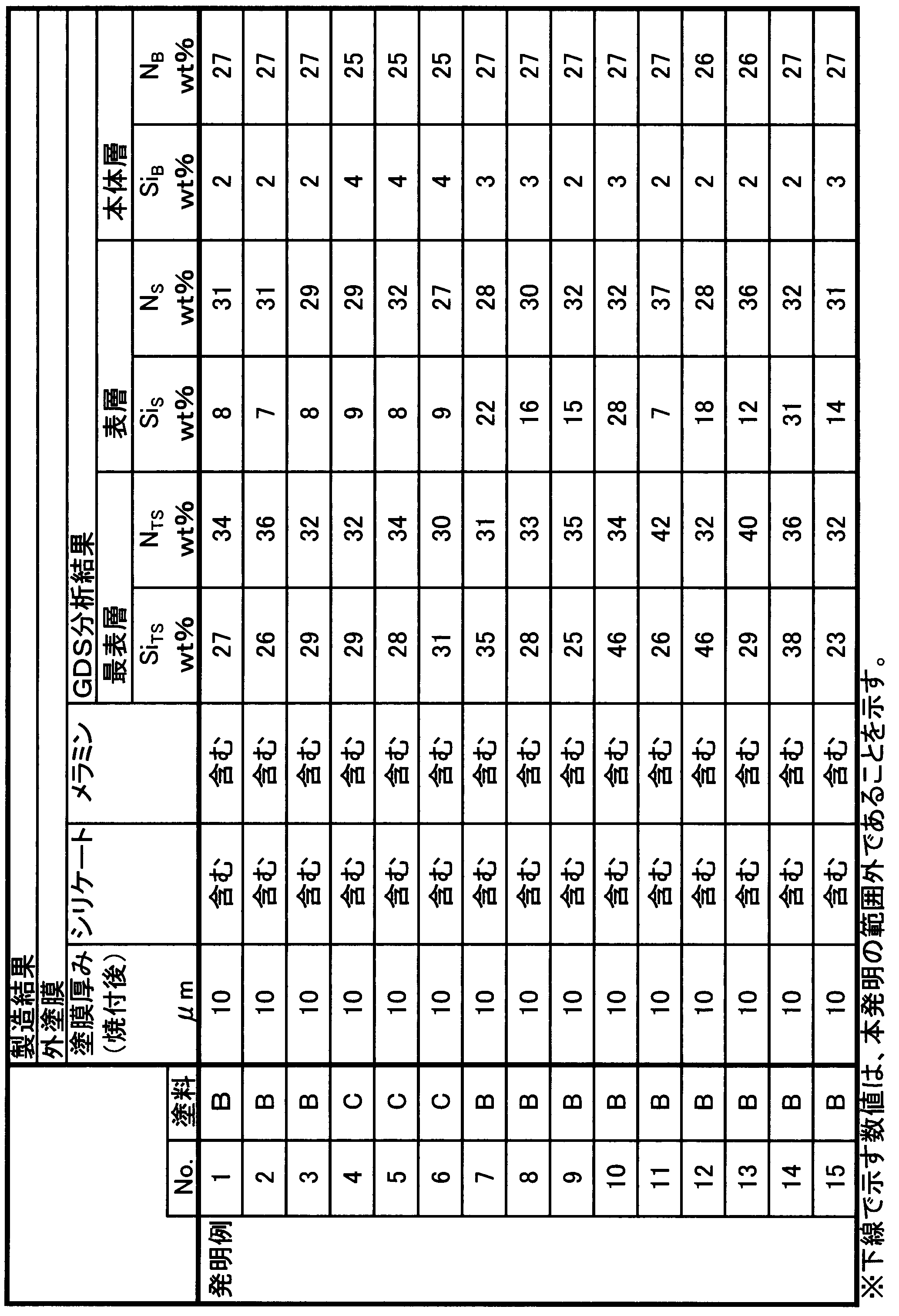
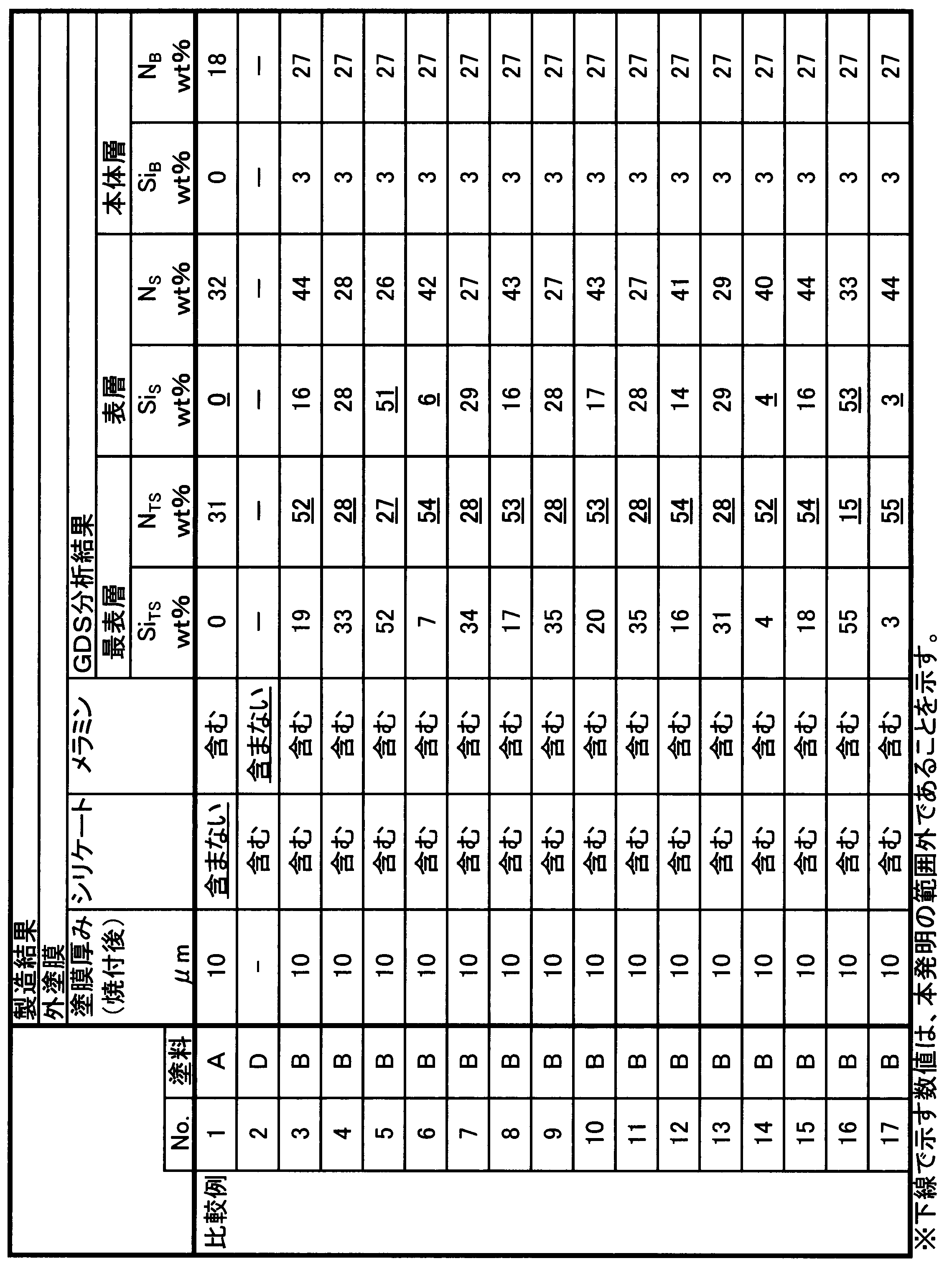
- Table 1 shows the composition of the coating for the outer coating film.
- the coating for the outer coating film comprises 0 to 10 parts by mass of silicate and 0 to 40 parts by mass of melamine resin with respect to 100 parts by mass of the polyester resin, It is a paint containing extender pigment, rust preventive pigment and wax.
- the steel sheet coated with the paint was baked by induction heating and / or hot air heating to form an outer coating film having a thickness of 10 ⁇ m. And about the manufactured coated steel plate, the analysis of the depth direction of an outer coating film was performed using GDS.
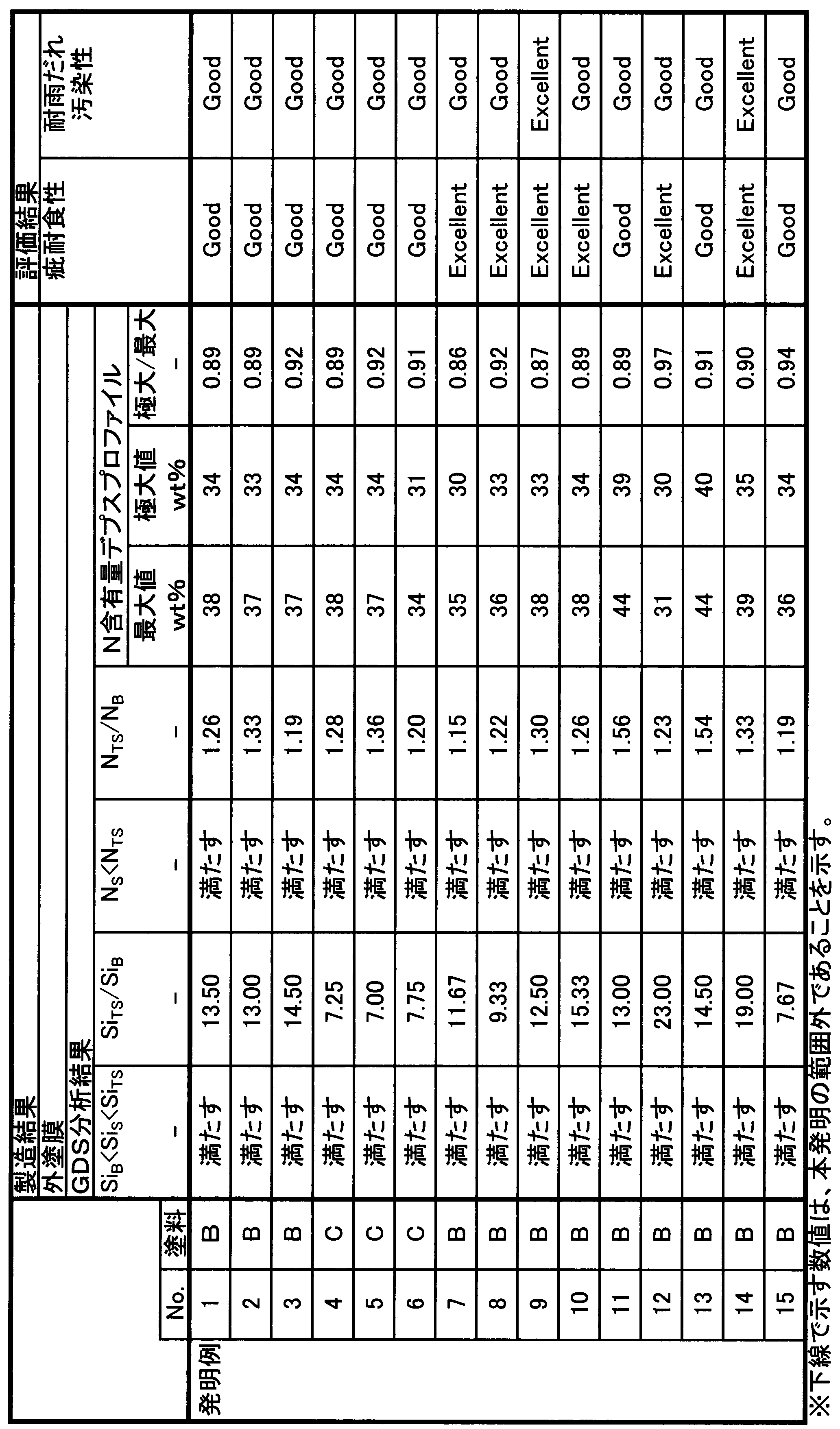
- the average Si content (Si TS ) and average N content (N TS ) of the outermost surface layer of the outer coating film, the average Si content (Si S ) and average N content (N S ) of the outer layer of the outer coating film, and Tables 2 to 5 show the average Si content (Si B ) and the average N content (N B ) of the main body layer of the outer coating film.
- the outermost layer of the outer coating film is a region from the outer surface (coating film surface) of the outer coating film to a depth (less than 10 nm) from the outer surface to the inner coating film.
- the depth is less than 0.1 ⁇ m
- the main body layer is a region other than the surface layer in the outer coating film.
- Corrosion test was performed using the manufactured coated steel sheet to evaluate corrosion resistance.
- As the corrosion test method a salt spray test was carried out for 500 hours under the conditions specified in JIS Z 2371 (2000), and the film swelling width of the end face of the test piece was measured. The base steel plate is exposed at the end face of the test piece. Therefore, the swollen width of the coating film on the end face can be used as an evaluation of the corrosion resistance.
- Table 3 and Table 5 show the evaluation results of corrosion resistance.
- Corrosion resistance is “Excellent” for coated steel sheets with a coating swelling width of 3 mm or less, “Good” for coated steel sheets with a coating swelling width of more than 3 mm and 5 mm or less, and a coated steel sheet with a coating swelling width of more than 5 mm. Poor ".
- “Excellent” represents the most excellent corrosion resistance.
- variety shows the grade of the swelling of the coating film accompanying corrosion of a base-material steel plate, and means that corrosion resistance is inferior, so that a value is large.
- a carbon black contamination test was conducted using the manufactured coated steel sheet, and the raindrop resistance was evaluated. This was done by dropping a 0.1% suspension of carbon black, drying it at 20 ° C., and then measuring the change in color tone of a test piece where the appropriate lower part was washed with running water. Tables 3 and 5 show the evaluation results of raindrop resistance.
- raindrop contamination “Excellent” is a coated steel sheet having a color change delta E of 3 or less
- “Good” is a coated steel sheet having a color change delta E of 3 or more and 5 or less
- a coated steel sheet having a color change delta E of 5 or more was determined as “Poor”.
- “Excellent” indicates that it is most excellent in rainproof and stain resistance.
- Reference numerals 1 to 15 are coated steel sheets on which outer coating films are formed by optimally controlling the baking conditions of induction heating and hot air heating.
- heating is performed at a rate of temperature increase of 2 to 10 ° C./second on average until the average temperature of the base steel sheet reaches a temperature range of 210 to 250 ° C. from room temperature. Hold for 0.5 to 120 seconds in the temperature range of 210 to 250 ° C, and after holding, the average temperature of the base steel sheet from the temperature range of 210 to 250 ° C to reach room temperature is the average cooling rate of 3 to 50 ° C Cooled at / sec. Further, during the baking process using the IH furnace, the average temperature of hot air is 140 to 200 ° C.
- the average speed of hot air is 0.1 to 1.0 m / sec with respect to the coating film surface (coating surface). Under such conditions, hot air was blown from the direction facing the sheet passing direction of the steel sheet. Control the depth profile curve of the N content of the outer coating by combining these induction heating and hot air heating conditions appropriately and controlling so that only one of the induction heating and hot air heating methods does not prevail. did.
- Comparative Example No. Nos. 1 to 17 are coated steel sheets in which an outer coating film is formed only by induction heating, coated steel sheets in which an outer coating film is formed only by hot air heating, or an outer coating film is formed by using induction heating and hot air heating together. Is a coated steel sheet that was not preferred.
- Comparative Example No. 1 is a coated steel sheet that does not contain silicate in the outer coating, and the outer coating Si S , Si B ⁇ Si S ⁇ Si TS , N S ⁇ N TS , and the N content depth profile did not satisfy the conditions . For this reason, the drought corrosion resistance and raindrop resistance were insufficient.
- Comparative Example No. 2 is a coated steel sheet that does not contain melamine in the outer coating film, and the crosslinking reaction of the outer coating film was insufficient. Therefore, it was not possible to evaluate the Si content and the N content of the outer coating film, the corrosion resistance and the raindrop contamination.
- Comparative Example No. 3 is a coated steel sheet in which the outer coating film was baked using induction heating and hot air heating in combination, and the average wind speed of the hot air was 1.1 m / sec, and N TS , Si TS / Si B of the outer coating film , And N content depth profile did not meet the conditions. For this reason, the drought corrosion resistance and raindrop resistance were insufficient.
- Comparative Example No. 4 is a coated steel sheet in which the outer coating film was baked by using induction heating and hot air heating together, and the average wind speed of the hot air was 0.05 m / sec, and N TS , N S ⁇ N TS of the outer coating film. , And N content depth profile did not meet the conditions. As a result, the resistance to raindrops was insufficient.
- Comparative Example No. 5 is a coated steel sheet in which the outer coating film was baked by using induction heating and hot air heating together, and the average wind speed of the hot air was 0.02 m / sec. N TS , Si S , and N of the outer coating film The content depth profile did not meet the conditions. As a result, the resistance to raindrops was insufficient.
- Comparative Example No. 6 is a coated steel plate in which the outer coating film was baked using induction heating and hot air heating in combination, and the average wind speed of the hot air was 5.0 m / second, and N TS , Si S , Si TS of the outer coating film / Si B and N content depth profile did not satisfy the conditions. For this reason, the drought corrosion resistance and raindrop resistance were insufficient.
- Comparative Example No. 7 has been baked outer coating in a combination of induction heating and hot air heating, a coated steel sheet average temperature of hot air was 130 ° C., the N TS and N content depth profile condition of the outer coating Did not meet. As a result, the resistance to raindrops was insufficient.
- Comparative Example No. 8 is a coated steel sheet in which the outer coating film was baked by using induction heating and hot air heating in combination, and the average heating rate in the IH furnace was 1 ° C./second. N TS and Si TS of the outer coating film / Si B and N content depth profile did not satisfy the conditions. For this reason, the drought corrosion resistance and raindrop resistance were insufficient.
- Comparative Example No. 9 is a coated steel sheet in which the outer coating film was baked by using induction heating and hot air heating in combination, and the average heating rate in the IH furnace was 11 ° C./second, and the outer coating film contained NTS and N.
- the quantity depth profile did not meet the requirements. As a result, the resistance to raindrops was insufficient.
- Comparative Example No. 10 is a coated steel sheet in which the outer coating film was baked by using induction heating and hot air heating in combination, and the holding temperature in the IH furnace was 200 ° C., and the outer coating film N TS , Si TS / Si B , And N content depth profile did not meet the conditions. For this reason, the drought corrosion resistance and raindrop resistance were insufficient.
- Comparative Example No. No. 11 is a coated steel sheet in which the outer coating film was baked using induction heating and hot air heating in combination, but the holding temperature in the IH furnace was 260 ° C., and the NTS and N content depth profile of the outer coating film was The condition was not met. As a result, the resistance to raindrops was insufficient.
- Reference numeral 12 denotes a coated steel sheet in which an outer coating film is baked by using induction heating and hot air heating in combination.
- Each condition of baking by induction heating and hot air heating satisfied the preferable numerical range of the present invention.
- the average temperature of hot air is 200 ° C. and the average wind speed of hot air is 1.0 m / sec
- the average heating rate in the IH furnace is 2 ° C./sec
- the holding temperature is 210 ° C. Since the holding time was 1 second, the crosslinking reaction caused by hot air heating became dominant.
- the outer coating N TS , Si TS / Si B , and the N content depth profile did not satisfy the conditions. For this reason, the drought corrosion resistance and raindrop resistance were insufficient.
- Reference numeral 13 denotes a coated steel sheet in which an outer coating film is baked using induction heating and hot air heating in combination.
- Each condition of baking by induction heating and hot air heating satisfied the preferable numerical range of the present invention.
- the average temperature of hot air is 140 ° C. and the average speed of hot air is 0.1 m / second
- the holding temperature in the IH furnace is 250 ° C. Became dominant.
- N TS , N S ⁇ N TS , and N content depth profile of the outer coating film did not satisfy the conditions. As a result, the resistance to raindrops was insufficient.
- Comparative Example No. 14 is a coated steel sheet in which the outer coating film was baked by using both induction heating and hot air heating, and the average temperature of the hot air was 220 ° C. and the average wind speed of the hot air was 5.0 m / sec.
- N TS , Si S , Si B ⁇ Si S ⁇ Si TS , Si TS / Si B , and the N content depth profile did not satisfy the conditions. For this reason, the drought corrosion resistance and raindrop resistance were insufficient.
- Comparative Example No. 15 is a coated steel sheet in which the outer coating film was baked using induction heating and hot air heating in combination, and the retention time in the IH furnace was 0 seconds, and the outer coating film N TS , Si TS / Si B , And N content depth profile did not meet the conditions. For this reason, the drought corrosion resistance and raindrop resistance were insufficient.
- Comparative Example No. 16 is a coated steel sheet in which the outer coating film is baked only by induction heating, and N TS , Si S , N S ⁇ N TS , N TS / N B , and the N content depth profile of the outer coating satisfy the conditions. There wasn't. As a result, the resistance to raindrops was insufficient.
- Comparative Example No. 17 is a coated steel sheet in which the outer coating film is baked only by heating with hot air, and the outer coating has N TS , Si S , Si B ⁇ Si S ⁇ Si TS , Si TS / Si B , and an N content depth profile. The condition was not met. For this reason, the drought corrosion resistance and raindrop resistance were insufficient.
- the coated steel plate according to the above aspect of the present invention can be suitably used as an outer plate of a metal device used outdoors. Therefore, industrial applicability is high.
Landscapes
- Life Sciences & Earth Sciences (AREA)
- Engineering & Computer Science (AREA)
- Wood Science & Technology (AREA)
- Laminated Bodies (AREA)
- Application Of Or Painting With Fluid Materials (AREA)
Abstract
Description
本願は、2014年7月16日に、日本に出願された特願2014-145821号に基づき優先権を主張し、その内容をここに援用する。
(2)上記(1)に記載の塗装鋼板では、前記外塗膜が、前記シリケートとして、テトラアルコキシシランまたはその部分加水分解縮合物のうちの少なくとも1つを含んでもよい。
(3)上記(1)または(2)に記載の塗装鋼板では、前記外塗膜が、さらに、ポリエステル樹脂を含んでもよい。
(4)上記(1)~(3)の何れか1項に記載の塗装鋼板では、前記基材鋼板が亜鉛めっき鋼板であってもよい。
SiB<SiS<SiTS ・・・(式1)
7.0≦SiS≦50 ・・・(式2)
7.0≦SiTS/SiB≦50 ・・・(式3)
NS<NTS ・・・(式4)
30≦NTS≦50 ・・・(式5)
1.0<NTS/NB≦3.0 ・・・(式6)
本実施形態に係る塗装鋼板に形成される外塗膜は、シリケートを含有する。このシリケートに由来するSiが、塗装鋼板の親水性(濡れ性)および疵耐食性に影響を与える。
本実施形態に係る塗装鋼板の内塗膜は、特に制限されない。内塗膜として、外塗膜と基材鋼板との間に、少なくとも1膜以上の塗膜が形成されていればよい(以下、外塗膜以外の塗膜をまとめて「内塗膜」と呼ぶ)。
本実施形態に係る塗装鋼板の基材鋼板は、特に制限されない。基材鋼板として、普通鋼(炭素鋼)、極低炭素鋼、高炭素鋼、キルド鋼、高張力鋼、Ni含有鋼、Cr含有鋼等が使用可能である。また、基材鋼板は、めっき層を有していなくてもよく、または耐食性を向上させるためにめっき層を有していてもよい。このめっき層は、電気めっき層、溶融めっき層等であってもよい。


2 基材鋼板
3 内塗膜
4 外塗膜
41 外塗膜の本体層
42 外塗膜の表層
42a 外塗膜の最表層
43 外塗膜の外表面(塗膜表面)
5 外塗膜のN含有量のデプスプロファイルカーブ
51 外塗膜のN含有量のデプスプロファイルカーブの最大値
52 外塗膜のN含有量のデプスプロファイルカーブの極大値
53 デプスプロファイルカーブ5の第1の波形
54 デプスプロファイルカーブ5の第2の波形
Claims (4)
- 基材鋼板と、
前記基材鋼板上に配された内塗膜と、
前記内塗膜上に配されて最外膜となる外塗膜と、
を備える塗装鋼板であって、
前記外塗膜が、シリケートとメラミンとを含み、
前記外塗膜の外表面から前記内塗膜に向かって深さが10nm未満までの領域を前記外塗膜の最表層とし、前記外表面から前記内塗膜に向かって深さが0.1μm未満までの領域を前記外塗膜の表層とし、前記外塗膜内で前記表層以外の領域を前記外塗膜の本体層とし、前記最表層のSi含有量を単位質量%でSiTSとし、前記表層のSi含有量を単位質量%でSiSとし、前記本体層のSi含有量を単位質量%でSiBとするとき、前記SiTS、前記SiS、および前記SiBが、
SiB<SiS<SiTS
7.0≦SiS≦50
7.0≦SiTS/SiB≦50
を同時に満足し、
前記最表層のN含有量を単位質量%でNTSとし、前記表層のN含有量を単位質量%でNSとし、前記本体層のN含有量を単位質量%でNBとするとき、前記NTS、前記NS、および前記NBが、
NS<NTS
30≦NTS≦50
1.0<NTS/NB≦3.0
を同時に満足し、
前記外塗膜のN含有量のデプスプロファイルカーブが、深さ0以上10nm未満の領域に最大値を持ち、深さ10nm以上0.1μm未満の領域に極大値を持ち、前記極大値を前記最大値で割った値が0.8以上1.0未満である
ことを特徴とする塗装鋼板。 - 前記外塗膜が、前記シリケートとして、テトラアルコキシシランまたはその部分加水分解縮合物のうちの少なくとも1つを含む
ことを特徴とする請求項1に記載の塗装鋼板。 - 前記外塗膜が、さらに、ポリエステル樹脂を含む
ことを特徴とする請求項1または請求項2に記載の塗装鋼板。 - 前記基材鋼板が亜鉛めっき鋼板である
ことを特徴とする請求項1から請求項3の何れか1項に記載の塗装鋼板。
Priority Applications (2)
| Application Number | Priority Date | Filing Date | Title |
|---|---|---|---|
| CN201580038183.9A CN106660321B (zh) | 2014-07-16 | 2015-07-16 | 涂装钢板 |
| JP2015552708A JP5880800B1 (ja) | 2014-07-16 | 2015-07-16 | 塗装鋼板 |
Applications Claiming Priority (2)
| Application Number | Priority Date | Filing Date | Title |
|---|---|---|---|
| JP2014-145821 | 2014-07-16 | ||
| JP2014145821 | 2014-07-16 |
Publications (1)
| Publication Number | Publication Date |
|---|---|
| WO2016010107A1 true WO2016010107A1 (ja) | 2016-01-21 |
Family
ID=55078593
Family Applications (1)
| Application Number | Title | Priority Date | Filing Date |
|---|---|---|---|
| PCT/JP2015/070373 Ceased WO2016010107A1 (ja) | 2014-07-16 | 2015-07-16 | 塗装鋼板 |
Country Status (4)
| Country | Link |
|---|---|
| JP (1) | JP5880800B1 (ja) |
| CN (1) | CN106660321B (ja) |
| MY (1) | MY163238A (ja) |
| WO (1) | WO2016010107A1 (ja) |
Cited By (1)
| Publication number | Priority date | Publication date | Assignee | Title |
|---|---|---|---|---|
| WO2019168041A1 (ja) * | 2018-03-02 | 2019-09-06 | 関西ペイント株式会社 | 塗装方法及び塗料組成物 |
Citations (4)
| Publication number | Priority date | Publication date | Assignee | Title |
|---|---|---|---|---|
| JPH1176933A (ja) * | 1997-09-04 | 1999-03-23 | Kansai Paint Co Ltd | 金属板の塗装方法及び汚れ防止性の優れた塗装金属板 |
| JP2005288963A (ja) * | 2004-04-02 | 2005-10-20 | Kobe Steel Ltd | 樹脂塗装金属板 |
| JP2008143108A (ja) * | 2006-12-12 | 2008-06-26 | Nippon Steel Corp | プレコート金属板及びその製造方法 |
| JP2010065075A (ja) * | 2008-09-08 | 2010-03-25 | Nisshin Steel Co Ltd | 耐汚れ付着性に優れた塗装鋼板用塗料および塗装鋼板 |
Family Cites Families (1)
| Publication number | Priority date | Publication date | Assignee | Title |
|---|---|---|---|---|
| TWI433898B (zh) * | 2009-10-20 | 2014-04-11 | Nippon Steel & Sumitomo Metal Corp | Chromium - free surface treatment of zinc - plated steel sheet |
-
2015
- 2015-07-16 MY MYPI2017700136A patent/MY163238A/en unknown
- 2015-07-16 CN CN201580038183.9A patent/CN106660321B/zh active Active
- 2015-07-16 WO PCT/JP2015/070373 patent/WO2016010107A1/ja not_active Ceased
- 2015-07-16 JP JP2015552708A patent/JP5880800B1/ja active Active
Patent Citations (4)
| Publication number | Priority date | Publication date | Assignee | Title |
|---|---|---|---|---|
| JPH1176933A (ja) * | 1997-09-04 | 1999-03-23 | Kansai Paint Co Ltd | 金属板の塗装方法及び汚れ防止性の優れた塗装金属板 |
| JP2005288963A (ja) * | 2004-04-02 | 2005-10-20 | Kobe Steel Ltd | 樹脂塗装金属板 |
| JP2008143108A (ja) * | 2006-12-12 | 2008-06-26 | Nippon Steel Corp | プレコート金属板及びその製造方法 |
| JP2010065075A (ja) * | 2008-09-08 | 2010-03-25 | Nisshin Steel Co Ltd | 耐汚れ付着性に優れた塗装鋼板用塗料および塗装鋼板 |
Non-Patent Citations (1)
| Title |
|---|
| HIROSHI KANAI: "Paint Film having Excellent Formability, Stain Resistance, and Hardness by Depth Profile Control of Melamine Resin", GEKKAN FINE CHEMICAL, vol. 31, no. 12, 15 July 2002 (2002-07-15), pages 28 - 34 * |
Cited By (3)
| Publication number | Priority date | Publication date | Assignee | Title |
|---|---|---|---|---|
| WO2019168041A1 (ja) * | 2018-03-02 | 2019-09-06 | 関西ペイント株式会社 | 塗装方法及び塗料組成物 |
| JPWO2019168041A1 (ja) * | 2018-03-02 | 2021-02-25 | 関西ペイント株式会社 | 塗装方法及び塗料組成物 |
| JP7225200B2 (ja) | 2018-03-02 | 2023-02-20 | 関西ペイント株式会社 | 塗装方法及び塗料組成物 |
Also Published As
| Publication number | Publication date |
|---|---|
| CN106660321A (zh) | 2017-05-10 |
| MY163238A (en) | 2017-08-30 |
| CN106660321B (zh) | 2018-01-23 |
| JP5880800B1 (ja) | 2016-03-09 |
| JPWO2016010107A1 (ja) | 2017-04-27 |
Similar Documents
| Publication | Publication Date | Title |
|---|---|---|
| CN105829568B (zh) | 具有改善的挠性的ZnAlMg涂覆的金属板及相应的制造方法 | |
| JP6341342B1 (ja) | 亜鉛系めっき鋼板用表面処理液、表面処理皮膜付き亜鉛系めっき鋼板の製造方法、及び表面処理皮膜付き亜鉛系めっき鋼板 | |
| JP2018062710A (ja) | 亜鉛系めっき鋼板用表面処理液、表面処理皮膜付き亜鉛系めっき鋼板の製造方法、及び表面処理皮膜付き亜鉛系めっき鋼板 | |
| CN102239011A (zh) | 制备用于高温应用的部件的方法和金属部件 | |
| ES2716302T3 (es) | Procedimientos de realización de una chapa prelacada con revestimientos ZnAlMg y chapa correspondiente | |
| KR101586979B1 (ko) | 칼라강판 및 그 제조방법 | |
| KR101920688B1 (ko) | 마그네슘 합금강판을 소재로 한 에어컨 실외기용 pcm 도료 조성물 및 이에 의해 제조된 pcm 도장강판 | |
| JP5880800B1 (ja) | 塗装鋼板 | |
| KR20160083313A (ko) | 단면 내식성이 우수한 도장강판 및 그 제조방법 | |
| JP4747625B2 (ja) | 耐食性と耐疵付き性に優れた表面処理鋼板及びその製造方法 | |
| KR102081372B1 (ko) | 내식성이 우수한 도장강판 및 그 제조방법 | |
| JP5163274B2 (ja) | プレコート金属板及びその製造方法 | |
| JP5532022B2 (ja) | 塗装鋼板 | |
| JP2007055137A (ja) | 塗装金属板 | |
| TWI864496B (zh) | 表面處理鋼材 | |
| JP6132078B1 (ja) | 黒色塗装鋼板 | |
| JP4751274B2 (ja) | フッ素樹脂塗装鋼板 | |
| JP2007175975A (ja) | 塗装亜鉛−アルミニウム合金めっき鋼板 | |
| JP6343505B2 (ja) | 建築用外装材 | |
| JP4892997B2 (ja) | プレコート鋼板およびその製造方法 | |
| KR101275819B1 (ko) | 강판 프린팅용 열경화성 잉크조성물 및 이를 이용한 강판 제조방법 및 그 강판 | |
| JP2019022953A (ja) | 塗装鋼板およびその製造方法、ならびにシャッタースラット | |
| JP6515330B2 (ja) | セルフクリーニング性塗装金属板 | |
| JP4317694B2 (ja) | 意匠性に優れた塗装金属板 | |
| JP4894766B2 (ja) | プレコート鋼板およびその製造方法 |
Legal Events
| Date | Code | Title | Description |
|---|---|---|---|
| ENP | Entry into the national phase |
Ref document number: 2015552708 Country of ref document: JP Kind code of ref document: A |
|
| 121 | Ep: the epo has been informed by wipo that ep was designated in this application |
Ref document number: 15822387 Country of ref document: EP Kind code of ref document: A1 |
|
| NENP | Non-entry into the national phase |
Ref country code: DE |
|
| WWE | Wipo information: entry into national phase |
Ref document number: IDP00201700671 Country of ref document: ID |
|
| 122 | Ep: pct application non-entry in european phase |
Ref document number: 15822387 Country of ref document: EP Kind code of ref document: A1 |