WO2016009649A1 - 表面処理アルミニウム材及びその製造方法、ならびに、当該表面処理アルミニウム材/樹脂層の接合体 - Google Patents
表面処理アルミニウム材及びその製造方法、ならびに、当該表面処理アルミニウム材/樹脂層の接合体 Download PDFInfo
- Publication number
- WO2016009649A1 WO2016009649A1 PCT/JP2015/003580 JP2015003580W WO2016009649A1 WO 2016009649 A1 WO2016009649 A1 WO 2016009649A1 JP 2015003580 W JP2015003580 W JP 2015003580W WO 2016009649 A1 WO2016009649 A1 WO 2016009649A1
- Authority
- WO
- WIPO (PCT)
- Prior art keywords
- oxide film
- aluminum material
- film layer
- aluminum oxide
- treated
- Prior art date
- Legal status (The legal status is an assumption and is not a legal conclusion. Google has not performed a legal analysis and makes no representation as to the accuracy of the status listed.)
- Ceased
Links
- HGCIXCUEYOPUTN-UHFFFAOYSA-N C1CC=CCC1 Chemical compound C1CC=CCC1 HGCIXCUEYOPUTN-UHFFFAOYSA-N 0.000 description 1
- 0 CCC1(CC2C)C(*)*(CC3)CC2C3C1 Chemical compound CCC1(CC2C)C(*)*(CC3)CC2C3C1 0.000 description 1
Images

Classifications
-
- B—PERFORMING OPERATIONS; TRANSPORTING
- B32—LAYERED PRODUCTS
- B32B—LAYERED PRODUCTS, i.e. PRODUCTS BUILT-UP OF STRATA OF FLAT OR NON-FLAT, e.g. CELLULAR OR HONEYCOMB, FORM
- B32B15/00—Layered products comprising a layer of metal
- B32B15/04—Layered products comprising a layer of metal comprising metal as the main or only constituent of a layer, which is next to another layer of the same or of a different material
- B32B15/08—Layered products comprising a layer of metal comprising metal as the main or only constituent of a layer, which is next to another layer of the same or of a different material of synthetic resin
-
- B—PERFORMING OPERATIONS; TRANSPORTING
- B32—LAYERED PRODUCTS
- B32B—LAYERED PRODUCTS, i.e. PRODUCTS BUILT-UP OF STRATA OF FLAT OR NON-FLAT, e.g. CELLULAR OR HONEYCOMB, FORM
- B32B15/00—Layered products comprising a layer of metal
- B32B15/20—Layered products comprising a layer of metal comprising aluminium or copper
-
- C—CHEMISTRY; METALLURGY
- C25—ELECTROLYTIC OR ELECTROPHORETIC PROCESSES; APPARATUS THEREFOR
- C25D—PROCESSES FOR THE ELECTROLYTIC OR ELECTROPHORETIC PRODUCTION OF COATINGS; ELECTROFORMING; APPARATUS THEREFOR
- C25D11/00—Electrolytic coating by surface reaction, i.e. forming conversion layers
- C25D11/02—Anodisation
- C25D11/04—Anodisation of aluminium or alloys based thereon
-
- C—CHEMISTRY; METALLURGY
- C25—ELECTROLYTIC OR ELECTROPHORETIC PROCESSES; APPARATUS THEREFOR
- C25D—PROCESSES FOR THE ELECTROLYTIC OR ELECTROPHORETIC PRODUCTION OF COATINGS; ELECTROFORMING; APPARATUS THEREFOR
- C25D11/00—Electrolytic coating by surface reaction, i.e. forming conversion layers
- C25D11/02—Anodisation
- C25D11/04—Anodisation of aluminium or alloys based thereon
- C25D11/18—After-treatment, e.g. pore-sealing
Definitions
- the present invention relates to a surface-treated aluminum material, a method for producing the same, and the surface-treated aluminum material / resin layer assembly, and more particularly, has excellent long-term adhesion and adhesion over the entire surface of the aluminum material.
- the present invention relates to a surface-treated aluminum material, a stable production method of such a surface-treated aluminum material, and the surface-treated aluminum material / resin layer assembly excellent in adhesion and adhesion.
- Aluminum materials or aluminum alloy materials are lightweight, have appropriate mechanical properties, and have excellent characteristics such as aesthetics, moldability, and corrosion resistance. Widely used in various containers, structural materials, machine parts, etc. While these aluminum materials may be used as they are, by applying various surface treatments, corrosion resistance, abrasion resistance, resin adhesion, hydrophilicity, water repellency, antibacterial properties, design properties, infrared radiation, high reflectivity In many cases, functions such as sex are added and improved.
- anodizing treatment for improving corrosion resistance and wear resistance
- anodizing treatment is widely used.
- an aluminum material is immersed in an acidic electrolytic solution and subjected to electrolytic treatment with a direct current, whereby a thickness of several to several tens of ⁇ m is formed on the surface of the aluminum material.
- Various processing methods have been proposed depending on the application.
- an alkaline alternating current electrolysis method as in Patent Document 1 comprises a porous aluminum oxide film layer having a thickness of 20 to 500 nm on the aluminum material surface and a barrier type aluminum oxide film layer having a thickness of 3 to 30 nm formed on the substrate side. Small holes having a diameter of 5 to 30 nm are formed, and the fluctuation range of the total thickness of the porous aluminum oxide film layer and the barrier type aluminum oxide film layer on the entire surface of the aluminum material is an arithmetic average of the total thickness. An oxide film that is within ⁇ 50% of the value is formed.
- an alkaline aqueous solution having an aluminum material electrode and a counter electrode, a pH of 9 to 13, a liquid temperature of 35 to 80 ° C., and a dissolved aluminum concentration of 5 ppm to 1000 ppm is used as an electrolytic solution, and a frequency of 20 to
- the above oxide film can be obtained by AC electrolytic treatment under the conditions of 100 Hz, current density of 4 to 50 A / dm 2 and electrolysis time of 5 to 60 seconds.
- the present invention provides a surface-treated aluminum material excellent in long-term adhesion and adhesion over the entire surface of the aluminum material, a stable production method of such a surface-treated aluminum material, and the surface excellent in adhesion and adhesion.
- the object is to provide a treated aluminum material / resin layer assembly.
- the present invention according to claim 1 includes an aluminum material and an oxide film formed on at least one of the surfaces thereof, and the oxide film is formed on the surface side of porous aluminum having a thickness of 20 to 500 nm. It comprises an oxide film layer and a barrier type aluminum oxide film layer having a thickness of 3 to 30 nm formed on the substrate side. Small pores having a diameter of 5 to 30 nm are formed in the porous aluminum oxide film layer.
- the surface-treated aluminum material was characterized in that the moisture contained in the film was 10 ⁇ g / cm 2 or less.
- the present invention provides that in claim 1, the fluctuation range of the total thickness of the porous aluminum oxide film layer and the barrier type aluminum oxide film layer is ⁇ 50% of the arithmetic average value of the total thickness. It was assumed to be within. It was.
- the present invention provides the method for producing a surface-treated aluminum material according to claim 1 according to claim 3, wherein the surface-treated aluminum material electrode and the counter electrode are used, the pH is 9 to 13, and the liquid temperature is 35 to 85 ° C.
- An electrolytic solution is applied to the surface of the aluminum material facing the counter electrode by subjecting it to an alternating current electrolytic treatment under the conditions of a frequency of 10 to 100 Hz, a current density of 4 to 50 A / dm 2 and an electrolysis time of 5 to 300 seconds. And the aluminum material on which the oxide film is formed is exposed to an atmosphere exceeding 150 ° C.
- the electrolytic solution of the alkaline aqueous solution contains 5 ppm or more and 1000 ppm or less of dissolved aluminum.
- the time t (second) for exposure to the atmosphere exceeding 150 ° C. is the porous aluminum oxide film layer thickness L (nm) and the atmospheric temperature is T (° C.). ) To satisfy the relationship of t ⁇ 20 ⁇ L / T.
- the surface temperature of the aluminum material in which the oxide film is formed by exposure to an atmosphere exceeding 150 ° C. after the end of the alternating current electrolysis treatment is 150 ° C. according to any one of claims 3 to 5. It was assumed that the time to reach was within 24 hours.
- the relative humidity of the atmosphere is 50% or less.
- the present invention provides a bonded body of surface-treated aluminum material / resin layer characterized in that, in claim 8, a resin layer is joined to the surface-treated surface of the surface-treated aluminum material according to claim 1 or 2. .
- the resin used for the resin layer has at least one polar functional group selected from an amino group, an amide group, an ester group, a carboxyl group, an epoxy group, and a hydroxyl group. It was.
- the value of the following formula 1 is 0.01 or more and 3 0.0 or less.
- a surface-treated aluminum material excellent in adhesiveness and adhesiveness can be formed on the entire surface of the aluminum material by uniformly forming a highly adhesive and highly adhesive oxide film that is stable over a long period of time against a resin or the like.
- the oxide film on the surface of the aluminum material has a two-layer structure of a porous aluminum oxide film layer and a barrier type aluminum oxide film layer.
- the porous aluminum oxide film layer having a thickness of 20 to 500 nm formed on the surface side of the aluminum material and having a small hole with a diameter of 5 to 30 nm suppresses its own cohesive failure. By increasing the surface area, the adhesiveness and adhesion to a bonded product such as a resin are improved.
- the barrier type aluminum oxide film layer having a thickness of 3 to 30 nm formed on the substrate side of the aluminum material is used to bond the aluminum substrate and the porous aluminum oxide film layer to improve the adhesion and adhesion.
- the moisture contained in the oxide film is 10 ⁇ g / cm 2 or less, the area where the bonded product such as resin comes into contact with the porous aluminum oxide film layer is increased, and the porous film is porous during a long period of time.
- the amount of water vapor generated inside the aluminum oxide film can be reduced, and as a result, high adhesion and adhesion can be maintained over a long period of time.
- the surface-treated aluminum material thus obtained can be applied to various applications by coating the treated surface with a joined material such as a resin due to its excellent adhesiveness.
- a resin when used as the bonded product, both a thermosetting resin and a thermoplastic resin are applicable, and various effects are imparted in combination with the oxide film formed on the specific treated surface of the present invention.
- the joined body of an aluminum material and a resin has a higher coefficient of thermal expansion than the aluminum material, the interface is easily peeled off or cut.
- the joined body of the surface-treated aluminum material and the resin according to the present invention since the adhesion is high, the stress generated at the joint interface due to the difference in the coefficient of thermal expansion is caused by the inside of the surface-treated aluminum material and / or the resin. Accumulated as stress. As a result, peeling and cutting at the interface are suppressed.
- the joined body of the surface-treated aluminum material and the thermoplastic resin according to the present invention can be suitably used as a lightweight and highly rigid composite material.
- the joined body of the surface-treated aluminum material and the thermosetting resin according to the present invention can be suitably used for printed wiring board applications and the like.
- the surface-treated aluminum material is stabilized by performing heat treatment under suitable conditions after the electrolytic treatment, in addition to appropriately setting the AC electrolytic treatment conditions. Can be manufactured.
- FIG. 6 is a chart of an infrared absorption spectrum for schematically explaining a region representing an integral value of a denominator of Equation 1.
- the surface-treated aluminum material according to the present invention has an oxide film formed on the surface thereof, and the oxide film has a porous aluminum oxide film layer formed on the surface side and a barrier type aluminum oxide film layer formed on the substrate side. It consists of. Small pores are formed in the porous aluminum oxide film layer.
- Aluminum material As the aluminum material used in the present invention, pure aluminum or an aluminum alloy is used. There is no restriction
- the plate thickness can be appropriately selected depending on the application, but is preferably 0.05 to 2.0 mm, more preferably 0.1 to 1.0 mm from the viewpoint of weight reduction and formability.
- a porous aluminum oxide film layer formed on the surface side and a barrier type aluminum oxide film layer formed on the substrate side are formed on the surface of the aluminum material. That is, an oxide film composed of two layers of a porous aluminum oxide film layer and a barrier type aluminum oxide film layer is provided on the surface of the aluminum material. While the porous aluminum oxide film layer exhibits strong adhesion and adhesion for a long period of time, the entire aluminum oxide film layer and the aluminum substrate are firmly bonded by the barrier type aluminum oxide film layer.
- Porous aluminum oxide film layer The thickness of the porous aluminum oxide film layer is 20 to 500 nm. If the thickness is less than 20 nm, the thickness is not sufficient, so that the formation of a small pore structure, which will be described later, is likely to be insufficient, and the adhesive force and adhesion force are reduced. On the other hand, when the thickness exceeds 500 nm, the porous aluminum oxide film layer itself tends to cohesively break down, and the adhesion is reduced.
- the thickness of the porous aluminum oxide film layer is preferably 50 to 400 nm.
- the porous aluminum oxide film layer has small holes extending from the surface in the depth direction.
- the diameter of the small holes is 5 to 30 nm, preferably 10 to 20 nm. This small hole increases the contact area between the resin layer, the adhesive, and the like and the aluminum oxide film, and exhibits the effect of increasing the adhesive force and the adhesive force. If the diameter of the small hole is less than 5 nm, the contact area is insufficient, and sufficient adhesive force and adhesion force cannot be obtained. On the other hand, if the diameter of the small holes exceeds 30 nm, the entire porous aluminum oxide film layer becomes brittle and causes cohesive failure, resulting in a decrease in adhesion and adhesion.
- the ratio of the total pore area of the small pores to the surface area of the porous aluminum oxide film layer is not particularly limited.
- the ratio of the total pore area of the small pores to the apparent surface area of the porous aluminum oxide film layer is 25 to 75%. preferable. If it is less than 25%, the contact area may be insufficient and sufficient adhesive force or adhesion may not be obtained. On the other hand, if it exceeds 75%, the entire porous aluminum oxide film layer becomes brittle and may cause cohesive failure, resulting in a decrease in adhesion and adhesion.
- the thickness of the barrier type aluminum oxide film layer is 3 to 30 nm. If the thickness is less than 3 nm, a sufficient bonding force cannot be imparted to the bonding between the porous aluminum oxide film layer and the aluminum substrate as the intervening layer, and the bonding force particularly in a severe environment such as high temperature and high humidity becomes insufficient. On the other hand, if the thickness exceeds 30 nm, the barrier type aluminum oxide film layer tends to cohesively break due to its denseness, and on the contrary, the adhesive strength and the adhesive strength are lowered.
- the thickness of the barrier type aluminum oxide film layer is preferably 5 to 25 nm.
- the moisture content contained in the oxide film must be 10 ⁇ g / cm 2 or less. Specifically, the moisture detected from 1 cm 2 of the apparent surface area portion (length ⁇ width) of the surface-treated aluminum material needs to be 10 ⁇ g / cm 2 or less. Considering the structure of the oxide film, it is considered that most of the contained moisture is adsorbed inside the porous aluminum oxide film layer. When the amount of water contained in the oxide film exceeds 10 ⁇ g / cm 2 , water vapor corresponding to the amount of water is generated particularly during a long period of time, and the oxide film undergoes volume expansion due to this water vapor.
- the volume expansion generates a peeling stress between the oxide film and a bonded material such as a resin, and dissociates hydrogen bonds generated at the bonding interface between the oxide film and the bonded material. As a result, the adhesive strength and adhesion after a long period of time are reduced.
- the lower limit of the amount of water is not particularly specified, but according to the measurement method described later, since the lower limit of detection is around 0.1 ⁇ g / cm 2 , the industrial lower limit is also 0.1 ⁇ g / cm2. It can be said to be about cm 2 .
- the amount of water contained in the oxide film is preferably 6 ⁇ g / cm 2 or less.
- the total thickness of the oxide film that is, the total thickness of the porous aluminum oxide film layer described in B-1 and the barrier type aluminum oxide film layer described in B-2 is Even if it is measured at any location of the aluminum material, the fluctuation range is preferably within ⁇ 50%, and more preferably within ⁇ 20%.
- the average value of the total thickness of the oxide film measured at a plurality of arbitrary locations on the surface of the aluminum material (10 or more are desirable, and it is desirable to have 10 or more measurement points in each location) is T (nm). In this case, it is desirable that the total thickness of the oxide film at all of the plurality of measurement points is in the range of (0.5 ⁇ T) to (1.5 ⁇ T).
- 10 sample pieces prepared under the same conditions are prepared, and the thickness of the entire oxide film is measured at 10 points for each sample, thereby obtaining a total of 100 measurement values for the samples prepared under the same conditions.
- the oxide film at that location becomes thinner than the surrounding area. Then, in this thin area, a gap is likely to occur between the adhesive, the resin layer to be bonded, etc., and the oxide film, and the sufficient contact area cannot be ensured and the adhesive force and adhesion force are reduced. There is.
- the oxide film at that location becomes thicker than its surroundings. Then, in this thick part, the stress from the resin layer etc. which should be joined concentrates, and the adhesive force and the adhesive force may fall relatively.
- the optical characteristics are different in the portion where the total thickness of the oxide film as described above is thin or thick, it may be visible as a change in color tone such as brownish brown or cloudy color.
- the alkaline aqueous solution used as the electrolytic solution in the AC electrolytic treatment step is a phosphate such as sodium phosphate, potassium hydrogen phosphate, sodium pyrophosphate, potassium pyrophosphate and sodium metaphosphate; sodium hydroxide and potassium hydroxide.
- An alkali metal hydroxide such as sodium carbonate, a carbonate such as sodium carbonate, sodium hydrogen carbonate, or potassium carbonate; an ammonium hydroxide; or an aqueous solution of a mixture thereof can be used. Since it is necessary to keep the pH of the electrolytic solution in a specific range as described later, it is preferable to use an alkaline aqueous solution containing a phosphate-based substance that can be expected to have a buffer effect.
- the concentration of the alkaline component contained in such an alkaline aqueous solution is adjusted so that the pH of the electrolytic solution becomes a desired value, but is usually 1 ⁇ 10 ⁇ 4 to 1 mol / liter, preferably 1 ⁇ 10 ⁇ 3 to 0.8 mol / liter.
- the pH of the electrolytic solution needs to be 9 to 13, and preferably 9.5 to 12.
- the alkaline etching power of the electrolytic solution is insufficient, so that the porous structure of the porous aluminum oxide film layer is incomplete.
- the pH exceeds 13 the alkaline etching power becomes excessive, so that the porous aluminum oxide film layer is difficult to grow, and the formation of the barrier type aluminum oxide film layer is further inhibited.
- the electrolytic solution temperature needs to be 35 to 85 ° C, preferably 40 to 70 ° C.
- the electrolytic solution temperature is less than 35 ° C.
- the alkaline etching ability is insufficient, and the porous structure of the porous aluminum oxide film layer becomes incomplete.
- the temperature exceeds 85 ° C., the alkaline etching force becomes excessive, and thus growth is inhibited in both the porous aluminum oxide film layer and the barrier type aluminum oxide film layer.
- the thickness of the entire oxide film including the porous aluminum oxide film layer and the barrier type aluminum oxide film layer is controlled by the quantity of electricity, that is, the product of the current density and the electrolysis time, and basically the quantity of electricity. As the amount increases, the thickness of the entire oxide film increases. From such a viewpoint, the AC electrolysis conditions of the porous aluminum oxide film layer and the barrier type aluminum oxide film layer are as follows.
- the frequency used for AC electrolysis is 10 to 100 Hz, preferably 20 to 90 Hz. If the frequency is less than 10 Hz, a direct current element increases as electrolysis. As a result, the formation of the porous structure of the porous aluminum oxide film layer does not proceed, resulting in a dense structure. On the other hand, when the frequency exceeds 100 Hz, the reversal of the anode and the cathode is too fast, so that the formation of the entire oxide film becomes extremely slow, and both the porous aluminum oxide film layer and the barrier type aluminum oxide film layer have a predetermined thickness. Takes an extremely long time.
- the electrolysis waveform in alternating current electrolysis is not specifically limited, Waveforms, such as a sine wave, a rectangular wave, a trapezoid wave, a triangular wave, can be used.
- the current density is 4 to 50 A / dm 2 , preferably 5 to 45 A / dm 2 .
- the current density is less than 4 A / dm 2 , since only the barrier type aluminum oxide film layer is formed preferentially, a porous aluminum oxide film layer cannot be obtained.
- the current becomes excessive, so that it is difficult to control the thickness of the porous aluminum oxide film layer and the barrier type aluminum oxide film layer, and processing unevenness is likely to occur.
- Electrolysis time is 5 to 300 seconds, preferably 10 to 240 seconds.
- the treatment time is less than 5 seconds, the formation of the porous aluminum oxide film layer and the barrier type aluminum oxide film layer is too rapid, so that neither oxide film layer is sufficiently formed, and it is composed of amorphous aluminum oxide. This is because it becomes an oxide film.
- it exceeds 300 seconds the porous aluminum oxide film layer and the barrier-type aluminum oxide film layer become too thick, and there is a risk of re-dissolution, and the productivity is further reduced.
- the concentration of dissolved aluminum contained in the electrolytic solution is preferably 5 ppm or more and 1000 ppm or less for the purpose of reducing the thickness variation of the oxide film. More preferably, it is 10 ppm or more and 800 ppm or less.
- the dissolved aluminum concentration is less than 5 ppm, the formation reaction of the oxide film at the initial stage of the electrolytic reaction takes place abruptly. Therefore, the thickness of the oxide film to be formed varies depending on the treatment process. It becomes easy to be affected by the mounting state of the aluminum material. As a result, a locally thick oxide film is formed.
- the concentration of dissolved aluminum exceeds 1000 ppm, the viscosity of the electrolytic solution increases and the uniform convection near the surface of the aluminum material is hindered in the electrolysis process, and at the same time, the dissolved aluminum acts to suppress film formation. . As a result, a thin oxide film is locally formed. If the dissolved aluminum concentration deviates from the above range, the fluctuation range of the total thickness of the porous aluminum oxide film layer and the barrier type aluminum oxide film layer on the entire aluminum material surface is within ⁇ 50% of the arithmetic average value of the total thickness. As a result, the adhesion strength and adhesion strength of the resulting oxide film may be reduced.
- One electrode of the pair of electrodes used for the alternating current electrolytic treatment is an aluminum material to be electrolytically treated.
- the other counter electrode for example, a known electrode such as a graphite, aluminum, or titanium electrode can be used.
- a graphite electrode is preferably used as the counter electrode. This is because the graphite electrode is chemically stable, inexpensive and easily available, and due to the action of many pores existing in the graphite electrode, the electric lines of force diffuse moderately in the AC electrolysis process. This is because the porous aluminum oxide film layer and the barrier type aluminum oxide film layer tend to be more uniform.
- both the aluminum material to be electrolytically processed and the counter electrode are flat, and the vertical and horizontal dimensions of the surfaces of the opposing aluminum material and the counter electrode are substantially the same, and both electrodes are stationary. It is preferable to perform the electrolysis operation in the state. In this case, an oxide film is formed on one surface of the aluminum material facing the counter electrode.
- an AC film is temporarily formed by forming an oxide film on one surface, and then the other surface is formed. The AC electrolysis treatment may be performed in the same manner by rearranging the electrodes so as to face the counter electrode.
- the surface of the aluminum material that has not been opposed to the counter electrode in the electrolysis process is repositioned so as to face the counter electrode, and the electrolysis process is repeated, An oxide film can be formed on a desired surface.
- the aluminum material obtained as described above is exposed to an atmosphere exceeding 150 ° C., moisture contained in the oxide film is effectively removed.
- moisture contained in the oxide film In a temperature environment of 150 ° C. or lower, water vapor cannot escape from the inside of the porous aluminum oxide film layer, and moisture contained in the oxide film cannot be removed.
- the atmosphere air, an inert gas such as nitrogen or argon, a mixed gas of these inert gases, a mixed gas of air and an inert gas, or the like can be used, but air is preferable from the viewpoint of economy.
- the relative humidity of the exposed atmosphere is preferably 50% or less, and more preferably 30% or less. If the relative humidity exceeds 50%, the moisture contained in the oxide film may not be removed effectively.
- the exposure time is t (seconds)
- the thickness of the porous aluminum oxide film layer is L (nm)
- the ambient temperature is T (° C.).
- x (L / T) This is a calculation formula based on the assumption that most of the water contained in the oxide film is adsorbed inside the porous aluminum oxide film layer, and the exposure time is proportional to the thickness of the porous aluminum oxide film layer. In many cases, it becomes shorter in inverse proportion to the ambient temperature.
- the coefficient 20 is a constant determined experimentally.
- about the upper limit of atmospheric temperature Preferably it is 500 degreeC, More preferably, it is 300 degreeC.
- the time until the surface temperature of the aluminum material that has been exposed to the atmosphere exceeding 150 ° C. to form an oxide film reaches 150 ° C. is less than 24 hours after the end of the AC electrolytic treatment. Preferably, it is within 12 hours.
- Moisture taken into the oxide film generated by the alternating current electrolysis process is fixed to aluminum hydroxide as Al 2 O 3 .nH 2 O (n is an integer of 1 to 3), although the amount is very small with time. There is a case.
- the moisture fixed to the aluminum hydroxide may be difficult to be removed by subsequent atmospheric exposure exceeding 150 ° C.
- the AC electrolytic treatment is performed through the steps of electrolytic treatment, washing with water, and drying.
- the starting time within 24 hours is the time when voltage application in the electrolytic treatment is stopped.
- a thermometer such as a thermocouple is in contact with the surface of the aluminum material that has been subjected to AC electrolytic treatment, and this is exposed to an atmosphere exceeding 150 ° C., and the thermometer shows 150 ° C. And when Normally, the thermometer shows 150 ° C. in about 60 seconds after starting exposure to an atmosphere exceeding 150 ° C.
- TEM transmission electron microscope
- the thickness of the porous aluminum oxide film layer and the barrier-type aluminum oxide film layer, and the diameter of the small holes in the porous aluminum oxide film layer should be prepared by TEM observation using a micro-microtome. Can be measured by.
- a method for measuring surface trace moisture using a temperature-programmed desorption gas analyzer can be used. Specifically, a surface-treated aluminum material is put in a closed cell and heated at a temperature rising rate of 10 to 60 ° C./min to a temperature 5 to 10 ° C. lower than the solidus temperature of the aluminum material. And it can measure by analyzing the gas component which generate
- an oxide film is formed on at least one of the surfaces of the aluminum material by the AC electrolytic treatment step, and then the moisture of the at least one oxide film is reduced by exposure to an atmosphere exceeding 150 ° C.
- a plate material is used as the aluminum material, only one surface may be a surface-treated surface, or both surfaces may be surface-treated surfaces.
- the surface can be used as a surface-treated surface by subjecting a desired surface to electrolytic treatment and exposure to an atmosphere exceeding 150 ° C.
- a surface-treated aluminum material / resin layer bonded body is obtained by bonding the resin layer to the surface-treated surface of the surface-treated aluminum material according to the present invention.
- the resin for the resin layer to be used various thermoplastic and thermosetting resins can be used.
- the resin layer is formed by contacting and infiltrating the porous aluminum oxide film layer with the resin that has been heated to flow, and then cooling and solidifying.
- an adhesive may be brought into contact with and permeated into the porous aluminum oxide film layer, and the resin layer may be bonded to the surface-treated aluminum material via this adhesive.
- a liquid type or a hot melt type can be used.
- the resin used for the resin layer bonded to the surface-treated surface of the surface-treated aluminum material according to the present invention is at least one polar functional group selected from an amino group, an amide group, an ester group, a carboxyl group, an epoxy group, and a hydroxyl group. It is preferable to have a seed.
- the resin has the above-mentioned polar functional group, not only the anchor effect caused by impregnation of the porous aluminum oxide film with the resin, but also the polar functional group and the oxide film are attracted by Coulomb force and / or hydrogen bonding force. By meeting, excellent primary adhesion. Furthermore, since the moisture contained in the oxide film formed on the surface-treated surface of the surface-treated aluminum material according to the present invention is 10 ⁇ g / cm 2 or less, the Coulomb force as the bonding force at the bonding interface between the oxide film and the resin. And / or water does not inhibit the hydrogen bonding force, and is excellent in secondary adhesion.
- the numerical value represented by the formula 1, that is, the abundance ratio of the polar functional group in the resin is 0.01 or more and 3.0. It is preferable that
- the molecule of Formula 1 is an infrared absorption spectrum derived from an amino group, an amide group, an ester group, a carboxyl group, an epoxy group, and a hydroxyl group, a wave number range where the spectrum appears, and an integral value of a region surrounded by a horizontal axis. That is, it defines the amount of polar functional groups present in the resin.
- the denominator of Formula 1 is an integral value of an infrared absorption spectrum derived from an aliphatic hydrocarbon and a benzene ring, a wave number range in which the spectrum appears, and a region surrounded by a horizontal axis. As shown schematically in FIG.
- the abundance other than the polar functional group present in the resin is defined. That is, Formula 1 defines the abundance ratio of the polar functional group in the resin with respect to the skeleton structure, and it can be said that the higher the value, the richer the polar component.
- thermoplastic resin examples include polyolefin (polyethylene, polypropylene, etc.), polyvinyl chloride, polyester (polyethylene terephthalate, polybutylene terephthalate, etc.), polyamide, polyphenylene sulfide, aromatic polyether ketone (polyether ether ketone, polyether).
- Ketone, etc. polystyrene, various fluororesins (polytetrafluoroethylene, polychlorotrifluoroethylene, etc.), ethylene- (meth) acrylic acid copolymer, propylene- (meth) acrylic acid copolymer, acrylic resin (polymethacrylic) Acid methyl, etc.), ABS resin, polycarbonate, thermoplastic polyimide and the like can be used.
- Polyester, polyamide, ethylene- (meth) acrylic acid copolymer, propylene- (meth) acrylic acid copolymer, and thermoplastic polyimide are preferable.
- thermosetting resin when used, the resin in a fluid state before curing may be brought into contact / penetration with the porous aluminum oxide film layer and then cured. Also, instead of such a curing method, a liquid type or hot melt type adhesive is contacted and infiltrated into the porous aluminum oxide film layer in the same manner as a thermoplastic resin, and the resin layer is surfaced through this adhesive. You may join to a process aluminum material.
- thermosetting resin for example, phenol resin, epoxy resin, melamine resin, urea resin, unsaturated polyester resin, alkyd resin, polyurethane, thermosetting polyimide and the like can be used.
- thermoplastic resin or thermosetting resin may be used alone, or may be used as a polymer alloy in which a plurality of types of thermoplastic resins or a plurality of types of thermosetting resins are mixed. Moreover, you may improve physical properties, such as the intensity
- Examples 1 to 33 and Comparative Examples 1 to 12 As the aluminum material, a JIS5052-H34 alloy flat plate having a length of 200 mm, a width of 400 mm, and a thickness of 1.0 mm was used. This aluminum alloy plate was used as one electrode, and a graphite plate having a flat plate shape of 300 mm long ⁇ 500 mm wide ⁇ 2.0 mm thick was used as the counter electrode. One surface of the aluminum alloy plate is opposed to the counter electrode, and on the surface layer of the one surface facing this, a porous aluminum oxide film layer on the surface side and a barrier type aluminum oxide film layer on the substrate side are formed. Both electrodes were placed. An alkaline aqueous solution mainly composed of sodium pyrophosphate was used as the electrolytic solution.
- the alkaline component concentration of the electrolytic solution was 0.5 mol / liter, and the pH was adjusted with hydrochloric acid and a sodium hydroxide aqueous solution (both concentrations were 0.1 mol / liter).
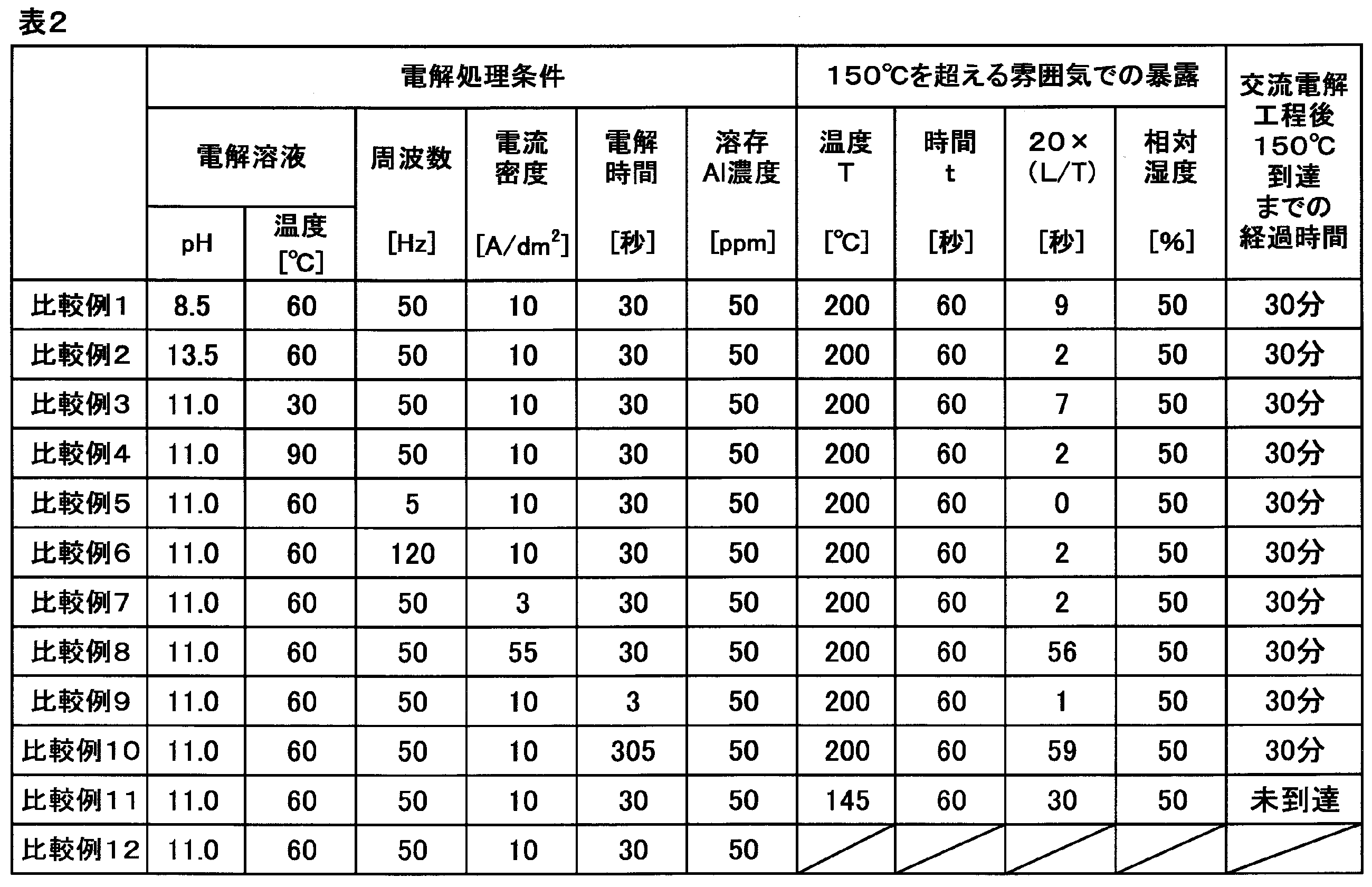
- AC electrolytic treatment is performed under the electrolysis conditions shown in Tables 1 and 2 to form a porous aluminum oxide film layer and a barrier type aluminum oxide film layer, and an air atmosphere exceeding 150 ° C. under the conditions shown in Tables 1 and 2 Exposure in was performed.
- the atmospheric air temperature was less than 150 ° C.
- Comparative Example 12 no atmospheric exposure was performed.
- “elapsed time until reaching 150 ° C. after the AC electrolysis step” is the time until the surface of the aluminum material reaches 150 ° C. starting from the time when the voltage application of the electrolytic treatment is stopped.
- a test material was prepared in which an oxide film composed of a porous aluminum oxide film layer and a barrier type aluminum oxide film layer was formed on one surface of the aluminum material.
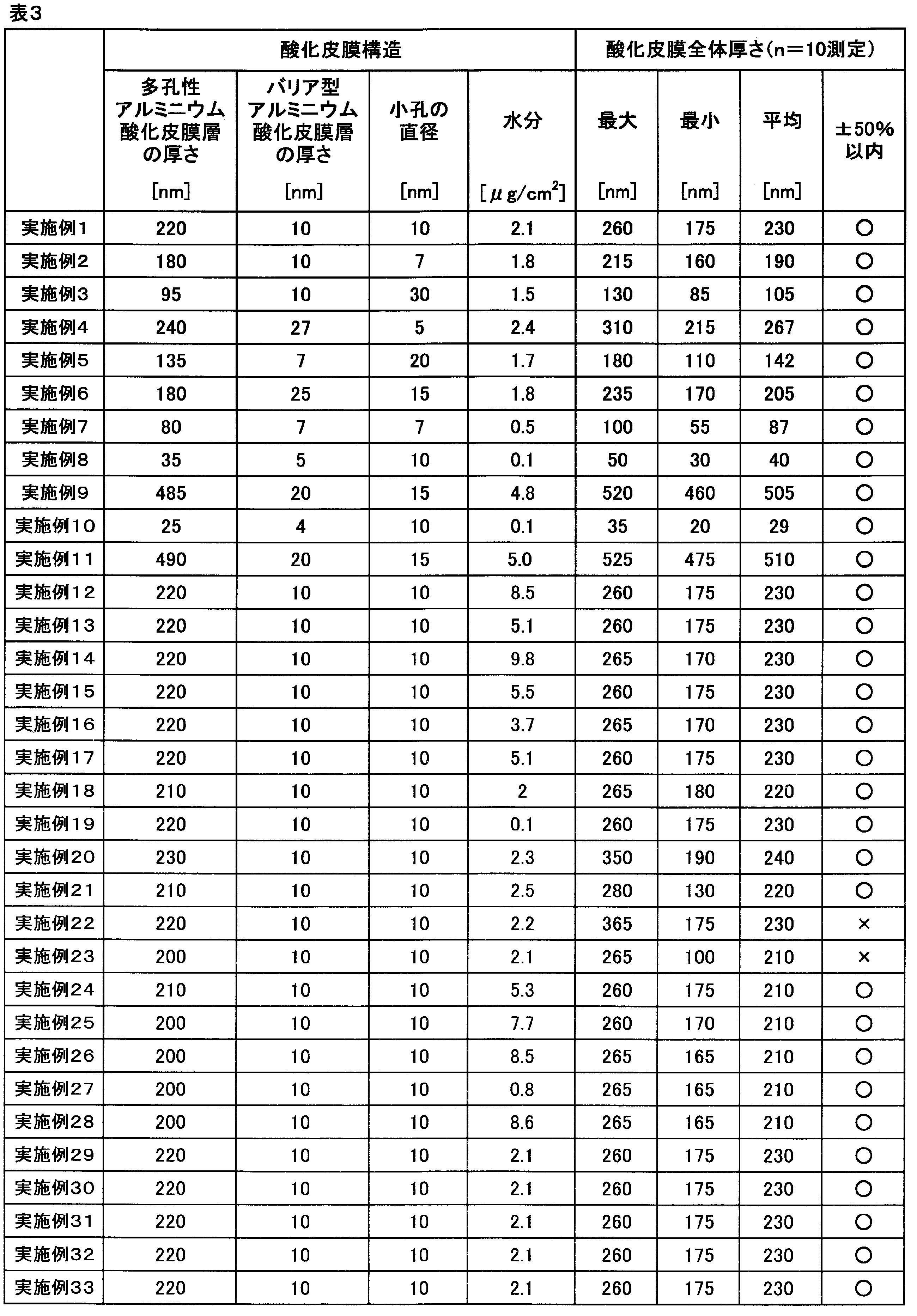
- the specimen prepared as described above was subjected to cross-sectional observation by TEM and measurement of water content by TDS-MS.
- TEM cross-sectional observation an ultramicrotome was used to measure the thickness of the porous aluminum oxide film layer and the barrier type aluminum oxide film layer, and the diameter of the small holes in the porous aluminum oxide film layer. From this, a slice sample for cross-sectional observation was prepared.
- the thin piece sample was cross-sectionally observed with a TEM, and the thicknesses of the porous aluminum oxide film layer and the barrier type aluminum oxide film layer at any 10 points in the observation field (1 ⁇ m ⁇ 1 ⁇ m), and the porous aluminum oxide
- the diameter of the small holes in the coating layer was measured at each point, and the arithmetic average value of each was taken as the measurement result.
- the temperature rising rate was set to 30 ° C./min, the temperature was raised to 620 ° C., and the abundance per unit area of water molecules was measured.
- the total thickness was obtained by adding the thicknesses of the coating layers to obtain the oxide coating thickness at each point.
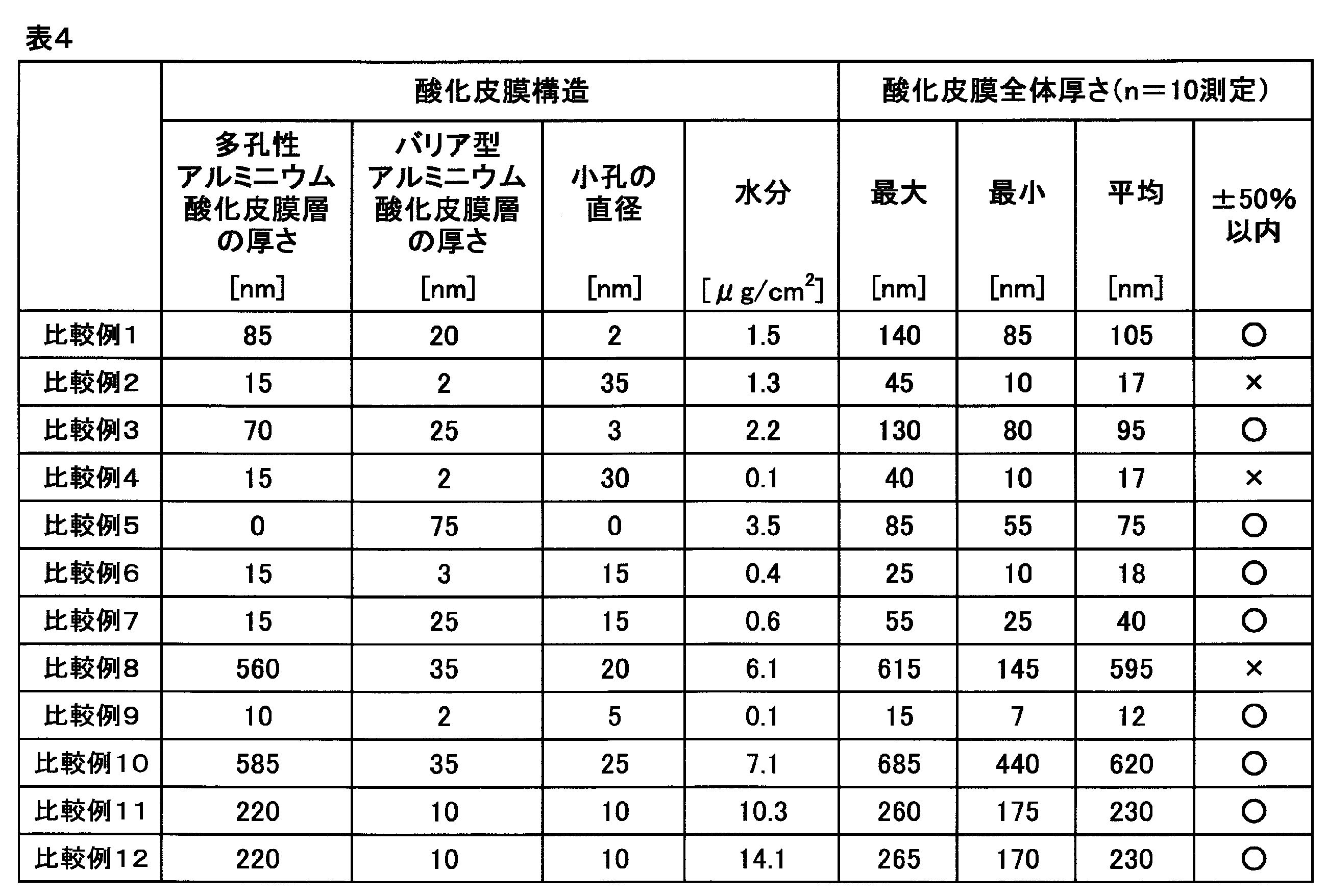
- the maximum value, the minimum value, and the arithmetic mean value of the 100 oxide film thicknesses obtained in this way are shown in the column of “total oxide film thickness” in Tables 3 and 4. Furthermore, it was examined whether or not the fluctuation range of the oxide film thickness at these 100 points was within ⁇ 50% of the arithmetic average value. Specifically, when the arithmetic average value is T (nm), the total thickness including the maximum value and the minimum value is in the range of (0.5 ⁇ T) to (1.5 ⁇ T). The case where it existed was set as (circle) and the case where it was not in the range was set as x.
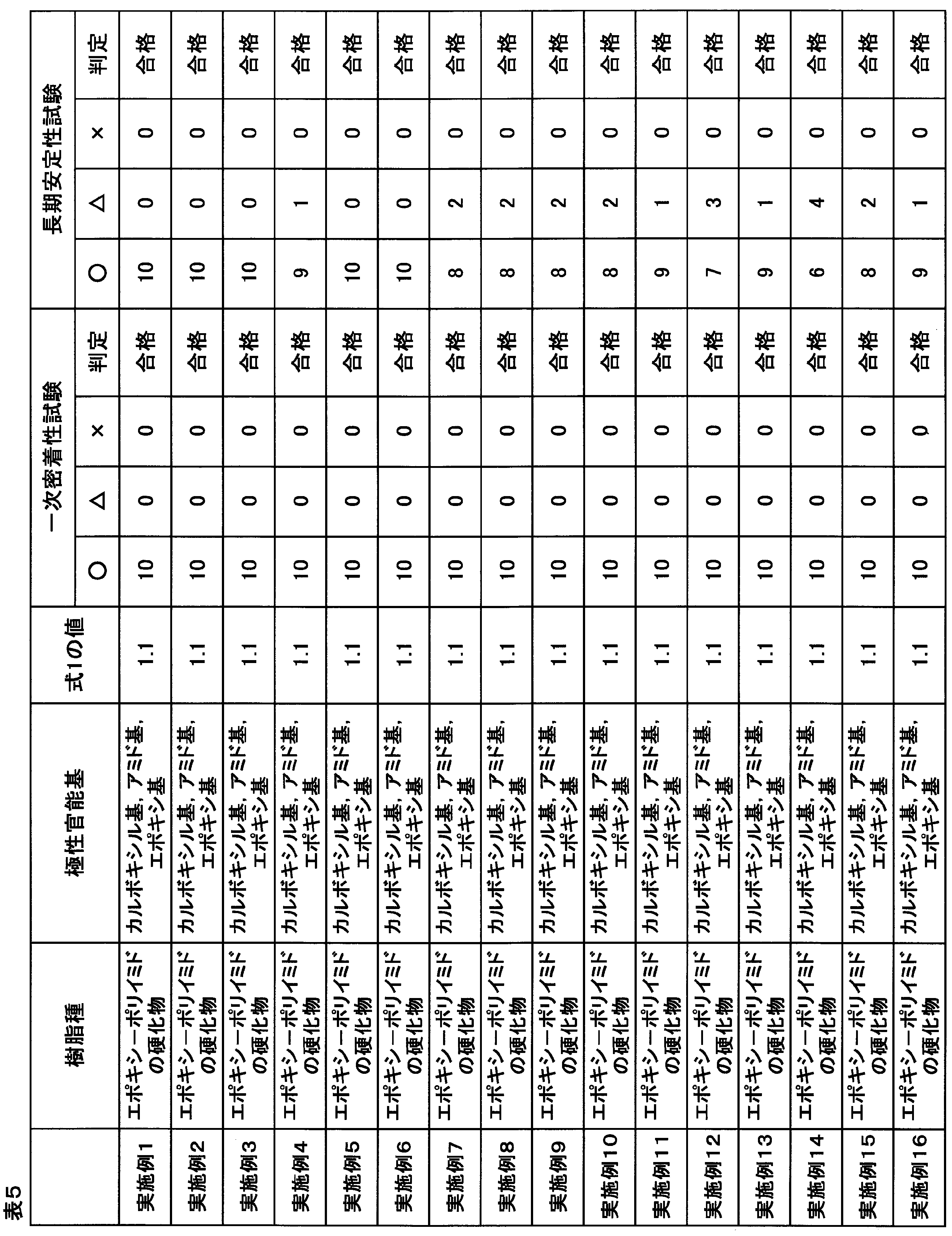
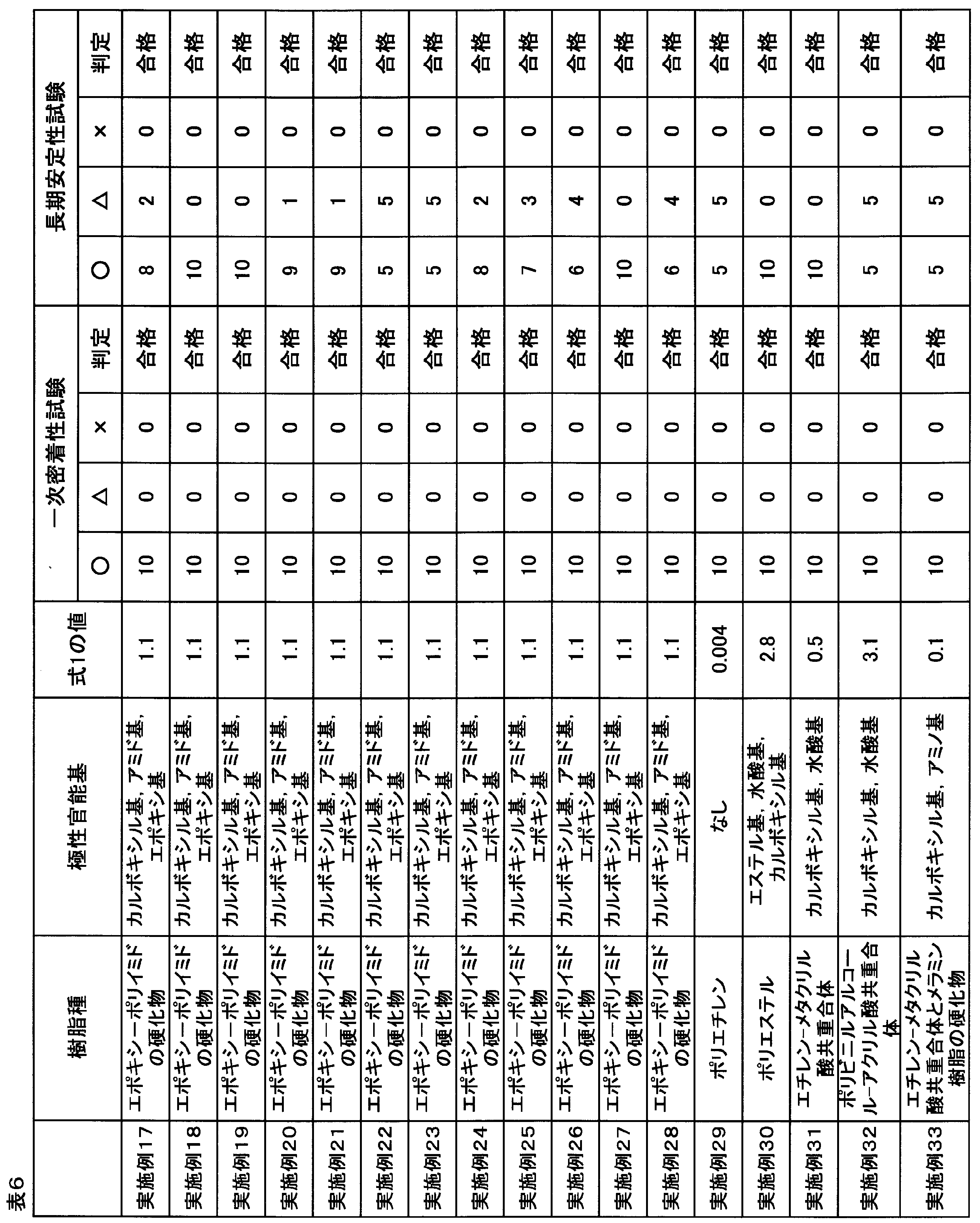
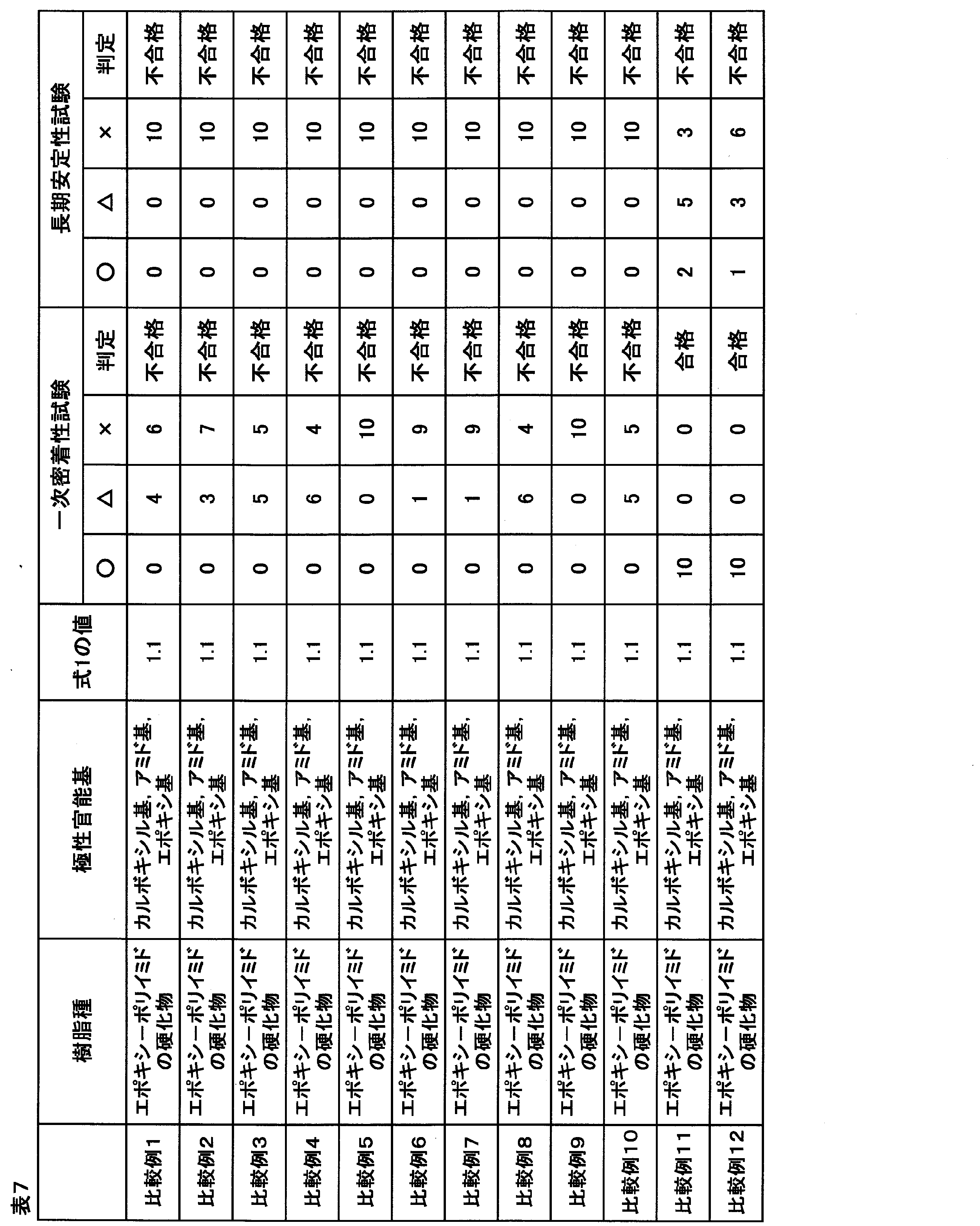
- the presence rate of the polar functional group in resin was evaluated. That is, the infrared absorption spectrum of the resin was measured using a Fourier transform type spectral hardness meter having a measurement wave number range of 4000 cm ⁇ 1 to 650 cm ⁇ 1 and a resolution of 1 cm ⁇ 1 . Next, the measured infrared absorption spectrum, the wave number range in which the spectrum appears, and the region surrounded by the horizontal axis were numerically integrated using the trapezoidal method at intervals of 1 cm ⁇ 1 to obtain the area. By substituting the obtained integral value into Equation 1 and calculating the value, the abundance of polar functional groups in the resin was evaluated. The results are shown in Tables 5-7.
- Each end in the length direction of the two specimens is pulled in the opposite direction along the length direction at a speed of 100 mm / min with a tensile tester, and is closely adhered by the load (converted to shear stress) and the peeled state. Sex was evaluated according to the following criteria.
- the shear test piece produced 10 sets of test pieces from the same test material, and evaluated each.
- ⁇ The shear stress is 20 N / mm 2 or more and the adhesive layer itself is agglomerated and broken ⁇ : The shear stress is 20 N / mm 2 or more, but the adhesive layer and the test material are separated at the interface ⁇ : Shear stress is less than 20 N / mm 2 , and the state where the adhesive layer and the specimen were peeled from each other The results are shown in Tables 5 and 6. The table shows the number of pairs of the above-mentioned ⁇ , ⁇ , and ⁇ of 10 sets of test pieces, respectively.
- Comparative Example 7 since the current density in the alternating current electrolysis treatment was too low, the barrier type aluminum oxide film layer was preferentially formed. Therefore, the thickness of the porous aluminum oxide film layer was insufficient, and the primary adhesion and long-term stability were unacceptable.
- Comparative Examples 11 and 12 since the shapes of the porous aluminum oxide film layer and the barrier type aluminum oxide film layer satisfied the provisions of the present invention, the primary adhesion was excellent. However, in Comparative Example 11, the temperature of the atmospheric exposure after the electrolytic treatment was too low, and in Comparative Example 12, since the atmospheric exposure was not performed, the moisture contained in the oxide film could not be removed, and long-term stability was improved. It was a failure.
- the surface treatment aluminum material which is excellent in adhesiveness and adhesiveness over the whole surface of an aluminum material, and can maintain this characteristic for a long time, and a joined body with the resin layer using the same are obtained stably. be able to.
Landscapes
- Chemical & Material Sciences (AREA)
- Engineering & Computer Science (AREA)
- Chemical Kinetics & Catalysis (AREA)
- Electrochemistry (AREA)
- Materials Engineering (AREA)
- Metallurgy (AREA)
- Organic Chemistry (AREA)
- Laminated Bodies (AREA)
Abstract
Description
とした。

本発明に用いるアルミニウム材としては、純アルミニウム又はアルミニウム合金が用いられる。アルミニウム合金の成分には特に制限無く、JISに規定される合金をはじめとする各種合金を使用することができる。形状としては特に制限されるものではないが、安定して処理皮膜を形成できることから平板状のものが好適に用いられる。用途に応じて、板厚を適宜選択することができるが、軽量化と成形性の観点から0.05~2.0mmが好ましく、0.1~1.0mmが更に好ましい。
本発明に用いるアルミニウム材の表面には、表面側に形成された多孔性アルミニウム酸化皮膜層と素地側に形成されたバリア型アルミニウム酸化皮膜層とが形成されている。すなわち、アルミニウム材表面には、多孔性アルミニウム酸化皮膜層とバリア型アルミニウム酸化皮膜層の二層によって構成される酸化皮膜が設けられている。多孔性アルミニウム酸化皮膜層が強力な接着性や密着性を長期間発揮する一方で、バリア型アルミニウム酸化皮膜層によって、アルミニウム酸化皮膜層全体とアルミニウム素地が強固に結合する。
多孔性アルミニウム酸化皮膜層の厚さは、20~500nmである。20nm未満では厚さが十分でないため、後述する小孔構造の形成が不十分になり易く接着力や密着力が低下する。一方、500nmを超えると、多孔性アルミニウム酸化皮膜層自体が凝集破壊し易くなり密着力が低下する。多孔性アルミニウム酸化皮膜層の厚さは、好ましくは50~400nmである。
バリア型アルミニウム酸化皮膜層の厚さは、3~30nmである。3nm未満では、介在層として多孔性アルミニウム酸化皮膜層とアルミニウム素地との結合に十分な結合力を付与することができず、特に、高温・多湿等の過酷環境における結合力が不十分となる。一方、30nmを超えると、その緻密性ゆえにバリア型アルミニウム酸化皮膜層が凝集破壊し易くなり、かえって接着力や密着力が低下する。なお、バリア型アルミニウム酸化皮膜層の厚さは、好ましくは5~25nmである。
酸化皮膜に含有される水分量は、10μg/cm2以下でなければならない。具体的には、表面処理アルミニウム材の見かけの表面積部分(縦×横)1cm2から検出される水分が10μg/cm2以下である必要がある。酸化皮膜の構造を考慮すると、含有される水分はその大部分が多孔性アルミニウム酸化皮膜層の内部に吸着しているものと考えられる。酸化皮膜に含有される水分量が10μg/cm2を超えると、特に長期間経過の際にその水分量に応じた水蒸気が発生し、この水蒸気によって酸化皮膜が体積膨張する。そして、この体積膨張によって酸化皮膜と樹脂等の接合物との剥離応力が発生するとともに、酸化皮膜と接合物の接合界面に生成していた水素結合が解離する。その結果、長期間経過後の接着力や密着力が低下する。なお、水分量の下限値については特に規定されるものではないが、後述の測定方法によれば0.1μg/cm2前後が検出下限であることから、工業的な下限値も0.1μg/cm2程度ということができる。なお、酸化皮膜に含有される水分量は、好ましくは6μg/cm2以下である。
酸化皮膜全体の厚さ、すなわち、B-1に記載の多孔性アルミニウム酸化皮膜層とB-2に記載のバリア型アルミニウム酸化皮膜層との厚さの合計は、アルミニウム材のいかなる場所で測定しても、その変動幅が±50%以内であることが好ましく、±20%以内であることがより好ましい。すなわち、アルミニウム材表面における任意の複数箇所(10箇所以上が望ましく、これら各箇所においても10点以上の測定点とするのが望ましい)で測定した酸化皮膜全体厚さの平均値をT(nm)とした場合、これら複数測定箇所の全てにおける酸化皮膜全体厚さが(0.5×T)~(1.5×T)の範囲にあることが望ましい。例えば、同一条件で作製した試料片を10個用意し、その各試料について酸化皮膜全体の厚さを各々10点測定することで、同一条件で作製した試料について合計100点の測定値を得る方法を挙げることができる。これに代わって、例えば長方形の試験片の縦横をそれぞれ5等分及び4等分に分割する線を引き、その交点(12個)近傍の酸化皮膜全体の厚さを各々10点測定することで、同一試料について合計120点の測定値を得る方法を挙げることができる。
なお、上記のような酸化皮膜の全体厚さが薄い箇所や厚い箇所では、周囲と比較して光学的特性が異なるため、茶褐色や白濁色といった色調の変化として目視可能な場合がある。
以上のような条件を満たした酸化皮膜を表面に備えた表面処理アルミニウム材を製造するための一つの方法として、表面処理されるアルミニウム材の電極と対電極とを用い、pH9~13で液温35~85℃のアルカリ性水溶液を電解溶液とし、周波数10~100Hz、電流密度4~50A/dm2及び電解時間5~300秒間の条件で交流電解処理することにより、対電極に対向するアルミニウム材表面に酸化皮膜を形成した後、150℃を超える雰囲気に暴露する方法を挙げることができる。
10ppm以上800ppm以下とするのがより好ましい。溶存アルミニウム濃度が5ppm未満の場合は、電解反応初期における酸化皮膜の形成反応が急激に生起するため、形成される酸化皮膜厚さが、処理工程におけるバラツキとして、例えば、アルミニウム材表面の汚れ状態やアルミニウム材の取り付け状態などの影響を受け易くなる。その結果、局部的に厚い酸化皮膜が形成されることになる。一方、溶存アルミニウム濃度が1000ppmを超える場合は、電解溶液の粘度が増大して電解工程においてアルミニウム材表面付近の均一な対流が妨げられるのと同時に、溶存アルミニウムが皮膜形成を抑制するように作用する。その結果、局部的に薄い酸化皮膜が形成されることになる。溶存アルミニウム濃度が上記範囲から外れると、アルミニウム材表面全体における多孔性アルミニウム酸化皮膜層とバリア型アルミニウム酸化皮膜層の合計厚さの変動幅を、この合計厚さの算術平均値の±50%内にすることが困難となり、その結果、得られる酸化皮膜の接着力と密着力の低下を招く場合がある。
本発明に係る表面処理アルミニウム材の表面処理した面に樹脂層を接合することにより、表面処理アルミニウム材/樹脂層の接合体が得られる。用いる樹脂層用の樹脂は、各種の熱可塑性及び熱硬化性樹脂を用いることができる。熱可塑性樹脂を用いる場合は、加熱して流動状態とした樹脂を多孔性アルミニウム酸化皮膜層に接触・浸透させ、次いで冷却固化することにより樹脂層が形成される。このような加熱固化による方法に代えて、接着剤を多孔性アルミニウム酸化皮膜層に接触・浸透させ、この接着剤を介して樹脂層を表面処理アルミニウム材に接合しても良い。なお、接着剤としては、液状タイプのものや、ホットメルトタイプのものを使用できる。
アルミニウム材として、縦200mm×横400mm×板厚1.0mmのJIS5052-H34合金の平板を使用した。このアルミニウム合金板を一方の電極に用い、対電極には縦300mm×横500mm×板厚2.0mmの平板形状を有する黒鉛板を用いた。アルミニウム合金板の一方の面を対電極に対面させ、この対面した一方の面の表層に、表面側の多孔性アルミニウム酸化皮膜層と素地側のバリア型アルミニウム酸化皮膜層が形成されるように、両電極を配置した。ピロりん酸ナトリウムを主成分とするアルカリ水溶液を電解溶液として用いた。電解溶液のアルカリ成分濃度は、0.5モル/リットルとするとともに、塩酸及び水酸化ナトリウム水溶液(いずれも濃度0.1モル/リットル)によってpHの調整を行なった。表1、2に示す電解条件にて交流電解処理を実施して多孔性アルミニウム酸化皮膜層及びバリア型アルミニウム酸化皮膜層を形成するとともに、表1、2に示す条件にて150℃を超える大気雰囲気中での暴露を行った。なお、比較例11では、大気雰囲気温度を150℃未満とし、比較例12では、雰囲気暴露を行わなかった。表中において、「交流電解工程後150℃到達までの経過時間」とは、電解処理の電圧印加を停止した時点をスタートとしてアルミニウム材表面が150℃に到達するまでの時間である。以上のようにして、アルミニウム材の一方の面に、多孔性アルミニウム酸化皮膜層及びバリア型アルミニウム酸化皮膜層からなる酸化皮膜を形成した供試材を作製した。

上記供試材から長さ50mm、25mm幅に切断したものを2枚用意した。これら2枚の供試材の表面処理した面同士を全幅方向に沿って長さ方向に10mmの幅をもって重ね合わせ、その間に樹脂層を挟んで接合体を作製した。樹脂層に用いた樹脂は、市販の2液型エポキシ接着剤(主剤=変性エポキシ樹脂、硬化剤=変性ポリイミド、重量混合比=主剤100/硬化剤100)、ポリエチレン、ポリエステル及びエチレン-メタクリル酸共重合体から選択される樹脂又はその混合物である。このような接合体のせん断試験片を作製した。2枚の供試材の長さ方向の各端部を引張試験機により100mm/分の速度にて長さ方向に沿って反対向きに引張り、その荷重(せん断応力に換算)と剥離状態によって密着性を下記の基準で評価した。なお、せん断試験片は同じ供試材から10組の試験片を作製して、それぞれについて評価した。
○:せん断応力が20N/mm2以上で、かつ、接着剤層自身が凝集破壊した状態
△:せん断応力が20N/mm2以上であるものの、接着剤層と供試材が界面剥離した状態
×:せん断応力が20N/mm2未満で、かつ、接着剤層と供試材が界面剥離した状態
結果を表5、6に示す。同表には、10組の試験片のうちの上記○、△、×の組数をそれぞれ示すが、全てが○の場合を合格、それ以外を不合格と判定した。
上記の一次密着性試験と同様のせん断試験片を作製し、85℃の環境に2000時間放置した後、一次密着性試験と同様の試験を実施し、それぞれについて評価した。
○:せん断応力が20N/mm2以上で、かつ、接着剤層自身が凝集破壊した状態
△:せん断応力が20N/mm2以上であるものの、接着剤層と供試材が界面剥離した状態
×:せん断応力が20N/mm2未満で、かつ、接着剤層と供試材が界面剥離した状態
結果を表5、6に示す。同表には、10組の試験片のうちの上記○、△、×の組数をそれぞれ示すが、○が5以上かつ×が0である場合を合格、それ以外を不合格と判定した。
Claims (10)
- アルミニウム材と、その表面の少なくともいずれか一方に形成された酸化皮膜とを含み、前記酸化皮膜は表面側に形成された厚さ20~500nmの多孔性アルミニウム酸化皮膜層と素地側に形成された厚さ3~30nmのバリア型アルミニウム酸化皮膜層とから成り、前記多孔性アルミニウム酸化皮膜層には直径5~30nmの小孔が形成されており、前記酸化皮膜に含有される水分が10μg/cm2以下であることを特徴とする表面処理アルミニウム材。
- 前記多孔性アルミニウム酸化皮膜層とバリア型アルミニウム酸化皮膜層との合計厚さの変動幅が、当該合計厚さの算術平均値の±50%以内である、請求項1に記載の表面処理アルミニウム材。
- 請求項1に記載の表面処理アルミニウム材の製造方法であって、表面処理されるアルミニウム材の電極と対電極とを用い、pH9~13で液温35~85℃のアルカリ性水溶液を電解溶液とし、周波数10~100Hz、電流密度4~50A/dm2及び電解時間5~300秒間の条件で交流電解処理することにより、対電極に対向する前記アルミニウム材表面に酸化皮膜を形成し、当該酸化皮膜を形成したアルミニウム材を150℃を超える雰囲気に暴露することを特徴とする表面処理アルミニウム材の製造方法。
- 前記アルカリ性水溶液の電解溶液が、5ppm以上1000ppm以下の溶存アルミニウムを含有する、請求項3に記載の表面処理アルミニウム材の製造方法。
- 前記150℃を超える雰囲気に暴露する時間t(秒)が、多孔性アルミニウム酸化皮膜層厚さをL(nm)及び雰囲気温度をT(℃)として、t≧20×(L/T)の関係を満たす、請求項3又は4に記載の表面処理アルミニウム材の製造方法。
- 交流電解処理の終了から、150℃を超える雰囲気に暴露して酸化皮膜を形成したアルミニウム材の表面温度が150℃に到達するまでの時間が24時間以内である、請求項3~5のいずれか一項に記載の表面処理アルミニウム材の製造方法。
- 前記雰囲気の相対湿度が50%以下である、請求項3~6のいずれか一項に記載の表面処理アルミニウム材の製造方法。
- 請求項1又は2に記載の表面処理アルミニウム材の表面処理された表面に、樹脂層を接合したことを特徴とする表面処理アルミニウム材/樹脂層の接合体。
- 前記樹脂層に用いる樹脂が、アミノ基、アミド基、エステル基、カルボキシル基、エポキシ基及び水酸基から選択される極性官能基の少なくとも1種を有する、請求項8に記載の表面処理アルミニウム材/樹脂層の接合体。
- 前記樹脂の赤外吸収スペクトルにおいて、波数νcm-1での吸収率がI(ν)で表せるときに、下記式1が0.01以上3.0以下である、請求項9に記載の表面処理アルミニウム材/樹脂層の接合体。

Priority Applications (3)
| Application Number | Priority Date | Filing Date | Title |
|---|---|---|---|
| JP2016534285A JP6575968B2 (ja) | 2014-07-18 | 2015-07-15 | 表面処理アルミニウム材及びその製造方法、ならびに、当該表面処理アルミニウム材/樹脂層の接合体 |
| KR1020167025106A KR20170032215A (ko) | 2014-07-18 | 2015-07-15 | 표면 처리 알루미늄재 및 그 제조 방법, 및, 당해 표면 처리 알루미늄재/수지층의 접합체 |
| CN201580024989.2A CN106460221B (zh) | 2014-07-18 | 2015-07-15 | 表面处理铝材及其制造方法和该表面处理铝材/树脂层的接合体 |
Applications Claiming Priority (2)
| Application Number | Priority Date | Filing Date | Title |
|---|---|---|---|
| JP2014-148051 | 2014-07-18 | ||
| JP2014148051 | 2014-07-18 |
Publications (1)
| Publication Number | Publication Date |
|---|---|
| WO2016009649A1 true WO2016009649A1 (ja) | 2016-01-21 |
Family
ID=55078156
Family Applications (1)
| Application Number | Title | Priority Date | Filing Date |
|---|---|---|---|
| PCT/JP2015/003580 Ceased WO2016009649A1 (ja) | 2014-07-18 | 2015-07-15 | 表面処理アルミニウム材及びその製造方法、ならびに、当該表面処理アルミニウム材/樹脂層の接合体 |
Country Status (5)
| Country | Link |
|---|---|
| JP (1) | JP6575968B2 (ja) |
| KR (1) | KR20170032215A (ja) |
| CN (1) | CN106460221B (ja) |
| TW (1) | TWI647340B (ja) |
| WO (1) | WO2016009649A1 (ja) |
Cited By (1)
| Publication number | Priority date | Publication date | Assignee | Title |
|---|---|---|---|---|
| WO2021176847A1 (ja) * | 2020-03-06 | 2021-09-10 | 富士フイルム株式会社 | 金属充填微細構造体の製造方法 |
Families Citing this family (2)
| Publication number | Priority date | Publication date | Assignee | Title |
|---|---|---|---|---|
| JP6584626B1 (ja) * | 2018-11-30 | 2019-10-02 | 株式会社Uacj | アルミニウム部材及びその製造方法 |
| KR102734656B1 (ko) * | 2020-01-20 | 2024-11-26 | (주)포인트엔지니어링 | 양극산화막 구조체의 제조 방법 및 양극산화막 구조체 |
Citations (4)
| Publication number | Priority date | Publication date | Assignee | Title |
|---|---|---|---|---|
| JPS60500831A (ja) * | 1983-02-22 | 1985-05-30 | デルファックス・システムズ | 陽極酸化された静電イメ−ジング表面 |
| JP2002155397A (ja) * | 2000-07-31 | 2002-05-31 | Mitsubishi Plastics Ind Ltd | 熱可塑性樹脂被覆アルミニウム板およびこの成形体 |
| WO2013011637A1 (ja) * | 2011-07-21 | 2013-01-24 | 国立大学法人東北大学 | ガス排気用ポンプのステータ及びその製造方法、並びにそのステータを備えるポンプ及びその製造方法及び組立方法 |
| WO2013118870A1 (ja) * | 2012-02-12 | 2013-08-15 | 古河スカイ株式会社 | 表面処理アルミニウム材及びその製造方法、ならびに、樹脂被覆表面処理アルミニウム材 |
Family Cites Families (1)
| Publication number | Priority date | Publication date | Assignee | Title |
|---|---|---|---|---|
| EP1306467A4 (en) * | 2000-07-31 | 2008-12-24 | Mitsubishi Plastics Inc | ALUMINUM PLATE WITH THERMOPLASTIC CARRIER COATING AND ITEM SHAPED PART |
-
2015
- 2015-07-15 JP JP2016534285A patent/JP6575968B2/ja active Active
- 2015-07-15 KR KR1020167025106A patent/KR20170032215A/ko not_active Withdrawn
- 2015-07-15 CN CN201580024989.2A patent/CN106460221B/zh active Active
- 2015-07-15 WO PCT/JP2015/003580 patent/WO2016009649A1/ja not_active Ceased
- 2015-07-16 TW TW104123084A patent/TWI647340B/zh active
Patent Citations (4)
| Publication number | Priority date | Publication date | Assignee | Title |
|---|---|---|---|---|
| JPS60500831A (ja) * | 1983-02-22 | 1985-05-30 | デルファックス・システムズ | 陽極酸化された静電イメ−ジング表面 |
| JP2002155397A (ja) * | 2000-07-31 | 2002-05-31 | Mitsubishi Plastics Ind Ltd | 熱可塑性樹脂被覆アルミニウム板およびこの成形体 |
| WO2013011637A1 (ja) * | 2011-07-21 | 2013-01-24 | 国立大学法人東北大学 | ガス排気用ポンプのステータ及びその製造方法、並びにそのステータを備えるポンプ及びその製造方法及び組立方法 |
| WO2013118870A1 (ja) * | 2012-02-12 | 2013-08-15 | 古河スカイ株式会社 | 表面処理アルミニウム材及びその製造方法、ならびに、樹脂被覆表面処理アルミニウム材 |
Cited By (3)
| Publication number | Priority date | Publication date | Assignee | Title |
|---|---|---|---|---|
| WO2021176847A1 (ja) * | 2020-03-06 | 2021-09-10 | 富士フイルム株式会社 | 金属充填微細構造体の製造方法 |
| JPWO2021176847A1 (ja) * | 2020-03-06 | 2021-09-10 | ||
| JP7336584B2 (ja) | 2020-03-06 | 2023-08-31 | 富士フイルム株式会社 | 金属充填微細構造体の製造方法 |
Also Published As
| Publication number | Publication date |
|---|---|
| JP6575968B2 (ja) | 2019-09-18 |
| TWI647340B (zh) | 2019-01-11 |
| TW201610238A (zh) | 2016-03-16 |
| CN106460221B (zh) | 2021-05-11 |
| KR20170032215A (ko) | 2017-03-22 |
| CN106460221A (zh) | 2017-02-22 |
| JPWO2016009649A1 (ja) | 2017-04-27 |
Similar Documents
| Publication | Publication Date | Title |
|---|---|---|
| Xu et al. | Improvement of adhesion performance between aluminum alloy sheet and epoxy based on anodizing technique | |
| JP6001573B2 (ja) | 表面処理アルミニウム材及びその製造方法、ならびに、樹脂被覆表面処理アルミニウム材 | |
| Shore et al. | Adhesive bond strength of PEO coated AA6060-T6 | |
| Kong et al. | Electrochemical anodic dissolution kinetics of titanium in fluoride-containing perchloric acid solutions at open-circuit potentials | |
| JP6575968B2 (ja) | 表面処理アルミニウム材及びその製造方法、ならびに、当該表面処理アルミニウム材/樹脂層の接合体 | |
| JP4494155B2 (ja) | 金めっき構造体およびこの金めっき構造体からなる燃料電池用セパレーター | |
| CN105408527A (zh) | 表面处理铝材及其制造方法 | |
| Dammulla et al. | Inhibiting the oxygen reduction reaction kinetics on carbon fiber epoxy composites through diazonium surface modification-impacts on the galvanic corrosion of coupled aluminum alloys | |
| Whitman et al. | Effect of galvanic current on the physicochemical, electrochemical and mechanical properties of an aerospace carbon fiber reinforced epoxy composite | |
| JP6041566B2 (ja) | アルミニウム複合材及びその製造方法 | |
| Jegdić et al. | Corrosion stability of polyester coatings on steel pretreated with different iron–phosphate coatings | |
| JP6168723B2 (ja) | 表面処理アルミニウム材及びその製造方法 | |
| CN107709631B (zh) | 树脂密接性优异的表面处理铝材及其制造方法、以及表面处理铝材/树脂的接合体 | |
| JP2019026924A (ja) | 表面処理アルミニウム合金材及びその製造方法 | |
| WO2017026461A1 (ja) | 樹脂密着性に優れた表面処理アルミニウム材及びその製造方法、ならびに、表面処理アルミニウム材/樹脂の接合体 | |
| Peng et al. | Superhydrophilicity of novel anodic alumina nanofibers films and their formation mechanism | |
| Seo et al. | Assessment of proton transport in amorphous aluminum oxide by cathodic polarization: Time of flight-elastic recoil detection analysis method | |
| El-Mahdy et al. | Influence of droplet characteristics on the electrochemical behavior of Zinc | |
| KR20240065788A (ko) | 기능성 표면처리된 스포츠 및 레저용품용 sus 316l 개발 | |
| JP2016148079A (ja) | 表面処理アルミニウム材及びその製造方法 | |
| Xu et al. | Application of Electrochemical Techniques in the Porosity Assessment of Electroless Coatings |
Legal Events
| Date | Code | Title | Description |
|---|---|---|---|
| 121 | Ep: the epo has been informed by wipo that ep was designated in this application |
Ref document number: 15822021 Country of ref document: EP Kind code of ref document: A1 |
|
| ENP | Entry into the national phase |
Ref document number: 2016534285 Country of ref document: JP Kind code of ref document: A |
|
| ENP | Entry into the national phase |
Ref document number: 20167025106 Country of ref document: KR Kind code of ref document: A |
|
| NENP | Non-entry into the national phase |
Ref country code: DE |
|
| 122 | Ep: pct application non-entry in european phase |
Ref document number: 15822021 Country of ref document: EP Kind code of ref document: A1 |