WO2015190597A1 - 水生生物付着防止材 - Google Patents
水生生物付着防止材 Download PDFInfo
- Publication number
- WO2015190597A1 WO2015190597A1 PCT/JP2015/067032 JP2015067032W WO2015190597A1 WO 2015190597 A1 WO2015190597 A1 WO 2015190597A1 JP 2015067032 W JP2015067032 W JP 2015067032W WO 2015190597 A1 WO2015190597 A1 WO 2015190597A1
- Authority
- WO
- WIPO (PCT)
- Prior art keywords
- fiber
- aqueous
- fluororesin
- biofouling prevention
- prevention material
- Prior art date
- Legal status (The legal status is an assumption and is not a legal conclusion. Google has not performed a legal analysis and makes no representation as to the accuracy of the status listed.)
- Ceased
Links
Images

Classifications
-
- C—CHEMISTRY; METALLURGY
- C08—ORGANIC MACROMOLECULAR COMPOUNDS; THEIR PREPARATION OR CHEMICAL WORKING-UP; COMPOSITIONS BASED THEREON
- C08L—COMPOSITIONS OF MACROMOLECULAR COMPOUNDS
- C08L27/00—Compositions of homopolymers or copolymers of compounds having one or more unsaturated aliphatic radicals, each having only one carbon-to-carbon double bond, and at least one being terminated by a halogen; Compositions of derivatives of such polymers
- C08L27/02—Compositions of homopolymers or copolymers of compounds having one or more unsaturated aliphatic radicals, each having only one carbon-to-carbon double bond, and at least one being terminated by a halogen; Compositions of derivatives of such polymers not modified by chemical after-treatment
- C08L27/12—Compositions of homopolymers or copolymers of compounds having one or more unsaturated aliphatic radicals, each having only one carbon-to-carbon double bond, and at least one being terminated by a halogen; Compositions of derivatives of such polymers not modified by chemical after-treatment containing fluorine atoms
- C08L27/18—Homopolymers or copolymers or tetrafluoroethene
-
- A—HUMAN NECESSITIES
- A01—AGRICULTURE; FORESTRY; ANIMAL HUSBANDRY; HUNTING; TRAPPING; FISHING
- A01N—PRESERVATION OF BODIES OF HUMANS OR ANIMALS OR PLANTS OR PARTS THEREOF; BIOCIDES, e.g. AS DISINFECTANTS, AS PESTICIDES OR AS HERBICIDES; PEST REPELLANTS OR ATTRACTANTS; PLANT GROWTH REGULATORS
- A01N25/00—Biocides, pest repellants or attractants, or plant growth regulators, characterised by their forms, or by their non-active ingredients or by their methods of application, e.g. seed treatment or sequential application; Substances for reducing the noxious effect of the active ingredients to organisms other than pests
- A01N25/34—Shaped forms, e.g. sheets, not provided for in any other sub-group of this main group
-
- A—HUMAN NECESSITIES
- A01—AGRICULTURE; FORESTRY; ANIMAL HUSBANDRY; HUNTING; TRAPPING; FISHING
- A01N—PRESERVATION OF BODIES OF HUMANS OR ANIMALS OR PLANTS OR PARTS THEREOF; BIOCIDES, e.g. AS DISINFECTANTS, AS PESTICIDES OR AS HERBICIDES; PEST REPELLANTS OR ATTRACTANTS; PLANT GROWTH REGULATORS
- A01N29/00—Biocides, pest repellants or attractants, or plant growth regulators containing halogenated hydrocarbons
-
- C—CHEMISTRY; METALLURGY
- C08—ORGANIC MACROMOLECULAR COMPOUNDS; THEIR PREPARATION OR CHEMICAL WORKING-UP; COMPOSITIONS BASED THEREON
- C08J—WORKING-UP; GENERAL PROCESSES OF COMPOUNDING; AFTER-TREATMENT NOT COVERED BY SUBCLASSES C08B, C08C, C08F, C08G or C08H
- C08J5/00—Manufacture of articles or shaped materials containing macromolecular substances
- C08J5/04—Reinforcing macromolecular compounds with loose or coherent fibrous material
-
- C—CHEMISTRY; METALLURGY
- C08—ORGANIC MACROMOLECULAR COMPOUNDS; THEIR PREPARATION OR CHEMICAL WORKING-UP; COMPOSITIONS BASED THEREON
- C08J—WORKING-UP; GENERAL PROCESSES OF COMPOUNDING; AFTER-TREATMENT NOT COVERED BY SUBCLASSES C08B, C08C, C08F, C08G or C08H
- C08J5/00—Manufacture of articles or shaped materials containing macromolecular substances
- C08J5/04—Reinforcing macromolecular compounds with loose or coherent fibrous material
- C08J5/0405—Reinforcing macromolecular compounds with loose or coherent fibrous material with inorganic fibres
- C08J5/042—Reinforcing macromolecular compounds with loose or coherent fibrous material with inorganic fibres with carbon fibres
-
- C—CHEMISTRY; METALLURGY
- C08—ORGANIC MACROMOLECULAR COMPOUNDS; THEIR PREPARATION OR CHEMICAL WORKING-UP; COMPOSITIONS BASED THEREON
- C08J—WORKING-UP; GENERAL PROCESSES OF COMPOUNDING; AFTER-TREATMENT NOT COVERED BY SUBCLASSES C08B, C08C, C08F, C08G or C08H
- C08J5/00—Manufacture of articles or shaped materials containing macromolecular substances
- C08J5/04—Reinforcing macromolecular compounds with loose or coherent fibrous material
- C08J5/10—Reinforcing macromolecular compounds with loose or coherent fibrous material characterised by the additives used in the polymer mixture
-
- C—CHEMISTRY; METALLURGY
- C08—ORGANIC MACROMOLECULAR COMPOUNDS; THEIR PREPARATION OR CHEMICAL WORKING-UP; COMPOSITIONS BASED THEREON
- C08J—WORKING-UP; GENERAL PROCESSES OF COMPOUNDING; AFTER-TREATMENT NOT COVERED BY SUBCLASSES C08B, C08C, C08F, C08G or C08H
- C08J5/00—Manufacture of articles or shaped materials containing macromolecular substances
- C08J5/18—Manufacture of films or sheets
-
- C—CHEMISTRY; METALLURGY
- C08—ORGANIC MACROMOLECULAR COMPOUNDS; THEIR PREPARATION OR CHEMICAL WORKING-UP; COMPOSITIONS BASED THEREON
- C08K—Use of inorganic or non-macromolecular organic substances as compounding ingredients
- C08K7/00—Use of ingredients characterised by shape
- C08K7/02—Fibres or whiskers
- C08K7/04—Fibres or whiskers inorganic
-
- C—CHEMISTRY; METALLURGY
- C08—ORGANIC MACROMOLECULAR COMPOUNDS; THEIR PREPARATION OR CHEMICAL WORKING-UP; COMPOSITIONS BASED THEREON
- C08L—COMPOSITIONS OF MACROMOLECULAR COMPOUNDS
- C08L95/00—Compositions of bituminous materials, e.g. asphalt, tar, pitch
-
- C—CHEMISTRY; METALLURGY
- C09—DYES; PAINTS; POLISHES; NATURAL RESINS; ADHESIVES; COMPOSITIONS NOT OTHERWISE PROVIDED FOR; APPLICATIONS OF MATERIALS NOT OTHERWISE PROVIDED FOR
- C09D—COATING COMPOSITIONS, e.g. PAINTS, VARNISHES OR LACQUERS; FILLING PASTES; CHEMICAL PAINT OR INK REMOVERS; INKS; CORRECTING FLUIDS; WOODSTAINS; PASTES OR SOLIDS FOR COLOURING OR PRINTING; USE OF MATERIALS THEREFOR
- C09D5/00—Coating compositions, e.g. paints, varnishes or lacquers, characterised by their physical nature or the effects produced; Filling pastes
- C09D5/16—Antifouling paints; Underwater paints
-
- C—CHEMISTRY; METALLURGY
- C09—DYES; PAINTS; POLISHES; NATURAL RESINS; ADHESIVES; COMPOSITIONS NOT OTHERWISE PROVIDED FOR; APPLICATIONS OF MATERIALS NOT OTHERWISE PROVIDED FOR
- C09D—COATING COMPOSITIONS, e.g. PAINTS, VARNISHES OR LACQUERS; FILLING PASTES; CHEMICAL PAINT OR INK REMOVERS; INKS; CORRECTING FLUIDS; WOODSTAINS; PASTES OR SOLIDS FOR COLOURING OR PRINTING; USE OF MATERIALS THEREFOR
- C09D7/00—Features of coating compositions, not provided for in group C09D5/00; Processes for incorporating ingredients in coating compositions
- C09D7/40—Additives
-
- E—FIXED CONSTRUCTIONS
- E02—HYDRAULIC ENGINEERING; FOUNDATIONS; SOIL SHIFTING
- E02D—FOUNDATIONS; EXCAVATIONS; EMBANKMENTS; UNDERGROUND OR UNDERWATER STRUCTURES
- E02D31/00—Protective arrangements for foundations or foundation structures; Ground foundation measures for protecting the soil or the subsoil water, e.g. preventing or counteracting oil pollution
-
- C—CHEMISTRY; METALLURGY
- C08—ORGANIC MACROMOLECULAR COMPOUNDS; THEIR PREPARATION OR CHEMICAL WORKING-UP; COMPOSITIONS BASED THEREON
- C08J—WORKING-UP; GENERAL PROCESSES OF COMPOUNDING; AFTER-TREATMENT NOT COVERED BY SUBCLASSES C08B, C08C, C08F, C08G or C08H
- C08J2327/00—Characterised by the use of homopolymers or copolymers of compounds having one or more unsaturated aliphatic radicals, each having only one carbon-to-carbon double bond, and at least one being terminated by a halogen; Derivatives of such polymers
- C08J2327/02—Characterised by the use of homopolymers or copolymers of compounds having one or more unsaturated aliphatic radicals, each having only one carbon-to-carbon double bond, and at least one being terminated by a halogen; Derivatives of such polymers not modified by chemical after-treatment
- C08J2327/12—Characterised by the use of homopolymers or copolymers of compounds having one or more unsaturated aliphatic radicals, each having only one carbon-to-carbon double bond, and at least one being terminated by a halogen; Derivatives of such polymers not modified by chemical after-treatment containing fluorine atoms
- C08J2327/18—Homopolymers or copolymers of tetrafluoroethylene
-
- C—CHEMISTRY; METALLURGY
- C08—ORGANIC MACROMOLECULAR COMPOUNDS; THEIR PREPARATION OR CHEMICAL WORKING-UP; COMPOSITIONS BASED THEREON
- C08J—WORKING-UP; GENERAL PROCESSES OF COMPOUNDING; AFTER-TREATMENT NOT COVERED BY SUBCLASSES C08B, C08C, C08F, C08G or C08H
- C08J2495/00—Bituminous materials, e.g. asphalt, tar or pitch
-
- C—CHEMISTRY; METALLURGY
- C09—DYES; PAINTS; POLISHES; NATURAL RESINS; ADHESIVES; COMPOSITIONS NOT OTHERWISE PROVIDED FOR; APPLICATIONS OF MATERIALS NOT OTHERWISE PROVIDED FOR
- C09D—COATING COMPOSITIONS, e.g. PAINTS, VARNISHES OR LACQUERS; FILLING PASTES; CHEMICAL PAINT OR INK REMOVERS; INKS; CORRECTING FLUIDS; WOODSTAINS; PASTES OR SOLIDS FOR COLOURING OR PRINTING; USE OF MATERIALS THEREFOR
- C09D5/00—Coating compositions, e.g. paints, varnishes or lacquers, characterised by their physical nature or the effects produced; Filling pastes
- C09D5/16—Antifouling paints; Underwater paints
- C09D5/1606—Antifouling paints; Underwater paints characterised by the anti-fouling agent
- C09D5/1612—Non-macromolecular compounds
- C09D5/1625—Non-macromolecular compounds organic
-
- E—FIXED CONSTRUCTIONS
- E02—HYDRAULIC ENGINEERING; FOUNDATIONS; SOIL SHIFTING
- E02D—FOUNDATIONS; EXCAVATIONS; EMBANKMENTS; UNDERGROUND OR UNDERWATER STRUCTURES
- E02D2300/00—Materials
- E02D2300/0051—Including fibers
-
- E—FIXED CONSTRUCTIONS
- E02—HYDRAULIC ENGINEERING; FOUNDATIONS; SOIL SHIFTING
- E02D—FOUNDATIONS; EXCAVATIONS; EMBANKMENTS; UNDERGROUND OR UNDERWATER STRUCTURES
- E02D2300/00—Materials
- E02D2300/0051—Including fibers
- E02D2300/0053—Including fibers made from glass
-
- E—FIXED CONSTRUCTIONS
- E02—HYDRAULIC ENGINEERING; FOUNDATIONS; SOIL SHIFTING
- E02D—FOUNDATIONS; EXCAVATIONS; EMBANKMENTS; UNDERGROUND OR UNDERWATER STRUCTURES
- E02D2300/00—Materials
- E02D2300/0051—Including fibers
- E02D2300/0064—Including fibers made from metal
-
- E—FIXED CONSTRUCTIONS
- E02—HYDRAULIC ENGINEERING; FOUNDATIONS; SOIL SHIFTING
- E02D—FOUNDATIONS; EXCAVATIONS; EMBANKMENTS; UNDERGROUND OR UNDERWATER STRUCTURES
- E02D2300/00—Materials
- E02D2300/0051—Including fibers
- E02D2300/0068—Including fibers made from carbon
Definitions
- This invention relates to the aquatic organism adhesion prevention material for preventing that aquatic organisms adhere to an underwater structure by attaching to an underwater structure.
- aquatic organisms such as barnacles, sea squirts, cell plastics, mussels, mussels, chrysanthemum moths, aonori and aosa are attached to and grown on the surface.
- fishe organisms such as barnacles, sea squirts, cell plastics, mussels, mussels, chrysanthemum moths, aonori and aosa
- mechanical removal methods such as periodically scraping off attached aquatic organisms were also common, but recently various antifouling paints have been developed and applied to the surface of underwater structures. The main practice is to prevent the attachment of aquatic organisms.
- Antifouling paints include those containing toxic antifouling agents such as organic tin compounds, cuprous oxide, zinc pyrithione and copper pyrithione.
- Patent Document 1 contains a binder comprising a starch fatty acid ester in which a hydroxyl group in starch or a starch degradation product is substituted with one or more fatty acid acyl groups, and a repellent, and the formed coating film is formed into a coating film.
- An antifouling paint composition that gradually releases the repellent by solubilizing elements in water and an antifouling panel formed with a coating film of the antifouling paint composition have been proposed.
- Patent Document 2 discloses an aquatic organism adhesion prevention molded article formed from a fluororesin that exhibits an aquatic organism adhesion prevention effect by setting the surface roughness Ra to 0.005 to 0.20 ⁇ m. .
- the method using the antifouling paint composition as in Patent Document 1 can prevent adhesion and growth of aquatic organisms, it uses a repellent and is therefore not preferable in terms of environmental safety and hygiene during the production and painting of the paint.
- the repellent gradually elutes from the coating film in water, which may contaminate the water area in the long term. Further, it has been found that such a method has a problem that the coating film of the antifouling coating composition formed on the panel surface is peeled off due to deterioration or the like, and it is difficult to exert the effect for a long time.
- the aquatic organism adhesion prevention molded article like patent document 2 does not use a repellent, the aquatic organism adhesion prevention effect can be exhibited, without polluting a water area.
- the aquatic organism adhesion-preventing molded article as described in Patent Document 2 cannot be said to have sufficient adhesion to the base material directly to adhere to the base material. For example, an adhesive layer is required.
- an object of the present invention is to provide an aqueous biofouling prevention material that can exert the effect of preventing aquatic organism adhesion without polluting the water area and has high adhesion to the substrate.
- the present inventors have been able to exert an aquatic organism adhesion preventing effect without contaminating the water area by using an aqueous organism adhesion preventing material formed from a fluororesin and a fluorinated pitch.
- the present inventors have found that an aqueous biofouling prevention material having excellent adhesion to the material can be provided, and have completed the present invention.
- an aqueous biofouling prevention material formed from a fluororesin and a fluorinated pitch is provided.
- an article comprising a base material and the above-mentioned aqueous bioadhesion preventing material in close contact with the base material.
- an underwater structure comprising the above-mentioned aqueous biofouling prevention material or the above article.
- an aquatic organism adhesion preventing effect can be exhibited over a long period of time without causing environmental problems, and an aqueous organism adhesion preventing material having high adhesion to a substrate can be obtained.
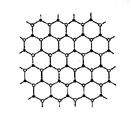
- FIG. 1 shows the carbon six-membered ring portion of the fluorinated pitch.
- FIG. 2 shows a structure in which a six-membered ring portion is bridged by a perfluorocarbon group in a fluorinated pitch.
- the aqueous biofouling prevention material of the present invention is formed from a fluororesin and a fluorinated pitch.
- the form of the aqueous biofouling prevention material of the present invention is not particularly limited, but is preferably a molded body.
- the molded body is obtained by crosslinking a fluororesin and a fluorinated pitch.
- the fluororesin is not particularly limited as long as it can be combined with fluorinated pitch, but polytetrafluoroethylene (PTFE), polyvinylidene fluoride (PVdF), polyvinyl fluoride (PVF), polychlorotrifluoroethylene ( PCTFE), ethylene-chlorotrifluoroethylene copolymer (ECTFE), vinylidene fluoride-hexafluoropropylene copolymer (VdF-HFP), vinylidene fluoride-tetrafluoroethylene copolymer (VdF-TFE), vinylidene fluoride Ride-tetrafluoroethylene-hexafluoropropylene copolymer (VdF-TFE-HFP) or tetrafluoroethylene copolymer is preferred.
- PTFE polytetrafluoroethylene
- PVdF polyvinylidene fluoride
- PVF polyvinyl fluoride
- PCTFE polychlor
- tetrafluoroethylene copolymer examples include ethylene (Et) -tetrafluoroethylene (TFE) copolymer, chlorotrifluoroethylene (CTFE) -TFE copolymer, and TFE-hexafluoropropylene (HFP) copolymer.
- Et ethylene
- CFE chlorotrifluoroethylene
- HFP TFE-hexafluoropropylene
- FEP polymer
- PAVE TFE-perfluoro (alkyl vinyl ether) copolymer
- polytetrafluoroethylene or a tetrafluoroethylene copolymer is used as the fluororesin, and polytetrafluoroethylene is particularly preferably used because it is more chemically and thermally stable.
- the thermoplastic fluororesin preferably has a melting point of 100 ° C or higher, for example, 150 ° C or higher, 170 ° C or higher, 200 ° C or higher, 220 ° C or higher, 250 ° C or higher, 270 ° C or higher, 300 ° C or higher, or 320 ° C or higher.
- a melting point 100 ° C or higher, for example, 150 ° C or higher, 170 ° C or higher, 200 ° C or higher, 220 ° C or higher, 250 ° C or higher, 270 ° C or higher, 300 ° C or higher, or 320 ° C or higher.
- the fluorine content in the thermoplastic fluororesin is 20% by mass or more, preferably 30% by mass or more, such as 40% by mass or more, 50% by mass or more, 60% by mass or more, 70% by mass or more, or 80%. It may be greater than or equal to mass%.
- the thermoplastic fluororesin has a melting point of 100 ° C. or higher and contains 20% by mass or more of fluorine.
- the melting point and fluorine content of the fluororesin may be 100 ° C. or higher and 30% by mass or higher, 150 ° C. or higher and 20% by mass or higher, or 150 ° C. or higher and 30% by mass or higher, respectively.
- fluorinated pitch is a compound obtained by fluorinating coal-based or petroleum-based pitch or coal tar. Fluorinated pitch can be obtained by substituting hydrogen in pitch or coal tar with fluorine in fluorine gas.
- fluorinated pitch for example, as Ogsol FP-S, Rinoves (registered trademark) P manufactured by Osaka Gas Chemical Co., Ltd. It is commercially available.
- the fluorinated pitch used in the present invention preferably has a carbon 6-membered ring as shown in FIG.
- black circles and white circles indicate fluorine atoms bonded to the upper side and the lower side, respectively, with respect to the surface.
- This six-membered carbon ring portion is the same as (CF) n, (CF) to consist entirely such a layer structure in n
- the pitch fluoride, six-membered ring unit shown in FIG. 1 Are bridged by a perfluorocarbon group (the hydrogen atom of the aliphatic hydrocarbon group that bridges the aromatic six-membered ring portion in the pitch is replaced by a fluorine atom).
- a perfluorocarbon group the hydrogen atom of the aliphatic hydrocarbon group that bridges the aromatic six-membered ring portion in the pitch is replaced by a fluorine atom.
- Such a structure of the fluorinated pitch is schematically shown in FIG. In FIG.
- the fluorinated pitch consists essentially of carbon atoms and fluorine atoms, has an F / C atomic ratio of 0.5 to 1.8, and is laminated with a carbon six-membered ring. This is a fluorinated pitch characterized by exhibiting the characteristic (b).
- a film can be formed by vacuum deposition.
- B) The contact angle with water at 30 ° C. is 141 ° ⁇ 8 °.
- the fluorine content in the fluorinated pitch may be 40% by weight or more, preferably 50% by weight or more, for example 60% by weight or more, 90% by weight or less, preferably 80% by weight or less, for example 70 It can be up to mass%.
- the content of the fluorinated pitch is preferably 0.05 to 50 parts by weight, more preferably 0.1 to 30 parts by weight, and further preferably 1 to 20 parts by weight with respect to 100 parts by weight of the fluororesin. Part.
- the amount of the fluorinated pitch is preferably 0.05 parts by weight or more with respect to 100 parts by weight of the fluororesin, the crosslink density after complexing with the fluororesin is increased, and the strength of the aqueous bioadhesion prevention material is increased. be able to.
- by setting it to 50 parts by weight or less it becomes possible to give moderate flexibility to the aqueous biofouling prevention material.
- content of a fluororesin increases, the water-based biofouling prevention function of a water-based biofouling prevention material can be improved.
- the average molecular weight of the fluorinated pitch is not particularly limited, but is preferably 1,000 to 10,000, preferably 1,500 to 5,000, more preferably 2,000 to 3,000.
- the average particle size is not particularly limited, but is preferably 0.5 to 10 ⁇ m, for example 1.0 to 5 ⁇ m, specifically about 1.2 ⁇ m.
- the softening temperature of the fluorinated pitch is not particularly limited, but is preferably 150 to 380 ° C., more preferably 180 to 300 ° C.
- the aquatic organism adhesion preventing material of the present invention does not require the use of a substance that dissolves into the surrounding environment such as a repellent, the aquatic organism adhesion preventing effect can be exhibited without polluting the surrounding environment. Moreover, the adhesiveness to a base material is high, and it can attach directly to a base material or an underwater structure. That is, attachment to a base material or an underwater structure is easy.
- the aqueous biofouling prevention material of the present invention further comprises a fiber material.
- a fiber material By including a fiber material, the strength can be increased, and for example, an aqueous biofouling prevention material that can withstand a physical impact by a large and heavy floating material such as driftwood can be obtained.
- the fiber material is not particularly limited, and examples thereof include a fiber reinforced plastic material (FRP), which may be a continuous fiber material or a short fiber material.
- FRP fiber reinforced plastic material
- Such fiber material is not particularly limited, and polytetrafluoroethylene (PTFE) fiber, glass fiber, carbon fiber, silicon carbide fiber, silicon nitride fiber, aramid fiber, poly-paraphenylene benzobisoxazole (PBO) fiber, and One or more materials selected from the group consisting of metal fibers are preferred.
- a fiber having heat resistance of preferably 150 ° C. or higher, more preferably 250 ° C. or higher, and further preferably 300 ° C. or higher is used.
- a carbon fiber woven fabric or a glass fiber woven fabric is preferable.
- the content of the fiber material is not particularly limited and can be appropriately changed according to the type and shape of the fiber material to be used.
- the content is 5 to 100 parts by weight based on 100 parts by weight of the fluororesin and the fluoride pitch.
- the amount is 100 parts by weight, more preferably 10 to 40 parts by weight, still more preferably 15 to 30 parts by weight.
- the aqueous biofouling prevention material of the present invention preferably has an initial contact angle of water of 80 ° or more, more preferably 90 ° or more. Although an upper limit is not specifically limited, 115 degrees or less are preferable and 110 degrees or less are more preferable. By having such an initial contact angle of water, a higher aqueous biofouling prevention function can be obtained.
- the water contact angle can be measured using a contact angle meter.
- the contact angle measurement in the present invention can be performed based on, for example, the description in JIS R3257: 1999 “Method for testing wettability of substrate glass surface”. Specifically, when a tangent line is drawn on the curved surface of a liquid from a portion where solid, liquid and gas (generally air) are in contact, the angle formed by this tangent and the surface of the solid is obtained, and this is determined as the value of the contact angle. To do. For the measurement of the contact angle, a method called the sessile drop method is used in which a droplet is placed on a solid surface and the contact angle is obtained.
- aquatic organisms examples include, but are not limited to, barnacles, mussels, sea anemones, oysters, squirts, hydroinsects, bryozoans, various aquatic microorganisms, various seaweeds (midorige, hondawala, aosa, aonori, etc.), various diatoms, Examples include annelids (such as quail and scallop), and sponges (such as quail).
- the aqueous biofouling prevention material of the present invention can be obtained by mixing a fluororesin and a fluorinated pitch and performing a post-treatment if desired.
- the post-treatment include heat treatment, radiation treatment, or a combination thereof. Radiation treatment is preferable because more precise crosslinking can be obtained.
- the production method of the aqueous biofouling prevention material of the present invention will be described in more detail with an embodiment including a fluororesin, a fluorinated pitch, and a fiber material, but the production method of the aqueous biofouling prevention material of the present invention is limited to this. Is not to be done.
- a fluoride pitch powder is added to and mixed with a dispersion in which the fluororesin powder is uniformly dispersed to prepare a mixture of the fluororesin and the fluoride pitch.
- the liquid for dispersing the powder that is, the dispersion medium is not particularly limited, and includes water and an emulsifier, water and alcohol, water and acetone, or a mixed solvent of water, alcohol and acetone, and any of those skilled in the art. Can be easily selected and prepared.
- a powder of fluorinated pitch may be added and mixed with a fine powder of fluororesin without using a dispersion.
- the impregnation method is not particularly limited.
- the impregnation method can be performed by immersing the fibers in the dispersion liquid obtained above or by applying the dispersion liquid to the fibers. After impregnation, drying is performed to remove the dispersion medium to obtain a fiber material containing a fluororesin and a fluorinated pitch.
- the method for removing the dispersion medium include a method by vaporization by heat drying, a method in which a sample dried after impregnation is immersed in pure water, and the dispersion medium is removed by diffusion from the inside.
- the fiber material obtained as described above is subjected to a radiation irradiation treatment and / or a heat treatment to react the fluororesin and the fluorinated pitch.
- the fluororesin is cross-linked and the fluorinated pitch and the fluororesin are also chemically reacted and cross-linked. Therefore, it is possible to obtain a composite material in which a resin having a network structure crosslinked in a molecular composite manner is firmly bonded to a fiber material.
- the heating temperature is, for example, 120 to 400 ° C., preferably a temperature above the softening point of the fluorinated pitch, for example, 180 to 300 ° C., preferably 270 to 300 ° C.
- the heating temperature is set to 400 ° C. or lower, thermal decomposition of the fluororesin can be prevented.
- the heating temperature is set to 120 ° C. or higher, decomposition of the fluorinated pitch is promoted, and sufficient radicals can be generated to cause a reaction with the fluororesin.
- an indirect or direct heat source such as a normal gas circulation thermostat, an infrared heater, or a panel heater can be used. Or you may implement shaping
- the amount of absorbed radiation is preferably 0.1 kGy to 10 MGy, preferably 50 kGy to 1 MGy, and more preferably 100 kGy to 500 kGy.
- the concentration of radicals contributing to the reaction can be increased, and the characteristics of the obtained composite material can be improved.
- it by setting it to 10 MGy or less, it is possible to suppress degradation of the fiber material and a decrease in adhesion to the fiber due to the decomposition gas from the fluororesin, and it is possible to obtain a crosslinking density that gives appropriate flexibility. .
- ionizing radiation such as electron beam, X-ray, neutron beam, and high energy ion can be used, and any of these may be used alone or in combination.
- an electron beam is preferably used.
- the irradiation with radiation is preferably performed in an atmosphere having an oxygen concentration of 2000 ppm or less, preferably 100 ppm or less.
- An atmosphere having an oxygen concentration of 2000 ppm or less is achieved by setting the oxygen concentration to 2000 ppm or less by making a vacuum by reducing the pressure, or by replacing oxygen in the atmosphere with an inert gas such as helium, argon, or nitrogen. be able to.
- an atmosphere having an atmosphere it is possible to prevent radiation oxidative degradation of the fluororesin without suppressing the cross-linking reaction of the fluororesin during irradiation.
- By setting the oxygen concentration to 2000 ppm or less it is possible to suppress a decrease in the progress of the crosslinking reaction due to the radicals induced by radiation being combined with oxygen.
- Irradiation is preferably performed in a temperature range of room temperature (for example, 20 ° C.) to 400 ° C., preferably a temperature above the softening point of the fluorinated pitch, for example, a temperature range of 180 to 360 ° C.
- a temperature range of room temperature for example, 20 ° C.
- a temperature above the softening point of the fluorinated pitch for example, a temperature range of 180 to 360 ° C.
- the network density of the crosslinked fluororesin in the composite material obtained as described above depends on the strength and flexibility of the desired aqueous bioadhesion-preventing material, the addition amount of the fluorinated pitch, the heating temperature, and / or the radiation irradiation dose. It can be arbitrarily adjusted by controlling.
- the aqueous biofouling prevention material of the present invention has moderate flexibility, and for example, its tensile elastic modulus can be 50 to 5,000 MPa, preferably 100 to 2,000 MPa. In a more preferred embodiment, the aqueous biofouling prevention material of the present invention has a bending strength of, for example, 10 to 200 MPa. By having such flexibility, it becomes easy to apply to an installation target base material or an underwater structure having various shapes, for example, a portion having a large curvature.
- the tensile elastic modulus and bending strength of the aqueous biofouling prevention material can be adjusted by adjusting the content of the fiber material per volume of the aqueous biofouling prevention material.
- a composite material made of a fluororesin, a fluorinated pitch, and a fiber material having such an elastic modulus of 50 to 5,000 MPa or a bending strength of 10 to 200 MPa is novel.
- the tensile modulus and bending strength can be measured by performing a three-point bending test on a plate-shaped plate having a thickness of 1.4 mm at a fulcrum distance of 50 mm and a crosshead speed of 1 mm / min.
- the article of the present invention includes a base material and the aqueous biofouling prevention material of the present invention in close contact with the base material.
- various plastics such as polyimide, polyamide, polycarbonate, polyethylene terephthalate, vinyl chloride, acrylic resin, various metals such as iron, stainless steel, copper, aluminum, nickel, and alloys thereof, slate, concrete, etc.
- base materials formed from materials.
- a method for attaching the aqueous bioadhesion-preventing material of the present invention to the surface of the substrate is not particularly limited, and examples thereof include a method using an adhesive, etc. Then, the base material and the aqueous bio-adhesion preventing material are brought into close contact with each other by heating. Even more preferably, the PTFE dispersion containing the fluorinated pitch is applied to the surface of the base material, the above-mentioned aqueous bioadhesion preventive material is contacted, and then the base material and the aqueous bioadhesion preventive material are heated. Adhere closely.
- the above-mentioned aqueous bioadhesion-preventing material is brought into contact with the substrate surface, and then the substrate and the aqueous bioadhesion-preventing material are brought into close contact with each other by heating, or the fluoride pitch is applied to the substrate surface.
- a method for producing the article comprising: applying a PTFE dispersion containing the aqueous bioadhesion-preventing material, contacting the aqueous bioadhesion-preventing material, and then bringing the base material and the aqueous bioadhesion-preventing material into close contact with each other by heating.
- the heating temperature is preferably 100 ° C. to 400 ° C., more preferably the softening point of the fluorinated pitch and the decomposition temperature of the fluororesin, specifically 180 ° C. to 360 ° C.
- an indirect or direct heat source such as a normal gas circulation thermostat, an infrared heater, a panel heater, or a heat gun can be used.
- the aqueous bio-adhesion-preventing material of the present invention can be firmly adhered to the base material only by heating as described above without using an adhesive. Although this invention is not restrained by any theory, it is thought that this is because the fluorinated pitch in the aqueous biofouling prevention material of the present invention softens and functions as an adhesive.
- the article having the aquatic organism adhesion preventive material of the present invention can suppress adhesion of aquatic organisms for a long period of time by being directly attached to a structure where the aquatic organism adhesion is to be prevented, and is desorbed at the site where the structure is installed. Is also easy.
- the underwater structure of the present invention comprises the aqueous biofouling prevention material of the present invention or the article of the present invention.
- underwater structures include various structures regardless of whether they are used in seawater or freshwater. Further, it may be used on the water surface. For example, although the following articles
- the structure includes not only fixed structures such as piers, piers, and waterways, but also structures that mainly move mega floats, ships, and the like.
- Underwater structures such as bridges, concrete blocks, wave-dissipating blocks, breakwaters, pipelines; Harbor facilities such as sluice gates, marine tanks and floating piers; Submarine work facilities such as undersea drilling equipment and underwater communication cable facilities; Thermal power, nuclear power, tidal power, ocean thermal power generation facilities such as waterway, cover pipe, water chamber, water intake, water outlet, etc .; Water supply and drainage and storage facilities for pools, water tanks, water towers, sewers, gutters, etc .; Home equipment such as system kitchen, flush toilet, bathroom, bathtub;
- Mobile type Ship structures or attachments such as the dredging or bottom of a ship, the exterior of a submarine, screws, propellers, dredging; Articles used on the surface of water or in water; Float materials such as seaplanes;
- the present invention also provides a method for preventing aquatic organisms from adhering to the underwater structure, including the step of attaching the aqueous biofouling prevention material of the present invention or the article of the present invention to the underwater structure.
- the method of attaching the aqueous biofouling prevention material of the invention or the article of the invention to the underwater structure of the invention is not particularly limited, and the aquatic organism adhesion prevention material may be directly attached to the underwater structure, An article in which an aquatic organism adhesion preventing material is attached to a base material may be used and attached to an underwater structure.
- the method for directly attaching the aqueous biofouling prevention material to the underwater structure is not particularly limited, and examples thereof include a method using an adhesive, and the like. It can also be attached by heating in contact with an object.
- the method for attaching the article of the present invention to the underwater structure includes a method using an adhesive and a method using an attachment such as an anchor bolt.
- Example 1 After impregnating 50 parts by weight of the mixed solution prepared in Production Example 1 above with 50 parts by weight of carbon fiber woven fabric T300 (manufactured by Toray Industries, Inc.) made of high-performance carbon fibers using polyacrylonitrile (PAN) as a raw material, Heated at 360 ° C. for 5 minutes. After that, it is cooled to 320 ° C. and brought into a supercooled state, and using an electron beam accelerator, an electron beam with an acceleration voltage of 250 kV, an acceleration current of 1 mA, and 150 kGy is irradiated for 1 minute to carry out a crosslinking treatment to prevent sheet-like aqueous biofouling The material was obtained.
- PAN polyacrylonitrile
- Example 2 A sheet-shaped aqueous biofouling prevention material was obtained in the same manner as in Example 1 except that the irradiation dose was 500 kGy (acceleration voltage 250 kV, acceleration current 1 mA) in Example 1.
- Test example 1 The following tests were conducted using the aqueous biofouling prevention materials obtained in Examples 1 and 2 above. Further, as a comparative example, the same test was performed using a commercially available polytetrafluoroethylene (PTFE) sheet (Comparative Example 1, manufactured by Nichias) and a vinyl chloride sheet (Comparative Example 2, manufactured by Sumitomo Bakelite).
- PTFE polytetrafluoroethylene
- Examples 1 and 2 using the aqueous biofouling prevention material of the present invention exhibit an excellent aqueous biofouling prevention effect over a long period of time, and also have excellent adhesion to the substrate. It was confirmed.
- the aquatic organism adhesion prevention material of the present invention is a submerged structure such as a conduit pipe, a condensate pipe, a water intake port, a water discharge port, a port facility, a buoy, a pipeline, a bridge, a submarine base, a submarine oil field drilling facility, and a ship. Can be applied to ballast tanks and decks.
Landscapes
- Chemical & Material Sciences (AREA)
- Engineering & Computer Science (AREA)
- Life Sciences & Earth Sciences (AREA)
- Organic Chemistry (AREA)
- Health & Medical Sciences (AREA)
- Chemical Kinetics & Catalysis (AREA)
- Materials Engineering (AREA)
- Medicinal Chemistry (AREA)
- Polymers & Plastics (AREA)
- Wood Science & Technology (AREA)
- Manufacturing & Machinery (AREA)
- Structural Engineering (AREA)
- Civil Engineering (AREA)
- General Health & Medical Sciences (AREA)
- Agronomy & Crop Science (AREA)
- Pest Control & Pesticides (AREA)
- Zoology (AREA)
- Environmental Sciences (AREA)
- Dentistry (AREA)
- General Engineering & Computer Science (AREA)
- Environmental & Geological Engineering (AREA)
- Hydrology & Water Resources (AREA)
- General Life Sciences & Earth Sciences (AREA)
- Mining & Mineral Resources (AREA)
- Paleontology (AREA)
- Toxicology (AREA)
- Plant Pathology (AREA)
- Inorganic Chemistry (AREA)
- Compositions Of Macromolecular Compounds (AREA)
- Paints Or Removers (AREA)
Abstract
Description
(イ)真空蒸着によって膜を形成することができる。
(ロ)30℃において水に対する接触角が141°±8°である。
橋梁、コンクリートブロック、消波ブロック、防波堤、パイプライン等の水中構築物;
水門門扉、海上タンク、浮き桟橋等の港湾施設;
海底掘削設備、海中通信ケーブル施設等の海底作業施設;
導水路、覆水管、水室、取水口、放水口等の火力、原子力、潮力、海洋温度差発電施設;
プール、水槽、給水塔、下水道、雨どい等の給排水および貯蔵施設;
システムキッチン、水洗便器、浴室、浴槽等の家庭内設備;
船舶の吃水部または船底、潜水艦の外装、スクリュー、プロペラ、錨等の船舶構造物または付属物;
水面または水中で使用する物品;
水上飛行機などのフロート材;
定置網等の魚網、ブイ、生簀、ロープ等の漁業用物品;
覆水器、水室等の火力、原子力、潮力、洋上風力、海洋温度差発電用物品;
海中(水中)ケーブル等の海底(水底)敷設物品;
移動型:
底引き網、はえなわ等の漁業用物品;
ポリテトラフルオロエチレン(PTFE)分散液(D-210C、固形分62.3%(ダイキン工業株式会社製、融点327℃、フッ素含有量76%)100.0重量部と、フッ化ピッチ(オグソールFP-S、大阪ガスケミカル株式会社製)1.25重量部を混合し、これらが均一に分散した混合液を得た。
上記製造例1で作製した混合液50重量部を、ポリアクリロニトル(PAN)を原料にした高性能炭素繊維からなる炭素繊維織布50重量部 T300(東レ株式会社製)に含浸させ風乾後、360℃で5分間加熱した。その後、320℃まで冷却して過冷却状態とし、電子線加速器を用いて、加速電圧250kV、加速電流1mA、150kGyの電子線を1分間照射して架橋処理を行い、シート状の水性生物付着防止材を得た。
実施例1において照射線量を500kGy(加速電圧250kV、加速電流1mA)とした以外は実施例1と同様にして、シート状の水性生物付着防止材を得た。
上記の実施例1および2で得られた水性生物付着防止材を用いて、下記の試験を行った。また、比較例として、市販のポリテトラフルオロエチレン(PTFE)シート(比較例1、ニチアス社製)および塩化ビニルシート(比較例2、住友ベークライト社製)を用いて同様の試験を行った。
上記の各シートについて、水の初期接触角を測定した。具体的には、初期静的接触角は、接触角測定装置を用いて、水2μLにて実施した。
海水循環式水槽内にメッシュ式試験容器と共に上記の各シートを垂下し、試験容器中に移入したフジツボ付着期幼生の試験品への付着状況を観察することによって、流水下における各種試験品の付着阻害効果を試験した。
具体的には、移入したフジツボ付着期幼生の個数(n0)に対する、試験品に付着したフジツボ付着期幼生の個数(n)の割合を算出することにより評価した。付着率は、下記式により算出した。
n/n0×100(%)
上記の各シートをステンレス製金属パネル基材にあてがい、ヒートガンで300℃に加熱し密着施工し、シートパネルを得た。その後、シートパネルをアンカーボルトを使用して水中構造物に取り付けて、水中に浸し、数日放置後に観察した。施工後のシートと基材パネルとの密着耐久性を目視にて以下により評価した。
〇・・・剥がれない
△・・・やや剥がれ
×・・・剥がれる

Claims (9)
- フッ素樹脂およびフッ化ピッチから形成される水性生物付着防止材。
- フッ素樹脂が、ポリテトラフルオロエチレンまたはテトラフルオロエチレン系共重合体である、請求項1に記載の水性生物付着防止材。
- フッ化ピッチの含有量が、フッ素樹脂100重量部に対して、0.05~50重量部である、請求項1または2に記載の水性生物付着防止材。
- さらに、繊維材料を含んで成る、請求項1~3のいずれかに記載の水性生物付着防止材。
- 繊維材料が、ポリテトラフルオロエチレン繊維、ガラス繊維、炭素繊維、炭化ケイ素繊維、窒化ケイ素繊維、アラミド繊維、ポリ-パラフェニレンベンゾビスオキサゾール繊維、および金属繊維からなる群から選択される1種または2種以上の繊維である、請求項4に記載の水性生物付着防止材。
- フッ素樹脂およびフッ化ピッチが、放射線照射または加熱処理により架橋し、網目構造を形成している、請求項1~5のいずれかに記載の水性生物付着防止材。
- 架橋が放射線処理により形成されている、請求項6に記載の水性生物付着防止材。
- 基材と、該基材に密着した請求項1~7のいずれかに記載の水性生物付着防止材を含む物品。
- 請求項1~7のいずれかに記載の水性生物付着防止材または請求項8に記載の物品を有して成る、水中構造物。
Priority Applications (2)
| Application Number | Priority Date | Filing Date | Title |
|---|---|---|---|
| JP2016527894A JP6452134B2 (ja) | 2014-06-13 | 2015-06-12 | 水生生物付着防止材 |
| US15/316,550 US20170158848A1 (en) | 2014-06-13 | 2015-06-12 | Material for preventing adhesion of aquatic organisms |
Applications Claiming Priority (2)
| Application Number | Priority Date | Filing Date | Title |
|---|---|---|---|
| JP2014-122670 | 2014-06-13 | ||
| JP2014122670 | 2014-06-13 |
Publications (1)
| Publication Number | Publication Date |
|---|---|
| WO2015190597A1 true WO2015190597A1 (ja) | 2015-12-17 |
Family
ID=54833680
Family Applications (1)
| Application Number | Title | Priority Date | Filing Date |
|---|---|---|---|
| PCT/JP2015/067032 Ceased WO2015190597A1 (ja) | 2014-06-13 | 2015-06-12 | 水生生物付着防止材 |
Country Status (3)
| Country | Link |
|---|---|
| US (1) | US20170158848A1 (ja) |
| JP (1) | JP6452134B2 (ja) |
| WO (1) | WO2015190597A1 (ja) |
Cited By (3)
| Publication number | Priority date | Publication date | Assignee | Title |
|---|---|---|---|---|
| JP2021016302A (ja) * | 2019-07-17 | 2021-02-15 | 住友電気工業株式会社 | ダイナミックケーブル、ダイナミックケーブルの製造方法およびダイナミックケーブルの布設方法 |
| US11946924B2 (en) | 2020-01-24 | 2024-04-02 | Proterial, Ltd. | Crosslinked fluoropolymer resin and control method for same |
| WO2025005080A1 (ja) * | 2023-06-29 | 2025-01-02 | Agc株式会社 | 樹脂組成物および成形体 |
Families Citing this family (2)
| Publication number | Priority date | Publication date | Assignee | Title |
|---|---|---|---|---|
| CN111607241B (zh) * | 2020-05-22 | 2022-03-01 | 中国路桥工程有限责任公司 | 沥青改性剂及制备工艺 |
| CN116285063B (zh) * | 2023-03-20 | 2025-04-11 | 阳光水面光伏科技股份有限公司 | 一种防生物附着材料及其制备方法和防生物附着浮体 |
Citations (5)
| Publication number | Priority date | Publication date | Assignee | Title |
|---|---|---|---|---|
| JPS61282796A (ja) * | 1985-06-06 | 1986-12-12 | Furukawa Electric Co Ltd:The | 熱交換器用伝熱管 |
| JP2003119293A (ja) * | 2001-10-12 | 2003-04-23 | Reitekku:Kk | 架橋フッ素樹脂複合材料およびその製造方法 |
| JP2007110976A (ja) * | 2005-10-20 | 2007-05-10 | Mitsubishi Heavy Industries Bridge & Steel Structures Engineering Co Ltd | 珊瑚育成用構造物 |
| WO2012133347A1 (ja) * | 2011-03-28 | 2012-10-04 | ダイキン工業株式会社 | 水生生物付着防止シート及び水生生物付着防止塗料 |
| WO2014054685A1 (ja) * | 2012-10-03 | 2014-04-10 | ダイキン工業株式会社 | 水生生物付着防止成形品 |
Family Cites Families (2)
| Publication number | Priority date | Publication date | Assignee | Title |
|---|---|---|---|---|
| JP2969201B2 (ja) * | 1991-03-04 | 1999-11-02 | 大阪瓦斯株式会社 | 防汚塗料 |
| JPH11189770A (ja) * | 1997-12-26 | 1999-07-13 | Osaka Gas Co Ltd | 撥水化処理剤、金属体の撥水化方法および撥水性金属体 |
-
2015
- 2015-06-12 WO PCT/JP2015/067032 patent/WO2015190597A1/ja not_active Ceased
- 2015-06-12 JP JP2016527894A patent/JP6452134B2/ja active Active
- 2015-06-12 US US15/316,550 patent/US20170158848A1/en not_active Abandoned
Patent Citations (5)
| Publication number | Priority date | Publication date | Assignee | Title |
|---|---|---|---|---|
| JPS61282796A (ja) * | 1985-06-06 | 1986-12-12 | Furukawa Electric Co Ltd:The | 熱交換器用伝熱管 |
| JP2003119293A (ja) * | 2001-10-12 | 2003-04-23 | Reitekku:Kk | 架橋フッ素樹脂複合材料およびその製造方法 |
| JP2007110976A (ja) * | 2005-10-20 | 2007-05-10 | Mitsubishi Heavy Industries Bridge & Steel Structures Engineering Co Ltd | 珊瑚育成用構造物 |
| WO2012133347A1 (ja) * | 2011-03-28 | 2012-10-04 | ダイキン工業株式会社 | 水生生物付着防止シート及び水生生物付着防止塗料 |
| WO2014054685A1 (ja) * | 2012-10-03 | 2014-04-10 | ダイキン工業株式会社 | 水生生物付着防止成形品 |
Cited By (4)
| Publication number | Priority date | Publication date | Assignee | Title |
|---|---|---|---|---|
| JP2021016302A (ja) * | 2019-07-17 | 2021-02-15 | 住友電気工業株式会社 | ダイナミックケーブル、ダイナミックケーブルの製造方法およびダイナミックケーブルの布設方法 |
| US11946924B2 (en) | 2020-01-24 | 2024-04-02 | Proterial, Ltd. | Crosslinked fluoropolymer resin and control method for same |
| JP7548362B2 (ja) | 2020-01-24 | 2024-09-10 | 株式会社プロテリアル | 架橋フッ素樹脂の品質管理方法 |
| WO2025005080A1 (ja) * | 2023-06-29 | 2025-01-02 | Agc株式会社 | 樹脂組成物および成形体 |
Also Published As
| Publication number | Publication date |
|---|---|
| JPWO2015190597A1 (ja) | 2017-04-27 |
| US20170158848A1 (en) | 2017-06-08 |
| JP6452134B2 (ja) | 2019-01-16 |
Similar Documents
| Publication | Publication Date | Title |
|---|---|---|
| JP6452134B2 (ja) | 水生生物付着防止材 | |
| Han et al. | Special issue on advanced corrosion-resistance materials and emerging applications. The progress on antifouling organic coating: From biocide to biomimetic surface | |
| AU2011279561B2 (en) | Surface treatment | |
| JP6304268B2 (ja) | 水生生物付着防止用織布 | |
| JP2001220524A (ja) | 水中用コーティング組成物、水中用コーティング塗膜形成方法および水中用コーティング部材 | |
| JP5660186B2 (ja) | 水生生物付着防止成形品 | |
| WO2012133347A1 (ja) | 水生生物付着防止シート及び水生生物付着防止塗料 | |
| EP0016195A1 (en) | PREVENTING GROWTH ON MARINE STRUCTURES. | |
| KR20020000783A (ko) | 항오염성 페인트 조성물 및 이로 도포된 물품 | |
| JP6720956B2 (ja) | 基材及びその用途 | |
| JP6766651B2 (ja) | 水生生物付着防止材料、水生生物付着防止塗料、水生生物付着防止パネル、水中構造物及び水中構造物に水生生物が付着することを防止するための方法 | |
| WO2001060923A1 (en) | Resin composition for preventing attachment of aquatic organism or physiological substance | |
| JP6791136B2 (ja) | 水生生物付着防止材料、水生生物付着防止塗料、水生生物付着防止パネル、水中構造物、水中構造物に水生生物が付着することを防止するための方法及び成形品 | |
| Subramanian et al. | An eco-friendly process for prevention of biofouling | |
| KR20170079594A (ko) | 방수방식 필름 | |
| KR101943624B1 (ko) | 방수방식 필름 | |
| JP2019031582A (ja) | 海洋生物付着防止塗料 | |
| Kadir et al. | Influence of Wettability Characteristic on Biofouling Resistance of Polytetrafluoroethylene (PTFE) and Polyvinylidene Fluoride (PVDF) Film Embedded on Glass Fiber | |
| KR102168854B1 (ko) | 자기 회복성을 가지는 방오 장치 | |
| NL2012036C2 (en) | Antifouling foil. | |
| Skaja | Testing coatings for zebra and quagga mussel control | |
| JPS6187764A (ja) | 海洋外装材 | |
| WO2018047827A1 (ja) | 生物付着防止塗料 | |
| JPWO2001060923A1 (ja) | 水生生物または生理物質付着防止用樹脂組成物 |
Legal Events
| Date | Code | Title | Description |
|---|---|---|---|
| 121 | Ep: the epo has been informed by wipo that ep was designated in this application |
Ref document number: 15805878 Country of ref document: EP Kind code of ref document: A1 |
|
| ENP | Entry into the national phase |
Ref document number: 2016527894 Country of ref document: JP Kind code of ref document: A |
|
| WWE | Wipo information: entry into national phase |
Ref document number: 15316550 Country of ref document: US |
|
| NENP | Non-entry into the national phase |
Ref country code: DE |
|
| 122 | Ep: pct application non-entry in european phase |
Ref document number: 15805878 Country of ref document: EP Kind code of ref document: A1 |