WO2015186597A1 - 加熱圧縮成形用成形材料およびその成形品 - Google Patents
加熱圧縮成形用成形材料およびその成形品 Download PDFInfo
- Publication number
- WO2015186597A1 WO2015186597A1 PCT/JP2015/065393 JP2015065393W WO2015186597A1 WO 2015186597 A1 WO2015186597 A1 WO 2015186597A1 JP 2015065393 W JP2015065393 W JP 2015065393W WO 2015186597 A1 WO2015186597 A1 WO 2015186597A1
- Authority
- WO
- WIPO (PCT)
- Prior art keywords
- mass
- parts
- calcium carbonate
- molding
- compression molding
- Prior art date
- Legal status (The legal status is an assumption and is not a legal conclusion. Google has not performed a legal analysis and makes no representation as to the accuracy of the status listed.)
- Ceased
Links
Classifications
-
- C—CHEMISTRY; METALLURGY
- C08—ORGANIC MACROMOLECULAR COMPOUNDS; THEIR PREPARATION OR CHEMICAL WORKING-UP; COMPOSITIONS BASED THEREON
- C08J—WORKING-UP; GENERAL PROCESSES OF COMPOUNDING; AFTER-TREATMENT NOT COVERED BY SUBCLASSES C08B, C08C, C08F, C08G or C08H
- C08J5/00—Manufacture of articles or shaped materials containing macromolecular substances
- C08J5/04—Reinforcing macromolecular compounds with loose or coherent fibrous material
-
- C—CHEMISTRY; METALLURGY
- C08—ORGANIC MACROMOLECULAR COMPOUNDS; THEIR PREPARATION OR CHEMICAL WORKING-UP; COMPOSITIONS BASED THEREON
- C08F—MACROMOLECULAR COMPOUNDS OBTAINED BY REACTIONS ONLY INVOLVING CARBON-TO-CARBON UNSATURATED BONDS
- C08F283/00—Macromolecular compounds obtained by polymerising monomers on to polymers provided for in subclass C08G
- C08F283/01—Macromolecular compounds obtained by polymerising monomers on to polymers provided for in subclass C08G on to unsaturated polyesters
-
- C—CHEMISTRY; METALLURGY
- C08—ORGANIC MACROMOLECULAR COMPOUNDS; THEIR PREPARATION OR CHEMICAL WORKING-UP; COMPOSITIONS BASED THEREON
- C08L—COMPOSITIONS OF MACROMOLECULAR COMPOUNDS
- C08L67/00—Compositions of polyesters obtained by reactions forming a carboxylic ester link in the main chain; Compositions of derivatives of such polymers
- C08L67/06—Unsaturated polyesters
Definitions
- the present invention relates to a molding material for heat compression molding having a low specific gravity, which can be molded by a heat compression molding method, and to obtain a molded product having excellent surface smoothness, and the molded product thereof.
- radically polymerizable resins have good mechanical properties, water resistance, chemical resistance, etc., have short curing times, and can be adjusted regardless of the curing temperature, so they can be used in various applications. Has been.
- FRP fiber reinforced plastic
- SMC sheet molding compounds
- BMC bulk molding compounds
- Various molded products bath members, merged septic tanks, vehicle members, electrical members, civil engineering members, pipe lining materials, structural members, and repairs thereof) are obtained by methods such as compression molding, transfer molding, injection molding, and pressure molding. The method is often used.
- the problem to be solved by the present invention is to provide a molding material for heat compression molding, which has a small molding shrinkage ratio, is excellent in surface smoothness and strength, and provides a molded product having a low specific gravity, and the molded product thereof. .
- the present inventors use a resin composition containing a specific unsaturated polyester resin, hydrogenated styrenic thermoplastic elastomer, light calcium carbonate, heavy calcium carbonate and a polymerization initiator in a specific mass ratio as a glass fiber reinforcement.
- the present inventors have found that a molded article obtained from a heat compression molding molding material obtained by impregnation has a small molding shrinkage ratio, a low specific gravity, and excellent surface smoothness and strength.
- an unsaturated polyester resin (a1) obtained by condensation polymerization of another basic acid component containing 90 mol% or more of maleic acid and / or fumaric acid and a polyhydric alcohol component, a hydrogenated styrene thermoplastic elastomer (a molding material for heat compression molding obtained by impregnating glass fiber (B) with a resin composition (A) containing a2), light calcium carbonate (a3), heavy calcium carbonate (a4) and a polymerization initiator;
- the content of the resin composition (A) is 30 to 60 parts by mass of the hydrogenated styrene-based thermoplastic elastomer (a2) with respect to 100 parts by mass of the unsaturated polyester resin.
- a molded material for heat compression molding characterized in that calcium carbonate (a4) is 25 to 150 parts by mass.
- the molded product obtained from the molding material for heat compression molding of the present invention has a low specific gravity and excellent surface smoothness and strength, in addition to housing equipment members such as bathtubs and wash bowls that are common for SMC applications, It can be suitably used for automobile parts, hull parts, aircraft parts and the like. In particular, it is optimal for coating applications because of its excellent surface smoothness.
- the molding material for heat compression molding of the present invention is an unsaturated polyester resin (a1) obtained by condensation polymerization of a polybasic acid component containing 90 mol% or more of maleic acid and / or fumaric acid and a polyhydric alcohol component.
- a glass fiber (B) is impregnated with a resin composition (A) containing a hydrogenated styrene-based thermoplastic elastomer (a2), light calcium carbonate (a3), heavy calcium carbonate (a4) and a polymerization initiator. It is a molding material for heat compression molding obtained, and the content in the resin composition (A) is 30 for the hydrogenated styrene thermoplastic elastomer (a2) with respect to 100 parts by mass of the unsaturated polyester resin.
- the total of light calcium carbonate (a3) and heavy calcium carbonate (a4) is 50 to 200 parts by mass
- light calcium carbonate (a3) is 2 To 150 parts by weight
- the calcium carbonate (a4) are those from 25 to 150 parts by weight.
- the resin composition (A) is an unsaturated polyester resin (a1) obtained by condensation polymerization of another basic acid component containing 90 mol% or more of maleic acid and / or fumaric acid and a polyhydric alcohol component, hydrogen It contains an added styrene-based thermoplastic elastomer (a2), light calcium carbonate (a3), heavy calcium carbonate (a4) and a polymerization initiator, and these contents are 100 parts by mass of the unsaturated polyester resin.
- a1 unsaturated polyester resin obtained by condensation polymerization of another basic acid component containing 90 mol% or more of maleic acid and / or fumaric acid and a polyhydric alcohol component, hydrogen It contains an added styrene-based thermoplastic elastomer (a2), light calcium carbonate (a3), heavy calcium carbonate (a4) and a polymerization initiator, and these contents are 100 parts by mass of the unsaturated polyester resin.
- the hydrogenated styrene thermoplastic elastomer (a2) is 30 to 60 parts by mass
- the total of light calcium carbonate (a3) and heavy calcium carbonate (a4) is 50 to 200 parts by mass
- the light calcium carbonate (a3) is 25 to 150 parts by mass
- the heavy calcium carbonate (a4) is 25 to 150 parts by mass.
- the unsaturated polyester resin (a1) is an unsaturated polyester resin obtained by condensation polymerization of a polybasic acid component containing 90 mol% or more of maleic acid and / or fumaric acid and a polyhydric alcohol component.
- maleic acid and / or fumaric acid in the polybasic acid component is less than 90 mol%, the molding shrinkage of the resulting molded article is increased, the surface smoothness is deteriorated, and the strength is insufficient.
- Examples of the polybasic acid component other than maleic acid and fumaric acid used as a raw material for the unsaturated polyester resin (a1) include itaconic acid, citraconic acid and anhydrides of these dibasic acids, adipic acid, sebacic acid, and succinic acid. Examples include acid, gluconic acid, phthalic anhydride, isophthalic acid, terephthalic acid, tetrahydrophthalic anhydride, chlorendic anhydride, and the like. These polybasic acid components can be used alone or in combination of two or more.
- Examples of the polyhydric alcohol component used as a raw material for the unsaturated polyester resin (a1) include ethylene glycol, 1,2-propylene glycol, 1,3-propylene glycol, 1,3-butanediol, 1,4- Butanediol, neopentyl glycol, 3-methyl-1,5-pentanediol, 1,6-hexanediol, cyclohexanediol, hydrogenated bisphenol A, dioxyethylene glycol, trioxyethylene glycol, dioxypropylene glycol, trioxy Examples include propylene glycol, octyl alcohol, oleyl alcohol, and trimethylolpropane. These polyhydric alcohol components can be used alone or in combination of two or more.
- Examples of the hydrogenated styrene-based thermoplastic elastomer (a2) include styrene / ethylene / propylene block copolymers, styrene / ethylene / propylene / styrene block copolymers, styrene / ethylene / butylene / styrene block copolymers, Examples thereof include styrene / ethylene / ethylene / propylene / styrene block copolymers.
- These hydrogenated styrene-based thermoplastic elastomers (a2) can be used alone or in combination of two or more.
- the method for producing the hydrogenated styrene-based thermoplastic elastomer (a2) is not particularly limited, and examples thereof include a method obtained by hydrogenating a double bond of a styrene / conjugated diene copolymer.
- the content of the hydrogenated styrene thermoplastic elastomer (a2) in the resin composition (A) is 30 to 60 parts by mass with respect to 100 parts by mass of the unsaturated polyester resin (a1). Since the surface smoothness of the molded product to be obtained is more excellent, 33 to 55 parts by mass is preferable.
- the light calcium carbonate (a3) preferably has a primary particle diameter of 3 ⁇ m or less and more preferably 1 ⁇ m or less because the surface smoothness of the molded product obtained is further improved.
- the heavy calcium carbonate (a4) is preferably one having an average particle diameter of 5 ⁇ m or less, and more preferably 2 ⁇ m or less because the surface smoothness of the resulting molded article is further improved.
- the total content of the light calcium carbonate (a3) and the heavy calcium carbonate (a4) in the resin composition (A) is 50 to 200 with respect to 100 parts by mass of the unsaturated polyester resin (a1). Part by mass.
- the amount is less than 50 parts by mass, the resulting molding material has a low viscosity, so that the heat compression moldability is inferior.
- the amount is more than 200 parts by mass, the specific gravity of the obtained molded product increases and the effect of the present invention cannot be obtained.
- the light calcium carbonate (a3) is 25 to 150 parts by mass with respect to 100 parts by mass of the unsaturated polyester resin (a1).
- the resulting molding material has a low viscosity, so heat compression molding is inferior.
- the resin composition (A) has a high viscosity. Therefore, a molding material such as SMC cannot be produced.
- the heavy calcium carbonate (a4) is 25 to 150 parts by mass with respect to 100 parts by mass of the unsaturated polyester resin (a1).
- the resin composition (A) has a high viscosity, which makes it difficult to produce a molding material such as a sheet molding compound, and the resin composition (A). Is non-uniformly dispersed, the molding material obtained has poor compression moldability, and the strength of the molded product obtained by heat compression molding becomes insufficient.
- the amount of the heavy calcium carbonate (a4) is more than 150 parts by mass, even if a molding material such as SMC can be manufactured, the surface smoothness of the finally obtained molded product is inferior.
- the polymerization initiator is not particularly limited, but is preferably an organic peroxide, such as a diacyl peroxide compound, a peroxy ester compound, a hydroperoxide compound, a ketone peroxide compound, an alkyl perester compound, a carbonate compound, and the like. And can be appropriately selected according to the molding conditions. These polymerization initiators can be used alone or in combination of two or more.
- the content of the polymerization initiator in the resin composition (A) is not particularly limited as long as the object of the present invention is achieved, but the curing characteristics and storage stability of the molding material of the present invention. Are both in the range of 0.3 to 3% by mass relative to the component having a polymerizable unsaturated group.
- the resin composition (A) includes the unsaturated polyester resin (a1), the hydrogenated styrene-based thermoplastic elastomer (a2), the light calcium carbonate (a3), the heavy calcium carbonate (a4), and prepolymerization.
- An agent, a thickener, a release agent, a pigment, a thickener, an anti-aging agent, a plasticizer, a flame retardant, an antibacterial agent, a stabilizer, a reinforcing material, a photocuring agent, and the like can be contained.
- thermosetting resin examples include vinyl ester resin, phenol resin, melamine resin, and furan resin. Moreover, these thermosetting resins can be used alone or in combination of two or more.
- thermoplastic resin examples include nylon resin, polyethylene terephthalate resin, polybutylene terephthalate resin, polycarbonate resin, polypropylene resin, polyethylene resin, polystyrene resin, acrylic resin, and those modified by copolymerization or the like. Moreover, these thermosetting resins can be used alone or in combination of two or more.
- polymerizable unsaturated monomer examples include vinyl monomers such as styrene; (meth) acrylic acid ester monomers such as methyl (meth) acrylate and butyl (meth) acrylate. These polymerizable unsaturated monomers can be used alone or in combination of two or more.
- the addition amount of the polymerizable unsaturated monomer may be appropriately adjusted for adjusting the viscosity of the resin composition (A), and is not particularly limited.
- the molding for heat compression molding such as sheet molding compound is not limited. Since the material is easy to prepare, the range of 100 to 200 parts by mass is preferable with respect to 100 parts by mass of the unsaturated polyester resin composition (a1), and the range of 140 to 180 parts by mass is more preferable.
- polymerization inhibitor examples include hydroquinone, trimethylhydroquinone, pt-butylcatechol, t-butylhydroquinone, toluhydroquinone, p-benzoquinone, naphthoquinone, hydroquinone monomethyl ether, phenothiazine, copper naphthenate, and copper chloride. It is done. These polymerization inhibitors can be used alone or in combination of two or more. These polymerization inhibitors are preferably contained in the resin composition (A) in an amount of 10 to 1000 ppm.
- the thickener examples include metal oxides such as magnesium oxide, magnesium hydroxide, calcium oxide, and calcium hydroxide, metal hydroxides, isocyanate compounds, and the like, and handleability of the heat compression molding material of the present invention. Depending on your choice, you can These thickeners can be used alone or in combination of two or more. Among these, magnesium oxide is preferable.
- release agent examples include zinc stearate, calcium stearate, paraffin wax, polyethylene wax, and carnauba wax.
- paraffin wax, polyethylene wax, carnauba wax and the like are used.
- These mold release agents can be used alone or in combination of two or more.
- glass fibers (B) examples include fibers obtained by cutting long fibers called roving, short fibers called chopped strands that have been cut in advance.
- a plain weave, satin weave, non-woven fabric, or mat-like fiber can be used. These glass fibers can be used alone or in combination of two or more.
- the glass fiber (B) examples include E glass, C glass, R glass, AR glass, or low boron content glass, with a fiber diameter of 10 to 25 ⁇ m and a linear density of 1000 to 5000 g / km (TEX). ) Or the like converged at ().
- a sizing agent sizing agent
- thermoplastic resins such as an acrylic resin, a urethane resin, a vinyl resin, and a silane coupling agent, for example.
- the molding material for heat compression molding of the present invention is obtained by impregnating the glass fiber (B) with the resin composition (A), but the glass fiber (B in the molding material for heat compression molding is used.
- Content is preferably in the range of 10 to 40% by mass, more preferably in the range of 20 to 40% by mass, since the strength and surface smoothness of the resulting molded article are further improved.
- the molding material for heat molding of the present invention is a sheet molding compound (hereinafter abbreviated as “SMC”) or a bulk molding compound (hereinafter abbreviated as “BMC”) from the viewpoint of handling as a molding material and moldability. It is preferable that
- the unsaturated polyester resin (a1), the hydrogenated styrene-based thermoplastic elastomer (a2) are used by using a mixer such as a normal roll, an intermixer, a planetary mixer, a kneader, or an extruder. ),
- the components of the resin composition (A) such as the light calcium carbonate (a3) and the heavy calcium carbonate (a4) are mixed and dispersed so that the carrier films are arranged on the top and bottom to have a uniform thickness.
- the glass fiber (B) coated and cut to a predetermined length is sandwiched between the resin compounds of the carrier film installed above and below, and then the whole is passed between impregnating rolls, and pressure is applied to reinforce the fiber.
- the material After the material is impregnated with a resin compound, it is wound into a roll or folded into a spell to obtain an SMC. This is followed by aging as necessary. When a thickener is blended, aging is preferably performed at a temperature of 25 to 60 ° C.
- a carrier film a polyethylene film, a polypropylene film, or the like can be used.
- the unsaturated polyester resin component (a1) using a mixer such as a normal roll, an intermixer, a planetary mixer, a kneader, and an extruder, After the resin composition (A) containing the hydrogenated styrene-based thermoplastic elastomer (a2), the light calcium carbonate (a3), the heavy calcium carbonate (a4), the prepolymerization initiator, etc. is dispersed, the last A method of mixing and dispersing the glass fiber (B) is preferred.
- a mixer such as a normal roll, an intermixer, a planetary mixer, a kneader, and an extruder
- the glass fiber (B) it is preferable to use a relatively short fiber as the glass fiber (B) from the viewpoint of dispersibility, for example, in the range of 5 to 13 mm. Further, when a thickener is mixed in the same manner as SMC, aging is preferably performed at a temperature of 25 to 60 ° C.
- the molded product of the present invention can be obtained from the above-mentioned molding material for heat molding.
- the molding method is preferably SMC or BMC heat compression molding method.
- a predetermined amount of molding material such as SMC, BMC, etc. is weighed, put into a mold heated to 110 ° C. to 180 ° C. in advance, and clamped with a compression molding machine, and then the molding material Is used, and the molding material is cured by holding a molding pressure of 0.1 to 20 MPa, and then the molded product is taken out to obtain a molded product.
- a molding pressure of 1 to 10 MPa is maintained for a specified time of 1 to 2 minutes per 1 mm thickness of a molded product, and heat compression molding is performed.
- the manufacturing method is preferred.
- the specific gravity is preferably in the range of 1.3 to 1.6.
- the molded product obtained from the molding material for heat compression molding according to the present invention can be obtained as a molded product having a low specific gravity and excellent surface smoothness. Can be used.
- Production Example 2 Production of resin composition (A-2)
- a resin composition (A-2) was obtained.
- Tables 1 and 2 show the compositions of the resin compositions (A-1) to (A-6) and (RA-1) to (RA-6) obtained above.
- Example 1 Production and evaluation of molding material (1) for heat compression molding
- 493 parts by mass of the resin composition (A-1) obtained in Production Example 1 was applied to two polypropylene carrier films installed on the top and bottom so as to have a uniform thickness, and cut to 25.4 mm.
- 192 parts by mass of glass fiber (“PB-549” manufactured by Nitto Boseki Co., Ltd., hereinafter abbreviated as “Glass Fiber (B-1)” is sandwiched between the resin compositions on the carrier film placed above and below.
- the glass fiber was impregnated with the resin composition (A-1) by applying pressure through the entire impregnating roll and then cured at 45 ° C. for 24 hours, and heated and compressed with a glass fiber content of 28% by mass.
- a molding material (SMC) (1) for molding was obtained.
- Examples 2 to 5 Production of molding materials (2) to (5) for heat compression molding
- Heat compression molding was carried out in the same manner as in Example 1 except that the resin composition (A-1) used in Example 1 was changed to resin compositions (A-2) to (A-5). Molding materials (2) to (5) were obtained.
- Example 6 Production of molding material for heat compression molding (6) Except for changing 493 parts by weight of the resin composition (A-1) used in Example 1 to 424 parts by weight of the resin composition (A-6), and changing the amount of glass fiber from 192 parts by weight to 165 parts by weight. Were operated in the same manner as in Example 1 to obtain a molding material (6) for heat compression molding having a glass fiber content of 28% by mass.
- Example 2 Evaluation of molding materials for heat compression molding (2) to (6)
- the same operation as in Example 1 was performed except that the molding material for heat compression molding (1) used in Example 1 was changed to the molding material for heat compression molding (2) to (6) obtained above.
- molded products (2) to (6) were prepared, and the specific gravity, shrinkage rate, strength and surface smoothness of the molded products were evaluated.
- Table 3 shows the compositions and evaluation results of the molding materials (1) to (6) for heat compression molding obtained above.
- Table 4 shows the compositions and evaluation results of the heat compression molding materials (R-1) to (R-6) obtained above.
- Molded articles obtained from the molding materials (1) to (6) for heat compression molding of Examples 1 to 6 are all excellent in specific gravity of 1.55 or less and molding shrinkage of 0.05% or less. It was found to have high strength and surface smoothness.
- Comparative Example 1 is an example in which the total of light calcium carbonate and heavy calcium carbonate exceeds the upper limit of 200 parts by mass with respect to 100 parts by mass of the unsaturated polyester resin, but the obtained molded product has a large specific gravity. The surface smoothness was inferior.
- Comparative Example 2 is an example in which heavy calcium carbonate exceeds the upper limit of 150 parts by mass with respect to 100 parts by mass of the unsaturated polyester resin, but the surface smoothness of the obtained molded product was found to be inferior.
- Comparative Example 3 is an example in which a styrene / butadiene / styrene block copolymer was used without using a hydrogenated styrene thermoplastic elastomer, but the obtained molded article had a large molding shrinkage of 0.13%. The surface smoothness was inferior.
- Comparative Example 4 is an example in which a polystyrene resin was used without using a hydrogenated styrene-based thermoplastic elastomer, but it was found that the surface smoothness of the obtained molded product was extremely inferior.
- Comparative Example 5 is an example in which maleic acid and / or fumaric acid is not contained in the polybasic acid component that is a raw material of the unsaturated polyester resin in an amount of 90 mol% or more, but the obtained molded article has a molding shrinkage rate. It was found that 0.07% was somewhat large, the surface smoothness was inferior, and the strength was insufficient.
- Comparative Example 6 is an example in which light calcium carbonate exceeds the upper limit of 150 parts by mass with respect to 100 parts by mass of the unsaturated polyester resin, but the resin composition has a high viscosity and is difficult to uniformly apply in the form of a carrier film. Thus, a molding material for heat compression molding could not be obtained.
Landscapes
- Chemical & Material Sciences (AREA)
- Health & Medical Sciences (AREA)
- Chemical Kinetics & Catalysis (AREA)
- Medicinal Chemistry (AREA)
- Polymers & Plastics (AREA)
- Organic Chemistry (AREA)
- Engineering & Computer Science (AREA)
- Manufacturing & Machinery (AREA)
- Materials Engineering (AREA)
- Casting Or Compression Moulding Of Plastics Or The Like (AREA)
- Compositions Of Macromolecular Compounds (AREA)
- Reinforced Plastic Materials (AREA)
Abstract
不飽和ポリエステル樹脂(a1)、水素添加スチレン系熱可塑性エラストマー(a2)、軽質炭酸カルシウム(a3)、重質炭酸カルシウム(a4)及び重合開始剤を含有する樹脂組成物(A)を、ガラス繊維(B)に含浸して得られる加熱圧縮成形用成形材料であって、前記不飽和ポリエステル樹脂100質量部に対して、前記水素添加スチレン系熱可塑性エラストマー(a2)が30~60質量部、軽質炭酸カルシウム(a3)と重質炭酸カルシウム(a4)との合計が50~200質量部であり、且つ、軽質炭酸カルシウム(a3)が25~150質量部、前記重質炭酸カルシウム(a4)が25~150質量部であることを特徴とする加熱圧縮成形用成形材料を提供する。この加熱圧縮成形用成形材料は、成形収縮率が小さく、表面平滑性及び強度に優れ、且つ、低比重の成形品が得られる。
Description
本発明は、加熱圧縮成形法により成形可能で、表面平滑性に優れる成形品が得られる低比重の加熱圧縮成形用成形材料及びその成形品に関する。
一般に用いられるラジカル重合性樹脂は、機械特性、耐水性、耐薬品性等が良好なうえに、硬化時間が短く、硬化温度に関わらず硬化時間の調整が可能であるため、種々の用途で利用されている。特に、繊維強化プラスチック(FRP)の分野においては、生産性が良く、種々の形状に対応可能なため、ラジカル重合性樹脂をシートモールディングコンパウンド(SMC)やバルクモールディングコンパウンド(BMC)として加工し、加熱圧縮成形、トランスファー成形、射出成形、圧着成形等の手法により種々成形品(浴室部材、合併浄化槽、車輌部材、電気部材、土木部材、管路の内張り材、構造部材、またこれらの補修)を得る方法がしばしば用いられる。
これらのFRPでは、十分な強度を得る為にガラス繊維を用い、またコスト低減の為に炭酸カルシウム等の無機充填材を添加する場合が多く、その比重は1.7~2.0程度であるが、近年、炭酸ガス削減や燃費向上の要求により、自動車部材、船舶部材、航空機部材を中心に軽量化が求められてきた。
これに対して、ガラスバルーン等の中空状の軽量充填材を含有する不飽和ポリエステル樹脂組成物やSMCが提案されている(例えば、特許文献1及び2参照。)。しかしながら、中空状の軽量充填材が高価であること、及び得られる成形品の表面平滑性が悪いという問題があった。また、ガラス繊維の代わりに、合成樹脂繊維や天然繊維を用いた低比重SMCが提案されている(例えば、特許文献3参照。)。しかしながら、このSMCにはガラス繊維を用いたものと比較して強度が弱いという課題があった。
本発明が解決しようとする課題は、成形収縮率が小さく、表面平滑性及び強度に優れ、且つ、低比重の成形品が得られる加熱圧縮成形用成形材料及びその成形品を提供することである。
本発明者等は、特定の不飽和ポリエステル樹脂、水素添加スチレン系熱可塑性エラストマー、軽質炭酸カルシウム、重質炭酸カルシウム及び重合開始剤を特定の質量比で含有する樹脂組成物をガラス繊維強化材に含浸して得られる加熱圧縮成形用成形材料から得られる成形品が、成形収縮率が小さく、低比重で、表面平滑性及び強度に優れることを見出し、本発明を完成した。
すなわち、マレイン酸及び/又はフマル酸を90モル%以上含有する他塩基酸成分と多価アルコール成分とを縮合重合して得られた不飽和ポリエステル樹脂(a1)、水素添加スチレン系熱可塑性エラストマー(a2)、軽質炭酸カルシウム(a3)、重質炭酸カルシウム(a4)及び重合開始剤を含有する樹脂組成物(A)を、ガラス繊維(B)に含浸して得られる加熱圧縮成形用成形材料であって、前記樹脂組成物(A)中の含有量が、前記不飽和ポリエステル樹脂100質量部に対して、前記水素添加スチレン系熱可塑性エラストマー(a2)が30~60質量部、軽質炭酸カルシウム(a3)と重質炭酸カルシウム(a4)との合計が50~200質量部であり、且つ、軽質炭酸カルシウム(a3)が25~150質量部、前記重質炭酸カルシウム(a4)が25~150質量部であることを特徴とする加熱圧縮成形用成形材料に関する。
本発明の加熱圧縮成形用成形材料から得られる成形品は、低比重で、表面平滑性及び強度に優れることから、SMC用途として一般的である浴槽や洗面ボウル等の住宅設備部材に加えて、自動車部品、船体部品、航空機部品等に好適に用いることができる。特に、表面平滑性に優れることから塗装用途に最適である。
本発明の加熱圧縮成形用成形材料は、マレイン酸及び/又はフマル酸を90モル%以上含有する多塩基酸成分と多価アルコール成分とを縮合重合して得られた不飽和ポリエステル樹脂(a1)、水素添加スチレン系熱可塑性エラストマー(a2)、軽質炭酸カルシウム(a3)、重質炭酸カルシウム(a4)及び重合開始剤を含有する樹脂組成物(A)を、ガラス繊維(B)に含浸して得られる加熱圧縮成形用成形材料であって、前記樹脂組成物(A)中の含有量が、前記不飽和ポリエステル樹脂100質量部に対して、前記水素添加スチレン系熱可塑性エラストマー(a2)が30~60質量部、軽質炭酸カルシウム(a3)と重質炭酸カルシウム(a4)との合計が50~200質量部であり、且つ、軽質炭酸カルシウム(a3)が25~150質量部、前記重質炭酸カルシウム(a4)が25~150質量部であるものである。
まず、前記樹脂組成物(A)について説明する。前記樹脂組成物(A)は、マレイン酸及び/又はフマル酸を90モル%以上含有する他塩基酸成分と多価アルコール成分とを縮合重合して得られた不飽和ポリエステル樹脂(a1)、水素添加スチレン系熱可塑性エラストマー(a2)、軽質炭酸カルシウム(a3)、重質炭酸カルシウム(a4)及び重合開始剤を含有するものであって、これらの含有量が、前記不飽和ポリエステル樹脂100質量部に対して、前記水素添加スチレン系熱可塑性エラストマー(a2)が30~60質量部、軽質炭酸カルシウム(a3)と重質炭酸カルシウム(a4)との合計が50~200質量部であり、且つ、軽質炭酸カルシウム(a3)が25~150質量部、前記重質炭酸カルシウム(a4)が25~150質量部であるものである。
前記不飽和ポリエステル樹脂(a1)は、マレイン酸及び/又はフマル酸を90モル%以上含有する多塩基酸成分と多価アルコール成分とを縮合重合して得られた不飽和ポリエステル樹脂である。多塩基酸成分中のマレイン酸及び/又はフマル酸が90モル%未満である場合は、得られる成形品の成形収縮が大きくなり、表面平滑性が悪化すると共に、強度が不十分となる。
前記不飽和ポリエステル樹脂(a1)の原料となるマレイン酸及びフマル酸以外の前記多塩基酸成分としては、例えば、イタコン酸、シトラコン酸及びこれら二塩基酸の無水物、アジピン酸、セバシン酸、コハク酸、グルコン酸、フタル酸無水物、イソフタル酸、テレフタル酸、テトラヒドロフタル酸無水物、クロレンド酸無水物等が挙げられる。これらの多塩基酸成分は、単独で用いることも2種以上併用することもできる。
前記不飽和ポリエステル樹脂(a1)の原料となる前記多価アルコール成分としては、例えば、エチレングリコール、1,2-プロピレングリコール、1,3-プロピレングリコール、1,3-ブタンジオール、1,4-ブタンジオール、ネオペンチルグリコール、3-メチル-1,5-ペンタンジオール、1,6-ヘキサンジオール、シクロヘキサンジオール、水素添加ビスフェノールA、ジオキシエチレングリコール、トリオキシエチレングリコール、ジオキシプロピレングリコール、トリオキシプロピレングリコール、オクチルアルコール、オレイルアルコール、トリメチロールプロパン等が挙げられる。これらの多価アルコール成分は、単独で用いることも2種以上併用することもできる。
前記水素添加スチレン系熱可塑性エラストマー(a2)としては、例えば、スチレン/エチレン/プロピレンブロック共重合体、スチレン/エチレン/プロピレン/スチレンブロック共重合体、スチレン/エチレン/ブチレン/スチレンブロック共重合体、スチレン/エチレン/エチレン/プロピレン/スチレンブロック共重合体等が挙げられる。また、これらの水素添加スチレン系熱可塑性エラストマー(a2)は、単独で用いることも2種以上併用することもできる。
前記水素添加スチレン系熱可塑性エラストマー(a2)の製造法は、特に限定されないが、スチレン/共役ジエン共重合体の二重結合を水素添加して得る方法が挙げられる。
ここで、前記水素添加スチレン系熱可塑性エラストマー(a2)の代わりに、水素添加処理されていないスチレン/ブタジエン共重合体、スチレン/ブタジエン/スチレンブロック共重合体等を使用した場合、得られる成形品の低収縮性や表面平滑性が不十分となり、本発明の効果を得ることができない。
前記樹脂組成物(A)中の前記水素添加スチレン系熱可塑性エラストマー(a2)の含有量は、前記不飽和ポリエステル樹脂(a1)100質量部に対して、30~60質量部であるが、得られる成形品の表面平滑性がより優れることから、33~55質量部が好ましい。
前記軽質炭酸カルシウム(a3)としては、得られる成形品の表面平滑性がより向上することから、一次粒子径が3μm以下であるものが好ましく、1μm以下であるものがより好ましい。
前記重質炭酸カルシウム(a4)としては、得られる成形品の表面平滑性がより向上することから、平均粒子径が5μm以下であるものが好ましく、2μm以下であるものがより好ましい。
前記樹脂組成物(A)中の前記軽質炭酸カルシウム(a3)と前記重質炭酸カルシウム(a4)の含有量は合計で、前記不飽和ポリエステル樹脂(a1)100質量部に対して、50~200質量部である。50質量部より少ない場合、得られる成形材料が低粘度となるため加熱圧縮成形性が劣り、200質量部より多い場合、得られる成形品の比重が大きくなり、本発明の効果が得られない。
また、前記軽質炭酸カルシウム(a3)、または前記重質炭酸カルシウム(a4)をそれぞれ単独で使用した場合、加熱成形圧縮性、得られる成形品の比重および表面平滑性のバランスが取れなくなり、本発明の効果を得ることができない。
さらに、前記不飽和ポリエステル樹脂(a1)100質量部に対して、前記軽質炭酸カルシウム(a3)は25~150質量部である。前記軽質炭酸カルシウム(a3)が25質量部より少ない場合、得られる成形材料が低粘度となるため加熱圧縮成形が劣り、150質量部より多い場合、前記樹脂組成物(A)が高粘度となるため、SMC等の成形材料が作製できなくなる。
また、前記不飽和ポリエステル樹脂(a1)100質量部に対して、前記重質炭酸カルシウム(a4)は25~150質量部である。前記重質炭酸カルシウム(a4)が25質量部より少ない場合、前記樹脂組成物(A)が高粘度となるため、シートモールディングコンパウンド等の成形材料の製作が困難となり、前記樹脂組成物(A)が不均一分散となるため、得られる成形材料の圧縮成形性が劣り、また加熱圧縮成形により得られる成形品の強度が不十分となる。前記重質炭酸カルシウム(a4)が150質量部より多い場合は、SMC等の成形材料が製作できても、最終的に得られる成形品の表面平滑性が劣る。
前記重合開始剤は、特に限定されないが、有機過酸化物が好ましく、例えば、ジアシルパーオキサイド化合物、パーオキシエステル化合物、ハイドロパーオキサイド化合物、ケトンパーオキサイド化合物、アルキルパーエステル化合物、パーカーボネート化合物等が挙げられ、成形条件に応じて適宜選択できる。これらの重合開始剤は、単独で用いることも2種以上併用することもできる。
前記樹脂組成物(A)中の前記重合開始剤の含有量は、本発明の目的を達成する範囲であれば特に限定されるものではないが、本発明の成形材料の硬化特性と保存安定性が共に優れることから、重合性不飽和基を有する成分に対して、0.3~3質量%の範囲が好ましい。
前記樹脂組成物(A)には、前記不飽和ポリエステル樹脂(a1)、前記水素添加スチレン系熱可塑性エラストマー(a2)、前記軽質炭酸カルシウム(a3)、前記重質炭酸カルシウム(a4)、前期重合開始剤以外の成分として、前記不飽和ポリエステル樹脂成分(a1)以外の熱硬化性樹脂、前記水素添加スチレン系熱可塑性エラストマー(a2)以外の熱可塑性樹脂、重合性不飽和単量体、重合禁止剤、増粘剤、離型剤、顔料、減粘剤、老化防止剤、可塑剤、難燃剤、抗菌剤、安定剤、補強材、光硬化剤等を含有することができる。
前記熱硬化性樹脂としては、例えば、ビニルエステル樹脂、フェノール樹脂、メラミン樹脂、フラン樹脂等が挙げられる。また、これらの熱硬化性樹脂は、単独で用いることも2種以上併用することもできる。
前記熱可塑性樹脂としては、例えば、ナイロン樹脂、ポリエチレンテレフタレート樹脂、ポリブチレンテレフタレート樹脂、ポリカーボネート樹脂、ポリプロピレン樹脂、ポリエチレン樹脂、ポリスチレン樹脂、アクリル樹脂、およびこれらを共重合等により変性させたものが挙げられる。また、これらの熱硬化性樹脂は、単独で用いることも2種以上併用することもできる。
前記重合性不飽和単量体としては、例えば、スチレン等のビニル単量体;(メタ)アクリル酸メチル、(メタ)アクリル酸ブチル等の(メタ)アクリル酸エステル単量体などが挙げられる。また、これらの重合性不飽和単量体は、単独で用いることも2種以上併用することもできる。
前記重合性不飽和単量体の添加量は、前記樹脂組成物(A)の粘度調整のため適宜調整すればよく、特に限定されるものではないが、シートモールディングコンパウンド等の加熱圧縮成形用成形材料が作成しやすいことから、不飽和ポリエステル樹脂組成物(a1)100質量部に対して、100~200質量部の範囲が好ましく、140~180質量部の範囲内がより好ましい。
前記重合禁止剤としては、例えば、ハイドロキノン、トリメチルハイドロキノン、p-t-ブチルカテコール、t-ブチルハイドロキノン、トルハイドロキノン、p-ベンゾキノン、ナフトキノン、ハイドロキノンモノメチルエーテル、フェノチアジン、ナフテン酸銅、塩化銅等が挙げられる。これらの重合禁止剤は、単独で用いることも、2種以上を併用することもできる。これらの重合禁止剤は、前記樹脂組成物(A)中に、10~1000ppm含有することが好ましい。
前記増粘剤としては、例えば、酸化マグネシウム、水酸化マグネシウム、酸化カルシウム、水酸化カルシウム等の金属酸化物や金属水酸化物、イソシアネート化合物等が挙げられ、本発明の加熱圧縮成形材料の取り扱い性によって適宜選択肢できる。これらの増粘剤は、単独で用いることも、2種以上を併用することもできる。これらの中でも、酸化マグネシウムが好ましい。
前記離型剤としては、例えば、ステアリン酸亜鉛、ステアリン酸カルシウム、パラフィンワックス、ポリエチレンワックス、カルナバワックスなどが挙げられる。好ましくは、パラフィンワックス、ポリエチレンワックス、カルナバワックス等が挙げられる。これらの離型剤は、単独で用いることも、2種以上を併用することもできる。
前記ガラス繊維(B)としては、例えば、ロービングと呼ばれる長繊維をカットした繊維、予め短くカットされたチョップドストランドと呼ばれる短繊維等が挙げられる。また、繊維を平織り、朱子織り、不織布、マット状の形態にしたものも使用できる。これらのガラス繊維は、単独で用いることも、2種以上を併用することもできる。
前記ガラス繊維(B)の種類としては、例えば、Eガラス、Cガラス、Rガラス、ARガラス、または低ホウ素含有率ガラス等を、繊維径10~25μmで、線密度1000~5000g/km(TEX)で集束したものなどを用いることができる。また、集束剤(サイジング剤)としては、例えば、アクリル樹脂、ウレタン樹脂、ビニル樹脂等の熱可塑性樹脂と、シランカップリング剤とを併用することが好ましい。
本発明の加熱圧縮成形用成形材料は、前記樹脂組成物(A)を、前記ガラス繊維(B)に含浸させて得られるものであるが、加熱圧縮成形用成形材料中の前記ガラス繊維(B)の含有率は、得られる成形品の強度及び表面平滑性がより向上することから、10~40質量%の範囲が好ましく、20~40質量%の範囲がより好ましい。
また、本発明の加熱成形用成形材料は、成形材料としての取り扱いや成形性の観点から、シートモールディングコンパウンド(以下、「SMC」と略記する。)又はバルクモールディングコンパウンド(以下、「BMC」と略記する。)であることが好ましい。
前記SMCの製造方法としては、通常のロール、インターミキサー、プラネタリーミキサー、ニーダー、押し出し機などの混合機を用いて、前記不飽和ポリエステル樹脂(a1)、前記水素添加スチレン系熱可塑性エラストマー(a2)、前記軽質炭酸カルシウム(a3)及び前記重質炭酸カルシウム(a4)等の樹脂組成物(A)の各成分を混合分散し、上下に設置されたキャリアフィルムに均一な厚さになるように塗布し、所定の長さにカットされたガラス繊維(B)を、前記上下に設置されたキャリアフィルムの樹脂コンパウンドに挟み込み、次いで、全体を含浸ロールの間に通して、圧力を加えて繊維補強材に樹脂コンパウンドを含浸させた後、ロール状に巻き取るか又はつづら折りに畳んでSMCが得られる。必要に応じて、この後に熟成等を行う。増粘剤を配合した場合は、25~60℃の温度で熟成することが好ましい。キャリアフィルムとしては、ポリエチレンフィルム、ポリプロピレンフィルム等を用いることができる。
前記BMCの製造方法としては、前記SMCの製造方法と同様に、通常のロール、インターミキサー、プラネタリーミキサー、ニーダー、押し出し機などの混合機を用いて、前記不飽和ポリエステル樹脂成分(a1)、前記水素添加スチレン系熱可塑性エラストマー(a2)、前記軽質炭酸カルシウム(a3)、前記重質炭酸カルシウム(a4)、前期重合開始剤等を含む前記樹脂組成物(A)を分散させた後、最後に前記ガラス繊維(B)を混合・分散させる方法が好ましい。BMCの場合、前記ガラス繊維(B)としては、分散性の観点から比較的短繊維を使用するのが好ましく、例えば、5~13mm長さの範囲である。また、SMCと同様に増粘剤を混合した場合は、25~60℃の温度で熟成することが好ましい。
本発明の成形品は、前記加熱成形用成形材料より得られるが、成形材料としての取り扱いや成形性の観点から、その成形方法としては、SMC又はBMCの加熱圧縮成形法が好ましい。
前記加熱圧縮成形法としては、例えば、SMC、BMC等の成形材料を所定量計量し、予め110℃~180℃に加熱した金型に投入し、圧縮成形機にて型締めを行い、成形材料を賦型させ、0.1~20MPaの成形圧力を保持することによって、成形材料を硬化させ、その後成形品を取り出し成形品を得る製造方法が用いられる。この場合シェアエッジを有する金型内で金型温度120℃~160℃にて、成形品の厚さ1mm当たり1~2分間という規定の時間、1~10MPaの成形圧力を保持し、加熱圧縮成形する製造方法が好ましい。
本発明の成形品は、軽量かつ強度に優れることから、比重が1.3~1.6の範囲内であることが好ましい。
本発明の加熱圧縮成形用成形材料から得られる成形品は、低比重で且つ表面平滑性が優れた成形品が得られることから、塗装を必要とする自動車部品、船体部品、航空機部品等に好適に用いることができる。
以下に本発明を具体的な実施例を挙げてより詳細に説明する。
(合成例1:不飽和ポリエステル樹脂(a1-1)の合成)
温度計、攪拌機、不活性ガス導入口および還流冷却器を備えた四口フラスコにフマル酸3モル及びプロピレングリコール3.15モルを仕込み、205℃にて10時間、脱水縮合反応した。次いで、スチレンを添加し、不飽和ポリエステル樹脂(a1-1)の60質量%スチレン溶液を得た。
温度計、攪拌機、不活性ガス導入口および還流冷却器を備えた四口フラスコにフマル酸3モル及びプロピレングリコール3.15モルを仕込み、205℃にて10時間、脱水縮合反応した。次いで、スチレンを添加し、不飽和ポリエステル樹脂(a1-1)の60質量%スチレン溶液を得た。
(合成例2:不飽和ポリエステル樹脂(a1-2)の合成)
温度計、攪拌機、不活性ガス導入口および還流冷却器を備えた四口フラスコにフマル酸2.7モル、イソフタル酸0.3モル、プロピレングリコール3.15モルとを仕込み、205℃にて10時間、脱水縮合反応した。次いで、スチレンを添加し、不飽和ポリエステル樹脂(a1-2)の60質量%スチレン溶液を得た。
温度計、攪拌機、不活性ガス導入口および還流冷却器を備えた四口フラスコにフマル酸2.7モル、イソフタル酸0.3モル、プロピレングリコール3.15モルとを仕込み、205℃にて10時間、脱水縮合反応した。次いで、スチレンを添加し、不飽和ポリエステル樹脂(a1-2)の60質量%スチレン溶液を得た。
(合成例3:不飽和ポリエステル樹脂(Ra1-1)の合成)
温度計、攪拌機、不活性ガス導入口および還流冷却器を備えた四口フラスコにフマル酸2.4モル、イソフタル酸0.6モル、プロピレングリコール3.05モルとを仕込み、205℃にて10時間、脱水縮合反応した。次いで、スチレンを添加し、不飽和ポリエステル樹脂(Ra1-1)の60質量%スチレン溶液を得た。
温度計、攪拌機、不活性ガス導入口および還流冷却器を備えた四口フラスコにフマル酸2.4モル、イソフタル酸0.6モル、プロピレングリコール3.05モルとを仕込み、205℃にて10時間、脱水縮合反応した。次いで、スチレンを添加し、不飽和ポリエステル樹脂(Ra1-1)の60質量%スチレン溶液を得た。
(製造例1:樹脂組成物(A-1)の製造)
合成例1で得られた不飽和ポリエステル樹脂(a1-1)の60質量%スチレン溶液167質量部(不飽和ポリエステル樹脂(a1-1)として100質量部)、スチレン/エチレン/プロピレンブロック共重合体(株式会社クラレ製「セプトン1020」、以下「SEP」と略記する。)の30質量%スチレン溶液140質量部(SEPとして42質量部)、軽質炭酸カルシウム(一次粒子径0.2μm)45質量部、重質炭酸カルシウム(平均粒子径1.1μm)122質量部、重合開始剤(化薬アクゾ株式会社製「カヤカルボン AIC-75」)5質量部、ステアリン酸亜鉛12質量部及び酸化マグネシウム5質量部をディゾルバーにより混合し、樹脂組成物(A-1)を得た。前記樹脂組成物中のスチレンは165質量部となった。
合成例1で得られた不飽和ポリエステル樹脂(a1-1)の60質量%スチレン溶液167質量部(不飽和ポリエステル樹脂(a1-1)として100質量部)、スチレン/エチレン/プロピレンブロック共重合体(株式会社クラレ製「セプトン1020」、以下「SEP」と略記する。)の30質量%スチレン溶液140質量部(SEPとして42質量部)、軽質炭酸カルシウム(一次粒子径0.2μm)45質量部、重質炭酸カルシウム(平均粒子径1.1μm)122質量部、重合開始剤(化薬アクゾ株式会社製「カヤカルボン AIC-75」)5質量部、ステアリン酸亜鉛12質量部及び酸化マグネシウム5質量部をディゾルバーにより混合し、樹脂組成物(A-1)を得た。前記樹脂組成物中のスチレンは165質量部となった。
(製造例2:樹脂組成物(A-2)の製造)
製造例1で用いた軽質炭酸カルシウムの量を45質量部から122質量部に変更し、重質炭酸カルシウムの量を122質量部から45質量部に変更した以外は、製造例1と同様に操作することにより、樹脂組成物(A-2)を得た。
製造例1で用いた軽質炭酸カルシウムの量を45質量部から122質量部に変更し、重質炭酸カルシウムの量を122質量部から45質量部に変更した以外は、製造例1と同様に操作することにより、樹脂組成物(A-2)を得た。
(製造例3:樹脂組成物(A-3)の製造)
製造例1で用いたSEPの30質量%スチレン溶液をスチレン/エチレン/プロピレン/スチレンブロック共重合体(株式会社クラレ製「セプトン2104」、以下「SEPS」と略記する。)の30質量%スチレン溶液に変更した以外は、製造例1と同様に操作することにより、樹脂組成物(A-3)を得た。
製造例1で用いたSEPの30質量%スチレン溶液をスチレン/エチレン/プロピレン/スチレンブロック共重合体(株式会社クラレ製「セプトン2104」、以下「SEPS」と略記する。)の30質量%スチレン溶液に変更した以外は、製造例1と同様に操作することにより、樹脂組成物(A-3)を得た。
(製造例4:樹脂組成物(A-4)の製造)
実施例1で用いたSEPの30質量%スチレン溶液をスチレン/エチレン/エチレン/プロピレン/スチレンブロック共重合体(株式会社クラレ製「セプトン4033」、以下「SEEPS」と略記する。)の30質量%スチレン溶液に変更した以外は、製造例1と同様に操作することにより、樹脂組成物(A-4)を得た。
実施例1で用いたSEPの30質量%スチレン溶液をスチレン/エチレン/エチレン/プロピレン/スチレンブロック共重合体(株式会社クラレ製「セプトン4033」、以下「SEEPS」と略記する。)の30質量%スチレン溶液に変更した以外は、製造例1と同様に操作することにより、樹脂組成物(A-4)を得た。
(製造例5:樹脂組成物(A-5)の製造)
製造例1で用いた不飽和ポリエステル樹脂(a1-1)の60質量%スチレン溶液を不飽和ポリエステル樹脂(a1-2)の60質量%スチレン溶液に変更した以外は、製造例1と同様に操作することにより、樹脂組成物(A-5)を得た。
製造例1で用いた不飽和ポリエステル樹脂(a1-1)の60質量%スチレン溶液を不飽和ポリエステル樹脂(a1-2)の60質量%スチレン溶液に変更した以外は、製造例1と同様に操作することにより、樹脂組成物(A-5)を得た。
(製造例6:樹脂組成物(A-6)の製造)
製造例1で用いた重質炭酸カルシウムの量を122質量部から53質量部に変更した以外は、製造例1と同様に操作することにより、樹脂組成物(A-6)を得た。
製造例1で用いた重質炭酸カルシウムの量を122質量部から53質量部に変更した以外は、製造例1と同様に操作することにより、樹脂組成物(A-6)を得た。
(製造例7:樹脂組成物(RA-1)の製造)
製造例1で用いた軽質炭酸カルシウムの量を45質量部から0質量部に変更し、重質炭酸カルシウムの量を、122質量部から393質量部に変更した以外は、製造例1と同様に操作することにより、樹脂組成物(RA-1)を得た。
製造例1で用いた軽質炭酸カルシウムの量を45質量部から0質量部に変更し、重質炭酸カルシウムの量を、122質量部から393質量部に変更した以外は、製造例1と同様に操作することにより、樹脂組成物(RA-1)を得た。
(製造例8:樹脂組成物(RA-2)の製造)
製造例1で用いた軽質炭酸カルシウムの量を45質量部から0質量部に変更し、重質炭酸カルシウムの量を122質量部から167質量部に変更した以外は、製造例1と同様に操作することにより、樹脂組成物(RA-2)を得た。
製造例1で用いた軽質炭酸カルシウムの量を45質量部から0質量部に変更し、重質炭酸カルシウムの量を122質量部から167質量部に変更した以外は、製造例1と同様に操作することにより、樹脂組成物(RA-2)を得た。
(製造例9:樹脂組成物(RA-3)の製造)
製造例1で用いたSEPの30質量%スチレン溶液を汎用ポリスチレンの30質量%スチレン溶液に変更した以外は、製造例1と同様に操作することにより、樹脂組成物(RA-3)を得た。
製造例1で用いたSEPの30質量%スチレン溶液を汎用ポリスチレンの30質量%スチレン溶液に変更した以外は、製造例1と同様に操作することにより、樹脂組成物(RA-3)を得た。
(製造例10:樹脂組成物(RA-4)の製造)
製造例1で用いたSEPの30質量%スチレン溶液をスチレン/ブタジエン/スチレンブロック共重合体(以下、「SBS」と略記する。)の30質量%スチレン溶液に変更した以外は、製造例1と同様に操作することにより、樹脂組成物(RA-4)を得た。
製造例1で用いたSEPの30質量%スチレン溶液をスチレン/ブタジエン/スチレンブロック共重合体(以下、「SBS」と略記する。)の30質量%スチレン溶液に変更した以外は、製造例1と同様に操作することにより、樹脂組成物(RA-4)を得た。
(製造例11:樹脂組成物(RA-5)の製造)
製造例1で用いた不飽和ポリエステル樹脂(a1-1)の60質量%スチレン溶液を不飽和ポリエステル樹脂(Ra1-1)の60質量%スチレン溶液に変更した以外は、製造例1と同様に操作することにより、樹脂組成物(RA-5)を得た。
製造例1で用いた不飽和ポリエステル樹脂(a1-1)の60質量%スチレン溶液を不飽和ポリエステル樹脂(Ra1-1)の60質量%スチレン溶液に変更した以外は、製造例1と同様に操作することにより、樹脂組成物(RA-5)を得た。
(製造例12:樹脂組成物(RA-6)の製造)
製造例1で用いた軽質炭酸カルシウムの量を45質量部から167質量部に変更し、重質炭酸カルシウムの量を122質量部から0質量部に変更した以外は、製造例1と同様に操作することにより、樹脂組成物(RA-6)を得た。
製造例1で用いた軽質炭酸カルシウムの量を45質量部から167質量部に変更し、重質炭酸カルシウムの量を122質量部から0質量部に変更した以外は、製造例1と同様に操作することにより、樹脂組成物(RA-6)を得た。
上記で得られた樹脂組成物(A-1)~(A-6)及び(RA-1)~(RA-6)の組成を表1及び表2に示す。


(実施例1:加熱圧縮成形用成形材料(1)の製造及び評価)
製造例1で得られた樹脂組成物(A-1)493質量部を上下に設置された2枚のポリプロピレン製キャリアフィルム上に均一な厚さになるように塗布し、25.4mmにカットしたガラス繊維(日東紡績株式会社製「PB-549」、以下「ガラス繊維(B-1)」と略記する。)192質量部を前記上下に設置されたキャリアフィルム上の樹脂組成物の間に挟み込み、全体を含浸ロールの間に通して圧力を加えて樹脂組成物(A-1)をガラス繊維に含浸させた後、45℃で24時間養生し、ガラス繊維含有率が28質量%の加熱圧縮成形用成形材料(SMC)(1)を得た。
製造例1で得られた樹脂組成物(A-1)493質量部を上下に設置された2枚のポリプロピレン製キャリアフィルム上に均一な厚さになるように塗布し、25.4mmにカットしたガラス繊維(日東紡績株式会社製「PB-549」、以下「ガラス繊維(B-1)」と略記する。)192質量部を前記上下に設置されたキャリアフィルム上の樹脂組成物の間に挟み込み、全体を含浸ロールの間に通して圧力を加えて樹脂組成物(A-1)をガラス繊維に含浸させた後、45℃で24時間養生し、ガラス繊維含有率が28質量%の加熱圧縮成形用成形材料(SMC)(1)を得た。
上記で得られた加熱圧縮成形用成形材料(1)を用いて、下記の成形品の評価を行った。
[成形品の作製]
上記で得られた加熱圧縮成形用成形材料(1)600gを300×300mmの金型を用いて加熱圧縮成形し、厚さ4mmの平板状の成形品(1)を得た。加熱圧縮成形条件は、金型温度(下)130℃/(上)145℃、キープ時間6分間、圧力5MPaであった。
上記で得られた加熱圧縮成形用成形材料(1)600gを300×300mmの金型を用いて加熱圧縮成形し、厚さ4mmの平板状の成形品(1)を得た。加熱圧縮成形条件は、金型温度(下)130℃/(上)145℃、キープ時間6分間、圧力5MPaであった。
[成形品の比重]
JIS K 6911に準じ、上記で得られた成形品(1)の比重を次の方法で測定した。成形品(1)を20mm角に切断し、質量を23℃の空気中で量った。次に蒸留水をビーカーに入れて23℃に保ち、はかりの皿に触れないように置いたビーカー台の上に置いた。細い金属線で結んだ成形品(1)を浸漬液に浸して、金属線の他端をはかりに吊るし、その質量を量った。成形品(1)を外し、前と同じ状態にして金属線だけの質量を量った。以下の式によって比重を算出した。
S=W/(W-W1+w)
ここで、
S:比重
W:成形品の空気中における質量(g)
W1:成形品を金属線で浸漬液中に吊り下げたときの質量(g)
w:金属線だけを浸漬液中に吊り下げたときの質量(g)
JIS K 6911に準じ、上記で得られた成形品(1)の比重を次の方法で測定した。成形品(1)を20mm角に切断し、質量を23℃の空気中で量った。次に蒸留水をビーカーに入れて23℃に保ち、はかりの皿に触れないように置いたビーカー台の上に置いた。細い金属線で結んだ成形品(1)を浸漬液に浸して、金属線の他端をはかりに吊るし、その質量を量った。成形品(1)を外し、前と同じ状態にして金属線だけの質量を量った。以下の式によって比重を算出した。
S=W/(W-W1+w)
ここで、
S:比重
W:成形品の空気中における質量(g)
W1:成形品を金属線で浸漬液中に吊り下げたときの質量(g)
w:金属線だけを浸漬液中に吊り下げたときの質量(g)
[成形品の収縮率]
上記で得られた成形品(1)を23℃、湿度50%の状態に24時間放置した後、成形品(1)のけがき線に沿って縦横6箇所の寸法を測定した。次に以下の式によって収縮率を算出した。
M=100×(D-d)/D
ここで、
M:収縮率(%)
D:23℃の室温で測定した金型の寸法(mm)
d:けがき線に沿って測定した寸法(mm)
上記で得られた成形品(1)を23℃、湿度50%の状態に24時間放置した後、成形品(1)のけがき線に沿って縦横6箇所の寸法を測定した。次に以下の式によって収縮率を算出した。
M=100×(D-d)/D
ここで、
M:収縮率(%)
D:23℃の室温で測定した金型の寸法(mm)
d:けがき線に沿って測定した寸法(mm)
[成形品の曲げ強度及び曲げ弾性率]
上記で得られた成形品(1)から切り出した5個の試験片(幅25mm×長さ80mm×厚さ4mm)について、JIS K7171に準拠し、株式会社島津製作所製「オートグラフAG-I」を使用して三点曲げ試験(標点間距離60mm、試験速度2mm/min)を行い、曲げ強度及び曲げ弾性率を測定した。
上記で得られた成形品(1)から切り出した5個の試験片(幅25mm×長さ80mm×厚さ4mm)について、JIS K7171に準拠し、株式会社島津製作所製「オートグラフAG-I」を使用して三点曲げ試験(標点間距離60mm、試験速度2mm/min)を行い、曲げ強度及び曲げ弾性率を測定した。
[成形品の衝撃強度]
上記で得られた成形品(1)から切り出した10個の試験片(幅10mm×長さ80mm×厚さ4mm)について、JIS K7111に準拠し、シャルピー衝撃試験機を使用して、シャルピー衝撃強さを測定した。
上記で得られた成形品(1)から切り出した10個の試験片(幅10mm×長さ80mm×厚さ4mm)について、JIS K7111に準拠し、シャルピー衝撃試験機を使用して、シャルピー衝撃強さを測定した。
[成形品の表面平滑性]
BYK-Gardner社製「micro-TRI-gloss」を使用し、上記で得られた成形品(1)表面の60度光沢値を測定した。
株式会社東京精密製「表面粗さ形状測定器 サーフコム130A」を使用し、上記で得られた成形品(1)表面の平均粗さ(Ra)及び10点平均粗さ(Rz)を測定した。平均粗さの値が低いほど、表面平滑性に優れる。
BYK-Gardner社製「micro-TRI-gloss」を使用し、上記で得られた成形品(1)表面の60度光沢値を測定した。
株式会社東京精密製「表面粗さ形状測定器 サーフコム130A」を使用し、上記で得られた成形品(1)表面の平均粗さ(Ra)及び10点平均粗さ(Rz)を測定した。平均粗さの値が低いほど、表面平滑性に優れる。
(実施例2~5:加熱圧縮成形用成形材料(2)~(5)の製造)
実施例1で用いた樹脂組成物(A-1)を、樹脂組成物(A-2)~(A-5)に変更した以外は、実施例1と同様に操作することにより、加熱圧縮成形用成形材料(2)~(5)を得た。
実施例1で用いた樹脂組成物(A-1)を、樹脂組成物(A-2)~(A-5)に変更した以外は、実施例1と同様に操作することにより、加熱圧縮成形用成形材料(2)~(5)を得た。
(実施例6:加熱圧縮成形用成形材料(6)の製造)
実施例1で用いた樹脂組成物(A-1)493質量部を、樹脂組成物(A-6)424質量部に変更し、ガラス繊維の量を192質量部から165質量部に変更した以外は、実施例1と同様に操作することにより、ガラス繊維含有率が28質量%の加熱圧縮成形用成形材料(6)を得た。
実施例1で用いた樹脂組成物(A-1)493質量部を、樹脂組成物(A-6)424質量部に変更し、ガラス繊維の量を192質量部から165質量部に変更した以外は、実施例1と同様に操作することにより、ガラス繊維含有率が28質量%の加熱圧縮成形用成形材料(6)を得た。
(加熱圧縮成形用成形材料(2)~(6)の評価)
実施例1で用いた加熱圧縮成形用成形材料(1)を、上記で得られた加熱圧縮成形用成形材料(2)~(6)に変更した以外は、実施例1と同様に操作することにより、成形品(2)~(6)を作製して、成形品の比重、収縮率、強度及び表面平滑性を評価した。
実施例1で用いた加熱圧縮成形用成形材料(1)を、上記で得られた加熱圧縮成形用成形材料(2)~(6)に変更した以外は、実施例1と同様に操作することにより、成形品(2)~(6)を作製して、成形品の比重、収縮率、強度及び表面平滑性を評価した。
(比較例1:加熱圧縮成形用成形材料(R-1)の製造)
実施例1で用いた樹脂組成物(A-1)493質量部を、樹脂組成物(RA-1)719質量部に変更し、ガラス繊維の量を192質量部から280質量部に変更した以外は、実施例1と同様に操作することにより、ガラス繊維含有率28質量%の加熱圧縮成形用成形材料(R-1)を得た。
実施例1で用いた樹脂組成物(A-1)493質量部を、樹脂組成物(RA-1)719質量部に変更し、ガラス繊維の量を192質量部から280質量部に変更した以外は、実施例1と同様に操作することにより、ガラス繊維含有率28質量%の加熱圧縮成形用成形材料(R-1)を得た。
(比較例2~6:加熱圧縮成形用成形材料(R-2)~(R-6)の製造)
実施例1で用いた樹脂組成物(A-1)を、樹脂組成物(RA-2)~(RA-6)に変更した以外は、実施例1と同様に操作することにより、加熱圧縮成形用成形材料(R-2)~(R-6)を得た。
実施例1で用いた樹脂組成物(A-1)を、樹脂組成物(RA-2)~(RA-6)に変更した以外は、実施例1と同様に操作することにより、加熱圧縮成形用成形材料(R-2)~(R-6)を得た。
(加熱圧縮成形用成形材料(R-1)~(R-6)の評価)
実施例1で用いた加熱圧縮成形用成形材料(1)を、上記で得られた加熱圧縮成形用成形材料(R-1)~(R-6)に変更した以外は、実施例1と同様に操作することにより、成形品(R-1)~(R-6)を作製して、成形品の比重、収縮率、強度及び表面平滑性を評価した。
実施例1で用いた加熱圧縮成形用成形材料(1)を、上記で得られた加熱圧縮成形用成形材料(R-1)~(R-6)に変更した以外は、実施例1と同様に操作することにより、成形品(R-1)~(R-6)を作製して、成形品の比重、収縮率、強度及び表面平滑性を評価した。
上記で得られた加熱圧縮成形用成形材料(1)~(6)の組成及び評価結果を表3に示す。
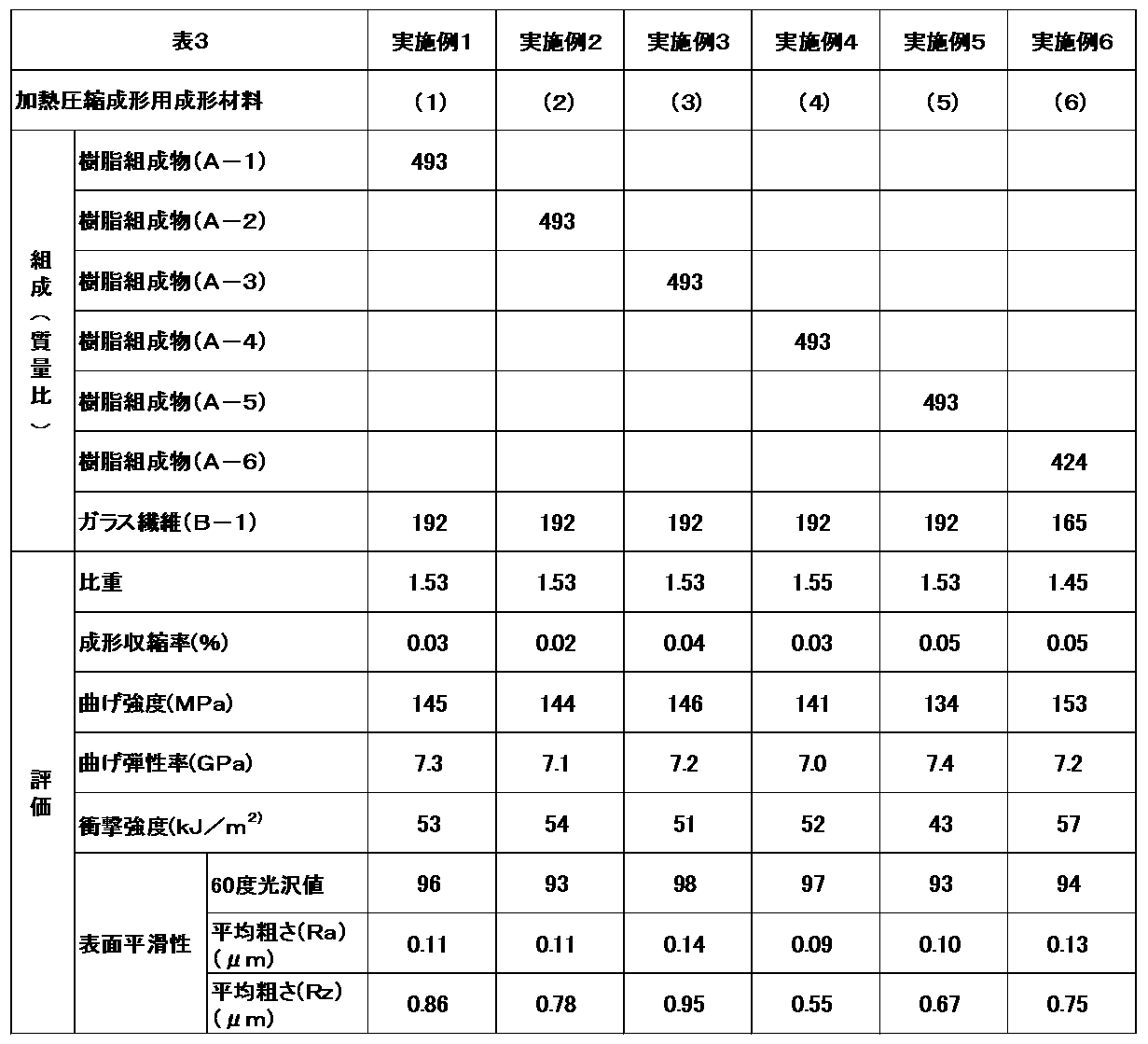
上記で得られた加熱圧縮成形用成形材料(R-1)~(R-6)の組成及び評価結果を表4に示す。

実施例1~6の加熱圧縮成形用成形材料(1)~(6)から得られた成形品は、いずれも比重が1.55以下で、成形収縮率が0.05%以下であり、優れた強度及び表面平滑性を有することが分かった。
比較例1は、不飽和ポリエステル樹脂100質量部に対し、軽質炭酸カルシウムと重質炭酸カルシウムとの合計が上限である200質量部を超える例であるが、得られた成形品は、比重が大きく、表面平滑性も劣ることが分かった。
比較例2は、不飽和ポリエステル樹脂100質量部に対し、重質炭酸カルシウムが上限である150質量部を超える例であるが、得られた成形品の表面平滑性が劣ることが分かった。
比較例3は、水素添加スチレン系熱可塑性エラストマーを用いず、スチレン/ブタジエン/スチレンブロック共重合体を用いた例であるが、得られた成形品は、成形収縮率が0.13%と大きく、表面平滑性も劣ることが分かった。
比較例4は、水素添加スチレン系熱可塑性エラストマーを用いず、ポリスチレン樹脂を用いた例であるが、得られた成形品の表面平滑性が著しく劣ることが分かった。
比較例5は、不飽和ポリエステル樹脂の原料である多塩基酸成分中に、マレイン酸及び/又はフマル酸を90モル%以上含有しない例であるが、得られた成形品は、成形収縮率が0.07%とやや大きく、表面平滑性が劣ると共に、強度が不十分であることが分かった。
比較例6は、不飽和ポリエステル樹脂100質量部に対し、軽質炭酸カルシウムが上限である150質量部を超える例であるが、樹脂組成物が高粘度で、キャリアフィルム状に均一塗布することが困難となり、加熱圧縮成形用成形材料を得ることができなかった。
Claims (5)
- マレイン酸及び/又はフマル酸を90モル%以上含有する多塩基酸成分と多価アルコール成分とを縮合重合して得られた不飽和ポリエステル樹脂(a1)、水素添加スチレン系熱可塑性エラストマー(a2)、軽質炭酸カルシウム(a3)、重質炭酸カルシウム(a4)及び重合開始剤を含有する樹脂組成物(A)を、ガラス繊維(B)に含浸して得られる加熱圧縮成形用成形材料であって、前記樹脂組成物(A)中の含有量が、前記不飽和ポリエステル樹脂100質量部に対して、前記水素添加スチレン系熱可塑性エラストマー(a2)が30~60質量部、軽質炭酸カルシウム(a3)と重質炭酸カルシウム(a4)との合計が50~200質量部であり、且つ、軽質炭酸カルシウム(a3)が25~150質量部、前記重質炭酸カルシウム(a4)が25~150質量部であることを特徴とする加熱圧縮成形用成形材料。
- 前記ガラス繊維(B)の含有率が10~40質量%の範囲である請求項1記載の加熱圧縮成形用成形材料。
- 請求項1又は2記載の加熱圧縮成形用成形材料を成形して得られることを特徴とする成形品。
- シートモールディングコンパウンド(SMC)又はバルクモールディングコンパウンド(BMC)の加熱圧縮成形法により得られるものである請求項3記載の成形品。
- 比重が1.3~1.6の範囲である請求項3又は4項記載の成形品。
Priority Applications (1)
| Application Number | Priority Date | Filing Date | Title |
|---|---|---|---|
| JP2015549105A JP5885053B1 (ja) | 2014-06-05 | 2015-05-28 | 加熱圧縮成形用成形材料およびその成形品 |
Applications Claiming Priority (2)
| Application Number | Priority Date | Filing Date | Title |
|---|---|---|---|
| JP2014-116822 | 2014-06-05 | ||
| JP2014116822 | 2014-06-05 |
Publications (1)
| Publication Number | Publication Date |
|---|---|
| WO2015186597A1 true WO2015186597A1 (ja) | 2015-12-10 |
Family
ID=54766670
Family Applications (1)
| Application Number | Title | Priority Date | Filing Date |
|---|---|---|---|
| PCT/JP2015/065393 Ceased WO2015186597A1 (ja) | 2014-06-05 | 2015-05-28 | 加熱圧縮成形用成形材料およびその成形品 |
Country Status (2)
| Country | Link |
|---|---|
| JP (1) | JP5885053B1 (ja) |
| WO (1) | WO2015186597A1 (ja) |
Cited By (2)
| Publication number | Priority date | Publication date | Assignee | Title |
|---|---|---|---|---|
| JP2021095525A (ja) * | 2019-12-18 | 2021-06-24 | 昭和電工株式会社 | 熱硬化性樹脂組成物、その硬化物及び人工大理石 |
| CN114106505A (zh) * | 2020-09-01 | 2022-03-01 | Dic株式会社 | 树脂组合物、成形材料及其成形品 |
Citations (5)
| Publication number | Priority date | Publication date | Assignee | Title |
|---|---|---|---|---|
| JPS62275154A (ja) * | 1986-05-22 | 1987-11-30 | Hitachi Chem Co Ltd | 繊維強化不飽和ポリエステル樹脂組成物 |
| JPH01236276A (ja) * | 1988-03-17 | 1989-09-21 | Nippon Shokubai Kagaku Kogyo Co Ltd | 低収縮性熱硬化性樹脂組成物 |
| JPH05125267A (ja) * | 1991-09-09 | 1993-05-21 | Idemitsu Petrochem Co Ltd | 繊維強化用不飽和ポリエステル樹脂組成物 |
| JP2002080613A (ja) * | 2000-06-22 | 2002-03-19 | Mitsubishi Rayon Co Ltd | 増粘剤、シートモールディングコンパウンドまたはバルクモールディングコンパウンドおよびその製造方法、並びに樹脂成形品およびその製造方法 |
| JP2008106183A (ja) * | 2006-10-26 | 2008-05-08 | Matsushita Electric Works Ltd | プラスチックからの無機物の回収方法 |
-
2015
- 2015-05-28 WO PCT/JP2015/065393 patent/WO2015186597A1/ja not_active Ceased
- 2015-05-28 JP JP2015549105A patent/JP5885053B1/ja active Active
Patent Citations (5)
| Publication number | Priority date | Publication date | Assignee | Title |
|---|---|---|---|---|
| JPS62275154A (ja) * | 1986-05-22 | 1987-11-30 | Hitachi Chem Co Ltd | 繊維強化不飽和ポリエステル樹脂組成物 |
| JPH01236276A (ja) * | 1988-03-17 | 1989-09-21 | Nippon Shokubai Kagaku Kogyo Co Ltd | 低収縮性熱硬化性樹脂組成物 |
| JPH05125267A (ja) * | 1991-09-09 | 1993-05-21 | Idemitsu Petrochem Co Ltd | 繊維強化用不飽和ポリエステル樹脂組成物 |
| JP2002080613A (ja) * | 2000-06-22 | 2002-03-19 | Mitsubishi Rayon Co Ltd | 増粘剤、シートモールディングコンパウンドまたはバルクモールディングコンパウンドおよびその製造方法、並びに樹脂成形品およびその製造方法 |
| JP2008106183A (ja) * | 2006-10-26 | 2008-05-08 | Matsushita Electric Works Ltd | プラスチックからの無機物の回収方法 |
Cited By (3)
| Publication number | Priority date | Publication date | Assignee | Title |
|---|---|---|---|---|
| JP2021095525A (ja) * | 2019-12-18 | 2021-06-24 | 昭和電工株式会社 | 熱硬化性樹脂組成物、その硬化物及び人工大理石 |
| JP7400437B2 (ja) | 2019-12-18 | 2023-12-19 | 株式会社レゾナック | 熱硬化性樹脂組成物、その硬化物及び人工大理石 |
| CN114106505A (zh) * | 2020-09-01 | 2022-03-01 | Dic株式会社 | 树脂组合物、成形材料及其成形品 |
Also Published As
| Publication number | Publication date |
|---|---|
| JPWO2015186597A1 (ja) | 2017-04-20 |
| JP5885053B1 (ja) | 2016-03-15 |
Similar Documents
| Publication | Publication Date | Title |
|---|---|---|
| JP6150034B1 (ja) | プリプレグ及び成形品 | |
| JP2008540770A (ja) | 相乗的充填剤組成物およびそれからの低密度シート成形コンパウンド | |
| CN111164137B (zh) | 预浸渍体用树脂组合物、预浸渍体及成型品 | |
| JP7173734B2 (ja) | 成形材料及びその成形品 | |
| EP1885538B1 (en) | Low-density, class a sheet molding compounds containing divinybenzene | |
| JP5885053B1 (ja) | 加熱圧縮成形用成形材料およびその成形品 | |
| JP2010150352A (ja) | ラジカル重合型熱硬化性樹脂用硬化剤及びそれを含む成形材料 | |
| WO2006121769A2 (en) | Low-density, class a sheet molding compounds from isophthalate-maleate thermoset resins | |
| JP2010065150A (ja) | 熱硬化性成形材料及び低比重成形体 | |
| JP6579417B1 (ja) | 炭素繊維強化プラスチック成形用樹脂組成物、成形材料、成形品及び成形品の製造方法 | |
| JP2022041470A (ja) | 樹脂組成物、成形材料およびその成形品 | |
| JP2017014481A (ja) | 熱硬化性樹脂組成物及びその樹脂成形物 | |
| JP6715666B2 (ja) | シートモールディングコンパウンド、その製造方法及び成形品 | |
| JP6432365B2 (ja) | 加熱圧縮成形用成形材料およびその成形品 | |
| JP2005054068A (ja) | 不飽和ポリエステル樹脂、および不飽和ポリエステル樹脂複合体、並びに該樹脂複合体の硬化物 | |
| JPWO2018105380A1 (ja) | VaRTM成形用樹脂組成物、成形材料、成形品及び成形品の製造方法 | |
| JP2018103490A (ja) | 熱硬化性シート状成形材料及び繊維強化プラスチックの製造方法 | |
| JPWO2021111885A1 (ja) | シートモールディングコンパウンド及びその成形品 | |
| JP2018087274A (ja) | 樹脂成形材料およびその成形品 | |
| JP7740264B2 (ja) | 成形材料及び成形品 | |
| JP2020079358A (ja) | 熱硬化性樹脂組成物及びその硬化物 | |
| JPH06122812A (ja) | 不飽和ポリエステル樹脂組成物,成形材料および成形物 | |
| JP2009040834A (ja) | ポリエステル樹脂組成物およびこれを用いた成形品 | |
| Stephy et al. | Application of UPR in marine applications | |
| CN105283476B (zh) | 减振材料用成型材料以及将其成型而得到的减振材料及结构构件用成型品 |
Legal Events
| Date | Code | Title | Description |
|---|---|---|---|
| ENP | Entry into the national phase |
Ref document number: 2015549105 Country of ref document: JP Kind code of ref document: A |
|
| 121 | Ep: the epo has been informed by wipo that ep was designated in this application |
Ref document number: 15803917 Country of ref document: EP Kind code of ref document: A1 |
|
| NENP | Non-entry into the national phase |
Ref country code: DE |
|
| 122 | Ep: pct application non-entry in european phase |
Ref document number: 15803917 Country of ref document: EP Kind code of ref document: A1 |