WO2015159972A1 - 反応性シリコーン化合物を含む重合性樹脂組成物 - Google Patents
反応性シリコーン化合物を含む重合性樹脂組成物 Download PDFInfo
- Publication number
- WO2015159972A1 WO2015159972A1 PCT/JP2015/061846 JP2015061846W WO2015159972A1 WO 2015159972 A1 WO2015159972 A1 WO 2015159972A1 JP 2015061846 W JP2015061846 W JP 2015061846W WO 2015159972 A1 WO2015159972 A1 WO 2015159972A1
- Authority
- WO
- WIPO (PCT)
- Prior art keywords
- group
- compound
- formula
- represented
- carbon atoms
- Prior art date
- Legal status (The legal status is an assumption and is not a legal conclusion. Google has not performed a legal analysis and makes no representation as to the accuracy of the status listed.)
- Ceased
Links
Images

Classifications
-
- C—CHEMISTRY; METALLURGY
- C08—ORGANIC MACROMOLECULAR COMPOUNDS; THEIR PREPARATION OR CHEMICAL WORKING-UP; COMPOSITIONS BASED THEREON
- C08F—MACROMOLECULAR COMPOUNDS OBTAINED BY REACTIONS ONLY INVOLVING CARBON-TO-CARBON UNSATURATED BONDS
- C08F2/00—Processes of polymerisation
- C08F2/44—Polymerisation in the presence of compounding ingredients, e.g. plasticisers, dyestuffs, fillers
-
- C—CHEMISTRY; METALLURGY
- C08—ORGANIC MACROMOLECULAR COMPOUNDS; THEIR PREPARATION OR CHEMICAL WORKING-UP; COMPOSITIONS BASED THEREON
- C08G—MACROMOLECULAR COMPOUNDS OBTAINED OTHERWISE THAN BY REACTIONS ONLY INVOLVING UNSATURATED CARBON-TO-CARBON BONDS
- C08G77/00—Macromolecular compounds obtained by reactions forming a linkage containing silicon with or without sulfur, nitrogen, oxygen or carbon in the main chain of the macromolecule
- C08G77/42—Block-or graft-polymers containing polysiloxane sequences
- C08G77/442—Block-or graft-polymers containing polysiloxane sequences containing vinyl polymer sequences
-
- C—CHEMISTRY; METALLURGY
- C08—ORGANIC MACROMOLECULAR COMPOUNDS; THEIR PREPARATION OR CHEMICAL WORKING-UP; COMPOSITIONS BASED THEREON
- C08F—MACROMOLECULAR COMPOUNDS OBTAINED BY REACTIONS ONLY INVOLVING CARBON-TO-CARBON UNSATURATED BONDS
- C08F257/00—Macromolecular compounds obtained by polymerising monomers on to polymers of aromatic monomers as defined in group C08F12/00
- C08F257/02—Macromolecular compounds obtained by polymerising monomers on to polymers of aromatic monomers as defined in group C08F12/00 on to polymers of styrene or alkyl-substituted styrenes
-
- C—CHEMISTRY; METALLURGY
- C08—ORGANIC MACROMOLECULAR COMPOUNDS; THEIR PREPARATION OR CHEMICAL WORKING-UP; COMPOSITIONS BASED THEREON
- C08F—MACROMOLECULAR COMPOUNDS OBTAINED BY REACTIONS ONLY INVOLVING CARBON-TO-CARBON UNSATURATED BONDS
- C08F265/00—Macromolecular compounds obtained by polymerising monomers on to polymers of unsaturated monocarboxylic acids or derivatives thereof as defined in group C08F20/00
- C08F265/04—Macromolecular compounds obtained by polymerising monomers on to polymers of unsaturated monocarboxylic acids or derivatives thereof as defined in group C08F20/00 on to polymers of esters
- C08F265/06—Polymerisation of acrylate or methacrylate esters on to polymers thereof
-
- C—CHEMISTRY; METALLURGY
- C08—ORGANIC MACROMOLECULAR COMPOUNDS; THEIR PREPARATION OR CHEMICAL WORKING-UP; COMPOSITIONS BASED THEREON
- C08F—MACROMOLECULAR COMPOUNDS OBTAINED BY REACTIONS ONLY INVOLVING CARBON-TO-CARBON UNSATURATED BONDS
- C08F290/00—Macromolecular compounds obtained by polymerising monomers on to polymers modified by introduction of aliphatic unsaturated end or side groups
- C08F290/08—Macromolecular compounds obtained by polymerising monomers on to polymers modified by introduction of aliphatic unsaturated end or side groups on to polymers modified by introduction of unsaturated side groups
- C08F290/14—Polymers provided for in subclass C08G
-
- C—CHEMISTRY; METALLURGY
- C08—ORGANIC MACROMOLECULAR COMPOUNDS; THEIR PREPARATION OR CHEMICAL WORKING-UP; COMPOSITIONS BASED THEREON
- C08G—MACROMOLECULAR COMPOUNDS OBTAINED OTHERWISE THAN BY REACTIONS ONLY INVOLVING UNSATURATED CARBON-TO-CARBON BONDS
- C08G77/00—Macromolecular compounds obtained by reactions forming a linkage containing silicon with or without sulfur, nitrogen, oxygen or carbon in the main chain of the macromolecule
- C08G77/04—Polysiloxanes
- C08G77/20—Polysiloxanes containing silicon bound to unsaturated aliphatic groups
-
- C—CHEMISTRY; METALLURGY
- C08—ORGANIC MACROMOLECULAR COMPOUNDS; THEIR PREPARATION OR CHEMICAL WORKING-UP; COMPOSITIONS BASED THEREON
- C08K—Use of inorganic or non-macromolecular organic substances as compounding ingredients
- C08K5/00—Use of organic ingredients
- C08K5/04—Oxygen-containing compounds
- C08K5/13—Phenols; Phenolates
-
- C—CHEMISTRY; METALLURGY
- C08—ORGANIC MACROMOLECULAR COMPOUNDS; THEIR PREPARATION OR CHEMICAL WORKING-UP; COMPOSITIONS BASED THEREON
- C08K—Use of inorganic or non-macromolecular organic substances as compounding ingredients
- C08K5/00—Use of organic ingredients
- C08K5/16—Nitrogen-containing compounds
- C08K5/34—Heterocyclic compounds having nitrogen in the ring
- C08K5/3412—Heterocyclic compounds having nitrogen in the ring having one nitrogen atom in the ring
- C08K5/3432—Six-membered rings
- C08K5/3435—Piperidines
-
- C—CHEMISTRY; METALLURGY
- C08—ORGANIC MACROMOLECULAR COMPOUNDS; THEIR PREPARATION OR CHEMICAL WORKING-UP; COMPOSITIONS BASED THEREON
- C08K—Use of inorganic or non-macromolecular organic substances as compounding ingredients
- C08K5/00—Use of organic ingredients
- C08K5/36—Sulfur-, selenium-, or tellurium-containing compounds
- C08K5/37—Thiols
-
- C—CHEMISTRY; METALLURGY
- C08—ORGANIC MACROMOLECULAR COMPOUNDS; THEIR PREPARATION OR CHEMICAL WORKING-UP; COMPOSITIONS BASED THEREON
- C08K—Use of inorganic or non-macromolecular organic substances as compounding ingredients
- C08K5/00—Use of organic ingredients
- C08K5/36—Sulfur-, selenium-, or tellurium-containing compounds
- C08K5/37—Thiols
- C08K5/372—Sulfides, e.g. R-(S)x-R'
-
- C—CHEMISTRY; METALLURGY
- C08—ORGANIC MACROMOLECULAR COMPOUNDS; THEIR PREPARATION OR CHEMICAL WORKING-UP; COMPOSITIONS BASED THEREON
- C08L—COMPOSITIONS OF MACROMOLECULAR COMPOUNDS
- C08L25/00—Compositions of, homopolymers or copolymers of compounds having one or more unsaturated aliphatic radicals, each having only one carbon-to-carbon double bond, and at least one being terminated by an aromatic carbocyclic ring; Compositions of derivatives of such polymers
- C08L25/02—Homopolymers or copolymers of hydrocarbons
- C08L25/04—Homopolymers or copolymers of styrene
- C08L25/08—Copolymers of styrene
- C08L25/14—Copolymers of styrene with unsaturated esters
-
- C—CHEMISTRY; METALLURGY
- C08—ORGANIC MACROMOLECULAR COMPOUNDS; THEIR PREPARATION OR CHEMICAL WORKING-UP; COMPOSITIONS BASED THEREON
- C08L—COMPOSITIONS OF MACROMOLECULAR COMPOUNDS
- C08L83/00—Compositions of macromolecular compounds obtained by reactions forming in the main chain of the macromolecule a linkage containing silicon with or without sulfur, nitrogen, oxygen or carbon only; Compositions of derivatives of such polymers
- C08L83/10—Block- or graft-copolymers containing polysiloxane sequences
-
- G—PHYSICS
- G02—OPTICS
- G02B—OPTICAL ELEMENTS, SYSTEMS OR APPARATUS
- G02B1/00—Optical elements characterised by the material of which they are made; Optical coatings for optical elements
-
- G—PHYSICS
- G02—OPTICS
- G02C—SPECTACLES; SUNGLASSES OR GOGGLES INSOFAR AS THEY HAVE THE SAME FEATURES AS SPECTACLES; CONTACT LENSES
- G02C7/00—Optical parts
- G02C7/02—Lenses; Lens systems ; Methods of designing lenses
Definitions
- the present invention relates to a polymerizable resin composition containing a reactive silicone compound, and in particular, a cured product having excellent optical properties (high refractive index, low Abbe number) and high heat resistance (heat yellowing resistance, crack resistance). It is related with polymerizable composition which can form.
- Plastic lenses are used for mobile phone cameras, digital cameras, in-vehicle cameras, and the like, and are required to have excellent optical characteristics according to the purpose of the device. Moreover, high durability, for example, heat resistance, weather resistance, and the like, and high productivity that can be molded with a high yield are required in accordance with the usage mode.
- a plurality of lenses are used in a high-resolution camera module, and an optical material having a high refractive index and a low Abbe number is required as one wavelength correction lens.
- an optical material having a high refractive index and a low Abbe number is required as one wavelength correction lens.
- most of the conventional materials proposed with features of a high refractive index and a low Abbe number are those having a temperature of 200 ° C. or less even when the heat resistance is improved.
- Casting lens molding which is one of the methods, can be said to be a method that can maximize the advantages of pressing molding such as low cost and high production efficiency because lens molding is performed using only a curable resin without using expensive optical glass.
- a lens molded using only a curable resin without using the glass support is called a monolithic lens, and has recently been attracting attention because the lens can be thinned.
- a conventionally known lens material as shown in Patent Document 1 has a temperature of 200 ° C. or higher. It has not yet been possible to guarantee the heat resistance to withstand, and there is a risk that cracks may occur due to a high-temperature heat history (for example, 260 ° C.) in the solder reflow process.
- optical characteristics high refractive index, low Abbe number
- heat resistance heat yellowing resistance, crack resistance
- the present invention has been made in view of such circumstances, and the cured product maintains a high refractive index and a low Abbe number, and further suppresses discoloration (thermal yellowing) and cracks caused by high-temperature thermal history. It is an object of the present invention to provide a polymerizable composition suitable for making a molded product.
- the present inventors have found that reactive silicone compounds obtained by polycondensation such as diaryl silicic acid compounds and alkoxy silicon compounds, and specific fluorene structures, bisphenol structures, etc.
- a composition containing a (meth) acrylate compound and a specific polymer having a phenylethylene, naphthylethylene, or biphenylethylene structure as a unit structure, the cured product (optical lens) has a high refractive index and a low refractive index.
- the inventors have found that the Abbe number can be maintained and that thermal yellowing and cracks caused by high-temperature heat history can be effectively suppressed, and the present invention has been completed.
- the present invention provides (a) a polycondensable compound containing at least a diaryl silicate compound A represented by the formula [1] and an alkoxysilicon compound B represented by the formula [2]. 100 parts by mass of a reactive silicone compound obtained by polycondensation in the presence of an acid or a base,
- the present invention relates to a polymerizable composition comprising (b) 1 to 200 parts by mass of a (meth) acrylate compound and (c) 0.1 to 50 parts by mass of a polymer having a weight average molecular weight of 5,000 to 100,000.
- Ar 1 and Ar 2 are each independently a phenyl group which may be substituted with an alkyl group having 1 to 6 carbon atoms, or an alkyl group having 1 to 6 carbon atoms. It represents a naphthyl group or a biphenyl group optionally substituted with an alkyl group having 1 to 6 carbon atoms.
- Ar 3 represents at least a phenyl group having at least one group having a polymerizable double bond, a naphthyl group having at least one group having a polymerizable double bond, or a group having a polymerizable double bond.
- the present invention relates to the polymerizable composition according to the first aspect, in which the polymer (c) is a polymer having at least a monomer unit represented by the formula [3].
- Ar 4 is a phenyl group which may be substituted with an alkyl group having 1 to 6 carbon atoms, a naphthyl group which may be substituted with an alkyl group having 1 to 6 carbon atoms, or 1 carbon atom.
- the present invention relates to the polymerizable composition according to the second aspect, in which the polymer (c) is a polymer further having a monomer unit represented by the formula [4].
- R 4 represents a hydrogen atom or a methyl group
- R 5 represents an alkyl group having 1 to 12 carbon atoms.
- the present invention relates to the polymerizable composition according to the third aspect, wherein the polymer (c) is poly (styrene-co- (meth) methyl acrylate).
- the (b) (meth) acrylate compound is at least one selected from the group consisting of a fluorene compound D represented by the formula [5] and a bisphenol compound E represented by the formula [6]. Further, the present invention relates to the polymerizable composition according to any one of the first aspect to the fourth aspect.
- R 6 and R 7 each independently represent a hydrogen atom or a methyl group
- L 1 and L 2 each independently represent a phenylene group which may have a substituent, or a substituent.
- An optionally substituted naphthalenediyl group, L 3 and L 4 each independently represents an alkylene group having 1 to 6 carbon atoms, and m and n are 0 or positive in which m + n is 0 to 40 Represents an integer.
- R 8 and R 9 each independently represent a hydrogen atom or a methyl group
- R 10 and R 11 each independently represent a hydrogen atom, a methyl group or a trifluoromethyl group
- L 5 and L 6 independently represents an alkylene group having 1 to 6 carbon atoms
- p and q represent 0 or a positive integer in which p + q is 0 to 40.
- the present invention relates to the polymerizable composition according to the fifth aspect, which includes at least two of the fluorene compound D and the bisphenol compound E as the (b) (meth) acrylate compound.
- any one of the first aspect to the seventh aspect further includes (e) 0.01 to 5 parts by mass of at least one sulfur compound selected from the group consisting of a thiol compound H and a disulfide compound I.
- the (a) reactive silicone compound includes a diaryl silicic acid compound A represented by the formula [1], an alkoxysilicon compound B represented by the formula [2], and a formula [9]. Any one of the first to eighth aspects, which is a reactive silicone compound obtained by polycondensation of a polycondensable compound containing at least an alkoxysilicon compound C represented in the presence of an acid or a base.
- the present invention relates to a cured product obtained by polymerizing the polymerizable composition according to any one of the first to ninth aspects.
- the optical lens obtained by superposing
- the material for high refractive index resin lenses which consists of a polymeric composition as described in any one among a 1st viewpoint thru
- the polymerizable composition of the present invention has not only the cured product having desirable optical characteristics (high refractive index, low Abbe number) as an optical device, for example, a lens for a high-resolution camera module, but also a high-resolution camera module. It also has heat resistance (yellowing resistance, crack resistance) that can be suitable for the process. In particular, even a monolithic lens having a film thickness obtained by a casting lens molding process has optical characteristics and heat resistance suitable for a mounting process of a high-resolution camera module. Therefore, the high refractive index resin lens material of the present invention comprising the polymerizable composition can be suitably used as a lens for a high resolution module.
- FIG. 1 is a diagram showing a 1 H NMR spectrum of the reactive fluorine-containing silicone compound obtained in Production Example 1.
- FIG. 2 is a diagram showing a 1 H NMR spectrum of the reactive silicone compound obtained in Production Example 2.
- the present invention provides (a) a polycondensable compound containing at least a diaryl silicic acid compound A represented by the above formula [1] and an alkoxysilicon compound B represented by the above formula [2]. 100 parts by weight of a reactive silicone compound obtained by polycondensation in the presence, (b) 1 to 200 parts by weight of a (meth) acrylate compound, and (c) a polymer having a weight average molecular weight of 5,000 to 100,000.
- the present invention relates to a polymerizable composition containing 1 to 50 parts by mass.
- the reactive silicone compound (a) used in the present invention is obtained by polycondensing a polycondensable compound containing at least a diaryl silicate compound A having a specific structure and an alkoxysilicon compound B having a specific structure in the presence of an acid or a base. It is a compound obtained.
- a polycondensable compound containing at least a diaryl silicate compound A having a specific structure and an alkoxysilicon compound B having a specific structure in the presence of an acid or a base. It is a compound obtained.
- the diaryl silicate compound A is a compound represented by the following formula [1].
- Ar 1 and Ar 2 are each independently substituted with a phenyl group which may be substituted with an alkyl group having 1 to 6 carbon atoms, or an alkyl group with 1 to 6 carbon atoms.
- Examples of the phenyl group which may be substituted with an alkyl group having 1 to 6 carbon atoms represented by Ar 1 and Ar 2 include a phenyl group, an o-tolyl group, an m-tolyl group, a p-tolyl group, 4- Ethylphenyl group, 4-isopropylphenyl group, 4-tert-butylphenyl group, 3,5-dimethylphenyl group, 3,5-diethylphenyl group, 3,5-diisopropylphenyl group, 2,4,6-trimethylphenyl Groups and the like.
- Examples of the naphthyl group optionally substituted by an alkyl group having 1 to 6 carbon atoms represented by Ar 1 and Ar 2 include a 1-naphthyl group, a 2-naphthyl group, a 4-methylnaphthalen-1-yl group, And 6-methylnaphthalen-2-yl group.
- Examples of the biphenyl group optionally substituted by an alkyl group having 1 to 6 carbon atoms represented by Ar 1 and Ar 2 include [1,1′-biphenyl] -2-yl group, [1,1′- Biphenyl] -3-yl group and [1,1′-biphenyl] -4-yl group.
- the compound represented by the formula [1] include diphenylsilanediol, di-p-tolylsilanediol, bis (4-ethylphenyl) silanediol, bis (4-isopropylphenyl) silanediol, and dinaphthyl.
- Examples thereof include, but are not limited to, silanediol, bis ([1,1′-biphenyl] -4-yl) silanediol, and the like.
- alkoxysilicon compound B is a compound represented by the following formula [2].
- Ar 3 has a phenyl group having at least one group having a polymerizable double bond, a naphthyl group having at least one group having a polymerizable double bond, or a polymerizable double bond.
- a biphenyl group having at least one group is represented, R 1 represents a methyl group or an ethyl group, R 2 represents a methyl group, an ethyl group or a vinylphenyl group, and a represents 2 or 3.
- Examples of the phenyl group having at least one group having a polymerizable double bond represented by Ar 3 include 2-vinylphenyl group, 3-vinylphenyl group, 4-vinylphenyl group, 4-vinyloxyphenyl group, 4 -Allylphenyl group, 4-allyloxyphenyl group, 4-isopropenylphenyl group and the like.
- Examples of the naphthyl group having at least one group having a polymerizable double bond represented by Ar 3 include 4-vinylnaphthalen-1-yl group, 5-vinylnaphthalen-1-yl group, and 6-vinylnaphthalene-2.
- -Yl group 4-allylnaphthalen-1-yl group, 4-allyloxynaphthalen-1-yl group, 5-allyloxynaphthalen-1-yl group, 8-allyloxynaphthalen-1-yl group, 5-vinyl Oxynaphthalen-1-yl group, 5-allylnaphthalen-1-yl group, 5-isopropenylnaphthalen-1-yl group, 6-vinylnaphthalen-2-yl group, 6-allylnaphthalen-2-yl group, etc. Can be mentioned.
- Examples of the biphenyl group having at least one group having a polymerizable double bond represented by Ar 3 include a 4′-vinyl- [1,1′-biphenyl] -2-yl group, 4′-vinyl- [1 , 1′-biphenyl] -3-yl group, 4′-vinyl- [1,1′-biphenyl] -4-yl group, 4′-vinyloxy- [1,1′-biphenyl] -4-yl group, 4′-allyl- [1,1′-biphenyl] -4-yl group, 4′-allyloxy- [1,1′-biphenyl] -4-yl group, 4′-isopropenyl- [1,1′- And biphenyl] -4-yl group.
- the compound represented by the above formula [2] include, for example, trimethoxy (4-vinylphenyl) silane, triethoxy (4-vinylphenyl) silane, (4-isopropenylphenyl) trimethoxysilane, dimethoxy (methyl) ) (4-vinylphenyl) silane, dimethoxybis (4-vinylphenyl) silane, trimethoxy (4-vinyl-1-naphthyl) silane, trimethoxy (5-vinyl-1-naphthyl) silane, trimethoxy (6-vinyl-2) -Naphthyl) silane, trimethoxy (4'-vinyl- [1,1'-biphenyl] -4-yl) silane and the like, but are not limited thereto.
- the polycondensable compound used in the reactive silicone compound (a) used in the present invention may contain an alkoxysilicon compound C having a specific structure in addition to the aforementioned diaryl silicate compound A and alkoxysilicon compound B. .
- the alkoxysilicon compound C is a compound represented by the following formula [9].
- Rf represents a fluoroalkyl group having 1 to 12 carbon atoms or a fluorophenyl group
- R 17 represents a methyl group or an ethyl group
- R 18 represents a methyl group, an ethyl group or a vinylphenyl group.
- b represents 2 or 3.
- Rf is group represented by Formula [10].
- X represents a hydrogen atom or a fluorine atom
- r represents an integer of 0 to 2
- s represents an integer of 1 to 6
- a black dot represents a bond to a silicon atom.
- fluoroalkyl group having 1 to 12 carbon atoms represented by Rf examples include a trifluoromethyl group, a pentafluoroethyl group, a heptafluoropropyl group, a perfluorobutyl group, a perfluoropentyl group, a perfluorohexyl group, 2, 2, 2-trifluoroethyl group, 2,2,3,3,3-pentafluoropropyl group, 3,3,3-trifluoropropyl group, 2- (perfluorobutyl) ethyl group, 2- (perfluorohexyl) Ethyl group, 2- (perfluorooctyl) ethyl group, 2- (perfluorodecyl) ethyl group, 2- (perfluoro-3-methylbutyl) ethyl group, 2- (perfluoro-5-methylhexyl) ethyl group, 2- (perfluoro
- fluorophenyl group represented by Rf examples include 2-fluorophenyl group, 3-fluorophenyl group, 4-fluorophenyl group, 2,4,6-trifluorophenyl group, perfluorophenyl group and the like.
- Specific examples of the compound represented by the above formula [9] include, for example, trimethoxy (trifluoromethyl) silane, trimethoxy (3,3,3-trifluoropropyl) silane, triethoxy (3,3,3-trifluoro Propyl) silane, dimethoxy (methyl) (3,3,3-trifluoropropyl) silane, dimethoxy (3,3,3-trifluoropropyl) (4-vinylphenyl) silane, and the like. It is not something.
- the polycondensable compound used in the reactive silicone compound (a) used in the present invention includes other polycondensable compounds other than the aforementioned diaryl silicic acid compound A, alkoxysilicon compound B and alkoxysilicon compound C. May be.
- Other polycondensable compounds are not particularly limited as long as they are compounds capable of polycondensation with these compounds, such as hydrolyzable silane compounds other than the above-mentioned compounds A to C.
- polycondensable compounds include, for example, tetramethoxysilane, tetraethoxysilane, trimethoxy (methyl) silane, trimethoxy (vinyl) silane, 3- (meth) acryloyloxypropyl (trimethoxy) silane, trimethoxy (phenyl) silane, Trimethoxy (1-naphthyl) silane, dimethoxy (dimethyl) silane, dimethoxy (diphenyl) silane, dimethoxy (methyl) (vinyl) silane, 3- (meth) acryloyloxypropyl (dimethoxy) (methyl) silane, dimethoxy (methyl) ( Phenyl) silane and the like.
- [Preferred examples of reactive silicone compound] As the reactive silicone compound (a), diphenylsilane diol as diaryl silicic acid compound A and a compound represented by the following formula [2a] as alkoxy silicon compound B are polycondensed in the presence of an acid or a base. The resulting reactive silicone compound is preferred.
- R 1 represents the same meaning as described above.
- Rf and R 17 have the same meaning as described above.
- the above-mentioned diaryl silicate compound A, alkoxy silicon compound B, and alkoxy silicon compound C can be used by appropriately selecting compounds as necessary, and a plurality of types can be used in combination.
- the molar ratio of the diaryl silicate compound A, the alkoxy silicon compound B, and the alkoxy silicon compound C is in the above range.
- the polycondensation reaction with the condensable compound) is preferably carried out in the presence of an acid or basic catalyst.
- the type of the catalyst used for the polycondensation reaction is not particularly limited as long as it is dissolved or uniformly dispersed in the solvent described later, and can be appropriately selected and used as necessary. Examples of the catalyst that can be used include B (OR) 3 , Al (OR) 3 , Ti (OR) 4 , Zr (OR) 4, etc.
- R represents a hydrogen atom, a linear alkyl group having 1 to 12 carbon atoms, a branched alkyl group having 3 to 12 carbon atoms, or a cyclic alkyl group having 3 to 12 carbon atoms.
- R represents a hydrogen atom, a linear alkyl group having 1 to 12 carbon atoms, a branched alkyl group having 3 to 12 carbon atoms, or a cyclic alkyl group having 3 to 12 carbon atoms.
- the acidic compound examples include boric acid, trimethoxyboron, triethoxyboron, tri-n-propoxyboron, triisopropoxyboron, tri-n-butoxyboron, triisobutoxyboron, tri-sec-butoxyboron, Tri-tert-butoxyboron, trimethoxyaluminum, triethoxyaluminum, tri-n-propoxyaluminum, triisopropoxyaluminum, tri-n-butoxyaluminum, triisobutoxyaluminum, tri-sec-butoxyaluminum, tri-tert- Butoxyaluminum, tetramethoxytitanium, tetraethoxytitanium, tetra-n-propoxytitanium, tetraisopropoxytitanium (titanium tetraisopropoxide), tetra-n-butoxytitanium, te Lysobutoxy titanium, tetra-
- Examples of the basic compound include sodium hydroxide, potassium hydroxide, magnesium hydroxide, calcium hydroxide, strontium hydroxide, barium hydroxide, ammonium hydroxide, tetramethylammonium hydroxide, tetrabutylammonium hydroxide, triethylamine. Etc.
- fluoride salt examples include ammonium fluoride, tetramethylammonium fluoride, and tetrabutylammonium fluoride.
- one or more selected from the group consisting of tetraisopropoxy titanium (titanium tetraisopropoxide), magnesium hydroxide, calcium hydroxide, strontium hydroxide, and barium hydroxide is preferably used.
- the amount of the catalyst used is 0.01 to 10% by mass, preferably 0.1 to 5% by mass, based on the total mass of the diaryl silicate compound and the alkoxysilicon compound. The reaction proceeds more favorably when the amount of the catalyst used is 0.01% by mass or more. In consideration of economy, the use of 10% by mass or less is sufficient.
- the reactive silicone compound according to the present invention is characterized by the structure of the alkoxysilicon compound.
- the reactive group (polymerizable double bond) contained in the alkoxysilicon compound used in the present invention is easily polymerized radically or ionically (anion, cation), and has high heat resistance after polymerization (after curing). Show.
- an alkoxysilicon compound and a diarylsilicate compound are polycondensed to obtain a silicone compound having high heat resistance, it is necessary to stop the reaction at an appropriate degree of polymerization so that the product maintains a liquid state.
- the alkoxysilicon compound used in the present invention does not actively hydrolyze, the polycondensation reaction with the diaryl silicate compound is gentle, and the degree of polymerization is easily controlled.
- the polycondensation reaction of the alkoxy silicon compound and the diaryl silicate compound by dealcoholization can be performed in the absence of a solvent, but it is also possible to use a solvent inert to the alkoxy silicon compound such as toluene described later as the reaction solvent. It is. When there is no solvent, there is an advantage that the alcohol as a reaction by-product can be easily distilled off. On the other hand, when a reaction solvent is used, there are advantages that the reaction system can be easily made uniform and a more stable polycondensation reaction can be performed.
- the reactive reaction of the reactive silicone compound may be performed without a solvent as described above, but there is no problem even if a solvent is used in order to make it more uniform.
- the solvent is not particularly limited as long as it does not react with the diaryl silicate compound and the alkoxysilicon compound and dissolves the condensate thereof.
- reaction solvent examples include ketones such as acetone and methyl ethyl ketone (MEK); aromatic hydrocarbons such as benzene, toluene and xylene; glycols such as ethylene glycol, propylene glycol and hexylene glycol; ethyl cellosolve Glycol ethers such as butyl cellosolve, ethyl carbitol, butyl carbitol, diethyl cellosolve and diethyl carbitol; amides such as N-methyl-2-pyrrolidone (NMP) and N, N-dimethylformamide (DMF) It is done.
- NMP N-methyl-2-pyrrolidone
- DMF N-dimethylformamide
- the reactive silicone compound used in the present invention is represented by the diaryl silicate compound A represented by the formula [1] and the alkoxysilicon compound B represented by the formula [2] (and optionally represented by the formula [9]. It is obtained by subjecting the alkoxysilicon compound C and / or other polycondensable compound) to dealcoholization condensation in the presence of an acid or a basic catalyst.
- the polycondensation reaction is preferably carried out without positively adding water, and is preferably carried out in an inert gas atmosphere such as nitrogen gas for the purpose of preventing water contamination.
- the reaction temperature is 20 to 150 ° C, more preferably 30 to 120 ° C.
- the reaction time is not particularly limited as long as it is longer than the time necessary for the molecular weight distribution of the polycondensate to increase and to stabilize the molecular weight distribution, and more specifically, several hours to several days.
- the reactive silicone compound obtained by any method such as filtration and solvent distillation it is preferable to collect the reactive silicone compound obtained by any method such as filtration and solvent distillation, and appropriately perform a purification treatment as necessary.
- the polycondensate obtained by such a reaction has a weight average molecular weight Mw measured in terms of polystyrene by gel permeation chromatography (GPC) of 500 to 10,000, and a dispersity Mw (weight average molecular weight) / Mn (Number average molecular weight) is 1.0 to 10.
- the (b) (meth) acrylate compound contained in the polymerizable composition of the present invention preferably comprises a fluorene compound D represented by the following formula [5] and a bisphenol compound E represented by the following formula [6]. It is at least one selected from the group.
- (meth) acrylate refers to both acrylate and methacrylate.
- the fluorene compound D is a compound represented by the following formula [5].
- R 6 and R 7 each independently represent a hydrogen atom or a methyl group
- L 1 and L 2 each independently represent a phenylene group which may have a substituent, or Represents an optionally substituted naphthalenediyl group
- L 3 and L 4 each independently represent an alkylene group having 1 to 6 carbon atoms
- m and n are 0 in which m + n is 0 to 40 Or it represents a positive integer.
- Examples of the phenylene group optionally having a substituent represented by L 1 and L 2 include an o-phenylene group, an m-phenylene group, a p-phenylene group, a 2-methylbenzene-1,4-diyl group, 2-chlorobenzene-1,4-diyl group, 2-bromobenzene-1,4-diyl group, 2-aminobenzene-1,4-diyl group, 2-methylbenzene-1,5-diyl group, 2-chlorobenzene -1,5-diyl group, 2-bromobenzene-1,5-diyl group, 2-aminobenzene-1,5-diyl group and the like.
- a p-phenylene group is preferred.
- the naphthalenediyl group optionally having a substituent represented by L 1 and L 2 include a naphthalene-1,4-diyl group, a naphthalene-1,5-diyl group, and a naphthalene-2,6-diyl group.
- Examples of the alkylene group having 1 to 6 carbon atoms represented by L 3 and L 4 include methylene group, ethylene group, trimethylene group, methylethylene group, tetramethylene group, 1-methyltrimethylene group, 2-methyltrimethylene group.
- m and n are preferably m + n from 0 to 30, and more preferably m + n from 2 to 20.
- fluorene compound D examples include, for example, 9,9-bis (4- (2- (meth) acryloyloxy) phenyl) -9H-fluorene, 9,9-bis (4- (2- ( (Meth) acryloyloxyethoxy) phenyl) -9H-fluorene, ethoxylated (ethylene oxide modified) (9H-fluorene-9,9-diyl) bis (4,1-phenylene) di (meth) acrylate, propoxylated (propylene oxide modified) ) (9H-fluorene-9,9-diyl) bis (4,1-phenylene) di (meth) acrylate, 9,9-bis (6- (2- (meth) acryloyloxy) naphthalen-2-yl)- 9H-fluorene, 9,9-bis (6- (2- (meth) acryloyloxyethoxy) naphthalen-2-yl) -9H-fluorene, 9,
- the bisphenol compound E is a compound represented by the following formula [6].
- R 8 and R 9 each independently represent a hydrogen atom or a methyl group
- R 10 and R 11 each independently represent a hydrogen atom, a methyl group or a trifluoromethyl group
- L 5 and L 6 each independently represent an alkylene group having 1 to 6 carbon atoms
- p and q each represents 0 or a positive integer in which p + q is 0 to 40.
- Examples of the alkylene group having 1 to 6 carbon atoms represented by L 5 and L 6 include the same groups as those exemplified as L 3 and L 4 in the above formula [5]. Of these, an ethylene group and a methylethylene group are preferable.
- p and q are preferably such that p + q is 0 to 30, and more preferably p + q is 2 to 20.
- bisphenol compound E examples include, for example, bisphenol A di (meth) acrylate, ethoxylated (ethylene oxide-modified) bisphenol A di (meth) acrylate (2.3 mol addition of ethoxy groups, 2.6 mol addition, 3 mol addition) 4 mol addition, 6 mol addition, 10 mol addition, 17 mol addition, 30 mol addition, etc.), propoxylation (propylene oxide modification) bisphenol A di (meth) acrylate (propoxy group 3 mol addition, etc.), ethoxy / propoxylation (ethylene oxide / propylene oxide modification) ) Bisphenol A di (meth) acrylate (6 mol of ethoxy group / 12 mol of propoxy group added), ethoxylated (ethylene oxide modified) bisphenol F di (meth) acrylate (Etoki) 4 mol group), ethoxylated (ethylene oxide modified) bisphenol AF di (meth) acrylate, NK ester A-B1206PE, ABE
- the blending amount of the (b) (meth) acrylate compound is preferably 1 to 200 parts by weight, more preferably 25 to 150 parts by weight with respect to 100 parts by weight of the (a) reactive silicone compound. 50 to 100 parts by mass is preferable.
- the (b) (meth) acrylate compound contained in the polymerizable composition of the present invention is a mixture of at least one selected from the group consisting of the fluorene compound D and the bisphenol compound E, and a mixture of two or more. It may be used.
- the polymer (c) contained in the polymerizable composition of the present invention has a weight average molecular weight Mw measured in terms of polystyrene by gel permeation chromatography (GPC) of 5,000 to 100,000, preferably 10,000 to 80. 1,000, more preferably 20,000 to 60,000 polymers.
- GPC gel permeation chromatography
- a polymer having at least a monomer unit represented by the formula [3] or a monomer unit represented by the formula [4] is preferable, and is represented by at least the monomer unit represented by the formula [3] and the formula [4].
- a polymer having monomer units is more preferred.
- Ar 4 is a phenyl group which may be substituted with an alkyl group having 1 to 6 carbon atoms, a naphthyl group which may be substituted with an alkyl group having 1 to 6 carbon atoms, or carbon. It represents a biphenyl group which may be substituted with an alkyl group having 1 to 6 atoms, and R 3 represents a hydrogen atom or a methyl group.
- Ar 4 represents a phenyl group which may be substituted with an alkyl group having 1 to 6 carbon atoms, a naphthyl group which may be substituted with an alkyl group having 1 to 6 carbon atoms, and an alkyl group having 1 to 6 carbon atoms.
- Examples of the biphenyl group optionally substituted with an alkyl group include the same groups as those exemplified as Ar 1 and Ar 2 in the above formula [1].
- the monomer unit represented by the formula [3] include, for example, 1-phenylethylene group, 1-methyl-1-phenylethylene group, 1- (naphthalen-1-yl) ethylene group, 1- ( [1,1′-biphenyl] -2-yl) ethylene group, 1-([1,1′-biphenyl] -3-yl) ethylene group, 1-([1,1′-biphenyl] -4-yl ) Ethylene group and the like. Of these, a 1-phenylethylene group is preferable.
- R 4 represents a hydrogen atom or a methyl group
- R 5 represents an alkyl group having 1 to 12 carbon atoms.
- alkyl group having 1 to 12 carbon atoms represented by R 5 examples include, for example, methyl group, ethyl group, n-propyl group, isopropyl group, n-butyl group, isobutyl group, sec-butyl group, tert-butyl group, n-pentyl, isoamyl, neopentyl, tert-amyl, sec-isoamyl, cyclopentyl, n-hexyl, cyclohexyl, n-heptyl, n-octyl, 2-ethylhexyl, n-nonyl Group, n-decyl group, n-dodecyl group, benzyl group, phenethyl group and the like.
- monomer unit represented by the above formula [4] include, for example, 1-methoxycarbonylethylene group, 1-methoxycarbonyl-1-methylethylene group and the like.
- polystyrene examples include, for example, polystyrene, acrylonitrile-chlorinated polyethylene-styrene copolymer (ACS), acrylonitrile-butadiene-styrene copolymer (ABS), acrylonitrile-EPDM (ethylene-propylene-dienter).
- ACS acrylonitrile-chlorinated polyethylene-styrene copolymer
- ABS acrylonitrile-butadiene-styrene copolymer
- EPDM ethylene-propylene-dienter
- Polymer -styrene copolymer (AES), acrylonitrile-styrene copolymer (AS), acrylonitrile-styrene-acrylate copolymer (ASA), methyl methacrylate-butadiene-styrene copolymer (MBS), methyl methacrylate -Styrene polymers such as styrene copolymer (MS), silicone-acrylonitrile-styrene copolymer (SAS), styrene-butadiene copolymer (SBC), styrene-maleic anhydride copolymer (SMA); Acry (Meth acid), (meth) acrylic polymers such as poly (methyl methacrylate) (PMMA); polyolefins such as polyethylene (PE) and polypropylene (PP); polyamide (PA); polycarbonate (PC); polyethylene terephthalate (PET), Polybutylene terephthalate (PBT)
- the molar ratio of each monomer unit constituting the copolymer is not particularly limited.
- the monomer unit represented by [3] is preferably 99: 1 to 10:90.
- the polymer may be used alone or in combination of two or more.
- the blending amount is preferably 0.1 to 50 parts by weight, more preferably 0.5 to 30 parts by weight, and particularly preferably 1 to 20 parts by weight with respect to 100 parts by weight of the (a) reactive silicone compound.
- the polymerizable composition of the present invention includes a light stabilizer F and an antioxidant as a component (d). At least one stabilizer selected from the group consisting of the agent G may be included.
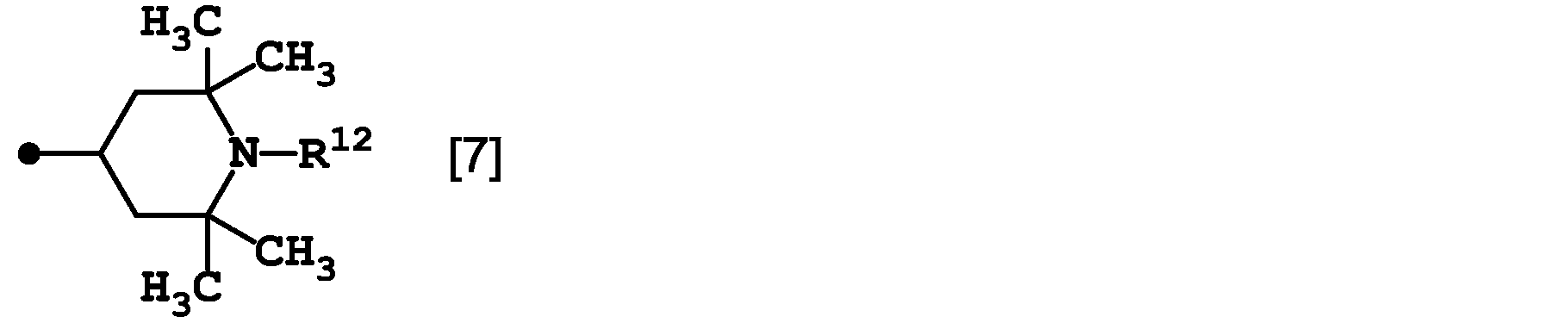
- the light stabilizer F is a compound having a group represented by the following formula [7].
- R 12 represents a hydrogen atom, an alkyl group having 1 to 10 carbon atoms, or an alkoxy group having 1 to 12 carbon atoms, and a black dot represents a bond.
- alkyl group having 1 to 10 carbon atoms represented by R 12 examples include, for example, methyl group, ethyl group, n-propyl group, isopropyl group, n-butyl group, isobutyl group, sec-butyl group, tert-butyl group, n-pentyl, isoamyl, neopentyl, tert-amyl, sec-isoamyl, cyclopentyl, n-hexyl, cyclohexyl, n-heptyl, n-octyl, n-nonyl, n-decyl Groups and the like.
- Examples of the alkoxy group having 1 to 12 carbon atoms represented by R 12 include a methoxy group, an ethoxy group, an n-propoxy group, an isopropoxy group, an n-butoxy group, an isobutoxy group, a sec-butoxy group, and a tert-butoxy group.
- N-pentyloxy group isoamyloxy group, neopentyloxy group, tert-amyloxy group, sec-isoamyloxy group, cyclopentyloxy group, n-hexyloxy group, cyclohexyloxy group, n-heptyloxy group, n-octyl And group oxy, n-nonyloxy, n-decyloxy, n-undecyloxy and the like.
- R 12 is preferably a hydrogen atom, a methyl group, a cyclohexyloxy group, or an n-octyloxy group.
- Examples of such a light stabilizer F include TINUVIN (registered trademark) 123, 144, 152, 292, and 770 [above, manufactured by BASF Japan Ltd.], ADK STAB (registered trademark) LA-52, LA-57, LA-63P, LA-68, LA-72, LA-77Y, LA-77G, LA-81, LA-82, LA-87 [above, Ltd.] ADEKA] and the like.
- the antioxidant G is a compound having a group represented by the following formula [8].
- R 13 represents an alkyl group having 1 to 10 carbon atoms
- R 14 to R 16 each independently represents a hydrogen atom or an alkyl group having 1 to 10 carbon atoms
- Examples of the alkyl group having 1 to 10 carbon atoms represented by R 13 and R 14 to R 16 include the same groups as those exemplified as R 12 in the above formula [7]. Among them, R 13 is preferably a tert-butyl group. Examples of the group represented by the formula [8] include a 3-tert-butyl-4-hydroxy-5-methylphenyl group, a 3-tert-butyl-4-hydroxy-6-methylphenyl group, 3 , 5-di-tert-butyl-4-hydroxyphenyl group and the like.
- antioxidant G examples include IRGANOX (registered trademark) 245, 1010, 1035, 1076, and 1135 [above, manufactured by BASF Japan Ltd.], Sumilizer (registered trademark) GA-80, GP, MDP-S, BBM-S, WX-R [above, manufactured by Sumitomo Chemical Co., Ltd.], ADK STAB (registered trademark) AO-20, AO-30, AO-40, AO- 50, AO-60, AO-80, AO-330 [above, manufactured by ADEKA Co., Ltd.].
- the component (d) is preferably contained in an amount of 0.01 to 5 parts by mass with respect to 100 parts by mass of the component (a). More preferably, it is 0.05 to 1 part by mass.
- the light stabilizer F may be used alone or in combination of two or more, or the antioxidant G may be used alone or in combination of two or more. Alternatively, one or more light stabilizers F and one or more antioxidants G may be mixed and used.
- the total amount of the plurality of types of compounds used is within the above range.
- the polymerizable composition of the present invention comprises: e) The component may contain at least one sulfur compound selected from the group consisting of the thiol compound H and the disulfide compound I.
- disulfide compound I examples include diethyl disulfide, dipropyl disulfide, diisopropyl disulfide, dibutyl disulfide, di-tert-butyl disulfide, dipentyl disulfide, diisopentyl disulfide, dihexyl disulfide.
- Dicyclohexyl disulfide didecyl disulfide, di-tert-dodecyl disulfide, bis (2-hydroxyethyl) disulfide, bis (2,2-diethoxyethyl) disulfide and the like; diphenyl disulfide, ditolyl disulfide, dibenzyl Disulfide, 2,2'-dipyridyl disulfide, 2,2'-dibenzimidazolyl disulfide, 2,2'-dibenzothiazolyl disulfide ⁇ incense ring disulfides of; tetramethyl thiuram disulfide, tetraethyl thiuram disulfide, tetrabutyl thiuram disulfide, thiuram disulfides such as di-pentamethylene thiuram disulfide and the like. Of these, alkyl disulfides are preferable, and didecyl disul
- the component (e) is preferably contained in an amount of 0.01 to 5 parts by mass with respect to 100 parts by mass of the component (a). More preferably, it is 0.1 to 1 part by mass.
- the thiol compound H may be used alone or in combination of two or more, or the disulfide compound I may be used alone or in combination of two or more, or A mixture of one or more thiol compounds H and one or more disulfide compounds I may be used.
- the total amount of the plurality of types of compounds used is within the above range.
- the polymerizable composition of the present invention may contain (f) a polymerization initiator in addition to the components (a) to (c) or the components (a) to (e).
- a polymerization initiator either a thermal polymerization initiator or a photopolymerization initiator can be used.
- thermal polymerization initiator examples include azos and organic peroxides.
- thermal polymerization initiator examples include V-30, V-40, V-59, V-60, V-65, and V-70 [above, manufactured by Wako Pure Chemical Industries, Ltd.] Etc.
- organic peroxide thermal polymerization initiators examples include, for example, Parkadox (registered trademark) CH, BC-FF, 14, 16 and Trigonox (registered trademark) 22, 23, 121.
- photopolymerization initiator examples include alkylphenones, benzophenones, acylphosphine oxides, Michler's benzoylbenzoates, oxime esters, tetramethylthiuram monosulfides, and thioxanthones.
- photocleavable photoradical polymerization initiators are preferred.
- examples of the photocleavable photoradical polymerization initiator include those described in the latest UV curing technology (p. 159, publisher: Kazuhiro Takahisa, publisher: Technical Information Association, published in 1991). .
- radical photopolymerization initiators examples include IRGACURE (registered trademark) 184, 369, 651, 500, 819, 907, 784, 2959, CGI 1700, CGI 1750, CGI1850, CG24-61, TPO, Darocur (registered trademark) 1116, 1173 [above, manufactured by BASF Japan Ltd.], ESACURE KIP150, KIP65LT, KIP100F, KT37, KT55, KTO46, KIP75 [Above, manufactured by Lamberti Co., Ltd.].
- the polymerization initiators When a polymerization initiator is added, the polymerization initiators may be used alone or in combination of two or more.
- the addition amount is 0.1 to 20 parts by mass, more preferably 0.3 to 10 parts by mass with respect to 100 parts by mass of the (a) reactive silicone compound.
- ⁇ (G) Diluent> In the polymerizable composition of the present invention, the aforementioned (a) reactive silicone compound, (b) (meth) acrylate compound and (c) polymer, or the above (a), for the purpose of improving the handling of the polymerizable composition.
- a diluent may be included as the component (g).
- the diluent it is preferable to use a compound having at least one group having a polymerizable double bond and having a viscosity at 25 ° C. of 500 mPa ⁇ s or less, more preferably 100 mPa ⁇ s or less.
- Examples of such a diluent include vinyl compounds such as styrene and divinylbenzene; methyl (meth) acrylate, ethyl (meth) acrylate, 2,2,2-trifluoroethyl (meth) acrylate, n-propyl (meth) ) Acrylate, isopropyl (meth) acrylate, n-butyl (meth) acrylate, sec-butyl (meth) acrylate, isobutyl (meth) acrylate, tert-butyl (meth) acrylate, n-hexyl (meth) acrylate, n-octyl (Meth) acrylate, isobornyl (meth) acrylate, adamantyl (meth) acrylate, dicyclopentanyl (meth) acrylate, dicyclopentenyl (meth) acrylate, 2- (dicyclopentanyloxy) e
- monofunctional (meth) acrylates bifunctional (meth) acrylates, trifunctional or higher (meth) acrylate (meth) acrylate compounds are preferable, and neopentyl glycol di (meth) acrylate is more preferable.
- the diluent When adding a diluent, the diluent may be used alone or in combination of two or more.
- the amount added is 10 to 300 parts by weight, more preferably 50 to 200 parts by weight, based on 100 parts by weight of the polymer (c).
- the method for preparing the polymerizable composition of the present embodiment is not particularly limited.
- a preparation method for example, the components (a) to (c) and, if necessary, the components (d) to (g) are mixed at a predetermined ratio, and other additives are further added as desired.
- the ratio of the solid content in the polymerizable composition is not particularly limited as long as each component is uniformly dissolved in the solvent. For example, it is 1 to 50% by mass, or 1 to 30%. % By mass or 1 to 25% by mass.
- the solid content is obtained by removing the solvent component from all components of the polymerizable composition.
- the solution of the polymerizable composition is preferably used after being filtered using a filter having a pore size of 0.05 to 5 ⁇ m.
- the present invention also relates to a cured product obtained by heat or photopolymerization of the polymerizable composition.
- the heating conditions in the thermal polymerization are not particularly limited, but are usually appropriately selected from the range of 50 to 300 ° C. and 1 to 120 minutes. Moreover, it does not specifically limit as a heating means, For example, a hotplate, oven, etc. are mentioned. Examples of actinic rays used for photopolymerization include ultraviolet rays, electron beams, and X-rays.
- a light source used for ultraviolet irradiation sunlight, a chemical lamp, a low-pressure mercury lamp, a high-pressure mercury lamp, a metal halide lamp, a xenon lamp, a UV-LED, or the like can be used.
- post-baking is performed as necessary. Specifically, the polymerization is completed usually by heating at 50 to 300 ° C. for 1 to 120 minutes using a hot plate, an oven or the like. Can do.
- the cured product of the present invention has a refractive index as high as 1.55 or more at a wavelength of 589 nm, and also has a dimensional stability by suppressing yellowing and cracking due to heating. It is useful as a material for a high refractive index resin lens such as an optical lens.
- the polymerizable composition of the present invention can be formed into various molded products in parallel with the formation of a cured product by using a conventional molding method such as compression molding (imprinting, etc.), casting, injection molding, blow molding and the like. Can be easily manufactured.
- a molded body (for example, an optical lens) thus obtained is also an object of the present invention.
- a method for producing a molded body for example, a step of filling the above-described polymerizable composition of the present invention between a lower surface mold or a support and an upper surface mold, and heating the filled composition for thermal polymerization.
- the manufacturing method including the step of performing and the step of releasing the thermal polymer from the mold is preferable.
- the heating and thermal polymerization step can be performed by applying the conditions shown in the above ⁇ cured product >>.
- the molded body produced by such a method can be suitably used as a camera module lens.
- Nertaro Awatori (registered trademark) ARE-310 (5) Refractive index n D , Abbe number ⁇ D Equipment: Multi-wavelength Abbe refractometer DR-M4 manufactured by Atago Co., Ltd. Measurement temperature: 20 ° C Intermediate liquid: Monobromonaphthalene (6) Haze Equipment: (With) Tokyo Denshoku spectrophotometric colorimetric haze meter TC-1800H Reference: Air (7) Reflow Oven Equipment: Desktop Reflow Oven STR-3100, manufactured by Thin Apex Co., Ltd. (8) Light transmittance Device: UV-visible spectrophotometer UV-3100 manufactured by Shimadzu Corporation
- BnA benzyl acrylate [Osaka Organic Chemical Co., Ltd. Viscoat # 160]
- BPEA Ethoxylated bisphenol A diacrylate (addition of 4 mol of ethoxy group) [NK ester A-BPE-4 manufactured by Shin-Nakamura Chemical Co., Ltd.]
- FDA Bisaryl full orange acrylate [Ogsol (registered trademark) EA-F5503 manufactured by Osaka Gas Chemical Co., Ltd.]
- HDDA 1,6-hexanediol diacrylate [Biscoat # 230 manufactured by Osaka Organic Chemical Industry Co., Ltd.]
- NPGDA Neopentylglycol diacrylate [Kyarad (registered trademark) NPGDA manufactured by Nippon Kayaku Co., Ltd.]
- TMP3A trimethylol propane triacrylate [manufactured by Shin-Nakamura Chemical Co., Ltd., NK Ester A-TMPT]
- MS3703, copolymerization molar ratio: methyl methacrylate / styrene 30/70, Mw: 36,000]
- MS5503, copolymerization molar ratio: methyl methacrylate / styrene 50/50, Mw: 40,000]
- the reaction mixture was heated to 50 ° C., and 38 mg (0.2 mmol) of barium hydroxide monohydrate [manufactured by Aldrich] was added. The mixture was stirred at 50 ° C. for 1 hour as it was, and then further stirred at 85 ° C. for 5 hours to carry out dealcoholization condensation. The reaction mixture was cooled to room temperature (approximately 25 ° C.), and insoluble matters were removed using a membrane filter having a pore size of 0.2 ⁇ m.
- This reaction mixture was heated to 50 ° C., 0.303 g (1.6 mmol) of barium hydroxide monohydrate [manufactured by Aldrich] was added, and the mixture was further stirred at 50 ° C. for 2 days for dealcohol condensation.
- the reaction mixture was cooled to room temperature (approximately 25 ° C.), and insoluble matters were removed using a membrane filter having a pore size of 0.2 ⁇ m.
- toluene and by-product methanol were distilled off from this reaction mixture under reduced pressure at 50 ° C. to obtain 305 g of a colorless transparent oily reactive silicone compound.
- the 1 H NMR spectrum of the obtained reactive silicone compound is shown in FIG.
- the weight average molecular weight Mw measured by polystyrene conversion by GPC was 1,500, and dispersion degree Mw / Mn was 1.3.
- Example 1 Preparation of polymerizable composition 32.5 parts by mass of FDA as a (meth) acrylate compound and 10 parts by mass of BPEA, 3 parts by mass of MS82 as a polymer, and 3,9-bis (2- (2- ( 3- (3-tert-Butyl-4-hydroxy-5-methylphenyl) propionyloxy) -1,1-dimethylethyl) -2,4,8,10-tetraoxospiro [5.5] undecane [Sumitomo Chemical Co., Ltd.] SUMILIZER (registered trademark) GA-80] 0.5 parts by mass, and 4.5 parts by mass of NPGDA as a diluent were mixed using a mix rotor until uniform at 50 ° C.
- the obtained cured product was measured for refractive index n D , Abbe number ⁇ D and haze (HAZE) at D line (wavelength 589 nm). Moreover, about the obtained hardened
- the cured products (Examples 9 to 16) obtained from the polymerizable composition of the present invention all had a low HAZE value of less than 1, a high light transmittance, and heating. It was confirmed that the film had very advantageous heat-resistant yellowing in which the light transmittance hardly changed (no yellowing) before and after (a solder reflow process at 260 ° C.). Furthermore, the cured products obtained from the polymerizable composition of the present invention are all monolithic lens sizes having a diameter of 5 mm and a thickness of 800 ⁇ m after heating (such as a solder reflow process at 260 ° C.). It was confirmed that no cracks were generated and the crack resistance was excellent. On the other hand, it was confirmed that the cured product to which no specific polymer was added (Comparative Example 2) had low crack resistance and could not withstand the solder reflow process.
- the polymerizable composition of the present invention has a high refractive index and a low Abbe number that are required for the cured product of the lens for a high resolution camera module.
- cured material obtained from the polymeric composition of this invention has heat resistance which does not produce yellowing and a crack also in the high temperature heat history in a solder reflow process, such as 260 degreeC, for example.
- the polymerizable composition of the present invention can obtain a cured product having both excellent optical activity and heat resistance, and thus can be used particularly suitably as a material for a thick camera module lens by, for example, casting molding. .
Landscapes
- Chemical & Material Sciences (AREA)
- Health & Medical Sciences (AREA)
- Chemical Kinetics & Catalysis (AREA)
- Medicinal Chemistry (AREA)
- Polymers & Plastics (AREA)
- Organic Chemistry (AREA)
- Physics & Mathematics (AREA)
- Ophthalmology & Optometry (AREA)
- General Physics & Mathematics (AREA)
- Optics & Photonics (AREA)
- General Health & Medical Sciences (AREA)
- Macromonomer-Based Addition Polymer (AREA)
- Graft Or Block Polymers (AREA)
- Silicon Polymers (AREA)
- Polymerisation Methods In General (AREA)
- Compositions Of Macromolecular Compounds (AREA)
- Materials For Photolithography (AREA)
Abstract
Description
このように、モノリシックレンズ、殊に高解像度カメラモジュール用レンズとして使用し得る光学特性(高屈折率、低アッベ数)、並びにはんだリフロー等の実装プロセスに適合する耐熱性(耐熱黄変性、クラック耐性)を満足する硬化性樹脂材料は未だなく、その開発が望まれていた。
(b)(メタ)アクリレート化合物1~200質量部、及び
(c)5,000~100,000の重量平均分子量を有するポリマー0.1~50質量部
を含む重合性組成物に関する。


第2観点として、前記(c)ポリマーが、少なくとも式[3]で表されるモノマー単位を有するポリマーである、第1観点に記載の重合性組成物に関する。

第3観点として、前記(c)ポリマーが、さらに式[4]で表されるモノマー単位を有するポリマーである、第2観点に記載の重合性組成物に関する。

第4観点として、前記(c)ポリマーがポリ(スチレン-co-(メタ)アクリル酸メチル)である、第3観点に記載の重合性組成物に関する。
第5観点として、前記(b)(メタ)アクリレート化合物が、式[5]で表されるフルオレン化合物D、及び式[6]で表されるビスフェノール化合物Eからなる群から選ばれる少なくとも一種である、第1観点乃至第4観点のうち何れか一つに記載の重合性組成物に関する。


第6観点として、前記(b)(メタ)アクリレート化合物として、前記フルオレン化合物D及び前記ビスフェノール化合物Eの二種を少なくとも含む、第5観点に記載の重合性組成物に関する。
第7観点として、さらに(d)式[7]で表される基を有する化合物である光安定剤F、及び式[8]で表される基を有する化合物である酸化防止剤Gからなる群から選ばれる少なくとも一種の安定化剤0.01~5質量部を含む、第1観点乃至第6観点のうち何れか一つに記載の重合性組成物に関する。


第8観点として、さらに(e)チオール化合物H及びジスルフィド化合物Iからなる群から選ばれる少なくとも一種の硫黄化合物0.01~5質量部を含む、第1観点乃至第7観点のうち何れか一つに記載の重合性組成物に関する。
第9観点として、前記(a)反応性シリコーン化合物が、式[1]で表されるジアリールケイ酸化合物Aと、式[2]で表されるアルコキシケイ素化合物Bと、さらに式[9]で表されるアルコキシケイ素化合物Cとを少なくとも含む重縮合性化合物を、酸又は塩基の存在下重縮合して得られる反応性シリコーン化合物である、第1観点乃至第8観点のうち何れか一つに記載の重合性組成物に関する。

第10観点として、第1観点乃至第9観点のうち何れか一つに記載の重合性組成物を重合して得られる、硬化物に関する。
第11観点として、第1観点乃至第9観点のうち何れか一つに記載の重合性組成物を重合して得られる、光学レンズに関する。
第12観点として、第1観点乃至第9観点のうち何れか一つに記載の重合性組成物からなる高屈折率樹脂レンズ用材料に関する。
したがって、上記重合性組成物からなる本発明の高屈折率樹脂レンズ用材料は、高解像用モジュール用のレンズとして好適に使用することができる。
本発明は、(a)上記式[1]で表されるジアリールケイ酸化合物Aと、上記式[2]で表されるアルコキシケイ素化合物Bとを少なくとも含む重縮合性化合物を、酸又は塩基の存在下重縮合して得られる反応性シリコーン化合物100質量部、(b)(メタ)アクリレート化合物1~200質量部、及び(c)5,000~100,000の重量平均分子量を有するポリマー0.1~50質量部を含む重合性組成物に関する。
本発明に用いられる(a)反応性シリコーン化合物は、特定構造のジアリールケイ酸化合物Aと、特定構造のアルコキシケイ素化合物Bとを少なくとも含む重縮合性化合物を、酸又は塩基の存在下重縮合して得られる化合物である。
以下、各成分の詳細を説明する。
[ジアリールケイ酸化合物A]
前記ジアリールケイ酸化合物Aは、下記式[1]で表される化合物である。

Ar1及びAr2が表す炭素原子数1乃至6のアルキル基で置換されていてもよいナフチル基としては、例えば、1-ナフチル基、2-ナフチル基、4-メチルナフタレン-1-イル基、6-メチルナフタレン-2-イル基等が挙げられる。
Ar1及びAr2が表す炭素原子数1乃至6のアルキル基で置換されていてもよいビフェニル基としては、例えば、[1,1’-ビフェニル]-2-イル基、[1,1’-ビフェニル]-3-イル基、[1,1’-ビフェニル]-4-イル基、が挙げられる。
前記アルコキシケイ素化合物Bは、下記式[2]で表される化合物である。

Ar3が表す重合性二重結合を有する基を少なくとも1つ有するナフチル基としては、例えば、4-ビニルナフタレン-1-イル基、5-ビニルナフタレン-1-イル基、6-ビニルナフタレン-2-イル基、4-アリルナフタレン-1-イル基、4-アリルオキシナフタレン-1-イル基、5-アリルオキシナフタレン-1-イル基、8-アリルオキシナフタレン-1-イル基、5-ビニルオキシナフタレン-1-イル基、5-アリルナフタレン-1-イル基、5-イソプロペニルナフタレン-1-イル基、6-ビニルナフタレン-2-イル基、6-アリルナフタレン-2-イル基等が挙げられる。
Ar3が表す重合性二重結合を有する基を少なくとも1つ有するビフェニル基としては、例えば、4’-ビニル-[1,1’-ビフェニル]-2-イル基、4’-ビニル-[1,1’-ビフェニル]-3-イル基、4’-ビニル-[1,1’-ビフェニル]-4-イル基、4’-ビニルオキシ-[1,1’-ビフェニル]-4-イル基、4’-アリル-[1,1’-ビフェニル]-4-イル基、4’-アリルオキシ-[1,1’-ビフェニル]-4-イル基、4’-イソプロペニル-[1,1’-ビフェニル]-4-イル基等が挙げられる。
本発明で使用する(a)反応性シリコーン化合物に用いる重縮合性化合物は、前述のジアリールケイ酸化合物A及びアルコキシケイ素化合物Bに加えて、特定構造のアルコキシケイ素化合物Cが含まれていてもよい。

中でも、Rfが式[10]で表される基であることが好ましい。

本発明で使用する(a)反応性シリコーン化合物に用いる重縮合性化合物は、前述のジアリールケイ酸化合物A、アルコキシケイ素化合物B及びアルコキシケイ素化合物C以外の、その他の重縮合性化合物が含まれていてもよい。
その他の重縮合性化合物としては、上記化合物A乃至化合物C以外の加水分解性シラン化合物など、これら化合物と重縮合可能な化合物であれば特に限定されない。
その他の重縮合性化合物としては、例えば、テトラメトキシシラン、テトラエトキシシラン、トリメトキシ(メチル)シラン、トリメトキシ(ビニル)シラン、3-(メタ)アクリロイルオキシプロピル(トリメトキシ)シラン、トリメトキシ(フェニル)シラン、トリメトキシ(1-ナフチル)シラン、ジメトキシ(ジメチル)シラン、ジメトキシ(ジフェニル)シラン、ジメトキシ(メチル)(ビニル)シラン、3-(メタ)アクリロイルオキシプロピル(ジメトキシ)(メチル)シラン、ジメトキシ(メチル)(フェニル)シラン等が挙げられる。
上記(a)反応性シリコーン化合物としては、ジアリールケイ酸化合物Aとしてジフェニルシランジオールと、アルコキシケイ素化合物Bとして下記式[2a]で表される化合物とを、酸又は塩基の存在下重縮合して得られる反応性シリコーン化合物が好ましい。また、ジアリールケイ酸化合物Aとしてジフェニルシランジオールと、アルコキシケイ素化合物Bとして下記式[2a]で表される化合物と、アルコキシケイ素化合物Cとして下記式[9a]で表される化合物とを、酸又は塩基の存在下重縮合して得られる反応性シリコーン化合物が好ましい。


上述の反応性シリコーン化合物に用いる式[1]で表されるジアリールケイ酸化合物Aと、式[2]で表されるアルコキシケイ素化合物Bの重縮合反応にかかる配合モル比は特に限定されないが、ブロックコポリマー化を防ぐ目的から、通常、ジアリールケイ酸化合物A:アルコキシケイ素化合物B=2:1~1:2の範囲が好ましい。より好ましくは1.1:0.9~0.9:1.1の間で配合される範囲である。
なお、重縮合性化合物として上記化合物A及び化合物Bに加えて、式[9]で表されるアルコキシケイ素化合物Cを含む場合、その配合モル比は特に限定されないが、上記目的から、通常、ジアリールケイ酸化合物A:アルコキシケイ素化合物B及びC=2:1~1:2の範囲が好ましい。より好ましくは1.1:0.9~0.9:1.1の間で配合される範囲である。また、通常、アルコキシケイ素化合物B:アルコキシケイ素化合物C=99.9:0.1~90:10の範囲が好ましい。
さらに、重縮合性化合物として上記化合物A乃至化合物C以外の、その他の重縮合性化合物を含む場合、その配合割合は特に限定されないが、通常、アルコキシケイ素化合物Bに対して50モル%以下が好ましい。
式[1]で表されるジアリールケイ酸化合物Aと、式[2]で表されるアルコキシケイ素化合物B(及び所望により、式[9]で表されるアルコキシケイ素化合物C及び/又はその他の重縮合性化合物)との重縮合反応は、酸又は塩基性触媒の存在下で好適に実施される。
重縮合反応に用いる触媒は、後述の溶媒に溶解する、又は均一分散する限りにおいては特にその種類は限定されず、必要に応じて適宜選択して用いることができる。
用いることのできる触媒としては、例えば、酸性化合物として、B(OR)3、Al(OR)3、Ti(OR)4、Zr(OR)4等;塩基性化合物として、アルカリ金属水酸化物、アルカリ土類金属水酸化物、アンモニウム塩、アミン類等;フッ化物塩として、NH4F、NR4F等が挙げられる。なお、ここでRは、水素原子、炭素原子数1乃至12の直鎖状アルキル基、炭素原子数3乃至12の分枝状アルキル基、炭素原子数3乃至12の環状アルキル基からなる群から選ばれる一種以上の基である。
触媒の使用量は、上記ジアリールケイ酸化合物とアルコキシケイ素化合物との合計質量に対し、0.01~10質量%、好ましくは0.1~5質量%である。触媒の使用量を0.01質量%以上とすることで反応がより良好に進行する。また、経済性を考慮すれば、10質量%以下の使用で十分である。
本発明にかかる反応性シリコーン化合物は、アルコキシケイ素化合物の構造が一つの特徴となっている。本発明に用いられるアルコキシケイ素化合物に含まれる反応性基(重合性二重結合)は、ラジカル的又はイオン(アニオン、カチオン)的に容易に重合し、重合後(硬化後)は高い耐熱性を示す。
このようなアルコキシケイ素化合物とジアリールケイ酸化合物とを重縮合させ、耐熱性の高いシリコーン化合物とするとき、生成物が液体状態を保つよう、適度な重合度で反応を停止させる必要がある。なお本発明で用いるアルコキシケイ素化合物は積極的に加水分解しないことから、ジアリールケイ酸化合物との重縮合反応が穏やかであり、重合度を制御しやすい特徴がある。
アルコキシケイ素化合物とジアリールケイ酸化合物の脱アルコールによる重縮合反応は、無溶媒下で行うことも可能だが、後述するトルエンなどのアルコキシケイ素化合物に対して不活性な溶媒を反応溶媒として用いることも可能である。無溶媒の場合は、反応副生成物であるアルコールの留去が容易になるという利点がある。一方、反応溶媒を用いる場合は、反応系を均一にしやすく、より安定した重縮合反応を行えるという利点がある。
このような反応溶媒としては、例えば、アセトン、メチルエチルケトン(MEK)等のケトン類;ベンゼン、トルエン、キシレン等の芳香族炭化水素類;エチレングリコール、プロピレングリコール、ヘキシレングリコール等のグリコール類;エチルセロソルブ、ブチルセロソルブ、エチルカルビトール、ブチルカルビトール、ジエチルセロソルブ、ジエチルカルビトール等のグリコールエーテル類;N-メチル-2-ピロリドン(NMP)、N,N-ジメチルホルムアミド(DMF)等のアミド類などが挙げられる。これら溶媒は、一種単独で、又は二種以上を混合して用いてもよい。これらの中でも、トルエンが好ましい。
反応時間は、重縮合物の分子量増加が終了し、分子量分布が安定するのに必要な時間以上なら、特に制限は受けず、より具体的には数時間から数日間である。
本発明の重合性組成物に含まれる(b)(メタ)アクリレート化合物は、好ましくは下記式[5]で表されるフルオレン化合物D、及び下記式[6]で表されるビスフェノール化合物Eからなる群から選ばれる少なくとも一種である。なお、本明細書において(メタ)アクリレートとは、アクリレートとメタクリレートの双方を指す。
前記フルオレン化合物Dは、下記式[5]で表される化合物である。

L1及びL2が表す置換基を有していてもよいナフタレンジイル基としては、例えば、ナフタレン-1,4-ジイル基、ナフタレン-1,5-ジイル基、ナフタレン-2,6-ジイル基等が挙げられる。
前記ビスフェノール化合物Eは、下記式[6]で表される化合物である。

本発明の重合性組成物に含まれる(b)(メタ)アクリレート化合物は、前述のフルオレン化合物D、及びビスフェノール化合物Eからなる群から選ばれる少なくとも一種を単独で、また二種以上を混合して用いてもよい。
(b)(メタ)アクリレート化合物として上記化合物D乃びEの二種以上を混合して用いる場合、前述のフルオレン化合物Dを必須の化合物として含むことが好ましく、フルオレン化合物Dとビスフェノール化合物Eの二種を少なくとも含みて用いることが好ましい。
二種以上を混合して用いる場合、例えばフルオレン化合物Dとビスフェノール化合物Eとを混合して用いる場合、これらは質量比で、フルオレン化合物D:ビスフェノール化合物E=20:1~1:1とすることが好ましく、10:1~2:1とすることがより好ましい。
本発明の重合性組成物に含まれる(c)ポリマーは、ゲル浸透クロマトグラフィー(GPC)によるポリスチレン換算で測定される重量平均分子量Mwが5,000~100,000、好ましくは10,000~80,000、より好ましくは20,000~60,000のポリマーである。
また、少なくとも式[3]で表されるモノマー単位又は式[4]で表されるモノマー単位を有するポリマーが好ましく、少なくとも式[3]で表されるモノマー単位及び式[4]で表されるモノマー単位を有するポリマーがより好ましい。


中でも、スチレン系ポリマーが好ましく、ポリスチレン、メタクリル酸メチル-スチレン共重合体がより好ましい。
本発明の重合性組成物には、前述の(a)反応性シリコーン化合物、(b)(メタ)アクリレート化合物及び(c)ポリマーに加えて、(d)成分として、光安定剤F及び酸化防止剤Gからなる群から選ばれる少なくとも一種の安定化剤を含んでいてもよい。
本発明に用いられる(d)成分のうち、光安定剤Fは下記式[7]で表される基を有する化合物である。

本発明に用いられる(d)成分のうち、酸化防止剤Gは下記式[8]で表される基を有する化合物である。

このような式[8]で表される基としては、例えば、3-tert-ブチル-4-ヒドロキシ-5-メチルフェニル基、3-tert-ブチル-4-ヒドロキシ-6-メチルフェニル基、3,5-ジ-tert-ブチル-4-ヒドロキシフェニル基等が挙げられる。
なお本発明において、(d)成分は光安定剤Fを一種単独で又は二種以上を混合して用いてよく、或いは酸化防止剤Gを一種単独で又は二種以上を混合して用いてよく、或いは
一種以上の光安定剤Fと一種以上の酸化防止剤Gとを混合して用いてもよい。(d)成分として複数種の化合物を用いる場合、上記配合量は用いた複数種の化合物の合計が上記の範囲となる。
本発明の重合性組成物には、前述の(a)反応性シリコーン化合物、(b)(メタ)アクリレート化合物及び(c)ポリマー、又は上記(a)成分乃至(d)成分に加えて、(e)成分としてチオール化合物H、及びジスルフィド化合物Iからなる群から選ばれる少なくとも一種の硫黄化合物を含んでいてもよい。
本発明に用いられる(e)成分のうち、チオール化合物Hとしては、例えば、メルカプト酢酸メチル、3-メルカプトプロピオン酸メチル、3-メルカプトプロピオン酸=4-メトキシブチル、3-メルカプトプロピオン酸=2-エチルヘキシル、3-メルカプトプロピオン酸n-オクチル、3-メルカプトプロピオン酸ステアリル、1,4-ビス(3-メルカプトプロピオニルオキシ)ブタン、1,4-ビス(3-メルカプトブチリルオキシ)ブタン、トリメチロールエタントリス(3-メルカプトプロピオネート)、トリメチロールエタントリス(3-メルカプトブチレート)、トリメチロールプロパントリス(3-メルカプトプロピオネート)、トリメチロールプロパントリス(3-メルカプトブチレート)、ペンタエリトリトールテトラキス(3-メルカプトプロピオネート)、ペンタエリトリトールテトラキス(3-メルカプトブチレート)、ジペンタエリトリトールヘキサキス(3-メルカプトプロピオネート)、ジペンタエリトリトールヘキサキス(3-メルカプトブチレート)、トリス〔2-(3-メルカプトプロピオニルオキシ)エチル〕イソシアヌレート、トリス〔2-(3-メルカプトブチリルオキシ)エチル〕イソシアヌレート等のメルカプトカルボン酸エステル類;エチルメルカプタン、1,2-ジメルカプトエタン、1,3-ジメルカプトプロパン、tert-ブチルメルカプタン、n-ドデカンチオール、tert-ドデカンチオール等のメルカプトアルカン類;2-メルカプトエタノール、4-メルカプト-1-ブタノール等のメルカプトアルコール類;チオフェノール、ベンジルチオール、m-トルエンチオール、p-トルエンチオール、2-ナフタレンチオール、2-ピリジルチオール、2-メルカプトベンゾイミダゾール、2-メルカプトベンゾチアゾール等の含芳香環メルカプタン類;(γ―メルカプトプロピル)トリメトキシシラン、(γ―メルカプトプロピル)トリエトキシシラン等のシラン含有チオール類などが挙げられる。中でも、メルカプトアルカン類が好ましく、n-ドデカンチオールがより好ましい。
本発明に用いられる(e)成分のうち、ジスルフィド化合物Iとしては、例えば、ジエチルジスルフィド、ジプロピルジスルフィド、ジイソプロピルジスルフィド、ジブチルジスルフィド、ジ-tert-ブチルジスルフィド、ジペンチルジスルフィド、ジイソペンチルジスルフィド、ジヘキシルジスルフィド、ジシクロヘキシルジスルフィド、ジデシルジスルフィド、ジ-tert-ドデシルジスルフィド、ビス(2-ヒドロキシエチル)ジスルフィド、ビス(2,2-ジエトキシエチル)ジスルフィド等のアルキルジスルフィド類;ジフェニルジスルフィド、ジトリルジスルフィド、ジベンジルジスルフィド、2,2’-ジピリジルジスルフィド、2,2’-ジベンゾイミダゾリルジスルフィド、2,2’-ジベンゾチアゾリルジスルフィド等の含芳香環ジスルフィド類;テトラメチルチウラムジスルフィド、テトラエチルチウラムジスルフィド、テトラブチルチウラムジスルフィド、ジペンタメチレンチウラムジスルフィド等のチウラムジスルフィド類などが挙げられる。中でも、アルキルジスルフィド類が好ましく、ジデシルジスルフィドがより好ましい。
なお本発明において、(e)成分はチオール化合物Hを一種単独で又は二種以上を混合して用いてよく、或いはジスルフィド化合物Iを一種単独で又は二種以上を混合して用いてよく、或いは一種以上のチオール化合物Hと一種以上のジスルフィド化合物Iとを混合して用いてもよい。(e)成分として複数種の化合物を用いる場合、上記配合量は用いた複数種の化合物の合計が上記の範囲となる。
本発明の重合性組成物には、上記(a)成分乃至(c)成分、又は上記(a)成分乃至(e)成分に加えて、(f)重合開始剤を含んでいてもよい。重合開始剤としては、熱重合開始剤及び光重合開始剤の何れも使用することができる。
市販されているアゾ系熱重合開始剤としては、例えば、V-30、V-40、V-59、V-60、V-65、V-70[以上、和光純薬工業(株)製]等を挙げることができる。
また市販されている有機過酸化物系熱重合開始剤としては、例えば、パーカドックス(登録商標)CH、同BC-FF、同14、同16、トリゴノックス(登録商標)22、同23、同121、カヤエステル(登録商標)P、同O、カヤブチル(登録商標)B[以上、化薬アクゾ(株)製]、パーヘキサ(登録商標)HC、パークミル(登録商標)H、パーオクタ(登録商標)O、パーヘキシル(登録商標)O、同Z、パーブチル(登録商標)O、同Z[以上、日油(株)製]等を挙げることができるが、これらに限定されるものではない。
特に、光開裂型の光ラジカル重合開始剤が好ましい。光開裂型の光ラジカル重合開始剤については、最新UV硬化技術(159頁、発行人:高薄一弘、発行所:(株)技術情報協会、1991年発行)に記載されているものが挙げられる。
また市販されている光ラジカル重合開始剤としては、例えば、IRGACURE(登録商標)184、同369、同651、同500、同819、同907、同784、同2959、同CGI1700、同CGI1750、同CGI1850、同CG24-61、同TPO、Darocur(登録商標)1116、同1173[以上、BASFジャパン(株)製]、ESACURE KIP150、同KIP65LT、同KIP100F、同KT37、同KT55、同KTO46、同KIP75[以上、ランベルティ社製]等を挙げることができる。
本発明の重合性組成物には、重合性組成物のハンドリングを向上させる目的で、前述の(a)反応性シリコーン化合物、(b)(メタ)アクリレート化合物及び(c)ポリマー、又は上記(a)成分乃至(f)成分に加えて、(g)成分として、希釈剤を含んでいてもよい。前記希釈剤としては、重合性二重結合を有する基を少なくとも1つ有し、かつ、25℃における粘度が500mPa・s以下、より好ましくは100mPa・s以下の化合物を使用することが好ましい。
さらに、本発明の重合性組成物には、本発明の効果を損なわない限りにおいて、必要に応じて、反応性希釈剤、連鎖移動剤、酸化防止剤、紫外線吸収剤、界面活性剤、レベリング剤、消泡剤、密着性向上剤等のその他の成分を適宜添加してもよい。
本実施の形態の重合性組成物の調製方法は、特に限定されない。調製法としては、例えば、(a)成分乃至(c)成分及び必要に応じて(d)成分乃至(g)成分を所定の割合で混合し、所望によりその他添加剤をさらに添加して混合し、均一な溶液とする方法、又はこれらの成分に加え更に慣用の溶剤を使用する方法等が挙げられる。
本発明は、また上記重合性組成物を熱又は光重合して得られる硬化物に関する。
熱重合における加熱条件としては、特に限定されないが、通常、50~300℃、1~120分間の範囲から適宜選択される。また、加熱手段としては、特に限定されないが、例えば、ホットプレート、オーブン等が挙げられる。
光重合に用いる活性光線としては、例えば、紫外線、電子線、X線等が挙げられる。紫外線照射に用いる光源としては、太陽光線、ケミカルランプ、低圧水銀灯、高圧水銀灯、メタルハライドランプ、キセノンランプ、UV-LED等が使用できる。また、光重合後、必要に応じてポストベークを行うことにより、具体的にはホットプレート、オーブン等を用いて、通常、50~300℃で1~120分間加熱することにより重合を完結させることができる。
本発明の重合性組成物は、例えば、圧縮成形(インプリント等)、注型、射出成形、ブロー成形などの慣用の成形法を使用することによって、硬化物の形成と並行して各種成形体を容易に製造することができる。こうして得られる成形体(例えば光学レンズ)も本発明の対象である。
成形体を製造する方法としては、例えば、下面モールド又は支持体と、上面モールドとの間に前述の本発明の重合性組成物を充填する工程、当該充填された組成物を加熱して熱重合する工程、熱重合物をモールドから離型する工程、を含む製造方法が好ましい。
上記加熱して熱重合する工程は、前述の<<硬化物>>に示す条件を適用して実施することができる。
このような方法によって製造された成形体は、カメラ用モジュールレンズとして好適に使用することができる。
なお、実施例において、試料の調製及び物性の分析に用いた装置及び条件は、以下の通りである。
装置:日本電子(株)製 JNM-ECX300
測定溶媒:CDCl3
基準物質:テトラメチルシラン(0.00ppm)
(2)ゲル浸透クロマトグラフィー(GPC)
装置:(株)島津製作所製 GPCシステム
カラム:昭和電工(株)製 Shodex(登録商標)GPC KF-804L、GPC KF-803L
カラム温度:40℃
溶媒:テトラヒドロフラン
検出器:UV(254nm)
検量線:標準ポリスチレン
(3)ミックスローター
装置:アズワン(株)製 MRC-5
(4)撹拌脱泡機
装置:(株)シンキー製 自転・公転ミキサー あわとり練太郎(登録商標)ARE-310
(5)屈折率nD、アッベ数νD
装置:(株)アタゴ製 多波長アッベ屈折計DR-M4
測定温度:20℃
中間液:モノブロモナフタレン
(6)ヘーズ
装置:(有)東京電色製 分光式測色ヘーズメーターTC-1800H
リファレンス:空気
(7)リフロー炉
装置:(株)シンアペックス製 卓上型リフロー炉STR-3100
(8)光線透過率
装置:(株)島津製作所製 紫外可視分光光度計UV-3100
BnA:ベンジルアクリレート[大阪有機化学工業(株)製 ビスコート#160]
BPEA:エトキシ化ビスフェノールAジアクリレート(エトキシ基4mol付加)[新中村化学工業(株)製 NKエステルA-BPE-4]
FDA:ビスアリールフルオレンジアクリレート[大阪ガスケミカル(株)製 オグソール(登録商標)EA-F5503]
HDDA:1,6-ヘキサンジオールジアクリレート[大阪有機化学工業(株)製 ビスコート#230]
NPGDA:ネオペンチルグリコールジアクリレート[日本化薬(株)製 KAYARAD(登録商標)NPGDA]
TMP3A:トリメチロールプロパントリアクリレート[新中村化学工業(株)製 NKエステルA-TMPT]
MS37:メタクリル酸メチル-スチレン共重合体[根上工業(株)製 MS3703、共重合モル比:メタクリル酸メチル/スチレン=30/70、Mw:36,000]
MS55:メタクリル酸メチル-スチレン共重合体[根上工業(株)製 MS5503、共重合モル比:メタクリル酸メチル/スチレン=50/50、Mw:40,000]
MS82:メタクリル酸メチル-スチレン共重合体[根上工業(株)製 MS8203、共重合モル比:メタクリル酸メチル/スチレン=80/20、Mw:40,000]
PS:ポリスチレン[根上工業(株)製 MS0103、Mw:32,000]
凝縮器を備えた200mLのナス型フラスコに、ジフェニルシランジオール[東京化成工業(株)製]43.3g(0.200mol)、トリメトキシ(4-ビニルフェニル)シラン[信越化学工業(株)製]44.0g(0.196mol)、トリメトキシ(3,3,3-トリフルオロプロピル)シラン[信越化学工業(株)製]0.873g(0.004mol)、及びトルエン35gを仕込み、窒素バルーンを用いてフラスコ中の空気を窒素で置換した。この反応混合物を50℃に加熱後、水酸化バリウム一水和物[アルドリッチ社製]38mg(0.2mmol)を添加した。そのまま50℃で1時間撹拌した後、さらに85℃で5時間撹拌して脱アルコール縮合を行った。反応混合物を室温(およそ25℃)まで冷却し、孔径0.2μmのメンブレンフィルターを用いて不溶物を除去した。ロータリーエバポレーターを用いて、この反応混合物からトルエン及び副生成物のメタノールを50℃で減圧留去することで、無色透明油状物の反応性含フッ素シリコーン化合物74.9gを得た。
得られた反応性含フッ素シリコーン化合物の1H NMRスペクトルを図1に示す。また、GPCによるポリスチレン換算で測定される重量平均分子量Mwは1,400、分散度Mw(重量平均分子量)/Mn(数平均分子量)は1.3であった。
凝縮器を備えた1Lのナス型フラスコに、ジフェニルシランジオール[東京化成工業(株)製]177g(0.80mol)、トリメトキシ(4-ビニルフェニル)シラン[信越化学工業(株)製]179g(0.80mol)、及びトルエン141gを仕込み、窒素バルーンを用いてフラスコ中の空気を窒素で置換した。この反応混合物を50℃に加熱後、水酸化バリウム一水和物[アルドリッチ社製]0.303g(1.6mmol)を添加し、さらに50℃で2日間撹拌して脱アルコール縮合を行った。反応混合物を室温(およそ25℃)まで冷却し、孔径0.2μmのメンブレンフィルターを用いて不溶物を除去した。ロータリーエバポレーターを用いて、この反応混合物からトルエン及び副生成物のメタノールを50℃で減圧留去することで、無色透明油状物の反応性シリコーン化合物305gを得た。
得られた反応性シリコーン化合物の1H NMRスペクトルを図2に示す。また、GPCによるポリスチレン換算で測定される重量平均分子量Mwは1,500、分散度Mw/Mnは1.3であった。
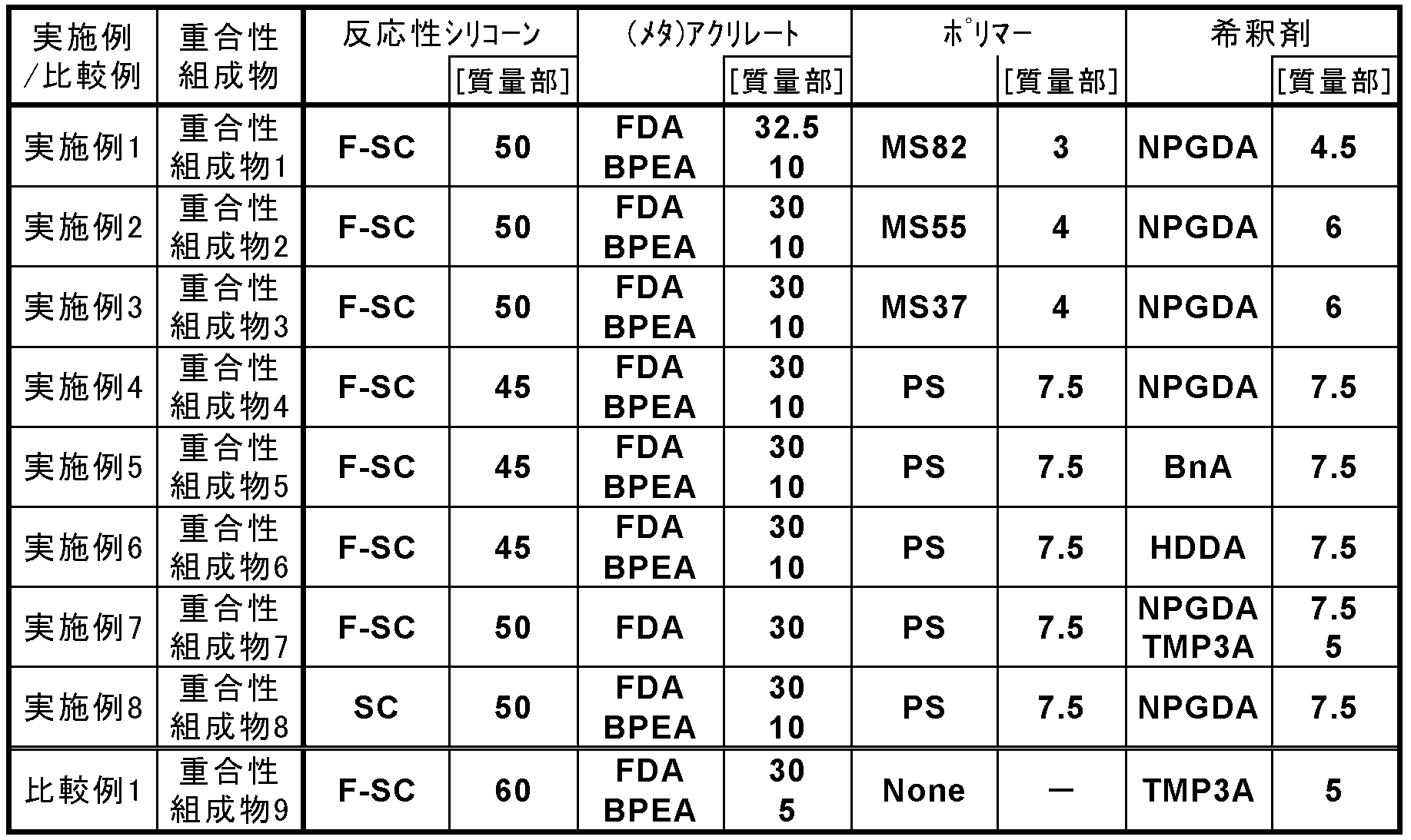
(メタ)アクリレート化合物としてFDA 32.5質量部、及びBPEA 10質量部、ポリマーとしてMS82 3質量部、安定化剤として3,9-ビス(2-(3-(3-tert-ブチル-4-ヒドロキシ-5-メチルフェニル)プロピオニルオキシ)-1,1-ジメチルエチル)-2,4,8,10-テトラオキソスピロ[5.5]ウンデカン[住友化学(株)製 SUMILIZER(登録商標)GA-80]0.5質量部、並びに希釈剤としてNPGDA 4.5質量部を、ミックスローターを使用して50℃で均一になるまで混合した(およそ24時間)。この混合物へ、反応性シリコーン化合物として実施例1で製造したF-SC 50質量部、硫黄化合物としてジデシルジスルフィド[東京化成工業(株)製]0.5質量部、並びに重合開始剤として2,4,4-トリメチルペンタン-2-イル=ペルオキシ-2-エチルヘキサノエート[日本油脂(株)製 パーオクタ(登録商標)O]3質量部を加え、均一になるまでおよそ30分間2000rpmで撹拌脱泡することで重合性組成物1を調製した。
各組成を表1に記載のように変更した以外は実施例1と同様に操作し、重合性組成物2乃至9を調製した。
[硬化物の作製]
表2に記載の重合性組成物を、800μm厚のシリコーンゴム製スペーサーとともに、離型処理したガラス基板2枚で挟み込んだ。この挟み込んだ重合性組成物を、130℃のオーブンで15分間加熱し、室温(およそ25℃)まで冷却後、硬化物をガラス基板から剥離することで、直径30mm、厚さ800μmの硬化物を作製した。
[光学特性評価]
得られた硬化物のD線(波長589nm)における屈折率nD、アッベ数νD及びヘーズ(HAZE)を測定した。また、得られた硬化物について、リフロー炉を用いた加熱試験前後の波長400nmの光線透過率をそれぞれ測定し、加熱による透過率の低下を評価した。なお、加熱試験は、1)260℃まで3分間で昇温、2)260℃で20秒間保持、3)50℃まで放冷、の3ステップを3回繰り返した。結果を表2に併せて示す。
[クラック耐性評価]
上記[硬化物の作製]に記載の方法に準じ、直径5mm、厚さ800μmの硬化物を作製した。この硬化物5つをリフロー炉で加熱し、加熱後にクラックの入った硬化物の数でクラック耐性を評価した。なお、加熱は、1)260℃まで3分間で昇温、2)260℃で20秒間保持、3)50℃まで放冷、の3ステップで行った。結果を表2に併せて示す。

一方、特定のポリマーを添加しない硬化物(比較例2)にあっては、クラック耐性が低くはんだリフロー工程に耐えられないことが確認された。
このように、本発明の重合性組成物は、優れた光学活性及び耐熱性を兼ね備えた硬化物を得ることができることから、例えばキャスティング成形による厚いカメラ用モジュールレンズの材料として、特に好適に使用できる。
Claims (12)
- (a)式[1]で表されるジアリールケイ酸化合物Aと、式[2]で表されるアルコキシケイ素化合物Bとを少なくとも含む重縮合性化合物を、酸又は塩基の存在下重縮合して得られる反応性シリコーン化合物100質量部、
(b)(メタ)アクリレート化合物1~200質量部、及び
(c)5,000~100,000の重量平均分子量を有するポリマー0.1~50質量部
を含む重合性組成物。


- 前記(c)ポリマーが、少なくとも式[3]で表されるモノマー単位を有するポリマーである、請求項1に記載の重合性組成物。

- 前記(c)ポリマーが、さらに式[4]で表されるモノマー単位を有するポリマーである、請求項2に記載の重合性組成物。

- 前記(c)ポリマーがポリ(スチレン-co-(メタ)アクリル酸メチル)である、請求項3に記載の重合性組成物。
- 前記(b)(メタ)アクリレート化合物が、式[5]で表されるフルオレン化合物D、及び式[6]で表されるビスフェノール化合物Eからなる群から選ばれる少なくとも一種である、請求項1乃至請求項4のうち何れか一項に記載の重合性組成物。


- 前記(b)(メタ)アクリレート化合物として、前記フルオレン化合物D及び前記ビスフェノール化合物Eの二種を少なくとも含む、請求項5に記載の重合性組成物。
- さらに(d)式[7]で表される基を有する化合物である光安定剤F、及び式[8]で表される基を有する化合物である酸化防止剤Gからなる群から選ばれる少なくとも一種の安定化剤0.01~5質量部を含む、請求項1乃至請求項6のうち何れか一項に記載の重合性組成物。

- さらに(e)チオール化合物H及びジスルフィド化合物Iからなる群から選ばれる少なくとも一種の硫黄化合物0.01~5質量部を含む、請求項1乃至請求項7のうち何れか一項に記載の重合性組成物。
- 前記(a)反応性シリコーン化合物が、式[1]で表されるジアリールケイ酸化合物Aと、式[2]で表されるアルコキシケイ素化合物Bと、さらに式[9]で表されるアルコキシケイ素化合物Cとを少なくとも含む重縮合性化合物を、酸又は塩基の存在下重縮合して得られる反応性シリコーン化合物である、請求項1乃至請求項8のうち何れか一項に記載の重合性組成物。

- 請求項1乃至請求項9のうち何れか一項に記載の重合性組成物を重合して得られる、硬化物。
- 請求項1乃至請求項9のうち何れか一項に記載の重合性組成物を重合して得られる、光学レンズ。
- 請求項1乃至請求項9のうち何れか一項に記載の重合性組成物からなる高屈折率樹脂レンズ用材料。
Priority Applications (3)
| Application Number | Priority Date | Filing Date | Title |
|---|---|---|---|
| CN201580020185.5A CN106232633A (zh) | 2014-04-18 | 2015-04-17 | 包含反应性有机硅化合物的聚合性树脂组合物 |
| JP2016513840A JP6555485B2 (ja) | 2014-04-18 | 2015-04-17 | 反応性シリコーン化合物を含む重合性樹脂組成物 |
| KR1020167023195A KR20160147707A (ko) | 2014-04-18 | 2015-04-17 | 반응성 실리콘 화합물을 포함하는 중합성 수지 조성물 |
Applications Claiming Priority (2)
| Application Number | Priority Date | Filing Date | Title |
|---|---|---|---|
| JP2014-086733 | 2014-04-18 | ||
| JP2014086733 | 2014-04-18 |
Publications (1)
| Publication Number | Publication Date |
|---|---|
| WO2015159972A1 true WO2015159972A1 (ja) | 2015-10-22 |
Family
ID=54324173
Family Applications (1)
| Application Number | Title | Priority Date | Filing Date |
|---|---|---|---|
| PCT/JP2015/061846 Ceased WO2015159972A1 (ja) | 2014-04-18 | 2015-04-17 | 反応性シリコーン化合物を含む重合性樹脂組成物 |
Country Status (5)
| Country | Link |
|---|---|
| JP (1) | JP6555485B2 (ja) |
| KR (1) | KR20160147707A (ja) |
| CN (1) | CN106232633A (ja) |
| TW (1) | TW201544547A (ja) |
| WO (1) | WO2015159972A1 (ja) |
Cited By (8)
| Publication number | Priority date | Publication date | Assignee | Title |
|---|---|---|---|---|
| WO2016163561A1 (ja) * | 2015-04-10 | 2016-10-13 | 日産化学工業株式会社 | 反応性シルセスキオキサン化合物を含む重合性樹脂組成物 |
| EP3127929A4 (en) * | 2014-03-31 | 2017-09-27 | Nissan Chemical Industries, Ltd. | Polymerizable composition containing reactive fluorinated silicone compound |
| WO2017208936A1 (ja) * | 2016-05-30 | 2017-12-07 | 日産化学工業株式会社 | 反応性ポリシロキサン及びそれを含む重合性組成物 |
| WO2017208748A1 (ja) * | 2016-05-30 | 2017-12-07 | 日産化学工業株式会社 | 重合性シラン化合物 |
| JPWO2017170668A1 (ja) * | 2016-03-31 | 2019-02-07 | 日産化学株式会社 | 高屈折率硬化膜形成用樹脂組成物 |
| JP2019507813A (ja) * | 2016-03-07 | 2019-03-22 | ダウ シリコーンズ コーポレーション | 光硬化性シリコーン組成物及びその硬化物 |
| WO2020213373A1 (ja) * | 2019-04-18 | 2020-10-22 | 日産化学株式会社 | インプリント用光硬化性組成物 |
| WO2024063069A1 (ja) * | 2022-09-22 | 2024-03-28 | ダウ・東レ株式会社 | 紫外線硬化性組成物およびその用途 |
Families Citing this family (1)
| Publication number | Priority date | Publication date | Assignee | Title |
|---|---|---|---|---|
| CN117624415A (zh) * | 2022-08-12 | 2024-03-01 | 中国石油天然气股份有限公司 | 烯烃聚合反应体系、方法及使用的防黏剂 |
Citations (15)
| Publication number | Priority date | Publication date | Assignee | Title |
|---|---|---|---|---|
| JPH01131276A (ja) * | 1987-11-16 | 1989-05-24 | Kansai Paint Co Ltd | 低温硬化性組成物 |
| JPH04120110A (ja) * | 1990-09-11 | 1992-04-21 | Agency Of Ind Science & Technol | 酸素透過性共重合体 |
| JPH05209027A (ja) * | 1991-09-24 | 1993-08-20 | Mitsubishi Rayon Co Ltd | 透明性に優れた複合体組成物およびその製法 |
| JPH08283362A (ja) * | 1995-04-18 | 1996-10-29 | Shin Etsu Chem Co Ltd | ラジカル重合性樹脂組成物 |
| JPH1171438A (ja) * | 1997-06-23 | 1999-03-16 | Denki Kagaku Kogyo Kk | 硬化性樹脂組成物、硬化体、コンクリート積層体、コーティング剤、接着剤、シーラント及びレジンコンクリート |
| JP2002308944A (ja) * | 2001-04-18 | 2002-10-23 | Denki Kagaku Kogyo Kk | 硬化性樹脂組成物、接着剤組成物及び接着方法 |
| JP2008007642A (ja) * | 2006-06-29 | 2008-01-17 | Asahi Kasei Electronics Co Ltd | ハイブリッド感光性樹脂組成物 |
| WO2009078336A1 (ja) * | 2007-12-14 | 2009-06-25 | Asahi Kasei E-Materials Corporation | 感光性樹脂組成物 |
| JP2011202127A (ja) * | 2010-03-26 | 2011-10-13 | Asahi Kasei E-Materials Corp | 感光性樹脂組成物及び硬化物 |
| WO2012097836A1 (en) * | 2011-01-21 | 2012-07-26 | Fraunhofer-Gesellschaft Zur Förderung Der... | Polymerizable compositions, cured products obtained therewith, and use of these materials |
| JP2013142105A (ja) * | 2012-01-10 | 2013-07-22 | Adeka Corp | 水系アクリルウレタン樹脂組成物、該樹脂組成物を硬化させてなる硬化物及び該硬化物によって表面保護された物品 |
| JP2014043547A (ja) * | 2012-03-27 | 2014-03-13 | Mitsubishi Chemicals Corp | コーティング塗料用樹脂組成物 |
| JP2015025075A (ja) * | 2013-07-26 | 2015-02-05 | 日産化学工業株式会社 | 反応性シリコーン化合物を含む重合性組成物 |
| WO2015022965A1 (ja) * | 2013-08-15 | 2015-02-19 | 日産化学工業株式会社 | 反応性シリコーン化合物を含む重合性組成物 |
| JP2015108074A (ja) * | 2013-12-05 | 2015-06-11 | 河村 良成 | 有機溶媒型つや消し塗料の作製法 |
Family Cites Families (3)
| Publication number | Priority date | Publication date | Assignee | Title |
|---|---|---|---|---|
| GB2212503B (en) * | 1987-11-16 | 1991-11-20 | Kansai Paint Co Ltd | Composition curable at low temperature |
| JP3556332B2 (ja) | 1995-07-17 | 2004-08-18 | 三菱レイヨン株式会社 | プラスチックレンズ成形用組成物及びそれを用いたプラスチックレンズ |
| JP6235265B2 (ja) * | 2013-07-26 | 2017-11-22 | アンリツインフィビス株式会社 | X線発生装置及びx線検査装置 |
-
2015
- 2015-04-17 KR KR1020167023195A patent/KR20160147707A/ko not_active Withdrawn
- 2015-04-17 CN CN201580020185.5A patent/CN106232633A/zh active Pending
- 2015-04-17 TW TW104112398A patent/TW201544547A/zh unknown
- 2015-04-17 WO PCT/JP2015/061846 patent/WO2015159972A1/ja not_active Ceased
- 2015-04-17 JP JP2016513840A patent/JP6555485B2/ja not_active Expired - Fee Related
Patent Citations (15)
| Publication number | Priority date | Publication date | Assignee | Title |
|---|---|---|---|---|
| JPH01131276A (ja) * | 1987-11-16 | 1989-05-24 | Kansai Paint Co Ltd | 低温硬化性組成物 |
| JPH04120110A (ja) * | 1990-09-11 | 1992-04-21 | Agency Of Ind Science & Technol | 酸素透過性共重合体 |
| JPH05209027A (ja) * | 1991-09-24 | 1993-08-20 | Mitsubishi Rayon Co Ltd | 透明性に優れた複合体組成物およびその製法 |
| JPH08283362A (ja) * | 1995-04-18 | 1996-10-29 | Shin Etsu Chem Co Ltd | ラジカル重合性樹脂組成物 |
| JPH1171438A (ja) * | 1997-06-23 | 1999-03-16 | Denki Kagaku Kogyo Kk | 硬化性樹脂組成物、硬化体、コンクリート積層体、コーティング剤、接着剤、シーラント及びレジンコンクリート |
| JP2002308944A (ja) * | 2001-04-18 | 2002-10-23 | Denki Kagaku Kogyo Kk | 硬化性樹脂組成物、接着剤組成物及び接着方法 |
| JP2008007642A (ja) * | 2006-06-29 | 2008-01-17 | Asahi Kasei Electronics Co Ltd | ハイブリッド感光性樹脂組成物 |
| WO2009078336A1 (ja) * | 2007-12-14 | 2009-06-25 | Asahi Kasei E-Materials Corporation | 感光性樹脂組成物 |
| JP2011202127A (ja) * | 2010-03-26 | 2011-10-13 | Asahi Kasei E-Materials Corp | 感光性樹脂組成物及び硬化物 |
| WO2012097836A1 (en) * | 2011-01-21 | 2012-07-26 | Fraunhofer-Gesellschaft Zur Förderung Der... | Polymerizable compositions, cured products obtained therewith, and use of these materials |
| JP2013142105A (ja) * | 2012-01-10 | 2013-07-22 | Adeka Corp | 水系アクリルウレタン樹脂組成物、該樹脂組成物を硬化させてなる硬化物及び該硬化物によって表面保護された物品 |
| JP2014043547A (ja) * | 2012-03-27 | 2014-03-13 | Mitsubishi Chemicals Corp | コーティング塗料用樹脂組成物 |
| JP2015025075A (ja) * | 2013-07-26 | 2015-02-05 | 日産化学工業株式会社 | 反応性シリコーン化合物を含む重合性組成物 |
| WO2015022965A1 (ja) * | 2013-08-15 | 2015-02-19 | 日産化学工業株式会社 | 反応性シリコーン化合物を含む重合性組成物 |
| JP2015108074A (ja) * | 2013-12-05 | 2015-06-11 | 河村 良成 | 有機溶媒型つや消し塗料の作製法 |
Cited By (19)
| Publication number | Priority date | Publication date | Assignee | Title |
|---|---|---|---|---|
| EP3127929A4 (en) * | 2014-03-31 | 2017-09-27 | Nissan Chemical Industries, Ltd. | Polymerizable composition containing reactive fluorinated silicone compound |
| EP3281959A4 (en) * | 2015-04-10 | 2018-04-11 | Nissan Chemical Industries, Ltd. | Polymerizable resin composition containing reactive silsesquioxane compound |
| US10550217B2 (en) | 2015-04-10 | 2020-02-04 | Nissan Chemical Industries, Ltd. | Polymerizable resin composition comprising reactive silsesquioxane compound |
| WO2016163561A1 (ja) * | 2015-04-10 | 2016-10-13 | 日産化学工業株式会社 | 反応性シルセスキオキサン化合物を含む重合性樹脂組成物 |
| JP2019507813A (ja) * | 2016-03-07 | 2019-03-22 | ダウ シリコーンズ コーポレーション | 光硬化性シリコーン組成物及びその硬化物 |
| JPWO2017170668A1 (ja) * | 2016-03-31 | 2019-02-07 | 日産化学株式会社 | 高屈折率硬化膜形成用樹脂組成物 |
| JP6992741B2 (ja) | 2016-03-31 | 2022-01-13 | 日産化学株式会社 | 高屈折率硬化膜形成用樹脂組成物 |
| WO2017208936A1 (ja) * | 2016-05-30 | 2017-12-07 | 日産化学工業株式会社 | 反応性ポリシロキサン及びそれを含む重合性組成物 |
| WO2017208748A1 (ja) * | 2016-05-30 | 2017-12-07 | 日産化学工業株式会社 | 重合性シラン化合物 |
| JPWO2017208936A1 (ja) * | 2016-05-30 | 2019-03-28 | 日産化学株式会社 | 反応性ポリシロキサン及びそれを含む重合性組成物 |
| JPWO2017208748A1 (ja) * | 2016-05-30 | 2019-04-04 | 日産化学株式会社 | 重合性シラン化合物 |
| CN109153691A (zh) * | 2016-05-30 | 2019-01-04 | 日产化学株式会社 | 聚合性硅烷化合物 |
| US10894800B2 (en) | 2016-05-30 | 2021-01-19 | Nissan Chemical Corporation | Polymerizable silane compound |
| US10899891B2 (en) | 2016-05-30 | 2021-01-26 | Nissan Chemical Corporation | Reactive polysiloxane and polymerizable composition comprising same |
| CN109196008B (zh) * | 2016-05-30 | 2021-07-06 | 日产化学株式会社 | 反应性聚硅氧烷及包含该反应性聚硅氧烷的聚合性组合物 |
| CN109153691B (zh) * | 2016-05-30 | 2021-07-09 | 日产化学株式会社 | 聚合性硅烷化合物 |
| CN109196008A (zh) * | 2016-05-30 | 2019-01-11 | 日产化学株式会社 | 反应性聚硅氧烷及包含该反应性聚硅氧烷的聚合性组合物 |
| WO2020213373A1 (ja) * | 2019-04-18 | 2020-10-22 | 日産化学株式会社 | インプリント用光硬化性組成物 |
| WO2024063069A1 (ja) * | 2022-09-22 | 2024-03-28 | ダウ・東レ株式会社 | 紫外線硬化性組成物およびその用途 |
Also Published As
| Publication number | Publication date |
|---|---|
| JPWO2015159972A1 (ja) | 2017-04-13 |
| TW201544547A (zh) | 2015-12-01 |
| KR20160147707A (ko) | 2016-12-23 |
| JP6555485B2 (ja) | 2019-08-07 |
| CN106232633A (zh) | 2016-12-14 |
Similar Documents
| Publication | Publication Date | Title |
|---|---|---|
| JP6555485B2 (ja) | 反応性シリコーン化合物を含む重合性樹脂組成物 | |
| US10308750B2 (en) | Polymerizable composition containing reactive silsesquioxane compound | |
| KR101996087B1 (ko) | 경화성 수지 조성물, 경화물 및 광학 물품 | |
| US10550217B2 (en) | Polymerizable resin composition comprising reactive silsesquioxane compound | |
| TW201339247A (zh) | 玻璃纖維複合化樹脂基板 | |
| WO2013146346A1 (ja) | 半硬化物、硬化物およびそれらの製造方法、光学部品、硬化樹脂組成物 | |
| JP6744576B2 (ja) | 反応性含フッ素シリコーン化合物を含む重合性組成物 | |
| WO2015022965A1 (ja) | 反応性シリコーン化合物を含む重合性組成物 | |
| JP2015025075A (ja) | 反応性シリコーン化合物を含む重合性組成物 | |
| TWI701267B (zh) | 含有含菲環之反應性倍半矽氧烷化合物之聚合性組成物 | |
| US10899891B2 (en) | Reactive polysiloxane and polymerizable composition comprising same | |
| JP6555499B2 (ja) | 高屈折率重合性化合物の低粘度化剤及びそれを含む重合性組成物 |
Legal Events
| Date | Code | Title | Description |
|---|---|---|---|
| 121 | Ep: the epo has been informed by wipo that ep was designated in this application |
Ref document number: 15779189 Country of ref document: EP Kind code of ref document: A1 |
|
| ENP | Entry into the national phase |
Ref document number: 2016513840 Country of ref document: JP Kind code of ref document: A |
|
| ENP | Entry into the national phase |
Ref document number: 20167023195 Country of ref document: KR Kind code of ref document: A |
|
| NENP | Non-entry into the national phase |
Ref country code: DE |
|
| 122 | Ep: pct application non-entry in european phase |
Ref document number: 15779189 Country of ref document: EP Kind code of ref document: A1 |