WO2015147102A1 - 毛髪処理剤用添加剤及びこれを含む毛髪処理剤組成物 - Google Patents
毛髪処理剤用添加剤及びこれを含む毛髪処理剤組成物 Download PDFInfo
- Publication number
- WO2015147102A1 WO2015147102A1 PCT/JP2015/059245 JP2015059245W WO2015147102A1 WO 2015147102 A1 WO2015147102 A1 WO 2015147102A1 JP 2015059245 W JP2015059245 W JP 2015059245W WO 2015147102 A1 WO2015147102 A1 WO 2015147102A1
- Authority
- WO
- WIPO (PCT)
- Prior art keywords
- group
- carbon atoms
- hair treatment
- general formula
- additive
- Prior art date
- Legal status (The legal status is an assumption and is not a legal conclusion. Google has not performed a legal analysis and makes no representation as to the accuracy of the status listed.)
- Ceased
Links
Classifications
-
- A—HUMAN NECESSITIES
- A61—MEDICAL OR VETERINARY SCIENCE; HYGIENE
- A61K—PREPARATIONS FOR MEDICAL, DENTAL OR TOILETRY PURPOSES
- A61K8/00—Cosmetics or similar toiletry preparations
- A61K8/18—Cosmetics or similar toiletry preparations characterised by the composition
- A61K8/30—Cosmetics or similar toiletry preparations characterised by the composition containing organic compounds
- A61K8/33—Cosmetics or similar toiletry preparations characterised by the composition containing organic compounds containing oxygen
- A61K8/34—Alcohols
-
- A—HUMAN NECESSITIES
- A61—MEDICAL OR VETERINARY SCIENCE; HYGIENE
- A61K—PREPARATIONS FOR MEDICAL, DENTAL OR TOILETRY PURPOSES
- A61K8/00—Cosmetics or similar toiletry preparations
- A61K8/18—Cosmetics or similar toiletry preparations characterised by the composition
- A61K8/30—Cosmetics or similar toiletry preparations characterised by the composition containing organic compounds
- A61K8/33—Cosmetics or similar toiletry preparations characterised by the composition containing organic compounds containing oxygen
- A61K8/34—Alcohols
- A61K8/345—Alcohols containing more than one hydroxy group
-
- A—HUMAN NECESSITIES
- A61—MEDICAL OR VETERINARY SCIENCE; HYGIENE
- A61K—PREPARATIONS FOR MEDICAL, DENTAL OR TOILETRY PURPOSES
- A61K8/00—Cosmetics or similar toiletry preparations
- A61K8/18—Cosmetics or similar toiletry preparations characterised by the composition
- A61K8/30—Cosmetics or similar toiletry preparations characterised by the composition containing organic compounds
- A61K8/33—Cosmetics or similar toiletry preparations characterised by the composition containing organic compounds containing oxygen
- A61K8/39—Derivatives containing from 2 to 10 oxyalkylene groups
-
- A—HUMAN NECESSITIES
- A61—MEDICAL OR VETERINARY SCIENCE; HYGIENE
- A61K—PREPARATIONS FOR MEDICAL, DENTAL OR TOILETRY PURPOSES
- A61K8/00—Cosmetics or similar toiletry preparations
- A61K8/18—Cosmetics or similar toiletry preparations characterised by the composition
- A61K8/30—Cosmetics or similar toiletry preparations characterised by the composition containing organic compounds
- A61K8/40—Cosmetics or similar toiletry preparations characterised by the composition containing organic compounds containing nitrogen
- A61K8/41—Amines
-
- A—HUMAN NECESSITIES
- A61—MEDICAL OR VETERINARY SCIENCE; HYGIENE
- A61K—PREPARATIONS FOR MEDICAL, DENTAL OR TOILETRY PURPOSES
- A61K8/00—Cosmetics or similar toiletry preparations
- A61K8/18—Cosmetics or similar toiletry preparations characterised by the composition
- A61K8/30—Cosmetics or similar toiletry preparations characterised by the composition containing organic compounds
- A61K8/40—Cosmetics or similar toiletry preparations characterised by the composition containing organic compounds containing nitrogen
- A61K8/41—Amines
- A61K8/416—Quaternary ammonium compounds
-
- A—HUMAN NECESSITIES
- A61—MEDICAL OR VETERINARY SCIENCE; HYGIENE
- A61Q—SPECIFIC USE OF COSMETICS OR SIMILAR TOILETRY PREPARATIONS
- A61Q5/00—Preparations for care of the hair
- A61Q5/12—Preparations containing hair conditioners
Definitions
- the present invention relates to an additive for a hair treatment agent and a hair treatment composition containing the same.
- a hair treatment composition for example, hair rinse, hair treatment, etc.
- a composition containing a cationic surfactant such as a quaternary ammonium salt and an oil such as a higher alcohol and silicone oil has been used ( Patent Document 1).
- Patent Document 1 a composition containing a cationic surfactant such as a quaternary ammonium salt and an oil such as a higher alcohol and silicone oil.
- these compositions have a problem that the hair after rinsing and drying is insufficiently smooth or sticky.
- compositions containing a specific tertiary amine and a specific cationic surfactant, a specific silicone, a higher alcohol, a sugar alcohol, etc. have been proposed for the purpose of improving smoothness after drying and hair mass.
- Patent Documents 3 to 5 None of these compositions take into account the melting point or concentration of the additive for hair treatment agent to be blended when producing a hair treatment agent composition such as a hair conditioner or hair treatment. The compatibility of various performances of additives is required.
- the object of the present invention is to obtain an additive for a hair treatment agent having a low melting point even when the cationic surfactant is at a high concentration, and is excellent in the smoothness of hair after rinsing and drying, while being moist but heavy.
- An object of the present invention is to provide an additive for a hair treatment agent and a hair treatment composition that are not too much, have a gloss, and have a well-finished finish.
- the present invention relates to a cationic surfactant (A) represented by the following general formula (1), a tertiary amine (B) represented by the following general formula (2), and a melting point of ⁇ 120 ° C. to 40 ° C.
- A cationic surfactant
- B tertiary amine
- a hair treatment composition comprising at least one selected from the group consisting of hydrogen oil, ester oil, silicone and preservatives.
- R 1 to R 4 are a monovalent hydrocarbon group having 16 to 30 carbon atoms and / or a monovalent organic group.
- the monovalent organic group includes a monovalent hydrocarbon group having 16 to 30 carbon atoms in which at least one hydrogen atom is substituted with a hydroxyl group, and / or at least one methylene group is an ether group, an amide group, or an ester group.
- the remaining groups of R 1 to R 4 are each an alkyl group having 1 to 6 carbon atoms, a hydroxyalkyl group having 1 to 6 carbon atoms, or a benzyl group.
- R 5 is an alkyl group having 1 to 6 carbon atoms.
- R 6 to R 8 are a monovalent hydrocarbon group having 16 to 30 carbon atoms and / or a monovalent organic group.
- the monovalent organic group is a group in which at least one hydrogen atom of a monovalent hydrocarbon group having 16 to 30 carbon atoms is substituted with a hydroxyl group and / or at least one methylene group is composed of an ether group and an ester group.
- the remaining groups of R 6 to R 8 are each an alkyl group having 1 to 6 carbon atoms, a hydroxyalkyl group having 1 to 6 carbon atoms, or a benzyl group.
- the hair treatment additive and hair treatment composition of the present invention are excellent in the smoothness of the hair from the time of rinsing to the time of drying, and are moist but not too heavy after drying and are glossy and well-organized. Furthermore, even if the concentration of the cationic surfactant in the additive is high, the hair treatment additive has a low melting point, so that the hair treatment composition can be easily produced.
- the present invention relates to a cationic surfactant (A) represented by the general formula (1), a tertiary amine (B) represented by the general formula (2), and a hydroxyl group having a melting point of ⁇ 120 ° C. to 40 ° C. It is an additive for hair treatment agents containing the containing compound (C).
- the additive for hair treatment agent of the present invention is a cationic surfactant (A) represented by the general formula (1), a tertiary amine (B) represented by the general formula (2) or a hydroxyl group-containing compound ( When C) is not contained, the smoothness from the time of rinsing to the time after drying is deteriorated.
- the melting point of the hydroxyl group-containing compound (C) is less than ⁇ 120 ° C.
- the hydroxyl group-containing compound (C) tends to volatilize, making it difficult to handle the additive for hair treatment agent.
- the melting point of the hair treatment additive is increased, it is necessary to increase the temperature when producing the hair treatment agent or to reduce the concentration of the cationic surfactant (A) in the hair treatment additive. It takes a long time to produce a hair treatment agent at a high temperature, and the quality of odor, color and the like deteriorates.
- concentration of the cationic surfactant (A) in the additive for hair treatment agents is made low, the compounding quantity of the other component at the time of manufacturing a hair treatment agent will be restrict
- the melting point of the hydroxyl group-containing compound (C) in the hair treatment additive of the present invention can be measured by differential scanning calorimetry (hereinafter also referred to as DSC).
- DSC differential scanning calorimetry
- the melting point of the hydroxyl group-containing compound (C) in the hair treatment additive of the present invention is preferably ⁇ 115 ° C. to 20 ° C., more preferably ⁇ 100 ° C. to 0 ° C.
- R 1 to R 4 are a monovalent hydrocarbon group having 16 to 30 carbon atoms and / or 1 Valent organic group.
- a hydrocarbon group having 16 to 26 carbon atoms and a monovalent organic group in which a hydrogen atom and / or a methylene group of the hydrocarbon group having 16 to 26 carbon atoms are substituted are more preferable.
- a monovalent organic group in which a hydrogen atom and / or a methylene group of a hydrocarbon group having 18 to 24 carbon atoms and a hydrocarbon group having 18 to 24 carbon atoms is substituted. If the carbon number is 16 or more, the hair is sufficiently smooth after drying, and if it is 30 or less, it is moist but not too heavy.
- Examples of the hydrocarbon group having 16 to 30 carbon atoms include an aliphatic hydrocarbon group having 16 to 30 carbon atoms, an alicyclic hydrocarbon group having 16 to 30 carbon atoms, and an aromatic hydrocarbon group having 16 to 30 carbon atoms. Can be mentioned.
- Examples of the aliphatic hydrocarbon group having 16 to 30 carbon atoms include a linear or branched alkyl group having 16 to 30 carbon atoms and a linear or branched alkenyl group having 16 to 30 carbon atoms.
- linear alkyl group having 16 to 30 carbon atoms examples include n-hexadecyl group, n-heptadecyl group, n-octadecyl group, n-nonadecyl group, n-eicosyl group, n-heneicosyl group, n-docosyl group, n- Tricosyl group, n-tetracosyl group, n-hexacosyl group, n-octacosyl group, n-triacontyl group and the like can be mentioned.
- the branching position of the branched alkyl group having 16 to 30 carbon atoms may be any position, and the number of branches is not particularly limited.
- Examples of the branched alkyl group having 16 to 30 carbon atoms include isohexadecyl group, isoheptadecyl group, isooctadecyl group, isononadecyl group, isoeicosyl group, isodocosyl group, isohexacosyl group, 2-n-decyl-n-dodecyl group, and carbon Examples thereof include a residue obtained by removing a hydroxyl group from a synthetic alcohol derived from an oligomer of olefins of number 3 or 4 (such as propylene and butene).
- the position of the double bond of the straight chain or branched alkenyl group having 16 to 30 carbon atoms may be any position, and the number of double bonds is not particularly limited. In the case of a branched alkenyl group having 16 to 30 carbon atoms, the number of branches is not particularly limited.
- Examples of the straight chain alkenyl group having 16 to 30 carbon atoms include n-hexadecenyl group, n-octadecenyl group, n-eicocenyl group, n-docosenyl group, n-tetracocenyl group, and n-triacontyl group.
- Examples of the branched alkenyl group having 16 to 30 carbon atoms include isohexadecenyl group, isooctadecenyl group, isoeicocenyl group, isodococenyl group, and isotriacontyl group.
- Examples of the alicyclic hydrocarbon group having 16 to 30 carbon atoms include alkylcycloalkyl groups (decylcyclohexyl group and hexadecylcyclohexyl group), cycloalkylalkyl groups (cyclohexyldecylyl group and cyclohexyltetradecyl group) and cycloalkenyl groups. Group (such as 2-cyclodecenyl group) and the like.
- aromatic hydrocarbon group having 16 to 30 carbon atoms examples include arylalkyl groups (such as phenyldecyl group, phenyloctadecyl group, and naphthyltetradecyl group).
- the monovalent organic group includes a monovalent hydrocarbon group having 16 to 30 carbon atoms in which at least one hydrogen atom is substituted with a hydroxyl group, and / or at least one methylene group is an ether group, an amide group, or an ester group.
- the total number of hydrogen and methylene group substitutions is a viewpoint that the cationic surfactant (A) is adsorbed to the hair appropriately. Therefore, the number is preferably 1 to 10, more preferably 1 to 5, particularly preferably 1 to 2, and most preferably 1.
- the substituent is preferably an ether group or an amide group, more preferably an amide group, from the viewpoint of the smoothness of the hair after drying.
- the combination of substituents in the case of having two or more kinds of substituents may be any combination.
- Examples of the monovalent organic group include those represented by general formulas (5) to (9).
- R 22 is a hydrogen atom, an alkyl group having 1 to 28 carbon atoms or an alkenyl group having 2 to 28 carbon atoms
- R 23 is an alkanediyl group having 1 to 29 carbon atoms or a carbon atom. It is an alkenediyl group of 2 to 29.
- R 24 is a hydrogen atom, an alkyl group having 1 to 29 carbon atoms or an alkenyl group having 2 to 29 carbon atoms
- R 25 is an alkanediyl group having 1 to 30 carbon atoms or 2 carbon atoms. ⁇ 30 alkenediyl groups.
- R 26 is a hydrogen atom, an alkyl group having 1 to 28 carbon atoms, or an alkenyl group having 2 to 28 carbon atoms
- R 27 is an alkanediyl group having 1 to 29 carbon atoms or 2 carbon atoms. ⁇ 29 alkenediyl groups.
- R 28 is an alkyl group having 1 to 28 carbon atoms or an alkenyl group having 2 to 28 carbon atoms
- R 29 is an alkanediyl group having 1 to 29 carbon atoms or 2 to 29 carbon atoms.
- R 30 is a hydrogen atom, an alkyl group having 1 to 26 carbon atoms, or an alkenyl group having 2 to 26 carbon atoms
- k is an integer of 1 to 5
- R 31 is 1 carbon atom.
- An alkanediyl group having ⁇ 27 or an alkenediyl group having 2 to 27 carbon atoms, or R 31 is not present.
- R 22 to R 31 are each independently a group having a carbon number such that the total number of carbon atoms in the monovalent organic group represented by the general formulas (5) to (9) is 16 to 30.
- alkyl group having 1 to 29 carbon atoms examples include a linear alkyl group having 1 to 29 carbon atoms and a branched alkyl group having 3 to 29 carbon atoms.
- linear alkyl group having 1 to 23 carbon atoms include methyl group, ethyl group, n-propyl group, n-butyl group, n-hexyl group, n-octyl group, n-decyl group, n-undecyl group, n -Dodecyl group, n-tridecyl group, n-tetradecyl group, n-pentadecyl group, n-hexadecyl group, n-heptadecyl group, n-octadecyl group, n-nonadecyl group, n-eicosyl group, n-heneicosyl group, n -Docosyl group, n
- Examples of the branched alkyl group having 3 to 23 carbon atoms include isopropyl group, t-butyl group, 2-ethylhexyl group, isodecyl group, isoundecyl group, isododecyl group, isotridecyl group, isotetradecyl group, isopentadecyl group, isohexadecyl group.
- alkenyl group having 2 to 29 carbon atoms examples include straight-chain alkenyl groups having 2 to 29 carbon atoms and branched alkenyl groups having 3 to 29 carbon atoms.
- the position of the double bond of the alkenyl group may be any position, and the number of double bonds is not particularly limited. In the case of a branched alkenyl group having 3 to 29 carbon atoms, the number of branches is not particularly limited.
- Examples of the straight chain alkenyl group having 2 to 29 carbon atoms include vinyl group, allyl group, n-hexenyl group, n-dodecenyl group, n-hexadecenyl group, n-octadecenyl group, n-eicosenyl group, n-docosenyl group, n -Tetracosenyl group, n-octacosenyl group and the like.
- Examples of the branched alkenyl group having 3 to 29 carbon atoms include an isopropenyl group, an isohexenyl group, an isodecenyl group, an isododecenyl group, an isooctadecenyl group, an isoeicosenyl group, an isodococenyl group, and an isooctacosenyl group.
- alkanediyl group having 1 to 30 carbon atoms examples include methylene group, ethylene group, propane-1,2-diyl group, propane-1,3-diyl group, butane-1,4-diyl group, and pentane-1,5. -Diyl group, hexane-1,6-diyl group, decane-1,10-diyl group, icosane-1,20-diyl group, hexacosane-1,24-diyl group and the like.
- alkenediyl group having 2 to 30 carbon atoms examples include 2-butene-1,4-diyl group, 2-pentene-1,5-diyl group, 2-hexene-1,6-diyl group, 3-hexene-1, Examples include a 6-diyl group, a 2-decene-1,10-diyl group, a 2-icocene-1,20-diyl group, and a 2-docosene-1,2-diyl group.
- the monovalent organic group represented by the general formula (5) examples include tetradecanoylaminopropyl group, hexadecanoylaminopropyl group, octadecanoylaminopropyl group, docosanoylaminopropyl group, and octadecanoyl.
- Examples include aminoethyl group and hexadecenoylaminopropyl group.
- the monovalent organic group represented by the general formula (6) include a hexadecyloxypropyl group, an octadecyloxypropyl group, a docosiloxypropyl group, an octadecyloxyethyl group, a hexadeceroxypropyl group, and A dodecyloxydecenyl group is mentioned.
- the monovalent organic group represented by the general formula (7) examples include 2-hydroxydodecyl group, 2-hydroxyoctadecyl group, 2-hydroxydocosyl group, 2-hydroxyoctacosyl group and 18-hydroxy.
- An octadecyl group is mentioned.
- Specific examples of the monovalent organic group represented by the general formula (8) include a hexadecanoyloxyethyl group, an octadecanoyloxyethyl group, a docosanoyloxyethyl group, and a hexadecenoyloxypropyl group.
- monovalent organic group represented by the general formula (9) examples include 3-tetradecyloxy-2-hydroxypropyl group, 3-octadecyloxy-2-hydroxypropyl group, and 3-docosyloxy-2- A hydroxypropyl group is mentioned.
- R 1 to R 4 in the general formula (1) are a monovalent hydrocarbon group having 16 to 30 carbon atoms and / or a monovalent organic group, and the remaining groups are carbon.
- Examples of the alkyl group having 1 to 6 carbon atoms include methyl group, ethyl group, propyl group, butyl group, pentyl group and hexyl group.
- hydroxyalkyl group having 1 to 6 carbon atoms examples include a hydroxymethyl group, a hydroxyethyl group, a hydroxypropyl group, a hydroxybutyl group, a hydroxypentyl group, and a hydroxyhexyl group.
- alkyl groups having 1 to 3 carbon atoms and hydroxyalkyl groups having 1 to 3 carbon atoms are preferable from the viewpoint of giving a soft touch to the hair and improving unity, and more preferable are methyl groups or ethyl groups. It is a group.
- R 5 in the general formula (1) is an alkyl group having 1 to 6 carbon atoms.
- the alkyl group having 1 to 6 carbon atoms include methyl group, ethyl group, propyl group, butyl group, pentyl group and hexyl group.
- an alkyl group having 1 to 3 carbon atoms is preferable from the viewpoint of giving a soft touch to the hair and improving unity, and a methyl group or an ethyl group is more preferable.
- the cationic surfactant (A) represented by the general formula (1) from the viewpoint of the smoothness of the hair after drying, the total number of carbons in the cationic surfactant [in the general formula (1), R 1 It is preferable to contain a cationic surfactant (A1) having a sum of carbon numbers of the groups of R 5 to 22 or more.
- Examples of (A1) include octadecyltrimethylammonium methosulphate, octadecyldimethylethylammonium ethosulphate, docosyltrimethylammonium methosulphate, docosyldimethylethylammonium ethosulphate, docosanoylaminopropyltrimethylammonium methosulphate, octadecanoylaminopropyl Trimethylammonium methosulfate, octadecyloxypropyltrimethylammonium methosulfate, 2-hydroxyoctacosyltrimethylammonium methosulfate, di (hydroxyethyl) ethyl (octadecanoyloxyethyl) ammonium etsulfate, docosanoyloxyethyl trimethylammonium methosulfate And 3-octa Siloxy-2-hydroxypropyl
- a cationic surfactant having a total carbon number of 24 or more is preferable, and a cationic surfactant having a total carbon number of 26 or more is more preferable.
- the content of (A1) in the cationic surfactant (A) is preferably 60% by weight or more, more preferably 70%, based on the weight of (A), from the viewpoint of smoothness after finishing. % By weight or more.
- the content of the cationic surfactant (A) is preferably 50 to 95% by weight, more preferably 60%, based on the weight of the additive for hair treatment agent. ⁇ 93 wt%. If it is 50% by weight or more, the concentration of (A) in the additive for hair treatment agent is sufficiently high, and the degree of freedom of selection of other raw materials is sufficient when producing the hair treatment agent. On the other hand, if it is 95 weight% or less, the melting point of the additive for hair treatment agents is sufficiently low.
- R 6 to R 8 are a monovalent hydrocarbon group having 16 to 30 carbon atoms and / or a monovalent group.
- a hydrocarbon group having 16 to 26 carbon atoms and a monovalent organic group in which a hydrogen atom and / or a methylene group of the hydrocarbon group having 16 to 26 carbon atoms are substituted are more preferable.
- a monovalent organic group in which a hydrogen atom and / or a methylene group of a hydrocarbon group having 18 to 24 carbon atoms and a hydrocarbon group having 18 to 24 carbon atoms is substituted. If the number of carbon atoms is 16 or more, it will be sufficiently moist and glossy after drying, and if it is 30 or less, it will be moist but not too heavy.
- Specific examples and preferred examples of the monovalent hydrocarbon group having 16 to 30 carbon atoms are the same as specific examples and preferred examples of the monovalent hydrocarbon group having 16 to 30 carbon atoms in the general formula (1).
- the monovalent organic group is selected from the group consisting of at least one hydrogen atom of a monovalent hydrocarbon group having 16 to 30 carbon atoms substituted with a hydroxyl group and / or at least one methylene group consisting of an ether group and an ester group.
- the total number of hydrogen and methylene group substitutions is 1 from the viewpoint of the smoothness of the hair after the tertiary amine (B) is dried. It is preferably ⁇ 10, more preferably 1 to 5, particularly preferably 1 to 2, and most preferably 1.
- substituent from the viewpoint of the smoothness of the hair after drying, an ether group and a hydroxyl group are preferred, and a hydroxyl group is more preferred.
- the combination of substituents in the case of having two or more kinds of substituents may be any combination.
- Examples of the monovalent organic group include those represented by general formulas (6) to (9).
- R 6 to R 8 in the general formula (2) are a monovalent hydrocarbon group having 16 to 30 carbon atoms and / or a monovalent organic group, and the remaining groups are carbon.
- alkyl group having 1 to 6 carbon atoms and the hydroxyalkyl group having 1 to 6 carbon atoms include alkyl groups having 1 to 6 carbon atoms and hydroxyalkyl groups having 1 to 6 carbon atoms in the general formula (1). These are the same as the specific examples and preferred ones.
- tertiary amine (B) examples include octadecyldimethylamine, octadecyldiethylamine, eicosyldimethylamine, docosyldiethylamine, docosyldimethylamine, octadecyloxypropyldimethylamine, 2-hydroxyoctacosyldimethylamine, (Hydroxyethyl) octadecanoyloxyethylamine, docosanoyloxyethyldimethylamine, 3-octadecyloxy-2-hydroxypropyldimethylamine and the like.
- eicosyldimethylamine docosyldimethylamine, octadecyldimethylamine, di (hydroxyethyl) octadecanoyloxyethylamine, octadecyloxypropyldimethylamine from the viewpoint of smoothness after finishing
- docosanoyloxyethyldimethylamine more preferably docosyldimethylamine, di (hydroxyethyl) octadecanoyloxyethylamine, octadecyldimethylamine and docosanoyloxyethyldimethylamine.
- the weight ratio [(A) / (B)] of the cationic surfactant (A) to the tertiary amine (B) is preferably [99.99 / 0.01 to 0.01% from the viewpoint of feel after rinsing. 70/30], more preferably [99.95 / 0.05 to 80/20].
- the content of the tertiary amine (B) is preferably 0.005 to 28% by weight, more preferably 0.1%, based on the weight of the additive for hair treatment agent, from the viewpoint of gloss after drying. ⁇ 20% by weight.
- Examples of the hydroxyl group-containing compound (C) having a melting point of ⁇ 120 ° C. to 40 ° C. are the hydroxyl group-containing compound (C1) represented by the following general formula (3) and / or the following general formula (4).
- a hydroxyl-containing compound (C2) is mentioned.
- R 9 represents a linear or branched hydrocarbon group having 1 to 8 carbon atoms.
- R 10 represents a linear or branched hydrocarbon group having 2 to 4 carbon atoms.
- n represents an average addition mole number of the oxyalkylene group, and is a number of 0 to 40.
- R 11 , R 12 , R 13 , R 14 and R 15 each independently represent a linear or branched hydrocarbon group having 1 to 12 carbon atoms or a hydrogen atom.
- R 16 , R 17 and R 18 each independently represents a linear or branched hydrocarbon group having 2 to 4 carbon atoms.
- a, b and c represent the average number of added moles of the oxyalkylene group, and each independently represents a number of 0 to 40;
- R 19 , R 20 and R 21 each independently represent a divalent hydrocarbon group having 1 to 12 carbon atoms or a divalent organic group, and at least one methylene group may be substituted with an ether group.
- d, e, and f each independently represent an integer of 0 or 1.
- m represents an integer of 0 to 4.
- Examples of the linear or branched hydrocarbon group having 1 to 8 carbon atoms include an aliphatic hydrocarbon group having 1 to 8 carbon atoms, an alicyclic hydrocarbon group having 3 to 8 carbon atoms, and an aromatic group having 6 to 8 carbon atoms. A hydrocarbon group etc. are mentioned.
- Examples of the aliphatic hydrocarbon group having 1 to 8 carbon atoms include a linear alkyl group having 1 to 8 carbon atoms or a branched alkyl group having 3 to 8 carbon atoms, and a straight chain having 2 to 8 carbon atoms or a branched chain having 3 to 8 carbon atoms. And alkenyl groups.
- linear alkyl group having 1 to 8 carbon atoms examples include methyl group, ethyl group, n-propyl group, n-butyl group, n-pentyl group, n-hexyl group, n-heptyl group, and n-octyl group. Can be mentioned.
- the branching position of the branched alkyl group having 3 to 8 carbon atoms may be any position, and the number of branches is not particularly limited.
- Examples of the branched alkyl group having 3 to 8 carbon atoms include isopropyl group, t-butyl group, 2-methylbutyl group, 2-ethylpentyl group, and 2-ethylhexyl group.
- the position of the double bond of the straight chain alkenyl group having 2 to 8 carbon atoms or the branched alkenyl group having 3 to 8 carbon atoms may be any position, and the number of double bonds is not particularly limited. In the case of a branched alkenyl group having 3 to 8 carbon atoms, the number of branches is not particularly limited.
- Examples of the straight chain alkenyl group having 2 to 8 carbon atoms include vinyl group, allyl group, 2-butylenyl group, 2-pentenyl group, 3-hexenyl group, and 2-octenyl group.
- Examples of the branched alkenyl group having 3 to 8 carbon atoms include a methallyl group, an isobutenyl group, an isohexenyl group, and an isooctenyl group.
- Examples of the alicyclic hydrocarbon group having 3 to 8 carbon atoms include a cycloalkyl group (such as a cyclopropyl group and a cyclohexyl group), an alkylcycloalkyl group (such as a methylcyclohexyl group and an ethylcyclohexyl group), and a cycloalkylalkyl group (a cyclohexylmethyl group).
- aromatic hydrocarbon group having 6 to 8 carbon atoms examples include a phenyl group, an arylalkyl group (such as a phenylmethyl group and a phenylethyl group), and an alkylaryl group (such as a tolyl group).
- linear or branched hydrocarbon group having 2 to 4 carbon atoms examples include an ethylene group, a propylene group, and a butylene group.
- n represents the average number of added moles of alkylene oxide, and preferably represents a number of 0 to 40.
- the addition of alkylene oxide may be random polymerization or block polymerization.
- Examples of the hydroxyl group-containing compound (C1) represented by the general formula (3) include aliphatic alcohols and their (poly) alkyl ethers, and aromatic alcohols and their (poly) alkyl ethers.
- Examples of the aliphatic alcohol include ethanol, 1-propanol, 2-propanol, 1-butanol, 1-pentanol, and 1-hexanol.
- Examples of (poly) alkyl ethers of aliphatic alcohols include polyalkylene (2 to 4 carbon atoms) glycol monoalkyl (1 to 8 carbon atoms) ethers having a number average molecular weight of 200 to 2000.
- Examples of the aromatic alcohol include benzyl alcohol and phenylethyl alcohol.
- Examples of (poly) alkyl ethers of aromatic alcohols include phenoxyethanol, phenoxypropanol, polyalkylene (2 to 4 carbon atoms) glycol monophenyl ether having a number average molecular weight of 200 to 2000, and polyalkylene (carbon number) having a number average molecular weight of 200 to 2000 2-4) glycol monobenzyl ether and the like.
- ethanol 1-propanol, 2-propanol, alkyl (1 to 6 carbon atoms) propylene glycol, alkyl (carbon Number 1 to 6)
- Dipropylene glycol polyalkylene having a number average molecular weight of 200 to 2000 (carbon number 2 to 4) glycol monoalkyl (carbon number 1 to 6) ether is preferred, and polyalkylene having a number average molecular weight of 200 to 2000 (carbon Number 2-4) glycol monoalkyl (carbon number 1-6) ether is more preferable.
- Polyalkylene (2 to 4 carbon atoms) glycol monoalkyl (1 to 6 carbon atoms) ether is an alkylene oxide adduct of an alcohol having 1 to 6 carbon atoms.
- the alcohol having 1 to 6 carbon atoms include methanol, ethanol, propanol, butanol, pentanol and hexanol.
- the alkylene oxide adduct one having an oxyalkylene group having 2 to 4 carbon atoms added is preferable. Specific examples include an oxyethylene group (hereinafter abbreviated as EO), an oxypropylene group (hereinafter abbreviated as PO), and an oxybutylene group. In the case of PO, it may be linear or branched.
- An oxyalkylene group having 2 or 3 carbon atoms is preferred.
- polyoxypropylene monomethyl ether, polyoxyethylene monoethyl ether, polyoxyethylene polyoxypropylene monobutyl ether And polyoxypropylene monobutyl ether are preferred.
- the number average molecular weight of a hydroxyl-containing compound (C) can be calculated by the hydroxyl value of the hydroxyl-containing compound (C) calculated
- Number average molecular weight 56100 ⁇ number of hydroxyl groups in one molecule of hydroxyl group-containing compound (C) / hydroxyl value (10)
- R 11 , R 12 , R 13 , R 14 and R 15 in the general formula (4) each independently represent a linear or branched hydrocarbon group having 1 to 12 carbon atoms or a hydrogen atom.
- Examples of the linear or branched hydrocarbon group having 1 to 12 carbon atoms include an aliphatic hydrocarbon group having 1 to 12 carbon atoms, an alicyclic hydrocarbon group having 3 to 12 carbon atoms, and an aromatic group having 6 to 12 carbon atoms.
- a hydrocarbon group etc. are mentioned.
- Examples of the aliphatic hydrocarbon group having 1 to 12 carbon atoms include a linear alkyl group having 1 to 12 carbon atoms or a branched alkyl group having 3 to 12 carbon atoms and a straight chain having 2 to 12 carbon atoms or a branched chain having 3 to 12 carbon atoms. And alkenyl groups.
- linear alkyl group having 1 to 12 carbon atoms examples include methyl group, ethyl group, n-propyl group, n-butyl group, n-pentyl group, n-hexyl group, n-heptyl group, n-octyl group, n -Decyl group, n-dodecyl group and the like.
- the branching position of the branched alkyl group having 3 to 12 carbon atoms may be any position, and the number of branches is not particularly limited.
- Examples of the branched alkyl group having 3 to 12 carbon atoms include isopropyl group, t-butyl group, 2-methylbutyl group, 2-ethylpentyl group, 2-ethylhexyl group, and 2-butyloctyl group.
- the position of the double bond of the straight chain alkenyl group having 2 to 12 carbon atoms or the branched alkenyl group having 3 to 12 carbon atoms may be any position, and the number of double bonds is not particularly limited. In the case of a branched alkenyl group having 3 to 12 carbon atoms, the number of branches is not particularly limited.
- Examples of the straight chain alkenyl group having 2 to 12 carbon atoms include vinyl group, allyl group, 2-butylenyl group, 2-pentenyl group, 3-hexenyl group, and 2-octenyl group.
- Examples of the branched alkenyl group having 3 to 12 carbon atoms include a methallyl group, an isobutenyl group, an isohexenyl group, an isooctenyl group, and an isododecenyl group.
- Examples of the alicyclic hydrocarbon group having 3 to 12 carbon atoms include a cycloalkyl group (such as a cyclopropyl group and a cyclohexyl group), an alkylcycloalkyl group (such as a methylcyclohexyl group, an ethylcyclohexyl group, and a hexylcyclohexyl group), and a cycloalkylalkyl.
- Groups (such as cyclohexylmethyl group, cyclohexylethyl group, and cyclohexylhexyl group) and cycloalkenyl groups (such as 2-cyclohexenyl group).
- aromatic hydrocarbon group having 6 to 12 carbon atoms examples include phenyl group, arylalkyl group (such as phenylmethyl group and phenylethyl group), and alkylaryl group (such as tolyl group and propylphenyl group).
- R 16 , R 17 and R 18 in the general formula (4) each independently represent a linear or branched hydrocarbon group having 2 to 4 carbon atoms.
- Examples of the linear or branched hydrocarbon group having 2 to 4 carbon atoms include an ethylene group, a propylene group, and a butylene group.
- a, b and c represent the average number of added moles of the oxyalkylene group, and each independently represents a number of 0 to 40;
- the addition of alkylene oxide may be random polymerization or block polymerization.
- R 19 , R 20 and R 21 in the general formula (4) each independently represent a divalent hydrocarbon group having 1 to 12 carbon atoms or a divalent organic group, and at least one methylene group is substituted with an ether group May be.
- the divalent hydrocarbon group having 1 to 12 carbon atoms include alkanediyl groups having 1 to 12 carbon atoms and alkenediyl groups having 2 to 12 carbon atoms.
- alkanediyl group having 1 to 12 carbon atoms examples include methylene group, ethylene group, propane-1,2-diyl group, propane-1,3-diyl group, butane-1,4-diyl group, and pentane-1,5. -Diyl group, hexane-1,6-diyl group, decane-1,10-diyl group, dodecane-1,12-diyl group and the like.
- alkenediyl group having 2 to 12 carbon atoms examples include 2-butene-1,4-diyl group, 2-pentene-1,5-diyl group, 2-hexene-1,6-diyl group, 3-hexene-1, Examples thereof include 6-diyl group, 2-decene-1,10-diyl group and 2-dodecene-1,12-diyl group.
- Examples of the organic group having 1 to 12 carbon atoms in which the methylene group is substituted with an ether group include a methyleneoxymethylene group, an ethyleneoxyethylene group, an ethyleneoxy group, a butyleneoxy group, and a hexyleneoxy group.
- d, e and f each independently represent an integer of 0 or 1. All are preferably 0.
- M in the general formula (4) represents an integer of 0 to 4. Preferably, it is 0 or 1.
- Examples of the hydroxyl group-containing compound (C2) represented by the general formula (4) include divalent to hexavalent hydroxyl group-containing compounds. Of these, monovalent to trivalent hydroxyl group-containing compounds are preferred from the viewpoint of the melting point of the hair treatment additive.
- divalent hydroxyl group-containing compound examples include ethylene glycol, 1,2-propylene glycol, 1,3-propylene glycol, 1,3-butylene glycol, 1,4-butylene glycol, 1,2-pentanediol, 1,5 -Pentanediol, 1,2-hexanediol, 1,6-hexanediol, diethylene glycol, dipropylene glycol, tripropylene glycol, 1,2-hexanediol, 1,2-octanediol, 2-methylpentane-2,4 -Diols and their alkylene oxide adducts having 2 to 4 carbon atoms.
- Examples of the trivalent hydroxyl group-containing compound include glycerin, trimethylolpropane, and alkylene oxide adducts thereof having 2 to 4 carbon atoms.
- Examples of the tetravalent hydroxyl group-containing compound include diglycerin and its alkylene oxide adducts having 2 to 4 carbon atoms.
- Examples of the pentavalent hydroxyl group-containing compound include triglycerin and its alkylene oxide adduct having 2 to 4 carbon atoms.
- Examples of the hexavalent hydroxyl group-containing compound include tetraglycerin and its alkylene oxide adduct having 2 to 4 carbon atoms.
- glycerin trimethylolpropane, alkanediol having 2 to 8 carbon atoms, alkylene oxide adduct of glycerin, alkylene oxide adduct of trimethylolpropane, number average from the viewpoint of the handling properties of hair treatment additives.
- the hydroxyl group-containing compound (C2) represented by the general formula (4) of the additive for hair treatment agent of the present invention is several from the viewpoint of the melting point of the additive for hair treatment agent and the unity of the hair treated with the hair treatment agent.
- An alkylene oxide adduct of alkanediol having 2 to 12 carbon atoms having an average molecular weight of 200 to 1000 or polypropylene glycol having a number average molecular weight of 200 to 2000 is preferable.
- alkanediol having 2 to 12 carbon atoms examples include ethylene glycol, 1,2-propylene glycol, 1,3-propylene glycol, 1,2-butylene glycol, 1,3-butylene glycol, and 1,2-pentane. Examples thereof include diol, 1,2-hexanediol, 1,2-octanediol, 1,2-decanediol, and 1,2-dodecanediol.
- the alkylene oxide adduct one having an oxyalkylene group having 2 to 4 carbon atoms added is preferable. Specific examples include an oxyethylene group, an oxypropylene group, and an oxybutylene group.
- PO it may be linear or branched.
- An oxyalkylene group having 2 or 3 carbon atoms is preferred.
- 1,2-propylene glycol, 1,2-butylene glycol PO adduct and 1,2-dodecanediol EO adduct are available. preferable.
- the hydroxyl group-containing compound (C) in the hair treatment additive of the present invention has a solubility parameter ( ⁇ ) of 8. from the viewpoint of compatibility with the cationic surfactant (A) in the hair treatment additive.
- Hydroxyl-containing compounds that are 5 to 20.0 (cal / cm 3 ) 1/2 are preferred. More preferably, it is 8.7 to 15.0, and particularly preferably 9.0 to 13.0.
- G represents cohesive energy and V represents volume.
- the weight ratio [(A) / (C)] of the cationic surfactant (A) and the hydroxyl group-containing compound (C) is determined by adding the cationic surfactant to the hair treatment additive in the hair treatment additive. From the viewpoint of the concentration and the melting point, it is preferably [50/50 to 95/5], more preferably [60/40 to 93/7], and particularly preferably [70/30 to 90/10]. It is.
- the content of the hydroxyl group-containing compound (C) is based on the weight of the hair treatment additive from the viewpoint of the concentration and melting point of the cationic surfactant and the hair treatment additive in the hair treatment additive. It is preferably 5 to 50% by weight, and more preferably 7 to 40% by weight.
- the melting point of the hair treatment additive of the present invention is preferably 50 to 110 ° C., more preferably 55 to 100 ° C., from the viewpoint of ease of production of the hair treatment additive.
- the melting point of the hair treatment additive can be measured with a trace melting point measuring machine.
- the hair treatment composition of the present invention preferably further contains at least one acid (D) selected from the group consisting of inorganic acids and organic acids.
- inorganic acids include hydrochloric acid, sulfuric acid, nitric acid, phosphoric acid, phosphonic acid, and carbonic acid.
- organic acid examples include alkyl hydrogen sulfate, sulfonic acid, amino acid, carboxylic acid, and hydroxycarboxylic acid.
- Alkyl hydrogen sulfate includes alkyl hydrogen sulfate having 1 to 24 carbon atoms, such as methyl hydrogen sulfate, ethyl hydrogen sulfate, propyl hydrogen sulfate, butyl hydrogen sulfate, hexyl hydrogen sulfate, octyl hydrogen sulfate, dodecyl hydrogen sulfate, octadecyl hydrogen sulfate. And eicosyl hydrogen sulfate.
- the sulfonic acid include aliphatic sulfonic acids having 1 to 24 carbon atoms and aromatic sulfonic acids having 6 to 24 carbon atoms.
- Examples of the aliphatic sulfonic acid having 1 to 24 carbon atoms include methanesulfonic acid, ethanesulfonic acid, propanesulfonic acid, hexanesulfonic acid, dodecanesulfonic acid, octadecanesulfonic acid, and eicosanesulfonic acid.
- Examples of the aromatic sulfonic acid having 6 to 24 carbon atoms include benzenesulfonic acid, toluenesulfonic acid, propylbenzenesulfonic acid, octylbenzenesulfonic acid, and dodecylbenzenesulfonic acid.
- sulfonic acids from the viewpoint of smoothness of the hair from the time of rinsing to after drying, preferred are aliphatic sulfonic acids having 1 to 12 carbon atoms and aromatic sulfonic acids having 6 to 12 carbon atoms, More preferred are aliphatic sulfonic acids having 1 to 6 carbon atoms.
- amino acids examples include glycine, alanine, valine, leucine, isoleucine, asparagine, glutamine, aspartic acid, glutamic acid, lysine, arginine, phenylalanine, tyrosine, cysteine, methionine, serine, threonine, histidine, tryptophan and proline.
- Examples of the carboxylic acid include 1 to 6-valent aliphatic carboxylic acids having 2 to 24 carbon atoms and aromatic carboxylic acids having 7 to 24 carbon atoms.
- Examples of monovalent aliphatic carboxylic acids having 2 to 24 carbon atoms include acetic acid, propionic acid, butyric acid, hexanoic acid, caprylic acid, capric acid, lauric acid, myristic acid, palmitic acid, linoleic acid, linolenic acid, stearic acid, olein Examples include acid and behenic acid.
- Examples of the divalent to hexavalent aliphatic carboxylic acid having 2 to 24 carbon atoms include citric acid, oxalic acid, malonic acid, succinic acid, glutaric acid, adipic acid, maleic acid, fumaric acid, tartaric acid, cyclopentanetetracarboxylic acid and cyclohexane.
- Examples include hexacarboxylic acid.
- Examples of the monovalent aromatic carboxylic acid having 7 to 24 carbon atoms include benzoic acid, methylbenzoic acid, propylbenzoic acid, hexylbenzoic acid, dodecylbenzoic acid, phenylacetic acid, phenylpropionic acid, and phenyldecanoic acid.
- Examples of the divalent to hexavalent aromatic carboxylic acid having 7 to 24 carbon atoms include phthalic acid, terephthalic acid, trimellitic acid, and pyromellitic acid.
- carboxylic acids from the viewpoint of the smoothness of the hair from the time of rinsing to the time after drying, 1 to 3 valent aliphatic carboxylic acids having 2 to 12 carbon atoms and 1 to 3 valences having 7 to 12 carbon atoms are preferable.
- Aromatic carboxylic acids are preferred, and monovalent or divalent aliphatic carboxylic acids having 2 to 8 carbon atoms are more preferred.
- hydroxycarboxylic acid examples include an aliphatic hydroxycarboxylic acid having 2 to 24 carbon atoms having 1 to 6 hydroxyl groups having 2 to 24 carbon atoms and a carboxyl group having 1 to 6 carbon atoms, and an aromatic hydroxy group having 7 to 24 carbon atoms.
- a carboxylic acid etc. are mentioned.
- Examples of the aliphatic hydroxycarboxylic acid having 2 to 24 carbon atoms having 1 to 6 hydroxyl groups and 1 to 6 carboxyl groups include glycolic acid, lactic acid, 2-hydroxybutyric acid, 6-hydroxyhexanoic acid, 2,8 -Dihydroxycaprylic acid, 10-hydroxycapric acid, 12-hydroxylauric acid, 16-hydroxypalmitic acid, 18-hydroxyoleic acid, 22-hydroxybehenic acid, malic acid, citric acid and the like.
- Examples of the aromatic hydroxycarboxylic acid having 7 to 24 carbon atoms having 1 to 6 hydroxyl groups and 1 to 6 carboxyl groups include salicylic acid, m-hydroxybenzoic acid, p-hydroxybenzoic acid, and 4-hydroxyphthalic acid.
- the fatty acid has 1 to 3 hydroxyl groups and 1 to 3 carbon atoms and has 2 to 12 carbon atoms.
- Aliphatic hydroxycarboxylic acids having 7 to 12 carbon atoms and more preferably aliphatic having 2 to 8 carbon atoms having one or two hydroxyl groups and one or two carboxyl groups Hydroxycarboxylic acid.
- sulfuric acid and / or alkyl hydrogensulfate having 1 to 24 carbon atoms are preferable, and sulfuric acid and / or 1 to 6 carbon atoms are more preferable from the viewpoint of smoothness of hair from the time of rinsing to after drying.
- alkyl hydrogen sulfate is preferable.
- the additive for hair treatment agents in the present invention can be produced, for example, by the following method.
- a glass reaction vessel equipped with a stirrer, a thermometer, a heating / cooling device, and a nitrogen inlet tube pressure reducing device 1 molar equivalent of the tertiary amine (B) and the hydroxyl group-containing compound (C) are added to the hair treatment additive.
- Is added in an amount of 5 to 50% by weight stirred under a nitrogen stream, and heated to 60 to 100 ° C.
- 0.8 to 1 molar equivalent of dialkyl sulfuric acid is added dropwise at 60 to 120 ° C., and the mixture is further stirred at 60 to 120 ° C. for 6 hours for reaction.
- the tertiary amine (B) may remain as an unreacted product of the quaternization reaction or may be added separately after the reaction.
- the hair treatment composition of the present invention comprises an additive for a hair treatment agent of the present invention, water, a cationic surfactant other than the cationic surfactant (A) represented by the general formula (1), a general formula A tertiary amine other than the tertiary amine (B) represented by (2), a hydroxyl group-containing compound other than the hydroxyl group-containing compound (C) having a melting point of ⁇ 120 ° C. to 40 ° C., a hydrocarbon oil, an ester oil, It contains at least one selected from the group consisting of silicone and preservatives.
- a cationic surfactant other than the cationic surfactant (A) represented by the general formula (1) a general formula A tertiary amine other than the tertiary amine (B) represented by (2), a hydroxyl group-containing compound other than the hydroxyl group-containing compound (C) having a melting point of ⁇ 120 ° C. to 40 ° C., a hydro
- Examples of the cationic surfactant other than the cationic surfactant (A) include imidazoline type cationic surfactants and alkylpyridinium salts.
- Examples of the tertiary amine other than the tertiary amine (B) include nitrogen-containing heterocyclic compounds.
- Examples of the hydroxyl group-containing compound other than the hydroxyl group-containing compound (C) include decanol, dodecanol, tetradecanol, hexadecanol, octadecanol, eicosanol, docosanol, tetracosanol, 1,2-tetradecanediol, 1,2-hexadecane.
- Examples thereof include diol and 1,2-octadecanediol.
- Examples of the hydrocarbon oil include liquid paraffin, paraffin, petrolatum, microcrystalline wax and squalane.
- Examples of ester oils include isopropyl myristate, octyl palmitate, cetyl 2-ethylhexanoate, and diisostearyl malate.
- Examples of silicone include dimethylpolysiloxane, methylphenylpolysiloxane, cyclic silicone, polyether-modified silicone, and amino-modified silicone.
- Preservatives include benzoic acid, benzoate, salicylic acid, salicylate, phenol, sorbic acid, sorbate, paraoxybenzoate, chlorcresol, dehydroacetic acid, dehydroacetate, resorcin, hexachlorophene, isopropylmethylphenol, Examples thereof include orthophenylphenol, benzalkonium chloride, chlorhexidine hydrochloride, bisabolol, halocarban, trichlorocarbanide, chlorhexidine gluconate, alkylisoquinolinium bromide, phenoxyethanol, and alkyldiaminoethylglycine hydrochloride.
- the content of the hair treatment additive of the present invention is 1 to 15 weights based on the weight of the hair treatment composition from the viewpoint of the smoothness of the hair after drying. %, More preferably 2 to 10% by weight.
- the content of the cationic surfactant (A) is preferably from 0.1 to 10% by weight, more preferably from 0.1 to 10% by weight, based on the weight of the hair treatment composition, from the viewpoint of the smoothness of the hair after drying. 2 to 8% by weight.
- the content of the tertiary amine (B) is preferably 0.002 to 2% by weight, more preferably 0.005 to 2% by weight, based on the weight of the hair treatment composition, from the viewpoint of gloss of the hair after drying.
- the content of the hydroxyl group-containing compound (C) is preferably 1 to 20% by weight, more preferably 2 to 15% by weight, based on the weight of the hair treatment composition, from the viewpoint of moist feeling of the hair after drying. is there.
- the content of the acid (D) is preferably 0.005 to 2% by weight, more preferably 0.01 to 2% by weight, based on the weight of the hair treatment composition, from the viewpoint of smoothness and safety of the hair during rinsing. 1.5% by weight.
- the content of water is preferably 40 to 97% by weight, more preferably 50 to 90% by weight, based on the weight of the hair treatment composition, from the viewpoint of sufficiently exerting the effect of the hair treatment composition. It is.
- the content of the cationic surfactant other than the cationic surfactant (A) is preferably 0 to 5% by weight based on the weight of the hair treatment composition from the viewpoint of the smoothness of the hair after drying, More preferably, it is 0 to 3% by weight.
- the content of the tertiary amine other than the tertiary amine (B) is preferably 0 to 1% by weight, more preferably 0 to 0%, based on the weight of the hair treatment composition, from the viewpoint of skin irritation. .5% by weight.
- the content of the hydroxyl group-containing compound other than the hydroxyl group-containing compound (C) is preferably 0 to 15% by weight, more preferably 0, based on the weight of the hair treatment composition because of smoothness after rinsing and after drying. ⁇ 7% by weight.
- the content of the hydrocarbon oil and the ester oil is preferably 0 to 10% by weight, more preferably 0 to 5% by weight, from the viewpoint of smoothness and gloss of the hair after drying.
- the content of silicone is preferably 0 to 10% by weight, more preferably 0 to 5% by weight, based on the weight of the hair treatment composition, from the viewpoint of gloss of hair after drying.
- the content of the preservative is preferably 0 to 3% by weight, more preferably 0 to 1% by weight, based on the weight of the hair treatment composition, from the viewpoint of maintaining the quality of the hair treatment composition.
- Examples of the form of the hair treatment composition include liquids, pastes, solids and powders, and are not particularly limited, but liquids and pastes are preferable from the viewpoint of handleability.
- the viscosity at 30 ° C. of the hair treatment composition of the present invention is preferably 1,000 to 50,000 mPa ⁇ s, more preferably 2,000 to 30,000 mPa ⁇ s from the viewpoint of ease of production. .
- the viscosity is measured with a B-type viscometer.
- the hair treatment composition of the present invention is excellent in the smoothness of the hair after rinsing and drying, and moreover it is moist but not too heavy, and can have a glossy finish, so it is suitable for hair rinses and hair treatments etc. used.
- the manufacturing method of the hair-treatment agent composition of this invention is not specifically limited, An example is described below.
- Water and a hydroxyl group-containing compound (C) are charged into a mixing tank equipped with a stirrer and a heating / cooling device, and stirred at 50 to 90 ° C. until uniform (the resulting mixture is referred to as a water-soluble component).
- an additive for a hair treatment agent [a mixture of a cationic surfactant (A), a tertiary amine (B) and a hydroxyl group-containing compound (C)], A cationic surfactant other than the cationic surfactant (A), a tertiary amine other than the tertiary amine (B), a hydroxyl group-containing compound other than the hydroxyl group-containing compound (C), silicone, etc.
- the hair treatment composition of the present invention is prepared by adding the cationic surfactant (A), the tertiary amine (B) and the hydroxyl group-containing compound (C) to the water-soluble component instead of adding to the oil-soluble component. It can also be manufactured.
- the hair treatment composition of the present invention can be used as a hair shampoo, hair rinse, hair conditioner, hair treatment and the like.
- the formulation of the hair treatment composition (hair conditioner) of the present invention is, for example, as follows.
- the method for using the hair treatment composition of the present invention is not particularly limited.
- the hair treatment composition of the present invention is once dissolved or dispersed in hot water and then treated on hair, and the present invention is applied to wet hair. And a method of directly applying the hair treatment composition.
- (S-1) 149 parts by weight (0.97 molar equivalent) of diethyl sulfuric acid was added dropwise at 70 to 90 ° C., and the mixture was further stirred and reacted at 80 to 90 ° C. for 6 hours to obtain an additive for hair treatment agent (S-1).
- the composition of (S-1) is 67.2% by weight of docosyldimethylethylammonium etosulphate (a-1) and docosyldimethylamine (b-1) based on the weight of the additive for hair treatment agent.
- dipropylene glycol (c-1) is 30.0 wt%
- sulfuric acid (d-1) is 0.3 wt%
- ethyl hydrogensulfate (d-2) is 0.1 wt%.
- Example 2 In Example 1, “octadecyldimethylamine 297 parts by weight (1 molar equivalent)” was used instead of “353 parts by weight (1 molar equivalent)”, and “dipropylene glycol 333 parts” was used instead of “333 parts by weight”.
- An additive for hair treatment agent (S-2) was obtained in the same manner as in Example 1 except that 111 parts by weight of propylene glycol was used.
- the composition of (S-2) is 77.0% by weight of octadecyldimethylethylammonium ethosulphate (a-2) and 2.2 in octadecyldimethylamine (b-2) based on the weight of the additive for hair treatment agent.
- propylene glycol (c-2) is 20.0% by weight
- sulfuric acid (d-1) is 0.3% by weight
- ethyl hydrogensulfate (d-2) is 0.1% by weight.
- Example 3 In the same glass reaction vessel as in Example 1, 424 parts by weight (1 molar equivalent) of docosanoylaminopropyldimethylamine and 103 parts by weight of 2-propanol were added, stirred under a nitrogen stream, and heated to 70-80 ° C. . 135 parts by weight (1.07 mole equivalent) of dimethyl sulfate was added dropwise at 70 to 90 ° C., and the mixture was further reacted by stirring at 80 to 90 ° C. for 4 hours. Thereafter, 25 parts by weight (0.07 mole equivalent) of docosyldimethylamine was added. The mixture was further stirred and reacted for 4 hours to obtain an additive for hair treatment agent (S-3).
- S-3 additive for hair treatment agent
- composition of (S-3) is 80.2% by weight of docosanoylaminopropyltrimethylammonium methosulfate (a-3) and docosyltrimethylammonium methosulfate (a- 4) is 3.4 wt%, docosyldimethylamine (b-1) is 1.0 wt%, 2-propanol (c-3) is 15.0 wt%, and sulfuric acid (d-1) is 0.3 wt%. % By weight, and methyl hydrogen sulfate (d-3) is 0.1% by weight.
- Example 4 In Example 1, instead of “353 parts by weight (1 molar equivalent) of docosyldimethylamine”, “417 parts by weight (1 molar equivalent) of di (hydroxyethyl) (octadecanoyloxyethyl) amine” was used. In the same manner as in Example 1 except that “145 parts by weight of diethylsulfuric acid (0.94 molar equivalent)” is used instead of “149 parts by weight of diethylsulfuric acid (0.97 molar equivalent)” (S -4) was obtained.
- composition of (S-4) is 67.7% by weight of di (hydroxyethyl) ethyl (octadecanoyloxyethyl) ammonium etsulfate (a-5) based on the weight of the additive for hair treatment agent, (Hydroxyethyl) octadecanoyloxyethylamine (b-3) is 4.2% by weight, dipropylene glycol (c-1) is 27.7% by weight, sulfuric acid (d-1) is 0.3% by weight, sulfuric acid Ethyl hydrogen (d-2) is 0.1% by weight.
- sulfuric acid (d-1) is 0.3% % By weight
- methyl hydrogen sulfate (d-3) is 0.1% by weight.
- Example 6 In Example 1, instead of “214 parts by weight of dipropylene glycol”, “polypropylene glycol (number average molecular weight; 400) 89 parts by weight” was used, and instead of “149 parts by weight of diethyl sulfate (0.97 molar equivalent)”. In the same manner as in Example 1, except that “154 parts by weight of diethylsulfuric acid (1 molar equivalent)” was used, an additive for hair treatment agent (S-5) was obtained. The composition of (S-6) is 83.5% by weight of docosyldimethylethylammonium etosulphate (a-1) and docosyldimethylamine (b-1) based on the weight of the additive for hair treatment agent.
- a-1 docosyldimethylethylammonium etosulphate
- b-1 docosyldimethylamine
- composition of (S′-1) is 69.7% by weight of docosyldimethylethylammonium etosulphate (a-1) and dipropylene glycol (c-1) based on the weight of the additive for hair treatment agent. 29.9% by weight, sulfuric acid (d-1) is 0.3% by weight, and ethyl hydrogensulfate (d-2) is 0.1% by weight.
- composition of (S′-2) is 84.7% by weight of docosanoylaminopropyltrimethylammonium methosulfate (a-3) based on the weight of the additive for hair treatment agent, 2-propanol (c-3) Is 14.9% by weight, sulfuric acid (d-1) is 0.3% by weight, and methyl hydrogen sulfate (d-3) is 0.1% by weight.
- composition of (S′-3) is 59.8% by weight of docosyltrimethylammonium chloride (a′-1) and 40% of stearyl alcohol (c′-1) based on the weight of the additive for hair treatment agent. 0.0% by weight and hydrochloric acid (d-4) are 0.2% by weight.
- Examples 7 to 19 and Comparative Examples 5 to 9 Into a glass beaker, components other than citric acid in (Y) listed in Table 2 are added, heated and mixed at 80 ° C., and emulsified by adding the component (X) separately heated and mixed at 80 ° C. with stirring. Then, citric acid was added to adjust the pH to 5.0.
- the hair treatment composition (hair rinse) of Examples 7 to 19 and Comparative Examples 5 to 9 was prepared by naturally cooling to room temperature while continuing stirring. Each raw material was adjusted with parts by weight shown in Table 2, and the viscosity at 30 ° C. was measured as a guide for ease of production.
- the hair treatment additive of the present invention has a low melting point and low odor. Further, as is apparent from the results in Table 2, the hair treatment composition produced using the hair treatment additive of the present invention was applied to hair as compared with the hair treatment composition of Comparative Example. It is excellent in smoothness and elongation, smoothness and ease of rinsing, smoothness after hair is dried, moist feeling, lightness and gloss.
- the hair treatment additive of the present invention By using the hair treatment additive of the present invention, the hair treatment is excellent in the smoothness of the hair from the time of rinsing to the time of drying, and after drying, the hair is moist but does not become too heavy and has a glossy finish.
- An agent composition can be obtained.
- the hair treatment composition of the present invention is suitably used for, for example, hair treatment agents (hair conditioners, hair rinses, hair treatments, hair shampoos, etc.), and further skin care cosmetics (skin lotion, emulsion, cream, cosmetics).
Landscapes
- Health & Medical Sciences (AREA)
- Life Sciences & Earth Sciences (AREA)
- Animal Behavior & Ethology (AREA)
- General Health & Medical Sciences (AREA)
- Public Health (AREA)
- Veterinary Medicine (AREA)
- Birds (AREA)
- Epidemiology (AREA)
- Emergency Medicine (AREA)
- Dermatology (AREA)
- Cosmetics (AREA)
Abstract
本発明は、毛髪処理をした後の毛髪に滑らかさと柔らかさを与え、乾燥後に重くならずにしっとりした感触を与える毛髪処理剤組成物を提供することを目的とする。本発明の毛髪処理剤用添加剤は、下記一般式(1)で表されるカチオン性界面活性剤(A)、下記一般式(2)で表される第3級アミン(B)及び融点が-120℃~40℃である水酸基含有化合物(C)を含有する。[一般式(1)中、R1~R4のうちの1個又は2個は、炭素数16~30の1価の炭化水素基等である。R1~R4の残りの基はそれぞれ炭素数1~6のアルキル基、炭素数1~6のヒドロキシアルキル基又はベンジル基である。R5は炭素数1~6のアルキル基である。][一般式(2)中、R6~R8のうちの1個又は2個は、炭素数16~30の1価の炭化水素基等である。R6~R8の残りの基はそれぞれ炭素数1~6のアルキル基、炭素数1~6のヒドロキシアルキル基又はベンジル基である。]
Description
本発明は、毛髪処理剤用添加剤及びこれを含む毛髪処理剤組成物に関する。
従来、毛髪処理剤組成物(例えばヘアリンス、ヘアトリートメント等)としては、4級アンモニウム塩等のカチオン性界面活性剤と、高級アルコール及びシリコーン油等の油分を含有する組成物が用いられてきた(特許文献1参照)。しかしながら、これらの組成物は、すすぎ、乾燥後の毛髪の滑らかさが不充分であったり、べたついたりする課題があった。
乾燥後の毛髪の滑らかさを改良する目的で、エーテル型カチオン性界面活性剤と特定の第3級アミンを含有する組成物が提案されている(特許文献2参照)。これらの組成物では、乾燥後の毛髪の滑らかさは改良されているものの、乾燥後のしっとり感が充分でないため、毛髪がパサつき、ツヤがない仕上がりとなることが課題であった。
さらに、乾燥後の滑らかさや毛髪のまとまりを改良する目的で、特定の第3級アミンと特定のカチオン性界面活性剤、特定のシリコーン、高級アルコール、糖アルコール等を含有する組成物が提案されている(特許文献3~5)。これらの組成物はいずれもヘアコンディショナーやヘアトリートメント等の毛髪処理剤組成物を製造する際に配合する毛髪処理剤用添加剤の融点や濃度を考慮されたものではなく、これらの諸毛髪処理剤用添加剤の諸性能の両立が求められている。
本発明の目的は、カチオン性界面活性剤が高濃度であっても融点が低い毛髪処理剤用添加剤を得ることができ、さらにすすぎ及び乾燥後の毛髪の滑らかさに優れ、しっとりするものの重くなり過ぎず、ツヤがあり、まとまりの良い仕上がりとなる毛髪処理剤用添加剤及び毛髪処理剤組成物を提供することにある。
本発明者は、上記の課題を解決すべく鋭意検討した結果、本発明に至った。
すなわち本発明は、下記一般式(1)で表されるカチオン性界面活性剤(A)、下記一般式(2)で表される第3級アミン(B)及び融点が-120℃~40℃である水酸基含有化合物(C)を含有する毛髪処理剤用添加剤:該毛髪処理剤用添加剤と、水、一般式(1)で表されるカチオン性界面活性剤(A)以外のカチオン性界面活性剤、一般式(2)で表される第3級アミン(B)以外の第3級アミン、融点が-120℃~40℃である水酸基含有化合物(C)以外の水酸基含有化合物、炭化水素油、エステル油、シリコーン及び防腐剤からなる群より選ばれる少なくとも1種とを含有してなる毛髪処理剤組成物である。

[式中、R1~R4のうちの1個又は2個は、炭素数16~30の1価の炭化水素基及び/又は1価の有機基である。1価の有機基は、炭素数16~30の1価の炭化水素基の少なくとも1つの水素原子が水酸基で置換された、並びに/又は少なくとも1つのメチレン基がエーテル基、アミド基及びエステル基からなる群より選ばれる1種の置換基で置換された1価の有機基である。R1~R4の残りの基はそれぞれ炭素数1~6のアルキル基、炭素数1~6のヒドロキシアルキル基又はベンジル基である。R5は炭素数1~6のアルキル基である。]

[式中、R6~R8のうちの1個又は2個は、炭素数16~30の1価の炭化水素基及び/又は1価の有機基である。1価の有機基は、炭素数16~30の1価の炭化水素基の少なくとも1つの水素原子が水酸基で置換された、並びに/又は少なくとも1つのメチレン基がエーテル基及びエステル基からなる群より選ばれる1種の置換基で置換された1価の有機基である。R6~R8の残りの基はそれぞれ炭素数1~6のアルキル基、炭素数1~6のヒドロキシアルキル基又はベンジル基である。]
すなわち本発明は、下記一般式(1)で表されるカチオン性界面活性剤(A)、下記一般式(2)で表される第3級アミン(B)及び融点が-120℃~40℃である水酸基含有化合物(C)を含有する毛髪処理剤用添加剤:該毛髪処理剤用添加剤と、水、一般式(1)で表されるカチオン性界面活性剤(A)以外のカチオン性界面活性剤、一般式(2)で表される第3級アミン(B)以外の第3級アミン、融点が-120℃~40℃である水酸基含有化合物(C)以外の水酸基含有化合物、炭化水素油、エステル油、シリコーン及び防腐剤からなる群より選ばれる少なくとも1種とを含有してなる毛髪処理剤組成物である。
本発明の毛髪処理剤用添加剤及び毛髪処理剤組成物は、すすぎ時から乾燥後までの毛髪の滑らかさに優れ、さらに乾燥後、しっとりするものの重くなり過ぎず、ツヤがあり、まとまりの良い仕上がりとすることができ、さらに添加剤中のカチオン性界面活性剤の濃度が高くても毛髪処理剤用添加剤の融点が低いため毛髪処理剤組成物を製造しやすいという効果を奏する。
本発明は、一般式(1)で表されるカチオン性界面活性剤(A)、一般式(2)で表される第3級アミン(B)及び融点が-120℃~40℃である水酸基含有化合物(C)を含有してなる毛髪処理剤用添加剤である。
本発明の毛髪処理剤用添加剤が、一般式(1)で表されるカチオン性界面活性剤(A)、一般式(2)で表される第3級アミン(B)又は水酸基含有化合物(C)を含有しない場合、すすぎ時から乾燥後までの滑らかさと仕上がりのまとまりが悪化する。また、水酸基含有化合物(C)の融点が-120℃未満の場合は、水酸基含有化合物(C)が揮発しやすいため毛髪処理剤用添加剤の取り扱いが困難であり、40℃より高い場合には毛髪処理剤用添加剤の融点が高くなるので、毛髪処理剤を製造する際に高温にするか毛髪処理剤用添加剤中のカチオン性界面活性剤(A)の濃度を低くする必要がある。毛髪処理剤を製造する際に高温にするには製造時間がかかるとともに、臭気や色等の品質が悪化する。また毛髪処理剤用添加剤中のカチオン性界面活性剤(A)の濃度を低くすると、毛髪処理剤を製造する際の他の成分の配合量が制限される。
本発明の毛髪処理剤用添加剤が、一般式(1)で表されるカチオン性界面活性剤(A)、一般式(2)で表される第3級アミン(B)又は水酸基含有化合物(C)を含有しない場合、すすぎ時から乾燥後までの滑らかさと仕上がりのまとまりが悪化する。また、水酸基含有化合物(C)の融点が-120℃未満の場合は、水酸基含有化合物(C)が揮発しやすいため毛髪処理剤用添加剤の取り扱いが困難であり、40℃より高い場合には毛髪処理剤用添加剤の融点が高くなるので、毛髪処理剤を製造する際に高温にするか毛髪処理剤用添加剤中のカチオン性界面活性剤(A)の濃度を低くする必要がある。毛髪処理剤を製造する際に高温にするには製造時間がかかるとともに、臭気や色等の品質が悪化する。また毛髪処理剤用添加剤中のカチオン性界面活性剤(A)の濃度を低くすると、毛髪処理剤を製造する際の他の成分の配合量が制限される。
本発明の毛髪処理剤用添加剤における水酸基含有化合物(C)の融点は、示差走査熱量測定(以下、DSCともいう)によって測定することができる。本発明の毛髪処理剤用添加剤における水酸基含有化合物(C)の融点が-120℃~40℃である場合、毛髪処理剤用添加剤中のカチオン性界面活性剤の濃度が高くても、毛髪処理剤用添加剤としての諸性能と低融点を両立することができる。水酸基含有化合物(C)の融点は好ましくは-115℃~20℃であり、さらに好ましくは-100℃~0℃である。
一般式(1)で表されるカチオン性界面活性剤(A)において、R1~R4のうちの1個又は2個は、炭素数16~30の1価の炭化水素基及び/又は1価の有機基である。
これらのうち好ましいのは、炭素数16~26の炭化水素基並びに炭素数16~26の炭化水素基の水素原子及び/又はメチレン基が置換された1価の有機基であり、さらに好ましいのは、炭素数18~24の炭化水素基並びに炭素数18~24の炭化水素基の水素原子及び/又はメチレン基が置換された1価の有機基である。
炭素数が16以上であれば充分に乾燥後の毛髪の滑らかさに優れ、30以下であれば、しっとりするものの重くなりすぎない。
これらのうち好ましいのは、炭素数16~26の炭化水素基並びに炭素数16~26の炭化水素基の水素原子及び/又はメチレン基が置換された1価の有機基であり、さらに好ましいのは、炭素数18~24の炭化水素基並びに炭素数18~24の炭化水素基の水素原子及び/又はメチレン基が置換された1価の有機基である。
炭素数が16以上であれば充分に乾燥後の毛髪の滑らかさに優れ、30以下であれば、しっとりするものの重くなりすぎない。
炭素数16~30の炭化水素基としては、炭素数16~30の脂肪族炭化水素基、炭素数16~30の脂環式炭化水素基及び炭素数16~30の芳香族炭化水素基等が挙げられる。
炭素数16~30の脂肪族炭化水素基としては、炭素数16~30の直鎖又は分岐のアルキル基及び炭素数16~30の直鎖又は分岐のアルケニル基等が挙げられる。
炭素数16~30の直鎖アルキル基としては、n-ヘキサデシル基、n-ヘプタデシル基、n-オクタデシル基、n-ノナデシル基、n-エイコシル基、n-ヘンエイコシル基、n-ドコシル基、n-トリコシル基、n-テトラコシル基、n-ヘキサコシル基、n-オクタコシル基及びn-トリアコンチル基等が挙げられる。
炭素数16~30の分岐アルキル基の分岐の位置はいずれの位置でもよく、分岐の数に特に制限はない。
炭素数16~30の分岐アルキル基としては、イソヘキサデシル基、イソヘプタデシル基、イソオクタデシル基、イソノナデシル基、イソエイコシル基、イソドコシル基、イソヘキサコシル基、2-n-デシル-n-ドデシル基、及び、炭素数3又は4のオレフィン(プロピレン及びブテン等)のオリゴマー由来の合成アルコールから水酸基を除いた残基等が挙げられる。
炭素数16~30の脂肪族炭化水素基としては、炭素数16~30の直鎖又は分岐のアルキル基及び炭素数16~30の直鎖又は分岐のアルケニル基等が挙げられる。
炭素数16~30の直鎖アルキル基としては、n-ヘキサデシル基、n-ヘプタデシル基、n-オクタデシル基、n-ノナデシル基、n-エイコシル基、n-ヘンエイコシル基、n-ドコシル基、n-トリコシル基、n-テトラコシル基、n-ヘキサコシル基、n-オクタコシル基及びn-トリアコンチル基等が挙げられる。
炭素数16~30の分岐アルキル基の分岐の位置はいずれの位置でもよく、分岐の数に特に制限はない。
炭素数16~30の分岐アルキル基としては、イソヘキサデシル基、イソヘプタデシル基、イソオクタデシル基、イソノナデシル基、イソエイコシル基、イソドコシル基、イソヘキサコシル基、2-n-デシル-n-ドデシル基、及び、炭素数3又は4のオレフィン(プロピレン及びブテン等)のオリゴマー由来の合成アルコールから水酸基を除いた残基等が挙げられる。
炭素数16~30の直鎖又は分岐のアルケニル基の二重結合の位置はいずれの位置でもよく、二重結合の数に特に制限はない。また、炭素数16~30の分岐アルケニル基の場合、分岐の数に特に制限はない。
炭素数16~30の直鎖アルケニル基としては、n-ヘキサデセニル基、n-オクタデセニル基、n-エイコセニル基、n-ドコセニル基、n-テトラコセニル基及びn-トリアコンチル基等が挙げられる。
炭素数16~30の分岐アルケニル基としては、イソヘキサデセニル基、イソオクタデセニル基、イソエイコセニル基、イソドコセニル基及びイソトリアコンチル基等が挙げられる。
炭素数16~30の直鎖アルケニル基としては、n-ヘキサデセニル基、n-オクタデセニル基、n-エイコセニル基、n-ドコセニル基、n-テトラコセニル基及びn-トリアコンチル基等が挙げられる。
炭素数16~30の分岐アルケニル基としては、イソヘキサデセニル基、イソオクタデセニル基、イソエイコセニル基、イソドコセニル基及びイソトリアコンチル基等が挙げられる。
炭素数16~30の脂環式炭化水素基としては、アルキルシクロアルキル基(デシルシクロヘキシル基及びヘキサデシルシクロヘキシル基等)、シクロアルキルアルキル基(シクロヘキシルデシルル基及びシクロヘキシルテトラデシル基等)及びシクロアルケニル基(2-シクロデセニル基等)等が挙げられる。
炭素数16~30の芳香族炭化水素基としては、アリールアルキル基(フェニルデシル基、フェニルオクタデシル基及びナフチルテトラデシル基等)等が挙げられる。
1価の有機基は、炭素数16~30の1価の炭化水素基の少なくとも1つの水素原子が水酸基で置換された、並びに/又は少なくとも1つのメチレン基がエーテル基、アミド基及びエステル基からなる群より選ばれる1種の置換基で置換された1価の有機基である。
1価の有機基において、水素及びメチレン基の置換の合計数(水酸基、エーテル基、アミド基及びエステル基の合計数)は、カチオン性界面活性剤(A)が毛髪に適度に吸着するという観点から、1~10個であることが好ましく、さらに好ましくは1~5個であり、特に好ましくは1~2個であり、最も好ましくは1個である。
置換基としては、乾燥後の毛髪の滑らかさの観点から、エーテル基及びアミド基が好ましく、さらに好ましくはアミド基である。
また、2種以上の置換基を有する場合の置換基の組み合わせは、いずれの組み合わせでもよい。
1価の有機基としては、例えば一般式(5)~(9)で表されるものが挙げられる。
1価の有機基において、水素及びメチレン基の置換の合計数(水酸基、エーテル基、アミド基及びエステル基の合計数)は、カチオン性界面活性剤(A)が毛髪に適度に吸着するという観点から、1~10個であることが好ましく、さらに好ましくは1~5個であり、特に好ましくは1~2個であり、最も好ましくは1個である。
置換基としては、乾燥後の毛髪の滑らかさの観点から、エーテル基及びアミド基が好ましく、さらに好ましくはアミド基である。
また、2種以上の置換基を有する場合の置換基の組み合わせは、いずれの組み合わせでもよい。
1価の有機基としては、例えば一般式(5)~(9)で表されるものが挙げられる。





R22~R31は、それぞれ独立に、一般式(5)~(9)で表される1価の有機基中の総炭素数が16~30となるような炭素数を有する基である。
炭素数1~29のアルキル基としては、炭素数1~29の直鎖アルキル基又は炭素数3~29の分岐アルキル基等が挙げられる。
炭素数1~23の直鎖アルキル基としては、メチル基、エチル基、n-プロピル基、n-ブチル基、n-ヘキシル基、n-オクチル基、n-デシル基、n-ウンデシル基、n-ドデシル基、n-トリデシル基、n-テトラデシル基、n-ペンタデシル基、n-ヘキサデシル基、n-ヘプタデシル基、n-オクタデシル基、n-ノナデシル基、n-エイコシル基、n-ヘンエイコシル基、n-ドコシル基、n-トリコシル基、n-テトラコシル基、n-ヘキサコシル基及びn-オクタコシル基等が挙げられる。
炭素数3~23の分岐アルキル基としては、イソプロピル基、t-ブチル基、2-エチルヘキシル基、イソデシル基、イソウンデシル基、イソドデシル基、イソトリデシル基、イソテトラデシル基、イソペンタデシル基、イソヘキサデシル基、イソヘプタデシル基、イソオクタデシル基、イソノナデシル基、イソエイコシル基、イソドコシル基、イソヘキサコシル基、2-n-デシル-n-ドデシル基及び炭素数3又は4のオレフィン(プロピレン及びブテン等)のオリゴマー由来の合成アルコールから水酸基を除いた残基等が挙げられる。
炭素数1~23の直鎖アルキル基としては、メチル基、エチル基、n-プロピル基、n-ブチル基、n-ヘキシル基、n-オクチル基、n-デシル基、n-ウンデシル基、n-ドデシル基、n-トリデシル基、n-テトラデシル基、n-ペンタデシル基、n-ヘキサデシル基、n-ヘプタデシル基、n-オクタデシル基、n-ノナデシル基、n-エイコシル基、n-ヘンエイコシル基、n-ドコシル基、n-トリコシル基、n-テトラコシル基、n-ヘキサコシル基及びn-オクタコシル基等が挙げられる。
炭素数3~23の分岐アルキル基としては、イソプロピル基、t-ブチル基、2-エチルヘキシル基、イソデシル基、イソウンデシル基、イソドデシル基、イソトリデシル基、イソテトラデシル基、イソペンタデシル基、イソヘキサデシル基、イソヘプタデシル基、イソオクタデシル基、イソノナデシル基、イソエイコシル基、イソドコシル基、イソヘキサコシル基、2-n-デシル-n-ドデシル基及び炭素数3又は4のオレフィン(プロピレン及びブテン等)のオリゴマー由来の合成アルコールから水酸基を除いた残基等が挙げられる。
炭素数2~29のアルケニル基としては、炭素数2~29の直鎖アルケニル基又は炭素数3~29の分岐アルケニル基が挙げられる。アルケニル基の二重結合の位置はいずれの位置でもよく、二重結合の数に特に制限はない。また、炭素数3~29の分岐アルケニル基の場合、分岐の数に特に制限はない。
炭素数2~29の直鎖アルケニル基としては、ビニル基、アリル基、n-ヘキセニル基、n-ドデセニル基、n-ヘキサデセニル基、n-オクタデセニル基、n-エイコセニル基、n-ドコセニル基、n-テトラコセニル基及びn-オクタコセニル基等が挙げられる。
炭素数3~29の分岐アルケニル基としては、イソプロペニル基、イソヘキセニル基、イソデセニル基、イソドデセニル基、イソオクタデセニル基、イソエイコセニル基、イソドコセニル基及びイソオクタコセニル基等が挙げられる。
炭素数2~29の直鎖アルケニル基としては、ビニル基、アリル基、n-ヘキセニル基、n-ドデセニル基、n-ヘキサデセニル基、n-オクタデセニル基、n-エイコセニル基、n-ドコセニル基、n-テトラコセニル基及びn-オクタコセニル基等が挙げられる。
炭素数3~29の分岐アルケニル基としては、イソプロペニル基、イソヘキセニル基、イソデセニル基、イソドデセニル基、イソオクタデセニル基、イソエイコセニル基、イソドコセニル基及びイソオクタコセニル基等が挙げられる。
炭素数1~30のアルカンジイル基としては、メチレン基、エチレン基、プロパン-1,2-ジイル基、プロパン-1,3-ジイル基、ブタン-1,4-ジイル基、ペンタン-1,5-ジイル基、ヘキサン-1,6-ジイル基、デカン-1,10-ジイル基、イコサン-1,20-ジイル基及びヘキサコサン-1,24-ジイル基等が挙げられる。
炭素数2~30のアルケンジイル基としては、2-ブテン-1,4-ジイル基、2-ペンテン-1,5-ジイル基、2-ヘキセン-1,6-ジイル基、3-ヘキセン-1,6-ジイル基、2-デセン-1,10-ジイル基、2-イコセン-1,20-ジイル基及び2-ドコセン-1,22-ジイル基等が挙げられる。
一般式(5)で表される1価の有機基の具体例としては、テトラデカノイルアミノプロピル基、ヘキサデカノイルアミノプロピル基、オクタデカノイルアミノプロピル基、ドコサノイルアミノプロピル基、オクタデカノイルアミノエチル基及びヘキサデセノイルアミノプロピル基が挙げられる。
一般式(6)で表される1価の有機基の具体例としては、ヘキサデシロキシプロピル基、オクタデシロキシプロピル基、ドコシロキシプロピル基、オクタデシロキシエチル基、ヘキサデセロキシプロピル基及びドデシロキシデセニル基が挙げられる。
一般式(7)で表される1価の有機基の具体例としては、2-ヒドロキシドデシル基、2-ヒドロキシオクタデシル基、2-ヒドロキシドコシル基、2-ヒドロキシオクタコシル基及び18-ヒドロキシオクタデシル基が挙げられる。
一般式(8)で表される1価の有機基の具体例としては、ヘキサデカノイルオキシエチル基、オクタデカノイルオキシエチル基、ドコサノイルオキシエチル基及びヘキサデセノイルオキシプロピル基が挙げられる。
一般式(9)で表される1価の有機基の具体例としては、3-テトラデシロキシ-2-ヒドロキシプロピル基、3-オクタデシロキシ-2-ヒドロキシプロピル基及び3-ドコシロキシ-2-ヒドロキシプロピル基が挙げられる。
一般式(1)におけるR1~R4のうちの1個又は2個は、炭素数16~30の1価の炭化水素基及び/又は1価の有機基であって、残りの基は炭素数1~6のアルキル基、炭素数1~6のヒドロキシアルキル基又はベンジル基である。
炭素数1~6のアルキル基としては、メチル基、エチル基、プロピル基、ブチル基、ペンチル基及びヘキシル基が挙げられる。炭素数1~6のヒドロキシアルキル基としては、ヒドロキシメチル基、ヒドロキシエチル基、ヒドロキシプロピル基、ヒドロキシブチル基、ヒドロキシペンチル基及びヒドロキシヘキシル基が挙げられる。
これらのうち、毛髪に柔らかい感触を与えまとまりをよくするという観点から好ましいのは、炭素数1~3のアルキル基及び炭素数1~3のヒドロキシアルキル基であり、さらに好ましいのはメチル基又はエチル基である。
炭素数1~6のアルキル基としては、メチル基、エチル基、プロピル基、ブチル基、ペンチル基及びヘキシル基が挙げられる。炭素数1~6のヒドロキシアルキル基としては、ヒドロキシメチル基、ヒドロキシエチル基、ヒドロキシプロピル基、ヒドロキシブチル基、ヒドロキシペンチル基及びヒドロキシヘキシル基が挙げられる。
これらのうち、毛髪に柔らかい感触を与えまとまりをよくするという観点から好ましいのは、炭素数1~3のアルキル基及び炭素数1~3のヒドロキシアルキル基であり、さらに好ましいのはメチル基又はエチル基である。
一般式(1)におけるR5は炭素数1~6のアルキル基である。
炭素数1~6のアルキル基としては、メチル基、エチル基、プロピル基、ブチル基、ペンチル基及びヘキシル基が挙げられる。
これらのうち、毛髪に柔らかい感触を与えまとまりをよくするという観点から好ましいのは、炭素数1~3のアルキル基であり、さらに好ましいのはメチル基又はエチル基である。
炭素数1~6のアルキル基としては、メチル基、エチル基、プロピル基、ブチル基、ペンチル基及びヘキシル基が挙げられる。
これらのうち、毛髪に柔らかい感触を与えまとまりをよくするという観点から好ましいのは、炭素数1~3のアルキル基であり、さらに好ましいのはメチル基又はエチル基である。
一般式(1)で表されるカチオン性界面活性剤(A)として、乾燥後の毛髪の滑らかさの観点から、カチオン性界面活性剤中の総炭素数[一般式(1)において、R1~R5の基の炭素数の足し合わせ]が22以上であるカチオン性界面活性剤(A1)を含有していることが好ましい。
(A1)としては、例えば、オクタデシルトリメチルアンモニウムメトサルフェート、オクタデシルジメチルエチルアンモニウムエトサルフェート、ドコシルトリメチルアンモニウムメトサルフェート、ドコシルジメチルエチルアンモニウムエトサルフェート、ドコサノイルアミノプロピルトリメチルアンモニウムメトサルフェート、オクタデカノイルアミノプロピルトリメチルアンモニウムメトサルフェート、オクタデシロキシプロピルトリメチルアンモニウムメトサルフェート、2-ヒドロキシオクタコシルトリメチルアンモニウムメトサルフェート、ジ(ヒドロキシエチル)エチル(オクタデカノイルオキシエチル)アンモニウムエトサルフェート、ドコサノイルオキシエチルトリメチルアンモニウムメトサルフェート及び3-オクタデシロキシ-2-ヒドロキシプロピルトリメチルアンモニウムメトサルフェート等が挙げられる。
(A1)として、仕上がり後の滑らかさの観点から、総炭素数が24以上であるカチオン性界面活性剤が好ましく、さらに好ましくは総炭素数が26以上であるカチオン性界面活性剤である。
(A1)のうち、仕上がり後の滑らかさの観点から、ジ(ヒドロキシエチル)エチル(オクタデカノイルオキシエチル)アンモニウムエトサルフェート、オクタデシルジメチルエチルアンモニウムエトサルフェート、エイコシルトリメチルアンモニウムメトサルフェート、ドコシルトリメチルアンモニウムメトサルフェート、ドコシルジメチルエチルアンモニウムエトサルフェート、ドコサノイルアミノプロピルトリメチルアンモニウムメトサルフェート、オクタデカノイルアミノプロピルトリメチルアンモニウムメトサルフェート、オクタデシロキシプロピルトリメチルアンモニウムメトサルフェート及びドコサノイルオキシエチルトリメチルアンモニウムメトサルフェートが好ましく、さらに好ましくはジ(ヒドロキシエチル)エチル(オクタデカノイルオキシエチル)アンモニウムエトサルフェート、オクタデシルジメチルエチルアンモニウムエトサルフェート、ドコシルトリメチルアンモニウムメトサルフェート、ドコシルジメチルエチルアンモニウムエトサルフェート及びドコサノイルオキシエチルトリメチルアンモニウムメトサルフェートである。
(A1)としては、例えば、オクタデシルトリメチルアンモニウムメトサルフェート、オクタデシルジメチルエチルアンモニウムエトサルフェート、ドコシルトリメチルアンモニウムメトサルフェート、ドコシルジメチルエチルアンモニウムエトサルフェート、ドコサノイルアミノプロピルトリメチルアンモニウムメトサルフェート、オクタデカノイルアミノプロピルトリメチルアンモニウムメトサルフェート、オクタデシロキシプロピルトリメチルアンモニウムメトサルフェート、2-ヒドロキシオクタコシルトリメチルアンモニウムメトサルフェート、ジ(ヒドロキシエチル)エチル(オクタデカノイルオキシエチル)アンモニウムエトサルフェート、ドコサノイルオキシエチルトリメチルアンモニウムメトサルフェート及び3-オクタデシロキシ-2-ヒドロキシプロピルトリメチルアンモニウムメトサルフェート等が挙げられる。
(A1)として、仕上がり後の滑らかさの観点から、総炭素数が24以上であるカチオン性界面活性剤が好ましく、さらに好ましくは総炭素数が26以上であるカチオン性界面活性剤である。
(A1)のうち、仕上がり後の滑らかさの観点から、ジ(ヒドロキシエチル)エチル(オクタデカノイルオキシエチル)アンモニウムエトサルフェート、オクタデシルジメチルエチルアンモニウムエトサルフェート、エイコシルトリメチルアンモニウムメトサルフェート、ドコシルトリメチルアンモニウムメトサルフェート、ドコシルジメチルエチルアンモニウムエトサルフェート、ドコサノイルアミノプロピルトリメチルアンモニウムメトサルフェート、オクタデカノイルアミノプロピルトリメチルアンモニウムメトサルフェート、オクタデシロキシプロピルトリメチルアンモニウムメトサルフェート及びドコサノイルオキシエチルトリメチルアンモニウムメトサルフェートが好ましく、さらに好ましくはジ(ヒドロキシエチル)エチル(オクタデカノイルオキシエチル)アンモニウムエトサルフェート、オクタデシルジメチルエチルアンモニウムエトサルフェート、ドコシルトリメチルアンモニウムメトサルフェート、ドコシルジメチルエチルアンモニウムエトサルフェート及びドコサノイルオキシエチルトリメチルアンモニウムメトサルフェートである。
カチオン性界面活性剤(A)中の(A1)の含有量は、仕上がり後の滑らかさの観点から、(A)の重量を基準として、60重量%以上であることが好ましく、さらに好ましくは70重量%以上である。
本発明の毛髪処理剤用添加剤において、カチオン性界面活性剤(A)の含有量は、毛髪処理剤用添加剤の重量を基準として、好ましくは50~95重量%であり、さらに好ましくは60~93重量%である。50重量%以上であれば、毛髪処理剤用添加剤中の(A)の濃度が充分高く、毛髪処理剤の製造時に他の原料の選択の自由度が充分である。一方、95重量%以下であれば、毛髪処理剤用添加剤の融点が充分に低い。
一般式(2)で表される第3級アミン(B)において、R6~R8のうちの1個又は2個は、炭素数16~30の1価の炭化水素基及び/又は1価の有機基である。
これらのうち好ましいのは、炭素数16~26の炭化水素基並びに炭素数16~26の炭化水素基の水素原子及び/又はメチレン基が置換された1価の有機基であり、さらに好ましいのは、炭素数18~24の炭化水素基並びに炭素数18~24の炭化水素基の水素原子及び/又はメチレン基が置換された1価の有機基である。
炭素数が16以上であれば乾燥後充分にしっとりしてツヤのある仕上がりになり、30以下であれば、しっとりするものの重くなりすぎない。
これらのうち好ましいのは、炭素数16~26の炭化水素基並びに炭素数16~26の炭化水素基の水素原子及び/又はメチレン基が置換された1価の有機基であり、さらに好ましいのは、炭素数18~24の炭化水素基並びに炭素数18~24の炭化水素基の水素原子及び/又はメチレン基が置換された1価の有機基である。
炭素数が16以上であれば乾燥後充分にしっとりしてツヤのある仕上がりになり、30以下であれば、しっとりするものの重くなりすぎない。
炭素数16~30の1価の炭化水素基の具体例及び好ましいものは、一般式(1)における炭素数16~30の1価の炭化水素基の具体例及び好ましいものと同じである。
1価の有機基は、炭素数16~30の1価の炭化水素基の少なくとも1つの水素原子が水酸基で置換された並びに/又は少なくとも1つのメチレン基がエーテル基及びエステル基からなる群より選ばれる1種の置換基で置換された1価の有機基である。
1価の有機基において、水素及びメチレン基の置換の合計数(水酸基、エーテル基及びエステル基の合計数)は、第3級アミン(B)が乾燥後の毛髪の滑らかさの観点から、1~10個であることが好ましく、さらに好ましくは1~5個であり、特に好ましくは1~2個であり、最も好ましくは1個である。
置換基としては、乾燥後の毛髪の滑らかさの観点から、エーテル基及び水酸基が好ましく、さらに好ましくは水酸基である。
また、2種以上の置換基を有する場合の置換基の組み合わせは、いずれの組み合わせでもよい。
1価の有機基としては、例えば一般式(6)~(9)で表されるものが挙げられる。
1価の有機基において、水素及びメチレン基の置換の合計数(水酸基、エーテル基及びエステル基の合計数)は、第3級アミン(B)が乾燥後の毛髪の滑らかさの観点から、1~10個であることが好ましく、さらに好ましくは1~5個であり、特に好ましくは1~2個であり、最も好ましくは1個である。
置換基としては、乾燥後の毛髪の滑らかさの観点から、エーテル基及び水酸基が好ましく、さらに好ましくは水酸基である。
また、2種以上の置換基を有する場合の置換基の組み合わせは、いずれの組み合わせでもよい。
1価の有機基としては、例えば一般式(6)~(9)で表されるものが挙げられる。
一般式(2)におけるR6~R8のうちの1個又は2個は、炭素数16~30の1価の炭化水素基及び/又は1価の有機基であって、残りの基は炭素数1~6のアルキル基、炭素数1~6のヒドロキシアルキル基又はベンジル基である。
炭素数1~6のアルキル基及び炭素数1~6のヒドロキシアルキル基の具体例と好ましいものは、一般式(1)における炭素数1~6のアルキル基及び炭素数1~6のヒドロキシアルキル基の具体例と好ましいものと同じである。
第3級アミン(B)としては、例えば、オクタデシルジメチルアミン、オクタデシルジエチルアミン、エイコシルジメチルアミン、ドコシルジエチルアミン、ドコシルジメチルアミン、オクタデシロキシプロピルジメチルアミン、2-ヒドロキシオクタコシルジメチルアミン、ジ(ヒドロキシエチル)オクタデカノイルオキシエチルアミン、ドコサノイルオキシエチルジメチルアミン及び3-オクタデシロキシ-2-ヒドロキシプロピルジメチルアミン等が挙げられる。
第3級アミン(B)のうち、仕上がり後の滑らかさの観点から、エイコシルジメチルアミン、ドコシルジメチルアミン、オクタデシルジメチルアミン、ジ(ヒドロキシエチル)オクタデカノイルオキシエチルアミン、オクタデシロキシプロピルジメチルアミン及びドコサノイルオキシエチルジメチルアミンが好ましく、さらに好ましくはドコシルジメチルアミン、ジ(ヒドロキシエチル)オクタデカノイルオキシエチルアミン、オクタデシルジメチルアミン及びドコサノイルオキシエチルジメチルアミンである。
カチオン性界面活性剤(A)と第3級アミン(B)との重量比率[(A)/(B)]は、すすぎ後の感触の観点から、好ましくは[99.99/0.01~70/30]であり、さらに好ましくは[99.95/0.05~80/20]である。
第3級アミン(B)の含有量は、乾燥後のツヤの観点から、毛髪処理剤用添加剤の重量を基準として、好ましくは0.005~28重量%であり、さらに好ましくは0.1~20重量%である。
融点が-120℃~40℃である水酸基含有化合物(C)としては、例えば、下記一般式(3)で表される水酸基含有化合物(C1)及び/又は下記一般式(4)で表される水酸基含有化合物(C2)が挙げられる。


炭素数1~8の直鎖又は分岐の炭化水素基としては、炭素数1~8の脂肪族炭化水素基、炭素数3~8の脂環式炭化水素基及び炭素数6~8の芳香族炭化水素基等が挙げられる。
炭素数1~8の脂肪族炭化水素基としては、炭素数1~8の直鎖又は炭素数3~8の分岐のアルキル基及び炭素数2~8の直鎖又は炭素数3~8の分岐のアルケニル基等が挙げられる。
炭素数1~8の直鎖アルキル基としては、メチル基、エチル基、n-プロピル基、n-ブチル基、n-ペンチル基、n-ヘキシル基、n-ヘプチル基及びn-オクチル基等が挙げられる。
炭素数3~8の分岐アルキル基の分岐の位置はいずれの位置でもよく、分岐の数に特に制限はない。
炭素数3~8の分岐アルキル基としては、イソプロピル基、t-ブチル基、2-メチルブチル基、2-エチルペンチル基及び2-エチルヘキシル基等が挙げられる。
炭素数1~8の脂肪族炭化水素基としては、炭素数1~8の直鎖又は炭素数3~8の分岐のアルキル基及び炭素数2~8の直鎖又は炭素数3~8の分岐のアルケニル基等が挙げられる。
炭素数1~8の直鎖アルキル基としては、メチル基、エチル基、n-プロピル基、n-ブチル基、n-ペンチル基、n-ヘキシル基、n-ヘプチル基及びn-オクチル基等が挙げられる。
炭素数3~8の分岐アルキル基の分岐の位置はいずれの位置でもよく、分岐の数に特に制限はない。
炭素数3~8の分岐アルキル基としては、イソプロピル基、t-ブチル基、2-メチルブチル基、2-エチルペンチル基及び2-エチルヘキシル基等が挙げられる。
炭素数2~8の直鎖又は炭素数3~8の分岐のアルケニル基の二重結合の位置はいずれの位置でもよく、二重結合の数に特に制限はない。また、炭素数3~8の分岐アルケニル基の場合、分岐の数に特に制限はない。
炭素数2~8の直鎖アルケニル基としては、ビニル基、アリル基、2-ブチレニル基、2-ペンテニル基、3-ヘキセニル基及び2-オクテニル基等が挙げられる。
炭素数3~8の分岐アルケニル基としては、メタリル基、イソブテニル基、イソヘキセニル基及びイソオクテニル基等が挙げられる。
炭素数2~8の直鎖アルケニル基としては、ビニル基、アリル基、2-ブチレニル基、2-ペンテニル基、3-ヘキセニル基及び2-オクテニル基等が挙げられる。
炭素数3~8の分岐アルケニル基としては、メタリル基、イソブテニル基、イソヘキセニル基及びイソオクテニル基等が挙げられる。
炭素数3~8の脂環式炭化水素基としては、シクロアルキル基(シクロプロピル基及びシクロヘキシル基等)、アルキルシクロアルキル基(メチルシクロヘキシル基及びエチルシクロヘキシル基等)、シクロアルキルアルキル基(シクロヘキシルメチル基及びシクロヘキシルエチル基等)及びシクロアルケニル基(2-シクロヘキセニル基等)等が挙げられる。
炭素数6~8の芳香族炭化水素基としては、フェニル基、アリールアルキル基(フェニルメチル基及びフェニルエチル基等)、アルキルアリール基(トリル基等)等が挙げられる。
直鎖又は分岐の炭素数2~4の炭化水素基としては、エチレン基、プロピレン基及びブチレン基等が挙がられる。
一般式(3)におけるnはアルキレンオキサイドの平均付加モル数を表し、好ましくは0~40の数を表す。アルキレンオキサイドの付加はランダム重合でもブロック重合でも良い。
一般式(3)で表される水酸基含有化合物(C1)としては、脂肪族アルコール及びその(ポリ)アルキルエーテル、並びに芳香族アルコール及びその(ポリ)アルキルエーテル等が挙げられる。
脂肪族アルコールとしては、エタノール、1-プロパノール、2-プロパノール、1-ブタノール、1-ペンタノール及び1-ヘキサノール等が挙げられる。
脂肪族アルコールの(ポリ)アルキルエーテルとしては、数平均分子量200~2000のポリアルキレン(炭素数2~4)グリコールモノアルキル(炭素数1~8)エーテル等が挙げられる。
芳香族アルコールとしては、ベンジルアルコール、フェニルエチルアルコール等が挙げられる。
芳香族アルコールの(ポリ)アルキルエーテルとしては、フェノキシエタノール、フェノキシプロパノール、数平均分子量200~2000のポリアルキレン(炭素数2~4)グリコールモノフェニルエーテル、数平均分子量200~2000のポリアルキレン(炭素数2~4)グリコールモノベンジルエーテル等が挙げられる。
脂肪族アルコールとしては、エタノール、1-プロパノール、2-プロパノール、1-ブタノール、1-ペンタノール及び1-ヘキサノール等が挙げられる。
脂肪族アルコールの(ポリ)アルキルエーテルとしては、数平均分子量200~2000のポリアルキレン(炭素数2~4)グリコールモノアルキル(炭素数1~8)エーテル等が挙げられる。
芳香族アルコールとしては、ベンジルアルコール、フェニルエチルアルコール等が挙げられる。
芳香族アルコールの(ポリ)アルキルエーテルとしては、フェノキシエタノール、フェノキシプロパノール、数平均分子量200~2000のポリアルキレン(炭素数2~4)グリコールモノフェニルエーテル、数平均分子量200~2000のポリアルキレン(炭素数2~4)グリコールモノベンジルエーテル等が挙げられる。
これらのうち、毛髪処理剤用添加剤の融点と毛髪処理剤で処理した毛髪のまとまりの観点から、エタノール、1-プロパノール、2-プロパノール、アルキル(炭素数1~6)プロピレングリコール、アルキル(炭素数1~6)ジプロピレングリコール、数平均分子量200~2000のポリアルキレン(炭素数2~4)グリコールモノアルキル(炭素数1~6)エーテルが好ましく、数平均分子量200~2000のポリアルキレン(炭素数2~4)グリコールモノアルキル(炭素数1~6)エーテルがさらに好ましい。
ポリアルキレン(炭素数2~4)グリコールモノアルキル(炭素数1~6)エーテルは、炭素数1~6のアルコールのアルキレンオキサイド付加物である。炭素数が1~6のアルコールとしては、例えば、メタノール、エタノール、プロパノール、ブタノール、ペンタノール及びヘキサノールが挙げられる。
アルキレンオキサイド付加物としては、炭素数2~4のオキシアルキレン基が付加したものが好ましい。具体的には、オキシエチレン基(以下、EOと略記)、オキシプロピレン基(以下、POと略記)、オキシブチレン基が挙げられる。POの場合は、直鎖でも分岐であっても良い。炭素数2又は3のオキシアルキレン基が好ましい。
これらのうち、毛髪処理剤用添加剤の融点が低く、かつ水酸基含有化合物(C)が揮発しにくいことから、ポリオキシプロピレンモノメチルエーテル、ポリオキシエチレンモノエチルエーテル、ポリオキシエチレンポリオキシプロピレンモノブチルエーテル及びポリオキシプロピレンモノブチルエーテルが好ましい。
アルキレンオキサイド付加物としては、炭素数2~4のオキシアルキレン基が付加したものが好ましい。具体的には、オキシエチレン基(以下、EOと略記)、オキシプロピレン基(以下、POと略記)、オキシブチレン基が挙げられる。POの場合は、直鎖でも分岐であっても良い。炭素数2又は3のオキシアルキレン基が好ましい。
これらのうち、毛髪処理剤用添加剤の融点が低く、かつ水酸基含有化合物(C)が揮発しにくいことから、ポリオキシプロピレンモノメチルエーテル、ポリオキシエチレンモノエチルエーテル、ポリオキシエチレンポリオキシプロピレンモノブチルエーテル及びポリオキシプロピレンモノブチルエーテルが好ましい。
なお、水酸基含有化合物(C)の数平均分子量は、JIS K 0070に準拠する方法で求められる水酸基含有化合物(C)の水酸基価と下記式(10)によって算出することができる。
数平均分子量=56100×水酸基含有化合物(C)の1分子中の水酸基の数/水酸基価 (10)
数平均分子量=56100×水酸基含有化合物(C)の1分子中の水酸基の数/水酸基価 (10)
一般式(4)におけるR11、R12、R13、R14及びR15は、それぞれ独立に炭素数が1~12の直鎖若しくは分岐の炭化水素基又は水素原子を表す。
炭素数1~12の直鎖又は分岐の炭化水素基としては、炭素数1~12の脂肪族炭化水素基、炭素数3~12の脂環式炭化水素基及び炭素数6~12の芳香族炭化水素基等が挙げられる。
炭素数1~12の脂肪族炭化水素基としては、炭素数1~12の直鎖又は炭素数3~12の分岐のアルキル基及び炭素数2~12の直鎖又は炭素数3~12の分岐のアルケニル基等が挙げられる。
炭素数1~12の直鎖アルキル基としては、メチル基、エチル基、n-プロピル基、n-ブチル基、n-ペンチル基、n-ヘキシル基、n-ヘプチル基、n-オクチル基、n-デシル基及びn-ドデシル基等が挙げられる。
炭素数3~12の分岐アルキル基の分岐の位置はいずれの位置でもよく、分岐の数に特に制限はない。
炭素数3~12の分岐アルキル基としては、イソプロピル基、t-ブチル基、2-メチルブチル基、2-エチルペンチル基、2-エチルヘキシル基及び2-ブチルオクチル基等が挙げられる。
炭素数1~12の直鎖又は分岐の炭化水素基としては、炭素数1~12の脂肪族炭化水素基、炭素数3~12の脂環式炭化水素基及び炭素数6~12の芳香族炭化水素基等が挙げられる。
炭素数1~12の脂肪族炭化水素基としては、炭素数1~12の直鎖又は炭素数3~12の分岐のアルキル基及び炭素数2~12の直鎖又は炭素数3~12の分岐のアルケニル基等が挙げられる。
炭素数1~12の直鎖アルキル基としては、メチル基、エチル基、n-プロピル基、n-ブチル基、n-ペンチル基、n-ヘキシル基、n-ヘプチル基、n-オクチル基、n-デシル基及びn-ドデシル基等が挙げられる。
炭素数3~12の分岐アルキル基の分岐の位置はいずれの位置でもよく、分岐の数に特に制限はない。
炭素数3~12の分岐アルキル基としては、イソプロピル基、t-ブチル基、2-メチルブチル基、2-エチルペンチル基、2-エチルヘキシル基及び2-ブチルオクチル基等が挙げられる。
炭素数2~12の直鎖又は炭素数3~12の分岐のアルケニル基の二重結合の位置はいずれの位置でもよく、二重結合の数に特に制限はない。また、炭素数3~12の分岐アルケニル基の場合、分岐の数に特に制限はない。
炭素数2~12の直鎖アルケニル基としては、ビニル基、アリル基、2-ブチレニル基、2-ペンテニル基、3-ヘキセニル基及び2-オクテニル基等が挙げられる。
炭素数3~12の分岐アルケニル基としては、メタリル基、イソブテニル基、イソヘキセニル基、イソオクテニル基及びイソドデセニル基等が挙げられる。
炭素数2~12の直鎖アルケニル基としては、ビニル基、アリル基、2-ブチレニル基、2-ペンテニル基、3-ヘキセニル基及び2-オクテニル基等が挙げられる。
炭素数3~12の分岐アルケニル基としては、メタリル基、イソブテニル基、イソヘキセニル基、イソオクテニル基及びイソドデセニル基等が挙げられる。
炭素数3~12の脂環式炭化水素基としては、シクロアルキル基(シクロプロピル基及びシクロヘキシル基等)、アルキルシクロアルキル基(メチルシクロヘキシル基、エチルシクロヘキシル基及びヘキシルシクロヘキシル基等)、シクロアルキルアルキル基(シクロヘキシルメチル基、シクロヘキシルエチル基及びシクロヘキシルヘキシル基等)及びシクロアルケニル基(2-シクロヘキセニル基等)等が挙げられる。
炭素数6~12の芳香族炭化水素基としては、フェニル基、アリールアルキル基(フェニルメチル基及びフェニルエチル基等)、アルキルアリール基(トリル基及びプロピルフェニル基等)等が挙げられる。
一般式(4)におけるR16、R17及びR18は、それぞれ独立に炭素数2~4の直鎖又は分岐の炭化水素基を表す。炭素数2~4の直鎖又は分岐の炭化水素基としては、エチレン基、プロピレン基及びブチレン基等が挙がられる。
a、b及びcはオキシアルキレン基の平均付加モル数を表し、それぞれ独立に0~40の数を表す。アルキレンオキサイドの付加はランダム重合でもブロック重合でも良い。
一般式(4)におけるR19、R20及びR21は、それぞれ独立に炭素数1~12の2価の炭化水素基または2価の有機基を表し、少なくとも1つのメチレン基がエーテル基で置換されていても良い。
炭素数1~12の2価の炭化水素基としては、炭素数1~12のアルカンジイル基及び炭素数2~12のアルケンジイル基等が挙げられる。
炭素数1~12の2価の炭化水素基としては、炭素数1~12のアルカンジイル基及び炭素数2~12のアルケンジイル基等が挙げられる。
炭素数1~12のアルカンジイル基としては、メチレン基、エチレン基、プロパン-1,2-ジイル基、プロパン-1,3-ジイル基、ブタン-1,4-ジイル基、ペンタン-1,5-ジイル基、ヘキサン-1,6-ジイル基、デカン-1,10-ジイル基及びドデカン-1,12-ジイル基等が挙げられる。
炭素数2~12のアルケンジイル基としては、2-ブテン-1,4-ジイル基、2-ペンテン-1,5-ジイル基、2-ヘキセン-1,6-ジイル基、3-ヘキセン-1,6-ジイル基、2-デセン-1,10-ジイル基及び2-ドデセン-1,12-ジイル基等が挙げられる。
メチレン基がエーテル基で置換された炭素数1~12の有機基としては、メチレンオキシメチレン基、エチレンオキシエチレン基、エチレンオキシ基、ブチレンオキシ基及びヘキシレンオキシ基等が挙げられる。
一般式(4)におけるd、e及びfは、それぞれ独立に0又は1の整数を表す。好ましくはすべて0である。
一般式(4)におけるmは、0~4の整数を表す。好ましくは、0または1である。
一般式(4)で表される水酸基含有化合物(C2)としては、2~6価の水酸基含有化合物等が挙げられる。これらのうち、毛髪処理剤用添加剤の融点の観点から、1~3価の水酸基含有化合物が好ましい。
2価の水酸基含有化合物としては、エチレングリコール、1,2-プロピレングリコール、1,3-プロピレングリコール、1,3-ブチレングリコール、1,4-ブチレングリコール、1,2-ペンタンジオール、1,5-ペンタンジオール、1,2-ヘキサンジオール、1,6-ヘキサンジオール、ジエチレングリコール、ジプロピレングリコール、トリプロピレングリコール、1,2-ヘキサンジオール、1,2-オクタンジオール、2-メチルペンタン-2,4-ジオール及びそれらの炭素数2~4のアルキレンオキサイド付加物等が挙げられる。
3価の水酸基含有化合物としては、グリセリン、トリメチロールプロパン及びその炭素数2~4のアルキレンオキサイド付加物等が挙げられる。
4価の水酸基含有化合物としては、ジグリセリン及びその炭素数2~4のアルキレンオキサイド付加物が挙げられる。
5価の水酸基含有化合物としてはトリグリセリン及びその炭素数2~4のアルキレンオキサイド付加物等が挙げられる。
6価の水酸基含有化合物としてはテトラグリセリン及びその炭素数2~4のアルキレンオキサイド付加物等が挙げられる。
3価の水酸基含有化合物としては、グリセリン、トリメチロールプロパン及びその炭素数2~4のアルキレンオキサイド付加物等が挙げられる。
4価の水酸基含有化合物としては、ジグリセリン及びその炭素数2~4のアルキレンオキサイド付加物が挙げられる。
5価の水酸基含有化合物としてはトリグリセリン及びその炭素数2~4のアルキレンオキサイド付加物等が挙げられる。
6価の水酸基含有化合物としてはテトラグリセリン及びその炭素数2~4のアルキレンオキサイド付加物等が挙げられる。
これらのうち、毛髪処理剤用添加剤のハンドリング性の観点から、グリセリン、トリメチロールプロパン、炭素数2~8のアルカンジオール、グリセリンのアルキレンオキサイド付加物、トリメチロールプロパンのアルキレンオキサイド付加物、数平均分子量200~1000の炭素数2~12のアルカンジオールのアルキレンオキサイド付加物、ポリグリセリン、数平均分子量200~1000のポリエチレングリコール、数平均分子量200~2000のポリプロピレングリコール、数平均分子量200~2000のポリブチレングリコール、ジプロピレングリコール及びトリプロピレングリコールが好ましい。
本発明の毛髪処理剤用添加剤の一般式(4)で表される水酸基含有化合物(C2)は、毛髪処理剤用添加剤の融点と毛髪処理剤で処理した毛髪のまとまりの観点から、数平均分子量が200~1000である炭素数が2~12のアルカンジオールのアルキレンオキサイド付加物又は数平均分子量200~2000のポリプロピレングリコールであることが好ましい。
炭素数が2~12のアルカンジオールとしては、例えば、エチレングリコール、1,2-プロピレングリコール、1,3-プロピレングリコール、1,2-ブチレングリコール、1,3-ブチレングリコール、1,2-ペンタンジオール、1,2-ヘキサンジオール、1,2-オクタンジオール、1,2-デカンジオール及び1,2-ドデカンジオール等が挙げられる。
アルキレンオキサイド付加物としては、炭素数2~4のオキシアルキレン基が付加したものが好ましい。具体的には、オキシエチレン基、オキシプロピレン基、オキシブチレン基等が挙げられる。POの場合は、直鎖でも分岐であっても良い。炭素数2又は3のオキシアルキレン基が好ましい。
これらのうち、毛髪処理剤用添加剤の融点と仕上がりのまとまりの良さの観点から1,2-プロピレングリコール、1,2-ブチレングリコールのPO付加物及び1,2-ドデカンジオールのEO付加物が好ましい。
アルキレンオキサイド付加物としては、炭素数2~4のオキシアルキレン基が付加したものが好ましい。具体的には、オキシエチレン基、オキシプロピレン基、オキシブチレン基等が挙げられる。POの場合は、直鎖でも分岐であっても良い。炭素数2又は3のオキシアルキレン基が好ましい。
これらのうち、毛髪処理剤用添加剤の融点と仕上がりのまとまりの良さの観点から1,2-プロピレングリコール、1,2-ブチレングリコールのPO付加物及び1,2-ドデカンジオールのEO付加物が好ましい。
本発明の毛髪処理剤用添加剤における水酸基含有化合物(C)は毛髪処理剤用添加剤中でのカチオン性界面活性剤(A)との相溶性の観点から溶解性パラメータ(σ)が8.5~20.0(cal/cm3)1/2である水酸基含有化合物が好ましい。さらに好ましくは8.7~15.0であり、特に好ましくは9.0~13.0である。
水酸基含有化合物(C)の溶解性パラメータ(σ)は、以下の式により算出される。
σ=(G/V)1/2
ここで、Gは凝集エネルギー、Vは体積を表す。
水酸基含有化合物(C)の溶解性パラメータ(σ)は、以下の式により算出される。
σ=(G/V)1/2
ここで、Gは凝集エネルギー、Vは体積を表す。
カチオン性界面活性剤(A)と水酸基含有化合物(C)との重量比率[(A)/(C)]は、毛髪処理剤用添加剤中のカチオン性界面活性剤と毛髪処理剤用添加剤の濃度と融点の観点から、好ましくは[50/50~95/5]であり、さらに好ましくは、[60/40~93/7]であり、特に好ましくは[70/30~90/10]である。
水酸基含有化合物(C)の含有量は、毛髪処理剤用添加剤中のカチオン性界面活性剤と毛髪処理剤用添加剤の濃度と融点の観点から、毛髪処理剤用添加剤の重量を基準として、好ましくは5~50重量%であり、さらに好ましくは7~40重量%である。
本発明の毛髪処理剤用添加剤の融点が、毛髪処理剤用添加剤の製造しやすさの観点から、好ましくは50~110℃であり、さらに好ましくは55~100℃である。
毛髪処理剤用添加剤の融点は、微量融点測定機により測定することができる。
毛髪処理剤用添加剤の融点は、微量融点測定機により測定することができる。
本発明の毛髪処理剤組成物は、さらに、無機酸及び有機酸からなる群より選ばれる少なくとも1種の酸(D)を含有することが好ましい。
無機酸としては、塩酸、硫酸、硝酸、リン酸、ホスホン酸及び炭酸等が挙げられる。
有機酸としては、硫酸水素アルキル、スルホン酸、アミノ酸、カルボン酸及びヒドロキシカルボン酸等が挙げられる。
有機酸としては、硫酸水素アルキル、スルホン酸、アミノ酸、カルボン酸及びヒドロキシカルボン酸等が挙げられる。
硫酸水素アルキルとしては、炭素数1~24の硫酸水素アルキルが含まれ、硫酸水素メチル、硫酸水素エチル、硫酸水素プロピル、硫酸水素ブチル、硫酸水素ヘキシル、硫酸水素オクチル、硫酸水素ドデシル、硫酸水素オクタデシル及び硫酸水素エイコシル等が挙げられる。
スルホン酸としては、炭素数1~24の脂肪族スルホン酸及び炭素数6~24の芳香族スルホン酸が含まれる。
炭素数1~24の脂肪族スルホン酸としては、メタンスルホン酸、エタンスルホン酸、プロパンスルホン酸、ヘキサンスルホン酸、ドデカンスルホン酸、オクタデカンスルホン酸及びエイコサンスルホン酸等が挙げられる。
炭素数6~24の芳香族スルホン酸としては、ベンゼンスルホン酸、トルエンスルホン酸、プロピルベンゼンスルホン酸、オクチルベンゼンスルホン酸及びドデシルベンゼンスルホン酸等が挙げられる。
これらのスルホン酸のうち、すすぎ時から乾燥後までの毛髪の滑らかさの観点から、好ましいのは、炭素数1~12の脂肪族スルホン酸及び炭素数6~12の芳香族スルホン酸であり、さらに好ましいのは、炭素数1~6の脂肪族スルホン酸である。
スルホン酸としては、炭素数1~24の脂肪族スルホン酸及び炭素数6~24の芳香族スルホン酸が含まれる。
炭素数1~24の脂肪族スルホン酸としては、メタンスルホン酸、エタンスルホン酸、プロパンスルホン酸、ヘキサンスルホン酸、ドデカンスルホン酸、オクタデカンスルホン酸及びエイコサンスルホン酸等が挙げられる。
炭素数6~24の芳香族スルホン酸としては、ベンゼンスルホン酸、トルエンスルホン酸、プロピルベンゼンスルホン酸、オクチルベンゼンスルホン酸及びドデシルベンゼンスルホン酸等が挙げられる。
これらのスルホン酸のうち、すすぎ時から乾燥後までの毛髪の滑らかさの観点から、好ましいのは、炭素数1~12の脂肪族スルホン酸及び炭素数6~12の芳香族スルホン酸であり、さらに好ましいのは、炭素数1~6の脂肪族スルホン酸である。
アミノ酸としては、グリシン、アラニン、バリン、ロイシン、イソロイシン、アスパラギン、グルタミン、アスパラギン酸、グルタミン酸、リジン、アルギニン、フェニルアラニン、チロシン、システイン、メチオニン、セリン、スレオニン、ヒスチジン、トリプトファン及びプロリン等が挙げられる。
カルボン酸としては、炭素数2~24の1~6価脂肪族カルボン酸及び炭素数7~24の芳香族カルボン酸が含まれる。
炭素数2~24の1価脂肪族カルボン酸としては、酢酸、プロピオン酸、酪酸、ヘキサン酸、カプリル酸、カプリン酸、ラウリン酸、ミリスチン酸、パルミチン酸、リノール酸、リノレン酸、ステアリン酸、オレイン酸及びベヘニン酸等が挙げられる。
炭素数2~24の2~6価脂肪族カルボン酸としては、クエン酸、シュウ酸、マロン酸、コハク酸、グルタル酸、アジピン酸、マレイン酸、フマル酸、酒石酸、シクロペンタンテトラカルボン酸及びシクロヘキサンヘキサカルボン酸等が挙げられる。
炭素数7~24の1価芳香族カルボン酸としては、安息香酸、メチル安息香酸、プロピル安息香酸、ヘキシル安息香酸、ドデシル安息香酸、フェニル酢酸、フェニルプロピオン酸及びフェニルデカン酸等が挙げられる。
炭素数7~24の2~6価芳香族カルボン酸としては、フタル酸、テレフタル酸、トリメリット酸及びピロメリット酸等が挙げられる。
これらのカルボン酸のうち、すすぎ時から乾燥後までの毛髪の滑らかさの観点から好ましいのは、炭素数2~12の1~3価脂肪族カルボン酸及び炭素数7~12の1~3価芳香族カルボン酸であり、さらに好ましいのは、炭素数2~8の1価又は2価の脂肪族カルボン酸である。
炭素数2~24の1価脂肪族カルボン酸としては、酢酸、プロピオン酸、酪酸、ヘキサン酸、カプリル酸、カプリン酸、ラウリン酸、ミリスチン酸、パルミチン酸、リノール酸、リノレン酸、ステアリン酸、オレイン酸及びベヘニン酸等が挙げられる。
炭素数2~24の2~6価脂肪族カルボン酸としては、クエン酸、シュウ酸、マロン酸、コハク酸、グルタル酸、アジピン酸、マレイン酸、フマル酸、酒石酸、シクロペンタンテトラカルボン酸及びシクロヘキサンヘキサカルボン酸等が挙げられる。
炭素数7~24の1価芳香族カルボン酸としては、安息香酸、メチル安息香酸、プロピル安息香酸、ヘキシル安息香酸、ドデシル安息香酸、フェニル酢酸、フェニルプロピオン酸及びフェニルデカン酸等が挙げられる。
炭素数7~24の2~6価芳香族カルボン酸としては、フタル酸、テレフタル酸、トリメリット酸及びピロメリット酸等が挙げられる。
これらのカルボン酸のうち、すすぎ時から乾燥後までの毛髪の滑らかさの観点から好ましいのは、炭素数2~12の1~3価脂肪族カルボン酸及び炭素数7~12の1~3価芳香族カルボン酸であり、さらに好ましいのは、炭素数2~8の1価又は2価の脂肪族カルボン酸である。
ヒドロキシカルボン酸としては、炭素数2~24の1~6個のヒドロキシル基及び1~6個のカルボキシル基を有する炭素数2~24の脂肪族ヒドロキシカルボン酸及び炭素数7~24の芳香族ヒドロキシカルボン酸等が挙げられる。
1~6個のヒドロキシル基及び1~6個のカルボキシル基を有する炭素数2~24の脂肪族ヒドロキシカルボン酸としては、グリコール酸、乳酸、2-ヒドロキシ酪酸、6-ヒドロキシヘキサン酸、2,8-ジヒドロキシカプリル酸、10-ヒドロキシカプリン酸、12-ヒドロキシラウリン酸、16-ヒドロキシパルミチン酸、18-ヒドロキシオレイン酸、22-ヒドロキシベヘニン酸、りんご酸及びクエン酸等が挙げられる。
1~6個のヒドロキシル基及び1~6個のカルボキシル基を有する炭素数7~24の芳香族ヒドロキシカルボン酸としては、サリチル酸、m-ヒドロキシ安息香酸、p-ヒドロキシ安息香酸、4-ヒドロキシフタル酸、5-ヒドロキシトリメリット酸及び3-ヒドロキシピロメリット酸等が挙げられる。
これらのヒドロキシカルボン酸のうち、すすぎ時から乾燥後までの毛髪の滑らかさの観点から、好ましいのは、ヒドロキシル基を1~3個及びカルボキシル基を1~3個有する炭素数2~12の脂肪族ヒドロキシカルボン酸並びに炭素数7~12の芳香族ヒドロキシカルボン酸であり、さらに好ましいのは、ヒドロキシル基を1個又は2個及びカルボキシル基を1個又は2個有する炭素数2~8の脂肪族ヒドロキシカルボン酸である。
1~6個のヒドロキシル基及び1~6個のカルボキシル基を有する炭素数2~24の脂肪族ヒドロキシカルボン酸としては、グリコール酸、乳酸、2-ヒドロキシ酪酸、6-ヒドロキシヘキサン酸、2,8-ジヒドロキシカプリル酸、10-ヒドロキシカプリン酸、12-ヒドロキシラウリン酸、16-ヒドロキシパルミチン酸、18-ヒドロキシオレイン酸、22-ヒドロキシベヘニン酸、りんご酸及びクエン酸等が挙げられる。
1~6個のヒドロキシル基及び1~6個のカルボキシル基を有する炭素数7~24の芳香族ヒドロキシカルボン酸としては、サリチル酸、m-ヒドロキシ安息香酸、p-ヒドロキシ安息香酸、4-ヒドロキシフタル酸、5-ヒドロキシトリメリット酸及び3-ヒドロキシピロメリット酸等が挙げられる。
これらのヒドロキシカルボン酸のうち、すすぎ時から乾燥後までの毛髪の滑らかさの観点から、好ましいのは、ヒドロキシル基を1~3個及びカルボキシル基を1~3個有する炭素数2~12の脂肪族ヒドロキシカルボン酸並びに炭素数7~12の芳香族ヒドロキシカルボン酸であり、さらに好ましいのは、ヒドロキシル基を1個又は2個及びカルボキシル基を1個又は2個有する炭素数2~8の脂肪族ヒドロキシカルボン酸である。
酸(D)のうち、すすぎ時から乾燥後までの毛髪の滑らかさの観点から、硫酸及び/又は炭素数1~24の硫酸水素アルキルが好ましく、さらに好ましくは硫酸及び/又は炭素数1~6の硫酸水素アルキルである。
本発明における毛髪処理剤用添加剤は、例えば以下の方法で製造することができる。
撹拌機、温度計、加熱冷却装置及び窒素導入管減圧装置を備えたガラス製反応容器に、第3級アミン(B)1モル当量及び水酸基含有化合物(C)を毛髪処理剤用添加剤の重量に対して5~50重量%投入し、窒素気流下、撹拌し60~100℃まで昇温する。ジアルキル硫酸0.8~1モル当量を60~120℃で滴下し、さらに60~120℃で6時間撹拌し反応させる。
第3級アミン(B)は4級化反応の未反応物として残っているものでも、反応後に別途添加したものでもよい。
撹拌機、温度計、加熱冷却装置及び窒素導入管減圧装置を備えたガラス製反応容器に、第3級アミン(B)1モル当量及び水酸基含有化合物(C)を毛髪処理剤用添加剤の重量に対して5~50重量%投入し、窒素気流下、撹拌し60~100℃まで昇温する。ジアルキル硫酸0.8~1モル当量を60~120℃で滴下し、さらに60~120℃で6時間撹拌し反応させる。
第3級アミン(B)は4級化反応の未反応物として残っているものでも、反応後に別途添加したものでもよい。
本発明の毛髪処理剤組成物は、本発明の毛髪処理剤用添加剤と、水、一般式(1)で表されるカチオン性界面活性剤(A)以外のカチオン性界面活性剤、一般式(2)で表される第3級アミン(B)以外の第3級アミン、融点が-120℃~40℃である水酸基含有化合物(C)以外の水酸基含有化合物、炭化水素油、エステル油、シリコーン及び防腐剤からなる群より選ばれる少なくとも1種を含有してなる。
カチオン性界面活性剤(A)以外のカチオン性界面活性剤としては、イミダゾリン型カチオン性界面活性剤及びアルキルピリジニウム塩等が挙げられる。
第3級アミン(B)以外の第3級アミンとしては、含窒素複素環化合物等が挙げられる。
水酸基含有化合物(C)以外の水酸基含有化合物としては、デカノール、ドデカノール、テトラデカノール、ヘキサデカノール、オクタデカノール、エイコサノール、ドコサノール、テトラコサノール、1,2-テトラデカンジオール、1,2-ヘキサデカンジオール及び1,2-オクタデカンジオール等が挙げられる。
炭化水素油としては、流動パラフィン、パラフィン、ワセリン、マイクロクリスタリンワックス及びスクワラン等が挙げられる。
エステル油としては、ミリスチン酸イソプロピル、パルミチン酸オクチル、2-エチルヘキサン酸セチル及びリンゴ酸ジイソステアリル等が挙げられる。
シリコーンとしては、ジメチルポリシロキサン、メチルフェニルポリシロキサン、環状シリコーン、ポリエーテル変性シリコーン及びアミノ変性シリコーン等が挙げられる。
防腐剤としては、安息香酸、安息香酸塩、サリチル酸、サリチル酸塩、フェノール、ソルビン酸、ソルビン酸塩、パラオキシ安息香酸エステル、クロルクレゾール、デヒドロ酢酸、デヒドロ酢酸塩、レゾルシン、ヘキサクロロフェン、イソプロピルメチルフェノール、オルトフェニルフェノール、塩化ベンザルコニウム、塩酸クロルヘキシジン、ビサボロール、ハロカルバン、トリクロロカルバニド、グルコン酸クロルヘキシジン、臭化アルキルイソキノリニウム、フェノキシエタノール及び塩酸アルキルジアミノエチルグリシン等が挙げられる。
カチオン性界面活性剤(A)以外のカチオン性界面活性剤としては、イミダゾリン型カチオン性界面活性剤及びアルキルピリジニウム塩等が挙げられる。
第3級アミン(B)以外の第3級アミンとしては、含窒素複素環化合物等が挙げられる。
水酸基含有化合物(C)以外の水酸基含有化合物としては、デカノール、ドデカノール、テトラデカノール、ヘキサデカノール、オクタデカノール、エイコサノール、ドコサノール、テトラコサノール、1,2-テトラデカンジオール、1,2-ヘキサデカンジオール及び1,2-オクタデカンジオール等が挙げられる。
炭化水素油としては、流動パラフィン、パラフィン、ワセリン、マイクロクリスタリンワックス及びスクワラン等が挙げられる。
エステル油としては、ミリスチン酸イソプロピル、パルミチン酸オクチル、2-エチルヘキサン酸セチル及びリンゴ酸ジイソステアリル等が挙げられる。
シリコーンとしては、ジメチルポリシロキサン、メチルフェニルポリシロキサン、環状シリコーン、ポリエーテル変性シリコーン及びアミノ変性シリコーン等が挙げられる。
防腐剤としては、安息香酸、安息香酸塩、サリチル酸、サリチル酸塩、フェノール、ソルビン酸、ソルビン酸塩、パラオキシ安息香酸エステル、クロルクレゾール、デヒドロ酢酸、デヒドロ酢酸塩、レゾルシン、ヘキサクロロフェン、イソプロピルメチルフェノール、オルトフェニルフェノール、塩化ベンザルコニウム、塩酸クロルヘキシジン、ビサボロール、ハロカルバン、トリクロロカルバニド、グルコン酸クロルヘキシジン、臭化アルキルイソキノリニウム、フェノキシエタノール及び塩酸アルキルジアミノエチルグリシン等が挙げられる。
本発明の毛髪処理剤組成物において、本発明の毛髪処理剤用添加剤の含有量は、乾燥後の毛髪の滑らかさの観点から、毛髪処理剤組成物の重量を基準として、1~15重量%が好ましく、さらに好ましくは2~10重量%である。
カチオン性界面活性剤(A)の含有量は、乾燥後の毛髪の滑らかさの観点から、毛髪処理剤組成物の重量を基準として、0.1~10重量%が好ましく、さらに好ましくは0.2~8重量%である。
第3級アミン(B)の含有量は、乾燥後の毛髪のツヤの観点から、毛髪処理剤組成物の重量を基準として、0.002~2重量%が好ましく、さらに好ましくは0.005~1重量%である。
水酸基含有化合物(C)の含有量は、乾燥後の毛髪のしっとり感の観点から、毛髪処理剤組成物の重量を基準として、1~20重量%が好ましく、さらに好ましくは2~15重量%である。
酸(D)の含有量は、すすぎ時の毛髪の滑らかさと安全性の観点から、毛髪処理剤組成物の重量を基準として、0.005~2重量%が好ましく、さらに好ましくは0.01~1.5重量%である。
水の含有量は、毛髪処理剤組成物の効果を充分に発揮する量の観点から、毛髪処理剤組成物の重量を基準として、40~97重量%が好ましく、さらに好ましくは50~90重量%である。
カチオン性界面活性剤(A)以外のカチオン性界面活性剤の含有量は、乾燥後の毛髪の滑らかさの観点から、毛髪処理剤組成物の重量を基準として、0~5重量%が好ましく、さらに好ましくは0~3重量%である。
第3級アミン(B)以外の第3級アミンの含有量は、皮膚刺激性の観点から、毛髪処理剤組成物の重量を基準として、0~1重量%が好ましく、さらに好ましくは0~0.5重量%である。
水酸基含有化合物(C)以外の水酸基含有化合物の含有量は、すすぎ時及び乾燥後の滑らかさのから、毛髪処理剤組成物の重量を基準として、0~15重量%が好ましく、さらに好ましくは0~7重量%である。
炭化水素油及びエステル油の含有量は、乾燥後の毛髪の滑らかさとツヤの観点から、それぞれ0~10重量%が好ましく、さらに好ましくは0~5重量%である。
シリコーンの含有量は、乾燥後の毛髪のツヤの観点から、毛髪処理剤組成物の重量を基準として、0~10重量%が好ましく、さらに好ましくは0~5重量%である。
防腐剤の含有量は、毛髪処理剤組成物の品質保持の観点から、毛髪処理剤組成物の重量を基準として、0~3重量%が好ましく、さらに好ましくは0~1重量%である。
カチオン性界面活性剤(A)の含有量は、乾燥後の毛髪の滑らかさの観点から、毛髪処理剤組成物の重量を基準として、0.1~10重量%が好ましく、さらに好ましくは0.2~8重量%である。
第3級アミン(B)の含有量は、乾燥後の毛髪のツヤの観点から、毛髪処理剤組成物の重量を基準として、0.002~2重量%が好ましく、さらに好ましくは0.005~1重量%である。
水酸基含有化合物(C)の含有量は、乾燥後の毛髪のしっとり感の観点から、毛髪処理剤組成物の重量を基準として、1~20重量%が好ましく、さらに好ましくは2~15重量%である。
酸(D)の含有量は、すすぎ時の毛髪の滑らかさと安全性の観点から、毛髪処理剤組成物の重量を基準として、0.005~2重量%が好ましく、さらに好ましくは0.01~1.5重量%である。
水の含有量は、毛髪処理剤組成物の効果を充分に発揮する量の観点から、毛髪処理剤組成物の重量を基準として、40~97重量%が好ましく、さらに好ましくは50~90重量%である。
カチオン性界面活性剤(A)以外のカチオン性界面活性剤の含有量は、乾燥後の毛髪の滑らかさの観点から、毛髪処理剤組成物の重量を基準として、0~5重量%が好ましく、さらに好ましくは0~3重量%である。
第3級アミン(B)以外の第3級アミンの含有量は、皮膚刺激性の観点から、毛髪処理剤組成物の重量を基準として、0~1重量%が好ましく、さらに好ましくは0~0.5重量%である。
水酸基含有化合物(C)以外の水酸基含有化合物の含有量は、すすぎ時及び乾燥後の滑らかさのから、毛髪処理剤組成物の重量を基準として、0~15重量%が好ましく、さらに好ましくは0~7重量%である。
炭化水素油及びエステル油の含有量は、乾燥後の毛髪の滑らかさとツヤの観点から、それぞれ0~10重量%が好ましく、さらに好ましくは0~5重量%である。
シリコーンの含有量は、乾燥後の毛髪のツヤの観点から、毛髪処理剤組成物の重量を基準として、0~10重量%が好ましく、さらに好ましくは0~5重量%である。
防腐剤の含有量は、毛髪処理剤組成物の品質保持の観点から、毛髪処理剤組成物の重量を基準として、0~3重量%が好ましく、さらに好ましくは0~1重量%である。
毛髪処理剤組成物の形態としては、液体、ペースト、固体及び粉末等が挙げられ、特に限定されないが、取り扱い性の観点から、液体及びペーストが好ましい。
本発明の毛髪処理剤組成物の30℃での粘度は、製造しやすさの観点から、1,000~50,000mPa・sが好ましく、さらに好ましくは2,000~30,000mPa・sである。
粘度は、B型粘度計によって測定される。
粘度は、B型粘度計によって測定される。
本発明の毛髪処理剤組成物は、すすぎ及び乾燥後の毛髪の滑らかさに優れ、さらにしっとりするものの重くなり過ぎず、ツヤのある仕上がりとすることができるので、ヘアリンス及びヘアトリートメント等に好適に使用される。
本発明の毛髪処理剤組成物の製造方法は特に限定されないが、一例を下記に記載する。
撹拌機及び加熱冷却装置を備えた混合槽に、水、水酸基含有化合物(C)を投入し、50~90℃で均一になるまで撹拌する(得られた混合物を水溶性成分という)。さらに別の撹拌機及び加熱冷却装置を備えた混合槽に、毛髪処理剤用添加剤[カチオン性界面活性剤(A)、第3級アミン(B)及び水酸基含有化合物(C)の混合物]、カチオン性界面活性剤(A)以外のカチオン性界面活性剤、第3級アミン(B)以外の第3級アミン、水酸基含有化合物(C)以外の水酸基含有化合物及びシリコーン等を投入し、50~90℃で均一になるまで撹拌する(得られた混合物を油溶性成分という)。水溶性成分を50~90℃で撹拌しながら、そこへ50~90℃の油溶性成分を徐々に加えて、さらに撹拌する。水溶性成分と油溶性成分が均一になった後、必要に応じて50~90℃でさらにホモミキサー等の乳化分散機で撹拌後25~50℃に冷却し、必要に応じてpH調整剤を加えてpH調整を行う。最後に防腐剤を加えて撹拌する。
なお、本発明の毛髪処理剤組成物は、カチオン性界面活性剤(A)、第3級アミン(B)及び水酸基含有化合物(C)を油溶性成分に加える替わりに、水溶性成分に加えて製造することもできる。
撹拌機及び加熱冷却装置を備えた混合槽に、水、水酸基含有化合物(C)を投入し、50~90℃で均一になるまで撹拌する(得られた混合物を水溶性成分という)。さらに別の撹拌機及び加熱冷却装置を備えた混合槽に、毛髪処理剤用添加剤[カチオン性界面活性剤(A)、第3級アミン(B)及び水酸基含有化合物(C)の混合物]、カチオン性界面活性剤(A)以外のカチオン性界面活性剤、第3級アミン(B)以外の第3級アミン、水酸基含有化合物(C)以外の水酸基含有化合物及びシリコーン等を投入し、50~90℃で均一になるまで撹拌する(得られた混合物を油溶性成分という)。水溶性成分を50~90℃で撹拌しながら、そこへ50~90℃の油溶性成分を徐々に加えて、さらに撹拌する。水溶性成分と油溶性成分が均一になった後、必要に応じて50~90℃でさらにホモミキサー等の乳化分散機で撹拌後25~50℃に冷却し、必要に応じてpH調整剤を加えてpH調整を行う。最後に防腐剤を加えて撹拌する。
なお、本発明の毛髪処理剤組成物は、カチオン性界面活性剤(A)、第3級アミン(B)及び水酸基含有化合物(C)を油溶性成分に加える替わりに、水溶性成分に加えて製造することもできる。
本発明の毛髪処理剤組成物は、ヘアシャンプー、ヘアリンス、ヘアコンディショナー及びヘアトリートメント等として使用できる。
本発明の毛髪処理剤組成物(ヘアコンディショナー)の配合処方は、例えば以下の通りである。
・カチオン性界面活性剤(A);0.1~10重量%
・第3級アミン(B);0.002~2重量%
・水酸基含有化合物(C);1~20重量%
・カチオン性界面活性剤(A)以外のカチオン性界面活性剤;0~5重量%
・第3級アミン(B)以外の第3級アミン;0~0.5重量%
・酸(D);0.005~2重量%
・水酸基含有化合物(C)以外の水酸基含有化合物;0~15重量%
・炭化水素油;0~10重量%
・エステル油;0~10重量%
・シリコーン;0~10重量%
・防腐剤;0~3重量%
・水;1~90重量%
(合計100重量%)
・カチオン性界面活性剤(A);0.1~10重量%
・第3級アミン(B);0.002~2重量%
・水酸基含有化合物(C);1~20重量%
・カチオン性界面活性剤(A)以外のカチオン性界面活性剤;0~5重量%
・第3級アミン(B)以外の第3級アミン;0~0.5重量%
・酸(D);0.005~2重量%
・水酸基含有化合物(C)以外の水酸基含有化合物;0~15重量%
・炭化水素油;0~10重量%
・エステル油;0~10重量%
・シリコーン;0~10重量%
・防腐剤;0~3重量%
・水;1~90重量%
(合計100重量%)
本発明の毛髪処理剤組成物の使用方法は特に限定されないが、例えば本発明の毛髪処理剤組成物5~15gを一旦湯に溶解又は分散後毛髪に処理する方法、及び濡らした毛髪に本発明の毛髪処理剤組成物を直接塗布する方法等が挙げられる。
以下、実施例により本発明をさらに詳細に説明するが、本発明はこれに限定されるものではない。
<実施例1~6、比較例1~4>
毛髪処理剤用添加剤(S-1)~(S-6)、(S’-1)~(S’-4)を調整した。組成を表1に示す。
<実施例1>
撹拌機、温度計、加熱冷却装置及び窒素導入管を備えたガラス製反応容器に、ドコシルジメチルアミン353重量部(1モル当量)及びジプロピレングリコール214重量部を投入し、窒素気流下、撹拌し70~80℃まで昇温した。ジエチル硫酸149重量部(0.97モル当量)を70~90℃で滴下し、さらに80~90℃で6時間撹拌し反応させ、毛髪処理剤用添加剤(S-1)を得た。
(S-1)の組成は、毛髪処理剤用添加剤の重量を基準として、ドコシルジメチルエチルアンモニウムエトサルフェート(a-1)が67.2重量%、ドコシルジメチルアミン(b-1)が2.4重量%、ジプロピレングリコール(c-1)が30.0重量%、硫酸(d-1)が0.3重量%、硫酸水素エチル(d-2)が0.1重量%である。
毛髪処理剤用添加剤(S-1)~(S-6)、(S’-1)~(S’-4)を調整した。組成を表1に示す。
<実施例1>
撹拌機、温度計、加熱冷却装置及び窒素導入管を備えたガラス製反応容器に、ドコシルジメチルアミン353重量部(1モル当量)及びジプロピレングリコール214重量部を投入し、窒素気流下、撹拌し70~80℃まで昇温した。ジエチル硫酸149重量部(0.97モル当量)を70~90℃で滴下し、さらに80~90℃で6時間撹拌し反応させ、毛髪処理剤用添加剤(S-1)を得た。
(S-1)の組成は、毛髪処理剤用添加剤の重量を基準として、ドコシルジメチルエチルアンモニウムエトサルフェート(a-1)が67.2重量%、ドコシルジメチルアミン(b-1)が2.4重量%、ジプロピレングリコール(c-1)が30.0重量%、硫酸(d-1)が0.3重量%、硫酸水素エチル(d-2)が0.1重量%である。
<実施例2>
実施例1において、「ドコシルジメチルアミン353重量部(1モル当量)」に代えて「オクタデシルジメチルアミン297重量部(1モル当量)」を用いて、「ジプロピレングリコール333部」に代えて「プロピレングリコール111重量部」を用いる以外は実施例1と同様にして、毛髪処理剤用添加剤(S-2)を得た。
(S-2)の組成は、毛髪処理剤用添加剤の重量を基準として、オクタデシルジメチルエチルアンモニウムエトサルフェート(a-2)が77.0重量%、オクタデシルジメチルアミン(b-2)が2.6重量%、プロピレングリコール(c-2)が20.0重量%、硫酸(d-1)が0.3重量%、硫酸水素エチル(d-2)が0.1重量%である。
実施例1において、「ドコシルジメチルアミン353重量部(1モル当量)」に代えて「オクタデシルジメチルアミン297重量部(1モル当量)」を用いて、「ジプロピレングリコール333部」に代えて「プロピレングリコール111重量部」を用いる以外は実施例1と同様にして、毛髪処理剤用添加剤(S-2)を得た。
(S-2)の組成は、毛髪処理剤用添加剤の重量を基準として、オクタデシルジメチルエチルアンモニウムエトサルフェート(a-2)が77.0重量%、オクタデシルジメチルアミン(b-2)が2.6重量%、プロピレングリコール(c-2)が20.0重量%、硫酸(d-1)が0.3重量%、硫酸水素エチル(d-2)が0.1重量%である。
<実施例3>
実施例1と同じガラス製反応容器に、ドコサノイルアミノプロピルジメチルアミン424重量部(1モル当量)及び2-プロパノール103重量部を投入し、窒素気流下、撹拌し70~80℃まで昇温した。ジメチル硫酸135重量部(1.07モル当量)を70~90℃で滴下し、さらに80~90℃で4時間撹拌し反応させ、その後ドコシルジメチルアミン25重量部(0.07モル当量)を投入してさらに4時間撹拌し反応させて、毛髪処理剤用添加剤(S-3)を得た。
(S-3)の組成は、毛髪処理剤用添加剤の重量を基準として、ドコサノイルアミノプロピルトリメチルアンモニウムメトサルフェート(a-3)が80.2重量%、ドコシルトリメチルアンモニウムメトサルフェート(a-4)が3.4重量%、ドコシルジメチルアミン(b-1)が1.0重量%、2-プロパノール(c-3)が15.0重量%、硫酸(d-1)が0.3重量%、硫酸水素メチル(d-3)が0.1重量%である。
実施例1と同じガラス製反応容器に、ドコサノイルアミノプロピルジメチルアミン424重量部(1モル当量)及び2-プロパノール103重量部を投入し、窒素気流下、撹拌し70~80℃まで昇温した。ジメチル硫酸135重量部(1.07モル当量)を70~90℃で滴下し、さらに80~90℃で4時間撹拌し反応させ、その後ドコシルジメチルアミン25重量部(0.07モル当量)を投入してさらに4時間撹拌し反応させて、毛髪処理剤用添加剤(S-3)を得た。
(S-3)の組成は、毛髪処理剤用添加剤の重量を基準として、ドコサノイルアミノプロピルトリメチルアンモニウムメトサルフェート(a-3)が80.2重量%、ドコシルトリメチルアンモニウムメトサルフェート(a-4)が3.4重量%、ドコシルジメチルアミン(b-1)が1.0重量%、2-プロパノール(c-3)が15.0重量%、硫酸(d-1)が0.3重量%、硫酸水素メチル(d-3)が0.1重量%である。
<実施例4>
実施例1において、「ドコシルジメチルアミン353重量部(1モル当量)」に代えて「ジ(ヒドロキシエチル)(オクタデカノイルオキシエチル)アミン417重量部(1モル当量)」を用いて、「ジエチル硫酸149重量部(0.97モル当量)」に代えて「ジエチル硫酸145重量部(0.94モル当量)」を用いる以外は実施例1と同様にして、毛髪処理剤用添加剤(S-4)を得た。
(S-4)の組成は、毛髪処理剤用添加剤の重量を基準として、ジ(ヒドロキシエチル)エチル(オクタデカノイルオキシエチル)アンモニウムエトサルフェート(a-5)が67.7重量%、ジ(ヒドロキシエチル)オクタデカノイルオキシエチルアミン(b-3)が4.2重量%、ジプロピレングリコール(c-1)が27.7重量%、硫酸(d-1)が0.3重量%、硫酸水素エチル(d-2)が0.1重量%である。
実施例1において、「ドコシルジメチルアミン353重量部(1モル当量)」に代えて「ジ(ヒドロキシエチル)(オクタデカノイルオキシエチル)アミン417重量部(1モル当量)」を用いて、「ジエチル硫酸149重量部(0.97モル当量)」に代えて「ジエチル硫酸145重量部(0.94モル当量)」を用いる以外は実施例1と同様にして、毛髪処理剤用添加剤(S-4)を得た。
(S-4)の組成は、毛髪処理剤用添加剤の重量を基準として、ジ(ヒドロキシエチル)エチル(オクタデカノイルオキシエチル)アンモニウムエトサルフェート(a-5)が67.7重量%、ジ(ヒドロキシエチル)オクタデカノイルオキシエチルアミン(b-3)が4.2重量%、ジプロピレングリコール(c-1)が27.7重量%、硫酸(d-1)が0.3重量%、硫酸水素エチル(d-2)が0.1重量%である。
<実施例5>
実施例1において、「ジプロピレングリコール214重量部」に代えて「ポリオキシエチレン(平均付加モル数=5)ポリオキシプロピレン(平均付加モル数=5)ブチルエーテル116部」を用いて、「ジエチル硫酸149重量部(0.97モル当量)」に代えて「ジメチル硫酸116重量部(0.92モル当量)」を用いる以外は実施例1と同様にして、毛髪処理剤用添加剤(S-5)を得た。
(S-5)の組成は、毛髪処理剤用添加剤の重量を基準として、ドコシルトリメチルアンモニウムメトサルフェート(a-4)が73.7重量%、ドコシルジメチルアミン(b-1)が5.9重量%、ポリオキシエチレン(平均付加モル数=5)ポリオキシプロピレン(平均付加モル数=5)ブチルエーテル(c-4)が20.0重量%、硫酸(d-1)が0.3重量%、硫酸水素メチル(d-3)が0.1重量%である。
実施例1において、「ジプロピレングリコール214重量部」に代えて「ポリオキシエチレン(平均付加モル数=5)ポリオキシプロピレン(平均付加モル数=5)ブチルエーテル116部」を用いて、「ジエチル硫酸149重量部(0.97モル当量)」に代えて「ジメチル硫酸116重量部(0.92モル当量)」を用いる以外は実施例1と同様にして、毛髪処理剤用添加剤(S-5)を得た。
(S-5)の組成は、毛髪処理剤用添加剤の重量を基準として、ドコシルトリメチルアンモニウムメトサルフェート(a-4)が73.7重量%、ドコシルジメチルアミン(b-1)が5.9重量%、ポリオキシエチレン(平均付加モル数=5)ポリオキシプロピレン(平均付加モル数=5)ブチルエーテル(c-4)が20.0重量%、硫酸(d-1)が0.3重量%、硫酸水素メチル(d-3)が0.1重量%である。
<実施例6>
実施例1において、「ジプロピレングリコール214重量部」に代えて「ポリプロピレングリコール(数平均分子量;400)89重量部」を用いて、「ジエチル硫酸149重量部(0.97モル当量)」に代えて「ジエチル硫酸154重量部(1モル当量)」を用いる以外は実施例1と同様にして、毛髪処理剤用添加剤(S-5)を得た。
(S-6)の組成は、毛髪処理剤用添加剤の重量を基準として、ドコシルジメチルエチルアンモニウムエトサルフェート(a-1)が83.5重量%、ドコシルジメチルアミン(b-1)が1.1重量%、ポリプロピレングリコール(数平均分子量;400)(c-5)が15.0重量%、硫酸(d-1)が0.3重量%、硫酸水素エチル(d-2)が0.1重量%である。
実施例1において、「ジプロピレングリコール214重量部」に代えて「ポリプロピレングリコール(数平均分子量;400)89重量部」を用いて、「ジエチル硫酸149重量部(0.97モル当量)」に代えて「ジエチル硫酸154重量部(1モル当量)」を用いる以外は実施例1と同様にして、毛髪処理剤用添加剤(S-5)を得た。
(S-6)の組成は、毛髪処理剤用添加剤の重量を基準として、ドコシルジメチルエチルアンモニウムエトサルフェート(a-1)が83.5重量%、ドコシルジメチルアミン(b-1)が1.1重量%、ポリプロピレングリコール(数平均分子量;400)(c-5)が15.0重量%、硫酸(d-1)が0.3重量%、硫酸水素エチル(d-2)が0.1重量%である。
<比較例1>
撹拌機、温度計、加熱冷却装置及び窒素導入管を備えたガラス製反応容器に、ドコシルジメチルアミン353重量部(1モル当量)及びジプロピレングリコール217重量部を投入し、窒素気流下、撹拌し70~80℃まで昇温した。ジエチル硫酸157重量部(1.02モル当量)を70~90℃で滴下し、さらに80~90℃で6時間撹拌し反応させて、毛髪処理剤用添加剤(S’-1)を得た。
(S’-1)の組成は、毛髪処理剤用添加剤の重量を基準として、ドコシルジメチルエチルアンモニウムエトサルフェート(a-1)が69.7重量%、ジプロピレングリコール(c-1)が29.9重量%、硫酸(d-1)が0.3重量%、硫酸水素エチル(d-2)が0.1重量%である。
撹拌機、温度計、加熱冷却装置及び窒素導入管を備えたガラス製反応容器に、ドコシルジメチルアミン353重量部(1モル当量)及びジプロピレングリコール217重量部を投入し、窒素気流下、撹拌し70~80℃まで昇温した。ジエチル硫酸157重量部(1.02モル当量)を70~90℃で滴下し、さらに80~90℃で6時間撹拌し反応させて、毛髪処理剤用添加剤(S’-1)を得た。
(S’-1)の組成は、毛髪処理剤用添加剤の重量を基準として、ドコシルジメチルエチルアンモニウムエトサルフェート(a-1)が69.7重量%、ジプロピレングリコール(c-1)が29.9重量%、硫酸(d-1)が0.3重量%、硫酸水素エチル(d-2)が0.1重量%である。
<比較例2>
比較例1において、「ドコシルジメチルアミン353重量部(1モル当量)」に代えて「ドコサノイルアミノプロピルジメチルアミン424重量部(1モル当量)」を用いて、「ジプロピレングリコール217重量部」に代えて「2-プロパノール85重量部」を用いて、「ジエチル硫酸157重量部(1.02モル当量)」に代えて「ジメチル硫酸129重量部(1.02モル当量)」を用いる以外は比較例1と同様にして、毛髪処理剤用添加剤(S’-2)を得た。
(S’-2)の組成は、毛髪処理剤用添加剤の重量を基準として、ドコサノイルアミノプロピルトリメチルアンモニウムメトサルフェート(a-3)が84.7重量%、2-プロパノール(c-3)が14.9重量%、硫酸(d-1)が0.3重量%、硫酸水素メチル(d-3)が0.1重量%である。
比較例1において、「ドコシルジメチルアミン353重量部(1モル当量)」に代えて「ドコサノイルアミノプロピルジメチルアミン424重量部(1モル当量)」を用いて、「ジプロピレングリコール217重量部」に代えて「2-プロパノール85重量部」を用いて、「ジエチル硫酸157重量部(1.02モル当量)」に代えて「ジメチル硫酸129重量部(1.02モル当量)」を用いる以外は比較例1と同様にして、毛髪処理剤用添加剤(S’-2)を得た。
(S’-2)の組成は、毛髪処理剤用添加剤の重量を基準として、ドコサノイルアミノプロピルトリメチルアンモニウムメトサルフェート(a-3)が84.7重量%、2-プロパノール(c-3)が14.9重量%、硫酸(d-1)が0.3重量%、硫酸水素メチル(d-3)が0.1重量%である。
<比較例3>
撹拌機、温度計、加熱冷却装置及び窒素導入管及び減圧装置を備えた耐圧反応容器に、ドコシルジメチルアミン353重量部(1モル当量)及びステアリルアルコール269重量部を投入し、減圧窒素置換を行った後、100~110℃まで昇温した。でメチルクロライド51.5重量部(1.02モル当量)を100~130℃で滴下し、さらに120~130℃で6時間撹拌し反応させて、毛髪処理剤用添加剤(S’-3)を得た。
(S’-3)の組成は、毛髪処理剤用添加剤の重量を基準として、ドコシルトリメチルアンモニウムクロライド(a’-1)が59.8重量%、ステアリルアルコール(c’-1)が40.0重量%、塩酸(d-4)が0.2重量%である。
撹拌機、温度計、加熱冷却装置及び窒素導入管及び減圧装置を備えた耐圧反応容器に、ドコシルジメチルアミン353重量部(1モル当量)及びステアリルアルコール269重量部を投入し、減圧窒素置換を行った後、100~110℃まで昇温した。でメチルクロライド51.5重量部(1.02モル当量)を100~130℃で滴下し、さらに120~130℃で6時間撹拌し反応させて、毛髪処理剤用添加剤(S’-3)を得た。
(S’-3)の組成は、毛髪処理剤用添加剤の重量を基準として、ドコシルトリメチルアンモニウムクロライド(a’-1)が59.8重量%、ステアリルアルコール(c’-1)が40.0重量%、塩酸(d-4)が0.2重量%である。
<比較例4>
比較例3において、「ステアリルアルコール269重量部」に代えて「ステアリルアルコール494重量部」を用いる以外は比較例3と同様にして、毛髪処理剤用添加剤(S’-3)を得た。
(S’-4)の組成は、毛髪処理剤用添加剤の重量を基準として、ドコシルトリメチルアンモニウムクロライド(a’-1)が44.9重量%、ステアリルアルコール(c’-1)が55.0重量%、塩酸(d-4)が0.1重量%である。
比較例3において、「ステアリルアルコール269重量部」に代えて「ステアリルアルコール494重量部」を用いる以外は比較例3と同様にして、毛髪処理剤用添加剤(S’-3)を得た。
(S’-4)の組成は、毛髪処理剤用添加剤の重量を基準として、ドコシルトリメチルアンモニウムクロライド(a’-1)が44.9重量%、ステアリルアルコール(c’-1)が55.0重量%、塩酸(d-4)が0.1重量%である。
(S-1)~(S-6)及び(S’-1)~(S’-4)の製造に使用した水酸基含有化合物(C)の融点、溶解性パラメータ、数平均分子量並びに毛髪処理剤用添加剤の融点及び臭気を表1に示す。
<臭気の評価>
250mLのポリ容器に直径1cm以下に粉砕した毛髪処理剤用添加剤50gを入れて、密閉して30℃で1時間静置した後、男女各5名のパネルが臭気の評価を以下の判定基準で行った。10名の合計点を表1に示す。合計点が30点であれば毛髪処理剤用添加剤の臭気がほとんど気にならない。
[判定基準]
3点:臭気がほとんど気にならない
2点:少し臭気がある
1点:強い臭気がある
250mLのポリ容器に直径1cm以下に粉砕した毛髪処理剤用添加剤50gを入れて、密閉して30℃で1時間静置した後、男女各5名のパネルが臭気の評価を以下の判定基準で行った。10名の合計点を表1に示す。合計点が30点であれば毛髪処理剤用添加剤の臭気がほとんど気にならない。
[判定基準]
3点:臭気がほとんど気にならない
2点:少し臭気がある
1点:強い臭気がある
<実施例7~19、比較例5~9>
ガラス製ビーカーに、表2に記載の(Y)のうちクエン酸以外の成分を投入し、80℃で加熱混合し、撹拌下、別途80℃で加熱混合した(X)の成分を加えて乳化させた後、クエン酸を加えてpHを5.0に調整した。
撹拌を継続しながら室温まで自然冷却し、実施例7~19及び比較例5~9の毛髪処理剤組成物(ヘアリンス)を調製した。各原料を表2に示す重量部で調整し、製造しやすさの指針として30℃における粘度を測定し、以下の方法で官能評価を行った。
ガラス製ビーカーに、表2に記載の(Y)のうちクエン酸以外の成分を投入し、80℃で加熱混合し、撹拌下、別途80℃で加熱混合した(X)の成分を加えて乳化させた後、クエン酸を加えてpHを5.0に調整した。
撹拌を継続しながら室温まで自然冷却し、実施例7~19及び比較例5~9の毛髪処理剤組成物(ヘアリンス)を調製した。各原料を表2に示す重量部で調整し、製造しやすさの指針として30℃における粘度を測定し、以下の方法で官能評価を行った。
<官能評価>
10名の女性パネルが、市販シャンプーで洗髪した後、実施例7~19及び比較例5~9の毛髪処理剤組成物(ヘアリンス)10gを毛髪に塗布し、30秒間放置して40℃のお湯で30秒間すすぎ流した。さらにタオルで毛髪の水分を除き、ドライヤーの温風で乾燥するまでの各工程における8項目の官能評価を、以下の判定基準で行った。10名の評価点の合計を表2に示す。
10名の女性パネルが、市販シャンプーで洗髪した後、実施例7~19及び比較例5~9の毛髪処理剤組成物(ヘアリンス)10gを毛髪に塗布し、30秒間放置して40℃のお湯で30秒間すすぎ流した。さらにタオルで毛髪の水分を除き、ドライヤーの温風で乾燥するまでの各工程における8項目の官能評価を、以下の判定基準で行った。10名の評価点の合計を表2に示す。
[判定基準]
<塗布時>
〔なめらかさ〕
3点:非常に指どおりがよくなめらかである
2点:少し指が毛髪に引っかかる感じがある
1点:指が毛髪に引っかかりなめらかでない
〔ヘアリンスの伸び〕
3点:非常に伸びがよく塗布しやすい
2点:少し伸びが悪く、均一に塗布しにくい
1点:非常に伸びが悪く、均一に塗布できない
<すすぎ時>
〔なめらかさ〕
3点:非常に指どおりがよくなめらかである
2点:少し指が毛髪に引っかかる感じがある
1点:指が毛髪に引っかかりなめらかでない
〔すすぎやすさ〕
3点:非常にすすぎやすい
2点:すすぎやすいともすすぎにくいともいえない
1点:すすぎにくく、残存感がある
<乾燥後>
〔なめらかさ〕
3点:非常に指どおりがよくなめらかである
2点:少し指が毛髪に引っかかる感じがある
1点:指が毛髪に引っかかりなめらかでない
〔しっとり感〕
3点:非常にしっとりしている
2点:少しパサつきがある
1点:パサつきが激しい
〔仕上がりの軽やかさ〕
3点:非常に軽やか
2点:少し重さがある
1点:非常に重い
〔仕上がりのツヤ〕
3点:非常にツヤがある
2点:少しツヤがある
1点:ツヤが感じられない
<塗布時>
〔なめらかさ〕
3点:非常に指どおりがよくなめらかである
2点:少し指が毛髪に引っかかる感じがある
1点:指が毛髪に引っかかりなめらかでない
〔ヘアリンスの伸び〕
3点:非常に伸びがよく塗布しやすい
2点:少し伸びが悪く、均一に塗布しにくい
1点:非常に伸びが悪く、均一に塗布できない
<すすぎ時>
〔なめらかさ〕
3点:非常に指どおりがよくなめらかである
2点:少し指が毛髪に引っかかる感じがある
1点:指が毛髪に引っかかりなめらかでない
〔すすぎやすさ〕
3点:非常にすすぎやすい
2点:すすぎやすいともすすぎにくいともいえない
1点:すすぎにくく、残存感がある
<乾燥後>
〔なめらかさ〕
3点:非常に指どおりがよくなめらかである
2点:少し指が毛髪に引っかかる感じがある
1点:指が毛髪に引っかかりなめらかでない
〔しっとり感〕
3点:非常にしっとりしている
2点:少しパサつきがある
1点:パサつきが激しい
〔仕上がりの軽やかさ〕
3点:非常に軽やか
2点:少し重さがある
1点:非常に重い
〔仕上がりのツヤ〕
3点:非常にツヤがある
2点:少しツヤがある
1点:ツヤが感じられない
表1の結果から明らかなように、本発明の毛髪処理剤用添加剤は融点が低く、臭気も少ない。また表2の結果から明らかなように、本発明の毛髪処理剤用添加剤を用いて製造した毛髪処理剤組成物は、比較例の毛髪処理剤組成物と比較して、毛髪に塗布する時のなめらかさ及び伸び、すすぎの時のなめらかさ及びすすぎやすさ、毛髪を乾燥した後のなめらかさ、しっとり感、軽やかさ及びツヤに優れる。
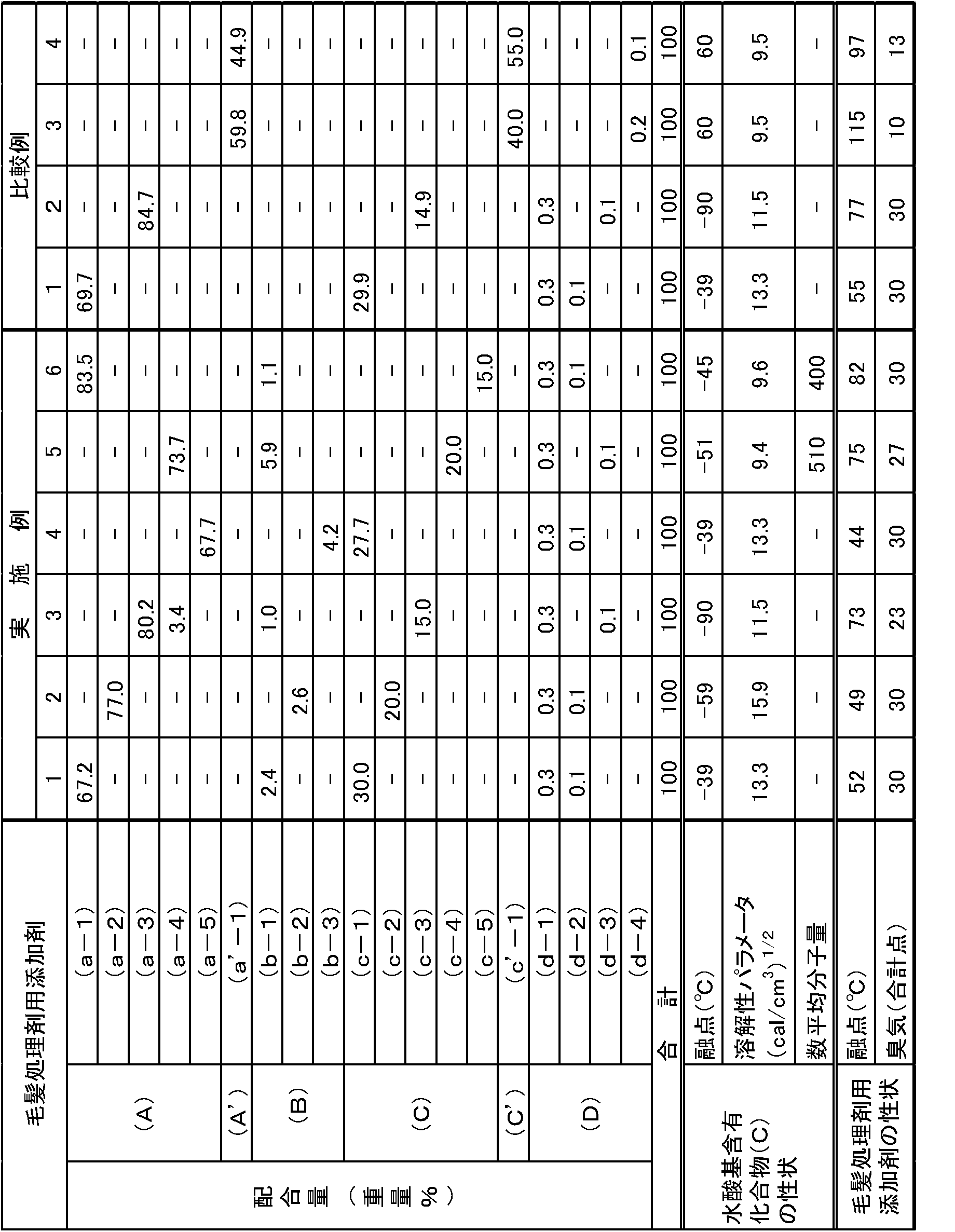
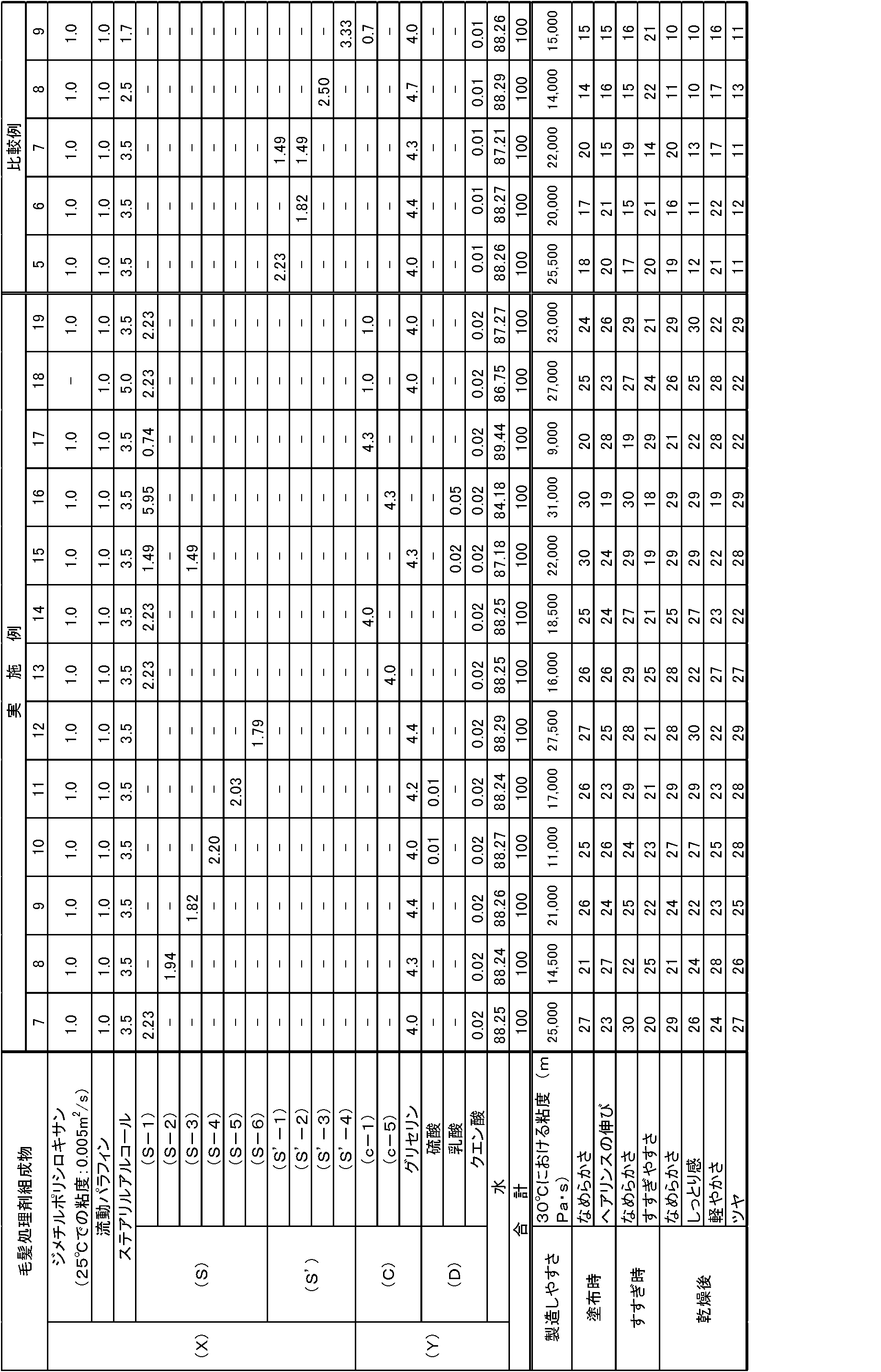
本発明の毛髪処理剤用添加剤を用いれば、すすぎ時から乾燥後までの毛髪の滑らかさに優れ、さらに乾燥後、しっとりするものの重くなり過ぎず、ツヤのある仕上がりとすることができる毛髪処理剤組成物を得ることができる。また、本発明の毛髪処理剤組成物は、例えば毛髪処理剤(ヘアコンディショナー、ヘアリンス、ヘアトリートメント及びヘアシャンプー等)に好適に使用され、さらには、スキンケア用化粧品(化粧水、乳液、クリーム、美容液、パック、マスク及び保湿用ジェル等)、メイクアップ用化粧品(ファンデーション、口紅、アイライナー、マスカラ、アイシャドー、眉墨及びネールトリートメント等)、毛髪洗浄剤(ヘアシャンプー等)、皮膚洗浄剤(ボディシャンプー及び洗顔クリーム等)食器用洗剤及び家庭用洗剤(衣料用柔軟剤等)等としても用いることができる。
Claims (15)
- 下記一般式(1)で表されるカチオン性界面活性剤(A)、下記一般式(2)で表される第3級アミン(B)及び融点が-120℃~40℃である水酸基含有化合物(C)を含有する毛髪処理剤用添加剤。


- 水酸基含有化合物(C)の溶解性パラメータ(σ)が8.5~20.0(cal/cm3)1/2である請求項1に記載の毛髪処理剤用添加剤。
- 水酸基含有化合物(C)が、下記一般式(3)で表される水酸基含有化合物(C1)及び/又は下記一般式(4)で表される水酸基含有化合物(C2)である請求項1又は2に記載の毛髪処理剤用添加剤。


- 一般式(3)で表される水酸基含有化合物(C1)が、エタノール、1-プロパノール、2-プロパノール、アルキル(炭素数1~6)プロピレングリコール、アルキル(炭素数1~6)ジプロピレングリコール及び数平均分子量200~2000のポリアルキレン(炭素数2~4)グリコールモノアルキル(炭素数1~6)エーテルからなる群より選ばれる少なくとも1種の(C1)である請求項3に記載の毛髪処理剤用添加剤。
- 一般式(3)で表される水酸基含有化合物(C1)が数平均分子量200~2000のポリアルキレン(炭素数2~4)グリコールモノアルキル(炭素数1~6)エーテルである請求項4に記載の毛髪処理剤用添加剤。
- 一般式(4)で表される水酸基含有化合物(C2)が、グリセリン、トリメチロールプロパン、炭素数2~8のアルカンジオール、グリセリンのアルキレンオキサイド付加物、トリメチロールプロパンのアルキレンオキサイド付加物、数平均分子量200~1000の炭素数2~12のアルカンジオールのアルキレンオキサイド付加物、ポリグリセリン、数平均分子量200~1000のポリエチレングリコール、数平均分子量200~2000のポリプロピレングリコール、数平均分子量200~2000のポリブチレングリコール、ジプロピレングリコール及びトリプロピレングリコールからなる群より選ばれる少なくとも1種の(C2)である請求項3~5のいずれかに記載の毛髪処理剤用添加剤。
- 一般式(4)で表される水酸基含有化合物(C2)が数平均分子量200~1000の炭素数2~12のアルカンジオールのアルキレンオキサイド付加物又は数平均分子量200~2000のポリプロピレングリコールである請求項6に記載の毛髪処理剤用添加剤。
- 一般式(1)で表されるカチオン性界面活性剤(A)と水酸基含有化合物(C)との重量比率[(A)/(C)]が50/50~95/5である請求項1~7のいずれかに記載の毛髪処理剤用添加剤。
- 一般式(1)で表されるカチオン性界面活性剤(A)において、カチオン性界面活性剤(A)の総炭素数が22以上であるカチオン性界面活性剤(A1)を含有しており、カチオン性界面活性剤(A1)の含有率が、カチオン性界面活性剤(A)の重量を基準として60重量%以上である請求項1~8のいずれかに記載の毛髪処理剤用添加剤。
- 一般式(1)で表されるカチオン性界面活性剤(A)と一般式(2)で表される第3級アミン(B)との重量比率[(A)/(B)]が[99.99/0.01~70/30]である請求項1~9のいずれかに記載の毛髪処理剤用添加剤。
- さらに、無機酸及び有機酸からなる群より選ばれる少なくとも1種の酸(D)を含有する請求項1~10のいずれかに記載の毛髪処理剤用添加剤。
- 酸(D)が硫酸及び/又は炭素数1~6の硫酸水素アルキルである請求項11に記載の毛髪処理剤用添加剤。
- 融点が50~110℃である請求項1~12のいずれかに記載の毛髪処理剤用添加剤。
- 請求項1~13のいずれかに記載の毛髪処理剤用添加剤と、
水、一般式(1)で表されるカチオン性界面活性剤(A)以外のカチオン性界面活性剤、一般式(2)で表される第3級アミン(B)以外の第3級アミン、融点が-120℃~40℃である水酸基含有化合物(C)以外の水酸基含有化合物、炭化水素油、エステル油、シリコーン及び防腐剤からなる群より選ばれる少なくとも1種とを含有してなる毛髪処理剤組成物。 - 30℃での粘度が1,000~50,000mPa・sである請求項14に記載の毛髪処理剤組成物。
Priority Applications (1)
| Application Number | Priority Date | Filing Date | Title |
|---|---|---|---|
| JP2016510446A JP6456359B2 (ja) | 2014-03-28 | 2015-03-25 | 毛髪処理剤用添加剤及びこれを含む毛髪処理剤組成物 |
Applications Claiming Priority (2)
| Application Number | Priority Date | Filing Date | Title |
|---|---|---|---|
| JP2014-068993 | 2014-03-28 | ||
| JP2014068993 | 2014-03-28 |
Publications (1)
| Publication Number | Publication Date |
|---|---|
| WO2015147102A1 true WO2015147102A1 (ja) | 2015-10-01 |
Family
ID=54195612
Family Applications (1)
| Application Number | Title | Priority Date | Filing Date |
|---|---|---|---|
| PCT/JP2015/059245 Ceased WO2015147102A1 (ja) | 2014-03-28 | 2015-03-25 | 毛髪処理剤用添加剤及びこれを含む毛髪処理剤組成物 |
Country Status (2)
| Country | Link |
|---|---|
| JP (1) | JP6456359B2 (ja) |
| WO (1) | WO2015147102A1 (ja) |
Citations (8)
| Publication number | Priority date | Publication date | Assignee | Title |
|---|---|---|---|---|
| JP2004091336A (ja) * | 2002-08-29 | 2004-03-25 | Hoyu Co Ltd | 毛髪化粧料組成物 |
| JP2005154366A (ja) * | 2003-11-27 | 2005-06-16 | Sanyo Chem Ind Ltd | 毛髪処理剤用基剤 |
| JP2005272788A (ja) * | 2004-02-25 | 2005-10-06 | Sanyo Chem Ind Ltd | 界面活性剤組成物 |
| JP2006104162A (ja) * | 2004-10-07 | 2006-04-20 | Hoyu Co Ltd | 毛髪化粧料組成物 |
| JP2007153806A (ja) * | 2005-12-06 | 2007-06-21 | Shiseido Co Ltd | 毛髪速乾用ヘアコンディショナー |
| JP2010180172A (ja) * | 2009-02-06 | 2010-08-19 | Shiseido Co Ltd | 毛髪化粧料 |
| JP2011207879A (ja) * | 2010-03-30 | 2011-10-20 | Evonik Goldschmidt Gmbh | 第四級アンモニウム化合物および有機カーボネートを含む組成物 |
| JP2012082169A (ja) * | 2010-10-13 | 2012-04-26 | Milbon Co Ltd | 毛髪処理剤 |
-
2015
- 2015-03-25 WO PCT/JP2015/059245 patent/WO2015147102A1/ja not_active Ceased
- 2015-03-25 JP JP2016510446A patent/JP6456359B2/ja active Active
Patent Citations (8)
| Publication number | Priority date | Publication date | Assignee | Title |
|---|---|---|---|---|
| JP2004091336A (ja) * | 2002-08-29 | 2004-03-25 | Hoyu Co Ltd | 毛髪化粧料組成物 |
| JP2005154366A (ja) * | 2003-11-27 | 2005-06-16 | Sanyo Chem Ind Ltd | 毛髪処理剤用基剤 |
| JP2005272788A (ja) * | 2004-02-25 | 2005-10-06 | Sanyo Chem Ind Ltd | 界面活性剤組成物 |
| JP2006104162A (ja) * | 2004-10-07 | 2006-04-20 | Hoyu Co Ltd | 毛髪化粧料組成物 |
| JP2007153806A (ja) * | 2005-12-06 | 2007-06-21 | Shiseido Co Ltd | 毛髪速乾用ヘアコンディショナー |
| JP2010180172A (ja) * | 2009-02-06 | 2010-08-19 | Shiseido Co Ltd | 毛髪化粧料 |
| JP2011207879A (ja) * | 2010-03-30 | 2011-10-20 | Evonik Goldschmidt Gmbh | 第四級アンモニウム化合物および有機カーボネートを含む組成物 |
| JP2012082169A (ja) * | 2010-10-13 | 2012-04-26 | Milbon Co Ltd | 毛髪処理剤 |
Also Published As
| Publication number | Publication date |
|---|---|
| JPWO2015147102A1 (ja) | 2017-04-13 |
| JP6456359B2 (ja) | 2019-01-23 |
Similar Documents
| Publication | Publication Date | Title |
|---|---|---|
| CN102395347B (zh) | 硅酮部分被支化的有机改性的硅氧烷用于制备化妆或药物组合物的用途 | |
| JP6535722B2 (ja) | 第四級アンモニウム基を含む低粘度であるポリオルガノシロキサン、その製造方法ならびにそれらの使用 | |
| JP6370575B2 (ja) | イソプロパノールアミンベースのエステルクワットを含む配合物 | |
| JP5997155B2 (ja) | 水性環境で安定している糖シロキサン並びにそのような糖シロキサンの調製及び使用方法 | |
| KR102359405B1 (ko) | 이소프로판올아민 및 테트라히드록시프로필 에틸렌디아민 기재의 에스테르 쿼트를 포함하는 제형 | |
| BR112020004478B1 (pt) | Composição contendo composto de amônio quaternário, especialmente para produzir formulações de cuidados e limpeza | |
| CN104334646A (zh) | 包含季铵基团的低粘度聚有机基硅氧烷、其生产方法和用途(ii) | |
| KR102410538B1 (ko) | 비-석유화학적으로 유도되는 양이온 유화제, 관련 조성물 및 방법 | |
| DE60306607T2 (de) | Methode zur Herstellung einer quaternäre ammoniumfunktionelle Silane und Siloxane enthaltenden Emulsion | |
| EP1810657A1 (en) | Hair care preparations | |
| JP2011503059A (ja) | エポキシ化合物とアミノシランの反応産物を含有するパーソナルケア組成物 | |
| KR20180094872A (ko) | 실리콘 폴리머의 혼합물을 포함하는 에멀젼 및 이의 제조방법 | |
| KR101948582B1 (ko) | 컨디셔닝 제제 및 컨디셔닝용 조성물 | |
| JP4629354B2 (ja) | 界面活性剤組成物 | |
| JP7328887B2 (ja) | 四級アンモニウム基を含む低粘度ポリオルガノシロキサン、その製造方法およびその使用 | |
| WO2009122755A1 (ja) | 毛髪用コンディショニング組成物 | |
| JP6456359B2 (ja) | 毛髪処理剤用添加剤及びこれを含む毛髪処理剤組成物 | |
| WO2011052113A1 (ja) | 抗菌剤 | |
| JP2017066114A (ja) | 毛髪洗浄剤組成物 | |
| JP5946724B2 (ja) | 毛髪化粧料 | |
| KR101591346B1 (ko) | 모발용 화장료의 제조 방법 | |
| JP4855217B2 (ja) | 1,2−オクタンジオール組成物及びそれを用いた1,2−オクタンジオール含有化粧料の製造方法 | |
| JP2010013404A (ja) | 毛髪化粧料 | |
| JP2017145241A (ja) | 抗菌剤 | |
| KR102200186B1 (ko) | 모발 관리용 조성물 |
Legal Events
| Date | Code | Title | Description |
|---|---|---|---|
| 121 | Ep: the epo has been informed by wipo that ep was designated in this application |
Ref document number: 15770375 Country of ref document: EP Kind code of ref document: A1 |
|
| ENP | Entry into the national phase |
Ref document number: 2016510446 Country of ref document: JP Kind code of ref document: A |
|
| NENP | Non-entry into the national phase | ||
| 122 | Ep: pct application non-entry in european phase |
Ref document number: 15770375 Country of ref document: EP Kind code of ref document: A1 |