WO2015147013A1 - 複層フィルム及びその製造方法 - Google Patents
複層フィルム及びその製造方法 Download PDFInfo
- Publication number
- WO2015147013A1 WO2015147013A1 PCT/JP2015/058981 JP2015058981W WO2015147013A1 WO 2015147013 A1 WO2015147013 A1 WO 2015147013A1 JP 2015058981 W JP2015058981 W JP 2015058981W WO 2015147013 A1 WO2015147013 A1 WO 2015147013A1
- Authority
- WO
- WIPO (PCT)
- Prior art keywords
- film
- particles
- resin layer
- multilayer film
- resin
- Prior art date
- Legal status (The legal status is an assumption and is not a legal conclusion. Google has not performed a legal analysis and makes no representation as to the accuracy of the status listed.)
- Ceased
Links
Images


Classifications
-
- B—PERFORMING OPERATIONS; TRANSPORTING
- B32—LAYERED PRODUCTS
- B32B—LAYERED PRODUCTS, i.e. PRODUCTS BUILT-UP OF STRATA OF FLAT OR NON-FLAT, e.g. CELLULAR OR HONEYCOMB, FORM
- B32B3/00—Layered products comprising a layer with external or internal discontinuities or unevennesses, or a layer of non-planar shape; Layered products comprising a layer having particular features of form
- B32B3/26—Layered products comprising a layer with external or internal discontinuities or unevennesses, or a layer of non-planar shape; Layered products comprising a layer having particular features of form characterised by a particular shape of the outline of the cross-section of a continuous layer; characterised by a layer with cavities or internal voids ; characterised by an apertured layer
- B32B3/30—Layered products comprising a layer with external or internal discontinuities or unevennesses, or a layer of non-planar shape; Layered products comprising a layer having particular features of form characterised by a particular shape of the outline of the cross-section of a continuous layer; characterised by a layer with cavities or internal voids ; characterised by an apertured layer characterised by a layer formed with recesses or projections, e.g. hollows, grooves, protuberances, ribs
-
- B—PERFORMING OPERATIONS; TRANSPORTING
- B32—LAYERED PRODUCTS
- B32B—LAYERED PRODUCTS, i.e. PRODUCTS BUILT-UP OF STRATA OF FLAT OR NON-FLAT, e.g. CELLULAR OR HONEYCOMB, FORM
- B32B27/00—Layered products comprising a layer of synthetic resin
- B32B27/18—Layered products comprising a layer of synthetic resin characterised by the use of special additives
- B32B27/20—Layered products comprising a layer of synthetic resin characterised by the use of special additives using fillers, pigments, thixotroping agents
-
- B—PERFORMING OPERATIONS; TRANSPORTING
- B32—LAYERED PRODUCTS
- B32B—LAYERED PRODUCTS, i.e. PRODUCTS BUILT-UP OF STRATA OF FLAT OR NON-FLAT, e.g. CELLULAR OR HONEYCOMB, FORM
- B32B27/00—Layered products comprising a layer of synthetic resin
- B32B27/40—Layered products comprising a layer of synthetic resin comprising polyurethanes
-
- C—CHEMISTRY; METALLURGY
- C08—ORGANIC MACROMOLECULAR COMPOUNDS; THEIR PREPARATION OR CHEMICAL WORKING-UP; COMPOSITIONS BASED THEREON
- C08J—WORKING-UP; GENERAL PROCESSES OF COMPOUNDING; AFTER-TREATMENT NOT COVERED BY SUBCLASSES C08B, C08C, C08F, C08G or C08H
- C08J7/00—Chemical treatment or coating of shaped articles made of macromolecular substances
- C08J7/04—Coating
- C08J7/0427—Coating with only one layer of a composition containing a polymer binder
-
- C—CHEMISTRY; METALLURGY
- C08—ORGANIC MACROMOLECULAR COMPOUNDS; THEIR PREPARATION OR CHEMICAL WORKING-UP; COMPOSITIONS BASED THEREON
- C08J—WORKING-UP; GENERAL PROCESSES OF COMPOUNDING; AFTER-TREATMENT NOT COVERED BY SUBCLASSES C08B, C08C, C08F, C08G or C08H
- C08J7/00—Chemical treatment or coating of shaped articles made of macromolecular substances
- C08J7/04—Coating
- C08J7/043—Improving the adhesiveness of the coatings per se, e.g. forming primers
-
- C—CHEMISTRY; METALLURGY
- C08—ORGANIC MACROMOLECULAR COMPOUNDS; THEIR PREPARATION OR CHEMICAL WORKING-UP; COMPOSITIONS BASED THEREON
- C08K—Use of inorganic or non-macromolecular organic substances as compounding ingredients
- C08K3/00—Use of inorganic substances as compounding ingredients
- C08K3/34—Silicon-containing compounds
- C08K3/36—Silica
-
- G—PHYSICS
- G02—OPTICS
- G02B—OPTICAL ELEMENTS, SYSTEMS OR APPARATUS
- G02B1/00—Optical elements characterised by the material of which they are made; Optical coatings for optical elements
- G02B1/10—Optical coatings produced by application to, or surface treatment of, optical elements
-
- G—PHYSICS
- G02—OPTICS
- G02B—OPTICAL ELEMENTS, SYSTEMS OR APPARATUS
- G02B5/00—Optical elements other than lenses
- G02B5/30—Polarising elements
-
- G—PHYSICS
- G02—OPTICS
- G02B—OPTICAL ELEMENTS, SYSTEMS OR APPARATUS
- G02B5/00—Optical elements other than lenses
- G02B5/30—Polarising elements
- G02B5/3025—Polarisers, i.e. arrangements capable of producing a definite output polarisation state from an unpolarised input state
- G02B5/3033—Polarisers, i.e. arrangements capable of producing a definite output polarisation state from an unpolarised input state in the form of a thin sheet or foil, e.g. Polaroid
- G02B5/3041—Polarisers, i.e. arrangements capable of producing a definite output polarisation state from an unpolarised input state in the form of a thin sheet or foil, e.g. Polaroid comprising multiple thin layers, e.g. multilayer stacks
-
- B—PERFORMING OPERATIONS; TRANSPORTING
- B05—SPRAYING OR ATOMISING IN GENERAL; APPLYING FLUENT MATERIALS TO SURFACES, IN GENERAL
- B05D—PROCESSES FOR APPLYING FLUENT MATERIALS TO SURFACES, IN GENERAL
- B05D5/00—Processes for applying liquids or other fluent materials to surfaces to obtain special surface effects, finishes or structures
- B05D5/02—Processes for applying liquids or other fluent materials to surfaces to obtain special surface effects, finishes or structures to obtain a matt or rough surface
-
- B—PERFORMING OPERATIONS; TRANSPORTING
- B32—LAYERED PRODUCTS
- B32B—LAYERED PRODUCTS, i.e. PRODUCTS BUILT-UP OF STRATA OF FLAT OR NON-FLAT, e.g. CELLULAR OR HONEYCOMB, FORM
- B32B2264/00—Composition or properties of particles which form a particulate layer or are present as additives
- B32B2264/10—Inorganic particles
- B32B2264/102—Oxide or hydroxide
-
- B—PERFORMING OPERATIONS; TRANSPORTING
- B32—LAYERED PRODUCTS
- B32B—LAYERED PRODUCTS, i.e. PRODUCTS BUILT-UP OF STRATA OF FLAT OR NON-FLAT, e.g. CELLULAR OR HONEYCOMB, FORM
- B32B2457/00—Electrical equipment
- B32B2457/20—Displays, e.g. liquid crystal displays, plasma displays
-
- C—CHEMISTRY; METALLURGY
- C08—ORGANIC MACROMOLECULAR COMPOUNDS; THEIR PREPARATION OR CHEMICAL WORKING-UP; COMPOSITIONS BASED THEREON
- C08J—WORKING-UP; GENERAL PROCESSES OF COMPOUNDING; AFTER-TREATMENT NOT COVERED BY SUBCLASSES C08B, C08C, C08F, C08G or C08H
- C08J2475/00—Characterised by the use of polyureas or polyurethanes; Derivatives of such polymers
- C08J2475/04—Polyurethanes
Definitions
- the present invention relates to a multilayer film and a method for producing the same.
- multilayer film having a plurality of layers is known (see Patent Documents 1 and 2). Since such a multilayer film can exhibit various functions obtained by combining the characteristics of each layer, it is used in a wide range of applications.
- multilayer films may also be used in optical films used in various image display devices such as liquid crystal display devices, organic EL display devices, and plasma displays.
- the multilayer film as described above is often produced as a long film from the viewpoint of increasing production efficiency. Moreover, such a long multilayer film is generally wound up into a film roll, and is stored and transported in the state of this film roll.
- Patent Document 3 Furthermore, a technique such as Patent Document 3 is known.
- a film roll manufactured by winding a long multilayer film may have a convex defect called a “strip” having a width of about 1 mm to 3 mm.
- the convex defect as described above is transferred to the multilayer film, the multilayer film is deformed in the transferred portion, and the optical characteristics in the portion may be impaired.
- this defect does not occur before winding the multilayer film but occurs after the production of the film roll, it is difficult to detect by inspection in the multilayer film production line.
- the defect is to be detected after the production of the film roll, it is required to carry out the inspection by taking out the multilayer film from the film roll, so it takes time to rewind the fed multilayer film again. It will be. Therefore, it is difficult to sort out the film roll having no defect while keeping the state of the film roll. Under such circumstances, there has been a demand for the development of a multilayer film that can suppress the occurrence of the aforementioned defects when a film roll is used.
- the internal haze is small.
- the fact that the internal haze is required to be small in this way is the same when the optical film is a multilayer film. Therefore, in the case of a multilayer film that can suppress the occurrence of convex defects when a film roll is used as described above, it is also required that the internal haze can be reduced.
- the present invention was devised in view of the above-mentioned problems, and when it is wound up into a film roll, it is possible to suppress the occurrence of the convex defects and to reduce the internal haze and the production thereof. It aims to provide a method.
- a multilayer film comprising a base film and a resin layer containing particles has a height on the surface of the resin layer opposite to the base film. It has been found that those having different projections with a predetermined regularity can suppress the occurrence of convex defects when the multilayer film is used as a film roll, and can reduce the internal haze of the multilayer film.
- the present invention is as follows.
- a multilayer film comprising a base film and a resin layer containing particles provided on the base film,
- the resin layer has a plurality of protrusions on the surface opposite to the base film,
- the projections (a) the height 5 nm N A number / mm 2 the number of 1 mm 2 per projections, (b) the number of 1 mm 2 per high protrusions 10 nm N B number / mm 2, ( c) height 15 nm N C pieces / mm 2 the number of 1 mm 2 per projections, (d) the height 20 nm N D pieces / mm 2 the number of 1 mm 2 per protrusions, the height 25 nm (e) when the number of 1 mm 2 per projections and N E pieces / mm 2, the number of 1 mm 2 per projection (f) the height 30nm and the N F / mm 2,
- the resin layer contains a polymer, The multilayer film according to [1], wherein the polymer includes polyurethane.
- the particles include a plurality of particles having different average particle diameters.
- the particles include particles (S) having an average particle diameter of less than 150 nm and particles (L) having an average particle diameter of 150 nm or more.
- the resin layer contains a polymer
- the particles include particles (S) having an average particle diameter of less than 150 nm and particles (L) having an average particle diameter of 150 nm or more,
- the resin layer contains a polymer
- the particles include particles (S) having an average particle diameter of less than 150 nm and particles (L) having an average particle diameter of 150 nm or more,
- the multilayer film according to any one of [1] to [6], wherein the particles are silica.
- the particles include particles (S) having an average particle diameter of less than 150 nm and particles (L) having an average particle diameter of 150 nm or more.
- the multilayer film of the present invention When the multilayer film of the present invention is wound up into a film roll, the occurrence of convex defects can be suppressed, and the internal haze can be reduced. According to the method for producing a multilayer film of the present invention, it is possible to produce a multilayer film that can suppress the occurrence of convex defects and can reduce the internal haze when wound into a film roll.
- FIG. 1 is a cross-sectional view schematically showing an example of a multilayer film according to an embodiment of the present invention.
- FIG. 2 is a front view schematically showing an example of a state in which wrinkles due to film sticking occur in a conventional film roll. 3, 3.5 ⁇ G ⁇ 7 and, an example of a multilayer film that satisfies the requirements of the N B ⁇ N C ⁇ N D ⁇ N E ⁇ N F, the height of the projection horizontal axis, the projections It is the distribution map which took the number on the vertical axis
- (meth) acryl includes both acrylic and methacrylic.
- (Meth) acrylate includes both acrylate and methacrylate.
- (co) polymer includes both a polymer and a copolymer.
- the particle size distribution is measured by laser diffraction method, and the cumulative volume calculated from the small diameter side in the measured particle size distribution is 50%. Adopt particle size.
- nx represents a refractive index in a direction (in-plane direction) perpendicular to the thickness direction of the film and giving the maximum refractive index.
- ny represents a refractive index in the in-plane direction of the film and in a direction perpendicular to the nx direction.
- nz represents the refractive index in the thickness direction of the film.
- d represents the film thickness of the film.
- the retardation measurement wavelength is 550 nm.
- the retardation can be measured using a commercially available phase difference measuring apparatus (for example, “KOBRA-21ADH” manufactured by Oji Scientific Instruments) or the Senarmon method.
- the “polarizing plate” includes not only a rigid member but also a flexible member such as a resin film.
- FIG. 1 is a cross-sectional view schematically showing an example of a multilayer film 100 according to an embodiment of the present invention.
- the multilayer film 100 which concerns on one Embodiment of this invention is equipped with the base film 110 and the resin layer 120 containing the particle
- the resin layer 120 has a plurality of protrusions 122 on the surface 121 opposite to the base film 110.
- the symbol “T” represents the thickness of the resin layer 120
- the symbol “H” represents the height of the protrusion 122.
- the thickness T of the resin layer 120 represents the thickness of the resin layer 120 in a region where the protrusion 122 is not present.
- the projection 122 on the surface 121 of the resin layer 120 3.5 ⁇ G ⁇ 7, and satisfies N B ⁇ N C ⁇ N D ⁇ N E ⁇ N F.
- N A , N B , N C , N D , N E and N F represent the following numbers.
- ( A ) N A (unit: piece / mm 2 ) indicates the number per 1 mm 2 of protrusions having a height of 5 nm among the protrusions 122 on the surface 121 opposite to the base film 110 of the resin layer 120. .
- N B (unit: piece / mm 2 ) indicates the number per 1 mm 2 of protrusions having a height of 10 nm among the protrusions 122 on the surface 121 opposite to the base film 110 of the resin layer 120.
- N C (unit: piece / mm 2 ) indicates the number per 1 mm 2 of protrusions having a height of 15 nm among the protrusions 122 on the surface 121 opposite to the base film 110 of the resin layer 120.
- N D (unit: piece / mm 2 ) indicates the number of protrusions having a height of 20 nm per 1 mm 2 among the protrusions 122 on the surface 121 opposite to the base film 110 of the resin layer 120.
- N E (unit: piece / mm 2 ) indicates the number per 1 mm 2 of protrusions having a height of 25 nm among the protrusions 122 on the surface 121 opposite to the base film 110 of the resin layer 120.
- N F (unit: piece / mm 2 ) indicates the number per 1 mm 2 of protrusions having a height of 30 nm among the protrusions 122 on the surface 121 opposite to the base film 110 of the resin layer 120. .
- a height of 5 nm represents a value of 4.5 nm or more and 5.4 nm or less in consideration of significant figures.
- a height of 10 nm represents 9.5 nm to 10.4 nm
- a height of 15 nm represents 14.5 nm to 15.4 nm
- a height of 20 nm represents 19.5 nm.
- the height represents 20.4 nm or less
- the height 25 nm represents 24.5 nm or more and 25.4 nm or less
- the height 30 nm represents 29.5 nm or more and 30.4 nm or less.
- the stacked film When a film roll is manufactured by winding a conventional film, the stacked film may be locally fixed. In such a fixed portion, the displacement of the film is restricted. Therefore, the tension applied to the film at the time of winding is not dispersed throughout the film, and stress bias occurs in the film. Such stress bias may cause wrinkles in the film roll.
- FIG. 2 is a front view schematically showing an example of a state in which wrinkles 210 are generated due to adhesion of the film in the conventional film roll 200.
- the wrinkles 210 are usually formed in a polygonal shape. Specifically, a plurality of polygonal (usually diamond-shaped) depressions 230 are formed in the axial direction and circumferential direction of the film roll 200, and wrinkles 210 are formed at positions corresponding to the polygonal sides of the depressions 230. There are many.
- Such wrinkles 210 do not bend the film greatly at the beginning of the generation.
- the degree of depression (depth) of the polygonal depression 230 gradually increases due to the weight of the film.
- the degree of depression of the depression 230 is increased, the degree of bending of the film is increased at the portion where the wrinkles 210 are generated.
- the film is greatly bent beyond the elastic limit, it is considered that the film undergoes plastic deformation at the bent portion, and a convex defect called “buzz” is generated.
- the multilayer film 100 provided with the plurality of protrusions 122 that satisfy the above-described requirements on the surface 121 opposite to the base film 110 of the resin layer 120 is formed on the surface 121.
- the surface 121 opposite to the base film 110 of the resin layer 120 is normally the outermost surface of the multilayer film 100, the slipperiness of the surface 121 is excellent, and the multilayer film 100 is wound up. , The sticking of the multi-layered film 100 that has been rolled up can be suppressed. Therefore, since it is possible to suppress the occurrence of wrinkles in the film roll, it is presumed that the occurrence of convex defects due to the wrinkles can be suppressed.
- the resin layer is formed as a resin layer containing particles.
- the internal haze of the resin layer may greatly increase depending on the amount and size of the particles. Therefore, from the viewpoint of application to an optical film, the resin layer is preferably designed so that the internal haze can be reduced.
- the particles are preferably small in order to avoid an increase in internal haze.
- the present inventor tried to provide a resin layer containing particles having a small size and a uniform particle diameter on the base film, and to provide a projection having a low height on the surface of the film.
- the film obtained in this way has low slipperiness on the surface having protrusions, and it has been difficult to suppress the occurrence of convex defects in the film roll.
- the present inventor predicted that if the particle size is increased to increase the height of the protrusion, the slipperiness of the surface provided with the protrusion is improved. Then, the present inventor conducted the same examination as described above by increasing the size of the particles in order to increase the height of the protrusions. However, even if the height of the protrusion is increased, the slipperiness is not sufficiently improved, and it is difficult to suppress the occurrence of convex defects in the film roll.
- the number of protrusions is increased, it is considered possible to improve the slipperiness of the surface having the protrusions.
- FIG. 3 shows a distribution diagram of an example of the multilayer film 100 that satisfies this requirement, with the height of the protrusions 122 on the horizontal axis and the number of the protrusions 122 on the vertical axis.
- the peak width is wide and gentle, and the peak apex is desired. Represents a small range.
- the surface 121 having the protrusions 122 having different heights has a remarkably high slipperiness.
- the resin layer having protrusions satisfying the above requirements (3.5 ⁇ G ⁇ 7 and N B ⁇ N C ⁇ N D ⁇ N E ⁇ N F ) appropriately includes small particles and large particles. By using in combination, it can be produced with a small amount of particles. Since the amount of particles can be reduced, an increase in internal haze due to the resin layer can be avoided.
- the multilayer film of the present invention can suppress the occurrence of convex defects in the film roll without causing an increase in internal haze even when protrusions are formed by particles contained in the resin layer.
- the particles used in the optical film are preferably smaller in size and more preferable in size from the viewpoint of not impairing the properties that the optical film should have. From this conventional recognition, it is surprising that a resin layer having a small internal haze and excellent surface slipperiness can be provided by using a combination of small particles and large particles as described above. It can be said that it is an effect.
- a resin film is usually used.
- resin which comprises a base film resin containing arbitrary polymers can be used.
- a thermoplastic resin is preferable and an alicyclic olefin resin is especially preferable.
- the alicyclic olefin resin is a resin containing an alicyclic olefin polymer, and is excellent in properties such as transparency, low moisture absorption, dimensional stability, and lightness, and is suitable for an optical film.
- the base film may be a single layer structure film including only one layer, or may be a multilayer structure film including two or more layers.
- the base film has a multilayer structure, it is preferable that one or more layers included in the base film are made of an alicyclic olefin resin.
- An alicyclic olefin polymer is a polymer having an alicyclic structure in the structural unit of the polymer, a polymer having an alicyclic structure in the main chain, and a polymer having an alicyclic structure in the side chain. Any combination may be used. Moreover, an alicyclic olefin polymer may be used individually by 1 type, and may be used combining two or more types by arbitrary ratios. Among these, a polymer containing an alicyclic structure in the main chain is preferable from the viewpoint of mechanical strength, heat resistance, and the like.
- Examples of the alicyclic structure include a saturated alicyclic hydrocarbon (cycloalkane) structure and an unsaturated alicyclic hydrocarbon (cycloalkene, cycloalkyne) structure.
- a saturated alicyclic hydrocarbon cycloalkane
- an unsaturated alicyclic hydrocarbon cycloalkene, cycloalkyne
- a cycloalkane structure and a cycloalkene structure are preferable, and a cycloalkane structure is particularly preferable.
- the number of carbon atoms constituting the alicyclic structure is preferably 4 or more, more preferably 5 or more, preferably 30 or less, more preferably 20 or less, particularly preferably per alicyclic structure. Is a range of 15 or less. Thereby, the mechanical strength, heat resistance, and moldability of the base film are highly balanced and suitable.
- the proportion of the structural unit having an alicyclic structure in the alicyclic olefin polymer may be appropriately selected according to the purpose of use, preferably 55% by weight or more, more preferably 70% by weight or more, particularly preferably. 90% by weight or more.
- the proportion of the structural unit having an alicyclic structure in the alicyclic olefin polymer is within this range, it is preferable from the viewpoint of the transparency and heat resistance of the base film.
- alicyclic olefin polymer examples include a norbornene polymer, a monocyclic olefin polymer, a cyclic conjugated diene polymer, a vinyl alicyclic hydrocarbon polymer, and a hydride thereof. . Of these, norbornene polymers are preferred because of their good transparency and moldability.
- Examples of the norbornene polymer include a ring-opening polymer of a monomer having a norbornene structure, a ring-opening copolymer of a monomer having a norbornene structure and an arbitrary monomer, or a hydride thereof; An addition polymer of a monomer having a structure, an addition copolymer of a monomer having a norbornene structure and an arbitrary monomer, or a hydride thereof.
- the hydride of a ring-opening polymer of a monomer having a norbornene structure and the hydride of a ring-opening copolymer of a monomer having a norbornene structure are transparent, moldability, heat resistance, From the viewpoint of low hygroscopicity, dimensional stability, light weight, etc., it is particularly suitable.
- Examples of the monomer having a norbornene structure include bicyclo [2.2.1] hept-2-ene (common name: norbornene), tricyclo [4.3.0.1 2,5 ] deca-3,7. -Diene (common name: dicyclopentadiene), 7,8-benzotricyclo [4.3.0.1 2,5 ] dec-3-ene (common name: methanotetrahydrofluorene), tetracyclo [4.4. 0.1 2,5 . 1 7,10 ] dodec-3-ene (common name: tetracyclododecene), and derivatives of these compounds (for example, those having a substituent in the ring).
- examples of the substituent include an alkyl group, an alkylene group, and a polar group. Moreover, these substituents may be the same or different, and a plurality thereof may be bonded to the ring. Moreover, the monomer which has a norbornene structure may be used individually by 1 type, and may be used combining two or more types by arbitrary ratios.
- Examples of the polar group include heteroatoms or atomic groups having heteroatoms.
- Examples of the hetero atom include an oxygen atom, a nitrogen atom, a sulfur atom, a silicon atom, and a halogen atom.
- Specific examples of the polar group include a carboxyl group, a carbonyloxycarbonyl group, an epoxy group, a hydroxyl group, an oxy group, an ester group, a silanol group, a silyl group, an amino group, a nitrile group, and a sulfonic acid group.
- Examples of an optional monomer capable of ring-opening copolymerization with a monomer having a norbornene structure include, for example, monocyclic olefins such as cyclohexene, cycloheptene, and cyclooctene and derivatives thereof; cyclic such as cyclohexadiene and cycloheptadiene. Conjugated dienes and derivatives thereof; and the like.
- the optional monomer capable of ring-opening copolymerization with a monomer having a norbornene structure one kind may be used alone, or two or more kinds may be used in combination at any ratio.
- a ring-opening polymer of a monomer having a norbornene structure, and a ring-opening copolymer of any monomer copolymerizable with a monomer having a norbornene structure are, for example, a known ring-opening monomer. It can be produced by polymerization or copolymerization in the presence of a polymerization catalyst.
- optional monomers capable of addition copolymerization with a monomer having a norbornene structure include ⁇ -olefins having 2 to 20 carbon atoms such as ethylene, propylene, 1-butene, and derivatives thereof; cyclobutene, cyclopentene And cycloolefins such as cyclohexene and derivatives thereof; non-conjugated dienes such as 1,4-hexadiene, 4-methyl-1,4-hexadiene, 5-methyl-1,4-hexadiene; and the like.
- ⁇ -olefin is preferable, and ethylene is more preferable.
- the arbitrary monomer which can carry out addition copolymerization with the monomer which has a norbornene structure may be used individually by 1 type, and may be used combining two or more types by arbitrary ratios.
- An addition copolymer of a monomer having a norbornene structure and an addition copolymer of any monomer that can be copolymerized with a monomer having a norbornene structure include, for example, a monomer of a known addition polymerization catalyst. It can be produced by polymerization or copolymerization in the presence.
- Examples of the monocyclic olefin polymer include addition polymers of cyclic olefin monomers having a single ring such as cyclohexene, cycloheptene, and cyclooctene.
- cyclic conjugated diene polymer examples include polymers obtained by cyclization of addition polymers of conjugated diene monomers such as 1,3-butadiene, isoprene and chloroprene; cyclic conjugated diene monomers such as cyclopentadiene and cyclohexadiene 1,2- or 1,4-addition polymers; and hydrides thereof;
- vinyl alicyclic hydrocarbon polymer examples include polymers of vinyl alicyclic hydrocarbon monomers such as vinyl cyclohexene and vinyl cyclohexane and their hydrides; vinyl aromatic hydrocarbon monomers such as styrene and ⁇ -methyl styrene.
- an aromatic ring hydride of a copolymer such as a random copolymer or a block copolymer with an arbitrary monomer.
- the block copolymer examples include a diblock copolymer, a triblock copolymer or higher multiblock copolymer, and a gradient block copolymer.
- the weight average molecular weight (Mw) of the polymer contained in the resin constituting the base film is usually 10,000 or more, preferably 15,000 or more, more preferably 20,000 or more, and usually 100,000 or less. Preferably it is 80,000 or less, More preferably, it is 50,000 or less.
- the weight average molecular weight is a polyisoprene or polystyrene equivalent weight average molecular weight measured by gel permeation chromatography using cyclohexane as a solvent. However, when the sample does not dissolve in cyclohexane, toluene may be used as the solvent for the gel permeation chromatography. When the weight average molecular weight is in such a range, the mechanical strength and moldability of the multilayer film are highly balanced, which is preferable.
- the molecular weight distribution (weight average molecular weight (Mw) / number average molecular weight (Mn)) of the polymer contained in the resin constituting the base film is usually 1.2 or more, preferably 1.5 or more, more preferably 1. It is 8 or more, usually 3.5 or less, preferably 3.0 or less, more preferably 2.7 or less.
- productivity of a polymer can be improved and cost can be suppressed.
- a low molecular weight component can be reduced by making it below an upper limit, relaxation time can be lengthened. Therefore, relaxation at high temperature exposure can be suppressed, and the stability of the base film can be enhanced.
- the polymer contained in the resin constituting the base film preferably has an absolute value of the photoelastic coefficient C of 10 ⁇ 10 ⁇ 12 Pa ⁇ 1 or less, preferably 7 ⁇ 10 ⁇ 12 Pa ⁇ 1 or less. More preferably, it is 4 ⁇ 10 ⁇ 12 Pa ⁇ 1 or less.
- the saturated water absorption rate of the polymer contained in the resin constituting the base film is preferably 0.03% by weight or less, more preferably 0.02% by weight or less, and particularly preferably 0.01% by weight or less.
- the saturated water absorption is in the above range, the change with time of retardation in the in-plane direction and retardation in the thickness direction of the base film can be reduced.
- deterioration of the polarizing plate and the image display device provided with the multilayer film of the present invention can be suppressed, and the display on the display can be stably and satisfactorily maintained for a long time.
- the saturated water absorption is a value obtained by expressing the mass increased by immersing the test piece in water at a constant temperature for a certain time as a percentage of the mass of the test piece before immersion. Usually, it is measured by immersing a test piece in water at 23 ° C. for 24 hours.
- the saturated water absorption in the polymer can be adjusted to the above range, for example, by reducing the amount of polar groups in the polymer. Therefore, from the viewpoint of lowering the saturated water absorption rate, the polymer contained in the resin constituting the base film preferably has no polar group.
- the resin constituting the base film may contain an optional component other than the polymer as long as the effects of the present invention are not significantly impaired.
- the optional components include colorants such as pigments and dyes; plasticizers; fluorescent brighteners; dispersants; thermal stabilizers; light stabilizers; ultraviolet absorbers; antistatic agents; An additive such as a surfactant. These components may be used individually by 1 type, and may be used combining two or more types by arbitrary ratios.
- the alicyclic olefin resin when used as the resin constituting the base film, it is preferable that the alicyclic olefin resin does not substantially contain particles.
- the term “substantially free of particles” means that even if particles are included in the resin, the amount of increase in haze of the base film from a state in which no particles are included is in a range of 0.05% or less. Means acceptable. Alicyclic olefin polymers tend to lack affinity with many organic and inorganic particles. Therefore, when the alicyclic olefin resin containing particles is stretched, voids are easily generated. However, by reducing the amount of particles as described above, it is possible to suppress the generation of voids when stretched and prevent haze from increasing.
- the amount of the polymer and additive contained in the resin constituting the base film can be arbitrarily set within a range in which the multilayer film of the present invention can exhibit desired optical characteristics.
- the ratio of the polymer in the resin constituting the base film is generally 50% to 100%, or 70% to 100%.
- the proportion of the polymer contained in the alicyclic olefin resin is usually 80% to 100%, preferably 90% to 100%.
- the base film may be a single-layer film having only one layer, or a multilayer film having two or more layers.
- the multilayer film of this invention can be used as an optical film which has various characteristics.
- the base film includes two or more layers, two or more of one type of layer may be included, or two or more different types of layers may be included.
- the layer made of other than the alicyclic olefin resin include layers having functions such as scratch prevention, antireflection, antistatic, antiglare and antifouling.
- the average thickness of the base film is preferably 5 ⁇ m or more, more preferably 20 ⁇ m or more, preferably 500 ⁇ m or less, more preferably 300 ⁇ m or less. Moreover, it is preferable that the thickness fluctuation
- the amount of the volatile component contained in the base film is preferably 0.1% by weight or less, more preferably 0.05% by weight or less, and further preferably 0.02% by weight or less.
- the amount of the volatile component is a substance having a molecular weight of 200 or less. Examples of volatile components include residual monomers and solvents.
- the amount of volatile components can be quantified by analyzing by gas chromatography as the sum of substances having a molecular weight of 200 or less.
- a base film is obtained by shape
- the film forming method include a cast forming method, an extrusion forming method, and an inflation forming method.
- a melt extrusion method that does not use a solvent can reduce the amount of residual volatile components efficiently, and is preferable from the viewpoints of the global environment and work environment, and excellent manufacturing efficiency.
- the melt extrusion method include an inflation method using a die, and among them, a method using a T die is preferable in terms of excellent productivity and thickness accuracy.
- the base film includes two or more layers
- the adhesive an appropriate one can be selected depending on the type of resin forming the film layer to be bonded.
- adhesives examples include acrylic adhesives, urethane adhesives, polyester adhesives, polyvinyl alcohol adhesives, polyolefin adhesives, modified polyolefin adhesives, polyvinyl alkyl ether adhesives, rubber adhesives, ethylene-vinyl acetate adhesives, Vinyl chloride-vinyl acetate adhesive, SEBS (styrene-ethylene-butylene-styrene copolymer) adhesive, SIS (styrene-isoprene-styrene block copolymer) adhesive, ethylene adhesives such as ethylene-styrene copolymer And acrylic acid ester adhesives such as ethylene- (meth) acrylate methyl copolymer and ethylene- (meth) ethyl acrylate copolymer.
- SEBS styrene-ethylene-butylene-styrene copolymer
- SIS styrene-isoprene-styrene block copo
- An adhesive agent may be used individually by 1 type, and may be used combining two or more types by arbitrary ratios.
- the average thickness of the adhesive layer formed by the adhesive is preferably 0.1 ⁇ m or more, more preferably 0.5 ⁇ m or more, preferably 10 ⁇ m or less, more preferably 5 ⁇ m or less.
- a base film having two or more layers When manufacturing a base film having two or more layers without using an adhesive, for example, coextrusion molding methods such as coextrusion T-die method, coextrusion inflation method, coextrusion lamination method, and dry lamination A film lamination molding method or the like can be used.
- a base film having two or more layers may be manufactured by using a coating molding method in which a surface of a certain film layer is coated with a solution containing a resin constituting another film layer.
- the coextrusion method is preferable from the viewpoint of production efficiency and from the viewpoint of not leaving volatile components such as a solvent in the base film.
- the coextrusion T-die method is particularly preferable.
- the co-extrusion T-die method includes a feed block method and a multi-manifold method, but the multi-manifold method is more preferable from the viewpoint that variation in thickness of each layer can be reduced.
- the base film may be an unstretched film that has not been stretched, or a stretched film that has been stretched. Moreover, when a base film is provided with two or more layers, a stretched film may be obtained by laminating a film layer that has been previously stretched, or a multi-layered film obtained by coextrusion or the like. The film may be stretched to obtain a stretched film.
- the stretching method is not particularly limited, and for example, either a uniaxial stretching method or a biaxial stretching method may be employed.
- a uniaxial stretching method a method of uniaxial stretching in the longitudinal direction using a difference in peripheral speed of a roll for film conveyance; uniaxial stretching in the width direction using a tenter stretching machine And the like.
- simultaneous biaxial stretching method that stretches in the width direction according to the spread angle of the guide rail at the same time as stretching in the longitudinal direction with an interval between the clips to be fixed; roll for film conveyance
- Examples include a sequential biaxial stretching method in which a difference between peripheral speeds is used to stretch in the longitudinal direction, and both ends are gripped and stretched in the width direction using a tenter stretching machine. Furthermore, it is neither parallel nor perpendicular to the width direction of the film using, for example, a tenter stretching machine that can apply a feeding force, a pulling force, or a pulling force at different speeds in the width direction or the longitudinal direction.
- An oblique stretching method in which oblique stretching is continuously performed in the direction may be used.
- Examples of the apparatus used for stretching include a longitudinal uniaxial stretching machine, a tenter stretching machine, a bubble stretching machine, and a roller stretching machine.
- the stretching temperature is preferably (Tg-30 ° C) or higher, more preferably (Tg-10 ° C) or higher, preferably (Tg + 60 ° C) or lower, where Tg is the glass transition temperature of the resin constituting the film to be stretched. More preferably, it is (Tg + 50 ° C.) or less.
- the draw ratio can be appropriately selected according to the optical properties of the substrate film to be used.
- the specific draw ratio is usually 1.05 times or more, preferably 1.1 times or more, and usually 10.0 times or less, preferably 2.0 times or less.
- the resin layer is a layer provided on the base film, and has protrusions on the surface opposite to the base film.
- the value G is larger than zero, it means that no region without a low protrusion is provided on the surface 121 of the resin layer 120 as shown in FIG.
- the value G being equal to or less than the upper limit of the above range means that a local region having excessively low protrusions is not provided on the surface 121 of the resin layer 120 as shown in FIG. This means that a small area is not provided. Therefore, the value G being equal to or less than the upper limit value of the range indicates that the low protrusions and the high protrusions are combined in a balanced manner. Furthermore, the value G being equal to or greater than the lower limit of the above range indicates that the number of protrusions can be suppressed to an extent that the internal haze is not improved because the number of protrusions is appropriate. Therefore, by keeping the value G in the above range, it is possible to suppress the occurrence of convex defects when the film roll is wound up, and to reduce the internal haze.
- projections on the surface opposite to the substrate film of the resin layer satisfies the N B ⁇ N C ⁇ N D ⁇ N E ⁇ N F. This indicates that the number of protrusions having a low height is equal to or greater than the number of protrusions having a high height.
- the height and number of protrusions as described above adjust the size of particles contained in the resin layer, the mode of evaporation of the solvent when the resin layer is manufactured, the order of steps for forming the resin layer, etc. Can be controlled.
- the “solvent” in the present specification includes not only a so-called solvent but also a dispersion medium.
- the resin layer includes particles.
- the particles have a function of forming protrusions on the surface of the resin layer opposite to the base film.
- the resin layer usually contains a polymer.
- this polymer may be referred to as a “binder polymer” as appropriate.
- the binder polymer has a function of holding the particles so as not to be detached from the resin layer, and a function of adhering the resin layer to the base film.
- the resin layer containing the particles and the binder polymer is usually prepared by mixing the particles and the binder polymer to obtain a fluid resin, and applying the fluid resin on the base film to form the resin layer.
- the fluid resin used for forming the resin layer may be referred to as “coating resin”.
- this manufacturing method will be described.
- any suitable polymer can be used depending on the use of the multilayer film.
- a binder polymer contains a polyurethane from a viewpoint which prevents a convex defect stably when a multilayer film is used as a film roll.
- polyurethane for example, polyurethane obtained by reacting (i) a component containing an average of 2 or more active hydrogens in one molecule and (ii) a polyisocyanate component can be used.
- a polyurethane the polyurethane manufactured by chain-extending an isocyanate group containing prepolymer using a chain extender, and making it a dispersion by adding water can be used, for example.
- the isocyanate group-containing prepolymer can be produced by subjecting the component (i) and the component (ii) to a urethanization reaction under an excess of isocyanate groups. This urethanization reaction can be performed in an organic solvent that is inert to the reaction and has a high affinity for water.
- the prepolymer may be neutralized before the chain extension of the isocyanate group-containing prepolymer.
- Examples of the chain extension method for the isocyanate group-containing prepolymer include a method in which the isocyanate group-containing prepolymer and the chain extender are reacted in the presence of a catalyst, if necessary.
- a catalyst if necessary.
- water, water-soluble polyamine, glycols, etc. can be used as the chain extender.
- component (i) those having hydroxylic active hydrogen are preferable, and for example, compounds having an average of two or more hydroxyl groups in one molecule are preferable.
- Specific examples of the component (i) include the following (1) polyol compound, (2) polyether polyol, (3) polyester polyol, (4) polyether ester polyol, and (5) polycarbonate polyol.
- polyol compound examples include ethylene glycol, propylene glycol, diethylene glycol, triethylene glycol, 1,2-butylene glycol, 1,3-butylene glycol, 2,3-butylene glycol, 1,4-butylene glycol, 1,5 -Pentanediol, neopentyl glycol, 1,6-hexane glycol, 2,5-hexanediol, dipropylene glycol, 2,2,4-trimethyl-1,3-pentanediol, tricyclodecane dimethanol, 1,4 -Cyclohexanedimethanol, 2,2-dimethylpropanediol, 1,4-butanediol, 1,6-hexanediol, 1,8-octamethylenediol, glycerin, trimethylolpropane and the like.
- the polyether polyol includes (1) an alkylene oxide adduct of the polyol compound; a ring-opening (co) polymer of an alkylene oxide and a cyclic ether (for example, tetrahydrofuran); polyethylene glycol, polypropylene glycol, ethylene glycol-propylene glycol Copolymer, 1,4-butanediol copolymer; glycols such as glycol, polytetramethylene glycol, polyhexamethylene glycol, polyoctamethylene glycol; and the like.
- Specific examples of the polyether polyol include poly (oxypropylene ether) polyol, poly (oxyethylene-propylene ether) polyol, and the like.
- polyester polyol examples include those obtained by polycondensation of a polyvalent carboxylic acid or an anhydride thereof and the above (1) polyol compound under hydroxyl-excess conditions.
- polyvalent carboxylic acid examples include dicarboxylic acids such as adipic acid, succinic acid, sebacic acid, glutaric acid, maleic acid, fumaric acid, phthalic acid, isophthalic acid, and terephthalic acid; and tricarboxylic acids such as trimellitic acid. Is mentioned.
- polyester polyols include ethylene glycol-adipic acid condensate, butanediol-adipine condensate, hexamethylene glycol-adipic acid condensate, ethylene glycol-propylene glycol-adipic acid condensate, or glycol as an initiator.
- polylactone diol obtained by ring-opening polymerization of lactone.
- Polyether ester polyol for example, an ether group-containing polyol or a mixture of this with another glycol is mixed with a polyvalent carboxylic acid or anhydride thereof as exemplified in the above (3) to react with an alkylene oxide. And the like.
- examples of the ether group-containing polyol include (2) the polyether polyol and diethylene glycol.
- Specific examples of the polyether ester polyol include polytetramethylene glycol-adipic acid condensate.
- Polycarbonate polyol examples include compounds represented by the general formula HO—R— (O—C (O) —O—R) X —OH.
- R represents a saturated fatty acid polyol residue having 1 to 12 carbon atoms.
- X represents the number of structural units of the molecule and is usually an integer of 5 to 50.
- transesterification method in which a saturated aliphatic polyol and a substituted carbonate (for example, diethyl carbonate, diphenyl carbonate, etc.) are reacted under the condition that the hydroxyl group becomes excessive; the saturated aliphatic polyol and phosgene are reacted, or If necessary, it can be obtained by a method of further reacting a saturated aliphatic polyol thereafter.
- a saturated aliphatic polyol and a substituted carbonate for example, diethyl carbonate, diphenyl carbonate, etc.
- Examples of the component (ii) to be reacted with the component (i) include compounds containing an average of 2 or more isocyanate groups in one molecule.
- This compound may be an aliphatic compound, an alicyclic compound, or an aromatic compound.
- the aliphatic polyisocyanate compound is preferably an aliphatic diisocyanate having 1 to 12 carbon atoms, and examples thereof include hexamethylene diisocyanate, 2,2,4-trimethylhexane diisocyanate, and hexane diisocyanate (HDI).
- the alicyclic polyisocyanate compound is preferably an alicyclic diisocyanate having 4 to 18 carbon atoms, such as 1,4-cyclohexane diisocyanate, methylcyclohexylene diisocyanate, isophorone diisocyanate (IPDI), dicyclohexylmethane diisocyanate (HMDI), etc. Is mentioned.
- aromatic polyisocyanate include tolylene diisocyanate (TDI), 4,4′-diphenylmethane diisocyanate, xylylene diisocyanate, and the like.
- component and (ii) component may be arbitrarily selected and used depending on the use of the multilayer film.
- component (i) it is preferable to use a component having a bond that is difficult to hydrolyze.
- (2) polyether polyol and (5) polycarbonate polyol are preferable, and (2) polyether polyol is particularly preferable. Particularly preferred.
- polyurethanes may contain an acid structure in the molecular structure. Since the polyurethane containing an acid structure can be dispersed in water without using a surfactant or even if the amount of the surfactant is small, improvement in water resistance of the resin layer is expected. This is called a self-emulsifying type, and means that polyurethane particles can be dispersed and stabilized in water with only molecular ionicity even without a surfactant. Moreover, since the polyurethane containing an acid structure does not require or requires a small amount of a surfactant, it has excellent adhesion to a base film and can maintain high transparency.
- the acid structure examples include acid groups such as a carboxyl group (—COOH) and a sulfo group (—SO 3 H).
- the acid structure may be present in the side chain or at the terminal in the polyurethane.
- One type of acid structure may be used, or two or more types may be used in combination at any ratio.
- the amount of the acid structure is preferably 20 mgKOH / g or more, more preferably 25 mgKOH / g or more, preferably 250 mgKOH / g or less, more preferably 150 mgKOH / g or less as the acid value in the coating resin.
- the acid value is preferably 20 mgKOH / g or more, more preferably 25 mgKOH / g or more, preferably 250 mgKOH / g or less, more preferably 150 mgKOH / g or less as the acid value in the coating resin.
- a polyether polyol or a polyester may be used in advance.
- transducing a carboxyl group into a polyol, polyetherester polyol, etc. is mentioned.
- the dimethylol alkanoic acid used here include dimethylol acetic acid, dimethylol propionic acid, and dimethylol butyric acid.
- a dimethylol alkanoic acid may be used individually by 1 type, and may be used combining two or more types by arbitrary ratios.
- Part or all of the acid structure contained in the polyurethane may be neutralized with a nonvolatile base. Due to the neutralization of the acid structure, the multilayer film maintains its properties as an optical material even when it has a thermal history exposed to high temperatures, and adheres to other members with a strong adhesive force. It is possible to Further, even if the acid structure is neutralized, the polyurethane particles can be dispersed in water without using a surfactant or even if the amount of the surfactant is small.
- the proportion of the acid structure to be neutralized is preferably 20% or more, particularly preferably 50% or more.
- the proportion of the acid structure to be neutralized is preferably 20% or more, particularly preferably 50% or more.
- Polyurethane preferably contains a polar group in order to enable reaction with a crosslinking agent.
- the polar group include a carboxyl group, a carbonyloxycarbonyl group, an epoxy group, a hydroxyl group, an oxy group, an ester group, a silanol group, a silyl group, an amino group, a nitrile group, and a sulfo group.
- a methylol group, a hydroxyl group, a carboxyl group, and an amino group are preferable, a hydroxyl group and a carboxyl group are more preferable, and a carboxyl group is particularly preferable.
- the amount of polar groups in the polyurethane is preferably 0.0001 equivalent / 1 kg or more, more preferably 0.001 equivalent / 1 kg or more, and preferably 1 equivalent / 1 kg or less.
- the polyurethane As the polyurethane, a commercially available water-based urethane resin may be used.
- the water-based urethane resin is a composition containing polyurethane and water, and is usually a composition in which polyurethane and optional components contained as necessary are dispersed in water.
- Examples of water-based urethane resins include the “ADEKA BONTITER” series manufactured by ADEKA, the “Olestar” series manufactured by Mitsui Chemicals, the “Bondic” series manufactured by DIC, and the “Hydran (WLS201, WLS202, etc.)” series.
- Bayer's "Imprunil” series, Kao's “Poise” series, Sanyo Kasei's “Samprene” series, Daiichi Kogyo Seiyaku's “Superflex” series, Enomoto Kasei's “ NEOREZ (Neoreds) series, “Sancure” series manufactured by Lubrizol, and the like can be used.
- one type of polyurethane may be used alone, or two or more types may be used in combination at any ratio.
- the glass transition temperature of the binder polymer is preferably 50 ° C or higher, more preferably 55 ° C or higher, particularly preferably 60 ° C or higher, preferably 150 ° C or lower, more preferably 125 ° C or lower, particularly preferably 100. It is below °C.
- the state of the binder polymer is arbitrary, and may be dispersed in the form of particles, or may be dissolved in other components such as a solvent.
- the polyurethane is often dispersed in the form of particles.
- the average particle diameter of the polyurethane particles is preferably 0.01 ⁇ m to 0.4 ⁇ m from the viewpoint of the optical properties of the multilayer film.
- any of inorganic particles made of an inorganic material, organic particles made of an organic material, and composite particles containing a combination of an inorganic material and an organic material may be used.
- water-dispersible particles from the viewpoint of easily forming the resin layer.
- inorganic particles include inorganic oxides such as silica, titania, alumina, zirconia; calcium carbonate, talc, clay, calcined kaolin, calcined calcium silicate, hydrated calcium silicate, aluminum silicate, magnesium silicate, calcium phosphate Etc.
- a silicone resin, a fluororesin, an acrylic resin etc. will be mentioned, for example. One of these may be used alone, or two or more of these may be used in combination at any ratio.
- silica is preferable.
- Silica particles are excellent in ability to suppress the generation of wrinkles and transparency, hardly cause internal haze, and have no color, and thus have little influence on the optical properties of the multilayer film.
- Silica has good dispersibility and dispersion stability in the coating resin.
- amorphous colloidal silica particles are particularly preferable.
- silica particles Commercially available products may be used as the silica particles as described above.
- Examples of commercially available products include Eposter MX-050W (average particle size 80 nm), Seahoster KE-W10 (average particle size 110 nm), Eposter MX-100W (average particle size 150 nm to 200 nm) manufactured by Nippon Shokubai Co., Ltd .; Nissan Examples include Snowtex MP-2040 (average particle size: 150 nm to 200 nm) manufactured by Kagaku Co., Ltd.
- the particles particles that can form protrusions that satisfy the above-described requirements on the surface of the resin layer opposite to the base film can be used.
- the height of the protrusion can be adjusted by the size of the particles.
- the particle diameter does not directly become the height of the protrusion, there is usually a correlation between the particle diameter and the height of the protrusion. Therefore, by adjusting the distribution of the particle diameter, it is described above. Thus, protrusions having a wide distribution can be formed on the surface of the resin layer.
- the particles of the resin layer usually contain a combination of a plurality of particles having different average particle diameters.
- Combining a plurality of particles with different average particle sizes can broaden the particle size distribution of the particles contained in the resin layer as a whole, so that the height distribution of the protrusions formed on the surface of the resin layer containing the particles can be increased. Is possible. Therefore, in this production method, in the step of obtaining the coating resin by mixing the particles and the binder polymer, it is preferable to mix a plurality of particles having different average particle diameters with the binder polymer.
- the average particle diameter of at least one particle is larger than the thickness of the resin layer.
- the average particle diameter of at least one particle among the plurality of particles may be smaller than the thickness of the resin layer.
- the particles of the resin layer preferably include a combination of particles (S) having an average particle size of less than 150 nm and particles (L) having an average particle size of 150 nm or more.
- the average particle diameter of the particles (S) is usually 20 nm or more, preferably 30 nm or more, more preferably 40 nm or more, and usually less than 150 nm, preferably 140 nm or less, more preferably 130 nm or less.
- the average particle diameter of the particles (S) is preferably at least 2 times, more preferably at least 3 times, particularly preferably at least 4 times the mode height of the protrusions formed on the surface of the resin layer. Yes, preferably 15 times or less, more preferably 14 times or less, particularly preferably 13 times or less.
- the mode height of the protrusion means the height of the protrusion having the highest protrusion among the protrusion heights of 5 nm, 10 nm, 15 nm, 20 nm, 25 nm, and 30 nm.
- the average particle diameter of the particles (S) is preferably 3 times or more, more preferably 4 times or more, particularly preferably 5 times or more, preferably 10 times or less, more preferably, with respect to the thickness of the resin layer. Is 8 times or less, particularly preferably 7 times or less.
- the amount of the particles (S) is usually 2 parts by weight or more, preferably 3 parts by weight or more, more preferably 5 parts by weight or more, and usually 24 parts by weight or less, preferably 20 parts by weight with respect to 100 parts by weight of the binder polymer. Part or less, more preferably 18 parts by weight or less.
- the average particle diameter of the particles (L) is usually 150 nm or more, preferably 160 nm or more, more preferably 170 nm or more, and usually 250 nm or less, preferably 230 nm or less, more preferably 200 nm or less.
- the average particle diameter of the particles (L) is preferably 15 times or more, more preferably 16 times or more, particularly preferably 17 times or more with respect to the mode height of the protrusions formed on the surface of the resin layer. Yes, preferably 25 times or less, more preferably 23 times or less, particularly preferably 20 times or less.
- the average particle diameter of the particles (L) is preferably 2 times or more, more preferably 3 times or more, particularly preferably 4 times or more, preferably 10 times or less, more preferably, with respect to the thickness of the resin layer. Is 8 times or less, particularly preferably 7 times or less.
- the difference between the average particle size of the particles (S) and the average particle size of the particles (L) is preferably 70 nm or more, more preferably 100 nm or more, particularly preferably 120 nm or more, preferably 200 nm or less, more preferably. Is 180 nm or less, particularly preferably 160 nm or less.
- the amount of the particles (L) is usually 5 parts by weight or more, preferably 6 parts by weight or more, more preferably 7 parts by weight or more, and usually 20 parts by weight or less, preferably 18 parts by weight with respect to 100 parts by weight of the binder polymer. Part or less, more preferably 15 parts by weight or less.
- the difference between the amount of the particles (L) and the amount of the particles (S) is preferably 0.5 parts by weight or more, more preferably 1 part by weight or more, particularly preferably 2 parts by weight with respect to 100 parts by weight of the binder polymer. Part or more, preferably 25 parts by weight or less, more preferably 20 parts by weight or less, and particularly preferably 15 parts by weight or less.
- the particle size distribution of the entire particles contained in the resin layer corresponds to the particles (S) and the particles (L), respectively.
- a single peak usually appears in the height distribution of the protrusions formed on the surface of the resin layer.
- the particle size distribution and the projection height distribution do not simply correspond to each other.
- the particle size distribution of the whole particles becomes wider, and accordingly, the height distribution of the protrusions formed on the surface of the resin layer also becomes wider. . Therefore, a projection satisfying the above-described requirements can be obtained by utilizing the correlation between the distribution of the average particle diameter of the particles and the distribution of the height of the projection.
- the coating resin may contain a crosslinking agent in addition to the particles and the binder polymer.
- the crosslinking agent can crosslink the binder polymer by reacting with a reactive group of the binder polymer to form a bond. Therefore, for example, the adhesion between the resin layer and the base film, as well as the mechanical strength and heat-and-moisture resistance of the resin layer can be improved by crosslinking the binder polymer after applying the coating resin to the base film. Can do.
- the crosslinking agent is usually unreacted after the reaction between the carboxyl group and its anhydride group contained in the acid structure and the components (i) and (ii). It can react with polar groups such as remaining hydroxyl groups to form a crosslinked structure.
- crosslinking agent for example, a compound having two or more functional groups that can form a bond by reacting with a reactive group of the binder polymer can be used.
- a crosslinking agent the compound which has a functional group which can react with a carboxyl group or its anhydride group is preferable.
- Specific examples of the crosslinking agent include epoxy compounds, carbodiimide compounds, oxazoline compounds, and isocyanate compounds.
- a crosslinking agent may be used individually by 1 type, and may be used combining two or more types by arbitrary ratios.
- the epoxy compound a polyfunctional epoxy compound having two or more epoxy groups in one molecule can be used.
- the epoxy compound those that are soluble in water or can be emulsified by being dispersed in water are preferable. If the epoxy compound is soluble in water or can be emulsified, the coating property of the aqueous resin can be improved when the coating resin is an aqueous resin, so that the resin layer can be easily manufactured.
- the aqueous resin refers to a fluid resin containing a solid content of a polymer or the like in a dissolved or dispersed state in an aqueous solvent such as water.
- Examples of the epoxy compound include ethylene glycol, diethylene glycol, triethylene glycol, polyethylene glycol, propylene glycol, dipropylene glycol, 1,4-butanediol, 1,6-hexane glycol, neopentyl glycol and the like glycols 1 Diepoxy compound obtained by etherification of 1 mol with 2 mol of epichlorohydrin; obtained by etherification of 1 mol of polyhydric alcohols such as glycerin, polyglycerin, trimethylolpropane, pentaerythritol, sorbitol and 2 mol or more of epichlorohydrin Polyepoxy compounds: die obtained by esterification of 1 mol of dicarboxylic acid such as phthalic acid, terephthalic acid, oxalic acid, adipic acid and 2 mol of epichlorohydrin Carboxymethyl compound; and the like.
- dicarboxylic acid such as phthalic acid, tere
- epoxy compound examples include 1,4-bis (2 ′, 3′-epoxypropyloxy) butane, 1,3,5-triglycidyl isocyanurate, 1,3-diglycidyl-5- ( ⁇ -acetoxy- ⁇ -oxypropyl) isosinurate, sorbitol polyglycidyl ethers, polyglycerol polyglycidyl ethers, pentaerythritol polyglycidyl ethers, diglycerol polyglycidyl ether, 1,3,5-triglycidyl (2-hydroxy) Ethyl) isocyanurate, glycerol polyglycerol ethers and trimethylolpropane polyglycidyl ethers.
- epoxy compounds are commercially available products such as “Denacol (Denacol EX-521, EX-614B, etc.)” series manufactured by Nagase ChemteX Corporation.
- An epoxy compound may be used individually by 1 type, and may be used combining two or more types by arbitrary ratios.
- the amount of the epoxy compound is usually 5 parts by weight or more, preferably 7 parts by weight or more, more preferably 10 parts by weight or more, and usually 50 parts by weight or less, preferably 40 parts by weight or less with respect to 100 parts by weight of the binder polymer. More preferably, it is 30 parts by weight or less.
- the amount of the epoxy compound is preferably 0.2 times or more, more preferably 0.4 times or more, particularly preferably 0, based on the weight, with respect to the amount of the epoxy compound equivalent to the polar group of the binder polymer. 0.6 times or more, preferably 1.4 times or less, more preferably 1.2 times or less, and particularly preferably 1.0 times or less.
- the amount of the epoxy compound equivalent to the polar group of the binder polymer refers to the theoretical amount of the epoxy compound that can react with the total amount of the polar group of the binder polymer without excess or deficiency.
- the polar group of the binder polymer can react with the epoxy group of the epoxy compound. Therefore, by keeping the amount of the epoxy compound within the above range, the reaction between the polar group and the epoxy compound can be advanced to an appropriate level, and the mechanical strength of the resin layer can be effectively improved.
- the carbodiimide compound a compound having two or more carbodiimide groups in one molecule can be used.
- This carbodiimide compound is produced using an organic isocyanate such as organic monoisocyanate, organic diisocyanate, or organic triisocyanate as a raw material.
- organic isocyanates include aromatic isocyanates, aliphatic isocyanates, and mixtures thereof. Therefore, as the organic group possessed by the organic isocyanate, either aromatic or aliphatic may be used, or an aromatic organic group and an aliphatic organic group may be used in combination. Among these, from the viewpoint of reactivity, an organic isocyanate having an aliphatic organic group is particularly preferable.
- a carbodiimide compound is synthesized by a condensation reaction of an organic diisocyanate.
- organic isocyanate examples include 4,4′-diphenylmethane diisocyanate, 4,4-diphenyldimethylmethane diisocyanate, 1,4-phenylene diisocyanate, 2,4-tolylene diisocyanate, 2,6-tolylene diisocyanate, hexa Organic diisocyanates such as methylene diisocyanate, cyclohexane diisocyanate, xylylene diisocyanate, 2,2,4-trimethylhexamethylene diisocyanate, 4,4'-dicyclohexylmethane diisocyanate, 1,3-phenylene diisocyanate; isophorone isocyanate, phenyl isocyanate, cyclohexyl isocyanate, Examples thereof include organic monoisocyanates such as butyl isocyanate and naphthyl isocyanate.
- carbodiimide compounds are commercially available products such as “Carbodilite (Carbodilite V-02, V-02-L2, SV-02, V-04, E-02, etc.)” manufactured by Nisshinbo Chemical Co., Ltd. Is possible.
- a carbodiimide compound may be used individually by 1 type, and may be used combining two or more types by arbitrary ratios.
- the amount of the carbodiimide compound is usually 1 part by weight or more, preferably 3 parts by weight or more, and usually 40 parts by weight or less, preferably 30 parts by weight or less with respect to 100 parts by weight of the binder polymer.
- oxazoline compound a polymer having an oxazoline group represented by the following formula (I) can be used.
- R 1 , R 2 , R 3 and R 4 are the same or different and are selected from the group consisting of a hydrogen atom, a halogen atom, an alkyl group, an aralkyl group, a phenyl group and a substituted phenyl group.
- This oxazoline compound is produced, for example, by subjecting a monomer component containing an optional polymerizable oxazoline as necessary and optionally containing an unsaturated monomer in solution in an aqueous medium by a known polymerization method. sell.
- Examples of the addition-polymerizable oxazoline include compounds represented by the following formula (II).
- R 1 , R 2 , R 3 and R 4 are the same as defined in formula (I).
- R 5 represents an acyclic organic group having an addition polymerizable unsaturated bond.
- addition polymerizable oxazoline are 2-vinyl-2-oxazoline, 2-vinyl-4-methyl-2-oxazoline, 2-vinyl-5-methyl-2-oxazoline, 2-isopropenyl-2- Examples thereof include oxazoline, 2-isopropenyl-4-methyl-2-oxazoline, 2-isopropenyl-5-ethyl-2-oxazoline and the like. Moreover, these may be used individually by 1 type and may be used combining two or more types by arbitrary ratios. Among these, 2-isopropenyl-2-oxazoline is preferred because it is easily available industrially.
- the amount of the addition-polymerizable oxazoline is preferably 3 parts by weight or more with respect to 100 parts by weight of all monomer components used for producing the oxazoline compound.
- any monomer that can be copolymerized with an addition-polymerizable oxazoline and does not react with an oxazoline group can be used.
- Such an arbitrary unsaturated monomer can be arbitrarily selected from the monomers described above.
- oxazoline compounds commercially available products include Epocross WS-500 and WS-700 manufactured by Nippon Shokubai Co., Ltd. Further, for example, for the emulsion type, Epocros K-2010, K-2020 and K-2030 manufactured by Nippon Shokubai Co., Ltd. can be mentioned. Among these, a water-soluble type having high reactivity with the binder polymer contained in the coating resin is preferable. Moreover, an oxazoline compound may be used individually by 1 type, and may be used combining two or more types by arbitrary ratios.
- the amount of the oxazoline compound can be set so that the molar ratio of the polar group of the binder polymer to the oxazoline group of the oxazoline compound (the number of polar groups / the number of moles of oxazoline groups) falls within a predetermined range.
- the molar ratio can be set to 100/20 to 100/100.
- the reactivity can be controlled by adjusting the kind of nonvolatile base used for neutralization and the degree of nonvolatileity.
- isocyanate compound a compound containing two or more isocyanate groups in one molecule can be used.
- These isocyanate compounds may be aliphatic compounds, alicyclic compounds, or aromatic compounds.
- Specific examples of the isocyanate compound include the same examples as the component (ii) described as the raw material for polyurethane.
- epoxy compounds and carbodiimide compounds are preferable, and epoxy compounds are particularly preferable.
- an epoxy compound is used as a crosslinking agent, the adhesiveness between the resin layer and the base film can be particularly greatly improved.
- the carbodiimide compound is used as a crosslinking agent, the pot life of the coating resin can be improved.
- the coating resin can contain a nonvolatile base in addition to the particles and the binder polymer.
- the non-volatile base include a base that is substantially non-volatile under the processing conditions when the coating resin is applied to the base film and then dried.
- the treatment conditions include a treatment that is allowed to stand at 80 ° C. for 1 hour.
- being substantially non-volatile means that a decrease in non-volatile base is usually 80% or less.
- Such a non-volatile base can function as a neutralizing agent for neutralizing an acid structure contained in a binder polymer such as polyurethane.
- an inorganic base or an organic base may be used as the nonvolatile base.
- an organic base having a boiling point of 100 ° C. or higher is preferable, an amine compound having a boiling point of 100 ° C. or higher is more preferable, and an amine compound having a boiling point of 200 ° C. or higher is particularly preferable.
- the organic base may be a low molecular compound or a polymer.
- examples of the non-volatile base examples include sodium hydroxide and potassium hydroxide.
- examples of the organic base include 2-amino-2-methyl-1-propanol (AMP), triethanolamine, triisopropanolamine (TIPA), monoethanolamine, diethanolamine, and tri [(2-hydroxy) -1 -Propyl] amine, 2-amino-2-methyl-1,3-propanediol (AMPD), 2-amino-2-hydroxymethyl-1,3-propane potassium hydroxide, zinc ammonium complex, copper ammonium complex, silver Ammonium complex, ⁇ -aminopropyltriethoxysilane, ⁇ -aminopropyltrimethoxysilane, N- ⁇ (aminoethyl) - ⁇ -aminopropyltrimethoxysilane, N- ⁇ (aminoethyl) - ⁇ -aminopropyltrimethoxysilane, N- ⁇ (aminoethyl)
- the amount of the non-volatile base is usually 0.5 parts by weight or more, preferably 1 part by weight or more, more preferably 2 parts by weight or more, and usually 30 parts by weight or less, preferably 100 parts by weight of the binder polymer. It is 20 parts by weight or less, more preferably 10 parts by weight or less.
- the coating resin can contain a wetting agent in addition to the particles and the binder polymer. By using the wetting agent, the coating property when the coating resin is applied to the base film can be improved.
- an acetylene surfactant for example, an acetylene surfactant, a fluorine surfactant, or the like can be used.
- acetylene-based surfactant for example, Surfynol series, Dynol series manufactured by Air Products and Chemicals, Inc. can be used.
- fluorine-type surfactant DIC Corporation mega-fac series, Neos company's tangent series, AGC company's Surflon series, etc.
- the blending amount of the wetting agent is usually 0.01% by weight or more, preferably 0.05% by weight or more, more preferably 0.1% by weight or more, and usually 5% by weight with respect to the solid content contained in the coating resin. % Or less, preferably 4 parts by weight or less, more preferably 3% by weight or less. Sufficient applicability can be obtained by setting the amount of the wetting agent to be equal to or more than the lower limit of the above range. Moreover, by making it into the upper limit value or less, bleeding out of the wetting agent can be suppressed, and further, the overcoatability can be improved.
- the coated resin usually contains a solvent.
- a solvent water or a water-soluble solvent is used.
- the water-soluble solvent include methanol, ethanol, isopropyl alcohol, acetone, tetrahydrofuran, N-methylpyrrolidone, dimethyl sulfoxide, ethylene glycol monomethyl ether, ethylene glycol monobutyl ether and the like.
- water is preferably used as the solvent.
- a solvent may be used individually by 1 type and may be used combining two or more types by arbitrary ratios.
- the amount of the solvent can be set so that the viscosity of the coating resin can be in a range suitable for coating.
- the amount of the solvent is set so that the solid content concentration of the coating resin can be within a desired range.
- the desired range is preferably 0.5% by weight or more, more preferably 1% by weight or more, preferably 15% by weight or less, more preferably 10% by weight or less. Thereby, the handleability and applicability of the coating resin can be improved.
- the coating resin may contain a curing accelerator in combination with the above-described crosslinking agent.
- the curing accelerator may be a tertiary amine compound (excluding compounds having a 2,2,6,6-tetramethylpiperidyl group having a tertiary amine at the 4-position). ), Boron trifluoride complex compounds and the like are suitable.
- a hardening accelerator may be used individually by 1 type, and may be used combining 2 or more types by arbitrary ratios.
- the amount of the curing accelerator is usually 0.001 part by weight or more, preferably 0.01 part by weight or more, more preferably 0.03 part by weight or more, and usually 30 parts by weight with respect to 100 parts by weight of the binder polymer.
- the amount is preferably 10 parts by weight or less, more preferably 5 parts by weight or less.
- the coating resin can contain a curing aid in combination with the above-mentioned crosslinking agent.
- curing aids include oxime / nitroso curing aids such as quinonedioxime, benzoquinonedioxime and p-nitrosophenol; maleimide curing aids such as N, Nm-phenylenebismaleimide; diallyl Allyl curing aids such as phthalate, triallyl cyanurate, and triallyl isocyanurate; Methacrylate curing aids such as ethylene glycol dimethacrylate and trimethylolpropane trimethacrylate; Vinyl-types such as vinyltoluene, ethylvinylbenzene, and divinylbenzene Curing aids; and the like.
- a hardening adjuvant may be used individually by 1 type, and may be used combining 2 or more types by arbitrary ratios.
- the amount of the curing aid is usually 1 part by weight or more, preferably 10 parts by weight or more, and usually 100 parts by weight or less, preferably 50 parts by weight or less with respect to 100 parts by weight of the crosslinking agent.
- a heat stabilizer for example, a heat stabilizer, a weather stabilizer, a leveling agent, a surfactant, an antioxidant, an antistatic agent, a slip agent, an antiblocking agent, an antifogging agent, Lubricants, dyes, pigments, natural oils, synthetic oils, waxes and the like may be included. Moreover, these may be used individually by 1 type and may be used combining two or more types by arbitrary ratios.
- the viscosity of the coating resin is preferably 15 mPa ⁇ s or less, and particularly preferably 10 mPa ⁇ s or less.
- the viscosity is a value measured under a condition of 25 ° C. with a tuning fork type vibration viscometer. This viscosity can be adjusted by, for example, the ratio of the solvent and the particle size of the particles.
- a step of coating the coating resin on the base film to form a coating resin film is performed.
- coating resin is normally provided directly on the surface of a base film, without passing through other layers, such as a layer of an adhesive agent.
- application resin may be apply
- any coating method can be used.
- Specific coating methods include, for example, a wire bar coating method, a dip method, a spray method, a spin coating method, a roll coating method, a gravure coating method, an air knife coating method, a curtain coating method, a slide coating method, and an extrusion coating method. Etc.
- the coating resin film is cured and / or dried to obtain a resin layer.
- the step of obtaining the resin layer includes drying and removing the solvent.
- the drying method is arbitrary, and for example, the drying may be performed by any method such as reduced pressure drying or heat drying. Among these, from the viewpoint of promptly proceeding with a reaction such as a crosslinking reaction in the coating resin, it is preferable to cure and dry the coating resin by heat drying. When performing heat drying, the crosslinking reaction of the binder polymer usually proceeds.
- the heating temperature is appropriately set in a range where the solvent can be dried to cure the polymer component in the coating resin.
- the heating temperature may be set to a temperature at which no orientation relaxation occurs in the base film.
- the glass transition temperature of the material forming the base film is Tg, it is preferably (Tg ⁇ 30 ° C.) or higher, more preferably (Tg ⁇ 10 ° C.) or higher, preferably (Tg + 60). ° C) or less, more preferably (Tg + 50 ° C) or less.
- the above manufacturing method may include an optional step in addition to the steps described above.
- the manufacturing method may include a step of modifying the surface of the base film before forming the coating resin film on the base film.
- the adhesiveness of a base film and a resin layer can be improved.
- the surface modification treatment for the base film include energy ray irradiation treatment and chemical treatment.
- the energy ray irradiation treatment include corona discharge treatment, plasma treatment, electron beam irradiation treatment, ultraviolet ray irradiation treatment, etc., and from the viewpoint of treatment efficiency, corona discharge treatment and plasma treatment are preferred, and corona discharge treatment is particularly preferred. preferable.
- a saponification process is mentioned, for example.
- medical agent process the method of immersing a base film in oxidizing agent aqueous solutions, such as potassium dichromate solution and concentrated sulfuric acid, and wash
- the manufacturing method may include a step of applying a hydrophilic surface treatment to the surface of the resin layer having the protrusions.
- the surface having the protrusions of the resin layer is usually a bonding surface when the multilayer film is bonded to another member. Therefore, the adhesiveness of a multilayer film and another member can be improved notably by further improving the hydrophilicity of the surface which has the Proceedings
- hydrophilic surface treatment examples include corona discharge treatment, plasma treatment, saponification treatment, and ultraviolet irradiation treatment. Among these, from the viewpoint of processing efficiency, corona discharge treatment and plasma treatment are preferable, and corona discharge treatment is more preferable.
- plasma treatment atmospheric pressure plasma treatment is preferable.
- the resin layer can be formed on the base film by the above manufacturing method.
- the surface 121 opposite to the base film 110 of the resin layer 120 obtained in this way has protrusions 122, so that it is excellent in slipperiness. Therefore, the coefficient of static friction between the surface 121 of the resin layer 120 opposite to the base film 110 and the surface 111 of the base film 110 opposite to the resin layer 120 can be reduced.
- the static friction coefficient is preferably 0.3 to 0.5.
- this resin layer does not contain so many particles as to cause an increase in the internal haze of the resin layer.
- particles having a small particle diameter have a small weight per particle. Therefore, even if the amount based on weight is small, the number of particles can be increased. Therefore, by using particles having a small particle size in combination with particles having a large particle size in this way, the amount of particles can be reduced in spite of having formed so many protrusions on the surface of the resin layer that the slipperiness can be improved. . Therefore, the internal haze of the resin layer can be reduced.
- the thickness of the resin layer is usually 10 nm or more, preferably 15 nm or more, more preferably 20 nm or more, and usually 100 nm or less, preferably 80 nm or less, more preferably 70 nm or less.
- the thickness of the resin layer is preferably 1 or more times, more preferably 2 times or more, particularly preferably 3 times or more, with respect to the most frequent height of the protrusions formed on the surface of the resin layer, It is 10 times or less, more preferably 7 times or less, and particularly preferably 5 times or less.
- the difference in refractive index at the interface between the base film and the resin layer is preferably 0.05 or less. When this refractive index difference is within the above range, it is possible to suppress light loss when light passes through the multilayer film.
- the multilayer film of the present invention includes the resin layer described above, the surface on the resin layer side is highly slippery. Therefore, it is possible to suppress the occurrence of convex defects after the film is rolled up into a film roll.
- the internal haze of the multilayer film is preferably 5% or less, more preferably 3% or less, and particularly preferably 1% or less.
- the internal haze of the multilayer film can be measured by the following method. A quartz cell having a height of 55 mm, a width of 36 mm, and an optical path length of 10 mm is prepared. This quartz cell is filled with silicone oil. A multilayer film is put in this silicone oil to obtain a measurement sample. Using the measurement sample prepared in this manner, the internal haze of the multilayer film is measured with a haze meter.
- the total light transmittance of the multilayer film is preferably high.
- the total light transmittance in terms of 1 mm thickness is preferably 80% or more, and more preferably 90% or more.
- the total light transmittance can be measured using a spectrophotometer (manufactured by JASCO Corporation, ultraviolet-visible near-infrared spectrophotometer “V-570”) in accordance with JIS K0115.
- the multilayer film may be a retardation film having retardation in the in-plane direction or thickness direction.
- the specific retardation range can be set according to the use of the multilayer film. Specifically, the range is usually selected from the range of 10 nm to 500 nm in the in-plane retardation Re and the range of ⁇ 500 nm to 500 nm in the thickness direction retardation Rth.
- the multilayer film has an in-plane retardation Re variation of usually within 10 nm, preferably within 5 nm, and more preferably within 2 nm.
- the variation in the retardation Re in the in-plane direction is that of the retardation Re in the in-plane direction when the retardation Re in the in-plane direction when the light incident angle is 0 ° is measured in the width direction of the film. It is the difference between the maximum and minimum values.
- the light incident angle of 0 ° means a state in which the incident light beam and the surface of the film are orthogonal to each other.
- the amount of residual volatile components in the multilayer film is preferably 0.1% by weight or less, more preferably 0.05% by weight or less, and still more preferably 0.02% by weight or less.
- the multilayer film may have a width-direction dimension of, for example, 1000 mm to 3000 mm. Moreover, although the multilayer film has no restriction
- the “long” film means a film having a length of at least 5 times the width of the film, preferably a length of 10 times or more, specifically a roll. It has a length enough to be wound up into a shape and stored or transported.
- the multilayer film of this invention can be manufactured with the manufacturing method including the process of preparing a base film, and the process of manufacturing a resin layer on the prepared base film.
- the process of manufacturing the resin layer on the base film includes the step of obtaining a fluid coating resin and the coating resin is applied on the base film to form a coating resin film. And a step of curing and / or drying a coating resin film formed on the base film to obtain a resin layer.
- the multilayer film includes, for example, a step of preparing a base film, a step of mixing a plurality of particles having different average particle diameters and a binder polymer to obtain a fluid coating resin, and applying the coating resin to the base film. It can be produced by a production method comprising a step of forming a coating resin film by coating on a substrate and a step of curing and / or drying the coating resin film formed on the base film to obtain a resin layer. .
- a multilayer film when a multilayer film is provided with arbitrary layers other than a base film and a resin layer, you may perform the process of providing an arbitrary layer in the arbitrary time in the manufacturing method of a multilayer film.
- the surface of the resin layer opposite to the base film is usually the outermost surface of the multilayer film and is exposed. Therefore, normally, an arbitrary layer is provided in the surface on the opposite side to the resin layer of a base film.
- the multilayer film of the present invention is usually used as an optical film.
- a protective film, retardation film, an optical compensation film, etc. will be mentioned.
- the multilayer film of the present invention is preferably used as a retardation film or a polarizing plate protective film, and particularly preferably used as a polarizing plate protective film.
- the polarizing plate usually includes a polarizer and a polarizing plate protective film. Therefore, when using the multilayer film of this invention as a polarizing plate protective film, the multilayer film of this invention is normally bonded together to a polarizer. Under the present circumstances, normally, a multilayer film and a polarizer are bonded together in the surface at the side of the resin layer of a multilayer film.
- the multilayer film and the polarizer may be bonded directly without using the adhesive layer, or may be bonded through the adhesive layer. Further, the multilayer film may be bonded to only one surface of the polarizer, or may be bonded to both surfaces. When a multilayer film is bonded to only one surface of the polarizer, another highly transparent film may be bonded to the other surface of the polarizer.
- the polarizer can be produced, for example, by adsorbing iodine or a dichroic dye on a polyvinyl alcohol film and then uniaxially stretching in a boric acid bath.
- it can be produced by adsorbing or stretching iodine or a dichroic dye on a polyvinyl alcohol film and further modifying a part of the polyvinyl alcohol unit in the molecular chain into a polyvinylene unit.
- a polarizer having a function of separating polarized light into reflected light and transmitted light such as a grid polarizer, a multilayer polarizer, and a cholesteric liquid crystal polarizer, may be used as the polarizer.
- a polarizer containing polyvinyl alcohol is preferable.
- the polarization degree of the polarizer is preferably 98% or more, more preferably 99% or more.
- the average thickness of the polarizer is preferably 5 ⁇ m to 80 ⁇ m.
- an optically transparent material can be used as the adhesive for bonding the polarizer and the multilayer film.
- the adhesive include a water-based adhesive, a solvent-type adhesive, a two-component curable adhesive, a photo-curable adhesive, and a pressure-sensitive adhesive.
- a water-based adhesive is preferable, and a polyvinyl alcohol-based water-based adhesive is particularly preferable.
- an adhesive agent may be used individually by 1 type, and may be used combining two or more types by arbitrary ratios.
- an acrylate adhesive containing urethane (meth) acrylate, hydroxyalkyl (meth) acrylate, and acrylamide derivative may be used.
- Urethane (meth) acrylate for example, after reacting a polyisocyanate and a polyol, further reacting a hydroxyl group-containing (meth) acryl compound and, if necessary, a hydroxyl group-containing allyl ether compound, thereby producing a radically polymerizable unsaturated group. It can be obtained as a containing oligomer.
- urethane (meth) acrylate can be obtained, for example, by reacting a hydroxyl group-containing (meth) acrylic compound with a polyol and further reacting with polyisocyanate.
- urethane (meth) acrylate use urethane (meth) acrylate having 2 to 3 double bonds per molecule and having a number average molecular weight of 500 to 3000 per double bond. However, it is preferable because it is easy to balance adhesive strength, flexibility, photocurability, viscosity, and the like.
- the amount of urethane (meth) acrylate in the photocurable adhesive is usually 30% to 50% by weight. By making the amount of urethane (meth) acrylate not less than the lower limit of the above range, the adhesive layer can be prevented from becoming brittle. Moreover, by making it into below an upper limit, the viscosity of an adhesive agent can be made low and adhesive strength can be made high.
- hydroxyalkyl (meth) acrylate examples include hydroxyethyl (meth) acrylate, hydroxypropyl (meth) acrylate, and hydroxybutyl (meth) acrylate. Among these, hydroxyethyl methacrylate is particularly preferable.
- the amount of hydroxyalkyl (meth) acrylate in the photocurable adhesive is usually 13% to 40% by weight. By making the amount of hydroxyalkyl (meth) acrylate not less than the lower limit of the above range, the hydrophilicity of the entire adhesive can be increased, so that the adhesive strength especially for the polyvinyl alcohol polarizing film can be improved. Moreover, by making it into an upper limit or less, it can prevent that an adhesive bond layer becomes weak, and can make photocurability of an adhesive agent high.
- acrylamide derivatives include N, N-dimethylacrylamide, N, N-diethylacrylamide, N, N-dimethylaminoethylacrylamide, N, N-dimethylaminopropylacrylamide, N-isopropylacrylamide, and N, N-dimethylamino.
- examples include propylacrylamide and N-hydroxyethylacrylamide. Of these, N, N-diethylacrylamide, N-isopropylacrylamide, N, N-dimethylaminopropylacrylamide, and N-hydroxyethylacrylamide are particularly preferable.
- the amount of the acrylamide derivative in the photocurable adhesive is usually in the range of 0 to 30% by weight, preferably 1 to 30% by weight.
- the photocurable adhesive preferably contains 30% to 40% by weight of isobornyl (meth) acrylate in addition to the components described above.
- isobornyl (meth) acrylate By including isobornyl (meth) acrylate, heat resistance is imparted to the adhesive layer. Furthermore, the viscosity for improving the coating performance can be adjusted without deteriorating the adhesive performance.
- the photocurable adhesive preferably contains a photopolymerization initiator.
- the photopolymerization initiator include 1-hydroxycyclohexyl phenyl ketone, 2,2-dimethoxy-2-phenylacetophenone, xanthone, fluorenone, benzaldehyde, fluorene, anthraquinone, triphenylamine, carbazole, 3-methylacetophenone, 4- Chlorobenzophenone, 4,4'-dimethoxybenzophenone, 4,4'-diaminobenzophenone, Michler's ketone, benzoin propyl ether, benzoin ethyl ether, benzyl dimethyl ketal, 1- (4-isopropylphenyl) -2-hydroxy-2-methylpropane -1-one, 2-hydroxy-2-methyl-1-phenylpropan-1-one, thioxanthone, diethylthioxanthone, 2-isopropylthiox
- the viscosity of the adhesive is usually 20 mPa or more, preferably 30 mPa or more, more preferably 50 mPa or more, and usually 5000 mPa or less, preferably 3000 mPa or less, more preferably 1500 mPa or less at 23 ° C.
- the average thickness of the adhesive layer is preferably 0.05 ⁇ m or more, more preferably 0.1 ⁇ m or more, preferably 5 ⁇ m or less, more preferably 1 ⁇ m or less.
- the method of laminating the multilayer film and the polarizer there is no limitation on the method of laminating the multilayer film and the polarizer. For example, after applying an adhesive on one surface of the polarizer as necessary, the polarizer and the multilayer film are bonded using a roll laminator, and irradiation with light such as drying or ultraviolet rays is performed as necessary. The method is preferred.
- a quartz cell having a height of 55 mm, a width of 36 mm, and an optical path length of 10 mm was prepared. This quartz cell was filled with silicone oil (“SH710” manufactured by Toray Dow Corning). A multilayer film was placed in this silicone oil to prepare a measurement sample. Using the measurement sample prepared in this way, the internal haze of the multilayer film was measured with a haze meter (“NDH-2000” manufactured by Nippon Denshoku Industries Co., Ltd.).
- a polyvinyl alcohol film having a thickness of 80 ⁇ m was dyed in a 0.3% iodine aqueous solution. Thereafter, the dyed polyvinyl alcohol film was stretched up to 5 times in an aqueous solution containing 4% boric acid and 2% potassium iodide, and dried at 50 ° C. for 4 minutes to obtain a polarizer.
- the adhesive was applied to the surface of the multilayer film on the resin layer side using a bar coater.
- the multilayer film and the polarizer were bonded together by placing a polarizer on the adhesive layer and pressing it with a roll laminator. Thereby, the polarizing plate provided with a polarizer, an adhesive bond layer, a resin layer, and a base film in this order was obtained.
- the manufactured polarizing plate was cut into a width of 10 mm to obtain a test piece.
- the surface of the test piece on the multilayer film side was attached to the surface of the glass plate with an adhesive (“No. 5601” manufactured by Nitto Denko Corporation).
- the polarizer of the test piece is gripped by the upper chuck of a precision universal testing machine (“Autograph AGS-5kNG” manufactured by Shimadzu Corporation) and is perpendicular to the surface of the glass plate at a speed of 20 mm / min. I pulled.
- the polarizer was pulled, peeling occurred at the interface between the resin layer and the base film.
- the magnitude of the force pulling the polarizer was measured. An average was determined from the measured values in the range of 50 mm where the magnitude of the force measured in the longitudinal direction of the test piece was stable, and this average value was taken as the peel strength.
- the light omission part refers to a part where light passing through the laminate is observed. Moreover, the area of the sample used for the measurement was 100 m 2 . The smaller the number of light omission parts, the better the surface state of the multilayer film without wrinkles and creases.
- Example 1 Manufacture of water-based resin
- a reactor equipped with a thermometer, a stirrer, a nitrogen introducing tube and a cooling tube 840 parts of polyester polyol (“Maximol FSK-2000” manufactured by Kawasaki Chemical Industry Co., Ltd .; hydroxyl value 56 mgKOH / g), 119 parts of tolylene diisocyanate, and 200 parts of methyl ethyl ketone was added and reacted at 75 ° C. for 1 hour while introducing nitrogen.
- the reaction mixture was cooled to 60 ° C., 35.6 parts of dimethylolpropionic acid was added, and the mixture was reacted at 75 ° C. Thereby, a polyurethane solution containing an acid structure was obtained.
- the content of isocyanate groups (—NCO groups) in the polyurethane contained in this solution was 0.5%.
- this polyurethane solution was cooled to 40 ° C.
- 1,500 parts of water and 120 parts of isophthalic acid dihydrazide (boiling point 224 ° C. or higher) as a non-volatile base (7 parts with respect to 100 parts of polyurethane) are added and emulsified by stirring at high speed with a homomixer. Went. Methyl ethyl ketone was distilled off from the emulsified liquid under heating and reduced pressure to obtain a neutralized polyurethane aqueous dispersion. The solid content concentration of this aqueous dispersion was 40%.
- this aqueous dispersion of polyurethane was separated by an amount such that the amount of polyurethane contained was 100 parts.
- 40 parts of glycerol polyglycidyl ether (“Denacol EX-313” manufactured by Nagase ChemteX Corp .; epoxy equivalent of 141 g / eq) as an epoxy compound and silica particles having an average particle diameter of 40 nm (electrochemistry) "UFP-80" manufactured by Kogyo Co., Ltd.)
- 20 parts of silica particles having an average particle size of 200 nm (“Snowtex MP-2040" manufactured by Nissan Chemical Industries), and 4,7-dihydroxy- as a nonionic surfactant
- An ethylene oxide adduct of 2,4,7,9-tetramethyl-5-decyne (“Surfinol 465” manufactured by Nissin Chemical Industry Co., Ltd.) and water are blended to form a
- This base film was subjected to a discharge treatment using a corona treatment device.
- the liquid aqueous resin was applied to the surface of the base film subjected to the discharge treatment using a roll coater so as to have a dry thickness of 50 nm, thereby forming an aqueous resin film.
- membrane of water based resin was hardened and dried, and the resin layer was formed on the base film.
- the multilayer film provided with a base film and a resin layer was obtained.
- the thickness of the resin layer of the obtained multilayer film was measured with a film thickness meter (“FE-300” manufactured by Otsuka Electronics Co., Ltd.), it was 50 nm.
- the obtained multilayer film was evaluated by the method described above.
- Examples 2 and 3 and Comparative Examples 1 to 4 In the production of the water-based resin, the amount of glycerol polyglycidyl ether as an epoxy compound, the amount of silica particles having an average particle size of 40 nm, and the amount of silica particles having an average particle size of 200 nm were changed as shown in Table 1, respectively. did. Except for the above, the multilayer film was produced and evaluated in the same manner as in Example 1.
- Multilayer film 110 Base film 111 Surface of the base film opposite to the resin layer 120 Resin layer 121 Surface of the resin layer opposite to the base film 122 Projection 200 Film roll 210 Wrinkle 220 Winding shaft 230 Indentation
Landscapes
- Physics & Mathematics (AREA)
- Chemical & Material Sciences (AREA)
- General Physics & Mathematics (AREA)
- Optics & Photonics (AREA)
- Health & Medical Sciences (AREA)
- Chemical Kinetics & Catalysis (AREA)
- Medicinal Chemistry (AREA)
- Polymers & Plastics (AREA)
- Organic Chemistry (AREA)
- Laminated Bodies (AREA)
- Polarising Elements (AREA)
- Application Of Or Painting With Fluid Materials (AREA)
Abstract
Description
また、この欠陥は、複層フィルムを巻き取る以前に生じるものではなく、フィルムロールの製造後に生じるものであるので、複層フィルムの製造ラインにおいて検査によって検出することが難しい。
さらに、フィルムロールの製造後に前記の欠陥を検出しようとすれば、フィルムロールから複層フィルムを繰り出して検査を行うことが求められるので、繰り出された複層フィルムを再び巻き取るための手間を要することになる。そのため、前記の欠陥のないフィルムロールを、フィルムロールの状態を保ったままで選別することは難しい。
このような事情から、フィルムロールとした場合に前記の欠陥の発生を抑制できる複層フィルムの開発が求められていた。
すなわち、本発明は以下のとおりである。
前記樹脂層は、前記基材フィルムとは反対側の面に複数の突起を有し、
前記突起のうち、(a)高さ5nmの突起の1mm2当たりの数をNA個/mm2、(b)高さ10nmの突起の1mm2当たりの数をNB個/mm2、(c)高さ15nmの突起の1mm2当たりの数をNC個/mm2、(d)高さ20nmの突起の1mm2当たりの数をND個/mm2、(e)高さ25nmの突起の1mm2当たりの数をNE個/mm2、(f)高さ30nmの突起の1mm2当たりの数をNF個/mm2としたときに、
G=NA/NFで示される値Gが、3.5≦G≦7であり、且つ、
NB≧NC≧ND≧NE≧NFである、複層フィルム。
〔2〕 前記樹脂層が、重合体を含み、
前記重合体が、ポリウレタンを含む、〔1〕に記載の複層フィルム。
〔3〕 前記粒子が、平均粒子径の異なる複数の粒子を含む、〔1〕又は〔2〕に記載の複層フィルム。
〔4〕 前記粒子が、150nm未満の平均粒子径を有する粒子(S)と、150nm以上の平均粒子径を有する粒子(L)とを含む、〔3〕に記載の複層フィルム。
〔5〕 前記樹脂層が、重合体を含み、
前記粒子が、150nm未満の平均粒子径を有する粒子(S)と、150nm以上の平均粒子径を有する粒子(L)とを含み、
前記樹脂層における前記粒子(S)の量が、前記重合体100重量部に対して、2重量部以上24重量部以下である、〔1〕に記載の複層フィルム。
〔6〕 前記樹脂層が、重合体を含み、
前記粒子が、150nm未満の平均粒子径を有する粒子(S)と、150nm以上の平均粒子径を有する粒子(L)とを含み、
前記樹脂層における前記粒子(L)の量が、前記重合体100重量部に対して、5重量部以上20重量部以下である、〔1〕に記載の複層フィルム。
〔7〕 前記粒子が、シリカである、〔1〕~〔6〕のいずれか一項に記載の複層フィルム。
〔8〕 前記樹脂層の厚みが、10nm以上100nm以下である、〔1〕~〔7〕のいずれか一項に記載の複層フィルム。
〔9〕 前記複層フィルムが、位相差フィルムである、〔1〕~〔8〕のいずれか一項に記載の複層フィルム。
〔10〕 前記複層フィルムが、偏光板保護フィルムである、〔1〕~〔8〕のいずれか一項に記載の複層フィルム。
〔11〕 〔1〕~〔10〕のいずれか一項に記載の複層フィルムの製造方法であって、
平均粒子径の異なる複数の粒子、及び、重合体を混合して流体状の樹脂を得る工程と、
流体状の前記樹脂を基材フィルム上に塗布して前記樹脂の膜を形成する工程と、
基材フィルム上に形成された前記樹脂の膜を硬化及び/又は乾燥させて樹脂層を得る工程とを含む、複層フィルムの製造方法。
〔12〕 前記粒子が、150nm未満の平均粒子径を有する粒子(S)と、150nm以上の平均粒子径を有する粒子(L)とを含む、〔11〕に記載の複層フィルムの製造方法。
本発明の複層フィルムの製造方法によれば、巻き取ってフィルムロールとした場合に凸状の欠陥の発生を抑制でき、且つ、内部ヘイズを小さくできる複層フィルムを製造できる。
図1は、本発明の一実施形態に係る複層フィルム100の一例を模式的に示す断面図である。
図1に示すように、本発明の一実施形態に係る複層フィルム100は、基材フィルム110と、この基材フィルム110上に設けられた粒子を含む樹脂層120とを備える。また、前記の樹脂層120は、基材フィルム110とは反対側の面121に、複数の突起122を有する。図1において、符号「T」は樹脂層120の厚みを表し、符号「H」は突起122の高さを表す。図1に示すように、樹脂層120の厚みTとは、樹脂層120の突起122が無い領域における厚みを表す。
ここで、前記の値Gは、G=NA/NFで示される値である。
また、NA、NB、NC、ND、NE及びNFは、以下の数を示す。
(a) NA(単位:個/mm2)は、樹脂層120の基材フィルム110とは反対側の面121にある突起122のうち、高さ5nmの突起の1mm2当たりの数を示す。
(b) NB(単位:個/mm2)は、樹脂層120の基材フィルム110とは反対側の面121にある突起122のうち、高さ10nmの突起の1mm2当たりの数を示す。
(c) NC(単位:個/mm2)は、樹脂層120の基材フィルム110とは反対側の面121にある突起122のうち、高さ15nmの突起の1mm2当たりの数を示す。
(d) ND(単位:個/mm2)は、樹脂層120の基材フィルム110とは反対側の面121にある突起122のうち、高さ20nmの突起の1mm2当たりの数を示す。
(e) NE(単位:個/mm2)は、樹脂層120の基材フィルム110とは反対側の面121にある突起122のうち、高さ25nmの突起の1mm2当たりの数を示す。
(f) NF(単位:個/mm2)は、樹脂層120の基材フィルム110とは反対側の面121にある突起122のうち、高さ30nmの突起の1mm2当たりの数を示す。
本発明の複層フィルムが凸状の欠陥の発生を抑制できる理由は必ずしも定かではないが、本発明者の検討によれば、以下のように推察される。ただし、本発明は以下に説明する推察によって制限されるものではない。
前記のようにフィルムの面の滑り性を高めるための方法としては、例えば、その面に突起を設けて当該面の粗さを大きくすることが考えられる。ただし、突起の高さが高い場合には、その突起が設けられた面における反射及び屈折などの光学作用によって表面ヘイズが大きく上昇し、光学フィルムを得ることが難しくなる。そこで、本発明者は、表面ヘイズを小さく維持できる程度に低い突起をフィルムの面に設けることを検討した。
基材フィルムとしては、通常、樹脂製のフィルムを用いる。基材フィルムを構成する樹脂としては、任意の重合体を含む樹脂を用いうる。中でも、基材フィルムを構成する樹脂としては、熱可塑性樹脂が好ましく、中でも脂環式オレフィン樹脂が好ましい。脂環式オレフィン樹脂は、脂環式オレフィン重合体を含む樹脂であり、透明性、低吸湿性、寸法安定性および軽量性などの特性に優れ、光学フィルムに適している。
また、基材フィルムの厚み変動は、長尺方向及び幅方向にわたって、前記平均厚みの±3%以内であることが好ましい。厚み変動を前記範囲にすることにより、基材フィルムのレターデーションなどの光学特性のバラツキを小さくできる。
また、例えば、あるフィルム層の表面に、別のフィルム層を構成する樹脂を含む溶液をコーティングするコーティング成形法などを用いて、2層以上の層を備える基材フィルムを製造してもよい。
樹脂層は、基材フィルム上に設けられている層であり、基材フィルムとは反対側の面に突起を有する。この突起は、G=NA/NFで示される値Gが、通常3.5以上、好ましくは3.6以上、好ましくは4.0以上、さらに好ましくは4.5以上であり、通常7.0以下、好ましくは6.4以下、より好ましくは6.0以下、さらに好ましくは5.5以下である。値Gがゼロより大きいことは、図1に示すような樹脂層120の面121において、低い突起の無い領域が設けられていないことを表す。また、値Gが前記範囲の上限値以下であることは、図1に示すような樹脂層120の面121において、低い突起を過剰に有する局所領域が設けられていないこと、並びに、高い突起の少ない領域が設けられていないことを表している。よって、値Gが前記範囲の上限値以下であることは、低い突起と高い突起とがバランス良く組み合わせられていることを表す。さらに、値Gが前記範囲の下限値以上であることは、突起の数が適切であるので、内部ヘイズの向上を招かない程度に突起の数を抑制できることを表す。したがって、値Gを前記の範囲に収めることにより、巻き取ってフィルムロールとした場合に凸状の欠陥の発生を抑制でき、且つ、内部ヘイズを小さくできる。
また、ポリウレタンとしては、例えば、イソシアネート基含有プレポリマーを鎖延長剤を用いて鎖延長し、水を加えて分散体とすることによって製造されるポリウレタンを用いうる。前記のイソシアネート基含有プレポリマーは、前記(i)成分及び前記(ii)成分を、イソシアネート基過剰の条件下でウレタン化反応させることにより、製造しうる。このウレタン化反応は、反応に不活性で水との親和性の大きい有機溶媒中で行いうる。また、イソシアネート基含有プレポリマーの鎖延長を行う前に、該プレポリマーは中和してもよい。イソシアネート基含有プレポリマーの鎖延長方法としては、イソシアネート基含有プレポリマーと鎖延長剤とを、必要に応じて触媒の存在下で反応させる方法が挙げられる。この際、鎖延長剤としては、水、水溶性ポリアミン、グリコール類などを用いうる。
ポリオール化合物としては、例えば、エチレングリコール、プロピレングリコール、ジエチレングリコール、トリエチレングリコール、1,2-ブチレングリコール、1,3-ブチレングリコール、2,3-ブチレングリコール、1,4-ブチレングリコール、1,5-ペンタンジオール、ネオペンチルグリコール、1,6-ヘキサングリコール、2,5-ヘキサンジオール、ジプロピレングリコール、2,2,4-トリメチル-1,3-ペンタンジオール、トリシクロデカンジメタノール、1,4-シクロヘキサンジメタノール、2,2-ジメチルプロパンジオール、1,4-ブタンジオール、1,6-ヘキサンジオール、1,8-オクタメチレンジオール、グリセリン、トリメチロールプロパンなどが挙げられる。
ポリエーテルポリオールとしては、前記の(1)ポリオール化合物のアルキレンオキシド付加物;アルキレンオキシドと環状エーテル(例えばテトラヒドロフランなど)との開環(共)重合体;ポリエチレングリコール、ポリプロピレングリコール、エチレングリコール-プロピレングリコール共重合体、1,4-ブタンジオール共重合体;グリコール、ポリテトラメチレングリコール、ポリヘキサメチレングリコール、ポリオクタメチレングリコールなどのグリコール類;などが挙げられる。ポリエーテルポリオールの具体例としては、ポリ(オキシプロピレンエーテル)ポリオール、ポリ(オキシエチレン-プロピレンエーテル)ポリオール等が挙げられる。
ポリエステルポリオールとして、例えば、多価カルボン酸又はその無水物と前記(1)ポリオール化合物とを、水酸基過剰の条件で重縮合させて得られたものなどが挙げられる。ここで、多価カルボン酸としては、例えば、アジピン酸、コハク酸、セバシン酸、グルタル酸、マレイン酸、フマル酸、フタル酸、イソフタル酸、テレフタル酸等のジカルボン酸;トリメリット酸等のトリカルボン酸が挙げられる。ポリエステルポリオールの具体例としては、エチレングリコール-アジピン酸縮合物、ブタンジオール-アジピン縮合物、ヘキサメチレングリコール-アジピン酸縮合物、エチレングリコール-プロピレングリコール-アジピン酸縮合物、或いは、グリコールを開始剤としてラクトンを開環重合させたポリラクトンジオール、などが挙げられる。
ポリエーテルエステルポリオールとして、例えば、エーテル基含有ポリオールまたは、これと他のグリコールとの混合物を、上記(3)で例示したような多価カルボン酸又はその無水物と混合してアルキレンオキシドを反応させてなるものなどが挙げられる。ここで、エーテル基含有ポリオールとしては、例えば、前記(2)ポリエーテルポリオール及びジエチレングリコール等が挙げられる。ポリエーテルエステルポリオールの具体例としては、ポリテトラメチレングリコール-アジピン酸縮合物などが挙げられる。
ポリカーボネートポリオールとしては、例えば、一般式HO-R-(O-C(O)-O-R)X-OHで示される化合物などが挙げられる。ただし、前記の式中、Rは炭素原子数1~12の飽和脂肪酸ポリオール残基を示す。また、前記の式中、Xは分子の構造単位の数を示し、通常5~50の整数である。これらは、飽和脂肪族ポリオールと置換カーボネート(例えば、炭酸ジエチル、ジフェニルカーボネートなど)とを、水酸基が過剰となる条件で反応させるエステル交換法;前記飽和脂肪族ポリオールとホスゲンとを反応させるか、または必要に応じて、その後さらに飽和脂肪族ポリオールを反応させる方法;などにより得ることができる。
脂肪族ポリイソシアネート化合物としては、炭素原子数1~12の脂肪族ジイソシアネートが好ましく、例えばヘキサメチレンジイソシアネート、2,2,4-トリメチルヘキサンジイソシアネート、ヘキサンジイソシアネート(HDI)などが挙げられる。
脂環式ポリイソシアネート化合物としては、炭素原子数4~18の脂環式ジイソシアネートが好ましく、例えば、1,4-シクロヘキサンジイソシアネート、メチルシクロヘキシレンジイソシアネート、イソホロンジイソシアネート(IPDI)、ジシクロヘキシルメタンジイソシアネート(HMDI)などが挙げられる。
芳香族ポリイソシアネートとしては、例えば、トリレンジイソシアネート(TDI)、4,4’-ジフェニルメタンジイソシアネート、キシリレンジイソシアネートなどが挙げられる。
架橋剤の具体例を挙げると、エポキシ化合物、カルボジイミド化合物、オキサゾリン化合物、イソシアネート化合物等が挙げられる。また、架橋剤は、1種類を単独で用いてもよく、2種類以上を任意の比率で組み合わせて用いてもよい。
また、エポキシ化合物の例を市販品で挙げると、ナガセケムテックス社製の「デナコール(デナコールEX-521,EX-614Bなど)」シリーズ等を挙げることができる。
エポキシ化合物は、1種類を単独で用いてもよく、2種類以上を任意の比率で組み合わせて用いてもよい。
カルボジイミド化合物は、1種類を単独で用いてもよく、2種類以上を任意の比率で組み合わせて用いてもよい。

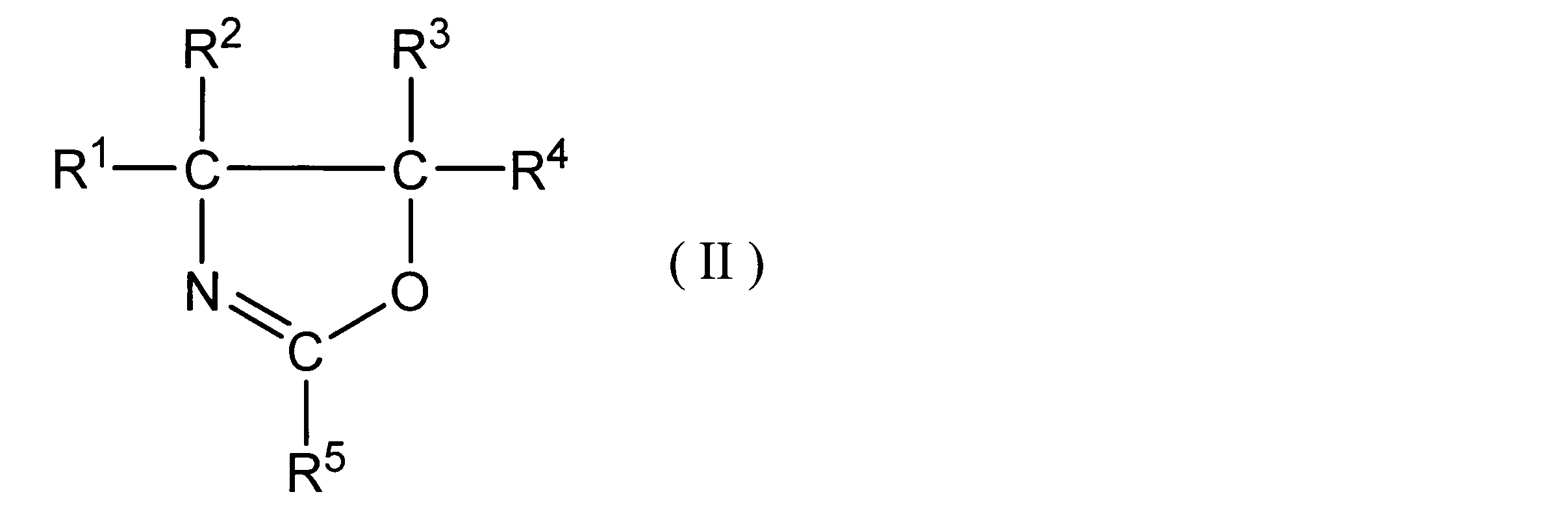
また、オキサゾリン化合物は、1種類を単独で用いてもよく、2種類以上を任意の比率で組み合わせて用いてもよい。
また、これらは、1種類を単独で用いてもよく、2種類以上を任意の比率で組み合わせて用いてもよい。
本発明の複層フィルムは、上述した樹脂層を備えるので、樹脂層側の面の滑り性が高い。そのため、ロール状に巻き取ってフィルムロールとした後において、凸状の欠陥の発生を抑制することができる。
高さ55mm、幅36mm、光路長10mmの石英セルを用意する。この石英セル内に、シリコーンオイルを充填する。このシリコーンオイル中に複層フィルムを入れて、測定試料を得る。このように用意した測定試料を用いて、ヘイズメーターによって、複層フィルムの内部ヘイズを測定する。
本発明の複層フィルムは、基材フィルムを用意する工程と、用意した基材フィルム上に樹脂層を製造する工程とを含む製造方法により、製造できる。ここで、基材フィルム上に樹脂層を製造する工程は、上述したように、流体状の塗布樹脂を得る工程と、この塗布樹脂を基材フィルム上に塗布して塗布樹脂の膜を形成する工程と、基材フィルム上に形成された塗布樹脂の膜を硬化及び/又は乾燥させて樹脂層を得る工程とを含む。したがって、複層フィルムは、例えば、基材フィルムを用意する工程と、平均粒子径の異なる複数の粒子及び結着重合体を混合して流体状の塗布樹脂を得る工程と、塗布樹脂を基材フィルム上に塗布して塗布樹脂の膜を形成する工程と、基材フィルム上に形成された塗布樹脂の膜を硬化及び/又は乾燥させて樹脂層を得る工程とを含む製造方法により、製造しうる。
さらに、複層フィルムの製造方法における任意の時点において、基材フィルム、樹脂層及び複層フィルムを延伸する工程を行なってもよい。
また、複層フィルムをロール状に巻き取る工程を行ってもよい。
本発明の複層フィルムは、通常、光学フィルムとして使用される。複層フィルムの用途となる光学フィルムの例を挙げると、保護フィルム、位相差フィルム、光学補償フィルムなどが挙げられる。中でも、本発明の複層フィルムは、位相差フィルム又は偏光板保護フィルムとして用いることが好ましく、偏光板保護フィルムとして用いることが特に好ましい。
ウレタン(メタ)アクリレートとしては、一分子当たり2個~3個の二重結合を有し、且つ、二重結合1個当たりの数平均分子量が500~3000であるウレタン(メタ)アクリレートを用いることが、接着強度、柔軟性、光硬化性及び粘度等をバランスさせやすいので、好ましい。
光硬化型接着剤におけるウレタン(メタ)アクリレートの量は、通常30重量%~50重量%である。ウレタン(メタ)アクリレートの量を前記範囲の下限値以上にすることにより、接着剤層が脆くなることを防止できる。また、上限値以下にすることにより、接着剤の粘度を低くでき、また、接着強度を高くできる。
光硬化型接着剤におけるヒドロキシアルキル(メタ)アクリレートの量は、通常13重量%~40重量%である。ヒドロキシアルキル(メタ)アクリレートの量を前記範囲の下限値以上にすることにより、接着剤全体の親水性を高くできるので、特にポリビニルアルコール系偏光フィルムに対する接着強度を向上させることができる。また、上限値以下にすることにより、接着剤層が脆くなることを防止でき、また、接着剤の光硬化性を高くできる。
光硬化型接着剤におけるアクリルアミド誘導体の量は、通常0~30重量%、好ましくは1重量%~30重量%の範囲である。
以下の説明において、量を表す「%」、「ppm」及び「部」は、別に断らない限り重量基準である。また、以下の操作は、別に断らない限り、常温常圧大気中にて行った。
〔突起の高さ及び数の測定方法〕
複層フィルムの樹脂層の、基材フィルムと反対側の面にある突起の高さ及び数を、微細形状測定装置(小坂研究所製「ET4000M」)を用いて、カットオフ0.8mm、測定範囲1mm×1mmで測定した。この測定は、複層フィルムの幅方向の中央部で行った。
高さ55mm、幅36mm、光路長10mmの石英セルを用意した。この石英セル内に、シリコーンオイル(東レ・ダウコーニング社製「SH710」)を充填した。このシリコーンオイル中に複層フィルムを入れて、測定試料を用意した。このように用意した測定試料を用いて、ヘイズメーター(日本電色工業社製「NDH-2000」)によって複層フィルムの内部ヘイズを測定した。
(接着剤の製造方法)
100gガラス容器に純水を66.5g量り取った。その純水を80℃に加温し、撹拌子で撹拌した。この純粋に、ポリビニルアルコール(日本合成化学製「ゴーセファイマーZ200」)3.5gをゆっくり加えて完全に溶解させて、5%のポリビニルアルコール溶液を得た。その後、このポリビニルアルコール溶液を室温まで戻した。このポリビニルアルコール溶液に、架橋剤としてグリオキザールを、ポリビニルアルコール溶液中のポリビニルアルコールに対して1%添加してよく撹拌し、接着剤を得た。
厚み80μmのポリビニルアルコールフイルムを0.3%のヨウ素水溶液中で染色した。その後、染色したポリビニルアルコールフィルムを、4%のホウ酸及び2%のヨウ化カリウムを含む水溶液中で5倍まで延伸し、50℃で4分間乾燥させて、偏光子を得た。
複層フィルムの樹脂層側の面に、バーコーターを用いて、前記の接着剤を塗布した。この接着剤層上に偏光子を載せ、ロールラミネーターで押圧することにより、複層フィルムと偏光子とを貼り合わせた。これにより、偏光子、接着剤層、樹脂層及び基材フィルムをこの順に備える偏光板を得た。
製造した偏光板を、幅10mmに切断して、試験片を得た。この試験片の複層フィルム側の面を、ガラス板の面に、粘着剤(日東電工社製「No.5601」)で貼り付けた。その後、試験片の偏光子を、精密万能試験機(島津製作所社製「オートグラフAGS-5kNG」)の上部チャックで掴み、20mm/minの速度で、ガラス板の面に対して垂直な方向へ引っ張った。偏光子が引っ張られることにより、樹脂層と基材フィルムとの界面で剥離が生じた。このとき、偏光子を引っ張る力の大きさを測定した。試験片の長手方向において測定された力の大きさが安定している50mmの範囲の測定値から平均を求め、この平均値をピール強度とした。
複層フィルムを3000m巻き取ったフィルムロールの外観を、目視及び触診にて評価した。
フィルムロールの周面に多角形状の窪みが無いものを「良」とし、フィルムロールの周面に多角形状の窪みがあるものと「不良」とした。
複層フィルムからサンプルを切り取った。2枚の直線偏光板を用意し、これらの直線偏光板で、複層フィルムから切り取ったサンプルを挟んだ。この際、2枚の直線偏光板は、クロスニコルとして、厚み方向から見て偏光透過軸が互いに垂直になるようにした。これにより、直線偏光板、サンプル及び直線偏光板をこの順に備える積層体を得た。
前記の積層体を、厚み方向から観察した。光抜け部分を光学欠陥とし、光学欠陥の数を数えた。ここで、光抜け部分とは、積層体を通った光が観察された部分を指す。また、測定に用いたサンプルの面積は、100m2であった。光抜け部分の数が少ないほど、複層フィルムにシワ及び折れが無く、その面状態が良好であることを示す。
(水系樹脂の製造)
温度計、攪拌機、窒素導入管及び冷却管を備えた反応器に、ポリエステルポリオール(川崎化成工業社製「マキシモールFSK-2000」;水酸基価56mgKOH/g)840部、トリレンジイソシアネート119部、及びメチルエチルケトン200部を入れ、窒素を導入しながら75℃で1時間反応させた。
反応終了後、60℃まで冷却し、ジメチロールプロピオン酸35.6部を加え、75℃で反応させた。これにより、酸構造を含有するポリウレタン溶液を得た。この溶液に含まれるポリウレタンのイソシアネート基(-NCO基)の含有量は、0.5%であった。
脂環式オレフィン樹脂(日本ゼオン社製「ZEONOR」;ガラス転移温度135℃)のペレットを、空気を流通させた熱風乾燥器を用いて70℃で2時間乾燥した。その後、65mm径のスクリューを備えた樹脂溶融混練機を有するTダイ式のフィルム溶融押出し成形機を使用し、溶融樹脂温度270℃、Tダイの幅500mmの成形条件で、厚み100μm、長さ1000mの基材フィルムを製造した。この基材フィルムは、脂環式オレフィン樹脂からなる基材フィルムである。
得られた複層フィルムについて、上述した方法によって評価を行った。
水系樹脂の製造の際に、エポキシ化合物であるグリセロールポリグリシジルエーテルの量、平均粒子径40nmのシリカ粒子の量、及び、平均粒子径200nmのシリカ粒子の量を、それぞれ表1に示すように変更した。
以上の事項以外は実施例1と同様にして、複層フィルムの製造及び評価を行った。
実施例及び比較例の結果を、下記の表に示す。下記の表において、略称の意味は、以下の通りである。
大粒子の量:平均粒子径200nmのシリカ粒子の量。
小粒子の量:平均粒子径40nmのシリカ粒子の量。
エポキシ量:グリセロールポリグリシジルエーテルの量。
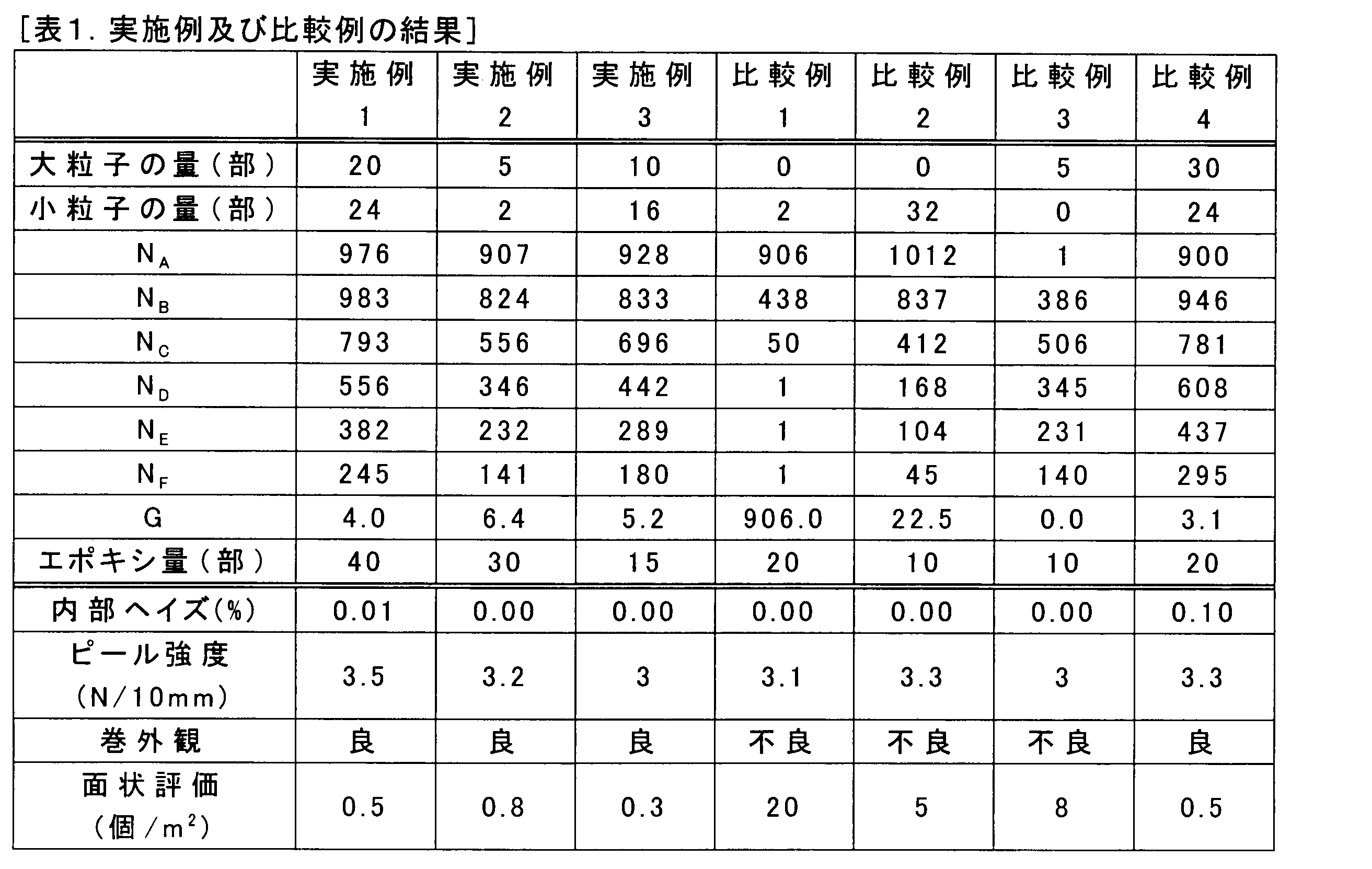
実施例及び比較例の結果から、基材フィルムと樹脂層とを組み合わせて備える複層フィルムにおいて、樹脂層の基材フィルムとは反対側の面に形成された突起が、3.5≦G≦7であり、且つ、NB≧NC≧ND≧NE≧NFを満たすことにより、巻き取ってフィルムロールとした場合に凸状の欠陥の発生を抑制でき、且つ、内部ヘイズを小さくできることが確認された。
110 基材フィルム
111 基材フィルムの樹脂層とは反対側の面
120 樹脂層
121 樹脂層の基材フィルムとは反対側の面
122 突起
200 フィルムロール
210 シワ
220 巻取り軸
230 窪み
Claims (12)
- 基材フィルムと、前記基材フィルム上に設けられた粒子を含む樹脂層とを備える複層フィルムであって、
前記樹脂層は、前記基材フィルムとは反対側の面に複数の突起を有し、
前記突起のうち、(a)高さ5nmの突起の1mm2当たりの数をNA個/mm2、(b)高さ10nmの突起の1mm2当たりの数をNB個/mm2、(c)高さ15nmの突起の1mm2当たりの数をNC個/mm2、(d)高さ20nmの突起の1mm2当たりの数をND個/mm2、(e)高さ25nmの突起の1mm2当たりの数をNE個/mm2、(f)高さ30nmの突起の1mm2当たりの数をNF個/mm2としたときに、
G=NA/NFで示される値Gが、3.5≦G≦7であり、且つ、
NB≧NC≧ND≧NE≧NFである、複層フィルム。 - 前記樹脂層が、重合体を含み、
前記重合体が、ポリウレタンを含む、請求項1に記載の複層フィルム。 - 前記粒子が、平均粒子径の異なる複数の粒子を含む、請求項1又は2に記載の複層フィルム。
- 前記粒子が、150nm未満の平均粒子径を有する粒子(S)と、150nm以上の平均粒子径を有する粒子(L)とを含む、請求項3に記載の複層フィルム。
- 前記樹脂層が、重合体を含み、
前記粒子が、150nm未満の平均粒子径を有する粒子(S)と、150nm以上の平均粒子径を有する粒子(L)とを含み、
前記樹脂層における前記粒子(S)の量が、前記重合体100重量部に対して、2重量部以上24重量部以下である、請求項1に記載の複層フィルム。 - 前記樹脂層が、重合体を含み、
前記粒子が、150nm未満の平均粒子径を有する粒子(S)と、150nm以上の平均粒子径を有する粒子(L)とを含み、
前記樹脂層における前記粒子(L)の量が、前記重合体100重量部に対して、5重量部以上20重量部以下である、請求項1に記載の複層フィルム。 - 前記粒子が、シリカである、請求項1~6のいずれか一項に記載の複層フィルム。
- 前記樹脂層の厚みが、10nm以上100nm以下である、請求項1~7のいずれか一項に記載の複層フィルム。
- 前記複層フィルムが、位相差フィルムである、請求項1~8のいずれか一項に記載の複層フィルム。
- 前記複層フィルムが、偏光板保護フィルムである、請求項1~8のいずれか一項に記載の複層フィルム。
- 請求項1~10のいずれか一項に記載の複層フィルムの製造方法であって、
平均粒子径の異なる複数の粒子、及び、重合体を混合して流体状の樹脂を得る工程と、
流体状の前記樹脂を基材フィルム上に塗布して前記樹脂の膜を形成する工程と、
基材フィルム上に形成された前記樹脂の膜を硬化及び/又は乾燥させて樹脂層を得る工程とを含む、複層フィルムの製造方法。 - 前記粒子が、150nm未満の平均粒子径を有する粒子(S)と、150nm以上の平均粒子径を有する粒子(L)とを含む、請求項11に記載の複層フィルムの製造方法。
Priority Applications (4)
| Application Number | Priority Date | Filing Date | Title |
|---|---|---|---|
| KR1020167020429A KR102382953B1 (ko) | 2014-03-26 | 2015-03-24 | 복층 필름 및 그의 제조 방법 |
| JP2016510400A JP6565901B2 (ja) | 2014-03-26 | 2015-03-24 | 複層フィルム及びその製造方法 |
| CN201811157614.5A CN110229366B (zh) | 2014-03-26 | 2015-03-24 | 多层膜及其制造方法 |
| CN201580005876.8A CN105934335B (zh) | 2014-03-26 | 2015-03-24 | 多层膜及其制造方法 |
Applications Claiming Priority (2)
| Application Number | Priority Date | Filing Date | Title |
|---|---|---|---|
| JP2014063686 | 2014-03-26 | ||
| JP2014-063686 | 2014-03-26 |
Publications (1)
| Publication Number | Publication Date |
|---|---|
| WO2015147013A1 true WO2015147013A1 (ja) | 2015-10-01 |
Family
ID=54195525
Family Applications (1)
| Application Number | Title | Priority Date | Filing Date |
|---|---|---|---|
| PCT/JP2015/058981 Ceased WO2015147013A1 (ja) | 2014-03-26 | 2015-03-24 | 複層フィルム及びその製造方法 |
Country Status (5)
| Country | Link |
|---|---|
| JP (1) | JP6565901B2 (ja) |
| KR (1) | KR102382953B1 (ja) |
| CN (2) | CN105934335B (ja) |
| TW (1) | TWI661939B (ja) |
| WO (1) | WO2015147013A1 (ja) |
Cited By (2)
| Publication number | Priority date | Publication date | Assignee | Title |
|---|---|---|---|---|
| JP2019026823A (ja) * | 2017-07-28 | 2019-02-21 | 三菱ケミカルアグリドリーム株式会社 | 防曇組成物および防曇性フィルム |
| WO2023233958A1 (ja) * | 2022-05-30 | 2023-12-07 | 日本ゼオン株式会社 | 複層フィルム及びその製造方法、偏光板、並びに有機エレクトロルミネッセンス画像表示装置 |
Families Citing this family (4)
| Publication number | Priority date | Publication date | Assignee | Title |
|---|---|---|---|---|
| KR20190100916A (ko) * | 2016-12-28 | 2019-08-29 | 니폰 제온 가부시키가이샤 | 필름 |
| JP7016269B2 (ja) * | 2018-02-02 | 2022-02-04 | 日東電工株式会社 | 延伸フィルムの製造方法 |
| CN113474155B (zh) * | 2018-12-06 | 2023-07-11 | 凸版印刷株式会社 | 阻气性膜 |
| CN117957114A (zh) * | 2021-09-29 | 2024-04-30 | 日本瑞翁株式会社 | 多层膜、光学多层膜以及制造方法 |
Citations (5)
| Publication number | Priority date | Publication date | Assignee | Title |
|---|---|---|---|---|
| JP2006272676A (ja) * | 2005-03-28 | 2006-10-12 | Toyobo Co Ltd | 積層熱可塑性樹脂フィルムロールおよびその製造方法 |
| JP2009035614A (ja) * | 2007-07-31 | 2009-02-19 | Dainippon Printing Co Ltd | ハードコート層用硬化性樹脂組成物、及びハードコートフィルム |
| WO2011068112A1 (ja) * | 2009-12-04 | 2011-06-09 | 東洋紡績株式会社 | 易接着性熱可塑性樹脂フィルム |
| JP2011136490A (ja) * | 2009-12-28 | 2011-07-14 | Jgc Catalysts & Chemicals Ltd | ハードコート膜付基材およびハードコート膜形成用塗布液 |
| US20140037942A1 (en) * | 2012-05-31 | 2014-02-06 | Lg Chem, Ltd. | Optical film including functional coating layer, and polarizing plate and image display apparatus including the same |
Family Cites Families (6)
| Publication number | Priority date | Publication date | Assignee | Title |
|---|---|---|---|---|
| JP3235759B2 (ja) | 1994-09-12 | 2001-12-04 | 東レ株式会社 | 写真用ポリエステルフィルム |
| JP2000079664A (ja) | 1998-09-07 | 2000-03-21 | Toray Ind Inc | 包装用積層フィルム |
| FR2887238B1 (fr) * | 2005-06-21 | 2007-09-28 | Jean Tristan Outreman | Procede de remplissage a chaud d'un contenant a paroi mince et contenant rempli ainsi obtenu |
| WO2009133645A1 (ja) * | 2008-04-30 | 2009-11-05 | 東洋紡績株式会社 | 接着性改質基材フィルムおよびハードコートフィルム |
| JP2010264643A (ja) | 2009-05-14 | 2010-11-25 | Toyobo Co Ltd | 易接着性ポリエステルフィルム及びゴム/ポリエステルフィルム積層体 |
| WO2013136975A1 (ja) * | 2012-03-15 | 2013-09-19 | 日本ゼオン株式会社 | 位相差フィルム積層体、位相差フィルム積層体の製造方法、並びに位相差フィルムの製造方法 |
-
2015
- 2015-03-24 CN CN201580005876.8A patent/CN105934335B/zh active Active
- 2015-03-24 JP JP2016510400A patent/JP6565901B2/ja active Active
- 2015-03-24 KR KR1020167020429A patent/KR102382953B1/ko active Active
- 2015-03-24 WO PCT/JP2015/058981 patent/WO2015147013A1/ja not_active Ceased
- 2015-03-24 CN CN201811157614.5A patent/CN110229366B/zh active Active
- 2015-03-25 TW TW104109494A patent/TWI661939B/zh active
Patent Citations (5)
| Publication number | Priority date | Publication date | Assignee | Title |
|---|---|---|---|---|
| JP2006272676A (ja) * | 2005-03-28 | 2006-10-12 | Toyobo Co Ltd | 積層熱可塑性樹脂フィルムロールおよびその製造方法 |
| JP2009035614A (ja) * | 2007-07-31 | 2009-02-19 | Dainippon Printing Co Ltd | ハードコート層用硬化性樹脂組成物、及びハードコートフィルム |
| WO2011068112A1 (ja) * | 2009-12-04 | 2011-06-09 | 東洋紡績株式会社 | 易接着性熱可塑性樹脂フィルム |
| JP2011136490A (ja) * | 2009-12-28 | 2011-07-14 | Jgc Catalysts & Chemicals Ltd | ハードコート膜付基材およびハードコート膜形成用塗布液 |
| US20140037942A1 (en) * | 2012-05-31 | 2014-02-06 | Lg Chem, Ltd. | Optical film including functional coating layer, and polarizing plate and image display apparatus including the same |
Cited By (2)
| Publication number | Priority date | Publication date | Assignee | Title |
|---|---|---|---|---|
| JP2019026823A (ja) * | 2017-07-28 | 2019-02-21 | 三菱ケミカルアグリドリーム株式会社 | 防曇組成物および防曇性フィルム |
| WO2023233958A1 (ja) * | 2022-05-30 | 2023-12-07 | 日本ゼオン株式会社 | 複層フィルム及びその製造方法、偏光板、並びに有機エレクトロルミネッセンス画像表示装置 |
Also Published As
| Publication number | Publication date |
|---|---|
| CN110229366A (zh) | 2019-09-13 |
| TWI661939B (zh) | 2019-06-11 |
| JP6565901B2 (ja) | 2019-08-28 |
| TW201540510A (zh) | 2015-11-01 |
| KR20160138381A (ko) | 2016-12-05 |
| CN110229366B (zh) | 2022-05-06 |
| JPWO2015147013A1 (ja) | 2017-04-13 |
| CN105934335A (zh) | 2016-09-07 |
| KR102382953B1 (ko) | 2022-04-04 |
| CN105934335B (zh) | 2019-01-08 |
Similar Documents
| Publication | Publication Date | Title |
|---|---|---|
| JP6565681B2 (ja) | 複層フィルム及びその製造方法 | |
| JP5644629B2 (ja) | 複層フィルム、複層フィルムの製造方法、偏光板保護フィルム及び偏光板 | |
| JP6565901B2 (ja) | 複層フィルム及びその製造方法 | |
| JP5305129B2 (ja) | 積層フィルムの製造方法及び積層フィルム | |
| JP5845891B2 (ja) | 複層フィルムおよびその製造方法 | |
| JP2015024511A (ja) | 複層フィルム、偏光板保護フィルム、および偏光板 | |
| JP5716571B2 (ja) | 複層フィルム、複層フィルムの製造方法、偏光板保護フィルム及び偏光板 | |
| JP6497063B2 (ja) | 複層フィルム及びその製造方法、並びに偏光板 | |
| WO2017164045A1 (ja) | 複層フィルムの製造方法及び製造装置 | |
| JP5168427B2 (ja) | 積層フィルム、偏光板保護フィルム、偏光板及び積層フィルムの製造方法 | |
| JP2017187454A (ja) | 薄膜層の厚みの測定方法、及び、複層フィルムの製造方法 | |
| JP6536116B2 (ja) | 複層フィルムの製造方法 | |
| WO2023233958A1 (ja) | 複層フィルム及びその製造方法、偏光板、並びに有機エレクトロルミネッセンス画像表示装置 | |
| WO2023054256A1 (ja) | 複層フィルム、光学複層フィルム、及び製造方法 | |
| JP2018051894A (ja) | 積層フィルム及び偏光板 |
Legal Events
| Date | Code | Title | Description |
|---|---|---|---|
| 121 | Ep: the epo has been informed by wipo that ep was designated in this application |
Ref document number: 15768278 Country of ref document: EP Kind code of ref document: A1 |
|
| ENP | Entry into the national phase |
Ref document number: 2016510400 Country of ref document: JP Kind code of ref document: A |
|
| ENP | Entry into the national phase |
Ref document number: 20167020429 Country of ref document: KR Kind code of ref document: A |
|
| NENP | Non-entry into the national phase |
Ref country code: DE |
|
| 122 | Ep: pct application non-entry in european phase |
Ref document number: 15768278 Country of ref document: EP Kind code of ref document: A1 |