WO2015145691A1 - ゴム組成物、その製造方法及び加硫物 - Google Patents
ゴム組成物、その製造方法及び加硫物 Download PDFInfo
- Publication number
- WO2015145691A1 WO2015145691A1 PCT/JP2014/058993 JP2014058993W WO2015145691A1 WO 2015145691 A1 WO2015145691 A1 WO 2015145691A1 JP 2014058993 W JP2014058993 W JP 2014058993W WO 2015145691 A1 WO2015145691 A1 WO 2015145691A1
- Authority
- WO
- WIPO (PCT)
- Prior art keywords
- mass
- oxide
- rubber
- vulcanizing agent
- parts
- Prior art date
- Legal status (The legal status is an assumption and is not a legal conclusion. Google has not performed a legal analysis and makes no representation as to the accuracy of the status listed.)
- Ceased
Links
Classifications
-
- C—CHEMISTRY; METALLURGY
- C08—ORGANIC MACROMOLECULAR COMPOUNDS; THEIR PREPARATION OR CHEMICAL WORKING-UP; COMPOSITIONS BASED THEREON
- C08J—WORKING-UP; GENERAL PROCESSES OF COMPOUNDING; AFTER-TREATMENT NOT COVERED BY SUBCLASSES C08B, C08C, C08F, C08G or C08H
- C08J3/00—Processes of treating or compounding macromolecular substances
- C08J3/24—Crosslinking, e.g. vulcanising, of macromolecules
- C08J3/246—Intercrosslinking of at least two polymers
-
- C—CHEMISTRY; METALLURGY
- C08—ORGANIC MACROMOLECULAR COMPOUNDS; THEIR PREPARATION OR CHEMICAL WORKING-UP; COMPOSITIONS BASED THEREON
- C08L—COMPOSITIONS OF MACROMOLECULAR COMPOUNDS
- C08L11/00—Compositions of homopolymers or copolymers of chloroprene
-
- C—CHEMISTRY; METALLURGY
- C08—ORGANIC MACROMOLECULAR COMPOUNDS; THEIR PREPARATION OR CHEMICAL WORKING-UP; COMPOSITIONS BASED THEREON
- C08K—Use of inorganic or non-macromolecular organic substances as compounding ingredients
- C08K3/00—Use of inorganic substances as compounding ingredients
- C08K3/01—Use of inorganic substances as compounding ingredients characterized by their specific function
- C08K3/011—Crosslinking or vulcanising agents, e.g. accelerators
-
- C—CHEMISTRY; METALLURGY
- C08—ORGANIC MACROMOLECULAR COMPOUNDS; THEIR PREPARATION OR CHEMICAL WORKING-UP; COMPOSITIONS BASED THEREON
- C08K—Use of inorganic or non-macromolecular organic substances as compounding ingredients
- C08K3/00—Use of inorganic substances as compounding ingredients
- C08K3/18—Oxygen-containing compounds, e.g. metal carbonyls
- C08K3/20—Oxides; Hydroxides
- C08K3/22—Oxides; Hydroxides of metals
-
- C—CHEMISTRY; METALLURGY
- C08—ORGANIC MACROMOLECULAR COMPOUNDS; THEIR PREPARATION OR CHEMICAL WORKING-UP; COMPOSITIONS BASED THEREON
- C08K—Use of inorganic or non-macromolecular organic substances as compounding ingredients
- C08K3/00—Use of inorganic substances as compounding ingredients
- C08K3/18—Oxygen-containing compounds, e.g. metal carbonyls
- C08K3/24—Acids; Salts thereof
- C08K3/26—Carbonates; Bicarbonates
-
- C—CHEMISTRY; METALLURGY
- C08—ORGANIC MACROMOLECULAR COMPOUNDS; THEIR PREPARATION OR CHEMICAL WORKING-UP; COMPOSITIONS BASED THEREON
- C08K—Use of inorganic or non-macromolecular organic substances as compounding ingredients
- C08K5/00—Use of organic ingredients
- C08K5/36—Sulfur-, selenium-, or tellurium-containing compounds
- C08K5/39—Thiocarbamic acids; Derivatives thereof, e.g. dithiocarbamates
- C08K5/40—Thiurams, i.e. compounds containing groups
-
- C—CHEMISTRY; METALLURGY
- C08—ORGANIC MACROMOLECULAR COMPOUNDS; THEIR PREPARATION OR CHEMICAL WORKING-UP; COMPOSITIONS BASED THEREON
- C08K—Use of inorganic or non-macromolecular organic substances as compounding ingredients
- C08K5/00—Use of organic ingredients
- C08K5/36—Sulfur-, selenium-, or tellurium-containing compounds
- C08K5/43—Compounds containing sulfur bound to nitrogen
- C08K5/44—Sulfenamides
-
- C—CHEMISTRY; METALLURGY
- C08—ORGANIC MACROMOLECULAR COMPOUNDS; THEIR PREPARATION OR CHEMICAL WORKING-UP; COMPOSITIONS BASED THEREON
- C08K—Use of inorganic or non-macromolecular organic substances as compounding ingredients
- C08K5/00—Use of organic ingredients
- C08K5/36—Sulfur-, selenium-, or tellurium-containing compounds
- C08K5/45—Heterocyclic compounds having sulfur in the ring
- C08K5/46—Heterocyclic compounds having sulfur in the ring with oxygen or nitrogen in the ring
- C08K5/47—Thiazoles
-
- C—CHEMISTRY; METALLURGY
- C08—ORGANIC MACROMOLECULAR COMPOUNDS; THEIR PREPARATION OR CHEMICAL WORKING-UP; COMPOSITIONS BASED THEREON
- C08L—COMPOSITIONS OF MACROMOLECULAR COMPOUNDS
- C08L23/00—Compositions of homopolymers or copolymers of unsaturated aliphatic hydrocarbons having only one carbon-to-carbon double bond; Compositions of derivatives of such polymers
- C08L23/26—Compositions of homopolymers or copolymers of unsaturated aliphatic hydrocarbons having only one carbon-to-carbon double bond; Compositions of derivatives of such polymers modified by chemical after-treatment
- C08L23/28—Compositions of homopolymers or copolymers of unsaturated aliphatic hydrocarbons having only one carbon-to-carbon double bond; Compositions of derivatives of such polymers modified by chemical after-treatment by reaction with halogens or halogen-containing compounds
-
- C—CHEMISTRY; METALLURGY
- C08—ORGANIC MACROMOLECULAR COMPOUNDS; THEIR PREPARATION OR CHEMICAL WORKING-UP; COMPOSITIONS BASED THEREON
- C08L—COMPOSITIONS OF MACROMOLECULAR COMPOUNDS
- C08L23/00—Compositions of homopolymers or copolymers of unsaturated aliphatic hydrocarbons having only one carbon-to-carbon double bond; Compositions of derivatives of such polymers
- C08L23/26—Compositions of homopolymers or copolymers of unsaturated aliphatic hydrocarbons having only one carbon-to-carbon double bond; Compositions of derivatives of such polymers modified by chemical after-treatment
- C08L23/28—Compositions of homopolymers or copolymers of unsaturated aliphatic hydrocarbons having only one carbon-to-carbon double bond; Compositions of derivatives of such polymers modified by chemical after-treatment by reaction with halogens or halogen-containing compounds
- C08L23/286—Chlorinated polyethylene
-
- C—CHEMISTRY; METALLURGY
- C08—ORGANIC MACROMOLECULAR COMPOUNDS; THEIR PREPARATION OR CHEMICAL WORKING-UP; COMPOSITIONS BASED THEREON
- C08J—WORKING-UP; GENERAL PROCESSES OF COMPOUNDING; AFTER-TREATMENT NOT COVERED BY SUBCLASSES C08B, C08C, C08F, C08G or C08H
- C08J2311/00—Characterised by the use of homopolymers or copolymers of chloroprene
-
- C—CHEMISTRY; METALLURGY
- C08—ORGANIC MACROMOLECULAR COMPOUNDS; THEIR PREPARATION OR CHEMICAL WORKING-UP; COMPOSITIONS BASED THEREON
- C08J—WORKING-UP; GENERAL PROCESSES OF COMPOUNDING; AFTER-TREATMENT NOT COVERED BY SUBCLASSES C08B, C08C, C08F, C08G or C08H
- C08J2423/00—Characterised by the use of homopolymers or copolymers of unsaturated aliphatic hydrocarbons having only one carbon-to-carbon double bond; Derivatives of such polymers
- C08J2423/26—Characterised by the use of homopolymers or copolymers of unsaturated aliphatic hydrocarbons having only one carbon-to-carbon double bond; Derivatives of such polymers modified by chemical after-treatment
- C08J2423/28—Characterised by the use of homopolymers or copolymers of unsaturated aliphatic hydrocarbons having only one carbon-to-carbon double bond; Derivatives of such polymers modified by chemical after-treatment by reaction with halogens or halogen-containing compounds
-
- C—CHEMISTRY; METALLURGY
- C08—ORGANIC MACROMOLECULAR COMPOUNDS; THEIR PREPARATION OR CHEMICAL WORKING-UP; COMPOSITIONS BASED THEREON
- C08K—Use of inorganic or non-macromolecular organic substances as compounding ingredients
- C08K3/00—Use of inorganic substances as compounding ingredients
- C08K3/18—Oxygen-containing compounds, e.g. metal carbonyls
- C08K3/20—Oxides; Hydroxides
- C08K3/22—Oxides; Hydroxides of metals
- C08K2003/2206—Oxides; Hydroxides of metals of calcium, strontium or barium
-
- C—CHEMISTRY; METALLURGY
- C08—ORGANIC MACROMOLECULAR COMPOUNDS; THEIR PREPARATION OR CHEMICAL WORKING-UP; COMPOSITIONS BASED THEREON
- C08K—Use of inorganic or non-macromolecular organic substances as compounding ingredients
- C08K3/00—Use of inorganic substances as compounding ingredients
- C08K3/18—Oxygen-containing compounds, e.g. metal carbonyls
- C08K3/20—Oxides; Hydroxides
- C08K3/22—Oxides; Hydroxides of metals
- C08K2003/2217—Oxides; Hydroxides of metals of magnesium
- C08K2003/222—Magnesia, i.e. magnesium oxide
-
- C—CHEMISTRY; METALLURGY
- C08—ORGANIC MACROMOLECULAR COMPOUNDS; THEIR PREPARATION OR CHEMICAL WORKING-UP; COMPOSITIONS BASED THEREON
- C08K—Use of inorganic or non-macromolecular organic substances as compounding ingredients
- C08K3/00—Use of inorganic substances as compounding ingredients
- C08K3/18—Oxygen-containing compounds, e.g. metal carbonyls
- C08K3/20—Oxides; Hydroxides
- C08K3/22—Oxides; Hydroxides of metals
- C08K2003/2234—Oxides; Hydroxides of metals of lead
-
- C—CHEMISTRY; METALLURGY
- C08—ORGANIC MACROMOLECULAR COMPOUNDS; THEIR PREPARATION OR CHEMICAL WORKING-UP; COMPOSITIONS BASED THEREON
- C08K—Use of inorganic or non-macromolecular organic substances as compounding ingredients
- C08K3/00—Use of inorganic substances as compounding ingredients
- C08K3/18—Oxygen-containing compounds, e.g. metal carbonyls
- C08K3/20—Oxides; Hydroxides
- C08K3/22—Oxides; Hydroxides of metals
- C08K2003/2237—Oxides; Hydroxides of metals of titanium
- C08K2003/2241—Titanium dioxide
-
- C—CHEMISTRY; METALLURGY
- C08—ORGANIC MACROMOLECULAR COMPOUNDS; THEIR PREPARATION OR CHEMICAL WORKING-UP; COMPOSITIONS BASED THEREON
- C08K—Use of inorganic or non-macromolecular organic substances as compounding ingredients
- C08K3/00—Use of inorganic substances as compounding ingredients
- C08K3/18—Oxygen-containing compounds, e.g. metal carbonyls
- C08K3/20—Oxides; Hydroxides
- C08K3/22—Oxides; Hydroxides of metals
- C08K2003/2265—Oxides; Hydroxides of metals of iron
-
- C—CHEMISTRY; METALLURGY
- C08—ORGANIC MACROMOLECULAR COMPOUNDS; THEIR PREPARATION OR CHEMICAL WORKING-UP; COMPOSITIONS BASED THEREON
- C08K—Use of inorganic or non-macromolecular organic substances as compounding ingredients
- C08K3/00—Use of inorganic substances as compounding ingredients
- C08K3/18—Oxygen-containing compounds, e.g. metal carbonyls
- C08K3/20—Oxides; Hydroxides
- C08K3/22—Oxides; Hydroxides of metals
- C08K2003/2296—Oxides; Hydroxides of metals of zinc
-
- C—CHEMISTRY; METALLURGY
- C08—ORGANIC MACROMOLECULAR COMPOUNDS; THEIR PREPARATION OR CHEMICAL WORKING-UP; COMPOSITIONS BASED THEREON
- C08K—Use of inorganic or non-macromolecular organic substances as compounding ingredients
- C08K2201/00—Specific properties of additives
- C08K2201/014—Additives containing two or more different additives of the same subgroup in C08K
Definitions
- the present invention relates to a rubber composition, a production method thereof, and a vulcanized product. More specifically, the present invention relates to a rubber composition using a blend rubber of chloroprene rubber and chlorinated polyethylene, a method for producing the rubber composition, and a vulcanizate obtained by vulcanizing the rubber composition.
- Chloroprene rubber is excellent in mechanical properties, weather resistance and flame retardancy, and is widely used as a material for industrial rubber parts. In recent years, the performance required for industrial rubber parts has been remarkably increased, and in addition to the various characteristics described above, improvements in ozone resistance and heat resistance are required.
- Patent Document 1 In order to improve the heat resistance, ozone resistance and cold resistance characteristics of chloroprene rubber, a rubber composition in which chlorinated polyethylene is blended with chloroprene rubber has been proposed (see Patent Document 1). There is also a rubber composition that improves the heat resistance and ozone resistance of vulcanizates and molded products by blending ethylene-propylene-diene copolymer rubber with chloroprene rubber (see Patent Document 2).
- the rubber compositions described in Patent Documents 1 and 2 can improve the heat resistance and ozone resistance of vulcanizates and molded articles as compared with rubber compositions using chloroprene rubber alone. However, even higher heat resistance and ozone resistance are required for industrial rubber parts, particularly those used as automobile rubber parts, which is not sufficient. In particular, the rubber composition described in Patent Document 1 has a short scorch time and a problem in moldability.
- the present invention provides a rubber composition capable of setting the scorch time of a rubber composition to a range suitable for molding processing, and a vulcanizate excellent in heat resistance and ozone properties, a method for producing the same, and a vulcanized product.
- the main purpose is to provide.
- the rubber composition according to the present invention comprises 100 parts by mass of a blend rubber composed of 50 to 90% by mass of chloroprene rubber and 10 to 50% by mass of chlorinated polyethylene, and a primary vulcanizing chloroprene rubber and chlorinated polyethylene in the blend rubber. 4.5 to 15 parts by mass of a vulcanizing agent and a secondary vulcanizing agent 0.5 which is added simultaneously with the primary vulcanizing agent or after the primary vulcanizing agent and vulcanizes the chloroprene rubber in the blend rubber. Containing 3.5 parts by mass.
- the primary vulcanizing agent is at least one oxide selected from magnesium oxide, calcium oxide, potassium oxide and hydrotalcite
- the secondary vulcanizing agent is zinc oxide, iron oxide, lead oxide and oxidation. It is at least one oxide selected from titanium.
- the rubber composition may contain 0.1 to 2 parts by mass of a vulcanization retarder per 100 parts by mass of the blend rubber.
- a vulcanization retarder at least one compound among thiazole compounds, thiuram compounds and sulfenamide compounds can be used. Specifically, di-2-benzothiazolyl disulfide, tetrasulfide There are methylthiuram disulfide and N-cyclohexyl-2-benzothiazolylsulfenamide.
- the method for producing a rubber composition according to the present invention comprises adding 100 parts by mass of a blend rubber comprising 50 to 90% by mass of chloroprene rubber and 10 to 50% by mass of chlorinated polyethylene, and adding chloroprene rubber and chlorinated polyethylene in the blend rubber.
- Primary blending step of adding and kneading 4.5 to 15 parts by mass of the primary vulcanizing agent to be vulcanized, and vulcanizing the chloroprene rubber in the blend rubber per 100 parts by mass of the blend rubber in the kneaded product obtained in the primary blending step
- a secondary blending step of adding and kneading 0.5 to 3.5 parts by mass of the secondary vulcanizing agent to be kneaded.
- Examples of the primary vulcanizing agent include at least one oxide selected from magnesium oxide, calcium oxide, potassium oxide, and hydrotalcite.
- Examples of the secondary vulcanizing agent include at least one oxide selected from zinc oxide, iron oxide, lead oxide, and titanium oxide.
- Another method for producing a rubber composition according to the present invention comprises 100 parts by weight of a blend rubber comprising 50 to 90% by weight of chloroprene rubber and 10 to 50% by weight of chlorinated polyethylene, and the chloroprene rubber and chlorinated polyethylene in the blend rubber.
- a step of adding and kneading 4.5 to 15 parts by mass of a primary vulcanizing agent for vulcanizing and 0.5 to 3.5 parts by mass of a secondary vulcanizing agent for vulcanizing the chloroprene rubber in the blend rubber is a step of adding and kneading 4.5 to 15 parts by mass of a primary vulcanizing agent for vulcanizing and 0.5 to 3.5 parts by mass of a secondary vulcanizing agent for vulcanizing the chloroprene rubber in the blend rubber.
- the primary vulcanizing agent include at least one oxide selected from magnesium oxide, calcium oxide, potassium oxide, and hydrotalcite.
- the secondary vulcanizing agent include at least one oxide selected from zinc oxide, iron oxide, lead oxide, and titanium oxide.
- the vulcanized product according to the present invention is a vulcanized product of the rubber composition.
- the rubber composition of the present invention has a scorch time in a range suitable for molding, and the vulcanized product is excellent in heat resistance and ozone resistance.
- the method for producing a rubber composition according to the present invention can produce a scorchtime rubber composition suitable for molding.
- the rubber composition of this embodiment contains a blend rubber composed of chloroprene rubber and chlorinated polyethylene, a primary vulcanizing agent, and a secondary vulcanizing agent.
- a vulcanization retarder may be added to the rubber composition of the present embodiment.
- Chloroprene rubber is obtained by polymerizing a raw material monomer containing chloroprene.
- emulsifiers, dispersants, catalysts, catalyst activators, chain transfer agents and polymerizations added during the polymerization May contain banners.
- the raw material monomer containing chloroprene is chloroprene alone or a mixture of monomers copolymerizable with chloroprene.
- the copolymerizable monomer include acrylic acid esters such as methyl acrylate, butyl acrylate and 2-ethylhexyl acrylate, and methacrylic acid esters such as methyl methacrylate, butyl methacrylate and 2-ethylhexyl methacrylate.
- Hydroxy (meth) acrylates such as 2-hydroxyethyl (meth) acrylate, 2-hydroxymethyl (meth) acrylate and 2-hydroxypropyl (meth) acrylate, and 2,3-dichloro-1,3-butadiene, 1 -Chloro-1,3-butadiene, butadiene, isoprene, ethylene, styrene and acrylonitrile. Two or more of these may be used in combination.
- chloroprene rubber examples include sulfur-modified chloroprene rubber, mercaptan-modified chloroprene rubber, and xanthogen-modified chloroprene rubber.
- sulfur-modified chloroprene rubber examples include sulfur-modified chloroprene rubber, mercaptan-modified chloroprene rubber, and xanthogen-modified chloroprene rubber.
- Chlorinated polyethylene Chlorinated polyethylene is blended in order to improve the heat resistance and ozone resistance of the vulcanizate. Chlorinated polyethylene is obtained by treating polyethylene with a compound containing chlorine such as trichloroethane or carbon tetrachloride and substituting a part of hydrogen in the molecule with chlorine.
- chlorinated polyethylene one having a chlorination rate in the range of 20 to 50% is preferably used in order to further improve the heat resistance of the vulcanizate.
- the blend rubber is obtained by kneading the above-mentioned chloroprene and chlorinated polyethylene in a ratio of 50 to 90% by mass of chloroprene rubber and 10 to 50% by mass of chlorinated polyethylene, and 60 to 80% by mass of chloroprene rubber and chlorinated polyethylene. Those kneaded at 20 to 40% by mass are preferred. If it limits to the said range, the heat resistance and ozone resistance of a vulcanizate can be improved significantly, without reducing a mechanical characteristic.
- the primary vulcanizing agent vulcanizes chloroprene rubber and chlorinated polyethylene and captures hydrochloric acid generated during vulcanization to prevent excessive vulcanization.
- the addition amount of the primary vulcanizing agent is 1.5 to 2.5 times the amount added to normal polychloroprene rubber.
- Chlorinated polyethylene is easier to vulcanize than chloroprene rubber.
- the addition amount of the primary vulcanizing agent within the above-described range, it is possible to balance the vulcanization speed with the chloroprene rubber.
- heat resistance can also be improved by making the rate of change of elongation at break after thermal aging of the vulcanizate obtained into a good range.
- the addition amount of the primary vulcanizing agent is less than 4.5 parts by mass per 100 parts by mass of the blend rubber, the scorch time of the resulting rubber composition is shortened. If the addition amount of the primary vulcanizing agent exceeds 15 parts by mass per 100 parts by mass of the blend rubber, the rate of change in elongation at break after thermal aging of the resulting vulcanizate increases, and the heat resistance deteriorates.
- the amount of the primary vulcanizing agent added is preferably 4.5 to 10 parts by mass per 100 parts by mass of the blend rubber in order to further improve the balance between the vulcanization rates of chloroprene rubber and chlorinated polyethylene.
- the primary vulcanizing agent added to the rubber composition of the present embodiment includes magnesium oxide, calcium oxide, potassium oxide, and hydrotalcite, and there are two or more combinations thereof.
- the secondary vulcanizing agent vulcanizes chloroprene rubber.
- the amount of secondary vulcanizing agent added is 0.05 to 0.8 times the amount added to normal polychloroprene rubber.
- the vulcanization speed of chloroprene rubber and chlorinated polyethylene can be balanced.
- the addition amount of the secondary vulcanizing agent is 0.5 to 3.5 parts by mass per 100 parts by mass of the blend rubber, the heat resistance of the vulcanizate is improved.
- the addition amount of the secondary vulcanizing agent is less than 0.5 parts by mass per 100 parts by mass of the blend rubber, the heat resistance of the vulcanizate is lowered.
- the addition amount of the secondary vulcanizing agent exceeds 3.5 parts by mass, the scorch time of the resulting rubber composition is shortened.
- the amount of the secondary vulcanizing agent added is preferably 1 to 3.5 parts by mass per 100 parts by mass of the blend rubber in order to further improve the balance between the vulcanization rates of chloroprene rubber and chlorinated polyethylene.
- the secondary vulcanizing agent added to the rubber composition of the present embodiment includes zinc oxide, iron oxide, lead oxide, and titanium oxide alone or in combination of two or more.
- the vulcanization retarder delays the vulcanization reaction of the blend rubber, thereby extending the scorch time of the rubber composition and improving the molding stability.
- a vulcanization retarder can be added in an amount of 0.1 to 2.0 parts by weight per 100 parts by weight of the blend rubber. The amount is preferably 0.1 to 1.0 part by mass.
- the vulcanization retarder added to the rubber composition of the present embodiment includes a thiazole compound, a thiuram compound, and a sulfenamide compound alone or in combination of two or more.
- thiazole compound examples include 2-mercaptobenzothiazole, di-2-benzothiazolyl disulfide, cyclohexylamine salt of 2-mercaptobenzothiazole, 2- (N, N-diethylthiocarbamoylthio) benzothiazole, 2- (4 '-Morpholinodithio)) benzothiazole.
- thiuram compounds include tetramethylthiuram disulfide, tetraethylthiuram disulfide, tetrabutylthiuram disulfide, tetrakis (2-ethylhexyl) thiuram disulfide, tetramethylthiuram monosulfide, and dipentamethylenethiuram tetrasulfide.
- sulfenamide compounds include N-cyclohexyl-2-benzothiazolylsulfenamide, N-tert-butyl-2-benzothiazolylsulfenamide, and N-oxydiethylene-2-benzothiazolylsulfenamide.
- a plasticizer to the rubber composition, a plasticizer, carbon black, a filler other than carbon black, a reinforcing agent, a processing aid, an antiaging agent, and the like may be added as long as the above-described effects are not impaired.
- the rubber composition of this embodiment is excellent in molding processability because the scorch time is in a range suitable for the molding process.
- Blend rubber a mixture of chloroprene rubber and chlorinated polyethylene
- a primary vulcanizing agent a secondary vulcanizing agent and other components
- an apparatus such as a kneader, a banbury or a roll. And kneading at a temperature below the vulcanization temperature.
- the secondary vulcanizing agent may be added together with the primary vulcanizing agent, or may be added after the primary vulcanizing agent is added.
- the secondary vulcanizing agent When the secondary vulcanizing agent is added after the addition of the primary vulcanizing agent, first, 100 parts by mass of a blend rubber composed of 50 to 90% by mass of chloroprene rubber and 10 to 50% by mass of chlorinated polyethylene; A primary blending step of adding 5 to 15 parts by mass and kneading is performed. Next, a secondary blending step is performed in which 0.5 to 3.5 parts by mass of the secondary vulcanizing agent is added to the kneaded product obtained in the primary blending step per 100 parts by mass of the blend rubber in the kneaded product.
- the secondary vulcanizing agent When the secondary vulcanizing agent is added together with the primary vulcanizing agent, 100 parts by mass of a blend rubber composed of 50 to 90% by mass of chloroprene rubber and 10 to 50% by mass of chlorinated polyethylene, and 4.5 to 15 of the primary vulcanizing agent. Part by mass and 0.5 to 3.5 parts by mass of the secondary vulcanizing agent are added and kneaded.
- a rubber composition can be produced in which the scorch time is in a range suitable for molding and a vulcanizate excellent in heat resistance and ozone resistance can be obtained. If the secondary vulcanizing agent is added to the rubber composition before the primary vulcanizing agent, the vulcanization of the rubber composition proceeds excessively during the production process, and the scorch time is shortened.
- the rubber composition produced by the above-mentioned method contains a vulcanized product of chloroprene rubber, a chlorinated polyethylene compound, and a co-vulcanized product of chloroprene rubber and chlorinated polyethylene.
- the vulcanized product of this embodiment is obtained by molding the rubber composition of the first embodiment described above into various desired shapes and then vulcanizing, or vulcanizing and molding into various shapes. is there.
- Various molding methods such as press molding, extrusion molding, and calendar molding can be applied to the method of molding the rubber composition or vulcanizate.
- the vulcanization method of the rubber composition or molded product is the same as the molding of the rubber composition or after molding, followed by press vulcanization, injection vulcanization, direct kettle vulcanization, indirect kettle vulcanization, direct steam continuous vulcanization, normal pressure.
- Vulcanization methods such as continuous vulcanization and continuous vulcanization press can be applied.
- the vulcanization temperature is 140 to 220 ° C., more preferably 150 to 180 ° C. from the viewpoint of productivity.
- the vulcanization time may be appropriately set depending on the composition of the rubber composition and the shape of the molded product, and is performed in the range of 10 minutes to 60 minutes.
- the vulcanized product of the present embodiment uses the rubber composition of the first embodiment described above, it has excellent heat resistance and ozone resistance.
- Example 1 The rubber composition of Example 1 was produced by the following method and the scorch time was measured, and the vulcanizate of the rubber composition was produced to evaluate its heat resistance and ozone resistance.
- the rubber composition of Example 1 exhibited a scorch time in a range suitable for molding.
- the vulcanizate of the rubber composition of Example 1 was excellent in heat resistance and ozone properties.
- ⁇ Rubber composition 70 parts by mass of mercaptan-modified chloroprene rubber, 30 parts by mass of chlorinated polyethylene A (chlorinated polyethylene with a chlorination rate of 35%), 6 parts by mass of magnesium oxide as a primary vulcanizing agent, 1 part by mass of stearic acid as an additive, aging 4 parts by mass of 4,4′-bis ( ⁇ , ⁇ -dimethylbenzyl) diphenylamine as an inhibitor, 30 parts by mass of HAF carbon (ASTM NO.N330) as carbon black, and 25 parts by mass of di-2-ethylhexyl sebacate as a plasticizer The mixture was added and kneaded with a pressurized Banbury tester.
- Mercaptan-modified chloroprene rubber is produced by the following method.
- Example 1 The rubber composition of Example 1 produced by the method described above was press vulcanized at 160 ° C. for 30 minutes to obtain a sheet-like vulcanizate having a thickness of 2 mm. About the obtained vulcanizate, the heat resistance and ozone resistance were evaluated by the method shown below.
- a 2 mm-thick dumbbell-shaped No. 3 test piece was prepared from the sheet-like vulcanizate produced by the above method, and a long-stroke tensile test system for vulcanized rubber manufactured by Shimadzu Corporation was used. The elongation at break before thermal aging of the test piece was measured under the condition of a tensile speed of 500 mm / min. After heat-treating the same sheet-like vulcanizate for 70 hours under a temperature condition of 120 ° C., a 2 mm-thick dumbbell-shaped No. 3 test piece was prepared, and the elongation at break after thermal aging of the test piece by the above method was used. Was measured.
- the rate of change in elongation at break after heat aging was calculated from the following formula 1.
- A represents a value of elongation at break before thermal aging of the test piece
- B represents a value of elongation at break after thermal aging of the test piece.
- the evaluation was accepted when the rate of change in elongation at break before and after heat aging was 30% or less in absolute value.
- ⁇ Ozone resistance> The ozone resistance of each vulcanizate was measured according to JIS K6259. Measurement conditions were as follows: the sample was held in an atmosphere of 40 ° C. and ozone concentration of 50 pphm in a state where the sample was stretched by 20%, and the number of days until the surface portion was cracked was counted. The evaluation was deemed acceptable if no cracks occurred for 10 days or more.
- Examples 2 to 7 The rubber compositions of Examples 2 to 7 were produced in the same manner and under the same conditions as in Example 1 above, except that the compounds and amounts added when producing the rubber compositions were changed as shown in Table 1 above. . While measuring the scorch time of the obtained rubber composition, the vulcanizate was manufactured and heat resistance and ozone resistance were evaluated.
- Examples 8 to 20, Comparative Examples 1 to 8 The compounds and amounts added when preparing the rubber compositions were changed as shown in Tables 2 to 4 above, and in the same manner and conditions as in Example 1 above, Examples 8 to 20, Comparative Examples 1 to 8 rubber compositions were produced. While measuring the scorch time of the obtained rubber composition, the vulcanizate was manufactured and heat resistance and ozone resistance were evaluated.
- the “xanthogen-modified chloroprene rubber” shown in Table 3 is produced by the following method.
- “Chlorinated polyethylene B” shown in Table 3 is a chlorinated polyethylene having a chlorination rate of 36%.
- the rubber compositions of Examples 1 to 20 shown in Tables 1 to 3 exhibited scorch times suitable for molding.
- the vulcanizate was also excellent in heat resistance and ozone resistance.
- the rubber compositions of Comparative Examples 1 to 8 outside the scope of the present invention had a short scorch time, or the heat resistance or ozone resistance of the resulting vulcanizate was inferior.
Landscapes
- Chemical & Material Sciences (AREA)
- Health & Medical Sciences (AREA)
- Chemical Kinetics & Catalysis (AREA)
- Medicinal Chemistry (AREA)
- Polymers & Plastics (AREA)
- Organic Chemistry (AREA)
- General Chemical & Material Sciences (AREA)
- Compositions Of Macromolecular Compounds (AREA)
- Processes Of Treating Macromolecular Substances (AREA)
Abstract
Description
ゴム組成物は、前記ブレンドゴム100質量部あたり、加硫遅延剤0.1~2質量部を含有していてもよい。前記加硫遅延剤としては、チアゾール系化合物、チウラム系化合物及びスルフェンアミド系化合物のうち少なくとも1種の化合物を用いることができ、具体的には、ジ-2-ベンゾチアゾリルジスルフィド、テトラメチルチウラムジスルフィド及びN-シクロヘキシル-2-ベンゾチアゾリルスルフェンアミドがある。
本発明に係る他のゴム組成物の製造方法は、クロロプレンゴム50~90質量%と塩素化ポリエチレン10~50質量%からなるブレンドゴム100質量部と、前記ブレンドゴム中のクロロプレンゴム及び塩素化ポリエチレンを加硫させる一次加硫剤4.5~15質量部と、前記ブレンドゴム中のクロロプレンゴムを加硫させる二次加硫剤0.5~3.5質量部を添加し混練する工程を有する。前記一次加硫剤としては、酸化マグネシウム、酸化カルシウム、酸化カリウム及びハイドロタルサイトから選択される少なくとも1種の酸化物がある。前記二次加硫剤としては、酸化亜鉛、酸化鉄、酸化鉛及び酸化チタンから選択される少なくとも1種の酸化物がある。
本発明に係るゴム組成物の製造方法は、成形加工に適したスコーチタイムのゴム組成物を製造できる。
本実施形態のゴム組成物は、クロロプレンゴムと塩素化ポリエチレンからなるブレンドゴムと、一次加硫剤と、二次加硫剤とを含有する。本実施形態のゴム組成物には、前述した各成分に加えて、加硫遅延剤が添加されていてもよい。
(クロロプレンゴム)
クロロプレンゴムは、クロロプレンを含む原料単量体を重合したものである。重合反応の生成物であるクロロプレン単独重合体又はクロロプレンと他の単量体との共重合体の他に、重合時に添加された乳化剤、分散剤、触媒、触媒活性化剤、連鎖移動剤及び重合禁止剤などが含まれている場合がある。
塩素化ポリエチレンは、加硫物の耐熱性及び耐オゾン性を向上させるために配合するものである。塩素化ポリエチレンとは、ポリエチレンをトリクロルエタンや四塩化炭素などの塩素を含む化合物で処理し、その分子中の水素の一部を塩素と置換したものである。
ブレンドゴムは、前述したクロロプレンと塩素化ポリエチレンとを、クロロプレンゴム50~90質量%と塩素化ポリエチレン10~50質量%の割合で混練したものであり、クロロプレンゴム60~80質量%と塩素化ポリエチレン20~40質量%で混練したものが好ましい。当該範囲に限定すると機械特性を低下させずに、加硫物の耐熱性及び耐オゾン性を大幅に向上させることができる。
一次加硫剤は、クロロプレンゴム及び塩素化ポリエチレンを加硫させるとともに、加硫時に発生する塩酸を捕捉して過度の加硫を防止させるものである。本実施形態のゴム組成物では、この一次加硫剤の添加量を、通常のポリクロロプレンゴムに添加される量の1.5~2.5倍にしている。
二次加硫剤は、クロロプレンゴムを加硫させるものである。本実施形態のゴム組成物では、二次加硫剤の添加量を、通常のポリクロロプレンゴムに添加される量の0.05~0.8倍にしている。
加硫遅延剤は、ブレンドゴムの加硫反応を遅延させることによって、ゴム組成物のスコーチタイムを長くし、成形安定性を向上させるものである。ゴム組成物では、スコーチタイムを適切な時間に調整するために、加硫遅延剤を、ブレンドゴム100質量部あたり0.1~2.0質量部添加することができ、好ましくは、ブレンドゴム100質量部あたり0.1~1.0質量部とするとよい。
ゴム組成物には、前述した効果が損なわれない範囲で、可塑剤、カーボンブラック、カーボンブラック以外の充填剤や補強剤、加工助剤、老化防止剤などが添加されていてもよい。
ゴム組成物を製造するには、ブレンドゴム(クロロプレンゴムと塩素化ポリエチレンの混練物)、一次加硫剤、二次加硫剤及びその他の成分を、ニーダー、バンバリー又はロールなどの装置を用いて、加硫温度以下の温度で混練する。その際、二次加硫剤は、一次加硫剤と共に添加しても良く、一次加硫剤添加後に添加しても良い。
本実施形態の加硫物は、前述した第1の実施形態のゴム組成物を、所望する各種の形状に成形した後で加硫したり、加硫した後で各種の形状に成形したものである。

以下に示す方法で実施例1のゴム組成物を製造してそのスコーチタイムを測定すると共に、前記ゴム組成物の加硫物を製造してその耐熱性及び耐オゾン性を評価した。
メルカプタン変性クロロプレンゴム70質量部、塩素化ポリエチレンA(塩素化率35%の塩素化ポリエチレン)30質量部、一次加硫剤として酸化マグネシウム6質量部、その他添加剤として、ステアリン酸1質量部、老化防止剤として4,4’-ビス(α,α-ジメチルベンジル)ジフェニルアミン4質量部、カーボンブラックとしてHAFカーボン(ASTM NO.N330)30質量部、可塑剤としてセバシン酸ジ2-エチルヘキシル25質量部を添加し、加圧式バンバリー試験機で混練りした。得られた組成物に、二次加硫剤として酸化亜鉛2質量部を加えて、8インチオープンロールを用いて再度混練りし、実施例1のゴム組成物を得た。メルカプタン変性クロロプレンゴムは以下の方法で製造したものである。
内容積5リットルの4つ口フラスコに、純水130質量部、ロジン酸ナトリウム塩4質量部、βナフタレンスルホン酸ホルマリン0.5質量部、2-クロロ-1,3-ブタジエン96質量部、2,3-ジクロロ-1,3-ブタジエン4質量部及びn-ドデシルメルカプタン0.3質量部及びその他の添加剤を仕込み、過硫酸カリウムを開始剤として、窒素雰囲気下で重合を行った。
<スコーチタイム>
前述した方法で作製した実施例1のゴム組成物について、JIS K6300-1に準拠して125℃におけるスコーチタイム(分)を測定した。評価は、スコーチタイムが10分以上であったものを合格とした。
前述した方法で作製した実施例1のゴム組成物を、160℃で、30分間プレス加硫し、厚さ2mmのシート状の加硫物を得た。得られた加硫物について、以下に示す方法で、耐熱性及び耐オゾン性を評価した。
各加硫物の耐熱性は、以下に示す方法に従って、熱老化前後の切断時伸びの変化率を測定し、評価した。
同一のシート状の加硫物を120℃の温度条件下で70時間熱処理した後、厚さ2mmのダンベル状3号形試験片を作製し、前記方法で試験片の熱老化後の切断時伸びを測定した。

各加硫物の耐オゾン性は、JIS K6259に準拠して測定した。測定条件は、温度40℃、オゾン濃度50pphmの雰囲気中に、サンプルを20%伸長させた状態で保持して表面部分にクラックが入るまでの日数を数えた。評価は、10日以上クラックが入らなかったものを合格とした。
ゴム組成物を作製する際に添加する化合物及び添加量を上記表1に示すとおり変更して、前述の実施例1と同様の方法及び条件で、実施例2~7のゴム組成物を製造した。得られたゴム組成物のスコーチタイムを測定すると共に、その加硫物を製造して耐熱性及び耐オゾン性を評価した。
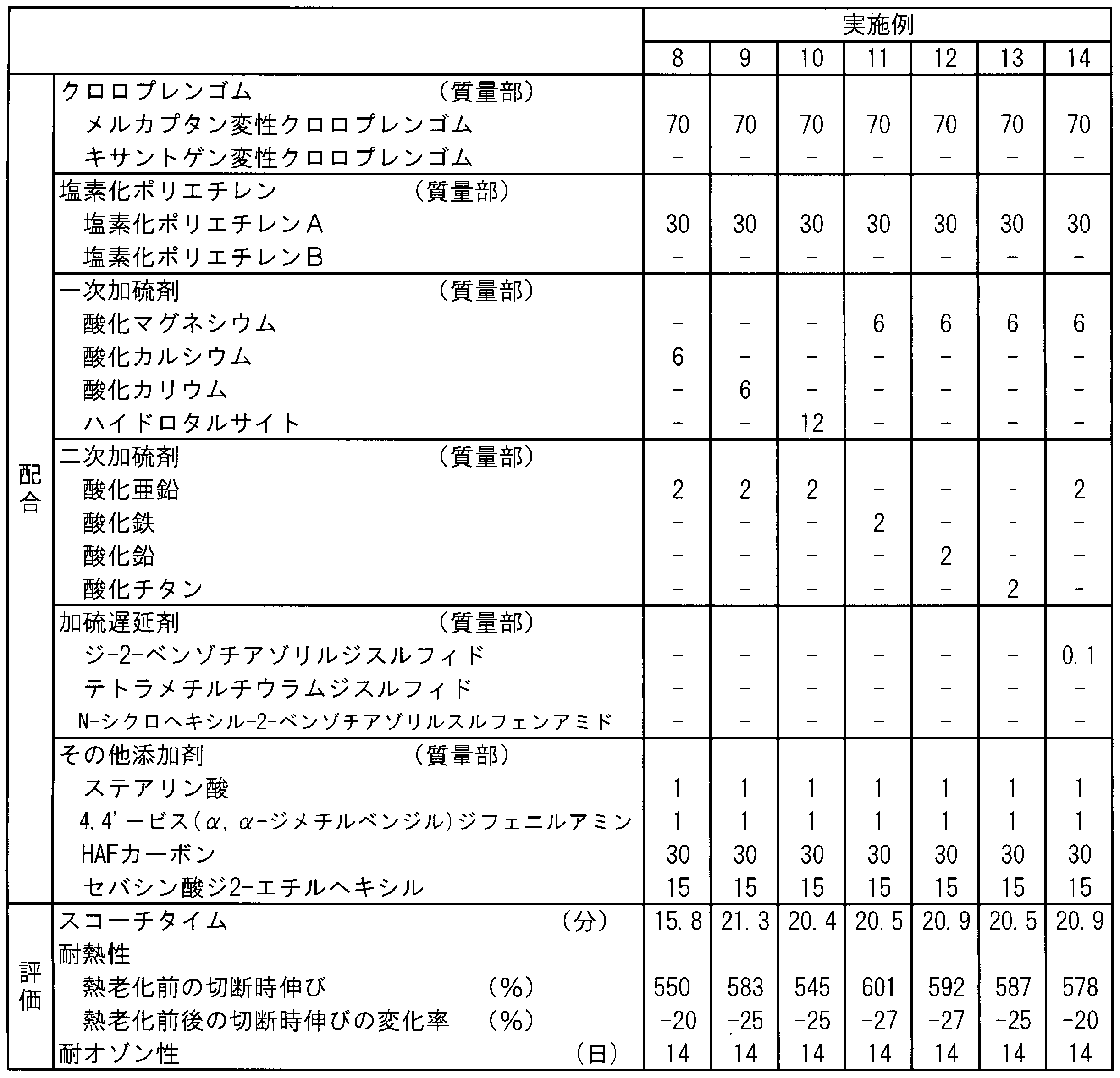
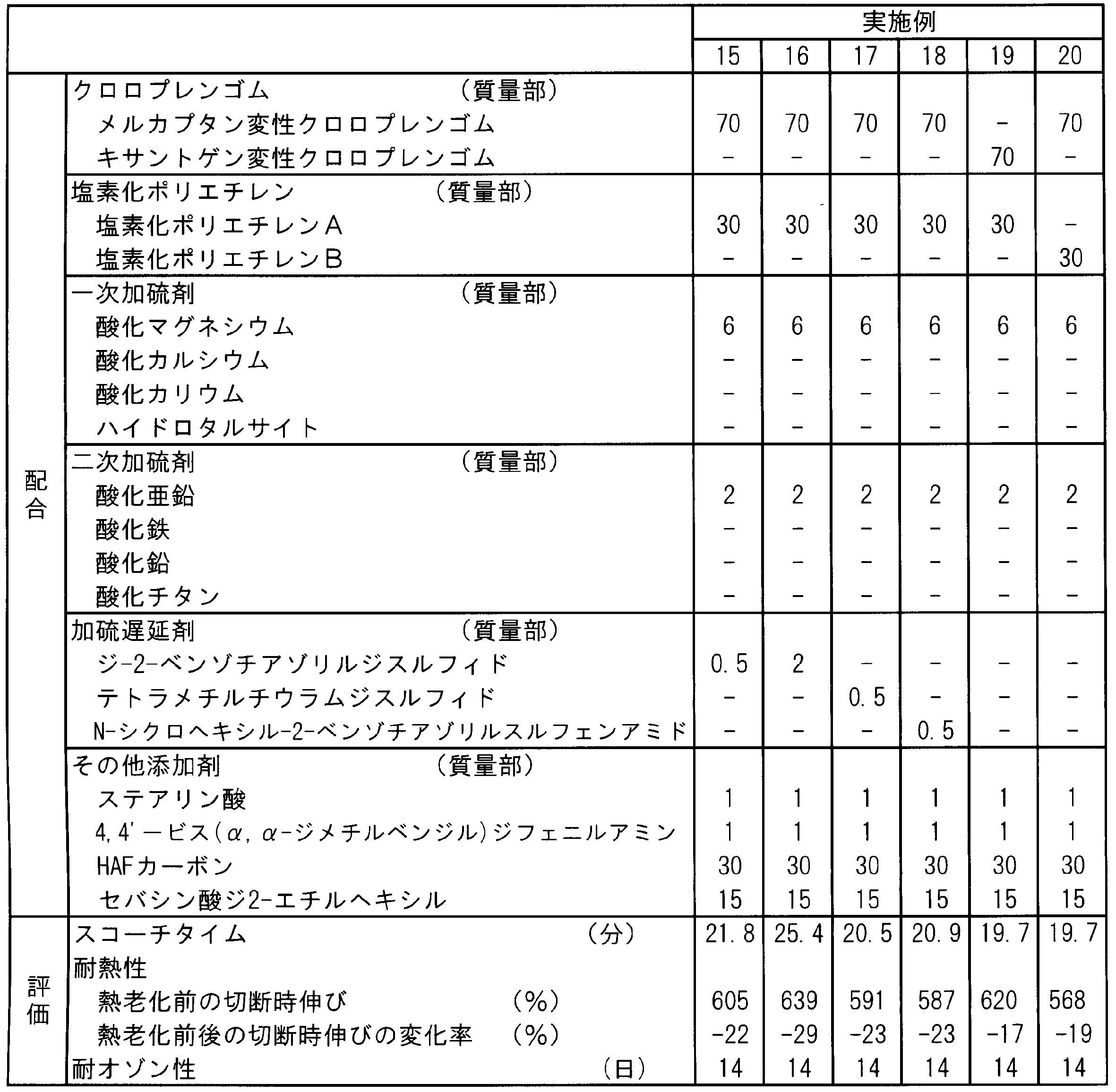
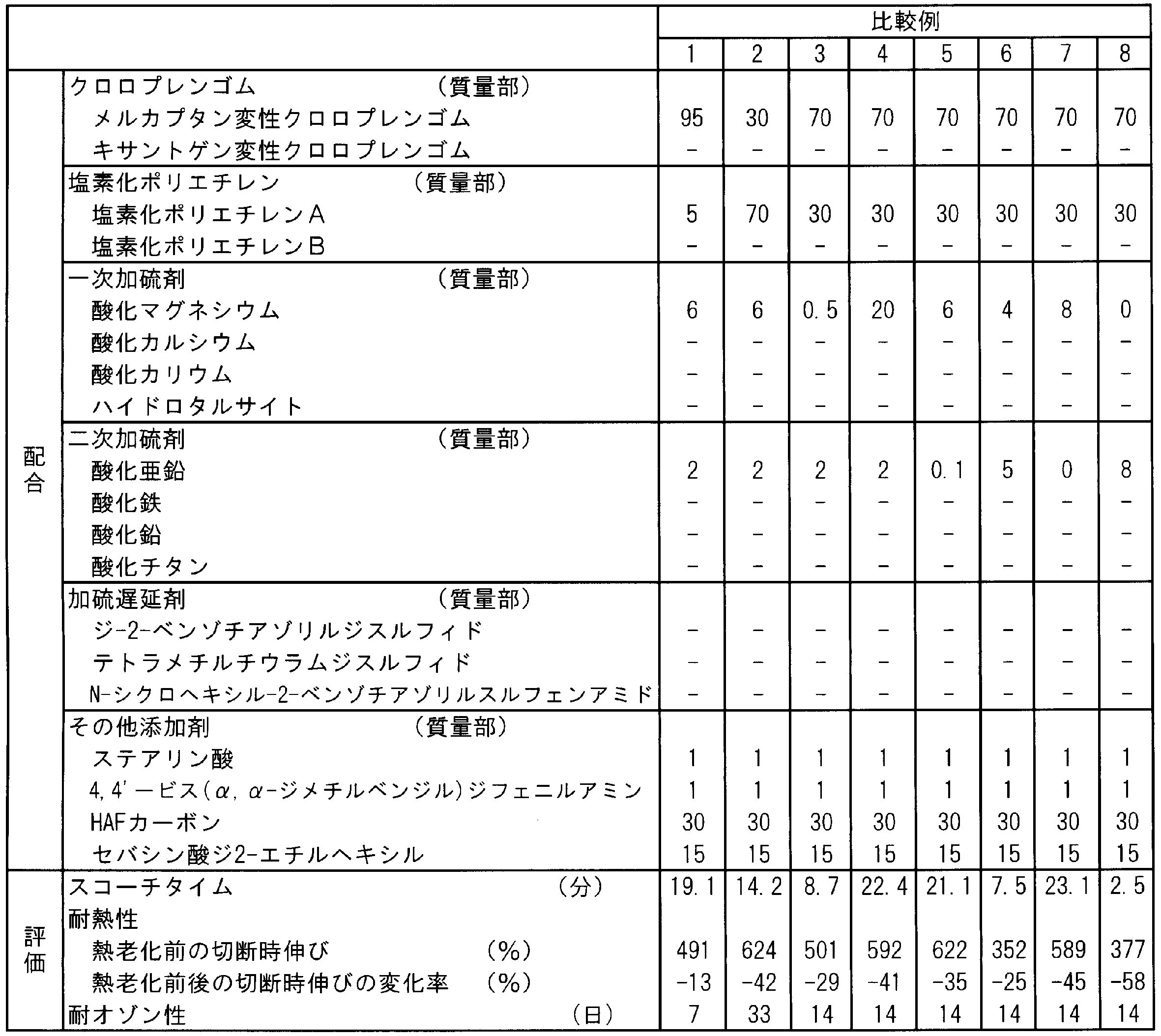
ゴム組成物を作製する際に添加する化合物及び添加量を上記表2~4に示すとおり変更して、前述の実施例1と同様の方法及び条件で、実施例8~20、比較例1~8のゴム組成物を製造した。得られたゴム組成物のスコーチタイムを測定すると共に、その加硫物を製造して耐熱性及び耐オゾン性を評価した。
上記表3に示す「キサントゲン変性クロロプレンゴム」は、以下の方法で製造したものである。上記表3に示す「塩素化ポリエチレンB」は、塩素化率36%の塩素化ポリエチレンである。
内容積5リットルの4つ口フラスコに、純水130質量部、ロジン酸ナトリウム塩4質量部、βナフタレンスルホン酸ホルマリン0.5質量部、2-クロロ-1,3-ブタジエン96質量部、2,3-ジクロロ-1,3-ブタジエン4質量部及びアルキルキサントゲン化合物0.3質量部及び他の添加剤を仕込み、過硫酸カリウムを開始剤として、窒素雰囲気下で重合を行った。
Claims (7)
- クロロプレンゴム50~90質量%と塩素化ポリエチレン10~50質量%からなるブレンドゴム100質量部と、
前記ブレンドゴム中のクロロプレンゴム及び塩素化ポリエチレンを加硫させる一次加硫剤4.5~15質量部と、
前記一次加硫剤と同時又は前記一次加硫剤よりも後に添加され、前記ブレンドゴム中のクロロプレンゴムを加硫させる二次加硫剤0.5~3.5質量部と、
を含有し、
前記一次加硫剤は、酸化マグネシウム、酸化カルシウム、酸化カリウム及びハイドロタルサイトから選択される少なくとも1種の酸化物であり、
前記二次加硫剤は、酸化亜鉛、酸化鉄、酸化鉛及び酸化チタンから選択される少なくとも1種の酸化物であるゴム組成物。 - 前記ブレンドゴム100質量部に対して、加硫遅延剤0.1~2質量部を含有する請求項1に記載のゴム組成物。
- 前記加硫遅延剤は、チアゾール系化合物、チウラム系化合物及びスルフェンアミド系化合物から選択される少なくとも1種の化合物である請求項2に記載のゴム組成物。
- 前記加硫遅延剤は、ジ-2-ベンゾチアゾリルジスルフィド、テトラメチルチウラムジスルフィド及びN-シクロヘキシル-2-ベンゾチアゾリルスルフェンアミドから選択される少なくとも1種の化合物である請求項3に記載のゴム組成物。
- クロロプレンゴム50~90質量%と塩素化ポリエチレン10~50質量%からなるブレンドゴム100質量部と、一次加硫剤4.5~15質量部を添加し混練する一次配合工程と、
前記一次配合工程で得た混練物における前記ブレンドゴム100質量部あたり、二次加硫剤0.5~3.5質量部を添加し混練する二次配合工程と、
を有し、
前記一次加硫剤として、酸化マグネシウム、酸化カルシウム、酸化カリウム及びハイドロタルサイトから選択される少なくとも1種の酸化物を使用し、
前記二次加硫剤として、酸化亜鉛、酸化鉄、酸化鉛及び酸化チタンから選択される少なくとも1種の酸化物を使用するゴム組成物の製造方法。 - クロロプレンゴム50~90質量%と塩素化ポリエチレン10~50質量%からなるブレンドゴム100質量部と、一次加硫剤4.5~15質量部と、二次加硫剤0.5~3.5質量部を添加し混練する工程を有し、
前記一次加硫剤として、酸化マグネシウム、酸化カルシウム、酸化カリウム及びハイドロタルサイトからなる群から選択される少なくとも1種の酸化物を使用し、
前記二次加硫剤として、酸化亜鉛、酸化鉄、酸化鉛及び酸化チタンから選択される少なくとも1種の酸化物を使用するゴム組成物の製造方法。 - 請求項1~4いずれか1項に記載のゴム組成物を加硫した加硫物。
Priority Applications (4)
| Application Number | Priority Date | Filing Date | Title |
|---|---|---|---|
| JP2016509773A JP6248180B2 (ja) | 2014-03-27 | 2014-03-27 | ゴム組成物、その製造方法及び加硫物 |
| KR1020167028813A KR102170604B1 (ko) | 2014-03-27 | 2014-03-27 | 고무 조성물, 그의 제조 방법 및 가황물 |
| PCT/JP2014/058993 WO2015145691A1 (ja) | 2014-03-27 | 2014-03-27 | ゴム組成物、その製造方法及び加硫物 |
| CN201480077576.6A CN106164159B (zh) | 2014-03-27 | 2014-03-27 | 橡胶组合物、其制造方法及硫化物 |
Applications Claiming Priority (1)
| Application Number | Priority Date | Filing Date | Title |
|---|---|---|---|
| PCT/JP2014/058993 WO2015145691A1 (ja) | 2014-03-27 | 2014-03-27 | ゴム組成物、その製造方法及び加硫物 |
Publications (1)
| Publication Number | Publication Date |
|---|---|
| WO2015145691A1 true WO2015145691A1 (ja) | 2015-10-01 |
Family
ID=54194281
Family Applications (1)
| Application Number | Title | Priority Date | Filing Date |
|---|---|---|---|
| PCT/JP2014/058993 Ceased WO2015145691A1 (ja) | 2014-03-27 | 2014-03-27 | ゴム組成物、その製造方法及び加硫物 |
Country Status (4)
| Country | Link |
|---|---|
| JP (1) | JP6248180B2 (ja) |
| KR (1) | KR102170604B1 (ja) |
| CN (1) | CN106164159B (ja) |
| WO (1) | WO2015145691A1 (ja) |
Cited By (3)
| Publication number | Priority date | Publication date | Assignee | Title |
|---|---|---|---|---|
| WO2019102898A1 (ja) * | 2017-11-24 | 2019-05-31 | デンカ株式会社 | 硫黄変性クロロプレンゴム組成物及び加硫物、並びに該加硫物を用いた成形品及び硫黄変性クロロプレンゴム組成物の製造方法 |
| CN110615945A (zh) * | 2019-09-25 | 2019-12-27 | 山东道恩高分子材料股份有限公司 | 高强度粘接橡胶密封条自润滑材料及其制备方法 |
| CN112321906A (zh) * | 2020-11-07 | 2021-02-05 | 衡水中铁建工程橡胶有限责任公司 | 一种隔震支座的基体橡胶材料及其制备方法 |
Families Citing this family (2)
| Publication number | Priority date | Publication date | Assignee | Title |
|---|---|---|---|---|
| JP7014739B2 (ja) * | 2017-02-01 | 2022-02-01 | デンカ株式会社 | クロロプレン系重合体ラテックス組成物、該組成物を用いた混合ラテックス組成物、及びその用途 |
| CN109627533B (zh) * | 2018-12-12 | 2021-03-19 | 常熟市海虞橡胶有限公司 | 一种低硬度氯丁胶及其混炼工艺 |
Citations (5)
| Publication number | Priority date | Publication date | Assignee | Title |
|---|---|---|---|---|
| JPS5686946A (en) * | 1979-12-14 | 1981-07-15 | Dainichi Nippon Cables Ltd | Foaming fireproof composition and foaming fireproof tape |
| JPS60181180A (ja) * | 1984-02-29 | 1985-09-14 | Osaka Soda Co Ltd | 接着剤組成物 |
| JPH02284938A (ja) * | 1989-03-29 | 1990-11-22 | Bayer Ag | 高ダンピング加硫物の製造に適するポリクロロプレン材料 |
| JP2010053246A (ja) * | 2008-08-28 | 2010-03-11 | Hitachi Cable Ltd | 耐放射線性樹脂組成物、及び耐放射線ケーブル |
| WO2010106908A1 (ja) * | 2009-03-16 | 2010-09-23 | Nok株式会社 | ゴム組成物 |
Family Cites Families (4)
| Publication number | Priority date | Publication date | Assignee | Title |
|---|---|---|---|---|
| JP2005060546A (ja) * | 2003-08-13 | 2005-03-10 | Daiso Co Ltd | クロロプレン系ゴム組成物およびその加硫物 |
| JP5459882B2 (ja) * | 2005-01-28 | 2014-04-02 | 昭和電工株式会社 | クロロプレン系加硫ゴム用組成物及びクロロプレン系加硫ゴム |
| JP2008195870A (ja) | 2007-02-14 | 2008-08-28 | Denki Kagaku Kogyo Kk | ゴム組成物、並びにこれを加硫成形したホース剤及び支承ゴム材 |
| KR101811191B1 (ko) * | 2010-11-12 | 2017-12-21 | 덴카 주식회사 | 클로로프렌 고무 조성물, 그 가황물 및 성형체 |
-
2014
- 2014-03-27 WO PCT/JP2014/058993 patent/WO2015145691A1/ja not_active Ceased
- 2014-03-27 KR KR1020167028813A patent/KR102170604B1/ko not_active Expired - Fee Related
- 2014-03-27 CN CN201480077576.6A patent/CN106164159B/zh active Active
- 2014-03-27 JP JP2016509773A patent/JP6248180B2/ja active Active
Patent Citations (5)
| Publication number | Priority date | Publication date | Assignee | Title |
|---|---|---|---|---|
| JPS5686946A (en) * | 1979-12-14 | 1981-07-15 | Dainichi Nippon Cables Ltd | Foaming fireproof composition and foaming fireproof tape |
| JPS60181180A (ja) * | 1984-02-29 | 1985-09-14 | Osaka Soda Co Ltd | 接着剤組成物 |
| JPH02284938A (ja) * | 1989-03-29 | 1990-11-22 | Bayer Ag | 高ダンピング加硫物の製造に適するポリクロロプレン材料 |
| JP2010053246A (ja) * | 2008-08-28 | 2010-03-11 | Hitachi Cable Ltd | 耐放射線性樹脂組成物、及び耐放射線ケーブル |
| WO2010106908A1 (ja) * | 2009-03-16 | 2010-09-23 | Nok株式会社 | ゴム組成物 |
Non-Patent Citations (1)
| Title |
|---|
| SHINZO YAMASHITA ET AL.: "Kakyozai Handbook", KABUSHIKI KAISHA TAISEISHA, 20 October 1981 (1981-10-20), pages 126 - 127 * |
Cited By (5)
| Publication number | Priority date | Publication date | Assignee | Title |
|---|---|---|---|---|
| WO2019102898A1 (ja) * | 2017-11-24 | 2019-05-31 | デンカ株式会社 | 硫黄変性クロロプレンゴム組成物及び加硫物、並びに該加硫物を用いた成形品及び硫黄変性クロロプレンゴム組成物の製造方法 |
| JPWO2019102898A1 (ja) * | 2017-11-24 | 2020-11-19 | デンカ株式会社 | 硫黄変性クロロプレンゴム組成物及び加硫物、並びに該加硫物を用いた成形品及び硫黄変性クロロプレンゴム組成物の製造方法 |
| JP7289266B2 (ja) | 2017-11-24 | 2023-06-09 | デンカ株式会社 | 硫黄変性クロロプレンゴム組成物及び加硫物、並びに該加硫物を用いた成形品及び硫黄変性クロロプレンゴム組成物の製造方法 |
| CN110615945A (zh) * | 2019-09-25 | 2019-12-27 | 山东道恩高分子材料股份有限公司 | 高强度粘接橡胶密封条自润滑材料及其制备方法 |
| CN112321906A (zh) * | 2020-11-07 | 2021-02-05 | 衡水中铁建工程橡胶有限责任公司 | 一种隔震支座的基体橡胶材料及其制备方法 |
Also Published As
| Publication number | Publication date |
|---|---|
| CN106164159B (zh) | 2018-09-28 |
| KR20160138989A (ko) | 2016-12-06 |
| KR102170604B1 (ko) | 2020-10-27 |
| JPWO2015145691A1 (ja) | 2017-04-13 |
| CN106164159A (zh) | 2016-11-23 |
| JP6248180B2 (ja) | 2017-12-13 |
Similar Documents
| Publication | Publication Date | Title |
|---|---|---|
| CN101796123B (zh) | 氯丁二烯橡胶组合物及其用途 | |
| JP6225165B2 (ja) | ゴム組成物及び加硫成形体 | |
| JP6196290B2 (ja) | ブレンドゴム、ブレンドゴム組成物及び加硫物 | |
| JP6412123B2 (ja) | ニトリル基含有コポリマーゴム | |
| JP6248180B2 (ja) | ゴム組成物、その製造方法及び加硫物 | |
| EP2399953B1 (en) | Polychloroprene elastomer composition, process for producing same, and vulcanizate and molded object | |
| JP2016141736A (ja) | クロロプレンゴム組成物 | |
| JP2020503397A (ja) | 水素化ニトリル−ジエン−カルボン酸エステルコポリマー | |
| WO2014196544A1 (ja) | ゴム組成物及びその加硫成形体 | |
| JP2005060581A (ja) | クロロプレン系ゴム組成物 | |
| JP2001316525A (ja) | クロロプレン系ゴム組成物 | |
| JP5230107B2 (ja) | タイヤ加硫用ブラダー | |
| JP4615989B2 (ja) | ゴム組成物及び空気入りタイヤ | |
| JP3887895B2 (ja) | 耐熱老化性及び圧縮永久歪に優れるクロロプレンゴム組成物 | |
| JP2011057768A (ja) | アクリルゴム組成物及びその成形品 | |
| WO2014119517A1 (ja) | クロロプレンゴム組成物及び加硫成形体 | |
| KR101694146B1 (ko) | 사이드월용 고무 조성물 및 이를 포함하는 공기입 타이어 | |
| JP2016044250A (ja) | 熱可塑性エラストマー | |
| JP2025102136A (ja) | アクリルゴム組成物 | |
| JP2011038063A (ja) | ゴムの耐リバージョン性、耐熱性及び動的低発熱性を向上させる加硫剤 | |
| JPH10139829A (ja) | アクリルエラストマー組成物 | |
| JP2010285414A (ja) | ゴムの耐リバージョン性,耐熱性および耐屈曲性を向上させる新規加硫剤 | |
| JP2016044249A (ja) | 熱可塑性エラストマー | |
| JP2016044252A (ja) | 熱可塑性エラストマー | |
| JP2016008247A (ja) | 熱可塑性エラストマー |
Legal Events
| Date | Code | Title | Description |
|---|---|---|---|
| 121 | Ep: the epo has been informed by wipo that ep was designated in this application |
Ref document number: 14886778 Country of ref document: EP Kind code of ref document: A1 |
|
| ENP | Entry into the national phase |
Ref document number: 2016509773 Country of ref document: JP Kind code of ref document: A |
|
| NENP | Non-entry into the national phase | ||
| ENP | Entry into the national phase |
Ref document number: 20167028813 Country of ref document: KR Kind code of ref document: A |
|
| 122 | Ep: pct application non-entry in european phase |
Ref document number: 14886778 Country of ref document: EP Kind code of ref document: A1 |