WO2015133405A1 - 光学活性アゼチジノン化合物の製造方法 - Google Patents
光学活性アゼチジノン化合物の製造方法 Download PDFInfo
- Publication number
- WO2015133405A1 WO2015133405A1 PCT/JP2015/055924 JP2015055924W WO2015133405A1 WO 2015133405 A1 WO2015133405 A1 WO 2015133405A1 JP 2015055924 W JP2015055924 W JP 2015055924W WO 2015133405 A1 WO2015133405 A1 WO 2015133405A1
- Authority
- WO
- WIPO (PCT)
- Prior art keywords
- optically active
- compound
- formula
- azetidinone compound
- group
- Prior art date
- Legal status (The legal status is an assumption and is not a legal conclusion. Google has not performed a legal analysis and makes no representation as to the accuracy of the status listed.)
- Ceased
Links
- 0 C[C@@](CCC([C@@](c(cc1)ccc1O*)N1c(cc2)ccc2F)C1=O)c(cc1)ccc1F Chemical compound C[C@@](CCC([C@@](c(cc1)ccc1O*)N1c(cc2)ccc2F)C1=O)c(cc1)ccc1F 0.000 description 1
- BVYNXBNCXPJQCW-PQHLKRTFSA-N O=C(CC[C@H]([C@@H](c(cc1)ccc1OCc1ccccc1)N1c(cc2)ccc2F)C1=O)c(cc1)ccc1F Chemical compound O=C(CC[C@H]([C@@H](c(cc1)ccc1OCc1ccccc1)N1c(cc2)ccc2F)C1=O)c(cc1)ccc1F BVYNXBNCXPJQCW-PQHLKRTFSA-N 0.000 description 1
- FOWWDYMLCOKZTN-QKBZBAIHSA-N O[C@@H](CC[C@H]([C@@H](c(cc1)ccc1OCc1ccccc1)N1C2=CC[C@H]2F)C1=O)c(cc1)ccc1F Chemical compound O[C@@H](CC[C@H]([C@@H](c(cc1)ccc1OCc1ccccc1)N1C2=CC[C@H]2F)C1=O)c(cc1)ccc1F FOWWDYMLCOKZTN-QKBZBAIHSA-N 0.000 description 1
Classifications
-
- C—CHEMISTRY; METALLURGY
- C07—ORGANIC CHEMISTRY
- C07D—HETEROCYCLIC COMPOUNDS
- C07D205/00—Heterocyclic compounds containing four-membered rings with one nitrogen atom as the only ring hetero atom
- C07D205/02—Heterocyclic compounds containing four-membered rings with one nitrogen atom as the only ring hetero atom not condensed with other rings
- C07D205/06—Heterocyclic compounds containing four-membered rings with one nitrogen atom as the only ring hetero atom not condensed with other rings having one double bond between ring members or between a ring member and a non-ring member
- C07D205/08—Heterocyclic compounds containing four-membered rings with one nitrogen atom as the only ring hetero atom not condensed with other rings having one double bond between ring members or between a ring member and a non-ring member with one oxygen atom directly attached in position 2, e.g. beta-lactams
-
- C—CHEMISTRY; METALLURGY
- C07—ORGANIC CHEMISTRY
- C07B—GENERAL METHODS OF ORGANIC CHEMISTRY; APPARATUS THEREFOR
- C07B53/00—Asymmetric syntheses
-
- C—CHEMISTRY; METALLURGY
- C07—ORGANIC CHEMISTRY
- C07F—ACYCLIC, CARBOCYCLIC OR HETEROCYCLIC COMPOUNDS CONTAINING ELEMENTS OTHER THAN CARBON, HYDROGEN, HALOGEN, OXYGEN, NITROGEN, SULFUR, SELENIUM OR TELLURIUM
- C07F7/00—Compounds containing elements of Groups 4 or 14 of the Periodic Table
- C07F7/02—Silicon compounds
- C07F7/08—Compounds having one or more C—Si linkages
- C07F7/18—Compounds having one or more C—Si linkages as well as one or more C—O—Si linkages
- C07F7/1804—Compounds having Si-O-C linkages
-
- Y—GENERAL TAGGING OF NEW TECHNOLOGICAL DEVELOPMENTS; GENERAL TAGGING OF CROSS-SECTIONAL TECHNOLOGIES SPANNING OVER SEVERAL SECTIONS OF THE IPC; TECHNICAL SUBJECTS COVERED BY FORMER USPC CROSS-REFERENCE ART COLLECTIONS [XRACs] AND DIGESTS
- Y02—TECHNOLOGIES OR APPLICATIONS FOR MITIGATION OR ADAPTATION AGAINST CLIMATE CHANGE
- Y02P—CLIMATE CHANGE MITIGATION TECHNOLOGIES IN THE PRODUCTION OR PROCESSING OF GOODS
- Y02P20/00—Technologies relating to chemical industry
- Y02P20/50—Improvements relating to the production of bulk chemicals
- Y02P20/55—Design of synthesis routes, e.g. reducing the use of auxiliary or protecting groups
Definitions
- the present invention relates to a method for producing an optically active azetidinone compound.
- the azetidinone compound (compound (1)) represented by the formula (1) is useful as a therapeutic agent for hyperlipidemia (see Non-Patent Document 1).
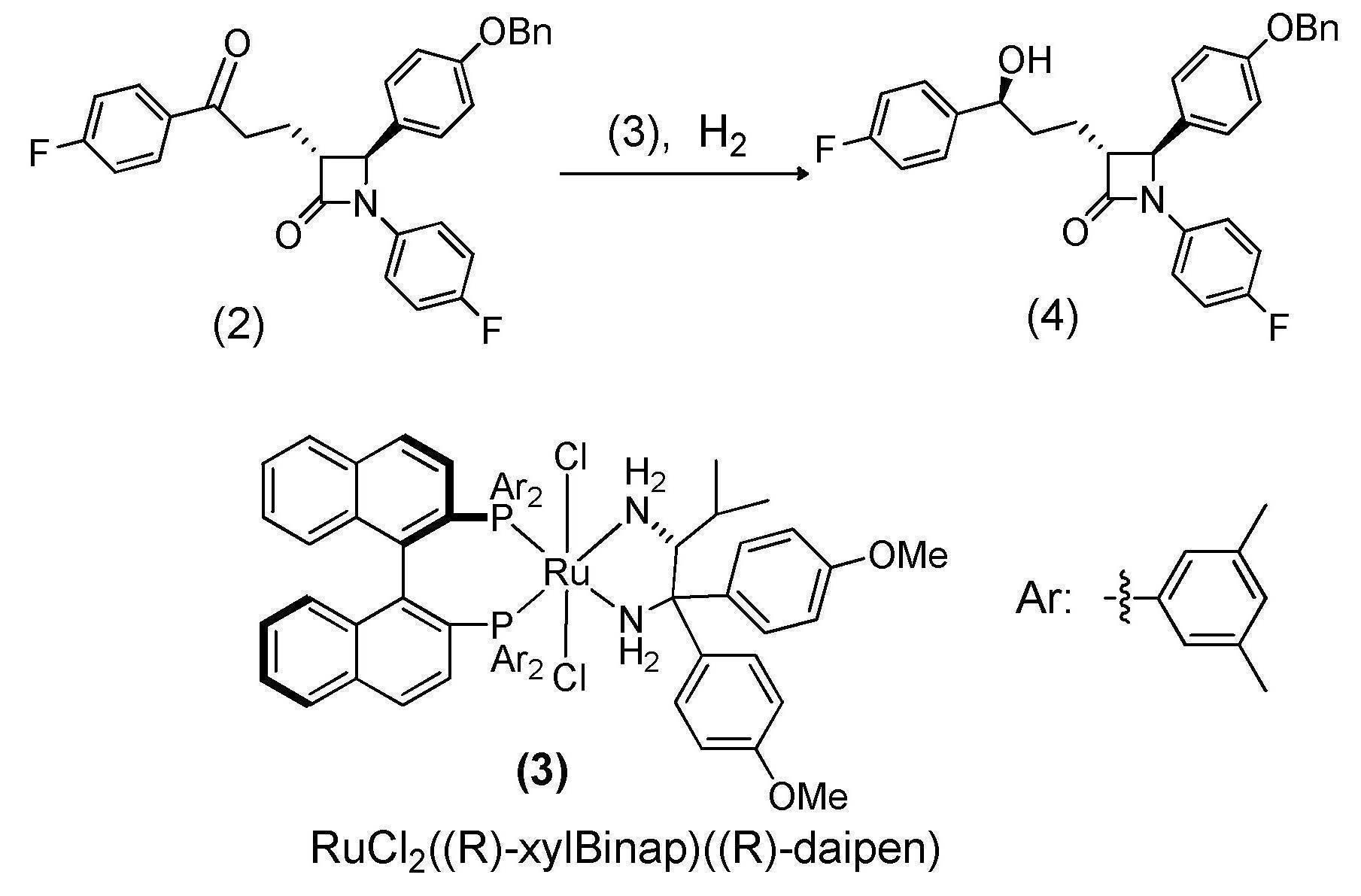
- the azetidinone compound (compound (4)) represented by formula (4) which is one of the precursors of compound (1), reduces the ketone compound (compound (2)) represented by formula (2).
- the presence of an asymmetric reduction catalyst such as RuCl 2 ((R) -xylBinap) ((R) -daipen) represented by formula (3) A method of reducing under is reported (see Patent Document 1).
- Patent Document 1 describes that the reaction conversion rate is lowered and the reaction time is extended by reducing the amount of the catalyst. Further, the hydrogen pressure during the reaction is described as 2 to 3 MPa, which is a condition requiring special equipment. Therefore, an industrially suitable improved manufacturing method has been desired.
- the present invention provides a production precursor of compound (1) and a further production method of compound (1).
- the present inventors have conducted an intensive study aimed at providing a high yield, high stereoselective and industrially useful production method of an optically active azetidinone compound.
- the inventors have found a production method capable of obtaining an optically active azetidinone compound with selectivity and high yield, and completed the present invention.
- the present invention relates to the following [1] to [10].
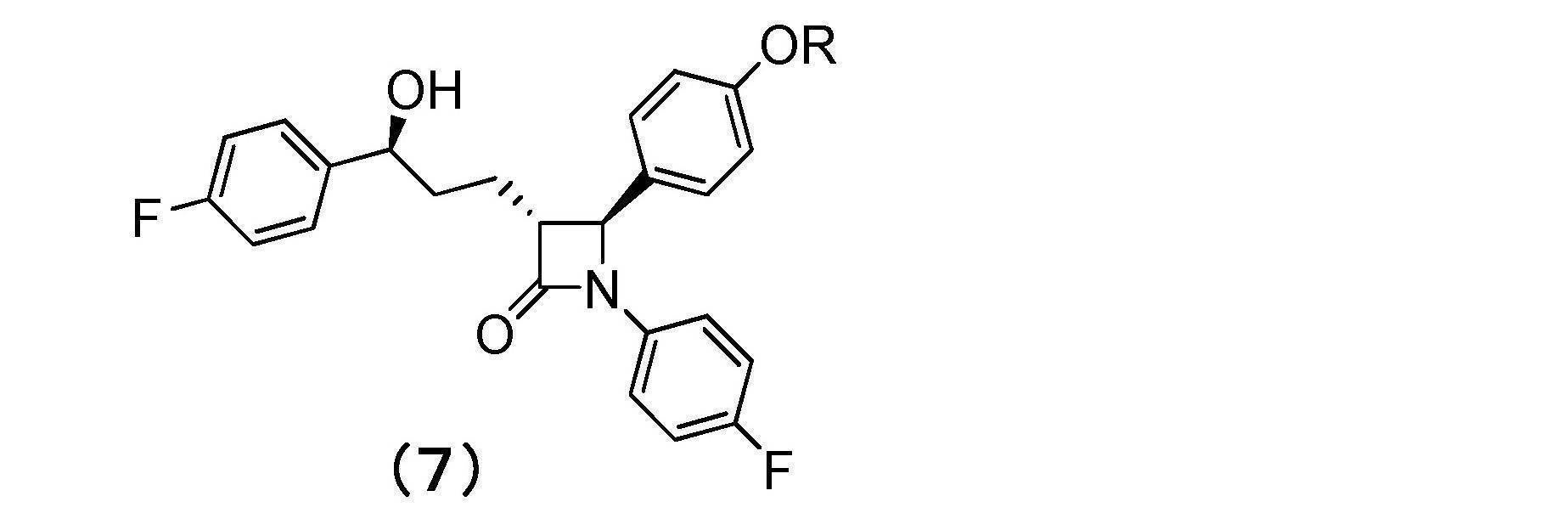
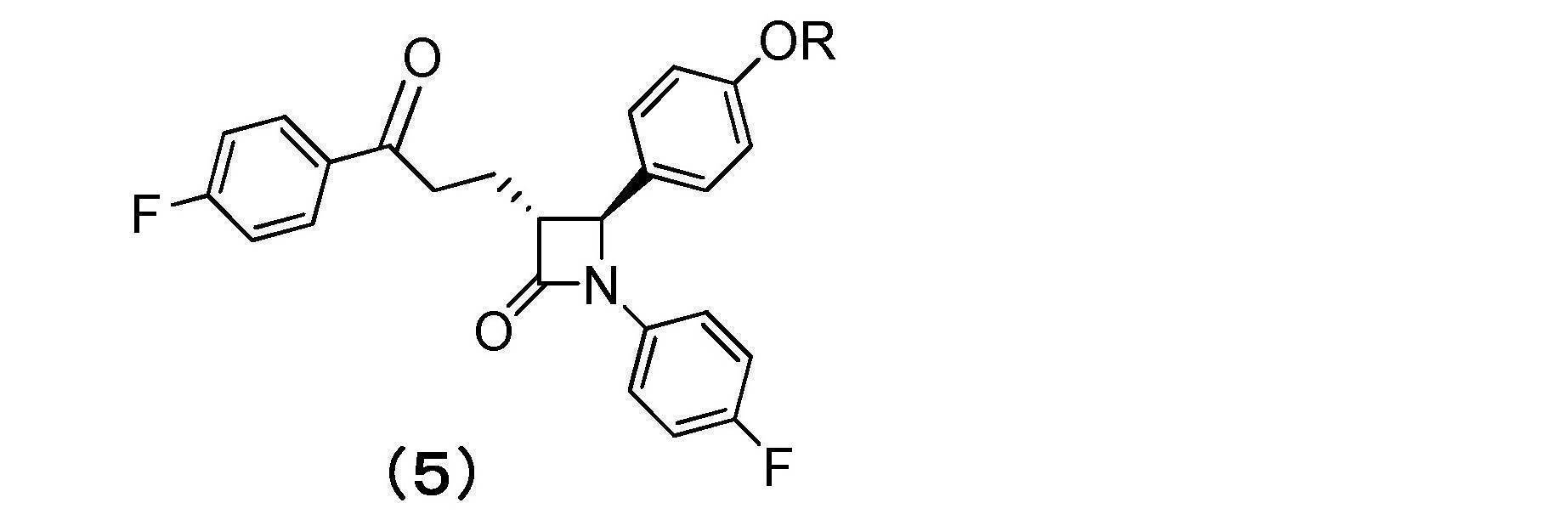
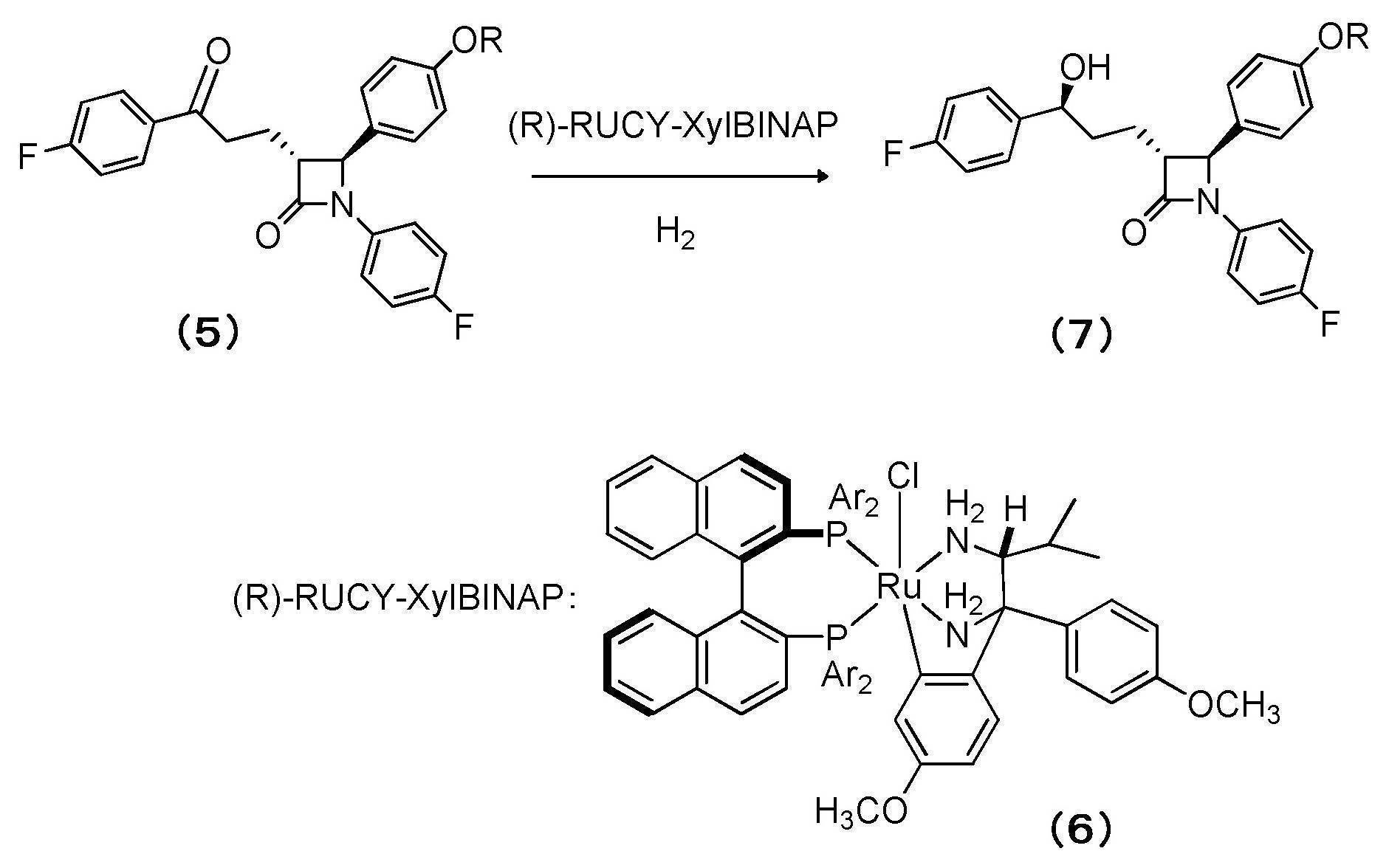
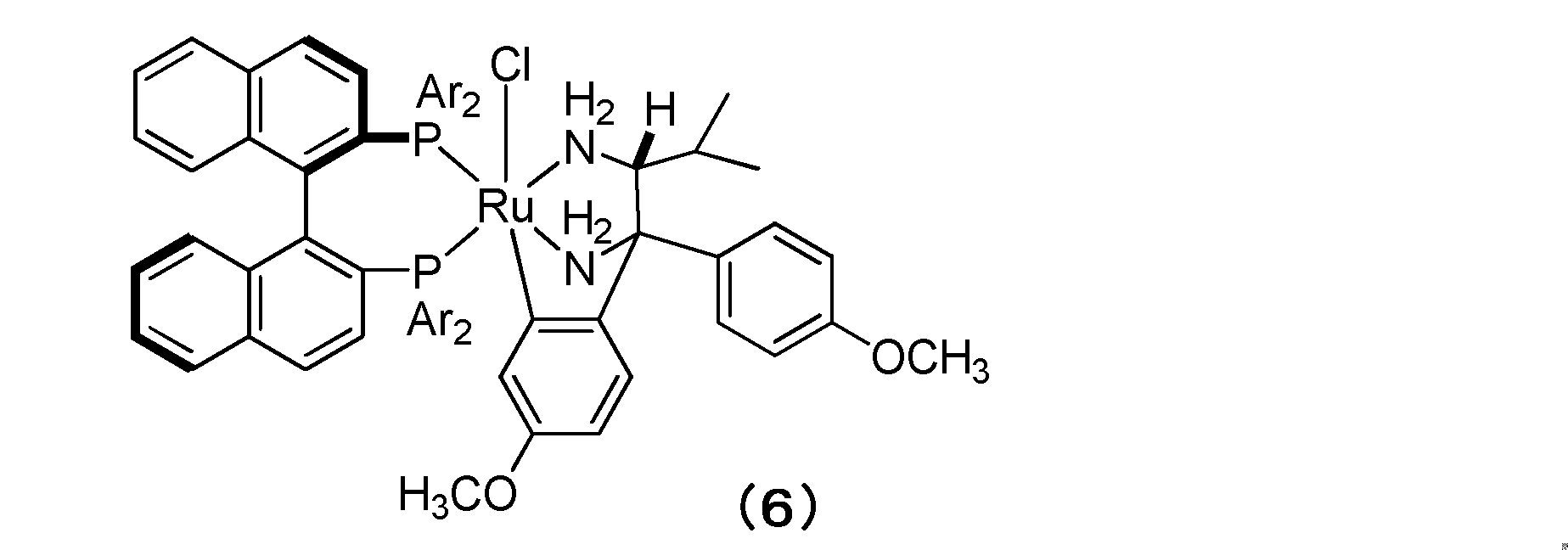
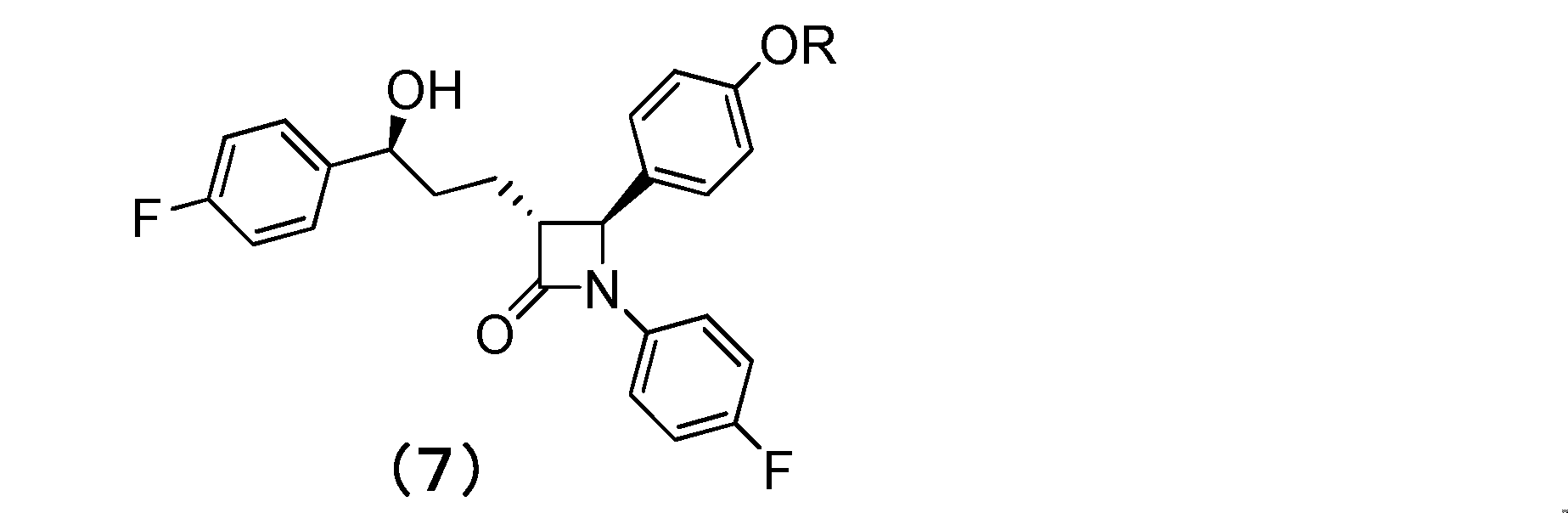
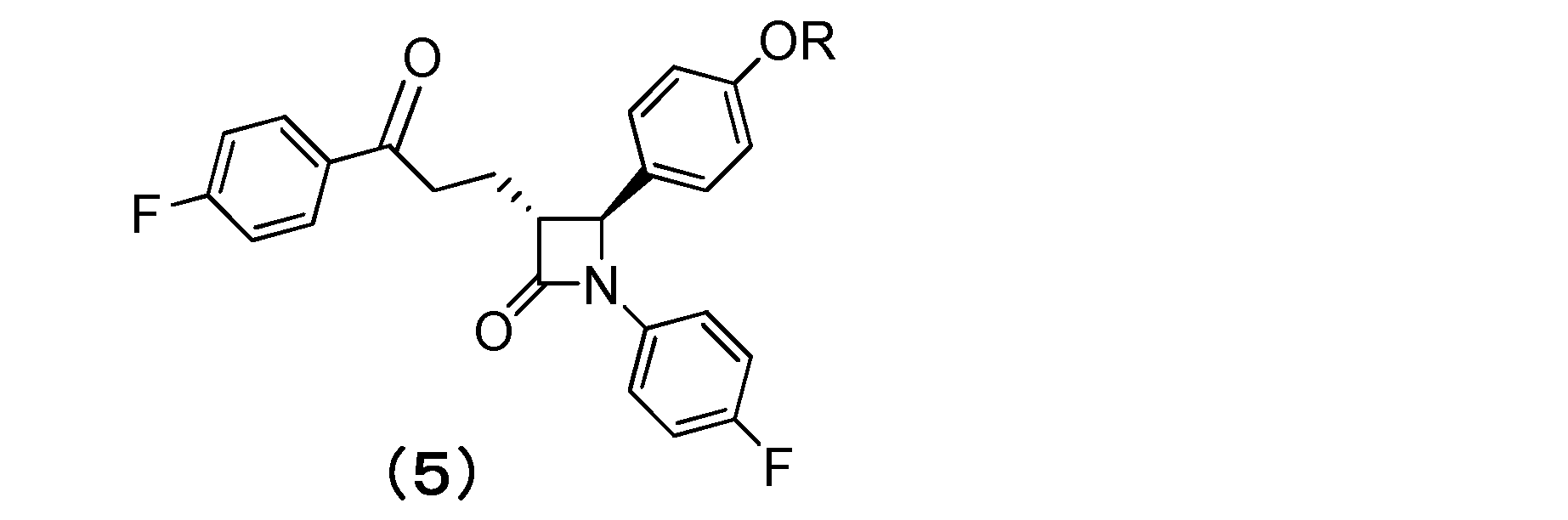
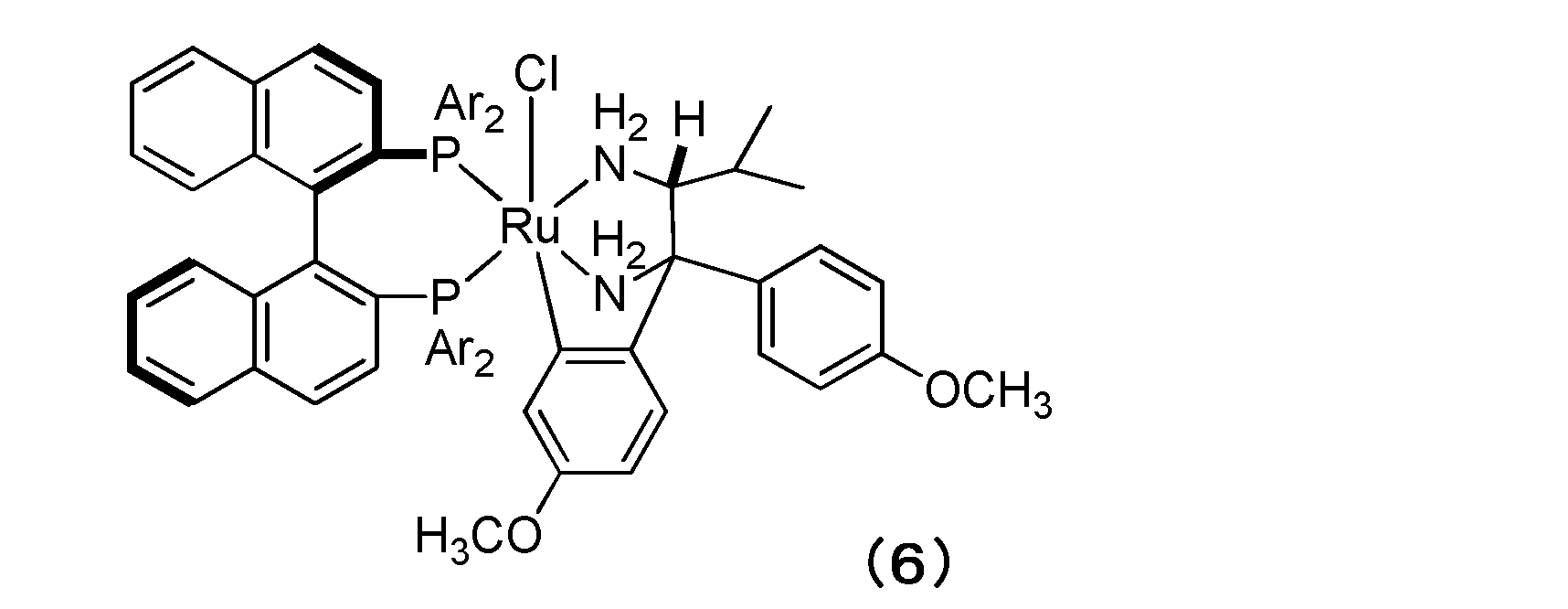
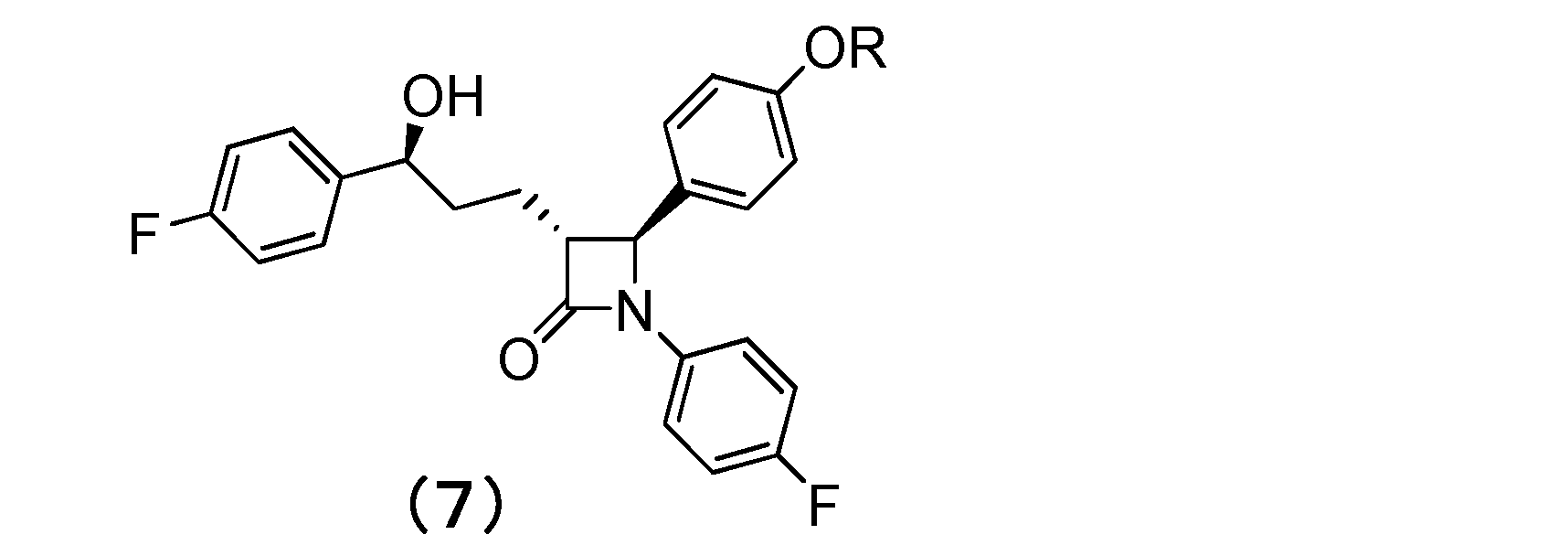
- Formula (5) (Wherein R represents a hydrogen atom or a hydroxy protecting group), a ketone compound represented by formula (6): (In the formula, Ar represents a 3,5-dimethylphenyl group.)
- an optically active ruthenium catalyst represented by formula (7) The manufacturing method of the optically active azetidinone compound represented by these.
- an optically active azetidinone compound represented by the formula (7) useful as a pharmaceutical intermediate can be produced in large quantities with high selectivity and high yield, and the present invention is useful as an industrial production method. Is expensive.
- n- is normal, “t-” is tertiary, “c-” is cyclo, “o-” is ortho, “Bn” is benzyl, “TBS”. Means t-butyldimethylsilyl.
- optically active azetidinone compounds (7) and (1) The production method of the optically active azetidinone compounds (7) and (1) will be described in detail below.
- the amount of the asymmetric reduction catalyst used is 1 / 100,000 mol% to 100 mol%, preferably 0.01 mol% to 5 mol% with respect to the ketone compound (5).
- a base can be added to accelerate the reaction.
- the base used include alkali metal salts of alcohols. More preferred bases are sodium methoxide, sodium ethoxide, potassium t-butoxide, and most preferred is potassium t-butoxide.
- the amount of the base to be added may be the same amount or more with respect to the asymmetric reduction catalyst to be used, and preferably 10 to 500 equivalents with respect to the catalyst.
- the solvent used in this reaction is not limited as long as it does not inhibit the progress of the reaction.
- Preferred examples include water, aprotic polar organic solvents (for example, N, N-dimethylformamide, dimethyl sulfoxide, N, N -Dimethylacetamide, tetramethylurea, sulfolane, N-methylpyrrolidone, N, N-dimethylimidazolidinone, etc.), ether solvents (eg, diethyl ether, diisopropyl ether, t-butyl methyl ether, tetrahydrofuran, dioxane, etc.), fat Aromatic hydrocarbon solvents (eg, pentane, n-hexane, c-hexane, octane, decane, decalin, petroleum ether, etc.), aromatic hydrocarbon solvents (benzene, chlorobenzene, o-dichlorobenzene, nitrobenzene,
- the reaction temperature is preferably about 10 to 50 ° C, more preferably about 20 to 30 ° C.
- the reducing agent that can be used is not particularly limited as long as it is a reducing agent that is used as a reagent, and examples thereof include hydrogen gas.
- the hydrogen pressure at the time of carrying out the reaction can be carried out at an arbitrary pressure, but it is preferably in the range of 0.1 to 4.0 MPa, more preferably 0 from the viewpoint of contribution to the reaction and adaptation to industrial production.
- the range is from 1 to 1.0 MPa.
- Hydroxy protecting groups can be used in deprotection reactions (eg, Protective Groups Organic Synthesis, Fourth edition, TWGreene), John Wiley and Sons. Incorporated (see John Wiley & Sons Inc. (2006) etc.) can be removed.
- the hydroxy protecting group in this production method is not limited as long as it does not inhibit the progress of the reaction, and a protecting group usually used in organic synthesis can be used.
- Preferred hydroxy protecting groups include, for example, benzyl group, methyl group, methoxymethyl group, acetyl group, trimethylsilyl group, t-butyldimethylsilyl group, allyl group, etc., preferably benzyl group, t-butyldimethylsilyl group Or an allyl group.
- Ketone compounds (2) and (8) are known compounds and can be synthesized according to methods described in the literature, for example, methods described in International Publication No. 2007/119106, International Publication No. 2007/072088 and the like.
- the conversion rate from the compound (2) to the compound (4) was 100.00%.
- To the obtained solution was added 423.7 mg (7.06 mmol) of acetic acid and stirred, and then insoluble matter was filtered off.
- the obtained filtrate was concentrated to 104.78 g under reduced pressure, then 327.82 g of ethanol was added and heated to 71 ° C. After cooling to 22 ° C., 54.00 g of water was added and cooled to 1 ° C.
- the precipitated solid was filtered, washed with a mixed solution of 43.23 g of ethanol and 10.94 g of water, further washed with a mixed solution of 43.28 g of ethanol and 10.82 g of ion-exchanged water, and 49.73 g of Compound (4) as a white solid.
- the chemical purity of the obtained compound (4) was 99.96%, and the diastereomeric excess was 99.88% de.
- Example 3 The same operation as in Example 3 was carried out except that the hydrogen pressure was changed to 500 kPa in Example 3, to obtain 1.89 g of Compound (4).
- the conversion rate from compound (2) to compound (4) after stirring for 1 hour was 97.44%, and the diastereomeric excess was 100.00% de.
- the present invention is useful in that an optically active azetidinone compound useful as a pharmaceutical intermediate can be produced with high yield and high stereoselectivity.
Landscapes
- Chemical & Material Sciences (AREA)
- Organic Chemistry (AREA)
- Low-Molecular Organic Synthesis Reactions Using Catalysts (AREA)
- Organic Low-Molecular-Weight Compounds And Preparation Thereof (AREA)
Abstract
Description

〔1〕
式(5):

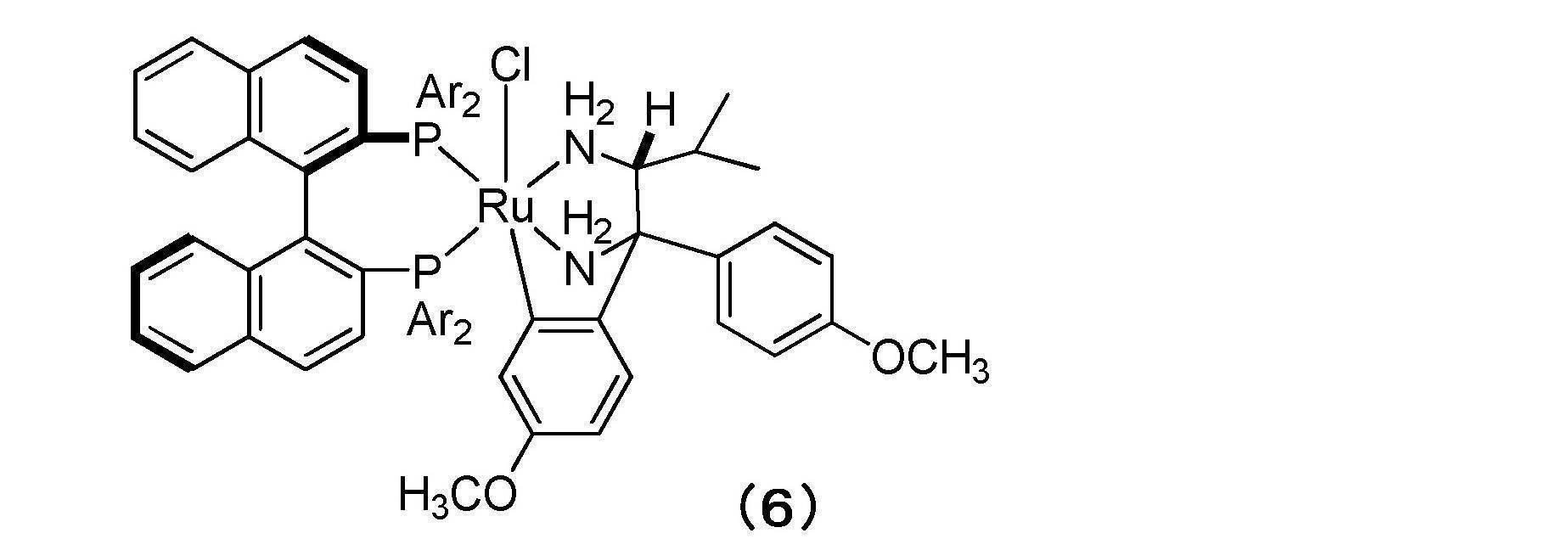
で表される光学活性ルテニウム触媒の存在下、水素ガスを反応させることを特徴とする、式(7):
〔2〕
Rが水素原子である、上記〔1〕記載の光学活性アゼチジノン化合物の製造方法。
〔3〕
Rがヒドロキシ保護基である、上記〔1〕記載の光学活性アゼチジノン化合物の製造方法。
〔4〕
Rがベンジル基である、上記〔3〕記載の光学活性アゼチジノン化合物の製造方法。
〔5〕
Rがt-ブチルジメチルシリル基である、上記〔3〕記載の光学活性アゼチジノン化合物の製造方法。
〔6〕
Rがアリル基である、上記〔3〕記載の光学活性アゼチジノン化合物の製造方法。
〔7〕
式(5):
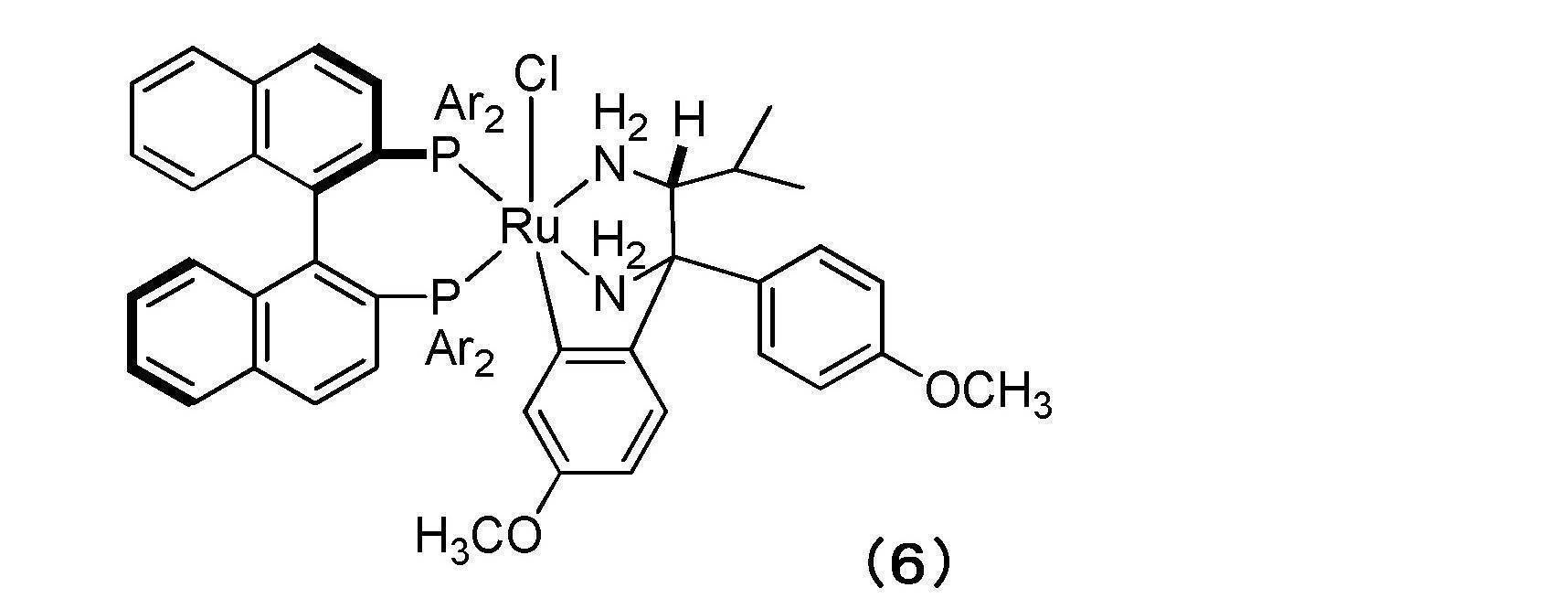
で表される光学活性ルテニウム触媒の存在下、水素ガスを反応させ、
式(7):

式(1):
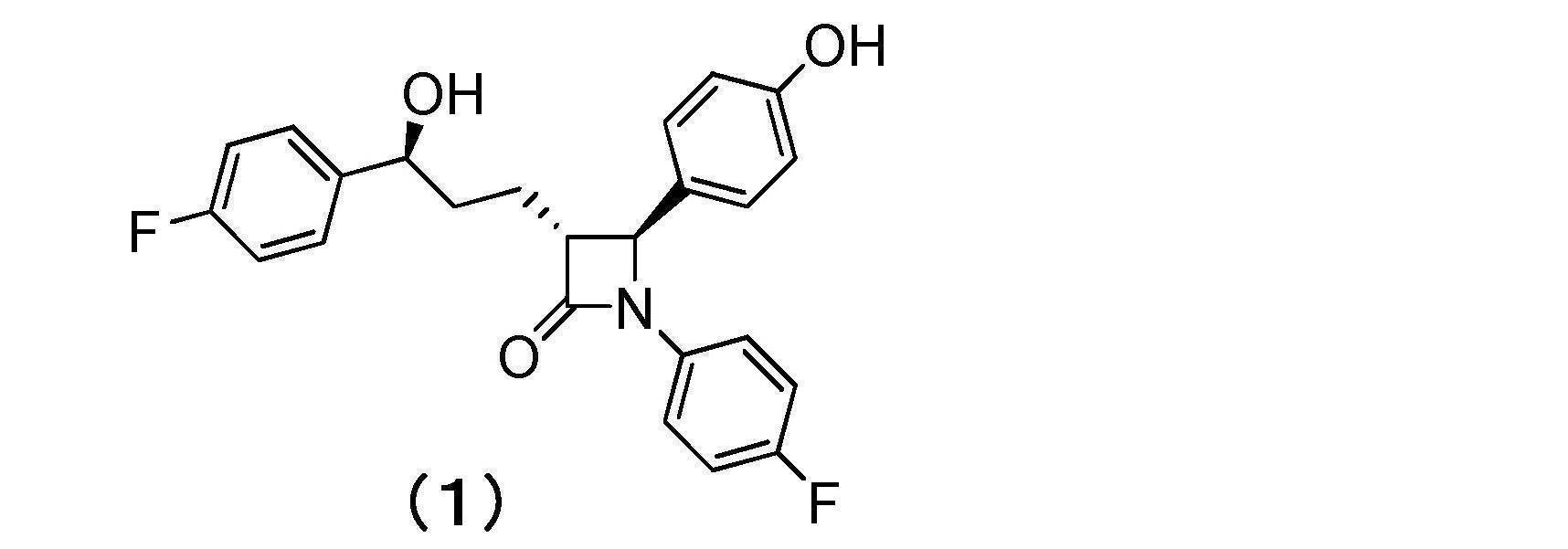
で表される光学活性アゼチジノン化合物の製造方法。
〔8〕
Rがベンジル基である、上記〔7〕記載の光学活性アゼチジノン化合物の製造方法。
〔9〕
Rがt-ブチルジメチルシリル基である、上記〔7〕記載の光学活性アゼチジノン化合物の製造方法。
〔10〕
Rがアリル基である、上記〔7〕記載の光学活性アゼチジノン化合物の製造方法。

[1]1H-NMR
機種:ECP300(日本電子株式会社製品)
測定溶媒:DMSO-d6
[2]HPLC
(1)HPLC分析条件1(化学純度及び反応転化率の測定に使用)
装置:アジレント1260
カラム:L-Column ODS(財団法人化学物質評価研究機構製品)
250×4.6mmI.D. 5μm
カラムオーブン温度:40℃
溶離液:アセトニトリル、10mM酢酸アンモニウム水溶液混合溶媒
グラジェント条件(アセトニトリル体積比):20%(0min.)→20%(10min.)→50%(15min.)→50%(30min.)→95%(40min.)→95%(50min.)
かっこ内のタイムプログラムは分析開始からの総時間を表す。
流速:1.0mL/min.
検出器:紫外可視吸光光度計233nm
(2)HPLC分析条件2(光学純度の測定に使用)
装置:島津20A
カラム:CHIRALPAK IC(株式会社ダイセル製品)
250mm×4.6mmI.D. 5μm
カラムオーブン温度:35℃
溶離液:ヘキサン/2-プロパノール/トリフルオロ酢酸=900/100/1(V/V/V)
流速:1.0mL/min.
検出器:紫外可視吸光光度計233nm
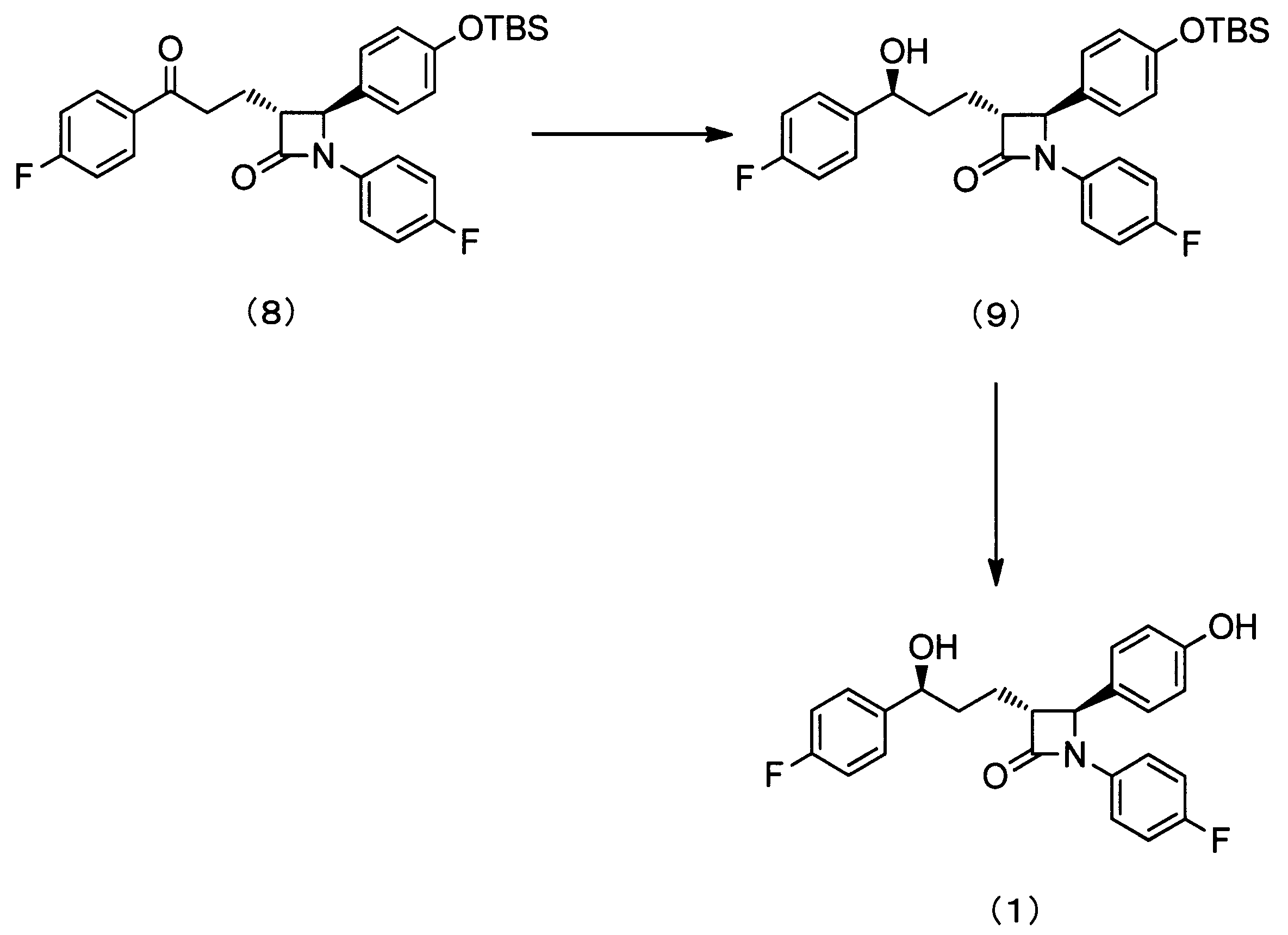
ここへ20%硫酸水溶液1.37g(2.79mmol)を加えて、58~59℃で1時間撹拌後、放冷したところ、白色の固体が析出した。ここへ水8.46gを滴下し、更に、0~3℃で3時間撹拌して、析出した固体をろ過した。2-プロパノール2.09gと水2.09gの混液、2-プロパノール2.11gと水2.10gの混液、水2.11gで洗浄し、50℃で減圧乾燥して、化合物(1)1.34gを白色固体として得た。
HPLC分析条件1にて化学純度を測定したところ、97.49%であった。
また、HPLC分析条件2にてジアステレオマー過剰率を測定したところ、99.01%deであった。さらに、その保持時間は、特許第3640888号に記載の方法に準じて合成した化合物(1)の保持時間と一致した(保持時間:19.7分、ジアステレオマーの保持時間:24.6分)。
また、2段階反応の生成物である(1)のジアステレオマー過剰率が99.01%deであり、2工程目でジアステレオマー過剰率が保持されると考えられることから、1段階目生成物の化合物(9)のジアステレオマー過剰率は99.01%de以上であることが分かる。
1H-NMR分析:(300MHz,DMSO―d6)δppm:1.72-1.88(4H,m),3.06-3.08(1H,m),4.49(1H,s),4.80(1H,d,J=2.2Hz),5.28(1H,br),6.76(2H,d,J=8.5Hz),7.09-7.16(4H,m),7.19-7.24(4H,m),7.28-7.33(2H,m),9.53(1H,s)

1H-NMR分析:(300MHz,CDCl3)δppm:1.84-1.99(4H,m),2.38(1H,d,J=2.9Hz),3.00(1H,d,J=5.2Hz),4.56(1H,br),4.64(1H,br),5.04(2H,s),6.88-7.03(6H,m),7.20-7.42(11H,m)
攪拌1時間後の化合物(2)から化合物(4)への転化率は97.44%であり、ジアステレオマー過剰率は100.00%deであった。

また、この白色固体のXRDを測定したところ、特表2007-526251号に記載のフォームAの回折パターンと一致した。

1H-NMR分析:(300MHz,CDCl3)δppm:1.85-2.02(4H,m),2.24(1H,d,J=3.8Hz),3.05-3.10(1H,m)4.51-4.54(2H,m),4.57(2H,d,J=16.7Hz),4.71-4.73(1H,m)5.27-5.44(2H,m),5.98-6.10(1H,m)6.89-7.05(6H,m),7.19-7.31(6H,m)

Claims (10)
- 式(5):

で表される光学活性ルテニウム触媒の存在下、水素ガスを反応させることを特徴とする、式(7):
- Rが水素原子である、請求項1記載の光学活性アゼチジノン化合物の製造方法。
- Rがヒドロキシ保護基である、請求項1記載の光学活性アゼチジノン化合物の製造方法。
- Rがベンジル基である、請求項3記載の光学活性アゼチジノン化合物の製造方法。
- Rがt-ブチルジメチルシリル基である、請求項3記載の光学活性アゼチジノン化合物の製造方法。
- Rがアリル基である、請求項3記載の光学活性アゼチジノン化合物の製造方法。
- 式(5):
で表される光学活性ルテニウム触媒の存在下、水素ガスを反応させ、
式(7):
式(1):

- Rがベンジル基である、請求項7記載の光学活性アゼチジノン化合物の製造方法。
- Rがt-ブチルジメチルシリル基である、請求項7記載の光学活性アゼチジノン化合物の製造方法。
- Rがアリル基である、請求項7記載の光学活性アゼチジノン化合物の製造方法。
Priority Applications (2)
| Application Number | Priority Date | Filing Date | Title |
|---|---|---|---|
| JP2016506463A JP6795974B2 (ja) | 2014-03-06 | 2015-02-27 | 光学活性アゼチジノン化合物の製造方法 |
| US15/120,842 US20160362369A1 (en) | 2014-03-06 | 2015-02-27 | Method for producing optically active azetidinone compound |
Applications Claiming Priority (6)
| Application Number | Priority Date | Filing Date | Title |
|---|---|---|---|
| JP2014043966 | 2014-03-06 | ||
| JP2014-043966 | 2014-03-06 | ||
| JP2014147387 | 2014-07-18 | ||
| JP2014-147387 | 2014-07-18 | ||
| JP2015-022124 | 2015-02-06 | ||
| JP2015022124 | 2015-02-06 |
Publications (1)
| Publication Number | Publication Date |
|---|---|
| WO2015133405A1 true WO2015133405A1 (ja) | 2015-09-11 |
Family
ID=54055212
Family Applications (1)
| Application Number | Title | Priority Date | Filing Date |
|---|---|---|---|
| PCT/JP2015/055924 Ceased WO2015133405A1 (ja) | 2014-03-06 | 2015-02-27 | 光学活性アゼチジノン化合物の製造方法 |
Country Status (3)
| Country | Link |
|---|---|
| US (1) | US20160362369A1 (ja) |
| JP (1) | JP6795974B2 (ja) |
| WO (1) | WO2015133405A1 (ja) |
Cited By (2)
| Publication number | Priority date | Publication date | Assignee | Title |
|---|---|---|---|---|
| JP2017203022A (ja) * | 2016-05-10 | 2017-11-16 | 株式会社トクヤマ | エゼチミブの製造方法 |
| WO2020195437A1 (ja) * | 2019-03-27 | 2020-10-01 | 協和ファーマケミカル株式会社 | プロスタグランジンの製造方法 |
Citations (7)
| Publication number | Priority date | Publication date | Assignee | Title |
|---|---|---|---|---|
| WO2007120824A2 (en) * | 2006-04-10 | 2007-10-25 | Teva Pharmaceutical Industries Ltd. | Processes for the synthesis of azetidinone |
| JP2008517951A (ja) * | 2005-09-08 | 2008-05-29 | テバ ファーマシューティカル インダストリーズ リミティド | (3r,4s)−4−((4−ベンジルオキシ)フェニル)−1−(4−フルオロフェニル)−3−((s)−3−(4−フルオロフェニル)−3−ヒドロキシプロピル)−2−アゼチジノン、すなわちエゼチミベの合成のための中間体の調製方法 |
| WO2009157019A2 (en) * | 2008-06-23 | 2009-12-30 | Ind-Swift Laboratories Limited | Process for preparing ezetimibe using novel allyl intermediates |
| JP2011246435A (ja) * | 2010-04-28 | 2011-12-08 | Takasago Internatl Corp | 新規ルテニウム錯体及びこれを触媒とする光学活性アルコール化合物の製造方法 |
| WO2012137460A1 (ja) * | 2011-04-06 | 2012-10-11 | 高砂香料工業株式会社 | 新規ルテニウム錯体及びこれを触媒とする光学活性アルコール化合物の製造方法 |
| WO2012165164A1 (ja) * | 2011-06-01 | 2012-12-06 | 高砂香料工業株式会社 | ワインラクトンの製造方法 |
| CN102952055A (zh) * | 2011-08-16 | 2013-03-06 | 凯瑞斯德生化(苏州)有限公司 | 一种依泽替米贝和其中间体的制备方法 |
-
2015
- 2015-02-27 JP JP2016506463A patent/JP6795974B2/ja active Active
- 2015-02-27 WO PCT/JP2015/055924 patent/WO2015133405A1/ja not_active Ceased
- 2015-02-27 US US15/120,842 patent/US20160362369A1/en not_active Abandoned
Patent Citations (7)
| Publication number | Priority date | Publication date | Assignee | Title |
|---|---|---|---|---|
| JP2008517951A (ja) * | 2005-09-08 | 2008-05-29 | テバ ファーマシューティカル インダストリーズ リミティド | (3r,4s)−4−((4−ベンジルオキシ)フェニル)−1−(4−フルオロフェニル)−3−((s)−3−(4−フルオロフェニル)−3−ヒドロキシプロピル)−2−アゼチジノン、すなわちエゼチミベの合成のための中間体の調製方法 |
| WO2007120824A2 (en) * | 2006-04-10 | 2007-10-25 | Teva Pharmaceutical Industries Ltd. | Processes for the synthesis of azetidinone |
| WO2009157019A2 (en) * | 2008-06-23 | 2009-12-30 | Ind-Swift Laboratories Limited | Process for preparing ezetimibe using novel allyl intermediates |
| JP2011246435A (ja) * | 2010-04-28 | 2011-12-08 | Takasago Internatl Corp | 新規ルテニウム錯体及びこれを触媒とする光学活性アルコール化合物の製造方法 |
| WO2012137460A1 (ja) * | 2011-04-06 | 2012-10-11 | 高砂香料工業株式会社 | 新規ルテニウム錯体及びこれを触媒とする光学活性アルコール化合物の製造方法 |
| WO2012165164A1 (ja) * | 2011-06-01 | 2012-12-06 | 高砂香料工業株式会社 | ワインラクトンの製造方法 |
| CN102952055A (zh) * | 2011-08-16 | 2013-03-06 | 凯瑞斯德生化(苏州)有限公司 | 一种依泽替米贝和其中间体的制备方法 |
Non-Patent Citations (1)
| Title |
|---|
| MATSUMURA, K. ET AL.: "Chiral Ruthenabicyclic Complexes: Precatalysts for Rapid, Enantioselective, and Wide-Scope Hydrogenation of Ketones", JOURNAL OF THE AMERICAN CHEMICAL SOCIETY, vol. 133, no. 28, 2011, pages 10696 - 10699, XP055131776 * |
Cited By (3)
| Publication number | Priority date | Publication date | Assignee | Title |
|---|---|---|---|---|
| JP2017203022A (ja) * | 2016-05-10 | 2017-11-16 | 株式会社トクヤマ | エゼチミブの製造方法 |
| WO2020195437A1 (ja) * | 2019-03-27 | 2020-10-01 | 協和ファーマケミカル株式会社 | プロスタグランジンの製造方法 |
| JPWO2020195437A1 (ja) * | 2019-03-27 | 2020-10-01 |
Also Published As
| Publication number | Publication date |
|---|---|
| JPWO2015133405A1 (ja) | 2017-04-06 |
| JP6795974B2 (ja) | 2020-12-02 |
| US20160362369A1 (en) | 2016-12-15 |
Similar Documents
| Publication | Publication Date | Title |
|---|---|---|
| ES2348968T3 (es) | Proceso para la preparación de alcoholes etenil fenílicos ópticamente activos. | |
| CN113227061A (zh) | 贝派地酸的新盐和多晶型物 | |
| CN102964323B (zh) | 一种5-(哌嗪-1-基)苯并呋喃-2-甲酰胺的合成方法 | |
| JP2023011667A (ja) | スルホンアミド構造のキナーゼ阻害剤の製造方法 | |
| JP6795974B2 (ja) | 光学活性アゼチジノン化合物の製造方法 | |
| KR101653025B1 (ko) | 2-아미노-4-트리플루오로메틸피리딘류의 제조 방법 | |
| CN104892485B (zh) | 2‑全氟烷基吲哚衍生物及其合成方法 | |
| JP2008201739A (ja) | エダラボンの製造方法 | |
| CN105646327A (zh) | 2-全氟烷基吲哚衍生物及其合成方法 | |
| CN101977899A (zh) | 哌啶-3-基氨基甲酸酯化合物的制造方法及其光学拆分方法 | |
| CN106458820A (zh) | 用于生产2,6‑二甲基苯醌的方法 | |
| WO2014157021A1 (ja) | ピリダジノン化合物の製造方法 | |
| CN102863341B (zh) | 一种(1r,2s)-2-芳基环丙胺衍生物的化学合成方法 | |
| WO2016199688A1 (ja) | カーバメート化合物の製造方法 | |
| US11866393B2 (en) | 7,7′-dihalo-3,3,3′,3′-tetramethyl-1,1′-spirobiindane and preparation method thereof | |
| JP2011057575A (ja) | 4−ヒドロキシベンゾチオフェン誘導体の製造方法 | |
| CN103130704B (zh) | 一种制备4-(2-羟乙基)-1,3-二氢-2h-吲哚-2-酮的新方法 | |
| WO2011152442A1 (ja) | 2-クロロ-6-フルオロベンゾオキサゾールの製造方法 | |
| JPWO2008007763A1 (ja) | イミダゾリジン−2,4−ジオン化合物の製法及び固体状4,5−ジヒドロキシ−2−イミダゾリジノン化合物の取得方法 | |
| CN107162999B (zh) | 2-苯基-4-对羟基苯基噻唑的合成方法 | |
| KR102157528B1 (ko) | 2-아미노니코틴산 벤질에스테르 유도체의 제조 방법 | |
| JPWO2004035520A1 (ja) | アセチレン化合物の製造方法 | |
| JP5071689B2 (ja) | 3−アルコキシカルボニル−6,7−クロロメチレンジオキシクマリン化合物、及びその製造方法。 | |
| JP5763313B2 (ja) | 2−(1−ベンゾチオフェン−5−イル)エタノールの製造法 | |
| KR20210049293A (ko) | (z)-오론 및 그 유도체 화합물의 제조방법 |
Legal Events
| Date | Code | Title | Description |
|---|---|---|---|
| 121 | Ep: the epo has been informed by wipo that ep was designated in this application |
Ref document number: 15758778 Country of ref document: EP Kind code of ref document: A1 |
|
| ENP | Entry into the national phase |
Ref document number: 2016506463 Country of ref document: JP Kind code of ref document: A |
|
| WWE | Wipo information: entry into national phase |
Ref document number: 15120842 Country of ref document: US |
|
| NENP | Non-entry into the national phase |
Ref country code: DE |
|
| 122 | Ep: pct application non-entry in european phase |
Ref document number: 15758778 Country of ref document: EP Kind code of ref document: A1 |