WO2015115053A1 - 非水電解質二次電池用負極 - Google Patents
非水電解質二次電池用負極 Download PDFInfo
- Publication number
- WO2015115053A1 WO2015115053A1 PCT/JP2015/000209 JP2015000209W WO2015115053A1 WO 2015115053 A1 WO2015115053 A1 WO 2015115053A1 JP 2015000209 W JP2015000209 W JP 2015000209W WO 2015115053 A1 WO2015115053 A1 WO 2015115053A1
- Authority
- WO
- WIPO (PCT)
- Prior art keywords
- negative electrode
- mixture layer
- electrode mixture
- particles
- battery
- Prior art date
- Legal status (The legal status is an assumption and is not a legal conclusion. Google has not performed a legal analysis and makes no representation as to the accuracy of the status listed.)
- Ceased
Links
Images

Classifications
-
- H—ELECTRICITY
- H01—ELECTRIC ELEMENTS
- H01M—PROCESSES OR MEANS, e.g. BATTERIES, FOR THE DIRECT CONVERSION OF CHEMICAL ENERGY INTO ELECTRICAL ENERGY
- H01M4/00—Electrodes
- H01M4/02—Electrodes composed of, or comprising, active material
- H01M4/62—Selection of inactive substances as ingredients for active masses, e.g. binders, fillers
-
- H—ELECTRICITY
- H01—ELECTRIC ELEMENTS
- H01M—PROCESSES OR MEANS, e.g. BATTERIES, FOR THE DIRECT CONVERSION OF CHEMICAL ENERGY INTO ELECTRICAL ENERGY
- H01M10/00—Secondary cells; Manufacture thereof
- H01M10/05—Accumulators with non-aqueous electrolyte
- H01M10/052—Li-accumulators
- H01M10/0525—Rocking-chair batteries, i.e. batteries with lithium insertion or intercalation in both electrodes; Lithium-ion batteries
-
- H—ELECTRICITY
- H01—ELECTRIC ELEMENTS
- H01M—PROCESSES OR MEANS, e.g. BATTERIES, FOR THE DIRECT CONVERSION OF CHEMICAL ENERGY INTO ELECTRICAL ENERGY
- H01M4/00—Electrodes
- H01M4/02—Electrodes composed of, or comprising, active material
- H01M4/13—Electrodes for accumulators with non-aqueous electrolyte, e.g. for lithium-accumulators; Processes of manufacture thereof
- H01M4/133—Electrodes based on carbonaceous material, e.g. graphite-intercalation compounds or CFx
-
- H—ELECTRICITY
- H01—ELECTRIC ELEMENTS
- H01M—PROCESSES OR MEANS, e.g. BATTERIES, FOR THE DIRECT CONVERSION OF CHEMICAL ENERGY INTO ELECTRICAL ENERGY
- H01M4/00—Electrodes
- H01M4/02—Electrodes composed of, or comprising, active material
- H01M4/13—Electrodes for accumulators with non-aqueous electrolyte, e.g. for lithium-accumulators; Processes of manufacture thereof
- H01M4/134—Electrodes based on metals, Si or alloys
-
- H—ELECTRICITY
- H01—ELECTRIC ELEMENTS
- H01M—PROCESSES OR MEANS, e.g. BATTERIES, FOR THE DIRECT CONVERSION OF CHEMICAL ENERGY INTO ELECTRICAL ENERGY
- H01M4/00—Electrodes
- H01M4/02—Electrodes composed of, or comprising, active material
- H01M4/36—Selection of substances as active materials, active masses, active liquids
- H01M4/362—Composites
- H01M4/364—Composites as mixtures
-
- H—ELECTRICITY
- H01—ELECTRIC ELEMENTS
- H01M—PROCESSES OR MEANS, e.g. BATTERIES, FOR THE DIRECT CONVERSION OF CHEMICAL ENERGY INTO ELECTRICAL ENERGY
- H01M4/00—Electrodes
- H01M4/02—Electrodes composed of, or comprising, active material
- H01M4/36—Selection of substances as active materials, active masses, active liquids
- H01M4/38—Selection of substances as active materials, active masses, active liquids of elements or alloys
- H01M4/386—Silicon or alloys based on silicon
-
- H—ELECTRICITY
- H01—ELECTRIC ELEMENTS
- H01M—PROCESSES OR MEANS, e.g. BATTERIES, FOR THE DIRECT CONVERSION OF CHEMICAL ENERGY INTO ELECTRICAL ENERGY
- H01M4/00—Electrodes
- H01M4/02—Electrodes composed of, or comprising, active material
- H01M4/36—Selection of substances as active materials, active masses, active liquids
- H01M4/48—Selection of substances as active materials, active masses, active liquids of inorganic oxides or hydroxides
- H01M4/485—Selection of substances as active materials, active masses, active liquids of inorganic oxides or hydroxides of mixed oxides or hydroxides for inserting or intercalating light metals, e.g. LiTi2O4 or LiTi2OxFy
-
- H—ELECTRICITY
- H01—ELECTRIC ELEMENTS
- H01M—PROCESSES OR MEANS, e.g. BATTERIES, FOR THE DIRECT CONVERSION OF CHEMICAL ENERGY INTO ELECTRICAL ENERGY
- H01M4/00—Electrodes
- H01M4/02—Electrodes composed of, or comprising, active material
- H01M4/36—Selection of substances as active materials, active masses, active liquids
- H01M4/48—Selection of substances as active materials, active masses, active liquids of inorganic oxides or hydroxides
- H01M4/52—Selection of substances as active materials, active masses, active liquids of inorganic oxides or hydroxides of nickel, cobalt or iron
- H01M4/525—Selection of substances as active materials, active masses, active liquids of inorganic oxides or hydroxides of nickel, cobalt or iron of mixed oxides or hydroxides containing iron, cobalt or nickel for inserting or intercalating light metals, e.g. LiNiO2, LiCoO2 or LiCoOxFy
-
- H—ELECTRICITY
- H01—ELECTRIC ELEMENTS
- H01M—PROCESSES OR MEANS, e.g. BATTERIES, FOR THE DIRECT CONVERSION OF CHEMICAL ENERGY INTO ELECTRICAL ENERGY
- H01M4/00—Electrodes
- H01M4/02—Electrodes composed of, or comprising, active material
- H01M4/36—Selection of substances as active materials, active masses, active liquids
- H01M4/58—Selection of substances as active materials, active masses, active liquids of inorganic compounds other than oxides or hydroxides, e.g. sulfides, selenides, tellurides, halogenides or LiCoFy; of polyanionic structures, e.g. phosphates, silicates or borates
- H01M4/583—Carbonaceous material, e.g. graphite-intercalation compounds or CFx
- H01M4/587—Carbonaceous material, e.g. graphite-intercalation compounds or CFx for inserting or intercalating light metals
-
- H—ELECTRICITY
- H01—ELECTRIC ELEMENTS
- H01M—PROCESSES OR MEANS, e.g. BATTERIES, FOR THE DIRECT CONVERSION OF CHEMICAL ENERGY INTO ELECTRICAL ENERGY
- H01M4/00—Electrodes
- H01M4/02—Electrodes composed of, or comprising, active material
- H01M4/62—Selection of inactive substances as ingredients for active masses, e.g. binders, fillers
- H01M4/621—Binders
- H01M4/622—Binders being polymers
- H01M4/623—Binders being polymers fluorinated polymers
-
- H—ELECTRICITY
- H01—ELECTRIC ELEMENTS
- H01M—PROCESSES OR MEANS, e.g. BATTERIES, FOR THE DIRECT CONVERSION OF CHEMICAL ENERGY INTO ELECTRICAL ENERGY
- H01M4/00—Electrodes
- H01M4/02—Electrodes composed of, or comprising, active material
- H01M4/62—Selection of inactive substances as ingredients for active masses, e.g. binders, fillers
- H01M4/624—Electric conductive fillers
- H01M4/625—Carbon or graphite
-
- H—ELECTRICITY
- H01—ELECTRIC ELEMENTS
- H01M—PROCESSES OR MEANS, e.g. BATTERIES, FOR THE DIRECT CONVERSION OF CHEMICAL ENERGY INTO ELECTRICAL ENERGY
- H01M4/00—Electrodes
- H01M4/02—Electrodes composed of, or comprising, active material
- H01M4/36—Selection of substances as active materials, active masses, active liquids
- H01M4/362—Composites
- H01M4/366—Composites as layered products
-
- Y—GENERAL TAGGING OF NEW TECHNOLOGICAL DEVELOPMENTS; GENERAL TAGGING OF CROSS-SECTIONAL TECHNOLOGIES SPANNING OVER SEVERAL SECTIONS OF THE IPC; TECHNICAL SUBJECTS COVERED BY FORMER USPC CROSS-REFERENCE ART COLLECTIONS [XRACs] AND DIGESTS
- Y02—TECHNOLOGIES OR APPLICATIONS FOR MITIGATION OR ADAPTATION AGAINST CLIMATE CHANGE
- Y02E—REDUCTION OF GREENHOUSE GAS [GHG] EMISSIONS, RELATED TO ENERGY GENERATION, TRANSMISSION OR DISTRIBUTION
- Y02E60/00—Enabling technologies; Technologies with a potential or indirect contribution to GHG emissions mitigation
- Y02E60/10—Energy storage using batteries
Definitions
- the present invention relates to a negative electrode for a non-aqueous electrolyte secondary battery.
- Metal materials that can be alloyed with lithium such as silicon, germanium, tin and zinc instead of carbonaceous materials such as graphite as negative electrode active materials, and these metals for higher energy density and higher output of lithium ion batteries
- silicon, germanium, tin and zinc instead of carbonaceous materials such as graphite as negative electrode active materials, and these metals for higher energy density and higher output of lithium ion batteries
- carbonaceous materials such as graphite
- Patent Document 1 proposes a composite of a material containing Si and O as a constituent element and a carbon material, and a negative electrode for a nonaqueous electrolyte secondary battery containing a graphitic carbon material as a negative electrode active material. .
- the non-aqueous electrolyte secondary battery of Patent Document 1 has a problem that gas is generated during high-temperature storage.
- a negative electrode for a nonaqueous electrolyte secondary battery is a negative electrode for a nonaqueous electrolyte secondary battery comprising a negative electrode current collector and a negative electrode mixture layer, wherein the negative electrode mixture layer Includes particles containing silicon, graphite particles, and carboxymethylcellulose ammonium salt, and NH 3 in the negative electrode mixture layer is 350 ⁇ g or less per 1 g of the negative electrode mixture.
- the non-aqueous electrolyte secondary battery using the negative electrode for a non-aqueous electrolyte secondary battery of the present invention has a low ammonium concentration in the negative electrode mixture layer and suppresses gas generation during high-temperature storage.
- a nonaqueous electrolyte secondary battery which is an example of an embodiment of the present invention includes a positive electrode including a positive electrode active material, a negative electrode including a negative electrode active material, a nonaqueous electrolyte including a nonaqueous solvent, and a separator.
- a positive electrode including a positive electrode active material a positive electrode active material
- a negative electrode including a negative electrode active material a nonaqueous electrolyte including a nonaqueous solvent
- separator As an example of the non-aqueous electrolyte secondary battery, there is a structure in which an electrode body in which a positive electrode and a negative electrode are wound via a separator and a non-aqueous electrolyte are accommodated in an exterior body.
- the positive electrode is preferably composed of a positive electrode current collector and a positive electrode active material layer formed on the positive electrode current collector.
- a positive electrode current collector for example, a conductive thin film, particularly a metal foil or alloy foil that is stable in the potential range of the positive electrode such as aluminum, or a film having a metal surface layer such as aluminum is used.
- the positive electrode active material layer preferably contains a conductive material and a binder in addition to the positive electrode active material.
- the positive electrode active material includes an oxide including lithium and a metal element M, and the metal element M includes at least one selected from the group including cobalt and nickel.
- Preferred is a lithium-containing transition metal oxide.
- the lithium-containing transition metal oxide may contain non-transition metal elements such as Mg and Al. Specific examples include lithium-containing transition metal oxides such as lithium cobaltate, Ni—Co—Mn, Ni—Mn—Al, and Ni—Co—Al. These positive electrode active materials may be used alone or in combination of two or more.
- the negative electrode 10 preferably includes a negative electrode current collector 11 and a negative electrode mixture layer 12 formed on the negative electrode current collector 11.
- a conductive thin film particularly a metal foil or alloy foil that is stable in the potential range of the negative electrode such as copper, or a film having a metal surface layer such as copper is used.
- the negative electrode mixture layer preferably contains a binder in addition to the negative electrode active material and carboxymethylcellulose ammonium salt (CMC ammonium salt).
- CMC ammonium salt carboxymethylcellulose ammonium salt
- SBR styrene-butadiene rubber
- polyimide polyimide
- the negative electrode active material 13 includes a negative electrode active material 13a that is a particle containing silicon and a negative electrode active material 13b that is a particle containing graphite.
- the negative electrode active material 13a preferably contains SiO x (preferably 0.5 ⁇ X ⁇ 1.5), Si or Si alloy.
- Si alloys include solid solutions of silicon and one or more other elements, intermetallic compounds of silicon and one or more other elements, and eutectic alloys of silicon and one or more other elements. It is done. Among these, it is preferable to use SiO x particles.
- NH 3 contained in the negative electrode mixture layer is 350 ⁇ g or less per 1 g of the negative electrode mixture layer.
- NH 3 contained in the negative electrode mixture layer is small, that is, when the ammonium concentration in the negative electrode mixture layer is low, the amount of gas generated during high-temperature storage due to a side reaction between the CMC ammonium salt and Li is reduced.
- NH 3 contained in the negative electrode mixture layer is preferably 250 ⁇ g or more per 1 g of the negative electrode mixture layer.
- NH 3 contained in the negative electrode mixture layer is less than 250 ⁇ g, the surfaces of the negative electrode active material 13a and the negative electrode active material 13b cannot be uniformly covered with the ammonium salt, and between the active materials of the negative electrode and between the active material and the current collector. The binding force between the bodies decreases, the electron conductivity decreases, and the capacity decreases.
- the amount of NH 3 contained in the negative electrode mixture layer varies depending on the heat treatment temperature, the heat treatment time, and the atmosphere during the heat treatment of the negative electrode.
- the atmosphere during the heat treatment is preferably a vacuum.
- the heat treatment temperature is preferably 120 ° C. or lower. If the heat treatment temperature is too high, the properties of the binder may change as the amount of NH 3 contained in the negative electrode mixture layer decreases.
- the amount of NH 3 contained in the negative electrode mixture layer varies depending on the degree of etherification of the CMC ammonium salt and the amount of CMC ammonium salt contained in the negative electrode mixture layer.
- the degree of etherification of the CMC ammonium salt is 0.6 to 1.4, more preferably 0.6 to 1.0.
- the degree of etherification is low, the viscosity of the negative electrode slurry tends to be high, and it is difficult to uniformly mix the negative electrode active material, and the adhesion between the negative electrode active materials and between the negative electrode active material and the current collector tends to decrease and the capacity tends to decrease There is.
- the degree of etherification is high, the concentration of NH 3 contained in the negative electrode mixture layer tends to increase, and the amount of gas generated during high-temperature storage tends to increase.
- the CMC ammonium salt in the negative electrode mixture layer is preferably 0.8 to 2.0% by mass with respect to the total mass of the negative electrode mixture layer. If the mass of the CMC ammonium salt is small relative to the total mass of the negative electrode mixture layer, the adhesion between the negative electrode active materials and between the negative electrode active material and the current collector is reduced. If the mass is large, the diffusion of Li + into SiO x is impeded. Decreases.
- the mass ratio of the carboxymethylcellulose ammonium salt and the binder in the negative electrode mixture layer is preferably 35:65 to 65:35. If the proportion of the carboxymethyl cellulose ammonium salt is outside this range, uniform mixing of the negative electrode active material becomes difficult, and the adhesion between the negative electrode active materials and between the negative electrode active material and the current collector decreases.
- the negative electrode active material 13a preferably includes a conductive carbon material layer covering at least a part of the surface.
- SiO X particles particularly preferably has an electrically conductive carbon material layer covering at least a portion of the surface.
- the conductive carbon material is preferably composed of a carbon material having low crystallinity and high electrolyte permeability. Such a carbon material is formed from, for example, coal tar, tar pitch, naphthalene, anthracene, phenanthrolene, etc., preferably coal-based coal tar or petroleum-based tar pitch.
- the surface of the SiO x particles is covered with carbon at 50% or more and 100% or less, preferably 100%.
- the SiO x surface is covered with carbon means that the surface of the SiO x particle is covered with a carbon film having a thickness of at least 1 nm when the particle cross section is observed by SEM. .
- the SiO x surface is covered with carbon by 100%.
- the particle cross section is observed by SEM, almost 100% of the SiO x particle surface is covered with a carbon film having a thickness of at least 1 nm. That's what it means.
- “approximately 100%” is intended to include not only 100% but also what is substantially recognized as 100%.
- the carbon coating is preferably 1 to 200 nm, more preferably 5 to 100 nm. If the thickness of the carbon film becomes too thin, the conductivity decreases. On the other hand, if the thickness of the carbon film becomes too thick, the diffusion of Li + into SiO x tends to be inhibited and the capacity tends to decrease.
- the SiO x particles preferably have a full width at half maximum of a peak in the vicinity of 1360 cm ⁇ 1 of a Raman spectrum obtained by Raman spectroscopic measurement of 60 cm ⁇ 1 or more and 250 cm ⁇ 1 or less, more preferably 120 cm ⁇ 1 to 170 cm ⁇ 1. is there.
- the peak in the vicinity of 1360 cm -1 the peak if the peak exists in the 1360 cm -1, peak top when there is no peak at 1360 cm -1 which means peak closest to 1360 cm -1.
- the peak near 1360 cm ⁇ 1 of the Raman spectrum is referred to as “predetermined Raman peak”.
- the crystallinity of the carbon material constituting the carbon film can be confirmed by the predetermined Raman peak of the SiO x particles. That is, specifically, when the full width at half maximum of the predetermined Raman peak of the SiO x particles is as wide as 100 cm ⁇ 1 or more, it can be said that the carbon material constituting the carbon film has low crystallinity.
- OH groups are present on the surface of the carbon film having low crystallinity. If the full width at half maximum of the predetermined Raman peak is within the above range, the OH group on the surface of the carbon film of SiO x is likely to be bonded to the NH 4 group in the CMC ammonium salt, and NH 3 is released as a gas. The amount of NH 3 contained in the layer is reduced, and the amount of gas generated during high-temperature storage is reduced. Further, since the OH groups present on the carbon coating the surface of the SiO X to be the cause of the H 2 gas at the time of high temperature storage is reduced, the amount of gas generated during high-temperature storage is reduced more.
- the Raman spectrum of the SiO x particles can be measured using a commercially available Raman spectrometer.
- a suitable Raman spectroscopic measurement device a micro laser Raman spectroscopic device “LaabRAM ARAMIS” manufactured by HORIBA can be exemplified.
- the carbon film that provides the characteristic predetermined Raman peak is produced, for example, by immersing SiO x particles to be coated in a solution such as coal tar and then performing high-temperature treatment in an inert atmosphere.
- the heat treatment temperature at this time is preferably about 900 ° C. to 1100 ° C.
- the average particle diameter of the negative electrode active material particles 13a is preferably 1 to 15 ⁇ m and more preferably 4 to 10 ⁇ m from the viewpoint of increasing the capacity.
- the “average particle diameter” means a particle diameter (volume average particle diameter; Dv 50 ) at which the volume integrated value becomes 50% in the particle size distribution measured by the laser diffraction scattering method. Dv 50 can be measured, for example, using “LA-750” manufactured by HORIBA. If the particle size is too small, the surface area of the particle becomes large, so that the amount of reaction with the electrolyte increases and the capacity tends to decrease. On the other hand, if the particle size becomes too large, Li + cannot diffuse to the vicinity of the center of SiO x , and the capacity tends to decrease and load characteristics tend to deteriorate.
- the average particle diameter of the negative electrode active material particles 13b is preferably 15 to 25 ⁇ m.
- the mass ratio of the negative electrode active material particles 13a and the negative electrode active material particles 13b is 1:99 to 20:80, more preferably 3:95 to 10:90.
- the ratio of the negative electrode active material particles 13a to the total mass of the negative electrode active material is lower than 1% by mass, the amount of expansion and contraction of the negative electrode is small, and the improvement effect due to the improvement in adhesion cannot be obtained sufficiently.
- grains containing a silicon with respect to the total mass of a negative electrode active material is higher than 20 mass%, the expansion / contraction amount of a negative electrode becomes large, and there exists a tendency for adhesiveness to be insufficient and for a battery characteristic to fall.
- Non-aqueous electrolyte examples include LiClO 4 , LiBF 4 , LiPF 6 , LiAlCl 4 , LiSbF 6 , LiSCN, LiCF 3 SO 3 , LiCF 3 CO 2 , LiAsF 6 , LiB 10 Cl 10 , lower aliphatic carboxylic acid.
- Lithium, LiCl, LiBr, LiI, chloroborane lithium, borates, imide salts, and the like can be used.
- LiPF 6 is preferably used from the viewpoints of ion conductivity and electrochemical stability.
- One electrolyte salt may be used alone, or two or more electrolyte salts may be used in combination. These electrolyte salts are preferably contained at a ratio of 0.8 to 1.5 mol with respect to 1 L of the nonaqueous electrolyte.
- non-aqueous electrolyte solvent for example, a cyclic carbonate, a chain carbonate, a cyclic carboxylic acid ester or the like is used.
- cyclic carbonate examples include propylene carbonate (PC), ethylene carbonate (EC), and fluoroethylene carbonate (FEC).
- chain carbonate examples include diethyl carbonate (DEC), ethyl methyl carbonate (EMC), and dimethyl carbonate (DMC).
- examples of the cyclic carboxylic acid ester include ⁇ -butyrolactone (GBL) and ⁇ -valerolactone (GVL).
- examples of the chain carboxylic acid ester examples include methyl propionate (MP) fluoromethyl propionate (FMP).
- a non-aqueous solvent may be used individually by 1 type, and may be used in combination of 2 or more type.
- separator a porous sheet having ion permeability and insulating properties is used.
- the porous sheet include a microporous thin film, a woven fabric, and a nonwoven fabric.
- material of the separator polyolefin such as polyethylene and polypropylene is suitable.
- Example 1> (Preparation of positive electrode) Weigh and mix lithium cobaltate, acetylene black (manufactured by Denki Kagaku Kogyo Co., Ltd., HS100) and polyvinylidene fluoride (PVdF) so that the mass ratio is 95.0: 2.5: 2.5. Then, N-methyl-2-pyrrolidone (NMP) as a dispersion medium was added. Next, this was stirred using a mixer (Primix Co., Ltd., TK Hibismix) to prepare a positive electrode slurry.
- NMP N-methyl-2-pyrrolidone
- this positive electrode slurry is applied to both surfaces of a positive electrode current collector made of aluminum foil, dried, and then rolled by a rolling roller to produce a positive electrode in which a positive electrode mixture layer is formed on both surfaces of the positive electrode current collector. did.
- the filling density in the positive electrode mixture layer was 3.60 g / ml.
- a conductive carbon material coating layer was formed on the surface of the mother particle A1.
- the coating layer was formed with an average thickness of 50 nm and 5 mass% (mass of coating layer / mass of negative electrode active material particles B1) using coal-based coal tar as a carbon source.
- the coal-based coal tar was mixed as a tetrahydrofuran solution (mass ratio 25:75) at a mass ratio of 2: 5.
- the mixture was dried at 50 ° C. and then heat-treated at 1000 ° C. in an inert atmosphere.
- a particle B1 (hereinafter referred to as “negative electrode active material particle B1”) in which a carbon film was formed on the surface of the base particle A1 was produced.
- a mixture of negative electrode active material particles B1 and graphite (average primary particle size: 20 ⁇ m) at a mass ratio of 3:97 was used as the negative electrode active material.
- the negative electrode active material and carboxymethylcellulose ammonium salt (CMC ammonium salt) styrene butadiene rubber were mixed at a mass ratio of 98: 1: 1 with an appropriate amount of water with a mixer to prepare a negative electrode mixture slurry.
- This negative electrode mixture slurry was applied to both sides of a negative electrode current collector sheet made of a copper foil having a thickness of 10 ⁇ m, dried and rolled.
- the packing density of the negative electrode active material layer was 1.60 g / ml.
- a CMC ammonium salt having a degree of etherification of 0.8 was used.
- the negative electrode slurry was uniformly applied to both surfaces of a negative electrode current collector made of copper foil so that the mass per 1 m 2 of the negative electrode mixture layer was 190 g. Subsequently, after drying this at 105 degreeC in air
- the filling density in the negative electrode mixture layer was 1.60 g / ml.
- the Raman spectrum (predetermined Raman peak) of the negative electrode active material particle B1 was obtained, and the full width at half maximum of the predetermined Raman peak was determined.
- the full width at half maximum of the predetermined Raman peak was 134 cm ⁇ 1 .
- a tab was attached to each of the electrodes, and the positive electrode and the negative electrode were wound in a spiral shape through a separator so that the tab was positioned on the outermost periphery, thereby preparing a wound electrode body.
- the electrode body is inserted into an exterior body made of an aluminum laminate sheet and vacuum-dried at 105 ° C. for 2 hours, and then the non-aqueous electrolyte is injected, and the opening of the exterior body is sealed to prepare the battery A1.
- the design capacity of the battery A1 is 800 mAh.
- the negative electrode prepared in the preparation of the negative electrode was vacuum dried at 105 ° C. for 2 hours, and then the negative electrode mixture layer was peeled off from the negative electrode, and the peeled negative electrode mixture layer was heated at 200 ° C. for 30 minutes in a nitrogen stream.
- the gas generated by heating was passed through 0.05 mol / liter dilute sulfuric acid to collect NH 4 + ions.
- the amount of NH 3 was measured from the collected NH 4 + ions using an ion chromatograph “ICS-3000” manufactured by Nippon Dionex.
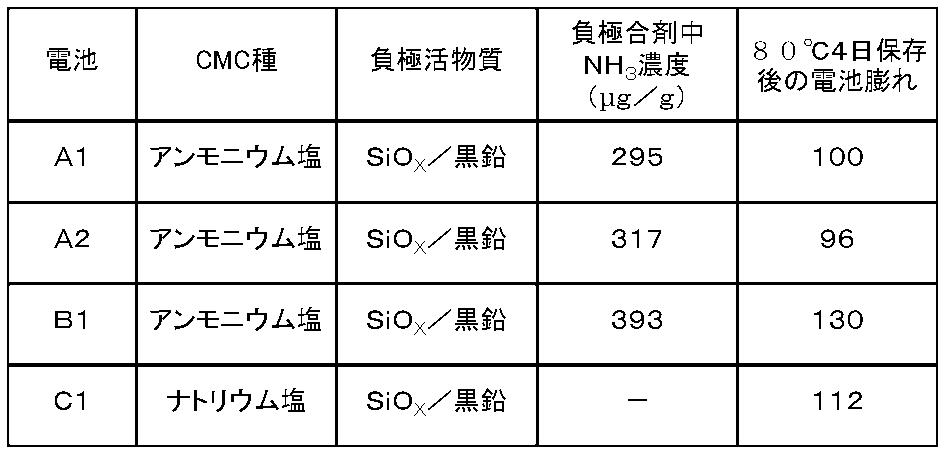
- the amount of NH 3 in the negative electrode mixture layer was 295 ⁇ g with respect to 1 g of the negative electrode mixture layer.
- a battery A2 was produced in the same manner as the battery A1, except that in the production of the battery, the electrode body inserted into the outer package was vacuum-dried at 85 ° C. for 2 hours.
- the amount of NH 3 in the negative electrode mixture layer after vacuum drying the negative electrode produced in the preparation of the negative electrode at 105 ° C. for 2 hours was 317 ⁇ g with respect to 1 g of the negative electrode mixture layer.
- a battery B1 was produced in the same manner as the battery A1, except that in the production of the battery, the electrode body inserted into the outer package was vacuum-dried at 65 ° C. for 2 hours.
- Battery C1 was produced in the same manner as Battery A1, except that carboxymethylcellulose sodium salt (CMC sodium salt) was used instead of CMC ammonium salt in the production of the battery.
- CMC sodium salt carboxymethylcellulose sodium salt
- NH 3 is not included in the negative electrode mixture layer.
- the battery after the first charge / discharge is charged at a constant current of 1.0 it (800 mA) until the battery voltage becomes 4.2 V, and then the current value becomes 0.05 it (40 mA) at a voltage of 4.2 V. After carrying out constant voltage charge, it preserve
- Battery swelling rate (%) ((Battery thickness after storage ⁇ Battery thickness before storage) / Battery thickness before storage) ⁇ 100 (1) The thickness of each battery was measured using a micrometer.
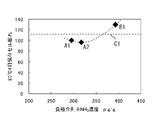
- Table 1 shows the relative value of the swelling rate of each battery when the battery swelling rate of the battery A1 is 100 as the amount of swelling of the battery.
- the NH 4 group of the CMC ammonium salt binds to the OH group present on the surface of the carbon coating on the silicon-containing particles and NH 3 is released as a gas. Therefore, the battery B1 having a high ammonium concentration in the negative electrode mixture layer is It is considered that the amount of gas generated during high-temperature storage increased compared to batteries A1 and A2 having a low ammonium concentration in the negative electrode mixture layer.
- the Na group of the CMC sodium salt remains in the negative electrode mixture without being released as a gas even when combined with the OH group.
- the Na compound remaining in the negative electrode mixture is the OH group in the electrolyte. It is considered that the battery C1 using the CMC sodium salt has increased the amount of gas generated during high temperature storage compared with the batteries A1 and A2 because it generates H 2 gas by reacting with H.sub.2.
- the swelling suppression effect by applying the CMC ammonium salt depends on the amount of NH 3 in the negative electrode mixture layer. Inferred from That is, in order to obtain the above swelling suppression effect, there is an optimum range for the amount of NH 3 in the negative electrode mixture layer.
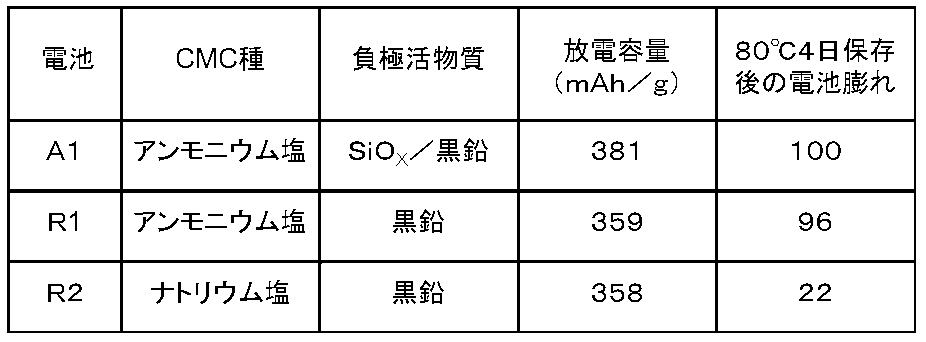
- a battery R2 was produced in the same manner as the battery A1, except that in the production of the negative electrode, only graphite was used as the negative electrode active material and a CMC sodium salt was used instead of the CMC ammonium salt.
- Example 2 In the same manner as in Example 1, the swelling rate (%) was examined, and the discharge capacity of the negative electrode was measured under the following conditions.
- a lead terminal was attached to the negative electrode and lithium metal foil used in the batteries A1, R1, and R2, and an electrode body wound up in a spiral shape through a separator was produced.
- This electrode body was inserted into an aluminum laminate as a battery outer package, and then the non-aqueous electrolyte was injected to obtain a test battery.
Landscapes
- Chemical & Material Sciences (AREA)
- Chemical Kinetics & Catalysis (AREA)
- Electrochemistry (AREA)
- General Chemical & Material Sciences (AREA)
- Engineering & Computer Science (AREA)
- Materials Engineering (AREA)
- Inorganic Chemistry (AREA)
- Composite Materials (AREA)
- Manufacturing & Machinery (AREA)
- Battery Electrode And Active Subsutance (AREA)
- Secondary Cells (AREA)
Abstract
Description
実施形態の説明で参照する図面は、模式的に記載されたものであり、図面に描画された構成要素の寸法比率などは、現物と異なる場合がある。具体的な寸法比率等は、以下の説明を参酌して判断されるべきである。
正極は、正極集電体と、正極集電体上に形成された正極活物質層とで構成されることが好適である。正極集電体には、例えば、導電性を有する薄膜体、特にアルミニウムなどの正極の電位範囲で安定な金属箔や合金箔、アルミニウムなどの金属表層を有するフィルムが用いられる。正極活物質層は、正極活物質の他に、導電材及び結着剤を含むことが好ましい。
図1に例示するように、負極10は、負極集電体11と、負極集電体11上に形成された負極合剤層12とを備えることが好適である。負極集電体11には、例えば、導電性を有する薄膜体、特に銅などの負極の電位範囲で安定な金属箔や合金箔、銅などの金属表層を有するフィルムが用いられる。負極合剤層は、負極活物質及びカルボキシメチルセルロースアンモニウム塩(CMCアンモニウム塩)の他に、結着剤を含むことが好適である。結着剤としてはスチレン-ブタジエンゴム(SBR)やポリイミド等を用いることが好ましい。
非水電解質の電解質塩としては、例えばLiClO4、LiBF4、LiPF6、LiAlCl4、LiSbF6、LiSCN、LiCF3SO3、LiCF3CO2、LiAsF6、LiB10Cl10、低級脂肪族カルボン酸リチウム、LiCl、LiBr、LiI、クロロボランリチウム、ホウ酸塩類、イミド塩類などを用いることができる。この中でも、イオン伝導性と電気化学的安定性の観点から、LiPF6を用いることが好ましい。電解質塩は、1種を単独で用いてもよく、2種以上を組み合わせて用いてもよい。これら電解質塩は、非水電解質1Lに対し0.8~1.5molの割合で含まれていることが好ましい。
セパレータには、イオン透過性及び絶縁性を有する多孔性シートが用いられる。多孔性シートの具体例としては、微多孔薄膜、織布、不織布等が挙げられる。セパレータの材質としては、ポリエチレン、ポリプロピレン等のポリオレフィンが好適である。
<実験1>
(正極の作製)
コバルト酸リチウムと、アセチレンブラック(電気化学工業社製、HS100)と、ポリフッ化ビニリデン(PVdF)とを、質量比が95.0:2.5:2.5の割合になるように秤量、混合し、分散媒としてのN-メチル-2-ピロリドン(NMP)を添加した。次に、これを混合機(プライミクス社製、T.K.ハイビスミックス)を用いて攪拌し、正極スラリーを調製した。次に、この正極スラリーを、アルミニウム箔から成る正極集電体の両面に塗布、乾燥した後、圧延ローラにより圧延して、正極集電体の両面に正極合剤層が形成された正極を作製した。尚、正極合剤層における充填密度は3.60g/mlとした。
[負極活物質粒子B1の作製]
SiとSiO2を1:1のモル比で混合し、減圧下で800℃に加熱した。加熱して生じたSiOXのガスは冷却し析出させて多結晶SiOX塊を作製した。次に、この多結晶SiOX塊を粉砕分級することで、平均粒径が5.8μmのSiOX粒子(以下、「母粒子A1」という)を作製した。母粒子A1の平均粒径は、水を分散媒として、HORIBA製「LA-750」を用いて測定した(以下同様)。
負極活物質粒子B1のラマンスペクトル(所定ラマンピーク)を取得して、所定ラマンピークの半値全幅を求めた。所定ラマンピークの半値全幅は134cm-1であった。
エチレンカーボネート(EC)とジエチルカーボネート(DEC)とを、体積比が3:7の割合となるように混合した混合溶媒に、六フッ化リン酸リチウム(LiPF6)を、1.0モル/リットル添加して非水電解液を調製した。
上記各電極にタブをそれぞれ取り付け、タブが最外周部に位置するようにセパレータを介して上記正極及び上記負極を渦巻き状に巻回して巻回電極体を作製した。当該電極体をアルミニウムラミネートシートで構成される外装体に挿入して、105℃で2時間真空乾燥した後、上記非水電解液を注入し、外装体の開口部を封止して電池A1を作製した。電池A1の設計容量は800mAhである。
上記負極の作製において作製した負極を、105℃で2時間真空乾燥した後、負極から負極合剤層を剥がし、剥がした負極合剤層を窒素気流中、200℃で30分間加熱した。加熱して生じたガスを、0.05モル/リットルの希硫酸に通して、NH4 +イオンを捕集した。捕集したNH4 +イオンから日本ダイオネクス製イオンクロマトグラフ「ICS-3000」を用いてNH3量を測定した。負極合剤層のNH3量は、負極合剤層1gに対し、295μgであった。
電池の作製において、外装体に挿入した電極体を、85℃で2時間真空乾燥したこと以外は、電池A1と同様にして電池A2を作製した。負極の作製において作製した負極を、105℃で2時間真空乾燥した後の負極合剤層のNH3量は、負極合剤層1gに対し、317μgであった。
電池の作製において、外装体に挿入した電極体を、65℃で2時間真空乾燥したこと以外は、電池A1と同様にして電池B1を作製した。負極の作製において作製した負極を、65℃で2時間真空乾燥した後の負極合剤層のNH3量は、負極合剤層1gに対し、393μgであった。
電池の作製において、CMCアンモニウム塩に代えて、カルボキシメチルセルロースナトリウム塩(CMCナトリウム塩)を用いたこと以外は、電池A1と同様にして電池C1を作製した。電池C1においては、負極合剤層にNH3は含まれていない。
上記の各電池を、以下の条件で保存した後、下記(1)式で示す膨れ率(%)を調べたので、その結果を表1及び図2に示す。
電池の膨れ率(%)=((保存後の電池厚み-保存前の電池厚み)/保存前の電池厚み)×100・・・(1)
各電池の厚みは、マイクロメータを用いて測定した。
A2と比較して、高温保存時のガス発生量が多くなったと考えられる。
することが、図2から推察される。即ち、上記膨れ抑制効果を得るためには、負極合剤層中のNH3量には、最適な範囲が存在する。
<実験5>
負極の作製において、負極活物質として黒鉛のみを用いたこと以外は、電池A1と同様にして電池R1を作製した。
負極の作製において、負極活物質として黒鉛のみを用い、CMCアンモニウム塩に代えて、CMCナトリウム塩を用いたこと以外は、電池A1と同様にして電池R2を作製した。
実施例1と同様にして、膨れ率(%)を調べるとともに、以下の条件で負極の放電容量を測定した。上記電池A1、R1、R2で用いた負極及びリチウム金属箔にリード端子を取り付け、セパレータを介して渦巻状に巻き取った電極体を作製した。この電極体を、電池外装体としてのアルミニウムラミネート内に挿入した後、上記非水電解液を注入し、試験用電池とした。
Claims (4)
- 負極集電体と負極合剤層とを備える非水電解質二次電池用負極において、
前記負極合剤層は、シリコンを含む粒子と黒鉛粒子とカルボキシメチルセルロースアンモニウム塩を含み、
前記負極合剤層に含まれるNH3は、前記負極合剤層1g当り350μg以下である、非水電解質二次電池用負極。 - 前記シリコンを含む粒子は、表面の少なくとも一部を覆う導電性炭素材料層を備える、請求項1に記載の非水電解質二次電池用負極。
- 前記シリコンを含む粒子は、SiOX(0.5≦X≦1.5)粒子を含む、請求項1または請求項2に記載の非水電解質二次電池用負極。
- ラマン分光測定により得られる、前記SiOX粒子のラマンスペクトルの1360cm-1付近のピークの半値全幅が、60cm-1以上250cm-1以下である、請求項3に記載の非水電解質二次電池用負極。
Priority Applications (3)
| Application Number | Priority Date | Filing Date | Title |
|---|---|---|---|
| JP2015559806A JP6394612B2 (ja) | 2014-01-31 | 2015-01-20 | 非水電解質二次電池用負極 |
| CN201580006612.4A CN105940529B (zh) | 2014-01-31 | 2015-01-20 | 非水电解质二次电池用负极 |
| US15/114,934 US20160351906A1 (en) | 2014-01-31 | 2015-01-20 | Nonaqueous-electrolyte secondary-battery negative electrode |
Applications Claiming Priority (2)
| Application Number | Priority Date | Filing Date | Title |
|---|---|---|---|
| JP2014-016562 | 2014-01-31 | ||
| JP2014016562 | 2014-01-31 |
Publications (1)
| Publication Number | Publication Date |
|---|---|
| WO2015115053A1 true WO2015115053A1 (ja) | 2015-08-06 |
Family
ID=53756640
Family Applications (1)
| Application Number | Title | Priority Date | Filing Date |
|---|---|---|---|
| PCT/JP2015/000209 Ceased WO2015115053A1 (ja) | 2014-01-31 | 2015-01-20 | 非水電解質二次電池用負極 |
Country Status (4)
| Country | Link |
|---|---|
| US (1) | US20160351906A1 (ja) |
| JP (1) | JP6394612B2 (ja) |
| CN (1) | CN105940529B (ja) |
| WO (1) | WO2015115053A1 (ja) |
Cited By (6)
| Publication number | Priority date | Publication date | Assignee | Title |
|---|---|---|---|---|
| JP2016058283A (ja) * | 2014-09-10 | 2016-04-21 | 日産自動車株式会社 | 電気デバイス用負極およびその製造方法 |
| WO2016136178A1 (ja) * | 2015-02-25 | 2016-09-01 | 三洋電機株式会社 | 非水電解質二次電池用負極及び非水電解質二次電池 |
| CN107204482A (zh) * | 2016-03-17 | 2017-09-26 | 株式会社东芝 | 电池、电池包和车辆 |
| JPWO2017026268A1 (ja) * | 2015-08-10 | 2018-05-31 | ソニー株式会社 | 二次電池用負極およびその製造方法、二次電池およびその製造方法、ならびに電池パック、電動車両、電力貯蔵システム、電動工具および電子機器 |
| JPWO2017026269A1 (ja) * | 2015-08-10 | 2018-05-31 | ソニー株式会社 | 二次電池用負極およびその製造方法、二次電池およびその製造方法、ならびに電池パック、電動車両、電力貯蔵システム、電動工具および電子機器 |
| JP2022530297A (ja) * | 2020-03-26 | 2022-06-29 | 寧徳新能源科技有限公司 | 負極材料、負極片、電気化学装置及び電子装置 |
Families Citing this family (3)
| Publication number | Priority date | Publication date | Assignee | Title |
|---|---|---|---|---|
| JP7358229B2 (ja) * | 2019-12-23 | 2023-10-10 | パナソニックホールディングス株式会社 | 非水電解質二次電池用負極及び非水電解質二次電池 |
| WO2022070818A1 (ja) * | 2020-09-30 | 2022-04-07 | パナソニックIpマネジメント株式会社 | 二次電池用負極及び二次電池 |
| CN113921819A (zh) * | 2021-09-07 | 2022-01-11 | 重庆理工大学 | 一种羧甲基纤维素铵用于锂电池粘结的方法 |
Citations (6)
| Publication number | Priority date | Publication date | Assignee | Title |
|---|---|---|---|---|
| JP2002279995A (ja) * | 2001-03-15 | 2002-09-27 | Sony Corp | 電 池 |
| JP2002313323A (ja) * | 2001-04-13 | 2002-10-25 | Toyota Central Res & Dev Lab Inc | リチウム二次電池用負極およびそれを用いたリチウム二次電池 |
| JP2006202529A (ja) * | 2005-01-18 | 2006-08-03 | Sanyo Electric Co Ltd | 非水電解液二次電池及びその充電方法 |
| JP2010186716A (ja) * | 2009-02-13 | 2010-08-26 | Sanyo Electric Co Ltd | 非水電解質二次電池用負極活物質合剤の製造方法及び非水電解質二次電池 |
| WO2011013756A1 (ja) * | 2009-07-30 | 2011-02-03 | 日本ゼオン株式会社 | 電気化学素子用電極および電気化学素子 |
| JP2013175418A (ja) * | 2012-02-27 | 2013-09-05 | Jfe Chemical Corp | リチウムイオン二次電池用負極材料、リチウムイオン二次電池用負極およびリチウムイオン二次電池 |
Family Cites Families (4)
| Publication number | Priority date | Publication date | Assignee | Title |
|---|---|---|---|---|
| JP4450192B2 (ja) * | 2004-07-01 | 2010-04-14 | 信越化学工業株式会社 | 珪素複合体及びその製造方法並びに非水電解質二次電池用負極材 |
| JP4819342B2 (ja) * | 2004-11-08 | 2011-11-24 | エレクセル株式会社 | リチウム電池用正極及びこれを用いたリチウム電池 |
| WO2006085416A1 (ja) * | 2005-02-10 | 2006-08-17 | Hitachi Chemical Company, Ltd. | エネルギーデバイス電極用バインダ樹脂エマルション及びこれを用いたエネルギーデバイス電極並びにエネルギーデバイス |
| KR101201807B1 (ko) * | 2011-08-31 | 2012-11-15 | 삼성에스디아이 주식회사 | 리튬 이차 전지 |
-
2015
- 2015-01-20 CN CN201580006612.4A patent/CN105940529B/zh active Active
- 2015-01-20 JP JP2015559806A patent/JP6394612B2/ja active Active
- 2015-01-20 US US15/114,934 patent/US20160351906A1/en not_active Abandoned
- 2015-01-20 WO PCT/JP2015/000209 patent/WO2015115053A1/ja not_active Ceased
Patent Citations (6)
| Publication number | Priority date | Publication date | Assignee | Title |
|---|---|---|---|---|
| JP2002279995A (ja) * | 2001-03-15 | 2002-09-27 | Sony Corp | 電 池 |
| JP2002313323A (ja) * | 2001-04-13 | 2002-10-25 | Toyota Central Res & Dev Lab Inc | リチウム二次電池用負極およびそれを用いたリチウム二次電池 |
| JP2006202529A (ja) * | 2005-01-18 | 2006-08-03 | Sanyo Electric Co Ltd | 非水電解液二次電池及びその充電方法 |
| JP2010186716A (ja) * | 2009-02-13 | 2010-08-26 | Sanyo Electric Co Ltd | 非水電解質二次電池用負極活物質合剤の製造方法及び非水電解質二次電池 |
| WO2011013756A1 (ja) * | 2009-07-30 | 2011-02-03 | 日本ゼオン株式会社 | 電気化学素子用電極および電気化学素子 |
| JP2013175418A (ja) * | 2012-02-27 | 2013-09-05 | Jfe Chemical Corp | リチウムイオン二次電池用負極材料、リチウムイオン二次電池用負極およびリチウムイオン二次電池 |
Cited By (10)
| Publication number | Priority date | Publication date | Assignee | Title |
|---|---|---|---|---|
| JP2016058283A (ja) * | 2014-09-10 | 2016-04-21 | 日産自動車株式会社 | 電気デバイス用負極およびその製造方法 |
| WO2016136178A1 (ja) * | 2015-02-25 | 2016-09-01 | 三洋電機株式会社 | 非水電解質二次電池用負極及び非水電解質二次電池 |
| US10490812B2 (en) | 2015-02-25 | 2019-11-26 | Sanyo Electric Co., Ltd. | Negative electrode including SiOx particles having carbon coating, carbonaceous active material particles, and compound having carboxyl or hydroxyl group and nonaqueous electrolyte secondary batteries |
| JPWO2017026268A1 (ja) * | 2015-08-10 | 2018-05-31 | ソニー株式会社 | 二次電池用負極およびその製造方法、二次電池およびその製造方法、ならびに電池パック、電動車両、電力貯蔵システム、電動工具および電子機器 |
| JPWO2017026269A1 (ja) * | 2015-08-10 | 2018-05-31 | ソニー株式会社 | 二次電池用負極およびその製造方法、二次電池およびその製造方法、ならびに電池パック、電動車両、電力貯蔵システム、電動工具および電子機器 |
| CN107204482A (zh) * | 2016-03-17 | 2017-09-26 | 株式会社东芝 | 电池、电池包和车辆 |
| US10541442B2 (en) | 2016-03-17 | 2020-01-21 | Kabushiki Kaisha Toshiba | Battery, battery pack, and vehicle |
| CN107204482B (zh) * | 2016-03-17 | 2020-05-08 | 株式会社东芝 | 电池、电池包和车辆 |
| JP2022530297A (ja) * | 2020-03-26 | 2022-06-29 | 寧徳新能源科技有限公司 | 負極材料、負極片、電気化学装置及び電子装置 |
| US12334559B2 (en) | 2020-03-26 | 2025-06-17 | Ningde Amperex Technology Limited | Negative electrode material, negative electrode plate, electrochemical device, and electronic device |
Also Published As
| Publication number | Publication date |
|---|---|
| JP6394612B2 (ja) | 2018-09-26 |
| CN105940529A (zh) | 2016-09-14 |
| JPWO2015115053A1 (ja) | 2017-03-23 |
| CN105940529B (zh) | 2019-04-23 |
| US20160351906A1 (en) | 2016-12-01 |
Similar Documents
| Publication | Publication Date | Title |
|---|---|---|
| JP6394612B2 (ja) | 非水電解質二次電池用負極 | |
| US20180138503A1 (en) | Cathode for lithium-sulfur battery, manufacturing method therefor, and lithium-sulfur battery containing same | |
| JP6314990B2 (ja) | 非水電解質二次電池用負極活物質及びその負極活物質を用いた非水電解質二次電池 | |
| CN106063014B (zh) | 非水电解质二次电池 | |
| WO2015098023A1 (ja) | 非水電解質二次電池用負極 | |
| JPWO2018051667A1 (ja) | リチウムイオン二次電池 | |
| JPWO2016136178A1 (ja) | 非水電解質二次電池用負極及び非水電解質二次電池 | |
| JP2023009668A (ja) | 非水電解質二次電池用被覆正極活物質及び該被覆正極活物質を含有する非水電解質二次電池。 | |
| WO2015136922A1 (ja) | 非水電解質二次電池 | |
| JP6477713B2 (ja) | 非水電解質二次電池用負極活物質 | |
| WO2010035681A1 (ja) | 非水電解質二次電池 | |
| US11362321B2 (en) | Negative electrode material and non-aqueous electrolyte secondary battery | |
| US20170012290A1 (en) | Negative electrode for non-aqueous electrolyte secondary battery | |
| WO2015045314A1 (ja) | 非水電解質二次電池 | |
| EP4099428A1 (en) | Nonaqueous-electrolyte secondary battery negative electrode and nonaqueous-electrolyte secondary battery | |
| EP4270521A1 (en) | Positive electrode for secondary battery, and secondary battery | |
| KR102293892B1 (ko) | 황-탄소 복합체의 제조방법, 그에 의해 제조된 황-탄소 복합체, 상기 황-탄소 복합체를 포함하는 양극, 및 상기 양극을 포함하는 리튬 이차 전지 | |
| JP2022551625A (ja) | リチウム二次電池用正極活物質の製造方法および前記方法により製造されたリチウム二次電池用正極活物質 | |
| CN115152048A (zh) | 非水电解质二次电池用负极和非水电解质二次电池 | |
| WO2015098024A1 (ja) | 非水電解質二次電池用負極活物質及びその負極活物質を用いた非水電解質二次電池 | |
| CN112042020B (zh) | 包含LiOH的锂二次电池用电极、其制造方法和包含所述电极的锂二次电池 | |
| WO2015118833A1 (ja) | 非水電解質二次電池 | |
| WO2025047625A1 (ja) | 被覆活物質、正極、および二次電池 | |
| WO2014132578A1 (ja) | 非水電解質二次電池 |
Legal Events
| Date | Code | Title | Description |
|---|---|---|---|
| 121 | Ep: the epo has been informed by wipo that ep was designated in this application |
Ref document number: 15744084 Country of ref document: EP Kind code of ref document: A1 |
|
| ENP | Entry into the national phase |
Ref document number: 2015559806 Country of ref document: JP Kind code of ref document: A |
|
| WWE | Wipo information: entry into national phase |
Ref document number: 15114934 Country of ref document: US |
|
| NENP | Non-entry into the national phase |
Ref country code: DE |
|
| 122 | Ep: pct application non-entry in european phase |
Ref document number: 15744084 Country of ref document: EP Kind code of ref document: A1 |