WO2015104972A1 - 床材用活性エネルギー線硬化性組成物 - Google Patents
床材用活性エネルギー線硬化性組成物 Download PDFInfo
- Publication number
- WO2015104972A1 WO2015104972A1 PCT/JP2014/083583 JP2014083583W WO2015104972A1 WO 2015104972 A1 WO2015104972 A1 WO 2015104972A1 JP 2014083583 W JP2014083583 W JP 2014083583W WO 2015104972 A1 WO2015104972 A1 WO 2015104972A1
- Authority
- WO
- WIPO (PCT)
- Prior art keywords
- active energy
- energy ray
- curable composition
- flooring
- compound
- Prior art date
- Legal status (The legal status is an assumption and is not a legal conclusion. Google has not performed a legal analysis and makes no representation as to the accuracy of the status listed.)
- Ceased
Links
Classifications
-
- C—CHEMISTRY; METALLURGY
- C08—ORGANIC MACROMOLECULAR COMPOUNDS; THEIR PREPARATION OR CHEMICAL WORKING-UP; COMPOSITIONS BASED THEREON
- C08J—WORKING-UP; GENERAL PROCESSES OF COMPOUNDING; AFTER-TREATMENT NOT COVERED BY SUBCLASSES C08B, C08C, C08F, C08G or C08H
- C08J7/00—Chemical treatment or coating of shaped articles made of macromolecular substances
- C08J7/04—Coating
- C08J7/043—Improving the adhesiveness of the coatings per se, e.g. forming primers
-
- C—CHEMISTRY; METALLURGY
- C08—ORGANIC MACROMOLECULAR COMPOUNDS; THEIR PREPARATION OR CHEMICAL WORKING-UP; COMPOSITIONS BASED THEREON
- C08F—MACROMOLECULAR COMPOUNDS OBTAINED BY REACTIONS ONLY INVOLVING CARBON-TO-CARBON UNSATURATED BONDS
- C08F2/00—Processes of polymerisation
- C08F2/46—Polymerisation initiated by wave energy or particle radiation
- C08F2/48—Polymerisation initiated by wave energy or particle radiation by ultraviolet or visible light
-
- C—CHEMISTRY; METALLURGY
- C08—ORGANIC MACROMOLECULAR COMPOUNDS; THEIR PREPARATION OR CHEMICAL WORKING-UP; COMPOSITIONS BASED THEREON
- C08F—MACROMOLECULAR COMPOUNDS OBTAINED BY REACTIONS ONLY INVOLVING CARBON-TO-CARBON UNSATURATED BONDS
- C08F2/00—Processes of polymerisation
- C08F2/46—Polymerisation initiated by wave energy or particle radiation
- C08F2/48—Polymerisation initiated by wave energy or particle radiation by ultraviolet or visible light
- C08F2/50—Polymerisation initiated by wave energy or particle radiation by ultraviolet or visible light with sensitising agents
-
- C—CHEMISTRY; METALLURGY
- C08—ORGANIC MACROMOLECULAR COMPOUNDS; THEIR PREPARATION OR CHEMICAL WORKING-UP; COMPOSITIONS BASED THEREON
- C08F—MACROMOLECULAR COMPOUNDS OBTAINED BY REACTIONS ONLY INVOLVING CARBON-TO-CARBON UNSATURATED BONDS
- C08F220/00—Copolymers of compounds having one or more unsaturated aliphatic radicals, each having only one carbon-to-carbon double bond, and only one being terminated by only one carboxyl radical or a salt, anhydride ester, amide, imide or nitrile thereof
- C08F220/02—Monocarboxylic acids having less than ten carbon atoms; Derivatives thereof
- C08F220/52—Amides or imides
- C08F220/54—Amides, e.g. N,N-dimethylacrylamide or N-isopropylacrylamide
- C08F220/58—Amides, e.g. N,N-dimethylacrylamide or N-isopropylacrylamide containing oxygen in addition to the carbonamido oxygen, e.g. N-methylolacrylamide, N-(meth)acryloylmorpholine
-
- C—CHEMISTRY; METALLURGY
- C08—ORGANIC MACROMOLECULAR COMPOUNDS; THEIR PREPARATION OR CHEMICAL WORKING-UP; COMPOSITIONS BASED THEREON
- C08F—MACROMOLECULAR COMPOUNDS OBTAINED BY REACTIONS ONLY INVOLVING CARBON-TO-CARBON UNSATURATED BONDS
- C08F226/00—Copolymers of compounds having one or more unsaturated aliphatic radicals, each having only one carbon-to-carbon double bond, and at least one being terminated by a single or double bond to nitrogen or by a heterocyclic ring containing nitrogen
-
- C—CHEMISTRY; METALLURGY
- C08—ORGANIC MACROMOLECULAR COMPOUNDS; THEIR PREPARATION OR CHEMICAL WORKING-UP; COMPOSITIONS BASED THEREON
- C08F—MACROMOLECULAR COMPOUNDS OBTAINED BY REACTIONS ONLY INVOLVING CARBON-TO-CARBON UNSATURATED BONDS
- C08F226/00—Copolymers of compounds having one or more unsaturated aliphatic radicals, each having only one carbon-to-carbon double bond, and at least one being terminated by a single or double bond to nitrogen or by a heterocyclic ring containing nitrogen
- C08F226/06—Copolymers of compounds having one or more unsaturated aliphatic radicals, each having only one carbon-to-carbon double bond, and at least one being terminated by a single or double bond to nitrogen or by a heterocyclic ring containing nitrogen by a heterocyclic ring containing nitrogen
-
- C—CHEMISTRY; METALLURGY
- C08—ORGANIC MACROMOLECULAR COMPOUNDS; THEIR PREPARATION OR CHEMICAL WORKING-UP; COMPOSITIONS BASED THEREON
- C08J—WORKING-UP; GENERAL PROCESSES OF COMPOUNDING; AFTER-TREATMENT NOT COVERED BY SUBCLASSES C08B, C08C, C08F, C08G or C08H
- C08J7/00—Chemical treatment or coating of shaped articles made of macromolecular substances
- C08J7/04—Coating
- C08J7/0427—Coating with only one layer of a composition containing a polymer binder
-
- C—CHEMISTRY; METALLURGY
- C08—ORGANIC MACROMOLECULAR COMPOUNDS; THEIR PREPARATION OR CHEMICAL WORKING-UP; COMPOSITIONS BASED THEREON
- C08J—WORKING-UP; GENERAL PROCESSES OF COMPOUNDING; AFTER-TREATMENT NOT COVERED BY SUBCLASSES C08B, C08C, C08F, C08G or C08H
- C08J7/00—Chemical treatment or coating of shaped articles made of macromolecular substances
- C08J7/04—Coating
- C08J7/046—Forming abrasion-resistant coatings; Forming surface-hardening coatings
-
- C—CHEMISTRY; METALLURGY
- C09—DYES; PAINTS; POLISHES; NATURAL RESINS; ADHESIVES; COMPOSITIONS NOT OTHERWISE PROVIDED FOR; APPLICATIONS OF MATERIALS NOT OTHERWISE PROVIDED FOR
- C09D—COATING COMPOSITIONS, e.g. PAINTS, VARNISHES OR LACQUERS; FILLING PASTES; CHEMICAL PAINT OR INK REMOVERS; INKS; CORRECTING FLUIDS; WOODSTAINS; PASTES OR SOLIDS FOR COLOURING OR PRINTING; USE OF MATERIALS THEREFOR
- C09D139/00—Coating compositions based on homopolymers or copolymers of compounds having one or more unsaturated aliphatic radicals, each having only one carbon-to-carbon double bond, and at least one being terminated by a single or double bond to nitrogen or by a heterocyclic ring containing nitrogen; Coating compositions based on derivatives of such polymers
- C09D139/04—Homopolymers or copolymers of monomers containing heterocyclic rings having nitrogen as ring member
-
- C—CHEMISTRY; METALLURGY
- C09—DYES; PAINTS; POLISHES; NATURAL RESINS; ADHESIVES; COMPOSITIONS NOT OTHERWISE PROVIDED FOR; APPLICATIONS OF MATERIALS NOT OTHERWISE PROVIDED FOR
- C09D—COATING COMPOSITIONS, e.g. PAINTS, VARNISHES OR LACQUERS; FILLING PASTES; CHEMICAL PAINT OR INK REMOVERS; INKS; CORRECTING FLUIDS; WOODSTAINS; PASTES OR SOLIDS FOR COLOURING OR PRINTING; USE OF MATERIALS THEREFOR
- C09D4/00—Coating compositions, e.g. paints, varnishes or lacquers, based on organic non-macromolecular compounds having at least one polymerisable carbon-to-carbon unsaturated bond ; Coating compositions, based on monomers of macromolecular compounds of groups C09D183/00 - C09D183/16
-
- E—FIXED CONSTRUCTIONS
- E04—BUILDING
- E04F—FINISHING WORK ON BUILDINGS, e.g. STAIRS, FLOORS
- E04F15/00—Flooring
- E04F15/02—Flooring or floor layers composed of a number of similar elements
- E04F15/10—Flooring or floor layers composed of a number of similar elements of other materials, e.g. fibrous or chipped materials, organic plastics, magnesite tiles, hardboard, or with a top layer of other materials
-
- C—CHEMISTRY; METALLURGY
- C08—ORGANIC MACROMOLECULAR COMPOUNDS; THEIR PREPARATION OR CHEMICAL WORKING-UP; COMPOSITIONS BASED THEREON
- C08J—WORKING-UP; GENERAL PROCESSES OF COMPOUNDING; AFTER-TREATMENT NOT COVERED BY SUBCLASSES C08B, C08C, C08F, C08G or C08H
- C08J2327/00—Characterised by the use of homopolymers or copolymers of compounds having one or more unsaturated aliphatic radicals, each having only one carbon-to-carbon double bond, and at least one being terminated by a halogen; Derivatives of such polymers
- C08J2327/02—Characterised by the use of homopolymers or copolymers of compounds having one or more unsaturated aliphatic radicals, each having only one carbon-to-carbon double bond, and at least one being terminated by a halogen; Derivatives of such polymers not modified by chemical after-treatment
- C08J2327/04—Characterised by the use of homopolymers or copolymers of compounds having one or more unsaturated aliphatic radicals, each having only one carbon-to-carbon double bond, and at least one being terminated by a halogen; Derivatives of such polymers not modified by chemical after-treatment containing chlorine atoms
- C08J2327/06—Homopolymers or copolymers of vinyl chloride
-
- C—CHEMISTRY; METALLURGY
- C08—ORGANIC MACROMOLECULAR COMPOUNDS; THEIR PREPARATION OR CHEMICAL WORKING-UP; COMPOSITIONS BASED THEREON
- C08J—WORKING-UP; GENERAL PROCESSES OF COMPOUNDING; AFTER-TREATMENT NOT COVERED BY SUBCLASSES C08B, C08C, C08F, C08G or C08H
- C08J2433/00—Characterised by the use of homopolymers or copolymers of compounds having one or more unsaturated aliphatic radicals, each having only one carbon-to-carbon double bond, and only one being terminated by only one carboxyl radical, or of salts, anhydrides, esters, amides, imides, or nitriles thereof; Derivatives of such polymers
- C08J2433/04—Characterised by the use of homopolymers or copolymers of compounds having one or more unsaturated aliphatic radicals, each having only one carbon-to-carbon double bond, and only one being terminated by only one carboxyl radical, or of salts, anhydrides, esters, amides, imides, or nitriles thereof; Derivatives of such polymers esters
- C08J2433/06—Characterised by the use of homopolymers or copolymers of compounds having one or more unsaturated aliphatic radicals, each having only one carbon-to-carbon double bond, and only one being terminated by only one carboxyl radical, or of salts, anhydrides, esters, amides, imides, or nitriles thereof; Derivatives of such polymers esters of esters containing only carbon, hydrogen, and oxygen, the oxygen atom being present only as part of the carboxyl radical
- C08J2433/08—Homopolymers or copolymers of acrylic acid esters
-
- E—FIXED CONSTRUCTIONS
- E04—BUILDING
- E04F—FINISHING WORK ON BUILDINGS, e.g. STAIRS, FLOORS
- E04F15/00—Flooring
- E04F15/02—Flooring or floor layers composed of a number of similar elements
- E04F15/10—Flooring or floor layers composed of a number of similar elements of other materials, e.g. fibrous or chipped materials, organic plastics, magnesite tiles, hardboard, or with a top layer of other materials
- E04F15/105—Flooring or floor layers composed of a number of similar elements of other materials, e.g. fibrous or chipped materials, organic plastics, magnesite tiles, hardboard, or with a top layer of other materials of organic plastics with or without reinforcements or filling materials
-
- E—FIXED CONSTRUCTIONS
- E04—BUILDING
- E04F—FINISHING WORK ON BUILDINGS, e.g. STAIRS, FLOORS
- E04F15/00—Flooring
- E04F15/12—Flooring or floor layers made of masses in situ, e.g. seamless magnesite floors, terrazzo gypsum floors
Definitions
- the present invention relates to an active energy ray-curable composition for coating the surface of a flooring.
- the active energy ray-curable composition is a composition that is instantly cured by a crosslinking reaction when irradiated with an active energy ray, and can impart excellent stain resistance by being coated on a flooring material.
- the flooring coated with the composition cured by these active energy rays is excellent in stain resistance, it cannot be said that the abrasion resistance and scratch resistance are sufficient.
- An object of the present invention is to provide an active energy ray-curable composition for flooring that adheres more strongly to a flooring containing vinyl chloride while maintaining the conventional physical performance.
- the inventors of the present invention have found that the active energy ray-polymerizable compound in the active energy ray-curable composition for flooring does not dissolve in the polyvinyl chloride at all or hardly dissolves in the polyvinyl chloride insoluble compound, and the polyvinyl chloride.
- the said subject was solved because the soluble polyvinyl chloride soluble compound consists of a specific ratio.
- polyvinyl chloride solubility is that the active energy ray-curable compound dissolves the polyvinyl chloride and realizes mixing at the molecular level with the active energy ray-curable compound in a 25 ° C. environment.
- 100 ⁇ L of an active energy ray-curable compound is dropped on a vinyl chloride base material, and after standing for 2 hours, the base material is washed with a neutral detergent, and then a substance that swells or remains tacky on the base material surface is designated as “polyvinyl chloride soluble compound” (B) ”.
- polyvinyl chloride insoluble compound (A) is used.
- Table 1 shows an example in which the polyvinyl chloride solubility of the active energy ray-curable compound was evaluated by the above test method. These test results are only examples, and all active energy ray-curable compounds exhibiting similar characteristics are included.
- the evaluation criteria for polyvinyl chloride solubility are as follows.
- the part in contact with the base material swells and has a tactile sensation ⁇ ... Slightly swollen and the part in contact with the base material can be clearly confirmed ⁇ ... The part in contact with the base material can be confirmed ⁇ ... The part that was in contact with the base material cannot be confirmed.
- the present invention relates to an active energy ray-curable composition for flooring containing an active energy ray-polymerizable compound and a photopolymerization initiator, and the active energy ray-polymerizable compound does not dissolve in polyvinyl chloride at all.
- the polyvinyl chloride soluble compound (B) is N-vinylcaprolactam, tetrahydrofurfuryl acrylate, N-acryloylmorpholine, N-vinylformamide, 1,6-hexanediol diacrylate, EO-added 1,6- Provided is an active energy ray-curable composition for flooring, which is one or more compounds selected from the group consisting of hexanediol diacrylate.
- the present invention also provides a flooring and a floor obtained by applying the active energy ray-curable composition for flooring and then curing with active energy rays.
- the active energy ray-curable composition for flooring of the present invention preferably contains 3 to 40% by weight of the polyvinyl chloride-soluble compound (B) with respect to the polyvinyl chloride-insoluble compound (A).
- this polyvinyl chloride-soluble compound (B) By adding this polyvinyl chloride-soluble compound (B) to the composition, the polyvinyl chloride on the flooring surface is slightly dissolved, and the adhesiveness of the composition is remarkably enhanced. If the content of the active energy ray-polymerizable compound is too small, the desired adhesiveness cannot be obtained, and if it is too much, the surface of the polyvinyl chloride flooring will be dissolved too much, resulting in unevenness on the surface of the flooring, glossiness Cause a decline.
- polyvinyl chloride-soluble compound (B) used in the present invention examples include N-vinylcaprolactam, tetrahydrofurfuryl acrylate, N-acrylomorpholine, N-vinylformamide and the like, and particularly N-vinylcaprolactam. If you use, the effect is great. Moreover, these may be used independently and may be used in combination of 2 or more types.
- the polyvinyl chloride insoluble compound (A) used in the present invention is not particularly limited as long as it is an active energy ray polymerizable compound other than the active energy ray polymerizable compound having the above-described properties. Specific examples include active energy ray polymerizable compounds that can be used in combination as described below. (Active energy ray polymerizable compound)
- the active energy ray-polymerizable compound used in the present invention can be arbitrarily selected from known (meth) acrylic monomers and / or (meth) acrylic oligomers usually used in active energy ray-curable compositions. .
- “(meth) acryl” is a general term for acrylic and methacrylic.
- (meth) acrylic monomers include unsaturated carboxylic acids such as acrylic acid and methacrylic acid or esters thereof, such as alkyl-, cycloalkyl-, halogenated alkyl-, alkoxyalkyl-, hydroxyalkyl-, aminoalkyl-, allyl.
- the (meth) acrylic monomer polyethylene glycol having an ethylene glycol unit in the molecule (n is 3 or more, approximately 14 or less) di (meth) acrylate, trimethylolpropane EO modification (n is 3 or more) And approximately 14 or less) tri (meth) acrylate, phenol EO-modified (n is 3 or more and approximately 14 or less) (meth) acrylate, 2-hydroxyethyl (meth) acrylate having a hydroxyl group in the molecule, 2 -Hydroxypropyl (meth) acrylate, 4-hydroxybutyl (meth) acrylate, pentaerythritol tri (meth) acrylate, monohydroxyethyl (meth) acrylate phthalate and the like.
- These (meth) acrylic monomers may be used alone or in combination of two or more.
- active energy ray polymerizable compounds may be used alone or in combination of two or more.
- Examples of the active energy ray polymerizable compound particularly suitable for the composition include methyl, ethyl, propyl, butyl, amyl, 2-ethylhexyl, isooctyl, nonyl, dodecyl, hexadecyl, octadecyl, cyclohexyl, benzyl, methoxyethyl, and butoxyethyl.
- the oligomer contained in the active energy ray-curable composition for flooring according to the embodiment is a compound that is crosslinked or polymerized by irradiation with light. Moreover, although it is a compound which has a polymer of a monomer as a principal chain, the number of monomers which comprise a principal chain is not limited. The molecular weight of the oligomer is preferably in the range of 500 to 20000.
- the number of functional groups of the oligomer is preferably 2-20, more preferably 4-20, and even more preferably 6-20.
- the functional group possessed by the oligomer is a photopolymerizable functional group.
- the photopolymerizable functional group is a carbon-carbon double bond such as an acryloyl group.
- the glass transition temperature (Tg) of the oligomer is preferably 40 ° C. or higher, more preferably 50 ° C. or higher, and even more preferably 70 ° C. or higher.
- the glass transition temperature (Tg) can be measured by differential scanning calorimetry (DSC), thermomechanical analysis (TMA), or the like.
- the viscosity of the oligomer is not particularly limited, but the viscosity at 25 ° C. is preferably from 100 to 10000 mPa ⁇ s in consideration of the influence on the handleability of the active energy ray-curable composition and the viscosity, and 5000 mPa ⁇ s. The following is preferable, and 1000 mPa ⁇ s or less is more preferable.
- the main chain of the oligomer can be polyepoxy, aliphatic polyurethane, aromatic polyurethane, aliphatic polyester, aromatic polyester, polyamine, polyacrylate and the like.
- the aforementioned photopolymerizable functional group is preferably added to the main chain of the oligomer.
- the functional group of the oligomer can be introduced by reacting the following (photopolymerizable) functional group-containing compound with the main chain of the oligomer.
- (photopolymerizable) functional group-containing compounds include (meth) acrylic acid, itaconic acid, crotonic acid, isocrotonic acid, maleic acid and other unsaturated carboxylic acids and their salts or esters, urethanes, amides and anhydrides thereof.
- an N-vinyl compound may be included.
- N-vinyl compounds include N-vinylformamide, N-vinylcarbazole, N-vinylacetamide, N-vinylpyrrolidone, N-vinylcaprolactam, acryloylmorpholine, and derivatives thereof.
- Preferred examples of the oligomer include epoxy (meth) acrylate, amine (meth) acrylate, aliphatic urethane (meth) acrylate, aromatic urethane (meth) acrylate, aliphatic polyester (meth) acrylate, and aromatic polyester (meth) acrylate. Etc. are included.
- Tg glass transition temperature
- the oligomer may be a linear oligomer, a branched oligomer, or a dendritic oligomer, but may be preferably a branched oligomer or a dendritic oligomer. Since the branched-chain oligomer and the dendritic oligomer have a relatively low viscosity, the hardness of the cured film can be increased although it is difficult to increase the viscosity of the active energy ray-curable composition for flooring.
- a dendritic oligomer means an oligomer having a plurality of branched chains in one molecule.
- dendritic oligomers examples include dendrimers, hyperbranched oligomers, star oligomers and graft oligomers.
- Dendrimers, hyperbranched oligomers, star oligomers and graft oligomers may be known compounds. Among these, a dendrimer and a hyperbranched oligomer are preferable, and a hyperbranched oligomer is more preferable. Dendrimers and hyperbranched oligomers are less likely to increase the viscosity of the active energy ray-curable composition.
- Hyperbranched oligomer refers to an oligomer in which a plurality of photopolymerizable functional groups are bonded to an oligomer in which two or more monomers are bonded as repeating units. Hyperbranched oligomers generally contain a large number of photopolymerizable functional groups. Therefore, the hyperbranched oligomer can further increase the curing rate of the active energy ray-curable composition for flooring, and can further increase the hardness of the cured film.
- the number of photopolymerizable functional groups in one molecule of hyperbranched oligomer is preferably 6 or more.
- hyperbranched oligomers examples include polyester 6-functional acrylate, polyester 9-functional acrylate, polyester 16-functional acrylate, and the like.
- Examples of commercially available oligomer products include the following.
- examples of commercially available hyperbranched oligomers include the following.
- the photopolymerization initiator used in the present invention may be a conventionally known photoinitiator, and specifically includes benzoin isobutyl ether, 2,4-diethylthioxanthone, 2-isopropylthioxanthone, benzyl, 2,4,6-trimethylbenzoyl.
- Diphenylphosphine oxide 6-trimethylbenzoyldiphenylphosphine oxide, 2-benzyl-2-dimethylamino-1- (4-morpholinophenyl) -butan-1-one, bis (2,6-dimethoxybenzoyl) -2, 4,4-trimethylpentylphosphine oxide and the like are preferably used, and other molecular cleavage types include 1-hydroxycyclohexyl phenyl ketone, benzoin ethyl ether, benzyl dimethyl ketal, methyl benzoyl formate, 2-hydroxy -2-Methyl-1-phenylpropan-1-one, 1- (4-isopropylphenyl) -2-hydroxy-2-methylpropan-1-one and 2-methyl-1- (4-methylthiophenyl) -2 -Morpholinopropan-1-one or the like may be used in combination, and hydrogen abstraction photopolymerization initiators such as benzophenone, 4-phen
- photopolymerization initiators suitable for use with UV-LEDs include 2-benzyl-2-dimethylamino-1- (4-morpholinophenyl) -butan-1-one, 2- (dimethylamino)- 2-[(4-methylphenyl) methyl] -1- (4-morpholinophenyl) -butan-1-one), bis (2,4,6-trimethylbenzoyl) phenylphosphine oxide, 2,4,6 -Trimethylbenzoyl-diphenyl-phosphine oxide, 2,4-diethylthioxanthone, 2-isopropylthioxanthone and the like.
- photopolymerization initiator for example, trimethylamine, methyldimethanolamine, triethanolamine, p-diethylaminoacetophenone, ethyl p-dimethylaminobenzoate, isoamyl p-dimethylaminobenzoate, N, N
- An amine that does not cause an addition reaction with the polymerizable component such as dimethylbenzylamine and 4,4′-bis (diethylamino) benzophenone can also be used in combination.
- These photopolymerization initiators may be used alone or in combination of two or more.
- the content of the photopolymerization initiator is not particularly limited, but is usually about 2 to 20% by mass of the total amount.
- the active energy ray-curable composition for flooring of the present invention can be made more excellent in scratch resistance by adding organic particles or inorganic particles.
- the organic particles used in the present invention include acrylic resin, urethane resin, fluororesin, silicone, melamine resin, styrene resin, and inorganic particles include calcium carbonate, silica, alumina, titanium oxide, magnesium hydroxide, zinc oxide. , Calcium silicate, aluminum hydroxide, and the like. These can be used alone or in combination, but alumina is preferably used.
- the average particle size of the organic particles and inorganic particles is preferably 10 ⁇ m or less.
- the organic particles and inorganic particles may be added as a single particle, or may be added after being dispersed in a suitable dispersion medium in advance.
- the addition amount of the organic particles and inorganic particles is preferably 10 parts by weight or less, more preferably 1 to 5 parts by weight with respect to 100 parts by weight of the active energy ray polymerizable compound.
- the active energy ray-curable composition for flooring can be colored to impart design properties.
- inorganic pigments and organic pigments can be used as known and commonly used colorants.
- an inorganic pigment or an organic pigment can be used.
- Inorganic pigments include silicas such as alkaline earth metal sulfates, carbonates, finely divided silicic acid, synthetic silicates, calcium silicates, alumina, hydrated alumina, titanium oxide, zinc oxide, talc, clay, etc.
- An inorganic pigment, iron oxide, or carbon black produced by a known method such as a contact method, a furnace method, or a thermal method can be used.
- Organic pigments include azo pigments (including azo lakes, insoluble azo pigments, condensed azo pigments, chelate azo pigments), polycyclic pigments (for example, phthalocyanine pigments, perylene pigments, perinone pigments, anthraquinone pigments, quinacridone pigments, dioxazines). Pigments, thioindigo pigments, isoindolinone pigments, quinofullerone pigments, etc.), dye chelates (for example, basic dye chelates, acidic dye chelates, etc.), nitro pigments, nitroso pigments, aniline black, and the like. Specific examples of the pigment include carbon black, No. manufactured by Mitsubishi Chemical Corporation. 2300, no. 900, no.
- 960, MCF88, No. 33, no. 40, no. 45, no. 52, MA7, MA8, MA100, no. 2200B, etc. are Raven 5750, 5250, 5000, 3500, 1255, 700, etc. made by Columbia, and Regal 400R, 330R, 660R, Mogu L, 700, Monarch 800, 880, made by Cabot, 900, 1000, 1100, 1300, 1400, etc. are Degussa Color Black FW1, FW2, FW2V, FW18, FW200, ColorBlack S150, S160, S170, Printex 35, U, the same V, the same 140 U, the Special Black 6, the same 5, the same 4 A, the same 4, and the like.
- Examples of the pigment used for the yellow color include C.I. I. Pigment Yellow 1, 2, 3, 12, 13, 14, 16, 17, 73, 74, 75, 83, 93, 95, 97, 98, 109, 110, 114, 120, 128, 129, 138, 150, 151, 154, 155, 180, 185, 213 and the like.
- Examples of pigments used for the magenta color include C.I. I. Pigment Red 5, 7, 12, 48 (Ca), 48 (Mn), 57 (Ca), 57: 1, 112, 122, 123, 168, 184, 202, 209, C.I. I. Pigment violet 19 and the like.
- pigments used for cyan C.I. I.
- examples of the pigment used for the white color include C.I. I. Pigment White 6, 18, 21 and the like can be used depending on the purpose, but titanium oxide having a high hiding power is preferable.
- titanium oxide having a high hiding power is preferable.
- additives such as photosensitizers, antifoaming agents, leveling agents, ultraviolet absorbers, light stabilizers, lubricants, and matting materials are added to the active energy ray-curable composition for flooring. be able to.
- an antibacterial agent, an antistatic agent, etc. can be suitably added as needed for the purpose of providing functionality.
- the active energy ray-curable composition for flooring of the present invention includes hydroquinone, methoquinone, hindered amine light stabilizer, hindered phenol light stabilizer, di-t-butyl hydroquinone, P—
- a polymerization inhibitor such as methoxyphenol, butylhydroxytoluene or nitrosamine salt may be added to the active energy ray-curable composition for flooring in the range of 0.01 to 2% by mass.
- a dispersant may be used for the purpose of improving the dispersion stability of the filler.
- the dispersant Ajinomoto Fine Techno Co., Ltd. Ajisper PB821, PB822, PB881, PB817, Lubrizol Solsols 24000GR, 32000, 33000, 36000, 39000, 41000, 71000, BASF EFKA-7701, Tsujimoto Chemicals Examples include, but are not limited to, Disparon DA-703-50, DA-705, DA-725, etc.
- the amount of the dispersant used is preferably in the range of 10 to 80% by weight, particularly preferably in the range of 20 to 60% by weight with respect to the filler.
- the amount used is less than 10% by weight, the dispersion stability tends to be insufficient, and when it exceeds 80% by weight, the viscosity of the active energy ray-curable composition for flooring tends to be high, The leveling property of the active energy ray-curable composition for flooring is lowered.
- non-reactive resins such as acrylic resin, epoxy resin, terpene phenol resin, rosin ester, and the like can be blended for the purpose of imparting adhesiveness to the substrate to be printed.
- An active energy ray-curable composition can be obtained by blending the necessary active energy ray-polymerizable compound and heating while stirring and mixing the photopolymerization initiator and the photopolymerization inhibitor.
- an additive such as a surface tension adjusting agent or a lubricant necessary for the active energy ray-curable composition for flooring is further added and stirred.
- an active energy ray-curable composition can be obtained.
- the viscosity of the active energy ray-curable composition for flooring in the present invention is preferably 50 to 1000 mPa ⁇ sec, and is preferably 100 to 1000 mPa ⁇ sec, because if the viscosity is too high, streaks may occur in the finished product after curing. 400 mPa ⁇ sec is most preferable.
- the application method of the active energy ray-curable composition for flooring is applied by using a roller, a printing hair or the like.
- the active energy ray-curable composition for flooring can be used for various inks and coating applications.
- Coating methods include, for example, roll coaters, gravure coaters, flexo coaters, air doctor coaters, blade coaters, air knife coaters, squeeze coaters, impregnation coaters, transfer roll coaters, kiss coaters, curtain coaters, cast coaters, spray coaters, die coaters, and offsets.
- Known means such as a printing machine or a screen printing machine can be appropriately employed.
- the active energy ray-curable composition for flooring is subjected to a curing reaction by irradiation with active energy rays, preferably light such as ultraviolet rays.
- a light source such as an ultraviolet ray
- a light source used in a normal UV curable coating agent for example, a metal halide lamp, a xenon lamp, a carbon arc lamp, a chemical lamp, a low-pressure mercury lamp, a high-pressure mercury lamp can be cured without any problem.
- a commercially available product such as an H lamp, D lamp, or V lamp manufactured by Fusion System can be used.
- an active energy ray irradiation source such as a UV-LED or an ultraviolet light emitting semiconductor laser.
- the active energy ray When used as an active energy ray-curable composition, the active energy ray is irradiated with an active energy ray having a wavelength peak in the range of 365 to 420 nm using a light emitting diode (LED).
- LED light emitting diode
- Example 1 Active energy ray-curable composition for flooring
- N-vinylcaprolactam V-CAP / RC” manufactured by Ashland
- dipropylene glycol diacrylate MIRAMER M222” manufactured by MIWON
- 21.0 parts hyperbranched polyester acrylate CN2303” manufactured by SARTOMER
- 14.0 parts of trioxide roll propane triacrylate MIRAMER M3130” manufactured by MIWON Co., Ltd.
- ⁇ -carboxy-polycaprolactone monoacrylate "Aronix M-5300” manufactured by Toa Gosei Co., Ltd., urethane manufactured by SARTOMER 22.0 parts of oligomer “CN9026”, 2.0 parts of 1-hydroxy-cyclohexyl-phenyl-ketone “V-CAP / RC” manufactured by Ashland
- dipropylene glycol diacrylate MIRAMER M222” manufactured by MIWON
- 21.0 parts hyperbranched polyester acrylate CN2303” manufactured by SARTOMER
- the active energy ray-curable composition having the above composition was applied to the surface (walking surface) of the composition vinyl floor tile “Machico V” manufactured by Toli Corporation and the homogeneous vinyl floor tile “Royalwood PWT563” manufactured by Toli Corporation. After the coating, ultraviolet rays were applied (irradiation amount: 500 mJ / cm 2 ), and the active energy ray-curable composition for flooring was cured to obtain a flooring.
- V-Cap N-vinylcaprolactam MIRAMER M-150 manufactured by ASHLAND, Inc. Tetrahydrofurfuryl acrylate MIRAMER M-200 manufactured by MIWON, 1,6-hexanediol diacrylate MIRAMER M-202 manufactured by MIWON, EO addition 1 manufactured by MIWON , 6-hexanediol diacrylate ACMO ... N-acryloylmorpholine beam set 770 manufactured by Kojin Film & Chemicals Co., Ltd. N-vinylformamide light acrylate PO-A manufactured by Arakawa Chemical Industries Co., Ltd. 2-phenoxyethyl acrylate MIRAMER M manufactured by Kyoeisha Chemical Co., Ltd. -222 ...
- the floor material active energy ray-curable composition obtained in the examples was able to obtain a floor material having good adhesion to the base material without deteriorating the gloss of the base material.
Landscapes
- Chemical & Material Sciences (AREA)
- Organic Chemistry (AREA)
- Health & Medical Sciences (AREA)
- Chemical Kinetics & Catalysis (AREA)
- Medicinal Chemistry (AREA)
- Polymers & Plastics (AREA)
- Engineering & Computer Science (AREA)
- Architecture (AREA)
- Materials Engineering (AREA)
- Wood Science & Technology (AREA)
- Life Sciences & Earth Sciences (AREA)
- Civil Engineering (AREA)
- Structural Engineering (AREA)
- Polymerisation Methods In General (AREA)
- Macromonomer-Based Addition Polymer (AREA)
- Paints Or Removers (AREA)
- Floor Finish (AREA)
Abstract
Description
しかしながら、これら活性エネルギー線により硬化する組成物を被覆した床材は耐汚染性には優れていても、耐摩耗性及び耐擦り傷性が充分とは言えなかった。
尚、ポリ塩化ビニル可溶性の評価基準としては下記の通りとする。
○…やや膨潤し、基材と接触していた部分がはっきり確認できる
△…基材と接触していた部分が確認できる
×…基材と接触していた部分が確認できない

(活性エネルギー線重合性化合物)
本発明で使用する活性エネルギー線重合性化合物としては、通常活性エネルギー線硬化性組成物に使用される公知の(メタ)アクリルモノマーおよび/または(メタ)アクリルオリゴマーから任意に選んで用いることができる。なお本発明において「(メタ)アクリル」とはアクリルとメタクリルとを総称したものである。
1,3-ブチレングリコール、1,4-ブタンジオール、1,5-ペンタンジオール、3-メチル-1,5-ペンタンジオール、1,6-ヘキサンジオール、ネオペンチルグリコール、1,8-オクタンジオール、1,9-ノナンジオール、トリシクロデカンジメタノール、エチレングリコール、ポリエチレングリコール、プロピレングリコール、ジプロピレングリコール、トリプロピレングリコール、ポリプロピレングリコール等のジ(メタ)アクリレート、トリス(2-ヒドロキシエチル)イソシアヌレートのジ(メタ)アクリレート、(メタ)アクリル酸2-(2-ビニロキシエトキシ)エチル、オペンチルグリコール1モルに4モル以上のエチレンオキサイドもしくはプロピレンオキサイドを付加して得たジオールのジ(メタ)アクリレート、ビスフェノールA1モルに2モルのエチレンオキサイドもしくはプロピレンオキサイドを付加して得たジオールのジ(メタ)アクリレート、トリメチロールプロパン1モルに3モル以上のエチレンオキサイドもしくはプロピレンオキサイドを付加して得たトリオールのジまたはトリ(メタ)アクリレート、ビスフェノールA1モルに4モル以上のエチレンオキサイドもしくはプロピレンオキサイドを付加して得たジオールのジ(メタ)アクリレート、トリメチロールプロパントリ(メタ)アクリレート,ペンタエリスリトールトリ(メタ)アクリレート,ジペンタエリスリトールのポリ(メタ)アクリレート、エチレンオキサイド変性リン酸(メタ)アクリレート、エチレンオキサイド変性アルキルリン酸(メタ)アクリレート等の多官能モノマーを挙げることができる。これらは2種類以上併用して用いることができる。
((メタ)アクリルオリゴマー)
実施形態に係る床材用活性エネルギー線硬化性組成物に含有されるオリゴマーは、光の照射により架橋又は重合する化合物である。また、モノマーの重合体を主鎖とする化合物であるが、主鎖を構成するモノマーの数は限定されない。前記オリゴマーの分子量は、500~20000の範囲であることが好ましい。
なかでも、ハイパーブランチオリゴマーの市販品の例には以下のものがある。
CN2300、CN2301、CN2302、CN2303(以上サートマー社製)、Etercure6361-100、Etercure6362-100(以上Eternal Chemical co.,LTD)、V#1000、V#1020(以上、大阪有機化学工業社製)
(光重合開始剤)
本発明で使用する光重合開始剤としては、従来公知のものでよく、具体的には、ベンゾインイソブチルエーテル、2,4-ジエチルチオキサントン、2-イソプロピルチオキサントン、ベンジル、2,4,6-トリメチルベンゾイルジフェニルフォスフィンオキシド6-トリメチルベンゾイルジフェニルフォスフィンオキシド、2-ベンジル-2-ジメチルアミノ-1-(4-モルフォリノフェニル)-ブタン-1-オン、ビス(2,6-ジメトキシベンゾイル)-2,4,4-トリメチルペンチルフォスフィンオキシド等が好適に用いられ、さらにこれら以外の分子開裂型のものとして、1-ヒドロキシシクロヘキシルフェニルケトン、ベンゾインエチルエーテル、ベンジルジメチルケタール、メチルベンゾイルホルマート、2-ヒドロキシ-2-メチル-1-フェニルプロパン-1-オン、1-(4-イソプロピルフェニル)-2-ヒドロキシ-2-メチルプロパン-1-オンおよび2-メチル-1-(4-メチルチオフェニル)-2-モルフォリノプロパン-1-オン等を併用しても良いし、さらに水素引き抜き型光重合開始剤である、ベンゾフェノン、4-フェニルベンゾフェノン、イソフタルフェノン、4-ベンゾイル-4’-メチル-ジフェニルスルフィド等も併用できる。
これらの光重合開始剤は、それぞれ単独で用いてもよいし、2種以上を組み合わせて用いてもよい。
(フィラー)
本発明の床材用活性エネルギー線硬化性組成物は有機粒子又は無機粒子を添加することにより、より耐擦り傷性に優れるものとすることができる。本発明で用いられる有機粒子としてはアクリル樹脂、ウレタン樹脂、フッ素樹脂、シリコーン、メラミン樹脂、スチレン樹脂などが挙げられ、無機粒子としては炭酸カルシウム、シリカ、アルミナ、酸化チタン、水酸化マグネシウム、酸化亜鉛、ケイ酸カルシウム、水酸化アルミニウムなどが挙げられ、それらを単独あるいは併用して用いる事ができるが、好ましくはアルミナが用いられる。また上記の有機粒子及び無機粒子の平均粒径は10μm以下のものが好ましい。上記有機粒子及び無機粒子は粒子単体で添加してもよく、あるいは適切な分散媒にあらかじめ分散してから添加してもよい。
(着色剤)
床材用活性エネルギー線硬化性組成物には着色し意匠性を付与する事ができる。着色のためには公知慣用の着色剤として無機顔料及び有機顔料を用いる事ができる。本発明で使用する顔料としては、無機顔料あるいは有機顔料を使用することができる。
無機顔料としては、アルカリ土類金属の硫酸塩、炭酸塩、微粉ケイ酸、合成珪酸塩、等のシリカ類、ケイ酸カルシウム、アルミナ、アルミナ水和物、酸化チタン、酸化亜鉛、タルク、クレイ等の白色顔料として使用される無機顔料、酸化鉄、あるいはコンタクト法、ファーネス法、サーマル法などの公知の方法によって製造されたカーボンブラックを使用することができる。
顔料の具体例としては、カーボンブラックとして、三菱化学社製のNo.2300、No.900、No.960、MCF88、No.33、No.40、No.45、No.52、MA7、MA8、MA100、No.2200B等が、コロンビア社製のRaven5750、同5250、同5000、同3500、同1255、同700等が、キャボット社製のRegal400R、同330R、同660R、Mogul L、同700、Monarch800、同880、同900、同1000、同1100、同1300、同1400等が、デグッサ社製のColor Black FW1、同FW2、同FW2V、同FW18、同FW200、ColorBlack S150、同S160、同S170、Printex 35、同U、同V、同140U、Special Black 6、同5、同4A、同4等が挙げられる。
イエロー色に使用される顔料としては、C.I.ピグメントイエロー1、2、3、12、13、14、16、17、73、74、75、83、93、95、97、98、109、110、114、120、128、129、138、150、151、154、155、180、185、213等が挙げられる。
また、マゼンタ色に使用される顔料としては、C.I.ピグメントレッド5、7、12、48(Ca)、48(Mn)、57(Ca)、57:1、112、122、123、168、184、202、209、C.I.ピグメントヴァイオレット 19等が挙げられる。
また、シアン色に使用される顔料としては、C.I.ピグメントブルー1、2、3、15:3、15:4、60、16、22が挙げられる。
また、ホワイト色に使用される顔料としては、C.I.ピグメントホワイト6、18、21などが目的に応じて使用できるが、隠ぺい力が高い酸化チタンが好適で具体的には、テイカ社製「チタニックスJR-301、403、405、600A、605、600E、603、805、806、701、800、808」「チタニックスJA-1、C、3、4、5」、石原産業社製「タイペークCR-50、50-2、57、80、90、93、95、953、97、60、60-2、63、67、58、58-2、85」「タイペークR-820、830、930、550、630、680、670、580、780、780-2、850、855」「タイペークA-100、220」「タイペークW10」「タイペ-クPF-740、744」「TTO-55(A)、55(B)、55(C)、55(D)、55(S)、55(N)、51(A)、51(C)」「TTO-S-1、2」「TTO-M-1、2」、デュポン社製「タイピュアR-900、902、960、706、931」等が挙げられる。
(添加剤)
床材用活性エネルギー線硬化性組成物にはその他添加剤として、光増感剤、消泡剤、レベリング剤、紫外線吸収剤、光安定剤、滑剤、艶消し材など従来公知のものを添加することができる。また、機能性を付与する目的で抗菌剤、帯電防止剤などを必要に応じて適宜添加することができる。
(床材用活性エネルギー線硬化性組成物の製造方法)
必要な活性エネルギー線重合性化合物を配合し、光重合開始剤と光重合禁止剤を攪拌混合しながら加熱することで、活性エネルギー線硬化型組成物を得ることができる。本発明の床材用活性エネルギー線硬化性組成物とするには、さらに、床材用活性エネルギー線硬化性組成物として必要な、表面張力調整剤や滑剤等の添加剤を加えて攪拌することで、活性エネルギー線硬化性組成物を得ることができる。
(床材用活性エネルギー線硬化性組成物の粘度)
本発明における床材用活性エネルギー線硬化性組成物の粘度は、あまり高粘度では硬化後の仕上がりにスジ状感が発生するおそれがあるため、粘度としては50~1000mPa・secが好ましく、100~400mPa・secが最も好ましい。
(塗布方法)
床材用活性エネルギー線硬化性組成物の塗布方法はローラーや印毛等を用いて塗布される。また前記床材用活性エネルギー線硬化性組成物は、各種インキやコーティング用途としても使用することができる。コーティング方法としては、たとえばロールコーター、グラビアコーター、フレキソコーター、エアドクターコーター、ブレードコーター、エアナイフコーター、スクイズコーター、含浸コーター、トランスファロールコーター、キスコーター、カーテンコーター、キャストコーター、スプレイコーター、ダイコーター、オフセット印刷機、スクリーン印刷機等の公知手段を適宜採用することができる。
(硬化)
前記床材用活性エネルギー線硬化性組成物は、活性エネルギー線、好ましくは紫外線等の光照射をすることにより硬化反応を行う。紫外線等の光源としては、通常のUV硬化性コーティング剤に使用する光源、例えばメタルハライドランプ、キセノンランプ、カーボンアーク灯、ケミカルランプ、低圧水銀ランプ、高圧水銀ランプ等であれば問題なく硬化させることができる。例えばFusion System社製のHランプ、Dランプ、Vランプ等の市販されているものを用いて行うことができる。
床材用活性エネルギー線硬化性組成物の硬化には、近年UV-LEDや、紫外線発光半導体レーザ等の活性エネルギー線照射源により硬化または半硬化させたいという要求があり、例えば、前記床材用活性エネルギー線硬化性組成物として使用する場合は、床材に塗工する工程と、発光ダイオード(LED)を用いて波長ピークが365~420nmの範囲にある活性エネルギー線を照射することにより前記活性エネルギー線硬化性組成物を硬化させることで、床を形成させることが可能である。
(実施例 床材用活性エネルギー線硬化性組成物)
ASHLAND社製N-ビニルカプロラクタム「V-CAP/RC」3.0部、MIWON社製 ジプロピレングリコールジアクリレート「MIRAMER M222」20.4部、SARTOMER社製ハイパーブランチポリエステルアクリレート「CN2303」21.0部、MIWON社製 エチレンオキサイド3モル付加トリメチロールプロパントリアクリレート「MIRAMER M3130」14.0部、東亜合成社製ω-カルボキシ-ポリカプロラクトンモノアクリレート「アロニックス M-5300」10.0部、SARTOMER社製ウレタンオリゴマー「CN9026」22.0部、BASF社製1-ヒドロキシ-シクロヘキシル-フェニル-ケトン「Irgacure184」2.0部、BASF社製メチルベンゾイルホルマート「DAROCUR MBF」5.0部、本州化学工業(株)社製ブチルヒドロキシトルエン「H-BHT」0.1部を添加し、60℃で30分加熱攪拌した後、Lubrizol社製ポリエチレン分散体「CC7610」1.0部、BYK-CHMIE社製レベリング剤「BYK-350」1.5部を添加し、充分に混合した。次いで100μmのフィルターを用いてろ過することにより床材用活性エネルギー線硬化型組成物を得た。同様に、実施例2~8、及び比較例1~4についても表2及び表3の組成に従って床材用活性エネルギー線硬化型組成物を得た。
更に、上記配合の活性エネルギー線硬化性組成物を東リ株式会社製コンポジションビニル床タイル「マチコV」及び東リ株式会社製ホモジニアスビニル床タイル「ロイヤルウッドPWT563」の表面(歩行面)に40μmの厚さに塗布後、紫外線を照射(照射量500mJ/cm2)し、床材用活性エネルギー線硬化型組成物を硬化させて床材を得た。
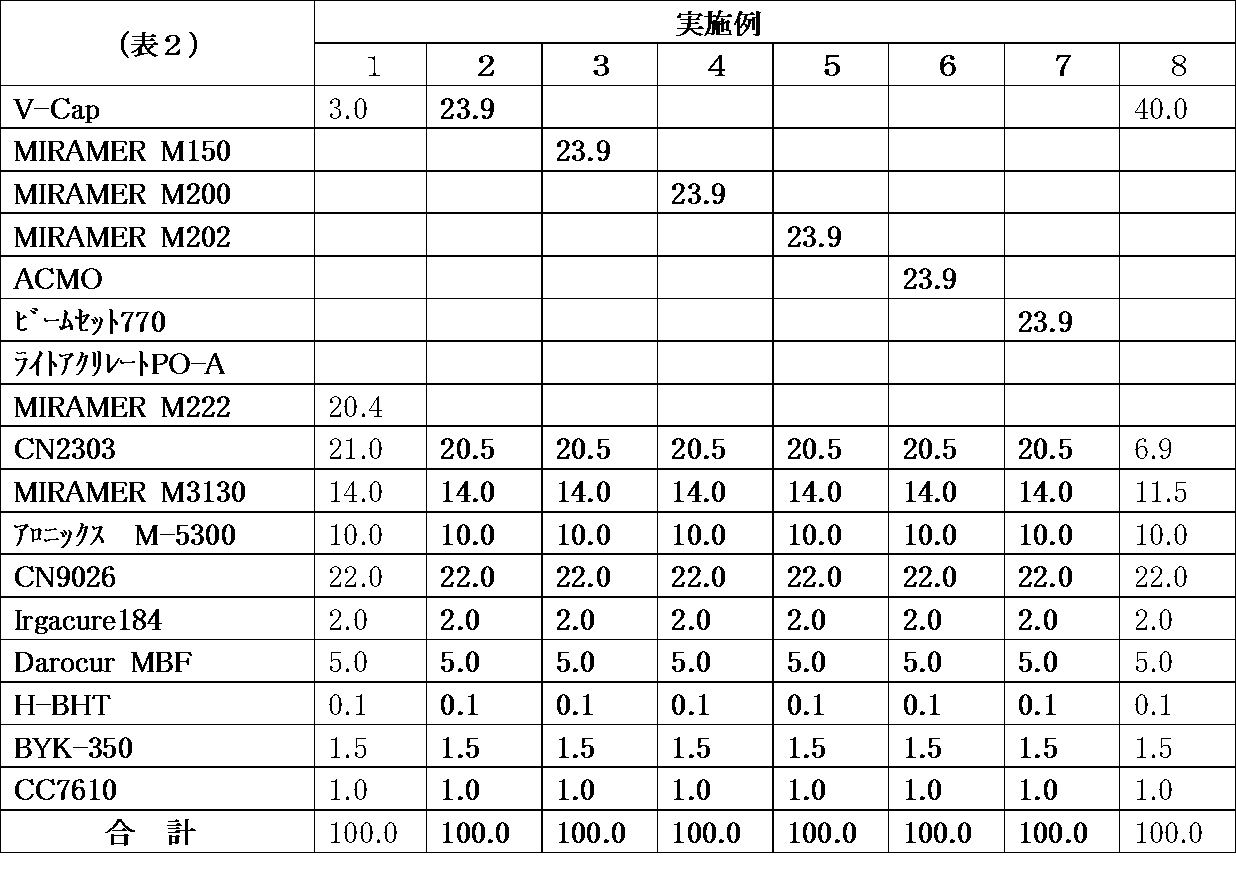
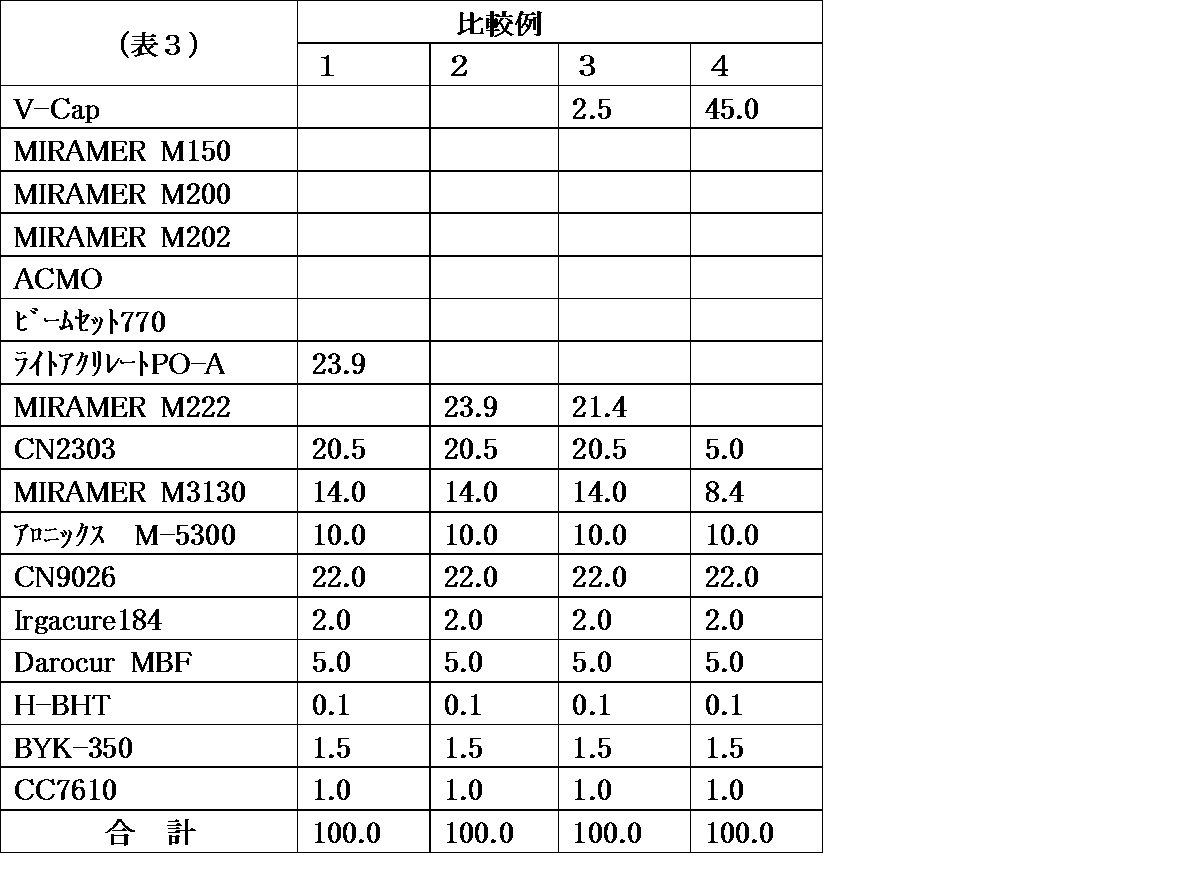
MIRAMER M-150…MIWON社製テトラヒドロフルフリルアクリレート
MIRAMER M-200…MIWON社製1,6-ヘキサンジオールジアクリレート
MIRAMER M-202…MIWON社製EO付加1,6-ヘキサンジオールジアクリレート
ACMO…興人フィルム&ケミカルズ社製N-アクリロイルモルホリン
ビームセット770…荒川化学工業社製N-ビニルホルムアミド
ライトアクリレートPO-A…共栄社化学社製2-フェノキシエチルアクリレート
MIRAMER M-222…MIWON社製ジプロピレングリコールジアクリレート
CN2303…SARTOMER社製ハイパーブランチポリエステルアクリレート
MIRAMER M-3130…MIWON社製エチレンオキサイド3モル付加トリメチロールプロパントリアクリレート
アロニックス M-5300…東亜合成社製ω-カルボキシ-ポリカプロラクトンモノアクリレート
CN9026…SARTOMER社製ウレタンオリゴマー
Irgacure184…BASF社製1-ヒドロキシ-シクロヘキシル-フェニル-ケトン
DAROCUR MBF…BASF社製メチルベンゾイルホルマート
H-BHT…本州化学工業(株)社製ブチルヒドロキシトルエン
CC7610…Lubrizol社製ポリエチレン分散体
BYK-350…BYK-CHMIE社製アクリル系レベリング剤
(評価方法)
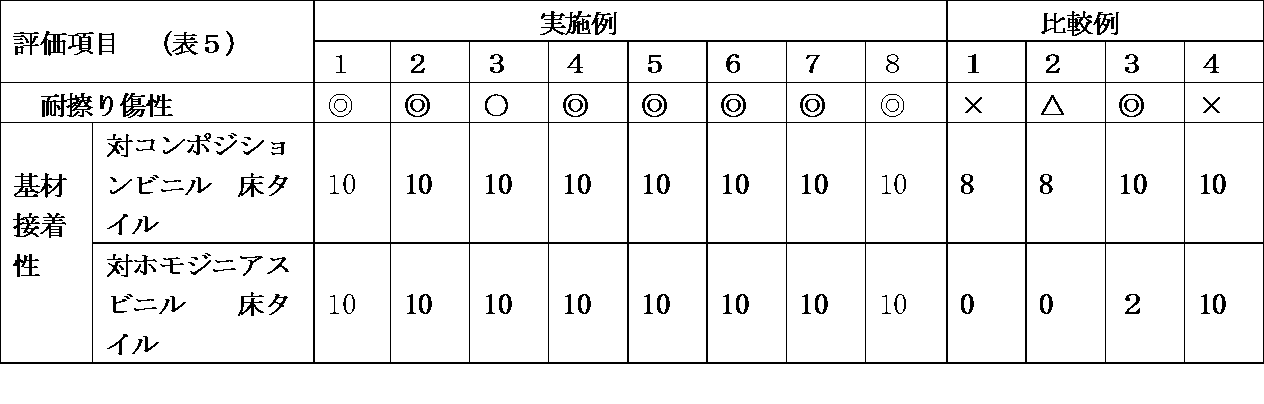
前記床材用活性エネルギー線硬化性組成物の実施例1~8、比較例1~4の評価方法を示す。
[耐擦り傷性]
平面摩擦試験機(東洋精機製作所製)のアーム先端にスチールウールNo.000を取り付け、500gの荷重をかけて塗膜表面を100往復ラビングした後の傷の有無を観察した。
○:傷が目立たない
△:傷がやや目立つ
×:傷がかなりあり、一部に剥離部分あり
[基材接着性]
上記実施例および比較例を用いて作製した試料を用いて、JIS K 5400記載の碁盤目テープ法に準じて評価し、接着性の良否を判定した。表4に評価基準を示す。

Claims (3)
- 活性エネルギー線重合性化合物と光重合開始剤とを含有する床材用活性エネルギー線硬化性組成物であって、該活性エネルギー線重合性化合物がポリ塩化ビニルに全く溶解しないか、殆ど溶解しないポリ塩化ビニル不溶解性化合物(A)と、ポリ塩化ビニルに溶解するポリ塩化ビニル可溶性化合物(B)とからなり、前記化合物(A)に対して、化合物(B)が3~40重量%含有することを特徴とする床材用活性エネルギー線硬化性組成物。
- 前記ポリ塩化ビニル可溶性化合物(B)がN-ビニルカプロラクタム、テトラヒドロフルフリルアクリレート、N-アクリロイルモルホリン、N-ビニルホルムアミド、1,6-ヘキサンジオールジアクリレート、EO付加1,6-ヘキサンジオールジアクリレートからなる群から選ばれる1種以上の化合物である請求項1記載の床材用活性エネルギー線硬化性組成物。
- 請求項1または2記載の床材用活性エネルギー線硬化性組成物を塗布した後、該組成物を活性エネルギー線で硬化して得られた床材および床。
Priority Applications (2)
| Application Number | Priority Date | Filing Date | Title |
|---|---|---|---|
| US15/108,669 US20160333215A1 (en) | 2014-01-08 | 2014-12-18 | Activating energy beam-curable composition for flooring material |
| JP2015524550A JP5846336B2 (ja) | 2014-01-08 | 2014-12-18 | 床材用活性エネルギー線硬化性組成物 |
Applications Claiming Priority (2)
| Application Number | Priority Date | Filing Date | Title |
|---|---|---|---|
| JP2014001599 | 2014-01-08 | ||
| JP2014-001599 | 2014-01-08 |
Publications (1)
| Publication Number | Publication Date |
|---|---|
| WO2015104972A1 true WO2015104972A1 (ja) | 2015-07-16 |
Family
ID=53523809
Family Applications (1)
| Application Number | Title | Priority Date | Filing Date |
|---|---|---|---|
| PCT/JP2014/083583 Ceased WO2015104972A1 (ja) | 2014-01-08 | 2014-12-18 | 床材用活性エネルギー線硬化性組成物 |
Country Status (3)
| Country | Link |
|---|---|
| US (1) | US20160333215A1 (ja) |
| JP (1) | JP5846336B2 (ja) |
| WO (1) | WO2015104972A1 (ja) |
Cited By (2)
| Publication number | Priority date | Publication date | Assignee | Title |
|---|---|---|---|---|
| JP2017105877A (ja) * | 2015-12-07 | 2017-06-15 | Dic株式会社 | 床材用活性エネルギー線硬化性組成物 |
| JPWO2023153067A1 (ja) * | 2022-02-14 | 2023-08-17 |
Families Citing this family (7)
| Publication number | Priority date | Publication date | Assignee | Title |
|---|---|---|---|---|
| CA2989690A1 (en) | 2015-06-17 | 2016-12-22 | Clariant International Ltd | Water-soluble or water-swellable polymers as water loss reducers in cement slurries |
| US11311473B2 (en) | 2016-12-12 | 2022-04-26 | Clariant International Ltd | Use of a bio-based polymer in a cosmetic, dermatological or pharmaceutical composition |
| JP7032402B2 (ja) | 2016-12-12 | 2022-03-08 | クラリアント・インターナシヨナル・リミテツド | ある特定のレベルのバイオベース炭素を含むポリマー |
| EP3554643B1 (en) | 2016-12-15 | 2025-03-19 | Clariant International Ltd | Water-soluble and/or water-swellable hybrid polymer |
| ES3017507T3 (en) | 2016-12-15 | 2025-05-13 | Clariant Int Ltd | Water-soluble and/or water-swellable hybrid polymer |
| EP3554644B1 (en) | 2016-12-15 | 2025-03-19 | Clariant International Ltd | Water-soluble and/or water-swellable hybrid polymer |
| WO2018108667A1 (en) | 2016-12-15 | 2018-06-21 | Clariant International Ltd | Water-soluble and/or water-swellable hybrid polymer |
Citations (6)
| Publication number | Priority date | Publication date | Assignee | Title |
|---|---|---|---|---|
| JPH11209489A (ja) * | 1998-01-22 | 1999-08-03 | Nissin High Voltage Co Ltd | ハードコート層の製造方法 |
| JPH11292910A (ja) * | 1998-02-27 | 1999-10-26 | Ciba Specialty Chem Holding Inc | 着色された光硬化性組成物 |
| JP2006193692A (ja) * | 2005-01-17 | 2006-07-27 | Mitsubishi Rayon Co Ltd | 硬化性組成物 |
| JP2008231375A (ja) * | 2007-03-23 | 2008-10-02 | Nippon Kasei Chem Co Ltd | 活性エネルギー線硬化型ハードコート組成物、ハードコート層及びハードコートフィルム |
| JP2009167785A (ja) * | 2008-01-17 | 2009-07-30 | Chae-Ho Kim | 2層構造型伝導性タイル材 |
| JP2010174075A (ja) * | 2009-01-27 | 2010-08-12 | Panasonic Electric Works Co Ltd | 抗アレルゲン塗膜形成用樹脂組成物、木質板およびその製造方法 |
-
2014
- 2014-12-18 JP JP2015524550A patent/JP5846336B2/ja not_active Ceased
- 2014-12-18 US US15/108,669 patent/US20160333215A1/en not_active Abandoned
- 2014-12-18 WO PCT/JP2014/083583 patent/WO2015104972A1/ja not_active Ceased
Patent Citations (6)
| Publication number | Priority date | Publication date | Assignee | Title |
|---|---|---|---|---|
| JPH11209489A (ja) * | 1998-01-22 | 1999-08-03 | Nissin High Voltage Co Ltd | ハードコート層の製造方法 |
| JPH11292910A (ja) * | 1998-02-27 | 1999-10-26 | Ciba Specialty Chem Holding Inc | 着色された光硬化性組成物 |
| JP2006193692A (ja) * | 2005-01-17 | 2006-07-27 | Mitsubishi Rayon Co Ltd | 硬化性組成物 |
| JP2008231375A (ja) * | 2007-03-23 | 2008-10-02 | Nippon Kasei Chem Co Ltd | 活性エネルギー線硬化型ハードコート組成物、ハードコート層及びハードコートフィルム |
| JP2009167785A (ja) * | 2008-01-17 | 2009-07-30 | Chae-Ho Kim | 2層構造型伝導性タイル材 |
| JP2010174075A (ja) * | 2009-01-27 | 2010-08-12 | Panasonic Electric Works Co Ltd | 抗アレルゲン塗膜形成用樹脂組成物、木質板およびその製造方法 |
Cited By (3)
| Publication number | Priority date | Publication date | Assignee | Title |
|---|---|---|---|---|
| JP2017105877A (ja) * | 2015-12-07 | 2017-06-15 | Dic株式会社 | 床材用活性エネルギー線硬化性組成物 |
| JPWO2023153067A1 (ja) * | 2022-02-14 | 2023-08-17 | ||
| WO2023153067A1 (ja) * | 2022-02-14 | 2023-08-17 | 三菱ケミカル株式会社 | 硬化性組成物、硬化物、積層体およびこれらの製造方法 |
Also Published As
| Publication number | Publication date |
|---|---|
| US20160333215A1 (en) | 2016-11-17 |
| JPWO2015104972A1 (ja) | 2017-03-23 |
| JP5846336B2 (ja) | 2016-01-20 |
Similar Documents
| Publication | Publication Date | Title |
|---|---|---|
| JP5846336B2 (ja) | 床材用活性エネルギー線硬化性組成物 | |
| JP5800212B1 (ja) | 床材用活性エネルギー線硬化性組成物とその施工方法 | |
| JP5910799B2 (ja) | 床材用活性エネルギー線硬化性組成物の硬化方法、及びその硬化方法を用いた硬化装置 | |
| JP2017105877A (ja) | 床材用活性エネルギー線硬化性組成物 | |
| TW201739850A (zh) | 光硬化型噴墨印刷用墨水組成物及噴墨印刷方法 | |
| JP5815913B1 (ja) | 活性エネルギー線硬化型オフセットインキ組成物 | |
| KR20130108634A (ko) | 활성 에너지선 경화형 잉크젯 기록용 잉크 조성물 및 화상 형성 방법 | |
| CN106536645A (zh) | Uv‑led固化型喷墨印刷用透明墨组合物 | |
| KR20170121170A (ko) | 광경화형 잉크젯 인쇄용 백색 잉크 조성물 | |
| CN107541113A (zh) | 辐射线固化型喷墨组合物以及喷墨记录方法 | |
| EP3303488B1 (en) | A printing ink | |
| WO2015163184A1 (ja) | 活性エネルギー線硬化型オフセットインキの硬化方法 | |
| JP2023097118A (ja) | 活性エネルギー線硬化性インク組成物及び印刷物の製造方法 | |
| CN116438263A (zh) | 活性能量射线固化型喷墨用油墨组合物 | |
| US20230348742A1 (en) | Radiation Curable Ink Jet Composition | |
| JP2023097117A (ja) | 活性エネルギー線硬化性インク組成物及び印刷物の製造方法 | |
| WO2022201664A1 (ja) | 活性エネルギー線硬化型インクジェット用インク組成物 | |
| JP2022076644A (ja) | 活性エネルギー線硬化性コーティング剤、これを用いた化粧シート、化粧板、及び建築材料 | |
| JP2013185001A (ja) | 水性紫外線硬化性コーティングニス組成物 | |
| JP7215125B2 (ja) | 積層体 | |
| JP7067228B2 (ja) | 構造体の製造方法 | |
| JP7383960B2 (ja) | 硬化型組成物、硬化型インク、硬化型インクジェット用インク、収容容器、2次元又は3次元の像形成装置、2次元又は3次元の像形成方法、及び硬化物 | |
| JP2018104664A (ja) | 化粧板用活性エネルギー線硬化型塗料組成物及びこれを用いた化粧板 | |
| JP6657973B2 (ja) | 建材用インクジェットインク白色受理層用活性エネルギー線硬化性組成物 | |
| JPWO2021111884A1 (ja) | インク及び印刷物の製造方法 |
Legal Events
| Date | Code | Title | Description |
|---|---|---|---|
| ENP | Entry into the national phase |
Ref document number: 2015524550 Country of ref document: JP Kind code of ref document: A |
|
| 121 | Ep: the epo has been informed by wipo that ep was designated in this application |
Ref document number: 14878201 Country of ref document: EP Kind code of ref document: A1 |
|
| WWE | Wipo information: entry into national phase |
Ref document number: 15108669 Country of ref document: US |
|
| NENP | Non-entry into the national phase |
Ref country code: DE |
|
| 122 | Ep: pct application non-entry in european phase |
Ref document number: 14878201 Country of ref document: EP Kind code of ref document: A1 |