WO2015079788A1 - 金属ナノ粒子の調製方法及び金属ナノ粒子 - Google Patents
金属ナノ粒子の調製方法及び金属ナノ粒子 Download PDFInfo
- Publication number
- WO2015079788A1 WO2015079788A1 PCT/JP2014/075055 JP2014075055W WO2015079788A1 WO 2015079788 A1 WO2015079788 A1 WO 2015079788A1 JP 2014075055 W JP2014075055 W JP 2014075055W WO 2015079788 A1 WO2015079788 A1 WO 2015079788A1
- Authority
- WO
- WIPO (PCT)
- Prior art keywords
- metal
- nanoparticles
- micelle
- dpa
- monomer
- Prior art date
- Legal status (The legal status is an assumption and is not a legal conclusion. Google has not performed a legal analysis and makes no representation as to the accuracy of the status listed.)
- Ceased
Links
Images


Classifications
-
- B—PERFORMING OPERATIONS; TRANSPORTING
- B22—CASTING; POWDER METALLURGY
- B22F—WORKING METALLIC POWDER; MANUFACTURE OF ARTICLES FROM METALLIC POWDER; MAKING METALLIC POWDER; APPARATUS OR DEVICES SPECIALLY ADAPTED FOR METALLIC POWDER
- B22F9/00—Making metallic powder or suspensions thereof
- B22F9/16—Making metallic powder or suspensions thereof using chemical processes
- B22F9/18—Making metallic powder or suspensions thereof using chemical processes with reduction of metal compounds
- B22F9/24—Making metallic powder or suspensions thereof using chemical processes with reduction of metal compounds starting from liquid metal compounds, e.g. solutions
-
- B—PERFORMING OPERATIONS; TRANSPORTING
- B01—PHYSICAL OR CHEMICAL PROCESSES OR APPARATUS IN GENERAL
- B01J—CHEMICAL OR PHYSICAL PROCESSES, e.g. CATALYSIS OR COLLOID CHEMISTRY; THEIR RELEVANT APPARATUS
- B01J23/00—Catalysts comprising metals or metal oxides or hydroxides, not provided for in group B01J21/00
- B01J23/38—Catalysts comprising metals or metal oxides or hydroxides, not provided for in group B01J21/00 of noble metals
- B01J23/54—Catalysts comprising metals or metal oxides or hydroxides, not provided for in group B01J21/00 of noble metals combined with metals, oxides or hydroxides provided for in groups B01J23/02 - B01J23/36
- B01J23/66—Silver or gold
-
- B—PERFORMING OPERATIONS; TRANSPORTING
- B01—PHYSICAL OR CHEMICAL PROCESSES OR APPARATUS IN GENERAL
- B01J—CHEMICAL OR PHYSICAL PROCESSES, e.g. CATALYSIS OR COLLOID CHEMISTRY; THEIR RELEVANT APPARATUS
- B01J35/00—Catalysts, in general, characterised by their form or physical properties
- B01J35/40—Catalysts, in general, characterised by their form or physical properties characterised by dimensions, e.g. grain size
- B01J35/45—Nanoparticles
-
- B—PERFORMING OPERATIONS; TRANSPORTING
- B22—CASTING; POWDER METALLURGY
- B22F—WORKING METALLIC POWDER; MANUFACTURE OF ARTICLES FROM METALLIC POWDER; MAKING METALLIC POWDER; APPARATUS OR DEVICES SPECIALLY ADAPTED FOR METALLIC POWDER
- B22F1/00—Metallic powder; Treatment of metallic powder, e.g. to facilitate working or to improve properties
- B22F1/05—Metallic powder characterised by the size or surface area of the particles
- B22F1/054—Nanosized particles
-
- B—PERFORMING OPERATIONS; TRANSPORTING
- B22—CASTING; POWDER METALLURGY
- B22F—WORKING METALLIC POWDER; MANUFACTURE OF ARTICLES FROM METALLIC POWDER; MAKING METALLIC POWDER; APPARATUS OR DEVICES SPECIALLY ADAPTED FOR METALLIC POWDER
- B22F1/00—Metallic powder; Treatment of metallic powder, e.g. to facilitate working or to improve properties
- B22F1/10—Metallic powder containing lubricating or binding agents; Metallic powder containing organic material
- B22F1/102—Metallic powder coated with organic material
-
- B—PERFORMING OPERATIONS; TRANSPORTING
- B22—CASTING; POWDER METALLURGY
- B22F—WORKING METALLIC POWDER; MANUFACTURE OF ARTICLES FROM METALLIC POWDER; MAKING METALLIC POWDER; APPARATUS OR DEVICES SPECIALLY ADAPTED FOR METALLIC POWDER
- B22F1/00—Metallic powder; Treatment of metallic powder, e.g. to facilitate working or to improve properties
- B22F1/10—Metallic powder containing lubricating or binding agents; Metallic powder containing organic material
-
- C—CHEMISTRY; METALLURGY
- C08—ORGANIC MACROMOLECULAR COMPOUNDS; THEIR PREPARATION OR CHEMICAL WORKING-UP; COMPOSITIONS BASED THEREON
- C08F—MACROMOLECULAR COMPOUNDS OBTAINED BY REACTIONS ONLY INVOLVING CARBON-TO-CARBON UNSATURATED BONDS
- C08F8/00—Chemical modification by after-treatment
- C08F8/40—Introducing phosphorus atoms or phosphorus-containing groups
-
- C—CHEMISTRY; METALLURGY
- C08—ORGANIC MACROMOLECULAR COMPOUNDS; THEIR PREPARATION OR CHEMICAL WORKING-UP; COMPOSITIONS BASED THEREON
- C08F—MACROMOLECULAR COMPOUNDS OBTAINED BY REACTIONS ONLY INVOLVING CARBON-TO-CARBON UNSATURATED BONDS
- C08F8/00—Chemical modification by after-treatment
- C08F8/42—Introducing metal atoms or metal-containing groups
Definitions
- the present invention relates to a method for preparing metal nanoparticles and metal nanoparticles.
- Metal nanoparticles are known to have optical properties, catalytic activity, and the like that differ from bulk materials due to their limited space size and surface effects. Therefore, metal nanoparticles are applied to various fields such as electronics and medicine. Conventionally, methods for preparing the metal nanoparticles have been extensively studied.
- Non-Patent Document 1 discloses forming a micelle made of a metal polymer complex of an amphiphilic polymer having a polydentate ligand and a platinum ion, and reacting in the micelle. It is disclosed that platinum nanoparticles were synthesized by reducing platinum ions as a field. Further, Non-Patent Document 1 discloses that the catalytic activity of platinum nanoparticles is increased by further adding platinum ions and a reducing agent to a micelle solution containing platinum nanoparticles and reducing the solution.
- An object of the present invention is to provide a novel dissimilar composite metal nanoparticle excellent in catalytic activity, replacing the platinum nanoparticle prepared by the above method, and a method for preparing the dissimilar composite metal nanoparticle.
- the present inventors can prepare different types of composite metal nanoparticles by preparing metal nanoparticles using a predetermined metal and using the inside of micelles as a reaction field. It has been found that the catalyst activity is excellent, and the present invention has been completed. More specifically, the present invention provides the following.
- a method for preparing heterogeneous composite metal nanoparticles A hydrophobic part comprising a metal polymer complex of an amphiphilic polymer having a hydrophobic part and a hydrophilic part having a polydentate ligand coordinated to a metal atom, and a first metal ion, Forming a micelle to perform, Reducing the ions of the first metal inside the micelles to form nanoparticles of the first metal; Preparing the heterogeneous composite metal nanoparticles by introducing ions of a second metal different from the first metal into the micelles and then reducing the ions; A method for preparing heterogeneous composite metal nanoparticles, wherein the first metal and the second metal are elements selected from the group consisting of platinum, gold, silver, copper, nickel, palladium, rhodium, cobalt, and zinc.
- Dissimilar composite metal nanoparticles composed of two kinds of metals selected from the group consisting of platinum, gold, silver, copper, nickel, palladium, rhodium, cobalt, and zinc.
- the method for preparing a heterogeneous composite metal nanoparticle according to the present invention comprises an amphiphilic polymer having a hydrophobic portion and a hydrophilic portion having a multidentate ligand coordinated to a metal atom, and an ion of a first metal.
- the first metal and the second metal are heterogeneous composite metal nanoparticles that are elements selected from the group consisting of platinum, gold, silver, copper, nickel, palladium, rhodium, cobalt, and zinc. Can be prepared.
- each process of the preparation method of the different composite metal nanoparticles of this invention is demonstrated in detail.
- the micelle formation step consists of a metal polymer complex of an amphiphilic polymer having a hydrophobic part and a hydrophilic part having a polydentate ligand coordinated to a metal atom, and a first metal ion. This is a step of forming micelles with the hydrophobic part inside. In this step, ions of the first metal are trapped at the polydentate ligand site in the amphiphilic polymer to form a metal polymer complex, and a micelle composed of the metal polymer complex is formed.
- the amphiphilic polymer used in the present invention has a hydrophobic portion and a hydrophilic portion having a multidentate ligand coordinated to a metal atom. More specifically, the amphiphilic polymer is prepared using at least a monomer (A) having a multidentate ligand coordinated to a metal atom and a hydrophilic monomer (B). It is. For example, when the monomer (A) and the monomer (B) have a polymerizable functional group for copolymerization, the amphiphilic polymer is obtained by block copolymerization of the monomer (A) and the monomer (B). The monomer (A), the monomer (B), and other monomers may be block copolymerized.
- amphiphilic polymer is a case where the monomer (A) does not have a polymerizable functional group
- It can also be prepared by copolymerizing the macro chain transfer agent and the monomer (B) having a polymerizable functional group, even if the monomer (B) does not have a polymerizable functional group.
- It can also be prepared by synthesizing a macro chain transfer agent in which a chain transfer agent is introduced into the monomer (B) and then copolymerizing the macro chain transfer agent and the monomer (A).
- the polymerizable functional group is not particularly limited, and examples thereof include a vinyl group, an allyl group, a styryl group, a methacryloyl group, and an acryloyl group.
- the monomer (A) may be copolymerized with the monomer (B) described later via these polymerizable functional groups.
- Monomer (A) is a hydrophobic monomer having a multidentate ligand coordinated to a metal atom.
- the ligand is a polydentate ligand, a stable complex can be formed by a chelate effect.
- the polydentate ligand is not particularly limited.
- bidentate ligands such as dipicolylamine (DPA), bipyridine, Schiff base, phenanthroline, orthobenzoquinone derivative, nucleobase, terpyridine, diethylenetriamine, Schiff base, tria Tridentate ligands such as zacycloalkane and tetrakis (2'-aminoethyl) -1,2-diaminopropane, porphyrin and derivatives thereof, phthalocyanine and derivatives thereof, tetradentate ligands such as tetraazacycloalkane, aminoalkyl -Tetraazacycloalkane etc. are mentioned.
- DPA dipicolylamine
- bipyridine Schiff base
- phenanthroline orthobenzoquinone derivative
- nucleobase terpyridine
- diethylenetriamine Schiff base
- Tridentate ligands such as zacycloalkane and tetrakis (2'-aminoethyl) -1
- Tridentate ligands such as tri (aminoalkyl) triazacycloalkane, 1,14-diamino-3,6,9,12-tetraazatetradecane, tri (aminoalkyl) triazacycloalkane, 1,14-diamino And hexadentate ligands such as ⁇ 3,6,9,12-tetraazatetradecane.
- dipicolylamine, bipyridine, and phenanthroline are preferable in that they have high strength to release radicals described later. Further, dipicolylamine, bipyridine, and phenanthroline tend to form a complex with the first metal ion (particularly, platinum ion and gold ion).
- Monomer (B) is a hydrophilic monomer.
- the polymerizable functional group is not particularly limited, and examples thereof include a vinyl group, an allyl group, a styryl group, a methacryloyl group, An acryloyl group etc. are mentioned.
- the monomer (B) may be polymerized with the monomer (A) through such a polymerizable group.
- the monomer (B) examples include hydroxyalkyl (meth) acrylic acid, aminostyrene, hydroxystyrene, vinyl acetate, glycidyl (meth) acrylate, (meth) acrylamide, 2-hydroxyethyl (meth) acrylate, and the like.
- N-vinyllactams such as acrylamides, N-vinyl-2-pyrrolidone, N-vinylamides such as N-vinylformamide, polyethylene glycol monoalkyls such as polyethylene glycol monomethyl ether Ether and the like.
- the monomer (B) is methacrylic acid (MAA), polyethylene glycol (meth) acrylate having a methoxy group, carboxyl group, amino group, azide group or propargyl group at the terminal, polyethylene glycol monomethyl ether, 2-hydroxyethyl methacrylate.
- HEMA N-vinyl-2-pyrrolidone
- DMAA N-dimethylacrylamide
- the amphiphilic polymer may have other monomers in addition to the monomer (A) and the monomer (B).
- examples of other monomers include (meth) acrylamide, methylol (meth) acrylamide, methoxymethyl (meth) acrylamide, ethoxymethyl (meth) acrylamide, propoxymethyl (meth) acrylamide, butoxymethoxymethyl (meth) acrylamide, N- Methylol (meth) acrylamide, N-hydroxymethyl (meth) acrylamide, 2-hydroxyethyl (meth) acrylamide, 2-hydroxypropyl (meth) acrylamide, 2-hydroxybutyl (meth) acrylamide, (meth) acrylic acid, fumaric acid , Maleic acid, maleic anhydride, itaconic acid, itaconic anhydride, citraconic acid, citraconic anhydride, crotonic acid, methyl (meth) acrylate, ethyl (meth) acrylate, buty
- a metal polymer complex in which a large amount of metal atoms are stably coordinated can be formed.
- the mass average molecular weight (measured by GPC using polystyrene as a standard substance) of the amphiphilic polymer is preferably 5,000 to 5,000,000, and preferably 10,000 to 1,000,000. More preferred. If it is the said range, the outstanding dispersibility can be shown.
- the proportion of the monomer (A) in the amphiphilic polymer is not particularly limited, but is preferably 10 to 90 mol%, more preferably 20 to 60 mol%. If it is the said range, sufficient quantity of a metal atom can be coordinated.
- the proportion of the monomer (B) in the amphiphilic polymer is not particularly limited, but is preferably 10 to 90 mol%, more preferably 20 to 60 mol%.
- the molar ratio of the monomer (A) to the monomer (B) in the amphiphilic polymer is not particularly limited, but is preferably 1:99 to 99: 1, more preferably 10:90 to 90:10.
- the molar ratio of monomer (A) / monomer (B) in the amphiphilic polymer may be adjusted depending on the type of the metal ion-containing solution.
- the polymerization method of the amphiphilic polymer is not particularly limited, and a conventionally known method can be used. Living radical polymerization methods such as addition-fragmentation chain transfer (RAFT) polymerization and atom transfer radical polymerization (ATRP) are preferable. . According to the living radical polymerization method, the molecular weight and molecular weight distribution of the amphiphilic polymer to be synthesized can be controlled. Below, the synthesis method of an amphiphilic polymer is illustrated.
- RAFT addition-fragmentation chain transfer
- ATRP atom transfer radical polymerization
- the monomer (B), the chain transfer agent, and the polymerization initiator are dissolved in a predetermined solvent, and after the oxygen in the reaction vessel containing dissolved oxygen is completely removed, the polymerization initiator is at or above the temperature at which it is cleaved.
- a macro chain transfer agent in which a chain transfer agent is introduced at the terminal of a polymer obtained by polymerizing the monomer (B) (hereinafter referred to as B block) is synthesized. To do.
- the macro chain transfer agent and the monomer (A) are dissolved in a predetermined solvent and heated at a temperature not lower than the temperature at which the polymerization initiator is cleaved and not higher than 100 ° C. for 24 to 300 hours.
- a block an amphiphilic polymer in which the B block and a polymer obtained by polymerizing the monomer (A) (hereinafter referred to as A block) are coupled in series can be synthesized.
- the monomer (B) is, for example, a monomer having a polyalkylene oxide chain
- this macro chain transfer agent after synthesizing a macro chain transfer agent in which a chain transfer agent is introduced into the monomer (B), this macro chain transfer agent, the monomer (A) was dissolved in a predetermined solvent and heated in the same manner as described above, whereby the monomer (B) and a polymer obtained by polymerizing the monomer (A) (hereinafter referred to as A block) were connected in series. Amphiphilic polymers can be synthesized.
- the chain transfer agent used in RAFT is not particularly limited.
- CDB cumyl dithiobenzoate
- 4-cyanopentanoic acid dithiobenzoate 4-cyanopentanoic acid dithiobenzoate
- acetic acid dithiobenzoate butanoic acid dithiobenzoate
- 4- And toluic acid dithiobenzoate 4- And toluic acid dithiobenzoate.
- the polymerization initiator is not particularly limited.
- a suitable amount of the polymerization initiator used is 0.001 to 1% by mass with respect to the monomer and 1 to 33% by mass with respect to the chain transfer agent.
- a monomer (B), a halogenated alkyl agent, and a catalyst are dissolved in a predetermined solvent and reacted to synthesize a macrohalogenated alkyl agent having a halogenated alkyl agent introduced at the end of the B block.
- the macrohalogenated alkyl initiator and the monomer (A) are dissolved in a predetermined solvent, a catalyst is further added, and the mixture is heated at a temperature not lower than room temperature and not higher than 100 ° C. for 6 to 50 hours.
- the amphiphilic polymer (block amphiphilic polymer) used in the present invention in which the B block and the A block are connected in series can be synthesized.
- the halogenated alkyl initiator used in ATRP is not particularly limited, and examples thereof include 2-bromoisobutyryl bromide, 2-chloroisobutyryl chloride, bromoacetyl bromide, bromoacetyl chloride, and benzyl bromide.
- transition metal complexes such as monovalent copper and divalent ruthenium can be used.
- the solvent used in the polymerization reaction is not particularly limited.
- water, methanol, ethanol, propanol, t-butanol, benzene, toluene, N, N-dimethylformamide, tetrahydrofuran, chloroform, 1,4-dioxane, dimethyl examples thereof include sulfoxide and a mixed solution thereof.
- the amphiphilic polymer forms micelles in the metal ion-containing solution. To be distributed.
- the metal polymer complex of the present invention can be made into micelles, for example, by dissolving the metal polymer complex of the present invention in a predetermined solvent and dialyzing it using a dialysis membrane.
- the predetermined solvent is selected so as to form micelles with the hydrophobic portion inside.
- Such a predetermined solvent is not particularly limited, but organic solvents such as ethanol, acetone, N, N-dimethylformamide, benzene, N, N-dimethylacetamide and the like are suitable.
- the dialysis membrane a regenerated cellulose membrane having a fractional molecular weight of 5,000 to 30,000 is preferably used.
- the first metal nanoparticle forming step is a step of reducing first metal ions inside the micelle to form first metal nanoparticles.
- the particle size of the nanoparticles becomes closer to a uniform size. .
- the reduction of the first metal ion inside the micelle is not particularly limited, but is performed, for example, by adding a reducing agent to the micelle.
- the reducing agent is not particularly limited, and examples thereof include sodium borohydride, diisobutylaluminum hydride, lithium aluminum hydride, oxalic acid, formic acid, hydrazine and the like. Of these, sodium borohydride is preferable.
- the addition amount of the reducing agent is not particularly limited, but can be appropriately selected in order to produce appropriate nanoparticles.
- the step of preparing the heterogeneous composite metal nanoparticles is a step of preparing the heterogeneous composite metal nanoparticles by introducing ions of a second metal different from the first metal into the micelle and then reducing the ions. is there. Reduction of the second metal ion occurs without introducing a reducing agent by introducing the second metal ion into the micelle. As a result, heterogeneous composite metal nanoparticles can be prepared.
- the action of reducing the second metal ions without adding a reducing agent will be described.
- radicals are generated from the multidentate ligand coordinated to the metal atom or the solvent in the micelle inside the micelle composed of the metal polymer complex.
- the first metal nanoparticles have a capability as a radical scavenger.
- the first metal nanoparticles scavenge the generated radicals, and the radicals are locally accumulated on the first metal nanoparticles, whereby the second metal introduced into the micelles. It is estimated that ion reduction occurs.
- restoration of the ion of a 2nd metal is performed spontaneously within a micelle, a reducing agent is not required.
- the heterogeneous composite metal nanoparticles are prepared by reduction of the second metal ions.
- the heterogeneous composite metal nanoparticles prepared in this way are excellent in catalytic activity. The reason is considered that the prepared heterogeneous composite metal nanoparticles have a core / shell structure or an alloy structure, and some interaction occurs between the first metal and the second metal. .
- the temperature at the time of reduction of the second metal is not particularly limited, but is preferably 30 ° C. or higher, more preferably 50 ° C. or higher, in that the activity of the dissimilar composite metal nanoparticles after reduction becomes higher.
- the first metal and the second metal of the present invention are not particularly limited as long as they are elements selected from the group consisting of platinum, gold, silver, copper, nickel, palladium, rhodium, cobalt, and zinc. As described above, these metal nanoparticles are considered to have a capability as a radical scavenger, so it is assumed that these metals act as the first metal. Of these, the first metal is preferably platinum or gold, and most preferably platinum. In addition, as described above, the reduction of the second metal ion in the autoreduction environment formed by the radical generating species generated from the polydentate ligand such as DPA (dipicolylamine) and the first metal nanoparticles. Therefore, dissimilar composite metal nanoparticles are formed. The second metal is preferably silver, palladium or rhodium, and most preferably silver. Also, the first metal and the second metal are different.
- the present invention includes heterogeneous composite metal nanoparticles composed of two kinds of metals selected from the group consisting of platinum, gold, silver, copper, nickel, palladium, rhodium, cobalt, and zinc.
- the heterogeneous composite metal nanoparticles of the present invention are excellent in catalytic activity. The reason is presumed that some kind of interaction occurs between the first metal and the second metal.
- the compound represented by the formula (1) (2.70 g, 10.5 mmol) is dissolved in 5 mL of dehydrated THF (tetrahydrofuran) at room temperature under an argon atmosphere, and TEA (triethylamine) (2.0 mL, 14.3 mmol, formula) 1.37 equivalents) was added to the compound represented by (1). Thereafter, acrylic chloride (1.1 mL, 13.5 mmol, 1.28 equivalents relative to the compound represented by formula (1)) was added dropwise in an ice bath, and the mixture was stirred for 1 day. After stirring, the mixture was filtered through celite, concentrated, dissolved in diethyl ether, and filtered through celite.
- THF tetrahydrofuran
- PEG-OMs (5.00 g, 0.99 mmol) represented by the formula (6) was dissolved in 100 mL of an ammonium solution and stirred at room temperature for 3 days. After stirring, the mixture was concentrated, reprecipitated with IPE, and lyophilized. The obtained product was confirmed to be PEG-NH 2 represented by the formula (7) by structural analysis by 1 H-NMR (4.88 g, yield: 99.9%). The reaction scheme is shown below.
- the RAFT agent represented by formula (4) (1.496 g, 4.98 mmol, 4.73 equivalents to the compound represented by formula (7)) is dissolved in about 100 mL of toluene.
- DCC diclohexylcarbodiimide
- the platinum complexation of PEG-b-DPA is a quantitative peak shift to the low magnetic field side of 1 H-NMR that shows the change in the electronic state of the pyridine ring due to the coordination of Pt to the amine of the pyridine ring of DPA. Confirmed by The reaction scheme is shown below.
- ⁇ Micelleization of PEG-b-DPA-Pt 50 mg of PEG-b-DPA-Pt (formula (10)) was dissolved in 5 ml of dimethyl sulfoxide, and dialyzed against PBS using a dialysis membrane (MWCO: 3500). Three days later, the recovered solution was adjusted to 1 mg / mL and used as a mother liquor. Prepare 4 mL of each concentration of 1, 0.5, 0.2, 0.1, 0.05, 0.02, 0.01, 0.001, 0.0001, 0.00001 mg / mL from the mother liquor. It was left for 3 days.
- polydispersity index (PD) of micelles in PEG-b-DPA and PEG-b-DPA-Pt is 0.06936 and 0.08488, respectively. The value was less than 1. This confirmed that each micelle was very monodispersed.
- the micelle solution was changed from yellow to brown within 1 hour after adding the reducing agent. As the amount of reducing agent added increased, the solution turned darker brown, suggesting reduction of Pt ions. Since the solution was a brown dispersion solution even after the lapse of a predetermined time, Pt particles were generated in the micelle core part, and it is considered that the block amphiphilic polymer plays a role as a dispersant.
- TEM observation When TEM observation was performed on the micelle after stirring, a black spot of 1-2 nm was observed in a faint black mass of 37.5-50 nm.
- Transmission electron microscope (TEM) obtains image contrast based on the density of electrons that have passed through the sample, so it is possible to observe metals that are difficult to transmit electron beams in areas where the image contrast is high, and organic substances that are easily transmitted through electron beams in thin areas. Is done. That is, the black spots observed by TEM are considered to be Pt nanoparticles.
- PEG-b-DPA-Pt after the first reduction by addition of a reducing agent is referred to as “1 st reduced PEG-b-DPA-Pt”.
- Pt nanoparticles are a catalyst for radical transfer.
- Pt nanoparticles have a capability as a radical scavenger and are known to scavenge the radical of 2,2-diphenyl-1-picrylhydrazyl (DPPH), which is well known as a stable radical.
- DPPH 2,2-diphenyl-1-picrylhydrazyl
- the radicals generated from DPA or the radicals generated from the solvent are scavenged by Pt nanoparticles, and the radicals are locally accumulated on the Pt nanoparticles, so that the reduction of Ag ions may have occurred. It is done.
- Table 2 shows the measurement results by DLS.
- Table 2 shows the measurement results by DLS.
- the micelle particle size and polydispersity index before and after the addition of metal ions. This indicates that the micelle maintains monodispersity before and after the reduction, suggesting that the reduction occurred using the core as a reaction field without the micelle collapsing.
- FIG. 3 The TEM observation result of each micelle is shown in FIG. In FIG. 3, 40 nm PEG-b-DPA-Pt micelles and 1-2 nm black spots were observed in Examples 1 and 2. This black spot of 1-2 nm is considered to be a composite metal of Pt nanoparticles and Ag nanoparticles.
- Test Example 1 The UV-vis spectrum measurement result of Test Example 1 is shown in FIG. From FIG. 4, in the Au ion addition system (Test Example 1), a peak derived from plasmon resonance of the metal nanoparticles was observed. This is thought to be because Au ions were reduced by radicals generated from the tertiary amine of DPA to produce Au nanoparticles.
- the reaction rate constant k was calculated from FIG. k is calculated using the following equation, and the results are shown in Table 4.
- Example 1 the reaction rate constant was dramatically improved by a factor of 500 compared to 1 st reduced PEG-b-DPA-Pt.
- Examples 1 and 2 have extremely excellent catalytic activity as compared with 1 st reduced PEG-b-DPA-Pt.
- Example 2 had slightly higher catalytic activity. This is considered to be due to the formation of a metal crystal having a rigid phase structure.
- FIG. 6 shows peak changes at 400 nm of the samples of Comparative Examples 1 and 2. As shown in FIG. 6, the catalytic activity of the Pt nanoparticles produced by the reduction twice was slightly higher than that of the first reduction, but no significant difference was confirmed.
- Examples 1 and 2 were confirmed to have extremely superior catalytic activity compared to 1 st reduced PEG-b-DPA-Pt (Pt nanoparticles). It was done. Further, Pt nanoparticles prepared by reducing Pt nanoparticles twice using a reducing agent (Comparative Example 2) were also reduced once (Comparative Example 1, ie, 1 st reduced PEG-b-DPA-). Since there was no significant difference in Pt) and catalytic activity, Examples 1 and 2 (Pt / Ag nanoparticles) were compared with Pt nanoparticles prepared by reduction twice (Comparative Example 2). It was shown that it has a very good catalytic activity.
- Pt nanoparticles have extremely higher catalytic activity than Ag nanoparticles (Kunio Esumi, et al., Langmuir, vol. 20, No. 1, p237-243 ( 2004)). If it does so, even if it combines the catalytic activity of Pt nanoparticle and Ag nanoparticle, it should be almost the same as the catalytic activity of the thing of only Pt nanoparticle. Nevertheless, as described above, Examples 1 and 2 (Pt / Ag nanoparticles) have very high activity compared to Pt nanoparticles. This is because the Pt / Ag nanoparticles prepared by the above method have a core / shell structure or an alloy structure composed of Pt and Ag, and some interaction works between Pt / Ag. This is presumably because of high catalytic activity.
Landscapes
- Chemical & Material Sciences (AREA)
- Engineering & Computer Science (AREA)
- Chemical Kinetics & Catalysis (AREA)
- Materials Engineering (AREA)
- Organic Chemistry (AREA)
- General Chemical & Material Sciences (AREA)
- Inorganic Chemistry (AREA)
- Nanotechnology (AREA)
- Manufacture Of Metal Powder And Suspensions Thereof (AREA)
- Addition Polymer Or Copolymer, Post-Treatments, Or Chemical Modifications (AREA)
- Powder Metallurgy (AREA)
Abstract
触媒活性に優れた新規な異種複合金属ナノ粒子及び異種複合金属ナノ粒子の調製方法を提供する。 異種複合金属ナノ粒子の調製方法は、金属原子に配位結合する多座配位子を有する疎水部と親水部とを有する両親媒性高分子と、第1の金属のイオンとの、金属高分子錯体からなる、疎水部を内側とするミセルを形成する工程と、ミセルの内部の第1の金属のイオンを還元し、第1の金属のナノ粒子を形成する工程と、ミセルの内部に第1の金属とは異なる第2の金属のイオンを導入した後、該イオンを還元することによって、異種複合金属ナノ粒子を調製する工程と、を有する。また、異種複合金属ナノ粒子は、白金、金、銀、銅、ニッケル、パラジウム、ロジウム、コバルト、及び亜鉛からなる群から選択される2種の金属からなる。
Description
本発明は、金属ナノ粒子の調製方法及び金属ナノ粒子に関する。
金属ナノ粒子は、その限られた空間サイズや表面効果等により、バルク物質とは異なる光学的特性や触媒活性等を有することが知られている。そのため、金属ナノ粒子は電子工学、医療等の様々な分野に応用されている。従来より、この金属ナノ粒子の調製方法が広く研究されている。
例えば、非特許文献1には、多座配位子を有する両親媒性高分子と、白金のイオンとの金属高分子錯体からなるミセルを形成することが開示されており、該ミセル内を反応場として白金イオンを還元することによって、白金ナノ粒子を合成したことが開示されている。さらに、非特許文献1には、白金ナノ粒子を含むミセル溶液に、白金イオン、還元剤をさらに加えて還元することによって、白金ナノ粒子の触媒活性が上昇したことが開示されている。
Akane Takagi,et al., POLYMER Preprints, Japan vol.62, No.1, p.1627(2013)
本発明は、上記方法により調製された白金ナノ粒子にかわる、触媒活性に優れた新規な異種複合金属ナノ粒子及び該異種複合金属ナノ粒子の調製方法を提供することを目的とする。
本発明者らは、所定の金属を用い、ミセルの内部を反応場として金属ナノ粒子を調製することによって、異種複合金属ナノ粒子の調製が可能であること、及び、この異種複合金属ナノ粒子が触媒活性に優れることを見出し、本発明を完成するに至った。より具体的には、本発明は以下のようなものを提供する。
(1)異種複合金属ナノ粒子の調製方法であって、
金属原子に配位結合する多座配位子を有する疎水部と親水部とを有する両親媒性高分子と、第1の金属のイオンとの、金属高分子錯体からなる、疎水部を内側とするミセルを形成する工程と、
前記ミセルの内部の前記第1の金属のイオンを還元し、前記第1の金属のナノ粒子を形成する工程と、
前記ミセルの内部に前記第1の金属とは異なる第2の金属のイオンを導入した後、該イオンを還元することによって、前記異種複合金属ナノ粒子を調製する工程と、を有し、
前記第1の金属及び前記第2の金属が、白金、金、銀、銅、ニッケル、パラジウム、ロジウム、コバルト、及び亜鉛からなる群から選択される元素である異種複合金属ナノ粒子の調製方法。
金属原子に配位結合する多座配位子を有する疎水部と親水部とを有する両親媒性高分子と、第1の金属のイオンとの、金属高分子錯体からなる、疎水部を内側とするミセルを形成する工程と、
前記ミセルの内部の前記第1の金属のイオンを還元し、前記第1の金属のナノ粒子を形成する工程と、
前記ミセルの内部に前記第1の金属とは異なる第2の金属のイオンを導入した後、該イオンを還元することによって、前記異種複合金属ナノ粒子を調製する工程と、を有し、
前記第1の金属及び前記第2の金属が、白金、金、銀、銅、ニッケル、パラジウム、ロジウム、コバルト、及び亜鉛からなる群から選択される元素である異種複合金属ナノ粒子の調製方法。
(2)前記第1の金属が白金又は金であり、前記第2の金属が銀である(1)記載の異種複合金属ナノ粒子の調製方法。
(3)(1)又は(2)記載の方法によって調製された異種複合金属ナノ粒子。
(4)白金、金、銀、銅、ニッケル、パラジウム、ロジウム、コバルト、及び亜鉛からなる群から選択される2種の金属からなる異種複合金属ナノ粒子。
本発明によれば、触媒活性に優れた新規な金属ナノ粒子及び金属ナノ粒子の調製方法を提供することができる。
以下、本発明の実施形態について詳細に説明するが、本発明は、以下の実施形態になんら限定されるものではなく、本発明の目的の範囲内において、適宜変更を加えて実施することができる。
<異種複合金属ナノ粒子の調製方法>
本発明の異種複合金属ナノ粒子の調製方法は、金属原子に配位結合する多座配位子を有する疎水部と親水部とを有する両親媒性高分子と、第1の金属のイオンとの、金属高分子錯体からなる、疎水部を内側とするミセルを形成する工程と、ミセルの内部の第1の金属のイオンを還元し、第1の金属のナノ粒子を形成する工程と、ミセルの内部に第1の金属とは異なる第2の金属のイオンを導入した後、該イオンを還元することによって、異種複合金属ナノ粒子を調製する工程と、を有する。当該調製方法によって、第1の金属及び第2の金属が、白金、金、銀、銅、ニッケル、パラジウム、ロジウム、コバルト、及び亜鉛からなる群から選択される元素である異種複合金属ナノ粒子を調製することができる。以下、本発明の異種複合金属ナノ粒子の調製方法の各工程について、詳細に説明する。
本発明の異種複合金属ナノ粒子の調製方法は、金属原子に配位結合する多座配位子を有する疎水部と親水部とを有する両親媒性高分子と、第1の金属のイオンとの、金属高分子錯体からなる、疎水部を内側とするミセルを形成する工程と、ミセルの内部の第1の金属のイオンを還元し、第1の金属のナノ粒子を形成する工程と、ミセルの内部に第1の金属とは異なる第2の金属のイオンを導入した後、該イオンを還元することによって、異種複合金属ナノ粒子を調製する工程と、を有する。当該調製方法によって、第1の金属及び第2の金属が、白金、金、銀、銅、ニッケル、パラジウム、ロジウム、コバルト、及び亜鉛からなる群から選択される元素である異種複合金属ナノ粒子を調製することができる。以下、本発明の異種複合金属ナノ粒子の調製方法の各工程について、詳細に説明する。
[ミセル形成工程]
ミセル形成工程は、金属原子に配位結合する多座配位子を有する疎水部と親水部とを有する両親媒性高分子と、第1の金属のイオンとの、金属高分子錯体からなる、疎水部を内側とするミセルを形成する工程である。この工程では、上記両親媒性高分子中の多座配位子部位に第1の金属のイオンが捕捉され、金属高分子錯体を形成し、該金属高分子錯体からなるミセルを形成する。
ミセル形成工程は、金属原子に配位結合する多座配位子を有する疎水部と親水部とを有する両親媒性高分子と、第1の金属のイオンとの、金属高分子錯体からなる、疎水部を内側とするミセルを形成する工程である。この工程では、上記両親媒性高分子中の多座配位子部位に第1の金属のイオンが捕捉され、金属高分子錯体を形成し、該金属高分子錯体からなるミセルを形成する。
本発明に用いられる両親媒性高分子は、金属原子に配位結合する多座配位子を有する疎水部と親水部とを有するものである。より具体的には、両親媒性高分子は、少なくとも、金属原子に配位結合する多座配位子を有するモノマー(A)と、親水性のモノマー(B)と、を用いて調製するものである。例えば、モノマー(A)及びモノマー(B)が共重合するための重合性の官能基を有する場合、両親媒性高分子は、モノマー(A)と、モノマー(B)とをブロック共重合させたものであってもよく、モノマー(A)と、モノマー(B)と、その他のモノマーとをブロック共重合させたものであってもよい。また、両親媒性高分子は、モノマー(A)が重合性の官能基を有していない場合であっても、モノマー(A)に連鎖移動剤が導入されたマクロ連鎖移動剤を合成した後、該マクロ連鎖移動剤と、重合性の官能基を有するモノマー(B)とを共重合させることによっても調製でき、モノマー(B)が重合性の官能基を有していない場合であっても、モノマー(B)に連鎖移動剤が導入されたマクロ連鎖移動剤を合成した後、該マクロ連鎖移動剤と、モノマー(A)とを共重合させることによっても調製できる。
モノマー(A)がその構造中に重合可能な官能基を有する場合、重合可能な官能基は、特に限定されず、例えば、ビニル基、アリル基、スチリル基、メタクリロイル基、アクリロイル基等が挙げられる。モノマー(A)は、これらの重合可能な官能基を介して後述のモノマー(B)と共重合してもよい。
モノマー(A)は、金属原子に配位結合する多座配位子を有する疎水性のモノマーである。配位子が多座配位子であると、キレート効果により安定な錯体を形成することができる。多座配位子は、特に限定されず、例えば、ジピコリルアミン(DPA)、ビピリジン、シッフ塩基、フェナントロリン、オルトベンゾキノン誘導体、核酸塩基等の二座配位子、ターピリジン、ジエチレントリアミン、シッフ塩基、トリアザシクロアルカン、テトラキス(2’-アミノエチル)-1,2-ジアミノプロパン等の三座配位子、ポルフィリン及びその誘導体、フタロシアニン及びその誘導体、テトラアザシクロアルカン等の四座配位子、アミノアルキル・テトラアザシクロアルカン等が挙げられる。トリ(アミノアルキル)トリアザシクロアルカン、1,14-ジアミノ-3,6,9,12-テトラアザテトラデカン等の五座配位子、トリ(アミノアルキル)トリアザシクロアルカン、1,14-ジアミノ-3,6,9,12-テトラアザテトラデカン等の六座配位子が挙げられる。これらの中でも、ジピコリルアミン、ビピリジン、フェナントロリンが、後述するラジカルを放出する強度が高いという点で、好ましい。また、ジピコリルアミン、ビピリジン、フェナントロリンは、第1の金属のイオン(特に、白金イオン及び金イオン)と錯体を形成しやすい。
モノマー(B)は、親水性のモノマーである。また、モノマー(B)が、その構造中に重合可能な官能基を有している場合、重合可能な官能基は、特に限定されず、例えば、ビニル基、アリル基、スチリル基、メタクリロイル基、アクリロイル基等が挙げられる。モノマー(B)は、このような重合性基を介してモノマー(A)と重合してもよい。
モノマー(B)は、具体的には、(メタ)アクリル酸、アミノスチレン、ヒドロキシスチレン、酢酸ビニル、グリシジル(メタ)アクリレート、(メタ)アクリルアミド、2-ヒドロキシエチル(メタ)アクリレート等のヒドロキシアルキル(メタ)アクリレート、(アルキル)アミノアルキル(メタ)アクリレート、アルキレングリコールモノ(メタ)アクリレート、ポリアルキレングリコールモノ(メタ)アクリレート、ポリアルキレンオキシド変性(メタ)アクリレート、N,N-ジメチルアクリルアミド等の(メタ)アクリルアミド類、N-ビニル-2-ピロリドン等のN-ビニルラクタム類、N-ビニルホルムアミド等のN-ビニルアミド類、ポリエチレングリコールモノメチルエーテル等のポリエチレングリコールモノアルキルエーテル等が挙げられる。なお、モノマー(B)が、メタクリル酸(MAA)、末端にメトキシ基、カルボキシル基、アミノ基、アジ基、又はプロパギル基を有するポリエチレングリコール(メタ)アクリレート、ポリエチレングリコールモノメチルエーテル、2-ヒドロキシエチルメタクリレート(HEMA)、N-ビニル-2-ピロリドン(NVP)、及びN,N-ジメチルアクリルアミド(DMAA)からなる群より選択される少なくとも1種であると、両親媒性高分子は、極性溶媒中、特に水を含む溶媒中においてより優れた分散性を示す。
両親媒性高分子は、モノマー(A)及びモノマー(B)以外に、その他のモノマーを有していてもよい。その他のモノマーとしては、例えば、(メタ)アクリルアミド、メチロール(メタ)アクリルアミド、メトキシメチル(メタ)アクリルアミド、エトキシメチル(メタ)アクリルアミド、プロポキシメチル(メタ)アクリルアミド、ブトキシメトキシメチル(メタ)アクリルアミド、N-メチロール(メタ)アクリルアミド、N-ヒドロキシメチル(メタ)アクリルアミド、2-ヒドロキシエチル(メタ)アクリルアミド、2-ヒドロキシプロピル(メタ)アクリルアミド、2-ヒドロキシブチル(メタ)アクリルアミド、(メタ)アクリル酸、フマル酸、マレイン酸、無水マレイン酸、イタコン酸、無水イタコン酸、シトラコン酸、無水シトラコン酸、クロトン酸、メチル(メタ)アクリレート、エチル(メタ)アクリレート、ブチル(メタ)アクリレート、2-エチルヘキシル(メタ)アクリレート、シクロヘキシル(メタ)アクリレート、2-ヒドロキシエチル(メタ)アクリレート、2-ヒドロキシプロピル(メタ)アクリレート、2-ヒドロキシブチル(メタ)アクリレート、2-フェノキシ-2-ヒドロキシプロピル(メタ)アクリレート、2-(メタ)アクリロイルオキシ-2-ヒドロキシプロピルフタレート、グリセリンモノ(メタ)アクリレート、テトラヒドロフルフリル(メタ)アクリレート、ジメチルアミノ(メタ)アクリレート、グリシジル(メタ)アクリレート等が挙げられる。これらのモノマーを、単独で有していても、2種以上を組み合わせて有していてもよい。
上記モノマー(A)と、上記モノマー(B)と、を少なくとも用いて調製した両親媒性高分子によれば、多量の金属原子が安定に配位した金属高分子錯体を形成することができる。
両親媒性高分子の質量平均分子量(ポリスチレンを標準物質としたGPCによる測定)は、5,000~5,000,000であることが好ましく、10,000~1,000,000であることがより好ましい。上記範囲であれば、優れた分散性を示すことができる。
両親媒性高分子におけるモノマー(A)の占める割合は、特に限定されないが、好ましくは10~90mol%であり、より好ましくは20~60mol%である。上記範囲であれば、十分な量の金属原子を配位させることができる。また、両親媒性高分子におけるモノマー(B)の占める割合は、特に限定されないが、好ましくは10~90mol%であり、より好ましくは20~60mol%である。
両親媒性高分子におけるモノマー(A)と、モノマー(B)とのモル比は、特に限定されないが、好ましくは1:99~99:1、より好ましくは10:90~90:10である。モノマー(A)の比率が高いと、非極性溶媒中において優れた分散性を示し、モノマー(B)の比率が高いと、水等の極性溶媒中において優れた分散性を示す。両親媒性高分子におけるモノマー(A)/モノマー(B)とのモル比は、金属イオン含有溶液の種類によって、調整するとよい。
両親媒性高分子の重合方法は、特に限定されず、従来公知の方法を用いることができるが、付加開裂連鎖移動(RAFT)重合、原子移動ラジカル重合(ATRP)等のリビングラジカル重合法が好ましい。リビングラジカル重合法によれば、合成する両親媒性高分子の分子量や分子量分布を制御することができる。以下に、両親媒性高分子の合成方法を例示する。
まず、RAFTによる場合について説明する。モノマー(B)と、連鎖移動剤と、重合開始剤とを所定の溶媒に溶解し、溶存酸素を含む反応容器中の酸素を完全に除いた後、重合開始剤が開裂する温度以上であって、かつ、100℃以下の温度で24~48時間加熱することにより、モノマー(B)が重合したポリマー(以下、Bブロックと称する)の末端に連鎖移動剤が導入されたマクロ連鎖移動剤を合成する。次に、このマクロ連鎖移動剤と、モノマー(A)とを所定の溶媒に溶解し、重合開始剤が開裂する温度以上であって、かつ、100℃以下の温度で24~300時間加熱することにより、Bブロックと、モノマー(A)が重合したポリマー(以下、Aブロックと称する)とが直列に結合した両親媒性高分子を合成することができる。なお、モノマー(B)が、例えば、ポリアルキレンオキシド鎖を有するモノマーの場合には、モノマー(B)に連鎖移動剤が導入されたマクロ連鎖移動剤を合成した後、このマクロ連鎖移動剤と、モノマー(A)とを所定の溶媒に溶解し、上記と同様に加熱することにより、モノマー(B)と、モノマー(A)が重合したポリマー(以下、Aブロックと称する)とが直列に結合した両親媒性高分子を合成することができる。
RAFTに用いられる連鎖移動剤は、特に限定されず、例えば、ブチルベンジルトリチオカルボナート、クミルジチオベンゾエート(CDB)、4-シアノペンタン酸ジチオベンゾエート、酢酸ジチオベンゾエート、ブタン酸ジチオベンゾエート、4-トルイル酸ジチオベンゾエート等が挙げられる。
重合開始剤は、特に限定されず、例えば、2,2’-アゾビスイソブチロニトリル(AIBN)、2,2’-アゾビス(2-メチルブチロニトリル)、ジイソプロピルペルオキシカーボネート、t-ブチルペルオキシ-2-エチルヘキサノエート、t-ブチルペルオキシピバレート、t-ブチルペルオキシジイソブチレート、過酸化ベンゾイル、ラウロイルパーオキサイド、過硫酸アンモニウム、過硫酸カリウム等を用いることができる。重合開始剤の好適な使用量は、モノマーに対して、0.001~1質量%、連鎖移動剤に対して、1~33質量%である。
次に、ATRPによる場合について説明する。まず、モノマー(B)と、ハロゲン化アルキル剤と、触媒とを所定の溶媒に溶解し、反応させることにより、Bブロックの末端にハロゲン化アルキル剤が導入されたマクロハロゲン化アルキル剤を合成する。次に、このマクロハロゲン化アルキル開始剤と、モノマー(A)とを所定の溶媒に溶解し、さらに、触媒を加え、室温以上であって、かつ、100℃以下の温度で6~50時間加熱することにより、Bブロックと、Aブロックとが直列に結合した、本発明で用いられる両親媒性高分子(ブロック両親媒性高分子)を合成することができる。
ATRPに用いられるハロゲン化アルキル開始剤は、特に限定されず、例えば、2-ブロモイソブチリルブロミド、2-クロロイソブチリルクロリド、ブロモアセチルブロミド、ブロモアセチクロリド、ベンジルブロミド等が挙げられる。
触媒としては、例えば、1価の銅、2価のルテニウム等の遷移金属錯体を用いることができる。
なお、重合反応に用いる溶媒は、特に限定されず、例えば、水、メタノール、エタノール、プロパノール、t-ブタノール、ベンゼン、トルエン、N,N-ジメチルホルムアミド、テトラヒドロフラン、クロロホルム、1,4-ジオキサン、ジメチルスルホキシド、これらの混合液等が挙げられる。
両親媒性高分子におけるモノマー(A)/モノマー(B)のモル比と、金属イオン含有溶液の種類を適宜選ぶことによって、両親媒性高分子は金属イオン含有溶液中でミセルを形成し、よく分散するようになる。
本発明の金属高分子錯体は、例えば、本発明の金属高分子錯体を所定の溶媒に溶解し、透析膜を用いて透析することにより、ミセル化することができる。所定の溶媒は、疎水部を内側とするミセルを形成するように選択する。このような所定の溶媒としては、特に限定されないが、例えば、エタノール、アセトン、N,N-ジメチルホルムアミド、ベンゼン、N,N-ジメチルアセトアミド等の有機溶媒が好適である。透析膜としては、分画分子量5,000~30,000の再生セルロース製膜を用いることが好ましい。なお、均一な粒子径のミセル(単分散なミセル)を得るために、上記透析後にフィルター等でろ過することが好ましい。
[第1の金属のナノ粒子形成工程]
第1の金属のナノ粒子形成工程は、ミセルの内部の第1の金属のイオンを還元し、第1の金属のナノ粒子を形成する工程である。
第1の金属のナノ粒子形成工程は、ミセルの内部の第1の金属のイオンを還元し、第1の金属のナノ粒子を形成する工程である。
ミセルの内部で第1の金属のイオンを還元するので、金属イオンの安定で選択的な取込みと、還元反応の分離が可能であり、結果としてナノ粒子の粒径がより均一に近い大きさとなる。
ミセルの内部の第1の金属のイオンの還元は、特に限定されないが、例えば、ミセルに還元剤を加えることによって行う。還元剤は、特に限定されないが、例えば、水素化ホウ素ナトリウム、水素化ジイソブチルアルミニウム、水素化アルミニウムリチウム、シュウ酸、ギ酸、ヒドラジン等が挙げられる。これらのうち、好ましくは、水素化ホウ素ナトリウムである。還元剤の添加量は、特に限定されないが、適切なナノ粒子を作成するために、適宜選択することができる。
[異種複合金属ナノ粒子の調製工程]
異種複合金属ナノ粒子の調製工程は、ミセルの内部に第1の金属とは異なる第2の金属のイオンを導入した後、該イオンを還元することによって、異種複合金属ナノ粒子を調製する工程である。第2の金属のイオンの還元は、ミセルの内部に第2の金属のイオンを導入することによって、還元剤を添加せずとも生ずる。これによって、異種複合金属ナノ粒子を調製することができる。以下に、還元剤を加えずとも第2の金属のイオンが還元される作用について、説明する。
異種複合金属ナノ粒子の調製工程は、ミセルの内部に第1の金属とは異なる第2の金属のイオンを導入した後、該イオンを還元することによって、異種複合金属ナノ粒子を調製する工程である。第2の金属のイオンの還元は、ミセルの内部に第2の金属のイオンを導入することによって、還元剤を添加せずとも生ずる。これによって、異種複合金属ナノ粒子を調製することができる。以下に、還元剤を加えずとも第2の金属のイオンが還元される作用について、説明する。
金属高分子錯体からなるミセルの内部において、金属原子に配位結合する多座配位子、あるいは、ミセル内の溶媒からラジカルが発生していると考えられる。さらに、第1の金属のナノ粒子は、ラジカルスカベンジャーとしての能力を有していると考えられる。これらにより、第1の金属のナノ粒子がその発生したラジカルをスカベンジし、第1の金属のナノ粒子上に局所的にラジカルが集積されることにより、ミセル内に導入された第2の金属のイオンの還元が起こると推測される。このように、第2の金属のイオンの還元は、ミセル内で自発的に行われるので、還元剤を要しない。第2の金属のイオンの還元により、異種複合金属ナノ粒子が調製される。このようにして調製された異種複合金属ナノ粒子は、触媒活性に優れる。その理由は、調製された異種複合金属ナノ粒子が、コア/シェル構造又は合金構造となり、第1の金属と第2との金属との間で何らかの相互作用が生じているからであると考えられる。
第2の金属の還元の際の温度は、特に限定されないが、より還元後の異種複合金属ナノ粒子の活性がより高くなるという点で、30℃以上が好ましく、50℃以上がより好ましい。
本発明の第1の金属及び第2の金属は、白金、金、銀、銅、ニッケル、パラジウム、ロジウム、コバルト、及び亜鉛からなる群から選択される元素であれば、特に限定されない。上述のとおり、これらの金属のナノ粒子は、ラジカルスカベンジャーとしての能力を備えているからであると考えられるので、これらの金属が第1の金属として作用すると推察される。これらのうち、第1の金属としては、好ましくは、白金又は金であり、最も好ましくは白金である。また、上記のとおり、DPA(ジピコリルアミン)をはじめとする多座配位子から発生するラジカル発生種と第1の金属ナノ粒子とで形成される自動還元環境において第2の金属イオンの還元を生じるため、異種複合金属ナノ粒子が形成する。第2の金属としては、好ましくは、銀、パラジウム又はロジウムであり、最も好ましくは銀である。また、第1の金属と第2の金属とは異なる。
<異種複合金属ナノ粒子>
本発明は、白金、金、銀、銅、ニッケル、パラジウム、ロジウム、コバルト、及び亜鉛からなる群から選択される2種の金属からなる異種複合金属ナノ粒子を包含する。
本発明は、白金、金、銀、銅、ニッケル、パラジウム、ロジウム、コバルト、及び亜鉛からなる群から選択される2種の金属からなる異種複合金属ナノ粒子を包含する。
本発明の異種複合金属ナノ粒子は、触媒活性に優れる。その理由は、第1の金属と第2の金属との間で何らかの相互作用が生じているからであると推測される。
以下、実施例等に基づき本発明を詳細に説明するが、本発明は、かかる実施例等になんら限定されるものではない
<モノマー(A)の合成>
[多座配位子としてジピコリルアミン(DPA)を有するモノマー(A)の合成]
常温、アルゴン雰囲気下で、2-(クロロメチル)ピリジン塩酸塩(10.0g,61.0mmol,3-アミノ-1-プロパノールに対して2.90当量)、TBAB(テトラブチルアンモニウムブロマイド)(322mg,1mmol)、炭酸カリウム(28.1g,203mmol,3-アミノ-1-プロパノールに対して9.67当量)を脱水アセトニトリルに溶解させた。その後、95℃、還流下で3-アミノ-1-プロパノール(1.6mL,21.0mmol)を添加し、4日間攪拌を行った。攪拌後、TLCプレート(展開溶媒:酢酸エチル/メタノール=9/1)で反応進行を確認し、セライトろ過した。濃縮した後、カラムクロマトグラフィーによる分離精製(展開溶媒:酢酸エチル/ヘキサン=1/9)を行った。得られた生成物が式(1)で表される化合物(DPA-OH)であることを、1H-NMRによる構造解析より確認した(4.67g、収率:89.3%)。
[多座配位子としてジピコリルアミン(DPA)を有するモノマー(A)の合成]
常温、アルゴン雰囲気下で、2-(クロロメチル)ピリジン塩酸塩(10.0g,61.0mmol,3-アミノ-1-プロパノールに対して2.90当量)、TBAB(テトラブチルアンモニウムブロマイド)(322mg,1mmol)、炭酸カリウム(28.1g,203mmol,3-アミノ-1-プロパノールに対して9.67当量)を脱水アセトニトリルに溶解させた。その後、95℃、還流下で3-アミノ-1-プロパノール(1.6mL,21.0mmol)を添加し、4日間攪拌を行った。攪拌後、TLCプレート(展開溶媒:酢酸エチル/メタノール=9/1)で反応進行を確認し、セライトろ過した。濃縮した後、カラムクロマトグラフィーによる分離精製(展開溶媒:酢酸エチル/ヘキサン=1/9)を行った。得られた生成物が式(1)で表される化合物(DPA-OH)であることを、1H-NMRによる構造解析より確認した(4.67g、収率:89.3%)。
常温、アルゴン雰囲気下で、式(1)で表される化合物(2.70g,10.5mmol)を脱水THF(テトラヒドロフラン)5mLに溶解させ、TEA(トリエチルアミン)(2.0mL,14.3mmol,式(1)で表される化合物に対して1.37当量)を加えた。その後、氷浴下で塩化アクリル(1.1mL,13.5mmol,式(1)で表される化合物に対して1.28当量)を滴下し、1日間攪拌した。攪拌後、セライトろ過、濃縮し、ジエチルエーテルに溶解させ、セライトろ過した。その後、溶液を濃縮し、酢酸エチルに溶解させ、炭酸水素ナトリウムと食塩水で洗浄を行った。得られた有機層を硫酸マグネシウムで脱水し、濃縮した後、カラムによる分離精製(展開溶媒:酢酸エチル/メタノール=9/1)を行った。得られた生成物が式(2)で表されるDPAモノマーであることを1H-NMRによる構造解析より確認した(1.52g,収率:46.5%)。反応スキームを以下に示す。

<モノマー(B)-マクロ-RAFT剤の合成>
[RAFT剤の合成]
常温、アルゴン雰囲気下で1-ブタンチオール(6.0mL,55.9mmol,式(3)で表される化合物に対して1.20当量)を脱水THFで溶解させた。その後、DBU(ジアザビシクロウンデセン)(8.3mL,55.5mmol,式(3)で表される化合物に対して1.19当量)を添加し、氷浴下で二硫化炭素(3.3mL,55.8mmol,式(3)で表される化合物に対して1.20当量)を滴下し、室温で30分攪拌した。その後、脱水THF(テトラヒドロフラン)に溶解させた4-ブロモ安息香酸(式(3))(10.0g,46.5mmol)を滴下し、一晩攪拌した。攪拌後、セライトろ過し、濃縮し、IPE(イソプロピルエーテル)に溶解させ、1N塩酸により洗浄を行った。得られた有機層を硫酸マグネシウムで脱水後、凍結乾燥させた。得られた生成物が式(4)で表されるRAFT剤(CTA)であることを、1H-NMRによる構造解析により確認した(9.23g,収率:66.1%)。反応スキームを以下に示す。
[RAFT剤の合成]
常温、アルゴン雰囲気下で1-ブタンチオール(6.0mL,55.9mmol,式(3)で表される化合物に対して1.20当量)を脱水THFで溶解させた。その後、DBU(ジアザビシクロウンデセン)(8.3mL,55.5mmol,式(3)で表される化合物に対して1.19当量)を添加し、氷浴下で二硫化炭素(3.3mL,55.8mmol,式(3)で表される化合物に対して1.20当量)を滴下し、室温で30分攪拌した。その後、脱水THF(テトラヒドロフラン)に溶解させた4-ブロモ安息香酸(式(3))(10.0g,46.5mmol)を滴下し、一晩攪拌した。攪拌後、セライトろ過し、濃縮し、IPE(イソプロピルエーテル)に溶解させ、1N塩酸により洗浄を行った。得られた有機層を硫酸マグネシウムで脱水後、凍結乾燥させた。得られた生成物が式(4)で表されるRAFT剤(CTA)であることを、1H-NMRによる構造解析により確認した(9.23g,収率:66.1%)。反応スキームを以下に示す。

[PEG-マクロ-RAFT剤の合成]
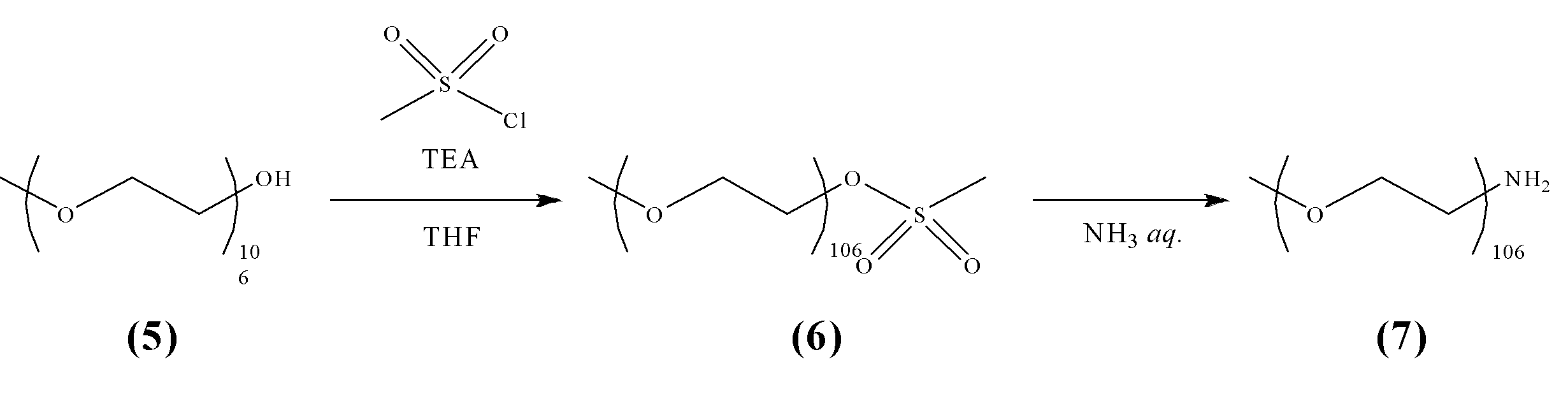
常温、アルゴン雰囲気下でポリ(エチレングリコール)メチルエーテル(式(5))(10.0g,2.00mmol)を脱水THFに溶解させた。その後、TEA(0.9mL,6.46mmol,式(5)で表される化合物に対して3.23当量)を添加し、氷浴下でメタンスルホニルクロリド(0.5mL,6.45mmol,式(5)で表される化合物に対して3.23当量)を滴下し、3時間攪拌した。攪拌後、セライトろ過、濃縮し、IPE(イソプロピルエーテル)により再沈殿を行い、凍結乾燥させた。得られた生成物が式(6)で表されるPEG-OMsであることを、1H-NMRによる構造解析により確認した(10.4g,収率:99.9%)。
常温、アルゴン雰囲気下でポリ(エチレングリコール)メチルエーテル(式(5))(10.0g,2.00mmol)を脱水THFに溶解させた。その後、TEA(0.9mL,6.46mmol,式(5)で表される化合物に対して3.23当量)を添加し、氷浴下でメタンスルホニルクロリド(0.5mL,6.45mmol,式(5)で表される化合物に対して3.23当量)を滴下し、3時間攪拌した。攪拌後、セライトろ過、濃縮し、IPE(イソプロピルエーテル)により再沈殿を行い、凍結乾燥させた。得られた生成物が式(6)で表されるPEG-OMsであることを、1H-NMRによる構造解析により確認した(10.4g,収率:99.9%)。
式(6)で表されるPEG-OMs(5.00g,0.99mmol)をアンモニウム溶液100mLに溶解させ、3日間常温で攪拌した。攪拌後、濃縮し、IPEによる再沈殿を行い、凍結乾燥させた。得られた生成物が式(7)で表されるPEG-NH2であることを、1H-NMRによる構造解析により確認した(4.88g,収率:99.9%)。反応スキームを以下に示す。
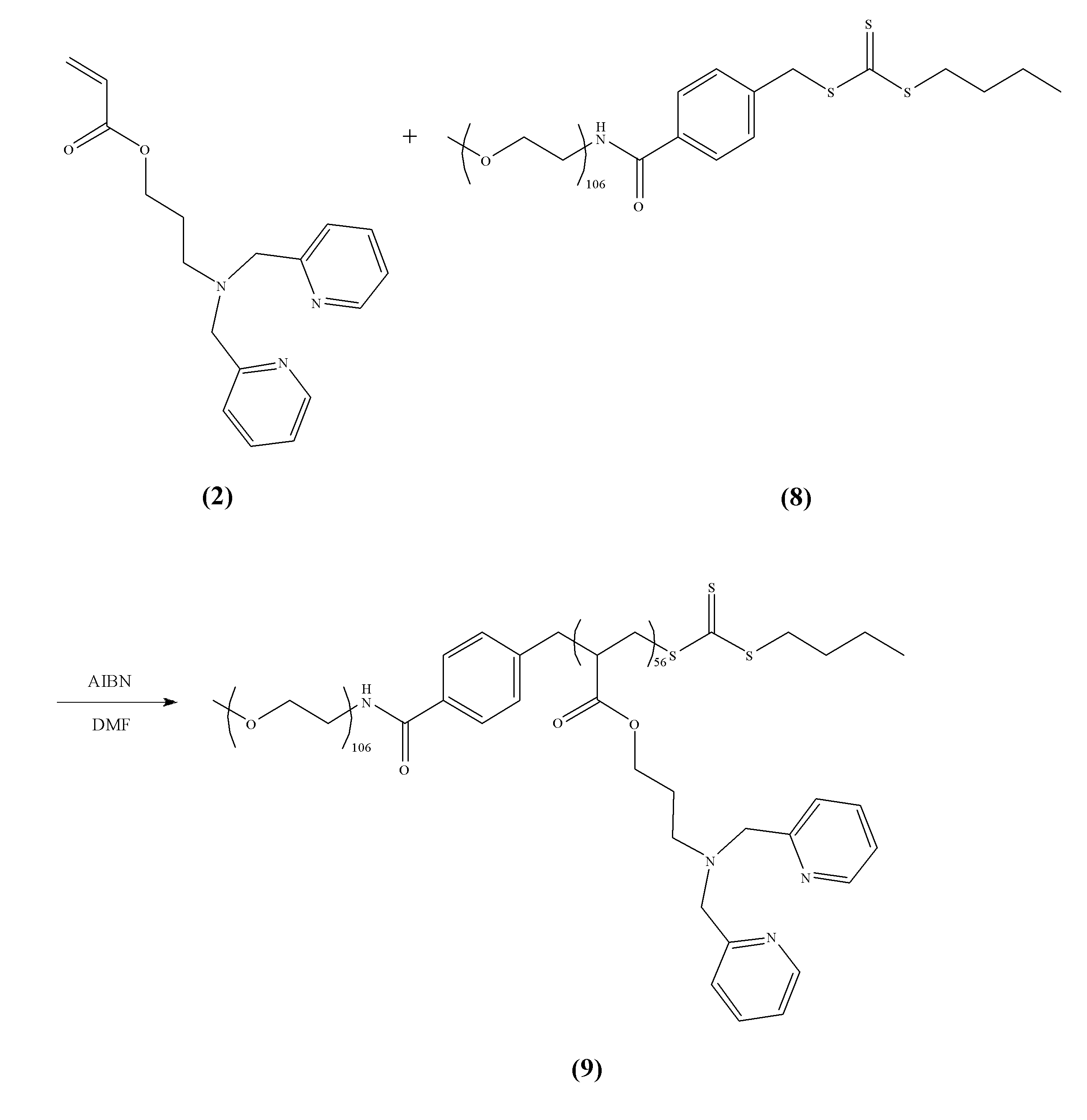
常温、アルゴン雰囲気下で、式(4)で表されるRAFT剤(1.496g,4.98mmol,式(7)で表される化合物に対して4.73当量)をトルエン約100mLに溶解させ、DCC(ジシクロヘキシルカルボジイミド)(1.042g,5.05mmol,式(7)で表される化合物に対して4.80当量)を加え、10分間攪拌した。攪拌後、PEG-NH2(式(7))(4.88g,1.05mmol)とDMAP(ジメチルアミノピリジン)(0.017g,0.115mmol,式(7)で表される化合物に対して10.9mol%)を加え、90℃、還流下で2日間攪拌した。その後、セライトろ過、濃縮し、IPEによる再沈殿を行い、凍結乾燥させた。得られた生成物が式(8)で表されるPEG-マクロ-RAFT剤であることを1H-NMRによる構造解析より確認した(4.20g,収率:81.1%)。反応スキームを以下に示す。

<両親媒性高分子の合成>
[PEG-b-DPAの合成]
式(2)で表されるDPAモノマー(3026mg,9.72mmol,式(8)で表される化合物に対して100当量)、式(8)で表されるPEG-マクロ-RAFT剤(478.6mg,0.0972mmol)、AIBN(アゾビスイソブチロニトリル)(4.79mg,0.0292mmol,式(8)で表される化合物に対して0.3当量)をDMF(ジメチルホルムアミド)9.72mL(モノマー濃度1M)に溶解させた。凍結脱気、アルゴン置換を行い、70℃において348時間攪拌した。反応後、ジエチルエーテルで再沈殿を行い、凍結乾燥により生成物を得た。1H-NMRによる構造解析より、DPAモノマーのユニットが56個連なったPEG-b-DPA56(式(9))の合成を確認した(2.12g,収率:60.5%)。反応スキームを以下に示す。
[PEG-b-DPAの合成]
式(2)で表されるDPAモノマー(3026mg,9.72mmol,式(8)で表される化合物に対して100当量)、式(8)で表されるPEG-マクロ-RAFT剤(478.6mg,0.0972mmol)、AIBN(アゾビスイソブチロニトリル)(4.79mg,0.0292mmol,式(8)で表される化合物に対して0.3当量)をDMF(ジメチルホルムアミド)9.72mL(モノマー濃度1M)に溶解させた。凍結脱気、アルゴン置換を行い、70℃において348時間攪拌した。反応後、ジエチルエーテルで再沈殿を行い、凍結乾燥により生成物を得た。1H-NMRによる構造解析より、DPAモノマーのユニットが56個連なったPEG-b-DPA56(式(9))の合成を確認した(2.12g,収率:60.5%)。反応スキームを以下に示す。
DPA-OH-Ptのスペクトルを確認したところ、0.5当量のスペクトルにおいて、DPA由来のピークとDPA-Pt由来のピークが観察できた。また、1.0当量のスペクトルはDPA由来のピークが観察されず、DPA-Pt由来のピークが観察された。2.0当量のスペクトルもDPA-Pt由来のピークが観察された。ピリジン環のアミンにPtが配位することによりピリジン環の電子状態が変化し、プロトンピークが低磁場側にシフトしたと考えられる。このピークシフトによりPEG-b-DPA-PtのPt錯体化率を決定できることを確認した。
<PEG-b-DPA-Ptの合成>
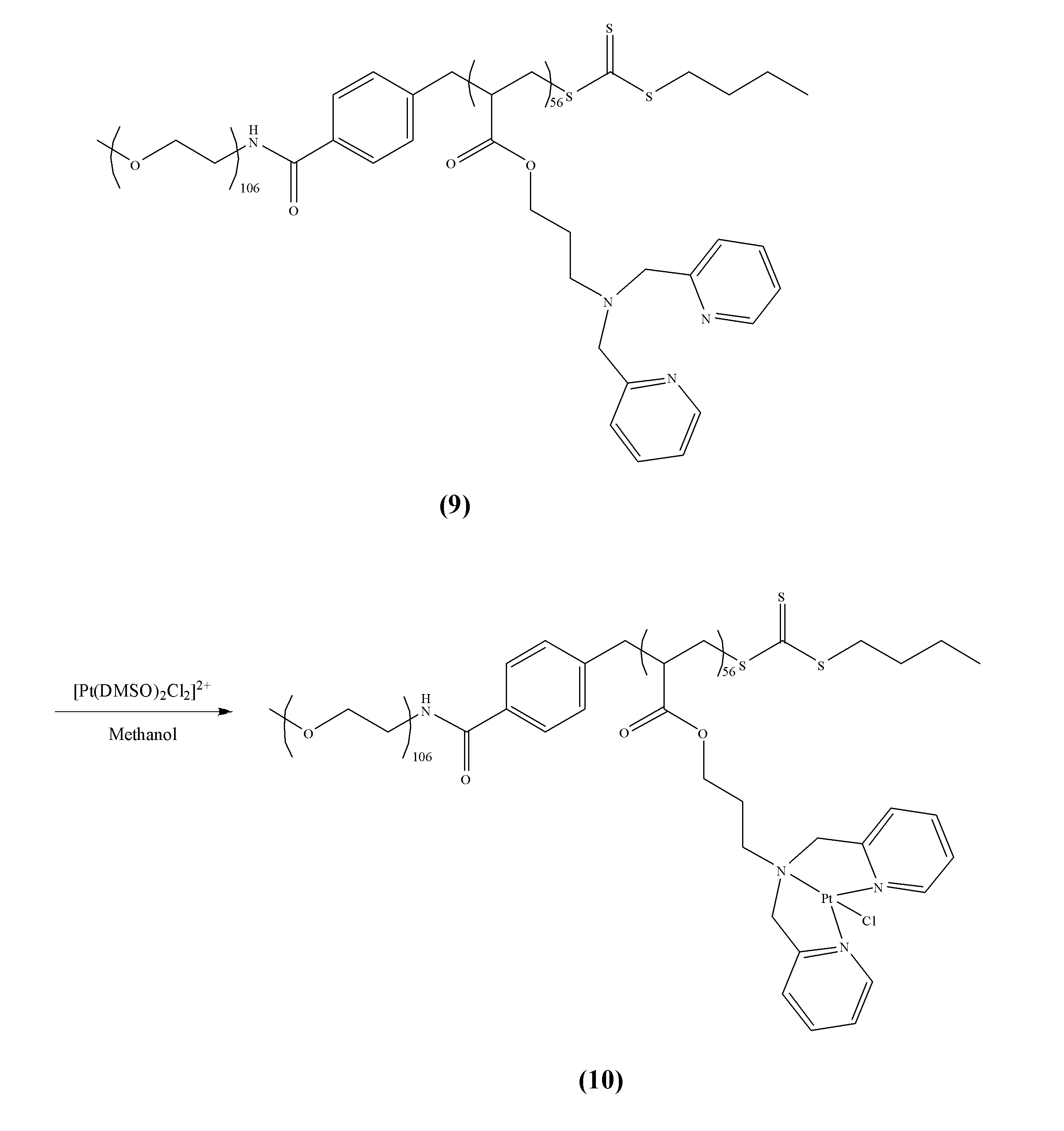
式(9)で表されるPEG-b-DPA(48.85mg,2.18μmol)をメタノール5mLに溶解させた溶液にPt(DMSO)2Cl2(69.08mg,0.164mmol,DPAユニットに対して1.337当量)をメタノール5mLに溶解させた溶液を滴下し、1日間攪拌した。その後、透析(MWCO:3500)による精製を行い、凍結乾燥を行った。得られた生成物が式(10)で表されるPEG-b-DPA-Ptであることを、1H-NMRのピークシフトより確認した(82.9mg,収率:92.9%)。PEG-b-DPAの白金錯体化は、DPAのピリジン環のアミンにPtが配位したことによるピリジン環の電子状態の変化を表した1H-NMRの低磁場側への定量的なピークシフトにより確認した。反応スキームを以下に示す。
式(9)で表されるPEG-b-DPA(48.85mg,2.18μmol)をメタノール5mLに溶解させた溶液にPt(DMSO)2Cl2(69.08mg,0.164mmol,DPAユニットに対して1.337当量)をメタノール5mLに溶解させた溶液を滴下し、1日間攪拌した。その後、透析(MWCO:3500)による精製を行い、凍結乾燥を行った。得られた生成物が式(10)で表されるPEG-b-DPA-Ptであることを、1H-NMRのピークシフトより確認した(82.9mg,収率:92.9%)。PEG-b-DPAの白金錯体化は、DPAのピリジン環のアミンにPtが配位したことによるピリジン環の電子状態の変化を表した1H-NMRの低磁場側への定量的なピークシフトにより確認した。反応スキームを以下に示す。
<PEG-b-DPAのミセル化>
PEG-b-DPA(式(9))50mgをジメチルスルホキシド5mLに溶解し、透析膜(MWCO:3500)を用いて、Milli-Q水に対する透析を行った。3日後、回収した溶液を1mg/mLに調整し、これを母液とした。母液から1、0.5、0.2、0.1、0.05、0.02、0.01、0.001、0.0001、0.00001mg/mLの各濃度の溶液4mLを調製し、3日間静置した。
PEG-b-DPA(式(9))50mgをジメチルスルホキシド5mLに溶解し、透析膜(MWCO:3500)を用いて、Milli-Q水に対する透析を行った。3日後、回収した溶液を1mg/mLに調整し、これを母液とした。母液から1、0.5、0.2、0.1、0.05、0.02、0.01、0.001、0.0001、0.00001mg/mLの各濃度の溶液4mLを調製し、3日間静置した。
<PEG-b-DPA-Ptのミセル化>
PEG-b-DPA-Pt(式(10))50mgをジメチルスルホキシド5mlに溶解し、透析膜(MWCO:3500)を用いて、PBSに対する透析を行った。3日後、回収した溶液を1mg/mLに調整し、これを母液とした。母液から1、0.5、0.2、0.1、0.05、0.02、0.01、0.001、0.0001、0.00001mg/mLの各濃度の溶液4mLを調製し、3日間静置した。
PEG-b-DPA-Pt(式(10))50mgをジメチルスルホキシド5mlに溶解し、透析膜(MWCO:3500)を用いて、PBSに対する透析を行った。3日後、回収した溶液を1mg/mLに調整し、これを母液とした。母液から1、0.5、0.2、0.1、0.05、0.02、0.01、0.001、0.0001、0.00001mg/mLの各濃度の溶液4mLを調製し、3日間静置した。
<PEG-b-DPA、PEG-b-DPA-Ptの物性評価>
[臨界ミセル濃度の評価]
上記にて得られたPEG-b-DPA(式(9))、PEG-b-DPA-Pt(式(10))のミセル溶液を用いて、ピレンの蛍光プローブ法により、それぞれの臨界ミセル濃度(cmc)を求めたところ、PEG-b-DPAのcmcは0.02597mg/mLと算出された。また、PEG-b-DPA-Ptのcmcは0.2277mg/mLと算出された。PBS中においてPEG-b-DPA-Ptの会合挙動が観察されたので、電荷的反発をイオン添加により緩和し会合体を形成したと考えられる。しかし、錯体化していないPEG-b-DPAと比較したところ、錯体化後のPEG-b-DPA-Ptのcmcがおよそ10倍であることが確認された。これは、Pt錯体化による親疎水バランスの変化によるものであると考えられ、電荷的反発のみが会合挙動に影響を及ぼしているわけではないと考えられる。
[臨界ミセル濃度の評価]
上記にて得られたPEG-b-DPA(式(9))、PEG-b-DPA-Pt(式(10))のミセル溶液を用いて、ピレンの蛍光プローブ法により、それぞれの臨界ミセル濃度(cmc)を求めたところ、PEG-b-DPAのcmcは0.02597mg/mLと算出された。また、PEG-b-DPA-Ptのcmcは0.2277mg/mLと算出された。PBS中においてPEG-b-DPA-Ptの会合挙動が観察されたので、電荷的反発をイオン添加により緩和し会合体を形成したと考えられる。しかし、錯体化していないPEG-b-DPAと比較したところ、錯体化後のPEG-b-DPA-Ptのcmcがおよそ10倍であることが確認された。これは、Pt錯体化による親疎水バランスの変化によるものであると考えられ、電荷的反発のみが会合挙動に影響を及ぼしているわけではないと考えられる。
[ダイナミック光散乱光度計による評価]
上記にて得られたPEG-b-DPAの母液(1.0mg/mL)を3mLとり、0.22μmフィルターでろ過後、ダイナミック光散乱光度計(DLS(Dinamic Light Scattaring)-7000(大塚電子(下部)、大阪、日本))を用いて、Arレーザー(488nm)により、測定を行った。また、PEG-b-DPA-Ptについても同様の操作を行った。その結果、PEG-b-DPA、PEG-b-DPA-Ptにおけるそれぞれのミセルの粒径は80.8nm、87.1nmであることが確認された。また、PEG-b-DPA、PEG-b-DPA-Ptにおけるミセルの多分散指数(P.D.)は、それぞれ0.06936、0.08488であり、いずれもミセルの多分散指数が0.1を下回る値を示していた。これにより、それぞれのミセルが非常に単分散であることが確認された。
上記にて得られたPEG-b-DPAの母液(1.0mg/mL)を3mLとり、0.22μmフィルターでろ過後、ダイナミック光散乱光度計(DLS(Dinamic Light Scattaring)-7000(大塚電子(下部)、大阪、日本))を用いて、Arレーザー(488nm)により、測定を行った。また、PEG-b-DPA-Ptについても同様の操作を行った。その結果、PEG-b-DPA、PEG-b-DPA-Ptにおけるそれぞれのミセルの粒径は80.8nm、87.1nmであることが確認された。また、PEG-b-DPA、PEG-b-DPA-Ptにおけるミセルの多分散指数(P.D.)は、それぞれ0.06936、0.08488であり、いずれもミセルの多分散指数が0.1を下回る値を示していた。これにより、それぞれのミセルが非常に単分散であることが確認された。
<Ptナノ粒子の作製>
上記にて得られたPEG-b-DPA-Ptミセル溶液(2mg/mL)を、150mM PBSを用いて希釈し、PEG-b-DPA-Pt(0.3533mg/mL)ミセル溶液6mLを調製した。調製したミセル溶液にNaBH4(12.71mg,DPAユニットに対して100当量)を直接加え、室温で1日間攪拌した。
上記にて得られたPEG-b-DPA-Ptミセル溶液(2mg/mL)を、150mM PBSを用いて希釈し、PEG-b-DPA-Pt(0.3533mg/mL)ミセル溶液6mLを調製した。調製したミセル溶液にNaBH4(12.71mg,DPAユニットに対して100当量)を直接加え、室温で1日間攪拌した。
ミセル溶液は還元剤を加えて1時間以内に黄色から茶色に変色した。還元剤の添加量の増加に伴い、溶液はよりこい茶色を呈し、Ptイオンの還元が示唆された。所定時間経過後も溶液は茶色の分散溶液であったことから、ミセルコア部でPt粒子が生成し、ブロック両親媒性高分子が分散剤としての役割を果たしていると考えられる。
[ダイナミック光散乱光度計による評価]
上記NaBH4の添加後の1日間の攪拌後、DLS測定とTEM観察を行った。DLS測定によると、ミセルの粒径は87.7nm、多分散指数(P.D.)は0.1144であった。還元前のミセル溶液は、粒径87.1nm、多分散指数(P.D.)は0.08488であった。このように、ミセルの粒径、多分散指数に大きな変化はみられなかった。これは、還元前後においてミセルが単分散性を維持していることを示しており、ミセルが崩壊することなくコアを反応場として還元が起きたことを示唆している。
上記NaBH4の添加後の1日間の攪拌後、DLS測定とTEM観察を行った。DLS測定によると、ミセルの粒径は87.7nm、多分散指数(P.D.)は0.1144であった。還元前のミセル溶液は、粒径87.1nm、多分散指数(P.D.)は0.08488であった。このように、ミセルの粒径、多分散指数に大きな変化はみられなかった。これは、還元前後においてミセルが単分散性を維持していることを示しており、ミセルが崩壊することなくコアを反応場として還元が起きたことを示唆している。
[TEM観察]
攪拌後のミセルにおいて、TEM観察を行ったところ、37.5-50nmのぼんやりとした黒い塊内に1-2nmの黒点が観察された。透過型電子顕微鏡(TEM)は試料を透過した電子の密度により画像のコントラストを得るため、画像のコントラストが濃い場所は電子線が透過しにくい金属、薄い場所は電子線が透過しやすい有機物が観察される。すなわち、TEMにより観察された黒点はPtナノ粒子であると考えられる。
攪拌後のミセルにおいて、TEM観察を行ったところ、37.5-50nmのぼんやりとした黒い塊内に1-2nmの黒点が観察された。透過型電子顕微鏡(TEM)は試料を透過した電子の密度により画像のコントラストを得るため、画像のコントラストが濃い場所は電子線が透過しにくい金属、薄い場所は電子線が透過しやすい有機物が観察される。すなわち、TEMにより観察された黒点はPtナノ粒子であると考えられる。
この結果より、ミセル溶液においてPEG-b-DPA-Pt会合体が一定の形状を保っていることや、1-2nmと非常にサイズ均一なPtナノ粒子が観察され、ミセルの形状を保ったままコア部にてPtナノ粒子が生成したことが考えられる。このミセルについて、STEMを用いて観察した画像を図1に示す。図1から、66nmのミセル内に1-2nmのPtナノ粒子が生成していることが確認された。
以上の結果より、NaBH4のDPAユニットに対して100当量加えることで、Ptナノ粒子が合成されることが確認された。なお、以下、還元剤の添加による1回目の還元後のPEG-b-DPA-Ptを「1streduced PEG-b-DPA-Pt」と呼称する。
<Ptナノ粒子の触媒活性評価>
1streduced PEG-b-DPA-Pt溶液(0.7377mg/mL)0.5677mL、4-ニトロフェノール水溶液(2mM)0.037mL、Milli-Q1.321mLを加えて溶液を調製し、全量を1.926mLにした。29.7mMに調製したNaBH4水溶液0.074mLを素早く加え、よく振り混ぜた後、直ちにUV-visスペクトル測定を開始した。その結果、4-ニトロフェノールの吸収波長である400nmにおけるピークの減少が確認された。これは、4-ニトロフェノールが4-アミノフェノールに変化したためであると考えられる。4-ニトロフェノールは触媒存在下においてのみ4-アミノフェノールに変化するため、1streduced PEG-b-DPA-Ptが触媒としてこの反応の進行に貢献したことが示唆された。
1streduced PEG-b-DPA-Pt溶液(0.7377mg/mL)0.5677mL、4-ニトロフェノール水溶液(2mM)0.037mL、Milli-Q1.321mLを加えて溶液を調製し、全量を1.926mLにした。29.7mMに調製したNaBH4水溶液0.074mLを素早く加え、よく振り混ぜた後、直ちにUV-visスペクトル測定を開始した。その結果、4-ニトロフェノールの吸収波長である400nmにおけるピークの減少が確認された。これは、4-ニトロフェノールが4-アミノフェノールに変化したためであると考えられる。4-ニトロフェノールは触媒存在下においてのみ4-アミノフェノールに変化するため、1streduced PEG-b-DPA-Ptが触媒としてこの反応の進行に貢献したことが示唆された。
<異種複合金属ナノ粒子の調製>
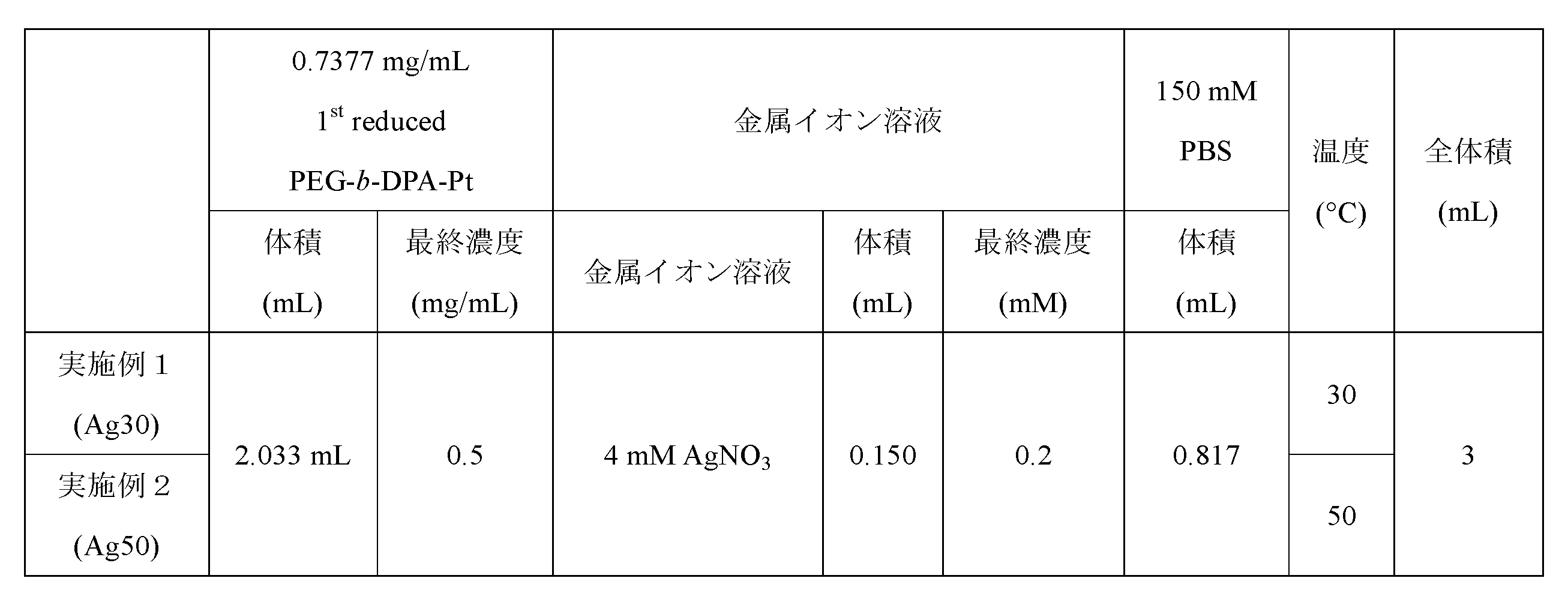
下記表1に示すとおりの組成で、実施例1、2の溶液を光学セルに調製し、各温度において静置した。一定時間ごとにUV-visスペクトル測定を行い、反応終了を確認後、DLS測定、TEM観察を行った。
下記表1に示すとおりの組成で、実施例1、2の溶液を光学セルに調製し、各温度において静置した。一定時間ごとにUV-visスペクトル測定を行い、反応終了を確認後、DLS測定、TEM観察を行った。
[UV-visスペクトル測定]
実施例1、2の溶液において、時間経過とともに金属ナノ粒子の表面プラズモン共鳴に由来するピークが観察された。しかし、1streduced PEG-b-DPA-Pt由来のベースライン上昇が観察されており、金属ナノ粒子由来のピークトップ波長の観察が困難なため、ブランクを1streduced PEG-b-DPA-Ptにし、各溶液についてUV-visスペクトル測定を行った。その結果を図2に示す。図2より、各溶液のピークトップ波長が、実施例1:408nm、実施例2:410nmであることが確認された。ピークトップ波長からも、Agイオンが還元されて、Agナノ粒子が生成していることが確認された。このように、Agイオンの還元が起こった理由は、Ptナノ粒子がラジカル移動の触媒になっているからであると考えられる。一般的に、Ptナノ粒子がラジカルスカベンジャーとしての能力を有しており、安定ラジカルとして有名な2,2-ジフェニル-1-ピクリルヒドラジル(DPPH)のラジカルをスカベンジすることが知られている。つまり、DPAから発生したラジカル、又は溶媒から発生したラジカルをPtナノ粒子がスカベンジし、Ptナノ粒子上に局所的にラジカルが集積されることにより、Agイオンの還元が起こったのではないかと考えられる。
実施例1、2の溶液において、時間経過とともに金属ナノ粒子の表面プラズモン共鳴に由来するピークが観察された。しかし、1streduced PEG-b-DPA-Pt由来のベースライン上昇が観察されており、金属ナノ粒子由来のピークトップ波長の観察が困難なため、ブランクを1streduced PEG-b-DPA-Ptにし、各溶液についてUV-visスペクトル測定を行った。その結果を図2に示す。図2より、各溶液のピークトップ波長が、実施例1:408nm、実施例2:410nmであることが確認された。ピークトップ波長からも、Agイオンが還元されて、Agナノ粒子が生成していることが確認された。このように、Agイオンの還元が起こった理由は、Ptナノ粒子がラジカル移動の触媒になっているからであると考えられる。一般的に、Ptナノ粒子がラジカルスカベンジャーとしての能力を有しており、安定ラジカルとして有名な2,2-ジフェニル-1-ピクリルヒドラジル(DPPH)のラジカルをスカベンジすることが知られている。つまり、DPAから発生したラジカル、又は溶媒から発生したラジカルをPtナノ粒子がスカベンジし、Ptナノ粒子上に局所的にラジカルが集積されることにより、Agイオンの還元が起こったのではないかと考えられる。
反応条件ごとに、各溶液の比較を行った。まず、30℃(実施例1)と50℃(実施例2)の比較を行った。その結果、50℃の方が金属イオンの還元スピードが速いことが確認された。これは、熱を加えたことによりDPAの活性化エネルギーが減少し、金属イオンの還元が促進されたからであると考えられる。また、熱を加えたことにより会合数が上昇し、ミセル反応場のDPA濃度が上昇し、還元されやすくなったとも考えられる。
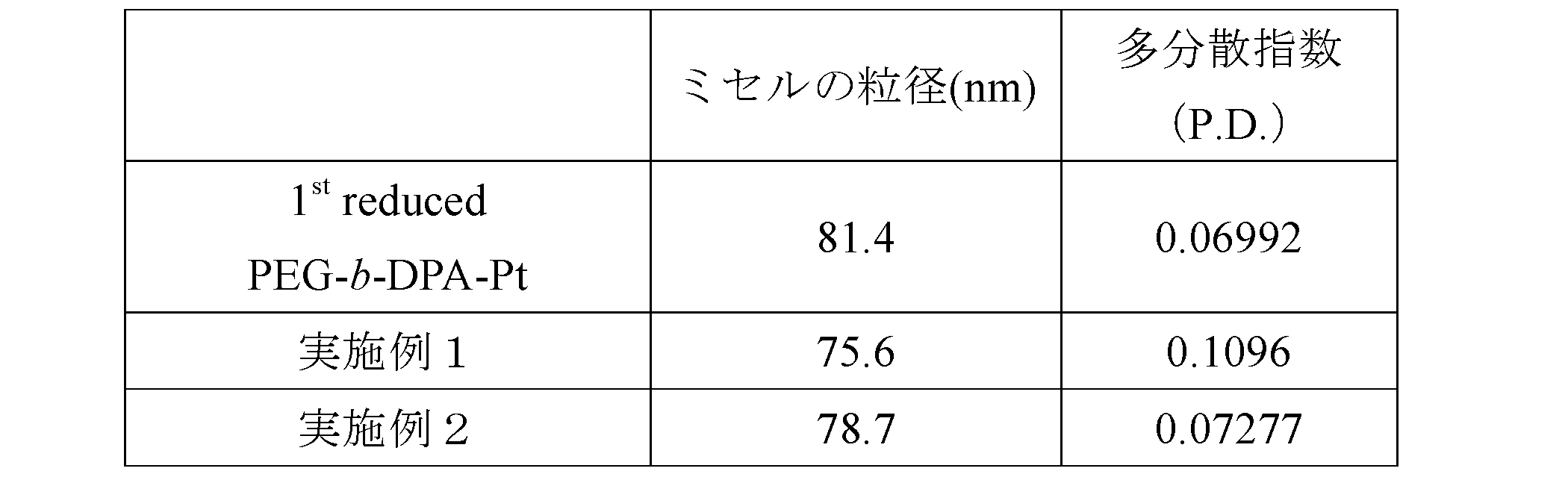
[ダイナミック光散乱光度計による評価]
DLSによる測定結果を、表2に示す。いずれの溶液においても金属イオン添加前と還元後では、ミセルの粒径、多分散指数には大きな変化はみられなかった。これは、還元前後においてミセルが単分散性を維持していることを示しており、ミセルが崩壊することなくコアを反応場として還元が起きたことを示唆している。
DLSによる測定結果を、表2に示す。いずれの溶液においても金属イオン添加前と還元後では、ミセルの粒径、多分散指数には大きな変化はみられなかった。これは、還元前後においてミセルが単分散性を維持していることを示しており、ミセルが崩壊することなくコアを反応場として還元が起きたことを示唆している。
[TEM観察]
各ミセルのTEM観察結果を図3に示す。図3において、実施例1、2では40nmのPEG-b-DPA-Ptミセルと1-2nmの黒点が観察された。この1-2nmの黒点が、Ptナノ粒子とAgナノ粒子の複合金属であると考えられる。
各ミセルのTEM観察結果を図3に示す。図3において、実施例1、2では40nmのPEG-b-DPA-Ptミセルと1-2nmの黒点が観察された。この1-2nmの黒点が、Ptナノ粒子とAgナノ粒子の複合金属であると考えられる。
<PEG-b-DPAを用いた金属ナノ粒子の作製>
下記表3に示す組成のとおりに、試験例1の溶液を光学セルに調製し、各温度において静置した。一定時間ごとにUV-visスペクトル測定を行った。
下記表3に示す組成のとおりに、試験例1の溶液を光学セルに調製し、各温度において静置した。一定時間ごとにUV-visスペクトル測定を行った。

試験例1のUV-visスペクトル測定結果を図4に示す。図4より、Auイオン添加系(試験例1)において、金属ナノ粒子のプラズモン共鳴に由来するピークが観察された。これは、DPAの3級アミンから発生するラジカルによりAuイオンが還元されAuナノ粒子が生成したものと考えられる。
<異種複合金属ナノ粒子の触媒活性評価>
4-ニトロフェノール水溶液(2mM)0.037mL、実施例1、2の溶液(いずれも0.5mg/mL)0.838mL、Milli-Q1.051mLを光学セルに添加し、全量を1.926mLにした。29.7mMに調整したNaBH4水溶液0.074mLを素早く加え、よく振り混ぜた後、直ちにUV-visスペクトル測定を開始した。
4-ニトロフェノール水溶液(2mM)0.037mL、実施例1、2の溶液(いずれも0.5mg/mL)0.838mL、Milli-Q1.051mLを光学セルに添加し、全量を1.926mLにした。29.7mMに調整したNaBH4水溶液0.074mLを素早く加え、よく振り混ぜた後、直ちにUV-visスペクトル測定を開始した。
[触媒活性評価]
UV-visスペクトル測定結果に基づき、λ=400nmにおける吸光度の時間依存的変化を対数で表したグラフを図5に示す。図5から反応速度定数kを算出した。kは以下の式を用いて算出し、その結果を表4に示す。
UV-visスペクトル測定結果に基づき、λ=400nmにおける吸光度の時間依存的変化を対数で表したグラフを図5に示す。図5から反応速度定数kを算出した。kは以下の式を用いて算出し、その結果を表4に示す。
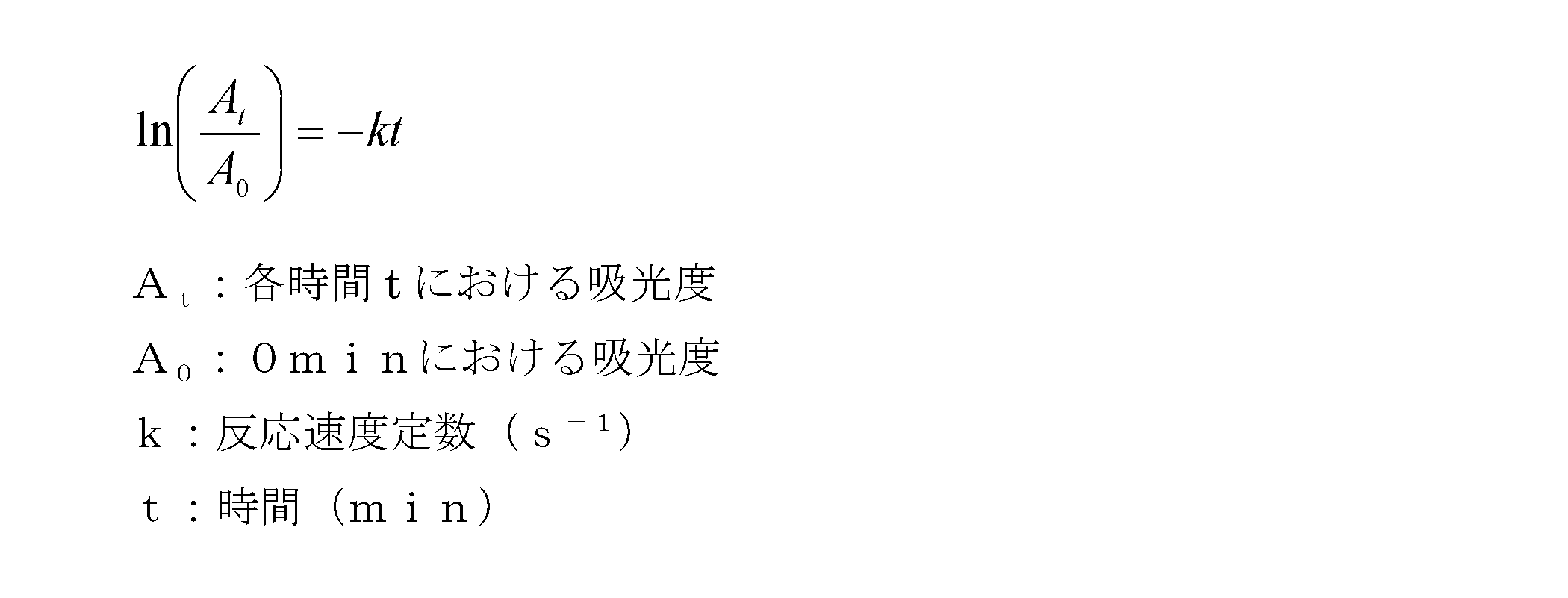

表4より、実施例1、2においては、1streduced PEG-b-DPA-Ptと比較すると反応速度定数が500倍と飛躍的に向上した。このように、実施例1、2は、1streduced PEG-b-DPA-Ptと比較して、触媒活性が極めて優れていることが確認された。また、実施例1(30℃還元)と、実施例2(50℃還元)を比較すると、実施例2の方が、触媒活性が若干高かった。これは、rigidな相構造を有する金属結晶の形成のためであると考えられる。
<2回還元によるPtナノ粒子の作製及び触媒活性評価>
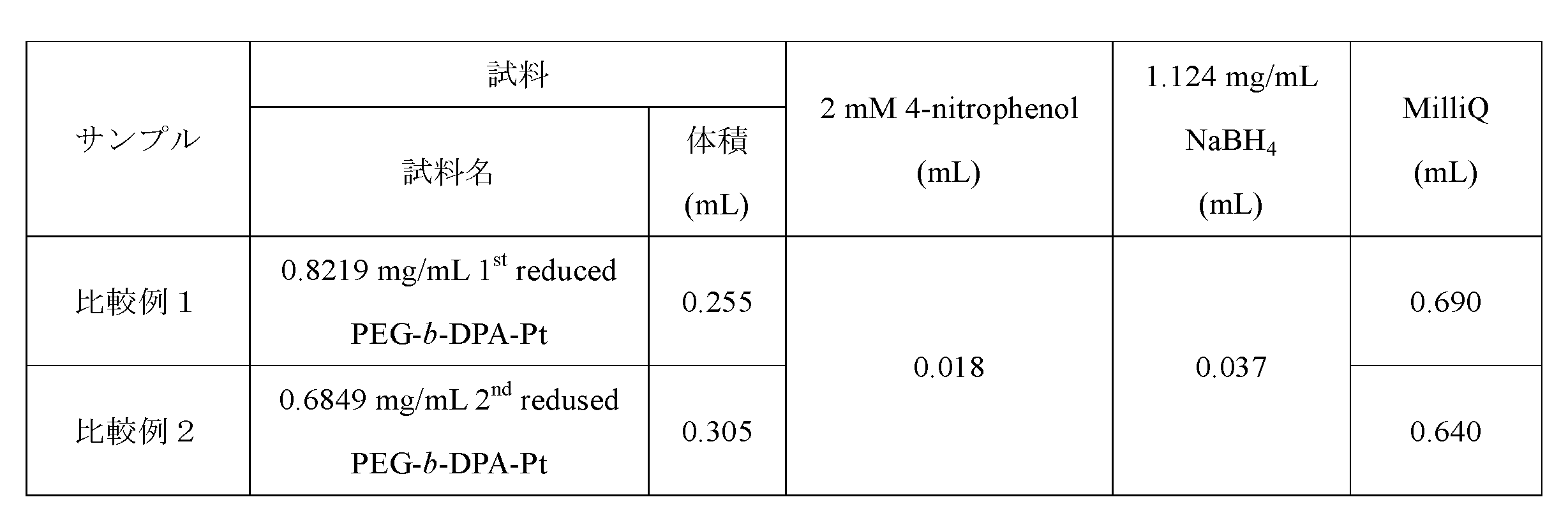
PEG-b-DPA-Ptミセル溶液(1mg/mL)6mLにNaBH436.00mg(Ptに対して100当量)を加え1日攪拌した後、PBSに対して1日透析を行った(1回還元)。透析後の溶液に対し、再度NaBH433mg(Ptに対して100当量)を加え1日攪拌した後、1日PBSに対して透析を行っている(2回還元)。1回還元、2回還元のそれぞれの溶液を用いて、4-ニトロフェノールによる触媒活性評価を行った。以下の表5に示すとおりの組成の溶液を調製し(比較例1、比較例2)、時間依存的なUV-visスペクトル測定結果より評価を行った。
PEG-b-DPA-Ptミセル溶液(1mg/mL)6mLにNaBH436.00mg(Ptに対して100当量)を加え1日攪拌した後、PBSに対して1日透析を行った(1回還元)。透析後の溶液に対し、再度NaBH433mg(Ptに対して100当量)を加え1日攪拌した後、1日PBSに対して透析を行っている(2回還元)。1回還元、2回還元のそれぞれの溶液を用いて、4-ニトロフェノールによる触媒活性評価を行った。以下の表5に示すとおりの組成の溶液を調製し(比較例1、比較例2)、時間依存的なUV-visスペクトル測定結果より評価を行った。
比較例1、2のそれぞれのサンプルの400nmにおけるピーク変化を図6に示す。図6に示すように、2回還元することによって、作製されたPtナノ粒子の触媒活性は、1回目のみ還元されたものより若干触媒活性が高いが、大きな差は確認されなかった。
上記に示したとおり、実施例1、2(Pt/Agナノ粒子)は、1streduced PEG-b-DPA-Pt(Ptナノ粒子)と比較して、触媒活性が極めて優れていることが確認された。また、Ptナノ粒子を、還元剤を利用して2回還元して作製したPtナノ粒子(比較例2)も、1回還元したもの(比較例1、すなわち1streduced PEG-b-DPA-Pt)と触媒活性において大きな差がみられなかったことから、実施例1、2(Pt/Agナノ粒子)は、2回還元して作製したPtナノ粒子(比較例2)と比較しても、極めて優れた触媒活性を有していることが示された。ここで、Ptナノ粒子は、Agナノ粒子よりも、触媒活性が極めて高いことが、従来から知られている(Kunio Esumi,et al., Langmuir, vol.20, No.1,p237-243(2004)を参照)。そうすると、Ptナノ粒子とAgナノ粒子との触媒活性を併せても、Ptナノ粒子のみのものの触媒活性とほとんど変わらないはずである。にもかかわらず、上記のとおり、実施例1、2(Pt/Agナノ粒子)は、Ptナノ粒子と比較して、極めて高い活性を有する。これは、上記方法により調製したPt/Agナノ粒子が、コア/シェル構造をとるか、あるいは、PtとAgとからなる合金構造をとり、Pt/Ag間で何らかの相互作用が働き、結果として極めて高い触媒活性を示しているからであると考えられる。
Claims (4)
- 異種複合金属ナノ粒子の調製方法であって、
金属原子に配位結合する多座配位子を有する疎水部と親水部とを有する両親媒性高分子と、第1の金属のイオンとの、金属高分子錯体からなる、疎水部を内側とするミセルを形成する工程と、
前記ミセルの内部の前記第1の金属のイオンを還元し、前記第1の金属のナノ粒子を形成する工程と、
前記ミセルの内部に前記第1の金属とは異なる第2の金属のイオンを導入した後、該イオンを還元することによって、前記異種複合金属ナノ粒子を調製する工程と、を有し、
前記第1の金属及び前記第2の金属が、白金、金、銀、銅、ニッケル、パラジウム、ロジウム、コバルト、及び亜鉛からなる群から選択される元素である異種複合金属ナノ粒子の調製方法。 - 前記第1の金属が白金又は金であり、前記第2の金属が銀である請求項1記載の異種複合金属ナノ粒子の調製方法。
- 請求項1又は2記載の方法によって調製された異種複合金属ナノ粒子。
- 白金、金、銀、銅、ニッケル、パラジウム、ロジウム、コバルト、及び亜鉛からなる群から選択される2種の金属からなる異種複合金属ナノ粒子。
Applications Claiming Priority (2)
| Application Number | Priority Date | Filing Date | Title |
|---|---|---|---|
| JP2013-248603 | 2013-11-29 | ||
| JP2013248603A JP6241929B2 (ja) | 2013-11-29 | 2013-11-29 | 異種複合金属ナノ粒子の調製方法 |
Publications (1)
| Publication Number | Publication Date |
|---|---|
| WO2015079788A1 true WO2015079788A1 (ja) | 2015-06-04 |
Family
ID=53198742
Family Applications (1)
| Application Number | Title | Priority Date | Filing Date |
|---|---|---|---|
| PCT/JP2014/075055 Ceased WO2015079788A1 (ja) | 2013-11-29 | 2014-09-22 | 金属ナノ粒子の調製方法及び金属ナノ粒子 |
Country Status (2)
| Country | Link |
|---|---|
| JP (1) | JP6241929B2 (ja) |
| WO (1) | WO2015079788A1 (ja) |
Cited By (4)
| Publication number | Priority date | Publication date | Assignee | Title |
|---|---|---|---|---|
| CN108746660A (zh) * | 2018-06-11 | 2018-11-06 | 盐城工学院 | 一种铜金铂复合纳米材料的制备方法及其在检测半胱氨酸上的应用 |
| JP2020090644A (ja) * | 2018-12-07 | 2020-06-11 | 学校法人東京理科大学 | 高分子金属錯体及びその製造方法 |
| CN112236254A (zh) * | 2018-06-08 | 2021-01-15 | 韩国科学技术研究院 | 用非晶态纳米结构体制备的超小型纳米结构体及其制备方法 |
| CN115351288A (zh) * | 2022-08-23 | 2022-11-18 | 西北工业大学 | 一种金纳米花及其制备方法和应用 |
Families Citing this family (3)
| Publication number | Priority date | Publication date | Assignee | Title |
|---|---|---|---|---|
| WO2022097580A1 (ja) * | 2020-11-06 | 2022-05-12 | 五洋紙工株式会社 | ジピコリルアミン部分を有する化合物およびその製造方法ならびにそれを用いた抗菌組成物 |
| JP7696544B2 (ja) * | 2021-06-14 | 2025-06-23 | 大日本印刷株式会社 | 金属ナノ粒子担持ポリマー、組成物、物品、及び該ポリマーの製造方法 |
| JP7700422B2 (ja) * | 2021-06-14 | 2025-07-01 | 大日本印刷株式会社 | 金属ナノ粒子担持ポリマー、組成物、物品、及び該ポリマーの製造方法 |
Citations (17)
| Publication number | Priority date | Publication date | Assignee | Title |
|---|---|---|---|---|
| JP2007191789A (ja) * | 2005-12-19 | 2007-08-02 | Fujifilm Corp | コア/シェル型粒子およびその製造方法 |
| JP2009510705A (ja) * | 2005-08-01 | 2009-03-12 | ブルックヘヴン サイエンス アソシエイツ | プラチナナノ粒子コア上に金の単原子層を含む電極触媒及びその使用 |
| WO2009096569A1 (ja) * | 2008-02-01 | 2009-08-06 | Kyushu University, National University Corporation | 金属ナノ材料の製造方法およびそれにより得られる金属ナノ材料 |
| JP2009533545A (ja) * | 2006-03-08 | 2009-09-17 | ノースウエスタン ユニバーシティ | ナノプリズムを形成するための2種類の成分からなるナノ粒子中における金の光誘起相分離 |
| JP2010065260A (ja) * | 2008-09-09 | 2010-03-25 | Tohoku Univ | 銀被覆銅微粉の製造方法 |
| JP2010185135A (ja) * | 2009-01-14 | 2010-08-26 | Kyushu Univ | コアシェル型金属ナノ粒子の製造方法 |
| JP2010189682A (ja) * | 2009-02-17 | 2010-09-02 | Shinko Kagaku Kogyosho:Kk | 複合金属ナノ粒子コロイド、複合金属ナノ粒子、複合金属ナノ粒子コロイドの製造方法、複合金属ナノ粒子の製造方法ならびに複合金属ナノ粒子コロイドの製造装置 |
| JP2011017071A (ja) * | 2009-07-10 | 2011-01-27 | Toyota Motor Corp | 二元系金属ナノ粒子の製造方法 |
| JP2011042863A (ja) * | 2009-08-19 | 2011-03-03 | Samsung Electro-Mechanics Co Ltd | 金属シードを用いた金属ナノ粒子の製造方法及び金属シードを含む金属ナノ粒子 |
| JP2011068936A (ja) * | 2009-09-25 | 2011-04-07 | Yamagata Univ | 銀コア銀銅合金シェルナノ微粒子とその微粒子被着物及びその焼結被着物 |
| WO2011071167A1 (ja) * | 2009-12-11 | 2011-06-16 | 学校法人東京理科大学 | 金-銀コアシェルナノロッド粒子及びその製造方法 |
| JP2011219807A (ja) * | 2010-04-07 | 2011-11-04 | Fujifilm Corp | 金属平板含有組成物及び熱線遮蔽材 |
| JP2012041581A (ja) * | 2010-08-17 | 2012-03-01 | Sony Corp | コアシェル型微粒子及びこれを用いた機能デバイス |
| JP2012184506A (ja) * | 2011-02-18 | 2012-09-27 | Tanaka Kikinzoku Kogyo Kk | 金属ナノ粒子及び金属ナノ粒子の製造方法 |
| JP2013057605A (ja) * | 2011-09-08 | 2013-03-28 | Kyushu Univ | 銀シェル金ナノロッドを用いる分析方法 |
| JP2013181177A (ja) * | 2012-02-29 | 2013-09-12 | Jx Nippon Mining & Metals Corp | コバルトめっき銅微粉及びコバルトめっき銅微粉を用いて製造した導電ペースト並びにコバルトめっき銅微粉の製造方法 |
| JP2013185213A (ja) * | 2012-03-08 | 2013-09-19 | Tokyo Institute Of Technology | 金属ナノ粒子及びその製造方法並びに導電性インク |
-
2013
- 2013-11-29 JP JP2013248603A patent/JP6241929B2/ja not_active Expired - Fee Related
-
2014
- 2014-09-22 WO PCT/JP2014/075055 patent/WO2015079788A1/ja not_active Ceased
Patent Citations (17)
| Publication number | Priority date | Publication date | Assignee | Title |
|---|---|---|---|---|
| JP2009510705A (ja) * | 2005-08-01 | 2009-03-12 | ブルックヘヴン サイエンス アソシエイツ | プラチナナノ粒子コア上に金の単原子層を含む電極触媒及びその使用 |
| JP2007191789A (ja) * | 2005-12-19 | 2007-08-02 | Fujifilm Corp | コア/シェル型粒子およびその製造方法 |
| JP2009533545A (ja) * | 2006-03-08 | 2009-09-17 | ノースウエスタン ユニバーシティ | ナノプリズムを形成するための2種類の成分からなるナノ粒子中における金の光誘起相分離 |
| WO2009096569A1 (ja) * | 2008-02-01 | 2009-08-06 | Kyushu University, National University Corporation | 金属ナノ材料の製造方法およびそれにより得られる金属ナノ材料 |
| JP2010065260A (ja) * | 2008-09-09 | 2010-03-25 | Tohoku Univ | 銀被覆銅微粉の製造方法 |
| JP2010185135A (ja) * | 2009-01-14 | 2010-08-26 | Kyushu Univ | コアシェル型金属ナノ粒子の製造方法 |
| JP2010189682A (ja) * | 2009-02-17 | 2010-09-02 | Shinko Kagaku Kogyosho:Kk | 複合金属ナノ粒子コロイド、複合金属ナノ粒子、複合金属ナノ粒子コロイドの製造方法、複合金属ナノ粒子の製造方法ならびに複合金属ナノ粒子コロイドの製造装置 |
| JP2011017071A (ja) * | 2009-07-10 | 2011-01-27 | Toyota Motor Corp | 二元系金属ナノ粒子の製造方法 |
| JP2011042863A (ja) * | 2009-08-19 | 2011-03-03 | Samsung Electro-Mechanics Co Ltd | 金属シードを用いた金属ナノ粒子の製造方法及び金属シードを含む金属ナノ粒子 |
| JP2011068936A (ja) * | 2009-09-25 | 2011-04-07 | Yamagata Univ | 銀コア銀銅合金シェルナノ微粒子とその微粒子被着物及びその焼結被着物 |
| WO2011071167A1 (ja) * | 2009-12-11 | 2011-06-16 | 学校法人東京理科大学 | 金-銀コアシェルナノロッド粒子及びその製造方法 |
| JP2011219807A (ja) * | 2010-04-07 | 2011-11-04 | Fujifilm Corp | 金属平板含有組成物及び熱線遮蔽材 |
| JP2012041581A (ja) * | 2010-08-17 | 2012-03-01 | Sony Corp | コアシェル型微粒子及びこれを用いた機能デバイス |
| JP2012184506A (ja) * | 2011-02-18 | 2012-09-27 | Tanaka Kikinzoku Kogyo Kk | 金属ナノ粒子及び金属ナノ粒子の製造方法 |
| JP2013057605A (ja) * | 2011-09-08 | 2013-03-28 | Kyushu Univ | 銀シェル金ナノロッドを用いる分析方法 |
| JP2013181177A (ja) * | 2012-02-29 | 2013-09-12 | Jx Nippon Mining & Metals Corp | コバルトめっき銅微粉及びコバルトめっき銅微粉を用いて製造した導電ペースト並びにコバルトめっき銅微粉の製造方法 |
| JP2013185213A (ja) * | 2012-03-08 | 2013-09-19 | Tokyo Institute Of Technology | 金属ナノ粒子及びその製造方法並びに導電性インク |
Non-Patent Citations (2)
| Title |
|---|
| DAISUKE MATSUKUMA ET AL.: "Pyridine Unit o Yusuru Shinsuisei Block Kyojugotai Sonzaika deno Kinzoku Ion Kangen Mechanism", POLYMER PREPRINTS, vol. 62, no. 1, 14 May 2013 (2013-05-14), JAPAN, pages 1626 * |
| YUSUKE IKENAGA ET AL.: "PEG-b- Py(Pyridine) Block Kyojugotai no Nano Ryushika to Saibo Shinwasei ni Kansuru Shosai Kento", POLYMER PREPRINTS, vol. 61, no. 1, 15 May 2012 (2012-05-15), JAPAN, pages 255 * |
Cited By (6)
| Publication number | Priority date | Publication date | Assignee | Title |
|---|---|---|---|---|
| CN112236254A (zh) * | 2018-06-08 | 2021-01-15 | 韩国科学技术研究院 | 用非晶态纳米结构体制备的超小型纳米结构体及其制备方法 |
| CN108746660A (zh) * | 2018-06-11 | 2018-11-06 | 盐城工学院 | 一种铜金铂复合纳米材料的制备方法及其在检测半胱氨酸上的应用 |
| JP2020090644A (ja) * | 2018-12-07 | 2020-06-11 | 学校法人東京理科大学 | 高分子金属錯体及びその製造方法 |
| JP7113509B2 (ja) | 2018-12-07 | 2022-08-05 | 学校法人東京理科大学 | 高分子金属錯体の製造方法 |
| CN115351288A (zh) * | 2022-08-23 | 2022-11-18 | 西北工业大学 | 一种金纳米花及其制备方法和应用 |
| CN115351288B (zh) * | 2022-08-23 | 2023-06-23 | 西北工业大学 | 一种金纳米花及其制备方法和应用 |
Also Published As
| Publication number | Publication date |
|---|---|
| JP6241929B2 (ja) | 2017-12-06 |
| JP2015105420A (ja) | 2015-06-08 |
Similar Documents
| Publication | Publication Date | Title |
|---|---|---|
| JP6241929B2 (ja) | 異種複合金属ナノ粒子の調製方法 | |
| Lligadas et al. | Recent developments in the synthesis of biomacromolecules and their conjugates by single electron transfer–living radical polymerization | |
| Niskanen et al. | How to manipulate the upper critical solution temperature (UCST)? | |
| Alqarni et al. | Synthetic routes to single chain polymer nanoparticles (SCNPs): current status and perspectives | |
| Zhang et al. | Cobaltocenium-containing methacrylate homopolymers, block copolymers, and heterobimetallic polymers via RAFT polymerization | |
| Wang et al. | Segmented highly branched copolymers: Rationally designed macromolecules for improved and tunable 19F MRI | |
| Vogt et al. | Tuning the temperature response of branched poly (N-isopropylacrylamide) prepared by RAFT polymerization | |
| DE60024605T2 (de) | Katalytische prozesse für die kontrollierte polymerisation von freiradikalischen, copolymerisierbaren monomeren und funktionellpolymersysteme hergestellt davon | |
| Zhang et al. | Synthesis of comb copolymers with pendant chromophore groups based on RAFT polymerization and click chemistry and formation of electron donor− acceptor supramolecules | |
| Ding et al. | Facile arm-first synthesis of star block copolymers via ARGET ATRP with ppm amounts of catalyst | |
| Darabi et al. | Nitroxide-mediated polymerization of 2-(diethylamino) ethyl methacrylate (DEAEMA) in water | |
| JP2008530306A (ja) | 改質された炭素粒子 | |
| JP4106240B2 (ja) | リビングラジカル重合開始基を有するポリマー微粒子及びその製造方法 | |
| Billing et al. | ATRP of tert-Butoxycarbonylaminomethyl acrylate (t BAMA): Well-Defined Precursors for Polyelectrolytes of Tunable Charge | |
| JP5594730B2 (ja) | 金属高分子錯体からなるミセルの分散液 | |
| Pafiti et al. | End-Linked poly [2-(dimethylamino) ethyl methacrylate]–poly (methacrylic acid) polyampholyte conetworks: Synthesis by sequential RAFT polymerization and swelling and SANS characterization | |
| Hou et al. | A supramolecular miktoarm star polymer based on porphyrin metal complexation in water | |
| CN102391413A (zh) | 一种侧链功能化聚合物及其制备方法 | |
| JP5097113B2 (ja) | 鎖末端官能性化したポリエチレンオキシド及びこれを用いたナノ寸法の遷移金属及びその塩の製造方法 | |
| Kuila et al. | Phase Behavior of Poly (vinylidene fluoride)-graft-poly (diethylene glycol methyl ether methacrylate) in Alcohol–Water System: Coexistence of LCST and UCST | |
| Pafiti et al. | High‐molecular‐weight symmetrical multiblock copolymers: Synthesis by RAFT polymerization and characterization | |
| JP2013017994A (ja) | 金属イオンの分離方法 | |
| Ren et al. | Synthesis of a star polymer library with a diverse range of highly functionalized macromolecular architectures | |
| JP3867400B2 (ja) | ボロン酸基含有単量体およびその重合体 | |
| Vo et al. | Synthesis of zwitterionic diblock copolymers without protecting group chemistry |
Legal Events
| Date | Code | Title | Description |
|---|---|---|---|
| 121 | Ep: the epo has been informed by wipo that ep was designated in this application |
Ref document number: 14865090 Country of ref document: EP Kind code of ref document: A1 |
|
| NENP | Non-entry into the national phase |
Ref country code: DE |
|
| 122 | Ep: pct application non-entry in european phase |
Ref document number: 14865090 Country of ref document: EP Kind code of ref document: A1 |