WO2015076533A1 - 탄소섬유 제조용 등방성 피치의 제조방법 - Google Patents
탄소섬유 제조용 등방성 피치의 제조방법 Download PDFInfo
- Publication number
- WO2015076533A1 WO2015076533A1 PCT/KR2014/010967 KR2014010967W WO2015076533A1 WO 2015076533 A1 WO2015076533 A1 WO 2015076533A1 KR 2014010967 W KR2014010967 W KR 2014010967W WO 2015076533 A1 WO2015076533 A1 WO 2015076533A1
- Authority
- WO
- WIPO (PCT)
- Prior art keywords
- raw material
- isotropic pitch
- content
- total amount
- naphthalenes
- Prior art date
- Legal status (The legal status is an assumption and is not a legal conclusion. Google has not performed a legal analysis and makes no representation as to the accuracy of the status listed.)
- Ceased
Links
Classifications
-
- D—TEXTILES; PAPER
- D01—NATURAL OR MAN-MADE THREADS OR FIBRES; SPINNING
- D01F—CHEMICAL FEATURES IN THE MANUFACTURE OF ARTIFICIAL FILAMENTS, THREADS, FIBRES, BRISTLES OR RIBBONS; APPARATUS SPECIALLY ADAPTED FOR THE MANUFACTURE OF CARBON FILAMENTS
- D01F9/00—Artificial filaments or the like of other substances; Manufacture thereof; Apparatus specially adapted for the manufacture of carbon filaments
- D01F9/08—Artificial filaments or the like of other substances; Manufacture thereof; Apparatus specially adapted for the manufacture of carbon filaments of inorganic material
- D01F9/12—Carbon filaments; Apparatus specially adapted for the manufacture thereof
- D01F9/14—Carbon filaments; Apparatus specially adapted for the manufacture thereof by decomposition of organic filaments
- D01F9/145—Carbon filaments; Apparatus specially adapted for the manufacture thereof by decomposition of organic filaments from pitch or distillation residues
- D01F9/155—Carbon filaments; Apparatus specially adapted for the manufacture thereof by decomposition of organic filaments from pitch or distillation residues from petroleum pitch
-
- C—CHEMISTRY; METALLURGY
- C01—INORGANIC CHEMISTRY
- C01B—NON-METALLIC ELEMENTS; COMPOUNDS THEREOF; METALLOIDS OR COMPOUNDS THEREOF NOT COVERED BY SUBCLASS C01C
- C01B32/00—Carbon; Compounds thereof
- C01B32/05—Preparation or purification of carbon not covered by groups C01B32/15, C01B32/20, C01B32/25, C01B32/30
-
- C—CHEMISTRY; METALLURGY
- C10—PETROLEUM, GAS OR COKE INDUSTRIES; TECHNICAL GASES CONTAINING CARBON MONOXIDE; FUELS; LUBRICANTS; PEAT
- C10C—WORKING-UP PITCH, ASPHALT, BITUMEN, TAR; PYROLIGNEOUS ACID
- C10C1/00—Working-up tar
- C10C1/19—Working-up tar by thermal treatment not involving distillation
-
- C—CHEMISTRY; METALLURGY
- C10—PETROLEUM, GAS OR COKE INDUSTRIES; TECHNICAL GASES CONTAINING CARBON MONOXIDE; FUELS; LUBRICANTS; PEAT
- C10C—WORKING-UP PITCH, ASPHALT, BITUMEN, TAR; PYROLIGNEOUS ACID
- C10C3/00—Working-up pitch, asphalt, bitumen
-
- C—CHEMISTRY; METALLURGY
- C10—PETROLEUM, GAS OR COKE INDUSTRIES; TECHNICAL GASES CONTAINING CARBON MONOXIDE; FUELS; LUBRICANTS; PEAT
- C10C—WORKING-UP PITCH, ASPHALT, BITUMEN, TAR; PYROLIGNEOUS ACID
- C10C3/00—Working-up pitch, asphalt, bitumen
- C10C3/002—Working-up pitch, asphalt, bitumen by thermal means
-
- D—TEXTILES; PAPER
- D01—NATURAL OR MAN-MADE THREADS OR FIBRES; SPINNING
- D01F—CHEMICAL FEATURES IN THE MANUFACTURE OF ARTIFICIAL FILAMENTS, THREADS, FIBRES, BRISTLES OR RIBBONS; APPARATUS SPECIALLY ADAPTED FOR THE MANUFACTURE OF CARBON FILAMENTS
- D01F9/00—Artificial filaments or the like of other substances; Manufacture thereof; Apparatus specially adapted for the manufacture of carbon filaments
- D01F9/08—Artificial filaments or the like of other substances; Manufacture thereof; Apparatus specially adapted for the manufacture of carbon filaments of inorganic material
- D01F9/12—Carbon filaments; Apparatus specially adapted for the manufacture thereof
- D01F9/14—Carbon filaments; Apparatus specially adapted for the manufacture thereof by decomposition of organic filaments
- D01F9/145—Carbon filaments; Apparatus specially adapted for the manufacture thereof by decomposition of organic filaments from pitch or distillation residues
Definitions
- the present invention provides a method for producing isotropic pitch, the content of the raw material containing at least one of naphtha decomposition residue oil, petroleum heavy streams or coal tar fractions and the content of the specific compounds contained in the raw materials produced in the manufacturing step and these
- the isotropic pitch which meets very limited conditions and is manufactured by suitable methods, can be used to produce high-elasticity and high-strength carbon fibers with excellent physical and radioactive properties.
- Anisotropic pitch can also be used to produce high strength and high elastic carbon fibers, but the manufacturing process is cumbersome and costly to produce carbon fibers up to the desired strength and elasticity level. For this reason, in recent years, research into the production of high strength and high elastic carbon fibers using isotropic pitch has been actively conducted . .
- naphtha cracker .bot tom oi l. NCB oi U attracts attention, naphtha cracked muds are by-products from other cracked holes. It is included in. high and the direction ⁇ affinities of compounds which are known to write the content of sulfur and insoluble matter suitable for producing carbon materials.
- naphtha cracking residues is isotropic ⁇ pitch for the pitch-based carbon fiber prepared according to the heat treatment conditions or Among them, isotropic pitch is amorphous, and the carbon fiber produced therefrom is low in strength, so anisotropic pitch is mainly used for producing high strength and high elastic carbon fiber. Oil, oil and coal tar are also used in the manufacture of carbon materials.
- isotropic pitch Physical properties and composition of isotropic pitch are important for producing high strength and high elastic carbon fibers.
- high-strength carbon fibers may be manufactured by melting the isotropic pitch for producing carbon fibers having a certain range and level of molecular weight, softening point and viscosity.
- Japanese Patent Application Laid-Open No. 1996-144131 invents an isotropic pitch for producing a carbon fiber having a constant molecular weight, but the carbon fiber produced therefrom has a low tensile strength and isotropic pitch-based carbon fiber.
- As a general-purpose material (3 ⁇ 4 fee could only be used on the road.
- a method for producing an isotropic pitch using a catalyst has been proposed, it is not known about the specific physical properties of the carbon fiber produced therefrom.
- Patent Document 1 Japanese Patent 3695077
- the present invention has excellent physical properties and radioactivity and can be used for the production of high strength, high elastic carbon fibers, 3 ⁇ 4 provides an isotropic pitch manufacturing method, at least one or more of naphtha cracked residue oil, petroleum heavy oil or coal tar fraction. It can be achieved by the analysis of the raw materials and raw materials to be produced in the intermediate step and a suitable manufacturing method.
- the present invention relates to a method for producing an isotropic pitch, comprising: a raw material containing at least one of naphtha cracked residue oil, petroleum heavy oil, or coal tar fraction satisfying a specific range of physical properties, compound content, and ratio thereof; It provides a raw material produced in the intermediate step and a manufacturing method suitable for it.
- the raw material may be obtained by pretreating a raw material including at least one of naphtha decomposition residue oil, petroleum heavy oil, or coal tar fraction. ⁇ 1 1>.
- the treatment may include heating and fractionation.
- the present invention is created.
- the intermediate stage of the process for producing anisotropic pitch ⁇ Provided are methods for the preparation of compounds in which the raw materials contain atomic ratios, aromatization degrees, average molecular weights, and the like content and ratios thereof.
- An isotropic pitch made in accordance with the present invention is provided.
- the manufacturing method according to the present invention is characterized in that the carbon composite material using the isotropic pitch produced to produce a high yield of isotropic pitch having excellent radioactivity with characteristic properties It is possible to produce carbon fibers of high strength and high elasticity that can be used.
- FIG. 1 shows a process for producing an isotropic pitch raw material and an isotropic pitch from NCB oil which is a raw material.
- Figure 2 shows a representative composition of the raw material and the raw material produced in the intermediate step.
- the present invention relates to an isotropic pitch for thermally polymerizing and heating a raw material obtained by pretreatment of a raw material including at least one of naphta cracking botto oil (NCBO), petroleum heavy oil, or coal tar fractionation. It is a manufacturing method.
- NCBO naphta cracking botto oil
- the present invention is an isotropic pitch manufacturing method for thermally polymerizing and heating a raw material obtained by pretreatment of a raw material including at least one of naphta cracking botto oil, petroleum heavy, or coal tar fractions. .
- Naphtha cracking residue oil is a pyrolysis fuel oil which is a kind of naphtha cracking residue.
- PF0 is a naphtha cracking process; to be produced from (naphtha cracking center CC) tapgyeo region (bottom) is a high degree of orientation is rich in the content of the resin.
- the PTO contains not only saturated compounds but also various aromatic hydrocarbons such as benzenes, naphtiialenes, indenes and biphenyls.
- Petroleum heavy or coal tar fractions as well as naphtha cracking residues, contain saturated compounds and various aromatic hydrocarbons and can be used to produce pitch and carbon fibers.
- the physical properties and composition of the raw material for isotropic pitch production can be adjusted, and the physical properties and composition of the raw material High strength, high elastic carbon fiber It has an important influence on the production of isotropic pitch for manufacture.
- the pretreatment may include heating and fractionation, and may remove low molecular weight substances, which are unlikely to form oligomers by thermal polymerization, and at the same time, may include a variety of reactions in the raw materials. Strong male and can remove unstable compounds.
- the main objective is to convert compounds containing one benzene ring, such as alkenyl benzenes or indenes, which can cause negative side reactions in the isotropic pitch synthesis step to compounds that are more effective for the production of more stable and isotropic pitches.
- the pretreatment may be carried out by heating and fractionating the raw material at atmospheric pressure until no more volatiles occur at a temperature of 150 to 260 ° C, preferably 160 to 240 ° C, more preferably 175 to 235 ° C. have.
- the pretreatment may proceed under pressure or reduced pressure. Under reduced pressure, the process can be carried out at a lower temperature, and when pressurized, a higher temperature is required, but it has the advantage of more precise fractionation by complementing the device design.
- the pretreatment process can freely control the pressure and temperature within the range that can achieve the same effect as the normal pressure.
- the filtration process may proceed under normal pressure, pressure or reduced pressure as necessary after distillation.
- the filtration step removes the solid material, and the solid material is a solid residue containing impurities such as metal, sulfur, and nitrogen, and acts as a cracker in the structure of the carbon fiber manufactured from an isotropic pitch. May cause degradation.
- the filtration step may be performed in a manner conventionally performed in the art, for example, filtration, centrifugation, sedimentation, adsorption, extraction, and the like.
- the main physical properties of the raw materials produced in the intermediate stage of the production method of the present invention are important.
- the main physical properties there is an atomic ratio of carbon and hydrogen, aromatization degree, average molecular weight, and the like, and having a specific range of physical properties greatly affects the production method of the isotropic pitch and the production of high strength high elastic carbon fibers.
- the degree of aroma (fa) of the raw material may be 0.70 to 0.95, preferably 0.75 to 0.90.
- the degree of aromatization is low, the carbonization yield may be lowered.
- the high degree of aromatization is more than the above preferred range
- the preparation of the isotropic pitch disclosed by may not be easy.
- the average molecular weight (Mw) of the raw material may have a distribution of 150 to 300, preferably 185 to 290, more preferably 190 to 245.
- the range of the appropriate molecular weight of the raw material affects the molecular weight of the isotropic pitch to be produced, and the range of the specific molecular weight of the isotropic pitch has a significant influence in producing high strength, high elastic carbon fibers. If the molecular weight is low, it may be difficult to produce a carbon fiber of the desired strength as the molecular weight of the prepared cyclic pitch is low, and if the molecular weight is high, the effect of precisely controlled thermal polymerization and heating for the production of high strength carbon fiber is low. Can be.
- Compounds contained in the raw material including at least one or more of the naphtha decomposition residue oil, petroleum distillate or coal tar fraction of the present invention and the raw material produced in the thickening step may be saturated according to the number of aromatic rings.
- the screen must include a condensed polycyclic compound structure, waters, or a single aromatic ring such as biphenyl addition may be a compound with "polycyclic compound structure associated with dajeung bond.
- such compounds include, but are not limited to, benzenes, indenes, naphthalenes, biphenyls, anthracenes, and the like, and various compounds and derivatives including aromatic rings may exist.
- the content of alkenyl benzene and indenes is particularly important, and in the case of compound containing two aromatic rings, it is particularly important to control the contents of biphenyls and naphthalenes.
- the content of the compound containing three or more aromatic rings should be controlled as a whole to produce isotropic pitches having excellent physical and radioactive properties, and finally to produce carbon fibers having high elasticity and high strength properties. The reason for this is that in the pitch synthesis step, the mesophase is partially generated at the insoluble solid or the synthesized pitch by the compounds that do not participate in the reaction or are too semi-active.
- Such insoluble solids and mesophase portion is a major factor to lower the physical properties and the radioactivity of the pitch and the mechanical properties of the carbon fiber, it is impossible to obtain the isotropic pitch for producing high-strength carbon fiber in the present invention. That is, the isotropic pitch for producing high strength, high elastic carbon fiber can be manufactured only when very limited conditions are satisfied.
- the content of the raw material including at least one or more of naphtha decomposition residue oil, petroleum heavy oil or coal tar fraction and the raw material produced in the thickening step and the content ratio thereof are included in the specific range.
- the compound containing one aromatic ring may be from 20.0 to the total amount of the raw material.
- indene is a very strong reaction material, which is accompanied by various side reactions during the long-term storage or synthesis of pitches carried out at a high temperature, and produces unfused solids or partially fished mesophases during the polymerization of the pitches. It is necessary to limit the content so that it can be done.
- the content of indenes is 75.0% or less, preferably 35.0 to 75.0%, relative to the total amount of the compound containing one aromatic ring, 5.0 to 30.0%, preferably 15.0 to 25.0% relative to the total amount of the raw material, naphthalene content And may be adjusted to satisfy a specific range of ratios.
- alkenyl benzenes which are olefins, have very strong reaction properties similarly to indenes.
- protons and electrons are provided to surrounding compounds in the polymerization stage of the pitch to cause a wide variety of side reactions. Alkenyl benzenes can be removed by pre-treatment and ⁇ in most cases.
- the content of naphthalenes is compared to the total amount of the compound containing two aromatic rings.
- Biphenyls do not contribute significantly to the polymerization reaction, so the lower the content, the better.They are 15.0% or less, preferably .10 .0% or less, more preferably measured, based on the total amount of the compound containing two aromatic rings. It is good to include or not contain a very small amount so as not to be able to do it, and it is good to include or not contain a very small amount so that it is 10.0% or less, preferably 5.0% or less, more preferably unmeasurable relative to the total amount of raw materials.
- the compounds included in the raw materials as described above satisfy each content, and together with the specific content ratio, they will be described in detail.
- the content ratio of the compound included in the raw material produced in the intermediate stage of the present invention should satisfy the following.
- An / Ar 2 ⁇ 0.75, preferably O . TO, more preferably 0.65 ⁇ An / Ar 2, 70.
- ArVAr 3 2.00 ⁇ / ⁇ ⁇ 3 ⁇ 12.00, preferably 4.00 ⁇ / ⁇ ⁇ 3 ⁇ 10.00, more preferably 8.00 ⁇ ⁇ 3 ⁇ 9.00.
- Ar 3 / Ar 2 Ar 3 / Ar 2 ⁇ 0.20, preferably Ar 3 / Ar 2 ⁇ 0. 15, more preferably Ar 3 / Ar 2 ⁇ 0. 10 is.
- Ar 2 is the content of the compound containing two aromatic rings relative to the total amount of the raw material
- Ar 3 is three The content of compounds containing aromatic rings is shown.
- a compound containing four or more aromatic rings relative to the total amount of the raw material may be represented by Ar 4 .
- Biphenyls / naphthalenes ⁇ 0.20, preferably biphenyls / naphthalenes ⁇ 0. Adjusting in this way with 15 It is particularly important that the ratio of biphenyls and naphthalenes of the raw material produced in the extra stage becomes 0.20 or more, but the reason is not clear. Tensile strength is significantly reduced.
- an isotropic pitch can be prepared by controlling the content of An, Ar 2 , Ar 3 and Ar L / Ar 2 , and more specifically, the content of indenes, naphthalenes, biphenyls, and the like. The ratio can be further adjusted to produce the isotropic pitch desired in the present invention.
- the isotropic pitch has poor radioactivity, and the strength of the finally produced carbon fiber may be drastically reduced and the elongation is also reduced. can do.
- biphenyls / naphthalenes are important in the content ratio, but if they fall outside the above preferred ranges, the physical properties and radioactivity of the isotropic pitch are poor even if other conditions are satisfied. Can be.
- the isotropic pitch produced when the raw material partially satisfying the content and the ratio thereof is produced in the intermediate stage, the isotropic pitch produced may be melt spun, but the radiation rate is not good because of its high single yarn frequency. .
- the carbon fiber produced from the isotropic pitch is not good in strength and elongation.
- the content and their satisfactory raw materials when the content and their satisfactory raw materials are produced in the intermediate stage, it is possible to melt-spun to produce a carbon fiber having a strength of at least 1.5 GPa or more and an elongation of 2% or more. It is possible to produce isotropic pitches with no single frequency of spinning.
- the isotropic pitch prepared according to the present invention has a softening point ( ° C) of 250 to 280, preferably 260 to 270, and an average molecular weight (Mw) of 1450 to 2850, preferably 1600 to 2600, more preferably 1700 and 2500.
- Mw average molecular weight
- the physical properties of the isotropic pitch of the present invention affects the excellent radioactivity and the physical properties of the charcoal fibers produced therefrom, and the specific properties of the isotropic pitch appearing with the above properties are also radioactive and the physical properties of the carbon fibers produced therefrom. Is an important factor.
- the isotropic pitch prepared in the present invention is capable of melt spinning and has excellent spinning property, in which single yarn does not occur or extremely rare during fiber spinning.
- Melt spinning is a method of melting polymer pitch and forming a continuous fiber, eliminating the need for expensive solvents required for spinning the fibers, which can simplify the construction of the spinning process and significantly reduce costs. It is a way.
- pitch spinning should be excellent, but the isotropic pitch prepared according to the present invention has very good spinning property, and melt spinning for carbon fiber manufacturing is possible, but the single yarn is extremely rare. Does not happen.
- the isotropic pitch capable of melt-spinning of the present invention is excellent in spinning property compared to the isotropic pitch that was used to produce short fibers through melt-blowing, and thus, high-strength and high-elastic carbon fibers are produced therefrom. can do.
- single radiation frequency corresponds to 0 is very excellent radioactivity.
- the isotropic pitch produced in the present invention can produce high strength, high elastic carbon 3 ⁇ 4 oil, and has much higher strength and higher elongation than conventional carbon fibers.
- Conventional isotropic pitch-based carbon fibers have been used as general-purpose carbon fibers due to their low strength, but the carbon fibers produced from the isotropic pitch of the present invention have excellent strength and high elongation, and thus anisotropic pitch-based carbon fibers or PA-based carbon fibers. It can also be used for carbon reinforced composites.
- an isotropic pitch manufactured by the manufacturing method of the present invention may produce carbon fibers having a very high strength of 1.5 GPa or more and an elongation of 2% or more. Carbon fiber having such properties has a wide range of applications to satisfy the strength that can be applied to carbon composites, materials, materials, and the like.
- the isotropic pitch of the present invention which can be melt-spun and extremely economical, can produce high strength, high elastic carbon fibers, has an effect that cannot be obtained from the existing isotropic pitch.
- the raw material produced in the intermediate stage described above is naphtha cracked residue oil. It may be produced in the thickening step using a method of pretreatment of a raw material comprising at least one of petroleum heavy or coal tar oil, or a raw material containing a specific range of compound composition.
- the method of pretreating the raw material preferably includes heating and fractionation at normal pressure.
- the heating is a temperature of 160 to 240 ° C, preferably 175 to 235 ° C In the figure it can proceed by heating and fractionation until no more volatiles.
- the raw material produced in the intermediate step of the preparation method of the present invention may satisfy the content of the compound for producing isotropic pitch and the ratio thereof. Specifically, when the temperature is out of the above temperature, the indenes may not be sufficiently converted to naphthalenes, and thus the content of naphthalenes may be insufficient. In addition, the content of indenes, compounds containing three or more aromatic rings, or other compounds may be excessively reduced or increased.
- the content of biphenyls may be excessively increased so that raw materials which are not suitable for an isotropic pitch having physical properties and radioactivity to be produced may be generated in an intermediate step.
- (B) may be represented by a method for producing an isotropic pitch comprising the step of thermally polymerizing and heating the raw material prepared in (a).
- the pretreatment temperature is 150 ° C or less, the above formulas (1) and (4) are not satisfied, and the indenes content is too high while the naphthalene content is too low.
- the pretreatment temperature is 250 ° C. or more, the above formula (4) is not satisfied, and the content of biphenyls is too high while the content of naphthalenes is too low.
- the strength of the carbon fiber produced is l. Not even OGPa.
- the strength of the carbon fiber produced from the isotropic pitch is l. It is less than OGPa and the elongation rate is less than 2%.
- the single yarn frequency during melt spinning of the isotropic pitch is high, and the elongation of the carbon fiber produced is It falls below 2%.
- the content of naphthalenes of the raw material produced in the intermediate stage while satisfying the above (1) to (4) of the manufacturing method is 20.0 to 60.0% of the total amount of the raw material, the biphenyl content is 5. or less and their content It is preferable that biphenyls / naphthalenes which are bi are less than 0.20.
- naphthalene, biphenyl content and the content ratio thereof even if the content of the preferred range does not satisfy the (1) to (4) of the manufacturing method, such as melting of the pitch Single frequency can be high when spinning.
- the strength of the carbon fiber produced is significantly lower or elongation is low.
- the mono frequency is high during melt spinning of isotropic pitch. And the strength of the carbon fiber produced is significantly lowered or the elongation is lowered.
- Raw materials for isotropic pitch production in the production method of the present invention depending on the content of the compounds contained in the raw material including at least one of naphtha cracked residue oil, petroleum heavy oil or coal tar fraction and the content ratio thereof. Can be generated at an intermediate stage.
- the compound containing one aromatic ring is preferably 30.0 to 60.0% of the total amount of the raw material.
- indenes may be partially converted to naphthalenes during the pretreatment process, but since they have strong reaction properties, they may adversely affect the physical properties and radioactivity of the anisotropic pitch, such as the subsequent production.
- the content of indenes is 25.0 to 70.0%, preferably 30.0 to 65.0% relative to the total amount of the compound containing one aromatic ring, and 5.0 to 50.0%, preferably 10.0 to 40.0% relative to the total amount of the raw material.
- olefin alkenyl benzenes also have very strong reaction properties similar to indenes, which may adversely affect the physical properties and radioactivity of the isotropic pitch produced afterwards. Is less than 3.0%.
- the compound containing two aromatic rings is 30.0% or more, preferably 35.0 to 80.0%, more preferably 55.0 to 70.0% of the total amount of the raw material.
- the content of naphthalenes is relative to the total amount of the compound containing two aromatic rings.
- 30.0% is preferably 35.0% or more and 5.0 to 60.0%, preferably 10.0 to 45.0% of the total amount of the raw material, thereafter, sufficient raw material containing sufficient naphthalene can be produced in the intermediate stage.
- Biphenyls do not contribute much to the reaction reaction, so the lower the content, the better.
- Less than 15.0% of the total amount of the compound containing two aromatic rings preferably 10 . o% or less and 10.0% or less of the total amount of the raw materials, preferably
- the crab should be less than 5.0%, more preferably very small or unmeasurable.
- Compounds containing three aromatic rings and compounds containing four or more aromatic rings may not participate in the polymerization reaction or may be subjected to an excessively large number of rings under the influence of olefins such as alkenyl benzene and lead-based compounds such as indene. It can form a condensed aromatic ring compound having. That is, the raw material desired in the isotropic pitch manufacturing method may not be generated in the intermediate stage of the isotropic pitch.
- Compounds containing three aromatic rings should be less than or equal to 8.0%, preferably less than 5.0%, more preferably insignificant or unmeasurable, and contain four or more aromatic rings relative to the total amount of raw material. Is less than 3.0%, and preferably contains or does not contain a traceable amount.
- Ar ′ 4 For / Ar ' 2 , 5.00 ⁇ Ar' 3 / Ar ' 2 ⁇ 20.00, preferably 10.00 ⁇ Ar' 3 / Ar ' 2 ⁇ 15.00.
- ⁇ Is the content of the compound containing one aromatic ring relative to the total amount of the raw material
- Ar ' 2 is the content of the compound containing two aromatic rings relative to the total amount of the raw material
- Ar' 3 Represents the content of the compound containing three aromatic rings relative to the total amount of the raw material.
- the compound containing four or more aromatic rings relative to the total amount of the raw material may be represented by Ar ′ 4.
- the content ratio of indene and naphthalene to the total amount of raw materials including at least one of naphtha cracked residue oil, petroleum heavy oil or coal tar fraction is 0.20 ⁇ indene / naphthalene ⁇ 4.00, preferably Is 0.25 ⁇ indenes / naphthalenes ⁇ 3.50.
- the ratio of the content of biphenyls to naphthalenes is biphenyls / naphthalenes ⁇ 0.15, preferably biphenyls / naphthalenes ⁇ 0.10. .
- a raw material that satisfies the content of the compound contained in the raw material and the ratio thereof.
- the content and ratio of specific compounds such as indenes, naphthalenes, biphenyls The range can be further adjusted.
- the content and ratio of the raw material produced in the intermediate stage may not be appropriate.
- indenes / naphthalenes are required in the content ratio of the raw materials, but the content and ratio of the raw materials produced in the thickening step may not be appropriate even if other conditions are satisfied.
- the thermal polymerization proceeding after the production of the raw materials is 0.1 to 1 at 350 to 380 ° C.
- Thermal evaporation may proceed in an inert gas atmosphere, and may proceed by fractionating gaseous by-products generated during the process of nitrogen and poly-condensat ion.
- the reaction temperature should not exceed 380 ° C. If the reaction temperature exceeds 380 ° C, insoluble solids are produced, excess mesophases exceeding the range of uniform isotropic pitch, or coke sintering proceeds. As a result, non-uniform carbon fibers may be produced in manufacturing carbon fibers.
- the heating may be a process of promoting evaporation to suppress mesophase formation and to produce a spinable isotropic pitch.
- the heating can be performed by a conventional thin film distillation method, which not only suppresses the generation of mesophases, but also does not require an additional process of removing insoluble solids.
- the isotropic pitch prepared according to the production method of the present invention is excellent in molecular weight, high softening point and radioactivity in a specific range, and thus carbon carbon oil having high strength and high elasticity can be produced.
- the carbon fiber may be manufactured through a stabilization step and a carbonization step after melt spinning, but is not limited thereto.
- the carbon fiber manufacturing step can be used for the binding agent * to prevent inter-fiber adhesion, and after the carbonization step by adding a surface treatment and sizing step can improve the adhesion with the matrix resin when manufacturing the composite material.
- the spinning conditions can be changed freely depending on the number of holes in the spinning machine or the capacity of the manufacturing equipment.
- each Example and Comparative Example corresponds to an example for implementing the present invention preferably, the present invention is not limited thereto.
- a stress-strain curve was measured with a universal test machine (UT) equipped with a 2N load cell on a sample of carbon fiber, and the tensile strength was measured as described above. The results were calculated from the diameters of the fibers analyzed by electron microscopy.
- Examples 1 to 4 were pre-treated NCB0 prepared at atmospheric pressure midstream at 190 ° C, 200 ° C, 210 ° C, 220 ° C, respectively, Comparative Example 1 was not pretreated, Comparative Examples 2 to 3 prepared NCB0 Raw materials were produced by pretreatment at 150 ° C. and 250 ° C., respectively.
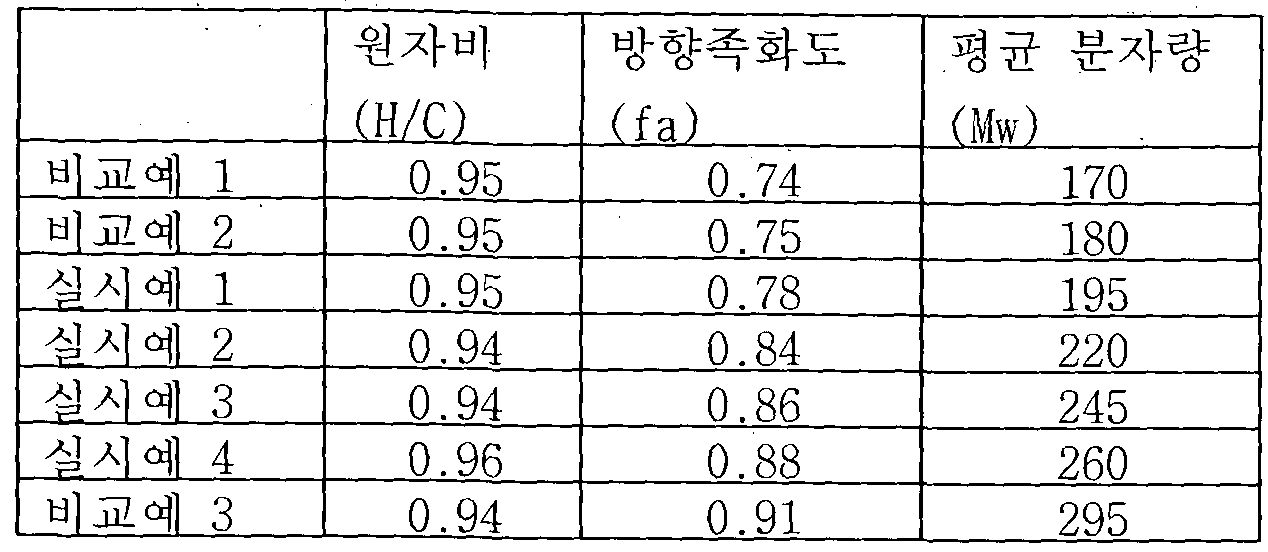
- Table 3 The physical properties of the raw materials produced in the intermediate stages according to each chassis and comparative example are shown in Table 3 below.
- composition of the compound included in the raw material produced in the intermediate step according to each Example and Comparative Example is shown in Tables 4 to 7.
- NCBO Cracker Bottom Oil
- Ar'r 34.2-51.8%, Ar ' 2 was 35.7-59.8%, Ar' 3 was less than 4.1%, and Ar'4 was less than 0.5% in each example.
- ArVAr ' 2 was 0.57-1.67, Ar' 3 / Ar ' 2 was 0.068-0.078, and ArVAr' 3 was 8.34-21.35.
- Table 18 below shows the physical properties of the raw materials produced in the intermediate steps of all examples and comparative examples.
- Table 18 shows that in each example, the degree of aroma was in the range of 0.78 to 0.88 and the average molecular weight was in the range of 170 to 260.
- Tables 19 to 22 below show the compositions of compounds included in the raw materials produced in the intermediate steps of all Examples and Comparative Examples.
- Table 19 is a look 22.5-38.0% content of compound A contains an aromatic ring in each embodiment, Ar 2 is 55.5 ⁇ 66.6%, Ar 3 is 4.5 ⁇ 8.3%, Ar 4 is 0.0 ⁇ 2.3% Belonged to. Among them, AiVAr 2 was 0.33-0.67, Ar 3 / Ar 2 was 0.08-0.13, and Ai Ar 3 was 3.04-8.44.
- Zen is mostly volatilized, and the content of alkylbenzene and phosphorus is reduced overall.
- compounds containing indane, biphenyls and three or more aromatic rings increased slightly, and naphthalenes increased significantly.
- the contents of the main compounds of the raw materials were all volatilized so as not to be measured in the case of alkenylbenzene, the indane was 2.2-4.7%, the indenes were 9.1-25.43 ⁇ 4, and the biphenyls were 0.4-4.9. % And naphthalenes belonged to 21.7 49.2%.
- Table 23 below shows the physical properties of the isotropic pitch prepared according to all Examples and Comparative Examples.
- the softening point of each example is 265-269 ° C. and the average molecular weight is 1750-.
Landscapes
- Chemical & Material Sciences (AREA)
- Engineering & Computer Science (AREA)
- Organic Chemistry (AREA)
- Oil, Petroleum & Natural Gas (AREA)
- Chemical Kinetics & Catalysis (AREA)
- General Chemical & Material Sciences (AREA)
- Textile Engineering (AREA)
- Materials Engineering (AREA)
- Civil Engineering (AREA)
- Thermal Sciences (AREA)
- Structural Engineering (AREA)
- Physics & Mathematics (AREA)
- Inorganic Chemistry (AREA)
- Working-Up Tar And Pitch (AREA)
- Inorganic Fibers (AREA)
- Compositions Of Macromolecular Compounds (AREA)
Abstract
본 발명은 특정 화합물의 함량, 이들의 비 및 물성을 가지는 원시재료 및 중 간단계에서 생성되는 원료에 적합한 제조방법을 통해 등방성피치를 제조하는 방법 에 관한 것으로, 본 발명에 따라 제조된 등방성 피치는 우수한 방사성 및 물성을 가져 고강도, 고탄성 탄소섬유를 제조할수 있다.
Description
【명세서】
【발명의 명칭】
' 탄소섬유 제조용 등방성 피치의 제조방법
【기술분야】
<ι> 본 발명은 등방성 피치의 제조방법으로서, 나프타분해 잔사유, 석유계 중질 류 또는 석탄 타르 유분 중 하나 이상올 포함하는 원시재료 및 제조단계에서 생성 되는 원료에 포함되는 특정 화합물의 함량 및 이들의 비기- 매우 제한적인 조건을 만족하고, 이에 적합한 제조방법으로 제조된 등방성 피치는 물성 및 방사성이 뛰어 나 고탄성ᅳ 고강도 탄소섬유를 제조하는데 사용될 수 있다.
【배경기술】
<2> 탄소섬유는 상대적으로 강한 강도에 비해 무게가 가벼워 스포츠 용품, 항공 산업, 자동차 등 다양한 분야에 사용될 수 있어, 고강도 및 고탄성의 탄소섬유를 얻기 위해 많은 연구가 거듭되고 있다 . 주로 고강도, 고탄성의 탄소섬유는 주로
PAN계 공중합 고분자 섬유를 산화안정화 및 탄화하여 제조된다. 또한 이방성 피치 를 사용해 고강도, 고탄성의 탄소섬유를 .제조할 수는 있으나 원하는 강도 및 탄성 수준에 이르는 탄소섬유 제조를 위해서는 제조공정이 번거로워 비용이 증가하는 문 제가 있다. 이로 인해, 최근에는 등방성 피치를 사용하여 고강도, 고탄성의 탄소섬 유 제조에 할한 연구가 활발하게 진행되고 있다..
<3> 피치계 탄소섬유.제조를 위해 :나프타 분해 잔사유 (naphtha cracker . bot tom oi l . NCB oi U가 주목받^ 있는데, 나프타분해 잡사 는 나 타 분해 공¾에서 생 기는 부산물로서 ,여기에 포함되어 .있는 화합물들의 방향^화도가높고 황 및 불용 분의 함량이 적어 탄소재료 제조에 적합한 것으로 알려져있다. 나프타 분해 잔사유 는 열처리시 조건에 따라서 피치계 탄소섬유 제조를 위한 등방^ 피치 또는 이방성 피치로 제조될 수 있다. 이 중 등방성 피치는 무정형으로서 이로부터 제조된 탄소 섬유는 강도가 낮기 때문에 고강도, 고탄성의 탄소섬유 제조를 위해서는 이방성 피 치가주로사용된다. 나프타 분해 잔사유 외에도석유계 중 유., 유분, 석탄 타르 또한 탄소재료 제조에 사용되고 있다.
<4> 고강도, 고탄성의 탄소섬유를 제조하기 위해서는 등방성 피치의 물성 및 조 성이 중요하다. 특히 일정한 범위 및 수준의 분자량, 연화점 및 점도.등을 가지는 탄소섬유 제조용 등방성 피치를 사융하여야 고강도의 탄소섬유를 제조할 수 있다. 종래 일본 특개 1996-144131의 경우 일정 범워의 분자량을 가지는 탄소섬유 제조용 등방성 피치를 발명하였으나 이로부터 제조된 탄소섬유는 인장강도가 낮아 기존의 등방성피치계 탄소섬유. 같이 범용 재 (료 ¾도로만 사용될 수 있었다. 또한, 최근에
는 촉매를 이용한 등방성 피치의 제조방법이 제시되고 있으나, 이로부터 제조된 탄 소섬유의 구체적인 물성에 대하여 알려진 바가 없는 것으로 보인다.
<5> 대부분의 종래 발명은 탄소섬유용 등방성 피치를 제조하기 위해 촉매를 사용 하는 등 제조방법에 주로 주목하였고, 원료의 분석에서부터 그에 맞는 제조방법에 대한 연구는찾아보기 어려웠다.
<6> 이러한 문제를 인식하고 본 발명자들은 탄소심유 제조용 등방성 피치의 원료 분석에서부터 그에 맞는 제조방법에 대한 연구를 하였고, 그 결과 고강도, 고탄성 의 탄소섬유를 .제조할 수 있는 등방성:피치 및 이외 제조방법을:발명하기에 이르렀 다-
<7> 「(특허문헌 1) 일본등록특허 3695077」
【발명의 상세한 설명]
【기술적 과제】
<8> 본 발명은 뛰어난 물성 및 방사성을 가지고 고강도, 고탄성 탄소섬유의 제조 에 사용될 수 ¾는 등방성 피치의 제조방법의 제공하며, 나프타 분해 잔사유, 석유 계 중질유 또는 석탄 타르 유분 중 적어도 하나 이상을 포함하는 원시재료 및 중간 단계에서 생성되는 원료의 분석과 이에 적합한 제조방법에 의해 달성될 수 있다. 【기술적 해결방법】
<9> 본 발명은 등방성 피치의 제조방법에 관한 것으로 특정 범위의 물성, 화합물 함량 및 이들의 비를 만족하는 나프타 분해 잔사유, 석유계 중질유 또는 석탄 타르 유분 중 적어도 하나 이상올 포함하는 원시재료 및 중간단계에서 생성되는 원료와 이에 적합한 제조방법을 제공한다.
<10> 본 발명에서 상기 원료는 나프타 분해 잔사유, 석유계 중질유 또는 석탄 타 르 유분 중 적어도 하나 이상을 포함하는 원시재료를 전처리하여 얻을수 있다. <1 1> . 본 발.명에서 상기 처리는 가열 및 분획과정을 포함할수 있다.
<12> , 본 발명은■ 방성 피치 제조방법의 중간단계에서.. 생성되는 ..원료가 원자비, 방향족화도, 평균분자량 그리.고 포함된 화합물의, 함량 및 이들의 비.가 특정 범위를 만족하는 제조방법을 제공한다.
< 13> 본 발:명에서 상가 원료가 열중합 및 가열단계를 거치는 등방성. 피치 제조방 법을 제공한다.
<14> 본 발명에 따라 제조된 등방성 피치를 제공한다.
[유리한 효과】
<15> 본 발명에 따른 제조방법은 특징적인 물성을 가지고 방사성아뛰어난 등방성 피치를 고수율로 제조할 수 있 제조된 등방성 피치를 사용하여 탄소복합재에 사
용할 수 있을 정도의 고강도 및 고탄성의 탄소섬유를 제조할수 있다.
【도면의 간단한 설명】 . ' '
<16> 도 1은 원시재료인 NCB oil로부터 등방성 피치의 원료 및 등방성 피치를 제 조하는 공정을 나타낸다.
<17> 도 2는 원시재료 및 중간단계에서 생성되는 원료의 대표 조성을 나타낸다.
【발명의 실시 * 위한 최선의 형태】 '
<18> 본 발명에 대한 설명에서 따로 정의하지 않는 용어는본 발 ^이 속하는분야 에서 통상의 지식을 가진자가 본 발명의 내용을 이해하기에 적합하도록 이해될 수 있으며, 설명 및 첨부된 도면에서 발명의 요지를 흐릴 수 있는 공지의 내용에 대하 여는 따로 기재하지 않을 수 있다 .
【발명의 실시를 위한 형태】
<19> 본 발명에 대한 설명에서 따로 정의하지 않는 용어는 본 발명이 속하는 분야 에서 통상의 지식을 가진자가 본 발명의 내용을 이해하기에 적합하도록 이해될 수 있으며, 설명 ,및. 첨부된.도면에서 발명의 요지를 흐릴 수 있는 공지의 내용에 대하 여는 따로 기재하지 않을 수 있다.
<20> 본 발명은 나프타 분해 잔사유 (naphta cracking botto oil. NCBO), 석유계 중질류 또는 석탄 타르 유분 증 적어도 하나 이상을 포함하는 원시재료를 전처리하 여 얻은 원료를 열중합 및 가열하는 등방성 피치 제조방법이다.
<2i> 본 발명은 나프타 분해 잔사유 (naphta cracking botto oil) ,석유계 중질류 또는 석탄 타르 유분 중 적어도 하나 이상을 포함하는 원시재료를 전처리하여 얻은 원료를 열중합 및 가열하는 등방성 피치 제조방법이다.
<22> 나프타 분해 잔사유는 나프타 분해공정 잔사유의 일종인 열분해 연료유
(pyrolized fuel oil, PF0)를 포함할 수 있다. PF0는 나프타 크래킹 공정의 (naphtha cracking center; CC) 탑겨부위 (bottom)에서 생성되는 것으로 방향화도 가 높고 수지의 ,함량이 풍부하다. 또한, PTO에는 포화화합물뿐만 아니라 벤젠류 (benzene)류, 나프탈렌 (naphtiialene)류, 인덴 (indene)류 및 비페닐 (biphenyl)류 등 과 같은 다양한 방향족 탄화수소류가포함되어 있다.
<23> 나프타 분해 잔사유뿐만 아니라 석유계 중질류 또는 석탄 타르 유분 역시 포 화화합물 및 다양한 방향족 탄화수소류가 포함되어 있어 피치 및 탄소섬유의 제조 에 사용될 수 있다.
<24> 나프타 분해 잔사유, 석유계 중질류 또는 석탄 타르 유분 중 적어도 하나 이 상을 포함하는 원시재료의 전처리 조건에 따라 등방성 피치 제조의 원료의 물성 및 조성을 조절할 수 있고, 상기 원료의 물성 및 조성은 고강도, 고탄성의 탄소섬유
제조를 위한등방성 피치 제조에 중요한 영향을 미친다.
<25> 본 발명에서 등방성 피치 제조방법은,
<26> ( a) 나프타 분해 잔사유, 석유계 중질류 또는 석탄 타르 유분 중 적어도 하 나 이상을 포함하는 원시재료를 전처리하여 원료를 생성하는 단계; 및
<27> ( b) 상기 ( a)에서 제조된 원료를 열중합 및 가열하는 단계;
<28> 를 포함하는 등방성 피치의 제조방법이다.
<29> 제조방법에서 전처리는 가열 및 분획과정을 포함할 수 있고 열중합 반응에 의해 올리고머를 생성할 가능성이 낮은 저분자물질올 제거할 수 있으며 , 동시에 다 양한 반웅을 수반하여 원시재료에 포함된 반웅성이 강하며 불안정한 화합물을 제거 할 수 있다. 예를 들어, 등방성 피치 합성 단계에서 부정적인 부반응을 유발할 수 있는 알케닐 벤젠류나 인덴류와 같은 하나의 벤젠고리를 포함하는 화합물을 보다 안정적이며 등방성 피치의 제조에 유효한 화합물로 전환하는 것을 주요 목적 증 하 나로 블 수 있다. 전처리는 원시재료를 150 내지 260°C , 바람직하게는 160 내지 240 °C , 더 바람직하게는 175 내지 235°C의 온도에서 더 이상 휘발분이 발생하지 않 을 때까지 상압에서 가열 및 분획하여 진행할 수 있다.
<30> 상기 전처리는 가압 또는 감압 하에서도 진행할 수 있다. 감압하에서는보다 낮은 온도에서 공정을 진행할 수 있으며, 가압하는 경우에는 보다 높은 온도를 필 요로 하지만 장치의 설계를 보완하여 보다 정밀하게 분획할 수 있는 장점이 있다. 전처리 과정은 상압과 동일한 효과를 얻을 수 있는 범위 내에서 압력 및 온도를 자 유롭게 조절할 수 있다. 또한, 증류 후 필요에 따라 상압, 가압 또는 감압하에서 여과 과정이 진행될 수 있다.
<31> 상기 여과단계는 고상 물질을 제거하며 상기 고상 물질은 금속, 황, 질소 등 의 불순물이 포함된 고체상의 잔류물로서 등방성 피치로부터 제조되는 탄소섬유의 구조에서 크래커 ( cracker )로 작용하여 강도저하를 유발할수 있다.
<32> 여과단계는 당업계에서 통상적으로 수행하는 방식, 예를 들어 여과, 원심분 리, 침강, 흡착, 추출 등으로 수행할수 있다.
<33> 본 발명의 제조방법의 중간단계에서 생성되는 원료의 주요 물성은 중요하다. 상기 주요 물성 중에서도 탄소와 수소의 원자비, 방향족화도, 평균분자량 등이 있 는데, 특정범위의 물성을 가지는 것이 등방성 피치의 제조방법 및 나아가 고강도 고탄성 탄소섬유를 제조하는데 있어 큰 영향을 미친다.
<34> 원료의 방향족화도 ( fa)는 0.70 내지 0.95, 바람직하게는 0.75 내지 0.90 일 수 있다. 방향족화도가 낮은 경우 탄화 수율이 저하될 수 있다. 방향족화도가 높은 경우에 대해서는 특별한 제한은 없으나, 상기 바람직한 범위 이상인 경우 본 발명
에서 개시한 등방성 피치의 제조가 용이하지 않을 수 있다.
<35> 원료의 평균분자량 (Mw)는 150 내지 300 , 바람직하게는 185 내지 290 , 더 바 람직하게는 190 내지 245의 분포를 가질 수 있다. 원료의 적정 분자량의 범위는 제 조되는 등방성 피치의 분자량에 영향을 미치고, 등방성 피치의 특정 분자량의 범위 는 고강도, 고탄성 탄소섬유를 제조하는데 중요한 영향을 미친다. 분자량이 낮을 경우 제조된 둥방성 피치의 분자량도 낮아져 원하는 강도의 탄소섬유를 제조하기 어려울 수 있으며, 분자량이 높은 경우는 고강도 탄소섬유의 제조를 위해 정밀하게 제어되는 열증합 및 가열에 의한 효과가 낮을 수 있다.
<36> 본 발명의 나프타 분해 잔사유, 석유계 증질류 또는 석탄타르 유분 중 적어 도 하나 이상을 포함하는 원시재료 및 증간단계에서 생성되는 원료에 포함된 화합 물은 방향족 고리의 수에 따라, 포화화합물, 한 개의 방향족고리를 포함하는 화합 물, 두 개의 방향족고리를 포함하는 화합물, 세 개의 방향족고리를 포함하는 화합 물, 네 개 이상의 방향족고리 이상을 포함하는 화합물로 구성될 수 있다. 상기 화 합물들은 축합다환화합물 구조가 포함되거나 비페닐과 같이 방향족 고리가 단일 또 는 다증 결합으로 연결된 '다환화합물 구조가 포함된 화합물일 수 있다. 예를 들어, 이러한 화합물들로는 벤젠류, 인덴류, 나프탈렌류, 비페닐류, 안트라센류 등이 있 으나 이에 한정되는 것은 아니며 방향족 고리를 포함하는 매우 다양한 화합물 및 유도체가존재할 수 있다.
<37> 나프타 분해 잔사유, 석유계 중질류 또는 석탄 타르 유분 중 적어도 하나 이 상을 포함하는 원시재료 및 중간단계에서 생성되는 원료에서 방향족 고리를 포함하 는 화합물의 종류는 매우 다양하나, 이 중에서 본 발명이 목적하는 등방성 피치의 제조를 위해서는 상기 원시재료 및 원료에 포함된 화합물 증 함량이 조절될 필요가 있는 주요 화합물이 존재한다.
<38> 한 개의 방향족고리를 포함하는 화합물 중에서는 특히 알케닐 벤젠, 인덴류 의 함량이 중요하고, 두 개의 방향족고리를 포함하는 화합물 증에서는 특히 비페닐 류 및 나프탈렌류의 함량을 조절하는 것이 중요하며 , 세 개의 방향족 고리 이상을 포함하는 화합물의 함량은 전체적으로 조절되어야 물성 및 방사성이 뛰어난 등방성 피치를 제조할 수 있고, 최종적으로 고탄성 및 고강도 물성을 지닌 탄소섬유를 제 조할 수 있다. 그 이유는 피치 합성 단계에서 반응에 참여하지 않거나 지나치게 반 웅성이 큰 화합물들에 의해 불용고형분 또는 합성된 피치에 부분적으로 메조페이스 를 생성하기 때문이다. 이러한 불용고형분과 메조페이스 부분은 피치의 물성 및 방 사성과 탄소섬유의 기계적 물성을 저하시키는 주요 요인이 되어 본 발명에서 목적 하는 고강도 탄소섬유 제조용 등방성 피치를 수득할수 없게 된다.
<39> 즉, 고강도, 고탄성 탄소섬유 제조용 등방성 피치는 매우 제한된 조건을 만 족하여야 제조가 가능하다.
<40> 본 발명에서는 나프타 분해 잔사유, 석유계 중질류 또는 석탄 타르 유분 중 적어도 하나 이상을 포함하는 원시재료 및 증간단계에서 생성되는 원료에 포함된 화합물의 함량 및 이들의 함량비가 특정범위에 포함될 때 상기의 매우 제한된 조건 을 만족하며 이를 통해 고강도, 고탄성 탄소섬유 제조용 둥방성 피치를 제조할 수 있다.
<41> 우선, 본 발명에서 목적하는 등방성 피치 제조를 위해 중간단계에서 생성되 는 원료의 함량에 대하여 구체적으로 설명한다 .
<42> 한 개의 방향족고리를 포함하는 화합물은 원료의 총량 대비 20.0 내지
45.0%, 바람직하게는 30.0 내지 40.0¾, 더 바람직하게는 35.0 내지 40.0%이다. 이 중에서 인덴류는 매우 강한 반웅성을 가진 물질로서 장기간 보관이나 고온에서 진 행되는 피치의 합성 과정 중 다양한 부반웅을 수반하고, 피치의 중합 단계에서 불 융고형분이나 부분적으로 생선된 메조페이즈를 생성할 수 있게 하므로 함량올 제한 할 필요가 있다. 인덴류의 함량은 한 개의 방향족고리를 포함하는 화합물의 총량 대비 75.0%이하, 바람직하게는 35.0 내지 75.0%이고, 원료의 총량 대비 5.0 내지 30.0% , 바람직하게는 15.0 내지 25.0%이며, 나프탈렌류 함량과 특정 범위의 비를 만족하도록 조절될 수 있다. 그리고, 을레핀인 알케닐 벤젠류 역시 인덴류와 유사 하게 매우 강한 반웅성을 가지며, 피치의 중합 단계에서 주위 화합물에 양성자와 전자를 제공하여 매우 다양한 부반웅을 유발하게 되어 원하는 물성의 등방성 피치 를 제조하기 어려운데 알케닐 벤젠류의 경우 전처리 과 ^에서 대부분 휘발시켜 제 거할수 있다.
<43> 두 개의 방향족고리를 포함하는 화합물은 원료의 총량 대비 50.0 내지
70.0% , 바람직하게는 55.0 내지 65 .0% , 더 바람직하게는 55.0 내지 60.0%이다. 이 중에서 나프탈렌류의 함량은 두 개의 방향족고리를 포함하는 화합물의 총량 대비
30.0%이상, 바람직하게는 35.0%이상이고, 원료의 총량 대비 15.0 내지 75.0% , 바람 직하게는 20.0 내지 60.0%, 더 바람직하게는 30.0 내지 50.0%이다. 비페닐류는 중 합 반웅에 크게 기여하지 못하므로 그 함량이 낮을수록 좋은데 두 개의 방향족고리 를 포함하는 화합물의 총량 대비 15.0%이하, 바람직하게는 .10 .0%이하이고 더 바람 직하게는 측정할 수 없을 정도로 극소량이 포함되거나 없는 것이 좋고, 원료의 총 량 대비 10.0%이하, 바람직하게는 5.0%이하, 더 바람직하게는 측정할 수 없을 정도 로 극소량이 포함되거나 없는 것이 좋다.
<44> 세 개의 방향족고리를 포함하는 화합물 및 네 개 이상의 방향족고리를 포함
하는 화합물은 중합반응에 참여하지 않거나 알케닐 벤젠과 같은 올레핀과 인덴과 같은 납센계 화합물의 영향으로 과도하게 많은 고리 수를 가지는 축합방향족고리 화합물을 형성할 수 있다. 이러한 축합방향족고리 화합물은 쉽게 적층구조를 만들 고 불용고형분 또는 합성된 피치에 부분적으로 메조페이스를 생성하게 되어 세 개 및 네 개 이상의 방향족고리를 포함하는 화합물의 함량도 조절할 필요가 있다. 세 개의 방향족고리를 포함하는 화합물은 원료의 총량 대비 10.0%이하, 바람직하게는 5.0%이하, 더 바람직하게는 측정할 수 없을 정도로 극소량이 포함되거나 없는 것이 좋다. 네 개 이상의 방향족고리를 포함하는 화합물은 원료의 총량 대비 5.0%이하, 바람직하게는 3.0%이하, 더 바람직하게는 측정할 수 없을 정도로 극소량이 포함되 거나 없는 것이 좋다.
<45> 본 발명에서 목적하는 등방성 피치 제조를 위해서는 상기와 같이 원료에 포 함된 화합물들이 각각의 함량을 만족하면서, 이와 함께 이들이 특정 함량비를 만족 해야 하는데 이에 대하여 구체적으로 설명한다.
<46> 본 발명의 중간단계에서 생성되는 원료에 포함된 화합물의 함량비는 다음을 만족해야 한다.
<47> 방향족고리를 포함한 화합물의 각 함량비는 Α /Αΐ"2에 있어서 0.30<
An/Ar2<0.75 , 바람직하게는 O
 . TO , 더 바람직하게는 0.65<An/Ar2으 70 이다. 다음으로 ArVAr3에 있어서 2.00<Αη/Αι·3<12.00 , 바람직하게는 4.00<Αη/Αι·3<10.00, 더 바람직하게는 8.00<ΑινΑι·3<9.00이다. 그리고 Ar3/Ar2에 있어 서 Ar3/Ar2<0.20 , 바람직하게는 Ar3/Ar2<0. 15 , 더 바람직하게는 Ar3/Ar2<0. 10 이다. 상기 함량비에서 는 원료의 총량 대비 한 개의 방향족고리를 포함하는 화합물의 함량이고, Ar2는 원료의 총량 대비 두 개의 방향족고리를 포함하는 화합물의 함량이 며, Ar3는 원료의 총량 대비 세 개의 방향족고리를 포함하는 화합물의 함량을 나타 낸다. 또한 원료의 총량 대비 네 개 이상의 방향족고리를 포함하는 화합물은 Ar4로 나타낼 수 있다.
<48> 원료의 총량 대비 인덴류와 나프탈렌류의 함량비는 0. 10<인덴류 /나프탈렌류
<2.00 , 바람직하게는 0. 15<인덴류 /나프탈렌류 <1.50, 더 바람직하게는 0.50<인덴류 / 나프탈렌류 <0.80이다.
<49> 원료의 총량 대비 비페닐류와 나프탈렌류의 함량비는 낮올수록 좋은데 비페 닐류 /나프탈렌류 <0.20, 바람직하게는 비페닐류 /나프탈렌류 <0. 15로 이와 같이 조절
되는 것이 특히 중요하다ᅳ 증간단계에서 생성되는 상기 원료의 비페닐류와 나프탈 렌류의 함량비가 0.20 이상이 되는 경우 이유는 명확하지 않으나, 제조되는 등방성 피치의 방사성 및 물성이 좋지 못하고 탄소섬유 제조시 인장강도가 현저히 감소한 다.
<50> 본 발명에서 목적하는 등방성피치를 제조하기 위해서 상기에서 설명한 화합 물의 함량 및 이들의 비를 만족하는 원료가 중간단계에서 생성되어야 한다. 예를 들어 An , Ar2 , Ar3의 함량 및 ArL/Ar2의 조절을 통해서 등방성 피치를 제조할 수 있 고, 여기에 보다 구체적으로 인덴류, 나프탈렌류, 비페닐류의 함량 및 이들의 비가 추가로 조절되어 본 발명에서 목적하는 등방성 피치를 제조할수 있다.
<51> 상기에서 설명한 화합물의 함량 및 이들의 비를 부분적으로 만족하는 원료가 중간단계에서 생성되는 경우 등방성 피치의 방사성이 좋지 못하고 최종적으로 제조 되는 탄소섬유의 강도가 급격히 감소할 수 있으며 신장를도 감소할 수 있다. 예를 들어, 함량비에 있어 비페닐류 /나프탈렌류가 중요한데 상기 바람직한 범위를 벗어 나는 경우 다른 조건을 만족하여도 등방성 피치의 물성과 방사성이 좋지 못하고 이 로부터 제조되는 탄소섬유의 강도가 급격히 감소할 수 있다.
<52> 본 발명의 일 실시예에 따르면 상기 함량 및 이들의 비를 부분적으로 만족하 는 원료가 중간단계에서 생성되는 경우 제조되는 등방성 피치는 용융방사가 가능하 나 단사빈도가 높아 방사성이 좋지 않다. 본 발명의 다른 일 실시예에 따르면 단사 빈도가 높지 않더라도 상기 등방성 피치로부터 제조되는 탄소섬유는 강도 및 신장 률이 좋지 않다. 반면 , 본 발명의 일 실시예에 따르면 상기 함량 및 이들의 만족하 는 원료가 중간단계에서 생성되는 경우 최소 1 .5GPa 이상의 강도를 가지며 신장를 이 2%이상인 탄소섬유를 제조할 수 있는 용융방사 가능하며 방사시 단사빈도가 없 는 등방성 피치를 제조할 수 있다.
<53> 이상에서 설명한 원료의 화합물 함량 및 이들의 비를 만족하는 원료가 중간 단계에서 생성되는 경우 방사성이 매우 우수한 물성을 가지는 등방성 피치를 제조 할 수 있고, 이로부터 제조되는 탄소섬유는 고강도, 고탄성의 물성을 만족한다.
<54> 본 발명께서 제조되는 등방성피치는 연화점이 ( °C ) 250 내지 280, 바람직하게 는 260 내지 270이고, 평균분자량 (Mw)은 1450 내지 2850, 바람직하게는 1600 내지 2600 , 더 바람직하게는 1700 내지 2500이다. 이러한 본 발명의 등방성 피치의 물성 은 우수한 방사성 및 이로부터 제조되는 탄장섬유의 물성에 영향을 미치며, 상기와 같은 물성을 지니면서 나타나는 등방성 피치의 특이적인 성상 역시 방사성 및 이로 부터 제조되는 탄소섬유의 물성에 중요한 요인이다.
<55> 본 발명에서 제조되는 등방성 피치는 용융방사 (mel t spinning)가 가능하고, 섬유 방사시 단사가 일어나지 않거나 극히 드문 우수한 방사성을 가진다. 용융방사 는 고분자 물질아나 피치를 용융하여 연속 섬유로 제조하는 방법으로 섬유 방사시 필요한 고가의 용매를 사용할 필요가 없어, 방사 공정의 구성을 단순화시킬 수 있 고 비용을 현저히 감소시킬 수 있는 매우 경제적인 방법이다. 탄소섬유 제조를 위 한 상기 용융방사가 가능하기 위해서는 피치의 방사성이 우수해야 하는데 본 발명 에 따라 제조되는 등방성 피치는 방사성이 매우 우수하여 탄소섬유 제조를 위한 용 융방사가 가능하면서 단사가 극히 드물거나 일어나지 않는다. 또한, 본 발명의 용 융방사가 가능한 등방성 피치는 기존의 멜트-블로잉 (mel tᅳ blowing)을 통해 단섬유 를 제조하는데 그치던 등방성 피치에 비해 방사성이 매우 뛰어나 이로부터 고강도, 고탄성의 탄소섬유를 제조할수 있다.
<56> 본 발명의 일 실시예에 따르면, 700rpm, 20분 연속으로 용융방사 중 끊김의 빈도를 단사빈도로 하여 측정한 결과 단사빈도가 0에 해당하여 방사성이 매우 우수 하다.
<57> 본 발명에서 제조되는 등방성 피치는 고강도, 고탄성의 탄소 ¾유를 제조할 수 있고, 기존의 탄소섬유보다 강도가 매우 우수하고 신장률도 높다 . 기존의 등방 성피치계 탄소섬유는 낮은 강도로 인해 범용 탄소섬유로 사용되었으나, 본 발명의 등방성 피치로부터 제조되는 탄소섬유는 강도가 매우 우수하고 신장률도 높아 이방 성피치계 탄소섬유 또는 PA 계 탄소섬유를 사용하던 탄소강화복합재에도 사용될 수 있다.
<58> 본 발명의 일 실시예에 따르면 본 발명의 제조방법으로 제조된 등방성 피치 로 1.5GPa이상의 매우 고강도이고 신장률이 2%이상인 탄소섬유를 제조할 수 있다. 이러한 물성을 가지는 탄소섬유는 탄소복합체, 재료, 소재 등에 응용될 수 있는 강 도를 만족하는 것으로 넓은 활용범위를 가진다.
<59> 즉, 용융방사 가능하여 매우 경제적이고 고강도, 고탄성의 탄소섬유를 제조 할 수 있는 본 발명의 등방성 피치는 기존의 등방성 피치로부터 얻을 수 없던 효과 를 가진다.
<60> 이상에서 설명한 중간단계에서 생성된 원료는 나프타 분해 잔사유. 석유계 중질류 또는 석탄 타르 유분 증 적어도 하나 이상을 포함하는 원시재료를 전처리하 는 방법 또는 이와 함께 특정 범위의 화합물 조성을 포함하는 원시재료를 사용하여 증간단계에서 생성될 수 있다.
<61 > 상기 원시재료를 전처리하는 방법은 상압에서 가열 및 분획과정을 포함하는 것이 바람직하다. 상기 가열은 160 내지 240°C , 바람직하게는 175 내지 235°C의 온
도에서 더 이상 휘발분이 발생하지 않을 때까지 가열하고 분획하여 진행할 수 있 다. 상기 온도에서 가열하는 경우 본 발명의 제조방법의 중간단계에서 생성되는 원 료가 등방성 피치 제조를 위한 화합물의 함량 및 이들의 비를 만족할 수 있다. 구 체적으로, 상기 온도를 벗어나는 경우 인덴류가 나프탈렌류로 충분히 전환되지 않 아 나프탈렌류의 함량이 부족할 수 있다. 그리고, 인덴류나 세 개 이상의 방향족고 리를 포함하는 화합물 또는 그외 기타 화합물의 함량이 지나치게 감소하거나 증가 할 수 있다. 또한, 비페닐류의 함량이 지나치게 증가하여 제조하고자 하는 물성 및 방사성을 지닌 등방성 피치에 적합하지 않은 원료가중간단계에서 생성될 수 있다. 이상에서 설명한 중간단계에서 생성되는 원료의 조건을 만족하는 등방성 피 치의 제조방법은,
(a) 나프타 분해 잔사유, 석유계 중질류 또는 석탄 타르 유분 중 적어도 하 나 이상올 포함하는 원시재료를 160 내지 240 °C에서 전처리하여 하기 식 ( 1)~(4)를 만족하는 원료를 준비하는 단계; 및
20.0% < Ar: < 45.0% ― ( 1)
50.0% < Ar2 < 70.0% ― (2 ) 0.0% < Ar3 10.0% ― (3)
0.30 < Ari/Ar2 < 0.75 -—— (4)
(b) 상기 (a)에서 제조된 원료를 열중합 및 가열하는 단계를 포함하는 등방 성 피치의 제조방법으로 나타낼 수 있다.
본 발명의 일 실시예에 따르면 전처리 온도가 150°C이하 경우 상기 식 ( 1) 및 (4)를 만족하지 못하고, 인덴류 함량이 지나치게 많은 반면 나프탈렌류의 함량 은 지나치게 적었다. 본 발명의 다른 일 실시예에 따르면 전처리 온도가 250 °C이상 인 경우 상기 식 (4)를 만족하지 못하고, 비페닐류의 함량이 지나치게 많은 반면 나프탈렌류의 함량이 지나치게 적었다.
본 발명의 일 실시예에 따르면, 상기 ( 1), (2) 및 (3)을 만족하여도 함량비 를 나타내는 상기 (4)를 만족하지 못하면 둥방성 피치의 용융방사시 단사빈도가 높 고, 제조되는 탄소섬유의 강도가 l . OGPa에도 미치지 못한다. 다른 일 실시예에 따 르면, 상기 ( 1) 및 (2)를 만족하고 함량비인 상기 (4)를 만족하여도 상기 (3)을 만 족하지 못하면 등방성 피치로부터 제조되는 탄소섬유의 강도가 l . OGPa에 미치지 못 하고 신장률이 2%미만으로 떨어진다. 또 다른 일 실시예에 따르면, 상기 (2) 및 (4)를 만족하여도 상기 ( 1) 또는 (3)을 만족하지 못하면 등방성 피치의 용융방사시 단사빈도가높고, 제조되는 탄소섬유의 신장률이 2%미만으로 떨어진다.
<7 i> 상기 제조방법의 ( 1) 내지 (4)를 만족하면서 중간단계에서 생성되는 원료의 나프탈렌류 함량은 원료의 총량 대비 20.0 내지 60.0%, 비페닐류 함량은 5. 이하 이고 이들의 함량비인 비페닐류 /나프탈렌류는 0.20미만인 것이 바람직하다. 본 발 명의 일 실시예에 따르면 나프탈렌류, 비페닐류 함량 및 이들의 함량비가 상기 바 람직한 범위를 만족하여도 상기 제조방법의 ( 1) 내지 (4)를 만족하지 않는 경우 등 방성피치의 용융방사시 단사빈도가 높을 수 있고. 제조되는 탄소섬유의 강도가 현 저히 낮아지거나 신장률이 떨어진다. 다른 일 실시예에 따르면, 나프탈렌류 및 비 페닐류 함량비가 상기 바람직한 범위를 만족하여도 나프탈렌류 또는 비페닐류의 함 량이 상기 바람직한 범위를 만족하지 못하는 경우에도 등방성 피치의 용융방사시 단사빈도가 높을 수 있고, 제조되는 탄소섬유의 강도가 현저히 낮아지거나 신장률 이 떨어진다.
<72> 다음으로. 나프타 분해 잔사유, 석유계 중질류 또는 석탄 타르 유분 중 적어 도 하나 이상을 포함하는 원시재료에 포함된 화합물의 함량 및 이들의 함량비에 따 라서도 본 발명의 제조방법에서 등방성 피치 제조를 위한 원료가 중간단계에서 생 성될 수 있다.
<73> 구체적으로, 한 개의 방향족고리를 포함하는 화합물은 상기 원시재료의 총량 대비 30.0 내지 60.0%가 바람직하다. 이 증에서 인덴류는 전처리 과정 동안 일부가 나프탈렌류로 전환될 수 있으나 강한 반웅성을 가진 물질이므로 이후 제조되는 등 방성피치의 물성 및 방사성에 악영향을 미칠 수 있어 함량을 제한할 필요가 있다. 인덴류의 함량은 한 개의 방향족고리를 포함하는 화합물의 총량 대비 25.0 내지 70.0%, 바람직하게는 30.0 내지 65.0%이고, 상기 원시재료의 총량 대비 5.0 내지 50.0%, 바람직하게는 10.0 내지 40.0%이다. 그리고, 올레핀인 알케닐 벤젠류 역시 인덴류와 유사하게 매우 강한 반웅성을 가져 이후 제조되는 등방성피치의 물성 및 방사성에 악영향을 미칠 수 있으나, 전처리 과정 증 대부분 휘발되어 함량이 크게 제한되지 않으며 바람직하게는 3 .0%이하이다.
<74> 두 개의 방향족고리를 포함하는 화합물은 원시재료의 총량 대비 30.0%이상, 바람직하게는 35.0 내지 80.0%, 더 바람직하게는 55.0 내지 70.0%이다. 이 중에서 나프탈렌류의 함량은 두 개의 방향족고리를 포함하는 화합물의 총량 대비. 30.0%이 상 바람직하게는 35.0%이상이고 상기 원시재료의 총량 대비 5.0 내지 60.0%, 바람 직하게는 10.0 내지 45.0%이어야 이 후 충분한 나프탈렌류가 포함된 원료를 중간단 계에서 생성할 수 있다. 비페닐류는 증합 반웅에 크게 기여하지 못하므로 그 함량 이 낮올수록 좋은데 두 개의 방향족고리를 포함하는 화합물의 총량 대비 15.0%이 하, 바람직하게는 10 . o% 이하이고 상기 원시재료의 총량 대비 10.0%이하, 바람직하
게는 5.0%이하, 더 바람직하게는 측정할 수 없을 정도로 극소량이거나 없는 것이 좋다.
<75> 세 개의 방향족고리를 포함하는 화합물 및 네 개 이상의 방향족고리를 포함 하는 화합물은 증합반웅에 참여하지 않거나 알케닐 벤젠과 같은 올레핀과 인덴과 같은 납센계 화합물의 영향으로 과도하게 많은 고리 수를 가지는 축합방향족 고리 화합물을 형성할 수 있다. 즉, 등방성피치 제조방법에서 원하는 원료가 등방성 피 치의 증간단계에서 생성되지 않을 수 있다. 세 개의 방향족고리를 포함하는 화합물 은 원시재료의 총량 대비 8.0%이하, 바람직하게는 5.0%이하, 더 바람직하게는 측정 할 수 없올 정도로 극소량이거나 없는 것이 좋으며, 네 개 이상의 방향족고리를 포 함하는 화합물은 3.0%이하, 바람직하게는 측정할 수 없을 정도로 극소량이 포함되 거나 없는 것이 좋다.
<76> 방향족고리를 포함한 화합물의 각 함량비는 에 있어서
0.50<Ar'i/Ar'2<2.00, 바람직하게는 0.55< Ar VAr '2<1.75이다. 다음으로 Ar' /Ar'3에 있어서 5.00<Ar'1/Ar'3<30.00) 바람직하게는 8.00<Ar ' ^Ar '3<25.00이다. 그리고 Ar'3
/Ar'2에 있어서 5.00<Ar'3/Ar'2<20.00, 바람직하게는 10.00<Ar'3/Ar '2<15.00이다. 상 기 함량비에서 ^ 는 상기 원시재료의 총량 대비 한 개의 방향족고리를 포함하는 화합물의 함량이고, Ar'2는 상기 원시재료의 총량 대비 두 개의 방향족고리를 포함 하는 화합물의 함량이며, Ar'3는 상기 원시재료의 총량 대비 세 개의 방향족고리를 포함하는 화합물의 함량올 나타낸다. 또한 상기 원시재료의 총량 대비 네 개 이상 의 방향족고리를 포함하는 화합물은 Ar' 4로 나타낼 수 있다.
<77> 나프타 분해 잔사유, 석유계 중질류 또는 석탄 타르 유분 중 적어도 하나 이 상을 포함하는 원시재료의 총량 대비 인덴류와 나프탈렌류의 함량비는 0.20<인덴류 /나프탈렌류 <4.00, 바람직하게는 0.25<인덴류 /나프탈렌류 <3.50이다.
<78> 원시재료에서 두 개의 방향족고리를 포함하는 화합물의 총량—대비 비페닐류 와 나프탈렌류의 함량비는 비페닐류 /나프탈렌류 <0.15, 바람직하게는 비페닐류 /나프 탈렌류 <0.10이다.
<79> 상기 원시재료에 포함된 화합물의 함량 및 이들의 비를 만족하는 원시재료를 사용하는 것이 바람직하다. 예를 들어 Ar'i, Ar'2의 함량 및 Ar'i/Ar'2의 조절을 통 해서 본 발명의 중간단계에서 생성되는 원료를 만족할 수 있다. 그리고 여기에 보 다 구체적으로 인덴류, 나프탈렌류, 비페닐류 등 구체적인 화합물의 함량 및 비의
범위가 더 조절될 수 있다.
<80> 본 발명의 일 실시예에 따르면 상기 원시재료에 포함된 화합물의 함량 및 이 들의 비를 부분적으로 만족하는 나프타 분해 잔사유를 사용하는 경우 중간단계에서 생성되는 원료의 함량 및 비가 적절하지 못할 수 있다 . 예를 들어, 상기 원시재료 의 함량비에 있어 인덴류 /나프탈렌류가 증요한데 상기 바람직한 범위를 벗어나는 경우 다른 조건을 만족하여도 증간단계에서 생성되는 원료의 함량 및 비가 적절하 지 못할 수 있다.
<81 > 본 발명에서 원료 생성 후 진행되는 열증합은 350 내지 380 °C에서 0. 1 내지
2시간 진행할 수 있으나 이에 제한되는 것은 아니다. 열증합법은 진행 시 불활성기 체 분위기에서 진행할 수 있으며, 질소와 폴리콘덴세이션 (po ly-condensat ion) 진행 중에 발생하는 기체 부산물을 분취하여 진행할 수 있다. 반응온도는 380°C를 넘지 않는 것이 좋은데, 반웅온도가 380 °C를 초과하는 경우, 불용 고형분이 생성되거나, 균일한 등방성 피치의 범위를 초과하는 과량의 메조페이즈가 생성되거나 또는 코크 스화가 진행되어 탄소섬유 제조시 불균일한 탄소섬유가 생성될 수 있다.
<82> 다음으로, 가열은 증발을 촉진하여 메조페이스 생성을 억제하고, 방사가 가 능한 등방성 피치를 제조하는 공정일 수 있다. 가열은 통상적인 박막증류법으로 진 행될 수 있으며, 이를 통해 메조페이스의 생성을 억제할뿐만 아니라 불용 고형분을 제거하는 추가적인 공정이 필요하지않는 장점이 있다.
<83> 본 발명의 제조방법에 따라 제조된 등방성 피치는 특정범위의 분자량, 고연 화점 및 방사성이 뛰어나 이로부터 고강도, 고탄성을 가지는 탄소장유를 제조할 수 있다.
<84> 탄소섬유의 제조는 용융방사 후 안정화 단계와 탄화단계를 거쳐 제조될 수 있으나 이에 제한되는 것은 아니다. 탄소섬유 제조단계에서 섬유간 점착 방지를 위 한 집속제 * 사용할 수 있고, 탄화 단계 후 표면처리 및 사이징 단계를 추가하여 복합재 제조 시 매트릭스 레진과의 부착성을 향상시킬 수 있다. 또한, 방사조건은 방사기의 홀 수나 제조 설비의 용량에 따라 자유롭게 변경될 수 있다.
<85> 이하에서 실시예를 통해 본 발명에 따른 등방성 피치 제조방법에 대하여 더 욱 자세히 설명한다. 하기 실시예에서 각 실시예 및 비교예는 본 발명을 바람직하 게 실시하기 위한 예시에 해당하며, 본 발명이 이에 제한되는 것은 아니다.
<86> 물성 측정 방법
<87> 1. 탄소와 수소 원자비 (H/C)
<88> CHNS 원소분석기로 분석
<89> 2. 방향족화도 ( f a )
<90> 13C画 R로 분석 (ASTM D5292)
<91> 3. 원시재료 및 원료의 조성
<92> 2D-GC로 분석
<93> 4. 평균분자량 (Mw)
<94> 평균분자량은 TOF-MS로 분석, 피치의 평균 분자량은 GPC로 분석
<95> 5. 점도 (Pa · s)
< 6> 점도는 TMA( Thermo Mechanical Analyzer)로 측정
< 7> 6. 연화점 ( °C)
<98> 연화점은 TMA(Thermo Mechanical Analyzer)로 측정
<99> 7. 수율
<100> 수율은 투입된 나프타 분해 잔 Λ卜유 중량 대비 최종수득된 피치의 중량에 의 해 계산되었다 .
<ιοι> 8. 기계적 물성
<102> 인장강도 (GPa)와 신장율 (¾)을 산출하기 위해 탄소섬유의 샘플에 대해 2N의 로드셀을 장착한 UT (Universal Test Machine)으로 Stress-Strain 커브를 측정하였 고, 인장강도는 상기 측정 결과와 전자현미경에 의해 분석된 섬유의 직경으로부터 계산되었다.
103> <실시예 1~4> 및 <비교예 1~3>
<104> 하기 표 1 내지 2의 조성 및 방향족화도를 가지는 Naphtha Cracker Bottom
0il(NCB())를 원시재료로 준비하였다.
<105> 【표 1】

<106> 【표 2】'

실시예 1~4는 준비된 NCB0를 각각 190 °C, 200 °C , 210 °C, 220°C에서 상압중류 로 전처리하였고, 비교예 1은 전처리하지 않았으며, 비교예 2~3는 준비된 NCB0를
각각 150°C , 250°C에서 전처리하여 원료를 생성하였다. 각각의 샬시예 및 비교예에 따라 중간단계에서 생성된 상기 원료의 물성은 하기 표 3에 나타내었다.
【표 3】
각각의 실시예 및 비교예에 따라 상기 중간단계에서 생성된 원료에 포함된 화합물 의 조성은 하기 표 4 내지 표 7에 나타내었다.
【표 4】

<ι ι ι> 【표 5】
전처리 ( 방향족 고리 .포한 화합몸
V) 알킬 벤젠 알케닐 인단 (indan 인덴 기타 총량 (¾
Ξ
벤젠 ) 유도체 ΤΓ ) 비교예 1 - 7.0 ■ 5.5 3.3 52.6 31.6 100 비교예 2 150 5.7 0.0 4.2 54.1 36.0 심시예 1 190 2.6 0.0 5.7 65.9 25.8 심시예 2 200 8.3 0.0 13.3 56.7 21.7 심시예 3 210 10.0 0.0 9.4 58.4 22.2 심시예 4 220 8.4 0.0 11.7 44.3 35.6 비교예 3 250 9.3 0.0 16.4 33.2 41.1
【표 6】

【표 7】

<U4> 이 후 상기 원료를 여과를 통해 고상 물질을 제거 한 후 100 중량부를 금속 재질의 용기에 투입하고 370°C에서 0.5시간 동안 가열하였다. 이 후 박막 증발장치 에 각각 투입한 후, 진공분위기, 340°C에서 30분간 가열하여 등방성피치를 제조하 였다. 제조된 등방성 피치의 평균 분자량, 연화점 및 점도는 표 23에 나타내었다.
<1.15>
<ι ΐ6> <실시여 15~7> 및 <비교예 4~5 >
<ii7> 하기 표 8의 물성을 가지고, 표 9 내지 12의 화합물 조성을 가지는 Naphtha
Cracker Bottom Oil(NCBO)를 원시재료로 준비하였다.
<118> 【표 8】

<119> 【표 9】
<120>
포화 방향족고리 방향족 고리 방향족 고리 방향족 고리 탄화 1개 포함 2개 포함 3개 포함 4개 이상포함 량 (Ar':) (Ar'2) (Ar'3) (Ar'4) ( ) 비교예 2.3 62.4 33.2 2.1 0 100
4
실시예 1.8 51.8 43.1 3.4 0
5
실시예 1.7 59.8 35.7 2.8 0
6
실시예 1.4 34.2 59.8 4.1 0.5
7
비교예 1.5 29.6 56.3 8.4 4.2
5
표 9를 보면 각각의 실시예에서 Ar'r 34.2-51.8%, Ar'2는 35.7-59.8%, Ar'3 는 4.1% 미만, Ar'4는 0.5%미만에 속했다. 이들의 함량비 증 ArVAr'2는 0.57-1.67, Ar'3/Ar'2는 0.068-0.078, ArVAr'3은 8.34-21.35에 속했다.
【표 10】

【표 12】

<|25> 표 12를 보면 각각의 실시예에서 주요 화합물 증 인덴류의 함량은 10.6~38.9%, 나 프탈렌류의 함량은 12.5-40.2%, 비페닐류 함량은 0.1~3,9%에 속했다. 이들의 함량 비 중 인덴류 /나프탈렌류는 0.26-3.11, 비페닐류 /나프탈렌류는 0.007-0.094에 속했 다.
<126> 상기 실시예 5ᅳ 7 및 비교예 4~5에 해당하는 준비된 NCB0를 모두 200°C에서 상압증류로 전처리하였디■. 각각의 실시예 및 비교예에 따라 전처리 후 생성된 원료 의 물성은 하기 표 13에 나타내었다.
<127> [표 13】

각각의 실시예 및 비교예에 따라 중간단계에서 생성된 원료에 포함된 화합물 의 조성은 하기 표 14 내지 표 17에 나타내었다.
<129> 【표 14】 ' . . . '

<130> 【표 15】

<i3i> 【표 16】

< 132> 【표 17】

<133> .: 이 후 상가 원료를 여과를 통해 고상 물질을 제거 한 후 100 중량부를 금속 재질의 용기에 투입하고 370°C에서 0.5시간 동안 가열하였다. 이 후 박막 증발장치 에 각각 투입한 후, 진공분위기, 340 °C에서 30분간 가열하여 등방성 피치를 제조하 였다. 제조된 등방성 피치의 평균 분자량, 연화점 및 점도는 표 23에 나타내었다.
134>
< 135> 중? 다계에서 생성된 원료의 분석
<136> 하기 표 18은 모든 실시예 및 비교예의 중간단계에서 생성된 원료의 물성을 나타낸 다.
<137> 【표 18】

ci,38> 표 18을 보면 각각의 실시예에서 방향족화도는 0.78 ~ 0.88에 속했고, 평균 분자량은 170 ~ 260에 속했다.
<139> 하기 표 19 내지 22는 모든 실시예 및 비교예의 중간단계에서 생성된 원료에 포함된 화합물의 조성을 나타낸다.
< 140> 【표 19】

<i4i> 표 19를 보면 각각의 실시예에서 방향족고리를 포함한 화합물의 함량은 A 은 22.5-38.0%, Ar2는 55.5~66.6%, Ar3는 4.5~8.3%, Ar4는 0.0~2.3%에 속했다. 이들 의 함량비 중 AiVAr2는 0.33-0.67, Ar3/Ar2은 0.08-0.13, Ai Ar3는 3.04-8.44에 속 했다.
<142> 【표 20】


젠은 대부분 휘발된 것을 알 수 있고, 알킬벤젠 및 인단류는 전체적으로 함량이 감 소한 것을 알 수 있다. 반면 인단류, 비페닐류 및 세 개 이상의 방향족고리를 포함 한 화합물은 전체적으로 소폭 증가하였고, 나프탈렌류의 함량은 전체적으로 대폭 증가하였다. 각각의 실시예에서 원료의 주요 화합물의 함량은 알케닐벤젠의 경우 측정되지 않을 정도로 모두 휘발되었고, 인단류는 2.2~4.7%, 인덴류는 9. 1~25.4¾ , 비페닐류는 0.4-4.9%, 나프탈렌류는 21.7 49.2%에 속했다. 그리고 각각의 실시예
에서 원료의 주요 화합물 함량의 비는 인덴류와 나프탈렌류의 비 (인덴류 /나프탈렌 류)가 0.18 1.17이었고, 비페닐류와 나프탈렌류의 비 (비페닐류 /나프탈렌류)가 0.08 0.13에 속했다.
<146>
<147> 제조된 등방성피치의 물성 분석
<148> 아래 표 23은 모든 실시예 및 비교예에 따라 제조된 등방성 피치의 물성을 나타낸다.
<149> 【표 23】

<150> 표 23을 보면 각각의 실시예의 연화점은 265~269°C, 평균분자량은 1750~
2500에 속했고, 점도는 194~411에 속했다.
<151> 【표 24】

<152> 표 24를 보면 실시예는 모두 용융방사가 가능하면서 방사시 단사가 발생하지 않았고, 탄소섬유의 인장강도는 최소 1.5GPa이상이면서 신장률도 2¾ 이상이었다.
반면, 비교예는 용융방사가 가능하나 단사가 발생한 것이 있었으며 단사가 발생하 지 않아도, 신장률이 2.0% 미만이거나, 탄소섬유의 인장강도가 최대 l.lGPa로 나타 나실시예와 현저한 강도차이가 나타났다.
<153>
<154>
Claims
【청구의 범위】
【청구항 1】
(a) 나프타 분해 잔사유, 석유계 중질류 또는 석탄 타르 유분 중 적어도 하 나 이상을 포함하는 원시재료를 160 내지 240 °C에서 전처리하여 하기 식 ( 1)~(4)를 만족하는 원료를 준비하는 단계; 및
20.0% < An < 45.0%― ( 1)
50.0% < Ar2 < 70.0% ― (2)
0.0% ≤ Ar3 < 10.0% -— (3)
0.30 < Ari/Ar2 < 0.75 ― (4)
(b) 상기 (a)에서 제조된 원료를 열증합 및 가열하는 단계;
를 포함하는 등방성 피치의 제조방법 .
(상기 An은 원료의 총량 대비 한 개의 방향족고리를 포함하는 화합물의 함 량, 상기 Ar2는 원료의 총량 대비 두 개의 방향족고리를 포함하는 화합물의 함량, 상기 Ar3는 원료의 총량 대비 세 개의 방향족고리를 포함하는 화합물의 함량이다. )
【청구항 2】
제 1항에 있어서,
상기 원료는 총량 대비 20.0% <나프랄렌류≤60.0% 및 0.0¾≤비페닐류≤5.0% 를 만족하는 등방성 피치의 제조방법.
【청구항 3】
제 2항에 있어서,
상기 원료는 비페닐류 /나프탈렌류 <0.20을 만족하는 등방성 피치의 제조방법. 【청구항 4】
제 1항에 있어서,
상기 원료는 Ar4≤5.0¾>을 만족하는 등방성 피치의 제조방법 .
(상기 Ar4는 원료의 총량 대비 네 개 이상의 방향족고리를 포함하는 화합물의 함량 이다. )
【청구항 5】
제 1항에 있어서,
상기 원료는 Ar3/Ar2<0. 15를 만족하는 등방성 피치의 제조방법 .
【청구항 6】
제 1항 내지 5항 증 어느 한 항에 있어서,
상기 나프타 분해 잔사유, 석유계 증질류 또는 석탄 타르 유분 중 적어도 하나 이 상을 포함하는 원시재료는 하기 식 (1)~(3)을 만족하는 등방성 피치의 제조방법 .
30.0% < Ar Ί < 60.0% ― (1)
55.0% < Ar'2 ≤ 70.0%― (2)
0.55 < Ar ' i/Ar 1 2 < 1.75 —— (3)
(상기 ^은 상기 원시재료의 총량 대비 한 개의 방향족고리를 포함하는 화 합물의 함량, 상기 Ar'2는 상기 원시재료의 총량 대비 두 개의 방향족고리를 포함하 는 화합물의 함량이다.)
【청구항 7】
제 6항에 있어서,
상기 원시재료는 총량 대비 10.0%≤인덴류 <40.0¾ 및 10.0%≤나프탈렌류 < 45.0%를 만족하는 등방성 피치의 제조방법..
【청구항 8】 .
제 7항에 .있.어서,
상기 원시재료는 0.25<인덴류 /나프탈렌류 <3.50을 만족하는 등방성 피치의 제 조방법 .
【청구항 9】
제 6항에 있어서.,
상기 원시재료는 Ar'3 ≤ 5.0%을 만족하는 등방성 피치의 제조방법.
(상기 ^'3는 상기 원시재료의 총량 대비 세 개의 방향족고리를 포함하는 화 합물의 함량이다.)
【청구항 10】
제 9항에 있어서,
상기 원시재료는 Ar'4≤3. o올 만족하는 등방성 피치의 제조방법.
(상기 Ar'4는 상기 원시재료의 총량 대비 네 개 이상의 방향족고리를 포함하 는 화합물의 함량이다.)
【청구항 11]
제 1항 내지 5항중 어느 한 항에 있어서,
상기 등방성 피치는 평균분자량 1450 내지 2850인 등방성 피치의 제조방법.
【청구항 12】
제 11항에 있어서,
상기 등방성 피치는 연화점 250 내지 280인 등방성 피치의 제조방범.
【청구항 13】
나프타 분해 잔사유 , 석유계 중질류 또는 석탄 타르 유분 중 적어도 하나 이상을 포함하는 원시재료를 열처리 및 분획하여 하기 식 ( 1 ) 내지 (7)를 만족하는 등방성 피치 제조용 원료로서, 상기 등방성 피치는 용융방사 가능하고 평균분자량 1450 내 지 2850, 연화점 250 내지 280인 등방성 피치 제조용 원료.

50.0% < Ar2 < 70.0% ― (2)
0% < Ar3 < 10.0% -ᅳ (3)
20.0% < 나프탈렌류 < 60.0% ― (4)
0% < 비페닐류 < 5.0% ― (5)
0.30 < Arj/Ar2 < 0.75 —- (6)
비페닐류 /나프탈렌류 < 0.20 ― (7)
(상기 An은 원료 총량 대비 한 개의 방향족고리를 포함하는 화합물의 함량, 상기 Ar2는 원료 총량 대비 두 개의 방향족고리를 포함하는 화합물의 함량, 상기
Ar3는 원료 총량 대비 세 개의 방향족고리를 포함하는 화합물의 함량이고, 나프탈렌 류 및 비페닐류는 원료의 총량 대비 함량이며, 비페닐류 /나프탈렌류는 원료의 총량 대비 함량의 함량비이다. )
Applications Claiming Priority (2)
| Application Number | Priority Date | Filing Date | Title |
|---|---|---|---|
| KR10-2013-0140340 | 2013-11-19 | ||
| KR20130140340 | 2013-11-19 |
Publications (1)
| Publication Number | Publication Date |
|---|---|
| WO2015076533A1 true WO2015076533A1 (ko) | 2015-05-28 |
Family
ID=53179750
Family Applications (3)
| Application Number | Title | Priority Date | Filing Date |
|---|---|---|---|
| PCT/KR2014/010969 Ceased WO2015076535A1 (ko) | 2013-11-19 | 2014-11-14 | 등방성 석유피치를 이용한 탄소장섬유의 제조방법 및 이로부터 제조된 탄소장섬유 |
| PCT/KR2014/010968 Ceased WO2015076534A1 (ko) | 2013-11-19 | 2014-11-14 | 탄소섬유 제조용 등방성 피치 및 이의 제조방법 |
| PCT/KR2014/010967 Ceased WO2015076533A1 (ko) | 2013-11-19 | 2014-11-14 | 탄소섬유 제조용 등방성 피치의 제조방법 |
Family Applications Before (2)
| Application Number | Title | Priority Date | Filing Date |
|---|---|---|---|
| PCT/KR2014/010969 Ceased WO2015076535A1 (ko) | 2013-11-19 | 2014-11-14 | 등방성 석유피치를 이용한 탄소장섬유의 제조방법 및 이로부터 제조된 탄소장섬유 |
| PCT/KR2014/010968 Ceased WO2015076534A1 (ko) | 2013-11-19 | 2014-11-14 | 탄소섬유 제조용 등방성 피치 및 이의 제조방법 |
Country Status (2)
| Country | Link |
|---|---|
| KR (4) | KR102220717B1 (ko) |
| WO (3) | WO2015076535A1 (ko) |
Families Citing this family (7)
| Publication number | Priority date | Publication date | Assignee | Title |
|---|---|---|---|---|
| KR102079363B1 (ko) * | 2017-05-26 | 2020-02-19 | 엘지전자 주식회사 | 탄소 히터의 제조 방법 |
| KR102477035B1 (ko) * | 2019-07-23 | 2022-12-13 | 오씨아이 주식회사 | 석유계 고연화점 피치의 제조방법 |
| KR102498310B1 (ko) * | 2021-01-18 | 2023-02-10 | 오씨아이 주식회사 | 함침 피치의 제조 방법 |
| KR102565168B1 (ko) | 2021-07-01 | 2023-08-08 | 한국화학연구원 | 고수율 메조페이스 피치 제조방법 및 이로부터 제조된 메조페이스 피치 |
| KR102764056B1 (ko) * | 2022-01-19 | 2025-02-07 | 주식회사 킬링턴머티리얼즈 | Mcmb 제조방법 |
| KR102803018B1 (ko) * | 2022-08-11 | 2025-05-09 | 오씨아이 주식회사 | 석유계 고연화점 피치의 제조방법 |
| CN119698453A (zh) * | 2022-08-11 | 2025-03-25 | Oci有限公司 | 石油基高软化点沥青的制备方法 |
Citations (5)
| Publication number | Priority date | Publication date | Assignee | Title |
|---|---|---|---|---|
| US4758326A (en) * | 1984-10-05 | 1988-07-19 | Kawasaki Steel Corporation | Method of producing precursor pitches for carbon fibers |
| US5182011A (en) * | 1987-06-18 | 1993-01-26 | Maruzen Petrochemical Co., Ltd. | Process for preparing pitches |
| KR930005526B1 (ko) * | 1987-06-18 | 1993-06-22 | 마루젠세끼유고오교 가부시끼가이샤 | 피치의 제조방법 |
| KR930006813B1 (ko) * | 1988-08-25 | 1993-07-24 | 마루젠 세끼유 가가꾸 가부시끼가이샤 | 고성능 탄소섬유 제조용 피치와 범용 탄소섬유 제조용 피치의 병산방법 |
| KR20130059174A (ko) * | 2011-11-28 | 2013-06-05 | 지에스칼텍스 주식회사 | 탄소섬유용 핏치의 제조방법 |
Family Cites Families (11)
| Publication number | Priority date | Publication date | Assignee | Title |
|---|---|---|---|---|
| JPS5876523A (ja) * | 1981-10-29 | 1983-05-09 | Nippon Oil Co Ltd | ピツチ系炭素繊維の製造方法 |
| KR920010266B1 (ko) * | 1990-04-06 | 1992-11-21 | 한일시멘트공업 주식회사 | 등방성 핏치계 탄소섬유의 제조방법 |
| JP2704499B2 (ja) * | 1994-08-01 | 1998-01-26 | 大阪瓦斯株式会社 | 等方性ピッチの製造法 |
| JPH08120282A (ja) * | 1994-10-25 | 1996-05-14 | Showa Shell Sekiyu Kk | 炭素繊維用等方性ピッチの製造法 |
| JPH08144131A (ja) | 1994-11-16 | 1996-06-04 | Showa Shell Sekiyu Kk | 炭素繊維製造用等方性石油ピッチ |
| JP3695007B2 (ja) | 1996-09-06 | 2005-09-14 | 三菱瓦斯化学株式会社 | 光学的等方性ピッチの製造法 |
| KR100244912B1 (ko) * | 1997-07-30 | 2000-02-15 | 손건래 | 고연화점 광학적 등방성 핏치의 제조방법 |
| JP3695077B2 (ja) | 1997-08-19 | 2005-09-14 | ブラザー工業株式会社 | インク噴射装置 |
| US6303096B1 (en) * | 1998-11-10 | 2001-10-16 | Mitsubishi Chemical Corporation | Pitch based carbon fibers |
| JP4349627B2 (ja) | 2003-09-25 | 2009-10-21 | 株式会社クレハ | 球状活性炭の製造方法 |
| KR101372012B1 (ko) * | 2012-03-02 | 2014-03-12 | 오씨아이 주식회사 | 고강도 고탄성 피치계 등방성 탄소섬유 및 그 제조 방법 |
-
2014
- 2014-11-14 WO PCT/KR2014/010969 patent/WO2015076535A1/ko not_active Ceased
- 2014-11-14 WO PCT/KR2014/010968 patent/WO2015076534A1/ko not_active Ceased
- 2014-11-14 KR KR1020140158502A patent/KR102220717B1/ko active Active
- 2014-11-14 WO PCT/KR2014/010967 patent/WO2015076533A1/ko not_active Ceased
- 2014-11-14 KR KR1020140158406A patent/KR102249296B1/ko active Active
- 2014-11-14 KR KR1020140158477A patent/KR102220800B1/ko active Active
- 2014-11-14 KR KR1020140158454A patent/KR102236622B1/ko active Active
Patent Citations (5)
| Publication number | Priority date | Publication date | Assignee | Title |
|---|---|---|---|---|
| US4758326A (en) * | 1984-10-05 | 1988-07-19 | Kawasaki Steel Corporation | Method of producing precursor pitches for carbon fibers |
| US5182011A (en) * | 1987-06-18 | 1993-01-26 | Maruzen Petrochemical Co., Ltd. | Process for preparing pitches |
| KR930005526B1 (ko) * | 1987-06-18 | 1993-06-22 | 마루젠세끼유고오교 가부시끼가이샤 | 피치의 제조방법 |
| KR930006813B1 (ko) * | 1988-08-25 | 1993-07-24 | 마루젠 세끼유 가가꾸 가부시끼가이샤 | 고성능 탄소섬유 제조용 피치와 범용 탄소섬유 제조용 피치의 병산방법 |
| KR20130059174A (ko) * | 2011-11-28 | 2013-06-05 | 지에스칼텍스 주식회사 | 탄소섬유용 핏치의 제조방법 |
Also Published As
| Publication number | Publication date |
|---|---|
| WO2015076534A1 (ko) | 2015-05-28 |
| KR102220717B1 (ko) | 2021-03-02 |
| WO2015076535A1 (ko) | 2015-05-28 |
| KR102236622B1 (ko) | 2021-04-07 |
| KR102220800B1 (ko) | 2021-03-02 |
| KR20150058010A (ko) | 2015-05-28 |
| KR20150058011A (ko) | 2015-05-28 |
| KR102249296B1 (ko) | 2021-05-07 |
| KR20150058007A (ko) | 2015-05-28 |
| KR20150058009A (ko) | 2015-05-28 |
Similar Documents
| Publication | Publication Date | Title |
|---|---|---|
| WO2015076533A1 (ko) | 탄소섬유 제조용 등방성 피치의 제조방법 | |
| Kumari et al. | Study of mesophase pitch based carbon fibers: Structural changes as a function of anisotropic content | |
| Kim et al. | Enhancing the tensile strength of isotropic pitch-based carbon fibers by improving the stabilization and carbonization properties of precursor pitch | |
| Kim et al. | Preparation of carbon fibers with excellent mechanical properties from isotropic pitches | |
| Lee et al. | Preparation and characterization of high-spinnability isotropic pitch from 1-methylnaphthalene-extracted low-rank coal by co-carbonization with petroleum residue | |
| AU2021417231B2 (en) | Steam cracking process for converting crude oils to pitch compositions spinnable into carbon articles | |
| Tomaru et al. | Preparation of spinnable mesophase pitch from pyrolyzed fuel oil by pressurized heat treatment and its application of carbon fiber | |
| Chai et al. | Insight into the reactivity of aromatic-rich fractions co‑carbonized with polyethylene glycol for preparation of isotropic pitch with superior spinnability | |
| US5213677A (en) | Spinning pitch for carbon fibers and process for its production | |
| JPS584824A (ja) | 石油ピツチからの炭素繊維の製造方法 | |
| JPH0532494B2 (ko) | ||
| JP2780231B2 (ja) | 炭素繊維の製造方法 | |
| US5540905A (en) | Optically anisotropic pitch for manufacturing high compressive strength carbon fibers and method of manufacturing high compressive strength carbon fibers | |
| Zhou et al. | Enhancing the microcrystalline structure and performance of mesophase pitch and derived carbon fibers through the molecular restructuring of petroleum pitch | |
| JPH0432118B2 (ko) | ||
| KR102474281B1 (ko) | 메조겐분리 방식을 포함하는 중질유 유래 탄소섬유용 이방성피치의 제조방법 | |
| CN120465134A (zh) | 一种自由基引发诱导缩聚制备可纺中间相沥青和沥青基碳纤维的方法 | |
| Chai et al. | Preparation of isotropic pitch with high spinnability through the co-carbonization of aromatic-rich distillate oil and polyvinyl alcohol | |
| JPH0455237B2 (ko) | ||
| JP2998396B2 (ja) | ピッチ系炭素繊維、その製造方法及び紡糸原料用ピッチ | |
| JP3018660B2 (ja) | 炭素繊維用紡糸ピッチ及びその製造方法 | |
| 島ノ江明生 | A study on the low cost production methods of mesophase pitch based carbon fiber: Enhancement of the yield of mesophase pitch and shortening of the oxidation/stabilization time | |
| 楊建校 | Preparation of isotropic pitch-based low-cost carbon fiber with high tensile strength using biomass and coal derived raw materials | |
| WO2025207283A1 (en) | Mesophase pitch production from blend of synthetic isotropic pitch and aromatic solvent | |
| JPH11302086A (ja) | 炭素繊維強化炭素複合材料及びその製造方法 |
Legal Events
| Date | Code | Title | Description |
|---|---|---|---|
| 121 | Ep: the epo has been informed by wipo that ep was designated in this application |
Ref document number: 14863176 Country of ref document: EP Kind code of ref document: A1 |
|
| NENP | Non-entry into the national phase |
Ref country code: DE |
|
| 122 | Ep: pct application non-entry in european phase |
Ref document number: 14863176 Country of ref document: EP Kind code of ref document: A1 |