WO2015053223A1 - 接着剤 - Google Patents
接着剤 Download PDFInfo
- Publication number
- WO2015053223A1 WO2015053223A1 PCT/JP2014/076707 JP2014076707W WO2015053223A1 WO 2015053223 A1 WO2015053223 A1 WO 2015053223A1 JP 2014076707 W JP2014076707 W JP 2014076707W WO 2015053223 A1 WO2015053223 A1 WO 2015053223A1
- Authority
- WO
- WIPO (PCT)
- Prior art keywords
- compound
- adhesive
- formula
- adherend
- polymer
- Prior art date
- Legal status (The legal status is an assumption and is not a legal conclusion. Google has not performed a legal analysis and makes no representation as to the accuracy of the status listed.)
- Ceased
Links
- HZOGFLPBYPXACG-UHFFFAOYSA-N C=COC(COC12)C1OCC2OC=C Chemical compound C=COC(COC12)C1OCC2OC=C HZOGFLPBYPXACG-UHFFFAOYSA-N 0.000 description 1
- IISBACLAFKSPIT-UHFFFAOYSA-N CC(C)(c(cc1)ccc1O)c(cc1)ccc1O Chemical compound CC(C)(c(cc1)ccc1O)c(cc1)ccc1O IISBACLAFKSPIT-UHFFFAOYSA-N 0.000 description 1
- 0 CC(O*)OC(C(CC(C1)C(OC(C)O*)=O)CC1C(OC(C)OC(COC12)C1OCC2OC(C)OC1=CC(C)C(C(C)(C)c(cc2)ccc2O*)C=C1)=O)=O Chemical compound CC(O*)OC(C(CC(C1)C(OC(C)O*)=O)CC1C(OC(C)OC(COC12)C1OCC2OC(C)OC1=CC(C)C(C(C)(C)c(cc2)ccc2O*)C=C1)=O)=O 0.000 description 1
- FTHDNRBKSLBLDA-UHFFFAOYSA-N OC(C(CC(C1)C(O)=O)CC1C(O)=O)=O Chemical compound OC(C(CC(C1)C(O)=O)CC1C(O)=O)=O FTHDNRBKSLBLDA-UHFFFAOYSA-N 0.000 description 1
Classifications
-
- C—CHEMISTRY; METALLURGY
- C09—DYES; PAINTS; POLISHES; NATURAL RESINS; ADHESIVES; COMPOSITIONS NOT OTHERWISE PROVIDED FOR; APPLICATIONS OF MATERIALS NOT OTHERWISE PROVIDED FOR
- C09J—ADHESIVES; NON-MECHANICAL ASPECTS OF ADHESIVE PROCESSES IN GENERAL; ADHESIVE PROCESSES NOT PROVIDED FOR ELSEWHERE; USE OF MATERIALS AS ADHESIVES
- C09J5/00—Adhesive processes in general; Adhesive processes not provided for elsewhere, e.g. relating to primers
- C09J5/06—Adhesive processes in general; Adhesive processes not provided for elsewhere, e.g. relating to primers involving heating of the applied adhesive
-
- C—CHEMISTRY; METALLURGY
- C09—DYES; PAINTS; POLISHES; NATURAL RESINS; ADHESIVES; COMPOSITIONS NOT OTHERWISE PROVIDED FOR; APPLICATIONS OF MATERIALS NOT OTHERWISE PROVIDED FOR
- C09J—ADHESIVES; NON-MECHANICAL ASPECTS OF ADHESIVE PROCESSES IN GENERAL; ADHESIVE PROCESSES NOT PROVIDED FOR ELSEWHERE; USE OF MATERIALS AS ADHESIVES
- C09J11/00—Features of adhesives not provided for in group C09J9/00, e.g. additives
- C09J11/02—Non-macromolecular additives
- C09J11/06—Non-macromolecular additives organic
-
- C—CHEMISTRY; METALLURGY
- C09—DYES; PAINTS; POLISHES; NATURAL RESINS; ADHESIVES; COMPOSITIONS NOT OTHERWISE PROVIDED FOR; APPLICATIONS OF MATERIALS NOT OTHERWISE PROVIDED FOR
- C09J—ADHESIVES; NON-MECHANICAL ASPECTS OF ADHESIVE PROCESSES IN GENERAL; ADHESIVE PROCESSES NOT PROVIDED FOR ELSEWHERE; USE OF MATERIALS AS ADHESIVES
- C09J125/00—Adhesives based on homopolymers or copolymers of compounds having one or more unsaturated aliphatic radicals, each having only one carbon-to-carbon double bond, and at least one being terminated by an aromatic carbocyclic ring; Adhesives based on derivatives of such polymers
- C09J125/02—Homopolymers or copolymers of hydrocarbons
- C09J125/04—Homopolymers or copolymers of styrene
- C09J125/08—Copolymers of styrene
-
- C—CHEMISTRY; METALLURGY
- C09—DYES; PAINTS; POLISHES; NATURAL RESINS; ADHESIVES; COMPOSITIONS NOT OTHERWISE PROVIDED FOR; APPLICATIONS OF MATERIALS NOT OTHERWISE PROVIDED FOR
- C09J—ADHESIVES; NON-MECHANICAL ASPECTS OF ADHESIVE PROCESSES IN GENERAL; ADHESIVE PROCESSES NOT PROVIDED FOR ELSEWHERE; USE OF MATERIALS AS ADHESIVES
- C09J125/00—Adhesives based on homopolymers or copolymers of compounds having one or more unsaturated aliphatic radicals, each having only one carbon-to-carbon double bond, and at least one being terminated by an aromatic carbocyclic ring; Adhesives based on derivatives of such polymers
- C09J125/18—Homopolymers or copolymers of aromatic monomers containing elements other than carbon and hydrogen
-
- C—CHEMISTRY; METALLURGY
- C09—DYES; PAINTS; POLISHES; NATURAL RESINS; ADHESIVES; COMPOSITIONS NOT OTHERWISE PROVIDED FOR; APPLICATIONS OF MATERIALS NOT OTHERWISE PROVIDED FOR
- C09J—ADHESIVES; NON-MECHANICAL ASPECTS OF ADHESIVE PROCESSES IN GENERAL; ADHESIVE PROCESSES NOT PROVIDED FOR ELSEWHERE; USE OF MATERIALS AS ADHESIVES
- C09J133/00—Adhesives based on homopolymers or copolymers of compounds having one or more unsaturated aliphatic radicals, each having only one carbon-to-carbon double bond, and at least one being terminated by only one carboxyl radical, or of salts, anhydrides, esters, amides, imides, or nitriles thereof; Adhesives based on derivatives of such polymers
- C09J133/04—Homopolymers or copolymers of esters
- C09J133/06—Homopolymers or copolymers of esters of esters containing only carbon, hydrogen and oxygen, the oxygen atom being present only as part of the carboxyl radical
- C09J133/062—Copolymers with monomers not covered by C09J133/06
- C09J133/066—Copolymers with monomers not covered by C09J133/06 containing -OH groups
-
- C—CHEMISTRY; METALLURGY
- C09—DYES; PAINTS; POLISHES; NATURAL RESINS; ADHESIVES; COMPOSITIONS NOT OTHERWISE PROVIDED FOR; APPLICATIONS OF MATERIALS NOT OTHERWISE PROVIDED FOR
- C09J—ADHESIVES; NON-MECHANICAL ASPECTS OF ADHESIVE PROCESSES IN GENERAL; ADHESIVE PROCESSES NOT PROVIDED FOR ELSEWHERE; USE OF MATERIALS AS ADHESIVES
- C09J201/00—Adhesives based on unspecified macromolecular compounds
-
- C—CHEMISTRY; METALLURGY
- C09—DYES; PAINTS; POLISHES; NATURAL RESINS; ADHESIVES; COMPOSITIONS NOT OTHERWISE PROVIDED FOR; APPLICATIONS OF MATERIALS NOT OTHERWISE PROVIDED FOR
- C09J—ADHESIVES; NON-MECHANICAL ASPECTS OF ADHESIVE PROCESSES IN GENERAL; ADHESIVE PROCESSES NOT PROVIDED FOR ELSEWHERE; USE OF MATERIALS AS ADHESIVES
- C09J201/00—Adhesives based on unspecified macromolecular compounds
- C09J201/02—Adhesives based on unspecified macromolecular compounds characterised by the presence of specified groups, e.g. terminal or pendant functional groups
-
- C—CHEMISTRY; METALLURGY
- C09—DYES; PAINTS; POLISHES; NATURAL RESINS; ADHESIVES; COMPOSITIONS NOT OTHERWISE PROVIDED FOR; APPLICATIONS OF MATERIALS NOT OTHERWISE PROVIDED FOR
- C09J—ADHESIVES; NON-MECHANICAL ASPECTS OF ADHESIVE PROCESSES IN GENERAL; ADHESIVE PROCESSES NOT PROVIDED FOR ELSEWHERE; USE OF MATERIALS AS ADHESIVES
- C09J201/00—Adhesives based on unspecified macromolecular compounds
- C09J201/02—Adhesives based on unspecified macromolecular compounds characterised by the presence of specified groups, e.g. terminal or pendant functional groups
- C09J201/06—Adhesives based on unspecified macromolecular compounds characterised by the presence of specified groups, e.g. terminal or pendant functional groups containing oxygen atoms
-
- C—CHEMISTRY; METALLURGY
- C09—DYES; PAINTS; POLISHES; NATURAL RESINS; ADHESIVES; COMPOSITIONS NOT OTHERWISE PROVIDED FOR; APPLICATIONS OF MATERIALS NOT OTHERWISE PROVIDED FOR
- C09J—ADHESIVES; NON-MECHANICAL ASPECTS OF ADHESIVE PROCESSES IN GENERAL; ADHESIVE PROCESSES NOT PROVIDED FOR ELSEWHERE; USE OF MATERIALS AS ADHESIVES
- C09J201/00—Adhesives based on unspecified macromolecular compounds
- C09J201/02—Adhesives based on unspecified macromolecular compounds characterised by the presence of specified groups, e.g. terminal or pendant functional groups
- C09J201/06—Adhesives based on unspecified macromolecular compounds characterised by the presence of specified groups, e.g. terminal or pendant functional groups containing oxygen atoms
- C09J201/08—Carboxyl groups
-
- C—CHEMISTRY; METALLURGY
- C09—DYES; PAINTS; POLISHES; NATURAL RESINS; ADHESIVES; COMPOSITIONS NOT OTHERWISE PROVIDED FOR; APPLICATIONS OF MATERIALS NOT OTHERWISE PROVIDED FOR
- C09J—ADHESIVES; NON-MECHANICAL ASPECTS OF ADHESIVE PROCESSES IN GENERAL; ADHESIVE PROCESSES NOT PROVIDED FOR ELSEWHERE; USE OF MATERIALS AS ADHESIVES
- C09J4/00—Adhesives based on organic non-macromolecular compounds having at least one polymerisable carbon-to-carbon unsaturated bond ; adhesives, based on monomers of macromolecular compounds of groups C09J183/00 - C09J183/16
-
- C—CHEMISTRY; METALLURGY
- C09—DYES; PAINTS; POLISHES; NATURAL RESINS; ADHESIVES; COMPOSITIONS NOT OTHERWISE PROVIDED FOR; APPLICATIONS OF MATERIALS NOT OTHERWISE PROVIDED FOR
- C09J—ADHESIVES; NON-MECHANICAL ASPECTS OF ADHESIVE PROCESSES IN GENERAL; ADHESIVE PROCESSES NOT PROVIDED FOR ELSEWHERE; USE OF MATERIALS AS ADHESIVES
- C09J5/00—Adhesive processes in general; Adhesive processes not provided for elsewhere, e.g. relating to primers
-
- C—CHEMISTRY; METALLURGY
- C09—DYES; PAINTS; POLISHES; NATURAL RESINS; ADHESIVES; COMPOSITIONS NOT OTHERWISE PROVIDED FOR; APPLICATIONS OF MATERIALS NOT OTHERWISE PROVIDED FOR
- C09J—ADHESIVES; NON-MECHANICAL ASPECTS OF ADHESIVE PROCESSES IN GENERAL; ADHESIVE PROCESSES NOT PROVIDED FOR ELSEWHERE; USE OF MATERIALS AS ADHESIVES
- C09J2203/00—Applications of adhesives in processes or use of adhesives in the form of films or foils
- C09J2203/326—Applications of adhesives in processes or use of adhesives in the form of films or foils for bonding electronic components such as wafers, chips or semiconductors
Definitions
- the present invention relates to an adhesive that can adhere and fix an adherend even in a high-temperature environment and can be easily removed when it is no longer needed.
- semiconductor chips are being reduced in size, thinned, and three-dimensionally integrated.
- Such a semiconductor chip is manufactured by forming a circuit pattern on a wafer, grinding and thinning, and dicing.
- the wafer after thinning is very fragile, it is easily damaged when processing such as grinding or dicing or when carrying it. Therefore, processing and transporting are performed in a state where the wafer is protected by temporarily fixing it to a support substrate or the like.
- Patent Document 1 a wax-type adhesive has been used for temporarily fixing a wafer.
- the wax type adhesive has a low softening point or melting point, it is difficult to fix the wafer by flowing the adhesive in a high temperature process such as film deposition by vapor deposition or transfer from a temporarily fixed substrate to a lamination wafer. It was a problem.
- Patent Documents 2 and 3 a temperature-sensitive adhesive containing a pressure-sensitive adhesive and a side chain crystalline polymer. The problem was that fixing was difficult.
- JP 2008-49443 A Japanese Patent No. 5074715 Japanese Patent No. 5074716
- the object of the present invention is to adhere and fix the adherend while exhibiting strong adhesiveness even in a high-temperature environment while fixing is necessary. It is in providing the adhesive agent which can be peeled without damaging. Another object of the present invention is to provide a method for temporarily fixing an adherend using the adhesive. Still another object of the present invention is to provide a method for processing an adherend using the adhesive. Still another object of the present invention is to provide an adhesive film formed of the adhesive.
- the adhesive containing a polyvalent vinyl ether compound and a compound having two or more hydroxyl groups or carboxyl groups can easily control the viscosity by adjusting the blending ratio of these, and various application methods and desired 1. Applicable to the film thickness to be applied, and excellent in coating properties.
- a polyvalent vinyl ether compound and a compound having two or more hydroxyl groups or carboxyl groups are polymerized by an acetal bond, and a thermoplastic resin having a softening point or melting point in a high temperature range of 160 ° C. or higher.
- the polymer can maintain adhesiveness at a temperature lower than its softening point or melting point, that is, it can maintain adhesiveness even in a high temperature environment of about 160 ° C. 4.
- the polymer can be rapidly softened or liquefied to reduce or lose adhesion.
- the acetal bond portion is easily decomposed by an acid, if the polymer is subjected to an acid treatment before heating, the polymer suddenly softens or liquefies even when heated at a temperature below the softening point or melting point of the polymer. That the adhesiveness can be reduced or lost
- the present invention has been completed based on these findings.
- the present invention includes a polyvalent vinyl ether compound (A), a compound (B) represented by the following formula (b) and / or a compound (C) having two or more structural units represented by the following formula (c).
- An adhesive containing is provided.
- Z 1 represents a saturated or unsaturated aliphatic hydrocarbon, a saturated or unsaturated alicyclic hydrocarbon, an aromatic hydrocarbon, a heterocyclic compound, and these via or without a linking group.
- n 1 hydrogen atoms have been removed from the bonded structural formula
- X represents a hydroxyl group or a carboxyl group
- n 1 represents an integer of 2 or more
- n 1 Xs are the same.
- Z 2 represents a saturated or unsaturated aliphatic hydrocarbon, a saturated or unsaturated alicyclic hydrocarbon, an aromatic hydrocarbon, a heterocyclic compound, and these via or without a linking group.
- the present invention also provides the above adhesive, wherein the polyvalent vinyl ether compound (A) is a compound represented by the following formula (a).
- Z 3 represents a saturated or unsaturated aliphatic hydrocarbon, a saturated or unsaturated alicyclic hydrocarbon, an aromatic hydrocarbon, a heterocyclic compound, and these via or without a linking group. It shows the combined structure groups obtained by removing n 3 hydrogen atoms from the equation, n 3 denotes an integer of 2 or more
- the present invention further provides the above adhesive containing an acid generator.
- the present invention also provides the above adhesive, wherein the compound (C) has a weight average molecular weight (polystyrene conversion by GPC method) of 1500 or more.
- the present invention also provides the polyvalent vinyl ether compound (A) in an amount of 0.5 to 80% by weight, compound (B) and / or compound (C) (compound (B) and compound) in the total amount of the polymerizable compound contained in the adhesive.
- the above-mentioned adhesive containing 20 to 99.5% by weight of the total amount of (C) together.
- the present invention further provides the above-mentioned adhesive containing a monovalent carboxylic acid represented by the following formula (d) and / or a monovalent alcohol represented by the following formula (e).
- Z 4 -COOH (d) In the formula, Z 4 may have a substituent other than a carboxyl group, and is a structure selected from saturated or unsaturated aliphatic hydrocarbons, saturated or unsaturated alicyclic hydrocarbons, and aromatic hydrocarbons. Indicates a group in which one hydrogen atom has been removed from the formula)
- Z 5 —OH (e) In the formula, Z 5 represents a group obtained by removing one hydrogen atom from the structural formula of an aromatic hydrocarbon which may have a substituent other than a hydroxyl group)
- the present invention further provides the above-mentioned adhesive containing a surfactant.
- the present invention is also a method of temporarily fixing an adherend to a support using an adhesive, the polyvalent vinyl ether compound (A) obtained by subjecting the adhesive to a heat treatment, a formula A fixing step of fixing an adherend to a support with a polymer of the compound (B) represented by (b) and / or a polymer of the compound (C) having two or more structural units represented by the formula (c);
- a method for temporarily fixing an adherend including a peeling step of peeling the adherend from a support by subjecting the polymer to heat treatment or light irradiation and heat treatment to soften or liquefy the polymer.
- the present invention is also a method of processing an adherend temporarily fixed using an adhesive, which is obtained by subjecting the adhesive to a heat treatment, a polyvalent vinyl ether compound (A), a formula A fixing step of fixing the adherend to the support with a polymer of the compound (B) represented by (b) and / or a compound (C) having two or more structural units represented by the formula (c); A processing step of processing the adherend, and a peeling step of peeling the adherend from the support by softening or liquefying the polymer by subjecting the polymer to heat treatment or light irradiation and heat treatment.
- a method for processing an adherend is provided.
- the polyvalent vinyl ether compound (A), the compound (B) represented by the formula (b) and / or the formula (c) obtained by applying the above adhesive and subjecting it to a heat treatment.
- the adhesive film containing the polymer of the compound (C) which has two or more structural units represented by these is provided.
- the present invention relates to the following.
- Compound (C) is a structural unit represented by the above formula (c), a chain olefin, a cyclic olefin, an aromatic vinyl compound, an unsaturated carboxylic acid ester, a carboxylic acid vinyl ester, and an unsaturated dicarboxylic acid.
- the compound (C) has a weight average molecular weight (polystyrene conversion by GPC method) of 1500 or more.
- the adhesive according to any one of (1) to (11), which contains the polyvalent vinyl ether compound (A), the compound (B), and the compound (C) in the following range.
- the polyvalent vinyl ether compound (A), the compound (B), and the compound (C) are contained, and the content (weight) thereof satisfies any of the following formulas: (1) to (12) Glue.
- the adhesive according to any one of (1) to (14), which contains the polyvalent vinyl ether compound (A) and the compound (B), and the content (weight) thereof satisfies the following formula.
- [Polyvalent vinyl ether compound (A)] / [Compound (B)] 0.8 to 1.5
- the monovalent carboxylic acid represented by the formula (d) and / or the monovalent alcohol represented by the formula (e) is 0.1 per 100 parts by weight of the polymerizable compound contained in the adhesive.
- Temporary fixing method A method of temporarily fixing an adherend to a support using an adhesive, wherein the adhesive according to any one of (1) to (21) is applied to the adherend and / or the support. Then, the adhesive is subjected to a heat treatment, so that the polyvalent vinyl ether compound (A), the compound (B) represented by the formula (b) and / or the structural unit represented by the formula (c) are two or more. Forming a polymer of the compound (C) having a fixing process, and thereby fixing the adherend to a support; and subjecting the polymer to heat treatment or light irradiation and heat treatment to soften or liquefy the polymer.
- a temporary fixing method of an adherend including a peeling step of peeling the adherend from the support by doing so.
- (24) A method for processing an adherend temporarily fixed using an adhesive, wherein the adhesive is obtained by subjecting the adhesive according to any one of (1) to (21) to a heat treatment.
- An adherend is supported by a polymer of a vinyl ether compound (A) and a compound (B) represented by formula (b) and / or a compound (C) having two or more structural units represented by formula (c).
- the processing method of a to-be-adhered body including the peeling process which peels from a support body.
- (25) A method for processing an adherend temporarily fixed using an adhesive, wherein the adhesive according to any one of (1) to (21) is applied to the adherend and / or a support. Then, the adhesive is subjected to a heat treatment, so that the polyvalent vinyl ether compound (A), the compound (B) represented by the formula (b) and / or the structural unit represented by the formula (c) are two or more.
- the adherend can be adhered and fixed while maintaining strong adhesiveness even in a high temperature environment while the adherend needs to be fixed.
- the adherend can be easily peeled off without being damaged by heat treatment or the like.
- the adhesive of the present invention has two or more structural units represented by the polyvalent vinyl ether compound (A), the compound (B) represented by the formula (b) and / or the formula (c) as the polymerizable compound.
- a compound (C) may further contain an acid generator.
- the polyvalent vinyl ether compound (A) of the present invention (hereinafter sometimes referred to as “compound (A)”) is an essential component of the adhesive of the present invention.
- the compound (A) is a compound having two or more vinyl ether groups in one molecule, and is represented by the following formula (a), for example.
- Z 3 represents a saturated or unsaturated aliphatic hydrocarbon, a saturated or unsaturated alicyclic hydrocarbon, an aromatic hydrocarbon, a heterocyclic compound, and these via a linking group, or A group in which n 3 hydrogen atoms have been removed from a structural formula bonded without intervening (that is, by a single bond) is shown.
- a linear or branched alkylene group such as methylene, ethylene, propylene, trimethylene, tetramethylene, pentamethylene, hexamethylene, octamethylene, decamethylene, dodecamethylene group (an alkylene group having 1 to 20 carbon atoms, preferably Is an alkylene group having 1 to 10 carbon atoms; linear or branched alkenylene groups such as vinylene, 1-propenylene and 3-methyl-2-butenylene groups (alkenylene groups having 2 to 20 carbon atoms, preferably carbon And alkenylene groups of 2 to 10).
- Examples of the group in which three or more hydrogen atoms have been removed from the structural formula of the saturated or unsaturated aliphatic hydrocarbon include groups in which one or more hydrogen atoms have been further removed from the structural formula of the group exemplified above. .
- a group in which two hydrogen atoms have been removed from the structural formula of the saturated or unsaturated alicyclic hydrocarbon Is, for example, a cycloalkylene group such as 1,2-cyclopentylene, 1,3-cyclopentylene, 1,2-cyclohexylene, 1,3-cyclohexylene, 1,4-cyclohexylene group ( 3- to 15-membered cycloalkylene group, etc.]; cycloalkenylene groups such as cyclopentenylene and cyclohexenylene groups (such as 3- to 15-membered cycloalkenylene groups); cycloalkylidene groups such as cyclopentylidene and cyclohexylidene groups (3- to 15-membered cycloalkylidene group, etc.); adamantanediyl, norborn
- Examples of the group in which three or more hydrogen atoms have been removed from the structural formula of the saturated or unsaturated alicyclic hydrocarbon include groups in which one or more hydrogen atoms have been further removed from the structural formula of the exemplified group. it can.
- aromatic hydrocarbon examples include benzene, naphthalene, anthracene and the like.
- the heterocyclic compound includes an aromatic heterocyclic compound and a non-aromatic heterocyclic compound.
- heterocyclic compounds include heterocyclic compounds containing an oxygen atom as a hetero atom (for example, 5-membered rings such as furan, tetrahydrofuran, oxazole, isoxazole, and ⁇ -butyrolactone ring; 4-oxo-4H -6-membered rings such as pyran, tetrahydropyran, morpholine ring; condensed rings such as benzofuran, isobenzofuran, 4-oxo-4H-chromene, chroman, isochroman ring; 3-oxatricyclo [4.3.1.1 4 , 8 ] undecan-2-one ring, 3-oxatricyclo [4.2.1.0 4,8 ] nonan-2-one ring or the like); a heterocyclic group containing a sulfur atom as a hetero atom Compound (for example, 5-membered ring such as
- linking group examples include divalent to tetravalent hydrocarbon groups, carbonyl groups (—CO—), ether bonds (—O—), sulfide bonds (—S—), ester bonds (—COO—), amides.
- a bond (—CONH—), a carbonate bond (—OCOO—), a urethane bond (—NHCOO—), a —NR— bond (R represents a hydrogen atom, an alkyl group, or an acyl group), and a plurality of these are linked. Groups and the like.
- examples of the divalent hydrocarbon group include linear or branched carbon numbers of 2 such as methylene, methylmethylene, dimethylmethylene, ethylene, propylene, and trimethylene groups.
- examples of the divalent hydrocarbon group include linear or branched carbon numbers of 2 such as methylene, methylmethylene, dimethylmethylene, ethylene, propylene, and trimethylene groups.
- alkylene groups 1,2-cyclopentylene, 1,3-cyclopentylene, cyclopentylidene, 1,2-cyclohexylene, 1,3-cyclohexylene, 1,4-cyclohexylene
- Examples thereof include an alicyclic hydrocarbon group having 4 to 15 carbon atoms (particularly a cycloalkylene group) such as a cyclohexylidene group.
- Examples of the trivalent hydrocarbon group include a group obtained by further removing one hydrogen atom from the structural formula of the divalent hydrocarbon group.
- Examples of the tetravalent hydrocarbon group include a group obtained by further removing two hydrogen atoms from the structural formula of the divalent hydrocarbon group.
- Z 3 may have one or more substituents.
- substituents include alkyl groups (for example, C 1-4 alkyl groups such as methyl and ethyl groups), cycloalkyl groups (having 4 to 10 carbon atoms), and alkenyl groups (for example, vinyl groups).
- alkenyl groups 3 to 10 alkenyl groups
- cycloalkenyl groups (4 to 10 carbon atoms)
- aryl groups for example, aryl groups having 6 to 15 carbon atoms such as phenyl and naphthyl groups
- hydroxyl groups carboxyl groups, nitro groups, amino groups Group, mercapto group, halogen atom, hydrocarbon group having 2 to 10 carbon atoms substituted by halogen atom, hydrocarbon group containing functional group containing hetero atom (oxygen, sulfur, etc.) (eg, C 1-4 alkoxy group) C 2-6 acyloxy group, etc.), and a group in which two or more of these are bonded.
- n 3 represents an integer of 2 or more, for example, an integer of 2 to 5, preferably an integer of 2 to 3.
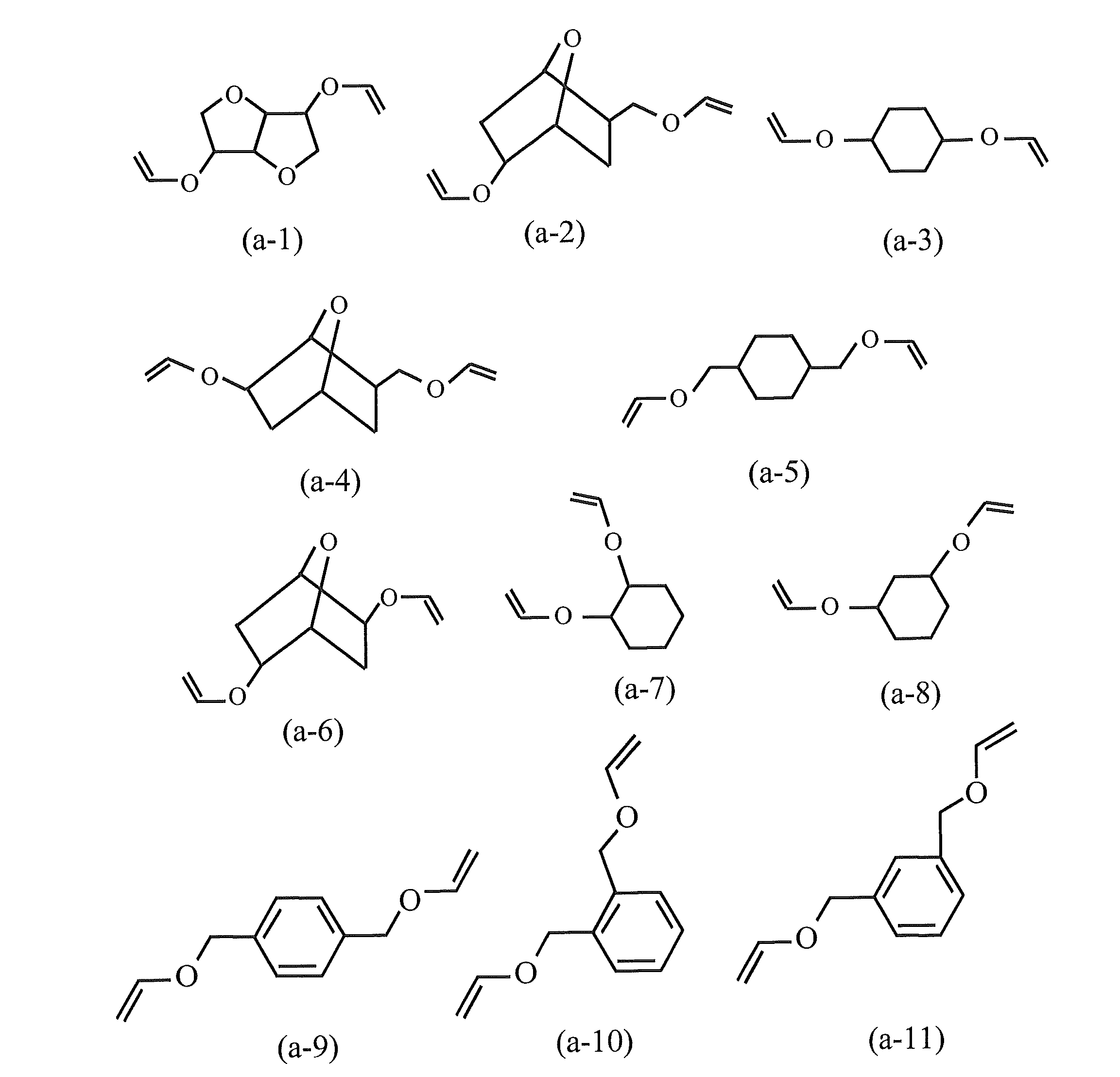
- the compound (A) examples include 1,4-butanediol divinyl ether, diethylene glycol divinyl ether, triethylene glycol divinyl ether, and the like, and compounds represented by the following formula.
- Z 3 of the present invention is, among other things, a heterocyclic compound, a bridged cyclic hydrocarbon, or an aromatic hydrocarbon structural formula in that a polymer having a high softening point or melting point can be formed.
- a group in which n 3 hydrogen atoms have been removed is preferred.
- the Z 3 of the present invention it is preferable not to have an epoxy group and / or oxetane structure.
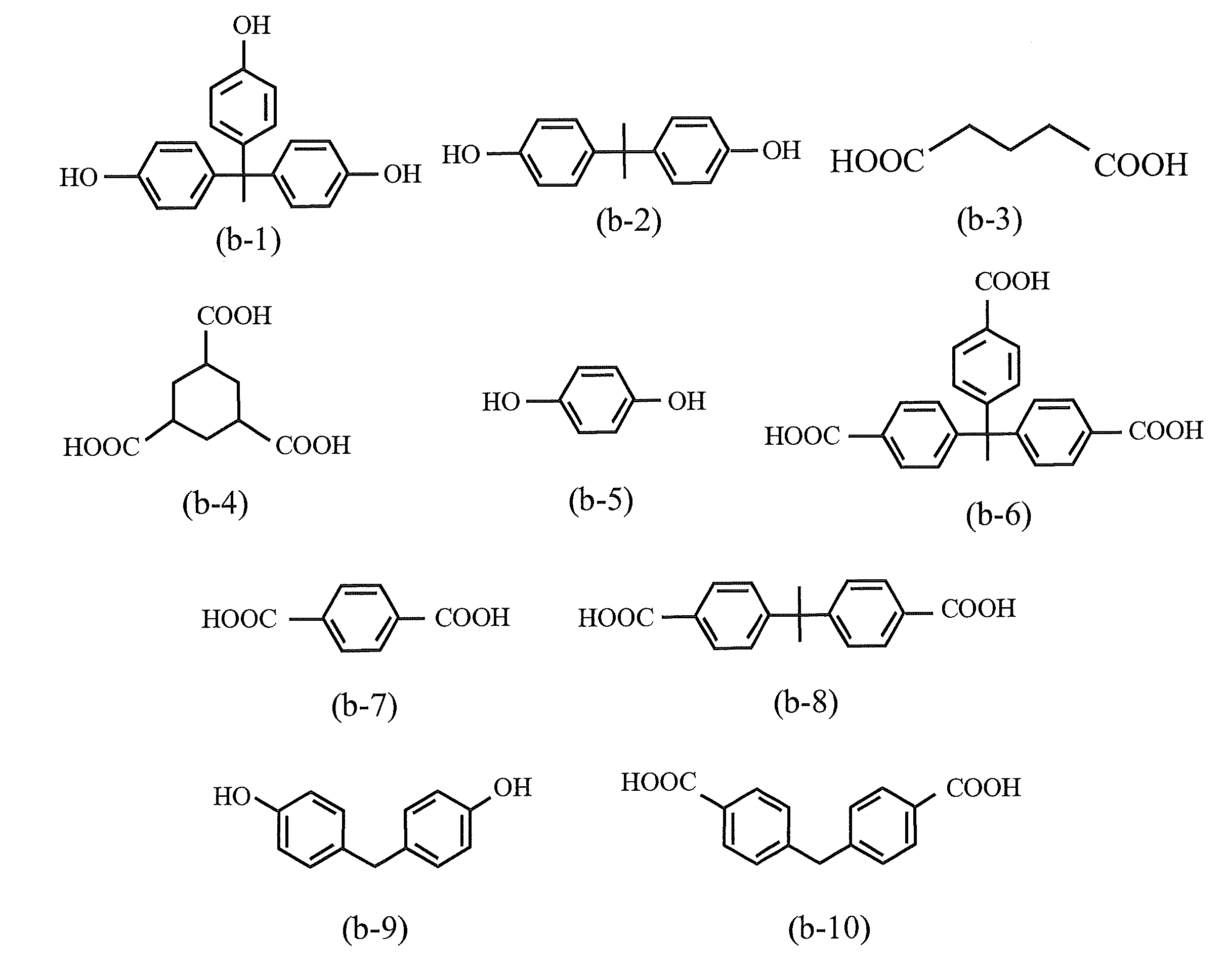
- the compound (B) of the present invention is a polymerizable compound represented by the following formula (b).
- X represents a hydroxyl group or a carboxyl group.
- n 1 Xs may be the same or different.
- n 1 represents an integer of 2 or more, for example, an integer of 2 to 5, preferably an integer of 2 to 4.
- Z 1 represents a saturated or unsaturated aliphatic hydrocarbon, a saturated or unsaturated alicyclic hydrocarbon, an aromatic hydrocarbon, a heterocyclic compound, and these via a linking group, or A group in which n 1 hydrogen atoms have been removed from the structural formula bonded without intervening, the saturated or unsaturated aliphatic hydrocarbon, saturated or unsaturated alicyclic hydrocarbon, aromatic hydrocarbon, heterocyclic
- Examples of the compound and the structural formula in which these are bonded via or without a linking group can include the same examples as in Z 3 above.
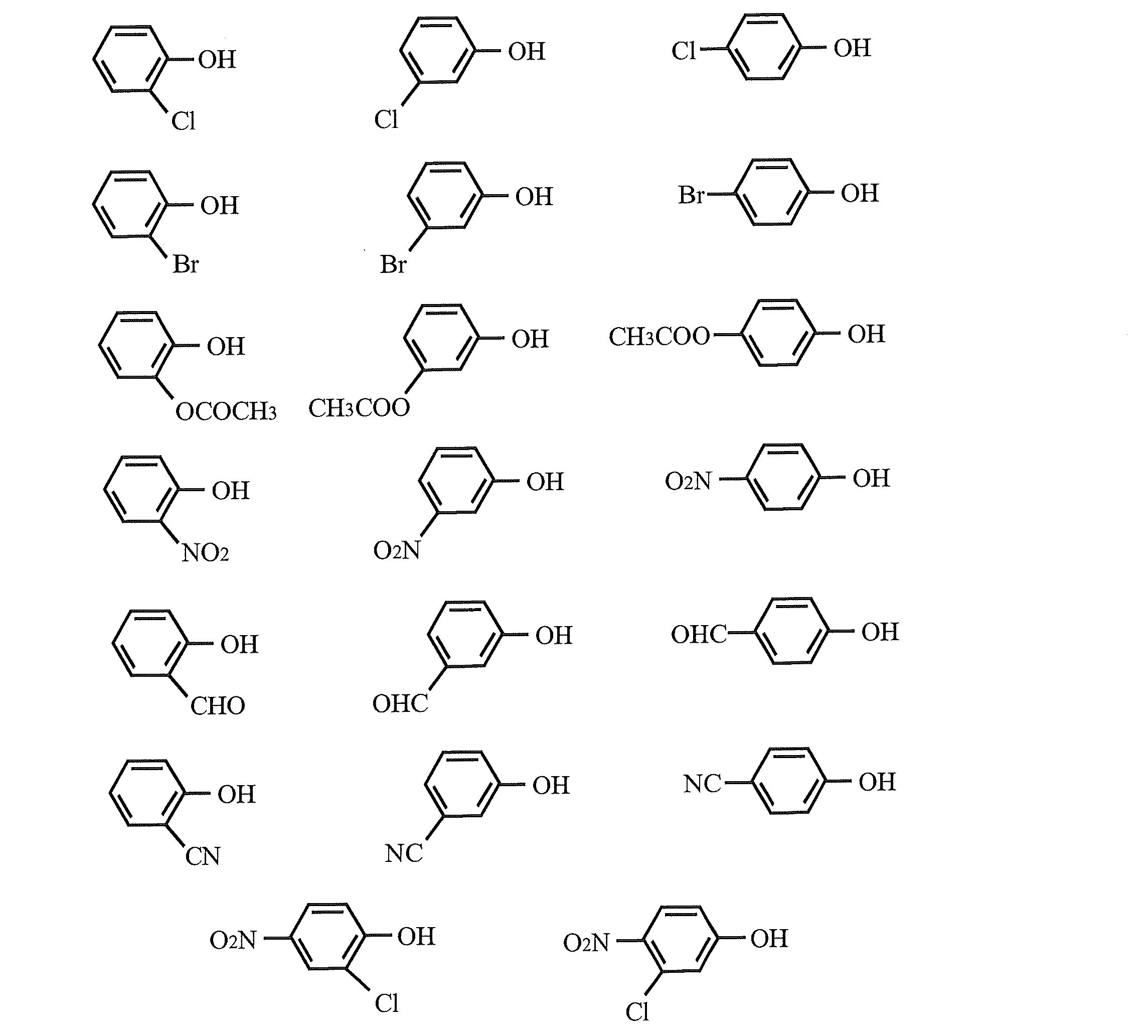
- Z 1 in the present invention when X is a hydroxyl group, among them, a group in which n 1 hydrogen atoms have been removed from the structural formula of the aromatic hydrocarbon (that is, as compound (B), bisphenols, hydroquinone Or trivalent phenols, etc.) are preferred because they are excellent in solubility and reactivity in a solvent and can form a polymer having a high softening point or melting point.
- Z 1 is a group in which n 1 hydrogen atoms have been removed from the structural formula of saturated or unsaturated aliphatic hydrocarbon or saturated or unsaturated alicyclic hydrocarbon, among others. Is preferable in that it has excellent solubility and reactivity in a solvent and can form a polymer having a high softening point or melting point.
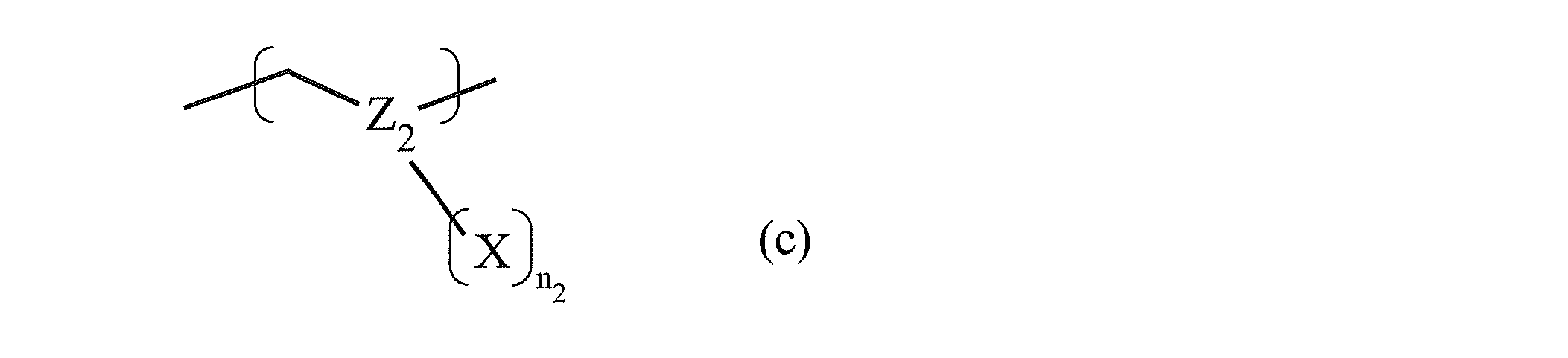
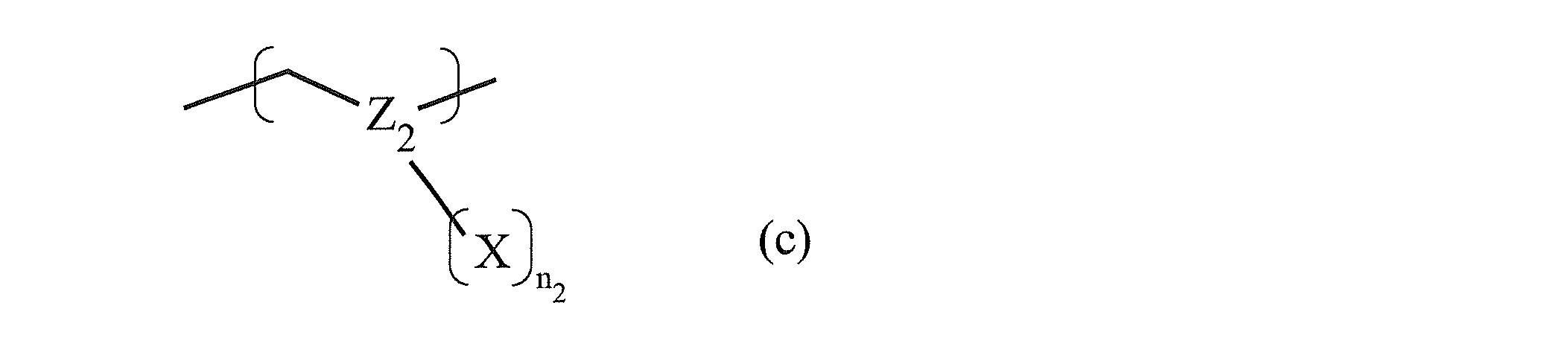
- the compound (C) of the present invention is a polymerizable compound having two or more structural units (repeating units) represented by the following formula (c).
- X represents a hydroxyl group or a carboxyl group.
- n 2 Xs may be the same or different.
- n 2 represents an integer of 1 or more. Among them, 1 is easily available, excellent in solubility in a solvent, and can form a polymer having a high softening point or melting point. An integer of 1 to 3 is preferable, and an integer of 1 to 2 is particularly preferable.
- the number of structural units (repeating units) represented by the above formula (c) in the compound (C) is 2 or more, and 2 to 40 in that a polymer having a high softening point or melting point can be formed.
- An integer of 10 to 30 is preferable, and an integer of 10 to 30 is particularly preferable.
- Z 2 represents a saturated or unsaturated aliphatic hydrocarbon, a saturated or unsaturated alicyclic hydrocarbon, an aromatic hydrocarbon, a heterocyclic compound, and these via a linking group, or A group in which (n 2 +2) hydrogen atoms have been removed from a structural formula bonded without intervention, the saturated or unsaturated aliphatic hydrocarbon, the saturated or unsaturated alicyclic hydrocarbon, the aromatic hydrocarbon, Examples of the heterocyclic compound and the structural formula in which these are bonded via or without a linking group include the same examples as in the above Z 3 .
- a (n 2 +2) -valent group containing a benzene ring is easily available, has excellent solubility in a solvent, and has a high softening point or melting point. It is preferable at the point which can form the polymer which has.
- X is a carboxyl group
- a (n 2 +2) -valent saturated aliphatic hydrocarbon group is available. It is preferable in that it is easy, has excellent solubility in a solvent, and can form a polymer having a high softening point or melting point.
- the compound (C) is preferably a styrene polymer, a (meth) acrylic polymer, polyvinyl alcohol, a novolac resin, a resole resin, or the like, and particularly selected from the following formulas (c-1) to (c-6):
- a polymerizable compound having 2 or more of at least one structural unit (repeating unit) is preferred.
- the proportion of the structural unit represented by formula (c) in the total amount of compound (C) is preferably 30% by weight or more. Particularly preferred is 50% by weight or more, and most preferred is 60% by weight or more.
- the proportion of the structural unit represented by formula (c) in the total amount of compound (C) is preferably 1% by weight or more. Particularly preferred is 5% by weight or more, and most preferred is 10% by weight or more.
- the proportion of the structural unit represented by the formula (c) is less than the above range, the weight average molecular weight of the polymer obtained by polymerization with the compound (A) decreases due to the increase in the distance between the crosslinking points or the decrease in the crosslinking points.
- the adhesion retention in a high temperature environment tends to decrease.
- the compound (C) of the present invention may be a homopolymer having only the structural unit represented by the formula (c), and has the structural unit represented by the formula (c) and other structural units.
- a copolymer may also be used.
- any of a block copolymer, a graft copolymer, and a random copolymer may be used.
- the other structural unit is a structural unit derived from a polymerizable monomer having no hydroxyl group or carboxyl group, and includes, for example, olefins [for example, chain olefins such as ethylene, propylene, 1-butene (especially C 2 -12 alkene); cyclic olefins such as cyclopentene, cyclohexene, cycloheptene, norbornene, 5-methyl-2-norbornene, tetracyclododecene (especially C 3-10 cycloalkene)], aromatic vinyl compounds (for example, styrene, Vinyltoluene, ⁇ -methylstyrene, 1-propenylbenzene, 1-vinylnaphthalene, 2-vinylnaphthalene, 3-vinylpyridine, 3-vinylfuran, 3-vinylthiophene, 3-vinylquinoline, indene, methylindene, eth
- Esters obtained by reacting corresponding monovalent groups carboxylic acid vinyl esters (for example, vinyl acetate, vinyl propionate, vinyl caprylate) C 1-16 fatty acid vinyl esters such as vinyl caproate and the like), unsaturated dicarboxylic acid diester (e.g., diethyl maleate, dibutyl maleate, dioctyl maleate, di of hexyl, etc., to maleic acid 2-ethyl C 1- 10 alkyl esters, and fumaric acid diesters corresponding thereto). These can be used individually by 1 type or in combination of 2 or more types.
- carboxylic acid vinyl esters for example, vinyl acetate, vinyl propionate, vinyl caprylate
- C 1-16 fatty acid vinyl esters such as vinyl caproate and the like
- unsaturated dicarboxylic acid diester e.g., diethyl maleate, dibutyl maleate, dioctyl maleate, di of hexyl, etc.,
- the compound (C) in the case of a copolymer includes, among others, the structural unit represented by the above formula (c), a chain olefin, a cyclic olefin, an aromatic vinyl compound, an unsaturated carboxylic acid ester, and a vinyl carboxylate.
- a compound containing a structural unit derived from at least one polymerizable monomer selected from an ester and an unsaturated dicarboxylic acid diester is preferred.
- the weight average molecular weight of the compound (C) (polystyrene conversion by GPC method) is, for example, 1500 or more, preferably 1800 to 10000, particularly preferably 2000 to 5000. Since the compound (C) is a compound having the above weight average molecular weight, the polymer of the adhesive containing the compound (C) has a higher softening point or melting point than the polymer of the adhesive not containing the compound (C). Thus, the adhesiveness can be maintained even under a higher temperature environment (for example, about 160 to 180 ° C.). In addition, an appropriate viscosity can be imparted by adding it to the adhesive, and it can be applied by squeegee coating. Moreover, a thick coating film can also be formed easily.
- the adhesive of this invention should just contain at least one of a compound (B) and a compound (C), even if it contains only a compound (B), only a compound (C), a compound ( Both B) and compound (C) may be included.
- the proportion (blending amount) of the compound (A) in the total polymerizable compound contained in the adhesive of the present invention is, for example, 0.5 to 80% by weight, preferably about 3 to 80% by weight, more preferably 5 to 70%. % By weight, particularly preferably 10 to 60% by weight.
- a compound (A) can be used individually by 1 type or in combination of 2 or more types, When it contains 2 or more types, the said content means the total amount of 2 or more types of compounds (A). To do.
- the adhesive obtained by blending the compound (A) in the above range can form a polymer having a softening point or a melting point in a high temperature range of 160 ° C. or higher by heating, and is excellent even in a high temperature environment. It becomes possible to exhibit adhesion retention.
- Ratio (blending amount) of compound (B) and / or compound (C) in all polymerizable compounds contained in the adhesive of the present invention Is, for example, 20 to 99.5% by weight, preferably 20 to 95% by weight, more preferably 30 to 90% by weight, and particularly preferably 40 to 85% by weight.
- a compound (B) and a compound (C) can each be used individually by 1 type or in combination of 2 or more types, and when it contains 2 or more types, the said content is total amount of 2 or more types Means.
- the adhesive obtained by blending compound (B) and / or compound (C) in the above range is polymerized together with compound (A) by heating and has a softening point or melting point in a high temperature range of 160 ° C. or higher.
- a polymer can be formed, and excellent adhesiveness can be exhibited even in a high temperature environment.
- the combination of the following [1] and [2], that is, the adhesive comprising the compound (A) and the compound (B) as essential components is excellent even in a high temperature environment. It is preferable in that it can exhibit adhesiveness, has an appropriate viscosity, can be applied by squeegee application, spin application, and the like, and can form a thick coating film. In particular, in the case of [1] below, the adhesiveness can be maintained even under a higher temperature environment (for example, about 160 to 180 ° C.). [1] When compound (A), compound (B), and compound (C) are contained together [2] When compound (A) and compound (B) are contained (compound (C) is not contained)
- each component is preferably contained within the following range, and each component is preferably contained within a range satisfying the following formula.
- Compound (B): 30 to 80% by weight (preferably 40 to 70% by weight) of the total polymerizable compound contained in the adhesive [Compound (A)] / [Compound (B)] (Weight) about 0.8 to 1.5 (preferably 0.5 to 1.4)
- the adhesive of the present invention does not contain a compound represented by the formula (b) as the compound (B) and n 1 is an integer of 3 or more
- the adhesive of the present invention contains each component. It is preferable to contain in the following range.
- Compound (A) For example, 0.5 to 40.0% by weight (preferably 0.5 to 25.0% by weight, particularly preferably 1.0 to 15.0% by weight) of the total polymerizable compound contained in the adhesive %, Most preferably 2.0 to 15.0% by weight)
- Compound (B) 0.2 to 20% by weight (preferably 5.0 to 15.0% by weight, particularly preferably 7.0 to 12.0% by weight) of the total polymerizable compound contained in the adhesive
- Compound (C) 50.0 to 99.0% by weight (preferably 60.0 to 95.0% by weight, particularly preferably 70.0 to 95.0% by weight) of all polymerizable compounds contained in the adhesive %, Most preferably 75.0-95.0% by weight)
- the adhesive of the present invention contains a compound represented by the formula (b) as the compound (B) and n 1 in the formula is an integer of 3 or more
- the adhesive of the present invention has each component in the following range. It is preferable to contain, and it is preferable to contain each component in the range which satisfy
- a compound represented by the formula (b) and n 1 is an integer of 3 or more: for example, more than 0% by weight and 55.0% by weight or less of all polymerizable compounds contained in the adhesive ( Preferably 5.0 to 50.0% by weight, particularly preferably 10.0 to 50.0% by weight, more preferably 20.0 to 50.0% by weight, most preferably 30.0 to 45.0%.
- the acid generator is a compound composed of a cation moiety that absorbs heat or light and an anion moiety that serves as an acid generation source, and includes a thermal acid generator and a photoacid generator. These can be used alone or in combination of two or more.
- the adhesive of the present invention contains an acid generator
- the polymer is decomposed by generating an acid from the acid generator by heating or irradiating light after polymerizing the adhesive to form a polymer. It can be softened or liquefied at a temperature lower than that of an adhesive containing no acid generator, and the adherend can be peeled off by reducing or losing the adhesiveness.
- the polymer can be reduced in molecular weight by being decomposed by an acid, it can be more easily washed away with a solvent, and the adhesive residue after the peeling can be easily removed.
- the thermal acid generator is a compound that generates a sulfonic acid (eg, perfluoroalkylsulfonic acid), a sulfonium cation, etc. by performing a heat treatment (particularly, a heat treatment at a temperature exceeding the curing temperature), for example, Aryldiazonium salts, aryliodonium salts, arylsulfonium salts, allene-ion complexes, and the like.
- a commercial product such as a trade name “SI-180L” (manufactured by Sanshin Chemical Industry Co., Ltd.) may be used.
- the content (blending amount) of the thermal acid generator is, for example, about 0.01 to 5 parts by weight, preferably 0.05 to 3 parts by weight, particularly preferably 0, based on the total amount of the polymerizable compound (100 parts by weight). .1 to 2 parts by weight.
- the content (blending amount) of the thermal acid generator is, for example, about 0.01 to 5 parts by weight with respect to the sum (100 parts by weight) of the compound (A), the compound (B), and the compound (C), preferably Is 0.05 to 3 parts by weight, particularly preferably 0.1 to 2 parts by weight.
- the photoacid generator is a compound that generates sulfonic acid (for example, perfluoroalkyl sulfonic acid, perfluorophosphonium sulfonic acid, etc.), sulfonium cation, etc. by irradiating light, for example, an iodonium salt compound (among others).
- sulfonic acid for example, perfluoroalkyl sulfonic acid, perfluorophosphonium sulfonic acid, etc.
- sulfonium cation etc. by irradiating light
- an iodonium salt compound for example, an iodonium salt compound (among others).
- aryliodonium salt compounds are preferred, bisaryliodonium salt compounds are particularly preferred), sulfonium salt compounds (among those arylsulfonium salt compounds are preferred, and triarylsulfonium salt compounds are particularly preferred). It can. These can be used alone or in combination
- Examples of the cation part of the photoacid generator include iodonium ions and sulfonium ions.
- iodonium ion examples include diphenyliodonium ion, di-p-tolyliodonium ion, bis (4-dodecylphenyl) iodonium ion, bis (4-methoxyphenyl) iodonium ion, and (4-octyloxyphenyl) phenyliodonium ion.
- Aryliodonium ions such as bisaryliodonium ions.
- sulfonium ion examples include arylsulfonium ions (particularly, triarylsulfonium ions) such as triphenylsulfonium ion, diphenyl [4- (phenylthio) phenyl] sulfonium ion, and tri-p-tolylsulfonium ion. .
- Examples of the anion moiety of the photoacid generator include perfluoroalkanesulfonium ions, perfluorophosphonium sulfonium ions, perfluoroantimonium sulfonium ions, BF 4 ⁇ , B (C 6 F 5 ) 4 ⁇ , PF 6 ⁇ , [ (Rf) n PF 6-n ] ⁇ (Rf: an alkyl group in which 80% or more of hydrogen atoms are replaced by fluorine atoms, n: an integer of 1 to 5), AsF 6 ⁇ , SbF 6 ⁇ , pentafluorohydroxyantimony Nate etc. can be mentioned.
- perfluoroalkanesulfonium ions and perfluorophosphoniumsulfonium ions are preferred because they can be used safely without containing any antimony as a toxic substance.
- the content (blending amount) of the photoacid generator is, for example, about 0.01 to 5 parts by weight, preferably 0.05 to 3 parts by weight, particularly preferably 0, based on the total amount of the polymerizable compound (100 parts by weight). .1 to 2 parts by weight.
- the content (blending amount) of the photoacid generator is, for example, about 0.01 to 5 parts by weight with respect to the sum (100 parts by weight) of the compound (A), the compound (B), and the compound (C), preferably Is 0.05 to 3 parts by weight, particularly preferably 0.1 to 2 parts by weight.
- the adhesive of the present invention may further contain a polymerization accelerator.
- the polymerization accelerator include monovalent carboxylic acids represented by the following formula (d) and monovalent alcohols represented by the following formula (e). These can be used alone or in combination of two or more.
- the adhesive containing the compound can accelerate the polymerization reaction of the compound (A), the compound (B), and the compound (C), compared to the case of using an adhesive that does not contain a polymerization accelerator, Even if the heating temperature at the time of polymerization is lowered, a polymer having the same or higher softening point or melting point can be formed, and the adhesiveness can be maintained even in a higher temperature environment (for example, about 160 to 180 ° C.).
- Z 4 -COOH (d) (In the formula, Z 4 may have a substituent other than a carboxyl group, and is a structure selected from saturated or unsaturated aliphatic hydrocarbons, saturated or unsaturated alicyclic hydrocarbons, and aromatic hydrocarbons. Indicates a group in which one hydrogen atom has been removed from the formula)
- Z 5 —OH (e) (In the formula, Z 5 represents a group obtained by removing one hydrogen atom from the structural formula of an aromatic hydrocarbon which may have a substituent other than a hydroxyl group)
- saturated or unsaturated aliphatic hydrocarbon, saturated or unsaturated alicyclic hydrocarbon, and aromatic hydrocarbon at Z 4 in the above formula (d), as aromatic hydrocarbon at Z 5 in the above formula (e) May include monovalent groups corresponding to the above examples of Z 3 .
- the substituent that Z 4 may have include an example in which a carboxyl group is excluded from the examples of the substituent that Z 3 may have.
- Examples of the substituent that Z 5 may have include an example in which the hydroxyl group is excluded from the examples of the substituent that Z 3 may have.
- the polymerization accelerator of the present invention preferably has a pKa (acid dissociation constant) of 3 to 8, particularly preferably 4 to 6.
- pKa acid dissociation constant
- the polymerization accelerator of the present invention preferably has a pKa (acid dissociation constant) of 3 to 8, particularly preferably 4 to 6.
- the pKa is below the above range, the storage stability tends to decrease, for example, the polymerization proceeds in the adhesive and the viscosity increases.
- pKa exceeds the above range, the effect of promoting polymerization tends to decrease.
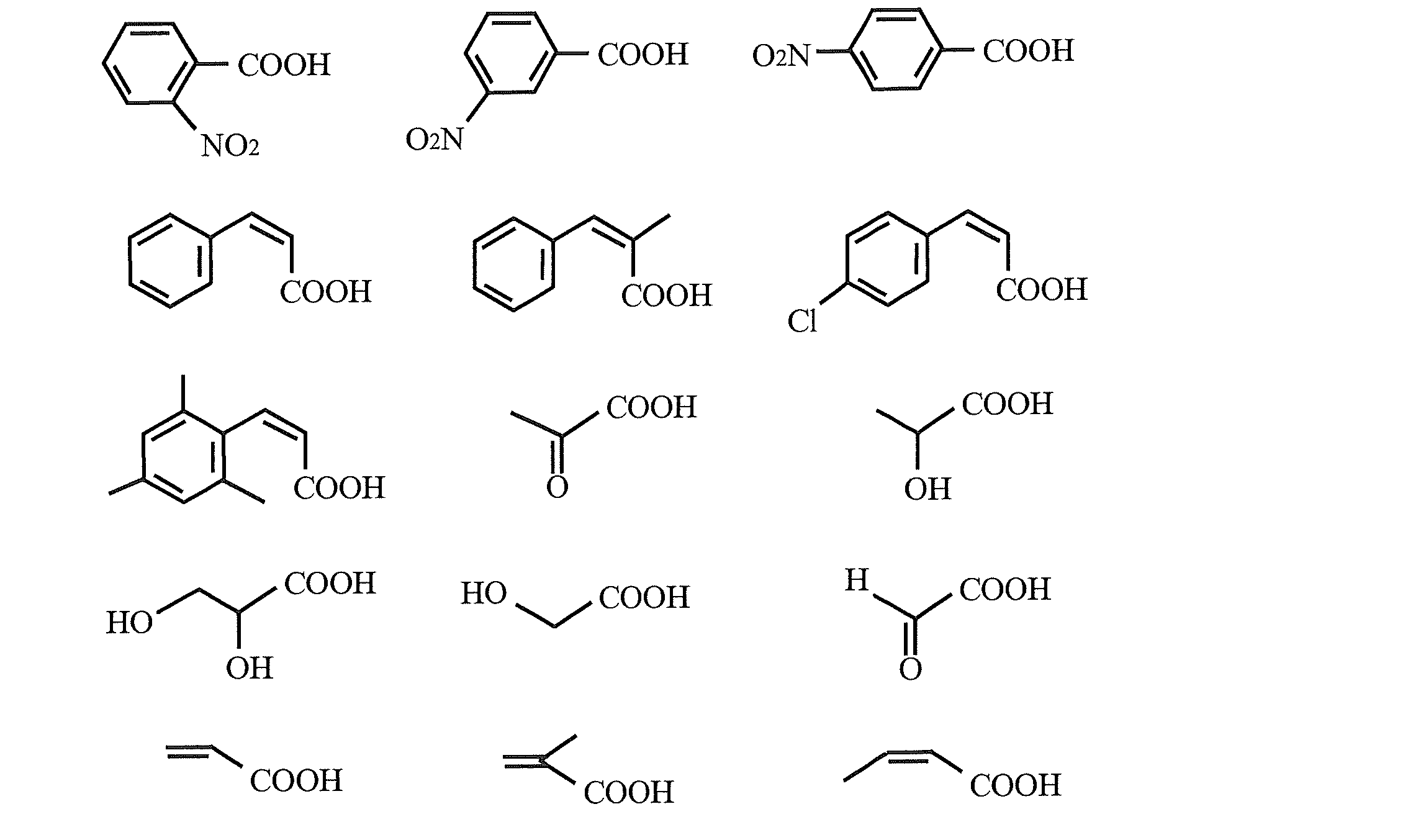
- the monovalent carboxylic acid represented by the formula (d) the following compounds (including geometric isomers) are preferable.
- the amount of the polymerization accelerator used is, for example, about 0.1 to 10 parts by weight (preferably 0.3 to 5 parts by weight) with respect to 100 parts by weight of the polymerizable compound contained in the adhesive.
- the adhesive of the present invention can further contain other components as necessary.
- other components include a solvent, a surfactant, a leveling agent, a silane coupling agent, and a foaming agent. These can be used alone or in combination of two or more.
- the adhesive of the present invention preferably contains a solvent in that the viscosity of the adhesive can be controlled by adjusting the amount of the solvent used.
- a solvent for example, toluene, hexane, isopropanol, methyl isobutyl ketone, cyclopentanone, propylene glycol monomethyl ether acetate, cyclohexanone, propylene glycol monomethyl ether, ⁇ -butyrolactone, etc.
- 2 More than seeds can be used.
- the adhesive of the present invention contains a surfactant in an amount of about 0.01 to 1% by weight based on the total amount of the adhesive, can improve the repellency of the adhesive at the time of application, and can improve the uniformity of the coating film. It is preferable at the point which can improve.
- the surfactant include trade names “F-444”, “F-447”, “F-554”, “F-556”, “F-557” (above, fluorine oligomer, manufactured by DIC Corporation). ), Trade name “BYK-350” (acrylic polymer, manufactured by Big Chemie), trade names “A-1420”, “A-1620”, “A-1630” (above, fluorine-containing alcohol, Daikin Industries, Ltd.) Can be used. These can be used alone or in combination of two or more.
- the adhesive of the present invention contains monomers such as the compound (A) and the compound (B) and does not contain the compound (C) or other resins, the change in viscosity for each product can be suppressed to a small level. It is possible to produce an adhesive having a certain range of viscosity with good reproducibility.
- the adhesive of this invention contains the said compound (A), a compound (B), and a compound (C), it has a much higher softening point or melting
- the adhesive of the present invention contains an acid generator, it is softened or liquefied by heat treatment at a lower temperature when the adhesiveness is reduced or lost compared to the adhesive of the present invention that does not contain an acid generator. Moreover, the adhesive residue adhering to the adherend after peeling can be more easily removed.
- the adhesive of the present invention can be prepared by blending the above components and other components as necessary, and stirring and mixing while removing bubbles under vacuum as necessary.
- the temperature at the time of stirring and mixing is preferably about 10 to 80 ° C.
- a known or conventional device for example, a rotation / revolution mixer, a single or multi-screw extruder, a planetary mixer, a kneader, a dissolver, etc.
- a known or conventional device for example, a rotation / revolution mixer, a single or multi-screw extruder, a planetary mixer, a kneader, a dissolver, etc.
- the viscosity (at 25 ° C.) of the adhesive of the present invention is, for example, about 50 to 600 mPa ⁇ s, and preferably 60 to 400 mPa ⁇ s. Therefore, it is excellent in applicability and can be uniformly applied to the adherend surface.
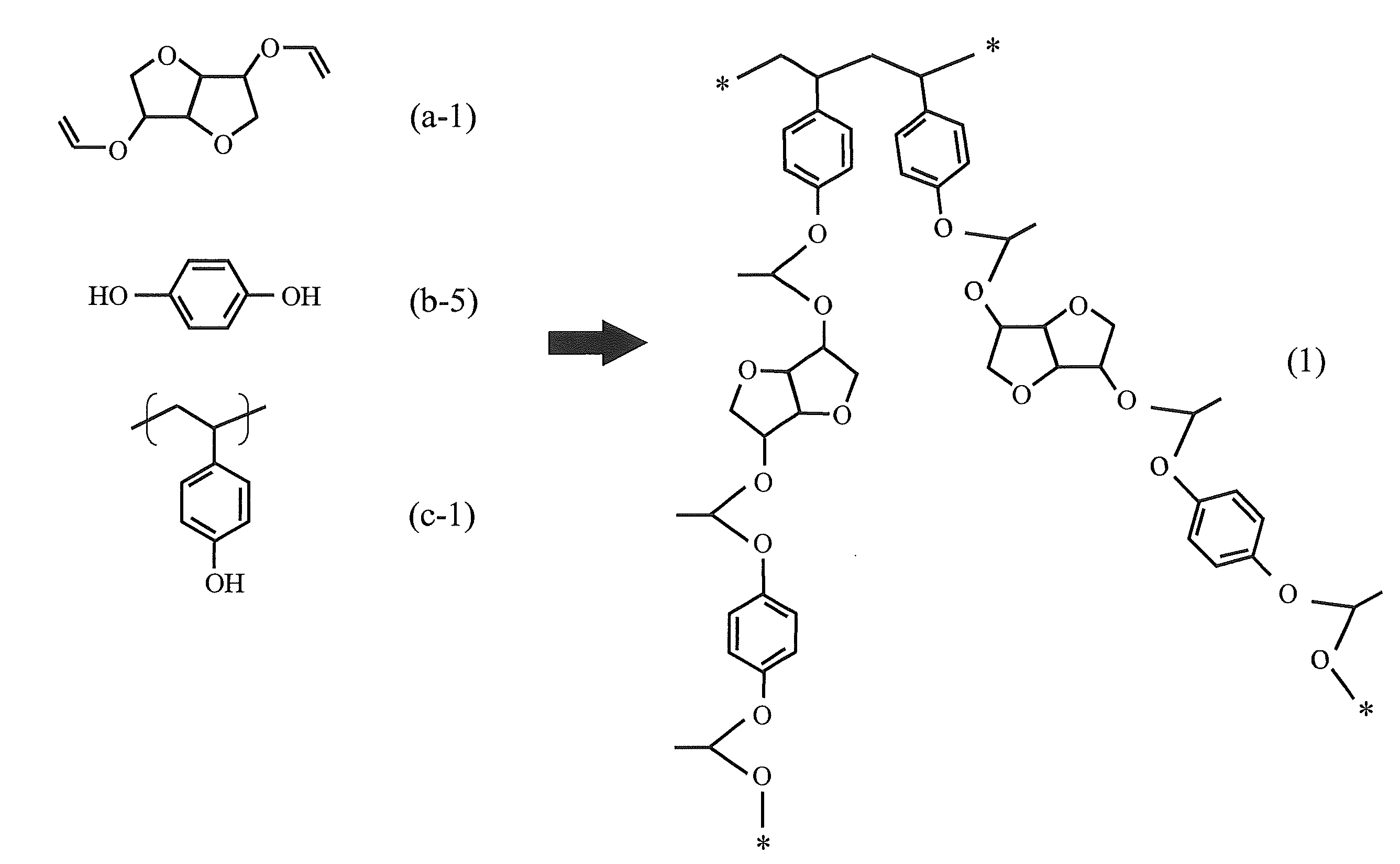
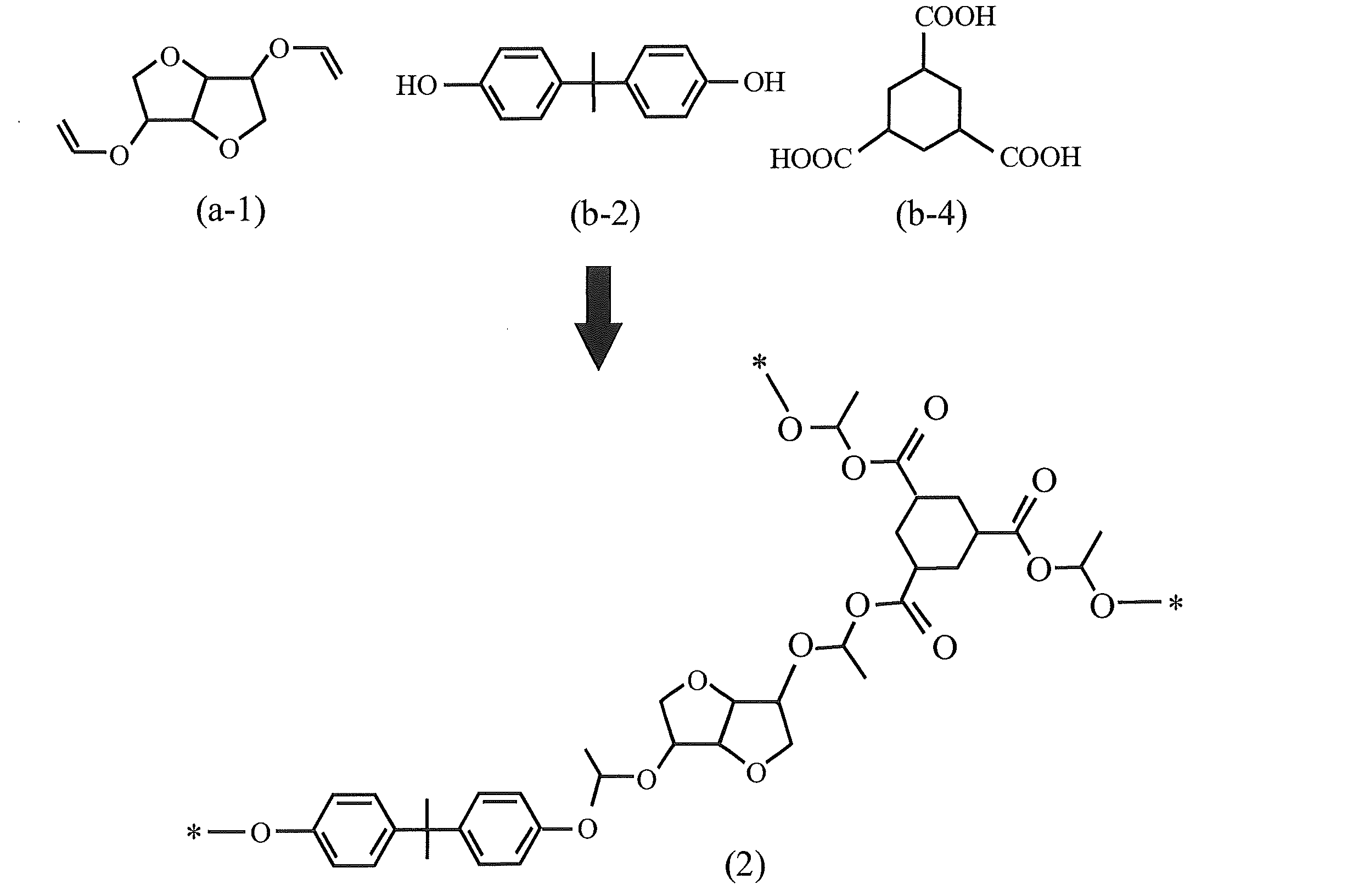
- the adhesive of the present invention can be acetal-bonded between the vinyl ether group of the polyvalent vinyl ether compound and the hydroxyl group and / or the carboxyl group by applying heat treatment after being applied to the adherend, thereby bonding the adhesive.
- a polymer having excellent properties can be formed.
- the compound represented by the following formula (a-1) as the polyvalent vinyl ether compound the compound represented by the following formula (b-5) as the compound (B), and the following formula (c-1) as the compound (C)
- a polymer represented by the following formula (1) can be obtained by subjecting the adhesive containing the compound represented by formula (I) to heat treatment.
- a polymer represented by the following formula (2) is obtained by subjecting the contained adhesive to heat treatment.
- the polymer obtained by subjecting the adhesive of the present invention to a heat treatment is a thermoplastic resin having a softening point or melting point of 160 ° C. or higher (for example, 160 to 250 ° C., preferably 170 to 200 ° C.). Therefore, excellent adhesion retention can be exhibited even in a high temperature environment (less than 160 ° C.).
- the “softening point or melting point of the polymer” in the present invention means that 0.1 g of the adhesive of the present invention is applied to the glass plate (1) to a thickness of 10 ⁇ m, and the glass plate (2) is bonded together.
- the polymer softens or liquefies when heated at a softening point or a temperature equal to or higher than the melting point (for example, 160 ° C. or higher, preferably 180 to 300 ° C., particularly preferably 200 to 250 ° C.), or the adhesiveness rapidly decreases To lose.
- the melting point for example, 160 ° C. or higher, preferably 180 to 300 ° C., particularly preferably 200 to 250 ° C.
- the adhesive of the present invention contains an acid generator
- the polymer is decomposed when acid is generated by heating or light irradiation after polymerization, and has a lower softening point or melting point than the polymer before decomposition.
- the polymer or a decomposition product obtained by decomposing the polymer can be softened or liquefied by heating at a temperature above its softening point or melting point, and the softened or liquefied compound can be cyclohexanone, propylene glycol monomethyl ether,
- solvents such as propylene glycol monomethyl ether acetate, acetone, ethyl acetate, butyl acetate, methyl isobutyl ketone, etc.
- the solvent can be easily washed away using one or more of the solvents.
- the adhesive of the present invention Since the adhesive of the present invention has the above properties, it can form a polymer having excellent adhesion retention by performing heat treatment, and can keep the adherend firmly even in a high temperature environment. It becomes possible. Further, when it becomes unnecessary, the polymer can be softened or liquefied by heat treatment or light irradiation and heat treatment, and can be easily removed without leaving glue. Therefore, the adhesive of the present invention can be suitably used as an adhesive for temporarily fixing a fragile adherend.
- the method for temporarily fixing an adherend of the present invention is a method of temporarily fixing an adherend to a support using an adhesive, which is obtained by subjecting the adhesive of the present invention to a heat treatment.
- the adherend is supported on a support by a polymer of compound (A) and compound (B) represented by formula (b) and / or compound (C) having two or more structural units represented by formula (c).
- the adhesive is used in the method for temporarily fixing an adherend of the present invention, even if the adherend is easily damaged such as a silicon wafer, optical glass, film, metal plate, ceramic plate, etc. It is possible to protect the adherend by adhering it to the support and fixing it, and it is possible to keep the adherend in a fixed state even in a high temperature environment. And when protection becomes unnecessary, it can peel without damaging an adherend and without remaining glue.
- the fixing step includes the following aspects 1 to 3.
- 1. A method of fixing an adherend and a support by polymerizing the adhesive by heating in a state in which the adherend and the support are bonded together. An adhesive is applied to the surface of the adherend and / or the support, and the adhesive is polymerized by heating, and the adherend and the support are bonded together, and then the polymerized adhesive is used. 2. Fixing method by softening An adhesive is applied to the surface of the substrate other than the adherend and the support, and the adhesive is polymerized by heating to create an adhesive sheet, and the adherend and the support are connected via the adhesive sheet. Method of fixing by softening the adhesive sheet after bonding
- the heating temperature at the time of forming the coalescence is, for example, about 100 to 300 ° C., preferably 100 to 250 ° C. Heating may be performed in a state of being fixed at a constant temperature, or may be performed by changing the temperature stepwise.
- the heating time is, for example, about 30 seconds to 30 minutes, preferably 3 minutes to 12 minutes. When the heating temperature and time are less than the above ranges, the weight average molecular weight of the polymer obtained becomes small and the softening point or melting point becomes low, so that the adhesion retention in a high temperature environment tends to be lowered.
- the heating temperature and time exceed the above range, the softening point or melting point of the polymer obtained by the occurrence of a side reaction will decrease, or the softening point or melting point will become too high due to excessive curing, washing after peeling. May be reduced, which is not preferable from the viewpoint of productivity.
- the method of softening the polymerized adhesive or adhesive sheet is, for example, at a temperature of 170 to 250 ° C. (preferably 190 to 230 ° C.), for example, about 0.5 to 10 minutes.
- a method of heating preferably 1 to 5 minutes can be mentioned.
- the fixing step can be performed in the air or in a vacuum.
- the temporary fixing method of the adherend of the present invention is a method of temporarily fixing the adherend to a support using an adhesive, and the adhesive is applied to the adherend and / or the support. After the coating, the adhesive is subjected to heat treatment, and the polyvalent vinyl ether compound (A), the compound (B) represented by the formula (b) and / or the structural unit represented by the formula (c) are converted into 2 units.
- the method is a temporary fixing method of the adherend including a peeling step of peeling the adherend from the support by liquefaction.
- the heating temperature for softening or liquefying the polymer may be any temperature above the softening point or melting point of the polymer, for example, about 165 to 250 ° C., preferably 170 to 220 ° C.
- the heating time is, for example, about 30 seconds to 15 minutes, preferably 3 minutes to 5 minutes.
- the “softening or liquefaction” in the present invention is to reduce the viscosity of the polymer to 100 Pa ⁇ s or less (preferably 1 Pa ⁇ s or less).
- the adhesive of the present invention contains an acid generator
- a step of decomposing the polymer with an acid to lower the molecular weight in advance is provided at a temperature lower than the softening point or melting point of the polymer. It becomes possible to peel off the kimono.
- the heating temperature in that case is, for example, about 50 to 160 ° C., preferably 100 to 150 ° C., particularly when a photoacid generator is contained as the acid generator.
- the heating time is, for example, about 30 seconds to 30 minutes, preferably 3 minutes to 5 minutes.
- the thermal acid generator is contained as the acid generator
- the heating temperature is, for example, about 200 to 300 ° C., preferably 210 to 270 ° C.
- the heating time is, for example, about 30 seconds to 30 minutes, preferably 5 minutes to 20 minutes.
- the photoacid generator When the photoacid generator is contained as the acid generator, it is preferable to perform light irradiation before the heat treatment in that the adherend can be peeled at a lower temperature.
- the light light having various wavelengths, such as ultraviolet rays and X-rays, can be used.
- the light source it is preferable to use far ultraviolet light having a wavelength of 400 nm or less.
- the light irradiation energy is, for example, about 500 to 8000 mJ / cm 2 .
- a well-known and commonly used method such as curtain coating, squeegee coating, roll coating, spray coating, brush coating, bar coating, roller coating, silk screen printing, spin coating, etc. is adopted. can do.
- the coating thickness of the adhesive can be adjusted as appropriate according to the application, and is, for example, about 1 to 20 ⁇ m when used for the purpose of bonding a semiconductor wafer to a support.
- the adhesive residue can be removed by performing a cleaning process.
- the polymer of the adhesive can be decomposed and reduced in molecular weight in the peeling step, so that it can be washed out very easily.
- the adhesive film of the present invention is a polyvalent vinyl ether compound (A) obtained by applying the above adhesive and subjecting to heat treatment, and the compound (B) and / or formula (c) represented by the formula (b).
- the polymer of the compound (C) which has 2 or more structural units represented by these is included.
- the target to which the adhesive is applied is not particularly limited, and examples thereof include an adherend and a support.
- the coating agent is applied by the same method as the method of applying the adhesive in the method for temporarily fixing the adherend, and the heat treatment is a method for polymerizing the adhesive in the method for temporarily fixing the adherend. It is performed by the same method.
- the thickness of the adhesive film can be appropriately adjusted depending on the application, and is, for example, about 1 to 20 ⁇ m when used for an application in which a semiconductor wafer is bonded to a support.
- the method of processing an adherend according to the present invention is a method of processing an adherend temporarily fixed using an adhesive, which is obtained by subjecting the adhesive of the present invention to a heat treatment.
- the adherend is fixed to the support by a polymer of (A) and the compound (B) and / or the compound (C) having two or more structural units represented by the formula (c).
- a peeling step of peeling the adherend from the support is included.
- the fixing step and the peeling step can be performed by the same method as the temporary fixing method of the adherend. Moreover, also in the processing method of a to-be-adhered body, when a paste residue exists on the to-be-adhered body surface after a peeling process, it is preferable to provide a washing process.
- the processing step is a step of processing the adherend.
- the adherend is a silicon wafer, it is a step of performing grinding (thinning), etching, or the like.
- the adherend is processed in a state of being fixed to the support using the adhesive, even if the adherend is extremely thinly ground, the adherend is damaged in the work process and the subsequent transport process. This can be prevented.
- the adhesive of the present invention forms a polymer having a high softening point or melting point of 160 ° C. or higher, the polymer is not softened or liquefied even in a high temperature environment (below 160 ° C.), and the adherend is adhered to. Can continue to be held on the support, and damage to the adherend can be prevented.
- Production Example 1 18 g of dicyclopentanyl acrylate (manufactured by Hitachi Chemical Co., Ltd.) and 2 g of methacrylic acid (manufactured by Wako Pure Chemical Industries, Ltd.) are dissolved in 30 g of cyclohexanone (manufactured by Wako Pure Chemical Industries, Ltd.), and dimethyl 2,2 ′ -0.4 g of azobis (2-methylpropionate) (trade name “V-601”, manufactured by Wako Pure Chemical Industries, Ltd.) was added and polymerized at 80 ° C. for 6 hours to obtain dicyclopentanyl acrylate / methacrylic acid. (Weight ratio: 90/10) A composition containing a copolymer [weight average molecular weight (in terms of polystyrene by GPC method): 20000] and cyclohexanone was obtained.
- Example 1 (Preparation of adhesive) 39.8 g of 1,1,1-tris (4-hydroxyphenyl) ethane (manufactured by Wako Pure Chemical Industries, Ltd.) and 8.6 g of glutaric acid (manufactured by Wako Pure Chemical Industries, Ltd.) were mixed with propylene glycol monomethyl ether 66. After dissolving in 7 g, 51.6 g of isosorbide divinyl ether (manufactured by Daicel Corporation) was added to prepare an adhesive (viscosity at 25 ° C .: 70 mPa ⁇ s).
- the obtained adhesive was spin coated (1200 rpm, 10 seconds) on a glass plate (Matsunami Glass, 7.6 cm ⁇ 2.6 cm ⁇ 0.2 cm), heated at 100 ° C. for 2 minutes, and then at 150 ° C. for 2 minutes. By heating and further heating at 200 ° C. for 4 minutes, an adhesive film (film thickness: 10 ⁇ m) was prepared, and an adhesive film / glass plate laminate was obtained.
- Examples 2 to 39 (Preparation of adhesive) An adhesive was prepared in the same manner as in Example 1 except that the formulation (unit: parts by weight) described in the following table was changed.
- Comparative Example 1 Preparation of adhesive
- 18 g of dicyclopentanyl methacrylate (manufactured by Hitachi Chemical Co., Ltd.) and 2 g of methacrylic acid (manufactured by Wako Pure Chemical Industries, Ltd.) are dissolved in 30 g of cyclohexanone (manufactured by Wako Pure Chemical Industries, Ltd.), and dimethyl 2,2 ′ -0.4 g of azobis (2-methylpropionate) (trade name “V-601”, manufactured by Wako Pure Chemical Industries, Ltd.) was added and polymerized at 80 ° C. for 6 hours to obtain an adhesive containing a resin.
- the weight average molecular weight (polystyrene conversion by GPC method) of the resin obtained by polymerization was 30000.
- the obtained adhesive was spin-coated (1200 rpm, 10 seconds) on a glass plate (made by Matsunami Glass, 7.6 cm ⁇ 2.6 cm ⁇ 0.2 cm) and heated at 160 ° C. for 5 minutes to form an adhesive film (film thickness: 10 ⁇ m), and an adhesive film / glass plate laminate was obtained.
- Comparative Example 2 (Creation of adhesive film) An adhesive film / glass plate laminate was obtained in the same manner as in Comparative Example 1 except that the composition obtained in Production Example 1 was used as an adhesive.
- Adhesiveness In the state which heated the adhesive film of the adhesive film / glass plate laminated body obtained by the Example and the comparative example to 200 degreeC, it is a glass plate (product made from Matsunami Glass, 7.6cm x 2.6cm x 0.2cm ) Is pressed for 1 minute at a pressure of 800 g / cm 2 , and bonded to an adhesive area of 6.76 cm 2 (2.6 cm ⁇ 2.6 cm) to form a glass plate / adhesive film / glass plate laminate. Then, the adhesion surface of the obtained laminate was observed and evaluated according to the following criteria. Evaluation Criteria No bubbles remained on the adhesion surface, and a uniform adhesion surface was obtained: ⁇ Bubbles remained on the bonding surface or could not be bonded: ⁇
- Adhesive retention The glass plate / adhesive film / glass plate laminate formed in the evaluation of the pastability is heated, and one glass plate is fixed, and the other glass plate is loaded with a load of 2 kg on the surface of the laminate.
- the temperature at which the glass plate moved was taken as the softening point or melting point, and the adhesion retention in a high temperature environment was evaluated according to the following criteria.
- the glass plate / adhesive film / glass plate laminated body using the adhesive agent obtained by the comparative example after forming a laminated body at 200 degreeC, it is softening point by the said method as it is, without cooling to room temperature. Or melting
- Softening point or melting point of 180 ° C or higher ⁇ Softening point or melting point of 160 ° C. or higher and lower than 180 ° C .: ⁇ Softening point or melting point of 100 ° C. or higher and lower than 160 ° C .: ⁇ Softening point or melting point less than 100 ° C .: ⁇
- the glass plate peeled in the peelability evaluation was immersed in cyclohexanone, propylene glycol monomethyl ether, or 0.1M sodium hydroxide aqueous solution at 25 ° C. for 1 minute, and the presence or absence of an adhesive film residue was visually observed. Evaluation was made according to the following criteria. Evaluation Criteria The adhesive film could be completely removed by using any of cyclohexanone, propylene glycol monomethyl ether, and 0.1 M aqueous sodium hydroxide as the solvent: When 0.1M sodium hydroxide aqueous solution was used as a solvent, the adhesive film could not be completely removed, but cyclohexanone and propylene glycol monomethyl ether completely removed the adhesive film when any solvent was used. I was able to: ⁇ Only when either one of cyclohexanone or propylene glycol monomethyl ether was used, the adhesive film was completely removed: ⁇ The adhesive film could not be completely removed using any solvent: ⁇
- the adhesive of the present invention can adhere and fix the adherend while maintaining strong adhesiveness even in a high temperature environment. Then, the adherend can be easily and without being damaged by performing a heat treatment or the like. Further, the glue remaining on the adherend after peeling can be easily dissolved and removed by washing with a solvent. Therefore, the adhesive of the present invention can be suitably used as an adhesive for temporarily fixing a fragile adherend.
Landscapes
- Chemical & Material Sciences (AREA)
- Organic Chemistry (AREA)
- Adhesives Or Adhesive Processes (AREA)
- Addition Polymer Or Copolymer, Post-Treatments, Or Chemical Modifications (AREA)
- Health & Medical Sciences (AREA)
- Chemical Kinetics & Catalysis (AREA)
- Medicinal Chemistry (AREA)
- Polymers & Plastics (AREA)
Abstract
Description
本発明の他の目的は、前記接着剤を使用した被着体の仮固定方法を提供することにある。
本発明のさらに他の目的は、前記接着剤を使用した被着体の加工方法を提供することにある。
本発明のさらに他の目的は、前記接着剤により形成された接着膜を提供することにある。
1.多価ビニルエーテル化合物と、ヒドロキシル基又はカルボキシル基を2個以上有する化合物を含有する接着剤は、これらの配合割合を調整することで容易に粘度をコントロールすることができ、様々な塗布方法や、所望する膜厚に適宜対応することができ、塗布性に優れること
2.前記接着剤に加熱処理を施すと、多価ビニルエーテル化合物と、ヒドロキシル基又はカルボキシル基を2個以上有する化合物がアセタール結合により重合し、160℃以上の高温域に軟化点又は融点を有する熱可塑性の重合体を形成することができること
3.前記重合体はその軟化点又は融点未満の温度では接着性を保持することができること、すなわち、160℃程度の高温環境下でも接着性を保持することができること
4.前記重合体をその軟化点又は融点以上の温度で加熱すると急激に軟化又は液化し、接着性を低下又は喪失させることができること
5.前記重合体はアセタール結合部分が酸により容易に分解するため、加熱する前に酸処理を施した場合は、前記重合体の軟化点又は融点未満の温度で加熱しても急激に軟化又は液化し、接着性を低下又は喪失させることができること
本発明はこれらの知見に基づいて完成させたものである。


Z4-COOH (d)
(式中、Z4はカルボキシル基以外の置換基を有していてもよい、飽和若しくは不飽和脂肪族炭化水素、飽和若しくは不飽和脂環式炭化水素、及び芳香族炭化水素から選択される構造式から1個の水素原子を除去した基を示す)
Z5-OH (e)
(式中、Z5はヒドロキシル基以外の置換基を有していてもよい芳香族炭化水素の構造式から1個の水素原子を除去した基を示す)
(1) 多価ビニルエーテル化合物(A)と、式(b)で表される化合物(B)及び/又は式(c)で表される構成単位を2以上有する化合物(C)を含有する接着剤。
(2) 多価ビニルエーテル化合物(A)が式(a)で表される化合物である(1)に記載の接着剤。
(3) 多価ビニルエーテル化合物(A)が式(a-1)~(a-21)で表される化合物から選択される少なくとも1種の化合物である(1)又は(2)に記載の接着剤。
(4) 化合物(B)が式(b-1)~(b-10)で表される化合物から選択される少なくとも1種の化合物である(1)~(3)の何れかに記載の接着剤。
(5) 化合物(C)が、式(c-1)~(c-6)から選択される少なくとも1種の構成単位を2以上有する重合性化合物である(1)~(4)の何れかに記載の接着剤。
(6) 化合物(C)が、上記式(c)で表される構成単位と、鎖状オレフィン、環状オレフィン、芳香族ビニル化合物、不飽和カルボン酸エステル、カルボン酸ビニルエステル、及び不飽和ジカルボン酸ジエステルから選択される少なくとも1種の重合性単量体由来の構成単位を含む共重合体である(1)~(5)の何れかに記載の接着剤。
(7) さらに、酸発生剤を含有する(1)~(6)の何れかに記載の接着剤。
(8) 酸発生剤が光照射によりパーフルオロアルカンスルホン酸、又はパーフルオロホスホニウムスルホン酸を発生する化合物である(1)~(7)の何れかに記載の接着剤。
(9) 化合物(C)の重量平均分子量(GPC法による、ポリスチレン換算)が1500以上である(1)~(8)の何れかに記載の接着剤。
(10) 接着剤に含まれる重合性化合物全量において多価ビニルエーテル化合物(A)を0.5~80重量%、化合物(B)及び/又は化合物(C)(化合物(B)と化合物(C)を共に含有する場合はその総量)を20~99.5重量%含有する(1)~(9)の何れかに記載の接着剤。
(11) 接着剤に含まれる重合性化合物全量において多価ビニルエーテル化合物(A)を3~80重量%、化合物(B)及び/又は化合物(C)(化合物(B)と化合物(C)を共に含有する場合はその総量)を20~95重量%含有する(1)~(10)の何れかに記載の接着剤。
(12) 多価ビニルエーテル化合物(A)、化合物(B)、及び化合物(C)を下記範囲で含有する(1)~(11)の何れかに記載の接着剤。
多価ビニルエーテル化合物(A):接着剤に含まれる全重合性化合物の5~30重量%
化合物(B):接着剤に含まれる全重合性化合物の3~20重量%
化合物(C):接着剤に含まれる全重合性化合物の50~90重量%
(13) 多価ビニルエーテル化合物(A)、化合物(B)、及び化合物(C)を含有し、且つこれらの含有量(重量)が下記式を満たす(1)~(12)の何れかに記載の接着剤。
[化合物(B)+化合物(C)]/[多価ビニルエーテル化合物(A)]=1.5~15
[化合物(B)]/[化合物(B)+化合物(C)](重量)=0を超え0.5以下
[化合物(C)]/[化合物(B)+化合物(C)](重量)=0.15以上1.0未満
(14) 多価ビニルエーテル化合物(A)及び化合物(B)を下記範囲で含有する(1)~(13)の何れかに記載の接着剤。
多価ビニルエーテル化合物(A):接着剤に含まれる全重合性化合物の20~60重量%
化合物(B):接着剤に含まれる全重合性化合物の30~80重量%
(15) 多価ビニルエーテル化合物(A)及び化合物(B)を含有し、且つこれらの含有量(重量)が下記式を満たす(1)~(14)の何れかに記載の接着剤。
[多価ビニルエーテル化合物(A)]/[化合物(B)]=0.8~1.5
(16) さらに、式(d)で表される1価のカルボン酸及び/又は式(e)で表される1価のアルコールを含有する(1)~(15)の何れかに記載の接着剤。
(17) 前記式(d)で表される1価のカルボン酸及び/又は式(e)で表される1価のアルコールのpKaが3~8である(16)に記載の接着剤。
(18) 前記式(d)で表される1価のカルボン酸及び/又は式(e)で表される1価のアルコールを接着剤に含まれる重合性化合物100重量部に対して0.1~10重量部含有する(16)又は(17)に記載の接着剤。
(19) さらに、界面活性剤を含有する(1)~(18)の何れかに記載の接着剤。
(20) 前記界面活性剤を接着剤全量の0.01~1重量%含有する(19)に記載の接着剤。
(21) 接着剤の粘度(25℃における)が50~600mPa・sである(1)~(20)の何れかに記載の接着剤。
(22) 接着剤を使用して被着体を支持体に仮固定する方法であって、(1)~(21)の何れかに記載の接着剤に加熱処理を施して得られる、多価ビニルエーテル化合物(A)と、式(b)で表される化合物(B)及び/又は式(c)で表される構成単位を2以上有する化合物(C)の重合体により被着体を支持体に固定する固定工程、及び前記重合体に加熱処理、又は光照射と加熱処理を施して前記重合体を軟化又は液化することにより被着体を支持体から剥離する剥離工程を含む被着体の仮固定方法。
(23) 接着剤を使用して被着体を支持体に仮固定する方法であって、(1)~(21)の何れかに記載の接着剤を被着体及び/又は支持体に塗布した後、前記接着剤に加熱処理を施して、多価ビニルエーテル化合物(A)と、式(b)で表される化合物(B)及び/又は式(c)で表される構成単位を2以上有する化合物(C)の重合体を形成させ、それにより被着体を支持体に固定する固定工程、及び前記重合体に加熱処理、又は光照射と加熱処理を施して前記重合体を軟化又は液化することにより被着体を支持体から剥離する剥離工程を含む被着体の仮固定方法。
(24) 接着剤を使用して仮固定された被着体を加工する方法であって、(1)~(21)の何れかに記載の接着剤に加熱処理を施して得られる、多価ビニルエーテル化合物(A)と、式(b)で表される化合物(B)及び/又は式(c)で表される構成単位を2以上有する化合物(C)の重合体により被着体を支持体に固定する固定工程、固定された被着体に加工を施す加工工程、及び前記重合体に加熱処理、又は光照射と加熱処理を施して前記重合体を軟化又は液化することにより被着体を支持体から剥離する剥離工程を含む被着体の加工方法。
(25) 接着剤を使用して仮固定された被着体を加工する方法であって、(1)~(21)の何れかに記載の接着剤を被着体及び/又は支持体に塗布した後、前記接着剤に加熱処理を施して、多価ビニルエーテル化合物(A)と、式(b)で表される化合物(B)及び/又は式(c)で表される構成単位を2以上有する化合物(C)の重合体を形成させ、それにより被着体を支持体に固定する固定工程、固定された被着体に加工を施す加工工程、及び前記重合体に加熱処理、又は光照射と加熱処理を施して前記重合体を軟化又は液化することにより被着体を支持体から剥離する剥離工程を含む被着体の加工方法。
(26) (1)~(21)の何れかに記載の接着剤を塗布し、加熱処理を施して得られる、多価ビニルエーテル化合物(A)と、式(b)で表される化合物(B)及び/又は式(c)で表される構成単位を2以上有する化合物(C)の重合体を含む接着膜。
本発明の接着剤は、重合性化合物として、多価ビニルエーテル化合物(A)と、式(b)で表される化合物(B)及び/又は式(c)で表される構成単位を2以上有する化合物(C)とを含有する。また、本発明の接着剤は、更に、酸発生剤を含有していてもよい。
本発明の多価ビニルエーテル化合物(A)(以後「化合物(A)」と称する場合がある)は本発明の接着剤の必須成分である。化合物(A)は、1分子内に2個以上のビニルエーテル基を有する化合物であり、例えば、下記式(a)で表される。


本発明の化合物(B)は下記式(b)で表される重合性化合物である。

本発明の化合物(C)は、下記式(c)で表される構成単位(繰り返し単位)を2以上有する重合性化合物である。

[1]化合物(A)、化合物(B)、及び化合物(C)を共に含有する場合
[2]化合物(A)、及び化合物(B)を含有する(化合物(C)は含有しない)場合
化合物(A):接着剤に含まれる全重合性化合物の5~30重量%(好ましくは5~25重量%)
化合物(B):接着剤に含まれる全重合性化合物の3~20重量%(好ましくは3~10重量%)
化合物(C):接着剤に含まれる全重合性化合物の50~90重量%(好ましくは60~85重量%)
[化合物(B)+化合物(C)]/[化合物(A)](重量)=1.5~15程度(好ましくは2~12、特に好ましくは3~10)
[化合物(B)]/[化合物(B)+化合物(C)](重量)=0を超え0.5以下程度(好ましくは0.05~0.4、特に好ましくは0.05~0.3)
[化合物(C)]/[化合物(B)+化合物(C)](重量)=0.15以上1.0未満程度(好ましくは0.25~0.98、特に好ましくは0.3~0.95、最も好ましくは0.5~0.95)
化合物(A):接着剤に含まれる全重合性化合物の20~60重量%(好ましくは30~50重量%)
化合物(B):接着剤に含まれる全重合性化合物の30~80重量%(好ましくは40~70重量%)
[化合物(A)]/[化合物(B)](重量)=0.8~1.5程度(好ましくは0.5~1.4)
化合物(A):接着剤に含まれる全重合性化合物の、例えば0.5~40.0重量%(好ましくは0.5~25.0重量%、特に好ましくは1.0~15.0重量%、最も好ましくは2.0~15.0重量%)
化合物(B):接着剤に含まれる全重合性化合物の、例えば0.2~20重量%(好ましくは5.0~15.0重量%、特に好ましくは7.0~12.0重量%)
化合物(C):接着剤に含まれる全重合性化合物の、例えば50.0~99.0重量%(好ましくは60.0~95.0重量%、特に好ましくは70.0~95.0重量%、最も好ましくは75.0~95.0重量%)
化合物(A):接着剤に含まれる全重合性化合物の、例えば35.0~65.0重量%(好ましくは40.0~60.0重量%、特に好ましくは45.0~60.0重量%)
化合物(B):接着剤に含まれる全重合性化合物の、例えば35.0~65.0重量%(好ましくは40.0~60.0重量%、特に好ましくは45.0~60.0重量%)
化合物(B)として、式(b)で表され、n1が3以上の整数である化合物:接着剤に含まれる全重合性化合物の、例えば0重量%を超え、55.0重量%以下(好ましくは5.0~50.0重量%、特に好ましくは10.0~50.0重量%、更にこのましくは20.0~50.0重量%、最も好ましくは30.0~45.0重量%)
化合物(C):接着剤に含まれる全重合性化合物の、例えば0~30.0重量%(好ましくは0~20.0重量%、特に好ましくは0~10.0重量%)
化合物(A)/化合物(B)(重量)=65/35~35/65程度(好ましくは60/40~40/60、特に好ましくは55/45~45/55)
酸発生剤は、熱又は光を吸収するカチオン部と、酸の発生源となるアニオン部で構成される化合物であり、熱酸発生剤と光酸発生剤が含まれる。これらは1種を単独で、又は2種以上を組み合わせて使用することができる。本発明の接着剤が酸発生剤を含有すると、接着剤を重合して重合体を形成した後に加熱又は光照射を施して酸発生剤から酸を発生させることにより、前記重合体を分解することができ、酸発生剤を含有しない接着剤に比べて低い温度で軟化又は液化させて、接着性を低下又は喪失させて被着体を剥離することが可能となる。また、酸によって分解することにより重合体を低分子量化することができるため、溶剤で一層容易に洗い流すことが可能となり、剥離後の被着剤の糊残りを容易に除去することができる。
本発明の接着剤は、さらに重合促進剤を含有していてもよい。前記重合促進剤としては、下記式(d)で表される1価のカルボン酸、及び下記式(e)で表される1価のアルコール等を挙げることができる。これらは1種を単独で、又は2種以上を組み合わせて使用することができる。前記化合物を含有する接着剤は、化合物(A)、化合物(B)、及び化合物(C)の重合反応を促進することができ、重合促進剤を含有しない接着剤を使用する場合と比べて、重合時の加熱温度を低下させても、同等又は、より一層高い軟化点又は融点を有する重合体を形成することができ、一層高い温度環境下(例えば、160~180℃程度)においても接着性を保持することができる点で好ましい。
Z4-COOH (d)
(式中、Z4はカルボキシル基以外の置換基を有していてもよい、飽和若しくは不飽和脂肪族炭化水素、飽和若しくは不飽和脂環式炭化水素、及び芳香族炭化水素から選択される構造式から1個の水素原子を除去した基を示す)
Z5-OH (e)
(式中、Z5はヒドロキシル基以外の置換基を有していてもよい芳香族炭化水素の構造式から1個の水素原子を除去した基を示す)

本発明の被着体の仮固定方法は、接着剤を使用して被着体を支持体に仮固定する方法であって、本発明の接着剤に加熱処理を施して得られる、多価ビニルエーテル化合物(A)と、式(b)で表される化合物(B)及び/又は式(c)で表される構成単位を2以上有する化合物(C)の重合体により被着体を支持体に固定する固定工程、及び前記重合体に加熱処理、又は光照射と加熱処理を施して前記重合体を軟化又は液化することにより被着体を支持体から剥離する剥離工程を含む。
1.被着体と支持体とを接着剤を使用して貼り合わせた状態で加熱して前記接着剤を重合体化することにより固定する方法
2.被着体及び/又は支持体の表面に接着剤を塗布し、加熱することにより前記接着剤を重合体化し、被着体と支持体とを貼り合わせた後に、前記重合体化した接着剤を軟化させることにより固定する方法
3.接着剤を被着体及び支持体以外の基材表面に塗布し、加熱することにより前記接着剤を重合体化して接着シートを作成し、被着体と支持体とを前記接着シートを介して貼り合わせた後に、接着シートを軟化させることにより固定する方法
本発明の接着膜は、上記接着剤を塗布し、加熱処理を施して得られる、多価ビニルエーテル化合物(A)と、式(b)で表される化合物(B)及び/又は式(c)で表される構成単位を2以上有する化合物(C)の重合体を含む。
本発明の被着体の加工方法は、接着剤を使用して仮固定された被着体を加工する方法であって、本発明の接着剤に加熱処理を施して得られる、多価ビニルエーテル化合物(A)と、式(b)で表される化合物(B)及び/又は式(c)で表される構成単位を2以上有する化合物(C)の重合体により被着体を支持体に固定する固定工程、固定された被着体に加工を施す加工工程、及び前記重合体に加熱処理、又は光照射と加熱処理を施して前記重合体を軟化又は液化することにより加工が施された被着体を支持体から剥離する剥離工程を含む。
尚、接着剤のスピンコートにはスピンコーター(商品名「ACT-400AII」、(株)アクティブ製)を使用した。
加熱にはホットプレート(ND-1、アズワン製)を使用した。
紫外線の照射はスポットキュア(UIS-25102、ウシオ電機製)を使用した。
ジシクロペンタニルアクリレート(日立化成(株)製)18gとメタクリル酸(和光純薬工業(株)製)2gをシクロヘキサノン(和光純薬工業(株)製)30gに溶解し、ジメチル2,2’-アゾビス(2-メチルプロピオネート)(商品名「V-601」、和光純薬工業(株)製)0.4gを加え、80℃で6時間重合させてジシクロペンタニルアクリレート/メタクリル酸(重量比:90/10)共重合体[重量平均分子量(GPC法による、ポリスチレン換算):20000]とシクロヘキサノンを含む組成物を得た。
(接着剤の調製)
1,1,1-トリス(4-ヒドロキシフェニル)エタン39.8g(和光純薬工業(株)製)とグルタル酸8.6g(和光純薬工業(株)製)をプロピレングリコールモノメチルエーテル66.7gに溶解した後、イソソルバイドジビニルエーテル51.6g((株)ダイセル製)を加えて接着剤(25℃における粘度:70mPa・s)を調製した。
得られた接着剤をガラス板(松浪ガラス製、7.6cm×2.6cm×0.2cm)にスピンコート(1200rpm、10秒)し、100℃で2分加熱した後、150℃で2分加熱し、更に200℃で4分加熱することで接着膜(膜厚:10μm)を作成し、接着膜/ガラス板積層体を得た。
(接着剤の調製)
下記表に記載の処方(単位:重量部)に変更した以外は実施例1と同様にして接着剤を調製した。
得られた接着剤を使用し、実施例1と同様にして接着膜(膜厚:10μm)を作成し、接着膜/ガラス板積層体を得た。
得られた接着剤をガラス板(松浪ガラス製、7.6cm×2.6cm×0.2cm)にスピンコート(1200rpm、10秒)し、140℃で2分加熱し、更に180℃で2分加熱して接着膜(膜厚:10μm)を作成し、接着膜/ガラス板積層体を得た。
得られた接着剤をガラス板(松浪ガラス製、7.6cm×2.6cm×0.2cm)にスピンコート(1200rpm、10秒)し、140℃で2分加熱し、更に200℃で2分加熱して、更に235℃で4分加熱して接着膜(膜厚:10μm)を作成し、接着膜/ガラス板積層体を得た。
(接着剤の調製)
ジシクロペンタニルメタクリレート(日立化成(株)製)18gとメタクリル酸(和光純薬工業(株)製)2gをシクロヘキサノン(和光純薬工業(株)製)30gに溶解し、ジメチル2,2’-アゾビス(2-メチルプロピオネート)(商品名「V-601」、和光純薬工業(株)製)0.4gを加え、80℃で6時間重合させて樹脂を含む接着剤を得た。重合により得られた樹脂の重量平均分子量(GPC法による、ポリスチレン換算)は30000であった。
得られた接着剤をガラス板(松浪ガラス製、7.6cm×2.6cm×0.2cm)にスピンコート(1200rpm、10秒)し、160℃で5分加熱して接着膜(膜厚:10μm)を作成し、接着膜/ガラス板積層体を得た。
(接着膜の作成)
製造例1で得られた組成物を接着剤として使用した以外は比較例1と同様にして、接着膜/ガラス板積層体を得た。
1.接着膜の評価
実施例及び比較例で得られた接着膜/ガラス板積層体の接着膜を目視で観察し下記基準により評価した。
評価基準
接着膜表面に凹凸がなく、ガラス面が露出した部分もなかった:◎
接着膜の表面に凹凸があるが、ガラス面が露出した部分はなかった:〇
接着膜の表面に凹凸があり、且つガラス面が露出した部分が発生した:×
実施例及び比較例で得られた接着膜/ガラス板積層体の接着膜を200℃に加温した状態で、ガラス板(松浪ガラス製、7.6cm×2.6cm×0.2cm)を800g/cm2の圧力で1分間押圧して、接着面積が6.76cm2(2.6cm×2.6cm)になるように貼り付けてガラス板/接着膜/ガラス板積層体を形成し、得られた積層体の接着面を観察して、下記基準で評価した。
評価基準
接着面に気泡が残存せず、均一な接着面が得られた:○
接着面に気泡が残存した、又は接着できなかった:×
上記貼り付け性評価で接着できたものについて、ガラス板/接着膜/ガラス板積層体を室温まで冷却して下記基準で評価した。
評価基準
接着面に変化なく、自然剥離なし:○
接着面にひびが発生したが、自然剥離なし:△
自然剥離した:×
上記貼り付け性評価で形成したガラス板/接着膜/ガラス板積層体を加熱し、一方のガラス板を固定した状態で、もう一方のガラス板を2kgの荷重で前記積層体の面に対して水平の方向に引っ張り、ガラス板が移動した温度を軟化点又は融点とし、下記基準により高温環境下での接着保持性を評価した。尚、比較例で得られた接着剤を使用したガラス板/接着膜/ガラス板積層体については、200℃で積層体を形成した後、室温にまで冷却すること無く、そのまま上記方法で軟化点又は融点を求めた。
評価基準
軟化点又は融点が180℃以上のもの:◎
軟化点又は融点が160℃以上、180℃未満のもの:○
軟化点又は融点が100℃以上、160℃未満のもの:△
軟化点又は融点が100℃未満のもの:×
上記貼り付け性評価で形成したガラス板/接着膜/ガラス板積層体を加熱し、一方のガラス板を固定した状態で、もう一方のガラス板を2kgの荷重でスライドさせて剥離し、剥離面を観察して下記基準により評価した。尚、酸発生剤を含む接着剤を使用して得られた接着膜の場合は、加熱前に紫外線(波長:360nm)を4000mJ/cm2照射した。
評価基準
150℃、2分加熱により、接着膜が軟化又は液化して剥離した:◎
150℃、2分加熱では凝集破壊により剥離したが、235℃、10分加熱により、接着膜が軟化又は液化して剥離した:○
上記剥離性評価で剥離したガラス板をシクロヘキサノン又は、プロピレングリコールモノメチルエーテル又は、0.1M水酸化ナトリウム水溶液に、25℃で1分間浸漬し、接着膜の残渣の有無を目視で観察し、下記基準により評価した。
評価基準
溶剤としてシクロヘキサノン、プロピレングリコールモノメチルエーテル、及び、0.1M水酸化ナトリウム水溶液の何れを使用しても接着膜を完全に除去することができた:◎
溶剤として0.1M水酸化ナトリウム水溶液を使用した場合は接着膜を完全に除去することはできなかったが、シクロヘキサノン及びプロピレングリコールモノメチルエーテルは、何れの溶剤を使用した場合も接着膜を完全に除去することができた:○
シクロヘキサノン又はプロピレングリコールモノメチルエーテルの何れか一方の溶剤を使用した場合のみ、接着膜が完全に除去された:△
何れの溶剤を使用しても接着膜を完全に除去することができなかった:×
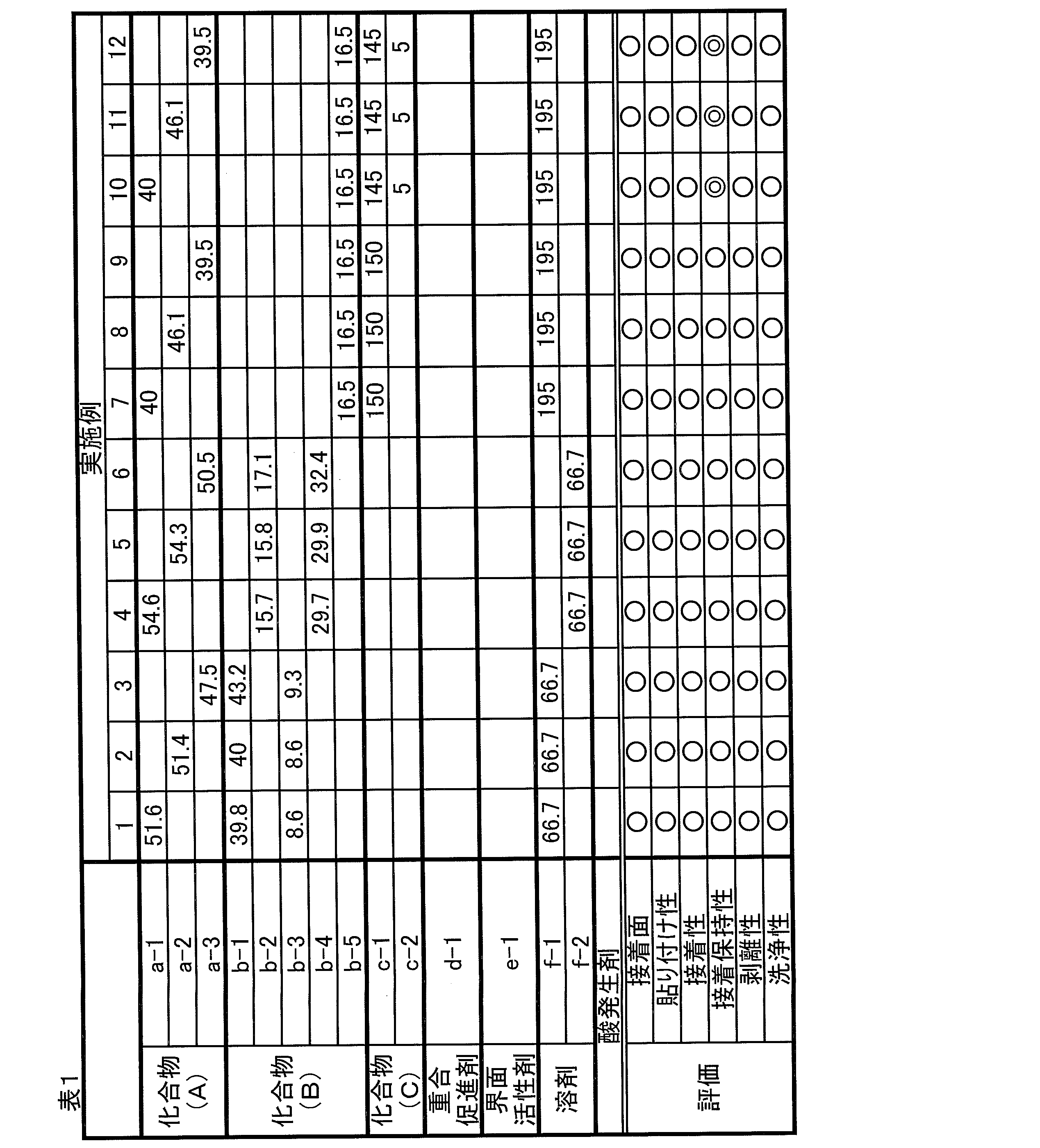

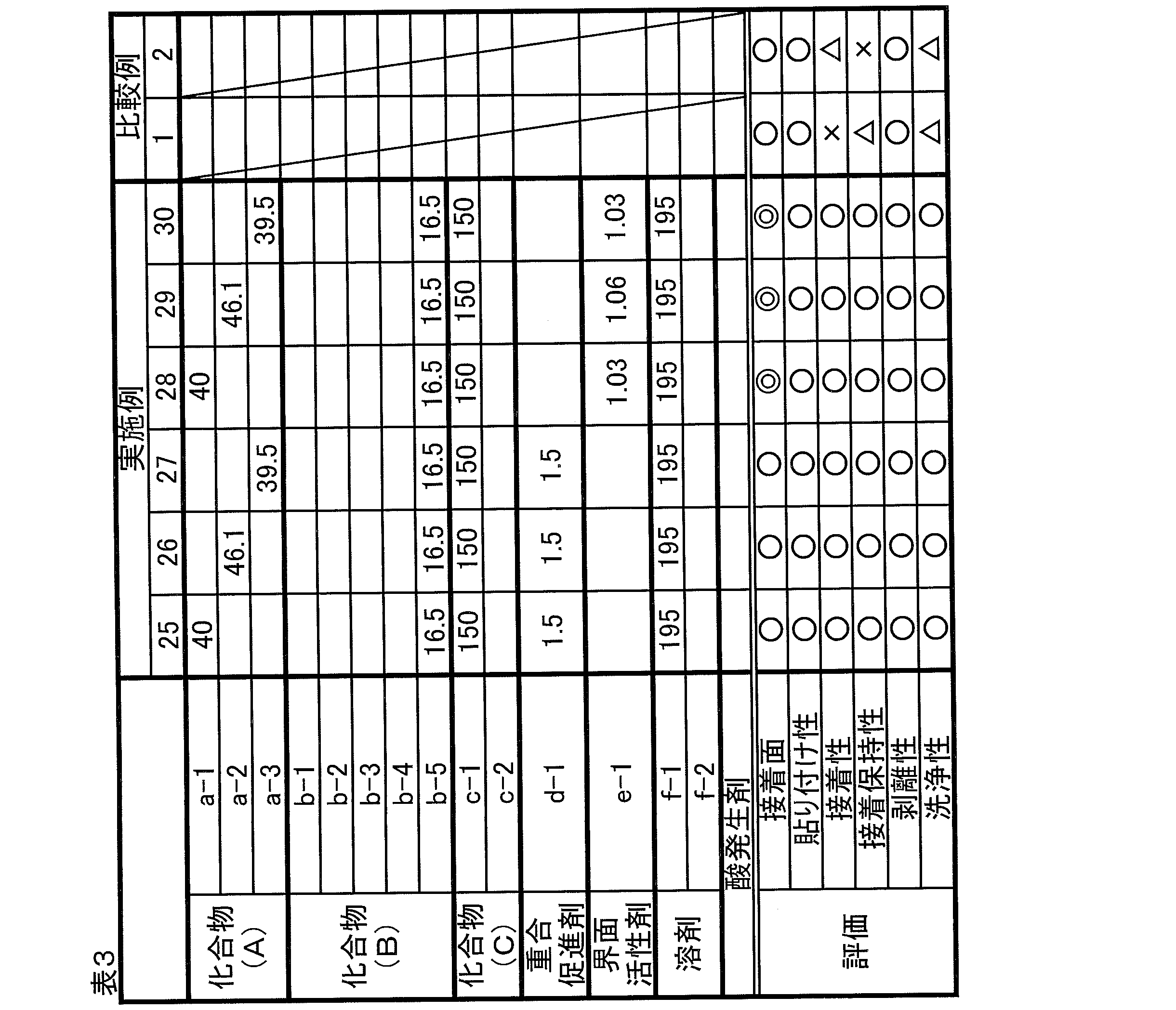

<化合物(A)>
a-1:イソソルバイドジビニルエーテル
a-2:2(又は3)-ビニルオキシ-5-(ビニルオキシメチル)-7-オキサビシクロ[2.2.1]ヘプタン
a-3:1,4-シクロヘキサンジオールジビニルエーテル
a-4:1,4-シクロヘキサンジメタノールジビニルエーテル
a-5:1,4-ブタンジオールジビニルエーテル
a-6:ジエチレングリコールジビニルエーテル
a-7:トリエチレングリコールジビニルエーテル
<化合物(B)>
b-1:1,1,1-トリス(4-ヒドロキシフェニル)エタン
b-2:4,4’-(プロパン-2,2’-ジイル)ジフェノール
b-3:グルタル酸
b-4:1,3,5-シクロヘキサントリカルボン酸
b-5:ハイドロキノン
<化合物(C)>
c-1:ポリ-p-ヒドロキシスチレン、重量平均分子量(GPC法による、ポリスチレン換算):2000、丸善石油化学(株)製、商品名「マルカリンカーM S1Pグレード」
c-2:ポリ-p-ヒドロキシスチレン、重量平均分子量(GPC法による、ポリスチレン換算):5000、丸善石油化学(株)製、商品名「マルカリンカーM S2Pグレード」
c-3:製造例1で得られたジシクロペンタニルアクリレート/メタクリル酸共重合体
c-4:p-ヒドロキシスチレン/スチレン共重合体(モル比:50/50、重量比:46/54)、重量平均分子量(GPC法による、ポリスチレン換算):4400、丸善石油化学(株)製、商品名「マルカリンカーCST-50」
<重合促進剤>
d-1:トランス桂皮酸(pKa:4.44、和光純薬工業(株)製)
<界面活性剤>
e-1:フッ素系オリゴマー(商品名「F-554」、DIC社製)
<溶剤>
f-1:プロピレングリコールモノメチルエーテル
f-2:プロピレングリコール-1-モノメチルエーテル-2-アセテート
f-3:シクロヘキサノン
<酸発生剤>
トリフェニルスルホニウムパーフルオロ-1-ブタンスルホネート、アルドリッチ社製
Claims (10)
- 多価ビニルエーテル化合物(A)と、下記式(b)で表される化合物(B)及び/又は下記式(c)で表される構成単位を2以上有する化合物(C)を含有する接着剤。

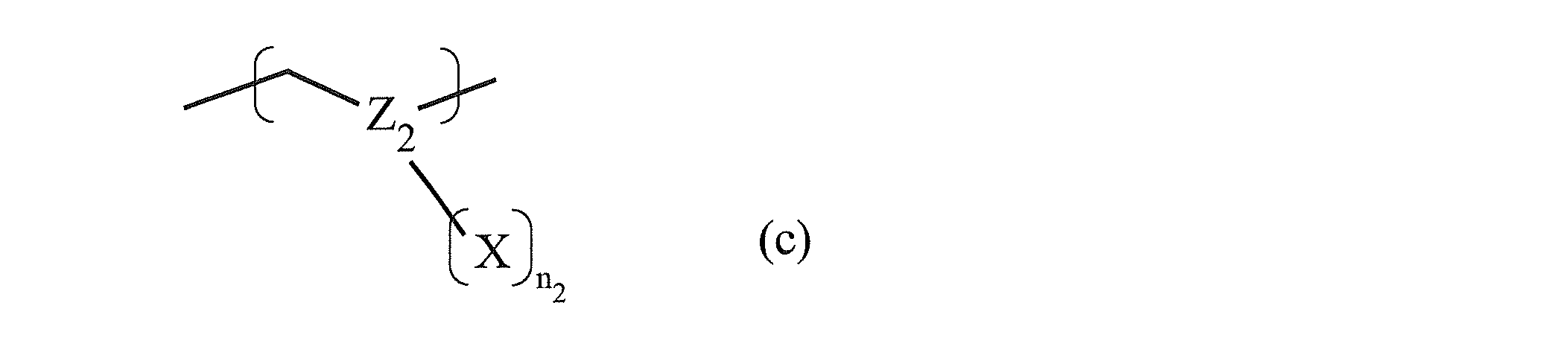
- 多価ビニルエーテル化合物(A)が下記式(a)で表される化合物である請求項1に記載の接着剤。

- さらに、酸発生剤を含有する請求項1又は2に記載の接着剤。
- 化合物(C)の重量平均分子量(GPC法による、ポリスチレン換算)が1500以上である請求項1~3の何れか1項に記載の接着剤。
- 接着剤に含まれる重合性化合物全量において多価ビニルエーテル化合物(A)を0.5~80重量%、化合物(B)及び/又は化合物(C)(化合物(B)と化合物(C)を共に含有する場合はその総量)を20~99.5重量%含有する請求項1~4の何れか1項に記載の接着剤。
- さらに、下記式(d)で表される1価のカルボン酸及び/又は下記式(e)で表される1価のアルコールを含有する請求項1~5の何れか1項に記載の接着剤。
Z4-COOH (d)
(式中、Z4はカルボキシル基以外の置換基を有していてもよい、飽和若しくは不飽和脂肪族炭化水素、飽和若しくは不飽和脂環式炭化水素、及び芳香族炭化水素から選択される構造式から1個の水素原子を除去した基を示す)
Z5-OH (e)
(式中、Z5はヒドロキシル基以外の置換基を有していてもよい芳香族炭化水素の構造式から1個の水素原子を除去した基を示す) - さらに、界面活性剤を含有する請求項1~6の何れか1項に記載の接着剤。
- 接着剤を使用して被着体を支持体に仮固定する方法であって、請求項1~7の何れか1項に記載の接着剤に加熱処理を施して得られる、多価ビニルエーテル化合物(A)と、式(b)で表される化合物(B)及び/又は式(c)で表される構成単位を2以上有する化合物(C)の重合体により被着体を支持体に固定する固定工程、及び前記重合体に加熱処理、又は光照射と加熱処理を施して前記重合体を軟化又は液化することにより被着体を支持体から剥離する剥離工程を含む被着体の仮固定方法。
- 接着剤を使用して仮固定された被着体を加工する方法であって、請求項1~7の何れか1項に記載の接着剤に加熱処理を施して得られる、多価ビニルエーテル化合物(A)と、式(b)で表される化合物(B)及び/又は式(c)で表される構成単位を2以上有する化合物(C)の重合体により被着体を支持体に固定する固定工程、固定された被着体に加工を施す加工工程、及び前記重合体に加熱処理、又は光照射と加熱処理を施して前記重合体を軟化又は液化することにより被着体を支持体から剥離する剥離工程を含む被着体の加工方法。
- 請求項1~7の何れか1項に記載の接着剤を塗布し、加熱処理を施して得られる、多価ビニルエーテル化合物(A)と、式(b)で表される化合物(B)及び/又は式(c)で表される構成単位を2以上有する化合物(C)の重合体を含む接着膜。
Priority Applications (5)
| Application Number | Priority Date | Filing Date | Title |
|---|---|---|---|
| JP2015541566A JP6671174B2 (ja) | 2013-10-11 | 2014-10-06 | 接着剤 |
| US15/028,147 US10711162B2 (en) | 2013-10-11 | 2014-10-06 | Adhesive agent |
| KR1020167009085A KR102176852B1 (ko) | 2013-10-11 | 2014-10-06 | 접착제 |
| CN201480055928.8A CN105637048B (zh) | 2013-10-11 | 2014-10-06 | 粘接剂 |
| CN202010558020.6A CN111690373B (zh) | 2013-10-11 | 2014-10-06 | 粘接剂 |
Applications Claiming Priority (2)
| Application Number | Priority Date | Filing Date | Title |
|---|---|---|---|
| JP2013214164 | 2013-10-11 | ||
| JP2013-214164 | 2013-10-11 |
Publications (1)
| Publication Number | Publication Date |
|---|---|
| WO2015053223A1 true WO2015053223A1 (ja) | 2015-04-16 |
Family
ID=52813039
Family Applications (1)
| Application Number | Title | Priority Date | Filing Date |
|---|---|---|---|
| PCT/JP2014/076707 Ceased WO2015053223A1 (ja) | 2013-10-11 | 2014-10-06 | 接着剤 |
Country Status (6)
| Country | Link |
|---|---|
| US (1) | US10711162B2 (ja) |
| JP (1) | JP6671174B2 (ja) |
| KR (1) | KR102176852B1 (ja) |
| CN (2) | CN105637048B (ja) |
| TW (1) | TWI640591B (ja) |
| WO (1) | WO2015053223A1 (ja) |
Cited By (4)
| Publication number | Priority date | Publication date | Assignee | Title |
|---|---|---|---|---|
| WO2017061416A1 (ja) * | 2015-10-09 | 2017-04-13 | 株式会社ダイセル | 接着剤 |
| JPWO2019065246A1 (ja) * | 2017-09-28 | 2020-09-10 | 日本ゼオン株式会社 | 樹脂組成物及び樹脂膜 |
| WO2020213659A1 (ja) * | 2019-04-16 | 2020-10-22 | 信越化学工業株式会社 | ペリクル、ペリクル付露光原版、半導体装置の製造方法、液晶表示板の製造方法、露光原版の再生方法及び剥離残渣低減方法 |
| JP2023533845A (ja) * | 2020-07-16 | 2023-08-04 | デロ・インドゥストリー・クレープシュトッフェ・ゲゼルシャフト・ミット・ベシュレンクテル・ハフツング・ウント・コムパニー・コマンディットゲゼルシャフト・アウフ・アクチェン | ポリアセタールを含む再剥離性組成物 |
Citations (4)
| Publication number | Priority date | Publication date | Assignee | Title |
|---|---|---|---|---|
| JPS60179479A (ja) * | 1984-01-31 | 1985-09-13 | アトケム | 熱可逆性架橋を有する接着剤組成物及びその製法 |
| JP2007186630A (ja) * | 2006-01-16 | 2007-07-26 | Denki Kagaku Kogyo Kk | 組成物及びそれを用いた部材の仮固定方法 |
| JP2011012098A (ja) * | 2009-06-30 | 2011-01-20 | Tokyo Ohka Kogyo Co Ltd | 接着剤組成物および接着フィルム |
| WO2012133142A1 (ja) * | 2011-03-31 | 2012-10-04 | 株式会社ダイセル | 接着剤とそれを用いた仮接着方法 |
Family Cites Families (10)
| Publication number | Priority date | Publication date | Assignee | Title |
|---|---|---|---|---|
| JP2000104039A (ja) * | 1998-09-30 | 2000-04-11 | Hitachi Chem Co Ltd | 接着剤組成物及びこれを用いた半導体装置 |
| JP2001226643A (ja) * | 2000-02-16 | 2001-08-21 | Dainippon Ink & Chem Inc | 光記録媒体用紫外線硬化型接着剤組成物及び光記録媒体 |
| JP2002184487A (ja) * | 2000-12-15 | 2002-06-28 | Sony Chem Corp | 異方性導電接着剤 |
| JP2004285242A (ja) * | 2003-03-24 | 2004-10-14 | Nagase Chemtex Corp | 熱硬化性接着用シートおよびその製造方法 |
| JP4461698B2 (ja) * | 2003-04-14 | 2010-05-12 | Dic株式会社 | 接着剤組成物、フレキシブル配線基板、及びカバーレイフィルム |
| US20060182949A1 (en) * | 2005-02-17 | 2006-08-17 | 3M Innovative Properties Company | Surfacing and/or joining method |
| JP5074716B2 (ja) | 2006-07-03 | 2012-11-14 | ニッタ株式会社 | 粘着シート |
| JP5074715B2 (ja) | 2006-07-03 | 2012-11-14 | ニッタ株式会社 | 粘着シート |
| JP2008049443A (ja) | 2006-08-25 | 2008-03-06 | Sumitomo Electric Ind Ltd | 半導体ウエハの研磨プレートへの貼り付け方法 |
| JP5725760B2 (ja) * | 2010-08-19 | 2015-05-27 | 大同化成工業株式会社 | タッチパネル用粘着剤組成物に用いるアクリル系高分子化合物 |
-
2014
- 2014-10-06 KR KR1020167009085A patent/KR102176852B1/ko active Active
- 2014-10-06 CN CN201480055928.8A patent/CN105637048B/zh active Active
- 2014-10-06 WO PCT/JP2014/076707 patent/WO2015053223A1/ja not_active Ceased
- 2014-10-06 US US15/028,147 patent/US10711162B2/en active Active
- 2014-10-06 JP JP2015541566A patent/JP6671174B2/ja active Active
- 2014-10-06 CN CN202010558020.6A patent/CN111690373B/zh active Active
- 2014-10-09 TW TW103135163A patent/TWI640591B/zh active
Patent Citations (4)
| Publication number | Priority date | Publication date | Assignee | Title |
|---|---|---|---|---|
| JPS60179479A (ja) * | 1984-01-31 | 1985-09-13 | アトケム | 熱可逆性架橋を有する接着剤組成物及びその製法 |
| JP2007186630A (ja) * | 2006-01-16 | 2007-07-26 | Denki Kagaku Kogyo Kk | 組成物及びそれを用いた部材の仮固定方法 |
| JP2011012098A (ja) * | 2009-06-30 | 2011-01-20 | Tokyo Ohka Kogyo Co Ltd | 接着剤組成物および接着フィルム |
| WO2012133142A1 (ja) * | 2011-03-31 | 2012-10-04 | 株式会社ダイセル | 接着剤とそれを用いた仮接着方法 |
Cited By (15)
| Publication number | Priority date | Publication date | Assignee | Title |
|---|---|---|---|---|
| US10947425B2 (en) | 2015-10-09 | 2021-03-16 | Daicel Corporation | Adhesive |
| KR20180067514A (ko) * | 2015-10-09 | 2018-06-20 | 주식회사 다이셀 | 접착제 |
| JPWO2017061416A1 (ja) * | 2015-10-09 | 2018-07-26 | 株式会社ダイセル | 接着剤 |
| WO2017061416A1 (ja) * | 2015-10-09 | 2017-04-13 | 株式会社ダイセル | 接着剤 |
| KR102528123B1 (ko) * | 2015-10-09 | 2023-05-03 | 주식회사 다이셀 | 접착제 |
| JPWO2019065246A1 (ja) * | 2017-09-28 | 2020-09-10 | 日本ゼオン株式会社 | 樹脂組成物及び樹脂膜 |
| JP7176524B2 (ja) | 2017-09-28 | 2022-11-22 | 日本ゼオン株式会社 | 樹脂組成物及び樹脂膜 |
| JP2020194182A (ja) * | 2019-04-16 | 2020-12-03 | 信越化学工業株式会社 | ペリクル、ペリクル付露光原版、半導体装置の製造方法、液晶表示板の製造方法、露光原版の再生方法及び剥離残渣低減方法 |
| JP6793894B1 (ja) * | 2019-04-16 | 2020-12-02 | 信越化学工業株式会社 | ペリクル、ペリクル付露光原版、半導体装置の製造方法、液晶表示板の製造方法、露光原版の再生方法及び剥離残渣低減方法 |
| WO2020213659A1 (ja) * | 2019-04-16 | 2020-10-22 | 信越化学工業株式会社 | ペリクル、ペリクル付露光原版、半導体装置の製造方法、液晶表示板の製造方法、露光原版の再生方法及び剥離残渣低減方法 |
| EP3958060A4 (en) * | 2019-04-16 | 2023-07-12 | Shin-Etsu Chemical Co., Ltd. | FILM, ORIGINAL EXPOSURE PLATE WITH FILM, METHOD FOR PRODUCING SEMICONDUCTOR DEVICE, METHOD FOR PRODUCING LIQUID CRYSTAL DISPLAY PANEL, METHOD FOR RECYCLING ORIGINAL EXPOSURE PLATES, AND METHOD FOR RELEASE RESIDUE REDUCTION |
| JP7587936B2 (ja) | 2019-04-16 | 2024-11-21 | 信越化学工業株式会社 | ペリクル、ペリクル付露光原版、半導体装置の製造方法、液晶表示板の製造方法、露光原版の再生方法及び剥離残渣低減方法 |
| JP2023533845A (ja) * | 2020-07-16 | 2023-08-04 | デロ・インドゥストリー・クレープシュトッフェ・ゲゼルシャフト・ミット・ベシュレンクテル・ハフツング・ウント・コムパニー・コマンディットゲゼルシャフト・アウフ・アクチェン | ポリアセタールを含む再剥離性組成物 |
| JP7570493B2 (ja) | 2020-07-16 | 2024-10-21 | デロ・インドゥストリー・クレープシュトッフェ・ゲゼルシャフト・ミット・ベシュレンクテル・ハフツング・ウント・コムパニー・コマンディットゲゼルシャフト・アウフ・アクチェン | ポリアセタールを含む再剥離性組成物 |
| US12565560B2 (en) | 2020-07-16 | 2026-03-03 | Delo Industrie Klebstoffe Gmbh & Co. Kgaa | Releasable compositions based on polyacetals |
Also Published As
| Publication number | Publication date |
|---|---|
| JP6671174B2 (ja) | 2020-03-25 |
| JPWO2015053223A1 (ja) | 2017-03-09 |
| US20160264822A1 (en) | 2016-09-15 |
| CN105637048B (zh) | 2020-07-10 |
| KR20160068766A (ko) | 2016-06-15 |
| CN105637048A (zh) | 2016-06-01 |
| TW201522549A (zh) | 2015-06-16 |
| CN111690373B (zh) | 2022-09-02 |
| US10711162B2 (en) | 2020-07-14 |
| KR102176852B1 (ko) | 2020-11-10 |
| CN111690373A (zh) | 2020-09-22 |
| TWI640591B (zh) | 2018-11-11 |
Similar Documents
| Publication | Publication Date | Title |
|---|---|---|
| JP6806692B2 (ja) | 接着剤 | |
| TWI542657B (zh) | 偏光板的黏性膜及黏著劑組成物、偏光板以及光學顯示器 | |
| JP6671174B2 (ja) | 接着剤 | |
| JP6279489B2 (ja) | ナノインプリント用光硬化性組成物、及びそれを使用した微細パターン基板の製造方法 | |
| JP2014205624A (ja) | オニウムボレート塩系酸発生剤 | |
| JP2020107649A (ja) | 分離層形成用組成物、分離層付き支持基体、積層体及びその製造方法、並びに電子部品の製造方法 | |
| JP7456269B2 (ja) | マイクロledチップ搬送用フィルム及びマイクロledチップの搬送方法 | |
| TW202212399A (zh) | 組合物、硬化物及硬化物之製造方法 | |
| JP2007153933A (ja) | 接着方法及び接着剤 | |
| JP2006348199A (ja) | 接着剤組成物およびそれを用いた接着フィルム、接着物の製造方法 | |
| TWI918229B (zh) | 乾膜光阻劑及其製備方法、使用光敏樹脂組成物的阻劑圖案及顯示裝置 | |
| US20250257251A1 (en) | Temporary adhesive, and method for manufacturing semiconductor wafer laminate using the temporary adhesive | |
| CN101027337A (zh) | 聚合性组合物 | |
| JP2025012722A (ja) | 支持基体分離方法、及び電子部品の製造方法 | |
| JP2009007501A (ja) | 硬化型粘接着材料 | |
| JP2005036092A (ja) | 硬化性樹脂組成物及び保護膜 | |
| TW202330721A (zh) | 分離層形成用組合物、附分離層之支持基體、積層體及其製造方法、以及電子零件之製造方法 | |
| CN117106358A (zh) | 分离层形成用组合物、带有分离层的支撑基体、层叠体及其制造方法和电子部件的制造方法 | |
| TW202307153A (zh) | 剝離層形成用組成物及剝離層 | |
| JP2009051982A (ja) | 硬化型粘接着材料 | |
| JP2007171399A (ja) | 液晶ディスプレイモジュールの製造方法 | |
| JP2017031127A (ja) | 光酸発生剤及び感光性組成物 | |
| JP2016014114A (ja) | 接着剤及びその使用方法並びに接着膜 |
Legal Events
| Date | Code | Title | Description |
|---|---|---|---|
| 121 | Ep: the epo has been informed by wipo that ep was designated in this application |
Ref document number: 14852278 Country of ref document: EP Kind code of ref document: A1 |
|
| ENP | Entry into the national phase |
Ref document number: 2015541566 Country of ref document: JP Kind code of ref document: A |
|
| ENP | Entry into the national phase |
Ref document number: 20167009085 Country of ref document: KR Kind code of ref document: A |
|
| WWE | Wipo information: entry into national phase |
Ref document number: 15028147 Country of ref document: US |
|
| NENP | Non-entry into the national phase |
Ref country code: DE |
|
| 122 | Ep: pct application non-entry in european phase |
Ref document number: 14852278 Country of ref document: EP Kind code of ref document: A1 |