WO2015040818A1 - 非水電解質二次電池 - Google Patents
非水電解質二次電池 Download PDFInfo
- Publication number
- WO2015040818A1 WO2015040818A1 PCT/JP2014/004594 JP2014004594W WO2015040818A1 WO 2015040818 A1 WO2015040818 A1 WO 2015040818A1 JP 2014004594 W JP2014004594 W JP 2014004594W WO 2015040818 A1 WO2015040818 A1 WO 2015040818A1
- Authority
- WO
- WIPO (PCT)
- Prior art keywords
- positive electrode
- active material
- electrolyte secondary
- secondary battery
- electrode active
- Prior art date
- Legal status (The legal status is an assumption and is not a legal conclusion. Google has not performed a legal analysis and makes no representation as to the accuracy of the status listed.)
- Ceased
Links
Images

Classifications
-
- H—ELECTRICITY
- H01—ELECTRIC ELEMENTS
- H01M—PROCESSES OR MEANS, e.g. BATTERIES, FOR THE DIRECT CONVERSION OF CHEMICAL ENERGY INTO ELECTRICAL ENERGY
- H01M4/00—Electrodes
- H01M4/02—Electrodes composed of, or comprising, active material
- H01M4/13—Electrodes for accumulators with non-aqueous electrolyte, e.g. for lithium-accumulators; Processes of manufacture thereof
- H01M4/131—Electrodes based on mixed oxides or hydroxides, or on mixtures of oxides or hydroxides, e.g. LiCoOx
-
- C—CHEMISTRY; METALLURGY
- C01—INORGANIC CHEMISTRY
- C01G—COMPOUNDS CONTAINING METALS NOT COVERED BY SUBCLASSES C01D OR C01F
- C01G53/00—Compounds of nickel
- C01G53/40—Complex oxides containing nickel and at least one other metal element
- C01G53/42—Complex oxides containing nickel and at least one other metal element containing alkali metals, e.g. LiNiO2
- C01G53/44—Complex oxides containing nickel and at least one other metal element containing alkali metals, e.g. LiNiO2 containing manganese
- C01G53/50—Complex oxides containing nickel and at least one other metal element containing alkali metals, e.g. LiNiO2 containing manganese of the type (MnO2)n-, e.g. Li(NixMn1-x)O2 or Li(MyNixMn1-x-y)O2
- C01G53/502—Complex oxides containing nickel and at least one other metal element containing alkali metals, e.g. LiNiO2 containing manganese of the type (MnO2)n-, e.g. Li(NixMn1-x)O2 or Li(MyNixMn1-x-y)O2 containing lithium and cobalt
- C01G53/504—Complex oxides containing nickel and at least one other metal element containing alkali metals, e.g. LiNiO2 containing manganese of the type (MnO2)n-, e.g. Li(NixMn1-x)O2 or Li(MyNixMn1-x-y)O2 containing lithium and cobalt with the molar ratio of nickel with respect to all the metals other than alkali metals higher than or equal to 0.5, e.g. Li(MzNixCoyMn1-x-y-z)O2 with x ≥ 0.5
-
- H—ELECTRICITY
- H01—ELECTRIC ELEMENTS
- H01M—PROCESSES OR MEANS, e.g. BATTERIES, FOR THE DIRECT CONVERSION OF CHEMICAL ENERGY INTO ELECTRICAL ENERGY
- H01M10/00—Secondary cells; Manufacture thereof
- H01M10/05—Accumulators with non-aqueous electrolyte
- H01M10/052—Li-accumulators
-
- H—ELECTRICITY
- H01—ELECTRIC ELEMENTS
- H01M—PROCESSES OR MEANS, e.g. BATTERIES, FOR THE DIRECT CONVERSION OF CHEMICAL ENERGY INTO ELECTRICAL ENERGY
- H01M10/00—Secondary cells; Manufacture thereof
- H01M10/05—Accumulators with non-aqueous electrolyte
- H01M10/052—Li-accumulators
- H01M10/0525—Rocking-chair batteries, i.e. batteries with lithium insertion or intercalation in both electrodes; Lithium-ion batteries
-
- H—ELECTRICITY
- H01—ELECTRIC ELEMENTS
- H01M—PROCESSES OR MEANS, e.g. BATTERIES, FOR THE DIRECT CONVERSION OF CHEMICAL ENERGY INTO ELECTRICAL ENERGY
- H01M10/00—Secondary cells; Manufacture thereof
- H01M10/05—Accumulators with non-aqueous electrolyte
- H01M10/058—Construction or manufacture
- H01M10/0585—Construction or manufacture of accumulators having only flat construction elements, i.e. flat positive electrodes, flat negative electrodes and flat separators
-
- H—ELECTRICITY
- H01—ELECTRIC ELEMENTS
- H01M—PROCESSES OR MEANS, e.g. BATTERIES, FOR THE DIRECT CONVERSION OF CHEMICAL ENERGY INTO ELECTRICAL ENERGY
- H01M4/00—Electrodes
- H01M4/02—Electrodes composed of, or comprising, active material
- H01M4/36—Selection of substances as active materials, active masses, active liquids
- H01M4/48—Selection of substances as active materials, active masses, active liquids of inorganic oxides or hydroxides
- H01M4/50—Selection of substances as active materials, active masses, active liquids of inorganic oxides or hydroxides of manganese
- H01M4/505—Selection of substances as active materials, active masses, active liquids of inorganic oxides or hydroxides of manganese of mixed oxides or hydroxides containing manganese for inserting or intercalating light metals, e.g. LiMn2O4 or LiMn2OxFy
-
- H—ELECTRICITY
- H01—ELECTRIC ELEMENTS
- H01M—PROCESSES OR MEANS, e.g. BATTERIES, FOR THE DIRECT CONVERSION OF CHEMICAL ENERGY INTO ELECTRICAL ENERGY
- H01M4/00—Electrodes
- H01M4/02—Electrodes composed of, or comprising, active material
- H01M4/62—Selection of inactive substances as ingredients for active masses, e.g. binders, fillers
- H01M4/624—Electric conductive fillers
- H01M4/625—Carbon or graphite
-
- C—CHEMISTRY; METALLURGY
- C01—INORGANIC CHEMISTRY
- C01P—INDEXING SCHEME RELATING TO STRUCTURAL AND PHYSICAL ASPECTS OF SOLID INORGANIC COMPOUNDS
- C01P2004/00—Particle morphology
- C01P2004/60—Particles characterised by their size
- C01P2004/61—Micrometer sized, i.e. from 1-100 micrometer
-
- C—CHEMISTRY; METALLURGY
- C01—INORGANIC CHEMISTRY
- C01P—INDEXING SCHEME RELATING TO STRUCTURAL AND PHYSICAL ASPECTS OF SOLID INORGANIC COMPOUNDS
- C01P2006/00—Physical properties of inorganic compounds
- C01P2006/40—Electric properties
-
- H—ELECTRICITY
- H01—ELECTRIC ELEMENTS
- H01M—PROCESSES OR MEANS, e.g. BATTERIES, FOR THE DIRECT CONVERSION OF CHEMICAL ENERGY INTO ELECTRICAL ENERGY
- H01M4/00—Electrodes
- H01M4/02—Electrodes composed of, or comprising, active material
- H01M2004/026—Electrodes composed of, or comprising, active material characterised by the polarity
- H01M2004/028—Positive electrodes
-
- H—ELECTRICITY
- H01—ELECTRIC ELEMENTS
- H01M—PROCESSES OR MEANS, e.g. BATTERIES, FOR THE DIRECT CONVERSION OF CHEMICAL ENERGY INTO ELECTRICAL ENERGY
- H01M4/00—Electrodes
- H01M4/02—Electrodes composed of, or comprising, active material
- H01M4/04—Processes of manufacture in general
- H01M4/0402—Methods of deposition of the material
- H01M4/0404—Methods of deposition of the material by coating on electrode collectors
-
- H—ELECTRICITY
- H01—ELECTRIC ELEMENTS
- H01M—PROCESSES OR MEANS, e.g. BATTERIES, FOR THE DIRECT CONVERSION OF CHEMICAL ENERGY INTO ELECTRICAL ENERGY
- H01M4/00—Electrodes
- H01M4/02—Electrodes composed of, or comprising, active material
- H01M4/36—Selection of substances as active materials, active masses, active liquids
- H01M4/48—Selection of substances as active materials, active masses, active liquids of inorganic oxides or hydroxides
- H01M4/52—Selection of substances as active materials, active masses, active liquids of inorganic oxides or hydroxides of nickel, cobalt or iron
- H01M4/525—Selection of substances as active materials, active masses, active liquids of inorganic oxides or hydroxides of nickel, cobalt or iron of mixed oxides or hydroxides containing iron, cobalt or nickel for inserting or intercalating light metals, e.g. LiNiO2, LiCoO2 or LiCoOxFy
-
- Y—GENERAL TAGGING OF NEW TECHNOLOGICAL DEVELOPMENTS; GENERAL TAGGING OF CROSS-SECTIONAL TECHNOLOGIES SPANNING OVER SEVERAL SECTIONS OF THE IPC; TECHNICAL SUBJECTS COVERED BY FORMER USPC CROSS-REFERENCE ART COLLECTIONS [XRACs] AND DIGESTS
- Y02—TECHNOLOGIES OR APPLICATIONS FOR MITIGATION OR ADAPTATION AGAINST CLIMATE CHANGE
- Y02E—REDUCTION OF GREENHOUSE GAS [GHG] EMISSIONS, RELATED TO ENERGY GENERATION, TRANSMISSION OR DISTRIBUTION
- Y02E60/00—Enabling technologies; Technologies with a potential or indirect contribution to GHG emissions mitigation
- Y02E60/10—Energy storage using batteries
-
- Y—GENERAL TAGGING OF NEW TECHNOLOGICAL DEVELOPMENTS; GENERAL TAGGING OF CROSS-SECTIONAL TECHNOLOGIES SPANNING OVER SEVERAL SECTIONS OF THE IPC; TECHNICAL SUBJECTS COVERED BY FORMER USPC CROSS-REFERENCE ART COLLECTIONS [XRACs] AND DIGESTS
- Y02—TECHNOLOGIES OR APPLICATIONS FOR MITIGATION OR ADAPTATION AGAINST CLIMATE CHANGE
- Y02P—CLIMATE CHANGE MITIGATION TECHNOLOGIES IN THE PRODUCTION OR PROCESSING OF GOODS
- Y02P70/00—Climate change mitigation technologies in the production process for final industrial or consumer products
- Y02P70/50—Manufacturing or production processes characterised by the final manufactured product
-
- Y—GENERAL TAGGING OF NEW TECHNOLOGICAL DEVELOPMENTS; GENERAL TAGGING OF CROSS-SECTIONAL TECHNOLOGIES SPANNING OVER SEVERAL SECTIONS OF THE IPC; TECHNICAL SUBJECTS COVERED BY FORMER USPC CROSS-REFERENCE ART COLLECTIONS [XRACs] AND DIGESTS
- Y02—TECHNOLOGIES OR APPLICATIONS FOR MITIGATION OR ADAPTATION AGAINST CLIMATE CHANGE
- Y02T—CLIMATE CHANGE MITIGATION TECHNOLOGIES RELATED TO TRANSPORTATION
- Y02T10/00—Road transport of goods or passengers
- Y02T10/60—Other road transportation technologies with climate change mitigation effect
- Y02T10/70—Energy storage systems for electromobility, e.g. batteries
Definitions
- the present invention relates to a non-aqueous electrolyte secondary battery.
- Non-aqueous electrolyte secondary batteries represented by lithium-ion batteries are widely used, such as power supplies for portable devices, power supplies for electric tools, electric vehicles, electric bikes, electric assist bicycles, and backup power supplies. Yes. As the use of devices equipped with non-aqueous electrolyte secondary batteries spreads, users of those devices are strongly required to further improve the characteristics of non-aqueous electrolyte secondary batteries.
- lithium cobalt oxide has been conventionally used as a positive electrode active material of a non-aqueous electrolyte secondary battery.
- a positive electrode using lithium cobaltate is exposed to a high potential for a long time, elution of cobalt into the electrolytic solution occurs, which may cause deterioration of battery characteristics. Therefore, in recent years, lithium-containing composite oxides containing nickel, which are inexpensive and excellent in charge / discharge cycle characteristics and storage characteristics, have attracted attention and research and development have been promoted.
- Patent Documents 1 and 2 disclose a non-aqueous electrolyte secondary battery using a so-called ternary lithium composite oxide containing nickel, cobalt, and manganese and further containing a trace amount of elements other than the three kinds. Yes. According to these documents, charge / discharge cycle characteristics and storage characteristics are improved by using this oxide as a positive electrode active material.
- Examples of the characteristics of the non-aqueous electrolyte secondary battery include battery capacity, charge / discharge cycle characteristics, and storage characteristics. Battery engineers are trying to obtain optimum battery characteristics by adjusting the above-mentioned electrode materials, or the physical properties of electrolytes, separators, and the like, and sometimes using new materials. However, when an active material is charged into the electrode at a high density in order to obtain a high capacity, the load characteristics and charge / discharge cycle characteristics of the battery deteriorate due to the destruction of the active material particles and the deterioration of the conductivity of the electrode plate, or Undesirable reactions reduce storage characteristics. In addition, the electrode plate is hard and difficult to bend, making it difficult to produce a wound electrode body.
- the particle size of the electrode active material or conductive agent is reduced to increase the battery reaction speed, while the particle size of the electrode active material or conductive agent is increased to improve the storage characteristics.
- an object of the present invention is to provide a nonaqueous electrolyte secondary battery that can achieve both excellent charge / discharge cycle characteristics and high-temperature storage characteristics.
- a nonaqueous electrolyte secondary battery of the present invention is a nonaqueous electrolyte secondary battery comprising a positive electrode containing a positive electrode mixture, a negative electrode, a separator for insulating the positive electrode and the negative electrode, and a nonaqueous electrolyte.
- the particle size in the present invention is the particle size of secondary particles.
- the positive electrode active material filling density is more preferably 3.0 g / cm 3 or more.
- both the positive electrode and the negative electrode have a flat plate shape, and a plurality of flat plate shapes and a plurality of the flat plate-shaped negative electrodes are alternately stacked via separators. It is preferable to use an electrode body.
- non-aqueous electrolyte secondary battery By configuring the non-aqueous electrolyte secondary battery as described above, it is possible to provide a non-aqueous electrolyte secondary battery that can achieve both excellent charge / discharge cycle characteristics and high-temperature storage characteristics.
- FIG. 1 is a perspective view of a nonaqueous electrolyte secondary battery according to an embodiment of the present invention.
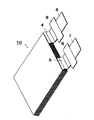
- FIG. 2 is a perspective view of a laminated electrode body used in a nonaqueous electrolyte secondary battery according to an embodiment of the present invention.
- FIG. 1 is a perspective view of a nonaqueous electrolyte secondary battery according to an embodiment of the present invention.
- 2 is a perspective view of a laminated electrode body used in the nonaqueous electrolyte secondary battery of FIG.
- a nonaqueous electrolyte secondary battery 20 includes a laminate described below in an exterior body 1 made of a laminate sheet in which resin films are laminated on both surfaces of a metal foil.
- the electrode body 10 is accommodated with a non-aqueous electrolyte.
- the exterior body 1 consists of two parts, a cup-shaped part and a planar-shaped part (not shown).
- a laminated electrode body and a non-aqueous electrolyte are accommodated in the cup portion, the opening of the cup is covered with a planar shape portion, and the cup portion and the planar shape portion are welded and sealed with a welding seal portion 1 ′ at the periphery.
- a positive electrode terminal 6 and a negative electrode terminal 7 protrude from one side of the welded sealing portion 1 ′.
- the positive electrode terminal 6 and the negative electrode terminal 7 are respectively connected to the positive electrode current collecting tab 4 and the negative electrode current collecting tab 5 of the laminated electrode body 10 described below.
- a positive electrode tab resin 8 and a negative electrode tab resin 9 are disposed between the positive electrode terminal 6 and the negative electrode terminal 7 and the outer package 1.
- the positive electrode tab resin 8 and the negative electrode tab resin 9 improve the adhesion between the positive electrode terminal 6 and the laminate sheet of the outer package 1 and between the negative electrode terminal 7 and the laminate sheet of the outer package 1, respectively. Furthermore, short circuit between the positive electrode terminal 6 and the metal foil of the laminate sheet of the outer package 1 and between the negative electrode terminal 7 and the metal foil of the laminate sheet of the outer package 1 are prevented.
- the laminated electrode body 10 accommodated in the non-aqueous electrolyte secondary battery 20 is formed by laminating a plurality of flat plate-like positive plates and a plurality of flat plate-like negative plates through separators alternately. It becomes.
- Each positive electrode plate is coated with a positive electrode mixture on both sides of a rectangular aluminum foil.
- the positive electrode plate includes a positive electrode current collecting tab 4 made of an aluminum foil protruding from a rectangular portion where no positive electrode mixture is applied.
- Each negative electrode plate is coated with a negative electrode mixture on both sides of a rectangular copper foil.
- the negative electrode plate includes a negative electrode current collecting tab 5 made of a copper foil protruding from a rectangular portion where no negative electrode mixture is applied.
- the positive electrode current collecting tabs 4 protruding from the respective positive electrode plates are bundled after the electrode plates are laminated and connected to the positive electrode terminal 6.
- the negative electrode current collecting tab 5 is also bundled and connected to the negative electrode terminal 7.
- the laminated electrode body as described above does not need to bend the positive electrode plate or the negative electrode plate when producing the electrode body, and even if the electrode plate is hardened by filling the electrode plate with a high density of active material, By winding, the electrode plate itself is not broken and cut.
- the positive electrode active material used in the present invention tends to be hard when the positive electrode plate is filled with high density. Therefore, it is preferable that the positive electrode plate using this positive electrode active material is used for a laminated electrode body.
- Example 1 Preparation of positive electrode active material> Sodium bicarbonate is added to the sulfuric acid solution containing the respective metal ions so that nickel: cobalt: manganese is included at a molar ratio of 0.3: 0.4: 0.3 in the final composition of the positive electrode active material, nickel, Carbonate containing cobalt and manganese was coprecipitated. This carbonate was heated and thermally decomposed to obtain an oxide containing nickel, cobalt and manganese. To this oxide, zirconium oxide was added so that the final composition of the positive electrode active material (total of nickel, cobalt, and manganese): zirconium had a molar ratio of 0.995: 0.005, and lithium carbonate as a lithium source.
- the final composition of the positive electrode active material (total of nickel, cobalt, manganese, and zirconium) was mixed so that the molar ratio of lithium was 1: 1.10. This mixture was fired in air at 850 ° C. and then crushed to obtain a lithium nickel cobalt manganese composite oxide containing zirconium having a particle size of 8 ⁇ m.
- the particle size can be increased by increasing the heat decomposition temperature and the firing temperature, and can be changed by decreasing the temperature.
- the composition of the positive electrode active material was analyzed and determined by a plasma emission analysis method.
- the particle size the particle size at which the cumulative particle amount is 50% on the volume basis was determined as the particle size based on the measured value using a laser diffraction particle size distribution measuring device.
- a positive electrode mixture slurry was prepared by dispersing 2.5 parts by mass of vinylidene in N-methyl-2-pyrrolidone (NMP). This slurry was uniformly applied to both surfaces of a positive electrode core made of an aluminum foil having a thickness of 15 ⁇ m to be a positive electrode core by a doctor blade method.
- the slurry applied to the aluminum foil was heated and dried to prepare a dry electrode plate in which a positive electrode mixture layer was formed on the aluminum foil.
- the dried electrode plate was compressed with a roller press and cut into a predetermined size to prepare a positive electrode plate having a height of 150 mm, a width of 150 mm, a thickness of 130 ⁇ m, and an active material packing density of 3.25 g / cm 3 .
- the positive electrode current collection tab 4 which consists only of aluminum foil of width 30mm and height 20mm protruded from the positive electrode plate.
- Graphite as a negative electrode active material, styrene butadiene rubber as a binder, and carboxymethyl cellulose as a viscosity modifier were mixed at 96: 2: 2 (mass ratio), and the mixture was dispersed in water to prepare a slurry.
- This slurry was uniformly applied to both surfaces of a 10 ⁇ m thick copper foil serving as a negative electrode core by a doctor blade method. Then, the slurry apply
- the dried electrode plate was compressed with a roller press and cut into predetermined dimensions, and a negative electrode plate having a height of 155 mm, a width of 155 mm, and a thickness of 150 ⁇ m was produced.
- the negative electrode current collection tab 5 which consists only of copper foil of width 30mm and height 20mm protruded from the negative electrode plate.
- Electrode body 10 Twenty positive electrode plates and 21 negative electrode plates were alternately laminated via a polyethylene microporous membrane separator having a height of 155 mm, a width of 155 mm, and a thickness of 20 ⁇ m.
- the positive electrode current collecting tab 4 and the negative electrode current collecting tab 5 are bundled, and the positive electrode current collecting tab 4 is connected to the positive electrode terminal 6 made of an aluminum plate, and the negative electrode current collecting tab 5 is connected to the negative electrode terminal 7 made of a copper plate by ultrasonic welding. did.
- the laminated electrode body 10 was produced.
- lithium hexafluorophosphate as an electrolyte salt has a concentration of 1.4 mol / liter. Dissolved in. And vinylene carbonate was mixed so that it might become 1 mass% with respect to the total mass of a nonaqueous solvent, and the nonaqueous electrolyte was prepared.
- the laminated electrode body 10 was housed in the exterior body 1, and the welded sealing portion 1 ′ provided on the periphery of the exterior body 1 was thermally welded except for one side from which the positive electrode terminal 6 and the negative electrode terminal 7 protruded. Thereafter, a non-aqueous electrolyte was injected from one side that was not welded, and after pressure reduction, the one side was thermally welded by a welding sealing portion 1 ′. In this way, a nonaqueous electrolyte secondary battery according to Example 1 having a design capacity of 25 Ah was produced.
- Example 2 When preparing the positive electrode active material, a positive electrode active material in which lithium carbonate is mixed so that the final composition of the positive electrode active material (total of nickel, cobalt, manganese, and zirconium): lithium has a molar ratio of 1: 1.05 A nonaqueous electrolyte secondary battery according to Example 2 was produced in the same manner as Example 1 except that it was used.
- Example 3 When preparing the positive electrode active material, a positive electrode active material in which lithium carbonate is mixed so that the final composition of the positive electrode active material (total of nickel, cobalt, manganese, and zirconium): lithium is 1: 1.15 is used. A nonaqueous electrolyte secondary battery according to Example 3 was produced in the same manner as Example 1 except that.
- Example 4 When preparing the positive electrode active material, the molar ratio of each metal ion in the sulfuric acid solution is changed so that the final molar ratio of nickel: cobalt: manganese of the positive electrode active material is 0.5: 0.4: 0.1.
- a nonaqueous electrolyte secondary battery according to Example 4 was produced in the same manner as in Example 1 except that the positive electrode active material thus prepared was used.
- Example 5 When preparing the positive electrode active material, the molar ratio of each metal ion in the sulfuric acid solution is changed so that the final molar ratio of nickel: cobalt: manganese of the positive electrode active material is 0.4: 0.5: 0.1.
- a nonaqueous electrolyte secondary battery according to Example 5 was produced in the same manner as in Example 1 except that the positive electrode active material thus prepared was used.
- Example 6 When preparing the positive electrode active material, the molar ratio of each metal ion in the sulfuric acid solution is changed so that the final molar ratio of nickel: cobalt: manganese of the positive electrode active material is 0.4: 0.3: 0.3.
- a nonaqueous electrolyte secondary battery according to Example 6 was produced in the same manner as in Example 1 except that the positive electrode active material was used.
- Example 7 When preparing the positive electrode active material, the molar ratio of each metal ion in the sulfuric acid solution is changed so that the final molar ratio of nickel: cobalt: manganese of the positive electrode active material is 0.33: 0.34: 0.33.
- a nonaqueous electrolyte secondary battery according to Example 7 was fabricated in the same manner as in Example 1 except that the positive electrode active material was used.
- Example 8 When preparing the positive electrode active material, the molar ratio of each metal ion in the sulfuric acid solution is changed so that the final molar ratio of nickel: cobalt: manganese of the positive electrode active material is 0.4: 0.4: 0.2.
- a nonaqueous electrolyte secondary battery according to Example 8 was fabricated in the same manner as in Example 1 except that the positive electrode active material was used.
- Example 9 In preparing the positive electrode active material, the mixed amount of zirconium oxide was changed so that the molar ratio of (nickel: cobalt: manganese): zirconium in the final composition of the positive electrode active material was 0.990: 0.01 A nonaqueous electrolyte secondary battery according to Example 9 was produced in the same manner as Example 1 except that was used.
- Example 10 A nonaqueous electrolyte secondary battery according to Example 10 was produced in the same manner as in Example 1 except that the positive electrode active material having a particle size of 10 ⁇ m was used.
- Example 11 A nonaqueous electrolyte secondary battery according to Example 11 was produced in the same manner as in Example 1 except that a positive electrode plate having an active material filling density of the positive electrode mixture of 2.30 g / cm 3 was used.
- Example 12 A nonaqueous electrolyte secondary battery according to Example 12 was fabricated in the same manner as in Example 1 except that a positive electrode plate having an active material filling density of 3.00 g / cm 3 was used.
- Example 13 A nonaqueous electrolyte secondary battery according to Example 13 was produced in the same manner as in Example 1 except that a positive electrode plate having an active material filling density of the positive electrode mixture of 3.50 g / cm 3 was used.
- Example 14 A nonaqueous electrolyte secondary battery according to Example 14 was fabricated in the same manner as in Example 1 except that acetylene black having a BET specific surface area of 25 m 2 / g was used as the conductive agent of the positive electrode mixture.
- Example 15 A nonaqueous electrolyte secondary battery according to Example 15 was produced in the same manner as in Example 1 except that acetylene black having a BET specific surface area of 50 m 2 / g was used as the conductive agent of the positive electrode mixture.
- Example 16 A nonaqueous electrolyte secondary battery according to Example 16 was produced in the same manner as in Example 7, except that acetylene black having a BET specific surface area of 25 m 2 / g was used as the conductive agent for the positive electrode mixture.
- Example 17 A nonaqueous electrolyte secondary battery according to Example 17 was fabricated in the same manner as in Example 7, except that acetylene black having a BET specific surface area of 50 m 2 / g was used as the conductive agent of the positive electrode mixture.
- Example 18 A nonaqueous electrolyte secondary battery according to Example 18 was fabricated in the same manner as in Example 8, except that acetylene black having a BET specific surface area of 25 m 2 / g was used as the conductive agent of the positive electrode mixture.
- Example 19 A nonaqueous electrolyte secondary battery according to Example 19 was produced in the same manner as in Example 8, except that acetylene black having a BET specific surface area of 50 m 2 / g was used as the conductive agent of the positive electrode mixture.
- Example 20 When preparing the positive electrode active material, the final composition of the positive electrode active material (total of nickel: cobalt: manganese): zirconium: tungsten was adjusted so that the molar ratio was 0.99: 0.005: 0.005.
- a nonaqueous electrolyte secondary battery according to Example 20 was fabricated in the same manner as in Example 1 except that the positive electrode active material mixed with tungsten oxide was used.
- Comparative Example 1 When preparing the positive electrode active material, a positive electrode active material in which lithium carbonate is mixed so that the final composition of the positive electrode active material (total of nickel, cobalt, manganese, and zirconium): lithium has a molar ratio of 1: 1.00 A nonaqueous electrolyte secondary battery according to Comparative Example 1 was produced in the same manner as Example 1 except that it was used.
- Comparative Example 2 When preparing the positive electrode active material, a positive electrode active material in which lithium carbonate is mixed so that the final composition of the positive electrode active material (total of nickel, cobalt, manganese, and zirconium): lithium is 1: 1.20 is used. A nonaqueous electrolyte secondary battery according to Comparative Example 2 was produced in the same manner as Example 1 except that it was used.
- Comparative Example 4 A positive electrode in which the molar ratio of each metal ion in the sulfuric acid solution was changed so that the molar ratio of nickel: cobalt: manganese in the final composition of the positive electrode active material was 0.6: 0.4: 0 when the positive electrode active material was prepared
- a nonaqueous electrolyte secondary battery according to Comparative Example 4 was produced in the same manner as in Example 1 except that the active material was used.
- Comparative Example 6 When preparing the positive electrode active material, the molar ratio of each metal ion of the sulfuric acid solution was changed so that the final molar ratio of nickel: cobalt: manganese of the positive electrode active material was 0.4: 0.6: 0. A nonaqueous electrolyte secondary battery according to Comparative Example 6 was produced in the same manner as in Example 1 except that a positive electrode active material having a particle diameter of 7 ⁇ m was used.
- Comparative Example 7 When preparing the positive electrode active material, the molar ratio of each metal ion in the sulfuric acid solution is changed so that the final molar ratio of nickel: cobalt: manganese of the positive electrode active material is 0.33: 0.34: 0.33. Then, a nonaqueous electrolyte secondary battery according to Comparative Example 7 was produced in the same manner as in Example 1 except that the positive electrode active material not mixed with zirconium oxide was used.
- Comparative Example 8 A nonaqueous electrolyte secondary battery according to Comparative Example 8 was produced in the same manner as Comparative Example 1 except that a positive electrode active material not mixed with zirconium oxide was used when preparing the positive electrode active material.
- Comparative Example 9 When preparing the positive electrode active material, a nonaqueous electrolyte secondary battery according to Comparative Example 9 was produced in the same manner as in Example 1 except that a positive electrode active material not mixed with zirconium oxide was used.
- Comparative Example 10 When preparing the positive electrode active material, the mixed amount of zirconium oxide was changed so that the final composition of the positive electrode active material (total of nickel: cobalt: manganese): zirconium was 0.950: 0.05.
- a nonaqueous electrolyte secondary battery according to Comparative Example 10 was produced in the same manner as in Example 1 except that the active material was used.
- Comparative Example 11 A nonaqueous electrolyte secondary battery according to Comparative Example 11 was produced in the same manner as in Example 1 except that the positive electrode active material having a particle size of 15 ⁇ m was used.
- Comparative Example 12 A nonaqueous electrolyte secondary battery according to Comparative Example 12 was produced in the same manner as in Example 1 except that a positive electrode plate having an active material filling density of the positive electrode mixture of 3.60 g / cm 3 was used.
- Comparative Example 13 A nonaqueous electrolyte secondary battery according to Comparative Example 13 was produced in the same manner as in Example 1 except that acetylene black having a BET specific surface area of 70 m 2 / g was used as the conductive agent for the positive electrode mixture.
- Comparative Example 14 A nonaqueous electrolyte secondary battery according to Comparative Example 14 was produced in the same manner as Comparative Example 1 except that acetylene black having a BET specific surface area of 70 m 2 / g was used as the conductive agent of the positive electrode mixture.
- Comparative Example 15 A nonaqueous electrolyte secondary battery according to Comparative Example 15 was produced in the same manner as in Comparative Example 4 except that acetylene black having a BET specific surface area of 70 m 2 / g was used as the conductive agent for the positive electrode mixture.
- Comparative Example 16 A nonaqueous electrolyte secondary battery according to Comparative Example 16 was produced in the same manner as in Example 7 except that acetylene black having a BET specific surface area of 70 m 2 / g was used as the conductive agent for the positive electrode mixture.
- Comparative Example 17 A nonaqueous electrolyte secondary battery according to Comparative Example 17 was produced in the same manner as in Example 8, except that acetylene black having a BET specific surface area of 70 m 2 / g was used as the conductive agent for the positive electrode mixture.
- Comparative Example 18 A nonaqueous electrolyte secondary battery according to Comparative Example 18 was produced in the same manner as in Example 1 except that furnace black having a BET specific surface area of 50 m 2 / g was used as the conductive agent for the positive electrode mixture.
- Comparative Example 19 When preparing the positive electrode active material, a positive electrode active material in which aluminum oxide was mixed so that the molar ratio of (nickel: cobalt: manganese): aluminum in the final composition of the positive electrode active material was 0.995: 0.005 was used. A nonaqueous electrolyte secondary battery according to Comparative Example 19 was produced in the same manner as Example 1 except for the above.
- Comparative Example 20 In preparing the positive electrode active material, a positive electrode active material in which magnesium oxide was mixed so that the molar ratio of (nickel: cobalt: manganese): aluminum in the final composition of the positive electrode active material was 0.995: 0.005 was used. A nonaqueous electrolyte secondary battery according to Comparative Example 20 was produced in the same manner as Example 1 except for the above.
- the battery was charged at a constant current of 25 A to 4.1 V, and then charged at a constant voltage of 4.1 V until the charging current reached 0.5 A, and then 100 days in a constant temperature bath at 60 ° C. saved.
- the battery that had been stored was allowed to stand at 25 ° C., and then discharged to 2.75 V at 25 ° C. and a current value of 25 A.
- the discharge capacity in this discharge process was defined as the capacity after storage.
- the ratio of the capacity after storage to the capacity before storage was defined as the remaining capacity ratio (%) after storage at high temperature.
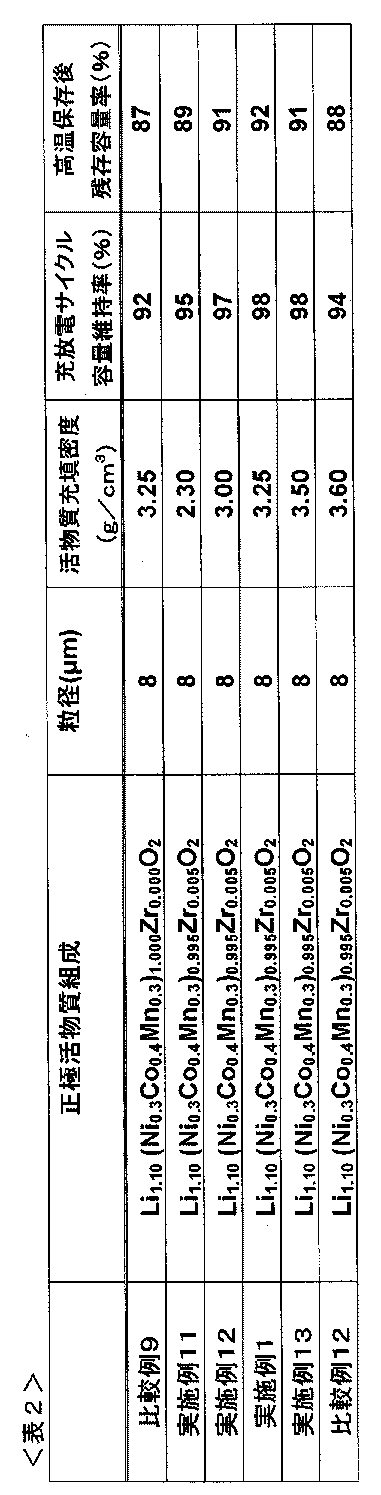
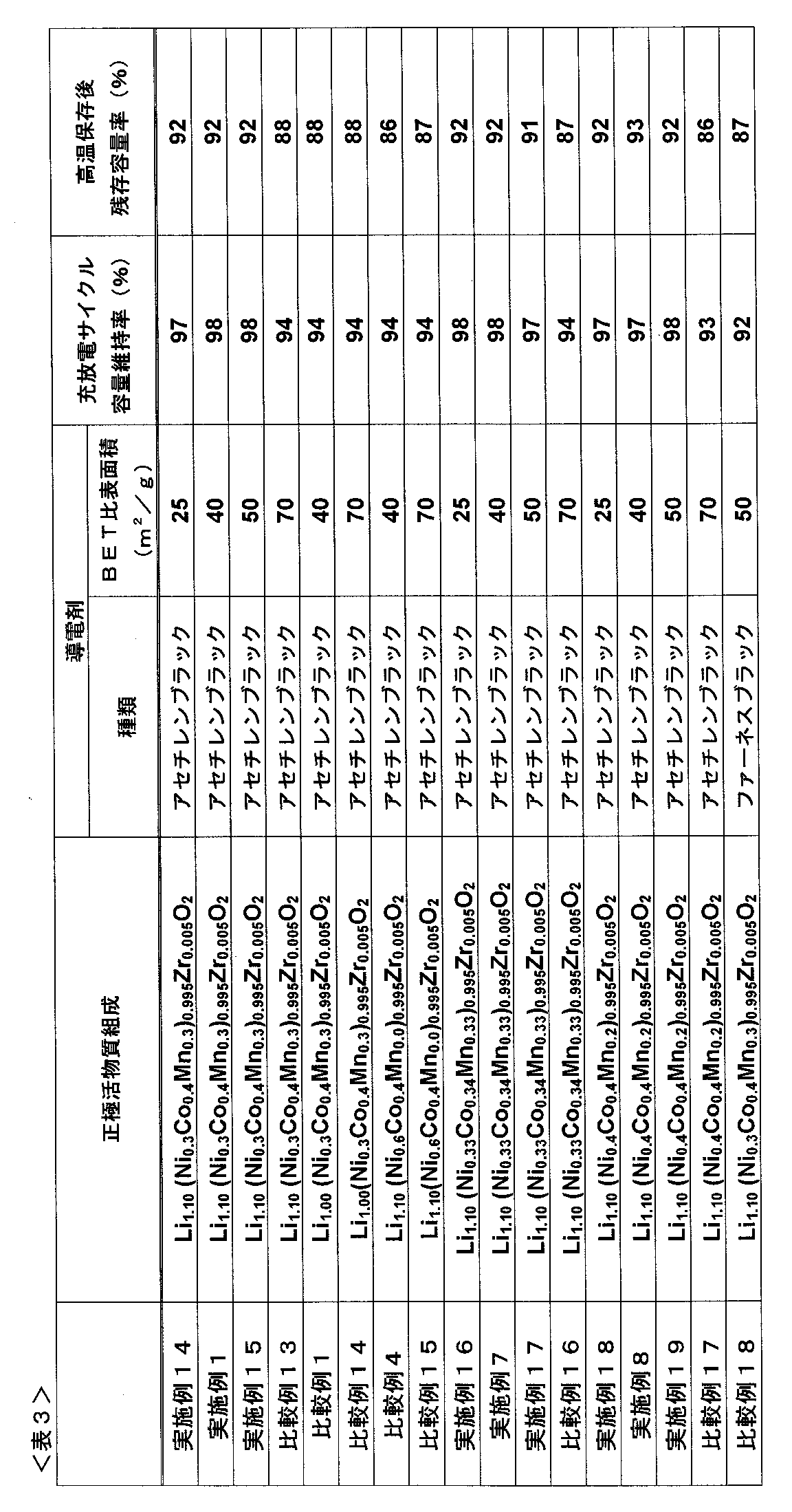
- Tables 1 to 4 The test results of the above examples and comparative examples are summarized in Tables 1 to 4.
- the composition of the positive electrode active material in the table is indicated by adding 0.00 or 0.000 to the element symbol of the component even for the component not added.
- Table 1 summarizes the composition and particle size of the positive electrode active material, and the following can be understood. That is, when the specific surface area of the conductive agent added to the positive electrode mixture is 40 m 2 / g and the active material filling density in the positive electrode mixture is 3.25 g / cm 3 , Examples 1 to 3 and Comparative Example 1 From the comparison with FIG. 2, regarding the composition of the positive electrode active material, the charge / discharge cycle capacity maintenance ratio is (the sum of nickel, cobalt, manganese and zirconium): lithium molar ratio is 1: 1.05 to 1: 1.15. And the remaining capacity ratio after storage at high temperature is good.
- the particle size is preferably 4 ⁇ m or more.
- Table 2 summarizes the active material packing density in the positive electrode mixture, and the following can be understood. That is, when the positive electrode active material in the composition range of the present invention is used, the charge / discharge cycle capacity retention ratio and the remaining capacity ratio after high-temperature storage are good when the active material filling density is 3.50 g / cm 3 or less. However, as the packing density increases, the charge / discharge cycle capacity retention ratio and the remaining capacity ratio after high temperature storage tend to decrease. Further, when the filling density is decreased, the charge / discharge cycle capacity retention ratio and the remaining capacity ratio after high-temperature storage tend to be slightly lowered, and the filling density is more preferably 3.0 g / cm 3 or more.
- Table 3 summarizes the conductive agents and shows the following. From comparison between Examples 1, 14, and 15 and Comparative Example 13, comparison between Examples 7, 16, and 17 and Comparative Example 16, comparison between Examples 8, 18, and 19 and Comparative Example 17, BET of the conductive agent was obtained. When the specific surface area is increased to 70 m 2 / g, the charge / discharge cycle capacity retention ratio and the remaining capacity ratio after high-temperature storage tend to decrease. Moreover, it can be seen from the comparison between Example 19 and Comparative Example 18 that even if the specific surface area is the same, the characteristics deteriorate when the conductive agent is furnace black. It is considered that the conductive state in the positive electrode mixture varies depending on the type of carbon black.
- the composition of the positive electrode active material is out of the scope of the present invention from the comparison between Comparative Example 1 and Comparative Example 14 or the comparison between Comparative Example 4 and Comparative Example 15, the conductive agent is within the scope of the present invention.
- the battery characteristics are not improved, and this also shows that the effect of the conductive agent according to the present invention is specific.
- acetylene black having a BET specific surface area of 25 to 50 cm 2 / g as the conductive agent.
- Table 4 summarizes the elements added to the positive electrode active material. That is, it can be seen from comparison between Example 1 and Comparative Examples 19 and 20 that the positive electrode active material contains zirconium. On the other hand, from Example 20, it can be seen that if zirconium is included in the positive electrode active material, the characteristics may be maintained even if other additional elements such as tungsten are further included.
- additional element in addition to tungsten, titanium, niobium, molybdenum, zinc, aluminum, tin, magnesium, calcium, and strontium are preferable, and they can be used similarly to tungsten. Further, the addition amount of the additional element is preferably 0.1 molar ratio or less.
- a non-aqueous electrolyte secondary battery having a good charge / discharge cycle capacity maintenance rate and a high remaining capacity rate after high-temperature storage can be provided, so that industrial applicability is great.
Landscapes
- Chemical & Material Sciences (AREA)
- Chemical Kinetics & Catalysis (AREA)
- Electrochemistry (AREA)
- General Chemical & Material Sciences (AREA)
- Engineering & Computer Science (AREA)
- Organic Chemistry (AREA)
- Inorganic Chemistry (AREA)
- Manufacturing & Machinery (AREA)
- Materials Engineering (AREA)
- Battery Electrode And Active Subsutance (AREA)
- Secondary Cells (AREA)
- Inorganic Compounds Of Heavy Metals (AREA)
Abstract
Description
本発明の一実施形態に係る非水電解質二次電池20は、図1に示すように、金属箔の両面に樹脂フィルムを積層したラミネートシートからなる外装体1の内部に、下で説明する積層電極体10を非水電解質とともに収容している。外装体1は図示しないカップ形状部と平面形状部の2つの部分からなる。カップ部に積層電極体と非水電解質を収納し、カップの開口を平面形状部で覆い、周縁の溶着封止部1’にてカップ部と平面形状部を溶着密閉している。
<正極活物質の作製>
正極活物質の最終組成でニッケル:コバルト:マンガンがモル比0.3:0.4:0.3の比で含むように、それぞれの金属イオンを含む硫酸溶液に炭酸水素ナトリウムを加え、ニッケル、コバルト、マンガンを含有する炭酸塩を共沈させた。この炭酸塩を加熱して熱分解し、ニッケル、コバルト、マンガンを含有する酸化物を得た。この酸化物に、正極活物質の最終組成が(ニッケル、コバルト、マンガンの合計):ジルコニウムが0.995:0.005のモル比になるように酸化ジルコニウムと、さらにリチウム源として、炭酸リチウムを、正極活物質の最終組成が(ニッケル、コバルト、マンガン、ジルコニウムの合計):リチウムが1:1.10のモル比になるように混合した。この混合物を空気中850℃で焼成し、その後解砕して、粒径8μmのジルコニウムを含有するリチウムニッケルコバルトマンガン複合酸化物を得た。粒径は加熱分解温度や焼成温度を高くしていくことで大きく、低くしていくことで小さく変化させることができる。
作製したジルコニウムを含有するリチウムニッケルコバルトマンガン複合酸化物を94.5質量部と、導電剤として比表面積が40m2/gのアセチレンブラックを3質量部とを混合し、さらに結着剤としてポリフッ化ビニリデン2.5質量部とをN-メチル-2-ピロリドン(NMP)に分散させて正極合剤スラリーを調製した。このスラリーをドクターブレード法により、正極芯体となる厚さ15μmのアルミニウム箔からなる正極芯体の両面に均一に塗布した。アルミニウム箔に塗布したスラリーを加熱乾燥して、アルミニウム箔上に正極合剤層が形成された乾燥極板を作製した。乾燥極板をローラープレス機で圧縮し、所定の寸法に裁断し、高さ150mm、幅150mm、厚さ130μm、活物質充填密度3.25g/cm3の正極板を作製した。なお、正極板からは幅30mm、高さ20mmのアルミニウム箔のみからなる正極集電タブ4を突出させた。
負極活物質として黒鉛と、結着剤としてスチレンブタジエンゴムと、粘度調整剤としてカルボキシメチルセルロースとを96:2:2(質量比)で混合し、この混合物を水に分散してスラリーを調製した。このスラリーをドクターブレード法により、負極芯体となる厚さ10μmの銅箔の両面に均一に塗布した。その後、銅箔に塗布したスラリーを加熱乾燥して、銅箔上に負極合剤層が形成された乾燥極板を作製した。乾燥極板をローラープレス機で圧縮し、所定の寸法に裁断後、高さ155mm、幅155mm、厚さ150μmの負極板を作製した。なお、負極板からは幅30mm、高さ20mmの銅箔のみからなる負極集電タブ5を突出させた。
正極板20枚と負極板21枚を、高さ155mm、幅155mm、厚さ20μmのポリエチレン製微多孔膜セパレータを介して交互に積層した。正極集電タブ4、負極集電タブ5をそれぞれ束ね、正極集電タブ4にはアルミニウム板からなる正極端子6を、負極集電タブ5には銅板からなる負極端子7を超音波溶接により接続した。このようにして積層電極体10を作製した。
エチレンカーボネートとジエチルカーボネートを体積比で25:75(25℃、1気圧)の割合で混合した非水溶媒に、電解質塩として六フッ化リン酸リチウムを1.4モル/リットルの濃度となるように溶解した。そして、ビニレンカーボネートを非水溶媒の総質量に対して1質量%となるように混合して、非水電解質を調製した。
積層電極体10を外装体1に収納し、正極端子6負極端子7が突出する1辺を除き、外装体1の周縁に設けた溶着封止部1’を熱溶着した。その後、溶着していない1辺から非水電解質を注入し、減圧後その1辺を溶着封止部1’で熱溶着した。このようにして設計容量が25Ahの実施例1に係る非水電解質二次電池を作製した。
正極活物質を調製する際、正極活物質の最終組成が(ニッケル、コバルト、マンガン、ジルコニウムの合計):リチウムが1:1.05のモル比になるように炭酸リチウムを混合した正極活物質を用いた以外は実施例1と同様に、実施例2に係る非水電解質二次電池を作製した。
正極活物質を調製する際、正極活物質の最終組成が(ニッケル、コバルト、マンガン、ジルコニウム合計):リチウムが1:1.15のモル比になるように炭酸リチウムを混合した正極活物質を用いた以外は実施例1と同様に、実施例3に係る非水電解質二次電池を作製した。
正極活物質を調製する際、正極活物質の最終組成のニッケル:コバルト:マンガンのモル比が0.5:0.4:0.1となるように硫酸溶液の各金属イオンのモル比を変更した正極活物質を用いた以外は実施例1と同様に、実施例4に係る非水電解質二次電池を作製した。
正極活物質を調製する際、正極活物質の最終組成のニッケル:コバルト:マンガンのモル比が0.4:0.5:0.1となるように硫酸溶液の各金属イオンのモル比を変更した正極活物質を用いた以外は実施例1と同様に、実施例5に係る非水電解質二次電池を作製した。
正極活物質を調製する際、正極活物質の最終組成のニッケル:コバルト:マンガンのモル比が0.4:0.3:0.3となるように硫酸溶液の各金属イオンのモル比を変更した正極活物質を用いた以外は実施例1と同様に、実施例6に係る非水電解質二次電池を作製した。
正極活物質を調製する際、正極活物質の最終組成のニッケル:コバルト:マンガンのモル比が0.33:0.34:0.33となるように硫酸溶液の各金属イオンのモル比を変更した正極活物質を用いた以外は実施例1と同様に、実施例7に係る非水電解質二次電池を作製した。
正極活物質を調製する際、正極活物質の最終組成のニッケル:コバルト:マンガンのモル比が0.4:0.4:0.2となるように硫酸溶液の各金属イオンのモル比を変更した正極活物質を用いた以外は実施例1と同様に、実施例8に係る非水電解質二次電池を作製した。
正極活物質を調製する際、正極活物質の最終組成の(ニッケル:コバルト:マンガン):ジルコニウムのモル比が0.990:0.01となるように酸化ジルコニウムの混合量を変更した正極活物質を用いた以外は実施例1と同様に、実施例9に係る非水電解質二次電池を作製した。
粒径を10μmとした正極活物質を用いた以外は実施例1と同様に、実施例10に係る非水電解質二次電池を作製した。
正極合剤の活物質充填密度を2.30g/cm3とした正極板を用いた以外は実施例1と同様に、実施例11に係る非水電解質二次電池を作製した。
正極合剤の活物質充填密度を3.00g/cm3とした正極板を用いた以外は実施例1と同様に、実施例12に係る非水電解質二次電池を作製した。
正極合剤の活物質充填密度を3.50g/cm3とした正極板を用いた以外は実施例1と同様に、実施例13に係る非水電解質二次電池を作製した。
正極合剤の導電剤として、BET比表面積が25m2/gのアセチレンブラックを用いた以外は実施例1と同様に、実施例14に係る非水電解質二次電池を作製した。
正極合剤の導電剤として、BET比表面積が50m2/gのアセチレンブラックを用いた以外は実施例1と同様に、実施例15に係る非水電解質二次電池を作製した。
正極合剤の導電剤として、BET比表面積が25m2/gのアセチレンブラックを用いた以外は実施例7と同様に、実施例16に係る非水電解質二次電池を作製した。
正極合剤の導電剤として、BET比表面積が50m2/gのアセチレンブラックを用いた以外は実施例7と同様に、実施例17に係る非水電解質二次電池を作製した。
正極合剤の導電剤として、BET比表面積が25m2/gのアセチレンブラックを用いた以外は実施例8と同様に、実施例18に係る非水電解質二次電池を作製した。
正極合剤の導電剤として、BET比表面積が50m2/gのアセチレンブラックを用いた以外は実施例8と同様に、実施例19に係る非水電解質二次電池を作製した。
正極活物質を調製する際、正極活物質の最終組成の(ニッケル:コバルト:マンガンの合計):ジルコニウム:タングステンのモル比が0.99:0.005:0.005となるように酸化ジルコニウムと酸化タングステンの混合した正極活物質を用いた以外は実施例1と同様に、実施例20に係る非水電解質二次電池を作製した。
正極活物質を調製する際、正極活物質の最終組成が(ニッケル、コバルト、マンガン、ジルコニウムの合計):リチウムが1:1.00のモル比になるように炭酸リチウムを混合した正極活物質を用いた以外は実施例1と同様に、比較例1に係る非水電解質二次電池を作製した。
正極活物質を調製する際、正極活物質の最終組成が(ニッケル、コバルト、マンガン、ジルコニウムの合計):リチウムが1:1.20のモル比になるように炭酸リチウムを混合した正極活物質を用いた以外は実施例1と同様に、比較例2に係る非水電解質二次電池を作製した。
正極活物質を調製する際、正極活物質の最終組成のニッケル:コバルト:マンガンのモル比が0:0.5:0.5となるように硫酸溶液の各金属イオンのモル比を変更した正極活物質を用いた以外は実施例1と同様に、比較例3に係る非水電解質二次電池を作製した。なお、以下、比率0とは、その成分を含まないことである。
正極活物質を調製する際、正極活物質の最終組成のニッケル:コバルト:マンガンのモル比が0.6:0.4:0となるように硫酸溶液の各金属イオンのモル比を変更した正極活物質を用いた以外は実施例1と同様に、比較例4に係る非水電解質二次電池を作製した。
正極活物質を調製する際、正極活物質の最終組成のニッケル:コバルト:マンガンのモル比が0.5:0:0.5となるように硫酸溶液の各金属イオンのモル比を変更した正極活物質を用いた以外は実施例1と同様に、比較例5に係る非水電解質二次電池を作製した。
正極活物質を調製する際、正極活物質の最終組成のニッケル:コバルト:マンガンのモル比が0.4:0.6:0となるように硫酸溶液の各金属イオンのモル比を変更した、粒径7μmの正極活物質を用いた以外は実施例1と同様に、比較例6に係る非水電解質二次電池を作製した。
正極活物質を調製する際、正極活物質の最終組成のニッケル:コバルト:マンガンのモル比が0.33:0.34:0.33となるように硫酸溶液の各金属イオンのモル比を変更し、酸化ジルコニウムを混合しなかった正極活物質を用いた以外は実施例1と同様に、比較例7に係る非水電解質二次電池を作製した。
正極活物質を調製する際、酸化ジルコニウムを混合しなかった正極活物質を用いた以外は比較例1と同様に、比較例8に係る非水電解質二次電池を作製した。
正極活物質を調製する際、酸化ジルコニウムを混合しなかった正極活物質を用いた以外は実施例1と同様に、比較例9に係る非水電解質二次電池を作製した。
正極活物質を調製する際、正極活物質の最終組成の(ニッケル:コバルト:マンガンの合計):ジルコニウムのモル比が0.950:0.05となるように酸化ジルコニウムの混合量を変更した正極活物質を用いた以外は実施例1と同様に、比較例10に係る非水電解質二次電池を作製した。
粒径を15μmとした正極活物質を用いた以外は実施例1と同様に、比較例11に係る非水電解質二次電池を作製した。
正極合剤の活物質充填密度を3.60g/cm3とした正極板を用いた以外は実施例1と同様に、比較例12に係る非水電解質二次電池を作製した。
正極合剤の導電剤として、BET比表面積が70m2/gのアセチレンブラックを用いた以外は実施例1と同様に、比較例13に係る非水電解質二次電池を作製した。
正極合剤の導電剤として、BET比表面積が70m2/gのアセチレンブラックを用いた以外は比較例1と同様に、比較例14に係る非水電解質二次電池を作製した。
正極合剤の導電剤として、BET比表面積が70m2/gのアセチレンブラックを用いた以外は比較例4と同様に、比較例15に係る非水電解質二次電池を作製した。
正極合剤の導電剤として、BET比表面積が70m2/gのアセチレンブラックを用いた以外は実施例7と同様に、比較例16に係る非水電解質二次電池を作製した。
正極合剤の導電剤として、BET比表面積が70m2/gのアセチレンブラックを用いた以外は実施例8と同様に、比較例17に係る非水電解質二次電池を作製した。
正極合剤の導電剤として、BET比表面積が50m2/gのファーネスブラックを用いた以外は実施例1と同様に、比較例18に係る非水電解質二次電池を作製した。
正極活物質を調製する際、正極活物質の最終組成の(ニッケル:コバルト:マンガン):アルミニウムのモル比が0.995:0.005となるように酸化アルミニウムを混合した正極活物質を用いた以外は実施例1と同様に、比較例19に係る非水電解質二次電池を作製した。
正極活物質を調製する際、正極活物質の最終組成の(ニッケル:コバルト:マンガン):アルミニウムのモル比が0.995:0.005となるように酸化マグネシウムを混合した正極活物質を用いた以外は実施例1と同様に、比較例20に係る非水電解質二次電池を作製した。
<充放電サイクル試験>
作製した電池を25℃にて50Aの電流値で4.0Vまで定電流充電し、引き続き4.0Vにて充電電流値が0.5Aになるまで定電圧充電を行った。その後、50Aの電流値で3.0Vまで放電した。この充電・放電工程を1サイクルとし、500サイクル繰り返した。そして、1サイクル目に対する500サイクル目の放電容量の比率を容量維持率(%)とした。
作製した電池を25℃にて25Aの電流値で4.1Vまで定電流充電し、引き続き4.1Vにて充電電流値が0.5Aになるまで定電圧充電を行った。その後、25Aの電流値で2.75Vまで放電した。この放電工程における放電容量を保存前容量とした。


20 非水電解質二次電池
Claims (3)
- 正極合剤を含む正極、負極、前記正極と前記負極を絶縁するセパレータ、及び非水電解質を備える非水電解質二次電池であって、
前記正極合剤が、粒径が10μm以下であり、Lia(NibCocMnd)1-x-yZrxMyO2(ただし、a=1.10±0.05、0.3≦b≦0.5、0.3≦c≦0.5、b+c+d=1、0.001≦x≦0.01、0≦y≦0.1、MはTi、Nb、Mo、Zn、Al、Sn、Mg、Ca、Sr、Wから選択される元素である。)の組成式で表される物質を主体とする正極活物質と、
BET法で求められる比表面積が25m2/g以上50m2/g以下であるアセチレンブラックを導電剤として含有し、
前記正極活物質の充填密度が3.5g/cm3以下であることを特徴とする非水電解質二次電池。 - 前記正極活物質の充填密度が3.0g/cm3以上であることを特徴とする請求項1に記載の非水電解質二次電池。
- 前記正極および前記負極はともに平板形状であって、複数枚の前記平板形状の正極と複数枚の前記平板形状の負極が前記セパレータを介して、交互に積層されることを特徴とする請求項1または2に記載の非水電解質二次電池。
Priority Applications (3)
| Application Number | Priority Date | Filing Date | Title |
|---|---|---|---|
| US14/909,810 US20160308193A1 (en) | 2013-09-17 | 2014-09-08 | Nonaqueous electrolyte secondary battery |
| CN201480047638.9A CN105493316B (zh) | 2013-09-17 | 2014-09-08 | 非水电解质二次电池 |
| JP2015537552A JP6468191B2 (ja) | 2013-09-17 | 2014-09-08 | 非水電解質二次電池 |
Applications Claiming Priority (2)
| Application Number | Priority Date | Filing Date | Title |
|---|---|---|---|
| JP2013191419 | 2013-09-17 | ||
| JP2013-191419 | 2013-09-17 |
Publications (1)
| Publication Number | Publication Date |
|---|---|
| WO2015040818A1 true WO2015040818A1 (ja) | 2015-03-26 |
Family
ID=52688488
Family Applications (1)
| Application Number | Title | Priority Date | Filing Date |
|---|---|---|---|
| PCT/JP2014/004594 Ceased WO2015040818A1 (ja) | 2013-09-17 | 2014-09-08 | 非水電解質二次電池 |
Country Status (4)
| Country | Link |
|---|---|
| US (1) | US20160308193A1 (ja) |
| JP (1) | JP6468191B2 (ja) |
| CN (1) | CN105493316B (ja) |
| WO (1) | WO2015040818A1 (ja) |
Cited By (1)
| Publication number | Priority date | Publication date | Assignee | Title |
|---|---|---|---|---|
| EP3353835A4 (en) * | 2015-09-23 | 2019-07-17 | Umicore | LITHIUM NICKEL MANGAN COBALT CATHODE POWDER FOR LITHIUM ION BATTERIES |
Families Citing this family (3)
| Publication number | Priority date | Publication date | Assignee | Title |
|---|---|---|---|---|
| CN107359334B (zh) * | 2017-07-11 | 2020-06-19 | 贵州振华新材料有限公司 | 球形或类球形锂离子电池正极材料及锂离子电池 |
| EP3930038A4 (en) * | 2019-02-19 | 2022-04-27 | SANYO Electric Co., Ltd. | SECONDARY NON-AQUEOUS ELECTROLYTE BATTERY AND METHOD OF MAKING A POSITIVE ELECTRODE PLATE USING THE SAME |
| EP4341211A1 (en) * | 2021-05-18 | 2024-03-27 | Orion Engineered Carbons IP GmbH & Co. KG | Pulverulent acetylene black material, process for its production, and compositions, manufactured articles and uses thereof |
Citations (6)
| Publication number | Priority date | Publication date | Assignee | Title |
|---|---|---|---|---|
| JP2009035598A (ja) * | 2007-07-31 | 2009-02-19 | Denki Kagaku Kogyo Kk | アセチレンブラック、その製造方法及び用途 |
| JP2010199076A (ja) * | 2010-04-16 | 2010-09-09 | Sanyo Electric Co Ltd | 非水電解質二次電池及びその充電方法 |
| JP2010225366A (ja) * | 2009-03-23 | 2010-10-07 | Sanyo Electric Co Ltd | 非水電解質二次電池 |
| JP2012109166A (ja) * | 2010-11-18 | 2012-06-07 | Toyota Motor Corp | 二次電池 |
| WO2012169083A1 (ja) * | 2011-06-07 | 2012-12-13 | 住友金属鉱山株式会社 | ニッケルマンガン複合水酸化物粒子とその製造方法、非水系電解質二次電池用正極活物質とその製造方法、ならびに、非水系電解質二次電池 |
| JP2013134871A (ja) * | 2011-12-26 | 2013-07-08 | Toyota Motor Corp | 正極活物質の製造方法 |
Family Cites Families (7)
| Publication number | Priority date | Publication date | Assignee | Title |
|---|---|---|---|---|
| JP4121260B2 (ja) * | 2001-07-31 | 2008-07-23 | 三洋電機株式会社 | 偏平型電池用電極の製造方法 |
| JP4177574B2 (ja) * | 2001-11-02 | 2008-11-05 | 松下電器産業株式会社 | リチウム二次電池 |
| JP4056346B2 (ja) * | 2002-09-30 | 2008-03-05 | 三洋電機株式会社 | 非水電解質二次電池 |
| JP5105393B2 (ja) * | 2005-03-02 | 2012-12-26 | 日立マクセルエナジー株式会社 | 非水電解質二次電池 |
| JP4925614B2 (ja) * | 2005-06-24 | 2012-05-09 | 日立マクセルエナジー株式会社 | 非水電解質二次電池用の正極、および非水電解質二次電池 |
| WO2011108106A1 (ja) * | 2010-03-04 | 2011-09-09 | 株式会社 東芝 | 非水電解質電池、電池パック及び自動車 |
| JP5626183B2 (ja) * | 2011-11-17 | 2014-11-19 | トヨタ自動車株式会社 | 非水電解液二次電池用の正極導電材ペースト、及び、非水電解液二次電池 |
-
2014
- 2014-09-08 JP JP2015537552A patent/JP6468191B2/ja active Active
- 2014-09-08 CN CN201480047638.9A patent/CN105493316B/zh active Active
- 2014-09-08 WO PCT/JP2014/004594 patent/WO2015040818A1/ja not_active Ceased
- 2014-09-08 US US14/909,810 patent/US20160308193A1/en not_active Abandoned
Patent Citations (6)
| Publication number | Priority date | Publication date | Assignee | Title |
|---|---|---|---|---|
| JP2009035598A (ja) * | 2007-07-31 | 2009-02-19 | Denki Kagaku Kogyo Kk | アセチレンブラック、その製造方法及び用途 |
| JP2010225366A (ja) * | 2009-03-23 | 2010-10-07 | Sanyo Electric Co Ltd | 非水電解質二次電池 |
| JP2010199076A (ja) * | 2010-04-16 | 2010-09-09 | Sanyo Electric Co Ltd | 非水電解質二次電池及びその充電方法 |
| JP2012109166A (ja) * | 2010-11-18 | 2012-06-07 | Toyota Motor Corp | 二次電池 |
| WO2012169083A1 (ja) * | 2011-06-07 | 2012-12-13 | 住友金属鉱山株式会社 | ニッケルマンガン複合水酸化物粒子とその製造方法、非水系電解質二次電池用正極活物質とその製造方法、ならびに、非水系電解質二次電池 |
| JP2013134871A (ja) * | 2011-12-26 | 2013-07-08 | Toyota Motor Corp | 正極活物質の製造方法 |
Cited By (2)
| Publication number | Priority date | Publication date | Assignee | Title |
|---|---|---|---|---|
| EP3353835A4 (en) * | 2015-09-23 | 2019-07-17 | Umicore | LITHIUM NICKEL MANGAN COBALT CATHODE POWDER FOR LITHIUM ION BATTERIES |
| US10601037B2 (en) | 2015-09-23 | 2020-03-24 | Umicore | Lithium-rich nickel-manganese-cobalt cathode powders for lithium-ion batteries |
Also Published As
| Publication number | Publication date |
|---|---|
| US20160308193A1 (en) | 2016-10-20 |
| JPWO2015040818A1 (ja) | 2017-03-02 |
| CN105493316B (zh) | 2018-04-03 |
| CN105493316A (zh) | 2016-04-13 |
| JP6468191B2 (ja) | 2019-02-13 |
Similar Documents
| Publication | Publication Date | Title |
|---|---|---|
| JP7253147B2 (ja) | 非水電解質二次電池 | |
| CN103392249A (zh) | 锂离子二次电池及其制造方法 | |
| JP6963866B2 (ja) | 全固体電池用負極および全固体電池 | |
| JP2010034024A (ja) | リチウムイオン二次電池 | |
| CN108140830A (zh) | 锂离子二次电池及其制造方法 | |
| JP2009032682A (ja) | リチウムイオン二次電池 | |
| JP7673094B2 (ja) | 電極、非水電解質電池及び電池パック | |
| CN105990576A (zh) | 电极、非水电解质电池和电池包 | |
| CN107534143A (zh) | 非水系电解质二次电池用正极活性物质和其制造方法、以及使用该正极活性物质的非水系电解质二次电池 | |
| JP7822895B2 (ja) | 非水電解質二次電池用正極および非水電解質二次電池 | |
| US20140011083A1 (en) | Electrode for non-aqueous electrolyte secondary batteries and non-aqueous electrolyte secondary battery including the same | |
| CN112447941A (zh) | 非水电解质二次电池 | |
| WO2014050114A1 (ja) | 非水電解質二次電池 | |
| CN104412442A (zh) | 非水电解质二次电池和非水电解质二次电池的制造方法 | |
| JP2002025611A (ja) | 非水電解液二次電池 | |
| CN107408729A (zh) | 二次电池用复合电解质、二次电池及电池包 | |
| JP6275694B2 (ja) | 非水電解質二次電池 | |
| WO2018198168A1 (ja) | 二次電池用電池部材、並びに、二次電池及びその製造方法 | |
| JP2018092707A (ja) | 正極板の製造方法及び非水電解質二次電池の製造方法、並びに非水電解質二次電池 | |
| CN101232088B (zh) | 电池 | |
| JP2007265668A (ja) | 非水電解質二次電池用正極及びその製造方法 | |
| CN101587952A (zh) | 复合钴酸锂正极材料和制备方法及其应用 | |
| US10177370B2 (en) | Positive electrode for lithium ion secondary battery and lithium ion secondary battery using the same | |
| JP6468191B2 (ja) | 非水電解質二次電池 | |
| WO2007052440A1 (ja) | リチウムイオン二次電池 |
Legal Events
| Date | Code | Title | Description |
|---|---|---|---|
| WWE | Wipo information: entry into national phase |
Ref document number: 201480047638.9 Country of ref document: CN |
|
| 121 | Ep: the epo has been informed by wipo that ep was designated in this application |
Ref document number: 14846044 Country of ref document: EP Kind code of ref document: A1 |
|
| ENP | Entry into the national phase |
Ref document number: 2015537552 Country of ref document: JP Kind code of ref document: A |
|
| WWE | Wipo information: entry into national phase |
Ref document number: 14909810 Country of ref document: US |
|
| NENP | Non-entry into the national phase |
Ref country code: DE |
|
| 122 | Ep: pct application non-entry in european phase |
Ref document number: 14846044 Country of ref document: EP Kind code of ref document: A1 |