WO2015037593A1 - 水硬性組成物 - Google Patents
水硬性組成物 Download PDFInfo
- Publication number
- WO2015037593A1 WO2015037593A1 PCT/JP2014/073844 JP2014073844W WO2015037593A1 WO 2015037593 A1 WO2015037593 A1 WO 2015037593A1 JP 2014073844 W JP2014073844 W JP 2014073844W WO 2015037593 A1 WO2015037593 A1 WO 2015037593A1
- Authority
- WO
- WIPO (PCT)
- Prior art keywords
- mass
- hydraulic composition
- cement clinker
- manganese slag
- cement
- Prior art date
- Legal status (The legal status is an assumption and is not a legal conclusion. Google has not performed a legal analysis and makes no representation as to the accuracy of the status listed.)
- Ceased
Links
Classifications
-
- C—CHEMISTRY; METALLURGY
- C04—CEMENTS; CONCRETE; ARTIFICIAL STONE; CERAMICS; REFRACTORIES
- C04B—LIME, MAGNESIA; SLAG; CEMENTS; COMPOSITIONS THEREOF, e.g. MORTARS, CONCRETE OR LIKE BUILDING MATERIALS; ARTIFICIAL STONE; CERAMICS; REFRACTORIES; TREATMENT OF NATURAL STONE
- C04B7/00—Hydraulic cements
- C04B7/14—Cements containing slag
- C04B7/147—Metallurgical slag
- C04B7/153—Mixtures thereof with other inorganic cementitious materials or other activators
- C04B7/17—Mixtures thereof with other inorganic cementitious materials or other activators with calcium oxide containing activators
- C04B7/19—Portland cements
-
- C—CHEMISTRY; METALLURGY
- C04—CEMENTS; CONCRETE; ARTIFICIAL STONE; CERAMICS; REFRACTORIES
- C04B—LIME, MAGNESIA; SLAG; CEMENTS; COMPOSITIONS THEREOF, e.g. MORTARS, CONCRETE OR LIKE BUILDING MATERIALS; ARTIFICIAL STONE; CERAMICS; REFRACTORIES; TREATMENT OF NATURAL STONE
- C04B28/00—Compositions of mortars, concrete or artificial stone, containing inorganic binders or the reaction product of an inorganic and an organic binder, e.g. polycarboxylate cements
- C04B28/02—Compositions of mortars, concrete or artificial stone, containing inorganic binders or the reaction product of an inorganic and an organic binder, e.g. polycarboxylate cements containing hydraulic cements other than calcium sulfates
- C04B28/04—Portland cements
-
- C—CHEMISTRY; METALLURGY
- C04—CEMENTS; CONCRETE; ARTIFICIAL STONE; CERAMICS; REFRACTORIES
- C04B—LIME, MAGNESIA; SLAG; CEMENTS; COMPOSITIONS THEREOF, e.g. MORTARS, CONCRETE OR LIKE BUILDING MATERIALS; ARTIFICIAL STONE; CERAMICS; REFRACTORIES; TREATMENT OF NATURAL STONE
- C04B28/00—Compositions of mortars, concrete or artificial stone, containing inorganic binders or the reaction product of an inorganic and an organic binder, e.g. polycarboxylate cements
- C04B28/02—Compositions of mortars, concrete or artificial stone, containing inorganic binders or the reaction product of an inorganic and an organic binder, e.g. polycarboxylate cements containing hydraulic cements other than calcium sulfates
- C04B28/08—Slag cements
-
- C—CHEMISTRY; METALLURGY
- C04—CEMENTS; CONCRETE; ARTIFICIAL STONE; CERAMICS; REFRACTORIES
- C04B—LIME, MAGNESIA; SLAG; CEMENTS; COMPOSITIONS THEREOF, e.g. MORTARS, CONCRETE OR LIKE BUILDING MATERIALS; ARTIFICIAL STONE; CERAMICS; REFRACTORIES; TREATMENT OF NATURAL STONE
- C04B28/00—Compositions of mortars, concrete or artificial stone, containing inorganic binders or the reaction product of an inorganic and an organic binder, e.g. polycarboxylate cements
- C04B28/14—Compositions of mortars, concrete or artificial stone, containing inorganic binders or the reaction product of an inorganic and an organic binder, e.g. polycarboxylate cements containing calcium sulfate cements
-
- C—CHEMISTRY; METALLURGY
- C04—CEMENTS; CONCRETE; ARTIFICIAL STONE; CERAMICS; REFRACTORIES
- C04B—LIME, MAGNESIA; SLAG; CEMENTS; COMPOSITIONS THEREOF, e.g. MORTARS, CONCRETE OR LIKE BUILDING MATERIALS; ARTIFICIAL STONE; CERAMICS; REFRACTORIES; TREATMENT OF NATURAL STONE
- C04B7/00—Hydraulic cements
- C04B7/14—Cements containing slag
- C04B7/147—Metallurgical slag
- C04B7/153—Mixtures thereof with other inorganic cementitious materials or other activators
- C04B7/21—Mixtures thereof with other inorganic cementitious materials or other activators with calcium sulfate containing activators
-
- Y—GENERAL TAGGING OF NEW TECHNOLOGICAL DEVELOPMENTS; GENERAL TAGGING OF CROSS-SECTIONAL TECHNOLOGIES SPANNING OVER SEVERAL SECTIONS OF THE IPC; TECHNICAL SUBJECTS COVERED BY FORMER USPC CROSS-REFERENCE ART COLLECTIONS [XRACs] AND DIGESTS
- Y02—TECHNOLOGIES OR APPLICATIONS FOR MITIGATION OR ADAPTATION AGAINST CLIMATE CHANGE
- Y02P—CLIMATE CHANGE MITIGATION TECHNOLOGIES IN THE PRODUCTION OR PROCESSING OF GOODS
- Y02P40/00—Technologies relating to the processing of minerals
- Y02P40/10—Production of cement, e.g. improving or optimising the production methods; Cement grinding
-
- Y—GENERAL TAGGING OF NEW TECHNOLOGICAL DEVELOPMENTS; GENERAL TAGGING OF CROSS-SECTIONAL TECHNOLOGIES SPANNING OVER SEVERAL SECTIONS OF THE IPC; TECHNICAL SUBJECTS COVERED BY FORMER USPC CROSS-REFERENCE ART COLLECTIONS [XRACs] AND DIGESTS
- Y02—TECHNOLOGIES OR APPLICATIONS FOR MITIGATION OR ADAPTATION AGAINST CLIMATE CHANGE
- Y02W—CLIMATE CHANGE MITIGATION TECHNOLOGIES RELATED TO WASTEWATER TREATMENT OR WASTE MANAGEMENT
- Y02W30/00—Technologies for solid waste management
- Y02W30/50—Reuse, recycling or recovery technologies
- Y02W30/91—Use of waste materials as fillers for mortars or concrete
Definitions
- the present invention relates to a hydraulic composition containing Portland cement clinker, manganese slag, and gypsum.
- CO 2 emitted in the cement industry is mainly derived from decarboxylation of limestone, which is a raw material for cement clinker, and from consumption of fuel necessary for cement clinker firing in the cement manufacturing stage.
- it is considered effective to reduce the amount of cement clinker and to increase the use ratio of a mixed material such as blast furnace slag.
- waste and by-products can be effectively treated by using waste and by-products as a mixture.
- blast furnace cement as a cement in which blast furnace slag is added as a mixture and the amount of cement clinker used is reduced.
- Blast furnace cement is stipulated in three types according to the blast furnace slag usage ratio, and it is specified to be more than 5 and 30% for Type A, more than 30 and less than 60% for Type B, and more than 60 and less than 70% for Type C.
- Blast furnace slag cement has excellent chemical resistance and suppresses alkali-silica reaction. In addition, it has latent hydraulic properties, so its initial strength is inferior to that of ordinary Portland cement. Is used in a wide range of fields because of its good characteristics.
- One means of effective use of waste and by-products if a cement with the same or better effect than ordinary Portland cement or blast furnace cement is obtained even if the usage rate is increased when mixing other waste and by-products Can be.
- the present invention is a hydraulic composition containing Portland cement clinker, manganese slag and gypsum, wherein the content of Portland cement clinker and manganese slag is based on the total amount of Portland cement clinker and manganese slag, respectively.
- the hydraulic composition is 95 to 75% by mass and 5 to 25% by mass, and the gypsum content is 0.5 to 4% by mass as SO 3 based on the hydraulic composition.
- Portland cement clinker is mainly composed of SiO 2 , Al 2 O 3 , CaO and Fe 2 O 3, and the mineral ratio of these components, specifically C 3 S (3CaO ⁇ SiO 2 ), C 2 S (2CaO ⁇ SiO 2 ), C 3 A (3CaO ⁇ Al 2 O 3 ), and C 4 AF (4CaO ⁇ Al 2 O 3 ⁇ Fe 2 O 3 ) have a great influence on various physical properties of cement. well known.
- the Portland cement clinker (hereinafter, also simply referred to as “cement clinker”) used in the present invention may be composed of the above four minerals as main components.
- C 3 S calculated by the Borg formula is 50 to 70% by mass
- C 2 S is 10 to 20% by mass
- C 3 A is 7 to 15% by mass
- C 4 AF is 7 to 15% by mass.
- the Borg equation is an equation for estimating the mineral composition in the cement clinker from the result of the chemical composition analysis obtained for the cement clinker, and in this specification, it is a simultaneous equation consisting of the following four equations.
- C 3 S amount (4.07 ⁇ CaO) ⁇ (7.60 ⁇ SiO 2 ) ⁇ (6.72 ⁇ Al 2 O 3 ) ⁇ (1.43 ⁇ Fe 2 O 3 )
- C 2 S amount (2.87 ⁇ SiO 2 ) ⁇ (0.754 ⁇ C 3 S)
- a amount (2.65 ⁇ Al 2 O 3 ) ⁇ (1.69 ⁇ Fe 2 O 3 )
- C 4 AF amount 3.04 ⁇ Fe 2 O 3
- the term represented by the chemical formula is the content of the species obtained by chemical composition analysis of the cement clinker
- C 3 S” in the second equation is the C 3 S amount estimated by the first equation. All of these contents are mass-based values (mass%).
- the components contained in the cement clinker may be quantified according to, for example, a chemical analysis method defined in JIS R 5202 or a fluorescent X-ray analysis method defined in JIS R 5204.
- a known clinker having the above-mentioned chemical composition, which exhibits general-purpose properties when used as a cement can be employed. This applies to Portland cement clinker.
- the fineness of the Portland cement clinker may be in a range that is generally used, and it is preferably adjusted to 3000 to 5000 cm 2 / g.
- the method for producing the cement clinker in the present invention is not particularly limited, and a known cement (clinker) raw material is adjusted and mixed at a predetermined ratio so as to have a desired mineral ratio and coefficient, and a known method. It can be easily obtained by firing with (for example, SP kiln or NSP kiln). A known method may be appropriately adopted as a method for adjusting and mixing the cement raw material.
- waste / by-products and other raw materials in advance (CaO sources such as limestone, quicklime and slaked lime, SiO 2 sources such as silica, Al 2 O 3 sources such as clay, Fe 2 O 3 sources such as iron sources, etc.)
- the composition ratio of each raw material is calculated so as to be within the above range from the ratio of each component during the weight reduction, and the raw material is prepared at that ratio.
- the raw material used for manufacture of the cement clinker used in the present invention is the same as the raw material conventionally used in the manufacture of the cement clinker without particular limitation. Of course, it is possible to use waste and by-products.
- wastes / byproducts from the viewpoint of promoting effective utilization of wastes / byproducts.
- More concrete examples of usable waste and by-products include blast furnace slag, steel slag, non-ferrous iron slag, coal ash, sewage sludge, purified water sludge, paper sludge, construction generated soil, foundry sand, dust, incineration fly ash, molten Examples include fly ash, wood chips, waste white clay, waste, tires, plastics, shells, municipal waste and incineration ash. is there).
- the hydraulic composition of the present invention contains manganese slag and gypsum as essential components in addition to the Portland cement clinker.
- the manganese slag used in the hydraulic composition of the present invention can be used without limitation as long as it is obtained by pulverizing manganese slag generated in a manganese purification process or the like.
- Manganese slag has a chemical composition ratio of SiO 2 of 10% by mass or more, CaO of 20% by mass or more, and Fe 2 O 3 of 3% by mass or less, SiO 2 of 30% by mass or more, and CaO of 21%.
- the content of Fe 2 O 3 is 2% by mass or less, and the content of SiO 2 is 35% by mass or more, CaO is 22% by mass or more, and Fe 2 O 3 is 1% by mass or less. .
- the upper limit of each component is preferably 50% by mass or less for SiO 2 and 40% by mass or less for CaO.
- the fineness of manganese slag is preferably adjusted to 3000 to 8000 cm 2 / g.
- the amount of manganese slag used is preferably 5 to 25% by mass, more preferably 5 to 20% by mass, and particularly preferably 5 to 15% by mass based on the hydraulic composition of the present invention.
- gypsum As the gypsum to be used, known gypsum can be used without particular limitation as a raw material for cement such as dihydrate gypsum, hemihydrate gypsum, and anhydrous gypsum. Specific examples include by-product dihydrate gypsum such as flue gas desulfurization gypsum and phosphate gypsum, natural dihydrate gypsum, hemihydrate gypsum, type II anhydrous gypsum, and the like.
- the amount of gypsum added is preferably 0.5 to 4% by mass, more preferably 0.5 to 3% by mass, more preferably 1.5 to 3% by mass in terms of SO 3 per total composition.
- the amount added is more preferably 2% by mass. If the content of gypsum is less than the lower limit, abnormal setting is shown in cement setting, while if it exceeds the upper limit, the amount of unreacted gypsum increases, which is not preferable.
- known techniques can be used without particular limitation, and after each component is individually pulverized, mixed Alternatively, it may be pulverized after mixing.
- a ball mill, a vertical mill or the like can be used as the pulverizer.
- the fineness of the hydraulic composition of the present invention containing Portland cement clinker, manganese slag and gypsum is preferably adjusted to 3000 to 8000 cm 2 / g.
- the hydraulic composition of the present invention can be used as the same as general-purpose cement. It can also be used as a constituent of a solidifying material such as a soil solidifying material.
- Table 1 shows the chemical analysis values of the used ordinary Portland cement clinker by fluorescent X-rays and the mineral composition calculated from the chemical analysis values by the Borg formula.
- Examples 1 to 3 Comparative Examples 1 and 2 and Reference Examples 1 to 6 Gypsum was added to ordinary Portland cement clinker so as to be 2% by mass in terms of SO 3 , and mixed and ground so that the specific surface area by the Blaine method was 3500 cm 2 / g.
- the manganese slag was pulverized so that the specific surface area of the brain was 4000 cm 2 / g.
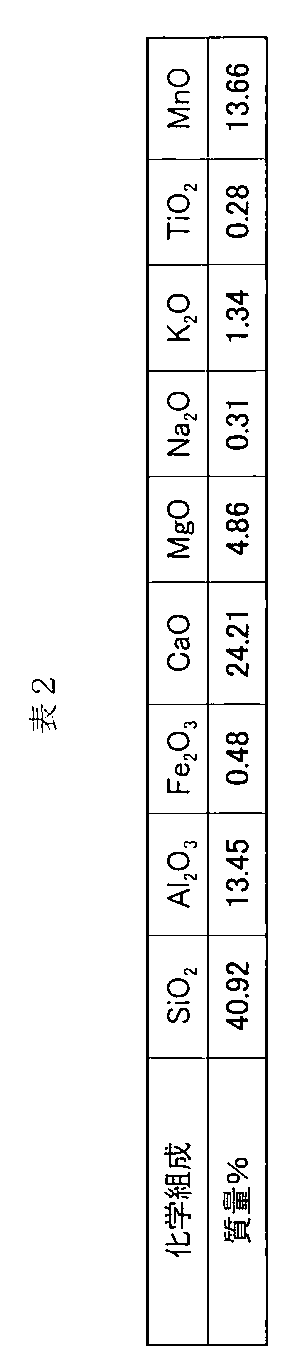
- the analysis value of this manganese slag is shown in Table 2 (by fluorescent X-ray analysis method).
- Each hydraulic composition was manufactured using the Portland cement clinker containing the above gypsum and manganese slag.
- the mortar compressive strength of the obtained hydraulic composition was measured.
- the mortar compressive strength was measured by a strength test according to JIS R 5201.
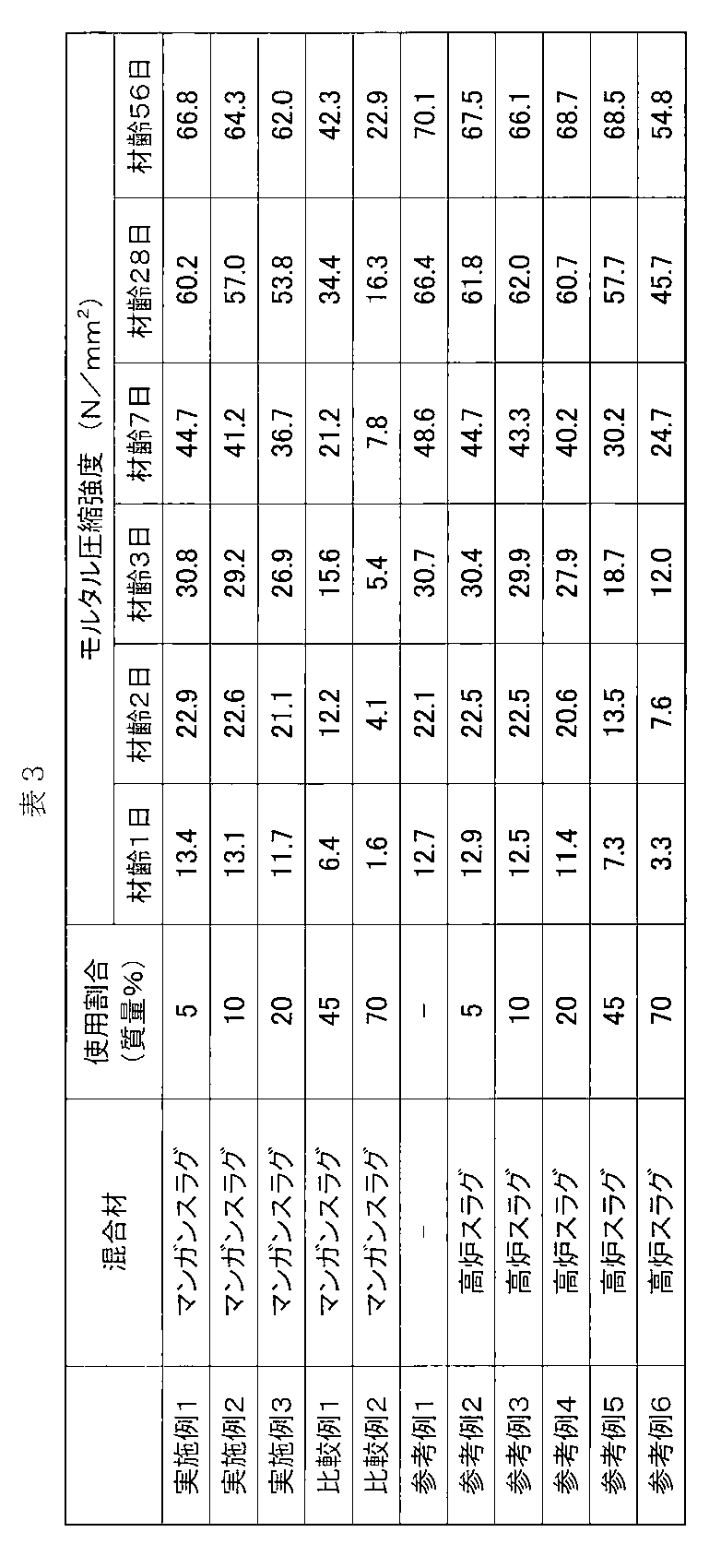
- Table 3 shows the results of the mixed material usage ratio and mortar compressive strength of each Example, Comparative Example, and Reference Example. It can be seen from Reference Examples 1 to 6 that the strength development tends to decrease as the proportion of blast furnace slag used increases.
Landscapes
- Chemical & Material Sciences (AREA)
- Engineering & Computer Science (AREA)
- Ceramic Engineering (AREA)
- Inorganic Chemistry (AREA)
- Materials Engineering (AREA)
- Structural Engineering (AREA)
- Organic Chemistry (AREA)
- Chemical Kinetics & Catalysis (AREA)
- Curing Cements, Concrete, And Artificial Stone (AREA)
Abstract
本発明は、ポルトランドセメントクリンカーを95〜75質量%とマンガンスラグを5〜25質量%(但し、クリンカーとスラグの合計を100質量%とする)と、組成物中のSO3量が0.5〜4.0質量%となる量の石膏を含む水硬性組成物を提供する。この組成物は、マンガンスラグを混合材として含有するにもかかわらず強度発現性の低下が比較的少ない水硬性組成物として利用することができる。
Description
本発明はポルトランドセメントクリンカーおよびマンガンスラグ、さらに石膏を含む水硬性組成物に係わる。
近年の地球環境問題と関連して、廃棄物・副産物等の有効利用は重要な課題となっている。セメント産業、セメント製造設備の特徴を生かし、セメント製造時に原料や燃料として廃棄物・副産物を有効利用あるいは処理を行なうことは、安全かつ大量処分が可能という観点から有効とされている。
大量生産・大量消費型産業であるセメント産業は、セメント製造時に原料や燃料として廃棄物・副産物を有効利用あるいは処理を行ない、省資源・省エネルギーで効率よくセメントを製造することが重要とされている。
一方、地球温暖化の観点からすると、セメント産業はCO2排出量の多い産業と位置づけられている。セメント産業で排出されるCO2は、セメント製造段階での、セメントクリンカー原料となる石灰石の脱炭酸によるものやセメントクリンカー焼成に必要な燃料の消費によるものが主となっている。セメント産業でのCO2低減については、セメントクリンカー量を少なくし、高炉スラグ等の混合材の使用割合を増やしたセメントとすることが有効とされている。また混合材として廃棄物・副産物を使用することで廃棄物・副産物の有効な処理が行なえる。
高炉スラグを混合材として添加し、セメントクリンカーの使用量を減らしたセメントとして高炉セメントがある。高炉セメントは高炉スラグの使用割合に応じて3種類に規定されており、A種では5を超え30%以下、B種では30を超え60%以下、C種では60を超え70%以下と規定されている。高炉スラグセメントは化学抵抗性に優れることやアルカリシリカ反応を抑制する抑制効果がある等の特徴の他に、潜在水硬性を持つため初期強度では普通ポルトランドセメントと比較して劣るものの長期強度発現性は良好であるという特徴を有することから幅広い分野で使用されている。
その他の廃棄物・副産物を混合する場合において使用割合を増加させても普通ポルトランドセメントや高炉セメントと同程度またはそれ以上の効果を有するセメントが得られれば廃棄物・副産物の有効利用の1つの手段となり得る。
大量生産・大量消費型産業であるセメント産業は、セメント製造時に原料や燃料として廃棄物・副産物を有効利用あるいは処理を行ない、省資源・省エネルギーで効率よくセメントを製造することが重要とされている。
一方、地球温暖化の観点からすると、セメント産業はCO2排出量の多い産業と位置づけられている。セメント産業で排出されるCO2は、セメント製造段階での、セメントクリンカー原料となる石灰石の脱炭酸によるものやセメントクリンカー焼成に必要な燃料の消費によるものが主となっている。セメント産業でのCO2低減については、セメントクリンカー量を少なくし、高炉スラグ等の混合材の使用割合を増やしたセメントとすることが有効とされている。また混合材として廃棄物・副産物を使用することで廃棄物・副産物の有効な処理が行なえる。
高炉スラグを混合材として添加し、セメントクリンカーの使用量を減らしたセメントとして高炉セメントがある。高炉セメントは高炉スラグの使用割合に応じて3種類に規定されており、A種では5を超え30%以下、B種では30を超え60%以下、C種では60を超え70%以下と規定されている。高炉スラグセメントは化学抵抗性に優れることやアルカリシリカ反応を抑制する抑制効果がある等の特徴の他に、潜在水硬性を持つため初期強度では普通ポルトランドセメントと比較して劣るものの長期強度発現性は良好であるという特徴を有することから幅広い分野で使用されている。
その他の廃棄物・副産物を混合する場合において使用割合を増加させても普通ポルトランドセメントや高炉セメントと同程度またはそれ以上の効果を有するセメントが得られれば廃棄物・副産物の有効利用の1つの手段となり得る。
廃棄物・副産物の使用量を増加させることは資源有効利用という観点から積極的に行なうことが求められるが使用することによりセメントの物性等に影響を及ぼしては意味がない。特に強度発現性はセメントの物性の重要な指標の1つであるが、ポルトランドセメントクリンカーの使用量を減らし、混合材の使用割合を増やすと強度発現性の低下につながることが懸念される。
従って、本発明の目的は、セメントクリンカーの使用量を減らし、混合材の使用割合を増加させたセメントにおいても強度発現性の低下の少ない水硬性組成物を提供することにある。
本発明者らは上記課題に鑑み鋭意研究を進めた結果、マンガンを精製する際に発生するマンガンスラグを、適切な混合割合で混合する場合には強度発現性の低下の少ない水硬性組成物とすることが可能であることを見出し、本発明の完成に至った。
即ち、本発明はポルトランドセメントクリンカー、マンガンスラグおよび石膏を含有する水硬性組成物であって、ポルトランドセメントクリンカーおよびマンガンスラグの含有量は、ポルトランドセメントクリンカーおよびマンガンスラグの合計量に基づいて、それぞれ、95~75質量%および5~25質量%でありそして石膏の含有量は当該水硬性組成物に基づいて、SO3量として0.5~4質量%である上記水硬性組成物である。
従って、本発明の目的は、セメントクリンカーの使用量を減らし、混合材の使用割合を増加させたセメントにおいても強度発現性の低下の少ない水硬性組成物を提供することにある。
本発明者らは上記課題に鑑み鋭意研究を進めた結果、マンガンを精製する際に発生するマンガンスラグを、適切な混合割合で混合する場合には強度発現性の低下の少ない水硬性組成物とすることが可能であることを見出し、本発明の完成に至った。
即ち、本発明はポルトランドセメントクリンカー、マンガンスラグおよび石膏を含有する水硬性組成物であって、ポルトランドセメントクリンカーおよびマンガンスラグの含有量は、ポルトランドセメントクリンカーおよびマンガンスラグの合計量に基づいて、それぞれ、95~75質量%および5~25質量%でありそして石膏の含有量は当該水硬性組成物に基づいて、SO3量として0.5~4質量%である上記水硬性組成物である。
ポルトランドセメントクリンカーは主にSiO2、Al2O3、CaOおよびFe2O3から構成されており、これら成分からなる鉱物比率、具体的にはC3S(3CaO・SiO2)、C2S(2CaO・SiO2)、C3A(3CaO・Al2O3)、C4AF(4CaO・Al2O3・Fe2O3)の組成比がセメントの各種物性に大きな影響を与えることはよく知られている。
本発明で用いるポルトランドセメントクリンカー(以下、単に「セメントクリンカー」ともいう。)は、上記4鉱物を主成分としていれば良い。好ましくは、ボーグ式によって算出されるC3Sが50~70質量%、C2Sが10~20質量%、C3Aが7~15質量%及びC4AFが7~15質量%である。ボーグ式とは、セメントクリンカーについて得られた化学組成分析の結果から、該セメントクリンカー中の鉱物組成を推定する式であり、本明細書においては下記の4式からなる連立式をいう。
C3S量 = (4.07×CaO)−(7.60×SiO2)−(6.72×Al2O3)−(1.43×Fe2O3)
C2S量 = (2.87×SiO2)−(0.754×C3S)
C3A量 = (2.65×Al2O3)−(1.69×Fe2O3)
C4AF量 = 3.04×Fe2O3
上記において、化学式で表した項は、セメントクリンカーの化学組成分析によって得られた当該種の含有量であり、
第2式中の「C3S」は、第1式によって推定されたC3S量である。これらの含有量はすべて質量基準の値(質量%)である。
セメントクリンカー中に含まれる各成分の定量は、例えばJIS R 5202に規定される化学分析方法や、JIS R 5204に規定される蛍光X線分析法に従い行なえばよい。
本発明におけるポルトランドセメントクリンカーとしては、セメントとした際に汎用性性状を示す、上記化学組成を持つ公知のクリンカーを採用することが可能であり、具体的には、普通ポルトランドセメント用クリンカーや早強ポルトランドセメント用クリンカー等が該当する。ポルトランドセメントクリンカーの粉末度、汎用的に使用される範囲のものであれば良く、3000~5000cm2/gに調整されていることが好ましい。
本発明における上記セメントクリンカーを製造する方法は特に限定されることがなく、公知のセメント(クリンカー)原料を、所望の各鉱物比率および係数となるように所定の割合で調整混合し、公知の方法(例えば、SPキルンやNSPキルン等)で焼成することにより容易に得ることができる。
当該セメント原料の調整混合方法も公知の方法を適宜採用すればよい。例えば、事前に廃棄物・副産物およびその他の原料(石灰石、生石灰、消石灰等のCaO源、珪石等のSiO2源、粘土等のAl2O3源、鉄源等のFe2O3源など)の組成を測定し、これら減量中の各成分割合から上記範囲になるように各原料の調合割合を計算し、その割合で原料を調合すれば良い。
なお、本発明で使用するセメントクリンカーの製造に用いられる原料は、従来セメントクリンカーの製造において使用される原料と同様なものが特に制限なく使用される。廃棄物・副産物等を利用することも、無論可能である。
本発明で使用するセメントクリンカーの製造において、廃棄物・副産物等から一種以上を使用することは、廃棄物・副産物等の有効利用を促進する観点から好ましいことである。使用可能な廃棄物・副産物をより具体的に例示すると、高炉スラグ、鉄鋼スラグ、非鉄鉱滓、石炭灰、下水汚泥、浄水汚泥、製紙スラッジ、建設発生土、鋳物砂、ばいじん、焼却飛灰、溶融飛灰、木屑、廃白土、ボタ、廃タイヤ、廃プラスチックス、貝殻、都市ごみやその焼却灰等が挙げられる(なお、これらの中には、セメント原料になるとともに熱エネルギー源となるものもある)。
本発明の水硬性組成物は、上記ポルトランドセメントクリンカーに加えて、マンガンスラグ、および石膏を必須成分として含む。
本発明の水硬性組成物に用いるマンガンスラグは、マンガン精製過程等で発生するマンガンスラグを粉砕したものであれば制限無く使用することができる。マンガンスラグは、化学組成割合で、SiO2が10質量%以上、CaOが20質量%以上、Fe2O3が3質量%以下であるものが好ましく、SiO2が30質量%以上、CaOが21質量%以上、Fe2O3が2質量%以下であるものがさらに好ましく、SiO2が35質量%以上、CaOが22質量%以上、Fe2O3が1質量%以下であるものが特に好ましい。各成分の上限は、好ましくはSiO2が50質量%以下、CaOが40質量%以下である。マンガンスラグの粉末度は、3000~8000cm2/gに調整されていることが好ましい。
マンガンスラグの使用量は本発明の水硬性組成物に基づいて、好ましくは5~25質量%であり、より好ましくは5~20質量%、特に好ましくは5~15質量%である。マンガンスラグを混合することによりクリンカーの使用量を減らすことができるが、マンガンスラグの使用割合が25質量%を超えると強度発現性が著しく低下する。
使用する石膏については、二水石膏、半水石膏、無水石膏等のセメント用原料として公知の石膏が特に制限なく使用できる。具体的には、排煙脱硫石膏、リン酸石膏等の副産二水石膏や天然の二水石膏、半水石膏、II型無水石膏等が挙げられる。石膏の添加量は、全組成当たりのSO3換算で、0.5~4質量%となるように添加することが好ましく、0.5~3質量%がさらに好ましく、1.5~3質量%となるような添加量がより好ましく、2質量%が特に好ましい。石膏の含有量が、下限より少なくなるとセメント凝結において異常凝結を示し、一方上限より多くなると未反応の石膏量が多くなり、いずれも好ましくない。
本発明の水硬性組成物を構成するポルトランドセメントクリンカーとマンガンスラグおよび石膏の粉末度を調整するための粉砕方法については、公知の技術が特に制限なく使用でき、各成分を個別に粉砕後、混合しても良いし、混合後に粉砕しても良い。粉砕機としてはボールミル、竪型ミル等が使用できる。ポルトランドセメントクリンカー、マンガンスラグおよび石膏を含む本発明の水硬性組成物の粉末度は、3000~8000cm2/gに調整されていることが好ましい。
本発明の水硬性組成物は、汎用性セメントと同等として使用することができる。また、土壌固化材等の固化材の構成成分として使用することも可能である。
本発明で用いるポルトランドセメントクリンカー(以下、単に「セメントクリンカー」ともいう。)は、上記4鉱物を主成分としていれば良い。好ましくは、ボーグ式によって算出されるC3Sが50~70質量%、C2Sが10~20質量%、C3Aが7~15質量%及びC4AFが7~15質量%である。ボーグ式とは、セメントクリンカーについて得られた化学組成分析の結果から、該セメントクリンカー中の鉱物組成を推定する式であり、本明細書においては下記の4式からなる連立式をいう。
C3S量 = (4.07×CaO)−(7.60×SiO2)−(6.72×Al2O3)−(1.43×Fe2O3)
C2S量 = (2.87×SiO2)−(0.754×C3S)
C3A量 = (2.65×Al2O3)−(1.69×Fe2O3)
C4AF量 = 3.04×Fe2O3
上記において、化学式で表した項は、セメントクリンカーの化学組成分析によって得られた当該種の含有量であり、
第2式中の「C3S」は、第1式によって推定されたC3S量である。これらの含有量はすべて質量基準の値(質量%)である。
セメントクリンカー中に含まれる各成分の定量は、例えばJIS R 5202に規定される化学分析方法や、JIS R 5204に規定される蛍光X線分析法に従い行なえばよい。
本発明におけるポルトランドセメントクリンカーとしては、セメントとした際に汎用性性状を示す、上記化学組成を持つ公知のクリンカーを採用することが可能であり、具体的には、普通ポルトランドセメント用クリンカーや早強ポルトランドセメント用クリンカー等が該当する。ポルトランドセメントクリンカーの粉末度、汎用的に使用される範囲のものであれば良く、3000~5000cm2/gに調整されていることが好ましい。
本発明における上記セメントクリンカーを製造する方法は特に限定されることがなく、公知のセメント(クリンカー)原料を、所望の各鉱物比率および係数となるように所定の割合で調整混合し、公知の方法(例えば、SPキルンやNSPキルン等)で焼成することにより容易に得ることができる。
当該セメント原料の調整混合方法も公知の方法を適宜採用すればよい。例えば、事前に廃棄物・副産物およびその他の原料(石灰石、生石灰、消石灰等のCaO源、珪石等のSiO2源、粘土等のAl2O3源、鉄源等のFe2O3源など)の組成を測定し、これら減量中の各成分割合から上記範囲になるように各原料の調合割合を計算し、その割合で原料を調合すれば良い。
なお、本発明で使用するセメントクリンカーの製造に用いられる原料は、従来セメントクリンカーの製造において使用される原料と同様なものが特に制限なく使用される。廃棄物・副産物等を利用することも、無論可能である。
本発明で使用するセメントクリンカーの製造において、廃棄物・副産物等から一種以上を使用することは、廃棄物・副産物等の有効利用を促進する観点から好ましいことである。使用可能な廃棄物・副産物をより具体的に例示すると、高炉スラグ、鉄鋼スラグ、非鉄鉱滓、石炭灰、下水汚泥、浄水汚泥、製紙スラッジ、建設発生土、鋳物砂、ばいじん、焼却飛灰、溶融飛灰、木屑、廃白土、ボタ、廃タイヤ、廃プラスチックス、貝殻、都市ごみやその焼却灰等が挙げられる(なお、これらの中には、セメント原料になるとともに熱エネルギー源となるものもある)。
本発明の水硬性組成物は、上記ポルトランドセメントクリンカーに加えて、マンガンスラグ、および石膏を必須成分として含む。
本発明の水硬性組成物に用いるマンガンスラグは、マンガン精製過程等で発生するマンガンスラグを粉砕したものであれば制限無く使用することができる。マンガンスラグは、化学組成割合で、SiO2が10質量%以上、CaOが20質量%以上、Fe2O3が3質量%以下であるものが好ましく、SiO2が30質量%以上、CaOが21質量%以上、Fe2O3が2質量%以下であるものがさらに好ましく、SiO2が35質量%以上、CaOが22質量%以上、Fe2O3が1質量%以下であるものが特に好ましい。各成分の上限は、好ましくはSiO2が50質量%以下、CaOが40質量%以下である。マンガンスラグの粉末度は、3000~8000cm2/gに調整されていることが好ましい。
マンガンスラグの使用量は本発明の水硬性組成物に基づいて、好ましくは5~25質量%であり、より好ましくは5~20質量%、特に好ましくは5~15質量%である。マンガンスラグを混合することによりクリンカーの使用量を減らすことができるが、マンガンスラグの使用割合が25質量%を超えると強度発現性が著しく低下する。
使用する石膏については、二水石膏、半水石膏、無水石膏等のセメント用原料として公知の石膏が特に制限なく使用できる。具体的には、排煙脱硫石膏、リン酸石膏等の副産二水石膏や天然の二水石膏、半水石膏、II型無水石膏等が挙げられる。石膏の添加量は、全組成当たりのSO3換算で、0.5~4質量%となるように添加することが好ましく、0.5~3質量%がさらに好ましく、1.5~3質量%となるような添加量がより好ましく、2質量%が特に好ましい。石膏の含有量が、下限より少なくなるとセメント凝結において異常凝結を示し、一方上限より多くなると未反応の石膏量が多くなり、いずれも好ましくない。
本発明の水硬性組成物を構成するポルトランドセメントクリンカーとマンガンスラグおよび石膏の粉末度を調整するための粉砕方法については、公知の技術が特に制限なく使用でき、各成分を個別に粉砕後、混合しても良いし、混合後に粉砕しても良い。粉砕機としてはボールミル、竪型ミル等が使用できる。ポルトランドセメントクリンカー、マンガンスラグおよび石膏を含む本発明の水硬性組成物の粉末度は、3000~8000cm2/gに調整されていることが好ましい。
本発明の水硬性組成物は、汎用性セメントと同等として使用することができる。また、土壌固化材等の固化材の構成成分として使用することも可能である。
以下、実施例により本発明の構成および効果を説明するが、本発明はこれらの実施例に限定されるものではない。
用いた普通ポルトランドセメントクリンカーの蛍光X線による化学分析値と、この化学分析値からボーグ式で算出される鉱物組成を表1に示す。
実施例1~3、比較例1、2および参考例1~6
普通ポルトランドセメントクリンカーにSO3換算で2質量%となるように石膏を添加し、ブレーン法による比表面積が3500cm2/gとなるように混合粉砕した。一方、マンガンスラグはブレーン比表面積が4000cm2/gとなるように粉砕した。このマンガンスラグの分析値を表2に示す(蛍光X線分析法による)。上記の石膏を含むポルトランドセメントクリンカーとマンガンスラグを用いて各水硬性組成物を製造した。得られた水硬性組成物のモルタル圧縮強さを測定した。
なお、モルタル圧縮強度の測定はJIS R 5201に準拠する強さ試験により測定した。
各実施例、比較例および参考例の混合材使用割合、モルタル圧縮強度の結果を表3に示す。
参考例1~6により、高炉スラグの使用割合が増加すると強度発現性の低下傾向となることがわかる。実施例1~3はマンガンスラグの使用割合を5~20質量%としたものであるが、高炉スラグを同使用割合とした比較例2~4と比較して若干低下するものの同等に近い強度発現性を有していることがわかる。
比較例1、2はマンガンスラグの使用割合を45、70質量%としたものであるが、高炉スラグを同使用割合とした参考例5,6と比較して著しく強度低下していることがわかる。

発明の効果
本発明によれば、マンガンスラグの含有割合を適切な範囲とすることで、汎用性セメントと同等程度の強度発現性性状が得られる水硬性組成物が提供される。
用いた普通ポルトランドセメントクリンカーの蛍光X線による化学分析値と、この化学分析値からボーグ式で算出される鉱物組成を表1に示す。
実施例1~3、比較例1、2および参考例1~6
普通ポルトランドセメントクリンカーにSO3換算で2質量%となるように石膏を添加し、ブレーン法による比表面積が3500cm2/gとなるように混合粉砕した。一方、マンガンスラグはブレーン比表面積が4000cm2/gとなるように粉砕した。このマンガンスラグの分析値を表2に示す(蛍光X線分析法による)。上記の石膏を含むポルトランドセメントクリンカーとマンガンスラグを用いて各水硬性組成物を製造した。得られた水硬性組成物のモルタル圧縮強さを測定した。
なお、モルタル圧縮強度の測定はJIS R 5201に準拠する強さ試験により測定した。
各実施例、比較例および参考例の混合材使用割合、モルタル圧縮強度の結果を表3に示す。
参考例1~6により、高炉スラグの使用割合が増加すると強度発現性の低下傾向となることがわかる。実施例1~3はマンガンスラグの使用割合を5~20質量%としたものであるが、高炉スラグを同使用割合とした比較例2~4と比較して若干低下するものの同等に近い強度発現性を有していることがわかる。
比較例1、2はマンガンスラグの使用割合を45、70質量%としたものであるが、高炉スラグを同使用割合とした参考例5,6と比較して著しく強度低下していることがわかる。
本発明によれば、マンガンスラグの含有割合を適切な範囲とすることで、汎用性セメントと同等程度の強度発現性性状が得られる水硬性組成物が提供される。
Claims (5)
- ポルトランドセメントクリンカー、マンガンスラグおよび石膏を含有する水硬性組成物であって、ポルトランドセメントクリンカーおよびマンガンスラグの含有量は、ポルトランドセメントクリンカーおよびマンガンスラグの合計量に基づいて、それぞれ、95~75質量%および5~25質量%でありそして石膏の含有量は当該水硬性組成物に基づいて、SO3量として0.5~4質量%である上記水硬性組成物。
- マンガンスラグの含有量が、ポルトランドセメントクリンカーおよびマンガンスラグの合計量に基づいて、5~20質量%である請求項1に記載の水硬性組成物。
- マンガンスラグの含有量が、ポルトランドセメントクリンカーおよびマンガンスラグの合計量に基づいて、5~15質量%である請求項1に記載の水硬性組成物。
- 石膏の含有量が、水硬性組成物に基づいて、SO3量として0.5~3質量%である請求項1に記載の水硬性組成物。
- ポルトランドセメントクリンカーが、ボーグ式により算出した組成割合として、C3S 50~70質量%、C2S 10~20質量%、C3A 7~15質量%およびC4AF 7~15質量%の組成を示す請求項1に記載の水硬性組成物。
Applications Claiming Priority (2)
| Application Number | Priority Date | Filing Date | Title |
|---|---|---|---|
| JP2013-188232 | 2013-09-11 | ||
| JP2013188232 | 2013-09-11 |
Publications (1)
| Publication Number | Publication Date |
|---|---|
| WO2015037593A1 true WO2015037593A1 (ja) | 2015-03-19 |
Family
ID=52665695
Family Applications (1)
| Application Number | Title | Priority Date | Filing Date |
|---|---|---|---|
| PCT/JP2014/073844 Ceased WO2015037593A1 (ja) | 2013-09-11 | 2014-09-03 | 水硬性組成物 |
Country Status (2)
| Country | Link |
|---|---|
| JP (1) | JP2015078112A (ja) |
| WO (1) | WO2015037593A1 (ja) |
Cited By (2)
| Publication number | Priority date | Publication date | Assignee | Title |
|---|---|---|---|---|
| CN110395954A (zh) * | 2019-08-01 | 2019-11-01 | 铜仁学院 | 一种电解锰渣轻骨料空心砌砖及其制备方法 |
| CN113248163A (zh) * | 2021-05-19 | 2021-08-13 | 贵州大学 | 一种电解锰渣磷石膏复合胶凝材料的制备方法 |
Families Citing this family (3)
| Publication number | Priority date | Publication date | Assignee | Title |
|---|---|---|---|---|
| JP6702238B2 (ja) * | 2017-03-14 | 2020-05-27 | 住友大阪セメント株式会社 | 水硬性組成物 |
| JP7037857B2 (ja) * | 2017-12-28 | 2022-03-17 | 太平洋セメント株式会社 | ポルトランドセメントの製造方法 |
| CN113429135B (zh) * | 2021-08-26 | 2021-11-12 | 天津市环境保护技术开发中心设计所有限责任公司 | 一种电解锰渣环保水泥及其制备方法 |
Citations (2)
| Publication number | Priority date | Publication date | Assignee | Title |
|---|---|---|---|---|
| JPH10152354A (ja) * | 1996-11-22 | 1998-06-09 | Tosoh Corp | マンガン鉱滓の処理方法 |
| CN102101756A (zh) * | 2010-12-30 | 2011-06-22 | 中南大学 | 一种改性锰渣-矿粉复合胶凝材料 |
Family Cites Families (2)
| Publication number | Priority date | Publication date | Assignee | Title |
|---|---|---|---|---|
| JPS57170867A (en) * | 1981-04-10 | 1982-10-21 | Ogawa Kogyosho Kk | Silicomanganese slag-added slab slate |
| CN102718418A (zh) * | 2012-06-19 | 2012-10-10 | 中南大学 | 一种改性锰渣水泥掺合料制备复合硅酸盐水泥的方法 |
-
2014
- 2014-09-01 JP JP2014176725A patent/JP2015078112A/ja active Pending
- 2014-09-03 WO PCT/JP2014/073844 patent/WO2015037593A1/ja not_active Ceased
Patent Citations (2)
| Publication number | Priority date | Publication date | Assignee | Title |
|---|---|---|---|---|
| JPH10152354A (ja) * | 1996-11-22 | 1998-06-09 | Tosoh Corp | マンガン鉱滓の処理方法 |
| CN102101756A (zh) * | 2010-12-30 | 2011-06-22 | 中南大学 | 一种改性锰渣-矿粉复合胶凝材料 |
Cited By (2)
| Publication number | Priority date | Publication date | Assignee | Title |
|---|---|---|---|---|
| CN110395954A (zh) * | 2019-08-01 | 2019-11-01 | 铜仁学院 | 一种电解锰渣轻骨料空心砌砖及其制备方法 |
| CN113248163A (zh) * | 2021-05-19 | 2021-08-13 | 贵州大学 | 一种电解锰渣磷石膏复合胶凝材料的制备方法 |
Also Published As
| Publication number | Publication date |
|---|---|
| JP2015078112A (ja) | 2015-04-23 |
Similar Documents
| Publication | Publication Date | Title |
|---|---|---|
| JP5665638B2 (ja) | セメントクリンカーの製造方法 | |
| JP6021753B2 (ja) | 混合セメント | |
| JP6282408B2 (ja) | 水硬性組成物 | |
| JP2016113319A (ja) | 炉底灰を含んだ水硬性組成物 | |
| WO2015037593A1 (ja) | 水硬性組成物 | |
| JP6600140B2 (ja) | セメント混和材の製造方法及びセメント組成物の製造方法 | |
| JP2016064940A (ja) | セメントクリンカーの製造方法 | |
| JPWO2020241078A1 (ja) | 水硬性組成物の製造方法 | |
| JP2017122016A (ja) | ポルトランドセメントクリンカーの製造方法 | |
| JP6305875B2 (ja) | ポルトランドセメントクリンカーの製造方法 | |
| JP2014205601A (ja) | 水硬性組成物 | |
| JP5932478B2 (ja) | セメント組成物およびその製造方法 | |
| JP6440537B2 (ja) | 固化材及びその製造方法 | |
| JP7436249B2 (ja) | セメントクリンカー | |
| JP6516658B2 (ja) | セメントクリンカー | |
| JP2010168256A (ja) | セメント添加材及びセメント組成物 | |
| JP2007186360A (ja) | セメント組成物 | |
| JP6483428B2 (ja) | 水硬性組成物 | |
| JP2013082568A (ja) | 低水和熱セメントクリンカおよび低水和熱セメント組成物 | |
| JP5976069B2 (ja) | セメントクリンカー | |
| JP6359322B2 (ja) | 水硬性組成物 | |
| JP6055367B2 (ja) | 流動性改善型クリンカー | |
| JP2017088434A (ja) | クリンカーの製造方法 | |
| JP2018158861A (ja) | ポルトランドセメントクリンカー | |
| JP6579760B2 (ja) | 水硬性組成物 |
Legal Events
| Date | Code | Title | Description |
|---|---|---|---|
| 121 | Ep: the epo has been informed by wipo that ep was designated in this application |
Ref document number: 14843541 Country of ref document: EP Kind code of ref document: A1 |
|
| NENP | Non-entry into the national phase |
Ref country code: DE |
|
| 122 | Ep: pct application non-entry in european phase |
Ref document number: 14843541 Country of ref document: EP Kind code of ref document: A1 |