WO2015033949A1 - タイヤパンクシール剤 - Google Patents
タイヤパンクシール剤 Download PDFInfo
- Publication number
- WO2015033949A1 WO2015033949A1 PCT/JP2014/073150 JP2014073150W WO2015033949A1 WO 2015033949 A1 WO2015033949 A1 WO 2015033949A1 JP 2014073150 W JP2014073150 W JP 2014073150W WO 2015033949 A1 WO2015033949 A1 WO 2015033949A1
- Authority
- WO
- WIPO (PCT)
- Prior art keywords
- tire puncture
- puncture sealant
- natural rubber
- rubber latex
- synthetic resin
- Prior art date
- Legal status (The legal status is an assumption and is not a legal conclusion. Google has not performed a legal analysis and makes no representation as to the accuracy of the status listed.)
- Ceased
Links
Classifications
-
- B—PERFORMING OPERATIONS; TRANSPORTING
- B29—WORKING OF PLASTICS; WORKING OF SUBSTANCES IN A PLASTIC STATE IN GENERAL
- B29C—SHAPING OR JOINING OF PLASTICS; SHAPING OF MATERIAL IN A PLASTIC STATE, NOT OTHERWISE PROVIDED FOR; AFTER-TREATMENT OF THE SHAPED PRODUCTS, e.g. REPAIRING
- B29C73/00—Repairing of articles made from plastics or substances in a plastic state, e.g. of articles shaped or produced by using techniques covered by this subclass or subclass B29D
- B29C73/16—Auto-repairing or self-sealing arrangements or agents
- B29C73/163—Sealing compositions or agents, e.g. combined with propellant agents
Definitions
- the present invention relates to a tire puncture sealant.
- a puncture repair kit is known in which a tire puncture sealant (tire puncture sealant) is combined with an optional compressor or the like.
- a tire puncture sealant called “tire puncture emergency repair agent” etc. and a small capacity compressor that takes power from a cigarette lighter socket, etc. are generally combined in a compact package.
- a tire puncture sealant for example, in Patent Document 1, “in a tire puncture sealant containing natural rubber latex and / or synthetic resin emulsion and propylene glycol, the ratio of propylene glycol / water is 0.5. Is a tire puncture sealant having a viscosity of ⁇ 20 ° C. at a rotational speed of 60 rpm and 100 to 1200 mPa ⁇ s when a BL type viscometer is used. ]).
- the present inventor has examined the tire puncture sealant described in Patent Documents 1 and 2, and has good sealing properties and injection properties. However, while maintaining these properties, the amount of liquid is reduced, and the storage container Clarified that there is room to reduce Then, this invention makes it a subject to provide the tire puncture sealing agent which can reduce a liquid quantity, maintaining the outstanding sealing performance and injection
- the present inventor uses a tire puncture sealant in which the volume increase rate (%) is in a specific numerical range, while maintaining excellent sealability and injectability, The present inventors have found that the amount of liquid can be reduced and completed the present invention. That is, the present inventor has found that the above problem can be solved by the following configuration.
- the tire puncture sealant according to (1) above which contains natural rubber latex and / or synthetic resin emulsion and a foaming agent.
- the tire puncture sealant according to (2) above wherein the content of the foaming agent is 1 to 20 parts by mass with respect to a total of 100 parts by mass of the solid content of the natural rubber latex and the synthetic resin emulsion. .
- the foaming agent is a sulfate ester salt.
- sulfate ester salt is at least one selected from the group consisting of alkyl sulfate ester salts and polyoxyethylene alkyl ether sulfate ester salts.
- sulfate ester salt is at least one salt selected from the group consisting of triethanolamine, sodium and ammonium.
- the tire puncture sealant of the present invention is a tire puncture sealant having a volume increase rate of 15 to 120% as measured by a blender test defined in ASTM standard D3519-88.
- the volume increase rate means a value (%) measured by a blender test defined in ASTM standard D3519-88.
- the liquid volume is reduced to 2/3 of a conventionally known tire puncture sealant while maintaining excellent sealability and injectability.
- Can be reduced to less than This is not clear in detail, but is estimated to be as follows.
- the tire puncture sealant is usually injected into the tire from an air injection portion (valve) of the punctured tire and filled with air up to a predetermined air pressure.
- the tire puncture sealant reaches the puncture hole by traveling the vehicle for a certain distance.
- the car repair factory where the tire can be changed by the tire puncture sealant forming a solidified substance in the tire due to the compressive force and shearing force received when the tire rotates and installed, and the puncture hole is sealed You will be able to self-propel to gas stations. Therefore, in the present invention, by injecting a tire puncture sealant having a volume increase rate of 15 to 120% into a punctured tire, the tire puncture sealant is blended and foamed in the tire when traveling a certain distance. By doing so, it is considered that the tire puncture sealant can reach the puncture hole even with a small amount of liquid.
- the volume increase rate is preferably 30 to 120%, more preferably 80 to 120%, because the tire puncture sealant is likely to spread over the shoulder groove portion of the tire tread. More preferred.
- a tire puncture sealant containing a natural rubber latex and / or a synthetic resin emulsion and a foaming agent will be described in detail as a preferred embodiment of a tire puncture sealant having a volume increase rate of 15 to 120%.
- the phase of the synthetic resin as the dispersoid may be a liquid phase or a solid phase.
- a system in which a dispersoid that is a liquid phase is dispersed in a dispersion medium that is a liquid phase is called an “emulsion”
- a system in which a dispersoid that is a solid phase is dispersed in a dispersion medium that is a liquid phase is referred to as “suspension”
- suspension is a concept including “suspension”.
- the natural rubber latex is not particularly limited, and a conventionally known natural rubber latex can be used.
- Specific examples of the natural rubber latex include those collected by tapping Hevea brasiliensis trees, so-called “deproteinized natural rubber latex” obtained by removing proteins from natural rubber latex, and the like.
- the synthetic resin emulsion is not particularly limited, and a conventionally known synthetic resin emulsion can be used.
- Specific examples of the synthetic resin emulsion include urethane emulsion, acrylic emulsion, polyolefin emulsion, ethylene-vinyl acetate copolymer emulsion, polyvinyl acetate emulsion, ethylene-vinyl acetate-vinyl versatate copolymer emulsion, A polyvinyl chloride emulsion etc. are mentioned, These may be used individually by 1 type and may use 2 or more types together.
- an ethylene-vinyl acetate copolymer emulsion and an ethylene-vinyl acetate-vinyl versatate copolymer emulsion are preferable because of better sealing properties and excellent storage properties. More preferably, it is a vinyl-vinyl versatate copolymer emulsion.
- the total solid content of the natural rubber latex and the synthetic resin emulsion is better because the sealing property and the injection property become better.
- the amount is preferably 20 to 40% by mass, more preferably 25 to 35% by mass, based on the tire puncture sealant.
- “the total solid content of natural rubber latex and synthetic resin emulsion” means the solid content of natural rubber latex (natural rubber) and the solid content of synthetic resin emulsion when natural rubber latex and synthetic resin emulsion are used in combination. This is the total amount of component (synthetic resin).
- synthetic resin emulsion solid content of natural rubber latex ( Natural rubber).
- the said foaming agent will not be specifically limited if the volume increase rate of a tire puncture sealing agent can be adjusted to the range mentioned above.
- foaming agent examples include sulfate ester salts, alkylbenzene sulfonates, alkali metal salts of fatty acids, N-acyl-N-methyl taurates, dialkyl sulfosuccinates, N-alkyl-N, N-dimethyl oxide and the like can be mentioned, and these may be used alone or in combination of two or more.
- sulfate ester salts alkylbenzene sulfonates, alkali metal salts of fatty acids, N-acyl-N-methyl taurates, dialkyl sulfosuccinates, N-alkyl-N, N-dimethyl oxide and the like can be mentioned, and these may be used alone or in combination of two or more.
- at least natural rubber latex is contained among the above-mentioned natural rubber latex and synthetic resin emulsion, it is a sulfate ester salt because the sealing property is further improved and the volume increase rate is easily adjusted. Is
- the sulfate ester salt is preferably at least one selected from the group consisting of an alkyl sulfate ester salt and a polyoxyethylene alkyl ether sulfate ester salt because of the rapid development of sealing properties.
- alkyl sulfate ester salt include a compound represented by the following formula (1)
- polyoxyethylene alkyl ether sulfate ester salt are represented by the following formula (2).
- each R independently represents an alkyl group having 1 to 20 carbon atoms
- M represents each independently a sulfonic acid base
- n represents an integer of 1 to 15).
- alkyl group having 1 to 20 carbon atoms represented by R in the above formula include, for example, methyl, ethyl, propyl, butyl, pentyl, hexyl, heptyl, octyl, and ethylhexyl.
- a long-chain alkyl group having 10 to 20 carbon atoms. Is preferred.
- Specific examples of the base represented by M include triethanolamine salt, sodium salt, ammonium salt and the like, and among them, triethanolamine salt is preferable.
- the content of the foaming agent is 1 with respect to a total of 100 parts by mass of the solid content of the natural rubber latex and the synthetic resin emulsion.
- the amount is preferably ⁇ 20 parts by mass, more preferably 10 to 20 parts by mass.
- the tire puncture sealant of the present invention preferably contains an antifreezing agent.
- the antifreeze agent is not particularly limited, and a conventionally known antifreeze agent can be used.
- Specific examples of the antifreezing agent include ethylene glycol, propylene glycol, diethylene glycol, glycerin, methanol, ethanol, isopropyl alcohol, and the like. These may be used alone or in combination of two or more. You may use together.
- the tire puncture sealant of the present invention is, in addition to the above-described components, if necessary, for example, a filler, an antioxidant, an antioxidant, a pigment (dye), a plasticizer, a thixotropic agent, an ultraviolet ray
- a filler an antioxidant, an antioxidant, a pigment (dye), a plasticizer, a thixotropic agent, an ultraviolet ray
- Various additives such as an absorbent, a flame retardant, a surfactant (including a leveling agent), a dispersant, a dehydrating agent, and an antistatic agent can be contained.
- the method for producing the tire puncture sealant of the present invention is not particularly limited.
- the above-described natural rubber latex and / or synthetic resin emulsion, foaming agent, and any antifreeze agent and additives are mixed in a mixer, etc. under reduced pressure.
- the method etc. which prepare by fully mixing using a machine are mentioned.
- NR natural rubber latex (Hytex HA, solid content: 60% by mass, manufactured by Felfex (handled by Nomura Trading Co., Ltd.))
- VEVA ethylene-vinyl acetate-vinyl versatic acid copolymer resin emulsion (Sumikaflex 950HQ, solid content: 53% by mass, manufactured by Sumika Chemtex Co., Ltd.)
- the tire puncture sealants of Comparative Examples 1, 2 and 4 having a volume increase rate of less than 15% are 2 / of the liquid volume of the conventional tire puncture sealant (about 450 ml). It was found that the sealing property could not be secured when it was about 3. Further, it was found that the tire puncture sealant of Comparative Example 3 having a volume increase rate of more than 120% had poor injectability even when the amount of liquid of the conventional tire puncture sealant (about 450 ml) was about 2/3. It was. In contrast, a tire puncture sealant with a volume increase rate of 15 to 120% provides excellent sealing performance and injection performance even when the volume of the conventional tire puncture sealant is about 2/3 of the liquid volume (about 450 ml).
- Examples 1 to 8 it was found that it could be retained (Examples 1 to 8). Further, from the comparison with Examples 1 to 3, it was found that the tire puncture sealant having a volume increase rate of 80 to 120% has a better sealing property. Further, from the comparison of Examples 2, 6 and 7, it was found that when the sulfate ester salt as the foaming agent was a triethanolamine salt, the volume increase rate was 80% or more, and the sealing property was further improved. .
Landscapes
- Engineering & Computer Science (AREA)
- Mechanical Engineering (AREA)
- Sealing Material Composition (AREA)
- Compositions Of Macromolecular Compounds (AREA)
- Chemical & Material Sciences (AREA)
- Materials Engineering (AREA)
- Organic Chemistry (AREA)
- Tires In General (AREA)
Abstract
Description
パンク修理キットは、タイヤパンクシール剤(タイヤパンクシール材)と任意のコンプレッサー等とを組み合わせた構成が知られている。また、実際の製品としては、「タイヤパンク応急修理剤」等と称するタイヤパンクシール剤と、シガーライターソケットから電源を採る小容量のコンプレッサー等とを組み合わせ、コンパクトにパッケージングしたものが一般的に知られている。
また、特許文献2において、「天然ゴムラテックス(A)と、合成樹脂エマルジョン(B)と、有機物微粒子の水分散体(C)と、凍結防止剤(D)とを含み、前記天然ゴムラテックス(A)と前記合成樹脂エマルジョン(B)との固形分配合比率が、[天然ゴムラテックス(A)の固形分質量/合成樹脂エマルジョン(B)の固形分質量]=5/95~20/80であり、前記有機物微粒子の水分散体(C)の固形分量が、前記天然ゴムラテックス(A)の固形分量と前記合成樹脂エマルジョン(B)の固形分量との合計100質量部に対して、0.05~1.5質量部であり、かつ前記有機物微粒子の平均粒子径が15μm以下である、タイヤパンクシール材。」が記載されている([請求項1])。
そこで、本発明は、優れたシール性および注入性を保持しつつ、液量を減らすことができるタイヤパンクシール剤を提供することを課題とする。
すなわち、本発明者は、以下の構成により上記課題が解決できることを見出した。
(2)天然ゴムラテックスおよび/または合成樹脂エマルジョンと、発泡剤とを含有する、上記(1)に記載のタイヤパンクシール剤。
(3)上記発泡剤の含有量が、上記天然ゴムラテックスおよび上記合成樹脂エマルジョンの固形分の合計100質量部に対して1~20質量部である、上記(2)に記載のタイヤパンクシール剤。
(4)上記天然ゴムラテックスおよび上記合成樹脂エマルジョンのうち、少なくとも上記天然ゴムラテックスを含有し、
上記発泡剤が、硫酸エステル塩である、上記(2)または(3)に記載のタイヤパンクシール剤。
(5)上記硫酸エステル塩が、アルキル硫酸エステル塩およびポリオキシエチレンアルキルエーテル硫酸エステル塩からなる群から選択される少なくとも1種である、上記(4)に記載のタイヤパンクシール剤。
(6)上記硫酸エステル塩が、トリエタノールアミン、ナトリウムおよびアンモニウムからなる群から選択される少なくとも1種の塩である、上記(4)または(5)に記載のタイヤパンクシール剤。
ここで、体積増加率とは、ASTM規格D3519-88に定めるブレンダーテストにより測定した値(%)をいう。
これは、詳細には明らかではないが、およそ以下のとおりと推測される。
まず、特許文献2にも記載されている通り、タイヤパンクシール剤は、通常、パンクしたタイヤの空気注入部(バルブ)からタイヤ内部に注入され、所定の空気圧まで空気が充填された後、車を一定距離走行させることにより、タイヤパンクシール剤がパンク穴に到達するものである。そして、タイヤが回転し設置する際に受ける圧縮力やせん断力によってタイヤパンクシール剤がタイヤ内で凝固物を形成し、パンク穴がシールされることにより、タイヤ交換をすることができる自動車修理工場、ガソリンスタンド等まで自走することができるようになる。
したがって、本発明においては、体積増加率が15~120%となるタイヤパンクシール剤をパンクしたタイヤに注入することにより、一定距離を走行させる際にタイヤ内でタイヤパンクシール剤がブレンドされ、発泡することにより、少ない液量であってもタイヤパンクシール剤がパンク穴に到達することができると考えられる。
なお、後述する合成樹脂エマルジョンにおいて、分散質である合成樹脂の相は、液相であっても固相であってもよい。
すなわち、一般的には、液相である分散媒に液相である分散質が分散した系を「エマルジョン」といい、液相である分散媒に固相である分散質が分散した系を「サスペンション」というが、本発明においては、「エマルジョン」は「サスペンション」を含む概念とする。
上記天然ゴムラテックスは、特に限定されず、従来公知の天然ゴムラテックスを用いることができる。
上記天然ゴムラテックスとしては、具体的には、例えば、ヘベア・ブラジリエンシス樹をタッピングして採取されるもの、天然ゴムラテックスから蛋白質を除去した所謂「脱蛋白天然ゴムラテックス」等が挙げられる。
上記合成樹脂エマルジョンは、特に限定されず、従来公知の合成樹脂エマルジョンを用いることができる。
上記合成樹脂エマルジョンとしては、具体的には、例えば、ウレタンエマルジョン、アクリルエマルジョン、ポリオレフィンエマルジョン、エチレン-酢酸ビニル共重合体エマルジョン、ポリ酢酸ビニルエマルジョン、エチレン-酢酸ビニル-バーサチック酸ビニル共重合体エマルジョン、ポリ塩化ビニル系エマルジョン等が挙げられ、これらを1種単独で用いてもよく、2種以上を併用してもよい。
これらのうち、シール性がより良好となり、保管性にも優れるという理由から、エチレン-酢酸ビニル共重合体エマルジョン、エチレン-酢酸ビニル-バーサチック酸ビニル共重合体エマルジョンであるのが好ましく、エチレン-酢酸ビニル-バーサチック酸ビニル共重合体エマルジョンであるのがより好ましい。
ここで、「天然ゴムラテックスおよび合成樹脂エマルジョンの固形分の合計」とは、天然ゴムラテックスおよび合成樹脂エマルジョンを併用している場合は天然ゴムラテックスの固形分(天然ゴム)および合成樹脂エマルジョンの固形分(合成樹脂)の合計量をいうが、天然ゴムラテックスを用いていない場合は合成樹脂エマルジョンの固形分(合成樹脂)をいい、合成樹脂エマルジョンを用いていない場合は天然ゴムラテックスの固形分(天然ゴム)をいう。
上記発泡剤は、タイヤパンクシール剤の体積増加率を上述した範囲に調整できるものであれば特に限定されない。
これらのうち、上述した天然ゴムラテックスおよび合成樹脂エマルジョンのうち、少なくとも天然ゴムラテックスを含有する場合は、シール性がより向上し、体積増加率を調整しやすくなる理由から、硫酸エステル塩であるのが好ましい。
ここで、上記アルキル硫酸エステル塩としては、例えば、下記式(1)で表される化合物が挙げられ、上記ポリオキシエチレンアルキルエーテル硫酸エステル塩としては、例えば、下記式(2)で表される化合物が挙げられる。

(式中、Rはそれぞれ独立に炭素数1~20のアルキル基を表し、Mはそれぞれ独立にスルホン酸の塩基を表し、nは1~15の整数を表す。)
また、Mが示す塩基としては、具体的には、例えば、トリエタノールアミン塩、ナトリウム塩、アンモニウム塩等が挙げられ、中でも、トリエタノールアミン塩であるのが好ましい。
本発明のタイヤパンクシール剤は、凍結防止剤を含有しているのが好ましい。
上記凍結防止剤は、特に限定されず、従来公知の凍結防止剤を用いることができる。
上記凍結防止剤としては、具体的には、例えば、エチレングリコール、プロピレングリコール、ジエチレングリコール、グリセリン、メタノール、エタノール、イソプロピルアルコール等が挙げられ、これらを1種単独で用いてもよく、2種以上を併用してもよい。
本発明のタイヤパンクシール剤は、上述した各成分以外に、所望により必要に応じて、例えば、充填剤、老化防止剤、酸化防止剤、顔料(染料)、可塑剤、揺変性付与剤、紫外線吸収剤、難燃剤、界面活性剤(レベリング剤を含む)、分散剤、脱水剤、帯電防止剤のような各種添加剤を含有することができる。
本発明のタイヤパンクシール剤の製造方法は特に限定されず、例えば、上述した天然ゴムラテックスおよび/または合成樹脂エマルジョン、発泡剤ならびに任意の凍結防止剤および添加剤を減圧下で混合ミキサー等のかくはん機を用いて十分に混合することによって調製する方法等が挙げられる。
下記第1表の各成分を、同表に示す組成で、撹拌機を用いて混合し、同表に示される各タイヤパンクシール剤を得た。なお、同表の括弧内の数値に記載するように、天然ゴムラテックスの固形分と合成樹脂エマルジョンの固形分との合計が100質量部となるように調製した。
調製した各タイヤパンクシール剤について、下記に示す方法により、体積増加率、シール性および注入性の評価を行った。これらの結果を同表に示す。
調製した各タイヤパンクシール剤の「体積増加率」をASTM規格D3519-88に定めるブレンダーテストにより測定した。
タイヤのトレッドのショルダー溝部にパンク孔(直径4mm)を空けた。
次いで、パンク孔を空けたタイヤをドラム試験機に装着し、調製した各タイヤパンクシール剤をタイヤのバルブ口から250ml(250g)注入し、タイヤ内圧が150kPaになるように空気を充填した。
その後、荷重350kg、時速30kmの条件下で上記タイヤを1分間走行させて停止する間欠運転サイクルを、空気漏れが無くなるまで繰り返した。空気漏れの有無は、目視および石鹸水をパンク孔付近に吹き付けることで確認した。
シール性能の評価は、シールするまでの間欠運転のサイクル数に基づき、以下の基準により行った。
・評価◎:5サイクル以内でシールしたもの
・評価○:6~10サイクルでシールしたもの
・評価△:11~20サイクルでシールしたもの
・評価×:21サイクル以上でもシールしなかったもの
調製した各タイヤパンクシール剤250ml(250g)を70℃に加温し、温度が低下しないように保温しながらタイヤのバルブ口から注入し、以下の基準により注入性を評価した。
・評価○:全量注入できたもの
・評価×:全量注入できなかったもの
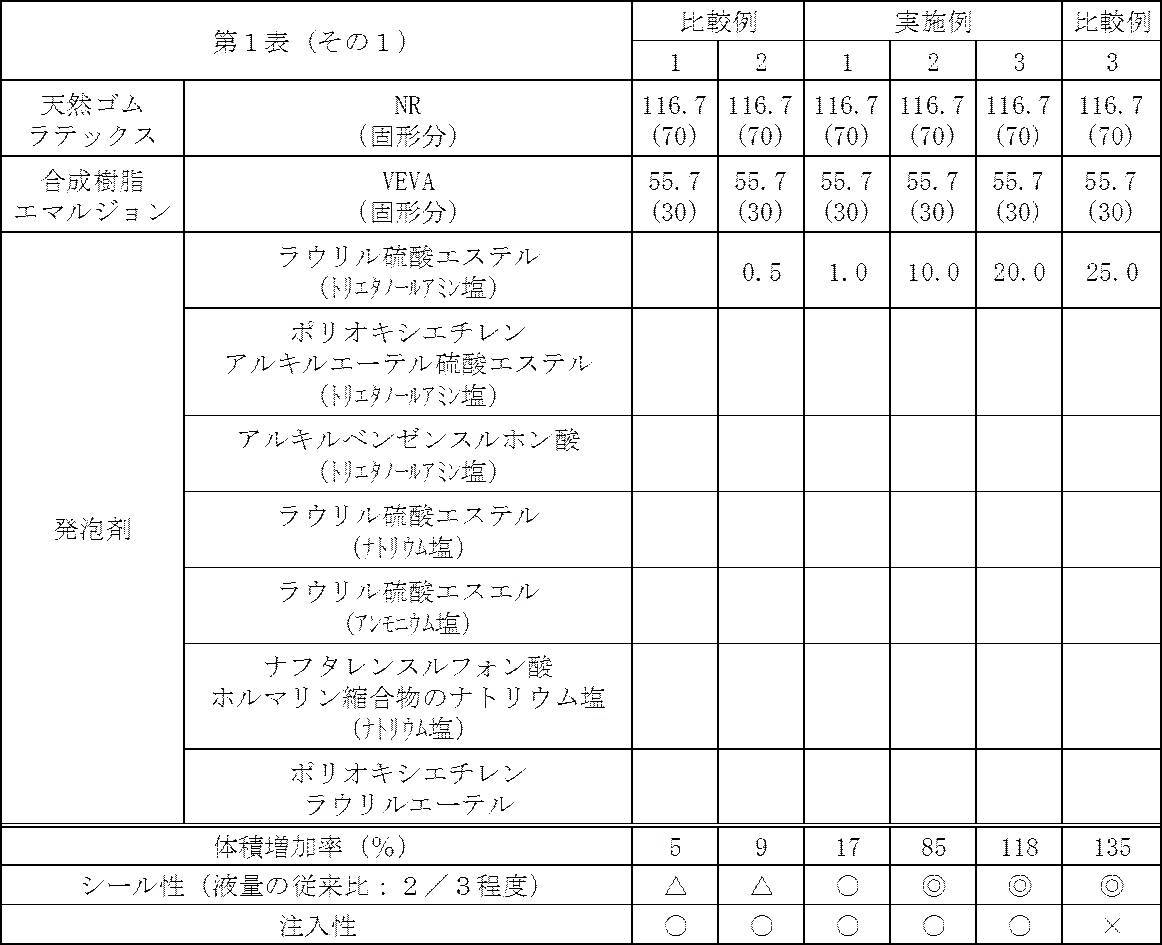
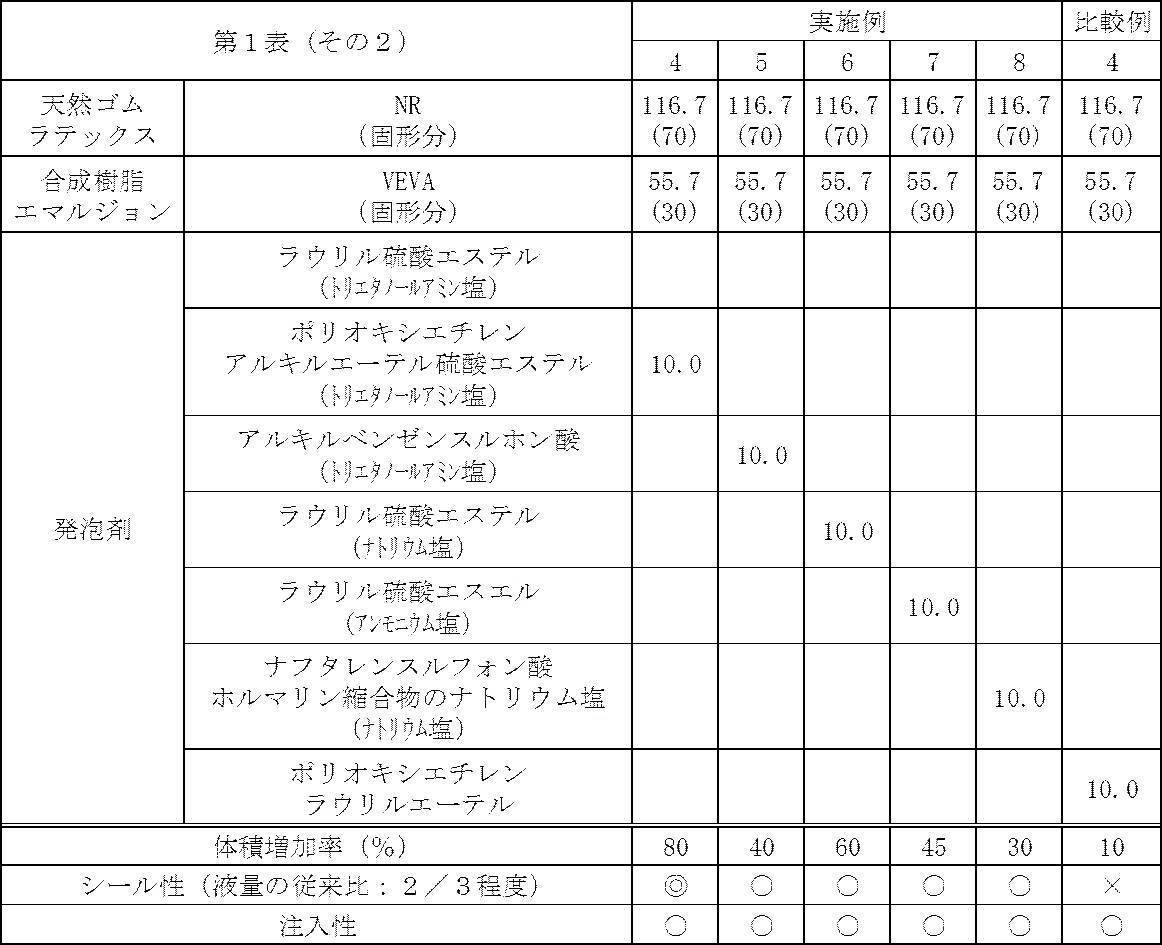
・NR:天然ゴムラテックス(Hytex HA、固形分:60質量%、フェルフェックス社製(野村貿易社取扱))
・VEVA:エチレン-酢酸ビニル-バーサチック酸ビニル共重合樹脂エマルジョン(スミカフレックス950HQ、固形分:53質量%、住化ケムテックス社製)
・ラウリル硫酸(トリエタノールアミン塩):エマールTD(分子量:405、花王株式会社製)
・ポリオキシエチレンアルキルエーテル硫酸エステル(トリエタノールアミン塩):エマール20T(花王株式会社製)
・アルキルベンゼンスルホン酸(トリエタノールアミン塩):ネオペレックスGS(花王株式会社製)
・ラウリル硫酸(ナトリウム塩):エマール10G(分子量:272、花王株式会社製)
・ラウリル硫酸(アンモニウム塩):ラテムルAD-25(分子量:267、花王株式会社製)
・ナフタレンスルフォン酸ホルマリン縮合物のナトリウム塩:デモールN(花王株式会社製)
・ポリオキシエチレンラウリルエーテル:エマルゲン150(花王株式会社製)
また、体積増加率が120%より大きい比較例3のタイヤパンクシール剤は、従来のタイヤパンクシール剤の液量(450ml程度)の2/3程度であっても、注入性が劣ることが分かった。
これに対し、体積増加率が15~120%のタイヤパンクシール剤は、従来のタイヤパンクシール剤の液量(450ml程度)の2/3程度であっても、優れたシール性および注入性を保持できることが分かった(実施例1~8)。
また、実施例1~3の対比から、体積増加率が80~120%のタイヤパンクシール剤は、シール性がより良好となることが分かった。
更に、実施例2、6および7の対比から、発泡剤としての硫酸エステル塩は、トリエタノールアミン塩であると、体積増加率が80%以上となり、シール性がより良好となることが分かった。
Claims (6)
- ASTM規格D3519-88に定めるブレンダーテストにより測定する、体積増加率が15~120%である、タイヤパンクシール剤。
- 天然ゴムラテックスおよび/または合成樹脂エマルジョンと、発泡剤とを含有する、請求項1に記載のタイヤパンクシール剤。
- 前記発泡剤の含有量が、前記天然ゴムラテックスおよび前記合成樹脂エマルジョンの固形分の合計100質量部に対して1~20質量部である、請求項2に記載のタイヤパンクシール剤。
- 前記天然ゴムラテックスおよび前記合成樹脂エマルジョンのうち、少なくとも前記天然ゴムラテックスを含有し、
前記発泡剤が、硫酸エステル塩である、請求項2または3に記載のタイヤパンクシール剤。 - 前記硫酸エステル塩が、アルキル硫酸エステル塩およびポリオキシエチレンアルキルエーテル硫酸エステル塩からなる群から選択される少なくとも1種である、請求項4に記載のタイヤパンクシール剤。
- 前記硫酸エステル塩が、トリエタノールアミン、ナトリウムおよびアンモニウムからなる群から選択される少なくとも1種の塩である、請求項4または5に記載のタイヤパンクシール剤。
Priority Applications (4)
| Application Number | Priority Date | Filing Date | Title |
|---|---|---|---|
| US14/917,188 US9610740B2 (en) | 2013-09-09 | 2014-09-03 | Tire puncture sealing agent |
| KR1020167005741A KR101688846B1 (ko) | 2013-09-09 | 2014-09-03 | 타이어 펑크 실제 |
| CN201480049161.8A CN105518099B (zh) | 2013-09-09 | 2014-09-03 | 轮胎补胎剂 |
| DE112014004125.4T DE112014004125B4 (de) | 2013-09-09 | 2014-09-03 | Reifenlochabdichtungsmittel |
Applications Claiming Priority (2)
| Application Number | Priority Date | Filing Date | Title |
|---|---|---|---|
| JP2013186355A JP5729436B2 (ja) | 2013-09-09 | 2013-09-09 | タイヤパンクシール剤 |
| JP2013-186355 | 2013-09-09 |
Publications (1)
| Publication Number | Publication Date |
|---|---|
| WO2015033949A1 true WO2015033949A1 (ja) | 2015-03-12 |
Family
ID=52628420
Family Applications (1)
| Application Number | Title | Priority Date | Filing Date |
|---|---|---|---|
| PCT/JP2014/073150 Ceased WO2015033949A1 (ja) | 2013-09-09 | 2014-09-03 | タイヤパンクシール剤 |
Country Status (6)
| Country | Link |
|---|---|
| US (1) | US9610740B2 (ja) |
| JP (1) | JP5729436B2 (ja) |
| KR (1) | KR101688846B1 (ja) |
| CN (1) | CN105518099B (ja) |
| DE (1) | DE112014004125B4 (ja) |
| WO (1) | WO2015033949A1 (ja) |
Cited By (3)
| Publication number | Priority date | Publication date | Assignee | Title |
|---|---|---|---|---|
| JP5958595B1 (ja) * | 2015-04-15 | 2016-08-02 | 横浜ゴム株式会社 | タイヤパンクシール剤 |
| WO2016159370A1 (ja) * | 2015-04-02 | 2016-10-06 | 横浜ゴム株式会社 | タイヤパンクシール剤 |
| JP6008011B1 (ja) * | 2015-04-02 | 2016-10-19 | 横浜ゴム株式会社 | タイヤパンクシール剤 |
Families Citing this family (1)
| Publication number | Priority date | Publication date | Assignee | Title |
|---|---|---|---|---|
| EP4257345A1 (en) * | 2022-04-06 | 2023-10-11 | Henkel AG & Co. KGaA | Use of a self-healing material for the formation of a film bag |
Citations (3)
| Publication number | Priority date | Publication date | Assignee | Title |
|---|---|---|---|---|
| JPS6114277A (ja) * | 1984-06-28 | 1986-01-22 | ペンゾイル カンパニイ | タイヤシーラー剤およびタイヤシール方法 |
| JP2002332475A (ja) * | 2001-05-09 | 2002-11-22 | Bridgestone Corp | シーラント組成物並びにそれを用いた圧力容器及びタイヤ |
| JP2010260911A (ja) * | 2009-04-30 | 2010-11-18 | Bridgestone Corp | パンクシーリング剤の必要最少量算出方法、およびパンクシーリング剤収納容器 |
Family Cites Families (13)
| Publication number | Priority date | Publication date | Assignee | Title |
|---|---|---|---|---|
| CN1053630A (zh) * | 1991-03-08 | 1991-08-07 | 成都科技大学 | 多功能补胎剂的复合添加剂及其制备 |
| CN1096045A (zh) * | 1993-05-29 | 1994-12-07 | 郑州市少林精细化工厂 | 自动充气、补胎、灭火、防漏剂 |
| EP1375197B1 (en) | 2001-03-21 | 2008-05-07 | Bridgestone Corporation | Assembly of tire and rim |
| CA2570848A1 (en) * | 2004-06-15 | 2006-01-05 | Glendon C. Daly | Tire sealant |
| US7841370B2 (en) * | 2007-07-25 | 2010-11-30 | The Goodyear Tire & Rubber Company | Foaming liquid material and use thereof for reducing noise in mounted tires |
| DE102008007992A1 (de) | 2008-02-07 | 2009-08-20 | Continental Aktiengesellschaft | Dichtmittel, insbesondere für Gummiartikel |
| EP2250204A4 (en) * | 2008-02-26 | 2012-01-25 | Fuller H B Co | ENERGY ACTIVATED TEMPERATURE-CONTROLLABLE POLYMER COMPOSITIONS AND DEVICES FOR ACTIVATING AND DISPENSING THE SAME |
| JP4609598B1 (ja) | 2009-06-22 | 2011-01-12 | 横浜ゴム株式会社 | タイヤパンクシール材 |
| JP4525839B1 (ja) | 2009-06-22 | 2010-08-18 | 横浜ゴム株式会社 | タイヤパンクシール材 |
| JP4752982B1 (ja) | 2010-02-04 | 2011-08-17 | 横浜ゴム株式会社 | タイヤパンクシール材 |
| CN102906214B (zh) * | 2010-05-27 | 2014-04-30 | 横滨橡胶株式会社 | 液态凝固剂及补胎材料套件 |
| JP2013006949A (ja) | 2011-06-24 | 2013-01-10 | Yokohama Rubber Co Ltd:The | タイヤパンクシール材 |
| JP5168394B2 (ja) | 2011-08-18 | 2013-03-21 | 横浜ゴム株式会社 | タイヤパンクシール剤 |
-
2013
- 2013-09-09 JP JP2013186355A patent/JP5729436B2/ja not_active Expired - Fee Related
-
2014
- 2014-09-03 KR KR1020167005741A patent/KR101688846B1/ko not_active Expired - Fee Related
- 2014-09-03 DE DE112014004125.4T patent/DE112014004125B4/de not_active Expired - Fee Related
- 2014-09-03 US US14/917,188 patent/US9610740B2/en not_active Expired - Fee Related
- 2014-09-03 CN CN201480049161.8A patent/CN105518099B/zh not_active Expired - Fee Related
- 2014-09-03 WO PCT/JP2014/073150 patent/WO2015033949A1/ja not_active Ceased
Patent Citations (3)
| Publication number | Priority date | Publication date | Assignee | Title |
|---|---|---|---|---|
| JPS6114277A (ja) * | 1984-06-28 | 1986-01-22 | ペンゾイル カンパニイ | タイヤシーラー剤およびタイヤシール方法 |
| JP2002332475A (ja) * | 2001-05-09 | 2002-11-22 | Bridgestone Corp | シーラント組成物並びにそれを用いた圧力容器及びタイヤ |
| JP2010260911A (ja) * | 2009-04-30 | 2010-11-18 | Bridgestone Corp | パンクシーリング剤の必要最少量算出方法、およびパンクシーリング剤収納容器 |
Cited By (5)
| Publication number | Priority date | Publication date | Assignee | Title |
|---|---|---|---|---|
| WO2016159370A1 (ja) * | 2015-04-02 | 2016-10-06 | 横浜ゴム株式会社 | タイヤパンクシール剤 |
| JP6008011B1 (ja) * | 2015-04-02 | 2016-10-19 | 横浜ゴム株式会社 | タイヤパンクシール剤 |
| CN107406751A (zh) * | 2015-04-02 | 2017-11-28 | 横滨橡胶株式会社 | 轮胎刺穿密封剂 |
| CN107406751B (zh) * | 2015-04-02 | 2019-02-12 | 横滨橡胶株式会社 | 轮胎刺穿密封剂 |
| JP5958595B1 (ja) * | 2015-04-15 | 2016-08-02 | 横浜ゴム株式会社 | タイヤパンクシール剤 |
Also Published As
| Publication number | Publication date |
|---|---|
| KR101688846B1 (ko) | 2016-12-22 |
| US9610740B2 (en) | 2017-04-04 |
| CN105518099B (zh) | 2018-05-18 |
| DE112014004125B4 (de) | 2020-03-12 |
| DE112014004125T5 (de) | 2016-05-25 |
| KR20160031051A (ko) | 2016-03-21 |
| US20160214337A1 (en) | 2016-07-28 |
| JP2015052083A (ja) | 2015-03-19 |
| CN105518099A (zh) | 2016-04-20 |
| JP5729436B2 (ja) | 2015-06-03 |
Similar Documents
| Publication | Publication Date | Title |
|---|---|---|
| JP5874843B2 (ja) | タイヤパンクシール材及びこれを用いるタイヤパンク修理キット | |
| CN106029816B (zh) | 轮胎补胎剂 | |
| WO2016159370A1 (ja) | タイヤパンクシール剤 | |
| JP5729436B2 (ja) | タイヤパンクシール剤 | |
| KR102142308B1 (ko) | 타이어 펑크 실제 | |
| KR102219575B1 (ko) | 타이어 펑크 실재 및 타이어 펑크 수리 키트 | |
| JP5773010B1 (ja) | タイヤパンクシール剤 | |
| KR102054245B1 (ko) | 타이어 펑크 실제 및 타이어 펑크 수리 키트 | |
| JP5812137B2 (ja) | タイヤパンクシール剤 | |
| JP6299844B1 (ja) | タイヤパンクシール材及びタイヤパンク修理キット | |
| CN109790440B (zh) | 轮胎补胎材料及轮胎刺孔修理套件 | |
| JP7077904B2 (ja) | タイヤパンクシール剤 | |
| JP6008011B1 (ja) | タイヤパンクシール剤 | |
| JP2016204421A (ja) | タイヤパンクシール剤 | |
| JP2020164566A (ja) | タイヤパンクシール剤 |
Legal Events
| Date | Code | Title | Description |
|---|---|---|---|
| 121 | Ep: the epo has been informed by wipo that ep was designated in this application |
Ref document number: 14842241 Country of ref document: EP Kind code of ref document: A1 |
|
| ENP | Entry into the national phase |
Ref document number: 20167005741 Country of ref document: KR Kind code of ref document: A |
|
| WWE | Wipo information: entry into national phase |
Ref document number: 14917188 Country of ref document: US |
|
| WWE | Wipo information: entry into national phase |
Ref document number: 1120140041254 Country of ref document: DE Ref document number: 112014004125 Country of ref document: DE |
|
| 122 | Ep: pct application non-entry in european phase |
Ref document number: 14842241 Country of ref document: EP Kind code of ref document: A1 |