WO2015020171A1 - タイヤパンクシール剤 - Google Patents
タイヤパンクシール剤 Download PDFInfo
- Publication number
- WO2015020171A1 WO2015020171A1 PCT/JP2014/070940 JP2014070940W WO2015020171A1 WO 2015020171 A1 WO2015020171 A1 WO 2015020171A1 JP 2014070940 W JP2014070940 W JP 2014070940W WO 2015020171 A1 WO2015020171 A1 WO 2015020171A1
- Authority
- WO
- WIPO (PCT)
- Prior art keywords
- vinyl versatate
- copolymer resin
- vinyl
- tire puncture
- puncture sealant
- Prior art date
- Legal status (The legal status is an assumption and is not a legal conclusion. Google has not performed a legal analysis and makes no representation as to the accuracy of the status listed.)
- Ceased
Links
Classifications
-
- B—PERFORMING OPERATIONS; TRANSPORTING
- B29—WORKING OF PLASTICS; WORKING OF SUBSTANCES IN A PLASTIC STATE IN GENERAL
- B29C—SHAPING OR JOINING OF PLASTICS; SHAPING OF MATERIAL IN A PLASTIC STATE, NOT OTHERWISE PROVIDED FOR; AFTER-TREATMENT OF THE SHAPED PRODUCTS, e.g. REPAIRING
- B29C73/00—Repairing of articles made from plastics or substances in a plastic state, e.g. of articles shaped or produced by using techniques covered by this subclass or subclass B29D
- B29C73/16—Auto-repairing or self-sealing arrangements or agents
- B29C73/163—Sealing compositions or agents, e.g. combined with propellant agents
-
- C—CHEMISTRY; METALLURGY
- C09—DYES; PAINTS; POLISHES; NATURAL RESINS; ADHESIVES; COMPOSITIONS NOT OTHERWISE PROVIDED FOR; APPLICATIONS OF MATERIALS NOT OTHERWISE PROVIDED FOR
- C09J—ADHESIVES; NON-MECHANICAL ASPECTS OF ADHESIVE PROCESSES IN GENERAL; ADHESIVE PROCESSES NOT PROVIDED FOR ELSEWHERE; USE OF MATERIALS AS ADHESIVES
- C09J107/00—Adhesives based on natural rubber
- C09J107/02—Latex
-
- C—CHEMISTRY; METALLURGY
- C09—DYES; PAINTS; POLISHES; NATURAL RESINS; ADHESIVES; COMPOSITIONS NOT OTHERWISE PROVIDED FOR; APPLICATIONS OF MATERIALS NOT OTHERWISE PROVIDED FOR
- C09J—ADHESIVES; NON-MECHANICAL ASPECTS OF ADHESIVE PROCESSES IN GENERAL; ADHESIVE PROCESSES NOT PROVIDED FOR ELSEWHERE; USE OF MATERIALS AS ADHESIVES
- C09J131/00—Adhesives based on homopolymers or copolymers of compounds having one or more unsaturated aliphatic radicals, each having only one carbon-to-carbon double bond, and at least one being terminated by an acyloxy radical of a saturated carboxylic acid, of carbonic acid, or of a haloformic acid; Adhesives based on derivatives of such polymers
- C09J131/02—Homopolymers or copolymers of esters of monocarboxylic acids
-
- C—CHEMISTRY; METALLURGY
- C09—DYES; PAINTS; POLISHES; NATURAL RESINS; ADHESIVES; COMPOSITIONS NOT OTHERWISE PROVIDED FOR; APPLICATIONS OF MATERIALS NOT OTHERWISE PROVIDED FOR
- C09J—ADHESIVES; NON-MECHANICAL ASPECTS OF ADHESIVE PROCESSES IN GENERAL; ADHESIVE PROCESSES NOT PROVIDED FOR ELSEWHERE; USE OF MATERIALS AS ADHESIVES
- C09J131/00—Adhesives based on homopolymers or copolymers of compounds having one or more unsaturated aliphatic radicals, each having only one carbon-to-carbon double bond, and at least one being terminated by an acyloxy radical of a saturated carboxylic acid, of carbonic acid, or of a haloformic acid; Adhesives based on derivatives of such polymers
- C09J131/02—Homopolymers or copolymers of esters of monocarboxylic acids
- C09J131/04—Homopolymers or copolymers of vinyl acetate
Definitions
- the present invention relates to a tire puncture sealant.
- Patent Document 1 discloses a “tire puncture sealant containing a natural rubber latex, a synthetic resin emulsion, and propylene glycol”, wherein the synthetic resin contained in the synthetic resin emulsion is “ethylene-vinyl acetate-vinyl versatate copolymer”.
- a tire puncture sealant which is a “resin” is described ([Claim 1] and [Claim 3]).
- [0014] of Patent Document 1 describes a monomer ratio (ethylene: vinyl acetate: vinyl versatate) constituting the “ethylene-vinyl acetate-vinyl versatate copolymer resin” as “mass ratio 5: 5: 90 to 10: 5: 85 ”is described as being preferable.
- the present inventor made a specific ratio of vinyl versatate in the vinyl versatate copolymer resin contained in the tire puncture sealant, while maintaining storage performance, The present inventors have found that low temperature characteristics can be improved and completed the present invention.
- the present invention provides the following (1) to (5).
- the vinyl versatate copolymer resin emulsion (B) contains an emulsifier (b2) containing polyvinyl alcohol, and the content of the emulsifier (b2) is that of the vinyl versatate copolymer resin emulsion (B).
- propylene glycol (C) is contained, and the mass ratio (B / C) between the solid content of the vinyl versatate copolymer resin emulsion (B) and the propylene glycol (C) is 0.1 to The tire puncture sealant according to any one of the above (1) to (3), which is 1.1.
- the mass ratio (A / B) of the solid content of the natural rubber latex (A) to the solid content of the vinyl versatate copolymer resin emulsion (B) is 90/10 to 40/60,
- the tire puncture sealant according to any one of (1) to (4).
- a tire puncture sealant excellent in storage performance and low temperature characteristics can be provided.
- the tire puncture sealant of the present invention comprises a natural rubber latex (A), a vinyl versatate copolymer resin emulsion (B) which is an emulsion of vinyl versatate copolymer resin (b1) containing vinyl versatate as a monomer unit, And a ratio of the vinyl versatate to the total monomer units constituting the vinyl versatate copolymer resin (b1) is 30 to 70% by mass.
- the natural rubber latex (A) is not particularly limited, and a conventionally known one can be used.
- a deproteinized natural rubber latex obtained by removing proteins from the natural rubber latex is preferable. This is because if the amount of protein is small, the amount of ammonia generated can be reduced, and corrosion damage to the steel cord due to ammonia and generation of an irritating odor can be prevented.
- deproteinized natural rubber latex (SeLatex series, manufactured by SRI Hybrid), deproteinized natural rubber latex (HA, manufactured by Nomura Trading Co., Ltd.), ultra-low ammonia natural rubber latex (ULACOL, manufactured by Restex), etc. Is mentioned.
- the natural rubber latex (A) may be used alone or in combination of two or more.
- the weight average molecular weight (Mw) of the natural rubber contained in the natural rubber latex (A) is not particularly limited.
- the weight average molecular weight is a weight average molecular weight expressed in terms of polystyrene by gel permeation chromatography (GPC) using tetrahydrofuran as a solvent (hereinafter the same).
- the tire puncture sealant of the present invention can further contain a synthetic rubber latex, such as SBR latex, NBR latex, carboxy-modified NBR latex, carboxy-modified SBR latex, and the like. Is mentioned.
- the vinyl versatate copolymer resin emulsion (B) is an emulsion in which the vinyl versatate copolymer resin (b1) is dispersed in a dispersion medium such as water as a dispersoid.
- a dispersion medium such as water as a dispersoid.
- the phase of the vinyl versatate copolymer resin (b1) which is a dispersoid may be a liquid phase or a solid phase.
- emulsion a system in which a dispersoid that is a liquid phase is dispersed in a dispersion medium that is a liquid phase
- emulsion a system in which a dispersoid that is a solid phase is dispersed in a dispersion medium that is a liquid phase
- emulsion is a concept including “suspension”.
- the vinyl versatate copolymer resin (b1) is a copolymer resin containing, as a monomer unit, vinyl versatate which is an ester of versatic acid and vinyl alcohol, that is, a copolymer resin composed of monomer units containing vinyl versatate. It is. Preferred examples of the monomer unit other than vinyl versatate include ethylene, vinyl acetate, (meth) acrylic ester, and the like.
- the vinyl versatate copolymer resin (b1) can be, for example, a random copolymer, a block copolymer, or a graft polymer.
- vinyl versatate copolymer resin (b1) examples include, for example, ethylene-vinyl acetate-vinyl versatate copolymer resin, vinyl acetate-vinyl versatate copolymer resin, vinyl acetate-versaic acid.
- the weight average molecular weight (Mw) of the vinyl versatate copolymer resin (b1) is not particularly limited, but is preferably 10,000 to 500,000, more preferably 50,000 to 200,000.
- the glass transition point (Tg) of the vinyl versatate copolymer resin (b1) is not particularly limited, but is preferably about ⁇ 20 ° C. or lower, more preferably about ⁇ 25 ° C. or lower, and further about ⁇ 30 ° C. or lower. preferable.
- the glass transition point (Tg) is a thermogram measured by differential scanning calorimetry (DSC) under a temperature rising rate condition of 10 ° C./min, and is defined as the temperature at the midpoint of the transition region (the same applies hereinafter).
- the ratio of vinyl versatate (vinyl versatate amount) to the total monomer units constituting the vinyl versatate copolymer resin (b1) is 30 to 70% by mass, 60 mass% is preferable.
- the vinyl versatate copolymer resin (b1) is an ethylene-vinyl acetate-vinyl versatate copolymer resin
- the monomer ratio (ethylene: vinyl acetate: vinyl versatate) constituting this resin is expressed by mass ratio ( Hereinafter, this is also referred to as “monomer mass ratio”), preferably 10 to 40:10 to 40:30 to 70, and more preferably 15 to 35:15 to 35:40 to 60.
- the vinyl versatate copolymer resin emulsion (B) preferably contains an emulsifier (b2) containing polyvinyl alcohol. That is, it is preferable that the said vinyl versatate copolymer resin (b1) which is a dispersoid is disperse
- the said emulsifier (b2) may contain only polyvinyl alcohol and may contain emulsifier components other than polyvinyl alcohol.
- emulsifier components other than polyvinyl alcohol include protective colloids such as hydroxyethyl cellulose, methyl cellulose, and carboxymethyl cellulose; polyoxyethylene alkyl ether, polyoxyethylene alkylphenol ether, polyoxyethylene / polyoxypropylene block copolymer, polyoxyethylene fatty acid ester
- Nonionic surfactants such as polyoxyethylene sorbitan fatty acid esters; alkyl sulfate esters, alkyl benzene sulfonates, alkyl sulfosuccinates, alkyl diphenyl ether disulfonates, polyoxyethylene alkyl sulfates, polyoxyethylene alkyl phosphates
- Anionic surfactants such as esters; and the like, and these may be used alone, It may be used in combination with more species.
- Polyvinyl alcohol is also called poval, and is generally obtained by saponifying polyvinyl acetate obtained by polymerizing vinyl acetate.
- polyvinyl alcohol low saponified PVA or completely saponified PVA may be used.
- partially saponified PVA having a saponification degree of 80 to 90 mol% is preferably used. The degree is preferably from 300 to 1,700.
- Polyvinyl alcohol may be modified with a compound such as carboxylic acid, sulfonic acid, or siloxane. Polyvinyl alcohol may be used alone or in combination of two or more.
- the content of the emulsifier (b2) relative to the solid content of the vinyl vinyl versatate resin emulsion (B) (hereinafter also referred to as “emulsifier amount”) is 0. 8 to 3.0% by mass is preferable, and 1.2 to 2.0% by mass is more preferable. If the amount of the emulsifier is within the above range, the storage performance and low temperature characteristics of the tire puncture sealant of the present invention can be achieved at a high level. In particular, if there is too much polyvinyl alcohol, the tire puncture sealant may be thickened, but if the amount of the emulsifier is within the above range, thickening is suppressed and the low-temperature injection performance can be improved.
- the method for producing the vinyl versatate copolymer resin emulsion (B) which is an emulsion of the vinyl versatate copolymer resin (b1) is not particularly limited.
- the polymerization conditions are not particularly limited, but generally the polymerization temperature is 20 to 80 ° C.
- the catalyst include persulfates such as potassium persulfate, hydrogen peroxide, and various organic peroxides.
- the mass ratio (A / B) of the solid content of the natural rubber latex (A) and the solid content of the vinyl versatate copolymer resin emulsion (B) is 90/10 to 40. / 60 is preferable, and 50/50 to 70/30 is more preferable.
- the mass ratio (A / B) is in the above range, the storage performance and low-temperature sealing performance of the tire puncture sealant of the present invention can be achieved at a high level.
- the solid contents of the natural rubber latex (A) and the vinyl versatate copolymer emulsion (B) are each a heating residue, specifically, heated at 200 ° C. for 1 hour. It is the amount of residue obtained later.
- the emulsifier (b2) is contained in the solid content of the vinyl versatate copolymer resin emulsion (B).
- the tire puncture sealant of the present invention preferably further contains propylene glycol (C) as an antifreeze agent.
- the mass ratio (B / C) between the solid content of the vinyl versatate copolymer emulsion (B) and the propylene glycol (C) is preferably 0.1 to 1.1, and preferably 0.3 to 0. .5 is more preferred.
- the mass ratio (B / C) is in the above range, the storage performance and low-temperature sealing performance of the tire puncture sealant of the present invention can be achieved at a high level.
- the tire puncture sealant of the present invention may contain water as a solvent, but the mass ratio (C / water) between the propylene glycol (C) and water is more low-temperature characteristics of the tire puncture sealant of the present invention. For reasons of improvement, 0.9 to 1.8 is preferable, and 1.0 to 1.2 is more preferable.
- the tire puncture sealant of the present invention may further contain an additive as required, in addition to the components described above.
- the additive include an antifreezing agent other than the propylene glycol (C) (for example, ethylene glycol, diethylene glycol, glycerin, etc.), a tackifier, a filler, an anti-aging agent, an antioxidant, and a pigment (dye). , Plasticizers, thixotropic agents, ultraviolet absorbers, flame retardants, surfactants (including leveling agents), dispersants, dehydrating agents, antistatic agents and the like.
- the amount of the additive is not particularly limited.
- the method for producing the tire puncture sealant of the present invention is not particularly limited.
- the tire puncture seal is obtained by sufficiently mixing the above-described essential components and optional components using a stirring machine such as a mixing mixer under reduced pressure.
- the method of manufacturing an agent is mentioned.
- the tire puncture sealant of the present invention is injected into the tire from the air filling portion of the tire.
- the method for injecting the tire puncture sealant of the present invention into the tire is not particularly limited, and a conventionally known method can be used, and examples thereof include a method using a syringe, a spray can and the like.
- the amount of the tire puncture sealant injected into the tire is not particularly limited, and is appropriately selected according to the size of the puncture hole.
- the tire is filled with air to a predetermined air pressure. Then, drive the car.
- water, vinyl acetate, vinyl versatate, polyvinyl alcohol (Poval 205, manufactured by Kuraray Co., Ltd., saponification degree 88 mol%, average polymerization degree: 500), nonionic surfactant (polyoxyethylene) Alkyl ether, Emulgen 1108, manufactured by Kao Corporation), and a solution in which ferrous sulfate heptahydrate was dissolved were added.
- the inside of the pressure vessel is replaced with nitrogen gas, and the temperature inside the vessel is raised to 45 ° C., then pressurized to 6.0 MPa with ethylene, 5% sodium persulfate aqueous solution is added, and 7% sodium erythorbate aqueous solution is added.
- Polymerization was started by adding to a pressure vessel. Subsequently, after confirming that the liquid temperature in the pressure resistant vessel had risen, while maintaining the liquid temperature in the vessel at 50 ° C., when 4 hours had elapsed after the start of polymerization, the oxidizing agent was added with 10% sodium persulfate and Switch to 2% tert-butyl hydroperoxide aqueous solution, add to the pressure vessel, cool the pressure vessel when the residual vinyl acetate monomer is less than 1%, remove unreacted ethylene gas, and generate The thing was taken out. In this way, a vinyl versatate copolymer resin emulsion was obtained. The solid content was 53% by mass and the glass transition temperature was ⁇ 30 ° C.
- a tire puncture sealant was produced by mixing the components shown in Table 1 below in the amounts (parts by mass) shown in the same table.
- the vinyl versatate copolymer resin emulsion produced as described above was used as the component (B).
- the “monomer mass ratio” and “emulsifier amount” of the vinyl versatate copolymer resin emulsion used are shown in Table 1 below.
- the lower numerical values (the numerical values in parentheses) in the components (A) and (B) are the total solid content of the components (A) and (B), respectively, in terms of the solid content. Is expressed as a relative value when 100 parts by mass is used (unit is part by mass).
- water was added as needed when producing the tire puncture sealant.
- the amount of water shown in Table 1 below is the total amount of water contained in the total amount of the tire puncture sealant.
- the sealing performance at ⁇ 30 ° C. was evaluated. Specifically, first, a puncture hole having a diameter of 4 mm was reproduced in the shoulder portion of the tire. Next, a tire that reproduces the puncture hole is mounted on a drum testing machine, a tire puncture sealant is injected from the valve port of the tire, and air is filled so that the tire internal pressure becomes 200 kPa. A drum test was conducted. In the drum test, a load of 350 kg, a traveling speed of 30 km / h, and a traveling time of 1 minute were set as one cycle.
- the evaluation criteria for sealing performance are “ ⁇ ” when the seal was completed within 5 cycles (no air leaks), “ ⁇ ” when the seal was sealed within 6 to 10 cycles, and when the seal was completed after 11 cycles. “ ⁇ ”, and “x” when the seal could not be made. If “ ⁇ ” or “ ⁇ ”, it can be evaluated as having excellent low-temperature sealing performance, which is a low-temperature characteristic.
- Comparative Examples 2 and 3 in which the vinyl versatate content exceeds 70% by mass have insufficient low-temperature characteristics. Moreover, the comparative example 1 whose said vinyl versatate amount is less than 30 mass% was inferior in the storage performance which is a basic performance as a tire puncture sealant. In contrast, Examples 1 to 10 in which the vinyl versatate content was 30 to 70% by mass had excellent storage performance and excellent low temperature characteristics. Further, when Examples 2 to 8 in which the amount of vinyl versatate is 40% by mass are compared, the amount of the emulsifier is 3.0% by mass or less than Example 8 in which the amount of the emulsifier exceeds 3.0% by mass. In Examples 2 to 7, the low-temperature injection performance was better.
Landscapes
- Chemical & Material Sciences (AREA)
- Organic Chemistry (AREA)
- Engineering & Computer Science (AREA)
- Mechanical Engineering (AREA)
- Sealing Material Composition (AREA)
- Compositions Of Macromolecular Compounds (AREA)
- Materials Engineering (AREA)
- Tires In General (AREA)
Abstract
Description
また、特許文献1の[0014]には、上記「エチレン-酢酸ビニル-バーサチック酸ビニル共重合樹脂」を構成するモノマー比(エチレン:酢酸ビニル:バーサチック酸ビニル)として「質量比で5:5:90~10:5:85」が好ましいと記載されており、実際に[実施例]では、「スミカフレックス950HQ、住化ケムテックス社製、エチレン:酢酸ビニル:バーサチック酸ビニル=10:5:85、固形分53質量%」が使用されている([0031])。
本発明者は、特許文献1に記載のタイヤパンクシール剤について検討を行なったところ、低温特性に関して、改善の余地があることを明らかにした。
本発明は、以上の点を鑑みてなされたものであり、保管性能および低温特性に優れるタイヤパンクシール剤を提供することを目的とする。
(1)天然ゴムラテックス(A)と、バーサチック酸ビニルをモノマー単位として含むバーサチック酸ビニル共重合樹脂(b1)のエマルジョンであるバーサチック酸ビニル共重合樹脂エマルジョン(B)と、を含有し、上記バーサチック酸ビニル共重合樹脂(b1)を構成する全モノマー単位に対する上記バーサチック酸ビニルの割合が、30~70質量%である、タイヤパンクシール剤。
(2)上記バーサチック酸ビニル共重合樹脂エマルジョン(B)が、ポリビニルアルコールを含む乳化剤(b2)を含有し、上記乳化剤(b2)の含有量が、上記バーサチック酸ビニル共重合樹脂エマルジョン(B)の固形分に対して、0.8~3.0質量%である、請求項1に記載のタイヤパンクシール剤。
(3)上記バーサチック酸ビニル共重合樹脂(b1)が、エチレン-酢酸ビニル-バーサチック酸ビニル共重合樹脂である、上記(1)または(2)に記載のタイヤパンクシール剤。
(4)さらに、プロピレングリコール(C)を含有し、上記バーサチック酸ビニル共重合樹脂エマルジョン(B)の固形分と上記プロピレングリコール(C)との質量比(B/C)が、0.1~1.1である、上記(1)~(3)のいずれかに記載のタイヤパンクシール剤。
(5)上記天然ゴムラテックス(A)の固形分と上記バーサチック酸ビニル共重合樹脂エマルジョン(B)の固形分との質量比(A/B)が、90/10~40/60である、上記(1)~(4)のいずれかに記載のタイヤパンクシール剤。
本発明のタイヤパンクシール剤は、天然ゴムラテックス(A)と、バーサチック酸ビニルをモノマー単位として含むバーサチック酸ビニル共重合樹脂(b1)のエマルジョンであるバーサチック酸ビニル共重合樹脂エマルジョン(B)と、を含有し、上記バーサチック酸ビニル共重合樹脂(b1)を構成する全モノマー単位に対する上記バーサチック酸ビニルの割合が、30~70質量%である、タイヤパンクシール剤である。
この理由は明らかではないが、以下のように推測される。すなわち、バーサチック酸ビニルはモノマー単位としては比較的分子量が大きいため、上記バーサチック酸ビニル量が多い場合には共重合樹脂全体の粘度が高くなりやすいところ、上記バーサチック酸ビニル量を抑えることで、適度な粘度となり、低温環境下でのシール性能や注入性能が改善されるものと考えられる。もっとも、これ以外のメカニズムであっても、本発明の範囲内とする。
なお、上記バーサチック酸ビニル量が30質量%未満であっても、低温特性は比較的良好であるが、タイヤパンクシール剤の基本的な性能である保管性能が劣るため、30質量%以上とする。
以下、本発明のタイヤパンクシール剤が含有する各成分について詳述する。
上記天然ゴムラテックス(A)としては、特に限定されず、従来公知のものを使用でき、例えば、天然ゴムラテックスからタンパク質を除去した脱蛋白天然ゴムラテックスが好適に挙げられる。タンパク質が少ないと、アンモニアの発生量を少なくでき、アンモニアによるスチールコードへの腐食損傷および刺激臭の発生を防止するという理由からである。具体的には、例えば、脱蛋白天然ゴムラテックス(SeLatexシリーズ、SRIハイブリッド社製)、脱蛋白天然ゴムラテックス(HA、野村貿易社製)、超低アンモニア天然ゴムラテックス(ULACOL、レヂテックス社製)等が挙げられる。
上記天然ゴムラテックス(A)は、1種単独で用いてもよく、2種以上を併用してもよい。
なお、重量平均分子量は、テトラヒドロフランを溶媒とするゲル・パーミエーション・クロマトグラフィー(GPC)によりポリスチレン換算で表わされる重量平均分子量である(以下、同様)。
上記バーサチック酸ビニル共重合樹脂エマルジョン(B)は、バーサチック酸ビニル共重合樹脂(b1)が分散質として、水等の分散媒に分散しているエマルジョンである。
このとき、分散質である上記バーサチック酸ビニル共重合樹脂(b1)の相は、液相であっても固相であってもよい。
すなわち、一般的には、液相である分散媒に液相である分散質が分散した系を「エマルジョン」と呼び、液相である分散媒に固相である分散質が分散した系を「サスペンション」と呼ぶが、本発明では、「エマルジョン」は「サスペンション」を含む概念とする。
上記バーサチック酸ビニル共重合樹脂(b1)は、バーサチック酸とビニルアルコールとのエステルであるバーサチック酸ビニルをモノマー単位として含む共重合樹脂、すなわち、バーサチック酸ビニルを含むモノマー単位で構成される共重合樹脂である。
バーサチック酸ビニル以外のモノマー単位としては、例えば、エチレン、酢酸ビニル、(メタ)アクリルエステル等が好適に挙げられる。
なお、上記バーサチック酸ビニル共重合樹脂(b1)は、例えば、ランダム共重合体、ブロック共重合体、グラフト重合体とすることができる。
これらのうち、低温シール性能がより優れるという理由から、エチレン-酢酸ビニル-バーサチック酸ビニル共重合樹脂が好ましい。
また、上記バーサチック酸ビニル共重合樹脂(b1)のガラス転移点(Tg)は、特に限定されないが、約-20℃以下が好ましく、約-25℃以下がより好ましく、約-30℃以下がさらに好ましい。
ここで、ガラス転移点(Tg)は、示差走査熱量測定(DSC)により10℃/分の昇温速度条件によりサーモグラムを測定し、転移域の中点の温度とする(以下、同様)。
本発明においては、上述した理由から、上記バーサチック酸ビニル共重合樹脂(b1)を構成する全モノマー単位に対するバーサチック酸ビニルの割合(バーサチック酸ビニル量)が、30~70質量%であり、40~60質量%が好ましい。
なお、上記バーサチック酸ビニル共重合樹脂(b1)が、エチレン-酢酸ビニル-バーサチック酸ビニル共重合樹脂の場合、この樹脂を構成するモノマー比(エチレン:酢酸ビニル:バーサチック酸ビニル)は、質量比(以下、これを「モノマー質量比」ともいう)で、10~40:10~40:30~70が好ましく、15~35:15~35:40~60がより好ましい。
上記バーサチック酸ビニル共重合樹脂エマルジョン(B)は、ポリビニルアルコールを含む乳化剤(b2)を含有するのが好ましい。すなわち、分散質である上記バーサチック酸ビニル共重合樹脂(b1)は、上記乳化剤(b2)の作用によって、分散媒中に分散しているのが好ましい。
なお、上記乳化剤(b2)は、ポリビニルアルコールのみを含有していてもよく、ポリビニルアルコール以外の乳化剤成分を含有していてもよい。ポリビニルアルコール以外の乳化剤成分としては、例えば、ヒドロキシエチルセルロース、メチルセルロース、カルボキシメチルセルロースなどの保護コロイド;ポリオキシエチレンアルキルエーテル、ポリオキシエチレンアルキルフェノールエーテル、ポリオキシエチレン・ポリオキシプロピレンブロックコポリマー、ポリオキシエチレン脂肪酸エステル、ポリオキシエチレンソルビタン脂肪酸エステルなどのノニオン系界面活性剤;アルキル硫酸エステル塩、アルキルベンゼンスルフォン酸塩、アルキルスルホコハク酸塩、アルキルジフェニルエーテルジスルフォン酸塩、ポリオキシエチレンアルキル硫酸塩、ポリオキシエチレンアルキルリン酸エステルなどのアニオン系界面活性剤;等が挙げられ、これらを1種単独で用いてもよく、2種以上を併用してもよい。
また、ポリビニルアルコールは、カルボン酸、スルホン酸、シロキサン等の化合物で変性されたものであってもよい。
ポリビニルアルコールは、1種単独で用いてもよく、2種以上を併用してもよい。
上記バーサチック酸ビニル共重合樹脂エマルジョン(B)において、上記バーサチック酸ビニル共重合樹脂エマルジョン(B)の固形分に対する上記乳化剤(b2)の含有量(以下、「乳化剤量」ともいう)は、0.8~3.0質量%が好ましく、1.2~2.0質量%がより好ましい。
上記乳化剤量が上記範囲であれば、本発明のタイヤパンクシール剤の保管性能と低温特性とを、高いレベルで両立できる。
とりわけ、ポリビニルアルコールが多すぎるとタイヤパンクシール剤が増粘する可能性があるが、上記乳化剤量が上記範囲であれば、増粘が抑制され、低温注入性能をより良好にできる。
上記バーサチック酸ビニル共重合樹脂(b1)のエマルジョンである上記バーサチック酸ビニル共重合樹脂エマルジョン(B)を製造する方法については、特に限定されず、例えば、バーサチック酸ビニルを含むモノマーと、上記乳化剤(b2)とを用いて、従来公知の乳化重合方法により製造(重合)する方法が挙げられる。
重合条件にも特に限定されないが、一般的には重合温度は20~80℃である。触媒としては、過硫酸カリウム等の過硫酸塩、過酸化水素および各種有機過酸化物が挙げられる。レドソックス開始系の場合は、さらに還元物質としてホルムアルデヒドナトリウムスルホキシレートなどが組み合わせて用いられる。
なお、上記バーサチック酸ビニル共重合樹脂エマルジョン(B)を製造するにあたっては、さらに必要に応じて、pH調整剤、増粘剤、消泡剤、分散剤、防腐剤などの添加剤を添加してもよい。
本発明のタイヤパンクシール剤において、上記天然ゴムラテックス(A)の固形分と上記バーサチック酸ビニル共重合樹脂エマルジョン(B)の固形分との質量比(A/B)は、90/10~40/60が好ましく、50/50~70/30がより好ましい。
上記質量比(A/B)が上記範囲であれば、本発明のタイヤパンクシール剤の保管性能と低温シール性能とを、高いレベルで両立できる。
例えば、上記乳化剤(b2)は、上記バーサチック酸ビニル共重合樹脂エマルジョン(B)の固形分に含まれる。
本発明のタイヤパンクシール剤は、さらに、凍結防止剤として、プロピレングリコール(C)を含有するのが好ましい。
このとき、上記バーサチック酸ビニル共重合樹脂エマルジョン(B)の固形分と上記プロピレングリコール(C)との質量比(B/C)は、0.1~1.1が好ましく、0.3~0.5がより好ましい。
上記質量比(B/C)が上記範囲であれば、本発明のタイヤパンクシール剤の保管性能と低温シール性能とを高いレベルで両立できる。
本発明のタイヤパンクシール剤は、上述した各成分以外に、必要に応じて所望により、添加剤をさらに含むことができる。上記添加剤としては、例えば、上記プロピレングリコール(C)以外の凍結防止剤(例えば、エチレングリコール、ジエチレングリコール、グリセリン等)、粘着付与剤、充填剤、老化防止剤、酸化防止剤、顔料(染料)、可塑剤、揺変性付与剤、紫外線吸収剤、難燃剤、界面活性剤(レベリング剤を含む)、分散剤、脱水剤、帯電防止剤などが挙げられる。上記添加剤の量は、特に限定されない。
本発明のタイヤパンクシール剤を製造する方法は、特に限定されないが、例えば、上述した必須成分および任意成分を、減圧下で混合ミキサー等のかくはん機を用いて十分に混合することによってタイヤパンクシール剤を製造する方法が挙げられる。
次に、本発明のタイヤパンクシール剤の使用方法を説明する。ただし、下記方法に限定されるものではない。
まず、本発明のタイヤパンクシール剤をタイヤの空気充填部からタイヤ内に注入する。本発明のタイヤパンクシール剤をタイヤ内に注入する方法は、特に限定されず従来公知の方法を用いることができ、例えば、シリンジ、スプレー缶等を用いる方法が挙げられる。タイヤ内に注入されるタイヤパンクシール剤の量は、特に限定されず、パンク穴の大きさ等に応じて適宜選択される。
次に、所定の空気圧までタイヤに空気を充填する。
その後、車を走行させる。タイヤが回転接地する際に受ける圧縮力や剪断力によって、上記天然ゴムラテックス(A)の天然ゴムや上記バーサチック酸ビニル共重合樹脂(b1)の粒子等による凝集体を形成し、パンク穴をシールできる。
投入成分量を適宜変更して、「モノマー質量比」および「乳化剤量」を異ならせた複数種類のエチレン-酢酸ビニル-バーサチック酸ビニル共重合樹脂エマルジョン(以下、単に、「バーサチック酸ビニル共重合樹脂エマルジョン」という)を得た。
具体的には、耐圧容器に、水、酢酸ビニル、バーサチック酸ビニル、ポリビニルアルコール(ポバール205、クラレ社製、ケン化度88モル%、平均重合度:500)、ノニオン界面活性剤(ポリオキシエチレンアルキルエーテル、エマルゲン1108、花王社製)、および、硫酸第一鉄七水和物を溶解した溶液を添加した。
次に、耐圧容器内を窒素ガスで置換し、容器内を45℃まで昇温した後、エチレンで6.0MPaまで加圧し、5%過硫酸ナトリウム水溶液を添加し、7%エリソルビン酸ナトリウム水溶液を耐圧容器に添加して重合を開始させた。
続いて、耐圧容器内の液温が上昇したことを確認した後、容器内の液温を50℃に維持しながら、重合開始後4時間経過した時点で、酸化剤を10%過硫酸ナトリウムおよび2%tert-ブチルハイドロパーオキサイド水溶液に切り替え、耐圧容器に添加し、残留酢酸ビニル単量体が1%未満になった時点で耐圧容器を冷却し、未反応のエチレンガスを除去した後、生成物を取り出した。このようにして、バーサチック酸ビニル共重合樹脂エマルジョンを得た。固形分は53質量%、ガラス転移温度は-30℃であった。
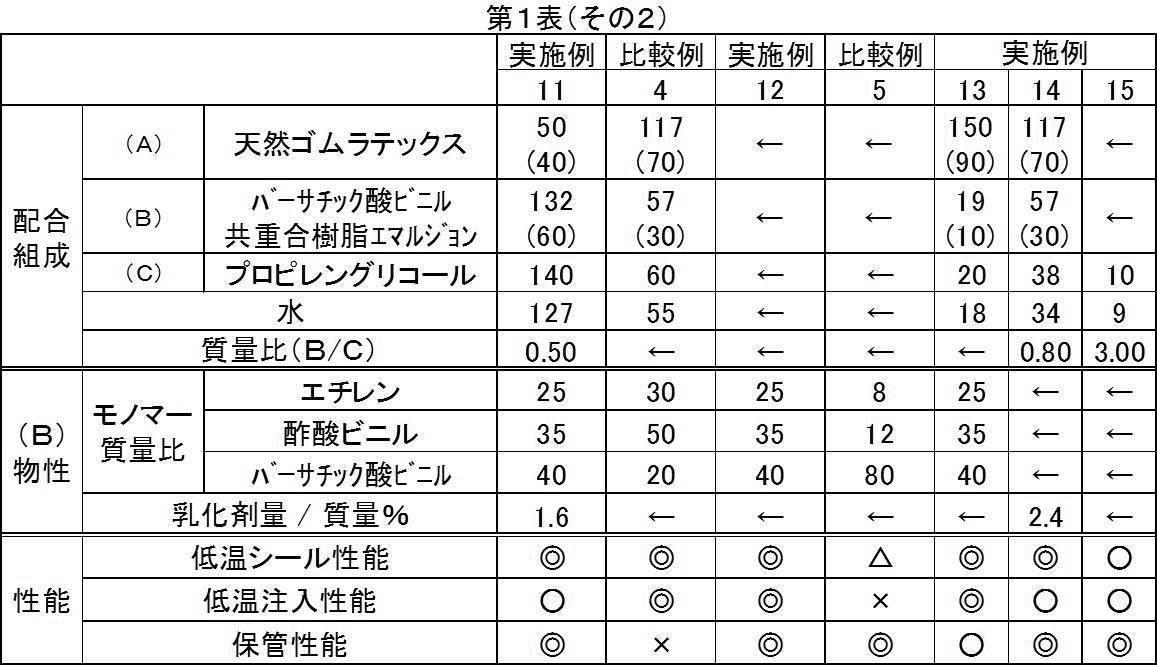
下記第1表に示す成分を、同表に示す量(質量部)で用いて、これらを混合することによってタイヤパンクシール剤を製造した。
このとき、(B)成分として、上記のようにして製造したバーサチック酸ビニル共重合樹脂エマルジョンを用いた。用いたバーサチック酸ビニル共重合樹脂エマルジョンの「モノマー質量比」および「乳化剤量」を下記第1表に示す。
なお、下記第1表中、(A)および(B)成分における下段の数値(括弧内の数値)は、それぞれ、固形分換算した配合量を、(A)および(B)成分の合計固形分を100質量部とした場合の相対的な値で表したものである(単位は質量部)。
また、タイヤパンクシール剤を製造する際に必要に応じて水を添加した。下記第1表に示す水の量はタイヤパンクシール剤全量中に含まれるトータルの水の量である。
得られたタイヤパンクシール剤について、以下の評価を行った。結果を下記第1表に示す。
得られたパンクシール剤を用いて、-30℃でのシール性能を評価した。
具体的には、まず、タイヤのショルダー部に直径4mmの大きさのパンク孔を再現した。次いで、パンク孔を再現したタイヤをドラム試験機に装着し、タイヤのバルブ口からタイヤパンクシール剤を注入し、タイヤ内圧が200kPaになるように空気を充填して、雰囲気温度を-30℃として、ドラム試験を行なった。ドラム試験は、荷重350kg、走行速度30km/h、走行時間1分とし、これを1サイクルとした。
シール性能の評価基準は、5サイクル以内でシールできた(空気漏れがなくなった)場合を「◎」、6~10サイクルでシールできた場合を「○」、11サイクル以上でシールできた場合を「△」、シールできなかった場合を「×」とした。「◎」または「○」であれば、低温特性である低温シール性能に優れるものとして評価できる。
得られたタイヤパンクシール剤の粘度を、-40℃の条件下で、BL型粘度計(ローターNo.4)を用いて回転数60rpmで測定した。
-40℃におけるタイヤパンクシール剤の粘度が、2000mPa・s以上2500mPa・s未満の場合を「◎」、2500mPa・s以上3000mPa・s未満の場合を「○」、3000mPa・s以上の場合を「×」とした。「◎」または「○」であれば、低温特性である低温注入性能に優れるものとして評価できる。
80℃雰囲気下において、タイヤパンクシール剤に20Hz、振幅±3mmの振動を168時間与える試験を行なった。
保管性能の評価基準は、クリームの発生なしで安定している場合を「◎」、クリームが発生したがタイヤパンクシール剤を撹拌すればクリームが消失し均一となった場合を「○」、凝集物が発生した場合を「×」とした。「◎」または「○」であれば、保管性能に優れるものとして評価できる。

・天然ゴムラテックス:Hytex HA(野村貿易社製、固形分約60質量%)
・バーサチック酸ビニル共重合樹脂エマルジョン:上述したもの
・プロピレングリコール:試薬1級、和光純薬社製
これに対して、上記バーサチック酸ビニル量が30~70質量%である実施例1~10は、保管性能が良好であるうえ、低温特性にも優れていた。
また、上記バーサチック酸ビニル量が40質量%である実施例2~8を対比すると、上記乳化剤量が3.0質量%を超える実施例8よりも、上記乳化剤量が3.0質量%以下である実施例2~7の方が、低温注入性能がより良好であった。
Claims (5)
- 天然ゴムラテックス(A)と、バーサチック酸ビニルをモノマー単位として含むバーサチック酸ビニル共重合樹脂(b1)のエマルジョンであるバーサチック酸ビニル共重合樹脂エマルジョン(B)と、を含有し、
前記バーサチック酸ビニル共重合樹脂(b1)を構成する全モノマー単位に対する前記バーサチック酸ビニルの割合が、30~70質量%である、タイヤパンクシール剤。 - 前記バーサチック酸ビニル共重合樹脂エマルジョン(B)が、ポリビニルアルコールを含む乳化剤(b2)を含有し、
前記乳化剤(b2)の含有量が、前記バーサチック酸ビニル共重合樹脂エマルジョン(B)の固形分に対して、0.8~3.0質量%である、請求項1に記載のタイヤパンクシール剤。 - 前記バーサチック酸ビニル共重合樹脂(b1)が、エチレン-酢酸ビニル-バーサチック酸ビニル共重合樹脂である、請求項1または2に記載のタイヤパンクシール剤。
- さらに、プロピレングリコール(C)を含有し、
前記バーサチック酸ビニル共重合樹脂エマルジョン(B)の固形分と前記プロピレングリコール(C)との質量比(B/C)が、0.1~1.1である、請求項1~3のいずれかに記載のタイヤパンクシール剤。 - 前記天然ゴムラテックス(A)の固形分と前記バーサチック酸ビニル共重合樹脂エマルジョン(B)の固形分との質量比(A/B)が、90/10~40/60である、請求項1~4のいずれかに記載のタイヤパンクシール剤。
Priority Applications (4)
| Application Number | Priority Date | Filing Date | Title |
|---|---|---|---|
| DE112014003671.4T DE112014003671B4 (de) | 2013-08-09 | 2014-08-07 | Reifenlochabdichtungsmittel |
| US14/910,802 US9604420B2 (en) | 2013-08-09 | 2014-08-07 | Tire puncture sealant |
| CN201480041338.XA CN105408441B (zh) | 2013-08-09 | 2014-08-07 | 轮胎补胎剂 |
| KR1020157034837A KR101707417B1 (ko) | 2013-08-09 | 2014-08-07 | 타이어 펑크 실제 |
Applications Claiming Priority (2)
| Application Number | Priority Date | Filing Date | Title |
|---|---|---|---|
| JP2013-166217 | 2013-08-09 | ||
| JP2013166217A JP5664722B1 (ja) | 2013-08-09 | 2013-08-09 | タイヤパンクシール剤 |
Publications (1)
| Publication Number | Publication Date |
|---|---|
| WO2015020171A1 true WO2015020171A1 (ja) | 2015-02-12 |
Family
ID=52461496
Family Applications (1)
| Application Number | Title | Priority Date | Filing Date |
|---|---|---|---|
| PCT/JP2014/070940 Ceased WO2015020171A1 (ja) | 2013-08-09 | 2014-08-07 | タイヤパンクシール剤 |
Country Status (6)
| Country | Link |
|---|---|
| US (1) | US9604420B2 (ja) |
| JP (1) | JP5664722B1 (ja) |
| KR (1) | KR101707417B1 (ja) |
| CN (1) | CN105408441B (ja) |
| DE (1) | DE112014003671B4 (ja) |
| WO (1) | WO2015020171A1 (ja) |
Cited By (1)
| Publication number | Priority date | Publication date | Assignee | Title |
|---|---|---|---|---|
| CN114773522A (zh) * | 2022-05-16 | 2022-07-22 | 上海保立佳化学技术有限公司 | 醋叔乳液,含其涂料及其原料组合物、制备方法和应用 |
Families Citing this family (4)
| Publication number | Priority date | Publication date | Assignee | Title |
|---|---|---|---|---|
| JP5664723B1 (ja) * | 2013-08-09 | 2015-02-04 | 横浜ゴム株式会社 | タイヤパンクシール剤 |
| CN107779123A (zh) * | 2017-10-15 | 2018-03-09 | 深圳市希顺有机硅科技有限公司 | 一种自动补胎液及其制备方法 |
| US12522719B2 (en) | 2022-11-15 | 2026-01-13 | Illinois Tool Works Inc. | Tire sealant |
| JP7610152B1 (ja) * | 2023-11-02 | 2025-01-08 | 横浜ゴム株式会社 | 空気入りタイヤ |
Citations (5)
| Publication number | Priority date | Publication date | Assignee | Title |
|---|---|---|---|---|
| WO2010150589A1 (ja) * | 2009-06-22 | 2010-12-29 | 横浜ゴム株式会社 | タイヤパンクシール材 |
| JP2011026533A (ja) * | 2009-06-22 | 2011-02-10 | Yokohama Rubber Co Ltd:The | タイヤパンクシール材 |
| JP2013006949A (ja) * | 2011-06-24 | 2013-01-10 | Yokohama Rubber Co Ltd:The | タイヤパンクシール材 |
| JP2013040297A (ja) * | 2011-08-18 | 2013-02-28 | Yokohama Rubber Co Ltd:The | タイヤパンクシール剤 |
| JP2013133432A (ja) * | 2011-12-27 | 2013-07-08 | Yokohama Rubber Co Ltd:The | タイヤパンクシール剤 |
Family Cites Families (6)
| Publication number | Priority date | Publication date | Assignee | Title |
|---|---|---|---|---|
| JPH05168394A (ja) | 1991-12-20 | 1993-07-02 | D M L:Kk | パン類の品質改良法 |
| US5739196A (en) * | 1995-11-30 | 1998-04-14 | Union Carbide Chemicals & Plastics Technology Corporation | Latex compositions having wet adhesion and other improved rheological properties and methods of producing same |
| JP2005120272A (ja) * | 2003-10-17 | 2005-05-12 | Sumitomo Rubber Ind Ltd | タイヤのパンクシーリング剤 |
| JP2007224246A (ja) * | 2006-02-27 | 2007-09-06 | Yokohama Rubber Co Ltd:The | タイヤパンクシール材 |
| JP4640494B2 (ja) * | 2008-11-25 | 2011-03-02 | 横浜ゴム株式会社 | タイヤパンク補修材 |
| JP5316607B2 (ja) * | 2010-08-11 | 2013-10-16 | 横浜ゴム株式会社 | タイヤパンクシール材 |
-
2013
- 2013-08-09 JP JP2013166217A patent/JP5664722B1/ja active Active
-
2014
- 2014-08-07 KR KR1020157034837A patent/KR101707417B1/ko not_active Expired - Fee Related
- 2014-08-07 US US14/910,802 patent/US9604420B2/en active Active
- 2014-08-07 CN CN201480041338.XA patent/CN105408441B/zh active Active
- 2014-08-07 WO PCT/JP2014/070940 patent/WO2015020171A1/ja not_active Ceased
- 2014-08-07 DE DE112014003671.4T patent/DE112014003671B4/de active Active
Patent Citations (5)
| Publication number | Priority date | Publication date | Assignee | Title |
|---|---|---|---|---|
| WO2010150589A1 (ja) * | 2009-06-22 | 2010-12-29 | 横浜ゴム株式会社 | タイヤパンクシール材 |
| JP2011026533A (ja) * | 2009-06-22 | 2011-02-10 | Yokohama Rubber Co Ltd:The | タイヤパンクシール材 |
| JP2013006949A (ja) * | 2011-06-24 | 2013-01-10 | Yokohama Rubber Co Ltd:The | タイヤパンクシール材 |
| JP2013040297A (ja) * | 2011-08-18 | 2013-02-28 | Yokohama Rubber Co Ltd:The | タイヤパンクシール剤 |
| JP2013133432A (ja) * | 2011-12-27 | 2013-07-08 | Yokohama Rubber Co Ltd:The | タイヤパンクシール剤 |
Cited By (1)
| Publication number | Priority date | Publication date | Assignee | Title |
|---|---|---|---|---|
| CN114773522A (zh) * | 2022-05-16 | 2022-07-22 | 上海保立佳化学技术有限公司 | 醋叔乳液,含其涂料及其原料组合物、制备方法和应用 |
Also Published As
| Publication number | Publication date |
|---|---|
| CN105408441A (zh) | 2016-03-16 |
| US9604420B2 (en) | 2017-03-28 |
| JP2015034246A (ja) | 2015-02-19 |
| DE112014003671B4 (de) | 2019-01-31 |
| DE112014003671T5 (de) | 2016-04-21 |
| KR101707417B1 (ko) | 2017-02-16 |
| KR20150143890A (ko) | 2015-12-23 |
| US20160185053A1 (en) | 2016-06-30 |
| JP5664722B1 (ja) | 2015-02-04 |
| CN105408441B (zh) | 2018-04-20 |
Similar Documents
| Publication | Publication Date | Title |
|---|---|---|
| JP4752982B1 (ja) | タイヤパンクシール材 | |
| JP5168394B2 (ja) | タイヤパンクシール剤 | |
| JP5664722B1 (ja) | タイヤパンクシール剤 | |
| WO2015133519A1 (ja) | タイヤパンクシール剤 | |
| JP5664723B1 (ja) | タイヤパンクシール剤 | |
| JP6555452B2 (ja) | タイヤパンクシール剤 | |
| JP7028042B2 (ja) | タイヤパンクシール剤 | |
| WO2015033949A1 (ja) | タイヤパンクシール剤 | |
| JP5567295B2 (ja) | パンクシーリング剤 | |
| JP6299844B1 (ja) | タイヤパンクシール材及びタイヤパンク修理キット | |
| JP6210135B1 (ja) | タイヤパンクシール剤及びタイヤパンク修理キット | |
| JP6304346B1 (ja) | タイヤパンクシール材及びタイヤパンク修理キット | |
| JP2020055982A (ja) | タイヤパンクシール剤 | |
| JP2013155338A (ja) | タイヤパンクシール剤 |
Legal Events
| Date | Code | Title | Description |
|---|---|---|---|
| WWE | Wipo information: entry into national phase |
Ref document number: 201480041338.X Country of ref document: CN |
|
| 121 | Ep: the epo has been informed by wipo that ep was designated in this application |
Ref document number: 14834193 Country of ref document: EP Kind code of ref document: A1 |
|
| ENP | Entry into the national phase |
Ref document number: 20157034837 Country of ref document: KR Kind code of ref document: A |
|
| WWE | Wipo information: entry into national phase |
Ref document number: 14910802 Country of ref document: US |
|
| WWE | Wipo information: entry into national phase |
Ref document number: 112014003671 Country of ref document: DE |
|
| 122 | Ep: pct application non-entry in european phase |
Ref document number: 14834193 Country of ref document: EP Kind code of ref document: A1 |