WO2014208170A1 - ポリエステル系可塑剤およびセルロース系樹脂組成物 - Google Patents
ポリエステル系可塑剤およびセルロース系樹脂組成物 Download PDFInfo
- Publication number
- WO2014208170A1 WO2014208170A1 PCT/JP2014/059575 JP2014059575W WO2014208170A1 WO 2014208170 A1 WO2014208170 A1 WO 2014208170A1 JP 2014059575 W JP2014059575 W JP 2014059575W WO 2014208170 A1 WO2014208170 A1 WO 2014208170A1
- Authority
- WO
- WIPO (PCT)
- Prior art keywords
- group
- carbon atoms
- cellulose
- mass
- polyester plasticizer
- Prior art date
- Legal status (The legal status is an assumption and is not a legal conclusion. Google has not performed a legal analysis and makes no representation as to the accuracy of the status listed.)
- Ceased
Links
Classifications
-
- C—CHEMISTRY; METALLURGY
- C07—ORGANIC CHEMISTRY
- C07C—ACYCLIC OR CARBOCYCLIC COMPOUNDS
- C07C69/00—Esters of carboxylic acids; Esters of carbonic or haloformic acids
- C07C69/34—Esters of acyclic saturated polycarboxylic acids having an esterified carboxyl group bound to an acyclic carbon atom
- C07C69/40—Succinic acid esters
-
- C—CHEMISTRY; METALLURGY
- C07—ORGANIC CHEMISTRY
- C07C—ACYCLIC OR CARBOCYCLIC COMPOUNDS
- C07C69/00—Esters of carboxylic acids; Esters of carbonic or haloformic acids
- C07C69/34—Esters of acyclic saturated polycarboxylic acids having an esterified carboxyl group bound to an acyclic carbon atom
- C07C69/44—Adipic acid esters
-
- C—CHEMISTRY; METALLURGY
- C07—ORGANIC CHEMISTRY
- C07C—ACYCLIC OR CARBOCYCLIC COMPOUNDS
- C07C69/00—Esters of carboxylic acids; Esters of carbonic or haloformic acids
- C07C69/76—Esters of carboxylic acids having a carboxyl group bound to a carbon atom of a six-membered aromatic ring
- C07C69/80—Phthalic acid esters
- C07C69/82—Terephthalic acid esters
-
- C—CHEMISTRY; METALLURGY
- C08—ORGANIC MACROMOLECULAR COMPOUNDS; THEIR PREPARATION OR CHEMICAL WORKING-UP; COMPOSITIONS BASED THEREON
- C08G—MACROMOLECULAR COMPOUNDS OBTAINED OTHERWISE THAN BY REACTIONS ONLY INVOLVING UNSATURATED CARBON-TO-CARBON BONDS
- C08G63/00—Macromolecular compounds obtained by reactions forming a carboxylic ester link in the main chain of the macromolecule
- C08G63/02—Polyesters derived from hydroxycarboxylic acids or from polycarboxylic acids and polyhydroxy compounds
- C08G63/12—Polyesters derived from hydroxycarboxylic acids or from polycarboxylic acids and polyhydroxy compounds derived from polycarboxylic acids and polyhydroxy compounds
- C08G63/16—Dicarboxylic acids and dihydroxy compounds
-
- C—CHEMISTRY; METALLURGY
- C08—ORGANIC MACROMOLECULAR COMPOUNDS; THEIR PREPARATION OR CHEMICAL WORKING-UP; COMPOSITIONS BASED THEREON
- C08K—Use of inorganic or non-macromolecular organic substances as compounding ingredients
- C08K5/00—Use of organic ingredients
- C08K5/04—Oxygen-containing compounds
- C08K5/10—Esters; Ether-esters
-
- C—CHEMISTRY; METALLURGY
- C08—ORGANIC MACROMOLECULAR COMPOUNDS; THEIR PREPARATION OR CHEMICAL WORKING-UP; COMPOSITIONS BASED THEREON
- C08L—COMPOSITIONS OF MACROMOLECULAR COMPOUNDS
- C08L1/00—Compositions of cellulose, modified cellulose or cellulose derivatives
- C08L1/08—Cellulose derivatives
- C08L1/10—Esters of organic acids, i.e. acylates
- C08L1/12—Cellulose acetate
-
- C—CHEMISTRY; METALLURGY
- C08—ORGANIC MACROMOLECULAR COMPOUNDS; THEIR PREPARATION OR CHEMICAL WORKING-UP; COMPOSITIONS BASED THEREON
- C08L—COMPOSITIONS OF MACROMOLECULAR COMPOUNDS
- C08L67/00—Compositions of polyesters obtained by reactions forming a carboxylic ester link in the main chain; Compositions of derivatives of such polymers
- C08L67/02—Polyesters derived from dicarboxylic acids and dihydroxy compounds
Definitions
- the present invention relates to a polyester-based plasticizer and a cellulose-based resin composition containing the polyester-based plasticizer, and more specifically, a polyester-based plasticizer capable of suppressing contamination of a processing machine during processing and a decrease in productivity.
- the present invention relates to a cellulose resin composition containing the same.
- Cellulosic resin has attracted attention in recent years as a resin with a low environmental impact. In general, it is tougher than other synthetic resins, has excellent characteristics such as excellent transparency, gloss and gloss, and a smooth surface and good touch. For this reason, the use of the cellulose-based resin is very diverse, for example, a sheet, a film, a wire coating, a toy, a medical device or a food packaging material.
- cellulosic resins do not have thermoplasticity, and must be melted or melted in a solvent at the time of processing and molding, but when they are melted at a high temperature, they simultaneously undergo thermal decomposition and become colored. There is. In order to avoid this, it is necessary to add an appropriate plasticizer to lower its softening point.
- Patent Documents 1 to 4 propose cellulose-based resin compositions obtained by blending various polyester-based plasticizers.
- the cellulosic resin composition described in the above-mentioned patent document still has room for improvement in terms of contamination of the processing machine due to volatilization during the processing of the contained components and the resulting decrease in product yield.
- an object of the present invention is to provide a polyester plasticizer capable of suppressing contamination of a processing machine during processing, and a decrease in productivity caused thereby, and a cellulose resin composition obtained by adding the polyester plasticizer. Is to provide.
- the polyester plasticizer of the present invention is characterized in that the component represented by the following general formula (1) and having a polymerization degree of 1 is less than 5% by mass.
- n represents an average degree of polymerization, 1.95 ⁇ n ⁇ 6,
- A is a linear or branched alkylene group having 1 to 18 carbon atoms, and cycloalkylene having 5 to 12 carbon atoms.
- G is a linear or branched alkylene group having 2 to 12 carbon atoms, a linear or branched alkylene group having 4 to 12 carbon atoms, A cycloalkylene group having 5 to 12 carbon atoms, E represents a hydrogen atom, an aliphatic acyl group having 2 to 10 carbon atoms, or an aromatic acyl group having 7 to 13 carbon atoms.
- the polyester plasticizer of the present invention is one or more selected from the group consisting of a linear or branched alkylene group having 2 to 5 carbon atoms, a phenylene group, and a naphthylene group in the general formula (1). It is preferable that
- G is ethylene glycol, 1,2-propylene glycol, butanediol, neopentyl glycol, diethylene glycol, triethylene glycol, cyclohexanediol, and cyclohexanedi.
- a group obtained by removing two hydroxyl groups from one or more selected from the group consisting of methanol is preferable.
- the polyester plasticizer of this invention makes the component whose polymerization degree is 1 less than 5 mass% by thin film distillation.
- the cellulose resin composition of the present invention is characterized by containing 1 to 50 parts by mass of any of the above polyester plasticizers with respect to 100 parts by mass of the cellulose resin.
- the cellulose resin is preferably cellulose acylate.
- the present invention it is possible to provide a polyester plasticizer in which contamination of a processing machine during processing and a decrease in productivity caused thereby are suppressed, and a cellulose resin composition obtained by adding the polyester plasticizer. It becomes possible.
- the polyester plasticizer of the present invention is characterized in that the component represented by the general formula (1) and having a polymerization degree of 1 is less than 5% by mass.
- the component having a polymerization degree of 1 is a compound in which n is 1 in the general formula (1). Thereby, it becomes possible to suppress the contamination of the processing machine at the time of processing due to the volatilization component, and the resulting decrease in productivity.
- the polyester plasticizer of the present invention is usually used as a mixture of compounds represented by the above general formula (1).
- examples of the linear or branched alkylene group having 1 to 18 carbon atoms that A can take include, for example, removing any one hydrogen atom from the following alkyl group having 1 to 18 carbon atoms.
- the alkyl group include methyl group, ethyl group, n-propyl group, isopropyl group, n-butyl group, isobutyl group, sec-butyl group, tert-butyl group, n-pentyl group, isopentyl group, neopentyl group, tert- Pentyl group, 1,2-dimethylpropyl group, n-hexyl group, 1,2-dimethylbutyl group, 1-isopropylpropyl group, 1,3-dimethylbutyl group, n-heptyl group, 2-heptyl group, 1, 4-dimethylpentyl group, tert-heptyl group, 2-methyl-1-iso
- examples of the cycloalkylene group having 5 to 12 carbon atoms that A can take include, for example, a cycloalkyl group such as a cyclopentyl group, a cyclohexyl group, a cyclooctyl group, a cyclododecyl group, and a 4-methylcyclohexyl group. And a group in which any one hydrogen atom is removed.
- examples of the aromatic group having 6 to 18 carbon atoms that A can take include a phenyl group, a naphthyl group, an anthracen-1-yl group, and a phenanthren-1-yl group. Of these, a phenyl group and a naphthyl group are preferable.
- polyester plasticizer of the present invention can also be used as a mixture of compounds having different A in the general formula (1).
- examples of the linear or branched alkylene group having 2 to 12 carbon atoms or the linear or branched alkylene group having 4 to 12 carbon atoms that can be represented by G include: Examples include groups obtained by removing two hydroxyl groups from the following glycols.
- glycols ethylene glycol, diethylene glycol, 1,2-propylene glycol, 1,3-propanediol, 2-methyl-1,3-propanediol, 2,2-dimethyl-1,3-propanediol, 2,2 -Diethyl-1,3-propanediol, 1,2-butanediol, 1,3-butanediol, 1,4-butanediol, 1,5-pentanediol, 1,6-hexanediol, 3-methyl-1 , 5-pentanediol, 2-ethyl-1,3-hexanediol, 2,2,4-trimethyl-1,3-pentanediol, and the like.
- a group obtained by removing two hydroxyl groups from a trihydric or higher polyhydric alcohol such as glycerin, trimethylolpropane, trimethylolethane, dipentaerythritol, and pentaerythritol may be used.
- the groups obtained by removing two hydroxyl groups from the glycol selected from the group consisting of ethylene glycol, 1,2-propylene glycol, butanediol, neopentyl glycol, diethylene glycol, triethylene glycol, cyclohexanediol, and cyclohexanedimethanol.
- a group in which two hydroxyl groups are removed is more preferable.
- examples of the cycloalkylene group having 5 to 12 carbon atoms that G can take include any one of a cyclopentyl group, a cyclohexyl group, a cyclooctyl group, a cyclododecyl group, a 4-methylcyclohexyl group, and the like. And a group in which two hydrogen atoms are removed.
- polyester plasticizer of the present invention can also be used as a mixture of compounds having different G in the general formula (1).
- the aliphatic acyl group having 2 to 10 carbon atoms which E can take is acetyl group, propanoyl group, butanoyl group, pentanoyl group, hexanoyl group, heptanoyl group, octanoyl group, nonanoyl group, decanoyl group Groups.
- examples of the aromatic acyl group having 7 to 13 carbon atoms that E can take include an optionally substituted benzoyl group and an optionally substituted cinnamoyl group. Can be mentioned.
- polyester plasticizer of the present invention can also be used as a mixture of compounds having different E in the general formula (1).
- the acid value (AV) of the polyester plasticizer of the present invention is preferably 1 or less.
- the polyester plasticizer of the present invention can be produced by performing polycondensation by a known method and then removing a component having a polymerization degree of 1 to less than 5% by mass by a known method.
- a polyhydric alcohol and a polyvalent carboxylic acid may be esterified with an esterification catalyst such as an acid catalyst, a titanium compound, or a tin compound, or an acid chloride corresponding to the polyvalent carboxylic acid is reacted with a polyhydric alcohol to form an ester.
- the raw material and the production method are not particularly limited, and may be obtained by transesterification of a polycarboxylic acid ester and a polyhydric alcohol in the presence of a transesterification catalyst. Moreover, it is preferable to refine
- n 1.95 is a case where the ratio of the component with a polymerization degree of 1 is 5 mass%, and the component with a polymerization degree of 2 is 95 mass%.
- the polyester plasticizer of the present invention is preferably a component having a polymerization degree of 1 less than 5% by thin film distillation.
- the degree of vacuum is preferably 70 Pa or less, more preferably 50 Pa or less, and further preferably 1 to 50 Pa.
- the jacket temperature is preferably 300 ° C. or lower, more preferably 270 ° C. or lower, and further preferably 180 to 270 ° C.
- AV acid value
- the content of the component having a polymerization degree of 1 can be easily measured by using gas chromatographic analysis (GC).
- GC gas chromatographic analysis
- the analysis method for the composition satisfying 1.95 ⁇ n ⁇ 6 is, for example, hydrolyzing the synthesized polyester plasticizer, and the acid value (AV) and hydroxyl value of the chemical product of JIS K 0070: 1992. It can be easily measured by obtaining the molar ratio from the value calculated in accordance with the (OH.V) test method or by using high performance liquid chromatographic analysis (HPLC) using a GPC column.
- the analysis method for the average degree of polymerization n is not limited to the above method, and an optimal method can be used as appropriate for the column, temperature, flow rate, and the like.
- the amount of the polyester plasticizer added in the present invention is 1 to 50 parts by mass, preferably 5 to 30 parts by mass with respect to 100 parts by mass of the cellulose resin. If the amount added is less than 1 part by mass, the plasticity and flexibility imparting effects may not be obtained, and if it exceeds 50 parts by mass, bleeding may occur, which is not preferable.
- the cellulose resin is not particularly limited, and various known cellulose derivatives can be used.
- cellulose esters such as triacetyl cellulose (TAC), diacetyl cellulose (DAC), cellulose acetate propionate (CAP), cellulose acetate butyrate (CAB), cellulose acetate phthalate, cellulose acetate trimellitate, cellulose nitrate, etc.
- Cellulose carbamates such as cellulose phenyl carbamate and the like, and cellulose ethers such as methyl cellulose, ethyl cellulose, hydroxyethyl cellulose, hydroxypropyl cellulose, and cyanoethyl cellulose are exemplified, and cellulose esters are preferable.
- cellulose esters for example, cellulose esters synthesized using cotton linter, wood pulp, kenaf and the like as raw materials can be used alone or in combination.
- a cellulose ester synthesized from cotton linter hereinafter sometimes simply referred to as linter
- the number of unsubstituted hydroxyl groups present in the cellulose resin is not particularly limited.
- a lower fatty acid ester of cellulose (cellulose acylate) is preferable.
- the lower fatty acid in the lower fatty acid ester of cellulose means a fatty acid having 6 or less carbon atoms.
- Examples of the lower fatty acid ester of cellulose include, for example, cellulose acetate, cellulose propionate, cellulose butyrate and the like, JP-A-10-45804, JP-A-8-231761, and US Pat. No. 2,319,052.
- Examples thereof include mixed fatty acid esters such as cellulose acetate propionate and cellulose acetate butyrate as described in the literature.
- particularly preferred lower fatty acid esters of cellulose are cellulose triacetate and cellulose acetate propionate.
- cellulose triacetate When cellulose triacetate is used as the cellulose resin, those having a degree of polymerization of 250 to 400 and an average degree of acetylation (bound acetic acid amount) of 54.0 to 62.5 mol% are preferable from the viewpoint of product strength, and the average degree of acetylation More preferred is 58.0 to 62.5 mol%.
- a particularly preferred lower fatty acid ester of cellulose has an acyl group having 2 to 4 carbon atoms as a substituent, the substitution degree of acetyl group is X, and the substitution degree of propionyl group or butyryl group is Y, It is a cellulose ester containing the cellulose ester which satisfy
- cellulose acetate propionate When cellulose acetate propionate is used as the cellulose ester, 1.9 ⁇ X ⁇ 2.5 and preferably 0.1 ⁇ Y ⁇ 0.9 in the above formulas (I) and (II). .
- the portion not substituted with an acyl group usually exists as a hydroxyl group.
- These can be synthesized by known methods. However, it is not necessarily limited to the above cellulose resin, and other cellulose resins can be used.
- Cellulosic resins may be used alone or in combination of two or more.
- the molecular weight and molecular weight distribution of the cellulosic resin can be appropriately selected depending on the application and molding method.
- the cellulose resin composition of the present invention may further contain various additives such as phosphorus, phenol or sulfur antioxidants, ultraviolet absorbers, hindered amine light stabilizers and the like.
- Examples of the phosphorus antioxidant include triphenyl phosphite, tris (2,4-ditert-butylphenyl) phosphite, tris (nonylphenyl) phosphite, tris (dinonylphenyl) phosphite, tris ( Mono-, di-mixed nonylphenyl) phosphite, bis (2-tert-butyl-4,6-dimethylphenyl) -ethyl phosphite, diphenyl acid phosphite, 2,2'-methylenebis (4,6-di-tert-butyl) Phenyl) octyl phosphite, diphenyl decyl phosphite, phenyl diisodecyl phosphite, tributyl phosphite, tris (2-ethylhexyl) phosphite, tri
- phenol-based antioxidant examples include 2,6-ditert-butyl-p-cresol, 2,6-diphenyl-4-octadecyloxyphenol, stearyl (3,5-ditert-butyl-4- Hydroxyphenyl) propionate, distearyl (3,5-ditert-butyl-4-hydroxybenzyl) phosphonate, tridecyl 3,5-ditert-butyl-4-hydroxybenzylthioacetate, thiodiethylenebis [(3,5 -Di-tert-butyl-4-hydroxyphenyl) propionate], 4,4'-thiobis (6-tert-butyl-m-cresol), 2-octylthio-4,6-di (3,5-di-tert-butyl) -4-hydroxyphenoxy) -s-triazine, 2,2'-methylenebis (4-methyl-6-tert-butylphenol), bis [3,3 Bis (4-hydroxy-3-tert-but
- sulfur-based antioxidant examples include dialkylthiodipropionates such as dilauryl, dimyristyl, myristyl stearyl, and distearyl esters of thiodipropionic acid, and polyols such as pentaerythritol tetra ( ⁇ -dodecyl mercaptopropionate). And ⁇ -alkyl mercaptopropionic acid esters.
- Examples of the ultraviolet absorber include 2,4-dihydroxybenzophenone, 2-hydroxy-4-methoxybenzophenone, 2-hydroxy-4-octoxybenzophenone, 2-hydroxy-4-tert-butyl-4 ′-(2 -Methacryloyloxyethoxyethoxy) benzophenone, 2-hydroxybenzophenones such as 5,5'-methylenebis (2-hydroxy-4-methoxybenzophenone); 2- (2-hydroxy-5-methylphenyl) benzotriazole, 2- ( 2-hydroxy-5-tert-octylphenyl) benzotriazole, 2- (2-hydroxy-3,5-ditert-butylphenyl) -5-chlorobenzotriazole, 2- (2-hydroxy-3-tert-butyl) -5-methylphenyl) -5-chlorobenzotriazol 2- (2-hydroxy-3-dodecyl-5-methylphenyl) benzotriazole, 2- (2-hydroxy-3-tert-butyl-5-C7-9
- hindered amine light stabilizer examples include 2,2,6,6-tetramethyl-4-piperidyl stearate, 1,2,2,6,6-pentamethyl-4-piperidyl stearate, 2,2, 6,6-tetramethyl-4-piperidylbenzoate, bis (2,2,6,6-tetramethyl-4-piperidyl) sebacate, bis (1,2,2,6,6-pentamethyl-4-piperidyl) sebacate Bis (1-octoxy-2,2,6,6-tetramethyl-4-piperidyl) sebacate, tetrakis (2,2,6,6-tetramethyl-4-piperidyl) -1,2,3,4 Butanetetracarboxylate, tetrakis (1,2,2,6,6-pentamethyl-4-piperidyl) -1,2,3,4-butanetetracarboxylate, bis (2, , 6,6-tetramethyl-4-piperidyl) -bis (tridecyl) -1
- additives such as a filler, a colorant, a crosslinking agent, an antistatic agent, a plate-out preventing agent, a surface treatment agent, a lubricant, a flame retardant, and a fluorescent agent are added to the composition of the present invention as necessary.
- Antifungal agents, bactericides, metal deactivators, mold release agents, pigments, processing aids, antioxidants, light stabilizers, foaming agents, and the like can be blended.
- the cellulose resin composition of the present invention can be processed by a known processing method and used for various applications.
- the cellulose resin composition obtained by adding the polyester plasticizer of the present invention can be used without being limited to the processing method, and for example, roll processing, extrusion molding processing, melt rolling method, melting It can be suitably used for casting, solution casting, injection molding, pressure molding, powder molding, and the like.
- Polyester plasticizers (compounds No. 1 to No. 8) were produced with the composition shown below.
- the inside of () of a mixture shows molar ratio.
- Adipic acid (100) as the polyhydric carboxylic acid component A, ethylene glycol (100) as the polyhydric alcohol component G, and n 2.3 polyester compound in which the terminal E is an acetyl group.
- compound No. 8 the peak of the compound composed of a single glycol and a single dibasic acid and the retention time of each of the compounds in which ethylene glycol and propylene glycol reacted with a single acid are different.
- the content of each component was calculated from a calibration curve created based on each area ratio.
- the average degree of polymerization n and molecular weight (Mw) of the polyester plasticizer are obtained by hydrolyzing the synthesized polyester plasticizer, and the acid value (AV) and hydroxyl value (OH) of the chemical product of JIS K 0070: 1992. V) was determined from the calculated molar ratio according to the test method, and the measurement results are shown in Table 1.
- Acetylcellulose (acetylation degree 61.5 mol%, polymerization degree 260) was dissolved in a mixed solvent consisting of 90 parts by mass of methylene chloride and 10 parts by mass of methyl alcohol with stirring to obtain a solution having a concentration of 15% by mass.
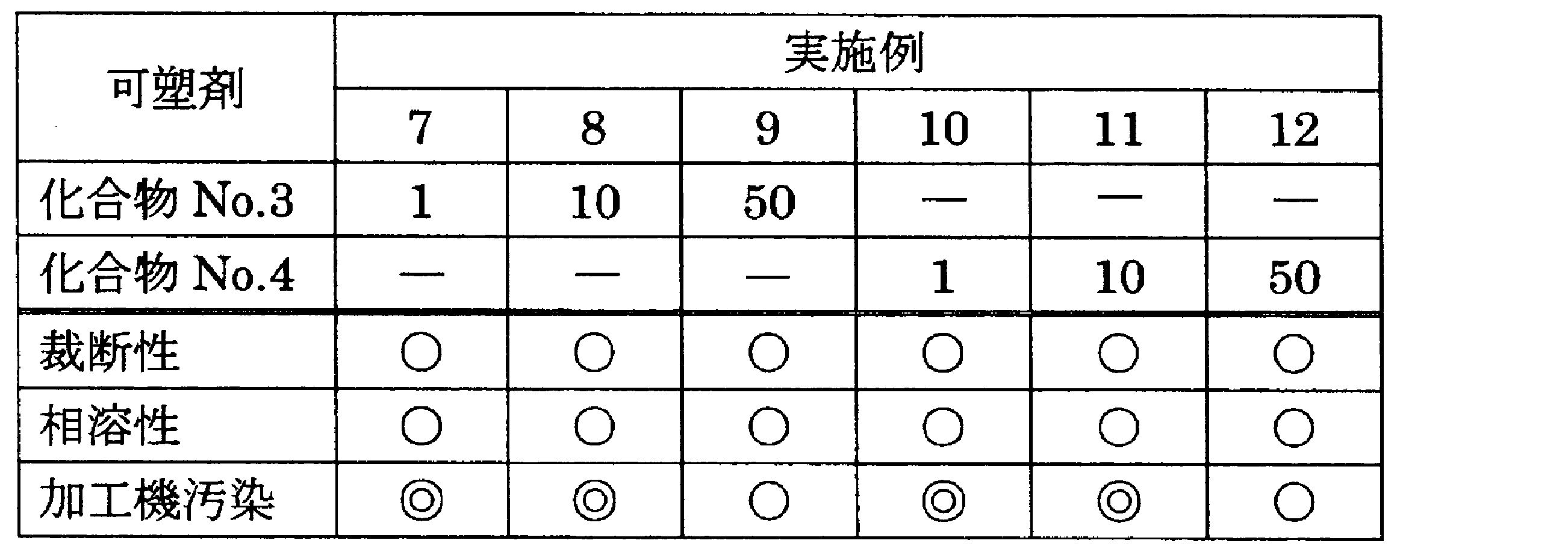
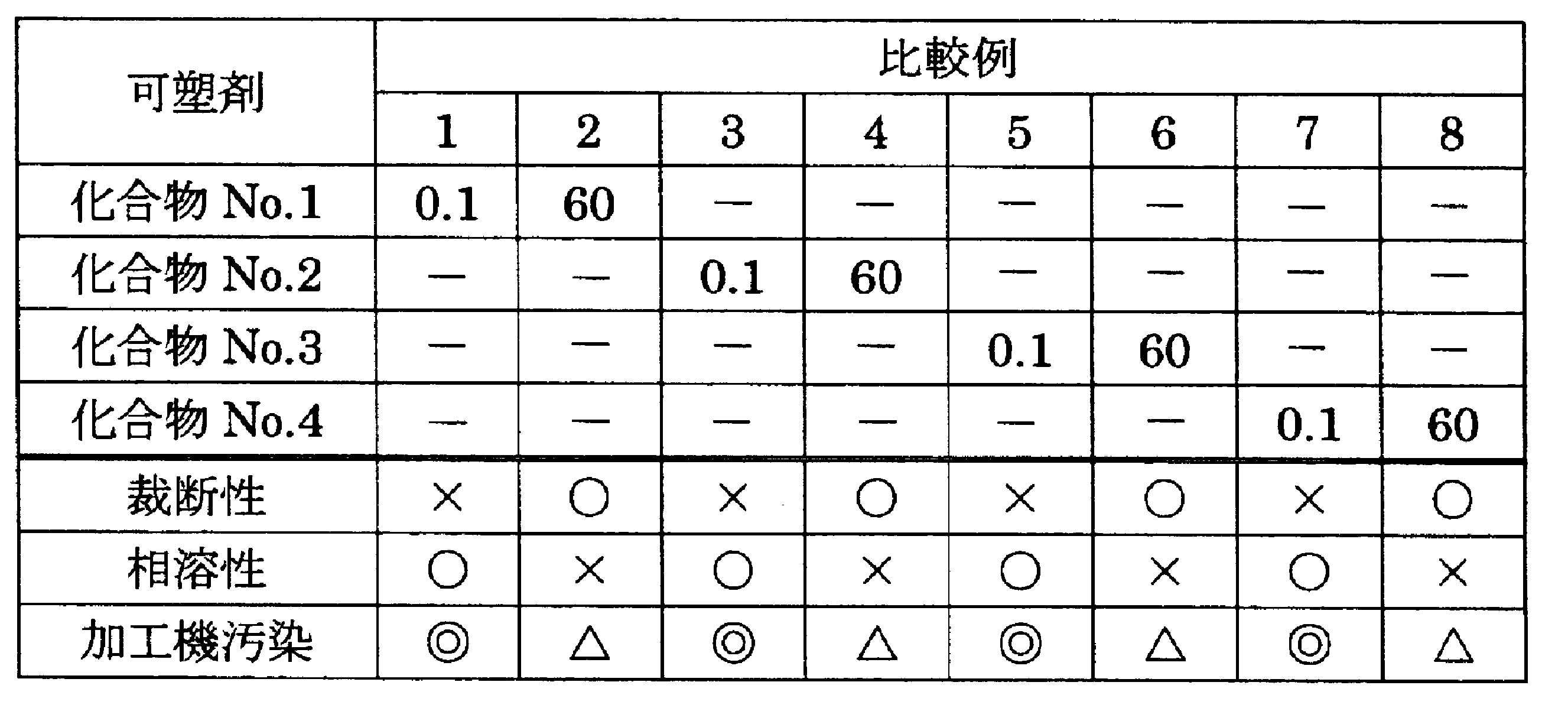
- the plasticizer shown in Table 1 was mixed with the addition amount (parts by mass) shown in Tables 2 to 6 with respect to acetylcellulose, and the solution was cast on a metal support to a thickness of about 0.1 mm. A film was formed to form a film. After peeling off the film from the metal support, the metal support was visually checked for dirt, and the following evaluation was made.
- Dirt * Severe dirt
- Comparative Examples 11 to 13 have poor processing machine contamination and compatibility.
- polyester plasticization that could be used for a wide range of processing could be provided without reducing production efficiency.
- cutting properties and compatibility are excellent. Therefore, it is clear that the specific polyester plasticizer in the present invention is excellent in reducing processing machine contamination, cutting properties, and compatibility, and by providing a predetermined amount, it is possible to provide a resin composition having the performance. It has become possible.
Landscapes
- Chemical & Material Sciences (AREA)
- Organic Chemistry (AREA)
- Health & Medical Sciences (AREA)
- Chemical Kinetics & Catalysis (AREA)
- Medicinal Chemistry (AREA)
- Polymers & Plastics (AREA)
- Compositions Of Macromolecular Compounds (AREA)
- Organic Low-Molecular-Weight Compounds And Preparation Thereof (AREA)
Abstract
Description

本発明のポリエステル系可塑剤は、上記一般式(1)で表され、かつ、重合度が1である成分が5質量%未満であることを特徴とするものである。重合度が1である成分とは、上記一般式(1)においてnが1である化合物である。これにより、揮散成分による加工時の加工機の汚染、およびそれによる生産性の低下が起こることを抑制することが可能となる。本発明のポリエステル系可塑剤は、通常、上記一般式(1)で表される化合物の混合物として用いられる。
セルロース系樹脂は、特に制限されず、公知の種々のセルロース誘導体を用いることができる。例えば、トリアセチルセルロース(TAC)、ジアセチルセルロース(DAC)、セルロースアセテートプロピオネート(CAP)、セルロースアセテートブチレート(CAB)、セルロースアセテートフタレート、セルロースアセテートトリメリテート、硝酸セルロース等のセルロースエステル類等、セルロースフェニルカーバメート等のセルロースカーバメート類等、メチルセルロース、エチルセルロース、ヒドロキシエチルセルロース、ヒドロキシプロピルセルロース、シアノエチルセルロースなどのセルロースエーテル類等が挙げられるが、好ましくはセルロースエステル類である。
式(I) 2.6≦X+Y≦3.0
式(II) 0≦X≦2.5
以下に示した配合にてポリエステル系可塑剤(化合物No.1~No.8)を製造した。混合物の( )内はモル比を示す。
化合物No.1:多価カルボン酸成分Aとして、コハク酸(50)及びテレフタル酸(50)、多価アルコール成分Gとして、エチレングリコール(50)及び1,2-プロピレングリコール(50)と、末端Eがアセチル基からなるn=2のポリエステル化合物。
化合物No.2:多価カルボン酸成分Aとして、コハク酸(50)及びテレフタル酸(50)、多価アルコール成分Gとして、エチレングリコール(50)及び1,2-プロピレングリコール(50)と、末端Eがアセチル基からなるn=3.1のポリエステル化合物。
化合物No.3:多価カルボン酸成分Aとして、アジピン酸(100)、多価アルコール成分Gとして、エチレングリコール(100)と、末端Eがアセチル基からなるn=2.3のポリエステル化合物。
化合物No.4:多価カルボン酸成分Aとして、アジピン酸(100)、多価アルコール成分Gとして、エチレングリコール(100)と、末端Eがアセチル基からなるn=5.6のポリエステル化合物。
化合物No.5:多価カルボン酸成分Aとして、コハク酸(50)及びテレフタル酸(50)、多価アルコール成分Gとして、エチレングリコール(50)及び1,2-プロピレングリコール(50)と、末端Eがベンゾイル基からなるn=4.1のポリエステル化合物。
化合物No.6:多価カルボン酸成分Aとして、コハク酸(50)及びテレフタル酸(50)、多価アルコール成分Gとして、エチレングリコール(50)及び1,2-プロピレングリコール(50)と、末端Eがアセチル基からなるn=0.5のポリエステル化合物。
化合物No.7:多価カルボン酸成分Aとして、コハク酸(50)及びテレフタル酸(50)、多価アルコール成分Gとして、エチレングリコール(50)及び1,2-プロピレングリコール(50)と、末端Eがアセチル基からなるn=8.3のポリエステル化合物。
化合物No.8:多価カルボン酸成分Aとして、コハク酸(50)及びテレフタル酸(50)、多価アルコール成分Gとして、エチレングリコール(50)及び1,2-プロピレングリコール(50)と、末端Eがアセチル基からなるn=3.1のポリエステル化合物。
ガスクロマトグラフ分析(GC)を、カラムはジーエルサイエンス社製PEG-HTを使用し、キャリアとして窒素(50ml/min)、温度はインジェクタ、ディテクタ共に300℃、温度プログラムは150℃~300℃、5℃/minとし、300℃で15分間保持して行った。内部標準としてテレフタル酸ジメチルを用いて、予め合成したn=1の化合物(単一のグリコールと単一の二塩基酸からなる)の検量線から、重合度が1である成分の含有量を測定した(質量%)。
ポリエステル系可塑剤の平均重合度n及び分子量(M.w)は、合成したポリエステル系可塑剤を加水分解し、JIS K 0070:1992の化学製品の酸価(A.V)及び水酸基価(OH.V)の試験方法に則りモル比を算出した値から求め、測定結果を表1に記した

フィルム用途の場合は加工時に裁断工程を必要とするため、裁断性の評価を行なった。アセチルセルロース(酢化度61.5モル%、重合度260)をメチレンクロライド90質量部とメチルアルコール10質量部とからなる混合溶剤に攪拌しながら溶解し、濃度15質量%の溶液とした。これに表1に示す可塑剤をそれぞれアセチルセルロースに対して表2~表6に示す添加量(質量部)を混合し、溶液をシャーレ上に流延し約0.1mmの厚さに製膜しフィルムを作成した。フィルムをハサミを用いて裁断した場合の裁断箇所を目視により判定し、以下の評価とした。
○:裁断性が良好
×:裁断箇所から割れが生じる
上記の方法でフィルムを作成し、フィルムの白濁の有無により相溶性を判定し、以下の評価とした。
○:白濁なし
×:白濁あり
アセチルセルロース(酢化度61.5モル%、重合度260)をメチレンクロライド90質量部とメチルアルコール10質量部とからなる混合溶剤に攪拌しながら溶解し、濃度15質量%の溶液とした。これに表1に示す可塑剤をそれぞれアセチルセルロースに対して表2~表6に示す添加量(質量部)を混合し、溶液を金属支持体上に流延し約0.1mmの厚さに製膜しフィルムを作成した。フィルムを金属支持体から剥離後、金属支持体の汚れを目視により判定し、以下の評価とした。
◎:汚れなし
○:ほとんど汚れなし
△:汚れあり
×:汚れ激しい



Claims (6)
- 下記一般式(1)で表され、かつ、重合度が1である成分が5質量%未満であることを特徴とするポリエステル系可塑剤。
(式(1)中、nは平均重合度を表し、1.95<n≦6であり、Aは直鎖又は分岐鎖の炭素数1~18のアルキレン基、炭素数5~12のシクロアルキレン基、または炭素数6~18の芳香族基を、Gは直鎖又は分岐鎖の炭素数2~12のアルキレン基、直鎖又は分岐鎖の炭素数4~12のエーテル結合を有するアルキレン基、炭素数5~12のシクロアルキレン基を、Eは水素原子または炭素数2~10の脂肪族アシル基または炭素数7~13の芳香族アシル基を表す。)
- 前記一般式(1)中、Aが、直鎖又は分岐鎖の炭素原子数2~5のアルキレン基、フェニレン基およびナフチレン基からなる群より選ばれる1種以上である請求項1記載のポリエステル系可塑剤。
- 前記一般式(1)中、Gが、エチレングリコール、1,2-プロピレングリコール、ブタンジオール、ネオペンチルグリコール、ジエチレングリコール、トリエチレングリコール、シクロヘキサンジオール、および、シクロヘキサンジメタノールからなる群より選ばれる1種以上から2つのヒドロキシル基を除いた基である請求項1記載のポリエステル系可塑剤。
- 薄膜蒸留によって、重合度が1である成分を5質量%未満とした請求項1記載のポリエステル系可塑剤。
- セルロース系樹脂100質量部に対して、請求項1~4のいずれか一項記載のポリエステル系可塑剤を1~50質量部含有することを特徴とするセルロース系樹脂組成物。
- 前記セルロース系樹脂が、セルロースアシレートである請求項5記載のセルロース系樹脂組成物。
Priority Applications (2)
| Application Number | Priority Date | Filing Date | Title |
|---|---|---|---|
| KR1020157037090A KR20160024885A (ko) | 2013-06-26 | 2014-03-31 | 폴리에스테르계 가소제 및 셀룰로오스계 수지 조성물 |
| CN201480036581.2A CN105339423A (zh) | 2013-06-26 | 2014-03-31 | 聚酯系增塑剂和纤维素系树脂组合物 |
Applications Claiming Priority (2)
| Application Number | Priority Date | Filing Date | Title |
|---|---|---|---|
| JP2013-133260 | 2013-06-26 | ||
| JP2013133260A JP6075776B2 (ja) | 2013-06-26 | 2013-06-26 | ポリエステル系可塑剤およびセルロース系樹脂組成物 |
Publications (1)
| Publication Number | Publication Date |
|---|---|
| WO2014208170A1 true WO2014208170A1 (ja) | 2014-12-31 |
Family
ID=52141524
Family Applications (1)
| Application Number | Title | Priority Date | Filing Date |
|---|---|---|---|
| PCT/JP2014/059575 Ceased WO2014208170A1 (ja) | 2013-06-26 | 2014-03-31 | ポリエステル系可塑剤およびセルロース系樹脂組成物 |
Country Status (5)
| Country | Link |
|---|---|
| JP (1) | JP6075776B2 (ja) |
| KR (1) | KR20160024885A (ja) |
| CN (1) | CN105339423A (ja) |
| TW (1) | TWI607044B (ja) |
| WO (1) | WO2014208170A1 (ja) |
Cited By (1)
| Publication number | Priority date | Publication date | Assignee | Title |
|---|---|---|---|---|
| JP2016030797A (ja) * | 2014-07-29 | 2016-03-07 | Dic株式会社 | セルロースエステル組成物、成形体、及び部品、内装材、筐体 |
Families Citing this family (4)
| Publication number | Priority date | Publication date | Assignee | Title |
|---|---|---|---|---|
| JP6435603B2 (ja) * | 2013-12-12 | 2018-12-12 | Dic株式会社 | 樹脂組成物、成形体、及び該成形体から構成される内装部品、内装材、筐体 |
| JP6945863B2 (ja) * | 2016-06-02 | 2021-10-06 | 大八化学工業株式会社 | セルロースエステル樹脂用改質剤、セルロースエステル樹脂組成物及び光学用フィルム |
| WO2022030014A1 (ja) * | 2020-08-07 | 2022-02-10 | 株式会社ダイセル | セルロースアセテート樹脂組成物 |
| WO2022030013A1 (ja) * | 2020-08-07 | 2022-02-10 | 株式会社ダイセル | セルロースアセテート樹脂組成物 |
Citations (8)
| Publication number | Priority date | Publication date | Assignee | Title |
|---|---|---|---|---|
| JPH0366727A (ja) * | 1989-08-07 | 1991-03-22 | Adeka Argus Chem Co Ltd | ポリエステル系可塑剤の改質方法及び改質されたポリエステル系可塑剤 |
| JPH03140323A (ja) * | 1989-10-23 | 1991-06-14 | Unichema Chem Bv | ポリエステル混合物、その製造及び用途 |
| JPH11209482A (ja) * | 1998-01-27 | 1999-08-03 | Oji Paper Co Ltd | 生分解性フィルム及びシート |
| JP2009155454A (ja) * | 2007-12-26 | 2009-07-16 | Fujifilm Corp | ポリマーフィルム、それを用いた位相差フィルム、偏光板、および液晶表示装置 |
| JP2009155455A (ja) * | 2007-12-26 | 2009-07-16 | Fujifilm Corp | セルロースエステルフィルム、それを用いた位相差フィルム、偏光板、および液晶表示装置 |
| JP2009299014A (ja) * | 2008-05-12 | 2009-12-24 | Fujifilm Corp | ポリマーフィルム、位相差フィルム、偏光板、および液晶表示装置 |
| JP2013001042A (ja) * | 2011-06-20 | 2013-01-07 | Konica Minolta Advanced Layers Inc | セルロースエステルフィルムおよびその製造方法、並びにこれを用いた位相差フィルムおよび表示装置 |
| WO2013168713A1 (ja) * | 2012-05-09 | 2013-11-14 | 株式会社Adeka | セルロース系樹脂組成物 |
Family Cites Families (4)
| Publication number | Priority date | Publication date | Assignee | Title |
|---|---|---|---|---|
| JP2009173741A (ja) | 2008-01-23 | 2009-08-06 | Adeka Corp | セルロース系樹脂組成物およびセルロース系樹脂フィルム |
| JP2009173740A (ja) | 2008-01-23 | 2009-08-06 | Adeka Corp | セルロース系樹脂組成物およびセルロース系樹脂フィルム |
| JP5312812B2 (ja) | 2008-01-23 | 2013-10-09 | 株式会社Adeka | セルロース系樹脂組成物およびセルロース系樹脂フィルム |
| JP5430860B2 (ja) | 2008-02-18 | 2014-03-05 | 株式会社Adeka | セルロース系樹脂組成物およびセルロース系樹脂フィルム |
-
2013
- 2013-06-26 JP JP2013133260A patent/JP6075776B2/ja not_active Expired - Fee Related
-
2014
- 2014-03-31 WO PCT/JP2014/059575 patent/WO2014208170A1/ja not_active Ceased
- 2014-03-31 KR KR1020157037090A patent/KR20160024885A/ko not_active Ceased
- 2014-03-31 CN CN201480036581.2A patent/CN105339423A/zh active Pending
- 2014-04-24 TW TW103114842A patent/TWI607044B/zh not_active IP Right Cessation
Patent Citations (8)
| Publication number | Priority date | Publication date | Assignee | Title |
|---|---|---|---|---|
| JPH0366727A (ja) * | 1989-08-07 | 1991-03-22 | Adeka Argus Chem Co Ltd | ポリエステル系可塑剤の改質方法及び改質されたポリエステル系可塑剤 |
| JPH03140323A (ja) * | 1989-10-23 | 1991-06-14 | Unichema Chem Bv | ポリエステル混合物、その製造及び用途 |
| JPH11209482A (ja) * | 1998-01-27 | 1999-08-03 | Oji Paper Co Ltd | 生分解性フィルム及びシート |
| JP2009155454A (ja) * | 2007-12-26 | 2009-07-16 | Fujifilm Corp | ポリマーフィルム、それを用いた位相差フィルム、偏光板、および液晶表示装置 |
| JP2009155455A (ja) * | 2007-12-26 | 2009-07-16 | Fujifilm Corp | セルロースエステルフィルム、それを用いた位相差フィルム、偏光板、および液晶表示装置 |
| JP2009299014A (ja) * | 2008-05-12 | 2009-12-24 | Fujifilm Corp | ポリマーフィルム、位相差フィルム、偏光板、および液晶表示装置 |
| JP2013001042A (ja) * | 2011-06-20 | 2013-01-07 | Konica Minolta Advanced Layers Inc | セルロースエステルフィルムおよびその製造方法、並びにこれを用いた位相差フィルムおよび表示装置 |
| WO2013168713A1 (ja) * | 2012-05-09 | 2013-11-14 | 株式会社Adeka | セルロース系樹脂組成物 |
Cited By (1)
| Publication number | Priority date | Publication date | Assignee | Title |
|---|---|---|---|---|
| JP2016030797A (ja) * | 2014-07-29 | 2016-03-07 | Dic株式会社 | セルロースエステル組成物、成形体、及び部品、内装材、筐体 |
Also Published As
| Publication number | Publication date |
|---|---|
| TWI607044B (zh) | 2017-12-01 |
| JP2015007015A (ja) | 2015-01-15 |
| TW201510021A (zh) | 2015-03-16 |
| CN105339423A (zh) | 2016-02-17 |
| JP6075776B2 (ja) | 2017-02-08 |
| KR20160024885A (ko) | 2016-03-07 |
Similar Documents
| Publication | Publication Date | Title |
|---|---|---|
| TWI585150B (zh) | Cellulose-based resin composition | |
| JP5551618B2 (ja) | セルロース系樹脂組成物およびセルロース系樹脂フィルム | |
| JP5469079B2 (ja) | セルロース系樹脂組成物およびセルロース系樹脂フィルム | |
| KR101542448B1 (ko) | 셀룰로오스계 수지 조성물 및 셀룰로오스계 수지 필름 | |
| JP6075776B2 (ja) | ポリエステル系可塑剤およびセルロース系樹脂組成物 | |
| JPWO2016158790A1 (ja) | 樹脂用改質剤およびこれを用いた樹脂組成物 | |
| WO2015064326A1 (ja) | リタデーション上昇剤、これを用いたセルロース系樹脂組成物、およびフィルム | |
| WO2013073533A1 (ja) | 延伸光学補償フィルム | |
| JP6802678B2 (ja) | 樹脂用改質剤およびこれを用いた樹脂組成物 | |
| JP6351945B2 (ja) | セルローストリアセテート樹脂用防湿剤、セルローストリアセテート樹脂組成物、およびフィルム | |
| JP6289862B2 (ja) | 防湿剤、セルロース系樹脂組成物、およびこれを用いたフィルム | |
| JP4420573B2 (ja) | 農業用塩化ビニル系樹脂組成物 | |
| JP2015025039A (ja) | セルロース系樹脂組成物 | |
| JP2014224962A (ja) | リタデーション上昇剤 |
Legal Events
| Date | Code | Title | Description |
|---|---|---|---|
| WWE | Wipo information: entry into national phase |
Ref document number: 201480036581.2 Country of ref document: CN |
|
| 121 | Ep: the epo has been informed by wipo that ep was designated in this application |
Ref document number: 14816629 Country of ref document: EP Kind code of ref document: A1 |
|
| NENP | Non-entry into the national phase |
Ref country code: DE |
|
| ENP | Entry into the national phase |
Ref document number: 20157037090 Country of ref document: KR Kind code of ref document: A |
|
| 122 | Ep: pct application non-entry in european phase |
Ref document number: 14816629 Country of ref document: EP Kind code of ref document: A1 |