WO2014192940A1 - 糖グリセロールの製造法 - Google Patents
糖グリセロールの製造法 Download PDFInfo
- Publication number
- WO2014192940A1 WO2014192940A1 PCT/JP2014/064502 JP2014064502W WO2014192940A1 WO 2014192940 A1 WO2014192940 A1 WO 2014192940A1 JP 2014064502 W JP2014064502 W JP 2014064502W WO 2014192940 A1 WO2014192940 A1 WO 2014192940A1
- Authority
- WO
- WIPO (PCT)
- Prior art keywords
- sugar
- glycerol
- culture
- medium
- treatment
- Prior art date
- Legal status (The legal status is an assumption and is not a legal conclusion. Google has not performed a legal analysis and makes no representation as to the accuracy of the status listed.)
- Ceased
Links
Images






Classifications
-
- C—CHEMISTRY; METALLURGY
- C12—BIOCHEMISTRY; BEER; SPIRITS; WINE; VINEGAR; MICROBIOLOGY; ENZYMOLOGY; MUTATION OR GENETIC ENGINEERING
- C12N—MICROORGANISMS OR ENZYMES; COMPOSITIONS THEREOF; PROPAGATING, PRESERVING, OR MAINTAINING MICROORGANISMS; MUTATION OR GENETIC ENGINEERING; CULTURE MEDIA
- C12N1/00—Microorganisms; Compositions thereof; Processes of propagating, maintaining or preserving microorganisms or compositions thereof; Processes of preparing or isolating a composition containing a microorganism; Culture media therefor
- C12N1/12—Unicellular algae; Culture media therefor
-
- C—CHEMISTRY; METALLURGY
- C12—BIOCHEMISTRY; BEER; SPIRITS; WINE; VINEGAR; MICROBIOLOGY; ENZYMOLOGY; MUTATION OR GENETIC ENGINEERING
- C12P—FERMENTATION OR ENZYME-USING PROCESSES TO SYNTHESISE A DESIRED CHEMICAL COMPOUND OR COMPOSITION OR TO SEPARATE OPTICAL ISOMERS FROM A RACEMIC MIXTURE
- C12P19/00—Preparation of compounds containing saccharide radicals
- C12P19/44—Preparation of O-glycosides, e.g. glucosides
Definitions
- the present invention relates to a method for producing sugar glycerol.
- Sugar glycerol refers to a compound having a structure in which a sugar is glycosidically bonded to a hydroxyl group of glycerol.
- Sugar glycerol is used as a functional substance in pharmaceuticals, cosmetics, foods and drinks, and the like.
- sugar glycerol hardly exists in nature and is highly rare.
- Sugar glycerol can be produced, for example, by chemical synthesis. Specifically, glycerol sugars can be produced by enzymatically or chemically glycoside-bonding sugars to the hydroxyl groups of glycerol, or by enzymatically or chemically cleaving acyl groups from glyceroglycolipids.
- sugar glycerol for example, galactosylglycerol has been found in red algae such as seaweed (Patent Document 1).
- cyanobacterial cell membranes and chloroplast thylakoid membranes contain a large amount of glyceroglycolipids such as galactosyl diacylglycerol, digalactosyl diacylglycerol, and sulfoquinovosyl diacylglycerol (non-patent literature). 1).
- glycerol saccharides are produced by culturing microalgae and subjecting the obtained algal bodies to intermediate temperature treatment or methanol treatment, The present invention has been completed.
- the present invention can be exemplified as follows.
- [1] Culturing microalgae in a medium; Subjecting the algal cells obtained by the culture to a medium temperature treatment and / or an organic solvent treatment, and recovering sugar glycerol from the treated product,
- a process for producing sugar glycerol comprising: [2] The method, wherein the sugar glycerol is selected from the group consisting of a compound represented by the following formula (I) and a compound represented by the following formula (II): Wherein R represents a sugar selected from monosaccharides, polysaccharides, and derivatives thereof; (Wherein R represents a sugar selected from monosaccharides, polysaccharides, and derivatives thereof).
- the method wherein the sugar is selected from the group consisting of the following (A) to (C): (A) Galactose; (B) a polysaccharide containing galactose as a constituent sugar; (C) Glucose derivative. [4] The method wherein the sugar is selected from the group consisting of the following (a) to (c): (A) galactose; (B) digalactose; (C) Sulfonyl quinobose. [5] The method, wherein the sugar glycerol is selected from the group consisting of galactosylglycerol, digalactosylglycerol, and sulfoquinovosylglycerol.
- microalgae are algae belonging to the green plant phylum.
- the microalga is an algae belonging to the genus Chlorella, Chlamydomonas, Desmodesmus, or Senedesmus.
- the method, wherein the microalgae is Chlorella kessleri, Chlamydomonas reinhardtii, or one of the genus Desmodesmus sp.
- the method, wherein the intermediate temperature treatment is performed at 35 ° C to 70 ° C.
- the organic solvent is methanol.
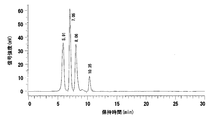
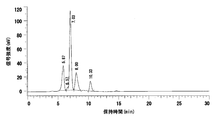
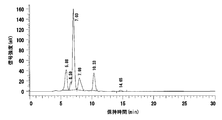
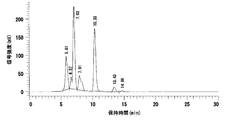
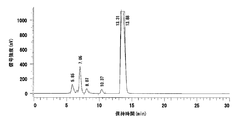
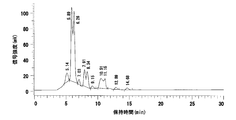
- the figure which shows the HPLC analysis result of the medium temperature processed supernatant of Chlorella kessleri 11h strain The figure which shows the HPLC analysis result of the medium temperature processed supernatant of Chlorella kessleri 11h strain (cultured days 5 days). The figure which shows the HPLC analysis result of the medium temperature processed supernatant of Chlorella kessleri 11h strain (culture days 7 days). The figure which shows the HPLC analysis result of the medium temperature processed supernatant of Chlorella kessleri 11h strain
- the figure which shows the HPLC analysis result of the medium temperature processed supernatant of Chlorella kessleri 11h strain (culture days 19 days).
- the method of the present invention includes culturing microalgae in a medium, subjecting the algal cells obtained by the culture to a medium temperature treatment and / or organic solvent treatment, and recovering sugar glycerol from the treated product, Is a method for producing sugar glycerol containing
- the microalgae used in the method is also referred to as “microalgae of the present invention”.
- Algae refers to an organism excluding moss plants, fern plants, and seed plants among organisms that perform oxygen-generating photosynthesis. Algae includes organisms belonging to the prokaryote Cyanobacteria (Cyanobacteria), eukaryotes Gray plant gate (Glaucophyta), Red plant gate (Rhodophyta), Green plant gate (Chlorophyta) ), Cryptophyta, Haptophyta, Hetero sparklephyta, Dinophyta, Dinophyta, Euglena Examples include organisms belonging to gates such as Euglenophyta and Chlorarachniophyta. Algae includes both unicellular and multicellular organisms.
- Microalgae refers to algae with a microscopic structure excluding seaweeds that are multicellular organisms from these algae (Biodiversity Series (3) Diversity and strains of algae: Chihara Mitsuo, Hanabo (1999)). Note that the microalgae includes those in which a plurality of cells form a colony.
- the microalgae of the present invention may be any as long as it is classified as such a microalgae.
- a microalgae of the present invention for example, algae belonging to the green plant phylum (Chlorophyta) are preferable.
- Examples of the algae belonging to the green plant phylum include, for example, classes such as Chlorophyceae, Trebouxiophyceae, Prasinophyceae, Ulvophyceae, and Charophyceae. Algae belonging to Among these, for example, algae belonging to the green alga class and algae belonging to the treboxya algae class are preferable.
- Examples of algae belonging to Chlorophyceae include algae belonging to genera such as Chlamydomonas genus, Scenedesmus genus, Desmodesmus genus and the like.
- Examples of the algae belonging to the Trevoxia algae include algae belonging to a genus such as Chlorella.
- Examples of the algae of the genus Chlamydomonas include the following species. Chlamydomonas moewusii Chlamydomonas nivalis Chlamydomonas reinhardtii
- Scenedesmus examples include the following species. S. acumunatus Sedesmus dimorphus S. disciformis Seddesmus Obartermus (S. ovaltermus)
- Desmodesmus examples include the following species. Desmodems Almatus (D. armatus) Desmodemus Arsrodesmiformis (D. arthrodesmiformis) Desmodemus Asymmetry (D. asymmetricus) D. bicellularis D. brasiliensis D. communis Desmodemus Cuneatus (D. cuneatus) Desmodemus denticulatus (D. denticulatus) Desmodemus Fenikas (D. fennicus) Desmodemus Historix (D. hystrix) Desmodems Komareki (D. komarekii) D. lefevrei Desmodems Maxims (D.
- Desmodems multi-barrier billis D. multivariabilis
- D. opoliensis Desmodemus Panonicus (D. pannonicus)
- Desmodemus Perforatus D. perforatus
- Desmodems Pirkorey D. pirkollei
- D. pleiomorphus Desmodems Quadricauda (D. quadricauda)
- Desmodemus Seratus D. serratus
- Desmodesmus algae include Desmodesmus sp. AJ7835 strain. On April 12, 2011, Desmodesmus 78sp. AJ7835 strain was incorporated on April 12, 2011 by the National Institute of Advanced Industrial Science and Technology, Patent Biological Depositary Center (currently the National Institute for Product Evaluation Technology, Biological Biological Depositary Center, Kisarazu Kazusa Kama, Chiba, Japan). It is deposited under the accession number FERM BP-11364 in Room No. 120, postal number 292-0818.
- Chlorella algae examples include the following species. Chlorella kessleri Chlorella pyrenoidosa Chlorella vulgaris
- Chlorella kessleri examples include Chlorella keskesleri 11h strain (UTEX 263).
- the Chlorella kessleri 11h strain is available from the University of Texas Algae Culture Collection (The University ofTexas at Austin, The Culture Collection of Algae (UTEX), 1 University Station A6700, Austin, TX 78712-0183, USA).
- the culture method is not particularly limited as long as the microalgae of the present invention can grow.
- the culture conditions can be appropriately set according to various conditions such as the type of microalgae used.
- the culture can be performed, for example, under normal conditions used for culturing microalgae.
- algae such as Chlorella genus, Arthrospira genus (Spirulina), and Dunaliella salina are cultivated industrially on a large scale (Spolaore). , P. et al. 2006. J. Biosci. Bioeng. 101: 87-96).
- the culture may be performed with reference to such knowledge, for example.
- Culturing is autotrophic culture using photosynthesis without using organic compounds, heterotrophic culture using organic compounds without using photosynthesis, or mixed nutrition using both photosynthesis and organic compounds. It can be carried out by culture (mixotrophic culture). Usually, microalgae may be cultured by autotrophic culture.
- Culture may be performed in an open system or a closed system.
- culture can be performed in an open culture system called an open pond.
- culture can be performed in a closed culture system called a closed photobioreactor.
- the medium used for the culture is not particularly limited as long as the microalgae of the present invention can grow.
- the culture medium may contain, for example, a nitrogen source and various inorganic salts.
- the culture medium may contain other components, such as a carbon source, as needed.
- concentration of a culture medium component can be suitably set according to various conditions, such as the kind of micro algae to be used.
- a normal medium used for culturing microalgae can be used.
- a medium specifically, for example, 0.3 ⁇ HSM medium (Oyama, Y. et al. 2006. Planta-224: 646-654), 0.2 ⁇ Gambogue medium (Izumo, A. et al. 2007.
- TAP medium for culturing Chlamydomonas genus algae such as Chlamydomonashardreinhardtii, for example, TAP medium or 0.3 ⁇ HSM medium can be used.
- 0.2 ⁇ Gumborg medium can be used for culturing Chlorella genus algae such as Chlorella kessleri.
- 0.2 ⁇ Gumborg medium can be used for culturing Scenedesmus algae and Desmodesmus algae.
- Algae are also known to accumulate fats and oils in the algae when the nitrogen source is depleted (Thompson GA Jr. 1996. Biochim. Biophys. Acta 1302: 17-45).
- a medium having a limited nitrogen source concentration may be used for culturing microalgae.
- the culture can be performed using a liquid medium.
- the culture temperature may be, for example, 20 to 40 ° C, preferably 25 ° C to 35 ° C.
- the initial pH of the medium may be around neutral, for example. Near neutral may be, for example, 7-9.
- the pH may or may not be adjusted.
- a suitable inorganic or organic acidic or alkaline substance can be used for pH adjustment.
- the culture may be performed with aeration.
- the aeration amount may be, for example, 0.1 to 2 vvm (volume per volume per minute) as an aeration amount per minute per culture medium volume.
- the culture medium may be further supplied to CO 2.
- the supply amount of CO 2 may be, for example, 0.5 to 5% (v / v) with respect to the aeration amount.
- CO 2 and air may be supplied separately to the culture solution, or mixed and supplied to the culture solution.
- light is supplied to the culture system.
- the light can be supplied using a suitable light source. Examples of the light source include a white fluorescent lamp, a white light emitting diode, a high pressure sodium lamp, and sunlight. These light sources may be used in appropriate combination.
- the illuminance of light may be, for example, 1,000 to 10,000 lux.
- the culture solution may be appropriately stirred or circulated. Various operations such as light supply, air supply, CO 2 supply, stirring and circulation may be performed continuously or intermittently.
- the culture period may be, for example, 1 to 40 days.
- the culture can be performed by batch culture, fed-batch culture, continuous culture, or a combination thereof.
- cultivation may be performed by dividing into seed culture and main culture.
- the main culture may be performed, for example, by inoculating 1-50% (v / v) of the seed culture solution in the main culture medium.
- the culture conditions for the seed culture and the main culture may or may not be the same.
- both seed culture and main culture may be performed by batch culture.
- seed culture may be performed by batch culture, and main culture may be performed by fed-batch culture or continuous culture.
- microalgae bodies of microalgae are produced in the medium.
- the algal cells obtained by culturing are subjected to medium temperature treatment and / or organic solvent treatment.
- only one of the intermediate temperature treatment and the organic solvent treatment may be performed, or both may be performed.
- the order is not particularly limited. Moreover, both may be implemented simultaneously.
- the medium temperature treatment and the organic solvent treatment may be collectively referred to as sugar glycerol production treatment.
- the algal cells may be subjected to a sugar glycerol production process while contained in the medium, or may be collected from the medium and then subjected to a sugar glycerol production process. Further, the algal bodies may be subjected to a sugar glycerol production treatment after appropriate pretreatment. Examples of the pretreatment include dilution, concentration, freezing, thawing, drying, crushing, and the like. These pretreatments may be appropriately combined.
- the method for recovering the algal cells from the medium is not particularly limited, and for example, a known method (Grima, E. M. et al. 2003. Biotechnol. Advances 20: 491-515) can be used.
- algal bodies can be recovered from the culture medium by methods such as natural sedimentation, centrifugation, and filtration. At that time, a flocculant may be used.
- the collected algal bodies can be appropriately washed using an appropriate medium.
- the collected alga bodies can be appropriately resuspended using an appropriate medium.
- Examples of the medium that can be used for washing and suspension include an aqueous medium (aqueous solvent) such as water and an aqueous buffer, an organic medium (organic solvent) such as methanol, and a mixture thereof.
- aqueous medium such as water and an aqueous buffer
- organic medium organic solvent
- the medium can be appropriately selected according to various conditions such as the type of sugar glycerol production treatment.
- the algal bodies may be subjected to a sugar glycerol production treatment after being diluted or concentrated to a desired degree, for example.
- the algal bodies can be diluted using an appropriate medium as described above. Concentration of algal bodies can be performed, for example, by precipitating algal bodies and removing the supernatant appropriately. Further, the algae can be concentrated by, for example, freeze-drying or evaporation.
- the algal bodies may be subjected to a sugar glycerol production process after being crushed, for example.
- the method for crushing algal bodies is not particularly limited, and for example, a known method can be used.
- Examples of the method for crushing algal bodies include high-temperature treatment, boiling treatment, strong alkali treatment, ultrasonic treatment, French press and the like. These techniques may be combined appropriately.
- Examples of the high temperature treatment include treatment at a temperature of 100 ° C. or higher, 150 ° C. or higher, or 175 to 215 ° C.
- the high temperature treatment also includes a high temperature and high pressure reaction called a hydrothermal reaction.
- the algal bodies may be frozen once and then subjected to a sugar glycerol production treatment.
- the freezing temperature may be, for example, 0 ° C. or lower, ⁇ 20 ° C. or lower, or ⁇ 50 ° C. or lower, and may be ⁇ 80 ° C. or higher.
- the freezing time may be, for example, 1 hour or longer and 24 hours or shorter. Moreover, you may repeat freeze-thaw.
- Medium temperature treatment refers to treatment at an intermediate temperature.
- the intermediate temperature treatment for example, the treatment at the intermediate temperature described in WO2011 / 013707 can be referred to.
- the conditions for the medium temperature treatment are not particularly limited as long as sugar glycerol is produced by the medium temperature treatment.
- the algal bodies can be subjected to intermediate temperature treatment in a state suspended in an appropriate medium as described above.
- the “medium temperature” is not particularly limited as long as it is a temperature at which sugar glycerol is produced.
- the intermediate temperature can be appropriately set according to various conditions such as the type of microalgae and treatment time.
- the intermediate temperature may be, for example, 35 ° C.
- the intermediate temperature may be, for example, 70 ° C. or lower, 65 ° C. or lower, or 60 ° C. or lower.
- the time for the intermediate temperature treatment can be appropriately set according to various conditions such as the type of microalgae and the treatment temperature.
- the time for the medium temperature treatment may be, for example, 1 hour or more, or 5 hours or more. Further, the intermediate temperature treatment time may be, for example, 48 hours or less, or 24 hours or less.
- the medium temperature treatment may be performed by standing or may be performed while stirring or shaking.
- the medium temperature treatment may be performed continuously or intermittently. Reaction conditions such as treatment temperature may or may not be constant throughout the medium temperature treatment. That is, for example, the algal cells may be continuously treated at the same temperature (hereinafter, also referred to as “continuous intermediate temperature treatment”), or may be treated at a lower temperature.
- the continuous intermediate temperature treatment may be performed, for example, in the above-exemplified intermediate temperature range and the above-exemplified intermediate temperature treatment range.
- As an aspect of lowering the temperature in the middle for example, an aspect of treating at a constant temperature lower than the temperature of the first stage intermediate temperature treatment as the second stage intermediate temperature treatment after once treating at the intermediate temperature as the first stage intermediate temperature treatment. Can be mentioned.
- the temperature of the first stage intermediate temperature treatment may be, for example, the intermediate temperature range exemplified above.
- the temperature of the second stage intermediate temperature treatment may be, for example, 30 ° C or higher, 35 ° C or higher, or 40 ° C or higher.
- the temperature of the second stage intermediate temperature treatment may be, for example, 55 ° C. or lower, 50 ° C. or lower, or 45 ° C. or lower.
- the time for the first stage intermediate temperature treatment may be, for example, 1 minute or more, or 20 minutes or more.
- the time of the first stage intermediate temperature treatment may be, for example, 120 minutes or less, or 60 minutes or less.
- the time for the second stage intermediate temperature treatment may be, for example, 1 hour or more, or 4 hours or more.
- the time of the second stage intermediate temperature treatment may be, for example, 20 hours or less, or 15 hours or less.
- the pH of the reaction system may be adjusted to weak acidity.
- the weak acid may be, for example, pH 3.0 to 7.0, or pH 4.0 to 6.0.
- the pH can be adjusted using, for example, an inorganic acid such as hydrochloric acid.
- Organic solvent treatment refers to treatment with an organic solvent.
- the conditions for the organic solvent treatment are not particularly limited as long as sugar glycerol is produced by the organic solvent treatment.
- the organic solvent treatment can be performed by bringing the algal bodies into contact with the organic solvent.
- the collected alga bodies may be suspended in an organic solvent, or an organic solvent may be added to the alga body suspension.
- the organic solvent examples include alcohols such as methanol and ethanol, aldehydes such as formaldehyde and acetaldehyde, ketones such as acetone, ethers such as diethyl ether, esters such as ethyl acetate, and alkanes such as n-hexane. , Benzene, phenol and chloroform.
- alcohols such as methanol and ethanol
- aldehydes such as formaldehyde and acetaldehyde
- ketones such as acetone
- ethers such as diethyl ether
- esters such as ethyl acetate
- alkanes such as n-hexane.
- Benzene, phenol and chloroform a water-soluble thing is preferable.
- alcohol is preferable and methanol is more preferable.
- the organic solvent one kind of organic solvent may be used, or two or more kinds of organic solvents may be used in combination.
- Examples of other components include an aqueous medium (aqueous solvent) such as water and an aqueous buffer solution. That is, for example, an aqueous solution of an organic solvent can be used for the organic solvent treatment.
- the organic solvent concentration in the mixture may be, for example, 10% (v / v) or more, or 20% (v / v) or more, 90% (v / v) or less, 70% (v / v) or less Or 50% (v / v) or less.
- the concentration of the organic solvent in the reaction solution for performing the organic solvent treatment may be, for example, 10% (v / v) or more, or 20% (v / v) or more, 90% (v / v) or less, It may be 70% (v / v) or less, or 50% (v / v) or less.
- the organic solvent treatment time may be, for example, 10 minutes or longer, 30 minutes or longer, or 1 hour or longer. Further, the time of the organic solvent treatment may be, for example, 10 hours or less, 5 hours or less, or 3 hours or less.
- the temperature of the organic solvent treatment may or may not be controlled. The temperature of the organic solvent treatment may be, for example, 10 to 70 ° C. or room temperature. The organic solvent treatment may be performed by standing or may be performed while stirring or shaking.
- sugar glycerol is produced by subjecting the algal cells to the sugar glycerol production treatment.
- Sugar Glycerol refers to a compound having a structure in which a sugar is glycosidically bonded to a hydroxyl group of glycerol.
- the sugar may be bound to any hydroxyl group of glycerol.
- the sugar may be bonded to only one of the three hydroxyl groups of glycerol, or may be bonded to two or three hydroxyl groups. In the present invention, only one sugar glycerol may be produced, or two or more sugar glycerols may be produced.
- sugar glycerol examples include a compound represented by the following formula (I) and a compound represented by the following formula (II).
- the above formula (I) is a structural formula of sugar glycerol in which sugar is bonded to the hydroxyl group of the 1-position or 3-position carbon of glycerol.
- the above formula (II) is a structural formula of sugar glycerol in which a sugar is bonded to the hydroxyl group of the carbon at the 2-position of glycerol.
- the type of sugar is not particularly limited.
- the sugar may be a monosaccharide, a polysaccharide, or a derivative thereof.
- monosaccharides include glucose and galactose.
- Polysaccharide refers to a saccharide composed of two or more monosaccharides. That is, the polysaccharide here includes disaccharides and oligosaccharides.
- the polysaccharide may be linear or may have a branched chain.
- the polysaccharide may be composed of one kind of monosaccharide or may be composed of two or more kinds of monosaccharides.
- the degree of polymerization of the polysaccharide is not particularly limited, and may be, for example, 2 to 50, 2 to 10, or 2 to 5.
- Examples of the polysaccharide include a polysaccharide containing galactose as a constituent sugar. Specific examples of the polysaccharide containing galactose as a constituent sugar include digalactose.
- a “sugar derivative” refers to a sugar in which components such as atoms and functional groups have been introduced, substituted, or removed.
- modification introduction, replacement, and removal of components are collectively referred to as “modification”.
- the location to be modified is not particularly limited, and may be, for example, on a carbon atom, on an oxygen atom, or other location. There may be one place to be modified, or two or more places. There may be one type of modification, or two or more types.
- the sugar derivative include deoxy sugar, amino sugar, sugar acid, and sugar alcohol.
- the functional group to be introduced include an acetyl group, an amino group, an alkyl group, and a sulfonyl group (—SO 3 —R).
- R in the sulfonyl group (—SO 3 —R) is not particularly limited, and may be, for example, a hydrogen atom (H) or an alkyl group.
- sugar glycerol examples include galactosylglycerol, digalactosylglycerol, and sulfoquinovosylglycerol.
- Galactosylglycerol is a sugar glycerol in which galactose is bonded to the hydroxyl group of any one carbon of glycerol.
- Digalactosylglycerol is a sugar glycerol in which digalactose is bound to the hydroxyl group of any one carbon of glycerol.
- Sulfoquinovosyl glycerol is a sugar glycerol in which sulfo quinose is bound to the hydroxyl group of any one carbon of glycerol. Unless otherwise specified, all of galactosylglycerol, digalactosylglycerol, and sulfoquinovosylglycerol have sugars bound to the hydroxyl group at the 1st carbon of glycerol, and sugars bound to the hydroxyl group at the 2nd carbon of glycerol. Or a saccharide bonded to the hydroxyl group at the 3-position carbon of glycerol, or a mixture thereof.
- sugar glycerol can be confirmed by a known method used for detection or identification of a compound. Examples of such a method include HPLC, LC / MS, GC / MS, and NMR. These methods can be used in appropriate combination.
- the produced sugar glycerol can be collected by a known method used for separation and purification of compounds. Examples of such a method include an ion exchange resin method and a membrane treatment method. These methods can be used in appropriate combination.
- the collected sugar glycerol may contain components such as algal bodies, medium components, moisture, components used in the sugar glycerol production treatment, and microalgae metabolic byproducts in addition to sugar glycerol.
- the sugar glycerol may be purified to the desired degree.
- the purity of sugar glycerol is, for example, 30% (w / w) or higher, 50% (w / w) or higher, 70% (w / w) or higher, 90% (w / w) or higher, or 95% (w / w) w) That's it.
- the recovered sugar glycerol can be used as it is or in combination with pharmaceuticals, cosmetics, foods and drinks.
- the amount of sugar glycerol blended is not particularly limited as long as the function of sugar glycerol is exhibited.
- the blending amount of sugar glycerol is not particularly limited, and may be, for example, 1 ppm (w / w) or more, 100 ppm (w / w) or more, or 1% (w / w) or more.
- the amount of sugar glycerol is not particularly limited, and may be, for example, 100% (w / w) or less, 10% (w / w) or less, or 1% (w / w) or less.
- Glycerol glycerol may have functions such as prebiotics, ⁇ -amylase activation, moisturizing, or cell activation.
- Sugar glycerol may be formulated in any dosage form, for example.
- the dosage form include solutions, suspensions, powders, tablets, pills, and capsules.
- excipients for example, excipients, binders, disintegrants, lubricants, stabilizers, flavoring agents, flavoring agents, fragrances, diluents, surfactants and other pharmacologically acceptable additives.
- excipients for example, excipients, binders, disintegrants, lubricants, stabilizers, flavoring agents, flavoring agents, fragrances, diluents, surfactants and other pharmacologically acceptable additives.
- binders for example, excipients, binders, disintegrants, lubricants, stabilizers, flavoring agents, flavoring agents, fragrances, diluents, surfactants and other pharmacologically acceptable additives.
- flavoring agents for example, binders, disintegrants, lubricants, stabilizers, flavor
- Sugar glycerol may be used by adding to food and drink, for example.
- the food and drink can be produced by the same method using the same raw materials as those of ordinary food and drink except that sugar glycerol is added.
- the addition of sugar glycerol may be performed at any stage of the production process of the food or drink. It does not restrict
- foods and beverages include fruit juices, milk, tea, alcoholic beverages, soups, instant miso soups, instant soups, etc .; processed foods such as ham and sausage; processed fishery products such as kamaboko and chikuwa; butter, fermented milk, Examples include dairy products such as powdered milk; processed rice products; bread; noodles; confectionery; powdered seasonings such as dashi and flavor seasonings; and liquid seasonings such as sauce, sauce and dressing.
- Example 1 Production of Sugar Glycerol from Chlorella kessleri
- Chlorella kessleri 11h strain was cultured and subjected to medium temperature treatment, and production of sugar glycerol was confirmed.
- Chlorella kessleri 11h strain (UTEX 263) from The University of Texas at Austin, The Culture Collection of Algae (UTEX), 1 University Station A6700, Austin, TX 78712-0183, USA ) was obtained. Chlorella kessleri 11h strain was precultured in 0.2 ⁇ Gamborg's B5 medium (Nippon Pharmaceutical) for 7 days. 16 mL of the obtained preculture solution was inoculated into 800 mL of 0.2 ⁇ Gamborg's B5 medium (Nippon Pharmaceutical Co., Ltd.) placed in a 1 L medium bottle, and air and CO 2 using a portable gas mixing device PMG-1 (Koflock).
- PMG-1 portable gas mixing device
- the mixture was adjusted to 3% CO 2 concentration and blown at 500 mL / min while stirring for 14 days to obtain a Chlorella culture solution.
- the culture was performed in a plant incubator CL-301 (TOMY), and the light irradiation conditions were set to continuous irradiation (illuminance: about 5,000 lux) using a white fluorescent lamp as a light source, and the temperature was set to 30 ° C.
- the composition of Gamborg's B5 medium is shown in Table 1.
- Gamborg's B5 medium was used after autoclaving (120 ° C., 15 min).
- HPLC analysis conditions The HPLC analysis was performed using a Hitachi autosampler L-7200, pump L-7100, and differential refractive index detector L-2490 equipped with a sugar analysis column SH-1011 (Showa Denko). Performed using the device. Water was used as the mobile phase. Fractions of each peak detected by HPLC were collected and subjected to mass spectrometry and 1 H-NMR analysis.
- the HPLC analysis conditions are the same in the following examples unless otherwise specified.
- Mass spectrometry and 1 H-NMR analysis conditions Mass spectrometry was performed using ZQ (Waters). 1 H-NMR analysis was performed using Avance 400M (Bruker), and D 2 O was used as a solvent. Mass spectrometry and 1 H-NMR analysis conditions are the same in the following examples unless otherwise specified.
- Example 2 Amount of sugar glycerol produced over time
- Chlorella kessleri 11h strain was cultured and subjected to medium temperature treatment, and the amount of sugar glycerol produced over time was evaluated.
- (1) Culture and medium temperature treatment The Chlorella kessleri 11h strain was cultured under the culture conditions described in Example 1, and Chlorella broths were obtained for 5 days, 7 days, 12 days, 14 days, and 19 days.
- Each Chlorella culture solution was subjected to an intermediate temperature treatment under the conditions described in Example 1, and the treated supernatant was subjected to HPLC analysis.
- FIG. 2 shows the HPLC analysis results for 5 days in culture
- Fig. 3 shows the HPLC analysis results for 7 days in culture
- Fig. 4 shows the HPLC analysis results for 12 days in culture
- 14 days for culture days
- FIG. 5 shows the HPLC analysis results
- FIG. 6 shows the HPLC analysis results for 19 days of culture.
- sulfoquinovosylglycerol was detected as a peak at a retention time of 5.8 minutes, digalactosylglycerol as a peak at a retention time of 7.0 minutes, and monogalactosylglycerol as a peak at a retention time of 7.9 minutes.
- Example 3 Production of sugar glycerol by methanol treatment
- Chlorella kessleri 11h strain was cultured and subjected to methanol treatment to confirm the production of sugar glycerol.
- Example 1 The Chlorella kessleri 11h strain was cultured under the culture conditions described in Example 1 to obtain a Chlorella broth for 14 days. The obtained Chlorella culture was centrifuged to remove the supernatant, and Chlorella alga bodies were obtained. The obtained Chlorella alga was suspended in a 30% methanol solution to prepare a 10-fold Chlorella concentrate. The methanol treatment was carried out by stirring the 10-fold Chlorella concentrate at room temperature for 2 hours. The treated product after the methanol treatment was centrifuged, and the supernatant after removing the residue was subjected to HPLC analysis.
- Chlamydomonas reinhardtii C9 strain was cultured and subjected to intermediate temperature treatment to confirm the production of sugar glycerol.
- (1) Culture conditions Chlamydomonas reinhardtii C9 strain was obtained from Chlamydomonas Resource Center, University of Minnesota, 250 Biological Sciences Center, 1445 Gortner Avenue, St. Paul, MN 55108, USA. Chlamydomonas reinhardtii strain C9 was pre-cultured in TAP medium for 7 days.
- TAP medium 2 mL of the obtained preculture was inoculated into 100 mL of TAP medium placed in a 500 mL Erlenmeyer flask and stirred and cultured for 4 days to obtain a Chlamydomonas culture.
- the culture was performed in a plant incubator CL-301 (TOMY), and the light irradiation conditions were set to continuous irradiation (illuminance: about 5,000 lux) using a white fluorescent lamp as a light source, and the temperature was set to 30 ° C.
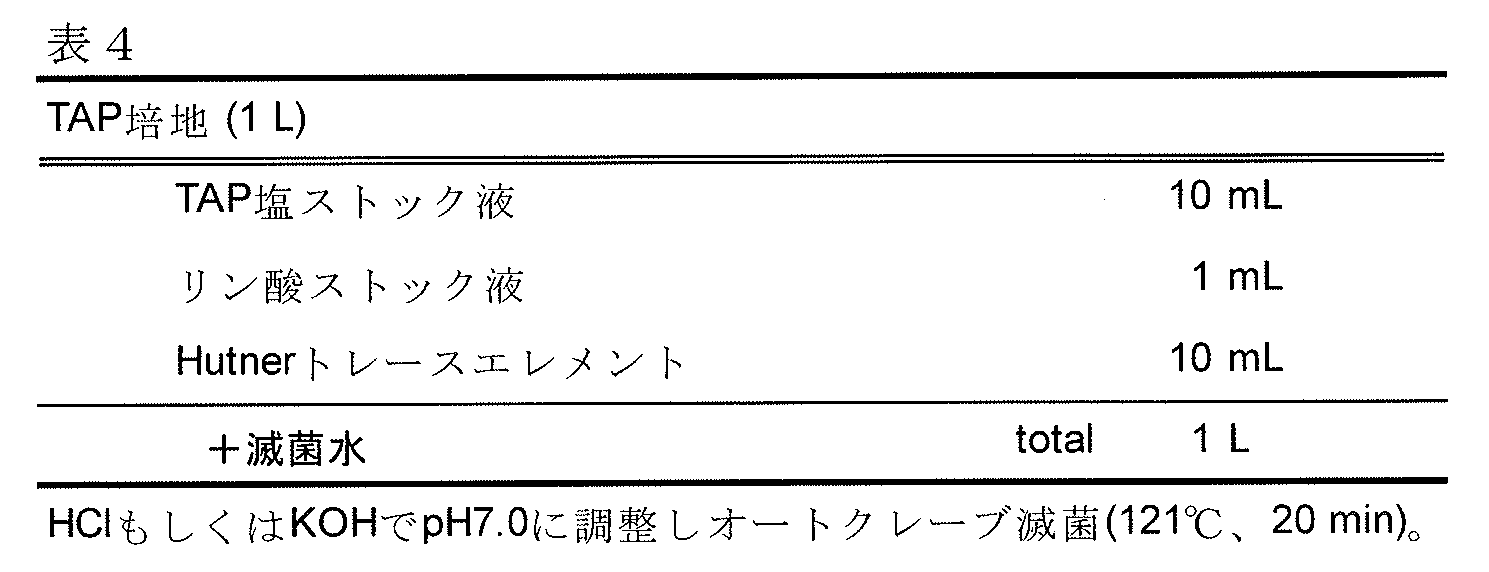
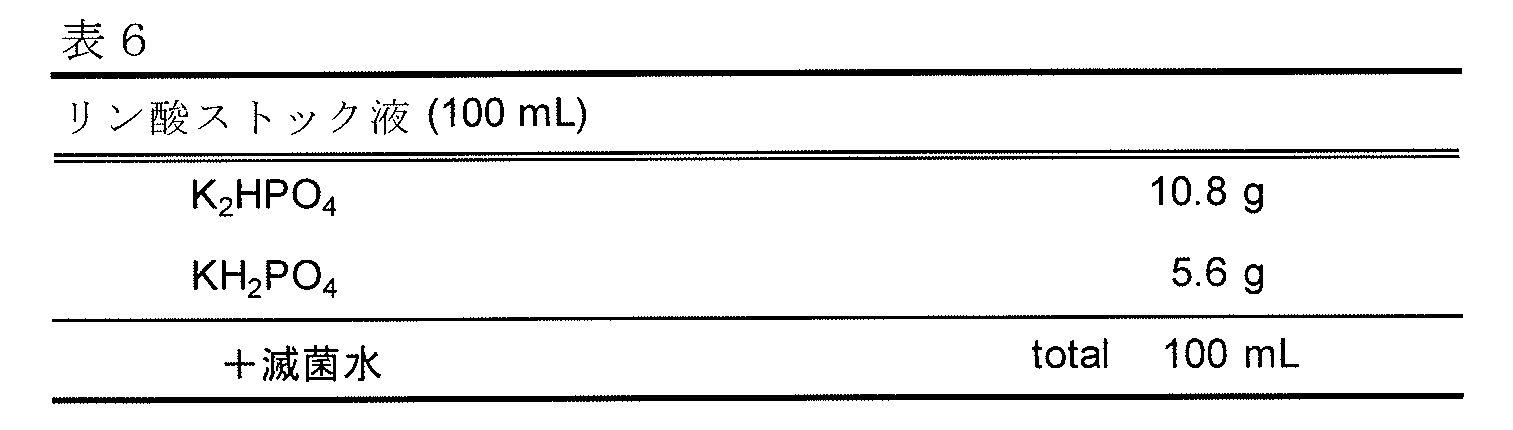
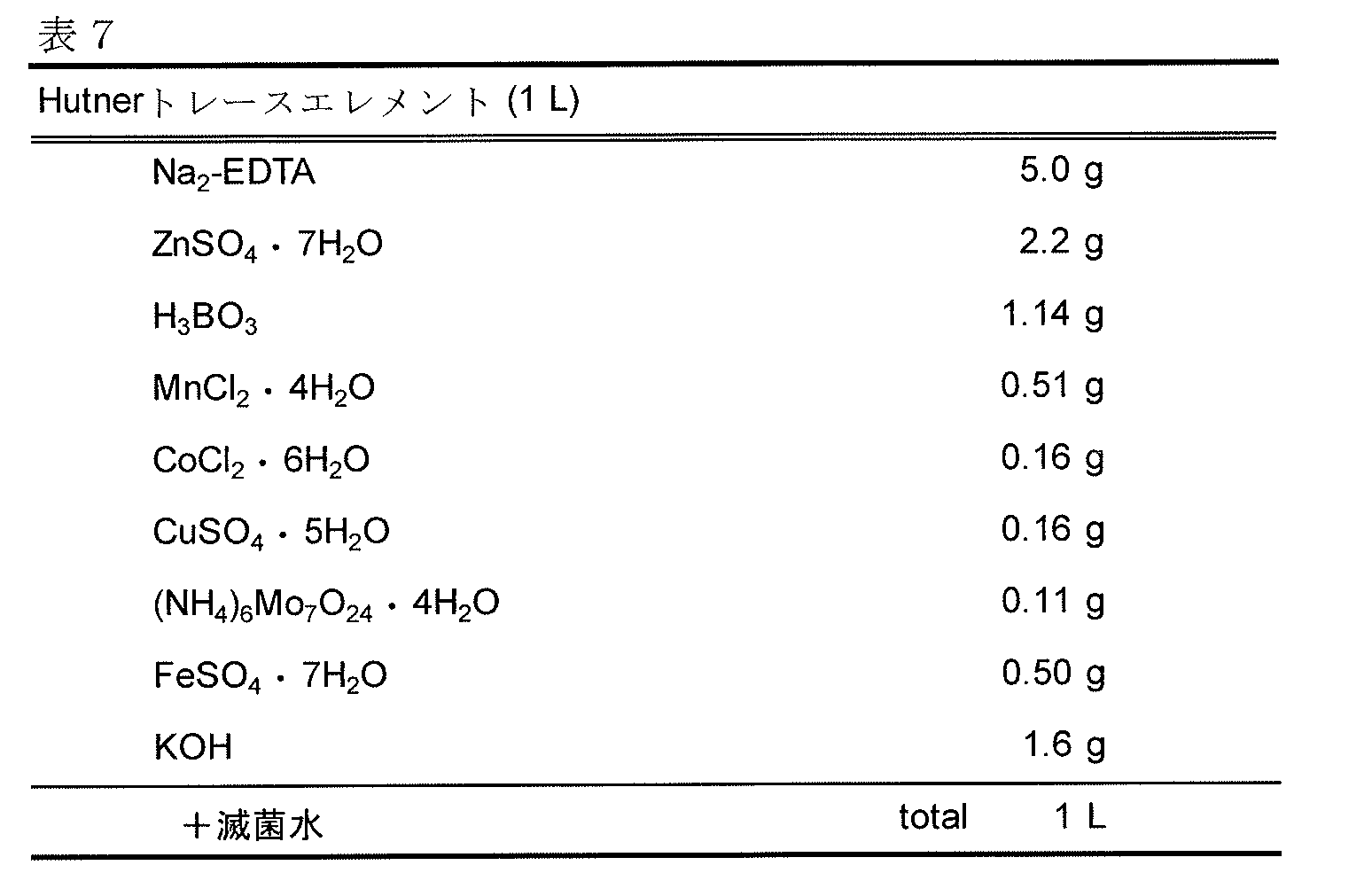
- the composition of the TAP medium is shown in Table 4, Table 5, Table 6, and Table 7.
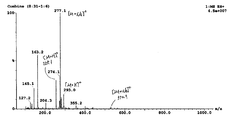
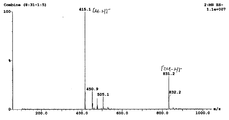
- FIG. 8 shows the HPLC analysis results. Retention time 5.89 min, 8.34 min peak results of the mass spectrometry of the, [MH] of m / z 316.8 is the former - the peak, from the latter is detected [M + Na] + peak of m / z 276.9, retention time 5.89 min peak: sulfoquinovosylglycerol, retention time 8.34 min peak: found to be monogalactosylglycerol.
- Example 5 Production of sugar glycerol from Desmodesmus sp.
- Desmodesmus sp. AJ7835 strain (FERM BP-11364) was cultured and subjected to intermediate temperature treatment to confirm the production of sugar glycerol.
- (1) Culture conditions Desmodesmus sp. AJ7835 strain (FERM BP-11364) was precultured in 0.2 ⁇ Gamborg's B5 medium (Nippon Pharmaceutical Co., Ltd.) for 7 days.
- FIG. 9 shows the HPLC analysis results. Retention time 5.89 min, 8.34 min peak results of the mass spectrometry of the, [MH] of m / z 316.8 is the former - the peak, from the latter is detected [M + Na] + peak of m / z 277.0, retention time 5.88 min peak: found to be sulfoquinovosylglycerol, retention time 8.46 min peak: monogalactosylglycerol.
- Reference Example 1 Synthesis of Sugar Glycerol Standard Products
- a standard product of each sugar glycerol was synthesized using commercially available glyceroglycolipid as a raw material.
- 500 ⁇ L of an equal amount of methanol / tetrahydrofuran solution mixed was added to dissolve the glyceroglycolipid.
- Example 6 Separation of sugar glycerol Since the medium-temperature treated supernatant contains proteins and peptides that are self-digested products in addition to sugar glycerol, a method for separating sugar glycerol was examined in this example. .
- Example 2 Separation of sugar glycerol Chlorella kessleri 11h strain was cultured for 14 days under the culture conditions described in Example 1 to obtain a Chlorella culture solution.
- the algal body for 500 mL of Chlorella culture solution was suspended in a small amount of sterile water to prepare a 15-fold Chlorella concentrate.
- the 15-fold Chlorella concentrate was adjusted to pH 4.5 with 1N HCl and subjected to a medium temperature treatment by stirring reaction at 50 ° C. for 24 hours. The treated product after the intermediate temperature treatment was centrifuged, and the supernatant was collected.
- the collected supernatant was subjected to ion exchange using the strongly acidic cation exchange resin Dowex Monosphere 650C (Dow Chemical) and then concentrated to obtain an adsorbed fraction 13 mg and a non-adsorbed fraction 136 mg.
- sugar glycerol can be produced.
Landscapes
- Chemical & Material Sciences (AREA)
- Engineering & Computer Science (AREA)
- Life Sciences & Earth Sciences (AREA)
- Organic Chemistry (AREA)
- Wood Science & Technology (AREA)
- Biotechnology (AREA)
- Health & Medical Sciences (AREA)
- Zoology (AREA)
- Genetics & Genomics (AREA)
- Bioinformatics & Cheminformatics (AREA)
- General Health & Medical Sciences (AREA)
- Microbiology (AREA)
- Biochemistry (AREA)
- General Engineering & Computer Science (AREA)
- Chemical Kinetics & Catalysis (AREA)
- General Chemical & Material Sciences (AREA)
- Botany (AREA)
- Cell Biology (AREA)
- Medicinal Chemistry (AREA)
- Tropical Medicine & Parasitology (AREA)
- Virology (AREA)
- Biomedical Technology (AREA)
- Preparation Of Compounds By Using Micro-Organisms (AREA)
Abstract
糖グリセロールの製造法を提供する。微細藻類を培地で培養すること、前記培養により得られた藻体を中温処理および/または有機溶媒処理に供すること、および前記処理の処理物から糖グリセロールを回収することにより、糖グリセロールを製造する。
Description
本発明は、糖グリセロールの製造法に関する。
糖グリセロールとは、グリセロールの水酸基に糖がグリコシド結合した構造を有する化合物をいう。糖グリセロールは、機能性物質として、医薬品、化粧品、飲食品等に配合して利用される。しかしながら、糖グリセロールは、自然界にはほとんど存在せず、希少性が高い。
糖グリセロールは、例えば、化学合成により製造することができる。具体的には、糖グリセロールは、グリセロールの水酸基に糖を酵素的あるいは化学的にグリコシド結合させることにより、あるいは、グリセロ糖脂質からアシル基を酵素的あるいは化学的に切断することにより、製造できる。
糖グリセロールとしては、例えば、ガラクトシルグリセロールが、海苔等の紅藻類に見出されている(特許文献1)。
また、シアノバクテリアの細胞膜や葉緑体のチラコイド膜は、ガラクトシルジアシルグリセロール、ジガラクトシルジアシルグリセロール、およびスルホキノボシルジアシルグリセロール等のグリセロ糖脂質を多量に含むことが知られている(非特許文献1)。
しかしながら、微細藻類等の微生物を利用した糖グリセロールの製造法については知られていない。
小林康一 光合成研究 2009 19: 52-58
本発明は、微生物を利用した糖グリセロールの製造法を提供することを課題とする。
本発明者は、上記課題を解決するために鋭意研究を行った結果、微細藻類を培養し、得られた藻体を中温処理またはメタノール処理に供することによって、糖グリセロールが生成することを見出し、本発明を完成させた。
すなわち、本発明は以下の通り例示できる。
[1]
微細藻類を培地で培養すること、
前記培養により得られた藻体を中温処理および/または有機溶媒処理に供すること、および
前記処理の処理物から糖グリセロールを回収すること、
を含む、糖グリセロールを製造する方法。
[2]
前記糖グリセロールが、下記式(I)で示される化合物および下記式(II)で示される化合物からなる群より選択される、前記方法:

(式中、Rは、単糖、多糖、およびそれらの誘導体から選択される糖を表す);

(式中、Rは、単糖、多糖、およびそれらの誘導体から選択される糖を表す)。
[3]
前記糖が、以下の(A)~(C)からなる群より選択される、前記方法:
(A)ガラクトース;
(B)ガラクトースを構成糖として含む多糖;
(C)グルコース誘導体。
[4]
前記糖が、以下の(a)~(c)からなる群より選択される、前記方法:
(a)ガラクトース;
(b)ジガラクトース;
(c)スルホニルキノボース。
[5]
前記糖グリセロールが、ガラクトシルグリセロール、ジガラクトシルグリセロール、およびスルホキノボシルグリセロールからなる群より選択される、前記方法。
[6]
前記微細藻類が、緑色植物門に属する藻類である、前記方法。
[7]
前記微細藻類が、緑藻綱またはトレボキシア藻綱に属する藻類である、前記方法。
[8]
前記微細藻類が、クロレラ属、クラミドモナス属、デスモデスムス属、またはセネデスムス属に属する藻類である、前記方法。
[9]
前記微細藻類が、クロレラ・ケスレリ(Chlorella kessleri)、クラミドモナス・レインハルティ(Chlamydomonas reinhardtii)、またはデスモデスムス属の1種(Desmodesmus sp.)である、前記方法。
[10]
前記中温処理が、35℃~70℃で行われる、前記方法。
[11]
前記有機溶媒が、メタノールである、前記方法。
[1]
微細藻類を培地で培養すること、
前記培養により得られた藻体を中温処理および/または有機溶媒処理に供すること、および
前記処理の処理物から糖グリセロールを回収すること、
を含む、糖グリセロールを製造する方法。
[2]
前記糖グリセロールが、下記式(I)で示される化合物および下記式(II)で示される化合物からなる群より選択される、前記方法:
[3]
前記糖が、以下の(A)~(C)からなる群より選択される、前記方法:
(A)ガラクトース;
(B)ガラクトースを構成糖として含む多糖;
(C)グルコース誘導体。
[4]
前記糖が、以下の(a)~(c)からなる群より選択される、前記方法:
(a)ガラクトース;
(b)ジガラクトース;
(c)スルホニルキノボース。
[5]
前記糖グリセロールが、ガラクトシルグリセロール、ジガラクトシルグリセロール、およびスルホキノボシルグリセロールからなる群より選択される、前記方法。
[6]
前記微細藻類が、緑色植物門に属する藻類である、前記方法。
[7]
前記微細藻類が、緑藻綱またはトレボキシア藻綱に属する藻類である、前記方法。
[8]
前記微細藻類が、クロレラ属、クラミドモナス属、デスモデスムス属、またはセネデスムス属に属する藻類である、前記方法。
[9]
前記微細藻類が、クロレラ・ケスレリ(Chlorella kessleri)、クラミドモナス・レインハルティ(Chlamydomonas reinhardtii)、またはデスモデスムス属の1種(Desmodesmus sp.)である、前記方法。
[10]
前記中温処理が、35℃~70℃で行われる、前記方法。
[11]
前記有機溶媒が、メタノールである、前記方法。
以下、本発明を詳細に説明する。
本発明の方法は、微細藻類を培地で培養すること、前記培養により得られた藻体を中温処理および/または有機溶媒処理に供すること、および前記処理の処理物から糖グリセロールを回収すること、を含む糖グリセロールを製造する方法である。同方法に用いられる微細藻類を、「本発明の微細藻類」ともいう。
<1>本発明の微細藻類
「藻類(algae)」とは、酸素発生型光合成を行う生物の内、コケ植物、シダ植物、種子植物を除いたものをいう。藻類としては、原核生物であるシアノバクテリア門(藍藻)(cyanobacteria)に属する生物や、真核生物である灰色植物門(Glaucophyta)、紅色植物門(紅藻)(Rhodophyta)、緑色植物門(Chlorophyta)、クリプト植物門(クリプト藻)(Cryptophyta)、ハプト植物門(ハプト藻)(Haptophyta)、不等毛植物門(Heterokontophyta)、渦鞭毛植物門(渦鞭毛藻)(Dinophyta)、ユーグレナ植物門(Euglenophyta)、クロララクニオン植物門(Chlorarachniophyta)等の門に属する生物が挙げられる。藻類には、単細胞生物および多細胞生物の両方が含まれる。
「藻類(algae)」とは、酸素発生型光合成を行う生物の内、コケ植物、シダ植物、種子植物を除いたものをいう。藻類としては、原核生物であるシアノバクテリア門(藍藻)(cyanobacteria)に属する生物や、真核生物である灰色植物門(Glaucophyta)、紅色植物門(紅藻)(Rhodophyta)、緑色植物門(Chlorophyta)、クリプト植物門(クリプト藻)(Cryptophyta)、ハプト植物門(ハプト藻)(Haptophyta)、不等毛植物門(Heterokontophyta)、渦鞭毛植物門(渦鞭毛藻)(Dinophyta)、ユーグレナ植物門(Euglenophyta)、クロララクニオン植物門(Chlorarachniophyta)等の門に属する生物が挙げられる。藻類には、単細胞生物および多細胞生物の両方が含まれる。
「微細藻類(microalgae)」とは、これら藻類から多細胞生物である海藻類を除いた微視的な構造を有する藻類をいう(バイオディバーシティ・シリーズ(3)藻類の多様性と系統:千原光雄 編 裳華房(1999))。なお、微細藻類には、複数個の細胞が群体を形成するものも含まれる。
本発明の微細藻類は、このような微細藻類に分類されるものであれば、いずれのものであってもよい。本発明の微細藻類としては、例えば、緑色植物門(Chlorophyta)に属する藻類が好ましい。
緑色植物門(Chlorophyta)に属する藻類としては、例えば、緑藻綱(Chlorophyceae)、トレボキシア藻綱(Trebouxiophyceae)、プラシノ藻綱(Prasinophyceae)、アオサ藻綱(Ulvophyceae)、車軸藻綱(Charophyceae)等の綱に属する藻類が挙げられる。これらの中では、例えば、緑藻綱に属する藻類やトレボキシア藻綱に属する藻類が好ましい。
緑藻綱(Chlorophyceae)に属する藻類としては、例えば、クラミドモナス(Chlamydomonas)属、セネデスムス(Scenedesmus)属、デスモデスムス(Desmodesmus)属等の属に属する藻類が挙げられる。トレボキシア藻綱に属する藻類としては、例えば、クロレラ(Chlorella)属等の属に属する藻類が挙げられる。
クラミドモナス(Chlamydomonas)属藻類としては、例えば、下記のような種が挙げられる。
クラミドモナス・モブシー(Chlamydomonas moewusii)
クラミドモナス・ニバリス(Chlamydomonas nivalis)
クラミドモナス・レインハルティ(Chlamydomonas reinhardtii)
クラミドモナス・モブシー(Chlamydomonas moewusii)
クラミドモナス・ニバリス(Chlamydomonas nivalis)
クラミドモナス・レインハルティ(Chlamydomonas reinhardtii)
Chlamydomonas reinhardtiiとして、具体的には、例えば、Chlamydomonas reinhardtii C9株やChlamydomonas reinhardtii CC125株が挙げられる。Chlamydomonas reinhardtii C9株は、ミネソタ大学クラミドモナスリソースセンター(Chlamydomonas Resource Center, University of Minnesota, 250 Biological Sciences Center, 1445 Gortner Avenue, St. Paul, MN 55108, USA)から入手できる。
セネデスムス(Scenedesmus)属藻類としては、例えば、下記のような種が挙げられる。
セネデスムス・アキュムナタス(S. acumunatus)
セネデスムス・ジモルファス(S. dimorphus)
セネデスムス・ジシフォルミス(S. disciformis)
セネデスムス・オバルテルムス(S. ovaltermus)
セネデスムス・アキュムナタス(S. acumunatus)
セネデスムス・ジモルファス(S. dimorphus)
セネデスムス・ジシフォルミス(S. disciformis)
セネデスムス・オバルテルムス(S. ovaltermus)
デスモデスムス(Desmodesmus)属藻類としては、例えば、下記のような種が挙げられる。
デスモデスムス・アルマタス(D. armatus)
デスモデスムス・アルスロデスミフォルミス(D. arthrodesmiformis)
デスモデスムス・アシンメトリカス(D. asymmetricus)
デスモデスムス・ビセルラリス(D. bicellularis)
デスモデスムス・ブラシリエンシス(D. brasiliensis)
デスモデスムス・コムニス(D. communis)
デスモデスムス・キュネアタス(D. cuneatus)
デスモデスムス・デンチキュラタス(D. denticulatus)
デスモデスムス・フェニカス(D. fennicus)
デスモデスムス・ヒストリクス(D. hystrix)
デスモデスムス・コマレキー(D. komarekii)
デスモデスムス・レフェブレイ(D. lefevrei)
デスモデスムス・マクシムス(D. maximus)
デスモデスムス・マルチバリアビリス(D. multivariabilis)
デスモデスムス・オポリエンシス(D. opoliensis)
デスモデスムス・パノニカス(D. pannonicus)
デスモデスムス・ペルフォラタス(D. perforatus)
デスモデスムス・ピルコレイ(D. pirkollei)
デスモデスムス・プライオモルファス(D. pleiomorphus)
デスモデスムス・クアドリカウダ(D. quadricauda)
デスモデスムス・セラタス(D. serratus)
デスモデスムス・サブスピカタス(D. subspicatus)
デスモデスムス・トロピカス(D. tropicus)
デスモデスムス・アルマタス(D. armatus)
デスモデスムス・アルスロデスミフォルミス(D. arthrodesmiformis)
デスモデスムス・アシンメトリカス(D. asymmetricus)
デスモデスムス・ビセルラリス(D. bicellularis)
デスモデスムス・ブラシリエンシス(D. brasiliensis)
デスモデスムス・コムニス(D. communis)
デスモデスムス・キュネアタス(D. cuneatus)
デスモデスムス・デンチキュラタス(D. denticulatus)
デスモデスムス・フェニカス(D. fennicus)
デスモデスムス・ヒストリクス(D. hystrix)
デスモデスムス・コマレキー(D. komarekii)
デスモデスムス・レフェブレイ(D. lefevrei)
デスモデスムス・マクシムス(D. maximus)
デスモデスムス・マルチバリアビリス(D. multivariabilis)
デスモデスムス・オポリエンシス(D. opoliensis)
デスモデスムス・パノニカス(D. pannonicus)
デスモデスムス・ペルフォラタス(D. perforatus)
デスモデスムス・ピルコレイ(D. pirkollei)
デスモデスムス・プライオモルファス(D. pleiomorphus)
デスモデスムス・クアドリカウダ(D. quadricauda)
デスモデスムス・セラタス(D. serratus)
デスモデスムス・サブスピカタス(D. subspicatus)
デスモデスムス・トロピカス(D. tropicus)
デスモデスムス(Desmodesmus)属藻類として、具体的には、例えば、Desmodesmus sp. AJ7835株が挙げられる。Desmodesmus sp. AJ7835株は、2011年4月12日に、独立行政法人産業技術総合研究所 特許生物寄託センター(現、独立行政法人製品評価技術基盤機構 特許生物寄託センター、日本国千葉県木更津かずさ鎌足2丁目5番地8 120号室、郵便番号292-0818)に、受託番号FERM BP-11364の下に寄託されている。
クロレラ(Chlorella)属藻類としては、例えば、下記のような種が挙げられる。
クロレラ・ケスレリ(Chlorella kessleri)
クロレラ・ピレノイドーサ(Chlorella pyrenoidosa)
クロレラ・ブルガリス(Chlorella vulgaris)
クロレラ・ケスレリ(Chlorella kessleri)
クロレラ・ピレノイドーサ(Chlorella pyrenoidosa)
クロレラ・ブルガリス(Chlorella vulgaris)
Chlorella kessleriとして、具体的には、例えば、Chlorella kessleri 11h株(UTEX 263)が挙げられる。Chlorella kessleri 11h株は、テキサス大学藻類カルチャーコレクション(The University of Texas at Austin, The Culture Collection of Algae (UTEX), 1 University Station A6700, Austin, TX 78712-0183, USA)から入手できる。
<2>培養方法
培養方法は、本発明の微細藻類が増殖できる限り、特に制限されない。培養条件は、用いる微細藻類の種類等の諸条件に応じて適宜設定することができる。培養は、例えば、微細藻類の培養に用いられる通常の条件で行うことができる。微細藻類の培養については多くの知見があり、例えば、Chlorella属藻類、Arthrospira属藻類(Spirulina)、およびDunaliella salina等の藻類は、食用として、工業的に大規模な培養が行われている(Spolaore, P. et al. 2006. J. Biosci. Bioeng. 101: 87-96)。培養は、例えば、このような知見を参照して実施してよい。
培養方法は、本発明の微細藻類が増殖できる限り、特に制限されない。培養条件は、用いる微細藻類の種類等の諸条件に応じて適宜設定することができる。培養は、例えば、微細藻類の培養に用いられる通常の条件で行うことができる。微細藻類の培養については多くの知見があり、例えば、Chlorella属藻類、Arthrospira属藻類(Spirulina)、およびDunaliella salina等の藻類は、食用として、工業的に大規模な培養が行われている(Spolaore, P. et al. 2006. J. Biosci. Bioeng. 101: 87-96)。培養は、例えば、このような知見を参照して実施してよい。
培養は、光合成を利用し有機化合物を利用しない独立栄養培養(autotrophic culture)、光合成を利用せず有機化合物を利用する従属栄養培養(heterotrophic culture)、または光合成と有機化合物の両方を利用する混合栄養培養(mixotrophic culture)により実施することができる。通常は、独立栄養培養(autotrophic culture)により微細藻類を培養してよい。
培養は、解放系で行われてもよく、閉鎖系で行われてもよい。例えば、オープンポンドと呼ばれる解放培養系で培養を行うことができる。また、例えば、クローズドフォトバイオリアクターと呼ばれる閉鎖培養系で培養を行うことができる。
培養に用いられる培地は、本発明の微細藻類が増殖できる限り、特に制限されない。培地は、例えば、窒素源や各種無機塩を含有していてよい。また、培地は、例えば、必要に応じて炭素源等の他の成分を含有していてもよい。培地成分の種類や濃度は、用いる微細藻類の種類等の諸条件に応じて適宜設定することができる。培地としては、例えば、微細藻類の培養に用いられる通常の培地を用いることができる。そのような培地として、具体的には、例えば、0.3×HSM培地(Oyama, Y. et al. 2006. Planta 224: 646-654)、0.2×ガンボーグ培地(Izumo, A. et al. 2007. Plant Science 172: 1138-1147)、modified NORO培地(Yamaberi, K. et al. 1998. J. Mar. Biotechnol. 6: 44-48; Takagi, M. et al. 2000. Appl. Microbiol. Biotechnol. 54: 112-117)、Bold's Basal Medium(Tornabene, T. G. et al. 1983. Enzyme and Microb. Technol. 5: 435-440; Archibald, P. A. and Bold, H. C. 1970. Phytomorphology 20: 383-389)、F/2培地(Lie, C.-P. and Lin, L.-P. 2001. Bot. Bull. Acad. Sin. 42: 207-214)、TAP培地が挙げられる。Chlamydomonas reinhardtii等のChlamydomonas属藻類の培養には、例えば、TAP培地や0.3×HSM培地を用いることができる。また、Chlorella kessleri等のChlorella属藻類の培養には、例えば、0.2×ガンボーグ培地を用いることができる。また、Scenedesmus属藻類やDesmodesmus属藻類の培養には、例えば、0.2×ガンボーグ培地を用いることができる。また、藻類は、窒素源が枯渇すると油脂を藻体内に蓄積することが知られている(Thompson GA Jr. 1996. Biochim. Biophys. Acta 1302: 17-45)。本発明においては、窒素源の濃度を制限した培地を微細藻類の培養に用いてもよい。
培養は、液体培地を用いて行うことができる。培養温度は、例えば、20~40℃、好ましくは25℃~35℃であってよい。培地の初発pHは、例えば、中性付近であってよい。中性付近とは、例えば、7~9であってよい。培養中はpH調整を行ってもよく、行わなくともよい。pH調整には、適当な無機あるいは有機の酸性あるいはアルカリ性物質を使用することができる。培養は、通気しながら行ってよい。通気量は、例えば、培養液単位体積当たりの1分間の通気量として、0.1~2 vvm(volume per volume per minute)であってよい。培養液には、さらにCO2を供給してもよい。CO2の供給量は、例えば、通気量に対して、0.5~5%(v/v)であってよい。CO2と空気は、別個に培養液に供給してもよく、混合して培養液に供給してもよい。光合成を利用する場合、培養系に光を供給する。光は、適当な光源を利用して供給することができる。光源としては、例えば、白色蛍光灯、白色発光ダイオード、高圧ナトリウムランプ、太陽光が挙げられる。これらの光源は、適宜組み合わせて利用してもよい。光の照度は、例えば、1,000~10,000 luxであってよい。培養液は、適宜、撹拌または循環させてよい。光の供給、空気の供給、CO2の供給、撹拌、循環等の各種操作は、連続的に行われてもよく、間欠的に行われてもよい。各種操作の条件は、培養を通じて一定であってもよく、そうでなくてもよい。培養期間は、例えば、1~40日間であってよい。培養は、回分培養(batch culture)、流加培養(Fed-batch culture)、連続培養(continuous culture)、またはそれらの組み合わせにより実施することができる。また、培養は、種培養と本培養とに分けて行われてもよい。本培養は、例えば、本培養の培地に、種培養液を1~50%(v/v)植菌することにより行ってよい。種培養と本培養の培養条件は、同一であってもよく、そうでなくてもよい。例えば、種培養と本培養を、共に回分培養で行ってもよい。また、例えば、種培養を回分培養で行い、本培養を流加培養または連続培養で行ってもよい。
このようにして微細藻類を培養することにより、培地に微細藻類の藻体が生成する。
<3>中温処理および有機溶媒処理
本発明の方法においては、培養により得られた藻体を中温処理および/または有機溶媒処理に供する。本発明の方法においては、中温処理および有機溶媒処理の片方のみを実施してもよく、両方を実施してもよい。両方を実施する場合、その順番は特に制限されない。また、両方が同時に実施されてもよい。なお、中温処理および有機溶媒処理を総称して、糖グリセロール生成処理という場合がある。
本発明の方法においては、培養により得られた藻体を中温処理および/または有機溶媒処理に供する。本発明の方法においては、中温処理および有機溶媒処理の片方のみを実施してもよく、両方を実施してもよい。両方を実施する場合、その順番は特に制限されない。また、両方が同時に実施されてもよい。なお、中温処理および有機溶媒処理を総称して、糖グリセロール生成処理という場合がある。
藻体は、培地に含まれたまま糖グリセロール生成処理に供してもよく、培地から回収してから糖グリセロール生成処理に供してもよい。また、藻体は、適宜前処理を行ってから糖グリセロール生成処理に供してもよい。前処理としては、例えば、希釈、濃縮、凍結、融解、乾燥、破砕等が挙げられる。これらの前処理は、適宜組み合わせて行ってもよい。
藻体を培地から回収する手法は特に制限されず、例えば公知の手法(Grima, E. M. et al. 2003. Biotechnol. Advances 20: 491-515)を利用できる。具体的には、例えば、自然沈降、遠心分離、濾過等の手法により、藻体を培地から回収することができる。また、その際、凝集剤(flocculant)を利用してもよい。回収した藻体は、適当な媒体を用いて適宜洗浄することができる。また、回収した藻体は、適当な媒体を用いて適宜再懸濁することができる。洗浄や懸濁に利用できる媒体としては、例えば、水や水性緩衝液等の水性媒体(水性溶媒)、メタノール等の有機媒体(有機溶媒)、およびそれらの混合物が挙げられる。媒体は、糖グリセロール生成処理の種類等の諸条件に応じて適宜選択することができる。
藻体は、例えば、所望の程度に希釈または濃縮してから糖グリセロール生成処理に供してよい。藻体の希釈は、上述したような適当な媒体を用いて行うことができる。藻体の濃縮は、例えば、藻体を沈殿させ、上清を適宜除くことにより、行うことができる。また、藻体の濃縮は、例えば、凍結乾燥やエバポレーションにより行うこともできる。
藻体は、例えば、破砕してから糖グリセロール生成処理に供してよい。藻体を破砕する手法は特に制限されず、例えば公知の手法を利用できる。藻体を破砕する手法としては、例えば、高温処理、煮沸処理、強アルカリ処理、超音波処理、フレンチプレス等が挙げられる。これらの手法は、適宜組み合わせて行ってもよい。高温処理としては、例えば、100℃以上、150℃以上、または175~215℃の温度での処理が挙げられる。また、高温処理としては、水熱反応と呼ばれるような高温高圧反応も挙げられる。
藻体は、例えば、一旦凍結させてから糖グリセロール生成処理に供してよい。凍結温度は、例えば、0℃以下、-20℃以下、または-50℃以下であってよく、-80℃以上であってもよい。凍結時間は、例えば、1時間以上であってよく、24時間以下であってもよい。また、凍結融解を繰り返してもよい。
<中温処理>
以下、中温処理について説明する。「中温処理」とは、中温度での処理をいう。中温処理としては、例えば、WO2011/013707に記載の中温度での処理を参照できる。中温処理の条件は、中温処理により糖グリセロールが生成する限り特に制限されない。藻体は、上述したような適当な媒体に懸濁した状態で中温処理に供することができる。「中温度」とは、糖グリセロールが生成する温度であれば特に制限されない。中温度は、微細藻類の種類や処理時間等の諸条件に応じて適宜設定できる。中温度は、例えば、35℃以上、40℃以上、45℃以上、または50℃以上であってよい。また、中温度は、例えば、70℃以下、65℃以下、または60℃以下であってよい。中温処理の時間は、微細藻類の種類や処理温度等の諸条件に応じて適宜設定できる。中温処理の時間は、例えば、1時間以上、または5時間以上であってよい。また、中温処理の時間は、例えば、48時間以下、または24時間以下であってよい。中温処理は、静置で行ってもよく、撹拌や振とうしながら行ってもよい。
以下、中温処理について説明する。「中温処理」とは、中温度での処理をいう。中温処理としては、例えば、WO2011/013707に記載の中温度での処理を参照できる。中温処理の条件は、中温処理により糖グリセロールが生成する限り特に制限されない。藻体は、上述したような適当な媒体に懸濁した状態で中温処理に供することができる。「中温度」とは、糖グリセロールが生成する温度であれば特に制限されない。中温度は、微細藻類の種類や処理時間等の諸条件に応じて適宜設定できる。中温度は、例えば、35℃以上、40℃以上、45℃以上、または50℃以上であってよい。また、中温度は、例えば、70℃以下、65℃以下、または60℃以下であってよい。中温処理の時間は、微細藻類の種類や処理温度等の諸条件に応じて適宜設定できる。中温処理の時間は、例えば、1時間以上、または5時間以上であってよい。また、中温処理の時間は、例えば、48時間以下、または24時間以下であってよい。中温処理は、静置で行ってもよく、撹拌や振とうしながら行ってもよい。
中温処理は、連続的に行われてもよく、間欠的に行われてもよい。処理温度等の反応条件は、中温処理を通じて一定であってもよく、そうでなくてもよい。すなわち、藻体は、例えば、連続で同じ温度で処理(以下、「連続中温処理」ともいう)してもよく、途中で温度を低下させて処理してもよい。連続中温処理は、例えば、上記例示した中温度の範囲および上記例示した中温処理の時間の範囲で行われてよい。途中で温度を低下させる態様としては、例えば、第一段中温処理として一旦中温度で処理した後に、第二段中温処理として、第一段中温処理の温度を下回る一定の温度で処理する態様が挙げられる。第一段中温処理の温度は、例えば、上記例示した中温度の範囲であってよい。第二段中温処理の温度は、例えば、30℃以上、35℃以上、または40℃以上であってよい。また、第二段中温処理の温度は、例えば、55℃以下、50℃以下、または45℃以下であってよい。第一段中温処理の時間は、例えば、1分以上、または20分以上であってよい。第一段中温処理の時間は、例えば、120分以下、または60分以下であってよい。第二段中温処理の時間は、例えば、1時間以上、または4時間以上であってよい。第二段中温処理の時間は、例えば、20時間以下、または15時間以下であってよい。
中温処理の前には、反応系のpHを弱酸性に調整してもよい。弱酸性とは、例えば、pH 3.0~7.0、またはpH 4.0~6.0であってよい。pHの調製は、例えば、塩酸等の無機酸を用いて行うことができる。
<有機溶媒処理>
以下、有機溶媒処理について説明する。「有機溶媒処理」とは、有機溶媒による処理をいう。有機溶媒処理の条件は、有機溶媒処理により糖グリセロールが生成する限り特に制限されない。有機溶媒処理は、藻体と有機溶媒を接触させることにより行うことができる。例えば、回収した藻体を有機溶媒で懸濁してもよいし、藻体の懸濁物に有機溶媒を添加してもよい。有機溶媒としては、例えば、メタノールやエタノール等のアルコール類、ホルムアルデヒドやアセトアルデヒド等のアルデヒド類、アセトン等のケトン類、ジエチルエーテル等のエーテル類、酢酸エチル等のエステル類、n-ヘキサン等のアルカン類、ベンゼン、フェノール、クロロホルムが挙げられる。有機溶媒としては、水溶性のものが好ましい。有機溶媒としては、アルコールが好ましく、メタノールがより好ましい。有機溶媒としては、1種の有機溶媒を用いてもよく、2種またはそれ以上の有機溶媒を組み合わせて用いてもよい。有機溶媒は、純品であってもよく、他の成分との混合物であってもよい。他の成分としては、例えば、水や水性緩衝液等の水性媒体(水性溶媒)が挙げられる。すなわち、例えば、有機溶媒処理には、有機溶媒の水溶液を利用することができる。混合物中の有機溶媒濃度は、例えば、10%(v/v)以上、または20%(v/v)以上であってよく、90%(v/v)以下、70%(v/v)以下、または50%(v/v)以下であってよい。また、有機溶媒処理を行う反応液中の有機溶媒濃度は、例えば、10%(v/v)以上、または20%(v/v)以上であってよく、90%(v/v)以下、70%(v/v)以下、または50%(v/v)以下であってよい。有機溶媒処理の時間は、例えば、10分以上、30分以上、または1時間以上であってよい。また、有機溶媒処理の時間は、例えば、10時間以下、5時間以下、または3時間以下であってよい。有機溶媒処理の温度は、制御されてもよく、制御されなくてもよい。有機溶媒処理の温度は、例えば、10~70℃であってよく、室温であってもよい。有機溶媒処理は、静置で行ってもよく、撹拌や振とうしながら行ってもよい。
以下、有機溶媒処理について説明する。「有機溶媒処理」とは、有機溶媒による処理をいう。有機溶媒処理の条件は、有機溶媒処理により糖グリセロールが生成する限り特に制限されない。有機溶媒処理は、藻体と有機溶媒を接触させることにより行うことができる。例えば、回収した藻体を有機溶媒で懸濁してもよいし、藻体の懸濁物に有機溶媒を添加してもよい。有機溶媒としては、例えば、メタノールやエタノール等のアルコール類、ホルムアルデヒドやアセトアルデヒド等のアルデヒド類、アセトン等のケトン類、ジエチルエーテル等のエーテル類、酢酸エチル等のエステル類、n-ヘキサン等のアルカン類、ベンゼン、フェノール、クロロホルムが挙げられる。有機溶媒としては、水溶性のものが好ましい。有機溶媒としては、アルコールが好ましく、メタノールがより好ましい。有機溶媒としては、1種の有機溶媒を用いてもよく、2種またはそれ以上の有機溶媒を組み合わせて用いてもよい。有機溶媒は、純品であってもよく、他の成分との混合物であってもよい。他の成分としては、例えば、水や水性緩衝液等の水性媒体(水性溶媒)が挙げられる。すなわち、例えば、有機溶媒処理には、有機溶媒の水溶液を利用することができる。混合物中の有機溶媒濃度は、例えば、10%(v/v)以上、または20%(v/v)以上であってよく、90%(v/v)以下、70%(v/v)以下、または50%(v/v)以下であってよい。また、有機溶媒処理を行う反応液中の有機溶媒濃度は、例えば、10%(v/v)以上、または20%(v/v)以上であってよく、90%(v/v)以下、70%(v/v)以下、または50%(v/v)以下であってよい。有機溶媒処理の時間は、例えば、10分以上、30分以上、または1時間以上であってよい。また、有機溶媒処理の時間は、例えば、10時間以下、5時間以下、または3時間以下であってよい。有機溶媒処理の温度は、制御されてもよく、制御されなくてもよい。有機溶媒処理の温度は、例えば、10~70℃であってよく、室温であってもよい。有機溶媒処理は、静置で行ってもよく、撹拌や振とうしながら行ってもよい。
このようにして藻体を糖グリセロール生成処理に供することにより、糖グリセロールが生成する。
<4>糖グリセロール
「糖グリセロール」とは、グリセロールの水酸基に糖がグリコシド結合した構造を有する化合物をいう。糖は、グリセロールのいずれの水酸基に結合していてもよい。糖は、グリセロールの3つの水酸基の内、1つの水酸基のみに結合していてもよく、2つまたは3つの水酸基に結合していてもよい。本発明においては、1種の糖グリセロールのみが製造されてもよく、2種またはそれ以上の糖グリセロールが製造されてもよい。
「糖グリセロール」とは、グリセロールの水酸基に糖がグリコシド結合した構造を有する化合物をいう。糖は、グリセロールのいずれの水酸基に結合していてもよい。糖は、グリセロールの3つの水酸基の内、1つの水酸基のみに結合していてもよく、2つまたは3つの水酸基に結合していてもよい。本発明においては、1種の糖グリセロールのみが製造されてもよく、2種またはそれ以上の糖グリセロールが製造されてもよい。
糖グリセロールとしては、例えば、下記式(I)で示される化合物および下記式(II)で示される化合物が挙げられる。


上記式(I)は、グリセロールの1位または3位の炭素の水酸基に糖が結合した糖グリセロールの構造式である。上記式(II)は、グリセロールの2位の炭素の水酸基に糖が結合した糖グリセロールの構造式である。
糖の種類は特に制限されない。糖は、単糖、多糖、またはそれらの誘導体であってよい。
単糖として、具体的には、例えば、グルコースやガラクトースが挙げられる。
「多糖」とは、2分子またはそれ以上の単糖で構成される糖をいう。すなわち、ここでいう多糖には、二糖やオリゴ糖も含まれる。多糖は、直鎖状であってもよく、分岐鎖を有していてもよい。多糖は、1種の単糖で構成されていてもよく、2種またはそれ以上の単糖で構成されていてもよい。多糖の重合度は、特に制限されないが、例えば、2~50、2~10、または2~5であってよい。多糖としては、例えば、ガラクトースを構成糖として含む多糖が挙げられる。ガラクトースを構成糖として含む多糖として、具体的には、例えば、ジガラクトースが挙げられる。
「糖の誘導体」とは、原子や官能基等の構成要素が導入、置換、または除去された糖をいう。以下、構成要素の導入、置換、および除去を総称して「改変」ともいう。改変を受ける箇所は特に制限されず、例えば、炭素原子上であってもよく、酸素原子上であってもよく、それ以外の箇所であってもよい。改変を受ける箇所は、1ヶ所であってよく、2ヶ所またはそれ以上であってもよい。改変の種類は、1種であってもよく、2種またはそれ以上であってもよい。糖の誘導体としては、例えば、デオキシ糖、アミノ糖、糖酸、糖アルコールが挙げられる。また、導入される官能基としては、例えば、アセチル基、アミノ基、アルキル基、スルホニル基(-SO3-R)が挙げられる。スルホニル基(-SO3-R)の「R」は、特に制限されないが、例えば、水素原子(H)やアルキル基であってよい。スルホニル基(-SO3-R)は、例えば、スルホ基(-SO3H)であってよい(R=Hの場合)。糖の誘導体としては、例えば、グルコース誘導体やガラクトース誘導体が挙げられる。グルコース誘導体として、具体的には、例えば、キノボースやスルホニルキノボースが挙げられる。スルホニルキノボースは、例えば、スルホキノボースであってよい(R=Hの場合)。ガラクトース誘導体として、具体的には、例えば、フコースやスルホニルフコースが挙げられる。スルホニルフコースは、例えば、スルホフコースであってよい(R=Hの場合)。
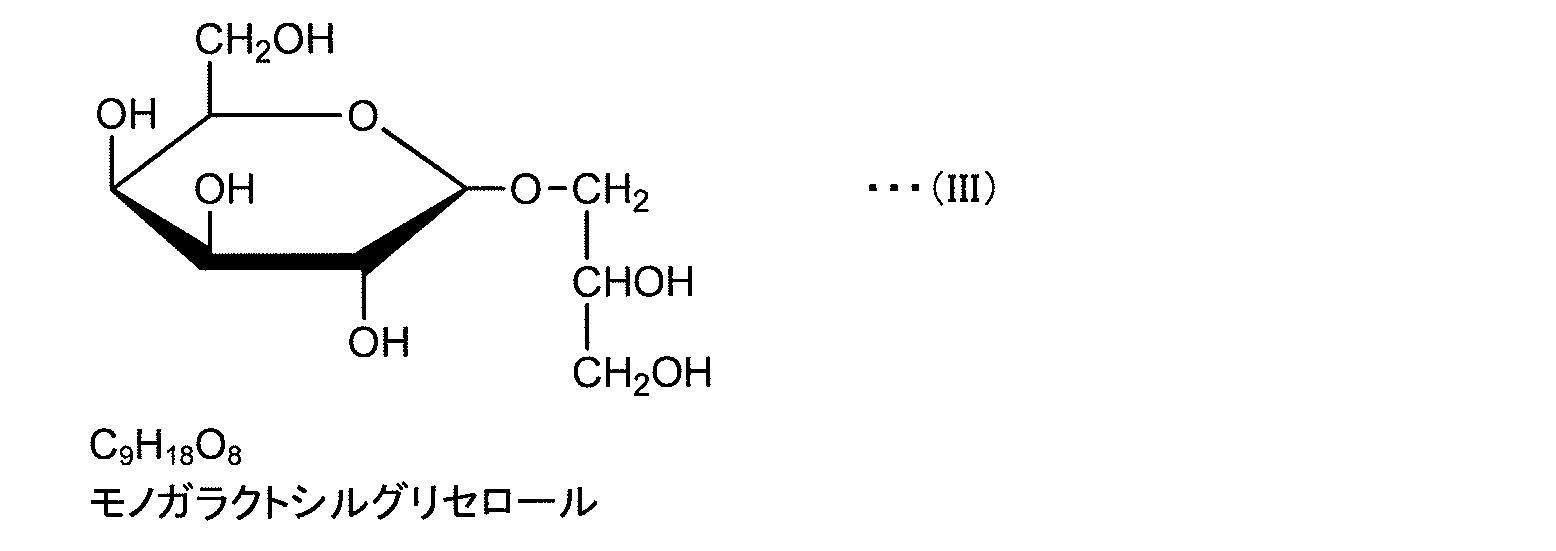
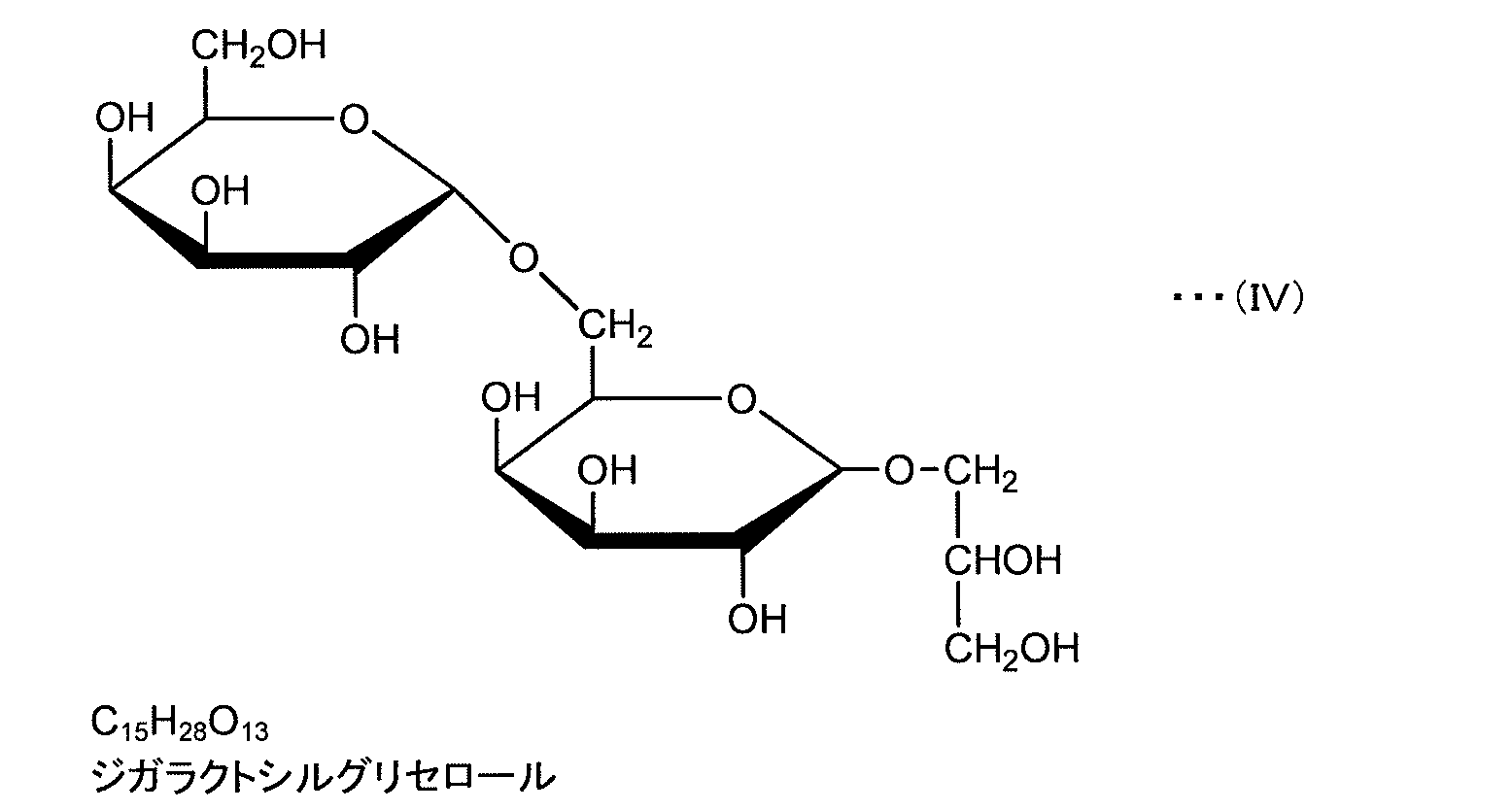
糖グリセロールとして、具体的には、例えば、ガラクトシルグリセロール、ジガラクトシルグリセロール、およびスルホキノボシルグリセロールが挙げられる。ガラクトシルグリセロールは、グリセロールのいずれか1つの炭素の水酸基にガラクトースが結合した糖グリセロールである。ジガラクトシルグリセロールは、グリセロールのいずれか1つの炭素の水酸基にジガラクトースが結合した糖グリセロールである。スルホキノボシルグリセロールは、グリセロールのいずれか1つの炭素の水酸基にスルホキノボースが結合した糖グリセロールである。ガラクトシルグリセロール、ジガラクトシルグリセロール、およびスルホキノボシルグリセロールは、特記しない限り、いずれも、グリセロールの1位の炭素の水酸基に糖が結合したもの、グリセロールの2位の炭素の水酸基に糖が結合したもの、グリセロールの3位の炭素の水酸基に糖が結合したもの、またはそれらの混合物であってよい。ガラクトシルグリセロール、ジガラクトシルグリセロール、およびスルホキノボシルグリセロールについて、グリセロールの1位または3位の炭素の水酸基に糖が結合したものの構造式を下記式(III)~(V)に示す。

糖グリセロールが生成したことは、化合物の検出または同定に用いられる公知の手法により確認することができる。そのような手法としては、例えば、HPLC、LC/MS、GC/MS、NMRが挙げられる。これらの手法は適宜組み合わせて用いることができる。
生成した糖グリセロールの回収は、化合物の分離精製に用いられる公知の手法により行うことができる。そのような手法としては、例えば、イオン交換樹脂法や膜処理法が挙げられる。これらの手法は適宜組み合わせて用いることができる。
回収された糖グリセロールは、糖グリセロール以外に、藻体、培地成分、水分、糖グリセロール生成処理に用いられた成分、微細藻類の代謝副産物等の成分を含んでいてよい。糖グリセロールは、所望の程度に精製されていてよい。糖グリセロールの純度は、例えば、30%(w/w)以上、50%(w/w)以上、70%(w/w)以上、90%(w/w)以上、または95%(w/w)以上であってよい。
回収された糖グリセロールは、そのまま、あるいは医薬品、化粧品、飲食品等に配合して利用できる。糖グリセロールの配合量は、糖グリセロールの機能が発揮される限り、特に制限されない。糖グリセロールの配合量は、特に制限されないが、例えば、1 ppm(w/w)以上、100 ppm(w/w)以上、または1%(w/w)以上であってよい。また、糖グリセロールの配合量は、特に制限されないが、例えば、100%(w/w)以下、10%(w/w)以下、または1%(w/w)以下であってよい。糖グリセロールは、例えば、プレバイオティクス、α-アミラーゼ活性化、保湿、または細胞賦活等の機能を有し得る。
糖グリセロールは、例えば、任意の剤形で製剤化されていてよい。剤形としては、例えば、液剤、懸濁剤、散剤、錠剤、丸剤、カプセル剤が挙げられる。製剤化にあたっては、例えば、賦形剤、結合剤、崩壊剤、滑沢剤、安定化剤、矯味剤、矯臭剤、香料、希釈剤、界面活性剤等の薬理学的に許容される添加剤を使用することができる。
糖グリセロールは、例えば、飲食品に添加して利用されてよい。飲食品は、糖グリセロールを添加すること以外は、通常の飲食品と同様の原料を用い、同様の方法によって製造することができる。糖グリセロールの添加は、飲食品の製造工程のいずれの段階で行われてもよい。飲食品としては、特に制限されず、あらゆる飲食品が包含される。飲食品としては、例えば、果汁、牛乳、茶、アルコール飲料、スープ、インスタント味噌汁、インスタント吸い物などの飲料;ハム、ソーセージなどの食肉加工食品;かまぼこ、ちくわなどの水産加工食品;バター、発酵乳、粉乳などの乳製品;米飯加工品;パン;麺類;菓子;だし、風味調味料などの粉体調味料;たれ、ソース、ドレッシングなどの液体調味料等が挙げられる。
本発明は以下の実施例によって、更に具体的に説明されるが、これらはいかなる意味でも本発明を限定する意図と解してはならない。
実施例1:Chlorella kessleriからの糖グリセロール生成
本実施例では、Chlorella kessleri 11h株を培養して中温処理に供し、糖グリセロールの生成を確認した。
本実施例では、Chlorella kessleri 11h株を培養して中温処理に供し、糖グリセロールの生成を確認した。
(1)培養条件
テキサス大学藻類カルチャーコレクション(The University of Texas at Austin, The Culture Collection of Algae (UTEX), 1 University Station A6700, Austin, TX 78712-0183, USA)より、Chlorella kessleri 11h株(UTEX 263)を入手した。Chlorella kessleri 11h株を、0.2×Gamborg's B5培地(日本製薬)で7日間前培養した。得られた前培養液 16 mLを、1L容メディウムビンに入れた0.2×Gamborg's B5培地(日本製薬) 800 mLに植菌し、ポータブルガス混合装置PMG-1(コフロック)を使用し空気とCO2を混合し3% CO2濃度に調整した混合ガスを500 mL/minで吹き込みながら、14日間攪拌培養し、Chlorella培養液を得た。培養は植物インキュベータCL-301(TOMY)内で行い、光照射条件は白色蛍光灯を光源とした連続照射(照度: 約5,000 lux)、温度は30℃に設定した。尚、Gamborg's B5培地の組成を表1に示す。Gamborg's B5培地は、オートクレーブ滅菌(120℃, 15 min)して使用した。
テキサス大学藻類カルチャーコレクション(The University of Texas at Austin, The Culture Collection of Algae (UTEX), 1 University Station A6700, Austin, TX 78712-0183, USA)より、Chlorella kessleri 11h株(UTEX 263)を入手した。Chlorella kessleri 11h株を、0.2×Gamborg's B5培地(日本製薬)で7日間前培養した。得られた前培養液 16 mLを、1L容メディウムビンに入れた0.2×Gamborg's B5培地(日本製薬) 800 mLに植菌し、ポータブルガス混合装置PMG-1(コフロック)を使用し空気とCO2を混合し3% CO2濃度に調整した混合ガスを500 mL/minで吹き込みながら、14日間攪拌培養し、Chlorella培養液を得た。培養は植物インキュベータCL-301(TOMY)内で行い、光照射条件は白色蛍光灯を光源とした連続照射(照度: 約5,000 lux)、温度は30℃に設定した。尚、Gamborg's B5培地の組成を表1に示す。Gamborg's B5培地は、オートクレーブ滅菌(120℃, 15 min)して使用した。

(2)中温処理条件
Chlorella培養液を遠心分離して上清を除き、Chlorella藻体を得た。得られたChlorella藻体を、少量の滅菌水で懸濁し、15倍Chlorella濃縮液を調製した。15倍Chlorella濃縮液を、1N HClにてpH4.5に調整し、50℃で24時間撹拌することにより中温処理を実施した。中温処理後の処理物を遠心分離し、残渣除去後の上清をHPLC分析に供した。
Chlorella培養液を遠心分離して上清を除き、Chlorella藻体を得た。得られたChlorella藻体を、少量の滅菌水で懸濁し、15倍Chlorella濃縮液を調製した。15倍Chlorella濃縮液を、1N HClにてpH4.5に調整し、50℃で24時間撹拌することにより中温処理を実施した。中温処理後の処理物を遠心分離し、残渣除去後の上清をHPLC分析に供した。
(3)HPLC分析条件
HPLC分析は、日立製のオートサンプラー L-7200、ポンプ L-7100、および示差屈折率検出器 L-2490に糖分析用カラム SH-1011(昭和電工)を備え付けたHPLC分析装置を使用して行った。移動相には水を用いた。HPLCで検出された各ピークのフラクションを分取し、質量分析および1H-NMR分析に供した。HPLC分析条件は、特記しない限り、以降の実施例においても同じである。
HPLC分析は、日立製のオートサンプラー L-7200、ポンプ L-7100、および示差屈折率検出器 L-2490に糖分析用カラム SH-1011(昭和電工)を備え付けたHPLC分析装置を使用して行った。移動相には水を用いた。HPLCで検出された各ピークのフラクションを分取し、質量分析および1H-NMR分析に供した。HPLC分析条件は、特記しない限り、以降の実施例においても同じである。
(4)質量分析および1H-NMR分析条件
質量分析は、ZQ(Waters)を使用して行った。1H-NMR分析は、Avance 400M (Bruker)を用いて行い、溶媒にはD2Oを使用した。質量分析および1H-NMR分析条件は、特記しない限り、以降の実施例においても同じである。
質量分析は、ZQ(Waters)を使用して行った。1H-NMR分析は、Avance 400M (Bruker)を用いて行い、溶媒にはD2Oを使用した。質量分析および1H-NMR分析条件は、特記しない限り、以降の実施例においても同じである。
(5)分析結果
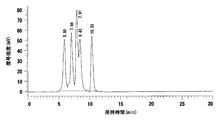
HPLC分析結果を図1に示す。保持時間5.91分、7.05分、8.06分、10.35分の4本のピークが検出された。これらの内、保持時間10.35分のピークはグリセロールのピークであることが分かっていたが、他の3つの保持時間のピークに相当する化合物は未知であった。保持時間5.91分、7.05分、8.06分のピークの質量分析の結果、各々m/z 340.8、m/z 439.0、m/z 276.8の[M+Na]+ピークが検出され、保持時間5.91分のピーク: スルホキノボシルグリセロール、保持時間7.05分のピーク: ジガラクトシルグリセロール、保持時間8.06分のピーク: モノガラクトシルグリセロールであることが分かった。また、保持時間5.91分、7.05分、8.06分のピークの1H-NMR分析結果は各糖グリセロール標準品の1H-NMR分析結果と一致した。なお、各糖グリセロール標準品の質量分析および1H-NMR分析の結果は、後述する参考例1の図10~15に示す。
HPLC分析結果を図1に示す。保持時間5.91分、7.05分、8.06分、10.35分の4本のピークが検出された。これらの内、保持時間10.35分のピークはグリセロールのピークであることが分かっていたが、他の3つの保持時間のピークに相当する化合物は未知であった。保持時間5.91分、7.05分、8.06分のピークの質量分析の結果、各々m/z 340.8、m/z 439.0、m/z 276.8の[M+Na]+ピークが検出され、保持時間5.91分のピーク: スルホキノボシルグリセロール、保持時間7.05分のピーク: ジガラクトシルグリセロール、保持時間8.06分のピーク: モノガラクトシルグリセロールであることが分かった。また、保持時間5.91分、7.05分、8.06分のピークの1H-NMR分析結果は各糖グリセロール標準品の1H-NMR分析結果と一致した。なお、各糖グリセロール標準品の質量分析および1H-NMR分析の結果は、後述する参考例1の図10~15に示す。
(6)定量
グリセロールを標準物質として、ピーク面積比に基づき、スルホキノボシルグリセロール、ジガラクトシルグリセロール、及びモノガラクトシルグリセロールの量を概算した。結果を、表2に示す。
グリセロールを標準物質として、ピーク面積比に基づき、スルホキノボシルグリセロール、ジガラクトシルグリセロール、及びモノガラクトシルグリセロールの量を概算した。結果を、表2に示す。

実施例2:培養経時での糖グリセロール生成量
本実施例では、Chlorella kessleri 11h株を培養して中温処理に供し、糖グリセロールの培養経時での生成量を評価した。
(1)培養および中温処理
実施例1に記載した培養条件でChlorella kessleri 11h株の培養を行い、培養日数5日、7日、12日、14日、19日のChlorella培養液を得た。各Chlorella培養液を、実施例1に記載した条件で中温処理に供し、処理物上清をHPLC分析に供した。
本実施例では、Chlorella kessleri 11h株を培養して中温処理に供し、糖グリセロールの培養経時での生成量を評価した。
(1)培養および中温処理
実施例1に記載した培養条件でChlorella kessleri 11h株の培養を行い、培養日数5日、7日、12日、14日、19日のChlorella培養液を得た。各Chlorella培養液を、実施例1に記載した条件で中温処理に供し、処理物上清をHPLC分析に供した。
(2)分析結果
培養日数5日のHPLC分析結果を図2に、培養日数に7日のHPLC分析結果を図3に、培養日数12日のHPLC分析結果を図4に、培養日数14日のHPLC分析結果を図5に、培養日数19日のHPLC分析結果を図6に示す。どの培養日数においても、保持時間5.8分のピークとしてスルホキノボシルグリセロール、保持時間7.0分のピークとしてジガラクトシルグリセロール、保持時間7.9分のピークとしてモノガラクトシルグリセロールが検出された。
培養日数5日のHPLC分析結果を図2に、培養日数に7日のHPLC分析結果を図3に、培養日数12日のHPLC分析結果を図4に、培養日数14日のHPLC分析結果を図5に、培養日数19日のHPLC分析結果を図6に示す。どの培養日数においても、保持時間5.8分のピークとしてスルホキノボシルグリセロール、保持時間7.0分のピークとしてジガラクトシルグリセロール、保持時間7.9分のピークとしてモノガラクトシルグリセロールが検出された。
(3)定量
グリセロールを標準物質として、ピーク面積比に基づき、スルホキノボシルグリセロール、ジガラクトシルグリセロール、及びモノガラクトシルグリセロールの量を概算した。結果を、表3に示す。
グリセロールを標準物質として、ピーク面積比に基づき、スルホキノボシルグリセロール、ジガラクトシルグリセロール、及びモノガラクトシルグリセロールの量を概算した。結果を、表3に示す。

実施例3:メタノール処理による糖グリセロール生成
本実施例では、Chlorella kessleri 11h株を培養してメタノール処理に供し、糖グリセロールの生成を確認した。
本実施例では、Chlorella kessleri 11h株を培養してメタノール処理に供し、糖グリセロールの生成を確認した。
(1)メタノール処理
実施例1に記載した培養条件でChlorella kessleri 11h株の培養を行い、培養日数14日のChlorella培養液を得た。得られたChlorella培養液を遠心分離して上清を除き、Chlorella藻体を得た。得られたChlorella藻体を、30% メタノール溶液で懸濁し、10倍Chlorella濃縮液を調製した。10倍Chlorella濃縮液を、室温で2時間撹拌することによりメタノール処理を実施した。メタノール処理後の処理物を遠心分離し、残渣除去後の上清をHPLC分析に供した。
実施例1に記載した培養条件でChlorella kessleri 11h株の培養を行い、培養日数14日のChlorella培養液を得た。得られたChlorella培養液を遠心分離して上清を除き、Chlorella藻体を得た。得られたChlorella藻体を、30% メタノール溶液で懸濁し、10倍Chlorella濃縮液を調製した。10倍Chlorella濃縮液を、室温で2時間撹拌することによりメタノール処理を実施した。メタノール処理後の処理物を遠心分離し、残渣除去後の上清をHPLC分析に供した。
(2)分析結果
HPLC分析結果を図7に示す。保持時間5.85分のピークはスルホキノボシルグリセロール、保持時間7.05分のピークはジガラクトシルグリセロール、保持時間8.07分のピークはモノガラクトシルグリセロールであることから、メタノール処理によっても糖グリセロールの生成が確認された。なお、保持時間10.37分のピークはグリセロール、保持時間13.6分のピークはメタノールである。
HPLC分析結果を図7に示す。保持時間5.85分のピークはスルホキノボシルグリセロール、保持時間7.05分のピークはジガラクトシルグリセロール、保持時間8.07分のピークはモノガラクトシルグリセロールであることから、メタノール処理によっても糖グリセロールの生成が確認された。なお、保持時間10.37分のピークはグリセロール、保持時間13.6分のピークはメタノールである。
実施例4:Chlamydomonas reinhardtiiからの糖グリセロール生成
本実施例では、Chlamydomonas reinhardtii C9株を培養して中温処理に供し、糖グリセロールの生成を確認した。
(1)培養条件
ミネソタ大学クラミドモナスリソースセンター(Chlamydomonas Resource Center, University of Minnesota, 250 Biological Sciences Center, 1445 Gortner Avenue, St. Paul, MN 55108, USA)より、Chlamydomonas reinhardtii C9株を入手した。Chlamydomonas reinhardtii C9株を、TAP培地で7日間前培養した。得られた前培養液 2 mLを、500mL容三角フラスコに入れたTAP培地 100 mLに植菌し、4日間攪拌培養し、Chlamydomonas培養液を得た。培養は植物インキュベータCL-301(TOMY)内で行い、光照射条件は白色蛍光灯を光源とした連続照射(照度: 約5,000 lux)、温度は30℃に設定した。尚、TAP培地の組成を表4、表5、表6、表7に示す。
本実施例では、Chlamydomonas reinhardtii C9株を培養して中温処理に供し、糖グリセロールの生成を確認した。
(1)培養条件
ミネソタ大学クラミドモナスリソースセンター(Chlamydomonas Resource Center, University of Minnesota, 250 Biological Sciences Center, 1445 Gortner Avenue, St. Paul, MN 55108, USA)より、Chlamydomonas reinhardtii C9株を入手した。Chlamydomonas reinhardtii C9株を、TAP培地で7日間前培養した。得られた前培養液 2 mLを、500mL容三角フラスコに入れたTAP培地 100 mLに植菌し、4日間攪拌培養し、Chlamydomonas培養液を得た。培養は植物インキュベータCL-301(TOMY)内で行い、光照射条件は白色蛍光灯を光源とした連続照射(照度: 約5,000 lux)、温度は30℃に設定した。尚、TAP培地の組成を表4、表5、表6、表7に示す。

(2)中温処理条件
Chlamydomonas培養液を遠心分離して上清を除き、Chlamydomonas藻体を得た。得られたChlamydomonas藻体を、少量の滅菌水で懸濁し、15倍Chlamydomonas濃縮液を調製した。15倍Chlamydomonas濃縮液を、1N HClにてpH5に調整し、40℃で終夜静置することにより中温処理を実施した。中温処理後の処理物を遠心分離し、残渣除去後の上清をHPLC分析に供した。HPLCで検出された各ピークに相当する化合物は、質量分析により同定した。
Chlamydomonas培養液を遠心分離して上清を除き、Chlamydomonas藻体を得た。得られたChlamydomonas藻体を、少量の滅菌水で懸濁し、15倍Chlamydomonas濃縮液を調製した。15倍Chlamydomonas濃縮液を、1N HClにてpH5に調整し、40℃で終夜静置することにより中温処理を実施した。中温処理後の処理物を遠心分離し、残渣除去後の上清をHPLC分析に供した。HPLCで検出された各ピークに相当する化合物は、質量分析により同定した。
(3)分析結果
HPLC分析結果を図8に示す。保持時間5.89分、8.34分のピークの質量分析の結果、前者からはm/z 316.8の[M-H]-ピーク、後者からはm/z 276.9の[M+Na]+ピークが検出され、保持時間5.89分のピーク: スルホキノボシルグリセロール、保持時間8.34分のピーク: モノガラクトシルグリセロールであることが分かった。
HPLC分析結果を図8に示す。保持時間5.89分、8.34分のピークの質量分析の結果、前者からはm/z 316.8の[M-H]-ピーク、後者からはm/z 276.9の[M+Na]+ピークが検出され、保持時間5.89分のピーク: スルホキノボシルグリセロール、保持時間8.34分のピーク: モノガラクトシルグリセロールであることが分かった。
実施例5:Desmodesmus sp.からの糖グリセロール生成
本実施例では、Desmodesmus sp. AJ7835株(FERM BP-11364)を培養して中温処理に供し、糖グリセロールの生成を確認した。
(1)培養条件
Desmodesmus sp. AJ7835株(FERM BP-11364)を、0.2×Gamborg's B5培地(日本製薬)で7日間前培養した。得られた前培養液 200μLを、50 mL容三角フラスコに入れた0.2×Gamborg's B5培地(日本製薬)100 mLに植菌し、8日間攪拌培養し、Desmodesmus培養液を得た。培養は植物インキュベータCL-301(TOMY)内で行い、光照射条件は白色蛍光灯を光源とした連続照射(照度: 約5,000 lux)、温度は30℃に設定した。
本実施例では、Desmodesmus sp. AJ7835株(FERM BP-11364)を培養して中温処理に供し、糖グリセロールの生成を確認した。
(1)培養条件
Desmodesmus sp. AJ7835株(FERM BP-11364)を、0.2×Gamborg's B5培地(日本製薬)で7日間前培養した。得られた前培養液 200μLを、50 mL容三角フラスコに入れた0.2×Gamborg's B5培地(日本製薬)100 mLに植菌し、8日間攪拌培養し、Desmodesmus培養液を得た。培養は植物インキュベータCL-301(TOMY)内で行い、光照射条件は白色蛍光灯を光源とした連続照射(照度: 約5,000 lux)、温度は30℃に設定した。
(2)中温処理条件
Desmodesmus培養液を遠心分離して上清を除き、Desmodesmus藻体を得た。得られたDesmodesmus藻体を、少量の滅菌水で懸濁し、10倍Desmodesmus濃縮液を作製。10倍Desmodesmus濃縮液を、1N HClにてpH4.5に調整し、50℃で終夜撹拌することにより中温処理を実施した。中温処理後の処理物を遠心分離し、残渣除去後の上清をHPLC分析に供した。HPLCで検出された各ピークに相当する化合物は、質量分析により同定した。
Desmodesmus培養液を遠心分離して上清を除き、Desmodesmus藻体を得た。得られたDesmodesmus藻体を、少量の滅菌水で懸濁し、10倍Desmodesmus濃縮液を作製。10倍Desmodesmus濃縮液を、1N HClにてpH4.5に調整し、50℃で終夜撹拌することにより中温処理を実施した。中温処理後の処理物を遠心分離し、残渣除去後の上清をHPLC分析に供した。HPLCで検出された各ピークに相当する化合物は、質量分析により同定した。
(3)分析結果
HPLC分析結果を図9に示す。保持時間5.89分、8.34分のピークの質量分析の結果、前者からはm/z 316.8の[M-H]-ピーク、後者からはm/z 277.0の[M+Na]+ピークが検出され、保持時間5.88分のピーク: スルホキノボシルグリセロール、保持時間8.46分のピーク: モノガラクトシルグリセロールであることが分かった。
HPLC分析結果を図9に示す。保持時間5.89分、8.34分のピークの質量分析の結果、前者からはm/z 316.8の[M-H]-ピーク、後者からはm/z 277.0の[M+Na]+ピークが検出され、保持時間5.88分のピーク: スルホキノボシルグリセロール、保持時間8.46分のピーク: モノガラクトシルグリセロールであることが分かった。
参考例1:糖グリセロール標準品の合成
本参考例では、市販のグリセロ糖脂質を原料として、各糖グリセロールの標準品を合成した。
(1)グリセロ糖脂質からの糖グリセロール合成
グリセロ糖脂質であるモノガラクトシルジグリセリド(LARODAN): 50 mg、ジガラクトシルジグリセリド(LARODAN): 50 mg、スルホキノボシルジグリセリド(LARODAN): 25 mgの各々に対して、等量混合したメタノール/テトラヒドロフラン溶液: 500μLを添加し、グリセロ糖脂質を溶解させた。得られた溶液に、更に3N 水酸化ナトリウム: 200μLを添加し、氷浴上で2時間撹拌することによりアルカリ加水分解を行った。アルカリ加水分解後の溶液にイオン交換水を5 mL添加し、更に弱酸性陽イオン交換樹脂FPC3500(ORGANO)を600 mg添加して1時間室温で静置し、濾紙で濾過しイオン交換樹脂を除去した。濾液に対して酢酸エチル抽出を行った後、水層を回収してロータリーエバポレーターで濃縮し、糖グリセロールのHPLC分取を行った。
本参考例では、市販のグリセロ糖脂質を原料として、各糖グリセロールの標準品を合成した。
(1)グリセロ糖脂質からの糖グリセロール合成
グリセロ糖脂質であるモノガラクトシルジグリセリド(LARODAN): 50 mg、ジガラクトシルジグリセリド(LARODAN): 50 mg、スルホキノボシルジグリセリド(LARODAN): 25 mgの各々に対して、等量混合したメタノール/テトラヒドロフラン溶液: 500μLを添加し、グリセロ糖脂質を溶解させた。得られた溶液に、更に3N 水酸化ナトリウム: 200μLを添加し、氷浴上で2時間撹拌することによりアルカリ加水分解を行った。アルカリ加水分解後の溶液にイオン交換水を5 mL添加し、更に弱酸性陽イオン交換樹脂FPC3500(ORGANO)を600 mg添加して1時間室温で静置し、濾紙で濾過しイオン交換樹脂を除去した。濾液に対して酢酸エチル抽出を行った後、水層を回収してロータリーエバポレーターで濃縮し、糖グリセロールのHPLC分取を行った。
(2)HPLC分取条件
HPLC分取は、島津製作所のポンプ LC-20AP、示差屈折率検出器 RID-10A、およびフラクションコレクターFRC-10Aに糖分析用カラムSH-1011(昭和電工)を備え付けたHPLC分取装置を使用して行った。移動相には水を用いた。各ピークのフラクションを分取し、凍結乾燥器FDU-1200(EYELA)で終夜乾燥させ、モノガラクトシルグリセロール: 7.3 mg、ジガラクトシルグリセロール: 7.8 mg、スルホキノボシルグリセロール: 6.6 mgを取得した。
HPLC分取は、島津製作所のポンプ LC-20AP、示差屈折率検出器 RID-10A、およびフラクションコレクターFRC-10Aに糖分析用カラムSH-1011(昭和電工)を備え付けたHPLC分取装置を使用して行った。移動相には水を用いた。各ピークのフラクションを分取し、凍結乾燥器FDU-1200(EYELA)で終夜乾燥させ、モノガラクトシルグリセロール: 7.3 mg、ジガラクトシルグリセロール: 7.8 mg、スルホキノボシルグリセロール: 6.6 mgを取得した。
(3)分析結果
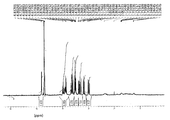
得られた各糖グリセロールを純水に溶解し、HPLCで純度確認を行った結果、いずれも単一ピークのみが検出された。また、得られた各糖グリセロールを、質量分析および1H-NMR分析に供した。各々の糖グリセロールの質量分析結果として、モノガラクトシルグリセロールを図10に、ジガラクトシルグリセロールを図11に、スルホキノボシルグリセロールを図12に示す。NMR分析結果として、モノガラクトシルグリセロールを図13に、ジガラクトシルグリセロールを図14に、スルホキノボシルグリセロールを図15に示す。
得られた各糖グリセロールを純水に溶解し、HPLCで純度確認を行った結果、いずれも単一ピークのみが検出された。また、得られた各糖グリセロールを、質量分析および1H-NMR分析に供した。各々の糖グリセロールの質量分析結果として、モノガラクトシルグリセロールを図10に、ジガラクトシルグリセロールを図11に、スルホキノボシルグリセロールを図12に示す。NMR分析結果として、モノガラクトシルグリセロールを図13に、ジガラクトシルグリセロールを図14に、スルホキノボシルグリセロールを図15に示す。
実施例6:糖グリセロールの分離
中温処理上清中には、糖グリセロール以外にも自己消化産物であるタンパク質やペプチドが含まれているため、本実施例では糖グリセロールの分離法の検討を行った。
中温処理上清中には、糖グリセロール以外にも自己消化産物であるタンパク質やペプチドが含まれているため、本実施例では糖グリセロールの分離法の検討を行った。
(1)糖グリセロールの分離
実施例1に記載した培養条件でChlorella kessleri 11h株を14日間培養し、Chlorella培養液を得た。Chlorella培養液500 mL分の藻体を少量の滅菌水で懸濁し、15倍Chlorella濃縮液を調製した。15倍Chlorella濃縮液を、1N HClにてpH4.5に調整し、50℃で24時間撹拌反応することにより中温処理を実施した。中温処理後の処理物を遠心分離し、上清を回収した。回収した上清を、強酸性陽イオン交換樹脂ダウエックス モノスフィア 650C (ダウケミカル)を用いてイオン交換した後、濃縮し、吸着画分 13 mgおよび非吸着画分 136 mgを取得した。
実施例1に記載した培養条件でChlorella kessleri 11h株を14日間培養し、Chlorella培養液を得た。Chlorella培養液500 mL分の藻体を少量の滅菌水で懸濁し、15倍Chlorella濃縮液を調製した。15倍Chlorella濃縮液を、1N HClにてpH4.5に調整し、50℃で24時間撹拌反応することにより中温処理を実施した。中温処理後の処理物を遠心分離し、上清を回収した。回収した上清を、強酸性陽イオン交換樹脂ダウエックス モノスフィア 650C (ダウケミカル)を用いてイオン交換した後、濃縮し、吸着画分 13 mgおよび非吸着画分 136 mgを取得した。
(2)分析結果
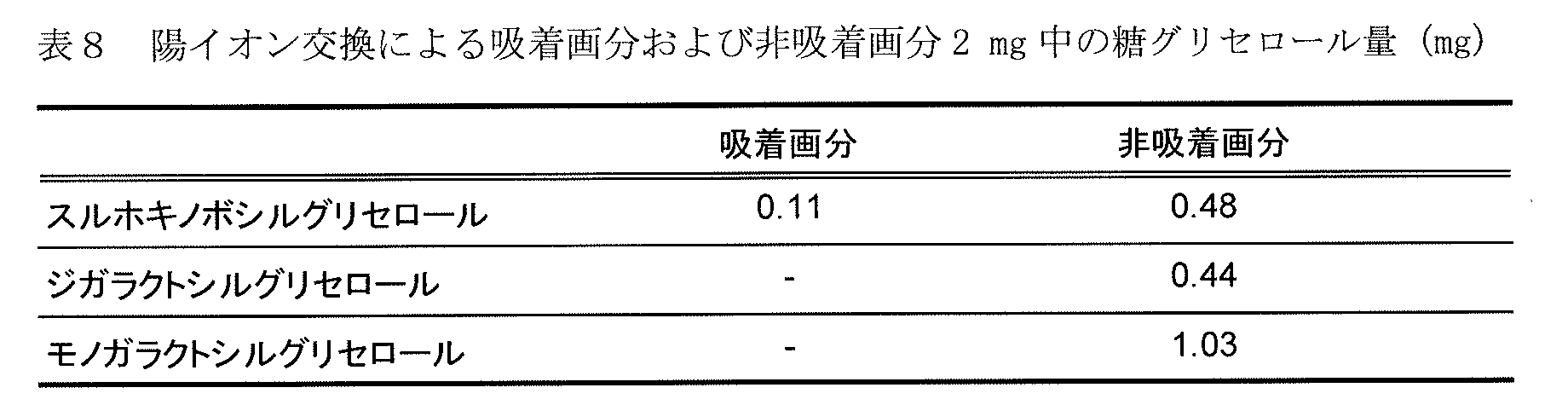
陽イオン交換による吸着画分及び非吸着画分を、それぞれ滅菌水に2 mg/mLになるよう溶解し、HPLC分析に供した。HPLC分析結果を、図16及び図17に示す。さらに、実施例7で合成した各糖グリセロール標準品を基準にして、ピーク面積比に基づき、各画分に含まれる糖グリセロールの量を概算した。結果を表8に示す。表8から、糖グリセロールのほとんどが非吸着画分に存在していることが示された。
陽イオン交換による吸着画分及び非吸着画分を、それぞれ滅菌水に2 mg/mLになるよう溶解し、HPLC分析に供した。HPLC分析結果を、図16及び図17に示す。さらに、実施例7で合成した各糖グリセロール標準品を基準にして、ピーク面積比に基づき、各画分に含まれる糖グリセロールの量を概算した。結果を表8に示す。表8から、糖グリセロールのほとんどが非吸着画分に存在していることが示された。
本発明により、糖グリセロールを製造することができる。
Claims (11)
- 微細藻類を培地で培養すること、
前記培養により得られた藻体を中温処理および/または有機溶媒処理に供すること、および
前記処理の処理物から糖グリセロールを回収すること、
を含む、糖グリセロールを製造する方法。 - 前記糖グリセロールが、下記式(I)で示される化合物および下記式(II)で示される化合物からなる群より選択される、請求項1に記載の方法:


- 前記糖が、以下の(A)~(C)からなる群より選択される、請求項2に記載の方法:
(A)ガラクトース;
(B)ガラクトースを構成糖として含む多糖;
(C)グルコース誘導体。 - 前記糖が、以下の(a)~(c)からなる群より選択される、請求項2に記載の方法:
(a)ガラクトース;
(b)ジガラクトース;
(c)スルホニルキノボース。 - 前記糖グリセロールが、ガラクトシルグリセロール、ジガラクトシルグリセロール、およびスルホキノボシルグリセロールからなる群より選択される、請求項1~4のいずれか1項に記載の方法。
- 前記微細藻類が、緑色植物門に属する藻類である、請求項1~5のいずれか1項に記載の方法。
- 前記微細藻類が、緑藻綱またはトレボキシア藻綱に属する藻類である、請求項1~6のいずれか1項に記載の方法。
- 前記微細藻類が、クロレラ属、クラミドモナス属、デスモデスムス属、またはセネデスムス属に属する藻類である、請求項1~7のいずれか1項に記載の方法。
- 前記微細藻類が、クロレラ・ケスレリ(Chlorella kessleri)、クラミドモナス・レインハルティ(Chlamydomonas reinhardtii)、またはデスモデスムス属の1種(Desmodesmus sp.)である、請求項1~8のいずれか1項に記載の方法。
- 前記中温処理が、35℃~70℃で行われる、請求項1~9のいずれか1項に記載の方法。
- 前記有機溶媒が、メタノールである、請求項1~10のいずれか1項に記載の方法。
Applications Claiming Priority (2)
| Application Number | Priority Date | Filing Date | Title |
|---|---|---|---|
| JP2013-115856 | 2013-05-31 | ||
| JP2013115856A JP2016144399A (ja) | 2013-05-31 | 2013-05-31 | 糖グリセロールの製造法 |
Publications (1)
| Publication Number | Publication Date |
|---|---|
| WO2014192940A1 true WO2014192940A1 (ja) | 2014-12-04 |
Family
ID=51988958
Family Applications (1)
| Application Number | Title | Priority Date | Filing Date |
|---|---|---|---|
| PCT/JP2014/064502 Ceased WO2014192940A1 (ja) | 2013-05-31 | 2014-05-30 | 糖グリセロールの製造法 |
Country Status (2)
| Country | Link |
|---|---|
| JP (1) | JP2016144399A (ja) |
| WO (1) | WO2014192940A1 (ja) |
Cited By (4)
| Publication number | Priority date | Publication date | Assignee | Title |
|---|---|---|---|---|
| WO2015064648A1 (ja) * | 2013-11-01 | 2015-05-07 | 味の素株式会社 | 脂肪酸を生成する緑藻類 |
| WO2020026953A1 (ja) * | 2018-07-31 | 2020-02-06 | 株式会社デンソー | 抗ヘルペスウイルス剤 |
| WO2020026945A1 (ja) * | 2018-07-31 | 2020-02-06 | 株式会社デンソー | 殺ウイルス剤 |
| CN115232848A (zh) * | 2022-08-22 | 2022-10-25 | 上海藻翰生物科技有限公司 | 一种采用连续流加梯度补料高产甘油葡萄糖苷的方法 |
Families Citing this family (1)
| Publication number | Priority date | Publication date | Assignee | Title |
|---|---|---|---|---|
| WO2026014488A1 (ja) * | 2024-07-09 | 2026-01-15 | パナソニックIpマネジメント株式会社 | 植物成長促進剤、植物栽培用組成物、及び植物成長促進方法 |
Citations (4)
| Publication number | Priority date | Publication date | Assignee | Title |
|---|---|---|---|---|
| JPS6222597A (ja) * | 1985-07-24 | 1987-01-30 | Nisshin Oil Mills Ltd:The | 糖グリセロ−ルおよび脂肪酸の製造法 |
| JPS6456692A (en) * | 1987-08-27 | 1989-03-03 | Nisshin Oil Mills Ltd | Production of sugar glycerol |
| JP2007290971A (ja) * | 2006-04-21 | 2007-11-08 | Fisheries Research Agency | グリセロールガラクトシドの抽出方法 |
| WO2011013707A1 (ja) * | 2009-07-29 | 2011-02-03 | 味の素株式会社 | L-アミノ酸の製造法 |
-
2013
- 2013-05-31 JP JP2013115856A patent/JP2016144399A/ja active Pending
-
2014
- 2014-05-30 WO PCT/JP2014/064502 patent/WO2014192940A1/ja not_active Ceased
Patent Citations (4)
| Publication number | Priority date | Publication date | Assignee | Title |
|---|---|---|---|---|
| JPS6222597A (ja) * | 1985-07-24 | 1987-01-30 | Nisshin Oil Mills Ltd:The | 糖グリセロ−ルおよび脂肪酸の製造法 |
| JPS6456692A (en) * | 1987-08-27 | 1989-03-03 | Nisshin Oil Mills Ltd | Production of sugar glycerol |
| JP2007290971A (ja) * | 2006-04-21 | 2007-11-08 | Fisheries Research Agency | グリセロールガラクトシドの抽出方法 |
| WO2011013707A1 (ja) * | 2009-07-29 | 2011-02-03 | 味の素株式会社 | L-アミノ酸の製造法 |
Non-Patent Citations (1)
| Title |
|---|
| MIYACHI, S. ET AL.: "Sulfolipid Metabolism in Chlorella", PLANT PHYSIOL., vol. 41, 1966, pages 479 - 486 * |
Cited By (8)
| Publication number | Priority date | Publication date | Assignee | Title |
|---|---|---|---|---|
| WO2015064648A1 (ja) * | 2013-11-01 | 2015-05-07 | 味の素株式会社 | 脂肪酸を生成する緑藻類 |
| WO2020026953A1 (ja) * | 2018-07-31 | 2020-02-06 | 株式会社デンソー | 抗ヘルペスウイルス剤 |
| WO2020026945A1 (ja) * | 2018-07-31 | 2020-02-06 | 株式会社デンソー | 殺ウイルス剤 |
| JPWO2020026945A1 (ja) * | 2018-07-31 | 2021-09-02 | 株式会社デンソー | 殺ウイルス剤 |
| JPWO2020026953A1 (ja) * | 2018-07-31 | 2021-09-09 | 株式会社デンソー | 抗ヘルペスウイルス剤 |
| JP7378091B2 (ja) | 2018-07-31 | 2023-11-13 | 株式会社デンソー | 殺ウイルス剤 |
| JP7505697B2 (ja) | 2018-07-31 | 2024-06-25 | 株式会社Kjバイオ | 抗ヘルペスウイルス剤 |
| CN115232848A (zh) * | 2022-08-22 | 2022-10-25 | 上海藻翰生物科技有限公司 | 一种采用连续流加梯度补料高产甘油葡萄糖苷的方法 |
Also Published As
| Publication number | Publication date |
|---|---|
| JP2016144399A (ja) | 2016-08-12 |
Similar Documents
| Publication | Publication Date | Title |
|---|---|---|
| KR101330864B1 (ko) | 펙티나아제를 이용한 진세노사이드 Rd가 강화된 발효인삼 또는 발효홍삼의 제조방법 | |
| Amer et al. | Characterization of exopolysaccharide produced from marine-derived Aspergillus terreus SEI with prominent biological activities | |
| JP5942197B2 (ja) | 高いスクワレン産生能を有する新規微生物及びこれによるスクワレンの製造方法 | |
| CN107119099B (zh) | 利用光照培养平滑菱形藻生产岩藻黄素的方法 | |
| JP2016144399A (ja) | 糖グリセロールの製造法 | |
| CA3153203A1 (en) | Method for producing astaxanthin by heterotrophic culture of haematococcus pluvialis | |
| US20250282811A1 (en) | A 3-o-monodesmosidic saponins extract, stable at physiological ph, method for preparing it from a quillaja plant extract cultured with a microbial consortium, uses and such microbial consortium | |
| Wang et al. | Allelopathic growth inhibition of Heterosigma akashiwo by the three Ulva spcieces (Ulva Pertusa, Ulva Linza, Enteromorpha intestinalis) under laboratory conditions | |
| WO2012047120A1 (en) | Heterotrophic microbial production of xanthophyll pigments | |
| Hamza et al. | Efficient production of biomass and exopolysaccharide from P. ostreatus and physio-chemical characterization of biomass powder | |
| Morais et al. | Microalgae polysaccharides with potential biomedical application | |
| CN103992953B (zh) | 一株转化甘草酸生成甘草次苷的东乡野生稻内生真菌 | |
| Halim | Industrial extraction of microalgal pigments | |
| CN103131643B (zh) | 一株产甘露醇的菌株及用该菌株发酵生产甘露醇的方法 | |
| CN102220274B (zh) | 巴氏微杆菌xj及应用该菌制备甜菊醇的方法 | |
| JP2006191919A (ja) | カロチノイド色素、スフィンゴ糖脂質、ユビキノンq−10の生産方法 | |
| JP4390259B2 (ja) | 硫酸多糖類、その製造方法及びそれを有効成分とする物質 | |
| CN104046674B (zh) | 一种发酵生产β-胡萝卜素用的改良玉米浆及其制备方法和应用 | |
| JP5052702B1 (ja) | N−アセチルグルコサミン非資化性キチン分解菌及びその用途 | |
| Trincone | Polysaccharides produced by microalgae | |
| CN101701237A (zh) | 发酵生产α-葡萄糖基化丁香酚的方法 | |
| JP3064052B2 (ja) | 微細藻類から多糖類を生産する方法 | |
| CN109929765B (zh) | 一株隐球酵母及其胞外多糖与应用 | |
| CN1187438C (zh) | 高产壳聚糖酶的真菌菌株及其用途 | |
| CN104450541B (zh) | 一株藏红花内生真菌及其粗多糖和制备方法与用途 |
Legal Events
| Date | Code | Title | Description |
|---|---|---|---|
| 121 | Ep: the epo has been informed by wipo that ep was designated in this application |
Ref document number: 14803705 Country of ref document: EP Kind code of ref document: A1 |
|
| NENP | Non-entry into the national phase |
Ref country code: DE |
|
| 122 | Ep: pct application non-entry in european phase |
Ref document number: 14803705 Country of ref document: EP Kind code of ref document: A1 |
|
| NENP | Non-entry into the national phase |
Ref country code: JP |