WO2014188667A1 - 熱伝導性シリコーン組成物 - Google Patents
熱伝導性シリコーン組成物 Download PDFInfo
- Publication number
- WO2014188667A1 WO2014188667A1 PCT/JP2014/002397 JP2014002397W WO2014188667A1 WO 2014188667 A1 WO2014188667 A1 WO 2014188667A1 JP 2014002397 W JP2014002397 W JP 2014002397W WO 2014188667 A1 WO2014188667 A1 WO 2014188667A1
- Authority
- WO
- WIPO (PCT)
- Prior art keywords
- silicone composition
- group
- component
- parts
- mass
- Prior art date
- Legal status (The legal status is an assumption and is not a legal conclusion. Google has not performed a legal analysis and makes no representation as to the accuracy of the status listed.)
- Ceased
Links
Classifications
-
- C—CHEMISTRY; METALLURGY
- C08—ORGANIC MACROMOLECULAR COMPOUNDS; THEIR PREPARATION OR CHEMICAL WORKING-UP; COMPOSITIONS BASED THEREON
- C08L—COMPOSITIONS OF MACROMOLECULAR COMPOUNDS
- C08L83/00—Compositions of macromolecular compounds obtained by reactions forming in the main chain of the macromolecule a linkage containing silicon with or without sulfur, nitrogen, oxygen or carbon only; Compositions of derivatives of such polymers
- C08L83/04—Polysiloxanes
-
- C—CHEMISTRY; METALLURGY
- C08—ORGANIC MACROMOLECULAR COMPOUNDS; THEIR PREPARATION OR CHEMICAL WORKING-UP; COMPOSITIONS BASED THEREON
- C08K—Use of inorganic or non-macromolecular organic substances as compounding ingredients
- C08K3/00—Use of inorganic substances as compounding ingredients
- C08K3/02—Elements
- C08K3/08—Metals
-
- C—CHEMISTRY; METALLURGY
- C08—ORGANIC MACROMOLECULAR COMPOUNDS; THEIR PREPARATION OR CHEMICAL WORKING-UP; COMPOSITIONS BASED THEREON
- C08K—Use of inorganic or non-macromolecular organic substances as compounding ingredients
- C08K3/00—Use of inorganic substances as compounding ingredients
- C08K3/18—Oxygen-containing compounds, e.g. metal carbonyls
- C08K3/20—Oxides; Hydroxides
- C08K3/22—Oxides; Hydroxides of metals
-
- C—CHEMISTRY; METALLURGY
- C08—ORGANIC MACROMOLECULAR COMPOUNDS; THEIR PREPARATION OR CHEMICAL WORKING-UP; COMPOSITIONS BASED THEREON
- C08K—Use of inorganic or non-macromolecular organic substances as compounding ingredients
- C08K5/00—Use of organic ingredients
- C08K5/56—Organo-metallic compounds, i.e. organic compounds containing a metal-to-carbon bond
-
- C—CHEMISTRY; METALLURGY
- C08—ORGANIC MACROMOLECULAR COMPOUNDS; THEIR PREPARATION OR CHEMICAL WORKING-UP; COMPOSITIONS BASED THEREON
- C08L—COMPOSITIONS OF MACROMOLECULAR COMPOUNDS
- C08L83/00—Compositions of macromolecular compounds obtained by reactions forming in the main chain of the macromolecule a linkage containing silicon with or without sulfur, nitrogen, oxygen or carbon only; Compositions of derivatives of such polymers
-
- C—CHEMISTRY; METALLURGY
- C09—DYES; PAINTS; POLISHES; NATURAL RESINS; ADHESIVES; COMPOSITIONS NOT OTHERWISE PROVIDED FOR; APPLICATIONS OF MATERIALS NOT OTHERWISE PROVIDED FOR
- C09K—MATERIALS FOR MISCELLANEOUS APPLICATIONS, NOT PROVIDED FOR ELSEWHERE
- C09K5/00—Heat-transfer, heat-exchange or heat-storage materials, e.g. refrigerants; Materials for the production of heat or cold by chemical reactions other than by combustion
- C09K5/08—Materials not undergoing a change of physical state when used
-
- C—CHEMISTRY; METALLURGY
- C08—ORGANIC MACROMOLECULAR COMPOUNDS; THEIR PREPARATION OR CHEMICAL WORKING-UP; COMPOSITIONS BASED THEREON
- C08G—MACROMOLECULAR COMPOUNDS OBTAINED OTHERWISE THAN BY REACTIONS ONLY INVOLVING UNSATURATED CARBON-TO-CARBON BONDS
- C08G77/00—Macromolecular compounds obtained by reactions forming a linkage containing silicon with or without sulfur, nitrogen, oxygen or carbon in the main chain of the macromolecule
- C08G77/04—Polysiloxanes
- C08G77/12—Polysiloxanes containing silicon bound to hydrogen
-
- C—CHEMISTRY; METALLURGY
- C08—ORGANIC MACROMOLECULAR COMPOUNDS; THEIR PREPARATION OR CHEMICAL WORKING-UP; COMPOSITIONS BASED THEREON
- C08G—MACROMOLECULAR COMPOUNDS OBTAINED OTHERWISE THAN BY REACTIONS ONLY INVOLVING UNSATURATED CARBON-TO-CARBON BONDS
- C08G77/00—Macromolecular compounds obtained by reactions forming a linkage containing silicon with or without sulfur, nitrogen, oxygen or carbon in the main chain of the macromolecule
- C08G77/04—Polysiloxanes
- C08G77/20—Polysiloxanes containing silicon bound to unsaturated aliphatic groups
-
- C—CHEMISTRY; METALLURGY
- C08—ORGANIC MACROMOLECULAR COMPOUNDS; THEIR PREPARATION OR CHEMICAL WORKING-UP; COMPOSITIONS BASED THEREON
- C08K—Use of inorganic or non-macromolecular organic substances as compounding ingredients
- C08K3/00—Use of inorganic substances as compounding ingredients
- C08K3/02—Elements
- C08K3/08—Metals
- C08K2003/0812—Aluminium
-
- C—CHEMISTRY; METALLURGY
- C08—ORGANIC MACROMOLECULAR COMPOUNDS; THEIR PREPARATION OR CHEMICAL WORKING-UP; COMPOSITIONS BASED THEREON
- C08K—Use of inorganic or non-macromolecular organic substances as compounding ingredients
- C08K3/00—Use of inorganic substances as compounding ingredients
- C08K3/02—Elements
- C08K3/08—Metals
- C08K2003/0893—Zinc
-
- C—CHEMISTRY; METALLURGY
- C08—ORGANIC MACROMOLECULAR COMPOUNDS; THEIR PREPARATION OR CHEMICAL WORKING-UP; COMPOSITIONS BASED THEREON
- C08K—Use of inorganic or non-macromolecular organic substances as compounding ingredients
- C08K3/00—Use of inorganic substances as compounding ingredients
- C08K3/18—Oxygen-containing compounds, e.g. metal carbonyls
- C08K3/20—Oxides; Hydroxides
- C08K3/22—Oxides; Hydroxides of metals
- C08K2003/2296—Oxides; Hydroxides of metals of zinc
-
- C—CHEMISTRY; METALLURGY
- C08—ORGANIC MACROMOLECULAR COMPOUNDS; THEIR PREPARATION OR CHEMICAL WORKING-UP; COMPOSITIONS BASED THEREON
- C08L—COMPOSITIONS OF MACROMOLECULAR COMPOUNDS
- C08L2205/00—Polymer mixtures characterised by other features
- C08L2205/02—Polymer mixtures characterised by other features containing two or more polymers of the same C08L -group
-
- C—CHEMISTRY; METALLURGY
- C08—ORGANIC MACROMOLECULAR COMPOUNDS; THEIR PREPARATION OR CHEMICAL WORKING-UP; COMPOSITIONS BASED THEREON
- C08L—COMPOSITIONS OF MACROMOLECULAR COMPOUNDS
- C08L2205/00—Polymer mixtures characterised by other features
- C08L2205/02—Polymer mixtures characterised by other features containing two or more polymers of the same C08L -group
- C08L2205/025—Polymer mixtures characterised by other features containing two or more polymers of the same C08L -group containing two or more polymers of the same hierarchy C08L, and differing only in parameters such as density, comonomer content, molecular weight, structure
-
- C—CHEMISTRY; METALLURGY
- C08—ORGANIC MACROMOLECULAR COMPOUNDS; THEIR PREPARATION OR CHEMICAL WORKING-UP; COMPOSITIONS BASED THEREON
- C08L—COMPOSITIONS OF MACROMOLECULAR COMPOUNDS
- C08L2205/00—Polymer mixtures characterised by other features
- C08L2205/03—Polymer mixtures characterised by other features containing three or more polymers in a blend
- C08L2205/035—Polymer mixtures characterised by other features containing three or more polymers in a blend containing four or more polymers in a blend
Definitions
- the present invention relates to a thermally conductive silicone composition.
- a cooling member such as a heat spreader is disposed in the vicinity of the heat generating portion, and after the two are brought into close contact with each other, heat is efficiently removed from the cooling member.
- thin and compressible heat radiation grease is suitable from the viewpoint of heat radiation performance, and it is particularly difficult for grease to flow out (pumping out) due to the heat history of the heat generating part and the cooling, etc. It is preferable to use the heat dissipating grease from the viewpoint of reliability.
- semiconductor packages are required to have a very high terminal density and reduction in mounting area. Therefore, solder applied to the bottom of the package is used at a high temperature of 200 ° C. or higher, instead of connecting the conventional package and substrate with a lead frame. A form of connection with a substrate has become mainstream through a melting reflow process. However, in the reflow process exposed to a high temperature of 200 ° C.
- the heat-curing heat dissipating grease described above is cured very quickly. For this reason, the heat dissipating grease cannot be compressed to a predetermined thickness, and the applied heat dissipating grease does not spread sufficiently over the entire heat generating portion, so that a sufficient heat dissipating performance cannot be obtained.
- the present invention has been made in view of the above problems, and uses a viscoelasticity measuring apparatus capable of measuring shear elasticity, and samples are measured at 10 ° C./min from 25 ° C. to 125 ° C., 2 ° C./125° C. to 145 ° C.
- the storage elastic modulus G ′ is measured with a program for maintaining the temperature at 145 ° C. to 150 ° C. at 0.5 ° C./min and maintaining at 150 ° C. for 7,200 seconds, 3,600 seconds from the start of measurement. It aims at providing the silicone composition which gives the hardened
- a silicone composition comprising: (A) Organopolysiloxane having at least two aliphatic unsaturated hydrocarbon groups in one molecule and a kinematic viscosity at 25 ° C.
- the storage elastic modulus G ′ is measured by setting up a program to maintain the temperature at 150 ° C. for 7,200 seconds after the temperature rises, the storage elastic modulus after 3,600 seconds and the storage elastic modulus after 7,200 seconds are measured.
- a silicone composition is provided, which provides a cured product having a ratio of 1 to 0.7 or less.
- the heat dissipation grease can be compressed to a predetermined thickness even after the reflow process exposed to a high temperature of 200 ° C. or higher, and the applied heat dissipation grease can be sufficiently spread over the entire heat generating portion. Therefore, sufficient heat dissipation performance can be obtained.
- the silicone composition is (E) the following general formula (1) (Wherein R 4 is an alkyl group having 1 to 6 carbon atoms, and g is an integer of 5 to 100)
- the hydrolyzable methylpolysiloxane represented by the formula (A) is preferably contained in an amount of 1 to 200 parts by mass per 100 parts by mass of the component (A).
- the silicone composition comprises (F) one or more control agents selected from the group consisting of acetylene compounds, nitrogen compounds, organic phosphorus compounds, oxime compounds and organic chloro compounds, with respect to 100 parts by mass of the component (A). It is preferably contained in an amount of 0.05 to 5.0 parts by mass.
- Such a component (F) acts as a control agent, suppresses the progress of the hydrosilylation reaction at room temperature, and can extend shelf life and pot life.
- the silicone composition of the present invention can compress the heat-dissipating grease to a predetermined thickness even after the reflow process exposed to a high temperature of 200 ° C. or higher, and sufficiently spread the applied heat-dissipating grease over the entire heat generating part. Therefore, sufficient heat dissipation performance can be obtained.
- the silicone compositions containing the components (A) to (D) and, if necessary, the components (E) and (F) have shear elasticity.
- the sample was heated from 25 ° C to 125 ° C at 10 ° C / min, from 125 ° C to 145 ° C at 2 ° C / min, from 145 ° C to 150 ° C at 0.5 ° C / min.
- the storage elastic modulus G ′ was measured with a program maintained at 150 ° C. for 7,200 seconds, the ratio between the storage elastic modulus after 3,600 seconds and the storage elastic modulus after 7,200 seconds from the start of measurement.
- the present invention is a silicone composition
- (A) Organopolysiloxane having at least two aliphatic unsaturated hydrocarbon groups in one molecule and a kinematic viscosity at 25 ° C. of 60 to 100,000 mm 2 / s: 100 parts by mass
- (B) Filler containing aluminum powder and zinc oxide powder: 100 to 2,000 parts by mass
- (C) Organohydrogenpolysiloxane having two or more hydrogen atoms bonded to silicon atoms (that is, SiH groups) in one molecule: the total number of aliphatic unsaturated hydrocarbon groups in component (A) An amount in which the number of SiH groups in the component (C) is 0.5 to 1.5
- the storage elastic modulus G ′ is measured by setting up a program to maintain the temperature at 150 ° C. for 7,200 seconds after the temperature rises, the storage elastic modulus after 3,600 seconds and the storage elastic modulus after 7,200 seconds are measured.
- It is a silicone composition characterized by giving the hardened
- Component (A) is an organopolysiloxane having at least two aliphatic unsaturated hydrocarbon groups in one molecule and a kinematic viscosity at 25 ° C. of 60 to 100,000 mm 2 / s. .
- the aliphatic unsaturated hydrocarbon group is preferably a monovalent hydrocarbon group having 2 to 8, more preferably 2 to 6 carbon atoms having an aliphatic unsaturated bond, and more preferably an alkenyl group. .
- alkenyl groups such as vinyl group, allyl group, propenyl group, isopropenyl group, butenyl group, hexenyl group, cyclohexenyl group, and octenyl group.
- alkenyl groups such as vinyl group, allyl group, propenyl group, isopropenyl group, butenyl group, hexenyl group, cyclohexenyl group, and octenyl group.
- Particularly preferred is a vinyl group.
- the aliphatic unsaturated hydrocarbon group may be bonded to either a silicon atom at the end of the molecular chain or a silicon atom in the middle of the molecular chain, or may be bonded to both.
- the organopolysiloxane preferably has a kinematic viscosity at 25 ° C. of 60 to 100,000 mm 2 / s, preferably 100 to 30,000 mm 2 / s. If the kinematic viscosity is less than 60 mm 2 / s, the physical properties of the silicone composition may be reduced, and if it exceeds 100,000 mm 2 / s, the extensibility of the silicone composition may be poor. is there.
- the kinematic viscosity is a value at 25 ° C. measured with an Ubbelohde Ostwald viscometer.
- the molecular structure of the organopolysiloxane is not particularly limited as long as it has the above properties, and examples thereof include a straight chain, a branched chain, a partially branched chain, or a linear chain having a cyclic structure.
- the main chain has a linear structure in which the main chain is composed of repeating diorganosiloxane units and both ends of the molecular chain are blocked with a triorganosiloxy group.
- the organopolysiloxane having a linear structure may partially have a branched structure or a cyclic structure. These organopolysiloxanes can be used alone or in combination of two or more.
- the organic group other than the aliphatic unsaturated hydrocarbon group bonded to the silicon atom of the organopolysiloxane has 1 to 18 carbon atoms, preferably 1 to 10 carbon atoms, more preferably 1 to 8 carbon atoms, and is unsubstituted or substituted. These are monovalent hydrocarbon groups.
- alkyl groups such as methyl group, ethyl group, propyl group, isopropyl group, butyl group, isobutyl group, tert-butyl group, pentyl group, neopentyl group, hexyl group, cyclohexyl group, octyl group, nonyl group, decyl group;
- Aryl groups such as phenyl group, tolyl group, xylyl group, naphthyl group; aralkyl groups such as benzyl group, phenylethyl group, phenylpropyl group, or part or all of hydrogen atoms of these groups are fluorine, bromine, chlorine And those substituted with a halogen atom such as cyano group, and the like, such as chloromethyl group, chloropropyl group, bromoethyl group, trifluoropropyl group, cyanoethyl group and the like.
- the component (B) is a thermally conductive filler containing aluminum powder and zinc oxide powder.
- the shape of the aluminum powder is not particularly limited, and examples thereof include a spherical shape and an indefinite shape.
- the aluminum powder may be a powder whose surface has been treated in advance.
- the aluminum powder has an average particle size of 0.1 to 100 ⁇ m, more preferably 1 to 40 ⁇ m.
- the average particle size of the aluminum powder is 0.1 ⁇ m or more, the viscosity of the resulting composition will not be too high and there will be no fear of poor extensibility. If it is 100 micrometers or less, the composition obtained will become uniform.
- an aluminum powder having a large average particle diameter or an aluminum powder having a small average particle diameter may be used alone, but preferably a large average particle diameter (for example, 5 ⁇ m to 100 ⁇ m).
- a grease having a good viscosity can be obtained by mixing.
- the mixing ratio may be adjusted according to the desired viscosity of the grease.
- the mass ratio of the aluminum powder having a large average particle diameter to the aluminum powder having a small average particle diameter is 0.5 to 9.0, It is preferably 1.0 to 5.0.
- the shape of the zinc oxide powder is not particularly limited, and examples thereof include a spherical shape and an indefinite shape.
- the zinc oxide powder has an average particle size of 0.1 to 10 ⁇ m, more preferably 1 to 4 ⁇ m.
- the average particle size of the zinc oxide powder is 0.1 ⁇ m or more, there is no fear that the resulting silicone composition has a high viscosity or poor extensibility. Moreover, if it is 10 micrometers or less, the silicone composition obtained will become uniform.
- average particle diameter means a particle diameter at an integrated value of 50% in a volume-based particle size distribution obtained by a laser diffraction / scattering method.
- the measurement by the laser diffraction / scattering method may be performed by, for example, a microtrack particle size analyzer MT3300EX (manufactured by Nikkiso Co., Ltd.).
- the filler (B) includes, in addition to the above aluminum powder and zinc oxide powder, titanium oxide powder, alumina powder, boron nitride powder, aluminum nitride powder, diamond powder, gold powder, silver powder, copper powder, carbon
- thermally conductive fillers such as powder, nickel powder, indium powder, gallium powder, metal silicon powder, and silica powder may be contained depending on the purpose.
- the amount of (B) filler is 100 to 2,000 parts by weight, preferably 200 to 1,800 parts by weight, and more preferably 400 to 1,800 parts by weight with respect to 100 parts by weight of component (A). If the amount of the filler is less than 100 parts by mass, the resulting composition may have poor thermal conductivity, and if it exceeds 2,000 parts by mass, the composition may have poor extensibility.
- the component (C) is composed of 2 or more, preferably 3 or more, particularly 3 to 100, more preferably 3 to 20 hydrogen atoms bonded to silicon atoms (ie, SiH groups) in one molecule.
- This is an organohydrogenpolysiloxane.
- a SiH group in the molecule can undergo an addition reaction in the presence of the aliphatic unsaturated hydrocarbon group of the component (A) described above and a platinum group metal catalyst described later to form a crosslinked structure. Anything is acceptable.
- the organohydrogenpolysiloxane is not particularly limited in its molecular structure as long as it has the above-mentioned properties, and examples thereof include linear, branched, cyclic, partially branched or linear linear structures. Preferably it is linear or cyclic.
- the organohydrogenpolysiloxane preferably has a kinematic viscosity at 25 ° C. of 1.0 to 1,000 mm 2 / s, preferably 10 to 100 mm 2 / s.
- the kinematic viscosity is 1.0 mm 2 / s or more, the physical properties of the silicone composition do not deteriorate, and if it is 1,000 mm 2 / s or less, the extensibility of the silicone composition is poor. There is no fear of becoming.
- the kinematic viscosity is a value at 25 ° C. measured by an Ubbelohde Ostwald viscometer.
- Examples of the organic group bonded to the silicon atom of the organohydrogenpolysiloxane include monovalent hydrocarbon groups other than aliphatic unsaturated hydrocarbon groups. Particularly, it is an unsubstituted or substituted monovalent hydrocarbon group having 1 to 12 carbon atoms, preferably 1 to 10 carbon atoms.
- alkyl groups such as methyl group, ethyl group, propyl group, butyl group, hexyl group and dodecyl group, aryl groups such as phenyl group, aralkyl groups such as 2-phenylethyl group and 2-phenylpropyl group, hydrogens thereof Those in which part or all of the atoms are substituted with halogen atoms such as fluorine, bromine and chlorine, cyano groups, etc., such as chloromethyl group, chloropropyl group, bromoethyl group, trifluoropropyl group, cyanoethyl group, and the like, and 2- Examples include epoxy ring-containing organic groups (glycidyl group or glycidyloxy group-substituted alkyl group) such as glycidoxyethyl group, 3-glycidoxypropyl group, and 4-glycidoxybutyl group.
- the amount of (C) organohydrogenpolysiloxane is such that the number of SiH groups in component (C) is 0.5 to 1.5 with respect to the total number of aliphatic unsaturated hydrocarbon groups in component (A). Amount.
- the amount of the component (C) is less than 0.5, the curing reaction does not proceed sufficiently and the grease may flow out.
- the unreacted SiH group causes an excessive crosslinking reaction, compresses the heat dissipating grease to a predetermined thickness after the reflow process, and spreads the applied heat dissipating grease over the entire heat generating part. As a result, it may be difficult to obtain sufficient heat dissipation performance.
- Component (D) is a platinum group metal catalyst and functions to promote the above-described addition reaction.
- a conventionally well-known thing used for an addition reaction can be used for a platinum group metal catalyst.
- platinum-based, palladium-based, and rhodium-based catalysts may be mentioned.
- platinum or platinum compounds that are relatively easily available are preferable. Examples include platinum alone, platinum black, chloroplatinic acid, platinum-olefin complexes, platinum-alcohol complexes, platinum coordination compounds, and the like.
- a platinum-type catalyst may be used individually by 1 type or in combination of 2 or more types.
- the blending amount of the component (D) is 0.1 to 500 ppm, more preferably 1.0 to 100 ppm, based on the mass converted to the platinum group metal atom with respect to the component (A). If the amount of the catalyst is less than 0.1 ppm, the effect as a catalyst may not be obtained. Moreover, even if it exceeds 500 ppm, since a catalyst effect does not increase and it is uneconomical, it is not preferable.
- the silicone composition of the present invention can further contain a hydrolyzable methylpolysiloxane represented by the following formula (1).
- R 4 is an alkyl group having 1 to 6 carbon atoms, and is methyl group, ethyl group, propyl group, isopropyl group, butyl group, sec-butyl group, tert-butyl group, pentyl group, hexyl. Groups and the like.
- g is an integer of 5 to 100, preferably an integer of 10 to 60. If the value of g is 5 or more, it is preferable because the oil bleed derived from the silicone composition becomes severe and the reliability is not deteriorated. Moreover, if the value of g is 100 or less, there is no fear that the wettability with the filler will be insufficient, which is preferable.
- the amount of component (E) is 1 to 200 parts by weight, preferably 10 to 180 parts by weight, more preferably 20 to 150 parts by weight, based on 100 parts by weight of component (A). .
- the amount of the component (E) is 1 part by mass or more, sufficient wettability can be exhibited.
- it is preferable that the amount of the component (E) is 200 parts by mass or less because the curing reaction proceeds sufficiently and there is no fear of the grease flowing out.
- the silicone composition of this invention may contain the (F) component which is a control agent further.
- the control agent functions to suppress the progress of the hydrosilylation reaction at room temperature and prolong the shelf life and pot life.
- a conventionally known control agent used in addition-curable silicone compositions can be used.
- acetylene compounds such as acetylene alcohols (for example, 1-ethynyl-1-cyclohexanol, 3,5-dimethyl-1-hexyn-3-ol), various nitrogen compounds such as tributylamine, tetramethylethylenediamine, and benzotriazole
- organic phosphorus compounds such as triphenylphosphine, oxime compounds, and organic chloro compounds.
- the amount of the component (F) is 0.05 to 5.0 parts by mass, preferably 0.1 to 1.0 parts by mass with respect to 100 parts by mass of the component (A). If the amount of the control agent is 0.05 parts by mass or more, the desired sufficient shelf life and pot life can be obtained, and if it is 5.0 parts by mass or less, the curability of the silicone composition decreases. This is preferable because there is no fear.
- the control agent may be diluted with toluene or the like to improve dispersibility in the silicone composition.
- the silicone composition of the present invention may contain an organo (poly) siloxane having no reactivity such as methylpolysiloxane in order to adjust the elastic modulus and viscosity of the composition.
- a conventionally known antioxidant such as 2,6-di-t-butyl-4-methylphenol may be contained as necessary.
- dyes, pigments, flame retardants, anti-settling agents, thixotropic agents, and the like can be blended as necessary.
- the method for producing the silicone composition of the present invention is not particularly limited as long as it follows the conventional method for producing a silicone grease composition.
- the above components (A) to (F), and other components as necessary may be a trimix, twin mix, planetary mixer (all are registered trademarks of a mixer manufactured by Inoue Mfg. Co., Ltd.), ultra mixer (Mizuho) It can be manufactured by a method of mixing with a mixer such as Kogyo Kogyo Co., Ltd. (registered trademark) and Hibis Dispermix (registered trademark of Kogyo Kagaku Kogyo Co., Ltd.).
- the silicone composition of the present invention preferably has a viscosity of 3.0 to 300 Pa ⁇ s, more preferably 5.0 to 200 Pa ⁇ s, measured at 25 ° C.
- a viscosity of 3.0 Pa ⁇ s or more is preferable because workability is not likely to deteriorate.
- the said viscosity can be obtained by adjusting the mixing
- the viscosity is a value of 25 ° C. measured with a Malcolm viscometer (rotor A: 10 rpm, displacement speed: 6 [1 / s]).
- the silicone composition of the present invention is interposed between a heat generating member such as an electronic component such as a semiconductor package or the like and a cooling member to transfer heat from the heat generating member to the cooling member. It can be suitably used for heat dissipation, and is particularly effective for a mounting type that requires a reflow process in which solder applied to the bottom of the package is melted at a high temperature of 200 ° C. or higher. Curing conditions for heat curing the silicone composition of the present invention are not particularly limited, but are usually 80 to 200 ° C., preferably 100 to 180 ° C., 30 minutes to 4 hours, preferably 30 minutes to 2%. It's time.
- the silicone composition was wrapped in a kitchen wrap and measured with TPA-501 manufactured by Kyoto Electronics Industry Co., Ltd.
- kinematic viscosity is a value measured at 25 ° C. with an Ubbelohde Ostwald viscometer (manufactured by Shibata Kagaku Co., Ltd.).
- Component A-1 Dimethylpolysiloxane having both ends blocked with dimethylvinylsilyl groups and a kinematic viscosity at 25 ° C. of 600 mm 2 / s
- A-2 Both ends blocked with trimethylsilyl groups Dimethylpolysiloxane having a kinematic viscosity of 600 mm 2 / s at 25 ° C., wherein two of the methyl groups on the silicon atom are vinyl groups
- Component B-1 Aluminum powder having an average particle diameter of 20.0 ⁇ m (thermal conductivity: 237 W / m ⁇ ° C.)
- B-2 Aluminum powder having an average particle size of 2.0 ⁇ m (thermal conductivity: 237 W / m ⁇ ° C.)
- B-3 Zinc oxide powder having an average particle size of 1.0 ⁇ m (thermal conductivity: 25 W / m ⁇ ° C.)
- Component D-1 Solution in which a platinum-divinyltetramethyldisiloxane complex is dissolved in the same dimethylpolysiloxane as in the above A-1 (platinum atom content: 1% by mass)
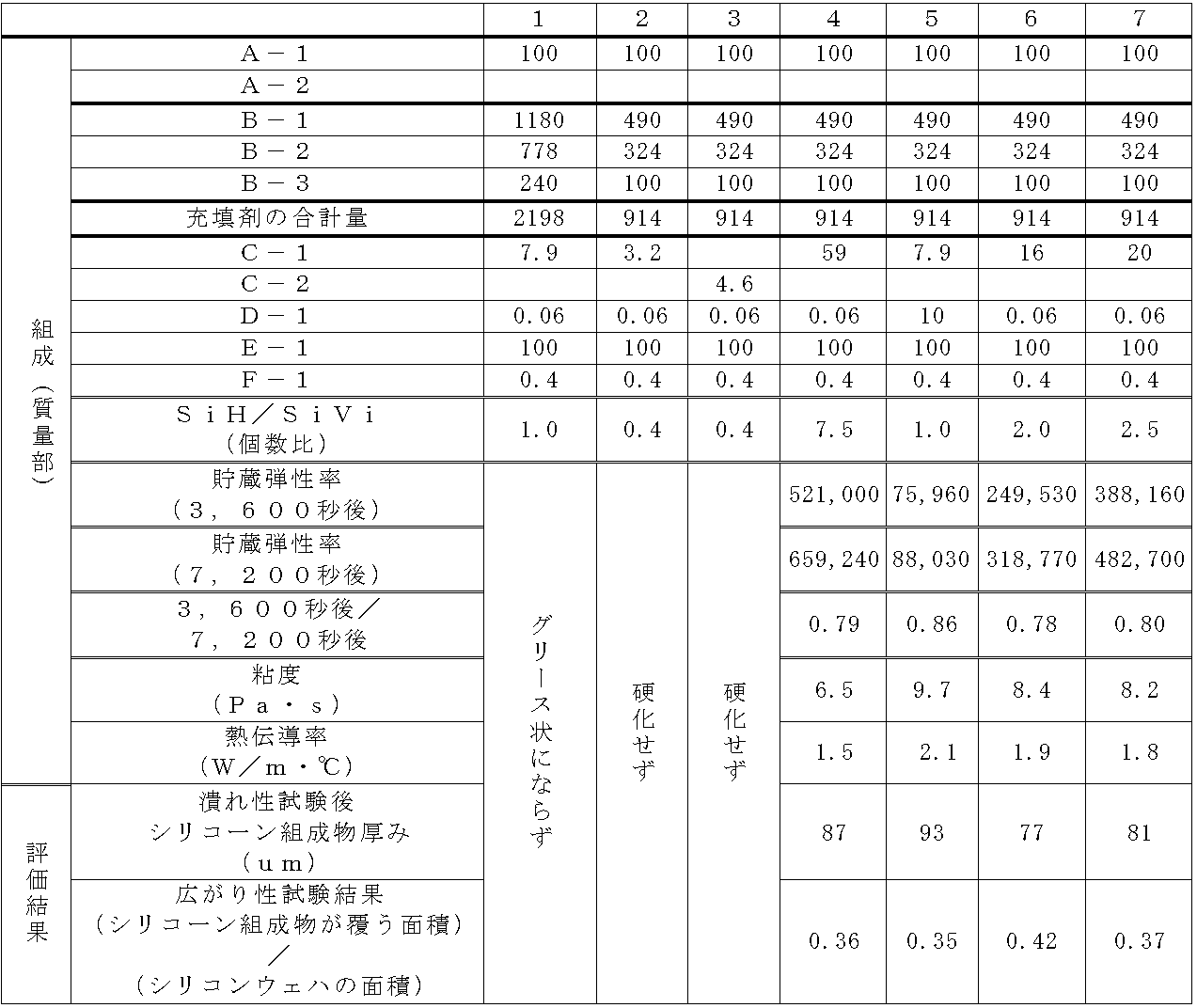
- Examples 1 to 13, Comparative Examples 1 to 7 Components (A) to (F) were mixed as follows to obtain compositions of Examples 1 to 13 and Comparative Examples 1 to 7. That is, the components (A), (B), and (E) were added to a 5 liter planetary mixer (manufactured by Inoue Seisakusho Co., Ltd.) in the amounts shown in Tables 1 and 2, and mixed at room temperature for 1 hour. Next, the components (C), (D), and (F) were added and mixed to be uniform. Tables 1 and 2 also show the measurement results of the storage modulus, viscosity, and thermal conductivity of the obtained composition, and the results of the crushability and spreadability tests.
- the silicone composition of the present invention can compress the heat-dissipating grease to a predetermined thickness even after the reflow process exposed to a high temperature of 200 ° C. or higher, and can spread the applied heat-dissipating grease over the entire heat generating part. It was confirmed that there was.
- the present invention is not limited to the above embodiment.
- the above-described embodiment is an exemplification, and the present invention has any configuration that has substantially the same configuration as the technical idea described in the claims of the present invention and that exhibits the same effects. Are included in the technical scope.
Landscapes
- Chemical & Material Sciences (AREA)
- Chemical Kinetics & Catalysis (AREA)
- Organic Chemistry (AREA)
- Medicinal Chemistry (AREA)
- Polymers & Plastics (AREA)
- Health & Medical Sciences (AREA)
- Engineering & Computer Science (AREA)
- Physics & Mathematics (AREA)
- Combustion & Propulsion (AREA)
- Thermal Sciences (AREA)
- Materials Engineering (AREA)
- Compositions Of Macromolecular Compounds (AREA)
- Cooling Or The Like Of Semiconductors Or Solid State Devices (AREA)
Abstract
Description
(A)1分子中に少なくとも2個の脂肪族不飽和炭化水素基を有し、25℃での動粘度60~100,000mm2/sを有するオルガノポリシロキサン:100質量部、
(B)アルミニウム粉末と酸化亜鉛粉末を含む充填剤:100~2,000質量部、
(C)1分子中に2個以上の、ケイ素原子に結合した水素原子(即ち、SiH基)を有するオルガノハイドロジェンポリシロキサン:(A)成分中の脂肪族不飽和炭化水素基の個数の合計に対する(C)成分中のSiH基の個数が0.5~1.5となる量、及び、
(D)白金族金属触媒:白金原子として(A)成分の0.1~500ppmとなる配合量
を含有し、
ずり弾性が測定可能な粘弾性測定装置を用い、試料を25℃から125℃まで10℃/分、125℃から145℃まで2℃/分、145℃から150℃まで0.5℃/分で昇温した後、150℃で7,200秒維持するプログラムを組んで貯蔵弾性率G’を測定した際、測定開始から3,600秒後の貯蔵弾性率と7,200秒後の貯蔵弾性率との比が0.7以下となる硬化物を与えるものであることを特徴とするシリコーン組成物を提供する。

で表される加水分解性メチルポリシロキサンを、前記(A)成分100質量部に対して1~200質量部となる量で含有するものが好ましい。
前述のように、200℃以上の高温に曝されるリフロー工程後においても放熱グリースを所定の厚みまで圧縮でき、また塗布した放熱グリースを発熱部全体に十分広げることが可能なシリコーン組成物の開発が望まれていた。
(A)1分子中に少なくとも2個の脂肪族不飽和炭化水素基を有し、25℃での動粘度60~100,000mm2/sを有するオルガノポリシロキサン:100質量部、
(B)アルミニウム粉末と酸化亜鉛粉末を含む充填剤:100~2,000質量部、
(C)1分子中に2個以上の、ケイ素原子に結合した水素原子(即ち、SiH基)を有するオルガノハイドロジェンポリシロキサン:(A)成分中の脂肪族不飽和炭化水素基の個数の合計に対する(C)成分中のSiH基の個数が0.5~1.5となる量、及び、
(D)白金族金属触媒:白金原子として(A)成分の0.1~500ppmとなる配合量
を含有し、
ずり弾性が測定可能な粘弾性測定装置を用い、試料を25℃から125℃まで10℃/分、125℃から145℃まで2℃/分、145℃から150℃まで0.5℃/分で昇温した後、150℃で7,200秒維持するプログラムを組んで貯蔵弾性率G’を測定した際、測定開始から3,600秒後の貯蔵弾性率と7,200秒後の貯蔵弾性率との比が0.7以下となる硬化物を与えるものであることを特徴とするシリコーン組成物である。
(A)成分
(A)成分は、1分子中に少なくとも2個の脂肪族不飽和炭化水素基を有し、25℃での動粘度60~100,000mm2/sを有するオルガノポリシロキサンである。脂肪族不飽和炭化水素基は、好ましくは、脂肪族不飽和結合を有する、炭素数2~8、更に好ましくは炭素数2~6の1価炭化水素基であり、より好ましくはアルケニル基である。例えば、ビニル基、アリル基、プロペニル基、イソプロペニル基、ブテニル基、ヘキセニル基、シクロヘキセニル基、及びオクテニル基等のアルケニル基が挙げられる。特に好ましくはビニル基である。脂肪族不飽和炭化水素基は、分子鎖末端のケイ素原子、分子鎖途中のケイ素原子のいずれに結合していてもよく、両者に結合していてもよい。
(B)成分はアルミニウム粉末と酸化亜鉛粉末を含む、熱伝導性の充填剤である。本発明においてアルミニウム粉末の形状は特に制限されるものでなく、例えば球状、不定形状等が挙げられる。アルミニウム粉末は事前に表面を処理した粉末であってもよい。好ましくは、アルミニウム粉末は平均粒径0.1~100μm、さらに好ましくは1~40μmを有するのが好ましい。
酸化亜鉛粉末の平均粒径が、平均粒径0.1μm以上であれば、得られるシリコーン組成物の粘度が高くなったり、伸展性が乏しくなる恐れがない。また10μm以下であれば、得られるシリコーン組成物が均一となる。
(C)成分は、ケイ素原子に結合した水素原子(即ち、SiH基)を1分子中に2個以上、好ましくは3個以上、特には3~100個、更には3~20個有するオルガノハイドロジェンポリシロキサンである。該オルガノハイドロジェンポリシロキサンは、分子中のSiH基が、上述した(A)成分が有する脂肪族不飽和炭化水素基と後述する白金族金属触媒の存在下に付加反応し、架橋構造を形成できるものであればよい。
(D)成分は白金族金属触媒であり、上述した付加反応を促進するために機能する。白金族金属触媒は、付加反応に用いられる従来公知のものを使用することができる。例えば白金系、パラジウム系、ロジウム系の触媒が挙げられるが、中でも比較的入手しやすい白金または白金化合物が好ましい。例えば、白金の単体、白金黒、塩化白金酸、白金-オレフィン錯体、白金-アルコール錯体、白金配位化合物等が挙げられる。白金系触媒は1種単独でも2種以上を組み合わせて使用してもよい。
本発明のシリコーン組成物はさらに下記式(1)で示される加水分解性メチルポリシロキサンを含有することができる。

本発明のシリコーン組成物はさらに制御剤である(F)成分を含有してもよい。制御剤は、室温でのヒドロシリル化反応の進行を抑え、シェルフライフ、ポットライフを延長させる為に機能する。該制御剤は、付加硬化型シリコーン組成物に使用される従来公知の制御剤を使用することができる。例えば、アセチレンアルコール類(例えば、1-エチニル-1-シクロヘキサノール、3,5-ジメチル-1-ヘキシン-3-オール)等のアセチレン化合物、トリブチルアミン、テトラメチルエチレンジアミン、ベンゾトリアゾール等の各種窒素化合物、トリフェニルホスフィン等の有機リン化合物、オキシム化合物、有機クロロ化合物等が挙げられる。
[貯蔵弾性率]
直径2.5cmの2枚のパラレルプレートの間に、シリコーン組成物を厚み2mmで塗布した。塗布したプレートを25℃から125℃まで10℃/分、125℃から145℃まで2℃/分、145℃から150℃まで0.5℃/分で昇温した後、150℃で7,200秒維持するプログラムを作成し、150℃で維持を始めて3,600秒後の貯蔵弾性率および7,200秒後の貯蔵弾性率を読みとった。なお測定には、粘弾性測定装置(タイプRDAIII:レオメトリック・サイエンティフィック社製)を用いた。
シリコーン組成物の絶対粘度は、マルコム粘度計(タイプPC-1T)を用いて25℃で測定した。
シリコーン組成物をキッチンラップで包み、京都電子工業(株)製TPA-501で測定した。
シリコンウェハ(10mm×10mm)上に5mgのシリコーン組成物を塗布し、240℃にて2分間加熱した。その後室温まで冷却して同じサイズのシリコンウェハを乗せ、1.8kgfで5秒間加圧した試験片を作製し、シリコーン組成物の厚みを測定した。
前記の潰れ性試験に用いた試験片を、2枚のシリコンウェハに引きはがし、(シリコーン組成物が覆う面積)/(シリコンウェハの面積)を算出した。
(A)成分
A-1:両末端がジメチルビニルシリル基で封鎖され、25℃における動粘度が600mm2/sのジメチルポリシロキサン
A-2:両末端がトリメチルシリル基で封鎖され、分子鎖途中のケイ素原子上のメチル基のうち2つがビニル基である、25℃における動粘度が600mm2/sのジメチルポリシロキサン
B-1:平均粒径20.0μmのアルミニウム粉末(熱伝導率:237W/m・℃)
B-2:平均粒径2.0μmのアルミニウム粉末(熱伝導率:237W/m・℃)
B-3:平均粒径1.0μmの酸化亜鉛粉末(熱伝導率:25W/m・℃)
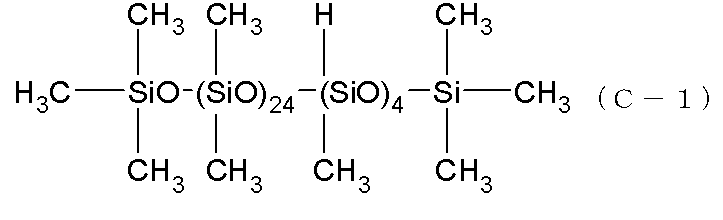

D-1:白金-ジビニルテトラメチルジシロキサン錯体を上記A-1と同じジメチルポリシロキサンに溶解した溶液(白金原子含有量:1質量%)


(A)~(F)成分を以下のように混合して実施例1~13及び比較例1~7の組成物を得た。
即ち、5リットルのプラネタリーミキサー(井上製作所(株)製)に表1,2に示す配合量で(A)、(B)、(E)成分を加え、室温で1時間混合した。次に(C)、(D)、(F)成分を加えて、均一になるように混合した。得られた組成物の貯蔵弾性率、粘度、熱伝導率の測定結果および潰れ性、広がり性試験の結果を表1,2に併記する。

Claims (3)
- シリコーン組成物であって、
(A)1分子中に少なくとも2個の脂肪族不飽和炭化水素基を有し、25℃での動粘度60~100,000mm2/sを有するオルガノポリシロキサン:100質量部、
(B)アルミニウム粉末と酸化亜鉛粉末を含む充填剤:100~2,000質量部、
(C)1分子中に2個以上の、ケイ素原子に結合した水素原子(即ち、SiH基)を有するオルガノハイドロジェンポリシロキサン:(A)成分中の脂肪族不飽和炭化水素基の個数の合計に対する(C)成分中のSiH基の個数が0.5~1.5となる量、及び、
(D)白金族金属触媒:白金原子として(A)成分の0.1~500ppmとなる配合量
を含有し、
ずり弾性が測定可能な粘弾性測定装置を用い、試料を25℃から125℃まで10℃/分、125℃から145℃まで2℃/分、145℃から150℃まで0.5℃/分で昇温した後、150℃で7,200秒維持するプログラムを組んで貯蔵弾性率G’を測定した際、測定開始から3,600秒後の貯蔵弾性率と7,200秒後の貯蔵弾性率との比が0.7以下となる硬化物を与えるものであることを特徴とするシリコーン組成物。 - 前記シリコーン組成物が、(E)下記一般式(1)
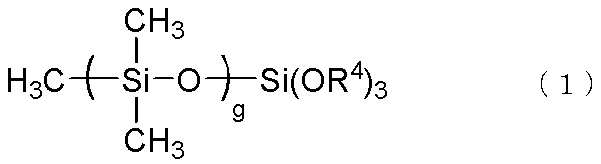
で表される加水分解性メチルポリシロキサンを、前記(A)成分100質量部に対して1~200質量部となる量で含有するものであることを特徴とする請求項1に記載のシリコーン組成物。 - 前記シリコーン組成物が、(F)アセチレン化合物、窒素化合物、有機リン化合物、オキシム化合物および有機クロロ化合物からなる群より選択される1種以上の制御剤を、前記(A)成分100質量部に対して0.05~5.0質量部となる量で含有するものであることを特徴とする請求項1又は請求項2に記載のシリコーン組成物。
Priority Applications (3)
| Application Number | Priority Date | Filing Date | Title |
|---|---|---|---|
| KR1020157033105A KR102176435B1 (ko) | 2013-05-24 | 2014-05-02 | 열전도성 실리콘 조성물 |
| CN201480029904.5A CN105246977A (zh) | 2013-05-24 | 2014-05-02 | 热传导性硅酮组合物 |
| US14/786,676 US10023741B2 (en) | 2013-05-24 | 2014-05-02 | Heat-conductive silicone composition |
Applications Claiming Priority (4)
| Application Number | Priority Date | Filing Date | Title |
|---|---|---|---|
| JP2013109908 | 2013-05-24 | ||
| JP2013-109908 | 2013-05-24 | ||
| JP2013-147582 | 2013-07-16 | ||
| JP2013147582A JP5898139B2 (ja) | 2013-05-24 | 2013-07-16 | 熱伝導性シリコーン組成物 |
Publications (1)
| Publication Number | Publication Date |
|---|---|
| WO2014188667A1 true WO2014188667A1 (ja) | 2014-11-27 |
Family
ID=51933238
Family Applications (1)
| Application Number | Title | Priority Date | Filing Date |
|---|---|---|---|
| PCT/JP2014/002397 Ceased WO2014188667A1 (ja) | 2013-05-24 | 2014-05-02 | 熱伝導性シリコーン組成物 |
Country Status (6)
| Country | Link |
|---|---|
| US (1) | US10023741B2 (ja) |
| JP (1) | JP5898139B2 (ja) |
| KR (1) | KR102176435B1 (ja) |
| CN (1) | CN105246977A (ja) |
| TW (1) | TWI609034B (ja) |
| WO (1) | WO2014188667A1 (ja) |
Cited By (4)
| Publication number | Priority date | Publication date | Assignee | Title |
|---|---|---|---|---|
| WO2017108332A1 (de) * | 2015-12-21 | 2017-06-29 | Beiersdorf Ag | Siloxanelastomere mit sofortiger optisch und sensorisch glättender wirkung sowie solche silikonelastomere enthaltende topische hautpflege-zusammensetzungen |
| US20180179384A1 (en) * | 2016-12-28 | 2018-06-28 | Shin-Etsu Chemical Co., Ltd. | Silicone composition and cured product |
| JP2020041024A (ja) * | 2018-09-07 | 2020-03-19 | 信越化学工業株式会社 | 熱伝導性シリコーン組成物 |
| JPWO2021235214A1 (ja) * | 2020-05-22 | 2021-11-25 |
Families Citing this family (13)
| Publication number | Priority date | Publication date | Assignee | Title |
|---|---|---|---|---|
| JP5783128B2 (ja) | 2012-04-24 | 2015-09-24 | 信越化学工業株式会社 | 加熱硬化型熱伝導性シリコーングリース組成物 |
| KR102108902B1 (ko) | 2013-01-22 | 2020-05-11 | 신에쓰 가가꾸 고교 가부시끼가이샤 | 열전도성 실리콘 조성물, 열전도성 층 및 반도체 장치 |
| JP6172165B2 (ja) | 2015-01-13 | 2017-08-02 | マツダ株式会社 | エアバッグ装置 |
| JP6264307B2 (ja) * | 2015-02-19 | 2018-01-24 | 信越化学工業株式会社 | 付加硬化型シリコーン組成物 |
| JP6223590B2 (ja) * | 2015-05-22 | 2017-11-01 | モメンティブ・パフォーマンス・マテリアルズ・ジャパン合同会社 | 熱伝導性組成物 |
| CN109844031B (zh) * | 2016-10-26 | 2022-01-11 | 信越化学工业株式会社 | 导热性有机硅组合物 |
| CN107833965A (zh) * | 2017-12-22 | 2018-03-23 | 刘�东 | 一种大功率led器件散热基板材料 |
| TWI787444B (zh) * | 2018-02-07 | 2022-12-21 | 日商陶氏東麗股份有限公司 | 可固化聚矽氧組成物、其固化產物、及光學半導體裝置 |
| WO2021079714A1 (ja) * | 2019-10-24 | 2021-04-29 | 信越化学工業株式会社 | 熱伝導性シリコーン組成物及びその製造方法 |
| WO2022099432A1 (en) * | 2020-11-10 | 2022-05-19 | Dow Silicones Corporation | Aluminum nitride filled thermally conductive silicone composition |
| CN116981739A (zh) * | 2021-03-31 | 2023-10-31 | 积水保力马科技株式会社 | 导热性组合物、导热性构件、电池模块 |
| JP2023044473A (ja) | 2021-09-17 | 2023-03-30 | デュポン・東レ・スペシャルティ・マテリアル株式会社 | 熱伝導性シリコーン組成物 |
| CN116997613A (zh) | 2022-01-28 | 2023-11-03 | 瓦克化学股份公司 | 含铝导热膏 |
Citations (5)
| Publication number | Priority date | Publication date | Assignee | Title |
|---|---|---|---|---|
| JP2005154532A (ja) * | 2003-11-25 | 2005-06-16 | Shin Etsu Chem Co Ltd | 放熱用シリコーングリース組成物 |
| JP2009292928A (ja) * | 2008-06-04 | 2009-12-17 | Shin-Etsu Chemical Co Ltd | 低温加熱時における硬化速度を促進した熱伝導性シリコーン組成物 |
| JP2011088953A (ja) * | 2009-10-20 | 2011-05-06 | Shin-Etsu Chemical Co Ltd | 放熱用熱伝導性シリコーングリース組成物及びその使用方法 |
| JP2011246536A (ja) * | 2010-05-25 | 2011-12-08 | Shin-Etsu Chemical Co Ltd | 熱伝導性シリコーングリース組成物 |
| JP2012102283A (ja) * | 2010-11-12 | 2012-05-31 | Shin-Etsu Chemical Co Ltd | 熱伝導性シリコーングリース組成物 |
Family Cites Families (33)
| Publication number | Priority date | Publication date | Assignee | Title |
|---|---|---|---|---|
| JPS4933094B1 (ja) | 1968-12-31 | 1974-09-04 | ||
| JPS4913874B1 (ja) | 1969-08-29 | 1974-04-03 | ||
| JPS4917380B1 (ja) | 1970-07-06 | 1974-04-30 | ||
| JPS58366B2 (ja) | 1973-10-06 | 1983-01-06 | ソニー株式会社 | 表面材貼付方法 |
| JPS61157569A (ja) | 1984-12-28 | 1986-07-17 | Shin Etsu Polymer Co Ltd | 熱伝導性接着組成物 |
| JPH08208993A (ja) | 1995-11-27 | 1996-08-13 | Toshiba Silicone Co Ltd | 熱伝導性シリコーン組成物 |
| EP0939115A1 (en) | 1998-02-27 | 1999-09-01 | Shin-Etsu Chemical Co., Ltd. | Thermally conductive grease composition |
| JPH11246536A (ja) * | 1998-02-27 | 1999-09-14 | Otsuka Chem Co Ltd | メフェナセット化合物、免疫学的反応体、ハイブリドーマ及びメフェナセットの測定方法 |
| JP2938428B1 (ja) | 1998-02-27 | 1999-08-23 | 信越化学工業株式会社 | 熱伝導性グリース組成物 |
| JP2938429B1 (ja) | 1998-02-27 | 1999-08-23 | 信越化学工業株式会社 | 熱伝導性シリコーン組成物 |
| JP3543663B2 (ja) * | 1999-03-11 | 2004-07-14 | 信越化学工業株式会社 | 熱伝導性シリコーンゴム組成物及びその製造方法 |
| JP3580358B2 (ja) * | 2000-06-23 | 2004-10-20 | 信越化学工業株式会社 | 熱伝導性シリコーン組成物及び半導体装置 |
| JP3580366B2 (ja) * | 2001-05-01 | 2004-10-20 | 信越化学工業株式会社 | 熱伝導性シリコーン組成物及び半導体装置 |
| KR100858836B1 (ko) | 2001-05-14 | 2008-09-17 | 다우 코닝 도레이 캄파니 리미티드 | 열전도성 실리콘 조성물 |
| JP3803058B2 (ja) * | 2001-12-11 | 2006-08-02 | 信越化学工業株式会社 | 熱伝導性シリコーン組成物、その硬化物及び敷設方法並びにそれを用いた半導体装置の放熱構造体 |
| JP4130091B2 (ja) | 2002-04-10 | 2008-08-06 | 信越化学工業株式会社 | 放熱用シリコーングリース組成物 |
| JP3952184B2 (ja) | 2002-10-10 | 2007-08-01 | 信越化学工業株式会社 | 熱伝導性シート |
| JP2004352947A (ja) | 2003-05-30 | 2004-12-16 | Shin Etsu Chem Co Ltd | 室温硬化型熱伝導性シリコーンゴム組成物 |
| JP4933094B2 (ja) | 2005-12-27 | 2012-05-16 | 信越化学工業株式会社 | 熱伝導性シリコーングリース組成物 |
| JP5047505B2 (ja) | 2006-02-08 | 2012-10-10 | 信越化学工業株式会社 | 放熱性に優れる電子装置およびその製造方法 |
| EP1878767A1 (en) | 2006-07-12 | 2008-01-16 | Shin-Etsu Chemical Co., Ltd. | Heat conductive silicone grease composition and cured product thereof |
| JP2008038137A (ja) | 2006-07-12 | 2008-02-21 | Shin Etsu Chem Co Ltd | 熱伝導性シリコーングリース組成物およびその硬化物 |
| JP4917380B2 (ja) | 2006-07-31 | 2012-04-18 | 信越化学工業株式会社 | 放熱用シリコーングリース組成物及びその製造方法 |
| JP5372388B2 (ja) | 2008-01-30 | 2013-12-18 | 東レ・ダウコーニング株式会社 | 熱伝導性シリコーングリース組成物 |
| JP4656340B2 (ja) | 2008-03-03 | 2011-03-23 | 信越化学工業株式会社 | 熱伝導性シリコーングリース組成物 |
| JP4572243B2 (ja) | 2008-03-27 | 2010-11-04 | 信越化学工業株式会社 | 熱伝導性積層体およびその製造方法 |
| JP5507059B2 (ja) | 2008-05-27 | 2014-05-28 | 東レ・ダウコーニング株式会社 | 熱伝導性シリコーン組成物および電子装置 |
| JP2010013521A (ja) | 2008-07-02 | 2010-01-21 | Shin-Etsu Chemical Co Ltd | 熱伝導性シリコーン組成物 |
| JP6014299B2 (ja) | 2008-09-01 | 2016-10-25 | 東レ・ダウコーニング株式会社 | 熱伝導性シリコーン組成物及び半導体装置 |
| JP4913874B2 (ja) | 2010-01-18 | 2012-04-11 | 信越化学工業株式会社 | 硬化性オルガノポリシロキサン組成物および半導体装置 |
| JP5447337B2 (ja) | 2010-10-29 | 2014-03-19 | 信越化学工業株式会社 | シリコーン構造体の製造方法及び半導体装置 |
| JP2012131916A (ja) * | 2010-12-22 | 2012-07-12 | Shin-Etsu Chemical Co Ltd | 高熱伝導性シリコーンゴムスポンジ組成物及び定着ロール |
| JP5565758B2 (ja) | 2011-06-29 | 2014-08-06 | 信越化学工業株式会社 | 硬化性でグリース状の熱伝導性シリコーン組成物および半導体装置 |
-
2013
- 2013-07-16 JP JP2013147582A patent/JP5898139B2/ja active Active
-
2014
- 2014-05-02 KR KR1020157033105A patent/KR102176435B1/ko active Active
- 2014-05-02 CN CN201480029904.5A patent/CN105246977A/zh active Pending
- 2014-05-02 WO PCT/JP2014/002397 patent/WO2014188667A1/ja not_active Ceased
- 2014-05-02 US US14/786,676 patent/US10023741B2/en active Active
- 2014-05-12 TW TW103116724A patent/TWI609034B/zh active
Patent Citations (5)
| Publication number | Priority date | Publication date | Assignee | Title |
|---|---|---|---|---|
| JP2005154532A (ja) * | 2003-11-25 | 2005-06-16 | Shin Etsu Chem Co Ltd | 放熱用シリコーングリース組成物 |
| JP2009292928A (ja) * | 2008-06-04 | 2009-12-17 | Shin-Etsu Chemical Co Ltd | 低温加熱時における硬化速度を促進した熱伝導性シリコーン組成物 |
| JP2011088953A (ja) * | 2009-10-20 | 2011-05-06 | Shin-Etsu Chemical Co Ltd | 放熱用熱伝導性シリコーングリース組成物及びその使用方法 |
| JP2011246536A (ja) * | 2010-05-25 | 2011-12-08 | Shin-Etsu Chemical Co Ltd | 熱伝導性シリコーングリース組成物 |
| JP2012102283A (ja) * | 2010-11-12 | 2012-05-31 | Shin-Etsu Chemical Co Ltd | 熱伝導性シリコーングリース組成物 |
Cited By (9)
| Publication number | Priority date | Publication date | Assignee | Title |
|---|---|---|---|---|
| WO2017108332A1 (de) * | 2015-12-21 | 2017-06-29 | Beiersdorf Ag | Siloxanelastomere mit sofortiger optisch und sensorisch glättender wirkung sowie solche silikonelastomere enthaltende topische hautpflege-zusammensetzungen |
| US20180179384A1 (en) * | 2016-12-28 | 2018-06-28 | Shin-Etsu Chemical Co., Ltd. | Silicone composition and cured product |
| US10752775B2 (en) * | 2016-12-28 | 2020-08-25 | Shin-Etsu Chemical Co., Ltd. | Silicone composition and cured product |
| AU2017276221B2 (en) * | 2016-12-28 | 2022-08-18 | Shin-Etsu Chemical Co., Ltd. | Silicone composition and cured product |
| JP2020041024A (ja) * | 2018-09-07 | 2020-03-19 | 信越化学工業株式会社 | 熱伝導性シリコーン組成物 |
| JPWO2021235214A1 (ja) * | 2020-05-22 | 2021-11-25 | ||
| WO2021235214A1 (ja) * | 2020-05-22 | 2021-11-25 | 信越化学工業株式会社 | 高熱伝導性シリコーン組成物 |
| JP7371249B2 (ja) | 2020-05-22 | 2023-10-30 | 信越化学工業株式会社 | 高熱伝導性シリコーン組成物 |
| US12570854B2 (en) | 2020-05-22 | 2026-03-10 | Shin-Etsu Chemical Co., Ltd. | High thermal conductive silicone composition |
Also Published As
| Publication number | Publication date |
|---|---|
| JP5898139B2 (ja) | 2016-04-06 |
| JP2015004043A (ja) | 2015-01-08 |
| CN105246977A (zh) | 2016-01-13 |
| KR102176435B1 (ko) | 2020-11-09 |
| US10023741B2 (en) | 2018-07-17 |
| TWI609034B (zh) | 2017-12-21 |
| TW201500422A (zh) | 2015-01-01 |
| US20160060462A1 (en) | 2016-03-03 |
| KR20160012137A (ko) | 2016-02-02 |
Similar Documents
| Publication | Publication Date | Title |
|---|---|---|
| JP5898139B2 (ja) | 熱伝導性シリコーン組成物 | |
| JP5947267B2 (ja) | シリコーン組成物及び熱伝導性シリコーン組成物の製造方法 | |
| JP6079792B2 (ja) | 熱伝導性シリコーン組成物、熱伝導性層及び半導体装置 | |
| TWI661008B (zh) | 矽氧烷組成物 | |
| JP5832983B2 (ja) | シリコーン組成物 | |
| TWI538996B (zh) | 導熱性聚矽氧潤滑脂組成物 | |
| JP6977786B2 (ja) | シリコーン組成物 | |
| EP2848677B1 (en) | Thermally conductive silicone grease composition | |
| JP7070320B2 (ja) | 熱伝導性シリコーン組成物 | |
| JP7467017B2 (ja) | 熱伝導性シリコーン組成物及びその硬化物 | |
| JP2015212318A (ja) | 熱伝導性シリコーン組成物 | |
| TW201940596A (zh) | 矽酮組成物 | |
| WO2018079309A1 (ja) | 熱伝導性シリコーン組成物 | |
| CN115667407B (zh) | 高导热性有机硅组合物 | |
| WO2021241097A1 (ja) | 熱伝導性付加硬化型シリコーン組成物 | |
| JP6314710B2 (ja) | 熱伝導性シリコーン組成物 | |
| JP2024035628A (ja) | 熱伝導性シリコーン組成物 | |
| TWI534255B (zh) | Heat-conductive silicone grease composition | |
| WO2025187619A1 (ja) | 熱伝導性シリコーン組成物 |
Legal Events
| Date | Code | Title | Description |
|---|---|---|---|
| 121 | Ep: the epo has been informed by wipo that ep was designated in this application |
Ref document number: 14801745 Country of ref document: EP Kind code of ref document: A1 |
|
| WWE | Wipo information: entry into national phase |
Ref document number: 14786676 Country of ref document: US |
|
| ENP | Entry into the national phase |
Ref document number: 20157033105 Country of ref document: KR Kind code of ref document: A |
|
| NENP | Non-entry into the national phase |
Ref country code: DE |
|
| 122 | Ep: pct application non-entry in european phase |
Ref document number: 14801745 Country of ref document: EP Kind code of ref document: A1 |