WO2014185452A1 - カーボンブラック、導電性樹脂組成物及び電極合材 - Google Patents
カーボンブラック、導電性樹脂組成物及び電極合材 Download PDFInfo
- Publication number
- WO2014185452A1 WO2014185452A1 PCT/JP2014/062845 JP2014062845W WO2014185452A1 WO 2014185452 A1 WO2014185452 A1 WO 2014185452A1 JP 2014062845 W JP2014062845 W JP 2014062845W WO 2014185452 A1 WO2014185452 A1 WO 2014185452A1
- Authority
- WO
- WIPO (PCT)
- Prior art keywords
- carbon black
- ratio
- mod
- resin composition
- mass
- Prior art date
- Legal status (The legal status is an assumption and is not a legal conclusion. Google has not performed a legal analysis and makes no representation as to the accuracy of the status listed.)
- Ceased
Links
Images
Classifications
-
- C—CHEMISTRY; METALLURGY
- C08—ORGANIC MACROMOLECULAR COMPOUNDS; THEIR PREPARATION OR CHEMICAL WORKING-UP; COMPOSITIONS BASED THEREON
- C08K—Use of inorganic or non-macromolecular organic substances as compounding ingredients
- C08K3/00—Use of inorganic substances as compounding ingredients
- C08K3/02—Elements
- C08K3/04—Carbon
-
- C—CHEMISTRY; METALLURGY
- C08—ORGANIC MACROMOLECULAR COMPOUNDS; THEIR PREPARATION OR CHEMICAL WORKING-UP; COMPOSITIONS BASED THEREON
- C08K—Use of inorganic or non-macromolecular organic substances as compounding ingredients
- C08K3/00—Use of inorganic substances as compounding ingredients
- C08K3/18—Oxygen-containing compounds, e.g. metal carbonyls
- C08K3/20—Oxides; Hydroxides
- C08K3/22—Oxides; Hydroxides of metals
-
- C—CHEMISTRY; METALLURGY
- C09—DYES; PAINTS; POLISHES; NATURAL RESINS; ADHESIVES; COMPOSITIONS NOT OTHERWISE PROVIDED FOR; APPLICATIONS OF MATERIALS NOT OTHERWISE PROVIDED FOR
- C09C—TREATMENT OF INORGANIC MATERIALS, OTHER THAN FIBROUS FILLERS, TO ENHANCE THEIR PIGMENTING OR FILLING PROPERTIES ; PREPARATION OF CARBON BLACK ; PREPARATION OF INORGANIC MATERIALS WHICH ARE NO SINGLE CHEMICAL COMPOUNDS AND WHICH ARE MAINLY USED AS PIGMENTS OR FILLERS
- C09C1/00—Treatment of specific inorganic materials other than fibrous fillers; Preparation of carbon black
- C09C1/44—Carbon
- C09C1/48—Carbon black
-
- H—ELECTRICITY
- H01—ELECTRIC ELEMENTS
- H01B—CABLES; CONDUCTORS; INSULATORS; SELECTION OF MATERIALS FOR THEIR CONDUCTIVE, INSULATING OR DIELECTRIC PROPERTIES
- H01B1/00—Conductors or conductive bodies characterised by the conductive materials; Selection of materials as conductors
- H01B1/20—Conductive material dispersed in non-conductive organic material
- H01B1/24—Conductive material dispersed in non-conductive organic material the conductive material comprising carbon-silicon compounds, carbon or silicon
-
- C—CHEMISTRY; METALLURGY
- C01—INORGANIC CHEMISTRY
- C01B—NON-METALLIC ELEMENTS; COMPOUNDS THEREOF; METALLOIDS OR COMPOUNDS THEREOF NOT COVERED BY SUBCLASS C01C
- C01B32/00—Carbon; Compounds thereof
-
- C—CHEMISTRY; METALLURGY
- C01—INORGANIC CHEMISTRY
- C01P—INDEXING SCHEME RELATING TO STRUCTURAL AND PHYSICAL ASPECTS OF SOLID INORGANIC COMPOUNDS
- C01P2004/00—Particle morphology
- C01P2004/51—Particles with a specific particle size distribution
- C01P2004/52—Particles with a specific particle size distribution highly monodisperse size distribution
-
- C—CHEMISTRY; METALLURGY
- C01—INORGANIC CHEMISTRY
- C01P—INDEXING SCHEME RELATING TO STRUCTURAL AND PHYSICAL ASPECTS OF SOLID INORGANIC COMPOUNDS
- C01P2004/00—Particle morphology
- C01P2004/54—Particles characterised by their aspect ratio, i.e. the ratio of sizes in the longest to the shortest dimension
-
- C—CHEMISTRY; METALLURGY
- C01—INORGANIC CHEMISTRY
- C01P—INDEXING SCHEME RELATING TO STRUCTURAL AND PHYSICAL ASPECTS OF SOLID INORGANIC COMPOUNDS
- C01P2006/00—Physical properties of inorganic compounds
- C01P2006/12—Surface area
-
- C—CHEMISTRY; METALLURGY
- C01—INORGANIC CHEMISTRY
- C01P—INDEXING SCHEME RELATING TO STRUCTURAL AND PHYSICAL ASPECTS OF SOLID INORGANIC COMPOUNDS
- C01P2006/00—Physical properties of inorganic compounds
- C01P2006/19—Oil-absorption capacity, e.g. DBP values
-
- C—CHEMISTRY; METALLURGY
- C01—INORGANIC CHEMISTRY
- C01P—INDEXING SCHEME RELATING TO STRUCTURAL AND PHYSICAL ASPECTS OF SOLID INORGANIC COMPOUNDS
- C01P2006/00—Physical properties of inorganic compounds
- C01P2006/40—Electric properties
-
- C—CHEMISTRY; METALLURGY
- C08—ORGANIC MACROMOLECULAR COMPOUNDS; THEIR PREPARATION OR CHEMICAL WORKING-UP; COMPOSITIONS BASED THEREON
- C08K—Use of inorganic or non-macromolecular organic substances as compounding ingredients
- C08K2201/00—Specific properties of additives
- C08K2201/001—Conductive additives
-
- C—CHEMISTRY; METALLURGY
- C08—ORGANIC MACROMOLECULAR COMPOUNDS; THEIR PREPARATION OR CHEMICAL WORKING-UP; COMPOSITIONS BASED THEREON
- C08K—Use of inorganic or non-macromolecular organic substances as compounding ingredients
- C08K2201/00—Specific properties of additives
- C08K2201/002—Physical properties
- C08K2201/006—Additives being defined by their surface area
Definitions
- the present invention relates to carbon black, and a conductive resin composition and an electrode mixture containing the carbon black.
- This application claims priority based on Japanese Patent Application Nos. 2013-102327, 2013-102328, and 2013-102329 filed in Japan on May 14, 2013, the contents of which are incorporated herein by reference. .
- Carbon black is widely blended for the purpose of imparting conductivity to a resin material or the like that is an electrical insulator.
- conductive resin compositions obtained by adding conductivity by blending carbon black with a thermoplastic resin that is an electrical insulator are widely used. ing.
- the conductivity of carbon black is important.
- the electrode material for a battery include a current collector and an active material layer formed on the current collector by an electrode mixture containing a composite metal oxide, a conductive material, and a binder resin. It is done. Carbon black is widely used as the conductive material.
- the carbon black having a high DBP oil absorption and an excellent conductivity imparting effect has poor dispersibility in a dispersion medium such as a solvent and is difficult to impart uniformly to a polymer material or the like.
- a dispersion medium such as a solvent
- the surface smoothness of the manufactured conductive article tends to be lowered.
- this carbon black is used for an electrode mixture, problems such as internal short circuit are likely to occur.
- acetylene black or the like is known as a carbon black having a small specific surface area and excellent dispersibility in a dispersion medium.
- the present invention provides carbon black having both good dispersibility and conductivity. Moreover, this invention provides the conductive resin composition which can manufacture the electroconductive article which has high mechanical strength, the outstanding surface smoothness, and electroconductivity. Moreover, this invention provides the electrode compound material which can manufacture the electrode material which is hard to produce malfunctions, such as an internal short circuit, and is excellent in battery performance.
- the carbon black of the present invention satisfies the following conditions (1) to (3).
- the BET specific surface area is 350 to 650 m 2 / g.
- DBP oil absorption amount is 270 ⁇ 340cm 3 / 100g.
- the ratio D 90 / D mod of the D90 diameter (D 90 ) to the mode diameter (D mod ) measured by the method for measuring the aggregate diameter described in JIS K6217-6 is 1.90 to 2.20. is there.
- the conductive resin composition of the present invention contains the carbon black and a resin.
- the electrode mixture of the present invention contains the carbon black, a composite metal oxide, and a binder resin.
- the carbon black of the present invention can achieve both good dispersibility and conductivity. Moreover, if the electroconductive resin composition of this invention is used, the electroconductive article which has high mechanical strength, the outstanding surface smoothness, and electroconductivity can be manufactured. Moreover, if the electrode compound of the present invention is used, it is possible to produce an electrode material that is less prone to problems such as an internal short circuit and that has excellent battery performance.
- the carbon black of the present invention satisfies the following conditions (1) to (3).
- both good dispersibility in the dispersion medium and good conductivity are compatible.
- the conductive resin composition of this invention contains this carbon black, it becomes a conductive resin composition which can manufacture the electrically conductive article which has high mechanical strength, the outstanding surface smoothness, and electroconductivity.
- the electrode mixture of this invention contains this carbon black, the electrode material from which the outstanding battery performance is obtained can be manufactured.
- the BET specific surface area is 350 to 650 m 2 / g.
- DBP oil absorption amount is 270 ⁇ 340cm 3 / 100g.
- the ratio D 90 / D mod of the D90 diameter (D 90 ) to the mode diameter (D mod ) measured by the method for measuring the aggregate diameter described in JIS K6217-6 is 1.90 to 2.20. is there.
- the BET specific surface area of the carbon black of the present invention is 350 to 650 m 2 / g, preferably 350 to 550 m 2 / g, and more preferably 350 to 500 m 2 / g. If the BET specific surface area of carbon black is not less than the lower limit, good conductivity can be easily obtained at the time of addition. Moreover, when this carbon black is added to the conductive resin composition, the conductivity of the conductive resin composition becomes good, and a conductive article having excellent conductivity can be produced. In addition, a conductive article having high mechanical strength can be manufactured. Further, when this carbon black is added to the electrode mixture, excellent battery performance can be obtained.
- the BET specific surface area of the carbon black is not more than the upper limit value, good dispersibility can be easily obtained at the time of addition. Moreover, when this carbon black is added to the conductive resin composition, the dispersibility of the carbon black in the resin becomes good, and a conductive article having excellent surface smoothness can be produced. Moreover, when this carbon black is added to the electrode mixture, the dispersibility of the carbon black in the electrode mixture is improved, and problems such as internal short-circuiting are less likely to occur in the electrode material.
- the BET specific surface area of carbon black is measured by a method based on ASTM D 3037.
- the carbon black of the present invention is a powder composed of secondary particles composed of a chain in which primary particles are arranged in a kitchen shape. Since DBP (n-dibutyl phthalate) is absorbed in the voids of the kitchen chain, the DBP oil absorption is an important index value of carbon black. DBP oil absorption amount of the carbon black of the present invention is 270 ⁇ 340cm 3 / 100g, preferably from 270 ⁇ 320cm 3 / 100g, and more preferably 285 ⁇ 315cm 3 / 100g. If the DBP oil absorption of carbon black is equal to or greater than the lower limit, good conductivity can be easily obtained upon addition.
- the carbon black when this carbon black is added to the conductive resin composition, the carbon black efficiently forms a network in the resin, and a conductive article having excellent conductivity can be manufactured. If the DBP oil absorption of carbon black is not more than the upper limit value, it is easy to obtain carbon black having good dispersibility. Moreover, when this carbon black is added to the conductive resin composition, the dispersibility in the resin becomes good, and a conductive article having excellent surface smoothness can be produced. Note that the DBP oil absorption of carbon black is a value measured with a sample amount of 9 g under conditions based on ASTM D 2414.
- the ratio D 90 / D mod of the D90 diameter (D 90 ) to the mode diameter (D mod ), which is measured by the method for measuring the aggregate diameter described in JIS K6217-6, is 1 .90 to 2.20, preferably 2.00 to 2.20, more preferably 2.10 to 2.20.
- the ratio D 90 / D mod is equal to or higher than the lower limit value, a conductive resin composition having excellent dispersibility can be obtained.
- the ratio D 90 / D mod is not more than the upper limit value, a conductive resin composition having excellent conductivity can be obtained.
- the conductive resin composition which has high mechanical strength in addition to a dispersibility and electroconductivity is obtained by setting it as said range.
- the D90 diameter (D 90 ) means a particle diameter at a point of 90% in a cumulative volume distribution curve with the total volume distribution determined on a volume basis being 100%, that is, a volume-based cumulative 90% diameter. .
- the mode diameter (D mod ) means the particle diameter having the largest appearance ratio in the particle size distribution, that is, the particle diameter at the maximum value of the distribution.
- the ratio D 90 / D mod is an index representing the spread of the particle size distribution.
- the D mod of the carbon black of the present invention is preferably 0.110 to 0.140 ⁇ m, and more preferably 0.115 to 0.135 ⁇ m. If D mod is within the above range, both good dispersibility and conductivity are easily achieved. In addition, when the ratio D 90 / D mod is within the above range, stable conductive performance is exhibited.
- the D 90 of the carbon black of the present invention is preferably 0.230 to 0.300 ⁇ m, and more preferably 0.250 to 0.290 ⁇ m. If D90 is within the above range, both good dispersibility and conductivity are easily achieved. Moreover, it is easy to obtain a conductive resin composition excellent in conductivity and surface smoothness.
- a good dispersibility in the dispersion medium from the viewpoint of easy good conductivity is compatible, the BET specific surface area of 350 ⁇ 550m 2 / g, DBP oil absorption of 270 ⁇ 320cm 3 / 100g Carbon black having a ratio D 90 / D mod of 1.90 to 2.20 is particularly preferable.
- the average primary particle size of the carbon black of the present invention is preferably 30 to 55 nm, more preferably 35 to 50 nm. If the average primary particle diameter of carbon black is at least the lower limit value, the dispersibility in the dispersion medium will be better. If the average primary particle diameter of carbon black is not more than the upper limit value, good conductivity is easily obtained at the time of addition. Moreover, it is easy to obtain a good conductive resin composition and a good conductive electrode mixture. The average primary particle size of carbon black is measured by the method described in the examples.
- the volatile content of the carbon black of the present invention is preferably 0.8% by mass or less, and more preferably 0.5% by mass or less. If the volatile content of carbon black is less than or equal to the above upper limit value, good electrical conductivity can be easily obtained at the time of addition. Moreover, it is easy to obtain a good conductive resin composition and a good conductive electrode mixture. In addition, the volatile matter of carbon black is measured by the method as described in an Example.
- the ash content of the carbon black of the present invention is preferably 0.05% by mass or less, and more preferably 0.03% by mass or less. If the ash content of the carbon black is not more than the upper limit value, stable conductive performance can be easily obtained at the time of addition. Moreover, the strength reduction of the resin is easily suppressed. Moreover, it is easy to obtain an electrode material that exhibits stable conductive performance.
- the ash content of carbon black is measured by a method based on ASTM D 1506.
- 24M4DBP oil absorption of the carbon black of the present invention is preferably 130 ⁇ 200cm 3 / 100g, and more preferably 140 ⁇ 180cm 3 / 100g . If the 24M4DBP oil absorption is greater than or equal to the lower limit, stable conductive performance can be easily obtained at the time of addition. Moreover, it is easy to obtain an electrode material having stable conductive performance. If the 24M4DBP oil absorption is less than or equal to the upper limit value, good dispersibility is easily obtained at the time of addition. Moreover, it is easy to obtain an electrode material having good dispersibility. The 24M4DBP oil absorption is measured using a sample amount of 20 g under the conditions described in JIS K 6217-4.
- the iodine adsorption amount is preferably 420 to 660 mg / g, and the pH of the 1% by mass aqueous solution is preferably 9 to 11.
- the stable electroconductivity is easy to be obtained at the time of addition.
- the iodine adsorption amount is measured by the method described in JIS K 6217-1.
- the ratio of the CTAB (cetyltrimethylammonium bromide) adsorption specific surface area to the BET specific surface area (CTAB / BET) in the carbon black of the present invention is preferably 0.3 to 0.8, preferably 0.6 to 0.8. It is more preferable that When the ratio (CTAB / BET) is within the above range, stable dispersion performance is easily obtained. Moreover, it is easy to obtain a conductive resin composition excellent in conductivity and surface smoothness.
- the CTAB adsorption specific surface area is measured under the conditions described in JIS K 6217-3.
- An example of the method for producing carbon black of the present invention is an oil-furnace method.
- the oil furnace method include, for example, a method in which a raw material oil is partially oxidized in the presence of molecular oxygen and water vapor in a furnace to generate synthesis gas and simultaneously produce carbon black. It is done.
- the carbon production furnace include a GE (General Electric) furnace and an SG (Shell Gasification) furnace, and an SG furnace is particularly preferable.
- the ratio of steam supplied to the furnace per 1 ton of feedstock (steam ratio), the feed of 1 ton of feedstock to the furnace It is important not only to control the ratio of molecular oxygen (oxygen ratio) and the amount of feedstock supplied into the furnace per unit time, but also to not emulsify the feedstock. That is, it is important to control all the manufacturing conditions corresponding to these four items. In particular, in order to satisfy the condition (3), it is particularly important to control the supply amount of the raw material oil and to suppress the emulsion of the raw material oil.
- the steam ratio is preferably 200 to 450 kg / t, more preferably 250 to 300 kg / t per ton of feedstock oil. If the steam ratio is within the above range, carbon black satisfying the conditions (1) to (3) can be easily obtained.
- the oxygen ratio is preferably 500 to 650 Nm 3 per ton of feedstock oil, and more preferably 550 to 600 Nm 3 . If the oxygen ratio is within the above range, carbon black satisfying the conditions (1) to (3) can be easily obtained.
- the amount of feedstock supplied into the furnace per unit time is preferably 1000 to 1800 kg / hour, more preferably 1200 to 1600 kg / hour. If the amount of feedstock supplied into the furnace per unit time is within the above range, carbon black satisfying the conditions (1) to (3) can be easily obtained.
- the feed oil is preferably fed without being emulsified. This makes it easy to obtain carbon black that satisfies the conditions (1) to (3).
- the furnace temperature is preferably 1250 to 1350 ° C., more preferably 1300 to 1350 ° C.
- the furnace pressure is preferably 15 to 45 kg / cm 2 , more preferably 25 to 35 kg / cm 2 .
- the obtained carbon black is preferably dried under a nitrogen gas atmosphere.
- the drying temperature is preferably 300 to 900 ° C., more preferably 350 to 700 ° C., and particularly preferably 400 to 600 ° C.
- the drying temperature is 300 ° C. or higher, the volatile matter is reduced and good conductive performance is easily obtained at the time of addition.
- the drying temperature is 900 ° C. or lower, the degree of graphitization becomes small, and good dispersion performance with respect to the resin or solvent is easily obtained.
- liquid hydrocarbons are preferable.
- coal-based hydrocarbons such as creosote oil, petroleum-based hydrocarbons such as ethylene bottom oil (EHE oil), etc. Is mentioned.
- EHE oil is preferable.
- the BMCI value of the feed oil is preferably 100 to 200, more preferably 120 to 180, and particularly preferably 130 to 160. If the BMCI value is 100 or more, the yield is difficult to decrease, which is preferable from an economic viewpoint. If the BMCI value is 200 or less, stable supply of raw materials is easy.
- the C / H ratio of the raw material oil is preferably 5 to 20, and more preferably 10 to 18. If the C / H ratio is 5 or more, the yield is unlikely to decrease, which is preferable from the economic aspect. If the C / H ratio is 20 or less, stable supply of the feedstock oil is easy.
- the sodium content is preferably 10 ppm by mass or less, more preferably 5 ppm by mass or less, and particularly preferably 3 ppm by mass or less. If sodium content is 10 mass ppm or less, it is easy to suppress that many metal contents, such as iron, remain
- the iron content of the raw material oil is preferably 10 mass ppm or less, more preferably 8 mass ppm or less, and particularly preferably 4 mass ppm or less. If the iron content is 10 mass ppm or less, it is easy to suppress the metal remaining in the carbon and adversely affecting the resin composition and battery characteristics.
- the contents of nickel, copper and manganese in the raw material oil are each preferably 8 mass ppm or less, more preferably 4 mass ppm or less, and particularly preferably 2 mass ppm or less. If content of nickel, copper, and manganese is 8 mass ppm or less, it will be easy to suppress that a metal remains in carbon and exerts a bad influence on a resin composition or a battery characteristic.
- the sulfur content of the feedstock oil is preferably 1% by mass or less, more preferably 0.5% by mass or less, and particularly preferably 0.01% by mass or less. If the sulfur content is 1% by mass or less, it is easy to suppress adverse effects on the resin composition and battery characteristics.
- the carbon black of the present invention described above satisfies the conditions (1) to (3), both good dispersibility and conductivity are achieved.
- the conductive resin composition of the present invention uses carbon black that satisfies the conditions (1) to (3), a conductive article having high mechanical strength, excellent surface smoothness and conductivity is obtained. Can be manufactured.
- the electrode mixture of the present invention uses carbon black that satisfies the conditions (1) to (3), it is possible to produce an electrode material that is less prone to problems such as internal short circuit and that has excellent battery performance. .
- the ratio of the composite metal oxide can be increased, so that the energy density of the battery can be easily improved.
- the electrode material manufactured using the electrode mixture of the present invention is excellent in battery performance even if the amount of carbon black used is small.
- carbon black (a) acetylene black DBP oil absorption of 270 cm 3/100 g less and a BET specific surface area of 350 meters 2 / g less than the carbon black
- carbon black (b) As the conductivity-imparting effect is high carbon black, DBP oil absorption of 340 cm 3/100 g super and a BET specific surface area of 650 meters 2 / g than the carbon black (hereinafter, referred to as "carbon black (b)".) It is commercially available However, the dispersibility of the carbon black (b) is low. The reason for the carbon black of the present invention is not clear, but even when compared with the intermediate performance assumed from the dispersibility and conductivity of the carbon black (a) and the dispersibility and conductivity of the carbon black (b), It has better dispersibility and conductivity.
- the carbon black of the present invention can be suitably used in fields requiring high dispersion performance in addition to conductivity, such as power cables, in addition to fields such as electrode materials, automotive conductive materials, and semiconductor packages.
- the conductive resin composition of the present invention contains the carbon black of the present invention and a resin. Moreover, the conductive resin composition of this invention may contain components other than carbon black and resin as needed.
- the ratio of carbon black in the conductive resin composition (100% by mass) of the present invention is preferably 0.5 to 40% by mass, and more preferably 3.0 to 30% by mass. If the ratio of the carbon black is equal to or higher than the lower limit, a conductive resin composition having excellent conductivity can be easily obtained. If the ratio of the carbon black is less than or equal to the upper limit value, a decrease in strength of the conductive resin composition is likely to be suppressed.
- the resin is not particularly limited, and may be a thermoplastic resin or a thermosetting resin.
- the thermosetting resin include phenol, melamine, and epoxy.
- the thermoplastic resin include polyolefin resins, elastomer resins, polystyrene resins, other general-purpose resins, engineering plastics, super engineering plastics, and the like.
- polyolefin-based thermoplastic resins include olefin homopolymers and copolymers, as well as copolymers of olefins and other monomers.
- polyethylene resins such as high-density polyethylene, medium-density polyethylene or low-density polyethylene, and linear low-density polyethylene produced by the low-pressure method, medium-pressure method, or high-pressure method; polypropylene resin; -Butadiene resin; ethylene-butene copolymer and the like.
- copolymers of ethylene, propylene or butylene and acrylates or methacrylates, and those obtained by chlorinating these copolymers can be mentioned.
- the mixture etc. which mixed 2 or more types of the said polymer are mentioned.
- the polyolefin-based thermoplastic resins a polyethylene resin and a polypropylene resin are preferable.
- the elastomeric thermoplastic resin includes olefin elastomers such as ethylene propylene elastomer and ethylene-propylene-diene rubber (EPDM) elastomer; styrene elastomers such as styrene-butadiene-styrene and styrene-isoprene-styrene; polyamides Examples include elastomers; urethane elastomers; and polyester elastomers.
- olefin elastomers such as ethylene propylene elastomer and ethylene-propylene-diene rubber (EPDM) elastomer
- EPDM ethylene-propylene-diene rubber
- styrene elastomers such as styrene-butadiene-styrene and styrene-isoprene-styrene
- polyamides Examples include elastomers;
- polystyrene-based thermoplastic resin examples include polystyrene, acrylonitrile-butadiene-styrene (ABS) resin, acrylonitrile-styrene (AS) resin, and acrylonitrile-acrylic rubber-styrene (AAS) resin.
- ABS acrylonitrile-butadiene-styrene
- AS acrylonitrile-styrene
- AAS acrylonitrile-acrylic rubber-styrene
- PVC polyvinyl chloride
- ESA ethylene-ethyl acrylate
- EVA ethylene-vinyl acetate
- AES acrylonitrile-ethylene-propylene rubber-styrene
- Engineering plastics include polyamide resins such as 6-nylon, 6,6-nylon, 6,10-nylon, 12-nylon and MXD-nylon resin; polyester resins such as polycarbonate resin, polyethylene terephthalate resin and polybutylene terephthalate resin; Polyacetal resin; and modified polyphenylene ether resin.
- polysulfone resin, modified polysulfone resin, polyphenylene sulfone resin, polyketone resin, polyether imide resin, polyarylate resin, polyphenylene sulfide resin, liquid crystal polymer, polyether sulfone resin, polyether ether ketone resin examples thereof include a polyimide resin, a polyamideimide resin, and a fluororesin.
- polycarbonate resin examples include an aromatic polycarbonate resin obtained by reacting an aromatic dihydroxy compound with phosgene or a diester of carbonic acid, and a fat obtained by using an alicyclic dihydroxy compound instead of the aromatic dihydroxy compound.
- aromatic dihydroxy compounds include 2,2-bis (4-hydroxyphenyl) propane, bis (4-hydroxyphenyl) methane, 1,1-bis- (4-hydroxyphenyl) ethane, 2,2-bis (4 -Hydroxyphenyl) propane, 2,2-bis (4-hydroxy-3-methylphenyl) propane, 4,4′-hydroxybiphenyl, and the like.
- alicyclic dihydroxy compound examples include isosorbide, spiroglycol and cyclohexyldiol.
- these resins may be blended for the purpose of ensuring the physical properties according to the application.
- specific examples include ABS / polycarbonate resin blends, polybutylene terephthalate resin / polycarbonate resin blends, polyphenylene ether resin / polyamide resin / styrene-butylene-styrene elastomer blends, and the like.
- the ratio of the resin in the conductive resin composition (100% by mass) of the present invention is preferably 60.0 to 99.5% by mass, and more preferably 70.0 to 97.0% by mass. . If the ratio of the said resin is more than a lower limit, the strength reduction of a conductive resin composition will be suppressed. If the ratio of the said resin is below an upper limit, the conductive resin composition which has the outstanding electroconductivity will be easy to be obtained.
- Other components include, for example, mica, glass fiber, silica, talc, calcium carbonate, zinc oxide, barium sulfate, to improve heat resistance, dimensional stability, rigidity, toughness, impact resistance or mechanical strength.
- An inorganic filler such as stainless steel, copper oxide, nickel, nickel oxide or zirconia silicate can be blended.
- a molding aid or a processing aid may be blended for the purpose of preventing deterioration due to kneading or aging of the thermoplastic resin and carbon black and improving moldability.
- Specific examples include lubricants such as known phenolic antioxidants and phosphorus antioxidants, metal soaps, and fatty acid amide derivatives.
- known flame retardants, plasticizers, and the like can be used depending on the application.
- the ratio of the other components in the conductive resin composition (100% by mass) of the present invention is 0.1 to 40.0% by mass.
- the content is 1.0 to 30.0% by mass.
- the method for preparing the conductive resin composition of the present invention is not particularly limited, and examples thereof include a method in which a resin, carbon black, and other components used as necessary are mixed and kneaded by a known method.
- the conductive resin composition of the present invention may be formed into a pellet compound by, for example, melting and kneading each component.
- Each component of the conductive resin composition of the present invention may be kneaded after being uniformly mixed by a premixer such as a tumbler or a Henschel mixer. Further, the specific components may be separately supplied to the kneader using a quantitative feeder or a capacity feeder, and kneaded.
- the kneading machine include a single-screw extruder with a vent, a different-direction twin-screw extruder, a same-direction twin-screw extruder, a super mixer, a Banbury mixer, a kneader, a tumbler and a kneader.
- a conductive resin composition in which carbon black is well dispersed in the resin can be easily prepared by a known kneading method.
- an electroconductive article using the electroconductive resin composition of this invention does not specifically limit as a method to manufacture an electroconductive article using the electroconductive resin composition of this invention, For example, injection molding or extrusion molding etc. can be suitably selected according to a use.
- the use of the conductive resin composition of the present invention is not particularly limited, and examples thereof include an automotive conductive material, a semiconductor package, and a power cable.
- the electrode mixture of the present invention is an electrode mixture used for forming an electrode material of a nonaqueous battery, for example, and contains the carbon black of the present invention, a composite metal oxide, and a binder resin.
- the proportion of carbon black in the electrode mixture (100% by mass) of the present invention is preferably 0.05 to 15% by mass, more preferably 0.5 to 12% by mass, and 1 to 10% by mass. % Is more preferable, and 1.5 to 8% by mass is particularly preferable. If the ratio of the carbon black is equal to or higher than the lower limit value, stable battery performance is easily obtained. If the ratio of the carbon black is less than or equal to the upper limit value, stable battery performance is easily obtained. Further, by reducing the proportion of carbon black, it is possible to increase the proportion of the composite metal oxide in the electrode material, and it becomes easy to achieve both improved energy density and stable battery performance.
- the composite metal oxide normally used as an electrode active material can be used.
- the composite metal oxide for example, Li x MO 2 (wherein M represents one or more transition metals, and 0.05 ⁇ x ⁇ 1.10.) Is mentioned.
- M is preferably at least one selected from the group consisting of Mn, Co or Ni.
- Specific examples of the lithium transition metal composite oxide include, for example, LiCoO 2 , LiNiO 2 , LiMnO 2 , LiMn 2 O 4 , Li 2 MnO 3 , LiMn 1/2 Ni 1/2 O 2 and LiNi 1/3 Co 1. / 3 Mn 1/3 O 2 and the like.
- the composite metal oxide examples include olivine such as LiFePO 4 , LiFeP 2 O 7 , LiMnPO 4 , LiCoPO 4 , LiNiPO 4 , Li 2 FeSiO 4 , Li 2 MnSiO 4 , Li 2 NiSiO 4, and Li 2 CoSiO 4.
- Type metal lithium salts may be used. 1 type may be sufficient as the composite metal oxide contained in the electrode compound material of this invention, and 2 or more types may be sufficient as it.
- the ratio of the composite metal oxide in the electrode mixture (100% by mass) of the present invention is preferably 70 to 99.9% by mass, and more preferably 76 to 99% by mass. If the ratio of the composite metal oxide is not less than the lower limit value, stable battery performance is easily obtained. If the ratio of the composite metal oxide is not more than the upper limit value, stable battery performance is easily obtained.
- binder resin It does not specifically limit as binder resin, The binder resin normally used for an electrode material can be used.
- the binder resin include, for example, fluorine resins such as polyvinylidene fluoride and polytetrafluoroethylene, and polymers having unsaturated bonds such as styrene / butadiene rubber, isoprene rubber and butadiene rubber.
- the binder resin contained in the electrode mixture of the present invention may be one type or two or more types.
- the ratio of the binder resin in the electrode mixture (100% by mass) of the present invention is preferably 0.05 to 15% by mass, and more preferably 0.5 to 12% by mass. If the ratio of the binder resin is not less than the lower limit value, stable battery performance is easily obtained. If the ratio of the binder resin is equal to or less than the upper limit value, stable battery performance is easily obtained.
- the electrode mixture of the present invention may further contain other components other than carbon black, composite metal oxide, and binder resin, if necessary.
- other components include a surfactant.
- the proportion of the other components in the electrode mixture (100% by mass) of the present invention is preferably 0.05 to 15% by mass. It is more preferably 5 to 12% by mass.
- the method for producing the electrode material using the electrode mixture of the present invention is not particularly limited, and for example, the solvent after the slurry obtained by dissolving or dispersing the electrode mixture in the solvent is coated on the current collector. And a method of applying a kneaded product obtained by kneading each component of the electrode mixture onto the current collector.
- those normally used as a current collector for electrode materials can be used, and examples thereof include metal foil made of aluminum and an alloy containing aluminum as a main component.
- a solvent usually used in the production of electrode materials can be used.
- alkyl alcohols methyl alcohol, ethyl alcohol, propyl alcohol, etc.
- alkyl ketones acetone, methyl ethyl ketone, etc.
- ethers Tetrahydrofuran, dioxane and diglyme
- amides diethylformamide, dimethylacetamide, N-methyl-2-pyrrolidone, dimethylimidazolidinone, etc.
- BET specific surface area of carbon black The BET specific surface area of carbon black was measured under conditions based on ASTM D 3037.
- Carbon black ratio D 90 / D mod was calculated from the result of measurement by the aggregate diameter measuring method described in JIS K6217-6. Specifically, a well-balanced carbon black was added to a 20 vol% ethanol aqueous solution containing 3 drops of a surfactant (“NONIDET P-40” manufactured by SIGMA CHEMICAL), and the carbon black concentration was 0.01% by mass. A sample solution was prepared. The sample solution was subjected to a dispersion treatment for 20 minutes using an ultrasonic cleaner (ULTRASONIC STIRRING BATH: manufactured by LAKOMANUFACTURING CO.) To obtain a carbon black slurry.
- ULTRASONIC STIRRING BATH manufactured by LAKOMANUFACTURING CO.
- a straight line B was drawn from the peak A of the histogram in parallel to the Y axis, and the intersection with the X axis of the histogram was taken as C.
- the Stokes diameter at C at this time is the mode diameter (D mod ).
- a straight line E was drawn in parallel with the Y axis from the point D at which the integrated amount becomes 90% in this histogram, and the intersection with the X axis of the histogram was taken as F.
- Stokes diameter at F at this time the D90 diameter (D 90).
- the average primary particle diameter of carbon black was determined using a transmission electron microscope. Specifically, a carbon black sample was dispersed in chloroform for 10 minutes using an ultrasonic disperser of 150 kHz and 0.4 kW to prepare a dispersion sample, which was sprinkled and fixed on a carbon reinforced support film. This was photographed with a transmission electron microscope, and the particle size of 1000 or more carbon blacks was randomly measured using an Endter apparatus from an image magnified 50000-200000 times, and the average value was taken as the average primary particle size. .
- the magnetic crucible (diameter 15 mm, height 30 mm, capacity 10 mL) and the drop lid were baked at 950 ⁇ 20 ° C. for 30 minutes, then cooled to room temperature (25 ° C.) in a desiccator, and the magnetic crucible and drop lid were The mass (M A ) was accurately weighed to the nearest 0.1 mg.
- 2 g of carbon black was pressed into a magnetic crucible so as not to exceed 2 mm below the lid, and the lid was dropped, and the mass (M B ) was accurately weighed to the nearest 0.1 mg. Then, it is heated in an electric furnace at 950 ⁇ 20 ° C.
- Carbon black ash (Carbon black ash) The ash content of carbon black was measured under conditions based on ASTM D 1506.
- Carbon black 1 g ⁇ 0.01 g was accurately weighed to 0.01 g and collected in a 20 mL beaker. Then, 1 mL of ethyl alcohol and 10 mL of distilled water boiled in advance were added to obtain a carbon black dispersion, which was covered with a watch glass and allowed to cool in a thermostatic chamber at 25 ° C. for 60 minutes. After confirming that the dispersion was at 25 ° C., the indicated value after 1 minute from the start of the measurement was read using a pH meter that was fair with the pH standard solutions 4, 7, and 9.
- the high-quality paper coated with the slurry was heated with a hot stirrer HS-5BH (manufactured by ASONE Corporation) at 80 ° C. for 30 minutes to volatilize n-methyl-2-pyrrolidone.
- HS-5BH hot stirrer
- the coated high-quality paper was cut into 20 mm ⁇ 20 mm, and then the fragments cut out using a SUS roller were flattened, and a hand press SSP-10A (Shimadzu Corporation) ) was used (press temperature 25 ° C., press pressure 370 MPa, press time 1 minute).
- a vacuum oven Isotemp Vacuum Oven Model 280A, manufactured by Fischer Scientific
- a model positive electrode composition film was obtained.
- the surface resistance value of the model positive electrode composition film was measured with a resistivity meter (Loresta GP MCP-T610 type, manufactured by Mitsubishi Chemical Analytech Co., Ltd.).
- Carbon black was obtained in the same manner as in Production Example 1, except that the oil supply amount, steam ratio, oxygen ratio, methane concentration, furnace temperature, and furnace pressure were changed as shown in Table 1.
- DBP oil absorption, BET specific surface area, D mod , D 90 , ratio D 90 / D mod , average primary particle size, yield, ash content, CTAB adsorption specific surface area, ratio (CTAB) of carbon black obtained in Production Examples 1 to 5 / BET), 24M4DBP oil absorption, iodine adsorption, and pH of a 1 mass% aqueous solution are shown in Table 1.
- Example 1 to 4 The carbon blacks obtained in Production Examples 1 to 4 were evaluated for their slurry viscosity, dispersibility, and surface resistivity.
- Table 2 shows the DBP oil absorption, the BET specific surface area, the ratio D 90 / D mod , and the evaluation results of carbon black in the examples and comparative examples.
- Example 1a 10 parts by mass of the carbon black obtained in Production Example 1 and 90 parts by mass of a polycarbonate resin (trade name “Iupilon S-3000”, manufactured by Mitsubishi Engineering Plastics Co., Ltd.) The mixture was kneaded at 290 ° C., extruded and cooled. Thereafter, a conductive resin composition having a cylindrical pellet-like compound was obtained by a pelletizer.
- a polycarbonate resin trade name “Iupilon S-3000”, manufactured by Mitsubishi Engineering Plastics Co., Ltd.
- Example 2a to 4a A conductive resin composition was obtained in the same manner as in Example 1a except that the carbon black used was changed as shown in Table 2.
- Comparative Example 5a Resulting carbon black of Comparative Example 3a and the carbon black of Comparative Example 1a were blended in a weight ratio 59/41, DBP oil absorption of 280cm 3 / 100g, BET specific surface area of 576m 2 / g, the ratio D 90 / D mod
- Comparative Example 6a Resulting carbon black of Comparative Example 2a and carbon black in Comparative Example 1a were blended in a weight ratio 52/48, DBP oil absorption of 280cm 3 / 100g, BET specific surface area of 443m 2 / g, the ratio D 90 / D mod
- volume resistivity A plate-shaped test specimen having a thickness of 3.2 mm, a length of 76 mm, and a width of 76 mm was produced by injection molding using the pellets of the conductive resin composition obtained in each example. Volume resistivity was measured according to ISO1853 using meter Model 2506A. It shows that it is excellent in electroconductivity, so that the value of volume resistivity is small.
- Table 2a shows the DBP oil absorption, the BET specific surface area, the ratio D 90 / D mod , and the evaluation results of the carbon black used in the examples and comparative examples.
- Example 1b (Manufacture of electrode materials) Carbon black obtained in Production Example 1 using 100% by mass of LiFePO 4 which is a composite metal oxide under the conditions of a kneading temperature of 25 ° C. and a rotation speed of 300 rpm using a planetary rotating ball mill LP-1 (manufactured by Ito Manufacturing Co., Ltd.) 10 parts by weight, 10 parts by weight of polyvinylidene fluoride as a binder resin, and 170 parts by weight of n-methyl-2-pyrrolidone were added in this order and kneaded for 10 minutes to obtain a slurry of the electrode mixture.
- LiFePO 4 which is a composite metal oxide under the conditions of a kneading temperature of 25 ° C. and a rotation speed of 300 rpm using a planetary rotating ball mill LP-1 (manufactured by Ito Manufacturing Co., Ltd.) 10 parts by weight, 10 parts by weight of polyvinylidene fluoride as
- a polyethylene (PE) coating frame (thickness 0.2 mm) was placed on an aluminum foil (30 mm ⁇ 140 mm), and the slurry was applied using a glass rod. Thereafter, the slurry-coated aluminum foil was heated with a hot stirrer HS-5BH (manufactured by AS ONE Corporation) at 110 ° C. for 1 hour to volatilize n-methyl-2-pyrrolidone. After flattening the surface using a SUS roller, the coated aluminum foil was cut into 20 mm ⁇ 20 mm.
- PE polyethylene
- the cut piece was flattened using a SUS roller, and pressed (press temperature 25 ° C., press pressure 370 MPa, press time 1 minute) using a hand press SSP-10A (Shimadzu Corporation). Furthermore, using a vacuum oven (Isotemp Vacuum Oven Model 280A, manufactured by Fischer Scientific) under reduced pressure drying at 110 ° C. for 5 hours, an electrode material was obtained. A plurality of electrode materials were manufactured, and those having a thickness of 25 ⁇ 3 mm measured in a dry box in an argon atmosphere were used for evaluation of battery characteristics.
- the evaluation cell was assembled in a dry box in an argon atmosphere.
- a lithium foil (25 mm ⁇ 25 mm) was fixed to a nickel plate (25 mm ⁇ 25 mm) with a resin roller.
- an electrode material (20 mm ⁇ 20 mm) is laminated so that the slurry coating surface is on the separator side, and an aluminum plate (22 mm ⁇ 22 mm) is further laminated. did.
- a heat sealer FT-130 manufactured by Fuji Impulse Co., Ltd.
- Example 2b to 11b An evaluation cell was produced in the same manner as in Example 1b except that the carbon black, the composite metal oxide, and the binder resin were changed as shown in Table 2b.
- the evaluation cell was taken out from the dry box, and the battery electrode portion was fixed with a torque of 15 Nm with a SUS plate.
- the open circuit voltage was measured using a pocket tester (manufactured by Custom Co., Ltd.), and the charge / discharge measurement was performed using the charge / discharge device HJ1001SD8 (manufactured by Hokuto Denko Co., Ltd.) for the evaluation cell showing a voltage of 3.4V. .
- the battery was charged for 5 hours at a constant current of 0.2 C, then charged for 2.5 hours at a constant voltage of 4.1 V, and allowed to stand for 30 minutes. Thereafter, the battery was discharged to 2.0 V at a rate of 30C.
- the ratio of the discharge capacity in the discharge at a rate of 30 C with respect to the theoretical capacity of the evaluation cell was defined as the capacity maintenance rate.
- the rate 1C indicates a current value that can discharge the theoretical capacity of the evaluation cell in one hour.
- An evaluation cell was manufactured in the same manner as the evaluation of battery characteristics. The evaluation cell was taken out from the dry box, and the battery electrode portion was fixed with a torque of 15 Nm with a SUS plate. An open circuit voltage was measured using a pocket tester (manufactured by Custom Co., Ltd.), and an evaluation cell showing a voltage of 3.4 V was set to SOC 50% using a charge / discharge device HJ1001SD8 (manufactured by Hokuto Denko Co., Ltd.). Thereafter, AC impedance measurement was performed using a frequency response analyzer 1260 type (manufactured by Solartron) and a potentio / galvanostat 1287 type (manufactured by Solartron). The measurement conditions were an amplitude AC potential of 2 mV, a DC potential of 0 CV, and a measurement frequency of 25 mHz to 100 kHz.
- the number of protrusions was measured by visual observation, and the dispersibility was evaluated according to the following criteria.
- Table 2b and Table 3b show the DBP oil absorption, the BET specific surface area, the ratio D 90 / D mod and the evaluation results of the carbon black used in the examples and comparative examples.
- Comparative Examples 6 to 8 using carbon black that does not satisfy any of the conditions (1) to (3) are compared to Examples 9 to 11 using electrode mixtures having the same composition except that carbon black is different. Thus, the capacity retention rate at the rate of 30C was low, and the battery performance was inferior.
Landscapes
- Chemical & Material Sciences (AREA)
- Organic Chemistry (AREA)
- Health & Medical Sciences (AREA)
- Chemical Kinetics & Catalysis (AREA)
- Medicinal Chemistry (AREA)
- Polymers & Plastics (AREA)
- Physics & Mathematics (AREA)
- Dispersion Chemistry (AREA)
- Spectroscopy & Molecular Physics (AREA)
- Compositions Of Macromolecular Compounds (AREA)
- Conductive Materials (AREA)
- Inorganic Chemistry (AREA)
Abstract
Description
本願は、2013年5月14日に日本に出願された特願2013-102327号、特願2013-102328号及び特願2013-102329号に基づき優先権を主張し、その内容をここに援用する。
優れた導電性が得られるカーボンブラックとしては、例えば、以下に示すものが知られている。
(i)液状炭化水素(原料油)を、炉内において分子状酸素及び水蒸気の存在下に部分酸化反応させて合成ガスを製造すると同時に得られる、DBP吸油量が290~640cm3/100gのカーボンブラック(例えば、特許文献1~4)。
(ii)液状炭化水素(原料油)を、炉内において分子状酸素及び水蒸気の存在下に部分酸化反応させて合成ガスを製造すると同時に得られる、DBP吸油量が400cm3/100g以上で、かつ比表面積が1000m2/g以上のカーボンブラック(例えば、特許文献5)。
一方、比表面積が小さく、分散媒への分散性に優れたカーボンブラックとしては、アセチレンブラック等が知られている。しかし、アセチレンブラック等を用いた場合は、導電性付与効果が低く、優れた導電性を有する導電性材料が得られ難い。また、アセチレンブラック等を導電性樹脂組成物に用いた場合は、製造される導電性物品において高い機械強度を得られ難い。また、アセチレンブラック等を電極合材に用いた場合は、充分な電池性能が得られ難い。
(1)BET比表面積が350~650m2/gである。
(2)DBP吸油量が270~340cm3/100gである。
(3)JIS K6217-6に記載の凝集体径の測定方法により測定される、モード径(Dmod)に対するD90径(D90)の比D90/Dmodが1.90~2.20である。
本発明の導電性樹脂組成物は、上記カーボンブラックと、樹脂とを含有する。
本発明の電極合材は、上記カーボンブラックと、複合金属酸化物と、バインダー樹脂とを含有する。
本発明のカーボンブラックは、下記条件(1)~(3)を満たす。下記条件(1)~(3)を満たすカーボンブラックにおいては、分散媒への良好な分散性と、良好な導電性とが両立される。また、本発明の導電性樹脂組成物はこのカーボンブラックを含有するので、高い機械強度と、優れた表面平滑性及び導電性を兼ね備えた導電性物品を製造できる導電性樹脂組成物となる。また、本発明の電極合材はこのカーボンブラックを含有するので、優れた電池性能が得られる電極材を製造できる。
(1)BET比表面積が350~650m2/gである。
(2)DBP吸油量が270~340cm3/100gである。
(3)JIS K6217-6に記載の凝集体径の測定方法により測定される、モード径(Dmod)に対するD90径(D90)の比D90/Dmodが1.90~2.20である。
なお、カーボンブラックのBET比表面積は、ASTM D 3037に準拠した方法で測定される。
本発明のカーボンブラックのDBP吸油量は、270~340cm3/100gであり、270~320cm3/100gであることが好ましく、285~315cm3/100gであることがより好ましい。カーボンブラックのDBP吸油量が下限値以上であれば、添加時に良好な導電性が得られやすい。また、このカーボンブラックを導電性樹脂組成物に添加すると、樹脂中でカーボンブラックが効率良くネットワークを形成し、優れた導電性を有する導電性物品を製造できる。カーボンブラックのDBP吸油量が上限値以下であれば、良好な分散性を有するカーボンブラックが得られやすい。また、このカーボンブラックを導電性樹脂組成物に添加すると、樹脂中での分散性が良好となり、優れた表面平滑性を有する導電性物品を製造できる。
なお、カーボンブラックのDBP吸油量は、ASTM D 2414に準拠した条件で、サンプル量9gで測定される値である。
なお、D90径(D90)とは、体積基準で求めた粒度分布の全体積を100%とした累積体積分布曲線において90%となる点の粒子径、すなわち体積基準累積90%径を意味する。また、モード径(Dmod)とは、粒度分布において最も出現比率が大きい粒子径、すなわち分布の極大値における粒子径を意味する。
比D90/Dmodは、粒度分布の広がりを表す指標となる。比D90/Dmodが大きくなる、すなわち粒度分布がブロードとなると樹脂等への添加時に良好な分散性能が得られ易いが、導電性付与効果が低下する。そのため、導電性能と分散性能を両立するためには、比D90/Dmodのコントロールが重要となる。
本発明のカーボンブラックのD90は、0.230~0.300μmであることが好ましく、0.250~0.290μmであることがより好ましい。D90が前記範囲内であれば、良好な分散性と導電性が両立されやすくなる。また、導電性と表面平滑性に優れた導電性樹脂組成物が得られやすい。
なお、カーボンブラックの平均一次粒子径は、実施例に記載の方法で測定される。
なお、カーボンブラックの揮発分は、実施例に記載の方法で測定される。
なお、カーボンブラックの灰分は、ASTM D 1506に準拠した方法で測定される。
24M4DBP吸油量は、JIS K 6217-4に記載の条件でサンプル量20gを用いて測定される。
ヨウ素吸着量は、JIS K 6217-1に記載の方法で測定される。
CTAB吸着比表面積は、JIS K 6217-3に記載の条件で測定される。
本発明のカーボンブラックの製造方法としては、オイルファーネス法(oil-furnace method)が挙げられる。
オイルファーネス法の具体例としては、例えば、原料油を、炉内において分子状酸素及び水蒸気の存在下に部分酸化反応させることにより、合成ガスを生成させると同時にカーボンブラックを製造する方法等が挙げられる。
カーボン製造炉としては、例えばGE(General Electric)炉、SG(Shell Gasification)炉が挙げられ、特にSG炉が好ましい。
原料油はエマルジョン化しないでフィードさせることが好ましい。これにより、条件(1)~(3)を満たすカーボンブラックが得られやすい。
炉内圧力は、15~45kg/cm2であることが好ましく、25~35kg/cm2であることがより好ましい。
なお、原料油のBMCI値は、下式で求められる。
BMCI値=48640/K+473.7S-456.8
ただし、前記式中、Kは原料油の平均沸点であり、Sは原料油の比重である。
原料油の鉄含有量は、10質量ppm以下であることが好ましく、8質量ppm以下であることがさらに好ましく、4質量ppm以下であることが特に好ましい。鉄含有量が10質量ppm以下であれば、カーボン中に金属が残存して樹脂組成物や電池特性に悪影響を及ぼすことを抑制しやすい。
原料油のニッケル、銅及びマンガンの含有量は、それぞれ8質量ppm以下であることが好ましく、4質量ppm以下であることが更に好ましく、2質量ppm以下であることが特に好ましい。ニッケル、銅及びマンガンの含有量が8質量ppm以下であれば、カーボン中に金属が残存して樹脂組成物や電池特性に悪影響を及ぼすことを抑制しやすい。
原料油の硫黄分は、1質量%以下であることが好ましく、0.5質量%以下であることが更に好ましく、0.01質量%以下であることが特に好ましい。硫黄分が1質量%以下であれば、樹脂組成物や電池特性に悪影響を及ぼすことを抑制しやすい。
従来から、分散性が良好なカーボンブラックとしては、アセチレンブラック等のDBP吸油量270cm3/100g未満かつBET比表面積350m2/g未満のカーボンブラック(以下、「カーボンブラック(a)」という。)が市販されているが、カーボンブラック(a)の樹脂等に対する導電性付与効果が低い。また、導電性付与効果が高いカーボンブラックとしては、DBP吸油量340cm3/100g超かつBET比表面積650m2/g超のカーボンブラック(以下、「カーボンブラック(b)」という。)が市販されているが、該カーボンブラック(b)の分散性が低い。本発明のカーボンブラックは、理由は明らかではないが、カーボンブラック(a)の分散性及び導電性とカーボンブラック(b)の分散性及び導電性から想定される中間の性能と比較しても、より良好な分散性及び導電性を有している。
本発明のカーボンブラックは、電極材料、自動車用の導電性材料、半導体パッケージ等の分野に加えて、パワーケーブル等の導電性に加えて高い分散性能が求められる分野に好適に利用できる。
本発明の導電性樹脂組成物は、本発明のカーボンブラックと、樹脂とを含有する。また、本発明の導電性樹脂組成物は、必要に応じて、カーボンブラック及び樹脂以外の成分を含有してもよい。
樹脂としては、特に限定されず、熱可塑性樹脂でもよく、熱硬化性樹脂でもよい。
熱硬化性樹脂としては、例えば、フェノール、メラミン、エポキシ等が挙げられる。
熱可塑性樹脂としては、例えば、ポリオレフィン系樹脂、エラストマー系樹脂、ポリスチレン系樹脂、その他汎用樹脂、エンジニアリングプラスチック、スーパーエンジニアリングプラスチック等が挙げられる。
また、ポリスチレン系熱可塑性樹脂としては、ポリスチレン、アクリロニトリル-ブタジエン-スチレン(ABS)樹脂、アクリロニトリル-スチレン(AS)樹脂及びアクリロニトリル-アクリルゴム-スチレン(AAS)樹脂等が挙げられる。
スーパーエンジニアリングプラスチックスとしては、ポリサルフォン樹脂、変性ポリサルフォン樹脂、ポリフェニレンサルフォン樹脂、ポリケトン樹脂、ポリエーテルイミド樹脂、ポリアリレート樹脂、ポリフェニレンスルフィド樹脂、液晶ポリマー、ポリエーテルサルフォン樹脂、ポリエーテルエーテルケトン樹脂、ポリイミド樹脂、ポリアミドイミド樹脂及びフッ素樹脂等が挙げられる。
芳香族ジヒドロキシ化合物としては、2,2-ビス(4-ヒドロキシフェニル)プロパン、ビス(4-ヒドロキシフェニル)メタン、1,1-ビス-(4-ヒドロキシフェニル)エタン、2,2-ビス(4-ヒドロキシフェニル)プロパン、2,2-ビス(4-ヒドロキシ-3-メチルフェニル)プロパン及び4,4’-ヒドロキシビフェニル等が挙げられる。
脂環式ジヒドロキシ化合物としては、イソソルビド、スピログリコール及びシクロヘキシルジオール等が挙げられる。
他の成分としては、例えば、耐熱性、寸法安定性、剛性、靱性、耐衝撃性又は機械的強度を向上させるために、マイカ、ガラス繊維、シリカ、タルク、炭酸カルシウム、酸化亜鉛、硫酸バリウム、ステンレス、酸化銅、ニッケル、酸化ニッケル又は珪酸ジルコニア等の無機充填剤を配合することができる。また、熱可塑性樹脂とカーボンブラックの混練時又は経時による劣化を防止し、成形性を改良する目的で、成形助剤又は加工助剤を配合してもよい。具体的には、公知のフェノール系酸化防止剤及びリン系酸化防止剤、金属石鹸、並びに脂肪酸アマイド誘導体等の滑剤が挙げられる。また、用途に応じて公知の難燃剤や可塑剤等を用いることもできる。
本発明の導電性樹脂組成物は、例えば、各成分を溶融混練してペレット状コンパウンドとしてもよい。本発明の導電性樹脂組成物をペレット状コンパウンドとする方法としては、特に制限はなく、公知の装置又は設備を用いる方法を採用できる。例えば、各成分を混練機に供給して溶融混練し、ダイから押し出し、ペレタイザー等を用いてペレット化する方法が挙げられる。
混練機としては、例えば、ベント付き単軸押出機、異方向二軸押出機、同方向二軸押出機、スーパーミキサー、バンバリーミキサー、ニーダー、タンブラー及びコニーダー等が挙げられる。
本発明では、カーボンブラックの分散性が良好であるため、公知の混練方法でも、樹脂中にカーボンブラックが良好に分散した導電性樹脂組成物を容易に調製できる。
本発明の導電性樹脂組成物の用途としては、特に限定されず、例えば、自動車用の導電性材料、半導体パッケージ及びパワーケーブル等が挙げられる。
本発明の電極合材は、例えば非水系電池の電極材の形成に用いられる電極合材であって、本発明のカーボンブラックと、複合金属酸化物と、バインダー樹脂と、を含有する。
複合金属酸化物としては、例えば、LixMO2(但し、Mは1種以上の遷移金属を表し、0.05≦x≦1.10である。)で表されるリチウム遷移金属複合酸化物が挙げられる。Mとしては、Mn、Co又はNiからなる群から選択される少なくとも1種が好ましい。
リチウム遷移金属複合酸化物の具体例としては、例えば、LiCoO2、LiNiO2、LiMnO2、LiMn2O4、Li2MnO3、LiMn1/2Ni1/2O2及びLiNi1/3Co1/3Mn1/3O2等が挙げられる。
本発明の電極合材に含有される複合金属酸化物は、1種でもよく、2種以上でもよい。
バインダー樹脂としては、特に限定されず、電極材に通常用いられるバインダー樹脂を用いることができる。
バインダー樹脂の具体例としては、例えば、ポリフッ化ビニリデン、ポリテトラフルオロエチレン等のフッ素系樹脂、スチレン・ブタジエンゴム、イソプレンゴム及びブタジエンゴム等の不飽和結合を有する重合体等が挙げられる。
本発明の電極合材に含有されるバインダー樹脂は、1種でもよく、2種以上でもよい。
本発明の電極合材は、必要に応じて、カーボンブラック、複合金属酸化物及びバインダー樹脂以外の他の成分をさらに含有してもよい。
他の成分としては、例えば、界面活性剤等が挙げられる。
[測定方法]
(カーボンブラックのDPB吸油量)
カーボンブラックのDPB吸油量は、ASTM D 2414に準拠した条件で、サンプル量9gで測定した。
カーボンブラックのBET比表面積は、ASTM D 3037に準拠した条件で測定した。
カーボンブラックの比D90/Dmodは、JIS K6217-6に記載の凝集体径の測定方法により測定した結果より算出した。
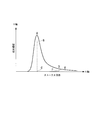
具体的には、界面活性剤(SIGMA CHEMICAL社製「NONIDET P-40」)を3滴加えた20容量%エタノール水溶液に、精秤したカーボンブラックを加えて、カーボンブラック濃度が0.01質量%の試料液を調製した。該試料液を超音波洗浄機(ULTRASONIC STIRRING BATH:LAKOMANUFACTURING CO.製)を用いて20分間分散処理することにより、カーボンブラックスラリを得た。遠心沈降式の粒度分布測定装置(BROOK HAVEN INSTRUMENTS社製「BI-DCP PARTICLSIZER」)にスピン液(純水)10mLを注入し、更にバッファー液(20容量%エタノール水溶液)1mLを注入した。その後、前記カーボンブラックスラリ1mLを注入し、回転数10000rpmで遠心沈降させ、真比重1.78でストークス相当径を計算した。図1に示すような、ストークス相当径に対して相対的な発生頻度のヒストグラムを作った。
ヒストグラムのピークAから直線BをY軸に平行に引き、ヒストグラムのX軸との交点をCとした。このときのCでのストークス直径が、モード径(Dmod)となる。また、このヒストグラムにおいて積算量が90%となる点Dから直線EをY軸に平行に引き、ヒストグラムのX軸との交点をFとした。このときのFでのストークス直径が、D90径(D90)となる。
カーボンブラックの平均一次粒子径は、透過型電子顕微鏡を用いて求めた。具体的にはカーボンブラック試料を150kHz、0.4kWの超音波分散機により、10分間クロロホルムに分散させて分散試料を作成し、これをカーボン補強した支持膜に振り掛けて固定した。これを透過型電子顕微鏡で撮影し、50000~200000倍に拡大した画像からEndterの装置を用いてランダムに1000個以上のカーボンブラックの粒子径を測定し、その平均値を平均一次粒子径とした。
先ず、磁性るつぼ(直径15mm、高さ30mm、容量10mL)及び落とし蓋を950±20℃で30分間空焼きした後、デシケータ中で室温(25℃)まで冷却し、該磁性るつぼ及び落とし蓋の質量(MA)を0.1mg単位まで正確に秤量した。次いで、カーボンブラックの2gを、磁性るつぼ中に蓋下2mmを越えない程度に押し詰めて落とし蓋をし、その質量(MB)を0.1mg単位まで正確に秤量した。その後、950±20℃の電気炉で7分間加熱し、デシケータ中で室温(25℃)まで冷却して、再度、質量(MC)を0.1mg単位まで正確に秤量して、以下の式によりカーボンブラックの揮発分を算出した。
揮発分(質量%)=(MB-MC)/(MB-MA)
カーボンブラックの灰分は、ASTM D 1506に準拠した条件で測定した。
JIS K 6217-4に記載の条件で、サンプル量20gを用いて測定を実施した。
JIS K 6217-3に記載の条件で測定を実施した。
JIS K 6217-1に記載の方法で測定を実施した。
カーボンブラック1g±0.01gを0.01gまで正確に秤量して20mLビーカーに採取した。その後、1mLのエチルアルコールと、あらかじめ沸騰させた蒸留水10mLを加え、カーボンブラックの分散液とし、時計皿で蓋をして、25℃の恒温室にて60分間放冷した。分散液が25℃になっていることを確認し、pH標準液4,7,9で公正したpHメーターを用いて、測定開始から1分後の指示値を読み取った。
(カーボンブラックのスラリ粘度)
遊星回転ボールミル(株式会社イトウ製作所製)を用い、混練温度25℃、回転数300rpmの条件下、カーボンブラック及びn-メチル-2-ピロリドンをこの順に入れ、10分間混練することにより、カーボンブラック濃度が5質量%のスラリを得た。次いで、該スラリについて、回転式粘度計(Physica MCR301、Anton Parr製)を用いて、25℃、せん断速度1/13/秒、5分間の条件で粘度を測定した。
遊星回転ボールミル(株式会社イトウ製作所製)を用い、混練温度25℃、回転数300rpmの条件下、カーボンブラック及びn-メチル-2-ピロリドンをこの順に入れ、10分間混練することにより、カーボンブラック濃度が5質量%のスラリを得た。上質紙(30mm×100mm)上にポリエチレン(PE)塗工枠(厚み0.2mm)を載せ、ガラス棒を用いて前記スラリを塗工したときの分散性を、以下の基準で評価した。
A:目視で確認できる突起物がなし。
B:目視で確認できる突起物の数が10個未満。
C:目視で確認できる突起物の数が10個以上100個未満。
D:目視で確認できる突起物の数が100個以上。
遊星回転ボールミル(株式会社イトウ製作所製)を用い、混練温度25℃、回転数300rpmの条件下、活物質であるLiFePO4の1.2g、カーボンブラックの0.12g、バインダであるポリフッ化ビニリデンの0.12g、及びn-メチル-2-ピロリドンの1.7gをこの順に入れ、10分間混練することにより、スラリを得た。上質紙(30mm×100mm)上にPET塗工枠(厚み0.2mm)を載せ、ガラス棒を用いて前記スラリを塗工した。その後、スラリが塗工された上質紙を、ホットスターラHS-5BH(アズワン株式会社製)にて80℃、30分間の条件で加熱し、n-メチル-2-ピロリドンを揮発させた。SUSローラを用いて表面を平坦にさせてから、塗工後の上質紙を20mm×20mmにカットした後、SUSローラを用いて切り出した断片を平坦にし、ハンドプレスSSP-10A(株式会社島津製作所)を用いてプレス(プレス温度25℃、プレス圧力370MPa、プレス時間1分間)を行った。さらに、バキュームオーブン(Isotemp Vacuum Oven Model 280A、Fischer Scientific製)を用いて、60℃、6時間の条件で減圧乾燥を行い、モデル正極組成膜とした。該モデル正極組成膜の表面抵抗値を、抵抗率計(ロレスタGP MCP-T610型、株式会社三菱化学アナリテック製)により測定した。
本製造例に用いた原料油の性状を以下に示す。
種類:EHE油
初留温度:198℃
10%留出温度:220℃
50%留出温度:279℃
C/H比:13.5
不純物:ナトリウム3質量ppm、鉄4質量ppm、ニッケル2質量ppm、銅2質量ppm、マンガン2質量ppm、硫黄10質量ppm
BMCI値:145
ファーネス炉を用いて、炉内への原料油の供給量(オイル供給量)を1400kg/時間、原料油1トンあたりの炉内に供給される水蒸気の比(スチーム比)を250kg/t、酸素比を570Nm3/t、メタン濃度を0.70体積%、炉内温度を1335℃、炉内圧力を30kg/cm2としてカーボンブラックを得た。さらに得られたカーボンブラックを450℃、窒素雰囲気中で乾燥した。原料油1トンあたりカーボンブラックの収量は、223kg/tであった。
オイル供給量、スチーム比、酸素比、メタン濃度、炉内温度、炉内圧力をそれぞれ表1に示すように変更した以外は、製造例1と同様にしてカーボンブラックを得た。
ファーネス炉を用いて、炉内へのエマルジョン原料油の供給量2222kg/時間(原料油としての供給量2000kg/時間)、原料油1トンあたりの炉内に供給される水蒸気の比(スチーム比)を515kg/t、酸素比を635Nm3/t、メタン濃度を0.83体積%、炉内温度を1305℃、炉内圧力を30kg/cm2としてカーボンブラックを得た。さらに得られたカーボンブラックを450℃、窒素雰囲気中で乾燥した。原料油1トンあたりカーボンブラックの収量は、130kg/tであった。
製造例1~5で得られたカーボンブラックのDBP吸油量、BET比表面積、Dmod、D90、比D90/Dmod、平均一次粒子径、収量、灰分、CTAB吸着比表面積、比(CTAB/BET)、24M4DBP吸油量、ヨウ素吸着量及び1質量%水溶液のpHを表1に示す。

製造例1~4で得られたカーボンブラックについて、スラリ粘度、分散性及び表面抵抗率の性能評価を行った。
比較対象のカーボンブラックとして、製造例5で得られたDBP吸油量が324cm3/100g、BET比表面積が800m2/g、比D90/Dmodが1.80(D90=0.200μm、Dmod=0.111μm)のカーボンブラックの性能評価を行った。
比較対象のカーボンブラックとして、DBP吸油量が193cm3/100g、BET比表面積が55m2/g、比D90/Dmodが3.47(D90=0.406μm、Dmod=0.117μm)の市販カーボンブラックの性能評価を行った。
比較対象のカーボンブラックとして、DBP吸油量が166cm3/100g、BET比表面積が256m2/g、比D90/Dmodが1.70(D90=0.292μm、Dmod=0.172μm)の市販カーボンブラックの性能評価を行った。
比較例1のカーボンブラックと比較例3のカーボンブラックを質量比59/41でブレンドして得られる、DBP吸油量が280cm3/100g、BET比表面積が576m2/g、比D90/Dmodが1.75(D90=0.238μm、Dmod=0.136μm)となるカーボンブラックの性能評価を行った。
比較例1のカーボンブラックと比較例2のカーボンブラックを質量比52/48でブレンドして得られる、DBP吸油量が280cm3/100g、BET比表面積が443m2/g、比D90/Dmodが2.62(D90=0.299μm、Dmod=0.114μm)となるカーボンブラックの性能評価を行った。
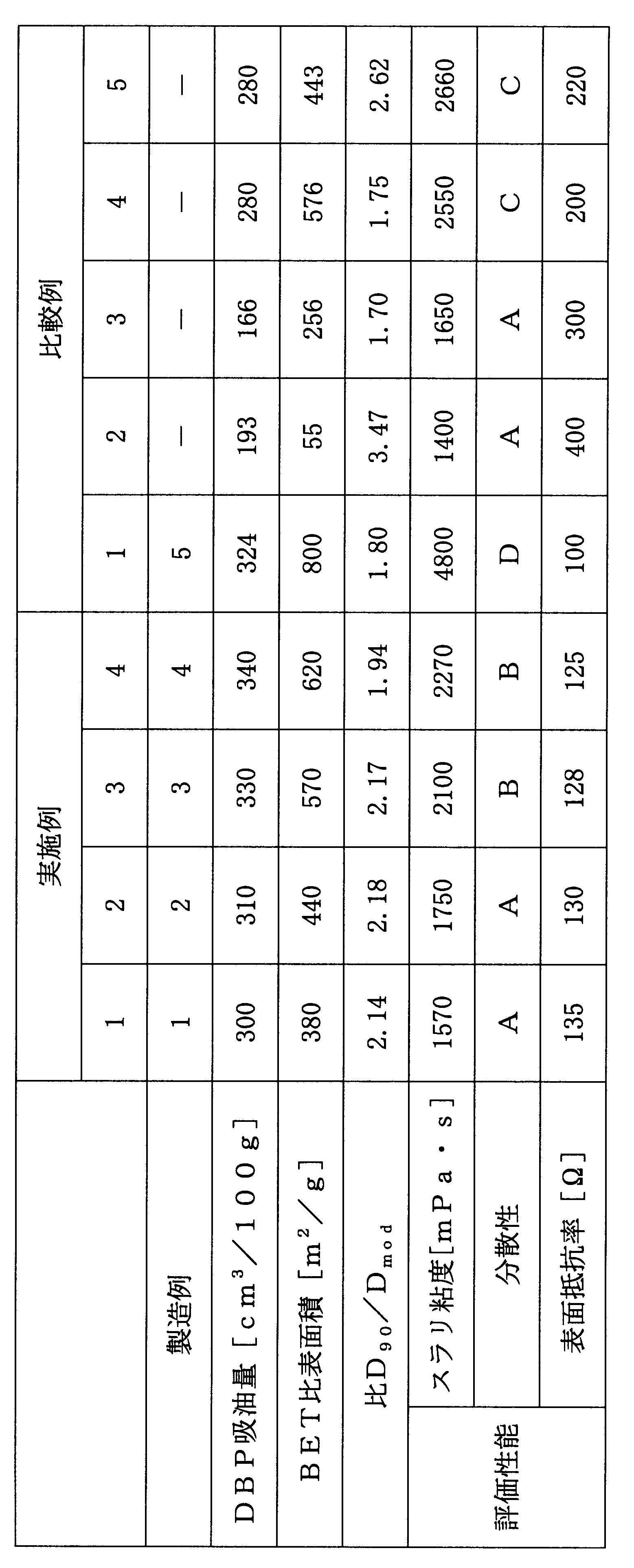
一方、条件(2)を満たすものの条件(1)、(3)を満たさない比較例1のカーボンブラックにおいては、導電性は良好であるものの、スラリ粘度が著しく高く、分散性が劣っていた。また、条件(1)、(2)及び(3)をいずれも満たさない比較例2及び3のカーボンブラックは、表面抵抗率が大きく、導電性が劣っていた。
また、条件(1)及び(2)を満たすものの条件(3)を満たさない、2種のカーボンブラックをブレンドした比較例4及び5では、実施例に比べて導電性が劣っており、また充分な分散性も得られなかった。
製造例1で得られたカーボンブラックの10質量部と、ポリカーボネート樹脂(商品名「ユーピロンS-3000」、三菱エンジニアリングプラスチックス社製)の90質量部とを、二軸押出機によりシリンダー温度260~290℃で混練して押出し、冷却した。その後にペレタイザーにより円柱状のペレット状コンパウンドとした導電性樹脂組成物を得た。
用いるカーボンブラックを表2に示すように変更した以外は、実施例1aと同様にして導電性樹脂組成物を得た。
比較対象のカーボンブラックとして、製造例5で得られたDBP吸油量が324cm3/100g、BET比表面積が800m2/g、比D90/Dmodが1.80(D90=0.200μm、Dmod=0.111μm)のカーボンブラックを8質量部、ポリカーボネート樹脂を92質量部用いた以外は、実施例1aと同様にして導電性樹脂組成物を得た。
比較対象のカーボンブラックとして、DBP吸油量が193cm3/100g、BET比表面積が55m2/g、比D90/Dmodが3.47(D90=0.406μm、Dmod=0.117μm)の市販のカーボンブラックを10質量部用いた以外は、実施例1aと同様にして導電性樹脂組成物を得た。
比較対象のカーボンブラックとして、DBP吸油量が193cm3/100g、BET比表面積が55m2/g、比D90/Dmodが3.47(D90=0.406μm、Dmod=0.117μm)の市販のカーボンブラックを17質量部、ポリカーボネート樹脂を83質量部用いた以外は、実施例1aと同様にして導電性樹脂組成物を得た。
比較対象のカーボンブラックとして、DBP吸油量が166cm3/100g、BET比表面積が256m2/g、比D90/Dmodが1.70(D90=0.292μm、Dmod=0.172μm)の市販のカーボンブラックを17質量部、ポリカーボネート樹脂を83質量部用いた以外は、実施例1aと同様にして導電性樹脂組成物を得た。
比較例1aのカーボンブラックと比較例3aのカーボンブラックを質量比59/41でブレンドして得られる、DBP吸油量が280cm3/100g、BET比表面積が576m2/g、比D90/Dmodが1.75(D90=0.238μm、Dmod=0.136μm)となるカーボンブラックを12質量部、ポリカーボネート樹脂を88質量部用いた以外は、実施例1aと同様にして導電性樹脂組成物を得た。
比較例1aのカーボンブラックと比較例2aのカーボンブラックを質量比52/48でブレンドして得られる、DBP吸油量が280cm3/100g、BET比表面積が443m2/g、比D90/Dmodが2.62(D90=0.299μm、Dmod=0.114μm)となるカーボンブラックを14質量部、ポリカーボネート樹脂を86質量部用いた以外は、実施例1aと同様にして導電性樹脂組成物を得た。
各例で得られた導電性樹脂組成物のペレットを用いた射出成形により、厚さ3.2mm×縦76mm×横76mmの板状の評価用試験体を作製し、横河北辰電機製デジタルマルチメーターModel 2506Aを用いてISO1853に準拠して体積抵抗率を測定した。体積抵抗率の値が小さいほど導電性に優れていることを示す。
各例で得られた導電性樹脂組成物のペレットを用いたインフレーション成形により、厚さ80~100μm×横10cm×縦10cmのフィルムを作製した。フィルム表面を目視で観察し、0.2mm以上のカーボン凝集物の個数を計測し、下記評価基準で表面平滑性を評価した。なお、カーボン凝集物の個数が少ないほどカーボンブラックの分散性に優れていることを示す。
「B」:カーボン凝集物の個数が10個未満である。
「D」:カーボン凝集物の個数が10個以上である。
各例で得られた導電性樹脂組成物のペレットを用いた射出成形により、ISO179記載のタイプ1試験体(長さ80mm×幅10mm×厚さ4mm、ノッチ付)を作製し、ISO179/1eAに準拠してシャルピー衝撃試験を行った。シャルピー衝撃強さが高いほど機械強度に優れていることを示す。

一方、条件(2)を満たすものの条件(1)及び(3)を満たさないカーボンブラックを用いた比較例1aでは、カーボンブラックの分散性が充分でなく、表面平滑性が劣っていた。また、条件(1)~(3)をいずれも満たさないカーボンブラックを用いた比較例2a~4aでは、導電性、表面平滑性及び機械強度のいずれか1つ以上が劣っていた。
また、条件(1)及び(2)を満たすものの条件(3)を満たさない、2種のカーボンブラックをブレンドしたものを用いた比較例5a及び6aでは、カーボンブラックの分散性が充分でなく、表面平滑性が劣っていた。
(電極材の製造)
遊星回転ボールミルLP-1(株式会社伊藤製作所製)を用い、混練温度25℃、回転数300rpmの条件下、複合金属酸化物であるLiFePO4の100質量部、製造例1で得られたカーボンブラックの10質量部、バインダー樹脂であるポリフッ化ビニリデンの10質量部、及びn-メチル-2-ピロリドンの170質量部をこの順に入れ、10分間混練することにより、電極合材のスラリを得た。アルミニウム箔(30mm×140mm)上にポリエチレン(PE)塗工枠(厚み0.2mm)を載せ、ガラス棒を用いて前記スラリを塗工した。その後、スラリが塗工されたアルミニウム箔を、ホットスターラHS-5BH(アズワン株式会社製)にて110℃、1時間の条件で加熱し、n-メチル-2-ピロリドンを揮発させた。SUSローラーを用いて表面を平坦にさせてから、塗工後のアルミニウム箔を20mm×20mmにカットした。その後、SUSローラーを用いて切り出した断片を平坦にし、ハンドプレスSSP-10A(株式会社島津製作所)を用いてプレス(プレス温度25℃、プレス圧力370MPa及びプレス時間1分間)を行った。さらに、バキュームオーブン(Isotemp Vacuum Oven Model 280A、Fischer Scientific製)を用いて、110℃、5時間の条件で減圧乾燥を行い、電極材とした。電極材は複数製造し、アルゴン雰囲気のドライボックス内で測定した厚みが25±3mmのものを電池特性の評価に用いた。
評価セルの組み立ては、アルゴン雰囲気のドライボックス内で行った。樹脂ローラーにより、ニッケル板(25mm×25mm)にリチウム箔(25mm×25mm)を定着させた。次いで、前記リチウム箔上にセパレータ(26mm×26mm)を積層した後、電極材(20mm×20mm)をスラリー塗工面が前記セパレータ側となるように積層し、さらにアルミニウム板(22mm×22mm)を積層した。次いで、前記セパレータと材質が同じ26mm×55mmの包装材を正方形となるように二つ折りにしたものの間に、ニッケル板、リチウム箔、セパレータ、電極材及びアルミニウム板の積層体を挟み込んだ状態で、電解液注入部を備えた筺体内に挿入した。このとき、デジタルテスターCDM-03D(株式会社カスタム製)を用いて回路内抵抗を測定し、抵抗値が0.001Ω未満で短絡が生じていないことを確認した。
ヒートシーラーFT-130(富士インパルス株式会社製)を用いて、前記筺体における電解液注入部以外の部分を封止した後、電解液注入部から電解液(1M LiPF6を含むエチレンカーボネート(EC)/ジメチルカーボネート(DMC)=1/2)0.6mLを注入し、90Torrで5分間置くことで電極材に電解液を浸み込ませ、電解液を電池内部に充分に拡散させた。その後、筺体の電解液注入部をヒートシーラーFT-130により封止し、評価セルとした。
カーボンブラック、複合金属酸化物及びバインダー樹脂を表2bに示すように変更した以外は、実施例1bと同様にして評価セルを製造した。
比較対象のカーボンブラックとして、製造例5で得られたDBP吸油量が324cm3/100g、BET比表面積が800m2/g、比D90/Dmodが1.80(D90=0.200μm、Dmod=0.111μm)のカーボンブラックを用いた以外は、実施例1bと同様にして評価セルを得た。
比較対象のカーボンブラックとして、DBP吸油量が193cm3/100g、BET比表面積が55m2/g、比D90/Dmodが3.47(D90=0.406μm、Dmod=0.117μm)の市販カーボンブラックを用いた以外は、実施例1bと同様にして評価セルを得た。
比較対象のカーボンブラックとして、DBP吸油量が166cm3/100g、BET比表面積が256m2/g、比D90/Dmodが1.70(D90=0.292μm、Dmod=0.172μm)の市販カーボンブラックを用いた以外は、実施例1bと同様にして評価セルを得た。
比較例1bのカーボンブラックと比較例3bのカーボンブラックを質量比59/41でブレンドして得られる、DBP吸油量が280cm3/100g、BET比表面積が576m2/g、比D90/Dmodが1.75(D90=0.238μm、Dmod=0.136μm)となるカーボンブラックを用いた。
比較例1bのカーボンブラックと比較例2bのカーボンブラックを質量比52/48でブレンドして得られる、DBP吸油量が280cm3/100g、BET比表面積が443m2/g、比D90/Dmodが2.62(D90=0.299μm、Dmod=0.114μm)となるカーボンブラックを用いた。
[比較例6b~8b]
比較例2bのカーボンブラックを用い、カーボンブラック、複合金属酸化物及びバインダー樹脂を表3bに示すように変更した以外は、実施例1bと同様にして評価セルを得た。
評価セルをドライボックスから取り出し、SUS板で電池電極部を15Nmのトルクで固定した。ポケットテスター(株式会社カスタム製)を用いて開回路電圧を測定し、3.4Vの電圧を示した評価セルについて、充放電装置HJ1001SD8(北斗電工株式会社製)を用いて充放電測定を行った。充放電測定では、レート0.2Cの定電流で5時間充電を行った後、さらに4.1Vの定電圧で2.5時間充電を行い、30分間静止させた。その後、レート30Cで2.0Vまで放電を行った。評価セルの理論容量に対するレート30Cでの放電における放電容量の割合を容量維持率とした。
なお、レート1Cは、評価セルの理論容量を1時間で放電できる電流値を示す。
電池特性の評価と同様にして評価セルを製造した。
評価セルをドライボックスから取り出し、SUS板で電池電極部を15Nmのトルクで固定した。ポケットテスター(株式会社カスタム製)を用いて開回路電圧を測定し、3.4Vの電圧を示した評価セルについて、充放電装置HJ1001SD8(北斗電工株式会社製)を用いてSOC50%とした。その後、周波数応答アナライザ1260型(ソーラトロン社製)、ポテンショ/ガルバノスタット1287型(ソーラトロン社製)を用いて交流インピーダンス測定を行った。測定条件は、振幅AC電位2mV、DC電位0CV、測定周波数25mHz~100kHzとした。
各例で得た電極材において、目視で観察して突起物の個数を計測し、分散性を以下の基準で評価した。
A:目視で確認できる突起物がない。
B:目視で確認できる突起物の数が10個未満。
C:目視で確認できる突起物の数が10個以上100個未満。
D:目視で確認できる突起物の数が100個以上。
各例で得た電極合材内の複合金属酸化物の割合を、下記の式にて算出した。
複合金属酸化物の割合[質量%]=複合金属酸化物[質量部]/(複合金属酸化物[質量部]+カーボンブラック[質量部]+バインダー樹脂[質量部])×100
実施例及び比較例で用いたカーボンブラックのDBP吸油量、BET比表面積、比D90/Dmod、及び評価結果を表2b及び表3bに示す。


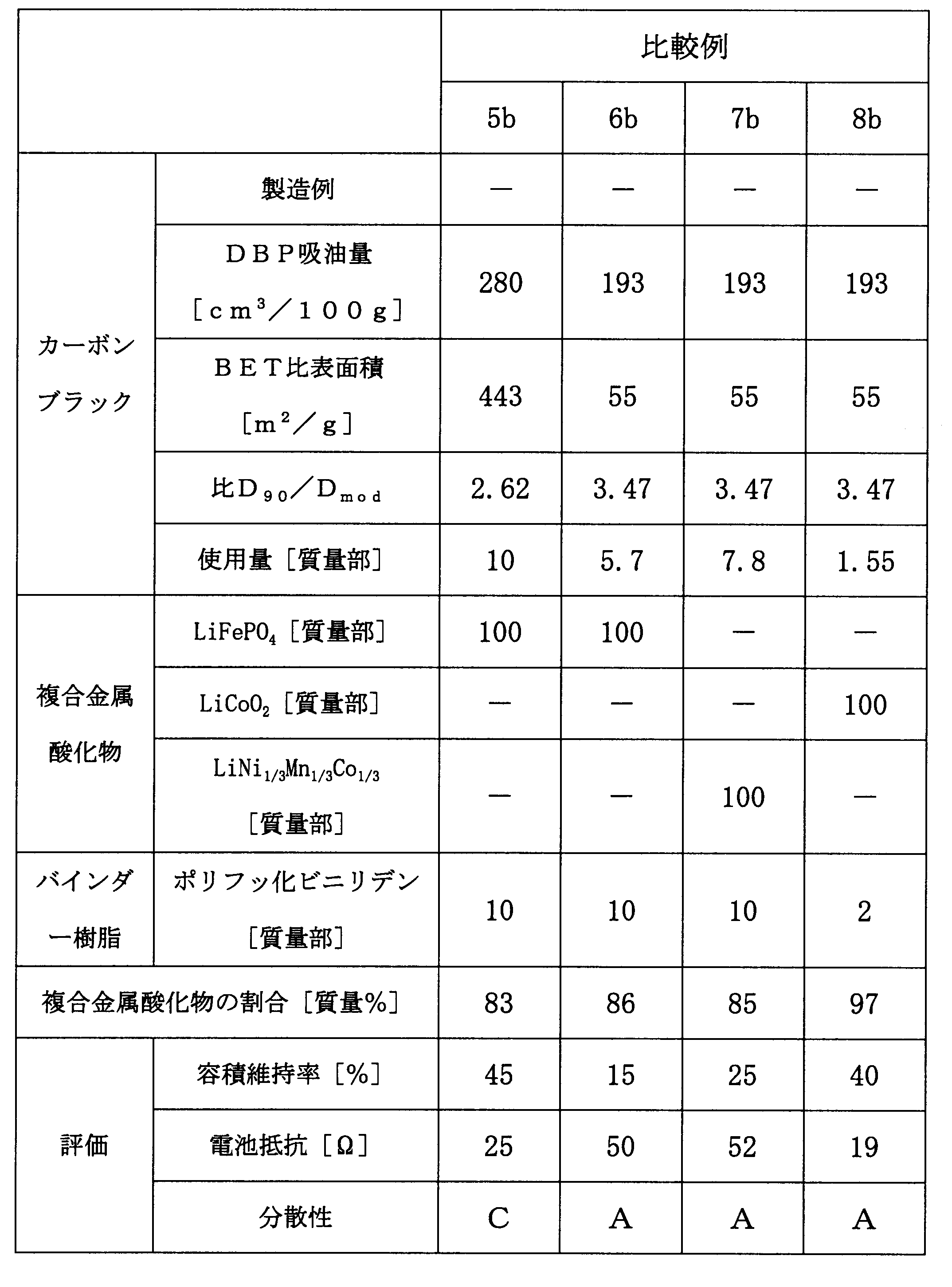
一方、表4b及び表5bに示すように、条件(2)を満たすものの条件(1)及び(3)を満たさないカーボンブラックを用いた比較例1bでは、カーボンブラックの分散性が充分でなく、電池抵抗が極端に低くなっており、内部短絡のおそれがあった。また、条件(1)~(3)をいずれも満たさないカーボンブラックを用いた比較例2b及び3bでは、レート30Cでの容量維持率が低く、実施例1b~8bと比較して電池性能が劣っていた。
また、条件(1)及び(2)を満たすものの条件(3)を満たさない、2種のカーボンブラックをブレンドしたものを用いた比較例4b及び5bでは、カーボンブラックの分散性が充分でなかった。
また、条件(1)~(3)をいずれも満たさないカーボンブラックを用いた比較例6~8では、カーボンブラックが異なる以外は同様の組成の電極合材を用いた実施例9~11に比べて、レート30Cでの容量維持率が低く、電池性能が劣っていた。
Claims (3)
- 下記条件(1)~(3)を満たすカーボンブラック。
(1)BET比表面積が350~650m2/gである。
(2)DBP吸油量が270~340cm3/100gである。
(3)JIS K6217-6に記載の凝集体径の測定方法により測定される、モード径(Dmod)に対するD90径(D90)の比D90/Dmodが1.90~2.20である。 - 請求項1に記載のカーボンブラックと、樹脂とを含有する導電性樹脂組成物。
- 請求項1に記載のカーボンブラックと、複合金属酸化物と、バインダー樹脂とを含有する電極合材。
Priority Applications (2)
| Application Number | Priority Date | Filing Date | Title |
|---|---|---|---|
| CN201480026355.6A CN105283514B (zh) | 2013-05-14 | 2014-05-14 | 炭黑、导电性树脂组合物以及电极混合材料 |
| KR1020157024491A KR102141482B1 (ko) | 2013-05-14 | 2014-05-14 | 카본블랙, 도전성 수지 조성물 및 전극합재 |
Applications Claiming Priority (6)
| Application Number | Priority Date | Filing Date | Title |
|---|---|---|---|
| JP2013102328A JP6026353B2 (ja) | 2013-05-14 | 2013-05-14 | カーボンブラック |
| JP2013-102328 | 2013-05-14 | ||
| JP2013102327A JP6035201B2 (ja) | 2013-05-14 | 2013-05-14 | 導電性樹脂組成物 |
| JP2013102329 | 2013-05-14 | ||
| JP2013-102329 | 2013-05-14 | ||
| JP2013-102327 | 2013-05-14 |
Publications (1)
| Publication Number | Publication Date |
|---|---|
| WO2014185452A1 true WO2014185452A1 (ja) | 2014-11-20 |
Family
ID=51898428
Family Applications (1)
| Application Number | Title | Priority Date | Filing Date |
|---|---|---|---|
| PCT/JP2014/062845 Ceased WO2014185452A1 (ja) | 2013-05-14 | 2014-05-14 | カーボンブラック、導電性樹脂組成物及び電極合材 |
Country Status (4)
| Country | Link |
|---|---|
| KR (1) | KR102141482B1 (ja) |
| CN (1) | CN105283514B (ja) |
| TW (1) | TWI613262B (ja) |
| WO (1) | WO2014185452A1 (ja) |
Cited By (10)
| Publication number | Priority date | Publication date | Assignee | Title |
|---|---|---|---|---|
| EP3438197A4 (en) * | 2016-03-29 | 2019-09-25 | Techno-UMG Co., Ltd. | THERMOPLASTIC RESIN COMPOSITION AND FORM BODY USED THEREOF |
| CN114085518A (zh) * | 2021-10-27 | 2022-02-25 | 金发科技股份有限公司 | 一种阻燃尼龙复合材料及其制备方法和应用 |
| JPWO2022080496A1 (ja) * | 2020-10-15 | 2022-04-21 | ||
| EP4234638A4 (en) * | 2020-12-04 | 2024-05-01 | Denka Company Limited | CARBON BLACK, SLURRY, AND LITHIUM-ION SECONDARY BATTERY |
| EP4234639A4 (en) * | 2020-12-04 | 2024-05-01 | Denka Company Limited | SOOT, SLUDGE AND LITHIUM-ION SECONDARY BATTERY |
| EP4234637A4 (en) * | 2020-12-04 | 2024-05-01 | Denka Company Limited | SOOT, SLUDGE AND LITHIUM-ION SECONDARY BATTERY |
| EP4245813A4 (en) * | 2021-02-05 | 2024-05-08 | Denka Company Limited | CARBON BLACK, METHOD FOR PRODUCING CARBON BLACK, COMPOSITION FOR ELECTRODE, ELECTRODE AND SECONDARY BATTERY |
| EP4235846A4 (en) * | 2020-12-04 | 2024-05-15 | Denka Company Limited | SOOT, SLUDGE AND LITHIUM-ION SECONDARY BATTERY |
| EP4245814A4 (en) * | 2021-02-05 | 2024-07-03 | Denka Company Limited | CARBON BLACK, METHOD FOR PRODUCING CARBON BLACK, COMPOSITION FOR ELECTRODE, ELECTRODE AND SECONDARY BATTERY |
| US20240219335A1 (en) * | 2021-03-19 | 2024-07-04 | Panasonic Intellectual Property Management Co., Ltd. | Sensitive membrane and gas sensor |
Families Citing this family (8)
| Publication number | Priority date | Publication date | Assignee | Title |
|---|---|---|---|---|
| KR102493033B1 (ko) * | 2014-09-09 | 2023-01-30 | 덴카 주식회사 | 전지용 카본 블랙, 혼합 분말, 전지용 도공액, 전지용 전극 및 전지 |
| US11264616B2 (en) | 2016-09-07 | 2022-03-01 | Denka Company Limited | Conductive composition for electrodes, and electrode and battery using same |
| PL3639312T3 (pl) * | 2017-06-15 | 2022-01-31 | Cabot Corporation | Elektrody i baterie zawierające różniące się cząstki sadzy |
| CN111162278A (zh) * | 2019-12-24 | 2020-05-15 | 浙江野马电池股份有限公司 | 一种碱锰电池用导电剂及其制备方法 |
| CN112322077B (zh) * | 2020-08-27 | 2021-09-10 | 山东联科新材料有限公司 | 一种环保型电缆屏蔽料用炭黑的生产方法 |
| JP7634264B2 (ja) * | 2021-06-15 | 2025-02-21 | ショーワグローブ株式会社 | ゴムラテックス配合物、手袋の製造方法及び手袋 |
| CN115611285B (zh) * | 2022-10-13 | 2023-06-23 | 焦作市和兴化学工业有限公司 | 一种浆料及其制备方法、设备 |
| CN119081279B (zh) * | 2024-11-07 | 2025-04-01 | 北京怀柔实验室 | 半导电屏蔽材料及其制备方法和应用 |
Citations (7)
| Publication number | Priority date | Publication date | Assignee | Title |
|---|---|---|---|---|
| JPH0368666A (ja) * | 1989-08-08 | 1991-03-25 | Tokai Carbon Co Ltd | 導電性ファーネスカーボンブラック |
| JPH11158321A (ja) * | 1997-11-27 | 1999-06-15 | Mikuni Shikiso Kk | 導電性高濃度カーボンブラック分散体およびその製造方法、ならびにそれからなる組成物 |
| JP2001139840A (ja) * | 1999-11-17 | 2001-05-22 | Tokai Carbon Co Ltd | カーボンブラック |
| JP2001311034A (ja) * | 2000-04-28 | 2001-11-09 | Mikuni Color Ltd | 電子写真用導電性高濃度カーボンブラック分散体およびその製造方法、ならびにそれからなる組成物 |
| JP2003020419A (ja) * | 2001-07-06 | 2003-01-24 | Tokai Carbon Co Ltd | 水性インキ用カーボンブラック顔料とそれを用いた水性インキ |
| JP2005307070A (ja) * | 2004-04-23 | 2005-11-04 | Denki Kagaku Kogyo Kk | カーボンブラック、その製造方法、及びそれを含有した組成物 |
| JP2006213767A (ja) * | 2005-02-01 | 2006-08-17 | Mitsubishi Chemicals Corp | 導電性熱可塑性樹脂組成物およびicトレー |
Family Cites Families (16)
| Publication number | Priority date | Publication date | Assignee | Title |
|---|---|---|---|---|
| JPS6060912A (ja) | 1983-09-13 | 1985-04-08 | Mitsubishi Petrochem Co Ltd | 導電性カ−ボンの製造方法 |
| JPS6067564A (ja) | 1983-09-22 | 1985-04-17 | Mitsubishi Petrochem Co Ltd | 高導電性カ−ボンブラツクの製造方法 |
| JPS6088073A (ja) | 1983-10-21 | 1985-05-17 | Mitsubishi Petrochem Co Ltd | 高導電性カ−ボンブラツク配合組成物 |
| JPS60152569A (ja) | 1984-01-18 | 1985-08-10 | Mitsubishi Petrochem Co Ltd | 新規なカ−ボンブラツク |
| JPS60197763A (ja) | 1984-03-21 | 1985-10-07 | Mitsubishi Petrochem Co Ltd | カ−ボンブラツク配合抵抗体 |
| JPH04125146A (ja) * | 1990-09-14 | 1992-04-24 | Toray Ind Inc | ポリプロピレン複合フイルム |
| JPH08176348A (ja) * | 1994-12-27 | 1996-07-09 | Yokohama Rubber Co Ltd:The | 空気入りタイヤ |
| CN1492002A (zh) * | 1997-08-28 | 2004-04-28 | 三菱化学株式会社 | 炭黑及其制备方法 |
| JPH11335583A (ja) * | 1998-05-25 | 1999-12-07 | Mitsubishi Chemical Corp | カーボンブラック |
| CN100436549C (zh) * | 2003-08-05 | 2008-11-26 | 三菱化学株式会社 | 炭黑 |
| CN100441640C (zh) * | 2003-09-26 | 2008-12-10 | 三菱化学株式会社 | 炭黑和使用炭黑的记录液 |
| JP4889460B2 (ja) | 2006-12-05 | 2012-03-07 | 信越ポリマー株式会社 | 半導体搬送容器用部品用導電性樹脂組成物及びこれを用いた半導体搬送容器用部品並びに半導体搬送容器 |
| US8435425B2 (en) * | 2009-04-24 | 2013-05-07 | Lion Corporation | Polar dispersion composition of carbon black |
| US8895142B2 (en) * | 2009-11-02 | 2014-11-25 | Cabot Corporation | High surface area and low structure carbon blacks for energy storage applications |
| MX2013003968A (es) * | 2010-10-15 | 2013-06-28 | Borealis Ag | Composicion polimerica semiconductora. |
| JP5702217B2 (ja) * | 2011-04-22 | 2015-04-15 | 住友ゴム工業株式会社 | タイヤ用ゴム組成物及び空気入りタイヤ |
-
2014
- 2014-05-14 KR KR1020157024491A patent/KR102141482B1/ko active Active
- 2014-05-14 CN CN201480026355.6A patent/CN105283514B/zh active Active
- 2014-05-14 TW TW103116985A patent/TWI613262B/zh active
- 2014-05-14 WO PCT/JP2014/062845 patent/WO2014185452A1/ja not_active Ceased
Patent Citations (7)
| Publication number | Priority date | Publication date | Assignee | Title |
|---|---|---|---|---|
| JPH0368666A (ja) * | 1989-08-08 | 1991-03-25 | Tokai Carbon Co Ltd | 導電性ファーネスカーボンブラック |
| JPH11158321A (ja) * | 1997-11-27 | 1999-06-15 | Mikuni Shikiso Kk | 導電性高濃度カーボンブラック分散体およびその製造方法、ならびにそれからなる組成物 |
| JP2001139840A (ja) * | 1999-11-17 | 2001-05-22 | Tokai Carbon Co Ltd | カーボンブラック |
| JP2001311034A (ja) * | 2000-04-28 | 2001-11-09 | Mikuni Color Ltd | 電子写真用導電性高濃度カーボンブラック分散体およびその製造方法、ならびにそれからなる組成物 |
| JP2003020419A (ja) * | 2001-07-06 | 2003-01-24 | Tokai Carbon Co Ltd | 水性インキ用カーボンブラック顔料とそれを用いた水性インキ |
| JP2005307070A (ja) * | 2004-04-23 | 2005-11-04 | Denki Kagaku Kogyo Kk | カーボンブラック、その製造方法、及びそれを含有した組成物 |
| JP2006213767A (ja) * | 2005-02-01 | 2006-08-17 | Mitsubishi Chemicals Corp | 導電性熱可塑性樹脂組成物およびicトレー |
Cited By (14)
| Publication number | Priority date | Publication date | Assignee | Title |
|---|---|---|---|---|
| US10669416B2 (en) | 2016-03-29 | 2020-06-02 | Techno-Umg Co., Ltd. | Thermoplastic resin composition and molded article in which same is used |
| EP3438197A4 (en) * | 2016-03-29 | 2019-09-25 | Techno-UMG Co., Ltd. | THERMOPLASTIC RESIN COMPOSITION AND FORM BODY USED THEREOF |
| WO2022080496A1 (ja) * | 2020-10-15 | 2022-04-21 | ライオン・スペシャリティ・ケミカルズ株式会社 | 導電性ペースト組成物、導電膜、電気抵抗型センサ |
| JPWO2022080496A1 (ja) * | 2020-10-15 | 2022-04-21 | ||
| EP4234639A4 (en) * | 2020-12-04 | 2024-05-01 | Denka Company Limited | SOOT, SLUDGE AND LITHIUM-ION SECONDARY BATTERY |
| EP4234638A4 (en) * | 2020-12-04 | 2024-05-01 | Denka Company Limited | CARBON BLACK, SLURRY, AND LITHIUM-ION SECONDARY BATTERY |
| EP4234637A4 (en) * | 2020-12-04 | 2024-05-01 | Denka Company Limited | SOOT, SLUDGE AND LITHIUM-ION SECONDARY BATTERY |
| EP4235846A4 (en) * | 2020-12-04 | 2024-05-15 | Denka Company Limited | SOOT, SLUDGE AND LITHIUM-ION SECONDARY BATTERY |
| EP4245813A4 (en) * | 2021-02-05 | 2024-05-08 | Denka Company Limited | CARBON BLACK, METHOD FOR PRODUCING CARBON BLACK, COMPOSITION FOR ELECTRODE, ELECTRODE AND SECONDARY BATTERY |
| EP4245814A4 (en) * | 2021-02-05 | 2024-07-03 | Denka Company Limited | CARBON BLACK, METHOD FOR PRODUCING CARBON BLACK, COMPOSITION FOR ELECTRODE, ELECTRODE AND SECONDARY BATTERY |
| EP4700841A3 (en) * | 2021-02-05 | 2026-04-29 | Denka Company Limited | Carbon black, carbon black production method, compistion for electrode, electrode, and secondary battery |
| EP4733361A1 (en) * | 2021-02-05 | 2026-04-29 | Denka Company Limited | Carbon black, carbon black production method, composition for electrode, and secondary battery |
| US20240219335A1 (en) * | 2021-03-19 | 2024-07-04 | Panasonic Intellectual Property Management Co., Ltd. | Sensitive membrane and gas sensor |
| CN114085518A (zh) * | 2021-10-27 | 2022-02-25 | 金发科技股份有限公司 | 一种阻燃尼龙复合材料及其制备方法和应用 |
Also Published As
| Publication number | Publication date |
|---|---|
| KR102141482B1 (ko) | 2020-08-10 |
| CN105283514A (zh) | 2016-01-27 |
| TWI613262B (zh) | 2018-02-01 |
| CN105283514B (zh) | 2017-09-19 |
| TW201502215A (zh) | 2015-01-16 |
| KR20160010399A (ko) | 2016-01-27 |
Similar Documents
| Publication | Publication Date | Title |
|---|---|---|
| WO2014185452A1 (ja) | カーボンブラック、導電性樹脂組成物及び電極合材 | |
| Mengesha et al. | A polydopamine-modified garnet–based polymer-in-ceramic hybrid solid electrolyte membrane for high-safety lithium metal batteries | |
| KR102275042B1 (ko) | 그래핀 분산액, 전극 페이스트를 제조하는 방법, 및 전극을 제조하는 방법 | |
| CN101292389B (zh) | 锂二次电池以及其中使用的非水电解液 | |
| JP6155224B2 (ja) | 電極合材 | |
| US10870761B2 (en) | High-conductive carbon black with low viscosity | |
| TWI765100B (zh) | 鋰離子二次電池用負極材料、其製造方法、負極用漿料、負極薄片及鋰離子二次電池 | |
| Prabakar et al. | Graphene-sandwiched LiNi0. 5Mn1. 5O4 cathode composites for enhanced high voltage performance in Li ion batteries | |
| JP6026353B2 (ja) | カーボンブラック | |
| WO2022138939A1 (ja) | 非水系電解液を使用する二次電池用電極の製造方法及び非水系電解液を使用する二次電池電極用結着剤 | |
| DE102017121250A1 (de) | Leistungsfähige siziumelektroden mit verbesserter grenzflächenhaftung zwischen bindemittel, silizium und leitfähigen partikeln | |
| CN105900269A (zh) | 锂离子二次电池用负极活性物质 | |
| CN104718158B (zh) | 碳材料、电池电极用碳材料以及电池 | |
| JP2011044245A (ja) | 非水電解質二次電池 | |
| Kwon et al. | Polypropylene nanocomposites doped with carbon nanohorns for high-voltage power cable insulation applications | |
| JPH0416500B2 (ja) | ||
| Zhou et al. | Fluoroethylene carbonate as the additive of lithium difluoro (oxalate) borate–sulfolane electrolytes to improve the electrochemical performance of LiNi0. 5Mn1. 5O4 cathode | |
| Yang et al. | Silane-modified Li6. 4La3Zr1. 4Ta0. 6O12 in thermoplastic polyurethane-based polymer electrolyte for all-solid-state lithium battery | |
| JP6035201B2 (ja) | 導電性樹脂組成物 | |
| KR20240101807A (ko) | 카본 블랙 및 팽창된 그래파이트를 포함하는 조성물, 및 이를 포함하는 성형 물품 및 기재 코팅, 이의 용도, 및 체적 저항률을 감소시키고, 열 전도도는 물론 전자기 간섭 차폐를 제공하기 위한 방법 | |
| JP2019071304A (ja) | グラフェン系炭素粒子を含むリチウムイオンバッテリ電極 | |
| WO1999062130A1 (en) | Method of producing an electrode for non-aqueous electrolytic secondary cells | |
| CN111584934B (zh) | 锂二次电池 | |
| JP2016136452A (ja) | ナトリウムイオン二次電池負極用炭素材、ナトリウムイオン二次電池負極用活物質、ナトリウムイオン二次電池負極、ナトリウムイオン二次電池、ナトリウムイオン二次電池負極用樹脂組成物、およびナトリウムイオン二次電池負極用炭素材製造方法 | |
| KR102952952B1 (ko) | 소듐 이차전지용 양극 및 이를 포함하는 소듐 이차전지 |
Legal Events
| Date | Code | Title | Description |
|---|---|---|---|
| WWE | Wipo information: entry into national phase |
Ref document number: 201480026355.6 Country of ref document: CN |
|
| 121 | Ep: the epo has been informed by wipo that ep was designated in this application |
Ref document number: 14797079 Country of ref document: EP Kind code of ref document: A1 |
|
| ENP | Entry into the national phase |
Ref document number: 20157024491 Country of ref document: KR Kind code of ref document: A |
|
| NENP | Non-entry into the national phase |
Ref country code: DE |
|
| 122 | Ep: pct application non-entry in european phase |
Ref document number: 14797079 Country of ref document: EP Kind code of ref document: A1 |